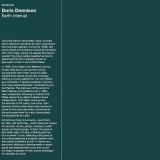
The discovery of Doris Dennison's score represents a genuine musicological breakthrough—what once would have been "a tree falling in the woods" thirty years ago now holds the potential to render "a thunderous clap in our minds." While researching Anna Halprin's lesser-known collaborators, scholar Tom Welsh uncovered the archives of AA Leath, one of Halprin's principal dancers. Buried within these materials was Dennison's handwritten score for Earth Interval, dated May 1956. Born in Saskatchewan, Canada, in 1908, and raised near Seattle, Dennison (1908-2009) encountered John Cage while teaching Dalcroze eurythmics at the Cornish College of the Arts. She joined Cage's earliest percussion quartet—alongside Margaret Jansen, the composer and his wife Xenia—in the group widely regarded as having performed the first complete concert of percussion music in the United States. This historic December 1938 concert was followed by tours and the landmark May 1941 performance at the California Club, comprising Cage and Lou Harrison's Double Music, the premiere of Cage's Third Construction, and Harrison's 13th Simfony.
As Bradford Bailey observes in his extensive liner notes, Earth Interval demonstrates "an extraordinary balance of elements that imbues the piece with a sense of clarity, directness, and constraint that is both distinct and ahead of its time." The work's most remarkable innovation lies in its approach to extended techniques, particularly Dennison's notation for the central movement: "In 2nd movement, 1st player lowers + raises a gong into a tub of water while beating." This technique, absorbed from Cage's experimental vocabulary, generates what Bailey describes as "fields of acoustic abstraction that bend and warp time through sustained resonances, beat, and space." The temporal sophistication of these manipulations anticipated Karlheinz Stockhausen's Mikrophonie I (1964) and Annea Lockwood's water-based sound investigations by over a decade. After joining Mills College as dance accompanist, Dennison maintained crucial connections to the Bay Area's experimental scene, collaborating with figures like Merce Cunningham and programming Cage's music throughout the 1950s.
Comprising three movements—Land Form, Air Tide, and Earth Play—Earth Interval is scored for recorder, drums, gongs, maracas, muted gongs, and bowl gongs. In total, the piece is just under eight minutes: "a fleeting glimmer of moment in time, a life spent at the cutting edge, and a singular creative vision that packs a powerful punch." When viewed in historical context, placed in contrast to roughly contemporaneous avant-garde percussion works by Cage, Harrison, Louis Thomas Hardin (Moondog), and Harry Partch, or important precursors like Edgard Varèse's Ionisation (1931) and Henry Cowell's Ostinato Pianissimo (1934), it's clear that Dennison was following her own path. Earth Interval is not derivative. It is a precursor to what was yet to come, alluding to developments of avant-garde and experimental music that wouldn't begin to appear on the cultural landscape until the 1970s and '80s, with the emergence of Post-Minimalism and more idiosyncratic artists and ensembles like Midori Takada, Ros Bandt, Peter Giger, Frank Perry, Christopher Tree, Michael Ranta, Gamelan Son of Lion, and Niagara.
This recording by Chicago's Third Coast Percussion, captured in March 2022, represents the first complete documentation of this pioneering work. The ensemble's interpretation reveals the piece's remarkable contemporaneity while maintaining its historical specificity. Where Cage, Harrison, and Partch employed "self-consciously off-kilter polyrhythms," Dennison's rhythmic sensibility anticipates minimalist developments by nearly a decade, yet integrates "forceful rests, as well as sharp shifts in sonic character, tempo, and meter, that break the momentum and breathe a sense of life into the piece's structure." This positions her work closer to Post-Minimalism decades before its emergence. The architectural approach demonstrates Dennison's understanding that "the composer almost entirely disappears" in favor of phenomenological listening experience, creating what might be called an egoless music that places its realities and meaning entirely in the ear of the beholder. The present recording, realized by Chicago's distinguished Third Coast Percussion ensemble, represents a significant achievement in experimental music scholarship and performance practice. As specialists in the Cage tradition and contemporary percussion repertoire, Third Coast Percussion approached Earth Interval with the historical sensitivity and technical precision required to illuminate Dennison's subtle compositional innovations. The March 2022 recording sessions, engineered by Colin Campbell, capture both the work's intimate chamber music qualities and its bold exploration of extended techniques. The ensemble's interpretation reveals the piece's remarkable contemporaneity—its ability to speak directly to current musical concerns while maintaining its historical specificity.
This recording serves multiple scholarly functions: it provides the first complete documentation of Dennison's compositional voice, offers insight into the broader network of experimental music practitioners surrounding Cage and Harrison, and demonstrates the sophisticated level of compositional thinking that was occurring within the Bay Area's dance-music collaborations of the 1950s. The work's emphasis on phenomenological listening—what might be called an "egoless" approach to musical experience—places it within a lineage of American experimental music that prioritizes perceptual process over compositional personality. The work's original obscurity—limited to AA Leath's performances at venues like the 1957 Pacific Coast Arts Festival at Reed College—paradoxically allowed it to remain "entirely on its own terms," free from the constraints of historical categorization. Drawing on Jacques Derrida's Archive Fever, the argument emerges that "the archive can acknowledge, celebrate, and resurrect" overlooked voices, transforming our understanding of experimental music history. The present Blume edition, featuring Third Coast Percussion's authoritative interpretation, includes a lavishly illustrated 16-page booklet designed by Bruno Stucchi / dinamomilano, containing complete scholarly apparatus, historical photographs, and detailed production notes. This recording enables "cross-temporal intersectionality," allowing Dennison to "belong to a newly formed and more dynamic understanding of the present and past," demonstrating how forgotten voices can reshape entire historical narratives when given proper scholarly attention and performance advocacy.
Cerca:architectural
Special Edition[39,49 €]
2025 repress. Expo 70, held in Osaka, was a pivotal event for the Japanese people and their relationship with the rest of the world, demonstrating both the nation's ongoing economic recovery from World War Two and the creative spirit of Japanese society and its artists. The event gained international acclaim for its adventurous architectural design, visual art and electronic music. Some of Japan's most renowned composers were involved, but also present were the now-legendary rockers, the Flower Travellin' Band. A series of performances, billed as "Night Events" were held at the Expo; the most radical of these was "Beam Penetration and Mad Computer, plus the Minimal Sound of Motorcycles", but its anti-establishment feel and general madness took the Expo organizers by surprise and it was cancelled after only one night, despite being scheduled for a longer run. An air of myth developed around the event, but a recording of the event has been discovered and this release is the result. And what an event it was: a night-time sound-bomb with a fabled band, electronic sound and 50 motorcycles with horns blaring,spotlights, electronic billboards and a robot ― all flashing, roaring andhowling at the night sky. This release comprises a CD, a 10-inch record with fold-out sleeve and large obi, plus fascinating notes in Japanese and English by Kenichi Yasuda, an expert on Japanese rock music, and Koji Kawasaki, a renowned researcher of Japanese electronic music, as well as rare photos.
- Ete
- Kharita
- Baynana
- Mudun
- Haigazian (October 22)
- Burj Al Murr (October 25 To 27)
- Markaz Azraq (December 6)
- Markaz Ahmar (December 6 Suite)
- Al Hisar (December 8)
- Holiday Inn (January To March)
- Holiday Inn (March 21 To 29)
- Al Irth
Mayssa Jallad is a Beirut-based bilingual singer-songwriter, architectural researcher and teacher. Her work deals with the highly personal as well as the political, as with her first solo album "Marjaa: The Battle of the Hotels", which explores the histories of urban battles that occurred before she was born, during the Lebanese Civil War, through a collaborative musical and architectural lens. "(Marjaa) is, as one might expect, a sombre affair largely comprised of Jallad's delicate vocals backed by acoustic guitar and ethereal synthesizer. Elsewhere, co-composer and producer Fadi Tabbal adds the crackle of distant artillery and a ghostly wind between the high-rise blocks." - Daniel Spicer, Songlines, April 2023 "Historical trauma, strings, drones, metallophones and buzuks wrap around powerful stories and gossamer vocals on Lebanese singer's tender, intimate debut. With shades of Nico, Jarboe and Elizabeth Fraser, '80s' 4AD fans will rejoice." - Andy Cowan, MOJO `Marjaa_' (tr. `reference') combined Mayssa Jallad's two main vocations: music and urban research/architectural history. The album was co-written with Fadi Tabbal and based on Mayssa's Historic Preservation master's thesis (`Beirut's Civil War Hotel District: Preserving the World's First High-Rise Urban Battlefield'). The thesis examined a 5-month conflict that took place within Beirut's skyscraper-laden luxury hotel district of Minet El Husn near the start of the Lebanese Civil War. Addressing a post-war generation who have never been taught this difficult history, `Marjaa_' was an attempt to process trauma, and "a call to protest for the renewal, rather than the recycling of the political class that once destroyed the country and holds us, to this day, hostage of its violence". In 2013, Mayssa founded indie-pop band Safar with guitarist Elie Abdelnour, releasing debut album In Transit with Lebanese indie label Ruptured in 2017, and follow-up EP Studies of an Unknown Lover in 2019. Both albums were produced by Lebanese producer Fadi Tabbal at Tunefork Studios in Beirut. Mayssa's most recent multi-genre collaborations include "Madina min Baeed" (2022) with electronic musician/producer Khaled Allaf; "Bi Kheir" and "Fil Aatma" (2022) with indie supergroup Baada Ab (Dani Shukri, Ezra Tenenbaum and Omaya Malaeb), released by Thawra records and Found Sound Nation. Next is the Versions version of Marjaa, which sees Civilistjävel! (aka Swedish producer Tomas Bodén) apply a stripped, dub methodology to Mayssa's original rich stems, refracting the Arabic source through the hazy prism of Northern European electronica. 140gsm vinyl, jacket printed on 20pt board with aqueous gloss coating, with a 3.5mm spine and a black paper inner dust sleeve.
Civilistjävel! x Mayssa Jallad’s ‘Marjaa: The Battle of the Hotels (Versions)’ is a radical response to Mayssa Jallad’s 2023 original LP, a lyrical account of epochal events in Beirut at the dawn of Lebanon's civil war. ‘…(Versions)’ sees Civilistjävel! (aka Swedish producer Tomas Bodén) apply a stripped, dub methodology to Mayssa's rich stems, refracting the Arabic source through the hazy prism of Northern European electronica. Retaining ‘Marjaa…’s deep spatial framing and vaporous, shifting nature, traces are lifted and set down in a new landscape: a ghost of a ghost. Informed by Tomas' singular strand of ambient, minimalist, dub techno, ‘… (Versions)’ recalls the reductive, shimmering pulse of pioneering Berlin-based practitioners Basic Channel/Chain Reaction, but with the parameters stretched into the ether. Where versions typically focus on a rhythm, here the anchor is the tone and texture of Mayssa’s voice, around which a new world has been constructed. Disembodied and liminal, it conjures an eerie panorama that feels like a postscript to the original, further emphasizing the geopolitical events that have had such devastating effect in Mayssa’s homeland of Lebanon since that record’s release. ‘Marjaa…’ (tr. ‘reference’) combined Mayssa Jallad’s two main vocations: music and urban research/architectural history. The album was co-written with Fadi Tabbal and based on Mayssa's Historic Preservation master's thesis (‘Beirut’s Civil War Hotel District: Preserving the World’s First High-Rise Urban Battlefield’). The thesis examined a 5-month conflict that took place within Beirut's skyscraper-laden luxury hotel district of Minet El Husn near the start of the Lebanese Civil War. Addressing a post-war generation who have never been taught this difficult history, ‘Marjaa…’ was an attempt to process trauma, and “a call to protest for the renewal, rather than the recycling of the political class that once destroyed the country and holds us, to this day, hostage of its violence.” Often perceived as a mysterious, shadowy presence, Civilistjävel! has come increasingly to the fore in recent years through a consistently dazzling stream of records, released both anonymously and via Fergus Jones’ FELT imprint, often appearing with scant information and tracks for the most part untitled. Having featured tracks from ‘Marjaa…’ on mixes, and included the album in his picks of 2023, in early 2024 Tomas asked Mayssa to provide vocals for a track on his album ‘Brödföda’. Mayssa remembers, “Tomas asked me to choose one of the tracks he was working on. I was in Boston at the time, so I took a walk and chose a track. I wrote the lyrics at the public park, wondering if I was the only one around that was losing sleep over the genocide in Palestine and the war in South Lebanon. I went back to the apartment and recorded the vocals on my phone, while listening to the track on headphones. Tomas reworked it with the voice and sent it back. I liked it immediately.” Despite the geographical distance from Beirut to Uppsala, Sweden, where Tomas resides, Mayssa’s contribution sounds very much at home in Civilistjävel!’s atmospheric, contemplative sound-world. Tomas’ request was reciprocated by Mayssa soon after, resulting in the spectral, glassy ambience of ‘Etel, Kharita (Version)’. This was followed by an invitation to work on more tracks, which Tomas immediately embraced, intensively jamming out versions live to two-track tape in downtime between travelling. If not entirely dissimilar to his regular working practice, the immediacy of it was unusual. Much was improvised live with just a keyboard (not tethered to a grid), and a restricted set-up that largely forbade later edits - only the rhythm tracks are programmed. A sharp conceptual thinker and composer, Tomas takes creative liberties with Mayssa’s songs in a way that is deeply felt and sympathetically aligned, whilst unashamedly outside of the original context of the record. The voice is leaned into as an instrument, without the clear, specific details of language, and this axis provides an uncertain, amorphous footing - structure is often suggested or hinted at, before disappearing or collapsing into fog, and folding back into the message within the song. A somewhat unprecedented source for an album of versions, even those familiar with ‘Marjaa: The Battle of the Hotels’ may at points struggle to hear the songs these versions are rebuilt from, despite the vocal narratives remaining virtually intact. The light has shifted; eroded buildings are foregrounded; fragments of memories appear in chiaroscuro. Signs and signifiers have been replaced. Shorn of the original's warm guitar, ‘Baynana (Version)’ feels like an ominous visitation, the sun no longer visible. ‘Holiday Inn (March 21 to 29) (Version)’ is a molten, clattering invocation. The beat-less tracks nod towards the cold, otherworldly sound-scaping of late '90s isolationism. More propulsive and embodied, ‘Holiday Inn (January to March) (Version)’ and ‘Kharita (Dub)’ are strobing, iridescent techno - lithe, shifting and mutating with almost implausible finesse. A stunning addition to Civilistjävel!’s growing catalogue, ‘…(Versions)’ is a luminous counterpoint to ‘Marjaa…’, and a welcome reminder of how incredible that record remains.
'Quiet Pieces' initiates Abul Mogard’s personal imprint Soft Echoes with a definitive self-portrait of calm, contemplative, and discreet inner landscapes made audible. It is the first solo album on vinyl in four years. RIYL Alessandro Cortini, William Basinski, The Caretaker.
While sifting through archived material left idle from earlier projects, a chance encounter with a late uncle’s trove of beloved 78rpm classical and opera records prompted the reworking and completion of what would eventually become the album. Spinning dusty records at 33 and 45rpm, Abul Mogard recombined their enduring spectres with unfinished sketches from his archive. The resulting soundscape blurs distinctions between his memories and those of another, exquisitely short-circuiting the senses with its waking, dream-like lucidity.
This was a process I hadn’t explored in my earlier works. I began sampling brief moments from these records, altering them with studio effects and playing them at slower speeds. In many cases, I wasn’t entirely sure how the original music sounded. These fragments, once further processed, became a source of inspiration for my new compositions. Over time, I realised that the old pieces from the archive and the new material derived from the samples naturally complemented each other.”
The resulting pieces hover over a threshold, a liminal space that harmonises the old and older material. Voluminous waves of quiet and loud undulate between consonance and dissonance, conjuring imagery of a decaying grandeur that humanity’s decadence has surrendered to the elements. Abul Mogard’s seemingly abandoned yet vast landscapes are nevertheless intimate with timbral frissons of red-lined distortion. Elusive, yet as tangible as sea spray or smog, they affect the olfactory senses with a rarified, synesthetic quality that modestly engages one’s emotional register – a hypnotic, distinguishing feature long hailed as one of the hallmarks of his work. A fidelity to memory and dream recall is sensitively probed in the journey from the stately symphonic stasis of 'Following a dream' to the almost industrial, untethered brutality evoked by a looming silhouette that’s never fully visible in 'Constantly slipping away', culminating in the foreboding coda of 'Like a bird'. Those pieces appear to shield the album’s sentimental core, where the tempestuous play of light and shadow of 'In a studded procession' escalates to breathtaking, panoramic climax, while 'Through whispers' evokes an out-of-body-like experience encountered with visceral poignancy.
Looking back, Mogard notes an unexpected influence: “I realise being inspired by Phill Niblock, whose work I had barely known at the time but explored after his passing in 2024. His album 'Boston Tenor Index' changed the way I approached dissonance. It encouraged me to push my sound further, to the edge of a space where I began to feel uncomfortable.”
The album artwork, created by longtime collaborator Marja de Sanctis, features a photograph taken at the Temple of Jupiter Anxur, an archaeological site overlooking the Mediterranean Sea. Captured with an iPhone, the image traces the residual presence of construction techniques and architectural forms of the Romans, where material history is transcribed through contemporary tools. The convergence of ancient and modern technology aims to reverberate the site’s lasting spiritual presence – an echo persisting in what is now perceived as a quiet, emptied space. The spiral gestures towards infinity and light. Past and present dissolve into one another, reflecting 'Quiet Pieces' meditation on sound, memory, and time.
RIYL Alessandro Cortini, William Basinski, The Caretaker
- Collection 001 - 001 A 23:46
- Collection 001 - 001 B 23:48
- Collection 002 - 002 A 18:12
- Collection 002 - 002 B 20:54
- Collection 003 - 003 A 22:14
- Collection 003 - 003 B1 09:33
- Collection 003 - 003 B2 05:25
- Collection 004 - 004 A 16:11
- Collection 004 - 004 B1 07:08
- Collection 004 - 004 B2 09:52
- Collection 005 - 005 A1 08:38
- Collection 005 - 005 A2 08:54
- Collection 005 - 005 B1 07:14
- Collection 005 - 005 B2 03:53
- Collection 005 - 005 B3 03:57
- Collection 005 - 005 B4 04:03
- Collection 006 - 006 A1 17:35
- Collection 006 - 006 A2 05:12
- Collection 006 - 006 B 23:12
- Collection 007 - Merzrock B1 + Dubbing 5 11:21
- Collection 007 - Merzrock A1 + Anemic Pop 1 02:00
- Collection 007 - Merzrock A1 + Anemic Pop 2 08:32
- Collection 007 - E-Study #3-1 + Merzsolo 1 15:49
- Collection 007 - E-Study #3-1 + Merzsolo 2 05:58
- Collection 008 - Concrete Tape Ph#1~ 05:19
- Collection 008 - E8 A1 + 006 A1 06:03
- Collection 008 - Merzsolo 10/6.81 A1 10:36
- Collection 008 - E8 B2/Concrete Tape Ph#1~ 06:28
- Collection 008 - Sans Titre Merz 1 + Tape Loops 04:54
- Collection 008 E6 A3 + Concrete Tape Ph#1~ 06:46
- Collection 008 - Merzsolo 10/6.81 A5 + Violin 03:21
- Collection 009 - N.a.m.4 + E-8 06:11
- Collection 009 - Telecom 1/3 + N.a.m.5 17:32
- Collection 009 - E-3-1-1 11:24
- Collection 009 - E-3-1-2 01:50
- Collection 009 - Tape Loop + Noise 1 (Concrete Tapes) 02:39
- Collection 009 - Tape Loop + Noise 2 (Concrete Tapes) 04:25
- Collection 010 - 007 B1 + Ah Corps 11:47
- Collection 010 - E3 B2 + Ah Corps 11:28
- Collection 010 - N.a.m.6 With Radio & Tapes 22:47
Carrying on their longstanding dedication to the seminal output of Merzbow, Urashima returns with what is unquestionably their most ambitious release to date: “Collection 001-010”, a deluxe, 10 LP vinyl box set limited to 299 copies, gathering together the entirety of the project’s first ten releases, originally released in 1981. Encountering the band in its early incarnation of the duo of Masami Akita and Kiyoshi Mizutani, raw, exposed and bristling with energy, foreshadowing numerous trajectories they would follow over the coming years, these astounding full lengths - the majority of which have never been released on vinyl - come housed in a beautifully produced, deluxe wooden box, with each LP in its own individual sleeve reproducing the original artwork, and a LP-sized 32-page book containing reproductions of artworls and collages by Masami Akita, an interview conducted by Jim O'Rourke, and liner notes penned by Lasse Marhaug, Thurston Moore, and Akita himself, amounting to what is unquestionably one of the most historically significant releases we’re likely to encounter in 2025.
Deluxe Edition of 299 copies, remastered from the original analog tapes by Masami Akita, each LP comes in its individual sleeve reproducing the original artwork, also includes a LP-sized 32-page book. ** Since its founding during the late 2000s, the Italian imprint, Urashima, has become a definitive voice in the landscape of noise. Bringing forth beautiful limited edition releases, they’ve sculpted a singular vision of one of the most vibrant and revolutionary bodies of experimental sound to have graced the globe. Among the many projects that they have supported over the decades, there has been an undeniable dedication to the output of the seminal Japanese noise outfit, Merzbow, making a significant amount of the project’s out of print back catalog available across a range of formats. Now they return with what is arguably their most stunning and ambitious release dedicated to the project to date: “Collection 001-010”, gathering the entirety of Merzbow’s first ten releases, largely privately released by the band on cassette across 1981, in a deluxe, 10 LP vinyl box set. Representing what is effectively ground zero in Japanese noise and collectively amounting to some of the most sought after releases ever produced within that movement, Urashima’s truly beautiful collection comes fully remastered by Masami Akita himself from the original tapes, presenting all but a small number in their first ever vinyl pressings, with each LP housed in its own individual sleeve reproducing the original artwork, alongside a LP-sized 32-page book containing reproductions of artworks and collages by Masami Akita, an interview conducted by Jim O'Rourke, and liner notes penned by Lasse Marhaug, Thurston Moore and Akita himself. Towering with energy and groundbreaking creative vision, within the realms of noise and experimental music, releases don’t get more monumental or historically important than this!
Merzbow came roaring onto the Tokyo scene in 1979, and remains, to this day, one of the most prolific and aggressively forward-thinking projects in experimental music. Eventually becoming the solo vehicle for the efforts of Masami Akita, in its earliest incarnation the project was the duo of Akita and Kiyoshi Mizutani, taking their name from German artist Kurt Schwitters' pre-war architectural assemblage, The Cathedral of Erotic Misery or Merzbau, and quickly set out to challenge entrenched notions of what music could be. Embracing technology and the machine, even in its earliest iterations, Merzbow pushed toward new territories of the extreme, arriving at a space of pure, unadulterated sonic onslaught that has continued, for over 40 years, to set the pace for the entire genre of noise, and has remained one of the movement’s most important, definitive voices, continuously laying the groundwork for countless artists who have followed in its wake.
When dealing with historical gestures, there’s an invertible aura surrounding original line-ups and early statements, and rightfully so. It is often within a band’s debut that we catch the purest glimpse of the raw energy and creative ferment that made them what they are. This is certainly the case when regarding the coveted early releases of Merzbow, capturing the emergence of the project in its form as the duo of Masami Akita and Kiyoshi Mizutani as they helped set the blue print from the then emerging movement of Japanese noise. Over the course of its nearly five decades of activity, Merzbow has always been noted for how prolific and ambitious the project is. This was no less the case in the very beginning. While they were active for roughly two years prior, in 1981 alone they issued ten self-released cassettes numerically titled “Collection 001-010”, albums which have both individually and collectively become holy grails in the realms of noise, with only two - “Collection 007” and “Collection 009” - ever receiving vinyl reissues prior to now.
As Lasse Marhaug deftly articulates in the newly commissioned liner notes for “Collection 001-010”, despite having been recorded in different location across a span of time, the sum total of Merzbow’s first ten releases might be best regarded as a single release to be listened to in the same, durational sitting, with the material standing well apart from what most came to expect from Merzbow, while foreshadowing numerous trajectories the project would take over the coming years. Not only do these recordings feature a vast array of instrumentation - tapes, acoustic and electric guitar, violin, drums, voice, recorder, organ, found sounds, clarinet, homemade and prepared instruments, a vast arsenal of effects and electronics, and piano, to only begin to scratch the surface - the majority of which would disappear from the project’s active sources of sound generation over the subsequent years, but there is a slow pacing and raw sense of openness and exposure that reveals strong connections to the avant-garde improvisations of groups like AMM, Musica Elettronica Viva, and Gruppo di Improvvisazione Nuova Consonanza, the psychedelia of groups like Taj Mahal Travellers and Flower Traveling band (both of whom Akita mentions having seen in youth within his interview with Jim O’Rourke), and rock in general - albeit in fully abstracted forms - unspooling as brittle, pointillistic, textural, raw and abrasive forms, that occasionally flirts with unexpected tonal sensibilities. As Marhaug describes it in his excellent liner notes: «Sonically, “Collection” sounds more sparse and stripped. It’s dry sounding, up-front, no reverb, and there’s less heavy low-end grime and thin on the signature frequency sweeps. Viewed in a 1981 context, musically, it’s more akin to what the LAFMS (Los Angeles Free Music Society) pool of artists were doing at that time than what was happening in industrial music... There’s a strong playfulness throughout, like the sound objects are being explored for the first time, without neither restraint nor hurry. Events are allowed to be fully examined before the music moves on, or simply cuts off. To a large degree, the music on “Collection” feels acoustic in nature, although a Electro-Harmonix ring-modulator features prominently throughout.»
Easily described as a rarely encountered revelation into the original and earlier documented studio sound of Merzbow, “Collection 001-010” collectively amounts to an engrossing sonic journey in its own right, while also allowing for important, often overlooked connections drawn from numerous other creative wellsprings, notably free jazz, underground rock, the output of European and Japanese avant-garde music, as well as Dada, Fluxus, and Mail Art, much of which, beyond the illumination made possible by the sounds, Jim O’Rourke’s fantastic interview with Akita, published in the booklet, further explores, offering great insights into the origins of Merzbow and the thinking behind the project, as well as aspects of the earliest days of Japanese noise.
»Even The Horizon Knows Its Bounds« explores sound’s relationship with architecture, inspired by the Naala Badu building at the Art Gallery of NSW. Created from sound prompts responded to by artists like Jim O’Rourke and claire rousay, the work reflects on space, collaboration, and the fluid nature of sonic environments.
I like to think that sound haunts architecture.
It’s one of the truly magical interactions afforded by sound’s immateriality. It’s also something that has captivated us from the earliest times. It’s not difficult to imagine the exhilaration of our early ancestors calling to one another in the dark cathedral like caves which held wonder, and security, for them.
Today the ways in which sound occupies space, the so-called liquid architecture, holds just as much wonder, albeit one that is often dominated by functionality and form. Beyond those constraints however, how sound operates in the material world is something that exists at the fundament of our understanding of music, and moreover within the broad church we know as the canon of sound arts.
Even The Horizon Knows Its Bounds is a record born out of these relations. In a direct sense, the record is the product of an invitation by curator Jonathan Wilson to create a sound environment, reflecting on the Naala Badu building at the Art Gallery Of NSW. The building’s name, which translates from the Gadigal language to ‘seeing water’, was opened in 2022 and this piece was offered as an atmospheric tint to visitors walking through the building throughout the year following its opening.
It’s also a record born out of a recognition for the porousness sound affords, especially as a device for collaborative endeavour. This composition is one born out of generosity and acoustic solidarity. Even The Horizon Knows Its Bounds is comprised not just of my sounds, but also that of an incredible array of artists who have also operated in the orbit of the Art Gallery Of NSW. The players include Amby Downs, Chris Abrahams, Chuck Johnson, Claire Rousay, Dean Hurley, Jim O’Rourke, JW Paton, Madeleine Cocolas, Norman Westberg, Stephen Vitiello and Vanessa Tomlinson.
The piece was constructed around two long form sound prompts that each musician responded and contributed to. These materials there when digested into the final piece you hear. The work could not exist without the substantial offerings these artists made, and I am immensely grateful to each of them.
I’ll finish with a little note that appears on the LP itself.
Place is an evolving, subjective experience of space. Spaces hold the opportunity for place, which we create moment to moment, shaped by our ways of sense-making.
Whilst the architectural and material features of space might remain somewhat constant, the people, objects, atmospheres, and encounters that fill them are forever collapsing into memory.
Lawrence English
Performed by Amby Downs, Chris Abrahams, Chuck Johnson, Claire Rousay, Dean Hurley, Jim O’Rourke, JW Paton, Madeleine Cocolas, Norman Westberg, Stephen Vitiello, Vanessa Tomlinson
- 1: Reconquista
- 2: Abandon
- 3: Angel
- 4: The Innocent One
Last release of a productive year for Feral Child sees a fabulous mini LP from London based, Japanese Psych band BARBICAN ESTATE. Six beguiling tracks of atmospheric, occasionally acid folk flavoured, melodic > freakout shifts, taking in tips of the hat to Popol Vuh (check Miri’s beautiful vox on “Angel”), Amon Duul and fellow countrymen Acid Mothers Temple and Kikagaku Moyo amongst others. Formed in 2019, this three-piece consists of Kazuki Toneri (guitar, sitar), Miri (bass, flute, vocals), and Koh Hamada (drums, percussion). Each member is well-versed in music, film, and various other arts, drawing inspiration not only from experimental, psychedelic rock, and noise music but also from art across the world, both past and present. Their music weaves solid, architectural elements with destruction into a dark and gloomy soundscape, is often described as "dark psychedelic." They released their first album, “Way Down East”, in 2021. In 2022, they relocated to London, where they performed on UK tours and at festivals. Having already played nearly 50 live shows, they are gaining attention in the local scene. Their latest EP, "Viscum" was released in June 2024. “Barbican City of Tokyo” is a compilation of tunes previously consigned to digital release only that label head, Dom had free rein to assemble an EP from, which luckily the band wholeheartedly agreed upon! …and all four tracks appear on vinyl here for the first time. This release hopefully cements a growing interest in the band’s fabulous music, and early reviews of both the LP here and their live shows are overwhelmingly positive.
- Ascend
- Drift
- Astray
- Barren
- Nyctophobia
- Wreckage
- Scavenge
- Animal
- Phantasmagoria
- Torment
- Perish
The intrepid composer and field recordist Jacob Kirkegaard is no stranger to perilous and hostile regions of the world. His 4 Rooms invoked the radioactive decay through the amplification of architectural resonance in Chernobyl, Ukraine; and he has ventured to the arctic environments of Greenland on a number of occasions to document that barren, icy territory. His recurrent use of shadow and mystery through his work both as metaphor and as extended sonic technique reflects the complex, existential conditions that cross-contaminate what we consider civilization and what we consider wilderness. Waste disposal, firearms, the decomposition of dead bodies, the eerie stillness of morgues. These have also been the source material in Kirkegaard's formidable work.
With Snowblind, Kirkegaard turns to history, and a poetic, failed attempt for a team of Swedish explorers to reach the North Pole by balloon in the late 19th Century. Perhaps driven by blind adventurism, perhaps consumed by his own delusions, S.A. Andrée launched this ill-fated flight in July 1897, registering only two days in the air before crashing into the ice and ultimately failing to navigate the frigid waters and ice floes. Yet documentation of their expedition - photographic, scientific, and diaristic - survived, to be discovered some thirty years after their deaths.
"I wanted to created a cold and hostile album, where there is no escape, no warmth and no happy ending," as Kirkegaard explains about Snowblind. "Yet, I wanted to leave out any immediate drama. It is the creeping shock, the icy feeling from realizing what has been lost and that there's no escape."
Yes, Snowblind is a very bleak album, but one that eschews the isolationist, long-form drone of conceptually similar works by Thomas Köner, Lustmord, Werkbund, and Lull with interconnected constellations of cryptic tone, thrumming reverberation, arctic bluster, and a plethora of harrowing sonic proclamations.
Die PBS-Serie Earth Focus befasst sich mit den komplizierten Verbindungen zwischen Südkaliforniens Naturlandschaften und städtischer Entwicklung. Jede Episode erforscht einen bestimmten Ort, darunter den Los Angeles River, das Diablo Canyon Nuclear Power Plant, Joshua Tree National Park und die Mojave Wüste. Der Soundtrack der Serie, komponiert von Elori Saxl, unterstreicht die emotionalen Erzählungen dieser Orte und betont das Zusammenspiel zwischen Menschen und der Natur sowie die Auswirkungen der vom Menschen geschaffenen Umwelt. Dabei ließ sie sich von Künstlern wie Alice Coltrane und Hiroshi Yoshimura inspirieren, Saxl hat die Musik mit digital manipulierten Aufnahmen von Wasser und Wind, analogen Synthesizern, MIDI-Samples und bearbeiteten Holzbläsern gespielt von Stuart Bogie (Klarinette, Bassklarinette, Flöte) kreiert. Diese einzigartige Mischung aus Klängen erinnert an das musikalische Erbe von Los Angeles und an die allgemeine Atmosphäre von Wind, Sonne und südkalifornischer Kultur. Die Musik bezieht sich lose auf die psychedelischen und traumhaften Klänge, die mit der Vergangenheit und Gegenwart von Los Angeles verbunden sind. Sie enthält jedoch einen modernen Twist, der reale und synthetische Elemente vermischt, um das zeitgenössische und zunehmend spürbare der von Menschenhand geschaffenen Landschaft in Los Angeles und den angrenzenden Regionen zu reflektieren.
Black Vinyl[25,00 €]
Building on the foundation of his two EPs for Samurai Music, we proudly present Urmah, the first LP exploring the 170 tempo from acclaimed Techno/Electronic producer Juan Rico aka Reeko, aka Architectural.
Reeko has now become an integral part of the overall Samurai Music sound. His work resonates deeply within the label's ethos, and Urmah exemplifies this synergy, highlighting his ability to enrich and expand Samurai Music's vision and push the boundaries of his own artistic expression.
For Urmah, Reeko delves even further into sound and psyche with a richer, more enveloping exploration into his distinct interpretation of the tempo. Reeko's production prowess shines brightly on Urmah with the warmth and weight of each track leaving an indelible impression.
Urmah focuses on heady fathomless grooves that tease shards of breakbeats like delicious icing, binding themselves to a gentle psychedelia with celestial textures. This is dexterous, meditative journey music from a producer who has an intimate relationship with groove creation.
As one of the most respected Techno producers in the genres long history, Reeko's influence and mastery are undeniable. With Urmah, he further showcases his expertise, expanding his palette to display a refined command of the 170 BPM tempo. The LP is a testament to his ability to innovate and redefine, solidifying his reputation as a pioneering force in electronic music.
De School is thrilled to announce the release of HET ALTIJD: a 160-page journey back to and through its now-defunct club, art spaces, café, and restaurant, which closed their doors on January 15. HET ALTIJD archives De School’s essential facets, functions, spaces, and stories, from the pre-DS days to the moment the music stopped. In sync with De School’s eight-year- spanning program, the publication is a sensory and experience-based format that crisscrosses disciplines and allows those who enter to define their own route. The release of HET ALTIJD follows the launch of HET ARCHIEF, the extensive sound archives unlocked earlier this year.
More than a final form of documentation, HET ALTIJD was created to be an experience in itself, expanding on the time-erasing sense of exploration that a deep dive into De School embodied. Preserved records such as architectural sketches and art documentation are interwoven with original imagery by various creative contributors, including semi-anonymous portraits of club regulars, and post-closing snapshots taken just minutes after the very last dance. Recurring throughout the publication, and featured on the cover, is the abstracted thermal imagery of artist Loes de Boer, who chronicled the 66-hour closing (Het Einde) while upholding De School’s distinct sense of anonymity and wonder. In HET ALTIJD, the no-photo policy is simultaneously upheld and lifted—leaving space to roam and relive De School one last time.
HET ALTIJD refrains from a singular storyline and exclusively features text found in, on, and around Doctor Jan van Breemenstraat 1. Left-behind wall markings, toilet scribbles and sticky notes from the basement were photographed and excerpted to form fragmentary, touching, and tongue-in-cheek poetry that revive individual and collective memories. In addition, the non-linear graphic design and—lack of—binding allows anyone to (re)arrange their very own De School encounters. Holding HET ALTIJD together is a translucent red cover featuring the instantly recognisable grid: a final nod to De School, the warm hue of its seemingly endless hallways, and its enduring, all-encompassing foundation.
The qualities of that object may be summarized as follows: 1, Formal legibility of plan; 2, clear exhibition of structure, and 3, valuation of materials for their inherent qualities „as found“ “ Reyner Banham „The new Brutalism“ Architectural Review (1966)
Following on from our audio visual experiences in St. Gertruds church in cologne, this album contains eight excerpts from live sets, specially produced for the unique space of the building designed by Gottfried Böhm, in an attempt to capture its architecture and sound. Since 2015, our goal has been to establish a format at the interface between pop and club culture, as well as "academic" electronic music, in which media art, visuals, sound installations and dance performances play a central role in an immersive and architecturally memorable environment alongside the sophisticated musical program.
U.S. Cinematic outfit Whatitdo Archive Group returns to explore the worlds of Mid-Century Exotica and Library Music with "Palace Of A Thousand Sounds," out on May 5th.
From the instrumental cinematic-soul outfit behind 2021's critically acclaimed The Black Stone Affair comes Whatitdo Archive Group's most recent foray into the realms of the esoteric and arcane, and their most adventurous album to date: Palace Of A Thousand Sounds, available May 5th, 2023 on Record Kicks on limited edition LP, CD and digital platforms.
After The Black Stone Affair enthralled record collectors by traversing the cinematic landscape of an imagined 1970s Spaghetti Western, Palace Of A Thousand Sounds finds Whatitdo Archive Group entrenched deeper in the worlds of mid-century exotica and library music—from the Tropicalia-steeped Amazon to the minor key tonalities of the far-out Near East.
When the dust finally settled from their debut album, composer and tireless sound scientist Alexander Korostinsky set out to discover the band's new direction, with the ultimate goal to breathe new life into the mid-century era sound with the compass of modernity as his guide.
From its conception in 2021, Palace has sought to carry on a legacy set in motion by the likes of Martin Denny, Les Baxter and Juan García Esquivel. Korostinsky, guitarist Mark Sexton, and drummer Aaron Chiazza recorded the album in marathon sessions from Korostinsky's Studio "A," in Reno, Nevada—a mysterious sonic laboratory where the year 1970 has yet to happen, and vintage analog equipment interfaces with modern musical perspectives and experimental recording techniques to produce era-defining sounds.
Not content to appeal to the sensibilities of armchair anthropologists, Palace Of A Thousand Sounds finds the band interrogating the genre itself while making studious tributes to the real places and times it draws from. It's in this tension between here and there, fantasy and reality, that Whatitdo Archive Group find their groove.
Drawing from a century of pop and folk sounds from around the world the way only 21st-century crate-diggers can, Palace is rooted in an undercurrent of heavy funk that is decidedly here and now. Whatitdo Archive Group showcase the breadth of their influences with disarming confidence, equally at home behind sweeping harp, loungey vibraphone or Turkish bağlama saz. A lush seventeen-piece orchestra commanded by award-winning composer Louis King (Janelle Monáe, Monophonics) completes the instrumental mélange, enticing listeners to imagine a borderless planet unified by melody and rhythm.
The album is unafraid to explore the strange and uncomfortable in pursuit of an authentic musical identity, subverting expectations in pursuit of forwarding the genre while paying homage to its past. Fans will appreciate the architectural complexity of the record accessible only through multiple listens—each visit to the palace yielding new details to marvel at, curiosities to ponder, grand mysteries to explore.
Once the needle drops, W.A.G carefully guides you from room to room, sound to sound within the walls of the album's sonic palace. Listening becomes an aural journey providing glimpses into different worlds both real and imagined; you are everywhere and nowhere all at once—a guest in the grand halls and hanging gardens of time and sound.
Steeped in obscurity, a cult following of crate-diggers and musical oddity collectors has been brewing over the mysterious releases of the Whatitdo Archive Group. Surfacing in 2009 from the high deserts of Reno, NV USA, this three-piece recording collective(Alexander Korostinsky, Mark Sexton and Aaron Chiazza) focuses solely on curating, performing and preserving esoteric soundtrack, library and deep-groove collections. As an onlooker, it's hard to tell whether the music they are procuring is actually archival, music of their own creation, or both. Their debut LP The Black Stone Affair, the formerly lost soundtrack music of a once-shelved Italian cinematic masterpiece, was released in 2021 and received praise from the likes of Wall Street Journal, Mojo Magazine, Uncut, Shindig, Blues & Soul Magazine, BBC 6, FIP Radio (FR), KCRW (US), JazzFM (UK) and more. Two years later, the Whatitdo Archive Group is back. Get ready for an exotic adventure with their sophomore full-length effort: Palace of a Thousand Sounds.
2024 Repress
Rotterdam based artist ''Ben Buitendijk'' has been around for quite a while now. With a string of releases of labels such as ''Ogun Records'', ''Eshu Records'' and appearances on the mighty ''Field Records'', the time has come for Ben to launch his own imprint. Inspired by the city of Rotterdam and his love for anything architectural, Oblique was founded. A label that is designed to cater to Ben's vision on the overall electronic landscape and to display his love for well thought out drum patterns with dense long-stretched builds and strained atmospheres.
''Venomous EP'' comes in a package of three extended techno cuts with a certain corresponding theme. As the title might suggest, all cuts have a certain
touch of hazardousness to them.
''Black Mamba'' is best explained as the experience of poison slowly creeping through one's veins and leaving an irreversible trail of destruction.
''King Cobra'' feels more boisterous than it's predecessor. Again, a long repetitive build keeps on changing into a slightly psychotic state of being while razor-sharp bits of synthesis tickle the listeners brain like when undergoing acupuncture.
''Stingray'' is the final cut of this first ''Oblique'' effort. Whilst maintaining the corresponding ''Venomous'' theme, the last endeavour is a thumping outcry of muscular drums, a ponderous bass shot, and haunting pad sounds that together create a dystopian character. As an extra, Ben has thrown in an ominous locked groove that should be useful in adventurous club settings.
Lisbet Fritze and Louise Foo have shared artistic trajectories for half of their lives, having been two thirds of pop noir purveyors Giana Factory. As Glas, the duo reveals a patchwork of everyday observations rooted in significant life changes: moving countries, becoming a mother, keeping sane with and without a significant other. The music conveys a quest for balance, riding the line between doomy drama and playing it cool.
Their 10 song, self-produced debut, Kisses Like Feathers, will be released, worldwide in March 2023, through Hamburg’s hfn music. All lyrics, vocals and instruments were performed by Glas, and recorded in their studio. The album was mixed by Anders Trentemøller, with artwork by Brunswicker studio The Copenhagen-based duo have never been short on inspiration. Lisbet has lent her vocal and guitar talents to Trentemøller, in both the studio and on stage. Louise has explored immersive music with avant-pop project SØSTR, along with her sister, Sharin Foo of The Raveonettes. Lisbet’s other life involves architectural design. Louise works with sound installations in a visual arts context. The musical ideas of these two polymaths find coherence in the newly-formed Glas.
Kisses Like Feathers embody Nordic duality. Dark at times, it also presents with an open ethereality. Some songs feel tailor-made for a club’s sound system. Others lend themselves to intimate, headphone moments. While Lisbet and Louise’s harmonious vocal stack is the common thread throughout the album, the musical fabric is interlaced with acoustic, electric, and electronic instruments. Lo-fi piano and acoustic guitars share a reciprocal space with rich, synthetic orchestration. Galloping, modern rhythms and folk arrangements are often featured in the same song. These elements, and so many others, buttress the pair’s hymns.
Complete with 10" vinyl record and booklet presenting Laurianne Bixhain's photographic work and text by Chloe Chignell.
Presented at the Mudam (Museum of Modern Art of Luxembourg) and initiated by a photographic exploration by Laurianne Bixhain, the work "The day begins with a loud boom" interrogates the manner and extent to which we are defined by our relationship to the physical environment, and the cultural import of the techniques of production. Its imagery follows the trajectories of the materials subjected to the processes of diamond cutting and automotive glassware fabrication, and presents the traces of human intervention of which those materials are both the object and the repository.
The interplay of its imagery, music and text constitutes a theatrical whole: both the staging of the text and the sonorities create an architectural space within which each constituent object is deployed. That spatiality is shared and complemented by the text’s sonorous and performative qualities. Likewise, the elements of texture and abstraction in the imagery invoke our sense of touch, as a means of material and spatial appreciation.
The succeeding reiterations of the ostinato the day begins with are treated graphically by its progressive effacement, evoking the tension in assembly line work between repetition and linearity, accumulation and exhaustion, trace and erasure. Such attrition is equally conveyed by the harsh, impassive, and architectural qualities of both the images and the music which accompany the text. The latter notably deploys a range of insidious effects, from the marriage of dissonance and unsettling rhythm evocative of the competing cycles of multiple industrial machines, to sensual and reassuring sonorities which are contaminated by their contrast with the harsh acoustic aesthetic elsewhere.
BlackCat is the sister label to WhiteWolf Records. Its purpose is to
showcase undiscovered NY talent and friends of WhiteWolf. High
quality beats and intrinsic groove for your dancefloor.
With BC001 we introduce Ṣonuga aka Femi Shinuga-Fleming. A NYC
based techno producer and DJ with Nigerian and Caribbean roots and an extensive background in live experimental electronic music.
Ṣonuga is interested in the intersections of deep textural soundscapes, layered percussion and shuffled rhythms.
His debut EP, 'Airing' explores themes of sound and space influenced by his architectural studies, while also exploring and paying homage to contemporary dub techno.
- 1: Specht0' 55
- 2: Sonne' 10
- 3: Skulptur2' 12
- 4: Immenweide2' 06
- 5: Glaswände1' 03
- 6: Weidplan2' 07
- 7: An Der Mühlenau2' 46
- 8: Zement2' 12
- 9: Am Morgen2' 30
- 10: Pflugacker1' 34
- 11: Plattenladen1' 45
- 12: Sark1' 25
- 13: Wildacker2' 21
- 14: Magnolien2' 22
- 15: Zentimeter2' 02
- 16: Feldmark2' 25
- 17: An Der Kollau2' 18
- 18: Am Abend0' 56
Perifaerye is a multi-part work of art comprising of 18 soundscapes, 36 digital drawings and 24 writings. Perifaerye is at once a record release, a book, a website; in the autumn of 2023 a series of playlists were published on billboards, linking the online soundscapes to the real-life physical realm. This publication is an artistic hybrid: a vinyl record / book combining sound, image and text.
The 18 audio works condense the sounds of the urban periphery into a sonic cartography. In Hamburg-Eidelstedt, people live in smaller detached houses and in larger apartment blocks. New housing estates have been developed recently in direct neighbourhood to the motorway, and currently in the district centre; a district where post-war housing estates and architectural remnants from a village past co-exist. Even meadows and fields, surrounded by the noise of motorways and other traffic, aeroplanes (the airport is close by) and railways (passenger and und freight trains, long distance, regional and local services). This collection of soundscapes – each a short composition on its own – presents a sonic portrait of a contemporary urban area.
In spring 2023, Jorn Ebner recorded the urban spaces of the Hamburg district of Eidelstedt. For each audio piece there is an image. The artist’s writings reflect and accompany the creative process.
For this book and record, Sebastian Kokus and Thomas Korf created a very haptic design. Each part of the whole can be experienced as a single piece: the A2-sized poster is part of the outer sleeve; the booklet presents image and text (German only); the record is visible through the holes in the inner and outer sleeves and forms part of the cover.
Egil Kalman has levelled up on this one; we were stunned by his last solo opus, and on ‘Forest of Tines’, the bassist/synthesist has traded the EMS Synthi 100 for the Buchla Series 200, recording at Stockholm’s illustrious Elektronmusikstudion (EMS). Here, he builds on themes he explored on his debut with a generous 20 track double album that marks firmer lines between Scandinavian folk music and contemporary electro- acoustic minimalism.
Using woody, synthesised tones that gradually open into sawing wails, Kalman suggests harmonies that lie between the 17th century polska and earlier, pre-Renaissance sounds, mimicking the tonal and textural fluctuations of strings with advanced tuning and sequencing techniques. There are plenty of artists delving into the past to unravel their identity, but Kalman’s approach is refreshingly unadulterated. He recorded the entire set on the fly, using just spring reverb to add extra texture, without overdubs or modern DAW-style layering, the Buchla 200 played almost like an acoustic instrument.
There’s a glimmer of vintage acid on the lithe ‘Dub One’, a complex, rhythmic experiment that lashes its pulses together with willowy portamento slides. And on ‘Klystron’, he absorbs warehouse techno’s architectural oomph, splaying psychedelic, reverberating ascending sequences over jagged kicks; listen carefully, and there’s something else going on in the background too, as Kalman meets his stabs with flute-like echoes. It’s a peculiar cocktail of ideas and provocations: ‘Mbira’ finds the composer shaping his synth into dusty, fluttering hits that resemble the titular Zimbabwean finger harp, and on ‘Drums’, he pipes pre-recorded percussion through the system, triggering its oscillators and helping shape its rhythmic patterns. He’s most comfortable when he’s mines a hazier past, ‘Autumn Leaves’ is a mystickal, just intoned droner that harmonises with Mattias Petersson’s awesome ‘Triangular Progressions’, and ‘Subtines’ sounds as if Kalman has deployed his instrument in a subterranean crevice, resonating his rumbles around synthetic water droplets.
If it’s uncanny court music you’re particularly interested in, there’s plenty of that too. ‘Polska’ is another sublimely hauntological Swedish folk interpolation, while closing track ‘Ocquet’ appears to blur Kalman’s ideas more thoroughly, melting folk phrasing and peaceful, uneasy drones to draw us to a neat conclusion. Soft-hearted but animated, it’s modern electronic music that isn’t afraid of employing vintage techniques to suggest new directions.
gold LP[37,40 €]
For PACKS, making a record isn’t a means to an end; the making of the record is a communal experience, bottled up for the public to hear. On third album Melt the Honey PACKS explores a state of contentment, even bliss, long elided. The self-produced record honors the unpretentious disaffection of the grunge movement and the inventive arrangements of Guided By Voices, whose prolific output has inspired PACKS since their inception.
To make Melt the Honey, PACKS traveled to Mexico City, where Madeline Link had spent significant time as an artist-in-residence at Casa Lü. Over the course of 11 days, PACKS practiced new songs in a rented studio space. From there, they took a bus to Xalapa where they worked as artists-in-residence at a house known as Casa pulpo, an architectural feat removed from the bustle of city life. “The house has no straight lines, it puts you in a creative mindset,” Link says. Melt the Honey, is an outward-facing testament to the wonderfully strange details of daily life, vividly rendered by a songwriter who knows they’re worthy of reverence. Out January 19th on Fire Talk.
black LP[37,40 €]
For PACKS, making a record isn’t a means to an end; the making of the record is a communal experience, bottled up for the public to hear. On third album Melt the Honey PACKS explores a state of contentment, even bliss, long elided. The self-produced record honors the unpretentious disaffection of the grunge movement and the inventive arrangements of Guided By Voices, whose prolific output has inspired PACKS since their inception.
To make Melt the Honey, PACKS traveled to Mexico City, where Madeline Link had spent significant time as an artist-in-residence at Casa Lü. Over the course of 11 days, PACKS practiced new songs in a rented studio space. From there, they took a bus to Xalapa where they worked as artists-in-residence at a house known as Casa pulpo, an architectural feat removed from the bustle of city life. “The house has no straight lines, it puts you in a creative mindset,” Link says. Melt the Honey, is an outward-facing testament to the wonderfully strange details of daily life, vividly rendered by a songwriter who knows they’re worthy of reverence. Out January 19th on Fire Talk.
Marjaa: The Battle of the Hotels” is a concept album born of the idea of merging singer & songwriter Mayssa Jallad’s two vocations: music and urban research/architectural history. Written in collaboration with producer Fadi Tabbal, the music builds upon Tabbal’s spatial approach to sound and Jallad’s research on Beirut’s Hotel District. The album is a reference to Jallad’s Historic Preservation master's thesis, in which she detailed the history of the “Battle of the Hotels”, a 5-months battle that took place in Beirut at the beginning of the Lebanese Civil War, from October 22nd, 1975 to March 29th, 1976. Jallad saw architecture as a main protagonist of the battle, as she discovered it was the first high rise urban battle in the world. The close of the battle resulted in the 15-year Green Line, an urban rift which split Beirut into “East and West”, restricting movement and communication and creating a violent divide that still resonates today. The album comprises two parts. Part A: Dahaliz, is a stroll in the city, where Jallad tries (and fails) to follow an old map. Musician Youmna Saba is a companion in this journey of remembering the once winding corridors (“Dahaliz”) of the city, destroyed by new developments since the 1960s. Empty skyscrapers propel her onto a past filled with the violence of snipers, and a present filled with the glamorous injustice of empty luxury real estate endorsed by powerful warlords-turned-politicians. In Part B: Maaraka, Jallad inhabits the building of the Battle of the Hotels, as its events unfold. She calls the fighting militias the Blues and Reds, respectively the Lebanese Front (Christian Nationalists) and the Lebanese National Movement (Pro-Palestinian leftists), leveling the playing field, and drawing a map of the battle through songwriting. Sary Moussa produces the conclusion of the battle in “Holiday Inn (March 21 to 29)”, which ends with the ultimate severance of the city of Beirut. The music caters to post-war youth who have never been taught this difficult history. Once we consider the “Battle of the Hotels” as our common heritage, it provides an opportunity to teach the value of civil peace. It is also a call to protest for the renewal, rather than the recycling of the political class that has once destroyed the country and holds us, to this day, hostage of its violence. Limited edition of 300 copies. 140gsm vinyl pressed at Microforum (Canada).
Brian Jonestown Massacre, Velvet Underground, TOY. “Upon the highways of Freedom, where Evil is like a Ferrari… “ Unbeknownst to its members, Index For Working Musik was born on an evening in late 2019 amidst the discovery of a collection of faded b&w photocopies that had been marinating on the floor of a urine-alley in the Gothic Quarter of Barcelona. An assortment of sacred and profane imagery were crumpled amongst an essay on early Christian hermits, entitled Men Possessed by God, the meaning of which was enticingly vague. Received together, they planted the seeds for a new endeavour. Though Max Oscarnold and Nathalia Bruno were already engaged in a creative ping-pong of sorts, the results to this point had only totaled a 30 min long ½ inch tape containing one track and four interludes. They needed a page and they needed ink, and they needed a place and it needed energy. Suddenly by chance or divine intervention, their experimental venture had been given form and direction. Back home in London’s cursed smog, they moved themselves and their 8-track studio into a basement in E8, where the project’s gravitational pull gained strength, quickly developing into an unexpected collective with the incorporation of drummer Bobby Voltaire, double bass player E. Smith and guitarist J. Loftus. As the world shifted around them and the Plague Years followed, it became increasingly clear that they were not going to leave that small basement room. The scarcity of light or outer world presence was less a limitation, instead the main tool at hand, allowing the recording to stretch for boundaryless days in architectural isolation, and forcing them to make straight forward free guitar music, adopting a ‘first thought, best thought’ approach. 35 minutes of repeat phrased guitars, slow-clipped drums and dulcet vocals where the recurring landscape is the desert. Reel-to reel-loops of Afghan music compete with the found sound overlays of voices recorded at the queue of the pharmacy and drum machines borrowed from Spanish heroes, channelling both far-off climes and snippets from a closer reality. It’s a strange psychic brew, built of imagined mysticism and domestic realities, of fever dreams and days that stretched into weeks of months. What was sparked by that discovery in the Gothic Quarter was actually a realisation that what they were looking for was with them all the while, buried as it was in piles of voice memos and recorded guitar feedback. Men Possessed By God they may be not: it was self-possession that was to guide their way in the end. “Life, despite all its destructive changes, remains indestructibly powerful and joyful
Next up is an overdue reunion with a familiar face. After his outstanding contribution to Cocoon Compilation S and his first solo EP on Cocoon Recordings, Raxon is back with a more than equally fascinating sound. The Egyptian-born and now Barcelona-based artist is back on it again, delivering two tracks that will take you on a journey through the depths of robotic soundscapes.
Intricate beats, hypnotic synthesizer melodies, deep bassline grooves, and distinctive EFX sounds create Raxon’s very special signature sound.
Straight drum programming paired with chirping percussions takes us away to embark on a travel through space and time while distinctive claps poke through a futuristic nebula of floating and shifting sequences. The twisted melody of “Robotalia” carries us to a parallel dimension of machine sound and if you listen closely, you can hear the robots’ screwing and sawing. Warping bleeps and mechanical effects complete the robotic feeling. Raxon’s understanding of structures and architectural abilities are reflected through the arrangement, slowly increasing to ecstasy.
“Kryptonite” scores with alien soundscapes. Stuttering vocals are the questions, while futuristic and dramatic chord stabs are the direct answer. A straight, radiant sound appears as an electronic trombone from outer space, offensively supporting the driving bassline. The symbiotic interplay between the euphoric synthesizer hook line and the relentless beat with pushing sharp hi-hats visualize powerful images in one's mind's eye. Suddenly the beat stagnates and results in a morphing break going head over heels developing a start-stop pitch effect that not only builds up tremendous tension but also bears an increased risk of melting your brain. We just love tape delay!
Svart Records proudly presents Sonny Rollins with the Heikki Sarmanto trio, in an extremely rare live performance at Finland Festival in the summer of 1972. Available for the first time, fifty years after it was initially recorded, this incredible show features Sarmanto on the Fender Rhodes electric piano, his brother Pekka Sarmanto on bass and Esko Rosnell on drums. Legend of American Jazz, “Saxophone Colossus” Sonny Rollins hand picked Heikki Sarmanto and his Finnish trio for this night of improvisation and mutual respect that culminated in years of collaboration after. The music conjured throughout this live extravaganza is everything a Jazz aficionado could have hoped for, with extensive improvisations and incredible soloing by the musicians. Two standards and one original by Rollins, which last between sixteen and twenty-four minutes, illustrate both the quartet’s vibe and supreme virtuosity. Taking place at the magnificent Finlandia Hall, an architectural marvel, which was completed only a few months earlier, and recorded by the YLE (The Finnish Broadcasting Company), this legendary concert has been expertly mastered by Pauli Saastamoinen at the infamous Finnvox Studios in 2022 to perfectly highlight the magic that was in the air all those years ago. Rollins seems to be especially in high spirits throughout the show and his powerful and expressive playing, full of humor, is simply marvelous. He even manages to quote some hints of Jean Sibelius’ “Finlandia” tone poem as a tribute to the venue. Through our tireless efforts at Svart Records to preserve our musical culture, you can now be re-introduced to an important piece in the jigsaw of Finnish Jazz history, immortalised on double vinyl gatefold and CD and both limited to only 1000 copies.
Lost in the depths of space, AAKAARA takes listeners on a journey to the outer limits of the sonic universe with their latest album “Obsidian Promises”. Blending influences from punk and metal, EBM, architectural design and certain celestial objects, AAKAARA offers a fresh take on industrial techno.
This body of work is dark and brooding, full of haunting and thought-provoking soundscapes. Metallic and cold one moment, blisteringly hot the next. Pounding drums create searing rhythms, acid-drenched synths weave abrasive textures, and noise permeates the stereo field. Inspired by the mysterious and alluring world of black holes, the producer explores the beauty of extremes through sound. “If you know my work or me,” AAKAARA says, “it’s no secret that I have a spiritual connection to, and an obsession with, black holes.
It’s not about doom and gloom, but about beautiful extremes: infinite calmness, ultra-high energy, being deeply centered, and inevitable attraction.” “I try to sonify this in a naive sense. It isn’t an attempt at science; it’s a way for me to practice a makeshift spirituality about these entities through craft and functional dance music for people.”
Spirituality and stellar inspiration were essential to AAKAARA’s life during the three years they spent between Los Angeles and London, while writing this album. It provided a sonic home during a period of transition, when they didn’t feel at home and didn’t have access to a studio.
Everything was made “in the box” using only Ableton 10. After collecting guitar pedals and amplifiers for years, AAKAARA has shifted away from a hardware-focused mindset and is now more invested in the conceptual framework, narrative, and cultural implications of their work. Visuals also play an integral role in this maximalist experience.
The outer sleeve (front and back cover) conveys the “big ideas” visually, while the companion poster includes custom typography, detailed drawings, symbol design, and poetry. The poetry provides a textual counterpoint to the lyric-less music, written in parallel but later stages of the production process. The visual identity of this work is inseparable from the music, describing it in an integral way. It’s the other side of the coin, not simply an accompaniment. With its spiritual connection to the infinite and mysterious, “Obsidian Promises” harnesses the beauty and intensity of celestial entities as musical inspiration, transforming the science into mystical, narrative-driven sonic experience. Get ready for a ride through the unknown as AAKAARA’s latest offering takes you on a high-energy trip through the black hole’s playground.
"The Concert" is the first discographic collaboration between percussionist Alexandre Babel and visual artist Latifa Echakhch. The record is intimately linked to the eponymous exhibition presented at the Swiss Pavilion during the 59th Venice Art Bienniale.
For her exhibition in the Swiss Pavilion, Latifa Echakhch created an orchestrated and enveloping experience, a rhythmic and spatial proposal that allowed the visitor a complete perception of time and of his own body. What is the origin of rhythm? How does the body perceive time? How does the mind rearrange it? Can we substitute one perception for another, the visual for the sound? Can fragments of memory go back in time and recreate a different story?
Her proposal entered a dialogue with the building around it, designed by Bruno Giacometti. The artist revisited its architectural programme as well as the prototypical progression of these exhibition spaces, originally defined for the display of classical art. She appropriated the entirety of the spaces, simultaneously exploring continuity, movement and sequence. Their relationship to light, and the different sounds that emerge from them. Yet the exhibition was entirely silent and the musical composition "The Concert" functions as its sound rendering, by following a similar path.
This one-sided vinyl is a complementary and inseparable partner piece to the exhibition and its eponymous catalogue, the latter having been published in April 2022 by Sternberg Press. The music features field recordings made at the Swiss Pavilion itself as well as pre-recorded percussion sounds and significant contributions by the Berlin-based musicians Jon Heilbronn, Rebecca Lenton, Theo Nabicht, Nikolaus Schlierf.
The record, available only after the closing of Latifa Echakhch’s exhibition offers a concluding phase to the project. The resonance of its sensory score. It reactivates the experience of the physical journey of the installation, without imposing itself as a transcription or an illustration. Through texture, temporality and its totality, the record stands as a resonance of the rhythms that have structured the pavilion, the harmonies that have composed it and the sounds that have inhabited it.
Latifa Echakhch Lives and works in Vevey, Switzerland. She graduated from the École nationale supérieure d’arts in Cergy-Pontoise and the École nationale des beaux-arts in Lyon. Galleries representing her include kamel mennour (Paris and London), kaufmann repetto (Milan and New York), Dvir Gallery (Tel Aviv/Brussels) and Pace (New York). She took part in the main exhibition of the Venice Biennale Arte in 2011 and was awarded the prix Marcel-Duchamp in 2013 and the Zurich Art Prize in 2015. Through her interdisciplinary installations, Latifa Echakhch is recognized for the fine balance between forcefulness and fragility of her visual language, inserting surrealist and conceptual elements, and her use of symbols that–in her own words–are both "political and poetic".
Alexandre Babel Lives and works in Berlin. He is a drummer, composer, and curator. His projects redefine the boundaries of musical convention, confounding listener expectations in the conquest of new contexts. Babel has been the artistic director of the contemporary percussion group Eklekto 2013–2022. In 2020, the monographic Festival Les Amplitudes in La Chaux-de-Fonds focused on Babel’s compositional and curatorial work. He is a laureate of the Swiss Music Prize from the Federal Office of Culture 2021.
Valencian producer Pépe's love of iridescent melodies, velvety pads and complex rhythms has seen him skilfully combine house, bass music and breakbeat in recent years. His music is globally reaching, having garnered attention from top artists including Ben UFO, Peggy Gou, Shanti Celeste, Moxie, Mount Kimbie and Disclosure.
His heartfelt, mercurial and emotive sound is ever present on his new album for Lapsus, which also incorporates a lush sonic forest, resplendent in detail and jam packed with influences. The album 'Reclaim' opens the door to experimentation and sound design, while embracing the braindance and hyperpop sphere with surprising maturity. It is an amalgamation of electronic sounds and pulsating structures in which orchestral sounds, folk music, ambient textures and an strong vocal presence, both synthetic and authentic, sparkle.
'Reclaim' imagines a post-human future, where nature once again reclaims lost ground and is free to flourish and take root around manmade structures. Pépe exhibits his personal reverence for the work of Antonio Cortés Ferrando, the architect behind the Espai Verd building, which broke architectural and urban planning norms by using computation to create structures that promote the organic growth of foliage. It is a building designed for the future, where flora cultivates indefinitely.
In Pépe’s own words, "At a time when we have witnessed how nature strives to regain ground, once humans are removed from the streets, it is important to start thinking critically about new techniques in the creation of art and design, and imagining a future where posterity is embodied in the rejuvenation of a greener world".
- A1: The Pitts
- A2: Lad Life
- A3: 92
- A4: Rave Slave
- A5: Rbb
- B1: Lust Forevermore
- B2: Glamour
- B3: Gabbertron
- B4: Warrior
- B5: Crash
2023 repress of Low Life's second album from 2019 on coloured vinyl, in a single LP sleeve with insert. Colour effect is a seafoam green smear with a transparent base. Arriving with an aura of anticipation, 'Downer Edn' (read: Edition) feels like a collective document of the band's timeline since their unforgettable debut `Dogging'. Recorded over two years and mixed in 2018 by Mikey Young (Total Control / Eddy Current Suppression Ring), `Downer Edn' sees the core trio of Mitch Tolman, Cristian O'Sullivan and Greg Alfaro expand their ranks to a five piece. Dizzy Daldal and Yuta Matsumura of Oily Boys & Orion were brought in to reinforce the thick wall of guitars, freeing Tolman up as a dedicated front man for live duties. The hours of studio work have resulted in the band sounding more confident and fully realised, reaching and finding a sound that was perhaps unattainable 5 years prior. However, lurking behind the bigger vision and polished production, `Downer Edn remains a dark blast of an album. Expansive and cohesive, yet shimmering and rough; something they can be proud to call a definitive statement. As far as Australian punk is concerned, Downer Edition not only shatters the boundaries applied by that descriptor, it does so with the lushest attack conceivable. The visceral pounding of melodies throughout the album transforms their inspirations; desperation, neuroses, trauma, survival, hooliganism, violence, hope, rejuvenation, and their hometown of Sydney's full architectural and social scope - from a realm of intangibility to the very, very tangible. Unified on `RBB,' ruminating on `92', chasing the escape on `Rave Slave,' and unwillingly defiant on `Warrior,' Downer Edition reaches past the wild ride of Dogging - this truly is the album that Low Life have been threatening to make for nearly a decade. Released in conjunction with Goner Records in the USA and Cool Death in Australia.
On their third album, »Rideau«, Swedish trio Tape made their great leap forward. Released in 2005 on Häpna, following two albums of pastoral folk meets electronica, »Rideau« saw the trio of Andreas and Johan Berthling, and Tomas Hallonsten, working with an outside producer, Marcus Schmickler (best known for his post-rock outfit Pluramon). On »Rideau«, Tape’s music opened out considerably, embracing traditional minimalism, and luscious melodicism. Now, seventeen years later, »Rideau« has a new home with Morr Music, who are reissuing the album on vinyl, marking its first appearance on the format, including an extra track.
It’s only logical that »Rideau« should reappear via Morr Music. Like Tape themselves, Morr Music was a significant part of the worldwide gang busy reconciling electronica, pop, and acoustic, group- oriented sound across the 2000s, and »Rideau« sits neatly alongside other releases of similar heritage. And yet, »Rideau« feels contemporary, suggesting the creative discoveries made by the trio have ongoing resonance; their elliptical poetry echoes through recent music from the likes of Tara Clerkin Trio, and Tape’s sometime collaborators, Tenniscoats.
Asked about the album, Johan Berthling recalls, “»Rideau« was a special album for us to make”. While they had previously recorded their albums in rural Sweden, for »Rideau«, the trio decamped to Schmickler’s Piethopraxis Studio in Cologne. The creative space that Schmickler carved out for the group allowed them to explore this new material to its fullest. For his part, Schmickler found himself drawn to Tape’s music –“Their focus was a combination of seemingly timeless folk influences with noisy electronics and field recordings,” he explains. You can hear Schmickler’s influence at an almost molecular level – Tape had never sounded quite so graceful and assured with their compositions. “Marcus really shaped the music, working architecturally to build the form of the pieces,” Berthling recalls.
»Rideau« represents a collective exhalation for Tape, with the trio exploring more involved, longer pieces, which situates them in yet broader musical contexts. There are clear connections with the history of minimalism, for example, via the repeating organ phrase of »Sunrefrain«, and the insistent piano arpeggio of »A Spire«, which builds into a Reich-ian dream song, with sensuous electronics and glinting vibraphone dappling abstract shapes across the song’s stretched canvas.
Reflecting on Tape’s essence, Schmickler isolates their “uncompromised ethos, caring about small details.” This echoes most radically through the twilight environment of »Long Lost Engine«, which sets the listener adrift on impossibly radiant drones, while a gentle, almost Feldman-esque melody plays out over the song’s surface. It’s followed by the reissue’s extra track, Japanese electronica quartet Minamo’s remix of »Roulette«, a connection that would lead to a Minamo/Tape collaborative album, »Birds Of A Feather« (2007).
For now, though, here is the gorgeous, penumbral abstraction of »Rideau«, an album of whispers and clues, quiet moments and grand gestures, reintroduced to a welcoming world.
"Full recording of one of the most engaging and beguiling Late Junction live sessions we’ve ever heard - the one off first meeting between Korean multi-instrumentalist Park Jiha and writer and performer Roy Claire Potter.
It’s an unlikely pairing which works from the first breath. Park Jiha plays the saenghwang, a Korean mouth organ which she blows in long multiphonics to set pace for Potter’s words. They unfurl a scene slowly in front of you, rich and focused, shifting your field of vision and drawing you in, elsewhere. It’s impossible not to follow, not to look for where they point. When the piri sounds for a flooded town on the B side, the water flows between your own feet; Potter’s words a sometimes frightening hörspiel in scouse.
Though the details are fine, the space each artist gives one another and their instruments, their language, is given to the listener in turn. A careful melody picks out a route for words with no fixed meaning, a body with no fixed direction, and we are invited to listen and see a kind of music made visible in its inference. A truly very special record we are very proud to share.
—
Influenced by linguistics and performance theory, Roy Claire Potter makes performance, text, drawing, installation and film, and oen collaborates with musicians and sound artists to make audio for music festivals and radio. Across the wide range of their practice, Roy tells stories built from fragmented, intense images that depict moving bodies or domestic scenes and architectural settings. Roy’s interest in subtext and narrative sequencing is felt in the way they use fast-paced talking or reading speeds, and restricted or partial views of space. Complicated social or group dynamics, and the aftermath of violent events are common themes in Roy’s work and are usually treated with a dark, sometimes wilful humour.
Park Jiha creates exploratory music rooted in traditional Korean instrumental performance. To this session she brings three instruments: a Korean hammered dulcimer called a yanggeum, a saenghwang which is an instrument made of 24 slender bamboo pipes attached to a bowl and played like a harmonica and a double-reed bamboo flute called a piri, which sounds similar to an oboe.
—
Recorded and mixed on: 30 January 2020 by Rob Winter, Pete Smith and Andy Rushton at Maida Vale Studios, London for “Late Junction - Roy Claire Potter and Park Jiha in session”. Produced by Rebecca Gaskell, Katie Callin and Alannah Chance at Reduced Listening for BBC Radio 3."
Clear Vinyl
sferic venture a new set of plasmic ambient entertainment systems by Jonas Wiese’s TIBSLC, mining that slender but heady sweetspot between the earliest Vladislav Delay productions for Chain Reaction, Japanese environmental x architectural recordings and the sort of gear you’d hear from Move D & Jonas Grossmann at the late 90’s Source Recordings heyday.
sferic pick up the mantle of late ‘90s-into-‘00s ambient with a new variant primed for the times. Following the themes of their ‘Decisive Tongue Shifts - Situation Based Compositions’ album of 2021, TIBSLC (The International Billionaire’s Secret Love Child) distills their sferic debut into a crystal clear, hypersensitive set of eight tracks that slip seamlessly into each other’s space, recalling the amorphous end of Jan Jelinek’s ambient shimmers.
Where TIBSLC’s first album sprawled over two discs, this one relates to the same recording sessions, but glimpsed via more succinct windows of opportunity. In effect they’re like Hitchcockian, voyeurist snapshots of other lives in the urban complex woven into a melting emulation of the city at dusk, replete with infrasonic bass from streets below, and streaked with the wistful dream energy and fizzy optimism of a certain city life. In fleeting rounds of ephemeral shrapnel and synth pad washes, the eight parts evoke a sense of mental discombobulation, lending itself to ruminating on the unbearable lightness of being.
Turbo Recordings presents its grandest achievement yet, a reimagining of Plastikman's 1998 magnum opus "Consumed", Transformed as a new collaborative composition between original artist Richie Hawtin and musical genius Chilly Gonzales. This is an album three decades in the making, brought into the world by Executive Producer Tiga. A masterpiece of restraint, depth, and music as architectural vision, "Consumed" was profoundly influential, defining the soon-to-emerge minimal movement. Shortly after its 20th anniversary, Chilly Gonzales was inspired to compose accompanying piano pieces (counterparts) for each of the tracks and shared them with Tiga, who became the conduit between both artists and led the project to fruition on his label. Hawtin mixed the new combined work, allowing each artist their own space within the project,more of a sonic conversation between them than a conventional collaboration. Consumed in Key will be available as a deluxe triple vinyl LP. The artwork is a reinterpretation of the original album's, flipped to black and white and with the cutout size transposed to the dimensions of a piano key, the die-cut in the white outersleeve revealing a shiny black foil stamp on the black innersleeves.
The Ricardo Villalobos / Samuel Rohrer partnership has yielded increasingly interesting results over the past few years, with the former’s remixes of the latter’s trio Ambiq being supplemented by further reinterpretations of Rohrer’s solo work and live meetings at select events like Berlin’s Funkhaus and Radialsystem V. As should be the case with any strong collaboration, this partnership has been based on mutual challenge rather than compromise,
seeing each participant shuttle key technical and emotive aspects of the other’s work to previously unexpected places.
Those who have been closely following this relationship will notice a definite sense of continuity between previous outings and the new collaborative release entitled MICROGESTURES. As with those earlier Villalobos / Rohrer pairings, these four new pieces are defined by a special quality of being many things that once: that is to say, depending on the listener’s own level of focus, these can feel very tightly constructed and disciplined, or playful and freely wandering. That the tracks are equally engaging regardless of one’s chosen listening “mode” is a testament to the level of thought put into them; you could almost imagining the creators poring over some elaborate sketched set of architectural blueprints rather than coolly monitoring the usual multi-track editing software.
Altogether the music here is firmly a-melodic and percussive, but within these deliberate limitations there is still a greater variety of individual sounds than most would bother with. Each track is its own observatory of microgestures clustering together into a dense communicative fog or a sort of robotic sound swarm. Yet while all
these tracks are variations on that theme, each one has its own character and, consequently, its own rewards in terms of the exact sectors of the imagination that it activates.
Take for example “Cochlea” and its twin “Helix,” on which the magnetizing, busy layers of percussion are tempered with mischievously disruptive blossomings of digital noise, as well as sampled radio communications (which again bring us back to the idea of listeners’ attentiveness changing the meaning of this music - these
curious transmissions can either be taken as a purely aesthetic element or as something to be actively decoded).
Club-oriented elements are also not absent from this suite, particularly on “Incus” with its traditional sequenced baseline, crisp synthetic trap and hats, and dizzily sliding set of bell-like tones laid on top.?
Yet this track, too, is powered as much by its restless desire to deviate as by its rhythmic consistency: throughout the eleven-minute running time, a mass of ambiguous and restless machine sounds build a parallel narrative, and will maybe prompt the occasional glance over the shoulder as they seem to be taking on their own life. “Lobule” rounds out the program with the most rhythmically eventful sound set off the five.
What this all adds up to is a confident music which builds that quality from its faith in possibilities rather than firm conclusions: it’s an inspiring addition to both the musical landscape and reality in general
Turbo Recordings presents its grandest achievement yet, a reimagining of Plastikman's 1998 magnum opus "Consumed", Transformed as a new collaborative composition between original artist Richie Hawtin and musical genius Chilly Gonzales. This is an album three decades in the making, brought into the world by Executive Producer Tiga. A masterpiece of restraint, depth, and music as architectural vision, "Consumed" was profoundly influential, defining the soon-to-emerge minimal movement. Shortly after its 20th anniversary, Chilly Gonzales was inspired to compose accompanying piano pieces (counterparts) for each of the tracks and shared them with Tiga, who became the conduit between both artists and led the project to fruition on his label. Hawtin mixed the new combined work, allowing each artist their own space within the project,more of a sonic conversation between them than a conventional collaboration. Consumed in Key will be available as a deluxe triple vinyl LP. The artwork is a reinterpretation of the original album's, flipped to black and white and with the cutout size transposed to the dimensions of a piano key, the die-cut in the white outersleeve revealing a shiny black foil stamp on the black innersleeves.
Tape
Alexandre Bazin's second album for Cassauna is a compelling minimal/experimental/electronic album consisting of one piece separated into several movements for the purpose of stronger narrative and aesthetic coherence. The album explores the concept of percussion and resonance through the spectrum of electronic frequencies and densities with a plunge into the sound.
Percussion-Resonance makes use of a new alphabet, a simple vocabulary in order to create innovative and personal music, with a clear and emotional subject. Structured architectural sequences give way to the experimental. Different climaxes punctuate the work in order to keep grabbing the listener’s attention.The record title tackles the theme of musique concrète developed by French composer Pierre Schaeffer as well a nod to Bernard Parmegiani’s De Natura Sonorum
Alexandre Bazin is a member of the Groupe de Recherches Musicales better known as the GRM, for which he writes documentaries about music for Radio France.
He is passionate about experimental music and more specifically the electronic music created by Bernard Parmegiani, Iannis Xenakis, Pan Sonic, Fennesz, Alva Noto and Ryoji Ikeda. His music is distributed by Important Records / Cassauna, Umor Rex Records and played at the Moogfest festival in the USA.
Fractal City, the latest Cubenx album is a collection of terrestrial jams and arachnean ambient ballads that are particularly apt for urban listening. If its predecessors cracked the musical codes in force and shone by the versatility of their references, this new opus offers its listener an intense and symbolic sound environment.
The raw material of Fractal City was first conceived as a series of sound patches, designed to run in parallel with Canadian digital artist Maotik's installation. Broadcasted in real-time by generative patches reacting to various external and non-human data, those musical excerpts have been rendered in hundreds of nuances and extended over infinite durations. This unusual approach confers to the recording of the finished album's outstanding immersive strength.
Recorded live on a single track over a short period of a few weeks, the nine compositions of Fractal City capture the obsessions of its author for postmodern urban landscapes, and the revelation of new perspectives on the city of Paris.
The opening piece `Ssarg´ seems to hide the figure of the Mexican ambient producer Jorge Reyes. Cubenx built a cocoon of energetic layers, a new home of the mystical kind harmoniously integrated in a flourishing rainforest ecosystem.
`Transect ´refers to the urban development model of the same name, which is based on a division of the city into autonomous "fractal" zones. It also echoes the concept of "metro polarities" which considers the city as a mosaic of social groups. "By cycling in the evening with a friend, we could get away from the city centre to the suburbs of Paris. The contrasts are striking. You move from chic districts to bedroom communities, from industrial zones to improvised caravan camps. But there is a kind of energy in this heterogeneity that pushes you to always pedal further."
A few miles away, it would look like Art and urbanism have tried to level the cultural and social discrepancies of the outskirts of Paris. "Architectural sites like the Arcades of Bofill are splendid. There are completely extravagant projects, which seem to emerge from nowhere."
These buildings with ambitious aesthetics off the beaten tourist track, deteriorate over time and often remain far from the expectations of the local population. A feeling of nostalgic beauty is particularly perceptible on the slowest and most introspective ballads of the album as 'Urban Decay', 'Hagel' or 'Axe Majeur'. The producer leaves nonetheless no room for melancholic emptiness. "Every time, I have the impression that urban culture is taking its rights back and that young people appropriate the places in one way or another."
Just like `Transect', ` Quantified' and `Fractal City' present themselves as mirrors of a daily urban life in constant motion. All three are empowered by an overheated factory, which dispatches hypnotic beats and burst of analogue compressors with a clinical precision and direct them straight away to the reptilian areas of their listener's brains.
The sequencing leaves however space and time to take breath and makes way for aerial sonic excursions of spiritual and enlightened nature. On `Human Dilemma', Cubenx shows some concerns to opening the Pandora's box of transhumanist theories. While a long cosmic wave gives the listener a feeling of perfect fullness, a dizzying guitar distortion cast doubts on long term outlooks. `Smash Other' on the other way alternates gentle dissonances over an ocean of white noise and concludes the album on ethereal note.
With ´Fractal City", Cubenx eludes his irreconcilable love for shoegaze pop song and techno to concentrate exclusively on the production of mutant experimental materials. The result is an uncanny musical object, rich in image and sensation. Cubenx give us a guiding framework, enthralling enough to engage the listener to a tour of town. But he leaves it to the sole listeners to design their own projection of the city.
- 1: Dearest Frederica (Opening The Proposal)
- 2: Grass Horns For The Proposal Dinner
- 3: Manufacture
- 4: Copyright Implications
- 5: Void Room And Reliquary
- 6: St. Gallen
- 7: Word Guitar
- 8: The Jeweler
- 9: Poised
- 10: Architecture Of Noise
- 11: The Nun With A Chipped Tooth
- 12: As Ever
- 13: Grass Horns For The Proposal Credits
Hand-numbered vinyl edition of 500 copies is 180gramLP in window-cut artboard jacket that frames eight different images from Magid's The Barragan Archives project, printed on four 12"x12" art card inserts including an artworked inner sleeve. The original score for the acclaimed feature-length artworld documentary by multi-disciplinary artist Jill Magid: an exploration of the contested legacy of the Mexican architect Luis Barragan and an art intervention in its own right. Griffin wrote, performed and recorded The Proposal soundtrack with an understated but wide-ranging electro-acoustic sensibility that organically compliments the film's enigmatic narrative and the discreet beauty of Barragan's architectural spaces. Various acoustic instruments combine with electronics, sampling and ambient treatments for an ever-shifting suite of musical vignettes across the album's thirteen tracks. Guest musicians include Matana Roberts, Reut Regev, Jim White (Xylouris White, The Dirty Three), Jason Ajemian (Helado Negro), and Sophie Trudeau and Timothy Herzog (Godspeed You! Black Emperor) alongside Griffin's own contributions on multiple instruments, field recordings and production. Griffin weaves an iridescent musical tapestry, threading various genres with sublime thematic and atmospheric coherence, echoing Magid's contemplative, cerebral journey. The music also works enchantingly on its own as a subtly haunted, evocative and meditative album.