“dego & 2000Black Remixes / Fish Factory Sessions” features two remixes from renowned broken beat innovator dego and 2000Black of “Sour Face”. One rooted in Brazilian funk and boogie and the other delving into a deeper Bruk realm, the reworkings showcase the versatility of the original track. Taken from Bryony Jarman-Pinto’s critically acclaimed debut LP ‘Cage and Aviary’, “Sour Face” focusses on the wider frustrations of everyday life; “of break ups, environmental issues, the album and myself” she confesses.
Alongside a selection of beautifully recorded as-live sessions of album tracks from the songwriter and vocalist, performed with a full band at London’s legendary Fish Factory Studios. “The sessions were meant to feel live, like a performance.” Bryony explains, “All the musicians have put their ideas into the songs, transporting them to somewhere beyond the album versions and allowing them to take on a new life”. Released last summer, the much-anticipated ‘Cage and Aviary’ was written over the course of three years and created with long-time friend, collaborator and Tru Thoughts label-mate Tom Leah AKA Werkha. Tying together personal reflection to wider social issues, the album gives an intimate insight into what it means to come of age in today’s world. Sophisticated song writing layered with jazz, soul and elements of folk charmed many major tastemakers including Gilles Peterson, Jamie Cullum, Lauren Laverne, Tony Minvielle, Toshio Matsuura, Laurent Garnier, Clash, The Telegraph, Bandcamp and EARMILK.
Cerca:at jazz
Favorite Recordings presents an exclusive reissue of the first private press eponymous LP by Sacbé, a Mexican Jazz Fusion masterpiece from 1977. Unique and beautifully recorded, with a breezy feel brought by the synthesizers, Sacbé could be likened to what Azymuth was doing at the same time in Brazil. Available as a vinyl-only limited pressing Deluxe Tip-On LP, coming with its original printed innersleeve, remastered by The Carvery.
Sacbé was composed of Eugenio (keyboards), Enrique (electric bass) & Fernando Toussaint (drums), three brothers hailing from the huge Mexico city, and their friend and sax player Alejandro Campos. Growing up in a family of musicians, they quickly became familiar with jazz music. However they were mostly self-taught, most of them choosing at first to work and study outside the music industry, but somehow, Eugenio had the opportunity to start studies at the Berklee Music University. Before leaving, he deeply wanted to play jazz with his brothers. That’s how Sacbé was created on a hot day of October 1976.
The band then built step by step a challenging repertoire including Chick Corea, Herbie Hancock, Weather Report, Milton Nascimento, Focus, Passport, and many more… Gradually, Eugenio started to compose more tracks, and through a cooperative work of arrangement, Sacbé ended up playing only their own compositions. That was not an easy choice for the band, resulting in a lot fewer opportunities to play in bars and clubs at night, while they were cumulating small jobs during the daytime. But their dedication, tightness, and integrity started to attract a wider audience thanks to their sessions at the Musicafé and helped Sacbé to assert its imprint within Mexico’s creative artistic circles. A group of artists with similar attitudes was created and they began working almost as a team, holding live shows, exhibitions, and dance performances, all with a very unique and creative proposal. It’s at this period that the band met Luis Gil, a young designer and recording engineer, who had access to one of the best studios of the city called LAGAB. Recording at nights and weekends for free, the Toussaint brothers had, therefore, the chance to really put their band quite literally under the microscope.
With tenacity, they explored all the possibilities of interpretations, structures and improvisations, collaborating with great musicians and finding themselves in the position of being their own producers, despite being only around 20 years old! This album is the result of this perfectionism ethics, shared by everyone involved. “Sacbé” means white road in the Mayan culture, it was the name for the roads connecting the main ceremonial centres with the jungle, made of roughly three feet of coral limestone. They were sacred roads used by high priests and warriors, which echoed the musical path of the three brothers. Putting the pieces together, they managed to create their own label and pressed 1000 copies of their reunited recordings in 1977. The artwork was painted by Enrique, inspired by the work of Le Douanier Rousseau and the Mayan jungle. Hopefully, the LP met some success in Mexico and California, opening many radio and TV doors for them. It was the starting point for a whole career of recordings, with a total of seven albums including various guests.
Saga: Ólafur Stephensen 01.02.1936 – 28.04.2016 Wife: Klara Stephensen Children: Ingibjörg “Día” Ambonguilat Stephensen, Stephan Stephensen, Magnús Stephensen & Ólafur Björn Stephensen
Ólafur was born in Reykjavik. His parents were Stephan Stephensen, a shopkeeper at Verðandi, and Ingibjörg Stephensen, a housewife.
Ólafur graduated from The Commercial College of Iceland on June 16, 1956 and then studied public relations as well as marketing and propaganda at Columbia University in New York where he graduated in 1962.
Ólafur was a pioneer in the advertising services in Iceland which with him turned away from being solely a profession of illustrators to a new era of marketing. Ólafur touched on many subjects through his career. Alongside his study Ólafur worked for NBC News and META educational TV. He reported for UN Radio and Voice of America as well as for AFRTS under the pen name of Sonny Greco. Ólafur was the managing director of The Icelandic Red Cross, a jazz pianist in Harlem, the spokesperson for the media center of the NATO ministerial summit in Reykjavík in 1968 and hosted a program on the Icelandic National Television. Ólafur was the first Scandinavian citizen to become a member of the Advertising Club of New York, the first president of the Reykjavik chapter of JC as well as the first vice-president of JC International, the host of a jazz program on Icelandic National Radio, a judge for the American Advertising Awards and an active Freemason in Iceland as well as Portugal. Ólafur was awarded a Badge of Honour by the Finnish Red Cross in 1967.
Ólafur founded both ÓSA advertising agency and later Gott Fólk and was the first elected president of the Icelandic Advertising Association. He wrote a large number of published newspaper and magazine articles on his trade of advertising and marketing and released a book on the subject, “New and Better”, in 1987. Ólafur Stephensen released three jazz albums with his jazz trio named Tríó Óla Steph, played music both in Iceland as well as internationally with various jazz combos and was a big fencing enthusiast.
Conjunto Papa Upa returns with “Todo Parao” (“Total Shutdown”), another boundary pushing tropical smasher. Bringing you the ultimate (humourous) hymn to the pandemic over an exquisite blend of highly danceable Caribbean rhythms (zouk, cadence, kompás, guaracha) and classic synths. Backed by a deep sea dub on the flip, complete with resplendent cowbell(!), timbales and Wurlitzer solos. Another stepping stone that showcases yet another angle of the unique and radical production style of Alex Figueira. Drop this 45 at your next virtual party and watch everybody leave their computers in a desperate search of a dancing partner.
Conjunto Papa Upa is the Afro Caribbean centered solo project of Figueira, backed live bysome of the best musicians from Amsterdam’s Latin and free jazz scenes. Their debut LP was recently released on legendary American indie label Names You Can Trust. Figueira is also known for his percussive work on tropical psych power trio Fumaça Preta or his regular live incursions with Amsterdam’s turkish psych folk powerhouse, Altin Gun.
Having spent the whole night working on the melodic structure of the song, Figueira took a break to take advantage of the different time zones and check on his dad in Venezuela, and ask how the pandemic was unfolding there. His answer: “Todo Parao” (“Total Shutdown”). The same two words he had used multiple times before, this time pronounced in a hilarious Rum-infused way, giving Alex an unexpected flush of inspiration in the form of an instant infectious chorus. He excused himself and immediately got locked back in the studio. The result is this incredibly catchy tune, displaying the optimistic approach of a boyfriend to the chaos, uncertainty and worrying of his girlfriend about the pandemic, presenting her with his own lascivious lockdown plan for the two, declaring at a certain moment: “while everyone is lamenting, you and I are going to enjoy”.
In the musical side, rhythms from Haiti, Guadaloupe, Martinique, Puerto Rico and Cuba are unscrupulously mixed with the most diverse and strikking elements: strident cowbells that evoke the toughest salsa of 70's New York, harmonized guitars evidencing the inconfesable influence of 80’s heavy metal, a delicate Wurlitzer piano reminiscent of Black America’s greatest Soul ballads, Casio keyboards rescued from a child’s toy cabinet and a whole plethora of half-broken classic Synths, to create an equally irresistible and unclassifiable hybrid.
On the flip side, Part 2 opens with a prominent dose of the lead guitar that appeared briefly on the A side, working as a preamble to an instrumentalist frenzy that is not concerned about displaying technique. Its mere intention is to tell you the rest of the story without using words. A few bars into the song, the first gear shifts with a monumental solo given by the least probable of all “soloist” instruments: the cowbell (!). After it, a crispy Timbal crashes the party, making a statement out of its only appearance in the entire recording. Finally, the longed-for turn of the melodious Wurlitzer, who left everybody craving for more on the other side of the record, giving the modest keyboard skills of Figueira an imposing pentatonic virtue.
- A1: If I Could See Heaven Without Dying Feat Scott Burton
- A2: Ce-Les-Tial
- A3: Sunwalkers Part Two And Three Feat Bill Summers
- A4: Just A Little While Longer
- A5: African Bahia Sol Feat Dr Who Dat?
- B1: Viberian Waves 1 & 2 Feat Capitol Peoples
- B2: Broken Arted
- B3: Banana Peel (Cáscara De Plátano) Featuring Masauko Chipembere
- B4: Trop-Pics
- B5: Let The Cuica Play Feat Café And Micröclimate
In 2018 Far Out Recordings signed a record deal with Brooklyn born, nomadic producer Jneiro Jarel. Having just put the finishing touches to the recordings, Jarel suffered an ischemic stroke while living and working in Costa Rica and his wife Indigo was forced to set up a crowd fund to cover special medical transport back to the states to receive treatment. The release was put on hold, but thanks to the generosity of friends and fans around the world, Jarel was able to get the care he needed and is now on the long road to recovery. We’re overjoyed to finally announce that Jneiro Jarel’s After A Thousand Years is now set for an October 2020 release.
Throughout a career that has spanned over twenty years and seen collaborations with MF DOOM, Thom Yorke, Damon Albarn, BadBadNotGood, Portishead’s Beth Gibbons, Kimbra and Khujo Goodie (Dungeon Family), Jneiro Jarel’s consistently distinctive, forward thinking productions, as well as his love for the music of Brazil, made his partnership with Far Out a perfect fit.
Recorded between New York, New Orleans, Miami and Costa Rica, After A Thousand Years features legendary multi-instrumentalist Bill Summers, famed for his work with Herbie Hancock, Quincy Jones and Eddie Henderson. The album also features Malawian-American guitarist Masauko Chipembere who has worked with the likes of RZA from Wu-Tang Clan and Ladybug Mecca from Digable Planets.
For Jarel, After A Thousand Years is “a culmination of the longstanding musical contributions of the African diaspora.” Permeating the Brazilian music and Latin jazz Jarel has loved and drawn inspiration from, as well as the stateside jazz, soul and funk Jarel grew up around, the influence of Africa and its musical history, on both North and South America, is key to the album’s sound.
On lead single “Banana Peel”, Jarel’s outernational perspective makes for a track that is almost impossible to place geographically: you can hear the swing of Jarel’s native New Orleans jazz, the vibrance of Costa Rican rainforests as well as the influence of Jarel’s vast collection of Brazilian records. “Viberian Waves 1&2” is equally nonconformist, morphing from funky baroque-flavoured instrumental hip hop into a bossa inspired, percussive jam.
Taking its inspiration from the biblical prophecies found in the books of Isaiah, Daniel, and Revelation, foretelling the fully realized, physical and spiritual restoration of the earth and mankind after the thousand year reign of the Messianic Kingdom, After A Thousand Years contemplates and celebrates a world where everlasting love, peace, and harmony abound under a sovereign, divine rulership.
After A Thousand Years will be released on Vinyl LP and CD on the 30th October 2020 via Far Out Recordings.
FEEDBACK
“great release. Really like this!” Antal (Rush Hour)
“Banana Peel is exactly what we need now. Visionary Jneiro Jerel at his finest channelling healing sounds and rhythms from Mother Earth. A much-anticipated lens through Jneiro’s third eye. Thank you!” King Britt
“Sounding real good!” Errol Anderson (Touching Bass)
“I love it!!!!!!!” Raffaele Costantino (RAI RADIO 2)
“Sounds great. Congratulations. Will play it on my radio shows.” Batida
“Will pitch album to my editors” Dean Van Nguyen
“Please send me the full album once it's finished.” Francisco Noronha (Publico PT)
“Beautiful man. So happy that he's ok” King Hippo (WLPN-LP / Worldwide FM)
“cracking tune. already lined up to add to playlist. might go into radio show too.. love it” Oli Brunetti (Collectivo Futuro / Olindo Records)
“Amazing! Ive not heard anything from JJ for a long time but a welcome return, this is a cracking track. Looking forward to hearing more new material.” Mickey Jukes (1BTN FM)
“Very vibrant, fresh release! It gets better every time I am listening to it.” Shantisan (Superfly FM Vienna)
“This is a pretty special track , unique sound but very accessible , like it a lot and will play in my show Look forward to hearing the LP” Andy Wilson (Ibiza Sonica Radio)
“So good to hear Jneiro again, loving this cut. Thanks!” Chris Knight (Astrojazz)
“sublime !!!! will definitely play !!!” Mark Milz (Radio Corax)
“I-Robots approved!” Thanks for sharing...” I-Robots
A name, a man, an attitude, Amsterdam Dj and producer San Proper is one that needs very little introduction. His intricately minimal, yet highly musical productions have seen the light of day on Dekmantel, Perlon and Rush Hour Records alongside his own label, Proper's Cult. Now, this renowned crazy cat presents a new set of works, 'Home' EP with MUSAR Recordings.
Teaming up with drummer, producer and long-time collaborator, D. (real name Derek Van Beelen) who has also appeared solo on 'Proper's Cult', the two come together on 'Home' to explore the genre of house; expanding it into new, idiosyncratic forms.
Across 'Home' EP, the flamboyance and quirks of San are deeply embroidered. From the frenetically charged, punk-esque 'Home' to the mid-tempo trip of 'Get On Down', each see the musical talents of D. underpinning the cursive vocals and hardware slurs of Proper. Whilst closing track 'Licks & Tech' provides an off-kilter take, pairing woody, linear percussive parts with sweeping and insidious modulations.
Tokyo's very own 'Watechno' originator and MUSAR associate, Hoshina Anniversary comes through with a rework of 'Home'. Flexing over San's vocals with jazzy keys and native Japanese instrumentation, striking experimentations in-keep with the expansive nature of 'Home' EP.
resh imprint Caldeira open their account with the first vinyl retrospective of Swiss composer Louis Crelier, whose FM sorcery and LinnDrum drama takes the listener away to an imaginary Africa.
Standing proud amid the sound waves, Caldeira emerges with a singular mission; to bring us music with hidden depth. Whether it’s a reissue or retrospective, archival or original, each release reflects the Michelin-grade tastebuds of label founder Camille Bertin AKA Plastic Bamboo.
Operating out of the shadow of Les Puces, the Saint-Ouen digger, DJ and producer has turned those in the know onto a wealth of zouk, boogie, proto-house and Balearic bombs over the past couple of years, but it seems he’s saved something truly special for this first release.
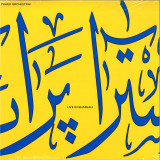
Rich with FM synthesis, infectious rhythms and evocative motifs, Rester Partir transports us to a fantasised Africa, found onstage at a Lausanne Theatre in 1985. Scoring a story about a 19th Century French missionary’s trip to Timbuktu, Swiss composer Louis Crelier created his own sonic landscape, capturing the exoticism and otherness of an imaginary Mali. Though the hypnotic rhythms and cascading mallets conjure images of the continent, the queasy keys, dubby idents and synthetic sonatas suggest something more interplanetary - picture James T. Kirk and Spock beaming down into the ochre dust of a ruined city.
Aided and abetted by a selection of ambient interludes, jazzy diversions and polyrhythmic excerpts from Crelier’s film work, as well as the exceptionally Balearic Deep In The Dale from TV series Alpine Academy, the largely unreleased compositions on Rester Partir finally break the fourth wall to find the wider audience they deserve.
Words by Patrick Ryder
'How is it that one of Art Blakey’s greatest albums with the Jazz Messengers is so little known? The 1961 edition of the Messengers included Lee Morgan on trumpet, Wayne Shorter on tenor saxophone, Bobby Timmons on piano, and Jymie Merritt on bass. In February and May of 1961, this group (with pianist Walter Davis Jr sitting in on two tracks) entered Rudy Van Gelder’s studio in New Jersey and proceeded to lay down Roots & Herbs, a brilliant set of six Shorter compositions including the driving hard bop of the title track, the playful “Ping Pong,” and the clever “United.” The album was eventually released in 1970 and deserves a place among Blakey’s finest recordings.
The first release of Eclectic Beats Music is from Portuguese artist and record label owner Fradinho! On ‘A Bright Future’, he blends a syncopated beat structure with an overall jazzy soulful funky groove
with Latin and Brasilian percussion, an engaging bass line and cosmic synth licks. Along with the original there are 5 remixes from the likes of the established Afronaut (Bugz In The Attic) that also features Mark de Clive-Lowe on keys, a wonderful Karmasound House remix, a Born74 Boogie Beat Mix, a Bruk Roller Mix from up and coming Mancunian producer Szajna and a darker, heavier and
dirtier UK Garage approach by Porto based LSK.
studio mule is back with another amazement, opening the roster towards sophisticated spiritual sounds on the crossroads of electrified jazz, oriental fourth-world spheres and deeply composed experimental sounds. this time the label welcomes japanese artist ya-sukazu sato aka yas-kaz, a university-trained percussionist, that gained global success as a composer for the internationally known butoh dance troupe sankai juku, that tours around the world since 1975. his infrequent musical amalgamation of ancient eastern genres, airy soundscapes, and ritualistic dance percussions perfectly accompanied the modern dance movements of an avantgarde dance group that is known for slow, mesmerizing dance passages, whose repetitive body movements sometimes focusing only on the feet or fingers. besides his theatre work, yas-kaz composed scores for japanese movies, performed live along stars like us-american jazz saxophonist wayne shorter or legendary japanese new-age musical group himekami and recorded a number of collabo-rative and solo albums.
with “virgo indigo”, studio mule reissues his third solo album, originally published on the japanese label canyon in 1986. the album opens with “djidanda”, a composition whose melodic drive and percussive groove reminds on moondog’s spirit. melancholic strings, loose guitar riffs, spiritual cowbells and wild, yet mild rhythms form a repetitive maelstrom that is made for all sorts of acrobatic body movements. it gets followed by the album’s title track “virgo indigo”, a spiritual jazz leaning arrangement featuring wayne shorter on the soprano saxophone, delivering a crystal-clear performance above tribal rhythms and traces of gamelan. the story-arc of the ten-minute long composition brings also minimalistic percussive moments, oriental ambient zones and some electronic drones, all calm and lively at the same time.
a versatileness, that marks the other four arrangements on the album, too. “kara-kira ~windscape iii~” comes around as an airy spiritual illusionist, that melds joyful flute notes with gentle chime melodies. the b-side’s epic opener “wadji” starts industrial, just to break down into a manic, again moondogish atmosphere full of darkish sounds and nebulous ambient deepness. subsequent yas-kaz enters with “notarinotari” the oriental zones, seducing with a jazz-laden romantic soundtrack mood. the final tune is yet another surprise, as “jasmin” is percussive driven neon cocktail bar pop, that features a hum-ming female voice and mesmerizing synth and guitar melodies. six tracks that introduce six different locations of yas-kaz’s ramified artistic work, which combines sweetish melodies, dynamic percussions, statuesque minimalism and world music traditions in spacious compositions that stay surprising until the very last second.
Unbegrenzt is the third in an ongoing series of archival records of the unheard music of Swedish composer Catherine Christer Hennix, co-released by Blank Forms Editions and Empty Editions. It follows Selected Early Keyboard Works and Selections from 100 Models of Hegikan Roku (named the #1 archival release of 2019 by The Wire), in addition to a two-volume collection of Hennix’s writing titled Poësy Matters and Other Matters.
Recorded in February of 1974 and featuring Catherine Christer Hennix (recitation, percussion, and electronics) and Hans Isgren (bowed gong), Hennix’s realization of Karlheinz Stockhausen’s “Unbegrenzt” (German for “unlimited”) from Aus den Sieben Tagen is an elaboration both rigorous and radically different from the canonical 1969 recording issued by Shandar. The collection of 15 text pieces written in Paris during May of 1968, Aus den Sieben Tagen, denies its performers notated direction and instead provides poetic cues that hinge upon Stockhausen’s conception of “intuitive music,” a Eurocentric perspective on improvisation antithetical to the vernacular forms Hennix had engaged with as a young drummer performing in Stockholm jazz clubs with musicians like Bill Barron, Cam Brown, Hans Isgren, Lalle Svenson, Allan Vajda, Bo Wärmell, and many others. While both Hennix and Isgren saw the formal prospect of Aus den Sieben Tagen as a productive development of and beyond La Monte Young’s event scores, she here steadfastly counters his rationalization of intuition with the Principle of Sufficient Reason. (Cf. Brouwer’s Lattice.) Eschewing the busy, conservatory-addled lapses into idiomatic citation of Stockhausen’s 1969 recording, Hennix’s alternative realization of the “Unbegrenzt” score’s instructions to “play a sound with the certainty that you have an infinite amount of time and space” is based on her concept of Infinitary Compositions, the trademark of her ensemble The Deontic Miracle which, at one time, considered adding Stockhausen, La Monte Young and Terry Jennings scores to its repertoire. Taking a mature, minimal iteration of Stockhausen’s compositional method of “moment-forming” to heart, her version’s dark, controlled feedback and amplified bowed gong subtly shift through an immanent sequence of formative moments, step by step. Its bubbling computer noise, percussion, and repeated ominous transient sounds of temple blocks over the bowed gong terminate with the integrated recitation of exotic text fragments from Hevajra Tantra which faithfully take Stockhausen’s score into deeper vistas of the unconscious and a more devastating opening to the unlimited time and space of a dreaming mind.
Audio restoration and mastering by Stephan Mathieu, with an essay by Bill Dietz.
Catherine Christer Hennix (b. 1948) started her creative life playing drums with her older brother Peter, growing up in Sweden where she heard jazz luminaries, such as John Coltrane, Eric Dolphy, Dexter Gordon, Archie Shepp, and Cecil Taylor perform from 1960 to 1967. Directly after high school, Hennix went to work at Stockholm’s pioneering Elektronmusikstudion (EMS), where she developed early tape music, incorporating computer generated speech done at the Royal Technological University (KTH), where she was an undergraduate student. After traveling to New York In 1968, she met artists Dick Higgins and Alison Knowles who invited her to stay at the Something Else Press Town House where she had the opportunity to meet, among others, composers John Cage, James Tenney, and Phil Corner. During the following years she developed fruitful collaborative relationships with many composers in the burgeoning American avant-garde, including, most significantly, Henry Flynt and La Monte Young. Young introduced Hennix to Hindustani raga master Pandit Pran Nath and she would later study intensively under him as his first European disciple. While Hennix continued to make music performing alongside Arthur Russell, Marc Johnson, Henry Flynt, and Arthur Rhames, she also served as a professor of Mathematics and Computer Science at SUNY New Paltz and as a visiting Professor of Logic (at Marvin Minsky’s invitation) at MIT’s Artificial Intelligence Laboratory. In recent years Hennix has led the just-intonation ensemble the Chora(s)san Time-Court Mirage, which has featured musicians Amelia Cuni, Amirtha Kidambi, Chiyoku Szlavnics, Hilary Jeffrey, Amir El-Saffar, Benjamin Duboc and Rozemarie Heggen. She currently resides in Istanbul, Turkey pursuing studies in classical Arabic and Turkish makam.
January 12th, 2020, a Sunday night in Toronto - Matthew Tavares and Leland Whitty (of BADBADNOTGOOD fame) are reunited at Burdock for a live improvised Jazz session. The pair are joined on stage by bassist Julian Anderson-Bowes and drummer Matt Chalmers as part of Burdock’s Piano Fest, an annual event at the city's brewery and music hall.
Two days later an email from Matthew hits Mr Bongo's inbox... "I think it turned out amazing, brought some really nice recording gear and it sounds almost like a studio record, thought I'd share. Moments definitely get to the jazzier side but there is some spiritual moments that are so far out". The Bongo office were all blown away by this free-flowing session, one which sounded like a well-rehearsed set at the end of a long tour, rather than a one-take improvised assembly. The chemistry between the musicians is magical. The tight friendship and musical connection between Tavares and Whitty are self-evident, however, Chalmers and Anderson-Bowes have a great contribution to make too. They act as the solid foundation that leaves Tavares and Whitty free to roam and explore moments of darkness and light, intensity and beauty. From the first time of hearing this intimate session, we knew this had to be shared.
The same quartet feature on Matthew Tavares & Leland Whitty's 2020 album 'Visions'. The plan to promote 'Visions' was to tour, with each night comprising a uniquely improvised set. Sadly due to world events, this couldn't happen, but for now 'January 12th' is a snapshot of the wizardry that would have been from four amazing musicians at the top of their game.
LINER NOTES BY JOHN-PAUL SHIVER:
Reinier Thijs a.k.a. Thijsenterprise's new project Lahringen begins where most of his previous creations have left off. Through reedy skronking sax, no easy listening aesthetics here, we get that passport to the '80s. The intersection between Lou Reed's old New York attitude and the encroaching rhythmic assault about to hit. Post-punk, featuring steady bass lines—peak demon Jaco to cool as fuck Slits era—in transit.
The first track in, bumping new-wave-jazz bravado, immediately covers those grounds the Dutch native likes to dig in on. He pays tribute to Gato Barbieri with "El Arriero", continuing in that off-kilter mash-up of sound textures. This time its beats and machismo.
But "Sketchy", an original arrangement, taps Reinier's dedication to skateboarding. Named for when skate rats land a trick sloppy, non-smooth, or ugly he does in fact match the sound of the bass with the feeling of ‘meh.’ “The drums and percussion in the track carry a driving pulse, and the saxophone plays a light melody, ping-ponging between the groove of the rhythm section, making the track very repetitive, catchy," stated Reinier.
3 x LP - Live in Sharjah Box Set + Booklet. designed by Lorenzo Mason Studio.
If you’ve ever travelled to Egypt and wandered through its crowded streets, you probably ended up buying a cassette or a CDR of popular synth based music heard in most cabs, cabarets, or alleys around town: the almighty Shaabi.Raed Yassin and Paed Conca based their project PRAED on research between Shaabi and Mouled (traditional trance music from Egypt) and the hypnotic structures of both these genres. Repetitive beats, loud Mizmar and loads of energy, with a strong influence from psychedelic rock, free jazz and electronica.
During the years in which the duo produced 4 albums and performed on an endless number of stages around the globe, PRAED started working on anambitious expansive project: an orchestra that could transpose this study of rural and popular culture into an immense, iconic work. In autumn 2018, supported by the Sharjah Art Foundation, PRAED Orchestra! premiered “Live in Sharjah”, interpreting new material merged with some of the band’s iconic pieces. The composition process started with the choice of musicians: the line-up consisted of some of the most innovative artists coming from a wide spectrum of musical practices. Each musician was chosen for a defined role, and the common denominator was their capacity to interpret written material, and their ability to improvise effortlessly. Each role was clearly set to work in unison with the rest of the group, while simultaneously sustaining a centrality in the choir. Solo parts masterfully drawn over the structure as a fil rouge connecting every piece of the entire concert; massive and powerful orchestral sections leading to a breathtaking trance-like state of mind; all of this material ultimately coalescing into an Egyptian Operette that narrates the sorrow, love, and deeply rooted culture of this urban music called Shaabi.
Paed Conca: Clarinet, Electric Bass, Electronics
Raed Yassin: Synthesizers, Vocals, Electronics
Alan Bishop: Alto Saxophone, Vocals
Nadah El Shazly: Vocals, keyboard, Electronics
Christine Kazarian: Electric Harp
Hans Koch: Bass Clarinet, Soprano Sax
Martin Kuchen: Tenor Saxophone, Baritone Sax
Maurice Louca: Keyboard, Organ
Radwan Ghazi Moumneh: Buzuk, Vocals, Modular Synthesizer
Sam Shalabi: Electric Guitar, Oud
Ute Wassermann: Vocals, Mouth Harp, Whistles
Khaled Yassine: Drums, Percussion, Darbuka
Michael Zerang: Drums, Percussion
Recorded live at Calligraphy Square on November 3rd, 2018 in Sharjah, UAE by: Sudish Suman & Shuaib Ahmad Poonthala
Edited by: Rabih Beaini at Morphine Studio, Berlin, Germany
Mixed by: Radwan Ghazi Moumneh at Hotel2Tango Studio, Montreal, Canada. Mastered by: Harris Newman at Grey Market Studio, Montreal, Canada.
Artwork by Lorenzo Mason Studio.
Project manager : Simsara Music
Right after the beautiful album " The Aquarius Years", Cali-Soul queen Tiombé Lockhart is back again on Mother Tongue with a special follow up.
"Sexy Suzy on a Sunday" receives two cosmic treatments from jazz-star Christian Scott and Intergalactic Don Carlos Nino.
Expect to be transferred into another (Soul) galaxy!
The latest vinyl slice from FBNM sees us head to the depths of central Africa via Paris to track down a feast of rare seventies afro funky jams from Cameroonian master musician EKO. We've brought FBNM favourite Riccio along for the journey too, who has provided us with a fantastic Rerub coaxing out some modern dancefloor sensibilities and production sparkle.
Eko Roosevelt Louis has had a music career spanning over forty years, born the grandson of a Kribi tribal chief, his musical persuasion beginning humbly with his village's local church before his formal education at the Senegal conservatoire and Paris' École Normale de Musique. EKO made a number of jazz funk and disco records in the mid seventies during a stint recording and touring in and around France before returning to Cameroon to take over his grandfather's tribal chieftaincy, a role he still holds today! Alongside this position of office EKO has continued to work with music, performing, teaching and even leading Cameroon's national orchestra!
The tracks we have selected for reissue are all taken from EKO's third album, Funky Disco Music which was recorded in Paris and released on his own Dragon Phenix imprint. Sung in a combination of English and EKO's native tongue we've lined up a real excursion in feel good afro-jazz, funk and soul made purely for dancing feet and boogying butts!
All tracks have been officially licensed and lovingly remastered for this special release by Andreas Lupo Lubich (CALYX Berlin), packaged alongside Riccio's sympathetic work in the cutting room on 12" vinyl with a special interview with Eko Roosevelt Louis himself!
Technically, Syrup are a hip-hop group with unmistakable leanings towards soul and jazz. The group consists of an MC (Turt), a pianist/singer (C.Tappin) and a beatmaker (Twit One).
Their music is rooted in the tradition of collectives like Native Tongues and Soulquarians, and they have come up with a pretty appropriate term to describe their sound, which is "cool bap". But if we put formalities aside and look at the bigger picture, Syrup are also a perfect example of how music can connect people beyond national borders, language and tradition. And furthermore, how Afro-American culture has influenced not only the musical taste but the views and opinion-making of generations of young people worldwide. The sheer existence of Syrup is also a big fat "Fuck Brexit!" which makes the group even more likeable. The story of Syrup begins in 2015 when Twit One is booked to play a dj gig in Bristol. Twit One is a producer, DJ, radio host, record friend and former bass-player from Cologne (where he also co-owns the Groove Attack Record Store). He is a member of a small group of pioneering producers, who during the 2010s laid the foundation for the European beat-scene as we know it today. Inspired by the likes of Dilla and Madlib these guys made it look cool to not be the rapper. And they recorded some pretty dope music, too, which we had the honour to release via Melting Pot Music as the "Hi-Hat Club" series (a title that Twit came up with). During that night in Bristol, Twit got acquainted with two young men by the name of Turt and C.Tappin. Two childhood friends who had moved from London to Bristol for their studies and had been avid fans of Twit's music for some time. "Back in Cologne, Twit told me about these MCs from Bristol with whom he might record some tracks" Olski remembers, "Needless to say that I never heard about them again until summer 2017 when the annual Radio Love Love boat party was about to happen and Turt and Tappin were actually coming over for the first time, to party and to rock the mic. A couple of months later we released "Hay Luv" a new Twit album that featured Turt and Tappin on two songs. On their next visit, the two were accompanied by Turt's brother Slim, a very talented beatmaker and one half of Summers Sons. We spent some quality time while mastering the 'Undertones' EP (including remixes by Twit One, FloFilz and Cap Kendricks) and shooting the album cover at the Groove Attack record store basement. Since then we released two more album by Summers Sons ("Uhuru" - a joint project with Tappin and "The Rain"), C.Tappin's debut EP "Ashes To Ashes" (with remixes by Reginald Omas Mamode IV, Hulk Hodn & Slim) and a KOOP beat tape by Slim. During the same time, Twit recorded two albums: "Dispo To Dispo" as Flatpocket (a project with Lazy Jones) and "Two", the long awaited follow up to the very first Hi-Hat Club album as Testiculo Y Uno (with Hulk Hodn)." In 2018, Turt and Tappin moved back to London (the Lightworks headquarter is now located in Streatham). They toured with Children of Zeus and shared stages with artists like Melodiesinfonie and FloFilz. But it wasn't until Brexit before the long talked about super group finally became a reality. At the final recording sessions in September 2019 we already knew that the next Eurostar ride would be a different one. Now with Covid-19 we have no clue when all three members of the group will be in the same room again – let alone rock a stage together. But fortunately, we were sitting on a big pile of great singles that we released over the summer months. The album "Rosy Lee" will follow in late September.
- A1: Lunchbag – Jazzstyle
- A2: Hazy Year – Notes
- A3: Flofilz – Uferlos
- A4: Illiterate – Cubensis
- B1: Melodiesinfonie - I Did This In 5 Minutes
- B2: Iamalex - About You
- B3: Made In M – Taipane
- B4: Juan Rios – Amatista
- C1: Les Geddit - Feels Like
- C2: Made In M - Flightmode On
- C3: Melodiesinfonie - I Drank Cafe´ Del Mar
- C4: Iamalex - Early Flight
- D1: Flofilz – Doorsteps
- D2: Theo Spazzatura - Make It Last
- D3: Juan Rios - Que´ Paso
- D4: Hazy Year – U
Beats on Boat vol. 1 is a double LP with 6 nationalities, 8 artists & 16 Tracks pressed on 180g vinyl and limited to 400 copies w/ FloFilz, Made in M, Melodiesinfonie, Juan RIOS, Hazy Year, Lunchbag (aka Theo Spazzatura), illiterate (aka Les Geddit) & iamalex.
The compilation accompanies the YouTube series which can be watched on our website: ear-sight com
All the artists involved have one track on each vinyl, celebrating their musical diversity. The first vinyl will be the sound you know and love of theirs. The second- will be the world premiere for the majority of the Musicians featured- taking a step out of their comfort zone into house, disco or their individual interpretations of those genres.
We set sail last summer to unite some of the best producers we know and came back with hours of dope sets and a 16 track double vinyl containing a lot of firsts - not only for us but also for most artists aboard- the C & D side are full of world premieres!
This vinyl is the blueprint of what’s to come here at ear-sight in the next couple of years, staying true to our lo-fi roots but also reaching out to new horizons and we feel so blessed to have taken this first step with these talented cats.
In these dark times of Covid we still have our music. We have the sounds to soothe us, distract and take our minds away from the chaos and uncertainty.
We can't dance like we used to but we can hear and feel. Our release must be found in another way, we must look within. We find solace and grant ourselves space and time in the music.
Sam McQueen (Indio co-producer with John Beltran, Indigo Aera, Delsin Records, Furthur Electronix) presents his debut album Dreams In Sepia for Mojuba sub label a.r.t.less and hits us with a real time soundscape of the moment, an epic-like document of these times. The rhythms are subtle, sometimes broken, the time structures often complex, this is not primarily dance floor orientated music. These sounds are way more cerebral, for the heads. They reflect perfectly the complexities of life we are experiencing in 2020.
The edges are rounded with occasional strolling bass lines and comfy chords. Slabs of keys and spaced out female vocals like a psychedelic journey that scares you at first yet comforts you soon after. Sam McQueen's mediatory sounds give an overwhelming sense of the moment. The music makes you take time out and listen. Its purposeful manner suggests there are more hours in the day, like time slowing down a pause, like the sun slithering slowly behind the horizon. These are sunset sounds for dark back-rooms.
Daytime or night, it works. This is the soundtrack for the other room, the deeper sounds not designed to make you dance. This music doesn't get in your face, it creeps up and smacks you on the ass. There are elements of early nineties UK Techno, a warmth and delicateness that pervades a distinct lack of four four dance floor in the beat structures, a softer tone throughout than the harder Detroit techno sounds of the same era but still nods and acknowledgements to the D in the layout and way the sounds present themselves. Think John Beltran, Symbols and Instruments, Black Dog or Kirk DeGiorgio, mid 90s Berlin sounds from Basic Channel / Rhythm & Sound, but in lockdown. Music for today's modern lacking landscape. The sounds often familiar, analogue, the drums, hi hats and snares, shimmer, jazz style. They accentuate and push the rest of the elements around them.
?In a bygone era this would be crudely classed as Chill Out music. In 2020 Covid era its about how it makes you feel as you relax and really listen to it. It is about emotion and empathy, a oneness, a new unknown and a deeper train of thought for the listener. Much like 2020, Sam McQueen lays the pieces round the edge of the jigsaw and lets you fill in the rest.
'Visions in Black and White' is a collection of rare jazz and improvised themes by one of the greatest Russian film composers Mikael Tariverdiev (1931-1996). Transferred from the original tapes and beautifully remastered, these recordings manage to retain their original ambience and capture a master at work. Originally composed for cinema and TV movies of the 1960s and 1970s, it centres on Mikael playing at the piano and keyboard. Many of the compositions can be described as jazz, a genre whose troubled story in the Soviet Union meant they probably would not have existed outside the context of a film score. But, as Vera Tariverdieva, Mikael's wife, tells, it is probably more in accordance with his vision to hear them in the context of his life-long love of improvisation. "Astoundingly, he said more than once that he wasn't fond of jazz. This perplexed me, as he'd always been great at improvisation. Imagine my amazement then when I rummaged through one of our old closets and found a crumbling old tape. It was the score for the 1964 film 'Until Tomorrow'. I played it. And the realisation came: not only had Mikael had been fond of jazz - no, he'd been an amazing jazz musician." Vera Tariverdieva The pieces here are an introduction to Mikael's musical world. The tonality of individual tracks varies - they were transferred from original tapes of different eras and conditions that are kept in the Tariverdiev apartment in Moscow where Vera still lives and works.