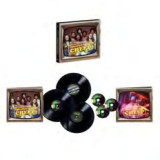
This deluxe 2025 vinyl edition of The Grateful Dead's Grayfolded was pressed at Optimal in Germany, known for their high end audiophile pressings.In 1993 Canadian composer John Oswald was invited by Phil Lesh to transform historical recordings of the Dead into something new, along the lines of what they had attempted in their Anthem of the Sun album.
Oswald chose to focus on the Dead’s Dark Star, which, over the courseof a quarter century, they had expanded and transformed in myriad waysin live performances. Oswald was given access to the Vaults, whereover the course of a month, with the guidance of the Dead's resident archivist Dick Latvala, he collected 105 performances, which throughthe following year he formed, folded, fondled, and finessed into a kaleidoscopic unstuck-in-time documentary of the Grateful Dead in someof their most psychedelic, symphonic, and rocking excursions— asingular 110-minute fantasy performance.Here it is, Deadheads, the ultimate Dark Star is now on vinyl. Deluxe audiophile pressing cut in Toronto under the watchful ears of John Oswald. Elaborately printed packaging in a heavy duty triple gatefold jacket includes liner notes by musicologist Rob Bowman featuring interviews with Jerry Garcia, Phil Lesh, and Robert Hunter plus six"time maps" which chart the source concerts of Dark Star.Music performed by The Grateful Dead (c) Grateful Dead Productions Inc. & Ice Nine Publishing Inc.
Taken from over 100 performances of Dark Star recorded between 1968 and 1993. Built, layered and "folded"to produce one large, new re-composed Dark Star.John Oswald is best known as the the creator of the music genre Plunderphonics, an appropriative form of recording studio creation which he began to develop in the late sixties. This has got him in trouble with, and also generated invitations from major record labels and musical icons. Meanwhile, in the í90ís he began, with several commissions from the Kronos Quartet, to compose scores for classical musicians and orchestras, the latest of which is an orchestral work,commissioned by the BBC, combining aspects of The Beatles, Gyˆrgy Ligeti, and Terry Riley. He also improvises on the saxophone in various settings, dances, and is a successful visual artist, best known for the chronophotic series Stillnessence
Suche:audio archi
- The Mountain (Intro)
- Snow
- Heavy
- Crush
- Hark!
- Foul Play
- Let Me Down
- Moonshine
- Both Ways
- Mc (Intermission)
- Beam
- Blu
- Disappear
- Wishing
Joviale machen Musik, die sich wie eine Show anfühlt; das Drama liegt in der Spannung zwischen Pop-Impuls und etwas Zerebralem und Sinnlicherem. Die multidisziplinären Künstler aus dem Norden Londons waren als Theaterkind aufgewachsen und machen sich nun ihre prismatische kreative Ausdruckskraft medienübergreifend zunutze, indem sie Komponenten von bildender Kunst, Performance und Musikaufnahmen zu einer einzigartigen Welt zusammenfügen. "Mount Crystal", das von Joviale zusammen mit John Carroll Kirby (Steve Lacey, Frank Ocean, Solange, Kacey Musgraves), Jkarri (PinkPantheress, Nia Archives, Natanya)und Kwaku Konadu produziert wurde, ist ein aufstrebendes, konzeptionelles Album. Die Songs sind elektrisch und gefühlvoll, gespickt mit jazzigen Experimenten, rhythmischem Rock und lebhaftem Sounddesign, alles realisiert mit einer Reihe von Mitwirkenden wie Sam Wilkes, Carter Lang und Will Miller. Im Jahr 2021, nach ihrer EP "Hurricane Belle", die erste Aufmerksamkeit von Pitchfork und Crack Magazine auf sich zog, zogen sie sich still zurück, um zu lernen und sich weiterzuentwickeln. Im Jahr 2025 kommen sie hinter dem Vorhang hervor: ursprünglich als Theaterstück konzipiert, strotzt "Mount Crystal" nur so vor Leben - Gefahr, Humor und dem menschlichen Geist - und beschwört einen metaphysischen Aufstieg, der über das Audioformat hinausgeht. Mit Plänen die Vision als Live-Set und mehr zu manifestieren, stellt Joviale den Kurs vor: "Die Überlieferung von Mount Crystal ist geprägt von der Verkörperung von Sehnsucht, Gefahr und Verzweiflung. Eine gespiegelte Dimension in einer fernen Realität, in der nichts ungesagt bleibt. Diese Kapitel sehnen sich danach, die Illusion des Vergnügens zu zerstören, indem sie den unerbittlichen Schmerz, den ich in meinem Bemühen zu lieben erfahren habe, verleugnen und die süßesten Melodien mit den süßesten Freunden umarmen."
- Personality Crisis
- Looking For A Kiss
- Vietnamese Baby
- Lonely Planet Boy
- Frankenstein (Orig.)
- Trash
- Bad Girl
- Subway Train
- Pills
- Private World
- Jet Boy
The extroverted blend of attitude, energy, and ostentatiousness that spills from the New York Dolls’ self-titled debut can be seen in full view on the album cover. Depicting the quintet in its hallmark flash-and-trash apparel and in drag appearance, the 1973 album scared away a considerable amount of potential listeners while capturing the attention of a sizable audience that recognized the band for what it was: zeitgeist pioneers who helped develop the punk and glam rock movements.
Named by Rolling Stone the 301st Greatest Album of All Time and by Mojo the 49th greatest album of all time, New York Dolls receives long-overdue audiophile treatment on Mobile Fidelity’s numbered-edition 180g 45RPM 2LP set. Sourced from the original master tapes, pressed at Fidelity Record Pressing in California, and housed in a Stoughton gatefold jacket, this collectible version marks the first time the group’s career-making statement is available to be experienced in audiophile quality.
Far from harboring the crude elements that became associated with the punk scene, New York Dolls benefits from keen production overseen by none other than Todd Rundgren. Though more accustomed to working far higher-caliber musicians, Rundgren — taken by the New York Dolls’ charisma and cool, if not their instrumental approach — fully understood the ensemble’s aesthetic. He captured what went down at New York City’s Record Plant with an astute blend of live-on-the-floor feel, raw authenticity, and professional acumen.
On Mobile Fidelity’s definitive-sounding reissue, you can hear those facets as well as key details, dynamics, and textures with previously unimaginable insight. Rundgren preserved generous degrees of grit, grime, and grease while bestowing the raucous music with elevated levels of separation, solidity, and impact every landmark recording deserves. His vision extends to introducing choice accents — barroom piano notes, Moog synthesizer passages, Buddy Bowser’s honking saxophones — that add to the songs’ appeal without interfering with the primary architecture.
Afforded extra groove space on this pressing, the tenor, presentation, and attack of both vocalist David Johansen and now-iconic guitarists Johnny Thunders and Sylvain Sylvain come across with stunning vibrancy and vitality. The New York Dolls often seem headed off the rails and into the red, but somehow, the strut, swagger, and sloppiness — and the associated sleaze and scruff, scrape and snarl, frenzy and feverishness those characteristics entail — remain together as a whole that shakes its collective fist at the frustrations, isolation, disarray, and disillusionment of youth chaos and urban decay.
Kicking off its debut with “Personality Crisis,” cited by Rolling Stone as one of the 500 Greatest Songs of All Time, the band makes obvious its grasp of alienation, deviance, displacement, and suburban disaffection — as well as its capacity to play hanging-by-a-thread boogie, noisy rock ‘n’ roll, and Brill Building-inspired pop. The lipstick-kissed New York Dolls possesses traits many of its harsher predecessors would overlook: joyfulness and melody, topped with a knack for knowing how and where to take a song inside of three-and-a-half minutes.
Dive and dash with the belligerent “Looking for a Kiss”; stomp your feet and clap your hands to the big choruses of “Jet Boy”; surrender to the demands and provocations of the coded “Vietnamese Baby”; decide whether “Bad Girl” yearns to explode or implode. It’s one of several tunes here that allude to the world coming to end. Of course, that doesn’t mean there isn’t time for a fling before everything burns. “There’s no place I gotta go,” yowls Johansen. And he means it.
Adorned with tonal crunch, glitter, and gristle, New York Dolls takes pride in its brashness and brattiness. The rambunctious effort, which earned the band the distinction of being voted both “Best New Group of the Year” and “Worst New Group of the Year” in the pages of Creem, displays knowing reverence for the blues without calling attention to the style. The folk-laden “Lonely Planet Boy” is nothing if not a collision of heart-on-the-sleeve emotions and the desire in the face of challenges to maintain a tough-skinned exterior. An interpretation of Bo Diddley’s “Pills,” complete with shivering harmonica and clattering rhythms, announces there’s no cure for what infects this band. It’s that contagious. And how.
His deliveries gushing with campy fun, playful irreverence, and sheer decadence, Johansen doubles as the equivalent of an open fire hydrant that spouts at will. He’s at once tender and vicious, serious and tongue-in-cheek. On arguably his finest hour on the album, Johansen’s phrasing, passion, and lyrical ambiguity alone turn “Trash” into an insistent glam-rock gem whose echoing harmonies and girl-group references stamp it a pop classic.
Too much, too soon? Only for those averse to some of the finest rock ‘n’ roll ever put on tape.
Alanis Morissette Delivers the Equivalent of a Spiritual Awakening on Supposed Former Infatuation Junkie:
Introspective Themes and Compassionate Emotions on Eastern-Tinged Album Have Grown More Relevant
1998 Smash Plays with Enhanced Detail, Rich Textures, and Sharp Focus on Mobile Fidelity’s 180g 33RPM 2LP Set:
First-Ever Audiophile Edition Strictly Limited to 3,000 Numbered Copies
1/2" / 30 IPS analogue master to DSD 256 to analogue console to lathe
Alanis Morissette refuses to adhere to convention on Supposed Former Infatuation Junkie. While most artists follow-up their breakthrough with an album that closely parallels the approaches that helped make them famous, the maverick singer-songwriter stayed true to herself and drew inspiration from travel to India before she began the recording sessions. As much as the preceding Jagged Little Pill put her on the global radar, Supposed Former Infatuation Junkie confirmed her role as a vital generational voice — and proved her blockbuster success was no fluke. Having set a mark for most sales of an LP in its debut week by a female artist, the 1998 smash remains a pop-rock staple.
Sourced from the original master tapes, strictly limited to 3,000 numbered copies, housed in a Stoughton jacket, and pressed at Fidelity Record Pressing, Mobile Fidelity’s 180g 33RPM 2LP set of Supposed Former Infatuation Junkie presents the triple-platinum LP in audiophile sound for the first time. Benefitting from defined grooves that befit the album’s nearly 72-minute length, this pressing plays with enhanced detail, refined clarity, sharper focus, and broader dynamics than prior versions.
Those traits are key given Morissette’s use of more textured and atmospheric soundscapes, not to mention her evolution into a more nuanced and controlled singer. Similarly, the scale and reach of David Campbell’s string arrangements come across as orchestrations should. Ditto the synth-based architecture shaped by producer and principal Morissette collaborator Glen Ballard. All in all, Mobile Fidelity’s collectible edition simply delivers more information via transparent means.
Notable for its balance, sophistication, and richness, Supposed Former Infatuation Junkie at heart finds Morissette pausing, taking a breath, and learning how to navigate life in a healthy manner after enduring one of the most exhausting and rocket-to-fame stretches any musician ever experienced. It’s the sonic equivalent of a spiritual awakening, a call to betterment, a brave assessment of the self and humanity as a whole. As such, the tunes on her second international (and fourth Canadian) release teem with gratitude, compassion, love, empathy — emotions that lend themselves to the largely mellow, contoured scope and Eastern-tinged melodies of the songs themselves.
“How ‘bout how good it feels to finally forgive you,” Morissette sings on the lead single “Thank U.” “How ‘bout grieving it all one at a time.” Those sentiments, and the vocalist’s embrace of concepts such as divinity and acceptance, not only provide a foundation on which Supposed Former Infatuation Junkie rests. They also reflect the personal maturation she gained from her embrace of Buddhist culture in India and a mindset bent toward notions of reconciliation, peace, and sensuality that were nearly absent in popular music in the late ‘90s.
Those themes continue on “That I Would Be Good,” a confident reflection that takes stock of one’s mental, physical, and emotional state in the face of both changing and unpleasant circumstances — and concludes with Morissette performing a flute solo, further exposing the raw intimacy of the introspective tune. She channels relatable simplicity and joy on “So Pure,” with her invocations of “dance” and “freestyle” speaking to the freedom of expression that courses throughout Supposed Former Infatuation Junkie. And perhaps no song finds Morissette showcasing her refreshed attitude toward life and opening up more than the relationship-themed “Unsent,” whose unconventional structures and lack of a chorus only add to its directness.
Akin to many albums that were ahead of their time, and despite the critical and commercial accolades afforded it upon release, Supposed Former Infatuation Junkie attracted new appreciation and perspective as it got older. Issued during an era where its ideas of serenity, absolution, tranquility, and contentment seemed largely alien, the record — akin to the ways its predecessor foreshadowed a movement — now functions as a visionary beacon that foretells of way to maintain sanity, dignity, and goodness amid a contemporary landscape filled with constant distractions, polarizing views, and incessant calls to purchase, promote, and produce without questioning the what-for purpose.
Supposed Former Infatuation Junkie dares to ask the questions and, at its best, supplies meaningful answers and alternatives that lead to longed-for enlightenment, healing, and laughter. For these reasons alone, it’s a record that never goes out of style.
Motel d'amour - A Lost Electro-Funk Gem from the NDW Era Resurfaces
When we first collaborated with Collage member Markus Kammann on the EP project "Mit den Puppen tanzen" at the end of last year, we never imagined what would follow: Kammann approached us with a completely unreleased full-length album by his former band. Upon receiving the first three preview tracks, we were floored. One of them was "Nachtcafé" - a track that kicks off with a funky bassline layered over the punchy rhythm of a Roland TR-808. Add shimmering synths and Katrin A. Kunze's sharp, distinctive vocals, and we instantly knew we were hearing something special.
For a label dedicated to rediscovering lost treasures, this was exactly what we'd been searching for. The next two tracks - "Rendezvous" and "Casanova" - were just as compelling. When Kammann sent us the full album, we realized we were holding an electro-funk grail from the late golden days of the German Neue Deutsche Welle (NDW). We were listening to "Motel d'amour".
"Motel d'amour" is a concept album, offering a sharp, vibrant perspective from a confident, intelligent, and radiant young woman eager to experience nightlife, love, and music. Kunze's lyrics paint vivid scenes of flirtation ("Nachtcafé", "Rendezvous"), encounters with men ("Casanova"), the pulse of nightlife ("Die Nacht ist noch jung"), love ("Rotes Licht für rote Liebe"), one-night stands ("Motel d'amour"), and more. Rarely has a German album from that era captured emotional nuance and social dynamics so insightfully. Without veering into the overly personal, Kunze's direct, daring lyrical style was groundbreaking at the time - and remains refreshingly bold today.
While German listeners will fully appreciate the lyrical depth, the music speaks volumes on its own. Kunze's words are masterfully complemented by the production of Markus Kammann and Jürgen Grah. As heard on the in-demand "Mit den Puppen tanzen", their creativity seemed boundless. Each track is tightly composed, catchy, and full of character. While many German bands at the time leaned into rock, Kammann drew from the deep grooves of Earth, Wind & Fire, The Isley Brothers, Brothers Johnson, The Commodores, and the electro-futurism of Afrika Bambaataa's "Planet Rock" and "Looking for the Perfect Beat". The result: tracks with unmistakable electro-funk flair, powered by the classic 808 drum sound.
Though primarily rooted in funk and electro, the album retains flashes of NDW aesthetics - "Wir haben getanzt heut' Nacht" being a prime example. The instrumentation is a dream list for vintage gear lovers: Yamaha keyboards, Roland Juno-60, vocoder, Micromoog, Hohner D6 Clavinet, Fender bass, and a Telecaster guitar all feature prominently.
Recorded in 1985 at the high-profile Delta Studio by Richard Rossbach, the album attracted interest from Polydor. However, the label proposed using the compositions for a solo project with singer Inga Humpe (of Neonbabies), who was already signed to their roster. This would have required replacing Kunze as the vocalist, an idea the group firmly rejected. As a result, "Motel d'amour" was shelved, and Kammann, Grah, and Kunze moved on to form Cold End.
The album cover features a rare archival photo of Katrin A. Kunze - rediscovered by Kammann and now finally seeing the light of day, 40 years later.
We believe Motel d'amour deserves recognition alongside cult German classics like P!OFF?, 1. Futurologischer Congress' "Wer spricht?", Ami Marie's "Verrückt nach Glück", the funkier cuts of Cosa Rosa, or Piet Klocke's groove classic "Heute ist nicht sonst". It's a record that fits into adventurous DJ sets but also rewards a full, start-to-finish listen.
A note on audio quality: Sadly, the original master tapes were lost. The tracks were restored from a vintage TDK cassette. Thanks to modern digital tools, we were able to remaster them to a high standard - but in some songs light distortions remain. We appreciate your understanding and hope you enjoy this lost and undiscovered gem.
Motel d'amour - A Lost Electro-Funk Gem from the NDW Era Resurfaces
When we first collaborated with Collage member Markus Kammann on the EP project "Mit den Puppen tanzen" at the end of last year, we never imagined what would follow: Kammann approached us with a completely unreleased full-length album by his former band. Upon receiving the first three preview tracks, we were floored. One of them was "Nachtcafé" - a track that kicks off with a funky bassline layered over the punchy rhythm of a Roland TR-808. Add shimmering synths and Katrin A. Kunze's sharp, distinctive vocals, and we instantly knew we were hearing something special.
For a label dedicated to rediscovering lost treasures, this was exactly what we'd been searching for. The next two tracks - "Rendezvous" and "Casanova" - were just as compelling. When Kammann sent us the full album, we realized we were holding an electro-funk grail from the late golden days of the German Neue Deutsche Welle (NDW). We were listening to "Motel d'amour".
"Motel d'amour" is a concept album, offering a sharp, vibrant perspective from a confident, intelligent, and radiant young woman eager to experience nightlife, love, and music. Kunze's lyrics paint vivid scenes of flirtation ("Nachtcafé", "Rendezvous"), encounters with men ("Casanova"), the pulse of nightlife ("Die Nacht ist noch jung"), love ("Rotes Licht für rote Liebe"), one-night stands ("Motel d'amour"), and more. Rarely has a German album from that era captured emotional nuance and social dynamics so insightfully. Without veering into the overly personal, Kunze's direct, daring lyrical style was groundbreaking at the time - and remains refreshingly bold today.
While German listeners will fully appreciate the lyrical depth, the music speaks volumes on its own. Kunze's words are masterfully complemented by the production of Markus Kammann and Jürgen Grah. As heard on the in-demand "Mit den Puppen tanzen", their creativity seemed boundless. Each track is tightly composed, catchy, and full of character. While many German bands at the time leaned into rock, Kammann drew from the deep grooves of Earth, Wind & Fire, The Isley Brothers, Brothers Johnson, The Commodores, and the electro-futurism of Afrika Bambaataa's "Planet Rock" and "Looking for the Perfect Beat". The result: tracks with unmistakable electro-funk flair, powered by the classic 808 drum sound.
Though primarily rooted in funk and electro, the album retains flashes of NDW aesthetics - "Wir haben getanzt heut' Nacht" being a prime example. The instrumentation is a dream list for vintage gear lovers: Yamaha keyboards, Roland Juno-60, vocoder, Micromoog, Hohner D6 Clavinet, Fender bass, and a Telecaster guitar all feature prominently.
Recorded in 1985 at the high-profile Delta Studio by Richard Rossbach, the album attracted interest from Polydor. However, the label proposed using the compositions for a solo project with singer Inga Humpe (of Neonbabies), who was already signed to their roster. This would have required replacing Kunze as the vocalist, an idea the group firmly rejected. As a result, "Motel d'amour" was shelved, and Kammann, Grah, and Kunze moved on to form Cold End.
The album cover features a rare archival photo of Katrin A. Kunze - rediscovered by Kammann and now finally seeing the light of day, 40 years later.
We believe Motel d'amour deserves recognition alongside cult German classics like P!OFF?, 1. Futurologischer Congress' "Wer spricht?", Ami Marie's "Verrückt nach Glück", the funkier cuts of Cosa Rosa, or Piet Klocke's groove classic "Heute ist nicht sonst". It's a record that fits into adventurous DJ sets but also rewards a full, start-to-finish listen.
A note on audio quality: Sadly, the original master tapes were lost. The tracks were restored from a vintage TDK cassette. Thanks to modern digital tools, we were able to remaster them to a high standard - but in some songs light distortions remain. We appreciate your understanding and hope you enjoy this lost and undiscovered gem.
Standard redefined The professional RMX-95 4+1 channel club mixer blurs the lines between analogue workflow and digital technology. The RMX-95 is a cutting-edge, extraordinarily versatile creative tool thanks to its dual-USB 2.0 interface, redesigned effects section, optional MIDI mapping of all controls and smooth integration of the djay Pro DJ software. The club mixer has a familiar and user-friendly interface, making it suitable for both professional and hobby DJs.
Surgical sound manipulation in every detail Will you go for ''Classic'' or ''Kill''? The RMX-95's 3-band EQ can be adjusted to allow maximum sound control for unique results. Echo, Reverb, Flanger, Phaser, Vinyl Brake, Loop Roll, Noise, Pitch Shift, Delay, Ping Pong Delay, Tape Delay, Bit Crusher and Transformer are just some of the many studio-quality effects included in the brand-new Beat FX unit. The dedicated FX frequency control (LPF/HPF) lets you apply the effects to a specific frequency range for a more unique sound. And that's not all: Each channel also features a bipolar filter unit (LPF and HPF) with real-time resonance adjustment. This allows for even more complex sound productions. Two digital displays show parameter changes in real time for precise control that goes beyond hearing. Connections galore The RMX-95 also excels in terms of connectivity: Four CD, two line, and two phono inputs are available on the four input channels. The separate microphone channel has two microphone connections (1 x jack, 1 x jack/XLR combination jack) and an additional AUX input. The master output offers RCA or balanced XLR cable connections. The booth output has two jack connections for stereo operation. However, it can also be used in mono mode.
A recording device can be connected to the Rec output via RCA jacks to record DJ sets regardless of the master output level. Last but not least, the DJ mixer has two jacks for headphones. Crisp cuts and smooth blending The adjustable curve of all faders provides DJs with the creative flexibility they want while mixing. Turntablists and scratch wizzards can also upgrade the crossfader with the contactless RMX innoFADER. Maximum flexibility: dual-USB audio interface Superior 24-bit sound quality is provided by the ten inputs and outputs of the high-quality dual-USB 2.0 interface. The two USB ports allow smooth transitions between DJs and maximum flexibility when using different setups in a single club night. In addition, the active USB hub enables the connection of additional USB devices. Fully digital architecture The RMX-95's digital architecture transforms the DJ mixer into an individually mappable MIDI controller. As part of this, the setup menu provides a wealth of customisable options, such as EQ frequency range, Neural Mix EQ mode, audio interface routing, and zone routing for the booth output. DVS-enabled for djay Pro & Neural Mix The RMX-95 works with Algoriddim djay Pro via plug and play. The DJ app's ground-breaking Neural Mix function lets you isolate beats, melodies, and vocals in the mix in real time. The RMX-95 supports djay Pro's advanced DVS integration with Mac, PC, iPhone and iPad.
The DJ software is also compatible with streaming services like Apple Music, Tidal, SoundCloud, Beatport and Beatsource. Indestructible design The club mixer's sleek black metal surface is not only eye-catching but also highly durable. The solid metal housing and hard-wearing metal shafts in all of the built-in potentiometers and switches provide a long service life, even with heavy club use. An internet connection and a separate Apple Music, Tidal, Beatport, Beatsource or SoundCloud subscription is required to use this service.
Professional 4+1-channel DJ club mixer - DUAL 10 In/Out USB 2.0 audio interface with superb, 24-bit sound quality
New Beat FX unit with multiple effects in studio quality: Echo, Reverb, Flanger, Phaser, Vinyl Brake, Loop Roll, Noise, Pitch Shift, Delay, Ping Pong Delay, Tape Delay, Bit Crusher,Transformer - FX frequency control (LPF/HPF) for manipulating effects in selected frequency band -
Sound filters: Bi-polar filter unit with LPF and HPF - Realtime resonance control for channel filters - Active USB hub to connect USB accessories
3-band EQ with adjustable behaviour (classic/kill) -
Two digital displays showing real-time information of parameter changes -
Digital mixer architecture with extensive adjustment options - Extensive setup menu, including:
- EQ frequency range (low, high)
- Neural Mix EQ mode
- Audio interface routing
- Booth output zone routing (matrix)
- Cue solo option
- RMX innoFADER compatible
- Adjustable linefader and crossfader curves
- MIDI-compatible control elements
- 2x High-retention USB 2.0 port, especially durable
- 2x Headphone outputs via 6.3/3.5 mm stereo jack with split cue
- 2x Mic inputs with dedicated MIC ON button
- Booth output in stereo or mono
- High-quality and hard-wearing, pure black metallic finish
- Sturdy construction in a metal housing with bolted metal shafts
- Kensington lock to secure the device
- Incl. instruction manual, power cord and USB cable
- Frequency Range: 20 Hz - 20 kHz +2/-3dB - Inputs: 7x line RCA, 2x phono RCA, 1x mic combo-XLR/jack, 1x mic 6.3mm jack (TR), 2x USB port - Outputs: master XLR (balanced), master RCA (unbalanced), booth (TRS) (balanced), rec RCA (unbalanced), 1x headphones 6.3mm jack, 1x headphones 3.5mm jack - EQ range classic at 70 Hz, 1 kHz, 13 kHz: -26 dB/+9 dB - EQ range isolator at 70 Hz, 1 kHz, 13 kHz: -90 dB (total kill)/+9 dB - EQ range mic at 100 Hz, 10 kHz: -12 dB/+ 12dB - EQ headphones at 100 Hz, 10 kHz: -29dB - Power Source: AC100-240V, 50/60Hz - Power Consumption: 29 W - Dimensions: 322(W) x 387(D) x 107.5(H) mm - Weight: 6.8 kg
dimensions (LxWxH) in mm
445x442x153
dimensions outerbox in mm
460x452x327
3x12" Vinyl[155,04 €]
In den frühen 70er Jahren war Fernsehen ein wichtiges Mittel, um Musiker in den eigenen vier Wänden bekannt zu machen. Frank Zappa, der mit seiner Tournee-Lichtshow und seinem Bühnenaufbau voll ausgestattet war, versuchte, Videomaterial für seine eigene Fernsehproduktion aufzunehmen, um es den großen Sendern anzubieten. Genau wie bei den Dreharbeiten zu The Roxy Performances Monate zuvor gab es technische Probleme, die letztendlich dazu führten, dass das Filmmaterial beiseite gelegt wurde. 50 Jahre später, mit den Fortschritten bei den Bearbeitungswerkzeugen für die Nachbearbeitung, präsentieren wir ”Cheaper Than Cheep”. Dieses neue 2-stündige Konzertprogramm bietet klassische Auftritte der Mothers-Besetzung von 1974, direkt von den neu restaurierten Original-Audio- und Videoband-Mastern aus dem Archiv. Die offzielle Zappa-Veröffentlichung Nr. 130 erscheint in einer speziellen, limitierten Super Deluxe-Edition mit dem remasterten Konzertvideo und brandneuem Dolby Atmos, 5.1 Surround sowie Stereo-Mix auf einer Blu-ray, dem Stereo-Soundtrack auf 2 CDs und 3 LPs auf 180 Gramm schwarzem Vinyl, einem ausführlichen Booklet mit seltenen, bisher unveröffentlichten Bildern und Linernotes von Ruth Underwood und Joe Travers, alles in einem ausziehbaren Schuber verpackt. Weitere Formate sind eine komplette 2-CD + Blu-ray und ein eigenständiger Soundtrack auf 3 LPs auf 180 Gramm schwarzem Vinyl
3x12" Vinyl[63,24 €]
In den frühen 70er Jahren war Fernsehen ein wichtiges Mittel, um Musiker in den eigenen vier Wänden bekannt zu machen. Frank Zappa, der mit seiner Tournee-Lichtshow und seinem Bühnenaufbau voll ausgestattet war, versuchte, Videomaterial für seine eigene Fernsehproduktion aufzunehmen, um es den großen Sendern anzubieten. Genau wie bei den Dreharbeiten zu The Roxy Performances Monate zuvor gab es technische Probleme, die letztendlich dazu führten, dass das Filmmaterial beiseite gelegt wurde. 50 Jahre später, mit den Fortschritten bei den Bearbeitungswerkzeugen für die Nachbearbeitung, präsentieren wir ”Cheaper Than Cheep”. Dieses neue 2-stündige Konzertprogramm bietet klassische Auftritte der Mothers-Besetzung von 1974, direkt von den neu restaurierten Original-Audio- und Videoband-Mastern aus dem Archiv. Die offzielle Zappa-Veröffentlichung Nr. 130 erscheint in einer speziellen, limitierten Super Deluxe-Edition mit dem remasterten Konzertvideo und brandneuem Dolby Atmos, 5.1 Surround sowie Stereo-Mix auf einer Blu-ray, dem Stereo-Soundtrack auf 2 CDs und 3 LPs auf 180 Gramm schwarzem Vinyl, einem ausführlichen Booklet mit seltenen, bisher unveröffentlichten Bildern und Linernotes von Ruth Underwood und Joe Travers, alles in einem ausziehbaren Schuber verpackt. Weitere Formate sind eine komplette 2-CD + Blu-ray und ein eigenständiger Soundtrack auf 3 LPs auf 180 Gramm schwarzem Vinyl
- A1: Space Drift
- A2: Memory Loss
- A3: Siren-Call
- A4: Harmonisers Of The Spheres
- A5: Telepathy Beyond Time
- A6: Older Than Time
- A7: Congestion Hoe-Down
- A8: Shadowland
- A9: Celandine & Columbine
- A10: The Dying Of The Light
- A11: Cloud
- A12: Darkness At Noon
- A13: Future Perfect
- A14: The Killing Skies
- B1: Into The Depths She Calls
- B2: Lazy Summer Afternoons
- B3: Insects Revolt
- B4: Blood Runs Cold
- B5: Post Apocalypse Fog
- B6: Fish Don’t Cry
- B7: Ghost In The Abbey
- B8: Insects Dance
- B9: Dreams Of Magic & Cornfields
- B10: Devil’s Lightening
- B11: Danger Hurts
- B12: Why Me?
First ever release of pioneering radiophonic / experimental / electronic / soundtrack composer you may never have heard of but really should have by now. 26 tracks in all.
As we began the mammoth task of whittling down material for this album Elizabeth recalled the time she met Delia Derbyshire. It was during a party for existing and former Radiophonic Workshop composers at BBC Maida Vale in the early 1980s. Delia introduced herself with typical energy and exuberance proclaiming "It's up to you now - I'm passing the baton. Show these men how we get things done". That must have been quite an honour and responsibility for a young, female composer establishing herself within the male-dominated environs at Delaware Road.
Looking back over a musical career spanning almost five decades, it's clear Elizabeth rose to the challenge and made her mark. She was consistently in demand with television and radio producers, composing for an array of ground-breaking, critically acclaimed and popular BBC projects. Whilst Delia's legacy has achieved mythical status with her position as an innovator and feminist icon secured, the majority of Elizabeth's recorded work remains unavailable so her contribution to the output of the Workshop and evolution of British electronic music is somewhat under-appreciated.
Perhaps this record will help start to remedy the situation. Included are early tape experiments, home demos and non-BBC commissions from the early 1970's to the late 2000s. Having listened to 260+ digital audio tapes from Elizabeth's personal archive we have barely scratched the surface but hope to provide an indication of the breadth of her compositional and sound design skills.
Classically trained in cello and piano, Elizabeth graduated from the University of East Anglia with a degree in Music in 1973. She was mentored by Tristram Cary who helped her to become UEA's first recipient of a Masters in Electronic Music and later awarded an Honorary Doctorate by Staffordshire University. Joining the BBC as a studio manager in 1975, Elizabeth transferred to the Radiophonic Workshop in 1978. One of her first tasks was to create special sound effects for Blake's 7 using tape loops, the EMS 100 and trusted VCS3.
Her celebrated score for The Living Planet in 1982 featured early use of the PPG synthesizer and earned an Emmy nomination. Over the following years studio technology evolved rapidly, but Elizabeth transitioned from analogue recording techniques to newer digital platforms with relative ease, using samplers, midi sequencing and computer controlled workstations.
With an incredible 1,400 commissions to her name, she created special sound for The Day Of The Triffids, Lord Of The Rings, countless radio dramas including Iris Murdoch's The Sea, The Sea, Harold Pinter's Moonlight, all of Howard Barker's plays, productions of King Lear, Wordsworth's Prelude and The Pallisers. The success of The Living Planet led to further work for the BBC Natural History Unit followed by numerous commissions for The Natural World. At one point in the late 1980's at least five of her signature tunes were being broadcast every week including Points Of View, Horizon, Doctors To Be and Everyman.
After the closure of the Workshop in 1996 Elizabeth became freelance, arranging Faure's Pavane for the BBC World Cup '98 coverage (reaching no. 9 in the UK singles chart). She wrote additional music for Monty Python's Holy Grail DVD, scored Michael Palin's Full Circle and Sahara TV series, The Lost Gardens Of Heligan and The Human Body with Robert Winston.
Retiring from the music industry in the late 2000's, Elizabeth recently returned to her East Anglian roots and now lives near the coast. She walks daily, listening to all kinds of music, new and old, on her beloved air-pods.
- Almon Memela - Amapoyisa
- Cowboy Superman - Ntombi Kazipheli
- Mfongozi Guitar Players - Marabi Jazz
- Casper Shiki - Ngazula
- Elliot Gumede - Amasoka
- The Play Singer - Imitwalo
- The Play Singer - Kusile Dale
- Enoch Mahlobo And Shezi - Wenzani
- The Blind Man With His Guitar - Isoka Labaleka
- Nongomo Trio - Guga Mzimba
- The Play Singer - Nga Fika Ekaya
- Cowboy Superman - I Lele Insizwa
- Mbaqanga Guitar Trio - Come Again
- Cowboy Sweethearts - Sambamba Lomfana
- Cowboy Superman And Beauty - Kumnandi Kwazulu
- The Blind Guitar Player - Ungakhulumi
- Thoko And Almon - Mandlovu
- Zachariah And His Guitar - Abafana
- Mampondo And Sobantu - Themba Lami
- Baca Boys - Ngiyamqoma
- Dennis Khanyile - Thembile
- The Play Singer - U Ngi Cebe E Poisen
- Mike Khuzwayo And The Playboys - Zibedu
- The Blind Man And His Guitar - Unledo Wabantu
- Almon Memela - Lashona
"Amazing! Like stumbling on a treasure-trove of unheard Charlie Patton and Blind Willie McTell 78s, but imbued with the spirit of Mahlathini and Ladysmith." Joe Boyd
'But for this compilation of rescued songs masterfully restored from rare 78 rpm shellacs, few could imagine the diversely beautiful roots of Zulu Guitar Music emerging during the period 1950 – 1965. Story-tellers and master musicians appropriate outlaw personae, re-purpose country and western, Hawaiian and other styles, to stretch and challenge our notion of “the Zulu guitar”.
Twenty-five songs (18 on vinyl) plunge us into the depths of the migrant experience. Translations in the liner notes offer us glimpses of pugnacity, melancholy and heartache, all coloured by the paternalism that circumscribed the singers’ apartheid-dominated lives.
The early *mbaqanga* undertow in many of the songs subverts the wanderlust of Country and Western music into a fugitivity burdened by nostalgia. Something irretrievable has been lost, prompting a blending of ideas and cultures to make sense through thankless acts of musical divination. Inadvertently they have been thrust into the role of the antihero, where outwitting competition for lovers is as important as evading the Black Jacks (apartheid’s municipal cops) and their informants.
Considering the politically repressive period that this music emerges from, we can surmise that the specificity in the storytelling went a long way towards evading censure. But even when words are absent, there is a narrative arc suggested by the musical expression.
With most of the master tapes wilfully destroyed or lost, modern transcription and restoration techniques from the original shellac discs present the original sound most likely more clearly than ever heard before.'
Produced for reissue by Chris Albertyn and Matt Temple at Matsuli Music and Siemon Allen at Flatinternational.
Artwork design by Siemon Allen.
Liner note and translations by Kwanele Sosibo.
Audio restoration and lacquers by Frank Merritt at The Carvery and pressed at Pallas, Germany.
Original 78rpm recordings sourced from the collections of Chris Albertyn at Matsuli Music, and Siemon Allen at the Flatinternational Archive.
Ground-breaking afro-rock and jazz with Memphis soul roots on this lost 1972 gem. Lovingly restored and reissued by Matsuli Music
'Black Soul' from 1972 is the third and last known album by The Anchors, a soul group originally formed in Johannesburg's Alexandra township in 1968. Their first two albums, 'Soul Upstairs' from 1969 and 'Everything' from 1971, were issued on Teal's City Special label alongside other prominent South African soul groups of the era like The Beaters, The Movers and The Flaming Souls.
On 'Black Soul', The Anchors undergo a notable shift, moving away from their early Memphis soul influences towards a pioneering African-driven sound. These changes laid the foundations for an emerging afro-fusion scene in the years to come from groups like Batsumi, The Drive and Harari.
'Black Soul' features a who's who of intergenerational musicians from great South African bands over the decades. In addition to Zacks Nkosi, the renowned bandleader of the Jazz Maniacs and long-time member of the African Swingsters in the 1940s and 50s, this album includes kwela star Little Kid Lex Hendricks, known for his Columbia recordings of the late 1950s; as well as Zack's son Jabu Nkosi who would go on to play with The Drive, Roots and Sakhile; and Banza Kgasoane later a member of The Beaters, Harari and then Mango Groove.
Now remastered for its first release since the original 1972 pressing, this lost gem offers a revealing glimpse into the evolution of South African music during a transformative era.
Zacks Nkosi (Sax), Patrick Jabu Nkosi (Organ and Flute), Anderson Nkosi (Lead Guitar), Given Sabela (Bass Guitar), Kid Lex Hendrix (Sax), Banza Kgasoane (Trumpet), Peter Morake (Drums), Hamilton Nzimande (Musical Director).
Original LP issued in South Africa on GRC’s CBS label (LAB 4037) in 1972.
Produced for reissue by Chris Albertyn and Matt Temple at Matsuli Music, and Siemon Allen at Flatinternational.
Original vinyl sourced from the Flatinternational Archive.
Artwork restoration and design by Siemon Allen.
Audio restoration, mastering and lacquers by Frank Merritt at The Carvery.
Manufactured at Pallas, Germany.
- I
- Ii
Sediment is an assemblage of field recordings made in the Swiss canton of Jura on a single day in August 2022. Jura's rock and limestone formations create a complex topology which hosts a diversity of sound spaces; human, more-than-human, geophonic, subterranean and extra-terrestrial. By walking and driving through this landscape curious pockets of activity are revealed to the listener. The layers of strata that make up Jura; earth, rock, forest, cables, pipes, factories, planes and radio towers inform the sound strata. These recordings incorporate and embrace these many layerings; the acoustic, radio, magnetic, vibrational, tectonic, resonant.
Over the course of a day Tim Shaw and Laurent Güdel followed their ears, they visited forests, mountains, rivers, hydroelectric plants, caves, radio broadcast towers, wind turbines, train tracks, sacred wells, man made tunnels and abandoned factories, harvesting sounds from this tangled and ever-changing soundscape. Using various listening devices they attempted to listen into the full spectrum of activity, hydrophonic, geophonic, air-pressure, electromagnetic and radio.
Sounds harvested include pieces of limestone being submerged into water, electromagnetic fall out from cell towers, the resonance of a limestone processing factory, VLF radio, the mechanisms of infrastructure, radio controlled airplanes and acoustic signals. These files are mixed and blended together to create a new stratification.
The final compositions were separately pieced together in each of the artist's studios using the collective corpus of recordings. The result is two different sonic interpretations of this layered, ancient and complex landscape.
Tim Shaw works with sound, light, and communication media to create performances, installations, and site-responsive interventions. His practice spans environmental sound art, digital media, media archaeology and walking. He frequently presents his work at festivals, in forests, caves, warehouses, up mountains, and in museums and art galleries all over the world.
Laurent Güdel explores analogue synthesis, phonography, and sound archives through multi-channel electroacoustic compositions, live performances, installations, and audio publications. His work explores the politics of sound, the means of production of early electronic music, and the archaeology of audio technologies, their infrastructures and institutions. He is also co-curator of Kopfhörer, a series dedicated to live experimental music.
In 1992, Glimpse Magazine was created to capture and share the emerging techno scene in Detroit, MI. It's creator, William Beaver (aka Billy Love), had a mission of sharing with the world all that was happening in the underground at that time, and provide an inside view to its readers about the blossoming culture of music, fashion, and lifestyle of Detroit techno. As an original creator of the music he interviewed the pioneering artists, designers, and founders of the scene. These original interviews and images comprised the first edition of Glimpse Magazine.
Thirty years later, we have republished this content and brought it into the current times by embedding a new, original multimedia concept. Along with interviews for the magazine Mr. Beaver also had a multimedia recording business, which allowed him to capture each moment during those times from creative sessions ranging from live events to backyard bbqs. Glimpse Interactive is the first view into this extensive basement archive, by not only republishing the existing original interviews and magazine, but adding to it a never-seen-before audio/ video experience. By embedding original interactive content, via a QR code, for the first-time readers are truly able to see, hear, and experience a GLIMPSE of the creation of the Detroit Techno underground, and the future as well.
- A1: Scattered Cipher
- A2: Divagation With Pavel Milyakov & Mizu
- A3: Take It All With Dorothy Carlos & Muein
- A4: Residue With Mizu
- A5: Greg's Thesis With Kevin Eichenberger
- B1: Chimera With Scott Li
- B2: Surrender Your Will With Mizu
- B3: Quake
- B4: Trace With Ryan Easter
- B5: Image / Player
- B6: Splinter With Sarilou & Aliya Ultan
H.D. Reliquary is the first eponymous release from Ben Shirken a.k.a. Ex Wiish, and finds him returning home to his own label, 29 Speedway. The songs sparked during sessions with close collaborators - across 11 pieces, artists such as Pavel Milyakov, MIZU, Dorothy Carlos, Kevin Eichenberger and Muein breathe personality into the record. H.D.R. coaxes beauty from a serrated, raw, yet subdued palette drawn from improvised recordings of trumpet, violin, upright bass, cello, and modular synthesis.
The title references the hard drive as a sacred container for relics, contemplating how digitally archived fragments of one’s existence can burn eternally after death. Archives, and in this case recordings, splinter and warp. Some distort what they contain. Some vanish, and others are eternally preserved, immune to deletion. Your information on these digital drives becomes archival shrapnel, the music that survives the remnants of collaboration. Pieces of recordings were fed into a series of proprietary neural networks, generating MIDI information and audio that reacted to on-the-fly soloing, imaginary sessions between players and algorithms invented posthumously (in post).
Shirken will release H.D. Reliquary alongside a sound installation on April 11. Where his prior work was geared towards dissociation, H.D. Reliquary invites us to contemplate how our tools for understanding and containing the world fundamentally alter our relationship with it. He has performed in spaces such as The New Museum, Pioneer Works, Public Records and Nowadays in New York City; Dripping Music And Arts Festival in New Jersey; La Station in Paris; and Cafe Oto in London.
- A1: Searchin' Ft. Jem Cooke
- A2: Falling Down - Totally Enormous Estinct Dinosaurs & A-Trak
- B1: Y Don't U
- C1: Alive Ft. Bloom Twins
- C2: R U Dreaming? Ft. Mathew Jonson
- D1: So Low Ft. Zoe Kypri
- D2: La Hija De Juan Simon Ft. Mëstiza
- E1: Warrior Dance Ft. Jojo Abot
- F1: Sunrise Generation Ft. Fink
- F2: Force Ft. Jojo Abot
Audio alchemist Damian Lazarus continues to redefine the boundaries of electronic music with his fifth studio album, ‘Magickal’.
Renowned for his unparalleled ability to craft transformative sonic journeys, Damian Lazarus is a master of rhythm, melody, and vibration—a true pioneer among his generation’s visionary artists. Damian’s broad depth of experience encompasses a variety of disciplines: tastemaker, selector, label owner, A&R and a Grammy-nominated artist in his own right - each informed by his unique ear for sound. He is chief wizard of the hugely influential and culture-defining Crosstown Rebels label, a globally renowned DJ with a penchant for exotic outdoor locations and a highly regarded recording artist with four albums and a plethora of solo cuts, collaborations and remixes in his sprawling discography.
With his fifth album, ‘Magickal’, Damian steps into his next evolutionary phase, combining his newly found sobriety with a more mature outlook while still pushing boundaries and creating unforgettable moments. At the root of it all is the magical power of togetherness and human connection that only music can facilitate. Driven by this core ethos, Damian continues on his mission to share his heartfelt music, taking the dance floor into unexplored realms of experience, facilitating moments of transcendence, bliss and pure, unadulterated magic.
Damian Lazarus, the avant-garde architect of spiritually nourishing sounds, is joined by a stellar lineup of collaborators on his latest excursion. It’s imaginative and mystical, rhythmically captivating and daring in its own way, as is typical of Damian’s approach. Taking consideration of his past, the album references his previous work to create a tapestry of compositions that tap into the energy of key moments from his discography. Drawing on his existing catalogue creates cohesive through lines and thematically serves as a continuation of previous stories. November’s single, ‘Sunrise Generation’, for instance, works as a companion to ‘Vermillion’, which was recorded by Damian with his band The Ancient Moons and vocalist Moses Sumney back in 2015. ‘Sunrise Generation’, featuring the beautiful vocals of Fink, was Damian’s first major release since his Grammy-nominated 2021 collaboration ‘Don’t Be Afraid’ with Diplo and Jungle, and continues to take inspiration from global gatherings at solstice and those moments of collective awe at sunrise.
Indeed, the album’s themes of mental elevation and psychedelic sonic journeys are evident throughout. Damian channels this energy through tracks like the soulful ‘So Low’, featuring the incredible Zoe Kypri, and the luminous ‘Searchin’, with Jem Cooke, whose collaboration with Damian dates back to ‘Flourish’ (2020) and lead single ‘Into The Sun’. Uplifting is the operative word here, as Damian aims straight for our hearts and inner selves, stripping away the layers to take us on a trip inwards, and out into the ether all at once. There’s a clear nod to Damian’s appreciation of amapiano when he teams up with Ghanaian interdisciplinary healer Jojo Abot on ‘Warrior Dance’. Old friend and inspirer Mathew Jonson brings his virtuoso touch to ‘Are You Dreaming?’, while TEED and A-Trak form an awesome alliance for ‘Falling Down’ with its heartrending vocals. ‘Alive’ features the Bloom Twins, and also additional production from acclaimed producer Mark Ralph, who incidentally worked on Damian’s debut album ‘Smoke The Monster Out’ in 2009 and forms another throughline to the past. ‘Alive’ blends pop sensibilities and song structure with Damian’s inimitable sound - and could become one of Damian’s biggest moments to date. ‘La Hija De Juan Simon’ delves into the Latin energy synonymous with vibrancy and self-expression as Damian teams up with acclaimed Spanish flamenco-influenced duo Mëstiza. On a solo tip, he rolls out with the eight-minute-plus soulful funk flex ‘Why Don’t U’.
In a suitably aligned instance of serendipity, the arrival of ‘Magickal’ comes at a pivotal period in Damian’s life, just as it has been with previous album concepts. Albums made and released during big shifts in his life speak to the correlation between growth, personal evolution, creativity, catharsis and sharing that process musically. The last album ‘Flourish’, for instance, was recorded and released in the space of a few months during the first summer of the global pandemic. As a result, there’s a kind of vulnerability in the music, a subtle story that’s being told with emotional touchpoints that will be relevant to anyone listening. The universal human experience and spectrum of emotions are things almost everyone can relate to. With the enhanced clarity of his sobriety, Damian’s compositions embody the uplifting nature of simply being alive, connected and unified in our love for music and one another.
Day Zero, Damian’s iconic annual festival, is intrinsically linked to ‘Magickal’. It’s the setting for his imagination when producing the music, it’s the launchpad for each year’s kaleidoscopic adventures around the world, and this year’s edition will be the backdrop to the release of ‘Magickal’. As the pinnacle of Damian’s annual experiences, Day Zero marks a vital milestone for his artistry, an extension of his inner realm, carefully curated and created for his global family of lovers and dancers to revel in the awe-inspiring beauty of Mother Nature. Central to the ethos of Day Zero is its sustainability practices and deep consideration for the locality within which it is held. Connections with local elders embolden its depth, cultivating a strongly aligned purpose with the ritual, customs and energy of the land and its people.
‘Magickal’ will be released in the same week as Day Zero, tying the two projects together in a neat dovetail. 12 years since it started, Day Zero continues to play a significant role in the music Damian makes, curates and plays. For him, it’s the epitome of his vision: a stunning natural setting, the very best party people from around the world, an unparalleled lineup of friends and family, high production values, eco-centric policies and music from another dimension. With these interdimensional transmissions, Damian channels his inner alchemist, which, in turn, permeates into the vibrational framework of ‘Magickal’.
Never one to adhere to convention, Damian has opted for a disruptive album release. ‘Magickal’ is to be kept under wraps and then announced and released on Crosstown Rebels on 8th January 2025, bypassing the modern trend of prolonged single drops and ‘tombstone’ album releases. ‘Magickal’ is the embodiment of Damian and his intentional, against-the-grain approach and reinforces the album as a complete artistic statement, offering listeners the full cohesive experience from the very beginning. This is a return to the album as the pinnacle moment and not the afterthought. Singles, edits and remixes will follow the ‘Magickal album’ release, and, of course, there will be a world tour to promote the album (including Glastonbury and Coachella) and a chance to present the album in exciting, innovative and unique ways.
Forever dreaming, a sincere student of magic, new and old, social sorcerer, lover of nature and master of musical wizardry, Damian Lazarus is a potent force. With ‘Magickal’, he reaffirms his place as one of electronic music’s most influential figures, taking listeners on a profound journey into sound, spirit, and connection.
- A1: Introduction • A2. Home Town
- A3: You Better Know • A4. Feeling High
- A5: Like A Chicken
- B1: See Your Mama
- B2: That’s What I Want
- B3: Try Me • B4. No Time
Private Press Version[29,37 €]
Archival reissue of the garage-psych Zamrock masterpiece (1974)
PRESSED ON OPAQUE RED VINYL
“Electrified by a diet of James Brown, the Stones and Deep Purple,
WITCH were the stadium-filling kings of 70' Zamrock." - MOJO
Our comprehensive overview of Zambia’s premier garage-, psych-, prog-, funk-,afro-rock ensemble WITCH, We Intend To Cause Havoc!, is now sold out in its 6LP box set form. So we are making the first four WITCH albums available in archival reissue form. As with our box set, the audio is nigh-perfect - restored and remastered from the original master tapes. WITCH’s musical arc is contained to a five year span and, in retrospect, is a logical one. The band’s first two, self-produced albums - released in unison with the birth of the commercial Zambian recording industry – are exuberant experiments in garage rock, and are as influenced by the Rolling Stones as they are James Brown. Thus Introduction, their first, is the perfect starting point for anyone interested in delving into the WITCH band, or Zamrock in general.
- Luciérnagas En Los Manglares
- Mundos Flotantes
- Horizontes Lejanos
- Arrecifes Del Espacio
- Estrellas I
- Sahara
- Kerepacupai Vena
- Estrellas Ii
The Venezuelan composer Oksana Linde presents Travesías, her second album released by Buh Records, featuring pieces created between 1986 and 1994 in her private studio in San Antonio de Los Altos, Venezuela. These works belong to the same creative period as the pieces included in her acclaimed debut album, Aquatic and Other Worlds (Buh, 2022). Born in 1948 in Caracas to Ukrainian immigrant parents, Oksana Linde's journey is an example of resilience and innovation. After abandoning her career as a chemist due to health problems, Linde devoted herself to music, experimenting with synthesizers to create a deeply evocative sonic universe. She produced a vast number of recordings during the 1980s, many of which remained unreleased until the publication of Aquatic and Other Worlds. This new collection of pieces, taken from the extensive archive of cassette tapes preserved by Linde, unveils yet another perspective of her work. The pieces "Mundos Flotantes" (Floating Worlds), "Horizontes Lejanos" (Distant Horizons), and "Arrecifes en el espacio" (Reefs in Space) were specifically composed for the show Travesía Acuastral (Aqua-Astral Journey), presented by Linde in February 1991 at Casa Rómulo Gallegos as part of the 3rd Encounter of New Electronic Music. This event, produced by Maite Galán in collaboration with the Musikautomatika group, was a milestone in shaping an experimental electronic music scene in Venezuela, one of the most active in Latin America at that time. Linde also composed a series of pieces for use in meditation sessions, four of which are included in this compilation: "Luciérnagas en los manglares" (Fireflies in the Mangroves), "Estrellas I" and "II" (Stars I and II), and "Kerepakupai Vena." The latter refers to two words from the Pemón Indigenous community in southeastern Venezuela, meaning Angel Falls, the name of the world's tallest waterfall. Travesías solidifies Oksana Linde's position as an essential figure in electronic music and furthers the effort to bring to light one of the most fascinating archives of electronic music produced in Latin America. This compilation is released through Buh Records in a limited edition of 500 copies. Compilation and liner notes by Luis Alvarado. Mastered by Alberto Cendra at Garden Lab Audio. Cover photo by Elisa Ochoa Linde. Art and design by Gonzalo de Montreuil.
- A Necessary Response With Gerald Casale
- Recombo Dna (Demo)
- The Words Get Stuck In My Throat (Live)
- Sloppy (I Saw My Baby Gettin’) (Demo)
- Be Stiff (Alternate Mix)
- Pink Pussycat (Demo)
- Goo Goo Itch (Alternate Version)
- Strange Pursuit (Demo)
- Sequence (B)
- The Day My Baby Gave Me A Surprise (Demo)
- Bushwacked (Prosthetic Version)
- Girl U Want (Demo Alternate Version)
- Turn Around (Demo Alternate Version)
- Snowball (Demo Alternate Version)
- Luv & Such
- Conscious Mutation With Mark Mothersbaugh
- Sequence (C)
- Gates Of Steel (Demo Alternate Version)
- Planet Earth (Demo Alternate Version)
- Whip It (Demo Alternate Version)
- Cold War (Demo Alternate Version)
- Time Bomb
- That’s Pep (Demo Alternate Version)
- Mental Warfare With Gerald Casale And Mark Mothersbaugh
- Make Me Dance (Labeled ’Make Me Move’)
- Gotta Serve Somebody (Live) By Dove
- I Saw Jesus
- Psychology Of Desire (Demo)
- Pity You (Demo)
- Sequence (E)
- Beautiful World (Demo)
- Race Of Doom (Demo)
- I Desire (Demo)
- Big Mess (Demo)
- Pink Pussycat (Demo)
- The 4Th Dimension (Alternate Rough Mix)
- Here To Go (Alternate Rough Mix)
- Sequence (F)
- Some Things Don’t Change (Rough Mix)
- Big Adventure (Rough Mix)
- No Noise (Rough Mix)
- Love Is Stronger Than Dirt
- Faster And Faster
- Modern Life
- We Are Unique With Gerald Casale And Mark Mothersbaugh
- Sequence (G)
- The Only One (Demo) With Vocal By Toni Basil
- Baby Doll (Demo)
- Some Things Never Change (Demo)
- Plain Truth (Demo)
- Sequence (D)
- Happy Guy (Demo)
- Sequence (H)
- Before Baby Doll There Was Satan With Mark Mothersbaugh
- Satan (Pre-Baby Doll)
- Red Alert (Unreleased)
- Sad Song (Unreleased Instrumental)
- Mind Games (Demo)
- Later Is Now (Instrumental)
- It’s Not Nuclear Bombs You Must Fear With Booji Boy
- Sequence (I)
- The Somewhere Suite (Studio Version Demo)
- Ton ‘O Luv (Instrumental Demo)
Also includes a large double sided poster , colour inner sleeves and liner notes by Gerald V Casale.
Spuds rejoice. After years of requests, Futurismo are thrilled to announce a brand new limited pressing of the DEVO’s incredible Recombo DNA 4xLP with Mini CD Set, plus also available is a brand new 3xCD version.
For decades Devo have been working non-stop at Recombo DNA Laboratories on a new kind of research to keep up with the mutating world around us. That extensive research is now ready for public consumption once again. Futurismo were the first to bring you this on vinyl and now they present unhindered access into Devo’s labs, documenting the scientific analysis and demonstrations as conducted by the band between the years 1977-2008.
This tireless research has manifested itself in Recombo DNA…an unmissable collection of studio demos and unreleased rare tracks that span Devo’s entire recording career, from their original basement days to their famed ’Freedom Of Choice’ era, right the way through to unused demos from their last studio album. You may know the track ‘Baby Doll’ but do you know it’s original incarnation as ‘Satan’? If you submit to the findings of Recombo DNA Labs you will, Futurismo’s version of this compilation includes six bonus tracks taken from the archives that had never been released, or even heard before.
This limited edition 4xLP set is a sonic fusion of demos, alternate versions and outtakes, demonstrating the true breadth and talent of one of America’s most important bands. But this set doesn’t stop at four beautiful slabs of mutated vinyl, also included is ’The Somewhere Suite’ served up on the format it was originally intended to be back in the May of ‘89, advertised although never released, it’s contained here in all it’s full length glory on a 3” Mini CD. Recombo DNA is also coming on a 3xCD digipak version for the very first time from Futurismo, including all the wonderful artwork and bonus material. Devo’s Recombo DNA is an essential addition to the collection of any science fearing spud, and the perfect sister release to last years Art Devo. The original 2017 pressing of Recombo DNA sold out in less than 48 hours, so grab this while you can. Each set includes 4xLP on limited edition coloured vinyl and includes a Mini CD. This fantastic collection of devolved recordings and bonus tracks are contained within the gloss laminated wide spined sleeve, with newly tweaked artwork, a huge A1 poster, full colour inner sleeves and liner notes by Gerald V Casale. A 3xCD digipak version is also available. Submit to these findings and witness audio mutation in action.
Warm welcome to the label this time comes to the duo of producers from Netherlands called pH Project. The musical union formed by Pelle and Herra that are both have been doing what they do for many years and played alongside as well many admirable artists which you can find on the archives of the internet if the curiosity will get the best of you. The maestros of the project have provided us with 3 ready to tremor up the speakers cuts with their signature groove and knowledge that they have acquired in the trenches of rave during their activity on the scene. Finalising this 12” vinyl cut is Levat, the producer who doesn’t need introduction as his persona and non-stop dedication for music speaks for itself. Taking non-standard approach of taking stems from all the originals hence the name of the work is “Thritrakk”, combining the elements of all three tracks we have this dark electro monster audio gracing the B2 side. The work of a collaboration of styles and sonically dedicated minds have resulted into this EP “Obvitrip” coming to life for us to enjoy.