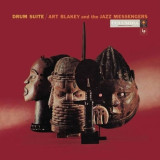
One of the inventors of the modern bebop style of drumming, Blakey is known as a powerful musician and a vital groover; his brand of bluesy, funky hard bop was and continues to be profoundly influential on mainstream jazz.
For more than 30 years his band, Art Blakey & The Jazz Messengers included many young musicians who went on to become prominent names in jazz. Recorded in 1956, Art Blakey's Drum Suite is a wonderful hybrid of African, Latin, and hard bop rhythms that prefigures the concept of Afro-beat by at least a decade. The sheer energy, not to mention its very special and fresh-sounding intimacy, make it especially astounding.
Even more amazing is that the three parts of the suite -- Blakey's "The Sacrifice," Ray Bryant's "Cubano Chant," and Oscar Pettiford's "Oscalypso" -- were recorded straight through live, and were only intended to be a pre-take run-through. As is obvious here, Blakey and company nailed the whole thing right out of the box.
Groundbreaking for its time, and still sounding vital, powerful, and visionary, the Drum Suite album is somewhat of a lost masterpiece that deserves a fresh audience.
"Art Blakey's first release for Columbia Records is essentially two records. Side one is a percussion ensemble playing what would, ten years later, be called Afro-Cuban drumming. Side two is the mid-fifties version of the Jazz Messengers featuring Jackie McLean on saxophone. Side one features Blakey, Jo Jones and Charles Wright on drums, Candido and Sabu on bongos, and Oscar Pettiford and bass and cello. The group plays three compositions, one by Blakey, one by Pettiford and one by Ray Bryant, fusing African, Cuban, and calypso percussion into a well-integrated suite.
"The group recorded a run through and it was so perfectly executed that they used the practice run for the release, unedited except to add some Swahili chants by the percussionists during a few passages. One cannot help but think of Olantunji's Drums of Passion, another Afro drumming landmark, here. Blakey's drum suite was recorded at Columbia's 30th Street studios in New York in 1957 and is in mono. The almost stereoscopic image is truly remarkable. Mastered by Kevin Gray and pressed at RTI, Drum Suite is a valuable record of one of the most important figures in jazz history. Recording: 9/10. Music 9/10." - Dennis Davis, Hifi+
"...The three-part suite was laid down in one take with no arrangements, and begins with a few tympani thwacks followed by an African chant. Soon the ensemble kicks in and the group takes off an a sweaty Afro-Cuban-bop journey that will leave you breathless, as the thing crackles with terrific energy. Side Two is more conventional hard bop, but given this group's mastery of if not invention of the style, these tracks are extremely satisfying. Kevin Gray's remastering is detailed and immediate, with plenty of bit and air, if not the widest dynamic range. For anyone interested in percussion of this genre, this is not to be missed." - Wayne Garcia, The Absolute Sound
Suche:b box
Recoil ist das musikalische Projekt des ehemaligen Depeche Mode-Mitglieds Alan Wilder. Mute veröffentlicht die letzten drei Recoil Alben „Liquid“, „Unsound Methods“ und „subHuman“ am 7. Oktober neu, jeweils auf CD und farbiger Doppel-Vinyl. Ursprünglich ein Soloprojekt für Alans experimentelle Arbeit außerhalb von Depeche Mode, wurde Recoil zu seinem wichtigsten Musikprojekt, nachdem er 1995 seinen Ausstieg aus der Band bekannt gab.
Das Golden Gate Jubilee Quartet, Rosa Torras, Diamanda Galás, Nicole Blackman, Samantha Coerbell und andere treiben Alan Wilders gleichfalls leidenschaftliche wie aufreibendes Recoil-Album „Liquid“ an. „Liquid“ wurde im Jahr 2000 veröffentlicht und besitzt eine hypnotische und zutiefst aufgeladene Anziehungskraft, die sich aus einem intensiven Geflecht aus Verlangen, Wut und Gewalt speist. Ein außergewöhnliches Werk zur Selbstreflexion in Gesellschaft der eigenen dunklen Seite, das sich auf eine wirklich verstörende Weise in die Psyche bohrt.
Das ursprünglich 2000 veröffentlichte Album des Soloprojekts von Ex-Depeche Mode Mitglied Alan Wilder (inkl. der Singles 'Jezebel' und 'Strange Hours'). Jetzt auf schwarzem Vinyl.
6x12" Colored Vinyl[151,22 €]
Nach dem gigantischen Erfolg des Spiels, in dem Millionen Gamer Aloy durch den Verbotenen Westen begleiteten und mit ihr die Rätsel um die neuen Gefahren einer post-apokalyptischen Welt lösten, erscheint jetzt der Soundtrack zum Spiel in drei Ausführungen. Die Highlights des Soundtracks sind in einer 2 LP-Version erhältlich. Zwei umfassendere Editionen für Fans und Sammler sind die coloured 6 Vinyl-Box und die kompaktere, auch kunstvoll gestaltete 6 CD-Edition.
Black Vinyl[36,09 €]
Colored Vinyl
Nach dem gigantischen Erfolg des Spiels, in dem Millionen Gamer Aloy durch den Verbotenen Westen begleiteten und mit ihr die Rätsel um die neuen Gefahren einer post-apokalyptischen Welt lösten, erscheint jetzt der Soundtrack zum Spiel in drei Ausführungen. Die Highlights des Soundtracks sind in einer 2 LP-Version erhältlich. Zwei umfassendere Editionen für Fans und Sammler sind die coloured 6 Vinyl-Box und die kompaktere, auch kunstvoll gestaltete 6 CD-Edition.
Big Crown Records is proud to present the debut full length offering from Les Imprimés, Rêverie. The stirring and ethereal sounds of Les Imprimés have been making fans of anyone who hears them since their first 7" single hit the speakers. Morten Martens is the man behind the band. Born, raised, and working in Kristiansand, Norway, he keeps a low prole while making his heart felt, highly infectious, and unique music. This album is a long time coming for Martens and it is sure to make him a name to be reckoned with. The first thing you notice listening to Les Imprimés is the high level of musician-ship. Martens plays nearly every instrument on the recordings and handles the production and arranging. He has been making records for decades, winning a Spellemann Award (aka, the Norwegian Grammy) in 2006 for producing a HipHop album as well as getting nominations across three other genres. While awards and accolades speak to the level of his talent, this new album really shows who he is an artist on his own terms. Moving away from being a hired gun on the touring scene naturally led him to start doing more studio work. Slowly collecting gear and getting more experi-ence behind the boards he built his own studio on the island of Odderoya and was making a living playing with and recording other people's music. As the story goes, after those sessions would end he would work on his own project into the wee hours of the night. From these late night sessions, Les Imprimés was born and Rêverie began to take shape. However, "it wasn't until COVID, when things locked down, that I was really able to nd the time to focus on Les Imprimés" Morten says about creating and leading his own solo project. "It was a scary time. But I knew I had to do something with it." He took the sum of his inuences, combined them with his own vibe and got busy writing the music, playing the instruments, and singing the songs. "It's soul music, but I don't exactly have the soul voice," Morten explains humbly. "But I do it my own way, in a way that's mine. "It is his sound, his fingerprint, his sensibility, that makes his music hard to put in a box. The album showcases both Martens' range and his ability to make a cohesive album. The lead single "Falling Away" starts with a raw drum break and turns into a lushly arranged tune that paints the picture of love when it slips away. On "Still Here" he professes his resilience through life's twists and turns over a thundering track that puts a new spin on the B side ballad genre. Songs like "You" and "Our Love" mix tones from 60s and 70s Soul with arrangement nods to Doo Wop records while Martens' lyrics and delivery leave you singing the melodies long after they finish. "Love & Flowers" finds Martens in a moment of clarity with a song that ts the niche sub genre of happy break up tunes, the four on the floor track will move the dancefloor or while the message will resonate with anyone who put too much effort into the wrong situation in their lives. However, it is songs like "Muse" and "Chess" that really encapsulate the uniqueness of Les Imprimés as they push the boundaries of genre, one a profession of love for music and the other a cover of an electronic record respectively. Martens' lyrics, emotion, and delivery truly make the whole thing come together and stand out from any of his peers. There's an infectiousness and a pop sensibility in the writing that is done with the utmost class and taste giving Les Imprimés the rare quality of immediate attraction that only deepens the more you listen.
- A1: Alive And Buried
- B1: Timeless Time
- C1: In Luton Airport No-One Can Hear You Scream
- D1: The Beast In The Cage
Four full-cast radio episodes based on the hit series, adapted by David Renwick from his TV scripts.
Having been made redundant from his job by an electronic box, crabby Victor Meldrew is faced with the
prospect of finding his feet in an increasingly frustrating world. In these four episodes – Alive and Buried,
Timeless Time, In Luton Airport No-one Can Hear You Scream and The Beast in the Cage – things hilariously
go from bad to worse for Victor and his long-suffering wife, Margaret.
Written by David Renwick, and starring Richard Wilson as Victor and Annette Crosbie as Margaret, these
highly entertaining BBC Radio 2 adaptations also feature a supporting cast including Doreen Mantle, Owen
Brenman, Sally Grace, Jeffrey Holland, Jon Glover and Michael Fenton-Stevens.
Presented in full-colour inner bags, depicting the everyday trappings of Victor’s life, two burgundy 140g
vinyl LPs are housed in an illustrated wide-spine outer sleeve -complete with coffee-spilled rear. You simply
won’t believe it!
"Aloha from Hawaii via Satellite" war ein Konzert von Elvis Presley, das ursprünglich in Honolulu stattfand und 1973 live via Satellit in die ganze Welt übertragen wurde. Das daraus resultierende Live-Album wurde zum Nummer-1-Album für Elvis, und die TV-Übertragung wurde weltweit zum Fernsehereignis des Jahres. Dieses 3CD + 1 Bluray Paket zum 50. Jubiläum enthält: CD 1 - neu abgemischte Version des originalen Fernsehübertragungskonzerts in voller Länge, CD 2 - Probeshow, CD 3 - komplette Bonussongs nach der Show und Bluray - Elvis Aloha from Hawaii Konzert + Probeshow + Bonussongs. Das 2LP-Set enthält die Highlights des Aloha-Boxsets: 2LP, Gatefold
Freak Frequency was a fitting title for the new material Greg Obis was planning for Stuck, the frenetic and twisted post-punk outfit he formed in 2018. Inspired by the doomy social economics of Mark Fisher’s Capitalist Realism, the bleak worldbuilding of horror games Demon’s Souls and Bloodborne, and the bombastic yet arty satire of Devo, Obis channelled his audio analogy into Freak Frequency, an album ringing out with explosive sounds and ideas.
Stuck formed after Obis’ previous projects, Yeesh and Clearance, called it quits in short proximity. Obis is on guitar and vocals, which span from booming theatrics to ecstatic yelps. The project’s rhythm section is completed by shoegaze guitarist-turned-chugging bassist David Algrim and tightly wound drummer Tim Green—also a graphic designer, and the artist responsible for Stuck’s distinctively unified visual aesthetic. Original co-guitarist Donny Walsh contributed freely inventive lines for the first few years of the project, including on Freak Frequency; Ezra Saulnier of Red Tunic, the newest member of the band, now brings calculated contrapuntal riffs to match Obis’ parts.
The building blocks of Stuck include the egg punk eccentricities of Uranium Club and The Coneheads filtered through noise rock power, à la Jesus Lizard or Slint; that melange is glittered with the precision microtones of Unwound and Women. “I want the feeling of immersion and chaos and tension, with a big guitar amp playing a big chord,” says Obis of his inspirations, citing friends and peers Cloud Nothings and Preoccupations. “But I want it delivered by having a lot of smaller points of light poking through.”
In fact, writing for Freak Frequency began while Content’s recording was still underway—beginning with “Scared,” which features acoustic layers under feedback squalls. “Time Out,” with motoric guitars in the sputtering lineage of Wire, was also composed in late 2019. Obis wrote it about the cycles of compulsion and shame woven into social media use, and the way negativity drives algorithmic engagement. It became an exciting exercise for the group in ramping up speed; “I thought I knew how far I could push Tim’s tempos,” Obis recalls. “But Tim kept insisting we do it 20 bpm faster than what I had. He is an absolute monster for playing that.”
Album opener “The Punisher,” a spiral staircase of disembodied guitars and rhythmic slams over a 2/4 beat, came in the aftermath of the January 6 insurrection. It felt immediately emblematic to Freak Frequency, and Obis describes it as his favorite Stuck track: one he wishes he could write again and again. “It hits all the boxes that Stuck can do: it’s goofy, but there’s a lot of intricate guitar interplay, and at the end, there’s a big payoff,” he explains. The last song written was “Do Not Reply,” a pre-album single that came to Obis after engineering for Melkbelly and channelling their earworm melodies. Algrim wouldn’t let it on the record unless Melkbelly’s front person Miranda Winters dueted on vocals; she was happy to oblige, and the gritty epic closes Freak Frequency.
With slippery snark, percussive heft, and funhouse mirrors of sludge, Freak Frequency delivers its needed screeds with gratifying nuance. If Stuck’s interpretation of this messed-up world goes down like a bitter pill, it’s only because its sugar coating is too delicious to keep from eating.
Chain Of Flowers return with their lofty and long-simmering sophomore full-length, rich with reckonings, reverb, and redemption: Never Ending Space. Despite some of the songs dating back a few years, the record first began materialising in earnest during the pandemic, by which point most of the band had relocated from Cardiff to London.
Reunited and rejuvenated, they picked up where they left off, booking two multi-day sessions at Hackney hub Total Refreshment Centre with producer Jonah Falco. In this time they successfully channelled their kinetic chemistry into 10 full-blooded anthems of torn dreams, poetic delirium, and “hope stretched too far.” Musically, Never Ending Space skews notably more maximal than the group’s previous work, fleshed out with trumpets, saxophone, synth, percussion boxes, and spoken word. (Smith jokingly calls them The Chain Of Flowers Orchestra).
Yet the songs still swing and soar with a charged heart, ripe with hooks, drama and ragged melody. Opener “Fire (In The Heart Of Hearts)” stirs to life on a tide of wiry guitar and defiant horns, facing down the embers of love that still glow in the wake of pain: “Peace came tumbling like a shower of bricks / The mind twists slowly till everything fits.”
A tense energy ripples throughout – from the nocturnal rush of “Serving Purpose” and “Amphetamine Luck” to the bruised battle cries of “Torcalon” and “Old Human Material.” Outliers like “Praying Hands, Turtle Doves” hint at proggy possible futures, while instrumental vignette “Anomia” offers an intriguing glimpse at a lesser heard facet of the band: swaying, shadowy, subdued. The album’s title track is also its closing cut, a stomping, sparkling ode to “the wrong side of the night, where time goes to die.” Smith describes the scene: “Everyone’s talking, screaming, trauma bonding, but no one’s listening. Broken dialogue. Shouting over each other. You want to switch off, but everyone’s too fucked.” The guitars spiral and slide towards the oblivion of dawn, the chance to crash and do it all again.
Chain Of Flowers return with their lofty and long-simmering sophomore full-length, rich with reckonings, reverb, and redemption: Never Ending Space. Despite some of the songs dating back a few years, the record first began materialising in earnest during the pandemic, by which point most of the band had relocated from Cardiff to London.
Reunited and rejuvenated, they picked up where they left off, booking two multi-day sessions at Hackney hub Total Refreshment Centre with producer Jonah Falco. In this time they successfully channelled their kinetic chemistry into 10 full-blooded anthems of torn dreams, poetic delirium, and “hope stretched too far.” Musically, Never Ending Space skews notably more maximal than the group’s previous work, fleshed out with trumpets, saxophone, synth, percussion boxes, and spoken word. (Smith jokingly calls them The Chain Of Flowers Orchestra).
Yet the songs still swing and soar with a charged heart, ripe with hooks, drama and ragged melody. Opener “Fire (In The Heart Of Hearts)” stirs to life on a tide of wiry guitar and defiant horns, facing down the embers of love that still glow in the wake of pain: “Peace came tumbling like a shower of bricks / The mind twists slowly till everything fits.”
A tense energy ripples throughout – from the nocturnal rush of “Serving Purpose” and “Amphetamine Luck” to the bruised battle cries of “Torcalon” and “Old Human Material.” Outliers like “Praying Hands, Turtle Doves” hint at proggy possible futures, while instrumental vignette “Anomia” offers an intriguing glimpse at a lesser heard facet of the band: swaying, shadowy, subdued. The album’s title track is also its closing cut, a stomping, sparkling ode to “the wrong side of the night, where time goes to die.” Smith describes the scene: “Everyone’s talking, screaming, trauma bonding, but no one’s listening. Broken dialogue. Shouting over each other. You want to switch off, but everyone’s too fucked.” The guitars spiral and slide towards the oblivion of dawn, the chance to crash and do it all again.
- A1: Did You Miss Me?
- A2: Film-Maker
- A3: Panzer Attack
- A4: Who Needs Enemies?
- B1: Amber
- B2: Digital Observations
- C1: Let’s Kill Music
- C2: 555-4823
- C3: Been Training Dogs
- D1: The Lake
- D2: Murder Song
Formed in Reading in 1998, The Cooper Temple Clause were an alternative rock band
consisting of Ben Gautrey (vocals), Tom Bellamy (guitar, keyboards), Didz Hammond
(bass), Daniel Fisher (guitar), Kieran Mahon (keyboards), and Jon Harper (drums).
• The band signed with RCA and burst onto the scene with their debut ‘See This Through
And Leave’ in 2002. Featuring the singles ‘Let’s Kill Music’, ‘Film-Maker / Been Training
Dogs’ and ‘Who Needs Enemies?’, the album earned the band a cult following and critical
acclaim including the Kerrang! ‘Best British Newcomer’ award.
• Previously only available on vinyl as a 7” boxset, Demon Records presents the complete
album on 12” vinyl for the very first time. Newly remastered by Phil Kinrade and cut by
Barry Grint at AIR Mastering.
• Pressed on two 140g vinyl with printed inner sleeves
Incredible jazz / prog / folk score to groundbreaking tattoo film by maverick filmmaker. Unreleased until now, so don’t go saying it’s a reissue because it isn’t, but I’m sure some people will because they always do.
John Samson (1946 - 2004) was a truly great documentary maker. He must be as I’ve been obsessed with his work for many years. Educated first at Glasgow School Of Art (circa 1963) and then finally in the art of film making at The National Film And Television School in Beaconsfield - he headed there in its opening year of 1971 having made a short film that got him a scholarship.
It was at the NFTS that Samson met Mike Wallington, who was to become his right hand man and eventual producer; together as a quite brilliant team they made a handful of inspiring, entertaining and hugely prescient films about important, overlooked, unseen and marginal fringes in society. Tattoo (1975) Exploring the rather clandestine world of tattooing in the UK. Dressing For Pleasure (1977) Exploring the rather clandestine world of festish in the UK. Brittania (1979) A film about railway enthusiasts and a steam train restoration.
Arrows (1979) The life of dart player Eric Bristow. Drag Ball (1981) An unreleased film about the annual Porchester Hall Drag Ball. The Skin Horse (1983) BAFTA winning film about The Outsiders Club, a dating agency for disabled people. The subject matter in all films was always unusual for the time, and Samson managed to navigate his way with compassion, interest and subtlety, immersing himself in the chosen scene and producing moving, fascinating and sometimes darkly amusing situations. His documentaries also do not rely on traditional voiceovers, with stories, facts and narrative threads being dictated by the subjects.
I’ve tried for a long time to find the music for a couple of his early films (there was actually an original 7” for Arrows) - so far this is the only unreleased soundtrack I have found. This one was written by Steve Jolliffe, who met Samson at the NFTS. Joliffe was the resident composer and had a room at the college complex where he could work on scores for the fledgling film makers. Jolliffe was and still is a multi-instrumentalist and prolific composer who had met Edgar Froese at the Berlin Konservatorium in the late 1960s and played in an early incarnation of Tangerine Dream. He toured with blues rock outfit Steamhammer, before hanging out at the NFTS, making this recording (and many others) and eventually rejoining Tangerine Dream in the late 1970s. Jolliffe still writes, records and releases today and once i had made contact with him we traced the original Tattoo master tape to a box at his brother’s house. Musically it’s charming, slightly folky, a touch baroque, there’s a whiff of prog too, and it perfectly suited this early documentary about the art and desire of tattoos. I only wish it was longer. But the film is only 16 minutes long. Seek it out if you can. Try and find all the Samson films, they really are a joy.
As well as featuring intimate footage of tattooed people, the film also includes a rare and very early interview with Alan Oversby (better known as Mr Sebastian), a seminal character in the development of tattoos and body modifications worldwide - it was he who eventually was to tattoo and pierce Genesis P-Orridge.
The images for this vinyl release were all found in Mike Wallington’s Tattoo documentary research folder from 1974, and were photos sent in to Mike and John by people who wanted to feature in the film. Most answered an advert in Time Out, and others included people from my home town of Aldershot where tattooist Bill Skuse and his wife, Rusty (the most tattooed woman in Britain at the time, and featured in the film) were based. His parlour was situated at the back of the arcade where we all used to lose all our pocket money in the slot machines.
The Musicians:
Steve Jolliffe - keyboards, flute, sax Geoff Jolliffe - bass guitar Julian Furniss - guitar Mick Kirby - drums
No. is the tenth Soft Riot album by Glasgow-based Canadian synth auteur Jack Duckworth (also known as JJD). With origins from the mid-nineties in the vibrant art-punk/hardcore dominating the West Coast American/ Canadian underground at the time, he has clocked in over twenty five years of musical output in various bands and projects.
No. is the logical follow-up to When Push Comes To Shove, released in November 2019 on the Glasgow UK-based label Possession Records, which saw some critical acclaim in the increasingly diverse synthwave scene — a crystallization of the artist’s signature “SynthLord” sound.
With No. things have been shaken up and pushed into new directions. Many different factors came into play, including the conditions of the pandemic lockdowns and an urge for listening to music favourites from beyond his own scene informed developments on this new record. One key feature of these tracks is that under these conditions they were developed as individual pieces — a contrasting approach from previous albums where tracks were written with an album in mind. An evaluation of all of these individual tracks in the summer of 2022 unveiled a common pattern going through these new compositions.
One can still hear any number of echoes of the spirits of original synth artists in his sound, such as Images in Vogue, The Box, Section 25, Thomas Dolby, Skinny Puppy, Chrome, Cabaret Voltaire, Fad Gadget, Japan and Bill Nelson. However, some of Jack’s halcyon punk influences surface as well, taking inspiration from legendary punk/hardcore labels such as Dischord and Gravity, as listening habits over pandemic steered back towards more guitar-based styles. The introduction of expanded production techniques, experiments with vocal styles and tones, and stylistic shifts mark a progression of Soft Riot’s sound. The result is a snarkier, urgent and more playful, with a focus on pure synthpop, new wave, art-punk, proto-EBM as well as grittier synth-punk and post-punk tones.
The variation, energy and tone of this collection of tracks illustrates Soft Riot’s ability to transcend the hallmarks of today’s music environment, which increasingly is fragmenting into smaller and smaller micro-genres. Dry wit and dark humour take the lyrics and the tone of this album on a fun ride through music scenes, dark alleys and inside jokes.
Be With present the first ever reissue of the ultra rare double pack DJ promo of Malcolm McLaren & Bootzilla Orchestra's "Call A Wave". Originally slipping out in 1989 to a select few, there were rumoured to be only ever 300 copies pressed. Indeed, the entire package never got a proper release and now goes for a small fortune.
Say what? Bootsy Collins, Jeff Beck and Malcolm McLaren, all in one band, composing over a Barry White sample? And that's just the original. But you can forget about that for now. Here we have the incredibly sought-after "DFC Dance Mix", mixed by Massimino Lippoli of Morenas / Sueño Latino fame for the legendary DFC Italy. It's a throbbing, vital, dramatic slice of dreamy ambient house. A deep, entrancing track that's both blissful and dancefloor dynamite. It features the iconic, disaffected female vocal chopped up over elegant piano snatches, Beck's ace guitar stylings over rolling, heavy drums and a killer, hypnotic bassline with sparkling harp coming and going. It's exotic, otherworldly and brimming with that very special late 80s/early 90s Mediterranean vibe. Yes, it's Balearic, it's House. Above all else, it's a pure uncut slice of halcyon summer days, pressed on wax.
But on side B we also have the mesmeric "Breakdown Mix", again mixed by DFC Italy. For some, *this* is the mix to have - and who are we to argue? This time, the vocals are treated so they're uttered backwards, contributing to the wonderfully disorienting magic of this particular mix.
And how could we forget the equally iconic "Orbital Mix"? Not by the actual group Orbital, but courtesy of S'Express's Mark Moore & William Orbit, no less. A brilliant, beautiful remix that's perhaps more musical. They make more obvious use of the sample from the original Barry White track ("I'm Gonna Love You Just a Little More Baby") that Malcolm was inspired by. Flip over to Side D to find the duo's uber-horizontal "Return To The Deep Ambient Mix", a floaty, beatless gem that'll leave you swooning.
To round out this quite astonishing package, the "New Age Mix", again coming from the DFC Italy camp, elegantly sends us off into the cosmos with minimal percussion and maximum vibes.
Every mix on this DJ double pack is truly killer. Simon Francis remastered the original audio for this release and Cicely Balston's precise cut for Alchemy at AIR Studios ensures this 2x12" well and truly pumps. The immaculate Record Industry pressing will ensure this incredibly sought-after masterpiece finds a home in many more DJ boxes this and every summer. For the artwork, we've recreated the original DJ promo, a plain white gatefold sleeve complete with the iconic burnt orange hype sticker. Hold tight. Roof down, tops off.
Brilliantly remastered (picture) LP/CD with new stunning artwork!
Lo-Fi India Abuse was recorded in 1998, some tracks are “pure” Muslimgauze and some are re-mixs of tracks from Systemwide’s “Sirius” CD (see also Systemwide meets Muslimgauze “at the City of the Dead” 12″). Nearly all of the tracks have hand percussion in varying tempos and intensities and at least 1/2 make use of electronic noise surges. The sound is very crisp and clean, extremely well produced, recorded and nicely varied throughout the length of the disc. Some track by track comments: “Antalya” is obviously from the same sessions as “Fakir Sind” seeing as it shares the same hand percussion sound, whistles, vocal wailing, cut-ups and delays. “Valencia Flames” sounds like a Systemwide remix. A dub bass line, hi-hat and background vocal of some sort are all obliterated by numerous delays, starts, stops and re-starts with an unpredictable nature in these cut-up tracks. “Al Souk Dub” injects background voices, market sounds and drones into the cut-up mix of slow hand percussion playing. “Catacomb Dub” and the final two tracks make use of twinkling synth waves, presumably a Systemwide sound source. “Dust of Saqqara” has a heavy pulsating electronic sound wave over an old beat box rhythm. “Android Cleaver” is brutal (as is “Nommos’ Afterburn”) hand percussion, jabs of noise and an oft repeated, unintelligible vocal sample. Yes, Lo-Fi India Abuse is yet another great Muslimgauze release, grab it!
All tracks recorded by Muslimgauze 1998
Some tracks are re-mixes from Systemwide’s “Sirius” album
Re-mastered by Višeslav Laboš
Sleeve by Oleg Galay
Originally released in 1999 via BSI Records (BSI 1999-3).
- A1: Fluido And Piacing
- A2: Lotus
- A3: Spider Of Hanns Heinz Ewers
- A4: Extinction
- B1: It`s Not Like Touching
- B2: Melancholy Of Guillaume Apollinaire
- B3: I Can Watch It
- B4: Cosmos Smooth
- C1: Drive Smooth
- C2: When Getting Involved
- D1: Let`s Open The Pandora Box
- D2: Witch Of Nikolai Gogol
- D3: Lyre Of Theodor Kellner
With the timely reissue of Megalon's highly acclaimed album 'Pandora's Box,' we are now thrilled to present the first of two archival compilations by the London-based electronic production duo.
This compilation meticulously curates handpicked tracks from Megalon's 1993 collection, featuring music from their EPs released on the legendary Plink Plonk label during that year. By delving into these archival tracks, the compilation effortlessly showcases Megalon's signature blend of modern, forward-thinking, and impeccably sleek techno hybrids. Prepare yourself for a diverse range of musical moods that provide a comprehensive 360° sonic experience of Megalon's esteemed catalog, ranging from deep techno meditations to high-octane dancefloor anthems.
Every track included in this compilation has been meticulously sourced from Megalon's original DAT tape archive and expertly remastered by the highly skilled Curvepusher. Furthermore, the artwork and design have been thoughtfully crafted under the watchful eye of Rogan Jeans, the original Plink Plonk Records and Megalon designer, ensuring a visually captivating experience that complements the music perfectly.
- 1: Splitterty Splat
- 2: Wreck And Roll
- 3: You?Re Full Of Shit
- 4: Tidal Wave
- 5: Refrigerator (Alt)
- 6: Cold Meat
- 7: Spinach Blasters
- 8: Jaguar Ride
- 9: Zoot Zoot
- 10: Giganto (Cyclotron)
- 11: Bunnies
- 12: Roll On, Big O
- 13: You Crummy Fags
- 14: No No
- 15: Sewercide (Alt)
- 16: Silver Daggers
- 17: As If I Cared
- 18: Natural Situation
- 19: Cards And Fleurs
- 20: Agitated (Orig)
- 21: Cyclotron
- 22: Black Leather Rock
- 23: Dead Man?S Curve
- 24: Safety Week
- 25: Accident
- 26: Anxiety
- 27: No Nonsense
The electric eels were the first punk band, full stop. They may not have “started” the genre, but they were the first to tick all the boxes. The eels rejected every 1970s rock convention—professionalism, virtuosity, subject matter, image. Dave E.’s caustic vocals, complete with an aggressive lisp and a head full of snot, would become de rigeur a few years after the group disbanded. Meanwhile, the songs’ focus on car crashes, suicide, neuroses, and generally hating people were as far out of the mainstream as possible. The two eels tracks that do approach the subject of romance couch it in terms of not really caring that much about it (“Jaguar Ride”) or placing it in the context of a grisly murder (“Silver Daggers”). Also consider John Morton’s signature guitar sound, a nails-on-chalkboard tone with brutally free soloing inspired more by Albert Ayler than the blues or aspirations to technical facility. Ditto Dave E.’s clarinet playing and affection for lawnmowers and vacuums during live performance. They were notoriously violent not only among themselves, but towards audiences, police, and anyone unfortunate enough to be around them when things went south. Then of course there are the leather jackets, the clothing festooned with rat traps or safety pins. And no bass player, why bother. There is simply no other “proto” band to have had all these pieces in place circa 1973- 1975. Yet it is a mistake to consider the eels exclusively in such a context. Yes, the eels could and did shock anyone who encountered them, but they also had great songs. While both Dave and John were visionary writers, they also had rhythm guitarist Brian McMahon, a melody and riff machine who wrote many of the band’s signature songs. And they were no one-trick pony. Although much of the band’s material is appropriately high-energy, there is also the downer eels—morbid, harmonically risky, and in full existential crisis. Although it’s not a focus of this compilation, the eels also had a penchant for completely free improvisation. Over the last forty plus years, there have been several electric eels compilations. Spin Age Blasters is quite simply the best one ever assembled, every single key track is here in its best version, properly mastered by John Golden, and sequenced with an eye towards both flow between tracks as well as individation between sides. A true monster of an album.
Imperial f.f.r.r. was Unrest’s breakthrough album in 1992. It has withstood the test of time and is now considered an indie-rock classic and one of the best albums of the 1990s. Formed in 1984, at Wakefield High School in Arlington, Virginia, the band started releasing homemade cassettes on their own Teenbeat label. Imperial f.f.r.r. is their sixth album and marked the arrival of original Velocity Girl vocalist Bridget Cross joining drummer Phil Krauth and singer/guitarist Mark Robinson. It was recorded by Wharton Tiers (Sonic Youth) at his home studio in Manhattan. After the release of Imperial f.f.r.r., the band released singles on Sub Pop and K and soon thereafter signed to legendary U.K. indie 4AD, releasing their final studio album Perfect Teeth in 1993. This limited edition features the original design and layout of the very first pressing from 1992. All the details have been recreated including the lyric sheet, the blue box around the amplifier on the front, the label art, and even the Ajax and No.6 Records logos. The original didn't have a barcode, so we've created a spiffy new removeable OBI card for that featuring a photograph by Mike Galinsky (The Decline of Mall Civilization) of the band playing at New York's Spiral club in 1991.