REMIXED & REMASTERED REISSUE OF THE PINEAPPLE THIEF'S 2003
STUDIO ALBUM
Kscope present 'Variations On A Dream', the third album from The Pineapple Thief
newly remixed by Bruce Soord & remastered by fellow bandmate Steve Kitch.
The Pineapple Thief are one of the leading lights of Europe's experimental rock
domain, led by post-progressive mastermind Bruce Soord, the band have built an
incredibly loyal fanbase over the past 23 years through extensive touring &
consistently lauded recordings. Founder Bruce Soord started The Pineapple Thief
as an outlet for his music back in 1999 & has since released over 15 studio
albums.
Albums like 'Someone Here Is Missing' (2010) & 'All The Wars' (2012) paved the
way to their recent releases. Multiple headline tours followed, including their
biggest headline performance in the UK at O2 Shepherds Bush Empire & their first
ever tour of North America.
'Variations On A Dream' opens with the timid beginnings of 'We Subside' as they
slowly move into the more progressive leaning 'Vapour Trails' before the delicate
strings of 'Resident Alien' position us toward the grand finale of the 16- minute
epic 'Remember Us'.
While earlier Kscope releases were many people's introduction to the band, The
Pineapple Thief spent the previous ten years building up a dedicated fan base
across the globe, selling over 25,000 records & nurturing their 'bittersweet'
progressive sound. A sound that has recently been revisited in a beautifully
packaged 'How Did We Find Our Way - 1999 - 2005' deluxe book set.
Kscope will be presenting 'Variations On A Dream' as a single black LP.
quête:black string
Black Truffle is pleased to announce Tender Membranes, the label’s first release from Swedish-Finnish sound artist and electro-acoustic composer Marja Ahti. Active for a decade in the Finnish underground music scene, in recent years Ahti has developed a distinctive approach to patiently unfolding electro-acoustic constructions, documented on a string of solo releases and collaborative projects with Judith Hamann and her husband Niko-Matti Ahti. Working with concrete and instrumental sounds, field recordings, and electronics, Ahti favours neither disjunctive collage nor monolithic consistency; rather, her work is composed of organically unfolding sequences of details and textures, which, as she says, ‘can stretch out or cut fast as long as they have a sense of inner stillness’, a sense that she connects to moments of heightened attention in everyday life. Tender Membranes consists of four lengthy pieces, partly inspired by the image of the senses and mind as membranes allowing for the passage between inner and outer spaces, sensation and its causes, creating a world. Ahti’s unhurried pacing encourages this sense of listening as an opening or surrender to sound, which can often create the impression that the listener is moving through a space zooming in on details. The opening Shrine (Aether) exemplifies this aspect of Ahti’s approach: a bell clears the air with a single long tone, followed by the ambience of outdoor spaces, crackling electronics, an archival recording of a horsefly on a windowpane. Dozens of these moments, varying in length, density, and intensity, move past the listener’s attention, momentarily brought into focus then slipping away. Like those of the masters of the French musique concrète tradition, Ahti’s sounds are not often recognisable, though they might suggest proximity or distance, open environments or closed spaces, the urban or rural, day or night. In Ahti’s work, we do not encounter spectacular metamorphoses à la Parmegiani but rather a state of ambiguity where the listener is often unsure what is organic and what is inorganic, where the careful productions of the synthesizer might end and sounds discovered in the environment begin. What Ahti calls her ‘poetic way of experiencing and organising the familiar and the unfamiliar’ is sustained throughout Tender Membranes, but each piece has its own character. On Dust / Light, human presence is more overt, as what appear to be whispers, singing, and distant speech thread between high frequencies, untraceable drips and pops, and metallic shimmers. In all this there is a melody that you can sing and to which you may dance makes more prominent use of musical instruments, gaining a sombre beauty from half-buried piano chords and organ tones. On the closing Oh Fragrant Witness, a delicate cloud of subtly bending pitches is repeatedly disrupted by a resounding, almost ominous mass of low tones, at once a strange detour from much of what has gone before and an almost classical finale. Arriving in a sleeve reproducing contemporary Finnish photographer Sini Pelkki’s fragmented visions of the everyday, Tender Membranes is a balm to reawaken tired ears.
- A1: Intro
- A2: Drumgita
- A3: Ancient Boogie (Mantra)
- A4: Artnam
- A5: Mantra
- A6: (One) Boogie Home Going
- B1: Going Home Boogie (One)
- B2: Un Minuto (One)
- B3: Un Minuto (Two)
- B4: Going Home Boogie (Two)
- B5: Going Home Boogie (Three)
- C1: Drumsong (One)
- C2: Drumsong (Two)
- C3: Drumsong (Three)
- C4: Strumelody
- D1: Drumelody (One)
- D2: Drumelody (Two)
- D3: Ydolemurd
- D4: Hum Drum Dring (One)
- D5: Hum Drum Dring (Two) (The Freedrum Song)
Occasionally, you find music outside the commercial mainstream, outside of everything – the music of visionaries, eccentrics, inventors, loners, the keepers of secrets, the path-finders. Moondog, Daphne Oram, Harry Partch are from this mould. And so too is Lori Vambe.
New on Strut, the first ever reissue of Vambe’s privately pressed original albums from 1982, Drumland Dreamland and Drumgita Solo. A self-taught drummer, inventor, and sonic experimentalist, Lori Vambe is a unique figure in British music. Creator of his own instrument, the drumgita (pronounced ‘drum-guitar’) or string-drum, Vambe intended to create a kind of music that had never been made in order to pursue access to the fourth dimension.
Vambe was born in Harare, Zimbabwe and his father, Lawrence Vambe, was a noted Zimbabwean journalist and author. Moving to London in 1959, Vambe immersed himself in the Brixton squat movement of the early 1970s, teaching himself to drum and creating a short-lived performance group, The Healing Drums of Brixton (Vambe, the sculptor Alexander Sokolov and outsider musician Michael O’Shea). Vambe later had a dream-vision involving a feeling of ecstasy while playing an unknown instrument that extended from his own umbilical cord; the instrument would manifest itself as the drumgita. In 1982, he privately produced a pair of home recordings, the diptych set Drumgita Solo and Drumland Dreamland, releasing them on his own label Drumony. On these records, he rejected any commercial aesthetic and employed tape effects, temporal shifts, reversed sound and overdubbing to investigate space-time and access the fourth dimension. Combining layered drums with the rhythmic throb of the drumgita and, on Drumland Dreamland, an improvised piano performance by Brazilian concert pianist Rafael Dos Santos, the albums are both hypnotic and perturbing.
Both albums were cut at Portland Studios by Chas Chandler and stand as a concealed monument of Black British experimental music. 500 copies of each record were originally pressed, and both were released together. The albums were never performed live.
For this first ever reissue of Drumland Drumland and Drumgita Solo, Strut presents the two albums in their original artwork, housed in a deluxe slipcase including an additional 8-page 12”-sized booklet featuring unseen photos, liner notes and an interview with Lori Vambe by The Wire magazine writer Francis Gooding. Both albums are fully remastered by The Carvery.
Black Truffle is pleased to announce its first release from celebrated London-based Canadian composer Cassandra Miller. Though her body of mature work stretches back almost twenty years, many listeners were introduced to Miller through the success of her astonishing 2015 Duet for Cello and Orchestra, which sets an imperturbable two-note cello part against a series of increasingly dense orchestrations of an Italian folk melody; in 2019, it was selected by The Guardian as one of the ‘best classical music works of the 21st century’. Traveller Song / Thanksong, the first release of her music on vinyl, presents a pair of compositions for voice and ensemble that exemplify Miller’s gently absurd, strikingly beautiful, and utterly unique work.
Like many of Miller’s compositions, these pieces originate in existing music. Traveller Song (2016/2018) begins from a 1950s song of an anonymous Sicilian cart driver recorded by Alan Lomax and Diego Carpitella, which Miller recorded herself singing along to, going on to then record herself singing to her own layered voices. Miller’s untutored voice is an unsteady, wavering wail that has, in her words, ‘more in common with a quasi-shamanistic keening than anything Sicilian’. Heard sometimes alone, sometimes layered, her pre-recorded voice is accompanied by a chamber sextet drawn from London’s Plus-Minus Ensemble. In the first section, Miller’s exposed warble is set to a spare piano accompaniment, somehow both faintly preposterous and magisterial. Following the voice note for note, the piano part often makes use of almost mechanical sequences of parallel chords, reminiscent both of Satie’s Rosicrucian period and the abrupt harmonic movements of a chord organ. The orchestration then opens up to guitar, clarinet, and sliding strings, a delicate environment for Miller’s voice, which, especially when it begins to be layered, generates a powerful sense of intimacy. In its concluding minutes, the folk roots of the original melody return in the form of a glorious full ensemble setting dominated by accordion, clarinet, and strummed guitar. Thanksong begins from recordings of Miller singing along to the third movement of Beethoven’s late quartet in A minor (Op. 132), the ‘holy song of thanks’ the composer wrote to express his gratitude for (temporarily) recovering from illness. Recording herself singing along repeatedly to each of the individual parts of the quartet, Miller created an aural score where each member of the string quartet listens to their own part on headphones, playing by ear. Performed on this recording by Montreal's Quatuor Bozzini, with whom Miller has a decades-long relationship, they are joined by the British soprano Juliet Fraser, who sings material from the Beethoven quartet ‘as slowly and quietly as possible’. The atmosphere of the opening of Beethoven’s Dankgesang, of hushed reawakening and thoughtful reflection, is sustained throughout the fourteen minutes of Miller’s piece, building at points almost to sentimentality before the five individual parts again fall back into a gentle burble of unsynchronised melodic gestures. Like Traveller Song, here the use of the voice is a long way from the mannered performance of much contemporary music, reaching for a human and bodily presence more connected to the reality of the everyday, albeit suffused with wonder. Presented in a stylish sleeve adorned with photography by Lasse Marhaug and liner notes by Cassandra Miller, this is a key release from a major contemporary composer whose work challenges and dazzles in equal measure. .
- 01: Dark Matter
- 02: Flume
- 03: Château H
- 04: Heliconia
- 05: Disobey
- 06: Zen Roller
- 07: Whiplash
- 08: God Intentions
- 09: Last Tango In Glasgow
- 10: Tae The Moon
- 11: Starlounger
Gold nugget vinyl (2023 repress)! A masterclass in cinematic psychedelia, `God Intentions' is the third studio album from Glasgow outfit Helicon and is due out April 28 on Fuzz Club. Their most ambitious and collaborative album to date, it was recorded at Dystopia, Glasgow with producers Luigi Pasquini and Jason Shaw, mastered by RIDE's Mark Gardener and includes contributions from the Rhona MacFarlane String Quartet, Lavinia Blackwall (Trembling Bells), Mark O'Donnell (Tomorrow Syndicate), Sotho Houle (French avant-garde violinist) and Anna McCracken. Talking about the new record, guitarist/vocalist John-Paul Hughes says: "`God Intentions' is inspired by my brother Gary's story and a few other influences. It's a journey through regret, redemption and resurrection. Our familiar darkness is there, but the record carries a fresh and uplifting positivity. I had a clear idea of how I wanted it to sound and feel long before it began. We're so pleased we achieved it. We managed to hold true to the idea whilst allowing the string quartet, Sotho, Lavinia, Anna, Mark, Jason, Luigi and other collaborators the space to put their mark on it. The album art, by San Francisco-based collage artist Nina Theda Black, captures the depth and breadth of themes and sounds we brought together to create a kind of motion in your mind."
An aura of mystery hangs over Jacky Giordano, a studio musician who has mostly worked for library music.He is the one behind the amazing label Freesound (Schifter, Philopsis, Challenger), but as well on Montparnasse 2000 with Pop in Devil's Train (reissued on Le Tres Groove Club), on Timing (Timing N?1 and Timing N?5, under the nickname Jacky Nodaro), on Musax with Boucles Rythmiques (under the nickname Joachim Sherylee, reissued as well on Le Tres Groove Club) or Black Devil Disco Club whose paternity for this record is still disputed between him and Bernard Fevre. Jacky Giordano wasn't an altar boy, far from it, and will have sadly been more known for his troubles with justice than for his music.This is his work for the label l'Illustration Musicale (IM) which can now be rediscovered thanks to this new reissue on Le Tres Groove Club.Organ Plus (IM26) is the sequel to Organ (IM 24), also reissued by Le Tres Groove Club. The title is misleading here, an organ not being preponderant part of the record which honours the Fender Rhodes, string machine, bass synth and clavinet. 'Be Careful', 'Riffologic', 'Twillight' : Jacky Giordano offers slow tempo jazz-funk, without losing his melancholy and low-fi groove that make his tracks immediately recognisable regardless the record label or nickname.
ltd 700 copies on black vinyl housed in reverseboard printed sleave with printed inner sleave. Comes with lyric booklet, poster and postcard inserts ** Formed in 1968, The Plastic People Of The Universe – named after a Mothers of Invention song and heavily influenced by Frank Zappa and The Velvet Underground – were iconic figureheads of the Prague Underground, a loose collective of Czech poets, philosophers and artists considered a threat by the Communist government. Banned and jailed under Czech communism The Plastic People Of The Universe are a true story of artistic perseverance, Authorities claimed their music would have a "negative social impact", and they were banned from playing for the public, having to play secret shows in remote locations. The raw DIY sound of their recordings escaped to Europe on tape and was released without the band's knowledge, their first album being a document of artistic defiance against the control of a stringent political environment they lived under.
Egon Bondy's Happy Hearts Club Banned, PPU's debut LP, was recorded in 1973-74, but not released until 1978 (and even then, only in France). A beguiling album of lo-fi experimental rock that falls somewhere between Can, The Fall and Canterbury psych-folk with Ayler-esque sax solos. First-time vinyl reissue and it is limited. Essential.
One of the best band you never heard of
ltd 700 copies on black vinyl housed in reverseboard printed sleave with printed inner sleave. Comes with lyric booklet, poster and postcard inserts ** Formed in 1968, The Plastic People Of The Universe – named after a Mothers of Invention song and heavily influenced by Frank Zappa and The Velvet Underground – were iconic figureheads of the Prague Underground, a loose collective of Czech poets, philosophers and artists considered a threat by the Communist government. Banned and jailed under Czech communism The Plastic People Of The Universe are a true story of artistic perseverance, Authorities claimed their music would have a "negative social impact", and they were banned from playing for the public, having to play secret shows in remote locations. The raw DIY sound of their recordings escaped to Europe on tape and was released without the band's knowledge, their first album being a document of artistic defiance against the control of a stringent political environment they lived under.
Egon Bondy's Happy Hearts Club Banned, PPU's debut LP, was recorded in 1973-74, but not released until 1978 (and even then, only in France). A beguiling album of lo-fi experimental rock that falls somewhere between Can, The Fall and Canterbury psych-folk with Ayler-esque sax solos. First-time vinyl reissue and it is limited. Essential.
One of the best band you never heard of
Attarazat Addahabia & Faradjallah's album came to us as quite a mystery. Our friends from Radio Martiko got access to the studio archive of the Boussiphone label and a reel labeled “Faradjallah” was among the items they had found there. After listening to the selection of reels they borrowed, Radio Martiko felt it was not a fit for their label and helped us licensing it from Mr. Boussiphone instead. We knew nothing about the band. We just had the reel with the music but very little information. What we knew was that the music was incredible and very unique. Gnawa sounds were combined with funky electronic guitars, very dense layers of percussions and female backing vocals more reminiscent of musical styles further south than Morocco. We started asking around whether anyone knew the band with no immediate success until we asked Tony Day, a musician from Morocco who helped us during our search for Fadoul’s family. His sharp memory came through once again, remembering all the names of the Attarazat Addahabia band members and even how to contact the bands singer and leader Abdelakabir Faradjallah. After visiting him at his home in Casablanca with our Moroccan colleague Sabrina multiple times, he shared his personal story. His father arrived in Casablanca from Aqqa at the age of six and his mother came from Essaouira. Abdelakabir was born in the neighbourhood of Benjdia in 1942. Abdelakabir Faradjallah studied fine arts in Casablanca, graduating in 1962. He also played soccer in the second team of "Jeunesse Societe One". His brother-in-law Ibrahim Sadr worked for one of the biggest football teams of the time in Morocco called "Moroco Sportive Union", which allowed him to travel to France occasionally. While Ibrahim was never part of the band he brought along a few instruments from trips.
Yet the majority of the instruments they could not afford to buy were build by Faradjallah and Abderrazak, Faradjallah's brother who passed away early. For instance they had built a Spanish guitar and a drum made of wood barrel and sheepskin by themselves.During the 1950s Faradjallah was booked as a singer for surprise parties with friends. He started to write his first songs including "L’gnawi" in 1967 and wanted to make people discover Gnawa culture, or maybe rather his take on the culture to be more exact. Faradjallah recalls his first interaction with the genre in the streets of the Dern neighbourhood, where he used to go to elementary school. Gnawa is one of the essential musical genres of Morocco. It combines ritual poetry with traditional dances and music linked with a spiritual foundation. Musically a lot of influences originated from West Africa as well as Sudan. Gnawa is usually played by a selection of specific instruments such as the qaraqab (large iron castanets centrally associated with the music), the hajhouj (a three string lute), guembri loudaâ (a three stringed bass instrument) and the tbel (large drums). People would put shells on their clothes and instruments and use incense at their parties. "Sidi darbo lalla - lala derbo khadem..." came from Gnawa verses Faradjallah used to sing when he was 14. The lyrics tackle a global (im)balance of power and the question of social status in this course. The band Attarazat Addahabia was formed in 1968. The original line-up included 14 members, all from the same family. They played their first small concerts here and there starting in 1969. Later in 1973 they performed bigger shows for instance at the Municipal Theatre followed by the "Al Massira Show" at Velodrome Stadium in downtown Casablanca. Their first album "Al Hadaoui" (the one you are listening to) was recorded at Boussiphone studios in 1972 and was never released before. Nobody seems to remember the exact reason why Boussiphone ended up deciding not to put the album out. The album's title track also served as the basis for Fadoul's "Maktoub Lah", who frequented the same circles as the band for some time.
Their shows sometimes could go as long as 12 hours, starting at 5pm in the afternoon, with an occasional break here and there. In the 1980s the band took a brief break. Faradjallah recalled the reason for that break like this: "Zaki, the bands drummer, had fallen in love with a young girl from Mohammedia. Soon after, he fell very ill. The group members were convinced that the girl had given him ‘s'hor’ (a kind of local Moroccan version of "black magic"). For four years, the whole group stopped playing. It was unthinkable to find another drummer to replace Zaki, even temporarily." So they waited four years for Zaki to "get back on his feet" before going back on stage. Apart from very few gigs here and there Faradjallah stopped playing music in the mid 1990s. Some members from the younger generations formed a new band and still play frequently to this day. Faradjallah runs a television repair shop coupled offerings beverages and snacks in the Belevedere /Ains Sbaa district of Casablanca. While Faradjallah was primarily a musician, he would work for the local cinema and paint their posters for new movies by hand and he designed all artworks and cover posters of the band.
And this eventually led to him participating actively in our first exhibition dealing with Habibi Funk’s work in Dubai 2018. He helped us by creating calligraphic complementations on large photo prints for that show.
Edna Wright's idiosyncratic "Oops!" is one of the most sublime vocal refrains in soul music history. Anchoring its host album's leadoff cut, it sets the tone for a uniquely satisfying modern soul LP. Indeed, whilst many of its ilk come laden with filler, Wright's one solo record is an exercise in elegant restraint, a concise killer.
Originally released in 1977 on RCA, this rare and sought-after album followed the 1973 disbanding of Edna's much-loved Honey Cone. Produced by her husband, legendary producer/songwriter Greg Perry, the album was somewhat of a risk, a deep soul album released during the period when disco was altering the landscape of popular music. And perhaps inevitably, despite the stellar production and spine-tingling vocals throughout, the album glided gracefully under the radar, spawning only one single and seeing no chart action.
That single - the magnificent title-track - soon became a notorious rare groove stepper in its own right. However, in the years since, it has become a crate diggers classic. Its fame was elevated among hip-hop heads when Prince Paul memorably looped the shimmering intro when crafting the melodic hook for De La Soul's late-summer-stunner "Pass The Plugs", a wistfully melancholic back-porch nostalgia trip. And, more recently, Leon Vynehall liberally lifted the same intro for his sepia-tinged "Midnight On Rainbow Road" to augment the excellent Rush Hour compilation Musik For Autobahns 2.
Yet this album is so much more than its most famous song. An assuredly lean masterpiece from start-to-finish, the album features a further six dynamite tracks of warm, smooth soul. As such, it's an impossible task to choose certain tracks to highlight alongside the mighty title track. Throughout, Edna's strikingly mature vocals are wonderful, proudly stepping out with a sophisticated groove reminiscent of Jean Carn or Gloria Scott, whilst Greg Perry's gorgeous string-drenched backdrops add a rich depth. So much so, many of the other tracks have been sampled by producers with impeccable taste, from 9th Wonder to The Alchemist for songs featuring Nas and Talib Kweli.
Following her glowing role in the acclaimed documentary 20 Feet From Stardom, we pray this long overdue reissue will allow further light to shine on Edna. Officially licensed and beautifully remastered for vinyl by celebrated engineer Simon Francis, it has been pressed on audiophile 180g vinyl for the first time and features the original iconic artwork. Each copy includes a printed inner sleeve with a sumptuous black & white photo, full lyrics and heartfelt notes from Edna herself.
Julian Cannonball Adderley's only Blue Note album, Somethin' Else, would likely forever be famous in music lore if just for the presence of Miles Davis. The iconic composer/trumpeter steps into the role of sideman on the 1958 set, one of just a handful of times he'd make such a move after the calendar passed the mid-1950s. Yet evaluating Somethin' Else strictly on Davis' involvement misses the big picture. Plain and simple, Adderley's jubilant work remains a jazz landmark due to the chemistry of its Hall of Fame personnel, enthusiasm of its participants, and sophistication of its arrangements – not to mention the reference-grade production and inclusion of the definitive renditions of two all-time jazz standards.
Limited to 6,000 numbered copies, pressed on dead-quiet MoFi SuperVinyl at RTI, and mastered from the original master tapes, Mobile Fidelity's ultra-hi-fi UltraDisc One-Step 180g 45RPM 2LP collector's edition pays tribute to the record's merit and includes the bonus track "Allison's Uncle." Offering reference-calibre sonics, this spectacular collector's version provides a clear, transparent, ultra-dynamic, and up-close view of a cornerstone effort that witnesses Adderley and Davis sharing horn duty alone for the only time in their fabled careers – an arrangement that occurred as a result of Adderley having joined Davis' majestic sextet a year prior.
The premium packaging and beautiful presentation of the UD1S Somethin' Else pressing befit its extremely select status. Housed in a deluxe slipcase, it features special foil-stamped jackets and faithful-to-the-original graphics that illuminate the splendour of the recording. No expense has been spared. Aurally and visually, this UD1S reissue exists as a curatorial artefact meant to be preserved, touched, and examined. It is made for discerning listeners that prize sound quality and production, and who desire to fully immerse themselves in the art – and everything involved with the album, from the iconic photos to the gorgeous finishes.
The vibrant potency reveals itself openly on an analogue set that provides full-range reproduction of an ensemble that also includes pianist Hank Jones, bassist Sam Jones, and drummer Art Blakey. Each and every snare hit, downbeat, and cymbal splash registered by the latter take on realistic proportions, blooming and decaying as they would right in front of you on a stage. Jones' foundational bass lines register with uncommon depth and palpability, the litheness of the strings and fullness of the instrument epitomizing the definition of rhythm. Stellar, too, are the surefooted 88s. Sublime in scale, tonality, and attack, with the delineation such you can practically separate the white and black keys in your mind. As for that liquid interplay between Adderley and Davis? Breathtakingly lifelike in timbre, naturalism, purity, and presence. This collector's version takes you there – there being Rudy Van Gelder's legendary New Jersey studio in March 1958 to witness it all unfold, again and again.
For reasons that extend far beyond the outstanding playing and flawless repertoire, Somethin' Else is without question a record you'll always want to watch and hear come together. As veteran critic Bob Blumenthal observed writing about the album four decades after its release, "The instant rapport achieved by the quintet is thus the product of much shared and common history, though the tensile strength that they create throughout created a totally unique feeling that can be attributed to the sensitive musicianship of all concerned, including the supposedly hard bopping leader and drummer." Such inimitable feeling, or emotion, courses throughout every passage, and no where more obviously than on "Autumn Leaves" and "Love for Sale."
Without question, the discreet interpretations of the Johnny Mercer and Cole Porter songs, respectively, found on Somethin' Else have long been considered part of jazz's alluring mystique. Adderley and Davis bring contrasting approaches to the table yet sound of a singular mind on "Autumn Leaves," with the latter's muted trumpet and the headliner's lush alto saxophone dovetailing into a performance that endures as a blueprint for expression, counterpoint, sophistication, fluidity, and linearity. Blues, melody, and romance pour from their horns. Their bandmates, picking up on the intimate vibe and calm mood here – as well as on the spry, head-over-heels spirit of "Love for Sale" – join in on the conversation with sharp economy and float-on-air roundedness.
Not to undersell the other three numbers, all deserving five-star status. Twelve measures in length, the title track offers a slow burn in swing. Written by Adderley's brother, Nat, the 12-bar "One for Daddy-O" transmits funk flavors. The closing "Dancing in the Dark" pops with lushness and temptation, its stream of bold colours and understated textures calling for a moonlight twirl, or at least fantasies suggestive of a memorable night. Somethin' else, indeed.
- A1: Leonard Nimoy – Music To Watch Space Girls By
- A2: Martin Denny – The Enchanted Isle
- A3: Yma Sumac – Gopher
- A4: The Bongolian – B-Boy Toga Party
- A5: Los Bitchos – The Link Is About To Die
- A6: Herb Alpert & The Tijuana Brass – The Lonely Bull (El Solo Toro)
- A7: Michael Giacchino & Nouvelle Modernica Orchestra – Sidereal Day: 3 (Instrumental)
- B1: Mel Tormé – Sunshine Superman
- B2: Sergio Mendes & Brasil ’66 – Mais Que Nada
- B3: Lalo Schifrin – Lalo's Bossa Nova
- B4: Quincy Jones – Black Orpheus (Manha De Carnaval)
- B5: Les Baxter & 101 Strings Orchestra – Tropicando
- B6: Pizzicato Five - They All Laughed
- B7: Alain Goraguer – Les Hommes
- B8: Hugo Montenegro & His Orchestra – The Good, The Bad And The Ugly
- C1: Mort Garson & The Lords Of Percussion – Geisha Girl
- C2: Arthur Lyman – Quiet Village
- C3: Les Baxter – Voodoo Dreams / Voodoo
- C4: Cal Tjader – The Lady Is A Tramp **
- C5: Martin Denny – The Enchanted Sea
- C6: Ixtahuele – Mareld 2021
- C7: Keith Mansfield – Morning Broadway
- D1: Mel Tormé – Comin' Home Baby
- D2: Dave Pike – Sweet Tater Pie
- D3: Jack Trombey – Underlay No.3
- D4: Don Sebesky – Guru-Vin **
- D5: Keith Mansfield – Beat Me Till I'm Blue
- D6: Brian Bennett & Keith Mansfield – Mermaid **
- D7: Sheila – Bang Bang
coloured 2x12"[35,08 €]
Repress!
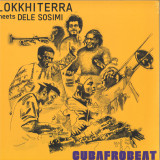
Funkiwala Records presents the third in the series of "Lokkhi Terra meets"albums, with the London fusionistas creating another unique sound-clash, this time with ex-Fela Kuti keyboardist and legendary UK Afro-beat ambassador Dele Sosimi, and members of his critically acclaimed Afro-beat Orchestra.
This particular collaboration has been bubbling away for a few years now, teasing audience expectations with a handful of sold out shows each year in between both bands busy schedules.
Featuring the two pianos of Kishon Khan and Dele Sosimi – Cuban percussionists/vocalists Geraldo De Armas (Yoruba Andabo), Oreste Noda (Ariwo), Javier Camilo (Ibrahim Ferrer) - a horn section led by Justin Thurgur (Bellowhead) featuring Yelfris Valdes (Sierra Maestra) and Graeme Flowers (Kyle Eastwood) to name a few – this is an All-star cast.
Kishon Khan's Lokkhi Terra have over a number of years now been quietly establishing themselves as one of London's more unusual heavyweight outfits, described as "Stunning Headliners… A majestic multi-cultural blend of sounds… effortlessly builds bridges between rolling Indian raga rhythms, Afro-Cuban grooves, Acid Jazz/funk and free flowing improvisation" (Timeout London). Included amongst the band members are London's top Cuban musicians, adding their infectious rich musical history to the city's melting pot.
When the band wanted to explore Cuban links with another of their favourite traditions, Afrobeat, who better to bring in then one of the Afrobeat originators – maestro Dele Sosimi – "Sosimi creates some of the most bewitching grooves in modern African music" E Jazz News.
Bringing together two Yoruba speaking musics - with different accents, from different sides of the Atlantic - Havana meets Lagos in London – A Cuban-Afrobeat-Experience. CUBAFROBEAT.
All About Jazz 4star review
A younger version of London's Grand Union Orchestra, founded by world-jazz pioneer Tony Haynes in 1982, Lokkhi Terra was put together by keyboard player Kishon Khan in 2005. Both ensembles have made a specialism of jazz / South Asian fusion, with Lokkhi Terra also giving as much attention to music from Cuba, where Bangladeshi-born, London-based Khan lived for a while in the early 2000s.
Cubafrobeat, as the title foretells, is a blend of Cuban dance music and Nigerian / Yoruban Afrobeat—a fusion rendered seamless by the synergies existing between Afro-Cuban and Yoruban music, language and mythology. The album is Lokkhi Terra's third and partners the band with the keyboard player and vocalist Dele Sosimi .
A young-going-on-child-prodigy member of Fela Kuti's Egypt 80, Sosimi went on to become musical director of Femi Kuti's Positive Force, before relocating to London and setting up Dele Sosimi's Afrobeat Orchestra, the finest Afrobeat band outside Nigeria, bar none, now with a string of consistently engaging albums under its belt. Cubafrobeat features Sosimi as lead vocalist on all four tracks, and on Fender Rhodes on two of them. His singing plays a prominent role in the Afrobeat Orchestra, but, such is the whirlwind impact of the band in full instrumental flight, that Sosimi is often thought of first and foremost for his keyboard and arranging talents. That may change by the time 2018 is over. Cubafrobeat is the third album in as many months to feature Sosimi as guest vocalist, spotlighting the gravitas, air of mystery, intimacy and ferocity his voice can bring to an occasion.
The first of these albums was the genre-bending spiritual-jazz band Emanative's Earth (Jazzman). One of the stand-out tracks, "Ìyáàmi," features Sosimi making obeisance to the titular Mother Goddesses of the Yoruba spirit worlds. His raw and intense invocations carry the track for nine mesmerising minutes. Otherwordly is not the half of it. Next up was dub / reggae / jazz band Soothsayers' Tradition (Wah Wah 45s), which featured Sosimi as lead vocalist on the compelling "Sleepwalking (Black Man's Cry)." Earth and Tradition are both outstanding albums and have previously been reviewed here.
Cubafrobeat is a total stonking blinder, too. It is an effectively nuanced affair, opening with the fiery "Afro Sambroso" and closing with the relatively reflective "Rumbafro." Sosimi's vocals light up the music, as do the several solos from trumpeters Graeme Flowers and Yelfris Valdes Espinosa and trombonist Justin Thurgur (a member of both Lokkhi Terra and the Afrobeat Orchestra). Sosimi and Kishon Khan's intertwining Fender Rhodes solos on "Cubafro" are also a delight, as is the drum and percussion section throughout.
The sound of summer, for sure, Cubafrobeat has enough depth and variety to make it something for all seasons.
Songlines 4star review
Lokkhi Terra are one of London's most authentic groups. They are a Latin-flavoured collective whose keyboard player and bandleader Kishon Khan segues from percussive montunos to complex Bengali rhythms and back, with jazz chops sparking funky and outward-looking fusions. Their collaboration with Dele Sosimi, Britain's foremost Afrobeat ambassador, has been bubbling for a while; here four tracks at ten minutes see musical conversations that never lose their sense of flow. An extensive line-up of stellar players, including trumpeter Yelfris Valdés, conguero Oreste Noda and trombonist Justin Thurgur, highlights the genre-crossing potential of world traditions. Opener 'Afro Sambroso' showcases batá drums from Gerardo de Armas Sarria before the track links Cuban grooves with Afrobeat. 'Timbafro' crackles and sways via Khan's organ, Sosimi's vocals and Oscar Martinez's timbales. 'Cubafro' features dazzling interplay between Khan, Sosimi and Javier Camillo's Spanish-language vocals. 'Rumbafro' is all rumba choruses, Yoruba vocals and Afrobeat horns. Rooted in their sources, but with musical threads intertwining, separating and reconfiguring – with grooves at a premium – this is a fusion lover's dream
Exit North are: Japan co-founder, solo artist Steve Jansen, Swedish singer songwriter Thomas Feiner, pianist Ulf Jansson, and renowned Swedish producer/multi-instrumentalist Charlie Storm. Their 2nd studio album 'Anyway, Still' continues the quartet's appetite for exploring provocative song structures. Weaving classic elements such as piano and strings into the layered threads of the bands material. Where intimacy and atmospherics give way to powerful dynamics, animated rhythms and grooves, driving distortions and crescendos in cinematic scale. Like excavators with uncompromising autonomy, Exit North relish the exploration of every nuance and detail of the recorded performance. Artwork contains full lyrics. " Exit North is truly about generating an aural gravity that pulls the best out of its participants. Those who admire Jansen's instrumental, experimental solo output, as well as his song-based work with Japan and Rain Tree Crow, will find much to enjoy on Book of Romance and Dust. Similarly, the audience Feiner has cultivated with his group Anywhen and its acclaimed recording The Opiates, will encounter a related, spacious aesthetic. LP limited to 500 copies on 180gm black vinyl with a gatefold sleeve (release date is later in July).
- 1: Overture – Live From The Royal Albert Hall
- 2: Complete Mess – Live From The Royal Albert Hall
- 3: Carousel – Live From The Royal Albert Hall
- 4: Me, Myself & I – Live From The Royal Albert Hall
- 5: She Looks So Perfect – Live From The Royal Albert Hall
- 6: Amnesia – Live From The Royal Albert Hall
- 7: Lie To Me – Live From The Royal Albert Hall
- 8: Caramel – Live From The Royal Albert Hall
- 9: Outer Space / Carry On – Live From The Royal Albert Hall
- 10: Youngblood – Live From The Royal Albert Hall
- 11: Red Desert – Live From The Royal Albert Hall
- 12: Jet Black Heart – Live From The Royal Albert Hall
- 13: Older (Feat. Sierra Deaton) – Live From The Royal Albert Hall
- 14: Take My Hand – Live From The Royal Albert Hall
- 15: Teeth – Live From The Royal Albert Hall
- 16: Ghost Of You – Live From The Royal Albert Hall
- 17: Bad Omens – Live From The Royal Albert Hall
Multi-platinum-selling pop-rock band, 5 Seconds of Summer, will release their live album The Feeling of Falling Upwards – Live from The Royal Albert Hall digitally on April 14. Physical formats of the album will be available on July 14.
The tracks are taken from the band’s 2022 one-of-a-kind performance “The Feeling of Falling Upwards” at the world-famous Royal Albert Hall in London, a venue the band busked outside of when they moved to the UK to write for their very first album 10 years ago. The performance included reimagined versions of songs from their 11-year catalog and brand-new songs from their critically acclaimed fifth studio album 5SOS5, accompanied by a 12-piece string orchestra and a 12-member gospel choir.
“’The Feeling of Falling Upwards’ is simply supposed to describe to you the feeling that we have experienced together, the feeling of taking a leap of faith on such a fickle thing like music,” expressed vocalist and drummer Ashton Irwin on stage at Royal Albert Hall, “And sharing this experience together year after year, season after season of our lives.”
Black Truffle is pleased to announce Symphony No. 107 –The Bard, a previously unheard archival recording of the legendary improvising ensemble MEV (Musica Elettronica Viva), captured in concert at Bard College, New York in 2012. Formed by a group of American expat composers in Rome in 1966, the MEV ensemble played an important role in the development of free improvisation, bridging the live electronics tradition begun by Cage and Tudor and the high-energy squall of free jazz. Early recordings like Spacecraft or The Sound Pool unleash volleys of metal and glass amplified with contact microphones, howling winds, primitive synthesizer bleep and raucous audience participation, the intensity of which puts much later ‘noise’ to shame. In later decades, the ensemble would go through many iterations, often including legendary free players like Steve Lacy and George Lewis. In its final years, MEV settled into the core trio of founding members heard here: Alvin Curran, Frederic Rzewski, and Richard Teitelbaum, using piano, electronics, and small instruments.
Curran, Rzewski, and Teitelbaum were life-long friends blessed, as Curran says, with ‘incompatible personalities’: major figures in the post-Cagean experimental tradition, they explored countless divergent and even contradictory paths as composers and performers, from agitprop songs to brainwave-controlled synthesis. MEV is the sound of these three personalities coming together, their contributions radically individual yet attaining a state of ‘fundamental unity’ that Rzewski, in a text written in the collective’s earliest years, defined as the ‘final goal of improvisation’. Of course, listeners familiar with aspect of the trio’s individual works might hazard some guesses about who is doing what: the crisp piano figures are probably Rzewski’s, the cut-up hip-hop samples most likely Curran’s, the sliding, squelching synth possibly Teitelbaum’s. But often these identities are dissolved in a constantly shifting hall of mirrors, the listener unable to tell which of these pianos is live and which is a sample of a past virtuoso, or whether a horn blast derives from ethnographic documentation or Curran cutting loose on Shofar. The two side-long sets here occupy a similar terrain of constantly shifting texture and instrumentation, unexpected interruptions, and moments of sudden beauty. The first set is sparser, at times almost ominous, as a bell repeatedly sounds across wheezing harmonica, seasick orchestral textures, and creaking wood, making room for episodes of yodelling and delicate prepared piano before exploding into a storm of buzzing synth and piano fragments. The second set is more frenetic, moving rapidly across centuries and continents: cars crash into post-serial piano pointillism, wailing voices collide with chopped and screwed hip-hop samples, Hollywood strings are buried under layers of electronic gurgles. The performance slows in its final moments, making way for a sampled voice repeating the phrase ‘protest and the good of the world’, reminding us that MEV’s idea of freedom was always more than musical. Symphony No. 107 –The Bard is a beautifully recorded example of the endlessly multi-layered later MEV sound, accompanied by new liner notes by Alvin Curran (now the only surviving member of the group) and a selection of previously unseen photographs from across the many decades of the group’s activity. Arriving in an elegant sleeve bearing a beautiful photograph by Francis Zhou of the Olin Hall at Bard College where the concert was recorded, this is an essential document from a major group in the history of experimental music. As Rzewski wrote, this music is ‘like life, unpredictable, sometimes making sense, mostly not’.
- A1: Sao Vicente Di Longe
- A2: Homem Na Meio Di' Homem
- A3: Tiempo Y Silencio (Feat Pedro Guerra)
- A4: Sabor De Pecado
- B1: Dor Di Amor
- B2: Nutridinha
- B3: Regresso (Feat Caetano Veloso)
- B4: Esperanca Irisada
- C1: Ponta De Fi
- C2: Crepuscular Solidao (Feat Bonnie Raitt)
- C3: Linda Mimosa (Feat Orquesta Aragon)
- C4: Negue (Feat Chucho Valdes)
- D1: Bondade E Maldade
- D2: Fada
- D3: Pic Nic Na Salamansa
São Vicente Di Longe is Cesaria Evora's eighth album and features multiple guest appearances, including Pedro Guerra, Caetano Veloso, Chucho Valdés, and North American blues superstar Bonnie Raitt.
The album includes more Latin-tinged songs, including "Tiempo Y Silencio" where Cesaria sings in Spanish, and nostalgic torch songs, such as "Linda Mimosa" and "Negue," which finds Cesaria accompanied by the piano. The tracks are recorded with a wide range of instruments like strings, horns, guitars, percussion and even a gospel choir (on "Bondade e Maldade").
São Vicente Di Longe is available on vinyl for the first time as a limited edition of 1000 individually numbered copies on orange and black marbled vinyl and includes a 4-page booklet with photos and lyrics.
- A1: A World Without Love – Peter & Gordon
- A2: Wishin’ And Hopin’ – Dusty Springfield
- A3: Don’t Throw Your Love Away – The Searchers
- A4: Beat Girl (1993 Remaster) – The John Barry Orchestra
- A5: Starstruck – The Kinks
- A6: You’re My World – Cilla Black
- B1: Wade In The Water (Live At Klooks Kleek) – The Graham Bond Organisation
- B2: I’ve Got My Mind Set On You – James Ray
- B3: (Love Is Like A) Heat Wave – The Who
- B4: Puppet On A String – Sandie Shaw
- B5: Land Of 1000 Dances – The Walker Brothers
- B6: There’s A Ghost In My House – R. Dean Taylor
- C1: Happy House – Siouxsie & The Banshees
- C2: (There’s) Always Something There To Remind Me – Sandie Shaw
- C3: Eloise – Barry Ryan
- C4: Anyone Who Had A Heart – Cilla Black
- D1: Last Night In Soho – Dave Dee, Dozy, Beaky, Mick & Tich
- D2: Neon (Soundtrack Edit) – Steven Price
- D3: Downtown (A Capella) – Anya Taylor-Joy
- D4: Downtown (Uptempo) – Anya Taylor-Joy
Few bands have as enduring a legacy in the acoustic/newgrass/jam band
scene as Colorado-based Leftover Salmon
Carrying the torch passed down by the progressive bluegrass pioneers, The
Seldom Scene and Newgrass Revival, Leftover Salmon are true architects of the
contemporary jam grass scene, inspiring the careers of a generation of artists
including Billy Strings, Greensky Bluegrass and Yonder Mountain String Band.On
'Grass Roots', Leftover Salmon reflect on its bluegrass and festival campground
origins with a set of songs that draws from the repertoires that The Salmon
Heads and The Left Hand String Band played when they first jammed in a
Telluride Bluegrass Festival campground. Collaborating with jam scene icons Billy
Strings, Oliver Wood, and Darol Anger, and with the recent addition of Jay Starling
on resophonic guitar, lap steel and keys to the band's official line, Leftover Salmon
have all the instrumental firepower needed to deliver hard driving versions of
bluegrass standards and grassed- up versions of songs from Bob Dylan, David
Bromberg, and The Grateful Dead.
Featuring special guests BILLY STRINGS, OLIVER WOOD and DAROL ANGER
The second album in a planned trilogy for Students of Decay, Theodore Cale Schafer’s “Trust” follows 2019’s “Patience,” building upon its motifs and compositional strategies to arrive at a potent document of artistic and personal growth. Recorded between 2020 and 2022, a period in which Schafer relocated to New York City, these arrangements feel like they bear the mark of a change in scale, not abandoning the private, diaristic sensibility of his earlier work so much as imbuing it with a charged atmosphere of vivid, slow-blooming intensity. These songs find the artist tightrope-walking between drama and austerity, narrative and abstraction. Such is the case on both “Luck,” in which a captivating wash of baroque strings slowly recedes into a bed of inky, flickering ambience, and “Best Friend,” wherein snatches of conversation are halted by entrancing piano motifs and hovering drones. This is an album that develops aspects of Schafer’s previous output– the patiently meted out, barely-there piano melodies, the unexpected resonance of off-the-cuff location recordings– working them like raw materials into robust, lyrical compositions. At times almost drifting into the romantic realm of the orchestral, “Trust” is the most generous and expansive offering we’ve heard from Schafer in his young career.
Theodore Cale Schafer (b. 1994) is a musician based in New York City. Informed by his occupation as an audio engineer, his work combines digitally sourced audio and manipulated self-recordings to create music that is equally influenced by Playstation OSTs, modern classical composition, confessional narrative, and spoken word. Recently, he has collaborated with Natalia Panzer, Angelo Harmsworth, Claire Rousay, Sydney Spann, and picnic, participated in the Neo-Pastiche: Changes in American Music Festival at the Black Mountain College Museum, and curated the “Casualism” mix series with Retreat Radio in Malmö, Sweden.
What’s Mu about? Mu is about everything: Songs about heartbreak and parting share the album with songs marvelling at the scale of the universe. Mu is a concept from Zen and Chan Buddhism that means: “nothingness” and also, “pure awareness.” The awareness at the source of all things. In Hannah’s words: “There is so much life in every moment. Endless patterns, algorithms and instances repeating and changing and adapting. Spiralling outwards from the source. What source? The source.” In search of the source, Hannah has composed and arranged an undefinable, cinematic album that leads the listener on a winding path through her imagination. Sonically as well as thematically, Mu is an album of extremes and lofty ambitions. Fragile and delicate vocal and violin textures contrast with crunchy noisescapes and brooding synthesizers. Hannah’s commanding voice shares the spotlight with a string section and is backed by spacious production featuring many acoustic instruments. Sonically, producer Nick Herrera has brought a reassuring chunkiness to this unplugged palette, in particular the head nodding drums that anchor Hannah’s celestial musings. Like a film soundtrack or a symphony Mu is best listened to and understood as a whole - it circles back to themes and refrains and re-examines them. Sometimes a song is a song, sometimes it’s a soundscape dreaming of a song. “When making this album, I had a specific concept for how I wanted the music to sound. I don’t mean in terms of genre… it was more of a visceral, sensory concept which I knew I could only realise by allowing myself to experiment and create simultaneously, believing in my rough ideas enough to grow them, to weave them into stories. I began allowing myself to enter and remain in a very heightened state of awareness, which is a state I have continued to pursue and learnt to enjoy ever since. I let my mind dissolve into blackness each day. From there the most wonderful colours can appear. I have decided to call the album “Mu” to signify the empty chasm I allowed to hold within me whilst these songs were born.”
"As long as you come to my garden", the sixth release in the cherished Die Schachtel’s series “Decay Music” as well as the debut of the duo Damāvand (Gianluca Ceccarini and Alessandro CIccarelli) on the prestigious Italian label, is a tribute to the Armenian troubadour Sayat Nova, through his lyrics and freely inspired by the cult movie about his life The Color of the Pomegranates (Nřan guynə, 1968, USSR) directed by Sergei Parajanov. The feature film tells the life of the poet, who lived in the 17th Century, from childhood in the royal court, to retirement until his death in the monastery of Haghpat, through a series of episodes, static like paintings that do not tell but show, evoke, they suggest through metaphors, analogies, surrealist flair, dreamlike landscapes, liturgical pauses.
The six tracks are inspired by the dreamlike imagery contained in the movie, weaving sound textures ranging from ambient to noise, to references to the musical tradition of the Middle East.
Gianluca Ceccarini and Alessandro Ciccarelli alternate, without fixed roles, with analog synths, drones, amplified common objects, generative music, audio samples from the film and acoustic instruments such as the tar - a stringed instrument of Persian origin, the trombone and the cornet. In addition, two of the songs on the album contain Sayat Nova’s poems recited in Persian by Nahid Rezashateri.
The sound materials are revealed gradually like episodes, evoking the visual suggestions staged by Parajanov in the movie. As long as you come to my garden is intended as an imaginative journey to distant spaces and indefinite archaic times.
DAMĀVAND is a musical project by Gianluca Ceccarini (electronics, electroacoustic objects, tar) and Alessandro Ciccarelli (electronics, electroacoustic objects, trombone, cornet)
Gianluca Ceccarini, guitarist, electroacoustic experimenter, luthier specialized in the restoration and construction of plucked musical instruments for early music. In 2021 his first album Starving Night was released for the netlabel Laverna and in 2022 the Sarab Label published a CD version. He also works in photographic research, video-art, graphics and independent publishing with the Sarab collective.
Alessandro Ciccarelli is an author who ranges between different languages: photography, video, sound. He is involved in several collective research projects in the musical and theatrical fields. His solo records are released under the nom de plume Elnath Project. The latest work, after six years of silence, from Italian berlin-based composer, performer and publisher (Black Letter Press) Claudio Rocchetti, and a welcomed return on the Die Schachtel imprint after the brilliant Another Piece of teenage wildlife (2008), Labirinto verticale (Vertical Maze) takes its origin from the four years long collaboration of Rocchetti with the Parma-based Fondazione Lenz, a contemporary theatre research collective/organization.
Ultramarine are an English electronic music duo, formed in 1989 by Ian Cooper and Paul Hammond.
Cooper and Hammond first worked together in the band A Primary Industry during the mid-1980s. Following the split of that band, they formed Ultramarine and released their debut album 'Folk' in April 1990 on seminal Belgian label Les Disques du Crépuscule. The duo found critical acclaim with their second long player, 'Every Man And Woman Is A Star', initially released in 1991. Over the next decade or so, they recorded two John Peel sessions, collaborated with Robert Wyatt, toured the States with Orbital, then Europe with Björk. After a hiatus, they began recording again in Ian's home studio, overlooking the Blackwater Estuary in Essex.
The moods and movements of this English estuary can be heard running through the duo's stunning and deeply intriguing new album 'Send and Return'.
Flowing and mutating as it transitions from an Essex river into the open sea, the Blackwater Estuary, north of London, inspired this beguiling collection of hypnotic jazz, itching electronica and softly dazzling ambient shapes.
For the 6-track album, Paul and Ian hired a Thames sailing barge moored on the estuary for one day and recorded below deck in the ship's downstairs wooden saloon; the idea was originally inspired by seeing Robin Williamson of The Incredible String Band perform on a similar barge.
The duo were joined by jazz musician Greg Heath and accomplished percussionist Ric Elsworth for the day, who added stunning saxophones, alto flute, percussion and vibraphone to the mix. It's a contemplative, ambient record with gentle jazz inflections and softly pulsing electronica.
This ten-track album showcases Alex Pester's unique and unconventional sound, a blend of folk, baroque pop, psychedelia, and experimentalism, and is set to become a defining moment in his young career.
A PRESSING OF 300 COPIES WORLDWIDE. NON-RETURNABLE.
At just twenty-two years old, Pester has already established himself as a prolific singer-songwriter hailing from Bath, England. He has released three albums to date, each displaying his immense talent as a musician and songwriter.
Influenced by the Incredible String Band, The Beatles, Robert Wyatt, Animal Collective, Harry Nilsson, and The Microphones, among others.
- A1: Siamese
- A2: First Day On A New Planet
- A3: Pow R Ball
- A4: Kewpies Like Watermelon
- A5: Phasers On Stun/ Sola Kola
- A6: Black Hole Love
- B1: Velvy Blood
- B2: Plastic Ashtray
- B3: Death 2 Everyone
- B4: Pachinko
- B5: (-)
- B6: Kernel
- B7: Road Song
- C1: It Is
- C2: On Yr Mind
- C3: Teen Dream
- C4: Majesty
- C5: Burriko Girl
- C6: Got The Sun
- D1: Silver Krest
- D2: Sucker/ Kitty Litter
- D3: Lo-Fi Scary Balloons
- D4: The Power Of Negative Thinking/ The Love That Brings You Down
In the days before “landfill” indie, and in rebellion against a developing Britpop orthodoxy, there were some weird but melodic bands coming of age outside London that drew inspiration from the US underground and the sparkly retro-futurism of Japan. Primitive guitar noise with art rock leanings, post punk DIY and fanzine culture. The best known of these bands was maybe Urusei Yatsura; “noisy stars”, named in honour of Rumiko Takahashi, legendary manga creator.
Back in 1996, after several increasingly well-received 7’s, the band travelled to Leamington Spa to record their debut album with John Rivers, producer of Swell Maps and Glasgow scene godparents, The Pastels. The resulting album won the group legions of new fans and gained them their first Independent #1 chart placing, alongside peers Ash and Super Furry Animals.
“These were fertile years in Glasgow, a scene with no name, no single sound, where the magic thread tying everyone together was words and works so personal, they couldn’t be mistaken for anyone else’s. ‘We Are Urusei Yatsura’ is a cascade of ‘why not?’ thinking. The way ‘Phasers on Stun’ spirals into ‘Sola Kola’; the sunburned 23-second improv at the end of ‘Pachinko’; the slack-echoing strings of the outro to ‘Road Song’ sprayed with the shrapnel of toy electronics. Pure pop magic, Ren & Stimpy on upstairs, ray-guns, Ian’s homemade walkie-talkie speaker, a beatbox, all sealed with a “Talking Tina” doll’s emphatic endorsement: “I love it”” – Nick Soulsby
Bedouin aka Tamer Malki and Rami Abousabe are to release their long awaited and adventurous debut album Temple of Dreams on their own label Human By Default this Spring.
Over the course of the pandemic, Malki and Abousabe spent a great amount of time finalizing songs created in the past 7 years, composing, song writing, singing, and working on numerous projects including collaborations and new originals. Temple of Dreams was shaped from these sessions and captures the enigmatic sound of the versatile, forward-thinking group.
Malki explains that the album looks to “experiment and push the boundaries.” It differs from their previous work, as the album is intended to be a deep listening experience for the fans, rather than a slew of club cuts. The multi-talented artists sought to create a timeless sound in Temple of Dreams. Malki outlines that the album lies between “what we play on stages around the world and what we’re capable of writing and producing as musicians and producers. We wanted to exceed expectations and present something that you might think or feel you’ve heard before, yet it's something completely new and not what might be expected from us.”
It starts with the enchanting sounds and candle lit grooves of Rise And Fall then journeys far and wide through the Eastern string sounds of Coldman featuring Nathan Daisy, darkly alluring vocals and mystic rhythms of Voices In My Head and the hypnotic melodic leads of Crazy feat. Iveta Mukuchyan. Elsewhere the richness of Bedouin's sound makes for spellbinding listening on tracks like Hokema Feat. Delaram and Flore Chico feat. Chico Castillo with its alluring Spanish vocals. Love And Hate is a more dynamic and punchier house cut while Fill The Space is an intriguing mix of melodic magic, authentic instrumentation and smooth rolling grooves.
The musicians, singer-songwriters, and producers in Bedouin have spent the better part of a decade fine-tuning their sound, which draws as much from their Middle Eastern heritage as it does their world travels as DJs playing iconic venues across the globe. They have pioneered a distinctive and timeless sound on some of the world’s most notable labels such as Crosstown Rebels, Get Physical, All Day I Dream, and recently their own imprint—Human By Default.
Select major label releases include remixes for Black Coffee and Virgil Abloh on Ultra and Sony/Universal and as well as calling Burning Man home they have their own iconic Ibiza party, Saga, at Pacha each week of summer, and play major events such as Coachella, Tomorrowland, and Art Basel and venues like Ushuaïa, Wynn Las Vegas as well as a ground-breaking Cercle set filmed in Petra, Jordan.
This much anticipated debut album shows yet another side and the artistic development for this influential pair.
Manchester's Avant-Jazzy-Funk outfit Swamp Children were enviably eclectic and Taste What's Rhythm is their mini masterpiece. Flitting gracefully through a feast of genres with consummate ease, the band were almost indefinable and, accordingly, nigh-on impossible to market. So whilst this cult EP, originally out in 1982 on Factory Benelux, remains in demand for those in the know, it has also glided under the radar of many otherwise clued-up heads for over 40 years. If you don't know, get to know...
The Taste Whats Rhythm EP was originally released in 1982 on Factory Benelux (an informal partnership between the legendary Manchester-based Factory Records and Belgium-based Les Disques du Crépuscule). With it's kaleidoscopic brightness, silky panache and superb execution, it remains one of the most startling documents of a remarkable time and place.
The EP opens with the oh-so-Balearic title track. "Taste Whats Rhythm" gently unfolds with a Spanish guitar, hazy, drifting vocals and sun-bleached Latin percussion. After this most sumptuous of intros, the tempo is raised, the rhythms grow in complexity as horns jostle amidst the restrained chaos quite wonderfully. And then it winds down again. Proper fluctuating rhythms and tempos throughout. I guess that was the point - taste the variety!
“You’ve Got Me Beat” is a *perfect* piece of post-punk pop-jazz. A mysterious, after dark jazz-dancer, the aching vocals serve as a touching, tender resignation to love. A guitar hook which seems to elegantly reference The Blackbyrds' "Rock Creek Park" and a flowing pulse from New York's No Wave scene. It still sounds so fresh all the years later.
Closing out this most perfect of EPs, the twisted synths and nimble rhythms of bass-heavy roller "Softly Saying Goodbye" combine to create a super-slinky gem; Brit-Funk of the highest order.
Swamp Children formed in Manchester in 1980, around core members Ann Quigley (vocals), Tony Quigley (bass, metalaphone, percussion), John Kirkham (electric & acoustic guitars, metalaphone, percussion), Ceri Evans (keyboards, bass, percussion, background vocals), Cliff Saffer (saxaphone, clarine) and Martin Moscrop (drums, percussion, trumpet). They initially practised at a rehearsal space shared with fellow post-punk funkers A Certain Ratio and Joy Division/New Order. Young and relatively inexperienced upon getting together, the ages of Swamp Children's members ranged from just 16 to 19. Talk about the brilliance of youth.
From the outset, Swamp Children shared DNA with A Certain Ratio. Martin Moscrop was a founder member of Ratio, while Ann provided artwork for them. Although the close association with ACR led some to assume that Swamp Children were simply a splinter group, the new band pursued a more overt latin and jazz tinged direction, at the same time adopting a post-punk attitude towards making music, influenced by the records they were listening to at the time: Miles Davis, Brazilian jazz fusion and heavy funk dancefloor sides.
The band made their live debut at Manchester's infamous Beach Club in May 1980. Thanks to a double-booking blunder another support band turned up and were turned away, having travelled all the way from Dublin for a string of British dates. The name of the unlucky band was U2...
With arrangements that emphasised Tony Quigley’s darkly-coloured basslines (and Ann Quigley’s impressionistic vocals as another instrument in the mix) Swamp Children possessed an easygoing grace and a bubbling energy which indicated that the band's true strength was as an ensemble. The band’s musical sophistication (a fusion of funk, jazz, and bossa nova) would prove to be a strong influence on later UK acts like Sade. Indeed, Swamp Children themselves later mutated into the more known and acclaimed latin jazz outfit Kalima.
Working directly with James Nice, custodian of Factory Benelux, means that the audio for this re-issue of the classic EP comes from the original tapes. Cut at 45 RPM and released in the house Be With disco sleeve, we’ve made sure this record is well up to the job of having a permanent place in every DJ’s bag. As far as we’re concerned, this is essential stuff.
This track is a huge Detroit synth- / strings affair in the fashion of Los Hermanos. The kick drum is very hard. With the bassline, you sometimes have three melodies at once. Very groovy and funky track, highly danceable. Perfect for outdoor events because of its rather buoyant character.
The talent on this Repressing is monumental Optic Nerve, Strand, Posatronix and Marty Bonds. This is a must have repressing that has been requested to be repressed by the most popular dj’s in the business. Dedicated to Juan Atkins and the spirit of Metroplex Records. This ep was originally called the Metroplex Social Club.
The Croatian production powerhouse and disco boogie impresario steps up to International Feel, and takes a left turn into deep space with a new six track LP Pulsar Diaries.
Ilija’s discography stretches back to 2003, and over those 20 years he’s packed it full with albums, versions, remixes and singles. His releases are often perfectly-penned love letters to ‘80s boogie, electro and disco, and like postcards from an old flame, they’ve landed in an array of record label catalogs, from Bear Funk, Rong, and Electric Minds, to Is It Balearic? as well as his own Red Music and Imogen Recordings. He’s long-been an active voice on the underground club scene, and if you’ve been out dancing in Zagreb, Berlin or even Tisno beach, chances are you’ve gotten down to one of his beautifully blended sets of cosmic-tinged electro funk and disco dubs.
On Pulsar Diaries, Ilija delivers a panoramic collection of spaced-out synths and drum machine grooves, dedicated to the planet and our place in the universe. The A side opens up with the blissful, weightless pads of the title track, before it breaks out into filtered stabs over a minimal b-boy bounce. Delphic Expanse ebbs and flows like a lunar eclipse, sounding like a futuristic version of Key-Matic’s Breaking In Space, all uprock rhythms and syrupy synth horns as it spins off beyond the asteroid belt. Side A closes out with Blackburn Tales, a suspenseful and spacious electro rhythm packed with strings and 303 squelch, which you might call anti-gravity acid, if you were so inclined.
Side B picks up the tempo with Fourth Amendment, perfect for the space station discotheque with its sweeping bass filters and ice-cold synth melodies hovering in orbit. Farewell Theme takes an introspective moment, slowing the pace to a cosmic 90 bpm and inviting a certain cinematic feel to proceedings. This feeling applies not just to the vivid landscapes we travel through, but also wider thoughts about humankind: as we pause for a breath and look around, we find ourselves in Ilija’s space, considering human motivations, like the pursuit of happiness, or the eternal struggle with the self.
Every journey begins with a goodbye, and so the last track of the album feels like the arrival at a new destination: Ursa Major is ablaze with cascading drum fills, bubble-wrapped bass riffs and bright synth chords that sparkle like city lights underneath a re-orbiting satellite.
With Pulsar Diaries, Ilija Rudman has created a rare artifact: an album that straddles several worlds at once. Part soundtrack to space travel, part meditation on the human condition, part deep-burning dancefloor dynamo - whether in the club surrounded by friends or at home by yourself, this is a record that expands the mind and lets the imagination soar.
Ghost Producer aka Badawi (aka Raz Mesinai aka Bilal ibn Yakub al-Badawi) is a prolific producer and artist who has been on the forefront of underground experimental jazz and electronic music scenes around the world for over thirty years, with a catalog of albums on labels as ROIR, Asphodel and Tzadik under various monikers dating back to the late 1980s.
Ghost Producer released his first albums starting in the late 80’s under the monikers Psy Co. and Ruff Riddim Productions, selling his cassette tapes in NYC. He produced, on average, at least one album per week since 1988 until today. One of the twenty or so monikers was Badawi, later being signed to ROIR Records and releasing the seminal experimental dub, punk albums »Bedouin Sound Clash« and later »The Heretic of Ether« on Asphodel. Spending time as a child between Occupied Jerusalem, the West Bank (Balata) and New York City (Rock Steady Park) during the height of the B-Boy era in the 70s and 80s informed Ghost Producer’s singular sound of heavy driving Sufi rhythms, sonic experiments, percussion, piano playing and sound design which has connected him to a wide variety of artists ranging from Maryanne Amacher to John Zorn, to added elements of darkness to music by such artists as Hanz Zimmer (Black Hawk Down) and rappers Danny Brown (Pneumonia) and Skepta and Double D (Don) among many others.
At age 14, Ghost Producer was discovered by visionary jazz and rock musician, Juma Sultan (Jimi Hendrix) whom later trusted Ghost Producer with producing the archive of over 2000 hours from recordings from »Studio We« and the Free Jazz Loft Movement in NYC in the 60s and 70s. As a composer, he has worked with Kronos Quartet and has had premiers at Carnegie Hall (Cross Fader, The Echo of Decay) and Lincoln Center (String Quartet For Four Turntables). In addition, Ghost Producer has released several albums on John Zorn’s Tzadik label, where he explored producing to the books of Franz Kafka (Before The Law, Resurrections for Goat Skin, Cyborg Acoustics)
As a composer for film, he coined the term »score design» to describe his work in conceiving and producing scores for films with particularly demanding needs, working on such films as A Late Quartet (director Yaron Zilberman composer: Angelo Badalamenti), The Fountain, Black Swan and The Wrestler (Darren Aronofsky/Clint Mansel), Black Hawk Down (Ridley Scott/Hans Zimmer) and many more. In 2014, he was awarded as a fellow in the Sundance Composers Lab.
In 2015, Ghost Producer formed the Underground Producers Alliance, a unique program for developing producers, performers and composers, with co-founders Scotty Hard (Wu Tang Clan, Medeski Martin and Wood, De La Soul), HPrizm aka High Priest (Anti Pop Consortium), Honeychild Coleman (the 1865, The Slits) and Prince Paul (Jungle Brothers, De La Soul), where Ghost Producer produces entire albums with student participation in his master course.
This album, »The Book of Jinn«, is one of many productions done within the course, featuring players/mentors Juma Sultan (percussion), Chandenie (voice) and Shahzad Ismaily (electric bass), with additional student participation from Adam Culbert and Jonah Sollins (aka Goodnight 1500) on synths and percussion as well, then all remixed and rearranged by Badawi into what you hear here, The Book of Jinn.
Elza Soares’ 34th studio album and her first to feature previously unrecorded material exclusively composed for her. Over a sprawl of distorted guitars, squalling horns, taught strings and electronic shards, samba is savaged by rock ‘n’ roll, free-jazz, noise and other experimental music forms as Elza tackles the burning issues of 21st century Brazil: racism, domestic violence, sex and drug addiction.
A true legend of Brazilian music Elza has an incredible musical oeuvre that stretches back over seven decades mixing samba with jazz, soul, funk, hip hop and electronica. Her life-story is a rags-to-riches-to-rags rollercoaster of triumphs and tragedies that has made her a voice for Brazil’s repressed female, black, gay and working-class populations.
Die Zusammenarbeit zwischen NEIL GAIMAN und dem FOURPLAY STRING QUARTET startete 2010, als das Sydney Opera House's Graphic Festival FOURPLAY beauftragte, einen Soundtrack zu NEILs Novelle "The Truth is a Cave in the Black Mountains" für eine Live-Performance mit ihm zu schreiben. Diese Zusammenarbeit führte zu einer anhaltenden Freundschaft und kreativen Zusammenarbeit, bei der NEIL und FOURPLAY das Konzept einer Reihe von Original-Werken rund um das Konzept des Tierkreises erarbeiteten, wobei die traditionellen Zeichen durch eine neue Sammlung von Wörtern und Objekten ersetzt wurden, die Aspekte des Lebens erkunden. Sie nannten diese Zusammenarbeit Signs. Einige der Arbeiten in "Signs Of Life" wurden für dieses Projekt entwickelt. Neben diesen Original-Werken gibt es neue Gedichte und Geschichten von NEIL, die mit der Musik von FOURPLAY verwoben sind, zwei Covers von Songs aus NEILs früheren Projekten und ein Instrumental-Stück, das von NEILs Arbeit inspiriert ist. Da sich alle Beteiligten in ihrer Kreativität immer geweigert haben, sich in eine Schublade stecken zu lassen, haben sie mit "Signs Of Life" etwas Bemerkenswertes und Einzigartiges geschaffen. Das Album ist eine großartige, bahnbrechende und genreübergreifende Zusammenarbeit zwischen einem großartigen Autor und einem einzigartigen Musik-Ensemble. Es ist teils Songwriting, teils Poesie, teils Storytelling; allumfassend schön. NEIL GAIMAN ist einer der beliebtesten und am meisten gefeierten Schriftsteller unserer Zeit. Sein Werk ist genre-, alters- und formatübergreifend und spannt einen Bogen über Romane, Fernsehen, Film, Kurzgeschichten, Comics, Hörspiele, Theater und mehr. Kürzlich wurden seine Romane "Good Omens" (gemeinsam mit Terry Pratchett geschrieben) und "American Gods" als Fernseh-Serien von Amazon Prime adaptiert. Seine revolutionäre und bahnbrechende Comicserie "The Sandman" wurde auf Netflix und Warner Bros. Television veröffentlicht und war mehrere Wochen lang weltweit die Nummer 1 auf Netflix. Das FOURPLAY STRING QUARTET ist in der Welt der Streichquartette etwas ganz Besonderes. FOURPLAY, die eher eine Band als ein klassisches Ensemble sind, improvisieren, jammen mit Ideen und verwenden außergewöhnliche Instrumental-Techniken und Effekte, um verblüffend originelle Klänge zu erzeugen. Nachdem sie zunächst durch ihre Interpretationen der Musik von Künstlern wie METALLICA, THE STROKES, RADIOHEAD, THE BEASTIE BOYS und CHARLES MINGUS weltweit bekannt geworden waren, konzentrierten sich FOURPLAY auf die Entwicklung ihres eigenen Repertoires und auf die Zusammenarbeit mit hybriden Medien und Projekten.
- 1: Doc's Guitar / Black Mountain Rag Featuring Billy Strings
- 2: White Freight Liner Blues Featuring Molly Tuttle
- 3: Daddy Frank (The Guitar Man) Featuring Jamey Johnson,Jimmie Fadden & Bill Payne
- 4: Precious Time Featuring Sierra Hull
- 5: Cajun Girl Featuring Little Feat & Sam Bush
- 6: Another Man Done A Full Go Round Featuring Jorma Kaukonen
- 7: Son Of A Gun Featuring Richard Smith
- 8: Someone Like You Featuring Michael Mcdonald
- 9: Mombasa Featuring Yasmin Williams
- 10: Everybody Loves You Featuring Larry Campbell & Teresa Williams
- 11: Mama Knows Featuring Jerry Douglas & Don Harper
- 12: Sweet Temptation Featuring The Del Mccoury Band
- 13: Yeller Rose Of Texas Featuring Sam Bush
- 14: Tennessee Stud Featuring Nitty Gritty Dirt Band
- 15: Seven Come Eleven Featuring David Grisman
- 16: Far Away Places Featuring Raul Malo
Tommy Emmanuel ist ein australischer Gitarrist, Schlagzeuger, Bassist und Songwriter. Er wurde bisher zweimal für den Grammy nominiert und gilt als einer der weltbesten Vertreter des sogenannten Fingerstyle, einer speziellen Spieltechnik insbesondere für akustische
Gitarre.
Tommy Emmanuels Duett-Album "Accomplice Two" bietet eine erstaunliche Vielfalt an Künstlern und Stilen. Es gibt Songs mit den Rocklegenden Michael McDonald, Jorma Kaukonen und Little Feat; lassen Sie sich von Bluegrass-Superstars wie Billy Strings, Molly Tuttle, The Del McCoury Band, Sam Bush, Jerry Douglas, Sierra Hull
und David Grisman überraschen. Außerdem sind die Country-Ikonen Nitty Gritty Dirt Band, Jamey Johnson und Raul Malo sowie die Gitarren-Schwergewichte Yasmin Williams, Larry Campbell und Richard Smith mit dabei.
Black Truffle is pleased to announce Down On Darkened Meetings, the first solo release on the label from the quietly prolific Giuseppe Ielasi. Recorded at Ielasi’s studio in Monza outside of Milan over two days in February 2022, the seven pieces presented here continue the renewed exploration of the guitar that marks much of his solo work over the last few years. Emerging in the late 1990s as an improviser working primarily with prepared acoustic and electric guitars, the instrument became less prominent in his work over the next decade, ceding to loop-based constructs that would eventually split into abstracted takes on club music and hip-hop (including his work as Inventing Masks), on the one hand, and spectral electroacoustic explorations (such as the stunning triple disc 3 pauses), on the other. Returning to the guitar in recent years, he has approached the instrument as a source of shimmering metallic glissandi (Five Wooden Frames) or as the vehicle of elegiac double-tracked lines that feel almost like Frisell playing Feldman (The Return). Here the focus is on electric guitar filtered, looped, and splayed out into fields of irregular echoes through a bank of pedals. Like many of Ielasi’s releases, Down On Darkened Meetings is structured as a set of short untitled pieces (here ranging between two and six minutes in length) that single-mindedly explore a single instrument or source throughout. The opening track immediately introduced the distinctive timbral world of fizzing, heavily filtered tones, chiming harmonics, and woozy looping bass figures inhabited throughout. At points it becomes near impossible to trace these sounds to the strings of an electric guitar; at others, as on the final two pieces, the instrument is unmistakable, as Ielasi builds up his shifting loops from snatches of almost unintentional sounding half-playing that give these closing tracks a hushed, private atmosphere reminiscent of Tolerance’s Anonym. While the repeating chords and hanging melodic figures present on many tracks call to mind earlier Ielasi classics like Gesine and Untitled, here the music feels less meticulously constructed than played: Ielasi’s lyrical guitar lines obscured by a battery of effects at times come across like a dilated take on the outer-fringe fretwork of improvisers like Henry Kaiser and Raymond Boni, and the muddy, asynchronous fields of pops and hiss at times wander into areas reminiscent of the hand-played dub techno of Vladislav Delay’s Multila. Like much of Ielasi’s work in recent years, these seven pieces perform a delicate balancing act: between abstraction and immediacy, austerity and abundance. Imbued with Ielasi’s distinctive lightness of touch, considered approach to pacing, and subtly psychedelic approach to the stereo field, Down on Darkened Meetings is a major new work from a quiet master of contemporary experimental music.
BBE Music are proud to reissue one of the most elusive and sought-after Afro-Funk LPs of all time: SON OF AFRICA, by REMI KABAKA.
Now a proud 85 years of age and enjoying retirement in America, Remi was the cornerstone of British West African music in the 50s, 60s and 70s, along with Ginger Oloronso Johnson, Fela Kuti and others. But while Ginger played mambo and cha cha cha in Soho clubland and Fela released his early ‘highlife jazz’ records on the Melodisc label, Remi Kabaka was fully ensconced in the UK Rock world, playing sessions and live shows with The Rolling Stones, Paul McCartney, Ginger Baker, Steve Winwood and countless others.
As the 60s became the 70s, Kabaka developed yet another string to his bow: the development of a UK based West African Funk scene, that found its genesis in the legendary Osibisa, but with an influence and an inspiration that spilled over into every contemporary Brit Funk band from Cymande and the Equals to The Average White Band, Matata and beyond.
SON OF AFRICA was originally released by Chris Blackwell’s Island records in 1976, to little acclaim, very few reviews, and with almost no promotion. African music was a hard sell when the 70s Black British record market wanted reggae first and foremost, and with Bob Marley on the books, Island understandably had other priorities at the time. The record disappeared. Until it reappeared in the early 2000s, as a £700-plus collectors’ item.
It’s barely 30 minutes long. But every single minute is drenched with sinuous, spare funk: no spacey psych rock, no disco, no boogie, no over-the-top production: just 90-110 BPM grooves that go straight to the body.
So: whether you’re a turntablist, a hip hop sampler, or just an honest-to-goodness African Funk lover, catch this limited reissue (with full, updated liner notes) while you can. There won’t be another chance.
Repress!
Using an old door, 17 strings, chopsticks and combining them with phasers, echo units and amplification, the new device was to become his signature sound, mixing Irish folk influences with Asian and North African sounds in a mesmerising and soulful new way that brought him to the attention of the leading improvisers of his day - Alice Coltrane, Ravi Shankar, Don Cherry and more.
A logical follow up to AllChival's recent reissue of Stano's debut LP, Michael O'Shea's self titled LP was originally released on Wire's Dome Imprint in 1982.
The background to the album is as interesting and inspiring as the artist who created it - born in Northern Ireland but raised in the Republic, O'Shea was keen to travel and escape the troubles of his home.
Wandering throughout Europe and the Middle East, O'Shea found himself living and working as a relief aid in Bangladesh in the mid Seventies where he learned to play sitar while recovering from a bout of hepatitis. A later period spent busking in France accompanied on zelochord by Algerian musician Kris Hosylan Harp led to O'Shea's idea of combining both instruments as a homebuilt instrument - Mo Chara (Irish for "My Friend").
He later described the process on the back of the LP himself saying:
"Having sold my sitar in Germany and being desperate for money to travel to Turkey, I conceived of the idea of combining both sitar and zelochord. The first Mo Cara was born, taken from the middle of a door, which was rescued from a skip in Munchen"
A combination of dulcimer, zelochord and sitar, O Shea would play it with a pair of chopsticks, striking the strings softly using Irish folk rhythms mixed with the rich, nostalgic sounds of of the many Asian artists he'd encountered on his travels.
It was a pan cultural sound standing at an unusual crossroads of folk, traditional, rock, progressive, jazz, electronic and post-punk worlds without hesitation.
Perfecting the instrument on the streets, there were further spells spent busking in the underground stations and cafes of London's West End and Covent Garden during the heady days of the 1970s when they were full of eccentric street entertainers, jazz improvisers and musical pioneers.
His work with Rick Wakeman never saw the light of day but O'Shea's contact with the world of post-punk London ensured his name would live on.
Introduced to Wire's Bruce Gilbert and Graham Lewis via cartoonist Tom Johnston, O'Shea eventually acquiesced to an open invite to record at their studio. Turning up unannounced in the summer of 1981 the LP was recorded in a day in the legendary Blackwing Studios and released on Dome the year after.
The first side features the fifteen minute masterpiece "No Journeys End" with the B side featuring more input from Wire in processing the Mo Chara sound.
Lewis himself said years later of the forgotten masterpiece: 'I always said it was the best job we ever did.'
After an aborted LP with The The's Matt Johnson the following year, O'Shea quietly disappeared from the formal recording world and his brief but unique contribution to the music world came to a sad end in 1991 when O'Shea was struck by a post van and died a few days later in hospital in London.
This repress on All City's AllChival imprint has been remastered and reissued with the approval of both Dome and his surviving siblings.
Since its beginnings, Hypnótica Colectiva has always shown a special interest in the music recorded and released in the city of Detroit.
A place with which we have both a blood and spiritual bond because of what occurred there socially and artistically during the 20th century.
This love led us to become ambassadors of what was happening there on a musical level, holding cultural events to screen documentaries translated into Spanish, as well as a number of themed sets at our events, dedicated motor city sections in our record shop or recently lectures on the history of the city and its music at the Museum of Illustration and Contemporary Art of Valencia (Muvim).
The time has now come to bring all this history, this musical influence, to the editorial section of our label HC records.
Detroit Legacy was born from the idea of capturing these influences on vinyl. Seeking artists from all over the world who share this passion that inspires them to create their music, what we can define as the universal Neo-Detroit.
For this first edition or first volume, the collective has enlisted in its ranks creators affiliated to the label who have shown us in their careers, this influence and this feeling.
Paul Cignol opens the record with Distance. From Dublin he offers us a track of warm sequences inspired by Deep Techno, with deep pads responding to organ keys and a subtle touch of 303.
Mallorcan LLuis Barcelo Sureda is responsible for the second track Funk Station. With a Techno Soul character that we might hear from Detroitish labels like Acacia or producers like Blake Baxter.
A real eminence in Techno is the Catalan Don Alex Martín, who already released in the mid-90s on Monssieur Garnier's label (France Communications). The Barcelona native brings his wealth of experience and wisdom through Megatech, which transports us to the spectrum of Derrick May’s Transmat who, in his day, was nicknamed "The Innovator". This track provides agile sequences of complex syncopated rhythms, combining with a dreamy Michigan style synth.
The anthem of the album comes from Ghent. The sublime Belgian creator, Mariska Neerman, once again makes our hairs stand on end and our hearts melt with a heavenly composition entitled Stellium.
No one interprets Neo-Detroit quite like Mariska, whom we baptise as a sovereign heiress of the genre in the world. If we have to think of an influence for this piece, we go straight to the genius of Detroit, the one and only Jeff Mills, in his most symphonic and harmonic facet of tracks released on his label Axis Records such as "The March", A Universal Voice That Speaks To All That Will Listen or A New Found Sense Of Being.
Some of these songs have been re-interpreted by world class philharmonic orchestras such as the Montpellier Philharmonic Orchestra at the 2005 Blue Potential (Pont Du Garde). Mariska's score in this song fuses organ keys with harmonic layers and violin - favourite instruments of the Detroitian extraterrestrial - with a harmonic result of strength and hope. An authentic anthem of classic emotional Techno.
Old School electro takes centre stage with the Master from Terrassa Ivan Arnau a.k.a. Dark Vektor. In the influence of Juan Atkins (the creator) as Cybotron or Model 500 and later creators who developed this sound like Aux 88. Metaverso Frik is a great recital of a urban poetry created and interpreted by Ivan, to completely devastating effect.
Croatian Bojan Jascur a.k.a. N-TER, closes the vinyl with We Will Emerge, in a exercise of vindication, a common weapon in the context of Detroit music. Raging, trippy electro in the purest style of Cosmic Force or Dynarec.
This first tribute to 8 Mile doesn't end with the vinyl, as 2 digital bonus tracks are included in the release.
We return to Barcelona with Pastin Futon in another sequence of consecutive oscillated rhythms oscillated much like Kevin Saunderson (The Elevator) in his day and the Techno Groove that we know today.
The most robotic touch of the release is the closer with this synthetic jigsaw puzzle of a track with echoes of the 1967 Detroit Riot, the Detroit Rebellion. Again produced by another Barcelona native, The Bandit (Dj Spy / Util Records). The sequences are very reminiscent of Arpanet and Drexciya.
The idea for the cover comes from Motor City itself by Jon Yowell, first cousin of HC records founder and head of HC records David Verdeguer.
Born, raised and a lifelong resident of Detroit, Jon is an enormously talented musician capable of writing lyrics, performing them on the mic and manipulating a number of stringed instruments as well as the drums, where he is a true master.
The cover is a tribute to the formative backgrounds of many of the city's musicians in every sonic trend. Wayne State University in the capital of Michigan.
Founded in 1868, it has offered didactic teaching to many of the city's musicians.
Not all of Detroit's creators went to university, and even less so when talking about Techno, many artists are self-taught or learned in a non-academic way, but it seems to us a good base to begin to highlight the origins of the city's music in a historic building, where those who have the opportunity to learn about music have been and continue to be educated.
The adapted designs are the work of our image manager Dani Requeni.
Mastering by Steve Voidloss at Black Monolith Studios in London (UK).
- 1: 70 For String Quartet
- 1: 2 Below They Dwell
- 1: 3 .2205 For String Quartet
- 1: 4 Five Winters
- 1: 5 Flickering Lights
- 1: 6 .404 For String Quartet
- 1: 7 Dreaming Of The North-West-Passage
- 1: 8 .800 For String Quartet
- 1: 9 Heel, Narcissus
- 1: 0 Hymn For The Common People
- 1: Glorious Times
- 1: 2 The Lion Hides In High Grass
- 1: 3 Debt Of Honor
- 1: 4 Blood Money
- 1: 5 The Machinists
- 1: 6 Snake Pit
- 1: 7 To Be A Mountain
- 1: 8 A Palace Made Of Lies
- 1: 9 Scratch My Back And I'll Scratch Yours
- 1: 20 The Bazaar
- 2: 1 Dance Of The Fireflies
- 2: All Hands On Deck
- 2: 3 They're Waltzing In
- 2: 4 Abandon Ship
- 2: 5 Momentum
- 2: 6 Her Majesty Arrived
- 2: 7 Babylonian Towers
- 2: 8 Man Is Wolf To Man
- 2: 9 Industrial Accidents
- 2: 10 The Fixed Star
- 2: 11 A Pile Of Dust
- 2: 1 Fair Winds And Following Seas
- 2: 13 Welcome To Brightsands
- 2: 14 Seed Of Change
- 2: 15 In The Belly Of The Beast
- 2: 16 Conqueror Of Clouds
- 2: 17 Wanderlust
- 2: 18 Cannonade
- 2: 19 Aeronautical Engineering
- 2: 0 The Great Depression
- 2: 1 We Take Back What's Ours
- 2: New World Dawning
Nach dem Erfolg des offiziellen Anno 1800-Vinylsoundtracks feiern Black Screen Records und Ubisoft Mainz die populäre Aufbausimulation mit "The Four Season": Der opulente zweite Soundtrack entführt in die lebendigen musikalischen Welten der vier Erweiterungssets des Spiels und erscheint pünktlich zum 25jährigen Jubiläum der Traditionsmarke am 31.03.2023, natürlich auf audiophilem 180g Doppelvinyl. Alle neuen Musikstücke werden zur gleichen Zeit auf Spotify verfügbar sein. Das Album wird erneut in wunderschönem Klappcover mit Artworks von Ubisoft Mainz ausgeliefert und kommt mit kostenlosem Download-Code für den digitalen Soundtrack, inklusive 8 Bonustracks. Musikalisch dokumentiert die Doppel-LP nicht nur die enorme inhaltliche Abwechslung der vier Anno 1800-"Seasons", sondern auch die stilistische Bandbreite der Komponisten Steffen Brinkmann, Jochen Flach, Armin Haas, Alexander Röder, Tilman Sillescu und Matthias Wolf (Dynamedion). Die Stücke erzählen von versunkenen Schätzen und reichen Ernten, von Expeditionen in die Arktis und ins gefährliche Land der Löwen, von der Eroberung des Reichs der Lüfte oder dem überwältigenden Ausblick von den majestätischen Dächern der Stadt. Kurzum: Die Welt von Anno 1800 und der facettenreichen Spielerweiterungen wird als akustische Reise erlebbar gemacht. Anno 1800 ist eine von Ubisoft Mainz entwickelte und von Ubisoft veröffentlichte Aufbausimulation, in der Spieler die industrielle Revolution anführen, Metropolen errichten und mit Diplomatie, Handel oder Krieg um die Vorherrschaft wetteifern. Das erfolgreiche PC-Strategiespiel begeistert mehr als 2,5 Millionen Spieler auf der ganzen Welt mit einer Kombination aus bewährten Spielelementen, innovativen Neuerungen und dynamischem Spielverlauf in einer der spannendsten Epochen der Menschheitsgeschichte.
The endlessly prolific and unpredictable Richard Youngs returns to Black Truffle with Modern Sorrow. As any Youngs fan knows, one of the great pleasures of following his career comes from not being able to predict what the next entry in his inexhaustible string of releases will bring: Unaccompanied voice? Country songs? Shakuhachi? Guitar pieces played with his feet? Shredding fuzz bass over the top of hyper-speed distorted drum machine beats? Continuing in the grand Youngs tradition of exploring new techniques, instrumentation and approaches while bringing to all of them his idiosyncratic touch, Modern Sorrow serves up two sides of twistedly elegiac, radically stark takes on contemporary pop production. The side-long title track is built from a piano sample, synthetic bass notes and organ swells, and an iterative blurt that seems to have wandered out of a 90s jungle track. Eventually joined by a shuffling drum machine, the track moves very slowly through a series of chords, each delayed long enough that its arrival comes as a major event. Over the top, Youngs’ heavily pitch-corrected voice is heard. The processing paints his signature wandering melodic improvisations with shades of contemporary R&B; at the same time, it cuts the natural swoops and glides of Youngs’ melodies into rapid microtonal trills, giving his voice a quavering, middle eastern feel. Unfolding languorously over more than 17 minutes, the piece’s final minutes make room for an extended drumless coda, returning to the stark palette of its opening moments. On the second side, the two parts of ‘Benevolence’ push this minimalism ever further, its first half consisting of nothing more than a remarkably slow drum machine hit, bass-heavy chords and pitch-corrected voice, here so heavily processed that it starts to resemble a shawn solo. In its second part, the harmonic foundation drops out from under the piece while two more voices join; at some moments the voices pause, leaving nothing more than isolated, metronomic drum hits. Though Youngs has explored the sound worlds associated with dance music and contemporary pop in previous work, here these elements are radically reduced, foregrounding a meditative bed of silence with a boldness equal to any more academically inclined contemporary composer. Embracing the accessible digital tools of contemporary music production just as at another moment he would pick up a kazoo, like much of Youngs’ work Modern Sorrow uses simple DIY tools to generous ends, producing formally radical music that remains both free from pretension and deeply moving.
For over 30 years Richard Adams has been quietly documenting his own particular corner of the English countryside both with Hood, the post-rock band he formed with his brother in 1991, and since 2007 with The Declining Winter. Recorded over a five year period and inspired by rustic English alternatives such as Talk Talk and Robert Wyatt, The Declining Winter’s latest work ‘Really Early, Really Late’ is a collection of beautiful songs, immersed in a richer sonic spectrum incorporating strings, horns and lush electronic textures, alongside Adams’ own unique guitar tones and characteristic dubby bass. Though it retains the homespun scratchiness of previous The Declining Winter records, ‘Really Early, Really Late’ is also their most ornate. A remotely collaborative effort, the record is scattered with decorative embellishments from violinist Sarah Kemp (Brave Timbers), cellist Peter Hollo (Tangents), and guitarist Ben Holton (epic45), among many others. Adams’ distorted whisper of a voice has never been more exposed leading to a brutally emotive and intensely personal song-suite, both raw and beautiful in equal measure. The storybook curiosity of Mark Hollis’ work is a particular influence. Like Hollis, this music is imbued with magical realism: beholden to nature, it hints at the mysteries lurking in mundane local landscapes and the more remote Yorkshire moors and valleys. A record to hold close to your heart, ‘Really Early, Really Late’ sees Adams and his collaborators emerge from the shadows with their most complete work to date. Home Assembly are proud to present the album on lush crystal clear, double vinyl, bundled with a CD housed in an oversized vinyl-style sleeve.