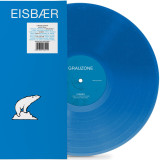
WRWTFWW Records is very honored to announce the official reissue of Grauzone's essential 1981 maxi single with timeless classic "Eisbär", proto-techno beast "FILM 2", and romantic synth ballad "Ich Lieb Sie", just in time for the 40th anniversary of the Swiss band's formation. The three-track vinyl is sourced from the original reels, cut at 45rpm, and comes with its iconic artwork on a 350gsm sleeve.
Ich möchte ein Eisbär sein...Written by Martin Eicher after a nightmare in which he saw talking polar bears on the walls, and with music by the Grauzone crew consisting of Martin and his brother Stephan Eicher, Marco Repetto, Christian "GT" Trüssel, and Claudine Chirac (on saxophone), "Eisbär" is the most recognizable title from the band, a sublime mix of ingredients reflecting the transitional era it comes from - the raw energy of punk music still palpable, combined with the audacity of early electronics, the warm groove of a disco gem, beautifully fragile lyrics, and one of the best basslines ever. It became a mega hit, totally unplanned, but how could you resist such a track
"FILM 2" is the ultimate b-side monster, a menacing all-instrumental pre-techno masterpiece, slowly building to a magnetizing frenzy. An instant underground favorite, it was famously heard played at both speeds depending on the scenes and DJs you were frequenting, 45rpm as it was first intended, and 33rpm for the cosmic experience (search Daniele Baldelli's Cosmic C75 1982 mixtape online for a great example of this).
The maxi single ends with "Ich Lieb Sie", a synth-pop meets doo-wop ballad, a true love song oozing with innocence. Simple, stylish, and just right.
At the crossroads of post-punk, new wave, pop, and electronic experimentation, the Eisbär maxi offers three songs that are technically different but hold the same spirit, the perfect embodiment of Grauzone's music - wild, unpredictable, and youthful, yet sophisticated, catchy, and ingenious. The magic recipe for the good stuff.
Stephan Eicher went on to be, arguably, the most successful Swiss musician ever, with an international career extending from pop chanson to experimental escapades and collaborations with Moondog, artists Sophie Calle and John Armleder, and author Martin Suter among many other luminaries. Marco Repetto flourished as a techno and ambient producer, releasing multiple projects including releases on Aphex Twin's Rephlex label.
Grauzone and WRWTFWW will continue to collaborate on the band's 40th anniversary reissue campaign, with numerous projects planned for the year, including a vast selection of music, visuals, and literature never available before.
out of Stock
Last delivered 8 months ago available to reorder, subject to availability
Mit dem Album “Life Time”, nach dem er wenig später seine bahnbrechende Fusion-Band benannte, startete
Tony Williams 1964 seine Solokarriere bei Blue Note. Der damals 18-Jährige präsentierte sich darauf nicht
nur als enorm druckvoller Schlagzeuger, sondern auch als erstaunlich gewiefter Komponist. Zwanzig Jahre
später kehrte er zu dem Label zurück, um mit einem modernen, akustischen Hardbop-Quintett auf Alben
wie “Civilization” wieder dort anzuknüpfen.
Pressed on smoky blue vinyl. 1971 classic album with new analogue mastering. Released on the Upsetter label, celebrating the groundbreaking collaboration between Bob Marley and The Wailers and Lee 'Scratch' Perry
The classic album now returns with new analogue mastering and stunning smoky blue vinyl pressing Released in Jamaica in 1971, Soul Revolution Part II is the follow-up to Bob Marley and the Wailers' 1970 debut album Soul Rebels. Going from strength to strength on the material they recorded for Lee Perry, this 12-tracker constitutes another crop of exceptional early-roots reggae anthems. Some of the songs are among the more widely lauded efforts in the repertoire of Bob Marley, Peter Tosh and Bunny Wailer. 'Don't Rock My Boat', 'Duppy Conqueror', 'Sun Is Shining' are about the most acclaimed of them and sound better than ever on this newly remastered edition using vintage analogue gear. Recorded at the famed Randy's Studio (also known as Studio 17) located at 17 North Parade in Kingston, Jamaica, this is the second full-length collaboration (and last!) between Bob Marley and the Wailers and producer Lee 'Scratch' Perry!
For Fans of, KISS, Starz, Angel, and 70’s classic rock! Employing a dazzling mix of glam rock, hard rock, and progressive rock, Angel's outrageous, white-satin-heavy image and equally over-the-top stage shows, making them one of the more colourful arena rock bands of the mid-'70s and early '80s. Discovered by KISS bass player, Gene Simmons, the group issued their eponymous debut album in 1975, which hewed closer to prog rock than the glam pop that would inform future endeavours like On Earth as It Is in Heaven(1977) and Sinful(1979). The group released a total of 5 studio albums and 1 live album before going their separate ways in 1981.Formed in Washington, D.C., the group's self-titled 1975debut was recorded for the flamboyant Casablanca Records label--home to KISS--with a line-up comprising Frank DiMino (vocals), Punky Meadows (guitar), Gregg Giuffria (keyboards), Mickie Jones(bass), and Barry Brandt(drums). A heavy slab of heavy pomp rock with lengthy songs swathed in Giuffria's atmospheric keyboards and featuring the longtime stage favourite "Tower". Now to celebrate the50thAnniversarythis classic has been remastered and is being released on both a 6-pane l CD digipak and on 180G vinyl with liner notes by Rock Candy journalist Dave Reynolds. There are only 700 of the Black-Blue swirl worldwide. A must have for any Angel fan with classics like “Tower” and “Rock & Rollers”
"Little Girl Blue, released in 1957, was Nina Simone's first studio recording ever. It was originally issued on the Bethlehem label and features the singer/ pianist backed by bassist Jimmy Bond (who had been a member of the Chet Baker Quartet among other groups) and drummer Albert ""Tootie"" Heath, one of the celebrated Heath brothers (the other two being saxophonist Jimmy Heath, and bassist Percy Heath). Many of the tracks from this LP would become true classics, among them her perennial version of ""My Baby Just Cares For Me"".
THE COMPLETE ALBUM + 3 BONUS TRACKS - 180-GRAM VIRGIN VINYL -
LIMITED EDITION"
Daniel Higgs vocals , Asa Osborne guitar, Sean Meadows bass, Mitchell Feldstein drums.
The Lungfish band from Baltimore, Maryland performed and released albums on the Dischord Records label for more than 20 years. The group's consciousness alternately/simultaneously coalesced and dispersed creating a continuous quasi-musical pulse, which reached climax at semi-monthly public performances.
Lungfish is now, as it often has been, quasi, if not entirely, defunct. However, after the release of Feral Hymns in 2005, singer Daniel Higgs (who is also an accomplished visual artist) embarked on a solo career, releasing albums on Northern Liberties, Thrill Jockey, and Holy Mountain and showing his artwork both in the States and the United Kingdom. Asa Osborne is currently recording and performing solo material under the name, The Zomes.
Japanese bamboo flute maestro and goat (JP) cohort Rai Tateishi makes an impressive debut statement with his holistic attempts to transcend the limits of ancient instruments to reveal gently delirious insights.
‘Presence’ is a triumph of improvised, elemental musicality that distills aspects of myriad folk traditions in pursuit of the artist’s own truth. For 40 minutes of singularly weird, locked-in performance, Rai Tateishi diverges his formative training in the shinobue (a bamboo flute) to applications for its elder sibling, the shakuhachi, and its distant relatives in the khene mouth organ of Northeastern Thailand and Laos, and even the Irish flute, with remarkable results returned from each.
Piece to piece, Tateishi adapts a spectra of unusual and extended instrumental experiments to articulate uniquely animist sound arrangements, with judicious use of a ring modulator and delay effects only subtly altering his sound in real-time, gelling the harmonics and smoothing off its contours. Some 15 years of studies and accreted knowledge of histories, timelines, and spirits are deftly tattered in the air and rebound in precisely complex ribbons that become all the more impressive by virtue of its in-the-moment recording.
Presented with no overdubs, the six works were recorded by label head and KAKUHAN/goat lynchpin Koshiro Hino across three days of adventurous improvisation capturing the breadth of Tateishi’s vision in a mix of succinct flights of fancy and one durational wonder where he really cuts loose. An opening piece of rapid percussive fingering and rasping sets the tone for increasingly intricate explorations of the shinobue, and bluesy cadence of a reedy Thai khene - antecedent of the shō - whipped into headier harmonic overtones, whilst his 5th piece for Irish flute best recalls Ka Baird or Michael O’Shea’s lysergic impishness, and a 13 minute closing piece most boldly fucks with folk and jazz traditions, in-depth and with the genre short-circuiting audacity of Rahsaan Roland Kirk.
Landing in the wake of prism-shaking works by Will Guthrie & Mark Fell, goat (jp) and Kakuhan; Tateishi’s ‘Presence’ more than lives up to NAKID’s impressive levels, unflinchingly operating by its wits with a verve and dare-to-differ moxie that gets at it from the first hit to the last, harnessing the kind of skill and ingenuity that’s distinctive but still strikingly minimal and overwhelmingly physical. It's a remarkable achievement.
Extirpated from the crepitating bowels of the surging Death / Grind scene of the early nineties and became cult with their frst platter of splatter released in 1991 by Wimp Records (LP) & Adipocere Records (CD), PUTRID OFFAL slowly dissolved in formaldehyde by the middle of the decade ..
But that is not dead what sleeps and the thing got alive again 25 years after its inception offering a brand new vision of its art with the release of the proper PUTRID OFFAL debut, Mature Necropsy in 2015 soon followed by countless Europe tours and festivals appearances like their 2017 gig at world famous HELLFEST captured alive for a DVD release as a bonus of second full-length, Sicknesses Obsessions in 2020 again followed by a slaughter campaign on all of Europe soiled grounds.
Now that their historical label KAOTOXIN / XENOKORP is left for dead, PUTRID OFFAL come back deadlier than ever and hungry for touring and gigging like a zombie for fesh ready to turn the crowd to pieces with their most brutal, to the point and mature album to date, Obliterated Life.
Recorded in Hollywood, California between two sessions in December 1956 and January 1957, Art Pepper’s Modern Art for the Intro label featured his melodic alto saxophone flights atop cool jazz, bebop, and blues in the company of a quartet with Russ Freeman on piano, Ben Tucker on bass, and Chuck Flores on drums. This mono Tone Poet Vinyl Edition was produced by Joe Harley, mastered by Kevin Gray from the original analog master tapes, pressed on 180g vinyl at RTI, and packaged in a deluxe tip-on jacket.
When considering the jazz vibraphone giants of the 20th century, seven stand out: Lionel Hampton, Red Norvo, Milt Jackson, Terry Gibbs, Cal Tjader, Gary Burton, and Bobby Hutcherson. Bobby Hutcherson (1941-2016), originally inspired by Milt Jackson, emerged from Los Angeles in the late 1950s. After a stint with the Billy Mitchell-Al Grey sextet in 1962, Hutcherson moved to New York, becoming the house vibraphonist for the Blue Note label. His foundation in hard bop did not limit him, as he also played in avant-garde sessions with artists like Eric Dolphy and Jackie McLean. On December 11, 1983, the 42-year-old Hutcherson performed seven standards with a stellar group. Pianist George Cables, consistently excellent throughout his career, had been working with Hutcherson since 1977. Bassist Herbie Lewis, a versatile musician, had collaborated with Hutcherson since 1966. Drummer Philly Joe Jones, known for his work with Miles Davis, also contributed to the session. The recording of the Four Seasons album features seven standards, starting with Thelonious Monk’s “I Mean You,” which showcases each musician. Hutcherson’s solo on Cole Porter’s “All Of You” is particularly adventurous. “Spring Is Here” receives a beautiful interpretation, and “Star Eyes” is taken uptempo. Hutcherson’s introduction on “If I Were A Bell” is notable, as is Jones’s solo. The session spotlights Cables on “Summertime” and concludes with a vibrant version of “Autumn Leaves.” Decades later, the music remains a timeless classic. Four Seasons is available on black vinyl, celebrates its 40th Anniversary, and includes an insert with newly written liner-notes by Scott Yanow
Googling “paradise house”, the first results to pop up are an endless list of European b&b’s with whitewashed lime façades, all of them promising “…an unmatched travel experience a few steps from the sea”. Next, a little further down, are the institutional websites of a few select semi-luxury retirement homes (no photos shown, but lots of stock images of smiling nurses with reassuring looks). To find the “paradise house” we’re after, we have to scroll even further down. Much further down.
It feels like yesterday, and at the same time it seems like a million years ago. The Eighties had just ended, and it was still unclear what to expect from the Nineties. Mobile phones that were not the size of a briefcase and did not cost as much as a car? A frightening economic crisis? The guitar-rock revival?! Certainly, the best place to observe that moment of transition was the dancefloor. Truly epochal transformations were happening there. From America, within a short distance one from the other, two revolutionary new musical styles had arrived: the first one sounded a bit like an “on a budget” version of the best Seventies disco-music – Philly sound made with a set of piano-bar keyboards! – the other was even more sparse, futuristic and extraterrestrial. It was a music with a quite distinct “physical” component, which at the same time, to be fully grasped, seemed to call for the knotty theories of certain French post-modern philosophers: Gilles Deleuze, Félix Guattari, Paul Virilio... Both those genres – we would learn shortly after – were born in the black communities of Chicago and Detroit, although listening to those vinyl 12” (often wrapped in generic white covers, and with little indication in the label) you could not easily guess whether behind them there was a black boy from somewhere in the Usa, or a girl from Berlin, or a pale kid from a Cornish coastal town.
Quickly, similar sounds began to show up from all corners of Europe. A thousand variations of the same intuition: leaner, less lean, happier, slightly less intoxicated, more broken, slower, faster, much faster... Boom! From the dancefloors – the London ones at least, whose chronicles we eagerly read every month in the pages of The Face and i-D – came tales of a new generation of clubbers who had completely stopped “dressing up” to go dancing; of hot tempered hooligans bursting into tears and hugging everyone under the strobe lights as the notes of Strings of Life rose up through the fumes of dry ice (certain “smiling” pills were also involved, sure). At this point, however, we must move on to Switzerland.
In Switzerland, in the quiet and diligent town of Lugano, between the 1980s and 1990s there was a club called “Morandi”. Its hot night was on Wednesdays, when the audience also came from Milan, Como, Varese and Zurich. Legend goes that, one night, none less than Prince and Sheila E were spotted hiding among the sofas, on a day-off of the Italian dates of the Nude Tour… The Wednesday resident and superstar was an Italian dj with an exotic name: Don Carlos. The soundtrack he devised was a mixture of Chicago, Detroit, the most progressive R&B and certain forgotten classics of old disco music: practically, what the Paradise Garage in New York might have sounded like had it not closed in 1987. In between, Don Carlos also managed to squeeze in some tracks he had worked on in his studio on Lago Maggiore. One in particular: a track that was rather slow compared to the BPM in fashion at the time, but which was a perfect bridge between house and R&B. The title was Alone: Don Carlos would explain years later that it had to be intended both in the English meaning of “by itself” and like the Italian word meaning “halo”. That wasn’t the only double entendre about the song, anyway. Its own very deep nature was, indeed, double. On the one hand, Alone was built around an angelic keyboard pattern and a romantic piano riff that took you straight to heaven; on the other, it showcased enough electronic squelches (plus a sax part that sounded like it had been dissolved by acid rain) to pigeonhole the tune into the “junk modernity” section, aka the hallmark of all the most innovative sounds of the time: music that sounded like it was hand-crafted from the scraps of glittering overground pop.
No one knows who was the first to call it “paradise house”, nor when it happened. Alternative definitions on the same topic one happened to hear included “ambient house”, “dream house”, “Mediterranean progressive”… but of course none were as good (and alluring) as “paradise house”. What is certain is that such inclination for sounds that were in equal measure angelic and neurotic, romantic and unaffective, quickly became the trademark of the second generation of Italian house. Music that seemed shyly equidistant from all the rhythmic and electronic revolutions that had happened up to that moment (“Music perfectly adept at going nowhere slowly” as noted by English journalist Craig McLean in a legendary field report for Blah Blah Blah magazine). Music that to a inattentive ear might have sounded as anonymous as a snapshot of a random group of passers-by at 10AM in the centre of any major city, but perfectly described the (slow) awakening in the real world after the universal love binge of the so-called Second Summer of Love.
For a brief but unforgettable season, in Italy “paradise house” was the official soundtrack of interminable weekends spent inside the car, darting from one club to another, cutting the peninsula from North to centre, from East to West coast in pursuit of the latest after-hours disco, trading kilometres per hour with beats per minute: practically, a new New Year’s Eve every Friday and Saturday night. This too was no small transformation, as well as a shock for an adult Italy that was encountering for the first time – thanks to its sons and daughters – the wild side of industrial modernity. The clubbers of the so-called “fuoriorario” scene were the balls gone mad in the pinball machine most feared by newspapers, magazines and TV pundits. What they did each and every weekend, apart from going crazy to the sound of the current white labels, was linking distant geographical points and non-places (thank you Marc Augé!) – old dance halls, farmhouses and business centres – transformed for one night into house music heaven. As Marco D’Eramo wrote in his 1995 essay on Chicago, Il maiale e il grattacielo: “Four-wheeled capitalism distorts our age-old image of the city, it allows the suburbs to be connected to each other, whereas before they were connected only by the centre (…) It makes possible a metropolitan area without a metropolis, without a city centre, without downtown. The periphery is no longer a periphery of any centre, but is self-centred”.
“Paradise house” perfectly understood all of this and turned it into a sort of cyber-blues that didn’t even need words, and unexpectedly brought back a drop of melancholic (post?)-humanity within a world that by then – as we would wholly realise in the decades to come – was fully inhuman and heartless. A world where we were all alone, and surrounded by a sinister yellowish halo, like a neon at the end of its life cycle. But, for one night at least, happy."
out of Stock
Last delivered 3 months ago available to reorder, subject to availability
The Irish producer t-woc makes his return to Rudimentary Records with Scenes, Journeys & Colors, his second LP for the label. The bones of the album was made during the 'quiet time' starting with a track that didn’t make the cut on this release but had provided the blueprint to that project titled ‘Street Soul Osaka’. It was a recent chance encounter with a lone boombox playing actual street soul on a pavement in Osaka that it became clear the project needed to be released and the album was completed in Dublin in 2024.
This album is crafted through a blend of samples, live instrumentation, field recordings and studio experimentation. The tracks are a mix of the slow and low, interspersed with minimal ambient pieces with a pronounced dub undercurrent, and a tip of the hat to the cosmos. There are also some vocoders and a fair dose of weirdness.
Since his 2016 LP for Rudimentary - ‘Sentinelas’, t-woc has released with Strangelove Records, Emotional Response, Macadam Mambo amongst others and is a regular contributor to DJ Sofa’s Elsewhere compilation series.
Nicht nur mit Jazz setzt Blue Note Records seit Jahren Zeichen. Neu auf dem US-Label ist jetzt auch die
Londoner Sängerin, Songwriterin und Gitarristin Maya Delilah, frisch von Spotify zum „Artist To Watch
2025“ ernannt, das sichere Zeichen eines aufgehenden Sterns.
Die 24-Jährige besuchte die renommierte BRIT School, zu deren Absolventen auch Adele und Amy Winehouse gehörten. Während des Lockdowns veröffentlichte sie im Social Media lässige Musikclips mit Gitarre
und hat inzwischen auf TikTok 600.000 und Instagram 310.000 Follower, darunter prominente Fans wie
Shawn Mendes und James Bay.
Seit Maya bei Blue Note unter Vertrag ist, hat sie eine Reihe fabelhafter Singles veröffentlicht, die 12
Songs ihres in London und LA aufgenommenen Debütalbums sind von akustischem Soul-Pop-Feeling durchdrungen, enthalten aber auch satte Country-, Blues- und Gospel-Anklänge, sowie eine Portion Funk. Eine
Musikerin von der man ganz sicher noch viel hören wird.
Apollo / R&S are delighted to welcome back The Primitive Painter, aka the duo of Roman Flügel and Jörn Elling Wuttke for a timely reissue of their 1994 lost classic self-titled album of sonorous IDM.
Growing up in Frankfurt, in the 80s and 90s the duo met at an indie rock club in their home town of Darmstadt, bonding over their shared obsession with the first wave of acid, Chicago house and early Detroit techno as well as their patronage of now iconic Frankfurt club nights like The Omen or Dorian Gray or the infamous Delirium Record shop run by scene stalwarts Ata (Robert Johnson) and Heiko MSO (Playhouse).
Taking inspiration from the likes of The Black Dog and Transmat as well as seminal compilations such as Planet E’s Intergalactic Beats and Warp’s Artificial intelligence compilation the duo honed their inventive take on the Detroit techno blueprint under the monicker Acid Jesus, debuting on their freshly minted Klang Elektronik label. The label was started in conjunction with Ata and Heiko after Fluegel & Wuttke (regular patrons of the Delirium store) pressed a demo on them, muttering the immortal line; “Please listen to the tape, we are big Mr. Fingers fans.”
Through the mid ’90s the project flourished giving rise to a classic album and a brace of singles that number amongst the best of the era’s techno, winning them a influential fans most notably Sven Väth, David Holmes and Andrew Weatherall who invited them to play live at one of the legendary Sabresonic parties in London.
Alongside the success of the Acid Jesus project, the duo found great inspiration in outside of the club, including an ambient happening when the KLF came to play Frankfurt; “There were live sheep eating grass on stage while they played at Mark Spoon’s club XS”, as well as cinematic influence from the likes of Jim Jarmush and Wim Wenders. It was however the euphonic IDM grandeur of Apollo Recordings self titled compilation of 1993 that really got their creative juices flowing: “It was a ten track compilation with artists like David Morley, Model 500, Aphex Twin which still sounds so good today,” Jörn enthuses. “ It was really the trigger to go away from the Detroit sound and more towards the big melodies of B12 etc.”
Deciding to make their tribute to this style of music the duo turned out 10 tracks of gauzy, melodious electronica in a white hot fever, one after another over the ensuing months. Settling on a name for the new project they picked ‘The Primitive Painters’ taking inspiration from the band Felt. “We are both children of the C86 movement,” explains Jörn. “this attitude of noisy art school influenced rock like Primal Scream, MBV, The Jesus & Mary Chain really inspired us to take a DIY approach to our music.”
They sent the resulting demo cassette to Renaat at R&S / Apollo. “We really had no expectations,” Jörn explains. “So we were shocked and delighted when we received a fax saying that he wanted to release it”.
The resulting release was bungled by an R&S mix up that attributed the album to the duo’s own Klang Elektronik label which confused both fans and distributors alike, denying the release the critical boost and attention that it so richly deserved. Accordingly the release slipped out without much fanfare, with a chastened Fluegel & Wuttke returning to their Acid Jesus activities which would eventually lead to their blockbusting success as Alter Ego.
Over the ensuing years the reputation of The Primitive Painter album has only grown, with second hand copies (only 500 vinyl were pressed) changing hands for exorbitant amounts on Discogs, leading us to this opportune moment of a richly deserved ‘first’ release on the label for which the project was started, Apollo / R&S.
“This really brings us full circle,” says Jörn. “Apollo / R&S meant and means so much to us as artists and so it was bittersweet to not have the official release - to put that right all these years later feels really good.”
This new vinyl release comes in re-created original gatefold artwork and includes all original 10 tracks (Stoned Soul Picnic was previously on the CD only).
out of Stock
Last delivered 14 months ago available to reorder, subject to availability
A2: Little Jr. Jesse & The Tear Drops – Give Your Love To Me
A3: Tonettes – I Gotta Know
A4: Doc & Sal – Can't Get You Offa My Mind
A5: Commands – I've Got Love For My Baby
A6: Willie Cooper & The Webs – You Don't Love Nobody
A7: Little Jr. Jesse & The Tear Drops – Ain't No Big Thing
B1: Commands – No Time For You
B2: Webs – Little Girl Blue
B3: Tonettes – My Heart Can Feel The Pain
B4: Doc & Sal – Cry & Wonder Why
B5: Commands – Don't Be Afraid To Love Me
B6: Willie Cooper & The Webs – I Can't Take No More
B7: Don & The Doves – Together
C1: Webs – Don't Ever Hurt Me
C2: Commands – Must Be Alright
C3: Bobby Blackmon & The Soul Express – She's Gotta Have Soul
C4: Doc & Sal – Laughing To Keep From Crying
C5: Webs – Try Loving Me
C6: Commands – Too Late To Cry
C7: Doc & Sal – My Dream
D1: Little Jr. Jesse & The Tear Drops – If You Don't Love Me
D2: Webs – Can't Let You Go
D3: Commands – A Way To Love Me
D4: Little Jr. Jesse & The Tear Drops – It Keeps Rainin
D5: Don & The Doves – I Need You
D6: Bobby Blackmon & The Soul Express – You'll Find Another
D7: Commands – Around The Go-Go
NUM043LPC2 Numero Group2x12inch28.03.202528.MAR.25
Whipped up in the dust of Rene & Rene’s Tejano tornado “Angelito,” the Dynamic label was just one among San Antonio record and real estate mogul Abe Epstein’s enterprises. Dynamic’s flagship outfit, the Commands, marched “No Time For You” up to the middle of the charts in 1966 with performance chops honed jet-sharp by the demanding Air Force Base circuit. That take off paved a runway for 20 more soulful Dynamic singles over an impressive 30-month campaign. Epstein’s open-door policy brought a diverse cross-section of Texas talent into convergence within his General McMullan Drive studio, as whites, blacks, and Latinos alike suited up for service in whichever new group the call of duty called for. Epstein’s Alamo City melting pot is ladled out here in 21 (28 on the 2LP) of Dynamic’s most intriguing dishes by the Tonettes, Little Jr. Jesse & the Tear Drops, Don & the Doves, Willie Cooper & the Webs, Bobby Blackmon & His Soul Express, and Doc & Sal. Lone Star pic sleeves, full-color dancehall photography, and rich ephemera plant a new flag for soul in soil that’s seen its share of hoisted banners.
• Collector Crystal Clear LP deluxe packaged – the very First reissue of the cult 11 track EP – Street Album from year 2000 by DJ Mehdi collecting his Espionnage adventures
• “DJ MEHDI : Made in France” : an Arte 6 episode exclusive serie about DJ Mehdi from September 12th ! DJ Mehdi was the one building bridges between french hip hop and electro, and becoming a key composer,producer and DJ. He was a game changer in himself, helping both french rap & electro scenes to rise in the late 90’s & early 200’s . 13 years after DJ Mehdi’s sudden death, his long-time friend and Director Thibaut de Longeville imagined & directed the serie, with archives materials & exclusive interviews and words from big names from Rap & Electro about their collaborations & relationships with DJ Mehdi.
SHORT BIOG
“Rather than a compilation, this record is a summary of what Espionnage has done in the past two years, from the rap 12”s, the instrumental 12”s to the remixes I was given the opportunity to do. The members of The Espionnage Sound System, Yvan from Double Pact included (even if he only appears here on the interlude betweeen “Camille Groult Starr (rmx)” and “Si Tu Savais (rmx)”), have been essential to the label’s development as a whole. The Chronowax Distribution staff has been equally vital to a structure primarily dedicated to independent vinyl production. By the way, I have to thank Ulysse Genet who, on top of lending his name to a track title, suggested the name “Espionnage” instead of “Le Cirque Disques” (which was my initial idea) and drew the first logo. Many thanks to my team : Olivier Rosset, Charlotte Dutoit, Thibaut de Longeville, Alexander Wise, the 360 Creative & Marketing teams, as well as X2N, Tom Kan, DJ Gilb’R, Roulé, Crydamoure, Benoît Blue Boy and his daughters Ludella and Amadine ; who have all contributed on one level or another to what this record is. Of course I can’t forget my family: the Essadis, Faveris, Gassamas, Majira (and their many relations) as well as my other family, the 113 Clan and the whole African Mafia and most particularly my group, Idéal J, for the respect and freedom with which they’ve let me express the somewhat unusual ideas I had about all of this”.
Peace, DJ Mehdi, NYC, March 29th 2000.
out of Stock
Last delivered 18 months ago available to reorder, subject to availability
This is the first reissue of the super rare 1968 Reggay anthem.
Originally released together on the Blue Cat label, this very much sought-after single features two exceptional tracks from the golden era of Jamaican music. "Belly Lick" by Dennis Walks and "The Game Song" by Drumbago & The Blenders exemplify the rich musical landscape of late 1960s Jamaica. Both tracks were written by Dennis Walks and produced by Joe Gibbs.
This reissue brings these two rare gems back to vinyl, allowing enthusiasts and collectors to experience their authentic sound. The original pressing has become highly collectible, with copies fetching big sums in the collectors' market.
This exceptional release will be available on our website and in select record shops worldwide from March 28, 2025.
Glasgow’s Cloth announce their return with new music by way of a four-track EP and their first release for their new label Rock Action Records. ‘Lucid’ is resplendent yet brooding, offering airy dream-like, haunting vocals over dark guitar riffs and resonating percussion - a perfect moment of minimal alternative rock.
Guitarist Paul Swinton says, “It was the first song we wrote for the EP and it felt like it set a tone for where we should go with the other songs - somewhere darker and bigger. The song is about being wrapped up in a situation you feel you have no control over then realising you do have the ability and agency to change things for the better.” Ice blue coloured 12” vinyl with digital download code. For fans of The xx, Cocteau Twins, Beach House and War Paint.
out of Stock
Last delivered 18 months ago available to reorder, subject to availability
The great Freddy King (aka Freddie King) was a forceful presence and formidable figure in two of the most prominent blues scenes: Texas and Chicago. Revered by his fans and respected by his peers, King was an innovative instrumentalist and an underrated singer. He would move beyond blues, R&B and soul to make commercial inroads into funk. Rolling Stone magazine ranked him the 15th greatest guitarist of all time. Presented here is his magnificent debut album, Freddy King Sings, originally released by the King label in 1961. THE COMPLETE ALBUM + 4 BONUS TRACKS - 180- GRAM VINYL - LIMITED EDITION
We are thrilled to announce another underground gem on our label. This time, it's Collage's incredible 4-track EP "Mit den Puppen tanzen" (Dancing With The Puppets). Originally released in 1984 on the small FMusic label, the 12" EP is a true highlight in German Electro and NDW history, becoming a sought-after item among collectors. It features intense lyrics by singer Katrin A. Kunze, with music composed by Markus Kammann and Jürgen Grah.
Kammann and Grah, both originally from Solingen - a small city near Wuppertal - had previously collaborated on the new wave project Schwarze Bewegung with a different singer. Their self-titled LP was released in 1982 on Bacillus/Bellaphon. During this period, the electro sound pioneered by Kraftwerk evolved into electro-funk, sparked by the release of Afrika Bambaataa's groundbreaking track "Planet Rock", which achieved global acclaim. The iconic Roland TR-808 drum machine, masterfully employed by Arthur Baker's production team, revolutionized dance music with further hits like "Looking for the Perfect Beat" and collaborations with Planet Patrol. Markus Kammann cites these tracks, along with black music as a whole, as key influences on his work. In contrast, much of the electronic music emerging from Germany at the time rather leaned towards the styles of artists like Klaus Schulze and Tangerine Dream. Kammann's influences are evident in Collage's EP, which incorporates elements of early electronic hip-hop, such as the scratching sounds in the title track (created with tape rather than turntables) and short rap segments in "Niemals zurück".
By this time, Kammann and Grah had acquired their own Roland 808 as well as a JUNO-60 keyboard. Grah, originally a drummer, played keyboards and vibraphone, while Kammann, primarily a guitarist, also played bass. All the lyrics on the EP were written and performed by Kathrin A. Kunze, who hailed from Cuxhaven, a northern German city. She moved to Wuppertal around 1983 to study literature, and the group Collage was born.
Through Uwe Bauer, drummer of Fehlfarben, and their manager Horst Lüdge (of Profil), Collage connected with Werner Lambertz, a legendary sound technician from Düsseldorf. Lambertz's state-of-the-art studio featured custom-built sequencers capable of triggering the JUNO-60, as well as expensive equipment like a vocoder. Over the course of a week, the group completed all four tracks.
The EP's hard yet playful electro beats were complemented by Kunze's distinctive performance and introspective lyrics, which lent the songs a uniquely German and wavy touch. Her subtle songwriting conveyed a sense of paranoia and sorrow, as seen in lines like "Ich glaub mir selber nicht. Wer hält denn schon, was er verspricht?" ("I don't believe myself. Who stays true to their word, anyway?").
Unfortunately, the EP was never properly promoted and was distributed solely through the independent market via EFA. Despite this, Collage continued working on new material and pre-recorded an album that garnered label's attention. Polydor expressed interest but proposed using the compositions for a solo project with singer Inga Humpe (of Neonbabies), who was already signed to their roster. This would have required replacing Kunze as the vocalist, an idea the group firmly rejected. As a result, the album was never released. In 1987, Kammann, Grah, and Kunze launched another project called Cold End, which released another brilliant and highly sought-after 12" single, Metropolitan Jungle, originally issued on Tam Tam and recently re-released.
The first-ever reissue of "Mit den Puppen tanzen" is limited to only 400 copies - 200 on classic black vinyl and 200 on blue transparent vinyl. The cover art remains true to the original 12" release, designed by the aforementioned Uwe Bauer (aka Bimbo Art). This reissue is a must-have for DJs and collectors alike
out of Stock
Last delivered 18 months ago available to reorder, subject to availability
"The classic album now returns with new analogue mastering and stunning smoky blue vinyl pressing
Released in Jamaica in 1971, Soul Revolution Part II is the follow-up to Bob Marley and the Wailers’ 1970 debut album Soul Rebels. Going from strength to strength on the material they recorded for Lee Perry, this 12-tracker constitutes another crop of exceptional early-roots reggae anthems. Some of the songs are among the more widely lauded efforts in the repertoire of Bob Marley, Peter Tosh and Bunny Wailer. ‘Don’t Rock My Boat’, ‘Duppy Conqueror’, ‘Sun Is Shining’ are about the most acclaimed of them and sound better than ever on this newly remastered edition using vintage analogue gear.
Recorded at the famed Randy’s Studio (also known as Studio 17) located at 17 North Parade in Kingston, Jamaica, this is the second full-length collaboration (and last!) between Bob Marley and the Wailers and producer Lee ‘Scratch’ Perry!
* 1971 classic album with new analogue mastering
* Pressed on smoky blue vinyl
* Released on the Upsetter label, celebrating the groundbreaking collaboration between Bob Marley and The Wailers and Lee ‘Scratch’ Perry "
Soul Jazz Records" Studio One Showcase 45 features a roll call of classic Studio One reggae legends including Horace Andy, Cornell Campbell, Bob Marley and The Wailers, Jackie Mittoo, The Heptones, The Skatalites and more - seminal reggae artists who all launched their careers at the legendary Studio One label. The album was previously only ever released as a long-deleted limited-edition seven-inch box set for Record Store Day. This album has now been expanded into a super double-vinyl album edition as well as first time on CD, with both featuring a massive eight bonus tracks of wicked Studio One classics and rarities.
out of Stock
Last delivered 15 months ago available to reorder, subject to availability
“Machine Against Rage” is the first release on OAOE - a new experimental music series on Wodawater.
Real and cloned voice becomes intertwined with physical space forming a call and response chain of a spatial imaginary emerging from a certain passage from Philip K. Dick. The machine never stops and enfolds the listener with affective feedback tones, subtle rhythms, disjointed impacts and noise. The record is result of a collaboration between the label’s founder Miko Szatko, also known as the techno producer and performer TRSSX and co-founder of EXIT Glasgow, and Verena Lercher, a Berlin-based media artist and resident at spæs - lab for spatial aesthetics in sound in Berlin. All recorded at Funkhaus Berlin between 2023-24, the six compositions originate from various feedback spatialisations and turntable movements amplified by an IKO, the 20-membrane speaker-instrument developed by spæs lab’s co-founder Gerriet Krishna Sharma and the IEM in Graz.
We are thrilled to announce another underground gem on our label. This time, it's Collage's incredible 4-track EP "Mit den Puppen tanzen" (Dancing With The Puppets). Originally released in 1984 on the small FMusic label, the 12" EP is a true highlight in German Electro and NDW history, becoming a sought-after item among collectors. It features intense lyrics by singer Katrin A. Kunze, with music composed by Markus Kammann and Jürgen Grah.
Kammann and Grah, both originally from Solingen - a small city near Wuppertal - had previously collaborated on the new wave project Schwarze Bewegung with a different singer. Their self-titled LP was released in 1982 on Bacillus/Bellaphon. During this period, the electro sound pioneered by Kraftwerk evolved into electro-funk, sparked by the release of Afrika Bambaataa's groundbreaking track "Planet Rock", which achieved global acclaim. The iconic Roland TR-808 drum machine, masterfully employed by Arthur Baker's production team, revolutionized dance music with further hits like "Looking for the Perfect Beat" and collaborations with Planet Patrol. Markus Kammann cites these tracks, along with black music as a whole, as key influences on his work. In contrast, much of the electronic music emerging from Germany at the time rather leaned towards the styles of artists like Klaus Schulze and Tangerine Dream. Kammann's influences are evident in Collage's EP, which incorporates elements of early electronic hip-hop, such as the scratching sounds in the title track (created with tape rather than turntables) and short rap segments in "Niemals zurück".
By this time, Kammann and Grah had acquired their own Roland 808 as well as a JUNO-60 keyboard. Grah, originally a drummer, played keyboards and vibraphone, while Kammann, primarily a guitarist, also played bass. All the lyrics on the EP were written and performed by Kathrin A. Kunze, who hailed from Cuxhaven, a northern German city. She moved to Wuppertal around 1983 to study literature, and the group Collage was born.
Through Uwe Bauer, drummer of Fehlfarben, and their manager Horst Lüdge (of Profil), Collage connected with Werner Lambertz, a legendary sound technician from Düsseldorf. Lambertz's state-of-the-art studio featured custom-built sequencers capable of triggering the JUNO-60, as well as expensive equipment like a vocoder. Over the course of a week, the group completed all four tracks.
The EP's hard yet playful electro beats were complemented by Kunze's distinctive performance and introspective lyrics, which lent the songs a uniquely German and wavy touch. Her subtle songwriting conveyed a sense of paranoia and sorrow, as seen in lines like "Ich glaub mir selber nicht. Wer hält denn schon, was er verspricht?" ("I don't believe myself. Who stays true to their word, anyway?").
Unfortunately, the EP was never properly promoted and was distributed solely through the independent market via EFA. Despite this, Collage continued working on new material and pre-recorded an album that garnered label's attention. Polydor expressed interest but proposed using the compositions for a solo project with singer Inga Humpe (of Neonbabies), who was already signed to their roster. This would have required replacing Kunze as the vocalist, an idea the group firmly rejected. As a result, the album was never released. In 1987, Kammann, Grah, and Kunze launched another project called Cold End, which released another brilliant and highly sought-after 12" single, Metropolitan Jungle, originally issued on Tam Tam and recently re-released.
The first-ever reissue of "Mit den Puppen tanzen" is limited to only 400 copies - 200 on classic black vinyl and 200 on blue transparent vinyl. The cover art remains true to the original 12" release, designed by the aforementioned Uwe Bauer (aka Bimbo Art). This reissue is a must-have for DJs and collectors alike
out of Stock
Last delivered 22 days ago available to reorder, subject to availability
Sonny Boy Williamson (Alex Miller 1912 - 1965) was one of the most inspiring
harmonica players in blues history. Though he took his name from another well-known
harmonica player, no one really sounded like him. Williamson developed his own
signature harmonica style, always showing a metronome like timing and an endlessly
inventive technique.
This release consists of Sonny Boy's complete debut LP, Down And Out Blues ,
originally released in 1959 on the Chess Records subsidiary label, Checker. Featuring
Muddy Waters, Jimmy Rogers, Willie Dixon, and Otis Spann, among others.
Sonny Boy Williamson toured England with American Folk Blues Festival in 1963 and
1965 and appeared on the iconic tv music show Ready Steady Go (8 January 1965)
backed by UK band,The T-Bones with Gary Farr.
Nels Cline, Gitarrist der US-Independent-Rockband Wilco, den der Rolling Stone in seiner Liste der “100
Greatest Guitarists of All Time” führt, ist in seinem „zweiten Leben“ Jazz-Gitarrist, und das seit 2016 auf
dem weltweit renommiertesten Label des Genres: Blue Note Records. Sein viertes in einer Reihe stilistisch unterschiedlicher Blue-Note-Alben hat er jetzt nach seinem neuesten Ensemble „Consentrik Quartet“
benannt - mit Ingrid Laubrock (Saxofone), Chris Lightcap (Bass) & Tom Rainey (Drums) - dessen Debü-
taufnahme dies ist.
„Consentrik Quartet“ ist Nels Clines bis dato stilistisch vielseitigstes Blue-Note-Werk, auf dem es ihm
gelingt, swingenden Modern Jazz und Avantgarde, Virtuosität und Coolness zu verbinden.
Of all the artists who recorded for the Black Jazz label, keyboardist and composer Doug Carn was the most prolific, releasing four albums for the imprint. 1972’s Spirit of the New Land was his second Black Jazz release, but the first one (of two) to co-feature his wife, vocalist Jean Carn. It’s the most collectible of the bunch, showcasing Carn’s innovative approach of adding lyrics to jazz standards like Miles Davis’ “Blue in Green” and Lee Morgan’s “Search for the New Land,” while originals like “Arise and Shine” and “My Spirit” soar with spiritual fervor on the wings of his wife’s five-octave range.
Along for the ride are a stellar cast of players, including trumpeter Charles Tolliver, co-founder of the Strata-East label; saxophonist George Harper, who played with Herbie Hancock and Jimmy Smith among others; trombonist Garnett Brown, who appears on albums by Roland Kirk, Albert Ayler, and Art Blakey among his hundreds of album credits; tuba player Earl McIntyre, whose discography spans from Carla Bley to the Band; and drummer Alphonse Mouzon, founding member of Weather Report. This beautiful, uplifting album also comes with liner notes by Pat Thomas, author of Listen, Whitey! The Sights and Sounds of Black Power 1965-1975, that feature excerpts from a freewheeling interview conducted with Doug Carn himself. Pressed in blue with black swirl vinyl limited to 750 copies!
compiled by tsunaki kadowaki
artwork by yoshirotten
mastering by kuniyuki takahashi
Tsunaki Kadowaki, a staff member at Kyoto’s record store Meditations, the supervisor of "New Age Music Disc Guide", and the founder of Sad Disco, curates the fourth installment of "Midnight in Tokyo" themed around Ambient Kayō.
The Midnight in Tokyo series by Studio Mule focuses on Japanese music, serving as a soundtrack for Tokyo nights—whether for home listening, club play, or as a driving BGM, transcending location and space. After a six-year hiatus, the fourth volume takes "Ambient Kayō" as its new perspective, compiling genre-defying tracks released between 1977 and 1999 to explore the intersection of Japanese ambient and pop music.
For this long-awaited fourth installment, selections were made regardless of record label status (major or independent), era, format (vinyl or CD), original release price, or prior reissues. Instead, the focus was on music that deeply moves the listener, is open-minded and evocative, brims with inspiration and spiritual insight, and embodies the "utagokoro" (singing heart) of Japanese artists.
Opening the compilation is "Umi e Kinasai" by Yōsui Inoue, a legendary Japanese singer-songwriter whose works have recently gained renewed interest as hidden gems of Walearic and ambient pop
Composed and arranged by Katsu Hoshi—who is also known for his arrangements on Inoue’s masterpiece Ice World—the track features renowned players such as Masayoshi Takanaka, Hiroki Inui, and Shigeru Inoue. The song embodies a yearning for Balearic horizons, tinged with youthful vibrancy and sentimentality.
Next, "Oritatamu Umi", compiled from Keiko Nosaka, a 20-string koto player, and George Murasaki, a pioneer of Okinawan rock, is an instrumental track from their album "Niraikanai Requiem 1945". As the title suggests, it carries themes of requiem and remembrance, conveying poetic lyricism even without words. Blending Ryukyuan/Okinawan harmonies and indigenous elements, it unfolds as an intimate and nostalgic piece of progressive rock.
Also featured is "Natsu no Kowareru Koro" by Higurashi, a folk-rock band led by Seiichi Takeda, formerly a guitarist of The Remainders of The Clover, the predecessor of RC Succession. Like the opening track "Umi e Kinasai", this song was also produced by Katsu Hoshi. It stands as a folk/new music piece that takes a step into an "otherworldly" realm, recommended for fans of Twin Cosmos and Masumi Hara.
From the enigmatic Blue, the only work left by the mysterious composer S.R. Kinoshita, comes "Mangrove", a hidden treasure of Japan's ambient/new age scene from the CD era. With an oriental and enigmatic atmosphere, the track evokes a mystical world of deep, uncharted jungles, unfolding as an otherworldly New Age Kayō.
"Yaponesia Sakura", selected from Rehabilual’s sole album New Child, is a masterpiece of Japanese new age music. Produced by Swami Dhyan Akamo, a disciple of Indian meditation teacher Osho and a renowned balafon player, the track features Michio Ogawa (Chakra) and Atsuo Fujimoto (Colored Music). Their collective artistry creates an exquisite spiritual ambient pop sound.
"Asa no Hitoshizuku", the opening folk song from Sachiko Kanenobu’s album Sachiko, is also included. Known for her legendary folk album Misora, produced by Haruomi Hosono, Kanenobu’s fourth album after resuming her career was inspired by her experiences living in San Francisco and revolves around the theme of "love." This track carries the same intimate poetic world as Misora, imbued with a pure, crystalline innocence.
From the synth-pop band E.S. Island, known for the Haruomi Hosono-produced *Teku Teku Mami", comes "Yume Fūrin ", selected from their long-lost new age classic Nanpū from Hachijo. Created while the band’s core duo was living in Hachijō Island, the album aimed to sonically capture "the high and happy vibrations of everyday island life." This track offers a dynamic, tribal-infused New Age Kayō experience.
Dubbed "the world's first Min’yō House Mix" "Esashi Oiwake (Maeuta) " comes from Kanazawa Akiko HOUSE MIX Ⅰ, a collaboration between Japanese house music pioneer Soichi Terada and Akiko Kanazawa, a renowned min’yō singer. Through the prism of club music, Hokkaido's Esashi Oiwake, one of Japan’s most iconic folk songs, is transformed into a futuristic ambient pop piece with intricate sound design.
The compilation also includes "Sweet Ong Choh", a track from Voice From Asia, a group active between 1989 and 1992 featuring vocal artist Shizuru Ohtaka. Taken from their imaginative minimal work Voice From Asia, released under Aoyama Spiral’s music label Newsic, the song presents a tranquil, tribal-minimal soundscape enriched by ethnic instruments.
Hailed by Haruomi Hosono as having “a shaman residing in her voice,” singer-songwriter Nami Hōdatsu also appears in the selection. Known for her collaborations with Henry Kawahara, her debut album featured "Asa-Hikari-Ame-Yume", a track that now stands as a precursor to modern vocaloid/synthesized vocal music—a hidden gem of post-choir aesthetics that deserves rediscovery.
Likewise, "Tennessee Waltz", from Naomi Akimoto’s album One Night Stand, supported by members of Mariah, serves as another early prototype of vocaloid/synthesized vocal music. The track weaves fragmented vocal samples, pastoral yet sweetly minimal synth sounds, and mechanical beats into a strikingly unconventional piece in the history of Japanese music.
Closing the compilation is "Heaven Electric", a track from Nav Katze’s album Gentle & Elegance, which featured remixes by Autechre, Seefeel, and Sun Electric. Merging elements of IDM, ambient techno, and chillout, the song embodies an optimism reminiscent of space music while seamlessly blending a mystical Japanese aesthetic—an ambient pop masterpiece.
---
The album presents 12 exquisite pop tracks infused with an ambient feeling, resonating deeply with the evolving landscape of the mid-2020s—a time of post-hyperpop and Y2K revival.
Tsunaki Kadowaki (Compiler)
Born in 1993 in Yonago, Tottori, Tsunaki Kadowaki is a staff member and buyer at Kyoto’s Meditations record store. He is the editor of New Age Music Disc Guide (DU BOOKS) and a contributor to Music Magazine, Record Collectors' Magazine, ele-king, and more. Kadowaki has written liner notes for multiple Japanese releases (Brian Eno, Masahiro Sugaya etc.) and runs the Sad Disco music label under Disk Union. He also curates Spotify’s official New Age Music playlist and performed as a DJ at YCAM’s Audio Base Camp #3 in 2024.
out of Stock
Last delivered 14 months ago available to reorder, subject to availability
The complete album - pressed on limited edition 180g vinyl
Tenor saxophonist Ben Webster (1909 - 1973) had already enjoyed a long and fruitful
career by the time this 1957 session was recorded. However, as Bob Blumenthal
explains in the original liner notes, he still wasn't known for the sensual ballad feeling
that became his trademark during the last two decades of his life. At that time, he was
still recognized for the hard blowing fast tenor sax style he played with both the Duke
Ellington Orchestra and his own multiple small groups.
Even though his repertoire was generally linked to that of Duke Ellington, this classic
Norman Granz produced session presents Webster playing four popular ballads and
two of his own bluesy compositions, Soulville and Late Date. On hand in support are
the incredible Oscar Peterson Trio (Herb Ellis, Ray Brown), and drummer Stan Levey.
"The by turns grizzled and vaporous-toned Webster really hit his stride on the Verve
label. This 1957 date with the Oscar Peterson Trio is one of the highlights of that
golden '50s run. After starting off with two bluesy originals, Webster gets to the heart
of things on five wistful ballads. Providing sympathetic counterpoint, Peterson
forgoes his usual pyrotechnics for some leisurely compact solos; his cohorts -
guitarist Herb Ellis, bassist Ray Brown, and drummer Stan Levey - are equally assured
and splendid. Newcomers shouldn't hesitate to start here." - ***** Stephen Cook,
AllMusic
Lee Hazlewood made his bones producing and cowriting with guitarist Duane Eddy during the ‘50s, and then cemented his immortality with the classic sides he produced for Nancy Sinatra during the ‘60s. Over the past few decades, though, attention has turned to Lee’s idiosyncratic solo work, the heart of which he recorded for the Reprise label and his own LHI Records. Issued in 1968,
Love and Other Crimes is one of his Reprise releases, and it’s one of the weirdest records in his entire catalog. Recorded in Paris with such legendary Wrecking Crew members as guitarist James Burton and drummer Hal Blaine, Hazlewood sounds every bit the bon vivant (read: half drunk) as he swings from country ballads to lightly psychedelic pop highlighted by his rockin’ cover of Bonnie Dobson’s “Morning Dew.” Other highlights include “Rosacoke Street,” which presents him at his most psychedelic lounge lizard-esque, (think a Hunter Thompson character from Fear and Loathing in Las Vegas) and his moving “Wait and See,” an apology for bad behavior to an absent lover.
We’ve enlisted Mike Milchner to remaster this one for vinyl… don’t miss Lee’s stream-of-consciousness back cover notes, either. Pressed in sea blue vinyl limited to 1000 copies!
The late, great Calvin Keys’1971 debut album for the Black Jazz Records label announced the arrival of a new star in the jazz guitar firmament. Keys had spent the ‘60s backing up the crème de la crème of jazz organists—Jimmy Smith, Jimmy McGriff, Jack McDuff, Richard “Groove” Holmes—but for his first record as a leader, he was eager to play with a piano player instead. So he recruited one of the best—Larry Nash, who, besides being a member of the L.A. Express, played with everybody from Eddie Harris to Bill Withers to Etta James. Bassist Lawrence Evans, drummer Bob Braye, and flautist-songwriter Owen Marshall rounded out the group on Shawn-Neeq, which might remind some of Pat Metheny’s early work (Metheny acknowledges Keys as an influence), or Grant Green.
But what gives Shawn-Neeq extra depth is that it comes from the heart; as Keys says in Pat Thomas’ liner notes, which feature an interview with the artist: “My thing was, I write about some of the experiences that I’ve had in my life.” Keys became a fixture in the Bay Area jazz scene before he passed in April 2024; this is the album that started his journey. Another gem from the celebrated Black Jazz catalog, pressed in blue with black swirl vinyl limited to 750 copies!
The late, great Calvin Keys’1971 debut album for the Black Jazz Records label announced the arrival of a new star in the jazz guitar firmament. Keys had spent the ‘60s backing up the crème de la crème of jazz organists—Jimmy Smith, Jimmy McGriff, Jack McDuff, Richard “Groove” Holmes—but for his first record as a leader, he was eager to play with a piano player instead. So he recruited one of the best—Larry Nash, who, besides being a member of the L.A. Express, played with everybody from Eddie Harris to Bill Withers to Etta James. Bassist Lawrence Evans, drummer Bob Braye, and flautist-songwriter Owen Marshall rounded out the group on Shawn-Neeq, which might remind some of Pat Metheny’s early work (Metheny acknowledges Keys as an influence), or Grant Green.
But what gives Shawn-Neeq extra depth is that it comes from the heart; as Keys says in Pat Thomas’ liner notes, which feature an interview with the artist: “My thing was, I write about some of the experiences that I’ve had in my life.” Keys became a fixture in the Bay Area jazz scene before he passed in April 2024; this is the album that started his journey. Another gem from the celebrated Black Jazz catalog, pressed in blue with black swirl vinyl limited to 750 copies!
Anyone that knows what I like and has been following Future Retro London over the years will know that I'm an avid supporter of Ricky Force's music. Having had him on the label in all the ways possible (a solo tune, a remix & a collab), I think it's fair to say that I'm a huge fan of what he does.
Out of the blue, he sent me a big folder of music and I couldn't narrow it down to a 4 track EP so it ended up becoming an 8 tracker, including a new collab I did with him to go on the release.
Thanks to Ricky Force for his quality work on this release & a very special mention going out to Team Hyper D for their co-operation in clearing the sample of Stevie Hyper D on "Sensi".
out of Stock
Last delivered 17 months ago available to reorder, subject to availability
The complete LP + 6 bonus tracks - limited edition pressing on 180g vinyl
Widely regarded as the finest female country singer of all time, Patsy Cline achieved
icon status following her tragic premature death at age 30 in 1963. Presented here is
one of Patsy Cline's best albums, Showcase (1961), originally released by the Decca
label. It boasts such important hits as 'Crazy', 'I Fall to Pieces' and 'Walkin' After
Midnight.
Featuring guitar legend Grady Martin, bassist Bob Moore, pianist Floyd Cramer, The
Jordanaires, this special edition of Showcase features six bonus tracks, including the
unforgettable 'She's Got You' and 'You Belong to Me, constituting a true Patsy Cline
greatest hits release.
"Patsy is and perhaps will always be the standard bearer for all female country
singers."- Tammy Wynette
Elvis' debut LP, titled Elvis Presley, was the first rock album to reach number one on
the US charts. It was recorded for the RCA label, which had paid what was then a
king's ransom to buy his contract from Sam Phillips' Sun Records in Memphis. The
album was produced by Steve Sholes, head of RCA's Country & Western and Rhythm &
Blues division, and released in March 1956.
"This was as startling a debut record as any ever made, representing every side of
Elvis' musical influences except gospel - rockabilly, blues, R&B, country, and pop were
all here in an explosive and seductive combination. Elvis Presley became the first rock
& roll album to reach the number one spot on the national charts, and RCA's first
million dollar-earning pop album." - ***** Bruce Eder, AllMusic
"Stoned Immaculate" (1991) ist das wohl bekannteste Dub Syndicate-Album, aufgenommen zwischen Jamaika und London. Zu den rockigen Rhythms des Bandleaders Style Scott gesellen sich weitere Topmusiker wie Skip McDonald (git), Lee "Scratch" Perry und Akabu on vocals, Leith Levene (keys), sowie Samples des verstorbenen, großartigen Prince Far I. Es markiert eine Zeit, in der das Label von Acid-House-Fans ebenso angenommen wurde wie von Hardcore-Dub-Fans, und diese LP zum festen Bestandteil der "Comedown"-Session nach dem Rave wurde. Der Titeltrack ist eine wahre On-U-Sound-Hymne, die Reggae, ausgeflippte Electronica, The Doors und Motown zu einem epischen Groove vermischt. Das seit Jahren vergriffene Vinylformat wurde von Frank Merritt im The Carvery neu geschnitten und enthält rare Fotos von Coneyl Jay und neue Linernotes von Rob Harris (Testpressung).
out of Stock
Last delivered 19 months ago available to reorder, subject to availability
At the start of the 60s, a new wave of gospel-influenced jazz started to emerge, with hits such as Art Blakey & The Jazz Messengers' "Moanin'" and Cannonball Adderley's "Work Song" epitomizing this evolution in the genre. The terms "soul jazz" and "funky jazz" were coined as a way to describe this new sound that was making an impact in the US and also on the other sides of the Atlantic and Pacific oceans.
In 1964, Ray Charles made his first visit to Japan. Then, in 1968, Martha & The Vandellas and Stevie Wonder set foot in the country, followed by Sam & Dave in 1969, Ike & Tina Turner in 1970, and B.B. King in 1971. The TV show "Soul Train" also began airing in Japan in the early 1970s. A watershed moment happened in 1973 when Sammy Davis Jr. was cast in a TV commercial for Suntory whisky — and the influence of the US Black entertainment world had really landed, with soul, jazz, and funk artists becoming household names.
Nippon Columbia played a pivotal role during this turning point. The company had contracts with Buddah Records and Blue Thumb Records, releasing notable works by artists such as Gladys Knight & The Pips, Curtis Mayfield, The Crusaders, and The Pointer Sisters. At the same time, the label was also releasing several Japanese soul, jazz, and funk projects under the lead of music director Jiro Inagaki. Inagaki, a saxophonist who began his professional career in the early 1950s, honed his skills at U.S. military camps, where he shared his love of music with the Black servicemen. In the 1960s, he played with drummer Hideo Shiraki's band, which was widely considered to be Japan's representative group of the funky jazz movement. Later, Inagaki went on to pursue more cutting-edge sounds with his Soul Media project, including being a pioneering figure in the "jazz rock" genre. By working closely with Inagaki and his various musical projects, Nippon Columbia really placed the company at the center of an exciting and important period in Japanese music.
In 1965, Nippon Columbia opened a recording studio in Tokyo's Akasaka neighborhood. Akasaka was also home to the first ever discotheque in Japan, the legendary MUGEN, which ran from 1968 to 1987 and where many acts performed, including Con Funk Shun, the Bar-Kays, Ike & Tina Turner, B.B. King, Sam & Dave, Three Degrees, and Edwin Starr, as well as many local Japanese singers and musicians. This melting pot of creativity in the area led to the recording of many singles and albums by Japanese artists that were infused with the sounds of soul and funk. Most of these recordings were not available outside of Japan and remain rare and unknown musical gems. The selection you are holding in your hands is an explosive collection of 10 essential tracks released by the legendary Nippon Columbia label between 1969 and 1977, capturing the raw, unapparelled energy that was flowing through the air of the Akasaka streets at this electrifying time. Enjoy!
---
180GWALP07 - Manufactured and distributed by 180g.
out of Stock
Last delivered 16 days ago available to reorder, subject to availability
With his debut singles championed by global tastemakers such as Gilles Peterson, Mr Scruff and Jazzanova, Quantic was quick to follow on the initial success of ‘The 5th Exotic’ Like Tru Thoughts label-mates Bonobo and Jon Kennedy, who went on to record with Ninja Tune and Grand Central respectively, Quantic took his inspiration from sleepy 1990s chill and his enviable collection of funk 45s. Apricot Morning, Quantic's ambitious sophomore full length, is built upon the achievements of its esteemed predecessor. Plentiful strings find themselves in friction against the hoots & parps of afrobeat brass, the loping percussion is tasked with drawing these elements together into a cohesive whole. Some inspired instrumentals were further fleshed out by the wonderful vocal contributions of EQ, Bristolian hip-hoppers Aspects and the majestic Alice Russell.
out of Stock
Last delivered 14 months ago available to reorder, subject to availability
This re-issue of the Cocteau Twins' 1993 album has been remastered by Robin Guthrie and is pressed onto high quality 140g vinyl . Cocteau Twins vocalist Elizabeth Fraser, guitarist Robin Guthrie, and bassist Simon Raymonde formed in Grangemouth, Scotland in the late 70s. The brainchild of Guthrie and original bassist Will Heggie, by 1981 they had added Fraser and the following year signed to 4AD, one of the most illustrious of the indie labels. With Raymonde replacing Heggie in 1983, the trio went on to create some of the most unique and otherworldly music of the 80s, built around Guthrie's chiming guitar and Fraser's unmistakable soprano. By the early 90s, the group had just released their most successful album, the commercial Heaven or Las Vegas, but the relationship with 4AD was coming to an end. Mercury imprint Fontana was going through something of a purple patch, signing former underground bands, and by 1992, Cocteau Twins had joined The Fall and the House Of Love. The group's debut album for Fontana, Four-Calendar Cafe, was released in October 1993. Its gossamer melodies and largely upbeat pop bely the turmoil the group were going through. Barney Hoskyns, writing in Mojo, said that Four-Calendar Caf was "the most poignant, heartrending Cocteaus record of all, an album of naked confession and raw beauty . . . Sadness never sounded so luscious." Simon Raymonde agreed: "I think in time people will realise what a great album Four-Calendar Caf is. Because I think it's beautiful." Led by the single Evangeline, the reached No 13 in the UK album chart and is much-loved by fans.
out of Stock
Last delivered 19 months ago available to reorder, subject to availability
Fust--the lyrical powerhouse Southern rock band from Durham, North Carolina--announce their new album Big Ugly, out March 7th on Dear Life Records, the record label that launched the careers of MJ Lenderman and Florry and that has become a haven for contemporary songwriters. Big Ugly arrives after the release of 2024's Songs of the Rail--"one of the best alt-country compilations_in a long, long time" (Paste) -- and 2023's standout Genevieve, which unassumingly introduced new listeners to Fust's unmistakable blend of "small-town poetry" (Mojo) with a familiar yet probing "country-tinged folk-rock" (KEXP) that made it "one of the most fun rock records of the year" (Pitchfork). Genevieve was their studio debut, recorded with producer Alex Farrar (Manning Fireworks, Rat Saw God, Tomorrow's Fire) in Asheville, North Carolina. The reception was far better than the band expected, stirring them to immediately start working on Big Ugly, their second collaboration with Farrar. Recorded over ten days in June of 2024, Big Ugly is the explosive sound of Fust uncovering a freedom within their sincere form of loose and fried guitar rock, realizing more than ever before an intimacy within bigness. The members -- Aaron Dowdy, Avery Sullivan, Frank Meadows, John Wallace, Justin Morris, Libby Rodenbough, Oliver Child-Lanning--weave their voices alongside guests like Merce Lemon, Dave Hartley (The War on Drugs), and John James Tourville (The Deslondes) to form a music that sounds like a conversation between old friends. And that's exactly what it is. At its heart, Big Ugly is a story cycle, following tough-skinned characters who seem to inhabit a shared and fictional small town--Big Ugly--that in reality gets its name from a lowly populated and unincorporated area in southern West Virginia around where Dowdy's family has deep roots. The album cover_a mural from the Big Ugly Community Center just off the Big Ugly Creek--was painted by locals for a 2004 play performed by the children that interpreted their elders' stories. In a way, Fust's Big Ugly does something similar as it takes the same area as its backdrop and reimagines a life depicted in the mural between the bars, gas stations, general stores, and double-wides. Throughout the album, we join the characters in finding history and meaning in the banal theater of their own private jerkwater.The songs on Big Ugly are hearteningly varied, moving from beer-fisted radio country to elegiac drones to deconstructed ballads. Songs like "Spangled" take up the theme of past traumas and present desensitizations colliding, of the small and cosmic coinciding in the life of a heedless protagonist. "Bleached" finds the soul-searching narrator recalling the feeling of inner vacancy in their childhood: thoughtless, speechless, herded around like cattle in backseats. And "Mountain Language" laments the poverties of Southern life at the same time that it promotes a higher poverty, a country utopia that's just out of grasp, where we could live if we could only "make it up the mountain again." The mystical hermeticism and the dime-store everyday are two sides of every insignificant thing in the town of Big Ugly.