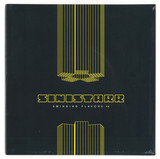
Swinging Flavors is BACK! After releasing material from names such as Simon Off aka Sun People, Moresounds, DJ Madd, Ticklish, Sully, Addison Groove, Itoa and Lynch Kingsley our 7' vinyl series devoted to Bass Culture and dancefloor vibes is back again with the the Sixth One aka BMRSF006. After having a Japan vs USA Chicago Footwork sound clash with DJ Fulltono and DJ Earl's 'Tribal Dancer', now it's time for an atlantic connection - in the name of Bass Music obviously.
On the A Side you'll find Sinistarr's '55555': the Detroit bass producer - with a 10yrs experience in sound design and recently appeared with an astonishing work on legendary dBridge label Exit Records - gives us a pure example of his sonic craziness with a minimal-but-high-impact work, with chopped vocal samples, magic flutes and heavy basses.On the B Side '55555' gets a full treatment by Philip D. Kick: Cosmic Bridge honcho Jim Coles - well known in the worldwide bass scene as Om Unit - surprisingly comes back with his iconic footwork moniker giving to the original vibes a more accentuate rave touch, with hyper speed drum patterns, amen breaks and piano notes.
Teste returns with The Box Man, a five-track EP that marks their first release of original material in 25 years. Formed during the early nineties in Hamilton, Ontario, they put out only three official records between 1992-1993 on Probe Records, most notably 'The Wipe,' which is regarded as a genre defining classic, while the follow-up 'Regions' also served as a template for the ensuing sonics of contemporary techno. With only a handful of live actions, the final chaotic show (public disturbance) occurred for Pure in Glasgow 1994. Afterwards, the original Teste lineup of juvenile delinquents disbanded but unwittingly ended up defining the hypnotic and drugged out strains of today's afterhours techno parties. The project vanished for decades until reactivating the chaos in 2014, promoting a slew of remixes 'The Rewipes,' by artists such as Rrose and Terence Fixmer, on the Edit Select imprint.
Since then, original member David Foster, still at large as //HUREN//, has been slugging it out in the fringes with influential output on the seminal Zhark Recordings Berlin and has collaborated as O/H with Rich Oddie of Orphx. First meeting on Mayday 2017 in Berlin, a new alliance with Martin Maischein aka Goner formed. Goner is likewise a veteran with essential output under various monikers on imprints such as Force Inc., Editions Mego, and Hospital Productions. From that pairing, The Box Man came into being for the second release on BITE, the Berlin techno label run by Hayden Payne and Florian Engerling.
The Box Man picks up where Teste last left us with their revolutionary vision of techno and continues to further their interdimensional manifestation of insanity and formation. Pure techno serving as a method of psychic expulsion and self-reckoning. From the opening, the eponymous track approaches full panoramic throttle as metallic synths creep 360 degrees around the listener, setting the tone for panic and loss of cognitive control. Teste then moves into the stealthier outpatient techno rhythms of 'The Long Term Care Facility' and 'Thieves Are Operating In This Area'. The EP contrasts its propulsion with different interpretations of its blueprint. 'Foaming At The Mouth' delves into Cabaret Voltaire-alike rhythm box violence until all is closed with the comedown melodies of 'Lyubov'. Through highly adept methods of sound design and neural interpretation, Teste once again cuts apart reality with their music, expressing nightmares and visions via new rituals and mind control techno.
Paul Dickow Aka Strategy Is A Musical Polymath With A Signature Sound Derived From His Immersion In Hardware-based Electronic Music. He Has Spent Close To Two Decades Traveling Freely Through House, Techno, Rave, Noise, Ambient, And Sounds More Difficult To Categorize. Strategy's Sound Is Inimitable Because It Is Literally Built By Hand - His Hands. Through All Of This Sonic Journeying, Including Multiple Full Length Releases, A Constant Has Been His Love Of Reggae And Dub, Yet Somehow A Proper Dub Album Has Never Emerged - Until Now.
After Two Much-loved 7' Singles On Zamzam - To Say Nothing Of Dubwise Excursions On Idle Hands, Shockout, Peak Oil, 100% Silk And More - dub Mind Paradigm' Is The Fulfillment Of A Clear, Simple Goal. "i Set Out To Make A Full Set Of Dub Tracks Good Enough To Make An Album -- Something That Had Always Eluded Me-- And It Worked, Finally. A Simple Exercise In Seeing If We Could Launch The Capsule To Orbit Planet Reggae And Make It Home Again.'
Reaching Planet Reggae, The Album Explores Analog Caverns Of Dubwise At All Tempos, From The 80s To 140, Full Of The Ghosts Of Ancient And Future Technologies, Glimmering Shards Of Hope Among Heaps Of Folly, Ruin And Rubble. Music Fans With Crates Deeper Than The Contemporary Will Find Shades Of Wackies, Firehouse, Unity Sound, Burial Mix And More, But Only Winks And Nods... No One Sounds Like Strategy, And Strategy Sounds Like No One.
Mastered By Sam Precise.
Art & Design By Polygon Press.
Distributed By Unearthed Sounds Ltd.
Limited To 700 Vinyl Lps - No Repress, No Digital.
The newstyle invented by the Espylon familly is a real new style as a scene... no excitation and no minimal. This is just let-it-go-pur-techno... They sell loads of their stuff on direct to the public and we are only re-seller. Real proud to have a chance to do it... but yes : original creation we got here. Pure Perfect musical design for parties... full of love and precision... needed music for dubbers as well as for Hardcorers... No frontier no blame, no bad vibes no darkness... maybe sometime a pinch of nostalgy but it's « just a game ». Original hard life transformed into bloody good vibes ! I love you guys !
In 2006 Salvador Breed and Stijn van Beek met while studying Sound Design and Music Technology at the Utrecht School of the Arts. Ever since then the pair have been beavering away behind an arsenal of blinking banks in Amsterdam. The musical fruit of this twelve year friendship Breek. A partnership that smears the boundaries of styles and sounds with festive flare. For their vinyl debut, a candy coloured cornucopia of elements are swirled and whirled. Braindance, electronica and neo-classical are festooned with dubby tones and underground grit in a unique sound of diverse textures and deep tones. Faster works, like the swooping joy of "Yokai", are countered by more contemplative "Ama." "Hang" is a whimsical dreamscape of squirming acid lines, crisp drums and angular notes that combine to produce a brilliantly bright piece. "Mu-Onna" and "Oiwa" are more abstract works that melt vocals with sweet strings before the final piano swells and ambient rains of "Burabura." A daring and dynamic vinyl debut from this eccentric duo with stunning artwork from Warren du Preez and Nick Thornton Jones (Massive Attack, Bjork en UNCLE).
"after Their Mental Scapes And French Kicks First Eps On Pont Neuf Records, French Duo Alva Are Back With A New 5-tracks Maxi, Steam Lights, On Their Own Imprint Virage Records. They Carry On With In Their Deep/club Vibe While Bringing In Some New And Fresh Sound Designs. It Oscillates Between Dreamy Atmospheres ( all Very Slow', steam Lights') And Hypnotical Sequences ( mirage'), But There Is An Obvious Common Factor To The Tracks : The Groove, Carried By Strong Basslines And Punchy Drums."
""Brilliant new duo from South London" Gilles Peterson BBC Radio 6 Music. South London electronic duo VTR release their alluring debut EP Soul to Skin on Brixton's Dream Diary Records. The five track EP veers from the melodic to the abstract as sensual lyricism occupies a distinct space amidst spectral sound design, striking a balance between haunting depth and inviting warmth. Soul to Skin was co-produced by recent R&S Records signee Afriqua, whose SLAP EP and Chronic Cool 12" out on Dream Diary brought considerable attention to the label.
The final offering on the EP is a Soul to Skin REMIX by INXEC (Crosstown Rebels, Get Physical, Cocoon and Leftroom and Culprit) Clash music were quick to premiere Soul to Skin describing VTR's sound as an "entrancing mixture- reminincent of those early James Blake EPs, or even the hushed intensity of Portishead." "
Shunter, the new album by the Berlin-based duo Driftmachine, is their most ambitious work to date. Although instantly recognizable, featuring their trademark Kosmische and Avant-garde sounds, it also presents a new journey into abstract and hallucinatory worlds. Filled with eerie textures, their electronic visions are darker and more vaporous than ever.
Driftmachine's fourth album (also the fourth one for Umor Rex) offers a new perspective on their ample sound spectrum and systemic narratives. Shunter overlaps and mutates their post-industrial-dub motives. It was conceived and produced in search of a very different kind of imagery, with sections of noise and field recordings intersecting with analogue sounds, a mixture of contrasted fragments, where the usual creative process of modular-synthesis leads Gerth and Zimmer to the discovery of a dark, hazy and diffused experience. There is a protean quality to the rhythmic elements, with tempos constantly contracting and expanding, a departure from the mono-beat-rhythms of "Nocturnes" and "Colliding Contours". The first half of Shunter is made of four pieces named "Shift", although individually separated, they are conceptually linked and can be understood as a sort of score. Imagine a late stage of the industrial revolution, with the interaction between heavy machinery and human beings. The second half of the album is not completely separated, but it has three other substantial melodic moments. Somewhere between the hauntological and the realms of archive-music, a huge range of subterranean beats and distinct patterns dotting the landscape of early electronic and post dub music.
All songs written & produced by Driftmachine (Andreas Gerth & Florian Zimmer), Berlin.
Mastered by Rafael Anton Irisarri. Design by Daniel Castrejón.
Miss Kittin & The Hacker are the Electro duo of Caroline Hervé and Michel Amato from Grenoble, France. The pair met during the early 90s at a rave and soon after bought turntables and began DJing. In 1996, they started writing music heavily influenced by 1980s synthpop and post-punk bands like Fad Gadget, DAF, Liaisons Dangeuresues, and Yazoo, as well as Italo Disco. Bored by the techno scene at the time, they set out out to lighten the serious tone and bring a campy sexiness to the dour musical landscape. Upon hearing their demos DJ Hell signed them to his Munich-based International DJ Gigolo label and released their first 2 EPs in 1998 and 1999. Their debut album 'First Album" was released in 2001 followed by . in .
Lost Tracks Vol. 2' contains 4 previously unreleased demos recorded between 1997 and 1999. The duo fused 80's European New Wave/Italo Disco with 90's Detroit Electro acts like Le Car and Dopplereffekt. By utilizing verse-chorus structures, they playfully shook up the loop based hard techno and electro that was popular at the time. Their studio set up at the time was a Korg MS-20, Roland SH-101, TR-606, TR-808, Siel DK80, and Boss DR-660 drum machine. The songs are direct, spontaneous, seemingly improvised in places. Miss Kittin sings about falling in love in the new millennium, snuff movies and controlling the unknown trip to death, all in her cheekily derisive French accent.
All songs have been transferred from the original DAT tapes by the band and remastered for vinyl by George Horn at Fantasy Studios. The vinyl comes housed in a glossy jacket featuring a black and white photo of the duo taken in 1996. Each LP includes a postcard with liner notes from Miss Kittin and The Hacker designed by Eloise Leigh. As Miss Kittin says of these demos, We were naive, innocent, adventurous and we didn't expect anything in return'
The remarkable thing about BELP's new album is its two-dimensional function. It works both on a loud and a quiet volume. Some tracks would go down well as a club track, like opener 'Travelling Thru Galaxies'. This track brings back memories of the best work released on the Hyperdub label, with it's fine combination of synths and irresistible, dubby beats. Elsewhere, 'Off Ending' might start off as 'dancehall-but-not-quite dancehall' track but when half way the synths kick in they change the feeling of the track to a more cerebral level.
BELP is the artist name of Sebastian Schnitzenbaumer. Born in Munich, he partially grew up on the Seychelles islands off the coast of East Africa. Educated in classical piano, those two gravitational poles, European and African influences, form the basis for his musical development. Currently he has close ties to the (dub) Sausage Studio in Hackney, London. In his hometown Munich, the Bavarian capital, BELP took a central role in a series of discussions and events aiming to improve the image and possibilities of Munich, which to his regret is a predominantly posh and hedonistic city where optimistic and uplifting music take central role.
In different guises Schnitzenbaumer works as a much needed antidote. Since 2013 he runs the Schamoni label, focusing on supporting local artists like Leroy and Protein. Its sublabel Jahmoni is responsible for recent works by international artists like Aaron Spectre and DJ Marcelle/Another Nice Mess.
BELP's music is dark, serious and layered. His love for dub and dancehall shines through in his broken beats. At the same time the synth layered tracks give the album an atmospheric feeling.
This also is what makes this album essential: it's refusal to be pigeonholed. The last track on side A, 'By Beauteous Softness', is an a cappella rendition of a 17th century Henry Purcell piece, beautifully sung by Alexander Schneider. This track is preceded by 'Transmission', which is a brilliant abstract work, sounding like wind closing on you from all sides. And you can sip a cocktail whilst listening to the jazzy 'Time And Again' (BELP once worked as a jazz pianist).
It's clear to hear BELP took a long time recording this album. Every note, synth, drum beat, is carefully placed. But what the album might lack on spontaneity it more than compensates this with its sheer musical beauty. This also reflects on the abstract sleeve, like 'Elephants' designed by BELP himself.
Enjoy this album on big speakers, as background music or simply on headphones. There will always be new sounds and layers to be discovered!
Music and Poetry of the Kesh is the documentation of an invented Pacific Coast peoples from a far distant time, and the soundtrack of famed science fiction author, Ursula K. Le Guin's Always Coming Home In the novel, the story of Stone Telling, a young woman of the Kesh, is woven within a larger anthropological folklore and fantasy. The ways of the Kesh were originally presented in 1985 as a five hundred plus page book accompanied with illustrations of instruments and tools, maps, a glossary of terms, recipes, poems, an alphabet (Le Guin's conlang, so she could write non-English lyrics), and with early editions, a cassette of field recordings' and indigenous song. Le Guin wanted to hear the people she'd imagined, she embarked on an elaborate process with her friend Todd Barton to invoke their spirit and tradition.
For Music and Poetry of the Kesh, the words and lyrics are attributed to Le Guin as composed by Barton, an Oregon-based musician, composer and Buchla synthesist (the two worked together previously on public radio projects). But the cassette notes credit the sounds and voices to the world of the Kesh, making origins ambiguous. For instance, The River Song' description reads, The prominent rhythm instrument is the doubure binga, a set of nine brass bowls struck with cloth-covered wooden mallets, here played by Ready.' According to writer and long-time friend of LeGuin, Moe Bowstern (who pens the liners for the Freedom To Spend edition of Kesh), Barton built and then taught himself to play several instruments of Le Guin's design, among them the seven-foot horn known to the Kesh as the Houmbúta and the Wéosai Medoud Teyahi bone flute.' Barton's crafting of original instruments lends an other-worldly texture to the recordings of the Kesh, not unlike fellow builders Bobby Brown and Lonnie Holley. Bowstern notes, Other musician / makers have crafted their own Kesh instruments after encountering the earlier cassette recordings that accompanied some editions of the book.' Both Barton and Le Guin are sensitive to the sovereignty of indigenous Californians and were careful not to trample the traditions of the Tolowa people who lived in the valley long before the Kesh. You research deeply, and then you bring your own voice to the table,' said Barton. Within the Kesh culture, the numbers four and five shape the lives, society and rituals. Barton composed loosely around these numbers, patiently listening to the land of Napa Valley for signs and audio signals from the natural elements. Todd incorporated ambient sounds of the creek by Le Guin's house and a campfire they built together. The songs of Kesh are joyful, soothing and meditative, while the instrumental works drift far past the imaginary lands. Heron Dance' is an uplifting first track, featuring a Wéosai Medoud Teyahi (made from a deer or lamb thigh bone with a cattail reed) and the great Houmbúta (used for theatre and ceremony). A Music of the Eighth House' sends gossamer waves of the faintest sounds to float on the wind.' Like the languages invented in the vocal work of Anna Homler, Meredith Monk, and Elizabeth Fraser, the Kesh songs and poems play with the shape of voice.
The Music and Poetry of the Kesh cassette was meant to accompany and enhance the experience of reading Always Coming Home. Presented in this edition as a long-playing album, where only traces of the book linger (the jacket offers some of Le Guin's illustration, and a letterpressed bookmark featuring the the narrative modes of western civilization and the Kesh valley is included), the music alone breaking the silence of what might be. It can transport—offering a landscape for imagining a future homecoming. One in which we are balanced, peaceful, and tend to the earth and its creatures. A line from the Sun Dance poem reminds us, We are nothing much without one another.' Freedom To Spend gives new life to the recordings of the Kesh people in the first ever vinyl edition of Music and Poetry of the Kesh, out on LP, and digital formats on March 23, 2018. The LP will include a deluxe spot printed jacket with illustrations from Always Coming Home, a facsimile of the original lyric sheet, liner notes by Moe Bowstern, multi-format digital download code and a limited edition bookmark letter pressed by Stumptown Printers in Portland, OR.
This past Monday, January 22, Ursula passed from this realm to another leaving a life spent building and exploring other worlds while challenging social concepts of the real word she inhabited.
Freedom To Spend had been working under Ursula's enthusiastic endorsement and with Todd Barton, her musical collaborator on Kesh, to give the music that accompanied her 1985 epoch a new life. With the Le Guin family's encouragement to move forward with our planned release, we are humbled to play this small role in sharing Ursula's work.
As Pete Swanson, one third of Freedom To Spend, stated, Ursula's legacy is her work which transformed the world, and this is another piece of the universe that her imagination birthed becoming real.' Listen to A Teaching Poem / Heron Dance' below.
Electronic music label Sheik 'N' Beik announces its new release SNBV013, an EP called Daisy Cutter by JEM. This EP is the third release in their series aimed at celebrating the diversity and history of New York and its boroughs. As Sheik 'N' Beik's hometown and source of constant inspiration, the label focuses on spotlighting and paying homage to the five boroughs of New York including Manhattan, Queens, Brooklyn, Staten Island
and The Bronx. Each borough's flag is given a modern and colorful twist via the cover art and design of
each outer jacket. The first release in the series, Manhattan, featured local NYC hero and co-founder of
Voodoo Down Records N'conduit, and the second, Kathisma resident Mr. Dello's Vaadhoo EP. The new EP from JEM, dedicated to The Bronx, opens up with title track Daisy Cutter, which directly sets the tone of the release with a straightforward, dynamic techno, elevated by an eerie, dark atmosphere. It
goes on with Neb, a downtempo second track with a lighter tone that progressively gets back to the initial
mysterious mood and capriciously brightens it with warmer back-and-forth sounds. Next on the 12' is
Semiotic, a third track structured by a clever balance of deconstructed rhythms and sparse acid and synth
melodies in the continuity of the lighter, warmer mood previously built up. The EP ends with Temple, with
a more aggressive accent animated by several lighter melodic layers and a stifled background bass.
Fresh on Francis Harris' Kingdoms imprint comes Rasmus Juncker's 'Ophold' - six tracks of sublime atmospheres and textures. The Danish musician, sound composer and DJ fits perfectly with the label's aesthetic, joining the dots between ambient, leftfield electronica and modern classical.
Juncker has a background in studying jazz drumming and has been playing improvised music within the jazz domain for many years. He also started to DJ at the age of 14 and was introduced to the world of electronic music production at the same time.
When Rasmus started to think about his debut album he spent several months trying to find his own way to combine his favourite musical influences, improvisation, electronics and classical music. 'Almost a year later', Juncker says, "I went to a sensory deprivation floating tank in Copenhagen while researching for another performance and while I was lying there, floating in the water, deprived from most of my senses, I got the idea to do something drastic in my musical process. Philosophers like Immanuel Kant describe this deprived state as a mental 'Cesura', which became some sort of guideline for the album."
So Juncker decided to start working on the album by leaving the process as well as the final result completely open. 'I wanted to create sounds and music that I had no idea what they would sound like, but would feel like a mental 'Cesura', an 'Ophold' (in Danish)' he states.
He invited musicians, one after the other, to his studio. "I had an electronic musician to improvise patterns and new interesting sounds based on my experience in the deprivation tank. I chose some of the takes and some weeks later I invited a jazz guitarist to listen and improvise on top of what he heard. Then a classical string quartet and a double bass player came to my studio months later, and finally I recorded myself on percussion and drums.
Throughout the recording process I've been experimenting with special microphones in various setups, used noises from the recordings and the room became absolutely essential for the pieces." Juncker states.
"The material I used was all first take improvision which I arranged, layered and edited into compositions. The final pieces were mixed by Andreas Pallisgaard with the same improvised and experimental approach of the recording and the production. None of the musician met each other, but their sounds developed into something completely fantastic I think. The presence of the acoustic instruments and the depth and complexity of the synthesized layers gave some kind of an indescribable sounding music from another galaxy.
Track by track:
'Norddrum' starts proceedings - ethereal, grainy sounds merge and disassociate, as a distant rhythm gradually finds its way to the fore.
The second track, 'Sora' , clocking in at under 2 minutes, is an interlude full of strings, pads, and percussive hits, rich in feeling. This strong sense of sound design and seemingly disparate sounds woven together into a whole carries through into 'Eksotisk Tirsdag' - the strings, plucked instruments and electronics harking back to 4th world adventurers like Jon Hassel and Brian Eno.
'Cyklus' dives into drone textures, pulsing and modulating to create an unearthly soundtrack.
'Havekunst' is another 2 minutes interlude, this time bringing a fully charged rhythmic barrage to the front.
'Cesura', the final track is in essence the EP's centerpiece - a sprawling 8 minute journey that traverses tense, fibrous sections and on into pulsing modular passages, before opening up into glorious moments of wonder and brightness. It's a hugely bold yet fragile endeavour, in line with the whole release.
Beath presents his debut album 'Dreams From Last Night'. A conceptual album in which the spanish producer brings us closer to different sounds that would be part of any day in a luxurious tropical paradise. The 8 tracks included in the vinyl would revolve around the smooth funk with a clear influence of the sounds of the 80s. In addition, the artwork of the album includes the cover illustration by the japanese designer Yoko Honda.
Factory Benelux presents a new vinyl edition of Swimming, the debut album by Belgian new wave group The Names, originally issued in June 1982, and now issued in a limited edition of 300 copies on clear vinyl.
Between 1979 and 1982 The Names recorded a string of excellent records for Factory, Factory Benelux and Les Disques du Crepuscule, all helmed by legendary producer Martin Hannett. Recorded at Strawberry Studios in Manchester, Swimming has come to be regarded as a European cold wave classic, combining strong songwriting from Michel Sordinia and poised, tasteful delivery by guitarist Marc Deprez and keyboards player Christophe Den Tandt.
"Exhibits many of the fine qualities of early 80s avant-rock: icy brutalism, spectral reverb, tormented vocals, techno-tribal rumbles" (Uncut, 12/2000); "Swimming retains a gorgeously shrouded, sepulchral mood" (Mojo, 12/2011); "Intelligent and imaginative" (The Face, 7/1982)
Bonus tracks include the popular singles Calcutta, Nightshift, Spectators of Life and The Astronaut, as well as the band's John Peel session from February 1982 - the first ever recorded by a Belgian band. The gatefold sleeve features original artwork and poster design by Benoit Hennebert, and photographs by Marc Portee.
Following their work compiling last year's hugely well-received Ten Years of Jaunt EP, Blackhall & Bookless return to their label with four varied, equally confident shades of their distinct, versatile dancefloor vision. 'Forward' is an instantly enveloping slice of big-room techno that's entirely club ready and yet focused on atmosphere and tension, taking no prisoners and yet unfolding on it's own terms. That same ecstatic and almost ethereal club pressure reemerges on 'Voyager', under which gently unleashes a skittering landscape of blissful breakbeats and Vangelisesque synths. Inspired by the unforgiving sea that borders their hometown in the North East of England, 'Ocean' is perhaps the most intense moment on the EP, dragging listeners into wave after wave of undulating dub chords, always underpinned by driving, raw and percussive drums. Ending in forgiving ambience, this moment of respite leads to the conclusion, 'Occupy'. A beatless send-off, it nonetheless remains equally compelling and vast in it's filmic and complex sound design, showcasing Blackhall & Bookless' finely tuned meld of the substantial and the subtle. Tinged with the North Sea air and the pulse of Detroit, Blackhall & Bookless continue to master the sound of agile, accessible yet uncompromising club music.
A near-perfect record, White Magic was the lauded CD-only debut album by Sorcerer (Californian native Dan Judd, one half of Windsurf with Hatchback). Just in time for Spring/Summer, we present the first ever vinyl issue, released as a deluxe double LP.
Back in summer 2007, this majestic set gently nestled itself into the Balearic soundtrack-to-summer slot for many, making him a household name for Cosmic Disco heads alongside the likes of Lindstrom, Metro Area, Todd Terje, Mudd, Studio and Quiet Village. In the intervening years, exceptional producers have created vibrant variations on the dreamy, dubby, melodic nu-disco theme. Happily, the emergence of such luminaries as Jex Opolis, Harvey Sutherland, Suzanne Kraft, Tornado Wallace et al has only served to make the master - Sorcerer - sound ever more brilliant and vital.
Utilising his array of guitars, drum machines, synths, and trusty MPC, the loved-up Sorcerer sound inspires halcyon memories of warm days, endless sunsets and pure youthful abandon. Influenced by surf, 80s dance pop, acid-R&B, space jazz, krautrock, disco, dub, and am radio gold, his music maps a tour through a uniquely Californian lifestyle. Yet when music so vividly captures a vibe and a feeling, it can make writing about it appear almost redundant. Instead, to glean the full colour of what your turntable will soon gratefully radiate, we prescribe the generous soundclips presented here.
And, for a unique insight into the process behind the wonderful sounds conjured up, here's Sorcerer himself:
"White Magic is a reflection of personal freedom and discovery. Having been in bands for years, this was a chance to develop music that stood alone and for me to be in full control.
I was living alone and worked on jams whenever I could. I was highly inspired by a new openness to music as a pure inspiration, not being part of any scene. I tapped into the mixes I was hearing coming out the UK where deejays were playing "cosmic" sounds that were so strangely familiar.
I was picking up all kinds of $1 vinyl and throwing bits of it into my sampler almost randomly to see what would come out.
In my mind, I was making music to be played at my friend's Broker/Dealer Pop nights where they fused golden German techno sounds with the new disco emerging at the time. Also, I took vacations and reconnected with the Pacific Ocean where I spent so much time as a kid: it spilled out into the sounds.
Lastly, I forged a partnership with Hatchback (Sam Grawe) who was working on music in the same way. I learned so much about arrangement and the colors of music. We began recording together as Windsurf and released our own stuff. It all seems like a small glorious moment in time, so I am so excited to keep the legacy alive and I continue to work on my music with these spirits inside of me."
Lovingly remastered by the esteemed Simon Francis, cut reassuringly loud on to heavyweight double vinyl and presented in a deluxe gatefold jacket with freshly commissioned artwork throughout from original designer Rich Robinson, this limited edition of 500 copies is sure to fly.
out of Stock
Last delivered 3 years ago available to reorder, subject to availability
A continuation of his kaleidoscopic sun-dappled cosmic-disco, Neon Leon was the much-loved CD-only sophomore album by Sorcerer. Just in time for Spring/Summer, we present the first ever vinyl issue, released as a deluxe double LP.
A perfectly formed suite of ten tracks featuring soft guitars, subtle synths and lightly grooving percussion, Neon Leon magically evokes that elusive summer feeling throughout. The guitar-driven "Algorhythm" serves as the album opener, blasting bold, sun-drenched jazz chords atop bright synths and groove-based drum programming. "Ride The Serpent" and "Distort Yourself" are guided by a more sultry, slo-mo disco impulse whilst the staggering "Chemise" and strident "Face It" merge 80s West Coast production sheen with Sorcerer's trademark laid back, gentle disco. "Raydio"'s undeniable head-nod groove adds a rare vocal to the proceedings, joyously combining with the bubbling cosmic funk.
Since its initial release in 2009, exceptional producers have created vibrant variations on the dreamy, dubby, melodic nu-disco theme. Happily, the emergence of such luminaries as Jex Opolis, Harvey Sutherland, Suzanne Kraft, Tornado Wallace et al has only served to make the master - Sorcerer - sound ever more brilliant and vital.
Utilising his array of guitars, drum machines, synths, and trusty MPC, the loved-up Sorcerer sound inspires halcyon memories of warm days, endless sunsets and pure youthful abandon. Influenced by surf, 80s dance pop, acid-R&B, space jazz, krautrock, disco, dub, and am radio gold, his music maps a tour through a uniquely Californian lifestyle. Yet when music so vividly captures a vibe and a feeling, it can make writing about it appear almost redundant. Instead, to glean the full colour of what your turntable will soon gratefully radiate, we prescribe the generous soundclips presented here.
And, for a unique insight into the process behind the wonderful sounds conjured up, here's Sorcerer himself:
"Neon Leon's is the name of a bar in a Elmore Leonard book I was reading on a vacation to Belize with my future wife. I was soaking up his brand of noir during the making of the songs on this record, along with another favorite Ross Macdonald. We were living in a small apartment in the Mission District of San Francisco where i had my own room to jam. It was painted Orange and Turquoise and was a very inspiring place to create and focus. I could walk out of my house to any number of hole in the wall bars where people were deejaying, hanging-out, and knew about me and my music.
After White Magic I developed more confidence in my style and process so I stuck with it and I believe it shows in the tunes I selected for the record. The sounds are rich and I dug deeper into sampling from obscure dollar records and getting looser musically. I made a handful of collage videos for the tracks at this time as well, which represent where my mind was at visually. In my mind it's Cosmic Funk that rules the day and I am thankful to have the opportunity to share it with the world again."
Lovingly remastered by the esteemed Simon Francis, cut reassuringly loud on to heavyweight double vinyl and presented in a deluxe gatefold jacket with freshly commissioned artwork throughout from original designer Rich Robinson, this limited edition of 500 copies is sure to fly.
WHEN YOU'VE FINISHED LOOKING AROUND THE WEBSITE, YOU CAN FIND US ON THESE SOCIAL CHANNELS
Acid Jazz is pleased to announce that it has teamed up with the legendary Fania Records for our latest 7 inch release.
June 1st will see us release Ray Barretto's Mercy Mercy Baby lifted from his classic album Acid produced by Harvey Averne.
It is backed by an astounding and previously unreleased instrumental version,which is longer than the released version and has a stunning trumpet solo making it a summer dance-floor cooker.
Released on a specially designed label, which pays tribute to the first Gold Fania labels, this will be limited to a run of a 1000.
æ Productions are pleased to present the new single by Truck featuring Phill Most Chill - 3,665.
Original AE co-founder Truck is back with a new album coming soon and delivers a taster with this lead off 7' single featuring fellow AE Productions recording artist and Hip Hop legend Phill Most Chill. 3,665 refers to the distance between Truck and Phill Most Chill's home cities and the pair duel brilliantly over a heavy beat by Sir Beans OBE (The Aroma/Parlour Talk/Ruztik Records). No chorus hook nonsense here but Mr Fantastic supplies some sharp cuts to complement the MC's.
The B-side is the 'Raw Skeleton Version' of Right or Wrong - a special stripped back version of a track from the forthcoming album produced by Mr Fantastic which will not to be released elsewhere. Truck flows effortlessly over the DJ friendly obscure Funk groove.
Available on black vinyl 7' in a run of 350 retail copies in full colour sleeve designed by Mr Krum.
æ Productions in association with Sure Shot! are pleased present the new single from Oxygen and Paul Nice.
The main cut 'Body Language' has Oxygen weaving tales of New York City nightlife over a hunk of obscure b-boy Funk from the crates and sampling wizardry of Paul Nice. Perfect record bag flavour for Hip Hop DJ's!
The B-side 'Feel Good Music' has been rescued from the Paul Nice vaults and thankfully given a vinyl release. The microphone mastery of Oxygen has the perfect bedrock of a familiar laid back Funk groove that will have your neck snapping within seconds!
Available on black vinyl 7' in a limited run of 350 retail copies not to be repressed and presented in full colour sleeve designed by Mr Krum with artwork by the incomparable Dan Lish. Also available on download.
Apollo proudly presents the return of SW, joined by partner SVN for a sublime 6 track EP. SW's lush sound design and hypnotic arrangements of 2017's 'The Album' had hearts and minds swooning following it's license from SUED to Apollo.
It's balmy glory won over Pitchfork ('deeply expressive debut album' 8/10), Rolling Stone (best electronic albums 2017) and XLR8R (Best releases 2017) amongst many others.
One year later, SW and SVN have gone into the studio, together; 'to make some original music specifically for Apollo. The results are the 6 tracks on this EP,' they share in a typically taciturn statement.Taking inspiration from the iconic house and techno of the mid / late 90s - SW and SVN combine dreamy melodies and mesmeric grooves with unfussy, focussed minimalism, their beguiling, modern take on classic sounds and rhythms remains thrillingly unique and elusive. While SW and SVN are more comfortable out of the limelight, this 6 track EP for Apollo once again proves that they are rightly worthy of the hype that swirls around them.
LYBES DIMEM is a project by visual artist and musician Lukas Rehm. With a focus on digital sound-de- sign, elaborate beat structures and the use of error, the music plays with cognitive phenomena and abstraction while maintaining an emotional refuge. LYBES DIMEM is presented in formats ranging from spatial sound experiences to sy- nesthetic shows complementing the auditive layers with visualiza- tions of real-time data, computer graphics and moving image. Lukas Rehms installative art, and compo- sitions have been internationally presented and awarded with multi- ple emerging arts prices.
SYNCLEFT CHRONEM is the first album released by LYBES DIMEM in both digital and vinyl format and accompanied by a moving image artwork. The title reflects the pro- jects interest in the potential of difference, cognitive frictions and exertion: sync = variability in the processing of auditive and visual signals, syncleft = the synaptic cleft, which is a crucial empty spa- ce in biological neural networks, chronem = the chroneme as a the- oretical unit to measure the time of
an articulated sound. Mathemati- cally clean sounds juxtapose pat- terns and transitions familiar from the realm of organic acoustics. Multi-layered noise textures ex- plore the simulated space. A tem- porary continuity is provided by percussive and melodic elements, right until the next escalation, eventually awaiting a concluding resolution.
The visual language explores dif- ferent phenomena and techniques of cognition inspired by the rhe- torics of big science (computer graphics, discontinuity of materi- al, pop cultural references). Both the moving image artwork and the graphic design of the release pay tribute to the multi-layered appro- ach of the music. The design of the vinyl cover by studio BNAG.cc uses subtractive colour synthesis to interchange between abstract for- mality and representationalism.
SYNCLEFT CHRONEM is the first release by LYBES DIMEM on SVS Records following a first encounter at the SVS residency at the 4D Spa- tial Sound Institute in Budapest.
A seminal album of the 1980s DC Punk sound, the album was the first to feature drummer Dave Grohl, who replaced Stax for the album, and stayed with the band until they disbanded in 1990. This was the first ever album the now world famous musician ever played on.
Since disbanding, several incarnations of Scream have reunited/resurfaced for tours and recordings since. Members of the band went on to form countless other influential acts, including Nirvana, The Foo Fighters, Wool, Queens of the Stone Age, Goatsnake, The Suspects, and others.
Southern Lord is proud to be chosen to reissue Scream's everlasting 'No More Censorship' album. The band found the original multi-track tapes and Southern Lord had them baked/prepped for a remix at Grohl's 606 Studio. The new mix sounds vital and intense; the entire packaging, layout, and design are completely different from the original, including unreleased photos of the band during that era.
Scream was formed in 1981 by vocalist Peter Stahl, and brother Franz Stahl on guitar, Skeeter Thompson on bass, and Kent Stax on drums. The next few years would see the addition of second guitarist Robert Lee Davidson and keyboard player Bobby Madden, following three LPs through Discord Records — "Still Screaming" (1983), "This Side Up" (1985) and "Banging the Drum" (1986) — Scream's 'No More Censorship' was released via reggae label RAS Records in August 1988.
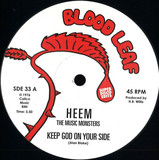
coming out of Philadelphia heem the music monsters were produced and handle by long time philly producer and writer Hubert willis. The group had small success circa 1976 with their psych funk 45 "wake up people"/piece of the rock" they recorded a few more tracks from those sessions and what lay on the reels for all these years is probably their best yet...Its just right for now. "Keep god on your side" is modern soul disco of the highest order, over 5 mins long it leads you onto the dancefloor and never lets go! Flip it over and you have one hell of a funk disco instrumental entitled " going down (incognito)". We have maintained the Blood Leaf label with a slightly new design
Grammy-nominated Ostinato Records presents "Abu Obaida Hassan & His Tambour: The Shaigiya Sound of Sudan" in a gatefold LP packaging with vintage photos and authentic Sudanese designs.
A complex blend of Arab melodies, Nubian rhythms, and signature Sudanese call and response by a legend of Shaigiya music from nothern Sudan.
Abu Obaida Hassan and the wonders of his five-string tambour remained largely a mystery. In the early 2000's, a prominent Sudanese newspaper declared him dead. Internet forums confirmed his passing. Many in Khartoum, Sudan's capital, said he had indeed died.
But rumors that he was still alive persisted.
What was always certain is Abu Obaida Hassan's mercurial talent.
His command of a modified tambour, backed by a chorus and two drummers, unleashed swirling melodies alongside complex Nubian rhythms and hypnotic Sudanese call and response. His bands roster constantly changed, but he remained at the helm, playing for sold out shows in cities across the country and capturing the dancefloors and youth of 1970's and 80's Sudan. This is a rich, raw example of the human experience with sound from northern Sudan, an ancient part of the world, and the birthplace of civilization. Music like this isn't mastered overnight.
The Ostinato team first came across Abu Obaida's recordings in 2011, finding scratchy bits and pieces along the years. We traveled to Sudan in 2016 to find the clues to piece together the Abu Obaida Hassan puzzle. Through some extensive detective work with our man in Khartoum, Ahmed Asysouti, and a generous dose of good fortune, we tracked Abu Obaida to the rural outskirts of Omdurman, the old capital just across the White Nile from Khartoum. Age has taken its toll, but he remains full of life and music, ready to jointly curate a selection of his eight best cuts. He has written over 100 songs, only 30 were recorded.
Abu Obaida comes from the Shaigiya people, whose culture is spread around the ancient city of Merowe, home of traditional Nubian culture, where pyramids older than those in Egypt still stand. They trace their entire lineage to one man, Shaig, who migrated from the Arabian peninsula in the 15th century. An endlessly rhythmic syncretism between Arab and Nubian styles, Abu Obaida's Shaigiya music was an in demand party affair in an era when a vibrant nightlife and roving sound systems were a staple of life in Sudan.
It was music for a modern era, and Abu Obaida, at just 19, rebelliously abandoned traditional Shaigiya music traditions, pioneering a new sound by adding an extra string to his tambour and electrifying an instrument adored across East Africa. The result was complexity in simplicity and a hyper-talented artist who mirrors the story of Sudan's highs and lows, from the leading tambour maestro of the hour to such obscurity on the fringes that he was believed dead. "They killed me!", he likes to joke.
Abu Obaida Hassan, his music and the musical traditions of the Shaigiya remain alive and kicking. A culmination of a 7-year journey — from first hearing Abu Obaida's distinct sound, found only in Sudan, to finding the man — has produced the first global release of Shaigiya music and is just the beginning of Ostinato's immersion into Sudan, with a full compilation of the lavish musical history of one the most diverse countries in Africa due later this year. All brought to you by the Grammy-nominated team behind last year's "Sweet As Broken Dates."
Somewhere between electro soul and melodramatic pop. Music focused towards the youth set in some strange dream. Not sugarcoating anything.
.
Aset was a collective founded by a group of individuals deeply involved in community improvement initiatives and the struggle for justice and equality. A project that would link motivated adults with talented young people in the Washington, DC metropolitan area.
The compilation takes songs from three released projects of Aset, and one semi-unreleased single. Latonya, a spunky 11 year old kid singing about divorce, love, and dancing. The poster child of Aset. Treo, a trio of high school gals in harmony singing about love and relationships. Whax, the high school boys who were a bit stranger, the silly side of Aset. All backed by The Aset Players.
Release comes housed in a newly designed jacket with inner sleeve containing info on the label/artists and an interview with the label director, Mba Mbulu.
Osaka based producer 7FO. Having previously released a cassette on RVNG International, and a 7'' single on Bokeh Versions in 2017, this is the Japanese producer's debut full length vinyl release. The tracks, recorded between 2012 and 2017, have been tweaked, remastered and recorded to vinyl for the first time.
.
The mysterious figure recorded the tracks at home, processing guitar sounds, using a sampler, synthesizer and junk equipment. Following in the footsteps of the ambient giants of his native lands, 7FO's music continues this illustrious heritage whilst offering something fresh, modern and beautifully rendered. He describes his own sound as 'gorgeous sustained tones and dreamlike oscillations that drift through the inorganic/electronic world reverberating through our subconscious creating sonic fables in our minds'.
The 12'' comes with artwork designed by label head & visual artist Jack Hardwicke. To accompany the release Greek filmmaker George Kountouras, who also collaborated on the artwork, has directed a gorgeous video for the title track 'Moment'.
Having showcased his more experimental on-edge techno design with his first two ASTRAY releases, Discrete Circuit's 'Control Zero EP' marks his most straightforward installment yet. The title track gets down to business without detours by growing into a powerful drum avalanche that combines bone-dry kicks with a frenetic atmosphere - point-blank: peak-time techno for the dance floor. Ed Davenport completes the A-side with a remix from his DJ and production alter ego Inland, who adds more muscle to the lower frequencies in order to retell a darker tale unfolding a cutting groove. Although both tracks on the flip pick up the pace and intensity, they venture out into less dense, more emotional directions. 'Dimensional Equivalent' embodies a no-nonsense rollout that builds an icy groove with a kick drum that, only blended by alerting, dream-like synths, never lets up. 'Conjugate' works with similar vocabulary while repeating bleep sounds, that are buried underneath the pounding grid, shift the focus towards both the varied percussion and the narrative progression.
Plush. Palace.
regularfantasy's music is about as plush as it gets, filling your area with bright melodic blankets for which to throw around your bod. Turning it into a plush palace of sorts, if you will. Half of this record seems designed to sooth you while the other half is all about getting you steppin'. Our pal dj zozi comes in with an absolute heater of a remix, taking you to planets unknown and raves gone by. Without a doubt, the party is gonna be turned out.
It's been a couple years, but I've put together a new record, this time with my neighbor Stu and a few other friends. Stu's been tuning the piano Linda and I were using for our Lejsovka & Freund and Trouble Books recordings, and I've always enjoyed the test scales and vignettes he would run through checking his work.
I floated the idea to collaborate on a sort of 70s/80s ECM kinda vibe, and soon started bringing my laptop and a couple microphones over to his house to collect his improvisations and have him add to pieces I had started. Other friends from the neighborhood dropped by to add parts here and there as well.
The recordings were made primarily in the summers of 2016 & 2017 (with a break in-between to mourn the triumph of neo-fascism as well as the passing of beloved pets). Ultimately I tried to follow the feel of those summer nights and the tranquility they offered. Open air or at least open windows, drifting along, you know"
-KF, Spring 2018.
Aqueduct Ensemble is a collaboration between Ohio based artist Keith Freund - who has previously released music as part of both Lejsovka & Freund and Trouble Books - and his neighbour Stu, who is a piano tuner and professional pianist. Their debut album together, "Improvisations On An Apricot" is the second release from label Last Resort, and follows G.S Schray's "Gabriel" (2017) - the sleeves for which were both designed by Keith, who does does all the art direction for the label. Beginning life in 2013 as an NTS radio show of the same name, Last Resort is run by Tom Cathcart from his home in London.
Welsh producer Odeko first appeared on Mr. Mitch's forward-looking Gobstopper imprint with the A.I. influenced EP "A History With Samus" in 2016 immediately snagging a "producer to watch" tag from Fact magazine and a premiere at SPIN. In early 2017, his second EP "Digital Botanics / Construct Conduct" arrived confirming his sound and setting the stage for him to start working on this - his debut album "Rose Tinted Vision Implant" that is set in a post-Ballard, post-Gibson, post-Miéville, alternate reality. "Rose Tinted Vision Implant" sees the Bath-based producer creating a cutting edge sonic world inspired by "speculative fiction, time/reality shifting stories and dystopian shit." The entire record is structured around, and expands upon his passion for the "future," underpinning the music via a underlining narrative. "Rose Tinted Vision Implant" starts with "The User" (aka the listener/ protagonist depending on your perspective) of the 'Optic.Rose' going through the process of getting an implant is made by a mega corporation, (think "whatever Elon Musk's legacy will be 200 years from now" says Odeko "not necessarily evil or good, just a world owning superpower."). And then we follow "The User" who has unfortunately received a bad egg through stages of that devices degradation. Sonically we're there to observe. We open ("Anomaly Detection") with a precursory scan and move onto installation ("OpticRose_0_1_Installation")
through to a battery change and a recalibration. From this point, the 'presence' begins to take over the implant and the tracks verge into a more cerebral range. Odeko notes "its a bit of a satire on corporate brands pushing these great products that everyone is obsessed but that are detrimental to both the world, and how we perceive reality. Our relationship with social media and tech could go down a dangerous path if we loose sight of things. I'm going quite far here for the sake of the concept, but things like VR, AR, the want for body tech, mixed with our desire to be connected, emotionally, digitally, physically, wirelessly could lead us to a world where everyone has implants, or some kind of tech built into them." Sonically its a record that explores a post-IDM, post-Grime, post-Ambient, post-Glitch, post-Retro-House, post-Instrumental Grime, take on electronic music, like Gobstopper's Mr. Mitch himself and his label mates Orlando, Lloyd SB, Tarquin, Clu, rAHHH and Loom, Odeko is making a kind of post-genre music. Yes it's a cerebral concept under the music but as popular shows like Black Mirror have shown - critiquing our new future can be fun, unusual and highly rewarding. Welcome to the world of Odeko.
Transversales Disques present a reissue of Bernard Baschet and Michel Deneuve's 4 Espaces Sonores, originally released in 1982. Rare 1979 recording of Bernard Baschet performing on his Sound Sculptures.The Baschet brothers are known worldwide as creators of Sound Sculptures, fantastic shapes of moulded metal and glass, which combine the visual arts with music.François Baschet had always been fascinated by acoustics, by the relationships between the shape and material of an intrument and the beauty of its sound.Bernard Baschet was passionately interested in contemporary music and firmly believed that such instruments were the proper tools for modern music, for they offered to the artist and performer a personal means of expression denied by electronic devices.Together the brothers began to design and produce Sound Sculptures, which could also be regarded as musical instruments.Circa 1965, Bernard worked alongside Pierre Schaeffer as a member of the GRM (Musical Research Group) on the elaboration of what was to become Schaeffer's "Traité des objets musicaux" (Treatise on Musical Objects).The Baschet brothers also created structures and instruments of all sizes, including bell towers, windmills and fountains, using the natural elements of wind and water to make music. Bernard Baschet was especially proud of his pedagogical work amongst deprived and handicapped children, with the instrumentaium made up of fourteen pieces.
"Emotional Rescue begins the first in a series of reissues looking at the music of guitarist Carl Weingarten and his Multiphase Records label, starting at his highly sought after collaborate album with Walter Whitney, Dreaming In Colors. With an early interest in photography and Super 8 film leading to a degree in cinema production, Weingarten's other, self-taught, love was the slide guitar. Taking its blues roots and merging them with his visual arts background created a unique "painting in sound" style of playing. While looking to break into the film industry he began writing and recording his own film scores and other music for modern dance companies. From this, he founded Multiphase Records in St Louis in 1980. By the time of Dreaming In Colors, the label had released a series of cassettes and vinyl albums offering abstract, experimental, jazz-fusion, new wave and increasingly, new age compositions. Throughout this period the work of engineer, keyboardist and programmer, Walter Whitney was often present and by the 1985 release of Dreaming In Colors the duo had collaborated for a number of years and released several projects together, most notably as members of the Delay Tactics band. Recorded during off days from the Delay Tactics sessions, the album came together at Whitney's Subterranean Sound studio with a focus away from the bands guitar driven instrumentals to explore a multilayered approach to synthesis, blending textures with Whitney's original samples and sound design, while Weingarten's guitar moved from shining solo moments to complimenting the overall oeuvre, all with heavy washes of delay. This ecumenical approach led to the creation of this compelling album. A masterful conceptual whole that is linked by rich melodies and a concise playing style, heavy on substance while never forgoing the uplifting vibrations. "
The optimum effect of Music of the Five Elements will be achieved if each side of this recording is played through, from beginning to end without interruption. Music of the Five Elements, when used as a meditational or body work tool, rather than entertainment, will increase in effect over time. Overplaying or improper use, however, may eventually diminish its designed effect'
.
Music is the healing force of the universe. It's an ancient idea bandied about by Pythagoras and Plato. In the last century, music as medication has been explored by musicians as diverse as Albert Ayler, Spacemen 3 and Pauline Oliveros. Nowhere did this concept gain more traction than in the so-called realm of New Age Music, an entire movement of synth droners and echoey flautists recording home-baked healing mantras on 4-track. In recent years, thanks to cassette collecting devotees and open-minded music journalists, New Age has shed its flowing robes and is being mined for the truly incredible music that swells under its pastel surface. Musician/acupressurist Sam McClellan's 1982 Music of the Five Elements is one of those revelatory discoveries, an unrivalled work of intense research and focus, simultaneously a near perfect work of art and a scientifically sound elixir for body and mind.
After studying electronic composition at Hampshire College with Randall McClellan (no relation), Sam McClellan became intrigued with the possibilities of healing through music. He explored this idea by applying the ancient Chinese philosophy of medicine to the principles of musical composition. Using the pentatonic scale (the traditional scale of Chinese music), McClellan related each of the notes to one of the five elements (Wood, Fire, Earth, Metal Water), and created five variations for each. He experimented with tempo, beat, pitch, duration, and sound quality, studying the effect on people's energy levels. Using the results of his tests he developed a comprehensive theory of sonic healing and spent the next year composing an album designed to help people achieve inner balance, reducing anxiety and energy depletion.
Music of the Five Elements is not only the acoustic massage' that McClellan set out to make, but is a fully realized and peerless piece of music. Taking cues from Minimalism, American Primitive guitar (Fahey & Basho) and even psychedelia, the album is a continuous sound voyage for voice, synthesizer, guitar, bowed bass, piano, effects and ciao (Chinese flute) all played by McClellan himself. Although divided into sections, the journey is best undertaken as a whole, without distraction.
Fresh on Francis Harris' Kingdoms imprint comes Adamo Golán's seven track LP, 'Exile And The New'. Golán is the alter ego of British-German artist Laurens A. Schmidt, who has been pursuing a more club-focused techno project, while developing an ever deeper fascination with experimental music, ambient and film scores. Drawing influence from his adopted homes Berlin and currently London, the 26-year-old has been uncompromisingly trying to develop his own musical voice.
'Exile And The New' expresses this ongoing pursuit and, being the first full-length and first ever release by Adamo Golán, marks the start of his most personal project to-date. Stretching over seven tracks, it touches upon a diverse set of sceneries, moods, and emotions whilst a distinctive sound design gives the work a subtle framework and guiding thread.
'Fis' starts the proceedings, introducing drones and field recordings and enveloping the listener in Golán's distinct sound world. 'Just Friends' merges distant snapshots of disembodied vocals with granular sound design and a sense of both space and creeping claustrophobia simultaneously. It's an approach the young producer has mastered - 'Replica' maintains an ambience of the deeply personal and a wider, hazy focus, realised via exquisite melodic fragments against a backdrop of pads and chiming electronics. Title track 'Exile And The New' unfolds around another cinematic world scored via a single stringed instrument, static interference and oceans of space. 'Lie to Me' brings a piano refrain to the fore, wrapped in luscious ambience and more fragments of a conversation heard through the rain. 'Then Rely On Me' slowly develops out of a haunting atmosphere and finds an uneasy but strangely beautiful flow, before 'The Hungry Years' closes out the album as it started - floating in space.
The 26-year-old artist sees the album as a journey that should captivate but never impose itself on the listener. It´s a gracious and neighborly invitation to dive in, get lost and explore its facets and peculiarities
In recent times Alex Pletnev has been making his mark on the musical stratosphere with an array of works from from cold wave edits, through gorgeous adaptations of african and world music to tribal techno originals. He joins us as Pletnev for "Aztec Code / Daywalker", a 12" combining his abundant influences to take us to bizarre, far-off places.
"Aztec Code" is a pure dance thing. Inspired by the fat kicks and live bass lines of the Big Beat era, Pletnev combines a jumping beat with african percussion and a charismatic vocal that seems to call out from between the palm fronds of somewhere steamy as we work up a sweat. Tenderly crafted with samples taken from almost 10 records, one-shots, drum layers and melodic licks are treated and mixed, giving rise to a warm, lush atmosphere perfect for circling a fire deep in the tropics.
On the flip, "Daywalker" is a completely original, synthesised outing. A sleazy lead line charms and slithers upwards between layers of syncopated tabla and a sultry acidic groove. The tune spins and twists around this central oriental theme, ever-evolving as layers of detailed percussion and ad-libbed melodies intensify the tone.
Sound artist Eva Geist joins Fleeting Wax label head Mehmet Aslan to spin "Daywalker". The pair create a sonic bridge between the two originals. Their hazy rework dubs out some electronic elements, adding contorted sound design, distant vocals, lofi samples and an italo leaning bass. A mystic incantation for spaced out late morning moments.
Haiku's Raw Waxes label is delighted to welcome the famously unconventional Stanislav Tolkachev with a new track EP of experimental techno and IDM sounds. Entitled Champions' Breakfast and with brilliant artwork from German Benedikt Rugar, the releases features six cuts, one of which is a previously digital-only track landing here on vinyl for the very first time.
Haiku has long been a fan of Ukrainian Tolkachev having previously collaborated on a remix for the label, while Tolkachev has also released on Haiku's other label Inkblots. This new EP is one that not only shows off the label's willingness to take risks and put out diverse and interesting electronic music, but also one that proves Tolkachev is a truly unique artist with his own musical voice. He has been that way for more than a decade now, and has put out three long players as well as countless EPs that get heavy support from the tastemakers of the day. This latest offering contains his take on the essentialness of groove, enriched by his use of atonality, dissonance and acid-not-acid textures, all in a minimal style.
The deep 'Shady' kicks things off with spangled synth lines and eerie pads off in the distance. It's a lonely and insular piece with kinked rhythms that keep you locked. The excellent 'The Main Thing Is To Survive' is then less constrained, with kicks that rock back and forth as off kilter synth lines warp and wrap around each other in mind melting and tripped out fashion. Switching up the mood with ease, 'Fuck This Guy' is a dark and musty passage of humid ambient techno with static electricity buzzing about over smeared pads that are filled with menace, then the curious 'Hair In My Mouth' is about blurting, busted frequencies, loose and scattered drums and glassy melodies. It's a mangled and mashed up track that sounds like little else. 'Negative Space' is horror soundtrack techno with urgent, driving drums and nervy sound design that keeps you on edge, and closer 'Self Destruction' is built on broken, bristling beats. A rhythm slowly emerges from the haze and it is one that is physical and restless and sure to make a big impact in the club.
This is a varied and vital EP that oozes essential electronic invention.
FIRST EVER VINYL PRESSING OF JOHANN'S 2006 ALBUM - DELUXE GATEFOLD SLEEVE, 2 x CLEAR LP - TWO BONUS TRACKS, DOWNLOAD CODE INCLUDED
Never before pressed on vinyl, IBM 1401, A User's Manual, is one of Jóhann Jóhannsson's most loved works. Released in 2006, the decade since its release has seen Jóhann establish himself as one of the most important composers in the World today, most notably scoring movies such as Arrival, Sicario and The Theory of Everything.
Inspired by the work his father did in the sixties when chief maintenance engineer of one of Iceland's first computers, Jóhann originally wrote IBM 1401, A User's Manual to accompany a dance piece by long-standing collaborator and friend, Erna Ómarsdóttir. For this album release, he rewrote it for a sixty-piece string orchestra, with a new final movement (built around a poem by Dorothy Parker) and incorporating both electronics, and reel-to-reel recordings made by his father and friends in 1971 of an enormous IBM 1401 mainframe computer singing the hymn Ísland Ögrum Skorið by Sigvaldi Kaldalóns as it was being decommissioned.
The first ever pressing of IBM 1401, A User's Manual comes in a deluxe gatefold sleeve, having been reworked by Chris Bigg (v23) from his original design. Pressed on clear vinyl, two album tracks recorded in 2010 with the City of Prague Philharmonic Orchestra at the Rudolfinum, Dvorák Hall in Prague have also been added and are exclusive to this release.
Mouse on Mars' Andi Toma and Jan St. Werner return with their most
inventive album to date, Dimensional People. The electronic music pioneers
have been critically acclaimed for their playful and inventive sound and
production techniques on releases spanning from the early '90s to now. In
demand from a surprising array of artists their most recent contributions are
featured on the Grammy award winning album Sleep Well Beast by The
National.
The duo are joined on Dimensional People by an impressive list of guests
: Justin Vernon (Bon Iver), Aaron and Bryce Dessner (The National), Zach
Condon (Beirut), Spank Rock, Swamp Dogg, Eric D. Clarke, Lisa Hannigan,
Amanda Blank, Sam Amidon, Ensemble Musikfabrik, and about 20 more
musical collaborators. The cast of characters are as unique as they are vast,
clearly a rich quarry for the prodigious duo.
Dimensional People is by it's nature a collaborative album. Originally
premiering as a spatial composition using object-based mixing technology
playing with the possibilities of sonic design (4D Sound) and collective
musicianship, the recording expands upon these ideas. Dimensional People
expresses itself as a dynamic 50-piece orchestra, telling a story in sound.
Mouse on Mars offer sound as a means to encourage open-minded societies,
aided by cutting-edge technology including their own MoMinstruments
music software or a spatial mixing technique called object based mixing,
with which a spatial version of the work was created. It is a conceptual
puzzle composed around one harmonic spectrum within one rhythmic
scheme, mostly in the tempo of 145bpm (inspired by Chicago footwork,
so the dance oor is not entirely absent). Looking ahead, Dimensional
People will also be realized through installation, presenting the work as an
immersive listening experience, as well as performance.