"Everything's been fucked since David Bowie died or they started up the Hadron Collider" say The Janitors. This feeling is epitomised in the title of their riveting new album: An Error Has Occurred. Marking over two decades of activity for the Swedish psych-rockers, the recording is informed by heartbreak and loss as well as the dismal state of the entire planet. For The Janitors, these two polarities intertwine constantly: "What's personal is political and vice versa." To channel their frustration and anger, the band revived certain songs they'd shelved during the pandemic when working on the acclaimed Noisolation Sessions. They added others, written since, that suited the mood of sticking a middle finger up to the oppressive world around us. Whereas previous recordings were often layered up gradually, this time the full band (Henric Herlenius, Jonas Eriksson, Anders Thorell and Wilhelm Tengdahl) rehearsed intensely together before laying down everything live, over two days and nights, in a converted missionary church. The songs on Side A have the menace of Melvins, the swagger of The Stooges and the cosmic heft of The Heads. These are the more simply constructed and poppier pieces... or so the band believe. (One friend of theirs did consider this "delusional".) 'In A Bliss' acts as the album's radiant centrepiece. A palette-cleansing love song which recalls The Jesus And Mary Chain at their most starry eyed, it finds The Janitors searching for solace and strength in straightforward companionship. After this come the dronier numbers, drawn out with soundscapes and textures influenced by The Velvet Underground's sonic experiments and the equally immersive atmospheres of electronic acts like Massive Attack. Hence, 'Operator' swings threateningly like a space-rock Swans, while the approach on 'Farewell Spacegirl' is jazzier and more meditative. "It can be hard to muster up some, or even any, positive energy at this point in time," says Henric. "We are eternally grateful to have the creative output that this constellation gives us. Neither me or Jonas would probably be here, or be the same people we are, if it wasn't for The Janitors. We'll leave you with a quote from an old anarchist: 'Every society gets the criminals it deserves.'"
Suche:channel u
YOUTH return with the debut album from Hazina Francia aka Tadleeh, chaining reticulated, sidewinding rhythms under gloaming scapes and pealing solo guitar licks.
Last spotted marshalling a mix for the now-defunct FACT series, Tadleeh’s previous productions landed on Haunter and more recently Nkisi’s label, Initiation, spanning reverberant downbeats and possessed cloud rap, a sound she further develops on this impressive full length debut. The 10 parts of ‘Lone’ sketch out a brooding worldview that takes the album format as an ideal canvas to fully portray her style of urbane ennui and gloom, bittersweet and depressive, but with a levity afforded by spatialised architecture.
With a clear sense of sorrow and a pull toward electronic music’s no-person’s-lands, she adapts animist techniques to tell a story “about loneliness and hidden places” in an attempt to work thru existential questions; “Am I still who I was before? Do I have the same energy and ambitions? Is this all still really me?” The results resonate with the sort of imaginative nostalgia navigated by fellow South European artists such as Christos Chondropoulos and Heith, and share a hauntological quality with Flora Yin-Wong’s works as much as Aïsha Devi’s summoning of ancient energies.
The wraithlike tumult of her intro gives way to reverberant dark ambient on ‘Blue (feat CTM)’, and spirit-gnawing, surprised tribalism in ‘Seekers’, whilst she pushes into screwed club murk on ‘Roads’ and the hot coal trampler ‘Barefoot’, before unleashing her darkest energies in the bombast of ‘Equality’, and channelling Loren Connors’ electric guitar nocturnes in ‘Homesick’, staking out grumbling downbeats shades away from Heith & Kareem Lotfy’s Ghost Lemurs in ‘Victim, perpetrator.’
2024 repress.
Nearly 10 years out of print, recut and remastered from the analogue tape masters from Alchemy's pristine mastering work; focusing and enriching every finite detail into pure analogue bliss! This remastered edition features epic reworks of cv313's now classic, "Seconds To Forever" released back in 2010.
The first track is a reshape by intrusion, dubbed out live in the mix from the original 8 channel analogue tapes as to summon the spirit of King Tubby. There's also two beautiful remixes from the brilliant Rod Modell (DeepChord). Those touched by his recent output will have a lot to love here. Gorgeous plumes of sound envelope the listener into near hypnosis, subdiving deeper than even the original work could. Sublime and beyond gravity, another exquisite excursion transmitting from the other side of the galaxy. Pressed onto 150 gram crystal virgin blue wax. Tip!
Chelsea Wolfe has always been a conduit for a powerful energy, and while she has demonstrated a capacity to channel that somber beauty into a variety of forms, her gift as a songwriter is never more apparent than when she strips her songs down to a few key components. As a result, her solemn majesty and ominous elegance are more potent than ever on Birth of Violence.
There is a core element to Chelsea Wolfe’s music—a kind of urgent spin on America’s desolation blues—that’s existed throughout the entirety of her career. At the center, there has always been Wolfe’s woeful longing and beguiling gravity, though the framework for compositions has continuously evolved based on whatever resources were available. Her austere beginnings were gradually bolstered by electronics and filled out with full-band arrangements. The music became increasingly dense and more centered around live performances. Her latest album, Birth of Violence, is a return to the reclusive nature of her earlier recordings
“I’ve been in a state of constant motion for the past eight years or so; touring, moving, playing new stages, exploring new places and meeting new people—an incredible time of learning and growing as a musician and performer,” Wolfe says of the era leading up to Birth of Violence. “But after awhile, I was beginning to lose a part of myself. I needed to take some time away from the road to get my head straight, to learn to take better care of myself, and to write and record as much as I can while I have ‘Mercury in my hands,’ as a wise friend put it.“ Birth of Violence is the result of this step out of the limelight. The songs stem from humble beginnings—little more than Wolfe’s voice and her Taylor acoustic guitar. Her longtime musical collaborator Ben Chisholm recorded the songs on a makeshift studio and helped fill them out with his modern production treatments and the occasional auxiliary flourish from ongoing contributors Jess Gowrie (drums) and Ezra Buchla (viola).
The album opens with “The Mother Road,” a harrowing ode to Route 66 that immediately addresses Wolfe’s metaphoric white line fever. It explains the nature of the record—the impact of countless miles and perpetual exhaustion—and the desire to find the road back home, back to one’s roots. Songs like “Deranged for Rock & Roll” and “Highway” offers parallel examinations on the trials and tribulations of her journeys while the ghostly “When Anger Turns to Honey” serves as a rebuttal to self-appointed judges.
While the record touches upon tradition, it also exists in the present, addressing modern tragedies such as school shootings in the minor-key lullaby “Little Grave” and the poisoning of the planet on the dark wind-swept ballad “Erde.” But the record is at its most poignant when Wolfe withdraws into her own world of enigmatic and elusive autobiography. Much like Alan Ginsberg’s hallucinatory long-form poem Howl, the tracks “Dirt Universe” and “Birth of Violence” weave together specific references from her past into an esoteric overview of the state of mankind. Though the lyrical minutiae remain secret, the overall power of the language and delivery is bound to haunt the listener with both its grace and tension.
“These songs came to me in a whirlwind and I knew I needed to record them soon, and also really needed a break from the road,” Wolfe says. “I’ve spent the past few years looking for the feeling of home; looking for places that felt like home. The result of that humble approach yields Wolfe’s most devastating work to date.
European Headline tour confirming now for 2020. UK/EU Publicity handled by Lauren Barley at Rarely Unable. Immense support from Press, including coverage with NPR, Pitchfork, FADER, Vice, Revolver, Decibel, Under The Radar.
- A1: Why Oh Why Dub
- A2: Dub Larking
- A3: Zion Dub
- A4: Dub Money
- A5: A True Dub
- A6: Dub Guidance
- B1: Dub Say Who
- B2: Dub On My Mind
- B3: Love Of A Dub Band
- B4: Use This Dub
- B5: Dub Letter
- B6: Dub Angel
Horace Andy a.k.a.Sleepy must process one of the sweetest and most distinctive voices in reggae music. 1951 in Kingston Jamaica. He cut his first track in 1966 for producer George ‘Phil’ Pratt, a tune called ‘Black Man’s Country’. But it was four years later his star really began to shine when he joined the stable of Clement ‘Coxsone’ Dodd’s Studio One. It was Coxsone Dodd who renamed him Andy after another of his leading artists Bob Andy, such was his belief in Horace’s writing talent and singing abilities. Still only twenty years of age Horace used his falsetto talent to the fore and cut some impressive tracks at 13 Brentford Road, Studio One’s headquarters. Such reggae standards as ’Skylarking’, ‘Just Say Who’, ‘Love of a Women’ and ‘Something on my Mind’ to name but a few. The early 1970’s saw Horace due to political reasons move on to work with producer Bunny Lee, a move that suited his talents and beliefs, Horace being an early advocate to the Rastafarian faith.The tracks which he cut with Bunny, which we concentrate on here gave his songs a rootsy feel. The rhythms often cut at Channel ONE and Randy’s Studio17 and finalised at King Tubby’s, provided a fine backbone for Horace to recut some of his earlier classics, along side his newer songs also to become reggae standards. Like ‘Money Money’, ‘Zion Gate’ the great ‘You are my Angel’ and a version of The Heptones ‘My Guiding Star’. The power of these recordings were such that the earlier tracks like ‘Skylarking’ became hits a second time around.Proving that the ‘you can’t keep a good tune down’ mantra was alive and kicking… …A golden time for Horace and Reggae music in general… Horace would go on to work with other producers like Everton Da Silva in 1977 creating the ‘In the Light’ album and the New York based Lloyd ‘Wackies’ Barnes in the 1980’s for his ‘Dancehall Style’ recordings. Most recently his work with Massive Attack has brought his majestic voice full circle and back into the arena once more. Those ‘Massive’ recordings and this dub collection here seem to fit side by side. Horace’s distinctive vocal riding over the rhythms adding a magic as only he can .....
RESPECT JAH FLOYD.
With 'Stone Flute', the free-improvising duo's third studio album proper, Galecstasy returns to the universe of synthesizers to deliver an aural odyssey, conjuring the ancient tones of a forgotten world.
The album was entirely conceived and recorded in, and around, the majestic landscapes of Joshua Tree National Park in the magnificent high desert of southern California. From atop the mountain, the two sonic surveyors were witness to a 360 degree view of the stars at night. From above, the giant rocks looked like immense wise faces looking up at the sky, or even huge bodies resting on the Earth and looking up at space. It was during this time that Galecstasy started a ritual that ended up being called the “Moon Cruise”. This would involve waiting for the full moon to rise and then driving into the national park after dark. They would turn off the headlights of the car and drive slowly through the alien landscape lit up by the moon. Boulder fields took on the shape of temples; faces carved into the rocks everywhere they looked; giant heads with smiles or haunting expressions; and the knowledge that people had been living, dancing, and making music here for thousands of years. It was during these enchanting escapades that 'Stone Flute' was conceived.
In the mountain-top recording studio, the band were utilizing every potential space to tap into the best vibrations the land had to offer. Where the mic was placed: Perhaps a giant boulder once stood, or an ancient tree. One could feel the different energies of every room. The fireplace in the living room was built of giant lava rocks for the music to swirl around. Sounds would spill and climb around the house.
"The living room was just a beautiful tangle of synthesizers and plants. It was an inspiring place to make great records. We channeled the music of the boulders buoyed by the energy shooting up from the fault lines. The good feelings emanated from the studio, it had become our own temple and the birthplace of 'Stone Flute'."
With 'Stone Flute', the free-improvising duo's third studio album proper, Galecstasy returns to the universe of synthesizers to deliver an aural odyssey, conjuring the ancient tones of a forgotten world.
The album was entirely conceived and recorded in, and around, the majestic landscapes of Joshua Tree National Park in the magnificent high desert of southern California. From atop the mountain, the two sonic surveyors were witness to a 360 degree view of the stars at night. From above, the giant rocks looked like immense wise faces looking up at the sky, or even huge bodies resting on the Earth and looking up at space. It was during this time that Galecstasy started a ritual that ended up being called the “Moon Cruise”. This would involve waiting for the full moon to rise and then driving into the national park after dark. They would turn off the headlights of the car and drive slowly through the alien landscape lit up by the moon. Boulder fields took on the shape of temples; faces carved into the rocks everywhere they looked; giant heads with smiles or haunting expressions; and the knowledge that people had been living, dancing, and making music here for thousands of years. It was during these enchanting escapades that 'Stone Flute' was conceived.
In the mountain-top recording studio, the band were utilizing every potential space to tap into the best vibrations the land had to offer. Where the mic was placed: Perhaps a giant boulder once stood, or an ancient tree. One could feel the different energies of every room. The fireplace in the living room was built of giant lava rocks for the music to swirl around. Sounds would spill and climb around the house.
"The living room was just a beautiful tangle of synthesizers and plants. It was an inspiring place to make great records. We channeled the music of the boulders buoyed by the energy shooting up from the fault lines. The good feelings emanated from the studio, it had become our own temple and the birthplace of 'Stone Flute'."
Manchester’s multifarious sound organiser Andrew Hargreaves (Tape Loop Orchestra, The Boats, Beppu) channels key touchstones of Glenn Branca’s microtonal minimalism, the paranormal, and DIY amateur broadcasting with some of his most enigmatic, intuitive recordings to date.
‘Drones In The Air’ finds Hargreaves deep in a new phase of vibrational investigation where the sentimentality of prior eras gives way to more abstract conceptual processes. Utilising a bunch of oscillators and the Lyra-8, an “organismic analog synthesiser”, plus pedals, Hargreaves works within just intonation tuning systems - or more precisely “intuitive intonation” - to just-about harness a microtonal flux of clashing, beating frequencies, but the project is more about ceding a certain amount of freedom to the machines and allowing aural alchemy to occur, prompting a spectrum of harmonic colours and rich timbral overtones distinguished from previous tape loop-based works.
Comparative to “Glenn Branca’s micro-tonal workouts if he had worked with oscillators instead of guitars”, the result also variously evoke mysteries of The Conet Project, the oceanic feel of Éliane Radigue compositions, and early ambient works by Terre Thaemlitz in their sound sensitivity and scope. In ‘The Sun is Afraid’ he mesmerises with glistening microtones that develop a coarser traction, interrupted by shortwave radio comms and resolving into phantasmic noise gauze that speaks to his long-standing fascinations with entropic decay and the sounds between sounds. ‘Your Hands Are Shaking’ follows with a stealthier approach to coaxing a hallucinatory drone mass inflated by ether voices and thickening up into a sinister gloam redolent of NWW’s ’Soliloquy for Lilith’.
Splattered Vinyl - Limited Edition of 200 - Includes free digital download code for Bandcamp!
On this Remix album, nine visionary producers are taking Florian Meindl's latest tracks into various directions on a journey.
Umwelt delivers a hard-hitting synth treatment, while Shaleen injects a housy, sexy touch into the mix.
Volpe channels the essence of Detroit influenced Techno, Beau Didier unleashes a relentless hardgroove rework, and Decka infuses dub techno vibes into the composition.
Janzon's exceptional vocal work shines through and Schott keeps it classic and pounding as well as GAEL with her dark vibe, while Garb adds a mesmerizing psy-techno leaning touch.
This limited edition splattered vinyl release is not just about the music but also features stunning artwork that complements the album's diverse vibe - one side of each record is missing the paper label so the splattered colors can be seen in the middle of the vinyl.
Still Kids is New Kids On The Block's first full-length studio album in 11 years. On the all new album, members Jonathan Knight, Jordan Knight, Joey McIntyre, Donnie Wahlberg and Danny Wood channel the New Kids’ beginnings, even as it pushes them into new territory as songwriters and as a band. The album features 14 new tracks including the lead single, “Kids," and is full of pop anthems, dance tracks, love songs, and grooves that will become fast favorites for the Blockheads.
NAKID presents the first album in years from Max Loderbauer (Sun Electric) and Tobias Freund’s cult Non Standard Institute. Delving deep into the aether with a double LP - almost an hour and a half in length - featuring ruined, vaporous and engrossing ambient variations on a theme.
Planing axes between iridescent new age ambient, sublime folk and avant-classical, to miasmic drone and plangent shoegaze; ‘A Day or Two’ charts the Non Standard Institute’s first actions in 6 years and serves as a compelling reminder of their intuitive work in abundance. Expanding and contracting their sound across 18 parts, they arc from heaving, oddly-tuned drones to smoggy, surreal soundscapes, bringing a wealth of fine-tuned instincts to the table. With Max Loderbauer’s 35+ years as Berlin ambient pioneer with Sun Electric, jams with Villalobos, and roles in Vladislav Delay Quintet and the Moritz von Oswald Trio, he’s matched by Freund’s 40 years of deep engineering expertise embedded in the experimental industrial and techno trenches.
The melancholy, Satie-laced piano meditations that grounded 2018's '5863' are gone, and the human touch that's been present since their very first collaborations is placed under the microscope, enhanced by their use of the Haken Continuum Fingerboard, a gestural synth that was developed to open up new modes of playing. Loderbauer's experience with the piano helps him make the most of the instrument's touch-sensitive 3D surface, while Freund uses two multi-channel loopers, piping the sounds through his arsenal of pedals.
The 18 tracks are billed as "unplanned atmospheres" that arc from sombre, drone-heavy material to humid, tape-saturated imaginary-island jams such as 'Listening To Cells' and 'Are You One Of Them'. On the latter, the duo work patiently, letting dusted string plucks tumble across each other while warbling pads hum below, bending like flutes. On 'Unlikely Events', anxious didgeridoo-like wails are ruptured by environmental rattles, before ominous voices lead us into a pocket of industrialised resonance. In time, the skies open up and the sounds morph into pastoral song, the drone blurring into hopeful pads almost as lucid and eloquent as AFX's 'SAW Vol. II', with sonorous synths that float over formless strings. Reflective, cinematic arrangements for flute and silvery ambient give way to diffusions of denser, resonant polychromatics and pucker up in outernational, alien ambient impulses recalling Connor Camburn jamming with dirashe folk pipes.
- Yellow Magic Orchestra - Seoul Music
- Sandii - Zoot Kook
- You An’ Me Orgasmus Orchestra - Sakisaka To Momonai No Gokigen Ikaga One Two Three
- Yukihiro Takahashi - Drip Dry Eyes
- Jun Togawa - Suki-Suki-Daisuki
- Miharu Koshi - Parallelisme
- Haruomi Hosono & Yukihiro Takahashi - Bikkuri Party No Theme
- Apogee & Perigee - Sakasa Kenjin Eagas
- Haruomi Hosono - Yumemiru Yakusoku
- Hajime Tachibana - Rock
- Ryuichi Sakamoto - Riot In Lagos
- Jun Togawa - Radarman
- Haruomi Hosono - Platonic
- Super Eccentric Theater - Beat The Rap
- Yellow Magic Orchestra -Rap Phenomena
- Ryuichi Sakamoto - Lexington Queen
- Sheena - Chanel No #5 No On The Rock
- Testpattern - Beach Girl
- Yukihiro Takahashi - Flashback
- Tamao Koike - Automne Dans Un Miroir
- Interior - Ascending
Recording technology was completely revolutionized in the 80s by the multitrack recorder, with the popularity of 24-channel SSL consoles sweeping the world. Japanese pop music created during this wave of digital improvement is now recognized worldwide as ""City Pop."" Techno Pop was another offshoot born of the same revolution. Precise, computer-controlled beats produced by groups like Yellow Magic Orchestra (YMO) introduced a different type of sound to the masses. By now, these works have been brought into the international limelight and continue to be a major influence on today's music.
At the center of Tokyo’s Techno Pop scene was ALFA/YEN Records. The label left behind an impressive body of work, but much of it wasn't made widely available... until now! This new, definitive compilation focuses on the music archives of the YEN Records catalog, available for the first time exclusively at Light in the Attic. This is a true celebration of Japan's Techno Pop scene of the 80s, reissued with the intent that future generations, internationally, will be able to discover, enjoy, and appreciate ALFA/YEN and its significant contributions to the sonic landscape of the 80s and beyond.
Warm Exit is a post-punk quartet hailing from Brussels, Belgium. Their violently frontal music is an explosive blend of sonic intensity that sets them apart as one of the country's most electrifying and raucous acts. Drawing inspiration from Krautrock, Punk, and Noise, their relentless rhythmic prowess is a testament to their diverse influences. Channelling the spirit of iconic 1970s bands like Wire, Rema Rema, and Nine Inch Nails, Warm Exit ventures into the shadowy realm of post-punk with their latest EP. Here, they seamlessly oscillate between fast and slow tempos, high and low energy levels, and vocals that span from tense whispers to unbridled screams. This journey takes the listener through a landscape of discordant riffs, haunting groans, evocative spoken word passages, and industrial undertones. Over the past three years, Warm Exit has cultivated a devoted following both locally and internationally, thanks to their electrifying live performances that leave audiences in awe. Carrying the reputation of a striking live band, they are eager to storm the stage at any and every given opportunity
The only proved efficient time traveling method to date is through listening to music, particularly evident when indulging in Jona Jefferies' latest EP released by Spanish house specialists Apersonal Music. It's a refreshing nod to the golden era of 90s electronic music. Across its three tracks, Jefferies masterfully blends elements of ambient, downtempo, and electronica, evoking a sense of nostalgia as if plucked from a bygone era. In contrast to today's TikTok-dominated landscape of short, immediate singles, this EP harkens back to a time when music was crafted with depth and complexity. Drawing inspiration from legendary acts like Boards of Canada and Underworld, it seamlessly transports listeners to the Gen-X decade, when acts like Daft Punk, Orbital and The Chemical Brothers reign supreme and exploited the electronic scene during the MTV era.
On the A side, "Es Camp" embodies the seamless influence of British electronic music on the Balearic scene of the 90s, and viceversa. Feels like Moby’s “Porcelain” if the film "The Beach" had been set in Ibiza. Max Essa's "Romantic Breaks Mix" elevates the track to pure Balearic bliss, setting the perfect mood for any sunset terrace around the globe.
Side B, tailored for the dance floor, runs through “Lost in Paradise”, a track that channels euphoria reminiscent of the underground rave culture during the final years of the 20th century. Apersonal's trusted remixer, Eddie C, delivers an extended rendition of the track that continually evolves, echoing Jim Morrison’s words: 'the music was new, black polished chrome, and came over the summer like liquid night.'
Warehouse Find!
As we hurtle towards our 200th Freerange release the quality output you've come to expect from Freerange shows no sign of faltering with Bas Amro bringing you an absolutely stellar EP entitled You And Me. Dutch wunderkind Bas has built himself a solid reputation through only a handful of releases on labels such as Wolfskuil, Kutchuli and most notably his 2011 EP Ten on Freerange which has gone onto become a stone-cold classic in the deep house mecca of Johannesburg. This long awaited follow up delivers on every level and if early feedback and crowd
response is anything to go by looks set to push Bas further into the spotlight where he deserves to be.
You And Me starts in a deceptively understated manner wrapping you in a shroud of warm, dubby stabs underpinned by a rolling groove that can't fail to draw you onto the dancefloor. Things stay deep with hints of Chandler and echoes of Basic Channel until the breakdown arrives, the filters roll up and the whitenoise
shines through bringing a new energy and dynamic to the track. A classic, timeless vibe which we're proud to be bringing you on Freerange. As with his previous release Ten, Bas works hard to deliver not one but two faultless originals so flip over for Across The Street featuring the vocals of Jennifer and you won't be disappointed. A simple, repeating six-measure synth hook drives the track and brings with it a lovely looseness and lack of obvious
structure. Kennifer's sparse, almost improvised sounding vocal drops heighten the sense of space and freefall effect making such a refreshing change to most of todays formulated and conventional house music. Last up is an amazing remix of You and Me from rising start Matt Karmil who brings his own unique and refreshing sound to the EP. Karmil's recent LP on PNN
won rave reviews from all corners and with just two other releases on Beats In Space and International Records Recordings he seems to have burst from out of nowhere but has certainly become hot property in the last 12 months. His forthcoming remix for John Talabot and Axel Boman under their Talaboman is immense and here he treads a similar path focusing on a raw percussion-heavy sound with very minimal tweaks and effects adding subtle colour and interest. These days it's very hard to breakthrough with an original, new approach to house
but Matt Karmil seems to have done it with ease.
Aerials live, dials tuned, Transmission Towers broadcasting. On either side of the river Mersey, transcendental communications are traded back and forth. Two late-night revellers, one firing messages filled with music, the other returning them laced with lyrics. The result, a dopamine hit of oddball machine soul, melded with a highlife, Afrofuturist touch. Wonky and murky yet deeply emotional, Transmission One, is a debut album that also marks the first release on Luke Una’s É Soul Cultura label, encompassing expertly the off-kilter atmosphere the label sets to orbit.
A synthesised landscape with a Northern charm, Transmission Towers marry the musical worlds of two artists that last collaborated over a decade ago. 10 years have passed, lives have been led, but a gravitational pull has placed Mark Kyriacou and Eleanor Mante back in each other’s spheres on opposite sides of the city of Liverpool. Energised with a newfound desire to strip it all back to the sounds that influenced their formative years in the late ‘80s and ‘90s - astral travelling, intoxicated on Motor City techno, Black Dog IDM and mystical Sun Ra.
Mark half Irish, half Greek Cypriot, Eleanor half Nigerian, half Ghanian, the music contained within is an alchemy of those roots and the pivotal acts that buried deep into their minds. A cosmic contrast, part machine-made, part distinctly human. Take the opener ‘UP’, an ESG-channelling, sci-fi punk beatdown or the polychromatic hyperspace anthem ‘Roller Skater 23’.
Transportive throughout, you ride the solar waves, pace and emotion ebbing and flowing. Tracks like ‘Go Slow Heart’ and ‘Cosmic Trigger’ step to a slower beat but hit with a punch. The former, a slo-mo blast of celestial tenderness, the latter an otherworldly, chugged-out lunar excursion, micro-dosing on whacked-out Wah Wah and Eleanor’s ethereal vocals. Beaming love letters to space and back, ‘Sparse’ marries the organic with the artificial, pianos and percussion circling around synth pads and broadcasting bleeps.
Elsewhere, vibrations move faster. ‘Mega’ strikes, fusing sonic tribalism with psychedelic swirls, as ‘Everything’ sweeps you up in its extra-terrestrial new wave grip. Synth stabs and basslines fizzing from every angle.
Demos of Transmission Towers music surfaced on Luke Una’s radar, making him stop in his tracks. Something magical was emerging, perfectly aligned with the E Soul guardian’s tastes. Guidance followed, quickly turning into conversations about Transmission One becoming the first release on Luke’s own label.
Escapist and futurist yet grounded and relatable. Transmission One is synthesis meets sentiment with a deep, spine-tingling soul at its core.
With words as weapons and public infrastructure as his blank slate, John Fekner's City Squad are always questing for the ineffable, even as they yearn for concrete change - Make no mistake, Idioblast is a serious party where everyone is welcome.
Released in 1984, Idioblast is a lost classic, a future shock narrative ahead of its time, and yet completely of its era, like few artifacts before or since. The cover tips you off from the jump--a crude but effective collage featuring classic Fekner slogans like Toxic Junkie, Growth Decay and Soft Brains Watch The Screen And Buy The Jeans. In an uncanny and tragic coincidence, the very first lyric on the album--"The place to be is on the space shuttle/if you're brave enough to get on it"--seems to anticipate the Challenger disaster just two years later.
But for the most part, the tracks on Idioblast directly reference the concepts that inspired Fekner's visual art. Musically, "Rapicasso" utilizes pneumatic pounding with an industrial edge as Fekner equates the great and controversial painter with risk-taking graffiti kids bombing trains and billboards across the city. Art is in a constant state of exploding--forms, paradigms, outdated ideas.
Splitting the difference between hip-hop and new wave, the Santaniello-sung "The Beat" is like Thomas Dolby meets Run-DMC and should've been a radio staple for at least one sticky summer. It could soundtrack either a couples roller skate or a drug-fueled evening out. Channeling Fekner's slogan-stencil aesthetic, "Travelogue The 80's" is a tour de force reminiscent of Negativland's experiments in audio culture jamming. As Fekner details, "I grabbed all of the sounds via a shortwave radio picking up transmissions from LaGuardia airport and the TV. I recorded and edited on a Sony Pro Walkman and an Aiwa dual cassette deck."
You may ask yourself what lies beyond the cumbia? What psychedelic permeations reveal themselves in the breaks of the modern day tropical wave? La Banda Chuska's debut single on Names You Can Trust provides a glimpse into the broad benchmarks of this new noise and language, channeling and surfing through a barrel of rip-roaring guitar licks to create something decidedly distinct and du jour at the same time. Just imagine if the B-52s got trapped in some sort of demented Pacific-Peruvian time warp and were forced to shred their way back into existence, bongos in tow. Come along for this excellent adventure and experience for yourself, the tropical waviness of La Banda Chuska's colorful crush.
2024 Repress!
Imagine for a moment that Arthur Russel had learned to speak Brazilian and then moved to Italy to produce an Italo-Disco single back in 1984. There's a good chance it would sound like the Dub version of the B side on this record (Remixed by Bob One). A percussive foundation channeling Latin Freestyle beats sets the groundwork for the chill sunset vibed melody to pleasantly unfold intertwined with the alluring Brazilian lyrics. The recording engineering on this production is clearly at a higher standard (than the usual neighborhood italo disco studio from back in the day) with some of the techniques at play giving it a very balanced and sophisticated sound for its time. The meticulous remastering this re-issue underwent allow for a generous low end with crystal clear mid range – game changing on any well calibrated dance floor sound system.
Mint Condition - A record label focused on excavating the outer fringes of classic House and Techno. Unreleased mixes, classics, overlooked gems and never heard before material, mined from the last 30+ years of contemporary dance music are the order of the day. From Chicago, Detroit and New York to London, San Francisco and beyond. Mint Condition have got their digging hats on to bring you exclusive heat and those rarer than rare jams that have been in your wants list for years. Dig in!
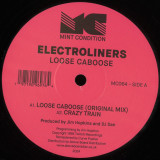
A serendipitous encounter at an SF record store in the early 90s brought together local music aficionados DJ Dan and Jim Hopkins. Their collaboration birthed the legendary Electroliners project, channeling their shared passion for underground and funky sounds into the iconic left-coast rave anthem, 'Loose Caboose', now firmly nestled in your hands. Pooling their musical prowess, Dan and Jim embarked on a journey of sonic exploration, meticulously crafting their signature sound by dissecting samples and breakbeats, infusing the musical landscape with a revitalizing energy. As their reputation grew within the local scene, they found themselves tasked with supplying a track for a promotional CD-ROM by a burgeoning software company.
Through marathon sessions of digging, slicing, sequencing, and exchanging snippets over phone calls, Electroliners hit their creative stride. It was only natural to unveil their creation in the raw intensity of a live rave setting. Thanks to a connection with DJ DRC, they seized the opportunity, and the rest is history. Copies of the record flew off the shelves by the thousands locally, and its overseas acclaim, spearheaded by licensing through XL Recordings in the UK, cemented its status as a bona fide underground classic. But what exactly is an Electroliner you might ask? Jim sheds light on the inspiration: “I delved into books on trains at the public library,” he reveals. “Among them, 'Electroliner' caught my eye, a train line in the Midwest. Given the track's pulsating train horn, 'Electroliner' and 'Loose Caboose' simply clicked.”
'Loose Caboose' is an all-time classic, and still causes much damage on the dancefloor today. Yet another unmissable addition to the MC reissue catalogue, fully licensed from the artists, mastered and cut by Curve Pusher, and available once again available for purchase. Do not sleep.
As mood changers go, this track is up there with the best. Last year whilst DJing with miche at Shapes festival in the snow-capped mountains of Switzerland, a breathtaking yet ominous Alpine sky suddenly became a picture postcard moment. The clouds parted and a double rainbow formed, as miche dropped Studio Rio's bossa nova remake of Bill Withers’ all-time classic 'Lovely Day'. From there, the dancefloor shifted gears and morphed into full-swing feel-good vibes, in a beautiful, spontaneous moment nobody could have planned for.
Mr Bongo now proudly presents a reissue of this brilliant, bossa-channelling Bill Withers reinterpretation from Studio Rio’s 2014 release ‘The Brazil Connection’. Masterminded by the German Grammy award-winning Berman Brothers, the project was born out of their deep love of Brazilian music. “Our goal was to bring the Brazilian joie de vivre to iconic performances by well-known artists. What would these classic songs sound like had they been recorded in the studios of Rio de Janeiro in the first place, with the best Brazilian musicians and arrangers?” the brothers reflect.
Capturing the life force of Brazil, the beating heart that is its music, they set out to find the musicians who would fit best with their concept. Landing in Rio in 2013 a series of coincidences led to them being introduced to their idols Marcos Valle and Roberto Menescal, who both agreed to come on board. The Berman Brothers also wanted to find some of the musicians who recorded with one of Brazil’s most influential composers Tom Jobim. “Fifty years after Jobim made the music that really defines bossa nova, we found that many of his sidemen were still active, including Paulo Braga of Jobim’s famed rhythm section. It was magic; everything just fell into place.”
There's no question that the original of ‘Lovely Day’ is up there as one of the most feel-good, spirit-lifting anthems of all time. Here the brothers, with the help of a whole host of Brazil’s finest musicians, rework Bill’s soul-fuelled groove into a bossa nova slice of sunshine. With the blessing of Bill and Sony, they were given access to the original multitracks so they could incorporate Bill’s vocals perfectly into the new arrangement.
Joy-injected horns and bouncing double bass blend with the smile-inducing samba flavour of Pretinho da Serrinha’s cavaquinho playing. Tying it all together Torcuato Marinao who worked with the likes of Gal Costa, Gilberto Gil and Caetano Veloso, completes the line-up as arranger of the songs.
The perfect end-of-the-night track, mood lifter or soul warmer, remakes don’t get much better than this.