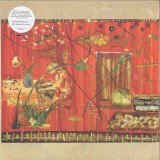
Ionisation is the first LP by Italian poet Adriano Spatola. Born in Yugoslavia in 1941, by the age of 23 he became a major force in the Italian avant-garde. “Towards Total Poetry,” Spatola’s critical study on the state of modern poetry, spells out his position: “to become a total medium, to escape all limitations to include theater, photography, music, painting, typography, cinematographic techniques, and every other aspect of culture, in a utopian ambition to return to origins.” Graphic poetry (cut-up zeroglyphs), volatile and beautiful prose (particularly his books The Porthole and Majakovskiiiiiiij), and of course sound poetry, represented here for the first time. Spatola was the editor of many underground publications: Baobab (a legendary audio-cassette magazine), Tam Tam, and Edition Geiger. Each of his pursuits spread the margins of the format, all done with a relentless, piercing curatorial eye.
Spatola has dark, drunken wit in spades. In his sound poems, an even more saturated persona is conjured. A desperate humor sneers through this LP, a humor that has surrendered to the severe joke of life long ago - lashing out on syllables and ingrown word games. Particularly, his classic “Aviation/Aviateur” (akin to his “Seduction/Seducteur,” & “Violacion/Violateur” etc.). Read by lesser performers, these pieces would falter and float by in the trough, though Spatola’s bull-like confidence tears through. “Poker Foundation” features the poet hysterically singing “the play of the words” over a classical radio piece, mocking and squawking against the string swells. Steve Lacy plays scissors, knife, and saxophone on “Hommage à Eric Satie,” a piece originally recorded for the luxurious Cramps LP boxset Futura. Collaborators Gian Paolo Roffi and Paul Vangelisti are also featured across the collection.
The LP concludes with the titular work “Ionisation,” recorded just days before his premature death in 1988. Feeling his sinking health, his belly in the quicksand, he prefaces the piece, “a funeral march for my body.” He proceeds to scrape and pound the microphone on his chest, face, and clothing. This thick pumping of Adriano’s torso rapping across the speakers abruptly stops after two minutes. A piercing moment.
I was born the day after Adriano died, which has some poetic meaning to me, naturally. I am indebted to him, his sickly sweet manner. The opportunity to publish these largely unknown sound works is an honor which brings a warmth to my torso. Much appreciation goes to Giovanni Fontana (poet and dear friend of Adriano), who helped produce this edition with me. “Every single word has been a tempest of gestures.“
Sean McCann, January 2020
Suche:cloth
Repress
Kali Malone presents a quietly subversive new album featuring almost two hours of concentrated, creeping organ pieces governed by a strict acoustic and compositional code. It’s a major new work with ultimately profound emotional resonance.
‘The Sacrificial Code’ takes a more detailed approach to ideas first sketched out on last year’s ‘Organ Dirges’, which featured canon exercises spontaneously captured without much prior technical planning. By contrast, the recording of ‘The Sacrificial Code’ involved the more careful micing up of several organs in such a way as to eliminate acoustic impurities as far as possible - essentially removing the large hall reverb so inextricably linked to the instrument. The pieces were then performed free of gestural adornments and without expressive impulse - an approach that
flows against the grain of the prevailing musical hegemony, where sound is so often manipulated,
and composition often steeped in self indulgence. The question posed; can this strict methodology still speak to the listener in meaningful terms?
The answer is both obvious and entirely surprising; with its slow, purified and seemingly austere qualities ‘The Sacrificial Code’ guides us through an almost trance-inducing process where we
become vulnerable receptors for every slight movement, where every miniature shift in sound becomes magnified through stillness.
As such, it’s a uniquely satisfying exercise in transcendence through self restraint - a stunning realisation of ideas borne out of academic and conceptual rigour which gradually reveals startling
personal dimensions. It has a perception-altering quality that encourages self exploration free of signposts and without a preordained endpoint - the antithesis to the language of colourless musical platitudes weíve become so accustomed to.
Stating their influences range from Prince, The Weeknd, Janet Jackson to Frank Ocean, Secret Rendezvous call their sound 'Indie R&B' and their latest track - 'Back In The Day' is a sentimental slow jam that showcases flashes of these elements set against bedroom and lofi styles.
Lyrically Morsch reminisces over the 90's, conjuring up imagery of baggy clothes, listening to Tupac on the basketball court, and going cruising with a bottle of Bacardi at night.
Her silky delivery and sing-along chorus is perfectly suited for the 808-led backdrop from Lauw.
Time is Local is a project by Danish collective We like We and sound artist Jacob Kirkegaard built around a 12-hour live sound installation and performance at Thorvaldsen Museum in Copenhagen.
The piece was initiated and performed by the artists during the G((o))ng Tomorrow Festival in 2017. As they slowly wandered the halls and rooms of the museum for a whole day, they performed extended sound compositions for a visiting audience at each of the 12 chambers for a longer session - a haunting experience as the outside world disappeared and the focus was on quiet sonic moments unfolding in midst of the grand, reverberous space. For this album they have collected 12 fragments revolving around the chambers in the museum. Each chamber is being represented by its own handful of tones, instruments and voice. The statues within, depicted by neo-classicist sculptor Bertel Thorvaldsen get their own soundtrack of quiet emanating gusts. Barely heard frequencies reflect through the walls. The marble carved busts of Greek gods that line the museum hallways gaze eternally with a blank stare as decades pass and new audience arrives.
Although We like We should need no introduction to followers of the Sonic Pieces label, the Danish all female sound quartet consists of Katrine Grarup Elbo (violin), Josefine Opsahl (cello), Sara Nigard Rosendal (percussion) and Katinka Fogh Vindelev (voice). Together they have forged a dynamic and intuitional sound beyond genres through the last decade. Only two years ago they released the nordic neo-classical opus Next to the entire All. This time they emerge in collaboration with sound artist Jacob Kirkegaard. Jacob’s works are sonic reflections on complex aspects of the human civilisation, treating themes such as radioactivity, melting ice, border walls and tones emitted by the ears. Through the last decades he has released records and sound documents through labels such as Touch, Important Records and more. As a document of their 12h performance, Time is Local is a beautiful sonic evocation that shines as a bright line of sun through the cracks of a tomb.
- A1: A Roller Skating Jam Named Saturdays - De La Soul Featuring Q-Tip & Vinia Mojica
- A2: Bonita Applebum - A Tribe Called Quest
- A3: Sunshine Men - The Freestyle Fellowship
- A4: Mistadobalina - Del Tha Funkeé Homosapien
- A5: What's Up Doc? (Can We Rock?) (K-Cut's Fat Trac Remix) - Fu-Schnickens With Shaquille O’neal (Shaq-Fu)
- B1: Doowutchyalike - Digital Underground
- B2: Peachfuzz - Kmd
- B3: Doin' Our Own Dang - Jungle Brothers
- B4: Mama Gave Birth To The Soul Children - Queen Latifah Featuring De La Soul
- B5: O.p.p. - Naughty By Nature
- C1: Where I'm From - Digable Planets
- C2: It's A Shame (My Sister) - Monie Love Featuring True Image
- C3: K Sera Sera - Justin Warfield
- C4: All For One - Brand Nubian
- C5: Case Of The P.t.a. - Leaders Of The New School
- D1: My Definition Of A Boombastic Jazz Style (Album Version) - Dream Warriors
- D2: The Choice Is Yours (Revisited) - Black Sheep
- D3: Age Ain't Nothin' But A # - Chi-Ali
- D4: We Run Things (It's Like Dat) - Da Bush Babees
- D5: You're Not Coming Home (Mase's Funkay Recall Mix) - Groove Garden
It wasn’t really a movement, barely even a moment, but the Daisy Age was an ethos that permeated pop, R&B and hip hop at the turn of the 90s. Playfulness and good humour were central to De La Soul’s 1989 debut album, “3 Feet High And Rising”, which would go on to cast a long, multi-coloured shadow over rap.
In Britain, the timing for “3 Feet High And Rising” couldn’t have been better. The acid house explosion of 1988 would lead to a radical breaking down of musical barriers in 1989, and its associated look – loose clothing, dayglo colours, smiley faces – chimed with the positivity of De La Soul and rising New York rap acts the Jungle Brothers and A Tribe Called Quest, all at the heart of a growing collective called Native Tongues.
The Native Tongues’ charismatic, summery aura quickly spread west to the Bay Area’s similarly-minded Hieroglyphics crew (Del Tha Funky Homosapien’s ‘Mistadobalina’); Canada’s Dream Warriors (‘My Definition Of A Boombastic Jazz Style’) used “3 Feet High”’s colour palette and borrowed Count Basie and Quincy Jones riffs; Naughty By Nature (OPP) were mentored by Native Tongues heroine Queen Latifah, while Londoner Monie Love was also adopted by the collective, resulting in her Grammy-nominated ‘It’s A Shame (My Sister)’.
It wasn’t built to last, but the Daisy Age reintroduced Multiplication Rock, bubble writing and the gently psychedelic into the charts. It was a brief, but extraordinarily warm and optimistic moment. The songs on this collection promised that the 90s would be a lot more easy-going than the 80s.
Available on CD and double LP.
Like a fine 40-year old whisky, the layers on this record and influences are complex, nuanced & Layered. You might taste something different but here are my tasting notes...
The Nose - Notes of Bobby Cauldwell, Steely Dan, David Crosby a definite Sun Drenched yacht folk dram.
The Body - I can taste strong notes of Jimmy Webb and Aztec Camera not present on the nose, this a much deeper dram than initially nosed, I can see myself enjoying this in front of a warm fire.
Finish - Long finish on this one, I can taste the Miami tarmac, the Beach and salt water, the nightclubs and linen clothing, Don Johnson's dirty washing.
Whisky tasting over, both the albums this LP was compiled from were recorded at Coconuts recording Studio in Miami, notable for Miami Sound Machine recordings and Blood, Sweat and Tears. I have been into these for a long time and whilst not the rarest AOTN re-issue to date (although that may change now the words out) they deserve to be recognised for the solid LPs that they are. Just buy it and float away.
Enzo Elia – one who knows how to conceive Italo driven audible passion with the machines that surround him. His releases on cult labels Compost, Free Range and Black Pearls Records have long spoken to us here at KOMPAKT.
We welcome this summer heater which is “Gilli 88 EP”. A tribute to the 80s phenomenon…THE PANINARO. Without any ideological basis or connection to a particular lifestyle THE PANINARO was based around fashion imagery and luxurious clothing. Enzo found this translatable to today’s social network dynamics and is prime for the retrofuturistic dancefloors of today that are inspired by the golden days of Italo-Disco.
“Low Red” is a Italo-Pop gem conceived with Quique Aldebaran and Quique on vocals that takes inspiration from the legends that were – the mighty Suicide. An instrumental version dives deeper into the groove for DJ play persuasion. “Aj Squinza” takes a classic 80’s disco approach with sound-scaping synths that endlessly jam with an everchanging rhythm. “Volpinata” succumbs to a classic EBM groove that finds its way out of focus due to fat synth melodies that engorge this elevating track.
Five years after his track 'Mr. Croissant Taker' appeared on Soulwax's Grand Theft Auto V radio station, Belgian producer Transistorcake releases his official debut release, the 'Future Plans' EP on Eskimo Recordings. Featuring 4 tracks of hazy electronica that would sit neatly alongside early releases on Aphex Twin's Rephlex label or recent excursions by the likes of Palmbomen and Betonkust.
Opening tracks 'Future Plan I' and 'Future Plan II' sets out Transistorcake's stall nicely. Swirling synth melodies, an ever evolving bassline that leads you down a labyrinthine maze and diaphanous strings and pads all add up to create an ecstatic yet at the same time melancholic quality to the music that manages to sound both ancient and modern.
"Future Plans I and II are constantly changing routes of ideas, improvisations and coincidences," explains Transistorcake, "nothing is a constant in the two numbers, outside the pulse of the drums. You can see them as two possible versions of the future or as an old version of the future alongside its current variation."
Whilst cut from the same cloth as the previous tracks 'Ribbles' has more than a touch of the Nordics to it. Sparkling, playful melodies glitter like snowflakes caught in the flash of a strobe light before a pulsing disco beat rockets the track into the stratosphere. In his own words the track is "an ode to spontaneity and dancing without braking. I pictured it being played by a live band next to a pool at an LA cocktail party in the '80s."
Closing the EP we have 'Kluts', driven by a stuttering, head-nodding, rhythm that recalls that rapping sound of a woodpecker in the forest, the track is gently swaddled in a warm embrace of synthetic stings that gradually develops and asserts its dominance over the course of nine, all-too brief as it happens, minutes. For all its gauzy textures there's also an undeniable solidity to these tracks, an underlying organic quality and nostalgic warmth that permeates them.
Having previously studied jazz composition and played in several bands over the years, Transistorcake brings a sense of spontaneity to the often all-to-structured world of electronic music. This EP just capturing a snapshot in time of these songs that can be endlessly reworked and reimagined in his live set, where live bass and drums, are added to his collection of vintage synths to an endless back and forth between man and machine.
Back in 2014 when we first released the self-titled Chupame El Dedo we weren't sure if people could hold their mojitos while banging to their music. In 2019 we seriously advise to keep your hands free while listening to their second album. Formed by psych cumbia master Eblis Alvarez (Meridian Brothers) and Pedro Ojeda (Romperayo), the man that found the perfect cocktail mix for acid + folk + tropical beats, Chupame El Dedo are ready to mess around with Satan. 'No Te Metas Con Satan' it's a humorous title for music that expels cartoonish metal-vibes mixed with tropical rhythms. It's a pitch perfect title for a record that's never at the right pitch. The humour makes way for the funny stories that Eblis and Pedro explore in their lyrics. Souk's fourth release is a daring adventure in global beats. Frequently it comes to mind the universe of Quasimoto, Madlib's abstract hip hop that sounded delicious in the early 2000s. Chupame El Dedo lives in the same kind of power trip, fuelled by intense salsa rhythms dressed with heavy metal images.
That's where Satan comes into place. The Devil wears many clothes, but none are as multi-coloured and trendy as the ones we see in 'No Te Metas Con Satan'. We are advised of that during the first side of the LP. Each song dares the listener, with a multitude of ideas, sometimes dissonant ones, that find their way to make sense. An example The first song 'No Te Metas Con Satan' sounds like a perverted version of 'Da Ya Think I'm Sexy' and when you think it's over, it starts again, repeating ideas and leaving you extremely confused. What the fuck just happened Chupame El Dedo happened.
And it goes on. Flip to the other side and 'Alexandra Candelaria' says hi. A 7:43 minute long sinful & hilarious soup opera. No-one is ready for this. Laughter mixes with intense head banging, while we listen to what would happen if Jodorowsky made a Cartoon Network show. A damn good one. Maybe it's a good idea to not mess around with Satan, but you'll be in serious trouble if you don't listen to this. Seriously.
F-Dorm is a collaboration between Connor Camburn of Litüus (AVIAN), and visual artist Conor Ekstrom. Commune follows the first F Dorm cassette on Mazurka and presents the first LP by the project. Songs build upon unexpected repetition, wielding normally aggressive sounds into meditative loops with subtle textural evolutions. Bursts of tape saturation, controlled waves of feedback, and linear drum beats shift and weave together through rhythmic delays. Affected vocals speak low as if coaxing the listener further out into the nether regions of the mind. The strange cumulative mood of the record is difficult to describe: A transcendental state or a foul parallel from which the listener arises stronger or does not arise at all. mummies in civilian clothes -the master of the riddle-a DOLLMIND haunts me in the penitentiary -the puttyman, naked inside -a mind made of cream
Long time kept in the pipelines, we are proud to welcome the discreet, although agitated newcomer Legion 808 conveying his debut vinyl release on the label. Composed while stuck in some kind of hallucinated trance, his mind and body cemented behind the four walls of his Parisian apartment, the Frenchman ultimately unleashes a scathing first entry into his discography. Taking the shape of a vicious six track mini-album, long brewed with ruthless humor, oozing fever and nervous breakdowns, 'Tombouctou Crisis' feels as vigorous as a slap in the face. Making up for some of the best industrial bedroom music we've heard as of late, he always manages to find his way back to the surface throughout the many layers of bizarre grooves and caustic humor, zealous snare attacks and strange nursery rhymes. Only to uncover a depressurized atmosphere of sorts; from which a strong smell of burned asphalt never gets off your clothes.
Third LP of Cabaret Contemporain, French band (featuring Fabrizio Rat on keys) who use acoustic instruments (piano, guitar, bass, drums, contrabass) to produce a « hand-crafted » club music infused with techno. Inspired by Jeff Mills, Robert Hood or Drexciya, the five members already had a career on classical scene; their idea is not to replay classical techno tunes but to create a new path for the electronic music. 2 tracks featuring with the label boss, Arnaud Rebotini.
« Ballaro », which opens Cabaret Contemporain's third album, begins with light percussions, which seem to turn on themselves, while being conveyed by reverberations close to dub. After a few minutes of convolutions, the piece gets out of hand, transporting the listener into a rich form of pulsating trance, irrigated by a soaring melody and punctuated by persistent piano tones. « La selva »; more subdued, has the same energy, the track ending in an even more powerful way, a kind of paroxysm.
Finally, the strangest and most minimal « Cactus », features a singular groove, which evokes the most brutal house from Chicago, or the sometimes obsessive techno from Detroit. Just like other tracks such as « Transistor » or « TGV », fuelled by sweat and trance, Séquence Collective bears all the intensity of a techno cut for clubs' dancefloors. The only difference being that their music is not played with synths, drum machines or software, but with acoustic instruments. Dual curriculum The band is composed of five musicians and a sound engineer: Fabrizio Rat on piano, Giani Caserotto on guitar, Julien Loutelier on drums, Ronan Courty and Simon Drappier on double bass and of course Pierre Favrez on console. They are all in their thirties and met at the prestigious Paris Conservatoire in the late 2000s. However, all the musicians in the band have a double curriculum and navigate freely between the institutional realm and the underground or pop music scenes. Through classical or contemporary music, jazz and improvisation, rock and experimentation, they share a common passion for the original and futuristic techno of the 1990s, that of Jeff Mills, Robert Hood or Drexciya, which they have decided to reinvent and further in their own way. Not as a simple stylistic exercise practiced by virtuoso musicians, but rather as a new path for modern music, and for their generation. « The original idea » they say, « was to make club music by hand, like craftsmen. Like in the early days of jazz, our band managed to transform itself into a kind of dancing machine. Our music is therefore functional because it is danceable, but also mental and abstract, while offering several layers of listening. You can dance and play, have a purely physical and sensory connection to the music. But you can also immerse yourself in its listening, perceive refined harmonies or more complex rhythmic superpositions »
If the tones of Cabaret Contemporain are truly unique it is because each member of the band has developed a very personal approach through the use ''prepared'' instruments. The strings of their piano, guitar or double bass may recall strange machines with literally incredible sounds, obtained using objects such as chopsticks, clothes pegs, foil, hangers, a tiny pie mould or many other utensils from a DIY store. A collective energy
Cabaret Contemporain is first and foremost a live band that has been performing in venues and festivals since its inception in 2012 (Nuits Sonores, Siestes Electroniques, L'Aéronef, Le Trabendo, Philharmonie de Paris, Gaîté Lyrique, Rewire, Dancity, Barcelona Accio Musical...), both at traditional jazz and contemporary music venues, and more often at electro music hubs. When facing the audience, the band, which plays each of its sets in one go, without a break, shows an intense physical presence, which competes with the musical power of DJs who share the stage with them. Their performance, full of tension and repetition, which requires maximum concentration and a state close to trance from the musicians, is sometimes, according to them, « a mental journey and a mystic experience ». A dimension that brings to mind the historical techno culture and its dancers who, communicating on the dancefloor, were carried until the early hours of the morning by the power of the beat. An album inspired by the stage Since their beginnings, their compositions on record have drawn their energy directly from the practice of their concerts, whether referring to Terry Riley (2014) or Moondog (2015), an EP and an album dedicated to the repertoire of the two American artists, the original compositions of Cabaret Contemporain (2016) and Satellite EP (2017), as well as this new album. Séquence collective can be listened to as a condensed transcription of their inventions and their live experiments. The tracks, more than half of which were improvised during sessions held in the former Vogue studios near Paris, were recorded in live conditions, « like an old school rock band » they say. As usual, they invited a new musician to join them in the studio. After collaborating with Étienne Jaumet or Château-Flight, Arnaud Rebotini, César winner for best film music, added a welcome synth touch on two tracks (Pro- One, Prophet 600), which boosted the group's formidable collective energy. The album ends with « October Glide », again performed with Rebotini, a lyrical and lively track, built on a powerful and slow progression of timbres and percussions, which would ideally find its place at the core of a techno party « peak time »

From four individual parts, with distinct musical pasts but also
overlapping histories, a new unified chapter begins with Piroshka and
the quartet's thrilling debut album 'Brickbat'.
The album is named after the word for a missile, which nails the
record's heavyweight lyrics if not the music's gorgeous, bittersweet
and euphoric pop. Think of 'Brickbat' as a wolf in sheep's clothing -
which suits the name Piroshka, the Hungarian take on the wolf
terrorised fairytale hero Little Red Riding Hood - a subtle nod, too, to
a certain red hairdo that stood out in the 1990s Brit-guitar-pop
scene...
The four band members are former Lush vocalist / guitarist (and
former redhead) Miki Berenyi, former Moose guitarist KJ 'Moose'
McKillop, Modern English bassist Mick Conroy and former Elastica
drummer Justin Welch. The connections between them are a
veritably tangled family tree. Before they lived together and raised a
family, Miki and Moose were notable figures on the so-called
shoegaze scene, while Elastica were Britpop peers. After post-punk
pioneers Modern English split for a second time, Mick became a
latterday member of Moose, while Justin joined the reformed Lush in
2015. And when Lush required a bassist for what proved to be their
final show (in Manchester) in November 2016, Mick stepped in.
It was the rehearsals for that Manchester show that laid the
foundations for Piroshka. 'We sounded great!' says Justin. 'Like a
proper punk band. Mick brings a huge amount of enthusiasm and
livens up the room, and I thought, this is the kind of band I want to
be in again.' Mick agreed. 'I'd seen Lush so many times, it was like
playing with old friends. Miki agreed it was good fun too. And with
Moose available, we thought, let's all have a bash, see what
happens.'
Though 'Brickbat' kicks off with a squeal of feedback, the album is far
from a proper punk record, with as much sublime delicacy as physical
force, with guitars to the fore but also electronic flourishes in all
manner of spaces. Combined, they drive the nuggety melodic bombs
long associated with Miki's songwriting
LP format includes digital download code.
It took a while before it was this. It was a place to find clothes made by people lost in a minefield of ideas who liked to party. It was a place for temporary visions that turned out to happen and were then forgotten. It was always a place to find a new circle of friends. A place for expression where the throttle had been loosened and we all careered into the next day and the day after that. We all need to meet in the flesh away from the pixels and connect our first thoughts. Somewhere to ruffle our own feathers and take off on a phantom flight. It has been all this and it still is. Only now there is a record label to try and actually document a little of all of that. Welcome to Sameheads.
This record is a morsel from the community. Novo Line, Twoonky, Kruton, Kris Baha and Antoni Maovvi and Balance Crew aka Dane Close & L. Zylberberg. Six acts whose sweat is in the carpet and who all owe more than seven euros to the place for one reason or another. Six songs that electrify a new way to no wave. Don't forget, this a mince based dish. Enjoy.
J R Seaton aka Call Super
White Shadows In The South Seas is the title of a book written in 1919 by Frederick O'Brien as part of a trilogy he wrote based on his experiences living in the Pacific islands in the early part of the 20th century. His book was taken as the starting point for a film to be directed, initially, by Robert Flaherty (famous at the time for his groundbreaking documentary / fiction film Nanook Of The North) with W.S.Van Dyke as his support. The film, ultimately, apart from the title, had little to do with O'Brien's book and Flaherty left the film after a few months leaving Van Dyke to finish it.
I purchased O'Brien's book, along with many others, from Basement Books, a secondhand bookstore in Melbourne/Australia. Part of my 'Islomania' and on going fascination with all things Pacific. When I discovered there was a 1929 silent film based on the book I sought it out and started to present it as part of my 'Live Music/Silent films' repertoire. Tabu by Frederick Murnau, which coincidently also had Flaherty as co-director originally, was the first film I ever wrote / improvised a score for and presented as a live film/music performance. My repertoire extends to over 23 films now.
My eclectic and diverse musical and artistic interests extend into 'Hawaiian', 'Exotica', 'Ambient' and 'Electronic' Music. I have produced several volumes of so called 'Electronic, Ambient, Exotica' on CD and Vinyl, including Kiribati, Globe Notes, Rayon Hula ( on Vinyl, CD and digital format ) and most recently, New Globe Note on Vinyl and White Shadows In The South Seas on CD.
White Shadows In The South Seas features some of the music presented in my live screenings of the 1929 silent film.
The film is the story of Dr. Matthew Lloyd, an alcoholic doctor who is disgusted by the exploitation by white people of the natives on a Polynesian island. The natives dive for pearls, however, numerous accidents occur and one diver dies. In anger, Dr. Lloyd punches Sebastian, the employer. As revenge and to prevent further interruption of his activities, he tricks Dr. Lloyd onto a ship with a diseased crew (thinking they are ill) and his men rough him up and send the ship off into a storm. Dr. Lloyd survives and is washed ashore on an island where none of the natives have ever seen a white man before. Lloyd is rescued and ultimately falls in love with the chief's daughter, who is Taboo, hence Lloyd is prevented from pursuing his love for her. An incident occurs and a young boy is thought to have drowned but Lloyd is able to revive him, earning him points and permission with the chief's daughter. Lloyd begins to realise that the local islanders have no sense of the value of the black pearls which grow in abundance around their island and he starts to dive for them and collect them. One morning the white man Sebastian unexpectedly turns up on a scooner and starts to offer the islanders trade for their pearls. Llloyd tries to interrupt the encounter and is shot and dies. His wife and the islanders morn for his dead body and, symbolically, the passing of a way of life.
Mike Cooper plays - Electric and acoustic lap steel guitars / electronics / Zoom Sampletrack / Kaos Pad / Casio SK1 / Korg Drum Machine / Self Made Instruments.
It also features field recordings made on Pulau Ubin by Mike Cooper during a month as Artist In Residence for The Artist Village / Singapore.
I would like to acknowledge and thank Lawrence English (Room40 Records) for his assistance and encouragement with the original recordings and the CD version of White Shadows In The South Seas.
All music written and played by Mike Cooper PRS/MCPS - except Po Mahina (trad. Arr. Cooper) and Hilo Hanakahi (trad. Arr. Cooper)
Recorded and Mixed at the Steelworks in Rome 2012/2013.
A White Shadow In The South Seas
In February 2014 'A White Shadow In The South Seas' was the title of an audio-visual installation I made at the Teatro In Scatola in Rome, Italy, presented as part of a series of sound installations titled 'Visitazioni' produced by Proposte Sonore.
The essay below, as well as our collection of Hawaiian shirts, Exotica and Hawaiian vinyl records, was an inspiration for this installation.
'..the transformation and reconstitution of the souvenir commodity as an indigenous ethnic art form and a scarce relic of Hawai'i's romanticized past...' from - Clothing and Textile Reasearch Journal - From Kitsch to Chic by Marcia A. Morgado.
And....
Michael Thompson's Rubbish Theory (1979)
' ...a critical aspect of Western culture is the pre-disposition to see objects in terms of two overt categories: the transient and the durable. Objects identified as transient have finite life spans and lose value over time, whereas those identified as durable have infinite lives and over time increae in value....category assignments are arbitrary, but once assigned a category membership determines relative value. Fashion apparel-by defenition-is assigned to the transient category; paintings commonly are designated durables....how is it that transient objects.. ( e.g. Hawaiian shirts and vinyl records ) ..sometimes become durables.
Objects assigned to the rubbish category are largely invisible, have no value and, ideally, no life span. Fashion for example, no longer worn and relegated to the back of the wardrobe has fallen into the covert rubbish category. But rubbish can be rescued and transformed. Thompson says ' What I believe happens is a transient object gradually declining in value and in expected life span may slide across into rubbish. Here it exists in a timeless and valueless limbo where it has a chance to be re-discovered and be successfully transformed to a durable. Such transferes are radical: objects gradually slide from transcience to rubbish, but the transformation from rubbish to durable involves an all-or-nothing leap across two boundaries, that separating the worthless from the valuable and that between the covert and the overt. Things drift into obscurity but they leap into prominence.
The delightful consequence of this hypothesis is that in order to study the social control of value we must study rubbish.
The rubbish-to-durable transformation is accompanied by the development of highly specialized knowledge derived from the discovery of subtle variations and complex details that went unnoticed in the objects transient stage. The discoveries initiate renewed interest in the object and its market value begins to climb. As prices soar beyond the reach of ordinary people, the object becomes available only in high priced collectors' markets. Furthermore, as market values rise, the aesthetic value of the object undergoes a reassessment as well, and it becomes increasingly apparent that the objects intrinsic beauty has been overlooked. Ultimately the object is re -assigned as a durable and becomes recognized as a timeless classic.
Exotica, Ambience and Pacificism - A dialogue with Mike Cooper & Professor Philip Hayward Deputy Pro Vice Chancellor of Research Southern Cross University, Lismore, Australia.
If you read the name Shankar you may right away think of Ravi Shankar, the grand master of contemporary Indian folk music who was very popular in the 60s due to his connection with the music industry in the United States despite staying away from the pure pop music by maintaining his classic sitar and tabla style ragas to express himself musically. Ananda Shankar used to be his nephew who also made a journey to the USA to gather inspirations from rock artists like Jimi Hendrix among others. His first album from 1970, a conglomerate of classic Indian folk tunes and instrumental versions of the hottest rock songs of the day clothed in a veil of sitar melodies and backed up with tabla drum grooves, was an attempt to combine the spiritual approach of his cultural origins with the light minded blissful attitude of western psychedelic pop music. It worked well in the sense that it is still, nearly fifty years later on, a groovy little album that leaves nobody sitting around at any random hippie party. He took a five year break from recording to create what should become his second album and this is what I am about to present to you now. The cover-tunes were replaced by all original compositions with a lush instrumentation that features the typical sitar, tabla and bowed string instruments such as sarong and sera arrangements mixed with sounds that have a definite western origin such as rock guitars, Hammond organ and moog synthesizers plus full drum kits that take care to enhance the actual groove. Psychedelic rock, raga, fusion-jazz and funk flow into each other quite naturally giving birth to something fresh and exciting I would label as Bengali pop'. The borders between eastern and western music get abrogated here. If it was not for a few deeply mythical chants on a bed of drones here and there you could not even tell this was a record by an Indian artist. This album is quite accessible most of the time and comes with a certain slickness that makes it easy for the listener to understand and appreciate what is going on. Still there is the other side of the coin, the depth pop music often lacks. So in the end this might have been too far out for the average western mainstream fanatic back in 1975 when disco began to rule but it is an awesome sound trip for fans of psychedelic dance music like INCREDIBLE BONGO BAND and all eastern influenced popular rock.
Next up on High Praise, we're pleased to welcome two long time friends of the label for their first collaborative venture. Introducing Rude & Mean (also know as James Rudie and EVM128). As key members of the infamous CoOp collective, they have been flying the flag for the UK's broken beat revival, turning heads with their intensely soulful productions. Supporters include the likes of Gilles Peterson, Bradley Zero and many more.
'Moments In Soul' and 'Just flow' are two exuberant masterclasses in how to create a joyful edit. Their broken beat background shines through in the meticulous drum programming, giving the performance a natural, live feel and setting it apart from others in their class. Syncopated rhythms, celebratory chords and relentlessly energetic basslines feature throughout - creating a groove so powerful you can't help but be spirited away to the dance floor.
With this release High Praise continue to build their status as a label to keep an eye on, with their party series and clothing line steadily growing in popularity.
Portland, Oregon resident Mary Sutton's solo debut materialized in the wake of a performance she gave at a clothing-optional soaking-pool sauna: 'I had never composed for synth before but wanted to make something people sitting motionless and naked in hot bubbly water would want to hear.'
It was while in this headspace that she reconnected with Satie's entrancing cyclical motifs, particularly the way 'he subtly spins melodic fragments, and pivots harmonies and phrases so the repetitions feel new and surprising yet soothingly familiar, as if casting a spell.'
The nine intuitive instrumentals comprising The Deep End accomplish exactly that, threading complementary shades of soft-hued hypnosis, dazed modal introspection, icy amusement park reverie, and lunar lullaby into a prismatic suite of contemplative melody and synthetic communion.
Sutton's songs are active rather than ambient yet their structure is more suggestive than scripted, full of lulls, asymmetries, and daydreams. Each track was written specifically to be played live on an analog synthesizer, with no overdubs or post-production wizardry. The sound of Saloli is one of warm-blooded wiring, turned on and tapped into, emotive and electric, storied machines speaking through all too human hands.
- A1: I Wanna Go Where The People Go
- A2: Greetings From Shitsville
- A3: Top Of The World
- A4: Vanilla Radio
- A5: Caffeine Bomb
- B1: O.c.d
- B2: Someone That Won't Let Me Go
- B3: Nita Nitro
- B4: Caprice
- C1: Girlfriend Clothes
- C2: Jonesing For Jones
- C3: Suckerpunch
- C4: Beautiful Thing You
- D1: Weekend '96
- D2: My Baby Is A Headfuck
- D3: Nothing Ever Changes But The Shoes
- D4: Love U Til I Don't
- D5: Don't Worry About Me
1st ever vinyl reissue of The Wildhearts classic 2004 Live double LP 'The Wildhearts Strike Back' originally released
by Gut Records.
The Wildhearts, led by Ginger Wildheart himself, are one of the most enduring and entertaining British rock bands,
still performing today after over 25 years.
Recorded Live in London, Liverpool, Nottingham, Northampton, Leeds, Sheffield, Norwich and Edinburgh, with The
Wildhearts at the top of their game
Pressed on 2 x 180grm heavyweight vinyl, and presented in a replica of the original gatefold sleeve, with the addition
of printed inner bags with lyrics.
Includes material from the full career of the band up to this date, and featuring the hits 'I Wanna Go Where The People
Go', 'Caffeine Bomb', 'Vanilla Radio' and 'Suckerpunch.'
Here come The James Hunter Six! Serving yet another delicious dish of what you wish with the premier single off their upcoming LP, Whatever It Takes (DAP-051).
And I'll be a monkey's uncle if James hasn't delivered two of his most compelling sides to date on this one. I Don't Wanna Be With- out You' is a graduate level course in the Three R's of R&B: Rhythm, Rhyme, and Romance.
A sultry rumba sets the mood, as Hunter swaggers in - donning his finest voice like a crisp tuxedo, complete with ruffled vibrato and rhyming cuff-links - and proceeds to lay on an absolute heart-stealin', deal-sealin', panty-peelin' gem.
On the flip, I Got Eyes' loosens the collar and brings the metro- nome mark up a few clicks for a punchy tightened-up workout, edged-up with vibes and street corner backgrounds.
Bring your talcum powder and a change of clothes cause it's another jaw-droppin' showstop- per by that finger-poppin' pond-hopper, James Hunter
Woven Entity are Patrick Dawes, Lascelle Lascelles and Paul May, three percussionists and drummers with a huge range of playing experience between them, from dance music to jazz, rock and folk to free improvisation and all points inbetween.
Their credits have included Groove Armada, Brand New Heavies, Campag Velocet, The Herbaliser, Petra Jean Phillipson, Richie Havens, Duke Garwood, Beth Orton to name a few.
Woven Entity is an improvisational group, inspired by a diverse range of influences from 70s free jazz to Krautrock to post punk to dub, Afrobeat and Tropicalia. They make a lush, joyful noise that tickles the brain and mobilises the body at the same time. Loose clothing is advised when listening.
Joining the core trio on a regular and irregular basis are keyboardist Ben Cowen, trumpeter Andy Knight, bassist Peter Marsh, saxophonists Alan Wilkinson, es, Lascelle Lascelles and Paul May, three percussionists and drummers with a huge range of playing experience between them, from dance music to jazz, rock and folk to free improvisation and all points inbetween.
Their credits have included Groove Armada, Brand New Heavies, Campag Velocet, The Herbaliser, Petra Jean Phillipson, Richie Havens, Duke Garwood, Beth Orton to name a few.
Woven Entity are Patrick Dawes, Lascelle Lascelles and Paul May, three percussionists and drummers with a huge range of playing experience between them, from dance music to jazz, rock and folk to free improvisation and all points inbetween.
Their credits have included Groove Armada, Brand New Heavies, Campag Velocet, The Herbaliser, Petra Jean Phillipson, Richie HavensWoven Entity are Patrick Dawes, Lascelle Lascelles and Paul May, three percussionists and drummers with a huge range of playing experience between them, from dance music to jazz, rock and folk to free improvisation and all points inbetween.
Their credits have included Groove Armada, Brand New Heavies, Campag Velocet, The Herbaliser, Petra Jean Phillipson, Richie Havens, Duke Garwood, Beth Orton to name a few.
Woven Entity is an improvisational group, inspired by a diverse range of influences from 70s free jazz to Krautrock to post punk to dub, Afrobeat and Tropicalia. They make a lush, joyful noise that tickles the brain and mobilises the body at the same time. Loose clothing is advised when listening.
Joining the core trio on a regular and irregular basis are keyboardist Ben Cowen, trumpeter Andy Knight, bassist Peter Marsh, saxophonists Alan Wilkinson, , Duke Garwood, Beth Orton to name a few.
Woven Entity is an improvisational group, inspired by a diverse range of influences from 70s free jazz to Krautrock to post punk to dub, Afrobeat and Tropicalia. They make a lush, joyful noise that tickles the brain and mobilises the body at the same time. Loose clothing is advised when listening.
Joining the core trio on a regular and irregular basis are keyboardist Ben Cowen, trumpeter Andy Knight, bassist Peter Marsh, saxophonists Alan Wilkinson,
Woven Entity is an improvisational group, inspired by a diverse range of influences from 70s free jazz to Krautrock to post punk to dub, Afrobeat and Tropicalia. They make a lush, joyful noise that tickles the brain and mobilises the body at the same time. Loose clothing is advised when listening.
Joining the core trio on a regular and irregular basis are keyboardist Ben Cowen, trumpeter Andy Knight, bassist Peter Marsh, saxophonists Alan Wilkinson,
A Certain Ratio Stammen Aus Manchester. Sie Wurden Von Dem New Order Manager Rob Gretton 1979 Entdeckt Und Bei Dem Legendären Label Factory Unter Vertrag Genommen. In Dem Spielfilm 24 Hour Party People Bringt Es Factory-label-manager Tony Wilson Auf Diesen Nenner: having All The Energy Of Joy Division But Better Clothes'. Jedenfalls Sollten A Certain Ratio Sollten Später Weitere Acts Wie Quando Quango Und Swing Out Sister Hervorgehen. Dennoch Existiert Die Band Bis Zum Heutigen Tag. Ihr Post-punk Sound Ist Weniger Puristisch Angelegt Als Der Ihrer Zeitgenossen, Öffneten Sich A Certain Ratio Doch Auch Genres Wie Dub, Disco, Funk Und Soul.
- change The Station Von 1997 Wurde Ursprünglich Auf Rob´s Records Veröffentlicht, Dem Label Des New Order Managers Rob Gretton. Soul-pop Trifft Auf Die Ambient-electronica Dieser Dekade.
Pseudocode in a kind of free form minimal electronique concrete mood. There`s even the odd suggestion of a pop tune here and there, maybe even some danceable beats, if you`ve got one leg shorter than the other. While Xavier S. contributes most of the lyrics and vocals, Guy-Marc Hinant plays often the core melody on guitar or electric piano, Neffe's contributions are particularly noteworthy throughout, as he weaves together the bulk of the sonic cloth through overdubbing and mixing.one of his parts are remotely virtuosic (hence his self-identification as a non-musician), but they are always unexpected and perfect in and of themselves, emotionally and sonically, and in that sense they are deeply musical.This could be seen as the missing link between Slaughter In Tiny Place and Europa - third and final LP by Peudocode.All songs are unreleased. Recorded and mixed between 1980 and 1981.
- A1: Heron Dance
- A2: Twilight Song
- A3: Yes—Singing
- A4: Dragonfly Song
- A5: A Homesick Song
- A6: The Willows
- A7: Lullaby—Lahel
- B1: Long Singing
- B2: The Quail Song
- B3: A Teaching Poem
- B4: A River Song
- B5: Sun Dance Poem
- B6: A Music Of The Eighth House
Music and Poetry of the Kesh is the documentation of an invented Pacific Coast peoples from a far distant time, and the soundtrack of famed science fiction author, Ursula K. Le Guin's Always Coming Home In the novel, the story of Stone Telling, a young woman of the Kesh, is woven within a larger anthropological folklore and fantasy. The ways of the Kesh were originally presented in 1985 as a five hundred plus page book accompanied with illustrations of instruments and tools, maps, a glossary of terms, recipes, poems, an alphabet (Le Guin's conlang, so she could write non-English lyrics), and with early editions, a cassette of field recordings' and indigenous song. Le Guin wanted to hear the people she'd imagined, she embarked on an elaborate process with her friend Todd Barton to invoke their spirit and tradition.
For Music and Poetry of the Kesh, the words and lyrics are attributed to Le Guin as composed by Barton, an Oregon-based musician, composer and Buchla synthesist (the two worked together previously on public radio projects). But the cassette notes credit the sounds and voices to the world of the Kesh, making origins ambiguous. For instance, The River Song' description reads, The prominent rhythm instrument is the doubure binga, a set of nine brass bowls struck with cloth-covered wooden mallets, here played by Ready.' According to writer and long-time friend of LeGuin, Moe Bowstern (who pens the liners for the Freedom To Spend edition of Kesh), Barton built and then taught himself to play several instruments of Le Guin's design, among them the seven-foot horn known to the Kesh as the Houmbúta and the Wéosai Medoud Teyahi bone flute.' Barton's crafting of original instruments lends an other-worldly texture to the recordings of the Kesh, not unlike fellow builders Bobby Brown and Lonnie Holley. Bowstern notes, Other musician / makers have crafted their own Kesh instruments after encountering the earlier cassette recordings that accompanied some editions of the book.' Both Barton and Le Guin are sensitive to the sovereignty of indigenous Californians and were careful not to trample the traditions of the Tolowa people who lived in the valley long before the Kesh. You research deeply, and then you bring your own voice to the table,' said Barton. Within the Kesh culture, the numbers four and five shape the lives, society and rituals. Barton composed loosely around these numbers, patiently listening to the land of Napa Valley for signs and audio signals from the natural elements. Todd incorporated ambient sounds of the creek by Le Guin's house and a campfire they built together. The songs of Kesh are joyful, soothing and meditative, while the instrumental works drift far past the imaginary lands. Heron Dance' is an uplifting first track, featuring a Wéosai Medoud Teyahi (made from a deer or lamb thigh bone with a cattail reed) and the great Houmbúta (used for theatre and ceremony). A Music of the Eighth House' sends gossamer waves of the faintest sounds to float on the wind.' Like the languages invented in the vocal work of Anna Homler, Meredith Monk, and Elizabeth Fraser, the Kesh songs and poems play with the shape of voice.
The Music and Poetry of the Kesh cassette was meant to accompany and enhance the experience of reading Always Coming Home. Presented in this edition as a long-playing album, where only traces of the book linger (the jacket offers some of Le Guin's illustration, and a letterpressed bookmark featuring the the narrative modes of western civilization and the Kesh valley is included), the music alone breaking the silence of what might be. It can transport—offering a landscape for imagining a future homecoming. One in which we are balanced, peaceful, and tend to the earth and its creatures. A line from the Sun Dance poem reminds us, We are nothing much without one another.' Freedom To Spend gives new life to the recordings of the Kesh people in the first ever vinyl edition of Music and Poetry of the Kesh, out on LP, and digital formats on March 23, 2018. The LP will include a deluxe spot printed jacket with illustrations from Always Coming Home, a facsimile of the original lyric sheet, liner notes by Moe Bowstern, multi-format digital download code and a limited edition bookmark letter pressed by Stumptown Printers in Portland, OR.
This past Monday, January 22, Ursula passed from this realm to another leaving a life spent building and exploring other worlds while challenging social concepts of the real word she inhabited.
Freedom To Spend had been working under Ursula's enthusiastic endorsement and with Todd Barton, her musical collaborator on Kesh, to give the music that accompanied her 1985 epoch a new life. With the Le Guin family's encouragement to move forward with our planned release, we are humbled to play this small role in sharing Ursula's work.
As Pete Swanson, one third of Freedom To Spend, stated, Ursula's legacy is her work which transformed the world, and this is another piece of the universe that her imagination birthed becoming real.' Listen to A Teaching Poem / Heron Dance' below.
The backroom club was packed with the hottest kids from the street. The movers and shakers wore their finest clothes to get down to the boassanova rock whilst the gangsters and players watched on from behind luxurious red curtains. In the murky shadows some exchanged more than just pleasantaries in the form of parcels and goods. They were devilish figures who existed only by night, when the streets were no longer safe for the do gooders to walk. This was a rough and ready town.
CYRK is set to release a new EP on the infamous Rawax record label. A charming assortment of well crafted house and some sophisticated electro cuts for the club. Rounded up by a fantastci remix from Claude Young!
Cut from the same cloth as last year's double-cassette, 'Like All Mornings,' Vanessa Amara's new album trails shorthand piano pieces and wilted strings through magnificent, electro-acoustic surrounds, often settling into buzzing, syncopated reveries. 'Manos' takes its name from an abbreviated term of endearment. Spoken in this form, it's an affectionate and inclusive gesture from friend to friend, or indeed from gang member to gang member. Vanessa Amara seemingly take their cues from either usage. Their new album feels hesitant to reveal its parts, and is perhaps a document of the limits of what can be revealed, a memorial to its own process as it winds itself in and around its delicately hued landscape. Though beginning with a morose gait, the album quickly turns over. And revealing its softer self, the clarity of the moving string arrangements hang in the air like fine mist. Everything settles against surfaces as the day breaks, opening up the space, though eventually condensing into the unnerving crescendo of the album's final piece. A recurrent, gentle whirring, much like a gramophone's needle, tracks through much of 'Manos.' It carefully steadies the listener into a mode of measuring duration, a meditative self-awareness that deliver's Vanessa Amara's world. Always intricate, and effortlessly tender, 'Manos' is an album as textural as it is melodic, and it is certainly the most exquisite suite of works to have been presented by Vanessa Amara thus far.
If you're familiar with Public Release's sibling, FACE, a series of parties, you'll already know that Jee Day, né Dennis McNany, has been in the Bay Area label's orbit for some time; as half of the DFA act Museum of Love, he joined the inner circle years ago. Here, with Amot Herga Laxy, he makes his bold debut on Public Release itself.
The single begins with 'Crocodile Tears,' an abstract, impressionistic tapestry of African rhythms, meditative synth washes, Vangelis-esque horns and pads. It recedes and Jee Day plunges deeper into the jungle with 'Communication Masterbation,' a propulsive number built around a psychedelic, droney bass that's wrapped with gritty, distorted effects and layers of topline keyboard licks stacked high. A raw club track cut from transcendentalist cloth that'll lift you off the dance floor.
The B-side is a dub of 'Communication Masterbation,' with an emphasis being placed on pulling out, unraveling, extending the rhythmic elements and emphasizing the electronic veil the piece is shrouded in. A trancey, menacing sprawl that could be an extended Sonic Youth live jam if they swapped their stringed instruments for Roland and Korg gear—and dusted the whole thing in an unknown psychoactive slime.
IMA (Intense Molecular Activity) is the duo of Don Hunerberg (synthesizers) and Andy Blinx (drums and percussion). Based in New York City and active between 1979 and 1982. Don, a studio Sound / music engineer and musician, Andy an electronic clothing designer, drummer and sound reinforcement engineer at downtown clubs like Max's Kansas City, Mudd Club and CBGB. In between doing sessions at Radio City Music Hall Studios for groups such as Ramones, Richard Hell, Sonic Youth, Liquid Liquid, John Zorn, Glenn Branca and many others, IMA took advantage of off hours to create their own music. As far as influences go, Don's background was in electronic music and Andy's in prog rock. To produce the songs, Don used his own method of creating patterns from 2-track tape loops and then edited them together on to a 24-track recorder adding more tracks of overdubs, In a very similar way that sequencers are used today. By 1980 the duo honed their own unique sound and version of Post Punk and No-Wave with the tools of the trade of the early 80s. Situated above the proscenium of the Radio City Music Hall stage, the studio was outfitted with a variety of orchestral instruments (timpani, bells, xylophone, etc). They self-released a 4-song EP titled 'IMA' on an 8' flexi-disc which was distributed by Ed Bahlman of 99 Records. The music bridges the wild psychedelic-rock of the 60s, the synth-punk of the late-70s and the elaborate constructions of progressive-rock. There are nods to the freak-outs of Chrome and the super neurosis of Suicide, but IMA takes a more clinical approach which also takes notice of Hawkwind and Pink Floyd's interstellar overdrive. We've added 4 bonus tracks recorded during the same studio sessions and included them here for the first time on vinyl. DJ Hell lifted elements of IMA's song "Blurb" virtually intact and uncredited for his electroclash club hit "Keep On Waiting" 20 years later. All songs have been remastered by George Horn at Fantasy Studios in Berkeley. The record is housed in an exact replica of the original jacket featuring a spray painted IMA tag a top a red dashed 'Do Not Enter' sign. Each copy includes a double-sided postcard with notes. This Album Is dedicated to the memory of Andy (Blinx) George.
The third instalment of the Bodybuilder Quartet has arrived, and once again label boss Nachtbraker adds an exciting name to the Quartet Series manifesto. Moscow native Kuzma Palkin previously released a double 10' and a double 12' on quality Russian imprint Gost Zvuk, but is also known for his productions under his Audiocad (Between Us) and Kausto (Shanti Records) noms de guerre. Make sure to check those out if you haven't already. Here, Kuzma serves up an EP as deep as they come, with greasy, industrial and glitchy sounds floating on steady beats. Title tune 'Macho Culture' is a peaktime roller for darker club spaces with its deep melodic stabs, slapping snares and a haunting synth. Also on the A is 'Muscle Mass Increase', which is cut from the same haunting cloth but comes with an edgy saw synth that will have the punters reach for the lazers. Flip over for 'Proper Sauna Chill', which comes with a thumping kick, beautifully crafted sound design details and an undeniable groove. Closing Kuzma's Quartet Series debut EP is 'Krepkiye Bitsepsky', another showcase of amazing sound design and warped stabs floating over a steady break beat and groovy bass line to round things off nicely.
LP Kraft Sleeve, Liner Notes Poster Inlay, Sticker Jun Fukamachi's 1986 never-officially-released highly sought after rarity NICOLE LP available for the first time ever on vinyl and CD, and made in cooperation with the artist's estate. All new liner notes by Masaharu Yoshioka aka The Soul Searcher.
WRWTFWW Records is proud to announce the release of Jun Fukamachi's highly coveted Nicole (86 Spring And Summer Collection - Instrumental Images) album, originally recorded in 1986 for celebrated fashion designer Mitsuhiro Matsuda's Nicole clothing brand and never officially available before. Only ever distributed as a limited promotional item offered to attendees and participants of the 1986 fashion show for the Nicole brand's Spring and Summer collection, Fukamachi's moody magnum opus has become a sort of Holy Grail for fans of Japanese ambient, jazz, and synth music alike...and rightly so! Meticulously conceived, smooth and subtle, Nicole sounds like it came from an ethereal land where Erik Satie and Art of Noise lived together, a sublimely cinematic listening experience perhaps best described by renowned Japanese music writer Masaharu Yoshioka aka The Soul Searcher: If you are driving down the Autobahn at 160 km/h, or even 80 km/h, and Jun's music starts playing on the car stereo, the windshield will instantly turn into your own personal silver screen. Nicole is available in two versions: a vinyl LP cut at Emil Berliner Studios, housed in a kraft sleeve similar to the original promo-only release, and a kraft digipak CD version. Both versions were made in cooperation of the artists's estate and come with new liner notes by Masaharu Yoshioka.
Virginia/North Carolina-based cult Loincloth reveal details of the upcoming LP, Psalm Of The Morbid Whore. This marks their second and final full-length release, again via the masters of heavy, Southern Lord Recordings.
Packing nine new instrumental passages of white-knuckled twists, and by-the-throat percussion,into a half-hour onPsalm Of The Morbid Whore. As with their 2012-released Southern Lord debut LP, Iron Balls Of Steel , Loincloth returned to Pershing Hill Sound in Raleigh, North Carolina to record with Greg Elkins. Masteringby Brad Boatright (Sleep, Corrosion Of Conformity, Sunn O))), Obituary) at Audiosiege.
About the release, the band made the following statement, Loincloth is no longer a live band, so this record is our final offering not only to the great horned one below, but to the committed ladies and gentlemen of the Cloth.'
Loincloth is a culmination of years of worshiping at the altar of the riff and Psalm Of The Morbid Whore arrives with the promise of absolute pummel! Guitarist Tannon Penland and drummer Steve Shelton (Confessor) return with their twisted brand of instrumental metal on the forthcoming LP, this time around also enlisting the infernal hands of Tomas Phillips on bass, who collaborated with Penland in experimental outfit Gauchiste for their self-titled 2012's release through Little Black Cloud Records. Penland, Shelton, and Phillips were joined by guitarist Craig Hiltonwho contributed towards the composition and on tour with Sunn O))) and at festivals from Barcelona's Day OfDoom and Power Of The Riff inLos Angeles, to Richmond's GWAR-B-Q.
Join Loincloth in their final hour of worship...
When Steve Lawler first sent us 'Crazy Dream,' he told us that he had made the record 'specifically with Turbo in mind,' thus sending us on a quasi-lucid journey down a rabbit hole of self-discovery from which we have only recently emerged. Most labels would simply talk up a nuts-to-the-wall floor-filler with a killer 'White Horse' bassline from an acid house legend and be done with it, but the fact remains that if we forgo an opportunity to learn more about ourselves as dance music imprint, we are doing our fans a disservice whether they could possibly be expected to realize it or not. We hired a board-licensed Forensic Poet to parse the track's lyrical references to nothing being 'quite as it seems,' 'feeling naked and confused,' and rising above 'the push and shove.' What was he trying to tell us The poet assured us that all it meant was that Lawler admires Turbo and thought the track would be a good fit, and that we should put our clothes back on, wipe the confused looks from our faces, and stop pushing and shoving one another because everything was exactly as it seemed. We paid him his $25 and did as we were told. For the remixes, we took a track made especially for us and enlisted a diverse cast of Turbo All-Stars to spin it into a release for everyone, a proprietary practice we call 'Human Alchemy: The Future of Generosity™.' Finland's Jori Hulkkonen, Belgium's Charlotte de Witte, and Argentina's DJs Pareja trace a beautiful global triangle for lovers of acid bangers, stripped-down techno, and tripped-out weirdness, respectively. At Turbo, giving party people what they need is more than just a crazy dream. It's a crazy reality.
Born on Chicago's southside 1970, Robert has an expansive Musical career that started at the age of 14 with Djing and remixing from the age of 18. In his cellar Robert started organising parties that became very popular in his neigbourhood. Some of the diehard visitors of Robert besement parties were inspired by him and became also DJs, amongst them was DJ Rush others became Rapstars like R Kelly. Robert was going to become a police officer up untill he spun abroad in Italy and realized his true passion. It was actually in Italy where his female fans named him Armani because of his designer clothes he loved to wear. Robert's Influences include Armando, Mike Dunn and Frankie Knuckles. He sees his music sticking with old styles and doing whatever comes to mind'. Producing with labels including Dance Mania, Pushpac, AVC, BML, High Octane and many more Armani has captured the ears of fans and promotors all over the world . He has played many international parties givig people his hard Techno fell. You name the place Armani has played there from Chicago to Japan.
Maurizio Martinucci (aka TeZ) is being warmly welcomed back into the Frigio fold. Following his work with Most Significant Beat, a partnership with Saverio Evangelista of Esplendor Geometrico, this Italian artist, and member of Clock DVA since 2010, is flying solo on new wings: Pragma.Martinucci examines, scrutinises and magnifies mechanics. And under such inspection all things change. Drums blossom into serrating melodies. Snares, hi hats, toms blur into one as they are distilled into a heady brew. At times this reduction is sour and sharp, as in the cruel cud of 'Ospel', at others its strangely smooth like in 'Dusk.' The lines that divide electronics and techno all but disappear, dissolved into insignificance under Pragma ´s barren palette. 'Espex' is stripped. Percussion is dipped in distortion, bass bleached by hiss as the reductionist manifesto is applied. An artist cut from the same caustic clothe closes.Arturo Lanz of Esplendor Geometrico amplifies the fuzz and static of 'Espex', shaving away all decoration to leave all but a harrowing husk of cables, wires and pain.
Following the success of their fourth studio album "Smoke" and touring for over a year Dapayk & Padberg felt ready to release the single "Come Out". Their brand new track is fresh and present, making it the perfect tool to dance into spring and get rid of thick winter clothing. On the B side the Berlin-based electronic duo presents two more album remixes. The pole Mooryc wraps the title track "Smoke" in his fragile, soulful and bass-driven slow-mo-electronica. Dublin's Eomac extends the list of 'Silent Fireworks' remixes. A deep wobbling sub bass combined with broken beats and spheric pad sounds give the original an eccentric touch of Dubstep.
- A1: Paul Fox - Wolf In Sheep Clothing
- B1: Partial Crew - Dub Here And Everywhere
*A tough tune from vocalist Paul Fox who has carved out a steady stream of new roots reggae classics over the last two decades. Boasting an instantly-recognisable, unique and distinctive vocal style, here he teams up with top UK roots reggae label Partial on a tough steppers rhythm topped off with some tasteful guitar licks.
* On heavy rotation on dubplate throughout the UK and Europe, with play on several sound systems.
* Produced by the Partial Crew and mixed at Conscious Sounds studio, London.
The German saying 'Ist der Ruf erst ruiniert, lebt man voellig ungeniert.', meaning once your reputation is ruined, your life gets easy, sums up a lot about Furfriend's artistic doing.
'Freedom of Filth' lives tightly along those lines and throws its full force of lushness at you, growing into an empowering industrial monster that makes you want you to rip all clothes off your body. If JFK did it, so can you.
If big room sound is too much for you and you miss the simplicity and pervy voice of Dingo Tush that made the duo famous, you'll wanna follow their instructions for self appreciation and have a listen to 'Touch Myself', A trainlike fuckfest for the dancefloor. Make sure to bring some lube!
Following is a short live recording from the 'Fuck Olympics' .... we are just going to leave this uncommented here.