Produced by Jenn Wasner of Wye Oak. LP is on coloured coke bottle green vinyl + inclues download code and 12x12' lyric sheet/ liner note insert.
Madeline will be on tour throughout the UK and Europe this Autumn.
'Building from understated beauty to dense guitar theatrics. It reminds me of Chicago circa '93 as remembered in a dream — a little bit of Liz Phair 'Exile In Guyville' - rendered in soft-focus with the graceful confidence of a young master. ' STEREOGUM
In January of 2018, five months after the release of her debut album Night Night at the First Landing, Madeline Kenney traveled from Oakland, California to the woods outside of Durham, North Carolina to record her sophomore album with a new collaborator, Wye Oak's Jenn Wasner.
The choice was a conscious decision to explore new methodology in writing, recording, production and even genre. Perfect Shapes sees Kenney leaping headfirst into fresh and adventurous territory, largely eschewing conventional rock structures in favor of theme and melody. Its ten songs are full of surprises big and small - from vibrant synth lines to taut bass figures and subtly modulated vocals - that instead of feeling fussed over, reveal Kenney's penchant for elegant and abstract composition.
Kenney's 2017 debut, Night Night at the First Landing, was a guitar-centric rock album, produced by friend and collaborator Chaz Bear of Toro Y Moi, Perfect Shapes leans on the foundational pieces of Night Night - fuzzed-out guitar tones, coy wordplay and Kenney's notably strong voice - but with an unconventional approach that allows them to bloom, reincarnated. Perfect Shapes marks Wasner's first foray into producing another artist's work and is permeated by the pair's collaborative spirit. Both Wasner and Kenney play multiple instruments on the record, and engineered the session alongside Kenney's touring percussionist, Camille Lewis.
An eagerness to explore and experiment is apparent from start to finish, as Kenney and Wasner weave endless sonic curve balls into the arrangements. From the delightfully warped percussion on opening track 'Overhead' to the burbling synths on the R&B-tinted 'The Flavor of the Fruit Tree' and the left-field trumpet solo in 'Your Art,' these rich and inventive ideas echo Yo La Tengo's everything-but-the-kitchen-sink mentality, as well as the surging soundscapes of Tame Impala and Wye Oak at their most impressionistic. Lead single "Cut Me Off" is a surprise of its own - the most pop-forward song Kenney has written yet. 'Bad Idea,' finds her balancing fragility as foil; later, 'I Went Home' manages to evoke both frustration and affection in a single breath.
The complex and open-ended questions that lay at the core of Perfect Shapes mark Kenney's arrival into a hard-hitting reflective space: How do you love another when it hurts to do so What is the physical limit to which one can carry the emotions of others How does a modern female artist reckon with the expectations demanded of her femininity Yet for all the notes of doubt and fear that Kenney raises, she delivers each song with confidence and poise, grounded by the pointedly laid and surging soundscape.
Kenney has always had a penchant for curiosity and experimentation. Raised in the Pacific Northwest, she began studying classical piano and dance in kindergarten, and grew to believe her future lay in modern dance choreography. Not one to be tied to a singular pursuit, however, Kenney took a hard left in college, studying Interpersonal Neurobiology and supporting herself with a career in baking. Music remained a constant however, and after moving to the Bay Area in 2013, Kenney quickly found footing in the supportive arts community in Oakland. There, she met and began collaborating with Chaz Bear (Toro Y Moi), which led to the production of her Signals EP and later her debut album, Night Night at the First Landing. Both releases were received with great critical acclaim, and saw Kenney exploring the sounds within her self-proclaimed twang-haze genre, defined by cathartic fuzz breakdowns and lyrical sensitivity.
Buscar:complex
Blackfilm is an anonymous Hungarian artist who introduced himself with his self-titled debut in 2008, sold out in a few months and later reissued on both CD and vinyl format via Denovali in 2010. His debut has garnered widespread attention - "Evolving from downtempo electronic music to orchestral paroxysms and, insanely, passing from down-pitched nothingness to frozen urban landscapes, it becomes inevitable to resist." / "Dark and brooding, Blackfilm envelopes you like a thick fog creeping off a cooling swampland." (Headphone Commute) - and is still a classic.
Since then, he has relocated to London and released the collaboration master-piece - Along the Corridors' with Italy's heavy dub producer Eraldo Bernocchi in 2010. After eight years of silence Denovali now proudly presents his second solo album - Zero One Seven', in line with a re-issue of - Along the Corridors' on vinyl for the first time.
On - Zero One Seven', Blackfilm merges tracks spanning across drum and bass, dub and electronic. The sounds on the album are built from the ideas on the original Blackfilm - S/T' and - Along the Corridors' and progress to a sound built on new ground mixing modern production techniques and influences while at times referencing the Blackfilm sound we know from his previous releases.
The album maintains a consistent focus on atmospherics, beats and heavy bass ranging from darker dub and drum and bass influences to vocal tracks and complex ambient soundscapes. Production wise, the familiar Blackfilm style incorporating the use of synthetic sounds mixed with samples enables the album to create an intriguing, shifting atmosphere as the album progresses. A dystopian journey through haunting vocals, hypnotic drum patterns and complex sound design.
4th album from Dutch electronic duo Tangent .
Limited Edition 180gm Orange vinyl LP w/DL of full CD tracklisting.
Previous coverage from Arctic Drones, Collective Zine, Igloomag, Soundblab
Approaching Complexity is the fourth album from Netherlands based ambient-beats duo Tangent.
This follow-up to 2016s Collapsing Horizons finds the duo expanding their sound by adding reoccurring expressive piano themes to their composite of skyward ambience and unfolding beat formations.
The album is said by the duo of Ralph van Reijendam and Robbert Kok to be 'about the transition from basic forms to complex struc- tures which are often seen in nature during the transi- tioning of seasons.' They add that 'Life awakens from hibernation and evolves from being introverted to becoming extroverted, even building upon the remnants of previous cycles and evolving into new realms.'
Approaching Complexity for Tangent is all about their evolution as progression has been a clearly defined constant in their output as a whole. Each work effort- lessly transitioning unto its predecessor.
OTHER TITLES FROM TANGENT
- MD248 / Collapsing Horizons / LP
Hot on the heels of Rapid Eye Movement's journey of discovery and growth comes the EP 'Split: Remixes' featuring reworks of the quartet of cuts originally signed by label founders Memorial Home and VII Circle.
Invited to apply their own reflections onto the material are rising producers Nur Jaber and Wrong Assessment as well as renowned artists on the underground experimental scene Edit Select and Reggy Van Oers.
First up is Nur Jaber's take on VII Circle's 'Metaphysical Functions' showing how the young Berlin-based Lebanese artist is as much inspired on remix duties than in crafting her already much acclaimed productions. The perfect mixture of dark and intense driving techno beat with haunting ambient-driven melodic motifs and dramatic breakdowns encompasses much of what her sophisticated sense of sonic exploration is about.
Up next on a heavier kicking note is 'Dogma' refashioned by Milanese fellow Wrong Assessment who transmits his vision of both minimal and hard pounding techno by merging a strait rugged beat with undulating synth lines and bouncy cymbals that will drive the audience to an insane rave-spirited dance floor venture.
Following the path, Tony Scott a.k.a Edit Select's interpretation of Memorial Home's 'Second Floor' is a clear example of the unique and forward-thinking sound that the Scottish techno scene 'veteran' has developed throughout the years. Deftly combining a tension-building drum and bassline work with layers of hypnotic synth textures that makes the track both suggestive and trippy-hitting in equal measure.
Concluding the journey is Reggy Van Oers (RVO)'s rework of Memorial Home's 'Ampere' which evinces this quest for organic and mental techno soundscapes inspired by classical and cinematic music, characterising the both complex and powerful crafting signature of Dutch Telemorph label's owner.
Between dark shadows and brightness, REM confirms with this new release that quality and free-minded artistry are the key pillars of the platform's curation philosophy.
Moritz Simon Geist, media artist and robotic musician, publishes his first record. It is the world's first techno record played entirely by self-made futuristic robots. This is the 4-track EP to the following full-length album out 16. Nov. 2018. All of the sounds on his records are played by robots: small motors that beat on metal, futuristic 3D-printed robo-kalimbas, salvaged parts from old hard drives that click and cut. It took Geist several years to build, tweak, test and play all his DIY robotic instruments. His 'Sonic Robots' try to push the boundaries of the imaginable. He did so already in 2012 with his well-known oversized 808 robot - an iconic drum machine gotten real, 4 by 2 meter, filled with robotic parts which play the instruments live and in front of the audience. Now, Moritz Simon Geist goes even further to discover the unknown and futuristic world of techno robotics. For this quest he teamed up with the berlinian sound wizards from Mouse On Mars and dug deep in the history of mechanical music and experiments of early electronic music.
On the 4-track EP 'The Material Turn' Moritz Simon Geist turns materials into sounds. The opener 'Entropy' is a bassy club-track, played by futuristic bass-kalimbas, a psychedelic pattern of tonal glasses and pneumatic hi-hat patterns. It is core piece to this EP and is also featured in the main video. Even without a visual part, listening to his music, a sound world opens up which is unheard before: in definition, reference and organic nature. Geist: 'When you listen to robots playing, you realize, that they sound precise, but in contrast to digital sounds they transport an immense organic feeling. No beat is like the other, everything is played with actual acoustic physicality and thus actual error. On the same time, the repetitive nature of the robots make it perfect for playing electronic music. Its industrial and organic at the same time.' The second track 'Under Deconstruction' is a metal-on-metal slammer with a heavy beat played on a big sheets of metal. 'I often try to compose a track around one instrument', explains Geist, 'letting the sounds take a lot of room so they can stand out.' The B-side starts with 'Supercharged' - a heavy drone, reminding of the darked sides of music concrete. Here, tuned air fans, and a metallic percussion robot create the texture. 'Detok' closed the EP with an up-tempo club track, featuring complex rhythmic textures and well defined robotic percussion elements. What Moritz Simon Geist came up with is a stunning record of what is possible today - to explore the sound of mechanics that keep on filling our world. Geist creates a smashing soundtrack for both the precise automation and physical fragility that shapes today's society.
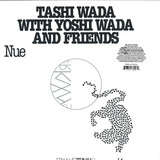
Composer Tashi Wada has performed for years with his father Yoshi Wada—artist, composer, and early member of the Fluxus movement. However, they have rarely appeared together in studio settings. Nue, the fourteenth entry in RVNG Intl.'s intergenerational FRKWYS series, finally brings Tashi and Yoshi, along with an eclectic group of close friends and extended family, together on tape.
Nue draws on aspects of Tashi's background for his widest vision to date—among them the minimalist bagpipe music of Yoshi, who co-composed three of the tracks, the psychoacoustic and perceptual explorations of his mentor, composer James Tenney, and reimagined forms of ancient and devotional music. The album, however, is not a tribute to the past or a recapitulation of familiar sounds. Instead, Nue is an intertwining of people and ideas as a means of growing, of looking inward to move outward, and of looking back to move forward.
To achieve this growth, Tashi assembled a core group of fellow travelers, including Yoshi, composer Julia Holter, producer Cole MGN, and percussionist Corey Fogel, to give life to this multifaceted suite. As an experience, Nue subtly navigates the interactions, intimacy and spaciousness of this group.
The album's title itself is a nod to Tashi's abiding interest in duality and the unknown: nue is a mythological Japanese chimera with the face of a monkey, the legs of a tiger, and a snake for a tail, a composite form, at once disturbing and otherworldly. But, as the composer points out, nue is also French for naked—stripped of complexity, bare and exposed, but also raw and essential.
From the doubling of tones—and the world of harmonic nuances such an action produces—to the rich interplay between individual musicians, all baring their own personalities and experiences through shared performance, Tashi's compositions allow space for these elements to join and grow. The multipartite creature that is an ensemble melds in the simplicity and purity of the music itself.
As explained by Tashi, each part was written with an individual in mind, not simply an instrument. And each individual performer makes their mark, from Holter's vocal performances on the cresting, oceanic 'Mutable Signs' and 'Ondine' with guest vocalists Simone Forti, Jessika Kenney and Laura Steenberge, to Fogel's resonant, precise percussion on 'Bottom of the Sky.' Producer Cole MGN, who has worked extensively with artists like Beck and Ariel Pink, helped to create a world of sound with minimal yet multi-dimensional materials. Like many of its influences, Nue uses deceivingly simple means to create complex, coherent worlds and narratives.
Tashi notes the influence of legendary Brazilian writer Clarice Lispector, whose work looked inward, investigating memory and emotion and dream, to understand the often overwhelming world outside the self. Like Lispector's classic novel Near to the Wild Heart, Nue cleaves these archetypal dualities—world/self, old/new, complex/simple—to create a work that allows them to coalesce into something singular.
As Tashi states in his liner notes: 'My desire was to create something both old and new sounding—ancient and futuristic—and ultimately something of its own world and other. Nue is a vision, an endless night of dreams, and a personal history of sorts, full of joys and demons.'
Those of you who have followed Lucky Brown's tireless efforts since joining the Tramp family in 2007 can hear without a doubt the progress he and his various ensembles have made in almost every musical aspect. His songwriting skills amazed us right from the start of our relationship. What deserves much more respect is that during the past years he has proved to be probably one of the most authentic and steady but at the same time most innovative creative minds on the contemporary funk scene. Sure, many of today's funk bands are able to deliver a two-and-a-half minute funk killer, what distinguishes Lucky Brown, however, is his ability to create compositions which also employ the idiom as a means to deliver an artistic message, a hard-to describe feeling, or a conscious concept, just like James Brown and Fela Kuti mastered in the 1970s. Furthermore, Lucky has developed his own trademark production and sound whose depth and honesty form a basis from which his work will ever remain timeless.
But that's nothing new as you can hear on both of his first two albums for Tamp ("Lucky Brown's Space Dream, 2011 and "Mystery Road", 2015) On "Mesquite Suite" he is forging new paths by soaking up musical styles from all over the world to infuse with his own totally unique way of producing. Perfect examples are the Mulatu Astatke-ish tracks "Pauraque" and "Mother Corn Stalk" with its distinctive New Orleans Swamp-Jazz flavor. Fans of the Menahan Street Band or El Michels Affair may see in "Taterbug" and "Estrellas De La Tierra" their favourite tracks. But it's the entirety which makes this album standout.
It has been Lucky Brown's aim to paint for the world a picture of the vernacular jazz that America's neighborhoods once crafted as their own homegrown cultural heritage. Lucky Brown's music is a rejection of the elitism, classism, and status of the music industrial complex and is an antitoxin to it's resultant homogeneity. He wants with his heart and his art to transmit an everyday people's sound, made by everyday people, dedicated to the upliftment of all people.
Tobias Kirmayer, August 2018
key-selling points:
- limited to 500 hand-numbered copies
- incl. full album download code
- double vinyl LP with deluxe gatefold cover
If you check the credits of The Rolling Stones' Goats Head Soup LP from 1973 you'll find a certain "Pascal" listed on the percussion section. That is none other than Los Angeles based artist Nicolas Pascal Raicevik (1933-1994), aka 107-34-8933, aka Head, aka Nik Pascal, aka Nik Raicevic. Besides his hitting the bongoes on the Stones album, Nik was a great artist on his own, both as a painter and as a musician. As a musician, he was a pioneer in the use of synthesizers, preceeding the Berlin school by some years when his Head LP was released on on Buddah in 1970. Buddah probably saw in Head the opportunity to cash in some money from the remains of the psychedelic scene - the three tracks on the LP are named after drugs used in the late sixties. The sounds, however, are accomplished works that show Raicevic as one of the most interesting pioneers in the use of synths. The album probably didn't do too well, since Buddah didn't renew the contract with Raicevic, who instead took his own way releasing his works on his very own Narco Records and Tapes label. Between 1968 and 1975 Narco would issue 4 LPs credited either to Nik Raicevic (Beyond The End... Eternity) or Nik Pascal (The Sixth Ear, Magnetic Web and Zero Gravity) plus one credited to 107-34-8933 (Numbers, which is in fact the same LP as Buddah's Head, albeit with different cover art). Copies of these LPs came with an ironic sticker over the shrinkwrap that read "Do not listen to this LP if you are stoned".
1972 saw the release of The Sixth Ear (Narco NR666), this time credited to Nik Pascal. A more complex work than Beyond The End..., it adds consistent rhythmic patterns to the mix with the addition of bongoes and also explores some interesting chord progressions.
Besides his musical explorations, Nik was also an interesting painter. His paintings are auctioned from time to time, and are consciousness expanding works influenced by abstract cubism and surrealism, some kind of Salvador Dalí on drugs exploring the outter and inner space. All the artwork on the sleeves of his LPs is done by himself. Spacey landscapes and psychedelic colours that fit perfectly to the music they contain.
"Nik Raicevic's music is at the intersection of radical psycho-electronic weirdness and kraut kosmische music (in particular the scifi-hypno-minimal modules of Conrad Schnitzler in Grun, Rot and Blau). It presents mega epic & tripped out electronic improvisations.
"This is an absolute must for collectors and fans of visceral, neurotic soundscapes." (progarchives)
"As far as late-60s / early-70s American Bedroom' Electronic Music goes, these LPS have to be among the first transmissions from this sector, made all the more attractive when coupled with Raicevic's alien topographIes - the covers are high-color portrayals of Venusian lanes, knotted growths, & future-past architecture in a style you might equate with Vintage' sci-fi pulp-novel covers - & copious Downer' sentiment. This music is imbued with a sort of lonely, anti-social sensibility that's about as far as you can get from the Academic' Early Electronic vector. I will say that if the Steve Birchall, Cellutron & the Invisible, and/or Pythagoron™ seed your garden, this will likely do the same." (twoheadeddog)
Never reissued before on vinyl format, the Wah Wah reissue features original sleeve artwork made of paintings and drawings by Nik himself and reproduction of the famous ironic "Do not listen if you are stoned" sticker. Limited edition, 500 copies only.
After more than a decade of deep, expansive productions on labels such as Detroit Underground and CPU, Annie Hall arrives on MUSAR for a record typically rich in texture and understated grooves.
Opening track 'Linium' immediately seduces listeners with a complex drum pattern that somehow feels spacious, subtly twisting and turning its way around Hall's analogue world. Dutch artist Mattheis maintains this understated feel but adds a soft, compelling kick in response on his suspenseful remix of 'Lavandula'. The original, moodier version of this cut the follows to open the B side, gradually erupting around a killer distorted bassline. The EP continues to hit a more urgent note with the tense machinations of 'Silene', where dense layers of stuttering, frenetic drums interweave with Hall's trademark, melancholy keys. The record concludes on a weightless, transcendent note with 'Santolina', taking each visceral element featured thus far and slowing each down, with affecting results.
Indebted to vintage electro and IDM, Hall's music is no throwback, always looking forward and moving dancefloors in the most unexpected ways.
DJ FEEDBACK
Early support from
Michael Mayer (Kompakt) : Nice vibes from Mattheis... will play for sure!
James Zabiela (Born Electric) : Linium is a nice one, thanks.
Arnaud Le Texier (Cocoon / Chronicle) : Nice music. Thx!
Marcel Dettmann (Ostgut Ton/MDR) : Thx!
Carl Craig (Planet E) : Thx!
Gonno (Beats In Space Records / Endless Flight) : I like Mattheis' :)
Thomas Hessler (Index Marcel Fengler) : Nice one! Thank you!
Slam (Soma) : Thanx
Âme (Innervisions) : Thanks
Blasha & Allatt (Meat Free / Manchester) : Amazing!
EREZ / John Byrun : A superb EP
Tom Lye (Melodic Distraction - Liverpool) : Big fan of the whole EP. Strong, building electro with different moods. Essential!
Afrodeutsche (NTS / LuckyMe / Skam) : Glitchy melodica... Right up my Strasse...
DJ Shiva / Noncompliant (Valence / Detroit Underground) : Stellar music here. Moving beyond "DJ music", this is just really fantastic to listen to in headphones. Gorgeous stuff.
Lonya (Asymmetric Recordings) : Great stuff here!
Nori (Posivision) : Cool work.
Cinnaman (Rush Hour / Naked Naked) : Lavandula and Santolina are my favorites! thanks
Dj Windows XP (E-Beamz) : Dope E.P. Will play Lavandula.
Ambivalent/LA-4A (Delft/Cocoon/Ovum) I'm a huge fan of Annie Hall and Mattheis!!! This is a FANTASTIC release!! One of my favorites of recent months just on first listen!!
Benoit C (Tsugi) : Linium for me
Ian Blevins (ESP Institute / Sulk Magic) : Linium and another bit of top work from Mattheis. Santolina is pushing my buttons too. Aphexy vibes.
Joe Europe (Ransom Note) : Very nice!
Azterisco: Very interesting record. Nice remix!
Oded Peled : What a fantastic release! Was hard to choose a favourite between Linium and the Mattheis Remix of Lavandula. Both will come in handy in my sets. ....Thanx a lot and keep em coming.
Naduve (Cocktail d'Amore / Disco Halal) : Both A1 and A2 are great!..Thanks.
Anastasia Kristensen (Nous) : I dig this a lot, it's a crazy well produced record.
Demia E.Clash (Darknet) : Such a good ep-.i love them all,quality production yess.
Pedro Martins (Karakter Records) : Nice EP overall. Linium, Silene, and Santolina are my favorites. Thank you so much!
Xinobi (Discotexas) : Great record. I'm specially enchanted by the original version o Lavandula. Congratulations.
Scan Mode (DJ Mag Spain) : Lavandula in both mixes for me
John Osborn (TANSTAAFL) : Can't pick a fav. it is all Devine. thank you.
Madloch (Sound Avenue) : Nice EP, Linium & Lavandula original are my favs, thanks.
DVS NME (Transient Force) : The standout track is Lavandula.
Inner River delivers a self-titled debut 2LP which is a 10-track journey of beautiful ambient, downtempo rhythms and otherworldly atmospheres. This mysterious dreamworld sounds complex, emotive, mystic and elegant. It's a personal story that remains interesting until the very end.
Lockjaw introduces his upcoming LP 'Human Research' with the release of the 'Human Research Sampler EP' on Locked Concept. A longtime curator of adroit, technical drum & bass through his Locked Concept imprint, Lockjaw now steps to the foreground, revealing four tracks from his forthcoming album that exemplify a continued dedication to this guiding principle, whilst displaying his expert abilities across an eclectic array of tracks that give a tantalizing taste of what is to come from the full LP.
The titular 'Human Research' opens with glistening chimes and a pensive drone, quickly joined by a wandering bassline that sweeps through the shadowy milieu of the track's opening, winding its way forwards amongst a series of increasingly sharp and distorted pulses towards the track's main section, where the combination is joined by a frantic drumbeat that rushes forwards with single minded determination.
'Without You' bears a tangible nostalgia, its opening drums carrying a classic, rave inspired piano riff and vocal reminiscent of an earlier era that reaches its climax amongst rising saw stabs, before locking into a dynamic bassline groove still rippling with the same jubilant energy introduced at the track's beginning.
'Velveteen' features the vocals of QUAILS, who provides an ethereal verse that daydreams about possible affection over soft, floating keys and a pulsating bassline, which drift aimlessly until the track grows with excitement in the second chorus amongst rising percussion & desirous guitar. 'Second Chance' considers the prospect of beginning again, as its sweeping pads grow from muted beginnings to produce an originally subdued drumbeat which exudes a humanizing growth in confidence that waxes as its complexity increases, with a rolling bass and stirring percussion introduced alongside wistful pads still wary from the outcome of the unspoken first attempt.
With the 'Human Research Sampler EP', Lockjaw, demonstrates in brief his unique ability to bestow deeply human qualities to his musical productions across a wide array of tones. In debuting these four sample tracks, he issues firm assurance that the forthcoming 'Human Research LP' will be no less mystifying as its researches the condition of humanity and the emotions most central to it.
Raw analog engines sound, roaming around concrete paved roads. Hypnotic rhythms mixed up with dystopian sound spheres. A perfect blend of analog synthesizers combined with bowed double bass and drums. CHOGORI project a picture of retro futuristic complexeties, intriguing compositions manifested in a massive HEAT HAZE. Hailing out from Düsseldorf, composed by Ralf Stritt and Gregor Kerkmann with drum performance by Martell Beigang.
Thomas Fehlmann steps away as co-member of The Orb following two acclaimed full lengths on Kompakt (COW - 2016, Moonbuilding 2703 AD - 2015) and embarks back on his solo career with a career defining album 'Los Lagos' - from Detroit to Schaffel techno he conducts a broad spectrum of electronic music into a seamless flow.
Thomas Fehlmann has been active since the late 1970's from Palais Schaumburg, the Tresor defnining trio 3MB (with Moritz von Oswald and Juan Atkins), Ocean Club (together with Gudrun Gut) and of course The Orb.
Artwork direction and design by DESIGNERS REPUBLIC.
'Los Lagos' is Thomas Fehlmann's seventh solo full-length, his 4th for Kompakt following his Berlin inspired 2010 full length 'Gute Luft'. in the musician's own words it's about "checking the juice".
Establishing a picture of his current artistic condition, as suggested by the title - los lagos / die lage / the situation (literally translating to 'the lakes' but taking the meaning of 'wassup' in the context of a relaxed discussion between friends), the album refers to Fehlmann's "musical motivation, dreams and wishes" through the language of music exclusively: a way to "allow myself to techno" he says, "to techno as a means to deconstruct and rebuild again. Set up an area of tension, loose it in the flow of the grooves. Magnifying some detail out of proportion, regroup around that and slowly knit a texture. Expand."
"It was time to take a bend and head where the sun rises or sets, wherever my heart drives me." This is pretty much the kind of decision Thomas Fehlmann has made. 61 and shining, longstanding member of The Orb, multi-talented composer and boundless experimentalist, had to make in the twilight of his collaboration with Alex Paterson, eager to taste the flavours of the unknown on his own again. "It was the moment when felxibility would have become compromise'. Far from being the demise of their joint dream, this was bound to split it in two distinct, parallel fantasies - rich of their own singularity.
As goes with that essential love of his for the free-flowing nature of electronic music, a fascination born out of its "lack of borders", capable of "inventing, changing the emphasis, experimenting with an unpredictable outcome", 'Los Lagos' "freely connects disparate extremes. Art, disco, minimalism, schmalz, jazz and funk". As he likes to say, Fehlmann's head functions as a sampler, capturing elements and re-assembling them under his own embracing perspective ; not afraid to leap from a deep, dubbed-out hypnotism ('Window', 'Morrislouis', 'Freiluft') to the playfulness of '90s-style bleepy schaffel ('Tempelhof' featuring Max Loderbauer), through out-there, muscle-flexing dancefloor cuts ('Triggerism') onto the calmness of ambient ('Geworden').
In need to keep his inner balance in check, Fehlmann committed himself to "switch off the control" and follow his intuition, which isn't so much of an easy process as he also wanted to incorporate the side disturbances experienced: "it's a complex process of search and destroy to bring out a new beauty trying to expand my vocabulary". With 'Los Lagos', Fehlmann looked at finding "the structure that's surprising, disturbing and rewarding". The artwork for the record, courtesy of contemporary artist and friend Albert Oehlen whom he shares lots of artistic ambitions with, echoes the producer's "funky use of shape and space, sludge and clarity" like a second skin. A search for light and harmony that Fehlmann sums up eloquently: "Does your inner musical voice respond", that is the question. Then "doors open up in unexpected corners, rays of light appear; you follow through and you're in - in your oasis."
The young virtuoso producer Prins Emanuel follows up his acclaimed debut album on Music For Dreams with something quite different than what we're used to hearing from him. While Arbete & Fritid was an epic odyssey into the furthest corners of disco with an array of studio wizardry and complex rhythms, Diagonal Musik is a sparse and delicate exploration of the acoustic guitar. Steering away from his comfort zone, the Prins follows his intuition for experimentation and lands somewhere in a field of genre-defiant folk-jazz meditations; a development that fits like hand in glove for the eccentric nature of Music For Dreams. The album reads like a soundtrack to the country house Emanuel shares with his family and friends, a place on the map called Oran. From atop a hillside overlooking a lake, Oran is lodged deep in the heart of the Skåne landscape, the southern part of Sweden that once belonged to Denmark. This place encompasses the whole of the album, as the track titles all pinpoint crucial locations on the courtyard and its surroundings. 'Orön' which opens the album is named after the small half-island that sits in the centre of the lake. There's the hand-built sauna ("Bastun") at the edge of the yard, and behind that in a slope the old root cellar ("Jordkällaren"). While the nature here is anything but balearic, the overwhelming calm of the country life seems to inspire the same laid-back attitude and passion for all things organic (and not just musically, as this is where Emanuel also makes cider from local apples according to the vin naturel school). Upon listening to Diagonal Musik one might be keen to draw references to works in similar style, such as the output of late 80's new age label Windham Hill or the dreamy lullabies of long-time friend and Music For Dreams affiliate 55 Cancri e. This is all circumstantial however, surprising as it may seem.
Luciano has arranged a special series of four releases as part of the celebrations for the fifteen years anniversary of his own Cadenza Records, launching the first one to begin the festivities. Each episode is coming out in a different season of the year; the first one, with the catalogue number 118, is the chapter dedicated to the summertime and contains 5 enchanting tracks with an exquisite sound. Thisseries is just one of the astonishing surprises that Luciano has set aside for the birthday of his beloved label.
The show begins with "The Amazing Lilou", a crispy ariose tune with elaborated percussions and calypso-flavored synthesizers. "Hiding Hearts" is a latin prelude with pleasant guitars and restful melodies, flowing with joy and peace. "Nabusima" is another Caraibic spell, with noteworthy carefullymixed drums and elevating harmonies. "Magik Mechanics" explores complex broken beats andelectronic textures, drawing a colored narration in between a fairy tale and a sci-fi movie. Finally,"Tirana del Oriente", as disclosed by the title, is a trip into the Oriental ardent magic. A collection offive long summery compositions to accompany our hot pleasing days from the dawn till the dusk,holding our hands during a never ending daydream.
- A1: Stilted
- A2: Swingtheory
- A3: Lie
- B1: Ghost
- B2: If You Only Knew
The 2nd Release On 823, A Creative Project Founded By Ta-ku, Is Featuring The Label Debut Of Portland Wunderkind Quickly, Quickly.
823 Is Also The Numerical Representation Of The Phrase 'thinking Of You'. It Represents The Appreciation For The People/ideas/places That Inspire Us And Push Us Forward. As A Label We Are Proud To Present A Series Of Musical Releases That Showcase The Artists Musical & Visual Endeavors. The Artwork Is Shot By The Artist Themselves & Each Release Has An Accompanying Photo Zine That Acts As A Visual Story That Compliments The Music They Wrote At That Time.
There's A Maturity To The Sound Of Portland, Oregon-based Producer Quickly, Quickly That Makes It Difficult To Believe He's Just 17 Years Old. Using Elements Of Jazz, Hip Hop, And R&b, Quickly, Quickly Weaves A Tapestry Of Wispy Productions That Feel Equally Inspired By The Dusty Drums Of Early '90s Boom Bap As They Do By The Whimsical Electronics Of Head-turning Contemporaries Like Tennyson. Taking Over On Vocals, Bass, Drums, And Piano, He Offers Insight Into A Greater Understanding Of Musicality, There's Time Devoted To Each Audible Layer And It Shows.
Ta-ku:
graham First Caught My Eye With His Film Photography - It Was Only Co-incidental That He Also Made World Class Sounds & Made Me Ever So Jealous With His Musical Talent At Such A Young Age. Graham Is One Of Those Wunderkinds That Have Managed To Create Such A Strong Musical Identity For Himself And Makes It Look So Effortless. Graham Is The Reason Why I Started 823. He Is The Epitome Of Someone Who Embodies That Free Flowing Creative Energy That Needs To Be Showcased To The World!
Music Has Always Been A Part Of Quickly, Quickly's Life, As He Started Playing Piano When He Was Two Years Old. This Love Of Music Shaped His Young Life And Created A Solid Musical Foundation For Future Efforts. In 5th Grade Quickly, Quickly Found Hip-hop, Citing Common Market, J Dilla, Blue Scholars, And The Pharcyde As Early Influences. With His Love Of Hip-hop And Early Musical Background, It Seemed Only Right That Quickly Would Begin To Produce His Own Music.
Having Now Made Beats For Around Six Years, Quickly, Quickly Is Producing At The Top Of His Game. The Production On His Debut Ep over Skies' Is As Easy-going As It Is Complex, And The Fact That There Are No Samples On The Ep Makes It All The More Impressive. Inspired Heavily By The Sky And The Many Forms It Takes, This Ep Blends Genres And Crosses Musical Borders With Ease.
Minialbum EP + Insert CD
An Ardent Heart is a focused techno mini album that brings forward Stefan Goldmann's most dancefloor-centered material in a decade. The tracks push and pull relentlessly. Despite their linear appeal, there is an intricately balanced interplay between the heavy-handed kicks, the bouncy bass accents and the sizzling, yet clear-cut details whipped up by the rallying drums. The peculiar, seemingly 'vocalised' mode of synthesis is maybe the most unifying sonic characteristic of the six tracks and one coda. Formant shaping, vowel filters and airstream perturbations let a wide range of sounding elements speak in the tongues of a cybernetic Babylon. Layered polymetric patterns perforate the aural plane with alien scripts. Clearly structured, yet opaque messages that seem to have traveled for aeons emanate from the red-hot circuitry. They spill into a network of delays, channeled down into labyrinthine corridors, enveloped in electrostatic noise. Most tracks build on chance patterns evoked with hardware sequencers and freeform modulation sources. The resulting synthetic systems are as cohesive as they exhibit vast internal variation and range. Thus balancing simplicity and complexity right in the middle, the results are just as immediately gripping as they can feed sustained attention. A wide palette of distortion and overtones mark the contours of individual elements that seem to have near-physical qualities - as if there were metallic strings, thick membranes, a resonating sphere, all struck by electric mallets, caused to vibrate by mechanical bows and sung by silicone lips.
Opening track 'In The B' kicks off proceedings in no uncertain fashion. It's 100% wall shaker material, the type of techno music best paired with strobe lights and towering speaker stacks. It mesmerises with its low-slung undulating bassline and Detroit rhythms before giving way to some riotous old school Essex stabs and sharp claps. No messing, this is a certified 3 AM red light burner! Track 2 'Chocolate Biscuit' accelerates proceedings! Beginning with unfussy drums and a robotic, bleep-heavy melody driving it off into a wonderfully off-kilter direction. Its arpreggio'd rhythms may be brutish and wrestle a growling sense of menace out of the track, but the overall feel, however, suggests considerable care and attention has been paid to make it sound this way. There's clearly an uncommon musicality at play here to make something this complex feel so simple.
The BPM drops next on 'Jenny's Hall' but from the offset, there's enough funk and thrust in the motorised synth line to get bodies gently grooving without the beauty getting lost in the slower loop. This is blissed out, psychotropic techno - the kind of track where it feels like you're floating and falling at the same time, but all the while making sure you still remain fit for purpose on the dancefloor. Ian Blevins takes on remix duties this time and the Berlin-based DJ/producer offers up a sleek peak-time banger that fizzes, bubbles and percolates. He gives the rhythm on 'Jenny's Hall' less space to swing and ties it to a tight motorik beat turning it into a slice of shiny, modern techno but with extra shoulder-checking force. Its vibe drawing from a sense of outsider-party fun with a wry smile, and a knowing wink running throughout before bringing the package to a suitably left of field crescendo.
After a debut outing on International Black last year with his best friend Mallard, LT graduates onto Rhythm Section INTL with a stunning debut solo effort: FOREST FLOOR.Aged just 20 years old, Lewis Taylor aka LT is another prodigal talent from the north of England, whose association with Rhythm Section goes back to his school days. A fan of the label from an early age, Lewis regularly made pilgrimages to the pool hall as soon as he was old enough to do so. It was these visits with his old school friend Mallard (who had recently moved down to London from Derbyshire to study music) which proved to be a formative influence, prompting him to try his hand at production...It turned out he was quite the natural, with his second ever effort as an 18 year old making it onto this very EP. Sitting somewhere between electro, house and techno with a healthy dose of breaks - LT constructs complex arrangements with as much of a nod to the retro summer of love stylings of Lone as to the new age bounce of the Pender Street Steppers. The piano house stabs of 'Untitled (Chesney)' reverberate around chopped breaks and screaming samples, anchored down by bouncy organ bass and FM lead synth which really begs the question: 'How did LT develop such a rich lexicon of club culture references in such a short time' We'd be tempted to believe it was just pure luck, if this mastery of rave aesthetics wasn't repeated throughout the EP...
Mesosphere fizzes with arpeggiated energy before giving way to a magnificent yet subtle drop that will serve festival main stages as well as it will back room clubs. Before the EP is over, LT has one more trick up his sleeve in Forest Floor - the titular track which is the musical equivalent of watching the sun rise through a misty glade after a night spent alone in the wilderness. With this gentle touch, LT proves he's more than another kid on Ableton making bangers - he has breadth, incredible musicality and a rare ability to transcript sceneries into sounds. Finishing with 'North Circular' possibly a reference to the free Parties on the London Orbital or merely just a coincidence you decide.
We couldn't be happier to welcome LT onto the RS INTL roster in what feels like a fulfilment of destiny. It's such a great honour to have nurtured and now introduce the next generation via the Rhythm Section platform.