Fellow violinist Stuff Smith marveled, "He plays violin like Coltrane plays saxophone." Born in 1942, the French violinist Jean- Luc Ponty transported jazz violin playing into the world of modern jazz. On Frank Zappa's urging, Ponty moved to the States in 1970. Over the next years he toured with Zappa, the Mahavishnu Orchestra, and Chick Corea's "Return to Forever".If Ponty's 1983 album Individual Choice was the sketchbook of his decision to take his music in a new direction, Open Mind (1984), released the following year, was a deeper
exploration of the emerging world of synthesizers and sequencers and their impact on live and studio performance. Here, complex rhythmic patterns shift in the background while new sounds appear and disappear on the surface in colorful bursts, and outstanding jazz improvisors create familiar music in new settings. It's almost an audio version of a kinetic wind sculpture.
Ponty chose to use a Roland rhythm machine instead of faking real drum and percussion sounds and played all the keyboard parts himself in order to further explore the concept he had introduced in Individual Choice. He additionally asked two longtime friends to solo on various tracks: George Benson, whom JLP had met and played with when they were both 21 years old, and Chick Corea, who
excels on two tracks with his Moog synthesizer. Open Mind has been re-mastered by 2023 Grammy Nominee Christoph Stickeland includes new liner notes.
Search:complex
- 01: Begin The Ceremony - Dionysus Disciplined
- 02: Ascensus Christi Ad Inferos
- 03: Taboo And Exogamy
- 04: The Waiver Of The Flesh
- 05: The Impossibility Of Transcendence In The Eyes Of An Operating Thetan Lviii
- 06: Salix Babylonica
- 07: Repentless
- 08: Expulsion At Old Calabar
- 09: The Cry Of The Curlew
- 10: Existential Dreg
- 11: Romance Llc
This is a Double LP Gatefold Silver plate !
Bacchus Harsh is the alias of Melbourne based multi-disciplinary artist Christian Bishop. Predominantly known in international music circles as Australian breakcore pioneer Xian, Bishop has expanded his already widescreen musical horizons to embrace an even broader creative cosmos under this new alias. Bacchus Harsh is the sonic embodiment of occult-themed electronics and deconstructed club music. De-territorializing exotica, occult psychedelia and industrial techno with polyrhythms and distorted blast beats, Bacchus Harsh confuses the dance floor.
Caveat Tumultum is an expansive double LP of icy post-breakcore industrial heaviness, where hallucinogenic cinematic atmospheres collide with sample-driven mania and complex mechanical rhythms. The resulting album is a 60-minute masterclass in foreboding electronic production, dystopian sonic manipulation and the thrillingly visceral experience of true underground party music.
Manchester's Avant-Jazzy-Funk outfit Swamp Children were enviably eclectic and Taste What's Rhythm is their mini masterpiece. Flitting gracefully through a feast of genres with consummate ease, the band were almost indefinable and, accordingly, nigh-on impossible to market. So whilst this cult EP, originally out in 1982 on Factory Benelux, remains in demand for those in the know, it has also glided under the radar of many otherwise clued-up heads for over 40 years. If you don't know, get to know...
The Taste Whats Rhythm EP was originally released in 1982 on Factory Benelux (an informal partnership between the legendary Manchester-based Factory Records and Belgium-based Les Disques du Crépuscule). With it's kaleidoscopic brightness, silky panache and superb execution, it remains one of the most startling documents of a remarkable time and place.
The EP opens with the oh-so-Balearic title track. "Taste Whats Rhythm" gently unfolds with a Spanish guitar, hazy, drifting vocals and sun-bleached Latin percussion. After this most sumptuous of intros, the tempo is raised, the rhythms grow in complexity as horns jostle amidst the restrained chaos quite wonderfully. And then it winds down again. Proper fluctuating rhythms and tempos throughout. I guess that was the point - taste the variety!
“You’ve Got Me Beat” is a *perfect* piece of post-punk pop-jazz. A mysterious, after dark jazz-dancer, the aching vocals serve as a touching, tender resignation to love. A guitar hook which seems to elegantly reference The Blackbyrds' "Rock Creek Park" and a flowing pulse from New York's No Wave scene. It still sounds so fresh all the years later.
Closing out this most perfect of EPs, the twisted synths and nimble rhythms of bass-heavy roller "Softly Saying Goodbye" combine to create a super-slinky gem; Brit-Funk of the highest order.
Swamp Children formed in Manchester in 1980, around core members Ann Quigley (vocals), Tony Quigley (bass, metalaphone, percussion), John Kirkham (electric & acoustic guitars, metalaphone, percussion), Ceri Evans (keyboards, bass, percussion, background vocals), Cliff Saffer (saxaphone, clarine) and Martin Moscrop (drums, percussion, trumpet). They initially practised at a rehearsal space shared with fellow post-punk funkers A Certain Ratio and Joy Division/New Order. Young and relatively inexperienced upon getting together, the ages of Swamp Children's members ranged from just 16 to 19. Talk about the brilliance of youth.
From the outset, Swamp Children shared DNA with A Certain Ratio. Martin Moscrop was a founder member of Ratio, while Ann provided artwork for them. Although the close association with ACR led some to assume that Swamp Children were simply a splinter group, the new band pursued a more overt latin and jazz tinged direction, at the same time adopting a post-punk attitude towards making music, influenced by the records they were listening to at the time: Miles Davis, Brazilian jazz fusion and heavy funk dancefloor sides.
The band made their live debut at Manchester's infamous Beach Club in May 1980. Thanks to a double-booking blunder another support band turned up and were turned away, having travelled all the way from Dublin for a string of British dates. The name of the unlucky band was U2...
With arrangements that emphasised Tony Quigley’s darkly-coloured basslines (and Ann Quigley’s impressionistic vocals as another instrument in the mix) Swamp Children possessed an easygoing grace and a bubbling energy which indicated that the band's true strength was as an ensemble. The band’s musical sophistication (a fusion of funk, jazz, and bossa nova) would prove to be a strong influence on later UK acts like Sade. Indeed, Swamp Children themselves later mutated into the more known and acclaimed latin jazz outfit Kalima.
Working directly with James Nice, custodian of Factory Benelux, means that the audio for this re-issue of the classic EP comes from the original tapes. Cut at 45 RPM and released in the house Be With disco sleeve, we’ve made sure this record is well up to the job of having a permanent place in every DJ’s bag. As far as we’re concerned, this is essential stuff.
- A1: Akousmatikous (Feat. Soccer96)
- A2: Dimensional Collapse
- A3: Always On My Mind
- A4: Fireflies
- A5: Dimcola Reprise
- A6: Propaganda (Feat. Brijean)
- A7: Zee Complex
- A8: The Giddy Aquatic
- B1: Sugar Coating
- B2: Proof Is In The Pudding
- B3: Cathartic Interlude
- B4: Pushing Me
- B5: Gradients
- B6: Losing Steam
- B7: Zaza Flip
- B8: Exhaustion And The Open Mind
Die Singer-Songwriterin, Multiinstrumentalistin und Produzentin Lindsay Olsen aus der Bay Area ist der brillante Kopf hinter dem schrägen und magischen Projekt Salami Rose Joe Louis. Auf der Grundlage ihres Studiums der Planetenwissenschaften erschafft sie eine einzigartige Erfahrung: Sie erforscht Ideen von Multiversen und Klimawandel durch die Linse eines fiktiven postapokalyptischen Erdenbürgers mit Keyboard, einer Taschenlampe, einer Dose Cashews und einem hoffnungsvollen Optimismus. Durch die Verschmelzung von Einflüssen aus Jazz, Rock und Hiphop, wie bspw. Shuggie Otis, Captain Beefheart, Stereolab oder R. Stevie Moore, schafft sie eine einzigartige Mischung aus experimentellen Klängen aus der Galaxis mit jazzbeeinflusstem Gesang und Keyboard.
Das neue Album folgt auf kürzliche Kollaborationen mit Toro Y Moi oder Alice Phoebe Lou für ihr Strongboi-Projekt, auf einen Remix für die Brainfeeder-Labelbuddies von Hiatus Kaiyote und auf die Mitwirkung am Song „Scapegoat“ des mit einem GRAMMY ausgezeichneten Rappers Baby Keem. Olsen hatte außerdem die Ehre, mit Flying Lotus, The Cinematic Orchestra, Toro Y Moi, TuneYards, Clairo, MNDSGN, Homeshake, The Comet is Coming und Still Woozy zu touren. „Akousmatikous“ ist die erzählerische Fortsetzung von ihrem letzten Studio-Album: Nachdem das Metropolis-Raumschiff am Ende von „Zdenka 2080“ auf die Erde gestürzt ist, kommt es zu einem dimensionalen Kollaps. In der Folge verwandeln sich die Köpfe und Hände der Erdbewohner:innen in Bildschirme, womit das neue Album beginnt. Die Erdbewohner:innen stecken in einer nicht enden wollenden Video-Feedback-Schleife zwischen ihren Köpfen und Händen fest. Ein interdimensionales Wesen, Zeeanori, manipuliert diese Rückkopplungsschleife, weil es will, dass die Pflanzen die Erde zurückerobern und die Natur wieder blüht und gesund wird. Ein alter Freund und frühere Liebe des Monsters, Akousmatikous (von einem fernen Planeten), kommt auf die Erde, um es zu sprechen, weil er neugierig auf seine Motive und die komplizierte ethische Situation ist. Akousmatikous stimmt zu, dass die Natur schön sein und blühen wird, ist aber besorgt über das Schicksal der Erdbewohner:innen, die in unendlichen Rückkopplungsschleifen gefangen sind. Akousmatikous hofft auf eine Lösung, die für jedes Wesen und jede Entität von Vorteil sein kann, einen Weg zur Symbiose.
- A1: Vromm - Red Tuna
- A2: Hyphen - Winter Sky
- B1: Saytek - Iyndub01 (Live)
- B2: Pascal Nuzzo – Hold On
- B3: Nphonix & Matrika - Rumble Around
- C1: Acidulant - Make Love To A Machine
- C2: Insider - Something Flash
- D1: Dharma - Structured Chaos
- D2: Som.1 – Ultimatum
- E1: Dino Lenny – Did This
- E2: Adam Antine - Sortavala
- E3: Paul Roux – Bapteme
- F1: Underworld – Appleshine (Film Edit)
- F2: Subject 13, Conscious Route – Dripping Sauce
First released back in the fall of 1989, the In Order To Dance album was a compilation LP that pulled together tracks from a
select band of electronic producers, pushing the boundaries of the house and electronic music that was in its infancy stage.
Released on the R&S Records label, the IOTD series would become pivotal in the development of the electronic music scene
at large.
The world of music is a constant shape shifting, trend moving behemoth. Style may come and go (and come back around
again), stars are made, stars can fall. But the ethos behind In Order To Dance remains the same as it ever has, with a fierce
independent spirit, and a pledge to bring forward the next generation of young artists and their music. And so, here we arrive
at a new collection, fresh for 2023, and just in time for the labels 40th anniversary year, and with the ardent A&R’ing of label
founder Renaat Vandepapeliere, a selection of new tunes is assembled to reinforce the strength and power to be found within
music.
Across thirteen tracks, a squad of refreshingly contemporary producers from around the globe are brought together under the
In Order To Dance banner. Ushering the series into a new era, new variations on the electronic genre and fresh ideas are
fused into a delightfully engaging collection of tracks. There’s deep breakbeats courtesy of UK producer Dharma, smooth and
dubby live action from Saytek and complex bass heavy rhythms from Vromm. There’s esoteric electronics from Hyphen, epic
piano driven deep house from Dino Lenny and swinging jazzy breaks from Nphonix & Matrika. Paul Roux’s melancholic
‘Bapteme’ unfurls waves of deft pianos and guitar swirls over taunt beats, and a driving electro tone is set on Acidulant’s
contribution. Intoxicating rave tropes and hefty breaks come courtesy of Pascal Nuzzo and Adam Antine delivers a wall of
sound anchored by shuffling, funky beats on ‘Sortavala’.
And to accompany the new wave of In Order To Dance, a series of music videos have been produced. Acclaimed artists and
video directors, including Alessandro Amaducci, Ben Marlowe and Gala Mirissa, have all stamped their digital artistic
visions onto these stunning compositions, synching audio and visual for a multi-sensory experience!
‘In Order To Dance 4.0’ by Various Artists is available on R&S Records from 14th April 2023 on 3LP vinyl, download &
streaming services.
Canto A Lo Divino is the unique musical expression of the Chilean peasant world - a conversation with the divine nourished by Biblical and other sacred texts. It is communal music, played in packed rooms throughout the night on the 25-string guitarron, its ancient melodies transmitted through the 10-line decima form originating in Spain and found across the Caribbean, South America, and even into the Mississippi Delta. Rooted in the remote Central Valley of Chile at the skirt of the mountains and following the slopes of the major rivers, the Canto tradition has persisted for centuries in the voices of hundreds of men and women who sing of saints, divine images, and angelitos (very young children who have died). The verses are also centered around daily life in the valley - labor and drought, family, animals, and plants. There are countless entonaciones (melodies) that define this region, its communities, and its unique worldview. Mississippi Records is privileged to work with the Museo Campesino En Movimiento and their archive of hundreds of hours of intimate field recordings of the Canto - music rarely, if ever, heard outside of the region. Artwork is provided by another inhabitant of Chile's Central Valley, a baker called Frederico Lohse, who brought divine visions from the Cantos to life, painted on reused flour bags. Canto A Lo Divino celebrates the complexity and solemn, stunning beauty of this nocturnal, communal form of musical devotion. Double vinyl LP comes housed in deluxe gatefold jacket with 8 pages of lyric translations and liner notes about the Canto tradition by researcher Danilo Petrovich.
Vinyl release compiling both Nukuluk EPs on one LP. Curating their own unique sound and captivating crowds with their refreshing approach to hip-hop, electronica and indie, Nukuluk return with their new EP ‘SUPERGLUE’ on 21 April. The writing and recording process has never been executed in a conventional style for the group, a series of laptops and bedrooms manifesting the groups’ studio, aspiring to a fundamentally collaborative process as they piece their separate parts together in ever surprising ways. Respective members lead through a variety of formats, bringing a demo, a motif or concept in what can be a deeply stimulating process, ensuring the sound is ever-evolving. The EP acted as an educational vehicle that held the group together as they learned how to overcome certain challenges, and hold it together as one, hence the title SUPERGLUE. It presents a fractured journey and chaotic growth of five individuals trying to create the new together; honest vulnerable expression married with complex soundscapes, pulling from whatever genre feels natural and trying new combinations of internal collaborations in the group. The release spans genres from hip-hop to alternative rock, ambient to metal, dance music to r’n’b in what the band note as: “a kaleidoscope of sonics, songs, beats, noises and stories lurching between vulnerability and bravado, as a body of work growing in all directions at the same time.” Their latest single ‘I Just Wanna Luv U’, the follow up to the high octane ‘Covered In Gold’, marks a charged change of pace; an introspective, meditative trip-hop piece, with creeping synths, electronic drums and gruff vocals transitioning into acoustic guitars, live drums and rap verses. It tells the story of wrestling with childhood trauma, isolation and self-acceptance. Vocalist/producer Syd Nuku explores an eerie modern condition before conversing with an inner child’s trauma and memory - “be slow kid, go and take a place below the ceiling where it won’t fall”. The accompanying video was co-directed by Luke Kulukundis (Syd Nuku) and Iso Attrill, and takes reference from the likes of Michel Gondry, Charlie Kaufman and David Lynch. Nukuluk are Monika, Syd, Mateo, Louis and olivia. Entirely self made the collective successfully blend genres and styles to reach new spaces through a broad range of influences (including JPEGMAFIA, Jockstrap, SOPHIE, Wu-Lu and Yves Tumor as well as esteemed groups like Massive Attack, Portishead and Gorillaz). Formed in the midst of lockdown, the collective played their first show in July 2021 before releasing their debut EP DISASTER POP to critical acclaim in November, which subsequently led to multiple festival appearances and a 3-night sold out residency at Bermondsey Social Club in 2022. Their release campaign was littered with videos and creative visuals that were constructed by the collective and its extended family of artists - this multifaceted creative output of the group making them a unique prospect; directing and producing their own videos, exploring many avenues of creation and trying to exist in a unique contemporary DIY space. With nods across the spectrum of the music media – including The Quietus, CLASH, NME, Ransom Note, DIY, DORK, So Young and many more – Nukuluk are steadily carving out their own space in the British leftfield.
Gatefold Green Vinyl Double LP with design by Dian Vandermeulen, the popular Canadian visual artist
(limited edition cassette version will be released by Not Not Fun).
Between December 2018 and 2019, Stefana Fratila embarked on a series of research trips across North America (including to NASA Jet Propulsion Laboratory and NASA Goddard Space Centre), meeting with astronomers and scientists in order to address a complex question: “If each planet in our solar system were a different room, what would each room sound like?”
Her ongoing creative research culminated in Sononaut, eight open-source VST plug-ins created for digital audio workstations (DAWs) that emulate the atmospheric conditions of the planets in our solar system (made in collaboration with artist and coder Jen Kutler, using calculations by NASA astronomer and planetary scientist Dr. Conor Nixon).
Her forthcoming album I want to leave this Earth behind is the sonic extension of her creative research.
In her own words: “The album is conceptual, in that it centres on outer space exploration and my understanding of 'Crip futurity'. My vision is for the album to engage listeners in an exercise of imagining the sounds of interplanetary atmospheres– conditions which are inherently unlivable, unbreathable, converting all human body-minds into disabled-bodied-ness. Since I identify as Crip, or disabled, this idea deeply resonates with me. I am the first artist (a disabled producer/musician, no less) to have worked with NASA researchers on a sonic imagining of the solar system’s atmospheres that incorporates real scientific data. If we are all 'disabled' in (or by) outer space, my music is concerned with propelling all listeners into space, leaving Earth behind them, through my music.”
The solar system’s planetary bodies are inherently prohibitive even in regards to Earth’s most ‘able-bodied’ subjects. Her project seizes upon a form of radical agency and science-fictive ambition, placing all human subjects within new worlds, into the interplanetary bodies of our solar system, through her own sonic imaginings.
The album will be released by Toronto-based label Halocline Trance (Casey MQ, myst milano, ACT!).
During a 2019 residency at CMMAS (Centro Mexicano para la Música y las Artes Sonoras) in Morelia, Mexico, Fratila began writing the album on an octophonic sound system (8 planets = 8 speakers).
Afterwards, from her home studio in Toronto, she recorded additional synthesizer parts, finalized arrangements, and incorporated Sononaut (her 8 solar system VST plug-ins) into the album’s production. The album was recorded, written, and produced by Fratila. She worked with mixing engineer Jeremy Greenspan (Jessy Lanza, Caribou, Junior Boys), as well as mixing engineer Lisa Conway and mastering engineer Sage Kim.
Underlining each track is a five-minute soundscape representing the weather on that planet, based on Fratila’s research at NASA. The weather patterns are interwoven with layers of synths and time-stretched samples.
There are very few disabled femme electronic artists gaining exposure in Canada today.
SPF 50 returns to Professional Music with 'Secret Technology', a diverse 5-track EP of playful, sonically rich material aimed at the dancefloor. The record explores some of the the core staples of the dance: bouncy grooves, rippling, psychedelic synth lines and a few cheeky vocal chops.
Heavily inspired by golden era tech-house, but with an ear for modern sound design, the music comes in with bad-boy energy but hints at something deeper bubbling beneath. Heavy kicks and sharp hats mingle with complex, modular basslines. Dusty breaks and euphoric vocals jiggle over top of lab-concocted acid. This one is for fans of serious fun.
Brazil Classics 4: The Best of Tom Zé Massive Hits, which comes in a limited Brazilian Blue gatefold edition, and The Hips of Tradition, which comes in a limited Amazon Green edition, here’s what you have in store: Household appliances and tools in arrangements with horns, strings, “prepared” guitars (punctuated by grunts, screams and other wild percussion), all melded with eccentric metaphorical lyricism.
Murmer is the long-standing project for Estonian field recordist and composer Patrick McGinley, and in Tether, The Helen Scarsdale Agency welcomes Murmer back to our roster, over a decade since he graced us with his last production for the Agency. His field recordings often center upon the amplification and activation of resonance from a particular space, landscape, or object. Such sounds emerge from a condition as begin fleeting, inconsequential, or ephemeral and explode into that which alien, sublime, and profound. Here lies the tremendous prowess of the contact microphone, as wielded by an accomplished musician! The source material cited by McGinley includes cables, fences, wires, and vents.
There is a heft to many of these sounds as heard throughout all of "Taevast" with deep throbbing pulsations from arctic wind generating subharmonic patterns upon thick high-tension wires. Elsewhere the subtle dissonance from a rasping cooling fan blooms into a brooding ambience that is sublimely rich in its metallic timbres and complex reverberations. McGingley has long been an exemplary artist in the field of phonography even as he is less prolific than others. On Tether, he has produced a majestic if occasionally foreboding work on par with the mythic wire recordings of Alan Lamb, Jacob Kirkegaard's haunted resonance from Chernobyl, and much of the Touch catalogue for that matter!
Patrick McGingley on Tether:
In 2006, I made a collection of recordings at a mobile phone mast in Mooste, southeast Estonia. It is a guyed tower, 80 meters tall, affixed to 3 support points with heavy cables. I attached my self-made contact microphones to these cables with poster tack, and spent many hours over several weeks recording the various wind and weather variances (it was summer), and the birds that passed or settled on the tower or cables. This was one of my first visits to estonia, where i now live, and one of the things that marked me about that experience was the access: the tower had no fences or protections around it (I have not been back there recently to answer my own question of whether or not this is still the case); it stands in the middle of a field of tall grass along a dirt road in the countryside, just out of view of the few nearby houses, and during all the hours I spent there I was never disturbed or shooed away.
For more than 16 years, I have been thinking about this location and these recordings, and have made several attempts to work with them. I have used the sounds in installations a handful of times, and uploaded one short edit to the Aporee soundmaps, but have never managed to use them in any composed work. They always seemed too big for any structure I could provide them, whether I left them on their own, or partnered them with other sounds. Finally, in 2019, after putting them down and picking them up again repeatedly over so many years, they seemed to allow me in, although it took me another few years before they were happy with what I could offer. They stand now not quite alone - the majority of the layered sounds in the piece come from various edits of those cable recordings, but I added two other contrasting sounds, related to one another: one is snowflakes landing delicately on a plastic cakebox with microphones inside it, and the other is a frosted field of grass thawing on a lightly warming autumn morning (both these recordings can also be heard on their own on the Aporee maps).
Coming back to those cables brought to mind so many other wind-driven sounds that I had spent time with and recorded, but never returned to, that I began digging through my archives looking for them. I ended up with a pool of sounds from resonant wires, cables, fences, poles, fans, and vents, which became the basis for the 2nd work on this release. One of these sounds is among the first sounds I ever recorded, possibly within a month or so of buying my first microphone and minidisc recorder: the rhythmic fan of a beer cooler in a pub where I worked in North London in 1999. Other sounds in the piece include another phone tower, recorded on the northern coast of France in 2008, a telephone pole recorded in the Beaujolais region in 2010, the drone of ventilator fans at a factory in Tezno, Slovenia in 2012, an electric sheep fence in the Scottish borders in 2013, a hanging wire in a storage space in Rovaniemi, Finland in 2016, and, with no relation to cables or wind at all, calcium deposits being cleaned from the inside of an electric kettle here in Estonia in 2019.
I offer these two new pieces as my first solo publication since 2018, the first release on a physical medium since 2016. No one has ever accused me of working too fast, or being too prolific. I have a need, it seems, to leave a physical space of time around my work, before I can consider it 'finished'. Perhaps it is a simple need to forget how I did something, or that I did something; perhaps I have a need to be able to hear a work as a first-time listener would, before I can consider it ready for such an encounter. In some part of my mind I have to forget it before I can let it go. Well, I've just about forgotten that London beer cooler now, and that walk in the Beaujolais (with my father, who has since passed away), and that sheep fence next to our campsite in the borders, and that kettle that is now leaky. So I guess it's time.
With his 1981 solo debut album The Red and the Black, Jerry Harrison proves his formidable talent as a multi-instrumentalist and songwriter. Dense, abrasive and focused, The Red and the Black’s complex and funky musical style was ahead of its time. Harrison's observations throughout the album on the modern condition ring all the more true in our digital age. This limited edition 2LP edition features the 1981 album recut from the original tapes plus a bonus LP of previously unreleased outtakes and alternate mixes.
- A1: Ss-Say - Care
- A2: Oskarova Fobija - Beli Dekolte
- A3: Danton's Voice - I Hear The Bells
- A4: Sympathy Nervous - Polaroid
- A5: Pas De Deux - Cardiocleptomanie
- B1: Robert Lawrence & Mark Phillips - Computer Bank
- B2: The Fast Set - Kaleidecon
- B3: Reserve - Destination Pour L'inconnu
- B4: Kym Amps - You Don't Know My Name
- B5: Unovidual & Tara Cross - Microphone Connection
A compilation of Minimal Wave from around the world ‘79-‘85. »The Hidden Tapes« features rare, unreleased, and licensed tracks from as far as Japan and the former Yugoslavia. Most of the bands on this compilation recorded on 4-track tape in their bedroom studios while two of them went further to collaborate by sending tapes through the mail. The sounds on this record range from raw proto-industrial to naive danceable Belgradian new wave, to filmic synthesizer music to more complex, vocal-driven melodic synthpop.
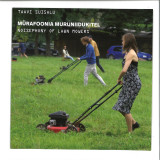
Taavi Suisalu is an Estonian media artist particularly interested into complex and adventurous sounds, field recordings and harsh audio emergencies, organized under the form of symphony or as a result of performative interactions.
In 2014 Suisalu received the Young Estonian Artist Prize as curator of Project of In-existent Villages, an articulate exhibition full of installations and site-specific sound performances. The use of peripheral spaces and the crossovers, sometimes extremely creative, of human interactions, data, sounds and technologies, are recurring in the works of Suisalu, whose subjective perspective unconventionally investigates different social and cultural phenomena. He is always attracted by the different forms of technologies. It can be an old seismograph he reconstructs to record the underground vibrations of a volcano, or, it can be some 3D models he uses to analyze a grain of soil coming from the ancient Pompei. The results of the researches would lead to the installations. The whole set of data is often the premise of a narration, a datafiction, as in the case of the signals recorded from some abandoned satellites, who are later presented with a speed set by the position of other satellites gravitating above the gallery hosting the event.
“Noisephony of Lawn Mowers" was originally composed in 2013, but it was unreleased until now, when Staalplaat, a fundamental label for its unusual experimental connections and for the sound events performed in unconventional spaces, decided to publish it. It's a score for lawnmowers, whose making is given to a conductor and executed by a group of artists. Suisalu reminds us that historically, lawn has been a symbol of power and wealth as it required substantial upkeep and unused land. Today, it still indicates wealth, but is mainly maintained by the owners themselves. This puts us in a schizophrenic situation where we strive to be privileged by taking the role of the servants.
“Silver Meets Ted” is the other track included in the selection. It's a recording of over ten minutes, whose trend cryptically moves on and with some unsettling minimal tolls, always more metallic. Some deaf beats follow, and then we have a splash of water and some slightly hinted neighs, chirps, different spills of liquid, more intense and measured, clackings and vibrations, some hardly identifiable frequencies and again a series of punctuated metal bells. The work by Taavi Suisalu stands out as a calibrated combination of mathematical coherence and elements of surprise, automatized and causal processes, some small oblique utopias, that work well together by improving highly subjective resources and create some slightly unsettling final results.
The »Icol Diston« compilation, released in 2002 on DIN, comprised the three first EPs released by Uwe Zahn under his Arovane moniker. Following up on vinyl reissues of his path-breaking debut album »Atol Scrap« as well as 2000’s »Tides,« the German Keplar label finally makes »Icol Diston« available in its entirety on vinyl for the first time in a remastered version with new artwork. This expansive reissue sheds a new light on Zahn’s first two outings as a producer on the »I.O.« and »Icol Diston« EPs on Torsten ›T++‹ Pröfrock’s legendary label as well as highlighting his radical inventiveness as a remixer with the two renditions of Pröfrock-produced material offered on »AMX.« Taken together, these musically complex and emotionally rich electronic compositions form the prologue to an artistic story like none other while also documenting a very specific era in cultural history.
The energy running through Berlin and its boundaryless electronic music scene at the end of the 1990s is reflected by and refined through these eleven tracks. »There was an overwhelming dynamic of liberation reverberating through the city—through the clubs, the arts, the people,« says Zahn today. At this early stage in his career, he had a head full of ideas and slowly started filling up his studio with samplers, synthesizers, and sequencers to put them into practice. »I would compose percussive structures in my mind during long metro rides and record them once I was back at the studio as well as composing melodies spontaneously on my sequencer.« The Yamaha QY700 would become his sketchbook that allowed him to experiment with different patterns, creating polymetric figures out of discrete musical elements.
Zahn’s sessions, recorded live in stereo and straight to DAT, resulted in two very different EPs of original material. His debut »I.O.« showcases a playful and gentle, albeit dubby and at times moody aesthetic. The four tracks are exercises in sonic worldbuilding, creating vast spaces and filling them with a plethora of intertwining melodies and rhythms. Its successor »Icol Diston« drew on similar parameters, but painted a very different picture in terms of atmosphere and mood. »Berlin’s history felt still so tangible and yet somewhat ghostly during the 1990s, and it is a reflection of all that,« explains Zahn. »The weight of its past, starting with World War II up to the end of the GDR, clashed with an atmosphere of departure, a new zest for life among the people in the city.« It is perhaps no surprise then that the five tracks put a firmer focus on beats, at times even approximating techno or electro grooves despite never eschewing the complexity that is so central to Zahn’s work.
The »AMX« EP features two remixes of tracks originally produced by Pröfrock under two different guises. »Außen vor« had been released under his Dynamo moniker and was reworked by Zahn after having been introduced to his label owner’s Studio 440 sampler, sequencer and drum machine. By leaving the groove at the core of the original track mostly intact but infusing it with more dub as well as anthemic synth drones, Zahn gave it more depth both sonically and emotionally. With his remix of »No. 8,« released under Pröfrock’s tongue-in-cheek pseudonym Various Artists, Zahn followed a more radical approach which led him even deeper into dub territory. »I used a relatively short sample as the tonal foundation and then added an incredibly deep bass and percussive elements,« he explains. Widely different from the original version, it perfectly translated the spirit of this singular masterpiece into another stylistic idiom.
The »Icol Diston« compilation is imbued with a forward-thinking spirit that remains exhilarating until today. It captures the sound of one unique artist, but also electronic music during that time more broadly. This is the sound of opening a new chapter, the willingness to venture into the unknown.
All tracks composed and recorded by Uwe Zahn in 1998/99.
D1 is a remix based on the track by Dynamo. D2 is a remix based on the track by Various Artists.
Originally released on three 12inches by DIN in 1998/99 and on CD in 2002.
Remaster and cut by Kassian Troyer @ D&M.
Cover art by Jim Kühnel based on a photograph by Uwe Zahn.
Text by Kristoffer Cornils.
- A1: Ten Hours (2023 Remaster)
- A2: Windy Wish Trees (2023 Remaster)
- A3: Passage To Nagoya (2023 Remaster)
- A4: Cry Osaka Cry (2023 Remaster)
- A5: Pink Lilies (2023 Remaster)
- B1: Lilies (2023 Remaster)
- B2: Tokyo Ghost Stories (2023 Remaster)
- B3: Instant Gods Out Of The Box (2023 Remaster)
- B4: Good Bye Forever (2023 Remaster)
Arovane's acclaimed 2004 album »Lilies« has been out of print on vinyl for nearly 2 decades now. It finally gets a well-deserved reissue through the Berlin based Keplar label. The new version has been remastered by Kassian Troyer at Dubplates & Mastering and comes with a brand new cover artwork.
»Lilies« was a follow-up to »Tides« in every sense, exploring a trip to Japan and drawing on shimmering textures and the sort of melodies that you might need some time to recover from. There's a hugely evocative sense to these tracks, emotionally driven, free of complexity or conceit, piano melodies providing the central focus for a twilight cascade of light that seems perfect for the Tokyo skyline - just as the sun sets. It's an album that radiates warmth and vulnerability, fusing the technological might at the heart of each track (and at the heart of the city) with an age-old understanding that certain echoes of sound, small melodic changes and cushioned lullabies can imprint sounds on your mind like childhood memories - remembered forever. Like a dreamlike score, or maybe even an alternate soundtrack to »Lost in Translation« - the sort of music that intertwines with images and stays in your mind indefinately.
After coming back from Tokyo and completing the production of »Lilies«, Uwe Zahn disassembled his studio in the big flat in an old building in Berlin's Prenzlauerberg district and stored it away in boxes. He needed a break from making music. »Lilies« was the last album prior to a nine-year hiatus for Arovane, ending in 2013 with the release of »Ve Palor«.
"Inner Eye" and "That Voodoo You Do" originally released in digital as "Every Dog Has Its Day vol.12" (2020)
"Nocturnal Moves" originally released in digital as "Every Dog Has Its Day vol.9" (2020)
Axis Expressionist Series:
A collection of vinyl and limited digital releases, curated by Millsart, an alias of Jeff Mills, of his most eclectic and transcendent compositions that derive from his Every Dog Has Its Day project as well as new unreleased works.
Vernacular creations that fall off from the "other side" of the Electronic Music tree, this project is designed for the experienced Techno music listener, and its goal is to reflect upon the pure artistry of the craft of storytelling. A realization between music and life.
Whereas "dancing" is the goal of Dance Music, the goal of this music is about "reflecting on the complexity and simplification of life". Soundtracks for people in their evolutionary process.
Following in the footsteps of 'L'Espròva', a record released in 2018 by and 'Mantras', a body of long instrumental pieces, Ernest Bergez joins Jacques Puech, Elisa Trebouville and Loup Uberto to explore the possibilities of a collective energy. L'Herbe De Détourne achieved to catch the vivid energy of the band playing live and combined it with all the sonic explorations the musicians had in mind for a long time, in a completly free state of mind. Themes and songs are wound up in complex rhythmic gears and follow one another in a continuous momentum. Freely digested, the traditional repertoire from the Massif Central mutates and hybridises with invented forms, inspired by traditional Greek, Persian and North African music... The result is music that is as much for the ears, the feet, as for the guts and perhaps the heart.
It can be a ball, a concert, or a spontaneous ceremony. The Occitan language takes a central place, both as musical material and as a poetic and emotional springboard. Inspired by traditional canvases, a poetic form emerges and makes its way through the old words, passed from mouth to mouth.
Constantly evolving and adapting his sound, Shackleton has releases
spanning labels such as Honest Jon’s, Perlon and his own imprints, Skull Disco (co-founded with Appleblim) and Woe to the Septic Heart!.
Shackleton now finds a home for a brand new project on the Barcelona-based, Modern Obscure Music.
Undoubtedly Shackleton, but taking the meditative aspects of his sound to a new plane, The Purge of Tomorrow, is an alias born to transmit a less dancefloor-orientated experience to whomever is ready to receive it.
‘The Other Side of Devastation’ is an investigation into a novel form of
deepness. Adverse to the reductive label of ‘Ambient’, these tracks are spawned from a live performance context. The essence was to create an immersive encounter where listeners are called on to actively unburden their mind of unnecessary thoughts. Staying true to the trance elements that Shackleton is renowned for, this EP is not dependent on traditional structures or a linear narrative.
‘Time Moving’ presents itself through a journey of disquieted moments and contemplative states. Hypnotic strings provided by Kathy Alberici construct pastoral phrases that mesh with the larger looming drones,
culminating to conjure a daydream-like energy. Following on, ‘Waves’
twists through various forms, awash with cascading vocal splices and
soothing murmurs contrasted with rousing sub pressure.
Reflective and sometimes provocative, as an artist who resents the
pigeon-holes of genre, The Purge of Tomorrow presents an exciting new direction for Shackleton. Bursting-at-the-seams with emotional
complexity as to echo the woes of the human condition, this EP is
steeped in feelings of forgone events doomed to be replicated.