Debut album, duo from Detroit which includes Chris Samuels of Ritual Howls 350 Units of limited cloudy clear/Bronze splatter colored vinyl Electronic, Industrial, Experimental music for Fans of Ritual Howls, Throbbing Gristle, Coil, The Legendary Pink Dots, Drew McDowall, Suicide, Cabaret Voltaire // Mission to the Sun synthesizes ambient, post-industrial landscapes with expansive arrangements and haunting vocals. Comprised of Christopher Samuels (synths, samples, programming) of Ritual Howls and Kirill Slavin (vocals), the Detroit-based duo creates an atmosphere of lamentation for a world left behind. Fragments of industrial noise and hypnotic synths fill Samuels' foreboding, alien terrain, and it's in this vastness that Slavin's voice mourns the drudgery of everyday life and the loss of universal consciousness. The duo's debut album, Cleansed by Fire, takes the listener on a journey home to the inferno of the sun, navigating memories of a life lived, dissolved into time. A wind of desolation opens "Take Me Back," with Slavin mourning for a return home to a distant reality. The song uses repetition to build a somber ambience while maintaining a spaciousness sparsely accented by noise with care and precision. Slavin's lyrics examine the conflict and paradoxes that riddle the human condition with Samuel's instrumentation providing a fitting backdrop. "The Unbroken Sea" illustrates this symbiotic reflection with a propulsive bass line contradicted by ethereal synths that swell and contract, only to be finally engulfed by a pulsating crescendo of rhythmic noise at the end. The dystopian title track "Cleansed by Fire" marches steadily along to a creeping darkwave rhythm. The basic elements of dance music are there, yet the song remains devoid of danceability. Punctuated by lyrics inspired by J.G. Ballard and technological isolation, a glimmer of pop sensibility can be found beneath the haze of the track's potent mood. Mission to the Sun beautifully captures an alien feeling: one ripe with despair and longing, one that doesn't quite belong to this world or time. A slow, satisfying burn, Cleansed by Fire traverses the dystopian past and present, while moving toward the future.
At the end of the '60s in Italy - but also abroad, especially in France and England - a very particular trend began to spread, that one known as 'Library music' or 'sonorization': as suggested by its name, those were real music libraries intended for the accompaniment of audiovisual productions such as
television programs, advertisements, documentaries and films. Since they were created in total artistic freedom condition, they are often difficult if not impossible to catalog, as they're not anchored to a specific musical genre; this freedom also allowed the authors to compose, sometimes in the most complete anonymity, experimental and avant-garde music, capable of anticipating the sounds that only many years later would have been widespread on a larger scale.
Egisto Macchi (1928-1992) was one of the most active composers of the sonorization and soundtrack genres together with artists such as Piero Umiliani, Alessandro Alessandroni and Ennio Morricone; he also collaborated with the latter in the experimental music project Gruppo di Improvvisazione Nuova Consonanza. "Fauna Marina" is among his most popular and sought-after by collectors titles: a set of eleven compositions intended to accompany the images of a hypothetical fish fauna documentary, an abstract hybrid of classical, contemporary and jazz music that is still fresh and surprising today.
"Fauna Marina" is part of a reissues series, made in collaboration with Edizioni Leonardi (Milan, Italy), of extremely rare library music LP's published between late '60s and early '70s, most of which have never been released again until today, and that are finally made available again for
Mouse on Mars, the Berlin-based duo of Jan St. Werner and Andi Toma, approach electronic music with an inexhaustible curiosity and unparalleled ingenuity. ‘AAI’ (Anarchic Artificial Intelligence) takes their fascination with technology and undogmatic exploration a quantum leap further.
Emerging from a primordial ooze of rolling bass and skittering electronics, hypnotic polyrhythms and pulsing synthesizers propel the listener across the
record’s expanse. Hidden in the duo’s hyper-detailed productions is a kind of meta-narrative.
Working with AI tech collective Birds on Mars and former Soundcloud
programmers Ranny Keddo and Derrek Kindle, the duo collaborated on the creation of bespoke software capable of modelling speech; text and voice from writer and scholar of African Studies Louis Chude-Sokei and DJ/producer Yağmur Uçkunkaya were fed into the software as a model, allowing Toma and Werner to control parameters like speed or mood, thereby creating a kind of speech
instrument they could control and play as they would a synthesizer.
The album’s narrative is quite literally mirrored in the music - the sound of an artificial intelligence growing, learning and speaking. This exploration of artificial intelligence as both a narrative framework and compositional tool, allowing the duo to summon their most explicitly science-fiction work to date. Original artwork by Casey Reas, inventor of the computer graphics language Processing.
Recently, Mouse on Mars received the 2020 Holger Czukay Prize for Pop Music.
Mouse on Mars have been regularly streaming performances throughout 2020, partnering with organizations like Goethe-Institut, Haus der Kulturen der Welt, Conditions of a Necessity and others and will continue these in 2021.
‘AAI’ is available on grey or black double LP packaged in a single sleeve with full colour insert / lyrics. CD comes with 8-panel poster booklet.
“Andi Toma and Jan St. Werner continue to create soundscapes that blur the line between programming and live musicianship, and sometimes between Earth and outer space.” - AV Club
“Enthralling and impossible to categorize.” - Pitchfork
“Sustained and ephemeral electronic sounds conjure unearthly open spaces… It’s not a song; it’s sound as a temporal phenomenon, a few minutes of sculpted attention.” - The New York Times
out of Stock
Last delivered 5 years ago available to reorder, subject to availability
Mouse on Mars, the Berlin-based duo of Jan St. Werner and Andi Toma, approach electronic music with an inexhaustible curiosity and unparalleled ingenuity. ‘AAI’ (Anarchic Artificial Intelligence) takes their fascination with technology and undogmatic exploration a quantum leap further.
Emerging from a primordial ooze of rolling bass and skittering electronics, hypnotic polyrhythms and pulsing synthesizers propel the listener across the
record’s expanse. Hidden in the duo’s hyper-detailed productions is a kind of meta-narrative.
Working with AI tech collective Birds on Mars and former Soundcloud
programmers Ranny Keddo and Derrek Kindle, the duo collaborated on the creation of bespoke software capable of modelling speech; text and voice from writer and scholar of African Studies Louis Chude-Sokei and DJ/producer Yağmur Uçkunkaya were fed into the software as a model, allowing Toma and Werner to control parameters like speed or mood, thereby creating a kind of speech
instrument they could control and play as they would a synthesizer.
The album’s narrative is quite literally mirrored in the music - the sound of an artificial intelligence growing, learning and speaking. This exploration of artificial intelligence as both a narrative framework and compositional tool, allowing the duo to summon their most explicitly science-fiction work to date. Original artwork by Casey Reas, inventor of the computer graphics language Processing.
Recently, Mouse on Mars received the 2020 Holger Czukay Prize for Pop Music.
Mouse on Mars have been regularly streaming performances throughout 2020, partnering with organizations like Goethe-Institut, Haus der Kulturen der Welt, Conditions of a Necessity and others and will continue these in 2021.
‘AAI’ is available on grey or black double LP packaged in a single sleeve with full colour insert / lyrics. CD comes with 8-panel poster booklet.
“Andi Toma and Jan St. Werner continue to create soundscapes that blur the line between programming and live musicianship, and sometimes between Earth and outer space.” - AV Club
“Enthralling and impossible to categorize.” - Pitchfork
“Sustained and ephemeral electronic sounds conjure unearthly open spaces… It’s not a song; it’s sound as a temporal phenomenon, a few minutes of sculpted attention.” - The New York Times
On Wild Pink’s third album (and first for Royal Mountain
Records), ‘A Billion Little Lights’, John Ross explores the
dichotomy of finally achieving emotional security - of
accepting the love and peace he deprived himself of in his
twenties - while also feeling existentially smaller and more
directionless than ever before.
Produced by Grammy-winning producer David Greenbaum
(U2, Beck, Jenny Lewis), the album is a two-pronged
triumph: an extraordinary reflection on the human
condition presented through the sharpest, grandest and
most captivating songs Wild Pink have ever composed.
“A steady and unstoppable rush of grand melodies and
rippling synths” - The FADER
“The Brooklyn band... thrives on a combination of rock
extroversion and frontman John Ross’ hard-won and
tenuous new optimism” - Pitchfork (8.1)
“‘A Billion Little Lights’ is his most ambitious and overall
best work” - Uproxx
“Glimmers like the stars over a vast heartland expanse” -
Stereogum
“Soaring, atmospheric indie rock” - BrooklynVegan
“One of rock’s tiny masterpieces” - Billboard
“Whatever vaguely ‘80s heartland motorik + classic rock
quality has made The War on Drugs an amphitheater
band, Wild Pink has it, too.” - Paste
Online - Features in Pitchfork, NPR All Songs Considered,
Stereogum, The FADER, MTV, Billboard, Paste, Uproxx,
Consequence of Sound, The Line Of Best Fit, BrooklynVegan.
Hunt & Gather’s debut vinyl release comes by way of Pezzner’s cryptic moniker “The Native Language”. Written as a quasi-homeless man living off the rich in the San Juan Islands who writes music once per year to suffice his own delusions.
Walking the streets in these damp, anxious days that all run together lately, I was approached by a man who would blend right into the neighborhood, layered in flannel and sweatshirts for sleeping.
Rough, but for his shoes. (Never cheap out on anything that separates you from the ground.) “Pezzner,” he called out, from a safe distance. “What did the mangrove say to the marauding hordes.” My soul left my body for a moment and my voice responded on its own. “Petrichor.”
He caught my eye, nodded, left a padded envelope on the ground and vanished. The envelope had passed through many hands, slipped into the bed of a ferry-bound truck, passed from one fellow traveler to another, stashed under the counters of anarchist bookstores, left tucked between books at Little Free Libraries. The greenish stains suggested that at one point it had been swum across a lake. Another DAT, contents encoded here unabridged, and a letter from someone who called himself The Sentinel.
The Vessel lived out his days on Shaw Island, under a canopy of trees that gets smaller and smaller every season. His condition the same, any electricity lit his brain on fire, could only bring himself to compose one day a year, only at night, out of sight. Until he met The Angel, an eccentric with means, who built for him a device.
A Faraday Cage to block all electromagnetic emissions. Burlap walls, for atmosphere. A system of pulleys and levers, wood and rope, all running into a box that sat outside. An entirely mechanical control surface. No electrons in here. The Vessel lit fires, watched the shadows dance, closed his eyes and disappeared into the motion for hours at a time. The Sentinel came every morning to change the tapes. The Angel watched and pondered, his plans unknown.
The box sat sealed, bare except for another set of ideograms, scratched in day by day over time. Inside, the usual bedroom-producer shit. Outside, the ideograms told a story, passed from the Vessel to the Sentinel and drawn by the Angel, of a man who became another creature. Alert to the lowest frequencies, feeling music deep in the soil below their feet. Music that brings messages, from distant friends, warning of new creatures and the danger they brought. Skin alive to the world, so sensitive it can detect the landing of a single fly. A mind capable of keeping a map of the world inside. A mind that can look in a mirror and see a soul it knows well. A mind that can grieve.
After processing its contents, I filled the envelope with granola bars and walked it down to the market. The clerk gave me a knowing look as I placed it on the counter behind a stack of pork rinds from the previous century. As I walked out, a young man carrying a plastic bag and wearing impeccable shoes walked in.
out of Stock
Last delivered 5 years ago available to reorder, subject to availability
English thrash metal outfit Xentrix is commonly referred to as one of the “big four” of English thrash metal, given their popularity in the underground metal scene of the 1980s to mid-1990s. The band released their second studio album For Whose Advantage? in 1990. It gave them even more interest than their debut, and it marked the first time the band got to shoot a music video – for the title track. It also gave Xentrix the opportunity to tour with Skyclad and play shows with world famous metal bands such as Slayer and Sepultura. And rightfully so, as this album belongs in any headbanger’s collection.
For Whose Advantage? is available as a limited edition of 1500 individually numbered copies on translucent blue coloured vinyl.
Today Rozzma announces the ‘Khatar Sayeb’ EP, the artist’s first release for XL Recordings. He kicks off the EP release with ‘Hout’, a track that displays Rozzma’s knack for combining tribal sounds and contemporary urban/street music with a sharp, idiosyncratic flair.
Rozzma is an Egyptian sound artist inspired by the era where sound preceded music – he finds inspiration in the similarities between the wilderness of prehistoric times and modern-day chaos. Having already performed his particular strain of music across the world and at festivals like Sonar and Unsound, Rozzma releases ‘Hout’ into the digital world with an animated video created by the artist’s close friend Mahmoud Shiha.
“Hout is a celebration of beating the odds,” says Rozzma. “It’s about a specific state of mind where one finds comfort in the most extreme and unfortunate circumstances to beat the odds that one could instead fear.”
The EP’s title ‘Khatar Sayeb’ means 'loose danger’. “The release challenges the idea that danger and fear are uncontrollable circumstances,” explains Rozzma. “We cannot fully diminish fear or danger. We can only condition ourselves to believe that safety exists during the absence of fear. It is however more dangerous to deny the uncertainty of danger itself. Danger is a very broad state with infinite circumstances. But it is also infinitely uncertain and mainly linked to luck. We do not control our luck; good or bad. And it is solely luck that dictates danger and safety. It is for that reason that one’s best chances may be to condition themselves to find comfort in danger. Loose danger to be specific.”
Rozzma’s world is one of status quos being challenged, whether that be the real world, the historical world or specifically in the world of music. Rozzma won’t let you settle with what you believe. Everything deserves to be challenged.
out of Stock
Last delivered 10 months ago available to reorder, subject to availability
For this ninth EP and special "10 Years De:tuned" emission we dig deep into Atypic's, better known as Andy and Ed from Plaid, archives for a couple of rare and previously unreleased tracks written in 1992. On offer two mighty lost classics gradually building into a fallout of immense, beautiful proportions produced by one of the most interesting electronic duos of the 90's and modern times.
Kevin Foakes (Openmind, DJ Food, Ninja Tune) created all the graphic work. Mastered by Matt Colton at Alchemy Mastering. This 12" is pressed on 180 gr vinyl and 1 track per side to transfer the rough DAT sound at best condition. A separate digital version will be available from the usual digital shops. Stay tuned!
out of Stock
Last delivered 5 years ago available to reorder, subject to availability
'Visions in Black and White' is a collection of rare jazz and improvised themes by one of the greatest Russian film composers Mikael Tariverdiev (1931-1996). Transferred from the original tapes and beautifully remastered, these recordings manage to retain their original ambience and capture a master at work. Originally composed for cinema and TV movies of the 1960s and 1970s, it centres on Mikael playing at the piano and keyboard. Many of the compositions can be described as jazz, a genre whose troubled story in the Soviet Union meant they probably would not have existed outside the context of a film score. But, as Vera Tariverdieva, Mikael's wife, tells, it is probably more in accordance with his vision to hear them in the context of his life-long love of improvisation. "Astoundingly, he said more than once that he wasn't fond of jazz. This perplexed me, as he'd always been great at improvisation. Imagine my amazement then when I rummaged through one of our old closets and found a crumbling old tape. It was the score for the 1964 film 'Until Tomorrow'. I played it. And the realisation came: not only had Mikael had been fond of jazz - no, he'd been an amazing jazz musician." Vera Tariverdieva The pieces here are an introduction to Mikael's musical world. The tonality of individual tracks varies - they were transferred from original tapes of different eras and conditions that are kept in the Tariverdiev apartment in Moscow where Vera still lives and works.
out of Stock
Last delivered 5 years ago available to reorder, subject to availability
When it comes to funky boogaloo Hammond B3 7"s George & the Highlanders' only 45RPM single release is certainly one of the best. Both sides are absolutely stunning and since original copies are quite hard to find (especially in clean condition) this reissue is a great one for all mod-soul-jazz DJs out there.
out of Stock
Last delivered 5 years ago available to reorder, subject to availability
Between Christmas 2000 and New Year 2001 producers Ekkehard Ehlers and Stephan Mathieu recorded an album of warm, soft, delicately crackling electronic music in the space of that week. It was christened with the ambivalent title "Heroin" and was released on CD via the label Brombron in 2001 and later in 2003 re-issued on Kit Clayton's Orthlorng Musork on double-LP with remixes the pair had commissioned as expansions.
17 years later Heroin sees its first vinyl release to include all 13 tracks from the original CD track-list on this LP + 12“ set. The centerpiece "Herz" finally receives its long deserved vinyl treatment (side C, at 45rpm) and on the flip side Thomas Brinkmann contributes a mirror in a magnificent remix of that very piece on side D.
Ehlers and Mathieu were both highly prolific solo artists during the period 2000-2004, and in just two years after the initial release of "Heroin" each had produced over half a dozen new solo recordings: among them the serial masterpiece Ehlers' "Plays" (Cornelius Cardew, Hurbert Fichte, John Cassavetes, Albert Ayler, Robert Johnson) released as 5 stunning LPs in a series on Staubgold, while Mathieu's 'Full Swing Edits' spread over five 10" records plus his album 'FrequencyLib' on Mille Plateaux, 'Die Entdeckung des Wetters' on Lucky Kitchen and ‘The Sad Mac’ on Atsushi Sasaki’s Headz label were greeted to critical acclaim.
Both artists were expanding their conceptual sonic approaches in the glow of developing laptop technologies which would to these times in 2020 seem quite primitive, but these two in that period used the state-of-the-art to aid and abet their conceptual visions, while at times the duo used unorthodox experimentation - yet always had a distinctively melodic and musical form at its heart and soul.
Ehlers can be seen as a conceptualist, as a meta-musician who interrogates the mediums and methods of sound production - reflecting on the conditions and possibilities of improvisation (e.g. "Plays Albert Ayler") and exploits ideas of mutation and distortion of popular aesthetics played out within a ghostly form of divine pop beauty in his project März.
Mathieu, originally a drummer and co-founder of what has come to be known as the Berlin 'Echtzeitmusik' scene. His approach could be similarly described as working a critical analyst and researcher: Subtly and precisely working in the realm of processing as a method of intervening in melodious/harmonic analog sound sources.
Ehlers and Mathieu may not think too much about their singular productions and publications outcomes, but instead concentrate on the process and musical personality that characterizes their gesture- style itself stays in the background - and they usher a music from small minimal sound sources coaching a patient music of slow intervention - much like a refraction of light than a concrete painting or a blurred photograph - beatus accident.
And indeed, "Heroin" is an album that embraces the happy accident being made up of reduced, often very catchy and very direct micro hooks which seem laser-guided into a space accepting obvious melodic beauty in what feels like an observation of musics unfolding and revealing it's DNA, embed with for a kind of yearning for innocence and naiveté - as if Satie were on the jukebox in "The Crying of Lot 49". Not to say the music is "reduced", but rather: 'restricted' and born from acceptance of limitations, and the artists allowing the sounds to just "be.." with some incremental degrees of coercion.
The album not only sounds like that of 2 producers who are both dreamers and scientists, but that Ehlers and Mathieu chose to work with these means in a dialogue together to reduce pop music to its musical/tonal core, it is not Pop music anymore, rather a ghostly pointilistic itteration of song. "Heroin" is located at this transition, around that point at which tracks, that were or could have become pop compositions, irrevocably slip into a static harmonic nirvana. We are invited to follow the arch of Heroin in a slow-motion morphine musical haze.
Heroin sounded timeless when originally released and proof is that it remains so, one wishes that Ehlers and Mathieu would convene again for a week, a month or an entire year to continue this process of slow rumination, picking affectionately over the sounds they both love - and then maybe when everything is condensed, evaporated they would write more songs with those sonic refractive elements that remain.
out of Stock
Last delivered 5 years ago available to reorder, subject to availability
Reissue of this long lost funky Afrobeat/Reggae classic from 1978
For fans of Fela Kuti, Peter Tosh, Bob Marley, Segun Bucknor
The year is 1978 and one hot thing from the musical underground is Reggae music from Jamaica, the USA or the UK, where most of the acts had musicians of Caribbean descent. Reggae had the groove, the rebel spirit, and the relaxed attitude all in one, to enchant a big part of the world’s inhabitants. And while at least Jamaica as a relatively poor and so-called "Third World“ country proved to spawn Reggae acts of the highest quality, literally nobody dared to look further and dig deeper into the underground except of a few maniacs who were not satisfied with spinning Marley over and over again. And maybe they stumbled over the 1970s Afro Beat sound from countries like Zambia or Nigeria and then got interested. What did they find in the simmering metropolises of this still mysterious continent? Somewhere in Nigeria, they would have certainly caught a glimpse of mind-blowing performances of The Sea Lions, a six-piece group mixing the then hip Reggae and Afro Beat styles to generate fresh and furious music with a hypnotizing atmosphere.
Polyrhythmic beat patterns build the foundation, the utterly fruitful soil for the heartwarming melodies wailed out by the guitars and the commanding vocals with their conjuring charm. Great organ work builds the link between the groove section and the melody instruments. You can imagine what a pleasant experience this band might have been live back in 1978 when their sole album "Free The People“ got released. And this album, of which copies in only good conditions already fetch prices of $450, while nice clean pieces might go up to $1200, lives up to the expectations one might have from watching a live show by the Sea Lions. The sound is vivid, transparent, powerful, and clean enough to make the music a real pleasure listening to, but earthy enough to present nothing but the band going wild here. The songs all have a similar pace, not too fast, but swinging and pulsating to spread their energy to and among the listeners. The melodies are simple but come from the depth of the heart. This feels typical for African 70s music and despite being kind of reduced, these melodies keep haunting you still even hours after the record been taken off the turntable and put back into its sleeve. They bring images of an ever pulsating city by night, warm climate, palm trees, people at the bar, a witches cauldron of sounds, smells, voice, and pictures. And you feel the magic floating through the air while this groove will not let you go so easily.
You can either dance your soul out to this ultimate reissue or you can sit down, listen and let the music tell you a story of the dark corners of the big city, the narrow alleys that lead you into a boiling labyrinth of mystical dreams. And in songs like "You Can Make It If You Try“ you will find the whole magic of the African world, a world so fascinating for us Europeans but still so unapproachable in some ways and dangerous for the weak. Do not try to resist, this is your pleasure. Grab a copy and the Sea Lions will carry you off to their place. I haven’t heard such a killer Afro Beat and Reggae album with songs this exciting and wild in a long time. If you equally love Peter Tosh, Bob Marley, Segun Bucknor, and Fela Kuti, look no further. Here is the spiritual essence of all these great artists merged into one giant act.
out of Stock
Last delivered 6 years ago available to reorder, subject to availability
Following 2019’s release of Azymuth’s Demos (1973-75), two more home-recorded demo tracks by the Brazilian psychedelic jazz-funk masters have surfaced from a tape in drummer Ivan Conti’s private archive. These five-decade old recordings by the young band show the maturity, musicianship and distinctive style that saw Azymuth become one of the most important groups in Brazilian history.
Featuring an instrumental take on Roberto and Erasmo Carlos’ 1969 Jovem Guarda hit “As Curvas da Estrada de Santos”, and spacey psych-folk oddity “Zé e Paraná”, the new 7” release via Far Out Recordings shines yet more light on this critical period for Azymuth.
As is the case with many of Brazil’s pop icons, Roberto and Erasmo Carlos had been backed by Bertrami, Malheiros and Conti either on stage, in the studio, or with compositions (in Bertami’s case) since the late sixties. Conti notes that “As Curvas da Estrada de Santos” was a big hit in Brazil when it came out in ‘69 and had already been covered by Elis Regina a year later.
But where both Elis’ version and the original were grand pop-rock ballads, Azymuth’s take is a moody, melodic jazz excursion, featuring Bertami’s incredible Hammond organ, Fender Rhodes and grand piano juggling, Ivan Mamao Conti’s distinctively tough drums, and unusually, Alex Malheiros plays a double bass instead of an electric one.
As the title suggests, “Zé e Paraná” is guitarist João Américo (Paraná) playing alongside Bertami’s Rhodes comping, synth embellishments and dreamy wordless vocals. While credited as the composer and guitarist on “Linha do Horizonte” a track from Azymuth’s debut album which would become the theme tune for a famous novella, Paraná has to this day, remained relatively unknown.
Both tracks were recorded in Jose Roberto Bertrami’s house in Rio de Janiero at some point between 1973-75. These tracks were not recorded in a professional studio, meaning the sound quality differs from other Azymuth releases. At Far Out we take great pride and extreme care in ensuring our releases and reissues are produced to the best possible sound quality. In this case the original source material had not aged well and was considerably damaged. The sound has been restored to the best possible condition but there is still some noticeable tape hiss and slight distortion on ‘Zé e Paraná’. For this reason, we strongly advise listening to preview clips before buying this release.
Keyboards: José Roberto Bertrami
Guitar: João Américo ‘Paraná’
Produced by Azymuth and José Roberto Bertrami
Recorded at José Roberto Bertrami’s home studio in
Laranjeiras, Rio De Janeiro, Brazil 1973
Issue and project co-ordinator: Joe Davis
Additional tape restoration by Daniel Maunick at the Sugar Shack
Mastered by Frank at Carvery Cuts
out of Stock
Last delivered 5 years ago available to reorder, subject to availability
Caiphus Semenya, AKA Mr Letta Mbulu, is a South African legend and Streams Today… Rivers Tomorrow, his second solo LP, is perfect. A ten out-of ten album if ever we heard one. It’s also incredibly rare, especially in good condition, so Be With is delighted to present this reissue.
Now a revered composer, musician, and arranger, Caiphus left apartheid South Africa in the 60s for self-imposed exile in Southern California together with his wife, Letta Mbulu. Settling in Los Angeles he started working with the likes of Hugh Masekela and Miriam Makeba and other exiled and semi-exiled South african artists, as well as, of course, his wife Letta.
Caiphus also found himself working with and composing for a broad range of jazz and pop artists, including Lou Rawls, Nina Simone and Cannonball Adderley. His facility with both jazz and African forms served him well. His LA stay also the beginning of an ongoing collaboration with Quincy Jones, the fruits of which can be tasted in Caiphus’s African compositions for the scores to Roots and Spielberg’s adaptation of The Color Purple.
Originally released in 1984, Streams Today… Rivers Tomorrow is not just a musical masterpiece, it is also the soundtrack to the life of many South Africans - both then and now. Fusing the US-heavy sounds of boogie, disco and funk with Afrobeat and traditional African elements, it’s truly a spectacular listen. Jabu Nkosi handles keyboards on the album, with synths by Caiphus and Craig Harris. Sipho Gumede is on bass and Condry Ziqubu is on guitars.
The Afro-Cuban grooves of “Mamase” open the record. Continuing where Listen To The Wind left off, this is another horn-heavy call-and-response ode to a positive life. Life as an invitation to party, to take part, to “get involved”. But only if you’re willing to let in the transcendent power of music. “There’s gonna be a Mardi Gras, there’s gonna be a carnival; there’s gonna be a jamboree, there’s gonna be a bacchanal”. Who can resist that? Vibrations everywhere.
It’s followed by the joy of “Aida”. Gleeful, dayglow keys and synths *just* on the right side of mid-80s sleaze are accompanied by a killer bassline, slick, skipping drums and proud horns. Infectious funk.
The tempo is taken down a few notches for the powerful “Nomalanga” and the lamentations of a heartbroken man who must leave his wife Nomalanga and their children to join the fight against apartheid. It’s an emotional song, no question, but it doesn’t bring you down. The uplifting music and optimistic vocal delivery from Caiphus and his backing singers in the second half offer hope.
Breezy drums and contemplative keys act as a backdrop for the stunning backing vocal harmonies in the intro of “Moshanyana”. This gives way to stuttering beats, a bassline to die for and Caiphus giving it his all, over guitars, marimba and synth strings. Another slo-mo winner.
Side two opens with “Dial Your Number”, an uptempo English-language boogie-funk workout, complete with mid-song cutaway to a random telephone call. Whether or not this propels the song into “key track” status, we’ll let you decide.
What’s not up for debate is the brilliance of “Matswale”. This was a hit in South Africa in the mid-80s and you can still hear why. It might just be our favourite Caiphus hit. Wow. This is some damn fine breezy, beautiful, emotional pop. The restrained playing, the guitar licks and the gentle keys are out of this world. The beats? Thundering, direct and slick. The singing? It’ll give you goosebumps. As for the sentiment? This is Caiphus singing to his in-laws about their daughter’s adultery, begging them to intervene and help him save his marriage. Not your typical pop single story-telling!
The ferocious “Ndi-Kulindile” closes the set with a nod to the coming sound of the States. The hard-edged, electro-influenced drum patterns and bouncing, elastic bassline are something of a departure from the album’s predominant sound, yet one wonderful constant, Caiphus’s exceptional delivery and his sparring with his backing vocalists, is satisfyingly present and warmly deployed.
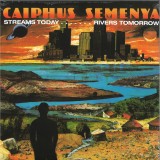
With Simon Francis handling the mastering of this Be With edition, you know it sounds as fantastic as ever. The stunning sleeve has been restored, with its painting of a dream-like cosmic vista, as a lone figure takes in a scene that’s part distant planet, part urban sprawl. One listen and you’ll be transported.
Caiphus Semenya, AKA Mr Letta Mbulu, is a South African legend and Streams Today… Rivers Tomorrow, his second solo LP, is perfect. A ten out-of ten album if ever we heard one. It’s also incredibly rare, especially in good condition, so Be With is delighted to present this reissue.
Originally released in 1984, Streams Today… Rivers Tomorrow is not just a musical masterpiece, it is also the soundtrack to the life of many South Africans - both then and now. Fusing the US-heavy sounds of boogie, disco and funk with Afrobeat and traditional African elements, it’s truly a spectacular listen. Jabu Nkosi handles keyboards on the album, with synths by Caiphus and Craig Harris. Sipho Gumede is on bass and Condry Ziqubu is on guitars.
One listen and you’ll be transported.
out of Stock
Last delivered 53 days ago available to reorder, subject to availability
Caiphus Semenya, AKA Mr Letta Mbulu, is a South African legend, and Listen To The Wind, his iconic debut album, is simply a superb modern-soul/boogie album. It’s also incredibly rare, especially in good condition, so Be With is delighted to present this reissue.
Now a revered composer, musician, and arranger, Caiphus left apartheid South Africa in the 60s for self-imposed exile in Southern California together with his wife, Letta Mbulu. Settling in Los Angeles he started working with the likes of Hugh Masekela and Miriam Makeba and other exiled and semi-exiled South african artists, as well as, of course, his wife Letta.
Caiphus also found himself working with and composing for a broad range of jazz and pop artists, including Lou Rawls, Nina Simone and Cannonball Adderley. His facility with both jazz and African forms served him well. His LA stay was also the beginning of an ongoing collaboration with Quincy Jones, the fruits of which can be tasted in Caiphus’s African compositions for the scores to Roots and Spielberg’s adaptation of The Color Purple.
Given his decades of work behind the scenes, it’s no surprise that it took until 1982 for Caiphus to get around to putting out the first album of his own. But all that experience shows. Listen To The Wind is a deeply impressive synthesis of early 80s US production and instrumentation together with his traditional South African musical roots.
It’s stylistically diverse but the ingredients are never diluted. There are elements of boogie, soul, funk and jazz, all shot through with pan-African flavour, and moving effortlessly from uptempo floor fillers to more meditative, slower soulful tracks. Produced by Caiphus himself, he makes full use of a stellar line up of session musicians including Nathan East, Michael Stanton, Sonny Burke and Paulinho DaCosta. And of course, there are Letta’s show-stopping vocals. To our ears, Listen To The Wind is just one big party, and lord knows we need that more than ever right now.
Opener “Angelina” is one of Caiphus’s most beloved tracks at Be With HQ. It’s a breezy, feel-good SA boogie-funk classic. Harmonic and horn heavy, it sounds as fresh today as it would’ve done in the early 80s. If this one doesn’t make you move, you may need your pulse taking. The drum breakdown alone, a little over halfway through, is sensational.
It’s followed by the gentle reggae lilt of “Play With Fire”. A real melodic slo-mo delight, carried by the tropical vibes and, above all else, by the extraordinary performance of Caiphus himself and his backing singers.
Closing out side one, the spectacular “Umoya” is driven by triumphant horns and slick bass. With its proto-Graceland vibes, we reckon Paul Simon must’ve been listening. Hard. Caiphus trades verses with the unmistakable tones of Letta, and it sounds divine. Yes, it’s as good as anything on Letta’s canonical In The Music… The Village Never Ends. A wide-eyed wonder, made for unity and togetherness, it’s all infectious, smiling faces for nearly nine minutes. But never mind nine, we could party to this for ninety minutes and “Umoya” would leave us re-energised for ninety more.
Elegantly firing up side two is perhaps the album’s best known track. “Without You” is a heavenly slice of modern soul, an end-of-nighter to end them all. Smooth strutting, disco-fied funk with that unmistakably South African sound, it’s just sublime, with those lyrics that keep coming back to smiling faces and community, “without You the sun won’t shine”. Big with the likes of Rush Hour’s Antal, this is aural perfection.
“Ziph’inkomo” is a soul-soothing, swooning epic. Gently building throughout, its final few minutes are genuinely stirring as the backing vocals and instrumentation swell. Jaw-dropping. The irresistible groove of frantic, percussive workout “Gumba Boogie” closes out what must surely be one of the greatest artistic statements of the 1980s. If his friend Quincy wasn’t feverishly taking notes for Thriller, then you could’ve fooled us.
With Simon Francis handling the mastering of this Be With edition, you know it sounds as fantastic as ever. The cover art, as breezy as the music, has been faithfully restored. All that’s missing is you.
out of Stock
Last delivered 5 years ago available to reorder, subject to availability
Faitiche presents a new album by Frank Bretschneider. abtasten_halten was made as part of the raster.labor installation first presented at CTM Festival in 2019. It is perhaps the most radical work in Bretschneider’s distinctive oeuvre: abtasten_halten is a self-generating composition for synthesizer modules whose sole sound source is the movement of two VU meter needles. The resulting percussive sounds coalesce into rhythmic combinations – all random, without repetition. The album resembles a meditation on infinite rhythmic variation. abtasten_halten is Frank Bretschneider’s first release on Faitiche.
One sound can give birth to thousands of tones through self-fertilization. Pierre Henry, 1982
Frank Bretschneider on abtasten_halten:
abtasten_halten (sample_hold) is a largely self-generating composition for a modular synthesizer system. Self-generating here means that as soon as a current flows, the various modules interact, but within limits set by the composer via the connections between the modules (patches): timing, tempo, timbres, dynamics. These conditions are kept variable to a certain extent or left to chance, so that the composition created is always similar but never the same. On the one hand, the use of random generators opens up possibilities that would not otherwise have been considered. On the other, it offers the fascination of the unfinished and the unique: totally unexpected musical events that you might hear only once.
abtasten_halten combines my preferences for percussive music in general and electronic music in particular. Largely avoiding repetitive structures, the piece is more like a free improvisation, quiet and diffuse, but also extremely dense, in ever-changing contrasts and transformations.
The tone generators are two modified VU meters whose needles, driven by trigger impulses, create a simple one-bar pattern by hitting against a metal spring that is connected to a piezo element (thanks to Gijs Gieskes / Gieskes.NL). The tempo is continuously varied over a period of about ten minutes by several mutually modulating LFOs, ranging from about 0.06 Hz up to the lower audio range of about 18Hz.
The percussive sounds thus obtained are then passed through low-pass filters with moderate resonance and random frequency modulation to additionally colour the sound. Further processing is then executed by an echo module whose tempo and repetitions are again determined by random parameters. Finally the audio signal is occasionally enriched with reverb to add more spaciousness to the sound.
The concept for the installation raster.labor was developed by Olaf Bender, Frank Bretschneider and David Letellier. Many thanks to raster - artistic platform.
On Frank Bretschneider:
Frank Bretschneider works as a musician, composer and video artist in Berlin, making mainly electronic work based on complex rhythmic structures and interlocking textures, whose many-layered sound is inspired by the experimental set-ups of modern physics, often supplemented by perfectly synchronized computer-generated visualizations. In 1986, he founded AG Geige, one of the most influential underground bands in East Germany. In 1996, he co-founded the label raster-noton and has since released many solo albums.
out of Stock
Last delivered 6 years ago available to reorder, subject to availability
Recorded a couple of years prior to Carl Holmes' legendary "Investigation No.1" album, this 45RPM single features Pervis Herder as vocalist on both sides. Original copies are pretty hard to find nowadays, especially in clean playing condition. We are extremely proud to release this legit repress, without a doubt one of the finest Philly funk/soul 45s ever released. 110% dance floor dynamite!
out of Stock
Last delivered 6 years ago available to reorder, subject to availability
"A Western Circular" is Will Archer’s debut under his new nom-de-plume, following early EP's- and an Album under the now-retired Slime moniker. Within ‘A Western Circular’ lies an exciting- and varied crew of guest artists including MF DOOM,Samuel T. Herring (Future Islands), Sudan Archives & Laura Groves, all contributing vocals to his rich, dexterous compositions!
An Album that’s been in the works for the past half-decade, ‘A Western Circular’ is a bold, reflective piece that directly relates to Archer’s personal experiences of life and death, centred on one particular week where they breathed with equal intensity. Ostensibly, it’s a poignant reflection on the duality of the human condition.
out of Stock
Last delivered 6 years ago available to reorder, subject to availability
Nina Simone was an exceptional artist. She was gifted with a precocious talent and she played music at home and in church. Nina originally counted on becoming the first black female classical pianist ; her plans were thwarted and that frustration no doubt permeated almost her entire career. Yet she became a diva capable of combining the jazz world with those of the classics and soul, and among other titles she recorded are some of the most vibrant and moving performances of Wild is the Wind or You Can Have Him, I don’t Want Him.
She was one of the greatest artists of her time, and her fervour and rigorous demands concerning the quality of her music took her to the highest summits, whether in her compositions or in her vocal and piano performances. For all that, she never forgot her condition as a black woman in the America of the Sixties, and her active commitment to defending the rights of the black minority was exemplary - and at times even excessive, for which she was often reproached.
She has left us some of the most beautiful chapters in jazz and soul music, among them the 23 titles that appear in this album.
out of Stock
Last delivered 6 years ago available to reorder, subject to availability
Calum Gunn has spent the past few years becoming a key figure in the European electronic avant-garde. As well as releasing his own music through labels like Entr'acte, FLUF and Tsuku Boshi, the Berlin-based Gunn also helms Conditional Records, one of the most forward-thinking computer-music imprints to emerge in recent times.
Gunn's Addenda EP, his debut drop for Central Processing Unit, contains some of his most dynamic work to date. While his commitment to experimentalism remains, these four tracks represent a clear shift in focus for Gunn - namely that, for perhaps the first time in his career, he is making music that is club-friendly. A whole host of dancefloor innovators are recalled when listening to Addenda - particularly Autechre, Analord-era AFX and several of Mark Pritchard's projects as well as Gunn's contemporaries Rian Treanor and Renick Bell.
These tracks never sit still, their rhythms constantly evolving and turning themselves over. Addenda's first two cuts use metronomic hi-hats to keep these ever-changing grooves in check. With its thwacking kicks and snares, opener 'Esephony' enters the fray with the heft of an early Wiley riddim. Atop these drums we find squeaky half-melodies interlocking and breaking apart, meaning that the overall effect is not dissimilar to the tweaking beats that Pritchard came up with as part of Africa Hitech. 'Esephony' is followed by 'Moebu', another track that harks to grime through its fluttering lead synth. The way that this single-note line snakes above a slow, steady drum pulse pitches 'Moebu' halfway between Last Japan and rRoxymore.
Gunn increases the tempo in Addenda's second half. 'Ternenmarz' introduces itself with more blarts of bass, but whereas these were steady on 'Esephony' they now jump around unexpectedly. Gunn holds the erratic kicks in place with twittering hats and snares - indeed, when you factor in its gnarly synth lines, 'Ternenmarz' steers closer than any other cut here to the high-grade electro drops that CPU has made its name with. Closer 'Pins' supercharges the snap of 'Esephony' to 145 bpm before Gunn softens up the track with reverb-drenched synths that nod to the sombre post-grime of Mr. Mitch's Gobstopper Records.
With the Addenda EP, Calum Gunn has achieved something that proves elusive to so many producers - making club tracks that are at once innovative and immediate, their experimental tendencies serving to elevate their dancefloor impact.
RIYL: Rian Treanor, Africa Hitech, Autechre, Renick Bell, Brainwaltzera
out of Stock
Last delivered 6 years ago available to reorder, subject to availability
'All Human - No Conditions" is the first solo EP by the French producer Itako. The opener "The Country That Does Not Exist" is a slow burning and bass-driven tune in which hypnotic synth and acid lines merge with North African vocal pieces. Thereafter, Itako shows with "Freehands Desire" his darker side. A mid-tempo composition with massive drum patterns and forward-moving melodies. On the flip side, "Groove That Dust" is screwing the tempo back down. Six minutes based on a 90s Hip-Hop sample with an irresistible groove where we assume no one can stand still. The release is rounded off with a remix by MR TC. The Glasgow based musician stretched "The Country That Does Not Exist" into a tribal workout with breaks in which he lets the machines speak for themselves.
out of Stock
Last delivered 3 years ago available to reorder, subject to availability
In opposite to other Nigerian acts which hardly got known beyond the borders of their homeland, BLO were always very popular in the Western world. Accompanying Ginger Baker of CREAM fame was the first step to break them into the western popular music market of the 70s and what followed could be called an African fairy tale.
Still this, their fifth album from 1979, waited a long time for a proper reissue, especially on hot black wax with originals in good conditions fetching prices of 300 € and more. For fans of 5th Dimension, The Temptations, Hot Chocolate, Earth, Wind & Fire. First ever and long overdue official reissue of this long lost Nigerian disco classic from 1979. Fifth album by one of The most outstanding Nigerian 70's afro beat acts.
out of Stock
Last delivered 6 years ago available to reorder, subject to availability
The 888 Miles E.P. includes two original tracks, 888 Miles and 777 Miles, which both develop a psychological tension that leads to moments of euphoric liberation where the synths soar and allow the mind the wander, accompanied by a rhythmic groove. There is a slightly different sensitivity between the two tracks that you'll can easlyer constat. Then, don't forget, even if the approach sounds different, the soul remains the same. The other original track, 000 Miles, places you on a spacecraft, with ambient musicality sounding like it could have been generated by hydraulic pipes or air conditioning. This E.P. release also includes '888 Miles XXX Reshape', a deep techno remix by none other than the awesome Francois X. He's probably the best person to describe it: "I've known David & Kevin (Klash Point duo) for a while now and when they suggested that I produce a remix for them, it was natural to say yes. It's funny how this piece of music saw the light, as it has a completely altered tone from the original. It's definitely one of my funkier tracks, with trippy and bluesy vibes - like a trip deep into the wild."
out of Stock
Last delivered 6 years ago available to reorder, subject to availability
I remember the first time I read W.E.B. DuBois eclectic masterpiece The Souls of Black Folk. The way in which this Weberian scholar flowed from personal account to prose to sociological analysis to music and even political intervention has had a lasting impact on my own work as a cultural anthropologist. It made me understand that as scholars we must use different means in order to give expression to the totality of the lived experience: There is only so much in an academic text.
The experience of alienation has always been at the heart of my scholarly and artistic practice. I have used academic writing, lecturing, theatre performance and electronic improvisation to understand and represent it as a theoretical concept, postcolonial condition and lived experience. I believe, some issues need to be told like a story, some analyzed in most abstract terms and others need to be sung like a gospel. The medium changes the message.
In this sense, I guess, I’m a singing cultural anthropologist.
For some time now I have been engaged in the use of dystopian themes and sounds to paint a sonic picture of structural racism and whiteness of our present. But recently I have grown weary of this Ballardian idea of Future Now and the resulting phantasmagorian aesthetics myself and others have been invested in. The widespread availability of Digital Audio Workstations, sequencers, loopers and delay pedals has lead us into a futuristic cul de sac best described by Mark Fisher as the very absence of future.
Likewise, I am most skeptical of the “naturalist” countermovement, the return of folk. Especially in Germany, I am convinced there is no such thing as an innocent or progressive folk musical expression as it is always connected to the idea of the homeland (“Heimat”) which in turn produces the colony. It seems to me, the current zeitgeist is stuck between a “museum of a dystopian future” and a “museum of an idealized past”, but I wanted to sing about the present.
So, I involuntarily returned to pop music in its two-folded meaning of something popular and addressing not an essentialist notion of “Volk” or its woke cousin “communities”, but society as a whole.
I entered the studio just with a few lo-fi sounding melodies and rhythms from my circuit bent CASIO synthesizer. I had no clue what the finished product would sound like. But as soon as Markus started drumming, in a way strangely reminding me of CAN’s Ethnographic Forgery Series, my uptight sounds were suddenly embedded within a warmer global sound spectrum. The alien at home and abroad and the strange overlapped: We were seeing one and the same sound differently but were gently held together by Tobias’ producing.
Making music is about building coalitions. It’s about suggesting an articulation of styles, sounds and people, that hasn’t materialized, yet, but may help us in the current crisis: I wanted Amon Düül II to send their drug induced archangel thunderbird to rescue the refugees, that had tried to escape the police by climbing up a tree in Munich in 2016. I wanted Sun Ra to taunt far-right protesters in Chemnitz in 2018. And I wanted to mourn the loss of a former kebab shop cum discotheque that served as proof that there is such a thing as a minoritarian universalism.
SCHLAND IS THE PLACE FOR ME is a pop album featuring songs of alienation, not only as a tragic experience, but as a pop-cultural promise. Maybe Bill Callahan sung it best, “I am Star Wars today, I am no longer English grey”. I want those who suffer from alienation to stand in alliance with those who seek alienation, and vice-versa. A coalition, that tolerates the possibility that we are moved by the same groove for contrary reasons.
Fehler Kuti
Munich, Autumn 2019
Music by Julian Warner, Markus Acher & Tobias Siegert
Saxophone on RINDERMARKT by Franz Brunner
Trombone on RINDERMARKT and IL by Matthias Götz
Recorded and mixed by Tobias Siegert in Munich.
SONTAGSFAVORIT mixed by Dario Albiez in Dusseldorf.
Mastered by Duphonic in Augsburg.
Artwork by Atelier Grande, Munich.
out of Stock
Last delivered 5 years ago available to reorder, subject to availability
For this ninth EP and special "10 Years De:tuned" emission we dig deep into Atypic's, better known as Andy and Ed from Plaid, archives for a couple of rare and previously unreleased tracks written in 1992. On offer two mighty lost classics gradually building into a fallout of immense, beautiful proportions produced by one of the most interesting electronic duos of the 90's and modern times.
Kevin Foakes (Openmind, DJ Food, Ninja Tune) created all the graphic work. Mastered by Matt Colton at Alchemy Mastering. This 12" is pressed on 180 gr vinyl and 1 track per side to transfer the rough DAT sound at best condition. A separate digital version will be available from the usual digital shops. Stay tuned!
out of Stock
Last delivered 6 years ago available to reorder, subject to availability
Klein's offbeat singular vision continues to defy classification. Her acclaimed, self-released records – Lagata, Only and CC – along with Tommy for Hyperdub and her theatre musical Care, have allowed glimpses into Klein's uniquely spirally perspective on vocal abstraction, disarming experimentalism and pop culture wonderment. Yet these chapters have also served as masks to conceal the artist's own personal crises of self-belief, misrepresentation and belonging.
An 18-month writing process led to her new album Lifetime. It's an unexpectedly literal body of work which Klein compares to "giving someone your diary." Lifetime embraces the inevitable cycles of existence, phasing through moments of brutality, vulnerability, estrangement and unexpected fortitude. Lifetime embraces the inevitable cycles of existence, phasing through moments of brutality, vulnerability, estrangement and unexpected fortitude. Every sound in Lifetime is intentional, every influence—from 'King of Gospel Music' composer James Cleveland, to early 18th century tonalities in the b side, the work of 'race film' pioneer Spencer Williams, the residue of the religious experience is deeply personal. The 12 songs of the album are pieced together like a puzzle; seamless transitions connect each of its compositions in a reverse chronology, while every chord from every song is echoed someplace else.
What's been hinted at in Klein's live performances is now realised in full for Lifetime. Less vocal work allows her to be even more expressive, and in eschewing a tendency towards brief, truncated sketches, each song serves as its own long conversational piece, committed to realities of a lived experience. The artist who once grappled with self-doubt has set about breaking the cycle of insecurity for others like her, while mindfully chipping away at the conventions of classical music.
Like its artwork, Lifetime addresses intersecting life cycles: the inner and outer selves, hypermodernity versus history, living nightmares and dream states, while seeking the light and darkness in both. Part 1 opens with unmistakable Klein flourishes on the title track. Gusty pads, anxious, frayed-edge static arcs, and craters of deep negative space, all of which melt down to the clean slate of "Claim It," which is a tribute to embracing one's own blessings. "Listen And See As They Take" and "Silent" form their own microcosm, as the sound of crackling kindling burns backwards into imposing structures of distorted strings and disembodied marching drums, before returning to heat and ash again. "For What Worth", in collaboration with sound artist and saxophonist Matana Roberts, explores the kinship between two artists whose shared exploration of lineage leads them both toward uncharacteristically sweet clarity.
Part 2 is further steeped in black expressive styles of the past. "Enough is enough" links the Lifetime narrative to the broader diasporic black experience, inhabiting every chamber of a harmonica with ghostly notes of the present and past, as fragmented gospel chords reflect spiritual bonds between self and the divine. "We Are Almost There" begins the journey with nothing but the looped structures of multitude of voices. The drums and dischord of "Never Will I Disobey" wordlessly create the conditions for "Honour," a near 10-minute composition where crossed boundaries and crossed wires are exposed in real time, and sharp expressions of hurtfulness, accountability and corrupted expectations are rendered beautiful in representational form, via sustained synth tones which hum, jab and flit in natural disharmony. The interlude "Camelot Is Coming" draws on the choir tradition to prelude the spoken word recounts the cycles of trauma and death that form "99." Lifetime closes with the dystopian swirl of "Protect My Blood" a composition which details an excruciating rift, before blooming into serenity as it draws to a close.
Klein's Lifetime is laid bare, from the end to the beginning, and cycled over again. From her place within her family, to their place within her, to viewing the fragility of culture through the lens of memory. It's a lifetime, an embodiment of young livelihood, and an end as much it is a beginning.
out of Stock
Last delivered 6 years ago available to reorder, subject to availability
In early 2018, Jas Shaw, one half of Simian Mobile Disco was diagnosed with a rare health condition – AL amyloidosis – a disorder of bone marrow cells. Having just completed SMD’s 7th studio album Murmurations and with a special show at the Barbican scheduled for April, things were thrown into confusion. At the time, no one, including Shaw, knew how the prognosis would pan out. Jas had to start chemotherapy almost immediately, which meant cancelling the tour. The duo decided to go ahead with the Barbican show in spite of Shaw’s illness, which was especially poignant as all involved knew it could potentially be SMD’s last ever live performance – in the end it turned out to be a tour-de-force. If this was SMD’s swansong, so be it.
In the year that followed, Jas spent months receiving weekly chemotherapy, learning to live with his condition, and when he felt well enough, spending hours in his studio making music.
The result of this was twofold, firstly a collaborative album with Derwin Dicker (Gold Panda), released as Selling – On Reflection, on City Slang Records Secondly, a growing archive of solo work, which is now ready for release. Entitled “The Exquisite Cops”, this 20+ track growing body of work will see the light of day via SMD’s Delicacies label – with a 2-track single released every fortnight /month and a limited
edition double LP scheduled for 27th September.
At the end of 2018 a difficult year was capped with hopeful news. With his condition in remission, able to stop chemotherapy Jas is able to start DJing and playing live again.
Jas: “The Exquisite Cops tracks seem to have made their own system for creation. Normally I record electronic music like a band would, as a take. So, it’s kind of surprising to me that that this batch of tracks wasn’t made this way. Instead of a single take that gets edited and developed these tracks were all made in bits, usually months apart. Some days I’d make a drum track, often editing it down so that it’s some sort of semblance of a structure; on other days I’d end up just making a synth sound or texture. This wasn’t something that I gave into reluctantly, it’s nice to be able to give a feedback based pad your whole attention rather than just set it up and only attend to it if it gets really out of hand.
The process of matching these misfits together was originally born out of laziness, rather than break open the synths to make something to develop an idea, what if I could just use something that I already had; slack. The interesting thing was that in pulling two takes together that were done months apart, they cast each other in a different light and though sometimes making them fit together was a hatchet job, sometimes they locked up together in an improbable way, making the rough structures that I’d improvised make a different sort of sense; often a more interesting sort of sense.
The more I did this the more it felt like this was not just a slacker’s way to use up offcuts, this resulted in combinations that I’d probably not have chosen if I’d done the tracks in one go. Also, and I know this isn’t something that’s important to everyone, there was a level of fastidious detail that I’d never have got if I’d had the textural and rhythmic elements playing together. It’s a longwinded process but it’s changed how I record and how I think about recordings I’ve made; plus I enjoy all parts of it so why cut it short?”
out of Stock
Last delivered 7 years ago available to reorder, subject to availability
SNTS presents the last part of his double trilogy, this time called SCENE III. SNTS wanted to obtain a different view of one of the tracks of this release, and, in order to achieve that, he introduced a big star of the techno scene to this story, that artist is SHIFTED. Anonymity remains the centerpiece of SNTS. To convey feelings and sensations without a face reference or a name is the key point of this mysterious artist. This time the titles of the tracks refer to dates. You may never discover what events those dates belong to, but perhaps we can decipher something through sounds and their path. 20.01.1944 It reminds us of a battle in an eerie and desolate terrain in which each sound makes you move, observing what is happening around you. 20.01.1944 The version from SHIFTED is the story told from the outside of the bipolar world where is SNTS. 07.09.1981 It is a step in the course of a life that accompanies an atmosphere that breathes, but is not noticeable by other senses. 15.04.1946 Destruction, desolation and despair is reflected in this track. It definitely meets all the conditions to describe SNTS' sound.
Played & Supported by:
Planetary Assault Systems, Paula Temple, Svreca, Takaaki Itoh, James Ruskin, Tommy Four Seven, Ryuj Takeuchi, Giorgio Gligli, Speedy J, Ancient Methods, Terence Fixmer, Cio D'or , Eomac, Milton Bradley, Samuli Kemppi, Dj Emerson, Chris Liebing, Par Grindvik, Ø Phase, Kr!z Token, Zadig, Marcel Dettmann, Answer Code Request, Slam, Norman Nodge, Dave Miller, Deepbass, Nihad Tule, Truncate, Dj Hyperactive, Angel Molina, Ben Gibson, Juho Kusti, Claudio PRC, Bas Mooy, J. Tijn, Manni Dee, Donor, Rebekah, Go Hiyama, Francois X, Adriana Lopez, Electric Indigo, Bleak, Inigo Kennedy, Pfirter, Alex.Do, Eric Cloutier.
“Built By Humanoid” is Humanoid's second album, a mere 30 years after the debut, though Brian Dougans claims the first album wasn't really him anyway.
Humanoid's classic acid house single, ‘Stakker Humanoid’, highly regarded as one of the key tracks from the era (Richard James (Aphex Twin) sights the Stakker project as a major influence), enjoyed massive success in 1988. Reaching No.1 for 5 weeks in the UK dance charts, performances on Top of the Pops, a John Peel session for the BBC and European tours eventually led to an album deal.
Whilst all this was happening, Brian Dougans (one half of electronic legends Future Sound of London) claims he was returning to his squat in Kings Cross with no electricity or water. He not only became disillusioned with the business, but also became increasingly ill from the conditions he was living in. Around 6 tracks into the album, he left London and record label, Streetsounds, returning to Manchester to recover and regroup his thoughts. However, Steetsounds pressed ahead with the album and it was finished in Brian’s absence with guest performers.
Brian left Humanoid behind and went on to create FSOL with Gaz Cobain becoming leading lights in the burgeoning ambient scene, scoring a top 10 album "Lifeforms" on Virgin Records.
In 2003 Rephlex (Aphex Twin’s label) released a posthumous album of 1988 out takes compiled by Brian.
Recently Humanoid tracks have been popping up on modern compilation albums (Touched Music / Gasman, etc) signalling a possible return.
“Built by Humanoid” is a brand new nine track album of future acid cuts, breaks and electronics, a lot of which is credited to 2 synthesisers co-designed by Brian Dougans and English Electronics company Digitana. It is this innovation that has helped usher Humanoid back into the limelight and consequently the album has a rather new and unique sound and style.
The track ‘Polymath’ is created using a possibility / probability theory that results in a track which at no point repeats itself - 303 tinged acidic bubbles. Meanwhile ‘Traktion’ is a break beat, pulse laden, bass heavy monster. ‘Fu*k It’ is the future sound of 303. Fast, frantic and beat driven. Whilst ‘Post Humans’ combines thumping 909 and 303 into an acid hallucination.
out of Stock
Last delivered 7 years ago available to reorder, subject to availability
Independent record label YGAM presents "Les Bergers du Galetas", Magnétisme Animal's debut EP, in which they share their intimate view of society. Formed by brg and Catartsis, the French duo invites the listeners to dive into a journey through the density of the modern metropolis. In a time of materialistic fetishism, where superficial occurrences and capitalism rule, the 4-track EP acts in opposition to these current matters. However, rather than trying to create a contrasting sonic landscape, Magnétisme Animal use sounds recorded in their environment to elaborate pieces that bear the heavy and frenetic industrial atmosphere of our urban sceneries. All sorts of clanging metal, steam discharge, electromagnetic static noise, train rails frictions, sirens and distant traffic, are combined with breathing, footsteps and vocal humming to create an oddly industrial as much as organic soundscape. The EP starts with a noise track that recalls some of the compositional processes of musique concrète, to then slowly drifts towards rhythmically oriented pieces. "Être c’est être coincé", with its ponderous bass and distortion work, appears as a peculiar blending of noise and techno, while "L’Enthousiasme des statues" displays a more traditional and dance floor approach to rhythm and drums, but still leaves space for an uncanny sound decor to unfold. The project ends with "La Toute-Toute", a repetitive ambient track filled with subtle sounds, where one can wander as spoken words underline a sense of melancholy. "Les Bergers du Galetas" is an unsettling industrial tapestry, a strange study of noises, that depicts the contemporary frenzy of the artists’ environments they referred to as the urban jungle. A landscape where one is a witness of the disparity of human conditions, where mind and body coexist with difficulty, where one is subject to conformism, where one is lost in the smog while carried by the masses through the cemented maze.
out of Stock
Last delivered 3 years ago available to reorder, subject to availability
Originally released as a Paddy McAloon solo album in 2003 and now fully remastered. A 9 song CD and double LP (1 side is etched) which includes several instrumental tracks including a 22 minute title track. Features new artwork and liner notes written by Paddy McAloon. The album was conceived and recorded after Paddy was diagnosed with a medical condition that dramatically affected his vision and has become regarded as one of the great lost classic records. Ads, features, interviews and reviews across all press. Radio support across 6Music, R2, Absolute and ILR network. Online/social media activity. Poster campaign and database mailout.
out of Stock
Last delivered 4 years ago available to reorder, subject to availability
Khaliphonic 11 Is A Truly Epic Release From One Of Our Most Prolific Artists, Brendon Moeller Aka Echologist, Aka Beat Pharmacy. In Just The Last Two Years, Moeller Has Released On Labels As Varied As Echocord, Silent Season, Kynant, And Rohs!, To Name Only The Most Well-known. Recognized Globally For A Singularly Organic And Dubwise Approach To Techno, We Are Proud To Have A Close Working Relationship With An Artist Who Coaxes Humanity And Warmth From Machines Like Few Others. The Dub Purpose Ep Is One Of His Finest Achievements.
As We Planned A Third Zamzam Release From Our Favorite Well Of Hardware Sonics, Four Tracks Emerged As Comprising A Set That Simply Did Not Want To Be Separated. The Four Tunes That Make Up This Ep Felt Like Chapters In A Single Gorgeous Narrative, And So A 12' Was Born.
We Asked Brendon How Dub Influences His Process, And What This Ep Specifically Is About. He Replied:
"dub Facilitates Whatever Vision I Have With Music, Which Is One Of The Reasons I Incorporate A Dub Approach In Everything I Do. Whether Infusing Nyabinghi Rhythms With Epic Strings, Roots Dub With Industrial Dread Or Grungy Modular Antics With Stepping Vibes, Dub Is The Glue That Keeps It Together. The Inspiration Behind These Tracks Are On-u Sound, Wordsound And Bill Laswell, Travellers Who Understood The Possibilities Of Dub."
The Dub Purpose Ep Does In Four Tunes What Many Lps Struggle To Do In Eight - It Builds A Cohesive Narrative Arc That Moves From Menace, To Exploration, Through Mystery, Closing With Beauty. And Just Wait Til You Hear It On A Proper Sound...
Third LP of Cabaret Contemporain, French band (featuring Fabrizio Rat on keys) who use acoustic instruments (piano, guitar, bass, drums, contrabass) to produce a « hand-crafted » club music infused with techno. Inspired by Jeff Mills, Robert Hood or Drexciya, the five members already had a career on classical scene; their idea is not to replay classical techno tunes but to create a new path for the electronic music. 2 tracks featuring with the label boss, Arnaud Rebotini.
« Ballaro », which opens Cabaret Contemporain's third album, begins with light percussions, which seem to turn on themselves, while being conveyed by reverberations close to dub. After a few minutes of convolutions, the piece gets out of hand, transporting the listener into a rich form of pulsating trance, irrigated by a soaring melody and punctuated by persistent piano tones. « La selva »; more subdued, has the same energy, the track ending in an even more powerful way, a kind of paroxysm.
Finally, the strangest and most minimal « Cactus », features a singular groove, which evokes the most brutal house from Chicago, or the sometimes obsessive techno from Detroit. Just like other tracks such as « Transistor » or « TGV », fuelled by sweat and trance, Séquence Collective bears all the intensity of a techno cut for clubs' dancefloors. The only difference being that their music is not played with synths, drum machines or software, but with acoustic instruments. Dual curriculum The band is composed of five musicians and a sound engineer: Fabrizio Rat on piano, Giani Caserotto on guitar, Julien Loutelier on drums, Ronan Courty and Simon Drappier on double bass and of course Pierre Favrez on console. They are all in their thirties and met at the prestigious Paris Conservatoire in the late 2000s. However, all the musicians in the band have a double curriculum and navigate freely between the institutional realm and the underground or pop music scenes. Through classical or contemporary music, jazz and improvisation, rock and experimentation, they share a common passion for the original and futuristic techno of the 1990s, that of Jeff Mills, Robert Hood or Drexciya, which they have decided to reinvent and further in their own way. Not as a simple stylistic exercise practiced by virtuoso musicians, but rather as a new path for modern music, and for their generation. « The original idea » they say, « was to make club music by hand, like craftsmen. Like in the early days of jazz, our band managed to transform itself into a kind of dancing machine. Our music is therefore functional because it is danceable, but also mental and abstract, while offering several layers of listening. You can dance and play, have a purely physical and sensory connection to the music. But you can also immerse yourself in its listening, perceive refined harmonies or more complex rhythmic superpositions »
If the tones of Cabaret Contemporain are truly unique it is because each member of the band has developed a very personal approach through the use ''prepared'' instruments. The strings of their piano, guitar or double bass may recall strange machines with literally incredible sounds, obtained using objects such as chopsticks, clothes pegs, foil, hangers, a tiny pie mould or many other utensils from a DIY store. A collective energy
Cabaret Contemporain is first and foremost a live band that has been performing in venues and festivals since its inception in 2012 (Nuits Sonores, Siestes Electroniques, L'Aéronef, Le Trabendo, Philharmonie de Paris, Gaîté Lyrique, Rewire, Dancity, Barcelona Accio Musical...), both at traditional jazz and contemporary music venues, and more often at electro music hubs. When facing the audience, the band, which plays each of its sets in one go, without a break, shows an intense physical presence, which competes with the musical power of DJs who share the stage with them. Their performance, full of tension and repetition, which requires maximum concentration and a state close to trance from the musicians, is sometimes, according to them, « a mental journey and a mystic experience ». A dimension that brings to mind the historical techno culture and its dancers who, communicating on the dancefloor, were carried until the early hours of the morning by the power of the beat. An album inspired by the stage Since their beginnings, their compositions on record have drawn their energy directly from the practice of their concerts, whether referring to Terry Riley (2014) or Moondog (2015), an EP and an album dedicated to the repertoire of the two American artists, the original compositions of Cabaret Contemporain (2016) and Satellite EP (2017), as well as this new album. Séquence collective can be listened to as a condensed transcription of their inventions and their live experiments. The tracks, more than half of which were improvised during sessions held in the former Vogue studios near Paris, were recorded in live conditions, « like an old school rock band » they say. As usual, they invited a new musician to join them in the studio. After collaborating with Étienne Jaumet or Château-Flight, Arnaud Rebotini, César winner for best film music, added a welcome synth touch on two tracks (Pro- One, Prophet 600), which boosted the group's formidable collective energy. The album ends with « October Glide », again performed with Rebotini, a lyrical and lively track, built on a powerful and slow progression of timbres and percussions, which would ideally find its place at the core of a techno party « peak time »
The sensational contribution of the Roman project Fire at work, risen over the millennium end, delivers the next 12 release of the label.
The sounds and visions of the two producers are coming directly from the most radical electronic counterculture's pot, the industrial dimension and the radical sound choice seem to be the best and right way to tell the story of a dystopian reality, a meaningful choice useful to criticise humans and their civilisation. The complex of the Fire At Work production represents an act of cultural resistance, therefore Monolith Records seems to be the right and natural follow up of a long multidisciplinary journey. This release is the meeting point of two generations sharing a similar electronic countercultural background, in the middle of the ruins of a modern world which is nothing but a ripped-off planet, a consumed scenario where the radicalisation of the exclusivity leads the beings to the recurring Post-humanistic alienation. The music journey develops through cuts deliberately violating the borders of genre and style, leaving to the dark decaying soundscapes the duty to shape coherence. The overall dimension of this work floats in a tension between the mental form of the synths and the implacability of the concrete drumming asset, that alternates straight and broken beats merged by the same obsessive character. In order to consistently remark the intention behind the production, the Remix by hypnoskull for 'Re_Sample The Future', a tool shaped by an heavy distorted timber that brings lyrics to clarify the common denominator of the EP: a totalitarian vision of reality involving the rejection of the status quo, together with the roles and the scopes of a totally dehumanised system. The 2.0 Man is unarmed and similar to a cadaver, and his desires and senses are reconciled by a perpetual stream of information, a data replacement of reality. The one way direction streaming can be interrupted by noise, as the element able to distort meaning the unexpected element occurring in the middle between the matrix of the message ed his audience. Given such conditions the style choice becomes part of the concept itself, and it is far from any kind of 'induced' choice.
There are still precious few women at the helm of record labels, let alone Indian women, but Vinita stands out as a proud anomaly... a champion of the underdog, an underdog herself, a surrogate mother to unsung musicians, a relentless workerbee, a fan, a carer, a catalyst...' (Richard Milward, from the Rocket Girl 20 book)
2018 marked the 20th anniversary of Rocket Girl, one of the most eclectic and resilient small independent labels in the UK, steered single-handedly by Vinita Joshi. To celebrate this milestone, in March 2019 Rocket Girl will release a very special collection of music and literature, comprising a 16-track CD compilation of Vinita's artists past and present, a collectable 7' and flexi disc, exclusive Anthony Ausgang print, full 20 track download, plus a strikingly illustrated 70-page hardback book uncovering the history of the label.
Based on extensive interviews with Vinita, with contributions from many of her bands (Füxa, God is an Astronaut, Coldharbourstores, Pieter Nooten), the book's text is written by Faber author and long-time Rocket Girl supporter Richard Milward. Beginning with Vinita's formative years in Rugby in the 1970s and 1980s, the story covers not only the eventful history of Rocket Girl but also Vinita's teenage initiation into the music industry: managing The Telescopes, founding Ché with Nick Allport out of the ashes of Cheree, before finally going it alone and setting up her own label in 1998. It is both an inspiring and bittersweet tale. Vinita's staying power alone in such a challenging industry is worthy of its own tribute: she has built a record label on her own terms from scratch, she has overcome the loss of loved ones, survived a breakdown at the height of her label's popularity, and all in all her immense love of music, her strength and positivity in the face of adversity blazes throughout the book. Along the way we learn of the hits (and why Kurt Heasley's vocal cords seemed to be malfunctioning during the Lilys' Top of the Pops appearance), the near-misses (including a never-before-seen letter from Richey Edwards of the Manic Street Preachers), the triumph of Vinita's first self-released LP A Tribute to Spacemen 3, her heartbreak losing Jason DiEmilio of The Azusa Plane in 2006, plus sad revelations concerning Television Personalities' Daniel Treacy's condition following his brain trauma in 2011...
Regular Rocket Girl designer Xiaofei Zhang has been given access to Vinita's vast collection of personal photographs, letters, flyers, press clippings and other keepsakes, arranging these alongside the text to give the book the feel of a technicolour scrapbook, a vivid chronicle of indie music past, present and future.
As Milward writes: 'The artists Vinita has worked with over the years are undisputed luminaries of alternative music, and stand up to any major indie label's roster: Spacemen 3, The Telescopes, Bark Psychosis, Disco Inferno, Lilys, Low, Bardo Pond, Mogwai, Cocteau Twins' Robin Guthrie, My Bloody Valentine's Kevin Shields, Patti Smith, Jonathan Richman, Television Personalities, to name just a handful.' Likewise, the artists featured on the accompanying CD compilation reveal just how far-ranging Vinita's taste is, and how loyal her bands have been to her over the years. The disc opens with a special 'Rocket mix' of Silver Apples' 'Susie' - the band that adorned the A-side of rgirl1, the label's first 7'. From here, there are cuts from Rocket Girl stalwarts like Füxa and Bell Gardens, as well as tracks contributed by friends and supporters of the label, such as Andrew Weatherall and Mogwai. Arguably the most notable track (certainly the most poignant) is the Television Personalities' 'All Coming Back', one of just a few unreleased songs recorded before Treacy's accident, and released here with Daniel's sister's blessing.
Vinita began her career selling Loop/Telescopes flexi discs on New Year's Eve 1988 and, in homage to this bygone format, she has included a 7' flexi (featuring 'Fight For Work', an outtake from Mogwai's most recent LP, Every Country's Sun) as well as a standard 7' bringing together rare tracks from two Philadelphia bands she has championed since their formation: Bardo Pond and The Azusa Plane. The three discs are housed in pockets found in the book's inside covers, and there are yet more gifts: an exclusive print by Anthony Ausgang (the instantly recognisable artist behind MGMT's Congratulations and Füxa's Electric Sound of Summer covers), plus a free download code for all tracks featured across the various formats of the collection.
Vinita's story is anything but ordinary, and this extraordinary collection is the most fitting tribute to the label's legacy so far: a treasure trove of rare tracks and unheard stories for Rocket Girl devotees, a comprehensive introduction to the label for the uninitiated, and both an inspirational chronicle and cautionary tale for anybody interested in the history of British independent music in the past thirty years...
After prominent releases on Rekids, Classic or Copie Blanche, one of the most promising french young house music talent Armless Kid is joining the VERTV family for his new EP : Choices.As a Millennial, questioning his own condition of young adult, the 24 years old producer explores the themes that strike his generation like love through the digital age (Internet love), the pursuit of a meaningful life and the need of affirmation through vigorous choices while options are abundant. Melancholia is one of the consequences of this quests (Flirting With Regrets) but it also gives a compelling desire to enjoy life to the fullest (Deep Energy) even if it means eating junk food and watching silly VOD with friends (B3A).This EP is good example of Armless Kid's music, catchy, fun and elegant with strong roots into the very French tradition of jazz-infused House music as well as bringing his very own twist on 90s influenced deep house thanks to his massive kick drums and sophisticated pads.
"I love you" is arguably one of the best obscure soul ballads out there. The highly anticipated re-release of this rare and collectable 45 is another collaboration with my good friend Brian Sears, Brooklyn based collector/researcher. Hailing from Dallas, Willie Griffin is a self-taught guitarist and singer-songwriter with a very unique style, which is on full display on both sides of this record. Although "I Love You" has long been a favorite among ballad collectors, do not sleep on "Where There's Smoke, There's Fire". For this limited release we were ecstatic to uncover the original master tape from 1984, in pristine condition, yielding the perfect reproduction. We hope you enjoy this special record.
out of Stock
Last delivered 6 years ago available to reorder, subject to availability
Ever since Onom Agemo & The Disco Jumpers broke the dreaded curse of the difficult second album by releasing "Liquid Love", a cocktail so spicy and delectable that it could warm the cockles of the grumpiest man alive's heart, even in the most Arctic conditions, everybody wondered how the Onom crew could top that one. But now you have an opportunity to whip out your "Magic Polaroid" as proof that this wasn't an impossible Project. Never before has the band so successfully captured their full-on live sound as they do here, thanks to three days of recording frenzy at Daniel Nentwig and Sebastian Maschat's Butterama studio, a haven of analog hardware hidden in a remote part of Berlin's Neukölln district. The exploding kaleidoscope of styles that make up this album, perfectly reflected by the stunning cover artwork from Nick Henderson and photography by Christoph Rothmeier, means that they can no longer be confined to their early description as an "Afro-Funk Quintet" or merely described as a lively tribute to the artists which have influenced them: their sound is 100 per cent pure uncut Onom Agemo, even though every track feels like a new beginning. The presence of a charismatic in-house vocalist who brought her own lyrics along has also boosted their confidence considerably and provided a further knock-out punch to their onstage performances.
And no one will be disappointed as soon as the first bars of "The Trumpets Of Denmark" stomp on stage like a boisterous fanfare, with Johannes Schleiermacher's impressive wall of sound production making the musicians sound like a much bigger band than what their line-up suggests (with Maria Schneider from Andromeda Mega Express Orchestra adding some extra percussive clout) and just the right amount of dizzying cross-rhythms to steer it away from potential bombast. When Onom Agemo's powerhouse vocalist Natalie Greffel starts chanting what at first sounds like a string of Onomatopoeia, it soon becomes clear that she's laying down her manifesto for a nostalgic Space-Age yet to come, with a few key words serving as Mantra (Focus, patience, tears and creation): an invitation to drive off the Information Superhighway and its endless litany of polite noises, to redirect our gaze inside ourselves and learn to understand and sometimes question how others perceive us.
With her debut album Self Fulfilling Prophecy, released by InFiné last June, the French producer closed the loop on the first sequence of her life. A sequence filled with transformations, encounters and collaborations: her successive moves to Montréal and Berlin (where she was closely involved with feminist activism), and her foundational residency at Detroit's Underground Resistance, among others, informed her authentic, global-minded techno aesthetic. The aptly-named Self Fulfilling Prophecy is thus the honest expression of a artist who has found herself at the center of techno activism, an eloquent testimonial to 'how today's electronic is made.' With the necessary hindsight and application, La Fraicheur has created an opus that blends raging techno with more atmospheric moments. An opus that is now being reviewed in light of the electronic scene's main pillar: the dancefloor. 'Self Fulfilling Prophecy remixes' recasts in vinyl version the Techno esprit of La Fraicheur´s original album with four reworks, which condition the dancers to unstoppable footwork as much as they open the listeners 'minds up. On the A-side, an activist of the Polish scene, VTSS is a leading figure in the protest against conservatism, racism and ambient homophobia and one of the founders of the Brutaz parties in Warsaw. She rocks 'Eau Troubles' in an 'industrial' soundscape, as disturbing as fascinating