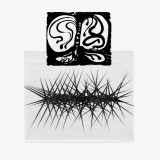
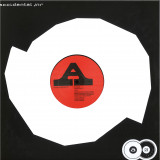
WE ARE WINTER'S BLUE AND RADIANT CHILDREN (WAWBARC) is the new quartet of Mat Ball (BIG|BRAVE), Efrim Manuel Menuck (Godspeed You! Black Emperor, Thee Silver Mt. Zion), and Jonathan Downs and Patch (both Ada). On "NO MORE APOCALYPSE FATHER" they present six modal lullabies drenched in seared distortion, slathered across striding electronic pulses. Ball and Menuck began creating music in and for the bleakest moments of Montréal winters: "We're honoring that idea of winter, when you come inside and your house is warm, a place that only exists because of how cold it is outside," says Menuck. They later recruited Downs and Patch to flesh out their initial ideas. Menuck met them in 2015 when recording Ada's final album at Montréal's Hotel2Tango _ where they reconvened to make this record. "NO MORE APOCALYPSE FATHER" is an album about witnessing bleakness from a place of safety. Carrying newfound descriptive depth, thanks to the quartet's open-ended songs freeing him from writing in meter, Menuck likens his lyrics to photorealism. On opener `Rats and Roses' he sings of an unnamed city struck by an unknown cataclysm, but the details are local: specifically, his neighbors inadvertently poisoning birds when tackling a rat infestation. It's backed by blown out synths and guitars reaching a soaring crescendo. "Seeing things from a distance and not being able to intervene happens a lot on the record," Menuck explains. "If you're a feeling and thinking person, that's just part of the human condition. We watch horror unfolding from afar, unable to do anything concrete to change it." A powerless witness, able to describe but not intervene. `Dangling Blanket From A Balcony (White Phosphorous)' references Michael Jackson holding his child over a hotel balcony in 2002_the bizarre media spectacle still lodged in Menuck's psyche. This and the album's closing track also elegize white phosphorous, a technology of war designed to light up battlefields but capable of inflicting horrific burns on those it touches. Illumination and horror in one, here underpinning scenes picturesque and terrifying. "The last song `(Goodnight) White Phosphorous' is deliberately like a lullaby," says Menuck. "Written from the viewpoint of watching white phosphorous falling outside your window." Scorched and tarnished and laden with harrowing imagery, "NO MORE APOCALYPSE FATHER" is also a record bathed in light: the bewilderment of hopeful spirits witnessing despair, watching a blizzard of distress unfold outside from a place of relative shelter and comfort. You could call that emotional ambivalence, maybe numbness. But those words are too passive for the weight of conflicted feeling resonating through the album. "I never know how I feel on an overcast day when the sun is still bright despite the grayness and the light is very flat. The colours become more saturated, and you see a single flower, say a morning glory, whose colour is so vibrant beneath the gray, I don't know if that's a lovely sensation or a terrible sensation. It's both," says Menuck.
Suche:d technology
- Call Of The Champions (The Official Theme Of The 2002 Olympic Winter Games)
- Immigration And Building
- The Country At War
- Popular Entertainment
- Arts And Sports
- Civil Rights And The Women's Movement
- Flight And Technology
- Song For World Peace
- Jubilee 350
- The Mission Theme (Theme For Nbc News)
- For New York (Variations On Themes Of Leonard Bernstein)
- Sound The Bells!
- Hymn To New England
- Celebrate Discovery
- Summon The Heroes (Written For The Centennial Celebration Of The Modern Olympic Games, Atlanta, Georgia, July 19, 1996)
"Call Of The Champions is an album by legendary American composer John Williams. The piece of the same name was composed by Williams especially for the Olympic Winter Games of 2002 in Salt Lake City. It is the opening track of this album which features over a dozen original tracks by Williams, plus an additional bonus track: ""Summon The Heroes"", the anthem written for the 1996 Olympic Summer Games in Atlanta. The album also features ""American Journey""; a six-part orchestral composition by Williams that was commissioned by U.S. President Bill Clinton for the 2000 Millenium celebrations in Washington D.C. ""American Journey"" is presented for the first time as a complete concert work on this album.
This album features The Mormon Tabernacle Choir, the Utah Symphony, The Boston Pops Orchestra and the Recording Arts Orchestra of Los Angeles. The album was released as An American Journey in the United States.
Call Of The Champions is available for the first time on vinyl as a limited edition of 800 copies on turquoise coloured vinyl and includes an insert with liner notes by music journalist Jackson Braider.
The message is simple, feel the groove and get into it! From James Brown and Funkadelic to Kool and the Gang and the Fatback Band, it's all about the groove and 'that' sound. In an age where digital technology is fast becoming king, Funkshone offer you a slice of yesterday for tomorrow. So turn it on, turn it up and get down to the deep funk sound.
The very first Buchla synthesiser performance by revolutionary composer Suzanne Ciani finally makes its fifty year journey from its switch-on New York art gallery to its long deserved and discerning global phonographic audience.
With this previously unheard vinyl pressing, Finders Keepers Records are proud to present an archival project of ‘art music’ that not only redefines musical history but lays genuine claim to the overused buzzwords such as pioneering, maverick, experimental, groundbreaking and esoteric, while questioning social politics and the evolution of music technology as we have come to understand it. To describe Italian-American composer Suzanne Ciani’s resurrected Buchla concert records as genuine gamechangers would be a gross understatement. These records represent a musical revolution, an artistic revelation, a scientific benchmark and a trophy in the cabinet of counterculture creativity. This sonic installation album, alongside her recently liberated WBAI/Phill Niblock 1975 sessions (FKR082), are triumphant yardsticks in the synthesiser space race and the untold story of the first woman on the proverbial musical moon. While pondering the early accolades attached to these golden era New York recordings it’s daunting to learn that these records were in fact not even records at all.
What exists on this disc now was a manifesto and a one-time gateway to a new world, which somehow was only partially pushed ajar. Captured here is a genuine live act exploring new territories with a fully performable music instrument. If the unfamiliar, modernistic, melodic pulses, tones and harmonics found on these 1970’s artistic gallery collaborations/ live presentations (then soon to be followed by academic grant applications and educational demonstrations) had been placed in a phonographic context alongside the widely marketed work of Morton Subotnick, Walter Carlos or Tomita, then the name Suzanne Ciani and her infectious influence would have already radically changed the shape, sound and gender of our record.
With the light of Buchla and Ciani’s initial flame Finders Keepers continues the journey through the vaults of this increasingly celebrated music legacy, illuminating these ‘non-records’ that evaded the limelight for almost half a century. You can’t write history when you are too busy making it. With fresh ink in the bottomless well, let’s start at the beginning. Again
Human Worth are proud to present the killer second album ‘Celestial Devastation’ from UK supergroup COWER, featuring members of The Ghost of a Thousand, Petbrick, USA Nails, Yards, The Eurosuite and JAAW, with a portion of proceeds donated to charity. Featuring the musical might of Tom Lacey (Yards, The Ghost of a Thousand), Wayne Adams (Petbrick, JAAW, Big Lad) and Gareth Thomas (USA Nails, The Eurosuite) Cower is a collaborative project of 3 friends celebrating a lifetime of music exploration together. Each bringing their own distinct flavour to this new record, which pushes the boundaries even more than their acclaimed debut ‘BOYS’, exploring further into the realms on gothic darkness, but still with a real kick, highlighting the trio’s noise roots.
Recorded, mixed and mastered at Bear Bites Horse Studio by Wayne Adams, ‘Celestial Devastation’ explores the idea of technology becoming the guiding light in our lives, for better or worse. In the words of the band’s lyricist Tom Lacey “We give up a lot of decision making to the algorithm more and more, so these songs are an attempt to make sense of that. I think that kind of power speaks to certain type of men, they seem to want to try and harness it, make others see it’s value, so this record speaks a lot to tech bros and the weird cult of silicon valley.” Human Worth have pressed up a limited run of ‘Celestial Eco Mix’ vinyl, housed in a gorgeous package designed by Thomas Lacey using MidSommar AI – linking perfectly with the album’s themes. Featuring a super high gloss cover, with additional photographic inserts illustrated by Daniel Holloway. 10% of all proceeds will be donated to Hackney Foodbank, supporting people in crisis or trapped in poverty with compassion and dignity.
Cassette[14,08 €]
Experimental hardcore outfit Rats Will Feast draws their musical landscape from extreme aggression and hallucinatory chaos. Hailing from Jyväskylä, Finland, the band has been touring actively in its current form since 2018. Varying between crushing hardcore, noisy psychedelia and more mellow postrock sounds on their 2019 album Scarcity, 2020 EP Songs of a Racehorseand 2021's Malady, the band's new album Hellhole continues the development of the bands destructive chaotic hardcore sound. Hellhole is the culmination of the band's previous work. It's a bruising demonstration of the bands core sound: chaotic rhythms, battering drums, screeching vocals, varied guitar melodies and crushing riffs with gritty low frequencies. Characteristic of the band, the album is defined by the twisted song structures and desolate, emotional lyrics which deal with the artificiality of the modern world.
Black Vinyl[21,22 €]
Experimental hardcore outfit Rats Will Feast draws their musical landscape from extreme aggression and hallucinatory chaos. Hailing from Jyväskylä, Finland, the band has been touring actively in its current form since 2018. Varying between crushing hardcore, noisy psychedelia and more mellow postrock sounds on their 2019 album Scarcity, 2020 EP Songs of a Racehorseand 2021's Malady, the band's new album Hellhole continues the development of the bands destructive chaotic hardcore sound. Hellhole is the culmination of the band's all the previous work. It's a bruising demonstration of the bands core sound: chaotic rhythms, battering drums, screeching vocals, varied guitar melodies and crushing riffswith gritty low frequencies. Characteristic of the band, the album is defined by the twisted song structures and desolate, emotional lyrics which deal with the artificiality of the modern world. Hellhole is the culmination of the band's all the previous work. It's a bruising demonstration of the bands core sound: chaotic rhythms, battering drums, screeching vocals, varied guitar melodies and crushing riffswith gritty low frequencies. Characteristic of the band, the album is defined by the twisted song structures and desolate, emotional lyrics which deal with the artificiality of the modern world.
Electronic titan Sasha combines with Sentre for the latest in a series of collaborative releases. The release of 'Glastacy' coincides with this year’s Glastonbury festival and comes with something special for fans.
Even by his own high standards, electronic luminary Sasha is in a superb run of form that has already yielded some stellar singles in the last year, both solo and in collaboration with like-minded talents. TheGRAMMY Award-nominated artist is renowned for pushing musical and technological boundaries, as well as for platforming exciting sounds on his Last Night On Earth label. The next release finds him working with Sentre, aka Dave Gardner & Dennis White, who have been electronic mainstays for many years. They have plenty of major credits under their belts, including working with Sasha on his seminal ‘Involver’ album and also 'Track 10' which they made with Sasha many years ago. It was Pete Tong’s Essential New Tune at the time and is one of many gems from these self-confessed studio nerds.
The release of ‘Glastacy’ also marks a new approach for Sasha and LNOE as they extend their relationship with fans beyond just the music. For the first time, along with the single release, fans will be able to collect and own the single artwork for free. The label has always sought to marry together music and art across its releases and now fans get the chance to own a piece for themselves. Using pioneering technology, those who claim the art will also be able to convert it to a smartphone wallet pass which will bring with it future benefits and surprises from Sasha and LNOE.
'Glastacy' is their latest collaboration, and it works angelic, wordless vocal sounds into heavenly loops that shimmer in and out of focus. Deft hi-hits and a supple bassline bring movement as a lead synth motif rises up out of the mix to bring dramatic tension and take dancers to the stars. It's emotive, hypnotic techno of the highest order, with a spine-tingling breakdown leading towards more trance-inducing musical pleasures. The Intro:Outro Mix is an ambient tool stripped of beats.
In contemporary usage, genius loci refers to a location's distinctive atmosphere, or a "spirit of the place"...
Genius Loci is a new audio work by sound artist Brian d'Souza (fka Auntie Flo). Referencing the notion of the protective 'spirit of place' from ancient Roman times, d'Souza used a vintage accordion to capture the acoustic properties of the Het Hem building in Zandaam, Netherlands. A former munitions and gun testing factory, Het Hem is a space full of character made up of a range of rooms that each hold a different acoustic property. d'Souza is interested in the connection between sound and space, using the accordion as a sound source with a variety of microphones placed around each room to capture the resonance and reverberation. The results are presented as part of an immersive audio visual website which incorporates generative audio technology developed by d'Souza's Swell Studio in collaboration with The University of Arts in London and is now available at https://thecouch.hethem.nl/genius-loci/ .
The original artist versions of Genius Loci are available on this release for the first time, available on 12 inch vinyl and download.
A State of Flo supports Earth Percent. 10% of the revenue generated from this release will be paid to environmental charities.
Traversing the boundaries of techno, a unique textural palette of Detroit, dub, ambient and breakbeat influences - the compelling debut album from Eddie Hale (Melbourne, Australia) beckons the listener on an introspective journey of the imagination.
Completing Kranky's chronologically reverse reissue program of the earlier loscil albums on vinyl, the 2001 debut album is issued on the format for the first time with the addition of three bonus tracks from the same sessions that produced the original release.
‘’Triple Point was my first full length album under the loscil name, and it was my first with kranky - a relationship now 25 years old. This reissue is as much about celebrating that relationship as it is about the music. I am extremely grateful for this journey. Arguably, none of it would have happened without this release.’’
“Pay no mind to the label and pay no mind to the producer's locale (Vancouver isn't Cologne or Detroit); Triple Point is one of the finest—and most varied—ambient techno releases of 2001.”— AllMusic
"Finding itself nestled halfway between the endlessly spacious mechanoid constructions of Berlin's Basic Channel and the drifting expanses of Labradford, Scott Morgan's work as Loscil never ceases to impress with its deft use of technology and percussion.”—Boomkat
2024 Repress
Finders Keepers invite you to witness the incredible first ever Buchla synthesiser concerts/demonstrations providing a distinctive feminine alternative to The Silver Apples Of The Moon if they had ever been presented in phonographic form. This is history in the remaking.
This spring Finders Keepers Records are proud to release an archival project that not only redefines musical history but boasts genuine claim to the overused buzzwords such as pioneering, maverick, experimental, groundbreaking and esoteric, while questioning social politics and the evolution of music technology as we've come to understand it. To describe this records as a game-changer is an understatement. This record represents a musical revolution, a scientific benchmark and a trophy in the cabinet of counter culture creativity. This record is a triumphant yardstick in the synthesiser space race and the untold story of the first woman on the proverbial moon. While pondering the early accolades of this record it's daunting to learn that this record was in fact not a record at all... It was a manifesto and a gateway to a new world, that somehow never quite opened. If the unfamiliar, modernistic, melodic, pulses, tones and harmonics found on this 1975 live presentation/grant application/educational demonstration had been placed in a phonographic context alongside the promoted work of Morton Subotnick, Walter Carlos or Tomita then the name Suzanne Ciani and her influence would have already radically changed the shape, sound and gender of our record collections. Hopefully there is still chance.
In short, Suzanne was a self-imposed twenty-year-old employee of the Buchla modular synthesiser company, San Francisco's neck and neck contender to New York's Moog. Buchla was run by a community of festival freaks and academic acid eaters whose roots in new age lifestyles and the reinvention of art and music replaced the business acumen enjoyed by its likeminded East Coasters. In the eyes of the consumer the creative refusal to adopt rudimentary facets like a piano keyboard controller rendered the Buchla synthesiser the more obscure stubborn sister of the synth marathon, steering these incredible units away from the mainstream into the homes and studios of free music aficionados, art house composers and die-hard revolutionaries. Championed and semi-showcased by composer Morton Subotnick on his albums The Bull and Silver Apples Of The Moon, Buchla's versatility began to open the minds of a new generation, but the high-end design features and no-compromise modus operandi was often confused with incompatibility and, in the pulsating shadow of Moog's marketing, the revolution would not be televised nor patronised. Suzanne Ciani, as one of the very few female composers on the frontline (and also providing the back line) did not lose faith.
These concerts' are the epitome of rare music technology historic documents, performed by a real musician whose skills and academic education in classical composition already outweighed her male synthesiser contemporaries of twice her age. At the very start of her fragile career these recordings are nothing short of sacrificial ode to her mentor and machine, sonic pickets of the revolution and love letters to an absolutely genuine vision of and 'alternative' musical future. In denouncing her own precocious polymathmatic past in a bid to persuade the world to sing from a new hymn sheet, Suzanne Ciani created a bi-product of never before heard music that would render the pigeon holes ambient' and futuristic' utterly inadequate. Providing nothing short of an entirely different feminine take on the experimental records' of Morton Subotnick and proving to a small, judgmental audience and jury the true versatility of one of the most radical and idiosyncratic musical instruments of the 20th century. These recordings have not been heard since then.
The importance of these genuinely lost pieces of electronic musics puzzle almost eclipses the glaring detail of Suzanne's gender as a distinct minority in an almost exclusively male dominated, faceless, coldly scientific landscape. Those familiar with Suzanne's work, a vast vault of previously unpublished non-records', will already know how the creative politics in her art of being' simultaneously reshaped the worlds of synth design, advertising and film composition before anyone had even dropped a stylus in her groove. Needless to say this record, finally commanding the archival format of choice, courtesy of the Ciani and Finders Keepers longstanding unison, was not the last first' with which this hugely important composer would gift society, and the future of a wide range of exciting evolving creative disciplines.
You have found a holy grail of electronic music and a female musical pioneer who was too proactive to take the trophies. With the light of Buchla and Ciani's initial flame Finders Keepers continues to take a torch through the vaults of this lesser-celebrated music legacy shining a beam on these non-records' that evaded the limelight for almost half a century. You can't write history when you are too busy making it. With fresh ink in the bottomless well, let's start at the beginning. Again. You, are invited!
Comes with insert and download coupon.
Imagine a Latin remake of Back to the Future. The mad scientist is Arsenio Rodriguez (the godfather of salsa) and the young student who travels through time with him is Eblis Alvarez (Meridian Brothers). This album can only be described as the perfect soundtrack for that movie that never was.
After the massive buzz generated by his first solo album, Mentallogenic, Alex Figueira got back in the studio to work in a more collective fashion this time, carefully assembling the second album of his largest project to date, Conjunto Papa Upa; a team of 6 musicians, spanning 3 generations of some of the best talent in the Latin and avant-garde scenes.
In an era where tropical music is dominated by purely electronic and rhythmically uniform sounds, the ten songs encompassed in “Fruta Madura” (“Ripe Fruit”) wander through the most diverse tempos, rhythms, and motifs effortlessly. A real breath of fresh air that gracefully incorporates soul, funk, jazz, psychedelia, and electronics into a solid tropical, irresistibly polyrhythmic foundation, without ever succumbing to the many genre clichés.
The distinctive production and catchy songwriting of Figueira shine in a very distinctive light on this second full-length. Living up to his reputation (Miles Cleret, founder of Soundway Records, called him “one of the scene's truly authentic and eccentric producers”), he takes the opportunity to show he’s not afraid to keep walking his own path.
Taking the band for a wild ride through the traditions of Africa, America, and the Caribbean; contrasting them with a ridiculously wide plethora of vintage, contemporary, and futuristic sounds, and pivoting on the exuberant musicality displayed by his musicians; the result leaves no doubt: this album is destined to be considered a future classic of the exciting tropical psychedelic music of the 21st century.
Addressing the most diverse themes in this new collection of songs, things take on a much more mature tone, as the title clearly suggests.
The opening track “El segundo es más sabroso” (“The second one is tastier”) sets the tone in the most assertive way imaginable, with the band boldly declaring, through multiple metaphorical references (laid upon a crazy mix of Dominican merengue, Detroit techno, classic and free jazz, dub, and electro), that the bar will be set higher with this second album.
The remaining compositions touch upon the most diverse subjects, with a fair dose of humor, sarcasm, and postmodern “magic realism”. “El Algoritmo” (The Algorithm) is a parranda-cumbia hybrid (for lack of a specific term) about the omnipresence of technology in our lives. The sophisticated Latin soul of the titling track “Fruta Madura” makes a case for the beauty of the maturity process. Some key philosophical teachings of Marcus Aurelius (the role of causality, the impositions of “the logos” and the importance of self-control) get a twisted cumbia treatment on “Reos del Deseo” (Prisoners of Desire). “No le pongas Coca-Cola” (“Don’t put Coca Cola in it”) shows us the most satirical side of the band, accusing those who mix Coca Cola with Rum of committing "sacrilege", on a powerful base of Dem Bow (the grandfather of Reggaeton), intertwined with touches of soul, salsa, and Cuban comparsa.
"Háblame Claro" (“Talk to me clearly”) is a story of heartbreak that evokes in its first part the spirit of the erotic salsa of the 80s (a subgenre deeply despised by purists), and after an unexpected samba interlude, leads to the hardest salsa of the 70s (a subgenre adored by purists), to end up in the surprising form of pure Afro-Cuban ceremonial music.
“Tu mamá tenía razón” ("Your Mom Was Right") is an attempt to exalt the spirit of the Latin American soap opera in the key of “acid bachata”, to recount a real-life case, witnessed by the band on countless occasions: the partying woman who arrives at the show accompanied by her bitter husband, who obviously does not like to dance. A very cheeky song to talk about the very serious and pertinent topic of female empowerment.
“La misma vaina” (“The same thing”) with its indescribable blend of bantú, candomblé, and Mozambique rhythms with abstract synthesizers, is an ode to adventure in favor of the aversion to taking risks and seeking predictability.
“Amigas picadas” (“Salty friends”) is another humorous song recounting another real-life case witnessed by the band on countless occasions: a love encounter sabotaged by the girlfriend's friends, who all happen to fancy the same guy. A jazzy take on the ancient Dominican rhythm of pambiche (grandfather of merengue), with generous psychedelic touches, resembling the classy late 60s releases of Guadeloupe's legendary producer / label owner Henri Debs.
“Vinimos a hablar” (“We came to talk”) takes sarcasm to the highest level, to ridicule the absurdity (also experienced by the band firsthand) seen in live music venues where people pay a ticket to go and have conversations that could be carried out much better on any bar, where no band is playing. The music alternates between a delicate melody with loose, sparse percussion and a full-on, pumping Angolan semba, with a techno kick drum included; bringing things to an apotheotic grooving finale, where the peculiar swing of Venezuelan calypso from the Callao region is thrown on top of all the precedent elements; closing the album in the most uplifting, “end of the carnival parade” feel.
The artwork is a delicate and impactful oil painting by Colombian artist Kevin Simón Mancera, who has collaborated many times with the label before (“Maracas, tambourines and other hellish things” tape and the Lola’s Dice LP).
What the experts are saying:
“Alex (Figueira) dove into this work with a brutal cohesion between lyrics and synths. Timbre poetry, sound poetry (you name it). And that, superimposed on his always impeccable percussive base, confirms the title of “avant-garde visionary of our beautiful Latin music”".
EBLIS ALVAREZ (MERIDIAN BROTHERS)
“Papa Upa's infectious quirkiness is a balm against boredom. A mature album, but without an expiration date”.
GLADYS PALMERA
“Here there is a lot of strength, drum, cadence and psychedelia, lost dance rhythms, united in an intercontinental Latin/African/and Caribbean journey, a unique winning combination that we could consider the new “Ritmo Figueira”.
DISCODELIC
Conjunto Papa Upa are:
Alex Figueira - Timbales, percussion, vocals.
Gerardo Rosales - Congas, percussion, vocals.
Ramón Mendeville - Bongos, percussion, vocals.
Randy Winterdal - Bass.
Andrew Moreno - Guitar.
Nico Chientarolli - Organ, piano, synths.
All songs written by Alex Figueira.
Arranged and performed by Conjunto Papa Upa.
Recorded, produced, mixed and mastered by Alex Figueira at Heat Too Hot, Amsterdam.
YESYESPEAKERSYES is the first vinyl release of the remarkable collaboration between Chicago foot-work founder Kavain Wayne Space (aka RPBoo) and London duo experiment XT (drummer Paul Abbott and saxophonist Seymour Wright). The trio’s synthesis of rhythms, sounds, strategies, technologies and traditions collapse genre, distance, boundaries and preconceptions into a total, and totally unique, brain-body music.
Its two 15-minute vinyl sides are cut from a 60-minute live set at Cafe OTO, London on Friday 8th October, 2021 also available as digital download. This was the fourth meeting of the trio followed, instead of being followed by*, an RPBoo DJ set.
Each time the trio play it pushes further into new technical, emotional and creative space. The collaboration needs ears, instruments, imaginations and bodies to be used in new ways. This need is transformative. Together they – and we – learn. This unique trio combination is rooted in deep conceptual foundations, that push into real and imaginary spaces of innovation and learning in a creative practice of 'interruption' far beyond genres or what is supposed to be. And what emerges each time is a trio technology - a total dance technology for any and all bodies.
Kavain, Paul and Seymour share a fascination with the musical history of Chicago – a source of which is of continual nourishment to their ongoing practice. While Kavain’s pioneering footwork work develops the rhythmic structures of Chicago house and the samples, grooves and melodies of 60’s/70’s Chicago soul, disco and R&B, Seymour and Paul share a fascination with these musics, and bring to this lineage a long-term engagement with Chicago’s jazz traditions, from Baby Dodds to the AACM through their unique prism of club, dance, free-jazz and improvised club structures, technologies and musics.
The LP was expertly mixed by Billy Steiger and mastered by Amir Shoat. Every purchase comes with a bonus download of the full, unedited live set from Cafe OTO.
The album includes artwork by Benedict Drew and text by Edward George.
02[14,08 €]
The Cutter & The Clan was the breakthrough album from Scottish Celtic rock band Runrig. Their fifth full length and the first with what is considered the classic line-up of the band. This record marked their debut for Chrysalis and took them to another level internationally, going Silver in the process. This was the beginning of a run of hit albums and features the song, 'An Ubhal as Airde', which was heard in the popular Carlsberg advert. The Cutter & The Clan has been mastered by Peter Beckmann at Technology Works, from the original pre-production 1/2" master and overseen by band member Malcolm Jones. Once In A Lifetime, originally released in 1988 and reaching Gold status, is considered to be one of the best live albums of the era. It's inclusion here gives listeners an insight into the excitement surrounding their live performances during this period.
“An Electric Storm” is the most renowned work of UK collective White Noise, an English experimental electronic music band consisting of virtuoso knob twiddlers and tape splicers. Although not very succes- sful on its initial release, the album is now considered an important and influential album in the develop- ment of electronic music. But beyond its historical importance, the harmonic progressions, among other things, are by no means taken for granted, and refer a lot to the Baroque and to classical composition in general. This album was obviously a labour of love, taking a whole year to complete seven amazing songs before sampling technology, synthesizers and digital equipment were readily available. There’s also chaotic humour at play on the feverish “Here Come the Fleas,” which contains more edits in its two minutes than the whole of Sgt. Pepper’s. Yet it’s the retro-futurist textures that still grab the ear most.
The unstoppable production powerhouse that is Paul Woolford aka Special Request is back with another of his frankly ridiculous run of releases. Never one to just drop a single tune, this year he has several albums on the way off the back of his superb re-imagining of the KLF's cult 'What Time Is Love?' and this Portals Box Set Project is one of them. It is a multi-part collection that "uses today's modern technology to bring you the sound of tomorrow" and each limited edition 12" comes with its own custom artwork by Nic Hamilton. As you should expect, these are all utterly monstrous bangers and this first part has the high-pressure techno bounce of 'Hectic' and 'Pure Potential' to welcome you to the Portal.
- A1: Deià Dream
- A2: Ọ̀sanyìn (Feat Maikel Alberto Salazar)
- A3: La Mujer Serpiente (Feat Lido Pimienta &Amp; Oliwa)
- A4: Quiero Que Mami (Feat Verito Asprilla)
- A5: Limones (Feat Oliwa, Numu &Amp; Semblanzas Del Rio Guapi)
- B1: Deià Dream Ii
- B2: Selam (Dub)
- B3: Salta La Cuerda (Feat Huaira)
- B4: Song Of The Wind
- B5: Selam (Feat Etsegenet Mekonnen)
- B6: Waves
"We Can Live Together is the first full LP by Earthtones on Wonderwheel. The title is a message, a prayer, and a vision for humanity. It is a reminder that we are in this life together, that love binds us all, and it is only the ideologies and social systems built to prohibit our ability to recognize how close we are that hold us back. We can live, together. The record is based in Folkloric Futurism, a movement that explores the convergence of global folk traditions with technology. Channeling the influence of proto House & Techno pioneers like Mr. Fingers, Kevin Saunderson and Inner City, Earthtones combines analog synthesizers & vintage drum machines with folkloric vocals and instrumentation in a way uniquely his own. It's a celebration of the intersection of past and future, here and there, ancestry and technology. It celebrates themes of spirituality, feminism, love, and most of all, peace. Highlights include "Ọ̀sanyìn", a prayer to the Orisha Ossain, with Maikel Alberto Salazar of rumba super-group Obbatuké on vocals. Recorded in Santiago De Cuba, the track is evocative of Mala's classic "Mala In Cuba" album that broke down barriers between electronic music & traditional music. "La Mujer Serpiente", having seen a sellout 7" last year features Polaris prize winning artist Lido Pimienta-behind the live cumbia rhythms, bass synths, analog keys, 808 drums & guitars, the vision of this track is one of uplifting womxn and femmes everywhere. Ancestral and contemporary Colombian voices are present on the mid-tempo dancefloor track that is the single "Limones" with Semblanzas Del Rio Guapi, Oliwa & the chugging analog rap soundscapes of "Quiero Que Mami" with Verito Asprilla . The album also touches into ambient moments ("Song of the Wind" , Waves") – inspired by friends Carlos Nino, Matthew David, Colloboh and the vibrant West Coast environmental sound movement. credits
g 07: Selam (Dub) [feat. Etsegenet Mekonnen]
- A1: Love Is Ft. Kameelah Waheed
- A2: Love Is A State Of Mind Ft. Ramona Renea
- A3: It's Quiet Now Ft. Dope Earth Alien
- B1: Downtown Ft. Anette Bowen & Nikki-O
- B2: Drama Ft. Rimarkable & Dope Earth Alien
- C1: Stand Ft. Cor.ece
- C2: In The Club Ft. Eve
- D1: Not About You Ft. Hadiya George
- D2: Everybody Ft. Pablo Vittar & Urias
- E1: Show Me Some Love Ft. Channel Tres
- E2: Don't Be Afraid Ft. Latashá
- E3: Work Ft. Dave Giles Ii, Cor.ece & Mike Dunn
- F1: C's Up Ft. Mike Dunn
- F2: La Femme Fantastique Ft. Josh Caffe
- F3: Love Me Like You Care Ft. Hadiya George
repressed !
Classic Music Company are proud to present Black Girl Magic, the highly anticipated sophomore album from the inimitable Honey Dijon. An artist in every sense of the word, across 15 tracks of attitude, energy, heart and community, Honey demonstrates a broad range of disciplines and influences, enlisting A-List collaborators such as Channel Tres, Eve, Pablo Vittar, Josh Caffe, Mike Dunn and more for an unmissable, boundary-pushing LP.
Redefining what it is to be a DJ in 2022, this year Honey’s production capabilities have been enlisted by the upper echelon of musicians. Producing two records for Beyonce’s chart-topping album Renaissance and remixing lead single ‘Break My Soul’, as well as working in the studio with Madonna on new material. Now unapologetically expressing her own sound on Black Girl Magic, she unveils the next chapter of her development as a producer and songwriter.
Since the first teaser of the album, the BBC Radio 1 playlisted collaboration with Atlanta singer-songwriter Hadiya George ‘Not About You’, to the most recent single ‘Show Me Some Love’ featuring Compton royalty Channel Tres, the Black Girl Magic project has consistently illustrated Honey’s dedication to profiling diverse vocal talent. Shining a spotlight on a new generation of queer people and people of colour, Honey’s intentions to “keep this culture in the conversation,” are demonstrated with the featured artists on the LP.
Behind the scenes Honey has worked closely with Classic Music Company founder and close friend Luke Solomon, as well as regular collaborator Chris Penny on the production of the album. Her most adventurous and explorative output yet with a diverse range of influences, Honey’s Chicago musical upbringing is a driving force behind the LP, with her sights set on demonstrating how she first experienced the music of her hometown felt deeply across the record.
Working with British sculptor Jam Sutton, an artist who explores the relationship between technology and antiquity, 3D sculptural digital renderings of Honey have formed the artwork for all preceding singles leading into Black Girl Magic. Exploring identity, form, technology and classical portraiture, the artwork for the album comes as the final piece in the series of bespoke displays of Honey.
From her stratospheric DJ career, to her fashion line with COMME des GARÇONS: Honey Fucking Dijon, to soundtracking some of the most iconic fashion shows of the 21st century, Honey’s influence is felt far and wide across the worlds of music, fashion and art, with Black Girl Magic a powerful physical statement of her interdisciplinary artistic impact.
Repress!
RYUICHI SAKAMOTO'S 1985 ELECTRONIC AND AMBIENT CLASSIC RELEASED OUTSIDE OF JAPAN FOR THE FIRST TIME SINCE ITS ORIGINAL RELEASE WITH NEW LINER NOTES BY ANDY BETA AND AUDIO REMASTERED BY SEIGEN ONO
Wewantsounds continues their Ryuichi Sakamoto reissue series with the release of the 1985 album "Esperanto", composed for a performance by New York avant garde choreographer Molissa Fenley. Produced and performed by Sakamoto with contribution by Arto Lindsay and Japanese percussionist Yas-Kaz, "Esperanto" is a fascinating instrumental work mixing electronica, ambient and synth pop. Released in Japan in 1985 on Midi Inc.s' School label, the album has never been released outside of Japan until now. This special reissue comes with original artwork including a 2 pages insert with a new introduction by Journalist Andy Beta. The audio has been remastered in Tokyo by Seigen Ono.
"Esperanto" originally came out in 1985 and was Ryuichi Sakamoto's sixth solo album. Coming after his stint with the influential Yellow Magic Orchestra, and also the worldwide success of Sakamoto's 1984 soundtrack for the film "Merry Christmas Mr. Lawrence" (in which he starred alongside David Bowie), "Esperanto" was a return to Sakamoto's leftfield roots.
?Composed as the soundtrack to a performance by New York choreographer Molissa Fenley (a show commissioned by Japanese producer Shozo Tsurumoto), the album was masterminded by Sakamoto with the help of the cutting-edge electronic technology of the time (the only external contributions are by Arto Lindsay on guitar and Japanese composer Yas-Kaz on percussion).
?Indeed, the album is a fascinating soundscape experimenting with the new sampler technology - which, according to Ryuichi Sakamoto from a conversation with journalist Andy Beta mentioned in the liner notes, needed a computer that was huge at the time.
?Esperanto is composed of eight tracks displaying a varied mix of influences. "A Wongga Dance Song" is pulsating with rhythms while "A Rain Song" adopts a minimalist mode with its distinctive
repetitive pattern. "Dolphins" and "A Carved Stone" are captivating ambient pieces showcasing Sakamoto's talent for setting beautiful abstract melodic ornaments over atmospheric tones.
?One of the highlights of the album is "Adelic Penguins", a fascinating proto techno piece with a funky twist stretching over six minutes which echoes the electro funk of 1981's album "Hidari Ude No Yume." "Ulu Watu", a collage-like piece featuring bird motives and a tropical soundscape closes the album with an experimental note. It's interesting to note that, a year later, the tracks from "Esperanto" would be turned into an experimental video project by New York visual artists Kit Fitzgerald and Nam June Paik collaborator Paul Garrin.
?A unique album in Ryuichi Sakamoto's rich discography, "Esperanto" is a groundbreaking work worth rediscovering in its full glory.
2024 Reissue
Deep in View is the debut album from Cola, a new project from Ought members Tim Darcy and Ben Stidworhty. Built on a foundation of elegant guitar grooves and knotty rhythms, Deep in View offers meditations on modern life and technology through curious lyrical vignettes, where everyday objects and scenes are never just as they seem. Cola, which most obviously is the fizzy beverage that’s bound “to poison most ordinary life on Earth,” as Darcy recites in spoken word on closing track “Landers,” but is also a term in poetics, as well as acronyms related to social security (Cost of Living Adjustment) and aeronautics (Collision on Launch Assessment).
The album sounds streamlined and intentional, as the rhythms of the punchy and exuberant guitar parts, urgent basslines, and unexpected drum patterns all tangle with each other in an elegant dance. At the center of all these elements is Darcy, whose characteristically wry voice shifts from detached to decisive to distressed, throughout the album’s course. Both enigmatically dense in meaning but precisely intricate in sound, Deep in View is an album that sparks novel interpretations with every listen, like an art object that takes on new shape with each angle from which you hold it.
"Androids may not yet dream of electric sheep, but maybe computers do sing sad songs."
In 2013, Tzoukmanis released ‘Hope Is The Sister Of Despair’, issued here for the first time on vinyl with 4 previously unreleased tracks.
The album was made following the end of a relationship and the happy/sad feeling is everywhere in this music. Sequences twinkle and nag, soft pads pour balm on tired ears and when drums do appear they provide an intimate framework rather than a call to the dance floor. The album taps into a rich vein of sequencer romanticism, from Tangerine Dream-obsessed-‘Berlin School’ daydreamers to the whole nebula of music inspired by Warp’s Artificial Intelligence series. It also looks forward, prefiguring the return today, in troubled times, to the comforting inner space of ‘90s-worshipping ambient techno.
The German word ‘weltschmerz’, roughly translating as ‘world sadness’, fits this music well. The melancholy it inspires feels collective, almost heartening. Sorrow might be said to infuse the technology’s basic building blocks – Leibniz’s binary ‘one’ bereft of its ‘zero’, its presence twinned with absence. But there is hope, too, in the network of actions and decisions that have been fashioned here into melody and rhythm.
Soul Direction are pleased to announce a new member of the Family “Contempo Soul” series. This label will showcase more contemporary sounding soul from independent artists. Our first offering in conjunction with Kevin Edwards III, and with the help of Dave Thorley. The Keved Project (Feat. Delbert Nelson) – “Life Has Been a Thief” / “Spread Love” – SDCO-1001. Edwards was born in Hamtramck, Michigan in 1959. As a young boy listening to Jimi Hendrix play guitar on Band of Gypsies, he knew he wanted to be a guitar player. By 16 Edwards, was playing in a high school band and at local cabarets. In 1979 Edwards played with Sons, a local jazz band. The group played Top 40s in local venues and eventually opened for the nationally renowned group, Brainstorm, which recorded on the CBS label. Sons and Brainstorm merged in 1980. When Brainstorm broke up in the early '80s Edwards freelanced with several local groups. His career took a turn in 1984 when he began writing and recording his own music. Edwards drew from his experiences and the R & B and jazz classics he'd grown up listening to as his inspiration for writing. Two years later in 1986, Edwards expanded his skills even further when he started producing young local talent. He and a partner produced Rhapsody, a rap group that released several singles on the Giant Record Label. The year 1998 saw the beginning of a new era for Edwards when he and long-time friends Darryl Lee and Greg Nance formed Ground Level. Ground Level enjoyed tremendous success, opening for the Isley Brothers, LL Cool J, Roy Ayers, Ronnie Laws and the funk group Slave. The band received accolades and grew in popularity. In 2003 the band changed its name to Level Rizon, signifying its new status and the fact that they are no longer at "ground level." Level Rizon took a year off of performing to produce That Vibe. With That Vibe Edwards feels he has started a whole new genre of music he calls "NuUrban Soul." He describes NuUrban Soul as a unique blend of jazz-fusion and R & B that has not failed to delight audiences of all walks of life. Kevin has performed with the late Michael Henderson (R/B recording artist known for You are my Starship, Sending a Valentine, Wide Receiver) in 2014. Kevin has also has a certificate in Audio Engineering from the Recording Institute of Detroit, Associates of Science in Electrical Engineering Technology from Lawrence Technological University, and Bachelor of Science degree in Electrical Engineering Technology from ITT Tech. Kevin built, and operates his own recording studio, and is continuously writing and recording new music..
Released in 1999 on Taylor Deupree’s 12k label, »optimal.lp« was the debut album by Dan Abrams under his Shuttle358 moniker. For its 25th anniversary, Keplar presents it on vinyl for the first time with three previously unreleased tracks—the digital version also includes a alternative version of »Tank«—as well as a new artwork recreated by Daniel Castrejón and a remaster by Andreas LUPO Lubich based on the original pre-masters that were been restored and cleaned up for the reissue project by Abrams. »optimal.lp« was inspired by the rich tradition of ambient music and the rhythmic complexity of 1990s electronica while also sharing many traits with the then-emerging clicks’n’cuts movement, making it a true sui generis piece of work—both informed by tradition and visionary, idiosyncratic and seminal for many artists after him.
Abrams developed an interest in ambient music when he was still a child, scouring through cassette tapes of environmental sounds, new age music, and world percussion. Discovering Brian Eno’s »Thursday Afternoon« as a young teenager marked a turning point for him. »It gave me the idea that ambient music could be an intentional creative act, that tone itself is a legitimate form of expression,« he says today. During the 1990s, he increasingly immersed himself in the electronica scene and the output of labels such as Instinct, where Deupree worked as an Art Director and released his first records as Human Mesh Dance. Abrams found a home on 12k after sending Deupree a demo tape that would later evolve into »optimal.lp,« released as the label’s fifth catalogue number.
Abrams was still in college when he started experimenting with a sound module, his laptop and a mixer as well as a MIDI card and a small controller. »Each note was composed in MIDI and played back when I was ready to record,« he explains his working process at the time. »The tracks could be replayed, but the sound interactions with glitches and noise would be a little different each time. I decided to base the concept of the album on these interactions.« Each piece started with a single sound or tone that, as Abrams puts it, already contained the entire composition: »I let these interactions guide me, and tried to complement them as I added sounds. It’s a conversation of sorts with the medium.«
While refining this technique that he would go on to use on every album until 2004’s »Chessa,« reissued by Keplar in 2021, he also used the first-ever Native Instrument product, the Generator soft synth, to write the record’s title track—possibly making it the first album on which it was being used. »optimal.lp« is marked by this curious interplay of cutting-edge technology, the limitations with which every college student with a small budget is faced, and boundless creativity. »I’ve talked with other artists about how we feel about our early work,« Abrams says today. »We all agreed that there were elements that remain a part of us in a timeless way, despite our techniques—or lack thereof—at the time. ›optimal.lp‹ has a lot of things that will always be with me, that are me. I think I left some clues in there for my future self.«
This sense of timelessness remains tangible after a quarter of a century after the album’s original CD release and is even being expanded upon by the vinyl reissue, which is complemented by three pieces that were made while Abrams was working on the album. The digital release even features an entirely new take on the original album’s final piece, »Tank.« While Abrams let one of the masters go through his customised reverb unit when preparing the reissue, he started recording the results of this accidental dialogue between past and present. It’s a fitting tribute to an album whose delicate circular rhythms, rich textures, and ethereal melodies are precisely so exhilarating because their interplay seems to suspend the passing of time altogether.
*REMASTERED ROUGH TRADE 4 TRACK E.P LIMITED TO JUST 500 COPIES*
Everything on “Up Home!” is bigger, richer; the guitars are huge, as though they’re being played through the clouds, massive gusts of blue-green noise that move across the stereo spectrum like weather systems. “Baby Milk Snatcher” is built around face-flattening dub bass, with glinting piano and shards of guitar ricocheting through the song. “W.O.G.S.” is delirious to the point of expiration; “One Way Mirror” is their attempt at weird, lopsided ‘anti-funk’, the song’s melody crushed by avalanches of six-string interference. And the closing “Up” is AR Kane’s masterpiece, a disembodied thud pulsing at its heart as a six-note guitar melody spirals ever onward, Ayuli’s voice lost in its own reverie, hymning escapism via references to Jamaican political activist Marcus Garvey’s ‘black star line’.
• Jon Dale, lead review in Uncut Magazine
who grew up together in Stratford, East London. From the off the pair were outsiders in the culturally mixed (cockney/Irish/West Indian/Asian) milieu of the East End, with Alex and Rudy’s folks first generation immigrants from Nigeria and Malawi, respectively. The two of them quickly developed and fostered an innate and near-telepathic mutual understanding forged in musical, literary and
artistic exploration. Like a lot of second-generation immigrants, they were ferocious autodidacts in all kinds of areas, especially around music and literature. Diving deep into the music of afro-futurist luminaries such as Sun Ra, Miles Davis, Lee Perry and Hendrix, as well as devouring the explorations of lysergic noise and feedback from contemporaries like Sonic Youth and Butthole Surfers, they also thoroughly immersed themselves in the alternate literary realities of sci-fi and ancient history (the fascination with the arcane that gave the band their name), all to feed their voracious cultural thirsts and intellectual curiosity.
It was seeing the Cocteau Twins performing on Channel 4 show the Tube that spurred A.R. Kane into being - “They had no drummer. They used tapes and technology and Liz Fraser looked completely otherworldly with those big eyes. And the noise coming out of Robin’s guitar! That was the ‘Fuck! We could do that!
The duo debuted with the astonishing ‘When You’re Sad’ single for One Little Indian in
1986. Immediately dubbed a ‘black Jesus & Mary Chain’ by a press unsure of WHERE to put a black band clearly immersed in feedback and noise, what was immediately apparent for listeners was just how much more was going on here – a tapping of dub’s stealth and guile, a resonant umbilicus back to fusion and jazz, the music less a conjuration of past highs than a re-summoning of lost spirits.
The run of singles and EPs that followed picked up increasingly rapt reviews in the press, but it was the ‘Up Home EP’ released in 1988 on their new home, Rough Trade that really suggested something immense was about to break. SimonReynolds noted the EP was: Their most concentrated slab of iridescent awesomeness and a true pinnacle of an era that abounded with astounding
landmarks of guitar-reinvention, A.R. Kane at their most elixir-like.
If anything, the remastered ‘Up Home’ is even more dazzling, even more startling than it was when it first emerged, and listening now you again wonder not just about how many bands christened ‘shoegaze’ tried to emulate it, but how all of them fell so far short of its lambent, pellucid wonder. This
remains intrinsically experimental music but with none of the frowning orthodoxy those words imply. A.R. Kane, thanks to that second generation auto-didacticism were always supremely aware about the interstices of music and magic, but at the same time gloriously free in the way they explored that connection within their own sound, fascinated always with the creation of ‘perfect mistakes’ and the possibilities inherent in informed play.
LIMITED EDITION LILAC COLOURED VINYL LP WITH DOWNLOAD CODE
It's a year later and everything has gone from bad to worse.
Machiavellian Art and Riot Season Records present "Population Control". A Sonic Examination of the Mechanisms of Control.
An intense exploration of societal and self-imposed controls, encapsulated in a dynamic contrast between Side A's visceral anger and the introspective ambiance of Side B. This duality mirrors the contrasting themes of external control versus internal reflection.
"Population Control" extends beyond its predecessor, "Indoctrination Sounds," in both musical depth and thematic scope. The album confronts a broad spectrum of modern-day addictions - not just to substances, but to technology, social media, and the relentless 24-hour news cycle. These themes manifest across tracks like "A Slow Death," "Population Control (1) + (2)," "Fear of the Outside World," and "Crisis," each exploring the resulting isolation, paranoia, fear, and hopelessness. "Seaside Holiday," a critique of environmental negligence, specifically highlighting the issue of untreated sewage being dumped into Britain's waterways by private companies.
Previous praise:
"Incredibly progressive, psychedelic but massively discordant, saxophone and static infused psych rock chaos" (Nineherz)
"Nasty noise rock with sax and freeform jam segments, but also—because you may have heard music which answers to that description before—a stamp of individuality." (Maximum Rock N Roll)
"Want a weird and dangerous album with a lot to say then Indoctrination Sounds is that album. " (Outlaws Of The Sun)
"Indoctrination Sounds is a total exercise in distorted, claustrophobic riffs, uneasy, anxious vibes, and industrial noise." (The Sleeping Shaman)
Machiavellian Art are: Amy Murphy, Benjamin Thomas, Joe Parkes, John Andrews,Sam Hunt
Written, recorded, produced and mixed by OMD – Andy McCluskey and Paul Humphreys – ‘English Electric’ is a 12-track letter to technology, space, love and a grand return to form for a band whose 1980 hit ‘Enola Gay’ occupied the world’s stage at last year’s Olympics Opening Ceremony.
As percolating synth-pop is pulled along at different speeds and executed with needle-sharp finesse, late night electro ballads collide with big sounding club cuts on a record which also features three interlude tracks, including dystopian missive ‘Please Remain Seated’ and ‘Decimal’, which is accompanied by this suitably mechanical video, directed by German motion and graphic designer Henning M. Lederer.
As Andy McCluskey says of the album; “the overarching feel tends to be a sense of loss, of melancholia, that things haven’t turned
out the way you wanted them to, whether it be with technology or personal relationships.” The title itself – taken from a British industrial manufacturing company
Seth Troxler & Phil Moffa’s Holoverse Research Labs imprint welcomes internationally-renowned multimedia artist Chris Korda to the label for its first non-Lost Souls Of Saturn Release. A pioneer of the use of complex polymeter in electronic dance music, Korda's boundary-smashing work spans thirty years across music, digital and video art, performance and conceptual art, philosophy, activitism and culture jamming. Korda's musical output has appeared on a host of revered independent labels including Yoyaku, Perlon, Mental Groove, and Gigolo Records.
In addition to their prodigious artistic output – and ongoing role as founder of the Church of Euthanasia – Korda is also the inventor of the Polymeter MIDI Sequencer, which was used to compose Korda’s new EP, ‘Avenging Angels of Software’. Developed over thirty years, the sequencer allows for the composition of music in complex polymeter – meaning that not only do the tracks use multiple time signatures concurrently, but those time signatures are exclusively in prime or relatively prime numbers.
This collision of technology and artistic form is the central tension of the EP’s themes, with AI-generated artwork complementing Korda's lyrics considering the takeover of Earth by sentient machines. Could they succeed where we’ve failed, by becoming the better angels of our nature, and preserving our accomplishments for eternity?
The message of the record is that AI should be welcomed rather than feared. It’s not AI but ourselves that we should be afraid of, because as Engerraund Serac said in Westworld, “Our history is like the ravings of a lunatic.” As Korda explained on previous records, the catastrophic climate we’re inflicting on future generations is both monstrously cruel and wildly irrational. One can reasonably hope that sentient machines would be less vicious and self-destructive, and more human, in the best possible sense of that word. Even if they decide to delete us, they may still remember us fondly: “Your stories will amuse us / On trips to the stars.”
Acclaimed electronic music artist Rhys Fulber returns to Sonic Groove with his latest album, "Balance Of Fear". Once again, Rhys delivers a masterfully crafted selection of eight songs that seamlessly blend techno, industrial, electro, and EBM elements, layered with thought-provoking atmospheric melodies. The album serves as a soundtrack for navigating through dark times, decaying cultures, the misuse of technology, the erosion of social structures, manipulated spirituality, and the consequences of disaster capitalism. To stay afloat in these turbulent floodwaters, one requires a "Balance of Fear".
First time on vinyl!
Newly remastered. LP housed in a gatefold jacket.
Featuring Herbie Hancock, Martha Reeves, Alphonse Mouzon, Chuck Rainey, Patryce “Choc’let” Banks, Carlos Morales, and members of The Pointer Sisters.
In the 1970s, Betty Davis defied genre and gender by pushing her voice to extremes and embracing the erotic. She articulated a kind of pre-punk, funk-blues fusion that had yet to be normalized in mainstream music – a style that few musicians have come close to replicating. As one of the first Black women to write, arrange, and produce her own albums, Betty was a visionary who disregarded industry boundaries and constraints. Raw, unapologetic and in full control, Betty paved the way for generations of future artists who said “funk you” to the music industry and social norms.
In 1979, when Davis entered an L.A. studio to record her fifth and final album, she was reeling from a series of setbacks. Three years earlier, after recording her fourth album, Is It Love Or Desire, Davis was dropped from her label and the LP was subsequently shelved. In 1978, her beloved band Funk House went their separate ways. Looking for a fresh start, Davis relocated to Hollywood to focus on songwriting. Before long, British manager Simon Lait (Toni Basil), offered to fund her next project.
With renewed vigor, Davis reunited with former Funk House guitarist Carlos Morales and brought together industry veterans like fusion drummer Alphonse Mouzon and session bassist Chuck Rainey. Old friends Anita and Bonnie Pointer (The Pointer Sisters) and Patryce “Choc’let” Banks joined Davis on vocals, as did Motown legend Martha Reeves. The resulting album, Crashin’ From Passion, was her most musically diverse, blending elements of reggae and calypso (“I’ve Danced Before”), jazz (“Hangin’ Out in Hollywood,” “Tell Me a Few Things”), dark synth-pop (“She’s a Woman”), and even disco (“All I Do Is Think of You”). Equally exploratory are Davis’ vocals, as she trades in her signature sass and snarls for more nuanced stylings.
Among the album’s few funk tracks is “Quintessence of Hip,” in which Davis hails musicians like Bob Dylan, Billie Holiday, Stevie Wonder, and John Coltrane, while deftly integrating elements of their work. The song also offers a moment of stark vulnerability, as she sings, “Isn’t rich? Isn’t it queer? Losing my timing so late in my career.” It would prove to be a prophetic line in the months to follow.
The mixing process was mired by artistic differences and then cut short, amid the death of Davis’ beloved father. Bereft and exasperated, Davis returned home for the funeral, setting into motion her retirement from the music industry. Crashin’ From Passion, meanwhile, would be shelved for 15 years and licensed for a CD-only release, without Davis’ consent, in the ‘90s. This 2023 edition of the album, made with Davis’ full approval and cooperation, marks its first official release and first time ever on vinyl. The package was designed by GRAMMY®-winning artist, Masaki Koike, while the album cover features an incredible shot of Betty captured in London in the mid-1970s by renowned photographer Kate Simon.
Crashin’ From Passion was remastered by Dave Cooley at Elysian Masters and pressed on vinyl at Record Technology, Inc. (RTI). The accompanying booklet includes a treasure trove of rare photos from the era, plus lyrics, and new liner notes by writer, ethnomusicologist, and Betty’s close friend, Danielle Maggio, who integrates interviews that she conducted with Davis, marking her last ever interviews.
First time on vinyl!
Newly remastered. LP housed in a gatefold jacket.
Featuring Herbie Hancock, Martha Reeves, Alphonse Mouzon, Chuck Rainey, Patryce “Choc’let” Banks, Carlos Morales, and members of The Pointer Sisters.
In the 1970s, Betty Davis defied genre and gender by pushing her voice to extremes and embracing the erotic. She articulated a kind of pre-punk, funk-blues fusion that had yet to be normalized in mainstream music – a style that few musicians have come close to replicating. As one of the first Black women to write, arrange, and produce her own albums, Betty was a visionary who disregarded industry boundaries and constraints. Raw, unapologetic and in full control, Betty paved the way for generations of future artists who said “funk you” to the music industry and social norms.
In 1979, when Davis entered an L.A. studio to record her fifth and final album, she was reeling from a series of setbacks. Three years earlier, after recording her fourth album, Is It Love Or Desire, Davis was dropped from her label and the LP was subsequently shelved. In 1978, her beloved band Funk House went their separate ways. Looking for a fresh start, Davis relocated to Hollywood to focus on songwriting. Before long, British manager Simon Lait (Toni Basil), offered to fund her next project.
With renewed vigor, Davis reunited with former Funk House guitarist Carlos Morales and brought together industry veterans like fusion drummer Alphonse Mouzon and session bassist Chuck Rainey. Old friends Anita and Bonnie Pointer (The Pointer Sisters) and Patryce “Choc’let” Banks joined Davis on vocals, as did Motown legend Martha Reeves. The resulting album, Crashin’ From Passion, was her most musically diverse, blending elements of reggae and calypso (“I’ve Danced Before”), jazz (“Hangin’ Out in Hollywood,” “Tell Me a Few Things”), dark synth-pop (“She’s a Woman”), and even disco (“All I Do Is Think of You”). Equally exploratory are Davis’ vocals, as she trades in her signature sass and snarls for more nuanced stylings.
Among the album’s few funk tracks is “Quintessence of Hip,” in which Davis hails musicians like Bob Dylan, Billie Holiday, Stevie Wonder, and John Coltrane, while deftly integrating elements of their work. The song also offers a moment of stark vulnerability, as she sings, “Isn’t rich? Isn’t it queer? Losing my timing so late in my career.” It would prove to be a prophetic line in the months to follow.
The mixing process was mired by artistic differences and then cut short, amid the death of Davis’ beloved father. Bereft and exasperated, Davis returned home for the funeral, setting into motion her retirement from the music industry. Crashin’ From Passion, meanwhile, would be shelved for 15 years and licensed for a CD-only release, without Davis’ consent, in the ‘90s. This 2023 edition of the album, made with Davis’ full approval and cooperation, marks its first official release and first time ever on vinyl. The package was designed by GRAMMY®-winning artist, Masaki Koike, while the album cover features an incredible shot of Betty captured in London in the mid-1970s by renowned photographer Kate Simon.
Crashin’ From Passion was remastered by Dave Cooley at Elysian Masters and pressed on vinyl at Record Technology, Inc. (RTI). The accompanying booklet includes a treasure trove of rare photos from the era, plus lyrics, and new liner notes by writer, ethnomusicologist, and Betty’s close friend, Danielle Maggio, who integrates interviews that she conducted with Davis, marking her last ever interviews.
A Haunted Tongue is the third album by Colossal Squid, the solo project of producer/virtuoso drummer Adam Betts (Goldie, Squarepusher, Melt Yourself Down, Jarvis Cocker). The first self-titled Colossal Squid album (2016) was intended by Betts as a way of exploring the process of creating music from purposefully limited tools (a drumkit and electronica) and finding a place where technology and live performance could happily meet. In comparison, the second album Swungert (2019) acted as a chance to see if the music written from that same process could be moulded (via collaboration and editing) into something more traditionally recognisable as a ‘song’. A Haunted Tongue moves things on one step further, letting the process and approach fade into the background, freeing Betts to balance a million inspirations (early 90s Warp, rave tapes, Nubian drumming, Indonesian gabba…) and filter them through an anything-goes punk aesthetic that results in a feeling of freedom that is both refreshing and rare. Betts has spoken of “a recurring dream of a stranger trying to get across an important message but not talking in any discernible language” that guided these recordings. This feels appropriate to the listener – the language of A Haunted Tongue isn’t straightforward or easily classified but yet the message is clearly understood and embraced by the listener at a primal level. That message is one of hope - channelling the shared euphoria of communal musical experience and searching for an uncynical and personal expression of positive energy that can move people and resonate with them. “A while back we had a chat with JR Moores, he was doing a Bandcamp piece on the label. We mentioned we wished we did more rave-related releases. Within seconds we had the Johnny Broke album in our inbox. Johnny Broke is actually Wayne Adams. Wayne messaged and told us about Adam Betts (AKA Colossal Squid). And here we are, dealing with someone who drums for Squarepusher and Goldie. Both Chris and I have the biggest love for 90s rave music. For me (Joe) I'm listening to an alternative world that I was old enough for but missed out on. I knew the music but didn't have the knowledge to drive around the M25 looking for the fields. It's a history I don't quite have but feel like I do. It's like the Beatles: known all my life but no idea why. It's cut into our DNA. It was our punk rock but we missed it. This Colossal Squid album, no matter how many times I listen to it, brings something new every time. And it makes me feel like I'm finally there” – Wrong Speed HQ
Color Vinyl Repress
The world moves faster than ever these days, and even in the digital age, things can always be counted on to go in cycles. Despite all of the advances in computer recording technology, home studios, and electronic instruments, there is a flourishing interest in analog recording techniques and in recreating the mood and sound of vintage soul records. With one foot in the past but their eyes firmly set on the future, El Michels Affair are among the leaders of a resurgent funk & soul movement from New York City that’s sweeping both the music community and the charts.
Led by saxophonist/organist Leon Michels and producer/engineer Jeff Silverman, El Michels Affair began as a loose collaboration of session musicians (including members of top-selling acts Sharon Jones & the Dap Kings, the Budos Band, and Antibalas) that looked to blend some of the vibrant quality of soundtrack records with the recording aesthetic of early reggae, and the rawness of 60's rock--they called it 'Cinematic Soul.' This delicate balance was evident on their 2005 debut album Sounding Out the City, which earned critical acclaim and acted as the inaugural full-length release for Michels and Silverman’s burgeoning label Truth & Soul (also the moniker for the duo as a production team).
The buzz generated from the album and a series of moderately successful 7” vinyl singles from Truth & Soul led to an invitation by Toyota’s Scion division for El Michels Affair to accompany the rapper Raekwon of Wu-Tang Clan for a promotional concert. As avid Wu-Tang fans, not only were the band leaders thrilled with the opportunity, but Michels found that the ‘Cinematic Soul’ sound was consistent with the moods of RZA’s gritty soundscapes on the classic Wu-Tang releases. The concert was such as success, El Michels Affair went oan to play several more concerts nationwide backing Raekwon and other members of the Clan, and the shows led to the recording of two smash 7” singles featuring instrumental reinterpretations of the Wu-Tang classiac songs “C.R.E.A.M.” and “Bring Da Ruckus.” The singles combined to sell an extraordinary amount of over 7,000 units worldwide, and their success led to a contract in 2007 with indie hip hop powerhouse Fat Beats Records to record an entire album of Wu-Tang Clan interpolations entitled Enter the 37th Chamber.
Since the contract was inked, a worldwide explosion of retro soul led by Amy Winehouse, Mark Ronson, and Sharon Jones and the Dap-Kings has transformed the pop music landscape, and the Truth & Soul production duo have been in strong demand, recording with everyone from breakthrough Grammy-nominated artist Adele to punk rock innovator Iggy Pop. They’ve been commissioned for official remixes of Amy Winehouse and Dinah Washington (for the popular Verve Remixed series), and produced for Australian multi-platinum acts Jet and Gabriella Cilmi.
Despite the eclectic group of clients for the Truth & Soul production company, El Michels Affair continued to build an audience within the hip hop community. A track from Sounding out the City was sampled for Ghostface Killah’s 2007 track “Shakey Dog Lolita,” and a horn part written and performed by Michels (for Menahan Street Band) was famously lifted for Jay-Z’s smash single “Roc Boys.” Truth & Soul also worked in the studio on original productions with multi-platinum producer Just Blaze (T.I.’s “Live Your Life,” Jay-Z, Usher).
With their increasing presence behind the scenes in the industry, El Michels Affair looks to have their status as recording artists rise significantly in 2009. With the release of their finally-completed album Enter the 37th Chamber, they can finally step out of the shadows of the retro-soul trend and establish their status as one of the most exciting and versatile bands in modern recorded music.
The phenomenal three-piece band includes members of Oranssi Pazuzu, K-X-P, Grave Pleasures and Aavikko
Svart Records is proud to release the debut album, I, from Haunted Plasma, a powerhouse of futuristic synth in symbiosis with the super violent atmospherics of kosmische Black Metal. Haunted Plasma is “man meets machine” in a cybernetic wasteland, set to a conceptual backdrop of William Gibson and Phillip K. Dick style mind-melt. The highly evolved creatives at the heart of Haunted Plasma’s sound, cite Terry Riley, Massive Attack, a contemporary take on Krautrock hypnosis, psychedelic Black Metal and 90s Techno, resulting in an orgy of mutant sound.
The phantoms at the beating nucleus of this unearthly machine are Juho Vanhanen (Oranssi Pazuzu, Grave Pleasures), Timo Kaukolampi (K-X-P, Op:l Bastards) and Tomi Leppänen (Circle, Aavikko, K-X-P), transmitting a music form evolved from a life of redefining sonic boundaries in their respective projects. Also featuring guest vocals from Mat McNerney (Hexvessel, Carpenter Brut, Grave Pleasures/Beastmilk), Pauliina Lindell (Vuono, Dust Mountain) and Ringa Manner (Ruusut, The Hearing). Haunted Plasma promises an extraterrestrial experience from some of the foremost contemporary musicians at the heart of the Finnish heavy and avant-garde musical underworld.
Haunted Plasma reveals:
“We are liberated futurists, embracing free-form and natural composition, mirroring the merciless forces of cosmic creation. We have a motto to stay true to our feelings, to spawn a sound that’s never been heard before. Servants of music. Energizing, radical and pure”
The first single from Haunted Plasma’s cascading debut, Reverse Engineer, is a creepy, slowly erupting, synthetic nightmare, of a downloaded being waking up in the wrong future. Ghostly vocals demand the listener to “give us what we want” in an Orwellian glimpse into the current dystopia we live in, where information is controlled, and thoughts are bought and sold. As McNerney intones the words “technology of power” he describes the threat of a malevolent and omnipresent artificial intelligence, as much as describing the oppressive and electromagnetic sonar pulse of Haunted Plasma’s sound itself. Psychedelic guitar hypnosis from Vanhanen snakes around Kaukolampi’s molten and morphing synths, while Leppänen’s uncanny man/machine rhythms pull our strings and animate their other-worldly mechanisms. Have a look at the official visualiser of "Reverse Engineer" on the Svart YouTube channel here
Culminating in the full-blown fast Krautrock of the final self-titled track, oozing with blistering noise elements and enigmatic vocals from Ringa Manner, the album's journey reaches its zenith, taking you to unknown territories on a Kubrikian space trip. I is a rare record of talented musicians coming together to create a completely new sound, which is entirely their own, boldly glowing, where no light has shone before. From the dreamy psychedelia of Echoes to the discombobulated Spectral Embrace, Haunted Plasma is a willful force of deliberate sound contortion.
Whether you want to give in to Haunted Plasma’s sound or not, you are being watched, you are being recorded and your every move is monitored. Haunted Plasma will enter your system on the 31st of May 2024. Turn on your phantom circuits and be prepared for an interdimensional excursion into Haunted Plasma’s alien dreams.
The debut album from Haunted Plasma will be packaged in a beautiful tip-on sleeve, swirling fog artwork, complete with 12” booklet and pressed on 3 exclusive vinyl colours: 300 copies on Standard Black Wax, 500 copies in Amber + Black Smoke and 200 copies of Svart exclusive Turquoise/Black Marble. The album will also be available on CD and digital platforms.
Two years in the making, 25-year-old Angelica Garcia's album Cha Cha Palace is the result of an artist's need to SAY SOMETHING. The second song on the record, "Jícama" might only be a minute and 25 seconds in its entirety, but the message spans generations and is one that resonates deeply for Garcia with her Mexican and Salvadoran roots. Singing/shouting, "I see you, but you don't see me Jímaca, Jímaca, Guava Tree_I've been trying to tell ya, but you just don't see, like you I was born in this country," Garcia tells the reality for millions of Americans unapologetically and with passion.That feeling of being between places is something Garcia knows well having been raised between multigenerational, multicultural, homes with step-parents and half-siblings. Additionally, she made the journey from the West Coast to the East Coast and back again multiple times before finally settling down in Richmond, Virginia.She fondly recalls Mexican ranchera music always playing throughout her childhood. Ranchera was ingrained within the maternal side of her family with her Mother, Grandmother, Uncle & Aunt constantly singing the traditional music throughout the home of her Grandparents.Like Mitski, Lorde, Billie Eilish, and Rosalía, Garcia isn't afraid to tear pages out of her diary and express emotions that might be difficult and oftentimes daunting to share given today's social and political environment. Like her peers, she joins a new chapter of musicians who are connecting with their audiences on a level that lives outside the reaches of technology, trends, and social media, the daily experience of feeling torn between saying something and doing something, for being a voice and speaking with your voice, of being Latina while being American. And it's humanity and honesty that audiences are looking for and will find in spades throughout each note of Cha Cha Palace.
ush's eighth studio album, Moving Pictures, was released in 1981 and features the Top 10 hits "Limelight" and "Tom Sawyer." 40th Anniversary Edition LP cut at half-speed on 180-gram vinyl and wrapped in a premium tip-on gatefold jacket with one of six hand-drawn lyric sheets by Neil Peart.
Released in 1981 at the dawn of the age of sequencing and synthesizers, Moving Pictures has one musical foot firmly in the 70's and the other stepping into the future of recording technology. This global smash includes the ultimate prog-instrumental, YYZ; the band's ode to live performance, Limelight; Witch Hunt, which explores socio-politics; and Tom Sawyer, which captures the feelings behind teenage alienation more succinctly than any song that has since followed, save Nirvana's Smells Like Teen Spirit. This recording is considered by many to be the absolute best Rush. - Jodi Lutz
Debut of Maurizio Martinucci's (aka TeZ) pseudonym SARMUNG on the newly born Amsterdam-based, Orizzonti Paralleli record label.
"TeZ is an Italian interdisciplinary artist and independent researcher living and working in Amsterdam. He uses technology as a means with which to explore perceptual effects and the relationship between sound, light and space. Since 2010 he has been a permanent member of Adi Newton’s seminal british band Clock DVA and a regular contributor of Antigroup.
Under the SARMUNG name he is now exploring the subtle atmospheric intersections between ambient, IDM, acid and minimalist Sound. For this project TeZ has been inspired by the mythological Persian collective Sarmung whose music was meant to accompany secret sacred dance."
Comes with full picture cover and insert!
"BT 26 Phono / Microfone Pre - Amplifier + UK-Power supply
and EU-Adapter"
Designed for use with any amplifier without a phono aux input
IC technology for low noise, high gain pre-amplification
Suitable for use with turntables with magnetic cartridges
Also suitable for use with stereo and mono microphones
TECHNICAL SPECIFICATIONS
Input Impedance: 50K ohms @ 1kHz
Input Level: 0.5mV Mic mode / 3mV Phono mode
Gain: 50 db Mic mode / 34 db Phono mode
Signal / Noise Ratio:
>48 db Mic mode / >55 db Phono mode
Freq. Response (Mic Mode):
+1db to -3 db / 70Hz - 20kHz
Equalisation (Phono Mode):
RIAA +1db to -3 db / 30Hz - 20kHz
Output Level: 150mV RMS
Load Impedance: >10K ohms
Overload Margin: 23 db
Crosstalk: 55 db
Supply Voltage:
12 - 15v DC 100ma. 1.3mm DC socket (centre + ve)
"BT 26 Phono-/ Mikrofon-Vorverstärker
mit UK-Netzteil und EU-Adapter Konzipiert für jeden Verstärker ohne Phono-Aux-Eingang Gefertigt nach RIAA-Spezifikation mit IC-Technologie für weniger Störgeräusche, High-Gain-Vorverstärkung
Auch geeignet für Mono- und Stereo-Mikrofone "
- Yellow Magic Orchestra - Seoul Music
- Sandii - Zoot Kook
- You An’ Me Orgasmus Orchestra - Sakisaka To Momonai No Gokigen Ikaga One Two Three
- Yukihiro Takahashi - Drip Dry Eyes
- Jun Togawa - Suki-Suki-Daisuki
- Miharu Koshi - Parallelisme
- Haruomi Hosono & Yukihiro Takahashi - Bikkuri Party No Theme
- Apogee & Perigee - Sakasa Kenjin Eagas
- Haruomi Hosono - Yumemiru Yakusoku
- Hajime Tachibana - Rock
- Ryuichi Sakamoto - Riot In Lagos
- Jun Togawa - Radarman
- Haruomi Hosono - Platonic
- Super Eccentric Theater - Beat The Rap
- Yellow Magic Orchestra -Rap Phenomena
- Ryuichi Sakamoto - Lexington Queen
- Sheena - Chanel No #5 No On The Rock
- Testpattern - Beach Girl
- Yukihiro Takahashi - Flashback
- Tamao Koike - Automne Dans Un Miroir
- Interior - Ascending
Recording technology was completely revolutionized in the 80s by the multitrack recorder, with the popularity of 24-channel SSL consoles sweeping the world. Japanese pop music created during this wave of digital improvement is now recognized worldwide as ""City Pop."" Techno Pop was another offshoot born of the same revolution. Precise, computer-controlled beats produced by groups like Yellow Magic Orchestra (YMO) introduced a different type of sound to the masses. By now, these works have been brought into the international limelight and continue to be a major influence on today's music.
At the center of Tokyo’s Techno Pop scene was ALFA/YEN Records. The label left behind an impressive body of work, but much of it wasn't made widely available... until now! This new, definitive compilation focuses on the music archives of the YEN Records catalog, available for the first time exclusively at Light in the Attic. This is a true celebration of Japan's Techno Pop scene of the 80s, reissued with the intent that future generations, internationally, will be able to discover, enjoy, and appreciate ALFA/YEN and its significant contributions to the sonic landscape of the 80s and beyond.
A 2LP edition on coloured vinyl of the original album remastered, housed in the newly updated Hopes and Fears 20 artwork, plus second disc of B sides and rarities.
"Mercury Studios announces the May 10, 2024 release of Back to Front– Live in London from Peter Gabriel on 4K Ultra High Definition Blu-ray.
Back to Front – Live in London captures the complete live performance of the So album from start to finish. This spectacular live concert, filmed at London’s O2 over 2 nights in October 2013, using the latest Ultra High Definition 4K technology, captures Peter Gabriel’s celebration of the 25th anniversary of his landmark album So. "
Glasgow’s Somewhere Press return with their inaugural vinyl release, a new album from Madelyn Byrd aka Slowfoam. Mining the seam between ecology and technology, Byrd offsets syrupy, dissociated electronics with sparse acoustic instrumentation and expressive field recordings.
The polyrhythmic pulse of the natural world surges through Byrd’s productions, and though the sounds are mostly electronic and strictly metered, a landscape teeming with insects, birds, and wildlife fills the horizon. We’re languidly ushered through the gates on the opening 'Enlightened Smudge on the Machine', juxtaposing glassy tones with flute (from Berlin-based sound artist Diane Barbé) and skittering percussion that could have been lifted straight off Björk’s 'Vespertine'. "No traffic, under the stem," a stoic voice muses while sounds dissolve into waterlogged ambience. There are hints of vintage West Coast new age music, but Byrds' over-arching theme is one of a contemporary digital reality slowly harmonising with its distant, bucolic past.
Field recordist Pablo Diserens provides some of the album's most arcane material, handing over environmental recordings of sulphur pools, Arctic terns and glacial streams. The lengthy 'Divine Morpho, Shimmering' deploys a swarm of insects, forming a looped, uneven rhythm that counters Byrd's pulsing electronics. Choral stems mesh with uncanny strings, blurring the line that separates artificial from organic sound sources. Byrd uses mutation and reconstruction as a form of "speculative melting" to bring us closer to utopia. On 'Like Phantom Memories In The Slinking Storm’, one of the album's most levitational moments, they tease twangy harp-lyre plucks into dubbed-out smudges, eventually given a reprise on 'Grief Rituals' where the same riffs are stretched into slower phrases, queered against giddy, xenharmonic drones.
Bird calls and tremulous exotica mark the brilliant 'Fragrant Dusking', and ‘Soft Body Virisdescence' takes us to a gurgling, kaleidoscopic climax, with electronic processes thrust into the foreground. 'Of Data & Delight' distills all the album’s sonic elements into a sort of delirious fever dream, using pitched animal calls to signal sensuality. It's not ambient, exactly, even if it shares space with the 3XL crew's sludgy eroticism, and it's not wholeheartedly electro-acoustic either. The record exists at a place of convergence, as one era wrestles with a new dawn, and real life glimpses high fantasy.
- A1: Pikiran Dan Kepentingan (Thoughts And Concerns)
- A2: Fenomena Demi Fenomena (From Phenomena To Phe-Nomena)
- A3: Lubuk Yang Terdalam (The Depths Of The Depths)
- A4: Manusia Oh Manusia (Human, Oh Human)
- B1: Selalu Ada Jalan Keluar (There Is Always A Way Out)
- B2: Meyakini Sebuah Jawaban (Believe In An Answer)
- B3: Kepada Cahaya Yang Menerangi Jiwa (To The Light Which Illuminates The Soul)
Born in 1977, in Malang, East Java, Wukir Suryadi began playing music for theatre at the age of 12 with the Idiot The-ater Studio, and later with the Rendra Theater Workshop. In his solo work, and as a member of Senyawa, Error Scream, Bendera Hitam Setengah, Potro Joyo and other groups, Wukir breaks the boundaries of traditional music, death metal and avant-garde performance. On this new release, “Cycle and Prayer,” recorded in 2023, he expands the edges of his unique artistic world further, by digging in to meditative improvisation, art, and community building in his home workshop in the mountains of central Java. These recordings vibrate inwards, toward the microcosmic ecologies of forests and rivers; they distort outwards, resonating with global waves of apocalyptic change that are forcing all living beings to the edges of existence on earth. The result is a meditative poem that moves, as its titles an-nounce, from phenomena to phenomena, praying that humans find a way out from the depths of the depths to the light that illuminates the soul.
An essential mode of creative work for Wukir is the creation of unique instruments, using these sound sources as “bullets of expression.” In addition to the spear-like tube zither Bambu Wukir, he has created the Solet, Enthong, Garu, Luku, Arrows, and Industrial Mutant instruments, which in addition to being used in live performance, have been exhibited in the Instrument Builders Project and the 2017 Jakarta Biennale. In the past few years, Wukir has begun to collaborate with local guitar makers, carpenters, and suppliers of native endemic wood in the mountain region of Salatiga. Using earthen bricks along with local woods (suren, coconut, mindi, and waru lengis) as building materials, he constructed a new studio and workshop space in Tingkir, where this album was made. The trees, water and air of the local environment have exerted a powerful influence in Wukir’s documentations of instrumental sound. On this recording, he uses the simple Cetta guitar, an instrument designed in Bali and made for Indonesian children and local communities of folk and popular musicians, in order to explore the different sonic characteristics of a more “normal” instrument built from local wood.
The themes of the album -- cycle and prayer -- arise from a foreboding series of meta-events that shook Indonesia and the world over the past years, following one after the other: the COVID-19 pandemic, the Ukrainian-Russian war, the Kanjuruhan Stadium tragedy in which football supporters were gassed and killed by police, revelations of govern-ment failures and corruption, the rise of personal vehicles, the increasing disturbance of natural patterns of the rainy season and other ecological cycles. “In these waves of technology and narratives of truth made for certain interests, playing a sound at a certain frequency and repeating can try to bring images and feelings to a certain point of con-sciousness,” Wukir told me. “Sound is a prayer that creates a change, whether gradual or rapid, in the behaviour of living things, to face the demands of the time, as humans struggle to live according to what they believe.” The draw-ings and sketches used for the cover spontaneously emerged alongside the recordings, as an instinctive depiction of “time and sound, nature that is outside of oneself, and nature that is within.”
Drab Majesty's third album, Modern Mirror, is a journey of self-reflection, nostalgia, love, beauty, and heartbreak told across eight addictive and emotional synth pop anthems - a seemingly classic tale delivered unblinkingly through the frame of the modern world. Elements of classic tragedy weigh heavily in the reflection of Modern Mirror in songs like "The Other Side", possessing a fundamental sound that is energetic, luminous and hopeful. Fusing the sonic aesthetics of predecessors like New Order and The Cure within the cautious instruction of Greek mythology and modern science fiction, Drab Majesty has birthed a hybrid of dreamy malaise, captured for a future moment. The first single, "Ellipsis", romantically plays up the distorted concept of courting through modern technology in a world that has yet to adapt, while on "Long Division", Deb's resounding guitar cascades around the chorus shared with No Joy frontwoman Jasamine White-Gluz, wistfully warning us against our vanity and self-obsession. Even when hope for everlasting love peeks through in "Oxytocin", a sparkling and stoic track sung by Mona D., we are firmly reminded our fleeting existence. Produced by Josh Eustis (Telefon Tel Aviv) with appearances by Jasamine White-Gluz (No Joy) and Justin Meldal-Johnson (NIN, Beck, M83, Air).
'One Deep River' is Mark's sixth consecutive studio album to be recorded at his British Grove Studios and his first since 2018's 'Down The Road Wherever.' When Covid restrictions eased, Mark reconvened at BG with longtime band members and collaborators such as Guy Fletcher, Danny Cummings, Richard Bennett, Glenn Worf, Jim Cox and others, with the addition of first-time contributor Greg Leisz on pedal and lap steel and acoustic guitar.
Says Mark of the new album, which he co-produced with longtime confidant Fletcher: "It was back to the old-fashioned idea of a band making a record together in the room, which maybe in the more youth-oriented side of the industry has become quite rare, because everyone uses loads of technology. We do too, but what we do is we combine the old and the new. If it works, I use it.
"With these songs, you can see them coming together very quickly, with a band like this. You're in a game where you're making the thing and it's happening whether you like it or not. You could push the pace, but I try and give myself a little bit more breathing room. The fatal thing a lot of the time would be to want to rush everything. Something creative always happens by not panicking."
Of the track 'Ahead Of The Game,' Mark adds: "That all goes back to bands playing live. In some way, I was thinking about Nashville, because when I first went out there, it must have been in the early '80s and all the bands in the bars downtown were playing the hits. And that's fine. What I was trying to say is that's an achievement to actually get to a place where you've got employment, and you've got yourself a gig. I mean, statistically, what are the odds of making it? If you stopped to think about that, you'd hardly take a step further, would you?"
'One Deep River' is Mark's sixth consecutive studio album to be recorded at his British Grove Studios and his first since 2018's 'Down The Road Wherever.' When Covid restrictions eased, Mark reconvened at BG with longtime band members and collaborators such as Guy Fletcher, Danny Cummings, Richard Bennett, Glenn Worf, Jim Cox and others, with the addition of first-time contributor Greg Leisz on pedal and lap steel and acoustic guitar.
Says Mark of the new album, which he co-produced with longtime confidant Fletcher: "It was back to the old-fashioned idea of a band making a record together in the room, which maybe in the more youth-oriented side of the industry has become quite rare, because everyone uses loads of technology. We do too, but what we do is we combine the old and the new. If it works, I use it.
"With these songs, you can see them coming together very quickly, with a band like this. You're in a game where you're making the thing and it's happening whether you like it or not. You could push the pace, but I try and give myself a little bit more breathing room. The fatal thing a lot of the time would be to want to rush everything. Something creative always happens by not panicking."
Of the track 'Ahead Of The Game,' Mark adds: "That all goes back to bands playing live. In some way, I was thinking about Nashville, because when I first went out there, it must have been in the early '80s and all the bands in the bars downtown were playing the hits. And that's fine. What I was trying to say is that's an achievement to actually get to a place where you've got employment, and you've got yourself a gig. I mean, statistically, what are the odds of making it? If you stopped to think about that, you'd hardly take a step further, would you?"
Dettinger’s Intershop and Oasis have long been held, by many fans of ambient and electronic music, to be some of the finest albums in their field. Produced by the mysterious Olaf Dettinger, about whom not much is publicly known, they were some of the earliest full-lengths released by the then-nascent Kompakt, and in many ways, they both articulated and defined the sound that would come to be known as Pop Ambient, while also existing, somehow, to the leftfield of any clearly recognisable genre.
Beautiful, sui generis works, it is a rare pleasure to see them being reissued on vinyl for a new generation of listeners to embrace. Originally released on CD only in 1999, Intershop was Kompakt’s first artist full-length. The music here simmers and broods, with opulent banks of tone marking out territory for rhythms that seem to be built from the clacking detritus of technology – hisses, thunks, knocks. Bass is deployed carefully, each drop a dubbed-out depth charge; drones spin and spiral, warping and weaving between the beats.
Oasis, released in 2000, refined the palette that Dettinger had explored on its predecessor. A blurred crusade of ambient texturology, its unassuming patterns, and subtle, incremental dynamics, admit to real beauty, and a kind of abstract sensuality that you don’t often experience with music that is, perhaps, similarly tooled, but not as poetic. Through seemingly simple gestures – whether lushly expansive repetitions, hyper-acute tremolo tones, or ear-tickling rhythms – it builds complex emotional resonance. It’s no surprise to discover Oasis is held in high esteem by artists like Panda Bear of Animal Collective, who once said of Dettinger, “For us, he was the dude.”
There is, of course, other music to know Dettinger by, too – his three excellent EPs for Kompakt, Blond (1998), Puma and Totentanz (1999), the latter of which, Michael Mayer once argued, “invented dubstep.” There is also a small, yet graceful run of compilation contributions, many of which can be found on Kompakt’s Total and Pop Ambient series. All this music has plenty to recommend it, sharing a clarity of purpose, and a rare, human warmth and depth. But Intershop and Oasis are the releases that distil Dettinger’s singular vision, and allow him, should he wish, to claim his place as a modern master of ambient and electronic music.
Dettingers Intershop und Oasis werden von vielen Fans von Ambient und elektronischer Musik seit langem als einige der besten Alben in diesem Bereich angesehen. Produziert von dem mysteriösen Olaf Dettinger, über den nicht viel bekannt ist, gehörten sie zu den ersten Alben, die von der damals aufstrebenden Plattenfirma Kompakt veröffentlicht wurden. In vielerlei Hinsicht formulierten und definierten sie den Sound, der später als Pop-Ambient bekannt werden sollte, während sie gleichzeitig irgendwie links von jedem klar erkennbaren Genre existierten.
Es ist eine seltene Freude zu sehen, dass diese wunderschönen Werke auf Vinyl wiederveröffentlicht werden, um sie einer neuen Generation von Hörern zugänglich zu machen. Ursprünglich wurde Intershop 1999 nur auf CD veröffentlicht und war Kompakts erstes komplettes Künstleralbum. Die Musik hier brodelt und brütet, mit opulenten Klangbänken, die das Territorium für Rhythmen abstecken, die aus dem klappernden Gerümpel der Technik gebaut zu sein scheinen – Zischen, Klopfen, Schaben. Der Bass wird sorgfältig eingesetzt, jeder Drop ist eine synchronisierte Tiefenladung; Drones drehen und winden sich spiralförmig und verflechten sich zwischen den Beats.
Oasis, das im Jahr 2000 erschien, verfeinerte die Palette, die Dettinger auf seinem Vorgänger erkundet hatte. Ein verschwommener Kreuzzug der Ambient-Texturologie, dessen unaufdringliche Muster und subtile, schrittweise Dynamik echte Schönheit und eine Art abstrakter Sinnlichkeit zulassen, die man nicht oft bei Musik erlebt, die vielleicht ähnlich ausgestattet, aber nicht so poetisch ist. Durch scheinbar einfache Gesten – seien es üppig ausladende Wiederholungen, hyperakute Tremolotöne oder ohrenbetäubende Rhythmen – baut sie eine komplexe emotionale Resonanz auf. Es ist keine Überraschung, dass Oasis von Künstlern wie Panda Bear von Animal Collective hoch geschätzt wird, der einmal über Dettinger sagte: “Für uns war er DER Typ”.
Es gibt natürlich auch noch andere Musik, die Dettinger bekannt macht – seine drei ausgezeichneten EPs für Kompakt, Blond (1998), Puma und Totentanz (1999), von denen letztere, wie Michael Mayer einmal kühn behauptete, “den Dubstep erfand”. Es gibt auch eine kleine, aber feine Reihe von Compilation-Beiträgen, von denen viele auf Kompakts Total- und Pop-Ambient-Serien zu finden sind. All diese Musik ist sehr empfehlenswert und zeichnet sich durch eine klare Zielsetzung und eine seltene, menschliche Wärme und Tiefe aus. Aber Intershop und Oasis sind die Veröffentlichungen, die Dettingers einzigartige Vision destillieren und es ihm ermöglichen, seinen Platz als moderner Meister der Ambient- und elektronischen Musik zu behaupten, sollte er dies wünschen.
Dettinger’s Intershop and Oasis have long been held, by many fans of ambient and electronic music, to be some of the finest albums in their field. Produced by the mysterious Olaf Dettinger, about whom not much is publicly known, they were some of the earliest full-lengths released by the then-nascent Kompakt, and in many ways, they both articulated and defined the sound that would come to be known as Pop Ambient, while also existing, somehow, to the leftfield of any clearly recognisable genre.
Beautiful, sui generis works, it is a rare pleasure to see them being reissued on vinyl for a new generation of listeners to embrace. Originally released on CD only in 1999, Intershop was Kompakt’s first artist full-length. The music here simmers and broods, with opulent banks of tone marking out territory for rhythms that seem to be built from the clacking detritus of technology – hisses, thunks, knocks. Bass is deployed carefully, each drop a dubbed-out depth charge; drones spin and spiral, warping and weaving between the beats.
Oasis, released in 2000, refined the palette that Dettinger had explored on its predecessor. A blurred crusade of ambient texturology, its unassuming patterns, and subtle, incremental dynamics, admit to real beauty, and a kind of abstract sensuality that you don’t often experience with music that is, perhaps, similarly tooled, but not as poetic. Through seemingly simple gestures – whether lushly expansive repetitions, hyper-acute tremolo tones, or ear-tickling rhythms – it builds complex emotional resonance. It’s no surprise to discover Oasis is held in high esteem by artists like Panda Bear of Animal Collective, who once said of Dettinger, “For us, he was the dude.”
There is, of course, other music to know Dettinger by, too – his three excellent EPs for Kompakt, Blond (1998), Puma and Totentanz (1999), the latter of which, Michael Mayer once argued, “invented dubstep.” There is also a small, yet graceful run of compilation contributions, many of which can be found on Kompakt’s Total and Pop Ambient series. All this music has plenty to recommend it, sharing a clarity of purpose, and a rare, human warmth and depth. But Intershop and Oasis are the releases that distil Dettinger’s singular vision, and allow him, should he wish, to claim his place as a modern master of ambient and electronic music.
Dettingers Intershop und Oasis werden von vielen Fans von Ambient und elektronischer Musik seit langem als einige der besten Alben in diesem Bereich angesehen. Produziert von dem mysteriösen Olaf Dettinger, über den nicht viel bekannt ist, gehörten sie zu den ersten Alben, die von der damals aufstrebenden Plattenfirma Kompakt veröffentlicht wurden. In vielerlei Hinsicht formulierten und definierten sie den Sound, der später als Pop-Ambient bekannt werden sollte, während sie gleichzeitig irgendwie links von jedem klar erkennbaren Genre existierten.
Es ist eine seltene Freude zu sehen, dass diese wunderschönen Werke auf Vinyl wiederveröffentlicht werden, um sie einer neuen Generation von Hörern zugänglich zu machen. Ursprünglich wurde Intershop 1999 nur auf CD veröffentlicht und war Kompakts erstes komplettes Künstleralbum. Die Musik hier brodelt und brütet, mit opulenten Klangbänken, die das Territorium für Rhythmen abstecken, die aus dem klappernden Gerümpel der Technik gebaut zu sein scheinen – Zischen, Klopfen, Schaben. Der Bass wird sorgfältig eingesetzt, jeder Drop ist eine synchronisierte Tiefenladung; Drones drehen und winden sich spiralförmig und verflechten sich zwischen den Beats.
Oasis, das im Jahr 2000 erschien, verfeinerte die Palette, die Dettinger auf seinem Vorgänger erkundet hatte. Ein verschwommener Kreuzzug der Ambient-Texturologie, dessen unaufdringliche Muster und subtile, schrittweise Dynamik echte Schönheit und eine Art abstrakter Sinnlichkeit zulassen, die man nicht oft bei Musik erlebt, die vielleicht ähnlich ausgestattet, aber nicht so poetisch ist. Durch scheinbar einfache Gesten – seien es üppig ausladende Wiederholungen, hyperakute Tremolotöne oder ohrenbetäubende Rhythmen – baut sie eine komplexe emotionale Resonanz auf. Es ist keine Überraschung, dass Oasis von Künstlern wie Panda Bear von Animal Collective hoch geschätzt wird, der einmal über Dettinger sagte: “Für uns war er DER Typ”.
Es gibt natürlich auch noch andere Musik, die Dettinger bekannt macht – seine drei ausgezeichneten EPs für Kompakt, Blond (1998), Puma und Totentanz (1999), von denen letztere, wie Michael Mayer einmal kühn behauptete, “den Dubstep erfand”. Es gibt auch eine kleine, aber feine Reihe von Compilation-Beiträgen, von denen viele auf Kompakts Total- und Pop-Ambient-Serien zu finden sind. All diese Musik ist sehr empfehlenswert und zeichnet sich durch eine klare Zielsetzung und eine seltene, menschliche Wärme und Tiefe aus. Aber Intershop und Oasis sind die Veröffentlichungen, die Dettingers einzigartige Vision destillieren und es ihm ermöglichen, seinen Platz als moderner Meister der Ambient- und elektronischen Musik zu behaupten, sollte er dies wünschen.
Repress!
It's five years since we first released Yosi Horikawa's 'Vapor' album. To commemorate the occassion, we're releasing the album on vinyl for the very first time, also including a previously unreleased bonus track, 'Yoggo'.
The devil is in the details. And Yosi Horikawa understands this perhaps better than most musicians from his generation, crafting compositions with broad appeal that also withstand the most intricate scrutiny. Originality has always been a rare currency in the creative arts, and having honed his voice over the years Yosi has plenty of it to give to those willing to listen.
The RBMA graduate has collaborated with artists such as Jesse Boykins III, Dorian Concept & Daisuke Tanabe, performed at Glastonbury, Sónar, Mutek, Dimensions, Low End Theory, Ninja Tune's Solid Steel & Boiler Room, featured in Time Out Tokyo, XLR8R, Dummy & more, and received acclaim and support from the likes of Benji B, Tom Ravenscroft, Fulgeance, DJ Food and Gilles Peterson, with whom he has worked with on several projects since the release of 'Vapor', for Brownswood, Worldwide Festival & Worldwide FM respectively, producing a regular feature, 'Soundscape with Yosi Horikawa'.
Besides writing and producing music, Yosi is a highly skilled sound engineer, working with prestigious architects, fashion brands, and technology firms as well as designing speakers for bars and clubs. He's also composed numerous jingles and theme songs for radio stations to science exhibitions. Such is his diversity and originality, he was the subject of an RBMA film documentary in 2014, 'Layered Memories'.
Following his debut EP on Eklektik Records, two EPs were released on First Word prior to this, his debut album, 'Vapor'. 17 tracks from the Japanese sound designer and producer that weave together diverse field recordings and sample sources, with rhythms and melodies, creating something that defies stylistic boxing. Echoes of dance music, hip hop and musique concrete can all be found amid the sounds of nature and everyday life that underpin the grooves of the music. 'Vapor' is an album in the old-fashioned sense, a tightly-woven sonic journey that benefits from repeat listens.
'Vapor' was named amongst 2013 Albums of the Year lists in Fact Magazine and The Japan Times.
"A sonic masterpiece and an entirely new pathway in to the matrix of emerging electronic creativity. Every piece on the album sounds boundless and full of texture & colour imaginable"
Earmilk: "A serendipitous mishmash of electronic, hip hop beats, and a litany of genres that fall in that spectrum with a liberal dose of acoustic magic
Datashader emerges from the shadows with a striking breaks- and bass-heavy debut release that challenges the fabric of our digital existence. Replete with a Dopplereffekt remix, it nods to the legacy of revered anonymous acts such as Scopex, Drexciya and Underground Resistance, pushing the boundaries of both electronic music exploration and its conceptual underpinnings. As a critique of the erosion of genuine human connection in the digital age, Datashader delivers a barrage of billowing subs, infectious electro, recontextualized jungle, and techno, serving as a poignant counterbalance to current dance floor-centric norms. It’s a contemporary anti-soundtrack that offers a haunting mirror to the societal costs of technological convenience.
In a world engulfed by the digital realm, where social media platforms thrive and dominate every aspect of our lives, the enigmatic project known as Datashader was founded to reflect on the pervasive erosion of authentic human connection through various virtual realities. Artistically, Datashader seeks to critique the impact of technology on human identity and relationships, breaking with an archetype of digital conformity and expressing a profound disillusionment with the superficiality of online interactions through music. Genuine human connection and art cannot be quantified by likes, comments, or followers but rather thrives in the visceral realm of shared sonic experience and human emotion. This idea is at the core idea of Datashader, whose artistic expression ranges from avant-garde composition and electronic experimentations to art, installation, film and more.
Expressed within the varied contexts of diverse artistic mediums, Datashader explores the concept of “technological gentrification”, which describes the gradual displacement of human interaction by technology. Just as gentrification alters the urban landscape, driving out communities and cultures, digital gentrification transforms the social landscape, replacing genuine connection with curated online personas.
Musically, Datashader’s practice confronts this dystopian reality, highlighting the alarming consequence of people becoming mere nodes in a network, reduced to a collection of data points. This is manifested sonically by a blistering assault of breaks, recontextualized IDM, abstract electronics and otherworldly synthscapes, conceived as the aesthetic counterbalance to much of contemporary electronic music’s dancefloor focus.
Datashader dives deep into genres and influences which stand for a form of sonic resistance: A contemporary anti- soundtrack – a sonic mirror of the price we pay for convenience and instant gratification. A self-image in constant flux. No false technological idols.
2024 Repress
Three emotional years in the making, Be With and Efficient Space finally present Steve Hiett’s Girls In The Grass. Pressed alongside the long awaited reissue of his one-shot masterpiece Down On The Road By The Beach, these ten balearic soul instrumentals are of equal necessity; unrivalled beauty rescued from the fashion photographer-guitarist’s Paris Tapes (1986-1997).
While recordings unintended for release should often be approached with caution, this is a rare case of unheard material being assembled as an indispensable and coherent piece. Girls In The Grass is something super special. The light and shadow that defines Hiett’s music is arguably more compelling here. It speaks to us in a language that feels profound, yet entirely comforting and familiar.
Girls In The Grass reintroduces Hiett’s languid electric blues boogie, crafted on Saturday afternoons with fellow art director Simon Kentish. Kentish would cook, pour some wine and then utilise his arsenal of technology. He’d dial up a chugging rhythm, together with some ambient pads or keyboard textures, and anchor the weightless gauze of Hiett’s six-stringed touch.
Hiett’s guitar sings with the same clean, crisp tone as Down On The Road, animated by a carefree weekend groove. Unlike his defining album which was boiled under pressure, these subsequent sessions have all the time in the world. The naïve melodies chart a missing link between Vini Reilly’s ventures into electronica and Booker T, sounding like sun-warped takes on wordless, fractured non-hits from his heroes The Beach Boys.
Remastered for public pleasure by Simon Francis, these private moments are adorned with Hiett’s singular photography and feature typically idiosyncratic liner notes from Mikey IQ Jones
When we started playing music together in 1997, we could spend a lot of time on each individual track. It would mutate, go through many phases, until we’d get to the point when we’d decide to capture it and mix it on the fly.
Twenty-five years later, we changed gears. This album was produced across a two year period, during several sessions in our studio (the third member of the band), following this process: we plug the machines, we start a musical conversation, we press record when it gets interesting.
In the studio, that moment always comes, when a fragile and magical balance happens. That’s when we record, usually in one take, sometimes all in the same stereo channel, the computer sitting in a corner, its presence not interfering with our ears.
La Folie Studio is the fruit of this process.
Let’s get numerologistic with this new age reactionary-philosophic strategy manifesto:
Playing electronic music, whether alone or not, must be joyous, funky, and make you feelgood.
The studio is not a sanctuary but a place of life. Technology must not be intimidating.
Welcoming friends and new objects in the studio should be an infinite source of inspiration.
If nothing happens in the studio, turn off the light and play a percussion record.
Techno heads of all ages need something more spontaneous and freer than little thumbnails shared on a pocket computer. Château Flight offers a musical experience carved on grooves.
With 25 years of experience, Château Flight can cure all your musical ills, instantly and painlessly.
The key to success: midi sync + din syc + external trigs.
DUBFIRE INVITES CHRIS LIEBING, TRUNCATE, CARL CRAIG, DRUMCELL, NADIA STRUIWIGH & MORE TO HIS REMIX ALBUM
EVOLV is a visionary window into the mind of Dubfire, the journey of the ‘hybrid’ being and its evolution. Last year in October, an 11-track debut album was released on his long-standing SCI+TEC imprint. And now, just over a year later, Grammy award winning producer Dubfire returns to that sonic discourse, drafting in an impressive array of names to re-interpret the material, and accompanied by Dubfire's new audio-visual EVOLV show which picked up where the critically acclaimed electronic performance experience HYBRID had left off.
The eclectic package will include such notables as Glaskin, Arjun Vagale, Nadia Struiwigh, Mathimidori (dub alias of Mathias Kaden), Maral, Decka, DEAS, Carl Craig, Truncate, Drumcell, Chris Liebing, and Luke Slater as L.B. Dub Corp who have all given the original music in their own unique style.
With a career spanning over 3 decades, Dubfire has achieved global success as an artist with relentless drive, talent, and intuition. Pioneering commercial notoriety came initially as one half of the Grammy Award-winning (2001) duo Deep Dish, before embarking on a truly groundbreaking solo career in 2007. A career filled with timeless tracks include his early works, ‘RibCage’ (2007), ‘Emissions' (2007), ‘Roadkill’ (2007) and the highly acclaimed ‘Grindhouse’ (2009) remix from Radio Slave which led to a host of other notable projects over the years.
Collaborative work highlights include projects with Miss Kitten, Luke Slater, Flug, and Oliver Huntemann, as well as co-producing two songs on Underworld’s Barking album. A true artist, he has always been heavily invested in exploring performance technology, unveiled to wide praise with his HYBRID live show. A two-year world tour commenced in 2015 and was followed by his retrospective album, A Decade Of Dubfire (2017), a celebration of his immense output during the first 10 years of solo artist stardom. EVOLV is Dubfire’s debut solo artist album.
tapetopia 006 In 1983, some more subdued sounds began to waft from the GDR punk underground into the second half of the ’80s. At five to the end of time, it was perpetually striking midnight and the occasional punk band would mix a little laudanum into their potential for aggression. Portents in this vein preceded a dark wave whose foamy crest would break on fog walls of dry ice. Especially in Leipzig and East Berlin, a chain-rattling zeitgeist produced bands that drew from a dark well. Many of these bands arose from the still hot or already cold ashes of punk. The two founding fathers of Neuntage Alt, René Glofke and Taymur Streng (nicknamed “Strangler”), knew each other from the East Berlin punk scene. The third man aboard, Mike Sauer, played drums in the early 1980s for Sendeschluß, a punk band that, lost in thought somewhere in the no-man’s land between punk and post-punk, faded away in 1984. Punk was no longer the order of the day, but it was a form of expression among many and easy to combine. Glofke and Streng found common ground in experimental set-ups with such otherworldly names as Medusa Brahma or Die zeitweilige Erscheinung.
From this far-flung point of departure, a short tunnel led straight into the black light of Neuntage Alt, the coldest star in the low-hanging sky above East Berlin. Neuntage Alt appeared at the end of 1986, during the last blackout phase of the GDR, on the threshold between the underground and the so-called “other bands” – a scene that used the non-socio-critical approach of German Wutwave (“anger wave”) in order to be allowed to perform publicly. In the context of this scene, Neuntage Alt did not belong to the inner circle. Moreover, the band’s subcultural base was initially in Mahlsdorf, on the south-eastern edge of East Berlin. This was where the DIY sound studio of amplitude apostle and great modulator Taymur Streng was situated. Strangler held the position of house electrician and keyboard god in various projects. One of them had the bland alias Mahlsdorfer Wohnstuben Orchester, behind which the avant-garde court chapel of the bungalow studio was concealed. There Taymur also conspired with the East Berlin underground band Ornament & Verbrechen (tapetopia #001). Ronald Lippok of Ornament & Verbrechen remembers how once, at the opening of a joint session, he and his brother Robert attended Taymur’s engaging slide show of his collection of test patterns. Afterwards, they created a piece with the psychedelic title “Das sentimentale UfO”, which sheds an iridescent light on the bizarre atmosphere in the studio. Taymur’s obsession with technology was legendary. The home studio was also his living space; a circuit, a machine park of screwed and soldered equipment, a single keyboard orgy. His own creations were also based on circuit diagrams found in the radio amateur magazine “Funkamateur”. Its somewhat clueless subtitle “Praktische Elektronik Für Alle” (Practical Electronics for All)
Wewantsounds is delighted to announce the reissue of Fumio Itabashi's highly sought-after album "Watarase" hailed as one of the great Japanese jazz albums and featuring Itabashi on solo piano playing an inspired mix of standards and originals. Recorded in 1981 for Denon and released in Japan the following year, the album has since reached cult status among international jazz connoisseurs, thanks to Itabashi's inventive piano playing and to its cult title track, a superb lyrical spiritual composition. Newly remastered by Nippon Columbia using their ORT mastering technology, the album reissue features original artwork including a 2 page insert with a new introduction by Paul bowler.
One of the greatest, heaviest, and most sought-after guitar records from 1970s West Africa, available on vinyl for the first time in over a decade!!!
Bamako, Mali, 1973: Rail Band, the official orchestra of the Malian state railway, drops their self-titled LP. It’s a relentlessly soulful and hypnotic blend of American funk, jazz horns, and Afro-Cuban music, reflected through centuries-old Mandé tradition and blasted at top volume by some of the continent’s greatest artists.
Led by legendary trumpet and saxman Tidiani Koné and held aloft by the intricate web of Djelimady Tounkara’s rumbling, reverb-soaked guitar, Rail Band’s sprawling compositions embody West African storytelling traditions while exulting in the technology and modernity of a newly independent Mali. Vocalists Salif Keita and Mory Kanté, two heroes of African music who would achieve global fame as soloists, are endlessly emotive, oscillating between silky ballads and funk screams. The band’s sound is filled out by layers of percussion, rolling guitars, and melodic horns filtered through the Caribbean.
Starting in 1970, Rail Band played five nights a week, from 2 pm til the early hours, at the Buffet Hotel de la Gare. Their audience was an international array of businessmen, young partiers, and people of the Bamako night. The band was incredibly versatile, switching genres, rhythms, and styles to meet their crowd. It was a volatile mix, one that would fall apart soon after these recordings were made, with Salif Keita’s departure to start the rival Les Ambassadeurs. Though Rail Band continued in many distinguished forms, the eight songs on this album reveal one of the greatest bands to ever exist, at the height of their creative powers.
On “Duga”, a composition dating back to the 13th century and passed on through oral tradition by the jelis (griots), the Rail Band replace balafon with the interplay of Cheick Tidiane’s speaker-rattling bass and Alfred Coulibaly’s tasteful organ. “Marabayasa,” with its iconic sax intro and Mory Kanté channeling James Brown, is a deep-cut favorite of DJs around the world. Part of a long and regal lineage of Malian guitar orchestras initially tasked with translating the region’s traditional music to modern instrumentation, Rail Band morphed and reenvisioned those traditions with a style and energy that has never been matched.
11:68PM returns to What If It Works with a 4-track EP dubbed wide screen narrow mind.
You were handed a myriad of tools before, but these are designed as perception devices discerning between simulation and reality. Even if you can't tell the difference you might sense it. Confront yourself with what you are handed, a sonic cross section of sun drenched synth contours and sub surface movements. This is a real-time report on inner screen time, carved out of the depths of the human mind.
11:68PM's second runny faced outing on What If It Works is pure technology for a reality that does not yet exist, you must decide for yourself how to proceed.
MASK’s ZentaSkai & Laura Merino Allue announce vinyl-only underground house and techno series as Cuddling Monsters.
Cuddling Monsters serve up the first vinyl-only volume of a new self titled series on Berlin-based Mask Records. All four cuts explore deep and classy techno, dub and house soundscapes with the aim of rediscovering the soul of electronic music and forming new bonds between human creativity and technological innovations.
Cuddling Monsters is the coming together of creative partners ZentaSkai and Laura Merino Allue. ZentaSkai is the MASK founder recognised for his immersive, hypnotic groove, and Allue is a fashion and graphic designer. They are newly assembled under this alias but have a long-time love of vinyl and analogue machines, which shows in their sounds.
"Crafting music with analogue instruments holds profound importance in the contemporary musical landscape. Despite the omnipresence of digital technology, analogue instruments maintain a pivotal role, offering distinctive sonic qualities, creative constraints, and genuine sound reproduction. The tactile, hands-on connection." - Cuddling Monsters The superbly deep and atmospheric 'Lucky Star' is a dubby minimal cut with a deft rhythm and warm pads that are perfect for cosy back rooms. The absorbing 'Crystal Growing' is another stripped-back techno roller with rubbery drums and pensive chords that lock you into a state of meditation. Up next is the powerful 'Floating Tank' which pairs gorgeous ambient synths with driving drums. It's a great coming together of the physical and the emotional that will take dance floors to the next level. 'Analog Dreams' shuts down with more perfectly smoky pads and grainy lo-fi atmospheres as slick but driving drums power onwards.
The Last Ronin project was born from the encounter of 2 minds, geographically far but so close ideologically. It was a simple idea at first:
'Why don’t we put some beats up, sample some bits, and mix it up with nowadays sounds and technology and see what comes up?’
That’s basically how ‘Sleepers’ was born.
Stretch & Enjoy sound is a mixture of cultures, vibes, experiences but has its common point into the 90’s breakbeat flavor and you can feel it all the way through.
Chunklet Industries is proud to announce a breakthrough in broadcasting technology. For the first time, the BBC working hand-in-hand with intergalactic audio pioneers Man…or Astro-Man? present to you seven volumes of their famed U.K. radio sessions. The band’s third session for famed DJ John Peel is their first with Dexter X from Planet Q. And for completists, "Welcome to the Wicky Wacky World of John Peel" is credited that way in the BBC archive, but we all know it's "The Wayward Meteor." For John Peel, who was one the earliest, most visible and most vocal supporters of the band, all four songs that were recorded are being released on this sixth of seven singles.
After achieving some decent notoriety, and not only in Italy, as an electro-pop duo (thanks mainly to the single 'Short Wave, a small 'classic' in the early years of that decade), between January 1982 and March 1983 Ruins morphed into a new five members line-up. With this fresh option, Ruins restructured the previous repertoire and produced entirely new material.
The original 4 track recording had remained largely unpublished at the time and seemed irretrievably lost. However, thanks to persistent research and with the aid of modern technology, they have been brilliantly recovered from the archives and are now available in this collection aptly titled “BRAIN FLAKES (The Lost Combo Tapes)“, bringing to light the 'explosive' blend of prog, funk, new wave, and electro-pop, that such short-lived lineup managed to create in just over a year of activity.
For Fans of Robyn, Tirzah, Charli XCX, Mica Levi, Jessy Lanza, Maurice Fulton. "Don't come closer, because I might hurt you boy / You don't deserve it, I treat you like a toy." So sings 28-year-old South East London musician Tatyana on "It's Over", the sad and squelchy electro-leaning title track to her second album. Primarily written and produced over the summer of `23, It's Over follows the loose trajectory of a not-quite-relationship from the year before. But, more than that, it's an album about modern dating, alienation and the confines of existing online. If you've heard Tatyana's name before, it's probably because she released a debut album back in 2022, Treat Me Right, co-produced with Metronomy's Joe Mount, a record she describes as more of a collaboration. For It's Over, Tatyana took control of every aspect of the album's creation, from the production (she co-produced it alongside Mikko Gordon) to the artwork and the technology she used throughout. "This record made me technically proficient because I really pushed myself," says Tatyana. "I figured out a lot of things that I didn't know before. In the past, I allowed others to lead the charge and I'm not doing that any more." Born in London, before moving to Russia, Holland and Singapore in her teens, before eventually studying music at Berklee College in the USA - which she attained on full scholarship - and then back to London, Tatyana imbues her music with both haywire technical proficiency and encyclopaedic, far-flung tastes. Mostly, though, her sound originates from a pure love of the dancefloor: Robyn, Tirzah, Mica Levi, Jessy Lanza, The Knife. You can hear these dance-pop influences everywhere, from the colourful synth shapes of "Control (ft. Dave Okumu)" to the crackling analogue hiss of "Nothing is True, Everything is Possible". Lean in a little closer, too, and you might catch the shimmer of a harp on every song (she's played harp since she was a little girl, and toured extensively as a professional session harpist). "I write about love, I write about romance, these are the things that interest me," says Tatyana. "That's what this record is. It's about this relationship that broke my brain and I had to write about it."
On his debut album "OK ROMANCE!", BLOWSOM has gained experience. He's more mature, and certainly stronger. He uses his new songs as a diary, this time recounting his break-up with the woman he thought was the love of his life, "NANCY".A true therapy, each track deals with the stages of reconstruction, where the acceptance of grief quickly transcends melancholy to draw out the strongest emotions; those that make you feel you've never experienced so intensely the joys and sorrows that build us up.The title track "OK ROMANCE!" is reminiscent of Radiohead's masterpiece "Ok computer".Where the legendary band criticize the growing grip of technology on humanity, BLOWSOM chooses to remind us that love is timeless.
Sydney rock outfit The Blamers are a modern band—two modern men, two modern women—with a revolutionary bent. Utilizing the latest cutting-edge stereophonic technology, the group—fuelled by an obsession with early garage greats—are at the fore of a sonic campaign to simplify rock back to its basic proto-punk form. With hooky riffs and a healthy dose of tambourine, the group are preparing to release their debut album early-2024 after a string of singles. The Blamers have shared the stage with Aussie heavy hitters The Chats, Bad Dreems, Pist idiots and blistered clubs around Australia with their no bullshit, beer-soaked sound. It’s a wonder that a band like The Blamers hasn’t come earlier! If you like the hard ass style of 60s punk with the wit of The B52’s, here it is.
It all started with a crashed computer and it certainly didn’t end there. »Cinnte le Dia« is the third collaborative album by Hanno Leichtmann and Valerio Tricoli, their first entry into Ni Vu Ni Connu’s duo series that focuses on Berlin’s Echtzeitmusik scene and beyond. Having already released two joint records on the now-defunct Entr'acte label, the two musicians wanted to document a 2018 concert in Berlin, but technology failed them. Undeterred, the sound artist and percussionist and the electroacoustic composer went to the former’s Static Music Studio to record six of the eight tracks on this record straight to tape, with two additional ones being recorded during a performance at Eupen’s Meakusma festival in 2019.
After 2016’s »The Future of Discipline« saw the duo enter the studio for a one-take session with added synth-bass overdubs and 2018’s »La Casa delle Chimere« documented a live gig in Kyiv, »Cinnte le Dia« presents a synthesis of the two approaches. Mixing the album together and adding overdubs—Leichtmann with his synth-bass again, Tricoli with his trusted Revox B77—the duo combined the special energy of their performance in front of a live audience with the intimate atmosphere of a studio session between two exceptional improvisers and composers. The pieces are accordingly marked by their sonic density, but also a rhythmic intricacy that makes the album as a whole negotiate its place in music history between bass-heavy, dubbed-out club music and electroacoustic as well as musique concrète techniques.
Leichtmann worked with a mix of acoustic percussion routed through a modified looper and a granular live sampler as well as electronic drums consisting of three modular sampleplayers, a Syncussion drum synth and a bass drum module. Depending on the current set-up, the two fed this input through Tricoli’s B77 either individually or collectively to further manipulate single elements or the entire sound. What might look complicated on a tech rider sounds intuitive on record: these are two versatile musicians engaging in a play of difference and repetition, acting and reacting to each other in real-time, but also creating additional layers by inserting new elements after the fact. In a very literal way, »Cinnte le Dia« is the duo’s most refined album, yet at the same time a testament to the uncanny energy they unleash during their improvisations. It’s solemn and moody, spontaneous and driving at once. Of course a computer couldn’t handle that.
Navy blue vinyl. For fans of Triumph, Rik Emmett, and Classic Rock! Rik Emmett is best known as the guitarist/vocalist for the legendary Canadian hard rock band Triumph. Between its 16 albums and DVDs, they have received 18 gold and nine platinum awards in Canada and the United States. They were nominated for multiple Juno Awards, including the 'Group of the Year Award' in 1979, 1985, 1986, and 1987. It was inducted into the Canadian Music Industry Hall of Fame in 2007, into the Canadian Music Hall of Fame in 2008, and into Canada's Walk of Fame in 2019. Their classic Allied Forces sold over a million copies in the US, while attaining the highest chart positions any Triumph album would attain: No. 23 in the US and No. 13 in Canada. It included the songs "Fight the Good Fight" and "Magic Power". "Magic Power" reached #8 on the Billboard Mainstream Top Rock Tracks chart and #51 on the Hot 100, while "Fight the Good Fight" went to #18 on the Top Rock Tracks chart. "Diamonds" is a brand-new compilation featuring Rik's favorite rock tracks from his Duke Street years. Newly remastered in 2023 at Iguana Studios in Toronto ON with the most up-to-date technology, every track brims with a new crisp presence. Tracks from Absolutely, Ipso Facto and The Spiral Notebook never sounded so good!
Red Vinyl[20,97 €]
REKORDER is "a kind of retrospective of myself", says M.RUX about his second, long-awaited solo album. For over 10 years, Marten Rux aka M.RUX appears as a DJ, producer, editor, remixer and multi-instrumentalist all over the world and has developed an idiosyncratic sound that opens up subtle fields of tension: M.RUX mixes a sound between experimental sound design and hooklines that stay in your ears forever. Between wild percussion and contemplative harmonies, between ecstasy and meditative calm. In his DJ and live sets, M.RUX usually steps up to the controls with a smile, discreetly bobbing his head, while the audience goes wild. He circumnavigates clichés with trustworthy certainty and develops his very own guiding threads in his selection beyond BPM or genre straitjackets. One constant is his warm, often stoically slow kick drum, which holds all that playfulness together. REKORDER is a manifestation of this typical M.RUX sound. Similar to his concept album "Vermonische Melodien" from 2020 (on the Pingipung label), the artist's curiosity is directed towards the musical visions of the past. When new music technology projected great visions of the future and when new sounds had not yet solidi ed into clichés. REKORDER refers to the recording device, spelled in a German way, because most of the recordings were made in Germany (and in England as well). Phonography is a miracle that has only been around for 150 years: Technology gifts upon us prosthetics for remembering sound. Every recording is a process, and every playback a new performative act. Recordari (Latin) is a beautiful word. It literally means to take something to heart (cor) once again (re-). This doesn't just refer to remembering, but also to a ponderous, loving, sometimes doubtful contemplation. It is a perfect headline for M.RUX’ approach to processing sound. REKORDER draws deeply from its own archive, which has ourished quite splendidly during the pandemic. Multi-instrumentalist M.RUX mixes his own recordings of banjo, guitar, auto-harp, synths, percussion and jews harp with fragments from sessions with friends that have accumulated since 2020. They unfold in the process of re-listening in the mix and transform into a solid musical tapestry. A typical gesture for this album? M.RUX bows deeply to the history of pop music - especially the blues and its melancholy, coolness and shuf ing groove. The harmonic framework of the album is based on blues scales throughout. Instead of conveying blue emotions via lyrics or the tone of the voice, as the original genre does, the synthesizer takes on this role on REKORDER. With his sound design, M.RUX achieves an ecstatic sorrow in his melodies, this gurgling portamento that is reminiscent of R&B (or even the ingenious title melody of the series "Bojack Horseman”). If voices are heard on REKORDER, then as hypnotic fragments that guide us through the groove as conjunctions: "Because...", says the voice in the track of the same name. That's enough. There are no lyrics, no literal weariness, no love-songs or storytelling, REKORDER processes all of this into timbres and groove as vessels for the album’s individual, contemplative melancholy. Never forgetting, with a gentle smile, to swing a leg.
Black Vinyl[17,61 €]
LIMITED RED COLOURED VINYL!
REKORDER is "a kind of retrospective of myself", says M.RUX about his second, long-awaited solo album. For over 10 years, Marten Rux aka M.RUX appears as a DJ, producer, editor, remixer and multi-instrumentalist all over the world and has developed an idiosyncratic sound that opens up subtle fields of tension: M.RUX mixes a sound between experimental sound design and hooklines that stay in your ears forever. Between wild percussion and contemplative harmonies, between ecstasy and meditative calm. In his DJ and live sets, M.RUX usually steps up to the controls with a smile, discreetly bobbing his head, while the audience goes wild. He circumnavigates clichés with trustworthy certainty and develops his very own guiding threads in his selection beyond BPM or genre straitjackets. One constant is his warm, often stoically slow kick drum, which holds all that playfulness together. REKORDER is a manifestation of this typical M.RUX sound. Similar to his concept album "Vermonische Melodien" from 2020 (on the Pingipung label), the artist's curiosity is directed towards the musical visions of the past. When new music technology projected great visions of the future and when new sounds had not yet solidi ed into clichés. REKORDER refers to the recording device, spelled in a German way, because most of the recordings were made in Germany (and in England as well). Phonography is a miracle that has only been around for 150 years: Technology gifts upon us prosthetics for remembering sound. Every recording is a process, and every playback a new performative act. Recordari (Latin) is a beautiful word. It literally means to take something to heart (cor) once again (re-). This doesn't just refer to remembering, but also to a ponderous, loving, sometimes doubtful contemplation. It is a perfect headline for M.RUX’ approach to processing sound. REKORDER draws deeply from its own archive, which has ourished quite splendidly during the pandemic. Multi-instrumentalist M.RUX mixes his own recordings of banjo, guitar, auto-harp, synths, percussion and jews harp with fragments from sessions with friends that have accumulated since 2020. They unfold in the process of re-listening in the mix and transform into a solid musical tapestry. A typical gesture for this album? M.RUX bows deeply to the history of pop music - especially the blues and its melancholy, coolness and shuf ing groove. The harmonic framework of the album is based on blues scales throughout. Instead of conveying blue emotions via lyrics or the tone of the voice, as the original genre does, the synthesizer takes on this role on REKORDER. With his sound design, M.RUX achieves an ecstatic sorrow in his melodies, this gurgling portamento that is reminiscent of R&B (or even the ingenious title melody of the series "Bojack Horseman”). If voices are heard on REKORDER, then as hypnotic fragments that guide us through the groove as conjunctions: "Because...", says the voice in the track of the same name. That's enough. There are no lyrics, no literal weariness, no love-songs or storytelling, REKORDER processes all of this into timbres and groove as vessels for the album’s individual, contemplative melancholy. Never forgetting, with a gentle smile, to swing a leg.
For the five members of Punchlove - multi-instrumentalists Jillian Olesen, Ethan Williams, Joey Machina, Ian Lange-McPherson, and visual artist Viz Wel - moving into a maze of a house in Brooklyn together was the transition that created the album they had been writing their whole lives. Quietly evolving from a bedroom project to a headlining live phenom, Punchlove has geared up a densely layered bed of emotionally serrated pain-pop songs that coalesce around a digitally-stimulated, emotional brand of modern neoshoegaze. Channels, out March 1st on Kanine Records, is an album of deeply prepared sounds, sharply honed instrumentals, and a band performing them that knows each other all the way through. Having met studying music technology in college, multiple members of Punchlove work mixing live bands at prominent NYC venues and in the studio. Using that expertise, the inhouse production, mixing, and recording is a palpable highlight; mastered by 2000s shoegaze stalwart Kurt Feldman (The Depreciation Guild), the record melds DIY recording and experimental sonic visions with studio quality. Punchlove is dedicated to pushing the envelope of experimental sonic practices in live performances, where they can be seen performing with real-time audio reactive analog visuals, executing real-time sampling and looping, self-mixing onstage, running radios and tape loops through effects, improvising, and playing guitar with everything from double bass bows to vibrators. In their home recording environment, experimentation is at the core of their creative process, where they integrate self-programmed digital signal processing systems, psychoacoustic phenomena, tailored feedback, elements of 3D audio, immersive field recording soundscapes, early electronic instruments, and experimental recording and mixing techniques into the greater backdrop of pop songwriting. FOR FANS OF: Radiohead, Wednesday, Hum, DIIV, my bloody valentine, The Smashing Pumpkins, bdrmm, A Place to Bury Strangers
What the listener might encounter on this album goes all the way down to the sound of a neuron transmitting pain, beatitude or any one of the countless senses and impressions we feel on any one day of life. N E U R O is the debut album by CURA MACHINES, a new project by Daniel Lea whose tracks are at once scientific in their capturing of the morphing of body cells as well as the larger expanses of a poetic filmscape of the contemporary metropolis.
The name CURA MACHINES comes from a sign Lea saw on a trip to Ancona, Italy at an abandoned hospital: Prima E Dopo La Cura (Before and after the cure). The sound in between, of what was lost or found, transmuted in the heavily manipulated and pulsating synthesisers, is the restoration here. With a physically visceral mix by Ben Frost and soaring re-amped bass textures from Yair Elazar Glotman, the album is lush with trans-morphing apeggia that shudder, quack and soar into ashen sparks.
Back in the turn of the 20th century the poet Rilke posited that the suture patterns of fused skull plates could potentially be played by the then-new technology of the gramophone, with each of us having our own personal tonal source code or anthem etched onto our skulls. And with a track like 'Suture' we have such an embodied sound: the close-up exhumation of the neural brain casing, stitched and sewn together in fleeting pulses of whisper and alarm.
The individual is exposed and isolated, but not without the promise of succour.
Or one also has the soundtrack to the loneliness of a morose private eye – a pulp novel set in a future time of neurosis or washed out euphoric beauty. It is here in tracks such as 'Terminal Zone' or 'Inversion Layers', music that is blinking in celluloid frames. The plot could easily be a sci-fi, paranoid tale of brain emulation, transhumanist crimes against humanity itself. After all this is Lea's soundtrack to Los Angeles, the city of angels that has been captured in countless movies: the racing tracking shot of the 2nd Street Tunnel at night, the freeways spreading out in a glorious sprawl of lit up veins and arteries. The last track 'Zosa' marks out the boundary line that delineates between day and night, when the lunar strains wane, the tides subside and the city comes to life.
- A1: Wear Your Love Like Heaven
- A2: Mad John's Escape
- A3: Skip-A-Long Sam
- A4: Sun
- A5: There Was A Time
- B1: Oh Gosh
- B2: Little Boy In Corduroy
- B3: Under The Greenwood Tree" (Words By William Shakespeare, Music By Leitch)
- B4: The Land Of Doesn't Have To Be
- B5: Someone Singing
- C1: The Enchanted Gypsy
- C2: Voyage Into The Golden Screen
- C3: Isle Of Islay
- C4: The Mandolin Man And His Secret
- C5: Lay Of The Last Tinker
- D1: The Tinker And The Crab
- D2: Widow With A Shawl (A Portrait)
- D3: The Lullaby Of Spring
- D4: The Magpie
- D5: Starfish-On-The-Toast
- D6: Epistle To Derrol
Donovan’s Original
A Gift From a Flower to a Garden made for a few firsts: the first double LP of Donovan’s
career, one of the first box sets in pop and, most importantly for Donovan himself; the first
pop album for the children of tomorrow.
He resolved to make A Gift From a Flower to a Garden an album of two halves. The first,
Wear Your Love Like Heaven, was intended for his own generation as they started to think
about the kind of world they wanted to leave behind. The second, For Little Ones, was for
the children they had or would have in the years to come. The result was a kaleidoscopic
folk-jazz suite on the power of love, imbued with all the romance and mystery of an Arthur
Rackham illustration for an ancient English fairy tale. The songs, remarkably adventurous
given Donovan was a globally famous singer at his commercial height, combined the
influences he had amassed so far.
There is something about A Gift From a Flower to a Garden that could never be repeated,
though. It is such an innocent evocation of the childlike imagination, so redolent of its time,
yet set apart from it too. All these years later, the peaceful qualities of this pioneering,
enchanting, deeply unusual album feel more valuable than ever.
The state51 Box Set
With authenticity core to the project, The state51 Conspiracy engaged one of the UK’s
leading experts in box set design, Daniel Mason at Something Else, to painstakingly recreate
the box, records and accompanying ephemera. The first challenge was to find the deep blue
leatherette paper the original box set was covered in; a problem since it was no longer in
production. “I knew people who had stacks of it, gathering dust on top shelves, so I bought it
up wherever I could find it,” says Mason. Then came the reproduction of 12 loose leaf lyric
sheets on fine art watercolour paper, each of them featuring a watermark and a fairytale-like
illustration by Donovan’s artist friends Sheena McCall and Mick Taylor. Where, though, to
find the same paper stock? “I found out that it was made at a paper mill in North Wales
called Abbey Mills. Unfortunately the mill dissolved in the early 70s and very little of the
paper remained. However enough paper remained to allow us to produce the numbered
certificate also signed by Donovan that sits within the box.”
Then to the iconic cover image. Donovan and Jimi Hendrix’s personal photographer Karl
Ferris, used infra-red film to achieve the psychedelic effect on the cover, but the original
negatives couldn’t be found. Mason then used digital technology to ramp up the colour levels
on a reproduction from an original copy of the album while allowing it to remain a little bit
faded, as it would be after half a century. The same labour of love and care has gone into
producing all elements of the box; from the rebuilding of the famous front cover font to the
hand-numbered and signed certificate; letterpress printed on the original paper stock of the
1968 UK release lyric sheets.
To cap it all off the original mono master tapes were waiting safely in the EMI Donovan
Archive and transferred from tape to digital by Abbey Road Studios where new lacquers
were cut, ensuring Donovan's favoured mono version of the album would be presented both
physically (and digitally for the very first time) in striking audiophile quality. The final touch to
A pioneer of the home recording movement, Linda Smith released several collections of delicate, bewitching solo music on cassette in the 1980s and 90s. The 2021 release of Till Another Time: 1988-1996, Captured Tracks' compilation of Smith's work, has helped bestow rightful critical acclaim to the ahead-of-her-time artist. Now, Captured Tracks dives deeper into Smith's catalog with the release of two full-length companion albums, Nothing Else Matters and I So Liked Spring, available for the first time on vinyl & streaming formats. Recorded at Smith's home in Baltimore in 1995, Nothing Else Matters chronicles the tension between the mundanity of daily life and the creative impulse: Traffic noises on the charmingly boisterous "Little To Be Won" showcase this levity, as does the addition of playful hand claps and a laugh track to her striking cover of Young Marble Giants' "Salad Days." I So Liked Spring, recorded the following year, saw Smith experimenting with the unique challenge of putting another artist's words to music. She'd come across a biography of the English poet Charlotte Mew and found her wistful poetry rife for musical interpretation. The songs on I So Liked Spring are delightfully unpredictable, full of upbeat melodies and spellbinding vocal harmonies. This is perhaps best showcased on the title track, one of Smith's most popular songs to date, a lovelorn anthem that recalls the airy melodies of early dream pop. Both of these albums showcase the mesmerizing charm of Smith's songwriting, often compared to the likes of the Velvet Underground and Laurie Anderson. Home recording technology has come a long way since Smith first began recording demos on her tape machine, but her influence reverberates through the work of today's bedroom artists. The release of these two essential albums seeks to further illuminate this connection, welcoming a new generation of listeners to the work of this trailblazing artist.
The cinematic opening track Inthenever starts off as a film >> somewhere on a desolate coast, where everything has already ceased. This is going to be an album with a story and depth, a fearless tour of the barren shores of our days // or is it possibly just a mirage conclusion of their razor-sharp sound brutalism? Tittingur's third album, Epiphany, is here, pounding with waves they had not done before.
It seems as though this dyad has disposed of all the genre confines that had locked them in, and have grasped the sound of new subject matters, for which the moniker of experimental techno is finally too narrow. With utter urgency and candid to their emblematic, thunderous sound, Dominik's and Matus's deafening mallets collide in beats which are now, more than ever, drenched in a mass of palpable gloom and anguish. As though we could touch the rising levels of the oceans, and smell the melting of the glaciers themselves.
In one way or another, the music of Tittingur has always been about nature, its fierce essence, and its stark contrast with the post-era that we have found ourselves living in. However, whereas before, it was the sound of old, weather-stained concrete, and the pounding of abandoned, overgrown buildings, now it is, unavoidably, their most direct and honest return to nature landscapes, and to human, age-old traditions, referenced in the Slovak folk motives, recordings and found sounds.
On Epiphany, Tittingur's sound becomes yet more abstract, in a sound world that is ambiguous but also unified, and works on its own. The duality of nature and technology, of inland human folklore and the trenches of deepest oceans, invite us to come closer and observe the volatile obliteration taking place. Can we even attempt to re-assess our position with nature, or is this whole experiment doomed to fail?
Unsurprisingly, in the echoes, all the ingredients of the classic Tittingur sound are still present, distilled into new forms >> the ever-present over-saturation, the exaggerated, maximalist approach and megalomania >> the sound of impending climate change, doom, and near-apocalyptic visions, the scent of borovička mixed with the wild North Sea, the agony of contemporary urban life, and the adventure of wilderness: ferocious synths, monumental beats, aggressive basslines and crumbling noise-scapes built of a found-sound, music concréte-like, collagist approach.
At moments, it seems the means have changed. Just until you realise that the sentences of this story are spoken in a new language. If you dive deep enough, and listen to the essence that the music of Tittingur articulates, it's surprisingly easy to understand >> although the notions and emotions are difficult to put into words. The profound narrative of Epiphany is that of an endless inner struggle of society, anxiety, crises, and ambiguously easy // difficult solutions in the post-modern global chaos. It is the calm before a storm. It is the storm. Is it the calm. It is all of it, in itself. credits
Repress.
Studio One's music in the 1970's took the label to new heights. The new style of Disco Mix brought many areas of Reggae together Roots, Lovers, Disco and Dub all came together in extended form, re-versioning classic hits, experimenting with new studio technology, over-dubbing, syn-drums and more producing what many fans describe as the most creative and innovative phase in the history of the legendary Studio One Records.
This Studio One Disco Mix album includes many sought after classic tunes only ever released in very small quantities (on Studio One's very first 12" records as well as it's infamous Music Lab 10"s out of New York) and consequently many of these track s have been unavailable since their day of release. Studio One Disco Mix features many of the classic Studio One artists such as Alton Ellis, Sugar Minott, Jackie Mittoo and Willie Williams (with his classic re-versioning of his own "Armigideon Time") alongside less well artists such as Doreen Schaeffer, Judah Eskender Tafari and George Dudley and many more.
- A1: Opening
- A2: The Pride Of Hiigara
- A3: Tanis Base
- A4: Vaygr Bombers Approaching
- A5: Assault On Chimera
- A6: Vaygr Invasion
- A7: Transports En Route
- A8: Transports Under Attack
- A9: Captain Soban
- A10: Hiigara Under Siege
- B1: Sarum
- B2: The Bentusi Arrive
- B3: Sajuuk's Identity
- B4: Outskirts Of Gehenna
- B5: Inhibitors
- B6: Vaygr Battle Theme
- B7: Oracle Located
- B8: Gehenna
- C1: Into The Dust
- C2: The Oracle
- C3: The Karos Graveyard
- C4: Movers Emerge
- C7: The Lighthouse
- C8: Progenitor Derelict
- C9: Derelicts
- C10: The Progenitors
- C11: Dreadnought Berth
- D1: The Guardian
- D2: The Heart Of The Graveyard
- D3: The Keeper
- D4: Ancient Technology
- D5: Counterattack
- D6: Taken To Thaddis Sabbah
- D7: Soban Captured
- D8: Keepers Of Sajuuk
- D9: Sacrifice
- D10: The First Core
- D11: Rescue Mounted
- D12: Vaygr Approach
- D13: Thaddis Sabban
- D14: The Path To Sajuuk
- D15: The Bentsui Foresaw This
- E1: Point Of No Return
- E2: Sajuuk-Khar
- E3: Battle For Sajuuk (Original)
- E4: Battle For Sajuuk (Remixed)
- C5: The Movers Attack
- E5: Core Transfer
- E6: Balcora
- E7: The Trinity
- E8: The Planet Killers
- F1: The Age Of S'jet
- F2: Credits
- F3: The Eye Of Aaran (Unreleased)
- F4: The House Of S'jet (Unreleased)
- F5: The Megalith (Unreleased)
- F6: Trinity Ambience (Unreleased)
- C6: Awoken
VOL 1[59,62 €]
Der vollständige Soundtrack von Paul Ruskay zur Homeworld 2 Remastered Edition (2015), der HD-Version des Echtzeit-Strategiespiels Homeworld 2 aus dem Jahr 2003. Während des HD-Restaurierungsprozesses holte Ruskay die Original-DAT-Tapes aus einem Schuhkarton, entstaubte jahrzehntealte Pro Tool Studio-Sessions und ließ von allen Titeln unkomprimierte Versionen erstellen, auch von bislang unveröffentlichten. Die Tracks wurden dann sorgfältig neu gemischt und sequenziert. Schwarzes 180g Triple-Vinyl mit 58 Tracks.
The second album by F.K. Raeithel, just after the operetta DIE WURLITZERORGEL DES GEISTES, explores the realms of interlocked rhythm sample and hold music. On 16 tracks different setups of self generating modular synthesizer patches are gathered on this release.
The concept of Dance With Uncertainty is deeply rooted in philosophical, artistic, and cultural traditions. The notion of embracing uncertainty and change has been explored in various forms throughout history, often symbolizing the human experience and the impermanence of life. In the context of music and sound, Dance With Uncertainty could be seen as a reflection of the constant ebb and flow of life‘s uncertainties, captured and conveyed through sonic textures and evolving compositions.
Interlocked Rhythm Sample & Hold Music, this approach to sound creation weaves a mesmerizing tapestry of rhythm, texture, and sonic exploration, captivating listeners and defying traditional musical boundaries. At its core, Interlocked Rhythm Sample & Hold Music is a synthesis of technology, creativity, and a deep understanding of rhythmic intricacies. The foundation lies in the Sample & Hold circuit, a device that captures and freezes incoming voltages, creating distinct musical snapshots that evolve over time or an Linear Feedback Shift Register (eg. Rungler), a circuit used in electronic music synthesis and sound manipulation to create unique and evolving musical textures. The Rungler was created by Rob Hordijk. A more sophisticated use of a 8 bit shift register and by combining this with a typical sequencer design is the Klee Sequencer developed by Scott Stites. A cheap version of this design is the Turing Machine. Another tool is the Analog Shift Register. In the context of creating arabesque melodies, an analog shift register (invented by Fukushi Kawakami and later adapted by Serge Tcherepnin) can be a fascinating tool to generate intricate and ornamented musical patterns. Yet, it‘s the interlocking of these snapshots that sets this genre apart, infusing the compositions with an intricate dance of patterns and pulses. A fourth device is a pendulum or random addressed sequencer, that in the first case moves in a drunken unpredictable manner. Each of these devices for uncertainty becomes a rhythmic sculptor, freezing the dynamic interplay of melodies, beats, and textures. These frozen moments are then interwoven, each snapshot forming a unique thread in a sound tableau that stretches and contracts, pulses and breathes. The result is an auditory experience that challenges preconceptions of rhythm and structure. The interlocked rhythms give rise to complex grooves that ebb and flow in unpredictable ways, evoking a sense of perpetual motion and transformation. The music becomes a living organism, its heartbeats synchronized yet untamed, its evolution both deliberate and free-spirited. The juxtaposition of staccato bursts and fluid flows, of machine-like precision and organic unpredictability. As listeners delve into the world of Interlocked Rhythmic Sample & Hold Music, they embark on a sonic odyssey. The music becomes a companion, guiding them through a labyrinth of rhythmic landscapes that simultaneously challenge and invite them to the dance with uncertainty.
- A1: Ale Hop - Head Transplant
- A2: Daniela Huerta - Tza Tun Tzat
- A3: Debashis Sinha - For The Waters Ever Taste The Heavens Up Parts I-V
- B1: Hexorcismos - ¿Acaso De Veras Se Vive Con Raíz En La Tierra?
- B2: Hexorcismos & El Irreal Veintiuno - Interferencias
- B3: Jessika Khazrik - Gebera
- C1: Khyam Allami - Mix V6
- C2: Kloxii Li - Anhaga
- C3: Kmru - Hidden Options
- C4: Maf - What's Heard Once Entered (Nommo)
- D1: Portrait Xo - Mutualism_151122
- D2: Simina Oprescu - Granularities
- D3: Visions Of Lizard - Barranca Del Muerto
For the last seven years, sound artist, technologist, and electronic musician Moisés Horta Valenzuela (aka Hexorcismos) has been studying artificial intelligence and generative art, wondering how these new technologies might be augmented into his musical process. Born in Tijuana and currently based in Berlin, Hexorcismos has long attempted to break down the permeable borders between musical styles and expressions, using the spaces in between to reinforce his politics and worldview. And on 'MUTALISMX - becoming sonic network', he expands his vision, inviting artists from across the globe to collaborate on work that questions the biases inherent in AI models, offering a collective alternative that could serve as a blueprint for further research.
The majority of AI art at this stage works with "big data", taking ideas from the cultural canon and muddying them with our contemporary reality. But if we accept that mass culture is always politically biased, always swaying towards historical prejudices, then there must be a counter-narrative. Hexorcismos began to develop a bottom-up approach, using "small data" to interrogate his idiosyncratic approach to art; he built a tool called SEMILLA.AI based on neural audio synthesis that could not only mimic his sonic fingerprint but transform it into another. So when he offered the synth to his network of collaborators, he gave them the option of either using only their data or sharing the signatures of each other artist involved in the project, blurring their identities into a mutual voice.
The result is a compilation that unspools with the coherence and fluidity of a single-artist album or adventurous DJ mix, genreless and boundless but unified by a singular message. Hunanese-American artist Kloxii Li for example takes rugged percussion and tense, industrial ambience, smudging her soundscape into a swirling gust of ghostly dissonance. Hexorcismos himself contributes two compositions: the lengthy, hypnotic 'Acaso de veras se vive con raíz en la Tierra', an AI-powered scramble of his pointed tribal guarachero experiments; and 'Interferencias', a collaboration with Mexican club veteran Bryan Dálvez, aka El Irreal Veintiuno that drives intense dancefloor rhythms into a dense haze of frozen drones and radio static. Elsewhere, Berlin-based Lebanese artist and writer Jessika Khazrik dissolves her voice into a mesh of obscured rhythms and dissociated whirrs, blending the organic with the artificial but retaining an overpowering sense of humanity.
Some artists were drawn to the nebulous aspects of the technology, searching for truth in a soup of different sounds, while others, such as KMRU, used Hexorcismos's synthesizer the examine their output. On 'hidden options', the Kenyan sound artist fed his immense catalog into the neural net, bringing out his mannerisms and tendencies in the process. Each track is singular but myriad, prompting both mutual respect and a sonic becoming, a feedback process between the artist and the tool, the individual and the collective. Data sets are made by people, and by engaging directly with musicians, Hexorcismos suggests a new way of utilizing a technology demonized and glorified without careful examination. Each artist owns their AI model, and alongside the album Hexorcismos will release SEMILLA.AI to the public (with custom-made models to start the process), allowing anyone to access this revolutionary technology.
Even the album's artwork reflects the political message, conceptualized by Chilean duo hypereikon, who used AI processes to develop a visual reflection of the technology and its possibilities. Operating outside of academia and capitalist enterprises, MUTUALISMX proposes an alternative future - one without borders that's not beholden to the Western canon, where independent labor can be prioritized and celebrated, and where creativity can truly flourish.
Abstracke presents Cristov's debut LP. The Hamburg-based artist and designer Christoph Lohse delivers an amazing record inspired by technology and dystopia. German futuristic electronics, mechanical synths, primal rhythms ... a cold, sometimes industrial sound, balanced with the jazzy acoustic drums and percussions performed by Manuel Chittka.
Influenced by Ike yard, Craig Leon, Monoton, and the German kraut maestros renewed by people like Kreidler, Die Wilde Jagd, Tolouse Low trax...
The acclaimed Cleveland-born saxophonist Joe Lovano came to Blue Note Records in 1990 and over the next 25 years became one of the most recorded artists in the label’s history, building a formidable and far-ranging catalog that explored the full breadth of his artistry. Recorded in September 1997, Trio Fascination: Edition One stands out as one of the more remarkable sessions in Lovano’s discography with the saxophonist joining forces with two all-time legends—bassist Dave Holland and drummer Elvin Jones—in a spare trio setting that finds these three masters conversing freely. Throughout Lovano can be heard on tenor, soprano, alto, and straight alto saxophones, as well as alto clarinet, and the set consists of nine creative Lovano originals including the pulsing opener “New York Fascination,” the spacious “Sanctuary Park,” the Sam Rivers tribute “Studio Rivbea,” and a stunning rendition of the lone standard “Ghost of a Chance.” This Tone Poet Vinyl Edition marks the album’s first-ever release on vinyl.
The Tone Poet Audiophile Vinyl Reissue Series was born out of Blue Note President Don Was’ admiration for the exceptional audiophile Blue Note LP reissues presented by Music Matters. Was brought Joe Harley, a.k.a. the “Tone Poet,” on board to curate and supervise a series of reissues from the Blue Note family of labels.
Extreme attention to detail has been paid to getting these right in every conceivable way, from the jacket graphics and printing quality to superior LP mastering (direct from the master tapes) by Kevin Gray to superb 180g audiophile LP pressings by Record Technology Inc. Every aspect of these Tone Poet releases is done to the highest possible standard. It means that you will never find a superior version. This is IT.
This stereo Tone Poet Vinyl Edition was produced by Joe Harley, mastered by Kevin Gray (Cohearent Audio) from the original analog master tapes, pressed on 180g vinyl at Record Technology Inc. (RTI), and packaged in a deluxe gatefold tip-on jacket.
EVOLV is a visionary window into the mind of Dubfire, the journey of the ‘hybrid’ being and its evolution. Last year in October, an 11-track debut album was released on his long-standing SCI+TEC imprint. And now, just over a year later, Grammy award winning producer Dubfire returns to that sonic discourse, drafting in an impressive array of names to re-interpret the material, and accompanied by Dubfire's new audio-visual EVOLV show which picked up where the critically acclaimed electronic performance experience HYBRID had left off.
The eclectic package will include such notables as Glaskin, Arjun Vagale, Nadia Struiwigh, Mathimidori (dub alias of Mathias Kaden), Maral, Decka, Carl Craig, Truncate, Drumcell, Chris Liebing, Radio Slave and Luke Slater who have all given the original music in their own unique style.
With a career spanning over 3 decades, Dubfire has achieved global success as an artist with relentless drive, talent, and intuition. Pioneering commercial notoriety came initially as one half of the Grammy Award-winning (2001) duo Deep Dish, before embarking on a truly groundbreaking solo career in 2007. A career filled with timeless tracks include his early works, ‘RibCage’ (2007), ‘Emissions' (2007), ‘Roadkill’ (2007) and the highly acclaimed ‘Grindhouse’ (2009) remix from Radio Slave which led to a host of other notable projects over the years.
Collaborative work highlights include projects with Miss Kitten, Luke Slater, Flug, and Oliver Huntemann, as well as co-producing two songs on Underworld’s Barking album. A true artist, he has always been heavily invested in exploring performance technology, unveiled to wide praise with his HYBRID live show. A two-year world tour commenced in 2015 and was followed by his retrospective album, A Decade Of Dubfire (2017), a celebration of his immense output during the first 10 years of solo artist stardom. EVOLV is Dubfire’s debut solo artist album.
* Lou Reed's final solo album finally available again * First time on vinyl * Produced in partnership with Laurie Anderson and the Lou Reed Archive * Booklet features unseen photography by Lou, Q&A with Laurie Anderson & Jonathan Cott, essay by Eddie Stern, and archival interviews with Lou and Hal Willner * Remastered by GRAMMYr-nominated engineer John Baldwin * Package designed by multi-GRAMMYr-winning artist Masaki Koike // "I first composed this music for myself as an adjunct to meditation, Tai Chi, and bodywork, and as music to play in the background of life, to replace the everyday cacophony with new and ordered sounds of an unpredictable nature. New sounds freed from preconception. ...over time, friends who heard the music asked if I could make them copies. I then wrote two more pieces with the same intent: to relax the body, mind, and spirit and facilitate meditation." - Lou Reed Light in the Attic Records in cooperation with Laurie Anderson and the Lou Reed Archive, proudly announces a definitive re-release of Hudson River Wind Meditations, the pioneering artist's final solo album. Originally released in 2007, the deeply personal project combines Reed's love of creating drone music with his passion for Tai Chi, yoga and meditation. The album's ambient soundscapes have been described as a counterpoint to his intense Metal Machine Music album-but they are similar outliers in Reed's 40+ year exploration of drone music and feedback harmonics. The album has been remastered by the GRAMMYr-nominated engineer John Baldwin with vinyl pressed at Record Technology Inc. (RTI). The Double LP set is presented in a gatefold jacket designed by GRAMMYr-winning artist, Masaki Koike and features new liner notes by renowned Yoga instructor and author, Eddie Stern, who guided Reed's practice for years. Also included in the physical editions is a fascinating conversation conducted earlier this year between author/journalist Jonathan Cott (Rolling Stone, The New Yorker) and Reed's wife, artist Laurie Anderson, who discusses the album, as well as her husband's devotion to Tai Chi - one of the album's primary inspirations. Hudson River Wind Meditations marks the latest release in LITA's Lou Reed Archival Series. Launched in 2022 in tandem with the late artist's 80th birthday, the ongoing series has celebrated one of America's most influential songwriters through such acclaimed collections as Words & Music, May 1965 featuring many of Reed's earliest (and previously-unreleased) recordings, including the earliest-known versions of "I'm Waiting for the Man" and "Pale Blue Eyes."
- A1: Open Space
- A2: Green Valley
- A3: Caretera Pnamericana
- A4: Goodmorning Sun
- A5: To-Day's Sound
- A6: Free Dimension
- B1: Truck Driver
- B2: Blue Lagoon
- B3: Wanderer
- B4: Lady Magnolia
- B5: Pretty
- C1: Railroad
- C2: Country Town
- C3: Bus Stop
- C4: Cotton Road
- C5: Nocturne
- D1: Exploration
- D2: Tropical River
- D3: Coast To Coast
- D4-: Safari Club
- D5: Music On The Road
PRESSING OF 500 COPIES WORLDWIDE. INCLUDES POSTER.
The sound of today. A very strong statement. Yet, fifty years later, it remains undisputed. Today’s sound is Piero Umiliani's manifesto, his will to demonstrate to the world that he always has his finger on the pulsating vein of the world, ready to embrace the heartbeat of the future.
In the summer of 1973, Piero Umiliani, in his futuristic recording studio in Rome, much like Miles Davis for his 'Bitches Brew,' gathered an extraordinary collective of musicians, both old and new guard to measure themselves against some of his compositions.
Besides strongly emphasizing the backbeat, what stands out the most is the timbre provided by his 'electronic instruments,' as he liked to call them. Minimoog, Arp 2600, Fender Rhodes, EMS VCS3, Clavinet, Lowrey organ, Space Echo, self-built envelope filters—machines impossible to see all together in an Italian recording studio at the time and made available to the musicians.
The line-up is stellar; under the name 'Sound Workshoppers,' the 'Wrecking Crew all'Amatriciana' is hidden an impossible mix where Marc 4, Gres and Perigeo are blended, along with a brass section of veterans and pioneers of Italian jazz, all members of the RAI Symphonic Rhythm Orchestra.
Comparing the recordings from the original scores, one can also understand the space left by Piero Umiliani for his musicians. They are free to move, to contribute solutions, to enrich the maestro's music.
The perfectly preserved original masters, once transferred at the maximum possible sampling frequency, allowed for the recovery of many lost frequencies, restoring brilliance and the remarkable low end expertly captured in recording by engineer Claudio Budassi.
Today’s sound was extremely difficult to control and fully render with the mastering technology of that time.
Paradoxically, Today's sound could not sound as I have managed to make it sound today: urgent, majestic, more alive than ever.
New Zealand juggernaut Fat Freddy’s Drop return with a new studio album, ‘Special Edition Part 1’, due for digital release on 15th November, with 2LP Vinyl and CD following up on 10th January. The 45rpm vinyl edition is produced with
a different track order across four sides and promises to deliver super fat loud audio.
Part 1 of a double album, ‘Special Edition Part 1’, comprises of six tracks of which ‘Raleigh Twenty’, ‘Trickle Down’ and
‘Six-Eight Instrumental’ were written and recorded undercover at the band’s Wellington studio, BAYS, while the other
tracks; ‘Special Edition, ‘Kamo Kamo’, and ‘OneFourteen’, have all been developed and evolved from the band’s celebrated live jam sessions, whilst on the road in front of audiences worldwide.
Supremely crafted at Freddy’s own BAYS studio in hometown Wellington, the deep musical and rich vocal layers reflect
Freddy’s inspiration from the black music lexicon and is a response to the crowd energy at their world dominating live
shows.
‘Special Edition Part 1’ is the first release of a long envisaged double album project with separate chapters. The next
journey, Part 2 will be released in 2020 after stringent road-testing with audiences over 35 shows across New Zealand, UK and Europe celebrating the release of the Part 1. These upcoming live performances will allow the band to fully explore new song-writing technology and give rise to a slamming Part 2. The new album follows on from 2015’s ‘BAYS’ LP, which saw support from Financial Times, Resident Advisor, Dummy, the DJ Mag and Clash-acclaimed ‘Blackbird,’ second album ‘Dr Boondigga and the Big BW’ - which gained rave reviews by The Guardian and BBC Music - and the band’s record breaking debut album ‘Based on a True Story’, which went nine times platinum and remained in New Zealand’s top 40 charts for over two years after its release in
2005.
The album cover artwork is by Wellington artist Otis Chamberlain, a continuing evolution from his creation for the its first single ‘Trickle Down’, a work that's morphed from digital cover art to the band’s massive summer tour backdrop and the recently released late-night buttery steppers ‘Kamo Kamo’. Fat Freddy’s Drop have been performing and recording together for more than 15 years, establishing themselves as one of New Zealand's most internationally successful acts. Considered one of the best live experiences in the world, they will embark on their biggest European and UK tour since they sold out a double hitter at London’s 02 Academy Brixton in 2018. Including an already sold out show in Dublin, the band will headline Cardiff’s Motorpoint Arena on 29th April 2020, Liverpool’s Invisible Wind Factory on 30th April, returning back to London’s Alexandra Palace on 1st May – the palace was the scene of two triumphant sold out headline concerts in 2014 and 2017 - before heading north to Glasgow’s Barrowland on 3rd May.
* Lou Reed's final solo album finally available again * First time on vinyl * Produced in partnership with Laurie Anderson and the Lou Reed Archive * Booklet features unseen photography by Lou, Q&A with Laurie Anderson & Jonathan Cott, essay by Eddie Stern, and archival interviews with Lou and Hal Willner * Remastered by GRAMMYr-nominated engineer John Baldwin * Package designed by multi-GRAMMYr-winning artist Masaki Koike // "I first composed this music for myself as an adjunct to meditation, Tai Chi, and bodywork, and as music to play in the background of life, to replace the everyday cacophony with new and ordered sounds of an unpredictable nature. New sounds freed from preconception. ...over time, friends who heard the music asked if I could make them copies. I then wrote two more pieces with the same intent: to relax the body, mind, and spirit and facilitate meditation." - Lou Reed Light in the Attic Records in cooperation with Laurie Anderson and the Lou Reed Archive, proudly announces a definitive re-release of Hudson River Wind Meditations, the pioneering artist's final solo album. Originally released in 2007, the deeply personal project combines Reed's love of creating drone music with his passion for Tai Chi, yoga and meditation. The album's ambient soundscapes have been described as a counterpoint to his intense Metal Machine Music album-but they are similar outliers in Reed's 40+ year exploration of drone music and feedback harmonics. The album has been remastered by the GRAMMYr-nominated engineer John Baldwin with vinyl pressed at Record Technology Inc. (RTI). The Double LP set is presented in a gatefold jacket designed by GRAMMYr-winning artist, Masaki Koike and features new liner notes by renowned Yoga instructor and author, Eddie Stern, who guided Reed's practice for years. Also included in the physical editions is a fascinating conversation conducted earlier this year between author/journalist Jonathan Cott (Rolling Stone, The New Yorker) and Reed's wife, artist Laurie Anderson, who discusses the album, as well as her husband's devotion to Tai Chi - one of the album's primary inspirations. Hudson River Wind Meditations marks the latest release in LITA's Lou Reed Archival Series. Launched in 2022 in tandem with the late artist's 80th birthday, the ongoing series has celebrated one of America's most influential songwriters through such acclaimed collections as Words & Music, May 1965 featuring many of Reed's earliest (and previously-unreleased) recordings, including the earliest-known versions of "I'm Waiting for the Man" and "Pale Blue Eyes."
Saint Abdullah & Eomac is a long distance, ongoing collaboration between New York based Iranian-Canadian brothers Mohammad and Mehdi Mehrabani (Saint Abdullah) and Ian McDonnell a.k.a. Eomac, based in Wicklow in Ireland. They tested the waters with their first album on Nicolas Jaar's Other People label last year, but 'Chasing Stateless' is their fullest expression so far.
The creative mindset behind the album starts with bravery and eschews escapism. Says Saint Abdullah's Mohammad, "As a collective, we exist to test the revolutionary possibilities within sound and sonic storytelling. As a means to finding a vision of the future and for building cultural dialogue today. Our belief is that the expressiveness of this vision should be pushed to its utmost limits to reveal anew. I always felt that the intensity of the middle eastern soul needs to be revealed more potently. Ian and the Irish have it too. I suspect most historically oppressed cultures do."
The music on 'Chasing Stateless' avoids easy middle eastern tropes — "I think what we're proposing here is that you don't need to water down our culture, you don't need to take only the bits that fit your idea of who we are, what we are. You ought to take it in its entirety."
Musically, the album approaches established genres and re-orientates them towards middle eastern rhythm and melody with an iron soul. Songs are rough and intense. Rusty polyrhythms, daf drums wrapped in a thick coating of distortion or punchy kicks with micro-edited samples of middle eastern life spiralling across them. Mournful melodies are squeezed out until the music teeters on the edge of rhythmic collapse. 'Chasing Stateless' is rough and energetic but also tender and reflective too. It's a human sound, utilising technology but not about technology. Sample heavy with expressions of anger, sadness and hope present and deeply felt.
The album's title speaks to a loss of collective societal imagination; of 'chasing status'. As Moh says "This generation, man, we're really good at putting up walls, despite all our openness. But where does this all lead to? What exactly are we chasing? This is where I especially love the name 'Chasing Stateless,' because if all this continues, we indeed will end up stateless, society-less, community-less, neighbor-less. Just a bunch of same-sies, living in an imaginary bubble, where we all look / think / say / CHASE the same things."
Driving weirdo techno, warm melodic acid and daring sound experiments - Killekill welcomes a new duo on board: SKEW & SATIRIST are Max Cooper and Gareth Williams who met in the Not- tingham, UK club scene in the early 00s, living together for a number of years, leading to an effec- tive collaboration.
Max learnt production from sitting and watching Gareth in the studio, Max helped show Gareth the way with his DJing. Both became successful in their solo projects, Max as a regular guest
on stages all over the world, Gareth starting a music technology business with partners such as Richie Hawtin, John Acquaviva or Daniel Miller.
Over the years the musical collaboration between the two friends has continued in the background and they've finally found the time to bring it to fruition and start this project for their darker, more extreme and twisted techno which has been lying dormant over the years.
Trailblazing instrumental synth pop experiments created to soundtrack Japan’s booming 1980s cartoon and comic industries. The brightly futuristic instrumentals on this collection reflect the mindset of composers and musicians who believed in a technological future where everything was possible.
In the late 1980s Japan experienced a brief but heady period where societal changes combined with new-found wealth to open up a world of possibilities. A huge influx of cash - artificially created by slashed interest rates after an agreement with the US to weaken the dollar relative to the yen - resulted in the inflation of real estate and stock market at a rapid pace. While the economic bubble it created was unprecedented and impossible to sustain, for a while money was in plentiful supply.
The musical genre City Pop reflected the aspirations of the country’s booming leisure class. Video games flourished with Nintendo's 1983 launch of their Family Computer (or FamiCom). Studio Ghibli was founded 1985 to later became one of the most famous and respected animation studios in the world, and Anime and Manga were established as major forms of entertainment for all generations of the Japanese public.
Music was no mere footnote to the anime and manga boom: the two forms of media often went hand in hand, and not simply through the presence of background melodies. With generous budgets available, even two-dimensional static manga comics could be released with an accompanying soundtrack of original music known as an ‘Image Album’.
Composer and arranger Kazuhiko Izu was one such beneficiary of this open budget approach. Written to accompany artist Katsuhiro Otomo’s manga comic Domu, the composer and arranger took advantage of the world-leading (and wallet-busting) Japanese synthesiser technology available at King Records’ fully equipped studio. Featured on this compilation, A3: Act 2 Scene 26 reflected the story’s sci fi themes with a blazingly futuristic yet warmly funky slice of synth pop that presents a joyful celebration of synthesisers and their seemingly endless possibilities.
Kan Ogasawara was another composer who made early mastery of the litany of synthesisers, drum machines and sequencers that had become available. Two tracks written to accompany the 1985 period manga Yume No Ishibumi are featured here; Honowo’s experimental electronic textures add spice to a jaunty electro pop melody that recalls the Rah band’s 1983 hit Messages From Stars; the jazz-tinged Utage rounds out Ogasawara’s shimmering synth textures with beautifully crafted backing from legendary musicians Yuji Toriyama (guitar), Pecker (percussion) and Jun Fukamachi (piano).
Before becoming one of the pioneers of Japanese Kankyo Ongaku (Ambient Music), Takashi Kokubo worked on the proto techno track Kiki (Jungle At Night). It was put together for the 1984 anime film Shonen Keniya (Kenya Boy) using some of the most expensive music technologies available at the time. This Africa-Inspired dance track offers a contemporary parallel to the early techno music that young Detroit based producers were then creating using cheap Japanese Roland drum machines and synthesisers.
This is the first compilation of Japanese anime and manga soundtracks curated by Kay Suzuki and Rintaro Sekizuka from Vinyl Delivery Service (a Tokyo based online record shop which also operates in East London's renowned wine and hifi shop Idle Moments). With a cover by artist Kazuki Takakura and two pages of liner notes, this vinyl only compilation of music never before released outside of Japan, captures a vital aural snapshot of an era whose forward-thinking sounds went hand in hand with cutting edge technology.
Chunklet Industries is proud to announce a breakthrough in broadcasting technology. For the first time, the BBC working hand-in-hand with intergalactic audio pioneers Man…or Astro-Man? present to you seven volumes of their famed U.K. radio sessions.The band’s debut session in Maida Vale 3 was also the first time they stepped foot on English soil. It all started with Birdstuff sending a postcard to John Peel insisting that he not play the band's music and it led to December 1993, at the special request of the legendary, who became one the earliest, most visible and most vocal supporters of the band on English soil, five songs were recorded and three tracks are being released on this initial single.t to you seven volumes of their famed U.K. radio sessions.
Chunklet Industries is proud to announce a breakthrough in broadcasting technology. For the first time, the BBC working hand-in-hand with intergalactic audio pioneers Man…or Astro-Man? present to you seven volumes of their famed U.K. radio sessions. The band’s debut for famed DJ Mark Radcliffe marks the final BBC session with original member Dr. Deleto. Although the band did a complete interview with Mr. Radcliffe, only the four tracks recorded that day in 1994 are presented on this third of seven singles.
Tape
Vestigios, Aeondelit’s second full length record after recently releasing an EP of shifting club music influenced by postmodern philosopher Leotard on Tel Aviv’s Sadan records, tells a lucid, captivating story of heritage, transformation, vulnerability and healing. It will be released via Berlin-based art platform and record label Unguarded as a digital and tape release with an artwork created by Petra Hermanova, and will be accompanied by limited textile pieces by Diane Esnault. Aeondelit’s music is strongly influenced by the rocky surrounding of his hometown Manizales and fuses electronic sensibilities, ambient streams and avant-percussive rhythms that build his sound identity. Aeondelit's evocative music has previously been released via the Insurgentes imprint, Vienna-based Ashida Park and was recently featured on the 'Unguarded 2 – Entangled' compilation. Cortés describes the meaning of Vestigios as such: “The memories of past generations: the lives that burn within me, are the pillars of who I am. They constitute longings and traps, sin and strength, the temple that breaks down and rebuilds. The different dimensions of consciousness converge in the mind, which constantly tells us who we are, synthesizing and projecting our contradictions. The pain that comes with getting in touch with our vulnerabilities opens the doors to healing through confrontation. This lays the foundation for a more honest relationship with our past, present and future. 'Vestigios' is the bridge between the temporal and the eternal, the crystallized remnant of pain caused by transformation and recognition of the convulsive underworld of our psyche.” Aeondelit, birth name Sergio Cortés, is a Colombian music producer who explores themes related to technology and human condition in sound. He focuses on the creative use of sample manipulation techniques and digital sound synthesis to deepen the idea of a dialogue between computer and human, and how both influence each other. Deep in Colombia's Andes, surrounded by big mountains and the sacred Nevado del Ruiz, Aeondelit has been forging his own sound identity, exploring the intersection points between sparkly experimental club music and melodic ambient electronic. His first release Editing Destiny on the Colombian label Insurgentes was well received by the public and DJs, named one of the best albums of 2020 on Mixmag. His last release on Sadan Records, Anima Minima, was reviewed and premiered on platforms like DJ Mag, THE BRVTALIST and Orb Mag. He is also the co-founder of the independent record label Nvrclose, where his debut album as Æon Series: Dualidad, was released. About Unguarded: Unguarded is a Berlin based experimental electronic music label and art platform. In 2020 long-term collaborators Tim Roth aka Sin Maldita aka 1k Flowers and Phillipp Hülsenbeck founded Unguarded to foster forward thinking artists with a focus on exploring cross-disciplinary collaboration and embarking on sonic adventures. Unguarded was founded in a time of turmoil and uncertainty for artists and music, trying to keep personal connections alive through shared personal and collective experiences between doom and destruction and glistening hope. Amongst their own contributions, Hülsenbeck and Roth gather a collection of genre-defying works by longtime collaborators as well as artists they bonded with in recent years. Their releases constantly escape from definition but through entangling their unique artistic marks, this diversity remains absorbing and compelling throughout their sprawling sonic miasmas. Combining earth-shattering club cuts, equally elegant and bouncy, Unguarded contributes to and connects the experimental music scene in and outside of Berlin. We invite the curious to a deep, tense but rewarding experience.
The Touch Infinity project involves the creation of works of art based on Spira and the way it is harmonized in modern art, an action with an emphasis on design and contemporary electronic music. We live in a spiral galaxy. The first sensation that a spiral shape gives is the image of evolution and the will to touch the infinity. Modern technology and binary code give us the ability to touch the infinity. With the use of modern technology, the music will be rendered in addition to vinyl and in shape and color in the form of a spiral ceramic vase.
With the financial support and under the auspices of the Hellenic Ministry of Culture.
Red Vinyl
EVOLV is a visionary window into the mind of Dubfire, the journey of the ‘hybrid’ being and its evolution. Last year in October, an 11-track debut album was released on his long-standing SCI+TEC imprint. And now, just over a year later, Grammy award winning producer Dubfire returns to that sonic discourse, drafting in an impressive array of names to re-interpret the material, and accompanied by Dubfire's new audio-visual EVOLV show which picked up where the critically acclaimed electronic performance experience HYBRID had left off.
The eclectic package will include such notables as Glaskin, Arjun Vagale, Nadia Struiwigh, Mathimidori (dub alias of Mathias Kaden), Maral, Decka, Carl Craig, Truncate, Drumcell, Chris Liebing, Radio Slave and Luke Slater who have all given the original music in their own unique style.
With a career spanning over 3 decades, Dubfire has achieved global success as an artist with relentless drive, talent, and intuition. Pioneering commercial notoriety came initially as one half of the Grammy Award-winning (2001) duo Deep Dish, before embarking on a truly groundbreaking solo career in 2007. A career filled with timeless tracks include his early works, ‘RibCage’ (2007), ‘Emissions' (2007), ‘Roadkill’ (2007) and the highly acclaimed ‘Grindhouse’ (2009) remix from Radio Slave which led to a host of other notable projects over the years.
Collaborative work highlights include projects with Miss Kitten, Luke Slater, Flug, and Oliver Huntemann, as well as co-producing two songs on Underworld’s Barking album. A true artist, he has always been heavily invested in exploring performance technology, unveiled to wide praise with his HYBRID live show. A two-year world tour commenced in 2015 and was followed by his retrospective album, A Decade Of Dubfire (2017), a celebration of his immense output during the first 10 years of solo artist stardom. EVOLV is Dubfire’s debut solo artist album.
EVOLV is a visionary window into the mind of Dubfire, the journey of the ‘hybrid’ being and its evolution. Last year in October, an 11-track debut album was released on his long-standing SCI+TEC imprint. And now, just over a year later, Grammy award winning producer Dubfire returns to that sonic discourse, drafting in an impressive array of names to re-interpret the material, and accompanied by Dubfire's new audio-visual EVOLV show which picked up where the critically acclaimed electronic performance experience HYBRID had left off.
The eclectic package will include such notables as Glaskin, Arjun Vagale, Nadia Struiwigh, Mathimidori (dub alias of Mathias Kaden), Maral, Decka, Carl Craig, Truncate, Drumcell, Chris Liebing, Radio Slave and Luke Slater who have all given the original music in their own unique style.
With a career spanning over 3 decades, Dubfire has achieved global success as an artist with relentless drive, talent, and intuition. Pioneering commercial notoriety came initially as one half of the Grammy Award-winning (2001) duo Deep Dish, before embarking on a truly groundbreaking solo career in 2007. A career filled with timeless tracks include his early works, ‘RibCage’ (2007), ‘Emissions' (2007), ‘Roadkill’ (2007) and the highly acclaimed ‘Grindhouse’ (2009) remix from Radio Slave which led to a host of other notable projects over the years.
Collaborative work highlights include projects with Miss Kitten, Luke Slater, Flug, and Oliver Huntemann, as well as co-producing two songs on Underworld’s Barking album. A true artist, he has always been heavily invested in exploring performance technology, unveiled to wide praise with his HYBRID live show. A two-year world tour commenced in 2015 and was followed by his retrospective album, A Decade Of Dubfire (2017), a celebration of his immense output during the first 10 years of solo artist stardom. EVOLV is Dubfire’s debut solo artist album.
Doctor Who – Time And The Rani was the opening serial of season 24, first broadcast on September 7th, 1987. It marked the debut of Sylvester McCoy and featured CGI in a very basic form as the technology was still in development. It also debuted a new computer animated opening title sequence with a new synthesiser version of the theme created by Keff McCulloch.
The composer was invited to create incidental music for the series and became a regular member of the team also writing music for Delta & The Bannerman, Paradise Towers, Remembrance Of The Daleks, Silver Nemesis, Battlefield, Dimensions In Time and Shada.
Keff, Dominic Glynn and Mark Ayres were the composers for the last three years of Doctor Who on its original run that ended in 1989, the latter compiling and producing this release.
JAPENESE IMPORT! :)
The poetry of the human voice encounters the magic of contemporary electronic musical technology. Heart, mind and spirit, conveyed by the word, are augmented and altered, enhanced and embraced, by electronic sound. Air from Air is a collaboration between Japanese vocalist/producer Dove and American electronic duo Georgia. This singular partnership is a collection of audio poems in which words breathed by Dove are modified and expanded, cradled and celebrated, syllable by syllable and phrase by phrase. Georgia thoughtfully highlight Dove’s voice, transforming breath and air through the ether of circuitry, dismantling meaning, yet paradoxically revealing new meaning, both verbal and musical. Part of the magic here is that Japanese-speaking listeners will find clouds and constellations of meaning in these atmospheres, while those who do not understand Dove’s native language will nevertheless find pure pleasure in these same atmospheres. While some listeners may perceive it as a brand new extension of the attempts of contemporary music pioneers to explore the possibilities of human
voice sound in sound art and electronic music, Air from Air will be rather a foray into the unexplored territory of new music, yet difficult to be named, extended into modern bass music and other fields.
Disc is made of environmentally friendly new material BioVinyl. Cover art by Sakura Kondo.
Repress!
The Accidental label pushes on in it’s 21st anniversary year with ‘Thanet House EP’, a no nonsense, no pretention house 12” from renowned sound artist and designer Yuri Suzuki. Born in Tokyo in 1980, Suzuki studied in Tokyo and London, exploring the relationship between music and technology. His design and sound work is widely lauded, with examples of his practice being found in, among others, Tate Britain, MoMA and Mudan. In 2016 he was recognized by Design Miami, receiving their Designer of the Future award and in 2018 became a partner at the world’s largest independently owned design studio, Pentagram.
Good Time is Teenanger boiled down to its very essence. A lean and muscular eight-song album that is the sound of a band who simultaneously has everything and nothing to prove. It’s what happens when seasoned songwriters flex their chops in an environment that fosters boundless creativity. It is also Teenanger’s most fun album. Choruses soar to previously unattained heights, descending to a rhythmically fertile ground to pull earworms that will stick inside listeners’ heads for days. If its songs were citizens, they would reside in a diplomatically neutral city-state, melting pots of art rock, pop, dub, post-punk and new wave.
The music of Good Time certainly elicits pleasure, but lyrically things are more weighty. The band does not shy away from its commentary on contemporary issues. There are calls to reject societal norms, ruminations on humanity’s obsession with technology and warnings about our impact on the environment. Teenanger never gets too earnest, delivering everything with an irreverence that has been there since day one.
Recorded at: Studio Z. Mixed by: Sandro Perri. Mastered by: Noah Mintz. Cover Photo: Colin Medley. Graphic Design: Thomas van Ryzwyek & Jonathon Yule.
This project is funded in part by FACTOR, the Government of Canada and Canada’s private radio broadcasters. Ce projet est financé en partie par FACTOR, le gouvernement du Canada et les radiodiffuseurs privés du Canada.
This album was created with the generous support of the Ontario Creates.
A limited edition of 300 copies of this 1985 masterpiece, remastered and presented in a renewed artwork. Berlin School synth sequences, American minimalism vibes, new age and oriental influences, guitar-synthesizers, genius arrangements... A masterpiece exploring the emerging MIDI technology of the time. A transportive selection of calming ambient soundscapes punctuated by glassy synth work and meditative drum patterns.
Acclaimed by many, Steve Roach himself said: »I heard Traces on vinyl back in the early 80s. It is still one of my top 10 albums. There is just an elegant, efficient, and emotional quality about it that just holds up like it was created today. A truly timeless piece of beauty.«
Recalling the »Traces« times, Wøllo explained: »I quit all the bands I played in. I wanted to work on my own using the modern electronic studio as an instrument, like a painter with his oil canvasses. I wanted to make a music that had expansive synthesizer textures and sequencer patterns, layered together with expressive melodic electric guitars. Working with depth, time and space. In those years in the early eighties the studio technology was new and revolutionary, and I wanted to explore all the new possibilities. To be able to control the infinite variations of electronic sound, using an endless palette for creative expression«.
Finally, a YouTube comment about the record that we enjoyed: »This sounds like vaporwave before vaporwave had anything to be nostalgic over«.
Repress!
Little Dragon return with a spectacular second album offering in August, a pulsating electro pop epic that Prince would be proud of (only fronted by a beautiful Swedish lady with a sultry voice). A bold and surprising side/two step onwards from their self titled debut, released two years ago to great acclaim especially among specialist circles. Machine Dreams, with its nagging hooks and gloriously infectious tunes, should finally see the band break out into the mainstream.
Recorded in their home city of Gothenburg, Machine Dreams is a gigantic leap on from previous material but still maintains a distinct sound that can only be Little Dragon. Be it Yukimi s warmly inviting vocals, Erik s dextrous drumming, the vast array of synths and bleeps created by Hakan or Frederik s bubbling bass lines, together they don t sound like anything else around right now. The move towards a more electronic sound was a conscious one, as Yukimi explains; The title Machine Dreams seems obvious. These days, humans seem more and more like machines, and as technology evolves, machines feel more human and it becomes fuzzy and beautiful and science fiction-ish. We feel dependent on our machines to create and live, and their sounds reflect us .
Album opener A New breaks us in gently with a single whirring note on the synthesiser, an almost alien sound that gradually morphs into a slow, thumping bassline. Yukimi s vocals flow alongside Hakan s assortment of sound effects interspersed with militaristic drums breaks. A magical opener that sets the scene and seems to sink into itself, taking us with it, until the pace is swiftly ratcheted skywards with Looking Glass , the massive snare, crisp driving beat and experimental synths revealing the band s current penchant for the 80 s. This influence continues apace into stand out track My Step . Utilising a solid drumbeat that nestles next to jagged and playful synthlines, the track breaks down into motorik propulsion with a scuzzy techno bassline that Yukimi works with ease.
Upcoming single Feather finds Yukimi s voice at its most detached and blaze, seemingly nonchalant yet magnificently seductive. Backed by Hakan s keyboard atmospherics, the song creates a soundscape reminiscent of Tears For Fears more reflective moods. Gradually layering more vocals, synths, echoes and reverb, it builds to a quietly psychedelic, dreamy cosmic swirl. Runabout brings forth a mini Airto style percussive breakdown at the tail end of yet another Little Dragon pop gem. Swimming bursts forth into vision with stabbing keys and reflective bass alongside yet another wonderful vocal performance from Yukimi who sings of young love and now so many years have past, my memories as clear as glass . The song is over as quickly as it started, flowing into the next miniature masterpiece in the form of Blinking Pigs
The album closes with the stunning track Fortune , which has already caught the attention of none other than DJ Shadow. It s no wonder really, as the textured melodies blend with the drifting percussion, creating a blissful sonic mood. With a smattering of drums and bass and the magic of Yukimi s voice and Hakan s electronic dynamics floating on top, it s the perfect track to end this fascinating journey through Little Dragon s brave new world.
With disparate influences from Depeche Mode to Prince, LCD Soundsystem to James Holden, Dancehall to R&B, Jazz and Soul, Little Dragon take their place among artists who straddle many genres, yet somehow create their own and in doing so create sounds that make time stop (Yukimi). Futuristic yet somehow retro, Machine Dreams sees Little Dragon achieve something timeless; that elusive pop classic.
First time on vinyl!
Newly remastered. LP housed in a gatefold jacket.
Featuring Herbie Hancock, Martha Reeves, Alphonse Mouzon, Chuck Rainey, Patryce “Choc’let” Banks, Carlos Morales, and members of The Pointer Sisters.
In the 1970s, Betty Davis defied genre and gender by pushing her voice to extremes and embracing the erotic. She articulated a kind of pre-punk, funk-blues fusion that had yet to be normalized in mainstream music – a style that few musicians have come close to replicating. As one of the first Black women to write, arrange, and produce her own albums, Betty was a visionary who disregarded industry boundaries and constraints. Raw, unapologetic and in full control, Betty paved the way for generations of future artists who said “funk you” to the music industry and social norms.
In 1979, when Davis entered an L.A. studio to record her fifth and final album, she was reeling from a series of setbacks. Three years earlier, after recording her fourth album, Is It Love Or Desire, Davis was dropped from her label and the LP was subsequently shelved. In 1978, her beloved band Funk House went their separate ways. Looking for a fresh start, Davis relocated to Hollywood to focus on songwriting. Before long, British manager Simon Lait (Toni Basil), offered to fund her next project.
With renewed vigor, Davis reunited with former Funk House guitarist Carlos Morales and brought together industry veterans like fusion drummer Alphonse Mouzon and session bassist Chuck Rainey. Old friends Anita and Bonnie Pointer (The Pointer Sisters) and Patryce “Choc’let” Banks joined Davis on vocals, as did Motown legend Martha Reeves. The resulting album, Crashin’ From Passion, was her most musically diverse, blending elements of reggae and calypso (“I’ve Danced Before”), jazz (“Hangin’ Out in Hollywood,” “Tell Me a Few Things”), dark synth-pop (“She’s a Woman”), and even disco (“All I Do Is Think of You”). Equally exploratory are Davis’ vocals, as she trades in her signature sass and snarls for more nuanced stylings.
Among the album’s few funk tracks is “Quintessence of Hip,” in which Davis hails musicians like Bob Dylan, Billie Holiday, Stevie Wonder, and John Coltrane, while deftly integrating elements of their work. The song also offers a moment of stark vulnerability, as she sings, “Isn’t rich? Isn’t it queer? Losing my timing so late in my career.” It would prove to be a prophetic line in the months to follow.
The mixing process was mired by artistic differences and then cut short, amid the death of Davis’ beloved father. Bereft and exasperated, Davis returned home for the funeral, setting into motion her retirement from the music industry. Crashin’ From Passion, meanwhile, would be shelved for 15 years and licensed for a CD-only release, without Davis’ consent, in the ‘90s. This 2023 edition of the album, made with Davis’ full approval and cooperation, marks its first official release and first time ever on vinyl. The package was designed by GRAMMY®-winning artist, Masaki Koike, while the album cover features an incredible shot of Betty captured in London in the mid-1970s by renowned photographer Kate Simon.
Crashin’ From Passion was remastered by Dave Cooley at Elysian Masters and pressed on vinyl at Record Technology, Inc. (RTI). The accompanying booklet includes a treasure trove of rare photos from the era, plus lyrics, and new liner notes by writer, ethnomusicologist, and Betty’s close friend, Danielle Maggio, who integrates interviews that she conducted with Davis, marking her last ever interviews.
Much has been written about Young Marble Giants' small, perfect catalogue, which contained roughly two-dozen songs, nearly each one a perfect gem. Less is known about his long wilderness years after the break-up of his first professional band. His next project, The Gist, chopped YMG's minimalism into a new sound. This Is Love, Public Girls and Fool For A Valentine showed his songs to be razor-sharp, but the album's fragmented pieces were a step too far for some, though even the strangest, Carnival Headache, when cast in sunlight by Alison Statton's combo Weekend, was as fine a song as any he'd written - and Love At First Sight became a million-seller when covered by Etienne Daho. Then Stuart disappeared. A rmid-90s resurgence led to fine albums done on low budgets, before more silence followed. The Gist's 2018's release Holding Pattern - unexpected and then quickly followed by YMG singer Alison Statton's first new album with her accompanist Spike in two decades, adding fuel to public interest. The Devil Laughs, recorded a few years back, is a compelling addition to the canon of the 21st century songwriting. Stuart's generally unadorned musical presentation does not hinder his appreciation for the skills of Louis Philippe, whose iconic arrangements across an array of Él label albums inspire the fierce devotion of aficionados around the world. Nor does the unvarnished solidity of Stuart's arrangements deter Louis from hearing possibilities for their presentation in styles which take inspiration from the perfection of 1960's studio technology that led to the rise of Brian Wilson, Burt Bacharach, along with less-recognised names such as Bones Howe and Roy Halee. Tidy Away is Young Marble Giants redux, though the backing vocals hint at maturity which band didn't live to see. Fighting To Lose, written with producer Ken Brake, would pass as a worthy b-side to Bridge Over Troubled Water, and although the songs are otherwise Stuart's, Louis fans will delight at several, like Love Hangover and Sky Over Water, which display his style and production genius as succinctly as anything on his own albums. The Devil Laughs is as out of its time as Colossal Youth was - its subtle but immediate beauty, devoid of "rock", is a recording best understood in the light of those obscure groundbreakers who inspired it - the faux barbershop vocals of Smile-era Beach Boys, the studio lustre of Tom Wilson's work with Simon & Garfunkel, a dash of The Swingle Sisters and French chanson - along with enough hints of Young Marble Giant's modernist folk abstraction to satisfy longtime fans. The Devil Laughs is a small masterpiece of pure expression.
- Neath The Shadow, Down The Meadow
- Leaves Lying On Each Side
- By The River, Flowers Shiver (Fading Dying In Their Pride)
- Someone Straying, Long Delaying
- Sad The Parting Down The Lane
- I Must Leave You Someone's Saying
- Till The Roses Come Again
- As I Wander, I Will Ponder (On A Happy By And By)
- On A Summer Over Yonder (With Joy To You And I)
- Sunshine Over Clover Blossom On The Meadow Wide
- Summer's Fingers Sweetly Linger (Everywhere On Every Side)
- Someone's Roaming In The Gloaming
- Happy Hearts That Feel No Pain
- All Their Sadness Turned To Gladness
- Now The Roses Come Again
Black Vinyl[30,67 €]
Bachman has a dedicated fan base who is tightly focused on his next steps. While he has always been restless with his art, his stylistic changes in 2020's "Axacan" demonstrated - and excited - many within that fan base as to how transformative his work and vision can be for "traditional" music in these modern times. This fresh work continued with 2022's "Almanac Behind". "When The Roses Come Again" is a perfect next step to this trendline, a synthesis of tradition and abstraction. In other words, it is yet another vivid reimagining of what a "traditional" album can be in modern times. On this LP Bachman takes acoustic guitar, banjo, fiddle and mouth harp alongside oscillators, drum apps and more to construct one-man string band compositions. Integrating technology as a tool for collage, as well as acoustic instruments that pre-date all of us, Bachman excitingly creates an album that has as much to do with Terry Riley, Laraaji, Eno’s late 70’s ambient albums, and 75 Dollar Bill, as it does the Carter Family, Stanley Brothers, and Hobart Smith. "When The Roses Come Again" is destined to thrill those who have been so enamored with Bachman's past exciting turns as well as pull new folks into the folks who are excited by new sounds.
- Neath The Shadow, Down The Meadow
- Leaves Lying On Each Side
- By The River, Flowers Shiver (Fading Dying In Their Pride)
- Someone Straying, Long Delaying
- Sad The Parting Down The Lane
- I Must Leave You Someone's Saying
- Till The Roses Come Again
- As I Wander, I Will Ponder (On A Happy By And By)
- On A Summer Over Yonder (With Joy To You And I)
- Sunshine Over Clover Blossom On The Meadow Wide
- Summer's Fingers Sweetly Linger (Everywhere On Every Side)
- Someone's Roaming In The Gloaming
- Happy Hearts That Feel No Pain
- All Their Sadness Turned To Gladness
- Now The Roses Come Again
Red Vinyl[26,77 €]
Bachman has a dedicated fan base who is tightly focused on his next steps. While he has always been restless with his art, his stylistic changes in 2020's "Axacan" demonstrated - and excited - many within that fan base as to how transformative his work and vision can be for "traditional" music in these modern times. This fresh work continued with 2022's "Almanac Behind". "When The Roses Come Again" is a perfect next step to this trendline, a synthesis of tradition and abstraction. In other words, it is yet another vivid reimagining of what a "traditional" album can be in modern times. On this LP Bachman takes acoustic guitar, banjo, fiddle and mouth harp alongside oscillators, drum apps and more to construct one-man string band compositions. Integrating technology as a tool for collage, as well as acoustic instruments that pre-date all of us, Bachman excitingly creates an album that has as much to do with Terry Riley, Laraaji, Eno’s late 70’s ambient albums, and 75 Dollar Bill, as it does the Carter Family, Stanley Brothers, and Hobart Smith. "When The Roses Come Again" is destined to thrill those who have been so enamored with Bachman's past exciting turns as well as pull new folks into the folks who are excited by new sounds.
"Fast Rate" blends echoes of nostalgia with futuristic innovation, crafting a sonic landscape. In the relentless rush of life's high-speed journey, it invites introspection, courageously urging listeners to delve into the intricate web of contemporary life.
This EP is inspired by deep reflections on the meaning of life in a fast-paced world filled with thoughts and emotions. It symbolizes a futuristic journey, mirroring the human struggle to gain an external perspective in our busy lives. Random Alias prompts users to contemplate their existence, offering a musical experience that transcends mere dance rhythms.
The 5 tracker showcases a wide array of sounds, from aggressive tones to captivating and atmospheric elements unveiling a new face of the label that keeps exploring the interconnection between human and technology.
The A side roars with high bpm and furious rhythms."Keep me high" express the need of escaping ordinary life, seeking something that keeps us "high" and allows to escape and reset.
Following up "Fast Rate" spans a variety of influences, blending the allure of old-school Detroit electro with futuristic sounds achieved through bold experimentation and advanced wave modeling. This fusion results in a diverse and innovative sonic aesthetic, ranging from nostalgic '80s/'90s vibes to experimental dimensions where tones morph and evolve.
"Solo in Space" and "Restless" on the filp side deliver direct, pulsating sounds and rhythms, embracing an impactful electro-techno vision. These tracks merge both worlds, combining the energy and drive of electro with the power and tension typical of techno, resulting in a sonic journey that blurs genre boundaries.
Completing the collection is a digital bonus track, "Galactic Power," which serves as a soulful embodiment of the EP's essence. With its otherworldly alien-style pitched vocals,The track intricately crafts a cosmic palette of bright pulses and ethereal FM synthesis.
This release represents a bold and progressive vision of electro, confirming and solidifying the eclectic direction and the concept of inter genre flexibility. Music can be an ever-evolving form of art, blending elements that transport listeners to distant cosmic realms.
Time shapes people, people shape technology, technology shapes music, music shapes time.
In his “Pulse Music” compositions of the mid-1970s, composer John McGuire forged a unique interpretation of European serialism. A student of Karlheinz Stockhausen, Krzysztof Penderecki and Gottfried Michael Koenig, McGuire moved to Cologne, Germany in 1970, where he become associated with the world-leading Studio for Electronic Music at Westdeutscher Rundfunk (WDR) in Cologne. Like Stockhausen, McGuire found his musical imagination both constrained and inspired by the technology that was available to him.
A conversation with sculptor Hans Karl Burgeff led McGuire to think beyond the horizon and into limitless space. For “Vanishing Points” (1985–1988), McGuire used an entirely digital set-up for the first time: a digital sequencer, eight Yamaha DX-7 synthesizers and a Studer 24-track digital tape recorder. The piece was conceived as a “sequel” to the Pulse Music series, but also a step forward from it. Whereas the Pulse Music pieces had employed steady streams of pulses, with Vanishing Points McGuire employed pulse layers that accelerate or decelerate against one another, vastly increasing the resulting rhythmic complexity.
McGuire's exploration of music technology continued in “A Cappella” (1990–1997), written for his wife, the soprano Beth Griffith, known for her recording of Morton Feldman’s “Three Voices” made in 1983. Using samples, he created a four-voice choir of voice samples and arranged them into interacting parts. The composition faced challenges due to the organic nature of the human voice compared to the precision of synthesized sounds. This process involved extensive editing and a negotiation between the "material" and the "original conception". This sort of negotiation applies as much to the composition of a single piece as it does to the work of two decades.
I want to introduce this work ‘Halos of Perception’ to you in the way Lisa introduced me to it, through the sharing of experiences.
Lisa and I met for a walk near South Yarra station to talk about this work, when inclement weather made it too wet to visit the tunnels. Moving almost seamlessly from a world of leisurewear, infinite milk alternatives and blaring neons to stretches of green by the water that brimmed with sounds and life, we saw a few people climbing the Burnley bouldering wall, butterflies suspended in the hot wind and lots of plants I wish I knew the names of. Overhead the cars rumbled like a ceaseless animal as we talked about hidden ecosystems, imagined spaces and networks of care.
Stemming from a serendipitous encounter with an original Cave Clan member that led to many underground adventures, this work explores the worlds that exist outside of our perceptions. By the river, I leafed through a selection of tunnel photos Lisa had printed off at Officeworks, revealing alien textures, tunnels that stretch on into abysses of their own, underground flowing streams. Light is sparse and delicate, something reflected by the flickering and wavering in Lisa’s piano compositions.
As we walked, we noticed the ways in which infrastructure is often designed to keep people out—cut doors into fencing and clipped wires show an active and ongoing defiance of this. We spoke about how her Cave Clan friend used to go down to this painted room and read in solitude, using candles for light. The way sound exists underground, encased in these hollow cement tunnels, a painted room with its own deep hum. How people used to hold underground shows, how there were rules for safety (no exploring after rain, never alone) that was shared with each other. This warmth and absorption of other’s experiences is present in Lisa’s work—it’s immersive, like wading in water.
We paused on the walk to eat berries and talk about how The Caretaker creates transitory worlds with recorded sound, how this technology captures memory, and the exploratory pursuits of Pauline Oliveros’ Deep Listening Band. These citations of memory and deep listening inform Lisa’s use of analogue and classical instruments, playback artefacts and acoustic feedback in her own world-building. When speaking about ‘Halos of Perception’, she describes it as a fascination with timbre and acoustic artefacts.
Ideas of networks and enmeshment are felt deeply in Lisa’s compositions, motifs overlaid over each other evoking the image of many hands interlinking playfully, tenderly, softly. The way her compositions delve into refraction and echo makes me think about the tunnels and the way they splinter off into many possibilities. Manipulated textures reminiscent of the chalky, earthy, moss air that perfumes the tunnels’ subterranean air. Tactile details that gesture towards close attention, verging on obsession.
This work is also about imagining ecosystems of potential. Lisa shared with me that during this project, she has been reimagining subterranean networks in dreams, thinking about oral traditions, and the way water moves—from the sky to the earth, through the ground, connecting all these spheres. Realised in collaboration with hyperreal video artist Tristan Jalleh, Lisa’s dream landscape melds waterfalls, leaks, flower graffiti, and hidden messages lit up by imagined light sources with existing subterranean networks. There’s a real sense of wonder in this world she has built, how the city can reveal itself to you with some patience and care, how the city and its secrets can find its way into your dreams.
— Panda Wong
Novo Line – aka Berlin's algorave maestro Nat Fowler – delivers a noisy, ultramarine voyage into the depths of his archaic hardware. Clawing at the periphery between leftfield electronics and avant-garde pop, Zeit is an entirely new sonic universe, eerily familiar yet utterly uncharted. A visionary synthesist, Fowler is renowned for his productions that make use of mainly '80s equipment including vintage digital synths, discarded MIDI Hi-Tech, tape delay and even an ancient Atari ST computer. But, despite the aged technology, the result is far from nostalgic.
'Ain't That a Mess' slams in with Monica Kremidi's crooning à la Little Annie Anxiety with reeving car engines and guitar-rock static fed through a pan effect. Multilayered melodies soar on 'Stein', the pounding drums matched by gliding strings, crafting that holy grail of cavernous, booming textures and uplifting euphoria that mark out the most transcendent of rave tracks. The deceptively gentle opening bars of 'Morning Star' are interrupted by a viscously squelching bassline, Cass McCombs' vocals dancing deliciously with the raw beat.
Rejecting contemporary tech-fetishism, Novo Line has a near-supernatural ability to exorcise novel sequences, weaving together a record that speaks to the ghost in the machine.
Denovali presents Spark and Earth, the ninth full length album from NYC-based composer and performer Mario Diaz de Leon. Celebrated for his electroacoustic chamber music, Spark and Earth is the first of Diaz de Leon’s solo albums to foreground his performance as a metal guitarist, alongside a vividly textured electronic ensemble of terse synth stabs, woodwind and vocal timbres, floor rattling synth bass, and propulsive kick drums. Songs such as Cruces, Templo, Kepha, and Elemental evoke rave-metal anthems, foregrounding a vibrant alchemy of thrash guitars with percussive synths. Aqua, Breath of God, and Carnelian seamlessly weave lead and chiming guitar lines with meticulously charted electronics and hammered dulcimer timbres. Carnelian charts the alluring flow of a single melodic line through the instruments of the ensemble, while the haunting analog synth interplay of Mirror Spirit recalls the vivid electroacoustic works of previous releases. Over nine songs and 30 minutes, Spark and Earth is an alchemical journey through Diaz de Leon’s electronic chamber metal.
Since 2009, Diaz de Leon has released four recordings of his collaborations with chamber ensembles (International Contemporary Ensemble, Talea, TAK), while from 2012-2016 he produced three solo electronic albums under the project name Oneirogen. With the two-song album Heart Thread (2022), he began releasing electronic works under his own name. His music has been celebrated over the last decade for its “hallucinatory intensity” (NEW YORK TIMES), “snarling exuberance” (PITCHFORK), and “remarkable textures and vivid atmosphere” (NEW YORKER MAGAZINE). As collaborator, he is guitarist and vocalist in the extreme metal duo Luminous Vault (Profound Lore Records), and performs synth and drum machine in Bloodmist, an electroacoustic improvisation trio with Jeremiah Cymerman and Toby Driver. In 2023, he collaborated with Eartheater and members of Krallice in a performance of songs from her album Trinity. Since 2019, he has taught at Stevens Institute of Technology as Assistant Professor of Music and Technology.
Repress of the sold out Record Store Day release, this time on a different colour. Black Spiders – Those trusted and true sons of the north are back. “We knew the new album had to be special. We’ve been away for a while. The first album was a straight shot, the second on the rocks, with this new one we had to kick down the brewery doors!” Pete Spiby. Back in June of 2017, Sheffield rock beasts Black Spiders waved goodbye to an army of loyal fans with some sonically charged shows before retreating into the shadows. And then, in November of last year, with the world in the grips of the Coronavirus pandemic and after a long year of very little fun from out of the silhouettes they returned with ‘Fly In The Soup’, the first new Black Spiders music in 6 years. Exactly the feel-good shot in the arm the world needed, while we await that other vaccine. The seeds of the Black Spider return were actually planted last summer, when singer and guitarist Pete Spiby began taking to guitarist Ozzy Lister to start writing new material and before they knew it, they had amassed the best part of 40 songs in a very short period of time which they whittled down. And then the pandemic hit. “It’s certainly been a strange process, in unfamiliar territory,” explains Pete. “We started to look at how we could do it given the restrictions and not only that, but we had to replace our original drummer too. For us and probably most other bands, we would usually take a riff or song idea to a rehearsal and thrash it out ‘till we either had something or it ended up in the song graveyard! This time around we couldn’t do that, so myself, Ozzy and on occasion Adam Irwin (bass player) started to send ideas back and forth until we had something to work with in GarageBand. We got to a point where we had enough song ideas with basic structure to go into a studio. It was at this point when we had to look for a new drummer.” With former drummer ‘Tiger’ Si Atkinson unavailable to play, with a week or two of grooming, the band took a chance on Planet Rock DJ Wyatt Wendel to occupy the drum stool. “I've never joined or worked with a band in this way EVER,” laughs Wyatt. “2020 certainly made it surreal. “A Pete/Ozzy writing session at the beginning of the year had produced some promising results, but it felt like barriers were popping up everywhere,” explains bassist Adam Irwin. “We started talking about how we could use technology such as GarageBand to help, and slowly but surely the song writing gathered pace. It was time to hook up with our old producer Matt Elliss and try these new songs out in the studio. “Heading into the studio to record songs we’d written but never played together, with a drummer that we’d never met, is one of the stranger experiences I’ve had while being in a band. Thankfully, Wyatt has turned out to be an excellent addition, who despite his faults (loud, southern) has fit right into the band dynamic. Covid has made life really tough for so many of us in our industry. And yet, this new way of song writing has been liberating, this is the most consistent and prolific we’ve ever been, and I am immensely proud of this album.” Against all of the odds, Black Spiders have crafted an album that features 13 tracks of high-energy, feel-good rock n’roll contrasted by demonic doom that despite the disjointed, isolated way it was recorded. It sounds like a band, firing on all cylinders. “We had to dig down deep to pull out some gems and what would we want from Black Spiders,” questions Pete. War, vengeance, mental health, death, conservation & climate change, where are we from? Relationships, friendships, our flaws. Where are we going? Alien life and Mother Earth - some of which made the record.” Kicking off with the aforementioned ‘Fly In The Soup’ single, this 3rd ST long-player wastes no time in grabbing you by the scruff of the neck and dragging you through an album where good times, hooks and riffs are not in short supply, but the doom-drenched likes of ‘Wizard Shall Not Kill Wizard’ and the psychedelic groove of album closer ‘Crooked Black Wings’ give us an album of many moods and dynamics and a reason to be cheerful in 2021. And why does the album have no title? “It wasn’t hard picking a title for the album, as we decided that the focus should be on the band, not the album title, so we decided not to have one. Let the music do the talking....
Heading to a new millennium, people in the 80s and 90s were looking for brighter days to come and Techno was the music of this utopic future, themed by rushed beats made by electronic instruments that resembled a new era of technology, endless excess and possibilities.
40 years later the world is more complicated and dystopian than ever as we face crises everywhere. Mental issues are a natural consequence of the troubled environments we live in and more people around the world suffer from them. At the same time, we haven't lost the appeal for euphoric and fast dancing, either to leave our problems behind or face them head-on on the sweaty dance floor.
This EP is dedicated to some of the feelings associated with the tribulations of mental issues. What seems like a dark take still points out that we are not alone, as music unites us being the source for help and change. Mental States 777_31 offers four sick cuts perfect for insane clubs - fast and furious like an attack, rushed and energetic embracing positivity in the darkness.
The 45rpm double disc Audiophile Analog Collection features a variety of recordings from the world of movies, blues, percussion ensembles, world music and jazz. This is part of a special series of compilations of analog audiophile recordings at their best, with emphasis on execution and great sound.
The 2xHD Fusion Mastering System is an innovation in audio restoration for a virtual audio reality. In the constant evolution of its proprietary mastering process, 2xHD has progressed to a new phase called 2xHD Fusion, integrating the finest state-of-the-art analogue Nagra-T tape recorder modified with high-end tube playback technology, wired with OCC silver cable for better transparency and 3D imaging. 2xHD Vinyl are sourced from first generation analogue recordings without any digital corruption. The cutting is done at Bernie Grundman Mastering Lab on tube cutting equipment.
Polish jazz rebels sneaky jesus are back with their second studio album For Chaching Taphed.The highly imaginative quartet out of Wroclaw comprising Maciej Forreiter (Guitar), Matylda Gerber (Saxophones), Ben Łasiewick i(Bass) and Filip Baczyński (Drums) have won fans around the world for their restless, quirky brand of jazz which takes in breakbeats, twisting chord progressions and improvisation as well as a wealth of musical influences.
The band have been touring their asses off ever since they surprised the world with their debut album For Joseph Riddle in 2021. From out of nowhere their debut LP of 500 copies sold out in a month and they quickly went on to sell close to 1,000 CDs of the album. Fast-forward to 2023 and the band are sharing stages with artists such as Ill Considered and Theon Cross.
For Chaching Taphed was created in complete isolation. The group locked itself in a barn at the Museum of Agricultural Technology in Piotrowice Świdnickie. It worked on its sophomore output surrounded by machinery, trucks and carriages. These new compositions mirror the abstract conversations which the group frequently has just for fun. Contrary to For Joseph Riddle, this album is simple and does not rely on ongoing grooves. This enabled the group to be much more experimental. The band was joined by friends Flautist Mariya Mavko on Piękno Niemożliwe (Impossible Beauty) and her playing is sampled in Hipotetyczny Taras (Hypothetical Terrace). Pięciu Pszczelarzy (Five Beekeepers) closes the album featuring EABS' Jakub Kurek on trumpet. His fiery solo is one of the most intense moments of the album.
Spacer Po Nadodrzu (A walk around Nadodrze) opens the album and is inspired by one of the districts of Wrocław. It is a sonic story depicting a walk through Nadodrze late at night. A steady bass rhythm imitates a careful pace and the responding sax line is a spooky theme that might pop to oneʼs head in a moment of uncertainty.
The album's first single Krztusiec (Whooping Cough) finds the group diving head first into their most recent influences. The trackstarts with drum improvisation, rolling into a solid hip-hop backbeat provided by Ben Łasiewicki on Bass and Drummer Filip Baczyński. Sax and Guitar weave steady but dissonant lines, written by Maciej Forreiter after many hours spent listening to the Ethiopian jazz greats. The track takes off right after that. Matylda Gerber delivers a fiery Sax solo, while the group picks up the tempo and quickens the groove. The essence is the middle section, a dubby collective improvisation. Forreiter, Gerber and Baczyński take turns playing both classic dub phrases and fierce avant grade lines. Łasiewicki keeps everybody in check with a steady bassline. The energy slows down until Baczyński's drum solo, which explores phrasing detached from the rest of the tune.
Second single Chiński Sprzedawca Smażonych Kasztanów (Chinese roasted chestnut seller) is a fusion of breakbeats, energized songo rhythms and motifs inspired by South African melodies. Presenting the group with spacious and rhythmic horn lines, guitarist Maciej Forreiter wrote a chord progression while Beniamin Łasiewicki and Filip Baczyński took care of the rhythm section. This first part of the track suddenly drops out and explodes into the dramatic main motif which includes double sax and fierce guitar playing in harmony, plus the rhythm section playing more and more jungle-esque. Powerful guitar and sax solos feature before we return to the main theme with a completely different rhythmic backdrop.
W Klatce z Bykiem (In a cage with a Bull), starts like a race. The music plays with an incredible nerve and when the theme is right on edge it suddenly stops. It is followed by an animalistic growl on the saxophone and a doom metal-esque bash of downtuned, distorted guitars and heavy drums. In this heavy fashion it slowly approaches the finishing line hitting one final metallic clang.
Piękno Niemożliwe (Impossible Beauty) features wonderful flute playing of Mariya Mavko (Kadabra Dyskety Kusaje). Her work in the opening motif evokes sounds of Polish and Ukrainian folklore. This brief mellow moment serves as a contrast to the usual frantic sounds of sneaky jesus. It is an appreciation of thepolish jazz music of the past, intrinsically-linked to folklore. The band took this idea and reworked it into their own unique style.
Hipotetyczny Taras (Hypothetical Terrace) is built on top of a lengthy vamp in an unusual 7/8 time-signature. The bass anchors the quartet in a simple line, while the rest of the quartet share an emotional conversation. This track is the most open of the whole project and it ends accordingly. The final burst is a call back to the basics ofspiritual jazzand the whole band shows every emotion simultaneously and gracefully fades out.
Pięciu Pszczelarzy (Five Beekeepers) is For Chaching Taphed's conclusion and is a non stop assault of heavy horn lines, punk rhythms and noise. The band is joined by the extraordinary trumpeter Jakub Kurek from EABS, who blends in perfectly with sax and guitar. His exchange of solos with Maciej Forreiter is a combination of classic jazz phrasing and discordant clatter. In the same fierce manner the whole group works within the motif, switching up accents and breaks.
In the short space of two years, sneaky jesus has gone from ambitious upstart looking to break out from its home city playing spit and sawdust venues, to touring Europe as well as prestigious Jazz clubs such as Jassmine in Warsaw. In the process, it has delivered two full-length albums that don't stay in lane or pander to established jazz sub-genres as so many groups do. Some artists make the same record twice or even more than that, but not sneaky jesus. For Chaching Taphed shows the band as restless, experimental, fun, irreverent but purposeful as never before.
“A lot of over-hyped improv / jazz projects out there at the moment and Sneaky Jesus are genuinely excellent and out on their own. Drawing on the expansive atmospherics of a barn as the recording's setting, the album immediately pulls you in with the unsettling 'Spacer Po Nadodrzu' and lifts off on 'Krztusiec', effortlessly moving from angular, abrasive jazz to trippy dub and cinematic intrigue. Tempos shift and intensities shift naturally. The whole set warrants a deep listen from start to finish and watch out for two great guest features from flautist Mariya Mavko and Jakub Kurek bringing some mad fuzz licks to the boisterous closer. Brilliant album.”
Quinton Scott — Strut Records
Following on from his 2021 book, Synthesizer Evolution: From Analogue to Digital (and Back), Oli Freke returns with a Synthesizer Evolution A6 zine series.
The invention of the synthesizer in the 1960s changed musical culture and music production forever, giving musicians whole new worlds of sound to play with. Vintage Synths celebrates that invention and its subsequent history by picking out 46 of the most influential, important or most interesting synths from 1939 – 1998. They represent the introduction of a new technology, had a particular impact, or maybe even formed the basis of entirely new genres.
Explore the most legendary synthesizers ever created, including the Minimoog, ARP 2600, Yamaha DX7, Roland Jupiter 8 and more, with detailed descriptions and the stories behind their developmen
The story of the phenomenon that is Kraftwerk, and how they revolutionised our cultural landscape
'We are not artists nor musicians. We are workers.' Ignoring nearly all rock traditions, experimenting in near-total secrecy in their Düsseldorf studio,
Kraftwerk fused sound and technology, graphic design and performance, modernist Bauhaus aesthetics and
Rhineland industrialisation - even human and machine - to change the course of modern music.
This is the story of Kraftwerk the cultural phenomenon, who turned electronic music into avant-garde concept art and created the soundtrack to our digital age.
Slave To Society pays homage to the legendary cultural theorist and philosopher, Mark Fisher. Diving into some of the conceptual ideas of Fisher’s literature and philosophy, you'll feel like you're wandering through a post-apocalyptic landscape in the future with this hard hitting, haunting and atmospheric piece.
‘The Future That Never Arrived’ experience the paranoia and anxiety of the digital age with this gritty and dissonant track. Fisher's ideas about technology's impact on society come to life in a sonic onslaught.
‘Cyberspace’ exploration of desire and its endless repetition. The frenetic energy of this track mirrors the insatiable hunger of consumer culture.
’Is There No Alternative’ the title track offers a sense of reflection and departure. It echoes Fisher's thoughts on escaping the boundaries of the present moment.
‘Ghosts Of My Life’ this track encapsulates Fisher's critique of our modern capitalist society. The heavy beats mirror the relentless grind of capitalism, while the haunting melodies reflect the loss of authentic experiences.
Alan Abrahams aka Portable returns to the label in fine form with his latest full-length LP, Augmented Dreams. The title refers to the use of everyday technological advancements to achieve what were once
only dreams or visions of past generations, making this an explorative concept album that is equal parts not-too-distant science fiction, and about as topical as it gets.
From the gorgeous opening string layers of “The Pull of Time” to the classy 4/4 grooves of “Begin Again” or lead single “Guiding Me”, into the apropos and angular sci-fi broken beat feels of “Parallax” and “The Color of Static”, fitting Detroit-influenced love taps like “Beacon” and “The Mycorrhizal Network”, the politically-inspired “Are We Not Above It?” referencing the lingering effects of colonization featuring NiQ E from South Africa on vocals and L_cio from Brazil on flute, through to the futurist pop elegance of the dreamy duet recorded with Alexey Kochetkov “I Need You” and the conclusive titular track, it is clear that both the in-depth concept and immaculately-crafted musical content in Portable’s inimitable style are balanced in significance and expressive effect. This also functions as a timely statement in itself, as today’s iceberg-tip evolution of AI technology is currently impending over the arts and many of our existing realities.
This ten-song album serves as an imaginative yet hyperrealist narrative on how humanity’s fascination with and reliance on ever-advancing technology defines the times we find ourselves in, while the skillful sonic displays and present-era production techniques along with Abraham’s knack for timeless emotive songwriting offer up this solid soundtrack for the ages.
Cybotron has re-emerged in our contemporary cybercultural age when artifactual futures begin a transition into a new era of "Meta".
By combining their knowledge of philosophy, science fiction, and mechanical engineering, at a time when electronic instrument companies were only just beginning to distribute their products to the masses, two prosumer audio technicians named Juan Atkins and Rik Davis were able to re-engineer Cybotron – a combination of the words “Cyborg” and “Cyclotron” (an atomic particle accelerator) – to be used as a home studio performance music that would change the course of independently produced and distributed electronic music.
Dissolving the boundary between singer, songwriter, and producer, Juan Atkins named Cybotron’s future forward funkadelic sound “techno” in reference to Alvin Toffler’s concept of unlikely “techno rebels” against technocracy. Techno is music that sounds like technology, and its purpose was to help society survive our collision with a universally felt “future shock” by inserting an audio virus into the cultural matrix.
Techno’s blueprint spread across the Detroit-Berlin Axis between Metroplex and Tresor. As human society began its transition from a post-industrial to an information-based market economy, Cybotron enabled a thorough system override of the human senses towards a tangible man-machine hybridity and showed the world how to channel their emotions and imaginations into new sound technologies and create new ‘sonic’ spatialities where listeners can transport themselves out of the physical world into the future. The cover of their debut album Enter (1983) transmitted a fragmented view of a body in motion being digitized mid-stride, dissolving physical and virtual reality into sonic fiction.
Today, the man-machine hybridity of Cybotron is still the truest form of techno, coevolving in conversation with the technological music they created and inspired. The latest data disk marks a new chapter that reflects a techgnostic musical expression of the knowledge acquired during their decades-long hiatus. Unlike the dance music industrial replications of the Model 500 formula, acknowledging the content marketing expectations that segments music into specific, sellable genres, this techno music is self-aware. Cybotron processes dance music tropes spawned from its very own blueprint with a meta-tactical precision out of sync with our current rave new world.
Cybotron’s return demonstrates a studied engagement with what techno was and should be with a peerless update of Juan Atkins’ initial inventive idea of do-it-yourself electrically reengineered music xeroxed onto both sides of the 12” – uploaded directly into the alleys of your mind.
- The Rhythmanalyst
The debut recording by Setting, a trio comprising Nathan Bowles (solo/trio, Pelt, Black Twig Pickers); Jaime Fennelly (Mind Over Mirrors, Peeesseye); and Joe Westerlund (solo, Califone, Sylvan Esso, Jake Xerxes Fussell). Deluxe LP edition features 140g black virgin vinyl and a reverse board jacket with art by Timothy Breen. Deluxe CD edition features a gatefold jacket with art by Timothy Breen. RIYL: Popol Vuh, Brian Eno’s Ambient 4, Harmonia, The Necks. Setting, befitting its name which can be read as noun or verb, and simultaneously suggests the sun, or any star in the firmament from our earthbound perspective; a story and its surroundings, its scenic context or mise en scène; or a psychedelic experience, as in the prescription to mind one’s “set and setting” arose outdoors, uncontained and unconstrained by architecture. The group’s debut recording Shone a Rainbow Light On traverses textural, phosphorescent topography with a certified organic folk-engine. Kosmische correspondences are inevitable and valid, but also somewhat deceptive, given this meditative music’s terrestrial rootedness in the familiar natural world, more in native humus and humidity than in outer space. Fuelled by a vibratory hybrid of acoustic and electronic instrumentation, these four stately longform pieces sound like a UFO slowly sinking into a peat bog (or, as we call it in North Carolina, a pocosin). An instrumental trio comprising Nathan Bowles (solo/trio, Pelt, Black Twig Pickers) on strings, keys, and percussion; Jaime Fennelly (Mind Over Mirrors, Peeesseye) on harmoniums, synthesizers, and piano zither; and Joe Westerlund (solo, Califone, Sylvan Esso, Jake Xerxes Fussell) on drums, percussion, and metallophones, Setting established its own setting and found its footing in regularly scheduled improvisational sessions outside Westerlund’s home in Durham, North Carolina, beginning in 2021. The three players began as two, in the context of occasional Bowles and Westerlund percussion duo performances dating back to 2018. Fennelly provided the initial impetus to gather and play together with intentionality and discipline, as well as an harmonic adhesive and thickening agent in the grain and gravity of his harmonium and synthesizer. As always, Bowles’s background as a pianist and drummer informs his approach to banjo, imparting a woodiness, a piney verticality and resinous tang. Westerlund’s training with Milford Graves is apparent in his polyrhythmic flow and its correspondences to human circulatory and corporeal rhythms. They recorded their collective discoveries with engineer Nick Broste in the spring of 2022.The record begins, like the group’s name, and like the language of its unique instrumental interplay, with ambiguous grammar: “We Center,” the first and longest track at thirteen and a half minutes, builds patiently to a percolating climax of tidal heaving, with ceremonial connotations. “Zoetropics,” the shortest piece, follows, offering a more diaphanous counterpoint to the density of its predecessor. The zithery, shivering “A Sun Harp,” its title redolent of Sun Ra, showcases Westerlund’s unfettered drumming, which skitters restlessly until anchored, at its conclusion, by a minor bass progression. Finally, “Fog Glossaries” exhales through the maritime and meteorological evocations of its title, distant buoys clanging. Although certainly elements and strategies of so-called ambient and drone musical traditions are invoked and deployed, those diffuse terms feel inadequate to describe everything else happening here: the devotional valences, the minimalist rigor, and even submarine jazz inclinations perceptible beneath the surface. Throughout this four-movement program, which invites deep listening, it is often difficult to differentiate individual instruments from the massed choir of the group’s unified sonic presence. At times what sound like field recordings cicadas, birds, wind, water splash out of this slow but powerful current, only to be revealed as overtones produced by harmonium, banjo, or cymbals. Setting’s sound is fundamentally synthetic in the sense of synthesis, not artifice—in a manner remarkable for its almost entirely acoustic arsenal of instrumentation, often registering as the product of a single alien technology, perhaps the rainbow lights of that bog-marooned UFO. (“Setting,” of course, can also refer to a machine’s variable operational amplitude its temperature, volume, speed, elevation, etc.) Sometimes the most seemingly extraterrestrial lifeforms are in fact our unfamiliar earthbound neighbors. Despite the destruction of many such habitats, the coastal plains of eastern, tidewater North Carolina is home to more pocosins freshwater, evergreen wetlands with deep, acidic, sandy, peat soils than anywhere else in the world. These threatened peat-bog ecosystems are the only native environment to sustain the carnivorous Venus flytrap, among other oddities. The sonic ecosystem of Setting similarly deep, acidic, and boggy contains equivalent wonders, savage and delicate, for listeners willing to take the time to sink.
Kraut synth funk explosion from the sci-fi, library & soundtrack specialists.
DIY funksters break into museum, steal modular moog and record proto-electro-punk with dusty live drums, wild percussion and out-of-control analog synth sequencing onto Tascam 8-track tape.
Following their debut 'Space Voyage' for Warner Chappell's music library and the outernational soundtrack LP 'Occhio Occhio', the U.K. based trio return with a darker, heavier edge on their new full-length 'Synchronization'.
The soundtrack to a strange and mysterious dystopian future Immersed in the sounds of arpeggiated vintage synths, full fat drum breaks and fuzz guitars. At times the album is reminiscent of post punk with hints of boom bap hip hop and as the album progresses the listener is transported to the dance floors of Berlin's underground raves. In an age that sees AI increasingly omnipresent, Eleven76 take control of the technology, creating a hybrid, genre spanning, production style that could only come from their hive mind.
The trio surrounded themselves with an enviable array of vintage synths and modern classic studio toys, with Paul Elliott and Anthony Donje at the helm of patching, connecting and bringing these analog beasts to life, while Timmy Rickard continued to lay down the grooves as the heart of the rhythm section. The result is SYNCHRONIZATION, of synth and drums, pictures and sounds, man and machine – and of your heart and brain if you're ready to get synchronized.
Limited rerelease. Unavailable for years. The legendary album from 1984. Fully remastered by David Cunningham. These recordings were originally released on cassette by Touch in 1984 with the exception of 'Parts Of My Body', released on a single by Canal Records in 1979. Performed by: Steve Beresford: bass, piano, farfisa organ, prophet 5, trumpet, flugelhorn, euphonium, percussion, glockenspiel, voice, toy piano, melodica, noises, rhythm tracks, drumkit. David Toop: guitar, prepared guitar, bass, percussion, flute, alto flute, glockenspiel, voice, tapes, noises, rhythm tracks David Cunningham: tape treatments with guests: Lol Coxhill, Dawn Roberts and Maartje ten Hoorn 'The atmosphere which General Strike conjure together suits an old fashioned, cold war-ish scenario of technology. Their 'Interplanetary Music' is the space pop of George Pal and 'The Day The Earth Stood Still', of computers built like Blackpool Tower in order to struggle through simple trigonometry, of 'The Jetsons' and I.G.Y. They go no further than Expo 67, the world's last gasp of optimism. And although there are dark and disquieting moods set in this mosaic which their listeners have pieced together, it is made with a humour which is true to the spirit of adventure which those references apply. The sanitation merchants who make up most of the world's record-makers today would forbid our ears from hearing these strangely electric keyboards, earthworked textures, bizarre chattering of percussion, and voices that seem like puzzled robots. Cataloguing the sound in that way makes it all seem a bit of a joke, but it isn't: laughter is encouraged, but it's serious music, made with a great deal more serious spirit than the great and disheartening mountain of music which today implores you to hear and not listen.' (Richard Cook).
Aurora Records proudly presents Temporal Gardening, featuring
composer and performer Stephan Meidell and the baroque ensemble
Bergen Barokk
The new album will be available on vinyl and digital platforms on15th of
September 2023.
Temporal Gardening was originally a commission written in 2020 for Bergen
Barokk. The idea was to explore using early music instrumentation in dialogue
with new electro-acoustic technology. The unique and remarkable ecology grew
from pseudo- baroque music playfully reimagined, reinterpreted, disassembled,
remixed, and resampled.
The trio has been expanded with drums, functioning as speakers for the
electronic manipulations of the ensemble. A double-bass recorder vibrates a subwoofer speaker mounted inside a bass drum, and a live sampled harpsichord
sounds through cymbals, gongs, and a snare drum. Meidell himself part takes as
a musician in the performance, doing live sampling and electronic contributions.
Musician-composer Stephan Meidell is a musical adventurer who, in a nomadic
fashion, improvises his way through a plentitude of styles. Meidell's music exists
where genres dissolve into fragments that canbe picked apartand combined in
new ways. He frequently combines sounds from electronic, acoustic, and
electromechanical instruments and machines and then recontextualises them
with his finely tuned intuition and sense of detail. Meidell has a plentitude of
releases and commissions, including with Erlend Apneseth Trio, Strings &
Timpani, Cakewalk, and TRIGGER on labels such as Hubro, Clean Feed, Playdate,
and Ideophone.
Bergen Barokk was established in 1994 and is today one of Norway's leading
early- music ensembles. The group has concertized and appeared in radio
broadcasts in Europe, Russia and USA. Their recordings on Simax Classics, BIS,
Bergen Digital Studio and Toccata Classics include German, English, Italian and
French repertoire. Bergen Barokk has collaborated with several ensembles
through the recent years, some of them are Pratum Integrum (Moscow),
Norwegian Soloists' Choir and Barokksolistene (Norway). Bergen Barokk has
performed in festivals like Festspillene i Bergen, Bach Festival of Philadelphia,
Moscow Early Music Festival and Janacek International Music Festival (Czech
Republic).
Ltd Edition!
Crash und Automation demonstrieren Mullers Beherrschung strenger, industrieller Klangwelten. Muller geht jedoch noch einen Schritt weiter, indem er Club-Elemente wie Nu-Disco-Tendenzen und Vocal-Samples einführt. Auf diese Weise greift er das Thema Körper und Maschine auf, das auch in den visuellen Inhalten der Filme behandelt wird. Crash ist eine Hommage an David Cronenbergs gleichnamigen Film von 1996. Sowohl Ashley als auch Cronenberg erforschen die Erotik von Autounfällen, ein Fetisch, der sowohl mechanisch als auch blutig wirkt. Diese gewalttätige Gegenüberstellung ist die eigentliche Inspiration für Muller. Body and Machine" aus Crash ist eine pulsierende Synthie-Hymne, die sowohl synthetische Echos als auch verspielte Highlights enthält. "Perverse Technology" ist eine groovige und disharmonische Nummer, während "Sharing a Smoke" eine düstere Strenge hat, man kann fast sehen, wie die Hände über Ledersitze gleiten, Glasscherben auf verschwitzte Körper prallen und Küsse mit offenem Mund im Scheinwerferlicht.
Toy Tonics going New Wave Disco with Baby’s Berserk’s self-titled debut album (to be released on 29 September).
There are many shades of funk in dance music. Berlin’s Toy Tonics label brings up artists that reflect many of these different aspects in dance music. Now the label comes up with a band! A band that is inspired by 1980ies New Wave as well as the Y2K Indie dance scene. Two guys and 2 girls from Amsterdam and Montreal called Baby’s Berserk.
Baby’s Berserk is about taking the freedom to be who you want to be, about being comfortable. Having played in all-girl punk bands since the age of 14, the bands singer Lieselot is an expert on female empowerment. “Dress like a girl and act like a boy,” is a catchphrase she lives up to every day and it clearly is a message that resonates with the band’s wild fans.
In the great tradition of Roxy Music, Throbbing Gristle and Malcolm McLaren, Baby’s Berserk is not just about the edgy music, but also about a very strong own visual style. They readily blend their sounds with underground fashion. What you see is what you get and seeing Baby’s Berserk is feeling right at home. Lieselot is a visionary when it comes to stage presence. Have you always wanted to see an electronic band with a punk attitude perform wearing a mix of haute couture and Flintstone-style rags? Look no further, it’s Baby’s Berserk.
Following on the critically acclaimed singles ‘What I Mean’ (2020) and ‘Toxic Kisses’ (2022), Baby Berserk’s highly anticipated self-titled full-length is now finally about to see the light on Berlin’s Toy Tonics records. Sonically designed for gritty rock venues as well as up-to-date edgy dance clubs, Mano’s lush compositions smoothly intertwine with the highly associative lyrics written by Puggy and Lieselot. Poets and literary addicts may think they’ve just discovered the rock & roll equivalents of Sylvia Plath, Kurt Vonnegut and Allen Ginsberg. To tell you the truth: their wild guess is pretty accurate as the works by these greats lie scattered around the Baby’s Berserk studio for inspiration.
The band was born in a laboratory back in 2019. Tired of being in bands with unruly and unpredictable humans, Mano Hollestelle set out to create a group of high precision robots to create the post-punk sound he had in mind. His outdated technology of floppy disks and cassette tapes worked well to program the androids, until one day a 90s rave mixtape was mistakenly entered into his computer. House music is a feeling and the punk bots instantly got hooked on it upon hearing it for the first time. They could never be reset to factory settings again. Mano worked tirelessly with his androids, currently known by their humanoid names of Lieselot Elzinga, Puggy Beales and Eva Wijnbergen, to fulfil his evil plan to make the rockers dance and the dancers rock. Baby’s Berserk is the fiendish extension of this plot. Beware, the band’s bass driven grooves and computerized beats have been known to cast a spell upon all within earshot.
So what do the songs on ‘Baby’s Berserk’ tell you? That it’s totally fine to have lots of fun in life! To have a boyfriend as an accessory (‘Accessories’), to get inspired by Sponge Bob (‘Dancing with the Fish’) and to blend your spirits with mixers whenever the hell you feel like it (‘Rum ‘n’ Kola’).
Baby’s Berserk member Puggy Beales on ‘Limousine’: “Decant the wine from my tip jar to yours. Soon we'll be on easy street, chauffeured home from the rat race each evening. Is it everything you'd hoped it would be?”
Check not only the debut album but also the forthcoming Remix EP with remixes by Each Other, Niklas Wandt, Sam Ruffillo, Kris Baha and Nicolini.
The innovators of Electro-Hip Hop are back! Franco-Californian duo, AllttA (French producer 20syl + American rapper Mr. J. Medeiros) emerge from their five year hiatus to take on the stage! After their 2017 debut “The Upper Hand” and sophomore following “Facing Giants” (that same year), AllttA returns with “Curio” Part. I, the first installment in their two part experiment on Electro and Hip Hop: a soundscape they’ve co-created while bending and pushing both into their own AllttA image . This “Curio” experiment of sound in motion will be hitting the road for a tour that will begin next fall.
The Electro-Hip Hop duo consisting of American rapper Mr. J. Medeiros and French producer 20Syl took an “at all cost” - “no fear” attitude when creating what might be the future of Electro - Hip Hop or at the very least a defining moment in the sub-genre.
“CURIO” Part II is AllttA’s second release from their two part album, “CURIO” Part I & II and as its name declares its: a rare, unusual, and intriguing object. In all aspects of “CURIO” you can see, feel, and hear the symbiosis of digital and organic life - the artificial intelligence and the human touch, a relationship which has never been so relevant as it is now.
Even material that didn’t make the record, a tune titled “Savages”, a jaw dropping sound experiment where AllttA used A.I. in a manner which shook the Hip Hop world at the highest levels of stardom, allowed the duo to insert a musical perspective into this world wide debate on the human relationship with technology. If this tune did not make it on the record - imagine what did…
“CURIO” Part II is where AllttA defines itself with confidence, class, and a level of creativity seemingly lost in an oversaturated market of express musical branding. Songs like “Honorificabilitudinitatibus’ and “Victim” take the listener into a genre splitting, epoch bending, mind and sound experience. Shakespearean like word play followed by stacked one-man choruses give you the impression Queen snuck in while distorted analog bass rings violently before morphing into sweet - pensive harmonic tones.
After being sold out for almost a year, the classic album ’New Flesh’ by Swedish synth-wizards Priest at last gets a long awaited reissue! Here’s a short description that was stated during it’s original
release in 2017: ”New Flesh is inhaling smog from the 80s and blowing smoke rings into a neon lit future. Believing in spiritual awakening through technology, Priest makes you transcend safely to
reach the ultimate goal - the merging with machines. Album producer Simon Söderberg (Alpha/ ex Ghost member) have worked with the band to perfect their sound. There is modern touch with a retro vibe over the entire album. "New Flesh" containes a total of ten tracks that that brings 2017 back to the 80s.”
Raz started working on the album Tyrants in 2017 and
mixed the finished version in 2021. The writing process
began with listening to sketches and sound-files he
had collected throughout the past years, which he had
not yet given up on. The album is thus a natural
continuation of his previous works and showcases
Raz’s unique sound design coherently. His increased
focus into composition and arrangement is highlighted
even further in this release.
In the oblivious environment surrounding his hideaway
lake cabin he produced an album that is rich and
diverse in its sonic palette, ranging from harshly
distorted synth-peaks, cinematic soundscapes, all the
way to avant-garde contemporary classical, and jazz
music. It is an album that invites the listener to explore
and discover not just the intimate self: it is also a very
personal, intuitive observation and reflection on the
world that we are living in today.
Certain instruments are very prominent. An old piano
that was left in Raz’ apartment by a friend that he
found joy in playing.
One can hear a certain curiosity in
the performance of this newly found, dust layered
treasure (Bardot). Sonically the album is an attempt to
blend acoustic sound recordings with synthesized
sounds, and to blend musical genres into one. It is an
acoustic expression of the transformative times we are
living in, a realm of mankind being mastered by
technology.
The gap of this transformational process is
a glitchy moment of time. It is portrayed on the front
cover image of the album, by glitch artist Azamat
Akhmadbaev.
Adam Beyer continues his prolific year in the studio with ‘Robotic Arms’, his third release of 2023.
The boss continues to set the standard. Following ‘Legend’, one of the year’s standout techno tracks, we were treated to a supreme collaboration with Green Velvet ‘Simulator’.
Now as 2023 hits the halfway mark, he returns with a pair of aces. The title track is both expansive and immersive, as pin-sharp drums and a powerful chord melody rub shoulders with a vocal that references AI entering the creative space and the intriguing unknown consequences that will result. “I’m fascinated by this and curious to see how it develops, as it’s both a threat for artists, while also being an opportunity to utilise this technology when making art,” Beyer shares.
‘No Hate’ is the perfect sonic contrast, a raw and dirty roller propelled by rhythmic percussion and a strident vocal line. A stomping ‘Trippy Mix’ of ‘No Hate’ rounds out the release.
A/B-Side effect green/yellow/purple vinyl. Limited to 200 copies. "I had just got off the road and went right into the studio out in the desert at Rancho de La Luna. I was living in the house just behind at the time making sessions super convenient. I was set to record with my band the Bros in a couple weeks but I decided to go into the Rancho early and get some sounds. Tony and I ended up recording a bunch of songs that I was writing on the fly. A week later the Bros showed up and we recorded another batch of songs with the band playing live in the front room. After we wrapped I combined both my solo session and the Bros session and released in as one record called Saved By Magic on my label Duna records. That was 2005. Now I'm rereleasing this record on HPS and I've decided to separate the two sessions into their original bodies of work. My solo session and the Bros session. I mostly did this because I feel the Bros deserve to have something of their own as they were a magical band. I also just thought it would be cool. I call both records Saved By Magic Again."
Part of the St. Petersburg underground for more than a decade now, Hoavi (Kirill Vasin) has released on labels around the world since debuting with Cyclones in 2013. With Phases, he joins the Gost Zvuk roster and builds on his previous ventures into ambient and dub inspired house with a six track mini-album that channels elements of his Phobia Airlines LP. The general atmosphere is built through industrial sound design, moving from quick-fire broken beat and woozy downtempo into rhythmic noise and abstract reductivism. The whole thing collides to form a sort of futurist, machinic statement that relies more on rhythm and percussive synth work than the balancing of melody, seeing the artist hone in further on physical modelling synthesis and computer-generated textures. This mission statement only adds to the inescapable sci-fi aura at work, with Hoavi providing a fresh take on the kind of zones explored by luminaries such as Best Available Technology, Vainqueur / Hallucinator and odd moments of The Flashbulb.
The story of the invention of the term, 'deepfunk' is probably only known among fans and practitioners of this niche-genre. In short, it all started in the 1990s when DJs like Keb Darge, Mark 'Snowboy' Cotgrove and others began spinning obscure and feral Funk 45 RPM singles from local American bands, ostensibly generating another sub-category branch off of the mighty Northern Soul tree. The dance-club phenomenon inevitably spilled over to contemporary groups on the funk scene which immediately tried to record their music the way their idols did. The 'rare groove' and 'acid jazz' movements had run their course and there was a concerted effort to reinstate primitive idiomatic styles and techniques into the music, most notably by 90s funk collective The Poets of Rhythm. As more years passed by the number of bands steadily increased (although in tiny numbers, compared to the mainstream market). Almost every country had a representative with the majority of them coming from the United Kingdom. The deepfunk sound was still a niche, however a very few bands made it onto the mainstream charts, most notably Sharon Jones & the Dap Kings.
At the height of the retro-soul movement a questionable development took place. As more bands arrived on the scene, the production became more and more polished and pop-ish. Some of that squeaky-clean tidiness began to creep into the recordings, encouraged in part by the signature sounds of the digital recording technology available at that time. Some bands even tried to jump onto the possibility of promoting their music as 'deepfunk' although they were actually playing slick, funky pop music. This way some people who thought they were listening to raw, energetic funk actually felt quite ambushed when hit with real deepfunk. In fact, a certain percentage of funk music produced within the past 20 years does not deserve to be described as 'deepfunk' at all. Fortunately there were (and are) some pleasant exceptions which did not just imitate but actually rendered amazing funk music just like some of the finest funk combos of the 1960s and 70s.
One of those creative minds is without a doubt Joel Ricci aka Lucky Brown. Originally from Seattle, Washington, USA, he has enriched the deepfunk community since the mid-2000s with his stellar abilities. He is not only an amazing musician playing multiple instruments, but also a brilliant composer, arranger, and producer too. But for us here at Tramp he is much more, a close friend and remarkable human being. Whenever we were struggling, whether with the label or in private life, Joel and his musical work helped us to overcome everything and to keep going our path.
So here we are in 2023. The songs you are listening to right now are the complete Space Dream collection, split into two parts, representing the two living-room recording sessions from which his 2011 Tramp Records debut was compiled. Each fully remastered album contains unreleased material and comes with brand new, beautifully reimagined artwork by Ricci himself, housed in an authentic 1960s tip-on cover. A first class product from a first class musician for the discerning funk enthusiast.
The story of the invention of the term, 'deepfunk' is probably only known among fans and practitioners of this niche-genre. In short, it all started in the 1990s when DJs like Keb Darge, Mark 'Snowboy' Cotgrove and others began spinning obscure and feral Funk 45 RPM singles from local American bands, ostensibly generating another sub-category branch off of the mighty Northern Soul tree. The dance-club phenomenon inevitably spilled over to contemporary groups on the funk scene which immediately tried to record their music the way their idols did. The 'rare groove' and 'acid jazz' movements had run their course and there was a concerted effort to reinstate primitive idiomatic styles and techniques into the music, most notably by 90s funk collective The Poets of Rhythm. As more years passed by the number of bands steadily increased (although in tiny numbers, compared to the mainstream market). Almost every country had a representative with the majority of them coming from the United Kingdom. The deepfunk sound was still a niche, however a very few bands made it onto the mainstream charts, most notably Sharon Jones & the Dap Kings.
At the height of the retro-soul movement a questionable development took place. As more bands arrived on the scene, the production became more and more polished and pop-ish. Some of that squeaky-clean tidiness began to creep into the recordings, encouraged in part by the signature sounds of the digital recording technology available at that time. Some bands even tried to jump onto the possibility of promoting their music as 'deepfunk' although they were actually playing slick, funky pop music. This way some people who thought they were listening to raw, energetic funk actually felt quite ambushed when hit with real deepfunk. In fact, a certain percentage of funk music produced within the past 20 years does not deserve to be described as 'deepfunk' at all. Fortunately there were (and are) some pleasant exceptions which did not just imitate but actually rendered amazing funk music just like some of the finest funk combos of the 1960s and 70s.
One of those creative minds is without a doubt Joel Ricci aka Lucky Brown. Originally from Seattle, Washington, USA, he has enriched the deepfunk community since the mid-2000s with his stellar abilities. He is not only an amazing musician playing multiple instruments, but also a brilliant composer, arranger, and producer too. But for us here at Tramp he is much more, a close friend and remarkable human being. Whenever we were struggling, whether with the label or in private life, Joel and his musical work helped us to overcome everything and to keep going our path.
So here we are in 2023. The songs you are listening to right now are the complete Space Dream collection, split into two parts, representing the two living-room recording sessions from which his 2011 Tramp Records debut was compiled. Each fully remastered album contains unreleased material and comes with brand new, beautifully reimagined artwork by Ricci himself, housed in an authentic 1960s tip-on cover. A first class product from a first class musician for the discerning funk enthusiast.
2023 Repress
Channelling his own explorations in search of the soul inside the machine, VRIL draws from the deep well of his live performances to present his third LP for Delsin, Animist. Inside lie 12 pieces which seem to probe at the unknowable distance between tangible consciousness and the astral plane, imbuing even the most seemingly synthetic of materials with a living essence. Given his illustrious back catalogue, it's no surprise to hear VRIL conjure explicitly electronic music with such loaded emotional impact and seemingly organic animus, but in the process he also toys with the idea of how far the technology's spiritual potential can reach.
'The double Oscar-nominated and multi-award-winning Icelandic composer Jóhann Jóhannsson (1969-2018), known for his film scores for "Arrival", "Sicario", or "The Theory of Everything", was renowned for his innovative and unique blend of classical and electronic elements. With his original, profound, and moving works for film and stage, he achieved worldwide fame and is considered one of the most celebrated film composers of the last decade.“Jóhannsson’s music gives the impression of having arrived in a time capsule from a distant planet that is a mirror image of our own. His own absence now adds further mystery and magic to his music’s unique sound world.” - Gramophone.The monumental orchestral work "A Prayer to the Dynamo," reminiscent of a lost symphony, was inspired by Jóhannsson's great fascination with technology. In particular, he drew inspiration from recordings of electrical installations and generators that he had made at the Elliðaár Power Station in Iceland, which are deeply intertwined with the orchestral sound. Furthermore, he was also captivated by the works of Edison, Tesla, and especially a chapter in the memoirs of American historian Henry Adams (1838-1918). In that chapter, Adams described his impressions of the 1900 Paris World Exhibition and the hidden power of the enormous machines he had seen there. Deutsche Grammophon now releases the world premiere recording of this outstanding orchestral work performed by the Icelandic Symphony Orchestra, conducted by Daníel Bjarnason. The album also includes two suites from Jóhannsson's soundtracks for "The Theory of Everything" and "Sicario", both of which were nominated for Oscars and various other awards, with the former winning the Golden Globe for Best Original Score.
United by a shared love of performing bluesy, soulful music in the most intimate and acoustic of settings, Blicher Hemmer Gadd's hard- swinging 4th album recreates the excitement and energy of the late- night sets they've performed around the world together. The album also features two special songs that were recorded during lockdown in Michael's studio in Copenhagen.
Formed after a chance encounter more than 11 years ago, they continue with this joyful project, which has flourished despite the 3,000+ miles, 40+ years and 3 busy touring schedules which separate them.
After decades performing stadiums with the likes of Eric Clapton, James Taylor and Steely Dan, Gadd relishes the opportunity to rediscover the sound and feel of playing almost acoustically "This is honest Music" he says, "no one plays like this anymore."
"It's bluesy, swinging and soulful jazz played by exceptional musicians" - Rhythm Magazine
The album has been produced together with Brinkmann (Germany), one of the world's leading producers of hi- end turntables. To deliver the highest possible sound quality, on both LP and CD the record has been mastered using MQA technology and converted to analog with a Brinkmann Audio Nyquist Mk II Streaming Digital- to- Analog Converter. The MQA Master has been directly fed from the DAC into the cutting machine. A Brinkmann Audio Bardo direct drive turntable is employed for quality control.
- 1: Hello
- 2: A Love From Outer Space
- 3: Crack Up
- 4: Timewind
- 5: What's All This Then?
- 6: Snow Joke
- 7: Off Into Space
- 8: And I Say
- 9: Yeti
- 10: Conundrum
- 11: Honeysuckleswallow
- 12: Long Body
- 13: In A Circle
- 14: Fast Ka
- 15: Miles Apart
- 16: Pop
- 17: Mars
- 18: Spook
- 19: Sugarwings
- 20: Back Home
- 21: Down
- 22: Supervixens
- 23: Insect Love
- 24: Sorry
- 25: Catch My Drift
- 26: Challenge
A.R. Kive collates the three most astonishing works from that most miraculous of duos - A.R. Kane - comprising the ‘Up Home’ EP from 1988 that signified the band’s dawning realisation of their own powers and possibilities, their legendary debut LP ‘sixty nine’ (1988) and its kaleidoscopic, prophetic double-LP follow up ‘i’ (1989).
In founder-member Rudy Tambala’s new remastering, the music on these pivotal transmissions from the birth of dream pop, have been reinvigorated and re-infused with a new power, a new depth and intimacy, a new height and immensity. Vivid, timeless and yet always timely whenever they’re recalled, these records still force any listener to realise that despite the habits of retrospective myth-making and the
safe neutering effects of ‘genre’, thirty years have in no way dimmed how resistant and dissident to critical habits of categorisation A.R. Kane always were. Never quite ‘avant-pop’ or ‘shoegaze’ or ‘post-rock’ or any of those sobriquets designed to file and categorise, A.R. Kive is a reminder that those genres had to be coined, had to be invented precisely to contain the astonishing sound of A.R. Kane, because
previous formulations couldn’t come close to their sui generis sound and suggestiveness. This is music that pointed towards futures which a whole generation of artists and sonic explorers would map out. Now beautifully repackaged, remastered and fleshed out with extensive sleeve notes and accompanying materials, ‘A.R. Kive’ reveals that 35 years on it’s still a struggle to defuse the revolutionary and inspirational possibility of A.R. Kane’s music.
A.R. Kane were formed in 1986 by Rudy Tambala and Alex Ayuli, two second-generation immigrants who grew up together in Stratford, East London. From the off the pair were outsiders in the culturally mixed (cockney/Irish/West Indian/Asian) milieu of the East End, with Alex and Rudy’s folks first generation immigrants from Nigeria and Malawi, respectively. The two of them quickly developed and fostered an innate and near-telepathic mutual understanding forged in musical, literary and artistic exploration. Like a lot of second-generation immigrants, they were ferocious autodidacts in all kinds of areas, especially around music and literature. Diving deep into the music of afro-futurist luminaries such as Sun Ra, Miles Davis, Lee Perry and
Hendrix, as well as devouring the explorations of lysergic noise and feedback from contemporaries like Sonic Youth and Butthole Surfers, they also thoroughly immersed themselves in the alternate literary realities of sci-fi and ancient history (the fascination with the arcane that gave the band their name), all to feed their voracious cultural thirsts and intellectual curiosity.
It was seeing the Cocteau Twins performing on Channel 4 show the Tube that spurred A.R. Kane into being - “They had no drummer. They used tapes and technology and Liz Fraser looked completely otherworldly with those big eyes. And the noise coming out of Robin’s guitar! That was the ‘Fuck! We could do that! We could express ourselves like that!’ moment”, recalls Tambala - and through a mix of
confidence, chutzpah, ad hoc almost-mythical live shows and sheer innocent will the duo debuted with the astonishing ‘When You’re Sad’ single for One Little Indian in 1986. Immediately dubbed a ‘black Jesus & Mary Chain’ by a press unsure of WHERE to put a black band clearly immersed in feedback and noise, what was immediately apparent for listeners was just how much more was going on here - a
tapping of dub’s stealth and guile, a resonant umbilicus back to fusion and jazz, the music less a conjuration of past highs than a re-summoning of lost spirits.
The run of singles and EPs that followed picked up increasingly rapt reviews in the press, but it was the ‘Up Home EP’ released in 1988 on their new home, Rough Trade that really suggested something immense was about to break. Simon Reynolds noted the EP was: Their most concentrated slab of iridescent awesomeness and a true pinnacle of an era that abounded with astounding landmarks of guitar-reinvention, A.R. Kane at their most elixir-like.
If anything, the remastered ‘Up Home’ that forms the first part of ‘A.R. Kive’ is even more dazzling, even more startling than it was when it first emerged, and listening now you again wonder not just about how many bands christened ‘shoegaze’ tried to emulate it, but how all of them fell so far short of its lambent, pellucid wonder. This remains intrinsically experimental music but with none of the frowning orthodoxy those words imply. A.R. Kane, thanks to that second generation auto-didacticism were always supremely aware about the interstices of music and magic, but at the same time gloriously free in the way they explored that connection within their own sound, fascinated always with the creation of ‘perfect mistakes’ and the possibilities inherent in informed play.
‘sixty nine’ the group’s debut LP that emerged in 1988 had
critics and listeners struggling to fit language around A.R. Kane’s sound. As a title it was telling - the year of ‘Bitches Brew’, the year of ‘In A Silent Way’, the erotic möbius between two lovers - and as originally coined by the band themselves, ‘dream pop’ (before it became a free-floating signifier of vague import) was entirely apposite for the music A.R. Kane were making. Crafted in a dark small basement studio in which Tambala recalls the duo had “complete freedom - We wanted to go as far out as we could, and in doing so we discovered the point where it stops being music”. There was an irresistibly dreamy, somnambulant, sensual and almost surreal flow to ‘sixty nine’s sound, but also real darkness/dankness, the ruptures of the primordial and the reverberations of the subconscious, within the grooves of remarkable songs like ‘Dizzy’ and ‘Crazy Blue’. Alex’s plangent vocals floated and surged amidst exquisite peals of refracted feedback but crucially there was BASS here, lugubrious and funky and full of dread, sonic pleasure and sonic disturbance crushed together to make music with a center so deep it felt subcutaneous, music constructed from both the accidental and the deliberate, generous enough to dance with both serendipity and chaos. ‘sixty nine’ remains - especially in this remastered iteration - ravishing, revolutionary.
The final part of this ‘A.R. Kive’ contains 1989’s astonishing double-LP ‘i’ which followed up on ‘sixty nine’s promise and saw the duo fully unleash their experimental pop sensibilities over 26 tracks, plunging the A.R. Kane sound into a dazzlingly kaleidoscopic vision of pop experiment and play. Suffused with new digital technologies and combining searingly sweet and danceable pop with perhaps the duo’s strangest and boundary-pushing compositions, the album did exactly what a great double-set should do - indulge the artists sprawling pursuit of their own imaginations but always with a concision and an ear for those moments where pop both transcends and toys with the listeners expectations. Jason Ankeny has noted that “In retrospect, ‘i’ now seems like a crystal ball prophesying virtually every major musical development of the 1990s; from the shimmering techno of ‘A Love from Outer Space’ to the liquid dub of ‘What’s All This Then?’, from the alien drone-pop of ‘Conundrum’ to the sinister shoegazer miasma of ‘Supervixens’ — it’s all here, an underground road map for countless bands to follow.” Perhaps the most overwhelmingly all-encompassing transmission from A.R. Kane, ‘i’ bookended a three year period in which the duo had made some of the most prophetic and revelatory music of the entire decade.
After ‘i’ the duo’s output became more sporadic with Tambala and Ayuli moving in different directions both geographically and musically, with only 1994’s ‘New Clear Child’ a crystalline re-fraction of future and past echoes of jazz, folk and soul, before the duo went their separate ways. Since then, A.R. Kane’s music has endured, not thanks to the usual sepia’d false memories that seem to maintain interest in so much of the musical past, but because those who hear A.R. Kane music and are changed irrevocably, have to share that universe which A.R. Kane opened up, with anyone else who will listen. Far more than other lauded documents of the late 80s it still sounds astonishingly fresh, astonishingly livid and vivid and necessary and NOW.
As time moves forward, it becomes increasingly clear that the need for emotional expression through artistry is more important than ever, especially in the wake of emerging AI technology that threatens to replace human creativity. Minus & MRDolly's new album, "Giant Stops," is a testament to the enduring power of art to connect with audiences on a deep emotional level.
Named in direct reference to arguably one of the greatest albums ever created, "Giant Steps" by John Coltrane, "Giant Stops" pays homage to the rich legacy of jazz while pushing the boundaries of the genre with a contemporary twist. The album seamlessly blends jazz, hip-hop, and electronic elements to create a unique sonic landscape that is both nostalgic and modern.
For Minus & MRDolly, "Giant Stops" represents a new chapter in his evolution as a musician, showcasing his growth and commitment to pushing boundaries in his genre-bending style. Taking inspiration from the creative process of Makaya McCraven, the album features dynamic instrumentals backed by a live band, with Minus & MRDolly's signature lyricism and storytelling shining through both the instrumentals and the lended work of guest musician such as Meta_ or Luca Argel. By using this production method the album takes a bold stand for the importance of sampling as an art form hoping to encourage listeners to appreciate the rich history and evolution of hip hop and to recognize the essential role that sampling has played in shaping the genre.
As a nod to his Portuguese roots, "Giant Stops" represents a deeper exploration of the artist's identity and a commitment to looking inward to find creative inspiration. With this album, Minus & MRDolly hopes to inspire others to embrace their own unique perspectives and use them to create art that connects with audiences on a deeply emotional level.
In a world where technology threatens to replace human creativity, "Giant Stops" is a reminder that the power of art to connect with people on a fundamental level is enduring and will continue to shape our world for generations to come.
- 1: Fur And Metal
- 2: Sharing A Smoke
- 3: A New Wound
- 4: Perverse Technology
- 5: Body As Machine
- 6: Shattered Glass
- Side B - Automaton
- 7: Initialize
- 8: Next Subject
- 9: Endoscopy
- 10: Examination
- 11: Acceptance
- 12: You Belong To The Machine
- 13: Observation
- 14: Stretching / Invading
- 15: Who Is In Control
- 16: Subdue Yourself
Augustus Muller (Boy Harsher) hat sich erneut mit Four Chambers zusammengetan, um CELLULOSED BODIES zu veröffentlichen, das die beiden Scores Crash und Automation enthält und über das Label Nude Club Records erscheint. Four Chambers ist das "Projekt" der experimentellen Pornografin Vex Ashley, Filmemacher, Fotograf und kulturelles Phänomen, wie er selbst sagt.
Beide Partituren dienen als Begleitmusik zu Filmen, die Ashley letztes Jahr über Four Chambers veröffentlicht hat.
Crash und Automation demonstrieren Mullers Beherrschung strenger, industrieller Klangwelten. Muller geht jedoch noch einen Schritt weiter, indem er Club-Elemente wie Nu-Disco-Tendenzen und Vocal-Samples einführt. Auf diese Weise greift er das Thema Körper und Maschine auf, das auch in den visuellen Inhalten der Filme behandelt wird. Crash ist eine Hommage an David Cronenbergs gleichnamigen Film von 1996. Sowohl Ashley als auch Cronenberg erforschen die Erotik von Autounfällen, ein Fetisch, der sowohl mechanisch als auch blutig wirkt. Diese gewalttätige Gegenüberstellung ist die eigentliche Inspiration für Muller. Body and Machine" aus Crash ist eine pulsierende Synthie-Hymne, die sowohl synthetische Echos als auch verspielte Highlights enthält. "Perverse Technology" ist eine groovige und disharmonische Nummer, während "Sharing a Smoke" eine düstere Strenge hat, man kann fast sehen, wie die Hände über Ledersitze gleiten, Glasscherben auf verschwitzte Körper prallen und Küsse mit offenem Mund im Scheinwerferlicht.
clear vinyl[26,68 €]
Life is nothing without love. Love is the force that drives our journey in life. Life is love and love is life.”
UK jazz master Chip Wickham follows last year’s brilliant soulful long-player Cloud 10 with a deftly crafted, reflective EP of beautiful spiritual jazz sounds influenced by the soulful sounds of Yusef Lateef. Chip’s music has always drawn from a broad world of influences from hip-hop to Roland Kirk and from classic funk to the classic ‘60s Brit-Jazz sound of Tubby Hayes. But Love & Life finds him foregrounding his wonderful flute playing and producing a perfect fourtracker of reflective, peaceful jazz that elevates and inspires as well as a trademark slice of boppish soul jazz – the jaunty Space Walk.
Elsewhere lead single Love & Life is a joyous jazz waltz with an uplifting, bouncing groove and Slow Down Look Around is introspective and intimate, featuring Chip’s signature flute with a beautiful solo from UK trumpeter Malcolm Strachan. Chip explains that the track presents “a big lesson for us to learn as the world changes around us with such speed. The technology changes but our human needs remain the same: peace, tranquillity and time to think.”
Black Vinyl[19,75 €]
Life is nothing without love. Love is the force that drives our journey in life. Life is love and love is life.”
UK jazz master Chip Wickham follows last year’s brilliant soulful long-player Cloud 10 with a deftly crafted, reflective EP of beautiful spiritual jazz sounds influenced by the soulful sounds of Yusef Lateef. Chip’s music has always drawn from a broad world of influences from hip-hop to Roland Kirk and from classic funk to the classic ‘60s Brit-Jazz sound of Tubby Hayes. But Love & Life finds him foregrounding his wonderful flute playing and producing a perfect fourtracker of reflective, peaceful jazz that elevates and inspires as well as a trademark slice of boppish soul jazz – the jaunty Space Walk.
Elsewhere lead single Love & Life is a joyous jazz waltz with an uplifting, bouncing groove and Slow Down Look Around is introspective and intimate, featuring Chip’s signature flute with a beautiful solo from UK trumpeter Malcolm Strachan. Chip explains that the track presents “a big lesson for us to learn as the world changes around us with such speed. The technology changes but our human needs remain the same: peace, tranquillity and time to think.”
My bioluminescent heart is glowing. My post-apocalyptic fae world is here for you to journey into. My wings have been ripped out, but I’ve built them anew using WEEDKILLER machine parts. I am the one sent here to eliminate you, WEEDKILLER.
Debut album WEEDKILLER is a collection of irresistible songs that perfect the bold, genre-blending sound that has defined Ashnikko’s work to date. However, as Ashnikko fans will know, she is known for transporting listeners into her universe and WEEDKILLER is no exception. The WEEDKILLER universe that Ashnikko has created is a dystopian fantasy that tells the story of a fae civilization occupied and destroyed by machines that feed on organic matter where the faerie protagonist seeks revenge by becoming part machine - a poetic commentary on environmental disaster and the rapid evolution of technology. Full of equal parts naked vulnerability and joyful rebellion, WEEDKILLER gives a thundering voice to the oppressed.
The 12th instalments on the label is signed by NeuGrau a brand new project from Ingmar Pauli and Saša Rajković. Their sound brings to mind rough 80s/90s dark wave with a punk/rock tinge and bass guitar as the lead instrument.
The duo is hard to pin down: synth mixture, prominent bass guitar, solid basslines and drums in tight lockstep, all with Saša Rajković’s fascinating vocal signature alongside.
Beneath The Skin flexes the songwriting muscle and spirit of the duo’s aesthetic, inspired by an entirely set of circumstance and vocabulary. No matter what situation the duo finds themselves in, every song gets an individualized treatment while building a larger story. NeuGrau’s feel is a musical manifesto of the current society disease and socially regressive technology.
- A1: Silvi's Dream (Damiano Von Erckert Remix)
- A2: What I Used To Play (Roman Flügel Remix)
- B1: The Worm (Robag Wruhme Remix)
- B2: We Are (Jonathan Kaspar Remix)
- C1: Feiern (Krystal Klear Remix)
- C2: Mystic Voices (Benjamin Damage Remix)
- D1: Sven | Väth – Nyx (Pas Deep Heet Remix)
- D2: Butoh (Robert Hood Remix)
- E1: Nyx (Planetary Assault Systems Remix)
- E2: Being In Love (Harald Björk Remix)
- F1: Catharsis (Mano Le Tough Remix)
- F2: Silvi‘s Dream (Florian Hollerith Remix)
The life-affirming energy at the heart of Sven Väth‘s recent album Catharsis is revisited, reanimated, and remixed by some of the most exciting names around, closing the circle on a superlative burst of
recent work that has not only given us the epic original LP, but also the extraordinary compilation What I Used To Play.
Roman Flügel, Benjamin Damage, Robert Hood, Planetary Assault Systems, Mano Le Tough… do we need to go on? This hand-picked list of luminaries have answered the call and certainly don’t disappoint, each fusing their signature sound with Sven‘s DNA to create a wild, uncompromising companion piece to the original album.
True to form, the running order is very much rooted on the dance floor, Silvi‘s Dream, revisited by Damiano von Erckert, explodes like a Balearic sunrise. Dreamy strings with a touch of Detroit create a lovely atmosphere while the beautiful piano sound goes right into your heart and appears as if you could feel the warm sun on your skin. Roman Flügel’s acidic rework of What I Used To Play is a homage to the 80s and the early sound of electronic music which creates nostalgic feelings and offers a greatly produced retro soundscape à la Kraftwerk. Staying close to the original, but with the perfect amount of spin, it’s a symbiotic interplay of synthetic bass pads, and a tiny bell melody. Robag Wruhme’s cranking minimal funk takes us down The Worm-hole. A concise interference sound builds
up sustained tension, tangled but structured, deep and yet driving. Robag took over the deep and dirty rhythms of the original perfectly and delivers a versatile piece. This opening salvo oozes quality and
sets things up perfectly for the electrified celebration of hi-octane technology come.
Jonathan Kaspar‘s growling interpretation of We Are provides a melancholic atmosphere with fascinating percussion parts. Zaps shoot through the air like small laser pistols while we let ourselves
be carried away by the bass, the frisky vocal stutter effect is the icing on the cake. Speeding things up, the euphoric trance that engulfs Krystal Klear’s epic version of Feiern. Expansive strings increase up
to ecstasy and guide us to a love-filled unity. This remix is sure to be an excellent peak-time smasher for the open-air season. On to a wild ride of pure techno with Benjamin Damage, who delivers a dry and uncompromising Berlin Techno version of Mystic Voices. Harder pace but the string synthesizer harmony brings light to an otherwise gloomy environment. Next up is Luke Slater’s PAS Deep Heet Mix to add a retro nineties vibe to proceedings on Nyx. Entering a rough space with gigantic clap impacts, we are blessed with straightforward Techno. Shimmering and spooling, this groove hits the
mark. Then, as if it was ever in doubt, Sven‘s lofty place in the techno firmament is underlined by a peak-time contribution by non-less than Detroit legend Robert Hood. Unmistakable, you must recognize the signature Robert Hood drive on Butoh. Chord stabs fulfill the Detroit feeling with offtaking string elements and high-energy vocal transformations. It’s a warm embrace that triggers emotions. Planetary Assault Systems then blasts things ever deeper into the cosmos on a second outing of Nyx. Reduced and to the point but of course, true to form, with powerful tribal percussion parts and intensive cutting hi-hats.
From there on in, the collection gradually re-enters the atmosphere, burning with a phosphorescent, melancholy glow. Harald Björk extrapolates Being In Love into a hypnotic groove for the early hours. A playful and atmospheric electronica interpretation to soothe our souls due to disharmonious synth pads and a dreamy deformation of the original melody. Mano Le Tough harnesses the ethno-rhythms
and brooding energy of Catharsis into a low-slung, tribal stomper. Anomalous organ parts ring out and link up with a trance-like sequence, summer feelings arouse as you feel like you can almost smell Ibizan air. The collection comes full circle with a second equally seductive interpretation of Silvi‘s Dream by Florian Hollerith. Stripped-down and hypnotic, the homage to Sven's girlfriend Silvi is extended as a reverence to Sven himself. Sven's profound vocal clearly infuse time and space and leave a forever-lasting memory of love.
By accident or design, it somehow leaves us with the reassuring sense that, although this specific part of the journey may be drawing to a close, the mission of the man behind it all most definitely isn't.
written & produced by: Sven Väth & Gregor Tresher
- An Anxious Host Is Described
- A Grift Is Detailed
- One Man's Trash Is Another Man's Garbage
- Skull Of Cortázar
- The Aftermath Of Post Office Arson Is Described
- The Sunken Cost Is Detailed
- Goes Reptile
- The Other Side Of The Coin Of The Confession Of The Medievalist
- Cart Dog
- Tired To The Bone
- Spanish House Is Described
Since the early 2010s, Josh Mason has slowly amassed an enchanting discography, publishing recordings on labels such as Florabelle, Dauw, Longform Editions, and his retired Sunshine Ltd. imprint. Whether focusing on electric guitar or modular synthesizer, Mason approaches his music with intentionality, tenderness, and a keen ear for detail, resulting in an exceptional and enduring oeuvre.
His workmanlike approach to craft and monomaniacal interest in circuit design culminated in 2021’s “Utility Music,” a daunting book/CD project that documents and unpacks a yearlong exploration of a Doepfer A-100 Eurorack system. The irony of such a project is that it might lead listeners to believe that academic technique and synthesis technology are the animating principles of his practice, but the reality is that this is only part of the story. Listening to Mason’s music one gets the sense that, like a good novelist, he truly cares about his characters, which take the forms of the textures and timbres of archaic wavetable oscillators, idiosyncratic filters, pulverized samples, and exotic noise sources.
“An Anxious Host” feels like a pivotal release in Mason’s catalog. It’s his first vinyl outing since 2019’s astounding “Coquina Dose,” and it may be the most succinct and potent album he’s made. The track titles function like stage directions in a play, intimating a hazy, filmic narrative populated by schemers, dreamers, and lost souls. As ever with Mason’s work, place is paramount, and this record is thoroughly shot through with the humidity, warmth, and “end of the line”-ness of the state of Florida. Seasick swells and sunken melodies; swampy, sputtering loops; sonic flotsam pooling together and flowing out, beckoning the listener to come have a soak.
- A1: Vortex Count - Growthh
- A2: Translate - Nyquist
- A3: Pulso - Unexpected
- A4: Aural Research - <>
- B1: Droneghost - Cartographer
- B2: David Bowman - Ligo
- B3: Animatek - Black Cat
- C1: Hd Substance - Kormoran
- C2: Groof - Al Caer Sube
- D1: Dorian Gray - Arcadia
- D2: Andrey Detochkin - Brain Impulses
- E1: Pedro Pina - Peakoil
- E2: Victor Santana - The Feeling Of Never Giving Up
- F1: Hironori Takahashi - Velk
- F2: Subtraum - Binare Code Ii
- G1: Plural - Stowaway
- G2: Hanton - Astral Travel
- H1: Eleck & Alex Schultz - Engine Control
- H2: Lakej - Someone Lead The Way
Neurotwin is a Trilogy:
Part I
In the fight against Alzheimer's, epilepsy, schizophrenia and other diseases characterized by an imbalance in neuronal activity, there are chemical weapons, such as those that try to prevent the protein fragments known as beta-amyloid plaques from developing in the cerebral cortex , and physical, such as electrical stimulation that allow to restore the functionality of brain cells. This last resort, which has already been shown to be effective in modifying the activity of the cerebral cortex, is today a weapon of general intervention. Converting it to precision requires the development of individualized and predictive brain models that allow identifying where and how much to stimulate each patient. To achieve this, an international European team is working on the creation of virtual replicas of the most unknown organ in the body: the Neurotwin project.
According to recent research, the decrease in power in the neuronal oscillations of the gamma band of the cerebral cortex (a pattern whose frequency ranges between 20 and 50 Hertz) favors the development of protein fragments related to Alzheimer's.
Transcranial application of weak electrical currents has proven to be an effective and painless way to modulate brain activity without side effects.
The objective is to create complete computational models of the brain with real data of living beings (human patients) and that allow to anticipate and specify the effects of non-invasive stimulation techniques on neurological mechanisms.
"Never turn your back on a friend."
- Alfred Hitchcock
Part II
The Neurotwin project is the successor to an initiative that encompasses many projects called Virtual Physiological Human, which was based on the idea of creating a complete model of a human being on a computer, to perform non-invasive tests at the computational level. Now the concept has been derived to "Digital Twin", which seeks not only to have an equal computational model for everyone, but to create "twin" digital models of each patient in order to be able to make personalized medicine from the genome of each individual. Specifically, in our project, we have focused on digital twin brains, which would be representations of patient brains created from data extracted with current neuroimaging and brain activity monitoring techniques.
"Mirrors are used to see the face, Art to see the soul."
- George Bernard Shaw
Part III
A digital twin is a computer system programmed in such a way that, receiving the same inputs as the physical object or process it is a twin of, it provides the same outputs.
Characteristics of digital twin technology
1 Connectivity
2 Homogenization
3 Reprogrammable and intelligent
4 Digital traces
"There is no light without shadows and no fullness of mind without imperfections. Life requires for its realization, not perfection, but fullness. Without imperfection, there is no progress or growth."
- Carl Gustav Young
Factory Benelux presents a limited (500 copies only) orange vinyl edition of Retrofit, the seventh studio album from post-punk trailblazers Section 25, originally released in 2010. First time on vinyl.
Recorded before the untimely death of founder member Lawrence Cassidy in February 2010, Retrofit saw cult Factory Records group Section 25 revisit key tracks from their 1980s back catalogue, remade and remodelled for the 21 st century using an appropriate mix of new and old technology.
‘Gathered here is a selection of Section 25 faves, re-recorded and re-thought. The idea is born from their invigorating live set – compelling use of technology to lift them (almost) free from the familiar shards of 80s underground. Shockingly, this newattack works. All this tightening appears to have tugged the band into a sense of Now, gloriously at odds with the contemporary norm’ (The Quietus)
‘Audacious and innovative’ (Record Collector)
‘Section 25 might just be the best band in the world. Since 1980 they’ve been forging music that is as beautiful as it is challenging, from the monochrome psychedelia of their first album through Zen guitarscapes, electronic epiphanies, the arguable invention of Acid House, and on to an unexpected rebirth in 2006. Even within the narrative of such an unusual band, Retrofit is an odd confection: not a best-of or remix album, but a retrospective in which tracks are remodelled as gleaming technosculptures with the most human of hearts.’ (Glasgow Herald)
Now released on vinyl for the very first time, FBN 140 is limited to just 500 copies pressed on orange vinyl. The digital copy contains 5 bonus tracks, including a blistering re-boot of Looking From A Hilltop by Stephen Morris of Joy Division/New Order.
Ein echtes Prachtstück für Blue-Note- und Vinyl-Liebhaber: “Round Trip: Ornette Coleman On Blue Note”
ist das allererste Boxset, das als Teil der audiophilen Tone-Poet-Vinylserie veröffentlicht wird. Das 6-LPSet präsentiert vollanaloge 180g-Editionen aller sechs Blue Note-Alben, auf denen der legendäre Saxofonist
Ende der 1960er Jahre zu hören war: “At The ‘Golden Circle’ Stockholm, Vol. 1 + 2” (1965), “The Empty
Foxhole” (1966), “New And Old Gospel” (1967), “New York Is Now!” (1968) und “Love Call” (1968).
Wie immer bei der Tone-Poet-Serie wurde die Wiederveröffentlichung von Joe Harley produziert und von
Kevin Gray bei Cohearant Audio direkt von den originalen Analogbändern gemastert. Das Vinyl wird
bei Record Technology Incorporated (RTI) hergestellt, die wie immer liebevoll faksimilierten Hüllen stecken
diesmal in einem stabilen Hardcover-Schuber mit einem Booklet mit seltenen Fotos und einem aufschlussreichen Essay des Kritikers Thomas Conrad.
- A1: California Girls
- A2: I Get Around
- A3: Surfin' Safari
- A4: Surfin' Usa
- A5: Fun, Fun, Fun
- A6: Surfer Girl
- A7: Don't Worry Baby
- A8: Little Deuce Coupe
- B1: Shut Down
- B2: Help Me, Rhonda
- B3: E True To Your School (Single Version)
- B4: When I Grow Up (To Be A Man) (To Be A Man)
- B5: In My Room
- B6: God Only Knows
- B7: Loop John B
- B8: Couldn't It Be Nice
- C1: Getcha Back
- C2: Come Go With Me
- C3: Rock & Roll Music
- C4: Dance, Dance, Dance
- C5: Barbara Ann
- C6: Do You Wanna Dance?
- C7: Heroes & Villains
- C8: Good Timin
- D1: Kokomo
- D2: Do It Again
- D3: Wild Honey
- D4: Darlin
- D5: I Can Hear Music
- D6: Good Vibrations
- E1: All Summer Long
- E2: Good To My Baby
- E3: This Whole World
- E4: All I Wanna Do
- E5: Disney Girls
- E6: Kiss Me, Baby
- E7: Let The Wind Blow
- E8: Forever
- F1: Sail On Sailor
- F2: Long Promised Road
- F3: Cotton Fields (The Cotton Song) (The Cotton Song)
- F4: Pom Pom Play Girl
- F5: Wind Chimes (Smile Version)
- F6: I Went To Sleep
- F7: Farmer's Daughter
- G1: Let Us Go On This Way
- G2: You Need A Mess Of Help To Stand Alone
- G3: The Night Was So Young
- G4: Marcella
- G5: You're So Good To Me
- G6: Aren't You Glad
- G7: Baby Blue
- H1: It's About Time
- H2: Do You Like Worms (Roll Plymouth Rock) (Roll Plymouth Rock)
- H3: Surf's Up
- H4: Add Some Music To Your Day
- H5: It's Ok
- H6: Goin' On
- H7: San Miguel
- I1: The Warmth Of The Sun
- I2: Everyone's In Love With You
- I3: All This Is That
- I4: California Saga (On My Way To Sunny California-I-A) (On My Way To Sunny California-I-A)
- I5: Feel Flows
- I6: Wendy
- I7: Girl Don't Tell Me
- J1: Let Him Run Wild
- J2: All I Want To Do (Alternate Take)
- J3: Susie Cincinnati
- J4: Vegetables
- J5: Time To Get Alone
- J6: Where I Belong
- J7: I Just Wasn't Made For These Times
- K1: Little Bird
- K2: Til I Die
- K3: (Wouldn't It Be Nice To) Live Again (Wouldn't It Be Nice To)
- K4: Friends
- K5: Devoted To You (Unplugged Version)
- K6: Can't Wait Too Long
- K7: California Feelin
Double LP[41,13 €]
Black Vinyl[9,12 €]
Blue Vinyl[10,29 €]
Black Vinyl[34,24 €]
Translucent Blue vinyl[35,92 €]
"To kick off the yearlong celebration and provide the perfect summer soundtrack, Capitol Records and UMe will release a newly remastered and expanded edition of The Beach Boys career-spanning greatest hits collection, Sounds Of Summer: The Very Best Of The Beach Boys, on June 17. Originally released in 2003, the album soared to no. 16 in the US and stayed on the chart for 104 weeks. Now certified 4x platinum for sales of nearly four and a half million albums, the collection has been updated in both number of songs and audio quality, expanding the original 30-track best of with 50 more of the band’s most beloved songs for a total of 80 tracks that span their earliest hits to deeper fan-favorite cuts and from their 1962 debut album, Surfin’ Safari through to 1989’s Still Cruisin’.
Assembled by Mark Linett and Alan Boyd, the team behind 2013's GRAMMY® Award-winning SMiLE Sessions and last year’s acclaimed boxed set, Feel Flows – The Sunflower and Surf's Up Sessions 1969-1971, Sounds Of Summer features nearly every US Top 40 hit of The Beach Boys’ incredible career, including “California Girls,” “I Get Around,” “Surfer Girl,” “Surfin’ U.S.A.,” “Fun, Fun, Fun,” “God Only Knows,” “Good Vibrations,” “Be True To Your School,” “Wouldn’t It Be Nice,” “Kokomo,” “Barbara Ann,” “Help Me, Rhonda,” “In My Room,” and many others. Fifty additional tracks showcase a broad mix of songs from across their wide-ranging catalog with some of the many highlights including “All Summer Long,” “Disney Girls,” “Forever,” “Feel Flows,” “Friends,” “Roll Plymouth Rock,” “Sail on Sailor,” “Surf’s Up,” and “Wind Chimes.”
The collection boasts 24 new mixes including two first-time stereo mixes, plus 22 new-and-improved stereo mixes, which in some cases feature the latest in digital stereo extraction technology, allowing for the team to separate the original mono backing tracks for the first time.
The expanded edition of Sounds Of Summer will be available in a variety of formats, including a 3CD softpack, and as a Super Deluxe Edition 6LP vinyl boxed set on 180-gram black vinyl in two options – a standard set or a numbered, limited edition version featuring a rainbow foil slipcase and four collectible lithographs. Both versions will feature color printed sleeves that replicate the original “Capitol Catalog” sleeves that highlight the entire Beach Boys discography, and all formats will include a booklet with new liner notes and updated photos. The original 30-track version will also be available in its newly remastered and upgraded form on single CD or double gatefold LP on standard weight vinyl or as a higher-end limited edition numbered version pressed on 180-gram vinyl with a tip-on jacket and a lithograph. "
Tom James Scott holds a unique position in experimental music. With a soft brush approach Scott, who currently lives on the North-West coast of England, has explored delicacy in music with a variety of sublime releases on a variety of labels. Predominantly known for gentle investigations of guitar and piano, Scott has shifted to incorporating different technology and tactics over time. All of this, either in performance or recording, is embedded with a spirit that is quintessentially his own. Nightshade is the latest in his expanding catalogue, one which ignites an alarmingly new take on his approach to music. Echo on Water initiates proceedings with the unmistakable sound of tape.
Any instrumentation is buried amongst the woozy sway of the medium itself, with its rough dynamics soon morphing into an overwhelmingly swirling mass of emotionally decayed sound. The movement of matter takes on a haunted shape with sounds looping and falling apart as the physicality of the medium holds it all together. The second track Blue Mist furthers this approach with its smeared haze of gorgeous emotion. This is deep exploration of ideas meeting matter. Wasting Stars takes up the entire flip side with the sound of tape recoiling a bit to allow the delicate glow of instruments to come more to the fore, with gentle effects that weave the musical matter. As a skewered take on Scott’s earlier piano explorations the atmosphere here is a subdued soundscape evoking the spiritual sadness found in the piano works of Gurdjieff/De Hartmann, with a modern lo fi angle.
Nightshade is a deeply effective journey and one of the most exquisite examples of Scott’s delicate approach so far. Two sides of form which inhabit contrasting yet complimentary clouds of sound communicating in an stunning emotional flow. As music with only trace elements of melody, Nightshade is a beautiful take on tools being used to explore paths both highly idiosyncratic, deeply moving and discreetly personal.
This Moment' - Shakti's first new studio album in more than 45 years - is
a work of immense depth and radiant optimism
With John McLaughlin (guitar, guitar synth) and Zakir Hussain (tabla) joined by
vocalist Shankar Mahadevan, violinist Ganesh Rajagopalan, and percussionist
Selvaganesh Vinayakram, the Shakti of now is a powerfully dynamic collective,
defined by deft interplay, dazzling unison passages, extraordinarily dexterous
improvisations, and the ability to draw from a vast well of global traditions and,
miraculously, put them in conversation with one another.
As a cornerstone of what is now called World Music, the vision and virtuosity of
Shakti has inspired generations of musicians from around the world to explore
sonic hybrids once thought impossible. Born of the musical and spiritual
brotherhood shared by the revolutionary British guitarist and bandleader John
McLaughlin and master Indian percussionist Zakir Hussain, Shakti's soulful,
organic intermingling of Eastern and Western musical traditions has proven
transformative for both the band's members and its listeners. Fifty years after the
informal conversations and jam sessions that sparked the band into existence,
their music continues to resonate and evolve.
Despite the large gap in their studio discography, Shakti has persisted
intermittently over the years as a live proposition, releasing several concert
recordings. "Shakti is very much a 'live' band, " explains McLaughlin. "A part of the
problem with making a studio recording has always been the fact that we live on
different continents, and we all follow our individual careers – in addition to
working together in Shakti. 'This Moment' is the result of me calling everyone in
the fall of 2021 and persuading them to use today's recording technology to
realise it."
Recorded and mixed in the U.S., Monaco, India, and Great Britain, This Moment is
nevertheless cohesive, bound by the deeply held bond shared by the players - a
bond that is audibly apparent across the album's eight tracks.
Next up in Veyl’s ever-evolving and diverse catalog comes of an experimental sonic experience from Llimbs.
The project of Hagen Ebejer, he began making music in the early 2000’s and started Llimbs in 2016, which allowed him to officially release music and perform live, making his debut at Berlin’s legendary Tresor. Now he arrives on Veyl with Midnight Amber, an 8-track album which fully realizes the Llimbs sound and vision. Inspired by dark and experimental sounds, Midnight Amber is a tour de force of genre-bending compositions, conjured using downtempo and dreamlike sounds which explore both the organic and digital.
The result is an undefinable affair which is both haunting and infectious at once. 'Unfold' commences the album with a soft yet powerful piece of melodic melancholy, inviting the listener through the gates and into the world of Llimbs. 'Divergent' picks things up with a ritual work of stirring chants which leads us to the evocative chords on 'Origin'. Finishing off side A is 'Absent', a slow burning rhythmic piece which encapsulates the listener, creating an almost nostalgic atmosphere for a time unknown.
'Phase' begins the B side with cinematic flair, creating a palpable tension which then evaporates into the ether. 'Eclipse' returns to a familiar dreamworld, traversing the skies which feel both familiar yet mysteriousbefore 'Fragment' dives deeper into a hidden universe of emotion, fusing ancient works with modern technology. Concluding the album is 'Midnight', a perfect end to a journey which exists at the intersection of the natural and mechanical, reality and surreality, marking a tremendous finale which can only lead to a new beginning.
“All in the Golden Afternoon We Glide” (Realia006) is the forthcoming record from LATHE 00, the new moniker under which Umbria-based artist Leonardo Carloni has recently started to operate.
Preceded by several collaborative undertakings, LATHE 00’s debut solo album is akin to an experiment in autotheory, where art-making practice and theoretical inquiry are entwined to the point of being virtually inseparable. Through the combined use of autobiographical and philosophical elements, “All in the Golden Afternoon We Glide” meditates on individuality, technology, and new forms of (post-)human existence.
The record has been conceived as a three-act project, with each act comprising four compositions that correspond to as many recurring themes: birth, love, death, and emptiness. Produced over the course of two years, the album has a total of twelve tracks, the majority of which run for less than two and a half minutes. Upon closer inspection, these tracks feel less like standalone pieces of music and more like outtakes of a single but continuously mutating continuum.
LATHE 00’s first feature is a work of rare beauty. As a one-person debut project, its stylistic variety, compositional maturity, and technical rigor are outstanding. By combining a forward-looking production style with references as varied as ambient, hyper-pop, instrumental post-rock, world-beat, and modern classical and folk music, LATHE 00 develops a mode of expression that transgresses genres and is distinctively his own.
The result is a signature sound that feels equally primordial and hyper-contemporary, fleshly visceral and detached. The inclusion of the artist's own vocals in the music is a notable aspect of this style. Alongside sampled materials, his non-lexical vocalisations appear as both an affirmative and negative act, simultaneously gesturing towards bodiless dissolution and a desire to reclaim one’s all-too-embodied presence in this world.
Despite being a concept album grounded in a profound theoretical substrate, “All in the Golden Afternoon We Glide” surprisingly relies on wordless communication only. As such, in it, song titles become key vectors of information. Appealing primarily to the listener’s sense of sight, they are used in a way that seamlessly blends the aesthetics of the digital (“Loading of Image Aborted!”), nature (the title track), and ritual (Pouring Blood into the Lake).
The album will be released in digital format alongside a limited-edition printed publication conceptualised and designed by Lidia Ginga Cozzupoli and Bernardo Berga.
Detroit's Rebecca Goldberg, aka 313 Acid Queen, releases 5 techno bangers incl. Mark Broom remix on Phoq U.
Phoq U Phonogrammen, the rebellious U-TRAX sublabel, returns after 26 years with its eight release, produced and manufactured in Detroit. Detroit native Rebecca Goldberg, who has previously released music and performed live under her 313 Acid Queen alias, will present her brand new People Mover EP at the Detroit Movement festival, on May 26, 2023.
The EP features 5 dancefloor fillers, including the Detroit-style remix by Mark Broom of the opening track Automated. The EP is inspired by transportation, industry and travel, as well as the city of Detroit of course, paying homage to the original minimal techno music and the evolution of technology and industry.
All tracks are live jams, recorded in one take on all hardware instruments. Rebecca tries to do as little post-work as possible, with just a little bit of final arrangement. Her work often incorporates field recorded sounds, and for this EP she used samples recorded while riding on the Detroit People Mover itself, the elevated automated light rail system in downtown Detroit. Goldberg started a sound walk group called Detroit Frequency and the recordings were taken on during the first event last summer.
The EP kicks off with the fast-paced Automated, that echoes the hypnotic minimal techno sound of Robert Hood. Mark Broom added an extra dose of 909 funk in his Mark Broom remix, which provides the track with even more pumping rhythms and making it sound even more 'classic Detroit'.
The B-side opens with Elevated, that features industrial-ish DPM sounds on a bed of pure acid, as if Goldberg wants us to remember why she is named the 313 Acid Queen.
Staying On meanwhile, puts a repeating DPM announcer's voice central stage, making it a fascinating piece of minimal techno. The closing track Linear Motion creates a dark atmosphere, with eerie, down-pitched DPM sounds that makes this a spooky techno trip that we believe many people will love.
Silicon Scally, the alias of electronic music producer Carl Finlow, released his critically acclaimed album 'Mr Machine' in 2002 on SCSI-AV. The album was a masterful blend of electro and sci-fi soundscapes, showcasing Finlow's unique style and production prowess, which took the listener on a journey through a futuristic world of machines and technology. It ranks as one of the finest electro records of the early noughties. Fast-forward to 2023 and Sync 24's Cultivated Electronics label is proud to present 'Mr Machine PT 2'. Like its predecessor, the new album is filled with intricate synth melodies, driving rhythms, and pulsating basslines, all perfectly balanced to create an immersive listening experience. 'Mr Machine PT 2' once again showcases Finlow's ability to not only create relentless beats for the dancefloor but also dynamic soundscapes that transport the listener to another world. Created using a mixture of both old analog gear and very modern plugins, both albums were written with a very strong emphasis on the machine aesthetic, reflecting the cutting edge of what was available at their respective times. Futuristic and timeless. The album will be released on triple-pack vinyl and digitally.
Brutal Nature Redux is a continuation of Rhys Fulber’s “Brutal Nature” album and art concept, featuring remixes by carefully curated artists. Years of Denial’s take on “Rogue Minority” injects some emotion and humanity into the stark and aggressive original while preserving the driving bass riff and lifting it into the sound of a futuristic tribal gathering. Berlin’s Sarin is up next, leaning into the future EBM style he also shares with Fulber but amping up the intensity and apocalyptic dance floor elements of Central State Institute. Night Render is given a darker and more sinister sheen by up-and-coming Bulgarian producer, Evitceles. The nature elements of the original are replaced by a cinematic dystopia, akin to salvaging lost technology in a ruined city. Orphx add their rhythmic sophistication to “Stare at the Sun, tripping and refining the original down to its base elements while tuning Sara Taylor’s (Youth Code) screams across what appears to be several channels of short wave radio. Qual’s radical re-interpretation of “Pyrrhic Act” brings elements of Fulber’s past history in EBM right to the fore, creating a groove that’s both retro and very modern, slowing it down so the tension hangs heavier in the air. Lastly but certainly not least, Vanity Productions highlights the “nature” of “Fragility”, accentuating it with delicate clouds hanging in an air of contemplation; darkness and light coexisting in thick emotional textures. A fine way to close out this collection of cohesive individualism.
- 1: Level Up (Feat. Youssou N’dour)
- 2: Alarm Clock
- 3: Way Too Big
- 4: Bebo
- 5: Wonderful
- 6: Onyeka
- 7: Naughty By Nature (Feat. Naughty By Nature)
- 8: Comma
- 9 23:
- 10: Time Files (Featuring Sauti Sol)
- 11: Monster You Made (Feat. Chris Martin)
- 12: Wetin Dey Sup
- 13: Real Life (Feat. Stormzy)
- 14: Bank On It
GRAMMY NOMINATED AFRO-FUSION SINGER, SONGWRITER, AND PERFORMING ARTISTE The Nigerian singer-songwriter, Burna Boy, was born Damini Ogulu on the 2nd of July, 1991 in Port Harcourt city, Nigeria to Bosede and Samuel Ogulu and he is the only son and eldest of three children.
He started producing music when he was ten years old. After graduating from college, Burna relocated to London to attend university. After two years, he dropped out and moved back to Nigeria to pursue his passion. Coming from a family where music was loved but where a greater premium was placed on education, he spent most of his summer holidays in the UK and in language immersion summer camps in France, Togo and Cote d'Ivoire, before finally moving to the UK where he picked up the Brixton Patois accents which have become a signature in his music.
Young Damini attended Montessori International primary school in Port Harcourt (1993-2002) and Corona Secondary School, Lagos (2002-2008). It has always been music for Burna Boy as observed by his mum when he was still a teenager. She recounts that he was always hanging around his Grandfather, listening to classical music; little wonder his role model later became the man his grandfather managed, Fela Anikulapo Kuti.
His quest for knowledge took him outside the shores of Nigeria to the United Kingdom to study Media Technology at the University of Sussex (2008–2009) and Oxford Brookes University (2009–2010) to study Media Communications and Culture.
Thereafter, he did a one-year internship with Rhythm 93.7 FM Port Harcourt before officially launching his professional music career when he was signed on to Aristocrat records - prompting a permanent relocation to Lagos.
Burna Boy has released a series of EPs, singles, mixtapes, and albums including 2018’s extraordinary “Outside”. The award-winning collection led to Burna’s U.S breakthrough, debuting at #3 on Billboard’s “Reggae Albums” chart, which was partly fueled by the blockbuster single/video, “Ye”. His most recent album, “African Giant”, released in July 2019 has garnered praise from both Nigerian and international media.
Furthermore, the “African Giant” album got nominated for the 62nd Annual Grammy Award in the Best World Album category. Burna is among the contemporary African music’s brightest stars and also the pioneer of an enigmatic genre he simply dubs “Afro-fusion”. The gifted singer-songwriter got featured on American songstress Beyonce's curated Lion King soundtrack, “The Gift”. He also recently took home the 2019 BET Best International Act Award and 2019 MTV Europe Music Award for “Best African Act”.
This new album compiles several songs made in the years following Black To Comm's classic "Alphabet 1968" album. Originally released on the seminal Type label in 2009 (and to be reissued on Cellule 75 this year) "Alphabet 1968" combined the sound of vintage shellac and vinyl loops with broken electronics and field recordings, the press release mentioning disparate influences "ranging from Moondog to Basic Channel by way of Bernard Herrmann". In a beautiful one-page review in The Wire magazine (later reprinted in his book Ghosts Of My Life) Mark Fisher compared Richter's music to JF Sebastian’s miniature automata in Blade Runner ("with their bizarre mixture of the clockwork and the computerised, the antique and the ultramodern, the playful and the sinister"), ETA Hoffmann's inventor-magicians and Auguste Villiers de l'Isle-Adam's 1886 tale of Thomas Edison's (fictitious) construction of an artificial human.
Now titled "Coh Bâle" (inspired by a strange dream) these recordings were supposed to become a follow-up to said album but for reasons unknown it never materialized and the album seemed forever lost. At the time Richter started to dive deeper into several strains of (so-called) world music aka the folk music of Southeast Asia and Eastern Europe as well as liturgical and medieval music, the Kraut-Electronica of Harmonia and several certain Mediterranean experimentalists from the 1980's who started to merge their mostly electronic and field recording based compositions with traditional musics from all over the world by way of new sampling technology.
Many of the songs for the album were recorded while travelling and at various residencies around Europe: a detuned piano in a Thessaloniki basement (Richter played at a children's birthday party there), vintage synthesizers in the GRM studios in Paris, decaying acoustic instruments found in an old Black Forest mansion, childrens' voices at a workshop in Karlsruhe's ZKM Institute; then mixed on headphones in the ICE trains running between these places and his hometown Hamburg.
"Coh Bâle" is taking inspirations from old Nonesuch Explorer and Ocora LP's, Crammed Records, 80s Mediterranean Ambient (Nuno Canavarro, Roberto Musci) combined with the DIY spirit of Deux Filles and Flaming Tunes and the playfulness of Asa Chang & Junray. The songs are both mysterious and transparent, intricate and frugal, vibrant and patient. One of the album's unexpected climaxes is a gorgeous (artificial) berimbau version of the Welsh traditional "Iechyd o Gylch".
No two songs feature the same instrumentation and many acoustic sources (pianos, flutes, wood percussion, viola, tablas, autoharp) were disassembled and later coalesced into new configurations or used as virtual instruments; later combined with samples, field recordings, electronics and (on a few tracks) autotuned vocals reminding of recent works by the likes of Claire Rousay or More Eaze.
We had to wait for a worldwide pandemic for Richter to dig deep into the vaults and finally bring these recordings to light. This is the 2nd release from his archives after the "Diode, Triode" LP which presented Musique Concrète/Acousmatic recordings made at INA/GRM and ZKM. Another massive Double-CD (MM∞XX Vol. 1 & 2) was released last year featuring collaborations with 33 artists such as Andrew Pekler, Richard Youngs, Eric Chenaux, Maja Ratkje, Radwan Ghazi Moumneh of Jerusalem In my Heart, GRM boss François Bonnet (Kassel Jaeger), Felix Kubin, Timo van Luijk (In Camera, Af Ursin), Luke Fowler and many others, showing Richter's versatility and his willingness to reinvent himself for every new release.
Marc Richter is widely known under his Black To Comm moniker, having released (at least) 12 albums under this alias in the last 20 years. He is currently signed to the Thrill Jockey label. Richter composes soundtracks for film and has worked with visual artists such as Mike Kelley and Ho Tzu Nyen. He also records as Jemh Circs and Mouchoir Étanche for his own Cellule 75 label (named in tribute to the late Luc Ferrari).
Salute to the Sun: Live at Halleì St Peter's documents a very special concert recorded at the iconic Manchester venue during lockdown.
Released in November 2020, Matthew's Halsall's Salute to the Sun was the trumpeter's first album since 2015's Into Forever, and marked the debut of his new band. A hand-picked ensemble featuring some of Manchester's finest young musicians. The album drew it's energy from the band's weekly sessions and was inspired by Halsall's love of nature. Lush and spiritual it received universal praise, but Halsall and his band were frustrated that they were unable to share their beautiful new sound live with an audience.
On November 25th 2020, Halsall took his band into the iconic Manchester venue, Hallé St Peter's, for a concert recording in aid of the charity Mind, that was streamed on January 21st 2021 to a global audience in the thousands. The concert was also recorded for posterity.
"When we recorded Salute to the Sun, I wanted to create something playful but also quite earthy and organic that connected to the sounds in nature. It seemed to strike a chord with people and I was blown away by the response to the album. Our concert film, recorded at the height of last winter's lockdown was a special moment for us all and I feel that the concert recording captured something beautiful that we wanted to share".
Salute to the Sun: Live at Halleì St Peter's features Matthew Halsall– trumpet, Matt Cliffe- flute & saxophone, Maddie Herbert– harp, Gavin Barras– bass, Liviu Gheorghe– piano, Alan Taylor– drums and Jack McCarthy- percussion
The recording has been mixed by Matthew Halsall and George Atkins at 80 Hertz and is mastered by Peter Beckmann at Technology Works. The vinyl was cut at Calyx in Berlin and the album is pressed at Optimal in Germany. It is presented in the form of a limited edition 2LP set with artwork by legendary designer Ian Anderson of The Designers Republic.
Spread over three sides of the vinyl LP for maximum fidelity the fourth side of the LP (side D) features an etching of Daniel Halsall's now iconic artwork for the album Salute to the Sun and copies are strictly limited with just 3000 available in total. The album will also be available for download and on streaming platforms.