After more than a decade of heating up dancefloors at over 600 festivals and stages in 34 countries and 6 released albums, the nine-headed instrumental collective Jungle by Night melted their years of passion, friendship, and influences from krautrock, dance, jazz and techno together into a new analogue composition that will put us in a trance. > makes us revel in the human things around us and connect with each other like never before in times of rampant digital distractions.
Jungle by Night: ''In a world in which technology and its algorithms have become highly influential in our daily lives, we'd almost rather stare at our screens than look out for each other. With >, we pay a tribute to natural, spontaneous HUMAN rhythm as a counterpoint to the sophisticated intoxicating algorithms of the computer.''
With this new analogue album, nine-headed instrumental collective Jungle By Night bursts our bubble and reminds us to surrender to being human. The oddball ensemble exists within its own cosmos and serves us a danceable and thundering live act, connecting with crowds like no other, with beaming fun and energy along the way.
"Jungle By Night has been one of the best live bands in the Netherlands for years."
- The Independent (UK) -
" To top it all off, they turn the stiffest festival audience in the Netherlands into a football choir at the long end. Jungle by Night can simply do all the festivals for another year.
- VPRO, 3voor12 -
"They're undeniably cool, they've come from Amsterdam and they're killing it! We're talking about Jungle By Night, the young Dutchmen who have been acclaimed by Tony Allen and described as the "future of Afrobeat".
- Radio Nova (FR) -
Tracks>>
1.Scrolling in the Deep 2.Axolotl 3.Cookies 4.E17 Snack 5.Angelo Samsonite 6.Where Are We Going
7.Destination A2 8.Multi Beam 9.Force 10.Odyssey
Поиск:daily
Все
Left Ear returns where they started, further highlighting the music of the enigmatic Leong Lau. Arguably one of the most unique artists to come out of Malaysia/Australia during the 70’s, Leong migrated to Australia to pursue an education in Engineering. He finished his degree but instead took a different ’career path’, choosing to explore his creativity.
From an early age Leong had been trained in the arts including both Chinese opera and flute. Leong recalls “making flutes out of grass weeds”, as he couldn’t afford a flute. It was this DIY ethos that Leong attached to his lifestyle. He found himself promoting festivals in the infamous town of Nimbin before moving to Sydney where he would record a small body of music with the sessional musicians he was playing with daily in the venues of Sydney’s Circular Quays. Leong’s ‘Late Night Flyer’ was the single to his supposed second album, which was allegedly manufactured but unfortunately a copy of the LP is yet to surface. One thing is for certain, two tracks landed on a 7” and together with a predominantly Chilean backing band known as ‘The East-West Unity Band’ they created two raw latin influenced jazz-rock tracks that stand the test of time.
The A-side a homage to the omnipresent characters that frequented the after-hours jazz clubs Leong performed at. Whereas the B-side is named after his favourite philosopher Herbert Marcuse’s novel ‘One Dimensional Man’, which sees Leong take a more psyched out approach.
- 1: Chances Are #
- 2: Generation 13 (Theme #1)
- 3: All Wil Change (Goodbye And Good Luck)
- 4: The Cross (Home #3)
- 5: Danger Whistle
- 6: Leave Her Alone
- 7: I'll Never Be Like You
- 8: My Name Is Sam (Finding A Friend)
- 9: The 13Th Generation
- 10: The Cross
- 11: The Learning Tree
- 12: I'll Never Be Like You (Once Again)
- 13: Snake Oil
- 14: We Hope Youre Feeling Better (The Test)
- 1: My Name Is Sam (Your Time Is Up)
- 2: Generation 13 (Theme #)
- 3: Where Are You Now?
- 4: Screw' Em
- 5: No Strings Attached
- 6: All Will Change (It's Happening To Me)
- 7: The Victim
- 8: One Small Step
- 9: Sams New Friend
- 10: We Hope Youre Feeling Better
- 11: Chances Are #2
- 12: Gotta Love It (1991 Single)
Their eleventh studio recording “Generation 13“ saw SAGA release a concept album for the first time in their career. Inspired by the book ‘13 Gen Abort Retry Ignore Fail’ by Neill Howe and Bill Strauss, keyboardist Jim Crichton developed the (fictitious) story of young Jeremy, a member of what is known as the 13th Gen – the generation born between 1961 and 1981, identified as the 13th generation in the US since the founding fathers – whose future prospects, according to Strauss/Howe, were full of uncertainties despite the nation’s huge wealth, and whose daily life would be marked by violence and chaos. The result was a versatile album featuring haunting rock songs and an ambitioned story full of social criticism. Reissued as a Double Heavyweight Black Vinyl Gatefold Edition, “Generation 13” will be available for the first time ever on vinyl and features the acclaimed 1991 single „Gotta Love It“ as an exclusive bonus track as well as personal liner notes by Jim Crichton.
In the afterglow of her acclaimed 2020 album Silver Ladders, Los Angeles-based harpist Mary Lattimore returns with a culminating counterpart release, Collected Pieces: 2015- 2020. The limited-edition LP features new and previously unreleased material, Bandcamp-only singles, and other obscurities alongside standouts from her 2017 tape Collected Pieces. Beyond the vinyl compendium, an expanded tracklist on the cassette/digital version brings more of Lattimore's archives together for the first time. Lattimore has described the process of arranging these releases as akin to "opening a box filled with memories," and here that box continues to populate, accessible for both the artist and fans. Evocative material separated by years, framed as a portrait of an instrumental storyteller who rarely pauses, recording and often sharing music as soon as it strikes her. Seemingly in constant forward motion for the last five years since her Ghostly debut, Lattimore glances back for a breath, inviting new chances to live in these fleeting moments and emotions; all the beauty, sorrow, sunshine, and darkness housed within. Opening the cassette version is "Mary, You Were Wrong," which mirrors an author's bout with a broken heart. "It's about how you have to keep on going even if you make some mistakes," she says. The bittersweet refrain cycles throughout, a little brighter every time, slowly, like the way time tends to heal. Unreleased track "Sleeping Deer" came together during Lattimore's artist residency on a cattle ranch in Wyoming. She remembers, "a small deer whose mother I think had been run over by a car would hang out in the yard. I called him Lollipop and would leave vegetable scraps out." Lollipop returned daily to eat, rest, and wait for more. The music this vision inspired is patient and droning, with light plucks giving way to deeper, vibrating tones, permeating with a sense of anticipation. Next is a newer single, "We Wave From Our Boats," which she improvised after walking her neighborhood during the early days of lockdown in 2020, and shared on her Bandcamp. "I would just wave at neighbors I didn't know in a gesture of solidarity and it reminded me of how you're compelled to wave at people on the other boat when you're on a boat yourself, or on a bridge or something. The pull to wave feels very innate and natural." The heart of the track is a somber loop, over top which Lattimore's synth notes ruminate, each a gentle shimmer of optimism in the most anxious and absurd of days. Also recorded in 2020, "What The Living Do" is inspired by Marie Howe's poem of the same name, which reflects on loss through an appreciation for the mundane messiness of being human. The echoed, slow-marching track has a distant feel to it, as if the listener is outside of it, watching life play out as a film. "Princess Nicotine (1909)" scores actual footage, a dream sequence Lattimore imagined for J. Stuart Blackton's surreal silent film Princess Nicotine; or, the Smoke Fairy. She adopted the same approach for "Polly of the Circus," explaining it was the name of one of the old silent films discovered in permafrost in the Yukon featured in the documentary Dawson City: Frozen Time, "the only copy that survived and it kind of warped in the aging process." A trove of pieces are collected here, most recorded in the moment, just Lattimore and her Lyon and Healy Concert Grand Harp, contact mics, and pedals. Like her most affecting work, these songs showcase Lattimore's gifts as an observer, able to shape her craft around emotional frequencies and scenes. Her power as a musician is rooted in how she sees the world: in vivid detail, profoundly empathic, with deep gratitude for nature and nuance.
- 1: Worlds Beyond (English Version)
- 2: Adrenaline Oasis (English Version)
- 3: Let Go (English Version)
- 4: City Life (English Version)
- 5: If I Had Wings (English Version) 00:04:23
- 6: Electric Sheep (English Version)
- 7: Daily Heroes (English Version)
- 8: Kindred Souls (English Version)
- 9: Transhumance (English Version)
- 10: Transhumance Jam (English Version)
- 1: Mondi Paralleli (Italian Version)
- 2: Umani Alieni (Italian Version)
- 3: Ombre Amiche (Italian Version)
- 4: La Grande Corsa (Italian Version)
- 5: Atmospace (Italian Version)
- 6: Pecore Elettriche (Italian Version)
- 7: Mr. Non Lo So (Italian Version)
- 8: Il Respiro Del Tempo (Italian Version)
- 9: Transumanza (Italian Version)
- 10: Transumanza Jam (Italian Version)
The making of “I Dreamed of Electric Sheep” was heavily influenced by the situation everyone had to face lately. “We were forced to work under very peculiar circumstances, often interrupting our studio activity because of the lockdown”, says Franz Di Cioccio (lead vocals, drums). The whole process took one year spent mostly working at home, sharing ideas and meeting at Patrick Djivas’ (bass, keyboards) home studio, before the band was able to record the album at White Studios in Milan, Italy. Being the rhythm section Cioccio and Djivas make a perfectly working team. “We both have a great passion for SciFi movies. In the past we watched many of them together. In the case of ‘Blade Runner’ we were hit by the question: Do Androids dream of Electric Sheep? - The world has been changing around us. Computers are taking over and Covid has accelerated the process. However, we strongly believe in the power of people to use their imagination and fantasy. To us this is what really makes the difference between human beings and androids.” The band considers themselves being in a similar place when it comes to music that Impressionists were in when it comes to painting: They didn’t paint fixed somatic traits for their figures with their brush strokes while PFM (Premiata Forneria Marconi) do not consider themselves limited to a specific genre. While the album tells multiple stories they are all linked to passion, love and the power of imagination. As a real treat PMF invited a couple of musicians they have been friends with for a long time: Ian Anderson (Jethro Tull) on flute and Steve Hackett (ex-Genesis) on electric guitar. “I Dreamed of Electric Sheep” is simultaneously released in both English and Italian versions, hence the Italian subtitle, “Ho Sognato Pecore Elettriche". PMF’s “I Dreamed of Electric Sheep” is available in the following formats: Special 2 CD Digipak with O-Card, Gatefold 2LP+2CD & Special LP-Booklet and Digital Album.
Originally from Limerick, O’Brien’s work captures the everyday and the inbetween in a way that transcends any genre label. Writing from her own observations, O’Brien’s influences can be found in the realism of Mark E. Smith of The Fall, Patti Smith and The Slits, and the works of literary icons such Frank O’Hara, W.B. Yeats, Joan Didion and Albert Camus. Releases to date have drawn admiration from British and American outlets and radio stations as diverse as The FADER, Stereogum, The Guardian, Loud And Quiet, The Quietus, BBC Radio 1 and BBC Radio 6 Music, and more.
Speaking about the new single, O’Brien explains: “‘Most Modern Painting’ is about the creation and maintenance of ‘the self’ - the most epic task we are faced with in our lives. I wanted to work with structure in an unconventional way, linking the movements together using various voices from the narrative. The lyrics are voiced through a dialogue between the conscious and unconscious, through dream recall, memory, the individual and the ego.”
The accompanying music video for ‘Most Modern Painting’ was shot in a film-like manner on 16mm. Directed by Saskia Dixie, the movements are intrinsically linked to the lyrics; the choreography incorporates physical theatre, dance and elements of daily gestures and habits.
The chorus line on ‘Most Modern Painting’ birthed the title for the EP ‘Drowning In Blessings’ - “The more I said it, the more it meant. It’s an image which I find really cathartic; seeing the weight or build up of things as possibilities and opportunities instead of bearing their burdens. I approached the set of songs on the EP like a short album so the body of work feels full and tells a substantial story. Tracks allude and refer to one another and provide clues and hints to the future and to the past. It’s not only about language and music - it’s about energy, spaces, leaving room for other people to get in.”
A multifaceted artist, O’Brien’s writing has also been published by the esteemed London Magazine whose alumni include T.S. Eliot, Sylvia Plath and William Burroughs. Her unique fusion of spoken lyrics and art rock has piqued the attention of luminaries of both fields, seeing her perform with John Cooper Clarke and The Brian Jonestown Massacre at sold out theatres across the U.K. Playing live with her band and collaborators; Julian Hanson (guitar) and Oscar Robertson (drums), Sinead O’Brien’s transfixing performances are placing her at the forefront of a resurgent wave of independent British and Irish talent.
Born in Majorca, Marc Melià is a composer/producer, who’s been based in Brussels for over 10 years. First spotted alongside Françoiz Breut, Lonely Drifter Karen or Borja Flames, he released Music for Prophet in 2017. It was issued on Gaspar Claus’s label Les Disques du Festival Permanent, as part of Flavien Berger’s curation.
On that first album, Marc Melià had explored the possibilities of a mythic synth; on Veus, as if sloughing, he applied the process of sound modification to his own voice, until becoming an android. But an android who sings of love and dreams, a sensitive automaton who plays with the tropes of pop music. Through this device, Marc Melià knowingly seeks poetry and beauty within transgenics, in the search of a universe where one can surf though waves of profoundly moving chord patterns, hear voices unconstrained by range limitations, or dance freely, as in zero gravity.
Part of the album has been recorded in Une ferme dans les Vosges, courtesy of Rodolphe Burger. It was recorded with Roméo Poirier, one of the most promising figures of ambient, and the elegant multi-talented Lou Rotzinger. As if progressing in parallel with his own linguistic experience, to add another layer to the sloughing, side A is sung in Catalan, Marc Melià’s mother tongue, and side B in French, his adopted language.
Like an echo to his previous album, Veus opens with an instrumental, “Pulse on a E”, which starts with a sequence created with a single note transposed to its octave, just like “Fata Fou”, the last song on Music for Prophet.
Although the title seems to reference an iconic 80s synth, “DX7” is actually about the seven days of the week. It is a love song, about the temperamental oscillations which make every morning the blank canvas of an unpredictable story. Wednesday, I hate you, Sunday, I love you. With few words and a lot of emotion, a synthetic voice is trying to grow more human each day.
“Dent de Serra” deals with the weight of memory on our relationships, but also with the way we revisit them constantly in order to integrate souvenirs within present relationships. Suddenly, the song stops and enters a new dimension, everything is different, as if what had just happened was now forgotten forever.
Oxytocin (“Oxitocines” in Catalan) is said to be the hormone of love. This song deals in a playful way with the duality between science and faith, between rational and magic, when it comes to sentimental relationships. Love is a universal theme, it is everywhere in the world, and love songs have been written for a very long time. But this particular love song is an ode to an aspect of love that has been less sung about: biology, which makes it possible to feel like you’re floating in space when you fall in love.
“Les étoiles” is a trio with Flavien Berger and Pi Ja Ma. The song is about attraction. What attracts humans to each other, but also the inevitable gravitational attraction. The song is also about accidents, magic moments that take us outside of our daily lives and give us the possibility to imagine a sidereal, infinite love.
“A propos d’une chanson” was born after Marc Melià had dreamed he had written the most beautiful song he’d ever created. When he woke up, he realized that song was actually O Superman by Laurie Anderson.
Aside from these songs, Marc Melià offers a few breaks, instrumental but no less narrative.
“Final d’hivern” conjures these quiet moments between two intense events; sleeping at night between two days; the calm that settles in after a hard winter, right before spring properly starts.
Using a musical language that clearly references Ryuichi Sakamoto, “Romain”, with its theme based on a melancholic chord pattern, could be the soundtrack to a 1970s movie lost in time. Little by little, elements that seem to come from a completely different context find their place, while turning the initial mood into something strange and unexpected.
Finally, “Retorn”, which finishes the album, is a reprise of the theme of “DX7”.
From the chords that make up a song, to the days that make up our lives, existence is but a cycle, and Veus is an exploration of them. Marc Melià keeps on drifting on his personal path, between homage to the past and visions of the future.
Following on from the success of their last single ‘Always Happy’ Bristol punk trio Grandmas House return this October with the release of a debut self-titled EP. Leading with the single ‘Golden’ the band are back on furious form and excite us with the prospect of what they can deliver live. The band have an astounding 40 UK shows in 2020 including a tour supporting The Blinders, dates with Katy J Pearson and a headline tour in October to accompany the EP release. The band have also recently been announced to support IDLES at The Downs festival in September.
Grandmas House have had extensive radio play including Steve Lamacq and Jack Saunders both championing at BBC 6 Music and BBC Radio 1 respectively. The single also landed them in the Radio X Evening Playlist as well as Amazing Radio. Press accolades have come from DIY, Dork, Get In Her Ears, Punk News, BandCamp Daily, Hard of Hearing and many more.
Deluxe Edition[33,57 €]
Portuguese experimental trio 10 000 Russos are gearing up for the release of their fifth album ‘Superinertia’, which is due out September 10th on Fuzz Club Records. Following on from 2019’s ‘Kompromat’ LP and tour dates around the UK, Europe and Mexico in support, the Porto-based band describe ‘Superinertia’ as a record addressing the “state of inertia that humans live in the West nowadays. It isn’t a record about the past or future. It’s about now.” For all that ‘Superinertia’ might take aim at a world without motion, however, the same cannot be said of 10 000 Russos themselves.
On the one hand, since their 2013 debut LP and the three that have followed on Fuzz Club since (2015’s self-titled, 2017’s ‘Distress Distress’ and ‘Kompromat’), 10 000 Russos’ music has always been about as kinetic as it gets: a truly unrelenting and motorik sonic force. On the other hand, ‘Superinertia’ also sees the band itself move into whole new musical territories – aided especially by the recent addition of synth player Nils Meisel to the line-up (who replaces former bassist André Couto.)
“The synths really opened up the sound of the band and gave more routes for the music to journey down. The most important thing on this album was to not repeat ourselves. A new arc in our sound is coming to life”, drummer and vocalist João Pimenta explains. On said arc, the Russos sound is expanded to include moments that invoke Ry Cooder’s ‘Paris, Texas’ soundtrack (‘Mexicali/Calexico’), dancey outbursts that transport you to the 90s Summer of Love (‘Super Inertia’), the closest thing Russos have ever done to a pop song (‘A House Full of Garbage’) and even a touch of banjo (albeit one that sounds like a country band on amphetamines playing over a feedback-blasted Stooges beat.)
“10 000 Russos are bizarre and excellent in equal measure.” - The Quietus
“Songs drip with heavy echo, relentless beats and bass and a sense of charging into the ultimate infinite.” - Bandcamp Daily
“Something unholy has indeed been summoned out of the ground, and it is a power trio from the Iberian Peninsula.” - Clash Magazine
Blue vinyl[26,43 €]
Portuguese experimental trio 10 000 Russos are gearing up for the release of their fifth album ‘Superinertia’, which is due out September 10th on Fuzz Club Records. Following on from 2019’s ‘Kompromat’ LP and tour dates around the UK, Europe and Mexico in support, the Porto-based band describe ‘Superinertia’ as a record addressing the “state of inertia that humans live in the West nowadays. It isn’t a record about the past or future. It’s about now.” For all that ‘Superinertia’ might take aim at a world without motion, however, the same cannot be said of 10 000 Russos themselves.
On the one hand, since their 2013 debut LP and the three that have followed on Fuzz Club since (2015’s self-titled, 2017’s ‘Distress Distress’ and ‘Kompromat’), 10 000 Russos’ music has always been about as kinetic as it gets: a truly unrelenting and motorik sonic force. On the other hand, ‘Superinertia’ also sees the band itself move into whole new musical territories – aided especially by the recent addition of synth player Nils Meisel to the line-up (who replaces former bassist André Couto.)
“The synths really opened up the sound of the band and gave more routes for the music to journey down. The most important thing on this album was to not repeat ourselves. A new arc in our sound is coming to life”, drummer and vocalist João Pimenta explains. On said arc, the Russos sound is expanded to include moments that invoke Ry Cooder’s ‘Paris, Texas’ soundtrack (‘Mexicali/Calexico’), dancey outbursts that transport you to the 90s Summer of Love (‘Super Inertia’), the closest thing Russos have ever done to a pop song (‘A House Full of Garbage’) and even a touch of banjo (albeit one that sounds like a country band on amphetamines playing over a feedback-blasted Stooges beat.)
“10 000 Russos are bizarre and excellent in equal measure.” - The Quietus
“Songs drip with heavy echo, relentless beats and bass and a sense of charging into the ultimate infinite.” - Bandcamp Daily
“Something unholy has indeed been summoned out of the ground, and it is a power trio from the Iberian Peninsula.” - Clash Magazine
Fractal City, the latest Cubenx album is a collection of terrestrial jams and arachnean ambient ballads that are particularly apt for urban listening. If its predecessors cracked the musical codes in force and shone by the versatility of their references, this new opus offers its listener an intense and symbolic sound environment.
The raw material of Fractal City was first conceived as a series of sound patches, designed to run in parallel with Canadian digital artist Maotik's installation. Broadcasted in real-time by generative patches reacting to various external and non-human data, those musical excerpts have been rendered in hundreds of nuances and extended over infinite durations. This unusual approach confers to the recording of the finished album's outstanding immersive strength.
Recorded live on a single track over a short period of a few weeks, the nine compositions of Fractal City capture the obsessions of its author for postmodern urban landscapes, and the revelation of new perspectives on the city of Paris.
The opening piece `Ssarg´ seems to hide the figure of the Mexican ambient producer Jorge Reyes. Cubenx built a cocoon of energetic layers, a new home of the mystical kind harmoniously integrated in a flourishing rainforest ecosystem.
`Transect ´refers to the urban development model of the same name, which is based on a division of the city into autonomous "fractal" zones. It also echoes the concept of "metro polarities" which considers the city as a mosaic of social groups. "By cycling in the evening with a friend, we could get away from the city centre to the suburbs of Paris. The contrasts are striking. You move from chic districts to bedroom communities, from industrial zones to improvised caravan camps. But there is a kind of energy in this heterogeneity that pushes you to always pedal further."
A few miles away, it would look like Art and urbanism have tried to level the cultural and social discrepancies of the outskirts of Paris. "Architectural sites like the Arcades of Bofill are splendid. There are completely extravagant projects, which seem to emerge from nowhere."
These buildings with ambitious aesthetics off the beaten tourist track, deteriorate over time and often remain far from the expectations of the local population. A feeling of nostalgic beauty is particularly perceptible on the slowest and most introspective ballads of the album as 'Urban Decay', 'Hagel' or 'Axe Majeur'. The producer leaves nonetheless no room for melancholic emptiness. "Every time, I have the impression that urban culture is taking its rights back and that young people appropriate the places in one way or another."
Just like `Transect', ` Quantified' and `Fractal City' present themselves as mirrors of a daily urban life in constant motion. All three are empowered by an overheated factory, which dispatches hypnotic beats and burst of analogue compressors with a clinical precision and direct them straight away to the reptilian areas of their listener's brains.
The sequencing leaves however space and time to take breath and makes way for aerial sonic excursions of spiritual and enlightened nature. On `Human Dilemma', Cubenx shows some concerns to opening the Pandora's box of transhumanist theories. While a long cosmic wave gives the listener a feeling of perfect fullness, a dizzying guitar distortion cast doubts on long term outlooks. `Smash Other' on the other way alternates gentle dissonances over an ocean of white noise and concludes the album on ethereal note.
With ´Fractal City", Cubenx eludes his irreconcilable love for shoegaze pop song and techno to concentrate exclusively on the production of mutant experimental materials. The result is an uncanny musical object, rich in image and sensation. Cubenx give us a guiding framework, enthralling enough to engage the listener to a tour of town. But he leaves it to the sole listeners to design their own projection of the city.
The '2Kings EP' is the debut release from Ash and Jay Shah, two brothers based in London. The record has come out on their newly formed '506' label via Kudos Records. Having produced for various MC's and vocalists in the past, this is the first time the brothers have teamed up to release something under their own '2Kings' alias.
Drawing on influences from the styles of producers such as Madlib, J Dilla and The Alchemist, the record blends obscure soul and jazz infused samples with incisive vocals to take the listener on an introspective journey across 6 tracks.
”Papered Up” and "Dark Corners" shows the pair team up with Detroit legend Guilty Simpson and LA wordsmith Blu over two soul-smoked instrumentals, with both MCs lacing up to provide hard-hitting verses. Guilty's gritty personal narrative of the daily struggles of living in the D is wonderfully counterbalanced by the spaced out, string-lead production; whilst Blu takes a more positive approach, his intricate west-coast flow interrupted only by the pitched-up vocal hook of the sample.
"Last Time", perhaps the standout song on the EP, is a rich, experimental piece of neo-soul embellished by gorgeous guitar riffs from Oscar Jerome (who has released on both Universal Records and Giles Peterson's Brownswood Records) and the velvet smooth tones of rising vocalist Douniah (signed to german based hip hop label Melting Pot Music).
Since the digital release, the EP has received widespread acclaim, with support from Tom Ravenscroft, Huey Morgan, Giles Peterson and Alexander Nut, to name a few. The brothers have been repeatedly championed by Jamie Groovement / Agent J (head music editor of Bonafide Magazine) having recently appeared on his Groovement Show on Reform Radio, and "Last Time" was also featured on Spotify's 'Fresh Finds' and 'Fresh Finds: The Wave' playlists.
The '2Kings EP' is definitely one to watch out for.
Joshua is the follow-up album to Olympic. While the second album, typically, often shows what critics call “maturity”, here Simon has released instead an album of adolescence. The musician opened up his own memory box to contemplate his childhood souvenirs, and dust them off of all nostalgia. At that time, he would VHS-record movies from TV and tape record soundtracks directly from the TV speaker, so he could listen to them in his bedroom. This is when he “discovered the power of music, the way it makes you enter another world, far from reality. I wanted to pay tribute to the era I shaped myself in – the ’80s and ’90s”. Tangerine Dream, Kraftwerk and Soft Machine. Logically, these are the sonic signatures that seem to haunt the album. The timeless pioneers of synthetic music constitute the sound references, without any established chronological timeline, that blend with the atmosphere of typically “French Touch” movie soundtracks – long before the term was even coined. “I use a musical palette that acts as a flashback to my favourite teenage movies: the synth sounds of Close Encounters of the Third Kind; the synth pads in Jean-Jacques Cousteau’s fascinating documentaries about the sea world; the melodies in the manner of François De Roubaix; the themes that evoke the soundtracks of late-night TV sessions (those by Verneuil, those with Belmondo, Depardieu, etc.); and the sci-fi ambiences like in Blade Runner.” In short, an aesthetic was decided on by Simon very early on: French analog synths instead of North American symphonic orchestras.
The name Joshua has two meanings for French 79: one is linked to the idea of nostalgia, the other to adventure. On the one hand, the computer in the 1983 movie Wargames, and on the other, the boat of French sailor Bernard Moitessier.
The track titled Joshua synthesizes the spirit of the album – an odyssey, a neverending crossing of the world in search of oneself, a spontaneous escape into the future, under the benevolent eye of the past. This epic invites everyone of us to a specific place in our imagination, which is also the source of an indescribable pleasure for French 79: a gust of wind, a sailboat ride, a skateboarding trick, the smell of freshly fallen snow, or the dull roar of an impatient audience.
The same aesthetic preferences are found in the videos that illustrate Joshua’s first tracks: for Hold On, the skateboarder chose to recall the cult ’90s skate videos that he would watch on repeat as a teenager, while Hometown hints at Close Encounters of the Third Kind. Although he now calls Marseille home, Simon continuously draws with passion from the anachronic contemporaneity of his childhood in the Eastern French region.
“I need escape to be able to create. A two or three-day sailing trip gives me enough inspiration to lock myself in the studio for a week when I’m back on dry land.” His boat takes him far away from everything, far from the Old Port where she moors, the rest of the time Simon would escape by walking the streets of his city or climbing the Alpine mountains.
Not only does the new version French 79 reveal a few biographical pieces of Simon henner's history, but it also inaugurates the first vocal track for the musician. One feels a guilty pleasure when hearing him take the lead on the first track, The Remedy. The electronic fugue that opens the album sets the tone: Simon has found the cure for his inner turmoil and wants us to discover our own treatment too. Hold On is a sonic explosion that celebrates the feeling of freedom - what's more of a teenage dream than this feeling - and it eventually command one to feel the same way too. Echoing Olympic, the electronic argonaut invites his muse again, singer Sarah Rebecca. On By Your Side and Touch The Stars, the native of Ocean Springs, Mississippi, now based in Paris, hoisted the mainsail of dream pop. First, though a dialogue that surfaced their unfailing attachment to the bonds of friendship, then through the light hearted atmosphere that leaves us with no choice but to believe in our own dreams and do anything possible to fulfill them. The quest for peace in the midst of the daily din is heard in both Code Zero and the title track Joshua, two majestic journeys in search of hedonism, combined with introspection.
Clear Vinyl
Post-punk/new wave hero Ann Margaret Hogan’s second album of solo piano and field recordings for Downwards is a box of subtle wonders, mastered by Veronica Vasicka and highly recommended if yr into Satie, Virginia Astley, Sarah Davachi.
A weight of history flows through Hogan’s keys with a stark intimacy, beautifully illuminated by naturally effortless, quietly grand songwriting. It’s a direct continuation of the landscaped themes
and atavism of 2020’s ‘Honeysuckle Burials’ and the ‘Reversing Into Tomorrow’ collaboration with Karl O’Connor, vividly capturing the slow passage of time in a way that has quite literally compelled
us to stop the relentless mind-grind for its 40 minute duration on more than one occasion.
After previous fixations on the iron age forts and burial mounds of the Clywdian Range in North Wales, Hogan transmutes the scenery of her more immediate locale, Oxton on The Wirral - from the cadence of its red sandstone landmark Thor’s Rock, to memories of its boating lake, for example - into a quiet yet ravishing suite inflected with traces of wildlife and industry recorded on long walks, all subsumed within a deep blue estuarial atmosphere silted by the strange reality of life in
the current era, echoing the surreal, sunny period when the album was conceived.
A generation on from her pivotal work with spar Marc Almond and likes of Deux Filles and Nick Cave, and forty generations since The Wirral hosted, as she says “a Norse parliament at Thingwall”,
Hogan weaves time and place into a reflective, funereal sort of parlour music, turning daily ambulations amid the gorse and under luminous skies into gorgeous, life affirming and intimate self expressions.
The eight pieces are mostly improvised and flow with a free, fleeting concision from the palpable warmth of ‘Forgotten Prelude’ and bluesy ache of ‘Fragile Elements’ to more funereal modes in ’Mesto’ and ‘Funeral Cargo’ suggestive of a Viking burial soundtrack. At its core, ‘Wolfswalzer’, a dedication to her one time collaborator and erstwhile Kraftwerk member Wolfgang Flür - is described by Hogan as “a simple waltz of coffee, food, friends and music”, and ‘Impromptu’ is the
album’s slowest, soaked in the feeling of atmospheric immanence that defines the album’s timeless appeal. It’s an unspeakably moving album, words really do it no justice.
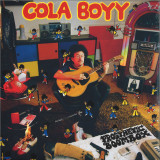
There’s liberation on the dance floor in the songs of Matthew Urango – glimpses of revolution that glimmer beneath the disco ball. “I want my music to bring people together,” says the Californian pop innovator, best known as Cola Boyy. “Because standing together is our best chance at fighting this shit show.” The shit show in question is a broken, brutal system the acclaimed multi-instrumentalist has witnessed up-close. Urango was born with spina bifida and scoliosis in Oxnard, California: a town in which almost 30,000 are estimated to live in poverty. Prosthetic Boombox, his eagerly awaited debut album, might at first glance seem a joyous confetti-burst of pop eclecticism, engineered to sound like “scanning between stations on a car radio, landing on all these different sounds and styles” as Urango puts it. Dig deeper, though, and you’ll discover a simmering sense of rebellion. “The working class are injured, struggling to pay rent and struggling to put food on the table,” he says. “I want to represent that.” Prosthetic Boombox
achieves that goal in a thrilling flurry of inventive indie, funk and soul: take Urango’s car radio analogy, place it in a time-travelling Delorean with Prince in the passenger seat, and you’re half-way there.
Look no closer than Prosthetic Boombox’s euphoric opener, the Avalanches-assisted ‘Don’t Forget Your Neighbourhood.’ The track – which Urango says mixes “the Beach Boys, French disco, house keys and ragtime piano, kinda like the Cheers soundtrack!” – ends with lyrics urging listeners to “fight for your town with your fist closed, strike it and make it more than just a memory.” It’s a reminder that the working classes need to “turn our fists against our oppressors instead of each other,” he explains. After that emphatic introduction comes a horn-laced funk wig-out titled ‘Mailbox’ – a song that gives Dua Lipa’s Future Nostalgia a run for its Studio 54-themed money, featuring rising Londoner JGrrey. Elsewhere, ‘Song for the Mister’ ventures into smooth R&B territory, before ‘Roses’ – a collaboration with Myd of Ed Banger fame – offers a bouquet of bustling disco guitars and infinite bisous of Connan Mockasin’s band drops in on the immaculate ‘Go the Mile’. Urango saves his most introspective moment for the album’s starry closer. ‘Kid Born in Space’, a cosmic collaboration with MGMT frontman Andrew VanWyngarden, sees the artist reflect on what he once had to overcome as a disabled person of colour. “I see them looking down on my dreams of being,” he sings tenderly. “I hear them making fun of my voice, but I keep on moving forward, I refuse to live in anyone else’s shadow.” Prosthetic Boombox, on this subject, is more than an album title – it’s a statement of intent.
“The message of my music is that our class is exploited, oppressed and murdered on the daily. That’s not right, and the system that enables that deserves to be wiped off the face of the earth,” he says. “The only way that happens is if we’re united. That’s the point of my music – to relate to people and unite them.” And what unites more than raucous, irresistibly danceable pop? Prosthetic Boombox is a riot of joyous grooves and catchy hooks for good reason. “I want to reach and spread my message to as many people as possible. You can’t do that if you’re some obscure motherfucker, you know?” he laughs. Don’t bet on him being an “obscure motherfucker” for long.
- A1: Fleetwood
- A2: Something
- A3: Crumbs (Feat. Evidence & Muja Messiah)
- A4: Woes
- A5: Strung (Feat. Musab)
- A6: Clocked
- A7: Sleepless (Feat. Nino Bless)
- A8: Distances
- A9: Carousel (Feat. Nikki Jean)
- A10: Vanish
- A11: Pressed (Feat. Anwar Highsign, Blackliq, Sa-Roc, Haphduzn, Lateef Truthspeaker)
- A12: Skull
- A13: Nekst
- A14: Barcade (Feat. Aesop Rock & Mf Doom)
Following their last release, The Day Before Halloween_an imaginative, distorted-synth-driven concept album_Atmosphere returns with a refreshing new project, simply titled WORD? Steering back toward their signature sound, the album further highlights producer Ant's undeniable talents as the project leans into the classic boom-bap aesthetic, bringing a unique energy out of Slug's wisdom, wit and delivery. From onset, WORD? proves to be every bit an exercise in refining and advancing their craft as it is a harkening to earlier work. That is, while their releases have grown more broodingly cinematic, and increasingly concerned with the human condition and mortality, WORD? manages to reintroduce moments of levity and lightheartedness throughout, an approach seldom heard on their albums of late. From album opener "Fleetwood," with its razor-sharp snares and warm fleshy bassline, to the resonant melody of "Clocked", there are strong hints of Atmosphere's nascent years within the sound. Meanwhile, songs like "Woes", "Strung" and "Vanish" cheerfully make light of daily hardships, but they're more likely to be remembered for making listeners want to bob their heads and sing along. With Slug and Ant directing the course, the album plays like a joyride through a range of experiences and emotions, with an extensive cast of special guests hopping in and out along the way, including Evidence, Muja Messiah, Musab, Nino Bless, Nikki Jean, Anwar HighSign, BlackLiq, Sa-Roc, Haphduzn, Lateef the Truthspeaker, Aesop Rock, and the late MF DOOM (RIP). The result is a project that feels like it came from the era or, perhaps more fittingly, the mindset that created albums like God Loves Ugly, Seven's Travels, or the popular Sad Clown series, while sounding as polished and perfected as more recent albums like Mi Vida Local or Whenever. Ultimately, WORD? pairs the breadth of Atmosphere's talents with the beauty of their growth, all while showing they still have a lot of fun in the process and don't mind letting the listener in on the fun as well.
Toronto’s PACKS make music that’s like leafing through a diary entry of a time without visible movement, a subtle beauty that appears only when paying close attention. The band’s debut is a collection of songs that marry the loose but incisive jangle of early Pavement with the barbed sweetness of Sebadoh and the wideeyed wonder of the first Shins LP. Written in two different settings, between the city limits of Toronto where Link was living in 2019, and the Ottawa suburbs where she was quarantined with her parents in the spring 2020, both remain complementary emblems of selfreflection and wry observation of the mundanity of daily life. Packaging: LP Printed Inner Sleeve
Pink Sweat$ has finally arrived with the unveiling of his highly anticipated debut album, PINK PLANET via Atlantic Records. PINK PLANET is a 16-track testament (plus 2 bonus tracks) to the Philadelphia rising superstar’s sonic abilities, luring in fans with ballads about his highs and lows, many successes and a heart-warming number from Pink along with family members. For his heartwarming debut, production credits include D Mile (Lucky Daye, H.E.R.), John Hill (Khalid), Rogét Chahayed (Drake, Miguel) and Michael Keenan.
PINK PLANET CD and vinyl will be available on 9th July. “Pink Planet is about love, it’s about inclusivity, and it’s about creative freedom. “As an artist you should have the ability to make whatever music feels good to you, and that’s what I tried to do with this album. Top to bottom, I’m giving a glimpse into my creative world; and I hope there’s a little something for everybody in it.” – Pink Sweat$
The new album includes eight brand new songs alongside six stellar tracks released in 2020 as THE PRELUDE EP, a token to fans adjusting to a new landscape surrounding the pandemic. His debut embodies a world that we aren’t living right now, with a purpose to heal and gift fans with a stellar project that speaks to listeners’ daily experiences. PINK PLANET further includes such captivating tracks as “Icy,” “17,” and the powerful “Not Alright,” all joined by official music videos streaming now at YouTube.
In 2021, Pink Sweat$ welcomes the year with a brand new remix to “At My Worst” featuring Kehlani, along with today’s release of his debut album, Pink Planet. Ultimately, Pink Sweat$ makes a statement by unapologetically bringing love to the forefront.
Blue Vinyl
Lynch protégé and Twin Peaks sound designer Dean Hurley coaxes an incredible puzzlebox of atmospheres and mood pieces on this killer contribution to our Documenting Sound series, now remastered and pressed on vinyl for what is, perhaps unsurprisingly, the most cinematic and neon-lit instalment in the series. Like a
smudged and overdubbed copy of the BoC Maxima tape, with added iridescence.
Across almost 40 minutes we transition from aerosolised synths to romantic chromatics, thru to Nurse WIth Wound-style severed rhythms and fading glimmers of hope, ‘Concrete Feather’ epitomises Dean Hurley’s prized knack for nuanced instrumental story-telling in the finest and most engrossing style we could imagine. Against the backdrop of the Hollywood film industry that has primed us for as long as we can all remember, the music spans a panorama of lush, mirage-like choral pads and starry flickers thru to gloaming
nightmare sequences and screwed drums, while touching on some of the dankest synth tones this side of his ‘Anthology Resource’ volumes or indeed his soundtrack work for Twin Peaks: The Return. It’s full of dread and a slowly unfolding sense of tragedy.
“Having a regular practice of recording is probably the single most important element to my craft. It’s a way of dropping indiscriminate mile markers while constantly moving forward in time without ability to pause.
Over the years, working for David Lynch taught me a great deal about this and the concept and importance of experimentation. I’ve found myself clinging to those lessons during this time and using them as tools for both productivity and balance. His notion of experimentation is a simple one, yet incredibly profound. It was one of the very first words I heard him say during our initial meeting, and I never stopped hearing the term daily over the subsequent 13 years working together. An ‘experiment’ can provide a legitimate mental back-entrance into the act of creation. It can position an approach toward discovery as opposed to effort, and eliminate the thought that one needs to ‘will’ something into existence. It also aids in calming the judgmental
side of a brain from stepping on/interfering with expression…after all, experiments are not about success or failure, they’re simply about learning. In the Lynch school of thought, multiple experiments then become firewood…and with firewood, one can not only build but actually sustain a fire…even turn it into a multipleacre blaze or more.
Dean Hurley