Buscar:dance parade

Estilos
Todo
Kerala Dust - An Echo Of Love (LP)

Kerala Dusts großartiges neues Album 'An Echo of Love' ist ein Paradebeispiel dafür, niemals stillzustehen. Im Mittelpunkt seiner musikalischen Hybridität - wo Artrock auf innovative Elektronik trifft und die warme Umarmung der Tanzfläche Raum für weite Ausblicke auf Americana, Wüstenblues und dämmrige Fahrten durch eine neonbeleuchtete Stadt lässt - steht ein Album, das die Möglichkeiten des ständigen Wandels lebt.

Es ist ein wunderbar wandelbares Album; eine rastlose Fusion, deren Bedeutung eher in Fragmenten als in etwas Festem oder Statischem liegt. Kurz gesagt: Es dreht sich alles um Dynamik. Dieses Gefühl der ständigen Bewegung spiegelt sich nicht nur in der wechselnden Besetzung der Band wieder - Keyboarder Tim Gardner und Schlagzeuger Pascal Karier sind Neuzugänge und gesellen sich zu den langjährigen Mitgliedern Edmund Kenny (Gesang und Elektronik) und Lawrence Howarth (Gitarre) -, sondern auch in den Orten, an denen das Album geschrieben und aufgenommen wurde. Die Sessions fanden in der Toskana, Austin, Berlin, Zürich und schließlich Rom statt. Für Sänger Edmund "existiert das Album in gewisser Weise an all diesen Orten". Im Oktober und September ist die Band auf GSA-Tour!

No en stock

Haga su pedido ahora y le encargaremos el artículo en nuestro proveedor.

24,33

Ültimo hace: 5 Meses
Rivet - Peck Glamour

Rivet

Peck Glamour

12inchEMEGO317V
Editions Mego
04.09.2025

Rivet’s new album for Editions Mego is an uplifting and joyous affair coming in the wake of tragedy and disenchantment. It is yet another rebirth from an artist willing to take a step back and reprise the current situation he is in. Mika Hallbäck has a long credible history in the Swedish underground. First recognised for his industrial techno works under the Grovskopa moniker he worked privately on more experimental works that eventually came out as On Feather and Wire, an album released on Editions Mego in 2020. After much acclaim for this bold new direction that blended electronic abstraction, pop and industrial forms into a heavy synthetic trip two tragedies struck. One was the passing of label boss Peter Rehberg and then the passing of his dog Lilo, who was as close as a companion one could have. These events led to the release of the more unsettling follow up L+P-2 (Lilo and Pita minus two) on Midnight Shift Records in 2023. Peck Glamour sees Rivet return to the reawakened Editions Mego with an album of optimism inspired by reconciliation with loss and further explorations of new mental/sonic realms.

Hallbäck defines his approach as not being married to any particular machine, instrument, process or genre. However he holds a particular affinity to sampling, of which, he says, provides the dirt and grit amongst what would otherwise be pristine, generic machine music. The contemporary crate digging method of scouring obscure download music bogs for unique sounds was his preferred research practice.

Peck Glamour is an album full of tracks brimming with the excitement of exploration. It's the results of a mind informed by punk, industrial, techno, dancefloor, disappointment, trauma and rebirth. Here the synthetic and authentic is viewed simply as the same means of human rationale and expression.

The opening, ‘Catch Up to Light’, sets the scene with ecstatic and odd fluorescent vocals sliding amongst crystalline likembe whilst synths swirl amongst the external festivities. ‘Orbiting Empty Cocoon’ is somewhat a homage to the alien sound worlds of The Orb, one which takes the listener deeper into a mind melting array of teased potential as visual elements are executed in a mask of audio wizardry and euphoric staccato rhythms, the later being a nod to Singeli music. ‘Patitur Butcher’ is more dance frontal utilising the Ghatam drum and a YouTube rip of a Chinese language lesson. ‘Plastic Bag Putain’ was made during the beginning of Russia's invasion of Ukraine and should be clear of its intent. ‘All that Heaven Allows’ is a marimba cover of an imaginary Love Parade anthem. 'Kyrie Geire’ potentially briefly fills the void left by the demise of Coil. The entire trip of Peck Glamour is sewn up with ‘We left before we came’ whereby extraneous recordings of double bass player Gregory Vartian-Foss (tuning/strumming/moving the bass) are superimposed with local field recordings to create a gorgeous bed of sounds acting as an exciting exit music to this sharp collection of cinematic ear excursions.

No en stock

Haga su pedido ahora y le encargaremos el artículo en nuestro proveedor.

24,58

Ültimo hace: 9 Meses
Barrington Levy - Sweet Reggae Music 2.0 (LP)
  • A1: Whom Shall I Be Afraid Of
  • A2: Mary Long Tongue
  • A3: Bounty Hunter
  • A4: 21 Girls Salute
  • A5: Hammer
  • B1: Praise His Name
  • B2: The Winner
  • B3: Pon Your Toe
  • B4: Mini Bus
  • B5: Teach The Youth

Cut loud and proud ‘Sweet Reggae Music 2.0’ includes the only LP appearances for much sought-after sound-systems favourites ‘Whom Shall I Be Afraid Of’, ‘Praise His Name’ & ‘Pon Your Toe’ ‘Longside Broader Than Broadway Hits’ ‘Teach The Youth’, ‘Mary Long Tongue’, ‘Mini Bus’ etc During this golden age of Jamaican music Barrington Levy was the undisputed lord of the dancehall - ‘Sweet Reggae Music 2.0’ is 100% black vinyl proof.

Reservar02.09.2025

debe ser publicado en 02.09.2025

22,65
Kerala Dust - An Echo Of Love LP

Kerala Dusts großartiges neues Album 'An Echo of Love' ist ein Paradebeispiel dafür, niemals stillzustehen. Im Mittelpunkt seiner musikalischen Hybridität - wo Artrock auf innovative Elektronik trifft und die warme Umarmung der Tanzfläche Raum für weite Ausblicke auf Americana, Wüstenblues und dämmrige Fahrten durch eine neonbeleuchtete Stadt lässt - steht ein Album, das die Möglichkeiten des ständigen Wandels lebt.

Es ist ein wunderbar wandelbares Album; eine rastlose Fusion, deren Bedeutung eher in Fragmenten als in etwas Festem oder Statischem liegt. Kurz gesagt: Es dreht sich alles um Dynamik. Dieses Gefühl der ständigen Bewegung spiegelt sich nicht nur in der wechselnden Besetzung der Band wieder - Keyboarder Tim Gardner und Schlagzeuger Pascal Karier sind Neuzugänge und gesellen sich zu den langjährigen Mitgliedern Edmund Kenny (Gesang und Elektronik) und Lawrence Howarth (Gitarre) -, sondern auch in den Orten, an denen das Album geschrieben und aufgenommen wurde. Die Sessions fanden in der Toskana, Austin, Berlin, Zürich und schließlich Rom statt. Für Sänger Edmund "existiert das Album in gewisser Weise an all diesen Orten". Im Oktober und September ist die Band auf GSA-Tour!

No en stock

Haga su pedido ahora y le encargaremos el artículo en nuestro proveedor.

24,33

Ültimo hace: 9 Meses
MOSLEY JR. - ROLLERSTATE (TAPE)

MOSLEY JR.

ROLLERSTATE (TAPE)

CassetteMFC001
MOODFAMILY
15.08.2025

On Rollerstate, Belgian duo Mosley Jr. (Niels Blondeel & Ijsbrand De Wilde) embrace a sound that’s raw and free, yet impossibly refined. This 7-track EP offers a journey through their unfiltered creativity, where analog imperfections, captivating grooves and nostalgic soundscapes collide.

Rollerstate is creatively underground, yet undeniably catchy, capturing an era of old-school dance influence, TV-commercials and vague hazy distant airwaves. Rollerstate is both the state of mind and fictional place we all tend to escape to.

Released on Moodfamily, the EP is available digitally and physically on vinyl and limited edition cassette (MFC001)

Reservar15.08.2025

debe ser publicado en 15.08.2025

11,13
MOSLEY JR. - ROLLERSTATE

Mosley Jr.

ROLLERSTATE

12inchMFV012
MOODFAMILY
13.08.2025

On Rollerstate, Belgian duo Mosley Jr. (Niels Blondeel & Ijsbrand De Wilde) embrace a sound that’s raw and free, yet impossibly refined. This 7-track EP offers a journey through their unfiltered creativity, where analog imperfections, captivating grooves and nostalgic soundscapes collide.

Rollerstate is creatively underground, yet undeniably catchy, capturing an era of old-school dance influence, TV-commercials and vague hazy distant airwaves. Rollerstate is both the state of mind and fictional place we all tend to escape to.

Released on Moodfamily, the EP is available digitally and physically on vinyl and limited edition cassette (MFC001)

No en stock

Haga su pedido ahora y le encargaremos el artículo en nuestro proveedor.

16,39

Ültimo hace: 9 Meses
WAX POETICS - WAX POETICS ISSUE 67 - THE PRINCE EDITION

118 pages * no ads * Pure Prince Content! - new High Quality paper version. (Originally printed in 2018)

Wax Poetics Issue 67 contains interviews and write-ups on a slew of Prince's albums, including 1978's For You, 1986's Parade, 1987's Sign "O" the Times, 1988's Lovesexy, 1991's Diamonds and Pearls, and 1995's The Gold Experience—with interviews from engineer Chris Moon, manager Owen Husney, engineer Susan Rogers, producer/engineer David Z, poet Ingrid Chavez, tour manager Alan Leeds, dancer Cat Glover, saxophonist Eric Leeds, guitarist and bandleader Levi Seacer Jr., engineer Michael Koppelman, trombonist Michael B. Nelson, and keyboardist Tommy Barbarella.

Issue 67 also includes standalone interviews with Jill Jones, Andre Cymone, and members of the Revolution: Doctor Fink, Bobby Z., Brown Mark, and Wendy & Lisa.

Reservar01.08.2025

debe ser publicado en 01.08.2025

20,80
Arthur Satan - A Journey That Never Was LP 2x12"
  • The Death Of A King
  • The Killer
  • A Cold Morning
  • Crucify Me
  • My Valentine
  • Losing Hand
  • Loner Perpective
  • Lovely Suzy
  • Son Of The Atom
  • After The Night
  • Glamosaurus Rex
  • The Farmer
  • The Soldier
  • Melatonine 1,9
  • To Please You All
  • The Pagan Truth
  • Life Goes Wrong
  • It's Over (The Last Dance)

Second solo album by Arthur Satan, released on Born Bad, after 'So Far So Good', his pop solo debut, which was a pleasant surprise for fans of his notthat-garage group JC Satan 'A Journey That Never Was' is so big you'll need special furniture to accommodate this unreasonable, maximalist parade, crammed full with 1960s pop influences.

The record plays with heritage like a kid would unabashedly plan for a birthday party. No stupid treasure hunt, we're bowling with the heads of our foes, guitars are literally bleeding through the mix. T-Rex burgers, fountains of chocolate choruses dripping on Brian Wilson - shaped giant cookies: let's indulge. Each song is a musical family, each verse is an album, each riff is a title. In his Christmas gift list, Arthur probably circled absolutely every toy: his taste for completism never disappoints. He played almost every instrument, mixed the album and designed a whole graphic universe to go along with it. A visual artist by trade, also made a point of drawing a monumental fresco spreading out the fantasy landscape that haunts this album.

Reservar23.05.2025

debe ser publicado en 23.05.2025

32,73
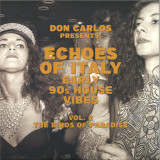
Various - ECHOES OF ITALY – THE BIRDS OF PARADISE – EARLY 90S HOUSE VIBES VOL.2 (2x12")

Googling “paradise house”, the first results to pop up are an endless list of European b&b’s with whitewashed lime façades, all of them promising “…an unmatched travel experience a few steps from the sea”. Next, a little further down, are the institutional websites of a few select semi-luxury retirement homes (no photos shown, but lots of stock images of smiling nurses with reassuring looks). To find the “paradise house” we’re after, we have to scroll even further down. Much further down.

It feels like yesterday, and at the same time it seems like a million years ago. The Eighties had just ended, and it was still unclear what to expect from the Nineties. Mobile phones that were not the size of a briefcase and did not cost as much as a car? A frightening economic crisis? The guitar-rock revival?! Certainly, the best place to observe that moment of transition was the dancefloor. Truly epochal transformations were happening there. From America, within a short distance one from the other, two revolutionary new musical styles had arrived: the first one sounded a bit like an “on a budget” version of the best Seventies disco-music – Philly sound made with a set of piano-bar keyboards! – the other was even more sparse, futuristic and extraterrestrial. It was a music with a quite distinct “physical” component, which at the same time, to be fully grasped, seemed to call for the knotty theories of certain French post-modern philosophers: Gilles Deleuze, Félix Guattari, Paul Virilio... Both those genres – we would learn shortly after – were born in the black communities of Chicago and Detroit, although listening to those vinyl 12” (often wrapped in generic white covers, and with little indication in the label) you could not easily guess whether behind them there was a black boy from somewhere in the Usa, or a girl from Berlin, or a pale kid from a Cornish coastal town.

Quickly, similar sounds began to show up from all corners of Europe. A thousand variations of the same intuition: leaner, less lean, happier, slightly less intoxicated, more broken, slower, faster, much faster... Boom! From the dancefloors – the London ones at least, whose chronicles we eagerly read every month in the pages of The Face and i-D – came tales of a new generation of clubbers who had completely stopped “dressing up” to go dancing; of hot tempered hooligans bursting into tears and hugging everyone under the strobe lights as the notes of Strings of Life rose up through the fumes of dry ice (certain “smiling” pills were also involved, sure). At this point, however, we must move on to Switzerland.

In Switzerland, in the quiet and diligent town of Lugano, between the 1980s and 1990s there was a club called “Morandi”. Its hot night was on Wednesdays, when the audience also came from Milan, Como, Varese and Zurich. Legend goes that, one night, none less than Prince and Sheila E were spotted hiding among the sofas, on a day-off of the Italian dates of the Nude Tour… The Wednesday resident and superstar was an Italian dj with an exotic name: Don Carlos. The soundtrack he devised was a mixture of Chicago, Detroit, the most progressive R&B and certain forgotten classics of old disco music: practically, what the Paradise Garage in New York might have sounded like had it not closed in 1987. In between, Don Carlos also managed to squeeze in some tracks he had worked on in his studio on Lago Maggiore. One in particular: a track that was rather slow compared to the BPM in fashion at the time, but which was a perfect bridge between house and R&B. The title was Alone: Don Carlos would explain years later that it had to be intended both in the English meaning of “by itself” and like the Italian word meaning “halo”. That wasn’t the only double entendre about the song, anyway. Its own very deep nature was, indeed, double. On the one hand, Alone was built around an angelic keyboard pattern and a romantic piano riff that took you straight to heaven; on the other, it showcased enough electronic squelches (plus a sax part that sounded like it had been dissolved by acid rain) to pigeonhole the tune into the “junk modernity” section, aka the hallmark of all the most innovative sounds of the time: music that sounded like it was hand-crafted from the scraps of glittering overground pop.

No one knows who was the first to call it “paradise house”, nor when it happened. Alternative definitions on the same topic one happened to hear included “ambient house”, “dream house”, “Mediterranean progressive”… but of course none were as good (and alluring) as “paradise house”. What is certain is that such inclination for sounds that were in equal measure angelic and neurotic, romantic and unaffective, quickly became the trademark of the second generation of Italian house. Music that seemed shyly equidistant from all the rhythmic and electronic revolutions that had happened up to that moment (“Music perfectly adept at going nowhere slowly” as noted by English journalist Craig McLean in a legendary field report for Blah Blah Blah magazine). Music that to a inattentive ear might have sounded as anonymous as a snapshot of a random group of passers-by at 10AM in the centre of any major city, but perfectly described the (slow) awakening in the real world after the universal love binge of the so-called Second Summer of Love.

For a brief but unforgettable season, in Italy “paradise house” was the official soundtrack of interminable weekends spent inside the car, darting from one club to another, cutting the peninsula from North to centre, from East to West coast in pursuit of the latest after-hours disco, trading kilometres per hour with beats per minute: practically, a new New Year’s Eve every Friday and Saturday night. This too was no small transformation, as well as a shock for an adult Italy that was encountering for the first time – thanks to its sons and daughters – the wild side of industrial modernity. The clubbers of the so-called “fuoriorario” scene were the balls gone mad in the pinball machine most feared by newspapers, magazines and TV pundits. What they did each and every weekend, apart from going crazy to the sound of the current white labels, was linking distant geographical points and non-places (thank you Marc Augé!) – old dance halls, farmhouses and business centres – transformed for one night into house music heaven. As Marco D’Eramo wrote in his 1995 essay on Chicago, Il maiale e il grattacielo: “Four-wheeled capitalism distorts our age-old image of the city, it allows the suburbs to be connected to each other, whereas before they were connected only by the centre (…) It makes possible a metropolitan area without a metropolis, without a city centre, without downtown. The periphery is no longer a periphery of any centre, but is self-centred”.

“Paradise house” perfectly understood all of this and turned it into a sort of cyber-blues that didn’t even need words, and unexpectedly brought back a drop of melancholic (post?)-humanity within a world that by then – as we would wholly realise in the decades to come – was fully inhuman and heartless. A world where we were all alone, and surrounded by a sinister yellowish halo, like a neon at the end of its life cycle. But, for one night at least, happy."

No en stock

Haga su pedido ahora y le encargaremos el artículo en nuestro proveedor.

28,99

Ültimo hace: 36 Días
Horse Meat Disco - Horse Meat Disco Presents Disco & Boogie From Brazil Vol. 1 LP 2x12"

13 years in the making, Mr Bongo proudly presents a new compilation of beloved Brazilian disco and boogie finds from the legendary London disco connoisseurs, Horse Meat Disco. A labour of love, it showcases a tantalising cross-section of disco, funk, boogie, samba and MPB, from past to present. Unearthing tracks from the seemingly endless gold mine of Brazilian gems, the compilation features legends such as Jorge Ben, Gretchen, Marcos Valle and Robson Jorge & Lincoln Olivetti, alongside unsung heroes including Zé Carlos and Carlos Bivar.

Over 20 years ago, the Horse Meat Disco crew (James Hillard, Severino Panzetta, Jim Stanton and Luke Howard) began their weekly residency at Eagle London back in 2003. That same year, Luke made his first visit to Brazil, beginning a musical love affair that is still going strong.

“I had always wanted to go to Brazil since I was a kid, and when I finally had the opportunity to go with Princess Julia, I was just blown away. I’ve visited Rio every year since 2003, and in that time, I’ve learned Portuguese and tried to discover as much as I can about Brazilian music and popular culture. I learned to dance samba with the Paraiso School of Samba in London and paraded three times at Rio Carnival. Brazilian music was a brand-new world for me to explore and get excited about—a whole universe of genius musicians, singers, and styles.”

9 years later, Mr Bongo invited Luke down to their Brighton HQ for a listening session of some of his favourite Brazilian boogie and disco 7" finds. A compilation was green-lit, but multiple licensing delays and the release of other HMD compilations meant that it lay dormant for years.

Fast forward to 2024, and with the help of esteemed, Rio-based record collector Tee Cardaci, along with suggestions from HMD’s James Hillard, the dream of an HMD Brazilian compilation finally materialised. It’s a carefully curated collection that includes the electronic-boogie/italo-disco-esque 1984 groover 'Venha (Remix)' by the singer Źe Carlos, two cuts by Luiza Maura taken from her sought-after Deixa Girar 7", and Gretchen's sultry 'Ela Tem Raça, Charme, Talento E Gostosura' written by Jorge Ben.

At its core, this compilation captures the excitement and sense of discovery that won over Horse Meat Disco’s heart more than 20 years ago. A vibrant mix of feel-good flavours, it homes in on a sun-soaked strand of disco and boogie that has been enriched with the spirit of a nation where music serves as a central pillar of life.

No en stock

Haga su pedido ahora y le encargaremos el artículo en nuestro proveedor.

27,94

Ültimo hace: 4 Meses
BIANCA STECK - THE JOY OF COINCIDENCES LP

LP in printed inner sleeve. The Joy of Coincidences is the debut album from the intriguing Barcelona-born and raised musician and singer-songwriter of British and German descent. The songs are stories and related feelings that reflect upon mankind observed through our eyes in different circumstances. This reflection is told through intimate music coming from folk-inspired pop.


The Joy of Coincidences is the debut album from the intriguing Barcelona-born and raised musician and singer-songwriter of British and German descent. Within the midst of movement, noise and chaos of the city, Bianca Steck searched for calmness and silence in order to write these twelve songs. Whether in a bar, on a tram, under a tree in a park, on a bench or on the balcony of her little apartment in Brussels overlooking the square, there must always be room for curiosity regarding the world we live in. Hence, this album was born through her compelling need for a conscious observation of our society and surroundings.


The songs are stories and related feelings that reflect upon mankind observed through our eyes in different circumstances and the consequent understanding of ourselves along this process. This reflection is told through intimate music coming from folk-inspired pop. Rooted in classical tradition, Bianca Steck chooses instruments such as harp, cello, double bass, upright piano, and flugelhorn and blends these warm sounds with synths, omnichord, drums, electric bass... in a very delicate way in order to create a dreamy landscape of sound. This carefully chosen music together with lyrics that tell real down to earth stories seen through the eyes of her imaginary world are the realm of this work.


BiancaSteck sees coincidences as small and playful interruptions of our everyday concerns, of life. We live in extremely uncertain times where many worries reign over our minds and there needs to be some kind of lightheartedness to move forward, to survive. Within all this complex spiral of thoughts, in the Joy of Coincidences the essential seed of simplicity prevails over the existential crisis.


The album is produced together with Catalan pianist and composer Nil Ciuró and features guest appearance Hania Rani with whom Bianca Steck toured as a support act across London, Paris, Berlin, Utrecht, Antwerp and other European cities and venues.

All demos were recorded in her apartment in Brussels with very simple means and were later on recorded in a studio in the mountains of Catalunya.

Reservar14.03.2025

debe ser publicado en 14.03.2025

22,48
VOLANTIS FEAT. HIROKO - YOKAI PARADE EP

Ancient Japanese spirits meet contemporary electronic music in *Yokai Parade EP*, a mystical collaboration between Italian producer Volantis and Japanese artist Hiroko. Inspired by a psychedelic experience in Kobe where train sounds summoned supernatural visitors, this four-track journey merges folklore with modern dance music through a unique blend of hardware synthesis and haunting vocals.

The title track “Yokai Parade” leads listeners into a shadowy realm where Hiroko’s Italian narration intertwines with Japanese train announcements, calling forth ancient spirits. Eden Burns transforms this nocturnal tale into a hypnotic, percussion-driven remix that deepens its ceremonial essence. On “La Kappa,” Hiroko embodies a playful water spirit, her accented Italian dancing over dreamlike sequences. Fabrizio Mammarella’s Italorama Version injects classic Italo disco energy, creating a perfect bridge between Japanese mythology and Mediterranean dance floors.

Co-produced with Niccolò Barozzi, this vinyl and digital release captures a unique moment where East meets West, and traditional folklore dissolves into electronic rhythms.

No en stock

Haga su pedido ahora y le encargaremos el artículo en nuestro proveedor.

13,40

Ültimo hace: 12 Meses
unknown - Parade004

Unknown

Parade004

10inchPARADE004
Parade
21.11.2024

traight from the vaults, we’re bringing you a gem that’s been lost in the rave—an old-school breakbeat vinyl that’s guaranteed to teleport you back to the raw, unfiltered energy of the '90s. With its thunderous basslines, slicing snares, and infectious rhythm, this record encapsulates the heart and soul of the underground scene. Dust off your decks, because this is more than just music; it's a journey to a time where every beat told a story, every drop defined a movement, and every spin was a call to dance. Don’t miss out—relive the golden era of breakbeat

No en stock

Haga su pedido ahora y le encargaremos el artículo en nuestro proveedor.

10,71

Ültimo hace: 8 Meses
William Arist - Gultural EP

William Arist

Gultural EP

12inchFRNZYREC003
Frenzy
09.10.2024

2024 Repress
For Frenzy's third release, and the first solo release, the Uruguay-based William Arist is introducing us to his world of 'tribal techno'. Hailing from the city of Montevideo, this Southern-American-born artist already is a talent to watch overseas. Through their like-minded vision of electronic music, William bonded strongly with our Amsterdam-based Frenzy crew over the last couple of years. This warm connection evolved into Frenzy 03 - showcasing pure dance floor eclecticism that only William can deliver, including two remixes by no other than VIL and rising star Kenji Hina aka Alarico.

The A side instantly kicks off at full good vibe-throttle with two productions that reminisce about those iconic Love Parade moments during the very first days of rave culture. Balancing on the edge of house and techno, 'Chaka Chaka' loops the listener into a straight sense of movement. With rhythmic drums and uplifting vocals, 'Days' feels like stepping into an after hour dance-floor at the beach while the morning sun rises through the exotic vegetation. On the B side, William leans towards a more hypnotic sound. With a great tempo and a dark yet subtle mood, 'Tero' sets the tone for those murky clubbing moments where the boundaries dissolve and bodies merge. Slowly climbing out of the deep, 'Gultural' stays on the same energy level while adding dubby hints and a taste of freshness.

To top it off, the release is provided with two remixes that leave no room for interpretation. Portuguese producer VIL turned 'Chaka Chaka' into a true peak-hour beast while Italian multi-talent Alarico shows his versatile skill set with a speedy house remix of 'Gultural' under his Kenji Hina alias.

No en stock

Haga su pedido ahora y le encargaremos el artículo en nuestro proveedor.

11,35

Ültimo hace: 9 Meses
Jibóia - Salar

Jibóia

Salar

12inchCREP106
Discrepant
04.10.2024

Four years after their Discrepant debut - 'OOOO' -, Lisbon-based travellers Jibóia return to the fold with another offering of globetrotting psychedelia with 'Salar'. With the core trio of Óscar Silva, Ricardo Martins and Mestre André augmented by a stellar parade of collaborators on various roles, 'Salar' further expands on the transglobal visions by now pretty trademarked by the band. Intersped among shorter vignettes for drums, saxophone and bass, each of the more fully fleshed tracks casts a guest to elevate Jibóia's music to uncharted realms - both in a mystical and geographical sense.

Opener 'Selar' summons the cello of songstress Joana Guerra for a skewed dialogue with Silva's guitar, propelled by Martins' drums and percussion and André's electronic textures into 4 minutes and 20 seconds that feel epic - if there was any psychedelic numerological symbolism needed. On 'Solar', Silva's non-western plucking rides on for Yaw Tembe's trumpet to veer in a multitude in directions, while the mysterious 'Sitar' conjures the voice of moroccan musician Ayoub El Ayadi for a contemplative nighttime prayer. Elsewhere, guitarist Rui Carvalho aka Filho da Mãe injects dissonant guitar lines unto 'Sarar's pummelling dance and Pedro Augusto's electronics hover below the shapeshifting dynamics of 'Sonar', among mesmerising keyboard lines. 'Salir' featuring Daiyen Jone enchanted flute brings the album to a close at its most reflective, all crepuscular synth lines and reverbed handclaps.

Reservar04.10.2024

debe ser publicado en 04.10.2024

18,70
Michèle Bokanowski - Cirque

The Circus is a place of lights and colors, but also of shadows, even darkness. Admittedly, it delights children and makes adults laugh. But you only need one rainy autumn evening near a circus tent and the smell of fodder to think of the sadness of the clowns, the endless training of the animals and the freaks who are hidden in some caravan... cinema, the essence of the circus – movement, light, danger and burlesque – will have been admirably rendered in Notes on the circus by Jonas Mekas (1966), one of the inventors of the filmed diary. With Cirque, Michèle Bokanowski does similar work, entirely dedicated to spinning, in the musical field.

She distinguished herself in particular in the composition of musique concrète, among others Tabou and Trois chambres d'inquiétudes, after having studied with Pierre Schaeffer and Éliane Radigue. The latter, great lady of drone and minimalism, fell under the spell of Cirque and wrote the booklet for the piece as a poem.

The piece, divided into five movements, is based on the handling and editing of recordings captured within one or more circuses (this is not specified and is of no importance) between 1988 and 1993. The initial allegro reveals the gallop of a horse joined gradually by other images. The idea of the circular space of the circus tent is immediatly and magnificently rendered and will be constantly recalled by an insistent use of the loop technique. Children's laughter, applause and drum rolls are thus sheared, repeated before being brutally interrupted. Accordion interludes and the distortion of sounds create a dreamlike atmosphere. This beautiful nightmare reminds us, to quote Éliane Radigue, the "Magic of childhood still living in the heart of man even beyond its abrupt end."

Words by Alexandre Galand, from the book “Field Recording – L’usage sonore du monde en 100 albums” (ed. Le mot et le reste, 2012)

Major member of the french musique concrète scene, Michèle Bokanowski was born on August 9, 1943 in Cannes, FR, to a musician mother and a writer father. She now lives and works in Paris.
Music lover since adolescence, it was relatively late, at the age of 22, that Michèle Bokanowski decided to study composition. Reading In Search of a Concrete Music by Pierre Schaeffer was decisive. After classical training on harmony, she met Michel Puig, a student of René Leibowitz, who taught her writing and analysis based on the Treatise of Schönberg. In September 1970 she began a two-year internship in the ORTF Research Department under the direction of Pierre Schaeffer. She takes part in the same time in a research group on sound synthesis, studies musical computing at the Faculty of Vincennes and electronic music with Éliane Radigue.
Her main works are intended for concert: Pour un pianiste, Trois chambres d’inquiétude, Tabou, Phone Variations, Cirque, L’étoile Absinthe, Chant d’Ombre, Enfance, Rhapsodia, Cadence, Elsewhere. She has also composed for theater (with Catherine Dasté), dance (with choreographers Hideyuki Yano, Marceline Lartigue, Bernardo Montet) and cinema: music for the short films of Patrick Bokanowski and his two feature films L'Ange ( 1982) and A Solar Dream (2016).

Reservar23.08.2024

debe ser publicado en 23.08.2024

23,49
CONJUNTO PAPA UPA - FRUTA MADURA LP

Comes with insert and download coupon.

Imagine a Latin remake of Back to the Future. The mad scientist is Arsenio Rodriguez (the godfather of salsa) and the young student who travels through time with him is Eblis Alvarez (Meridian Brothers). This album can only be described as the perfect soundtrack for that movie that never was.

After the massive buzz generated by his first solo album, Mentallogenic, Alex Figueira got back in the studio to work in a more collective fashion this time, carefully assembling the second album of his largest project to date, Conjunto Papa Upa; a team of 6 musicians, spanning 3 generations of some of the best talent in the Latin and avant-garde scenes.

In an era where tropical music is dominated by purely electronic and rhythmically uniform sounds, the ten songs encompassed in “Fruta Madura” (“Ripe Fruit”) wander through the most diverse tempos, rhythms, and motifs effortlessly. A real breath of fresh air that gracefully incorporates soul, funk, jazz, psychedelia, and electronics into a solid tropical, irresistibly polyrhythmic foundation, without ever succumbing to the many genre clichés.

The distinctive production and catchy songwriting of Figueira shine in a very distinctive light on this second full-length. Living up to his reputation (Miles Cleret, founder of Soundway Records, called him “one of the scene's truly authentic and eccentric producers”), he takes the opportunity to show he’s not afraid to keep walking his own path.

Taking the band for a wild ride through the traditions of Africa, America, and the Caribbean; contrasting them with a ridiculously wide plethora of vintage, contemporary, and futuristic sounds, and pivoting on the exuberant musicality displayed by his musicians; the result leaves no doubt: this album is destined to be considered a future classic of the exciting tropical psychedelic music of the 21st century.

Addressing the most diverse themes in this new collection of songs, things take on a much more mature tone, as the title clearly suggests.

The opening track “El segundo es más sabroso” (“The second one is tastier”) sets the tone in the most assertive way imaginable, with the band boldly declaring, through multiple metaphorical references (laid upon a crazy mix of Dominican merengue, Detroit techno, classic and free jazz, dub, and electro), that the bar will be set higher with this second album.

The remaining compositions touch upon the most diverse subjects, with a fair dose of humor, sarcasm, and postmodern “magic realism”. “El Algoritmo” (The Algorithm) is a parranda-cumbia hybrid (for lack of a specific term) about the omnipresence of technology in our lives. The sophisticated Latin soul of the titling track “Fruta Madura” makes a case for the beauty of the maturity process. Some key philosophical teachings of Marcus Aurelius (the role of causality, the impositions of “the logos” and the importance of self-control) get a twisted cumbia treatment on “Reos del Deseo” (Prisoners of Desire). “No le pongas Coca-Cola” (“Don’t put Coca Cola in it”) shows us the most satirical side of the band, accusing those who mix Coca Cola with Rum of committing "sacrilege", on a powerful base of Dem Bow (the grandfather of Reggaeton), intertwined with touches of soul, salsa, and Cuban comparsa.

"Háblame Claro" (“Talk to me clearly”) is a story of heartbreak that evokes in its first part the spirit of the erotic salsa of the 80s (a subgenre deeply despised by purists), and after an unexpected samba interlude, leads to the hardest salsa of the 70s (a subgenre adored by purists), to end up in the surprising form of pure Afro-Cuban ceremonial music.

“Tu mamá tenía razón” ("Your Mom Was Right") is an attempt to exalt the spirit of the Latin American soap opera in the key of “acid bachata”, to recount a real-life case, witnessed by the band on countless occasions: the partying woman who arrives at the show accompanied by her bitter husband, who obviously does not like to dance. A very cheeky song to talk about the very serious and pertinent topic of female empowerment.

“La misma vaina” (“The same thing”) with its indescribable blend of bantú, candomblé, and Mozambique rhythms with abstract synthesizers, is an ode to adventure in favor of the aversion to taking risks and seeking predictability.

“Amigas picadas” (“Salty friends”) is another humorous song recounting another real-life case witnessed by the band on countless occasions: a love encounter sabotaged by the girlfriend's friends, who all happen to fancy the same guy. A jazzy take on the ancient Dominican rhythm of pambiche (grandfather of merengue), with generous psychedelic touches, resembling the classy late 60s releases of Guadeloupe's legendary producer / label owner Henri Debs.

“Vinimos a hablar” (“We came to talk”) takes sarcasm to the highest level, to ridicule the absurdity (also experienced by the band firsthand) seen in live music venues where people pay a ticket to go and have conversations that could be carried out much better on any bar, where no band is playing. The music alternates between a delicate melody with loose, sparse percussion and a full-on, pumping Angolan semba, with a techno kick drum included; bringing things to an apotheotic grooving finale, where the peculiar swing of Venezuelan calypso from the Callao region is thrown on top of all the precedent elements; closing the album in the most uplifting, “end of the carnival parade” feel.

The artwork is a delicate and impactful oil painting by Colombian artist Kevin Simón Mancera, who has collaborated many times with the label before (“Maracas, tambourines and other hellish things” tape and the Lola’s Dice LP).

What the experts are saying:

“Alex (Figueira) dove into this work with a brutal cohesion between lyrics and synths. Timbre poetry, sound poetry (you name it). And that, superimposed on his always impeccable percussive base, confirms the title of “avant-garde visionary of our beautiful Latin music”".
EBLIS ALVAREZ (MERIDIAN BROTHERS)
“Papa Upa's infectious quirkiness is a balm against boredom. A mature album, but without an expiration date”.
GLADYS PALMERA

“Here there is a lot of strength, drum, cadence and psychedelia, lost dance rhythms, united in an intercontinental Latin/African/and Caribbean journey, a unique winning combination that we could consider the new “Ritmo Figueira”.
DISCODELIC

Conjunto Papa Upa are: 


Alex Figueira - Timbales, percussion, vocals. 

Gerardo Rosales - Congas, percussion, vocals. 

Ramón Mendeville - Bongos, percussion, vocals. 

Randy Winterdal - Bass.

Andrew Moreno - Guitar.

Nico Chientarolli - Organ, piano, synths.


All songs written by Alex Figueira. 

Arranged and performed by Conjunto Papa Upa. 

Recorded, produced, mixed and mastered by Alex Figueira at Heat Too Hot, Amsterdam.

Reservar01.08.2024

debe ser publicado en 01.08.2024

25,17
Color Green - Fool's Parade

The color green can represent many things. It can symbolize money, of course, but also weed. And envy. It implies newness, the rebirth of spring, but it can also evoke illness and infection. It’s an apt name for a band that is defined by its adaptability, by its knack for doing many different things all at once. On the Color Green’s second full-length—their first as a quartet—they ground their cosmic jams in earthy melodies, drawing from ‘60s SoCal folk-r0ck, ‘70s classic rock, ‘80s underground rock, ‘90s psychedelic dance-rock, and many other sources.

In the two years the band has been touring, it has already shared stages with a range of groups that reflect both the sophistication and the wild malleability of their sound, including Fuzz, Kikagaku Moyo, Circles Around the Sun, and Young Guv. “When we play live, I don’t really know what’s going to happen,” says guitarist Noah Kohll. “You really have no idea what you’re going to get with this band, which keeps things fresh for us and maybe makes the live experience special.”

Adds drummer Corey Rose, “One thing about this band that I really appreciate is that we can camouflage into any environment or any show. We can play with Hiss Golden Messenger and lean into that funky country vibe, or we can play with the Brian Jonestown Massacre and get evil. We all love a variety of music, so let’s not put ourselves in a box.”

That wild, mercurial quality is reflected on Fool’s Parade, a meditation on loss, grief, confusion, frustration, and the clarity to which they all lead. Their songs are vehicles for self-explorations, not just a means of putting their feelings into lyrics and notes but molding them, night after night, into different shapes to get different insights.

Reservar12.07.2024

debe ser publicado en 12.07.2024

26,77
SHEIDA GHARADECHEDAGHI & MOHAMMAD REZA ASLANI - CHESS OF THE WIND LP

The lost soundtrack to "Chess of the Wind," Iran's banned 1976 queer-gothic-class-horror masterpiece, restored by the director and released for the first time. Not for the faint of heart!

Reservar30.06.2024

debe ser publicado en 30.06.2024

22,65
SHEIDA GHARADECHEDAGHI & MOHAMMAD REZA ASLANI - CHESS OF THE WIND LP

The lost soundtrack to "Chess of the Wind," Iran's banned 1976 queer-gothic-class-horror masterpiece, restored by the director and released for the first time. Not for the faint of heart!

Reservar14.06.2024

debe ser publicado en 14.06.2024

23,49
Artículos por página
N/ABPM
Vinyl