Very limited LP on Cream / Blue twist vinyl. Emma Houton is a timeless, celestial voice from New York City. We felt an urgency to share this incredibly calming product of Lockdown with the wider world, Trapped Animal Records. // "her ambient soundscapes brim with escapism _and enchantment" Highclouds Magazine // "a truly bewitching, gorgeous sonic tapestry." Beats Per Minute // Composed after ethnographic study into her Irish folk song roots, and recorded as part of her senior thesis in experimental electronic music, Emma originally wrote The Bath as a piece for eight voices to be performed live. Due to the COVID pandemic, she ended up recording all eight parts alone in her childhood bedroom, mixing and producing it herself. On recording the piece, Emma says: "When composing the album I had an interest in recreating the feelings I had hearing folk tales as a kid. We had a giant book of Irish folk tales my grandmother gave me, and I was both fascinated and scared shitless by them! I intended this to be a live performance initially and so the whole album is scored. I write most of my music by constructing layered loops of my voice using a loop pedal and then singing a melody line over them, and I was trying to translate that practice into a live performance in which each "loop" is sung and repeated, creating the effect of looping without actually recording loops. I was hoping to create something where voice is used as an instrument, rather than standing apart from instruments as it often does I took source material from hymns and traditional folk songs, with the lyrics centering on water-related themes like drowning, baptism, and purification, which I tried to reflect in the sonic environment of the piece through enveloping delays, cavernous reverb, and a general sense of being completely immersed in sound. The concept for the piece in its live form is much more of a production than the album itself, which became more of a "how do I record something written for an ensemble alone with an SM58?" project, and I've figured out how to perform these pieces solo with the loop pedal, in a very coming-full-circle turn." Emma found her way to Trapped Animal Records after a quirk in the Bandcamp algorithm led her to listen to - her now label mate - Maija Sofia's similarly named debut "Bath Time". Signed within a fortnight of making contact with the label at the end of 2020, during a bleak winter, the label quickly ploughed ahead to schedule release of "The Bath". Label partner Kerry Devine says "there was a feeling of urgency to share this incredibly calming product of Lockdown with the wider world, we felt compelled".
Поиск:de effect
Все
May 28 will see prolific Japanese vibraphonist, multi-percussionist and composer Masayoshi Fujita mark a new sonic direction with his forthcoming album Bird Ambience on Erased Tapes.
Bird Ambience brings several fresh changes for the artist. Until now, Fujita would separate his acoustic solo recordings from the electronic dub under his El Fog alias and experimental improvisations with contemporaries such as Jan Jelinek, Bird Ambience sees him unite all of these different sides to his work for the first time, into one singular vision. He also makes a lateral leap from his signature instrument the vibraphone, on which he created his acclaimed triptych Stories (2012), Apologues (2015) and Book of Life (2018), to the marimba, which takes centre stage on his new album alongside drums, percussion, synths, effectors and tape recorder.
“The way of playing the marimba is similar to the vibraphone, so it was kind of a natural development for me and easier to start with, yet it sounds very different”, explains Masayoshi. “The marimba bars are made with wood and it has a wider range than the vibraphone, which gives me a bigger sound palette with more possibilities. I play the instrument with bows and mallets, and sometimes manipulate it with effects.”
Bird Ambience also marks his liberation from fastidious preparation for past solo releases to new endeavours in improvisation. “I prioritised trying to capture the wonder which happens during those occasional magic improv moments. Sometimes the mic-ing and placement of instruments was pretty rough; things weren’t perfect and everything was done quickly, but it turned out as the final recording. Overall when I
couldn’t decide between two takes, I told myself to go with the first”, Masayoshi recalls.
Arranged with a perfect Kanso-like balance, the unhurried pace of Bird Ambience allows each sound and phrase enough time to be mindfully absorbed and savoured. This subtle but affective work carries ethereal remnants of Midori Takada’s minimalism, the static atmospheres of Mika Vainio, To Rococo Rot’s organics and the bucolic electronics of Minotaur Shock. Fujita vaporises contemporary and classical, ambient and dismantled dub, controlled noise and fragments of jazz into an atmospheric, static mist, which he skilfully coerces into new forms.
After 13 years in Berlin, Masayoshi recently relocated to a new home and studio in the rural Japanese mountain village of Kami-cho, Hyogo, following his life-long dream of creating music in nature. Even though the album was entirely recorded in Germany before he left, it has this palpable sense of reverie found in the natural world. From there we can only imagine the kind of impact his new life in rural West Japan will have on future works.
Big Ever is the new moniker of Sydney born, Berlin based music producer Thomas McAlister. Over 2016-19 Big Ever released a string of EPs and singles under the name Cop Envy; through Black Opal, Templar Sound, Cry Baby Records, Decisions and Hypercolour. Incienso is hyped to release the debut Big Ever EP “Otto” as the first in our run of very exciting records coming out in 2021.
Coming through with four distinctive and vibrant club tracks primed for all hours of the night or early morning, Big Ever lets loose on 2021 with a bold and unique take on percussion, bass, and ambiance working in unison to extraordinary effect.
Written, Produced and Mixed by Thomas McAlister
Mastered by Rashad Becker
Artwork and design by Ezra Miller
- That’s Me, Just A Sweet
- Melody
- Side Effects
- Religion (U Can Lay Your
- Hands On Me)
- The Stage
- Bklynldn
- Tommy
- Princess Leia
- Flyin’
- Forever
- Control
- Skyline, Be Mine
- Magazine Launch (Demo)
- Elevator Girl Ft. Ivy Sole
- Obsession
- T-Shirt
- Side Effects (Acoustic)
- Religion (U Can Lay Your
- Hands On Me) (Acoustic)
- The Stage (Acoustic)
- Bklynldn (Acoustic)
- Forever (Acoustic)
Shura announces a deluxe version of her acclaimed 2019 album
‘forevher’, released via Secretly Canadian.
‘forevher: Deluxe Edition’ is released on cassette and features the
eleven original album tracks with nine extras. These include acoustic
versions of five album tracks recorded and produced with Sam Evian
and featuring Hannah Cohen on backing vocals, previous Bandcamp
single ‘magazine launch (demo)’, last year’s collaborative single
‘elevator girl’ featuring Ivy Sole and two unreleased tracks including
‘obsession’.
On ‘obsession’, Shura explains: “‘obsession’ was one of the songs I
wrote whilst I was writing ‘forevher’. I always wanted it to be a duet
between two women but it never came to fruition during the recording
process. Then, when I toured ‘forevher’ in Europe, Rosie Lowe came
with us and we’d always spoken about wanting to collaborate on
something together and I suddenly remembered this song, which I loved
but had somehow never finished. I sent the track across to Ro and when
she sent back her rough take I was like ‘YES. this is it.’”
With ‘forevher’, Shura’s immediately identifiable way with love, touch and
how we talk about it reached even greater creative heights. Having
moved from West London to New York following her adored 2016 debut,
,Nothing’s Real,, it’s all mirrored in a lyrical journey from rejection and
loss to desire, long-distance love and the prospect of how we make
something real actually work.
In 2020, Shura emerged as one of contemporary pop’s accidental
trailblazers. A frank, funny voice in the LGBTQ+ community whose
contribution to the paradigm-shift in the cultural landscape cannot be
underestimated.
Written primarily about Shura’s relationship with her girlfriend and their
long-distance conception, ‘forevher’ traces everything from the initial pull
of desire to that first real life meeting (‘the stage’), before recognising
when the connection develops into something scarily meaningful. It’s a
classic NYC-to-London love story but one told through the totally modern
filter of dating apps, unanswered texts, Skype chats and MUNA gigs.
And whilst how to live - and love - as a queer woman has always been
integral to Shura, it’s remarkable to hear these stories twisted through
such a gorgeous amalgam of influences: Joni Mitchell and Minnie
Riperton, Bon Iver and Frank Ocean, Prince and Ariel Pink. Through
these inspirations, Shura’s own modern, outlier perspective found a
newer, more daring approach to sound and song.
The second solo album on Jazzland (and fourth in total) by Tortusa, a NorwegianAmerican electronic musician and producer from Stavanger, Norway. The album has
taken three years to create, and features
contributions from some of Norway’s finest musicians, including three of his idols:
Arve Henriksen, Eivind Aarset and Erland Dahlen.
‘Bre’ is composed of ambient experimental music heavily inspired by nature, and takes
the listener on an emotional journey. Tortusa paints with sounds, and the music inspires
inner visualisation of the story he tells through his weaving and blending of abstract sonic
material.
The sampling of acoustic instruments forms the foundation of the album. Tortusa takes
essentially familiar instrumental sounds, and warps, mangles, distorts and modulates
them, defamiliarising them, repositioning them both in the context of themselves and
other sounds, creating a new sonic vocabulary that is neither exclusively organic nor synthetic, but is an aesthetically balanced combination of both.
This process is the source of the album’s originality and distinction from more conventional approaches to sampling and synthesis. Tortusa composes his music with an array
of hardware and software samplers, that are then fed into various effects or effects chains
for further manipulations. His draws inspiration from producers like Biosphere, Flying Lotus, Teebs, and Nils Frahm. Field recordings are an important part of the production and
lend additional dimensions to the music and extend the textures and moods.
- A1: Dialogue - Open Wide The Gates
- A2: The Curse Of Margaret Morgan
- A3: Blinded By The Light
- A4: Dialogue - A Person In Number Five
- A5: A Special Child
- A6: Dialogue - Our Philosophy
- A7: Crushing The Ritual
- A8: Give It To Me Baby
- A9: Dialogue - Ladies Choice
- A10: The Spirit Of Radio
- A11: Dialogue - Smash Or Trash
- A12: The Lords Theme
- A13: Dialogue - Salem Rocks
- A14: Venus In Furs
- A15: Three Sisters
- A16: Dialogue - You Know What I Think
- A17: I'll Always Know
- A18: Apartment Five
- A19: Dialogue - Lord Hear Us
- A20: All Tomorrow's Parties
- A21: Dialogue - Wiqz News
- B1: Corpse Eater: Satanic Misery Live For The Dead
- The complete film music available for the first time on vinyl - 180 Gram "Satanic Rite" Colored Vinyl - Exclusive liner notes by Rob Zombie - 16 Page Booklet featuring unreleased photography - Bonus Black Metal live album by Count Corgan pressed to 180 gram black vinyl with B-Side etching // Waxwork Records is proud to present Rob Zombie's THE LORDS OF SALEM Original Motion Picture Soundtrack. Available for the very first time on vinyl and pressed to 180 gram "Satanic Rite" colored vinyl, the music of THE LORDS OF SALEM features The Velvet Underground, Rick James, Rush, Leviathan the Fleeing Serpent, John 5, and more. THE LORDS OF SALEM is a 2012 American supernatural horror film written, produced, and directed by Rob Zombie. The film stars Sheri Moon Zombie (The Firefly Trilogy), Meg Foster (They Live), Bruce Davison (X-Men), Dee Wallace (E.T., The Hills Have Eyes), and Patricia Quinn (The Rocky Horror Picture Show). The plot focuses on a troubled female disc jockey, Heidi (Sheri Moon Zombie), who is a recovering drug addict living in Salem, Massachusetts. Her life becomes entangled with a coven of ancient Satan-worshipping women after receiving a strange wooden box and listening to the album inside it by a band named "The Lords". The soundtrack features classic songs by The Velvet Underground, Lou Reed, Manfred Mann's Earth Band, and several more. The score features original cues by John 5 and Griffin Boice. In line with other Zombie soundtracks, the album features intermittent dialogue tracks from the movie. Waxwork is thrilled to present the debut vinyl release of THE LORDS OF SALEM as a deluxe album package featuring 180 gram "Satan Rite" colored vinyl (Blood Red and Blue Butterfly effect with White Splatter), exclusive liner notes by Rob Zombie, new and original art by Robert Sammelin, a 12"x12" 16-page booklet including unreleased set photography from Zombie's personal archive, a heavyweight art print, printed inner sleeves, and old-style tip-on gatefold jackets with satin coating. Also included is a bonus black metal album by Count Gorgann entitled Corpse Eater: Satanic Misery Live for the Dead. This bonus album features a 2015 live recording at Black Forest Discothek and is pressed to 180-gram black vinyl with an etched B-Side.
A unique new album of poetry and music featuring Marianne Faithfull set to the music of Warren Ellis, and featuring Nick Cave, Brian Eno and Vincent Ségal
With She Walks in Beauty, Marianne Faithfull with composer and multi-instrumentalist Warren Ellis releases one of the most distinctive and singular albums of her long, extraordinary life and career. It was recorded just before and during the first Covid-19 lockdown – during which the singer herself became infected and almost died of the disease – with musical friends and family including not only composer Warren Ellis but Nick Cave, Brian Eno, cellist Vincent Ségal and producer-engineer Head. She Walks in Beauty fulfils Faithfull’s long-held ambition to record an album of poetry with music.
It’s a record that draws on her passion for the English Romantic poets, a passion she fostered in her A Level studies with one Mrs Simpson at St Joseph's Convent School in Reading. From there she entered the world of As Tears Go By, of Mick Jagger and the Rolling Stones, Top of the Pops and the left-hand path of pop and stage stardom. Sixties iconography and outrage followed, as did her subsequent battles with addiction before her 1979 return to powerful female and artistic autonomy with Broken English, an album which featured her setting to music Heathcote Williams’ poem of eviscerating rage, Why D’Ya Do It?
Drawing deep on the poetry of Shelley, Keats, Byron, Wordsworth, Tennyson and Thomas Hood, Faithfull’s vocal performances set to Ellis’s subtle collages of sound draw out the heart, the quick, the vibrant living matter in all these great poems, making them fresh, renewing them with the complex, lived-in timbres of her voice, and set to a subtle palette of ambient musical settings. It’s both a radical departure and a return to her original inspirations as an artist and performer.
The greatest poetry is best heard, and Faithfull’s accounts of some of the greatest lyric poetry in our language – Keats’ Ode To A Nightingale and Ode To Autumn – are spine-tingling in their deep understanding of the poetry’s powerful currents of meaning and identification. On Nightingale, her voice opens up like an epic landscape, while in Shelley’s miniature masterpiece, To The Moon, she sounds otherworldly, as if calling down from another medium, and the atonal, otherworldly sound textures provided by Eno on Bridge of Sighs and La Belle Dame Sans Merci become a compelling foil for Faithfull’s haunting interpretations of these rich, dark poems.
“They’ve have been with her her whole life,” says Ellis. “She believes in these texts. That world, she inhabits it, embodies it, and that really comes through. There’s just something about the way she can deliver that is incredibly affecting.”
“Eventually I always end up where I was meant to be,” says Faithfull. “I’ve noticed that. It may take a long time, but I get there. I never forget these things. After all these years, I’ve drawn the strands back and they still mean something and they resonate more, actually, because I now have life experience. Life and near-death experience. Many times! Not just once.” She Walks in Beauty is scheduled for release April 30th, with artwork created for the album by British artist and lifelong friend, Colin Self, and with the full texts of the poems, and commentary, included in the liner notes. While Faithfull continues to recover from the after-effects of Covid-19, and the world around us continues to struggle with the impact of the worldwide pandemic, these are poems and performances to steady and lift the spirit.
- 01-01: Jiu Yue Noge _ September Song
- 01-02: Jia _ A House
- 01-03: Jian Wei Inoshi _ The Fruit Of Errata
- 01-04: Qiang Ifeng _ Storm
- 01-05: Keki _ Cake
- 01-06: Samishii _ Lonely
- 01-07: Aruri Yi Jiang , Sonota _ Since A Certain Day, Others
- 01-08: Gan Ikuai _ The Sweetest Mass
- 01-09: Shibuyakun _ Shibuya-Kun (Vinyl Bonus Track)
- 02-01: Sahuin _ Surfin (Vinyl Bonus Track)
- 02-02: Koregaxian Shi Da _ Thats Reality
- 02-03: Lai Tare, Si Yo _ Come Away, Death
- 02-04: Shi Gajiang Ru _ Raining Stones
- 02-05: Gui Huo _ Onibi
- 02-06: E Mo Noge _ The Devil Song (12_ Edit)
- 02-07: Shi Bai Wobao Kishimeyou _ Lets Hug Failure (Vinyl Bonus Track)
- 02-08: Ren _Nosan _ Umbrella People
- 02-09: Shi Zai Surushi Nozhong _ The World Exists
Following in the footsteps of the pathbreaking Minna Miteru compilation of Japanese indie music, Morr Music and Alien Transistor have again joined forces to release The Fruit Of Errata, a compilation introducing the world to the intimate DIY pop of yumbo. Led by songwriter, pianist, and occasional vocalist Koji Shibuya, the Japanese band has released four albums since forming in 1998. This compilation draws fifteen songs (eighteen on vinyl) from those albums, and some ancillary releases, to uncover a biographical narrative of yumbo, showing how Shibuya’s songwriting, and the group’s limber, sensitive playing, has developed over the decades. It also places them squarely within a tradition of home-spun but ambitious Japanese pop that takes in Maher Shalal Hash Baz, Tenniscoats, Nagisa Ni Te, Yuzo Iwata, Kazumi Nikaido and more.
yumbo is very much the vision of Shibuya, an amiable iconoclast whose songs seem informed by some of his early listening – there’s the playful seriousness of Maher Shalal Hash Baz’s Tori Kudo here, an avowed long-time hero for Shibuya, but also the flexibility of freely improvised music. You can also hear Shibuya’s fondness for Mayo Thompson and The Red Crayola in both the idiosyncracies of the writing and the egalitarian looseness of the playing. Shibuya also carries those energies into the group’s membership – there are fantastic stories of him having a conversation at a record shop, or overhearing someone speaking, and asking the person in question to join yumbo as one of their various singers. He seems open to chance as a driving force, as a way to make space for unexpected possibilities to blossom.
The great achievement of yumbo and Shibuya, though, is translating all of this into beautiful, unpredictable pop songs. There’s a gorgeous soul-inflected lilt to “A House” that makes it delightfully affecting; the swaying brass on “Storm” propels its melody to a moody, dreamlike conclusion; the nakedness of “The Sweetest Mass” is slightly reminiscent of Carla Bley’s more pop-focused writing, crossed with the classicism of the songs that spilled from the Brill Building in the ‘60s. Throughout, Shibuya renders pop a deeply personal experience; you can hear musings here on friendship, family, intimacy, the complexity of relationships, mortality, and imbalances of power. These musings are also shadowed by real-life events: the effects and impact of the Great East Japan Earthquake of 2011 are captured in songs like “Umbrella People” from Onibi.
Throughout the performances on The Fruit Of Errata, Shibuya and the group play with tenderness; they also often draw on other players to flesh out the music even further, two such guests being the aforementioned Tori Kudo (on “Umbrella People”) and Olympia, Washington’s LAKE (on “The Devil Song”). Community-minded and generous in approach, the writing of Shibuya and the music of yumbo is never less than lovely, and The Fruit Of Errata is a welcome introduction to their world. Open and gentle, confident and generous, these pop songs are filled with charm and spirit.
Marcus Schmickler's music is designed for multi-channel sound projections and references German electronic music tradition, spectral music, experimentalism as well as 1990s club music. His artistic practice explores avant-garde trajectories in electronic music composition, formal systems, sonification and psychoacoustics. EMEGO 296 features two new major works from this audacious sound explorer.
Sky Dice / Mapping the Studio premiered at Donaueschinger Tage fur Neue Musik 10.20.2018 having being commissioned by SWR and realized at the Experimentalstudio (EXP) in Freiburg. This is a work for ARP 2500, Publison DHM89B, Publison Infernal Machine and Computer. Taking cues from Bruce Nauman's Mapping the Studio I (Fat Chance John Cage) (2001) the piece draws a fragmented acoustic map of the SWR facility itself; the studio serves as a source-model for the sonic display of historical signal flow graphs. Various acoustic and psychoacoustic effects come into play including the Larsen effect, as well as Style Transfer and Topological Sonification. The result is a daring and dizzying display of disorientating audio. Sound moves in most unusual ways, rising and falling simultaneously, appearing and disappearing like apparitions, nothing here behaves in expected ways. To paraphrase Albert Einstein's now famous quote regarding quantum mechanics, this is spooky audio at a distance.
Fortuna Ribbon is a selection of sonic material that emerged from a research based on how DPOAEs (Distortion Product Otoacoustic Emission) can be designed in the context of musical frameworks, augmenting the compositional pallets in regard to spatial hearing. In this manifestation, the materials are presented without context. The resulting emissions from the ear that are excited in varying ways from the 6 examples on display here. Playback in undisturbed acoustic environments is recommended at >82 dB/A.
Schmickler's ongoing investigation of sound matter conjures impossible audio that delight's in the extremity of form and resulting effects on the listener. Schmickler's audio invocations explore the capabilities of contemporary technology resulting in dizzying new worlds of sound.
Thanks to the Experimentalstudio crew, Detlef Heusinger, Björn Gottstein, Julian Rohrhuber and Peter Rehberg.
Lotus Wash drops his debut album on LBD Sounds, bringing a whole load of fresh material which came out from his experience as a session musician, and performing his experimental live sets around the Czech Republic. He connects the dots between classically trained musician and modular synth-head, working in Prague's DIY shop and creative community Noise Kitchen. The album spans across 6 original tracks of pure analogue bliss and live ideas, alongside three remixes from his closest allies, local producers Oliver Torr, Vision of 1994, and Hrtl.
The Field Theory was created during a period of deep fascination with quantum physics, with the tracks being conceptually and aesthetically inspired by some of its phenomena. Acoustically, it's mostly a slow and dark affair, with Lotus Wash only letting the light in very briefly when the sun is young (Magnetic Moment), keeping the shutter firmly closed for the rest of the record. His music does not rely on banging beats to drive it, instead letting intense grooves do the job from deep underground, just like on earth-shattering album opener Vacuum Fluctuation. He masters his craft of building atmosphere, a skill learnt during multiple collaborations with various Czech theatres. Of course, he lets the steam out occasionally, and always with devastating effect (Higgs Field, Casimir Force), but mostly choses to keep it capped, humming and hissing. When the sky clears, he opts for a minimalistic and hypnotic approach, only to disturb this peace with a killer bassline in one of the album's highlights – Spooky Action in A Distance – later re-imagined and re-electrified by Oliver Torr. Standard Model is anything but your standard techno, while Hrtl's remix of Magic Moment flirts with techno too, but on a dubbier and brighter side. Bringing the album to a close is Vision of 1994's downtempo take on the same track, finally letting you breathe out.
Tibor Szemző is not only a skillful and experienced Hungarian musician but also a media artist with a vast imagination. His last LP, ARBO X – Csoma Grooves, refers to his full-length film A Guest of Life released in 2006, for which he not only directed but also composed all the music. The film is inspired by the life of Alexander Csoma de Körös, a remarkable polyglot from the 19th century who set out from his native Transylvania to central Asia on foot to look for the roots of the Hungarian language. He reached Tibet, dedicated the rest of his life to study of Tibetan manuscripts and finally became the founder of tibetology. After 14 years Tibor Szemző decided to explore the theme further and composed the cinematic performance, Silverbird and the Cyclist, where he as narrator presented the story of Csoma from a different perspective.
ARBO X is the music from this performance and it is based on the soundtrack of the original movie but the material has been restructured and enhanced by new layers. There are fourteen relatively short tracks on the album and each of them has a very specific character, sometimes mysterious as the titles of the tracks themselves. Their arrangement is ingeniously composed. Szemző’s typical bass flute and voice with percussion accompaniment on the first track Axis is a very impressive introduction to the whole album. The following tracks build up a series of colorful sound parables, which are in no way descriptive. Every element, whether it’s a double bass, viola, soprano voice, vocal trio or electronics, fits perfectly within the overall sound fabric with effective timing. Listening to ARBO X one unwittingly concentrates on interweaving details without loosing the sense of the whole. It’s certainly a great benefit, as in previous recordings, that most of the musicians participating in the recording of ARBO X are very familiar with Szemző’s music and his collaboration with some of them goes back to Group 180, a new music ensemble he founded in 1978 and soon earned international acclaim. This most recent album belongs among a long line of recordings that Tibor Szemző has released during his musical career and displays great compositional complexity and a keen sense of a perfectly balanced sound spectrum.
Alexandr Krestovský
LP edition of the sold out CD/Pamphlet from 2016. The score by Schmid, reading by Landry, and edited/produced by McCann. Includes a big poster of The St. Francis List.
Emily Martin and Derek Baron on St. Francis (Feb. 2021):
What does it mean to pray? To address someone, to plead for something, to welcome humiliation and failure: Please, let me forget about the China Chalet parties, please let there be no countries and no war, please let me love you. Is prayer iteration, or just repetition: My god, my god, my god, my god… To know spleen you just have to be down to be humiliated. But do we know for sure that we are miserable? How do we know?
This is how it has to go. We listened to this for the first time together in May 2017, while driving from Chicago to New York along the I-80 in Pennsylvania, stopping at the rest area that I later mistook for the famous picture of American “culture.” We stayed at a hotel and may have ordered a pizza. Content first, then, content again. Went inside and drank wine in relative silence, burping. Recognizing the sacredness in the plot of Friends. A choral melisma representative of holy Joy.
The dreams of moving through a convoluted space of passages, staircases, open courtyards, rooms just glimpsed past a door. It doesn’t seem possible that you can get from one place to the next but according to the logic of the dream you do. I think this has to do with how each little unit of ‘content’ happens at a different distance from your ear. The holiness of the periphery. That you can catch a shard of history if you only find the right distance to stand from the painting.
But prayer is also like the magic language we were talking about — faith that words do something more than just mean — they have the capacity to effect change in the world, and not just in the like, “words change ppl’s minds” kind of way, but in that the words themselves actually have agency. Form: sing-along.
Captain Rip Hayman (b.1951, New Mexico) has come ashore again, bearing fresh cargo. A student of John Cage, Ravi Shankar, and Philip Corner, Rip was a founding editor of the notable Ear Magazine (1975-1991), and since 1977 he has run New York's oldest bar, the Ear Inn. The focused minimalism of his new LP Waves: Real and Imagined varies from the collaged spectacle of his first Recital LP, Dreams of India & China (2019).
This oceanic dish holds two side-long works: “Waves for Flutes,” a multi-tracked flute composition recorded by the artist in 1977. ‘Angelic’, ‘Grave’, and ‘Sad’ modes overlap an effect of medieval choral organum, as shifting patterns evoke water and wind variations of the shore and vast sea beyond. An enchanting and arresting piece.
The second side holds “Seascapes,” which was recorded on the Pacific ocean in February and March of 2020 – through calm seas and tempestuous storms. The ship as the instrument played by the sea. We feel both lost and saved when at sea, the landfall feared or longed for.
The album is dedicated to all those whose souls have been lost and found at sea amidst the waves, for each sea wave is a child of Oceanus & Tethys, Greek gods of the sea, every one sent on their way to play...
May 28 will see prolific Japanese vibraphonist, multi-percussionist and composer Masayoshi Fujita mark a new sonic direction with his forthcoming album Bird Ambience on Erased Tapes.
Bird Ambience brings several fresh changes for the artist. Until now, Fujita would separate his acoustic solo recordings from the electronic dub under his El Fog alias and experimental improvisations with contemporaries such as Jan Jelinek, Bird Ambience sees him unite all of these different sides to his work for the first time, into one singular vision. He also makes a lateral leap from his signature instrument the vibraphone, on which he created his acclaimed triptych Stories (2012), Apologues (2015) and Book of Life (2018), to the marimba, which takes centre stage on his new album alongside drums, percussion, synths, effectors and tape recorder.
“The way of playing the marimba is similar to the vibraphone, so it was kind of a natural development for me and easier to start with, yet it sounds very different”, explains Masayoshi. “The marimba bars are made with wood and it has a wider range than the vibraphone, which gives me a bigger sound palette with more possibilities. I play the instrument with bows and mallets, and sometimes manipulate it with effects.”
Bird Ambience also marks his liberation from fastidious preparation for past solo releases to new endeavours in improvisation. “I prioritised trying to capture the wonder which happens during those occasional magic improv moments. Sometimes the mic-ing and placement of instruments was pretty rough; things weren’t perfect and everything was done quickly, but it turned out as the final recording. Overall when I
couldn’t decide between two takes, I told myself to go with the first”, Masayoshi recalls.
Arranged with a perfect Kanso-like balance, the unhurried pace of Bird Ambience allows each sound and phrase enough time to be mindfully absorbed and savoured. This subtle but affective work carries ethereal remnants of Midori Takada’s minimalism, the static atmospheres of Mika Vainio, To Rococo Rot’s organics and the bucolic electronics of Minotaur Shock. Fujita vaporises contemporary and classical, ambient and dismantled dub, controlled noise and fragments of jazz into an atmospheric, static mist, which he skilfully coerces into new forms.
After 13 years in Berlin, Masayoshi recently relocated to a new home and studio in the rural Japanese mountain village of Kami-cho, Hyogo, following his life-long dream of creating music in nature. Even though the album was entirely recorded in Germany before he left, it has this palpable sense of reverie found in the natural world. From there we can only imagine the kind of impact his new life in rural West Japan will have on future works.
The group Magizter formed in Malmö, Sweden in the early 90s, and mainly consisted of former members of the Hungarian industrial band Das Kapital, of which some managed to flee to Sweden from the communist regime before the fall of the Soviet Union.
Gyula Szilagyi, who was the first to make his escape via train through Berlin in 1987, recalls: “it was a few weeks before mandatory military service would begin, and our passports should have been turned over to the authorities”. Risking deportation and prison, he was granted asylum in Sweden after some months in Stockholm.
Szilagyi and the rest of the band were all part of the underground scene in Budapest, of which some had been under surveillance by the secret police since their teens. It was a tight knit community where anti-communist and illegal literature was distributed, and many bands shared mutual members.
The track “Das Kapital” was produced in Malmö in 1993 by Szilagyi and fellow Magizter member Zoltan Lengyel, in a home studio overlooking the Möllevång Square, were Szilagyi had moved after some years working at the glass factory in Orrefors. He had managed to save a few performances by Das Kapital recorded on cassette, of which one served as sample material for the Magizter track; an homage of sorts to a group involuntarily disbanded.
The cassette sampled here was recorded in 1986 during a live concert at the university-affiliated venue Ráday Klub, where Das Kapital performed alongside the British industrial act Left Hand Right Hand (who had formed from the Sheffield band Zahgurim).
On the eve in question, Szilagyi remarks: “we used a guitar that we had made ourselves to resemble a Kalachnikov rifle. During the concert at Ráday Klub the guitar was destroyed using a drill machine. It made a powerful sound effect”
A remix of the remix is offered by Vienna-based Heap, who with his own productions as well as his work with the Neubau label is building a bridge towards the new era of European industrial music.
If you mention the name of Metamorfosi in front of any fan of Italian progressive rock, you get a unique effect: awe, wonder, united to the memory of the masterpiece that firmly established them as fundamental exponents of the genre. We are obviously talking of "Inferno", published in January 1973 and inspired by the eponymous first poem of the Divine Comedy by Dante Alighieri.
But the musical maturity of "Inferno" had not come immediately, at least not in discographic terms, as it happened for example in the case of Alphataurus, Biglietto per l’Inferno and Campo di Marte, typical meteors of Italian prog that made their debut with a bang and then dissolved into thin air for decades. In fact, Metamorfosi debuted with a work that was indeed less complete, but not negligible.
“...e fu il sesto giorno” is born after two years of gestation, since the singer Jimmy Spitaleri joined the band I Frammenti in 1970. It is the period of maximum splendour for the music which at the time was called ‘avant-garde pop’ and that only later would be labeled as ‘progressive rock’, a music scene in which the Metamorfosi of the beginning just partially fit in as they were partly still anchored to old beat styles, and as they engaged in the exaltation of the Catholic faith at the textual level. The religious content of the album is substantially unequivocal from the cover, in which Jimmy Spitaleri is portrayed in a symbolic laying on of hands to the rest of the band, his disciples and fellow adventurers.
If it is true that the weakness of the Italian prog scene has always been found in the singing, Spitaleri is a notable exception, who does not show any shortcoming throughout the disc. In addition, some elements - the guitar solos, the interventions of flute and keyboards, a solid rhythmic base, a sometimes unpredictable song structure - anticipate what will come from there after a few months. "...e fu il sesto giorno" is, therefore, contrary to what is often said, a major premise, a flower waiting to bloom and show everyone its own beauty.
2008 saw fledgling filmmakers RKSS release a faux trailer for NINJA ELIMINATOR. It was a love letter to the kung fu flicks of Godfrey Ho they grew up watching, loaded with over-the-top acting, gory DIY effects & crazy vocal dubs. It was a massive hit with festival crowds. A then-unknown LE MATOS provided the score. Inspired by DAFT PUNK, ED BANGER & the whole French Techno scene, LE MATOS delivered a driving, pulsating & intense melodic score that helped solidify the blueprint for the singular sound they have today. This EP collects tracks from all three NINJA ELIMINATOR shorts and have been extensively reworked, remixed and remastered for this release. Includes download code and insert written by Aaron Veling.
Have you ever felt like you’re being watched? Have you felt unseen eyes staring at you, monitoring your every move? Composer and guitarist Daniel Davies reflects on this familiar paranoia on his new EP, Spies. Across its five stirringly atmospher- ic tracks, the frequent John Carpenter collaborator evokes the tingle you get on the back of your neck when you sense you’re under surveillance - a feeling some psychologists have dubbed the “psychic staring effect.”
The songs for Spies were composed in the fall and winter of 2020, in the depths of pandemic lockdown. Working in isolation in his L.A. studio, Davies composed the five tracks entirely alone. With no collaborators, his gaze turned inward, and the songs feel intimate and intense. Yet at the same time, they would become the most sonically expansive material he’s ever put on a solo record. His guitar and synthesizer are bolstered by double bass, cello, viola, and violin, adding a new depth to the music.
As he did for his 2020 full-length Signals, Davies teamed up with acclaimed visual artist Jesse Draxler for the artwork. The stark, black-and-white piece that Draxler contributed for the cover of Spies perfectly captures the mood of the record. Eyes are cut out, disassociated from faces, their gazes made inscrutable. Yet they seem to fix on the listener. Have you ever felt like you’re being watched? Maybe you are.
Kscope Re-Issue Of The Classic ‘Radiation’ Featuring 2013 Mixes, 2 x LP 140Gram Vinyl in a Gatefold sleeve. The CD edition will include both the original 1998 version and the 2013 mixes, whilst the LP edition will host the 2013 mixes with an etched D-side
Marillion formed in 1979 and have since sold over 15 million albums worldwide. Rightly regarded as legends of progressive rock, the band have continued to evolve and have been keen to embrace the possibilities of the internet, using innovative ways to interact with listeners resulting in an incredibly loyal legion of fans around the world.
‘Radiation’ was the band’s tenth studio album and debuted in the top 40 in the UK when it was originally released in 1998. The album saw the band abandon the acoustic approach of ‘This Strange Engine’ and instead revisit a heavier sound previously found on ‘Afraid Of Sunlight’. This change in sound as well as the experimentation with different instrument tones and vocal effects and samples led to a more pop sound than that previously heard from the group.
The album was subsequently remixed and remastered by Michael Hunter in 2013. Kscope are now pleased to present a reissue of this highly regarded album on LP.
The trio of fiddle player Erlend Apneseth with guitarist Stephan Meidell and drummer Oyvind Hegg-Lunde follows up their Nordic Prize-nominated album of 2019, ‘Salika, Molika’, with a remarkable suite of tunes inspired by the rhythms and physicality of the human body in motion.
Originally commissioned by FRIKAR Dance Company to accompany the performance of a new work, ‘Skaut’, dealing with the covering of the body in different cultures, the music of ‘Lokk’ takes the trio further than ever before into completely fresh areas of electro-acoustic improvisation.
The sounds of their original instruments are integrated with electronic beats and treated textures to form a kind of enhanced digital-folk style whose influences stretch from traditional south Asian ragas to contemporary dance culture from around the globe.
The result is intense, and intensely rhythmic, music where the normally separate realms of the cerebral and the corporeal can appear to fuse into one irresistible groove.
As the trio rocks on - in a dream of perfect interplay between instruments and players, soloists and ensemble - deep, trembling sub-bass intersects with ethereal ambient soundscapes. Elsewhere, the twittering of birdsong - from both real bird-calls and the uncanny imitation of them by Apneseth’s Hardanger fiddle - meets archival recordings of Norwegian herdswomen.
“Our musical idea for this project was to unite different extremes, connections that felt “forbidden” in one form or another”, says Stephan Meidell. “For example, by using the sampled recording of traditional herd-calling, blended together with aesthetics from more contemporary music styles. This exploration has led us further into a rhythmic and danceable landscape than in previous releases. We also wanted to use this opportunity to deliberately make more dance-related music. As regards the original commission, were pretty free to do what we wanted, but there was one specific dance in mind, ‘Valdresspringar’, for which Erlend wrote the melody. It’s a traditional, asymmetrical dance and has a very particular form. The melody is on the track called ‘Springar’, which we then messed around with.”
This “messing around with” element is key to the sound of ‘Lokk’, whose playful experimentation over the nine separate tracks creates a beguiling, constantly surprising sense of adventure and intrigue that both draws the listener in, and then keeps them on their toes as to where the next stage of the journey will take them. It also becomes inescapably obvious that this is a group of three equals.
The contributions of Stephan Meidell and Oyvind Hegg-Lunde, as musicians, co-composers and producers, appear every bit as important as that of Erlend Apneseth, who performs superbly throughout. “Even though the trio carries Erlend’s name, it’s a band in every sense of the word”, says Stephan Meidell. “We make the music together, where everyone brings their ideas and we build on each other’s input and output. This is not our “coming out” as a band, but the group is sometimes interpreted as having a hierarchical structure, as a soloist and accompaniment.”
As is evident from the trio’s live performances, where each member seamlessly integrates the acoustic and the electronic elements in their respective sounds through constant monitoring and tweaking, Apneseth, Meidell and Hegg-Lunde are also pioneers,
creating real-time effects that in the past were only available through post-production or the intervention of a sympathetic engineer and a truck-load of kit. ‘Lokk’ translates this fleet-footed improvisational approach, and the players’ lightning-speed reaction times, back into the environment of the recording studio, where the music composed for the original FRIKAR dance piece was further embellished and adapted. Played live, it will continue to change again, as improvised music always does.
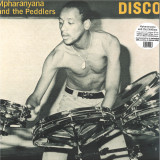
Kalita are proud to announce the first ever official re-release of Mpharanyana & The Peddler's 1979 South African disco and funk recordings 'Disco' and 'Freak Out With Botsotso', backed by a devastating extended edit of 'Disco' courtesy of Amsterdam-based DJ and producer Jamie 3:26. Cut on a loud 12" single and accompanied by an extended edit of 'Disco' courtesy of Jamie 3:26, this truly is another no-brainer from the Kalita camp.
Born on 15th November 1949 in Kattlehong, South Africa, Jacob ‘Mpharanyana’ Radebe was one of South Africa’s greatest ever musicians, releasing a canon of legendary soul, jazz and disco albums before his untimely death in August 1979 at the age of just twenty-nine.
Here, Kalita select his highly sought-after disco and funk recordings ‘Disco’ and ‘Freak Out With Botsotso’, both selected from his 1979 invisible final album, ‘Hela Ngwanana’, re-releasing them for the first time in forty years. Including Paul Simon and Herbie Hancock session musician Bakithi Kumalo on bass and Themba Mokena of Dick Khoza ‘Chapita’ fame on lead guitar, the recordings feature some of the country’s top contemporary musicians joining forces to glorious effect.
With the original album currently fetching eye-watering prices on the rare occasion that they turn up for sale, the time is now ripe to share this masterpiece with the world once more.
RNXRX returns to VEYL for his debut album, 'Impreciso'. No stranger to the label, the artist first made an appearance on 'Previously Undisclosed Rituals' and then again with 'Sigil', a collection of B-sides which act as the perfect prelude to this offering.
Derived from an alchemy of inspiration, the album is the result of endless nights unearthing samples, vinyl oddities, effects databases from a bygone era and the artist’s own post-processed vocals - imprecise components which all combine perfectly to form this LP.
Unconstrained by genre, 'Impreciso' journeys through strains of body music, psychedelic rock, soundtrack and more, delivering electronic experimentations which expose the artist’s darkest tendencies while
revealing a long admiration of post-punk, hip hop and science fiction’s finest.
Twelve tracks falling somewhere between homage and reinvention, 'Impreciso' operates with 80’s circuitry, throws back to 90’s beat nostalgia and drills into a cyber-verse for a familiar yet unexpected trip perfect for this moment.
In 1970 Barney Wilen assembled a team of filmmakers, technicians and musicians to travel to Africa for the purpose of recordi ng the music of the native pygmy tribes. Upon returning to Paris two years later, he created Moshi, a dark, eccentric effort fusing avantjazz sensibilities with African rhythms, ambient sound effects and melodies rootedin American blues traditions. Cut withFrench and African players including guitarist Pierre Chaze, pianist Michel Graillier and percussionist Didier Leon , this is music with few precedents or followers, spanning from extraterrestrial dissonance to earthbound, streetlegal funk. Wilen pays little heed to conventional structure, assembling tracks like "Afrika Freak Out" and "Zombizar" from spare parts of inde terminate origins. (Jason Ankeny, AMG)
Revelatory reissue of Barney Wilen’s ambitious jazz-fusion journey, Moshi (1972), presenting the legendary French jazzman and Miles Davis-sideman’s wildly ambitious effort fusing recordings of Pygmy tribes with African rhythms and stellar avantjazz leanings, sounding little like anything before or since its release. (boomkat)
Super rare and long out of print, the ground-breaking 1972 album from saxophonist Barney Wilen receives a reissue treatment of the highest order. Complete with a 20-page booklet and a never before seen DVD chronicling Wilen’s trip to Africa, this one is sure to be a delight for fans old and new. The deepest spiritual jazz grooves meet field recordings from the Upper Volta and b eyond, whilst psych rock influences collide with hypnotic and shamanistic percussion work. Truly one of the most out -there jazz records we’ve stocked for a long time! (bleep)
Originally issued by the seminal imprint Saravah in 1972, and among the most uncategorizable and sought after artefacts of the French avant-garde, Barney Wilen’s Moshi is nothing short of a masterpiece - long holding a coveted spot in the hearts of adventurous listeners and record collectors alike. A wild unkept cultural collage. A series of sonic experiments. A spiritual, psychedelic pilgrimage into the unknown - darting from one continent to the next, each of its tangents building toward a more optimist world view through ordered sound. Its scope remains as difficult to understand today as it was when it was released. Now brought back into the light by Souffle Continu, this is a moment to be celebrated far and wide. (Soundohm)
Deluxe reissue with additional artwork & remastered audio. 20-page booklet including rare pictures, sheet music & original liner notes. Bonus DVD with exclusive artwork of Caroline de Bendern’s movie « à l’intention de Mlle Issoufou à Bilma » documenting this incredible african journey.
In 1970 Barney Wilen assembled a team of filmmakers, technicians and musicians to travel to Africa for the purpose of recordi ng the music of the native pygmy tribes. Upon returning to Paris two years later, he created Moshi, a dark, eccentric effort fusing avantjazz sensibilities with African rhythms, ambient sound effects and melodies rootedin American blues traditions. Cut withFrench and African players including guitarist Pierre Chaze, pianist Michel Graillier and percussionist Didier Leon , this is music with few precedents or followers, spanning from extraterrestrial dissonance to earthbound, streetlegal funk. Wilen pays little heed to conventional structure, assembling tracks like "Afrika Freak Out" and "Zombizar" from spare parts of inde terminate origins. (Jason Ankeny, AMG)
Revelatory reissue of Barney Wilen’s ambitious jazz-fusion journey, Moshi (1972), presenting the legendary French jazzman and Miles Davis-sideman’s wildly ambitious effort fusing recordings of Pygmy tribes with African rhythms and stellar avantjazz leanings, sounding little like anything before or since its release. (boomkat)
Super rare and long out of print, the ground-breaking 1972 album from saxophonist Barney Wilen receives a reissue treatment of the highest order. Complete with a 20-page booklet and a never before seen DVD chronicling Wilen’s trip to Africa, this one is sure to be a delight for fans old and new. The deepest spiritual jazz grooves meet field recordings from the Upper Volta and b eyond, whilst psych rock influences collide with hypnotic and shamanistic percussion work. Truly one of the most out -there jazz records we’ve stocked for a long time! (bleep)
Originally issued by the seminal imprint Saravah in 1972, and among the most uncategorizable and sought after artefacts of the French avant-garde, Barney Wilen’s Moshi is nothing short of a masterpiece - long holding a coveted spot in the hearts of adventurous listeners and record collectors alike. A wild unkept cultural collage. A series of sonic experiments. A spiritual, psychedelic pilgrimage into the unknown - darting from one continent to the next, each of its tangents building toward a more optimist world view through ordered sound. Its scope remains as difficult to understand today as it was when it was released. Now brought back into the light by Souffle Continu, this is a moment to be celebrated far and wide. (Soundohm)
Deluxe reissue with additional artwork & remastered audio. 20-page booklet including rare pictures, sheet music & original liner notes. Bonus DVD with exclusive artwork of Caroline de Bendern’s movie « à l’intention de Mlle Issoufou à Bilma » documenting this incredible african journey.
Domino are immensely proud to announce the signing of my bloody
valentine, with new physical editions of the band’s seminal catalogue
being made available. ‘Isn’t Anything’ and ‘loveless’ have been
mastered fully analogue for deluxe LPs and also mastered from new
hi-res uncompressed digital sources for standard LPs, with each
being made available widely for the first time ever. Fully analogue
cuts of ‘m b v’ will also be available on deluxe and standard LPs
globally for the first time.
my bloody valentine, the quartet of Bilinda Butcher, Kevin Shields,
Deb Googe and Colm Ó Cíosóig, are widely revered as one of the
most ground-breaking and influential groups of the past forty years.
During an era in which guitar bands denoted, at best, a retroclassicism, not only did my bloody valentine sound unlike any of their
contemporaries, the band achieved the rare feat of sounding like the
future.
With their debut album, ‘Isn’t Anything’ (originally released in 1988),
my bloody valentine revolutionised alternative music and heralded a
new approach to guitar music for generations to come. The album
birthed a sound which became a template for thousands of new
subgenres, heralding a new approach to guitar music and studio
production. Not only was it a new type of music, it paved the way for a
new type of journalism; inciting comparisons to elemental
phenomenon, tapping into how the music affected the psyche.
Shields and Butcher frequently sang in a similar vocal range that
allowed their voices to blend together. This had the effect of making
their gender indistinguishable, to the point where their voices could
be used as another melodic layer to complement the vertigo-inducing
sounds made by Shields’ guitars. It is a record characterised by the
ominous sense of space that inhabits many of its songs, which
veered between the harried and propulsive, to the subdued and eerie.
Joviale is a multidisciplinary artist from North London making otherworldly, immersive music that plays with “minimal textures, killer interjections and vocals that are equal parts restraint and rage.” (The Times) Looping these high vocals with heady, emotional chords, they weave a screen around the listener, pulling them into chaptered, strangely sweet variations of the artist, divided out across albums, and designed to generate a performative atmosphere, both on stage and through the recording.
For their forthcoming EP Hurricane Belle NEVER SEVEN, spring 2021, Joviale combines warm sensual exposure with a flash of teeth, as the fictional Hurricane Belle whirls onto the scene, an embodiment of the “sense of electric and spiralised chaos” erupting from the artist’s centre. Hurricane Belle is a Champion that was inspired by Peter Shenai’s “Hurricane Bell” experiment, in which he cast brass bells modelled on the five stages of Hurricane Katrina. Industrial, insatiable and metallic, Hurricane Belle is embedded in the album not only through sound, but also through sight; the first single of the project, Blow, will be accompanied by a self-directed video, reflecting Joviale’s increased interest in the visual arts, and in building multisensory experiences. As written in the accompanying prose for the album, “Let yourselves into my breath, my rhythm and my core. Take pleasure in the whiplash of this collection.”
2019 saw the release of the artist’s debut EP Crisis, in which Joviale wielded narrative and storytelling to build a dreamy, silk-wrapped universe across songs such as Dreamboat, and Taste of the Heavens. As with Hurricane Belle, Crisis was created in collaboration with the producer Bullion, and it has been widely supported by press, including interviews in The Face and Coeval, and features in Dazed, Line of Best Fit, Guardian, The Times, Fader, Crack and Clash, among others. The EP also merited radio support from Huw Stephens on BBC Radio 1, Jamz Supernova on BBC 1xtra, Selector FM, Matt Wilkinson on Beats 1, Tom Ravenscroft, Tom Robinson on BBC 6 Music, Dan Alani on Reprezent, and Worldwide FM, among others.
Joviale belongs to a generation of artists with a strong sense of collaborative, interdisciplinary practice. The artist leans into this skill-sharing, research-led community, valuing project-based work that allows for the development of concepts related to visual and sound culture. This is reflected in them having recently directed a video for Laura Groves, as well as running a bi-monthly radio show on NTS over a period of twelve months. They carry a deep interest in the connection between the arts, ecological sciences, and semi-fictive encounters, as well as the wider London scene. In 2019, The Face described Joviale’s sound and aesthetic as “building the London artist a loyal fan base”, an effect that encompasses their involvement in the city’s music circuit; Joviale built a reputation for their live shows before releasing any official music. They have played support shows for artists that include Celeste, Zsela, Kate Tempest, Nilufer Yanya, Babeheaven, Kindness, and Westerman, and, in 2019, Joviale sold out their first headline show at Folklore, Hackney.
Fiddlehead wasn’t supposed to make a second record. But, if we’re being totally honest, they weren’t supposed to make their first record either. Formed in what singer Pat Flynn describes as “a deeply, deeply, laughably depressing part of my life,” Fiddlehead was born with modest intentions. Flynn and his then-roommate, guitarist Alex Dow, decided to work on some songs, and with Basement having just broken up, guitarist Alex Henery entered the fold. Drummer Shawn Costa and bassist Adam Gonsalves—who has since been replaced by Casey Nealon—linked up with them and, all together, they wrote what would become the Out Of The Bloom EP. Those five songs established what Fiddlehead would be, a band that merged elements of post-hardcore, post-punk, and classic ‘80s emo into something that felt distinctly theirs.
Between The Richness effectively picks up where Springtime & Blind left off, as Flynn dives headfirst into that same subject. But astute listeners will notice a major difference this time: Flynn is singing about himself. “These massive things happened in my life between the first record and this record. It just so happened that I ended up getting married, I had a child, and it was around the 10-year anniversary of my father’s passing. So what if I want to write another record about how I feel about the loss of my father? Will people be like, ‘Pick another topic, dude.’ So, the opening track is called ‘Grief Motif’ because it’s the idea that this is an eternal struggle that will never go away. Take it or leave it, but it will be part of this dude as long as he’s got a pen in the hand.”
Between The Richness explodes with an energy that usurps that of Springtime & Blind. The guitar riffs of Dow and Henery are their most anthemic and combustive yet, making songs like “The Years,” “Get My Mind Right,” and “Down University” not just serve as the backbone for Flynn’s personal ruminations, but empathetic, emotional musical stabs that hit the listener just as hard. Meanwhile, Costa and Nealon give the songs a propulsive heft, allowing a track like “Million Times” to dart into unexpected territories without ever feeling alien
Fiddlehead wasn’t supposed to make a second record. But, if we’re being totally honest, they weren’t supposed to make their first record either. Formed in what singer Pat Flynn describes as “a deeply, deeply, laughably depressing part of my life,” Fiddlehead was born with modest intentions. Flynn and his then-roommate, guitarist Alex Dow, decided to work on some songs, and with Basement having just broken up, guitarist Alex Henery entered the fold. Drummer Shawn Costa and bassist Adam Gonsalves—who has since been replaced by Casey Nealon—linked up with them and, all together, they wrote what would become the Out Of The Bloom EP. Those five songs established what Fiddlehead would be, a band that merged elements of post-hardcore, post-punk, and classic ‘80s emo into something that felt distinctly theirs.
Between The Richness effectively picks up where Springtime & Blind left off, as Flynn dives headfirst into that same subject. But astute listeners will notice a major difference this time: Flynn is singing about himself. “These massive things happened in my life between the first record and this record. It just so happened that I ended up getting married, I had a child, and it was around the 10-year anniversary of my father’s passing. So what if I want to write another record about how I feel about the loss of my father? Will people be like, ‘Pick another topic, dude.’ So, the opening track is called ‘Grief Motif’ because it’s the idea that this is an eternal struggle that will never go away. Take it or leave it, but it will be part of this dude as long as he’s got a pen in the hand.”
Between The Richness explodes with an energy that usurps that of Springtime & Blind. The guitar riffs of Dow and Henery are their most anthemic and combustive yet, making songs like “The Years,” “Get My Mind Right,” and “Down University” not just serve as the backbone for Flynn’s personal ruminations, but empathetic, emotional musical stabs that hit the listener just as hard. Meanwhile, Costa and Nealon give the songs a propulsive heft, allowing a track like “Million Times” to dart into unexpected territories without ever feeling alien
Every Dunbarrow album has a hauntingly classic sound of, in the band’s own
words, “an eerie rawness.” But their third album feels like you’ve discovered a
mysterious half-century old recording tucked away in a decrepit abandoned
mansion. Perhaps there’s a note attached, begging its courier to beware. Alas,
whoever possessed the tape apparently never survived. ...that is to say, it feels like there’s a solemn
story to this album, not just in the
lyrics, but in the sound itself. Much like
the eponymous debut of Black Sabbath,
the band uses subtle sound effects to
dramatically set the scene for its mostly
clean tones and masterful use of open
space for which the band has become
known. But unlike their first two albums,
this one does see the band branching
out just a bit into heavier, more distorted
guitars. The result is a much more
in-your-face sound, while retaining the
Haugesund, Norway quintet’s masterful
proto-metal sound.
The album opens with the sound of falling
rain as Lønning and Eirik Øvregård’s
guitars seep into the speakers like
funereal bells and haunted drones on
“Death That Never Dies.” Drummer Pål
Gunnar Dale slams down three snare
beats as bassist Sondre Berge Engedal
slinks in harmony over it all. Andersen’s
crisp vocals paint a bleak picture of
dark perdition until the band slips into
a swaggering piano-led coda reminiscent
of “Sabbra Cadabra.” The 7-minute
psychedelic folk masterpiece “Turn In
Your Grave” is the album centerpiece,
replete with mournfully shimmering
Mellotron and bleak folkloric lyrics. Its
hypnotically spinning guitar notes and
old European parlando-rubato singing
hearken to dark early Steeleye Span with
a sinister edge. “In My Heart” perfectly
showcases the band’s penchant for folk
based, yet head-banging riffs that break
with tradition that has stilted modern
heavy music.
“I think with this record, we have managed
to create our own unique sound
with its own Dunbarrow tag,” says the
band. With that sound comes the perfect
artwork: A cover illustration from the
early 1900’s by artist Harry Clarke from
his work for Edgar Allen Poe’s Tales of
Mystery and Imagination.
Global electronic sound specialist - Producer and DJ Oliver Williams aka "The Busy Twist" is at it again. Among his numerous projects as a producer, this double-sider, dancefloor-focused EP is one of his seldom seen, more personal works in the vein of what he does best: an uptempo, bass-heavy madness, influenced by his regular trips to Africa, Latin America and the West-Indies, packed with undeniable British club music culture and production technique. Highly infectious energy, pure sunshine, 100% good vibes. Following up on The Busy Twist previous collaborations with Congolese singer Tres. "Nanko" is another joyful, sun-soaked, highly danceable Electro-Soukous party joint, loaded with captivating guitar grooves and soulful vocals. On the flip, "Rwendo Rweupenyu (The Journey Of Life) Remix" is an outstanding take on Zimbabwean Sungura Music (one of the country's most popular genres), originally performed by street band Daniel & Gonora Sounds, led by singer-guitarist Daniel Gonora and his drummer son Isaac. Respectfully using Daniel's mind bending guitar riffs and highpitched, uplifting vocals, The Busy Twist and his collaborator delivers an inspiring and remarkably effective version of the original song. Vinyl contains exclusive extended and instrumental Dj-friendly versions of both tracks that won't be available for download anywhere.
- A1: Squrl - Streets Of Detroit
- A2: Squrl - Funnel Of Love (Feat Madeline Follin)
- A3: Jozef Van Wissem & Squrl - Sola Gratia (Part 1)
- A4: Jozef Van Wissem & Squrl - The Taste Of Blood
- B1: Squrl - Diamond Star
- B2: Squrl - Please Feel Free To Piss In The Garden
- B3: Squrl - Spooky Action At A Distance
- C1: Jozef Van Wissem & Squrl - Streets Of Tangier
- C2: Jozef Van Wissem - In Templum Dei (Feat Zola Jesus)
- C3: Jozef Van Wissem & Squrl - Sola Gratia (Part 2)
- C4: Jozef Van Wissem - Our Hearts Condemn Us
- D1: Yasmine Hamdan - Hal
- D2: Jozef Van Wissem & Squrl - Only Lovers Left Alive
- D3: Jozef Van Wissem & Squrl - This Is Your Wilderness
Soundtrack for the critically acclaimed Jim Jarmusch film Only Lovers Left Alive, starring Tom Hiddleston and Tilda Swinton. The score for Only Lovers Left Alive - a collaboration between SQÜRL (Jim Jarmusch, Carter Logan and Shane Stoneback) and Dutch lutenist Jozef Van Wissem - serves as a reflection of the distinct textures of Detroit and Tangier, bridging ancient and modern sounds, entangled and timeless. Avant-Baroque lute weaves through twenty-first century guitar grit, heavy back beats, Moroccan percussion, synth bass, field recordings, and numerous sonic effects to create a cinematic tapestry. Guest vocalist Madeline Follin (Cults) appears on SQÜRL's syrup soaked re-interpretation of the Wanda Jackson hit "Funnel of Love". Zola Jesus' commanding vocal soars through Van Wissem's "In Templum Dei". And Yasmine Hamdan's intimate and evocative "Hal", recorded on the set of the film and mixed by SQÜRL. The film and soundtrack album were released worldwide in 2014, and quickly earned the group the Cannes Soundtrack Award from a consortium of film and music critics. In the years that have followed it has remained a favorite of critics and fans alike, who have continued to hunt down the limited vinyl copies in existence.
“Some of the most extraordinary songs I’ve heard in years.” Brian Eno
Les Disques du Crepuscule presents The Salt Garden (Landscaped), an album of extended pieces by acclaimed quiet music ensemble Fovea Hex, featuring longform remixes by British songwriter and producer Steven Wilson and Serbian soundscape artist Abul Mogard, as well as a previously unreleased mix by Peter Chilvers.
Formed in 2005 by Irish musician Clodagh Simonds, Fovea Hex have since released 3 albums (Neither Speak Nor Remain Silent, Here Is Where We Used to Sing and The Salt Garden), drawing favourable comparisons with Nico, This Mortal Coil, Ligeti and even Schubert.
The Salt Garden (Landscaped) is pressed on crystal clear vinyl, and comes packaged with a CD version featuring 4 tracks in total. The outer sleeve is printed in white reverse board and features an image taken by Crepuscule designer Joel Van Audenhaege during a recent trip to Greenland. The inner bag offers detailed liner notes as well as an interview with Clodagh.
As well as Steven Wilson and Abul Mogard, other high-profile admirers include film director David Lynch, who invited the group to play at his Cartier Foundation exhibition in Paris in 2007, and Brian Eno, who has described Clodagh’s work as “some of the most extraordinary songs I’ve heard in years.”
The Salt Garden (Landscaped) gathers together 3 long ambient remixes of tracks from the Salt Garden EP trilogy, originally released between 2016 and 2019. The core album is pressed on crystal clear vinyl and showcases ‘Solace’ and ‘Is Lanza Light & Given’, both re-worked by musical polymath Steven Wilson. “I’ve long been a fan of Fovea Hex,” explains Steven, “which for me is some of the most sublimely beautiful music ever recorded. It’s a mix of electronic and acoustic sounds played on instruments ranging from state-of-the-art to ancient and arcane.”
As well as the two tracks reworked by Steven, the bonus CD enclosed with the vinyl album also finds room for ‘We Dream All the Dark Away’, the widely-acclaimed re-interpretation by Abul Mogard of ‘All Those Signs’ from the Salt Garden II EP. By turns haunting and sinister, but always beautiful, the piece features vocals by both Clodagh and Brian Eno, as well as cello by Kate Ellis, and modular synth and effects by mysterious soundscaper Mogard.
An additional special bonus track on the CD is an unreleased remix of lesser -known 2015 digital single ‘By the Glacial Lake’ made by musician Peter Chilvers, best known for his collaborations with Brian Eno, Karl Hyde, Chris Martin and Tim Bowness.
“I feel truly honoured!” says Clodagh Simons, who began her career in cult folk-psyche band Mellow Candle, and since then has guested on albums by Mike Oldfield, Thin Lizzy, Russell Mills, Matmos, Current 93 and Steven Wilson. “It’s been fascinating to witness how these pieces have been so imaginatively and skilfully revisioned in the hands of Steven, Abul and Peter. Each piece has emerged into a completely fresh new light, with a different vibrancy, yet remains grounded in what was there before.”
Roman Flügel is a magician. This statement is far from being a hyperbole. Just put the needle down on any record – I mean any! – of his ( collaborations included) since the early nineties and see for yourself: none of them are without that special effect. The magic works instantly. And as the thing with magic goes: it’s challenging to explain it. But I guess that is what makes it magic.
Eating Darkness is the title of his newest spell. Affected by the fundamental shock that any system got in 2020 – but not the result thereof – it is an album that could absorb it – as its name might suggest. Music and nightlife work hand in hand as escapism and as anchors or as the undercoat of social interactions. They enable people to deal with hardships as well as the burden and the joy of life. That is the starting point and hope of Eating Darkness: the outlook and invitation to enrich each and everyone’s existence.
Bound to the single LP format and reminiscent of a time with format limitations, the nine tracks are testament to Flügel’s weakness for the art of pop music with the use of little and especially short motifs. Furthermore equipped with a clear instrumentation and without any camouflage, Eating Darkness corresponds to his idea of a virtual band.
As it happens, the opener is called The Magic Briefcase. That sits not only well with my first sentence, but pretty much embodies the album and Roman Flügel’s apparatus in an alternative title: Crystal clear sounds and melodies bounce on and off the dance floor, living room and club are pulled together and transcendental moments take turns with the tangibility of reality. After all, that is how a real magician allures you.
Straight Outta Caledonia is the first commercially available “Greatest Hits” of the outsider songwriter Jackie Leven, an artist
who has largely remained in obscurity in his native Scotland despite being one of the greatest wordsmiths – and singers – it ever
produced. A well-travelled musician who began making psychedelic, progressive music in the late 60s before emerging as an
epic storyteller full of pathos, humour and humanity in the 90s, Leven lived and wrote like many of the fragile, gregarious
characters of his songs; large, full of life and empathy. Leven passed away in 2011 after recording 30+ albums under different
guises or with his briefly successful New Wave band Doll by Doll. Straight Outta Caledonia is a compilation collated by Night
School Records on its Archival label School Daze that seeks to introduce Leven’s music to new generations.
In an age of isolation, alienation and loss of visceral experience, Jackie Leven’s music can be massive and welcoming. It feels
connected to some universal humanity and vibrates with vitality. His songs are often full of tragedy and comedy simultaneously,
cutting straight to the heart, often plugging directly into the nervous system of the listener. His lyrics are rich, dense with imagery
that can veer from apocalyptic to the comically banal in a sentence, with a songwriting panache that can be heavy handed to
almost bursting point before skewering the song with a clownish, warm punchline. His productions ranged from Bob Dylan’s
Rolling Thunder Revue style rock band orchestrations with strings and organ as on the epic Ancient Misty Morning or they could
be pared down to the purest form of folk song as on Poortoun: Leven on stage alone with an acoustic guitar, albeit played with a
mastery of the instrument that he often only hinted at. Musically his sound can bend traditional structures or stay completely
confined within them yet still forever push towards an ecstatic release, as on the cinematic Snow In Central Park.
The most exciting, jaw-droppingly effective tool at Leven’s disposal was his voice. A multi-octave instrument that, though
damaged during a savage assault in Fife, he used with flair; he had both a brazen disregard for the rules and a deep humility, all
of which is evidenced with every phrasing. A baritone that could flit up through the register – always touched by his gentle
Kirkcaldy accent – it’s the prime delivery method for his songs. Leven’s voice enabled him to inhabit the characters in his songs to
an uncanny degree, a skill that in turn enables the listener to empathise with them and, subsequently, the singer. It’s most evident
in stand out song The Sexual Loneliness Of Jesus Christ, a breathtaking re-telling of the life of its protagonist, not as a pure,
sinless messiah but as a sexually frustrated, solitary man condemned to an existential loneliness no one else will ever feel. In
many ways the track is the archetypal Jackie Leven song. Produced by Pere Ubu’s David Thomas, what strikes the ear first –
after the samples of unemployed workers in Glasgow following the closing of the Clyde shipyards – is the audacious, rhythmic
tremolo effect Leven employs through the verses before the production opens up to allow Leven’s vocal to lift into a soar, a
freeing glide powered both by the force of the singer’s chutzpah and the inherent, doomed destiny of the protagonist. With any
other singer such subject matter could come across as gauche or worse, pretentiously sonorous, but Jackie Leven’s genius was
such that he could be this cinematic and brazen while touching something elemental and true in the beholder. It’s a skill evident in
every song on Straight Outta Caledonia, the trademark of a songwriter who revelled and excelled in intensity with a lightness of
touch.
In his lifetime, Jackie Leven toured, wrote and recorded at a ferocious rate. He recorded under aliases to avoid record contract
restrictions, played house shows in Europe after or instead of official concerts, events which were often spoken word story telling
masterclasses as well as performances of his often bewilderingly dense songbook. His music has traditionally been catalogued
as “folk” music and has been largely banished to a small, dedicated group of international fans and apostles both private and well
known, like author Ian Rankin or Glenn Matlock. Since his passing in 2011 however, there has been a growing recognition
amongst a newer generation, with artists like James Yorkston or Molly Nilsson publicly stating the influence of the unsung
troubadour on their own craft. Jackie Leven’s fairytales for hard men are often forensic deconstructions of masculinity, sad and
ecstatic, light and shadow, always endlessly rich, a resource as bountiful as Leven himself’s human spirit undoubtedly was.
2024 Repress
Grey Marbled Vinyl
Focus mode to the fullest. Berlin-based Lars Huismann strikes back on Voxnox Records, with his four-track EP "Take The Step".
Self-titled "Take The Step" kicks in first by delivering filthy hat shuffles on even nastier drums and a growing arpeggiator line. With small, yet effective vocal pieces emerging over the place, mysterious pad shapes build a tremendous climax ready to roll further into the future on this one. It's a Voxnox Fam thing with this perfect introduction!
With "Not The Same" stepping up next, Huismann showcases an ever-evolving percussion line on top of some tasty claps and flowing synthesizer plugs. Small voice parts enter the situation too as we get into deeper, atmospheric vibes bringing us a never stopping joy.
And so it's said that the B-sided "Bulletproof" takes nothing less but marching drum patterns and melody glitches coming out of nowhere to prove a forward-directed vibe afterwards. Eventually taking us back to the good old raving area, where eclectic synth lines were the regular state, followed by clever arrangement moves.
Rounding up this EP is the delivered "Bulletproof" remix by Manchester's powerhouse AnD. Taking a faster pitch on the original stems, this remix is a forward-moving rave machine par excellence. With synthesizers marching around the room, proofing that nothing can stop them, we get lost inside this epic round up for the 44th Release of VNR.
Divine Invasions is the sophomore release from Welsh electro post-rock duo Ritual Cloak. The album builds on the cinematic soundscape themes of their debut, with the addition of vocals scattered throughout the record.
Work on Divine Invasions began as soon as the first album had been finished back in September 2019. The first album saw sparing use of guitar, instead mainly writing around piano. When it came to writing the second, Sanders and Barnett didn’t want to fall into the same routine, choosing to embrace exploring new sounds, experiment with new effects, making guitars sound like synths and using vocals for the first time.
The title Divine Invasions is inspired by the Philip K Dick biography. Dick was plagued by nervous breakdowns and driven to near insanity by visions of God.
For Fans Of:Mogwai, Radiohead, Sigur Ros, Kiasmos
black & red transparent marbled vinyl
This is the 24th release on RIOT Radio Records, an independent techno label based in Scotland.
Moscow based Trust True is a producer and DJ who’s quite literally off his rocker. Displaying agonizing and often deranged broken beats which seize the very beat of your heart, his music rushes, grinds and pulsates with so much ferocity, even your living breath will be succumb to its lethal effect.
Continuing with our ‘Limited As Fuck’ series of 12”s, this overpowering ‘OUTBURST’ will provocatively attack your gnarly senses in an unrealised beguilement on this crazy Russian’s 1st ever vinyl release.
There’s four demolition grade tracks on this vinyl release that will completely eradicate any dance floor of ravers not able to keep up with its devastating destructiveness. Bursting with aggressive intensity from the get go, Trust True’s warmongering battle cry of ‘AAIRAA’ is akin to that of a volcanic eruption which never ceases in fieriness through-out the remaining tracks.
The full digital release also features two bonus paroxysmal abuses of your auditory senses. Every single track counterbalances each-others cognitive array of hedonistic sentient comprehension to such an extent your sub-vocal oscillations will be fit to burst.
WARNING: ONLY A HEART OF STONE WOULD FAIL TO BE MOVED BY SUCH TORRENTIAL DISTURBANCE
After contributing to the genesis of the label, the pioneering techno artist Zadig returns to KR3 with a 6-track EP inclusive two remixes by Adriana Lopez and Mod21.
Silent Warrior is an intense, deep and emotion-filled work dedicated to the memory of a beloved friend. A personal outburst that focuses on the hypnotic and triggering effect that music can have on each of us.
GEORGIA's new kaleidoscopic hyper-music-entity "State Effect (Accel)" expands the NYC's duo project in a high-dimensional phase space—and does so within their all-kind-of-music frame.
State Effect (Accel) is happening this very moment, it is a positive cry for change—a brilliant plan.
This record is "viscous" — whatever I do, wherever I am, it sort of "sticks" to me.
It is "nonlocal" — its 'accelerated' effects are globally distributed through a huge tract of time. It forces me to experience time in an unusual way.
It is "phased" — I only experience pieces of it at any one time.
It is "inter-objective" — it consists of all kinds of other/multiple entities but it is not reducible to the sum of its parts.
This music reveals the present and its psychic dimension, no titles could have been more relevant.
Justin Tripp and Brian Close's new kaleidoscopic hyper-music-entity expands their GEORGIA project in a high-dimensional phase space. A great work of cognitive music mapping that plots all the states of a system — Lovely bubbly HTML.
The eight tracker long playing make extensive use of the vocal participation of Paris/Berlin-based artist/DJ MARYLOU aka OISEAU DANSEUR and Gabi Asfour of visionary NY fashion collective threeASFOUR.
It is with extreme pleasure that we, Basement Boys Records proudly announce our 100th single release and 30th year in the music business as an active recording label!
Holding down our 100th release is the legendary multi-faceted singer/songwriter/producer Byron Stingily. As one third of the Chicago-bred, world renown trio, Ten City and as its primary lead vocalist, Byron’s velvety falsetto graced such House Music staples as “Devotion”, “That’s the Way Love Is”, “My Piece of Heaven” along with scores of other classic House music favourites. As a solo artist, Byron went on to create such memorable House jewels as “Get Up” & “It’s Over” a classic collaboration with the Basement Boys for his project on Nervous Records.
“We Belong Together” contains four mixes. The Monday Night Vocal Dub and Instrumental are up first, with percolating congas and swinging violins that accentuate the well-paced drums and percussion of this delectable mix. The brassy horns sing in tandem with Byron as he tugs on the heartstrings with his romantic, chromatic vocal adlibs and signature riffs. The sugar-laden strings and sparkling pianos brings to mind the 90's Ten City production of Marshall Jefferson.
DJ/songwriter/musician/producer, Maurice Fulton is one of House music’s true originals, back where he started. Maurice had the first release on Basement Boys Records with Sticky People "Kong". A man with a mind-blowing complexity behind all that is deep, dark and funky.
Fulton’s mix takes a more soulful tech approach employing a host of electro sounds. A fervent polyrhythmic vortex of percussive wind chime effects, married with classic snares, tom toms & hi-hats, deep sub bass and a meaty kick all define this masterful alignment of electro and acoustic elements. At the midway point, Maurice turns the suspense-filled symphonic intro from the previous mixes into this electro breakdown groove fest sure to drive dancers into a frenzy complete with Byron’s heartfelt lyric.
Closing it out the Main Mix in all its glory, hi-powered, dense bottoms and percussive elements, sweet R&B “boogie” style chords, neatly placed horn accents with Byron slaying the lyric as he always does in his exquisite, soulful pleading falsetto telling the object of his affection, “We Belong Together”.
"Matasuna" brings together two important pioneers of funk on its latest release: "The Meters" from "New Orleans"and "The Watts 103rd Street Rhythm Band" from "Los Angeles". The song "Giggin' Down 103rd" by "The Watts 103rd Street Rhythm Band" was first released as a single in 1968 (as Misspress) and is now available again for the first time. The song "Sing A Simple Song" by "The Meters" even premieres as a 45! Both tracks have been remastered to offer the best possible sound.
The A-side opens with "Sing A Simple Song" by "The Meters", a cover version of a song by "Sly & Family Stone" written by "Sly Stone". In direct comparison, "The Meters" cover sounds much more energetic and powerful. The ingredients are simple but effective: heavy drum breaks, funky guitar riffs, deepe bassline and a lively organ. A killer instrumental joint that exudes roughness & funkyness from the first second to the last!
On the flipside "The Watts 103rd Street Rhythm Band" follows up in similar fashion with the song "Giggin' Down 103rd". Instead of an organ like "The Meters", the band offers a super thight horn section backed by killer drums, guitars & bass. A special spicy recipe that thematically fits perfectly for this Funk45!
"The Watts 103rd Street Rhythm Band" was formed by "Charles Wright". Charles, a musician & composer born in 1940 in "Clarksdale, Mississippi", moved to "Los Angeles" in the 1950s. There he played as a singer & guitarist in various doo-wop groups. Beginning in 1962, he formed his own band, "Charles Wright & The Wright Sounds", which was joined in the following years by other musicians who would become known in the future band. The name "The Watts 103rd Street Band" was established in 1967. That same year they signed a record deal with "Warner Bros. Records" and released their first album. More LPs were released in the following years.
The band played mainly cover versions of popular R&B hits in the early years, but began to create their own songs and form their own sound in the late 1960s, which would have a strong influence on other musicians at the time.
Starting in 1969, the first members left the band to work on other projects. Charles also left the band in 1972 to further his solo career and release various albums.
In 1965, the group "The Meters"was founded by "Art Neville"with three other musicians in the musical epicenter of "New Orleans". They quickly made a name for themselves in the local scene. The musician "Allen Toussaint", who was to become one of the most influential record producers of the 1960s, discovered the band and signed them to his label "Sansu Enterprises". They first played as a backing band at live and studio performances of artists of the New Orleans scene, before getting their own record deal with "Josie Records". On this label they released three albums, before releasing more in the following years on "Reprise Records" and "Warner Bros. Records". The band officially disbanded in 1977 and reunited a few years later in 1989.
Since then they have been on stage in different formations as "The Meters", "The Funky Meters" or "The Meter Man".
Their innovative musical style, which was influenced by traditional New Orleans second line music, West African rhythms, Soul and rReggae, set a standard that would influence many musicians. Also, their music had a significant impact on the Hip Hop community, which sampled their songs hundreds of times.
Dynamite Cuts are proud to have the opportunity of presenting this amazing Dj dance floor diamond, by the legendary funk n soul band S.O.U.L. “Burning Spear” is an upbeat Drum and Bass groove with a super funky flute and all time classic sample. Sampled by hip greats like Pete rock & C.L Smooth & Organized Konfusion to name a few, a pure rare-groove club anthem, I remember those nights, funky-ing down to this awesome rhythm.
Dynamite Cuts’ issue of this monster, is a double-sider of the ultimate versions of “Burning Spear”. The A side cut is taken from the superb “What it is?” LP. On the B-side is the rare and more collectable version; slightly different, more percussive recording which was released on 7” in 1971 on the Musicor record label, but sadly on the hissing, breakable styrene, and not on the lovely VINYL. You’d be lucky to find a copy that doesn’t hiss, pop and crackle. But with thanks to; Mr Simon Watson, who had a mint stock copy almost un-played; and to the A-Lister Dynamite Cuts’ mastering magicians - Andy Pearce (de-noises) and Stuart Hawkes (remastering to get that full-on funk effect). Now what are the chances of that!!!
The name S.O.U.L means Sounds Of Unity and Love, consists of four men from Cleveland, Ohio USA, the band was formed around 1970.
Lee Lovett, a Libra - Lead singer, Bass and Baritone;
Gus Hawkins, a Scorpio - Vocals, Saxophone, Flute
Paul Stubblefield, an Aquarius - Vocals, Drums
Walter Winston, a Pisces - Guitar.
Sometimes, savagery is the most effective form of communication. For that, there are the Dueling Experts, the dark ninjas behind one of 2020’s most filthy, cohesive, and authentic hip-hop records. A masterclass of verbal carnage and bell-ringing beats that reminds you that if ain’t raw, it’s worthless. You may know Verbal Kent, the battle-scarred Chicago sensei, who has proven his mettle time and time again on wax -- both in his solo albums and in Ugly Heroes. But you’ve never heard him as serrated as he sounds alongside the Ghanian MC, Recognize Ali. Spitting pyroclastic flows over a treasure trove of lo-fi beats excavated from the legendary and mysterious producer, Lord Beatjitzu, the two craftsmen attack with meticulous rhyme schemes and hardbody vocals to spark melees. The beats are so adamantine that they could crush diamonds. Meanwhile, Kent and Ali exhibit a chemistry reminiscent of all-time greats like Billy Danze and Lil Fame of M.O.P., Raekwon and Ghostface, and Rock (Sean Price) and Ruck of the Boot Camp Click. This is the sound of war. Hip-hop to slap the proverbial taste of your mouth. The soundtrack to bloody knuckle brawls and broken glass. Beats that sound like they were dropped on the floor and coated in filth, boasting an almost Beta-like quality while simultaneously exemplifying sampling and chopping in a 90’s RZA-like fashion. This is the second installment "DE2: Sand the Floor
- A1: Barbara Tucker - Beautiful People (Underground Network Mix)
- A2: Essence - Moments In House (Full Effect Mix - Dj T Edit)
- B1: Mole People - Break Night
- C1: Dj Sneak - Keep On Groovin' (Fat Bottom Mix)
- C2: Wamdue Project - King Of My Castle (Original Mix)
- D1: South Street Player - (Who?) Keeps Changing Your Mind (The Night Mix)
- D2: Sole Fusion - Basstone (Underground Network Mix)
Legendary NYC house label Strictly Rhythm is celebrating a mammoth 3 decades of cutting edge, roof-raising house music. Truly a benchmark.
Originally founded in 1989 by the dynamic pairing of music industry man Mark Finkelstein and A&R expert Gladys Pizarro, Strictly tapped directly into the fertile New York underground and after hours club scene, helping to launch and bolster the recording careers of dance music luminaries like Armand Van Helden, Roger Sanchez, Ultra Nate, Todd Terry, Wamdue Project, DJ Sneak, Louie Vega and many more. Strictly Rhythm is easily one of the most recognisable and respected dance music powerhouses of all time.
Across 3 limited double vinyl offerings, the Strictly catalogue has been expertly picked over to present you with a snapshot of some of the most earth shattering house music to emanate from the streets of New York City. A who's who of producers and artists, all killer and no filler. End to end classics that help to tell the story of one of dance music's most well loved labels. Classic cuts and essentials from DJ Sneak, Wamdue Project, Louie Vega (Sole Fusion), Essence and more all feature on part 2 in their unedited, 12" mix glory.
Fully legit, remastered and selected with love courtesy of Strictly Rhythm and Above Board distribution for 2020. Happy birthday Strictly Rhythm!
All music improvised by Michael Wollny, Emile Parisien, Tim Lefebvre
and Christian Lillinger (except ‘Nostalgia for the Light’, written and
arranged by Michael Wollny).
The music we hear doesn’t fit into any category. We’re in uncharted
territory, so a good way to capture its essence might be to break it
down into its four component parts. First there’s Michael Wollny, here
for the very first time playing only on electronic keyboard instruments.
He creates a characterful world of retro-futuristic sounds that is very
much his own. We find the occasional nod to early Jean-Michel Jarre,
references to science fiction and horror movies and also vivid
memories of the sounds of avant-garde Krautrock: Can and Irmin
Schmidt and Klaus Schulze.
As for Tim Lefebvre, here is a musician who has plied his very great
craft with stars such as David Bowie, the Tedeschi Trucks Band, John
Mayer, Knower, Steely Dan, Elvis Costello and Wayne Krantz. Here
he is like a rock in a tempestuous sea. He propels the music forward
with a combination of bass and effects. He builds structures and
tames unruly elements. The way he lays down a groove is
overwhelming.
As a counterbalance we find the explosive yet highly sensitive playing
of drummer Christian Lillin-ger. He stacks layer upon layer of rhythms
and textures.
And the melodic lines of Emile Parisien on soprano saxophone
always have an astonishing springy inventiveness. Such is Parisien’s
latent energy, it seems as if at any moment he could suddenly
become airborne.
The players’ eager curiosity as to what the next turn, the next
impulse, the next push will be is palpable to the listener. One can
sense the tension between the urge to construct forms, lines,
grooves, harmonies, textures, versus the illicit joy of tearing such
fragile structures apart before they have even been heard. There are
beats and patterns from the 90s, 80s and 70s, all coalescing into
cinematic bacchanalia of sound. These four master improvisers and
composers all have the urge to rewrite the rules of their musical world
- and to do so in real time.
LP pressed on 180g vinyl with digital download code.
A. Smyth debut album, Last Animals, will be released early next year on 19th February. The album was produced by Darragh Nolan (Asta Kalapa) and mastered by JJ Golden. “…we made Last Animals in January of this year, moments before the world was to change forever. Throughout the record I reflect on the effect we as humans are having on our home, little did I know what was to come.... Last Animals is made up of 10 songs, some big, some small, but all with something to say”.
The forthcoming album’s first taster ’Hero’ (Oct 2019) racked up 338k streams with inclusion on Easy, Your Coffee Break and Breath of Fresh Eire Spotify playlists. It followed a series of equally well-received early singles released by A. Smyth over the last two years, including ‘Second Moon’, another add to Your Coffee Break playlist (alongside many other discovery playlists) with 642k Spotify streams to date, ‘Coming Back To You’ and ‘Fever’, both of which featured in ‘Made In Chelsea.’ With the singles gaining early support by major Irish radio stations RTE Radio 1 and Today FM.
A. Smyth has sold out Whelans in his hometown Dublin, and performed at Ireland Music Week and Other Voices festivals - with an appearance also on Other Voices TV show which aired this Spring. As well as performing UK/international showcases at Primavera Pro, Eastbound Festival and All Together Now (among others).
The imaginative talents of writer Neil Gaiman come to vinyl with this collection of three full-cast radio dramas based on his bestselling works. This highly collectible box set presents 5 x 140g gold
vinyl, in three individual sleeves (two gatefolds plus one single LP). Each one features an exclusive sleeve note by Neil Gaiman plus full cast, credits and broadcast details.
A frameable, full-colour print of Neil Gaiman, signed by the author himself, is also included. These are strictly limited to 750 copies.
Stardust, adapted by Dirk Maggs (Sandman, Good Omens) tells the story of Tristran who goes in search of a fallen star and enters the world of Faerie.
Norse Mythology is Gaiman’s retelling of myths populated by gods and monsters, all featuring tricks and trust, fiery endings and new beginnings. Chivalry tells the tale of Mrs Whitaker, who discovers the Holy Grail in a charity shop… The cast for these three productions features the crème de la crème of acting talent: Eleanor
Bron, Diana Rigg, Glenda Jackson, Matthew Beard, Sophie Rundle, Frances Barber, Maggie Steed, Derek Jacobi, Natalie Dormer, Colin Morgan, Nathaniel Martello-White, Kit Harington and many more, plus cameo appearances by Tori Amos and Neil Gaiman. A superb soundscape of music and effects accompanies each one.
Afrosound's mission was to emulate the guitar-heavy tropical sounds emanating from Perú and Ecuador at the time. To add to the hippie vibe, there were plenty of whacky improvised vocal asides (called 'inspiraciones'), plus custom fuzz, wah-wah, flange and echo effects boxes for the guitar and keyboards. A barrage of odd sounding synths, drum machines and other electronic flourishes were also sprinkled in to spice up the proceedings. The dozen tracks on Afrosound's debut long play make for a surprisingly diverse palette from which these Colombian musicians painted their daring portrait of Peruvian cumbia, returning the favor in bold colors that still resonate almost 50 years later. "La danza de los mirlos" kicks off with most famous Afrosound hit of all, 'Caliventura', a genius blend of funk and cumbia. Aside from the cumbia amazónica title tune, there are several other covers including three popular songs by Nelson y Sus Estrellas, plus radically reimagined versions of various Colombian costeño classics published by Fuentes. Mario "Pachanga" provides a sad but still groove-oriented Christmas son montuno / cumbia hybrid while Fruko brings us the bomba-funk ditty 'El chorrillo' and the rocking cumbia andina gem 'Cabeza de chorlito' where Sepúlveda channels Enrique Delgado. Fruko collaborator Hernán "Hercovalle" Colorado Vallejo rounds things out with the melancholic psychedelic cumbia 'Esperando por ti', proving that every tropical party has to have its down side as well. The record was also released in the US, Ecuador, Perú, Panamá, Mexico and Venezuela, and probably had an influence of its own, at least in South America. The cover of this lovingly restored reissue features the artwork for the Peruvian edition, which was licensed and issued by Lima's El Virrey label in 1974. The original Fuentes artwork, with a far more outrageous "cheesecake" image, can be seen on the back cover.
9ms is the duo of Simon Popp and Florian König.
On their wide ranging debut album ‚Pleats' the tech-savvy drummers offer grooves from the dubbier realms of World Music and Krautrock - some meditative and light, some thick as wall and steady as a clock.
The album was recorded live in a large wooden hall in the Bavarian Alps with only three microphones. Using various infrared and magnetic field sensors, Popp and König were able to translate their movements into control voltage, which they then used to trigger and tweak synthesizers and a myriad of effects. A way for two humans to become one with their mystic machinery.
A chirp, a wine and a gurgle are the sounds that make the song of swallow. You won't find any of them on here though. The third installment of this sampler series features well-rounded dance and prance material instead. Four artists, four hits. Berlin duo Cyrk pay tribute to their favorite Sunday parties with Italo Blade. Barely hidden by its name, it cuts right through any heart of stone with aural infatuation and elation. Portraying the best moment in someone's life after a gig at the infamous Papaya Playa Project, Smallville records associate Snad, delivers a skippy and irresistible MPC jam that makes one want to whistle along. The baroque effect and element of Voon's music is a given. The Italian duo made that clear with Rose in Japan and is able to repeat the trick with Brando. Like Rondo Veneziano at a rave, it's larger than life and happily jumping over the inhibition gate of restraint. Finally, Lukas Lehmann takes the boiling pot off the stove. Juno Cuts A Caper is an ode to synthesizer number six of the renowned Roland series and a masterclass in simmering down. All in all: fun, fun, fun.-
A conceptual album featuring five long tracks with raw in–your–face sound and production, over–charged fuzz & wah wah guitar, powerful vocals with killer echo/reverb and studio effects. This is must for any hard rock / metal / heavy psych aficionado, reissued for the first time on vinyl and remastered from the original tapes.
Including insert with liner notes and rare pictures from the archive of Vicente Feijóo, the original guitarist & vocalist from Zarpa. Heavy carboard sleeve + OBI.
Formed in Mislata, Valencia, in 1977 by four teenager friends (Vicente Feijóo on lead vocals & lead guitar, Eduardo Feijóo on bass & vocals, Javier Herviás on guitar and Jesús Martinez on drums), Zarpa Rock (“Claw Rock”), later shortened to Zarpa, evolved from a group called Wolframio. After spending most of 1977 learning how to play their instruments, they were approached by a management agency called Zeus Rock, joining their roster in company of bands like Doble Zero.
Under Zeus Rock guidance, the band did their first recording: a conceptual album titled “Los 4 Jinetes del Apocalipsis” (The Four Horsemen of Apocalypse) which due to low studio budget, was recorded “live in the studio” in a single one-hour-and-a-half take. After the bankruptcy of Zeus Rock, the proposed album project was shelved. Zarpa shared stage with legends like Ian Gillan and later on, in the heyday of Heavy Metal in Spain, they managed to release two more LP’s which established them as a very popular band, even opening for Barón Rojo, true Metal Stars in the early 80’s. They’re still in active.
“Pretty much heavier and more loaded with crazed lead guitar than any of the other big ones from Spain like Storm, Tapiman, Leño or anything else I can think of” – Rockadrome
“Their music combines the slightly bluesy mid-70s Spanish hard rock sound of bands like Storm, which channeled Sabbath and Deep Purple, with a just-this-side-of-NWOBHM early heavy metal sound”
-Shit-Fi
"...a swirl of the bedrock elements that make up modern music, his LP lifts from Soul, Funk and Hip-Hop to create this ode to Detroit House."
A NATION OF MILLIONS
EARLY SUPPORT FROM ALEXANDER NUT ("Tight beats from Snips as always. Dexters Pain is my fave here. Big ups"), KARIZMA ("Proud to hear a friend grow musically, great work on the album my friend...Full Support. K'), RED RACK'EM, SK VIBEMAKER
SNIPS delivers the first vinyl release on Houseology. The Barbershop LP is a tongue in cheek play on the production techniques Todd Worsnip aka Snips normally uses when making his Hip-Hop work. This 8 track LP is meeting of the two worlds of House and Hip-Hop tapping into Snips' raw ability to find the best cuts and chops needed for any genre.
DJ Snips began his career at legendary London record store Deal Real', where he ran the open mic night alongside British host and comedian Doc Brown, Snips' years at Deal Real saw him DJ'ing alongside performances from several US heavy hitters including Kanye West, Mos Def and the Black Eyed Peas.
Snips' knack for manoeuvring through a wide range of Hip Hop oeuvres has seen him play around the world, Specifically in NYC where he has been a guest at legendary parties including Everyday People, Bible Study, Mobile Mondays and Ginny's Supper Club. As well as being a regular in NY, Snips has also headlined events in The Philippines, Australia, Germany, Hong Kong, The Netherlands, Qatar, France, Norway and Spain. When Snips isn't touring or on the Club circuit, he's known for churning out beats for some of the most talented MCs on both sides of the Atlantic. His production work includes tracks for several major US recording artists including M1 (Dead Prez), Capadonna (Wu Tang), Sean Price.
Work on the Houseology record label allows Snips the opportunity to articulate himself even more so within his skilled production, by drawing a definitive line between the House/Hip-Hop relationship which has existed for years.
Long out of print and highly anticipated repress of the Andrew Weatherall ‘anti-produced’ long player. The Twilight Sad’s third full-length, No One Can Ever Know, marked a sonic shift for the band
'No One Can Ever Know' was released across all formats on 6th February 2012 and was the follow-up to 2009's acclaimed break-through 'Forget The Night Ahead'. Already flagged by the widely leaked 'Kill It In The Morning' and forthcoming first single proper, 'Sick', 'No One Can Ever Know' marked a sonic shift for The Twilight Sad. Freshly inspired by a listening diet of Caberet Voltaire, Liars, Magazine, Autechre, Banshees, Fad Gadget, PiL and Can, a synth-heavy sound characterizes 'No One Can Ever Know', a record thematically akin to 'Holy Bible' era Manics, 'Violator'-era Depeche Mode and 'The Downward Spiral' -era Nine Inch Nails.
"We wanted to be a lot more spontaneous, get outside our comfort zone - not to fall back into repeating what we've done previously", explains guitarist Andy MacFarlane. "So we moved to London for a month to record at The Pool and got Andrew Weatherall involved to bounce ideas off and to generally reassure us of the direction we were already progressing in - toward a sparser sound, with a colder, slightly militant feel."
Under the guidance of Weatherall the band experimented with vintage analogue synths - borrowed from Ben Hillier - to work on the core sounds they wanted, finding inspiration too in the distinctive production style of innovators like Martin Hannett and Conny Plank. For the first time the drums were also recorded separately utilising a lot of synthetic effects which allowed for the easy manipulation of the sounds and samples later in the process. Stylistically, the guitars tend to refract John McGeogh (Magazine/ Banshees) or Keith Levene (PiL) rather than the 'wall of sound' approach that defined The Twilight Sad's previous recordings.
Lyrically 'No One Can Ever Know' finds singer James Graham on typically ominous form, delivering lightning bolts of malevolent threat. "I'll find you - don't worry" he promises on forthcoming single, 'Another Bed' - The Twilight Sad's most radical and anthemic moment yet, it's driving disco motorik and glacial keys pushing a dizzy emotional uplift.
- 1: Death Sequence I (Live) 05:27
- 2: Calypso (Live) 03:38
- 3: Death Sequence Ii (Live) 0:48
- 4: Death Sequence Iii (Live) 06:05
- 5: Holy Caves / Surrogate Head (Live) 12:20
- 6: Obeliskmonolith (Live) 03:52
- 7: Obidant (Live) 03:56
- 8: Impolex (Live) 04:34
- 9: The Astral Wave (Live) 03:43
- 10: Mobius Strip Ii (Live) 01:30
The Physics House Band present METROPOLIS. A 50-minute mind warping performance recorded live at Metropolis Studios, to a small invited audience. The set brings together pieces from across our diverse back catalogue, weaved together with furious energy. On this record we explore light and dark themes in jazz fusion, prog, noise and electronic music.
We teamed up with world leading product developers, BOSS and Roland to present the sessions, incorporating a diverse range of instruments from synthesizers to a wide range of effect pedals, alongside acoustic instruments such as vintage drums, grand piano and saxophone.
It was inredible to use the Studio 1 live space at London's Metropolis Studios (while Future was recording his new album next door in Studio 2). We were able to experiment with some of the amazing equipment on offer at the studio, and bring along our producer Mark Roberts to direct the session. Also, Arctangent Festival brought along some competition winners to watch the session being filmed and recorded from the control room and atrium over looking the studio space
The fifth album from Oklahoma-bred singer/songwriter Parker Millsap, Be Here Instead emerged from a wild alchemy of instinct, ingenuity, and joyfully determined rule-breaking. In a departure from the guitar-and-notebook-based approach to songwriting that shaped his earlier work, the Nashville-based artist followed his curiosity to countless other modes of expression, experimenting with everything from piano to effects pedals to old-school drum machines (a fascination partly inspired by the early-’70s innovations of Sly Stone and J.J. Cale). As those explorations deepened and broadened his musical vision, Millsap soon arrived at a body of work touched with both unbridled imagination and lucid insight into the search for presence in a chaotic world. Produced by John Agnello (Kurt Vile, Sonic Youth, Waxahatchee) and mainly recorded live with Millsap’s full band, Be Here Instead marks a stylistic shift from the gritty and high-energy folk of his previous output, including 2018’s acclaimed Other Arrangements and 2016’s The Very Last Day (an Americana Music Association Awards nominee for Album of the Year). With its adventurous yet immaculately detailed sonic palette, the album warps genres to glorious effect, at one point offering up what Millsap aptly refers to as a “disco-Americana showtune.” In another creative breakthrough, Be Here Instead forgoes the character-driven storytelling of his past in favor of a more introspective and endlessly revelatory form of lyricism, an element he traces back to the charmed nature of his songwriting process. “Because the lyrics were appearing seemingly out of nowhere and with no prior intent, some of them started to feel like transmissions from my subconscious, rather than the preconceived linear stories or waking thoughts of my earlier songs,” says Millsap. “They feel like words I needed to hear from myself, and not just things I wanted to say to someone else.”
With an Arturo Micro brute synthesizer put through psychedelic effects, Modern Ruins keeps the flame of Andrew Weatherall and Suicide burning through times of isolation and disarray. This Synth Wave/New Wave experience of an album, released on LP on Höga Nord Rekords, sums up 2020 with its dark and cold sound.
The title speaks for itself: “Unemployment Disco Line” reflects the desperation in the sound and the reverb-drenched vocals in the back of the soundscape comes from deep within the Covid hole. Sick, fed up and restless!
Drawing influences from masters like the legends above,Rowland S. Howard, Johan Balance + Peter Christopherson et cetera, this debut album by Modern Ruins sums up four decades of underground club music and no matter how long this pandemic goes on we are in “Nothing Blues” until the dance floors open again.
Captivating, ethereal and majestic, Mammal Hands (saxophonist Jordan Smart, pianist Nick Smart and drummer and percussionist Jesse Barrett) has carved out a refreshingly original sound from a disparate array of influences: drawing on spiritual jazz, north Indian, folk and classical music to create something inimitably their own. Hailing from Norwich, one of Britain's most isolated and most easterly cities, they have forged their own path away from the musical mainstream and their unique sound grew out of long improvised rehearsals. All three members contibute equally to the writing process: one that favours the creation of a powerful group dynamic over individual solos. Their records are entrancing and beautiful affairs, while their hypnotic live shows have seen them hailed as one of the most exciting bands in Europe as they push their unique line-up to the outer limits of its possibilities.
Shadow Work is their third album and the first they have self-produced. Recorded at 80 Hertz Studios, Gondwana Records home from home in Manchester, it is the result of 18 months of intensive touring and mammoth writing sessions. The energy from their exhilarating live performances has fed into the writing process and yet there is a quiet reflective side to this album, giving it an expanded emotional range that draws the listener deep into Mammal Hand's sound world. One that builds on the sound of their previous recordings, Animalia and the beautiful Floa, but is wider than ever, with the use of prepared piano strings, more prominent effects and field recordings all adding to the band's most ambitious and accomplished album to date. The striking artwork is by Daniel Halsall and reflects the organic, natural influences underpinning the band's music alongside a darker, modern minimalism.
The Copenhagen-based, Scottish-born composer Clarissa Connelly’s music is evocative of the whimsical and almost child-like, tainted by an undercurrent of dark sensuality, disquietude and existential dread. Characterized by complex arrangements, big compounded chords, as well as a broad array of instruments, effects and sounds, her songs orient the listener towards utopian beauty that lie somewhere between the baroque and the primordial. With an experimental approach to vocal techniques, her voice can manifest benevolent fay-like creatures as easily as banshees and maleficent spirits singing melodies that retain the accessibility typically associated with pop-music. The compositions are lyrically and aesthetically grounded in Celtic folklore and Scandinavian vitalism. The threshold between the mundane and the fantastical are accentuated in her work, in such a way that the pursuit for – and the ability to recognize – real beauty in the world become anchored in the realm of work, everyday anxiety, motivation, human brilliance and failure.
With forthcoming album The Voyager, Connelly sets out to not only to study the relationship between nature and music, but also its relationship with time. She says: “I’ve always been especially excited about times in the north before Christianity came, and how the Pagan culture and Christianity became intertwined in people through rituals and formations in the landscape - burial mounds, passage graves, dolmens, etc.” She continues: “In some way, it’s very difficult to translate nature into an understandable movement of change. Looking at a mountain I often view a still picture of time – a moment right now – but sometimes, I can look at the mountain and see millions of years of change and movement. I believe that this point of view can be assisted by art and music. In a landscape ornamented with ruined Viking fortresses or ancient burial mounds, I find that I, for whatever reason, seem to be able to perceive time and comprehend history (the history of nature and culture) as a series of changes in a more salient way.”It is here that The Voyager derives so much of its power. It roots itself in history, mythology, capable of intertwining and unravelling both past and present. Songs such as Holler and The Hills Are Crying – opening and closing tracks on the album, respectively – conjure images of these ancient Danish sites, offering something more than just a fluid, long-forgotten way, and instead a tangible reverie that can educate, engage and thrill in equal measure. Connelly explains: “I have the idea, that the mystical and fantastical nature of these olden barrows and ruins can kindle a more dynamic and historically informed perspective. I think that an understanding of time as a movement is articulated when looking at the landscape in this way and can maybe bring us out of our little bell jar, and into a greater experience of life as a whole.”
The Voyager is released in conjunction with an app Vandringen (released 27 september 2020), conceived and created by Clarissa Connelly - along with the contributions of 21 other Danish musicians, painters, sculptures, performers - which highlights special ancient Danish locations, not viewable on Google Maps. These locations are presented with local knowledge and a number of them are interpreted for the modern day by the creatives involved. Connelly concludes: “I am very eager to write music that sounds like something that is happening now but has also happened a very long time ago. I have always found it fascinating to view history through changes in the landscapes around us, and therefore I started created this app and wrote this album.”
Zwerm is a Belgian-Dutch electric guitar quartet (with a backyard rehearsal shed located in Antwerp) that operates along the borders between styles and traverses traditions that are typically not convergent. Zwerm rhymes Larry Polansky with Nadah El Shazly and are galvanized by the likes of guitars pioneers like The Velvet Underground and Sonic Youth, the microtonal DYI-er Harry Partch, Middle Eastern sonorities and the prog-madness of Kind Gizzard & the Lizard Wizard. ‘Musical adventure’ is not just a hollow cliché for this quartet, but a genuine commitment. Zwerm calls itself a ‘guitar quartet’, but that can be interpreted broadly as well as with a pinch of salt: “If we want to do something on instruments we don’t really master, we’ll just figure out a way to make it work.”
Toon Callier, Johannes Westendorp, Kobe van Cauwenberghe and Bruno Nelissen all met in 2007 while working on a project with Glenn Branca. A new guitar quartet was born and it became clear rather quickly that staying in the strictly contemporary compositions lane was not for this quartet-with-five-to-six-members (an organizational chart is available upon request).
An appetite for new and lasting collaborations has been a constant theme throughout their artistic parcours. The group has shared stages with theatrical producers like Walpurgis and Post uit Hessdalen, dancers such as Ecce and with the musicians Fred Frith, Stephen O’Malley, Shiva Feshareki, Rudy Trouvé, Mauro Pawlowski, Larry Polansky, Eric Thielemans, Yannis Kyriakides, François Sarhan, Serge Verstockt and Stefan Prins. These projects have not always translated into records, but they have been decisive in creating a unique musical approach. In 2015, when Zwerm was asked by De Handelsbeurs to collaborate with Fred Frith, they proceeded to pen a few new musical sketches over which Firth sublimely improvised. In 2018 ‘Badminton in Tehran’ was released, their first record that was made up completely of only the group’s compositions.
“a basket full of buttons here
and if you push the wrong one: fear
and if you push the right one: love
or maybe none of the above”
The route that Zwerm has taken is often defined by the question “What if... ?” - like a dart thrown at a musical map, not quite blindly, but naive enough to lead to unexpected endings.
“What if we play Renaissance pieces written by John Dowland, but instead of playing lutes we play these tunes with a Telecaster – and then jam it through effect pedals and an amplifier?”
“What if we connect one hundred guitar pedals and just leave our guitars at home?”
“What if we record a record with ten different one-page-pieces that we found on the Internet?”
In 2020 our metaphorical dart landed on “What if we tried microtonality?”.
‘Microtonality’ sounds a bit creepy, but actually there is nothing to be afraid of: there are no out-of- tune notes, just alternate notes. On the continents where Western musical theory is less stringently applied, microtonality is the rule, and has become the subject of many deep and thoughtfully written theories. However for Zwerm, this phenomenon occurs in many, often surprisingly lighthearted forms. A dilapidated piano that has settled into a beautiful microtonal tuning of its own accord, enthusiastic choral singing, a guitar whose three strings are tuned a quarter-tone higher, a saz (Turkishquarter-tone lute), a maddening guitar pedal, ...
"the dreams they were convicted for telling only lies reality came after for claiming to be wise what you don’t see is what you get just never light a spark I’m a crow in the dark”
“And… what if we work with a drummer?” Enter Karen Willems - dummer, extraordinaire, and ardent player in groups, projects and collaborations galore. One chance meeting and the deal was done. It was obvious before the start that Willems was the versatile and creative percussionist-in-a-toy-store necessary for this project. And in the studio, to our delight, she demonstrated an easy dexterity when switching quickly from one idea to the next.
At the reins behind the scenes was producer Rudy Trouvé, who – during previous sessions for ‘Badminton in Terhran’, when the classically trained guitarists went completely off the rails, staring deeply and forlornly into their scores, looking for answers – was able to pinpoint the problem and get the wagons rolling in the right direction again. Completing the team were Mark Dedecker (recording)and Joris Calluwaerts (mixing).
The results are in and it’s called ‘ Great Expectations’ – a title that, in several ways, fits perfectly with these strange times.‘Great Expectations’ goes wide! Zwerm is at its best when it can run along the borders between style and across traditions that otherwise would not necessarily intersect. The most straightforward rockers have a proggy tinge while the dreamy psychedelic songs lean more toward Richard Youngs. And if a nice melody dared come to close to becoming a ‘Kit-Katjingle’, then barbs-a-la-Pere-Ubu were trailed, tracked, found and promptly embedded. ‘Heavy Machinery’ sits neatly somewhere between Captain Beefheart and Richard Wagner, and ‘On My Way To Aguno’, set to an Iranian folk song chord progression, grew into a hyper-personal lullaby. Zwerm used the saz (Turkish lute) and the sinter (Moroccan gnawa bass instrument) without falling into pastiche psychedelia, but you can still sense the orient.
A plethora of different dancefloor flavours from Frankfurt's Chris Geschwidner, across four tracks, that take in the warmth and soul of house and the cold steel beauty of techno and bound them up into something fresh and altogether new. 'Corroded' has the colliding drum machines and handclaps of vintage techno or even electro, but welded to a skippy, playful beat that is a definite mood lifter, while dreamy synths seductively cut a swathe around the metronomic hypnotism. 'Pass Over' is smoother, sleeker and combines a bleep techno approach to the soundscape with a bed of comforting Detroit-style synths and strings. 'Viktrak' has more classic Motor City influences but a more classic garage-slanted beat regime - imagine Derrick May's 'Nude Photo' overhauled by Roy Davis Jr. 'The Free' ends the set off with simple but effective electro funk flourishes and a sense of sunny optimism, bringing this lively, accessible but deep affair to a close.
VII Circle returns to his Destroy To Rebuild imprint this March with two fierce techno tracks alongside Mickey Nox and Fractions remixes.
Following 2020's "Fearless EP", which saw support from the likes of Rebekah, Regal, and Randomer, VII Circle returns to his own Destroy To Rebuild imprint with two blistering originals and a pair of remixes from Green Fetish's Mickey Nox and Russian duo Fractions.
Title track "Warriors" gets straight to the point with a heavy-duty synth snaking its way through the track, as a series of relentless drums and sharp production combine to form a pure sonic assault. "Mayhem" takes a darker turn, conjuring images of dark, sweat-filled rooms, taking influences from intense club experiences.
For Mickey Nox's take on "Warriors", the Melbourne based producer strips the track to the bone, turning his focus to bone-crushing drum shaping, reducing the lead synth of the original to a sparsely used element, deployed to maximum effect.
Drawing from their experience on Rotterdam Electronix and Dax J's Monnom Black VA, Fractions turns "Mayhem" into an upfront banger. By adding rave-infused stabs and the occasional breakbeat to the mixture, the duo brings a fresh take on the original, with a euphoric breakdown thrown in for a brief respite before the pandemonium resumes.
La Morte Viene Dallo Spazio (Death Comes From Space)’s name is taken from an a late 50s Italian sci-fi b-movie, and this ensemble’s cinematic odyssey of sound is like Argento, Fulci and Bava taking acid with Magma and Jodorowsky. A solid departure from anything you will be listening to right now, La Morte Viene Dallo Spazio’s free-form journeys leave you in unknown astral territory and bake your brain. Composed of an open gathering of players, the Italian quintet combines flavours of Middle Eastern scales, droning theremin and guitars. Their flute-player’s frantic, progressive and abstract elements tear open the cosmic gates like Jethro Tull in a Giallo nightmare. The first album, ‘Sky Over Giza’, released in 2018, was a synth laden soundscape full of ancient mysticism and alien apparitions which gained them a rabid following in their home country of Italy and beyond. La Morte Viene Dallo Spazio’s second album on Svart Records; ‘Trivial Visions’, is a wholly unique experience. An enthralling listen in a confluence of sound and ritual atmospheres that craft a both vibrant and hypnotic effect with nods to black metal and extreme ends of the sound spectrum. This vivid, dreamy and cosmic material will transfer the listener to vast sonic dimensions where one could easily lose the way back to reality. Is this Jazz, Stoner-Rock, Psych-Rock or Progressive Rock? This is La Morte DalloS pazio and they’re in a universe of their own. Start receiving your deathly visions when the new album drops via Svart Records on the 26th of March 2021.
“The Obvious I would sound unutterably pretty even as an instrumental album. But once you factor in a voice whose purity has elicited comparisons to Robert Wyatt, Mark Hollis and Dean Wareham, the effect is something akin to hearing a ghost transmitting from a machine of its own making” - Pete Paphides ‘The Obvious I’ is the second album from Ed Dowie and is the second new master release from Needle Mythology. In 2017, Ed released his feted debut album ‘The Uncle Sold’, leading The Quietus to hail him as a “bold and starry-eyed visionary”, The Skinny to praise his “beautiful… stolen snapshots of glimpsed futures and lost pasts.” and BBC Radio 3’s Late Junction made the record one of their albums of the year. Now, four years on, Ed is to return with an album that will surely find him new followers alongside longtime fans such as Lauren Laverne, who described its predecessor as an “absolutely extraordinary” achievement. Adhering to Kraftwerk’s maxim about achieving the maximum emotional impact by the most minimal means 'The Obvious I' marks a pronounced evolution from Dowie’s earlier music. Co-produced by pioneering British experimental musician and sometime member of Polar Bear “Leafcutter John” Burton what ultimately emerged from these efforts – and what reveals itself with successive plays – is a beguiling process of alchemy. Each song from The Obvious I is the culmination of a beautiful process of distillation. A crystal extracted from chaos. Tumult distilled into lullaby. “My biggest battle,” says Ed Dowie, “was to ask myself how I can make something that reflects the turbulence of this period without adding to it.” By that metric, and several more, The Obvious I is no small triumph.
"To The End" is a tremendous demonstration of power that impressively unites all elements of its predecessors and paints a frightening picture of war, death and destruction at the end of which nothing remains but ashes and the realization of a masterpiece. It is the beginning of a new era. Since early October 2020, smoke is laying over Northampton near London. The machinery is well-oiled, the plan excellent - MEMORIAM have recorded their fourth studio album! The speed the British machinery has been working at since their early days is just enormous and equally amazing. Only back in 2016 the band inaugurated the public about their existence. Since those days the machines never stood still. The British Death Lead Commando caused a big rumble shortly after the first rumors about where the journey would go. "The Hellfire Demos" hit the worldwide scene with their old school Death Metal and left speechlessly torn open mouths which are still raving about the enthusiasm of this achievement today. When "For The Fallen", the debut album, is unleashed on mankind via Nuclear Blast Records in 2017, the impression is even more powerful – Truly an historic act for metal history. But as mentioned, there is no stand still in MEMORIAM. Meanwhile emancipated from other bands, they write their very own piece of history. While the first album was still heavy, oppressive and marked by grief, the second album "The Silent Vigil" (2018) showed a more merciless and aggressive side. The same applies to the third strike "Requiem For Mankind", which stands unmistakably in the short but impressive tradition of all previous MEMORIAM works. After this concentrated Death Metal trilogy, all signs were pointing to upheaval. As if the band wanted to completely break away from their old roots, they looked for a new home and signed a worldwide record deal with the upcoming label Reaper Entertainment Europe. While drummer Andy Whale had to take a forced break due to health reasons, Spike T Smith - a close friend of the band - took over the job in the rhythm section. Nevertheless "To The End" follows the tradition of its predecessors without leaving any doubt that one of the strongest albums of 2021 lurks here. Once again the groove is monstrous, the riffs deadly merciless and the atmosphere oppressive, paralyzing, even overwhelming. Willett's aggressive vocals give the sound the proverbial icing on the cake.
- I Remember Clifford (Benny Golson)
- Pandemic Of Ignorance
- (David Helbock)
- Prelude In E-Minor, Op
- 28: No. 4 (Frédéric Chopin)
- Truth (David Helbock)
- Hymn For Sophie Scholl (David Helbock)
- Time After Time (Cyndi Lauper & Rob Hyman)
- Solidarity Rock (David Helbock)
- I Feel Free (Jack Bruce)
- On The Shore (Arne Jansen)
- Korona Solitude #1 (Sebastian Studnitzky)
- Angel Eyes (Matt Dennis)
- Surrounded By The Night (Peter Madsen)
“It was my wish to cool things down a bit,” says David Helbock. The
Austrian-born pianist has formed a new trio with guitarist Arne
Jansen and trumpeter Sebastian Studnitzky and it is clear when he
talks about it how far he has already moved on since his previous
group: “In the Random Control Trio we had a lot of instruments on
the stage, there was a lot of changing from one instrument to
another… and a lot of notes.” And the new group? “It is more about
emotions. And emotions are the most important thing in music.”
There are other differences too. Whereas Helbock’s previous groups
have consisted of musicians from his native Austria, he has now lived
in Berlin for five years, and ‘The New Cool’ presents his first group
formed with players who have also adopted Berlin as their home city.
With Arne Jansen, originally from Kiel, what appeals to Helbock is
that “he is such an unselfish player, very centred and very calm - and
subtle too. With him it’s all about the music.” Studnitzky is originally
from the Black Forest and Helbock liked “his style of playing with that
very airy sound” and the fact the range of timbres and moods he
creates with just one effects device. And how does it work in the
trio? “All three of us are melody players, but we are all capable of
holding back and giving space to the others.”
It would be wrong, however, to see the elegiac feel of much of this
album as a response to the pandemic. Helbock and producer Siggi
Loch were having “a productive and fruitful discussion” about these
ideas a full year before the recording sessions took place at the Emil
Berliner studios in August 2020. Loch has a fascination for the way
cool jazz “turned the wheel around” to connect with a wide audience
and references and connections with the cool jazz movement are
scattered throughout this album. It is also the very first time that
Helbock has included a tune by his teacher for over a decade,
American pianist Peter Madsen, who toured extensively with Stan
Getz and also taught Maria Schneider.
Helbock has been inspired by the innovations and concepts of Lennie
Tristano and his sense of affinity with the Chicago-born genius runs
deep. Tristano once decreed that “the jazz musician’s function is to
feel.” Helbock, Jansen and Studnitzky have taken that maxim to their
hearts.
LP pressed on 180g vinyl with digital download included.
For Chris Tooker, the first decade of his artistic journey was immersed in bands while the second was engaged in wandering the realms of electronica in the form of creator, composer and engineer for DJ duo KMLN. Today, after many incarnations, Tooker returns to the source of himself while carrying both the treasures of his past and a vision for the future. Tooker has long been called to pursuing obsessive trails through the greater cosmos. On these journeys, he seeks particles with a hypnotic essence. Once found, he interprets this magic in his own special way, through the most universal language - music. His music tells stories of fascinating adventures through the dust, the palms, and the gritty streets of yonder. It is colorful, deep, and disco laced. It flaunts rare collected percussion (delivered live in his sets), various instruments and sometimes whispers a touch of voice. Now his solo-debut EP Nang’o drops on Acid Pauli and Nico Stojan’s label Ouie. For the lead track Nang’o, Tooker recruits the phenomenal talents of Kenya’s multi-instrumentalist Labdi. Labdi’s oruto (a western Kenyan fiddle instrument) and bewitching vocals provide the hooks for this subtle, shuffling track, presented here as both a full version and as an instrumental. Baladi features Shawna Hofmann both on co-production and vocal duties - this time a more driving, rolling groove develops with Shawna adding sultry, evocative vocals to the mix. Undone rounds off the physical release - another signature exercise in subtlety and restraint, as an infectious groove folds in bubbling synths, crisp percussion and dubby effects.
- 1: The Ballad Of Crowfoot
- 1: 2 Peruvian Dream (Part )
- 1: 3 Charlie
- 1: 4 Broker
- 1: 5I Pity The Country
- 1: 6C Razy Horse
- 1: 7L Ouis Riel
- 1: 8 S Hool Days
- 1: 9 Te Carver
- 1: 0O Canada!
- 1: Down By The Stream (Starlight Maiden)
- 1: 2 Rattling Along The Freight Train (To The Spirit Land)
- 1: 3 Pontiac
- 1: 4 The Pacific
- 1: 5 Nova Scotia
- 1: 6 The Dreamer
- 1: 7 Sonnet 33 And 55 / Friendship Dance
- 1: 8 Wounded Lake
- 1: 9 Métis Red River Song
- 1: 20 Son Of The Sun
- 1: 2 The Lovenant Chain
- 1: 22 Bear And Fish
- The definitive overview of one of Canada's unsung musical heroes - Rare/previously unreleased recordings, photos, and interviews - Lyrics, discography, and filmography - Audio re-mastered by John Baldwin Mastering - Artwork by Christi Belcourt and Alanna Edwards - Liner notes by Kevin Howes (Voluntary In Nature) - Contributions from the Dunn family, Bob Robb, and Alanis Obomsawin (OC) // How did you first experience the poetry, music, and film of Willie Dunn? In a Montreal coffeehouse during the mid-1960s? On a CBC Indian Magazine broadcast with host Johnny Yesno? At a Toronto record store or Native Friendship Centre at the turn of the 1970s? Waiting outside of the Mohawk Nation Longhouse? Maybe in your parent's record collection on the Rez? A White Roots of Peace gathering? Pow wow? The Mariposa Folk Festival? Or was it that Save James Bay Benefit back in '73? On a good friend's stereo? Sitting around a crackling campfire? How about an old NFB film reel or VHS tape in high school? Or while attending Manitou College? A German concert hall in the 1980s? Maybe a direct action protest on the colonial streets of Canada? Busking in Ottawa during the 1990s? College radio? At Willie's celebration of life service in 2013 alongside Alanis Obomsawin and Willy Mitchell? LITA's Grammy-nominated Native North America (Vol. 1) compilation or the very anthology you hold in your hands? There should be no judgment for coming to things when you do. All that's important is remaining open to life-changing messages such as these_ Willie Dunn shared truth through song and celluloid. His original composition, "I Pity the Country," is an unparalleled statement on the greed and hate created by humankind, recorded in 1971 and still unfortunately needed today. "It's like the reason you're supposed to make music," said Kurt Vile about the song to MOJO Magazine in 2015. With "Charlie," Willie was the first to deliver the devastating story of Chanie Wenjack and the Canadian residential school system to the music community, nearly 50 years before the much-celebrated Secret Path, yet ignored outside of Indian Country and the folk festival circuit. Dunn's film technique, featured in 1968's The Ballad of Crowfoot (NFB), predates the "Ken Burns effect" to great effect. Are you catching the drift? Willie Dunn was not only a trailblazing leader in his time, but well ahead of the curve, simply without the PR push and big money backing of major label players. "He was our Leonard Cohen," said singer-songwriter Eric Landry about his musical hero. The only difference is that Willie refused to play the Hollywood showbiz game. In talent, he is Cohen, Dylan, and Cash rolled into one and along with Buffy Sainte-Marie, Floyd Red Crow Westerman, and A. Paul Ortega, brought a new set of perspectives and realities to the folk music tradition. Willie spoke directly to his people and Mother Earth through his creations, not only from experience but by examining his roots and connecting with the world in which he lived. We are humbled to help honor Willie Dunn. May he never be forgotten_ PEACE
Dream Violence, Michael Beach’s fourth full-length, is an epic album that explores the duality of the human condition. Or, as Beach himself puts it, the album is about “human futility, passion, desire, anger, frustration, and the struggle to maintain hope in a somewhat hopeless time.” Dream Violence, then, addresses the existential crisis of being an artist in 2020.
Known for his work touring with the Australian guitar pop band Thigh Master and the late, brilliantly eccentric Israeli guitarist Charlie Megira, currently the focus of a number of reissues by the Numero Group, Beach is the architect of a sound that is both well-built and ramshackle, straightforward and indeterminably complex, out of the norm yet familiar in all the best ways.
Dream Violence unfolds like a revelation, filled with sonic tumbleweeds that reference Neil Young’s On the Beach, Bruce Springsteen’s Nebraska, the Velvet Underground’s Loaded, and the Go Betweens’ Before Hollywood. Influences ranging from the enigmatic outlier Megira to Glenn Branca to the Oblivians are combined to create a new, exhilarating sound, part of the path that Beach has been on since 2008’s Blood Courses. A veteran of year-end indie rock round ups beginning with Golden Theft in 2013 and continuing with Gravity/Repulsion, released in 2017, Beach distills the best of those early albums and adds sharpened intent.
Dream Violence works beautifully as a start-to-finish album. There are magnificent stand-alone moments: “Spring,” a raggedly building ballad that perfectly captures the ennui attached to new beginnings; “De Facto Blues,” a born-to-lose anthem that, says Beach, “is the sound of people totally at their wits end;” “Curtain of Night,” a simultaneously derelict and bright tribute to the late Megira, which sounds like it could’ve been cut at Muscle Shoals Sound Studio after the Rolling Stones wrapped up sessions for Sticky Fingers; and the delicately vulnerable “You Found Me Out,” which evokes equal parts Lou Reed and Joni Mitchell. On the latter, the lyrics “You found me out, on a ship at sea, you pulled me in, made a wreck of me,” encapsulate “the aimless of a modern world view in a future without hope and the draw/dependence of love in those times,” Beach explains.
Through music, Beach strives to convey both passion and compassion, energy and action. “My hope is that something gets communicated that makes people think outside of themselves or their surroundings,” he says. “To ask questions, and consider the effects of their decisions. To communicate some essential part of the human spirit that understands intuitively how to feel connected to each other rather than divide, exploit, separate, ignore, and all the other heinous shit we have the ability to do with each other.”
Recorded on two continents, Dream Violence documents Beach’s move from Oakland, California to Melbourne, Australia as he navigated a new music scene, plenty of bureaucratic red tape, and, ultimately, citizenship. Parts of the album were recorded and mixed at Tiny Telephone Recording in Oakland, at the end of a 2019 tour with Kelley Stoltz producing. Other tracks were recorded at Beach’s new home in Melbourne, where he could be “relaxed and sloppy in all the right ways,” and partially remixed at Phaedra Studios.
At the Memphis-based Goner label, Beach joins an increasingly unique roster of international musicians that reaches far beyond garage or indie rock to encompass artists like gospel singer Rev. John Wilkins, Kentucky rockers Archaeas, New Orleans iconoclasts Quintron and Miss Pussycat, and no-wavers Optic Sink.
“Walk the dog. Exercise. Make art.’The mind is happy when the body
is.’ Things I can potentially fill my days with if I am stuck at home
for months on end…Then, one day, I hear a frenetic, free drummer
playing in his garage a few blocks from me. And I think ‘interesting’.
I stand outside his garage staring at the wall, like a fool, for a minute,
then decide to leave a note on the car parked there. This is how I ended
up meeting and working with Ted Byrnes. He wasn’t creeped out, and
he ended up sending me a pile of truly spontaneous drums recordings
from the carport to work with. I decided to have every musician
come in one at at time and just take a wild pass at their track over the
drums. None of these people had ever met or played together. I was
the connecting thread. I scratched the surface initially with electric
bass, saxophone, guitars, cuica, synthesizers, flute and effects, but
soon realized I would need heavy hitters to make this place habitable.
“Greg Coates, upright bass expressionist extraordinaire, hacked
through the dense weeds, vines and frayed cabling. He lays the map
out and makes breathing room. Space to swing a cat. Tom Dolas
(keys), my often foil, came in and began tip-toeing through the rubble
and refuse. Dotting the layout with flecks of light, flights of fancy and
potential tangential trajectories. Then the finisher, Brad Caulkins on
horns. As always, Brad came in like grace itself, scanned the floor
for food, and huffed and puffed and blew the house down. He takes a
bruiser situation and lends it some warmth and hospitality, old school.
“After I spent a bit of time mixing and editing this down to a
palatable offering I couldn’t help but think about human consumption.
...Endless Garbage seemed a fitting title. A cacophonous and glorious
sketch of ourselves. For fans of Albert Ayler, ECM records, Gong,
improvisation, sustainability and consumption” —John Dwyer
The collaborative debut of American minimal techno pioneer Troy Pierce and Colombian audiovisual artist Natalia Escobar aka Poison Arrow was conceived in reverse: first they created a collection of shadowy surrealist videos, then wrote music inspired by them. This inverted process proved remarkably fruitful. Shatter is a simmering, slow-burn noir odyssey inspired by the Greek myth of Echo and Narcissus, traversing subtle shades of sleepwalker dub, metallic lament, broken beats, and erotic negative space. It's an effectively unsettling evocation of the legend's core theme: “There is nothing more complex than a shattered heart, or a heart that can't love.”
Considering their shared background trafficking in darkened dance floor modes, what's most striking about Pierce with Arrow's partnership is its rhythmic restraint. The album's 10 tracks seethe and shudder between glamor and gloom, with only occasional dread-steeped metronomes mapping the malaise to a grid. They speak of pursuing a “spatial approach” with this project, which manifests in the music's immersive design and patient execution, each mangled clang and rippling pool of bass allowed to reverberate
its full flickering waveform.
The collaborative debut of American minimal techno pioneer Troy Pierce and Colombian audiovisual artist Natalia Escobar aka Poison Arrow was conceived in reverse: first they created a collection of shadowy surrealist videos, then wrote music inspired by them. This inverted process proved remarkably fruitful. Shatter is a simmering, slow-burn noir odyssey inspired by the Greek myth of Echo and Narcissus, traversing subtle shades of sleepwalker dub, metallic lament, broken beats, and erotic negative space. It's an effectively unsettling evocation of the legend's core theme: "There is nothing more complex than a shattered heart, or a heart that can't love." Considering their shared background trafficking in darkened dance floor modes, what's most striking about Pierce with Arrow's partnership is its rhythmic restraint. The album's 10 tracks seethe and shudder between glamor and gloom, with only occasional dread-steeped metronomes mapping the malaise to a grid. They speak of pursuing a "spatial approach" with this project, which manifests in the music's immersive design and patient execution, each mangled clang and rippling pool of bass allowed to reverberate its full flickering waveform. Guest appearances by austere techno producer Konrad Black ("Obsidian Glass") and drum n bass institution dBridge ("It's A Love Story, After All") flow seamlessly into the whole, subtle sculptural accents on a dimly lit descent through purgatories of longing and lust. But the shadows recede for the record's closing cut, "Narcissus," which swells elegiacally in a mass of devotional drones over a muted heartbeat, like Narcissus gazing upon his reflection in holy awe: elusive true beauty, finally beheld, by itself.
Electric Jalaba comprises six accomplished musicians with an empathy thatfeels telepathic and a groove that immerses. In Arabic, the mother tongue ofMoroccan-born singer and guimbri player Simo Lagnawi, a leading practitionerof Gnawa music in Britain, they call this indefinable quality, "El Hal" - "Thefeeling". "It's the feeling that comes when we're playing and totally forgetting where weare," says producer and bassist Olly Keen. "The feeling of being grabbed by themusic and lost in the groove." 'El Hal / The Feeling' is the new third album fromElectric Jalaba and their first release in five years. It's a multi-faceted work thatfinds the band tighter than ever, deploying a vast cache of influences across ninetracks improvised and developed in their south London studio then deftlyproduced by Keen. Some tracks pay homage to the origins of Gnawa music,whose repertoire of Arabic-language praise songs contains remnants of WestAfrican dialects - Bambara from Mali, Fulani and Hausa from the Sahel region -that point to a centuries-old migration. "The trance-inducing effect of Gnawa was what hit us first. It was visceral, heartstopping," continues Olly, whose siblings - producer / keys player Henry Keen,guitarist / multi-instrumentalist Nathaniel Keen and singer / multi-instrumentalistBarnaby Keen - make up Electric Jalaba alongside revered Anglo-Italian kitdrummer Dave De Rose and Simo on vocals, krakeb and guimbri. "Simoselected the chant from the traditional song suites and, as a band, we extendedthese short pieces of ceremonial music and experimented with sound andstructure," explains Olly. Tracks include the Juno-led dancefloor single 'CubailiBa', 'Agia Hausa', a multi-layered wig-out that partly takes its inspiration fromSenegal's fiercely percussive mbalax rhythms and 'Daimla', a gloriously dubbyode to Allah and iconic maalems including the late Mahmoud Guinea. "There's avery strong rhythmic element within the band but because of our differentperspectives but the melodic components are really unique as well," says Henry.That feeling of being outside of yourself but totally within yourself at the sametime... That's what all of us, collectively, are striving for."
Multidimensional duo Divide and Dissolve release their third full length studio album ‘Gas Lit’ on Invada Records, produced by Ruban Neilson of Unknown Mortal Orchestra.
Divide and Dissolve members Takiaya Reed (saxophone, guitar, live effects) and Sylvie Nehill (drums, live effects) create instrumental music that is both heavy and beautiful, classically influenced yet thrillingly contemporary and powerfully expressive and communicative. Their music has the ability to speak without words and utilises frequencies to interact with the naturally occurring resonance.
The CD is presented as a digipack.
The vinyl is pressed on 180g Transparent Red vinyl and comes housed in a heavyweight spined sleeve with printed insert and digital download card.
‘We Are Really Worried About You’ presents a formidable saxophone sound giving way to a surge of crushing percussion and heavy guitar riffs. ‘Denial’ is a potent blend of Takiaya’s ominous and unsettling sax that blows wide open into riff city for almost eight glorious minutes. Both tracks encapsulate the message behind the music: to undermine and destroy the white supremacist colonial frameworks and to fight for indigenous sovereignty, black and indigenous liberation, water, earth and indigenous land given back.
For fans of James Baldwin, Osa Atoe, Adrienne Davies, the ocean and freshwater, breath/breathing, Toni Morrison, Octavia Butler, Afro futurism, indigenous futurism, indigenous sovereignty, slavery abolition, resistance, the forest, bodies of water, being submerged, the railroad and Ai Ogawa.
- A1: High Velocity (02 26)
- A2: Crash Course (02 40)
- A3: Crash Course Ii (00 14)
- A4: Crash Course Iii (00 10)
- A5: Matter Of Urgency (02 37)
- A6: Dawn Of Aquarius (02 50)
- A7: Dawn Of Aquarius Ii (02 50)
- A8: Staying Power (03 28)
- B1: Trucking Company (02 32)
- B2: Trucking Company (A) (01 03)
- B3: Trucking Company (B) (00 50)
- B4: Trucking Company (C) (00 38)
- B5: Hot Cargo (02 25)
- B6: Espionage (03 08)
- B7: Interplay (01 55)
- B8: Omen (05 17)
- B9: Perpetual Motion (03 30)
They Say: “Contemporary scores for visual effect”.
We say: Synth-heavy, low-slung space-funk masterpiece.
The creator of the romping tunes that became the iconic themes to the BBC’s Grandstand programme and their televised Wimbledon Tennis Championship coverage, Keith Mansfield was perhaps KPM’s most prolific artist from the mid 1960s right the way through the 1980s. As well as the sort of pop orchestral sound that is all over these classic library records, he could also turn his hand to raw, edgy rock and funk. Quentin Tarantino is a big fan, going as far as including some of Keith’s work on the soundtracks to Kill Bill and Grindhouse.
This is it. This is THE ONE for us: Keith “The Man” Mansfield’s Vivid Underscores from 1977. A sample freak’s wet dream and one of Be With Rob’s favourite ever KPM records. A must for fans of Brian Bennett’s Voyage (yes, THAT good). And no, we’ve no idea either why it took us this long to get round to tackling this monster of a record. But then again some things are worth waiting for.
Attention! Calling all crate diggers, DJs, beat heads, Hip Hop junkies, MF DOOM fans! Behold! Vivid Underscores makes sampling easy. Prepare to be up all night, every night, chopping, looping and splicing these endless grooves and spacey synths. The highlights are too many and too mind-blowing so we’ll pull out a few particular highlights. Trust us, this library LP is just jaw-dropping.
“High Velocity” sets the tone with its aggressive horns, wah-wah guitars, funky baseline and wobbly synth refrain. So good and so hypnotic that Memphis Bleek just had to swipe the ominous, frazzled intro for “What You Think of That” featuring Jay-Z. Also, for real drama, the 1985 Lakers retrospective “Return to Glory” used it to soundtrack the footage from the legendary game five of the NBA finals at the Forum. Heady days. “Crash Course” - Stetsasonic horn refrain? Beautiful - jazzy chase-funk, amazing warm keys, percussion and funky horns - all action.
The more restrained “Matter Of Urgency” is an utterly amazing, brass-heavy underscore. The grandiose, uplifting “Dawn Of Aquarius” still sounds like the future with its tense, thundering drums, killer bassline and swirling synths. Version II loses the drums and percussion but is no less startling. “Staying Power” closes the first side with a relentless, pounding groove which *will* snap your neck. Be warned.
“Trucking Company” is a pacey, synth-and-string masterpiece and its accompanying parts (a–c) mess with the formula to great effect. Part (a) adds echo delay to really dazzle and part (c) plays the breezy, beautiful middle section without the tension. “Hot Cargo” and “Espionage” are both tense spy-funk themes par excellence. “Interplay” is a quiet killer, with flutes over a glistening piano refrain just waiting to be looped. The intro to the menacing “Omen” might’ve been sampled by 7L & Esoteric for their classic “So Glorious” but the entire 5 minute track is a mini-drama masterpiece, one only Mansfield could create.
Even though its a mix of short themes in-and-amongst longer, full-length tracks, Vivid Underscores is still thoroughly listenable from start to finish. That’s not something that can be said of all library records and it still manages to serve as rich resource to keep even the keenest samplers busy for a while.
As with all of our KPM re-issues, the audio for Vivid Underscores comes from the original analogue tapes and has been remastered for vinyl by Be With regular Simon Francis. And as usual, the sleeve reproduction duties were handed over to Richard Robinson, the current custodian of KPM’s brand ident
- A1: Impulsion (03 02)
- A2: Tension Build (00 30)
- A3: Fast Action (02 28)
- A4: The Chaser (01 57)
- A5: Heat On (01 03)
- A6: Runaway (02 04)
- A7: Power Source (00 30)
- A8: Percussion Power (02 51)
- A9: Shivers (03 08)
- A10: Gathering Storm (02 21)
- A11: Drums On Parade (02 16)
- B1: Samba Street (A) (03 00)
- B2: Samba Street (B) (03 00)
- B3: Child’s Theme (A) (01 14)
- B4: Child’s Theme (B) (00 40)
- B5: Child’s Theme (C) (01 04)
- B6: Child’s Theme (D) (01 26)
- B7: Child’s Theme (E) (01 25)
- B8: Spanner In The Works (02 17)
- B9: Tropical Peace (01 45)
- B10: Clippity Clop (01 15)
- B11: Red Indian Drums (00 35)
- B12: Fairy Wand (A) (00 08)
- B13: Fairy Wand (B) (00 09)
- B18: Timpani (B) (00 05)
- B19: Timpani (C) (00 05)
- B20: Vibraphone (A) (00 15)
- B21: Vibraphone (B) (00 15)
- B22: Bell Chimes (00 27)
- B23: Clock Chimes (00 37)
- B14: Fairy Wand (C) (00 12)
- B15: Snare Drum Roll (A) (00 12)
- B16: Snare Drum Roll (B) (00 07)
- B17: Timpani (A) (00 25)
They Say: “Exploring the wide range of moods and sounds produced by percussion”.
We say: MPCs at the ready because this does exactly what it says on the tin, to devastating effect. Oh, and the sleeve is stunning.
Originally released in 1979, Percussion Spectrum was produced by the legendary percussionists Barry Morgan and Ray Cooper. With dope beats taking in diverse styles, from funk and soul and jazz through to Latin, Brazilian, samba and Afro-Cuban, this is an amazing sample source filled with killer drum-breaks and percussion flares. Unsurprisingly it’s one of the most sought-after records from the Themes catalogue.
This library LP is a library in itself, with its mix of short themes of single beats, short breaks and some longer, more fully-formed DJ-friendly tracks. Trust us when we say that this is a box full of percussion firework ready to be thrown onto the dancefloor at the just right moment. We don’t have anywhere near enough space to describe all 34 tracks (there isn’t even enough room on the labels to list them all!) so we’ll pick out some favourites.
Favourites like opener “Impulsion”, a percussive masterclass with drum upon drum upon drum making it feel like a neat prototype to the percussive underscores of Peter Lüdemann and Pit Troja’s eternal The Now Generation LP. And the dramatic “Fast Action” is exactly that, racing along on a rapid roll of congas, cymbal crashes and throbbing kicks. “The Chaser” is classic library cop-funk with dilapidated drum figures, and the outrageously funky “Heat On” is the perfect accompaniment to your wild action sequences.
A real highlight is “Runaway”, and not just because it sounds like nothing else on the record. Here are drums and percussion in that tight funk style that just cries out to be sampled. “Percussion Power” is an extended, near-three minute suite of funky drum solo after funky drum solo that just aches to be looped: open drums to die for people! “Shivers” is a tense, apprehensive underscore with shock stabs that builds to a climax whilst “Drums On Parade” is a showcase of head-nod drums and cymbals in march time. Did someone say “funky”?
Side B starts with a stroll down “Samba Street”. With the noise of the crowd in the background, this is riotous, authentically drawn samba that sounds like it’s been beamed straight in from Rio in full flow. Drop this at midnight and watch the cobwebs fly off any dancefloor. Prefer it without the fake crowd? “Samba Street (b)” has you covered.
The simple, innocent “Child’s Themes” (all five of them) provide a nice, sweet respite from all the funk. Nursery sounds tinged with only a touch of melancholy. The gentle marimba solo of “Tropical Peace” only adds to the sense of serenity we get from the relatively calm second side. The album closes out with a veritable toolkit of tom toms, snare drum rolls, timpani, vibraphones and chiming bells.
Percussion Spectrum is a joyous collection of sounds, as bright, beaming and downright funky as the vibrant cover. The Themes series is known for each record having its own particularly striking sleeve, which was unusual for library records at the time, and Percussion Spectrums’s multi-coloured drumsticks make for one of the most eye-catching.
As with all of our other Themes re-issues, the audio for Percussion Spectrum comes from the original analogue tapes and has been remastered for vinyl by Be With regular Simon Francis. As usual Richard Robinson has taken the same care with restoring the original sleeve from archive scans. This is another one ticked off the list of library records that should be out there for anyone who wants a copy.
The dusty streets of apartheid-era Soweto, 27 July 1987. The politically charged funeral of a young activist who fled South Africa to became a commander in the military wing of Nelson Mandela's African National Congress. Police await in armoured cars. The funeral is restricted by specific government decree.
The man being buried is Peter Motau, assassinated in neighbouring Swaziland on the orders of South Africa's most notorious government-sanctioned killer, Eugene de Kock, orders carried out by his secret police unit in a bloody ambush.
For De Kock and the apartheid government, Peter Motau was a terrorist. For the singing, chanting mourners at his funeral, he was a freedom fighter, a hero from the streets of Soweto itself.
ZA87 is a raw audio document of one extraordinary day under apartheid. A father mourns, himself breaking the regulations declaring any political statements at the funeral illegal. Young activists, the "Comrades", sing in praise of the banned ANC's military wing, sirens blare, helicopters hover overhead, a police officer orders all television and photojournalists to leave. Nigel Wrench's microphone remains. Also there is Winnie Mandela, on behalf of the ANC's exiled leadership. Banned from speaking at the funeral, she speaks instead into Wrench's microphone and stages a remarkable intervention as the police seek to detain activists.
The authorities sought to keep the events of that day away from the eyes and ears of anyone who wasn't there. ZA87 breaks that silence.
Nigel Wrench is an award-winning journalist whose career began in South Africa under apartheid. He is the winner of a Sony Award for "Out This Week", BBC Radio's first national lesbian and gay news programme, and a New York Radio Award for BBC Radio 4's "Aids and Me", chronicling his experience of living with HIV. "Few journalists have quite so intimately captured the essence of their era's great moral panics as Nigel Wrench" (The Quietus).
ZA87 is the follow-up to Wrench's acclaimed first cassette on The Tapeworm, ZA86, "a remarkable documentation of South Africa under apartheid in 1986" (Boomkat), "chilling and at times stunningly beautiful" (The Quietus), "stylistically not dissimilar to Adam Curtis's 2015 documentary 'Bitter Lake', its hypnagogic float through the rushes feels curiously vivid, free of the dating or distancing effect further media packaging might bring" (The Wire).
When Linda Smith purchased a 4 track cassette recorder in the mid-1980s she was playing guitar in a band called the Woods, and thought it would be useful for sharing demos with her bandmates. In the end, the new hobby followed her from New York back to her native Baltimore, and over the next decade she’d release several albums worth of delicate, bewitching solo music on cassette. Till An- other Time: 1988-1996 is the first retrospective collection of Smith’s charmingly lo-fi music.
Sparse and gentle, Linda’s music is tinged with lovelorn melancholy despite the sweetness of her voice. Over ‘60s pop-indebted melo- dies on tracks like “A Crumb Of Your Affection”, she delivers ob- servations with an earnest softness. Elsewhere, her voice takes on a post punk deadpan, as on “I See Your Face.” The effect of both modes is a haunting charm, equally reminiscent of early Cherry Red Records and ‘60s yé-yé.
With a no-nonsense approach to recording, Linda recorded almost all of her songs at home. There was a creative freedom that came with recording on tape, and unbeknownst to her, this was a conclu- sion that many musicians were reaching at the time.
Unfortunately, the independence that made at-home recording ap- pealing to Linda also made it difficult for her to reach a wider au- dience. Relying on niche publications, cassette trading, and word of mouth to share music, Linda released a few 7”s on labels like Slumberland and Harriet but remained relatively local in terms of reach. Nevertheless, one can trace a direct line from Linda Smith to the ubiquity of bedroom recording today.
Part 2[14,08 €]
A rare treat for Drumcode faithful: A-Sides Vol.10 is set to drop in December, the second edition of the beloved series to come in 2020.
Fuelled by the extra time and space to be creative during lockdown, Drumcode’s collective of artists have stepped up. Across 17 contributions, the producers have gone deeper into their sonic repertoire, crafting powerful, yet reflective works that capture the range of the label’s sound.
Jay Lumen leads the way with a rousing riff-driven weapon, ‘Galactic Rainbow’, while Ramon Tapia brings us the muscular gem ‘Drum Control’, mixing up ruffneck techno with a barrage of synapse-tickling synths in the second half. Both rousing highlights of the compilation.
Victor Ruiz, Drumcode’s most prolific contributor in 2020, dishes up ‘Love Story’, led by a huge vocal lead. Zimmz also returns with ‘Tension’, which deftly combines deep squelchy grooves with a silky synth interlude. Thomas Hoffknecht follows up his debut on Vol.9 with ‘Escape’, keeping listeners on their toes with dynamic, choppy shifts throughout. Veerus joins with another stirring addition ‘I Know’, reinforcing why Beyer rates him so highly.
Elsewhere a string of debutants feature: buzzy newcomer Lilly Palmer gives us ‘Amnesie’, a brilliantly pummelling and eerie cut; Alex Lentini & Stomp Boxx serve up ‘Expanders’ mixing up drone effects, trippy vocals and an unsettling melody line; and Patrik Berg’s ‘Activated’ is full-bodied techno that drops down into funky rhythms.
Long-time DC family member Bart Skils brings his A-game with the thrilling no-nonsense ‘Solid State’ that hits like a steam train. Likewise, Alan Fitzpatrick who brings a momentous slab of techno energy with ‘Rochus’, while Thomas Schumacher, now feeling like a regular on the imprint, crafts another dark techno opus, this time in collaboration with CAITLIN.
There’s even a special appearance by the chief Adam Beyer, who makes a welcome return with the progressive-tinged ‘Changes’, driven by organic tones and spacey atmospherics. The track stands as his first original contribution to A-Sides since 2017.
The strange and majestic musical beast that is Africadelic was Dibango’s follow-up to Soul Makossa, but it was initially released on Louis Delacour’s library music label, Mondiaphone, before “Soul Makossa” became an international phenomenon. As a
Mondiaphone release, it was aimed at television and film producers seeking atmospheric background music, so the original titles are simply “Theme No 1,” “Theme No 2,” etc, with corresponding rhythmic notations such as “3/4 Africain,” “Afro Beat 12/8” and “Medium Soul Beat,” though once “Soul Makossa” hit the stratosphere, subsequent reissues bore actual song titles. In any case, the album is simply wonderful, a driving mix of Afro soul, funk and jazz, with an undercurrent of Latin percussion throughout, given further shades by rock guitar and soul organ, as heard on “African Battle” and the title track; opener “Soul Fiesta” builds
dramatic percussive tension before Dibango drops a killer vibraphone riff, while “African Carnival” makes the most of the full horn section, Dibango’s sax soloing giving room for complex polyrhythmic percussion breaks. “Oriental Sunset” has beautiful vibraphone from
Dibango too, as well as a thrilling flute melody, “Monkey Beat” and “Wa Wa” are funky soul struts and “Percussion Storm” has the band marching off into the African sunset as Dibango unleashes another killer vibraphone melody. Listening back to the album now, it is hard to believe that the whole shebang was written in a couple of days and committed to tape within the space of a week, but that is all more testimony to the greatness of Manu Dibango, one of African music’s true pioneers. Play loud and often for best effect!
“Our first ever show in the UK was the opening slot at Brixton Academy so this is just totally emblematic of the support that has grown overseas we are ever grateful for. It’s still the greatest show we have ever played and we will never forget that night. See you all soon! Stay safe.” DMA’S
On March 6th, 2020 a sold-out audience filled the O2 Academy Brixton’s cavernous space from wall-to-wall. The band played the biggest headline show of their career to date half a planet away from home, yet the show conjured the atmosphere of an intimate homecoming celebration.
The O2 Academy Brixton show was immediately hailed as one of the highlights of the band’s career so far, and it has taken on whole new significance given the events that have followed. For many fans it was their final show before live music events were halted.
From early favourites ‘In The Air’ and ‘Lay Down’ to new material such as ‘Silver’ and ‘Life Is A Game Of Changing’ from ‘THE GLOW’ The show is documented in the ‘Live at Brixton’ album, which will be released almost a year to the day later on March 5th. ‘Live at Brixton’ will be released on a striking smoke-effect pink/orange limited edition double vinyl. Its design was inspired by a flare that was set off during the show. The album offers a chance to reminiscence on the life-affirming power of live shows, and also an inspiring reminder of what we’re all looking forward to returning to.
Frontman of Nottingham punk band Kagoule, Cai Burns, returns as Blood Wizard. Arriving with no fixed direction, Blood Wizard is a project that sees Burns explore himself as a brand new entity, an artist beyond boundaries and preconceptions.
First single ‘Breaking Even’, showcases Burns’ impeccable songwriting skills and acts as the perfect introduction to this exciting project. With jangled, stop-and-go instrumentation, it is sheer artistic satire with an added charm.
Burns says about ‘Breaking Even’: “Breaking Even is a song about doing a lot for someone, changing yourself to fit their ideas of you but not getting the same in return. It's a satirical commentary on the effect that can have on a friendship or relationship”
Western Spaghetti, out 5th March 2021 via Moshi Moshi Records. Filled with crisp hooks, it is an album that has a predominant folk undertone that also expertedly navigates through various textures and dark melodies. There was not an album in
mind when Burns first started recording with Tom Towle at Random Recording Studio - just fragments of songs that all came together when the world paused in the spring and Burns realised that what he had been working on over the last few months could become a full record. The structure of the album follows suit, chopping and changing between harder-edged sounds and acoustic meanderings.
There is a forward honesty and a witty wryness to Blood Wizard. “Hooray to the big news, got my mouth around the spoiled fruit” he sighs on Fruit, a song about keeping happy for your friends’ achievements while your life feels static. Meanwhile, Total Depravity’s stand-out, bittersweet lyric “I’m never going to get that jacket back” pinpoints a singular moment amongst an anxious blur and a time he cannot return to. The infectious and fuzzy Carcrash draws on the weird ways love can be displayed, whilst in stark contrast, the subdued Somehow I Knew tells of the people you’ve never got to know.
Rebuke returns to Drumcode with a trio of timeless dancefloor weapons.
The Irishman’s ‘Rattle’ was a standout of 2019, judged by DJ Mag as their no.22 top track of the year and is etched in the Drumcode discography as one of the most original releases to date. A valued part of Adam Beyer’s extended collective; he would have made his Drumcode event debut at WMC in Miami this March. Without a doubt, a sophomore EP was always on the cards.
‘Instatik’ kicks the work into gear, a rugged, reverb-heavy cut with industrial drums that pump like pistons and an undulating synth effect that makes you feel like you’re on a turbo-charged rollercoaster. ‘Livewire’ has the trademark Rebuke brain-scrambling stamp on it, a flurry of steelyard percussion bring the track to life, before a low-end melody swells to attention, rubbing shoulders deliciously with driving drumlines, for an uplifting second half. The title track ‘Obscurity’ is a dark slice of techno funk, filled with synapse-tickling arpeggios, before a rollicking groove takes hold and launches the track home at full-flight. Another thrilling and innovative release to add to the Rebuke canon.
“I think 2020 will go down in history as the craziest year of our lifetime. The future is still pretty unknown right now and things are drastically changing week to week. With that in mind, I felt ‘Obscurity’ would be a fitting title for my second Drumcode EP. It represents the state of being unknown, unclear or difficult to understand – feelings I’m sure most of us are going through right now. Most the tracks aside from ‘Livewire’ were written in quarantine; ‘Livewire’ was written right before the virus shut the world down, in a hotel room in Lima, Peru in January. This EP is my favourite to date as I think it shows a different side to my musical palette, whilst still developing the signature sound heard in all my music.” – Rebuke
In The Joker EP, Biome shows why he is right at the very top of the game. 4 incredibly made pieces of Dubstep mastery, beautifully put together into the first Deep, Dark & Dangerous release of 2021.
Creepy intros, crunchy midbass, crisp and slick drumwork, quirky hooks and crushing sub all categorise this release. Each sample and sound meticulously positioned for maximum effect. Biome has always been the king of making sure everything is in it's right place, less is more, every piece of the puzzle has it's purpose and the whole release is a masterclass in this aesthetic.
We know you are going to love it as much as we do.
The Sushitech label turned 15 years old in 2020 and to celebrate this milestone Yossi Amoyal has put together the Fluere compilation across four discs, plus this extended fifth part, titled Fatum. Juan Atkins' remix of 'Someone' by Killer Loop takes up residence on the A-side of this three tracker, all swirling, warm pads and spiralling filters, the percussion almost leaning towards disco with its syncopated handclaps, although the overall effect is as shiny and futuristic as you would expect from this Detroit legend. Flip it over for Terry Brookes' 'Breaking Cycles', a calm spoken word narration providing a meditational mantra to accompany the chugging house foundations, full of gentle tease. 'Limits of Likeness' by MSL completes the package with restless electro machinations and shifting clouds of synth floating across its horizon. Sheer bliss all round.
A rare treat for Drumcode faithful: A-Sides Vol.10 is set to drop in December, the second edition of the beloved series to come in 2020.
Fuelled by the extra time and space to be creative during lockdown, Drumcode’s collective of artists have stepped up. Across 17 contributions, the producers have gone deeper into their sonic repertoire, crafting powerful, yet reflective works that capture the range of the label’s sound.
Jay Lumen leads the way with a rousing riff-driven weapon, ‘Galactic Rainbow’, while Ramon Tapia brings us the muscular gem ‘Drum Control’, mixing up ruffneck techno with a barrage of synapse-tickling synths in the second half. Both rousing highlights of the compilation.
Victor Ruiz, Drumcode’s most prolific contributor in 2020, dishes up ‘Love Story’, led by a huge vocal lead. Zimmz also returns with ‘Tension’, which deftly combines deep squelchy grooves with a silky synth interlude. Thomas Hoffknecht follows up his debut on Vol.9 with ‘Escape’, keeping listeners on their toes with dynamic, choppy shifts throughout. Veerus joins with another stirring addition ‘I Know’, reinforcing why Beyer rates him so highly.
Elsewhere a string of debutants feature: buzzy newcomer Lilly Palmer gives us ‘Amnesie’, a brilliantly pummelling and eerie cut; Alex Lentini & Stomp Boxx serve up ‘Expanders’ mixing up drone effects, trippy vocals and an unsettling melody line; and Patrik Berg’s ‘Activated’ is full-bodied techno that drops down into funky rhythms.
Long-time DC family member Bart Skils brings his A-game with the thrilling no-nonsense ‘Solid State’ that hits like a steam train. Likewise, Alan Fitzpatrick who brings a momentous slab of techno energy with ‘Rochus’, while Thomas Schumacher, now feeling like a regular on the imprint, crafts another dark techno opus, this time in collaboration with CAITLIN.
There’s even a special appearance by the chief Adam Beyer, who makes a welcome return with the progressive-tinged ‘Changes’, driven by organic tones and spacey atmospherics. The track stands as his first original contribution to A-Sides since 2017.
‘No Limits’ is a record that has been causing waves since 2019 when it was originally released on Gladys Pizarro’s Launch Entertainment imprint.
Born out of an inspired studio session in 2018 between Danism, Train and DJ Rae, the song immediately felt special, evoking memories of the heyday of the soulful NYC sound. The production and, in particular, the sublime vocal delivery from DJ Rae made it stand out and the NYC-based Launch Entertainment seemed the perfect home for it. The record was a hit on the soulful house scene with heavy support from Louie Vega, Todd Terry, Francois K, Terry Hunter, CJ Mackintosh, Mr V, Sandy Rivera, DJ Spen, Brutha Basil, Sy Sez, Richard Earnshaw and loads more.
Fast forward to 2021 – and in partnership with SoSure Music - ‘No Limits’ is set for release on vinyl with the unquestionable expertise of Danny Krivit laying down a signature re-edit of this soulful house gem. Looping up DJ Rae’s vocals to expert effect at the beginning of his edit, Krivit amps up the anticipation for that sensuous, soulful house drop as twinkling keys reverberate from ear to ear. This is emotive house at it’s very best. The full length and original Vocal Mix graces the B-side.
With this release Danism, Train and DJ Rae also launch their DTR project alias. With the continued success of ‘No Limits’ plus brand new material set to follow throughout the year on Launch Entertainment it makes sense to cement their initial collaboration into something more solid. Danism, Train, DJ Rae combine as the DTR Project with Danny Krivit on remixes duties. A delightful combination to kickstart 2021.
Machine is the second studio album by the American industrial metal band Static-X, released in 2001. The album can be considered post-modern metal, as it features electronics and industrial effects, and not just a pinch of electronic gadgetry. Critics and fans responded positively to this album, which peaked at #11 on the Billboard 200 charts. The song “Black and White” provided the album’s first single and music video, followed by “This Is Not”. The third single “Cold” is used on the soundtrack of the film Queen of the Damned. Machine is available as a a limited edition of 1000 numbered copies on transparent red vinyl.
"Do you feel what I feel too?" Brijean Murphy floats the question at the start of Feelings, the full-length Ghostly International debut from Brijean, her collaborative project with Doug Stuart. Guided by a lush mix of charismatic keyboard chords, grooving bass lines, and radiant bongo-driven rhythms, the "Day Dreaming" lyric doubles as an invitation and a statement of intention. Brijean want you to move, physically, mentally, dimensionally; this is dance music for the mind, body, and soul. With Feelings, they've manifested a gentle collective space for respite, for self-reflection, for self-care, for uninhibited imagination and new possibilities. The album cultivates a specific vibe, a softness Murphy has come to call "romancing the psyche." Growing up in a family immersed in jazz, Latin and soul music, Murphy would become an accomplished DJ, session and live player in Oakland's diverse music scene and one of indie's most in-demand percussionists (Poolside, Toro Y Moi, U.S. Girls). In 2018, she began recording songs with multi-instrumentalist and producer Doug Stuart, who shares a background in jazz and pop in bands such as Bells Atlas, Meernaa, and Luke Temple. Following their first sessions, which resulted in the mini-album Walkie Talkie (released in 2019 on Native Cat Recordings), the duo continued freeform hangs in Oakland, inviting friends Chaz Bear, Tony Peppers, and Hamir Atwal. "We improvised on different feels for hours," says Murphy. "Nothing quite developed at first but we had seeds. We re-opened the sessions a couple months later, after returning from tours, and spent a month developing the songs in a little 400 square foot cottage." Aforementioned album opener "Day Dreaming" is a dynamic celebration of newness: the excitement in finding deeper understandings of yourself as you get to know someone, something, or somewhere new. "Wifi Beach" drops a pin in pure psych-pop exotica. With Atwal on drums, Stuart on bass, Peppers on keys, and Bear engineering, the group improvised the track's intro sequence based on the vision of a lavish 1970s pool party. Establishing the scene is a mid-frequency drum kit disco shuffle augmented by tight congas and timbale effect, as Murphy sings in spurts: "I want to be / Deep in love / I want to be / Say you love me too / I want to be / Honey." The stanzas cut between "reflective moments of wants and being overwhelmed by feelings of the present," she explains. "A lot of the `love songs' I write are to my psyche, self-reflections on how to encourage tender perspectives and make more time for the sweet stuff." Though there is a loose, dance-oriented motif throughout, the material gives way to somnolent turns. On "Ocean," Brijean's anodyne lyrics, reminiscent of Astrud Gilberto's airy croon, float atop a brushed drum pattern, sparkling rhodes lines, and pittering and softly funky woodblock bops. The opening line sets up the rest, "In this gentle space we lay" _ among the album's propensity for movement, tracks like "Ocean" stand out by leaning back for momentary sways of blissful introspection. Murphy calls the charming "Hey Boy" a "psychedelic guide _ the exploration of finding what feels good _ through sorrow, anxiety, apathy." This mentality applies to Feelings on the whole: in these nebulous and verdant worlds of hazy melodies, feathery hooks, and percussive details, the songs simply want us to feel alive. They radiate in wonderful abandon and with a sense of devotion to the self. RIYL: Stereolab, Astrud Gilberto, Air, Little Dragon, Broadcast, Khruangbin, Poolside.
LTD. BLUE & PINK SWIRL VINYL
"Do you feel what I feel too?" Brijean Murphy floats the question at the start of Feelings, the full-length Ghostly International debut from Brijean, her collaborative project with Doug Stuart. Guided by a lush mix of charismatic keyboard chords, grooving bass lines, and radiant bongo-driven rhythms, the "Day Dreaming" lyric doubles as an invitation and a statement of intention. Brijean want you to move, physically, mentally, dimensionally; this is dance music for the mind, body, and soul. With Feelings, they've manifested a gentle collective space for respite, for self-reflection, for self-care, for uninhibited imagination and new possibilities. The album cultivates a specific vibe, a softness Murphy has come to call "romancing the psyche." Growing up in a family immersed in jazz, Latin and soul music, Murphy would become an accomplished DJ, session and live player in Oakland's diverse music scene and one of indie's most in-demand percussionists (Poolside, Toro Y Moi, U.S. Girls). In 2018, she began recording songs with multi-instrumentalist and producer Doug Stuart, who shares a background in jazz and pop in bands such as Bells Atlas, Meernaa, and Luke Temple. Following their first sessions, which resulted in the mini-album Walkie Talkie (released in 2019 on Native Cat Recordings), the duo continued freeform hangs in Oakland, inviting friends Chaz Bear, Tony Peppers, and Hamir Atwal. "We improvised on different feels for hours," says Murphy. "Nothing quite developed at first but we had seeds. We re-opened the sessions a couple months later, after returning from tours, and spent a month developing the songs in a little 400 square foot cottage." Aforementioned album opener "Day Dreaming" is a dynamic celebration of newness: the excitement in finding deeper understandings of yourself as you get to know someone, something, or somewhere new. "Wifi Beach" drops a pin in pure psych-pop exotica. With Atwal on drums, Stuart on bass, Peppers on keys, and Bear engineering, the group improvised the track's intro sequence based on the vision of a lavish 1970s pool party. Establishing the scene is a mid-frequency drum kit disco shuffle augmented by tight congas and timbale effect, as Murphy sings in spurts: "I want to be / Deep in love / I want to be / Say you love me too / I want to be / Honey." The stanzas cut between "reflective moments of wants and being overwhelmed by feelings of the present," she explains. "A lot of the `love songs' I write are to my psyche, self-reflections on how to encourage tender perspectives and make more time for the sweet stuff." Though there is a loose, dance-oriented motif throughout, the material gives way to somnolent turns. On "Ocean," Brijean's anodyne lyrics, reminiscent of Astrud Gilberto's airy croon, float atop a brushed drum pattern, sparkling rhodes lines, and pittering and softly funky woodblock bops. The opening line sets up the rest, "In this gentle space we lay" _ among the album's propensity for movement, tracks like "Ocean" stand out by leaning back for momentary sways of blissful introspection. Murphy calls the charming "Hey Boy" a "psychedelic guide _ the exploration of finding what feels good _ through sorrow, anxiety, apathy." This mentality applies to Feelings on the whole: in these nebulous and verdant worlds of hazy melodies, feathery hooks, and percussive details, the songs simply want us to feel alive. They radiate in wonderful abandon and with a sense of devotion to the self. RIYL: Stereolab, Astrud Gilberto, Air, Little Dragon, Broadcast, Khruangbin, Poolside.
‘Dekalb Works’ is the collaborative project of Austin Peru (Vision Fortune) & Daniel Creahan (Sweat Equity / Alien D). Born out of a shared deep sociological interest of dialects and cultural frameworks, and the effects these have on meaning within modes of speech, the pair here delve into the dialects of their own beginnings, mining US/British regional accents and weaving these situational scenes through a textured, intentionally disjointed, hand made soundscape of bass tension and fleeting, glistening melody – adding additional layers of emotion and meaning to everyday observations of language.
‘Duologue’ intends to blur the lines between perceived and constructed reality, occupying a gauzy, dreamlike space shared by the likes of Hype Williams & James Ferraro, where foggy sonars & deep subs provide the backbone to both eccentric and mundane ephemeral flutters of dialect.
‘Duologue’ revels in its variance of linguistic stylings – from the deep US south religious lament of ‘of a’ hovering above an ambience of Zither & Bells, to the doom laden sax skronk and vocal stutter of ‘with’, to the creeping stripped micro dub of ‘only’ which allows the familiar hue of the British news reader and typical West Midlands dialectical moments to clash – aptly documenting of an impending collision.
This is certainly one for heads into all things slow & spacious - for sure there’s a lot to digest and get lost in here across the records quite intentionally intoxicating ark, where touch points and historical nods range from Laraaji’s signature ambience to Ernest Hood’s visionary ‘Neighbourhoods’, filtered through modern outer sound explorers such as John T. Gast, Mark Lecky, and the bass minimalism of SND.
Luigi Madonna returns for his first Drumcode EP in five years, teaming up with fellow Neapolitan and label favourite Robert Capuano.
We got our last taste of the creative synergy that marks Luigi Madonna and Robert Capuano’s friendship when the pair dropped ‘Limitless’ in 2017, a brilliant addition to A-Sides Vol.6. Prior to that Luigi hadn’t dropped a cut on DC since 2015’s hook-driven ‘Magic Land’, while Capuano stands as one of the label’s most infallible contributors, last year’s ‘The Walker’ EP was typically impressive.
Crafted between two studios in a pre-COVID-19 world, the three-track conceptual EP opens with ‘Mad World’, as masterfully layered industrial hits and rides depict it’s narrative, while a pulsating melodic lead ensures heavy impact. ‘System Alert’ is inspired by the destructive effects of climate change and the track’s composition mirrors this malaise, as a pitch-bending synth elicits rhythmic chaos alongside Luigi and Robert’s deft drum work. ‘Headquarter’ is steeped in drama and cinematic charm, backed by a distorted vocal sample, stormy oscillating synths and a sharp percussive backdrop.
Old, but still functioning computers are simply scrapped, made redundant and without remorse left to corrosion and an existence without a task and no perspective. That this doesn’t need to be so, and that even computers with limited storage capacity can still take on a function in society, is illustrated by Alexei Shulgin’s outdated 386, now serving as a musician. Performing Classic Rock's Biggest Smash Hits! The Clash! The Doors! The Sex Pistols! Hendrix! and more... gone digital, gone to 8-bit computerized chip-music with a singing computer, with all the charme available to a text-to- speech- programm.
Created by Russian artist Alexei Shulgin, 386 DX was “the world’s first cyberpunk band.” Known for its live performances on city streets and in nightclubs, the performer is a dingy, singing PC that runs Windows 3.1, equipped with a vintage sound card and loaded with MIDI files of drums, guitar, and synth and accompanying lyrics.
The ironic comment delivered by Shulgin and his singing computer is well within the context of the performances by the 386 DX rockband, with which he “toured” Europe in 1998 and performed on nearly 60 occasions. This one- man-one-computer-show was based on a similar idea as his current installation: Shulgin presented himself as a performer carrying a keyboard, and by simply hitting a key elicited the text-to-speech singing, accompanied by very simple music and a few Seventies-style visual effects.Alexei Shulgin simply is the King of Cyberpop.
Waterford hero Cailin inaugurates Gurriers with her solo debut Phantom Love Affair. 4 tracks of gritty, hardware focused techno with impressive variety and measured dancefloor focus that prove the producer to be one of Ireland's finest.
"The Unicorn" gets right down to business, siren-ated synths engulfing the hardened doofs for a tool'd up ride through the wild and uneasy. "Dickheads" proves heavier with an rising acid line leading the march to addictively hypnotic militant drums.
The flip gets funkier with Sphinx's staccato'd snares bouncing around a kinetic melody via peak time pace for prime floor effect. Our finale then involves the incredible title track, locking in for a mesmerising frenzy of pressure cooked 303's, high hats & kicks that will surely ravage the rave, whenever it may be.
US based label, Lurid welcomes Spanish producer Señora for a stunning new double gatefold album entitled ‘Fósil’ that showcases his unique take on hypnotic rhythm, found sounds and sampling.
Señora became a firm favourite with the likes of Andrew Weatherall (R.I.P.) and Sean Johnston for his rugged grooves and innovative approach to production, melding the sounds of machines, animals, electricity and other weird noises in a flurry of FX and sonic experimentation. He debuted on this label in 2017 and has also landed on Shango Records, Night Noise and LNDKHN since then. Now based in Berlin and a regular at clubs and festivals round Europe he offers up a debut album that features nine stunning pieces that ”aim to reflect on the next evolutionary steps of the human race".
The otherworldly ‘Preludio: Ocaso Hominido’ kicks off with a swampy bass sound overlaid with cosmic details and downtempo drums. It’s a brilliantly mysterious opener than leads on to ‘Antropoceno’, a spacious soundtrack with bubbling synths, undulating drums and plenty of sonic details that paint a picture of a starry night sky up above. The tumbling drums of ‘Segundo Sexo’ sink you into a dubby reverie with bird calls and wordless vocal sounds mixing with percolating percussion.
The excellent ‘El Elefante Que Siempre Andaba Solo’ is a perfectly flabby and chugging dark disco cut with bright chords and scintillating drum work while ‘Código y Marfil’ is a futurist landscape in outer space with modulated synths and deft astral details making it colourful and cinematic. This most escapist of listens then plays out through the supple bass warbles and spacecraft sound effects of the entrancing ‘Papaver Somniferum’ and churning drums and twisted bass funk of the brilliantly slow burning ‘El Último Discurso’ before closing on ‘Fuga: La Gran Desconexión’ a downbeat offering with myriad pads circling the skies above a deeply rooted rhythm.
This is a hugely atmospheric album of perfectly realised inter planetary sounds, the whole thing taking you on a cerebral and evocative journey far away from here.
Supported by: Tim Sweeney (Beats In Space), Dr. Rob (Ban Ban Ton Ton), Balearic Mike, Elena Colombi (NTS), Andrew Wowk (Decoded Magazine), Faze Magazine Germany, DJ Mag Espana, Future Music UK, ClubbingSpain, and others.
Born in Newtownards, County Down, Northern Ireland, singer/songwriter/guitarist Ricky Warwick was cut from the cloth of a mill workers’ jacket. Raised on a diet of Patsy Cline, Johnny Cash, Thin Lizzy, Stiff Little Fingers, Motown and everything in between. Saving his money from a newspaper round and a little help from his father, Ricky got his first electric guitar at age 13. “That cheap electric guitar changed my life....it saved me, it was more than just notes on a fretboard, it was the deepest breath of life I ever experienced.“ explains Warwick.
At age 14 Ricky and his family relocated to Strathaven, Scotland. It was here that Warwick fully immersed himself in the sonic seas of Rock n Roll. Writing and practicing every free moment he wasn’t working on his father’s farm, Ricky got a call to join acclaimed U.K. Punk/Folk band New Model Army as rhythm guitarist on their 1987 ‘Ghost Of Cain‘ World Tour. Following New Model Army, Ricky went on to form The Almighty in Glasgow who enjoyed ten top forty singles and four top twenty albums in the U.K. during the late 80’s/early 90’s, touring worldwide with such iconic bands as The Ramones, Motorhead, Megadeth and Iron Maiden.
In 2002, after relocating back to Ireland, Ricky recorded his first solo album ‘Tattoos & Alibis‘ in Joe Elliott of Def Leppard’s studio in Dublin with Joe also handling production duties. It marked a shift in direction “I realized that I didn’t need to yell over a wall of sound to make my point...less is more, stripped back instrumentation could achieve the same goal just as effectively. I learned so much making that record, primarily about myself”. Warwick would go on to release two more solo albums between 2002 -2010 and tour globally opening for the likes of Def Leppard, Cheap Trick, Bryan Adams and Lynyrd Skynyrd.
In January 2010 Ricky received a call from his old friend Scott Gorham who was spearheading a reformation of Ireland’s favourite sons Thin Lizzy and wanted Ricky to front the new line up. ”I was shocked, terrified, excited and extremely humbled when I got that call. Phil Lynott was my hero and Thin Lizzy were the soundtrack of my life. I realized that I could never hope or even dare to try and stand in Phil’s shoes. All I could do was try and stand beside them and sing his songs with as much heart, soul and passion possible. In late 2012, with a necessity to write and perform new material, out of respect for the Thin Lizzy name, Black Star Riders were born. Warwick is the frontman and main songwriter for the band and 2013 saw the release of Black Star Riders acclaimed debut album
‘All Hell Breaks Loose‘.
Black Star Riders have now released four critically-acclaimed and commercially successful albums, the most recent being 2019’s ‘Another State Of Grace‘. They have achieved two U.K. top 15 albums and one U.K. top 10 album as well as mainstream radio play which includes claiming two “singles of the week” on BBC Radio 2.
Following 2016’s lauded ‘When Patsy Cline Was Crazy... And Guy Mitchell Sang The Blues’, Warwick is getting ready to unleash his 5th solo album in 2021. Titled ‘When Life Was Hard And Fast‘, it was recorded in Los Angeles and produced by Keith Nelson (ex-Buckcherry), who also co-wrote the majority of the songs on the record with Warwick. “Keith Nelson and I share a passion for good, honest, rock ‘n’ soul. Making the album with Keith who shares a similar outlook and work ethic as myself was a no brainer ....also the fact that he has a killer collection of vintage guitars contributed greatly”
“I wanted to create an album that had the simplistic melodies of Tom Petty and the Heartbreakers charged with the electric hedonistic fury of Johnny Thunders And The Heartbreakers. Recording the album as live as possible with a full band was requisite to achieving the desired effect”. Xavier Muriel (Ex-Buckcherry) on drums and Robert Crane (Black Star Riders) on bass completed the core band and turned in stellar performances, giving the songs a real lease of life.
Also, once again, Warwick tapped some of his closest friends for guest appearances on the record, including Andy Taylor (Duran Duran & Power Station) Luke Morley (Thunder), Joe Elliott (Def Leppard), Dizzy Reed (Guns n Roses). Ricky also duets with his daughter Pepper on the song ‘Time Don’t Seem To Matter‘. “I can’t wait for people to hear this album and to hit the road touring it whether it’s with my band The Fighting Hearts or just myself and my acoustic - it will be amazing. I’m grateful that after 30 years of making records my appetite for writing and playing is the same as it was that day all those years ago when I got my first electric guitar”
For those intrigued by the album cover, it depicts a crash scene from the famous Ards TT Motor Car Race in County Down Northern Ireland. The race ran from 1928 until 1936 was watched by over 250,000 spectators annually. The embankment in the photograph that the spectators are on is actually a field belonging to Ricky’s Great Grandfather’s Farm, which he grew up on for the first fourteen years of his life.
The collaborative debut of American minimal techno pioneer Troy Pierce and Colombian audiovisual artist Natalia Escobar aka Poison Arrow was conceived in reverse: first they created a collection of shadowy surrealist videos, then wrote music inspired by them. This inverted process proved remarkably fruitful. Shatter is a simmering, slow-burn noir odyssey inspired by the Greek myth of Echo and Narcissus, traversing subtle shades of sleepwalker dub, metallic lament, broken beats, and erotic negative space. It's an effectively unsettling evocation of the legend's core theme: “There is nothing more complex than a shattered heart, or a heart that can't love.”
Considering their shared background trafficking in darkened dance floor modes, what's most striking about Pierce with Arrow's partnership is its rhythmic restraint. The album's 10 tracks seethe and shudder between glamor and gloom, with only occasional dread-steeped metronomes mapping the malaise to a grid. They speak of pursuing a “spatial approach” with this project, which manifests in the music's immersive design and patient execution, each mangled clang and rippling pool of bass allowed to reverberate
its full flickering waveform.
We last heard from Radeckt on the Spektrum 2 compilation, now he’s back with his debut solo EP. The Danish producer specialises in emotionally-driven club music, designed to spark inspiration and moments of contemplation. The dance floor is a safe space for free expression, human interaction and catharsis… Radeckt’s music is the perfect accompaniment to these channels of connection, while encouraging you to dance. On the Corroded Mind EP we get four original cuts, all of which encapsulate Radeckt’s penchant for music that moves the soul… It all begins with the title track. ‘Corroded Mind’ has a subdued intro, gently guiding us into a mesmerising sonic landscape. Soft pads massage the mind while siren-esque effects and metallic beats encourage the body to move to their hypnotic rhythm. Radeckt imbues the second half with drama and energy, while still keeping the mood sombre. ‘Narrative Lie’ utilises layers of emotive synth and serene sounds, along with a meandering melody that lures you into its rhythmic flow. The glum low end counteracts the brighter elements of the track creating a neat juxtaposition. As the track progresses, the intensity of the main motif increases, sending temperatures rising. Next up is ‘Invisible Guard’ with its oscillating bass and simple, yet highly effective riff. Radeckt confidently applies the pressure, carefully increasing the tension until we reach a scintillating breakdown which takes us into the glorious second half.
‘Silver Lining’ closes the EP, bringing a little bounce to the release. Radeckt gives us stuttered beats with great use of percussion to provide the energetic allure of this cut. As it builds, he incorporates an earworm melody along with neon laser synth lines and the whole thing feels like an eighties TV show theme with 21st Century sheen.
Children Of Tomorrow will celebrate soon its 10 years anniversary. The label was created by Emmanuel Ternois back in the day and being joined by Arnaud Le Texier in 2011. Since then they focused on Techno producing amazing artists, to name few: Terrence Dixon, Zadig, Tensal, Antigone, Oscar Mulero, Jonas Kopp, Samuli Kemppi etc... Children Of Tomorrow is now presenting the first album from Arnaud Le Texier. After almost 30 years Dj-ing around the world and almost 20 years producing. Signing many releases over the years and always busy delivering dance floor releases, it's been a long wait to finally get an album from ArnaudOn his first album we can feel that he wanted to tell a story and to express something deeper with his production experience. There is a different variety of Techno that stretches from ambient / broken beat / hypnotic / raw Techno along with subtles grooves, wondrous atmospheres & sonic textures. On A side the album opens with Dusk, an ambient atmospheric mid-tempo track with sonic sounds that is a perfect intro.Pattern 2 starts with drones and blip sounds and a broken beat groove follows with a pad that sounds like a voice coming from the space. The track ends with some modular click sounds that make the whole track clever. Followed by the album title Granular Therapy, a deep techno track with modular bass line and melancholic pad. A perfect track to play in after or to warm up a party.The B Side is more dedicated to the dance floor with Black Nympheas that is a proper dark modern techno with a grinding bass line and magic drones. A simple beat makes the track evolve in a nice way. Blade Pass frequency is 4/4 effective Techno with a 909 kick, a syncope acid bass line and a pad that sends you to another dimension. It is a powerful track but with a sense of deepness and sensibility that Arnaud can achieve sometimes. This side closes with Binary Sun Dawn which is an ambient track with melody that has a jazz feeling mixed with dark atmospheres, sonic drones and water drops. The C side opens with Mono Driver, a minimal track with a little synth that stays until the end repetitively until it makes you travel and lose your mind. Deep and dance floor at the same time.
Then Snapper is a more percussive track with some shinning bells and a grinding modular bass line.
The last track Virgo Consortium is a cosmic broken beat with dark atmospheric drone, simple bass and phasing efx. The D Side starts with Midi overdub which is a beauty. A mix between ambient and broken beat. The pad has the deepness that transports you somewhere else with an angel choir on top. The beat is spacial and groovy at the same time with smart high hats. This reminds Arnaud's past ambient production but with a modern approach. Surely a special track of the album.
Hideous Engine is more dance floor with metallic bass line and 4'4 beat going towards a sonic pad that closes the track.The last track Dawn is ambient with drones and blip sounds and an acid bass line modulate. A perfect end of the album.This album is an accomplished journey that makes you dance and travel from dusk till dawn. Arnaud Le Texier shows a coherent vision and illustrates his vast diversity in the techno world. Hopefully we won't have to wait 20 years to get another one.
Watching Abul Mogard’s Live performance in Atonal Festival 2017 and his releases on Not Waving’s Ecstatic record label were somewhat of a milestone in Malka Tuti’s sonic aesthetics. His ability to touch us with those pulsating sonic textures com-ing out of his modular machine inspired us in MTHQ for years to come. We were more then happy that Mogard chose to contact Tapan about their album and eventually deciding to remix not one but two track from the Belgrade duo… It was like a circle coming to a close.
On the A-side Mogard take the original 17 minute sax infused piece that is EUROPA and drenches it with drones and low freq pulses and atmosphere, creating a some sort of a post apoca-lyptic intense atmospheric soundtrack. The effect of drowning the horns from the original track in a sea of drones and pads, contributes to the over all impression of listening to a distant memory of music… fitting for days like these....
On the B-side Mogard takes it to the next level, capturing a line from Tapan's original collaboration with Jerusalem In My Heart's Radwan Ghazi Moumneh, and passing it through his modular system, amalgamating an epic piece of tension build ups and repetitive movements...
The original artwork was made by artist Marja de Sanctis and adapted, as always, to the sleeve by Morey Talmor.
Alan Fitzpatrick returns to Radio Slave’s Rekids with the ‘Immortal Daydream’ in January.
Following 2020’s ‘Step Away’ on Rekids, as well as multiple releases on heavy-duty labels such as Drumcode, Hotflush, and of course his own We Are The Brave, Alan Fitzpatrick returns in full techno mode for his second appearance on the imprint in 2021 with an EP of crushing, hypnotic, and uncompromising techno.
Classic 909 kits and spacey reverberations take front and centre across the record, neatly displayed on lead track ‘Everlasting’, which kicks off proceedings by rumbling through a series of sizzling effects and dubbed-out chords. ‘Titan Silence’ follows with reserved synths built delicately around thunderous and attention- grabbing drums; a track built for dark cavernous rooms.
On the flip, ‘Droid Disco’ sees the Southampton powerhouse look to the twilight hours, as off-kilter synths wriggle and evolve throughout, leading into the closing track ‘The Underdog’, which sees Fitzpatrick delve further into the night, combining crunchy drums with soft, elegant synthesis to close off a memorable 12” on a quintessential label.
Harry Bertoia's Glowing Sounds LP contains three versions of the same composition, each transferred at different tape speeds in accordance with the artist's instructions. This is the third LP to be released from Bertoia's extensive tape archive and it's the first, of many, to be released using instructions left behind by the artist himself.
Bertoia wrote the concept for this Glowing Sounds LP on a note in 1975 and slipped it into the master tape case where it sat unread for 45 years. The idea was simple, transfer the original recording at its original speed and two slower speeds. Bertoia noticed that the results, however, were profound.
Recorded on January 20, 1975 using two large gongs, Glowing Sounds is one of the most powerfully minimal recordings yet discovered in Bertoia's collection. The artist's note left with the tape indicated that it was recorded at a speed of 15 IPS (inches per second) but slowing it down to speeds of 7.5 IPS and 3.25 IPS were quite effective for enhanced playback. Side A features the original 15 IPS recording and the 50% slower 7.5 IPS recording. Side B features a 20 minute, ultra-slow version at 3.25 IPS.
Long, deep drones and powerful overtones define the sound of this recording. Comparison of the three speeds provides a revealing magnification of Bertoia's gongs, overtones and the artist's inventive approach to performance, composition and recording.
Bio:
Harry Bertoia first gained some artistic visibility in the early 1940s, then came into prominence with his sculptural, ergonomic chairs, produced by Knoll Furniture beginning in 1952, which quickly became classics of modernist furniture. Inspired by the resonant sounds emanating from metals as he worked them and encouraged by his brother Oreste, whose passion was music, Harry restored a fieldstone "Pennsylvania Dutch" barn as the home for this experiment in sounding sculptures which he had begun in the late 1950s. Bertoia was an obsessive composer and relentless experimenter, often working late into the night and accumulating hundreds of tapes of his best performances; Oreste, too, would explore and record the sculptures' sounds during his annual visits to his brother's home in rural Pennsylvania.
Harry Bertoia's recently dismantled Sonambient barn collection was an attentive listener's paradise full of warm, expressive instruments that were gorgeous visually and audibly. Nothing could prepare you, even on return visits, for the overwhelming experience of entering the spacious wood and plaster interior where gongs, some of them giant, hung among the ranks of standing sculptures of various metals. Over nearly twenty years of adding, culling and rearranging, Bertoia carefully selected nearly 100 harmonious pieces ranging in height from under a foot to more than fifteen feet. He considered this barn a full experience, sights and sounds comprising not a collection of works, but one piece unto itself. It was here, deep in the woods, that his Sonambient recording work took place.
Learning by experimentation was common for Bertoia and he mastered the art of tape recording, turning the Sonambient barn into a sound studio with four overhead microphones hanging from the rafters in a square formation. He would experiment with overdubbing by performing along to previous recordings, sometimes backwards, constantly improving his methods while also honing his performance skills. Bertoia was a careful editor of his own work and only chosen recordings remained, each with a date and carefully considered observations written on a note included with each tape. Through these pieces of paper a the artist's logic can be uncovered, a careful approach to composition, ideas, feelings and forms. The story of Sonambient barn collection will slowly be told through the release of recordings from the archive as well as installations and performances built from Bertoia's own recordings, lectures and a book.
The five members of Sun June spent their early years spread out across the United States, from the boonies of the Hudson Valley to the sprawling outskirts of LA. Having spent their college years within the gloomy, cold winters of the North East, Laura Colwell and Stephen Salisbury found themselves in the vibrant melting-pot of inspiration that is Austin, Texas. Meeting each other while working on Terrence Malick's 'Song to Song', the pair were immediately taken by the city's bustling small clubs and honky-tonk scene, and the fact that there was always an instrument within reach, always someone to play alongside. Coming alive in this newly discovered landscape, Colwell and Salisbury formed Sun June alongside Michael Bain on lead guitar, Sarah Schultz on drums, and Justin Harris on bass and recorded their debut album live to tape, releasing it via the city's esteemed Keeled Scales label in 2018. The band coined the term 'regret pop' to describe the music they made on the 'Years' LP. Though somewhat tongue in cheek, it made perfect sense ~ the gentle sway of their country leaning pop songs seeped in melancholy, as if each subtle turn of phrase was always grasping for something just out of reach. Sun June returns with Somewhere, a brand new album, out February 2021. It's a record that feels distinctly more present than its predecessor. In the time since, Colwell and Salisbury have become a couple, and it's had a profound effect on their work; if Years was about how loss evolves, Somewhere is about how love evolves. "We explore a lot of the same themes across it," Colwell says, "but I think there's a lot more love here." Somewhere is Sun June at their most decadent, a richly diverse album which sees them exploring bright new corners with full hearts and wide eyes. Embracing a more pop-oriented sound the album consists of eleven beautiful new songs and is deliberately more collaborative and fully arranged: Laura played guitar for the first time; band members swapped instruments, and producer Danny Reisch helped flesh out layers of synth and percussion that provides a sweeping undercurrent to the whole thing. Throughout Somewhere you can hear Sun June blossom into a living-and-breathing five-piece, the album formed from an exploratory track building process which results in a more formidable version of the band we once knew. 'Real Thing' is most indicative of this, a fully collaborative effort which encompasses all of the nuances that come to define the album. "Are you the real thing?" Laura Colwell questions in the song's repeated refrain. "Honey I'm the real thing," she answers back. They've called this one their 'prom' record; a sincere, alive-in-the-moment snapshot of the heady rush of love. "The prom idea started as a mood for us to arrange and shape the music to, which we hadn't done before," the band explains. " Prom isn't all rosy and perfect. The songs show you the crying in the bathroom,, the fear of dancing, the joy of a kiss - all the highs and all the lows." It's in both those highs and lows where Somewhere comes alive. Laura Colwell's voice is mesmerising throughout, and while the record is a document of falling in love, there's still room for her to wilt and linger, the vibrancy of the production creating beautiful contrasts for her voice to pull us through. Opening track 'Bad With Time' sets this tone from the outset, both dark and mysterious, sad and sultry as it fascinatingly unrolls. "I didn't mean what I said," Colwell sings. "But I wanted you to think I did." Somewhere showcases a gentle but eminently pronounced maturation of Sun June's sound, a second record full of quiet revelation, eleven songs that bristle with love and longing. It finds a band at the height of their collective potency, a marked stride forward from the band that created that debut record, but also one that once again is able to transport the listener into a fascinating new landscape, one that lies somewhere between the town and the city, between the head and the heart; neither here nor there, but certainly somewhere.
Alkisah is the new album by Indonesian duo Senyawa. Alkisah is co-released by a multitude of independent record labels from all over the globe each with different packaging and design, with multiple version of remixes by various artists.
Senyawa is an experimental music duo made up of Rully Shabara (extended vocal technique) and Wukir Suryadi (homemade instrument). The music that they create is a combination of extended vocal technique and a homemade instrument. The instrument was handcrafted by master instrument builder Wukir out of one long piece of bamboo, it is a string instrument with guitar pick-ups—it is amplified and processed through several effects pedals but at times is played as an acoustic instrument, percussion and string instrument.
They are located in the ancient city of Jogjakarta, Central Java, Indonesia and their music is a reflection of their traditional Javanese heritage filtered through a framework of contemporary experimental music practices. Senyawa try to push the boundaries of both traditions in an attempt to mix the musics’ of the east and the west to create a new sound.
As a duo they have been performing and playing together extensively for the last 3 years and we have toured Indonesia several times over. Last year they were invited to perform internationally for the first time at the Melbourne International Jazz Festival sharing the stage with many great musicians such as Faust, Yoshida Tatsuya, Tony Conrad and Charlemagne Palestine.
In a world governed by stereotypes, Lachinos break down the boundaries between people and gender. It is impossible to clearly distinguish the origin, roots and cultures that are specific to each of its members. An association that turns out to be as unexpected as it is effective on their first EP America Lachina, out on Goutte d’Or, a sub-label of french team Cracki Records.
America Lachina is also and above all an ode to Latin American music. One travels to the rhythms of merengue, cha cha cha, cumbia or even Brazilian surf, always with a musical commitment to rock accents.
Being as LSD was first developed in a laboratory in Basel, it is perhaps no coincidence that one of the most far out albums of all time was made by this Swiss band (no small feat, given the competition!). Braintickets 1971 debut, Cottonwoodhill, begins normally enough with two fine psychedelic/Krautrock-influenced tracks, but the remainder of the album plays like an acid trip with a soundtrack, dominated by Joel Vandroogenbroecks endless droning organ, a variety of musique concrète-type sound effects and vocalist Dawn Muirs trippy vocals. The album, banned in several countries, even came with this self-imposed warning: After Listening to this Record, your friends may not know you anymore. / Only listen to this once a day, your brain might be destroyed!. Gatefold sleeve. Fully remastered from the original master tapes!
‘Giants of All Sizes’ was recorded at Hamburg’s Clouds Hill Studio, The Dairy in Brixton, 604 Studios in Vancouver and Blueprint Studios in Salford with additional recording taking place at various band member’s home studios spread across Manchester. As with their previous four studio albums, ‘Giants’ was produced and mixed by Craig Potter. Guests across the album include Jesca Hoop, The Plumedores and South London newcomer Chilli Chilton.
Given such bleak, if ultimately redeemed, subject matter, it is also, perversely, the most relaxed record which elbow have made in some time. On ‘Giants of All Sizes’, each band member extended their usual process of working on demos alone and followed their vision to its conclusion rather than, as Craig Potter puts it, ‘taking the edges off things to find compromise’. In tandem with this, they returned to playing live in the studio, encouraged to experiment with the banks of analogue equipment at Clouds Hill in Northern Germany, giving songs a looser, more live feel. The result is the most starkly dynamic record from the band in recent times, “Sonically unabashed”, as Guy would have it. Whilst album closer ‘Weightless’ has the gossamer melodies and communal harmonies for which the band have latterly been known, this album echoes earlier elbow work at times whilst also breaking new ground.
‘White Noise White Heat’ is motorik, metal machine soul driven by a vocal that is rage incarnate, ‘Doldrums’ mixes John Carpenter with The Plastic Ono Band to brilliantly disturbing effect and ‘On Deronda Road’ hitches stark bass beats and glitches to an ad-hoc choir. ‘Empires’ delivers dark resignation via an insidious melody and ‘Seven Veils’ continues the subversion by inverting the perception of elbow as a band for lovers into a band for haters, a double-barrelled fuck-you song par excellence. ‘The Delayed 3:15’ marries mariarchi guitars to jazz dynamics, Morricone via Buddy Rich, and ‘My Trouble’ is a clockwork, analogue shuffle housing a delicate melody that builds over the course of the song into a fragile monolith to the power of love.
Lead track, ‘Dexter & Sinister’, released on 10” ahead of the album, encapsulates the whole. A seven-minute musical journey that blends deep bass grooves, sudden keyboard stabs, dislocated piano and guitar runs and soul stylings then abruptly shifts gear, parts the storm clouds and takes wing, flying towards the heat of the sun. It is the soundtrack for these ‘hope free, faith free, charity free days’, a denial of the divine and a reconciliation, two songs in one song, two emotions for one emotion, human, fragile and brilliant like the album which it opens.
The Sea and Cake's fifth album Oui is back on vinyl. Pressed on color vinyl for the first time (yellow with white!) and packaged in a high gloss jacket with a free download card. Oui marks the triumphant return of The Sea and Cake after a three-year absence which saw the members of the band pursue a variety of interests; musical, professional and personal. The line up of the band remains Sam Prekop, Archer Prewitt, Eric Claridge and John McEntire. The Sea and Cake formed in 1994 out of the ashes of Shrimp Boat (Sam and Eric), and The Cocktails (Archer). John was a friend of the three and had just begun playing with Mosquito, which would later rename itself Tortoise. In fall of that year the band released their self- titled debut record and followed it with three more for a total of four in four years, each gaining in popularity and critical acclaim. In 1997 after months of touring in support of their most successful record The Fawn, the band decided to take some time off to focus their energy in other places. Eric went to work on his paintings with a series of shows in Chicago and a bi-monthly insert in the Chicago Reader. Archer recorded his second solo record, toured and continued to concentrate on his Sof' Boy merchandise and comics (published by Fantagraphics). John played with Tortoise, built a studio (SOMA) and engineered the Stereolab record among many others. Sam painted for his debut solo show in Chicago and a July 2000 show at Clementine in Chelsea, released his debut solo record and toured extensively. When things began to quiet down in late 1999, the four began setting aside the time to record what would become their finest record yet, Oui. "Surprisingly the long lay off didn't seem to pose any ill effects, somehow the distant perspective supplied a new necessary focus", says Prekop. There were no impediments as far as reconvening and songwriting were concerned. Sam added that "I think (the fact that) Archer and I continued to work together during The Sea and Cake's down time was crucial. So when we started writing it wasn't like we were starting over, we were just working in a new context."
“The Vale” is in immersive electronic album of dark soundtrack work. It’s the first of several Everyday Dust releases scheduled for Castles in Space in 2021.
Everyday Dust is RJ McConnell. Based in Scotland, RJ ditched piano lessons when he realised I had no interest in being an instrumentalist. Instead he wanted to create his own musical works from the ground up. He goes on, “I was much happier working my way through music theory books on my own and applying my learning to my own music. We had a little home studio when I was a child. My Dad was also a musician and was involved in local amateur theatre where he prepared and operated all the sound cues on reel to reel tape. So from an early age I was messing around with tape machines, making tape loops and recording music. For years I tried to make the most interesting tones I could from a Yamaha home keyboard by passing it through my Dad’s guitar pedals, or recording to tape and playing it back at different speeds etc. My first proper synth was the Roland SH101.” He went on to study music and sound for theatre and worked for many years as a theatre composer before branching into larger events and eventually film and documentary work.
The Vale story starts in 2018. RJ again, “I was brought in as composer for an independent horror short that was being filmed in Istanbul. The film was a vampire movie, very atmospheric and beautifully shot. I was aware of being a Scottish composer on a Turkish film and therefore didn’t want to attempt in any way to make anything that sounded traditionally Turkish. I wanted to represent the idea of these ancient beings who had existed in one of the oldest cities in the world for centuries. I wondered how I could imply this “ancient” world with the instruments I had to hand. I recorded various old metal whistles, which were slowed right down to become eerie arcane horn blasts that sounded like they had come from another time. I also recorded lots of melodica, which was again slowed down to sound like wheezing old harmonium drones. I spent another day recording inside an old piano, plucking individual strings and also hammering them percussively with wooden beaters. Using synthesizers and effects as the “glue” to bring these sounds together I started to work on the cues for the film. I had scored most of the film by the time I heard it was being cancelled. The concept and story had been taken over by a streaming site who wanted to make it into a series - with a drastically different tone and style.
“Later that same year I had worked on a project that incorporated the folklore of a celtic water sprite who kept the waterfalls and streams running smoothly so they could turn the mills of the local village. In return the villagers would bring the water sprite bannocks (Scottish flatbreads) each day. I started to daydream about a darker, Lovecraftian twist on this story. Some Ancient One dwelling in the forests and controlling the water - the very life essence of the village - in return for offerings of the soul. The concept was filed away in the back of my mind for some months.
“The following year I was on a flight to visit my friend in Bodrum. He had been the producer and editor on the original disbanded Vampire film, and I found myself thinking about the project again. I wondered if the sound cue files were still on my laptop, which they were. It had been a year since I’d even heard them. Hearing the eldritch folk-tinged sounds of the whistles and plucked strings my mind instantly returned to the idea of the Lovecraftian folk horror story. I started jotting down notes and musical ideas and by the time I landed in Bodrum I already had the album title - The Vale. Having the album concept and prototype ideas to work with was a huge head start in making the album. Although all of the original cues were so dramatically developed and transformed that they really just served as the initial clay on the wheel.
“I used a Doepfer A100 modular synth to create the animalistic yelps, conches and horns that were improvised over the original cues as a response to the arcane “folk” world of the acoustic instruments. This half-acoustic half-modular landscape was the sonic scene-setter I needed to move onto the composition and musical journey of the album. I composed and developed most of the musical parts on an Oberheim Matrix 6 synthesizer. However all the percussion, rhythmic sequences and ornamental synth sounds were created from improvised modular sessions multitrack recorded. A lot of editing later, the soundtrack to the movie in my mind was finally there.
Wretched Cuts is the new solo EP by gender-nonconforming techno artist, Projekt Gestalten. The release comes via the New York’s Mild Fantasy imprint run by DJ Elle Dee and features three original themes focusing on introspective techno plus a remix by veteran, The Lady Machine.
The project reflects an array of themes using as the starting point the story of Estamira and the Brazilian documentary of the same name, telling her life story. Estamira was an incredibly enlightened older woman who scattered one of the largest landfills of Rio de Janeiro for food. Not because she had to, but because she loved that place as she loved “her own children” and enjoyed making a living out of other people’s disposable goods. Simultaneously, while dealing with schizophrenia and abuse, she believed she was a superior spiritual being whose magical powers could control time, space, and other elements of nature.
The tracks are inspired by some of her most memorable quotes and moments that made an impact on Projekt Gestalten. “Wise People In Reverse” goes into a darker approach and samples Estamira’s voice talking in a mysterious unknown language with an unrevealed force, using only a broken piece of a telephone that she had just found it in the trash. “Morte Macaca” takes a rhythmic approach towards dub techno, and “Holographic Principle” gets trippier and hallucinogenic with Projekt Gestalten’s signature acid lines. The Lady Machine’s “Wise People In Reverse” remix takes the original theme to a driving, peak hour approach and transforms it into an effective DJ tool.
“There are no more innocent people on Earth, only wise people in reverse”.
Skylax Armagnac's darling who released his first EP just a year ago, which had an international resonance with rave reviews from Resident Advisor, Bicep, Chaos in the CBD, Peach or even soul clap. Rightly some saw it as a resurgence, a modernized version of 90s New York house, silky and elegant in the Bobby Konders, Mr Fingers way. For this new EP, with fantastic remixes of the brilliant Simoncino, our French prodigy is inspired by the beginnings of trance on the title song (and title of the ep by the way) "The world as we know it (masterclass mix)", UK dub and rave influences, as on some Nu Groove releases (notably the first joey beltram) - the lead vocal sample comes from a speech in which Noam Chomsky describes the United States as a violent country and hard. According to the author "If this piece says something, I believe it is that the music and the party should not serve to forget the problems of the world, but rather to find the strength, the resources, the inspiration to solve them." On "Oh La Musique" Armagnac used the sound of his neighbors as a voice sample ! Indeed, during this incredibly complicated period that we are living in, confinement due to the devastating effects of covid 19, one of his neighbors played music really loudly and for 20 minutes ignored the other neighbors who were screaming "oh oh, the music" through the window. "Turning this moment of irritation into a sample to the glory of the music strikes me as pretty funny." Still according to the author. On B1, it’s a house masterclass lesson by the phenomenal & ultra prolific Simoncino, but do i need to remind you how much italians are masters in their way of paying homage to all the best house music that has ever been created & produced ? Good taste is often on their side ! The red zone club is a tense and incredibly effective mix that can be enjoyed either on a house or techno dancefloor, it is clearly a banger. B2 saw the italian master offers us a beautiful ambient mix. And to conclude "On My Own" is according to Armagnac "a title that speaks of the trust that one can place in one's fellow human beings and of emancipation." A superb EP that adds to the long list of must-haves from Skylax Records.
To step out from trival sounds.
Jo IND strikes here again !
A side brinsg a quiet sweet tune, strings is the thema... With a veryu nice Josh Winks acid style for the start, meeting the cello effect... Sweet musical crazyness... with tonality variations and harmony richness... Acid as a musical instrument.
take your time and enter the universe of these 2 superb tunes : we splitted the listening of B side in two so you can hear this superb intro... Defenitly feeling the space in full with a 1m30 intro... before kicking in a mystical way...
The label visual of B side is an fatastic vision of someone falling ? flying ? in front of a soundwall ???
totally in the state of mind of this crazey tune...
Lyon-based freakers Chico Magnetic Band began as Chico & the Slow Death, its front man a
wild Tunisian-born singer otherwise known as Mahmoud Ayari, with drummer Patrick Garel,
bassist Alain Mazet and guitarist Bernard Lloret, later replaced by Bernard Monneri.
Conjuring a dark, excessive sound with unfettered guitar, pummelling drum rolls and Ayari
growling and grumbling over the top, this sole LP is culled from different permutating
sessions, with plenty of audio freakery and extreme effects from Jean-Pierre Massiera;
Hendrix cover “Cross Town Traffic” is rendered with love, despite Ayari’s hefty accent.
“The earth shall rise again...”
AMOR/LEMUR finds the Glasgow quartet AMOR in partnership with Norwegian improvising ensemble LEMUR to hopeful and ecstatic effect. Conceived before the onset of Covid 19 but finished during spring lockdown, their eponymous EP is the most loose, alive and elevated recording in AMOR’s catalog. AMOR/LEMUR takes the template of throbbing avant disco expanded upon on previous recordings for Night School and lifts it into new
territories, with new tonalities and unexpected turns on the journey. More than anything, the expanded, near- cinematic expression of human connectivity feels like a lightning new energy to grasp in the dark.
Following a revelatory concert in Glasgow in January 2020 wherein the two sets of musicians met and performed together for the first time, a recording session was arranged the following day, resulting in the most elevated permutation of AMOR’s art to date. Each track was built upon a rhythmic bedrock of percussion and drums performed by Paul Thomson and samples/synthesizer by Luke Fowler. Thomson used bamboo Javanese gamelan (most notably on For You) and scrap metal, as well as traditional percussion and drums while Fowler incorporated processed ambient field recordings recorded in enclosed acoustic spaces around Glasgow. Singer/pianist Richard Youngs contributes some of the most bright and mindful work of his career. Acoustic bass player Michael Francis Duch, whose lush playing as ever provides the elastic spine to each song, scored the string parts for LEMUR on piano at home in Norway. The addition of swelling strings and drones fills out the AMOR sound significantly, lending a sonorous tone to 8 minute, epic closer For You or an ascending melodic introduction to Stars Burst that feels like a new morning dawning on a world saved from certain death. With the circumstances of lockdown forcing the musicians to work differently, a thread of optimism and utopia grounded in the moment weaves through these tracks. Unravel reveals a spine tingling vocal from Youngs. It’s a song about the simultaneously grounding and ecstatic effect of love, feeling connected to others. It’s a simple message, “I’m finding myself in your smile, always unravels me” speaks of ego death, the dissipation of the material into a nirvana of pure energy, the power of surrender. This isn’t a quasi-religious message, this is the power of each other, a love song to connection in a temporary age of isolation. Stars Burst is a play on the inner and outer cosmos, with narrator Youngs exploring wonder to a pounding galloping rhythm and snake-charming synth. It’s an open dance, with the group locked in together for the wild ride. Fear is the centerpiece of the record, starting with drones and scraped overtones before swirling synth notes filter upwards to meet reverberating minor chords. Over 8 minutes of tight but loose playing, Youngs is the shaman instructing us to use Fear as a celebration of the moment, embrace it and jump into the unknown. The only way to overcome your fear is to feel it, use it as an energy. The use of the studio as an instrument throughout side 2 is particularly important, with the dubbing and mixing prowess of engineer Paul Savage (who mixed unattended due to lockdown restrictions) and tape manipulations performed by Jason Lescallet coming into play. For You closes out with a largely instrumental, evolving composition that uses many of the abstract and novel aspects of this permutation to aid the trance. It’s massive, an unfurling creature with unexpected tonalities and serious heft.
Demon Records presents Distortion: 1996-2007, the second in a series of four expansive vinyl box sets chronicling the solo career of legendary American musician Bob Mould.
Bob Mould’s career began in 1979 with the iconic underground punk group Hüsker Dü before forming the beloved alternative rock band Sugar and releasing numerous critically acclaimed solo albums. Volume two in this new series covers 1996 to 2007, beginning with the 1996 self-titled solo album and continuing through to Mould’s 2006 collaboration with Rich Morel BLOWOFF.
• 6 studio albums across 8LPs, including – Bob Mould, The Last Dog And Pony Show, modulate. (first time on vinyl), Long Playing Grooves. (first time on vinyl), Body Of Song, and BLOWOFF (first time on vinyl).
• Each album is presented with brand new artwork designed by illustrator Simon Marchner and pressed on 140g clear vinyl with unique splatter effects.
• Accompanying the studio albums is a new compilation Distortion Plus: 1996-2007 which features an array of bonus tracks including the demo version of ‘Dog On Fire’ (Theme from The Daily Show), B sides and other rarities (pressed on clear vinyl).
• Includes a 28-page companion booklet featuring: liner notes by journalist Keith Cameron; contributions from Death Cab For Cutie’s Ben Gibbard and Best Coast’s Bethany Cosentino; lyrics and memorabilia.
• Mastered by Jeff Lipton and Maria Rice at Peerless Mastering in Boston.
Growing up in deindustrialized Providence, Rhode Island of the 1970s and 1980s provided NYC-based composer and interdisciplinary artist Gavilán Rayna Russom access to derelict subterranean spaces including the mile-long East Side Rail Tunnel. The tunnel's reverberant darkness would produce distinctive sensory effects and host Russom's formative experiences of interpersonal connectedness, liminality, transgender identity, anti-capitalist desire and state repression.
Secret Passage – an absorbing, memoiristic work by Russom, whose synthesis-based practice fuses information and expression into organic wholes – draws on memories of "unsupervised autonomous zones where I tasted the possibilities of a world without surveillance," as she writes in the liner notes. Inspired by "this beautifully neglected place," the music resounds with ghostlike echoes and raw pulsations.
Russom utilizes synthesizers, field recordings and voice to illustrate hallucinatory revelations of the city's lightless undercarriage. Each track of Secret Passage, originally released as a limited cassette on Voluminous Arts, is dedicated to a friend – entwining personal liberation with collective discovery. The East Side Rail Tunnel has been inaccessible since the 1990s, the result of urban development and gentrification.
fter a small digital break, here is new record from the Comic Sans' vaults. First world appearance for Low Khey with 10 tracks exploring the 90-100 bpm side of experimental bass music. Call it mutant dancehall, deconstructed dub or industrial riddims, it's difficult to describe precisely in which genre the release falls.
Let's just imagine that Vybz Cartels' beats met Adrian Sherwood's punk dub sound design and that the whole thing was supervised by the evil twin of DJ Python. The big space left to the drums and the precise use of robotic sound-effects give a hyper-mechanical aspect to the riddim tracks which are aired by several interludes made of weird FX making it sound like futuristic commercials for spaceships or intergalactic bitcoin exchange.
The whole project has hidden references to artificial intelligence and problems that human are facing regarding the technology. The world in wich Low Khey lives is dominated by machines, and mankind is having a rough time to say the least! But there is hope for our Homo Sapien friend... If only he kept in mind this simple advice : Never. Trust. A. Cyborg.
coloured vinyl
Fractions return to Fleisch for a third time with their debut LP, unleashing eight tracks of highly effective techno-infused body music inspired by the melodrama of French films such as La Haine and Irreversible. With a palette of modernized 90s rave elements they transport the listener on a cinematic ride of contrasts between the explosive and the soothing, through violence and action to love and hope. Featuring Zanias on Track A4
Viennese improvisation guitar/drums duo ALSO return with a superb live recording. Katharina Ernst and Martin Siewert(of Radian) have been working together for more than five years and continue to enjoy their compelling dynamics. This set is full of fire and thunder but also drawn by some striking fragile moments through a variety of effects and some delicate lap steel play – two true masters in working on the axis of refracting and reflecting, and throwing it back again.
“The greatest thing about being a musician is experiencing it with other people,” says Ed Riman, the Brighton-based Eurasian singer, songwriter and sound-scapist who records as Hilang Child. “Whether that’s playing with others, creating together, sharing a vision, whatever, I just think in all aspects it’s a totally elevated experience when you’re not alone.” Proof rings out with force and feeling on Hilang Child’s superlative second album, ‘Every Mover’, released on Bella Union.
In 2018, Riman delivered a serene, textured debut album in ‘Years’, rich in sound and feeling. Lauren Laverne, Q, MOJO and others lavished praise but the “isolating process” of making the album left Riman hungry to find alternative ways of working. Meanwhile, the “lonely, pressured” aftermath of ‘Years’ found Riman grappling with “rough selfesteem and anxiety issues,” amplified in part by social media’s “fulfilment narratives.” Duly, he set out to navigate and overcome these mindsets, drawing deeply on his own insecurities and those he recognised in others.
These themes converge emphatically on ‘Every Mover’, an album steeped in everyday emotional states and crafted for cathartic, communal performance. Drawing on a rich spread of collaborators, sounds and themes, Riman uses his frustrations as the impetus to transform the brimming promise of ‘Years’ into upfront and expansive new shapes. “I wanted it to sound a bit gutsier than the first album,” he says, succinctly, “heavier and closer to the kind of stuff that hits me when I go to shows or blast music in the car. I started out in music as a drummer playing for pop or beat-driven artists and grew up listening to louder stuff, but a lot of the music I’ve made as Hilang Child has been more ethereal. I wanted to bring it back to a place that feels more ‘me’ and make more of a thing of having big hypnotic drums, aggressive bass, ripping distorted instruments and a general energy to it.”
‘Good To Be Young’ serves swift notice of this leap, its banked synths and twinkling sound clusters leading to an assertion of fresh force when the main beat lands and a congregation of friends - AK Patterson, Paul Thomas Saunders, Dog in the Snow, Ellen Murphy, members of Penelope Isles - unite for the gang-vocal refrains. “It’s all iridescent colour I’m on,” Riman exults, a claim lived up to on the full-flush folktronica of ‘Shenley’.
A reflection on spiralling insecurity, ‘Seen The Boreal’ ups the ante again with its monkish chorales, looping samples, spectral woodwinds (from multi-instrumentalist John ‘Rittipo’ Moore, of Public Service Broadcasting and Bastille previous) and ecstatic chorus, Riman transforming a meditation on hindsight’s limiting effects into a spur to look forwards. And surge forwards he does with the glittering synths, spacey guitars and Krautrock propulsion of ‘King Quail’, developed in jam sessions with dream-pop wonder Zoe Mead (Wyldest) in her basement studio.
Brought to a sublime close with ‘Steppe’, the resulting album projects its own epiphanic force. Thankfully, most of the main parts were recorded pre-lockdown between East London, Gateshead, Brighton, Wandsworth and elsewhere, before mixing proceeded remotely. Meanwhile, alongside indie-pop trio OUTLYA’s Will Bloomfield (percussion/coproduction on ‘Play ’Til Evening’), visual design collective Tough Honey (accompanying videos) and other collaborators, Riman’s bond with co-producer JMAC (Troye Sivan, Haux, Lucy Rose) proved crucial. “It felt freeing to work collaboratively and have that push-andpull of ideas,” says Riman. “Even the moments where we didn’t see eye-to-eye made it feel like I wasn’t alone, with someone else working just as passionately on the project.”
LP pressed on red transparent vinyl.
Bristol-based trip hop trio Jabu this week announced details of their second album. ‘Sweet Company’ will be released on November 20th via the group’s own do you have peace? imprint.
Sweet Company is the second album by Jabu. Where their first LP, Sleep Heavy, was an unflinching exploration of grief, dark and disembodied, Sweet Company’s deep, sedative soul feels like more of a lovers’ outing: optimistic, becalmed, looking outwards as well as inwards, and longing for the kind of human connections where ego and self-consciousness might dissolve. It is perhaps also an exhortation to love and accept yourself, to recover a lost innocence and peace – that paradise which has always been lost. Released via their own do you have peace? label, Sweet Company is on the one hand a very intimate and private-sounding work - the sound of life played out in a room, a bubble, a home, a head. The rhythms of everyday domesticity: listening to the plants, cars in the street, voices through the wall…. going to work, not going to work, sleeping heavy or not sleeping at all. Wavering on the brink of a revelation, of something just beyond the material world, while you wait for the kettle to boil. The core Jabu trio of producer Amos Childs and vocalists Jasmine Butt and Alex Rendall is present and correct. Sweet Company has theexhilarating sweep and confidence of a collaboration between people who trust and understand each other implicitly, and, secure in that knowledge, are able to give the absolute best of themselves to us. As before, Jasmine’s voice is a textural, painterly instrument, layered and blurred into abstraction, resisting the limits of language; the songs she sings on are portals into vast internal landscapes where the normal rules of gravity are suspended, every sound is smothered in a cathedral-like resonance, and you're both fearful and hopeful that you might never find your way back out again. Alex takes a more narrative, confessional and no less engaging pop tack: as on the gauzy, decelerated 2-step of ‘Lately’, with his masochistic, self-mocking entreaties to “be cruel to me … I like it when you make a fool of me”. Childs has a true hip-hop fiend's ear for a striking sample, and how to loop it to most hypnotic and rapturous effect, but here takes things to ever more powerfully uncanny and auteurish places, drawing inspiration from the voidal bliss-outs of shoegaze (AR Kane’s amniotic dream-pop epic 69 is one influence cited) and the space-time disturbances of dub, commanding both a raindrops-on-cobwebs delicacy and an immense, oceanic pressure. His productions seem to resist linear progression - instead they move by a kind of unstoppable diffusion, like weeds reclaiming an unkempt garden, or alien flora patterning the sea-floor and coral-caves of the subaquatic level of a computer game which may exist only in your, or his, imagination. Perhaps it's Daniela Dyson, the British-Afro-Colombian artist who contributes her vivid, energising poetic mysticism to two tracks, who best sums up Sweet Company's ambition and effect: “Me quiero perder en los momentos tan puros en su esencia que Las Horas mismas se detienen para ser testigo de nuestro amor” (I want to lose myself in the moments so pure in their essence / that The Hours themselves stop to bear witness to our love…). For a precious half an hour, we're invited to celebrate the smallness of our lives - and the limitless grandeur which that smallness contains. When it ends, we step back from the brink but things aren’t quite the same anymore: we’re haunted by what we briefly almost knew.
Dexta and Crypticz are delighted to announce their long awaited 12" single, 'Together', featuring two remixes from Munich-based Danny Scrilla. Two years in the making, the project will finally see the light of day on 10th November 2017 via Diffrent Music.
A fusion of Drum & Bass, Jungle, House and Garage, 'Together' is built for the dancefloor. The track borrows vocals and breaks from the early '90s, while blending drum machines, bass samples and vintage effect processes crafted by Dexta & Crypticz.
Danny Scrilla debuts on the label with a pair of remixes. The 'Reslice', is a great example of signature Scrilla, manipulating the original parts into an exploration of dubby, half time soundsystem music. His 'Reflop', meanwhile, is a 140bpm re-think, splicing chopped up breaks and bass stabs from the original along with strong percussion lines and weird vocal edits.
Since his outing on Hospital Records in 2015, and his debut 'SE4 EP' on Diffrent Music last year, Dexta - otherwise known as Londoner Chris Royle - has released the third part in an ongoing series for None60 Recordings, honing tracks for dancefloors and stereos alike.
Somerset's Crypticz (aka Jordan Parsons) has had quite an eventful 12 months, with his 'Echo Sound EP' on Doc Scott's 31 Recordings, and more recently the 'Forever EP' Om Unit's Cosmic Bridge imprint, while evolving his club performance from a DJ set to a custom live show consisting solely of his own music and explorations in sound design. This single comes two weeks after his latest release, the 'Access You EP', also on Diffrent Music, which set a new benchmark for Jordan, refining his sound to its highest quality.
Danny Scrilla (born Daniel Pirkl) has gone from strength to strength this year, dropping a cassette tape project on Cosmic Bridge, compiled of 16 synth and hardware-led experiments. Last month Dan also released a collaborative 12" with Sam Binga called 'Weird In Munich' - a superb effort, pushing boundaries from both their usual styles - before putting out an EP for Amit's AMAR imprint in early September.
'Together' will be available as a limited 300 run of 180gsm coloured 12" vinyl, and will be officially released on 10th November 2017. An exclusive small batch will be available at the Clashmouth D&B Label Market on 28th October 2017 at Cafe 1001 on London s Brick Lane.
Italian composer Gadi Sassoon debuts on A Strangely Isolated Place with an experimental exploration of impossible physics; an intricate soundtrack based on newly created sounds and abstract atmospheres. In 2015 Gadi was invited to Edinburgh by The NESS Project to check out their groundbreaking sound synthesis work. With the help of a supercomputer, the NESS group had created new digital systems capable of creating sounds so complex, rich and realistic they were indistinguishable from acoustic instruments. Better yet, the code could be hacked to create completely imaginary sonic worlds with bizarre physical properties. Gadi fell in love with this idea and became resident composer at NESS for the following years, collaborating with the researchers to create impossible instruments: mile-long trumpets blown by dragon fire in Black Hole Fanfare, needle fingers brushing eternally vibrating strings in Pi (p), giant resonating lattices of bound masses and springs in the Moto Perpetuo suite and Collision Suite, marbles sliding on thousand-string fretboards in Young's Modulus, morphing bouncing objects in Chaos & Order, an orchestra of giant bowed basses in Life On A Tidally Locked Planet. Multiverse was designed and created by bending the laws of physics in subtle ways, effectively creating acoustic simulations from parallel universes. Gadi combined the NESS sessions with analogue synths and live instruments in his Milan studio, with the intent of creating a space for the listener to get lost in - blurring the lines between organic and synthetic, loud and quiet, the abstract and the familiar.
Biz returns with another ep of seriously smooth Detroit inspired techno and body poppin electro that take the listener on a cerebral journey while still being laced with those tough elements that work so effectively on the dancefloor. This is the fourteenth release on Biz’s own label cliq which was founded in 2002 and is a reminder that Australian techno is smokin…don’t miss this future classic!!
Support by Laurent Garnier, DJ Deep, Ben Sims, Extrawelt, Deetron, Dave Clarke, Christian Smith, Stephan Brown.
“Biz’s music is amazing….big fan” Laurent Garnier
- Track 1 Rub-A-Dub Style - Shorty The President
- Track 2 Gorgon Style - U Roy
- Track 3 Greedy Girl - Jah Stitch
- Track 4 Babylon Dub – Dillinger
- Track 5 Dub Dunza - U Brown
- Track 6 Stick By Dub - Dennis Alcapone
- Track 7 Dub To The Lonely - Prince Jazzbo
- Track 8 Control Dub - Shorty The President
- Track 9 3 Wisemen In Dub - I Roy
- Track 10 Yu Nuh Here Dub - U Brown
- Track 11 Dub Chalice - Prince Jazzbo
- Track 12 Rebel Dub Skank - Shorty The President
- Track 13 Don’t Touch The Dub - I Roy
- Track 14 Hard Time Dub - U Brown
One of the two great chapters in reggaes history was the DJ phenomenon that conquered the Sound Systems in and around Kingston town in those heady 1970's, the other was the dub plates specials that allowed the DJ's to explore a tune in the first place. Giving some fine question and answers to its original vocal, emphasising its meaning or taking it into another subject matter altogether. When you have these two styles and add to it that original vocal, dubbed in at various points you get a fantastic melting pot that lifts a tune and can take it almost anywhere it likes.
Although DJ's were operating in Jamaica in the 1950's and 1960's with the likes of Count Matchuki and Sir Lord Comic, their role was that of mainly selector with a few vocal embellishments to instrumental tracks to gee up the crowd. 1969 saw the art form broaden with the likes of DJ King Stitt (Winston Spark) who scored a couple of hits for producer Clancy Eccles with 'Fire Corner' and 'Herbsman Shuffle'. But it was Clancy Eccles next releases with a certain U Roy (Ewart Beckfort) in the same year that saw the style explode. When hearing the DJ holding the crowd’s attention on King Tubby's Home Town Hi - Fi Sound System, the producer rushed the DJ into the studio and cut 'Wake the Town' and 'Rule The Nation'. Which would top the Jamaican charts in the soon to follow 1970.
In true Jamaican musical style when a new sound hits on the radio waves, many would soon follow. With an abundance of already tried and tested hits, producers would get the new
toasters of which there were many and revamp and breathe new life into their back catalogues.
But what makes this set of cuts, chosen for this release that little bit more interesting, are the working of the dub plates and effects alongside these vocal talents. Adding another layer to this musical cake.
A fine selection of tunes worked over by the cream of the 1970's DJ circuit.U Roy, I Roy. Jah Stitch, U Brown, Dillinger, Prince Jazzbo, Dennis Alcapone and the vastly underrated Shorty the President alongside some classic King Tubby dubs surely a match made in heaven...
Hope you enjoy ride…….
Mix Master Mike brings you Conquest.
Limited edition ORANGE 7 inch vinyl.
Introducing original music by the mastermind, Mike Schwartz. aka Mix Master Mike
The Invisibl Skratch Piklz general and babylon sonic destroyer cooks up an almighty timeless classic of heavy beats along with a devastating array of methodically crafted scratch sounds designed to keep the turntablism culture inspired!
Side A consists of 5 earth shattering beats.
Side B is packed full of MMM sounds!
Passionately constructed to invigorate the artform!
Use with honour, wisdom and guidance!
With music from a mix of talented producers, ISSUES is about to release their first ever VA vinyl only limited edition compilation. Each quarter there will be a VA which will contain the best selling tracks of each release and it will also be a way to showcase the sound of the label and promote the artists.
On the A side artists there is Joseph Edmund “It’s ON” track which has Josephs trademark sound with trippy breakdowns, strong buildups and heavy basslines and also Spanish producer Alvaro Am “Activate” reflecting his new renovate sound, offering an infectious vocal hook and a heavy bassline.
Side B includes Kabbina’s “Amnesia” which effectively reflects the trio’s unique style. Using an unmistakable synth shot, prolific vocal and a wobbly bass line that complete the dynamic track and Campbell Fryer’s “Moody” which is a unique groovy tech house track that has appeared in many sets including Michael Bibi, Detlef, Steve Lawler to name a few.
The Vision returns with the third single from their eponymous debut album, along with remixes from two of the scene’s most revered producers. ‘Missing’ treads the familiar tale of love lost with a stark openness, a funk-filled track underpinned by a catchy vocal hook sure to resonate with its listeners. As one half of The Vision, this release is the first where Ben Westbeech provides vocals as well as producing behind the scenes alongside Kon, perfectly matched with regular collaborator Andreya Triana to bring the heartfelt lyrics to life. On this special 12” package, underground hero Maurice Fulton’s remix opens the A-Side, an artist described by Resident Advisor as “making some of the most unhinged house out there”, his mix may strike listeners as surprising with its stripped-back feel. With extended instrumental breaks perfect for club play, the reflective feel of Maurice’s mix aptly suits the message of the record, as elegant guitar riffs and warm synths make his remix an irresistible version. The Accapella closes out the A-Side, an essential DJ tool that allows Andreya and Ben’s flawless vocals to really shine. On the flip, the original version of ‘Missing’ opens, before Swiss DJ Deetron provides his remix, impeccably executed with bubbling synths and snapping percussion, as the Character Records boss explores the emotional potential of dancefloor-destined house to compelling effect. ‘Missing’ is no exception to The Vison’s existing discography, as meaningful messaging is paired with flawless execution to produce a record with all the makings of a future classic.
The 3rd release from tINI’s Part Of The Gang Records is here.
This new three-tracker comes courtesy of Barcelona-based Uruguayan producer Jorge Gamarra.
Jorge’s takes influences from Detroit and Chicago, as well as the UK and of course, Montevideo’s electro scene.
Across three cuts we get a selection of future facing productions, composed with a vintage sonic aesthetic imbued with Gamarra’s heady mix of influences.
The track ‘ADE’ is opening the EP with a delightful adventure into the cosmos.
Groaning bass is combined with a menagerie of twinkling sounds, chirps and effects straight from another galaxy.
Next up is ‘MK Ultra’, named after the infamous CIA mind control experiments (“Involves several drugs and electrodes plugged into the brain”).
This one utilises layers of retro instrumentation to take hold of your subconscious and get that body moving uncontrollably...
Finally, ‘DTR’ is 10 minutes of Gamarra demonstrating his production prowess, bringing together groovy bass, sci-fi effects and a catchy earworm, whistling melody…
Philipp Otterbach’s psychedelic music never been a sunshine pleasure pill. But yet, the souls of his notes are deeply gentle. With “Everything Else Matters” the Berlin based DJ and producer now introduces his debut album, that follows a long introduction. Already since a while he devotes himself with endurance to music. He was an early resident at Düsseldorf’s shrine for outernational grooves Salon Des Amateurs. Since 2014 he releases music under his given name or as Grand Optimist on labels like Grokenberger Records, Knekelhuis or Themes For Great Cities and leaves marks as a remixer for artists like DJ Normal 4, Brainwaltzera, Wolf Müller and Niklas Wandt on labels like Growing Bin Records or Second Circle. His long DJ nights and already released music prefigures the spirits, that he now bunched on his first album. It’s a record, that does not want to pursue a straight categorization. It rather aims to spellbound with an atmosphere, that is made for moments in the absence of hysteria. Tribalistic, trip-hopping rhythms, menacing sounds, cold cool vocal passages, drone chants, morbid goth-ambient spheres, Indie rock indications: its many facets meld into some kind of black highway sound for thoughtful night prowlers in a dissociative state of mind. In context all particles achieve delicate sculptural effects that operate like the surprising architecture of a dream. A forward- thinking dream, that bundles something otherworldly, something unspeakable, that lives hauntingly between the sounds, rhythms and suggested melodies.
- A1: Elvis Presley - Suspicious Minds
- A2: George Baker Selection - Little Green Bag
- A3: The Temptations - My Girl
- A4: Frank Sinatra - Fly Me To The Moon (In Other Words) (In Other Words)
- A5: Etta James - At Last
- A6: Roy Orbison - In Dreams
- A7: Tom Jones - Green Green Grass Of Home
- A8: The Mamas & The Papas - California Dreamin
- B1: The Kinks - Dedicated Follower Of Fashion
- B2: Nina Simone - Ain't Got No/I Got Life
- B3: David Bowie - Space Oddity
- B4: The Beach Boys - God Only Knows
- B5: Simon & Garfunkel - Mrs Robinson
- B6: Diana Ross & The Supremes - Reflections
- B7: Johnny Cash - Ring Of Fire
- B8: The Moody Blues - Nights In White Satin
- C1: Procol Harum - A Whiter Shade Of Pale
- C2: Bob Dylan - Blowin' In The Wind
- C3: The Band - The Weight
- C4: Dusty Springfield - Son Of A Preacher Man
- C5: Brainbox - Down Man
- C6: Glen Campbell - Wichita Lineman
- C7: The Byrds - Mr Tambourine Man
- C8: Q'65 - The Life I Live
- D1: The Who - My Generation
- D2: The Spencer Davis Group - Keep On Running
- D3: Shocking Blue - Venus
- D4: Marvin Gaye - I Heard It Through The Grapevine
- D5: Dave Berry - This Strange Effect
- D6: Fleetwood Mac - Albatross
- D7: Golden Earrings - Just A Little Bit Of Peace In My Heart
- D8: James Brown - It's A Man's Man's Man's World
The Radio 2 Top 2000 is the largest annual radio event in The Netherlands. The audience of Radio gets to vote for their favorite all-time songs. These literally millions of votes come together in the Top 2000. All these 2000 songs are broadcasted back to back from Christmas until a few minutes before New Years Eve, when they air the No.1 of the chart.
Top 2000 - The 60’s contains the best hits from the century in which the music industry saw its biggest change. It were the years some of the biggest bands in the history of music rose to fame, like The Beach Boys, The Kinks, The Who, and Fleetwood Mac. Rock, pop, funk, soul and psychedelia all stand side by side on this release, with artists like James Brown, Nina Simone, David Bowie, Etta James, Elvis Presley, and Dusty Springfield. These artists and many more you’ll find on this wonderful 2LP.
The Top 2000 bridges the gaps between all musical generation from the Sixties to the present, making it the most eclectic chart out there, and keeping more that half of the country glued to their radio day and night for the whole week it’s broadcasted. And with a daily tv spin-off during its broadcast, it has reached an even bigger audience.
Top 2000 - The 60’s is available as a limited edition of 2000 individually numbered copies on yellow vinyl. The package includes an insert.
clear magenta vinyl edition
EP number eight of the "10 Years De:tuned" series is centered around the 303 tinged acidic sound. This release kicks off with a new and innovative version of Humanoid's highly ranked and major influential classic acid house cut, followed by a proper rave peak time slammer courtesy of Mike Dred. The B-side brings Luke Vibert's grinding acid funk rhythm to the table, plus the squelchy "Strunkelpotz" produced by the cult duo Air Liquide, resulting in a broader spectrum of acid-referencing styles with the same brain-melting effect!
Kevin Foakes (Openmind, DJ Food, Ninja Tune) created all the graphic work. Mastered by Matt Colton at Alchemy Mastering and pressed on 180 gr vinyl. Stay tuned!
Created in 2006, Setenta, the Latin Soul Band spreads a unique mix over the world scene. For their fifth album Materia Negra, the Paris-based band returns to its roots: hard Latin funk with plenty of Afro-Latin percussion upfront in the mix contrasted with accents of lush vocal harmony and warm, breezy melody. But at its core, there is something essentially darker, rougher and funkier than their previous releases, especially in the guitar and synth work, bluesy minor key arrangements, and lyrical content. It’s essentially a heavier feel with this record, influenced no doubt on the negative side by the current dark times being experienced across the globe due to the pandemic, subsequent economic downturn and the lack of effective government leadership and global solidarity to deal with the crisis. On the positive tip, the inspiring Black Lives Matter movement and international protests against oppressive governments, systemic racism, corporate greed, global warming and environmental exploitation no doubt have something to do with the serious feel of Materia Negra as well.
Another crucial aspect to this newfound toughness is what band member and Latin Big Note founder and director Osman Jr. states is the group’s desire to address DJs and dancers who appreciate the rawest songs from Setenta’s previous productions. The desire is to leave their mark on the decks and dance floors of the planet with a genre that “we defend by taking the torch extended by our mentors such as Joe Bataan: Latin Funk!” Setenta’s sound has always been soulful, with plenty of tropical Caribbean roots, but this time there is an even stronger Afro-centric theme and gritty psychedelic R&B angle, clothed in galactic, outer-space trappings, bringing to mind another forerunner, Mandrill, as well as the Afro-Futurist mothership vibe of Parliament-Funkadelic.
- A1: Prelude
- A2: Satellite To Medusa
- A3: God Dang Burglar
- A4: Bye Gramps & Tv
- A5: Locked In To Medusa
- A6: Medusa & Bye Bye Spiro
- A7: Gramps In Bed & Od Chased
- A8: Sherman Fights Back
- B1: Pluthar Arrives
- B2: Pluthar Dies &…Good Morning
- B3: The Fibonaccis - Terrorvision
- B4: The Fibonaccis - The Friends Of Crime
- B5: The Fibonaccis - Sack Of Suet Suite
- B6: The Fibonaccis - Advice To A Mutant
- B7: The Fibonaccis - He Can’t Stop Laughing
180g blue colored vinyl LP vinyl,
WRWTFWW Records is giggling with pleasure as it announces the official reissue of Richard Band’s director’s cut soundtrack for sci-fi horror comedy classic TerrorVision (1986).The limited edition blue-colored 180g vinyl LP is housed in a heavy gatefold sleeve with full movie gallery, obi strip, and video store stickers. It includes liner notes by Richard Band himself.
People of Earth
Your planet is about to be destroyed...
We're terribly sorry for the inconvenience
Conceived as a late 1960s Lost in Space type score with a 80s electronic twist, TerrorVision is one of the most unique soundtracks in Richard Band’s discography. Part oddball adventure, part eerie soundscape, it mixes the fun and flashy colors of the era with synth explorations that flirt with minimalism and experimental music. Band composed with a Yamaha CS70 plus twin ARP 2800s, a mini Moog synthesizer, as well as DX5 and DX7 keyboards, creating a groovy twilight zone of electrifying alien funk. The soundtrack also includes 5 numbers by deliriously wild LA band The Fibonaccis. One of a kind - like the movie itself!
This is released in conjunction with the soundtracks of Empire Pictures’ Ghoulies and Troll, also out on WRWTFWW Records November 20th. Established by producer and director Charles Band in 1983, Empire Pictures quickly became notorious for the horror-comedy classics made during its brief but legendary lifespan. With wild special effects, outrageous humor and over-the-top horror action, Ghoulies, Troll and TerrorVision were three of Empire’s finest works, and each movie featured an unforgettable score by Charles’ award-winning composer brother Richard Band.
- A1: Prologue
- A2: Main Titles
- A3: Basement Discovery
- A4: First Incantation
- A5: First Ghoulie & Clown Room
- A6: Jonathan Prepares
- A7: Bring Forth The Ghoulies
- A8: In Bed With…Ghoulies
- A9: Becky Is Leaving
- B1: The Master Returns
- B2: Bracelet Kill
- B3: Mr. Dick’s Tongue Lashing
- B4: Short Dudes
- B5: The Ghoulie Attacks
- B6: Ghoulies Attack Becky
- B7: Father & Son Battle & Finale
- B8: End Titles
- A1: Fela Johnson - Dancing With A Monster Bonus 7
- A2: Fela Johnson - Surrender Bonus 7
(Full Uncut Original Soundtrack) 180g pink colored vinyl LP vinyl + 7"
WRWTFWW Records is ghoulishly happy to announce the first everl release of Richard Band’s full uncut soundtrack for cult horror comedy classic Ghoulies (1985).The limited edition pink-colored 180g vinyl LP is housed in a heavy gatefold sleeve with full movie gallery, obi strip, and video store stickers.The album is also available on CD house in a classic jewel case with cavalier and video store sticker. Both versions contain liner notes by Richard Band himself.
One of the most sought-after soundtracks from horror/sci-fi/fantasy film scoring master Richard Band, Ghoulies is finally getting the full official release it deserves. Packed with 16 tracks, plus two bonuses by Fela Johnson (including the fan-favorite "Dancing with a Monster", a true disco…monster!), it beautifully flows, covering all aspects of 80s b-movie horror music, from eerie vibes to palpable tension, full on satanic darkness, epic momentums, and just the right amount of wackiness. Band has a true talent for subtle tones and precise moods, fully capable of taking you on an uninterrupted magical ride/listening experience - one that feels like a trip to a 1985 video store and a whole world of mysterious treasures to discover!
This is released in conjunction with the soundtracks of Empire Pictures’ TerrorVision and Troll, also out on WRWTFWW Records November 20th. Established by producer and director Charles Band in 1986, Empire Pictures quickly became notorious for the horror-comedy classics made during its brief but legendary lifespan. With wild special effects, outrageous humor and over-the-top horror action, Ghoulies, Troll and TerrorVision are three of Empire’s finest works, and each movie feature an unforgettable score by Charles’ award-winning composer brother Richard Band.
Ottavia Records comes with OTTEP10 from G.I.N.O. who was part of the duo “Code Deploy” (which released music on labels such as Budare). The first track is “Alucinogeno” plenty of atmospher sounds and groove which are mixed with smooth vocals. Then, Dj Honesty comes with an incredible "Alucinogeno" remix, a highly effective dancefloor cut in which you can find house vibes. For the 3rd reference, Franco Cinelli arrives with “Paramus” Remix, a track that will involve you from the beginning with solid bass lines and melodies, in an emotive deeper track. Finally Imperatrice & Groove Circus have versioned paramus and the result is a track plenty of groove and unexpected changes influenced by a music range from acid to minimal.
Reissue of this mesmerizing record including an unreleased alternate mix of "Subterranean Zappa Blues". Hypnotic rhythms made of slow minimal beats, industrial textures, intoxicating drones and repetitive voices that seem to merge from dreams. Everything built by two of the most brilliant industrial music minds: Steven Stapleton and Colin Potter.
"This album arrived somewhere after a dream meeting of several individuals, Graham Bond, Joe Meek, Jacques Berrocal and myself. After a few beers and a heated disscussion of puncture repair we all lay down in a circle and point our penises at Venus, telepathic messages are sent out to Colin saying he can use the two golden microphones. He did, and here we are." Steven Stapleton, 17.1.94.
Rock 'n Roll Station began life with Steven Stapleton asking engineer Colin Potter to remix some of the more rhythmic elements of 'Colder Still' from 1992's Thunder Perfect Mind. As Potter gradually warped these sections into weirder and weirder pieces, a new album began to emerge. Potter himself explained it to David Keenan in England’s Hidden Reverse: “What I sometimes did in the studio was to ‘over-use’ effects and processors to totally mutate a piece into something completely different” while Stapleton observed how “it was almost as though telepathic messages were sent over to Colin. We’d started an album together at IC Studio that was never finished. He then sent me some vague mixes, which were just what I had in mind. So, from that basis, I started putting the album together.”
Potter would quickly become a key player in Nurse With Wound’s productions, a position he continues to fulfil to this day. He was first credited as a member on 1992’s Thunder Perfect Mind, a tour-de-force of cold, at times hostile, machined atmospheres, but considers Rock ‘N Roll Station from the following year to still be his favourite.
Building on percussion and drone elements, Stapleton and Potter throw in a huge range of bizarre and atmospheric elements: didgeridoos, chanting voices, and their usual selection of unidentifiable sounds.
Its strong focus on rhythm was erroneously surmised by some as an attempt to join the then rising electronic dance music scene. But it was Stapleton’s recent obsession with the music of ‘King of the Mambo’ Pérez Prado that was beating at the heart of Rock N’ Roll Station’s heady rhythms.
The album’s title alluded to two specifically rock-related stations of influence: the song of the same name by Jac Berrocal, of which a surprisingly straight cover opens the album in homage; and the tragic life of the Sixties British R&B organist Graham Bond who influenced bands such as Deep Purple and Cream. Beset by mental health problems (at one point believing he was the son of Aleister Crowley), Bond died under a train at a Tube station in 1989 and it is this tragic scene that Rock ‘n Roll Station’s closing track, ‘Finsbury Park, May 8th, 1:35 PM (I'll See You In Another World)’, sets in sound.
"Baby Queen has announced details of her debut EP, ‘Medicine,’ set for release on November 6th via Polydor Records on limited edition Pink coloured vinyl. The EP has 6 tracks, 1.Internet Religion, 2.Pretty Girl Lie, 3.Want Me, 4. Buzzkill, 5.Medicine, 6. Online Dating. Baby Queen’s most recent track, ‘Medicine,’ saw enthusiastic praise across the board, with NME calling it “a subdued but shiny track that explores the side effects and salves of anti-depressants” while DIY proclaimed her ""pop’s buzziest new talent."" Previous single ‘Buzzkill’ saw the rising South Africa-born artist hailed one of BBC Radio 1’s ‘New Names’ on the Annie Mac Show . Additional plaudits from the likes of Billboard, who called the track “an electric, effortlessly cool single that balances its stream-of-consciousness snark with an arena-ready chorus,” drawing comparisons to Billie Eilish and Lorde. "
Ike Yard remain a legendary band of early '80s New York City – at once immensely influential, yet obscured by a far-too-brief initial phase. Their debut EP, the dark and absorbing Night After Night, sounds almost like a different group, so rapidly would Ike Yard evolve towards the calmly menacing electro throb of their self-titled LP.
Originally released on Factory in 1982, the album put Ike Yard's indelible mark on the synth-driven experimental rock scene then emerging all over the planet. While historical analogues would be Cabaret Voltaire's Red Mecca or Front 242's Geography, opening track "M. Kurtz" makes starkly clear that Ike Yard is a far heavier proposition.
With a thick porridge of bass, ringing guitar and strangled/stunted layers of voice, these six pieces are densely packed and perversely danceable. "Loss" sounds like a minimal techno track that could have been made last week, while "Kino" combines Soviet-era imagery with sparse soundscapes à la African Head Charge's Environmental Studies.
Ike Yard somehow pull off the toughest trick in modern music: making repetition hypnotically compelling through subtle variation. The effect of Ike Yard's first LP can be heard in many genres – from industrial dance labels like Wax Trax to electro-punk bands and innumerable European groups (Lucrate Milk, Red Lorry Yellow Lorry, etc.).
The fact that the cover artwork does not include any photos of the band, but rather features the original catalogue number (FACT A SECOND) only further illustrates the release's importance and Ike Yard's timeless mystique.
The electronic musician and Poker Flat founder's contemplative new studio album takes in minimal house music, moody techno and effervescent breaks across 11 unique tracks. His previous LP Paradise Sold alongside Langenberg was released in 2018 to critical acclaim, and described as "elegantly euphoric" by Mixmag. Never Ending Winding Roads is an entirely solo release however, with much of it produced during the months of enforced isolation due to the coronavirus pandemic. Many of the track titles reflect Steve's headspace during this time, with themes of solitude, contemplation and reflection brought to the fore perhaps more than with any of his previous work. Steve's formative musical years were spent during Germany's techno and acid-house heyday, with his love for a perfect groove as apparent now as it was back then. His DJ skills and a keen, innovative ear led him not down the typical path of the early nineties trance and harder dance scene, but instead towards a fresher, hybrid sound-merging stripped deep house, tweaked out acid and more minimal forms of techno and electronic music: a strand of music he fiercely champions to this day.
"My mindset when making Never Ending Winding Roads was completely different to any other project I have embarked on. I didn't have to tour, and instead could focus 100% on writing music without having the dancefloor as a constant influence. This allowed me creative freedom to explore a range of styles and emotions, and as a result, it is the album I feel most satisfied with to date." says Steve Bug.
With 11 brand new tracks, Never Ending Winding Roads is a meticulously produced and deeply engaging electronic album; one that explores various shades of house, techno and broken beat with Steve's celebrated attention to detail and consummate originality. Album opener Lucid Loops perfectly sets the tone, immediately ensnaring you with a hypnotic, undulating synth line and a faintly menacing undertone thanks to hushed, discordant strings and unnerving vocal stabs. This atmosphere of quiet paranoia permeates many of the tracks on Never Ending Winding Roads, most explicitly in the sinewy groove and sketchy, panic-inducing synth line of Locked Away In My Head.
This album more than perhaps any other in his career sees Steve experimenting with broken-beats, to incredible effect. Tracks like A Conscious Machine and Electro Harmonix are melodic, emotionally-rich cuts: burst of radiant optimism that juxtapose beautifully with the album's darker moments. Elsewhere tracks like Yellow Snake find Steve exploring deep, dubby territory, while album closer Upon Mountains is a cosmic, arpeggiated masterpiece: an 8bit computer game soundtrack reimagined as a poignant electro ballad.
No Exit Records is pleased to present Hektor's debut release, 'Rituals'. Four tracks of lush electronica, Hektor gives us a highly textural, romantic record where field recordings, analogue synths, drum machines and samples are woven together to dramatic effect. With this palette of sounds in hand, the classically trained artist takes us on deft and unexpected journey, exploring unconventional arrangements in a wholly immersive listening experience. Exciting sounds from the newcomer.
Slak debut on his own imprint with 3 balanced breaks/electro deep cuts entitled ‘Desireʼ including a remix from Datafive.
‘Desireʼ is built on fuzzy breakbeats, dubby pads and vibrant sound effects whilst ‘Intreccioʼ is more rhythmical with itʼs lively 909 hi hats, acid synths-and solid low end. Atmospherical but punchy, ‘Textureʼ with vocal echoes combining it with ethereal pads and clean breaks. Furthermore we have an elegant dʼnʼb remix of the track ‘Desireʼ from the co-owner Datafive, delivering the usual accurate mix of sound design, drums and dub-tech influences.
Wah Wah 45s are proud to present a unique collaboration between the U.K.'s very own Afrobeat Ambassador, Dele Sosimi, and a producer who's been at the forefront of the South London electronic music scene for a decade now, Medlar.
The pair first joined forces five years ago, when Medlar was asked by Dele's label to remix the title track from his last album,You No Fit Touch Am. The result was possibly one of the most popular and cherished remixes to appear on the imprint. The producer's respect for the history of Afrobeat shined through in the mix of course, but it was his ability to finely balance that with his house music instincts whilst adding an infectious groove and classic 80s analogue synths that really stood out.
The track was an instant classic, and it soon became clear that the Afrobeat Ambassador and Peckham producer needed to make some music together. Having never actually met during the remix process, the dating began, and luckily the two were clearly a perfect match.
After some weeks of pinging ideas back and forth, and spending time in the studio together, it became obvious that this project was also something they could take out live. As so it has been, from their modest debut performance in East London last spring, to playing festivals across the UK and beyond. Never the same show twice, their shows are based around a bank of rhythms on MPC which come alive when combined with Dele's vocals and improvisational keyboard explorations, all of which are dubbed out live by Medlar. Their musical journey is always unpredictable, vibrant and often quite surprising!
With this in mind, when picking tracks they'd developed on the road over the last year to take into the studio,Full Moonevolved into what might be best described as a bossa nova meets country & western lounge track, suitable for sipping cocktails to on a beach, or perhaps in your back garden in the current situation!
"This is really great this track. Really great!" Gilles Peterson
The original version of the song dropped earlier this summer and has been championed by both Gilles Peterson and Moses Boyd on BBC 6Music. When it came to remix duties, there was only one production outfit who fitted the bill, and one who the label had been trying to coax a remix out of for a couple of years.
Lars Dales and Maarten Smeets, otherwise known as Detroit Swindle, have been turning out musical, soulful, tropical and always party starting house music for almost a decade now. Wah Wah label boss Dom Servini hooked up with the pair at a European festival a couple of years ago, and ever since has been waiting for the right project to come along that would spark their imagination.
"When we heard the original of 'Full Moon' for the first time, we really felt the retro style with the cr78 drum, the dreamy pads and that almost overly simple synth flute. For us, that really defined the direction of the remix and we looked for a hook that could make those elements pop in a more energetic way. The vocal is also super laid back so we chopped it up a bit to give it some more spice. I think it was when we wrote the chords for our remix that the dubbed out 80's synth vibe really started to take form. It turned out to be a really nice remix for this time of year and hopefully it'll warm some hearts when people hear it." Detroit Swindle
The follow up single,Gúdú Gúdú Kan,in turn received support from Tom Ravenscroft and Gideon Coe on BBC 6Music. It's Dele and Medlar's own take on an Afro-disco stomper. The title refers to the role the snare drum plays and its relationship with Ìyá Ìlù kan, or the kick drum. It's a simple but very effective metaphor for this unique musical collaboration where once again the pair forged a sound that's all their own.
Taking things back to The Shrine by way of a little Bugz style bruk magic, Daz-I-Kue's remix ofGúdú Gúdú Kanrestructures the tune more in the style of a Fela classic, albeit with a broken flavour and layers upon layers of keys galore! In doing so, Daz creates what we think is a sure fire future club classic.
For the first time you can enjoy the full length versions of both of these top class remixes on a single slab of gorgeous wax!
The specially designed game and accompanying music video pertains to the overall theme of the EP, which shows an absurd society obsessed with social media descending into a dystopian world. It is a paranoid graphic vision, set in Brussels, Strapontin’s hometown, that puts you in control of a role playing game as you march round the city collecting social points with scant regard for others.
Besides being a dancer, performer and on-and-off “Madame pipi”, French-born, Brussels-based Strapontin is also a DJ and producer who mixes up slow and rough techno with thrilling soundtracks and groove driven disco. He has released on Nein and I’m Single amongst others and marks this 10th Hard Fist release in fine style.
Opening up the EP is ‘Nervous Days’, a gallivanting techno-disco groove with rugged loops and jumbled percussion that sounds like a rampage through a cityscape, as per the video. Then comes ‘But The Nice One!’, a stomping and rough and ready ride on lumpy drums and bass that is dark but playful. The quality continues on ‘Miss Mickey the Dumbs’, with some brilliantly heavy and reverberating drums making you jerk your body while sci-fi effects float and drift about up top.
Blindetonation label regular and esteemed modern disco man Thomass Jackson remixes ‘But The Nice One!’ In his capable hands it becomes a melon twisting workout with spangled synth lines, psyched-out synths and percolating drums that are finished with a vulnerable and eerie vocal. Last of all is a Damon Jee remix of ‘Miss Mickey the Dumbs’, His music can be heard on the underground’s most sought-after labels including Roam, Hafendisko, Suara and Sincopat to name just a few. His version is a more direct affair, with searching laser synths and a hypnotic space-techno vibe that carries you off to the stars at increasingly high speeds.
This is a fittingly brilliant EP from the vital Strapontin on ever-excellent Hard Fist.
Landscapes of dystopian worlds, both emotive and driving,
unveil new forms of life here as Nightdrive’s “Miracles” LP
travels through the far east regions of house and techno with
this 10-track release. As this marks “Rough Cuts 02” for Too
Rough 4 Radio, “Miracles” is as much a transcendent force
of ethereal tunes as it is effective for any dance§oor. What
you’ll uncover across this release from this St. Petersburg
based producer is a traversing blend through IDM, Deep
House, DnB, and Techno through the lens of lush,
atmospheric soundscapes
In ancient Rome, Consuls held two strategic roles: exercising authority over all the public affairs of the city and accompanying the legions in their military campaigns.
Lykos Records gave this role to Artist Laertes, born Gianluca Meloni. Ambassador of the sound of Rome, Laertes has been one of the pioneers of the deep-techno genre. After establishing in Italy as producer, live performer and mastering engineer, he exported his aesthetics all around the world.
"Titanomachia" is the title of Laertes' new work inspired by Hesiod's Theogony. The artist tells through aggressive and groovy sounds one of the bloodiest wars in Greek mythology, Zeus leading the Olympian gods versus Chronos and the Titans.
"Chaos" throws us into the swirl of battle. The repetitive sound of the synth bass sequence alludes to the sound of spears broken on shields, while pads and strings charge the entire track with tension. The narration continues in a daring succession of loops and hypnotic rhythms, with the second track "The Immortal". Strident bleeps and incessant percussions and rhythmic patterns characterize the progressive crescendo.
The description of the battle changes with Worg, who proposes his version of "Chaos". The story of the battle is entrusted to the evolution of lashing metallic effects that recall the lightning of the father of all Gods.
Psyk closes the chronicle of the epic battle with an adaptation of "The Immortal". The kick recalls war drums that galvanize the troops on battlefields. The artist evokes the heroic spirit with powerful and thunderous sounds.
Black Truffle is proud to announce the first vinyl reissue of Rafael Toral’s Aeriola Frequency, originally released by Perdition Plastics in 1998. Toral made his name in the world of mid-90’s experimental electronics with two releases, Sound Mind Sound Body (1994) and Wave Field (1995), both now recognised as classics and reissued on vinyl by Drag City, which saw him exploring the potential of electric guitar and pedals to immerse the listener in seemingly endless waves of sustained tones. On Wave Field, inspired by the striking resonance effects he experienced during a Buzzcocks gig with bad acoustics, he achieved a synthesis—often imitated but never bettered—of rock guitar, Ambient, and the acoustic exploration of Alvin Lucier, a kind of "liquid, abstract flux of rock sound".
On Aeriola Frequency, Toral continued the explorations of Wave Field but dropped the guitar, creating a series of extended pieces using only a simple feedback loop designed to work with pure electronic resonance. The result is far more delicate than Wave Field, a steady but unstable flow of filtered tones that continually reorder themselves into new forms. On both the LP’s sides, the tones, like growing plants, imperceptibly shift from drifting freely in ambient space to weaving strangely natural melodic patterns, as the loops unfold and the resonance gently outlines recurring rhythmic shapes.
The overall effect is strikingly organic, as David Toop noted in the liner notes included in the original release (and reprinted in this reissue): “A crystal garden, the sound grows in reeds and streams, blown like spider web strands, glittering and invisible, pulsing with translucent colour, bubbling and imploding, fraying and powdering.”
A classic of the non-academic approach to electronics that flourished in the 1990s— and a big influence at the time on Black Truffle head honcho Oren Ambarchi—Aeriola Frequency ushers listeners into an endlessly fascinating world of gliding tones and shifting details that they might never want to leave.
- Recorded at Noise Precision, Portugal, December 1997 and April 1998. Remastered by Rafael Toral in 2020.
- Liner notes by David Toop and Rafael Toral.
The latest record from Delinquent Delivery sees label-head Stephen Mahoney round up five of Dublin’s most prolific producers. Stuey Lyons, Jon Hussey, Jack Jennings, Stephen Mahoney & Rustal have contributed to Stretching Ohms, the fifth release on Delinquent Delivery. Dancefloor directed techno at its finest.
Stuey Lyøns & Jon Hussey have teamed up for A1, a straight-shooting dancefloor oriented techno work. With over forty years of experience between them,Lyøns & Hussey’s expertise is put to work on A1. Dark, pensive and groove-oriented, A1 never deviates too far from its source, making it a useful techno tool for any DJ’s arsenal.
Jack Jennings contribution on A2 is another dancefloor directed number, featuring a dissonant lead married with a swinging percussive section which creates an infectious groove. Jennings’ production style would be synonymous with dark, late night sets, such as those by Marcel Dettmann or Chris Liebling.
Mahoney’s input to Stretching Ohms is B1, a commanding techno banger. Mahoney’s production style is similar to his DJ sets, delicately blending subtle elements throughout B1 while never losing focus of the main driving components. B1’s direct approach makes it perfect for late night sets.
Rustal rounds the record off with B2, a groovy roller which echoes Detroit through and through. Chiming in as the fastest track on the record, Rustal effortlessly balances a funky bassline with a compelling lead, reminiscent of the Belleville Three’s earlier work. B2 marks the end of Stretching Ohms, continuing on the energetic path set out before.
Stretching Ohms delivers high-octane dancefloor driven bangers of the highest quality. Each track differs in style, but combined they all have similar DNA – they’re all made in Dublin. This release highlights the talent that Ireland has to offer to techno globally.
Tape / Cassette
As one half of Phantom Horse, his long-serving electronic duo with Ulf Schütte, Niklas Dommaschk co-produces beautifully muted, Kraut-inspired jams that seem to soundtrack fictitious TV ads for wondrous imaginary household appliances, e.g. a calmly efficient, if slightly unsettling kitchen robot with an integrated lava lamp feature.
In contrast, Shapes cuts tracks down to size – nothing here is longer than five-and-a-half minutes. Also, Dommaschk has turned up the treble, the prominence of the higher frequency spectrum adding bite and menace to these deceptively simple synth polyrhythms.
Whereas opening track “Benzin” (German for “Petrol”) manages to conjure the paradoxical image of something or someone meandering with urgency, “Einzeller” (German for “single-celled organism”) channels a John-Carpenter-style pulse, complete with horror sound effects. “Interference” is a truly effective representation of the term, with piercing, but quiet tinnitus frequencies set above a beat as sparse as it is crunchy. “Two Stones”, by contrast, offers a kind of robotic wistfulness whereas closing piece “Energies of the mind” fizzes out like a jumble of toy keyboards attempting to score a science programme - and failing, but instead revealing some much grander emotional truth.
This is the sound of breaking some kind of inner lockdown, of turning inwards and then projecting parts of murky inner shadows outward, as well-defined and sometimes lurid shapes, individually clear, but still in the process of becoming organized into a complete whole. The unfinished is what excites us the most. May the shapes never find their slot in the jigsaw puzzle.
All songs by Niklas Dommaschk
Recorded between 2017 and 2020 in Berlin and Nijmegen
Mastering by Edgar Medina
Artwork by Daniel Castrejón
- A1: Unconditional Contours Memorymoog
- A2: Châteaux Dans Le Ciel Farfisa Syntorchestra 2
- A3: Swiss Fairytales
- A4: Little Music With A Big Synth
- A5: Evolution Evs-1 Promars And Prophet 5
- B1: Prophet Vector Synth Dazzling In The Sun
- B2: These Phenomena Are Not Well Understood
- B3: Smem23 Digital Clap Trap Promars Prophet
- B4: Roxannes Magic Watch
- B5: Fbt Synther 2000
Legowelt has been a key figure in the Dutch electronic music scene since the early nineties, steadily releasing timeless music that merges the pioneering sounds of Detroit and Chicago with idiosyncratic sci-fi fascinations. "Unconditional Contours" captures Legowelt's stint at the Swiss Museum for Electronic Music Instruments (SMEM), after he was invited to be the first artist in residence at the institution's "Playroom" project.
Legowelt visited SMEM in Fribourg, Switzerland, in early 2019 to explore the collection and record music. Possessing an extensive collection of synthesizers himself, he used hand-picked synthesizers from the museum's archive: the rare Farfisa Synthorchestra, the EVS-1 Evolution, the "shittiest rompler ever made", amongst many others. The 10-track album "Unconditional Contours" is both a probe into the vast collection of SMEM, and a display of Legowelt's well established compositional qualities. Leaving ample space for new sounds to unfold, Legowelt invokes gentle trips, brooding excursions, bleep heavy soundscapes, and reimagined elements of dance music classicism.
SMEM and -OUS are launching the "smem+ous" series to document the "Playroom" residencies. A limited edition of this album was already sent out to early supporters of the "Playroom". Founded in 2016 and based on a collection of more than 5000 synthesizers, organs, drum machines and effects that had been collected over a 35 year period by Klemens Niklaus Trenkle, SMEM offers residencies, studio sessions, talks and workshops.
Aix Em Klemm is the moniker of the ambient music project consisting of Adam Wiltzie (Stars Of The Lid / A Winged Victory For The Sullen) and Robert Donne (Labradford / Anjou).
As Wiltzie told Sadness Is In The Sky fanzine, his collaboration with Donne began when “we all met during a Texas swing of a Labradford tour that Stars Of The Lid opened for back in 1996. They stayed at my house for a few days and we became close.”
A year later Wiltzie was asked to join Labradford for their Mi Media Naranja European tour of 1997 as the sound technician. This tour also included Bruce Gilbert of the legendary band Wire who was the opening act and joined them in the van for the entire tour. With Gilbert’s nightly improvisations of minidisk field recording explosions running through a Sherman Filterbank, it left a profound effect on Wiltzie and Donne, and led to inspiring internal philosophical discussions on the importance of improvisation. After concluding six weeks in the van, the idea of creating a unique collaboration separate from their other projects was realized. The duo exchanged tapes over the course of a year and then Donne ventured to Austin, TX for a week to record at Wiltzie’s home studio in 1999. The in-person collaboration moved much more quickly than the exchange of tracks by mail. One track on the Aix Em Klemm album, “Sparkwood And Twenty-One”, was written and recorded in one day. The duo took the mysterious name Aix Em Klemm and the self-titled debut was released in the autumn of 2000.
As of late, Wiltzie lives in Brussels, and Donne joined Stars Of The Lid on their last tour of Europe in 2016 playing modular synth. They still collaborate musically so new Aix Em Klemm recordings remain a possibility.
“The two extracted some morsels of sound from their respective group’s structures and constructed an altogether different and Zarathrustian ‘building of sound’—one that combines the haunting spirits of the old with the mystique of the new unknown.” —Tape Op
Good Vids, Vile Times is the second album by Ant Antic. Its central themes are the never-ending flood of information and its effects on us. The Berlin-based singer and producer Tobias Koett wraps serious questions into radiant pop songs. What does constant bombardment of information do to us? What's lost along the way?
On his new album, Ant Antic observes the emotional power of media and information. The helplessness we feel in the face of predominantly bad news and the growing inability to take pleasure in good news. The way an overload of junk information leaves no mental capacity for real social connections. As a child of the first globally connected generation, he witnesses geographical boundaries dissolve and people consider humanity as one. At the same time, everyone seems to struggle to come to terms with a reality overflowing with possibilities. Slowly, we collectively turn into superficial nihilists.
"When I wrote my first album Wealth I looked inward to examine my own emotions, asking myself "How do I really feel?". For Good Vids, Vile Times I was focusing less on the how and more on the question of why. "Why do I feel that way?"", Tobias explains the creative writing process behind his second album as Ant Antic.
"I'm a bag of hot air / Push me up density / Feel like a millionaire / Don't bring me down gravity", he admits on the single Yellow Press. Referencing the album's cover artwork by Austrian photographer Erli Grünzweil, Tobias describes how it feels to advertise his own life to other people - when behind the meticulously crafted presentation, there's sometimes nothing left but emptiness and anxiety.
Good Vids, Vile Times is an album rich in variety, ranging from indie-pop to contemporary R&B. In stark contrast to the somber tone of the lyrics, the songs radiate a cheerful liveliness. Fueled by analog synthesizers and an electric guitar often not discernible as such, the record builds on Ant Antic's signature sound. It's all Tobias on Good Vids, Vile Times - writing songs, recording vocals, guitars and synths, all the way to production and mixing. Essential elements and ideas are put into focus by getting rid of everything else. At the same time, the new album sees singer and producer Tobias openly flirting with pop, exploring new sounds and aesthetics, and maturing musically and lyrically. No song is alike, each one tells an honest and relatable story - all held together by the magic glue that is Tobias' distinctive voice, which might stay with you forever.
- LP 1: – Bob Mould - Workbook (1989)
- A1: Sunspots
- A2: Wishing Well
- A3: Heartbreak A Stranger
- A4: See A Little Light
- A5: Poison Years
- A6: Sinners And Their Repentances
- B1: Brasilia Crossed With Trenton
- B2: Compositions For The Young And Old
- B3: Lonely Afternoon
- B4: Dreaming, I Am
- B5: Whichever Way The Wind Blows
- LP 2: – Bob Mould - Blacksheets Of Rain (1990)
- C1: Black Sheets Of Rain
- C2: Stand Guard
- C3: It’s Too Late
- C4: One Good Reason
- C5: Stop Your Crying
- D1: Hanging Tree
- D2: The Last Night
- D3: Hear Me Calling
- D4: Out Of Your Life
- D5: Disappointed
- LP 3: – Sugar – Copper Blue (1992)
- E1: The Act We Act
- E2: A Good Idea
- E3: Changes
- E4: Helpless
- E5: Hoover Dam
- F1: The Slim
- F2: If I Can't Change Your Mind
- F3: Fortune Teller
- F4: Slick
- F5: Man On The Moon
- LP 4: – Sugar – Beaster (1993)
- G1: Come Around
- G2: Tilted
- G3: Judas Cradle
- H1: Jc Auto
- H2: Feeling Better
- H3: Walking Away
- LP 5: – Sugar – File Under: Easy Listening (1994)
- I1: Gift
- I2: Company Book
- I3: Your Favorite Thing
- I4: What You Want It To Be
- I5: Gee Angel
- D6: Sacrifice / Let There Be Peace
- J1: Panama City Motel
- J2: Can't Help You Anymore
- J3: Granny Cool
- J4: Believe What You're Saying
- J5: Explode And Make Up
- LP 6: & 7 – Sugar – Besides (1995)
- K1: Needle Hits E
- K2: If I Can't Change Your Mind (Solo Mix)
- K3: Try Again
- K4: Where Diamonds Are Halos (Live At The Cabaret Metro, 22Nd July 1992)
- K5: Armenia City In The Sky (Live At The Cabaret Metro, 22Nd July 1992)
- L1: Clownmaster
- L2: Anyone (Live At The Cabaret Metro, 22Nd July 1992)
- L3: Jc Auto (Live At The Cabaret Metro, 22Nd July 1992)
- L4: Believe What You're Saying (Campfire Mix)
- L5: Mind Is An Island
- M1: Frustration
- M2: Going Home
- M3: In The Eyes Of My Friends
- M4: And You Tell Me
- N1: If I Can't Change Your Mind (Bbc Radio Session)
- N2: Hoover Dam (Bbc Radio Session)
- N3: The Slim (Bbc Radio Session)
- N4: Where Diamonds Are Halos (Bbc Radio Session)
- LP 8: – Distortion Plus:1989 – 1995
- O1: All Those People Know
- O2: No Water In Hell
- O3: Dying From The Inside Out
- P1: Dio
- P2: Hickory Wind
- P3: Can’t Fight It
- P4: Turning Of The Tide
Demon Records presents Distortion: 1989-1995, the first in a series of four expansive vinyl box sets chronicling the solo career of legendary American musician Bob Mould. Bob Mould’s career began in 1979 with the iconic underground punk group Hüsker Dü before forming the beloved alternative rock band Sugar and releasing numerous critically acclaimed solo albums. Volume one in this new series covers 1989 to 1995, beginning with Mould’s first post Hüsker Dü album Workbook and continuing through to Sugar’s final studio album File Under: Easy Listening.
Each album is presented with brand new artwork designed by illustrator Simon Marchner and pressed on 140g clear vinyl with unique splatter effects.
Includes a 28-page companion booklet featuring: liner notes by journalist Keith Cameron; a foreword by writer and actor Fred Armisen; a tribute from Richard Thompson; lyrics and memorabilia.
Mastered by Jeff Lipton and Maria Rice at Peerless Mastering in Boston.
Featuring an array of bonus tracks including Sugar’s 1995 collection of Bsides and non-album tracks Besides, along with Distortion Plus: 1989-1995 a new and exclusive collection of rarities and collaborations (pressed on clear vinyl).
yellow & clear green marbled vinyl
For the inaugural EP, FOLD resident Gareth Wild presents "Common Assault". With metallic tubular synthesis, cut-throat percussion and rolling rhythms, this EP is an effective and essential piece of material demonstrating all angles of Techno, immersive to peak-time.
The release features three original tracks and two locked grooves from Gareth with stripped back, dark-side remix work from Madrid's very own Roll Dan.
Featuring bespoke, full colour cover art by designer Lion Sauterleute and pressed up on coloured neon wax the release lands 25th September at all good outlets.
In the meantime, check out the snippets on our Soundcloud. The movement continues!
On August 21st rising DJ/producer Haider presents the ‘Endless Clouds’ EP on his own label Breaker Breaker, where pristine future electro meets high tech funk and raw, jacking house. This new release follows praise from a wide selection of world-class DJs and media for his past 12”s, not to mention achievements as label owner, party promoter, canny early spotter of talent and general proactive instigator. Now based in Berlin but originally from Sheffield via a stint in London, there’s a commonality throughout all of Haider Masroor’s music that links both thematically and geographically. His
productions recall both Steel City bleep and its distant younger cousin bassline, using only sparse elements, with beats and bass at the fore, to deadly effect. London is audible too via
the spiky energy of grime and the swinging shuffle of UK funky, and so is Berlin, evident in the sleek sheen and efficient precision.
On ‘Maracuja’ lush pads, pitched-up vocal snippets, bleeps and proper electro beats ride atop a deep, purring bassline that unfurls like giant waves, with sub bass punctuation adding further hefty depth.
The bouncy, punchy beats and pristine gleam of ‘I Came To Destroy’ are somewhere between celestial Miami bass and the aquatic grooves of Drexciya, again propelled by gigantic slo-mo bass tones.
A modern take on the cut-up samples of 90s house, on ‘Grove Street’ Haider mixes elements of classic French touch, Chicago rawness and low fi outsider grit, to create something very enticing indeed.
It's been three years since the last vinyl by Ntogn was unveiled and now we're glad to share with you the result of his venture through the recent winter.
'Smedjan' is inspired by the dwarven craftsmanship of Norse mythology. It is made completely with organic sounds gathered from, and recorded in, the forests of Bålsta which is rich with northern heritage. Everything you hear is either processed textures of birch wood blocks, layers of a custom made Ukrainian artisan mouth harp or the artist's own voice.
There is no synthesis in this record. The kick drums are made by hitting these pieces of wood against each other with contact microphones. Bass layers are extracted from bark scraping against bark. Hi hats are crafted by recorded fire of the same wood logs burning and ambiance is built from the forests where the trees grew and from the woodshed where the artist chopped the wood during winter to keep his cabin warm. The rhythms and sounds in this shed is what inspired the making of this record.
By shaping these sounds of wood and metal Ntogn strives to create a sonic experience that connects the listener to the old Norse stories of the dwarven craftsmanship of Svartalfheim. It is they who made the famous trinkets and weapons that empower the gods of Asgård through stories of trickery and despair which has later inspired tales and literature for over a thousand years.
The record has been distilled from material that was meant to become a two-hour live set specifically made for Mo:dem festival which was unfortunately cancelled due to the corona pandemic. It was also the foundation of the artist's thesis at the university of sound design where he made a study of the effects of organic sound on an electronic expression such as techno music.
It will be released digitally and as a 200 copy limited edition black vinyl adorned with an artwork drawn by the artist's partner Gabriella Holmström using the ashes of the same birch wood blocks that was used to make the sonic content.
The record has received early support from Francois X, Takaaki Itoh, Abstract Division, BLNDR and Rambadu to name a few.
*:・゚✧*:・゚✧
Ntogn en'togg-n is a conceptual electro-acoustic project developed by Hypnus Records' founder and sound design graduate Michel Iseneld (b. 1988, Sweden). It aims to breath life into a fascination for magic with the use of contemporary and classic sound design techniques. This has resulted in what Resident Advisor's William Lynch describes as 'fierce, artistic techno that sounds like little else out there' and a discography ranging from earth-shattering techno to dark, throbbing ambient excursions.
After spending nearly three years in isolation, deeply lost in literature on history, philosophy, occultism and epic fairy-tales; Michel developed an inner world which eventually found an outlet through the means of music in 2013. By the use of field recordings and various samplings of his voice and surroundings, something peculiar sprouted as his inner images started to manifest and mature into an organic sound inspired by the emerging hypnotic deep techno scene.
Today, all music is released on his own imprint Tome in order to preserve the projects' artistic freedom and originality. After two years of sound design studies at the university and a new-found passion for modular synthesis; there's plenty of music in store aimed to satiate the curious minds.
Mysterious and masked techno talent Paul Villard unveils more of his musical weaponry on the Lone Romantic label this August.
Nothing is known about this artist but from the fact that, “strange and unusual superhuman powers and abilities” came to him after a “gamma accident.” He has released on Blind Allies and Applied Research, remixed Carl Finlow and is a producer with a cinematic electro sound.
Futuristic opener 'Side Effects’ is a bumping electro cut with a stuttering drum pattern and squelchy synth funk from another planet. ‘Submarine Limousine’ keeps up the cyborg styles with a crisp electro groove that is run through by sci-fi vocals and effects, while ’Fluid Dynamics’ is all watery synth droplets and fractured vocals panning about the mix. Taught bass stabs keep you on your toes and make for an otherwordly robot disco vibe.
The second half of this well-crafted EP starts with the glowing pads and creepy atmospheres of
‘Bioluminescence’, a classic Drexcyian electro jam that charges hard and deep into the cosmos. ‘Neon Death’ is an explosion of coruscated synth lines and bumping bass, tripped out machine sounds and warped electro-techno before closer ‘C.A.R.R.I.O.N.’ zones you out with intense ambient pads and modulated synths that are restless and paranoid.
With this majestic EP, Paul Villard paints and vivid picture of some distant interplanetary world.
After six years, The Notwist return with three new tracks on Morr Music. It’s both an exposition of the the band’s musical variety and a prospect on a forthcoming album.
Six years have passed since The Notwist released their last regular studio album, but that doesn’t mean that the members of this outstanding band have been idle in the meantime. There have been side projects, movie scoring, and other activities, like programming four editions of „Alien Disko“, a festival taking place in Munich, Germany. One of that event’s regular guests was the Japanese duo Tenniscoats – and a lovely side effect from that was an evolving friendship between the two bands. It lead to various collaborations: most recently in a new album by international band „Spirit Fest“ (featuring Tenniscoats singer Saya & The Notwist’s Markus & Cico) & a deep digging compilation of Japanese indie music called „Minna Miteru“.
The title track of this new EP is another step in this collaboration – and a first step to an upcoming album by The Notwist – as it features Saya, who lends her voice to the percussive song. It is build around a slightly detuned synthline, which is contrasted by more pragmatic guitar work. „It neither sounds like The Notwist, Tenniscoats, nor Spirit Fest“, tells Markus Acher. „Just like Saya is saying in the lyrics: ‘I want to go outside, I want to meet people’, „Ship“ is another chapter in what The Notwist always tries to do: redefining itself, exploring something new, integrating different styles of music and collaborating with musicians they admire.“
The second song „Loose Ends“ is, in contrast, more classic Notwist material. A gently expanding ballad, this time featuring the distinctive voice of Markus Acher. The song came out of recording sessions for the soundtrack for „One Of These Days“, a movie by Bastian Günther. The EP then closes with „Avalanche“ a carefully optimistic instrumental.
With its variety of styles, „Ship“ also serves as an outlook on an upcoming album, which will be influenced by the band’s experiences from their detailed work of creating sounds and moods for film soundtracks, and it will include more collaborations with international guest musicians.
A 38 minutes exorcism, dionysac sexyness fueled with romanticism, made of mechanical incantations mixed with spectral vocals of forgotten imaginary tribes, words from a physicist (Incomprehensible Image), and mystical breathings… To remind you that music is demanding your soul and body, fully.
A master irritator, disclosing this talent all the way, down to every chosen title, for the album itself and all of its components (would you put Milk in Water ?). As repetitive or minimalist music may already make some of you feel nervous, it seems more accurate to talk here about primitive music – notwithstanding a non violent anarchism. But those are only words and vain attempts to attach TLT to a region or a family. Neither the burden of classical European music legacy, which eventually lead to pop music, seemed to interfere with his wild mind, and if it is no surprising to hear Bach in German electronic music, there is here a clear statement that you are out of this sirupy prison…
For D.W. is a sorcerer. He’s been empirically learning the speaking of trance with years of touring and experimenting with all kinds of audience and venues, from clubs to museums, from Mongolia to Brazil, from his performances with his bands Kreidler or Toresch to solo ones, sustained by a steady limited set up, as the one used when he’s recording : one MPC, rudimentary synths, few effects and a mixer. No sound engineer on stage as only he knows his secret language… Raw dubmaking, leaning towards hip hop, indubitably underlining here a significant distanciation from his previous industrial inspirations. The bewitchment of this record is operating with no warning from the very first seconds until the last epiphany of Sales Pitch.
He is using his knowledge of techno, psychedelism (Inverted Sea), UK bass (Jumping Dead Leafs), only to bring you out of it. We all tend to be slaves, without even being conscious about it, and a balance must be existing between being a slave and showing off. Mr. Weinrich’s answer is unsettling because it is an utter call to this balance, in our world of black and white and political correctness. There is no morality in music… Don’t expect anything else than an unaccountable liberating immediate experience. Don’t expect any kind of music because you are already in the past or the future… From his recording technique mainly relying on one takes, his adoration of mistakes and jeopardy, to the core essence of repetitive music, it is all here about being in the present. No ears no glasses.