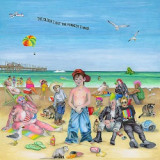
With L'Amour Aux Mille Parfums, mim comes out of the shadows, naked, and gives a very personal vision of love that is at once accessible, profound and complex.
mim writes a politics of intimacy that grows out of the rubble of free pop tinged with experimental song. He turns clichés and expectations on their head in his own way in a "post-modern love" music that lowers its weapons and invites laughter and a form of enlightenment. Surprising and invigorating.
To accompany him in this adventure, he invites his friend, Charlène Darling, and together they stage their friendship in a dialogue full of sincerity and laughter. mim & Charlène had already collaborated on the excellent album "Saint Guidon".
Translated with DeepL Translator (free version)
We've heard it a million times: the story of the diary in music, the coming of age, the coming of age, the coming of age record. We've heard it a million times times, but never like this. With L'Amour aux mille parfums, mim comes out of the shadows, naked, and gives a very personal vision of a a record with a heavy heart, hemmed in by inner turmoil as much as by questions by inner turmoil as much as by questions about a socially stifling era. a kind of intimate politics that grows out of the rubble of a free pop tinged with experimental song.
L'Amour aux mille parfums is divided into two segments: a "social" A side and a "mystical" B side. and a "mystical" side B, both of which Mim has conceived of as two proponents of a of a vision embedded in the reality of the desire for love shattered by the outside world. world. Pas Malade is, according to its author, "a piece that breaks the screen, almost documentary". Bienvenue (which opens the album) states loud and clear, without any aesthetic irony "better a broken heart than a closed one". The The narrative and musical path of this album is naturally freed from the of love to wander with a certain malice in the sensitivity of the musician and the sensitivity of the musician and those who listen to him. It turns clichés and expectations on their head in its own way. clichés and expectations in his own way, writing a kind of "post-modern love" music music that lowers its weapons and invites laughter and a form of enlightenment.
100% GALCHER was by all accounts a game-changer when it landed in 2013 as an hour of original music from a relatively unknown producer ushered in by the beloved mix series Blowing Up The Workshop. Galcher Lustwerk's signature sound _ a smoky stream-of-consciousness baritone shadow-boxing with beats, informed by funk, rap, rhythm, and blues _ felt like an epiphany, impossibly hypnotic and complete. Resident Advisor writes, "100% GALCHER laid out a louche, lysergic and resolutely black take on deep house." Pitchfork remembers the music's immediate impact: "It's the sort of gem you felt inclined to pass around" _ and by year-end list time, word-of-mouth intensified. It was Resident Advisor and Juno's mix of the year, and earned a top-ten placement in FACT Magazine's albums list, as well as Philip Sherburne's personal rundown for Spin." Since then, select songs from 100% GALCHER have seen small-run pressings, while the album has lived primarily on SoundCloud and YouTube as a low-key cult legend. The gateway into Lustwerk's now well-established catalog, known for its reliability as a late-night listen and its prophetic vision for the near future of underground dance music. RA would later name it a mix of the decade, citing its influence and imagination: "Original in every sense _ unknown, unheard and unbelievably good." In late 2022, marking ten years since he first recorded the material, Lustwerk returns to Ghostly International to release 100% GALCHER as a remastered limited-edition double LP. Lustwerk is a product of the Midwest. Growing up in Cleveland, he'd tape over his parents' cassettes and spend hours at his family computer recording loops and designing artwork for the jewel cases of burned CDs. In high school, he turned to Ableton Live and absorbed every electronic music magazine he could find at the local Borders Books store. As a college student at RISD, he played in noise bands, plugged into Providence's DIY scene via Myspace, and started DJing weeknights at bars downtown. There he connected with Young Male and DJ Richard, who would go on to found White Material Records and offer their third release to Galcher Lustwerk, an alias realized via CAPTCHA test, a perfect artifact of its internet age. By 2012, Lustwerk had drifted to New York City and settled into a graphic design job, quickly growing disenfranchised by office culture. "Some days I felt like a token, other days I felt invisible." At night, he and his friends were carving out their own space, throwing parties in small basements, office buildings, and off-beat karaoke bars in Manhattan, influenced by series such as Mr. Sunday in Gowanus and The Bunker at Public Assembly. The lifestyle started to bleed into Lustwerk's musical vision. He remembers the night it clicked in Providence, partying and listening to tunes with Morgan Louis and Alvin Aronson. He went back to New York and pieced together his bedroom setup: a Dave Smith Tempest drum machine, a Waldorf Blofeld synthesizer, and a TEAC cassette recorder. Early snippets went straight to SoundCloud, where Lustwerk tested the crowd. Comments and messages offered instant feedback. One DM proved to be the greenlight: from Matthew Kent, an invitation to his burgeoning mix series Blowing Up The Workshop. 100% GALCHER traveled fast and far. A phenomenon he could only enjoy for a short period before discovering that nearly all the masters of the tracks got wiped by water damage to his computer. "The only copies were now on the 192kbs mp3 mix I sent Matt." Until now, after Lustwerk revived the lost tracks and handed them to Josh Bonati for remastering. "The original mix was never mastered so I hope older fans can find something new here." Hearing the enhanced set for the first time delineated by tracklist reveals this was a proper album all along. Sly synth interludes (all titled "Stem") clear the air for raspy house anthems like "Fifty" and "Parlay," the set's original breakout. Themes present across Lustwerk's catalog first materialize in this iconic run _ the link between the meditative state of Midwest driving and the solitary comedowns of nightlife. Lust- werk, the narrator, is an elusive character, a secret agent of the club, embodied by the hooks: "One minute I'm on / next minute I'm gone," he reminds us on cult-favor- ite "Put On." These narcotic, one-line refrains stick with you; look no further than the original YouTube upload of "Kaint" to know that fans can't let these phrases go. While recorded alone, 100% GALCHER was a collective moment. A decade later, Lustwerk sees the legacy as shared: "Making music can be an alienating experience, especially for DJs who travel a lot, it's all super isolating. It's easy to express lone- liness in the music itself, but when it comes down to getting things done, putting music out, you def should go on that journey w other people, friends, or maybe just a group of people online, build things with your friends then they can build to help you."
out of Stock
Last delivered 3 years ago available to reorder, subject to availability
100% GALCHER was by all accounts a game-changer when it landed in 2013 as an hour of original music from a relatively unknown producer ushered in by the beloved mix series Blowing Up The Workshop. Galcher Lustwerk's signature sound — a smoky stream-of-consciousness baritone shadow-boxing with beats, informed by funk, rap, rhythm, and blues — felt like an epiphany, impossibly hypnotic and complete. Resident Advisor writes, "100% GALCHER laid out a louche, lysergic and resolutely black take on deep house." Pitchfork remembers the music's immediate impact: "It's the sort of gem you felt inclined to pass around” — and by year-end list time, word-of-mouth intensified. It was Resident Advisor and Juno's mix of the year, and earned a top-ten placement in FACT Magazine's albums list, as well as Philip Sherburne's personal rundown for Spin." Since then, select songs from 100% GALCHER have seen small-run pressings, while the album has lived primarily on SoundCloud and YouTube as a low-key cult legend. The gateway into Lustwerk's now well-established catalog, known for its reliability as a late-night listen and its prophetic vision for the near future of underground dance music. RA would later name it a mix of the decade, citing its influence and imagination: “Original in every sense — unknown, unheard and unbelievably good.” In late 2022, marking ten years since he first recorded the material, Lustwerk returns to Ghostly International to release 100% GALCHER as a remastered limited-edition double LP.
Lustwerk is a product of the Midwest. Growing up in Cleveland, he'd tape over his parents’ cassettes and spend hours at his family computer recording loops and designing artwork for the jewel cases of burned CDs. In high school, he turned to Ableton Live and absorbed every electronic music magazine he could find at the local Borders Books store. In excerpts from the 100% GALCHER liner notes, Lustwerk looks back: "My dad drove me to this shop on the westside Bent Crayon, where I would get anything the blogs told you to get + whatever the clerk recommended. CDs stayed in their packaging, there was always an overflow of vinyl stacked on the floor. I was too shy to listen to anything before buying."
As a college student at RISD, he played in noise bands, plugged into Providence's DIY scene via Myspace, and started DJing weeknights at bars downtown. There he connected with Young Male and DJ Richard, who would go on to found White Material Records and offer their third release to Galcher Lustwerk, an alias realized via CAPTCHA test, a perfect artifact of its internet age. By 2012, Lustwerk had drifted to New York City and settled into a graphic design job, quickly growing disenfranchised by office culture. "Some days I felt like a token, other days I felt invisible." At night, he and his friends were carving out their own space
out of Stock
Last delivered 3 years ago available to reorder, subject to availability
Comprehensive box of 6 LPs / EPs and the band's first rare 7inch.
Aroma Di Amore is/was Belgian’s premier cult band. Since the early eighties ADA innovatively combined electronics with rock. With a mix of razor-sharp Flemish lyrics and unconventional song structures the group earned a cult status in Belgium and abroad. 40 years later they conclude their career with a few last concerts and a vinyl box set spanning the years 1983-1987.
At the notorious Rock Rally of 1982 Aroma Di Amore stands out with their wonderful handling of the Flemish language, a deep bass, typical cold new wave drums, biting guitar riffs with the occasional flavor of absolute madness. Frontman Jos Verlooy adopts the stage name Elvis Peeters. The explanation for this remarkable pseudonym choice: in 1977 – the period of the singer's musical awakening – one of the two famous rocking Elvises (not Costello, but Presley) succumbs to his pill addiction. So, dixit Verlooy, there is an Elvis vacant. A banal surname belongs next to that exotic first name. A combination that breathes rock 'n' roll, according to the singer.
His companion Gerry Vergult – who very much determines the sound with his metallic riffs, somewhat indebted to Jean-Marie Aerts – adopts the stage name Fred Angst. Completely in line with the depressing zeitgeist of the 1980s. Gerry eats and breathes music. Besides composing most of ADA’s songs, he records & self-produces a few fantastic dark en loner solo minimal wave tracks as Fred Angst. He is still musically active, more towards the electronic leftfield nowadays under the moniker Zool.
It is clear from an early age that companion Elvis Peeters possesses the gift of the word. As an adolescent he published the punkzine “Dus”. The punk spirit stimulates Peeters. He begins to transform the poetry that he has been entrusting to paper for some time into song lyrics. It is on a whim and without any stage experience that punk friends Peeters and Angst register for the Rock Rally as Aroma di Amore. On a bed of post-punk and cold wave (Joy Division, Wire and Sisters of Mercy are the main influences), they initially let out playful, minimalist and nonsensical slogans such as "Doe De Mafia" (1982) and "Gorilla Dans De Samba" (1983). Later on, the tone becomes more serious, although Peeters' choice of words continues to show a penchant for absurdism and sarcasm. No one in Dutch songwriting imitates this verbal elasticity, certainly at that time.
The numerous songs about war are downright horrifying. In the 1980s, an arms race is underway. When the Belgian government decides to install nuclear missiles in 1981, Aroma di Amore asks for one minute of silence in the hall during performances. In "Lauwe Oorlog" (1983), Peeters exposes the core of his unrest: “paraat voor de parade / de vrede wordt begraven / met militaire eer”. To this day, the frontman of AdA still proudly wears his at least 30 year old 'atomic energy, no thanks!' button.
In 1984 Aroma releases Koude Oorlog on the new and independent Brussels label Play It Again Sam. The traditional press and radio ignore the record, but in the alternative circuits the mini-album does not go unnoticed, and the group starts to build a solid fan base, resulting in more and more offers for gigs. There's also interest in the Netherlands, and due to the international contacts of PIAS, the record also ends up in France, Switzerland, Spain and Canada.
Encouraged by this modest success, the group returns to the studio for a 12" single. With new group member Frits De Cauter on sax, they record "Voor De Dood". To this day, Voor De Dood remains the most popular AdA song, as evidenced by the countless compilations on which the song has appeared.
AdA goes to the Netherlands to record their next album “De Sfeer Van Grote Dagen”. The people from Nasmak have built a new studio in Eindhoven and one of the members, Theo Van Eenbergen (later Henry Rollins), will be the producer. “De Sfeer Van Grote Dagen” is the group's most adventurous album, and the reviews are again unanimously favorable. However, sales are disappointing and PIAS proposes to recruit Chris Reed of Red Lorry Yellow Lorry and record a new single with him. "Zonder Omzien" is recorded at the prestigious Pyramid Studio. However, PIAS is waiting to release the album and in the meantime AdA is recording a number of extra tracks with producer Ludo Camberlin, including "Koekoek In De Stad". Towards the end of the year, Lo and Elvis travel to Africa for a few months and as a result the group comes to a standstill. In this period, Zonder Omzien is released.
At the beginning of 1986, Peeters and Meulen return, and Andrea Smits leaves the group. Luc Pillards is hired as a replacement, and when Ludo Camberlin presents himself as a new label boss and producer (Anything But Records), they start recording their first full album for the label. “Harde Feiten" kicks in immediately, and the group is back up to cruising speed. In the first week of release, the record even appears in the bestseller list of the record stores.
At the beginning of 1987 the recordings for the second album start, this time in a production by Peeters and Angst themselves. Shortly after the shooting, AdA goes to Switzerland for a short but successful tour, with Men 2nd and Cas & Organized Crime as support act. "Koudvuur" is published in the autumn and considered to be their strongest record so far by the group, the reactions are rather low. Both the reviews in the press and the sales are disappointing and put a damper on the joy. Nevertheless, the group is invited to perform in Valencia, Spain, where they have an unexpected success.
MUTANT SOUNDS BLOG
Aroma Di Amore have always been outsiders, even within the confinement of the alternative rock circuit. Their peculiar blend of raw guitars, electronics, Dutch lyrics and unconventional song structures was too hybrid for many. Those howewer who, without prejudice, would lend an ear to the band's music, discovered an energetic, authentic and uncompromising collective that stood above all trends. While so many Belgian "connaisseurs" had their doubts about the possibilities of international recognition for a band singing in Dutch, Aroma Di Amore toured France, Switzerland and Spain; their records figured in alternative charts from Poland to Canada.
From beginning to end the nucleus of Aroma Di Amore consisted of Elvis PEETERS, who in a inimitable, possessed way delivered his highly original lyrics, and Fred ANGST, guitarist mastering the heaviest riffs as well as refined tapestries of sound. Furthermore, the line-up varied throughout the band's carreer with:- H.K. (Guitarist from 1982 until 1983)- Andrea SMITS (Organ from 1982 until 1985)- Luc PILLARDS (Synthsizer in 1986)- Jan WANDELAAR (Guitar and synthesizer in 1986)- Pulcherie (Saxophone in 1983)- Wout DOCKX (Bass from 1987 until 1988)and especially- Lo MEULEN (Bass from 1983 until 1987)and the late Frits DE CAUTER (Saxophone from 1984 until 1986) contributing to the music.
Box Set includes: Gorilla Dans De Samba 7" (1983), Voor De Dood 12" (1984), Koude Oorlog LP (1984), De Sfeer Van Grote Dagen 12" (1985), Zonder Omzien 12" (1986), Harde Feiten LP (1986), Koudvuur LP (1987)
First-time reissue of Aroma Di Amore's debut album, originally released in 1984.
Aroma Di Amore is/was Belgian’s premier cult band. Since the early eighties ADA innovatively combined electronics with rock. With a mix of razor-sharp Flemish lyrics and unconventional song structures the group earned a cult status in Belgium and abroad. 40 years later they conclude their career with a few last concerts and a vinyl box set spanning the years 1983-1987.
At the notorious Rock Rally of 1982 Aroma Di Amore stands out with their wonderful handling of the Flemish language, a deep bass, typical cold new wave drums, biting guitar riffs with the occasional flavor of absolute madness. Frontman Jos Verlooy adopts the stage name Elvis Peeters. The explanation for this remarkable pseudonym choice: in 1977 – the period of the singer's musical awakening – one of the two famous rocking Elvises (not Costello, but Presley) succumbs to his pill addiction. So, dixit Verlooy, there is an Elvis vacant. A banal surname belongs next to that exotic first name. A combination that breathes rock 'n' roll, according to the singer.
His companion Gerry Vergult – who very much determines the sound with his metallic riffs, somewhat indebted to Jean-Marie Aerts – adopts the stage name Fred Angst. Completely in line with the depressing zeitgeist of the 1980s. Gerry eats and breathes music. Besides composing most of ADA’s songs, he records & self-produces a few fantastic dark en loner solo minimal wave tracks as Fred Angst. He is still musically active, more towards the electronic leftfield nowadays under the moniker Zool.
It is clear from an early age that companion Elvis Peeters possesses the gift of the word. As an adolescent he published the punkzine “Dus”. The punk spirit stimulates Peeters. He begins to transform the poetry that he has been entrusting to paper for some time into song lyrics. It is on a whim and without any stage experience that punk friends Peeters and Angst register for the Rock Rally as Aroma di Amore. On a bed of post-punk and cold wave (Joy Division, Wire and Sisters of Mercy are the main influences), they initially let out playful, minimalist and nonsensical slogans such as "Doe De Mafia" (1982) and "Gorilla Dans De Samba" (1983). Later on, the tone becomes more serious, although Peeters' choice of words continues to show a penchant for absurdism and sarcasm. No one in Dutch songwriting imitates this verbal elasticity, certainly at that time.
The numerous songs about war are downright horrifying. In the 1980s, an arms race is underway. When the Belgian government decides to install nuclear missiles in 1981, Aroma di Amore asks for one minute of silence in the hall during performances. In "Lauwe Oorlog" (1983), Peeters exposes the core of his unrest: “paraat voor de parade / de vrede wordt begraven / met militaire eer”. To this day, the frontman of AdA still proudly wears his at least 30 year old 'atomic energy, no thanks!' button.
In 1984 Aroma releases Koude Oorlog on the new and independent Brussels label Play It Again Sam. The traditional press and radio ignore the record, but in the alternative circuits the mini-album does not go unnoticed, and the group starts to build a solid fan base, resulting in more and more offers for gigs. There's also interest in the Netherlands, and due to the international contacts of PIAS, the record also ends up in France, Switzerland, Spain and Canada.
Encouraged by this modest success, the group returns to the studio for a 12" single. With new group member Frits De Cauter on sax, they record "Voor De Dood". To this day, Voor De Dood remains the most popular AdA song, as evidenced by the countless compilations on which the song has appeared.
AdA goes to the Netherlands to record their next album “De Sfeer Van Grote Dagen”. The people from Nasmak have built a new studio in Eindhoven and one of the members, Theo Van Eenbergen (later Henry Rollins), will be the producer. “De Sfeer Van Grote Dagen” is the group's most adventurous album, and the reviews are again unanimously favorable. However, sales are disappointing and PIAS proposes to recruit Chris Reed of Red Lorry Yellow Lorry and record a new single with him. "Zonder Omzien" is recorded at the prestigious Pyramid Studio. However, PIAS is waiting to release the album and in the meantime AdA is recording a number of extra tracks with producer Ludo Camberlin, including "Koekoek In De Stad". Towards the end of the year, Lo and Elvis travel to Africa for a few months and as a result the group comes to a standstill. In this period, Zonder Omzien is released.
At the beginning of 1986, Peeters and Meulen return, and Andrea Smits leaves the group. Luc Pillards is hired as a replacement, and when Ludo Camberlin presents himself as a new label boss and producer (Anything But Records), they start recording their first full album for the label. “Harde Feiten" kicks in immediately, and the group is back up to cruising speed. In the first week of release, the record even appears in the bestseller list of the record stores.
At the beginning of 1987 the recordings for the second album start, this time in a production by Peeters and Angst themselves. Shortly after the shooting, AdA goes to Switzerland for a short but successful tour, with Men 2nd and Cas & Organized Crime as support act. "Koudvuur" is published in the autumn and considered to be their strongest record so far by the group, the reactions are rather low. Both the reviews in the press and the sales are disappointing and put a damper on the joy. Nevertheless, the group is invited to perform in Valencia, Spain, where they have an unexpected success.
MUTANT SOUNDS BLOG
Aroma Di Amore have always been outsiders, even within the confinement of the alternative rock circuit. Their peculiar blend of raw guitars, electronics, Dutch lyrics and unconventional song structures was too hybrid for many. Those howewer who, without prejudice, would lend an ear to the band's music, discovered an energetic, authentic and uncompromising collective that stood above all trends. While so many Belgian "connaisseurs" had their doubts about the possibilities of international recognition for a band singing in Dutch, Aroma Di Amore toured France, Switzerland and Spain; their records figured in alternative charts from Poland to Canada.
From beginning to end the nucleus of Aroma Di Amore consisted of Elvis PEETERS, who in a inimitable, possessed way delivered his highly original lyrics, and Fred ANGST, guitarist mastering the heaviest riffs as well as refined tapestries of sound. Furthermore, the line-up varied throughout the band's carreer with:- H.K. (Guitarist from 1982 until 1983)- Andrea SMITS (Organ from 1982 until 1985)- Luc PILLARDS (Synthsizer in 1986)- Jan WANDELAAR (Guitar and synthesizer in 1986)- Pulcherie (Saxophone in 1983)- Wout DOCKX (Bass from 1987 until 1988)and especially- Lo MEULEN (Bass from 1983 until 1987)and the late Frits DE CAUTER (Saxophone from 1984 until 1986)contributing to the music.
First-time reissue of Aroma Di Amore's 2nd album, originally released in 1986.
Aroma Di Amore is/was Belgian’s premier cult band. Since the early eighties ADA innovatively combined electronics with rock. With a mix of razor-sharp Flemish lyrics and unconventional song structures the group earned a cult status in Belgium and abroad. 40 years later they conclude their career with a few last concerts and a vinyl box set spanning the years 1983-1987.
At the notorious Rock Rally of 1982 Aroma Di Amore stands out with their wonderful handling of the Flemish language, a deep bass, typical cold new wave drums, biting guitar riffs with the occasional flavor of absolute madness. Frontman Jos Verlooy adopts the stage name Elvis Peeters. The explanation for this remarkable pseudonym choice: in 1977 – the period of the singer's musical awakening – one of the two famous rocking Elvises (not Costello, but Presley) succumbs to his pill addiction. So, dixit Verlooy, there is an Elvis vacant. A banal surname belongs next to that exotic first name. A combination that breathes rock 'n' roll, according to the singer.
His companion Gerry Vergult – who very much determines the sound with his metallic riffs, somewhat indebted to Jean-Marie Aerts – adopts the stage name Fred Angst. Completely in line with the depressing zeitgeist of the 1980s. Gerry eats and breathes music. Besides composing most of ADA’s songs, he records & self-produces a few fantastic dark en loner solo minimal wave tracks as Fred Angst. He is still musically active, more towards the electronic leftfield nowadays under the moniker Zool.
It is clear from an early age that companion Elvis Peeters possesses the gift of the word. As an adolescent he published the punkzine “Dus”. The punk spirit stimulates Peeters. He begins to transform the poetry that he has been entrusting to paper for some time into song lyrics. It is on a whim and without any stage experience that punk friends Peeters and Angst register for the Rock Rally as Aroma di Amore. On a bed of post-punk and cold wave (Joy Division, Wire and Sisters of Mercy are the main influences), they initially let out playful, minimalist and nonsensical slogans such as "Doe De Mafia" (1982) and "Gorilla Dans De Samba" (1983). Later on, the tone becomes more serious, although Peeters' choice of words continues to show a penchant for absurdism and sarcasm. No one in Dutch songwriting imitates this verbal elasticity, certainly at that time.
The numerous songs about war are downright horrifying. In the 1980s, an arms race is underway. When the Belgian government decides to install nuclear missiles in 1981, Aroma di Amore asks for one minute of silence in the hall during performances. In "Lauwe Oorlog" (1983), Peeters exposes the core of his unrest: “paraat voor de parade / de vrede wordt begraven / met militaire eer”. To this day, the frontman of AdA still proudly wears his at least 30 year old 'atomic energy, no thanks!' button.
In 1984 Aroma releases Koude Oorlog on the new and independent Brussels label Play It Again Sam. The traditional press and radio ignore the record, but in the alternative circuits the mini-album does not go unnoticed, and the group starts to build a solid fan base, resulting in more and more offers for gigs. There's also interest in the Netherlands, and due to the international contacts of PIAS, the record also ends up in France, Switzerland, Spain and Canada.
Encouraged by this modest success, the group returns to the studio for a 12" single. With new group member Frits De Cauter on sax, they record "Voor De Dood". To this day, Voor De Dood remains the most popular AdA song, as evidenced by the countless compilations on which the song has appeared.
AdA goes to the Netherlands to record their next album “De Sfeer Van Grote Dagen”. The people from Nasmak have built a new studio in Eindhoven and one of the members, Theo Van Eenbergen (later Henry Rollins), will be the producer. “De Sfeer Van Grote Dagen” is the group's most adventurous album, and the reviews are again unanimously favorable. However, sales are disappointing and PIAS proposes to recruit Chris Reed of Red Lorry Yellow Lorry and record a new single with him. "Zonder Omzien" is recorded at the prestigious Pyramid Studio. However, PIAS is waiting to release the album and in the meantime AdA is recording a number of extra tracks with producer Ludo Camberlin, including "Koekoek In De Stad". Towards the end of the year, Lo and Elvis travel to Africa for a few months and as a result the group comes to a standstill. In this period, Zonder Omzien is released.
At the beginning of 1986, Peeters and Meulen return, and Andrea Smits leaves the group. Luc Pillards is hired as a replacement, and when Ludo Camberlin presents himself as a new label boss and producer (Anything But Records), they start recording their first full album for the label. “Harde Feiten" kicks in immediately, and the group is back up to cruising speed. In the first week of release, the record even appears in the bestseller list of the record stores.
At the beginning of 1987 the recordings for the second album start, this time in a production by Peeters and Angst themselves. Shortly after the shooting, AdA goes to Switzerland for a short but successful tour, with Men 2nd and Cas & Organized Crime as support act. "Koudvuur" is published in the autumn and considered to be their strongest record so far by the group, the reactions are rather low. Both the reviews in the press and the sales are disappointing and put a damper on the joy. Nevertheless, the group is invited to perform in Valencia, Spain, where they have an unexpected success.
MUTANT SOUNDS BLOG
Aroma Di Amore have always been outsiders, even within the confinement of the alternative rock circuit. Their peculiar blend of raw guitars, electronics, Dutch lyrics and unconventional song structures was too hybrid for many. Those howewer who, without prejudice, would lend an ear to the band's music, discovered an energetic, authentic and uncompromising collective that stood above all trends. While so many Belgian "connaisseurs" had their doubts about the possibilities of international recognition for a band singing in Dutch, Aroma Di Amore toured France, Switzerland and Spain; their records figured in alternative charts from Poland to Canada.
From beginning to end the nucleus of Aroma Di Amore consisted of Elvis PEETERS, who in a inimitable, possessed way delivered his highly original lyrics, and Fred ANGST, guitarist mastering the heaviest riffs as well as refined tapestries of sound. Furthermore, the line-up varied throughout the band's carreer with:- H.K. (Guitarist from 1982 until 1983)- Andrea SMITS (Organ from 1982 until 1985)- Luc PILLARDS (Synthsizer in 1986)- Jan WANDELAAR (Guitar and synthesizer in 1986)- Pulcherie (Saxophone in 1983)- Wout DOCKX (Bass from 1987 until 1988)and especially- Lo MEULEN (Bass from 1983 until 1987)and the late Frits DE CAUTER (Saxophone from 1984 until 1986)contributing to the music.
First-time reissue of Aroma Di Amore's 3rd album, originally released in 1987.
Aroma Di Amore is/was Belgian’s premier cult band. Since the early eighties ADA innovatively combined electronics with rock. With a mix of razor-sharp Flemish lyrics and unconventional song structures the group earned a cult status in Belgium and abroad. 40 years later they conclude their career with a few last concerts and a vinyl box set spanning the years 1983-1987.
At the notorious Rock Rally of 1982 Aroma Di Amore stands out with their wonderful handling of the Flemish language, a deep bass, typical cold new wave drums, biting guitar riffs with the occasional flavor of absolute madness. Frontman Jos Verlooy adopts the stage name Elvis Peeters. The explanation for this remarkable pseudonym choice: in 1977 – the period of the singer's musical awakening – one of the two famous rocking Elvises (not Costello, but Presley) succumbs to his pill addiction. So, dixit Verlooy, there is an Elvis vacant. A banal surname belongs next to that exotic first name. A combination that breathes rock 'n' roll, according to the singer.
His companion Gerry Vergult – who very much determines the sound with his metallic riffs, somewhat indebted to Jean-Marie Aerts – adopts the stage name Fred Angst. Completely in line with the depressing zeitgeist of the 1980s. Gerry eats and breathes music. Besides composing most of ADA’s songs, he records & self-produces a few fantastic dark en loner solo minimal wave tracks as Fred Angst. He is still musically active, more towards the electronic leftfield nowadays under the moniker Zool.
It is clear from an early age that companion Elvis Peeters possesses the gift of the word. As an adolescent he published the punkzine “Dus”. The punk spirit stimulates Peeters. He begins to transform the poetry that he has been entrusting to paper for some time into song lyrics. It is on a whim and without any stage experience that punk friends Peeters and Angst register for the Rock Rally as Aroma di Amore. On a bed of post-punk and cold wave (Joy Division, Wire and Sisters of Mercy are the main influences), they initially let out playful, minimalist and nonsensical slogans such as "Doe De Mafia" (1982) and "Gorilla Dans De Samba" (1983). Later on, the tone becomes more serious, although Peeters' choice of words continues to show a penchant for absurdism and sarcasm. No one in Dutch songwriting imitates this verbal elasticity, certainly at that time.
The numerous songs about war are downright horrifying. In the 1980s, an arms race is underway. When the Belgian government decides to install nuclear missiles in 1981, Aroma di Amore asks for one minute of silence in the hall during performances. In "Lauwe Oorlog" (1983), Peeters exposes the core of his unrest: “paraat voor de parade / de vrede wordt begraven / met militaire eer”. To this day, the frontman of AdA still proudly wears his at least 30 year old 'atomic energy, no thanks!' button.
In 1984 Aroma releases Koude Oorlog on the new and independent Brussels label Play It Again Sam. The traditional press and radio ignore the record, but in the alternative circuits the mini-album does not go unnoticed, and the group starts to build a solid fan base, resulting in more and more offers for gigs. There's also interest in the Netherlands, and due to the international contacts of PIAS, the record also ends up in France, Switzerland, Spain and Canada.
Encouraged by this modest success, the group returns to the studio for a 12" single. With new group member Frits De Cauter on sax, they record "Voor De Dood". To this day, Voor De Dood remains the most popular AdA song, as evidenced by the countless compilations on which the song has appeared.
AdA goes to the Netherlands to record their next album “De Sfeer Van Grote Dagen”. The people from Nasmak have built a new studio in Eindhoven and one of the members, Theo Van Eenbergen (later Henry Rollins), will be the producer. “De Sfeer Van Grote Dagen” is the group's most adventurous album, and the reviews are again unanimously favorable. However, sales are disappointing and PIAS proposes to recruit Chris Reed of Red Lorry Yellow Lorry and record a new single with him. "Zonder Omzien" is recorded at the prestigious Pyramid Studio. However, PIAS is waiting to release the album and in the meantime AdA is recording a number of extra tracks with producer Ludo Camberlin, including "Koekoek In De Stad". Towards the end of the year, Lo and Elvis travel to Africa for a few months and as a result the group comes to a standstill. In this period, Zonder Omzien is released.
At the beginning of 1986, Peeters and Meulen return, and Andrea Smits leaves the group. Luc Pillards is hired as a replacement, and when Ludo Camberlin presents himself as a new label boss and producer (Anything But Records), they start recording their first full album for the label. “Harde Feiten" kicks in immediately, and the group is back up to cruising speed. In the first week of release, the record even appears in the bestseller list of the record stores.
At the beginning of 1987 the recordings for the second album start, this time in a production by Peeters and Angst themselves. Shortly after the shooting, AdA goes to Switzerland for a short but successful tour, with Men 2nd and Cas & Organized Crime as support act. "Koudvuur" is published in the autumn and considered to be their strongest record so far by the group, the reactions are rather low. Both the reviews in the press and the sales are disappointing and put a damper on the joy. Nevertheless, the group is invited to perform in Valencia, Spain, where they have an unexpected success.
MUTANT SOUNDS BLOG
Aroma Di Amore have always been outsiders, even within the confinement of the alternative rock circuit. Their peculiar blend of raw guitars, electronics, Dutch lyrics and unconventional song structures was too hybrid for many. Those howewer who, without prejudice, would lend an ear to the band's music, discovered an energetic, authentic and uncompromising collective that stood above all trends. While so many Belgian "connaisseurs" had their doubts about the possibilities of international recognition for a band singing in Dutch, Aroma Di Amore toured France, Switzerland and Spain; their records figured in alternative charts from Poland to Canada.
From beginning to end the nucleus of Aroma Di Amore consisted of Elvis PEETERS, who in a inimitable, possessed way delivered his highly original lyrics, and Fred ANGST, guitarist mastering the heaviest riffs as well as refined tapestries of sound. Furthermore, the line-up varied throughout the band's carreer with:- H.K. (Guitarist from 1982 until 1983)- Andrea SMITS (Organ from 1982 until 1985)- Luc PILLARDS (Synthsizer in 1986)- Jan WANDELAAR (Guitar and synthesizer in 1986)- Pulcherie (Saxophone in 1983)- Wout DOCKX (Bass from 1987 until 1988)and especially- Lo MEULEN (Bass from 1983 until 1987)and the late Frits DE CAUTER (Saxophone from 1984 until 1986)contributing to the music.
First-time reissue of Aroma Di Amore's 3rd EP, originally released in 1985.
Aroma Di Amore is/was Belgian’s premier cult band. Since the early eighties ADA innovatively combined electronics with rock. With a mix of razor-sharp Flemish lyrics and unconventional song structures the group earned a cult status in Belgium and abroad. 40 years later they conclude their career with a few last concerts and a vinyl box set spanning the years 1983-1987.
At the notorious Rock Rally of 1982 Aroma Di Amore stands out with their wonderful handling of the Flemish language, a deep bass, typical cold new wave drums, biting guitar riffs with the occasional flavor of absolute madness. Frontman Jos Verlooy adopts the stage name Elvis Peeters. The explanation for this remarkable pseudonym choice: in 1977 – the period of the singer's musical awakening – one of the two famous rocking Elvises (not Costello, but Presley) succumbs to his pill addiction. So, dixit Verlooy, there is an Elvis vacant. A banal surname belongs next to that exotic first name. A combination that breathes rock 'n' roll, according to the singer.
His companion Gerry Vergult – who very much determines the sound with his metallic riffs, somewhat indebted to Jean-Marie Aerts – adopts the stage name Fred Angst. Completely in line with the depressing zeitgeist of the 1980s. Gerry eats and breathes music. Besides composing most of ADA’s songs, he records & self-produces a few fantastic dark en loner solo minimal wave tracks as Fred Angst. He is still musically active, more towards the electronic leftfield nowadays under the moniker Zool.
It is clear from an early age that companion Elvis Peeters possesses the gift of the word. As an adolescent he published the punkzine “Dus”. The punk spirit stimulates Peeters. He begins to transform the poetry that he has been entrusting to paper for some time into song lyrics. It is on a whim and without any stage experience that punk friends Peeters and Angst register for the Rock Rally as Aroma di Amore. On a bed of post-punk and cold wave (Joy Division, Wire and Sisters of Mercy are the main influences), they initially let out playful, minimalist and nonsensical slogans such as "Doe De Mafia" (1982) and "Gorilla Dans De Samba" (1983). Later on, the tone becomes more serious, although Peeters' choice of words continues to show a penchant for absurdism and sarcasm. No one in Dutch songwriting imitates this verbal elasticity, certainly at that time.
The numerous songs about war are downright horrifying. In the 1980s, an arms race is underway. When the Belgian government decides to install nuclear missiles in 1981, Aroma di Amore asks for one minute of silence in the hall during performances. In "Lauwe Oorlog" (1983), Peeters exposes the core of his unrest: “paraat voor de parade / de vrede wordt begraven / met militaire eer”. To this day, the frontman of AdA still proudly wears his at least 30 year old 'atomic energy, no thanks!' button.
In 1984 Aroma releases Koude Oorlog on the new and independent Brussels label Play It Again Sam. The traditional press and radio ignore the record, but in the alternative circuits the mini-album does not go unnoticed, and the group starts to build a solid fan base, resulting in more and more offers for gigs. There's also interest in the Netherlands, and due to the international contacts of PIAS, the record also ends up in France, Switzerland, Spain and Canada.
Encouraged by this modest success, the group returns to the studio for a 12" single. With new group member Frits De Cauter on sax, they record "Voor De Dood". To this day, Voor De Dood remains the most popular AdA song, as evidenced by the countless compilations on which the song has appeared.
AdA goes to the Netherlands to record their next album “De Sfeer Van Grote Dagen”. The people from Nasmak have built a new studio in Eindhoven and one of the members, Theo Van Eenbergen (later Henry Rollins), will be the producer. “De Sfeer Van Grote Dagen” is the group's most adventurous album, and the reviews are again unanimously favorable. However, sales are disappointing and PIAS proposes to recruit Chris Reed of Red Lorry Yellow Lorry and record a new single with him. "Zonder Omzien" is recorded at the prestigious Pyramid Studio. However, PIAS is waiting to release the album and in the meantime AdA is recording a number of extra tracks with producer Ludo Camberlin, including "Koekoek In De Stad". Towards the end of the year, Lo and Elvis travel to Africa for a few months and as a result the group comes to a standstill. In this period, Zonder Omzien is released.
At the beginning of 1986, Peeters and Meulen return, and Andrea Smits leaves the group. Luc Pillards is hired as a replacement, and when Ludo Camberlin presents himself as a new label boss and producer (Anything But Records), they start recording their first full album for the label. “Harde Feiten" kicks in immediately, and the group is back up to cruising speed. In the first week of release, the record even appears in the bestseller list of the record stores.
At the beginning of 1987 the recordings for the second album start, this time in a production by Peeters and Angst themselves. Shortly after the shooting, AdA goes to Switzerland for a short but successful tour, with Men 2nd and Cas & Organized Crime as support act. "Koudvuur" is published in the autumn and considered to be their strongest record so far by the group, the reactions are rather low. Both the reviews in the press and the sales are disappointing and put a damper on the joy. Nevertheless, the group is invited to perform in Valencia, Spain, where they have an unexpected success.
MUTANT SOUNDS BLOG
Aroma Di Amore have always been outsiders, even within the confinement of the alternative rock circuit. Their peculiar blend of raw guitars, electronics, Dutch lyrics and unconventional song structures was too hybrid for many. Those howewer who, without prejudice, would lend an ear to the band's music, discovered an energetic, authentic and uncompromising collective that stood above all trends. While so many Belgian "connaisseurs" had their doubts about the possibilities of international recognition for a band singing in Dutch, Aroma Di Amore toured France, Switzerland and Spain; their records figured in alternative charts from Poland to Canada.
From beginning to end the nucleus of Aroma Di Amore consisted of Elvis PEETERS, who in a inimitable, possessed way delivered his highly original lyrics, and Fred ANGST, guitarist mastering the heaviest riffs as well as refined tapestries of sound. Furthermore, the line-up varied throughout the band's carreer with:- H.K. (Guitarist from 1982 until 1983)- Andrea SMITS (Organ from 1982 until 1985)- Luc PILLARDS (Synthsizer in 1986)- Jan WANDELAAR (Guitar and synthesizer in 1986)- Pulcherie (Saxophone in 1983)- Wout DOCKX (Bass from 1987 until 1988)and especially- Lo MEULEN (Bass from 1983 until 1987)and the late Frits DE CAUTER (Saxophone from 1984 until 1986)contributing to the music
First-time reissue of Aroma Di Amore's 4th EP, originally released in 1986.
Aroma Di Amore is/was Belgian’s premier cult band. Since the early eighties ADA innovatively combined electronics with rock. With a mix of razor-sharp Flemish lyrics and unconventional song structures the group earned a cult status in Belgium and abroad. 40 years later they conclude their career with a few last concerts and a vinyl box set spanning the years 1983-1987.
At the notorious Rock Rally of 1982 Aroma Di Amore stands out with their wonderful handling of the Flemish language, a deep bass, typical cold new wave drums, biting guitar riffs with the occasional flavor of absolute madness. Frontman Jos Verlooy adopts the stage name Elvis Peeters. The explanation for this remarkable pseudonym choice: in 1977 – the period of the singer's musical awakening – one of the two famous rocking Elvises (not Costello, but Presley) succumbs to his pill addiction. So, dixit Verlooy, there is an Elvis vacant. A banal surname belongs next to that exotic first name. A combination that breathes rock 'n' roll, according to the singer.
His companion Gerry Vergult – who very much determines the sound with his metallic riffs, somewhat indebted to Jean-Marie Aerts – adopts the stage name Fred Angst. Completely in line with the depressing zeitgeist of the 1980s. Gerry eats and breathes music. Besides composing most of ADA’s songs, he records & self-produces a few fantastic dark en loner solo minimal wave tracks as Fred Angst. He is still musically active, more towards the electronic leftfield nowadays under the moniker Zool.
It is clear from an early age that companion Elvis Peeters possesses the gift of the word. As an adolescent he published the punkzine “Dus”. The punk spirit stimulates Peeters. He begins to transform the poetry that he has been entrusting to paper for some time into song lyrics. It is on a whim and without any stage experience that punk friends Peeters and Angst register for the Rock Rally as Aroma di Amore. On a bed of post-punk and cold wave (Joy Division, Wire and Sisters of Mercy are the main influences), they initially let out playful, minimalist and nonsensical slogans such as "Doe De Mafia" (1982) and "Gorilla Dans De Samba" (1983). Later on, the tone becomes more serious, although Peeters' choice of words continues to show a penchant for absurdism and sarcasm. No one in Dutch songwriting imitates this verbal elasticity, certainly at that time.
The numerous songs about war are downright horrifying. In the 1980s, an arms race is underway. When the Belgian government decides to install nuclear missiles in 1981, Aroma di Amore asks for one minute of silence in the hall during performances. In "Lauwe Oorlog" (1983), Peeters exposes the core of his unrest: “paraat voor de parade / de vrede wordt begraven / met militaire eer”. To this day, the frontman of AdA still proudly wears his at least 30 year old 'atomic energy, no thanks!' button.
In 1984 Aroma releases Koude Oorlog on the new and independent Brussels label Play It Again Sam. The traditional press and radio ignore the record, but in the alternative circuits the mini-album does not go unnoticed, and the group starts to build a solid fan base, resulting in more and more offers for gigs. There's also interest in the Netherlands, and due to the international contacts of PIAS, the record also ends up in France, Switzerland, Spain and Canada.
Encouraged by this modest success, the group returns to the studio for a 12" single. With new group member Frits De Cauter on sax, they record "Voor De Dood". To this day, Voor De Dood remains the most popular AdA song, as evidenced by the countless compilations on which the song has appeared.
AdA goes to the Netherlands to record their next album “De Sfeer Van Grote Dagen”. The people from Nasmak have built a new studio in Eindhoven and one of the members, Theo Van Eenbergen (later Henry Rollins), will be the producer. “De Sfeer Van Grote Dagen” is the group's most adventurous album, and the reviews are again unanimously favorable. However, sales are disappointing and PIAS proposes to recruit Chris Reed of Red Lorry Yellow Lorry and record a new single with him. "Zonder Omzien" is recorded at the prestigious Pyramid Studio. However, PIAS is waiting to release the album and in the meantime AdA is recording a number of extra tracks with producer Ludo Camberlin, including "Koekoek In De Stad". Towards the end of the year, Lo and Elvis travel to Africa for a few months and as a result the group comes to a standstill. In this period, Zonder Omzien is released.
At the beginning of 1986, Peeters and Meulen return, and Andrea Smits leaves the group. Luc Pillards is hired as a replacement, and when Ludo Camberlin presents himself as a new label boss and producer (Anything But Records), they start recording their first full album for the label. “Harde Feiten" kicks in immediately, and the group is back up to cruising speed. In the first week of release, the record even appears in the bestseller list of the record stores.
At the beginning of 1987 the recordings for the second album start, this time in a production by Peeters and Angst themselves. Shortly after the shooting, AdA goes to Switzerland for a short but successful tour, with Men 2nd and Cas & Organized Crime as support act. "Koudvuur" is published in the autumn and considered to be their strongest record so far by the group, the reactions are rather low. Both the reviews in the press and the sales are disappointing and put a damper on the joy. Nevertheless, the group is invited to perform in Valencia, Spain, where they have an unexpected success.
MUTANT SOUNDS BLOG
Aroma Di Amore have always been outsiders, even within the confinement of the alternative rock circuit. Their peculiar blend of raw guitars, electronics, Dutch lyrics and unconventional song structures was too hybrid for many. Those howewer who, without prejudice, would lend an ear to the band's music, discovered an energetic, authentic and uncompromising collective that stood above all trends. While so many Belgian "connaisseurs" had their doubts about the possibilities of international recognition for a band singing in Dutch, Aroma Di Amore toured France, Switzerland and Spain; their records figured in alternative charts from Poland to Canada.
From beginning to end the nucleus of Aroma Di Amore consisted of Elvis PEETERS, who in a inimitable, possessed way delivered his highly original lyrics, and Fred ANGST, guitarist mastering the heaviest riffs as well as refined tapestries of sound. Furthermore, the line-up varied throughout the band's carreer with:- H.K. (Guitarist from 1982 until 1983)- Andrea SMITS (Organ from 1982 until 1985)- Luc PILLARDS (Synthsizer in 1986)- Jan WANDELAAR (Guitar and synthesizer in 1986)- Pulcherie (Saxophone in 1983)- Wout DOCKX (Bass from 1987 until 1988)and especially- Lo MEULEN (Bass from 1983 until 1987)and the late Frits DE CAUTER (Saxophone from 1984 until 1986)contributing to the music.
The Anne, EP is the afterword to Joseph Shabason's acclaimed 2018 harmonic suite Anne, through which he examined and processed his mother's struggle with Parkinson's disease. Employing a small supporting cast that includes vocalist Dan Bejar (Destroyer) and guitarist Thomas Gill (Owen Pallett), Anne, EP spotlights the Toronto saxophonist as he builds empathic tropospheres of woodwinds and synthesizers, deepening the sentiment established by the EP's companion album. In doing so, Shabason further cements jazz, ambient sound design, and new age revivalism into a timely new genre all his own. Also Available From Joseph Shabason: The Fellowship LP/CD, Anne LP/CD, Aytche CD. “gorgeous and empathetic ambient music.” – Pitchfork // “I love it…very original...so exciting." – Bob Boilen, NPR Music // “…densely textured ambient jazz that is wonderful to immerse yourself in…” - The Guardian // “...seriously engaging…” – Aquarium Drunkard // “…magical transportive healing vibes.” – Gorilla vs. Bear // “…rich, healing ambient jazz.” – The A. V. Club // “…at once intimate and universal, honest and hopeful.” - Resident Advisor // Tracks: 01 West Of Heaven 5:12, 02 1517 5:57, 03 I Don't Want To Be Your Love 4:30, 04 Broken Hearted Kota 5:12, 05 Face Chord 7:13, 06 Gymnopédie No. 1 7:26.
The Anne, EP is the afterword to Joseph Shabason's acclaimed 2018 harmonic suite Anne, through which he examined and processed his mother's struggle with Parkinson's disease. Employing a small supporting cast that includes vocalist Dan Bejar (Destroyer) and guitarist Thomas Gill (Owen Pallett), Anne, EP spotlights the Toronto saxophonist as he builds empathic tropospheres of woodwinds and synthesizers, deepening the sentiment established by the EP's companion album. In doing so, Shabason further cements jazz, ambient sound design, and new age revivalism into a timely new genre all his own. Also Available From Joseph Shabason: The Fellowship LP/CD, Anne LP/CD, Aytche CD. “gorgeous and empathetic ambient music.” – Pitchfork // “I love it…very original...so exciting." – Bob Boilen, NPR Music // “…densely textured ambient jazz that is wonderful to immerse yourself in…” - The Guardian // “...seriously engaging…” – Aquarium Drunkard // “…magical transportive healing vibes.” – Gorilla vs. Bear // “…rich, healing ambient jazz.” – The A. V. Club // “…at once intimate and universal, honest and hopeful.” - Resident Advisor // Tracks: 01 West Of Heaven 5:12, 02 1517 5:57, 03 I Don't Want To Be Your Love 4:30, 04 Broken Hearted Kota 5:12, 05 Face Chord 7:13, 06 Gymnopédie No. 1 7:26.
On the cusp of their 30th year with British indie Warp Records, Plaid return with a joyous new studio album, Feorm Falorx. From their playful early releases in the late 80's until now, they have explored diverse musical styles and embraced new methods of synthesis whilst maintaining a musical thread that spins back through the early Hip Hop scene of their youth and beyond to the sounds of the late 60s and 70s that inspired it.
Plaid have toured extensively and collaborated widely over the years, writing for and performing with sonic researchers, percussion groups, solo artists and orchestras, most recently for the BBC Concert Orchestra. They have written for computer games and scored several feature films, one of which, Tekkon Kinkreet, was awarded the Japan Academy Prize for Animation of the Year.
This eleventh studio album finds our duo, Ed Handley and Andy Turner, recreating a recent performance at the Feorm Festival, an intergalactic festival held on the planet Falorx. In order to survive the Falorxian atmosphere they were converted into light so the traditional recording devices they'd taken on 'The Campbell' were not functional. Fortunately, having consulted Earth's Space Agency, it was deemed safe to recreate the performance back in their London studio. Extensive testing of the resulting recordings have established a level of thought contamination deemed, “perfectly acceptable.”
Feorm Falorx will be released Universally on 11-11-22
Joining techno mainstays Spencer Parker, Leo Pol and label boss Mella Dee among others, BLACK GIRL / WHITE GIRL are the latest artists to come to Warehouse Music serving up an EP of mind-expanding techno rollers.
The Holland-based duo have made a name for themselves producing weighty, no-nonsense techno cuts to reputable labels Super Rhythm Trax, Balkan Vinyl, and more recently, their independent Bandcamp series Dancefloor Destroyers which remade old school classics in the image of jack: acidifying everything from Robyn to Donna Summer, these tools show off the pair’s ability to make a club (re)werk.
Now with their ‘Multiverse EP’, BLACK GIRL / WHITE GIRL take their sound to another plane where kick drums slide over spectral voices, bleeps smudge into cosmic fractals, and minimal hi-hats make way for a slinkier, deeper energy than on previous releases—all without spilling a drop of their signature raw power.
out of Stock
Last delivered 2 years ago available to reorder, subject to availability
Thomas Newman became the ninth composer in the James Bond series history. His score for Skyfall won the BAFTA Award for Best Film Music. In 2013, it became one of two Bond scores to be nominated for the Academy Award for Best Original Score. The other to be nominated was the score from The Spy Who Loved Me. Skyfall does not contain the title song performed by Adele.
Skyfall (2012) is the twenty-third spy film in the James Bond film series. It features Daniel Craig in his third performance as James Bond, and Javier Bardem as Raoul Silva, the film's villain. The movie was directed by Sam Mendes. The story centres on Bond investigating an attack on MI6. The attack is part of a plot by former MI6 agent Raoul Silva to humiliate, discredit and kill M as revenge against her for betraying him. The film sees the return of two recurring characters to the series after an absence of two films: Q, played by Ben Whishaw, and Moneypenny, played by Naomie Harris. Skyfall is the last film of the series for Judi Dench, who played M, a role that she had played in the previous six films.
The limited edition of Skyfall of 1.500 individually numbered copies is pressed on coloured (transparent & black mixed) vinyl. The package includes a big poster, a 4-page insert and 2 printed innersleeves. Both innersleeves have one hole in the middle to show James Bond on the labels. Don't forget to check the secret service inscriptions on the run out grooves.
Especial Specials and Chillmountain Recordings present the 2nd EP in the Enjoy Your Self EP, diving deeper into the Osaka based labels music to showcase their roster in detail.
The EP starts with label head, Ground's mesmerising Beatdown meets Trance inducing Utau Narukoyuri. A slow burning, late night trip out for deep parties or 'afters'.
Next, Especial 'favourite' Akio Nagase appears for the first time in the series with the heavy, tribal percussives of Arauma (Kobato Dub). The original link between the Chillmountain and Especial, Akio's name is on the rise and here the heavyweight dub basslines and ethereal, new age flute is perfect for late night dark room, psychedelic adventures.
The label's collaborative approach shines as Equador duo Josefina Gandara and Juan Diego Illescas are welcomed. Members of electronic cumbia project, Categal, his backgrounds in film and sound composition, sound design and visual media, highlights Illescas' mastery of the conscious sounds of the pueblos, working with Ground's dub minimalism, all elevated with the awe and lanquitidy of Gandara's natural vocals.
To end Akira Arasawa returns, here with Kun and Franky-Ch, and a meandering Balearic journey of hazy beats, guitar, Hoomii (Mongolian) throat singing, found sound, bird song and folkloric strings, beautifully together for the perfect come down.
out of Stock
Last delivered 20 months ago available to reorder, subject to availability
ONE OF THE BIGGEST JUNGLE TRACKS OF ALL TIME GETS NEW REMIXES & A PICTURE DISC!
Does this track need any introduction? Since the original release on London’s Dee Jay Recordings way back in 1995 Babylon is one of those rare tracks that doesn’t seem to date.
Andy C, founder of the iconic Ram Records & arguably the worlds most in demand drum & bass DJ, sighted Babylon as one of his favourite ever D&B tracks. The track still regularly features in his
sets some 27 years after its initial release!!
Over the years this genre defining track has been reworked by some of the scenes all-time greats; Dillinja, Trace, Bladerunner, DJ SS & Ray Keith, the latter two names featuring on this visually
stunning repressing with carefully remastered inclusions of their versions.
The success of this track made Splash aka Undercover Agent one of the most sought-after names in jungle / drum & bass and was the launchpad from which he instigated his own Juice & Splash label imprints.
The artwork for this picture disc has been reproduced with kind permission from the original Dee Jay Recording sleeve artwork for Babylon and proudly features both the Dee Jay Recordings and Juice Recordings logos.
Alongside those very high value classic Ray Keith & DJ SS remixes come two brand new remixes!
Ego Trippin, is both a popular DJ on today’s D&B circuit, and under previous guises was one of the original artist signings to the Juice / Splash labels… Who better to breathe new life into this classic track? This 2022 Remix brings all the flavours of the original & injects a new energy for today’s audiences.
Deadly Silence is a new artist head hunted by Splash himself and entrusted to bring a new take on his legacy music, providing yet another exclusive unreleased version to this incredible package.
This picture disc is extremely limited. We’re expecting this to sell out as soon as it goes on sale. Act fast to be one of the few to own this exquisite collector’s item.
out of Stock
Last delivered 2 years ago available to reorder, subject to availability
Emanating from a ‘prehistoric’ existence near the end of the last millennium, Andy Votel and his slightly older college mates were once best recognised in Mancunian clubs and bars as teenage vinyl nerds and bum-fluffed battle rappers under the collective name Violators Of The English Language (which in acronymic form explains Andy’s own exotic pen-name).
As steadfast supporters of the 1980s / 90s Brit-core rap scene coming out of London, the multicultural Violators’ Mancunian accents were perhaps a bridge-too-far to secure dream job contracts for humble labels like Kold Sweat and Music Of Life. An unlikely constructive meeting with Gang Starr’s DJ Premier (while Andy helped out at a radio station), plus playing warm up DJ sets for countless US rap heroes might have temporarily added inspirational fuel to the fire, but after an active period combining graffiti, rapping, scratching, obsessive record digging and beat making into their daily operations, adulthood eventually began to rear its unwelcome head.
A decade later, Andy Votel and his digging skills would begin to provide direct sample material for the likes of Madlib, Mos Def, Jay Z, Nas, Dr Dre, Ghostface Killa and Action Bronson, amongst others, and the Violators’ black book of breakbeats and catalogue numbers soon began to feed a same-butdifferent rap beast.
For a project that has taken thirty years, it would be totally inadequate to call the formation of Hypocritical Beatdown Records a lockdown-project. There’s a deep history and psychology in these records by Violators Of The English Language and their spin-off groups Magnets (Rap Group) and ProVerbs, that combines stage-fright, loss, pride, creative-schizophrenia, racial inequality, surrealism, personal politics, brotherhood, artistic-constipation, better judgment, love, anti-love, soul searching and much more.
As well as Andy Votel taking care of both production and part of the microphone duties, some might recognise fellow MC and solo recording artist Figure Of Speech as a prominent voice here. The trio of Magnets (Rap Group) sees Andy also joined by local B-Girl legend Jeni Chan aka Penny Chew, and rapper and DJ Benjamin Hatton who has previously recorded with Kid Acne, The Mongrels and Sheffield’s Invisible Spies’ long-running squadron. Widely respected visual artist Rick Myers (now living in Massachusetts) also contributed scratches for many of these recordings via file sharing and custom dub-plates to keep the Violators’ authentic line-up intact, as well as galvanising the crew’s semi-reluctant art-school roots.
Extra production credits for the label also go to Sean Canty from Demdike Stare, and the late great Dan Dwayre aka Black Lodge (Mo Wax) who sadly passed away during the completion of these recordings. The members of Violators Of The English Language who you’ve not yet heard of will quickly make themselves known as the needle drops on this long-mooted debut vinyl release.
out of Stock
Last delivered 3 years ago available to reorder, subject to availability
Having first met in 1991, music photographer STEVE GULLICK and JAMES JOHNSTON, founder of Gallon Drunk, began blurring the boundaries between audio and visual in 2004 when they formed their own band, '...bender'. They’ve maintained the habit ever since, with Gullick subsequently founding Tenebrous Liar and Johnston pursuing a career, alongside his work with PJ Harvey and a tenure in Nick Cave & The Bad Seeds, as an acclaimed visual artist and painter.After working together on an art show in late 2019, the idea of making music again immediately resurfaced. Without any firm strategy, Johnston and Gullick began recording, unprompted, drawing upon a shared love of noise, folk, and classical. This became the album ‘We Travel Time’, a compelling and mysterious record that bravely embraced beautiful piano, voice, violin, and guitar to create a drifting haze, forging an imagined soundtrack which offers echoes of Big Star, Nico, Lee Hazlewood and Palace Brothers alongside the haunting influence of contemporary minimal classical. Due for release this coming November 18th via God Unknown Records, Johnston and Gullick have returned to their craft to create a stunning new selection of songs and moods, brought together for the album ‘Everybody’s Sunset’. Recorded at their homes throughout 2021 and 2022, the ten songs on this new album take the fragile intimacy and agenda-free approach of its predecessor and go out even further into the fringes of tone and feeling. Utilising a vast selection of instruments between them (violin, organ, guitar, banjo, autoharp, harmonica, piano, synthesisers….), ‘Everybody’s Sunset’ ebbs and flows, bringing different instruments and signals to the fore as the album progresses. a bold, adventurous musical trip that finds Johnston and Gullick’s musical bond grow ever deeper and closer. Tune in and watch the Sunset glow. All songs written, arranged and recorded by James Johnston and Steve Gullick James Johnston: Violin, voice, organ, piano, guitar, banjo, autoharp. Steve Gullick: Voice, guitar, piano, organ, harmonica, harmonium. 1. The Moon & The Stars 2. Shimmer 3. Fear of Everything 4. Save Our Souls 5. Ice Moon 6. The Town That Couldn't Sleep 7. Medieval Death Song 8. Greater Silence 9. Who I Who 10. Everybody's Sunset
On the cusp of their 30th year with British indie Warp Records, Plaid return with a joyous new studio album, Feorm Falorx. From their playful early releases in the late 80's until now, they have explored diverse musical styles and embraced new methods of synthesis whilst maintaining a musical thread that spins back through the early Hip Hop scene of their youth and beyond to the sounds of the late 60s and 70s that inspired it.
Plaid have toured extensively and collaborated widely over the years, writing for and performing with sonic researchers, percussion groups, solo artists and orchestras, most recently for the BBC Concert Orchestra. They have written for computer games and scored several feature films, one of which, Tekkon Kinkreet, was awarded the Japan Academy Prize for Animation of the Year.
This eleventh studio album finds our duo, Ed Handley and Andy Turner, recreating a recent performance at the Feorm Festival, an intergalactic festival held on the planet Falorx. In order to survive the Falorxian atmosphere they were converted into light so the traditional recording devices they'd taken on 'The Campbell' were not functional. Fortunately, having consulted Earth's Space Agency, it was deemed safe to recreate the performance back in their London studio. Extensive testing of the resulting recordings have established a level of thought contamination deemed, “perfectly acceptable.”
Feorm Falorx will be released Universally on 11-11-22
out of Stock
Last delivered 2 years ago available to reorder, subject to availability
Best listened to from inside the womb, Duster’s 1998’s debut Stratosphere simultaneously capped off and reinvented the slow core’s first wave. A four track dreamscape that will wake the neighbors and then lull them back to sleep. Hazy, arpeggiated guitars layer over a deliberate drummer with no real place to be, as semi-inaudible vocals warn of millennial malaise and subtly encourage the listener to “rock out, rock out, rock out, rock out.
“Music for dark spaces and closed eyelids, deeply psychedelic but without sprawl, ambient music with a serrated edge of punk.”—The Ringer
“Warm, fuzzed-out sounds that hit home like a tight, melancholic embrace from your favorite person.”—Vice
Opaque pink vinyl LP. For fans of: Tirzah, Caroline Polachek, Erika de Casier, Oklou, Smerz. Between the ages of 2 and 18, Cora Gilroy-Ware lived in a haunted place. On the outside, this small edge of Connecticut coastline was a quintessential New England town. Yet beneath its quaint surface was a netherworld that got steadily darker over the course of those sixteen years. From a serious drug problem to environmental pollution leading to deadly illnesses, frequent suicides and an above average number of fatal accidents, something about this place was cursed. Amid this world Cora was an outsider, someone who preferred pop and RnB to the music of her peers, who mostly subscribed to the dregs of a Deadhead culture that was more nihilistic than utopian. Still, she found herself on weekends drinking in the woods with the rest of them, playing along until it was time to leave. Christmas breaks and summer months were spent across the Atlantic in a completely antithetical environment. In London, the city of her birth, Cora spent her teen years taking the bus home at dawn after raves under the railroad arches, or riding the tube to her cousin’s house in Camden. For a long time, Cora’s life was composed of these two strands—ghostly East Coast suburbia and inner-city London—which she was forced to fold in and out of one another like a two-strand French braid. She quickly learned to adapt and be whoever the particular moment demanded. Her outsider status was intensified by the fact that, being of mixed Afro-Caribbean and European descent, her family didn’t look like the others in Connecticut. In the 2000s, this meant Cora had to contend with a deeply ingrained kind of folk-racism, both conscious and unconsciously expressed. Nobody talked about these things back then, and she internalized a lot of shame. The ability to shape-shift became integral to Cora’s artistic practice. Her survival mechanism at school was to carve out her own worlds through visual art and dance. Music was less of a creative outlet than a way of life, something like a form of religion for her family, who all played instruments and saw music as the form to which all art aspires. She studied violin and learned enough guitar chords to write her first songs. Cora always wanted to be a performer, but, having moved around constantly, craved stability and independence. Eager to make her own way in the world, she began to write about painting and sculpture, which eventually led to time spent working in Naples, Italy and a day job teaching the History of Art at university level. It wasn’t until 2018 that Cora first shared her first songs with the wider world. Having collaborated and played live with Jam City (Jack Latham, who has co-produced each of her releases), she finally embarked on a solo career, which for her felt inevitable, only a matter of time. Following four acclaimed EPs—Toxic Femininity (2018), Lashes in a Landfill (2019), Dreamcatcher (2020) and Maiden No More (2021), this year will see the release of her debut album The Golden Ass. For her artist name she chose, “Fauness”: a play on the Latin faunus, a woodland god with the body of a man and the horns, ears, and legs of a goat. The feminine equivalent—fauness—is a modern invention, made up by rococo sculptors in 18th century France. Cora was drawn to this pseudonym because of its temporal layers and amalgamation of beauty and beast, which, for her, captures something of her complex personal story. an utterly individual voice in underground pop music" - The FADER // "a sparkling sweet pop ride" – NYLON // “It is hard to write a perfect pop song. It’s even harder to make it look as easy as London artist Fauness” - GUARDIAN GUIDE // Tracks 01. Lonely 02. Mystery 03. Peaches 04. Hours 05. Siena 06. Grape & Grain 07. Laura 08. High 09. Cinnamon 10. Girl In The Moon
XAM Duo – the Yorkshire-based pairing of Matthew Benn and Christopher Duffin – follow-up their The A-side features a reworking of the album’s closing track, ‘Cold Stones’, by legendary electronic artist and DJ, James Holden. In one of his first remixes for a number of years, he has taken the original’s calming, comedown energy and transformed it into an epic, 11-and-a-half-minute journey, which somewhere around the five-minute mark comes right back up. “It didn't turn out quite how I expected, but as they say the sculpture is already in the stone, we just have to find it,” says Holden. “It's like the most rave thing I’ve done for ages and also not rave at all, like a blurry dream about a rave?” Whatever it is, it’s incredible, as are the two further reworkings on the B-side. The Early Years resurface after another lengthy hiatus and reframe ‘LGOC’ as a divine astral jazz / krautrock crossover, while Richard Pike (of PVT and Deep Learning, among others) turns ‘Blue Comet’ into a glitchy and discordant soundtrack to the best 1980s computer game you never played. “It’s lovely to hear three different interpretations of songs that we already tend to keep quite loose and elastic,“ says Matthew Benn. “These remixes feel like a natural extension of the music on the album, like they're from the same world, but perhaps in a different language.” Praise for XAM Duo II: “Thirty minutes of top-quality retro techno ambience and high-tech jazz” – MOJO “An elegant swirl of MIDI exotica, digital wind chimes and health-spa tones... threading saxophone through Boards Of Canada-style funk” – Uncut “Simultaneously more eclectic and more concise, the album expands, refines and folds down the twosome’s electro-organic explorations” – Concrete Islands “XAM Duo’s layered electronics pivot between the meditative and the assertive” – Clash “Made up of sweet synths, precise beats and some piano and sax, they create an atmosphere that feels as if it’s designed to accompany times of concentration and calm” – Loud And Quiet A1 - Cold Stones (James Holden Remix) B1 - LGOC (The Early Years Remix)
B2 - Blue Comet (Richard Pike Remix)
Lee Fields is arguably the greatest soul singer alive today. In an age when the shelf life of an artist largely depends on posturing and trends, he has proven to be an unassailable force of nature. His prolific, decade-spanning career continues to reign supreme on the modern soul scene.
In early 2022, Lee reunited with Daptone Records and producer Gabriel Roth to record Sentimental Fool, a deep, blues-tinged, whollyconceived soul album. From his first line to his final plaintive lyric, the beauty, power, and raw humanity of Lee' s voice is on full display here; the culmination of an astounding career that has seemed to defy gravity, rising to only greater and greater heights.
out of Stock
Last delivered 3 years ago available to reorder, subject to availability
The Older I Get, the Funnier I Was, which follows Thomas’ brilliant 2020 HBO special The Golden One and his Can't Believe You're Happy Here EP released earlier this year, surveys a range of emotion and offers a broad sonic palette, moving between pop punk, electro, and the obvious influence of the singer-songwriters he grew up listening to in early childhood. It conjures the ennui of Bright Eyes alongside the barefaced storytelling of John Prine, the overstuffed lists of Fred Thomas with the lackadaisical humor of Colleen Green, among many others.
Thomas attributes the dexterity of the record to Duterte, who recorded and engineered most of it in addition to serving up plenty of encouragement when Thomas got down on the process. “As a comic, I used to test out new songs during sets to see if the funny bits were hitting, but since I wrote this in isolation I ended up writing lyrics and worrying less about making jokes,” Thomas says. That said, the album’s plenty funny. Stand-out and lead single “Rigamarole” opens with a Thomas-voiced infomercial that recalls his oft-cited lookalike Jim Carrey as the Grinch, before launching into a buoyant pop song about being depressed.
Whitmer Thomas will admit that when he traveled home to small town Gulf Shores, Alabama to record his HBO stand-up special, The Golden One, he expected to be greeted as a returning hero, a conquering king, or at minimum, a guy with a moderately successful career as an entertainer in Los Angeles. “I expected a big welcome home, open arms, but when I went back I realized: nobody fucking knows me. Nobody remembers me,” Thomas says. “In the years I’d been performing that show, I’d been romanticizing my childhood in this mythologized place, but the visit made me see that I’m not really from there anymore.”
The sense of alienation compounded when Thomas recognized how few people in town remembered his mom, to whom The Golden One is dedicated and largely about. Thomas grew up watching her perform with her twin sister at the legendary Flora-Bama Lounge, where he set the special, and still counts her as one of his musical influences. His new album, The Older I Get, the Funnier I Was, isn’t overtly about his mom, her presence is deeply felt throughout. While in Gulf Shores, Thomas discovered dozens of her old recordings, all of which had been wrecked by Katrina, but upon returning to LA, Thomas paid “a fancy place in Hollywood” to fix the tapes and hired Melina Duterte (Jay Som, Bachelor, Routine) to mix them. The two struck up a collaborative friendship, and Thomas had the sound of his mom’s voice back. “I was listening to songs she recorded when she was about my age, just these heartfelt, sweet Americana songs,” he says. “I decided then that I wanted to lose the Ian Curtis voice I always sing with; I wanted to do what came naturally, because my mom always sounded like herself, even when she was singing some cheesy reggae song about, like, Jamaica.”
Thus he went into The Older I Get, the Funnier I Was knowing it was time to retire his darkwave persona, and leaning into his natural, chirpier voice, which he says sounds “like a 12-year-old’s.” It makes sense: much of the album chronicles what Thomas calls “being a kid and feeling like you have no control and overcompensating by being annoying.” “So much of the album is about witnessing drug and alcohol addiction as a kid and seeing what it does to people, but also realizing that there's nothing you can do about it,” Thomas says. It’s familiar territory (see: “Partied to Death”) but the methodology is different this time around; true to its title, The Older I Get, the Funnier I Was isn’t always looking for laughs. Thomas might’ve left his hometown behind, but his kid self is still tagging along, a Peter Pan shadow he can’t untether himself from. The first line he sings on The Older I Get, the Funnier I Was is: “There should be a room at every party where you can just sit and watch a movie.” Find a 12-year-old who wouldn’t say the same.
Several things happened before a warm day when I met the four members of Frankie Cosmos in a Brooklyn studio to begin making their album. Greta Kline spent a few years living with her family and writing a mere 100 songs, turning her empathy anywhere from the navel to the moon, rendering it all warm, close and reflexively humorous. In music, everyone loves a teen sensation, but Kline has never been more fascinating than now, a decade into being one of the most prolific songwriters of her generation. She's lodged in my mind amongst authors, other observational alchemists like Rachel Cusk or Sheila Heti, but she's funnier, which is a charm endemic to musicians. Meanwhile Frankie Cosmos, a rare, dwindling democratic entity called a band, had been on pandemic hiatus with no idea if they'd continue. In the openness of that uncertainty they met up, planning to hang out and play music together for the first time in nearly 500 days. There, whittling down the multitude of music to work with, they created Inner World Peace, a collection of Greta's songs changed and sculpted by their time together. While Kline's musical taste at the time was leaning toward aughts indie rock she'd loved as a teenager, keyboardist Lauren Martin and drummer Luke Pyenson cite "droning, meditation, repetition, clarity and intentionality," as well as "'70s folk and pop" as a reference for how they approached their parts. Bassist/guitarist Alex Bailey says that at the time he referred to it as their "ambient" or "psych" album. Somewhere between those textural elements and Kline's penchant for concise pop, Inner World Peace finds its balance. The first order of business upon setting up camp in Brooklyn's Figure 8 studios was to project giant colorful slides the band had made for each track. Co-producing with Nate Mendelsohn, my Shitty Hits Recording partner, we aimed for FC's aesthetic idiosyncrasies to shine. The mood board for "Magnetic Personality" has a neon green and black checkerboard, a screen capture of the game Street Fighter with "K.O." in fat red letters, and a cover of Mad Magazine that says "Spy Vs. Spy! The Top Secret Files." On tracks like "F.O.O.F." (Freak Out On Friday), "Fragments" and "Aftershook," the group are at their most psychedelic and playful, interjecting fuzz solos, bits of percussion, and other sonically adventurous ear candy. An internal logic strengthens everything, and in their proggiest moments, Frankie Cosmos are simply a one-take band who don't miss. When on Inner World Peace they sound wildly, freshly different, it may just be that they're coming deeper into their own. Inner World Peace excels in passing on the emotions it holds. When in the towering "Empty Head" Kline sings of wanting to let thoughts slide away, her voice is buoyed on a bed of synths and harmonium as tranquility abounds. When her thoughts become hurried and full of desire, so does the band, and she leaps from word to word as if unable to contain them all. As a group, they carry it all deftly, and with constant regard for Kline's point of view. Says Greta, "To me, the album is about perception. It's about the question of "who am I?" and whether or not the answer matters. It's about quantum time, the possibilities of invisible worlds. The album is about finding myself floating in a new context. A teenager again, living with my parents. An adult, choosing to live with my family in an act of love. Time propelled us forward, aged us, and also froze. If you don't leave the house, who are you to the world? Can you take the person you discover there out with you?" - Katie Von Schleicher
Several things happened before a warm day when I met the four members of Frankie Cosmos in a Brooklyn studio to begin making their album. Greta Kline spent a few years living with her family and writing a mere 100 songs, turning her empathy anywhere from the navel to the moon, rendering it all warm, close and reflexively humorous. In music, everyone loves a teen sensation, but Kline has never been more fascinating than now, a decade into being one of the most prolific songwriters of her generation. She's lodged in my mind amongst authors, other observational alchemists like Rachel Cusk or Sheila Heti, but she's funnier, which is a charm endemic to musicians. Meanwhile Frankie Cosmos, a rare, dwindling democratic entity called a band, had been on pandemic hiatus with no idea if they'd continue. In the openness of that uncertainty they met up, planning to hang out and play music together for the first time in nearly 500 days. There, whittling down the multitude of music to work with, they created Inner World Peace, a collection of Greta's songs changed and sculpted by their time together. While Kline's musical taste at the time was leaning toward aughts indie rock she'd loved as a teenager, keyboardist Lauren Martin and drummer Luke Pyenson cite "droning, meditation, repetition, clarity and intentionality," as well as "'70s folk and pop" as a reference for how they approached their parts. Bassist/guitarist Alex Bailey says that at the time he referred to it as their "ambient" or "psych" album. Somewhere between those textural elements and Kline's penchant for concise pop, Inner World Peace finds its balance. The first order of business upon setting up camp in Brooklyn's Figure 8 studios was to project giant colorful slides the band had made for each track. Co-producing with Nate Mendelsohn, my Shitty Hits Recording partner, we aimed for FC's aesthetic idiosyncrasies to shine. The mood board for "Magnetic Personality" has a neon green and black checkerboard, a screen capture of the game Street Fighter with "K.O." in fat red letters, and a cover of Mad Magazine that says "Spy Vs. Spy! The Top Secret Files." On tracks like "F.O.O.F." (Freak Out On Friday), "Fragments" and "Aftershook," the group are at their most psychedelic and playful, interjecting fuzz solos, bits of percussion, and other sonically adventurous ear candy. An internal logic strengthens everything, and in their proggiest moments, Frankie Cosmos are simply a one-take band who don't miss. When on Inner World Peace they sound wildly, freshly different, it may just be that they're coming deeper into their own. Inner World Peace excels in passing on the emotions it holds. When in the towering "Empty Head" Kline sings of wanting to let thoughts slide away, her voice is buoyed on a bed of synths and harmonium as tranquility abounds. When her thoughts become hurried and full of desire, so does the band, and she leaps from word to word as if unable to contain them all. As a group, they carry it all deftly, and with constant regard for Kline's point of view. Says Greta, "To me, the album is about perception. It's about the question of "who am I?" and whether or not the answer matters. It's about quantum time, the possibilities of invisible worlds. The album is about finding myself floating in a new context. A teenager again, living with my parents. An adult, choosing to live with my family in an act of love. Time propelled us forward, aged us, and also froze. If you don't leave the house, who are you to the world? Can you take the person you discover there out with you?" - Katie Von Schleicher
'Swooping, sub-heavy sci-fi from Riz Maslen. Leda Maar is a new moniker for the established artist who’s released a crop of downtempo and electronic music as Neotropic and Small Fish With Spine, as well as collaborated with the likes of Future Sound of London, filmmaker Andrew Kötting, and featured in PSP-era Grand Theft Auto soundtracks.
Mana’s long lasting love of Riz’s 1996 Laundrophonic EP, released under her Neotropic name, spurred this new release. That 12” was a deep and dark web of rhythm and ghostly urban found sound that one Discogs reviewer aptly named “coin-slot Dubstep”. With elements mostly sourced from tape recordings made in and of her local laundromat, it still stands out as a remarkably contemporary feeling work; more like a post-Fisher, post-hauntology observation of urban life from the last decade, taking the ambient temperature and undercurrent pressures of the 90s. Asking if she had anything in continuity with this slice of her discography, and describing our interest in her take on “space and bass”, Maslen returned to us with Stairway 13.
Heavy-lidded and ethereal in long form, the album’s balance of bass weight, mechanical metre, and darkly tinted new age feels like a cinematic re-approach to some of the textures, moods, and themes of Laundrophonic. Originally designed for an installation, Stairway 13 folds in her decades’ experience in sound design and theatre, along with shards and elements abstracted from her more recent folk-like music, zoning into a deep, retreated, altogether dreamlike and expansive atmosphere. The scale and soundscape is reminiscent of Geinoh Yamashirogumi and their Ecophony album series, resonating to similar frequencies and exploring themes of chaos and re-birth in feature-length form.
Stairway 13’s four parts spread and swoop as single extended sides across this double LP. Carried by waves of sub bass and heavenly chorus, and later punctuated with autonomic clicks of machinery, whirrs, and pulses - sometimes reminiscent of FSOL’s weirder and more clipped staccato sampling in sections of their cyberpunk ISDN - the work forms a gothic, otherworldly ambience. A subtle space opera.'
out of Stock
Last delivered 3 years ago available to reorder, subject to availability
Written and recorded in the midst of a dizzying stretch in which nearly everything about the way the band lived and worked was turned on its head, Motel Radio's "The Garden" is indeed a work of relentless hope. The songs are profoundly vulnerable here, and the performances are warm and breezy, calling to mind everything from Andy Shauf and Cass McCombs to Beck and Tame Impala with an easygoing demeanor that belies the deep emotional work underpinning them. Motel Radio generated early buzz in their adopted hometown of New Orleans on the strength of their 2015 debut EP, Days & Nights, which helped land them dates with the likes of Kurt Vile and Drive-By Truckers in addition to festival slots at Firefly, Jazz Fest, and more. The band followed it up with the similarly well-received Desert Surf Films in 2016 and their first full-length, Siesta Del Sol, in 2019, touring the country on a seemingly endless loop as they built up their devoted following one night at a time. Since then, the band had set a goal of becoming more self-sufficient and learning to record on their own, and when it came time to cut The Garden, they dove in headfirst, cutting half the collection in an old fishing camp south of New Orleans with the help of engineer Ross Farbe (Video Age, Esther Rose) and the other half fully remotely while engineering themselves. "There was this real creative freedom that came with working remotely and learning how to run the sessions on our own," explains co-lead singer Ian Wellman. "Synths, samples, beats, plug-ins; suddenly these whole new worlds of sound were at our fingertips and the possibilities were limitless." That creative liberation is easy to hear on The Garden, which opens with the mesmerizing "Wise." Like much of the album, it's a gentle meditation on finding joy and fulfillment, on spreading love and positivity. "I've gotta open my eyes," co-lead singer Winston Triolo sings over dreamy guitars and a hypnotic digital drum loop. "I only get one life, well now how can I live it wise?" The airy "Outta Sight" celebrates the simple pleasures of letting go and being present, while the washed-out "Sweet Daze" revels in the warmth of human connection, and propulsive "Happiness Pie" looks for ways to share the comfort and contentment that comes with self-acceptance. On The Garden, they've realized there's no sweeter garden than the one you grow yourself.
Life and Death founder Manfredi Romano aka DJ Tennis debuts on Aus with ‘Repeater’ - here he delves deep into his own cosmos creating two cuts that are uniquely spacey whilst playful and powerful. DJ Seinfeld needs no introduction. His DJ Kicks mix and debut album for Ninja Tune have both been critically acclaimed. His ravey mix of 'Repeater' is a tension builder, his version simmers away for seven minutes patiently dropping metallic stabs and detroit fm synths licks. Manfredi’s career spans over two decades as agent, manager, promoter, label owner, dj and producer. His releases are few and far between so, it’s an honour for him to trust us with his art.
out of Stock
Last delivered 2 years ago available to reorder, subject to availability
Following on from last year’s acclaimed Sylva Sylvarum, the epic double LP from Ora Clementi (her collaborative project with James Rushford), crys cole returns to Black Truffle with Other Meetings. Originally commissioned and released on cassette by Boomkat Editions in 2021, Other Meetings is a major addition to the body of carefully hewn solo work cole has released over the last decade, offering up two side-long suites of her radically intimate approach to sound. After many years dominated by touring and travel, cole found herself in lockdown in her Berlin apartment, working in a limited space with minimal equipment. Digging through archives of recordings taken overseas and exploring the sonic potential hidden in the objects surrounding her (including a coffee pot and a vase of dying flowers), she crafted what in her liner notes she calls ‘an internal dérive, a journey that drifted through many places without a defining compass’. Totalling over 50 minutes, the two pieces unfold at an unhurried pace, each containing four individually titled subsections. Beginning with a sequence of the highly amplified small sounds characteristic of much of cole’s work, the opening moments of ‘The time between two durations of sleep’ are underpinned by a gentle rocking motion, weaving together contact mic crunch, metallic resonance, glimpses of bird song, and isolated drum machine hits, the sonic space expanding and contracting as focus moves between elements. Briefly side-lined by a tactile but unplaceable sizzling, this complex weave of voices then returns in a kind of dubbed-out ‘version’, the percussive accents echoing around the stereo space. In one of the record’s most beautiful and unexpected moments, these sounds are joined by a sparse melodic line performed on a broken 1980s digital synth, the vaguely New Age timbres being taken on a long, tonally ambiguous wander. Cole’s immersion in memories of travel comes to the fore in the final section of the first side, titled ‘Wat Paknam’ after a royal temple in Bangkok, where snatches of voices, ringing bells and distant waves of chanting blur together with synth tones into an increasingly abstracted wave of sound. The second side, ‘Slices of cake’, opens in a similarly hallucinatory outdoor space of echoing bird song and liquified traffic before abruptly zooming in on a microscopic world of subtly processed and highly amplified objects, explored with a starkness and quiet insistence that calls to mind the fringe not-quite-concrète of outsiders like Paul A.R. Timmermans or Knud Viktor, whose obsessive interrogation of dripping water might also serve as a point of reference for the following sub-section, the aptly titled ‘magischer Abfluss’ (magic drain).
While Other Meetings develops many aspects of cole’s previous work – the hyper-magnification of small gestures, the unsettling edits and fades partly inspired by hypnagogic states, the location recordings smeared into oneiric haze – it is almost as if these pieces are somehow songs, the remnants of an evaporated music of which nothing remains except isolated hits from a synthetic drum, a handful of notes, or simply a duration of emptied atmosphere. Radically reductive yet deeply musical, Other Meetings is a major work from an artist driven by an uncompromising and idiosyncratic vision.
Presented with an inner sleeve with photos and liner notes from the composer and remastered audio.
out of Stock
Last delivered 4 years ago available to reorder, subject to availability
Empathy is the codeword when it comes to The AM’s second solo EP: The ‘Sexworker’ EP. A short story through music and art, allowing you a moment to walk a mile in another seasoned professional’s shoes… Imagine life through her eyes, her thoughts, her feelings, her actions and motivations as her work takes her from flirty fun to a much more severe and fierce role as a vigilante, fighting for justice and retribution for women who’ve been abused and wronged. As the EP progresses, the further we’re plunged into this dark nocturnal world of carnal chaos, deceit and danger.
Sat in a not-so distant neon tomorrow, downtown Detroit, this is the vivid concept and narrative conjured by Detroit native, violinist-turned-techno artist The AM (Ann-Marie Teasley) Sliding into our collections since her debut tracks last year as one half of HLX-1, 2022 has been all about The AM solo releases; in March we had ‘Black Majik’ on Tresor. Now on Deeptrax ‘Sexworker’ is another revelation from the agenda-setting artist who’s crafted a completely immersive narrative that ranges from the playful electro beats of ‘Intercosmic Lap Dance’ to the runaway juggernaut ‘Black Galaxy’ (a collaboration with Scan 7's Track Masta Lou). Each track adding layers of tension and intrigue, cutting through the late night sleaze and exploitation with raw machine soul, ‘Sexworker’ is steeped in detail… But loaded with enough space for your imagination.
Fronted by a stark futuristic city artwork, ‘Sexworker’ takes place in The AM’s stomping ground but could just as easily happen anywhere in the world… Amsterdam, London and right now, our speakers. This bumps in an exciting yet timeless way. It’s AM 24/7 right now.
.
out of Stock
Last delivered 3 years ago available to reorder, subject to availability
She Sleeps is the second single from FaltyDL's coming-of-age masterpiece, Hardcourage, and perhaps the centrepiece of the album. The only vocal song on the full length, "She Sleeps" features a brilliant, haunting turn from the Friendly Fires' Ed Macfarlane. Mysterious, tender and reflective, his lyrics weave around the driving, purposeful percussion and a melody that's singularly exploratory and gentle.
The single comes with a remix package that more than does justice to the quality of the original. Holland's electronic pioneer Martyn has reworked the track into a writhing, muscular dancefloor stomp. Gang Gang Dance need no introduction, and their take on the song proves why once more. Lifting the inter beauty of the song to the fore, they've turned it into an opus of rich texture and uplifting, melancholic melody.
Ital is the solo moniker of Planet Mu's Daniel Martin-McCormick, and his remix takes things a touch darker and industrial edged, warping the melody into something altogether more ominous. Finally, exuberant London boogie-ists 2000Black have worked "She Sleeps" into a deep, hypnotic soulful groove
out of Stock
Last delivered 4 years ago available to reorder, subject to availability
ITWVA001 was born as the first deep collection of House Music. This collection was entirely produced by young and talented Italian artists. Italian Weapons are always looking for sounds from the Italian house scene, allowing their artists to travel back to these golden age sounds.
ITWVA001 Includes 5 tracks carefully selected by the Italian Weapons label. Owned by Niccolo Turini and Gunther Mian. These tracks were mastered by Michele Mucci of Nachtkerzestudio Berlin. The first various artist ranges through all the nuances of Italian house music produced by artists located throughout the country and beyond.
The first round of artists includes Matteo Mangano aka; James Brucke, Heat Alliance, Gunther Mian & Niccolo Turini aka; Funksonik, Samuele de Santis, and Sandro Pandullo
out of Stock
Last delivered 3 years ago available to reorder, subject to availability
Quality over quantity. That’s what characterises Shamek Farrah and Norman Person’s recorded output. They may have a small discography between them but it’s a stable of recordings that centrally locate them in the development of the black jazz of America. BBE Music is delighted to present a new edition of a rare, relatively unknown, and unheard gem. Recorded between 1988 and 1991 across a series of concerts, ‘Live’ was released in 1991 and was only available for sale at their gigs. Issued on audio cassette on Farrah’s private Heritage Industries label, ‘Live’ is a raw, uncompromising selection of deep, conscious jazz featuring three original compositions and two covers: ‘Aisha’, written by Person, was inspired by Person’s daughter and is a majestic joyous groove that extends out into a percussive jam; ‘Negative Forces’ is a fiercely paced hard bopper worthy of the Jazz Messengers. Written by Person, he tells how “it had to be like a torpedo, man. It had to come out strong and fight against those negative forces”. The one Farrah/Person co-write on the album is ‘Timeless Beings’, a short freeform improvisation that creates a distinct moment of space and light in an otherwise intensely focussed, yet highly accessible album. The two covers on the album reflect the instruments of the co-leaders: sax and trumpet. ‘Footprints’, the classic written by the Newark Flash himself, Wayne Shorter, and first heard on ‘Miles Smiles’ in 1967 is delivered deftly by Farrah and co. Here, the band pays a respectful yet adventurous rendition, with some superbly colourful piano from Sonelius Smith. The second cover is a tribute to the great trumpeter Clifford Brown, who died in a car accident in 1956, aged just 25. ‘I Remember Clifford’ written by Benny Golson, is handled with suitably delicate reverence. “I still listen to Clifford Brown today,” says Person. “He’s still my teacher.” On ‘Live’, saxophonist Farrah and trumpeter Person - friends for decades - capture an energy and vibration that is infused with the spirit of their youth – whether drawing on the hard bop of the late 50s and early 60s or the Afrocentric spiritual jazz of the early 70s, of which Farrah is intimately linked via his albums on Strata East, ‘Live’ is a document of two masters at work. ‘Live’ has flown under the radar to many a fan of prime black conscious and spiritual jazz but now BBE brings back this astonishing set by two giant talents accompanied by a group of musicians who shine with brilliance and verve. Available for the first time on CD, digital, and double vinyl set cut at 45rpm by the Grammy-nominated The Carvery mastering studio, ‘Live’ also comes with an extended interview with Shamek Farrah and Norman Person by Tony Higgins.
12" Widespine Gloss Jacket, Full Color Printed Record Sleeves, 1x Red & Black Marbled Vinyl, 1x Blue & Black Marbled Vinyl and Free Digital Download Card. Growing up in his hometown of Atlanta, artist/producer Sol Messiah has always been inundated with the rich and energizing spirit of Hip Hop culture. Breakdancing from a young age eventually led him joining the legendary Rock Steady Crew out of New York City and learning and mastering the skill of DJing. From there, he began taking an interest in production too, which ultimately led him to working alongside legendary Atlanta producer, Dallas Austin. While Sol Messiah's time with Austin created a deep catalog filled with timeless tracks for TLC, Madonna, Boyz II Men and more, he eventually chose to pursue his own path independently and spent years building a stunning catalog of his own, producing popular tracks for Chamillionaire, David Banner, Nappy Roots, Dead Prez and more. Soon, Sol Messiah would embark on a fruitful musical partnership with a fierce lyricist named Sa-Roc. Together, Sa-Roc and Messiah have released over a dozen projects thus far, including Sa-Roc's groundbreaking 2020 debut on Rhymesayers Entertainment, The Sharecropper's Daughter. As a duo, Sa-Roc and Sol Messiah have amassed a global reach, touring internationally and rocking crowds across continents. They have performed at the legendary Jazz Cafe in London, performed live for BBC, and have shared the stage with luminaries such as Common, The Roots and Jay Electronica. On GOD CMPLX, Sol Messiah connects with some of the finest MCs in the game to create an impressive collection of Hip Hop music that's both innovative and inspiring. Featuring guest performances from KXNG Crooked, Sa-Roc, Evidence, Locksmith, Slug (Atmosphere), Murs, Aesop Rock, Baba Zumbi (Zion I), Che Noir, Lyric Jones and more, GOD CMPLX is a powerful and engaging project serving as a testament to Sol Messiah's skills both as a producer as well a visionary.
Lionel "Vinyl" Williams is an American multimedia artist based in Los Angeles. Vinyl Williams" music is deeply intertwined with his other media of expression (graphic design, interactive website, and videos) with whom he shapes a consistent immersive new-age-infused psychedelic universe. Vinyl Williams" celestial pop is part of the construction of his own Cosmopolis, an ideal city, where the skyline is drawn by marvelous organic architecture and monumental ancient structures, where while walking on twisted paths, you can hear indistinctly lush vocals, iridescent gauzy keyboard harmonies, and rolling rhythms. Without acknowledging it, you are floating, your soul can ramble, free to imagine. Musically, Cosmopolis is a synthesis of Williams" craze, his contemporary dream-pop production, 60s sunshine pop influences, Brasilian Tropicália hints, jazz chords, and complex arrangement. With this sixth album, Cosmopolis, Vinyl Williams continues to dig deep into his parallel universe, which he has developed with a rare consistency. From chaos emerges harmony and incredible pop songs. For fans of Triptides, Gold Celeste, Toro y Moi, Unknown Mortal Orchestra, GUM, Tame Impala, Swin Mountain, Chris Cohen, Morgan Delt, Dungen, Dumbo Gets Mad, Pond, Maston, Holy Wave, Arthur Verocai, The Free Design, The Association, Once And Future Band...
Lionel "Vinyl" Williams is an American multimedia artist based in Los Angeles. Vinyl Williams" music is deeply intertwined with his other media of expression (graphic design, interactive website, and videos) with whom he shapes a consistent immersive new-age-infused psychedelic universe. Vinyl Williams" celestial pop is part of the construction of his own Cosmopolis, an ideal city, where the skyline is drawn by marvelous organic architecture and monumental ancient structures, where while walking on twisted paths, you can hear indistinctly lush vocals, iridescent gauzy keyboard harmonies, and rolling rhythms. Without acknowledging it, you are floating, your soul can ramble, free to imagine. Musically, Cosmopolis is a synthesis of Williams" craze, his contemporary dream-pop production, 60s sunshine pop influences, Brasilian Tropicália hints, jazz chords, and complex arrangement. With this sixth album, Cosmopolis, Vinyl Williams continues to dig deep into his parallel universe, which he has developed with a rare consistency. From chaos emerges harmony and incredible pop songs. For fans of Triptides, Gold Celeste, Toro y Moi, Unknown Mortal Orchestra, GUM, Tame Impala, Swin Mountain, Chris Cohen, Morgan Delt, Dungen, Dumbo Gets Mad, Pond, Maston, Holy Wave, Arthur Verocai, The Free Design, The Association, Once And Future Band...
The debut 7” vinyl from bloody/bath ‘Idle Hands’ is also the debut release by Kooky>Too, an offshoot of Kooky Records est 1996 (previous output including the acclaimed Durutti Column album ‘A Paean To Wilson’). This limited 7” is a peach – a gloomy neu wave banger for our gloomy fin de siècle death-spiralling age. And it’s increasingly relatable - previous bloody/bath digital single ‘Washed Out’ was championed by Lauren Laverne on 6 Music. Limited to 300 distro copies – black vinyl – 300gsm spined sleeve – reverse board printing. Sonically a bout of sleep paralysis, emotionally a midnight text from your favourite ex, bloody/bath are feverish, infectious and bewitching taking a post-punk passage that sounds distinctly their own. Catchy melodies dance throughout the tracks, disguising a heaviness, a desperation, drowning somewhere beneath the surface. Louder Than War describe the bloody/bath sound as “Stop-The-Clocks pop. Music to submerge yourself in. Wallow deep, then count your blessings”. Summoned initially by Northampton singer-songwriter Kailan Price, but now a fully fledged five-piece band, interest has been soaring following their incendiary live sets invited to play for Slow Dance at the Brixton Windmill, and other shows in London, Bristol and Bedford with Ritual Howls, Do Nothing and Minor Conflict. Bloody/bath have steadily created a large following on spotify with over 1.8 million streams and over 36,000 monthly listeners - particular streaming numbers in London, Berlin and across Eastern Europe - their sparse expanses, concrete homogeny and heavy atmospheres - perhaps testament to what bloody/bath are creating and why people are listening. Bruised and beaten down, a whole load of listeners can’t get enough of bloody/bath.
New edition on Opaque Cream Vinyl, (CLMN12044LPC3) is for Indies only. For Fans of: Menahan Street Band, The Budos Band, Antibalas, El Michels Affair. The Sure Fire Soul Ensemble are definitely on a roll coming off of their third LP, Build Bridges, which debuted at #1 on Billboard's Contemporary Jazz Chart. Their new and fourth LP, Step Down, is a direct reflection of the heavy times they were written and recorded in. Covid-19, two Presidential impeachment trials, the George Floyd murder and resulting social unrest, a seditious attempt to subvert the democratic process at The Capitol… With titles like Step Down, The Other Side, Time To Rebuild, Omnificent, Love Age, and In Common, SFSE uses their music to beautifully paint a picture of societal woes, but also points toward the solution and a better world. Heavy Cinematic Soul, spiritual Jazz-Funk, upbeat Afro-Funk, and deeply introspective rare-groove cuts lace this ten-track transmission vessel. SFSE is deeply defined by the sum of their influences, but always have their eye focused beyond the horizon as well. We think this album will capture your heart immediately, but also provide the depth for discovery upon repeated listens. SFSE have made a true statement here, and we are very proud to present Step Down to the world.
TV Blonde is a veritable triple threat—singer, songwriter, producer. Bear witness to the LA native's infectious bedroom soul masterpiece entitled Ghost In My Mirror. Whether your tastes call for harmonics, punchy rhythms, or both - best believe this LP has them in spades. Smoky vocals deliver deep vulnerable expressions, while rolling dreamscapes stain these fluttering reverb laden tracks. The LA native transfixes us with infectious groove after infectious groove. The icy heat of Fuck It Up’s plucked harmonics bleed into warm synth lines with biting vocals. With snares shuffling seismically atop a pastiche funk ground, Fool’s driving percussion pulsates towards a breakdown that emanates a quiet, slick cool. Idyllic soundscapes are in no short supply either and are tenderly crafted; A pillowy bassline sitting beneath crisp high-mids on Where is My Baby adds depth, with liquid synthwork drizzled atop the break. Plucked strings slide underneath grounded musings on Come Back Again, slowly taking the album’s built-up energy and distilling it into slowed down concentrate. While maintaining an aged realism, TV Blonde weaves dreamlike aural tools into inviting and entrancing cuts on Ghost In My Mirror. Soulful and beat-driven tunes lie ahead on this 11-track scape - savor the journey.
TRACKLIST: 1. Ghost 2. Fuck It Up (featuring Palmer Eldritch) 3. Pick Up Your Phone 4. Fool 5. Where Is My Baby 6. My Love Is The End 7. Before The Lie (Prelude) 8. Why Do I Lie 9. Searching For 10. I Feel Ugly Today 11. A Song For My Little Woeful Sinner 12. Don't Break My Chest