Buscar:department

Estilos
Todo
DEERHOOF - ACTUALLY, YOU CAN

Auf Deerhoof ist Verlass: 2020 veröffentlichte die Band "Future Teenage Cave Artists" und überraschte mit dem Gratis-Album "Love-Lore" (auf dem sie 43 Songs in 35 Minuten coverten!), schon lassen die experimentellen Indie-Rocker bereits ihr nächstes Werk folgen. Mit "Actually, You Can", ihrem insgesamt 18. Studioalbum, beweisen Deerhoof, dass - von der kreativen Neuerfindung nach 25 Jahren Karriere bis zur Selbstverwirklichung inmitten einer globaler Umwälzung - alles möglich ist. Das Ergebnis ist Deerhoofs "Barock goes DIY"-LP, die von der Band selbst produziert wurde und mit nur nur zwei Gitarren, Bass, Schlagzeug und Gesang auskommt. Dabei nutzen Satomi Matsuzaki, Ed Rodriguez, John Dieterich und Greg Saunier ihren Witz und ihre Skurrilität, um eine neue gemeinsame Sprache der Revolution zu erschaffen. Eine, die von lyrischen Labyrinthen und thrashigen Melodien angetrieben wird. Das Album markiert außerdem Deerhoofs Rückkehr zu biblischen Referenzen, wie man sie von ihren früheren bahnbrechenden Noise-Rock-Werken kennt. Während das gefeierte "Future Teenage Cave Artists" märchenhafte Visionen der Post-Apokalypse und den Anti-Helden als Retter der Menschheit erforschte, schlägt die Band auf "Actually, You Can" optimistischere Töne an.

Reservar22.10.2021

debe ser publicado en 22.10.2021

9,45

Ültimo hace: 2026 Años
Alice Cooper - Welcome to my Nightmare

Alice Cooper

Welcome to my Nightmare

12inch0603497843497
Rhino
03.09.2021

Alice Cooper perfected shock rock with his 1975 concept album WELCOME TO MY NIGHTMARE. The stage show is justifiably legendary, replete with boa constrictors, guillotines and other Grand Guignol theatrics, and this 1975 Atlantic collection is its aural equivalent - a loosely conceptual set exploring a child's dark dreams. With guitarists Dick Wagner and Steve Hunter supplying the firepower, this NIGHTMARE features plenty of hard rock (“Cold Ethyl,” “The Black Widow”), but there are also quieter moments like the hit ballad “Only Women Bleed,” and thanks to Bob Ezrin's elaborate production it all flows together perfectly. WELCOME TO MY NIGHTMARE will be pressed on clear vinyl.

Reservar03.09.2021

debe ser publicado en 03.09.2021

23,49

Ültimo hace: 2026 Años
Lewis Taylor - Lewis Taylor 2x12"

Lewis Taylor

Lewis Taylor 2x12"

2x12inchBEWITH099LP
Be With Records
16.08.2021

’Angelo lost his shit over it. Aaliyah’s 3rd favourite track of all time is on it. David Bowie rocked up with it to a TV interview, declaring it “the most exciting sound of contemporary soul music”.

In 1996, Lewis Taylor released his self-titled masterpiece. A true modern classic, it’s an album that was years ahead of its time. Forget 25 years ago, it could easily have been made in 2021. An effortless blend of neo-soul, sophisticated pop, smart grooves and laid-back white funk, it enjoyed rapturous reviews from critics and music legends alike. But the album never managed to make an impact and given what was likely a token vinyl release at the time, the original records have long since been near-impossible to find. Lewis Taylor’s Lewis Taylor remains a holy relic for some and criminally unknown to most.

Lewis Taylor’s impeccable influences created a dazzling sonic palette: the LP as a whole suggests the visionary brilliance of Prince; the vocal stylings evoke the yearning power of Marvin Gaye; the effortless guitar playing shares the virtuosity of Jimi Hendrix; the haunting tones conjure Tricky; the innovative production and engineering invite comparisons to studio mavericks like Todd Rundgren and Brian Eno; the multi-layered, complex harmonies flash on Pet Sounds-era Brian Wilson; the dark, drama is reminiscent of both Scott Walker and Stevie Wonder; the complex arrangements create textures and moods with the feel of Shuggie Otis on Inspiration Information; the bold experimentation is akin to progressive artists like Faust and Tangerine Dream; the atmosphere is in conversation with Jeff Buckley’s Grace… and we could go on. That might all sound like marketing hyperbole, but not as far as Be With is concerned. It is a genuine wonder how an album this good could’ve passed so many people by.

But despite all the reference points, the similarities are really only skin-deep because the album sounds truly original. It occupies its own distinct, strange universe that feels dark and brooding one moment, bright and joyous the next. Ultimately, Taylor sounds like Taylor.

Although you wouldn’t know it from the credits, the album wasn’t the work of Lewis alone. Sabina Smyth gets an executive producer credit on the original sleeve, but in fact she worked with Lewis on the production and arrangements, did a lot of the backing vocals and she co-wrote Track, Song, Lucky and Damn with Lewis.

Lewis clarified all this in a Soul Jones interview with Dan Dodds in 2016. He explains how not giving Sabina the credit she was due at the time was an unfortunate consequence of where his head was at and he’s now trying to set the record straight.

Together they created an exquisite and sensually-charged record, with a freshness to the writing that makes the songs catchy, melodic-yet-deep and sometimes even funky. The music is predominantly guitar-led and a mixture of organs and synths, live drum loops and electronic percussion make for a sort of modern soul backing orchestra.

On the surface the album is gorgeously laidback, but beneath the lush, sometimes slick, production there’s a murkiness in the seriously gritty funk/hip-hop instrumentation. Lewis Taylor can be a claustrophobic listen. Even its one-word, often seemingly throw-away track titles add to the sense of unease. In its most positive moments, there’s still a sense that things aren’t quite right. The magic comes from this compelling tension.

The languid, strutting “Lucky” is a sensational opening statement. Sinuous electric guitar winds around the shaking percussion with a killer bass line rattling your bones, and Lewis’s voice is sublime. Its six-and-a-half unhurried minutes manage to distill the work of Marvin, Al Green and Bobby Womack because yes, it’s *that* good. Up next is the tough, dusty drum and jazzy, unsettling psych-guitar workout of “Bittersweet”. Aaliyah described it the “perfect song”, which says it all. By turns loping and soaring, tightly coiled and blasting free, 25 years on its discordant, swaggering majesty still sounds like future R&B.

The swinging, blue-eyed funk of “Whoever” oozes sophisticated sunshine soul for hazy days before “Track” sweeps in. The music tries to lift us up, beyond the reach of the vocals trying to drag us back down as Taylor sings “my mood is black as the darkest cloud”. The spare, dubby electro-soul of “Song” closes out the first half of the album with barely contained dread as it creeps towards the lush, synth-heavy coda.

The smouldering “Betterlove” eases us into the second half, coming on like a languorous response to the call of “Brown Sugar”, before sliding into the shuffling, softly-rocking “How”. Somehow the remarkable “Right” manages to both warm things up and smooth things out even more. Taut yet luxurious, it’s definitely not wrong.

“Damn” was to have been the album’s title track and you might also be able to hear its influence on D’Angelo’s Voodoo, maybe most obviously in the chaotic closing moments of “Untitled (How Does It Feel)”. Building to a screeching wall of noise that suddenly cuts dead, “Damn” sounds like the natural end to the album, with the celestial a cappella “Spirit” serving as a heavenly reprise.

When it came to the sleeve, art director Cally Callomon heard Taylor’s music as “sideways off-camera glances at a plethora of influences he had” and wanted to interpret that visually: “I went off into night-time London to see if I could find his song titles in off-beam low-fidelity photographs. I even found a shop called Lewis Taylor”. With a slide for each of the album’s ten tracks, nine of them are on the inner sleeve and the slide for “Damn” makes the front cover. It should’ve been the album’s title, but concerns over distribution in the US scuppered this.

One of UK soul’s most fascinating artists, Andrew Lewis Taylor is an enigmatic figure and a hugely under-appreciated talent. A prodigious multi-instrumentalist who got his start touring with heavy blues/psych outfit the Edgar Broughton Band, he released two albums of psychedelic-rock as Sheriff Jack before Island signed him on the strength of a demo alone. But Taylor was destined to be one of those artists unable (or unwilling) to be pigeonholed and despite the best efforts of Island’s publicity department the music never sold in the quantities it needed to or deserved to. Island eventually let him go in the early 2000s and in June 2006, Lewis Taylor retired from music.

Typical for the mid-90s, this CD-length album was squeezed onto a single LP for its original vinyl release. Simon Francis’s fresh vinyl mastering now spreads out the ten tracks over a double LP so nothing is compromised. And as usual, the records have been cut by Pete Norman and pressed at Record Industry. The original artwork has been restored at Be With HQ and subtly re-worked to work as a double.

This sprawling psychedelic soul opus really is a forgotten should-be-classic. We know that there are those of you who know, and as for the rest of you, we’re a bit jealous that you’re getting to hear Lewis Taylor for the first time.

No en stock

Haga su pedido ahora y le encargaremos el artículo en nuestro proveedor.

26,01

Ültimo hace: 4 Años
Planetary Assault Systems - SAY IT LOUD

Token celebrates its 100th release with Luke Slater, a legend of the genre, releasing under one of his most iconic aliases: Planetary Assault Systems. For over 25 years, Slater has delivered unparalleled quality in his music - a formative figure in Techno and instrumental in defining the sound globally, few can touch the Brit for depth, urgency and hit rate.

Exhibiting near enough perfect renditions of classic dance-floor moods, the four track EP is a wrought iron rollercoaster through some of the artist's most exacting work. Booming opener Bang Wap chugs unrelentingly while a lithe FX line does the bulk of the movement in the high mid range - building tension before a satisfying release in the last quarter. A2 Bolt is classic Planetary Assault Systems - hypnotic and driving with a single sequence dipping in and out of view. On the flip, Say It Loud could be an idiosyncratic hit waiting to happen - dry and tight in the drum department for maximum effect, and featuring a recurring vocal sample chopped and skewed for tension. Closer Shine takes a deeper, more psychedelic route with shades of the classic, jacking Detroit sound in the pitch bent lead line, but maintains the energy throughout with stylish delay sends upping the ante where required, all in all delivering a neat finish to the EP.

No en stock

Haga su pedido ahora y le encargaremos el artículo en nuestro proveedor.

12,19

Ültimo hace: 13 Meses
Dan Snazelle and Jasen Loveland - Snazelle vs Loveland

Schmer brought these two together to battle it out for Schmer019: Snazelle vs Loveland : Get this special 6 track maxi EP of pure techno and YOU will be the winner.


Brooklyn based techno producer and Snazzy Fx boss. Much of the hardware Dan uses in his productions and live sets was designed and built by him. His focus as an artist is on electronic music as a vehicle for achieving transcendent states. This comes out in his sets as a respect for both the funky and hypnotic aspects of dance music. As a DJ and live act, Dan has performed throughout Europe and is a regular fixture in NYC.

2018 saw Dan release the "Exposure to a Steady Stream Ep" on Jacktone records. Fact Magazine included the track " Broken Saucers" in their best of September round-up.

In early 2019 Nina Kraviz and Dan released their collaboration "u ludei est pravo"on the trip compilation "Happy New Year! We Wish You Happiness".

In August, Schmer released his newest EP, "Swarm Draze".


Jasen Loveland is a mercurial force about whom little is known with any certainty. Much of Loveland’s life and exploits are shrouded in an opaque and often contradictory mythology that includes many other characters who may or may not be Loveland himself. Born sometime around 1950, Loveland seems to have been operational within the dance music community for decades, allegedly interning for Giorgio Moroder in Munich after finishing a medical degree in the 1970s. It is rumored he was the individual who did the actual synth programming on “I Feel Love”, however this was never confirmed. Documentation of Loveland’s past was further obscured by a “studio fire” while operating out of Chicago in the mid-1990s that destroyed all of Loveland’s memorabilia from the past, except for a handful of lo-resolution, poorly-scanned photographs Loveland (an early user of Hyperreal.org and the #mw.raves listserv) had emailed to a friend. Fortunately, Loveland was able to save his two favorite synthesizers, a battered Roland TB-303 and it’s demented sibbling, the MC-202, but the rest of Loveland’s equipment, and the documentation of his past, was lost in the blaze, leaving Loveland homeless for several months. Regardless of the veracity of his tales, Loveland’s music speaks for itself; the intense, maniacial vibes that pervade the ouvre are undeniably suited for the most far-out, dancefloor head trips, thus making it only a matter of time before he joined the Interdimensional Transmissions family.


Most recently, Loveland has been presenting DJ-style musical performances under the name “Loveland & Friends”, which has become an umbrella term for all projects related to his work, including JL-303, DJ Curtis Chipp, Chip Curtis, MIDI Master, Remote Perception, The Limit, Acid Musik Department, The Gaze, Ace of Fades, East German Chemistry, The Universal Vision, Clonus, Gamma Polaris, R.O.M. and DJ Kline, and Da House Band. Many of these, such as the DJ Kline project (with Prof. Dr. Alice B. Kline, a self-described “unremarkable scientist” and researcher at CERN), seem to be collaborations or ghost productions, although even this is not clear. In fact, the only confirmed Loveland collaborations are LW Productions (with Clay Wilson) and Pervocet (with Patrick Russell), the latter presented as a 12” by Interdimensional Transmissions, Detroit.

No en stock

Haga su pedido ahora y le encargaremos el artículo en nuestro proveedor.

10,04

Ültimo hace: 4 Años
Fehler Kuti - Professional People 2x12"

In view of the immense Black Lives Matter mobilisation in reaction to the murder of George Floyd and the comparatively meagre societal reaction to the attack in Hanau, the question arises: How come our society does not show the same empathy and solidarity towards its own fellow citizens with Kurdish, Turkish, Bulgarian, Bosnian, Afghan migrant backgrounds or members of the Roma and Sinti?

How limited is our postcolonial discourse if we are unable to address the racist exploitation of those who repair our cars, deliver our parcels or harvest our asparagus?

It’s all a sham. Shake it off like a biometric photograph. Shake off that false consciousness. The Black Diaspora is a transatlantic lie invented by music curators and journalists. Embrace this nuanced return to structures and superstructures, to articulations and historical constellations as analytical tools.

Allow me to dampen your expectations. This is not the sound of decolonisation. This is no compilation of BLM protest songs. This is no celebration of Black emancipatory struggles. You will not be able to play this at your hip post-pandemic house party. This will not go down well with your woke friends. This is music for the square in the room. For that reluctant BAME/Person of Color repelled by your fetishisation of the African-American experience.

This is music for gated communities. This is Fehler Kuti singing of class relations, not of identities and positionalities. This is Fehler Kuti resisting.

Listen to these songs of infrastructure and appraisal of the welfare state. Join me in mourning the broken promises of prosperity for all. Send that “Ausländer“ of your mind to heaven. Colonialism fucked you up. Platform Capitalism is keeping you in chains. Are we to unionise all human and non-human workers at Amazon? Will modernity always have that "forever nigger“? What about those dispossessed field hands harvesting your asparagus?

All is lost. The system is rigged. Because all histories, gestures and identities have been absorbed into this late capitalist apparatus we call diversity. It can integrate anything and anyone. It made me. It is the price of the ticket. And it is unable to challenge its own premise of an atomised society. As if you and I had so little in common.

They will try and help you. They will build a museum for your history and a scholarship program for your future. I warn you. Don‘t let them give you a name. Resist appellation. Don’t get that German passport. Don‘t eat asparagus.

Fehler Kuti, Spring 2021

All songs by Julian Warner. Produced by Markus Acher and Tobias Siegert.

Markus Acher – drums, percussion, backing vocals Micha Acher – sousaphone, trumpet Cico Beck – synthesizer Jenny Bohn – backing vocals Pacifico Boy – vocals Katja Kobolt – spoken word Theresa Loibl – bass clarinet, backing vocals Sascha Schwegeler – steeldrum, kalimba, percussion, backing vocals Tobias Siegert – bass, synthesizers, percussion, backing vocals Julian Warner – piano, memotron, vocals

recorded and mixed by Tobias Siegert at Minga Records, july – december 2020 mastered by Moritz Illner at Duophonic

Cover art and photography by Andreas Neumeister. Layout by Sascha Schwegeler.

Fehler Kuti “Professional People” is part of the same multiverse as “The History of the Federal Republic of Germany as told by Fehler Kuti und die Polizei”. A production by Julian Warner. In cooperation with Münchner Kammerspiele. Funded by the Department of Arts and Culture of the City of Munich. Released by Alien Transistor.

No en stock

Haga su pedido ahora y le encargaremos el artículo en nuestro proveedor.

24,16

Ültimo hace: 4 Años
Trinity Carbon - S/T

Trinity Carbon

S/T

2x12inchESP105
ESP INSTITUTE
28.06.2021

Something wicked this way comes. Following singles 'Know The Future' b/w 'Digital Warfare' in 2019 and 'Hypersocial' b/w 'Safety Test' in 2020, ESP’s own Patrick Conway has now teamed up with the illustrious Appleblim (of Skull Disco and Apple Pips fame) for a meaty self-titled debut 2xLP under the new collaborative moniker, Trinity Carbon. There is something to be said for art created in the face of global unraveling, while mass transgression and the friction of culture shifting produce poignant commentary, but more often than not, it’s the personal coping mechanisms within our work that have the power to speak directly to the receiver. After a number of sessions resulting in wild imaginative beginnings, it was the untimely passing of Andrew Weatherall and a coming to terms with that loss that moved the two Brits-via-Berlin to herd their roaming sketches into a more narrative statement. In the uphill struggle to retain some sense of individualism, it’s always outsiders like Weatherall whose risks illuminate the roads of creativity less traveled, and when those beacons go dark there is a disorientation felt far and wide. Conway and Blim concede to the internal inquiry, “What would Weatherall do?” bringing to mind the man’s pervading morale, always soldiering onward through mediocrity, as it was undoubtedly an impetus for the duo growing steadfast and chiseling 'Trinity Carbon' into completion. While employing trusted machines in the bass department, they established a warm euphonic home base from which they could stray in a variety of tonal and rhythmic directions without straining a tether to the album’s core. However, as soon as any hint of familiarity may arise, or listeners begin to mentally assign stylistic epithets, the duo boldly change course to remind us that while the banal stay safely defined, it’s the iconoclasts, the outsiders who make us feel.

No en stock

Haga su pedido ahora y le encargaremos el artículo en nuestro proveedor.

20,97

Ültimo hace: 4 Años
Various - Strain Crack & Break: Music From The Nurse With Wound List Volume Two (Germany)

With his ongoing commitment to like-minded archivist label Finders Keepers Records, industrial music pioneer Steven Stapleton further entrusts us to lift the veil and expose “the right tracks” from his uber-legendary and oft misinterpreted psych/prog/punk peculiarity shopping list known as The Nurse With Wound List.
Following the critically lauded first instalment and it’s exclusively French tracklisting both parties now combine their vinyl-vulturous penchants to bring you the next ‘Strain Crack & Break’ edition which consists of twelve lesser-known German records that played a hugely important part in the initial foundations of the list which began to unfold when Stapleton was just thirteen years old.
From the perspective of a schoolboy Amon Düül (ONE) victim, at the start of a journey that commenced before phrases like kosmische and the xeno-ignant Krautrock tag had become mag hack currency, this compendium is devoid of the tropes that united what many would accurately argue to be the greatest progressive pop bands in Europe
(namely CAN, Neu! and Kraftwerk) and rather shatters the ingredients across a ground zero landscape for both inquisitive fans and socially rehabbing musos to begin to assemble a unique self-styled identity. If Krautrock was the music that journalist told us lurked behind schlager (German pop) in the 1970s, then this record includes the music that skulked behind Krautrock and perhaps refused to polish its backhanded name belt.
Including lesser-known artists like the late Wolfgang Dauner, whose career proceeded and outlived the kosmische movement while consistently informing and outsmarting them whenever they got stuck in their metronomic ruts, or how about Fritz Müller, the man who
was to Kraftwerk what Stuart Sutcliffe was to The Beatles but had more in common with Yoko and quite rightly couldn’t give a stuff about the Fab Four’s Hamburg roots.
Elsewhere we have a plethora of German bands made for German audiences as they try and shed secondhand flower power Americanisms and feel the benefits of much harder drugs and the realisations of difficult second album budgets while Kommune 1
newsflashes wipe smiles from everybody’s faces and replace them with opioid chic or acid-sarcastic grins. Bonzo Cockettes show us their Big Muffs and drummers ask for extra mics while Conny Plank goes for parliamentary office and gives babies good firm handshakes for the camera.
‘Strain Crack & Break: Volume Two’ is the sound of Steve Stapleton’s sponge-like mind and the dividends of anyone who was brave enough to even peek inside those brick-thick gatefold covers never mind drop the needle.
Over forty years since Nurse With Wound’s first album was released, Finders Keepers Records and Steve Stapleton take connoisseurs of our kind of music back to the disused elevator shaft towards ground zero. Arriving at the same checkout from different departments, Finders Keepers and Nurse With Wound continue to sing from the same hymnal with this ongoing collaborative attempt to officially, authentically and legally compile the best tracks from Steve’s list, where many overzealous erds have faltered (or simply, got the wrong end of the stick).
After ‘Strain Crack & Break: Volume One’ merely scratched the surface of this DIY dossier of elongated punk-prog peculiarities, this second lavish metallic gatefold double vinyl compendium drives a much deeper groove which, in accordance with Steve’s wishes, focusses exclusively on individual tracks of German origin - the country whose music forged the prototype of the NWW inventory in the form of his secondary school vinyl wantlist in the early 1970s, comprised of disassembled free jazz, unshowered stoner psych, hypnotic prog, deranged monk funk and fuzzed out Deutschmark bin bonzo beats.

No en stock

Haga su pedido ahora y le encargaremos el artículo en nuestro proveedor.

12,73

Ültimo hace: 2 Años
Rose Bolton - The Lost Clock

Rose Bolton

The Lost Clock

CassetteSAUNA059CS
Cassauna
25.06.2021

Tape

It might be easy to assume that the distinctly focused compositional voice unveiled on Rose Bolton's The Lost Clock is the product of its creator's rigorous, almost hermetic dedication to her own particular aesthetic universe. A quick survey of Bolton's artistic career, however, reveals that her carefully sculpted approach to abstract electronica has been forged through a longstanding engagement with a wide range of intertwining creative activities.

This album—coming out on Important Records' cassette imprint, Cassauna—demonstrates both the Toronto-based composer's unique mastery of colour and her gift for breathing a tactile, organic quality into synthetic landscapes. Bolton's distinctive sensibility is akin to that of a painter—every hue has been carefully mixed so as to imbue its accompanying gesture with its own life and personality. This tangible dimensionality her electronic work assumes, however, can be traced back to the work Bolton has been doing since the 1990's. She has produced a large and varied catalogue of work that includes pieces for solo performers, chamber ensembles, orchestra, electronics, voice, and to accompany installations and films. A number of her works reside in several of these zones simultaneously, such as Song of Extinction, an ambitious collaboration between herself, filmmaker Marc de Guerre, poet Don McKay, and multiple live ensembles, that was mounted in an abandoned power station for Toronto's Luminato Festival.

This quasi-instrumental vitality isn't the only feature of The Lost Clock that reflects Bolton's diverse artistic practice. It can also be heard within the structural realm. Each of the collection's four tracks trace a patient unfolding and favour a certain roundness of timbre, even as finer details begin to fidget along the perimeter of the music. As with her writing for the concert hall, Bolton doesn't shy away from the evocative here, yet she doesn't pursue this poignancy through conventional, direct or quasi-narrative means. Her compositions lead the listener gradually through their impressionistic sonic scenery, but neither the path they take nor their ultimate destination are at all predictable. The ostensible gentleness each piece exudes dissolves as dissonances slowly insinuate themselves, obscure textures writhe just out of earshot, percussive lattice work materializes, or as the overall blend begins to exert a heavier weight. Her lucid-dream vision of form functions in tandem with her acute micro-level attentiveness to engender a vivid and elusive soundworld that resists classification.

Over more than two decades Rose Bolton has been garnering acclaim and enthusiasm from audiences and major collaborators alike. Last year, her brooding string quartet The Coming Of Sobs was nominated for Classical Composition of the Year at the JUNO Awards, following earlier accolades such as SOCAN Awards for Young Composers, and the Canadian Music Centre's Norman Burgess Fund. Her music has been commissioned by the likes of the CBC, stalwart experimental music festival the Sound Symposium, as well as key interpreters and ensembles such as percussionist David Schotzko, accordionist Joseph Petric the Esprit Orchestra, Continuum, Arraymusic, the Kitchener-Waterloo Symphony, and guitar quartet Instruments of Happiness (led by Tim Brady). Together with Marc de Guerre, she produced an 8-speaker sound and video installation for Toronto's Nuit Blanche Festival. She's also been featured by the likes of revered pianist Eve Egoyan, The Vancouver Symphony, L'ensemble contemporain de Montréal, The Music Gallery, and AKOUSMA, while appearing in concert alongside the likes of Jerusalem in My Heart (Constellation Records), Tanya Tagaq, and Francis Dhomont. Bolton is also a respected film composer, notably contributing music to the highly regarded documentary Anthropocene: The Human Epoch (co-directed by Jennifer Baichwal, Nicholas de Pencier and Edward Burtynsky).

As a performer, she variously employs electronics, violin, and viola. Parallel to her engagement with exploratory approaches, she's invested in the fiddle traditions of the British Isles, and various Canadian regions. She teaches this repertoire at the Royal Conservatory of Music. Bolton has also performed with Rhys Chatham, Owen Pallett, opened for Charlemagne Palestine, and appears on recordings by the likes of Chatham and Aidan Baker. In 1999 she joined the Canadian Electronic Ensemble, whose fifty-years together make them the world's longest-running live-electronic music group. In February 2020, the CEE held a residency and provided guest lectures at Carnegie Mellon University's music department. Bolton has also led workshops at the Banff Centre, also founded the SOCAN/ Moog Audio-sponsored program EQ: Women in Electronic Music, which worked to foster community and mentorship among (trans/cis) women and non-binary individuals.

Reservar25.06.2021

debe ser publicado en 25.06.2021

12,56

Ültimo hace: 2026 Años
Ozan Ata Canani - Warte Mein Land, Warte

Divided into two worlds Life? A long narrow path. Anything else? Yes: people and music. That's it, but still. It couldn't get any more narrow than for Ozan Ata Canani.

I've been asking myself all these years: what has he done to deserve that his art is so ignored? The young Ata was a prodigy on the bağlama, the Anatolian long- necked lute. So good that the great Aşik Mahzuni Şerif took him on tour. At that time Ata was just thirteen. Ata's father was suspicious and forbade him to play music.

In the late seventies, the young adult Ata wrote the first song cycle of Anatolian music in German. He wanted to arrive, live in Germany and communicate with the majority society. He wanted to make audible what was going wrong. The lament was only eclipsed by Ata's infectious optimism. His music is a journey that takes its listeners along. He was obviously ahead of his time, because no one wanted to publish these songs. They found no lobby. Not even the utopias of the German counterculture of the sixties did include the so-called guest workers and their art and culture - which is why Ata's parents' generation did not find a connection in the country. Most of them wanted to return home after their work was done. So what was the point of building bridges to the land of the oral cavity surveyors and the screaming foremen? The Anatolian people of Germany had created their own great structure of music dissemination. They were not dependent on the radio and the department stores. They had their own shops, everywhere. Unnoticed by the German music industry and the local media, companies like Türküola in Cologne or Uzelli in Frankfurt turned over millions of records every year. Türküola is the most successful independent label in post-war history. The records and cassettes, later CDs, went over the counters in their own shops, in greengrocers' markets and at electronics hawkers near railway stations.

Reservar28.05.2021

debe ser publicado en 28.05.2021

26,85

Ültimo hace: 2026 Años
DAVE BRUBECK QUARTET & PAUL DESMOND - LIVE IN INDIANA 1958

Fingerpoppin’ Records The Dave Brubeck Quartet With Paul Desmond / Live In Indiana 1958 Limited Edition Audiophile Pressing
180gr. Premium Vinyl
Following the year-long world tour set up by the State Department, The Dave Brubeck Quartet returned to the United States in 1958 full of new ideas. The group had played in England, Germany, Scotland, Denmark, Belgium, Holland, Turkey, Pakistan, India, Afghanistan, Iran and Iraq, and the music they heard in those places would inspire Brubeck to compose the pieces that would be featured on the album Jazz Impressions of Eurasia.
A few days before taping that studio album, the group performed most of its tunes in Indiana, during the French Lick Jazz Festival, a set heard here in its entirety. A wonderful performance by the same group at the 1960 Newport Jazz Festival and a rare live reading of the classic “Take Five” have been added as a bonus.
PAUL DESMOND, alto sax; DAVE BRUBECK, piano; EUGENE WRIGHT, bass; JOE MORELLO, drums. Recorded live at the French Lick Jazz Festival, Indiana, August 17, 1958.

Reservar09.04.2021

debe ser publicado en 09.04.2021

18,45

Ültimo hace: 2026 Años
Swingrowers - Hybrid LP

Swingrowers

Hybrid LP

12inchZESTLP205
FRESHLY SQUEEZED
06.04.2021

SWINGROWERS are an Italian quartet from Sicily. They have been at the forefront of the electro swing scene for many years but have evolved beyond it more recently. Their constant touring and festival appearances from Boomtown to Glastonbury's Avalon stage, from Tokyo's Blue Note club to tours in India and more have secured them a large international following while their YouTube videos regularly reach multi-million views. Starting as a DJ/Vocal duo with the debut album in 2012, via the 5 piece band on Remote (2014) to the current line-up on Outsidein (2018) they are now poised to release their best album yet and take things up another level.

HYBRID is a lyrically ambitious project held together by ecological themes but what really sets this apart is the brilliant melodic work of a tightly-knit group working perfectly together, plus exemplary musicianship in the gypsy guitar work and alto sax department, coupled with a gorgeous voice and brilliant, original production work. This album is their masterpiece. Usual support expected from previous supporters like Craig Charles and BBC 6 Music, but this album is also likely to reach out to a much wider audience than before. SWINGROWERS have also been lucky to have many significant syncs and this album is expected to generate many more. In particular future single and video WANNABE has the standout qualities of an anthem, concerning itself with female empowerment and individuality that will have wide appeal.

No en stock

Haga su pedido ahora y le encargaremos el artículo en nuestro proveedor.

18,45

Ültimo hace: 3 Años
Various - mex 2020

Various

mex 2020

12inchAO030LP
Ana Ott
26.02.2021

mex is a non-profit-organization for intermedia and experimental music projects, located in Dortmund, Germany. Since 1992 more than 650 musicians and media artists from around the world presented their subtle, noisy, improvised or conceptual works. mex’s traditional venue for those projects of concerts in combination with performance, video and intermedia, is the mexKeller at the Künstlerhaus with it’s special acoustic and atmosphere. Jens Brand began inviting artists and later Maija Julius went on until Achim Zepezauer took over in 2015. mex is a member of Medienwerk NRW. Kindly supported by: Department of cultural affairs of the City of Dortmund, Pro Jazz e.V. and Künstlerhaus Dortmund.

The artists featured on this sampler were guests within the curation of Achim Zepezauer and performed live for the mex audience between 2013 & 2019. Due to global pandemic conditions mex was unable to host any concerts in 2020 and therefore decided to release this special compilation in cooperation with the label Ana Ott.

Reservar26.02.2021

debe ser publicado en 26.02.2021

19,29

Ültimo hace: 2026 Años
The Dave Brubeck Quartet - Time Out

The Dave Brubeck Quartet

Time Out

12inch977205204893305
Columbia
08.02.2021

The album was intended as an experiment using musical styles Brubeck discovered abroad while on a United States Department of State sponsored tour of Eurasia, such as when he observed in Turkey a group of street musicians performing a traditional Turkish folk song that was played in 9/8 time, a rare meter for Western music. Columbia president Goddard Lieberson took a chance to underwrite and release Time Out. It received negative reviews by critics upon its release, but despite this, it became one of the best-known and biggest-selling jazz albums, charting highly on the popular albums chart when 50,000 units sold for a jazz album was impressive. It consequently produced a Top 40 hit single in "Take Five", composed by Paul Desmond, and the one track not written by Dave Brubeck. The cover art is just as important as the LP itself featuring specific artwork created by S. Neil Fujita best known for his covers for CBS Records, which introduced abstract art to jazz LP packaging.

No en stock

Haga su pedido ahora y le encargaremos el artículo en nuestro proveedor.

12,56

Ültimo hace: 3 Años
NEP - Pop Not Pop (Songs For New Europe 1985-1989)

NEP was a loose multimedia collective formed in 1982 Zagreb, ex-Yugoslavia. The founder Dejan Krsic collaborated with various artists in a quest of re-thinking the stale concepts of art history, position of the author and the barriers between pop and elitist high culture. Heavily influenced by Walter Benjamin and Andy Warhol in theory and Brian Eno and Kraftwerk in music, Krsic created NEP as an umbrella term (meaning Nova Evropa or New Europe) of diverse rule-breaking activities, covering graphic design, music, photography, video, news-media and theoretical work. Musically NEP focused on experiments in ambient and tape-music, self-released and hard to find compilation tapes like "The Cassette Played Poptones" (1988). Deeply immersed in pop-culture, politics and art theory Krsic's search for perfect pop music with cutting critical edge peaked in 1989, the year 'Decadance' track was conceived in studio. Fox & His Friends published the single in 2017 with Snuffo Remix on B-side. It received rave reviews in music press like MixMag and DJ Mag and it is still played on dance-floors around the world. But the story around the NEP is musically (as well as artistically) much wider: for the first time Fox & His Friends team compiles best cuts from unreleased and rare NEP tapes, covering the period from 1985 to 1989 on POP NOT POP abum. Dejan Krsic is now famous graphic designer and art historian in Croatia. Other collaborators include Laibach and Borghesia photographer Jane Stravs, artist and TV director Gordana Brzovic, Jovan Culibrk, now Bishop at The Serbian Orthodox Church and Anja Rupel, singer of cult Yugoslavian synth-pop group Videosex as well as the other members of Videosex, Iztok Turk and Janez Krizaj who produced some of the tracks. Other collaborators were talented producers Robert Logozar and Davor Daga Devcic, singers Linda Cooper, Natalija, Alexx Kovacs... The list of collaborations is long. Some of the memorable moments on POP NOT POP album are early demo version of Decadance 'How Do I Dance To This Music?' with blue movies samples and drum machine experiments like early Cabaret Voltaire, then Krsic's reinterpretation of legendary Kraftwerk's Trans Europe Express anthem as 'Transcendance', or 'Radical Chic', where Dejan himself and Anja Rupel from Videosex make lovely couple of dandy-esque fashionistas, singing chart-friendly radio synthpop tune that contrasts the A-side (The 'NOT POP' side) - full of experiments, dark wave and industrial nods to Test Department and Cabs. B-side is 'THE POP' side that will surprise most of the NEP followers from their early experimental cassette days. Sunny, danceable, joyfull pop that reveals the many faces of NEP. As Kraftwerk today is more of a concept than a band, NEP does the same by re-writing its products (musical, graphical, theoretical, activist) and constantly puts them in permanent state of change or re-mix. In the future, only NEP logo will be enough to consider something an art piece, and NEP will be everybody who wants to, as their Art Manifest claims. Until that day comes, 'POP NOT POP' is a document of how the vivid and creative were art-scenes in socialist Yugoslavia. Some of the graphic work, cut-ups from theory and Manifesto are also included on this LP, designed by Dejan Krsic aka NEP himself. This release is made from the original master tapes and published for the first time on vinyl.

No en stock

Haga su pedido ahora y le encargaremos el artículo en nuestro proveedor.

24,83

Ültimo hace: 4 Años
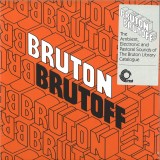
Various - Bruton Brutoff – The Ambient, Electronic and Pastoral side of the the Bruton library catalogue

Rare musical magic from the Bruton library catalogue – ambient, spacey, pastoral and electronic. Music by John Cameron, Alan Hawkshaw, Fran-cis Monkman, Brian Bennett and more – all total masters of the scene. All very cool. All very now. All will sell very fast.

Over the last three decades Jonny Trunk has collected and written about library music. But he’s never had a great deal of luck with the Bruton catalogue. By this he means that he’s never stumbled across a massive stash, or lucked-out buying a huge run for practically nothing –that’s the kind of thing that used to happen in the 1990s and the early noughties if you were out there looking hard for library music. But he did manage to get about 25 in one hit about 20 years ago when the BBC shut down their “TV Training Department” near Lime Grove and also when a box of Brutons ended up being dumped at a hospital radio, and they didn’t want the records, so Jonny got a call.

There are lots of Bruton albums in existence – over 330 LPs in the vinyl catalogue, issued between 1978 and 1985. That’s a lot of music to wade through if you are looking for sublime modern day sounds. For many years now the “trophies” from the Bruton catalogue have been the beat or action driven LPs – the two Drama Montage albums (BRJ2 and BRJ8) have always been the big hitters, and others such as High Adventure (BRK2) too.

But Jonny has always found himself drawn to the lime green LPs, the pastoral, peaceful albums (The BRDs), which were full of the kind of gentle, lovely music that would turn up in Take Hart as Tony was paint-ing a woodpecker or a badger or an Autumn tree. The other Brutons he likes are the orange ones (The BRIs) simply because they are full of ex-perimental futuristic electronics and would remind him of 1980s ITV backgrounds. This LP series includes Brian Bennett’s cosmic classic Fantasia (BRI 10). Jonny has been knows to refer to this style of library music as “Krypton Factor library”, because it’s exactly what that strange but successful 1980s TV quiz show sounded like.

In recent years as interest in library music has expanded, we’ve watched
the price of a handful of Brutons really going through the roof - not the just the action and drama ones, but the more esoteric and experimental LPs too – like the BRDs and the BRIs. Jonny gets the vibe that people fi-nally want to hear this other more interesting and experimental side of the Bruton catalogue. So what better time than now to put together a compilation of such sublime period sounds.

Not only does this album bring together a set of fabulous cues that would cost the average man in the street a month’s wages (if the origi-nals were all wanted and if you could even track them all down), but it also chops out the need to listen to other tracks on library albums that are nowhere near as good.

The cues here all date from between 1978 and 1984. They come from the BRD, BRI, BRH, BRJ, BRM, BRR and BRs catalogues.

The composers are all legends within the genre, and here, were doing what great library composers do best – fulfilling a brief and utilising modern studio equipment to both commercial and beguiling effect.

No en stock

Haga su pedido ahora y le encargaremos el artículo en nuestro proveedor.

15,92

Ültimo hace: 5 Años
Luc Ferrari - L'Escalier Des Aveugles

L’Escalier des Aveugles, or The Stairway of the Blind, was commissioned in November 1990 by Spanish National Radio (Radio Nacional de España). Asked for a piece to premiere as part of the European Day of Music, Luc Ferrari returned with a radiophonic concept that organised his anecdotal music into montage form, sequencing short, elusive narratives in a successive way.

The completed composition is formed of thirteen chapters containing a mixture of environmental and synthesised sound, commentary, chatter, and encounters with people and places. Each focuses on a small event within this playbook, and Ferrari notes that each “in addition to being a realistic photograph, will be the subject of a ‘setting to music’: fragments of voice and atmosphere will be sampled and will produce musical matter or a ‘song’.”

The sonic language of Madrid forms the setting to which Ferrari lays out the persistent theme of the piece, that of the composer being guided throughout the city by a young woman. Using a game-like structure (liners for this edition include Ferrari’s “Regles de Jeu”, or “Rules of the Game” which act as a script or score to the piece) the motivation is posed: imagine that one day you are told “I know a place in Madrid that sounds amazing (or bizarre)”, to which you reply “Let’s go to it together.” The recordings toy with the relationships between guide and tourist, translator, director and actress, and masculine and feminine that emerge as Ferrari and the actresses follow this action, documenting the shared experience and connections they make as they visit these places.

Six actresses guide Ferrari (and the listener) through locations simultaneously ordinary and sonically rich: the metro; the El Corte Inglés department store where we hear the gossip from changing rooms set against music emanating from the PA; vagabonds declaiming their political stance in the Conde de Barajas plaza; interactions buying apples in a market; the reverberant and spacious halls of the Prado Museum where one actress gives a moving description of her favourite painting - Goya’s The 3rd of May 1808.

Ferrari replies in French to their comments in Spanish, and there are several self-referential plots, devices, and word games that flirt with the poetics and rhythm of language and sound. A recital of Lorca’s poem "La Casada Infiel" in “Hommage À Lorca” in amongst the location recordings feels striking, and the call and response of “La Nouvelle de L’Escalier”, where one of the actresses descends the staircase of the blind - a long stone stairway in Madrid proposed to Ferrari as an interesting location to visit during the trip by producer José Iges. She replies to Ferrari’s vocal enunciation of the place (and title) in French - L’Escalier des Aveugles - with the place-name in Spanish: La Escalera de los Ciegos.

Using this repeated title and image of the staircase of the blind as a symbolic place, a line is drawn to a situational landscape experienced and diffused through snapshots and allusion rather than holistically overviewed, sound conjuring pictures within the imagination. In the sensorial qualities of Ferrari’s treatment of emotion and language—fortified with electro-acoustic motifs and musical properties—the piece accelerates towards a render that is truthful, beautiful, yet also surreal; somewhere between theatre and reality, a gonzo cinema of the ear.

No en stock

Haga su pedido ahora y le encargaremos el artículo en nuestro proveedor.

21,98

Ültimo hace: 5 Años
FAZE ACTION/ZEKE MANYIKA - Sununguka (Alan Dixon Mix)

Faze Action return with the 3rd instalment of their 4 part series featuring Zeke Manyika. "Sununguka", sung in Zeke's native Shona, is literally translated to mean, "To unravel oneself and unlock yourself".

It's set over an infectious reggae, boogie rhythm, with an early proto house feel. Featuring backing vocals from Sharon Manyika and heavenly keyboard solos from Rob Lee, this EP is set to take us into summer and beyond.

The package comes with a stunning remix from Alan Dixon who has been lighting up dance floors with his releases on Running Back and more. Here he turns the original into an Italo/electronic Aend of night classics, managing to seamlessly Amerge Zeke's African vocals with a serious bass line, ahead of the curve, contempory production whilst placing the release firmly in the credible main room department.

On "A2" we have Rwendo where Zeke really stretches his songwriting skills as the whole track manages to fuse a variety of rhythms together to create a beautiful downtempo masterpiece.
Finishing off we have the "Special Extended Dub Mix" which strips back the original and turns it into a balearic house gem made for the summer ahead.

No en stock

Haga su pedido ahora y le encargaremos el artículo en nuestro proveedor.

9,79

Ültimo hace: 3 Años
FROM OVERSEAS - Home

Islands, volcanoes and instrumental exile stories... From Overseas is the experimental ambient project by Kevin Sery.

Originally from the tiny French overseas department and region, Reunion Island, he routinely bounces between his home island, a small port town on the east coast of the US & Continental Europe picking up fresh ideas & inspiration along the way.

With a beautiful master by Stephan Mathieu (12k, Shelter Press, ... ) From Overseas Releases his first full length album "Home" on PITP. "Home" is a journey through beautiful soundscapes where dark and light intertwine, where ambient tones give way to post-rock guitar craft, then segway to melodic drone, noise and back again.


These soothingly powerful songs evoke emotions on a full spectrum, dreamy unplanned travels and inspire us to question the nature of the place that each of us calls home. The fourth track, Maloya Tales, is a personal tribute to Sery's homeland 'Reunion Island' and gives the listener a glimpse of the mystical rhythms of traditional Reunionese Maloya music.

No en stock

Haga su pedido ahora y le encargaremos el artículo en nuestro proveedor.

25,76

Ültimo hace: 4 Años
Imaginary Softwoods - Annual Flowers in Color

"Annual Flowers in Color" is an absolutely gorgeous, perfectly weathered, subtly strange record. It's exactly the thing you're thinking of when you think "I want to hear really killer polysynths and tape delay" but it's also much more, glistening with distended reflections of Steve Roach and Stapleton, ringing with simultaneous sublimated echoes of the dorkiest and most expensive French mellotron prog and the most incandescent cheap heat from the $2 exotica bin, and dripping with the "as above, so below" that characterizes synthesizer records at their best. It's both a welcoming point of entry for the uninitiated and a sticky, seductive cut deep enough to envelop any heads seeking a way station on the search for the apocryphal second volume of Cosmos Farm Sessions.

Chris Madak Philadelphia, February 2020

No en stock

Haga su pedido ahora y le encargaremos el artículo en nuestro proveedor.

18,45

Ültimo hace: 5 Años
Wolff Parkinson White - Small Favours

Auf "Small Favours" - der 6–Songs Vinyl–Auskopplung des Albums "Favours", verbündet sich Elektronikmusik–Zauberer Wolff Parkinson White mit verschiedenen SängerInnen, unter anderem Norah Jones, Natalie Beridze und Pascal Leboeuf.

Wolff Parkinson White's typisches Maschinengewehr–Feuer aus manipulierten Audio–Splittern steht hier in krassem Kontrast zu der Wärme der menschlichen Stimme. Seine erste EP–Veröffentlichung auf Nonplace bedient sich an vergleichsweise bekannten Liedstrukturen und beantwortet die Frage, wie ein Projekt von Björk und Venetian Snares klingen würde, wären sich beide jeweils der Nachteile diatonischer Monotonie und der endlosen harmonischen Wüste bewusst.

Die 6 Tracks der EP wurden von Labelchef Burnt Friedman persönlich von den 13 Album–Tracks ausgewählt. Der Schlagzeuger Jochen Rückert, der hinter dem Spitznamen "Wolff Parkinson White" steht, spielt auf "Heaps Dub" (nonplace20) von Root 70 und "Coptic Dub" (nonplace27) von Hayden Chisholm's Projekt The Embassadors.

No en stock

Haga su pedido ahora y le encargaremos el artículo en nuestro proveedor.

15,08

Ültimo hace: 6 Años
TRADISYON KA - Gwo Ka: Music Of Guadeloupe West Indies

Soul Jazz Records continues its journey into the world of Afro-Caribbean roots music with this album of newly recorded music of Gwo Ka music recorded and produced by Soul Jazz Records on the island of Guadeloupe, French West Indies.

Gwo Ka music is a fantastic fusion of African-­derived musical form ( call and response), with vocal styles that draw upon the equally powerful French chanson singers to create a truly unique combination.

Tradition Ka, made up of some of the island’s finest singers and master drummers, is part of a powerful network of politicised Gwo Ka groups on the island – upholding the traditions and cultural importance of Gwo Ka as part of a larger process of defining the identity of Guadeloupe and its culture.

This album is newly studio recorded in Pointe-­A-­Pitre, Guadeloupe by Soul Jazz Records. Like the cult music of Haiti’s Vodou and Cuba’s Santeria or the roots music of Belize’s Garifuna (all of which Soul Jazz have also released), Gwo Ka is the musical and cultural product of the region’s African ancestry, forcibly brought to the Caribbean through slavery.

Gwo Ka exists only in Guadeloupe, a very different island from much of the Caribbean, in that it remains a ‘department’ of its original colonial master, France. Here, the currency is the Euro and the baker sells croissant and café au lait.

This constant ‘European-­ising’ of the island means that Gwo Ka plays a fundamental and important role in the defining of Guadeloupean identity. As an African-­derived music, its position as a counter-­balance to French influence means that the definition of how and what Gwo Ka represents is also in a constant state of flux.

These new recordings show how Gwo Ka is both a modern Caribbean music form and one firmly rooted in ancestral history.

Over the last 20 years Soul Jazz Records have been documenting and presenting the often hidden histories and deep musical worlds of Cuba, Haiti, Jamaica, Belize, Trinidad, the Bahamas and more. This documentation encompasses reissuing lost recordings, such as the mighty Studio One catalogue of reggae, producing films/dvds (such as the 3-­hour documentary Mirror To The Soul in conjunction with British Pathé, and Dub Echoes), books (check the forthcoming photography book on the Caribbean 90 Degrees of Shade, with text by Paul Gilroy, and Kanaval) as well as travelling to the region to produce new recordings.

Reservar04.02.2020

debe ser publicado en 04.02.2020

30,21

Ültimo hace: 2026 Años
Amadeo SAVIO - Isolat EP

Amadeo Savio

Isolat EP

12inchVGNR005
Vigenère
12.12.2019

Amadeo Savio is next up on Vigenere, the label that has thus far presented a whole host of unknown names in the field of minimal techno all bound together by a shared classiness in their production style. Savio's approach is deep and dubby on opening cut "Isolat", one primed for the after hours. "Trance Later" has a slightly more forthright approach, but there's still plenty of mellow delights to be found in the synth department to keep you chilling. "Encor" heads into more typically minimal pastures, while "Kassion" explores broken beat patterns and fragmented samples with scintillating results.

No en stock

Haga su pedido ahora y le encargaremos el artículo en nuestro proveedor.

9,62

Ültimo hace: 6 Años
Hannah Williams & The Affirmations - 50 Foot Woman

The highly anticipated album by Jay-Z's 4:44 soul hurricane Hannah Williams & the Affirmations produced by award-winning composer and multi-instrumentalist Shawn Lee.

Hannah Williams, the British soul hurricane who sensationally became part of Jay-Z's chart-topping 4:44 album, is primed and ready for her own national and international breakthrough.

Williams turned heads worldwide when the hip-hop superstar sampled her heart-stopping vocals on 'Late Nights & Heartbreak' for the title track, '4.44' on his 2017 album. Now Hannah and her exemplary, Bristol-based band the Affirmations deliver a definitive career statement with the drop-dead soulful new album 50 Foot Woman which will be released October 18th on the Milan based imprint Record Kicks.

The album captures all of the visceral power of the band's increasingly legendary live performances. Shades of classic Soul and Psychedelic Funk blend uniquely with modern-day flavours on a record destined to set the soul agenda for 2019 and far beyond. "I've never been as proud of anything in my entire career" says Hannah.

Born in High Wycombe in Buckinghamshire, Williams'father was a musically gifted minister, and her mother let her join the church choir at the age of six. Hannah could read music before she could properly read words, and when she discovered soul by listening with her mum to Motown and Bill Withers, there was no turning back.

After a 2012 debut with her previous band the Tastemakers, it was 2016's Late Nights & Heartbreak that announced the arrival of Hannah Williams and the Affirmations. But little did she know that Jay-Z was listening. One day, at her then-day job running the music department at the University of Winchester, he sent her a text.

Once she'd established that it wasn't a wind-up, and summoned the courage to call him back, she learned that JayZ's producer, No I.D., had played him Hannah's track to inspire his response to Beyoncé's Lemonade, on which she sang of his infidelities.

Williams was as in the dark about how 'Late Nights & Heartbreak' would be used until 4:44 dropped. But the substantial sample of her voice opened doors she never dreamed of. "It was an incredible catalyst," she says, "as a change in our collective career, and getting a global audience. Suddenly, there were millions of predominantly American hip-hop fans listening to my voice, going 'Is this from the '60s? Is she dead?'"

What followed was a year of the band's widest-ever touring including an invitation to perform at Central Park Summer Stage NY, Toronto Jazz Festival and Brooklyn Bowl NY and expanded audiences in continental Europe where she and the Affirmations had already made a mark. Then came the burning determination to make the record of their lives. The captivating 50 Foot Woman is that album, produced by Shawn Lee, a respected presence on the funk/soul scene whose credits include Amy Winehouse, Lana Del Rey and Alicia Keys. Lee has released five solo albums as Shawn Lee's Ping Pong Orchestra on San Francisco label Ubiquity Records and is also one half of the cool melodic pop duo Young Gun Silver Fox.

Now the world will hear what the cognoscenti have known for a while: that Hannah Williams is the real deal, and sings from her very soul. "I feel like my performance comes from my solar plexus," she says. "The emotional side of it is so intrinsic; I can't take it away from what I do."

No en stock

Haga su pedido ahora y le encargaremos el artículo en nuestro proveedor.

15,92

Ültimo hace: 6 Años
L'AVENIR - REQUIEM LP

“Requiem” is the name of the new Cold Beats Records release. The reference number 14 of the catalan label is written by L´Avenir, the cold synth side project of veteran electronic musician and sound artist Jason Sloan. Known throughout the space and ambient music scenes for his contemplative electronic soundscape work for close to two decades; Sloan founded L’Avenir in 2012 to explore his long time love of synthnpop and dark minimal wave music created purely from analog and vintage equipment. While still retaining the atmosphere of his solo records, the music of L’Avenir is rooted in the tradition of the minimal, analog, synthesizer music of the late 70′s and 80′s ( Fad Gadget, Depeche, Click Click, Chicago’s Wax Trax Records scene etc…). Growing up through the original scene while it was happening, it’s no suprise that Sloan’s music would eventually move in this direction. While releasing over a dozen solo albums and E.P.’s under his own name, Sloan has played live all over the US, Canada and Europe including the influential Live Constructions radio program at Columbia University, STEIM in Amsterdam and Philadelphia’s The Gatherings concert series, one of the country’s oldest continuing ambient and electronic music series. Sloan is a Professor teaching full-time in the Interactive Arts department along with being the founder and program coordinator for the Sound Art concentration at the Maryland Institute College of Art in Baltimore, Maryland. L’Avenir returns with Requiem, the fourth, full-length album for Barcelona’s Cold Beats Records. Requiem finds L’Avenir visiting themes of postmodernity, alienation and spiritualism while expanding the sonic palette far beyond his minimal synth beginnings. The music of L’Avenir has, at times, been compared to 4AD era Clan of Xymox or mid-period Depeche Mode. But while echoes of the former can be heard, L’Avenir brings a uniquely fresh perspective unheard in other bands of the genre. Requiem features eight new songs and is available on limited edition blood red vinyl. Requiem is L’Avenir’s sixth release was written and recorded between February 2018 and January 2019 in a Minimal Space, (Baltimore). Limited edition of 300 copies lacquered pressed on 140 gr. high quality red vinyl and digital album.

No en stock

Haga su pedido ahora y le encargaremos el artículo en nuestro proveedor.

13,15

Ültimo hace: 6 Años
Philippe Cam - Rotterdam

Philippe Cam

Rotterdam

2x12inchTRAUMV233
Traum Schallplatten
06.09.2019

Philippe Cam is the Thomas Pynchon of the electronic music world. Little is known about him and only a couple of pictures have been put online since he emerged on this planet to write his first and only album18 years ago. We know he worked as a sailor and that’s it. If you dig deeper you might find out that he worked as a DJ in the beginning of the 90ies in Brussels and began to study electronic music there and also began to write music for theaters and ballets.

The American distributor Forced Exposure once wrote that about him: „Philipe Cam is a star in his own field. He is among the few people who have succeeded to write hypnotic dance music without a conventional beat still conveying a thrilling, dramatic feel. Cam has developed an accurate, intense and complex formula of modulation-techno. Starting with music similar to Pan Sonic in 1996, his music turned towards a more elegant form of minimal music. Abstract soundtracks lead to an organic form of music, which was equally influenced by modern techno as Wolfgang Voigt's Studio 1/Gas or Basic Channel/Maurizio. Cam's music corresponds heavily to the Cologne scene, where his music is appreciated and played throughout the clubs by the likes of Michael Mayer, Tobias Thomas and various other DJs as well as experimental djs from the A-musik corner.“

So what’s new with his music? Basically the art of filtering is still his passion. Maybe he can be less associated with techno and the themes of his new tracks emerge in a more distinctive pattern? Well that’s hard to say, we would comment the energy of his early techno days in Brussels have returned here in a fierce way with some oft he tracks. The rhythmic movements are classy and stick with you. Whereas other tracks look for a distinctive relaxation of some kind.

We are releasing the album as a double clear vinyl with cover art by Yvette Klein who also designed the cover for his Philippe Cam’s album 18 years ago. Graphics for "Rotterdam" come from Cologne designer Daniela Thiel. We also would like to thank the cultural department of Cologne for supporting us to finance the album and to see the artistic value in this piece of minimalism.

The album kicks off with the mellow and soothing "Cocoa Beach". A Gentle beat that moves like bodies swaying in the hot summer sun. The clock moves a step forward and then a step backward as evolution takes a rest.

"Manga" feels like an acceleration to the moon, the contemplative moments come in spurts and hide in the intervals of the chords which are on the loose. Philippe Cam is the most energetic person in the world when it comes to core activity, this is head banging stuff for the ambient lounge.

"Short Summer" is a heavy and violent recognition. As intensive as it is it knows when to stop and disappear. In the ear and brain of the listeners it leaves an indisputable echo which lingers on for minutes. We suggest not to make a pause but jump directly into "Vermillions Sands".

What can be said about into "Vermillions Sands"? Be prepared some Terry Riley might lure around the corner to offer you some oranges on a silver plate, but don’t eat them. This is luring and beautiful at the same time. Maybe the best ambient track ever written and yet who can ever venture to say that without making a fool of himself. "Vermillions Sands" comes in waves and they could be longer we think.

"Rotterdam" the home of Philippe Cam for a long time but not anymore. He moved away. So that changes the perspective. But when was the track written? "Rotterdam" seems mechanical and rusty and spooky and divided. This arrangement is very different to all the other tracks so far and is almost dub in style but way more fractured. A steady stop and go emerges. But the longer it runs the better it gets. At minute 6 the brain resets itself and tries to grasp what has happened so far, reconstruction as a result of its own phantasmic imagination and hardly true at all, wonderful. Applause included!

Here comes "Bis", a short episode of a track and before we can comment on it, it is already over.

"The Game" is a mule of a track. It has a quiet stubborn sequence that bites and kicks you in the back without any change in near sight. We can hear a voice whispering, which sounds like a miniature vocoder featuring the voice of a child calling out - never stopping. This is treadmill to some extend but starts to breathe towards the middle of the track and slowly changes perspective. In fact there are some changes taking place here which go beyond a sound design that works heavily on the stereo image. Stick with it and the experience will be a great one.

"Ultimate Fly For Halloway" somehow orchestrates how you might feel after you climbed a 8000 meter high mountain and reached the top. A rejoicing off a special kind. Lava for the ears. No cheerleader murder plot sorry.

"Last Track" is a perfect example of a true minimalistic pice of music that manages to make contact with other genres and does this with elegance, determination and a lot of soul.

key selling points: The key selling point is the fact that Philippe Cam once was referred to as one of the main protagonists of the minimal music scene along with Wolfgang Voigt's Studio 1/Gas and Basic Channel/Maurizio. A true artist with a vision which is very rare.

Philippe Cam has picked up the sound he was famous for but has developed it further without selling out to any genre and expectation that rules our daily business.

Exactly this is the strength of the album to create a vivid world of impressions by using instruments in a whole different way than all software developers would suggest.

"Rotterdam" is a piece of art that can set off a firework when you listen to it and it owes nothing to anyone.

No en stock

Haga su pedido ahora y le encargaremos el artículo en nuestro proveedor.

16,77

Ültimo hace: 6 Años
Stefan Smith - Stefan Smith

Stefan Smith

Stefan Smith

12inchSAPIENSLP001
Sapiens
25.03.2019

Stefan Smith has channeled an elevated reverence for process, texture and synth-extrapolation with the forthcoming release of his self-titled LP on the Sapiens imprint. A relative new-comer to the land of rapid fire releases and dance floor formulae, Smith is deeply steeped in the art of music creation, performance and theory.
As a graduate of Mills College's revered music department, Smith's prosaic understanding of music partially explains his migration to Sapiens, a label headquartered in Paris, France, which, under the direction of techno luminary, Agoria, has been expanding the realm of possibility for what a techno label can become. Collaborating with musicians, visual artists, film directors, shamans and sound designers, the young Sapiens platform releases may include political speeches, radio hits, dance floor tunes, sensorial or cognitive music or a gentle computer
virus'. Smith's LP contribution will definitely fall on the more delicious end of this spectrum, having woven a synth-lovers dream tapestry. 
The nine tracks composing the album, Stefan Smith', draw the listener in on a river of oscillators, which push just past the banks of perceptible sound with with flawless production and loving sound treatment. The idea behind the album is very raw and organic. Stefan Smith focuses on atmosphere, mood, tones, and frequencies, rather than melodies. His productions are a response to the subliminal, and about feeling.
This album came together from a natural flow of working with computers and synthesisers, and also from the musical connection fostered Sebastien Devaud (Agoria). His approach to the album's production was to edit as little as possible, keeping the original feeling of chance and temporality intact. We can sense here Smith's intuition as sound designer, a role which has enabled him to work with artist Nicolas Becker and through this association further contribute work to the Philippe Parreno 'Anywhen' exhibition in Tate Modern Turbine Hall. The feedback
generated by studio experimentation gives birth to new ideas for aural shapes and textures. If one were only to lie back and identify the various wave forms, like butterflies and birds flittering through dappled sunlight, in each track's canopy of bountiful synth elements the mind's eye would dance with the steady intervals of Smith's real-time probe of his machinery, however, deep tracts of emotion and effortless grooves won't allow for a purely sensory listen. In the spirit of exploration, enjoy the ride.

No en stock

Haga su pedido ahora y le encargaremos el artículo en nuestro proveedor.

17,52

Ültimo hace: 4 Años
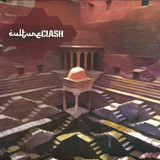
Cultureclash - Cultureclash

Lost Futures is a new label that explores experimental and often radical approaches to dance music from the past. In a musical landscape that increasingly claims to seek and reward new forms and ideas, Lost Futures delves into the recent past to revisit forward-thinking, optimistic projects that, owing to the social, musical or outright political climate, perhaps struggled to find an audience. Allowing only time to re-contextualise these leftfield, sometimes misunderstood and ultimately human bodies of work, Lost Futures taps into the inherent idealism of rave.

LF001 trips back until the early nineties to revisit the alternative scene emerging from the Dutch city of Utrecht. Here, three young men - DJ Zero One (Sander Friedeman), TJ Tape TV (Arno Peeters) and DJ White Delight (Richard van der Giessen) - joined forces to form 'The Awax Foundation'. Inspired by the transcendent and revolutionary electronic music arriving on their shores imported from Chicago and Detroit, combining their knowledge, gear and ever-expanding vinyl collection allowed additional freedom in paying sincere tribute to these intoxicating sounds, while also developing their tastes in a more personal, eclectic direction.

The musical flavours of Awax initially leaned toward acid house and the roots of techno. However, with three different mindsets in the mix, their tastes were rarely fixed. One thing each shared in common was a devotion to collecting rare sounds, specifically more adventurous and international samples than those emanating from the increasingly-hard, masculine dance music emerging from the Netherlands during the period. Inspired by the cross-over global sound of bands like Suns of Arqa, or 'World Music', as it was perhaps patronisingly termed at the time, the trio became interested in the idea of making techno with 'ethnic instruments'.

Of course, this being 1992, none of The Awax Foundation had access to such instruments, instead, they had a vast, collective library of samples from all over the world. There were no collaborations and no clear plan. Instead, they set to work using a Yamaha TX16W sampler, the legendary Atari 1040ST computer, a cheap mixing desk and a couple of low-end synths and FX machines. When Richard mentioned the project to his friend, Akin Fernandez, the London DJ and owner of cult label Irdial Discs, Fernandez was intrigued enough to invite the trio to record a one-hour show for his 'Monster Music Radio' series on London's then-burgeoning Kiss FM.

Forced to come up with a name, 'CultureClash' seemed like the obvious choice, even if the members of Awax were only creatively sparring among themselves. Along with the term 'ethno-techno', slightly dubious to a hopefully more conscious Western audience in 2017, these were the only guiding principles to the quietly ambitious project that soon combined cutting-edge machine rhythms with samples sourced from everywhere from Bolivia to Togo, and inspired by everything from Ravi Shankar's epic soundtrack to the Oscar-winning movie Ghandi, to the technical limits of their own setup requiring a dazzling degree of cut-and-paste work. Some tracks even emerged out of academic studies within the ethnomusicology department at The University of Amsterdam.

The show aired on October 2nd, 1992, recorded in one blistering take and without any rehearsals, traversing a huge variety of tempos and styles. If the performance wasn't seamless, it was undeniably thrilling, fresh and ambitious. As such, several labels, including Fernandez's aforementioned Irdial Discs expressed an interesting in commercially releasing CultureClash, while another imprint proposed a series of twelve-inches and an album. But the sheer complexity of the project meant that it never saw the light of day, while the trio embarked on different journeys ahead, both creative and personal.

Twenty five years later, and the original CultureClash lineup and founding members of The Awax Foundation provide the sound of the first release from Lost Futures. An otherworldly, ambitious and optimistic compilation, accompanied by extensive sleeve notes from the trio, CultureClash is a timeless ode to experimentation in dance music's ever-overlapping culture.

No en stock

Haga su pedido ahora y le encargaremos el artículo en nuestro proveedor.

22,65

Ültimo hace: 7 Años
Bruno Spoerri - Rare & Unreleased

11 never-heard tracks from Synthzerland pioneer Bruno Spoerri, released for the first time on vinyl, with liner notes by the artist. WRWTFWW Records is very delighted to announce the release of Rare & Unreleased 1971-1998, a collection of never-heard and hard-to-find works by Swiss music pioneer and synth super wizard Bruno Spoerri. The album is sourced from original masters and available on a vinyl LP cut at Emil Berliner Studios (formerly the in-house recording department of Deutsche Grammophon), housed in a 350g sleeve with a superb artwork by Nicolas Eigenheer, and packed with track-by-track liner notes by Mr. Spoerri. Rare & Unreleased 1971-1998 gives a fascinating glimpse into Bruno Spoerri's incredibly inventive repertoire, collecting tracks from projects as diverse as commissioned music for trade fairs, the Swiss railroads, or the union of Swiss cheese makers(!), soundtracks for TV shows about ecology, live synth improvisations at Montreux Jazz Festival, and sound installations for art exhibitions. Always the adventurer, Spoerri records a pneumatic drill for the irresistible electronic bossa of 'Konzert für SIG-Pressluftwerkzeuge", mixes train sounds and the EMS Synthi-100 for the joyful lo-fi funk of 'Rollin'", lets overheating synthesizers take a life of their own to create the sci-fi ambient of 'Waves of Montreux", and works with bees, pigs and various birds for the environmental music bliss of 'Rhythm'n bees' and 'Birds of Cochin". Synthzerland rejoice, it's time for another captivating journey of sound exploration on Planet Spoerri! Bruno Spoerri celebrated his 83th birthday in August this year. He is still experimenting, recording, customizing audio gear, improvising on stage and in the studio, collaborating (Julian Sartorius, Franz Treichler of Young Gods, Marco Repetto of Grauzone, Roger Girod...), inventing new sounds and finding new creative outlets.

No en stock

Haga su pedido ahora y le encargaremos el artículo en nuestro proveedor.

25,76

Ültimo hace: 6 Años
Various - Antilles Mechant Bateau

Fifteen track completion of deep biguines and Gwo Ka from the '60s French West Indies. The vinyl edition included a 4 page booklet + download code.

Biguine is a rhythmic style of music that originated in Guadeloupe and Martinique in the 19th century, which fuses 19th-century French ballroom

dance steps with African rhythms. Gwo Ka is found among all ethnic and religious groups of Guadeloupean society.

It combines responsorial singing in Guadeloupean Creole, rhythms played on the Ka drums and dancing. Gwo Ka is the musical and cultural product of the

region's African ancestry, forcibly brought to the Caribbean through slavery. Gwo Ka exists only in Guadeloupe, which is a very different island from much of

the Caribbean, in that it remains a 'department' of its original colonial master, France. Here the currency is the Euro and the baker sells croissants and café

au lait. This constant 'European-ising' of the island means that Gwo Ka plays a fundamental and important role in the defining of Guadeloupean identity.

'Antilles' Méchant Bateau', a low-tempo number with a bolero feel, indeed a pure case of the blues, and a terrific saxophone solo. What else would you

expect to set the tone for this selection, in which beguine regains its original colours, in the darkness of the Gwo Ka drums. This 45 by André Mahy, released

under the Aux Ondes sublabel, was recorded in the 1960s at Célini's, one of Guadeloupe's two main houses. Through its drum rolls and harrowing chant, it

recalled how, long before the mid-1960s, the Antilles' history was written in an ocean of teardrops - namely the Black Atlantic.

No en stock

Haga su pedido ahora y le encargaremos el artículo en nuestro proveedor.

18,45

Ültimo hace: 7 Años
Michaela Melián - Music from a Frontier Town

Following the U.S. Army's liberation of Munich in May 1945, the world's first Amerikahaus was inaugurated there with a library, a magazine reading room, a children's library, a record and lm department, and lecture and seminar rooms, together with a concert hall and exhibition space. Up to 80,000 people a month utilized the offerings of Amerikahaus during its early years. Beginning in 1953, the United States Information Agency (USIA), an institution founded as an instrument of the Cold War, began to finance Amerikahaus. In addition to representing the U.S., its principal task in West Germany was to democratize and denazify the postwar population. After the beginning of the Cold War, many of these re-educative measures also served as propaganda in a programmatic linking of democratic and economic principles meant to strengthen transatlantic relations against the Communist Bloc. In 1997, the U.S. government concluded its work at Amerikahaus in Munich and shipped almost all its items back to the States. However, 1,630 long-playing vinyl records from the library were left behind in cardboard boxes in the basement. When Michaela Melián looked through this forgotten collection, one of the first things she came across was Don Gillis' 1940 tone poem »Portrait of a Frontier Town«, whose second movement is entitled »Where the West Begins«. Don Gillis, a composer and radio producer, used the musical styles and genres of that decade to create an explicitly American program music. Michaela Melián's »Music from a Frontier Town« is fueled by the diverse sonic material of this extensive record collection once considered as an instrument of cultural education. This record has been produced in addition to Melián's twenty-four hour performative music installation »Music from a Frontier Town« in the garage of what is now the Bavarian Center for Transatlantic Relations at Karolinenplatz, Munich (4-5 May 2018).

No en stock

Haga su pedido ahora y le encargaremos el artículo en nuestro proveedor.

14,50

Ültimo hace: 7 Años
Bon Voyage Organisation - Jungle  Quelle jungle 2x12"

There are some records that manage to sound both of a time and utterly timeless and Bon Voyage Organisation's Jungle Quelle Jungle (a nod to Supertramp's Crisis What Crisis) is one of those albums. Its silken-smooth production, irresistible grooves, funk-tinged guitars, lush soundscapes and general glowing presence could easily lead one to believe that have dug up a lost disco gem from the 1970s. However, behind the disco-pop gleam lies eerie dystopian sci-fi ruminations of a futuristic bent and tones that can often feel as French as they do Asian or African.

This sort of cross-continental exploration is an expansion on BVO's previous two EPs, the man behind the Organisation, Adrien Durand, says. 'I tried to continue the musical expedition between dystopian Science-Fiction Haunted Africa - plus Haitian Vaudou on 'Soleil Dieu' - and futuristic Asia. Addressing, in a double entendre manner, some of the political issues that I am sensitive to.' In fact the jungle in question in the album's title is a metaphorical one and one that creates a vast series of environments for Durand to explore such subjects as world trade, utopian ideals and themes of idols, as well as of time and communication. However, one will need to speak French to decipher such explorations, as well as shake off the natural impulse to move with every glorious beat on its 13 tracks, of which are moved along by Maud Nadal and Agathe Bonitzer's golden vocals.

Durand is a full-time producer based in Paris, working with the likes of Amadou & Mariam, so it makes sense that this record would absolutely sparkle in this department. Durand feeds off the variety of musicians coming and going during recording sessions as well as the rotating members and numbers of people involved with the band but fundamentally he writes all songs on piano first before bringing them to record live. 'We recorded a rhythm section of five - drums, percussion, guitar and myself on bass/synth bass and keyboards - at La Frette which is a studio located in a mansion outside of Paris and fitted with a beautiful 1973 NEVE desk. We only used analogue gear, by taste really, and found it a pretty reliable way of doing things. This simply consists of putting good players together in a room and waiting for the right take to happen.' Two four-day sessions and a 'cooling off' period (to let the recordings settle) soon followed before Durand picked the material back up to give it a final polish.

The resulting album is one loaded with intricacies and idiosyncrasies, something that Durand puts down to his own unique approach. 'I don't consider myself much of a songwriter but I love arranging rhythm sections and I'm pretty proud of the ones on this record.' This applies when it comes to working with such musicians as Inor Sotolongo Zapata, who with Durand used traditional Cuban percussive instruments and explored Haitian rhythms. When Durand expands on some of the ideas and influences that were funnelled into the record, you begin to get a sense of the vastness of the sounds that fill his world, from Trevor Horn's production work on ABC's Lexicon of Love, to the literary work of JG Ballard to the visual flair of the original Blade Runner and even the Tuareg sounds of Tinariwen, due to the fact that his studio neighbours their manager's and he would hear their rhythms bleeding through the walls. You therefore end up with an album that offers tracks such as 'GOMA' that fuses Chinese and African rhythms as well as 'SI D'Adventure' a piece of pop music that is dazzlingly hook-laden.

As a result of this cooking pot of sounds, influences, thoughts and creations, Durand has more of a gumbo approach to making this music than a set-out scientific formula. 'There is no definite recipe for me to like the production of a record,' he says. 'Of course it really sticks out that my work is really influenced by the 1978-1983 period, the golden age and last stand of analogue studios and session musicians.' Whilst Durand adores the traditional and conventional music, he really views this as something bigger and wider. 'I have a taste for the otherworldly vibe from records coming from less sought-after musical scenes, particularly Poland, Haiti, Ethiopia, Somalia, Congo and early Cantonese pop. Languages and the rapport of the people involved in the making of those records really inspires me. I particularly hate the use of the word 'World Music' as a potpourri for everything that doesn't sound quite western enough.'

No en stock

Haga su pedido ahora y le encargaremos el artículo en nuestro proveedor.

26,34

Ültimo hace: 5 Años
Daisuke Kondo - Stuck In A Time Warp

Having recently appeared on Bosconi Records and Altzmusica, Daisuke Kondo is a producer on the rise at present. This outing on Vibraphone adds fuel to that particular fire with four distinctive cuts that push to the outer edges of house music without losing sight of the groove. "Hold On To Love" is, on the surface, an upbeat, disco-infused house jam, but there's a certain trippy approach Kondo takes in the processing department that edges the music into a different head space. "Life" meanwhile gets gritty and bass heavy at one end of the frequency range, and airy and melodic at the other. "Feelin Blue" gets even dustier and scratchier with its sample treatment, and then "Fallen Star" lays down some unflinching machine beats with wonky, distant piano licks.

No en stock

Haga su pedido ahora y le encargaremos el artículo en nuestro proveedor.

11,30

Ültimo hace: 7 Años
Felix Kubin - Takt Der Arbeit

Felix Kubin

Takt Der Arbeit

12inchEMEGO243V
Editions Mego
22.11.2017

Felix Kubin (org, electr,sampler)
Milosz Pekala (vib, xyl, sampler, perc, effects)
Magdalena Kordylasinska (mar, perc, effects)
Hubert Zemler (glsp, dr, perc)

Music composed by Felix Kubin, tracks A1+2 together with Milosz, Magda and Hubert.

The pieces are soundtracks to educational and industrial 16mm films dealing with the subject of "work".

They were commissioned by NDR das neue werk (North German Radio).

Recording engineer: Robert Migas, Black Kiss Studio, Warsaw
Mix: Tobias Levin, Electric Avenue Studio, Hamburg
Mastering: Rashad Becker, D&M, Berlin
Production: Felix Kubin

Film archive: Metropolis Kino, Hamburg
NDR editorial department: Dr. Richard Armbruster

Artwork: Stephen O'Malley

Originally developed as a film score "Takt der Arbeit" is inspired by a handful of industrial and instructional films from the early 1960's until the early 1990's that portrait different forms of work. Felix Kubin is translating these historic documents into a musical poem of conceptual depth. "Takt der Arbeit" - the beat of work - is not only serving as a title but also as constructive element in this endeavour.

Being hunted down by the ever accelerated pulse of our reality is an omnipresent issue in capitalist societies of the the Western world. Living in times of constant exhaustion, it's not only our bodies that have been disciplined by and synchronized to the rhythms of working processes, but also our minds that rage in the tempo of our surroundings. Following an almost analytical effort, Kubin and an ensemble of 3 percussionists are investigating the different qualities and intensities of time that are catalyzed in working processes. While picking up precise temporal and motoric motives of the films, condensing paces and excavating rhythmic patterns, the ensemble is mapping out an animist choreography, shifting from a time when labour was still relying on bodily efforts to a time when machines and ticking clocks seem to reign and model our perception. While Side A is dedicated to procedures that are still based on manual and mechanical movement, Side B is inspired by the digital age, marked by invisible processes and subcutaneous pulses that we internalize.

The result is a critical and poetic reflection on the rhythms of our daily life and yet another example of Felix Kubin's skills as a composer, placing him in the field of orchestral music.

No en stock

Haga su pedido ahora y le encargaremos el artículo en nuestro proveedor.

17,61

Ültimo hace: 8 Años
Lorenz Lepus - Feral Child

Lorenz Lepus

Feral Child

12inchSHKL005
Schakal
25.07.2017

The enigmatic label from Berlin, Schakal Recordings is back with its fifth release and young DJ Lorenz Lepus is next in line. The Lepus project has gone through many guises, finally Lorenz settled on making music as a solo artist under the Lorenz Lepus alias in 2014. While still studying at school Lorenz became a resident at Chalet's Tuesday sound Department parties, cutting his teeth in the cities clubs he has played in venues including Hoppetosse, Sisyphos, Arena and many more. This dedication to his music was not without some confusion, being aware of the melan- cholic minimal tendencies of his productions he has always been loathe to pin himself to a particular genre.What with the success of his career so far.. perhaps this isn't a bad thing.
'Feral Child' is made up of two original tracks and two remixes.The title track's melody swells until it breaks down into a pulsing and rolling rhythm. 'Lost' is more immediate in its dance-floor compatibly, maintaining the rolling style Lorenz imbues his take on deep house with an emotional poignancy rarely heard. Floyd Lavine steps up for the first remix on the EP, Floyd is a resident at the legendary RISE par- ties at Watergate, with one foot in Berlin and the other in his native Cape Town Floyd delivers a beauti- fully loopy and oddball twist on 'Feral Child' adding crunching static sounds. Providing a harder take on 'Feral Child', Italies VII Circle change the rolling melody into a slow techno heater.

No en stock

Haga su pedido ahora y le encargaremos el artículo en nuestro proveedor.

9,45

Ültimo hace: 8 Años
G. Markus - G-edits #2 Xhaka Can

G. Markus

G-edits #2 Xhaka Can

12inchGEDITS002
G-EDITS
06.06.2017

G. Markus returns with two fresh edits after his first G-Edits release sold out and enjoyed heavy support from all sorts of discjockeys. '70s soul/disco is the flavour here with a legendary diva getting the treatment, with one big peak-time banger and a slo-mo chugger for good measure. Danvers helps thickens things up in the bass department with some live electric bass on both tracks.

No en stock

Haga su pedido ahora y le encargaremos el artículo en nuestro proveedor.

11,35

Ültimo hace: 5 Años
Shankar Jaikishan - Raga Jazz Style

Never before reissued, this legendary 1968 EMI recording is a revered Indian jazz rarity, a collectors' holy grail. Raga Jazz Style is an original Indian excursion into Indo-jazz fusion. A one-away recording from the almost unknown Bombay jazz scene, it is among the few jazz LPs to hail from the subcontinent.Closely contemporary with the UK-based explorations of Amancio D'Silva, John Mayer and Joe Harriott, Raga Jazz Style takes the melodic, scale-based raga system of Indian classical music and marries it with a swinging jazz rhythm section assembled by Bollywood's most highly acclaimed musical directors, the soundtrack composing duo Shankar Singh and Jaikishan Panchal.Singh and Panchal were a dominant force in Hindi film music from the late 1940s onwards. Shankar had been trained in classical tabla, while Jaikishan was an expert harmonium player. They worked together on well over a hundred films, and their innovative compositions and orchestral scoring revolutionised the music of the nascent Bollywood industry. Central to their sound was regular collaborator Sebastian D'Souza. From 1952 onwards, D'Souza would work on every Shankar Jaikishan soundtrack, eventually becoming Bollywood's most coveted musical arranger.
Originally from Goa, D'Souza had cut his teeth in the dance-band era, arranging and playing with his uncle's jazz bands in Lahore and Quetta. After Partition, he had moved to Bombay to follow the reliable work provided by the film industry, where Goan musicians had become the mainstay of Bollywood's film studio orchestras. Goans were also the core of Bombay's thriving dance-hall and hotel-based jazz scene, with artists including saxophonist Braz Gonsalves, guitarist Amancio D'Silva and trumpeter Chic Chocolate all working in the city during the post-war years.
The team assembled for Raga Jazz Style were drawn from this inventive and forward-thinking milieu. Pianist Lucilla Pacheco, saxophonist Manohari Singh and guitarist Anibal Castro were all fixtures on the Bombay jazz circuit, while drummer Leslie Godinho is reputed to have taught Joe Morello the 5/4 'Take Five' beat when they jammed together during Dave Brubeck's State Department tour of India. To this jazz backbone was added the sitar of Ustad Rais Khan, scion of long line of classical instrumentalists, and nephew of the renowned sitarist Ustad Vilayat Khan. Bombay's jazz modernists had been experimenting with the fusion of ragas and jazz since the 1950s, long before American or British jazz musicians had tuned in to Indian classical music. But very little of this exciting scene was ever captured on record. Raga Jazz Style offers a rare chance to hear the innovative sounds of the Indian jazz scene, as peerless composers Shankar Jaikishan and arranging supremo D'Souza join with veteran Bombay jazzers to explore classical themes in a jazz setting — eleven ragas to a swinging beat!This is a highly impressive inaugural salvo by Outernational Sounds, using original masters and beautifully rendered facsimile artwork, with 180g vinyl pressed at Pallas, in Germany.

No en stock

Haga su pedido ahora y le encargaremos el artículo en nuestro proveedor.

14,83

Ültimo hace: 8 Años
Midori Takada - Through The Looking Glass

Palto Flats & WRWTFWW Records are ecstatic to announce the highly-anticipated reissue of Japanese percussionist Midori Takada's sought after and timeless ambient / minimal album "Through The Looking Glass", originally released in 1983 by RCA Japan.

Considered a Holy Grail of Japanese music by many, "Through The Looking Glass" is Midori Takada's first solo endeavor, a captivating four-song suite capturing her deep quests into traditional African and Asian percussive language and exploring contemplative ambient sounds with an admirably precise use of marimba. The result is alternatively ethereal and vibrant, always precise and mesmerizing, and makes for an atmospheric masterpiece and an unparalleled sonic and spiritual experience.

The fully licensed reissue is available as a single 33rpm LP and a limited 45rpm DLP, both cut directly from the original studio reels (AAA), at Emil Berliner (formerly the in-house recording department of renowned classical record label Deutsche Grammophon) for the 45rpm DLP, and at the equally famous Frankfurter SST Studio for the LP. It is also available in CD format for the first time. All versions come with extensive liner notes.

No en stock

Haga su pedido ahora y le encargaremos el artículo en nuestro proveedor.

43,07

Ültimo hace: 6 Años
Artículos por página
N/ABPM
Vinyl