"Reptile Brain Music" - Imperial State Electric's third studio album was originally released in 2013.
Clocking in at a little over 33 minutes RBM boasts a dozen tracks of their particular and peculiar rock'n'roll.
The album is bookended by two high-energy live favorites, "Emptiness into the Void" and "Down in the Bunker" in a classic Andersson style. However, the less obvious songs within also reveal some unexpected treats. The heavy Blackmoresque "Faustian Bargains" showcases some unexpected time signatures. "Dead Things" feels like Beatles meets horror movie soundtrack (Fred Estby contributes lyrics). While the frantic "Born Again" is far from pieous, delivering a blistering blow to religion.
RBM also shows the further development from solo project into a full-fledged band with multiple songwriters and different lead vocalists. Tobias Egge opens new doors with his contribution "Stay the Night" and Rudolf de Borst screams lead vocals for the wonderfully primitive title track - "Reptile Brain".
Recorded at Gutterview Recorders, mixed by Fred Estby & Nicke Andersson & produced by Nicke Andersson.
Originally released on Warner Music and promptly "Out of Print" fans have been clamoring for a reissue.
From the press release 2013 "Imperial State Electric is entering phase 3 in its ongoing battle against mediocrity.
An endless quest to make the rock roll".
Suche:development
Frozen reeds presents the only recorded duo playing of two legendary musical figures. Derek Bailey and Paul Motian – two longstanding pioneers of distinct strains of improvised music – came together for a brief period of collaboration in the early 1990s. Tapes of their two known live performances (one at Groningen’s JazzMarathon festival in the Netherlands, the other a year later at New Music Cafe, NYC) were recently unearthed in the Incus archives, and their contents will surprise and delight fans of both supremely idiosyncratic musicians.
The Groningen concert (1990) is released on vinyl, while the New York date (1991) is included with the digital download, free of charge for all purchasers. A conversation between Bill Frisell and Henry Kaiser on Bailey, Motian, their intertwined backgrounds, and the significance of these recordings is included as sleeve-note insert.
“This is one of those moments that we’re always hoping for, and it's so rare. And it's so hard to talk about, because it's so beautiful. It's like you're seeing some new species of plant that you never knew existed or something.” – Bill Frisell
Each player bringing decades of crucial experience to their encounters – with histories taking in vast swathes of the development of jazz and free improvisation – these fleeting shared moments provide some of the most riveting playing in the career of either.
There is precious little recorded evidence of Motian as a free improviser, but his mastery is beyond any doubt in these recordings. From knife-edge precision to textural haze, Motian’s palette is astounding, but perhaps even more impressive is his confidence in the non-idiomatic conversation itself. Pushing far beyond the established vocabulary of free percussion, his playing allows a measured degree of repetition to take form, giving rise to almost song-like structures. The covert influence of the drummer’s work on the post-rock genre (just taking its first nascent steps in the early 1990s) is made overt here.
In turn, Bailey allows some of his most unashamedly melodic passages to unfold without a mote of his trademark contrariness or antagonism. Patterns that would be acerbically disrupted elsewhere are allowed to settle, with variations of note and timbre introduced more gradually than is typical of his playing. When forceful changes in dynamics or tone do arrive, they do so in such close tandem with Motian’s rhythmic and textural transitions as to beggar belief. The guitarist’s duos with percussionists (Jamie Muir, Han Bennink, John Stevens…) arguably provide some of the highlights of his discography. ‘Duo in Concert’ represents a strong addition to the list.
An elegant sense of construction pervades the sets, as the duo ably fulfil the promise of free improvisation: carving out hugely compelling, expertly balanced, and thrillingly paced music as if from thin air.
SOARS is the solo project of Kristian Karlsson, synth player in CULT OF LUNA and bass player/vocalist in PG.LOST - and yes, `Repeater', a truly epic instrumental rock album bustling with delay-drenched drama and joyful yet melancholic melodies will make every PG.LOST fan very, very happy. Why is it not a PG.LOST album then? "I got tired of discarding ideas I've written that didn't ft PG.LOST, but at the same time were too good for my ears to throw away. PG.LOST as a collective works at a relatively slow pace, while I by default write music all the time_ so eventually it became clear to me that I needed a new outlet for all those ideas". Karlsson released his debut solo album `Enfold' under the Soars moniker in 2021. Recorded and released all by the artist himself, `Enfold' made waves in the post rock world and the vinyl pressing sold out quickly. Repeater connects seamlessly with the debut album: propelled by the powerful drumming of Christian Augustin (Stiu Nu Stiu, live drummer of Cult of Luna) and Karlsson's charismatic synths melodies, these eight tracks share a distinct reference to the cinematic works of artists like Vangelis and Jean-Michelle Jarre, as well as post rock acts like God is An Astronaut, Caspian and Mogwai. "Soars is a personal journey and expression of a sound that has been developed over the years," explains Karlsson. And this long-term development of his artistry ensures that while painting with a familiar palette of tones and textures as the aforementioned artists, Karlsson always paints a picture that is very much his own. Title track «Repeater» comes saturated with orchestral grandeur and melancholy, and yet somehow exudes a sense of hopefulness which lingers throughout the album. Driven by layers of processed vocals and glorious melodies, «Uprise» literally gives rise to waves of exalted joy, while tracks like «The Waiting» or «Grow» demonstrate that Repeater shines through sheer strength of composition. Wrapping his retro synth sounds into a fat modern production, Repeater is stuffed with stunning dynamic arcs, catchy melodies and atmospheric density. The recording and mix are fawless and, in a sense, timeless. "The recording process was pretty simple," explains Karlsson matter-of-factly. "A lot of the ideas was formed at home in my kitchen and took its fnal form in the studio." With Soars, Karlsson is proving his innate ability to convert his blithe spirit into sound waves. Repeater is a manifestation of a man who lives and breathes music - an album that grabs you and carries you away.
“A piece of music never truly comes to An end. Revisiting a theme illustrates this idea that life goes on.” These are the words of Wayne Shorter, uttered in 2018 upon the release of Emanon, his final opus. On this record, the octogenarian uses dusky hues to shade in the passions of his youth - drawing and science-fiction, as well as the causes he has defended all his life - the fight against ecological upheaval and structural racism. This sentiment did not fail to resonate with Julien Lourau, who has reached a stage in life where he has begun to look back over certain pages written by the man he has always considered one of the masters of his trade. Five years later, this Parisian native has also chosen to revisit his glory days, offering reworked versions of specific tracks composed by his titular elder throughout the 80s. “When I play this music, I find myself back in my teenage bedroom. These are my standards, and they remind me of autumn in Rambouillet.” At that time, after practising his scales, Julien would also play Dungeons & dragons, and immerse himself in SF as well as heroic fantasy - epic influences which are not without a certain connection to the dreamworlds Shorter conjured up, as another fan of landscapes beyond the grasp of reality.
This album features four themes taken from Atlantis, which came out in 1985, and two from Joy Ryder, released three years later. To these, he has added a composition penned at around the same time for Sportin’ Life, the penultimate LP by Weather Report. This is rounded off by a tune taken
from Native Dancer, the record which, ten years earlier, in 1975, brought together this saxophonist who learnt his trade alongside Art Blakey, before joining Miles’ second quintet, and Brazilian Milton Nascimento.
“Between Native Dancer and Atlantis, Shorter did not release anything under his own name, but he took the time and care to really perfect his writing. Upon his return, he injected a very Brazilian form of subtlety into his compositions, especially rhythmically. And from a harmonic point of view, these themes are extremely sophisticated, and reveal truly singular colours. In fact, he decided to display the score as if it constituted the liner notes of Atlantis.”
Julien Lourau is a fan of every Wayne Shorter era, from his Blue Note days, where Mr Gone defined the bases of a truly unique repertoire, all the way to his final quartet - a reference like no other. He decided to focus on this “highly electric” period, which is not necessarily Shorter’s best known, nor his most widely appreciated - despite being a unanimous reference, Shorter has nonetheless never had a direct descendent. In Lourau’s line of sight there lies a desire to focus on typically South American tonic accents which characterise this repertoire, twinned with the ambition to switch up their actual sound “by attempting to open up onto a production highly influenced by eighties fusion". However, he admits that modifying the structures of these most unique of worlds constituted a fresh challenge. “There’s this labyrinthine harmonic system where you’ve no idea how it holds together, but where it’s actually impossible to touch the slightest element without the whole edifice wavering. It is in fact a very difficult thing to achieve!”
In order to successfully transcribe all this creativity free of obstacles, Julien Lourau once again called upon the help of Mathieu Debordes. From January 2023 onwards, Mathieu endeavoured to break down all the musical elements, on paper, before creating any actual music. The record was therefore constructed on the faith of these scores, without necessarily transiting through a creative residency - just two live gigs, to make sure the setup worked. Besides Mathieu Debordes and his synthesisers, Julien Lourau has assembled an ad hoc team by his side. On the bass, according to the track, we can hear erstwhile companion Sylvain Daniel or a new acolyte on the fretless bass, Joan Eche Puig.
Stéphane Edouard, on percussion, even dives headfirst into an unlikely proto-rap of sorts, on Pearl On The Half Shell (where, on the original version, Bobby McFerrin adjusted his interventions in a rather madcap style). Aesthete and drummer Jim Hart as well as pianist Leo Jassef also figure on this release - both were present on previous project devoted to label
CTI. “At sixteen, I wanted to sound like Michael Brecker rather than Ben Webster - that was equated with modernity in those days”, adds Julien with a smile, as for him, all this rings out a little like a logical next step, a joyful immersion into the fountain of youth. And if, for this record, he plays the soprano more than ever, the saxophone Shorter set in his sights on, he never tries to replicate an unattainable ideal note by note. What would be the point?
“Wayne Shorter is not just a saxophonist’s saxophonist. In fact, I don’t know a single person who has risen to challenge of his solos. I have not done it myself either, but on the other hand, I have retained a lot of his phraseology. His way of approaching the instrument reveals a more evanescent language, a work on colour and shape. Keeping this in mind has allowed me to gravitate towards certain elements, that in hindsight, I find echoes of in my work, even in Groove Gang.” Shorter etches out these phrases, creating a groove within which Lourau had traced subtle punctuation, managing, from a highly written base, to create fresh apertures, promises of a great escape. Emblematic of this standpoint, his regal version of Ponte de Areia, originally a wonderful dialogue between Milton Nascimento and Wayne Shorter. Here, the Frenchman takes liberties with the original melodies, without ever growing distant from the original spirit, extending one section with delicacy, offering a rubato development and then a groove “like a little suite”. Julien Lourau also renews with an accomplice from last century, Magic Malik, who lends his high-pitched vocals to the track. Though they had not recorded together for more than twenty years, the two of them got on as if they had only ceased collaborating yesterday, everything flowed naturally. The track was wrapped up in just one take, much like other themes, such as opener Who Goes There where the flautist deploys smooth, enchanted and smoky wisps.
Fundamentally, reflecting of the sleeve which features a child playing with a ball, image that could symbolise the sun just as much as the moon, Julien Lourau manages to translate the ambiguous candour which characterizes Shorter’s work - solar and crepuscular at the same time, that of a visionary and poet definitively situated outside of all chronology, but with whom Julien shares surprising and ‘timely’ coincidences. Shorter was born August 25, 1933, the same day as Julien’s father, “if we take time zones into account”, and who died on Lourau’s birthday, March 2, 2023. Should we take this as a random fact? Or could we not see here the sign of a destiny connecting the agnostic Frenchman to the man who, as a fervent Buddhist, believed in the transmission of his spiritual flow ?
Cylene II is the new materialization of the collaboration between François J. Bonnet & Stephen O"Malley, initiated in 2018 and continued without interruption since then, taking form in a myriad of contexts ranging from common practice to recording sessions, concerts and tours. Cylene II bears witness to these different contexts, offering a multifaceted sound signature developed on different occasions (artist residencies in La Becque, Switzerland and Modena, Italy, live performance excerpts, a studio session at INA-GRM Studios in Paris). The epic opening track "Four Rays (Anti Divide)" welcomes, for the first time, other musicians - in this case a wind quintet - expanding the duo"s sonic palette without betraying the fundamental component of their music, namely the driving of sonic energy. Elsewhere, Bonnet and O"Malley propel the energy between themselves, extending the singular climate that has characterized their musical development over the past five years. Among their minimal presentation of tones and resonances, as glacial harmonic intersections slowly elevate with massive physicality to an orchestral degree, new refinements become evident: the music"s relationship to silence, and a brightening of the fine metallic edge glowing at its core. For the listener, Cylene II is a sound that reaches from the deep and scales up to the far firmament in its careful motion, drawing emotions viscerally from the chest, giving rise to the suggestibility of the soul. A séance of sorts for all who witness it, whether playing or listening.
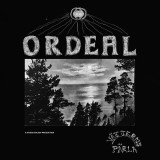
As an important agent of Gothenburg’s underground scene, Dan Johansson has been a member of several experimental harsh noise projects such as Sewer Election, and lo-fi indie folk bands like Enhet För Fri Musik and Amateur Hour. Ordeal is his latest solo output, and might as well be ashes stuck in the blast furnace's edges of his last longing career. Not by means of summing up genres or as a culmination of his musical development, but as a profound music piece weaved in his own household.
With not much more than a synthesizer, Vätterns Pärla is built by trembling, dissonant drones stained in feedback and reverberation, thickly textured by the no-fi quality of the recording, depicting a menacing atmosphere congested with heavy fumes. In Johansson's words, Ordeal "takes inspiration from the early 80’s albums of Maurizio Bianchi, filtered through a Gothenburgian no-fi bleakness. It’s an album for inner voyage, childhood memories, and places that now lost purpose and meaning”.
There's certainly intimacy and nostalgia, yet a claustrophobic, hypnotic ambiance wraps it all up in a contained and narrow space. Emphasis is put on texture rather than on detail, on color rather than on progression, on suspense rather than on conclusion. Tension varies stiffly, sometimes a drone layer dismantles and the mood seems to filter, but ragged edges are never polished. We can feel the walls and the air, which although tarnished, can be breathed in somehow. It's as if waking up in a dark room and having to recognize it with our ears and tact, testing its dimensions and its surface. The stillness in the chamber is like the stillness between gasps of storms.
Without visible stars, an enclosed share of night sky hides a heavy load of industrial debris underwater. These remnants are maybe the pearl regarding the album's title. It all can seem like a dream, a grim mechanical soundscape deafened by hefty, yet sporadic winds. Soil strives to make something grow, but sprouting is kept suspended, held by a dismal presentiment. Long shadows on the ground prove that darkness is about to befall. And as these shadows stretch, almost about to break up in a loud strike, the noise turns white.
- 1: The Lineman - Prelude And Development
- 2: He Saw An Opportunity - Counterpoint In C Minor
- 3: Vice - Main Title Piano Suite
- 4: Master Of The Butterfly Knife
- 5: Flipping Cards
- 6: B-Flat Prelude
- 7: The Lineman In E-Flat Minor
- 8: Taking Over The Damn Place
- 9: Scalia
- 10: 0James Earl Carter Jr
- 11: The Wyoming Campaign
- 12: The Other Half Fears Us
- 13: Dick's Heart Is Healthier Than Ever
- 14: He Wants To Impress His Father
- 15: My Friend, My Running Mate
- 16: The Washington Game Board
- 17: The Many Offices Of The Vp
- 18: The War In Afghanistan / His Magnum Opus
- 19: The Iraq War Symphony
- 20: Major Combat Operations Have Ended
- 21: At Death's Door
- 22: Conclusion - The Transplant
- 23: Vice - Main Title Orchestra Suite
- 24: Imperium
- 25: G Minor Prelude
- 26: Parade Music
The soundtrack features orchestral, big band, rock, and hip-hop compositions, the score was recorded at Abbey Road and Air Studios and evokes both the intensity and the sardonic humor found within the main themes of the film. Speaking of the music, Nicholas Britell says, “When I first began working with Adam McKay on the score for VICE, Adam’s initial instinct was that the score should have a symphonic scope to match the size of the story we were telling. Over the course of more than one year of composing, I wrote a score which utilizes a full symphony orchestra, while also exploring the sounds of big band jazz, rock, and hip-hop. There is a subtle – and at times not-so-subtle – dissonance in the music which weaves in and out of the themes, harmonies, and textures. This idea of dissonance became a central element within the nature of the score.”
Assegai is an instrumental rock outfit consisting of saxophone, bass, guitar, and drums. Each member of the group brings a variety of musical influences to the eclectic entanglement that is Assegai’s distinct sound. No matter where you place yourself musically you will always find something to grab your attention in their odd type of instrumental rock. The album Water Worlds and Dry Spells is the product of a mutual pile of ideas; written sketches, memorized conversations, and cell phone recordings which were all collected in a joint cloud folder, and eventually laid the foundation of the compositions. Continuing from their 2020 album Kraal and their 2022 album 53, this release is a further development of the unity that the band have found themselves in, where jazz phrases fuse with krautrock repetition, traditional folk themes, and polyrhythmic structures. The compositions on Water Worlds and Dry Spells showcase the intensity that the band has cultivated during the last couple of years of live performances. On Water World and Dry Spells Assegai acts as the perfect live band for a future abandoned water world
OLAYA SOUND SYSTEM, Peruvian band founded 15 years ago and with a discography of 6 CDs, present their first vinyl release, comprising some of their most outstanding productions recorded between 2015 and 2022. Their songs explore the sounds of Andean cumbia and chicha, with elements of psychedelia, reggae and Afro-Latin rhythms of global relevance, projecting with its music an innovative new chapter in the development of Peruvian tropical music of the 21st century.
Just like Chico Trujillo, Frente Cumbiero or Son Rompe Pera are also doing, OLAYA SOUND SYSTEM are reaching a global impact modernizing tropical music.
This album is released on the recently revamped Peruvian label Rey Record, one of the essential and most iconic record labels during the golden days of cumbia and chicha, decades ago. Olaya Sound System was founded in Chorrillos, Lima (Peru), in 2009 and since then they have developed a very particular exploration of the sounds of Andean cumbia and chicha, with elements of psychedelia, reggae and Afro-Latin rhythms of global relevance, projecting with its music an innovative new chapter in the development of Peruvian tropical music of the 21st century. Both on the dance floor and in meditative listening, Olaya Sound System take us with this LP on a journey through bucolic landscapes of the Andes, the Amazon and the infinite Pacific Ocean, essential locations that constitute their native Peru and that have inspired very perceptibly their sound. This album, the band's first release on vinyl, comprising some of their most outstanding productions recorded between 2015 and 2022. Cultivators of a very particular tropical musical style, they collect and adapt the Peruvian traditions of the cumbia, chicha and huayno genres, and then blend them with a melting pot of contemporary Latin and global influences such as reggae, salsa, rock, among others.
Emerging from the Peruvian independent scene, Olaya Sound System reflect relevant social topics in its lyrics, such as the search for individual and collective consciousness, with a strong content of social issues. The band has become, from their native Peru, in one of the most interesting projects that modernize tropical music today, just like groups like Chico Trujillo, Frente Cumbiero or Son Rompe Pera, are also doing from different Latinamerican territories, reaching a global impact
It has been five long years since the Brazilian power metal kings Angra released their last album "Ømni". was released. Now the band is finally back with new music and once again proves their exceptional position as unique as unique bands in the genre.
Angra's unmistakable sound - the fusion of classic-virtuosic power metal with progressive with progressive elements and rhythms - comes to its perfect perfect development and makes "Cycles Of Pain" a highlight for every a highlight for every fan of sophisticated,
first-class metal.
The long-standing line-up of the band, which was founded in 1991, is joined has been joined since 2013 by the former Rhapsody of Fire singer Fabio Lione, who again delivers an incredible performance. incredible performance. Mix and mastering of "Cycles Of Pain" were once again done by Dennis Ward (Helloween, Magnum, Firewind).
It has been five long years since the Brazilian power metal kings Angra released their last album "Ømni". was released. Now the band is finally back with new music and once again proves their exceptional position as unique as unique bands in the genre.
Angra's unmistakable sound - the fusion of classic-virtuosic power metal with progressive with progressive elements and rhythms - comes to its perfect perfect development and makes "Cycles Of Pain" a highlight for every a highlight for every fan of sophisticated,
first-class metal.
The long-standing line-up of the band, which was founded in 1991, is joined has been joined since 2013 by the former Rhapsody of Fire singer Fabio Lione, who again delivers an incredible performance. incredible performance. Mix and mastering of "Cycles Of Pain" were once again done by Dennis Ward (Helloween, Magnum, Firewind).
NTsKi, Japan-based vocalist/songwriter/producer; pronounced n-t-s-k-i. Calla is her 2nd album, a unified statement of her musical vision at this point in her development, with all-new songs melding her breathy and intimate voice, singing in Japanese and English, with organic acoustic sounds and distinctive electronic colours. NTsKi possesses a charming melodic gift as well as a distinctive production style, giving Calla a cohesion and subtle momentum, with relaxed tempos, interesting arrangements and intriguing melodies fusing into a focused musical statement that is refreshing, charming and forward-looking, underpinned by a sense of wistfulness, nostalgia and melancholy.
As with her 2021 Orca release, co-released on EM Records and Orange Milk, NTsKi is joined by engineer Illicit Tsuboi and British musician/producer Dan Shutt. The songs here are lovely, concise gems, warmly glowing, gently sparkling, evocative and moving. LP comes with a Japanese and English lyric sheet. Vinyl edition disc is made of environmentally friendly new material BioVinylTM. and includes an insert & download card, shrink-wrapped and stickered.
Unnion takes off with its first EP featuring a compilation of four spanish artists with different styles and a unique common thread, living up to the platform's name.
The album kicks off with Tadeo's offering, titled "The Second Part", where we can immediately hear the artist's personal touch: a lot of funk, solid sounds, and attention-grabbing elements that go straight to the dance floor.
The second track comes from Unkle Fon, titled "Eltzegor." It's a soaring journey towards a climax filled with synthetic sounds and hypnotic developments that create a unique sense of motion.
Moving on to the third track, we have the contribution of Not A Headliner, titled "Cricket Circus." It features an atonal sensation accompanied by a groovy rhythm in which the interplay of sounds transcends the norm.
Closing the album is Irazu's proposal, titled "Quietly," which presents itself as a singular, monolithic, and raw option, overwhelming like a locomotive and ready to crush any obstacle that dares to stand in its way."
Following on from his 2021 book, Synthesizer Evolution: From Analogue to Digital (and Back), Oli Freke returns with a Synthesizer Evolution A6 zine series.
Drum machines and samplers have something of a shared history and this zine celebrates their invention and by picking out 46 of the most influential, important or most interesting synths from 1949 – 1996. Explore the most legendary drum machines and samplers ever created, including the Roland TR-808, Roland TR-909, Akai S1000, Fairlight CMI, Akai MPC60 and more, with detailed descriptions and the stories behind their development.
The central theme of Steady is perseverance. Each track is based on a personal story or a fleeting encounter with people these past few years, from close friends to total strangers, either at home or on night shift commutes. People navigating their own hardships, almost giving up but always struggling through. More broadly, it’s about multiplicity, and contradiction. These central figures displaying hope and determination within a city of development and neglect, uniformity and chaos - an unfiltered representation of a city with all its jagged edges, darkness, and shards of light. It's broken and disheveled, but never not beautiful, just like the people in it. Musically, Steady continues where Bleach (debut album) left off - a sonic language of glitch, decaying tape and analogue distortion through which hints of RnB and soulful ballads bleed through. With a greater emphasis on beats, albeit lopsided on pitch-shifted tape loops, Steady feels more self-assured, more confident, more recognisable. At the same time, it's never stable or predictable - choruses break down early, harmonies bend into beating microtones, tracks emerge before others have finished. The symphonic scope of Bleach is still retained in Steady though. This is music of motivic development, of micro and macro form, of meticulous refining. The work of two classically trained composers, the album's chaos is heavily considered and carefully shaped. Hours of improvisation sessions have since been painstakingly refined into ten distilled tracks, owing to Steady's three year gestation.
A Tonic For The Troops have, after extensive touring, established themselves as a tight collective with high octane performances providing enjoyable and accessible jazz. After several ‘top of the year’ lists for their debut album Ambush, ATFTT are joining forces again for their second album! The ingredients still consist of straight ahead post-bop with a modern and contemporary sound, but ‘Realm of Opportunities’ also opens up a more lyrical and emotional approach. Ellen Brekken has established herself as one of the most versatile bass players in Norway today. In A Tonic For The Troops we can see her evolution as a composer as well, with a firm grasp of melody and development, demonstrated in cinematic and suite-like tunes.The band utilises the strengths of some of the most energetic performers on the Norwegian jazz scene today, leading successful bands in their own right. Espen Berg (piano), Magnus Bakken (sax) and Magnus Sefaniassen Eide (drums) all bring great solo contributions too, but the band´s real secret weapons are both their playful interaction and also their openness to using a melting-pot of musical ideas. A Tonic For The Troops demonstrate once again with 'Realm of Opportunities' that their energy and motivation are at their peak, showcasing a life-affirming band in top shape!
Ellen Brekken (double bass) Magnus Bakken (tenor saxophone) Espen Berg (piano) Magnus Sefaniassen Eide (drums)
Emerging from the ashes of Ireland's early rave era - that had been absorbed into the vastly commercialised club scene of the late '90s - was an oft forgotten, but exceptionally fertile period for electronic music in Ireland. Spearheaded by the then Dublin duo of Decal (later becoming the solo project of Alan O' Boyle), nurtured through nights like Phunk City at The Funnel, Model One at Switch and at a later point midweek club haunt Electric City, an unlikely Irish electro movement was born; breeding an abundance of new labels, parties and producers hungry to make their mark. "Dreams of Electric Bleep" revisits a crucial time of development (1999-2005), when production standards on the island of Ireland rose in perfect synchronicity with the collapse of the music industry as we knew it.
While Detroit, The Hague and London heavily influenced the sounds heard in the clubs, clubs in pubs, warehouses and great outdoors of Ireland - it was producers from Belfast, Cork, Donegal, Dublin, Limerick and Mayo who created the first significant chunk of high-quality Irish electro, demonstrated here over a range of styles (originally released a variety of local and international labels). This double 12" release - featuring key tracks from Decal, Magnetize, Metroneem, Americhord, Phil Kieran, Takeover Sound, Chymera and John Braine - comes on picture-sleeved coke bottle clear vinyl, and includes a download code.
Designed by Jonny Costello (Adult Art Club) with liner notes from Stephen Rennicks (Drexciya Research Lab). Mastered by Paul Mac at Hardgroove Mastering, vinyl mastered and cut by Simon Davey at The Exchange Vinyl.
As a songwriter and a performer, he played a vital role in the development of the idiom.
Growing up in central Texas, he was impacted by a wide range of musical influences, such as the Texas honky- tonk of Ernest Tubb, the western swing of Bob Wills, and even the polka bands of German-American.
He had begun writing songs as a child and by the time he reached adulthood was starting to turn out fully realized masterpieces such as Night Life and Misery Mansion.
This release presents Nelson's underrated debut LP, ...And Then I Wrote, originally issued in 1962 on the Liberty label.
2023 Repress
One of Larry Heard's most under-rated albums finally remastered and available as full vinyl release for the first time! Known for his classic early house releases Larry Heard's productions always hinted at deepest outer space, but his 1996 Alien album was his first actual science-fiction record. It's almost as polished as the most mainstream dance production, but just as sublime as any Detroit producer. Heard's house roots often show themselves, while the chords and shimmering production make this an album almost on par with Heard's mid-'80s peak. The project was a recording & sound-development experiment that was mostly constructed around a Korg O1/W workstation keyboard that was left at Larry's studio to check out by Victor 'melodious myles' Houston along with some of the staples of his studio, including the Roland d550 and Oberheim Matrix 1000. Mr Fingers magic touch can be heard all over the album, and this showcases the incredible musical talents of the man, who's name by now cant be left out from any hall of fame when you're talking music innovators from the last century! Recommended!
“coming of age” motif flows freely through She’s In Parties’ debut EP, End Scene. The four piece wanted to construct a record that’s influenced by the idea of a final, reflective monologue scene in a movie, and would fit nicely in an 80’s coming of age film like The Breakfast Club, but with their own generational twist to it. The listener can expect quintessential developmental milestones interwoven throughout the listening experience, with themes centering platonic and romantic relationships, mental health battles, illicit substance experimentation and more.
“We’re coming of age ourselves - apart from Granddaddy Matt,” the members joke, with 3⁄4 of the band having just begun their journey into their 20’s. “It’s something we relate to and, whether we like it or not, reflects itself in our music writing".