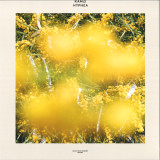
Official AFRODELIC reissue of the ultra-rare Tunde Mabadu’s debut album. Originally released in 1978 on Blackspot label (DECCA’s West Africa division), Bisu, which includes the supergroovy ‘Red Jeans’, differs from the later 1980 ‘Viva Disco’ album by a much more pure African style.
A beautiful and soulful production in which Tunde’s deep voice and sax move on the excellent horns arrangements, percussions, the wahwah rhythm guitar and weird keyboards and synths (at times psychedelic as in the ‘Blue Bird’ 9 minutes).
As wrote on the original liner notes of the era “His music will mesmerize you from the first track. A dedicated Musician especially to his African Roots with so much to offer Musically”.
Repressed for the first time. Limited Edition.
Поиск:dif
Все
Orizont is back for its second release. And just like its predecessor, "Orizont 02" introduces four tracks from different artists, each with its own style, circling the worlds of atmospheric minimal and deep tech-house: Dragusanu, Calinie, Andrei Voica and Cata.
Dragusanu kicks off the EP with 'Asa Dar', a thoroughly atmospheric minimal track drenched in dark tones and menacing grooves. Calinie's 'Substance' is the logical continuation to Dragusanu's darker tones, expertly expanding and emotionally charging the sonic space into the morning hours with finesse. Andrei Voica's 'Colors' entirely switches the colour of the EP, opting for warmth and a particular focus on groove and feel-good sounds. Cata's contribution, 'Morning Dew,' provides an adequately named (and particularly groovy) deep house track for the closing of the EP, fulfilling the desires of those looking for an EP that they can play at any given time, from dusk till dawn.
Flexi Cuts is pleased to introduce Lazy Snail's new EP, Lucky Life. A truly valuable work, the result of time and research, where Alessandro (aka Lazy Snail) wanted to explore different sides of electronic music of an inner and mature nature at the same time.
Lucky Life is like going up to the attic and finding something precious to take care of; it sums up a long musical journey, from the past to the present, in five tracks full of meaning.
The first track, Remèrcier, is a tribute to 'dance' music, an intense talk over a hypnotic moog bass.
This is followed by Vagrants, dedicated to his hometown (Cudgnola), where we find an 808 rhythmic patterns as involving and beating as a walk in the rain.
The B-side opens with One Place, which features a vocal stunning collaboration with Flicker Fox, who brings the track into a techno universe with percussion and intimate echoes.
Climbin' High was inspired by Alessandro's passion and admiration for the mountains. He composed it imagining an extreme climb, and immediately afterwards an equally dangerous but necessary descent. Just like in reality.
The record ends with No Evil, an ambient-flavoured gem that opens on the climax in a riot of expert snares and synths.
RAMZi's 'hyphea', the new album by Montreal based artist Phoebé Guillemot. It is her latest sonic quest containing 10 new tracks, of which some are versions of the score she made for a documentary about mushrooms called 'Fun Fungi' (directed by Frederic Lavoie).
Recorded between November 2021 and May 2022, writing 'hyphea' started off somewhat as an attempt to escape boredom and frustrations imposed by the severe restrictions during the pandemic. For Phoebé it was a way to reconnect with RAMZi who's spirit brought her back to mystical feelings and gave hope for future magical adventures after having felt disconnected for a while.
RAMZi is a wild spirit from the forest and refers to a parallel autonomous world that keeps evolving. In her own words: “The music remains as a doorway to that world. It has never been about me, I always see that entity bigger than myself. The process of writing 'hyphea' was rather intuitive. I don’t think about styles of music before producing tracks. Those are more like an adventure in itself, each one set in a different ecosystem.”
Artwork by Marinka Grondel.
Presented together for the first time, American composer John McGuire’s Pulse Music series (1975-1979) blurs the popular narrative that Minimalism was a reaction against Europe’s angular, intellectual, inscrutable high-modernism. McGuire, born in California, studied at Occidental College in Los Angeles and UC Berkeley before going to Europe to study with Karlheinz Stockhausen, Krzysztof Penderecki, and Gottfried Michael Koenig. His compositions lock serialism’s warped geometries onto an evenly spaced grid, perfectly preserving serial music’s multi-dimensionality while smoothing its wildest disjunctures and sharpest angles. If serialism is Montreal’s Habitat 67 modular housing complex, McGuire’s Pulse Music compositions are the primary-colored grids of Le Corbusier’s L’Habitation apartment complex — an exuberant expression of the same materials and principles.
Every layer of pulses is made distinct through its timbre, register, and tempo. We hear them as a plurality, organized like stars in the sky. Every so often the sky rotates and the stars appear in a different arrangement. Our ear naturally starts to draw connections and, as it sweeps between one layer and another, what was discrete becomes continuous. Pulses become flows; quantitative reality becomes qualitative experience.
Blue / Yellow Vinyl in PicCover
(THIS ALBUM IS DIRECT ACTION: ALL REVENUE GOES TO THE ARTISTS IN ODESA. YOU ARE PARTICIPATING IN KEEPING UKRAINIAN ARTISTS WORKING AND EARNING MONEY DURING THIS TIME. Слава Україні!) BE:AT WAR is the new album from Odessa’s MEDIUM, who released the acclaimed Evolution of the Universe on Ohm Resistance in 2017. They have been writing drum and bass for over 15 years and released on labels such as Ohm Resistance, Sonic Terror, Hardline, Close2Death Recordings, Distortion Records, Combat Records and more. This follow up album is made under adversely different conditions - the approach of war to their home city, the assault on their native land. Yet these men are making music happen in the midst of it, recording their artistic and emotional reactions as chaos unfolds around them. Guest starring London MC Flowdan, Godflesh’s Justin K Broadrick, SIMM and Submerged. BE:AT WAR is a full spectrum image of the horror, uncertainty, and perseverance surrounding these Ukraine-based producers.
• Gil Scott-Heron’s “Pieces Of A Man” is one of the most important albums in the history of black American music. Although it didn’t set the charts alight, it stands as a masterpiece alongside contemporary works such as Marvin Gaye’s “What’s Going On”, Curtis Mayfield’s debut LP, Funkadelic's “Maggot Brain” and Isaac Hayes’ “Shaft”. All were brilliant in their way, but lyrically Scott-Heron was on a different level from almost every other writer.
• It was a landmark album with its bold, poetic lyrical content allied to progressive and melodic music, and it saw producer Bob Thiele help Gil and his musical partner Brian Jackson paint the picture they needed to get their message across. Thiele put Gil and Brian together with Ron Carter, Hubert Laws and Bernard Purdie, giving them the musical heft they wanted.
• For many years the focus was on ‘The Revolution Will Not Be Televised’, which was included in the Grammy Hall Of Fame in 2014, but this focus sometimes overshadowed the heights which Gil reached throughout the album. Today ‘Home Is Where The Hatred Is’ and ‘Lady Day And John Coltrane’ are also considered standards, whilst the album’s title track is a prescient and heart-breaking warning about the way in which big business dehumanises its workers.
• The album reached its landmark 50th year in 2021 and we decided that we would create this special edition to celebrate its incredible sound. The original master tape was taken to Frank Merritt at The Carvery in London, who cut it as a double disc 2 x 45 RPM record, in an all-analogue chain. The original record - especially side two - was long, and serving it up this way allowed the music a greater level of fidelity.
• The release is packaged in the original album’s gatefold sleeve.
repressed !
Label head Setaoc Mass returns to his own fledgling SK_Eleven imprint with the much-anticipated Second Chapter EP. True to form, the release deals in bleeps and melodic Sci-Fi indebted elements, yet with a harder impact and a sense of urgency calibrated for the main room floor. B-side cut Thunder Bay ventures into new territory for the artist, diffusing coarse, broken rhythms over ominous call and response synth riffs.
(Produced, Arranged and Conducted by Claus Ogerman)
Not long after the dawn of her career, as a teenager in Rio de Janeiro, Joyce was declared “one of the greatest singers” by Antonio Carlos Jobim. Yet despite reputable accolades and the fact that she has since recorded over thirty acclaimed albums, Joyce never quite achieved the international recognition of the likes of Jobim, João Gilberto and Sergio Mendes, all of whom became global stars after releasing with major labels in the US.
There was a moment when it seemed she might be on the cusp of an international breakthrough. While living in New York, Joyce was approached by the great German producer Claus Ogerman. Ogerman had already played a pivotal role in the development and popularisation of Brazilian music in the 1960s, recording with some of the all-time greats like Jobim and João Gilberto, as well as North American idols like Frank Sinatra, Billie Holiday and Bill Evans.
"I met him in New York City, in 1977”, recalls Joyce. “I was living and playing there, and João Palma, Brazilian drummer who used to play with Jobim, introduced me to Claus. We had an audition, he liked what we were doing and decided to produce an album with us.”
Featuring fellow Brazilian musicians Mauricio Maestro (who wrote/co-wrote four of the songs), Nana Vasconcelos and Tutty Moreno, and some of the most in-demand stateside players including Michael Brecker, Joe Farrell and Buster Williams, the recordings for Natureza took place at Columbia Studios and Ogerman produced the album, provided the arrangements and conducted the orchestra.
But mysteriously, Natureza was never released, and what should have been Joyce’s big moment never happened. As Joyce remembers, “I returned home, but Claus and I remained in contact, by letters and phone calls. He was very enthusiastic about the album and tried to hook me up with Michael Franks. He wanted me to go back to NYC in order to re-record the vocals in English with new lyrics, which I actually wasn’t too happy about. But then I got pregnant with my third child and could not leave Brazil. And little by little our contact became rare, until I lost track of him completely. And that was it. I never heard from him again."
While Claus was known to be something of an elusive character, the album’s disappearance might also have been a result of timing. The Brazilian craze was coming to an end, making way for disco and new wave at the end of the seventies, and Ogerman struggled to find a major label interested in a new Brazilian sensation. Additionally, as Joyce mentions, it wasn’t quite finished. Ogerman wanted to add finishing touches to the mix and to record alternative English lyrics for the US and international markets - a critical artistic difference between Joyce and Ogerman.
As the military dictatorship’s grip on Brazil began to subside in the 1980s, Joyce had a handful of hits in her home county, including a tribute to her daughters ‘Clareana’, and the iconic ‘Feminina’ - an intergenerational conversation between mother and daughter about what it means to be a woman. But already a feminist pioneer, these successes were hard fought. Joyce had caused controversy as a nineteen-year-old when she became the first in Brazil to sing from the first-person feminine perspective, and the institutional sexism she faced was worsened by the dictatorship who would often censor her music. Even once the Junta was out of the way, Joyce found herself up against the male-dominated major record companies in Brazil, who sought to dictate her career and sexualise her image, before dropping her for refusing to play along.
A few years after the success of her albums Feminina and Agua E Luz in Brazil, Joyce’s music began to find its way to the UK, Europe and Japan, and “Feminina” and “Aldeia de Ogum” became classics on the underground jazz-dance scenes of the mid to late-eighties and early-nineties.
The full-length version of “Feminina” from the Natureza sessions was first heard on a Brazilian Jazz compilation in 1999 and “Descompassadamente” was licensed for a CD compiling the work of Claus Ogerman in 2002. Following these, word began to get out about an unreleased Joyce album with Claus Ogerman and the legend of Natureza grew.
Forty-five years since it was recorded, Natureza finally sees the light of day, as Joyce intended: with her own Portuguese lyrics and vocals. Featuring the fabled 11-minute version of ‘Feminina’, as well as the never before heard ‘Coração Sonhador’ composed and performed by Mauricio Maestro, Natureza’s release is a landmark in Brazilian music history and represents a triumphant, if overdue victory for Joyce as an outspoken female artist who has consistently refused to bow to patriarchal pressure.
***Disclaimer! While “Feminina” and “Descompassadamente'' were mixed by legendary engineer Al Schmitt and mastered from the original master tapes, the remaining five tracks are unmixed. Due to significant deterioration of the master-tapes, the best audio source for these tracks was an unmixed tape copy Joyce had kept of the recordings. The best care has been taken in the restoration and mastering of this release, but the sound quality may differ from other releases on Far Out Recordings. We advise listening to sound clips before buying where possible.
After a long hiatus, Rotate is back for its 8th release. "Inner Space EP" by the duo Abé & Lowris as Labello is a three-track 12-inch with a strong focus on psychedelic sounds, warped vocals, hypnotic synths and finely-tuned drum programming.
Like yin and yang, both tracks on the A-side of the EP display exquisitely opposed tones crafted for distinct dancefloor moments. The bright, funky and appropriately named 'Goodtimes' stands very different from the dark, cinematic and thrilling 'Invisible Red'. Still, ensembled, they serve as a statement on the raw potential of sonic hypnotization, where shuffling grooves, wacky melodies and cinematic atmospheres work together to set the dancer's minds into a seemingly perpetual state of flow. B-side's extended cut 'Pkaila' is one of the deepest arrangements here, reminiscent of the golden age of techno minimalism where dancefloors needed little more than a rolling groove, shuffling drums and impeccable sound design slapping from its sound systems.
Bandcamp buyers also get "FCT", an exclusive downloadable bonus 18-minute jam that further showcases Labello's explorational side, rounding off "Inner Space" in a delightfully varied manner.
BEC returns to Second State with another earth-shattering release containing four raw & atmospheric cuts.
The Berlin by way of Brighton producer BEC has been a member of the Second State family since her first release with the label in 2016. Since then, BEC has dropped 4 EP’s with the Berlin imprint, and regularly appears at the likes of Awakenings, Amnesia, Warehouse Project, Fabrik, Watergate & Burning Man to name a few.
Title track ‘Solitude’ opens with a sharp, rounded kick and crafty drumwork. Metallic swipes and rave stabs are injected to build tension, along with a choppy vocal and bubbling element. Punchy arrangements and rave stabs bring this track to rave territory at moments, before hauling back into the deepness of the cut. Next up is ‘Process Don’t Resist’, easing us in with a crackling bass and a solitary hi-hat, soon joined by buoyant claps and a muffled kick that submerges listeners into a different dimension. Darker, swiping elements are introduced with metallic textures, with the claps becoming more erratic as the track unfolds. An indiscernible vocal gives way to a jarring breakdown halfway through, sending shockwaves through the listener before submerging back into the hysteria.
‘Coming’ follows and initially appears as a break from the heaviness of the previous productions, before transforming into a high-octane stomper. A booming kick, bleeps and spiking vocal build the intensity as the track drives forward and hoover noise wavers menacingly. The vocal and kick bounce in unison towards the close, with a final cry towards the end. The finale is dark, mysterious and entrancing with ‘Fear Parade’. An authoritative female voice utters ‘not afraid’ under a myriad of shakers, howls and vicious synth swipes. The sample gradually takes over with the track building to crescendo, allowing shakers to come to the forefront along with eerie howls and a new, more robotic vocal that utters the initial phrase repeatedly until close in an effort to encourage listeners.
MUSTA presents an elaborate six track EP project, titled 'Tamburi
Parlanti' which translates to 'Talking Drums' in English. The body of
work marks a turning point in his career to make more than electronic
music, and delves into a plethora of live music and field recordings
recorded for the EP, ranging from polyrhythmic tribal drum-patterns to
Afro-funk bass chords, congas and jazz-keyboard, played by local
musicians as well as himself.
Musta's love for music began during his 11 years spent living in the
Dominican Republic. This encounter of Latin rhythms started the musical
genre contamination that to this day distinguishes his productions. In
this EP, like the rest of his releases, the music is diverse, tribal and
hypnotic. Respectful of the past yet constantly innovative. This love of
the past and future has led him to release edits and originals on staple
labels such as Nervous Records, Samosa Records.
Music aside the EP artwork has significant meaning, the mask shown is
that of the ancient Mamuthone icon of Sardinian folklore which goes back
further than 2000 years, defined as a representation of the collective
soul of Sardinia, the ancient ritual of the Mamuthone creatures is that
of a rhythmic dance where 12 of the creatures dance together,
representing the 12 months of the year. With this theme, Musta aims to
connect the dots of this pastime tradition into the EP, reflecting it
visually as well as through the music itself.
"Tamburi Parlanti EP is a collection of songs that I've made myself
around the world, recording and collaborating with various musicians of
many different nationalities. The music reflects my musical path in
recent years which draws strong inspiration from afro-funk and latin
disco from the 70s and 80s. My intent is to create music that presents a
journey between the hottest Latin sounds, over to more African disco
rhythms.
There was a time when a person would pick up an instrument to compose yet another song for a loved one. A sad figure humming into a microphone, pronouncing the most basic words and forms to convey quantity, quality, fact, statistics and similar sounds describing pain, loss and sorrow. The human brain would perceive the melody sad and perhaps within herself feel a sense of melancholia.
In another parallel world a new composition would then appear. But not one composed on a wooden built instrument, no, sounds made into structures and tables that would assists the listener into providing an additional context and meaning through digital synthesis and quantised harmonies. But who could really tell if these sounds were real? Or where they just sounds impersonating an idea of something?
Rhyme nor reason is as abstract in its shapes and ideas as it is concrete and elegant in its narratives. A carefully crafted wooden cabinet with an over-whelming amount of different drawers and hidden compartments. Each box storing blissful arrangement; a fluorescent stone, a paper note saying something about lunch, some collectible objects, a forgotten token or perhaps an autograph, all so very vibrant and joyful for its possessor.
Deleted files stored on rapidly rotating platters coated with magnetic material. Small, easy to loose SSD memory cards of recorded corrupt files and digital artefacts. Software engineered compositions trying to grasp the shared belief of an upcoming future, vivid and uncertain; birds, waters and long lost recollections. A release unconcerned with the literal depiction of things from the visible world. At least not for now.
Disco Volante is a new imprint created by Laila Moshiri (aka Laila), curator of the Disco Volante show on Ibiza Global Radio, aimed at merging different cultures, styles, personalities and their unique music frequencies.
The imprint's first EP - Aston Martin - is the result of the beautiful collaboration between Dandy Jack & Laila. Pursuing an intrinsic desire to flirt with deep and sensual music, Martin and Laila created a collection of tracks that span a multitude of genres, from laidback minimal to Detroit-tinged deep house.
Originally released in 1994 on Calypso Records / Irma Records in a triple vinyl promo white label version, Don Carlos's album Aqua is the
second album by the Varese-based DJ producer, already then known for his first two singles Alone and Mediterraneo, then both included in
his first album entitled Mediterraneo and released only in Compact Disc format in 1992 for the American market printed and distributed by
IRMA U.S.A., the American subsidiary of IRMA Records Italy.
The same fate will also have the Compact Disc format of the Aqua album, again printed only on the American market.
But the triple vinyl, printed in a limited edition of 500 copies in a white generic envelope, was never reissued and has become a rare record
over the years.
After almost thirty years, after countless requests for reissues, especially in the last few years in which the name and music of Don Carlos
has made a comeback, Irma Records has decided to reissue the vinyl in exactly the same original triple version.
DJ Don Carlos (born Carlo Troja) with his productions in the 90s has become one of the cult producers for DJs around the world.
His track Alone released in 1991 for Calypso was and still is one of the classics of House Music, played by all the major American and British
DJs.
At the time of its publication it was considered an underground song and therefore did not sell very much, but over the years its myth has grown
thanks to its subsequent productions as for example his second single, the EP entitled Mediterraneo, title which it will then inspired his first CD
album printed in the USA with the same title.
Several other singles followed, another album, always printed only in the USA, entitled Aqua, from which a triple promo vinyl was extracted which
today is one of the artist's most requested rarities.
In Italy his third album was released in 2002 entitled The Music In My Mind where Kim Mazelle, Michelle Weeks, Taka Boom and Kevin Bryant
were present as vocal guests. In 2009 a collection of the first two albums released in the USA titled Mediterraneo-Club Favourite Collection '90-
98 and in 2010 his fourth album entitled The Cool Deep which reproduced the sounds closest to his first productions.
Also active as a remixer for Italian and international labels, one of his most important works is the remix of Byron Stingily of the song You Make
Me Feel of which he made a worldwide hit. As a producer he also used other pseudonyms such as Montego Bay, Aquanuts, Sotterranea and
Love 2 Love Orchestra. He has played and plays in different countries such as London, New York, Miami and at various festivals, such as the
Robot and the Stickermule Festival in an evening with Apparat, Derrick May, DJ Koze, Lil 'Louis, Young Marco and Ellen Allien, LTJ Xperience
Vinyl only. Twovi aka Vito Loperfido helps Inner Balance enter its adolescence on this deep house 4-tracker. Using familiar ingredients of bumping basslines, driving percussion and soulful keys, each cut finds allegiance in a different clan of classic US house sounds...with an extra Italian flavour!Check the Jovonn swagger of 'Sweet Eyes' or the Glenn thump of 'Theo Docet', the expansive floorfiller 'Fake Love' or the jazzy interludes in 'Tropical Age': this EP takes its place in an unmistakeable tradition that goes right back to Vibraphone and MBG in '92.
"Contaminated Culture" is the next various artists on limited edition by Scena_731 Recordings. Are two collections with 7 artists and divided in one vinyl release. The contamination comes from the different culture of these artists, who found two similar genres into the techno music and who marry in a festival line up. On the Part I of the V/A on side a, we have three artists on the classic techno and deep sounds. As you will know the well-known sound of Ritzi Lee with a classic mix, Paul Birken with his unmistakable technique through modular systems, Booz equally a lover of the sound sought through spatial connections of the universe. On the Part II on the side b, we have the B2B of Yari Greco & Karah from Rotterdam with a totally raw and edgy version for the dancefloor with a mix of raw and pounding groove. Then you will listen to Aeit, with an industrial London sound with a raw electronic synth perfect for the rave crowd and the last track signed by Jassass, an earthquake that damages you with very fast grooves and changes of industrial scenarios.
Support the good techno music for his different culture. Enjoy!
Home is a powerful concept with an abstract definition. This solo album takes those subjective ideas and unifies them under one roof. Evolving from Jerve’s #dailypiano posts in 2019, ‘The Soundtrack of My Home’ relays thoughts and improvisations that trace his journey from childhood home to adult and now, father. Nurturing a mood or feeling, each song begets a sonorous story of someone close to him, expressed through the language of piano playing.
Jerve makes use of his hands as a human step sequencer, often programming two or more motifs of varying lengths in a polymetric fashion. These melodic patterns and arpeggios evolve at varying rates but grow around clear progressions with standard 8-bar forms.
The first track - ‘Kjetil’ enters with an earnest, gentle and endearing character - like a young river near its source. As with such a river, it will grow to varied sizes throughout the album but must begin as a humble expression from the source. The following titles sketch his interpretations of the people that have made up his home.
There is a theme across the album that unites the songs, so much so that differentiating tracks can at times be difficult. Though, Jerve punctuates this overarching mood with a few distinct structures, as found in tracks ‘Karoline’ (wife), ‘Espen’ (brother) and ‘Sven’ (father). ‘Turid’ (daughter) and ‘Jon Eirik’ (brother) seem less directive and welcome more intrigue, reminiscent of a curious child wandering through the dappled light of a forest.
‘Iben’ (daughter) and ‘Eivor’ (daughter) have a hypnotic, three-pointed melodic structure that leaves the listener suspended; transfixed - while ‘Sussi’ (cat) carries unique momentum and suitably feline autonomy. ‘Mette’ (mother) has a mood of ascending, like that of a child's upward gaze at their maternal carer. Utterly nuanced in structure, Jerve leaves ample space for subjective interpretation and allows the listener to weave their own life into the tones.
As expected from the founder of Dugnad rec - this album signifies a deeply personal sentiment. Sometimes we are forced to confront the music and other times, we are left to wonder. Here, we find a balance and unity that allows little thoughts and worries to drift away, bringing us warmly to rest in the present. The LP edition's bonus track features producer/performer extraordinaire Stian Balducci, drawing a line to the next chapter of piano-based music from Dugnad rec: TOKYO TAPES: PIANO RECYCLE.
Drawing from a strong history of electronic influence, Tomashevsky has created his own underworld of foreboding techno. We enter this EP with Incoherent, which exudes ominous sounds - reminiscent of murky radar blips that may be heard deep underwater in the metallic bowels of a submarine. Bubbling electronic delays remain adjoined to these metronomic blips and oer lateral, spontaneous movement around an otherwise sturdy song structure. Jittery melodies scatter nervously under lead elements, remaining disjointed and resulting in increased energy and a darkened excitement.
As we move through the EP, we face ups and downs, both in tempo and mood. Leading on from the first, Rollback is destabilizing, energetic and mean in all the right ways. Wobbling low ends open into a mood of uncertainty, held in place only by the stability of the drums. Rollback suits a peak-time club atmosphere thanks to the gritty synth leads and fast-paced feel.
Ending with the two tracks on the B-side, Tomashevsky still seeks to surprise. Rejected seems to be a distant relative of the Incoherent, following the synthetic blip structure but allowing snares and other percussions to build more prominently. Finally, we arrive at the closing track which marks itself as more obscure. Leaning on kick drum patterns initially reminiscent of electro/breaks, the use of half-time tempo gives a change of pace and a platform for a slightly different song structure and mixing potential.
Mesmeric and entrancing, these songs give any DJ or listener to chance to turn mind chatter o and lock into a hypnotic groove. Drawing on classically techno foundations, Tomashevsky has tipped his hat to the founders of the genre whilst adding his own flavour and subtle techniques that make this EP shine.
Very limited priEvate press.
The new record by Tropa Macaca brings together two pieces, Animais Sintéticos and Aerossol, which were previously presented in an exhibition context, at gnration in Braga and at PADA in Barreiro, in the years 2022 and 2020, respectively. Both exhibitions, which took the title of the pieces, presented themselves as immersive installations that allied music to Joana da Conceição's paintings and videos. These two exhibitions are different pacts between the audible and the visible, and of both with the world.
Here are the texts that accompanied the exhibitions, as well as links to visual report.
Animais Sintéticos, gnration, Braga, 2022
The exhibition Animais Sintéticos exists like a landscape, the kind we remember
when we are not there, alive, but suspended inside us. Enigmatic for us who created
them, they accompany us, and if we imagine that one day they had a beginning, an
original referent outside of us, the time they have already spent with us forces us to
doubt that this is so. Time has uprooted them, torn them from that place. We look
closer, we reflect, we examine, we meditate, and when, as in a quantum leap, we
originate what becomes there, we believe that it has always been there, that we have
crossed the glass, that we have come close to the mystery. It is a landscape like this
that is offered in this exhibition. One of those that say more about us than about the
world, at a time when we already know what we already felt, that we are not the
world. An exercise in quantum paleontology, where the painting, the music, and the
moving image are echoes of this place we inhabit, between promise and ruin. A
confrontation, in the form of an elegy, in search of reconciliation.