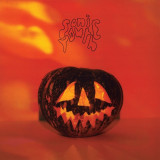
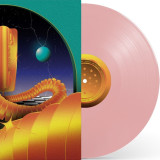
Austin, TX legends, The Sword, welcome in the Twelfth vinyl release in the Live at LEVITATION series. On June 27, 2024, the band announced they would reunite for a one-off concert on November 3 at the 2024 edition of LEVITATION in Austin. In celebration of this reunion, we pulled from the archive and this limited live release showcases the bands appearance at the festival with their 2015 and 2021 performances. These recordings are now immortalized on beautiful limited colored vinyl. "With the band originating in the great city of Austin, a city that's proven to be a nucleus for a wide range of distinct and eclectic musical acts, it only felt natural to be included on the Levitation roster in 2015 and again in 2021, adding our own flavor to its diverse landscape. What an honor it has been to be included at such a cool festival. We've had two memorable sets so far, playing alongside some truly amazing bands. When we began entertaining the thought of returning to the stage after a two year hiatus, playing a reunion set at Levitation became the only appropriate solution, to play in front of the fans in Austin Texas, where it all began. We're very excited! Being asked to be part of the "Live at Levitation" LP series is also a great honor. The tracks we selected from each performance, at Carson Creek Ranch and Empire Garage, captured a special energy and enthusiasm that only Levitation could provide. It truly means a lot to share these memories with everyone and be included in this series!" - The Sword LEVITATION and the LIVE AT LEVITATION Vinyl Series The first Austin Psych Fest was held in March 2008, and expanded to a 3 day event the following year. The event quickly developed into an international destination for psychedelic rock fans, with lineups spanning the fringes of indie rock, from up-and-comers to vintage legends, and capped off with headline performances from co-founders The Black Angels, along with Tame Impala, The Flaming Lips, The Brian Jonestown Massacre, Thee Oh Sees (in various forms) and many more. LEVITATION helped spark a movement, inspiring the creation of similar events across the globe and a burgeoning psych scene that would soon ignite. The series captures key moments in psychedelic rock history, and live music in Austin, Texas, pressed on beautiful limited edition colorful vinyl pressings - each an eye popping visual representation of the music contained within. The artists and sets showcased on Live at LEVITATION have been chosen from over a decade of recordings at the world-renowned event, and document key artists in the scene performing for a crowd of their peers and fans who gather at LEVITATION annually from all over the world.
Cerca:document one
- Movin' Much Too Fast
- A Groovy Thing Going
- Hey Mr. Skyjacker
- What I Feel
- Take A Ride
- Work Your Show
- Neath The Heat Of The Summer Sun
- Barbara With The Kooky Eyes
- Mojo Shingaling
- Rhythm And Soul
- Lucy's Spanish Harlem
- Love It Up
- Jumpin' Around
- Takin' Over
- Hey, Mama
- We Belong Together
- Come Live With Me
- Got This Happy Feeling
- Do It
- Pamoja Watu (Together People)
- It's Your Thing
- Undress My Mind
- Isco Kid
- Gimme, Take It
Those in the know are well aware of Bobby Marin's work, and the fact that he was behind the scenes for some of the best boogaloo and salsa of the '60s and '70s. Yet, until now, no one has explicitly put Bobby's name in the headline and given him his due on the cover of a properly credited Latin soul compilation. This compilation comprises twenty four essential boogaloo, Latin funk, rock and afro disco gems, each one bearing the mark of quality: "A Bobby Marin Production", including songs by Ricardo Marrero, the Ghetto Brothers, Ocho, Louie Ramírez_ A freshly curated overview of his fascinatingly complex back catalog in these genres. Since the late 1980s there have been numerous Latin soul and boogaloo compilations, and certainly much has been written about the history of the music too and an an excellent documentary (We Like It Like That, by Mathew Ramírez Warren) have brought the music to a broader audience. Generally, when discussing the "first wave" of Latin soul and boogaloo, it's the bands and their leaders, the singers and the songs that get all the recognition. But what of the producers, composers, and arrangers behind the music? Over the years, one of the best old-school New York Latin music producers, Bobby Marin, has occasionally been given some well-deserved credit and popped up sporadically in articles or liner notes (Wax Poetics, Fania, Gladys Palmera). However, to the casual public, he is not a household name, even among some fans of boogaloo. There are even some contemporary Latin soul compilations that contain mostly material licensed, produced and / or written by Bobby (or his brother, Richard), and a tip of the hat must go to Bobby's friend Dean Rudland for all his work in this area, as well as to Rocafort Records for digging up the long-lost Nitty Gritty Sextet album. Yet, until now, no one has explicitly put Bobby's name in the headline and given him his due on the cover of a properly credited Latin soul compilation. This collection aims to change that and give the man his Latin soul "props" for the first time on a freshly curated overview of his fascinatingly complex back catalog in this genre.
Behind the deceptive veneer of the demure monotone artwork, something unassuming lies within this long-play waiting to be explored. Intrigued by the ironic title, enticed by the elegant text positioned alone on the beautifully tactile matte canvas, the listener will experience musical wonderment at odds with the presentation and discover that the 1976 album Colours is a powerful yet sophisticated set of electric soul-jazz. An inspired recording that bursts with warmth and texture, the pivotal recording from an exceptional jazz musician. HER name - Judy Bailey.
Over the course of a 70 year career, the pianist and composer established herself as one of the central figures of Australian jazz. Her crowning achievement Colours is a spirited and ambitious recording that captured the maturation and shifting jazz landscape of the mid 1970s Australia. Alongside other notable albums recorded mid decade including the 1975 self titled album by Melbourne's Arena (see Roundtable SIR014)) and Jackie Orszaczky's Beramiada (1975), the album signalled the countries transition from semi-acoustic jazz to electric jazz-funk. Regularly compared to the albums released on Creed Taylor's CTI label, Colours parallel these recordings with their clean production and spacious soul-jazz arrangements. In particular the crisp drums and processed bass heard on Bob James and Joe Farrell albums, the sprightly flute of Hubert Laws or perhaps the more sensual side of Flora Purim's vocals could all be suggested as a source of influence.
Continuing to celebrate and re-document Australia's jazz music legacy, The Roundtable are pleased to offer the first vinyl reissue of this seminal Australian Jazz recording. Presented in a replica gatefold sleeve with new liner notes, the full palette can once again be appreciated including the moody funk of Fall Down Dead, the Iberian Waltz Toledo, the Jazz-Dance anthem Colours Of My Dream and the spacey impressionist piece The Eleven Eight Song.
The London-based electronic musician Luke J Murray aka Stonecirclesampler and the award-winning writer Travis Elborough have combined forces on a new collaboration to be released on The Tapeworm label under the title 'Memorex'.
Luke J Murray is a man of many musical aliases, releasing and performing variously as: Superior Grime London Blue DNB-like South Sand Dynamics Luke Marblex The In 2.5G Label White Dark Rainfall J Escape NCR London The From Cracks In Concrete 900Cold Liquid DJ Pulp Grime Murray The endorphin Old 0161 Conflicting 2 Solo Widens Damage Ambient Glow Electronics and Stonecirclesampler.
Described by The Guardian as 'one of the country's finest pop culture historians', Travis Elborough's books include 'Wish You Were Here: England on Sea', 'The Long-Player Goodbye', a hymn to vinyl records that inspired the BBC4 documentary 'When Albums Ruled the World', in which he also appeared, 'Through the Looking Glasses: The Spectacular Life of Spectacles' and 'Atlas of Vanishing Places', winner of Edward Stanford Travel Book Award in 2020.
long content, you may need to expand row to see all... 10th Anniversary colour reissue of the 2014 album featuring “Just One of the Guys”, “The Voyager”, “She’s Not Me” and more on Translucent Sea Blue 1LP. This is the former Rilo Kiley frontwoman's third solo album & documents her struggle to cope following the death of her estranged father in 2010 and the subsequent break-up of Rilo Kiley. 'The Voyager' finds the always relatable songwriter at her sharp-witted best, singing about her experiences with honesty and incisiveness.
On 4 October 2024 Universal Music Recordings and Decca Records are making Jamaican/British jazz saxophonist Joe Harriott’s album ‘Movement’ available again for the first time since it was released in 1964. Long sought after by collectors and connoisseurs, original copies now sell for upwards of £1,000.
This new edition was mastered at Abbey Road using high definition 24bit/192kHz audio files, copied directly from the original stereo analogue master tapes (previously only the mono version has been on vinyl). Images of those tapes are included in the package alongside new sleeve notes written by noted author, compiler and documentary maker Tony Higgins, who also acts as Executive Producer for Decca’s ‘British Jazz Explosion’ series.
Recorded in 1963, ‘Movement’ was released as part of the Lansdowne Series, overseen by the influential Denis Preston, one of the UK’s first independent record producers, and engineered by Adrian Kerridge. Of the nine tracks, seven are Harriott originals, whilst the other two were written by another pioneer of British Jazz, Michael Garrick. Playing alongside Joe were bassist Coleridge Goode (b. 1914 Jamaica, d. 2015 London), drummer Bobby Orr (b. Scotland 1928, d. 2020), pianist Pat Smythe (b. Scotland 1923, d. 1983), and trumpet/flugelhorn player Ellsworth ‘Shake’ Keane (b. St. Vincent 1927, d. 1997).
Born in Jamaica in 1928, Joseph Arthurlin Harriott was a pupil at the Alpha Boys School (alma mater to Harold McNair, Dizzy Reece, and a myriad of Ska greats). He arrived in Britain in the early ’50s, initially touring with the Ozzie Da Costa Band, followed by a brief spell with the Ronnie Scott Big Band, and sessions backing the likes of George Chisholm, and Lita Roza.
By the mid ’50s Joe was a big enough draw to release records under his own name, and whilst these early recordings conform to the then popular bop style, the following decade would see him release albums whose titles chart his development; ‘Free Form’ in 1960, and ‘Abstract’ in 1963.
‘Movement’ is a testament to Joe Harriott’s visionary approach to jazz. It blends structure with freedom, tradition with innovation, and individual expression with collective creativity. His development of free-form jazz represents a significant contribution to the genre, paralleling yet distinct from the work of Ornette Coleman and other American free jazz artists. It is an essential listen, not only for fans of British jazz, but jazz fans in general.
It is perhaps best summed up by the epitaph that now adorns Joe’s gravestone; “Parker? There’s them over here can play a few aces too.”
Senking and DYL team up again after first collaborating for a track on 2020’s »Uniformity Of Nature« EP that also featured different solo productions by the two producers. »Diving Saucer Attack« is the first full-length record by the German artist and his Romanian collaborator, released through the Berlin-based Karaoke Kalk label, home to the former’s work for more than a quarter of a century. The six pieces, two of which were produced individually, both showcase the duo’s shared interests for dub-heavy, adventurous electronic music while also emphasising the productive friction generated by the subtle differences between their respective approaches.
Cluj-Napoca-based DYL, real name Eduard Costea, cites his colleague Jens Massel’s work and especially his »Ping« EP—released in 1999 through Karaoke Kalk—as a crucial point of reference for his own development. »He’s one of the producers who inspired me to start making music,« he says. Massel was already familiar with his partner’s eclectic productions when he was approached by him with the idea of collaborating for a piece in 2020. They didn’t stop there, as Massel explains »It went very well and ever since we’ve been sending each sounds and tracks.« As their first joint album, »Diving Saucer Attack« documents the multi-faceted results of this on-going process.
The album opens with a track in true Senking style. Throbbing bass frequencies, haunting synth melodies and carefully placed rhythmic elements form a slow, but driving groove. Before DYL’s »a7r380R« introduces the listener to his anthemic take on IDM, the collaborative second track »2024« showcases how well their respective philosophies complement one another: the two create a detailed soundscape in which an intricate interplay of percussive elements and melodies can unfold. The title track transforms rattling drums and growling bass sounds into a laid-back, spooky trip-hop tune with a live-jazz feel, while »Astral Project« sees the duo venture into the uncanny regions of dub techno. »Not Just Numbers« closes on an even more sombre note—a fitting closing statement to an album full of twists and turns.
»Diving Saucer Attack« is a special album on more than the musical level. Massel released his first records under different guises such as Fumble, Kandis, and Senking through Karaoke Kalk between 1997 and 2001, after which he focused on his work as Senking, putting out a string of iconic albums through raster-noton, among others. 23 years after his last Senking LP for Karaoke Kalk, 2001’s »Silencer,« his return is as non-nostalgic as you’d expect it from such a forward-thinking producer: together with DYL, he continues to explore the possibilities and outer limits of electronic music in an intergenerational dialogue.
De School is thrilled to announce the release of HET ALTIJD: a 160-page journey back to and through its now-defunct club, art spaces, café, and restaurant, which closed their doors on January 15. HET ALTIJD archives De School’s essential facets, functions, spaces, and stories, from the pre-DS days to the moment the music stopped. In sync with De School’s eight-year- spanning program, the publication is a sensory and experience-based format that crisscrosses disciplines and allows those who enter to define their own route. The release of HET ALTIJD follows the launch of HET ARCHIEF, the extensive sound archives unlocked earlier this year.
More than a final form of documentation, HET ALTIJD was created to be an experience in itself, expanding on the time-erasing sense of exploration that a deep dive into De School embodied. Preserved records such as architectural sketches and art documentation are interwoven with original imagery by various creative contributors, including semi-anonymous portraits of club regulars, and post-closing snapshots taken just minutes after the very last dance. Recurring throughout the publication, and featured on the cover, is the abstracted thermal imagery of artist Loes de Boer, who chronicled the 66-hour closing (Het Einde) while upholding De School’s distinct sense of anonymity and wonder. In HET ALTIJD, the no-photo policy is simultaneously upheld and lifted—leaving space to roam and relive De School one last time.
HET ALTIJD refrains from a singular storyline and exclusively features text found in, on, and around Doctor Jan van Breemenstraat 1. Left-behind wall markings, toilet scribbles and sticky notes from the basement were photographed and excerpted to form fragmentary, touching, and tongue-in-cheek poetry that revive individual and collective memories. In addition, the non-linear graphic design and—lack of—binding allows anyone to (re)arrange their very own De School encounters. Holding HET ALTIJD together is a translucent red cover featuring the instantly recognisable grid: a final nod to De School, the warm hue of its seemingly endless hallways, and its enduring, all-encompassing foundation.
Tig Notaro is an Emmy, Grammy and SAG Award-nominated comedian, actor, writer, director and podcast host originally from Mississippi, and named by Rolling Stone one of the 50 best stand-up comics of all time. She appears in Season 3 of THE MORNING SHOW on Apple TV+ alongside Jennifer Aniston and Reese Witherspoon, and STAR TREK: DISCOVERY on Paramount Plus. Tig recently starred in the Netflix films YOUR PLACE OR MINE and WE HAVE A GHOST, as well as Zack Snyder's ARMY OF THE DEAD. Prior to that, she starred in the heartwarming Paramount film INSTANT FAMILY alongside Mark Wahlberg and Octavia Spencer. Tig wrote, produced and starred in the semi-autobiographical Amazon Prime Video series ONE MISSISSIPPI, also directing the premiere episode of Season 2. The show yielded critical acclaim and several award nominations, including WGA, GLAAD and The Critics Choice Awards. Tig's HBO standup special, DRAWN, made history as the first-ever fully animated stand-up special, and was nominated for a Hollywood Critics Association Award. She was previously nominated for an Emmy and a Grammy Award for her 2016 HBO special BOYISH GIRL INTERRUPTED, a GLAAD Award nomination for the Netflix Original Documentary TIG, and her memoir I'm Just a Person is a New York Times Bestseller. In 2013, Tig was also nominated for a Grammy for her sophomore release, LIVE, which was the #1 selling comedy album in the world that year. LIVE is a stand-up set delivered just days after Tig was diagnosed with invasive bilateral breast cancer, from which she is now in remission. Tig remains a favorite on talk shows, including "The Late Show with Stephen Colbert" and "The Tonight Show with Jimmy Fallon", public radio, and continues to tour internationally. Tig and her wife, Stephanie Allynne, co-directed the feature film, AM I OK?, starring Dakota Johnson and Sinoya Mizuno, which premiered at Sundance and premiered on HBO Max in June 2024. Tig also hosts HANDSOME, a critically acclaimed comedy podcast, alongside friends and co-hosts Fortune Feimster and Mae Martin. Her newest special, TIG NOTARO: HELLO AGAIN, premiered in March 2024 on Prime Video.
Written over the last two years - in Somerset, Los Angeles, and London; hotel rooms and tour vans; good places and rough patches - Welcome The Night is a mutant document of Sad Night Dynamite’s mission and scale. Deliberately chaotic, their grab-bag approach to sound creates an album ranging from dark club bangers, trippy folk, hip-hop and bugged-out storytelling. An ‘anything goes’ space that offers total creative freedom through absurdism.
crys cole returns to Black Truffle with Making Conversation, her third solo release for the label. After the intimate song-like constructions of Other Meetings (BT096), Making Conversation documents a different facet of cole’s work, presenting three rigorously conceptualised commissioned pieces, each of which extend her signature approach to highly amplified small sounds into new directions.
The side-long title piece is a stereo version of an 8-channel sound installation exhibited in 2023 at the Tabakalera Art Center in Donostia / San Sebastian, Spain. The piece uses a multitude of instrumental, vocal, concrete and electronic sounds to evoke the soundscapes cole encountered during nocturnal listening session in Bali, Indonesia in 2018 and 2019. In this world of night sounds, she explains, she ‘observed the complex interplay between amphibian, lizard, bird and insect communication, domestic animals (roosters, dogs), man-made sounds (airplanes, vehicles, conversations and evening activities) and sounds that were difficult to place’. Drawing on field recordings as memory aids (but including none in the finished piece), cole’s piece uncannily reproduces the spatiality and pacing of environmental sound without attempting strictly to replicate it. We hear insect-like twittering and birdsong fragments, resonant thuds and distant roars, furtive crunches and taps, muffled breath and metallic scrapes. While at times it can be difficult to imagine the source of these sounds, at other points they are clearly instrumental or electronic in origin; in its placement and layering, though, the whole assemblage suggests the glorious, unthinking richness of a non-musical sound environment. Suggesting at once the electronic gardens of Rolf Julius and the little instrument expanses of classic AACM, the piece is a brilliant enactment of the Cagean drive to ‘imitate nature in her manner of operation’.
‘Valid ForeverrRrrRRrrr… (pt. 1)’ began as cole’s contribution to an Issue Project Room commission to realise a score from Alison Knowles and Annea Lockwood’s Women's Work, a 1975 collection of text and conceptual scores by women artists and composers. cole’s piece begins from Beth Anderson’s Valid for Life, a complex arrangement of the letter R in various typefaces. Where the composer suggests a realisation on a trio of acoustic instruments (playing rolls with velvet beaters), cole translates the piece into her characteristic sound and object language as a trio of rolling sounds on ‘two large similar paper things and one 5-pin bowling ball’. Rolling from one side of the stereo field to the other, the bowling ball’s uneven movement is the heart of this immersive textural array, created with the simplest materials, which generates phantom sensations of pitch and phasing effects solely through amplified friction.
On ‘Valid ForeverrRrrRRrrr… (pt. 2)’, cole makes a first foray in translating her signature approach into conventional instrumental sounds, here in the form of a transcription for MIDI percussion ensemble. The result is refreshingly puzzling, comparable perhaps only to the sparsest moments of Keiji Haino’s classic “C’est parfait…” Accompanied with extensive liner notes, photographic documentation and a download code, Making Conversation is an exciting next step in cole’s work, extending her signature concerns in new sonic and conceptual directions.
Permanent Parts is the second album released by visual artist Katharina Grosse (synthesizer) and musician Stefan Schneider (synthesizer; So Sner, To Rococo Rot). Grosse and Schneider were joined at Galerie Max Hetzler on 29 April 2023, performing as part of the Spectrum without Traces exhibition, by three artists who all generally work within improvised music – Carina Khorkhordina (trumpet), Tintin Patrone (trombone and electronics), and Billy Roisz (noise generator, piezo and mini cymbal). Permanent Parts is an extraordinary set of recordings that inhabits multiple zones at once: within its thirty-five minutes, we can hear the interactions of non-idiomatic collective music making, and the electronic glimmers of electro-acoustics, while, at the same time, the music remains untethered to genre.
This capacity to work within liminal zones makes perfect sense when thinking about both Grosse’s and Schneider’s prior work, whether the energetic diffusions and spatial explorations of Grosse’s artistic practice, or the slippery texturology of Schneider’s recent work with electronics. Khorkhordina, Patrone and Roisz all find their own ways into this dynamic, too, and Permanent Parts feels like an equal exchange of presence and contribution; there are no hierarchies here. This might explain the music’s curious sense of development, where several elements are allowed to exist alongside each other, not in direct contact but in a mode that’s somewhere between carefree layering and unconscious juxtaposition. The musicians are listening, but not just with their ears – their skin, their bodies are hearing, too.
When talking about Permanent Parts, Schneider is careful to place it within contexts that are specific, to some degree, but which allow for difference to blossom. “Although it was recorded live, it somehow was not meant to be a documentation of a live event in the first place. The five piece line up that appears on the record had met for the first time only a few hours before the concert took place.” While it might take a leap of faith for all parties to walk together, and so willingly, into a place of such freedom, of such risk, there is clear sympathy here between the musicians, and a shared appreciation of the immediacies of the situation.
It also throws some of our preconceptions about this music out of the window. “The record does not feel like a document of a performance as the music was not pre-composed and there was no reference,” Schneider continues. “Perhaps it was not even an improvisation?” For Grosse, her musical relationship with Schneider similarly shakes free from expectation: “My sound does not exist without Stefan’s. It is neither written down nor is it improvised. It is instantaneous.” When thinking about the five-piece exploration on Permanent Parts and asked to expand on what each musician brings to the table, she continues, “We all love the thrill of an unknown encounter and we seem to have a need for building connections through the thicket of our voices.”
There’s a curious phrase on the back cover of the album, before the artists are listed: “Wir sind eine Batterie / We are a battery.” This sums up the spirit of Permanent Parts. Schneider recalls that Grosse said this phrase to the musicians at the start of the performance. Grosse explains further, “The figure of the battery referred to our placement in the space building out a small circle facing one another from where the sound could spill into the impressive volume of the gallery.” The battery as an arrangement of similar devices; but I also think of charge, and the conversion of chemical energy, and of fortification. It’s a poetic metaphor that sums up much of the febrile pleasure of the music contained on these Permanent Parts.
– Jon Dale, Melbourne
Few bands are as primed to capture their ecstatic live energy in masterful sonic detail like Terry Gross. Composed of three renowned engineer/producers (recording artists like Wooden Shjips, Moon Duo, Earthless, Big Business, and more) whose studio doubles as their jam spot and communal gathering place, the trio"s penchant for longform psychedelic escapades is able to be recorded with granular precision. The potency of the fellowship formed by drummer Phil Becker (Lower Forty-Eight, Peace Creeps, Pins of Light), bassist Donny Newenhouse, and guitarist Phil Manley (Trans Am, Oneida, Life Coach) lies in their ability to utilize their prowess as both players and record engineers to translate feeling with immaculate clarity. On Huge Improvement, Terry Gross embody a complex web of emotion with songs as ferocious and precise as they are agile and care-free, delighting in the catharsis of excising tension alongside one"s most trusted peers. Huge Improvement"s tongue-in-cheek title is rightfully earned. Like their debut Soft Opening, the pieces on Huge Improvement began as improvised studio jam sessions without expectations. The trio"s ability to plug in, play and have each experiment thoroughly documented opens up unparalleled avenues for further exploration and honing. The four mammoth slabs that make up Huge Improvement are driving, unrelenting excursions into the unknown. Whether burning white-hot or smoldering in plumes of smoke, the pieces stretch as much inwardly as they do cosmically, embracing every surprising turn. Terry Gross"s Huge Improvement morphs the trio"s search for communal connection and reprieve into a transcendent respite, a burst of focused energy to be enveloped in while facing the senselessness around us with a smile.
- A1: Columbia (Live At Knebworth)
- A2: Acquiesce (Live At Knebworth)
- A3: Supersonic (Live At Knebworth)
- B1: Hello (Live At Knebworth)
- B2: Some Might Say (Live At Knebworth)
- B3: Roll With It (Live At Knebworth)
- B4: Slide Away (Live At Knebworth)
- C1: Morning Glory (Live At Knebworth)
- C2: Round Are Way (Live At Knebworth)
- C3: Cigarettes & Alcohol (Live At Knebworth)
- C4: Whatever (Live At Knebworth)
- D1: Cast No Shadow (Live At Knebworth)
- D2: Wonderwall (Live At Knebworth)
- D3: The Masterplan (Live At Knebworth)
- E1: Don’t Look Back In Anger (Live At Knebworth)
- E2: My Big Mouth (Live At Knebworth)
- E3: It's Gettin' Better (Man!!) (Live At Knebworth)
- F1: Live Forever (Live At Knebworth)
- F2: Champagne Supernova (Live At Knebworth)
- F3: I Am The Walrus (Live At Knebworth)
3LP[43,66 €]
This year marks 25 years since Oasis’ two iconic record breaking live concerts at Knebworth Park in Hertfordshire on the 10th and 11th August 1996. The shows were both the pinnacle of the band’s success and a landmark gathering for a generation of young people. Released alongside the cinema debut of the feature length documentary film of the event, ‘Oasis Knebworth 1996’ is the definitive live recording featuring a setlist packed with stone cold classics album taken from across both nights of the concert, from the opening salvoes of ‘Columbia’ and ‘Acquiesce’, to ‘Champagne Supernova’, ‘Don’t Look Back In Anger’, ‘Live Forever’, an orchestra backed ‘I Am The Walrus’, and ‘Wonderwall’ the first song from the 1990’s to reach over one billion streams on Spotify and universally loved anthem.
Boxset contains:
3 x Vinyl, LP, Album
2 x CD, Album
2 x Cassette, Album
3 x DVD, Multichannel, Stereo
Get Nuff Nuff Data is a series of books exploring positive forces in contemporary music in relation to place and culture.
This book opens the series with the stories of musician I Jahbar and his surrounding community, set in the outskirts of Spanish Town, Jamaica. In 2011 I Jahbar collaborated with a duo of California based experimental musicians, and his acrobatic performance on their track ‘Spy’, inspired the founding of a record label named ‘Duppy Gun’. Their music captivated me like nothing had before. It was difficult to frame, drawn towards an innovation in sound, while embodying some ancient energy. 'Duppy Gun’ has paved its own unique path in dancehall music ever since, showcasing the power of international creative collaborations, by linking Jamaican lyricists with producers from different parts of the world.
There’s a little family formed around those musical projects, of goodhearted, talented individuals.
Led by a growing curiosity, I came to Jamaica, offering to create a visual aspect to the ongoing dancehall movement. During 3 weeks of collaborating with I Jahbar, we worked on a shared vision of promoting the voices of emerging vocalists and documenting their creative spirit.
The feeling of being welcomed to step into an unfamiliar narrative inspired the creation of this series, examining the perceptions of ones belonging and idea of home. Through segments of monologues and conversations, nature and portrait photographs, the book portrays a bond between people and their surrounding land, what they seek to change or wish to cherish and preserve. Get Nuff Nuff Data is dedicated to the simple lines that connect us all, each individual story exists as a universal one.
* Part of the book takes place online, including access to ‘unprintable data’. Exclusive video, audio, and downloads.
Details:
Self published
Designed by Matúš Hnáts
Printed by Tiskárna Helbich
500 copies, Swiss binding, 120 pages, 16x24cm
Printed on Fedrigoni 135gsm Symbol Tatami White
ISBN 978-965-598-736-2
(Barcode on the Last page of the book)
Isik Kural returns with Moon in Gemini, a luminous scrapbook of slow-flowing narratives couched in intuitive and symbolic storytelling. Bending a playful take on environmental music to the folk song form, Isik's vocals coo atop pastoral field notes, airy chamber instrumentation and archival recordings culled from a curious musical life. A tender pastiche coalesces across the suite of Moon in Gemini's fourteen pieces, and Isik invites the listener to daydream as-deep-as-possible. "The songs on Moon in Gemini don't mind being slower or taking their time to reach the listener," says Isik, who wanted the title to speak to the album's dreamy, liminal nature. "I enjoyed how the phrase could be used to describe an object, a time or a place simultaneously," he explains. Similarly and subsequently, these songs contain a multiplicity of sonic artifacts, moments and spaces that span Isik's rich musical career to date. With the bulk of the album realized between Amasya, Turkey and Isik's current home in Glasgow, in both domestic and studio recording environments, additional tracks unearthed from his personal recording archive lend their lush patina. The record emerged as a fertile space to reimagine a handful of previously unreleased songs and unfinished ideas spanning the past fifteen years of his life and work, including streetside sounds documented while growing up in Turkey and recordings made while studying music engineering in Miami, Helsinki and Glasgow. Looking to the more recent past, Isik found himself wanting to build upon some of the methodologies and textures explored on his 2022 album in february, seeking a newly intimate, vocal-forward sound. He points to the track "film festival" from that album as a door through which to enter Moon in Gemini, where sample-based arrangements are presented in the context of asymmetrical "build ups and progressions" and ambience and vocals intertwine. Inspired in part by listening to iconic, if not sometimes misunderstood, singers such as Nina Simone, Aldous Harding and Ed Droste of Grizzly Bear, Isik aimed to carve out a new space for his voice on Moon in Gemini, experimenting with novel recording and mixing techniques. Captured at his aunt's farmhouse in Amasya during an extended three week recording session, we find Isik's vocal high in the mix, front-and-center and on newly expressive terms. As a songwriter, Isik is an intuitive and playful lyricist who allows his deep love of literature to flow through his off-kilter texts. Here, echoes of Silvina Ocampo's poem "Dialogues of the Silence" reverberate from the margins of "Most Beautiful Imaginary Dialogues". Likewise, Elliott Smith and Virgina Astley shapeshift through "Behind the Flowerpots," some lines of which were based on misheard lyrics from Smith's "Stickman" and Astley's "Some Small Hope." Attuned to the magic of happy coincidences, other unexpected "themes and connections between tracks flourished" during the recording process, resulting in some songs being more "thematically and lyrically connected to each other compared to previous records." The duos "Prelude" and "Interlude" as well as "Grown One Iota" and "After a Rain" explore connected stories, while "Almost a Ghost" and "Behind the Flowerpots" serendipitously emerged out of a conversation with Stephanie "Spefy" Roxanne Ward, whose balmy vocals heard highlighting in february return and call out to Isik's in sweet dialogue. Plumbing these new potentials of structure and songwriting, Isik also developed a taste for an expanded sonic palette, one enriched by the lulling undertones of live woodwinds and strings. The resulting collaborations with flutist Tenzin Stephen, harpist Kirstin McCarlie and clarinet player Giulia Tamborino envelop the record in an altogether "dreamier sound," swaying pastel and awash in lunar light. Moon in Gemini, brimming with natural imagery and lullaby-inflected tones, tunes into states of being where the wonder filled sound of everyday is heard and felt, perfectly imperfect in its poetry; where the invisible steps forward; where dauntless ghosts wait around every corner and play enriches the soul; where bird song fills sun-soaked afternoons and carries us on its wings into each enchanted evening. Isik Kural's Moon in Gemini will be released on vinyl, Japanese import CD, and digital editions on September 6, 2024. On behalf of Isik and RVNG, a portion of the proceeds from this release will benefit Mor Çaty Women's Shelter Foundation, whose social work at their solidarity centers and shelters supports women building lives unhindered by gender-based discrimination and male violence under free and equal conditions.
Black Truffle is thrilled to present a Song for two Mothers / Occam IX the first ever solo release from Laetitia Sonami. Born in France in 1957, Sonami studied with Éliane Radigue in Paris before moving to California in 1978 to study electronic music at Mills College, going on to make important innovations in the field of live electronics interfaces and multi-media performance. Sonami is perhaps most closely associated with one of her inventions, the Lady’s Glove, an arm-length tailored glove fitted with movement sensors allowing the performer fluidly to control digital sound parameters and processing, as well as motors, lights and video playback. Having performed with the Lady’s Glove for 25 years, Sonami retired it in 2016, turning her attention to the interface/instrument heard and pictured here, the Spring Sprye.
In Sonami’s own description, “The Spring Spyre is composed of three thin springs that are attached to reverb tank pickups, mounted on a metal ring. The audio generated when the springs are touched, rubbed or struck is analyzed in Max/MSP. The extracted features are then used to train machine learning models in Wekinator and Rapidmax and control the audio synthesis in real time. We never actually hear the springs.” After decades of aversion to documenting her work on recordings, a Song for two Mothers / Occam IX treats listeners to two side-long performances with the Spring Spyre: the very first piece developed for the instrument and the most recent, the two contrasting remarkably in sound palette, energy and form. A Song for two Mothers (2023) spins an intricate web of rippling synthetic burbles, rapid sweeps and fizzing textures. Performed in real time with the sensitive and partly uncontrollable Spring Sprye ("a bit tyrannical," Sonami calls it), the music is delicate yet chaotic. Abrupt gestures hover against a backdrop of silence, "devoid of spatial or temporal direction". After several minutes, the sound-world becomes metallic and percussive, tapping and ticking in pointillistic flurries before a wavering harmonic cloud emerges, sprinkled with resonant drips and pops.
Occam IX is a radically different proposition. At the outset of Sonami’s exploration of the Spring Sprye, she asked her former teacher Éliane Radigue to compose a piece for it—and her: like all of Radigue’s work since she ceased working with analogue electronics at the beginning of the 21st century, Occam IX is written not only for an instrument but also for a particular performer. These scores are developed verbally, through meetings and conversations between performer and composer; each is grounded in an image (usually kept from listeners, to avoid influencing their experience); all magnify the subtlest acoustic phenomena and require great commitment and patience from the performer. Sonami’s is one of the few Occam pieces to make use of electronics, bringing it closer to Radigue’s famous longform pieces for ARP 2500. Beginning from a rumbling low tone, the listener is gradually immersed in slowly lapping waves of synthetic tones, eventually thinning out into delicate bell-like pings against a background of white noise, reminiscent of one of the most beautiful sections of Kyema from the Trilogie de la Morte.
Accompanied by notes from Sonami, her longtime collaborator Paul DeMarinis, and Radigue, and illustrated with scores, photographs and images of the Spring Spyre, a Song for two Mothers / Occam IX is an essential document celebrating an under-recognised pioneer of electronic music and performance.
Elliott Smith's "Division Day" is not only one of the late artist's most beloved fan favorite songs, it's also one of Smith's first departures away from the soft-spoken melancholy of his first two albums and into the more sophisticated pop that led to his breakout success. B-side "No Name #6" is a classic in its own right, encapsulating the humble brilliance of one of our generation's greatest singer-songwriters. "Division Day" b/w "No Name #6" is now back in print with its first pressing on colored vinyl. Limited to 1000 copies on clear vinyl, this 7" single is a crucial document of Elliott Smith's musical evolution, and a vital piece of Suicide Squeeze history.
The true test of originality for any musician comes when you hear an instrument being played and you instantly know who’s playing it. For electric guitarists, certainly Hendrix qualifies; Page and Clapton, too. Maybe Eddie Van Halen before the legion of imitators. You probably have your own list, but to us, standing toe-to-toe (or pick-to-pick) with those legends is Television guitarist and solo artist Tom Verlaine. His self-taught, jazz-influenced style, largely devoid of effects, and vibrato tone (oh, that tone!) makes any Verlaine solo unmistakably a Verlaine solo. That he was quite an accomplished, idiosyncratic songwriter is just a bonus. Real Gone Music is very, very proud to announce that we have arranged with the Verlaine estate to release Tom’s last three solo albums on LP; Songs and Other Things was the last record he released, in the same year (2006) as the all-instrumental Around. As the title indicates, this was indeed a return to lyrics and vocals, the first record with “songs” since 1990’s The Wonder (although the first track, “A Parade in Littleton”—one of the “Other Things”—is a low-key, funky instrumental that would have been home on a late Talking Heads album). The time off clearly allowed Verlaine to build up a strong cache of compositions, with “Nice Actress” and “The Earth Is in the Sky” among the highlights. The record also marks a welcome return of Verlaine’s enigmatic lyrics, which as always prompt head scratching while somehow making intuitive sense. But in the end, it’s the amazing guitar work—ably supported by Fred Smith of Television fame and Jay Dee Daugherty of The Patti Smith Group among others—that elevates Songs and Other Things to essential status, worthy of its exalted position as the final release of Tom Verlaine’s career. Bassist and original engineer Patrick Derivaz has mastered the album for its vinyl debut; Verlaine’s long-time partner Jutta Koether contributes notes. Teal vinyl pressing!
- Despertemos En America
- Querida Miusi
- Sabor De Amigo
- Como Aprendi A Soportar Tus Inseguridades
- Tema De Los Titulos
- Transeuntes
- El Revolver Es Un Hombre Legal
- Lo Mas Bello Esta En Cualquier Lugar
- Tu Vas A Ser (Youre Gonna Be)
- El Secreto De La Vida (O Segredo Da Vida)
- Brians Coral (Dedicado A Brian Wilson)
- Buscando En El Bolsillo Del Alma
- En La Tierra, El Sol
- Cuecas Song
- El Casamiento De Los Musicos
- La Palabra Desnuda (The Naked World)
- La Mascara Se Encendio
- Cancion Para Domingo Cura
- Para Mi Suerte
- Titulos Para Un Documental No Realizado
- Tierra, Viento & Fuego
Amazing compilation of Litto Nebbia's recordings from 1971-1988, a magical and prolific time in the career of the Argentine artist and in the history of his record label, Discos Melopea, including different sounds, from jazz to Brazilian rhythms or experimental textures. Hip-hop artists and producers such as The Alchemist, Jay Electronica and DJs such as Gilles Peterson have openly declared their admiration for Nebbia, generating great interest in his records among collectors around the world. This double-LP compilation, first one ever released in Europe, comprises twenty one recordings taken from some of his best-known albums and also rarities, tracks previously unavailable on vinyl and songs taken from his most obscure albums, the vast majority never reissued on vinyl before. This compilation, the first to be released in Europe, is a subjective look into his fascinating work. It has no historical biographical pretensions or completist aspirations. The selection includes forays into different sounds, from jazz to Brazilian rhythms or experimental textures, which show the rich variety present in Litto Nebbia's vast discography. This collection of songs extends throughout the period 1971-1988, a magical and prolific time in the career of Litto Nebbia and in the history of his record label, Discos Melopea. It comprises twenty one recordings taken from some of his best-known albums, "Bazar de los milagros", "Canciones para cada uno", "Toda canción será plegaria" and also rarities, tracks previously unavailable on vinyl and songs taken from his most obscure albums, the vast majority never reissued on vinyl before.
- A1: Beyond This World
- A2: Feelin' Alright
- A3: Sunshine
- A4: What "U" Waitin' 4?
- B1: U" Make Me Sweat
- B2: Acknowledge Your Own History
- B3: Belly Dancin' Dina
- B4: Good Newz Comin
- C1: Done By The Forces Of Nature
- C2: Beeds On A String
- C3: Tribe Vibes
- C4: J Beez Comin' Through
- D1: Black Woman
- D2: In Dayz "2" Come
- D3: Doin' Our Own Dang
- D4: Kool Accordin' "2" A Jungle Brother
"2" A Jungle Brother The Jungle Brothers' 1988 debut, Straight Out The Jungle, was important for many reasons. It was sloppy and goofy but had moments of real focus and social consciousness. It was a true kitchen sink' record, that caught a rap fanbase enraptured by Eric B. & Rakim, Public Enemy and Boogie Down Productions a bit off-guard. Also of note, beyond the excellence of the album itself, the Jungle Brothers were the fulcrum for what would become the Native Tongues movement - they came first, De La Soul and A Tribe Called Quest followed, under their guidance. By 1989, the group had even more confidence, plus a Warner Bros. contract and advance in their back pocket. They used it to great advantage on the self-produced and criminally underrated Done By The Forces Of Nature, expanding their sonic palette and continuing their Afrocentric approach to music and life. Singles like What 'U' Waitin' 4' and Doin' Our Own Dang' (with De La and Q-Tip, alongside Monie Love) showed the group's fun side, which has also lead the way in the hip-house' movement. But things weren't all fun and games, as deeper, more pensive album tracks like Black Woman,' Beeds On A String,' and Acknowledge Your Own History' show. It was another accomplished mix of fun, frolic and knowledge-of-self, proving that you could be serious in the rap game but still let off steam and fill the dancefloor. Done By The Forces Of Nature stands as one of the most cherished hip-hop documents of the late '80s among true-school heads, and this edition is the perfect way to revisit this classic thinking-man's (and woman's) rap platter. Issued for the first time ever on 2-LP with the original picture sleeve artwork, it also comes with a reproduction of the original insert, with credits and lyrics.
Black[37,77 €]
"Hannes Aitman, the 20-year-old country debutante, continues to release singles ahead of his debut album "Weak Point"
which will be released on August 23. "Looking Back, Looking out" will be released on 5/24 and is a song about reflection,
hope, love and longing A perfect introduction to Hannes' debut album. Together with the album, Hannes will go on a
summer tour through Sweden and will also be a support act for Ludwig Hart this fall. The album will also be available on
vinyl. Hannes is now recording a YouTube documentary where we will be able to follow his journey as one of the fastest
climbing debutants we have in Sweden. He will follow up this success with a headline tour in 2025."
Black[29,20 €]
"Hannes Aitman, the 20-year-old country debutante, continues to release singles ahead of his debut album "Weak Point"
which will be released on August 23. "Looking Back, Looking out" will be released on 5/24 and is a song about reflection,
hope, love and longing A perfect introduction to Hannes' debut album. Together with the album, Hannes will go on a
summer tour through Sweden and will also be a support act for Ludwig Hart this fall. The album will also be available on
vinyl. Hannes is now recording a YouTube documentary where we will be able to follow his journey as one of the fastest
climbing debutants we have in Sweden. He will follow up this success with a headline tour in 2025."
Incognito virtuoso Lambert, known for his playful personality, bold vision, stunning neo-classical compositions, and of course his ever-present horned Sardinian mask, is back with brand-new album Actually Good. Initially intended as the score for a gritty crime drama and debut film entitled ‘The Stranger’, which, due to reasons that will become clear with time, was swiftly curtailed, the now retitled soundtrack, Actually Good, is not only ready for release, but so is a remarkable mini-documentary about the making of this crime catastrophe. Featuring rolling piano arpeggios, sedate strings and staccato synths, Actually Good combines tension and elegance in equal measures for a truly cinematic experience.
Neil Feather has spent decades creating a musical world of his own through dozens of one-of-a-kind instruments he invented and built himself. His work as an instrument inventor, improviser, musical iconoclast, and stalwart of the idiosyncratic Baltimore experimental scene culminated in the late 2010s when filmmaker Skizz Cyzyk shot hours of footage of Feather taking stock of his workshop and his collaborations with musicians from Baltimore and beyond as he prepared to relocate permanently to New Zealand. That period produced Sound Mechanic, Skizz’s 2022 feature-length documentary about Feather’s work and music. It also produced an album-length collection of recordings of Feather’s music from the film that captures the spectrum of his unique sonic vision. Uninterested in the traditional rules and roles of music from his early years, Feather began constructing noisemakers out of what was around him—pieces of metal, spare parts from bikes and other gadgets, discarded traditional instruments, various electronics, ball bearings, and so on. By the time he moved to Baltimore in 1985, his work had become more codified into a practice of instruments and families of instruments, such as the Nondo, the Vibrawheel, and the Former Guitars. At the same time, he became a mainstay of the burgeoning experimental / improvised music scene that erupted from the Red Room and the internationally renowned High Zero Festival.
Gregory T.S. Walker’s Minstrels & Minimoogs was self-published by a young, nomadic composer and virtuoso in 1988 to accompany an immersive multimedia performance at the University of Colorado Boulder’s Fiske Planetarium. Created with this outer, and other, world setting in mind, the four tracks find Walker stretching toward an ancient-to-future vision where Egyptian myths and Hieronymus Bosch-ian tableaus are rendered in a screaming three dimensional circuitry of electronic drums, synth guitars, and, of course, Minimoog. Given the musical terrains and outmoded topics traversed, and that this entirely DIY effort was originally released as a micro one-sided 12” edition, Minstrels & Minimoogs is as perplexing and euphoric a document lost-to-time as it is now found.
Born in 1961 into an intensely musical family spanning four generations, Gregory’s mother Helen Walker-Hill was a noted musicologist specializing in the rediscovery and work of historical Black female composers, while his father, George Walker, was the first African American composer to win the Pulitzer Prize for music. Both parents studied with the famed (and famously strict) Nadia Boulanger in Paris in the 1950s, and held to lofty aesthetic standards in their home life. Walker began studying the violin as a child, but when a burgeoning interest in the electric guitar and rock music as a teen manifested, it was largely verboten in the household. The rule was that the music played in the home was to be acoustic and classical. Although the elder Walkers eventually relented and allowed Gregory’s guitar to be plugged in for a brief interval on the weekends, the remaining days he settled for strumming it sans amplification.
Gregory, conditioned and eager for a life in music but looking to get out from under the influence and yoke of his famous composer father, ultimately chose to study computer music at the University of California at San Diego, where he earned a Master of Arts. This was followed by another MA in electronic music composition at that hotbed of West Coast experimental music, Mills College. Intermedia and multimedia in the arts was the rage in the 1980s, and Mills was one of the centers for it; audacious spectacle meeting visionary performance, such as one of the realizations for Anthony Braxton’s music for multiple orchestras a young Gregory performed in with his violin.
After a series of solo synthesizer concerts around California, Gregory followed a girlfriend on a mid-country move to Boulder, Colorado. After picking up yet another composition degree at University of Colorado Boulder, his life as a composer really started, writing a piece for extended technique for guitar, a passacaglia for vocoder and orchestra, as well as Minstrels & Minimoogs.
Envisioned as a multimedia performance such as the kind he’d experienced at Mills (which was all but unknown in Boulder at the time), Gregory roped in a number of college going or aged friends of varying skill levels and musical sympathies to accompany him with distorted sax or oblique spoken interludes. Confronted with a lack of finances, but driven to get his ideas captured in a complete musical package, the album was recorded in his brother’s apartment. If not every player assembled was on Gregory’s virtuosic level, so be it; it was more about capturing the spirit of his intentions and embracing the serendipity of mistakes.
An inspired attempt at world building, Minstrels & Minimoogs draws on the deep well of musical knowledge Gregory gathered from his parents and teachers, but all the while subverting that historical basis by incorporating mutant strains of prog and pop music. The work accumulated is not unlike the playful 1980s work of Gregorio Paniagua, where medieval estampies and rondeaus are wrenched into an anachronistic present where Hildegard Von Bingen and Kate Bush are contemporaries. Ars nova, new art, a 20th century minimalist jester and troubadour.
A one sided LP was the cheapest option Gregory found to have Minstrels & Minimoogs memorialized on vinyl, so somewhere between 50 to 100 copies were pressed. There was no distribution, outside of copies that were handed out to friends or sold at the performances at the planetarium. Gregory T.S. Walker’s cosmic-futuristic forays into oblique pop and baroque subversion could forever reside perfectly in both the domed simulacrum of our universe for which it was composed, in the formats it is being reintoduced now, and our own biblical firmament. For in the words of Gregory, straight from the original liner notes: “God Is A Minimoog”
Gregory T.S. Walker’s Minstrels & Minimoogs arrives again August 23, 2024 on vinyl and digitally as part of uncommon¢ (“uncommon sense”), an open-ended, serialized endeavor from Freedom to Spend that provides new meaning for rarefied recordings from music's outermost fringe.
Celebrated Norwegian singer and composer Susanna announces her new album, Meditations on Love, out August 23rd via her own label SusannaSonata. Having spent five years writing material, Meditations on Love reflects the complexities and difficulties of maintaining love. So many songs celebrate the giddy joy of a new connection or lick the wounds from a break-up, but Meditations on Love explores what happens in between, examining the work required by a healthy relationship and contemplating the conditions that turn love into something toxic. Susanna's mastery of balladry is well documented, but on Meditations on Love, she introduces a rhythmic presence new to her work. The result is one of Susanna's strongest and most dynamic recordings of her career. The Norwegian artist Susanna has released albums as Susanna and the Magical Orchestra/Susanna/Susanna Wallumrod since 2004 on labels like Rune Grammofon/ECM/Grappa Musikkforlag and since 2011 on her own label SusannaSonata. Critically acclaimed for both her own songs and her highly personal interpretations of other people's songs, she wanders lightly and intented between champer folk, avantgarde, electronica, jazz and independent pop. Highly riyl Joanna Newsom, Sufjan Stevens, Kate Bush
- Introduction By Andre Francis
- Directions
- Milestones
- Miles Runs The Voodoo Down
- Footprints
- Round Midnight
- It's About That Time
- Sanctuary
- The Theme
- Introduction By Andre Francis
- Directions
- Spanish Key
- I Fall In Love Too Easily
- Introduction By George Wein
- Bitches Brew
- Paraphernalia
- Nefertiti
- Masqualero (Incomplete)
- This
Music On Vinyl proudly presents the second installment of the acclaimed Miles Davis Bootleg series on pristine 180 gram vinyl! Part 1 (Live in Europe 1967, MOVLP421) was voted Historical Album Of The Year in the Down Beat Readers and Critics Poll. Bootleg 2: Live In Europe 1969 skips two years ahead to record Davis with his ‘third great quintet’ also known as ‘the lost band’ of 1969-’70. This line-up consists of Miles Davis, Wayne Shorter, Chick Corea, Dave Holland and Jack De Johnette at their peak – they were never recorded in studio. Their European tours of 1969 are some of the only existing recordings of the group; the first legitimately released audio recordings by this stellar lineup. Bootleg 2: Live In Europe 1969 captures the short-lived quintet in three separate concert settings across 4 LPs, containing selections from two nights at Festival Mondial Du Jazz D'Antibes in France and one night in Stockholm, Sweden. Special recordings include a pre-studio recording version of “Bitches Brew” which would be recorded in the studio for the infamous record by the same name a few months later. The audio sources of Live In Europe 1969 have been remastered from the highest quality masters available, secured from the European broadcast centres where the material was originally documented.
Dark Entries Collected Music Graphics Compiled by Josh Cheon and Eloise Shir-Juen Leigh To celebrate 15 years of Dark Entries, this zine showcases the label’s visual aesthetic, bringing together some of the most iconic designs that we’ve released. While Dark Entries’ sonic mission has included sounds as diverse as synth-pop, Italo disco, darkwave, house, and techno, it is equally staggering to see the breadth of visuals the label has encountered and collected over the years. Included here are selected typography, logos, and illustrations from the label’s extensive catalog — well over 300 releases to date. Designs have been created using DIY analogue techniques as well as more contemporary digital approaches. A full discography is included at the end for reference and an essay by Shawn O’Sullivan (Led Er Est, Further Reductions). This zine serves as a source of inspiration for artists as well as a means of preserving and documenting these distinct graphics. DARK ENTRIES RECORDS is a San Francisco-based record label that was born in July 2009. Helmed by Josh Cheon, a vinyl-focused DJ and collector, the label has focused largely on excavating the 1980s underground era – but releases have spanned from sultry vintage disco to bleeding-edge contemporary techno. Graphic designer Eloise Shir-Juen Leigh has been responsible for most of the label’s artwork, whether reproducing original designs accurately for reissues or creating exciting new ones. Much care and attention is given to each release to represent the music in a memorable way as well as tell the stories behind these projects. Hand-stamped and limited to 200 numbered copies. 64 pages with neon cardstock covers. Measures 5×7 inches.
You could call Wishy's story a lucky one. After prior monikers and iterations, Wishy was born as a kaleidoscope of alternative music's semi-recent history, with traces of shoegaze, grunge and power-pop swirling together. On Triple Seven, Indiana songwriters Kevin Krauter and Nina Pitchkites' musical synergy proves itself to be a rare one-the kind that sounds like someone striking gold. Part sly wink and part warm gratitude, it's only fitting their much anticipated full length debut is titled Triple Seven, where Wishy's penchant for indelible hooks is couched equally in pillowy atmospherics and scathing distortion. By day Krauter works as a music teacher, giving drum and guitar lessons to students, while Pitchkites is a seamstress by trade and often makes embroidered merch for the band. Coming up in a scene defined by hardcore and emo, Krauter and Pitchkites instead found themselves writing melodies in their heads while driving to work, pulling music from the air and arriving at a blearier, more ethereal interpretation of Midwest expanse. Initially, their music oscillated between hazy dream-pop and heavier alt-rock. The subject of their songs create a loose web of vignettes and snapshots, capturing Krauter and Pitchkites in a whirlwind couple of years _ exiting the pandemic, embarking on an embryonic project, making sense of their musical pasts while forging a musical future alongside one another, each of them on a journey of self-acceptance and self-understanding. Sometimes gorgeous, sometimes festering, and always cathartic, Triple Seven is a vibrant and exhilarating document of self-discovery with the scope and heft of the bygone big-budget rock albums that inspired it.
At the muddy miracle that was Woodstock, the most miraculous performance just might have been Jefferson Airplane’s. The band had been one of the first to sign on for the festival, their imprimatur prompting many other acts to hop on board, and their stature had landed them a coveted headlining slot closing Saturday night’s schedule. But, as the torrential downpours and the unexpected crush of half a million people kept on delaying their set, the chances of putting on anything approaching a quality performance seemed to diminish.
According to Paul Kantner, “We were supposed to go on at 10:30 at night and we’d been up and down about four or five times on acid that night, getting ready to go on, and then everything was delayed for whatever reasons. So, we didn’t get on until like 7:00 the next morning and everybody was pretty much burned out.” Kantner’s protestations to the contrary, the Airplane (with guest pianist Nicky Hopkins in tow) played a scorching two-hour set that defied the elements and the circumstances. Grace Slick led the charge as the band plunged into a frenetic version of Fred Neil’s “The Other Side of This Life”: “Alright, friends, you have seen the heavy groups. Now you will see morning maniac music. Believe me, yeah. It’s a new dawn!” What followed was an adventuresome (and surprisingly tight) set that not only featured the band’s big hits like “White Rabbit” and “Somebody to Love” but also premiered songs from the Volunteers album that was still three months away from being released, including a 21-minute version of “Wooden Ships!” Indeed, about the only members of the crew who weren’t up to snuff were the ones filming the concert documentary, which explains why the Airplane is not one of the acts that commonly come to mind when thinking about Woodstock; they didn’t appear in the film due to subpar footage, and only one of their songs (“Volunteers”) was included the chart-topping 3-LP Woodstock release.
Now, Real Gone Music is proud to present Jefferson Airplane’s complete Woodstock performance. The 3-LP set comes inside a gorgeous, double-gatefold jacket sporting photos of the band at Woodstock, most of them taken by the legendary Henry Diltz; liner notes by folk-rock guru Richie Unterberger complete the package. Pressed in iridescent, “clouds breaking” blue for its 55th anniversary, this release makes a convincing claim that Jefferson Airplane’s Woodstock performance ranks right up there with those of Jimi, Sly, and Santana as a festival highlight. Limited to 1000 copies!
80s alt country punk outfit, Lone Justice, with Maria McKee, Ryan Hedgecock, Marvin Etzioni and Don Heffington are in full flight with the release of a brand new 7". Taken from their forthcoming album, Viva Lone Justice, 'Teenage Kicks' is a rambunctious slice of punk angst that sounds like it was recorded in one take. It's a timeless anthem with a joyous riff that explodes into a hail of feedback. A favour returned as Maria McKee, the songwriter of Feargal Sharkey's only solo hit 'A Good Heart', Lone Justice cover The Undertones' Peel-approved favourite with the artwork of the single being a nod to the original. "As much as we loved Merle Haggard, George Jones, and many other authentic hard core Country artists, we were also deeply impacted by Punk; from the Velvet Underground (we were playing "Sweet Jane" live as early as 1983) to the MC5 ("Sister Ann" is on the album "Viva Lone Justice")." Backed with 'Nothing Can Stop My Loving You' that's cut with a wild, squeezebox-powered interpretation of the George Jones and Roger Miller country stomp. "Speaking of George Jones, here's one written by George Jones and Roger Miller. Two of our favorites! We played this song at nearly every show starting in 1983. This ragged and right live recording captures the fire from a sold out show at The Palace in Los Angeles and features Jo-El Sonnier on lead accordion documenting the only time Sonnier played with LJ. "Nothing Can Stop My Loving You" is the only live track on Viva Lone Justice." // "A roots rock band that took Los Angeles by storm in the 80s and developed a smaller but deeply enthusiastic following outside the Golden State
From listening to pirate radio recordings, putting on illegal parties and working for one of the UK’s original rave promoters, Greg Hepworth, aka Settle Down, has always had roots in the foundations of UK dance music.
Settle Down’s 30 year journey began when the sounds of Fantazia drifted into his childhood bedroom at the age of 10. After wearing out cassettes of pirate radio recordings and immersing himself in a growing culture, what followed was putting on illegal raves across the South Coast and packing tapes for Dreamscape, before crossing over to Creator and releasing for Metalheadz and Reinforced as 'Ulterior Motive' and reinventing himself as 'Settle Down'.
From fan to facilitator to maker. Voyage is a documentation of Settle Down's 30 year journey through UK breakbeat culture. Presented as a recording of a 90’s rave cassette mix, it chronicles the journey through house, breakbeat, hardcore and jungle and the influences that make up these genres, a love letter to the past and an ode to the vibe.
Voyage will be released on a limited edition mixtape cassette, 12” vinyl and digitally mixed and unmixed single tracks alongside some limited edition merchandise.
2024 Repress
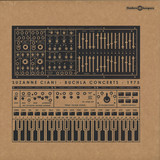
Finders Keepers invite you to witness the incredible first ever Buchla synthesiser concerts/demonstrations providing a distinctive feminine alternative to The Silver Apples Of The Moon if they had ever been presented in phonographic form. This is history in the remaking.
This spring Finders Keepers Records are proud to release an archival project that not only redefines musical history but boasts genuine claim to the overused buzzwords such as pioneering, maverick, experimental, groundbreaking and esoteric, while questioning social politics and the evolution of music technology as we've come to understand it. To describe this records as a game-changer is an understatement. This record represents a musical revolution, a scientific benchmark and a trophy in the cabinet of counter culture creativity. This record is a triumphant yardstick in the synthesiser space race and the untold story of the first woman on the proverbial moon. While pondering the early accolades of this record it's daunting to learn that this record was in fact not a record at all... It was a manifesto and a gateway to a new world, that somehow never quite opened. If the unfamiliar, modernistic, melodic, pulses, tones and harmonics found on this 1975 live presentation/grant application/educational demonstration had been placed in a phonographic context alongside the promoted work of Morton Subotnick, Walter Carlos or Tomita then the name Suzanne Ciani and her influence would have already radically changed the shape, sound and gender of our record collections. Hopefully there is still chance.
In short, Suzanne was a self-imposed twenty-year-old employee of the Buchla modular synthesiser company, San Francisco's neck and neck contender to New York's Moog. Buchla was run by a community of festival freaks and academic acid eaters whose roots in new age lifestyles and the reinvention of art and music replaced the business acumen enjoyed by its likeminded East Coasters. In the eyes of the consumer the creative refusal to adopt rudimentary facets like a piano keyboard controller rendered the Buchla synthesiser the more obscure stubborn sister of the synth marathon, steering these incredible units away from the mainstream into the homes and studios of free music aficionados, art house composers and die-hard revolutionaries. Championed and semi-showcased by composer Morton Subotnick on his albums The Bull and Silver Apples Of The Moon, Buchla's versatility began to open the minds of a new generation, but the high-end design features and no-compromise modus operandi was often confused with incompatibility and, in the pulsating shadow of Moog's marketing, the revolution would not be televised nor patronised. Suzanne Ciani, as one of the very few female composers on the frontline (and also providing the back line) did not lose faith.
These concerts' are the epitome of rare music technology historic documents, performed by a real musician whose skills and academic education in classical composition already outweighed her male synthesiser contemporaries of twice her age. At the very start of her fragile career these recordings are nothing short of sacrificial ode to her mentor and machine, sonic pickets of the revolution and love letters to an absolutely genuine vision of and 'alternative' musical future. In denouncing her own precocious polymathmatic past in a bid to persuade the world to sing from a new hymn sheet, Suzanne Ciani created a bi-product of never before heard music that would render the pigeon holes ambient' and futuristic' utterly inadequate. Providing nothing short of an entirely different feminine take on the experimental records' of Morton Subotnick and proving to a small, judgmental audience and jury the true versatility of one of the most radical and idiosyncratic musical instruments of the 20th century. These recordings have not been heard since then.
The importance of these genuinely lost pieces of electronic musics puzzle almost eclipses the glaring detail of Suzanne's gender as a distinct minority in an almost exclusively male dominated, faceless, coldly scientific landscape. Those familiar with Suzanne's work, a vast vault of previously unpublished non-records', will already know how the creative politics in her art of being' simultaneously reshaped the worlds of synth design, advertising and film composition before anyone had even dropped a stylus in her groove. Needless to say this record, finally commanding the archival format of choice, courtesy of the Ciani and Finders Keepers longstanding unison, was not the last first' with which this hugely important composer would gift society, and the future of a wide range of exciting evolving creative disciplines.
You have found a holy grail of electronic music and a female musical pioneer who was too proactive to take the trophies. With the light of Buchla and Ciani's initial flame Finders Keepers continues to take a torch through the vaults of this lesser-celebrated music legacy shining a beam on these non-records' that evaded the limelight for almost half a century. You can't write history when you are too busy making it. With fresh ink in the bottomless well, let's start at the beginning. Again. You, are invited!
To experience Justin R. Cruz Gallego's pulverizing Sub Pop debut is to get burned down to ashes and burst forth, born anew. Grim Iconic...(Sadistic Mantra), the Tacoma-based artist's second album, is driven by opposing forces: noisy abstractions and tightly structured beats, anguish and dissolution at the outside world and empowerment within, apathy and catharsis. Grim Iconic...(Sadistic Mantra) weds scouring electronics to hooky songs and Gallego's powerful drumming in a way that feels visceral and new. It's his most personal statement to date, at once playful and intent, driven and combustible, total fucking chaos mixed into glints of broken-glass beauty. Born in Tucson, Arizona, Gallego experienced culture shock as a child after relocating to the frigid climes of the Pacific Northwest. He found solace in the Seattle punk scene centered around Iron Lung Records and has since remained a fixture in the underground community. "I see this record as first and foremost a musical statement," Gallego says. "I grew up in punk and DIY subcultures, but before that I had Latin music playing in the background through my childhood and every phase of adolescence. It was surprisingly natural to incorporate. I realized I wanted to go deeper into these rhythms. I wanted to make a record that felt as experimental as much as it felt from the perspective of a Latino. When I got a glimmer of that possibility, it felt exciting." Lead single "Dogear" is a face-melting party starter that sounds like someone forced Talking Heads and Rudimentary Peni to share a practice space. "I wanted a song that felt playful in the way it attempted to be dissonant without taking itself too seriously," Gallego says. "Cholla Beat" is even more ambitious, an anthemic mix of WAR and Wire led by unruly synthesizers spiraling down a labyrinth of production. Gallego's influences for the album are vast, ranging from British documentary filmmaker Adam Curtis to electric Miles Davis to audio miscreants like Demdike Stare and Oneohtrix Point Never. But it's Gallego's assured sonic vision that resounds the loudest. And, while J.R.C.G. is a solo project, conceived and executed primarily in Gallego's home studio, he found strength in opening the project to others, starting with Seth Manchester as co-producer. Manchester's penchant for bone-rattling frequencies, as seen in his production work with The Body, Battles, and Mdou Moctar, made him a natural fit for Gallego. Together, they retained the intimacy of Gallego's home recordings while taking advantage of the hi-fi stylings of his Machines With Magnets Studio in Rhode Island. The closing song, "World i," offers a glimpse into the live experience of Grim Iconic...(Sadistic Mantra), with upwards of seven band members blasting off. The album features a fascinating mix of supporting players, many of whom cycle through J.R.C.G.'s live lineup: Morgan Henderson (The Blood Brothers, Fleet Foxes), Jason Clackley (Dreamdecay, The Exquisites), Jon Scheid (Dreamdecay, U Sco), Erica Miller (Casual Hex, Big Bite), Veronica Dye (Terminator) Phil Cleary (U Sco), and Alex Gaziano (Dreamdecay, Kidcrash, Science Amplification). Taken as a whole, G.I.S.M. is a whirlwind of sound, pummeling, and cleansing. It's a sweaty, thrilling aural adventure and, like a great basement show, it'll leave you breathless, exhausted, and wanting to repeat it all over again. As any good mantra should.
Marking its first decade of activity, Blume returns with the first ever vinyl reissue of the seminal “New Music for Electronic and Recorded Media”, from 1977, the third and final instalment in a suite of releases that includes James Tenney’s “Postal Pieces” and Ben Vida’s “Vocal Trio”. Unquestionably among the most important collections of experimental music to emerge during the 20th Century, “New Music for Electronic and Recorded Media” is the original feminist presentation in its context, releasing the work of Johanna M. Beyer, Annea Lockwood, Pauline Oliveros, Laurie Spiegel, Megan Roberts, Ruth Anderson, and Laurie Anderson under its collective banner. Includes newly commissioned liner notes by Jennifer Lucy Allen and Bradford Bailey.
Since its founding back in 2014, Blume has carved a unique place in cultural landscape, issuing free standing works, spanning the historical and contemporary, that represent singular gestures of creativity within the field of experimental sound. Joining their broad efforts in building networks of context and understanding that already includes the efforts of efforts of Werner Durand, Sarah Hennies, Bruce Nauman, John Butcher, Jocy de Oliveira, Mary Jane Leach, Valentina Magaletti, Alvin Curran, Julius Eastman, Alvin Lucier, and others, Blume delivers their third release in their first suite of releases for 2024, the fist ever vinyl reissue of the seminal “New Music for Electronic and Recorded Media” compilation, originally issued by Thomas Buckner's 1750 Arch Records in 1977. Out of print for decades on vinyl and arguably the most important feminist statement in the history of experimental music, illuminating the work of Johanna M. Beyer, Annea Lockwood, Pauline Oliveros, Laurie Spiegel, Megan Robert, Ruth Anderson, and Laurie Anderson - in a number of cases representing their recording debuts - during a crucial moment in the history of experimental music. Blume’s brand new edition - complete with newly commissioned liner notes by Jennifer Lucy Allen and Bradford Bailey, as well as reproducing Charles Amirkhanian’s original accompanying text - radically shifts perceptions of the past and present day with its truly revolutionary sounds.
Issued by Thomas Buckner's 1750 Arch Records in 1977, and out of print nearly the entire time since, “New Music for Electronic and Recorded Media” can be understood within two simple frameworks. On one hand, it is an astounding document of the landscape of experimental music toward the end of the 1970s. On the other, it is a historically significant feminist statement, being the first collection of experimental music entirely dedicated to female composers, a number of whom were grossly under-celebrated at the time, but have since gone on to be regarded as among the most important composers of their generation.
The eight pieces gathered by “New Music for Electronic and Recorded Media” - Johanna M. Beyer’s “Music of the Spheres”, Annea Lockwood’s “World Rhythms”, Pauline Oliveros’ “Bye Bye Butterfly”, Laurie Spiegel’s “Appalachian Grove I”, Megan Roberts’ “I Could Sit Here All Day”, Ruth Anderson’s “Points”, and Laurie Anderson’s “New York Social Life” and “Time To Go (For Diego)” - might be regarded as the first cohesive vision of alternate proximity or expression of experimental music to what has always been a frustratingly male dominated environment, and to the tropes, temperaments, and sensibilities that have been historically perceived to define it. It is an expanded vision of truth. While the presence of feminine sensibilities and temperaments in experimental music, however they may present themselves, were anything but new in 1977, “New Music for Electronic and Recorded Media” was the first opportunity, beyond the temporal limitations of live performance, to view them collectively, rather than as individualised expressions within a larger body of similar gestures (as was the case of Oliveros’ inclusion in Odyssey’s 1967 “New Sounds In Electronic Music” and “Extended Voices” compilations) where they might be confused for something else; to regard and celebrate a radical notion of feminine sonority for its unique characteristics and through its interrelations.
While its historical significance and groundbreaking nature can not be debated in its totality, nearly half a century on “New Music for Electronic and Recorded Media” remains compelling in both its musicality and the palpable sense of its lasting influence. Every composition across the album’s two sides is not only engrossing and deeply compelling - feeling as fresh and relevant as the day it was laid to tape - but clearly tangible in their lasting influence. Viewed in context, the album’s eight works feel like breath of fresh air when compared to much of what came before, and laid the groundwork for much of what was to come, introducing a new, often more holistic temperament and more sensitive and inclusive sensibility into the landscape of experimental music.
Particularly in the case of Annea Lockwood, Pauline Oliveros, Laurie Spiegel, Ruth Anderson, and Laurie Anderson, it's hard to throw ourselves back in time and imagine a moment when these composers rested in a fairly marginalised corner of the creative landscape. Blume’s brand new edition of “New Music for Electronic and Recorded Media” - complete with newly commissioned liner notes by Jennifer Lucy Allen and Bradford Bailey, as well as reproducing Charles Amirkhanian’s original accompanying text - brings us back to this confounding moment and points us toward a crucial moment of change set forth by these incredible composers and their sounds. Absolutely seminal and not to be missed.
First official vinyl reissue under Sonor music production license - numbered to 500 copies.
Outstanding Italian Library session from the desirable Nike private label owned by Bruno Battisti D'Amario and featuring the great Silvano Chimenti on guitars and Edda Dell'Orso scats. Amazing, refined Score music released for TV and documentaries music production with superb loungy and soft sounds inspired by Western landscapes and natural panorama. Moody and bluesy jam with a mixture of various guitar tones, trippy atmospheres and themed descriptive music with addiction of soft Psychedelic moods, Easy Listening and allegro vibes alternated by sweet melodies. The cult maestro and Morricone's collaborator D'Amario here provides one of his highest masterwork in composition with its classical guitar added by Chimenti's Psychedelic notes and some mindmelting Edda Dell'Orso's scat numbers. Several exquisite Spaghetti Western inspired themes, maybe used as original score for obscure movie in the '70s / ethereal LSD Psychedelic vibes with isolated distorted Wah Wah / Lounge moods throughout with nature inspired themes / Folk & Blues influences / trippy Scat vocals / 70s Easy Listening and panoramic descriptive music for a very complete Library session. Great album!
Experimental black metal from Brooklyn featuring members of Pyrrhon, Krallice, Sigur Rós, The Glen Branca Ensemble, Steve Reich. Recorded by Colin Marston (Dysrhythmia, Krallice, Liturgy). Follow-up to the bands well received 2022 debut Aveilut. The Promise Of Rain, the sophomore album of the experimental black metal band Scarcity, is an embodiment of the hard-to-believe truth that burdens are easier to bear when distributed, a realization Brendon Randall-Myers (conductor of the Glenn Branca Ensemble) grappled with extensively while writing this record. This is a sweat-drenched album about dispersion, about spreading, about the collective relieving of burdens through shared experience: one doesn’t have to go through everything alone. When Scarcity’s debut album Aveilut was written in early 2020, Randall-Myers and vocalist Doug Moore (Pyrrhon, Weeping Sores, Glorious Depravity, and Seputus) never expected to be able to play their songs live. The cathartic experience of playing something that came from a place of isolation out to people in a live setting is the root of the intensity in The Promise Of Rain. The Promise Of Rain begins where the craziest climaxes of Aveilut end, and is the first Scarcity record to include Tristan Kasten-Krause (Sigur Ros, Steve Reich, LEYA) on bass, Dylan Dilella (Pyrrhon) on guitar and Lev Weinstein (Krallice) on drums. Rather than building density with the quasi-orchestral layering on Aveilut, Scarcity challenged themselves to document what five people in a room could do, recording most of The Promise Of Rain in one or two takes, capturing the physical effort and urgency of a live performance. Scarcity forges a completely fresh sound in The Promise Of Rain with their alarming guitar work and melodic arpeggiating, shedding dead skin and breaking ground with sheer vulnerability. The lyrics for The Promise Of Rain were inspired by a trip Moore took to the high deserts of southern Utah in 2023. “To thrive in the desert is an act of abnegation—” he observes, “you do right by the land and receive its gifts, or it does away with you.” The necessity of adaptation is as evident in the desert as it is to the landscape of the human experience. The transformation of ideas and beliefs, the grief of losing relationships that had to end, and the fear involved in forming new ones under the grip of mental illness is conjured over and over again on this panoramic album.
On their second album, Winter Pageant, The Softies move forward with focused delight. It's the combination of Jen Sbragia (All Girl Summer Fun Band) and Rose Melberg (Tiger Trap, Gaze, Go Sailor) that molds The Softies' panoply: feathers and thorns, fawn and fearless, fable and friction. Originally released in 1997, Winter Pageant is the drama of utter melancholia documenting the broken promises, missed phone calls, conversations stalled, love lost. Colossal tasks recorded two guitars deep, forming a new Iliad, chapters on brave deeds and the power of love on the move. You can live for love, or you could live for the splendid cascade of guitar on guitar, voice over voice: The Softies. Winter Pageant was recorded by Stuart Hallerman (Soundgarden, KARP) at his Avast! recording studio in Seattle, Washington.
SHHE, Scottish-Portuguese sound artist and producer Su Shaw, is releasing new mini-album, ‘DÝRA’, on July 19th via One Little Independent Records. The ambient project took form during a self-directed artist residency in the Westfjords of Iceland, influenced by the tranquillity of the Dýrafjörður fjord. Immersed in a distinct landscape with quietly monumental surroundings, Shaw began documenting her experience of the environment through field recordings and environmental data captured across several geographical locations.
‘DÝRA’ is an exploratory and mesmerising durational piece, evocative in its construction, inviting listeners to imagine their own space and scale within a landscape. Reflective, textured, and pensive, with expansive synths that further showcase Shaw’s deftness in sculpting immersive and introspective soundscapes.
Dýrafjörður is a 32-kilometre-long fjord in the Ísafjarðarbær municipality, in the Westfjords of Iceland. Shaw originally embarked on a 10-day residency in 2018, during which the village experienced an immense storm, hindering her schedule. Shaw explains, “It was my first visit to Iceland, and I’d made myself a meticulous itinerary in advance, which included recording at the summit of some of the peaks in the fjord. When the storm arrived after only a few days, it made any kind of travel challenging – so partly out of necessity to be able to continue developing the project, I began recording my immediate surroundings instead – attuned to incidental sounds from around the village and fluctuating weather states – and I quickly built up an archive of the environment”.
Over atmospheric instrumentation expanded by cinematic structure and pacing, Pearlty presents Knifeplay somewhere between dream-pop influenced shoegaze and lofty slowcore, never fully committing to one or the other in its insistence on creating an immersive, organic world.
Originally released in 2019, Knifeplay’s vivid debut Pearlty documents songwriter Tj Strohmer’s expressions of early adulthood in what he describes as “the journey from innocence to experience.”
Written during a time of immense inspiration, Strohmer was able to peel himself away from detached nihilism, uncovering the physicality and therapeutic powers of songwriting. Newly emboldened by this discovery and the talented community surrounding him, Strohmer channeled this revelation into his work, taking Knifeplay from a bedroom experiment that merely wrote songs to a more substantial project with a purpose.
500 only pressed. 80s alt country punk outfit, Lone Justice, with Maria McKee, Ryan Hedgecock, Marvin Etzioni and Don Heffington are in full flight with the release of a brand new 7”. Taken from their forthcoming album, Viva Lone Justice, ‘Teenage Kicks’ is a rambunctious slice of punk angst that sounds like it was recorded in one take. It’s a timeless anthem with a joyous riff that explodes into a hail of feedback. A favour returned as Maria McKee, the songwriter of Feargal Sharkey’s only solo hit ‘A Good Heart’, Lone Justice cover The Undertones’ Peel-approved favourite with the artwork of the single being a nod to the original. “As much as we loved Merle Haggard, George Jones, and many other authentic hard core Country artists, we were also deeply impacted by Punk; from the Velvet Underground (we were playing "Sweet Jane" live as early as 1983) to the MC5 ("Sister Ann" is on the album "Viva Lone Justice").” Backed with ‘Nothing Can Stop My Loving You’ that’s cut with a wild, squeezebox-powered interpretation of the George Jones and Roger Miller country stomp. “Speaking of George Jones, here's one written by George Jones and Roger Miller. Two of our favorites! We played this song at nearly every show starting in 1983. This ragged and right live recording captures the fire from a sold out show at The Palace in Los Angeles and features Jo-El Sonnier on lead accordion documenting the only time Sonnier played with LJ. "Nothing Can Stop My Loving You" is the only live track on Viva Lone Justice." // “A roots rock band that took Los Angeles by storm in the 80s and developed a smaller but deeply enthusiastic following outside the Golden State.
Repress.
Welcome to “Through Lines”, a collection of hand picked tracks by genre nomad and bass innovator Martyn, made between 2005 and 2015, carefully recovered and remastered for vinyl and digital release on 3024. Previously only available on 12” across a scattering of different labels, this set includes essential ‘Martyn Music’ (as the producer likes to classify it); tracks like “Vancouver” (A 140 staple to this day), “Mega Drive Generation” and his classic remix of TRG’s “Broken Heart”, as well as deeper cuts like the rare “Friedrichstrasse” and house gem “For Lost Relatives”.
This is not just a compilation of remastered music, it’s a document of an era of UK inspired dance music where ideas, genres, tempos and scenes seemed to rapidly merge and splinter off. An exciting time where producers constantly tried to one-up each other with new ideas and influences, in a vibrant international scene of small club nights from FWD>> and DMZ in London to Red Zone (co-run by Martyn) in the periphery, the earliest online forums like Dubstepforum and radio shows like Dj Flight’s BBC 1xtra show and Mary Anne Hobbs’ Breezeblock. Innovation in music never happens in a vacuum and is always a product of community, producers, writers, and other makers continuously inspiring and pushing each other to come up with the next thing. This ethos is present in all of Martyn’s music throughout the years, but also in his work with Jeroen Erosie as 3024 and within the 3024 Mentoring Program he runs today.
- The Perils Of Believing In Round Squares
- Stop Flushing The Toilet
- Red, White, And You
- It S A (Half) Pipe Dream
- Intro To Photography
- The Ironic Assholism Of Hardy Jenns
- Radiation Blue
- I Hope You Don T Get The Joke
- Psycho 75
- Something To Guac About
- The Half Eaten Sausage Would Like To See You In His Offic
- The Hill Of Fool's Gold
- Warsaw
- Aotkpta
- No Poetry Needed
- Elephant In The Doom
- Mature Science
- Myddel Fyngir
- Old Age Lasts Too Long
- Mind Meld
- Zz Stop
- Rasquache
- Come Bogeyman
Enjoy The Ride Records proudly presents the Don't Fall In Love With Yourself Soundtrack.
Don't Fall in Love with Yourself is a documentary that explores the life of enigmatic musician and artist, Justin Pearson (The Locust, Swing Kids, Dead Cross, Planet B, Head Wound City, Deaf Club). From childhood tragedy to his rise in the San Diego punk scene, Don't Fall in Love with Yourself takes an in-depth look at a career made of blood, sweat, and spit.
Much of the footage has been sourced from dozens of VHS & Mini-DV tapes recorded over the past three decades. With never-before-seen footage of one of the most interesting and unique musical movements in recent memory. Interviews include Justin Pearson, Dave Lombardo, Eric Paul, Gabe Serbian, Jason Pettigrew, Travis Ryan, Jeremy Bolm, Jon Syverson, Molly Neuman, and more.
Don't Fall in Love with Yourself includes tracks from throughout Justin Pearson's career plus previously unreleased score music by Luke Hensgaw (Planet B), Alex Edkins (Metz) and Graham Walsh (Holy Fuck). It features music by The Locust, Swing Kids, Struggle, Crimson Curse, Retox, Planet B, and Justin Pearson/Gabe Serbian. Remastered by Dave Marino for vinyl.
Don't Fall in Love with Yourself is housed in an embossed silver foil laminated jacket, which includes a full-color double-sided insert.
- A1: Boyfriend
- A2: Uma
- A3: No 1 Fan
- A4: Brand
- A5: Purr (Interlude)
- A6: Seles
- B1: Grow
- B2: Pretty Head (Interlude)
- B3: Cicciolina
- B4: Penny For Love
- B5: Skin (Interlude)
- B6: Feigned Sleep
- B7: Horse
- C1: No 1 Fan (Ep Version)
- C2: Worri
- C3: Horse (Ep Version)
- C4: Sunny Pie
- C5: Cicciolina (Single Version)
- D1: Purr (Davies 7" Version)
- D2: Space Between Your Moles
- D3: Seine
- D4: If Jfa Were Still Together
- D5: Ghost Of Fun
Milky Clear Vinyl[35,71 €]
Driven by lust-fueled limerence and drifting far from conformity, Butterflies Don't Go Away captures Majesty Crush's transient, yet subversive mark on the landscape of American shoegaze to come. Tracked between 1991-1995, the quartet reimagined the collapse of the American rust belt as a late-night, nail biting fever dream/revenge fantasy. This deluxe 2xLP compiles their Love 15 album, singles, EPs, and rarities, all remastered from the original tapes, with thorough annotation and visual documentation in a 24-page booklet. An immortal transcendence if there ever was one.
- Roland Alphonso - Live Desire (Trombone Version)
- The Skatalites - Live Wire
- Lynn Taitt - Ska-Ta-Shot (Take 2)
- Roland Alphonso - Step Down (Low Riff)
- Jackie Mittoo - Warlock
- Roland Alphonso - Determination (Take 2)
- Roland Alphonso - Determination (Take 5)
- Don Drummond - Love In The Afternoon
- Roland Alphonso - El Cid (Take 4)
- Johnny Moore - Red Is Danger (Take 3)
- Roland Alphonso - V.c.10 (Take 3)
- Johnny Moore - Yogi Man (Take 1)
- Roland Alphonso - Tough Talk (Take 1)
- Roland Alphonso - Tough Talk (Take 4)
“On August 5th 1962, after 300 years of British rule, which had soaked the earth of the island in blood, Jamaica was finally independent. The country that the British left behind was certainly a place of widespread poverty and deep inequality, but there seems to have been a real burst of confidence that came with independence. Newsreels of the day show well-dressed crowds reacting with enthusiasm and excitement, and the era found its perfect soundtrack in the boldness and exuberance of ska music, which was erupting all over the island.
This optimistic mood found probably its greatest artistic expression in the music of the Skatalites, who formed in June 1964 as a kind of Jamaican supergroup. Philip “Justin” Yap was a young, upcoming producer who had used members of the Skatalites for his first tunes, recorded either at RJR (Radio Jamaica and Redifussion) or at Federal studios. As Steve Barrow documented in the sleevenotes for Pressure Sounds’ reissue of the classic “Ska-Boo-Da-Ba” album, Justin had also befriended Clement “Coxsone” Dodd, and when Coxsone opened his own Studio One facility in December 1963, Justin immediately switched most of his production work to this new recording room. Studio One opened just in time to catch the formation of the Skatalites, and is where Justin recorded most of his classic Skatalites sides. He also recorded lots of excellent instrumentals with a smaller brass section, still mainly using members of the Skatalites, but crediting instead the composer or arranger of the tune. Combined with Coxsone’s own recordings, these productions for Justin’s Top Deck and Tuneico labels really captured the members of the Skatalites at their magnificent best in the unique atmosphere of Studio One.”
Fourteen new and previously unreleased tracks from some of the most exciting current bands from Seattle, Washington's vibrant alternative-rock underworld.
Continuing in the spirit of regional compilation albums like 1988's Sub Pop 200, "From Far It All Seems Small" serves as a snapshot of the contemporary Seattle scene.
"From Far It All Seems Small" jumps off the speakers with an onslaught of fuzz and an abundance of hooks. You might find yourself flipping the sleeve over, expecting to see a release date from the 1990's, but no, these are Seattle's finest here and now! - Jackson Long (KEXP, HMS Studio)
A wonderful document of the current moment of Seattle indie. - Ole Johnson (Painter Man Records)
A collection of songs that will get stuck in your head by Seattle's best alt-rockers. - Ellen Rumel (PNW music photographer)"
The long running vessel for Cameron Stallones' psychedelic excursions, Sun Araw, returns to Discrepant after last year's split with Tarzana via Keroxen sister label (KRXN033).
Without much precedent in his own - already wide-ranging - back-catalog, 'Cetacean Sensation' discards the dubby vibes, psych-rock sunburnt jams, tropical visions, or stalking sensibilities of such classic efforts as 'On Patrol' or 'Ancient Romans' towards a deeply focused and vivid solitary approach, while still retaining this Sun Araw blissed out escapist feeling.
Composed of hydrophone recordings of whales and dolphins sourced during a summer in Galicia, 'Cetacean Sensation' paints an impressionistic and sensory floating canvas that expertly escapes both academic-like documentarian purposes and any new-age spa vibrations one could associate with such subject matter. Processing those raw recordings into alluring collages that flow gracefully between moments of clear eco-location and submerged impressions of wildlife social dynamics. By the third track - Dance of the Minke - we're introduced to this ringing MIDI tone that evokes a CD-ROM era of mystic educational programs and click-and-deploy strategies that still feel very much like an unfulfilled future, conjured again by 'Spider Crab Elegy's sparse keyboard pads and sound effects that give way to this properly elegiac tentative melody. 'The Spider Crab Point' ends the album on a more uneasy vibe, with synth tones pointing towards no particular direction, confounding and strangely inviting at the same time. As sensations often do.
Music written and produced by Cameron Stallones using hydrophones and digital synthesisRecorded in 2019 in Galicia, ES
Mastering by Rashad Becker
10-piece UK afro-fusion outfit TC & The Groove Family are proud to share their new EP ‘We Have Each Other’. Releasing on Friday 7th June via Bridge The Gap, the project sees the band refine the sound debuted on their 2022 album ‘First Home’. Returning to work once again with producer Tom Excell (Nubiyan Twist, ONIPA), the project explores a darker sonic palette, channelling a deep appreciation of UK bass and electronic music alongside afro-jazz sounds and hip-hop sensibilities.
The record documents a time of change within the group - a new lineup, plus members living in different cities and pursuing various paths - whilst also reflecting the turbulent socio-political climate, and the major shifts and changes on the horizon for humanity. However, despite the heavy subject material, the band strike an optimistic, uplifting tone, with MC Franz Von channeling the music into a message encouraging listeners to look around and embrace
community, whatever that may look like. Bandleader Tim Cook shares:
“Our collective purpose is to craft music that empowers and energises individuals to embrace their true selves with pride, celebrating the unity and strength we radiate as one community. No one needs to be alone when they are striving for common humanity. No one should be lonely when we celebrate each other, drawn together by a sound that says it’s good to be me, it’s better to be us. As our MC, Franz Von says, music brings peace, love & energy”.
Opener and lead single ‘Stand Strong’ is a love letter to afrobeat, creating a contemporary twist with its Khruangbin-esque guitar lines and weaving horns, whilst ‘Here, Now’ takes the tempo down to an atmospheric haze of dubbed-out ambient effects, pierced by uplifting horn melodies. ‘Blessed’ sees the group welcome Nubiyan Twist’s Aziza Jaye for a dancehall-meets-North African-flavoured feature, subtly reimagining what Elephunk era Black Eyed Peas would
sound like today.
At the EP’s centre-point and emotional peak, title track ‘We Have Each Other’ showcases the band’s jazz fusion, Latin and dark electronic influences. The tracks growling, subbed-out bass tones return as a theme for ‘Wile Out’ - a UK hip-hop & jungle tinged collaboration with SANITY complete with virtuosic, tight-knit grooves, furious horn lines and a whirlwind of immersive turntablism.
Originally formed in Leeds, TC & The Groove Family’s sound reflects the diverse musical and cultural backgrounds at the core of the project, with songs exploring grooves and genres including afrobeat, broken beat, jungle, jazz and grime. Their music has drawn widespread acclaim, supported by tastemakers including Jamz Supernova and Craig Charles on BBC Radio 6, BBC Introducing West Yorkshire, Jazz FM, Rinse FM, Radio FIP and more. The group have performed at the likes of Glastonbury, We Out Here, Greenman and Boomtown, and will embark on a UK tour across May & June in support of the release of ‘We Have Each Other’.
The seductive sounds of Portugal swing to Dark Entries on Rock Rendez Vous: Música Moderna Portuguesa 1985-1986, a compilation of vintage Iberian synth, wave, and postpunk gems.
The legendary club Rock Rendez Vous (RRV) opened its doors in Lisbon in 1980, heralding a new era in the Portuguese underground. Although touring acts like Killing Joke, Danse Society, or Echo & the Bunnymen graced its stage, RRV more vitally served as ground zero for a new generation of Portuguese bands, one simultaneously in touch with broader international musical movements while being invested in establishing a national sonic identity. Rock Rendez Vous culls 9 tracks of prime Portuguese indie tunes from the Música Moderna Portuguesa compilations released in 1985 and 1986, documenting the heyday of this movement. Jangly and brooding postpunk gems like “Levante” from Jovem Guarda, Projecto Azul’s “New Sides,” and Essa Entente’s “Festa Final” are well-represented here. Meanwhile, quirky Balearic-laced synthpop gems like D. W. Art’s “Mate” or Zona Proibida’s “Musak” add a subtly regional flare. Rock Rendez Vous: Música Moderna Portuguesa comes housed in a sleeve designed by Eloise Leigh featuring a photo of the club RRV, and also includes a double-sided insert with lyrics, photos, and liner notes.
Jacken Elswyth is a London-based folk musician, banjo player, and instrument builder. At Fargrounds is her third solo album, her first for the Wrong Speed label and the latest in a rich catalogue that repositions the spectral, vulnerable sound of the banjo away from its familiar role as signifier of the past and onto lands brave, new and unexplored. “The living wood is imbued with qualities that require engagement and understanding. Working with cherry, oak or walnut involves naming it an equal partner. The parallel, synchronous transformations of wood into instrument, of growing tree into resonating sound, musical tradition into musical flourishing, lie at the heart of Jacken Elswyth’s practices both as an instrument builder and as a creative musician. One might consider her primarily as a worker in wood, but whose craft and fields of expression are absorbed by those transitional and interim processes that manifest change. The traditional tunes included here have been cultivated and maintained by generations of players and collectors, pruned, grafted, and shaped over time. However, in this setting, their long-established forms seem to morph and shift. They audibly accrue unique qualities, blossoming and swelling into new modes of being, bright-stepping arrangements unfolding with a liveliness hinting at practices of ritual and community. Meanwhile, other pieces, creative cornerstones of this collection, appear fluid, partially formed. They suggest not the cultivation of new growth from established stock, but instead the actions of something on the verge of taking form. Working with raw elements of melodic and tonal abstraction, they illuminate the process of emergence and evolution. In this context, the title At Fargrounds is telling. It suggests a point set at some distance from any centre of human concerns, a liminal space in which the cultivated world encounters the world of other living things in their living state. Here, the innate strangeness of the maintained environment–vast lawns, sculpted hedges, vacant playing fields–encounters sprawling vistas of driftwood, dense thickets of brambles, stony hillsides. Across a full century-and-a-quarter, long-standing rural and pastoral musical traditions, at some distance from their origins, have been preserved, nurtured and re-shaped under the folk revival. Placed here, these artefacts now sit in alignment with unvarnished documents featuring the raw elements of sound-making. Their working-together is achieved through a universally-applied interest in musical growth and development. The juxtaposition and combination of these elements gives evidence of new, emerging approaches to community and social music: familiar, known, yet charged with an alien vitality”–CWK Joynes. “...she knows how to knit atmospheres, and does so to especially powerful effect during Scene 4b’s three minutes of stunning bowed banjo, yearning with longing and dread, while showing off her talent, curiosity and range”–Jude Rogers review of Six Static Scenes (Guardian Folk Album Of The Month July 2022) "Jacken is an emotive player with high technical ability. Further, she builds banjos and other instruments, and that intimate knowledge of the bones and fibres holding everything together means that her playing has very few cracks" - Foxy Digitalis
The wait is over: With the 14th June release of One Hand Clapping, one of the most bootlegged live albums in musical history will finally receive a proper release. In August 1974, when Band on the Run was enjoying a seven-week consecutive #1 stint at the top of the UK album charts, Paul McCartney and Wings headed to Abbey Road Studios for the filming of a video documentary and possible live studio album – One Hand Clapping. Despite overwhelming demand for newly recorded material from the biggest band in the world at that time, One Hand Clapping was never officially released. 2LP- 50 years after their initial recording, the sessions for Wings One Hand Clapping will be released for the very first time. Discs 1 and 2 are newly mixed with 12 tracks that didn’t appear in the original film, including reworked extracts of Beatles classics. The package includes original artwork, plus a TV sales brochure created for the film.
- A1: Ten City - Devotion (Club Mix)
- A2: Marshall Jefferson Presents Truth - Open Our Eyes (Celestial Mix)
- B1: Marshall Jefferson Vs. Noosa Heads - Mushrooms (Salt City Orchestra Out There Mix)
- B2: Jungle Wonz - Time Marches On (Re Vision)
- C1: Cece Rogers - Someday (Club Mix)
- C2: Hercules - 7 Ways (Vocal)
- D1: Sterling Void & Paris Brightledge - It's Alright (House Mix)
- D2: Sleezy D. - I've Lost Control (Re Vision)
Defected welcomes one of Chicago house’s founding fathers Marshall Jefferson into the illustrious list of House Masters with this exclusive wax release. An artist that has successfully navigated major cross-over success while retaining utmost respect from the inner circle of electronic music’s underground, Marshall has been behind countless seminal records over his five-decade career. Now a selection of the very best tracks from his new House Masters compilation appear together on vinyl for the very first time, showcasing the impressive output of this house pioneer from his most well-known solo records, to major production credits, key remixes and the underground gems still favoured by selectors today.
Cutting his teeth as a producer for Chicago’s Universal Recording Studios, Marshall was one of the most active DJ and producers on the Windy City’s music scene during the 1980’s house music boom. Working under a plethora of aliases such as Virgo, Jungle Wonz, Truth and On The House, as well as producing for names such as CeCe Rogers, Curtis McClain and Evelyn "Champagne" King, Marshall’s status as a bona fide house music luminary is well documented.
‘Defected presents House Masters - Marshall Jefferson’ is an all-encompassing guide to his tremendous career. A trailblazer and genre-defining artist, Defected is honoured to welcome Marshall into the House Masters Hall of Fame with this very special vinyl compilation.
Principal member Keith Finch linked up with reggae manager and publisher Othman Mukhlis at Stanley House Studio in 2001 and began a series of projects featuring there love of retro reggae. JA13 worked with major reggae stars of the sixties on the ‘Heroes of Kingston’ project, Alton Ellis, Derrick Morgan, Dave Barker Dave and Ansell Collins Winston ‘Mr Fixit’ Francis, Denis Alcapone, Owen Grey, BB Seaton Gaylads and legendary trombonist Rico Rodriguez. [Which lead to two solo albums with Rico Rodriguez]. Project championed by David Rodigan and Ranking Miss P. Music in films and TV including Hawaii 5-0, various US films, BA, Tesco, various BBC, latest and currently they have many tracks on BBC most successful export ‘Death in Paradise’. They also feature two tracks in the forthcoming Shaggy documentary Other reggae artists projects include Bob Andy, Joseph Cotton, General Saint and Clint Eastwood, Don Campbell, J C Lodge, Susan Cadogan, Glen Adams [Upsetters] Pat Rhoden [first artist on Trojan] Tippe Irie, Tenor Fly, Spanna Banner, FYA [Platinum in Japan], Bounty Killer, Elephant man, and many more on ‘Bar Mitzvah riddim’ which was co written and produced with Skatta Burrell. Written for UK pop reggae band Madness on last two albums, and on the project ‘Charge of the Dance Brigade’ with Lee Thompson [Madness] and Jennie Matthias Belle stars singer] with Brazilian jazz accordionist/pianist Chico Chagas. And a host of other top musicians. [Which he co wrote, produced, engineered and nurtured] JA13 have featured on many reggae projects and remixes, the latest offering is ‘World Radio Dub – Chapter One’
The Telescopes Radio Sessions collects together the essence of three live session recordings in 3 different countries over a three year period between 2016-2019. This is the third in a series of radio session releases from Tapete Records that have so far included The Monochrome Set and Comet Gain. More session releases are being lined up for the rest of the year and beyond - enjoy the sonics and stay tuned. Over the years I have read a lot on people’s impressions of The Telescopes. Some folk think it’s a collective, others imagine it used to be a band and feel nostalgia towards what they consider to be the original line-up (even though many had come before, during and since) and some people refer to it as currently a solo career. In a way this is all true and none of it is. When faced with these kind of questions, along with questions about the style of music that The Telescopes make I often say The Telescopes house has many rooms, which explains things perfectly for me but for people on the outside looking in it only serves to increase their confusion. For me, confusion isn’t such a bad thing. Everything is born into confusion, the sense we try and make of that chaos is interesting and excites me. The universe often disorientates, it sends me a jumble of thoughts and impressions coupled with a feeling of something I need to express… if I could only decipher the encryption. This is how The Telescopes music comes to be and it is also how The Telescopes came to me. I regard The Telescopes as an entity of it’s own that introduced itself in my darkest hour and I was chosen as its vessel. From the second it arrived I was obsessed to the point where there was nothing else. A bit like having an imaginary friend. As the obsession grew it began to infect others, everybody loved my imaginary friend and wanted a piece of it. As its success grew however, so did the corruption, until one day the entity fell silent. The silence lasted for years, I tried everything to reconnect but it was having none of it. I had been a bad caretaker, I had let the house become infested and I had lost my way. This epiphany served to remind me of simpler times when anything felt possible with this entity by my side. It had trusted me with something so simplistically profound and I had let it down. The realisation of this was a eureka moment. I am not The Telescopes, I never was and never will be, I am the caretaker, the lighthouse keeper and if a job is worth doing it is worth doing well. With this dawning, I felt a crack open up in the cosmic egg and a familiar confusion in my head. The entity had returned. It was time to start untangling its tangled threads once more, to make sense of what it was saying, this time without corruption. It’s all about listening. I listen to what my cosmic friend sends me and channel this expression into what you hear through your speakers. It may take one person to achieve this, it may take more. There is no set line up or instrumentation that can hold The Telescopes. Whatever it takes to hit the zone, whatever is available, absolute focus is imperative. Sometimes it takes sabotage to keep that line of vision intact, there is no room for preconceptions or complacency in making the music. The Telescopes music is the now
incarnate and a state of total being is necessary to achieve. From the outside looking in... again, it’s all about listening. What comes through your speakers is the only thing that matters. The music either reaches you or it doesn’t. Everything else may seem interesting or confusing but ultimately it is corruption. So if you’ve bought the record, read the sleeve notes and bought a ticket to see a live show, don’t be surprised if the line-up is or isn’t the same as the recording. The only thing that is for sure is that The Telescopes as an entity is speaking to you in its own voice in every scenario.
Of course the difference between albums and live shows is that you can play the record over and over again to the point where you know every line and every note that was played. Whereas with live events you are left with an impression that can only be replayed in your mind. It can be frustrating at times. When you are touring with a great line-up and feel like something exciting is happening, you want everyone to hear it, not just the people at the shows but the people that couldn’t make it on the night as well. There is no guarantee that there will be the same line-up at a live show as there is on the album. This is why live sessions are important, they document a side of things that is often fleeting. Here we have three sessions, all different people transmitting The Telescopes sound on each. Some are regulars, some dip in and out and some were just passing through. In each case The Telescopes chose them as their vessel and as the lighthouse keeper I did everything I could to help them on that journey while trying to be a good caretaker to the house of many rooms. The Telescopes have been invited in for many sessions over the years, the first two were for John Peel on BBC Radio 1. We also recorded a session for Marc Riley and Mark Radcliffe before their
celebrity when they had a show on BBC Radio Manchester. We could have compiled this album from those sessions, it was certainly considered but Tapete and myself believe this selection gives an exciting glimpse into that fleeting side of The Telescopes in a constant state of flux that is left mostly to myth and imagination. For those who listen to the records but have never had the chance to take in the live experience, welcome to the other side. For those that follow us live, here’s a little reminder and a keepsake. Infinite suns. Stephen Lawrie February 2024.
An’archives presents the latest album by Japanese free saxophonist and vocalist Harutaka Mochizuki, Doppelgänger ga boku wo. Since the early 2000s, Harutaka has quietly, yet steadily, released a string of solo and collaborative releases that have allowed multiple perspectives on one of the most singular voices in modern music. In collaboration, he seems to prefer the duo format, and digging through his discography, you’ll find releases where he pairs with Tomoyuki Aoki (of Up-Tight), Michel Henritzi, and Hideaki Kondo. But Harutaka’s solo performances, with their lyricism and physicality, are where the magic truly happens.
If earlier albums, like Solo Document 2004 (Bishop, 2005) and Pas (no label, 2014), were raw documentations of solo alto saxophone performances, in recent years, Harutaka’s solo albums have become more complex, more mystifying. Most significantly, they’ve become more personal; there are few musicians extant whose albums feel quite so much like diaristic interventions, and Harutaka’s music now is deeply moving in its intimacy. Developing that thread of revelation, Doppelgänger ga boku wo offers a still richer exploration of many facets of Harutaka’s artistry.
The two double-tracked alto saxophone performances here feel consummate, with Harutaka shadowing himself, exploring the possibilities of the multiple self: Doppelgänger is me, indeed. The playing here is rich with affect, but still exploratory, voiced with rigour and intent. Two short pieces for keyboard and voice (about Giacometti and Genêt, respectively) are fragile miniatures, with clusters of chords, and passing phrases, wrapping around Harutaka’s untutored but lovely singing.
The ‘karaoke’ performance that closes the album, of “Woman ‘W no higeki’ yori”, speaks to the iterative aspects of Harutaka’s music. A cover of the Hiroki Yakushimaru song, the theme to Shinichirō Sawai’s 1984 film W’s Tragedy, he’s returned to this song several times, and here, his delivery perfectly captures the spirit of what Michel Henritzi, in his typically beautiful liner notes, evocatively details as “one of those sad love songs that accompany lonely sake drinkers in smoky night bars, sharing their spleen.”
Gorgeous, human, heartrending - Doppelgänger ga boku wo is Harutaka Mochizuki in element and in spirit.
This album compiles a series of sound pieces produced by the Peruvian artist Teresa Burga (Iquitos, 1933 - Lima, 2021) during the 1970s. It includes works that were part of various artistic projects, mainly sound installations, as well as pieces commissioned to musicians and inspired by her work. This album thus embodies an approach to a sound universe that has accompanied Burga's very personal work, which has transcended the limits of the artistic medium and disciplines. In the last decade, Teresa Burga's work has been present in numerous retrospectives and anthologies, as well as in various critical studies, which has cemented her standing in the art world, both in her home country and internationally. Indeed, she has come to be seen as one of the key figures of Peruvian conceptual and pop art of the 1960s and 1970s. This album includes the sound pieces Estructura Informe Corazón Structure Informe Corazón (1972) and 4 mensajes [4 Messages (1974)], composed of heart sounds and distorted television signals. It also includes the interpretation of the conceptual score Esctructura Propuesta Sonido [Structure Proposal Sound I (1978)], based on the poem "Cruz y Ficción" by Blanca Varela, in versions by the Peruvian Nicolás Wangeman, and by the Argentineans Alma Laprida and Alan Courtis. Also included is the piece Borges (2017), a commission by Burga to the Peruvian composer Jan Diego Malachowski, for the installation of the same name, here presented in a synthesizer version by Laprida and Courtis. Estructura Propuesta Sonido, by Teresa Burga is presented in vinyl format, in a limited edition of 300 copies. The publication includes a booklet with extensive notes by curator and researcher Luis Alvarado, as well as extensive visual documentation. Includes the participation of musicians Nicolás Wangeman, Lama Laprida and Alan Courtis (Reynols).
- A1: Barry Woolnough - Great Father Spirit In The Sky
- A2: David Holmes & Steve Jones - The Reiki Healer From County Down
- A3: The Children Of Sunshine - It's A Long Way To Heaven
- A4: Spark Sparkle - Slythtovery
- A5: Alain Maclean - Talking Judgement Day Blues
- A6: David Crosby - Orleans
- A7: Buddy Holly - Love Is Strange
- B1: After Dinner - Paradise Of Replica
- B2: Lullaby Movement - Ru-Ru (Sleep Little Baby)
- B3: Jeff Bridges & Keefus Ciancia - It's In Every One Of Us
- B4: Song Sung - I'm Not In Love
- C1: Neo Maya - I Wont Hurt You
- C2: Bp Fallon & David Holmes - Henry Mccullough
- C3: Documenta - Love As A Ghost (Produced By David Holmes)
- C4: Keith Fullerton Whitman - Stereo Music For Acoustic Guitar, Buchla Music Box 100 Hewlett Packard Model 236 Oscillator, Electric Guitar And Computer Part I
- D1: Eat Lights Become Lights - Into Forever
- D2: Geese - Andrew Parsnip
- D3: Die Hexen - Gloomy Sunday
- D4: Jon Hopkins & David Holmes Feat Stephen Rea - Elsewhere Anchises
DJ and producer David Holmes is welcomed to the Late Night Tales fraternity with an evocative collection of personal songs and music, peppered with exclusive new material and rare gems. By now, I think we all know David Holmes, right There's acid house Holmes, with bone-rattling Chicago jams and Detroit destroyers, break-digger Holmes responsible for the grittily shaking 'Let's Get Killed' and seminal Essential Mix compilation (which brought Sixto Rodriguez to people's attention, and then there's soundtrack Holmes. His most enduring and vital source of musical inspiration - cinema - plugged into David's rst solo record 'This Film's Crap, Let's Slash the Seats' and inspired 2000's 'Bow Down to the Exit Sign', created as the soundtrack to a not-yet-made movie. Ofcial soundtracks have been bountiful, including scores for Soderbergh's Out Of Sight and Ocean's trilogy, '71, Hunger and Good Vibrations. In a series of personal songs sung by himself, David's last solo album 'The Holy Pictures' explored inuences of La Düsseldorf, The Jesus and Mary Chain and early Brian Eno. His Unloved collaboration with Keefus Ciancia and Jade Vincent then took us on a musical journey full of raw 60s pop-noir, psychedelia and French Ye Ye with a contemporary twist. Somehow he's also found time to produce records by Primal Scream and Jon Spencer Blues Explosion. Unsurprisingly, for someone au fait with matters cinematic, this Late Night Tales conjures up its own mindmovies. It's not only packed with the judiciously selected nuggets for which his mixes are noted but also stuffed with original material, including collaborations with BP Fallon and Jon Hopkins and an amazing new reading of 10cc's 'I'm Not In Love' by Holmes-produced Song Sung. In fact, there's a Celtic thread running through the whole journey with Stephen Rea's reading of an extract from Seamus Heaney's AENEID BOOK VI - Elsewhere Anchises. Among the other gems included here are David Crosby's lush 'Orleans', Buddy Holly's celestial 'Love Is Strange' and the Children Of Sunshine's 'It's A Long Way To Heaven'. David Holmes loves music. It's a way of expressing the sometimes inexpressible or the inconsolable, a questing desire to nd out just what is over the next hill. It's no surprise to learn he's a keen walker. Always on the move, headphones on, lost in some reverie or piece of music, the soundtrack to his life, the stuff that feeds his imagination. I walk a lot. It's amazing for listening to music: your phone or your emails aren't going and you're just in the forest listening to music. It's so intimate. Anyway, I was listening to the KLF's Chill Out album, which still sounds amazing, but it triggered an idea with concrete sounds through travelling and movement. And one of the things I was trying to do was to use this idea not just break up the moods but also as a metaphor for moving through life and arriving in different destinations or arriving at different stages in different parts of your life. Memory, Love, Living, Family, Friendship, Healing, Death and The Afterworld are some of the themes I wanted to explore within this record. Although these strong themes and tracks are personal to me, I also wanted it to be a great listen that was unpredictable yet had a seamless ow - a journey that was personal to me yet to the listener a great compilation of music that they may or may not have heard before. I hope I've succeeded in the later.' David Holmes 2016
Venerated heavyweights Surgeon and Speedy J cement their Multiples collaborative project with a long-form album of tweaked experiments past the outer reaches of the techno realm. Recorded over the course of two days at Speedy J's STOOR lab in Rotterdam, Two Hours Or Something is what happens when decades-deep experts in the field plug their hardware in and jam without time constraints or crowd expectations. In these raw, one-take, no-edit sessions there are propulsive moments of techno and electro balanced out by extended beatless passages and a constant experimental instinct which drives the music forward into parts unknown. Following a string of knockout club and festival appearances, this is a fitting document of just how far out Multiples can go when you combine two such experienced and inquisitive minds (and their respective gear). The album comes in a special gatefold designed by Atact, and with a download-code including 5 bonus tracks.
repress !
Following acclaimed singles from Powell, Blood Music, Shit & Shine and Prostitutes, the next release from Diagonal is a landmark. It marks both the London label's first full-length album release, and the return of abrasive and furiously funky hip-hop deconstructionists Death Comet Crew, one of the most quietly influential underground acts to emerge from the creative melting pot of 1980s New York.
Ghost Among The Crew documents the group's return to studio operations for the first time since the 80s, as well as their first ever full-length studio album. It's a remarkable trip: a consolidation of their early feral disassemblies of hip-hop and electro, but also broader in scope, chewing up and spitting out fragments of soul, jazz fusion, punk and industrial music.
Death Comet Crew were founded in New York City in 1983 by Stuart Argabright, a founder member of post-punk/industrial mavericks Ike Yard and the mind behind Dominatrix and later Black Rain. Their sound, then as now, was a singular proposition: urban in mood, exploratory, often compellingly danceable, yet confrontational. It emerged from the interweaving talents of the group's varied members: guitarist Michael Diekmann (of Ike Yard), bassist Shinichi Shimokawa (later of Black Rain) and Nick Taylor aka DJ High Priest, frequently joined by the late, great hip hop artist and graffiti writer Rammellzee. Having recorded two studio EPs - 1985's At The Marble Bar (featuring Rammellzee) and its follow-up Mystic Eyes - the group disbanded barely a year after forming. They left behind a reputation for their incendiary live performances, several recordings from which were gathered on crucial 2004 compilation This Is Riphop.
The musical climate that first birthed Death Comet Crew was one of fertile cross-pollination of styles. In the late 1970s and early 1980s, the seeds of modern day urban musics - hip hop, punk and post-punk, no wave - were taking root in the streets of recession-struck New York City. Argabright recalls dancing at the downtown Mudd Club around 1980 to a bold mixture of styles, with DJs cutting from synth-pop and post-punk to funk, soul and early hip-hop: Bowie and James Brown next to Run DMC, Ultravox and Gary Numan. Indeed, the names of his New York contemporaries operating around the same time - the likes of Liquid Liquid, Run DMC, Afrika Bambaataa, Arthur Russell, ESG, Swans, Sonic Youth, Bill Laswell and more - have since been inscribed in modern music history.
With previous projects Dominatrix and Ike Yard having recently become inactive, in 1984 Argabright formed Death Comet Crew as a means of exploring new sonic avenues. He'd been experimenting with tape, recording and procesing the sounds of his surrounding environment and dialogue from films and TV. Joined by Shimokawa, Diekmann and Taylor, and using drum machines, turntables, spidery guitar and bass, the group assembled a scrambled collage of rhythms and sampled voices. Their live performances were, in Argabright's words, "aurally violent, sharp-edged, downright lacerating", hacking gleefully away at hip hop and electro's rhythmic frameworks. Rammellzee joined the group to vocal 1985 debut EP At The Marble Bar; his MC turn on highlight 'Exterior Street' is all the more remarkable for having been entirely freestyled in the studio. When Death Comet Crew reformed in 2003 for a string of live shows, he continued as an active member of the group, touring and working with them during the recording of Ghost Among The Crew, until he sadly passed away in 2010.
After reforming, Death Comet Crew began writing and recording new material. Now, following on from their just-released Galacticoast 12" through Citinite, Ghost Among The Crew - its title a homage to Rammellzee - hones the group's abrasive early experimentations while tripping into bold and astrally minded new territory. Alongside the core quartet of Argabright, Diekmann, Shimokawa and Taylor are new voices, including Rapscallion (a friend of Rammellzee's), Jessica 6/Hercules & Love Affair singer Nomi Ruiz, and Carolyn 'Honeychild' Coleman. Its eight tracks are steeped in the impulsive spirit of electric Miles and the deep space romances of Sun Ra, and possessed of an enigmatic yet undeniable pop edge. But equally they're pricked with urban paranoia and dread, traits that have long been hallmarks of Argabright's musical projects.
'Me Czar Of The Magyars' opens the album in a twist of tension like the turning of a ratchet. Its taut electroid shudder is paired with machine gunned cymbal hits and a voice telling of "wormwood and opium dens" - the sound of being teleported from everyday city streets into the astral plane, where every sensory input is heightened and the promise of danger or pleasure lurks unseen around every corner. Later, Coleman's lyrics pay tribute to Rammellzee on the sci-fi funk of 'Deep Space Woman'. 'Let The Clubs Ring' melts lounge bar organs and frazzled guitar into freakishly unstable shapes, while 'Drag Racing' matches its title, rocketing along frantically atop clattering drums. 'Moons On Titan's Seas' is halfway interlude pause for rest, like an exotic cocktail in a bar orbiting some as-yet-undiscovered new world. These varied strands are somehow all summarised in album closer 'Ignition Spark', which sets Ruiz's vocals alongside Taylor's and Argabright's. The zone the trio inhabit in this final track exists in perpetual push-pull between contemplation, memory, intrigue and violence, a decisive opening of a new chapter in Death Comet Crew's history.
As with all Diagonal releases, the initial vinyl pressing will be packaged in unique, specially designed artwork.
GRAMMY award-winning, multi-platinum rock band Kings of Leon are coming back big with their 9th full-length studio album, Can We Please Have Fun. As the title suggests, it’s a document of one of this era’s great rock & roll bands cutting loose, trying new things, and, yes, having some fun. Recorded at Dark Horse studio and produced with new collaborator Kid Harpoon (Harry Styles, Florence + the Machine) the album sees a new side of Kings of Leon. On the new album, the band harkens back to their gritty origins while simultaneously finding new gears. It’s the sound of a band unified in vision and purpose, freed from any expectations, and the album the band says they’ve always wanted to make.
- A1: Pikiran Dan Kepentingan (Thoughts And Concerns)
- A2: Fenomena Demi Fenomena (From Phenomena To Phe-Nomena)
- A3: Lubuk Yang Terdalam (The Depths Of The Depths)
- A4: Manusia Oh Manusia (Human, Oh Human)
- B1: Selalu Ada Jalan Keluar (There Is Always A Way Out)
- B2: Meyakini Sebuah Jawaban (Believe In An Answer)
- B3: Kepada Cahaya Yang Menerangi Jiwa (To The Light Which Illuminates The Soul)
Born in 1977, in Malang, East Java, Wukir Suryadi began playing music for theatre at the age of 12 with the Idiot The-ater Studio, and later with the Rendra Theater Workshop. In his solo work, and as a member of Senyawa, Error Scream, Bendera Hitam Setengah, Potro Joyo and other groups, Wukir breaks the boundaries of traditional music, death metal and avant-garde performance. On this new release, “Cycle and Prayer,” recorded in 2023, he expands the edges of his unique artistic world further, by digging in to meditative improvisation, art, and community building in his home workshop in the mountains of central Java. These recordings vibrate inwards, toward the microcosmic ecologies of forests and rivers; they distort outwards, resonating with global waves of apocalyptic change that are forcing all living beings to the edges of existence on earth. The result is a meditative poem that moves, as its titles an-nounce, from phenomena to phenomena, praying that humans find a way out from the depths of the depths to the light that illuminates the soul.
An essential mode of creative work for Wukir is the creation of unique instruments, using these sound sources as “bullets of expression.” In addition to the spear-like tube zither Bambu Wukir, he has created the Solet, Enthong, Garu, Luku, Arrows, and Industrial Mutant instruments, which in addition to being used in live performance, have been exhibited in the Instrument Builders Project and the 2017 Jakarta Biennale. In the past few years, Wukir has begun to collaborate with local guitar makers, carpenters, and suppliers of native endemic wood in the mountain region of Salatiga. Using earthen bricks along with local woods (suren, coconut, mindi, and waru lengis) as building materials, he constructed a new studio and workshop space in Tingkir, where this album was made. The trees, water and air of the local environment have exerted a powerful influence in Wukir’s documentations of instrumental sound. On this recording, he uses the simple Cetta guitar, an instrument designed in Bali and made for Indonesian children and local communities of folk and popular musicians, in order to explore the different sonic characteristics of a more “normal” instrument built from local wood.
The themes of the album -- cycle and prayer -- arise from a foreboding series of meta-events that shook Indonesia and the world over the past years, following one after the other: the COVID-19 pandemic, the Ukrainian-Russian war, the Kanjuruhan Stadium tragedy in which football supporters were gassed and killed by police, revelations of govern-ment failures and corruption, the rise of personal vehicles, the increasing disturbance of natural patterns of the rainy season and other ecological cycles. “In these waves of technology and narratives of truth made for certain interests, playing a sound at a certain frequency and repeating can try to bring images and feelings to a certain point of con-sciousness,” Wukir told me. “Sound is a prayer that creates a change, whether gradual or rapid, in the behaviour of living things, to face the demands of the time, as humans struggle to live according to what they believe.” The draw-ings and sketches used for the cover spontaneously emerged alongside the recordings, as an instinctive depiction of “time and sound, nature that is outside of oneself, and nature that is within.”
Culled from three 1985 gigs in the UK during a transitional and transcendent time in the band's story, Sonic Youth's `Walls Have Ears' appeared as a 2LP set in 1986, not just a live album but an artful tapestry full of live experimentation with songs, between-song tape segues, darkness, humor and audio verité on par with elements of side B of `Master Dik' to come later. With a bit of complexity to the situation of the release itself. But that's a different story. Deleted as quickly as it appeared then, it's now issued for the first time officially under the band's auspices. In this 2LP set brimming with primitive classics like "The Burning Spear", "I Love Her All The Time", "Death Valley 69" and "I'm Insane" (uncredited on sleeve), segues and live guitar changes ooze together threaded by Madonna tapes and vocal loops off the board. The first two sides of `Walls' are massive, cavernous, with newly-drafted drummer Steve Shelley in tow taking on past tunes and unveiling "Expressway To Yr Skull" in glorious form. They tear it up especially on one trash-fi excerpt of "Blood On Brighton Beach" (actually "Making the Nature Scene") from a legendary outdoor gig November 8th where Moore, Gordon and Ranaldo's guitars treble-blast dissonant shockwaves over the black-stoned beach of Quadrophenia fame. The record's second slab spotlights an April 1985 pre-Shelley gig supporting Nick Cave at London's Hammersmith Palais and was one of the final appearances live of Bob Bert, again featuring some molten takes on "Brother James", "Kill Yr Idols", "Flower" (Iisted as "The Word (E.V.O.L.)"), "Ghost Bitch" and others. The emergence of the Jesus and Mary Chain in the world gave Brit scribes a lazy and easy parallel, addressed here with a wink with the inclusion of "Speed JAMC", another offstage tape interlude playfully scrolling through one of that band's songs at fast-forward. This document remains an essential representation of some lean and mean years of the quartet's throttling march out into the world in the mid eighties. Coloured vinyl, one red, one yellow LP.
Lost in the soot and fall out from Youngstown, Ohio's infamous Black Monday steel industry collapse was Tony March's cross-generational Tammy label. From its early days as a doo wop powerhouse to their last gasps chasing disco hits, Tammy unintentionally documented Youngstown's small but prolific Black music scene. This single LP surveys the label's best R&B, soul, funk, and disco, with 13 tracks from Ice Cold Love, Lynn Minor, J.C. & the Soul Angels, The Snapshots, Iron Knowledge, Roy Jefferson, and Steel City Band. Housed in a deluxe tip-on jacket, with a booklet crammed full of notes and ephemera, The Tammy Label continues Numero's 20 year tradition of preserving regional Ohio music.
Sheer Magic Transparent Silver Glitter Colored Vinyl. Lost in the soot and fall out from Youngstown, Ohio's infamous Black Monday steel industry collapse was Tony March's cross-generational Tammy label. From its early days as a doo wop powerhouse to their last gasps chasing disco hits, Tammy unintentionally documented Youngstown's small but prolific Black music scene. This single LP surveys the label's best R&B, soul, funk, and disco, with 13 tracks from Ice Cold Love, Lynn Minor, J.C. & the Soul Angels, The Snapshots, Iron Knowledge, Roy Jefferson, and Steel City Band. Housed in a deluxe tip-on jacket, with a booklet crammed full of notes and ephemera, The Tammy Label continues Numero's 20 year tradition of preserving regional Ohio music.
A leading Norwegian bassist for over 30 years, ECM legend Arild Andersen forges promising relation-ships with two rising stars - Daniel Sommer (drums) and Rob Luft (guitar) in an expansive, playful exploration of song and collective improvisation. As Time Passes " is set to release on April 26th on April Records. Led by Sommer, the release signifies the first chapter of the drummers much much-anticipated Nordic trilogy on April Records, aiming to capture and document Nordic improvisation and composition across three carefully curated ensembles. Bassist Arild Andersens storied career stretches back to the 1970"s as one of ECM s first recording artists, collaborating with household names of the genre including Jan Garbarek, Don Cherry, Bill Frisell, John Taylor, Sonny Rollins, Chick Corea, and the list goes on. Welcoming the opportunity to work with and nurture younger artists, the ensemble was born when Daniel Sommer selected Andersen for a project during his studies at the Danish National Academy of Music. Later, impressed by Luft s performances in Ireland and Norway, Andersen suggested expanding the pair into a trio. A transcendent musical voyage, As Time Passes " blurs the lines of conventional trio roles, and celebrates the evolution of jazz as a fluid, versatile form of expression. By providing each musician the freedom of becoming a key contributor in the melodic discourse, the trio channels the spirit of jazz veterans such as the Bill Evans Trio and free free-jazz ensemble Air, while echoing the sounds and innovations of pan pan-European contemporary jazz. Mixing pensive rubato ambience with energetic grooves, instrumental dexterity, a modern ECM ECM-esque sound and folk undertones, the record s compositional clarity combined with the spontaneity of a live performance flows across and between genres, borders and generations alike. Luft s intricately over-dubbed layers of acoustic guitars, vast reverbs, and contrapuntal melodies expand the sound of the three piece into an immersive world of textures. Rendered in the stark beauty of Andersen"s bass lines, the nuanced strokes of Sommer"s drums, and capped with the lush, expansive timbres of Luft"s guitar, "As Time Passes" is a testament to enduring and ever ever-evolving wonder of Jazz.
METAL HAMMER - 8/10 review. FOR FANS OF : Lustmord, Om, Sunn O))) . “An exercise in freeform ambience, ritualistic repetition and the rapturous, womb-like power of bass…strange and affecting. We remain lucky to share in the great man’s vision.”
It’s a dream diary narrating a passage through Summer Isle where Flying Saucer Attack are wafting out of a window, a distant Fairport Convention are being remixed by dub master Adrian Sherwood, celestial scanners Tangerine Dream are trying to drown out Bert Jansch and Hawkwind are playing Steeleye Span covers, all prised out of time yet bound to its singularity.
Released periodically on three of 2024’s full moons – April 23rd’s Pink Moon, July 21st’s Buck Moon and October 17th’s Hunter Moon – the three-album cycle, “Triptych”, is (Steve Von Till from Neurosis) Harvestman’s most ambitious undertaking yet.
Guest musicians including Al Cisneros of Sleep / OM who plays bass on one track for each LP, of which he will also mix a dub version on the B-Side of each LP. Dave French of Yob, Sanford Parker and Wayne from Petbrick all make appearances.
Released periodically on three of 2024’s full moons – April 23rd’s Pink Moon, July 21st’s Buck Moon and October 17th’s Hunter Moon – the three-album cycle, “Triptych”, is (Steve Von Till from Neurosis) Harvestman’s most ambitious undertaking yet.
Guest musicians including Al Cisneros of Sleep / OM who plays bass on one track for each LP, of which he will also mix a dub version on the B-Side of each LP. Dave French of Yob, Sanford Parker and Wayne from Petbrick all make appearances.
It’s a dream diary narrating a passage through Summer Isle where Flying Saucer Attack are wafting out of a window, a distant Fairport Convention are being remixed by dub master Adrian Sherwood, celestial scanners Tangerine Dream are trying to drown out Bert Jansch and Hawkwind are playing Steeleye Span covers, all prised out of time yet bound to its singularity.
Bone White opaque + Black Galaxy effect vinyl in dub style jacket (jacket sleeve with centre hole cut out so label shows throug
Drawn to the megaliths, ruins and ancient sites mapped out along the British and European mainland’s geographical and psychic landscapes, the folklore and apocrypha forever resurfacing as portals from a rational world, “Triptych” is a meditation forged from traces and residues, and an hallucinatory recollection of artists who have tapped into that enduring otherworldliness embedded within us all.
Woven together from home studio recordings that span two decades, this fifth outing as Harvestman finds parallels with nature’s cycles not just in its release dates but in the repeated structure that binds each album, like an imprint refracted though three separate strata. “Part One”, as with the forthcoming Parts Two and Three, starts on a collaboration with Om bassist and long-term friend of Steve’s, Al Cisneros, with a dub take opening the B-Side. Here, the opening track “Psilosynth" orbits a grandfather-clock mechanism passing through a nebula haze, all waved on by an acid-fried deity. From there on, “Part One” journeys through the elegiac “Give Your Heart To The Hawk”, with the sampled poetry like a documentary retrieved from a long-lost world, Philip Glass wistfully attending a rescue beacon from the far corner of the universe on Coma, as well as percussion recordings performed by Steve and friend Dave French (drummer of Yob) on a rusted torn open stock tank outside Steve’s barn, treated bagpipes and old reel-to-reel recordings, all reiterated across the next volumes in ever more out-there contexts.
If “Triptych” is a multi- and extra-sensory experience, it extends to the remarkable glyph-style artwork of Henry Hablak, a map of correspondences from a long-forgotten ancient and advanced civilization. As with “Triptych” itself, it’s an echo from another time, an act of binding, a guide to be endlessly reinterpreted, and a signpost to the sacred that might not indicate where to look, but how.
Tara Nome Doyle's latest EP »Agape« marks her return to the music scene after a two-year hiatus following the success of her acclaimed sophomore album »Værmin« (Modern Recordings, BMG, 2022).
»Agape« is a profoundly intimate collection of songs documenting TND's emotional journey through grief, commemorating the passing of a loved one. Each track explores different facets of this emotional landscape, showcasing TND's otherworldly performances and unique approach to songwriting.
This self-produced EP represents an artistic leap for the Norwegian-Irish songwriter. Skill-fully capturing the arresting beauty of her compositions, TNDs minimalistic arrangements feature the haunting melodies of Norwegian-Scottish cellist Sunniva Shaw of Tordarroch (known for her work with Fay Wildhagen, Liv Jakobsen and Juni Habel). The ethereal atmosphere they create together evokes a distinctly Scandinavian eeriness while TND's dedication to crafting poetic lyrics and vivid storytelling pays tribute to her Irish singer-songwriter roots.
The EP's title »Agape« translates to unconditional, selfless love - a sentiment that permeates each of the six tracks. This timeless collection of songs aims to be a comforting and cathartic companion for anyone caught in the throes of grief. 1
The incendiary proto hard rock and ambitious epic journeys this album delivers are all the more uncanny and devastating when you realize Gary Del Vecchio was a mere 16 years old when the title track Buzzin was unleashed! Even more astonishing is how far he travelled over the next five years, documented in this brilliant selection of nine tracks from the classic daze of early 1970s underground rock. Ohio was a hotbed for hard rock at the time with bands like the James Gang, Glass Harp, Poobah, Left End, Damnation Of Adam Blessing… what you get here matches the style any of those bands laid down. Gary's music grabs you immediately and grows over time. Grabber and Grower… best of both worlds style! It makes sense that Gary later owned a recording studio, right out of the gate he was laser focussed on all the aspects involved in making music that stands the test of time. The guitar action is incredible, shards of sound flying free yet hitting the bullseye continuously, vocals confident with none of the macho posturing that ages poorly in much early hard rock. These tracks are all vividly recorded and meticulously mixed in a way that balances fiery performance and intelligent structure to maximum effect. The bass and drumming here are phenomenally inventive and propulsive, the several players involved across the album nail it in their support of Gary's vision. This is rock music born in the 'anything is possible' life affirming energy of the late '60s right on time with where the most enduring artists of the early '70s took it. Had he scored the major label deal he pursued with labels like Mercury or London at the time I am confident we'd be hearing his music on classic rock radio today! The music on this album is both uncompromising and accessible. In particular, the two long tracks Wasted King and Starman have all the moves needed to grab fans of Pink Floyd, Led Zeppelin and the likes by the throat and brain in the extended progressive epic department! RidingEasy Records sets a high bar when it comes to unleashing the best vintage hard rock you never heard… take my tip people, the ride this one takes you on is definitely an 11 on a scale of 1 to 10… Gary Del Vecchio really knows how to do it!
As one of the most recorded session singers in the music industry LYNN DAVIS is finally stepping back into the spotlight after four decades of singing background for icons like George Duke, Marvin Gaye, Chaka Khan and Stevie Wonder.
BEAUTIFUL YOU was one of the outstanding soul tracks from last year and CAN I COME OVER a highlight from the year before. Now paired together on a 7” single - the release is made extra special with a beautiful portrait of Lynn, painted by the uber talented Arjan van Gent and on the back cover is Lynn’s musical biography, documented in full!
Nia Archives is the star at the forefront of the latest era of jungle. Since her emergence in 2020, her collagist soundscapes have helped bring the sound to a new generation of clubgoers (though fair warning: don’t call her a “revivalist” – she’s the first to point out that the scene never went away). So when it comes to talk of the 24-year-old producer, DJ, singer and songwriter’s much-anticipated debut album, the odds are you’re thinking of a full-length record of weightless jungle tracks with basslines so intense they’ll leave your ears ringing.
But the reality of the Bradford-born, Leeds-raised artist’s first ever album – while very much replete with that exquisite jungle sound she does so well – is also doing something a little different. On the thrilling and freeing Silence Is Loud, Nia Archives is looking to make music for beyond the rave. As she explains: “I think music can be experienced in different ways, and there’s different kinds of music for different scenarios. Say you’re at a festival listening to music with thousands of other people, that can feel really uniting. But then you might listen to an album on your own in the bus, or in a taxi; and this project is definitely more a record to sit and listen to than a collection of club tracks.” Nia is intent that Silence Is Loud is taken in as a full body of work of something “more song-focussed, putting interesting sounds on jungle.” It means that this is a record which finds gloomy Britpop, warm Motown, soaring indie, a love for Kings of Leon’s Aha Shake Heartbreak, skittering IDM, Madchester, classic rock, old skool hardcore and more, woven and fused into her ragga and junglist tapestry, all layered with feeling, imbued with her songwriterly lyricism about loneliness, relationships, family, navigating her 20s, and the intense potential power of silence.
The vast sonic palette on Silence Is Loud comes down to Nia’s broad array of influences through her life. With her Jamaican heritage, Nia remembers hearing jungle as a child via her nana, as well as at Bradford Carnival, where she was drawn to the soundsystem culture, dancing carefree on the floats in the parade. The first album she ever bought was Rihanna’s debut, Music of the Sun, and she also went to Pentecostal church back then, and was obsessed with gospel. Aged 16, she moved to Manchester, where she didn’t really know anybody: and so, her solution to meeting people was going out. “Partying was a huge part of my life,” she says, “They used to do little freestyle cyphers at the house parties and I would join in – that’s kind of how I got into singing.” She had found music boring at school, but in meeting all these new people she became interested in making her own music as a hobby. “I was making boom-bap kind of stuff which I didn’t really like in the end,” she laughs, “My lyrics are quite deep, so on a hip-hop beat it all sounds really depressing. I wanted people to dance to my music.” And so she began experimenting with faster tempos alongside that melancholy songwriting, teaching herself how to make beats on Logic: “It’s all been a lot of trial and error, really.”
Nia went to study music in London, and was also interested in visual art, making collages and VHS: “Before the music, I was trying to make a visual archive of my life and the people around me,” she explains, “And then my music was like my diary, and a sonic archive, as well.” Hence, she paired the word “archives” with her middle name, Nia. To this day, in her spare time she’s working on pulling together a documentary on the global nature of the jungle scene.
Back on those first two EPs, Headz Gone West (2021) and Forbidden Feelingz (2022), she honed that junglist sound, painting it with new flecks of colour and vibrance. It was only after she started releasing work that she realised pursuing music could be a viable life path for her. The decision has been paying off ever since. Nia Archives placed third in the prestigious BBC Sound Poll for 2023, alongside garnering a nomination for the Brit Awards’ Rising Star prize, plus wins at the DJ Mag, NME, the MOBOs and Artist and Manager Awards. She has also toured the world – be it North America, Europe or Asia – and even opened a show in London as part of a little something called Beyoncé’s Renaissance World Tour. She’s renowned as a party-starter in her own right, too, with takeovers at Glastonbury, Warehouse Project and her own Bad Gyalz day event. She’s done official remixes for the likes of Jorja Smith, had a huge summer hit with her Yeah Yeah Yeahs rework ‘Off Wiv Ya Headz’, and worked with brands like Corteiz, Nike, Flannels, Burberry, FIFA and Apple. In just three years, it’s fair to say that Nia Archives has become a need-to-know name in dance music.
But Nia is not interested in being one fixed thing. Building on the terrain from her third EP, Sunrise Bang Ur Head Against Tha Wall, the universe of Silence Is Loud is not totally unfamiliar territory; but it’s still emblematic of a bolder scope than we’ve heard from the artist before. Working with Ethan P. Flynn (the songwriter and producer known for his work with FKA twigs and David Byrne), the resulting record is an impressive feat of deftly-sculpted textures; sometimes big and euphoric, like the wobbly, lusty bass of ‘Forbidden Feelingz’, or elsewhere notably gentle and quiet – see: the gorgeous, surprisingly drumless ‘Silence Is Loud (Reprise)’, a heartfelt number that sits somewhere in the school of Adele. “I really sharpened my songwriting skill on this project,” Nia says, “I was really intentional about what I was writing about, and I really loved co-producing with Ethan. His process is so different to anyone I’ve worked with before, and he’s got a kind of DIY set-up like me.” Flynn’s flat overlooks the Barbican, adding that unquantifiable futurist urban quality that the area holds to the music. The pair enjoyed the collaborative process so much that the album was done within three and a half months.
Perhaps this is why Silence Is Loud maintains an exuberant immediacy while still being sleek and spacious, interspersed with flourishes of metallic beats, lush melody and topped with her sugary but powerful vocal, floating over it all. There is an intimacy to the record, perhaps in part due to Nia writing most of her lyrics while sitting in bed in her flat in Bow (once a bedroom producer, always a bedroom producer). You can hear it on the refrain for lead single ‘Crowded Roomz’, which finds rippling guitar lines cutting taut through the beats as Nia refrains: “I feel so lonely crowded rooms.” The song is an examination of life on tour, constantly surrounded by people, but not necessarily those she can be herself around; more than that, the track is exemplary in the category of sad bangers.
Silence Is Loud often finds itself in that push and pull between melancholy and euphoria. There’s a celebration of her unconditional love for her younger brother (the title track), a rumination of an evening with an Irish boy she met by Temple Bar (‘Cards On The Table), or a letter to herself on the light and airy ‘Unfinished Business’, even coming to terms with a lover having a past they haven’t quite processed yet (“nobody comes with a clean slate”). The latter was recorded the week after a music festival, and accordingly captures Nia’s vocal in its not quite healed, husky state.
Nia’s work is always a snapshot of where she’s at when she’s making it. This might not be the debut album you were expecting, but that’s what makes Silence Is Loud so special. Nia Archives has learned the rules of her sound, and is unafraid to break them, pushing jungle and herself into new, unchartered territories that, in turn, go some way to map the history of the greats of British dance music. More than that, it plants her firmly in that lineage.
I love these musicians Sam Amidon, Karl Blau, Charlotte Greve, Shahzad Ismaily. I’ve played with some of them for two years and some for over twenty. We met up last spring at Figure 8 Studios in Brooklyn and rehearsed for one day before recording this album at the nearby Owl Parlor on March 29 and 30, 2023. It fills me with joy to hear my songs reinterpreted through the spirits of these masterful musicians (who are also my dear friends). I hope you enjoy this document, too. Thank you to Oren Bloedow at The Owl Parlor for creating a beautiful space for us to perform and record this music.” Sam Amidon – fiddle, electric guitar and vocals Karl Blau – bass and vocals Charlotte Greve – sax, synths and vocals Shahzad Ismaily – drums, piano and vocals Laura Veirs – nylon guitar, electric guitar, piano and vocals Recorded and mixed by Lily Wen Mastered by Josh Bonati at Bonati Mastering NYC Produced by Laura Veirs
.
- A1: Goodbye Jackie Dandelion
- A2: Larry Bird
- A3: Cabra Drive
- A4: Bambi Feat Gotts Street Park
- A5: Woof Feat Biig Piig
- A6: Johnny Mcenroe Feat Wiki
- A7: Yoko Oh No!
- A8: Fat Ronaldo/Covent Gardens
- B1: Wagyu
- B2: Rainy Days
- B3: What If? Feat Charlotte Dos Santos
- B4: Citizen Kane
- B5: Peekaboo
- B6: Phantom Of The Afters
- B7: Heaven Shouldn't Have You
PHANTOM OF THE AFTERS is the 3rd album from Irish rapper Kojaque, out on his very own Soft Boy Records. With landmark projects Deli Daydreams and Town’s Dead, that saw him 2x nominated for Choice Music Prize, receive support from Radio 1, 1xtra, 6Music, support Loyle Carner & Lana Del Rey and headline festivals across Ireland, Kojaque changed the rap landscape (and Irish culture) for good. Collaborations on his latest project include Biig Piig, Wiki, Charlotte Dos Santos and Gotts Street Park. The album traces blurred outlines of childhood trauma, depression, grief and love, interweaving the physical and emotional journey of central character Jackie Dandelion with bigger questions about immigrant identity, homesickness, cultural stereotypes and ultimately the reconciliation of self. Kojaque has created a cinematic-universe that is bigger in scope but also more tender and intimate in approach than ever before. It’s this willingness to be vulnerable - grotesque, even - that’s captured in the album’s iconic artwork, which subverts the bigoted depictions of Irish caricatures in 19th and 20th century Punch Magazine cartoons and sees this particular Phantom of the Opera remove not just those distorted masks, but also his own.
With songs that are cocksure and contemplative, brutally honest but also refreshingly myth-making, PHANTOM OF THE AFTERS marks a new era from Kojaque: one of his generation’s most unique talents. In suitably audio-visual style, the album traces blurred outlines of childhood trauma, depression, grief and love. It interweaves the journey of central character Jackie Dandelion from Dublin to London with bigger questions about immigrant identity, homesickness, cultural stereotypes and ultimately the reconciliation of self. It’s this willingness to be vulnerable - grotesque, even - that’s captured in the iconic artwork, which subverts the bigoted depictions of Irish caricatures in 19th and 20th century Punch Magazine cartoons and sees this particular Phantom of the Opera remove not just those distorted masks, but also his own.
The record drops alongside one of its more brooding moments, ‘WHAT IF?’: a soulful ode to anxiety, and the crippling impact of fear in moving forward in life or your relationships. “I’ve been obsessed with Charlotte Dos Santos ever since I heard her project Cleo,” Kojaque comments. “She’s just got such a distinct voice and sound. I sent the track over hoping she’d be into it and she sent me back a near perfect hook.” A fully independent artist, Kojaque has brought a stellar lineup of guests together on his latest work: from Biig Piig, Charlotte Dos Santos and NY rapper Wiki (who featured on ‘JOHNNY MCENROE’) to Gotts Street Park (‘BAMBI’) plus production credits such as Calvin Valentine (Ryan Beaty), Tony Seltzer (Eartheater, Freddie Gibbs) and Karma Kid (Hak Baker, Shygirl).
PHANTOM OF THE AFTERS will see Kojaque continue to blaze a trail around the world. He first came to prominence with the genre-bending concept record Deli Daydreams: it became the first mixtape to ever be nominated for the Choice Music Prize, and demonstrated his prowess not only as a polymathic artist, but DIY label-head (co-founding Soft Boy Records, which was subject to a Boiler Room documentary) and visual artist (Kojaque has received a prestigious Royal Hibernian Academy Award for his film-making). Even as the rest of the world sat up and paid Irish Art some long-overdue attention, Kojaque’s creative output has remained thrillingly uncompromising. Tour-de-force debut album Town’s Dead examined everything from gentrification, masculinity and mental health to a gnarly love-triangle unfolding on New Year’s Eve, held together by a multi-hyphenate attitude. Once again nominated for the Choice Prize, Kojaque played a sold-out UK & European headline tour around the restrictive local lockdowns, with the album landing additional support across the likes of Radio 1, 1xtra, 6Music, plus shows with Lana Del Rey and Loyle Carner (who also sampled Kojaque on hugo). With his landmark projects to date, Kojaque changed the rap landscape (and Irish culture) for good. On PHANTOM OF THE AFTERS, you sense he’s just getting started.
We’re hugely excited to announce the brand new album from Dee C. Lee - ‘Just Something’, out 22 March on Acid Jazz. It follows the incredible response to the new single ‘Walk Away’ and last year’s double-sider ‘Don’t Forget About Love’ / ‘Be There In The Morning’, marking the return of one of the UK’s most revered soul singers. Dee is known for her work with The Style Council, Wham!, Slam Slam and Animal Nightlife, and an illustrious solo career (including the Top 3 hit ‘See The Day’). ‘Just Something’ is her first new record since 1998, and her debut for Acid Jazz. Available on LP and CD, all pre-orders from the Acid Jazz Store will be signed by Dee.
‘Just Something’ features 11 songs: nine originals co-written by Dee, a song penned by her daughter Leah Weller, a successful singer/songwriter in her own right, and two inspired covers. Produced by Sir Tristan Longworth, the album is a soulful collection that frames her instantly recognisable vocals in luxurious horns, percussion and keys, and heritage soul with a disco backdrop. While making the record has been a collaborative process, ‘Just Something’ is nevertheless the sound of a singer in charge of her own style and direction. Her vocal delivery and phrasing steal the show throughout, bright and lilting one moment, passionate and ringing the next. She cites Chaka Khan and Jean Carn as major influences, but Lee’s voice is resolutely her own, the product of a life lived.
Inspired by classic Motown, current single ‘Walk Away’ was written by Dee with one of her ‘brothers from another mother’, former fellow Style Council member Mick Talbot, and features Talbot’s distinctive piano and Wulitzer playing on the track. Talbot also plays on another of the album’s many standouts, the Leah Weller-penned ‘Everyday Summer’.
Three of the album’s songs, opener ‘Back In Time’, first single ‘Don’t Forget About Love’ and ‘How To Love’ were co-written with Michael McEvoy and Ernest McKone, whom Dee wrote with back in the 1980s. All three songs channel her musical past, from the thrill and excitement of those early Wham! days, going out and partying, to The Style Council’s trademark jazzy soul, and expressive balladry and killer choruses, which places Lee in the lineage of classic soul singers.
Elsewhere, on ‘Anything’, co-written with Paul Barry, Dee sings her heart out on a song full of optimism and hope for the future, while ‘For Once In My Life’, the oldest song here dates back to 1998, is effortlessly commercial and has hit written all over it, with Lee empowered and regal sounding over a warm blanket of bassy funk.
The album’s two covers, meanwhile, were both suggested to Lee by Acid Jazz’s Eddie Piller. In Lee’s hands, Renee Geyer’s ‘Be There In The Morning’ is pure celebration, taking its cue from the Norman Connors version from 1979. ‘I Love You’, written by Don Blackman and recorded by Weldon Irvine in 1976, could have been written with Lee in mind. A big club tune, Dee recalls hearing it everywhere she went and I wanted to keep as close to the original vibe as she could.
Dee’s relationship with Acid Jazz the goes back to The Style Council days, and it was the 2019 documentary ‘Long Hot Summers’ that renewed Dee’s friendship with label founder Ed Piller and director Dean Rudland. We’re honoured to release this record and be a part of Dee’s return to the forefront of UK soul music.
- Tharsis
- Rigal
- Hath Arob
- Sansanah
- Mibi
- Tagriel
New Masada Quartet is one of the best groups Zorn has ever had. Bristling hot guitar master Julian Lage, bass wizard Jorge Roeder and 30- year Zorn veteran Kenny Wollesen perform with a crackling live energy that brings the Masada music to life like never before!
Led by Zorn's versatile sax and stop- and- start conducting, the music is filled with burning solos, telepathic group interaction, heartfelt lyricism and hypnotic grooves. Please purchase this limited edition LP and help Tzadik continue its mission to support and document new music in the 21st century.
- A1: Boyfriend
- A2: Uma
- A3: No 1 Fan
- A4: Brand
- A5: Purr (Interlude)
- A6: Seles
- B1: Grow
- B2: Pretty Head (Interlude)
- B3: Cicciolina
- B4: Penny For Love
- B5: Skin (Interlude)
- B6: Feigned Sleep
- B7: Horse
- C1: No 1 Fan (Ep Version)
- C2: Worri
- C3: Horse (Ep Version)
- C4: Sunny Pie
- C5: Cicciolina (Single Version)
- D1: Purr (Davies 7" Version)
- D2: Space Between Your Moles
- D3: Seine
- D4: If Jfa Were Still Together
- D5: Ghost Of Fun
Black Vinyl[29,83 €]
Milky Clear Vinyl
Driven by lust-fueled limerence and drifting far from conformity, Butterflies Don't Go Away captures Majesty Crush's transient, yet subversive mark on the landscape of American shoegaze to come. Tracked between 1991-1995, the quartet reimagined the collapse of the American rust belt as a late-night, nail biting fever dream/revenge fantasy. This deluxe 2xLP compiles their Love 15 album, singles, EPs, and rarities, all remastered from the original tapes, with thorough annotation and visual documentation in a 24-page booklet. An immortal transcendence if there ever was one.
Cookin’ is the first of four albums derived from the Miles Davis Quintet’s fabled extended recording session on Octobre 26, 1956; the concept being that the band
would document its vast live-performance catalogue in a studio environment, rather than preparing all new tracks for its upcoming long-player. The bounty of material in the band’s live sets –
as well as the overwhelming conviction in the quintet’s studio sides – would produce the lion’s share of the Cookin’, Relaxin’, Workin’ and Steamin’ albums.
As these recordings demonstrate, there is an undeniable telepathic cohesion that allows this band – consisting of Miles Davis (trumpet), John Coltrane (tenor saxophone), Red Garland (piano),
Paul Chambers (bass) and Philly Joe Jones (drums) – to work so efficiently both on the stage and the studio. This same unifying force is also undoubtedly responsible for the extrasensory dimensions
scattered throughout these recordings. The immediate yet somewhat understated ability of each musician to react with ingenuity and precision is expressed in the consistency and singularity of each
solo as it is maintained from one musician to the next without the slightest deviation. « Blues by Five » reveals the exceptional symmetry between Davis and Coltrane that allows them to complete each others’ thoughts musically.
Cookin’ features the pairing of « Tune Up / When the Lights Are Low » which is, without a doubt, a highlight no only of this mammoth session, but also the entire tenure of Miles Davis mid-‘50’s quintet.
All the éléments converge upon this fundamentally swinging medley. Davis’s pure-toned soloes and the conversational banter that occurs with Coltrane, and later Garland during
« When the Lights Are Low », resound as some of these musicians’ finest moments.
On September 9th, 2022 at the Harrison House in Joshua Tree, Georg and Heike debuted a collection of songs that would later comprise Son of Velvet Rat’s Ghost Ranch studio album. A sacred space to present these new pieces, stripped-down to their most essential elements: two voices; one gruff and anchoring baritone, the other lifting in weathered hope, over six strings danced upon by Georg’s possessed spider-fingers, every note plucked with intention. A bare-boned outpouring, reverberating through the House like Midnight Mass in a rare church brave enough to explore the complexities of love.
That night, which ended with a refreshing baptismal monsoon as we walked out to our cars, would have to be preserved in the amber of memory until Georg and Heike would properly document the pieces at Gar Robertson’s Red Barn Studio in Morongo Valley the following spring ’23, before finishing the album in Austria.
Suffolk-based singer songwriter James Varda’s fourth and final album before his death from a long battle with cancer in 2015, Chance And Time, set for a vinyl only reissue on Unspun Heroes is an astonishing aural document of a creative, forward -thinking musician coming to terms with a life slowly evaporating away. There is hubris, melancholy and an undeniable weight of sadness in these ten songs but, miraculously, there is also a stoic realisation and acceptance from Varda that is both heart-wrenching and deeply affecting. On Chance And Time Varda reconnects the human spirit to the land, a heavy, fearful heart to an optimistic soul, and in a beautiful poetic flourish gives a real tangible sense of loving and hope to his family and friends offering genuine reassurance and even, at times, a green light for celebration.
Carrying a certain air of mystique, that same sense of a ‘other worldliness’ if you will of say a Karen Dalton or a Jeff Buckley, Varda’s delivery and tone carries huge emotional weight here and an unique ability to add an honest perspective and warmth to the starkest of realities. The hard hitting impact of the opening tracks is blunt and sharply defined. There is pain, hardship, and fear wrapped in these tales - ‘The Doctor Spoke, Two Hearts Broke” - made all the more hitting as this is a real life journey in the here and now being catalogued. As we move towards the second half of the record there is something even deeper and truly incredible at play. Varda’s whole demeanor is one of understanding and acceptance - hear the celebratory shamanic vibe of the extraordinary ‘Pass It On’ and the poignantly reflective, chokingly sad finale ‘We Won’t Dream’ - bringing to an end a record that will leave a mark on everyone who hears it. Real art is both timeless and omnipresent, these songs from James Varda will hang in the air forever and be there for those who look to find understanding, joy and a sense of hope. Chance And Time is both an extraordinary record and poignant study of life and living, of death and what comes after.
James Varda released four albums between 1988 and his death in 2015. A fledgling career beginning on the singer-songwriting folk scene where his arrival was met with both curiosity and critical acclaim as was his debut, the John Leckie produced Hunger. Any momentum was lost however as it would be ten years before the next, In The Valley was met with a ruffle of applause. Cancer took hold of the troubadour and for a number of years Varda lived life and wrote songs until The River And The Stars appeared like a phoenix from the flames as he began to wrestle with the realities of his situation. It’s a record that beautifully lays the ground for this his masterpiece that was to follow.
Unspun Heroes, a new label set up by Simon White, has the sole purpose of finding and reissuing albums that he considers both undervalued and seemingly ignored. All releases will be on vinyl only complete with Obi strip and extensive liner notes. Each will be individually numbered and limited.
Over atmospheric instrumentation expanded by cinematic structure and pacing, Pearlty presents Knifeplay somewhere between dream-pop influenced shoegaze and lofty slowcore, never fully committing to one or the other in its insistence on creating an immersive, organic world. Originally released in 2019, Knifeplay’s vivid debut Pearlty documents songwriter Tj Strohmer’s expressions of early adulthood in what he describes as “the journey from innocence to experience.” Written during a time of immense inspiration, Strohmer was able to peel himself away from detached nihilism, uncovering the physicality and therapeutic powers of songwriting. Newly emboldened by this discovery and the talented community surrounding him, Strohmer channeled this revelation into his work, taking Knifeplay from a bedroom experiment that merely wrote songs to a more substantial project with a purpose. Pearlty’s various climactic passages, like those heard on the impressionist album opener “Tears”, envelop listeners in textured walls of distorted guitar and noisy breakdowns, a distinct hallmark of shoegaze – but Knifeplay’s compositions go far beyond such conventions. Also featured are downtempo compositions – such as the tribute track “Angel” – that call on a range of influences, from grunge to lofi pop, all the way back to slowcore. Layers of Strohmer’s falsetto lilt adorn the songs with another dimension of sentimentality, while rounding out the sonic vastness of the group’s emotionally enrapturing style, lending impressive depth to the band’s debut full-length.
The vinyl is pressed in pink.
Ltd. Pink Coloured 180g Vinyl ( )
Daniel Romano returns with his first new music since the release of the massive, singular, La Luna in those long ago days of autumn 2022 (an impossibly long time in this famously prolific artist's career) - Too Hot To Sleep is simultaneously a transcendent document of the spirit, and a swaggering, street level blast of power-pop and Stone's derived rock 'n' roll; a surprisingly direct shout down of the corrupt politicians and techno fascists that police our bodies, pollute our world, assault our connections; a reason and occasion to dance, to sweat together at one of The Outfit's legendary live shows wherein everything comes faster than the next, no breaks, no outside, there is only now, there is only all of us here together, alive
Over atmospheric instrumentation expanded by cinematic structure and pacing, Pearlty presents Knifeplay somewhere between dream-pop influenced shoegaze and lofty slowcore, never fully committing to one or the other in its insistence on creating an immersive, organic world. Originally released in 2019, Knifeplay’s vivid debut Pearlty documents songwriter Tj Strohmer’s expressions of early adulthood in what he describes as “the journey from innocence to experience.” Written during a time of immense inspiration, Strohmer was able to peel himself away from detached nihilism, uncovering the physicality and therapeutic powers of songwriting. Newly emboldened by this discovery and the talented community surrounding him, Strohmer channeled this revelation into his work, taking Knifeplay from a bedroom experiment that merely wrote songs to a more substantial project with a purpose. Pearlty’s various climactic passages, like those heard on the impressionist album opener “Tears”, envelop listeners in textured walls of distorted guitar and noisy breakdowns, a distinct hallmark of shoegaze – but Knifeplay’s compositions go far beyond such conventions. Also featured are downtempo compositions – such as the tribute track “Angel” – that call on a range of influences, from grunge to lofi pop, all the way back to slowcore. Layers of Strohmer’s falsetto lilt adorn the songs with another dimension of sentimentality, while rounding out the sonic vastness of the group’s emotionally enrapturing style, lending impressive depth to the band’s debut full-length.
"Pearlty" by Knifeplay includes the following tracks: "Feel U", "Mirage", "Held My Hand", "Lemonhead" and more.
It all started with a crashed computer and it certainly didn’t end there. »Cinnte le Dia« is the third collaborative album by Hanno Leichtmann and Valerio Tricoli, their first entry into Ni Vu Ni Connu’s duo series that focuses on Berlin’s Echtzeitmusik scene and beyond. Having already released two joint records on the now-defunct Entr'acte label, the two musicians wanted to document a 2018 concert in Berlin, but technology failed them. Undeterred, the sound artist and percussionist and the electroacoustic composer went to the former’s Static Music Studio to record six of the eight tracks on this record straight to tape, with two additional ones being recorded during a performance at Eupen’s Meakusma festival in 2019.
After 2016’s »The Future of Discipline« saw the duo enter the studio for a one-take session with added synth-bass overdubs and 2018’s »La Casa delle Chimere« documented a live gig in Kyiv, »Cinnte le Dia« presents a synthesis of the two approaches. Mixing the album together and adding overdubs—Leichtmann with his synth-bass again, Tricoli with his trusted Revox B77—the duo combined the special energy of their performance in front of a live audience with the intimate atmosphere of a studio session between two exceptional improvisers and composers. The pieces are accordingly marked by their sonic density, but also a rhythmic intricacy that makes the album as a whole negotiate its place in music history between bass-heavy, dubbed-out club music and electroacoustic as well as musique concrète techniques.
Leichtmann worked with a mix of acoustic percussion routed through a modified looper and a granular live sampler as well as electronic drums consisting of three modular sampleplayers, a Syncussion drum synth and a bass drum module. Depending on the current set-up, the two fed this input through Tricoli’s B77 either individually or collectively to further manipulate single elements or the entire sound. What might look complicated on a tech rider sounds intuitive on record: these are two versatile musicians engaging in a play of difference and repetition, acting and reacting to each other in real-time, but also creating additional layers by inserting new elements after the fact. In a very literal way, »Cinnte le Dia« is the duo’s most refined album, yet at the same time a testament to the uncanny energy they unleash during their improvisations. It’s solemn and moody, spontaneous and driving at once. Of course a computer couldn’t handle that.
- A1: The Great Hen-Yuan’ River
- A2: Summer Will Not Come
- A3: Six Coral Devils (Part Ii)
- A4: Six Coral Devils (Part Iii)
- A5: Six Coral Devils (Part Iv)
- A6: Six Coral Devils (Part V)
- A7: Six Coral Devils (Part Vii)
- A8: Definitely That Ketsal
- A9: The Waltz Windows On The Floor
- B1: Blue
- B2: Kwolyj Twist (Slow Twist)
- B3: Argolida (Part I)
- B4: Argolida (Part Ii)
- B5: Argolida (Part Iii)
- B6: Argolida (Part V)
- B7: Argolida (Part Vi)
- B8: Argolida (Part Vii)
- B9: Argolida (Part Viii)
- C1: All Secrets Of A Poem (Part Iii)
- C2: All Secrets Of A Poem (Part Iv)
- C3: All Secrets Of A Poem (Part Vi)
- C4: All Secrets Of A Poem (Part Vii)
- C5: Poliuwannia (The Hunt)
- C6: Smilywo Chodit’ Do Zymy (Walk Brave To The Winter)
- D2: Widen Spyt’ (Vienna Is Sleeping)
- D3: Wartowyj (The Stand Guard)
- D4: Procesija Mertwych (Dead Ceremony)
- D5: Na Skryni (On The Basket)
- D6: Untitled (Bonus Track)
- C7: Zradnyky (The Traitors)
- D1: Obminaj Misce (Around This Place)
The founders of Cukor Bila Smert’ (Ukrainian: Цукор– Біла Смерть, English: Sugar – White Death) band were Svitlana Okhrimenko (a.k.a. Svitlana Nianio), Oleksandr Kohanovs’kyi, and Tamila Mazur, who studied at the Reinhold Glier Kyiv Academy of Music in 1984-1988. In the summer of 1988, they got acquainted with Eugene Taran, a young guitarist and artist. He joined the band and also became the ideologist of Sugar – White Death. Moreover, Eugene coined the name for the band: the irony towards the Yellow Press. The musicians gathered at Kohanovs’kyi’s house, where they spent their free time not only playing music but also listening to and discussing new records and thinking about the conception of their new project.
For two years, the band recorded a few home-made albums, such as “Rhododendrons Coral Aspides” in 1988 (which is considered lost), where Kostyantyn Dovzhenko took part as a guitarist and sound engineer. He also replaced Taran during the recording session because Eugene was passing an exam at that time. The band also recorded another album – “Lilies and Amaralises,” in 1989, which is also considered lost. Eugene remembers that the band made a lot of recordings but did not pay so much attention to them. Sugar – White Death played live occasionally but spent more time creating their own sound, which was named by Oleksii Dekhtyar (a founder of “Ivanov Down”) as a “sugar calypso sound.” At that time, the music was mostly created by Oleksandr Kohanovs’kyi, and the lyrics were written by Svitlana Okhrimenko and Eugene Taran.
In February 1990, a quartet came to the Scientists House Studio in Kyiv, where they had one studio session only, recorded by Valerii Papchenko. Musicians played live for about one take. This session was represented on the “Mannered Music” compilation by several blocks – “Venus with Long Neck,” “The New Sissies,” and “Rhododendrons Coral Aspides,” which was shortened to “Rhododendrons” on the cassette (two songs from which – “Summer Will Not Come” and “The Great Hen-Yuan’ River,” dedicated to Grigorii Khoroshylov, the sinologist from Kyiv). The compilation cover design was created by Eugene Taran. Later, this tape got to Vlodek Nakonechnyj, the founder of Koka Records, a young Polish label, who released “Mannered Music” on cassettes and made efforts to invite Sugar – White Death to play several gigs in Poland.
In November 1990, Sugar – White Death played their last gig as a quartet in Kharkiv. They were invited by Sergii Myasoyedov, who curated the art association “Nova Scena” (The New Scene). The band played selected tracks from the albums “The New Sissies” and “The Shellfishes in Gold Wrappers” (the last one is also considered lost). Due to Sergii Myasoyedov's efforts, the performance was documented: he saved a lot of photos and fragments of soundboard recordings on reel-to-reel tape.
Later, Oleksandr Kohanovs’kyi and Tamila Mazur left Sugar – White Death: Oleksandr founded his own project Pan Kifared, and Tamila became a bass player of Shake Hi-Fi (whose co-founder was Eugene Taran). Sugar became a duo of Svitlana and Eugene. They started to focus on their next work: “Antinoy Is Leaving” in late 1990.
In 1992, they were also invited by Sergii Myasoyedov for a studio session in Kharkiv, where due to the efforts of Oleksandr Vakulenko, Sugar recorded the new album called “All Secrets Of A Poem”. Some tracks from the work (“Dead Ceremony,” “Vienna Is Sleeping,” and “Untitled”) were released on their next and last album, “Selo” (“The Village”). The rest compositions were published as a part of the compilation for the first time.
In the autumn of 1992, the musicians went to Poland, where Vlodek Nakonechnyj, who wanted Sugar to come to a “real” studio, organized their last recording session. Although the journey’s beginning was unsuccessful (Eugene’s guitar was taken away by a customs officer when crossing the border), the musicians worked fast during the session at the Arek Was studio at Marki on an 8-track reel-to-reel machine. Boleslav Blazhchyk took part as a cellist, playing the parts created by Svitlana. The album was completed in three days – the musicians spent two days recording and one-day mixing, mostly done by Eugene Taran. In 1993, this work was released as “Selo” (“The Village”) album on cassette tapes by Koka Records (remastered by Tadeusz Sudnik). Later, Sugar – White Death was disbanded.
Credits:
Cukor Bila Smert’: Svitlana Okhrimenko (lyrics, keyboards, piano, vocals), Eugene Taran (lyrics, keyboards, guitar), Oleksandr Kohanovs’kyi (piano, A1-B2), Tamila Mazur (cello, A1-B2), Boleslaw Blaszczyk (cello, C5-D6)
Cover photo by Vlad Urazovs’kiy
Photo archive courtesy: Vlad Urazovs’kiy, Vlodek Nakonechnyj (Koka Records),
Oleh Yuhrinov, Sergii Myasoyedov
Audio archive courtesy: Vlodek Nakonechnyj (Koka Records), Guido Erfen,
Sergii Myasoyedov
Liner notes: Vlad Yakovlev
Compiled by Dmytro Nikolaienko, Dmytro Prutkin and Sasha Tsapenko
© ? Shukai / Cukor Bila Smert’
2024
The Pheromoans are tenants of an unruly domain. Over the last 18 years the group have evolved from garage rock primitivists to auteurs of their own curious sound; a frothy brew of loose electronics, refractory rock and humdrum musing. Their songs are mutable, capricious, unreliable narrations, often withholding as much as they reveal. Russell Walker’s understated vocal has always been the band’s unifying focus, it is wry, unsparing and wilfully honest. Walker’s lyrics are an observational tour de force, sometimes droll, yet often tipping over into unlikely pathos. With previous releases on Upset The Rhythm, Convulsive and Alter, 2024 will witness The Pheromoans return with lucky album number 13, entitled ‘Wyrd Psearch’ (out March 1st on Upset The Rhythm).
‘Wyrd Psearch’ was recorded in Lewes throughout 2023. This was undertaken by founding member James Tranmer, his keen instinct for how the band should sound shaping many of the creative decisions. Joined by new guitarist Henry Holmes, the five piece doubled down on a decidedly breezy, melodic approach. Scott Reeve’s drumming is ever brisk, whilst Daniel Bolger explores AOR peripheries on keyboard and bass. “Wyrd Psearch finds us on relatively zestful form” affirms Walker “whether it be merrily recalling the Jason Williamson / Tim Lovejoy Covid summit, or mentally bathing in the pleasures of lunch hours spent strapped to a listening post in Borders.” With The Pheromoans there is always a familiarity at play, only broken and reassembled, like a bygone sitcom gone rogue in your memory. This contributes to the group’s peculiarly British outsider perspective, one that shouts from the sidelines, but never goes unnoticed.
Subjects covered lyrically on ‘Wyrd Psearch’ include “mid-life crises, male pattern baldness, and thwarted artistic and personal ambitions” according to Walker himself. “Nothing is off limits for scrutiny, even rural arts communities” he concludes. Lead single ‘Downtown’ swings with chiming guitars and finds Walker mid-breakdown trying to persuade a loved one to accompany him into the town centre to collect controlled medication and wind back the clock to happier times. “I want to keep you in cotton wool until pay day” he confides. ‘Cropped to Death’ and ‘Father Austin’ are ruminative and more relaxed in nature, whilst ‘Twibbon Wife’ is a more energetic effort, all jabbed synth chords, circuitous basslines and rampant drum fills. ‘Faith in the Future’ similarly bounds along with reverie.
Walker claims that the album’s title is an expression of his frustration at the ubiquity of people claiming things are eerie or weird / wyrd in the present cultural milieu. The artwork for the record is designed as an actual word search too, a knowing nod to how we all grapple for meaning amongst the absurdity of each day. Leaning into ‘weird’ as a coping mechanism is not on The Pheromoans’ agenda however. This album holds little sway with the supernatural, it’s not enough. The overriding impression given by ‘Wyrd Psearch’ is of a band renewed with ideas. There’s no trouble finding the right words, they’re hitting their mark, keeping up with the commentary. ‘Wyrd Psearch’ is a document of The Pheromoans mastering their unquiet moment.
Audiophile reviews rave about saxophone master John Coltrane's immortal Impulse! records, A Love Supreme (1964) and Ballads (1963). Ballads is an album that will never go out of style and never be unwelcome on any jazz lover's turntable.
You're about to experience Ballads at its peak of vinyl perfection — in UHQR format on Clarity Vinyl, with the added bonus of a double 45 RPM cut by Ryan K. Smith at Sterling Sound. Ryan's cut has his characteristic clarity and transparency all set against Quality Record Pressing's usual noiseless backgrounds on 200-gram flawless records. Each UHQR will be packaged in a deluxe box and will include a booklet detailing the entire process of making a UHQR along with a hand-signed certificate of inspection. This will be a truly deluxe, collectible product.
For this 45 RPM 2LP edition you'll also receive a !2" x 12" 12-page booklet featuring liner notes by Ashley Kahn and recording session images by Jim Marshall.
The intense passionate Coltrane interpretation of standards such as "All Or Nothing At All," "What's New," "It's Easy To Remember" and the Sinatra classic "Nancy (With The Laughing Face)" are the essence of Ballads. When asked why attempt such an undertaking, Coltrane replied "Variety."
While it may have been a short detour by Trane before he exploded off into the nether regions of jazz music a few years later, it is still a fantastic document of one of the premier jazz groups of the 1960s.
Recorded December 21, 1961 and September 18 & November 13, 1962 at Rudy Van Gelder Studios.
"It's impossible to sleepwalk through tracks like "You Don't Know What Love Is" and "I Wish I Knew" and impart them with even a fraction of the emotional heft that the Quartet achieves. This is the type of jazz album in which the music just washes over the listener with it's restrained grace and beauty, and while it may not have the adventurousness that some listeners think Trane should have had each and every time he recorded, I'd say it shows off a side of him that only makes us appreciate his more bold and daring albums even more." — The Jazz Record
- A1: Theo Beckford – Easy Snapping
- A2: The Skatalites – Guns Of Navarone
- A3: Delroy Wilson – Dancing Mood
- A4: Michigan And Smiley – Nice Up The Dance
- B1: Heptones – Baby
- B2: The Abyssinians – Declaration Of Rights
- B3: Alton Ellis – I'm Still In Love With You
- B4: Tommy Mccook – Tunnel One
- C1: Sugar Minott – Jah Jah Children
- C2: The Skatalites – Man In The Street
- C3: Dub Specialist – Banana Walk
- C4: Dennis Alcapone – Run Run
- D1: Larry Marshall – Nanny Goat
- D2: Brentford Allstars – Throw Me Corn
- D3: Lone Ranger – Love Bump
- D4: Jackie Mittoo – Freak Out
Soul Jazz Records’ feature-length documentary/CD/Book ‘Studio One Story’ is being re-released on 1 August 2011, and is also available for the first time as a stand alone DVD. The DVD is being issued as a prelude to the forthcoming deluxe-hardback book ‘Original Cover Art of Studio One Records’ released this autumn by Soul Jazz Records as well as a new Studio One album compilation on Soul Jazz to coincide with the new book.
Studio One Story is a documentary this is both a staggering slice of musical history and a definitive guide to Studio One, Jamaica’s greatest ever record company, and its legendary founder, Clement ‘Coxsone’ Dodd. ‘Studio One Story’ was filmed in 2002, two years before the death of the legendary Clement ‘Sir Coxsone’ Dodd, a man famously reticent of being interviewed - until the making of this film. Described by Chris Blackwell as the Motown of Jamaica, or ‘The University of Reggae’, Studio One is where the careers of literally hundreds of reggae artists began: Bob Marley and the Wailers, Alton Ellis, The Heptones, Ken Boothe, The Skatalites, Burning Spear and Sugar Minott, to name but a few! Studio One is the ‘foundation’ label of Jamaican Reggae and Clement ‘Sir Coxsone’ Dodd is seen by many as its father.
One and a half years in the making, Studio One Story is a truly unique documentary in which the late Clement Dodd gave unprecedented personal access to tell the previously untold story of how he and the many artists and musicians at Studio One literally shaped the rise of Reggae music from the 1950s onwards through to the late 1970s. This is the true story of reggae music and its Jamaican roots told from the inside: From the rise of Kington’s sound systems in the 1940s and 1950s, through to the evolution of a Jamaican music industry (and Studio One’s dominance) in the 1960s and the worldwide success of reggae in the 1970s.
The 4 hour documentary (including over an hour of extras) was filmed on location in Kingston, Jamaica and features interviews with Horace Andy, Alton Ellis, Ken Boothe, Sugar Minott, Denis Alcapone, The Ethiopians, Sylvan Morris, Johnny Moore, Lone Ranger, King Stitt and many others. The DVD also includes rare footage of The Skatalites, Jackie Mittoo, Count Ossie, Marcia Griffiths and others. As well as the stand-alone DVD, Soul Jazz Records are reissuing the original (DVD +CD+Book) original box set.
IF YOU ARE ORDERING THIS PLEASE CHECK IF YOU NEED NTSC (AMERICA, JAPAN, ETC) OR PAL (EUROPE, AUSTRALIA, ETC).
THE DVD HAS FRENCH AND ENGLISH SUBTITLES.
NB.MP3 Release is for the audio CD only.
REVIEWS ‘Studio One was Jamaica’s Motown. This documentary brings it brilliantly to life.’ The Telegraph ‘The history of Clement ‘Coxsone’ Dodd’s legendary Jamaica studio is fantastically told through interviews, copious amounts of music and historical footage and more.’ Uncut ‘Studio One Story is no mere historical document; it is a map that will lead you directly to a massive seam, endlessly mineable, of musical gold’ The Observer ‘A fascinating documentary’ The Telegraph ‘Compulsive viewing for anyone with an interest in Reggae’ The Wire
For more than 30 years, singer-songwriter and guitar hero Mary Timony has cut a distinctive path through the world of independent music, most recently as vocalist and guitarist of acclaimed garage-pop power trio Ex Hex (Merge) but also as a member of seminal postpunk band Autoclave (Dischord), celebrated leader of the deeply influential Helium (Matador), multifaceted solo artist (Matador, Lookout!, Kill Rock Stars), and a co-founder of supergroup Wild Flag (Merge). Described by Sleater-Kinney's Carrie Brownstein as "Mary Shelley with a guitar" and dubbed "a trailblazer and an innovator" by Lindsey Jordan a.k.a. Snail Mail, Timony has distinguished herself as one of her generation's most influential. Although she has remained a cult hero and critical favorite since the early '90s, Timony's many triumphs have long been counterbalanced by crippling doubt and self-nullification. Her fifth solo album, Untame the Tiger, approaches these emotions head on. Her first solo release in 15 years is a startling document of an artist fully coming into her own power during the fourth decade of her career. It is the product of lessons learned during life-altering struggle. The mystical, acoustic-driven Untame the Tiger emerged after the dissolution of a long-term relationship and was bookended by the deaths of Timony's father and mother. The album was recorded during a two-year period during which she was the primary caregiver for her ailing parents. The tectonic psychic shift Mary experienced due to this loss informs many of her lyrics. Standout track "No Thirds" "is a song about losing everything and having to keep on going," says Timony. "I wanted the verses to sound like a wide-open barren space, like driving across a desert, because that is what the song is about - losing people and the feeling that your future is a giant, wide-open blank space." The stripped-back acoustic instrumentation of "The Guest" conjures Sweetheart-era Byrds. Timony describes it as a song sung directly to loneliness: "I was imagining loneliness as a house guest who keeps knocking on your door. I thought it would be funny to say loneliness is the only one who always comes back." Untame the Tiger does not eschew Timony's guitar hero reputation; in fact, "Summer" relishes in it, a straight-up banger that you'd be half tempted to call "no frills" until its initial garage rock stomp breaks into the unexpected bliss of a twin guitar solo conclusion. "I wanted the recording to have the energy of the Kinks, early Dio and Elf, or Rory Gallagher," she explains. "I was also listening to a lot of Gerry Rafferty's first solo album and was inspired to have two simultaneous guitar solos." Untame the Tiger picks up the thread woven through Timony's freak-folk-anticipating solo albums of the early '00s. Basic tracks were recorded at Studio 606 in Los Angeles, with Timony backed by Dave Mattacks, drummer of legendary British folk-rock band Fairport Convention. "Mattacks is a hero of mine and one of my favorite musicians of all time. He is a true legend. I never in a million years thought he'd agree to play on my record," says Timony. "Before the session, I had a panic attack and had to go sit alone in the parking lot_ Once we started playing together, it felt so great that the fear subsided and turned into excitement. His playing felt instantly familiar, which makes sense because it's the foundation of many of my favorite records." Untame the Tiger was produced by Mary Timony, Joe Wong, and Dennis Kane. The album was recorded over the course of two years at Studio 606, Magpie Cage, 38North, and in Mary's basement Additional engineering by J. Robbins (Jawbox, Burning Airlines). Musicians include Chad Molter (Faraquet, Medications), David Christian (Karen O, Hospitality), and Brian Betancourt (Cass McCombs, Devendra Banhart, Hospitality). The album was mixed by Dave Fridmann (MGMT, The Flaming Lips, Mercury Rev), Dennis Kane, and John Agnello (Dinosaur Jr., Kurt Vile, Waxahatchee).
- Sandman's Song - 5:05
- Highlodge Hare - 2:15
- Fire And Wine (Steve Ashley) - 3:30
- Step Right Up (Henry Mccullough) - 3:10
- Ride, Ride - 3:20
- The Time Has Come - 2:35
- Clea Caught A Rabbit (Stan Ellison) - 1:50
- Tangled Man - 3:22
- Wishing Well (Anne Briggs, Bert Jansch) - 1:45
- Standing On The Shore - 4:33
- Tidewave - 3:23
- Everytime - 3:04
- Fine Horseman (Lal Knight) - 3:02
GREEN VINYL[27,31 €]
LP black vinyl repress, standard single sleeve printed inner but note no download card. The Time Has Come’ is an absolute master class on words and guitar twisting into one another - the poetry goes beyond simple observation into deeply personal and profound lore. A timeless document of sweet and haunting melodies. My favourite record of all time.’ Ryley Walker. // "I've never written songs, regularly, because I never considered myself a songwriter. I've only ever really considered myself a ballad singer, which is what is most important to me. The stories... the ancient nature of the situations and the human condition. And obviously, it's changed so much over the centuries that those songs have been sung, but it always retains that essence of something that's universal... to humanity, and I've always wanted to touch that. I think I wanted to understand people; I think I wanted to understand myself. It's a way of finding the truth. I felt I belonged to that music.” Anne Briggs // Offering some of her first original compositions, ‘The Time Has Come’ was a break from tradition in more ways than one for Anne Briggs. Where previous recordings displayed the unaccompanied melodies of her voice, this album - originally released by CBS in 1971 - brings additional instrumentation in the form of guitar and bouzouki. The result is that her vocals are not submerged but heightened - the plucked strings providing the perfect foil for her crystalline inflection. ‘The Time Has Come’ is a mix of Anne’s own songs alongside some notable covers (Lal Waterson, Steve Ashley, Stan Ellison, Henry McCulloch). All are graced with the quietly self-assured elegance of Anne’s playing, with sounds ranging from the breezy ‘Clea Caught A Rabbit’ to the terrible beauty of ‘Wishing Well’ - each song typifying the bouzouki or guitar style. To say that Anne was an accomplished picker is to do her something of an disservice - the intricacy of her finger-work rivals - and more often than not eclipses - any number of her contemporaries.
Danielle Boutet’s P »Pièces« is a mysterious artifact of Quebecois marginalia, self-released in 1985. Moving from languid ennui to high drama, »Pièces« is a dreamy gestalt, an album that borders Chanson, spoken-word, jazz noir, and minimalism, conjured from the chasm between acoustic and electronic realms. »Pièces« allows us a window into the highly intimate songcraft and compositional skill of an artist who longed to linger not in the public eye, but in relation with others and the world around her.
Born in Quebec City, Boutet studied music at the University of Montreal, where she focused on composition and percussion, before becoming involved in Montreal’s feminist and lesbian art scene. Primarily written, performed, and recorded by Boutet, with voice, guitar work, and technical assistance by Sylvie Gagnon, Pièces was created during a paradigm shift in home recording. Originally composed for the piano, Boutet and Gagnon utilized a consumer-friendly Tascam 4-track Portastudio and versatile Yamaha DX-7, alongside guitar, bass, marimba, and the human voice, to expand and contemporize the original composition’s scope.
Inspired by prog rock and British poet and musician Anne Clark, »Pièces« translates Boutet’s influence by moving between sunny, wistful fairytale and dark, wintry dirge. Filled with longing marimba, vertiginous, startling synth pads, and folk guitar, each track on Pièces offers a wholly unique proposition. Some are modal and rife with the ethereal psychological tension of a sci-fi soundtrack, while others are more like entering a smoke-laced lounge, the entertainer embodying seduction.
With the sprechgesang of artists like Serge Gainsbourg, there is an intense intimacy to Boutet’s delivery, sometimes as if she is performing for an audience of one. As one lyric goes, translated to English from French: “Like holograms/ Images from a world/ That inhales souls/ And exudes drama.” Another song contains an excerpt from The Tao of Physics: “The eastern sages specify clearly that they do not identify an ordinary void, but rather, a void having an infinite creative potential.”
To English-language audiences, the album’s title, »Pièces«, might seem to simply refer to the eleven different pieces. The title can also, of course, refer to parts of a larger whole, but Boutet is keen to point out that there is also another meaning: In French, a pièce is a room. On the cover of the original cassette, Boutet is seen sitting on a chair, alone in an empty apartment, a cable snaking at her feet. Listening to »Pièces« is like entering eleven different rooms: whether a study encased in shadow, a greenhouse left to wither in an eternal frost, or a divine nave.
Boutet sold a few dozen copies around Montreal, a scene mostly occupied by the new wave explosion de rigueur, but the inclusion of Pièces in the 1987 issue of Ladyslipper—the North Carolina-based mail order catalog that championed women musicians of all calibers and careers—led to more exposure throughout North America. “In the catalog,” Boutet says, “they included it in the New Age section, but I was, and still am, aware that this album is relatively unclassifiable.”
Boutet would release one more album, titled Musiques Urbaines, before getting pulled in the direction of interdisciplinary art and theory. “Although I never stopped making music, I lost all interest in public diffusion or performance,” Boutet says. Despite her departure from performance and publicly releasing music, she left behind a strange and enthralling document of Montreal’s 1980s feminist fringe, an aural document of the historic moment when self-recorded music and its practical potential became a prismatic reality.
Danielle Boutet’s Pièces arrives February 16, 2024 as part of uncommon¢ (“uncommon sense”), an open-ended, serialized endeavor from Freedom to Spend that provides new meaning for rarefied recordings from music’s outermost fringe.
- A1: Lab Technicians - We Gave U Life
- A2: Aural Exciter - U = Euphoria
- A3: Original Clique - "F" (Whistle Mix)
- B1: Pierrepoint - Tonnerre
- B2: A.e.k. - Lick It
- B3: Zubbizerretta - Wake The Town (Somnabulist Mix)
- C1: Estudiantes - Let The Music Into Your Mind
- C2: Zeco - The Witch Trials
- C3: Big Showdown - They're Here
- D1: The Rhythm Squad - Animal House (Original Mix)
- D2: The Rhythm Squad - Manhunt (Instrumental)
- D3: Nine-L - Islands, Part 2
volume II[25,17 €]
Tony Boninsegna: Notes From The Underground 1986-1994 (Volumes 1 and 2) Cold Blow / Musique Pour La Danse
The story of dance music is littered with hidden heroes and underground activists whose immense contributions have been overlooked, ignored and under-documented. Tony Boninsegna, a producer who made and released countless classic cuts and forgotten gems during the acid house and rave era, is one such example.
Melding elements of all that was popular in underground clubs at the time to create his own dancefloor-friendly sound worlds, Boninsegna amassed a huge catalogue between 1986 and '94, while hiding his involvement via an array of oddball aliases and opaque pseudonyms. Boninsegna's story first came to light four years ago when he appeared in Join The Future: Bleep Techno and the Birth of British Bass Music, Matt Anniss's critically acclaimed alternative history of UK dance music in the rave era. Now Cold Blow has joined forces with Musique Pour La Danse to deliver a much-needed anthology of his greatest productions and
co-productions - many rare or hard-to-find - for the first time.
Featuring 24 restored and remastered tracks stretched across two volumes on vinyl and digital, including a handful of previously unreleased tracks and mixes, and accompanied by detailed sleeve notes by Anniss, Notes From The Underground 1986-1994 is a joyful celebration of one of British dance music's most under-appreciated artists. The full breadth and depth of Boninsegna's rave-ready catalogue, as well as an indication of
the sheer volume of aliases he utilised during the period, is explored in detail across the two-part compilation.
Fittingly, volume one features two previously unreleased recordings that mark his earliest explorations of the emerging house sound (both as The Rhythm Squad, with Richard Compton), alongside touchstone releases such as Zeco's 'The Witch Trials' (a 1989 production that marked his first outing on vinyl), celebrated workouts recorded with regular collaborator Mykey Tee (Lab Technicians' bleep-inspired 'We Gave U Life', Big Showdown's epic 'They're Here' and AEK's mind-mangling, bleep & breaks number 'Lick It'), and genuinely overlooked gems (the proto-tribal house of Pierrepoint's acid-smothered 'Tonnerre' and saucer-eyed rush of Estudiantes' 'Let The Music Into Your Mind').
It all adds up to the definitive musical retrospective of a genuine underground, rave-era hero whose time in the spotlight may finally have arrived.
Culled from three 1985 gigs in the UK during a transitional and transcendent time in the band’s story, Sonic Youth’s The Walls Have Ears appeared / disappeared as a 2LP set in 1986, not just a live album but an artful tapestry full of live experimentation with songs, between-song tape segues, darkness, humor and audio verité. It’s now issued for the first time officially under the band’s auspices.
The ’85 shows were the second time the band appeared on UK soil, Brits now getting juiced to the mythos of the emerging guitar-slinging American independent underground; an art / punk band from NYC sporting casual attitudes and tees sporting Bruce Springsteen, Madonna, and Prince made some good press copy on top of their bludgeoning stage appearance. Paul Smith of the newly-founded Blast First label acted as an overseas diplomatic envoy for Sonic Youth through their SST years as well as issuing their classic 1988 Daydream Nation outside the USA. However the Smith-produced ‘bootleg’ of their ’85 UK gigs surfaced much to everyone’s surprise, just before EVOL was to be released. It turned out to be a marker of the group’s dissatisfaction that ultimately led to the release’s deletion, and the band and Smith parting ways after Daydream.
In this 2LP set brimming with primitive classics like ‘The Burning Spear,’ ‘Death Valley 69,’ and ‘I’m Insane’ (uncredited on sleeve), segues and live guitar changes ooze together threaded by Madonna tapes and vocal loops off the board (somewhat a necessity for distraction until the band had a full fledged stage crew to prepare guitars). The first two sides of Walls are massive, cavernous, with newly-drafted drummer Steve Shelley. SY tear it up especially on one trash-fi excerpt of ‘Blood On Brighton Beach’ (actually ‘Making The Nature Scene’) from a legendary outdoor gig November 8th where Thurston Moore, Kim Gordon and Lee Ranaldo’s guitars treble-blast dissonant shockwaves over the black-stoned beach of Quadrophenia fame.
The record’s second slab spotlights an April 1985 at London’s Hammersmith Palais and was one of the final appearances live of Bob Bert on drums, again featuring some molten takes on ‘Brother James,’ ‘Flower’ (listed as ‘The Word (E.V.O.L.)’), and others. This document remains an essential representation of some lean and mean years of the quartet’s throttling march out into the world. (by Brian Turner)
Culled from three 1985 gigs in the UK during a transitional and transcendent time in the band’s story, Sonic Youth’s The Walls Have Ears appeared / disappeared as a 2LP set in 1986, not just a live album but an artful tapestry full of live experimentation with songs, between-song tape segues, darkness, humor and audio verité. It’s now issued for the first time officially under the band’s auspices.
The ’85 shows were the second time the band appeared on UK soil, Brits now getting juiced to the mythos of the emerging guitar-slinging American independent underground; an art / punk band from NYC sporting casual attitudes and tees sporting Bruce Springsteen, Madonna, and Prince made some good press copy on top of their bludgeoning stage appearance. Paul Smith of the newly-founded Blast First label acted as an overseas diplomatic envoy for Sonic Youth through their SST years as well as issuing their classic 1988 Daydream Nation outside the USA. However the Smith-produced ‘bootleg’ of their ’85 UK gigs surfaced much to everyone’s surprise, just before EVOL was to be released. It turned out to be a marker of the group’s dissatisfaction that ultimately led to the release’s deletion, and the band and Smith parting ways after Daydream.
In this 2LP set brimming with primitive classics like ‘The Burning Spear,’ ‘Death Valley 69,’ and ‘I’m Insane’ (uncredited on sleeve), segues and live guitar changes ooze together threaded by Madonna tapes and vocal loops off the board (somewhat a necessity for distraction until the band had a full fledged stage crew to prepare guitars). The first two sides of Walls are massive, cavernous, with newly-drafted drummer Steve Shelley. SY tear it up especially on one trash-fi excerpt of ‘Blood On Brighton Beach’ (actually ‘Making The Nature Scene’) from a legendary outdoor gig November 8th where Thurston Moore, Kim Gordon and Lee Ranaldo’s guitars treble-blast dissonant shockwaves over the black-stoned beach of Quadrophenia fame.
The record’s second slab spotlights an April 1985 at London’s Hammersmith Palais and was one of the final appearances live of Bob Bert on drums, again featuring some molten takes on ‘Brother James,’ ‘Flower’ (listed as ‘The Word (E.V.O.L.)’), and others. This document remains an essential representation of some lean and mean years of the quartet’s throttling march out into the world. (by Brian Turner)
Special tour only numbered 3 cd package. (Albums Inc: Joan Of All / Get Well Soon / Sarabeth Tucek) #33 MOJO AOTY 2023 #28 UNCUT AOTY 2023 Sarabeth Tucek emerges from a decade-long hibernation with a new double-album Joan of All under the new moniker SBT – a longtime nickname given to her by the many musicians she has worked with throughout her career. After retreating from the fevered pace of the record business to concentrate on other creative endeavors, Sarabeth began to piece together the music that would eventually become her most ambitious, personal project yet – the sprawling double-album Joan Of All, which will be released world-wide on 19th May 2023 via her own freshly-minted imprint Ocean Omen. Sarabeth Tucek officially broke onto the music scene 2003 performing a series of spellbinding duets with Bill Callahan on the acclaimed Smog album Supper. This was swiftly followed by a memorable appearance in the prize-winning Brian Jonestown Massacre documentary DiG! Sarabeth also contributed material to their 2005 EP release, We Are the Radio. One of Sarabeth's compositions covered by the band on that EP, "Seer," would later be retitled and released in 2006 as Tucek's debut single, "Something for You”, which became Steve Lamacq’s Single Of The Week on BBC Radio 6 Music. Her self-titled debut album produced by Luther Russell and Ethan Johns hit stores the following year and garnered rave reviews in the press, leading her to supporting Bob Dylan and unfaltering support at the BBC. In 2011, Sarabeth followed up her extraordinary debut with a raw, uncompromising album entitled Get Well Soon, praised as an unflinching meditation on the subject of grief. This release made many year-end lists and the title track was featured on the first season of HBO’s Girls.
- 1: Beast (Produced By Torchbars)
- 2: Brick Buildings (Produced By Kelz With Tha Heat)
- 3: Hustle/Gamble (Produced By Roycee)
- 4: Freedom Featuring Pearl Gates (Produced By Torchbars)
- 5: Hate Featuring Marcela Cruz (Vocals) & Ethan Black (Violin) (Produced By Torchbars)
- 1: Boom (Produced By Sir Williams)
- 2: It Is Featuring Da Bulldogs (Produced By Kelz With Tha Heat)
- 3: Smoke Featuring Masta Ace (Produced By Dj Scienz)
- 4: She Had So Much Soul (Produced By Geronimo X)
- 5: Blues Featuring Big Rush (Produced By Geronimo X)
- 6: Left Behind (Produced By Sirplus)
Edo.G's latest Album FreEDOm couldn't come at a better time in history as we are in an age where it seems like our freedoms are slowly getting taken away with a corrupt dictator in office.
FreEDOm has a sound that is reminiscent to one of your favorite Hip-Hop albums with songs that touch every part of your life. Edo.G's conscious lyrics over banging beats are bound to resonate and inspire. The song "Smoke" features Masta Ace, marking their first collaboration since the critically acclaimed 2009 "Arts & Entertainment" album. “Boom”, Produced by Sir Williams is the first music video from the album that sheds light on gun violence and the affect it has on victims, families and communities. FreEDOm is Edo.G’s 15th studio album produced by up and coming producers Torchbars, Kelz With Tha Heat, Sir Williams, Geronimo X, DJ Scienz & more.
If the album wasn't enough, the Digipak CD includes a full-length documentary based on the ED O.G & Da Bulldogs hit song "I Got To Have it". This ground-breaking documentary is a true artistic masterpiece on how one song can change your life. This is an in-depth look into Edo.G's journey through the music industry being dropped from a major label to finding his way independently. It highlights his life and career from his early teenage years to the present day. Through touring the world and making a positive impact with his music, Edo.G’s continued relevance in Hip Hop is not to be questioned.
FOLLOWING THEIR RECENT REUNION, THE DELGADOS REISSUE THEIR FOURTH STUDIO ALBUM HATE ON COLOURED VINYL AND CD TO MARK ITS 21st ANNIVERSARY
Ushering in a new era of emotionally vulnerable and cinematic songwriting for celebrated Glasgow group The Delgados, 2002’s Hate is the group’s most ambitious recorded statement to date. Recorded amidst a backdrop of personal change and international crisis, Hate’s internal alchemy transmogrifies darkness into light. It’s an enclosed universe full of tragedy and magic, a swirling galaxy of lush orchestration, misanthropy dealt with kindness and black humour. Above all it showed a band coming to terms with their fragility with a new power and grace.
In Hate, the band’s ambition saw them striving to reflect the breadth of human experience, both the joy and tragedy of living in tumultuous times. Initially commissioned by The Barbican in London to compose music for a film about artist Joe Coleman, the instrumental music that instigated Hate was laden with darkness from the outset. The Delgados’ worldview has always been informed by nuance, an oblique but incisive lyrical perspective but on Hate a new rawness is woven throughout the songs. Coleman’s original subject matter - portraits of troubled historical figures like Ed Gein, Mary Bell and Jayne Mansfield - influenced the tonality of the music but the songs were written against a backdrop of international tumult and personal life changes for the band members. Beginning writing sessions following a family bereavement in drummer Paul Savage’s family, Hate was then recorded while both Alun Woodward and co-singer/guitarist Emma Pollock were expecting new additions to their young families, the latter with drummer Paul Savage. In the background to the recording process were the attacks on the World Trade Center of September 2001 and their aftermath. In this context, it’s remarkable that an album was made at all, let alone one so grand and compassionate. It’s a masterclass in restraint and imagination.
Hate sounds like the world in all its ugly glory. Recorded in Glasgow and New York with Tony Doogan, Dave Fridmann and the band as producers and using over 20 additional musicians, Hate grabs the baton from the group’s breakthrough critical and commercial success The Great Eastern. Bolder, broader and more all-encompassing than anything the band had previously attempted, the album’s palette is furnished by a string section, brass and reed instrumentation, a choir and electronic elements augmenting the core group of Emma Pollock, Alun Woodward, Paul Savage and Stewart Henderson. Far from being over the top, the group’s skill is in attention to detail, in honing and refining each arrangement, allowing each element its space.
It’s a fine balancing act that pays massive dividends. Woodward’s new lyrical vulnerability is spotlighted on tracks like The Drowning Years, which throws elegiac string arrangements against the narrative of characters living in darkness, punctuated by couplets that bring a real-life documentary feel to the narrative. All Rise brings a black comedy to the idea of a confessional before a transcendent, choir-led refrain brings ecstatic resolution to Woodward’s vocal in its highest register. On the single All You Need Is Hate, Woodward’s trick of subverting the Beatles standard showcases the dark humour at the centre of Hate. Here The Delgados’ perversity is in full flow, nurturing a glowing light from darkness, the resolving melody and Fridmann production recalling contemporaries The Flaming Lips (whose Michael Ivins assisted in mixing) or Mercury Rev. The perversity is the surging serotonin induced by the group while singing the lines “Hate is everywhere, inside your mother’s heart and you will find it there. You ask me what you need? Hate is all you need.”
It’s a dark magic that pervades Hate, indeed it’s almost the driving force throughout the album. Flipping minor to major and back again, Favours is fuelled by fear and violence before blasting into the heavens with the gauche line “and you’re feeling fine,” operating in stark contrast to the verses’ tone. Album opener The Light Before We Land finds Emma Pollock in the aftermath of recent family trauma. Her vocal is effortless; a study in steady restraint against the massive, Fridmann-patented drum sound powering Savage’s playing and Henderson’s instantly recognisable melodic basslines. Coming In from the Cold is Pollock in full flight, lifted to the heavens by wide-screen, instrumental texture. Her presence on Hate highlights her knack for lyrical impressionism, the timbre of her voice lending itself to drama while always retaining a mystique. Never Look At The Sun, inspired by the Coleman painting The Big Bang Theory (itself an explosives-themed study), revels in paranoia, her performance ringing out in the eye of the storm conjured by the swirling arrangements. It reaches the peak of a redemptive arc while seemingly parodying the very idea of redemption.
Hate was the sound of The Delgados completely fulfilling their potential, a fully realised vision buoyed by the weight of coming through a darkness into light. For its 21st anniversary, the album is being reissued on the band’s own Chemikal Underground on coloured vinyl and CD. Hate is all you need
D Double E is one UK rap's most respected, celebrated and genre defining artists, shelling down radio sets, raves and having countless solo hits. Starting off in Jungle and UK garage, he began life in grime as a member of the N.A.S.T.Y. Crew alongside Ghetts, Kano and Jammer before founding the Newham Generals with Footsie. From solo releases and much loved classics including ‘Street Fighter Riddim’ and ‘Woo Riddim’, in 2018 he released his debut solo album Jackuum to critical acclaim. Subsequent releases included the invigorated and daring D.O.N and most recent Bluku! Bluku! 2 have led the legendary artist to receive consistent praise and support from the likes of The Fader, i-D, Crack, The Guardian, VICE, Complex, Highsnobiety, COLORS, DJ Target and more. Boasting artistic collaborations with everyone from Kenny Allstar, Unknown T, Skepta, Ghetts, Novelist, Shy FX, Backroad Gee and more, D Double E has also made an impact in his career resounding far outside of UK rap with big brands. He wrote the original track for the viral and now iconic IKEA Christmas Advert, put his lyrical magic touch on an advert for Pepsi and more. Most recently he has been interviewed as part of the BBC documentary “8 Bar: The Evolution of Grime” and has been tapped for collaborations with Clarks, Palace Skateboards and others.
- A1: Dance With Me & Let Me Drink - Women From Cherkessk
- A2: My Beloved One - Women From Cherkessk
- A3: I Miss You - Women From Cherkessk
- A4: My Yura - Women From Cherkessk
- A5: I Swear I Won't Drink - Men From Ulyap
- B1: Vodka Is A Bitter Water - Yura Nagoev & Elena Dokshokova
- B2: Vodka Is A Bitter Water - Men From Ulyap
- B3: Aminat - Men From Ulyap
- B4: Aminat - Damir Guagov
- B5: Circissian Dancing Tunes - Damir Guagov
- C1: Siii Babe - Misha Sultan
- C2: Au Dela Du Vent - Emmanuelle Parennin & Colin Johnco
- C3: Ease - Simone Aubert
- C4: Evergrowing Tree - Valentina Goncharova
- D1: Aminat - Minami Deutsch
- D2: Aminat - G.a.m.s & Vatannar
- D3: Si Aminat - Jrjpej & Ben Wheeler
- D4: My Darling - Zongamin
2x12" + book[51,89 €]
Flee new issue tries to document a Caucasian musical phenomenon mixing criminal songs, Adygean culture & post-soviet society; and features original recordings of traditional songs, and contemporary reinterpretations by a selected line-up of electronic-esque producers: Emmanuelle Parrenin & Colin Johnco, Misha Sultan, Zongamin, Minami Deutsch, Valentina Goncharova, Simone Aubert, Ben Wheeler...
Ulyap is a village in the Caucasus, where one can find an enormous number of accordion and harmonica players. "Ulyap Songs: Beyond Circassian Tradition" represents an attempt to document ancient bards' chants and their entanglement with popular rural heritage as well as post-Soviet culture during modern times, through a critical prism.
This publication reflects on a music phenomenon involving talented female and male musicians, performing in lively (and sometimes festive) social dynamics. It does so by revealing important songs of the repertoire on the one hand, inviting original artists to experiment with Ulyap songs on the other.
Built around an important work of documentation on this genre mixing criminal songs, Adygean culture and lyrics related to post-Soviet society, the book and record (available separately or as part of a bundle) include essays, archive and contemporary photographs as well as three art commissions questioning this original phenomenon from various point of views. Written in English and Russian, the book encompasses a dozen contributions.
Musically, the double LP conists of rare and unpublished archives as well as recordings made by FLEE, Ored recordings and Nikita Rasskazov over the last years in various locations of the Caucasus. These original celebration and drinking songs performed by group of professional and amateur musicians alike have been used as a creative fabric by sonic sound artists and musicians.
- A1: Dance With Me & Let Me Drink - Women From Cherkessk
- A2: My Beloved One - Women From Cherkessk
- A3: I Miss You - Women From Cherkessk
- A4: My Yura - Women From Cherkessk
- A5: I Swear I Won't Drink - Men From Ulyap
- B1: Vodka Is A Bitter Water - Yura Nagoev & Elena Dokshokova
- B2: Vodka Is A Bitter Water - Men From Ulyap
- B3: Aminat - Men From Ulyap
- B4: Aminat - Damir Guagov
- B5: Circissian Dancing Tunes - Damir Guagov
- C1: Siii Babe - Misha Sultan
- C2: Au Dela Du Vent - Emmanuelle Parennin & Colin Johnco
- C3: Ease - Simone Aubert
- C4: Evergrowing Tree - Valentina Goncharova
- D1: Aminat - Minami Deutsch
- D2: Aminat - G.a.m.s & Vatannar
- D3: Si Aminat - Jrjpej & Ben Wheeler
- D4: My Darling - Zongamin
2x12"[30,04 €]
Flee new issue tries to document a Caucasian musical phenomenon mixing criminal songs, Adygean culture & post-soviet society; and features original recordings of traditional songs, and contemporary reinterpretations by a selected line-up of electronic-esque producers: Emmanuelle Parrenin & Colin Johnco, Misha Sultan, Zongamin, Minami Deutsch, Valentina Goncharova, Simone Aubert, Ben Wheeler...
Ulyap is a village in the Caucasus, where one can find an enormous number of accordion and harmonica players. "Ulyap Songs: Beyond Circassian Tradition" represents an attempt to document ancient bards' chants and their entanglement with popular rural heritage as well as post-Soviet culture during modern times, through a critical prism.
This publication reflects on a music phenomenon involving talented female and male musicians, performing in lively (and sometimes festive) social dynamics. It does so by revealing important songs of the repertoire on the one hand, inviting original artists to experiment with Ulyap songs on the other.
Built around an important work of documentation on this genre mixing criminal songs, Adygean culture and lyrics related to post-Soviet society, the book and record (available separately or as part of a bundle) include essays, archive and contemporary photographs as well as three art commissions questioning this original phenomenon from various point of views. Written in English and Russian, the book encompasses a dozen contributions.
Musically, the double LP conists of rare and unpublished archives as well as recordings made by FLEE, Ored recordings and Nikita Rasskazov over the last years in various locations of the Caucasus. These original celebration and drinking songs performed by group of professional and amateur musicians alike have been used as a creative fabric by sonic sound artists and musicians.
Following the reissue last year of Fairuz's classic 1979 album "Wahdon", Wewantsounds pursue their exploration of great Lebanese music with the reissue of Fairuz's highly sought-after LP "Maarifti Feek," released in 1987. Recorded in Beirut around 1983-84, the album features the Diva's superb voice combined with Ziad Rahbani's jazz and funk orchestration, making it one of the most in-demand albums on the Arabic funk scene. The release will coincide with "Arab Divas," a major exhibition set in the prestigious Institut du Monde Arabe (IMA) in Paris, celebrating the greatest singers from the Arab World and starting 13 May 2020. One of the greatest singers of the Middle East, Fairuz started her career in Lebanon in the 50s and quickly established herself as the most renowned Diva in the Arabic world, playing the most prestigious venues in the world. At the end of the 70s, Fairuz was at a turning point both professionally and personally. Her Husband Assi Rahbani, who, with his brother Elias, had penned her biggest successes, has suffered a stroke a few years earlier. This setback ultimately led to both the demise of their marriage and the end of their professionnal partnership. Enters Ziad Rahbani, Fairuz and Assi's son, a young musician, playwright and producer who had cut his teeth writing a handful of Fairuz's song - including her 1973 hit "Sa'alouni El Nas" - at just seventeen. Ziad Rahbani swiftly took over from his father and uncle as the singer's musical director and composer and this fruitful association, which started in 1979 with the album "Wahdon," broke many new grounds for Fairuz with funkier rhythms and edgier lyrics. It was recorded at the same time as Rahbani's own 12 inch "Abu Ali" which became a sought-after disco classic in its own right. The association between the two continued with a second album, "Maarifti Feek" ("Our Encounter"), recorded between 1983 and 84 in Beirut but only released in 1987. The album was another groundbreaking mix of influences ranging from the traditional arrangements of "Oudak Rannan" and "Ma Kdirt Nseet" to the brazilan flavour of "Version 1" via the synth funk of "Ouverture 83" and its follow up "Reprise 83". Also featured on the album is a beautiful remake of Joaquin Rodrigo's "Concerto de Aranjuez" in the form of a tribute to the lebanese capital, "Li Beirut." This blend of Oriental grooves with jazz and funk orchestrations by Ziad Rahbani is a unique document of Fairuz's career development in the 80s and explains why "Maarifti Feek" is such a sought after album on the DJ and collector circuits which Wewantsounds is delighted to reissue for the first time since the album first came out.
Keiji Haino/Jim O'rourke/Oren Ambarchi
With pats on the head, just one too few is evil one too many...
- My “Watashi Dake?” Is Definitely Not Included In This Unequal Treaty, Is It?
- Right Brain, Left Brain; Right, Left; Right Wing, Left Wing. Just How Many Combinations Can Be Made From These?
- “Critical Consciousness?” That’s Been Abandoned In Corner Of A Shower Room In A 53-Storey Apartment Building Inhabited By Extra-Terrestrial Lifeforms…
- I Thought I Had Pulverized It Summarily But There Are Just Too Many Who Lack Reality Or Who Are Cowards So I Cannot Change A Thing
- E1: Still Divided Into Pieces? Let’s Reconnect Them Recognise That You Are A Point And The Longest Line Let It Become Light
- I Can No Longer Sense That Sacred Feeling Of Expression Just The Loitering Of Vulgar Vibrations That Can Only Be Described As A Half-Hearted Class Reunion Will You Consent To This?
- There Are Always Things I Wish To Say But I Can Only Convey Them In This Language August 6 August 9
The heavyweight trio of Keiji Haino, Jim O’Rourke and Oren Ambarchi return with their 12th and most epic release to date, the triple LP With pats on the head, just one too few is evil one too many is good that's all it is. Documenting the entirety of their final performance at the dearly departed Roppongi home of Tokyo underground institution SuperDeluxe in November 2018, the music spread across these six sides splits the difference between the guitar-bass-drums power trio moves and experiments with novel instrumentation that have defined the trio’s decade of working together. Containing some of the most delicate music the three have committed to wax since the gorgeous 12-string acoustic guitar and dulcimer tones of Only wanting to melt beautifully away is it a lack of contentment that stirs affection for those things said to be as of yet unseen (BT011), this wide-ranging release also offers up some of their most blistering free rock performances yet.
The side-long opening piece finds Haino on a single snare drum in duet with O’Rourke on unamplified electric guitar, playing in the lovely post-Bailey vein heard on his classic 90s recordings with Henry Kaiser and Mats Gustafsson. Spiky dissonance and ringing harmonics interweave with flowing melodic fragments as Haino single-mindedly explores the resonance of the snare like an untutored Han Bennink. On ‘Right brain, left brain; right, left; right wing, left wing. Just how many combinations can be made from these?’, O’Rourke moves to synth and electronics, joined by Ambarchi on drums, who at first focuses on sizzle cymbals before hypnotic cycles of gentle tom rhythms combine with electronic burbles and flutters to suggest a dream collaboration between Masahiko Togashi and Jean Schwarz. Ambarchi’s percussion is then joined by Haino on wandering, overblown flute, before the man in black switches back to the snare for a bizarre, stuttering drum duet.
For the first trio performance, Haino makes another new addition to his seemingly infinite catalogue of instruments, this time a homemade contraption he refers to as ‘Strings of Dubious Reputation’. Joined by O’Rourke on increasingly spaced-out electric guitar and Ambarchi on skittering percussion, Haino’s wonky, slack strings adds a definite ‘musique brut’ edge to this side-long performance, certainly one of the most enchantingly odd in the trio’s discography. When the group reconvene for the second set, spread out across the final three sides, they seem ready to breathe fire from the first instant. O’Rourke slashes distorted chords on the six-string bass, Ambarchi breaks into his signature irregular caveman thump, and Haino squeals and squawks on heavily delayed oboe before unleashing an overpowering electrical storm when he first picks up the guitar. For over half an hour, the trio pound out one of their most relentless performances, a constantly rearranging kaleidoscope of tortured fuzz guitar, insanely busy bass riffing and propulsive, tumbling drums. A hushed atmosphere initially reigns on the final long piece, given the mournful title ‘There are always things I wish to say but I can only convey them in this language August 6 August 9’. Haino’s clean guitar strumming calls up the shimmering tones of his PSF classic Affection, gradually building to a surging wall of sound, bass and drums lumbering through a roar of jet-engine guitar. Arriving in a deluxe trifold package with photos by Lasse Marhaug alongside inner sleeves with extensive live images, this epic release is perhaps the most remarkable document yet of this unique trio’s stamina and continuing inventiveness.
An autumnal treasure, East Village’s Drop Out has spent the past thirty years finding new ears to bewitch and new hearts to melt. The only album from this British four-piece, recorded and released in the early nineties, it’s long been considered one of the hidden jewels of its time, and is talked of with hushed reverence by people who know. Bob Stanley of Saint Etienne once called it “an elegy for a particular brand of eighties guitar music, sweet minor chords and Dylanesque lyrics”, which captures what makes it so special; in summarising its era, though, it also effortlessly transcends it.
Like all great guitar gangs, East Village fell together as a four-piece; having relocated from High Wycombe to London in mid ‘80s, brothers Martin and Paul Kelly on bass and guitar, set on forming a group together, were joined by John Wood (guitar) and Spencer Smith (drums). Wood and the Kellys shared writing and vocal duties; it was an ideal combination, and one of the many charms of East Village is their various song writing voices, a tip of the hat, seemingly, to the 60s folk-rock groups who influenced them.
Originally influenced by garage-rock and freakbeat, the band eventually came through via the same scene as groups like Felt, The Go-Betweens, The Weather Prophets, and Primal Scream. They’d formed as Episode Four, releasing an EP, Strike Up Matches, in 1986, which has gone on to become one of most sought after releases of the C86 era. Their first two singles as East Village, ‘Cubans In The Bluefields’ (1987) and ‘Back Between Places’ (1988), were released on Jeff Barrett’s Sub Aqua label.
When it came time to record Drop Out, East Village found a supporter in Bob Stanley, who bankrolled the album sessions until Barrett re-signed the band to his new imprint Heavenly Recordings in 1990. The album that took shape is dusky, heartfelt, lamplit, full of chiming minor chords, close harmonies, rattling organs, all buoyed by a rhythm section that moves as one, steady and elegant. There’s melancholy here, certainly, on songs like ‘What Kind Of Friend Is This’, but also pleasure and freedom, on ‘When I Wake Tomorrow’ and ‘Silver Train’. The group were obsessed with Dylan’s Eat The Document at the time, and the album’s rich with references to the film; Drop Out’s character is also somehow close to the thin wild mercury sound of Blonde On Blonde, and the lambent light of the Byrds’ Notorious Byrd Brothers.
In one of life’s gentler surprises, ‘Silver Train’ became an unexpected radio hit in Australia when released there as a single in 1993. The story of East Village seems marked by such unexpected turns and surprising events. None was more surprising for their fans at the time, though, than their onstage split in 1991, leaving an unreleased album in the can. Encouraged by Jeff Barrett the band revisited the tapes two years on and while mixing the album for its posthumous release in 1993 invited Debsey Wykes (Dolly Mixture, Coming Up Roses, Saint Etienne, Birdie) to sing the quietly devastating album closer, “Everybody Knows”, a perfect, sad-eyed sign-off.
Listening now to Drop Out, its timelessness is clear. It could have been recorded by young folk-pop hopefuls in the late sixties, taking their shot at the big time; but it could just as easily have been recorded yesterday, by a group that’s both reverent to music’s past, but forward looking in spirit and temperament. It’s that kind of album. Drop Out’s pop poetry is fully formed, with a singular charm that takes in wistfulness, romance, and good times, and a clutch of deeply moving songs that are overflowing with melody and gracefulness. It’s pretty much everything you’d want from a guitar pop record.
It's also an album that’s slowly accrued its own legend. From its stunning cover art, photographed by Juergen Teller originally for a Katherine Hammett campaign, to the ten perfectly formed songs within, Drop Out’s significance in the scheme of things is such that, a decade ago, it was given a rare 10/10 rating in Uncut magazine, who called the album “the lost classic of its era”. Drop Out comes round every decade or so, each edition introducing new fans to its understated beauty, and this latest reissue is its most elegant and deluxe yet.
The 30th anniversary edition of Drop Out lands in two formats: an LP with tip-on style jacket and four-page insert, designed to partner with the 2019 vinyl reissue of their singles and rarities compilation, Hot Rod Hotel; and a double CD, featuring an extra disc compiling the group’s early singles and alternative versions. This CD edition previously has only been available in Japan, though it now features a new, superior mix of their second single, ‘Back Between Places’. Both feature new, typically eloquent liner notes from writer Jon Savage.
The members of East Village have all gone on to do inspired things: Martin Kelly joined Jeff Barrett at Heavenly and has managed label mainstays Saint Etienne since 1993; Paul Kelly formed Birdie with Debsey Wykes, and is now a renowned film director and graphic designer; both Paul and Spencer Smith played in Saint Etienne’s live band; John Wood moved to China to teach, and released a lovely, understated folk album, Quiet Storm, in Japan in 2006. But with the hazy perfection of Drop Out, they’ve all already etched their names in the firmament.
- 1: Sceptre - Ancestors Calling 03:24
- 2: Truths & Rights - New Language 04:47
- 3: Black Symbol - Travelling 02:56
- 4: Gerald Love - Jah Children 05:59
- 5: Zephaniah - Music Business 0:1
- 6: Truths & Rights - Saddest Moment 04:43
- 7: Black Symbol - Spiritual Reggae 03:0
- 8: Gerald Love - Scandal Man 06:20
- 9: Sceptre - Living On Strong 03:43
- 10: Zephaniah - Free Man 05:05
Back in stock - limited numbers. Note new price. As with the second volume, the original of this release suffered from limited distribution and despite the valiant efforts of band members to promote the album, literally travelling around the UK's record shops with boxes of LPs, the original release sold in very limited numbers. It has justifiably become one of the most sought after and expensive British reggae LPs and one where the music more than lives up to expectations. Black Symbol provided other local Handsworth based bands with the opportunity to record their songs properly in the well equipped Outlaw Studio and then gave them the platform of this album with each band getting two tracks to showcase their talent. This album lifts the lid on a scene that was overflowing with talent and yet rarely documented
.
At one time participating in ground-breaking medical scientific research, in another a relentless road-trip, hoovering up rare records and tapes, in the nooks and crannies of France, Algeria, or any country that he happens to land in. And then there’s his long standing show for Rinse France.
Following his slamming mix for the Japan Blues show on NTS last year, he kindly offered up a selection for Japan Blues’ first tape release. Algeria is the focus of this tape, taking a brief dip into Sameer’s broad collection, coinciding with his research for his documentary film about the social history of Rai music, "Rai is not Dead" for Arte.
Words from the Hadj: “The medehates are traditional vocal formations of women from western Algeria. Their main role is to give some compliments to the future wife during a wedding, and pray to all the saints through long songs which could last for hours, until reaching a sort of transcendental state amplified by looped percussions, traditional flute, and violon notes. Exclusively for women, no men (including young boys) admitted. This ceremonial tradition gave an intimate space for women to speak out about taboo topics like men-women relationships, love, sins like alcohol consumption etc. Since then, some of them started freely to mention all of that in this small circle and some of them have been recorded live for release on 7″. I picked up a few from my collection in order to make this mix. They represent one of the most powerful and wildest roots of the raw traditional form of rai which appeared in the 50/60s in Algeri
Charles Mingus brought together an amazing lineup spanning the totality of the nation's jazz scene with such luminaries as Eric Dolphy, Buddy Collette, Clark Terry, Zoot Sims, Pepper Adams, Jaki Byard, Grady Tate, and more. Brought together to perform new Mingus compositions for the first time in public, the recording was initially considered weak due to limited rehearsal time but the years have been kind to this recording and it's a fantastic set of Mingus compositions, including the powerful "Freedom" which rivals the works on Mingus Ah-Um (1959) for its strength of purpose and message, in a similar vein to Max Roach's legendary We Insist! album (1960). Mingus is one of the most important figures in 20th century music and this live recording documents his compositional and arranging process as well as sheer swinging joy.
EASYGOING PORTRAIT OF DOWN-HOME SOUL SINGER COMING INTO HIS OWN AND ESTABLISHING AN INDELIBLE BOND BETWEEN PERFORMER AND AUDIENCE
1/4" / 15 IPS / Dolby A analogue master to DSD 64 to analogue console to lathe
On par with the most treasured concert albums of the 60s and 70s, Bill Withers' transformative Live at Carnegie Hall is a forgotten classic – an easygoing portrait of a down-home soul artist coming into his own in front of an audience eager to share every moment of his brilliance. Soothing with subtlety, charming with calmness, and healing with a vocal timbre as relaxing as his grooves, Withers uses the stage to expand the range of favorites and engage in dialog with the crowd. Distinguished with sonics that restore the performances' balance and improve the sound-staging, this reissue takes you inside the venue.
Moreover, aspects that really make this concert document unique – the energetic crowd, Withers and his band's willingness to extend arrangements, and the undeniable communicative bond between the performer and his fans – are brought into fuller relief. While most live albums give you the sense of what transpired, our reissue allows it to seem that what you're hearing and sensing is happening right now, in the moment. You are as much a participant as listener. For this reason and more, Live at Carnegie Hall ranks with James Brown's Live at the Apollo and B.B. King's Live at the Regal. No small claims, but the proof is in the grooves.
The antithesis of the sweaty R&B shouter that prowls the edge of stages, Withers deals in mellowness and vulnerability, qualities that come to fore. The songs here span soul, blues, and folk and often times, contain elements of all three styles. Live at Carnegie Hall also deals with serious subject matter with unflinching honesty and simple directness. Companionship, poverty, war, maturity, family, and love all crop up within Withers' tunes, yet the messages are never overly cumbersome or preachy. Credit goes to his easygoing style and relatable lyrics, not to mention a tight-as-a-vice band that on this night is simply "on."
"One more time?" Withers asks in response to a request for another stanza during "Use Me," and like the snap of fingers, his musicians are right back on cue, the crowd clapping along on every beat. This classic, as well as the instantly familiar "Ain't No Sunshine," poignant "Grandma's Hands," and all-time favorite "Lean On Me" are delivered with utmost soulfulness, passion, and electricity. Few, if any, live albums demonstrate such a bond between the crowd and artist as Live at Carnegie Hall. You'll definitely want to be there.
Repress of Hey Colossus' twelfth studio album from 2019 on a limited coloured edition to mark the bands 20th anniversary. This edition is on transparent lime w/ marbles smoke effect and limited to 200 copies. Genre: Alternative / Noise Rock Hey Colossus are one of Europe's great live bands. Since 2003 the 6-piece has been driving around the continent with their "pirate ship" backline of broken amps and triple-guitar drang, elevating audiences in every type of venue imaginable; a doctor's waiting room in Salford, an industrial unit in Liege and a vast field next to a river in Portugal. Four Bibles is their twelfth studio album and the first to be released by London label Alter. Recorded by Ben Turner at Space Wolf Studios in Somerset, it's their most direct album yet and follows a well-documented trajectory of evolution that began (in the truest sense) with 2011's RRR for Riot Season and continued across three albums for Rocket Recordings. Lead vocalist Paul Sykes sounds more in focus than before, dialling down the effects and using reverb / delay to carry his lyrics rather than smother. The band has also fine-tuned to leave some room for extra depth. Piano, electronics and violin (by Daniel O'Sullivan of This is not This Heat / Grumbling Fur) all find a way in amongst a familiar mesh of interlacing guitars, wrapped round a taut rhythm section. Like every other Hey Colossus record before, the line-up has altered and the sounds reflect this. From the weight of "Memory Gore", to the subtlety and swag of "It's a Low", via the sonic extremes of "Palm Hex/Arndale Chins" this is exactly as the band are live; raging & rail-roading but somehow in control. Grooves for those who want to dance or for those who want to hug a wall and nod...bleak dystopian imagery submerged in relentless rhythms and low-end rattle. The songs breath life and soul - Hey Colossus have never sounded fresher or more on point.
Black Truffle is pleased to announce the first LP documenting master khene player Sombat Simla, the label’s first collaboration with Japanese sound artist, field recordist, and researcher Yasuhiro Morinaga. Simla is known in Thailand as one of the greatest living players of the khene, the ancient bamboo mouth organ particularly associated with Laos but found throughout East and Southeast Asia. His virtuosic and endlessly inventive renditions of traditional and popular songs have earned him the title ‘the god of khene’, and he is known for his innovative techniques and ability to mimic other instruments and non-musical sound, including, as a writer for the Bangkok Post describes, ‘the sound of a train journey, complete with traffic crossings and the call of barbecue chicken vendors’. Aided by a group of Thai friends, in 2018 Morinaga travelled to the Maha Sarakham province in the Isan region, arranging to meet Simla in a remote spot surrounded by rice fields. Then and there, Morinaga recorded the solo performances heard on the LP’s first side. At Morinaga’s request, Simla began with a rendition of the train song ‘Lot Fay Tay Lang’. Beginning with long tones that seem to mimic a train horn, the performance soon moves into a rapid chugging rhythm, interrupted at points by vocal exclamations and the remarkable timbre Simla produces by singing through the khene. To listeners unfamiliar with Thai music, the pentatonic scales and rhythmic chug of many of the pieces can have surprising echoes of the rawest American blues. The range of Simla’s performance is astonishing, moving from compulsive rhythmic workouts on single chords and rapid-fire runs of single notes to gentle sing-song melodies, and using a fascinating array of techniques, including a rapid tremolo that sometimes sounds almost electronic. Later the same day, Morinaga followed Simla to a cattle shed where he met percussionist Mali Moodsansee to play some molam (folk songs found in Isan and neighbouring Laos), with Pattardon Ekchatree joining in on cymbal. At times, these molam songs have a wistful, romantic character quite different from the solo pieces. Backed up by the propulsive hand drums, Simla again dazzles with his melodic fluidity, rhythmic drive, and wild displays of unorthodox technique. As Morinaga writes, ‘It felt like they had been playing together so long that their breathing was perfectly in sync, and it was like listening to the precision of James Brown’s funk’. Accompanied by extensive liner notes by Morinaga detailing the day of recording, this is a stunning document of a master musician, seamlessly integrating tradition and innovation.
There’s a big clue to the pacific wisdom of The Orchestra in the Sky in the artist name – Hochzeitskapelle + Japanese Friends. For this is, indeed, music based in, and resonating with, friendship, camaraderie, collaboration, and creative exchange. Across two albums – one documenting recordings from Tokyo, the other an expansive double album of sessions from Kobe – Hochzeitskapelle gather around them some of the finest voices in Japanese independent and underground pop music, like Tenniscoats, Eddie Marcon, Yuko Ikema, and Kama Aina, and explore an open field of music, full of creative encounters.
You may already know Hochzeitskapelle as the German instrumental quintet formed by members of The Notwist, Alien Ensemble, and friends from the jazz scene. Across three albums, one a collaboration with Kama Aina (2018’s Wayfaring Suite), they’ve developed a way of playing together that’s intimate and playful, rich and human; it’s a music that’s deliberately rough around the edges, and that nestles cosily into the everyday. Their relationship with Japanese indie has developed over the years, doubtless encouraged by Saya´s „Minna Miteru“, compilations series of Japanese indie pop for Morr Music. A peripatetic gang, Hochzeitskapelle also recently backed Japanese singer-songwriter Makoto Kawamoto on her new album, Hikari.
In many ways, The Orchestra in the Sky feels like the culmination of a set of ongoing cross-cultural exchanges: the Minna Miteru compilations; tours of Japan by Hochzeitskapelle and The Notwist; and indeed, Markus Acher’s Spirit Fest group with Saya and Ueno of Tenniscoats. The latter are present throughout much of The Orchestra in the Sky, and Saya’s voice is particularly winning on songs like “Tsuki no oto”, where the two outfits are joined by brass ensemble Zayaendo. There are several lovely turns from singer-songwriter Yuko Ikema, and Eddie Marcon appear twice; their songs are still beautiful, spectral acid folk, but with Hochzeitskapelle filling the details with lush, sad brass and strings.
But it’s also the potentially lesser-known names that shine through The Orchestra in the Sky, like the frail folk of Gratin Carnival; the delightful, gentle pop songs by sekifu and Zayaendo member, Kanako Numata; a trio of beautiful, stumble-drunk melodies played in swaying consort with popo. That group, along with the presence of Zayaendo, Fuigo, and Mitamurakandadan?, make strong connections with the Japanese underground’s love of brass bands, partly informed by the tradition of chindon’ya, marching bands that walk the streets of Japanese cities. They also all appeared on the recent Alien Parade Japan compilation of such groups, assembled by Acher and Saya.
All things converge, then, on The Orchestra in the Sky, a smart, spirited collection of heavenly pop songs, intimate folk melodies, lungfuls of joyous brass, deep weeping strings, and swooning sighs. The last words go to Acher himself: “Many things we did in the last years come together here and it feels like something special was captured.” We hope you like what you hear.
- A1: Garden Of Peace - Hochzeitskapelle, Tenniscoats
- A2: Higasa Amagasa -Hochzeitskapelle, Gratin Carnival
- A3: Itsuno Manika Watashitachi - Hochzeitskapelle, Eddie Marcon
- A4: Kaze No Uta - Hochzeitskapelle, Tenniscoats
- B1: Kitakana St March - Hochzeitskapelle, Satomi Endo
- B2: Kuroganemochi - Hochzeitskapelle, Eddie Marcon
- B3: Poisong - Hochzeitskapelle, Tenniscoats
- C1: Big Park - Hochzeitskapelle, Kanako Numata
- C2: Unknown Street - Hochzeitskapelle, Gratin Carnival
- C3: Miracle Happy - Hochzeitskapelle, Mitamurakandadan?
- C4: Dep - Hochzeitskapelle, Popo
- C5: Gold Rush - Hochzeitskapelle, Popo
- D1: Boat - Hochzeitskapelle, Popo
- D2: Ashioto - Hochzeitskapelle, Kanako Numata
- D3: When The Wind Blows, The Bucket Maker Gains - Hochzeitskapelle, Satomi Endo
- D4: Coppepan - Hochzeitskapelle, Mitamurakandadan
There’s a big clue to the pacific wisdom of The Orchestra in the Sky in the artist name – Hochzeitskapelle + Japanese Friends. For this is, indeed, music based in, and resonating with, friendship, camaraderie, collaboration, and creative exchange. Across two albums – one documenting recordings from Tokyo, the other an expansive double album of sessions from Kobe – Hochzeitskapelle gather around them some of the finest voices in Japanese independent and underground pop music, like Tenniscoats, Eddie Marcon, Yuko Ikema, and Kama Aina, and explore an open field of music, full of creative encounters.
You may already know Hochzeitskapelle as the German instrumental quintet formed by members of The Notwist, Alien Ensemble, and friends from the jazz scene. Across three albums, one a collaboration with Kama Aina (2018’s Wayfaring Suite), they’ve developed a way of playing together that’s intimate and playful, rich and human; it’s a music that’s deliberately rough around the edges, and that nestles cosily into the everyday. Their relationship with Japanese indie has developed over the years, doubtless encouraged by Saya´s „Minna Miteru“, compilations series of Japanese indie pop for Morr Music. A peripatetic gang, Hochzeitskapelle also recently backed Japanese singer-songwriter Makoto Kawamoto on her new album, Hikari.
In many ways, The Orchestra in the Sky feels like the culmination of a set of ongoing cross-cultural exchanges: the Minna Miteru compilations; tours of Japan by Hochzeitskapelle and The Notwist; and indeed, Markus Acher’s Spirit Fest group with Saya and Ueno of Tenniscoats. The latter are present throughout much of The Orchestra in the Sky, and Saya’s voice is particularly winning on songs like “Tsuki no oto”, where the two outfits are joined by brass ensemble Zayaendo. There are several lovely turns from singer-songwriter Yuko Ikema, and Eddie Marcon appear twice; their songs are still beautiful, spectral acid folk, but with Hochzeitskapelle filling the details with lush, sad brass and strings.
But it’s also the potentially lesser-known names that shine through The Orchestra in the Sky, like the frail folk of Gratin Carnival; the delightful, gentle pop songs by sekifu and Zayaendo member, Kanako Numata; a trio of beautiful, stumble-drunk melodies played in swaying consort with popo. That group, along with the presence of Zayaendo, Fuigo, and Mitamurakandadan?, make strong connections with the Japanese underground’s love of brass bands, partly informed by the tradition of chindon’ya, marching bands that walk the streets of Japanese cities. They also all appeared on the recent Alien Parade Japan compilation of such groups, assembled by Acher and Saya.
All things converge, then, on The Orchestra in the Sky, a smart, spirited collection of heavenly pop songs, intimate folk melodies, lungfuls of joyous brass, deep weeping strings, and swooning sighs. The last words go to Acher himself: “Many things we did in the last years come together here and it feels like something special was captured.” We hope you like what you hear.
Pink Vinyl. The title of the most recent Atmosphere album, May 2023's So Many Other Realities Exist Simultaneously, evokes the multiversal storytelling that's recently vaulted into the mainstream consciousness. With their latest effort, the irrepressible Talk Talk EP, the Minneapolis legends dart across threads of space-time to grab hold of the one where Slug and Ant became titans of the electro-rap that was foundational to their youths. By evoking acts like Kraftwerk and Egyptian Lover, Atmosphere makes visions of the future from four decades ago seem new once again, the relentless forward churn of technological optimism reimagined as an endless loop with irresistible drums. The genesis of the Talk Talk EP was the session for a song of the same name that appeared on So Many Other Realities Exist Simultaneously. A collaboration with Lifter Puller alum Bat Flower, the song "Talk Talk" exists alongside electro classics in an uncanny valley that's been warped into a sweaty nightclub, at once vaguely alien and deeply human. Enamored with the song's outcome, Slug and Ant returned for a longer exploration of the sound, to mesmeric results. The pulsing "Rotary Telephone," where the TV antennas seem tuned to a world just slightly askew from ours, thrives on the tension between Slug's careening vocals and the song's taught structure_form matched perfectly with content. And on "Hear Hear," the struggle to make human connections is revealed as a beautiful one. For all its well-documented roots in disco and R&B, rap's connection to the electronic music of the 1970s and `80s is a core part of its DNA. The Talk Talk EP is one of the clearest articulations of this truth to emerge in many years, a testament to the communal power of programmed sound. For proof, look no further than "Traveling Forever," the haunting missive that closes out the record. Images flash: of police knees on necks, of prying cameraphones, another empty hotel room indistinguishable from the last. "I never got to learn how to dance for you," Slug raps, pointedly. "I don't know whether or not that's an attribute." A chill runs down your spine but the skull at its top keeps nodding.
There are few instruments more uniquely suited to capturing the beauty and ennui of the rural American midwest than the acoustic steel-string guitar. In the hands of a master, the range of evocable emotion and experience is truly limitless. Daniel Hecht is one such master. His 1973 self-released debut album, simply titled Guitar, is an indispensable piece of the endless puzzle that is instrumental Guitar Soli music.
Guitar was written and recorded while Hecht was living and working on a commune in Madison, Wisconsin. In between harvesting his own food and studying the music of Andrés Segovia and Mississippi John Hurt, Hecht found himself playing host to legendary itinerant street performer, Moondog.
On Moondog’s insistent urging, Daniel decided to record some of his recent guitar compositions. Released on his own Dragon’s Egg imprint, Guitar fused Hecht’s complex classical preoccupations with his country folk influences. The album eventually found a fan with guitar godhead, John Fahey, who eventually helped land Hecht on the eminent new age/ instrumental label, Windham Hill.
As Hecht’s playing and composition grew in complexity, he found peership with labelmates like Michael Hedges, William Ackerman, and Alex DeGrassi. But it is his debut album that remains the greatest document of Hecht’s talent and ambition in first bloom. A rolling, blissful trip through rural America, guided by the ambitious hand of a guitar master. Morning Trip is elated to release this gorgeous and seminal document of acoustic exploration on vinyl for the first time since its initial 1973 offering.
- A1: Dead Man's Chest - Blunted
- A2: Tim Reaper & Drumlinezz - Deep Into Space & Back
- B1: Coco Bryce - Adventures In Perception
- B2: Threshold - Pluto's Song
- C1: Response & Pliskin - Anima Morta
- C2: Earl Grey - Levitate
- D1: Thugwidow - Pilgrim
- D2: Cavanaut - Vanishing Point
- E1: Theory - Smoke & Mirrors
- E2: Sonic - 00000005_Dubwise_Selection-V12
- F1: Dead Man's Chest & Coco Bryce - Trip Ii Trinity
- F2: King Kutlass - Trouble Dub
Compiled by Dead Man's Chest and drawing from some of the freshest talent in the contemporary jungle movement, Blunted Breaks Volume 01 aims to capture & document one of the most exciting musical resurgences of the era.
Blurring the lines between future & nostalgia, Blunted Breaks is intended as a true long-player, paying homage to the roots of jungle music & it's disparate & eclectic nature.
Banzaï Lab is proud to present 'Rogue Monsters 2', the new album from Al'Tarba x Senbeï.
Al'Tarba, the architect of sonic shadows, and Senbeï, the master of electronic textures, join forces once again on an opus that's off the beaten track.
A fusion work inspired by skate subculture, Rogue Monsters 2 transcends convention, blending heady rhythms and ethereal harmonies.
Retro samples blend with contemporary electronic melodies, recalling the fusion of styles and the abo- lition of musical chapels specific to the sound universe of 90's/early 00's skate culture. We're naturally reminded of the soundtracks to Larry Clark films (Bully, Kids), skate documentaries (Fully Flared, Video Days...) and video games (Extreme Games, Tony Hawk's Pro Skater...).
This second joint opus is much more than a simple album, it's a unique and timeless experience, fusing hip-hop, punk and electronic music.
Rogue Monsters 2 stands out in today's musical landscape, offering a bold vision of what defines an album, one that will appeal to those nostalgic for the Golden Era of the 90s as much as to those exploring new sounds.
It might be his debut album, yet Peacey’s “Play It By Ear” is a body of work crafted as though by a scholar. And where better for this work to emerge from than Derby, UK’s Atjazz Record Company, a label with a rich heritage and many strings to its bow?
This eclectic sonic journal catalogues the evolution of Peacey, documenting his interactions with, and influences from, some of dance music’s notable players. It’s an album that will attract discerning ears and open minds; minds attuned to a multitude of genres as it visits Hip Hop, R&B, House, Garage and Fusion.
'Culture Bandit' is the 2nd single taken from this colossal album, and gives us a great understanding that Peacey really knows where to hit it! It’s a deep banger of course, with a hint of tech-house, deep-house and even the more percussive side of afro-latin house, but with the electrifying vocals of Vanessa Hidary atop, this will go down in history as “One of those tunes”. To say this song has life is an understatement. So we’ve covered that, did we mention that Osunlade & Atjazz have also remixed this killer slice? Ah, well they have, and they join Peacey on this pristine release to give alternative angles on this wild, spoken and edgy outing.
Die-cut sleeve. In the fall of 2013 Bry Webb was putting the finishing touches on his second album Free Will. Released on May 20th 2014, Bry, with his newly assembled band The Providers, spent the following few years traversing North America playing clubs, festivals and storied stages such as Toronto’s Massey Hall. Nothing new for an artist who had spent the aughts in a constant state of motion with Constantines, a band who on average had performed one of every three nights on a stage somewhere in the world. In fact, running in parallel to Bry’s solo touring schedule was a reunion with his former Constantines’ bandmates to once again present their incendiary live show and celebrate the 11th anniversary reissue of the band’s Shine A Light. It is what happened as the decade wound down that seemed out of character for an artist who had spent close to 20 years immersed in the studio and on the stage: the music stopped altogether. Bry explains his feelings at that time, “I lost the musical plot about 5 years ago and stopped playing music entirely, sold instruments and recording equipment, and committed myself to the idea that I was absolutely done”. Webb dedicated himself to his ongoing work in community radio, months turned to years and musical life seemed to be all but gone from view. Now in an unexpected turnaround 10 years on from the recording of his last studio album, there is not only a return to the stage for Bry but also a new record. Primarily composed in a season of upheaval, Run With Me contains some of Bry’s rawest sentiments. Fresh and painfully present there is an immediacy one can hear as emotional walls collapse in real time. Bry explains the context of the album’s creation: “In early 2023 my personal life exploded. In the process of dealing with that, I started writing music again and started recording at home. Advised that I needed to figure out how to ask for, and accept, help from other people, I sent early recordings of songs to friends from twenty-five years of music making - many folks I hadn’t connected with in years - and asked if they’d contribute anything to the songs. People came through in ways that overwhelmed me to the point that I cried when I wrote out the list of players for the liner notes. I felt incredibly cared for. From Andy Magoffin, who recorded the first Constantines album in 1999, to members of the Cons, to my nieces Addy and Ella playing drums, and a doppler recording of my daughter’s heartbeat, the record is a document of my creative life, and the people who made it possible to make music again.” If the cover of Run With Me looks familiar, it is with full intent. The album’s technicolor marbling and die cut text serve to signal the inclusion of the album in a trilogy started with Bry’s first record Provider. Just as that album starts with the track Asa, this new one introduces itself with the instrumental Webb. The trilogy is now completed with his daughter's first, middle and last names represented as the first tracks on each of the three albums. While the LP’s package signals its place in the collection, and tracks such as Older Than The Dirt and What I Do revisit their predecessor’s familiar sonic starkness, Run With Me is the outlier of the trio. A number of new tracks forego the quietude of Provider and Free Will, clearly recalling the rallying rhythms of Constantines’ anthems. Thunder Bay (instrumental backing courtesy of The Harbourcoats circa 2009), with its insistent kick drum and wall of electrics, support one of Webb’s most indelible melodies, and the not so subtly psychedelic Modern Mind reveal an expansion of Webb’s palette. Perhaps the furthest afield is the contextual centerpiece of the album, Goodbye, where we not only hear a joyful voice that lay dormant for years, but hear it reclaim its power. Backed by Constantines’ Will Kidman, Doug MacGregor and Dallas Wehrle, Bry belts out “I’m through with all the rage, now watch the light pour out of me.” As with all of Bry’s work, Run With Me’s lyrics take their time to settle in. Songs of self-examination, reconfigured love ballads, and songs for those who work to help others. Songs of singing abound. It’s there in Older Than The Dirt’s second verse: "Logic to the last intention, logic in the way we kept holding on forever, singing as the floor- was swept”, ten thousand birds sing a warning song in Thunder Bay and again in Goodbye’s telling of a cathartic return to one’s true self with its celebration of those “Who sing - sing all joy - all joy of language, in a single word”. Joining Bry in singing Run With Me’s songs of “death, transition and hope,” are kindred spirits Jennifer Castle, Julie Doiron, Daniel Romano and Steph Yates. All of these singers elevate the album’s healing sentiments and help express the album’s central plea; a prayer of sorts wrapped in the traditional Scottish Gaelic melody of She Is Here’s second verse: “Let the sun rise in the morning and any witness bring. Let all the blooming cosmos teach us to sing”.
‘Demos/sketches/interludes from the hinterland between records. Drum machines and single take vocal sketches tied together with downtime synth experiments and recordings of local disappearing areas.’ True as it is, Jabu’s strap-line is a somewhat understated take on what also proved to be a transformative experience for them. The follow-up record to their 2020 sophomore LP ‘Sweet Company’ (and the ensuing ‘Versions’), ‘Boiling Wells’ weaves a smudged, group -mind spell. Originally released earlier this year without fanfare as a digital-only release, it now receives the proper release attention it deserves, issued in a neatly packaged vinyl edition of 300 copies. Dreamlike, woozy, raw and in dub, the album documents a blossoming process, and encapsulates a fragment in time - holed up in the country, soaking up the atmosphere in collective isolation, creatively embracing the limitations of a small recording set-up, and finding a new way to work as a band. “My mum had gone away so we’d decided to take the mixing desk and a couple of drum machines out to her house and set it up in the front room. We did it a couple of times to get the bulk of the tunes on 'Boiling Wells' done, one in summer and one boozy one around Christmas. I think we all immediately enjoyed working that way, sat around all together, more of an immediate thing. Jas started to play a lot more guitar, her and Al would write lyrics on the fly or be programming a drum beat in or something. We were all switching around and getting ideas down really quickly, not worrying too much if they were good or not. The music was limited by the stuff we had there, I didn’t bring a big desk so we only had six channels or so, and everything was basically just recorded in as a stereo take so we were more or less stuck with it after we’d laid it down - which was nice too. I don’t think we would’ve changed them anyway; it was the sound of the room and of us doing it together in the moment that was really important.” There has always been a collaborative heart to Jabu, though its nature has shifted and morphed over time. In their earliest incarnation, in after-school jams, Alex Rendall would rap over Amos Childs’ beats, but by the time they began releasing music in 2012, Al had found his singing voice – a sweet, soulful counterpoint to Amos’ increasingly dub-wise, experimental backing. Both are founder members of Bristol’s Young Echo, a collective of friends and musicians first operating loosely together on radio shows, artistic collaborations and events, and later on, running a record label. As expansive as their original remit was, Young Echo has steadily evolved since featuring in The Wire’s 2013 cover feature on Bristol’s new school of post-dubstep bass music. Of late, Seb (aka Vessel) has been working with violinist Rakhi Singh on string arrangements for Jabu, and the upcoming residency at Bermondsey’s MOT will showcase relative newcomers Birthmark and Intel Mercenary alongside the regular crew. Jabu’s debut album proper, ‘Sleep Heavy’, arrived in 2017 courtesy of Blackest Ever Black. A sublime, focused meditation on grief and loss written largely by Amos and Al, it marked the debut of Jasmine Butt (aka Guest), adding a further layer of vocal texture to their palette. ‘Sweet Company’, their first album written as a trio (released via their own do you have peace? label), drifted into lighter, more ethereal introspection. Featuring guest appearances by Sunun and Daniela Dyson, remixes by Equiknoxx’s Time Cow and Young Echo ‘s Ossia teased out the inherent pop and dub sensibilities respectively. Recent times have also seen remixes by kindred spirits Seekers International and Jay Glass Dubs, and a collaboration with the renowned T.S. Eliot Prize-winning dub Poet and musician Roger Robinson on a pair of plaintive, aching 7” singles. Jabu’s broad raft of inspirations can be experienced first -hand on their monthly NTS Radio show ‘Music 4 Lovers’, co -hosted by long-time friend and soul afficionado Andy Payback. A celebration of the endless tapestry of interrelated musical connections, it runs parallel to Jabu’s own reinterpretation of their influences. For ‘Boiling Wells’, Amos remembers a diet of “A.R. Kane, Cocteau Twins, DJ Screw, Southern/Memphis rap mixtapes, early 90’s jungle, Karen Dalton, Sybille Baier, Vashti Bunyan, Svitlana Nianio, a lot of soul, Armand Hammer & Alchemist, Grouper, Bobby Caldwell. Jazz was a constant, Japanese, Polish, Latin, American…”. And from those diverse strands, something new and singular has formed, to line up alongside them. ‘Boiling Wells (Demos ‘19-’22)’ is released by UK newcomer Six of Swords in a limited vinyl edition of 300 copies, pressed on black vinyl housed in full colour 270 gsm matt varnish sleeve and black paper inner, with full download coupon
- A1: Incarnate
- B1: Ultimate
LTD SOLID WHITE Vinyl[27,94 €]
Fully remastered edition of the classic rarities collection from The Obsessed, plus new tracks and new liner notes! A historic document of the stoner/doom godfather's original and best-known band. This new version is Black.Blues Swirl Vinyl! 2020 is the 40th anniversary of the formation of The Obsessed, one of the preeminent bands in the worldwide stoner/doom scene. Led by Scott "Wino" Weinrich, a heavy music lifer admired and acclaimed by the likes of Dave Grohl, Pepper Keenan, Henry Rollins and Phil Anselmo, The Obsessed has been releasing milestone albums for decades on labels like Hellhound, Columbia and Relapse, with Wino himself playing and performing with members of Sleep, Neurosis, Foo Fighters, Judas Priest, Black Sabbath and more. Since their earliest days, The Obsessed accumulated dozens of demos, b-sides, covers and alternate recordings, many of which were issued in various limited releases and an early-2000s collection called Incarnate. Long out of print, Blues Funeral Recordings' new ultimate edition of The Obsessed 'Incarnate' is completely remastered, features the addition of 4 new tracks, and is packaged with all new artwork, photos, and extensive new liner notes with Wino himself telling stories behind each long-lost gem. Fully remastered, new tracks, new artwork, new photos, new liner notes! Press Quotes: 'The career of Wino is a rich and fabled one, and his tentacles of influence weave throughout the arenas of rock, punk and metal.' _Alternative Press 'Wino, what a fucking guitar player, and one of my favorite singers, nothing to prove, just soul-felt vocals.' _Phil Anselmo (Down, Pantera) 'Wino's music has always been so serious, that's the only thing he knows, and he's gonna do it whether or not he makes a million dollars or ten bucks... he means it.' _Pepper Keenan (Corrosion of Conformity) 2020 is the 40th anniversary of the formation of The Obsessed, one of the preeminent bands in the stoner/doom scene worldwide for nearly 40 years. Led by Scott ""Wino"" Weinrich, a heavy music lifer admired and acclaimed by the likes of Dave Grohl, Pepper Keenan, Henry Rollins and Phil Anselmo, The Obsessed has been releasing milestone albums for decades on labels like Hellhound, Columbia and Relapse, as well as Wino himself playing and performing in bands with members of Sleep, Neurosis, Judas Priest, Black Sabbath and more. Since The Obsessed's earliest days, the band accumulated dozens of b-sides, covers, alternate takes and demos, many of which were issued on a variety of compilations and an early-2000s collection called Incarnate. Long out of print, Blues Funeral Recordings' new ultimate edition of The Obsessed 'Incarnate' is completely remastered, features the addition of new tracks, and is packaged with all new artwork, photos, and all-new extensive liner notes written by Wino himself to tell the stories behind each long-lost gem.
- Yen Sleep (Remastered)
- Concrete Cancer (Remastered)
- Peckerwood Stomp (Remastered)
- Inside Looking Out (Remastered)
- Mental Kingdom (Remastered)
- Sodden Jackal (Remastered)
- Iron And Stone (Remastered)
- Indestroy (Remastered)
- Mourning (Remastered)
- Spirit Caravan (Remastered)
- Skybone (Remastered)
- On The Hunt (Remastered)
- No Blame (Remastered)
- Neatz Brigade (Remastered)
- Hiding Mask (Remastered)
- Endless Circles Live (Remastered)
- Streetside (Remastered)
- Climate Of Despair (Remastered)
- Decimation (Remastered)
- Fears Machine (Remastered)
- Field Of Hours (Remastered)
Black/Blue Swirl Vinyl[31,72 €]
Fully remastered edition of the classic rarities collection from The Obsessed, plus new tracks and new liner notes! A historic document of the stoner/doom godfather's original and best-known band. This new version is Black.Blues Swirl Vinyl! 2020 is the 40th anniversary of the formation of The Obsessed, one of the preeminent bands in the worldwide stoner/doom scene. Led by Scott "Wino" Weinrich, a heavy music lifer admired and acclaimed by the likes of Dave Grohl, Pepper Keenan, Henry Rollins and Phil Anselmo, The Obsessed has been releasing milestone albums for decades on labels like Hellhound, Columbia and Relapse, with Wino himself playing and performing with members of Sleep, Neurosis, Foo Fighters, Judas Priest, Black Sabbath and more. Since their earliest days, The Obsessed accumulated dozens of demos, b-sides, covers and alternate recordings, many of which were issued in various limited releases and an early-2000s collection called Incarnate. Long out of print, Blues Funeral Recordings' new ultimate edition of The Obsessed 'Incarnate' is completely remastered, features the addition of 4 new tracks, and is packaged with all new artwork, photos, and extensive new liner notes with Wino himself telling stories behind each long-lost gem. Fully remastered, new tracks, new artwork, new photos, new liner notes! Press Quotes: 'The career of Wino is a rich and fabled one, and his tentacles of influence weave throughout the arenas of rock, punk and metal.' _Alternative Press 'Wino, what a fucking guitar player, and one of my favorite singers, nothing to prove, just soul-felt vocals.' _Phil Anselmo (Down, Pantera) 'Wino's music has always been so serious, that's the only thing he knows, and he's gonna do it whether or not he makes a million dollars or ten bucks... he means it.' _Pepper Keenan (Corrosion of Conformity) 2020 is the 40th anniversary of the formation of The Obsessed, one of the preeminent bands in the stoner/doom scene worldwide for nearly 40 years. Led by Scott ""Wino"" Weinrich, a heavy music lifer admired and acclaimed by the likes of Dave Grohl, Pepper Keenan, Henry Rollins and Phil Anselmo, The Obsessed has been releasing milestone albums for decades on labels like Hellhound, Columbia and Relapse, as well as Wino himself playing and performing in bands with members of Sleep, Neurosis, Judas Priest, Black Sabbath and more. Since The Obsessed's earliest days, the band accumulated dozens of b-sides, covers, alternate takes and demos, many of which were issued on a variety of compilations and an early-2000s collection called Incarnate. Long out of print, Blues Funeral Recordings' new ultimate edition of The Obsessed 'Incarnate' is completely remastered, features the addition of new tracks, and is packaged with all new artwork, photos, and all-new extensive liner notes written by Wino himself to tell the stories behind each long-lost gem.
"Galt MacDermot (1928-2018) was an award-winning Canadian-American composer, pianist, writer of classical music and theatrical pieces. MacDermot also composed music for several film soundtracks (like the 1970 blaxploitation film `Cotton Comes To Harlem') and released several exceptional jazz and funk albums on his own label Kilmarnock Records. He is best known for his work on the Grammy winning 1967 musical Hair (which also produced several number-one singles like "Aquarius/Let The Sunshine In") and Two Gentlemen of Verona (1971) for which he won a Tony Award. In 2009 Galt MacDermot was inducted into the Songwriter's Hall of Fame and in 2010 he received the Lifetime Achievement Award. In 1979, MacDermot formed the New Pulse Jazz Band, which performed and recorded his original music. Galt MacDermot's music is extremely popular with collectors of jazz and funk. Working with jazz and soul musicians such as Bernard Purdie and Idris Muhammad, MacDermot created pieces that used African rhythms (he made the study of African music his speciality). In recent decades, his work has become popular with hip-hop musicians including Busta Rhymes, Ol' Dirty Bastard, Gang Starr, Action Bronson, Public Enemy, MF Doom, Madlib, J Dilla, Obie Trice, Naughty By Nature, Run DMC and Digable Planets_the list is endless. The album "Ghetto Suite" was written in 1970 and released in 1972 and is considered one of the most ground-breaking records ever issued on Galt MacDermot's Killmarnock label and consists out of a selection of songs and poems by Harlem/Bronx school children, set to Galt's music, and sung by vocalist Angela Ortega. Given That Galt's handling the music, you can bet that there's plenty of nicely executed funky touches - supported by rolling bass-work, snapping drums, and organ virtuosity. But the real charm of these groovy tunes comes from the lyrics, which have a simple and to the point way of dealing with issues of racism, poverty and other issues of the time. The story telling is surprisingly gripping even after all these years. The whole album creates an extremely personal direct sensitivity to the environment of Ghetto kids_telling us with defiantly honest intensity what it was like to be young and black, the drugs and the deaths, the topic of incarceration_or simply the fact of being battered by the frustration of Ghetto existence. Ghetto Suite is way more than an entertainment record, it has been used by teachers and counsellors to inspire and motivate the muted voices of the black inner cities_ documenting both their anguish and their triumphs. Tidal Waves Music now proudly presents the FIRST EVER vinyl reissue of this exceptional conceptual album (originally released in 1972 and a highly sought-after pricey collectable ever since) This unique record now comes as a deluxe 180g vinyl edition (strictly limited to 1000 copies) with obi strip and features the original artwork and extensive sleeve notes.
Tenor saxophonist Ben Webster (born Kansas City, 1909) needs little introduction, Webster is regarded as one of the three foremost swing era tenor saxophonists - the two others being Coleman Hawkins and Lester Young. His ballad playing and sound inspired such later fellow saxophonists as Archie Shepp, Sonny Rollins and John Coltrane. Webster became famous for his unique sound, quick tempos, his solos that contained great virile rhythmic momentum, a rasping timbre and an almost brutal aggressiveness filled with growl, while his ballad playing was breathy, tender and sensual. The list of his collaborations is long, Ben Webster worked, recorded and played with legends from the likes of Art Tatum, Count Basie, Cab Calloway, Roy Eldridge and Dexter Gordon_but a dream came true when he was offered a permanent job in Duke Ellington's orchestra where his personal style matured. Webster stayed with Ellington until 1943, after which he formed his own groups and played with other small ensembles. From 1952 on he spent his time between Los Angeles and New York playing, freelancing and recording with a variety of soloists, among them high-profile singers like Billie Holiday, Ella Fitzgerald, Carmen McRae and Frank Sinatra. Despite excellent reviews of his albums, it was difficult for Webster to find steady work in the US during the early 1960's, and when in 1964 he got offered to play for a month in London he accepted and sailed to England. Webster never returned to the United States. In Europe he found plenty of work, playing residences in Scandinavia, settled in Amsterdam (1966-69) and then in Copenhagen (where he even has a street named after him). He toured frequently, playing in clubs and at big festivals with local bands or with visiting American musicians. Ben Webster suffered a stroke in Amsterdam in September 1973 following a performance in Leiden and died on September 20. Even when his health started to decline during his last years, his playing never did. To the last day Webster played with passion and intensity, delivering weight on every note. Webster is the subject of two renowned documentaries and two extensive biographies have been published about his legacy. Responsible for a plethora of excellent recordings he remains THE best-selling tenor saxophonist in jazz. Ben Webster was one of those unique jazz musicians whose presence came through on every recording (He recorded for prestigious labels including Verve, Impulse!, Prestige, Reprise, Blue Note_and countless others. On the album we are proudly presenting you today (Wayfaring Stranger recorded in 1970 by the NPS Radio network in The Netherlands) you will find mind-blowing high-quality Dutch sessions that were left dormant on a shelf and weren't commercially released for over 30 years! On 'Wayfaring Stranger' the listener is treated to no less than nine sublime tracks that document Webster's trademark relaxed-swinging but imaginative playing style that never gets boring. The album features an all-star line-up from the likes of Rob Langereis (Toots Thielemans), John Engels (Chet Baker, Dizzy Gillespie) and Cees Slinger (Dexter Gordon, Slide Hampton). Expect a 61-year-old Ben Webster in excellent form giving a warm, dusky, gritty yet funky performance where he delivers everything from up-tempo material, 12-bar blues jams to soulful expressive ballads. Webster's quartet is in constant musical dialog with each other, creating a unique back and forth between musicians at the top of their game. Tidal Waves Music now proudly presents the FIRST EVER vinyl release of this fantastic album (originally released as a limited Compact Disc edition back in 2000). This unique record comes as a deluxe 180g DOUBLE vinyl edition (strictly limited to 1000 copies) with obi strip.
»Tropic of Capricorn« is the second album by Lawrence English and Werner Dafeldecker. Based on field recordings made by the prolific Room40 owner that were subtly but decisively altered with electroacoustic techniques through the German improv legend, these two long-form pieces blur the lines between acoustic ecology and aesthetic interventions, concrete local sound worlds and boundary-defying art. They put a focus on our relationship with nature as listeners as much as they call into question where nature ends and human perception begins. They are deeply confusing, disorienting perhaps, in the most beautiful ways.
English recorded the material that form the basis of the duo’s Hallow Ground debut on two different field trips. One led him from the Western coast to the Pilbara region in the North of the country called Australia, the other to the central desert into the lands of the Arrernte people. »These are vast spaces, and in some respects they shun contemporary ideas of civilisation which seek not to listen to the country,« says English. When recording the soundscapes, the artist put a focus on the residues of failed colonial aspirations. »The buildings and objects that remain from the failed cattle pastures and other endeavours create uneasy sound worlds of their own,« he says of the regions that are also places of extraction, especially the heavily mined Pilbara. »There is a distant drone of industry in even the most remote of places; an unsettled sense of heavy breath on the land.« He brought home a document of natural reclamation in time.
The rich source material was then given to Dafeldecker. Spatialising the recordings with transducers applied to different surfaces such as wood, stretched animal skin, glass, or metal surfaces and also re-recording parts of the recordings, he created discrete events that were inserted into, or rather enmeshed with English’s recordings. You’ll hear plenty of birdsong, insect noises and the sound of rain during these 39 minutes; the sounds of a life you can tap into if you tune into your environment. But there are also other things, things that are impossible to categorise even after repeated listens and that call into question whether or not those were really birds, insects, or the sound of rain in the first place. What »Tropic of Capricorn« invites its listeners to listen beyond the preconceived notions of how nature is supposed to be represented in sound and to instead embrace the immediacy of the sensation.
- Intro At The Piano
- Red, White, And Blue
- Improvisation At Heart Mountain
- Summer Of '42 (Orchestral Edition)
- Improvisation In The Root Cellar
- ? ? ? ? ? (Iga Ueno Castle)
- Improvisation At Jerome, Ar
- Theme For Jerome (Orchestral Edition)
- ? ? ? ?? (Nada Sou Sou)
- ? ? ? ? ? ? ? ? (Ue O Muite Arukou)
- A Safe Place For Animals
- Manchester (Acoustic Edition)
- Removal (With Kara Kondo)
- Violin Tsunami For The Victims Of Tacoma Detention
- Epilogue From Improvisations On Eo9066
- For Every Voice That Never Sang
- War
- Removal
- Arrival At Heart Mountain
- Coldest Of The Camps
- Know Your Enemy:japan
- Improvisation For The Tokyo Firebombing
- Intro To 1853
- 1853: Commodore Perry And His Black Ships
- Bach's Double Violin Concerto In The Key Of Gypsy Swing
- Keiko Ishibashi
- My Name Is Kishi Bashi
- Proud American
- The 442Nd - Go For Broke
- Chicago Meditation
- A New Life
- The Pilgrimage
- Omoiyari And The Model Minority Myth
"Omoiyari" means to have empathy and consideration for others, and act on it. This fall, the American indie-folk multi-instrumentalist and singer-songwriter Kishi Bashi is set to release the companion album to his forthcoming documentary song film, titled Music from the Song Film: Omoiyari. Consisting of two LPs_"The Songs" and "The Score"_the release showcases what is essentially the soundtrack to Omoiyari, the feature-length motion picture co-directed by Kishi Bashi, aka Kaoru Ishibashi or "K," which is being released via MTV Documentary Films in November. Focusing on K's own six-year journey of discovery surrounding his research of the incarceration of 120,000 Japanese Americans that followed the attack on Pearl Harbor in 1941, the film is part social justice documentary and part song-film experiment. The album includes K's live improvisations, which are featured in the documentary, many recorded on the sites where the concentration camps stood. Written during and about the artist's transformational dive into his personal identity and serving as a broad survey of the Japanese American experience as well as the incarceration_Music from the Song Film: Omoiyari serves as an evocative musical accompaniment to the lessons of empathy and compassion portrayed in the film and highlights the process and power of one of modern indie's most talented musicians.
Get On Down is proud to announce a vinyl reissue of one of the West Coast's most revered, yet underrated, hip-hop classics and quite possibly one of the best hip-hop albums of all time: The D.O.C.'s No One Can Do It Better. Produced entirely by Dr. Dre and out of print on vinyl in the U.S. for several years, this limited edition colored LP features original album artwork and thirteen tracks of rap heaven. When his debut album hit in mid-1989, The D.O.C. was in the vortex of the biggest hip-hop happening on the planet: the rise and rule of N.W.A. The group’s breakout album Straight Outta Compton had hit one year prior and had created both controversy and worldwide critical acclaim. As rap history buffs and industry insiders know, The D.O.C. was a crucial behind-the-scenes member of the N.W.A. inner circle - his most important role in the early days of the group was writing many of Eazy-E's rhymes, including his hit 1988 single “We Want Eazy.” He would go on to write for Efli4zaggin, The Chronic and Doggystyle. But The D.O.C. wasn’t in N.W.A. and never wanted to be - he was his own man, with his own vision. And after Compton proceeded to blow up the next crew album was No One Can Do It Better. Significantly, it was the first album where Dr. Dre showed his greatness as a solo producer for one MC. Boasting four singles - “The D.O.C. & The Doctor,” “Mind Blowin’,” the smash “It's Funky Enough” and “The Formula” - the album is flawless from beginning to end. Of particular note beyond the singles is “The Grand Finale,” which was the last time that Ice Cube, M.C. Ren and Eazy-E would rhyme on a track together. The D.O.C. showed on this amazing record that he was one of hip-hops most talented MCs. He nearly died in a horrific car crash as the album was catching fire in the late summer of 1989 which damaged his vocal cords, but he survived and continues to make new music and act as a sounding board for Dr. Dre to this day. More recently a documentary covering D.O.C.'s life titled The DOC debuted at the Tribeca Film Festival with fans eagerly awaiting a wider release. This album is a must have for any Hip-Hop fan
“I feel like there are two sides of me,” says the Nashville-based singer-songwriter and guitar virtuoso known as Sunny War. “One of them is very self-destructive, and the other is trying to work with that other half to keep things balanced.” That’s the central conflict on her fourth album, the eclectic and innovative Anarchist Gospel, which documents a time when it looked like the self-destructive side might win out. Extreme emotions can make that battle all the more perilous, yet from such trials Sunny has crafted a set of songs that draw on a range of ideas and styles, as though she’s marshaling all her forces to get her ideas across: ecstatic gospel, dusty country blues, thoughtful folk, rip-roaring rock and roll, even avant garde studio experiments. She melds them together into a powerful statement of survival, revealing a probing songwriter who indulges no comforting platitudes and a highly innovative guitarist who deploys spidery riffs throughout every song. Because it promises not healing but resilience and perseverance, because it doesn’t take shit for granted, Anarchist Gospel holds up under such intense emotional pressure, acknowledging the pain of living while searching for something that lies just beyond ourselves, some sense of balance between the bad and the good. Featuring: David Rawlings, Allison Russell, Jim James, Micah Nelson
'soft like steel’ is documenting a personal process; one of understanding, cleansing, re-learning and ultimate re-birth into a version of myself with renewed perceptions, ideas, and an openness to the new. LVRA represents an idealised version of myself - one that I feel like I can almost touch, but in reality is difficult to achieve. It follows my journey in understanding how my morality, principles and opinions have been shaped by the world and people around me - sometimes for the better, and sometimes for the worse. This on-going conversation with myself is a conversation that I hope other people have with themselves too; stepping through the mystical doors of perception, coming into a this unknown universe with me, is choosing the hard way - it is choosing to destroy the comforts of what is familiar, to seek new experiences that allow for greater empathy and understanding of the world and others. Only then do I believe the world can be a more accepting place for all kinds of individuality and differences, and I hope people find safety and acceptance in the music.
Five groups, one mythical studio - documenting the emergence of a generation!
The initial postulate was simple: five groups, one emblematic studio and 24 hours for each to imagine and record two unreleased tracks with one objective - the will to document a French jazz scene in the midst of renewal.
In these last few years, several innovative currents have shaken up the world of jazz and attracted new fans. They have bubbled up from Los Angeles, impregnated with hip-hop culture (Kamasi Washington, Terrace Martin, Thundercat), or from London, tinged with African rhythms (Nubya Garcia, Kokoroko, Ezra Collective). Meanwhile, in France, a new scene is emerging, carrying with it more of a dancefloor-oriented sound influenced by electronic music - an obvious kinship with the French Touch explosion of the late 90s.
Historically, every movement has been assimilated to a certain neighbourhood, to specific clubs where late at night, young guns stayed up to imagine the jazz of tomorrow - the Cotton Club for the jazz of the 20s, Minton’s Playhouse in Harlem for Be-Bop, the Black Hawk in San Francisco for West Coast jazz, Birdland in New York for Hard-Bop or a lot more recently, the Total Refreshment Centre which has been the playing field for the new London scene.
In Paris too, this new sound is associated with actual venues, places which have allowed these groups to form, create a repertoire and forge an aesthetic - Le Baiser Salé for Monsieur Mâlâ, La Gare/Le Gore for Photon, La Pêche in Montreuil for Ishkero, La Petite Halle for Underground Canopy and also le Duc des Lombards and le 38 Riv’ for Alex Monfort; it’s in a live context that this music will always continue to evolve.
Keeping this “live” spirit, with all its spontaneity, was actually the guiding line for the elaboration of this Studio Pigalle compilation. Each take was recorded in the most organic way possible, bringing all the musicians together in the same room to limit post-production alterations before the final cut was assembled, in just one day, by studio in-house sound engineer, Felix Rémy.
A feeling of urgency permeates a record guided by an artistic production taking care to crystalise the essence of this artistically free-range generation whose childhoods were rocked just as much by Bill Evans and Roy Hargrove as by J Dilla and Jeff Mills. One of the two tracks recorded is geared towards the dancefloor, and the other, more cosmic/ambient gives freer rein to individual interpretation.
There were therefore many possible ways of interpreting these guidelines for the five formations which number among the most distinctive on the current French musical landscape, and the occasion, for some, to rummage through their archives! With Transe (Mbappé) and Da Verdere (Vella), Monsieur
Mâlâ present us with two unreleased tracks issued from the very first rehearsals of the quintet reworked especially for this compilation. “Seen the aesthetic range of this group, it all worked out very naturally in the studio”, recounts keyboardist Nicholas Vella “Recording like they did in the sixties with all the channels live and working with small imperfections was a very interesting task, even when it came to the mix, we had to make do with the takes we had... “
“Our group is very recent, and with this session, in just two tracks, we had the opportunity to present the entirety of our musical universe,” says Photons pianist Gauthier Toux. “All too often, we assimilate this fusion between jazz and dance music to computers and post-production modifications. For “Dessine”, we kept the first take, and we must have recorded just three or four for the other track with more of a techno bent. In one day, we understood that we could play our entire repertoire live, from A to Z”.
“When the Komos label offered me this project, it immediately spoke to me”, remembers Alex Monfort “Straight away, I thought of “Since I Met You”, a track with a nine/four time signature which really is reminiscent of a new- soul groove, but with this extra cosmic vibe! I wrote the words to the chorus and Nina Tonji placed her voice on the track, adding her own verses. For “Tonight”, the up-tempo track, I wanted to head off in more of a hybrid direction inspired by Kaytranada or the Black Radio series by Robert Glasper. A cross-over between jazz and hip-hop which really does represent my world, and I also tried to place vocals centre stage (Emcee Agora)”.
“We truly resonated with the way Antoine Rajon imagined this compilation and the recording session”, confide Warren Dongué and Jérémy Tallon from Underground Canopy. “When arriving in this studio we felt as if we had gone backtothe70s! Inkeepingwiththespiritofthisera,heknewhowtoletus keep our spontaneity, without recording in too many takes, and that’s how we like to work”.
“We managed to adhere to the themes of the compilation without changing our instrumentation, we wanted to remain faithful to the sound of Ishkero on these new compositions and take them somewhere else” – says drummer TaoEhrlich -“Withoutaddinganyelectronics.Thesessionwassupervisedin a truly subtle and benevolent manner. From a human perspective, it was also a wonderful experience”.
Whether turned towards hip-hop, ethnic or electronic music, the artists featured on this Studio Pigalle compilation represent the eclecticism of a new generation in the process of writing the first chapters of its history. Open to experimentation, these artists continue to hold high an immutable love for improvisation and creation in the moment... another definition of the word Jazz!
and Sebastian Kokus and the prolific Ulf Schütte, the Hamburg-based trio has tirelessly expanded upon its sound and extended its musical style. After 2022’s »S/T« documented the results of their first jam sessions as a newly-founded group, »V.A.« started even more modestly and became an even bigger undertaking. Originally conceived as a small one-off release, it grew into a full record which sees the group embracing dub music, collaborating with Peaking Lights’ Aaron Coyes and inviting other artists—No UFO’s, Seekers International, Coco Em—who reworked select tracks in true dub style. »V.A.« is marked by inconsistency, openness, and heterogeneity in the best sense of those words: ever-changing, constantly surprising and consistently in motion.
The starting point for »V.A.« was a Hamburg concert in December 2022 together with Coyes, who played a solo set as Peaking Lights. On the request of the event organiser, Cloud Management teamed up with him for a jam session after the gig, laying the foundation for a track that the group took to the studio before sending it to Coyes to record vocals for it. Another song quickly followed and even though the band initially intended to release »PST« and »0rten Pitch« as standalone 7” single, they soon decided to have others create versions of the two tunes to round them off in the form of a 12” EP. Once more though, one thing led to another and now »V.A.« collects five original pieces by Cloud Management as well as three—four on the digital version—remixes by other artists.
Collaborating with Leipzig-based Canadian producer No UFO’s, the Canadian Seekers International collective, and Kenyan multi-disciplinary artist Coco Em came about organically. As fans of their friend Konrad Jandavs’ work for labels such as Spectrum Spools, Root Strata and his own Nice Up International, Korf, Kokus and Schütte asked him for a remix and granted him full creative freedom for his take on »PST«. Jandavs also connected them with the prolific Richmond-based soundsystem worshippers, who present their take on the same track on this record as well as a version of »Electric CD.« Also this track appears three times on the record, having been re-rubbed by Emma Mbeki Nzioka, who was introduced to the the trio by its label Altin Village & Mine.
There isn’t really a common thread running through the rough digi-dub of No UFO’s take on »PST«, Seekers International’s traditionally-minded yet infinitely playful dub-psychedelia and Coco Em’s bass-heavy, percussive, pulsating take on »Electric CD.« However, as a group dedicated to staying in flux at all times, Cloud Management ended up embracing the creative differences between their own work and those of their respective collaborators. In calling it »V.A.,« they paid tribute to their somewhat loose, but conceptually consistent concept of giving various artists full creative licence over their own work. Neither a true album in the strict sense of the world nor just a compilation, »V.A.« is actually the essential Cloud Management record: ever-changing, constantly surprising, consistently in motion.
Recital presents the first full-length vinyl LP by sound artist Asha Sheshadri. Whiplash combines elements of sound poetry, diary-like narrations, and delicate incidental music. Sheshadri has crafted a unique and marvelous album.
Asha Sheshadri is a visual artist and musician, who “meditates on meaning, context, and impermanence” (Joshua Kim). Moves freely between video, writing, sound, and photography. Her forms flow together to create unpredictable observations of the overlooked, while documenting personal and political networks within our collective, imperfect memory.
“This record is an alternate approach to the autobiographical ‘confessional’ – I wanted to stitch together some pivotal sketches in self-understanding and forgiveness. While their designs may seem affectively disparate, they are in fact quite interrelated. My intention (as with past recordings) is to task the listener with tracing the contours of the narrative (or lack thereof). Each track contains sound from video work, excerpts from writers I admire, ethnographic methods, recovered and recycled voice/text memos, photographs from personal and public archives, and research-driven fictions. These sources expand and collapse into each other, only to reveal the eponymous "whiplash". To me, the feeling of "whiplash" is the collision of: a refracted ambivalence towards what was once real, the endless cycle of reckoning with wherever "home" has taken place, the fraught process of anchoring one’s self in the wake of slow-release trauma, and how (if even possible) to translate all of this into artwork.” –Asha Sheshadri, 2023
“Place is security, space is freedom: we are attached to the one and long for the other. There is no place like home.” –Yi Fu Tuan, Space and Place: The Perspective of Experience.
All tracks arranged & recorded by Asha Sheshadri; in bedrooms, living rooms, libraries, bars, airplanes, backyards and parks across North America.
Mastered by Sean McCann.
Celebrating the 30 anniversary of this legendary cult band from Argentina, with more than 150 releases in labels from Japan, Europe, Oceania, Latin America and USA and shows played and their music presented all over the world. A nondescript, experimental, truly original band with a story to match their legacy. LP includes fold out insert. At last! A comprehensive compilation documenting the exciting career of the legendary experimental Argentinian cult band. A career overview through eight of their most mesmerizing compositions. The fact that their drummer and singer Miguel Tomasin has down syndrome not only makes them one of the longest-running and most notable inclusive rock bands of all time, but also allows us to appreciate the importance of Miguel's creative contribution, both for his singular way of singing and for his inimitable verbal inventions. For his work with the band, Miguel stands as one of the most relevant personalities with down's syndrome in the world and his name appears mentioned in diverse books of neuroscience and neurodiversity. Their long list of collaborators includes luminaries such as Lee Ranaldo (Sonic Youth), Pauline Oliveiros, Damo Suzuki (Can), The Nihilist Spasm Band, Michael Snow, N U Unruh (Einstürzende Neubauten), Alan Licht, Pajarito Zaguri, Acid Mothers Temple, John Oswald and many more.
It's been a little over ten years since Hailu Mergia reemerged on the international music scene. Following the first in a series of his classic recordings reissued in collaboration with Awesome Tapes From Africa, Mergia assembled a band and began performing live again after many years driving a cab in Washington, DC. His first show back appeared on the front page of the New York Times along with a stellar review and he took off from there performing his flavor of Ethiopian jazz all over the world in the years since, including Radio City Music Hall and Montreal Jazz Festival. Finally, we have a recorded document of the keyboard player's powerful DC-based trio _ which practices each weekend in his basement _ featuring Kenneth Joseph on drums and Alemseged Kebede on bass. Beautifully captured at one of their fiery live shows at the venerable Brooklyn non-profit cultural center Pioneer Works on July 1, 2016, the concert was recorded by PW staff and mixed by Ted Young with mastering by ATFA's expert audio extraction collaborator Jessica Thompson. The performance clarifies what many people across the globe already know: in his fifth decade of music-making Hailu Mergia continues to push the boundaries of his remarkable abilities. Mergia and his veteran band energetically and playfully unpeel layer after layer of harmonic and rhythmic interest out of a spectrum of Ethiopian repertoire. Modern jazz demands constant reinvention and improvisation, night after night creating new works out of known modes and classic standards. This band is unstoppable when it comes to turning age-old melodies (like "Tizita" or "Anchihoye Lene") upside down and inside out until they emerge as molten new works, often spontaneously. Mergia's original compositions (like "Yegle Nesh") shine brighter than ever here as well. Moving from keyboard to organ to accordion to melodica, he deftly switches instruments _ often during the same song. Mergia at 77 years old seems to be working harder than musicians half his age. "Pioneer Works Swing (Live)" brings into focus the kind of onstage group improvisation and deadly solo passages that reach for places Mergia and the band have never gone, on festival and club stages across four continents. Now that Mergia has released two new recordings along with four classic reissues, he is eager to let everyone hear what he's been doing on the road since he re-took the global stage for his victory laps. So much more than an old act from yesteryear, Mergia balances his legendary Ethiopian recordings with good old fashioned sweat-soaked live concert triumphs such as the one we have here.
It’s been a little over ten years since Hailu Mergia re- emerged on the international music scene. Following the first in a series of his classic recordings reissued in collaboration with Awesome Tapes From Africa, Mergia assembled a band and began performing live again after many years driving a cab in Washington, DC. His first show back appeared on the front page of the
New York Times along with a stellar review and he took off from there performing his flavor of Ethiopian jazz all over the world in the years since, including Radio City Music Hall and Montreal Jazz Festival.
Finally, we have a recorded document of the keyboard player’s powerful DC-based trio—which practices each weekend in his basement—featuring Kenneth Joseph on drums and Alemseged Kebede on bass. Beautifully captured at one of their fiery live shows at the venerable Brooklyn non-profit cultural center Pioneer Works on July 1, 2016, the concert was recorded by PW staff and mixed by Ted Young with mastering by ATFA’s expert audio extraction collaborator Jessica Thompson. The performance clarifies what many people across the globe already know: in his fifth decade of music-making Hailu Mergia continues to push the boundaries of his remarkable abilities.
Mergia and his veteran band energetically and playfully unpeel layer after layer of harmonic and rhythmic interest out of a spectrum of Ethiopian repertoire. Modern jazz demands constant reinvention and improvisation, night after night creating new works out of known modes and classic standards. This band is unstoppable when it comes to turning age-old melodies (like “Tizita” or “Anchihoye Lene”) upside down and inside out until they emerge as molten new works, often spontaneously. Mergia’s original compositions (like “Yegle Nesh”) shine brighter than ever here as well. Moving from keyboard to organ to accordion to melodica, he deftly switches instruments—often during the same song. Mergia at 77 years old seems to be working harder than musicians half his age.
Pioneer Works Swing (Live) brings into focus the kind of onstage group improvisation and deadly solo passages that reach for places Mergia and the band have never gone, on festival and club stages across four continents.
Now that Mergia has released two new recordings along with four classic reissues, he is eager to let everyone hear what he’s been doing on the road since he re-took the global stage for his victory laps. So much more than an old act from yesteryear, Mergia balances his legendary Ethiopian recordings with good old fashioned sweat-soaked live concert triumphs such as the one we have here.
- 1: Walk Away As The Door Slams (Feat. Your Angel)
- 2: Love + Pop (Feat. Your Angel)
- 3: Gatsby (Feat. Lil Yachty)
- 4: My Shadow Life (Feat. Oddbody)
- 5: Cigarettes
- 6: Bb Put On Deftones
- 7: Dr Satan
- 8: Moon Sickness
- 9: Rock N Roll Dreams (Feat. Brutus Viii)
- 10: I Feel Truth Inside Of U
- 11: 3Lefant (Feat. Slow Hollows)
- 12: U R The Reason
LOVE + POP is a snapshot of a moment in not-so-far-away time; something fast, loud, moody and a little dangerous. It is, in some ways, classic Current Joys: full of wild ambition, sneaky hooks, and songs that move from concept to completion with prolific speed. But LOVE + POP also explodes myriad expectations with aggressive, deconstructed production, house music influence, and a guest appearance from Lil Yachty. It is not so much a twist as it is a unique multiverse identity for Current Joys, as Nick Rattigan's set out to "capture this sonic moment and harken back to the way I first released music." The story of LOVE + POP begins with one of those house parties: the kind that bulldozes your home and, in its aftermath, leaves a wreckage that finds you flattened but also ready to be new. In that mess and mayhem, Rattigan watched Everybody's Everything, the documentary of Lil Peep, and recorded a cover of "walk away as the door slams". But the itch wasn't scratched, and what began as a moment of homage morphed into something bigger, deeper and more fundamental, a point where the seemingly haphazard - in his home, in Peep's process - opened Rattigan up to an entire creative space and a new approach to bending or even detonating genre. Crucially, all of this was recorded at home, in what Rattigan calls a "tribute to the process of creating" in a DIY space. And what began as a singular passion project unexpectedly grew into a uniquely collaborative record for Current Joys. "I've set out to make collaborative records before," Rattigan explains, "but they often end up totally me, with just a couple exceptions. But then this record gave me the opportunity to be extremely collaborative, to let other people write instrumental tracks, sending links around for people to mess with and weigh in on. I sat down to do credits and realized here were all these people and styles and they all came together and worked." LOVE + POP's cover art is an airbrush/spraypaint rendition of the Wild Heart album cover, which is itself a photo of Rattigan's grandparents kissing. It is sacred in some ways and shredded in others. This idea - the aggressive reimagining of something timeless into a present, finite style - is LOVE + POP.
- 1: Walk Away As The Door Slams (Feat. Your Angel)
- 2: Love + Pop (Feat. Your Angel)
- 3: Gatsby (Feat. Lil Yachty)
- 4: My Shadow Life (Feat. Oddbody)
- 5: Cigarettes
- 6: Bb Put On Deftones
- 7: Dr Satan
- 8: Moon Sickness
- 9: Rock N Roll Dreams (Feat. Brutus Viii)
- 10: I Feel Truth Inside Of U
- 11: 3Lefant (Feat. Slow Hollows)
- 12: U R The Reason
LOVE + POP is a snapshot of a moment in not-so-far-away time; something fast, loud, moody and a little dangerous. It is, in some ways, classic Current Joys: full of wild ambition, sneaky hooks, and songs that move from concept to completion with prolific speed. But LOVE + POP also explodes myriad expectations with aggressive, deconstructed production, house music influence, and a guest appearance from Lil Yachty. It is not so much a twist as it is a unique multiverse identity for Current Joys, as Nick Rattigan's set out to "capture this sonic moment and harken back to the way I first released music." The story of LOVE + POP begins with one of those house parties: the kind that bulldozes your home and, in its aftermath, leaves a wreckage that finds you flattened but also ready to be new. In that mess and mayhem, Rattigan watched Everybody's Everything, the documentary of Lil Peep, and recorded a cover of "walk away as the door slams". But the itch wasn't scratched, and what began as a moment of homage morphed into something bigger, deeper and more fundamental, a point where the seemingly haphazard - in his home, in Peep's process - opened Rattigan up to an entire creative space and a new approach to bending or even detonating genre. Crucially, all of this was recorded at home, in what Rattigan calls a "tribute to the process of creating" in a DIY space. And what began as a singular passion project unexpectedly grew into a uniquely collaborative record for Current Joys. "I've set out to make collaborative records before," Rattigan explains, "but they often end up totally me, with just a couple exceptions. But then this record gave me the opportunity to be extremely collaborative, to let other people write instrumental tracks, sending links around for people to mess with and weigh in on. I sat down to do credits and realized here were all these people and styles and they all came together and worked." LOVE + POP's cover art is an airbrush/spraypaint rendition of the Wild Heart album cover, which is itself a photo of Rattigan's grandparents kissing. It is sacred in some ways and shredded in others. This idea - the aggressive reimagining of something timeless into a present, finite style - is LOVE + POP.
- 1: Walk Away As The Door Slams (Feat. Your Angel)
- 2: Love + Pop (Feat. Your Angel)
- 3: Gatsby (Feat. Lil Yachty)
- 4: My Shadow Life (Feat. Oddbody)
- 5: Cigarettes
- 6: Bb Put On Deftones
- 7: Dr Satan
- 8: Moon Sickness
- 9: Rock N Roll Dreams (Feat. Brutus Viii)
- 10: I Feel Truth Inside Of U
- 11: 3Lefant (Feat. Slow Hollows)
- 12: U R The Reason
LOVE + POP is a snapshot of a moment in not-so-far-away time; something fast, loud, moody and a little dangerous. It is, in some ways, classic Current Joys: full of wild ambition, sneaky hooks, and songs that move from concept to completion with prolific speed. But LOVE + POP also explodes myriad expectations with aggressive, deconstructed production, house music influence, and a guest appearance from Lil Yachty. It is not so much a twist as it is a unique multiverse identity for Current Joys, as Nick Rattigan's set out to "capture this sonic moment and harken back to the way I first released music." The story of LOVE + POP begins with one of those house parties: the kind that bulldozes your home and, in its aftermath, leaves a wreckage that finds you flattened but also ready to be new. In that mess and mayhem, Rattigan watched Everybody's Everything, the documentary of Lil Peep, and recorded a cover of "walk away as the door slams". But the itch wasn't scratched, and what began as a moment of homage morphed into something bigger, deeper and more fundamental, a point where the seemingly haphazard - in his home, in Peep's process - opened Rattigan up to an entire creative space and a new approach to bending or even detonating genre. Crucially, all of this was recorded at home, in what Rattigan calls a "tribute to the process of creating" in a DIY space. And what began as a singular passion project unexpectedly grew into a uniquely collaborative record for Current Joys. "I've set out to make collaborative records before," Rattigan explains, "but they often end up totally me, with just a couple exceptions. But then this record gave me the opportunity to be extremely collaborative, to let other people write instrumental tracks, sending links around for people to mess with and weigh in on. I sat down to do credits and realized here were all these people and styles and they all came together and worked." LOVE + POP's cover art is an airbrush/spraypaint rendition of the Wild Heart album cover, which is itself a photo of Rattigan's grandparents kissing. It is sacred in some ways and shredded in others. This idea - the aggressive reimagining of something timeless into a present, finite style - is LOVE + POP.
There was one irrepressible Chicago club act that refused to be replaced by any DJ's sound system. Maxx Traxx (and Third Rail before them) were a scene unto themselves in the early 80s, happening live on-stage five-plus nights a week somewhere in the 312. Their two LPs, both recorded in 1982, are a sheer energy ride almost too explosive to be captured by studio tape. And yet these two stone classics would remain unanswered by a city as it moved determinedly toward the motorik sound of house. Hop the turnstile and move with this complete document of Chicago's last great club band told in detailed text, newly revealed photos, and complete studio recordings painstakingly remastered. AVAILABLE IN LIMITED EDITION LAKE MICHIGAN TEAL VINYL!
Dagerlöff & Galner is a French duo that seeks to create its own vision of modern music, including elements of futuristic synths, Japanese video games, progressive jazz or epic and textured soundtracks. Their sound has a progressive touch that can recall the works of Aphex Twin or Oneohtrix Point Never. To be given the opportunity to set this masterpiece to music, the first cinematic venture into the occult, was a real treat for them. Presented in the style of a lecture, Häxan: Witchcraft Through The Ages is a Swedish silent documentary - horror film directed by Benjamin Christensen which was originally released in 1922 (in Sweden) and deals with witchcraft from antiquity to the film's contemporary period. The movie was released in the US in 1968. Witchcraft is carefully portrayed through illustrations from medieval books and audio-visual reconstructions. From the witches' sabbath to the interrogations of the Inquisition, the classical images come to life in disturbing spectral visions using all the special effects available at the time: overprints, models, jump cuts, stop motion, make-up and prosthetics. The film's soundtrack is divided in three parts, including the one by Dagerlöff & Galner. The duo enhances the heretical character of the work through dark pieces with constant intensity. This work of digital synthesis (choirs, orchestra, organ, analog modulars and tapes) allowed them to draw lines between tradition and modernity, like a film whose purpose remains as strong and relevant almost a century later. The film was re-released in a restored Blu-ray version by Potemkine in 2021, in a limited edition of 1666copies(sold out).
An archival release of this head-scratching 2010 recording made by
members of the freshly disintegrated Stars Like Fleas (called "NY's most
sublime and continuously undiscovered band" by PAPER Magazine): an
amalgam of private press new age, electro-acoustic improvisation, gothadjacent 80s DIY cassette culture, Italian prog rock, and community
choirs
From 2009-2011, Family Dynamics said what they had to say and then vanished,
their members separately going on to celebrated musical careers of their own.
The project emerged from the still smoldering ashes of volatile art- music
collective Stars Like Fleas, one of the earliest and most polarizing bands to define
the early aughts North Brooklyn music scene that produced Grizzly Bear, Dirty
Projectors, Animal Collective, TV On The Radio, Liars and others who went on to
enjoy broader appeal and success. Family Dynamics performed for barely two
years before unceremoniously vanishing, without any widely available record or
document. Whatever's Clever is thrilled to (re)issue this buried treasure, selfrecorded in a cabin in Woodstock, NY, at their creative peak, and never before
issued in physical format
In the 1950s and 60s, the blues was the dominant form of Black vernacular music throughout Texas and the surrounding areas In segregated neighborhoods, community members gathered in saloons, dancehalls, and each other's homes to hear their neighbors sing their stories of sorrow, heartbreak, jubilation, and triumph. Robert "Mack" McCormick, an academically untrained but fanatical devotee of the blues, stepped into this world and became one of its most devout advocates and documentarians. By photographing Black and Latino Texans and their neighborhoods, as well as recording and interviewing musicians, many of whom never stepped foot into a proper recording studio, McCormick endeared and eventually embedded himself into these communities. By the time he died in 2015, McCormick had amassed a collection of 590 reels of sound recordings and 165 boxes of manuscripts, original interviews and research notes, thousands of photographs and negatives, playbills, and posters. Because McCormick never published or released most of these materials, his collection became a thing of legend and intense speculation among scholars, blues aficionados, and musicians alike. 'Playing for the Man at the Door..' is the first compilation of music drawn from this fabled collection, which indelibly documents a pivotal moment in African American history. It features never- before- heard performances not only from musicians who became icons in their own right, including Lightnin' Hopkins and Mance Lipscomb, but also, crucially, performers whose names may be unfamiliar to even the most devoted blues fans and scholars. Newly mastered recordings and accompanying photographs bring to life many of these forgotten figures: offering insight into their lives and illuminating in new, enlightening ways their joys and anguish, deep social connections, distinctive voices, and cultural networks. The collection spans gospel, ragtime, country blues dirges, the unclassifiable music of George "Bongo Joe" Coleman, and more, showing that no community, no matter how tight knit, is monolithic. Accompanying the music is a 128- page book, which contains breathtaking photographs by McCormick and his associates, as well as contextual essays by producers Jeff Place and John Troutman on McCormick's life, and by musicians Mark Puryear and Dom Flemons on some of the marginalized communities throughout "Greater Texas" to which McCormick devoted his life's work.
Sometimes, space is the perfect catalyst for intense creativity. Following the release of their fourth LP, 2019's Your Church On My Bonfire, PAWS - the Scottish DIY indie rock songwriting partnership of Phillip Jon Taylor and Joshua Swinney, toured briefly, and as the world began to shut down, they slipped out of sight. Phillip retreated north to the Highlands where he focused on his painting, solo work and the rewarding demands of fatherhood. Josh headed south to London, pursuing his other passion as a chef at the highly acclaimed Plimsoll. It would have been easy for both to settle into their new lives, but PAWS never died…and neither did the tie connecting the two friends. Having missed playing together for too long, a plan was set and in October 2022 Josh travelled to Phillip's home studio in his crofters cottage where work began on the band's fifth self-titled LP. Relying on a set of phone demos and chemistry honed after years on the road the songs came together surprisingly fast. Having recorded previously with both Blink 182’s Mark Hoppus and Frightened Rabbit’s Andy Monaghan, the band once again seized control of production duties as they had on their sophomore release Youth Culture Forever. Utilizing all they had learned and adding their own DIY ethos into the mix, the music was done in a week. Josh headed home and Phillip set to work on lyrics. The resulting record finds the band as grounded and assured as they ever have been. Marrying the deafening assault of youthful abandon with the whispered reasoning that comes with getting older; swaying from anger and exasperation to wide eyed optimism. PAWS is a succinct, razor wire encased documentary chronicling the pains of modern living. Delving into the dark underbelly of 90s alternative rock, painting with evocative instrumentals and reveling in celebratory indie punk, the band also embrace sordid pop and ambient electronics. And while it pays homage to where they have come from, it also signals a clean slate for the pair. Two friends united over distance. After some time apart, all they needed was a spark.
Repress.
EYE is back. Metamujer marks the third installment on the Knekelhuis label and we’re extremely happy to release this document of another chapter in Laurène Exposito’s life. Recorded on various locations ranging from the Swiss mountains to the chalky coasts of Brittany, Metamujer is an 8-track ode to salty love and closeness to nature, a tribute to a modest lifestyle à la Henry David Thoreau. Far from being praise for self-sufficiency, this new LP is deeply influenced by Laurène’s environment. We can hear Korg MS-10 created synthetic waves (Sanatorium) and birds (Luscinia), but one can also catch her singing in Italian, one of 3 languages spoken in Switzerland. Still minimalist and yet more aesthetically diverse, her new sounds are on the edge of EBM and synth pop, between classic minimal wave tunes and rustic ballads on acid.
- A1: Q - From Within (Body Mix)
- A2: Integrity Ii - Living In A Fantasy
- A3: Strange Ways - Strange Ways
- B1: Thee J Johanz - Stompin N Rising
- B2: Exposure - Love Quest
- B3: Tons Of Tones - Oh Ah Oh Ah Oh
- C1: Interface - Temazepam
- C2: It’s Thinking - Hyperion
- C3: Eric Nouhan - Technobility
- D1: Secret Cinema - Sundance
- D2: Hole In One - Spiritual Ideas For Virtual Reality
Vol.3[25,17 €]
Through 35 hedonistic highlights stretched across three volumes, Music For The Radical Xenomaniac delivers the first ever deep dive into The Netherlands’ colourful house sound of the 90s and the under-celebrated producers and record labels whose music soundtracked a countrywide cultural movement.
Plenty of books and documentaries have celebrated the riotous raves, legendary clubs, high profile DJs and promoters who shaped The Netherlands’ hedonistic house scene throughout the 90s. Music For The Radical Xenomaniac dares to challenge these narratives by shining a light, for the first time, on those who created the scene’s kaleidoscopic, game-changing and globally influential soundtrack.
Leading the charge were a disparate group of key creators who not only forged links with their counterparts in Detroit, Chicago, New York, Belgium, Germany and the United Kingdom, but also became celebrated figures on the worldwide electronic underground (Eric Nouhan, Aad De Mooy, Orlando Voorn, Stefan Robbers and Steve Rachmad). Alongside key underground imprints (Stealth Records, Basic Energy, ESP, Prime and Outland Records included) and lesser-known producers, these pioneers gave flavour to a radical musical movement via open-mindedness, unheard-of creativity and a genuinely futuristic ethos. All of these artists and labels are represented throughout the series.
So, what defined this hedonistic house sound from The Netherlands? Stylistically, it was varied – as the series so emphatically proves – but was defined by a set of distinctive sonic characteristics: emotive musical motifs, high-frequency synth sounds, mellow basslines, pulsating rhythms and more than a touch of hallucinatory intent.
Volume 2 contains a wealth of notable tracks and slept-on gems. These include Q’s ‘From Within (Body Mix)’, a lesser-known cut from the trio better-known as Quazar (Gert van Veen, R.o.X.Y co-founder Eddy De Clercq and Eric Cycle), Eric Nouhan’s melodic masterpiece ‘Technobility’, which is appearing on vinyl for the first time since 1994, and a rare collaboration between regular production partners Maarten van der Vleuten and Mike Kivits (better known as Aardvarck), which was initially released on a special R&S Records’ offshoot set up by the label’s co-founder, Renaat Renaat Vandepapeliere (Integrity II’s ‘Living In Fantasy’).
Other highlights include Exposure’s ‘Love Quest’, a highly sought-after 1991 track by The Hague-based DJ/producer Maurits Paardekooper, and an ambient-infused Andrew Weatherall favourite originally released by Stealth Records in 1993, Hole In One’s ‘Spiritual Ideas For Virtual Reality’.
Packed full of forward-thinking 90s gems remastered for today’s dance floors by Alden Tyrell, Music For The Radical Xenomaniac Volume 1 is a life-affirming celebration of a distinctly Dutch musical movement, whose rich textures and melodies are still inspiring new generations of DJs and dancers today.
This two-time Grammy nominee’s career has taken Cidny from singing back-up on tour with Elton John, working with Bob Dylan, Rod Stewart, and singing three lead vocals on the “Grease” movie
soundtrack to having nine critically acclaimed solo albums, including the award winning Somewhere Between Heaven and Earth. Cid’s friends on the albums include friends Bonnie Raitt, Lucinda
Williams, Steve Earle, Bryan Adams, Emmylou Harris, Delbert McClinton, and Sir Elton John himself.
Cidny has also co-written many Country songs in Nashville, including Radney Foster’s hit “Hammer and Nails”. Since 2007, Cidny has been one-third of “super-group”, The Refugees with Wendy Waldman and Deborah Holland. In 2011, Cidny made the difficult and daunting decision to start transitioning from female to male, from Cindy to Cidny. He has written and has been performing his one-person theatrical show Somewhere Between: Not An Ordinary Life all over the U.S. An award-winning documentary short about his life called The Gender Line screened at major film festivals around the world from 2019-2022. Cid will be releasing his first album as “Cidny Bullens” Little Pieces in the fall of 2023. Cid’s memoir, TransElectric: My Life as a Cosmic Rock Star, with foreword by Sir Elton John was released on June 6, 2023, and is now available for purchase at all major bookstore sites.
- A1: The Connection Machine - Echoes From Tau Ceti
- A2: Direct Movement - Natural Chemistry
- A3: Paradise 3001 - Surfin The Cuban Waves
- B1: Exquisite Corpse - Strange Attractor
- B2: Orlando Voorn - Still
- B3: Nyx - Delphi (Rewaxed)
- C1: Stefan Robbers - Afridisiac (Jumpy Mix)
- C2: Fluxland - Fluxland
- C3: This Side Up - Glider
- D1: Georgio Schultz - Trance
- D2: Quazar - Cycle Drops
- D3: 2000 And One - Crystal
Vol.2[25,17 €]
Through 35 hedonistic highlights stretched across three volumes, Music For The Radical Xenomaniac delivers the first ever deep dive into The Netherlands’ colourful house sound of the 90s and the under-celebrated producers and record labels whose music soundtracked a countrywide cultural movement.
Plenty of books and documentaries have celebrated the riotous raves, legendary clubs, high profile DJs and promoters who shaped The Netherlands’ hedonistic house scene throughout the 90s. Music For The Radical Xenomaniac dares to challenge these narratives by shining a light, for the first time, on those who created the scene’s kaleidoscopic, game-changing and globally influential soundtrack.
Leading the charge were a disparate group of key creators who not only forged links with their counterparts in Detroit, Chicago, New York, Belgium, Germany and the United Kingdom, but also became celebrated figures on the worldwide electronic underground (Eric Nouhan, Aad De Mooy, Orlando Voorn, Stefan Robbers and Steve Rachmad). Alongside key underground imprints (Stealth Records, Basic Energy, ESP, Prime and Outland Records included) and lesser-known producers, these pioneers gave flavour to a radical musical movement via open-mindedness, unheard-of creativity and a genuinely futuristic ethos. All of these artists and labels are represented throughout the series.
So, what defined this hedonistic house sound from The Netherlands? Stylistically, it was varied – as the series so emphatically proves – but was defined by a set of distinctive sonic characteristics: emotive musical motifs, high-frequency synth sounds, mellow basslines, pulsating rhythms and more than a touch of hallucinatory intent.
Volume 3 is packed with in-demand tracks and hard-to-find gems, including a previously CD-only cut from Dutch techno originator Orlando Voorn (1999’s ‘Still’), a genuine rave classic from The Hague by hardcore DJ Charly Lownoise as Fluxland, and a killer cut from prolific producer – and genuinely influential pioneer – Aad De Mooy AKA D-Shake. He’s represented on this volume by Paradise 3001 cut ‘Surfin The Cuban Waves’, which first appeared on ESP Records in 1993.
Other highlights include Direct Movement’s ‘Natural Chemistry’, a sought-after slow house cut produced by Dennis Buné, who had an enormous impact on the Dutch house scene as Jaimy, and ‘Delphi (Rewaxed)’ by NYX, a highly regarded and hard to find single from former new wave and synth-pop producer Bart Barten, and occasional studio partner Hanz Meyer.
Packed full of forward-thinking 90s gems remastered for today’s dance floors by Alden Tyrell, Music For The Radical Xenomaniac Volume 3 is a life-affirming celebration of a distinctly Dutch musical movement, whose rich textures and melodies are still inspiring new generations of DJs and dancers today.
- A1: Darling Dears “I Don’t Think I’ll Ever Love Another”
- A2: Eddie Finley & The Cincinnati Show Band “Treat Me Right Or Leave Me Alone”
- A3: Thomas East “Slippin’ Around”
- A4: Hot Chocolate “We Had True Love”
- B1: The Equatics “Merry Go Around”
- B2: Black Conspirators “Love”
- B3: Jazzie Cazzie And The Eight Sounds “Young Girl”
- B4: Rhythm Machine “Whatcha Gonna Do?”
- B5: Ed. Nelson “I’ll Give You A Ring (When I Come, If I Come)”
- B6: Darling Dears “And I Love You”
- C1: Symphonic Four “Who Do You Think You’re Fooling (Part I)”
- C2: Lee Bonds “I’ll Find A True Love”
- C3: Black Exotics “What Am I Waiting For”
- C4: Black Velvet “Is It Me You Really Love”
- C5: The Conspiracy “I Believe (Our Love Has Gone Away)”
- D1: Little Janice “Since You’ve Been Gone”
- D2: Primitive “You Are Everything To Me”
- D3: Eunice Collins “At The Hotel”
- D4: Hunts Determination Band “Are We Through”
- D5: Disciples Of Soul “Together”
- D6: Symphonic Four “Who Do You Think You’re Fooling (Part Ii)”
Repress! We at Now-Again unearthed so much information about the bands that recorded the definitive disco and modern soul contained in our recently launched Soul Cal anthology that we decided we had no choice but to release an album and a book at the same time. Well, following that line, the music contained on Loving On The Flip Side music is too damn good to be anonymously relaunched, decades after musical visionaries blended the best of heavy funk and sweet soul into a unified whole. And simply telling the stories of these vocalists and bands without allowing their lovelorn pleas to be heard again wasn’t an option. Thus, Loving On The Flip Side again offers the enthused a chance to listen to, read about and reflect on another great burst of black American creativity: the creation of the sublime
genre we like to call “sweet funk.”
It seems laughable to skip past Thomas East’s “Slipping Around” 7” for the cheesy funk of ‘Just A Trip,” or to listen obsessively to Lou Ragland’s instrumental funk on the Hot Chocolate LP and ignore his indolent-yet-stirring “We Had True Love.” Yet we did just that, until we first heard the Darling Dears and Funky Heavy’s beautiful
two-sider nearly ten years back. This was the record that set Loving On The Flip Side in motion, as the Darling Dears and Funky Heavy’s two songs precipitated the sweet funk genre: the dichotomy of Funky Heavy’s skull snapping rhythm section and the teenage Dears’ angelic harmonies didn’t sound like anything we’d heard before. That discovery set off a decade long search for the band and culminated in their discovery, the documenting of their stories, the emergence of their master tapes and the inclusion of their songs on Loving On The Flip Side.
The excitement we felt while listening to the Darling Dears and Funky Heavy’s masterworks forced us back into the field, in search of other sweet funk swooners and beat-heavy ballads to round out this anthology. The opportunity to present anew such wondrous soul music made the exhaustive process that produced Loving On The
Flip Side worthwhile, and allowed us to collect one-offs that escaped prior investigations into the deep funk and sweet soul genres.
- A1: I'm Getting Out While I Can
- A2: All Of My Friends Are Going To Hell
- A3: There Is Power In The Blood
- A4: Idumea
- A5: I Will Be With You Always
- A6: Precious Lord Take My Hand
- B1: May This Comfort And Protect You
- B2: The Poor Wayfaring Stranger
- B3: Nothing But The Blood Of Jesus
- B4: I Know His Blood Can Make Me Whole
- B5: How Can I Keep From Singing
Red Vinyl[27,69 €]
SAVED! is an apocalyptic revelation on the complex, sometimes ugly, always nonlinear process of healing. Herein, Reverend Kristin Michael Hayter documents an earnest attempt to achieve salvation through the tenets of charismatic Christianity, focusing on the Pentecostal-Holiness Movement, which dictate that one's closeness to God is demonstrated through transcendental personal experience. Sonically and thematically, the record is both a logical conclusion to and a significant departure from Hayter's previous work as Lingua Ignota. Mirroring her personal evolution away from pain, she sheds the moniker that made her successful for its unflinching expression of lived trauma and instead builds herself anew, claiming her full given name, determined to see value within. Musically, while she continues to use historical avant-garde technique and formal constraints superimposed over accessible frameworks, she also strips down her instrumentation and degrades audio to provide a sense of musicological antiquity. Similar to Lingua Ignota, the record is steeped in pathos, but now the wrath of God gives way to His deliverance: "His boundless love shall make you whole."
- 1: I'm Getting Out While I Can
- 1: 2All Of My Friends Are Going To Hell
- 1: 3There Is Power In The Blood
- 1: 4Idumea
- 1: 5I Will Be With You Always
- 1: 6Precious Lord Take My Hand
- 1: 7May This Comfort And Protect You
- 1: 8The Poor Wayfaring Stranger
- 1: 9Nothing But The Blood Of Jesus
- 1: 0I Know His Blood Can Make Me Whole
- 1: How Can I Keep From Singing
Black Vinyl[28,99 €]
SAVED! is an apocalyptic revelation on the complex, sometimes ugly, always nonlinear process of healing. Herein, Reverend Kristin Michael Hayter documents an earnest attempt to achieve salvation through the tenets of charismatic Christianity, focusing on the Pentecostal-Holiness Movement, which dictate that one's closeness to God is demonstrated through transcendental personal experience. Sonically and thematically, the record is both a logical conclusion to and a significant departure from Hayter's previous work as Lingua Ignota. Mirroring her personal evolution away from pain, she sheds the moniker that made her successful for its unflinching expression of lived trauma and instead builds herself anew, claiming her full given name, determined to see value within. Musically, while she continues to use historical avant-garde technique and formal constraints superimposed over accessible frameworks, she also strips down her instrumentation and degrades audio to provide a sense of musicological antiquity. Similar to Lingua Ignota, the record is steeped in pathos, but now the wrath of God gives way to His deliverance: "His boundless love shall make you whole."
- 1: Kaleidoscope World
- 1: 2 Satin Doll
- 1: 3 Frantic Drift
- 1: 4 Rolling Moon
- 1: 5 Bite
- 1: 6 Flame Thrower
- 1: 7 Pink Frost
- 1: 8 Purple Girl
- 1: 9 This Is The Way
- 1: 0 Never Never Go
- 1: Don't Even Know Her Name
- 1: 2 Bee Bah Bee Bah Bee Boe
- 2: 1 Whole Weird World
- 2: Dream By Dream
- 2: 3 Doledrums
- 2: 4 Hidden Bay
- 2: 5 I Love My Leather Jacket
- 2: 6 The Great Escape
- 2: 7 Oncoming Day (Early Version)
- 2: 8 Dan Destiny And The Silver Dawn (Unplugged)
- 2: 9 Martyn's Doctor Told Me
- 2: 10 I'll Only See You Alone Again
- 2: 11 Green-Eyed Owl (Live)
- 2: 1 Smile From A Dead Dead Face (Live)
The Chills reissue their celebrated early singles compilation, this 24-track expanded version of Kaleidoscope World gathers together tracks from the ‘Dunedin Double’ compilation, live recordings, Doledrums’ single and the band’s seminal ‘Pink Frost’. The collection also contains ‘The Lost EP’, with early takes on their groundbreaking ‘Submarine Bells’ album, alongside the aching ‘I Love My Leather Jacket’, perfectly illustrating the rollercoaster ride of Martin Phillipps and The Chills as portrayed in the award film The Triumph And The Tragedy Of Martin Phillipps. “Singer/guitarist Martin Phillipps’ group was at the forefront of the extraordinary little guitar-pop scene in New Zealand in the early ’80s.. Kaleidoscope World is the major document of their early era.” Pitchfork. Part of the 80’s extraordinarily vibrant and innovative independent music scene in New Zealand, The Chills became flag bearers, taking the Dunedin sound, as championed by the Flying Nun label, to the world. Long recognised as one of New Zealand's most influential bands, Kaleidoscope World is a definitive artifact from Martin Phillipps’ groundbreaking project.
A resurgent Dog Meat Records is thrilled and proud to release a new album by a resurgent rock'n'roller and an old friend, PAT TODD and his band THE RANKOUTSIDERS. The seventh album by LA's finest rock'n'roll band comes some 36 years after the label's first dalliances with Pat, back when he fronted the legendary Lazy Cowgirls. The new album shows that Pat has lost none of his spark, that his voice and songwriting have only gotten stronger, and that he's got another killer band behind him, one that mixes classic '70s punk rock roots with country, blues and rock'n'roll in a manner that sits somewhere between Exile on Main Street and LAMF. The new album is highlighted as usual by Pat Todd's fantastic songs. A prolific writer with an eye on life in the margins - whether they be in small towns or the big sprawling city he has called home for 40 years - Todd routinely hits the mark where youth and the advancement of age find common ground in alienation and wilfulness. Pat knows that rock’n’roll is not necessarily a young person's game, and nor is it a glamourous one; the name he gave this band accurately points to where he and they are coming from. New originals like 'All We Have To Show', the horn-riffing rocker 'Living In A World of Hurt' and the raucous country-folk punker 'Goodbye to the World' are up there with anything he has ever written, and the Rankoutsiders play them even better than ever. Indeed, a couple of choice covers - a version of 'Hi Ho Silver Lining', sung by guitarist Nick Alexander and cut before Jeff Beck's unfortunate passing, and a version of David Johansen's old heartbreaker 'Donna' cut before word of Martin Scorsese’s Johansen documentary got out - shows by comparison to the original versions just how well these guys can crank it out. *** For over 20 years - from the early 80s to the early 00’s- Pat Todd fronted the undisputed Los Angeles roots-punk kings: THE LAZY COWGIRLS. Having landed in LA from the mid-west-meets-the south outpost of Vincennes, Indiana early in the decade, the Cowgirls sparked a new LA punk scene; their live album Radio Cowgirl was the first release on scene prime mover SFTRI -and ultimately inspired a resurgence of classic 1976 Ramones/Saints/ Heartbreakers-style punk that stretched across the US into Europe, Japan and elsewhere, inspiring bands like the New Bomb Turks, Oblivions, Teengenerate, Onyas and countless others. THE LAZY COWGIRLS were but a memory in 2006 when PAT TODD and the RANKOUTSIDERS’ 28 song double-disc debut, The Outskirts of Your Heart was released. Where most bands would have exhausted their creative gas to fumes with such an ambitious first release, this was only the beginning for the RANKOUTSIDERS. Prior to the new album Sons of the City Ditch, the RANKOUTSIDERS have released six full-length albums (yes, some are double discs) and over a dozen singles and EPs and have more releases queued up. Each and every one of them is a testament to Pat’s personal vision of raw, high energy rock’n’roll infused with elements of country and rhythm & blues, and documentary proof that the RANKOUTSIDERS are one of the hottest rock'n'roll bands on the planet. Indeed, it must be said the RANKOUTSIDERS truly are a band: energetically flanking Pat stage left is long-time guitarist and vocalist Kevin Keller; to the right is guitarist and founding member, Nick Alexander- the cool, calm and collected eye of the storm; bassist Steven Vigh holds the lower frequencies in check with steadfast authority, pushing the chorus to the next harmonic level, while drummer Walt Phelan drives the engine hard while keeping the band on the rails.
- A1: Everywhere All The Time
- A2: Withdrawing
- A3: In The Cellar
- A4: Very Fuzzy
- A5: Kept Secret
- A6: Death Pulls
- A7: Disappeared One Day
- B1: Pearl
- B2: Star
- B3: Familiar
- B4: Fell In Love With Her
- B5: Found Each Other
- B6: All Over The World
- B7: Listen To Radios
- C1: By Herself
- C2: Belong To Nobody
- C3: It Becomes Her
- C4: Truly Truly
- C5: Didn’t Exist
- C6: Picture Of Her
- C7: Like A Light
- C8: Black Raven Hair
- C9: Great Willow Tree
- C10: Slowly Eroding
- D1: Tulips
- D2: Wound
- D3: Abandon
- D4: Golden Age
- D5: Fairytale
- D6: Water Sprite
- D7: Rose
- D8: Moon River
Originally released on white vinyl for Record Store Day 2021, this much sought after soundtrack is now available on a limited run of Transparent Red Vinyl.
2020 saw the release of the critically acclaimed “Audrey”, a documentary film taking an intimate look at Audrey Hepburn’s life with access to never-before-seen footage from her family’s personal collection and produced by the multi award-winning team behind “McQueen” and “Churchill”.
The soundtrack was composed by Alex Somers, an American composer and producer who has written and collaborated on soundtracks including “We Bought A Zoo”, “How To Train Your Dragon Trilogy”, “Aloha”, “The Circle”, “Captain Fantastic”, “Shia LaBeouf's Honey Boy” and Taylor Swift's Netflix original documentary “Miss Americana”. His work was first noticed in 2009 with Riceboy Sleeps, his ambient album collaboration with partner Jónsi (Sigur Rós). Following “Riceboy Sleeps”, Alex co-produced Jónsi’s 2010 debut solo album “Go”. He then opened his own recording studio in Reykjavík where he co-produced and mixed Sigur Rós’ 2013 album “Valtari”, and continued to collaborate with artists Jónsi, Julianna Barwick, Jóhann Jóhannsson, Gyða Valtýsdóttir, Damien Rice, Amiina, Sin Fang, Briana Marela.
Since forming in 1999, Suishou No Fune (A Ship Of Crystal), the vehicle for long-term musical collaborators Pirako Kurenai (guitar, voice) and Kageo (guitar), have been one of the most compelling groups in the Japanese underground. Their long, languorous songs are devastating in their simplicity, as though the gently sung ballads of the Velvet Underground’s third album were re-scored by the legendary Japanese free-rock gang, Les Rallizes Denudes. Their new album, 風は春、空は虹、愛は波間に隠れている (The wind is spring -. There is a rainbow in the sky - Love is hiding in the waves.), documents a live performance from May 2021, at Silver Elephant, where the duo are joined by Matsuedo Hideo on bass, and Mark Anderson (Greymouth, Mysteries Of Love) on drums.
The duo of Pirako Kurenai and Kageo have come a long way since their early performances and self-released CD-Rs – in the intervening decades, they’ve released albums on P.S.F., Holy Mountain, Important, Archive, 8mm and Essence, amongst others, each album another manifestation of the duo’s ever-changing same. You can hear them patiently toiling over these beauteous songs, with their choral melodies and lush waves of tonology, Kageo’s guitar radiating bejewelled chimes and dense passages of texture, pulling the songs into a black hole of quietude and sadness. And as Kurenai once told journalist Phil Kaberry, “Suishou No Fune’s songs, sounds and words are often born from heartrending feelings like sadness and pain”.
The wind is spring. There is a rainbow in the sky. Love is hiding in the waves begins with the deep blues of “Cherry”, a drawn-out drift-song that pivots on a most elegant two-chord mantra, as Kurenai sings, siren-like, amidst the sheets of noise Kageo peels from six strings. There’s something painterly about the duo’s playing here, and indeed, Kageo was a painter and Kurenai was a doll maker and watercolour painter when they met in the late ‘90s. On the flip side, a spare, spaced-out improvisation, “A Rainbow Is Floating”, acts as a prelude to “Endless Descent”, one of Suishou No Fune’s most remarkable songs, where a mesmeric guitar line endlessly coils and twines around the flicker and toll of Kurenai’s hypnotic one-chord strum. It’s a bruised, quietly desperate ending to an album that has an achroamatic air, as though the songs were transmitting to a cabal of lost spirits.
Black vinyl, in 3 colour variations of silkscreened jacket with obi in black or kraft, with inserts and a postcard Liner notes by Jon Dale Printed by Alan Sherry
Works for the Ever Present Orchestra Vol. II continues Black Truffle’s documentation of the late work of legendary American experimental composer Alvin Lucier, who sadly passed away in 2021 at the age of 90. Like the first volume of the series, the two works recorded here were written for The Ever Present Orchestra, an ensemble founded in Zürich in 2016 to perform Lucier’s work exclusively. At the core of the music Lucier wrote for the ensemble is the electric guitar, an instrument he began to explore in 2013. Played with e-bows, in these works electric lap steel guitars take on roles akin to the slow sweep pure wave oscillators heard in many of Lucier’s works since the early 1980s. This strikingly elegant pair of compositions would serve as an ideal introduction to Lucier’s late music for a listener as yet unfamiliar with its graceful exploration of beating patterns and other acoustic phenomenon.
The two pieces have quite different characters, exemplifying Lucier’s ability to harvest a remarkable range of musical results from closely related compositional procedures and concerns. In Arrigoni Bridge (2019), Lucier uses a technique familiar from earlier works such as Still Lives (1995), where sine waves traced the shapes of household objects. Here, three lap steel electric guitars (played by Oren Ambarchi, Bernhard Rietbrock, and Jan Thoben) follow the form of the Arrigoni Bridge that connects Middletown and Portland, Connecticut. The bridge’s two enormous steel arcs become slowly sweeping pitches, alongside which alto saxophone (Joan Jordi Oliver Arcos), violin (Rebecca Thies) and cello (Lucy Railton) sustain long tones, creating a variety of audible beating patterns depending on their distance from or proximity to the guitars. With its stately pacing, warm middle register tones, and rich timbral variety in the sustaining instruments, Arrigoni Bridge is a beautiful example of compositional reduction producing immersive results. Flips (2020), on the other hand, is more austere. Scored for two lap steel electric guitars (Rietbock and Thoben), double bass (Ross Wightman) and glockenspiel (Trevor Saint), the two acoustic instruments played with bows, the piece zooms in on the range of a major second (two semitones). The two guitars sweep in opposite directions within the range, crossing every four minutes; the double bass and glockenspiel sustain long tones, producing beats of different speeds determined by their distance from the guitar tones. This limitation of the tonal range means the music is often dissonant and forces the phenomenon of audible beating to the surface, resulting in a paradoxical music composed entirely of long tones yet alive with pulsating rhythm. Exemplifying Lucier’s ability to uncover near-infinite complexity within seemingly simple materials, Works for the Ever Present Orchestra Vol. II is a fitting tribute to one of the major figures of the experimental music tradition and a testament to the continuing power of his work.
Post-war musical history was written in Germany with the MPS label: noble music productions with many international greats come from the Black Forest and are timelessly legendary. Some treasures from the label's archive are released by HGBSBlue on highquality vinyl.
More than 20 top-class jazz musicians met in July 1965 for a jazz workshop at the Ruhr Festival in Recklinghausen and recorded a total of 17 pieces. Nine tracks from the live recording were to be released the same year as the first double LP on the young Villingen jazz label SABA (the forerunner of MPS). Everything was prepared for this, but it never happened.
It is not really clear why, because everything was technically ready for release.
With Hans Koller, Rolf Kühn, Leo Wright, Benny Bailey, Tubby Hayes, Ronnie Ross, Stuff Smith and others, many leading players of the jazz scene at the time were involved. However, the two music tapes were not pressed onto record and slumbered unheard for many years in the MPS archive in Villingen. In 2018, on the 50th anniversary of the MPS label, this was made up for: the double LP, which was to be released as "Junges Forum 65" by SABA, was released by HGBSBlue in a limited edition and is now also available here. The music of the workshop formation is still full of sparkling creativity today, almost 60 years after it was recorded.
You can hear first-class jazz on a bebop basis, which was played in Europe at that time by an immensely creative generation of musicians full of commitment. A listening pleasure for every jazz fan on the one hand, but also a wonderful documentation captured on this double LP.
The iconic voice of Luzmila Carpio rings out from the Andes, spreading messages of indigenous struggle, female empowerment and unceasing love for both the people and planet around us. An undeniable icon of Bolivian Andean culture whose career spans multiple decades, Luzmila has released more than 25 albums (there’s a reason that Rolling Stone described her as”one of the most prolific indigenous singers of South America”), inspiring millions while singing in both her native Aymara-Quechua language and Spanish. Yet Luzmila Carpio isn’t someone who’s content to simply rest on her laurels; she continues to take risks and push her music into vibrant new soundworlds. On new album Inti Watana: El Retorno del Sol (her first LP in a decade), she’s teamed up with Argentinian producer Leonardo Martinelli (a.k.a. Tremor), a ZZK veteran who’s spent the bulk of his career finding the common ground between Latin American folk rhythms and modern electronics. Building off the momentum created by 2015’s Luzmila Carpio Meets ZZK collection in which her music was reworked by not only Tremor, but standout electronic artists like Nicola Cruz, Chancha Vía Circuito and El Búho this new album is meant to stretch across genres, generations and continents, with Luzmila’s sonorous, occasionally birdsong-inspired vocalizations gracefully gliding amongst ambient textures, programmed beats and (of course) a bevy of traditional instrumentation from around the globe. Over the course of the LP, Bolivian charangos and quenas sit comfortably alongside the sounds of harmonium, violin, acoustic and electric guitar, Argentinian bombo leguero and sacha guitar, Armenian duduk and a litany of Asian percussion. Inti Watana: El Retorno del Sol which will be accompanied by a full length documentary might not sound like previous Luzmila Carpio releases, but on a spiritual, political and lyrical level, her core values remain unchanged. A native of Bolivia’s Potosí region, she’s long been a beacon for indigenous communities in not just her home country, but throughout Latin America, her voice inspiring joy and pride amongst ancient peoples whose culture and inherent beauty are often overlooked. Her pursuit of music a field traditionally dominated by men in Andean communities long ago made her a pillar of women’s empowerment, but Carpio has also been a vocal proponent for social change, using her influence to advocate not just for the rights of women, but for the protection and increased visibility of all indigenous people. Yet it’s the planet itself that Carpio is most passionate about, and she’s devoted much of her new album to conversations with Mother Earth and Father Sun


![Settle Down - Voyage [Mixtape Cassette] (TAPE)](https://www.deejay.de/images/l/0/3/1076603.jpg)