Clear Coloured Vinyl incl. Booklet in silk screened pvc sleeve
Sound fragments unfold across Zurich, making loss, memory, and cultural change physically and acoustically perceptible. In The Rhythm of Design, Zurich-based fine arts duo Michael Meier & Christoph Franz explore urban displacement and its impact on the local music scene.
Focusing on six venues that have disappeared or are under threat, the artists collected materials on site—wood, metal, and other architectural elements—and, with the support of professional instrument builders, transformed them into six musical instruments. Six artists and groups connected to these spaces—namely Kalabrese, Tobibi Ferrari-Bienz, Rafal Skoczek, Lucien Badoux & Jeremy Sauter, Nicola Kazimir, and Dualism—each composed a piece for them, forming the basis for site-specific performances in September 2025. Rather than performing as an ensemble, the works—ranging from experimental funk and punk to kraut, noise, and drone—unfolded simultaneously in spatial fragments at the original locations. Only through movement and listening across the city did the composition emerge as a whole. The work was realized in collaboration with the City of Zurich, Art in Public Space (KiöR).
Eight months after the original performances took place, the pieces are released via Switzerland-based publishing platform Präsens Editionen. The record—available as a limited-edition coloured vinyl with a special artwork, as a digital album, and for streaming—carries the fragmented sounds of Zurich into a new form of collective memory, extending the work beyond its original locations as a lasting document of urban transformation.
* Edition of 300 clear color vinyl
* Special artwork feat. silk-screen printed plastic sleeve and an extensive booklet, designed by award-winning graphic design studio A Language, Melina Wilson and Martin Stoecklin
* Published by Präsens Editionen
Поиск:dr doc
Все
Bliss Point is proud to welcome the Bogotá born, New York based Matük to the label with Sendero, a collection dripping with life, with lust, with joy in the face of it all.
Birthed from weekend-long studio sessions in the heat of New York summer, Sendero is luscious and visceral party music, crackling with the spontaneous possibility that runs through city streets as temperatures peak, asses throw and emotions run high.
Hailing from Colombia and deeply immersed in the New York underground, Matük’s influences collide into an ecstatic tapestry on Sendero, blending the rich traditions of Afro-Caribbean musics with experimental and club sonics, long the sounds of joy as defiance from deep within the imperial core.
Many paths cross on Sendero. “Ricotta” features vocals from BRAVA, the Basque DJ and MC whose raw, infectious spirit has injected new energy into the international bass and footwork scene. She is joined by Argentinian-Colombian artist FEDRA on synth and vocals, transforming voice notes the trio sung into their phones over a long weekend of dancing into a party anthem of their own. “Lio”, the EP opener, pairs Mexico’s Renn Loop with Matük himself, trading sultry, heated frustrations over latinx futurist production. Things slow down on “De; Dioses y Pantallas”, a yearning, introspective plea to the night sky, before returning to the party with the bouncing, acid-fueled remix of “Ricotta” from Mexico City’s Soos.
Sendero is a snapshot of a scene in motion, a document of serendipity and collaboration, music made in the long tradition of enjoyment as a revolutionary act.
A fragile sense of time and memory runs through 'Thrill', the third collaborative album from Yana Pavlova and Pavel Milyakov. Recorded across four years and completed shortly before Pavlova's passing in February 2025, the collection expands the delicate language they introduced on Blue. The 14 scratchy, diaristic pieces move between ambient drift, field recordings and loose jazz inflections where haunted vocals, blurred guitars and faded textures surface then dissolve again. Rather than settling into fixed forms, the music unfolds patiently, revealing quiet emotional weight and space. It makes for a fitting closing chapter and a great document of Pavlova's singular, ethereal voice.
Collaborating for more than two decades, Oren Ambarchi and Will Guthrie arrive at a place of expansive, intuitive interplay on "Cold Shoulder." Their musical dialogue, which previously moved through abstraction and volatile electro-acoustic experimentation, now unfolds with relaxed confidence, melding drifting Leslie tones, shimmering percussion, and fluid pulses that emerge and dissolve. It's a document of experience; music that feels freer, more direct, perhaps quietly fearless.
Pon is Tujiko Noriko’s sixth album for Editions Mego and a further extension of her already significant body of work as both a solo and collaborative artist. Dedicated to her cat who she adopted as an infant and passed away due an accident having been born deaf, Pon is imbued with abstraction, tenderness and a deep emotional resonance.
Noriko’s palette of electronics, romantic melodies and surprising sonic details are all fully present here, and like her last full length, 2023’s Crépuscule this is an epic work, released as a 2LP by Editions Mego alongside a Japanese CD release.
The unmistakable hue of Japan hovers throughout this emotional rich landscape. Subtle field recordings and fragile, abstract motifs drift through the album, all cloaked in a warmth and humanity that only Noriko seems able to conjure.
Pon moves effortlessly between the childlike and the obscure. There are moments of deceptive simplicity where unexpected elements suddenly surface — strange voices emerge on Boku Wa Obaka, Knife of Yonder is a standout: a startling ten-minute unfolding that begins with a warm, almost Eno-esque drift before launching into a soaring mid-section and finally landing somewhere unexpectedly blues-adjacent.
Kikoeru Pon is brimming with childlike wonder — a heartfelt ballad that dissolves into domestic field recordings, including sounds of the feline for whom both the album and track are named. A quietly devastating ending that brings the personal nature of the record into sharp focus.
There is a deep sense of the human in the way Noriko embraces technology. This is far from cold abstraction; rather, Ponfeels like a colourful photo album, documenting Noriko’s inner world and instincts with remarkable intimacy. Hovering in liminal states between pop, ambient and abstraction, this is a deeply affective and moving release that reveals new surprises with each listen.
The emotional range of Noriko’s latest offering inspires hope in a world in disarray. It is both gentle and epic and one which we feel embodies the work of an artist fully at the height of her powers.
- A1: A Night In Tunisia
- A2: Off The Wall
- B1: Theory Of Art
- B2: Couldn't It Be You?
- B3: Evans
Art Blakey is one of the inventors of the modern bebop style of drumming. Known as a powerful musician and a vital groover his brand of bluesy, funky hard bop was and continues to be profoundly influential on mainstream jazz. For more than 30 years, his band Art Blakey & The Jazz Messengers included many young musicians who went on to become prominent names in jazz.
Released in the late fifties, A Night In Tunisia is a jazz milestone and prime example of Blakey's exceptional rhythmic prowess. This album is not all about drumming though; it leaves much space for great melodical interplay by fellow musicians Sam Dockery on piano, John Griffin and Ferris Benda on saxophone, Bill Hardman on trumpet and Jimmy De Brest on double bass.
A Night In Tunisia is available as a limited edition of 1500 individually numbered copies on orange vinyl, and is packaged in a deluxe sleeve with linen laminate finish.
The small print:
• Due to rights restrictions, this item is only available in the MOV store to European customers.
This record contains six tracks by Freephilipp and Robin — two Bremen-based musicians who meet where the void of digital subculture and experimental electronic music opens up. Freephilipp contributes four glitch-driven pieces that move between IDM-tinged ambient, electro, atmospheric broken beats and junglish fragments. Random Chords Memory is one of the reasons this release needed to be carried out into the nexus: it stands on its own, just like the rest of the EP, yet it may be the signature track of Freephilipp’s nocturnal enthusiasm — mixing between night shifts and sharing production skills with the people around him. Robin (zckr rec / ph17) completes the EP on the flipside. Tau-37 and Omega5, named after two star systems, invite you onto a dub-soaked, drifting flight. The Basic Channel- esque impact of Tau-37 rounds out the journey in combination with Omega5, whose drone-laden soundscape slowly opens and dissolves. This music was never meant to be produced for an audience. It is a document of what it sounds like when you say goodbye to the outer world and begin building landscapes in another.
Black Truffle is pleased to present Radis, the first recording by the Oslo-based trio of Andrea Giordano (voice and organetto), Kalle Moberg (accordion) and Jo David Meyer Lysne (guitar and snare drum). Now based in Norway, Giordano is a native of Cuneo, in the Piedmont region in the north-west of Italy and her exploration of the Piedmontese language provides the starting point and conceptual anchor of the trio improvisations heard on Radis, which make use of the words of 20th century Piedmontese poets Nino Costa, Bianca Dorato and Oreste Gallina. As the musicians explain, the project is an attempt to preserve the beauty and singularity of a language at risk of extinction.
Fittingly, the first sound we hear on the opening piece ‘Fiorìa’ is Giordano’s unaccompanied voice. She sings a poem from Oreste Gallina as a kind of floating cadenza, the accompanying silence sensitizing the listener to the pellucid quality of Giordano’s voice and the unique sound of the Piedmontese language. The voice dies away and into the silence swells a single tone, sounded by Moberg’s accordion and—special guest on this opening piece—the alto saxophone of Mario Gabola. Extended techniques and preparations create unexpected timbres from the acoustic instruments: Gabola’s saxophone is augmented with tin cans and springs and Moberg’s unorthodox techniques allow the accordion to generate wheezing, buzzing textures and patterns of microtonal beating. Giordano’s voice returns, picking up the thread of the languorous opening melody, coexisting for a while with the shifting drone before the piece takes an unexpected yet organic left-turn into a delicate saxophone solo of sorts.
Recorded in several locations across Italy and Norway over the course of three years, Radis documents an ensemble who have developed both a distinctive sound-world and a remarkably sensitive group dynamic. Moving from folkish duets between accordion and Giordano’s organetto (the small accordion used in Italian folk music) to episodes of metallic guitar scraping from Meyer Lysne, the music is both quietly contemplative and gently chaotic. Ensemble roles shift with disarming ease. If on ‘Profij dëspers’ Meyer Lysne’s prepared guitar adds a haywire noise element to a lyrical episode of organetto and accordion, the next piece, ‘D’antorn a lor’, is grounded in chiming guitar chords of stunning beauty; once Giordano’s joins, the result calls up the most spacious moments of Maria Monti’s Il Bestiario. Throughout the seven pieces, the trio explore countless possibilities of group interaction and the margin between conventional euphony and pure abstraction: at times the voice floats against silence or seems almost disconnected from the gentle clatter of the instruments (sometimes reminiscent of Nikiforas Rotas’ haunting settings of Cavafy), while at other points the instruments touch on conventional harmonic accompaniment. What is perhaps most striking of all is the way that voice and instruments relate to each other, the extended technique reframing the voice as a kind of abstract sound object, while the melodic beauty of Giordano’s voice lends a contemplative, almost melancholic air to the wheezing and scraping of accordion and guitar.
Captured in gorgeously intimate recordings, Jim O’Rourke’s careful and beautifully spacious mix highlights the wealth of textural detail in each element. Accompanied by notes, session photos and the text of the Piedmontese poems, Radis is a work of stunning beauty that demonstrates the vitality of exploratory music in Norway today.
Part 1[12,40 €]
A Lisbon classic by now, Paraiso (a label, a radio show, a party and now also a documentary) is back for its 19th release with a pairing who's no stranger to the label or the portuguese techno underground: lucky for us, head honcho Shcuro got back in the studio with techno legend in the making Vil to make Repercussions part 2 - and they invited iconic Spanish producer Annie Hall (Delsin, CPU) as a remixer. The record opens with a tour de force, the relentless yet perfectly in control, mutanting and experimental yet elegant and timeless 'Motorik'. In it, you can hear echoes of Detroit groove sense, but also a generous splash of dub sonics seamlessly merging into pure peak time, closed eyes, layers of ear-candy hypnotizing you type of stuff. Things strip back a little in 'Emergence Dub' - still immersive fast techno ammunition, but there is a playful, experimental and sometimes ravey spirit to it, with a wonky mutating key, vocal pads and cheeky percussion working together to create a stunning modern dance piece. Side B is inaugurated by 'Origins', a deep bow to dub traditions with delay-drenched stabs and a bouncy bassline for days. An energetic yet dreamy piece with spoken word samples that will have your heart melt, it perfectly mirrors the duo's influences in a beautiful closing original. Annie Hall steps in for the remix, taking A2 'Emergence Dub' into Breaks geographies, with a talking bassline fit for an electro banger, and the ever-present pads sending us off in zen mode after a delightful ride.
&Co. debut on A Quiet Village. The US-based trio drop the third release on Quiet Village’s eponymous imprint March 20th. &Co. Is a project from multi-hyphenate and Bianca Chandon founder, Alex Olson, pianist, composer and producer Alberto Bof (known for his work on ®Oscar ®Bafta ®Golden Globe and ®Grammy award winning ’A Star is Born’) and DJ/fashion luminary, Paul Takahashi. The trio’s second release, ‘Staycation’ follows 2015’s ‘Best of Friends’, and sees these rare talents create a two-tracker that explores a uniquely evocative, cinematic and dubby Balearic aesthetic. ‘Staycation began as a follow-up to the first EP, Best Friends.
As a result, ‘Staycation’ came together in fragments. The first track was built over a handful of short studio sessions, each only about an hour long, driven by brainstorming and reworking ideas. With Alex away, Alberto and I continued refining the piece in Los Angeles, sharing updates for Alex’s approval until it was completed. The track remained unmastered and was quietly circulated to a small circle as a promotional piece. The second track, “Lean Like a Cello,” was initially conceptualized together. However, with Alex now based in New York and less available, we completed the arrangement in Los Angeles, sending versions back and forth for Alex’s input and feedback. Nearly a decade later, the idea resurfaced, and the recordings were finally mastered and released. A friend, Justin Van Der Volgen, handled the mastering. What began as a plan to give the tracks away as a promo evolved when Justin encouraged the group to shop the release. With help from Eric Duncan of Rub N Tug, the music reached Matt (Edwards, aka Radio Slave/ 1/2 of Quiet Village).
Ten years after the first sessions, Staycation arrives as a document of distance, collaboration, and time. A project shaped as much by separation as by shared intention.’ (Paul Takahashi, Feb 2026)
A piece of art from a powerhouse creative team operating at the intersection of skate culture, music, design and fashion, ‘Staycation’ by &Co. Arrives on The Quiet Village 12” and digital/streaming on March 20th.
- A1: Abundance
- A2: Gecko
- B1: Tangent I
- B2: Tangent Ii
- C1: Perpetuum
- C2: Amazon
- D1: Ginza
- D2: Terminal
Continuing its faithful documentation of the early years of Monolake, Field Records proudly present the first-ever vinyl pressing of seminal 1999 album Interstate. In a kaleidoscopic lattice of micro-rhythms and exquisitely dynamic textural work, Robert Henke and Gerhard Behles fully collaborated for the final time on this record — and created an electronica landmark in the process.
Monolake's evolution from their earlier dub-techno-tinted works saw their exploration of Max/MSP go further out. The duo yielded greater complexity in the behaviour of their sound palette to achieve an organismic quality that remains an enduring influence on so many strands of experimental electronic music today. Interstate is a vivid record that builds up eight different ecosystems of sound and subtly threads elegant grooves through their root structures.
There's a house-like undulation to the low-end driving 'Tangent-I' and 'Tangent-II', but the infinitesimally detailed layers of sound on top swoon from techno synth shimmers to trickling waters, snaking delay trails and pin prick percussion. You can hear the unmistakable, snappy rhythmic thrust of drum & bass driving 'Ginza', but here it's used as an engine for the crispest array of designer percussion and dub-soaked synth chirrups. Across every track, Henke and Behles demonstrate a potent combination, both groovily instinctive and eternally fascinating to try and pick apart.
After Interstate, Behles departed to focus entirely on the development of Ableton Live and Henke steered Monolake towards a leaner — but no less pioneering — sound. Every Monolake record has its own unique context and sound, and the circumstances of Interstate could never be repeated. Capturing the leaps in progress that were being made in digital music production at the end of the millennium, it's an information-rich document of a moment in time that still sounds wildly futuristic 27 years later.
- A1: Trigger
- A2: I’m Hungover And Went To Church
- A3: Hockey
- A4: D.o.a
- A5: Intrusive Thoughts
- B1: Jumper
- B2: Eleven87
- B3: Substance
- B4: Human Stereotype
- B5 5: Bridges
Near the end of fifth grade, Eli Edwards’ mom gave him $20 and told him to go find a friend. His team had won its soccer game that day, so they were out celebrating at a local pizza parlor with games. But, more importantly, there had been one other Black kid that day on the pitch in Spanaway, WA, a Tacoma suburb and military-base town at the rainy northwest corner of the United States. That kid just happened to be Xayvien Young. An instant deep connection was formed between Edwards and Young—Eli and Xay, as they prefer to be called were inseparable— and now twelve years later they are the electrifying, boundary-skipping duo Casi.
Along the way, Eli had relocated to Los Angeles with the indie rock band Enumclaw he had helped found, but he found himself flying home maybe a little too much. He was ostensibly visiting his girlfriend, but he spent most of his time with Xay. They cut tracks in every bit of free time they found until they had an epiphany: Maybe this music they’d made together for a dozen years was actually something special. Casi’s 10-track, self-titled debut out on Carpark Records is the electrifying proof they needed.
On the record, they enthusiastically explore every musical interest they have ever had—explosive hip-hop and unbridled hardcore, high-gloss nü metal and a little bit of emo—as a pair. These songs don’t ignore genre lines; they delight in destroying them, in finding ways to slam hip-hop and hardcore, emo and nü metal together until it seems illogical that they were ever apart. Take “Jumper,” where heavy metal guitars and face-kicking drums stir the moshpit for rabid verses about crushing ICE and the lessons you learn riding the poverty line. And take closer “Bridges,” where the melodic imprint of Deftones meets the relentless confessions of Death Grips. Here are the hard, funny, and loud stories of two 23-year-olds, screaming about the world over a breathless composite of all the music they’ve ever loved.
When Eli was in Los Angeles, Xay missed his friend. But in his absence, he also felt the spark of inspiration. Music was something that had just been their childhood hobby, but now Eli was in a rock band that had press accolades and tours. He got serious about the craft. Eli would write about the dislocation and isolation he felt in California, while Xay would document the hardships of being a young Black man with a complicated family while working menial jobs in Spanaway.
This isn’t a coming-of-age album for Casi; it is, instead, a raw and riveting snapshot of that process, painful as it can be. “Eleven87” is a breakup song, a soul beat springing beneath arching emo vocals. And “Intrusive Thoughts” treats that topic like a punching bag, Eli and Xav fighting against the mental habits that keep them down. These 10 songs instantly close that gap.
Always lurking amidst the underground Porto music scene is Spitbender, the most stable moniker of the ever-morphing Francisco Antão. Spin gathers a collection of tracks that demonstrate his experimentalism & coy sonic precision. Spitbender takes cues from Jungle & Hip Hop producers to create his own unique blend of Downtempo. What becomes clear throughout the album is the attention to detail: it is infused as much by Industrial's red-line spectra as it is by the dubplate logic of the Darkside Continuum, yet it does so at its own tripped out speed.
Spin begins with the laid-back but constantly shifting 'Global Overgroove'. Its breakbeat science moves in & out of DSP glitch-work & dub reflections. When its slinky bassline melody arrives, a certain dread sets in.
'Weyward Fold' drops into a driving, hard-edged chug, threaded with snippets of Malcolm X's disobedient pedagogy. The momentum carries into 'Headnod Doctor', where the bass distortion thickens & the cymbal circuit is overloaded, landing somewhere between Hip‑Hop grit & metal weight.
Side A ends with the downtempo roller 'Dogs and Moles (Skylurk Mix)'. The familiar break drifts into new territory, pulled along & wrapped in a slap-back echo. A quirky melody cuts through the haze, giving the track a fresh tilt. The mulch of the track forms a steady, unhurried pulse.
Spitbender's spacious atmospherics & groove-focused approach comes further into focus on 'Nothing Here But the Recordings'. Creating his own chapter in the book of Trip Hop, his minimalist touch is laid out in full.
'Force the Hand Ov Chance' pulls Boom Bap gently into dub mechanics, letting space do the heavy lifting. Its simplicity hides a deep pocket.
Returning to broken-up distortion, 'Mirrors of Flesh (Dub Mix)' finds Spitbender using the mixer as an instrument to push & pull the heavy drums of Benjamin Brejon of Méchanosphere alongside the voice of Rui intoning the title phrase.
Sitting between the album's two poles, 'Out Take Dub' fuses the clipped‑obsession timbres of Spin's heavier moments with its blissed out flow. Feedback & distortion are welcomed & drawn long.
In the end, Spin hits like a fully formed statement—lean, focused, & unmistakably Spitbender. Every track pushes its own angle, but together they land with a clarity that feels earned. It's a sharp marker in his trajectory, & it leaves a charge in the air.
We Release JAZZ is very happy to announce the limited vinyl edition of Obad’s powerful new album Suspended, a vivid document of the Tehran ensemble’s endlessly evolving sonic universe — now available as a limited LP housed in a heavyweight sleeve with an Obi strip and featuring original artwork by Iranian painter Sadra Baniasadi.
Suspended is a superbly spontaneous, improvisational blend of exploratory jazz fusion, progressive funk-rock, and transcendental groove. Built from lived experience and shaped by Tehran’s pulse, Obad’s music is kinetic and intuitive — an ever-morphing dialogue between rhythm and texture, emotion and message.
With Farid Farzian Pour on drums, Siavash Karimi on electric guitar, Kiarash Radmehr on bass guitar, and Hamidreza Keshavrpajuh (aka Pajuh) on tenor saxophone, Obad creates a soundworld where hypnotic basslines meet thunderous, free-flowing percussion; where searing guitar motifs coil around saxophone phrases that move from whispered invocation to explosive catharsis. Suspended captures the quartet at full creative stretch: alive, unguarded, and deeply attuned to one another.
Sadra Baniasadi’s striking cover painting mirrors the album’s energy — bold, dreamlike, charged with movement, and extending Obad’s world into the visual realm.
Suspended stands as a major statement from one of Iran’s most compelling contemporary ensembles, marking Obad’s first release on We Release JAZZ and continuing the label’s commitment to boundary-pushing music born from profound listening, place, and collective intuition.
Gatefold Sleeve
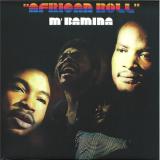
M’Bamina – African Roll (1975)
The story of an album born between Africa, Italy, and the nightclub culture of the 1970s
In the heart of 1970s Italy — a country undergoing profound social change and a music scene just beginning to open itself to distant sounds and cultures — an extraordinary, almost improbable story took shape. It is the story of a group of young African musicians who found their way to Europe, of a Turin nightclub that became a crossroads for communities and experimenters, and of an album which, released in small numbers and largely unnoticed at the time, is now considered a rare jewel of Afro-fusion.
The band called themselves M’Bamina — an ensemble of musicians from Congo, Cameroon, and Benin, who arrived in Italy in the early Seventies. Settling between northern Italy and the Pavia area, they began performing in small clubs and community events, bringing with them a vibrant rhythmic heritage: African polyrhythms, call-and-response vocals, funk-infused bass lines, and Caribbean or Afro-Latin colours absorbed along their musical journeys. Their raw, contagious energy on stage quickly drew attention.
Meanwhile, in Turin, another story was unfolding. There was a venue becoming almost legendary: Voom Voom, one of the city’s liveliest nightclubs, run by Ivo Lunardi. The club attracted an eclectic crowd — students, artists, foreigners, night owls — and Lunardi quickly understood that the dancefloor wasn’t just a place for music, but a melting pot for a new kind of cultural energy. Out of this vibrant atmosphere came his idea: to turn the club’s name into a small independent record label, Voom Voom Music, capable of capturing the spirit of those years and giving voice to unconventional projects.
When Lunardi heard M’Bamina, he immediately sensed that this was the sound he had been searching for: fresh, different from anything circulating in Italy at the time, and capable of blending African tradition with funk and European sensibility. He brought them into the studio.
Production was handled by Lunardi along with Christian Carbaza Michel, while the engineering was entrusted to Danilo Pennone, a young sound technician with a sharp, intuitive ear.
The recording sessions — held in Turin in 1975 — produced a remarkably warm and direct sound. The music feels almost live: grooves rooted in African tradition, but open to funk-rock structures and modern arrangements. It is a natural fusion, never forced. Tracks move between tribal rhythms, funk basslines, light electric guitars, congas and Afro-Latin percussion, with call-and-response vocals and melodies that echo both Congolese tradition and the lineage of Latin jazz. Not by chance, one of the album’s most striking tracks, Watchiwara, reinterprets a Latin standard through M’Bamina’s own rhythmic language.
The album was titled African Roll — a name that was already a statement of intention. It is African music that “rolls,” that moves, adapts, transforms within a new geographic and cultural setting. It is not strictly Afrobeat, nor Congolese rumba, nor Western funk: it is a spontaneous, hybrid blend, shaped more by lived experience than by any calculated aesthetic program.
When African Roll was released, the world around it barely noticed. Distribution was limited, and 1970s Italy had yet to develop a cultural framework for receiving such music. The national music press rarely paid attention to African or “world” productions. The album slipped into silence — though the band’s own story did not.
M’Bamina continued performing across Europe and Africa, even sharing a stage in Cameroon with none other than Manu Dibango. By the late Seventies, they moved to Paris, signed with Fiesta/Decca, and recorded a second LP, Experimental (1978). Meanwhile, the peculiar record they had made in Turin began to resurface quietly among vinyl collectors, Afro-funk enthusiasts, and DJs hunting for forgotten grooves.
That is when the album’s fate began to shift.
Over the decades, African Roll emerged as an almost unique document: a snapshot of an intercultural Italy before the word “intercultural” even existed, a fragment of migrant history, a spontaneous experiment in musical fusion born far from major industry circuits but rich in authenticity. Original copies began commanding high prices on the collector’s market, and the album became recognized as one of the hidden classics of European Afro-fusion from the 1970s.
Today, more than fifty years later, this reissue finally restores visibility and dignity to a project that deserves to be heard, studied, and celebrated. It is not simply an album: it is the testimony of a rare cultural encounter, born in an Italy unaware of how fertile such exchanges would one day become.
It is the story of a visionary producer, an extraordinary band, and a fleeting moment in which music, migration, and nightlife came together to create something genuinely new.
African Roll is — now more than ever — the sound of a bridge: between continents, between eras, between cultures. A record that, after rolling far and wide, has finally come home.
- A1: Pray To The Sun Feat. Declan De Barra & The Hu
- A2: Am I Enough (Tony Tony Chopper) Feat. Au/Ra
- A3: Whisky Peak Saloon Feat. Leo P
- A4: Miss All Sunday
- A5: Dr. Kureha
- A6: Cherry Blossom Miracle
- A7: Welcome Aboard Doctor
- A8: Dorry & Brogy
- B1: Smoker
- B2: Igaram's Sacrifice
- B3: In Elbaf We Have A Ritual
- B4: Miss Wednesday
- B5: Drum Kingdom
- B6: What's An Army Of Monsters To The Hero Of Little Garden
- B7: My Sails Are Set (Loguetown Opera Version)
- C1: Tony Tony Chopper (Instrumental Suite)
- C2: Humans Are Not The Only Ones Who Can Be Cruel
- C3: Pirate Is Someone Who Has Adventures And Dreams
- C4: Potion To Cure All Diseases Of The Heart
- C5: Peace Offering
- C6: Hoist This Flag And Fight Like A Pirate
- C7: Doctor Hiriluk Won't Be Back
- C8: When Does A Man Die? When He Is Forgotten
- D1: Reverse Mountain
- D2: Who Wants To Make A Snowman
- D3: The Sedative Is Losing Its Effectiveness
- D4: Zoro - 1 Vs 100 Part Iii
- D5: In Alabasta We Ride Ducks
- D6: Miss Goldenweek
- D7: Drum Kingdom Is Saved
LP 2x12" Deluxe Boxset[121,64 €]
Capturing the full scope of the Straw Hat Crew’s journey into the Grand Line, this collection brings together the massive, high energy score by award winning composers Sonya Belousova and Giona Ostinelli. From the shores of Loguetown to the snowy peaks of Drum Island, every moment of the voyage is brought to life through soaring orchestral arrangements and unforgettable pirate anthems.
2LP Audiophile Black Vinyl: Two 12 inch records pressed on high quality black vinyl for a classic look and superior sound fidelity, delivering every orchestral swell with crystal clear precision.
Double CD Set: Two discs featuring the complete original score and songs, presented in a premium compact format.
Premium Packaging: A double gatefold jacket for the vinyl edition and a three fold digipack for the CD, both showcasing vibrant cinematic artwork of Luffy and the Straw Hat Crew.
Complete Soundtrack: Over 40 tracks spanning the entire second season, including character themes, emotional moments and epic battle motifs.
Whether at home or on your own journey, this release is the perfect way to keep the spirit of adventure alive, immersing you fully in the world of One Piece.
Netflix’s epic high seas pirate adventure, ONE PIECE, returns for Season 2, unleashing fiercer adversaries and the most perilous quests yet. Luffy and the Straw Hats set sail for the extraordinary Grand Line, a legendary stretch of sea where danger and wonder await at every turn. As they journey through this unpredictable realm in search of the world’s greatest treasure, they will encounter bizarre islands and a host of formidable new enemies
Who could have imagined that Ryo Fukui had left behind a recording like this? Captured on June 8, 1977, this previously unreleased live session was recorded at the Sapporo jazz club Vidro by Masataka Ito, the producer behind Fukui’s albums Scenery and Mellow Dream. It is unmistakably the Ryo Fukui Trio of that era, yet the performance possesses an overwhelming intensity and freshness that far surpass any studio recording—excitement in its purest form.
The 16-minute, searing performance of “Mellow Dream” is just the beginning. The propulsive energy of “Speak Low”, the beautifully woven lyricism of “Body & Soul,” the blistering drive of “Love For Sale”, the weighty depth of “Mr. P.C.”, and the crystalline fragility of “My Foolish Heart”—each track is delivered with feverish brilliance. It was this very live recording, excerpts of which were evaluated at the Trio Records headquarters at the time, that ultimately led to the production of Fukui’s second album Mellow Dream. In every sense, this is an extraordinarily precious document.
- A1: Eclypso
- A2: Relaxin' At Camarillo
- B1: Come Sunday
- B2: He's A Real Gone Guy
- C1: Stella By Starlight
- D1: Juju
- D2: Harlem Blues
This is joy beyond expectation the arrival of a new Ryo Fukui recording. Captured on June 26, 2004, this live session documents the ninth anniversary concert of Slowboat, the jazz club Fukui founded and considered his musical home. The trio features Ryo Fukui on piano, Benisuke Sakai on bass, and Yoshihito Eto on drums. Fukui was 56 years old at the time, and his playing is powerful and expansive, yet still marked by delicacy and razor sharp precision. In terms of energy, stamina, and technique, he was entering a true period of artistic maturity. He delivers the music of his beloved Phineas Newborn Jr. and Tommy Flanagan with depth and elegance, and approaches the works of Wayne Shorter—an early-life influence—with thrilling intensity. The performance captures Fukui at a moment of profound fulfillment, offering a truly compelling glimpse into his late career brilliance.
- 112: Bells & A Baby Crying
- 2: Ur Cool Knife
- 3: I Haven't Forgotten You
- 4: Wash You Out
- 5: My Spell
- 6: Rock On (Ft. Royal Tusk, April Lawine)
- 7: Smash
- 8: Pt. Iii (Ft. Fireball Kid)
- 9: At Midnite
- 10: Underground Shopping District
- 11: This One
Wer ist Born At Midnite und warum sollte dich das interessieren? Born At Midnite sind keine gewöhnlichen Drag-and-Drop-Produzenten, sondern eine vertikal integrierte Songmaschine. Mit Samplern, künstlichen Drums, Tonbandgeräten und hauseigenem Artwork, alles im Homeoffice-Tempo; seit einem halben Jahrzehnt steuert das Duo aus Montreal ganz lässig auf den Status der ,coolsten Band der Szene" zu. Indem sie den allgegenwärtigen Narzissmus und die Selbstverliebtheit unserer Zeit ausspielen - und sich gleichzeitig darüber lustig machen -, flicken die Jungs eine Art ungesponserten ,Product-Placement-Punk" zusammen. Also sag mir, was hat es mit ihrem Debütalbum auf sich? Was ist das Gegenteil eines Wunsches, der mit einem schrecklichen Fluch einhergeht? Es ist etwas, das niemand wollte, das aber vor ewiger Verdammnis schützt; es ist ,Eternal BAM Nation", das lang erwartete und doch schnell zusammengestellte Debütalbum von Born At Midnite. Und du weißt, dass diese elfeinhalb Songs den Kern der Sache treffen.
- A1 78: Light Years From Earth 04:57
- A2: Mechanus 9 05:36
- B1: Terraformers Warning 03:45
- B2: Terraformers Warning (Arpanet Terraformation Quanta Remodel) 05:10
- B3: Ignition One 04:59
Detroit producer, Shawescape Renegade, comes to Tresor Records with Exoframe, a five-track EP of pure techno and electro, including a remix by Arpanet.
As with so many forerunners and peers in the Detroit techno world, Shawescape Renegade, is a deep thinking and a world-building story teller and Exoframe uses the traditional sci-fi narrative to explore recent thought Shaw has had on the potential hidden costs of technological
evolution: what happens when overspecialisation leads to a dead end; when inflexibility means a return to the old forms becomes difficult.
The EP opens with 78 Light Years From Earth, an effects-laden slab of electro that pulls the percussion into other dimensions. Mechanus 9 brings a techno edge before Terraformers Warning unleashes a bass-driven beast.
A fast-paced remodel of Terraformer’s Warning from Gerald Donald’s Arpanet project follows, before the EP is closed out with another bassline-forward track, Ignition One, an updated version of the Shawescape cut that soundtracked the section of the Black To Techno
documentary focussed on the Detroit’s Jit dance scene. The strong symbiosis between Jit and Techno is a foundational part of Detroit’s culture and a community tie and suggests that while technology may lead to stagnation, the cultural muscle memory offers a path back to
authenticity.
In a thoughtful nod to the praxis of the DJ, the vinyl versions of A1 & B1 are five BPM slower than the digital, moving the music to between 128BPM and 151BPM on a standard Technics turntable and opening it up for play in a greater range of club environs.
It’s this deep respect for the artistry and traditions of Detroit’s longstanding music and dance scenes that mark Shawescape Renegade out as one of the true inheritors of the city’s heritage.