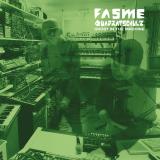
Fasme and Quadratschulz join forces for a very special record: Ghost in the Machine. Finding cacophony and harmony through their blinking music boxes, these two knob-twiddlers melt genres. Through live jam sessions, a week of braindance shenanigans, the pair emerged from a Hamburg studio with five spur-of-the-moment cuts. Bubbles of acid pop, dreamy notes float, keys dash and race as robotic voices slice through this helter-skelter interplay of melody and percussion. A celebration of impromptu experimentation where analogue alchemy reacts with impulsive energy.
Open Universe is a new record label founded in 2025 following an invitation to envision a series of releases for the German production music library Sonoton.
Curated by Jon Tye (Lo Recordings, Ocean Moon, Seahawks, MLO) with a remit to explore and create new worlds of sound in which to dwell and discover. Prismatic Fields is a collaboration between Ocean Moon and Silver Ley (Jon Tye & Bethany Ley), together they create metaphysical pop from another dimension where warm oscillations mingle and resonate to conjure a world alive with light and life.
An album that leans lightly into the worlds of fantasy synth and sacral medievalist electronics where silken harp glissandos, synth waves and enchanted vocal tones mix with lush fourth world textures and clusters of rhythmic invention.
Tripping into spaces modern and game-like, soundtrack moods that dip into the liminal dream states found in the work of Daniel Lopatin, Susumu Yokota and Boards Of Canada. Music that is both functional and formless, designed to stimulate and facilitate, to inspire and motivate.
Ocean Moon & Silver Ley will be performing live alongside Sonic Boom and Alexis Taylor at the Sonoton Music Label showcase @Schmidtchen, Hamburg 17th September 26.
here is a direct and enduring connection between the roots of Italian electronic music and the underground club culture of today.
Boldly pulling that thread are Marta Paradise, the duo from Martina Franca (Puglia, Italy), who have established themselves as a go-to name for anyone craving an elegant, refined sound that remains unapologetic.
For their latest release, they team up once again with a true legend: Fred Ventura. As one of the most iconic artists of early Italo Disco, Ventura brings an unmistakable vocal timbre that turns every track into an instant classic.
The result of this cross-generational collaboration is Call In The Night, a track that bridges authentic Italian heritage with the sharpest edges of modern Indie Dance. It delivers everything discerning clubbers live for: shimmering synths cutting through the dark, an octave-driven bassline that locks you to the dancefloor and a nocturnal, dreamy, relentlessly catchy vocal line.
Elevating the package even further is a stellar remix package featuring some of the hottest names on the current circuit, including Mystery Friend, Day Ventura, the unmistakable touch of the legendary Flemming Dalum, and Slow Motion label boss Franz Scala.
Far from a simple nostalgia exercise, Call In The Night is a forward-looking journey with a vintage soul that never falls into cheap clichés. Past and present merge to set the world’s most visionary DJ booths ablaze.
Written by GIANLUCA SERVETTI
HEY CABRERA
Owner of the Magazine “rockerilla”
Fans and headz worldwide have been clamoring for a follow- up, but all Emapea wanted to do was just 'zone out.' And that's what happened, with the release of Emapea's twenty song album Zoning Out, Volume 1. Emapea's cuts are meant for the listener to get lost in - but they're not only for chilling, or when deep in thought, but also for getting in that crucial head-nod zone, like when the DJ drops the dopest beat. Expertly crafted and sequenced, the album presents a boom-bap journey that's dreamy and spacey while remaining tough and jazzy. "Check It Out" exemplifies the mood with its smooth drums, chiming keys, subtle sax riffs, and hip hop shout-outs. The vibe expands on "Motion", adding an exotic, worldly flavor to the seductively loping rhythm. And "Classy" features a smokey saloon piano melody that cruises smugly out of jeep-beat speakers.
Nanel opens the doors to a new release in the catalogue, bringing an enigmatic two-track record to the wax. Rooted in minimal but rich with musical character, this release finds its strength in the balance between groove and melody. A continuous bassline lays the foundation of the A side, while delicate melodies and scattered vocal fragments slowly reveal themselves alongside crisp drums. On the flip, the journey becomes even more melodic, with warm chords, dreamy pads, and a steady bassline creating a deeper and more emotive atmosphere.
collecting
Bestelle jetzt. Wir sammeln aktuell Bestellungen für eine Nachpressung.
Palms Trax returns to production with his first release since 2019. The first single off his upcoming 2 track EP 'Soft Trance, Hard Gossip' is a journey through bold basslines, ear tingling acid lines and hopeful synth lines. It feels measured in its temperament for a listen on the bus home whilst punchy enough to earn its place across festival and club sets this summer. The title track Keys To A Printed Garden captures him at his best, moving deeper into a lush, melodic setting that stretches beyond the dancefloor while never fully leaving it behind. The track is built around warm deep house grooves, hazy nu groove textures and subtle IDM notes. The record unravels with a dreamlike smoothness. Swirling synth work, jazz-inspired saxophone lines and soft lo-fi textures give the record an immersive, almost weightless quality, while moments of glitch and ambient drift push it into more experimental territory. Even at its most reflective, steady percussion and rolling grooves maintain a subtle club-rooted pulse, balancing emotional depth, introspection and atmosphere with movement, rhythm and understated precision.
Two of the most prolific remixers in the world of Disco,Dave 'Love' Lee and John Moraleshave teamed up for one of their biggest projects to date - 'Mixed To The Maxxx'. After gaining access from the legendary original artists, the pair take the multi-track tapes of many classic Disco, Funk & Soul tracks and re-work them...to the Maxxx!
Where Remixed With Love stands as Dave Lee's own gold-standard body of work, Mixed To The Maxxx sets that legacy alongside Morales' own decades-deep M+M body of work: Lee brings his musically dense, groove-first touch to the likes of Harold Melvin, Syreeta, Lenny Williams and The Brand New Heavies, while Morales applies his extended, dancefloor-built M+M treatment and crushes the likes of Barry White, The Temptations and Loleatta Holloway, plus Dennis Coffey's breakbeat classic "Scorpio" for the DJs and collectors alike. Both work from original tapes, surfacing parts barely audible or entirely unheard in the source mixes, and both know when to let a classic breathe rather than bury it under modern production. It's a pairing a long time in the making. Lee and Morales first talked about working together around a decade ago, and getting Mixed To The Maxxx off the ground took five years of patient work: tracking down usable stems, securing approvals, and navigating a licensing landscape where much of the best material is now tied up with major labels increasingly cautious about clearing remixes. What's landed here is the product of that graft as much as the pair's shared ear for a great record, the sound of two people who know exactly what they're looking for and are willing to put in the time to find it.
A double 12" sampler in summer 2025 previewed the record's range. A bass-driven overhaul ofThe Brothers Johnson's "The Real Thing" and an extended mix of Philly legends Bell & James' "Livin' It Up (Friday Night)" showcased Lee's side, while an anthemic take on Inner Life's "Ain't No Mountain High Enough" and a tempo-lifted Light Of The World"London Town" flew the flag for Morales. Both drew strong early support ahead of the full LP.
Dirty Sound Magnet's album to ease the soul. An album that showcases the depth of DSM's music. Between modern folk and ambitious art rock reminiscent of Sgt Pepper by the Beatles and early Pink Floyd and David Bowie.
For UnExposed Records first vinyl release, Uruguay’s Marcos Coya wanted to show the world a different side of his artistic approach. In a world of monotonous copy/paste, Marcos wanted to bring something unique to the table. A compilation of spacey, dreamy & emotional tunes custom built for the dance floor yet still experimental as well. Deep grooves & long developments. No fluff. No overbearing bangers. True underground production principles. Crafted for those with a refined palate.
The A-side is dedicated to Marcos Coya’s four to the floor production work. This sonic expedition begins w/ a bang: the record’s title track “Moon Trippin”! A showcase of freaky melodies accompanied by groovy percussions which bolster a vocal of Prince speaking his mind about the true essence of creating musical art & his disdain for mainstream music industry critics.
“Delirium” closes out the A-side w/ a dreamy acid house tune adding an emotional touch to the record. After hours material. A real step forward for Marcos and his production work. Leaning heavier than ever into trusting his melodies. Taking a bit more risk with his approach by creating something you’ve never heard from him on any of his nearly 20 vinyl releases over his career.
For the B-side we shift over to a more breakbeat approach with 2 absolute heaters. B1 introduces the track Hearthug has claimed to be one of the tracks of the year: “Rage Dog”. Rage Dog is a Marcos Coya signature track due to its rock & hip hop influences developed during his adolescence. Marcos even purchased new synthesizers specifically to improve this track & its melodies. The cherry on top is the vocal from Rage Against The Machine’s front man, Zack de la Rocha, which adds a rebelliously political undertone to the record, something UnExposed & Marcos both are very proud to address w/ passionate conviction during this time of war and injustice.
We close out the record with “D.N.A.”, the most experimental piece of art on this vinyl release. A wild combination of breakbeats, guitars, melodies & crazy vocals. The perfect bizarrely fascinating conclusion to this wild trip to the moon and back.
Early support from heavy hitters such as: DJ Koolt, Anthea, Velasco, KT, Hearthug, Mario Liberti, Daïf & many more!
Pascal Moscheni debuts on Limousine Dream with a double 12" featuring 8 stunning representations of the modern tech house sound. Ultra functional, but with plenty of character, and hard-driving but never overbearing - these are tools for DJs working with high-energy dancefloors.
Teal return on October 2 with Love Comes Thru, the trio's nine-track debut album. Expanding their emotionally resonant blend of downtempo trip-pop, the record reaches into street soul, dub, and experimental grooves, marking a confident new chapter for the group.
At its core, Love Comes Thru is a reflection on the quiet strength of love—not through grand gestures, but through the steady presence that carries us through uncertainty, change, and connection. Written over the course of a year of bi-coastal collaboration, the album became a testament to the bond Teal share as artists, friends, and family.
From the lush synth landscapes of "Aries Moon" to the footwork-inspired pulse of "Time Is Blind," the album explores themes of patience, vulnerability, longing, and intimacy. Standout singles "Kissing in a Dream" and the title track lean into left-field street soul, while stripped-back, 808-driven tracks like "Change Your Mind" and "Anomaly" demonstrate the power of restraint without sacrificing momentum. Building on the group's love of ambient improvisation, Love Comes Thru also features instrumental pieces with percussion by Brandon Valdivia (Mas Aya/Lido Pimienta).
The album closes with the sensual "Bubbling," bringing the journey full circle with a reminder that love ultimately comes through in its most embodied, physical form. Love Comes Thru is presented in a deluxe, limited-edition matte-finish, double-embossed jacket with a printed inner sleeve. Available on LP and digitally through Rubadub, In Sheep's Clothing, and Forced Exposure beginning October 2.
Madelyn Byrd returns to Glasgow’s Somewhere Press with a hazed set of weightless soundscapes. »Night Rider« opens in widescreen with the chirp of cicadas dancing across a desert landscape, before Shiroishi’s saxophone eventually cuts through the dark like neon. The story Byrd tells is close to their heart: they spent their teenage years in the Sonoran Desert, the vast subtropical expanse spanning parts of Arizona, California, and Mexico. Its seemingly alien landscape — pocked with giant, tree-like cacti and looming rocky outcrops — is lodged in the cultural memory, a quality Byrd draws on as they slowly reveal their poetic narrative.
The album plays like a road movie of sorts, moving through Byrd’s memories and setting them to very different rhythms. Clattering drums emerge on »Of Nature, Of Bodies, Of Dreams«, while Byrd’s soft tones, processed to sound almost otherworldly, glide gently across the metallic clangs. Each track highlights a form of movement: there is the microscopic, insectoid crunch of »Imprint«, where guitar prangs meet Shiroishi’s spirited runs, while »Into Sonoran Pool« creates motion from the atmosphere itself, recreating the thick desert air with shimmering electrical currents and psychedelic processes.
At this point, the album begins to echo Robert Ashley’s late-period theatrical work: compositions that broke with familiar formats, juxtaposing dialogue with knowingly experimental orchestral flourishes. Byrd strikes a similar note through a fusion of poetry, sound design, choral music, and chiming, listless ambient elements that also recall Harold Budd. Budd grew up in the Mojave Desert, which borders the Sonoran, creating an eerie parallel with the moods he conjured throughout his long career.
Byrd finds a similarly aesthetic link to the West Coast landscape, referencing the history of experimental music while establishing their own voice. As the album rides into the sunset with a roar of engines, they offer a distinct vision of pop: »What Is, What Was« integrates a chugging break and ketamised vocal hook, while the finale, »In Perfume, Remember«, lands as a James K-like heartmelter.
At this point, the vast swathes of unreleased Muslimgauze material Bryn Jones left behind when he passed away over 25 years ago are as legendary as any of his work. And sure enough, there's still some being unearthed today.
The fourth entry in a 7" single series is taken from one of Jones' customary completely unlabelled DATs, which he sent to labels seemingly as fast as he finished them.
A new series of singles collecting one of Bryn Jones’ innumerable DAT tapes that would show up at the labels he worked with sans any identifying marks.
Side A layers multiple voices (a background, faraway wail that either is or is akin to a muezzin, and a flatly declaimed two-word phrase that periodically halts proceedings) over his classic, slightly brick-walled hand percussion for a strangely meditative experience, as Jones phases elements in and out, more or less prominently in the mix. Side B however, open in a surprisingly dreamy place for Muslimgauze, with a looped ascending synth pad and beautiful sampled singing only gradually acquiring percussive accompaniment. As with the other side, Jones is content to let these elements interact and swap spaces in the mix for the duration, trusting in the sturdiness of his chosen components to carry the listener through.
Coil’s 17-minute soundtrack for »How to Destroy Angels«, performed on January 19, 1984: ritual music ›for the accumulation of male sexual energy‹, structured around magickal and numerological concepts.
Throughout history man has made and used music for two distinct and separate purposes. In recent years, particularly since the advent of sound recording, the most popular use of music has been for entertainment - the temporary amusement and distraction of as large a number as possible. As a consequence, many people tend to overlook its more fundamental and ancient use as a tool for affecting man's body and spirit. The many varieties of religious music from around the world contain a vast quantity of clues to the way in which sound can affect the physical and mental state of the serious listener, yet many find their associations with religion itself too difficult a stigma to overlook in their appreciation of the sound and its potential, for its own sake.
On this record, hopefully the first in a series, we have tried to produce sound which has a real, practical and beneficial power in this modern Era. Specifically, it is intended as an accumulator of male sexual energy. Although we make neither claims nor rules for its use, we do suggest that for maximum potency it should only be played in circumstances that exclusively male and/or onanistic in nature. What these are is entirely up to you.
The execution of the piece was structured around concepts we felt would work for us - in this case magickal and numerological rather than conventionally musical in form. One image or symbol which we drew upon that may be useful to bear in mind is that of Mars, often indicated by the male symbol.
Should this music have any power, over and above the banal and transitory titillation achieved by most records available now, it is a positive and beneficial power to be used and controlled by the listener, as he desires.
Coil’s 17-minute soundtrack for »How to Destroy Angels«, performed on January 19, 1984: ritual music ›for the accumulation of male sexual energy‹, structured around magickal and numerological concepts.
Throughout history man has made and used music for two distinct and separate purposes. In recent years, particularly since the advent of sound recording, the most popular use of music has been for entertainment - the temporary amusement and distraction of as large a number as possible. As a consequence, many people tend to overlook its more fundamental and ancient use as a tool for affecting man's body and spirit. The many varieties of religious music from around the world contain a vast quantity of clues to the way in which sound can affect the physical and mental state of the serious listener, yet many find their associations with religion itself too difficult a stigma to overlook in their appreciation of the sound and its potential, for its own sake.
On this record, hopefully the first in a series, we have tried to produce sound which has a real, practical and beneficial power in this modern Era. Specifically, it is intended as an accumulator of male sexual energy. Although we make neither claims nor rules for its use, we do suggest that for maximum potency it should only be played in circumstances that exclusively male and/or onanistic in nature. What these are is entirely up to you.
The execution of the piece was structured around concepts we felt would work for us - in this case magickal and numerological rather than conventionally musical in form. One image or symbol which we drew upon that may be useful to bear in mind is that of Mars, often indicated by the male symbol.
Should this music have any power, over and above the banal and transitory titillation achieved by most records available now, it is a positive and beneficial power to be used and controlled by the listener, as he desires.
'The Shadow BoxerÔ - a tale of oppression, discipline, and inevitable revenge - is re-interpreted by British producer Heritage, whose musical style perfectly aligns with the Shaw Cuts squad.
Ku Ding trained in Tai Chi under Master Yeung for over a decade. This discipline prioritizes health, self-defense and above all, the virtue of tolerance. 'Looking Back, Moving ForwardÔ mirrors this holistic training for body and mind through its broken rhythms, dreamy pads, and warm bass.
Despite facing relentless harassment at work from his tyrannical boss Jin Dasheng, Ku Ding remains calm and endures the humiliation. The playful percussions, vocal snippets, and powerful low-end grooves of 'DancehallÔ underscore the protagonist's deep-rooted discipline and resilience.
However, after his lover A Bao is killed and both his master and his friend Hu Binglian are successively murdered, he is forced to rise up and fight back using his martial arts prowess.
'2003Ô comes in swinging, fueling Ku Ding with the perfect mindset for the battle ahead via punchy drums and an energetic bassline.
Driven to mete out justice, Ku Ding prepares for his revenge without betraying his sacred tolerance. The complex breakbeat patterns of 'HaywireÔ carried by recurring, subtle chords, give him a final boost. But can this rational approach succeed? You better find outÉ
Type-303 is the project of Tampere-based Finnish producer, DJ and vinyl collector Dan Greijer. His releases for labels including Super Rhythm Trax, I Love Acid, Verrazzano, Zeitnot and 45 Live Records explore the connections between acid house, rave, early-'90s house and Balearic-influenced electronic music.
Enigmatic Dreams is Type-303’s first release on Cold Blow, a six-track 12" focused on the melodic and atmospheric side of classic electronic sounds. The release features Dr. Rhythm aka Mark Woollard, connecting Type-303’s production with the Cold Blow catalogue following the label’s previous compilation of Dr. Rhythm’s original 12"s, Hits The Vibes 91-92. Across the EP, Greijer draws from late-'80s acid, Italian dream house and early-'90s Balearic influences, using classic sounds including the Roland TB-303, 808 rhythms and M1-style piano tones.
Following the success of Denshi Ongaku No Bigaku Vol. 1 and Vol. 2 in 2023, Cosmocities returns in 2026 with two new chapters in its acclaimed compilation series dedicated to the rich heritage and continuing evolution of Japanese electronic music.
Compiled by label owner Matt Soulie, Denshi Ongaku No Bigaku Vol. 4 further explores the depth, sophistication and diversity that have long made Japan's electronic underground one of the world's most inspiring musical landscapes.
Since its inception, the Denshi Ongaku No Bigaku project has celebrated the artists and sounds that have profoundly influenced the Cosmocities vision. Across four volumes, the series has journeyed through ambient soundscapes, deep house, boogie, jazz-infused electronics and forward-thinking club music. Volume 4 shifts the focus firmly towards the deeper end of the dancefloor, bringing together timeless classics, rare gems and sought-after reinterpretations from some of Japan's most respected producers.
Opening proceedings is Kaoru Inoue's remix of Soft's "Art Farmer", a rolling percussive Afro-house excursion rich in hypnotic groove and organic rhythm. XTAL's "Heavenly Overtone" follows with a beautifully cosmic house journey, combining shimmering keys and celestial atmospheres that perfectly capture the compilation's expansive spirit.
On the B-side, Slow Didi's "Follow Me (Hidaway Mix Instrumental)" delivers a deep and hypnotic groove before Tokyo Black Star's "Fantastique Voyage" channels the soulful, sophisticated energy of classic 1990s deep house. The journey continues with Manabu Nagayama and Soichi Terada's "Low Tension", presented here in a sublime instrumental remix by Satoshi Fumi and Yoshi Horino, where warm piano melodies and elegant synth work create a timeless late-night mood.
The final stretch moves into more driving territory. Hiroshi Watanabe's "The Orionids (2025 Revised)" subtly raises the tempo, blending deep house sensibilities with sleek tech-inflected textures. Kaoru Inoue's "Ground Rhythm", reworked by The Backwoods, plunges deeper into hypnotic territory with a heads-down groove designed for intimate basement spaces and low-lit dancefloors.
Closing the compilation is Bitowa and YAMADAtheGIANT's "Forest (Mixtacy Exclusive Version)", a trippy, immersive finale that leaves listeners suspended in a dreamlike state between nature, rhythm and imagination.
A carefully curated collection of deep, cosmic and forward-thinking sounds, Denshi Ongaku No Bigaku Vol. 4 once again showcases the enduring creativity, innovation and global influence of Japanese electronic music.