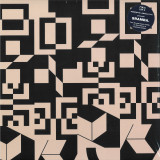
180g Black Vinyl. Limited to 100 Copies
Formed in Cardiff, Sock make guitar-driven alternative rock, taking inspiration from psychedelic music. Known for their creative melodic arrangements and blending of genres, the band describe their music as “a rather progressive affair”.
Following on from the bands debut album ‘Fresh Bits’, in 2018, this is Sock’s much anticipated self-titled follow up. The album features Jacob on Rhythm Guitar & Vocals, Billy on Lead Guitar, Sam on Bass & Keys, and Simon on Drums & Percussion. Produced by the band, the album was recorded during the pandemic and sees the music move into a heavier and more refined sound.
Cerca:dr rhythm
Ghost Producer aka Badawi (aka Raz Mesinai aka Bilal ibn Yakub al-Badawi) is a prolific producer and artist who has been on the forefront of underground experimental jazz and electronic music scenes around the world for over thirty years, with a catalog of albums on labels as ROIR, Asphodel and Tzadik under various monikers dating back to the late 1980s.
Ghost Producer released his first albums starting in the late 80’s under the monikers Psy Co. and Ruff Riddim Productions, selling his cassette tapes in NYC. He produced, on average, at least one album per week since 1988 until today. One of the twenty or so monikers was Badawi, later being signed to ROIR Records and releasing the seminal experimental dub, punk albums »Bedouin Sound Clash« and later »The Heretic of Ether« on Asphodel. Spending time as a child between Occupied Jerusalem, the West Bank (Balata) and New York City (Rock Steady Park) during the height of the B-Boy era in the 70s and 80s informed Ghost Producer’s singular sound of heavy driving Sufi rhythms, sonic experiments, percussion, piano playing and sound design which has connected him to a wide variety of artists ranging from Maryanne Amacher to John Zorn, to added elements of darkness to music by such artists as Hanz Zimmer (Black Hawk Down) and rappers Danny Brown (Pneumonia) and Skepta and Double D (Don) among many others.
At age 14, Ghost Producer was discovered by visionary jazz and rock musician, Juma Sultan (Jimi Hendrix) whom later trusted Ghost Producer with producing the archive of over 2000 hours from recordings from »Studio We« and the Free Jazz Loft Movement in NYC in the 60s and 70s. As a composer, he has worked with Kronos Quartet and has had premiers at Carnegie Hall (Cross Fader, The Echo of Decay) and Lincoln Center (String Quartet For Four Turntables). In addition, Ghost Producer has released several albums on John Zorn’s Tzadik label, where he explored producing to the books of Franz Kafka (Before The Law, Resurrections for Goat Skin, Cyborg Acoustics)
As a composer for film, he coined the term »score design» to describe his work in conceiving and producing scores for films with particularly demanding needs, working on such films as A Late Quartet (director Yaron Zilberman composer: Angelo Badalamenti), The Fountain, Black Swan and The Wrestler (Darren Aronofsky/Clint Mansel), Black Hawk Down (Ridley Scott/Hans Zimmer) and many more. In 2014, he was awarded as a fellow in the Sundance Composers Lab.
In 2015, Ghost Producer formed the Underground Producers Alliance, a unique program for developing producers, performers and composers, with co-founders Scotty Hard (Wu Tang Clan, Medeski Martin and Wood, De La Soul), HPrizm aka High Priest (Anti Pop Consortium), Honeychild Coleman (the 1865, The Slits) and Prince Paul (Jungle Brothers, De La Soul), where Ghost Producer produces entire albums with student participation in his master course.
This album, »The Book of Jinn«, is one of many productions done within the course, featuring players/mentors Juma Sultan (percussion), Chandenie (voice) and Shahzad Ismaily (electric bass), with additional student participation from Adam Culbert and Jonah Sollins (aka Goodnight 1500) on synths and percussion as well, then all remixed and rearranged by Badawi into what you hear here, The Book of Jinn.
Coherence is overrated. Especially if keeping things hazy, and not smoothing away all the rough edges, and allowing all the seeming contradictions to find their own unique harmony with each other in their own time can result in the heady magic of Lock Eyes & Collide, the second EP from South London-based quintet Moreish Idols. Across these four tracks, Moreish Idols deal in tangles of hyper-melodic guitar, sleepy-eyed murmurs glowing with unassuming poetry, blossoms of wise saxophone, rhythms that pulse and purr to their own inarguable logic. You could spend days trying to define what exactly it is they are doing over these fifteen or so minutes, but you’d be wiser to just lose yourself within Lock Eyes & Collide’s laser-guided twists and turns.
Pulling into focus. They passed tracks from initial collaborative song-writing sessions along to Dan Carey, who signed Moreish Idols to his Speedy Wunderground label and produced their first release on the label, the Float EP, in the summer of 2022 (they’d released a pair of self-released 7”s before lockdown). Restless, jerky, jagged and rhythmically centred, many of Float’s energetic pleasures bore the influence of their earlier flirtation of post-punk, but the ruminative When The River Runs Dry spelled deeper treasures lay within, while the erratic, wonderful Speedboat spoke to Moreish Idols’ essential gift for mystery. Lock Eyes & Collide is something else altogether, though – a looser constellation of ideas, a clearer hint of the group’s future.
The elements that compose the EP – swooning tremolo guitars, prickly melodic riddles, erudite saxophone improvs, loose and flexible rhythms – make perfect sense together, on vinyl if not on paper, sounding like Watery, Domestic-era Pavement one second and some bucolic Canterbury Scene prog the next, but always, always like Moreish Idols most of all.
The future that is undefined is limitless. If Lock Eyes & Collide captures Moreish Idols’ present, what do they see in their future? “If we’d just made Float II for our second EP, people would be, ‘Oh, they’re the band that does that,” says Tom. “I’m so glad we’ve made this weird alter-ego of our first EP; now we feel we can do whatever we want.”
At only 19 years old, Dar Es Salaam's DJ Travella represents a new wave of singeli producers who are driving Tanzania's breakneck dance sound into fresh, innovative spaces. Unaffiliated with any of the well-known studios like Sisso and Pamoja, Hamadi Hassani's music points singeli's fusion of taraab and techno towards the stars, locating a cyber-singeli style that's dense, kinetic and unashamedly sexy. Hassani started producing at 15, and a few years later his debut is a jagged set of hi-nrg dance music that pulls influence from across the globe, folding together elements of dembow, rave, R&B, and trap. But nothing's straightforward: opening track 'Crazy Beat Music Umeme 2' juxtaposes grinding 200bpm rhythmic intensity with urgent plucked strings, sounding like Timbaland conjuring a Thunderdome soundtrack for a Tanzanian street party. 'Crazy Beat Music Umeme 4' is even more barbed, with neon rave synths and hand-jammed percussion that's one part 808 Mafia and one part DJ Diaki. On 'London Bandcamp', Travella meshes hi-speed singeli backbeats with downtempo dembow kicks, squeezing out unexpected sleaze in the process, while on 'London Uwoteeee' there's an almost romantic sparkle, with ethereal vocals draped across woodblock cracks and whistles. But Travella sounds most nimble when giving the nod to Atlanta, and his merging of earworm synth hooks and neck-snapping East African rhythms on tracks like 'London Jomon Beat' will leave no doubt that the young producer is capable of bending singeli completely to his will.
Tor.Ma in Dub’s bass-quaking Terra and it’s fierce flipside Terra Dub drop on 7” this May 5th.
Terra’s pulsating bassline is complemented by sparse tribal percussion and disembodied vocals, creating a grounded and meditative vibe.
Terra Dub is straighter and heavier, with a punchy bass and a relentless steppers rhythm, guaranteed to lively up the dancefloor.
Both tracks are taken from the Solve et Coagula album, which focused on alchemy and transformation, with the elements presented in pairs. Downbeat dubs morph into uptempo steppers, all crafted with the unique blend of roots and psychedelia that are the hallmarks of the Mexico-based producer’s style.
"Akuphone is proud to present the Jerusalem-based improvisational trio Leviot and its hypnotizing debut album. Leviot (Hebrew for “Lionesses”) is a brainchild of multi-faceted musician and composer Yael Lavie, who’s joined by classically trained percussionist and music teacher Cnaan Canetti, and synth enthusiast Yishay Seroussi. The project is a result of Lavie’s ongoing explorations beyond the restraints of classical kanun playing and fascination with electronic sound and modern composition. Initially started following her experience performing and recording with Spiritczualic Enhancement Center, in Leviot, Yael gives up rehearsed pieces in favour of improvised sets, based on virtuous interpretation by Cnaan and Yishay. The three have been active since 2019, playing their immersive shows in a wide variety of settings, venues and festivals. The trio’s debut release is a live session, recorded in late 2020 at Mazkeka Studios (Jerusalem) for the lockdown edition of the annual Zikuk Festival. It’s a meditative improv piece in five parts that combines and melts boundaries between the traditional and the experimental, the primal and the futuristic. With setup as the foundation of the piece and Lavie’s graphic score as the road map, Leviot takes off on a cosmic journey between deep drones, whispering chimes, mesmerizing Arab melodies, pulsating rhythms and iridescent ambient patterns."
Ese puerto existe' is the sophomore album by Venezuelan folk trio, Insólito UniVerso, a psychedelic dream towards sound and its powers of communication. On it, the band explore the diverse geography, rhythms and traditions of their home country of Venezuela, through their own distinctive sound. Featuring additional vocals by Stereolab co-founder and solo artist Lætitia Sadier, and mixed by Meridian Brothers mastermind, Elbis Álvarez and Heliocentrics co-founder and producer, Malcolm Catto.
On their debut album, ‘La Candela del Río’ (to be reissued VERY soon), the band created a magical Latin American sound
of their very own, leading to critical acclaim from the likes of Songlines, Bandcamp, The Wire and many more; as well as a
nomination for Best Group at the Songlines Awards in 2020.
Edmony Krater grew up on the side of Morne Rouge in Sainte-Rose, north of Guadeloupe. His mother sang in church, but Edmony was drawn to the sound of Gwo Ka, which was frowned upon but very present in ceremonies or funeral vigils.
As both a fashion designer for the theater and a musician (percussion, trumpet, vocals) in the group Gwakasonné, formed by Robert Oumaou and Georges Troupé, Edmony left Guadeloupe in 1983 to settle in mainland France just after recording their first album.
Upon his arrival in Paris, with the desire to give his own version of Gwo Ka, he founded the group Zepiss with Eddy Lebouin, Freddy Tisseur, Philippe Augusty, and Rico Toto and immediately recorded a first album, Natibel.
In a singular way, Natibel perpetuates Gwo Ka Modèn, a movement initiated by the iconic jazz guitarist Gérard Lockel, who was the first to theorize and politicize this music previously transmitted only orally. In just six tracks, Natibel combines the sophistication and roughness of its root music, as Gwo Ka combines an intense rhythmic section with intoxicating melodies.
In the tradition of other Gwo Ka musicians who took the music further such as Guy Conquet, Fabriano Fuzion, Gwakasonné, Erick Cosaque, and above all legendary drummer Marcel Lollia aka Vélo, Edmony Krater and his group Zepiss have contributed to preserving its heritage and bringing an obvious touch of modernity.
Lost in the depths of space, AAKAARA takes listeners on a journey to the outer limits of the sonic universe with their latest album “Obsidian Promises”. Blending influences from punk and metal, EBM, architectural design and certain celestial objects, AAKAARA offers a fresh take on industrial techno.
This body of work is dark and brooding, full of haunting and thought-provoking soundscapes. Metallic and cold one moment, blisteringly hot the next. Pounding drums create searing rhythms, acid-drenched synths weave abrasive textures, and noise permeates the stereo field. Inspired by the mysterious and alluring world of black holes, the producer explores the beauty of extremes through sound. “If you know my work or me,” AAKAARA says, “it’s no secret that I have a spiritual connection to, and an obsession with, black holes.
It’s not about doom and gloom, but about beautiful extremes: infinite calmness, ultra-high energy, being deeply centered, and inevitable attraction.” “I try to sonify this in a naive sense. It isn’t an attempt at science; it’s a way for me to practice a makeshift spirituality about these entities through craft and functional dance music for people.”
Spirituality and stellar inspiration were essential to AAKAARA’s life during the three years they spent between Los Angeles and London, while writing this album. It provided a sonic home during a period of transition, when they didn’t feel at home and didn’t have access to a studio.
Everything was made “in the box” using only Ableton 10. After collecting guitar pedals and amplifiers for years, AAKAARA has shifted away from a hardware-focused mindset and is now more invested in the conceptual framework, narrative, and cultural implications of their work. Visuals also play an integral role in this maximalist experience.
The outer sleeve (front and back cover) conveys the “big ideas” visually, while the companion poster includes custom typography, detailed drawings, symbol design, and poetry. The poetry provides a textual counterpoint to the lyric-less music, written in parallel but later stages of the production process. The visual identity of this work is inseparable from the music, describing it in an integral way. It’s the other side of the coin, not simply an accompaniment. With its spiritual connection to the infinite and mysterious, “Obsidian Promises” harnesses the beauty and intensity of celestial entities as musical inspiration, transforming the science into mystical, narrative-driven sonic experience. Get ready for a ride through the unknown as AAKAARA’s latest offering takes you on a high-energy trip through the black hole’s playground.
London’s own Trev appeared on our first release, Body Music Vol 1, as well as other key releases on CoOp Presents and Local Talk. We’ve been fans from the start and, after Trev joined the family, his music went from strength to strength. It was already out-of-this-world production, with serious attention to detail, and this EP is nothing short of excellent! He told us 'there’s no hiding that this EP is, in essence, a long love letter to Brazil', but that it’s also written to 'Iran, London, Lisbon, Japan, probably more - too many to remember!'. Trev described his process as 'listening, learning, combining my favourite elements of all this music that has brought me so much joy over the years'. Right on!
This EP is fresh, different and sonically on point. It’s Bruk, it’s Brazilian, it’s Bass, it’s… all-round-really-good dance music! Trev is a real modern musician, an awesome keys player as well as a producer. He understands the importance of musicality and originality, together with weighty beats and bass, working just as well on the dance floor as they do at a house party… or dinner party, for that matter!
'Nightjar', the title track, draws you in with hypnotic plucks like crickets on a hot summer’s night. Eerie pads float in building tension before the beat drops - Pandeiro and Caxixi serving broken-beat with the kick - pumping the sonic palette and pumping the dancefloor. Deep sinister chords pulse in and out, percussive melodies bring love from the middle east, and we reach a beautiful jazz-harmony break - then it’s straight back to the body movement - this time letting loose with the cowbells and the shakers. Think Brazil, think Persia, think Jazz, think dance-floor, it’s all in there!
'Late Flip' pulls us into a more ethereal intro, with the Koto and skate sounds laying our dream scene. Morphing out of flutes, modular synth plucks pay tribute to the sounds of Lisbon as we drop - a rolling broken beat punch, playful Rhodes and distant vocal chops ring out with the Koto dripping in warm echoes. A truly amazing composition and arrangement that leaves you wanting more!
'Beijo' is one of our faves on this EP. We’re straight in with a kiss - MWAH! - a classic Baile rhythm gets a warm Bruk embrace. It’s passionate and dark and tells a story as old as history. Get lost in the movements between drums and percussion, in the flutes and cicadas, until the organ bass calls it - time to get moving. This really is Trev’s signature dance floor style. A banger with a naughty-yet-subtle bassline, and its own game of perspective - feel this rhythm in more ways than one. Vocal chops and Tamborim place São Paulo’s influence front and centre.
'Grey' takes us on a dusty House/Bruk journey with filtering chords that grow patiently until the beat drops - getting your feet moving and neck bopping! Burning slow, Trev is playful with the harmony, keeping the fun with a roller of a bassline that pulls it all together. It’s a six-and-a-half-minute rich musical journey that feels more like half that time!?
Complete your Dance Regular Vinyl collection with this absolute killer EP from the one called Trev.
Tom Zé and Faust collide in Domenico Lancellotti's "machine samba"
Domenico Lancellotti's SRAMBA reaches back to the roots of samba whilst completely revamping its blueprint, indoctrinating guitar and percussion-led rhythms with analogue synthesisers, courtesy of album producer Ricardo Dias Gomes.
The majority of SRAMBA was recorded over two months in The Cave - Domenico's home studio in Lisbon, the city both Brazilian ex-pats reside in, where the arrival of a couple of Russian-designed synths purchased by Ricardo influenced the direction of their initial experimentation: "Ricardo had these instruments, modular machines" remembers Domenico, "and I had my guitar, some percussion instruments. On the first day we started making sounds and recording them, and songs started to appear, sambas started to appear."
The son of a renowned samba songwriter, at home Domenico would watch his father play and compose. At parties, the adults would hand his father a tamborim (a small tambourine) and ask him to play along. "I grew up inside samba, it's my roots", he says. "For me, everything is samba, I bring it into whatever style of music I am making".
Domenico and Ricardo instantly saw how the synthesisers were not at odds with the sambas they were playing, instead they had a similar sound to its typical percussion instruments (ganza, repinique, surdo, tarol). What's more, they saw a connection with roots samba, the samba that existed before bossa nova and samba jazz came along. This was rhythmic samba, with grooves that could go on ad infinitum. "It's samba de clave, geometrically structured" says Domenico. "It's ostinato samba", adds Ricardo.
"Diga" is a great example of what their proposal is capable of, as what begins as a glitchy machine whirring into action soon turns into a glorious samba in which the gurgles and scratchy beats coming from the analogue equipment only add to the arrangement. Likewise, on "Tá Brabo" it's an aching melody from one of the synths that gives the guitar rhythm its needed counterpoint, and shows how the duo's greatest accomplishment is not in invention alone, but in creating a great samba album. It's an album that can go from the opening track "Ere" with its reverberant bass thud, mantra-like vocals and staccato rhythms to the string-accompanied "Nada Sera de Outra Maneira", a swooning samba that pays tribute to the Brazilian ensemble Tamba Trio, who along with Tom Zé's Estudando O Samba, Domenico names as the biggest influence on their treatment of samba.
Other important reference points are made clear on "Um Abraço No Faust". One of three instrumentals on the album its title riffs off a JoãoGilberto song, "Um Abraço no Bonfá", but whereas JoãoGilberto was giving a hug (um abraço) to bossa nova guitarist Luiz Bonfá, Domenico and Ricardo are giving theirs to the German avant-gardists Faust. "Quem Samba", with its horn section and dramatic melody give a whiff of Domenico's Italian ancestry, while "Descomunal" is devoid of rhythm whatsoever, guest vocalist Tori singing over a bed of electronic drums, cello and swirling synths, that highlights the duo's unwillingness to stick to a particular formula.
Both Domenico Lancellotti and Ricardo Dias Gomes are revered names within Brazilian music over the past 20 years. As a member of the +2's, with Moreno Veloso and Kassin, Domenico released a trio of albums on Luaka Bop in the early 00s that pioneered a new Rio samba sound with elements of funk and psychedelia. With Veloso and Kassin he would later form Orquestra Imperial, a big band intent on reviving ballroom (gafieira) samba, and that has worked with guest vocalists such as Seu Jorge, Elza Soares and Ed Motta. SRAMBA is his fourth solo album. Multi-instrumentalist Ricardo Dias Gomes first came to notice as a member of Caetano Veloso's band Cê which helped reinvigorate Caetano's career with a sound influenced by British new wave. As well as collaborations with Lucas Santtana, Negro Leo and Thiago Nassif, and work with his own group Do Amor, he has released a series of acclaimed solo albums that reveal a restless music-maker.
SRAMBA is a glorious showcase of the duo's style, uniting Domenico's playful lyrics and rhythmic, samba-rooted songs with with Ricardo's assured accompaniment of unorthodox textures and instrumentations. It may be a new language for samba, machine samba (samba de máquina), but as Domenico says, "samba da máquina is samba".
Magic Source invites you to a journey to the obscure side of disco music.
Led by producer & notorious tape operator Björn Wagner (of Mighty Mocambos, Bacao Rhythm & Steel Band and Mocambo Records), the group follows up on their rootsy cosmic debut LP Earthrising and last year's EP Riviera Drive, whose stunning flute jazz cover of “Genius of Love” is also featured on this longplayer.
Further exploring the more unusual facets of disco in its otherworldly and international stylings, Voyage Spectral travels through a wide musical scope, ranging from “lost” tropical grooves, Mediterranean funk, outernational boogie, to cosmic sci-fi soundtracks. All 100% organic - created by real musicians with real vintage instruments, captured on 16-track analog tape.
An all-star cast of musicians invites you to a fantasy trip where angelic voices blend with spaced-out synths, ethnic string instruments interplay with sharp horn lines while the rhythm section is holding down a polyrhythmic puzzle of guitars, clavinets, B-3, drums and percussions.
Borgo Dora is a multiethnic neighborhood located in the centre of Torino. A perfect example of inclusion between different people from (mainly) the Mediterranean area and home to Porta Palazzo, the largest open-air market in Europe.
In 1991, a newly born studio located in the middle of the district guided by Biagio Puma decided to give birth to a dance lp called Teknoafro with the support of local Techno dj Bart Spinelli. The title almost speaks for itself, mixing the Italian "Afro" dj culture and the new Akai samplers with 909-driven Techno rhythms. The result was impressive, giving birth to a quite unique recording that reveals many aspects of the '90s Italian dance creativity and tapestry.
Dualismo Sound comes with a fully remastered selection of 6 tracks taken from the original lp.
Two albums that shook the world! The release of these two ground-breaking dubs sets in 1975 altered the course of modern music forever. Dub From The Roots & Roots Of Dub make up a crucial selection of King Tubby’s mind-altering dub versions.
Produced by Bunny ‘Striker’ Lee – both albums are essential!
The ace reissue of these wicked dub albums collecting together classic 70's dub versions by dub pioneer and leader of ‘roots’ music in Jamaica, King Tubby! Tubby’s vast knowledge of electronics and Bunny’s vast catalogue of rhythms would lay the foundations of what today is taken as a standard. All the tracks on here are versions of classic tracks from Cornell Campbell, Johnny Clarke, Horace Andy, Linval Thompson, Derick Morgan & Hortense Ellis dubbed out by the King of Dub King Tubby!’
The Berlin musician, visual artist, and label owner Lasse Winkler aka ACUD has attracted attention with titles such as MATJESFILET or VERBRENNUNGSMOTOR. He shows that electronic dance music can also have a sense of humor without ending in slapstick. Creaking basses and swinging rhythms meet warm synth chords and complement his bright voice. The microphone, always ready, replaces the notepad. Succinct, spontaneous keywords and sentences are created, snapping up everyday life. On the 10-track album VERDAMMT NOCHMAL, the musicians are accompanied over a creative period of three years.
Dynamite Cuts begibt sich in den erstaunlichen Sound und die Welt der Library Music. Musik, die ein Gefühl oder Modus in einer einzigen Note oder Groove einfangen kann. Die 4-Track-Auswahl stammt aus der 'Sound Music' Albenreihe der Deutschen Bibliothek, deren Originale heute zu dreistelligen Summen gehandelt werden.
Recorded with a who's who of fusion titans including trumpeter Eddie Henderson, bassist Stanley Clarke, and keyboardist Herbie Hancock, Dance of Magic channels the lessons drummer Norman Connors learned in the employ of Pharoah Sanders, Sam Rivers, and Sun Ra, marshalling Latin rhythms, electronic textures, and cosmic mysticism to create non-denominational yet deeply spiritual funk-jazz. The sprawling 21-minute title cut spans the entirety of the record's first half, capturing a monumental jam session that explores the outer edges of free improvisation but never steps past the point of no return.
Connors' furious drumming is like a trail of bread crumbs that leads his collaborators back home. The remaining three tracks are smaller in scale but no less epic in scope, culminating with the blistering "Give the Drummer Some." by Jason Ankeny
ULTRADISC ONE-STEP BOX SET OF BRUCE SPRINGSTEEN'S 1973 DEBUT PLAYS WITH AUDIOPHILE SOUND: LIMITED TO 7,500 NUMBERED COPIES.
1/4" / 15 IPS analogue master to DSD 256 to analogue console to lathe
Teeming with identifiable characters, youthful romanticism, vivid narratives, and sophisticated arrangements, Greetings from Asbury Park, N.J. is a personal postcard from the heart, soul, and mind of a rock ’n’ roll lifer bent on discovering his world and what lays beyond it. The 1973 album establishes many of the signature themes and sounds Bruce Springsteen would embrace throughout his unparalleled career. No wonder a majority of the songs — “Blinded by the Light,” “Lost in the Flood,” “Spirit in the Night” included — remain staples of the New Jersey native’s fabled concerts.
Sourced from the original analog master tapes, pressed at RTI on MoFi SuperVinyl, and strictly limited to 7,500 numbered copies, Mobile Fidelity's UltraDisc One-Step 180g 33RPM LP set is the definitive-sounding version of Springsteen’s daring debut. Afforded the benefits of SuperVinyl’s nearly non-existent noise floor, Greetings from Asbury Park, N.J. plays with a clarity, directness, and emotionalism that practically whisks you into the New York office in which Springsteen — accompanied by then-manager Mike Appel — played a few originals for legendary Columbia Records executive John Hammond and earned a record deal.
That solo-centric aspect of Greetings from Asbury Park, N.J. — credited only to Springsteen and featuring only a handful of accompanying musicians — helps make it unique in his catalogue. So do the acoustic-based frameworks, revealed on this pressing with newly exposed detail, nuance, and immediacy. The music emerges with an openness that gives flight to the Boss’ storytelling. His words flow with unbridled, stream-of-conscious pacing and vibrant imagery; they pay homage to and update a tradition established by Bob Dylan, Woody Guthrie, and Jack Kerouac. Equally important, Springsteen’s still-underrated vocal performances can now be appreciated in full-range fidelity. Earnest, transparent, and sincere, his singing comes across with an urgency that distinguishes him from the era’s singer-songwriter mold and a raw energy that underlines his unflinching belief in rock ’n’ roll.
Recorded in just three weeks, Greetings from Asbury Park, N.J. also stands out by way of its insightful artwork. Designed by Grammy winner John Berg, the inviting cover is appointed with images of the local landmarks, beachfronts, and geography that provide the backdrops for some of the songs. Those graphics are complemented by the beautiful packaging of Mobile Fidelity’s UD1S edition. Tucked in a sleek slipcase, the LP is housed in a special foil-stamped jacket with faithful-to-the-original graphics. In every way, this reissue is made for listeners who prize sound quality and who want to engage themselves in everything involved with this invigorating album.
An aspirational declaration by a then-23-year-old musician who was already a seasoned veteran of the Jersey Shore bar-band scene, Greetings from Asbury Park, N.J. can in many ways be seen as a semi-fictional autobiography released more than four decades before Springsteen penned his official tome. Elaborate, descriptive, and absorbing, Springsteen’s lyrics spark with the enthusiasm and exuberance of a wide-eyed adventurer ready for possibility, excitement, and fun — but who is also mindful of loss, pain, and disappointment. Words often tumble and collide like dice spilling from a jar; shaken and fully intact, they pour forth with purpose and without self-conscious concern.
One of two songs composed after label president Clive Davis cited the need for a radio-friendly single, the opening “Blinded by the Light” provides an unforgettable introduction. It flares with a blend of confidence, fun, and poetry that helps define Greetings from Asbury Park, N.J. Crackling with wiry guitars, funky chords, Clarence Clemons’ cool-toned saxophone, and action-packed lyrics, the shuffle simultaneously expands and contracts — and establishes Springsteen as a master of rhyme, alliteration, and breathless expression. The thread continues on “Growin’ Up.” Steered by ascending piano lines, soulful grooves, and frisky rhythms, the coming-of-age confessional is at once rebellious and controlled, fearless and vulnerable, honest and boastful. It is a tale to which multiple generations still relate.
Such universality has always been a Springsteen trademark. It surfaces throughout Greetings from Asbury Park, N.J., as does another Boss hallmark: the importance of friendship and tight bonds. These concepts relate to the fact many of the songs — see the feverish “Does This Bus Stop at 82nd Street?,” strutting “It’s So Hard to Be a Saint in the City,” and tender “For You,” the latter complete with brilliant Hammond organ shading — are directly tied to the friends, acquaintances, places, and happenings he knew. “Lost in the Flood,” whose cinematic drama and epic scope hint at the directions Springsteen would pursue on his next LP, extends that familiarity while addressing the kind of socially conscious issues with which he’s forever been associated.
Balancing the label’s vision of him as a folk-based singer-songwriter and his own desire to play rock ‘n’ roll with a full band, Springsteen never again made a record like Greetings from Asbury Park, N.J. One of the most captivating debuts in history, it heralds the start of a legacy whose import Springsteen seemingly foretells on “Blinded by the Light”: “He’s gonna make it tonight.” And how.
Tidal Waves Music proudly presents the re-issue for Nina Simone's 'A Very Rare Evening'. Originally released on PM records in 1979, featuring Weldon Irvine on organ, Don Allias on drums and Jazz legend Gene Perla on bass. Included on these European sessions from 1969 you'll find Nina classics & rare versions of recordings written by Aretha Franklin, Barry Gibb, Randy Newman & Pete Seeger.
One of the most sought after Nina Simone albums is now back available as a deluxe limited vinyl edition for the first time since 1979. Produced by Gene Perla, officially licensed from PM Records & featuring the original artwork created by A.M. Schnider.
"It's her first LP in years, but was taped back in 1969 in Europe with a confident, impressive organ and rhythm section backup band. Simone is an acquired taste. But, for those who appreciate her singing, these eight tracks will prove welcome." - BILLBOARD
Anything by this lady of song is welcome, especially when she's in front of an adoring audience, as she is in these decade-old, never-released sides. Simone covers all bases from Barry Gibb's "In The Morning," to Pete Seeger's adaptation from the Book of Ecclesiastes, "Turn! Turn! Turn!" She gives special meaning to such tunes as the poignant "The Other Woman," the gospel inflected "Save Me," and "I Think It's Going To Rain Today." But the highlight is her own tune, composed with keyboardist Weldon Irvine, Revolution."- CASH BOX MAGAZINE
Though the Simone catalog overflows with live recordings, this 1969 German concert outranks all others. Focusing almost exclusively on then-contemporary material--the Gibb brothers' "In the Morning" and "To Love Somebody," Randy Newman's "I Think It's Going to Rain Today," Aretha Franklin's "Save Me," the Byrds' "Turn! Turn! Turn!"--Simone is at her most assuredly earthy and intrepidly regal.' - THE JAZZ TIMES
»Techno is a genre of electronic dance music (EDM) which is generally produced for use in a continuous DJ set, with tempo often varying between 120 and 150 beats per minute (bpm). The central rhythm is typically in common time (4/4) and often characterized by a repetitive four on the floor beat.«
Well, that's what Wikipedia says about »techno« - but can Laura BCR's music simply be called »techno«? We say it's much more than that. The French DJ and On Board Music label founder who took her name from the much-loved and now closed, Berlin record store, Bass Cadet Records, started to produce her very own music in 2020. Music which could easily fit in her transportive, deep techno and dubby ambient DJ sets. Sets that have brought her to some of Europe’s finest venues.
After her releases on SoHaSo, Semantica, Paloma, RDV Music, Technologia Organica or Sublunar we're happy to present to you her latest work for Live At Robert Johnson: »Human Behavior«.
The four tracks all share a deepness which is typical for a lot of her productions so far. This is repetitive music, yes - but also very atmospheric music. Whether it's the helicopter sound in first track »Farewell« which Laura put on top of layers of whirring synths sounds or the swelling and decaying sounds of »Long Wait«. Sounds which swallow you deep into their core and make you forget about the here and now. Yes, Laura's music is hypnotizing - and it has a certain psychedelic quality attached to it as well. This aspect of her music can be heard quite good in »Post Dynamic« with its electronic blowing wind sounds galore. Or in »Human Behavior«, the title track of Laura BCR's LARJ debut. Yet Laura never forgets the importance (and the power) of the bass drum and its four on the floor beat.
A beat that is the heartbeat of techno. And a beat that defines Laura BCR as well.
Now all hail the bass drum and all hail Laura BCR!