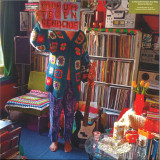
"Militant roots missile delivered by the one-of-a-kind voice that is Daweh Congo. Daweh’s haunting delivery and spiritual fire set him apart in the roots revival movement. On “Prophecy Reveal,” originally released in 2000, Daweh’s mystical chant rides a heavy digital rhythm, while the flip side unleashes deep ’90s electronic dub vibes."
Search:dub one
- 1: Echo-Logik
- 2: Bass Temprature
- 3: Train To Transylvania
- 4: Emperor Dub
- 5: Mother Dubber
- 6: The Orientalist
- 7: Hempro 905
- 8: N 1 Station
- 9: Rajaskank
- 10: Lysergic Sound Of Dub
- 11: Antivitrolles Dub
- 12: Dubiously
With Bass Temprature, rediscover on one single CD the first three vinyl EPs by High Tone: Bot Dub Seasons, Low Tone, and Bass Temperature-a total of 12 tracks that propelled the Lyon-based group into the ranks of electro-dub heavyweights. In addition to these two reissues, four extra tracks have been added, making for a 12-track album just as compelling as it's predecessor. It marks a shift toward a more roots-oriented sound while remaining firmly grounded in the electro-dub genre. The album opens with Echo-Logik, a warrior-like chant followed by a driving bassline that makes you want to move-DJ Twelve's scratches laid over the groove offer a brilliant showcase of the band's talent. The title track, Bass Temprature, follows-perhaps the least striking piece, though that's only relative given the strength of the rest. Worth noting are the mystical vocal samples in Train to Transylvania, evoking vampires and devils, while N1 Station brings a heavy psych sound, a more energetic beat, and moments that border on hard-tek. Other influences also emerge, such as the strong Eastern vibe in The Orientalist. As always, High Tone delivers a stunning dub album sure to delight ears tired of the everyday noise pollution that surrounds us.
- A1: Space Afro– Blessed
- A2: Dualbox & Aracy Carvalho– Feel (Afrobeats Mix)
- A3: Bellestar & Trippynova– A Different Path
- A4: Nikko Mad & Space Afro– On My Mind (Mona Lisa Mix)
- A5: Future Soundscapes & Françoise Sanders– Honestly
- A6: Dualbox & Sapce Afro– Used To Be
- A7: Motor City Squad– One Truth
- B1: Space Afro & Monsoon– Ready
- B2: General Soundbwoy & Nikko Mad– You Trap Me
- B3: Golden Smirk– Missing You (Afrobeats Mix)
- B4: Dual Sessions– Us Together
- B5: Urban Love– I Want You, Girl
- B6: Space Gang & Frederik Young– Can't Go On
- B7: Max Dubster & General Soundbwoy– Kenya (General Soundbwoy Mix)
- C1: Future Soundscapes– Body
- C2: Monsoon– Pretty Nature (Nikko Mad Mix)
- C3: Space Afro & Nikko Mad– Lights
- C4: Don & Gene– For My Love (Afrobeats Mix)
- C5: Dual Sessions– Bikini
- C6: Monsoon– I Think About You Every Day
- C7: Hypnomusic– Can't Stop
- D1: Space Afro– Liquor (Afrobeats Mix)
- D2: Space Afro– Sweet Gal
- D3: Monsoon– Scars (Afrobeat Mix)
- D4: Rhythmic Control– Burghalle
- D5: D G– Senegal Dreams
- D6: Gilbert Mota– Number One
- D7: Rhythmic Contro– One, Two, Three
Peach Discs’ first EP of 2025 comes from DJ, producer, curator and all-round doer of great things James Priestley aka Secretsundaze.
The Mordisco EP accumulates inspiration from James' past and present, whether it be echoes of his time as a drum & bass DJ in the late 90s on "Closer," the UK Bass-referencing percussive drive of "Treat That Doll" or the title track's vocal contributions from partner Paula Juana, the result is a personal and true record that always retains the laser-focused dancefloor energy that James is so good at dishing up.
Lead single "Mordisco" serves to highlight both the UK x Colombia connection found in James' relationship to Paula, as well as his love for Latin American music in general. Paula's sultry vocals wrap themselves around tumbling drum fills, arcing synths and an insistent rhodes riff, creating something unclassifiably groovy, riding the line between house and techno while never settling into either. Sansibar takes the baton and runs further into propulsive, progged-out, dubbed-out territory on his remix – the first officially released remix on Peach Discs.
James founded Secretsundaze as a party series in 2002, and since then it's established itself as one of the most reliable names in electronic music, encompassing a record label, festival (Multi Multi), live band (Spirit of Sundaze Ensemble) and production outfit. The four tracks that make up this EP fit neatly into the lineage that James has cultivated over the past 23 years – paying tribute to history while not being beholden to it. Mordisco continues the deep, rhythmically ambiguous approach to house music that Secretsundaze championed since the first EP for Phonica Records in 2018, and continued with stand-out releases for Mule Muziq, Live At Robert Johnson and more recently Warning.
As long-time fans and affiliates of Secretsundaze (Shanti released her Alma EP on the label back in 2015), we're thrilled to be working together again and releasing this record into the world.
- A1: Free State Fence
- A2: The Surfer
- A3: Prayer For Civilisation
- A4: Hillbrow 1
- A5: Hillbrow 2
- B1: Hippo In Town
- B2: Independence Day
- B3: Don't Dance
- B4: Crossed Cheques
- B5: September 1984
This is an album made during a crucial period in South Africa’s history during which there was a palpable feeling of a slow turning towards the collapse of the apartheid state side by side with an increasingly well-organised culture of resistance through the formation of the United Democratic Front (UDF) and various affiliated bodies. However, as a result, there was increased pushback from the state security establishment, a turning to dirty tricks and the formation of hit squads whose members murdered and tortured many of our friends and created chaos throughout South Africa as well as neighbouring countries.
This album is situated in this political environment however it took advantage of the new do-it-yourself music technologies available at that time. Technologies that made it possible to make and release records without interference from traditional record company executives. Two musician friends of mine pooled their resources after their respective bands had broken up. Ivan Kadey (National Wake) and Lloyd Ross (Radio Rats) built an 8-track recording studio control room and fitted it out in a second hand caravan and called it Shifty. They parked it in a garage attached to the only house left in a demolished and derelict mining village near Soweto on the outskirts of Johannesburg.
All the work on this album was completed there, mainly after hours and mostly alone where I enjoyed an exhilarating freedom to develop a whole new set of musical skills and ideas, incorporating my love of a wide range of music I’d grown up with. Influences of 1970s progressive/kraut/and psychedelic rock combined with mbaqanga bass styles, early reggae/dub and Indian tabla rhythms. Stockhausen, early Zappa and Holgar Czukay were radio text and shredding influences, and Chris Cutler’s band Henry Cow & Art Bears helped me see a way to political expression. Mostly though was the exciting post-punk and no-wave music coming through to us from Europe and America: bands like This Heat, the Mekons, Raincoats, Sonic Youth and Pere Ubu were immensely important to me as was my reading from the period: J.M.Coetzee’s first 3 novels are strong influences on Free State Fence; the stark landscape, superstition, ritual, and sexual repression are in many of his settings. JG Ballard was a constant presence throughout that period, especially whilst living in such a surreal environment, surrounded by mine dumps, but mostly I think the whole French post-modern philosophical movement—Derrida, Foucault and of course, Baudrillard’s Simulacra and Simulation—set out a new sense of possibilities, possible ways to express oneself, ways to think, and ways to try and analyse the political intersection of public and private life. Most important at that time was the influence of sound recordings I had made and experiences garnered from working as a sound recordist on documentary films. These financed my work and later the studio and were consistent employment throughout the 1980s. Film work also enabled me to experience much of South Africa that was hidden from most. The track Independence Day is a good example; drawn from some time spent in the rural homeland of Venda. This then was the first full length Kalahari Surfers album, completed in summer of 1984 it was taken to EMI pressing plant but rejected by the cutting engineer as being ""political, pornographic and anti religious"". Chris Cutler at Recommended Records took up the challenge and released the album through his label. He wrote the original liner note
- A1: Out Of Control
- A2: Twilight
- A3: An Cat Dubh / Into The Heart
- A4: Surrender
- B1: Two Hearts Beat As One
- B2: Seconds
- B3: Sunday Bloody Sunday
- B4: The Cry / The Electric Co
- C1: I Fall Down
- C2: New Year's Day
- C3: Gloria
- C4: I Threw A Brick Through A Window
- C5: A Day Without Me
- D1: Trash, Trampoline And The Party Girl
- D2 11: O'clock, Tick Tock
- D3: I Will Follow
- D4 40:
Civilistjävel! x Mayssa Jallad’s ‘Marjaa: The Battle of the Hotels (Versions)’ is a radical response to Mayssa Jallad’s 2023 original LP, a lyrical account of epochal events in Beirut at the dawn of Lebanon's civil war. ‘…(Versions)’ sees Civilistjävel! (aka Swedish producer Tomas Bodén) apply a stripped, dub methodology to Mayssa's rich stems, refracting the Arabic source through the hazy prism of Northern European electronica. Retaining ‘Marjaa…’s deep spatial framing and vaporous, shifting nature, traces are lifted and set down in a new landscape: a ghost of a ghost. Informed by Tomas' singular strand of ambient, minimalist, dub techno, ‘… (Versions)’ recalls the reductive, shimmering pulse of pioneering Berlin-based practitioners Basic Channel/Chain Reaction, but with the parameters stretched into the ether. Where versions typically focus on a rhythm, here the anchor is the tone and texture of Mayssa’s voice, around which a new world has been constructed. Disembodied and liminal, it conjures an eerie panorama that feels like a postscript to the original, further emphasizing the geopolitical events that have had such devastating effect in Mayssa’s homeland of Lebanon since that record’s release. ‘Marjaa…’ (tr. ‘reference’) combined Mayssa Jallad’s two main vocations: music and urban research/architectural history. The album was co-written with Fadi Tabbal and based on Mayssa's Historic Preservation master's thesis (‘Beirut’s Civil War Hotel District: Preserving the World’s First High-Rise Urban Battlefield’). The thesis examined a 5-month conflict that took place within Beirut's skyscraper-laden luxury hotel district of Minet El Husn near the start of the Lebanese Civil War. Addressing a post-war generation who have never been taught this difficult history, ‘Marjaa…’ was an attempt to process trauma, and “a call to protest for the renewal, rather than the recycling of the political class that once destroyed the country and holds us, to this day, hostage of its violence.” Often perceived as a mysterious, shadowy presence, Civilistjävel! has come increasingly to the fore in recent years through a consistently dazzling stream of records, released both anonymously and via Fergus Jones’ FELT imprint, often appearing with scant information and tracks for the most part untitled. Having featured tracks from ‘Marjaa…’ on mixes, and included the album in his picks of 2023, in early 2024 Tomas asked Mayssa to provide vocals for a track on his album ‘Brödföda’. Mayssa remembers, “Tomas asked me to choose one of the tracks he was working on. I was in Boston at the time, so I took a walk and chose a track. I wrote the lyrics at the public park, wondering if I was the only one around that was losing sleep over the genocide in Palestine and the war in South Lebanon. I went back to the apartment and recorded the vocals on my phone, while listening to the track on headphones. Tomas reworked it with the voice and sent it back. I liked it immediately.” Despite the geographical distance from Beirut to Uppsala, Sweden, where Tomas resides, Mayssa’s contribution sounds very much at home in Civilistjävel!’s atmospheric, contemplative sound-world. Tomas’ request was reciprocated by Mayssa soon after, resulting in the spectral, glassy ambience of ‘Etel, Kharita (Version)’. This was followed by an invitation to work on more tracks, which Tomas immediately embraced, intensively jamming out versions live to two-track tape in downtime between travelling. If not entirely dissimilar to his regular working practice, the immediacy of it was unusual. Much was improvised live with just a keyboard (not tethered to a grid), and a restricted set-up that largely forbade later edits - only the rhythm tracks are programmed. A sharp conceptual thinker and composer, Tomas takes creative liberties with Mayssa’s songs in a way that is deeply felt and sympathetically aligned, whilst unashamedly outside of the original context of the record. The voice is leaned into as an instrument, without the clear, specific details of language, and this axis provides an uncertain, amorphous footing - structure is often suggested or hinted at, before disappearing or collapsing into fog, and folding back into the message within the song. A somewhat unprecedented source for an album of versions, even those familiar with ‘Marjaa: The Battle of the Hotels’ may at points struggle to hear the songs these versions are rebuilt from, despite the vocal narratives remaining virtually intact. The light has shifted; eroded buildings are foregrounded; fragments of memories appear in chiaroscuro. Signs and signifiers have been replaced. Shorn of the original's warm guitar, ‘Baynana (Version)’ feels like an ominous visitation, the sun no longer visible. ‘Holiday Inn (March 21 to 29) (Version)’ is a molten, clattering invocation. The beat-less tracks nod towards the cold, otherworldly sound-scaping of late '90s isolationism. More propulsive and embodied, ‘Holiday Inn (January to March) (Version)’ and ‘Kharita (Dub)’ are strobing, iridescent techno - lithe, shifting and mutating with almost implausible finesse. A stunning addition to Civilistjävel!’s growing catalogue, ‘…(Versions)’ is a luminous counterpoint to ‘Marjaa…’, and a welcome reminder of how incredible that record remains.
"High urgency music with a very personal expression of the artist: in one way or another", this has always been the important or maybe even the core factor of every Cortizona release so far.
So it was just a matter of time until DJ Marcelle/Another Nice Mess, longtime fan of The Fall and Jiskefet, topnotch producer, dj wizard with three turntables (and a lovely person in general) - and myself - would collaborate towards a Cortizona release.
I guess the initial idea of working together with DJ Marcelle/Another Nice Mess dates back to 2019. One day she called me four times in five minutes just to hear Mark E. Smith's voice message on my phone. Since then there has been no going back. I mean: what's not to love about her?
Some time ago, she sent me the digital files of her new LP 'Sorry, No Service'. One of the tracks, 'Sorry, No Silence', features the Nan Goldin sample: 'this is clearly ethnic cleansing', taken from Goldin's impressive speech to which the audience cheered in support at the opening of her exhibition at the Neue Nationalgallerie in Berlin end of 2024.
Two weeks later Marcelle contacted me again: her German label refused to release the track. This was the moment we had both been waiting for: at last Cortizona and Marcelle would work together!
The album is due to be released later this year, but, with things as they are in Gaza, it is important to issue 'Sorry, No Silence' as a stand-alone track as soon as possible.
Talking about urgency!
'Sorry, No Silence' resonates feelings of global despair over the genocide in Gaza and the moraland political bankruptcy of 'western values'. It does so over a repetitive, militant tribal beat, complete with heavy basslines. The spirits of Mark Stewart, On-U Sound and Muslimgauze loom over the track, but as is always the case with Marcelle, both on stage and in the studio: she has an authentic style of her own, where playfulness meets courage and - also in this case - anger meets rhythm.
'Sorry, No Silence' is a track I didn't know I was waiting for. A track reflecting the sign of the times. The 12'' also features an even more heavy (and faster) dub version and the avant garde track 'Never Again Means', featuring more Nan Goldin samples: 'never again means never again for everyone'.
For obvious reasons the proceeds of this 12 inch and the digital Bandcamp release will be donated to PCRF, Palestine Children's Relief Fund.
Support more than welcome.
(written by Philippe Cortens)
Limited to 300 copies.
Japanese musician MERMAID, focusing on new roots dub with all bases in sine wave.
The songs have plenty of echoes of chamber music, Japanese folk songs and chopped his own voices, giving the listener layered sounds with a rather odd sense of humour :)
MERMAID is one of the members of DDM (Dangerous Dance Music), which is the movement spread from 'Los Apson?' record store in Tokyo.
After participating in dub & electronic compilations, continuing his own research into Reggae, he has finally unleashed 10 songs in DUBMAID.
Senselessness 1/2 is the very first solo issue of the Swiss electronic composer Robin Félix, on his own label De l’Aube (Of Dawn), the occasion for him to prove that field recordings can be (or should be?) an integral part of the global matter, when so often they are just something hovering in the background because it’s “nice” or reminds the artist of a place he loves.
Throughout the length of these four tracks, they are litterally central; moreover, they are electronically transformed, manipulated, skewed and twisted in order to form some sort of framework, a backbone on to which sounds and genres intertwine. On Cluster, violins and cellos (recorded in the gardens of the Venice Biennale) are soon transmuted into the abrasions of the electroacoustic realm, until the pulse of a relentless bass introduces a pure and pristine electronic music that knows and uses the roots of dub, drum’n’bass and the meticulousness of Jan Jelinek’s Glitch aesthetics. A tad “housy”, Chi comes as a second pulse where a modified didgeridoo and African percussions (recorded in a Swiss forest) lead the listener to a sort of tribal mode, as suited to dancers than to those who prefer inner journeys; here, the spatial dub of King Tubby moves from background to foreground.
The more abstract Boiler verges on the IDM and the heady, elegant and spartan Detroit techno – headphones reveal its numerous minute and delicate details. Based on the recording of insects, of which one can hear the actual rubbing of elytras, the closing Swarm ends the record with and intricate blend of ambient, which in some way winks to the Aphex Twin and The Future Sound Of London. Overall Senselessness 1/2 is a mesmerising and concise update of the famous Deutsche elektronische musik of old, that gathered on its way the other genres that made Robin Félix tick. Since field recordings have hardly been that meaningful, one wonders where Senselessness 2/2 will lead us to
Sub Basics's Temple Of Sound is back with new music from Henry Greenleaf who appears under his new moniker, Greenteeth. It is a project he is clearly using to cook up smart back room minimal sounds going off this evidence: 'Loxton' is a slow motion and prowling groove but one with deep, menacing bass and nice louche percussion. 'Jungle Love' is another subversive sound with a snaking rhythm and dubby low ends, dusty hi hats and late night mischief. Last of, 'On & On & On' plays out over all of the flipside with shuffling drums that are light and airy and topped with wispy drones. It's delightfully hypnotic.
In celebration of Pride Month, Kinga struts to Dark Entries with “Sexy Boy,” a steamy Canadian pop gem. Inspired by gender-bending pop stars of the 1980s like Boy George and Janet Jackson, a young Tomas Fussey aka Kinga ditched his “schoolboy appearance” to adopt an edgier, androgynous style. Immersed in Calgary nightlife, he became acquainted with sexy synthpop and disco songs like Madonna’s “Everybody,” Divine’s “Native Love,” and the Flirts’ “Passion” - songs which still linger in his mind. He began writing music: “It was 80s. Everyone was making a record. So I made one too.” In 1988 he teamed up with keyboardist Dan Madison and veteran producer Bob Gallo to make “Elevator Operator” and “Sexy Boy.” Kinga was surprised when the B-side “Sexy Boy” garnered substantial radio play from CFNY in Toronto. But he notes: “They saw the obvious... My physical appearance supported the lyrics.” In 1989, Amok Records backed a new “Late Night Dance Mix” version of “Sexy Boy.” Almost every part was re-recorded or remade, including Kinga’s vocals. The new version surprised Kinga with its slick production and moody atmosphere. Sales were disappointing, and Kinga stated “It was not the sound of the moment.” But these deeper house-inflected grooves feel like the sound of our current moment. This release of Sexy Boy includes five different mixes, including the original 7” mix, three versions from the 12”, and the previously unreleased “TV Mix”. Sexy Boy comes sleeved in a reproduction of the original artwork and includes an insert with liner notes and lyrics, as well as an 8x10 glossy press photo of the sexy boy himself.
Makin’ Moves bring this archived studio gem to the fore as it was just too damn good to be left sitting on the drive! Rewind back to 2005 and a chance studio meeting in London between Bugz in the Attic producer Afronaught aka Orin Walters and Justin Chapman aka Kemeticjust who decided to work on some tracks. It was a time in London where there was a huge melting pot of new sounds in the broken beat era / scene and that sound was at the forefront of London’s club scene including night’s like Co-op at Plastic People in Shoreditch. However, these sounds still have stayed the test of time and very prominent still in clubland today.
Justin’s classy vocal tells a political story about our modern times in American and feeling of oppression with in the Black race.
Phil Asher (RIP) at the time loved the track and decided to do his own “Restless Soul Dub” remix version, adding his characteristic drums and stripping the vocal back while also keeping the soulfulness of Kemetic’s original.
Also featured on the package are two other mixes the excellent Blaktones Mix is must have for all the co-op broken beat heads, seeing Afronaught using those classic sounds to full effect to set the party off!
Hollie Cook, one of reggae’s most exciting voices, makes a return to the label that released her cherished debut album in 2011. Landing back on Mr Bongo, 'Night Night' is a stand-alone aperitif and taster of what to expect from the next era in Hollie's musical journey
Revisiting her roots, this latest single embraces the trademark reggae / tropical pop sound Hollie found fame with on her first two albums. With a career that has gone from strength to strength since those formative days, the buoyance, charisma, and confidence gained in those subsequent years are on show for all to see.
Recorded at Crosstown Studios in London with the General Roots band and produced, mixed and dubbed by Ben McKone, ‘Night Night’ documents the longing of a lonely lover. Grounded in a sound system rattling bass line, strutting guitars and shimmering keys provide a sunshine-infused contrast. Hollie’s smooth sultry tones radiate throughout, backed by the legendary Horseman on toasting duties - a collaboration that hasn’t been heard since Hollie’s first album. Trading verses, the warmth of Hollie's velvety vocals balances Horseman's raw explosive energy in an absorbing harmony.
In true reggae style, the 7" single is backed with a classic dub mix, adding spacey reverb and delays, whilst giving Hollie and Horseman a more spacious streamlined flow in the mix.
The Collective Cuts sub-label of Cinthie’s 803 Crystal Grooves makes a welcome return
with a fresh VA package, featuring Willy Mikkelson, Luca Olivotto, Batch One and Roque
(CRP).
Since its inception back in 2020, Cinthie’s Collective Cuts imprint has welcome the likes of
KETTAMA, 9th House, S3A, UC Beatz, Anaxander, Azuni and many more onto the label. Here
the story continues with more dynamic house jams from Cinthie’s coterie of underground
artists from across the globe.
Nashville, USA’s WiLLY MiKK leads with Devastate, laying the foundations for the records
with a classic Hip House vibe, fusing crisp drums, bright stabs and bumpy bass with
choppy hip hop vocals. Small Great Things head honcho Luca Olivotto follows with
‘Passion’, the Berlin based Italian delivers his refreshing disco-tinged House aesthetic via
funky guitar licks, bright chord melodies, ethereal pad textures and shuffled drums.
Batch One’s ‘When U R Free’ follows to open the flip side, merging snaking arpeggios and
bouncy bass notes with uplifting piano lines and a raw, robust rhythm section. Spanish
artist based out of Basel, Switzerland Roque (CRP) then concludes the package with ‘Bring
It Down’, perfectly rounding things out on a deeper tip, raw, reduced drums carry the
groove alongside an amalgamation of chopped vocal chants, dubbed out stabs and tension
building strings.
- A1: Return To The River Ganges (Distant Green Shore Dub)
- A2: Mediolana (Ambrosirus Dub)
- A3: The Galicians Of Asia Minor
- B1: Indika Keltika (Fiery Pharoah Mix)
- B2: Dhaka Corinthia
- B3: Delfic Tongue (Hercynian Forest Dub)
- C1: Voyage Of The Pytheas (Pagan Dub)
- C2: Benares Eternal City (Eryri Dub)
- C3: Sumerian Odyssey
- D1: King Of The Faeries (Demnoriax ‘King Of The Lower World’ Dub)
- D2: Deer Hunter (Aeduan Druid Odyssey Mix)
- D3: Atmabodha (Ritual Focus Dub)
Coloured[32,73 €]
OVERVIEW: DUB TREES is one of Youth’s most revered dub projects, it helped define the Liquid Sound Design sound that fans around the world hold dear. This project is the third in a triptych of albums Youth has made with a specific Celtic / Hindu fusion. Starting out with the classic Celtic Cross ‘Hicksville’ 20 years ago, featuring the mythical Simon Posford (Shpongle) through to ‘East of the River Ganges’ (ft Klaus Shultz / Tangerine Dream amongst many others) in 2004 followed by the last piece of this mystical puzzle ‘Celtic Vedic’ ,released on compact disc only in 2016 , which charts the journey of the Celt from Northern India to Snowdonia. The idea stems from Youth’s firm belief that there is a strong correlation between Celtic and Vedic cultures and their Northern Indian roots. Youth has assembled a host of collaborators to weave their labrynthine magic on ‘Celtic Vedic’: Jah Wobble (PiL) on bass, Matt Black/Coldcut (Ninja Tunes) on warped soundscaping duties, Galician Celtic pipe and flute player Daniel Romar, Bollywood contemporary Indian singer Shridevi Keshavan and Elfic Circle. It features many field recordings made by Youth on his various Indian odysseys and is all harnessed together with cutting-edge electronica that the Liquid Sound Design team pioneered 20 years ago. The team today are still pioneering new directions within ‘Downtempo Electronica Music’ and beats that create 3 dimensional landscapes for the helioscopic imagination to explore and psychoactive maps for the inner astronaut in all of us. ‘Celtic Vedic’ promises unchartered bass annihilation and heliotropic soundscapes, pounding basslines overlayed on 3D holographic beats and wrestles with serpentine melodies and psychedelic textures.
Khadim is a stunning reconfiguration of the Ndagga Rhythm Force sound. The instrumentation is radically pared down. The guitar is gone; the concatenation of sabars; the drum-kit. Each of the four tracks hones in on just one or two drummers; otherwise the sole recorded element is the singing; everything else is programmed. Synths are dialogically locked into the drumming. Tellingly, Ernestus has reached for his beloved Prophet-5, a signature go-to since Basic Channel days, thirty years ago. Texturally, the sound is more dubwise; prickling with effects. There is a new spaciousness, announced at the start by the ambient sounds of Dakar street-life. At the microphone, Mbene Diatta Seck revels in this new openness: mbalax diva, she feelingly turns each of the four songs into a discrete dramatic episode, using different sets of rhetorical techniques. The music throughout is taut, grooving, complex, like before; but more volatile, intuitive and reaching, with turbulent emotional and spiritual expressivity.
Not that Khadim represents any kind of break. Its transformativeness is rooted in the hundreds upon hundreds of hours the Rhythm Force has played together. Nearly a decade has passed since Yermande, the unit's previous album. Every year throughout that period — barring lockdowns — the group has toured extensively, in Europe, the US, and Japan. With improvisation at the core of its music-making, each performance has been evolutionary, as it turns out heading towards Khadim. “I didn’t want to simply continue with the same formula," says Ernestus. “I preferred to wait for a new approach. Playing live so many times, I wanted to capture some of the energy and freedom of those performances.” Though several members of the touring ensemble sit out this recording — sabar drummers, kit-drummer, synth-player — their presence abides in the structure and swing of the music here.
Lamp Fall is a homage to Cheikh Ibra Fall, founder of the Baye Fall spiritual community. The mosque in the city of Touba is known as Lamp Fall, because the main tower resembles a lantern. Soy duggu Touba, moom guey séen / When you enter Touba, he is the one who greets you. After a swift, incantatory start Mbene sings with reflective seriousness. Her voice swirls with reverb, over a tight, funky, propulsive interplay between synth and drums, threaded with one-two jabs of bass. Cheikh Ibra Fall mi may way, mo diayndiou ré, la mu jëndé ko taalibe... Cheikh Ibra Fall amo morome, aboridial / Cheikh Ibra Fall shows the way forward, he gives us strength, he gathers his disciples... Overflowing with grace, Cheikh Ibra Fall has no equal.
Interwoven with Wolof proverbs, Dieuw Bakhul is a recriminatory song about treachery, lies, and back-biting. Over moody, roiling synths and ominous, lean bass, Mbene throws out fluttering scraps of vocal, as if re-running old conversations in her head. The music shadows her despair to the verge of breakdown, at one moment seemingly so lost in thought and memories, that it threatens to disintegrate. Bayilene di wor seen xarit ak seen an da ndo... Dieuw bakhul, dieuw ñaw na / Stop judging your friends and companions... A lie is no good, a lie is ugly.
Khadim is a show-stopper; currently the centrepiece of Ndagga Rhythm Force live performances. The song is dedicated to Cheikh Ahmadou Bamba, aka Khadim, founder of the Mouride Sufi order. Serigne Bamba mi may wayeu / Serigne Bamba is the one who makes me sing. The verses name-check revered members of his family and brotherhood, like Sokhna Diarra, Mame Thierno, and Serigne Bara. Though Islam has been practised in Senegal for a millennium, it wasn’t until the start of the twentieth century that it began to thoroughly permeate ordinary Senegalese society, hand-in-hand with anti-colonialism. The verses here recall Bamba’s banishment by the French to Gabon, and later to Mauritania, in those foundational times. During exile, his captors once introduced a lion to his cell: gaïnde gua waf, dieba lu ci Cheikhoul Khadim / the lion doesn’t budge, it gives itself over to Cheikh Khadim. Deep, surging bass, steady kick-drum, and simple, reverbed chords on the off-beat lend the feel and impetus of steppers reggae. A reed plays snatches of a traditional Baye Fall melody; the dazzling polyrhythmic drumming is by Serigne Mamoune Seck. Mbene compellingly blends percussive vocalese, narrative suspense, exultant praise, introspection, and grievance.
Nimzat is a devotional tribute to Cheikh Sadbou, a contemporary of Bamba, buried in a mausoleum in Nizmat, in southern Mauritania. Way nala, kagne nala... souma danana fata dale / I call upon you and wonder about you... If I am overwhelmed, come to my aid. The town holds special significance for Khadr Sufism. An annual pilgrimage there is conducted to this day. The rhythm is buoyantly funky; the mood is sombre, reined-in, foreboding. Punctuated by peals of thunder, Mbene sings with restrained, intense reverence; huskily confidential, steadfast. Nanu dem ba Nimzat, dé ba sali khina / Let us go to Nimzat, to seal our devotion.
Mbene Diatta Seck: vocals.
Bada Seck: bougarabou, thiol, mbeung mbeung bal, tungune.
Serigne Mamoune Seck: bougarabou, khine, mbeung mbeung, tungune.
Text by Mark Ainley (Honest Jons).
Mastered by Rashad Becker.
Everything else by Mark Ernestus.
Repress of the KGB002... that was never repressed since 1998.
One legendary tubular Tribe speedaz tune... and one more Dub-Techno tribal 69DB pure style (in the vibe of the Trax or the Drop bass 23...)
The Toolbox Killerz 23 was never out so far because we really wanted this one to be the KGB002, as KGB is part of our history for those who knows...
We did dig some cool old flyers and pictures and did a patchwork printed sleeves with some souvenirs :)
-------------------------
Mastered by Stefan ZMK and cut by Simon The Exchange.
Tunes have been re-calibrated to regular tempo (as it was a live the tempo was moving, somehow...)
ENJOY !
- A1: Those New York Dolls (2.06)
- A2: Those New York Dolls Dub (2.13)
- B1: Doll Breaker (1.47)
- B2: Lipstick Power And Paint (2.00)
- B3: Lipstick Power And Dub (2.01)
12” Signed & Embossed Art Print
‘Well let me tell you a little something and it goes like this
Those New York Doll boys they were always looking for a kiss’
Those New York Dolls
The group that started it all back in those pre-punk days. The New York Dolls had it all, style, sass and the tunes to back it up. But as the title of their second and last studio album incurred they were simply `Too Much Too Soon’. For outside of New York and L.A. their humour and drag look was all too much for the mainstream listening public, so they imploded. But a few other bands were taking notes and by softening the edges they took over the world and as the title track of Mal-One’s latest 12” release points out;
‘But who wants a thrill without a little risk
I think we’ll just leave all that up to bands like Kiss’
Those New York Dolls
So Mal-One thought he ‘d better pay homage and let the kids know how great they were.
So we hope you enjoy this tribute to those New York Dolls that make you wanna go…
‘Yeah Yeah Yeah’.
Introspekt’s hotly anticipated debut album Moving The Center comes nearly a year after the release of her latest EP Tectónica. Set to be released on June 20th, Moving the Center sees Introspekt play homage to dubstep’s point of genesis in South London in order to then shift the center of focus from a singular point of origin, to a more global narrative of bass and vibration. The album blends UK bass with contrasting genres like garage and ballroom, creating the perfect feminine blend of these historically masculine genres. The album merges the Black diaspora from across the Atlantic, crafting a sonic world where past, present and future are parallel and immersed in an early millennium type dubstep soundscape.
Speaking about the album, Introspekt says, “‘Moving The Center’ embodies an alternate perspective to that which has been dominant in dance music, particularly so-called ‘bass music’. The narrative it presents is one which throws a wrench in the seemingly common perception of Dubstep as a masculinist sensibility. ‘Moving The Center’ pushes a feminine physicality to the front of the bassbins. Femmes to the front!”