La Castanya is releasing “Gran Sur” on vinyl for the first time, originally released on CD in 2004. Very Limited/Non-Returnable.
Hello Cuca, inspired by the DIY philosophy and the Riot Grrrl movement, toured the United States with The Make Up (Dischord / K Records) and Spain with Bratmobile (Lookout! Records / Kill Rock Stars).
Hello Cuca released on vinyl a handful of EPs between the late nineties and the two thousands and then an album released on CD, Gran Sur, an out of print release right up until now that La Castanya is going to release it on vinyl for the first time.
In Gran Sur Lidia Damunt (the same Lidia Damunt who has now gone solo) was joint by her sister Mabel Damunt on the bass and Alfonso Melero (the same Alfonso Melero from Villarrobledo’s much-missed indie aristocracy) on drums. She sang Mabel’s lyrics about a place in-between the Spanish Levante Coast and the West Coast of the United States. A place for Mabel’s dream-theories about love and sisterhood and how we learn how to be people when we talk to each other, when a name is given to us, when we do things and let the others see we have done them.
There they were, and there they are still. Lidia shouting that madness of lyrics and
playing the guitar and Mabel and Alfonso doing their badaboom-badaboom from behind.
It was incredible to watch, it is irresistible, they are the best without question. I think a lot
about Hello Cuca. — Manolo Martínez, Astrud
Suche:each
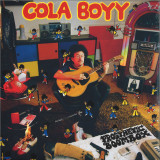
There’s liberation on the dance floor in the songs of Matthew Urango – glimpses of revolution that glimmer beneath the disco ball. “I want my music to bring people together,” says the Californian pop innovator, best known as Cola Boyy. “Because standing together is our best chance at fighting this shit show.” The shit show in question is a broken, brutal system the acclaimed multi-instrumentalist has witnessed up-close. Urango was born with spina bifida and scoliosis in Oxnard, California: a town in which almost 30,000 are estimated to live in poverty. Prosthetic Boombox, his eagerly awaited debut album, might at first glance seem a joyous confetti-burst of pop eclecticism, engineered to sound like “scanning between stations on a car radio, landing on all these different sounds and styles” as Urango puts it. Dig deeper, though, and you’ll discover a simmering sense of rebellion. “The working class are injured, struggling to pay rent and struggling to put food on the table,” he says. “I want to represent that.” Prosthetic Boombox
achieves that goal in a thrilling flurry of inventive indie, funk and soul: take Urango’s car radio analogy, place it in a time-travelling Delorean with Prince in the passenger seat, and you’re half-way there.
Look no closer than Prosthetic Boombox’s euphoric opener, the Avalanches-assisted ‘Don’t Forget Your Neighbourhood.’ The track – which Urango says mixes “the Beach Boys, French disco, house keys and ragtime piano, kinda like the Cheers soundtrack!” – ends with lyrics urging listeners to “fight for your town with your fist closed, strike it and make it more than just a memory.” It’s a reminder that the working classes need to “turn our fists against our oppressors instead of each other,” he explains. After that emphatic introduction comes a horn-laced funk wig-out titled ‘Mailbox’ – a song that gives Dua Lipa’s Future Nostalgia a run for its Studio 54-themed money, featuring rising Londoner JGrrey. Elsewhere, ‘Song for the Mister’ ventures into smooth R&B territory, before ‘Roses’ – a collaboration with Myd of Ed Banger fame – offers a bouquet of bustling disco guitars and infinite bisous of Connan Mockasin’s band drops in on the immaculate ‘Go the Mile’. Urango saves his most introspective moment for the album’s starry closer. ‘Kid Born in Space’, a cosmic collaboration with MGMT frontman Andrew VanWyngarden, sees the artist reflect on what he once had to overcome as a disabled person of colour. “I see them looking down on my dreams of being,” he sings tenderly. “I hear them making fun of my voice, but I keep on moving forward, I refuse to live in anyone else’s shadow.” Prosthetic Boombox, on this subject, is more than an album title – it’s a statement of intent.
“The message of my music is that our class is exploited, oppressed and murdered on the daily. That’s not right, and the system that enables that deserves to be wiped off the face of the earth,” he says. “The only way that happens is if we’re united. That’s the point of my music – to relate to people and unite them.” And what unites more than raucous, irresistibly danceable pop? Prosthetic Boombox is a riot of joyous grooves and catchy hooks for good reason. “I want to reach and spread my message to as many people as possible. You can’t do that if you’re some obscure motherfucker, you know?” he laughs. Don’t bet on him being an “obscure motherfucker” for long.
After signing to the Toolroom in 2018, Friend Within is finally ready to unveil his debut album titled ‘Hope’ with four of the standout tracks being compiled for this 12 inch sampler. An established producer in his own right, having worked with countless DJs and producers over the years Friend Within has come full circle with his debut album ‘Hope’. Written during lockdown in 2020, it is a collection of his finest tunes to date, packed full of club bangers and dancefloor fillers leaving little room to disappoint.
Released back in 2020, the first single to the album ‘For You’ is a self-assured classic house track with no need for an introduction, maintaining the albums theme of absolute bangers. Despite it being one of the more chilled out moments on the album, ‘Love Goes On And On’ cements its place as a straight up house banger. Next up, A-Trak makes an appearance as the pair collaborate on 'Know Each Other', upping the ante from their previous 2019 hit ‘Blaze’. Going from strength to strength, the late night, feel good nature of the song speaks for itself and is a definite high point of the album. Finishing things off is instant dancefloor classic, 'Rola', an uplifting Disclosure esque record sprinkled with subtle hints of Friend Within magic for good measure.
Although the album leaves a sense of longing for live music again, it gives hope that better times are yet to come. Hope is destined to soundtrack and define nightlife post pandemic, known the world over as a classic debut by one of the most exciting artists of this decade.
Die weltbekannte Band aus Island ist mit ihrem elften Studioalbum, dem hoch emotionalen "Mobile Home", zurückgekehrt und veröffentlicht damit ihr erstes Album seit 2018. Das Kollektiv beweist einmal mehr die Meisterhaftigkeit, seine künstlerischen Grenzen zu erweitern, indem sie eines ihrer ambitioniertesten und kraftvollsten Alben seit Jahrzehnten veröffentlichen. Für ihr neuestes Album holten sich GusGus die VÖK-Sängerin Margrét Rán zur Hilfe, um ihren Stil zu erweitern und den Sound des Kollektivs so frisch wie immer zu halten. Das 9-Track-Album bietet eine Mischung aus elektronischem Rock, Ambient, Darkwave, Downtempo und Synthpop. GusGus besser denn je!
World-renowned group GusGus have returned with their 11th studio album, the highly emotive Mobile Home, marking their first album release since 2018. The collective once again prove their commitment to pushing their artistic boundaries as they release one of their most ambitious and powerful albums in decades. For their latest record, GusGus call on VÖK’s lead singer Margrét Rán to help expand their style, keeping the collective’s sound as fresh as ever. The 9-track album features a concoction of electronic rock, ambient, darkwave, downtempo, and synthpop.
After announcing a new album in October 2020, GusGus wowed fans with their first single “Higher,” offering a first taste of how VÖK’s impactful vocals mesh seamlessly with GusGus’ intelligent and powerful electronic production. “Higher” was soon followed up with the darker, downtempo “Stay The Ride” and the bright and energetic synth work on “Our World.” The three captivating singles each received equally remarkable music videos courtesy of founding members Arni & Kinski, the directing team known for working with the likes of Sigur Rós, Kiasmos, Ólafur Arnalds, Of Monsters and Men, and more.
Every track on Mobile Home doubles as a window into a futuristic dystopian world that has been overtaken by machines. A nod to the rise of technology and ever-growing uncertainty surrounding automation, the album explores themes of solitude, rebellion, science fiction, hedonism, pleasure, and anger. Swirling within this world is a disconnected, aching soul who is on the verge of slipping into complete dementia. Forgotten purpose and goals but continues to be driven by the hedonistic default program of material consciousness; sensually self-indulgent and engaged in the pursuit of pleasure alone. In Mobile Home, GusGus challenge themselves like never before, resulting in a wonderfully chaotic reflection of the ongoing war between soul and machine.
With Mobile Home, GusGus show the quality and sonic diversity of the singles pervades throughout the full LP, while preserving the melodramatic themes that tie its 9 tracks together. “Simple Tuesday” showcases the group’s aptitude for blending contemporary electronic production with pop sensibilities while keeping an optimistic tonality at the forefront. Meanwhile, “Love Is Alone” and “Original Heartbreak” offer a slower, more pensive take on synthpop, and evoke feelings of solitude and deep melancholia. “Silence” and “The Rink” boast some of GusGus’s more experimental production, each alternating between radio-ready vocal verses with inventive and exciting synth elements. GusGus closes Mobile Home with “Flush,” an instrumental score that leaves the listener riding high as they finish the LP.
The first release in what will be an ongoing three-part series, Part I features nine tracks for bass guitar and tenor saxophone. Part II, an exploration of a slightly larger, more sonically diverse musical world will feature string quartet and voice. Finally, Part III will collaborate with choreographer Siobhan McKenna, who alongside Nick will develop a percussive movement work that seamlessly intertwines with the musical work.
“My aim is to create music that is sonically and musically atypical whilst still belonging to an accessible contemporary scene. Each project, album or ‘part’ will set out to explore a single ensemble or group of instruments. In the case of Part I, that ensemble is hollow body bass guitar and tenor saxophone. “ - Indigo (Nick Roder)
The Indigo project itself was inspired by Saxophone & Bass Guitar by Sam Gendel and Sam Wilkes, which prompted Nick to write an album of music for the same type of ensemble. Having only just purchased a bass guitar for a different project, the instrument was still very new to him.
“I was curious to see what I would write with my self-imposed rule of not being able to overdub material, and further, how my limitations as a relatively green bass guitarist would influence the writing of the material. A strong focus on harmonic movement and melodic material was where I eventually found my happy place.”
The result is a phenomenal debut. Burrowing into the space between it’s sparse instrumentation and dulcet tones, Part I is the realisation of a minimalist and concise vision of what a symbiotic relationship between two instruments can yield.
About Indigo
Indigo is the moniker and ongoing project of Melbourne-based composer and arranger, Nick Roder. The Indigo project was conceptualised in 2020 and focuses on deep sonic exploration of little-heard ensembles in a contemporary space.
Since 2018, Nick has been composing soundtracks for video games including The Invisible Hand, Roadwarden, N1NE: Splintered Mind, This Dead Winter and Miska. Nick has also played in art-rock ensemble, Tulalah, exploring sonic textures, combining contemporary jazz/rock with chamber sounds. The modular ensemble released The Flood (Equinox Recordings, 2015) and The Question (Independent, 2017).
New wave dancefloor instrumentalists Snazzback release stunning secondalbum on new label from Bristol's cultural instigators, Worm Disco Club. Bristolseven-piece Snazzback bring the sound of reopened dancefloors, of communalrelease, and of the joyful sound of dancing outside in the sunshine to live music.Their second album 'In The Place' overflows with deep grooves and loose,lolloping rhythms that tease and play, sometimes languid and carefree, othertimes energy spiralling upwards - and taking the listener with them, each andevery time. Their music is soaked in great black american dancefloor music,whether that's the sound we call 'jazz' or hip hop. They also bring other flavours- interlocking Afro-Latin rhythms, electronica and hypnotic rock, all marinated inBristol's long musical histories.
- A1: Dandara's Purpose
- A2: Gap Between Worlds
- A3: A New Hope
- A4: Their Pleas Echoed Through Time
- A5: No More Singing Birds
- A6: Once A Beautiful Horizon
- A7: Remain In Oblivion
- A8: Weight Of A Doubt
- A9: Mãe
- B1: A Leap Towards Freedom
- B2: Crumbling Memories
- B3: Eternal Sigh
- B4: Lingering Question
- B5: Hidden In Logic
- B6: Hopefully A Nightmare
- B7: Golden Menace
- C1: Golden Fortress
- C2: The Relentless Choir
- C3: Stories Of Freedom
- C4: Dandara's Legacy
- C5: Hidden Thoughts Beyond The Crimson Maw
- C6: Resolutely Unimpressed
- C7: Not Born For This
- C8: Not Made For This
- C9: Not Ready For This
- C10: Restless Machines
- D1: The Defeated Crone
- D2: Rushed Ouroboros
- D3: That Party You Can't Miss
- D4: Violent Ambush
- D5: Chained Wings
- D6: Hesitant Salt
- D7: Menina
- D8: Tormented Mind
- D9: Weight Of A Change
- D10: Stories Of Peace
- D11: Dandara's Fanfare
The Dandara: Trials of Fear Edition Original Soundtrack features over one hour of ethereal, surreal and organic music created specifically for the exploration of the Salt's surreal world. Blending eclectic electronic scores with sweeping, melodious soundscapes, Thommaz Kauffmann's score is like taking a ride into a new, wonderous land.
Dandara's light but incredibly strong presence was the starting point for all the sound presented in this album, consisting of a soundtrack that sounds hopeful and melancholic at the same time. Her lonely journey into the corrupted regions of Salt narrates each gesture made to fight the fears deep inside the Salt's most uncharted caves.
The textures and musical aesthetics in this soundtrack match a world that suffers from its abandonment to spontaneity, creativity, and vitality. It is with the presence of Dandara that there is a break in these standards imposed in Salt by an authoritarian regime.
Wrapped up in a beautiful, sturdy tip-on gatefold with a rough, black and white aesthetic, this vinyl 2xLP comes with two "Salt" white 180g in two printed inner sleeves.
Composed, produced and mixed by Thommaz Kauffmann
Artwork by Luísa Almeida
Game developed by Long Hat House
Published by Raw Fury
oracle and audioMER. are honoured to announce the release of a new LP; Reading the City with music by oracle, Laszlo Umbreit & Mira Sanders.
In 2019 oracle invited artist Mira Sanders to interact with their practice through her writing. Due to the corona crisis, their shared working time couldn’t happen in the planned way:
“The writing project was originally planned as an exchange while travelling together one week on the Buratinas boat, navigating on the canals and rivers starting from Brussels. Due to the sanitary conditions with the Covid19, the trip together could not be realised or at least was complicated.
Instead of seeing the situation as an obstacle, I saw it as an opportunity to travel with them from afar. Me, living outside the city and them, inside. My question was ‘how, through their voices echoing with the urban spaces, will I imagine the city’s everyday life?’. Because one of the things that oracle’s practice does is to offer ways to perceive and encounter the city and its inhabitants.
For the texts I was inspired by the recordings oracle sent me every day during one week. Besides that, the book Invisible Cities written by Italo Calvino gave me a way of structuring my imagination.” – Mira Sanders
Following this artistic exchange and during a collaboration with sound artist Laszlo Umbreit, the idea of the record Reading the City was born. The existing recordings and the written sci-fi episodes by Mira Sanders functioned as a source of inspiration for the electronic sound composition Places, infiltrated by the original voices and city soundscapes. The recordings of the texts From Afar reflect oracle’s playful and spontaneous way of interacting with their given environment. From Afar is an invitation for the reader to immerse in the city while being in movement. Each track on this side has its own identity or colour, often in relation to what Mira’s text evoked, but this also happened in an empirical way, by trial and error.
Places is a composition in movement, following the idea of interaction with imaginary cities but regularly coming back to a presence of the workshop’s raw documentary sound. While being a carefully edited piece, it tries to keep a certain sense of immediacy and improvisation through semi-random dropping of heterogeneous sound materials in the timeline. Accidents are welcome. The arc drawn by the journey through different “places” is an interpretation of what can happen inside (and outside) when experiencing the oracle practice: being around them, imagining what was felt at different moments in the street, from a distance, preparing the itinerary in the city beforehand, talking about what oracle could be as a record and if it can exist outside the moment it happens.
- 1: Low On Love
- 2: I Will Avenge You (Feat. Ryan Scott)
- 3: You Didn't Know
- 4: I Wish (Feat. Cory Wong, Justin Stanton & Michael League)
- 5: True Minds
- 6: Between Me & You
- 7: Good Stuff
- 8: Feels Like This
- 9: Slow Burn (Feat. Jacob Collier)
- 10: Charlemagne (Feat. Alan Hampton)
- 1: Never Mine
- 2: Response To Criticism (Feat. Roosevelt Collier)
- 3: Halfway (Feat. Laura Perrudin)
- 4: Heather's Letters To Her Mother (Feat. David Crosby, Michelle Willis, & Mike "Maz" Maher)
Since making her debut with the 2011 album Weightless, singer/songwriter/multi-instrumentalist Becca Stevens has tested the limits of musical identity, mining everything from jazz to Irish folk to indie-rock in her striving for complete and authentic expression. In her latest musical endeavor—the five-track EP WONDERBLOOM and a soon-to-follow full-length of the same name—the North Carolina-bred, Brooklyn-based artist again defies all expectation, this time dreaming up a groove-heavy, dance-ready sound infused with elements of pop and funk and R&B. But despite its brighter textures and uptempo rhythms, WONDERBLOOM finds Stevens achieving a profound complexity in her lyrics, ultimately redefining what’s possible in creating music that elevates and edifies. Centered on the captivating vocal presence she’s showcased as a member of David Crosby’s Lighthouse Band, WONDERBLOOM telegraphs an unabashed joy that Stevens partly attributes to the project’s production. In a bold new turn for her musical career, Stevens co-produced and co-engineered WONDERBLOOM alongside Nic Hard (Snarky Puppy, Ghost-Note, The Church), overseeing every aspect of the recording and claiming a sense of agency that had long eluded her in the studio. “Nic and I were truly working as equals and trusting each other to get the job done, and it was an incredibly empowering experience for me,” she says. In another major departure, Stevens purposely brought a communal sensibility to the making of WONDERBLOOM —an undertaking that resulted in more than 40 musicians contributing to the album, including Vulfpeck guitarist Cory Wong, Jacob Collier, and all of her Lighthouse bandmates (i.e., keyboardist Michelle Willis, Snarky Puppy bandleader Michael League, and David Crosby himself).
George Otsuka (or Ohtsuka), sadly passed away in March 2020, was one of Japan’s most renowned jazz drummers. ‘Sea Breeze’, released in 1971on the Union label, is his first record in quintet formation and is reissued here on a single LP housed in a gatefold sleeve.
And we can say that George Otsuka knew how to surround himself: Shunzo Ohno is on trumpet and Flugelhorn, Takao Uematsu on tenor sax and soprano, Takashi Mizuhashi on bass and Hideo Ichikawa on electric piano.
If all the tracks on this album are solid, included the astonishing cover of “Fool on the Hill”, it is especially “Sea Breeze”, the eponymous track opening the album that will make an impression. A super and long jazz-funk track where the five musicians, in perfect osmosis, leave each other enough space to express the full extent of their talent.
Recent copies of the original vinyl,which were only released in Japan have sold for £200-300.
In celebration of the 20th anniversary of the release legendary singer/ guitarist Thalia Zedek's Been Here and Gone, Thrill Jockey is proud to present the album unlike it has ever been heard before: on vinyl, re-mastered by Sarah Register. Thalia Zedek has been one of the most enduring rock musicians of the past four decades. From her auspicious beginnings in bands Uzi, Live Skull, and Dangerous Birds to her wider recognition in Come, Zedek established herself as a singular voice accruing accolades from critics and contemporaries including J. Mascis, Kurt Cobain, and Bob Mould. Been Here and Gone, her debut solo release originally released on Matador in 2001 on CD, marked a turning point in Zedek's music. As Come was coming to a close, Zedek began exploring writing and performing as a solo artist, eventually backed by violist David Curry, pianist Mel Lederman (both of which went on to perform with Zedek for two decades), as well as former Come bandmates Chris Brokaw and Daniel Coughlin. The idiosyncrasies of her voice were laid bare for the first time, revealing an even greater depth to her unique songwriting. The more spacious and rich arrangements sprawl and whisper with powerful vulnerability. "There was definitely something magical about the making of Been Here and Gone," says Zedek. "I'm not sure if it was because it was made at a studio called Higher Power in a recently desanctified church in Stuyvesant, NY, or if it was because it was the end of a century, not to mention a millennium, the end of a decade of being in Come, the longest running band I'd had up to that point, and the end of 5 years of unhappy breakups and tumultuous relationships in my personal life." The eleven tracks that comprise Been Here and Gone embody that tension of uncertainty with a hopeful edge of renewal. Zedek's indelible resilience lifts even the somberest laments into triumphs. Even on the album's three cover tunes, including a haunting rendition of Leonard Cohen's "Dance Me to the End of Love," Zedek's voice and guitar color every note with raw emotion, making each passing gesture personal. Been Here and Gone channels the thunder and roar of Zedek's past into a fragile magnificence.
L’objectif are schoolmates Saul Kane (vocals, guitar) and Louis Bullock (drums) – who first formed a band together at the age of 12 – Ezra Glennon (bass) and Dan Richardson (guitar).
With each member picking up instruments as children, the young friends – none of whom are over the age of 17 – have a shared love of genres and musicians that belies their tender age: jazz funk, hip-hop, punk, post-punk, and almost everything in between. Also inspired by painters Basquiat and Francis Bacon, L’objectif seek excitement in the intellectually stimulating and subjective; finding thrill in the confusion.
With Saul having spent lockdown cocooned away in Leeds writing and recording demo upon demo in his home studio, and the band as a whole constantly refining their sound, L’objectif are finally ready to spread their wings for the very first time with their incendiary debut single on Chess Club, ‘Drive In Mind’.
Having already unearthed three collections of archival ‘70s recordings by Catherine Christer Hennix, Blank Forms continues their annual illumination of the visionary Swedish composer’s music by turning to more recent work with this first-time vinyl edition of Hennix’s “Blues Alif Lam Mim in the Mode of Rag Infinity/Rag Cosmosis,” a 2014 piece first released as a CD in 2016 (Important Records).
The double album captures the April 22, 2014 premiere of Hennix’s composition by by the Chora(s)san Time-Court Mirage, her expanded just intonation ensemble, featuring a brass section of Amir ElSaffar, Paul Schwingenschlögl, Hilary Jeffery, Elena Kakaliagou, and Robin Hayward; live electronics by Stefan Tiedje and Marcus Pal; and voice by Amirtha Kidambi, Imam Ahmet Muhsin Tüzer, and Hennix herself. Intended to reveal the blues’ origins in the eastern musical traditions of raga and makam, “Blues Alif Lam Mim in the Mode of Rag Infinity/Rag Cosmosis” has its roots in Hennix’s 2013 realization of an “Illuminatory Sound Environment,” a concept developed in 1978 by anti-artist Henry Flynt on the basis of Hennix’s own “The Electric Harpsichord.”
As Hennix explains in Other Matters, Blank Forms’ 2019 collection of her writings:
“Rag Infinity/Rag Cosmosis presents fragments of ‘raga-like’ frequency constellations following distinct cycles and permuting their order, creating a simultaneity of ‘multi-universes.’ When two such ‘universes’ come in proximity of each other and begin unfolding simultaneously along distinct cycles, there is a kaleidoscopic exfoliation of frequencies as one universe is becoming two, but not separated—the effect of cosmosis is entrained, binding two or more frequency universes into proximity where their modal properties interact and blend, creating in the process entirely new microtonal constellations in an omnidirectional simultaneous cosmic order with phenomenologically ‘transfinite’ Poincaré cycles (cyclic returns to initial conditions).”
As with Hennix’s best work, the organic unfolding of this quivering drone belies a precision that opens onto the infinitesimal. Upon its mesmerizing ebb and flow, the vocalists incant a devotional poem written in Arabic by Hennix and featuring quotations from the Quran. Also reproduced on the album’s gatefold jacket, Hennix’s reduction of the sacred text to its most elegant formulation invites the contemplator to bring their inner knowledge to the composition for use as a prompt for meditation. Yet the piece offers depth to even the most secular listener willing to immerse themselves in music brimming with such serene intensity.
Catherine Christer Hennix (b. 1948) started her creative life playing drums with her older brother Peter, growing up in Sweden where she heard jazz luminaries, such as John Coltrane, Eric Dolphy, Dexter Gordon, Archie Shepp, and Cecil Taylor perform from 1960 to 1967. Directly after high school, Hennix went to work at Stockholm’s pioneering Elektronmusikstudion (EMS), where she developed early tape music, incorporating computer generated speech done at the Royal Technological University (KTH), where she was an undergraduate student. After traveling to New York In 1968, she met artists Dick Higgins and Alison Knowles who invited her to stay at the Something Else Press Town House where she had the opportunity to meet, among others, composers John Cage, James Tenney, and Phil Corner. During the following years she developed fruitful collaborative relationships with many composers in the burgeoning American avant-garde, including, most significantly, Henry Flynt and La Monte Young. Young introduced Hennix to Hindustani raga master Pandit Pran Nath and she would later study intensively under him as his first European disciple. While Hennix continued to make music performing alongside Arthur Russell, Marc Johnson, Henry Flynt, and Arthur Rhames, she also served as a professor of Mathematics and Computer Science at SUNY New Paltz and as a visiting Professor of Logic (at Marvin Minsky’s invitation) at MIT’s Artificial Intelligence Laboratory. In recent years Hennix has led the just-intonation ensemble the Chora(s)san Time-Court Mirage, which has featured musicians Amelia Cuni, Amirtha Kidambi, Chiyoku Szlavnics, Hilary Jeffrey, Amir El-Saffar, Benjamin Duboc and Rozemarie Heggen. She currently resides in Istanbul, Turkey pursuing studies in classical Arabic and Turkish makam.
Whie Vinyl
TIP!!!
Berlin’s Pure Hate drops its first release for 2021 from Toronto’s MDD. The Consume + Impose EP consists of 3 original tracks with remixes from Swarm Intelligence & Mickey Nox.
MDD is a live performance and studio project created by Measure Divide and Dolgener.
Having released on HANDS, South London Analogue Material, Inner Surface Music and Drøne, MDD’s tough industrial infused rhythms oscillate frequencies ranging from the realm of techno to punk. On the performance front, each set is an improvisation of heavy drum grooves, edgy basslines and distorted elements.
No Pure Hate release would be complete without remixes and this time they welcome Swarm Intelligence & Mickey Nox to the label. A regular artist on 47, Swarm intelligence takes on lead track Apex Switch with his distorted broken beat style while S.L.A.M. & Perc Trax artist Mickey Nox hammers Hate Pusher squarely to the floor.
Another year has passed, and so it’s time for the latest installment in TAU’s huge compilation series, Spektrum. The Adana Twins have been collecting and curating hot new productions from a variety of sources, new and more established, compiling a V/A that distills that ineffable TAU sound into 16 diverse cuts. A few familiar names are representing alongside some fresh faces, introducing new talent as we do with each Spektrum release. With this special release you’ll receive the Spektrum zine, a printed publication with features on all of the artists who’ve contributed to this release (+DL Code). As a record label it’s our intention to innovate and entertain our supporters with creative treats and alternate ways of reppin’ our artists and music. We hope you enjoy it, and we’re sure this Spektrum release will keep you rocking, whether you’re at home or on the dance floor...
Makèz have come a long way since they first sneaked into Amsterdam’s studio 80 at the age of 17 to hand over their demos to Dam Swindle. Those demos led to their debut EP ‘Different planets’ on Heist in 2019 which gained major support from artists like Seth Troxler and Chez Damier. Quickly after, they signed two records on New York based label Let’s Play House. Fast forward two years, and here we are: the release of their debut album “City of all”.
"City of all” shows an admirable level of sophistication and matureness and effortlessly bridges genres across its 13 tracks. You can feel the amount of thought that has been put into this record, with songs happily blending into each other as Makèz submerge themselves in their concept of accidental encounters, inclusiveness and what it means to live in a city like Amsterdam.
On “City of all”, Makèz bring together all the musical influences they’ve picked up in their life as music fans, clubbers and art students. The jazz-funk of opening track “The entrance” feels breezy, casual almost, like the freeform rhythms that are played in a jazz club during soundcheck. That energy also oozes from “Not so different”, which features the smooth vocals of LYMA. There’s a hint of the house-meets-R’n B vibe that made Anderson .Paak the star that he is now. The song is brilliantly funky and shows the songwriting and arrangement talent of Makèz, who cleverly use pop & soul cues to create one of the album’s highlights.
What follows is 4 cuts ranging from the syncopated Balearic funk of “Orbit”, the strings of album title track “City of all”, the organ-led jam “Gonna getya" and the downbeat “Sonder”. Allysha Joy -best known for performing in Melbourne Hip Hop collective 30/70 - is featured on the deep and jazzy cut “Looking up”. If Makèz and Allysha are all looking up, it’s clear they’re seeing the same thing. These kindred spirits perfectly complement each other on this track, where the deep bass, warm harmonies and jazzy percussion prove to be a perfect foundation for Allysha’s rhymes.
Is it an album all about jazz and soulful tracks to listen to at home? Far from that. There’s a nice bit of dance floor-oriented tracks, where the distorted filter funk of “Roselane” featuring Fouk proves to be a highlight along with what is arguably the heaviest cut of the album: “Bent with funk”.
In an EP context, these house tracks would surely do their work, but they really come to life in this album format. No compromise has been made to storytelling and the house tracks all play their part while still standing their ground as powerful club tracks. It’s the expert production and smart arrangement that gives this album its casually funky feel. On “City of all”, Makèz showcase their remarkable talent for writing an album that goes to so many different places, but most of all, just really feels like home.
Enjoy the music,
Maarten & Lars
Reissue for John Joseph’s own all-star group 2017 debut album
At its purest, there is little that can match the visceral thrill and empowering spirit of hardcore. As front-man of New York City hardcore kings Cro-Mags, this is something John Joseph knows very well, and with Up In Arms, he and his Bloodclot compatriots deliver a furious collection that hits hard on every level. "In this band we're doing what each of us have always done: give it our all," he states plainly. "We work hard, and we have a lot to say. Look around the planet - people are fed up with the corrupt ruling class. They destroy the planet and kill millions for profit, and the formula for our response is simple: Anger + applied knowledge = results. Don't just bitch. Change it."
The results reflect the roots and passions of the individual members. Danzig/Murphy's Law guitarist Todd Youth was the first piece of the puzzle. "We've always talked about doing this record together, Todd had songs written and I had notebooks full of lyrics. In late September 2015, I went out to LA to do a triathlon and injured my calf muscle, so I couldn't race, and Todd said he could get some studio time. So, we went in and cut the demo. While there are things we may perceive as a negative in our lives, in fact the universe has a bigger plan, and that experience ultimately resulted in the record." Having been friends with Queens Of The Stone Age and Danzig powerhouse drummer Joey Castillo for three decades, the two musicians had long admired each other's work, and their collaboration has been a long time coming. Following Castillo's suggestion of bringing in Nick Oliveri (Queens Of The Stone Age/The Dwarves) to handle bass duties, the lineup was complete. The songs that comprise Up In Arms manifested after the quartet plugged in and let the music speak for them. "We didn't decide to try to play anything, these are the songs that happened when we started jamming, and I love this band because there are no egos involved. Our goal is to make the best music possible, period. I love it when those guys contribute with melodies, etc., and I've even helped with some of the arrangements. Because we all think alike, our lyrics deal with the issues of the day, and that makes for better songs."
Every track on Up In Arms lives up to the rallying cry of the album's title - the bursts of high energy hardcore act as the perfect accompaniment to Joseph setting his sights on injustice and the seemingly endless flaws of the contemporary world. The breakneck thrashing of "Slow Kill Genocide" is an anthem for everyone sickened by those responsible for "killing the planet and all its inhabitants through industry and war. They're fucking maniacs and must be stopped." The suitably titled "Manic" attacks with bared fangs, Joseph making it clear that you can only push someone so far before they will react with violence - a call to arms for the disenfranchised who want tomorrow's world to be better than today's. Tracked at NRG in Los Angeles, the raw, old-school production that leaps out from the speaker comes courtesy of producer Zeuss (Hatebreed, Revocation), and the record was mixed by Kyle McAulay at NRG. From the moment the opening title track explodes to life, it's clear that everyone involved is having a blast and playing from the heart, and that this is no frills / no bullshit music at its most passionate - every song evoking mental images of utter chaos in a heaving mosh pit.
For anyone approaching the album for the first time, Joseph has only this to say: "Turn the volume way the fuck up!" And with plans to tour everywhere, Bloodclot will be getting in a lot of faces in 2017 and beyond. "We are already writing material and the next album is in the works. But, for now, all we want is to hit the stage to support 'Up in Arms', and every single night leave every ounce of ourselves up there."
Techno isn't a genre that has birthed many consistent albums, and the dub techno subgenre even less so, but one indisputable classic is Porter Ricks' debut 'Biokinetics'. Originally issued on the legendary Basic Channel sub-label Chain Reaction in 1996 following a trio of 12"s, 'Biokinetics' was the first of the label's album releases, and still stands as its crowning achievement. Porter Ricks are Thomas Köner and Andy Mellwig, and between them they re-framed the techno sound, imbuing the spacious ambience pioneered by label bosses Mark Ernestus and Moritz Von Oswald with a frosty, isolated experimental bent, and combining it with the sort of haunted minimalism of early Plastikman.
What separated 'Biokinetics' from other albums at the time was its unwavering narrative - the exact sound has been interpreted countless times since, but the immersive qualities of this singular record have rarely been touched. Maybe it is down to the silvery underwater concept that ties each track together - the bubbling pads, sub-aquatic basses and muffled kick drums. But as with any great album, it's hard to exactly put your finger on what makes it a classic. Simply put 'Biokinetics' is one of the most important records in the genre and one of techno's finest albums. It has been re-released ten years ago by Type Records, and now Mille Plateaux is celebrating Porter Ricks' and Biokinetics' 25th anniversary with this sumptuous double viny edition.
- Bass Tone - Squidgy Black
- Bass Tone - Cem4430
- Bass Tone - Sleepy Sweep
- Bass Tone - Eric’s Wobble
- Bass Tone - Fisherman’s Friend
- Bass Tone - Hollow Cat
- Bass Tone - Shadows From The Moon
- Bass Tone - Ripley’s Insides
- Lead Tone - Mind Ray
- Lead Tone - Horny Solo
- Lead Tone - Mrs Pipes
- Lead Tone - Hand Sync
- Lead Tone - Speak To The Hand
- Lead Tone - Numan’s Car
- Lead Tone - Escape From New York
- Lead Tone - Year 2106Atonal Scratch Sounds
- Evolving Drum Sequence
- 133: 33 Bpm Bass Phrases
- Funk Bass Phrases
- Funk Phrases With Cm To Gm Blues Scale Bass And Lead
- Funk Progressions 1 With Em To Bm Blues Scale Bass And Lead
- Funk Progressions 2
- Soul Phrases And Chords 1 With Cm To Gm Blues Scale Bass And Lead
- Soul Phrases And Chords 2 With Em To Bm Blues Scale Bass And Lead
- Soul Phrases And Chords 3 With Dm To F Major Blues Scale Bass And Lead
- Soul Phrases And Chords 4 With D#M To F# Major Blues Scale Bass And Lead
- Major 7Th Chords - Circle Of 5Ths Sequence
- Major 7Th Chords - Circle Of 5Ths Sequence Variation 2
- Major 7Th Chords - Circle Of 5Ths Sequence Variation 3
- Minor 7 Chords - Circle Of 5Ths Sequence
- Minor 7 Chords - Circle Of 5Ths Sequence Variation 2
- Minor 7 Chords - Circle Of 5Ths Sequence Variation 3
- Experimental Tone - Avant Guard Dog
- Experimental Tone - Contact Made
- Experimental Tone - Tank Zapper
- Experimental Tone - Off Limits
- Experimental Tone - Arp Attack
- Skip Proof - Vocoded Fresh Ahh
- Skip Proof - Atonal Noise Sweeps
- Skip Proof - Atonal Noise Sweeps 2
Tones 1.0 is a record specifically made for the purpose of melodic scratching, although it is not limited to just that; it can be also used as a production tool.
Think of Tones 1.0 as a synthesized toolkit that blurs the lines between live performance and production.
Side A consists of 16 locked modulating tones (8 bass tones and 8 lead tones) that have been recorded from various analog synthesizers. They were recorded live while manipulating cut-off frequencies, resonance and LFOs to a click track at 133.33 BPM. This gives the tones extra rich sonics and more depth while being scratched. Each bass tone is recorded at middle C (C3) while each lead tone has been recorded an octave higher (C4).
Side B consists of musical phrases, chords, drums, experimental tones and skip-proof atonal scratch sounds, all of which have been recorded at 133.3 BPM.
You’ll find a rich tapestry of ideas to choose from ranging from funk basslines/chords and licks, soul chords and licks, drums, atonal scratch sounds and experimental tones that create futuristic atmospheres. Major and minor 7th chords follow the circle of 5ths so that they are all relative to each other, perfect for creating music quickly. Once you’ve created a beat/sketch you can then jump to the skip-proof atonal scratch sounds and solo over the top. Enjoy.
A little over a year ago, Nathan Williams found himself back in San Diego, writing what would eventually become Hideaway, his seventh album as Wavves, in a little shed behind his parents’ house. It was also the place where he made some of his earliest albums, before he became known for his uncanny ability to write songs that sneered at the world while evoking pathos, sympathy, and a deep understanding of how sometimes we’re our own worst enemies, and that can be okay. Williams’ return to his childhood home was not just a symbolic attempt at jumpstarting creativity. It came as a result of a series of major life changes. A decade ago, Williams released King of the Beach on the maverick indie label Fat Possum. The album was a cocky collection of pop punk gems that catapulted him into the public consciousness, eventually prompting a jump from Fat Possum into the major label system, where he released two albums before becoming disillusioned by the lack of creative agency available to him. In 2017, Williams self-released You’re Welcome on his label, Ghost Ramp. Now, Williams has returned to Fat Possum with a barbed collection of anxious anthems that grapple with the looming sense of doom and despair that comes with getting older in an increasingly chaotic world. “He’ll always skew toward the Bart Simpson character,” says Matthew Johnson, founder of Fat Possum. “But that does not mean that he doesn’t have some commentary, and once in awhile, it’s totally spot on.” Across its brief but impactful nine tracks, Hideaway is about what happens when you get old enough to take stock of the world around you and realize that no one is going to save you but yourself, and even that might be a tall order. The album features Williams’ most universal and urgent songs yet. “Honeycomb” lopes along sunnily, as Williams sings affecting lines like “I feel like I’m dying, it’s cool, it’s great, just pretend I’m okay.” His directness is shocking, and proof that Williams is the kind of songwriter who can capture pain and uncertainty with resonant brutal force. “It’s real peaks and valleys with me,” Williams says. “I can be super optimistic and I can feel really good, and then I can hit a skid and it’s like an earthquake hits my life, and everything just falls apart. Some of it is my own doing, of course.” It’s this self awareness that permeates each of Hideaway’s songs, marking them each as mature reckonings with who he is. After realizing the material he’d been working on in the hideaway was starting to take shape, Williams, along with bandmates Stephen Pope and Alex Gates workshopped the songs in a series of now-abandoned studio sessions, before linking up with musician and producer Dave Sitek of TV on the Radio to help fully realize their new songs.