LOYOTO are the East-Berlin born Eva Be and Cle from the western part of the formerly dived city. Both started their DJ and producer career almost at the same time in the heart of the then developing scene, the very center of Berlin, just after the wall came down. Originally rooted in very different styles of music, they encountered for the first time DJing together in 2011, finding common ground in more than just music - a gig, that should lead to more: They decided to combine their talents and knowledge and build a studio together. Here, and during legendary back2back DJ sets, they finally united their different musical backgrounds - dub/reggae and underground house music - and defined their very own sound.
Suche:east west
Following the 'Screaming Ghosts' collection highlighting the music of C Cat Trance, Emotional Rescue and Malka Tuti return with the first of two EPs where the band's music is given over to a selection of artists, friends and collaborators for reinterpretation, re-editing, replaying and remixing to provide a modern outlook on the bands mixture of East meets West musicology.
Very much the vision of Malka Tuti and close to their ground-breaking releases of the last two years, the genius is out of the bottle with a who's who representing both labels. First, Autarkic go supergroup in enlisting Tel Aviv's White Screen for a cover of Screaming (To Be With You). Totally replayed, this is the perfect opening, with wide-screen production, updated arrangement and decimal delivering vocals setting the standard.
Following comes an effusive, simple and on-point remix of Dalbouka by the inspiring ledge that is JD Twitch. Platitudes aside - enough has been said by others - but the fact Twitch is as enthusiastic and driven as ever is testament enough. The simplicity and genius of his rework, where 909 is added alongside fx to speaker shaking effect, shows that less can be much more.
In Sneaker (DJ) we have a name moving steadily from the (cult) periphery to become one to consistently check and respect. Following EPs for Rat Life and Bahnsteig 23, the singularity of his reversion is audacious and entrancing. Brevity, purity and ultimately intensity of percussion, horns, bell and guitar. Enter.
To end volume 1 comes Die Orangen. Kris Baha and Dreems' bromance of Aussie label (red) heads, united in post-industrial explorations. With a deep, expansive album incoming on Malka Tuti, their brooding, rattling, ghostly mix is one for late night thinkers, that steps up to encapsulate an EP that successfully marries old and new, bringing C Cat Trance's music present.
2023 Repress Spice 1 is an undisputed West Coast legend, who first hit the scene after the N.W.A. and – closer to home – Too $hort explosion of the late ‘80s. As history showed, he continued that bloodline with finesse and authority. His nasal flow is menacing and strong, and fans have been consistently captivated by his ‘hood tales since his self-titled debut in 1992. If you want thematic range with your MCs, Spice isn’t that dude – he is all about crime tales and the perils of ghetto life. And he attacks that storytelling sweet spot with each new cut. Spice 1 boasted four singles by the time it was all said and done, and breezed to Gold status on the strength of cuts like the catchy “East Bay Gangster”; the heartfelt tales and truths of “Welcome To The Ghetto”; and the thick, grooving “In My Neighborhood.” He even produced the alcohol-themed “187 Proof,” another of the album’s singles, and the hands-down cleverest vocal outing on the LP. Sonically, the backdrops on Spice 1 range from plunky, keyboard-bassline funk to deeper, fuzzy ‘70s samples – and he sounds strong on top of both. “Break Yourself” is fueled with an electro-funk drive; “1-800 Spice” brings reggae flavor; and “Peace To My Nine” gets chunkier, with a well-placed P-Funk “One Nation Under A Groove” sample. Presented here on official retail vinyl for the first time since its initial release 26 years ago, Spice 1’s debut holds the test of time and carries the California gangsta flag with pride. Some colors just don’t fade.
2018 repress of the debut full length LP from Spencer Doran and Ryan Carlile's Visible Cloaks project. Initially recorded in 2013 and issued on cassette by Sun Ark in 2014 (as Cloaks), this first offering uses conceptual processes to weave many of the same threads as their later work; synthetic FM tones, tuned mallet percussion, and electronically modulated voice, all arranged in a gossamer web, spun with neon electronics. On this release the duo set off on the sonic journey they are still on today, refracting their influences through East West feedback loops, augmenting traditions with technology. Remastered 45rpm DMM version with additional surprises!
It's rare to come across a debut album that delights and surprises in equal measure, but that's exactly what you can expect from Human Call, the first full-length excursion from daydreaming dancefloor fusionists Earthboogie.The East London-based duo of Izak Gray and Nicola Robinson has previous form when it comes to creating beautiful, funk-fuelled fusions of soundsystem-ready rhythms, humid instrumentation and intergalactic audio explorations. To date, they've released a pair of fine EPs on Leng, both of which did a splendid job in showcasing their unique musical vision.Even so, this vision has never been clearer than it is on Human Call, a vibrant eight-track missive that fixes the sticky tropical cheeriness of African and South American dance music - be it Afro-disco, Afro-funk or samba - with a wide range of complimentary sounds, styles and influences, from spacey analogue electronics, sun-kissed Balearica and hazy West Coast jazz-rock, to chunky dub disco, snappy retro-futurist house and bouncy, dub-fuelled club workouts.Throughout, Gray and Robinson showcase an impressive level of musicianship, variously combining crunchy drum machine hits and dusty old synthesizers with razor-sharp electric and acoustic guitars, rich bass, cascading saxophone solos and hazy, life-affirming vocal harmonies.The result is a string of memorable highlights, from the sticky tropical-house-meets-dub disco futurism of 'Human Call' and fuzzy disco-funk righteousness of opener 'Overground', to the post-punk disco jauntiness of 'Stargazing' and samba-infused dancefloor bliss of Nina Miranda collaboration 'Silken Moon'. Cheery, absorbing, imaginative and hugely entertaining, Human Call offers a perfect snapshot of Earthboogie's distinctive musical world.
- A1: Band One - Stories / Cairo Wonk / Ballache Mansions
- A2: Band Two - Jazz Pact / Feelin Dank / Industrial Giant Colour
- A3: Band Three - Theme From The Tincleton Now / Man Next Door
- A4: Band Four - Now There's Pain / Art Slab
- B1: Band One - Teahead Of Time / Western Monk
- B2: Band Two - Carnaby St Caper / Gongs2Go / Turnintuit
- B3: Band Three - Bontempi Ventures / Speltre Flecks
- B4: Band Four - Kitten Kindred / Zvuk Poisk / Cimbolism
- B5: Band Five - Baked Tapes
Glyn Bigga Bush has been producing electronic and sample-based music since the early 90s when he formed Rockers Hi Fi, going on to release numerous albums. Since the turn of the century he has produced and DJ'd as BiggaBush as well as various side projects such as Lightning Head (Sonar Kollektiv), the Dandelion Set (Buried Treasure) and the Magic Drum Orchestral (Tru Thoughts).
Bigga's latest project 'Sunken Foal Stories' represents a departure from much of his other work in that it is not primarily based on beats. Instead, his working method was to go with fascinating samples, accidental juxtapositions and irregular loops - inspired by pioneers of sound such as Faust and the audio experiments of Julian House as well as early stereo test records, soundtracks and library music.
The 21 concise tracks of Sunken Foal Stories link into two 15 minute segments on the LP. Bush explores the random elements created by overlaying disparate samples, where chimes of baroque psychedelia clash with ascending classical strings, or a haunting Eastern European folk song is looped into an eternal cadence of longing. Various voices float over the speakers, lost poets, disturbing therapists, dreaming vampires, chuckling cabaret singers. Sourced almost entirely from charity shops and carboot sales, the source material speaks of a forgotten yet relatively recent period, when stereo was something new and exciting, when home entertainment first came into its own and suburban homes thrilled to the exotic sounds of home organs, primitive beatboxes, LPs bought in unusual holiday destinations and 'glamorous' soundtracks.
A side comes with Euralma 95 debut release. From a few and simple seeds of synthesis grooves eventually gear up to higher levels and explore alternate terrains of house and disco from east to west.Track is lead by a confident but disobedient psychedelic synth solo. Harmonies answer in form of rich fm synthesis which eventually becomes the paradise lost.
- A1: Alyth (Nuage Remix)
- A2: Wingbeats (Max Cooper Remix)
- B1: East London Street (Hidden Orchestra Remix)
- B2: Western Isles (Throwing Snow Remix)
- C1: Still (Floex Remix)
- C2: Stone (Matthew Herbert Spring Dub)
- C3: The Lizard (Skalpel Remix)
- D1: First Light (Nostalgia 77 Remix)
- D2: Serpentine (Wrongtom Rotten Row Dub)
- D3: Long Orchard (The Physics House Band Remix)
Hidden Orchestra's 'Dawn Chorus Remixes' follows the illuminating 'Dawn Chorus' album, reworking producer and composer Joe Acheson's latest album of immersive field recordings and expansive soundscapes into an journey through electronica, deep house and ambient psychedelia. Fronted by Wingbeats (Max Cooper Remix)', 'Dawn Chorus Remixes' features reworkings from Max Cooper, Matthew Herbert, Throwing Snow, The Physics House Band, Nuage, Floex, Nostalgia 77, Wrongtom and Skalpel.
Built around a collection of birdsong and other field recordings captured over many years across diverse locations around the UK and abroad, the snapshots within 'Dawn Chorus' intertwine for a transporting listen. The 'Dawn Chorus Remixes' album revisits this vast source material, reinterpreting the structure of the tracks and uncovering new layers of hidden sounds and instruments for the listeners, sometimes unearthing entire musical progressions that bring the tracks into clearer focus.
Max Cooper provides his take on Wingbeats, focussing on the synchronised recordings of birds beating their wings, to reveal a beautiful chord structure hidden amongst the rhythms. Matthew Herbert applies intricate electronic components with a purist house beat on Stone' which follows into The Lizard', remixed by Polish duo Skalpel who were an early influence of Acheson's. Electronic producer Floex transforms 'Still' with layers of oscillating synths, while Wrongtom provides a dub remix and The Physics House Band deliver ambient and progressive sounds for their rework of Long Orchard'.
Key Marketing Points:
- Remixes from high profile acts such as Max Cooper, Matthew Herbert, Floex, Throwing Snow, The Physics House Band, Skalpel and more.
- Available on 2x LP, housed in reverse board sleeve with silver embossed foil title and printed inner-sleeves. Cover art comes from acclaimed artist and printmaker, Norman Ackroyd.
- European AV 'Dawn Chorus' Tour starts November 20th 2017.
- Radio support for 'Dawn Chorus' from Lauren Laverne (BBC 6Music), Nemone (6Music), Huey Morgan (BBC 6Music), Gideon Coe (BBC 6Music), Jamie Cullum (BBC R2) + more
- Previous press support from The Arts Desk, Clash, The Independent, The Guardian, Line Of Best Fit, Blues & Soul, Record Collector, DJ Mag
Praise for the original Dawn Chorus album
You could just listen to that forevermore, couldn't you' MARY ANNE HOBBS (BBC 6MUSIC)
Such a beautiful project' - LAUREN LAVERNE
Out of this world' - THE LINE OF BEST FIT
Gorgeous' - NEMONE (BBC 6MUSIC)
- A1: Dictionary
- A2: Smoothie
- A3: Riding East
- A4: Great Wall
- A5: Communication Breakdown
- A6: Dirty Flirty
- A7: Great Escape
- B1: Shabby Attack
- B2: Frenchman Code
- B3: Burru Saturday
- B4: Ruff House
- B5: Riding East(Original Western Mix)
- B6: Communication Breakdown(Dub)
The first time I heard of Mattes Schwarz, someone called him 'Stecken-Mattes'. Stecken was a defining, if almost secret, Cologne dance music venue of the 2000s and early 2010s, a minuscule basement without curfew and seemingly any other restrictions, where the up to twelve hour long DJ-sets felt like a tightly knit circle of friends just playing records to each other: The selectors from the night before and the one after reliably sitting right in front of the just over one meter long stretch of the bar that formed its booth, never missing out on a chance to see their mates play, heads nodding and hands clapping through the smoke-filled air, until someone started to sing along, and eventually everyone got up for a few hours of moves on the 15 square meter dancefloor, on a grey Wednesday or Saturday morning at 7 or just as well 10 am.
Mattes Schwarz started DJing in 1982 at age twelve, inspired by, as many West-German kids, the GI-DJs of the roller skating rinks around US army bases. While he got heavily involved in Cologne's BMX scene of the 90s, he never really stopped, and during the main years of being known as Stecken-Mattes and playing there each Friday night, he coincidently lived in Magazine record's homebase, North- Eastern Cologne's old harbour.
One day after Stecken's closure had sent restructuring ripples through the city - I imagine him getting up in the morning and taking a deep breath - he decided to send Magazine a few tracks.
'I Don't Know' is Mattes Schwarz' first release.
The Passport To Paradise gang are in fine form as they serve up four more tripped-out disco edits for the globally-minded savant.
We take sail with the excellent 'Thru Wit' Waitin'', a beefed-up guitar chugger reminiscent of 70s AOR in its steady percussive work and misty sax solo. It's the guitar line that really shines here, lifting the tune into funk transcendence in the bridge.
'Anybody Out There' reaches out to the disco trippers with its northern Italian cosmic kitsch feel: starry-eyed synth pads float above reverb-soaked guitar musings and playful French vocal samples. A particular highlight. On the flip, PTP take things south with a soulful West African shuffler guaranteed to elicit some arresting footwork. The EP leaves us with resounding vibrations from the Far East: 'JP Wave' explores ethereal planes, building up a dense rhythmic fabric punctuated by bass stabs and ornamental chimes. This is a clever bunch of edits for the more discerning selectors and enthusiasts out there- act fast.
* Includes a DIN A2long poster inside the 12" sleeve with edition number and music download code
* Rogue Style 1 EP is an international homage to b-boy culture, where the worlds of breakbeat music and breakdance collide. Sinistarr (USA), Kiat (Singapore), Kabuki (Germany) and HomeSick (Canada) are connected in many ways, now they lay bare their hip-hop roots and give something back with a fresh take through the eyes of drum & bass and juke/footwork. Here is what they have to say:
Sinistarr: "As a teenager I grew up as a b-boy, dancing anywhere I could: schools, parks, festivals, you name it, my crew was there with cardboard and a speaker. I eventually got deeper into DJing and making music and learned to bring a sound that's not just for the crowds and the purists, but also for all the dancers!"
Kiat: "Hip Hop has taught me to keep evolving, to explore new forms in all my art. Progression is the key to evolution. -- I met Sinistarr online thru myspace and we had a musical connection which led to our first collaboration 'Black Diamonds' which is still one of my personal favourite tunes I've been fortunate to be part of it's creation. With Kabuki, i've always been a fan of his work since his 'Makai' alias on No U-Turn, despite meeting him only recently thru the label.I've always known him to be constantly progressing his ideas in his music which I respect alot."
Kabuki: "B-boy culture has always been a strong influence on how I pursued my art, mainly because of its DIY ethos and attitude of perfecting your craft. Incidentally these were also the aspects that drew me to Jungle when I first discovered it in the nineties. -- I'm happy to rub shoulders with Kiat, Sinistarr and HomeSick on this release, as I'm a fan of their music foremost, but also because we became friends through the music."
HomeSick: "I was only a child in the 90s and as a result I feel like my understanding of b-boy culture was experienced second hand thanks to 90s/early 2000s hip hop music. I appreciate the parallels I can see with footwork culture, particularly the similarities to the community mentality of break dancing. -- I know Sinistarr through booking him for our local party night in Alberta, Canada called Percolate. Our city must have left an impression on him because a year later he made the move here from Detroit. Had the pleasure of hosting him as a room mate for a little over half a year, the home was a very potent creative space during this time. Kabuki hit me up a few years ago and we very quickly got to sharing tracks and collaborating together. Mans a master of production and a super important part of the global scene."
The idea for a reminiscence of b-boy culture stem from label owner Booga:
"Why am I interested in this so much I grew up in East Germany and as the movie "Beat Street" premiered in 1985 over here I was age 13 and blown away by the energy, the music, the wit, the style - everything in this movie was better than everyday life in Leipzig. So I started saving for a cassette recorder and taped music shows from West German radio and prepared tapes for school disco gigs to the hope somebody would do the "robot" to Arthur Baker "Breaker's Revenge". Unfortunately that never worked out hahaha. But I was hooked since then and as the wall came down in 1989 I travelled to West Berlin just to buy the Beats, Breaks and Scratches 1-4 vinyl box by Simon Harris. The fascination for breakbeats never stopped and before I discovered Jungle around '94 I was down with the British cut up house thing from the likes of Marrs, Krush and Coldcut as another form of breakbeat music. The "do it yourself" spirit from hip hop culture inspired me to start a local website called breaks.org in 2000 to locally promote the drum and bass scene with emerging producers, djs and mcs for a wider audience and I threw in some interviews with Storm, Kabuki, Rob Playford, Klute and John B. That turnt into a multi author blog called itsyours.info in 2004 which still exists - that is where I had the pleasure to introduce Kiat and Ash in 2007. All these years I was listening and playing drum and bass tunes when the occasional "bboy tune" came up, some were obvious like Alex Reece "B-Boy Flavour", Lemon D "B Boyz", Commix "Change" and some were not so much self-explanatory like Digital & Spirits "Phantom Force" and the remixes by T-Power & Codeine or Fracture's Astrophonica Edit - but I felt the hidden force of breakdancing nevertheless. With the Rogue Style series I have the first class opportunity to ask established and new Defrostatica artists to present a current interpretation of b-boy culture. This is a dream coming true."
Visible Cloaks' Reassemblage is a collection of delicately rendered passages of silence and sound that invokes - and invites - consciousness. The foundation of the duo's second album is gently poured upon the ground their musical predecessors explored, using the materials of chance operations, MIDI translation,' and other generative principles that favor inclusive musical environments over the narrowly constrained.
In 2010, Spencer Doran, one part of Visible Cloaks alongside Ryan Carlile, prepared the first volume of Fairlights, Mallets, and Bamboo, a mixtape indicated by Doran as an investigation into fourth-world undercurrents in Japanese ambient and pop music, years 1980 - 1986.' These mixes contextualized the outré orbit of Yellow Magic Orchestra-related solo projects and their abstract, radiant forays as forever futuristic modes of music.
Reassemblage evokes similar musical futures celebrated on the Fairlights mixes, but does so observantly rather than reverently. The title Reassemblage, for example, is taken from a film essay by Trinh T. Minh-ha, which explores the impossibility of ascribing meaning to ethnographic images. The author aims to speak nearby' rather than speak about.' In other words, to embrace lapses of understanding, and realize that the impulse to map direct meaning across a cultural gap often results in further disconnect.
In an effort to speak nearby' rather than speak about,' Visible Cloaks filters and forms source material to become young again. Often the duo strip tonal elements of their specificity or randomize melodies so they become stirring and lucid. Essential patterns emerge, conscious experience heightens. In these moments, the musical language of Reassemblage finds unlimited resonance and presents a path to uninhabited realities.
The origin of this language could be described as translingual or polyglottal, working within the eastern / western feedback loop of influence, Fourth World ambiguity, and the universality of human emotion. Incorporating an international array of virtual instruments to advance the idea of panglobalism through digital simulation, tones and colors cohere into a living, breathing pool of sensorial experience in Visible Cloaks' environs.
Beyond embracing the fluidity of worldly musical influences, Visible Cloaks works fluently between mediums. The contribution of stalwart digital and installation artist Brenna Murphy's dream dimensions to Reassemblage's cover artwork and surrounding videos extends the album's exploration of global headspace into a visual, visceral reality.
Muyei Power or Orchestre Muyei (muyei means 'our country') was one of the top dance bands of the1970s in Sierra Leone. Soundway Records' first collection of music from this West African country ('Muyei Power: Sierra Leone in 1970s USA') is an album of rock-infused, 'afro' music from a group that traveled the world throughout the mid 1970s. Fusing elements of electric Congolese and Nigerian music with fast, syncopated, uptempo modernised arrangements of traditional music, Muyei Power produced a series of unique single-only releases that have been unavailable for 35 years. The rare recordings featured here are a glimpse of a dynamic and powerful band at the very height of its powers.
Even though lyrically Orchestre Muyei focused on traditional themes and songs, the arrangements and formulation of the instrumental side of things still very much reflected the mixed nature of urban Sierra Leone music, exemplified by a small collection of bands that also included Afro National, Sabanoh 75 and Super Combo.
For the early part of 1970s the band toured extensively throughout Sierra Leone, Liberia and Côte d'Ivoire before making a handful of 45s in local TV and radio studios. The recordings featured here however come from a period of touring the college circuit in California during late 1975 and early 1976. Later that year, as they played the colleges of the east coast, they gave the tracks to the owner of the African Record Centre in Brooklyn, New York. He initially released two of them on his in-house Makossa Records label as 7-inch 45rpm singles in 1976. The tracks from 1975/6 were then not heard of again until 1979/80 when the African Record Centre released many of them on a series of Makossa Records 12's that sounded far superior than the records that had been released a few years earlier.
Orchestre Muyei Power finally split up in 1979 leaving no proper album releases and only a handful of recordings for us to enjoy all these years later.
Stirred up from deep within, from an abstract spiral of sound and movement, from a sensation of time and space absolving and converging at once, the Black Flower musicians have molded a tangible matter: the album Artifacts. Their second full album sounds international and ageless. Eastern influences, Ethiodub and jazz effortlessly merge. Fantasy and reality seem to fuse. In a word: nourishment for body and soul.
"Psyche-delicious and accessible 20th century Ethiodubjazz. As if John Zorn put on Fela Kuti's shoes and imbibed Mulatu Astatke's whirls."
Piloted by saxophonist /flutist /composer Nathan Daems (Ragini Trio, Dijf Sanders, Antwerp Gipsy-Ska Orkestra), this instrumental band aims for originality. Fellow musicians and 'brothers down the road' are Jon Birdsong (dEUS, Beck, Calexico) on cornet, Simon Segers (Absynthe Minded, De Beren Gieren, Stadt) at the drums, Filip Vandebril (Lady Linn, The Valerie Solanas, Antwerp Gipsy-Ska Orkestra) at the bass and Wouter Haest (Los Callejeros, Voodoo Boogie) playing keys.
For many of us, the Ethiopian aspect once made known to the world by Mulatu Astatke will stand out. Still, Black Flower further adds oriental scales, Afrobeat à la Fela Kuti, jazz in a John Zorn way and varied western music traditions such as rock and dub. The resulting melting pot is undoubtedly inspired by Nathan's distant travels and the multifariously colorful city of Brussels.
...Pretty legit if you ask me - LeFto, Studio Brussel
After their well-received debut album Abyssinia Afterlife (2014, W.E.R.F. / Zephyrus Records) that created an atmosphere of mythical figures and psychedelia, Black Flower now reflects on ancient and modern cultures. The album title Artifacts refers to centuries-old fragile objects or tools that empowered the development of human culture. The world today would look entirely different without those artifacts. The seemingly brittle suddenly becomes a powerful welding cornerstone. Add the musicians' personal musical backgrounds and the result is an album with an ageless mystique. Artifacts is the synthesis of different cultures, of the past and present, and personal and collective memories. It is the soundtrack to modern reality, based on the elements that connect us.
Brilliant - Gilles Peterson, BBC Radio 6
One of Belgium's Best Bands of these past years (...) Black Flower does not simply play a tune, they always groove! - Kurt Overbergh, Ancienne Belgique
Uncomplicated originality, plenty of space for fantasy and an organic tone: those are the ingredients for Black Flower to lay claim to an age-old human ritual: dancing! Still, Black Flower also stands out in various other settings. Their audience at a jazz club will have felt exalted, their audience at a late-night show will not have resisted dancing. The band wields influence over their surroundings in a way only heart-and-soul musicians can. This mastery has repeatedly taken them to United Kingdom, France, the Netherlands and Germany.
- A1: Intro
- A2: This Is L.a
- A3: It's The Delinquentes (Featuring Sen Dog)
- B1: 1 Adam 12
- B2: Think Your're Bad
- B3: Here Come The Horns
- C1: Western Ways
- C2: Shed A Tear (Featuring Sen Dog)
- C3: Wallah
- C4: Orphan Of The Industry
- D1: Life Is A Struggle (Featuring Sen Dog)
- D2: Super D.j. (Rock The House Party)
- D3: Life I Live
- D4: Get Up, Get On It (Featuring Mellowman Ace, Rude, Sen Dog)
Here Come the Horns is the second studio album by the hip hop group Delinquent Habits. Formed in East Los Angeles in 1991, the group are known for their Latin-tinged rap, which is both melodic and hardcore. Their first self-titled album (MOVLP1338) was executive produced by Cypress Hill member Sen Dog and featured guest appearances by Sen himself as well as Puerto Rican New York City rapper Hurricane G.
- They Follow Me (Live)
- Close To The Glass (Live)
- Kong (Live)
- Into Another Tune (Live)
- Pick Up The Phone (Live)
- One With The Freaks (Live)
- This Room (Live)
- One Dark Love Poem (Live)
- Trashing Days (Live)
- Gloomy Planets (Live)
- Run Run Run (Live)
- Gravity (Live)
- Neon Golden (Live)
- Pilot (Live)
- Consequence (Live)
- Gone Gone Gone (Live)
Remember how badly we wanted to join them and be part of those sea-faring adventures: Jack London’s The Sea-Wolf, classic TV shows based on his novel The Road, on Radu Toduran’s novels... back then, a couple decades ago, the titles of these shows alone were enough to trigger some strong gusts in our hearts, salty squalls perfect for imaginary downwind journeys we dreamed of with billowing sails. We wanted to cruise alongside albatrosses, seagulls, and fellow sailors. Floating high above a three-masted vessel, we watched our own adventures unfold far below, an imagined movie scene complete with a whole crew that worked the rigging, and all the rest. Cutting waves. Amidst the storm and stress of sounds hitting our eardrums far out in the ocean. Combined with the sounds of rotors, of tropics crossed, of marimbas and cabin wood pounded, of strange music spotted in the distance. And even though it was merely for an hour or two that we were rescued by that seal-hunting ship “Ghost,” as Jack London had it, plus, even worse, often found ourselves surrounded by villains: it was a great escape, for we’d successfully set sails – to new and exciting places.
Both around their own Weilheim shores and elsewhere, brothers Markus and Micha Acher have launched various musical vessels, bands and free-floating constellations over the past three decades – and yet: amid all these other speedboats and unlikely sonic barges, The Notwist has always remained the mother ship. This new album documents the latest live incarnation of this very band, which also features Andi Haberl, Max Punktezahl, Karl Ivar Refseth, and Cico Beck. Recorded on December 16, 2015 on the second of three consecutive, sold-out nights at UT Connewitz in Leipzig, Germany, "Superheroes, Ghost-Villains & Stuff" indeed feels like a first-hand live experience caught on triple vinyl. That’s why it’s the definitive album of The Notwist’s career.
Although there is one song that points to the early, “louder years” of The Notwist – “One Dark Love Poem” off the album Nook –, the rest of the night’s set sees the band perform all the major hits off Neon Golden, The Devil, You + Me, and Close To The Glass. However, these are different, organically enhanced versions, new interpretations and combinations that feel much more alive; thanks to Olaf Opal’s incredible mix, they sometimes even outshine the original studio recordings. Listening to "Superheroes, Ghost-Villains & Stuff" feels like watching these songs evolve and change, moving from one frame to the next, much like a baroque triptych.
What starts out like ‘wimmelbook’ imagery, the music soon folds and unfolds like a Moebius strip: Sans bottom or top, sans inside or outside, the inside becomes the outside and vice versa. It’s all about sonic interconnection, about music as entanglement, music as reconciliation. The rather majestic, cinematic (indie) pop and experimental, kraut- infused jazz, the spirit of the enlightenment and baroque playfulness, the traces of modernism and minimal music, dub leanings, hip-hop lessons, and even hints of house music: here is where they all come together, reconciled in a sound that’s both melancholy and romantic. And ultimately, the spirit of these songs is set free – and the band has released itself, is free at last.
As for the album title, it’s lifted from the song “Kong,” and encapsulates Markus Acher’s motto. Throughout the track, the water theme first appears as a dangerous threat: a force that’s strong enough to wash away an entire house; and yet the fluid state keeps transforming and eventually releases that sense of threat into something rather hopeful, a new musical beginning, a melodic departure that ultimately leads to euphoria and a renewed spirit of adventure. These are the strong gusts mentioned above, it’s the spirit of discovery, the urge to set sail together. The crew’s back at it, working the instruments, the rigging, with sails a- billow, launching the next voyage of discovery, assuming the East in the West and vice versa. And thus the adventure saga continues.
Pico Be (Das Weiße Pferd)
We're extremely pleased here at Invisble Inc HQ to be releasing this amazing new album by veteran multi-instrumentalist and ethno-musicologist Jon Keliehor.
Originally from Seattle and musically active since the 1960s Jon started out playing drums and percussion in bands like The Daily Flash and Bodine all the while becoming known as a venerable session and touring musician in his own right. Not many people can claim to have played alongside Jim Morrison AND James Brown....but Jon certainly has.
Moving to London in the '70s where he lived until the mid '80s, Jon started composing music for theatre, drama and dance. During this time his own work veered toward the more experimental and it was during this period that two of his 'cult' library music albums saw the light of day (East Meets West on Bruton and Avantgarde on Studio G).
Returning to Seattle in the early '90s Jon joined Gamelan Pacifica where he developed his knowledge of Javanese and Balinese gamelan and for whom he became a primary composer of non-traditional pieces. In the late '90s Jon moved to Glasgow with world renowned percussionist (and his then partner) Signy Jacobsdottir and they both became staple members of Gamelan Naga Mas with whom they are still active today.
- A1: St. Germain - Pink Panther Theme
- A2: Slim Smith - Everybody Needs Love
- A3: Michael Mcdonald - Living For The City
- A4: D-Influence - Good Lover
- B1: Paul Johnson - Better Than This (Dego&Kaidi's 2000 Black Mix)
- B2: The Chi-Lites - I Keep Comin' Back To You
- B3: The Real Thing - Love Takes Tears
- B4: Deodato - Never Knew Love
- C1: Delroy Wilson - Better Must Come
- C2: Laurel Aitken & The Gruvy Beats - Kent People
- C3: The Crystalites - Splash Down (Original Mono Recording)
- C4: Stone City Band Feat. Rick James - Little Runaway
- D1: The Fantastic Four - I Got To Have Your Love
- D2: Chanson - Don't Hold Back
- D3: Baby Washington - Think About The Good Times (Vinyl Only Bonus Track)D
Norman Jay MBE presents his latest compilation, titled 'Good Times Skank & Boogie', set for release 9th October 2015 on Sunday Best Recordings. This is his first compilation since 2011's Good Times 30th Anniversary Addition and follows on from his hotly anticipated Good Times Goes East party at St John Church at Hackney on 29th August.
Norman Jay is undoubtedly one of the finest and highly respected DJs in the world today and yet again pulls from his impressive collection to provide the ultimate eclectic selection.
For this 12th compilation, for those of you counting, Norman kicks off with St Germain's version of Henry Mancini's Pink Panther Theme. A cult favourite from 2004s Pink Panther Penthouse Party album, it of course immediately brings Peter Sellers to mind and a smile to your face. Next up former Uniques front man Slim Smith's Everybody Needs Love is a classic from 1968, cut at the legendary Duke Reid's Treasure Isle studio. Penned originally by Motown heroes Norman Whitfield and Eddie Holland and covered by household names including The Temptations and Glady's Knight & The Pips, Slim's version became something of a signature tune until his mysterious death in 1971. Sticking with Motown, Stevie Wonder's Living For The City is up next but it's the Michael McDonald rendition from his 2008 album Soul Speak, which proves the man who gave us the sublime Sweet Freedom had lost none of his class 20 plus years on.
D-Influence's Good Lover takes things up and brings them closer to home, to the streets of London infact. After a couple of independent releases the band, who had strong connections to the London Jazz and Soul scenes, served up this contemporary boogie tune as part of their 1992 debut long player for East West. They would subsequently score hits as a production team for a number of British R&B acts. Homegrown soul continues with Paul Johnson's Better Than This, released here via longstanding UK soul imprint Expansion to deserved acclaim last year. It's quality and appeal are simply timeless, whilst master Dego and Kaidi's mix adds a classic 80s soul dimension to proceedings.
The Chi-Lites I Keep Comin' Back To You and The Real Thing's Love Takes Tears continue and expand the 80s theme, bringing in 2-step and boogie, as does Deodato's Never Knew Love from the same period.
We switch again with Delroy Wilson's Better Must Come, a massively popular sufferers lament from 1971 by this former Jamaican child star, it would go on to be used in election campaigns by various Jamaican political parties. Kent People by Laurel Aitken & The Gruvy Beat is the next one out the box and was the flip to the 1969 anthem Skinhead Train. It features the UK's top reggae band of the era The Rudies, who along with Aitken, the widely-proclaimed Godfather of Ska, comprised of Earl Dunn (lead guitar), Trevor White (bass), Sonny Binns (keyboards) and Danny Smith (drums). They would go on to enjoy UK chart success backing singer Freddie Notes before they evolved into Greyhound. From the same year Splash Down by The Crystalites is another slate that ignited dance floors in both Jamaica and the UK upon release. Some of you will have noticed the rhythm track is the same as that of the earlier Kingstonians' best-seller, Sufferer, which came courtesy of legendary producer Derrick Harriott.
As the end draws close The Stone City Band featuring Rick James serve up some hard edged boogie, hotly followed by a classic Tom Moulton slice of late 70s disco courtesy of The Fantastic Four and their I Got To Have Your Love. If that doesn't have you dancing then Chanson's superb Don't Hold Back featuring James Jamerson Jr. on bass will leave you no choice. Classic Good Times indeed.
- A1: Nils Frahm - 4:33
- A2: The Baka Forest People Of South-East Cameroon - Liquindi 2
- A3: Carl Oesterhelt / Johannes Enders - Divertimento Fur Tenorsaxophon Und Kleins Part 4
- A4: Four Tet - 0181 (Excerpt)
- A5: Boards Of Canada - In A Beautiful Lace Out In The Country
- A6: Bibio - It Was Willow
- B1: Dictaphone - Peaks
- B2: System - Sk20
- B3: Rhythm & Sound - Mango Drive
- C1: Victor Silvester - It's The Talk Of The Town (Nils Frahm's '78' Recording)
- C2: Miles Davis - Générique
- C3: Colin Stetson - The Righteous Wrath Of An Honorable Man
- C4: Penguin Café Orchestra - Cutting Branches For A Temporary Shelter
- C5: Nina Simone - Who Knows Where The Time Goes
- C6: Gene Autry - You're The Only Star (Nils Frahm's '78' Recording)
- D1: Dinu Lipatti - O Herr Bleibet Meine Freunde, Bmv 147
- D2: Nina Jurisch - Cleo The Cat
- D3: Dub Tractor - Cirkel
- D4: The Gentlemen Losers - Honey Bunch
- D5: Nils Frahm - Them (Solo Piano Edit)
- D6: Cillian Murphy - In The Morning (Exclusive Spoken Word)
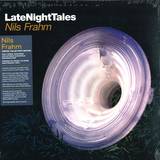
Composer, musician and producer Nils Frahm steers the new edition of Late Night Tales, set for release on 11th September. A hypnotic voyage through modern and classical composition, experimental electronics, jazz, dub techno, soundtracks and soul; Frahm's Late Night Tales haunts and beguiles. It's not mixing, so much as gently layering, like a particularly fluffy goose-down duvet folding in on itself, the folds part of the attraction, the layers part of the overall picture being painted. Many of the tracks have been edited, effected and re-made. The subtly overdubbed parts on Rhythm & Sound's 'Mango Drive' adding to the haunting hypnosis, while choral interruptions aid Miles Davis' 'Générique' on its journey towards the light. Meanwhile, on Boards Of Canada's 'In A Beautiful Place Out In The Country', the tempo is somewhat sluggish, the organs slurred, as Frahm slows it down to a funereal 33rpm that nevertheless fits perfectly. The purring of his girlfriend's cat Cleo transitions playfully between Nina Simone's definitive version of 'Who Knows Where the Time Goes' and unearthing the gentle electronics of Dub Tractor. Eddy Arnold's 'You're The Only Star', a country tune that sounds like its transmitting from a mid-west diner wireless circa 1947, is straight from the soundtrack to an imaginary David Lynch movie, comforting and dismaying all at once. This crackly reality abounds, as on Finnish band Gentleman Losers' 'Honey Bunch', that adds an unsettling texture, with a sound that is modern but as nostalgic. Frahm's own tracks bookend the mix, opening with an inspired "rework" of the infamous silent John Cage piece '4:33' ("I sat at the piano in silence and worked from
there. I listened and took in the atmosphere and this is what came out of it") and ending with a solo piano version of 'Them', taken from his recently released score of the film 'Victoria'. The traditional Late Night Tales spoken word epilogue is voiced by actor Cillian Murphy (Inception, Batman, 28 Days Later), reading a short story by Edna Walsh (Hunger, Disco Pigs).