In Spring 2021, Seoul-based label Extra Noir will make TENGGER’s first EP, Electric Earth Creation, available on vinyl for the first time. Previously limited to a small run of CDs sold only in Korea, this 5-song 2013 collection reveals the genesis of what would become TENGGER’s signature sound: hypnotic synths, spectral vocals, rhythmic propulsion and nature motifs. Electric Earth Creation, however, presents a harder, less ethereal and more danceable version of the band. The EP was produced on Korea’s Jeju island, after the birth of RAAI, son of Marqido (synthesizers and programming) and Itta (vocals), which followed the dissolution of their previous musical project, 10. Conceived in response to the house-bound isolation of becoming new parents and the wild nature that surrounded them outside, the songs of Electric Earth Creation feel like rituals to summon and celebrate Earth’s primordial forces.
Despite a COVID-19-related separation between Japan and Korea, TENGGER have gained increasing recognition throughout 2020, and are confirmed to play 2021’s SXSW Online, with their most recent LP Nomad appearing in multiple “Best of 2020” lists and Pitchfork describing the album as imbued with “rustic majesty”. Fans of TENGGER’s later work will find Electric Earth Creation an essential part of the band’s catalog.
Поиск:electric nature
Все
Nils Petter Molvær and Mino Cinelu had both come a long way in their careers before they met. Cinelu gained international renown on Miles Davis’ albums We Want Miles and Amandla, also noted for his playing with the likes of Weather Report, Gong, Herbie Hancock, Pat Metheny, Sting, Santana, Lou Reed and Laurie Anderson, to name just a few. He has also released 3 solo records and collaborated with Dave Holland and Kevin Eubanks on the World Trio album. Nils Petter Molvær, meanwhile, is one of the most outstanding figures in European jazz. In 1997, he made his debut on ECM Records with the album Khmer, combining the Nordic feeling of nature with the Southeast Asian philosophy of sound. His journey into the uncharted areas of music spans almost a dozen records, on which he explores various combinations of acoustic and electrical sounds. He collaborated with Berlin’s electronic producer Moritz von Oswald in 2013, with the reggae philosophers Sly & Robbie in 2018 and with Bill Laswell on several occasions.
Cinelu and Molvær in some senses represent two worlds, which – at first glance – could hardly be more different. Their musical home is the entire planet, but while Molvær's hoarse and cloudy trumpet sound evokes boreal cold, Cinelu stands for the rhythmic fire of Latin America and Africa. On ‘SulaMadiana’, they’ve found their common playground - the album’s title itself a tribute to the two musicians’ heritage. Sula is the Norwegian island from where Molvær grew up, and Madiana is a synonym for Martinique, from where Cinelu's father hails.
SulaMadiana is a cornucopia, spilling out reverberations of Miles Davis, Gong, and previous works of Molvær, and yet Molvær and Cinelu open up doors to entirely new worlds. Cinelu becomes a singer on his percussion, while Molvær's electronically distorted sounds create a driving pulse. Cinelu plays acoustic guitar, Molvær conjures up drones on the electric guitar. The interplay between the two musicians is key, Molvær observing; “We are different, but what we have in common is that we like to give some space to things. I create space for him, he creates space for me, and we both create space for music.” Cinelu adds: “It doesn't matter who has what share in music. We both know each other’s cultures, we find bridges and crossings, and often we walk these paths that lead in the same direction. We wrote everything together and followed our feelings. There are no limits or barriers.”
- A1: Chubby & The Gang Rule Ok?
- A2: Pariah Radio
- A3: All Along The Uxbridge Road
- A4: Speed Kills
- A5: Can't Tell Me Nothing
- A6: Trouble (You Were Always On My Mind)
- B1: The Rise And Fall Of The Gang
- B2: Hold Your Breath
- B3: Moscow
- B4: Bruce Grove Bullies
- B5: Blue Ain't My Colour
- B6: Grenfell Forever
- B7: Union Dues
At the start of 2020, before the world turned to ash, several US publications began running glowing reviews of ‘Speed Kills’, the breakneck debut album from Chubby & The Gang, a West London punk troupe comprised of members of various bands associated with The New Wave of British Hardcore, among them Violent Reaction, Abolition, Big Cheese and more.
At the time, the band - helmed by local electrician Charlie Manning - had developed a cult following in the UK, largely rooted in the cross-pollinating nature of the punk scene, select shows including dates with Sheer Mag and an impending, lastminute US run with Royal Hounds.
‘Speed Kills’, produced by Jonah Falco of Fucked Up, would go on to be called “the best punk-pop LP in recent memory” by Paste Magazine, a debut that “comes alive with liberating energy” in an 8.0 review from Pitchfork and full of “massive barroom gang choruses, power chords at breakneck tempos,
rock spelled R-A-W-K and visceral gratification” as Stereogum put it. Impressive going for a band at the time with no publicist, no big budget label backing and no industry clout, per se, beyond increasingly fervent underground support.
Following the quietly blossoming success of ‘Speed Kills’, Chubby & The Gang now find a new home on Partisan Records (IDLES, Fontaines D.C., Laura Marling, Fela Kuti) who have reissued the album in remastered form with the unreleased cut ‘Union Dues’ included to boot and with new music on the horizon.
Tape / Cassette
Dust Editions presents Evan Caminiti’s original score for the short film Autoscopy from London based director Claes Nordwall. The film premiered at the Nevada City Film Festival in August 2020 and is featured in the 2021 edition of the Slamdance Film Festival.
Autoscopy follows a young man who escapes to the Swedish wilderness for a period of creativity and introspection. The tranquility and isolation he finds there morphs into something more sinister when he discovers an abandoned flotation tank in the forest, leading him on a hallucinatory voyage deep into the heart of nature and his own psyche.
Caminiti’s score channels the beauty, desolation, and dread Nordwall captures in the film’s disorienting arc. Boundaries are dissolved between the organic and the unnatural, the imagined and the experienced; electric guitar dissolves into spectral whispers, blurring into rippling synthesizers and heaving drones. Caminiti explores dissonance and space, veering into realms of extreme digital deconstruction before plunging into amplifier sizzling abandon.
This OST release features three additional pieces not heard in the film.
Serge Synthesizer Recorded at EMS Stockholm, September 2017
Electric guitar, vocals, additional synthesizers recorded at Spider House, Los Angeles 2020.
Arranged and produced at Spider House, Los Angeles, 2020
Mastered by Stephan Mathieu at Schwebung Mastering
- 1: Prologue: Rain
- 2: A Trail Of Wind And Fire
- 3: Second Born Child
- 4: Tokyo Music Experience
- 5: The Rise And Fall Of The Plague
- 6: Another Year
- 7: Fragments
- 8: The Disappearance Of Dr. Duplicate
- 9: Excerpt Taken From Chapter 3
- 10: Where Is My Dream?
- 11: Part One: The Long Drought
- 12: Part Two: Crossing The Desert
- 13: Epilogue: Big Poisonous Shadows
BLACK vinyl with deluxe origami fold out sleeve & obi strip & DL Card. CD Wallet. The third album from Dutch punk-laced noiseniks adds new maturity and a conceptual feel that pulls the extremes of their sound together. A psyche-fuelled journey into the id punctuated with rhythmic kabuki modal mood swings, thunderstorms, digital beeps, traffic noise, and just plain old beautiful cacophonous reverb-drenched sound when needed. The 'third chapter' refers to the last five years that the Dutch band have spent creating their "difficult" third album. Each song spins a yarn; there are plagues, dreams, wind and fire, 'mythical' characters, and the search for the secret government warehouse. Lead single, Tokyo Music Experience, resonates with a conveyor belt-propelled modal guitar, reflecting the halcyon days of Japanese super-productivity; a mesmerising mantra, infected with news bulletin on-the-hour bleeps underlining its time-sensitive nature; a pristine super-commercial anthem to drive loyalty and reinforce solidarity with the party! Having been described as creating "underground noise with a bracing, warped pop appeal" (Mojo), their new album is a coming-of-age post-classic with a unique worldview - inspired by Van Dyke Parks (Song Cycle) Scott Walker (3 & 4), Moondog (Elpmas), White Noise (An Electric Storm) and Beach Boys (Smile). If their previous effort (Tape Hiss) was their very own sketch of a sketch for an incomplete concept album, a noisy reaction to their previous life, then 'Excerpts From Chapter 3..', with all its interlaced intricacies, is the realisation of their transition from punk-spiked-pop to psyche-pop protagonists. Evolving, testing, infectious...
In a time where everyone from Whitney Houston to Frank Zappa have been re-created in hologram form, where Grimes recently suggested in an interview that “we were at the end of human art”; there could scarcely be a better time for genre-shifting Leeds-based six-piece Team Picture to bring forth the thrillingly expansive synth-pop opus of their debut album The Menace of Mechanical Music.
Inspired by an early 20th century essay under the same name by American marching band leader John Philip Sousa, Team Picture take a look at the automation of creativity on this, their first record with a fully settled line up. Themes centre around the value of creative identity in an automated age, the increasingly disposable nature of art and where that leaves its creators. At twelve songs split into a three-part suite; The Menace of Mechanical Music is emphatically maximalist.
Tracks like the breathy, twinkling Flowerpots, Electric Beds and Handsome Machines’ Icarus-like striving for the sun are an antidote to a music world awash with digital production manipulation and songs written to algorithm. In debating the loosening of the human grip on creativity, Team Picture have poured every last drop of emotion into the recording process.
The group’s now trademark three-way vocal delivery and blurring of textures takes on new structure and purpose. They’ve always had a self-awareness to themselves, too. Initially grouped in with the guitar psych crowd, thanks to their fledgling repeato-rock, they were quick to disassociate themselves from that on 2018's mini-album Recital. With The Menace of Mechanical Music, they expand their sound further still, pirouetting from the likes of Sleeptype Auction – which glimmers like a late 80’s 4AD artefact – through various FX-laden dreamscapes, to the squelchy post-punk of closer Quit Reading. Yet the group were as much influenced by the work of the Early Netherlandish painter Hieronymus Bosch, and his triptych The Garden of Earthly Delights, as they were music touchstones ranging from Kate Bush, Cass McCombs and The Cure.
It’s Sousa words that resonate most deeply within the record however: “The fears of Sousa echo the fears of today's musician,” says Lewis of the late band leader’s 1907 text. “The re-appropriation of funds and support that the artist needs to survive, the gradual erosion of musicianship and self-improvement, that art will become disposable, and that our cultural identity will disappear.”
Recorded with producer Matt Peel (W.H Lung, Eagulls), half the group were unemployed during the session and a daily routine would see them undertake universal credit meetings and job interviews in the morning, before heading to the studio to work into the night. “It was an anxious process but an enjoyable one” says the band’s guitarist Josh Lewis. Indeed, beyond the increasingly golden gated idea of ‘making it’ as an artist, this new album is simply about surviving as one.
Sousa’s vision of a society that had deferred to automation, where babies were rocked to sleep by wheels and pulleys, and people no longer played piano with their own hands. Well over 100 years later and on the precipice of a technological shift never seen before, The Menace of Mechanical Music is the most human response that Team Picture could have given.
- A1: Xtra Brux - Hot Shot
- A2: Cengiz - Reminiscing
- A3: Entek - Yeye
- B1: Reginald Omas Mamode Iv - 400 Years
- B2: Wonky Logic - Boss Slug
- B3: Trev - Of The Sorcerer
- B4: Turbojazz - Rewind
- C1: Namebrandsound - Home Demo (Feat Aleisha Lee)
- C2: Szajna - Wriggle Shuffle
- C3: Evm128 - Bun Dat
- D1: Lcsm - Virtual Signal
- D2: Sivey - Secret Circuit
- D3: Coach Leo - Give It Up (Groove Chronicles Remix)
CoOp Presents an all-new double-album compilation entitled 'Plug One'. It features a plethora of global talent from in & around the world of bruk and beyond - some already well-established in the field, some very much on the come-up and some brand new artists - this compilation is an acknowledgment of a continually evolving sound from the label formed by IG Culture & Alex Phountzi a few years ago. 'Plug One' affirms this electric movement, with a deeply fluid current running throughout, with tracks ranging from the cosmic psych jazz of LCSM, to the classic UKG tweaks of Groove Chronicles, to the thought-provoking vibes of Reginald Omas Mamaode IV, to a veritable who's who of 2020 bruk talent including Xtra Brux, Sivey, EVM128, Cengiz, Wonky Logic & many more.
From its beginnings as a classic club night and label in the early 2000's, CoOp always carried an undefinable and potent creative energy. A sense of freedom and uninhibited exploration was positioned at the core of CoOp's sprawling community and consciousness, communicated via movement and sound. From this seed and throughout the years that followed, this same energy permeated the worldwide underground music ecosystem. As CoOp's legacy continued to influence new generations of music makers far and wide. The syncopated rhythms, soulful keys and infectious grooves synonymous with the broken beat sound, now known simply as Bruk, became entwined with new concepts and progressions, leading to new movements carrying on the essence of the bruk energy.
IG Culture and Alex Phountzi took the helm of their CoOp Presents label in 2018, with the vision of championing these new waves of emerging artists, continuing the all-important exchange of energy at the heart of the original CoOp movement, but also giving room for the music to be pushed into new and uncharted territories. With burgeoning producers from around the globe being drawn to the explorative and expressive nature of the project, an incubator was created, providing a space and platform for these ideals to take on new shapes and sounds. Just as every generation must rewrite its own history books, CoOp Presents was born from a combination of influences, ideas and personalities, and in turn is now encouraging the next generation to do some re-writing of its own.
'Plug One' will be released on vinyl & digital on CoOp Presents in November 2020.
- A1: Flying Between The Clusters Of Trees Without Buoyoant, Floating Wing Beats
- A2: He Was Beginning To Despair Of Ever Knowing
- A3: Like Sleepwalkers Ghosting Through A Dreamscape
- A4: Lions In The Supermarket Don‘t Sound Like Humans
- B1: Misty Fog Covering The Side Window
- B2: He Or She Will Then Drill Into The Pulp To Reach The Root Canal
- B3: Into Your Brain - A News Report Said The Line Carried 13,000 Volts Of Electricity
- B4: The Film Is About A Clown Who Leaves His Circus And Lives In A Building Near The Railway Station
- B5: She Wanted Her To Grow Up In A Nice House With A Backyard, So She Could Play
- C1: The Drawings Were Rearranged, As If By Magic
- C2: He Didn‘t Seem The Kind Of Guy Who Would Just Get Talking To A Stranger
- D1: Pigeons Dancing On The Roof
- D2: When They Returned Home After Midnight
- D3: I Wanted To Hold Her Close And Whisper In Her Ear That She‘d Be Fine
- D4: Good Bye My Love
This time, RØDHÅD tunes into a place of reflection and reformation on his most avant-garde project to date: WSNWG – BACK TO ZERO. Intended to provide a space for solo releases, the imprint comes at a crucial turning point, as society circles in on itself during the pandemic.
RØDHÅD christens the label with MOOD, his first ambient experimentalist release, comprised of his own solo archival material mostly from 2017/2018, working on a plane of spontaneity, devoid of set structures. The result is a life-giving, intimate and solipsistic work. Awash with field recordings, droning loops and subtle granulations, the sparse soundscapes on the 18- track album are deeply profound and satisfying.
Collating a myriad of emotions through this sonic venture, RØDHÅD demonstrates his kaleidoscopic nature as a producer of atmospheric and ambient soundscapes, as well as his legacy provider of dance floor energies. The album will have unique artwork contributed by DJ & producer Silent Servant.
Tyyni is the third album by Finnish-born sound artist and musician Cucina Povera aka Maria Rossi. The second album recorded using a more studio-based scenario – as opposed to last year’s Zoom, a collection of in-situ, spontaneous recordings – Tyyni feels like a slowly unfurling mediation on the clash between nature and mechanical living, a rumination on the complexities of modern life that begin to unveil more about the inner landscape of the artist as it progresses. A Finnish word referring to still, serene weather, the title belies a new note of turmoil in Cucina Povera’s soundworld. Tyyni represents a more detailed focus on the sculpting of sounds that curl around Rossi’s hymnal vocal performances. It’s a more adventurous work than Rossi’s previous output that goes further into noise elements and vocal abstraction while maintaining the balance and ecclesiastical ecstasy of her debut Hilja.
While tension at the core of Cucina Povera is always prevalent, previously it was organic sounds that were used to counterpoint Rossi’s singing but on Tyyni these are often replaced with aggressive synths and distortion, profane clashes with the seemingly sacred hymns. Whether close mic’d and intoning in a loop or in full flight, Maria Rossi’s voice remains in the foreground, set here against a more synthetic backdrop. This development builds new worlds for Cucina Povera, a digital environment which brings in a sense of the alien for Rossi’s vocal to duel. The effect is often dazzling. On Salvia Salvatrix, an ode to the medicinal plant used to ward off evil spirits, Rossi’s invocation is encircled by a distorted synth sound tearing at the fabric of the composition. It’s an inspired juxtaposition, leaving the listener to appreciate both sounds as separate and as a duet. Anarkian kuvajainen embraces a sense of chaos, an accidental transmitting mobile phone’s pulse is swept up gently with looped synth swells as Rossi’s prayer-like vocal rhythmically teases the composition into loops that embrace and then drift apart. Teerenpeli flirts with a minimal beat rendered by sampler and processed, layered field recordings of capercaillies, while Side A ends with one of Rossi’s most beautiful, simple tracks yet recorded. Varjokuvatanssi is an a cappela recording built on top of a wordless glossolalia, a shadowy interplay which foregrounds the solo vocal.
Pölytön nurkka is the most melodic song yet recorded by Cucina Povera. While it still maintains an off-the-cuff performance style, the synthesized chimes and 4/4 beat are smothered by a distorted synthesizer which almost replicates the bravado of an electric guitar feedbacking into the night. Rossi’s subject matter talks of trying to start anew, getting rid of extraneous material, perhaps still feeling powerless to affect positive change. On Haaksirikkoutunut, the protagonist vocal is lost, a vessel rudderless on the ocean, buffeted by waves metaphorical or real, digital, atonal chords gurgling and splashing against the bow, a storm forever brewing on the horizon. Saniaiset recalls Coil in its eldritch, nocturnal tone and digital-bell like synth, Rossi’s half-spoken/half-sung voice attaining a creepy tone before flipping into flight. Album closer Jolkottelureitti uses an escalating, sequenced synth that splinters into both abrasive tones and harmonising chords creating a kosmische effect, reminding the listener of Kluster or synth-era Popol Vuh, all the while elevated by Rossi’s searching vocalising.
For an artist with such a singularly unique musical language, Cucina Povera is continually teasing new strands and emotive tones from an evolving palette. Most importantly, Tyyni appears to be pulling back the veil to uncover an artist finding a synergy between her own emotional inner world and practice. As such, on her third album, Maria Rossi has found a third way between abstraction and extraneous emotion, personal experience turned inside out to reveal more about the listener.
First album in 8 years from legendary Dearborn duo . Windy and Carl have been crafting inner space electric guitar and bass vistas for nearly three decades now, but their latest feels as vital and vaporous as any peak opus in their vast catalog. Written and recorded across six years, the songs swirl between shoegaze minimalism and stargaze drift, over which Windy Weber whispers veiled poetic narratives of transformation, isolation, and escape. Allegiance and Conviction is their first album since 2012's We Will Always Be. The six compositions are something of outlier in their catalog, shorter in nature than most on their previous releases. All of the tracks are saturated with Hultgren's signature guitar work, intimate constructions of murmurs, drones and his trademark layered filigree, gently amassed into alternately lighter and heavier than air atmospheres. Despite being their first full-length in more than half a decade,the album fully belongs to the bewitching galaxy of sound Windy and Carl innovated and within which they remain the sole occupants: music of thresholds and peripheries and eternities. Allegiance and Conviction is the multifaceted, contemporary take on their sound.
Originally released in 1978, Music By William Eaton is a private-press album from the accomplished experimental stringed instrument builder. The atmospheric recording techniques, mixed with a hint of Fahey/Takoma-lineage make for a listening experience akin to the mountainscape drawing represented on the album cover. The experience may seem simple at first, but like any great trip in nature, new details consistently reveal themselves upon each listen.
“When I started building instruments, playing guitar took on a whole new dimension. From the conception to the birth of each instrument, new layers of meaning unfolded. Cycles, connections and interdependencies became apparent as I contemplated the growth of trees from seed to old age, and the transformation from raw wood to the building of a musical instrument. I sought out quiet natural environments to play and listen to the “voice” of my 6 string, 12 string, 26 string (Elesion Harmonium) and double neck quadraphonic electric guitar. Deep canyons contained a beautiful resonant quality and echo. A starlit night with a full moon provided all the reflection and endless space by which to project music into the cosmos. The sound of a bubbling stream and singing birds added a natural symphonic tapestry to a melody or chord pattern. As I perceived it, everything was participating in a serendipitous dance. Everything was part of the music.
During this time, I decided to record an instrumental album of music. The idea was simple; it would be a series of tone poems with no titles or any information attached, only the words ‘Music by William Eaton.’ While some of the songs evolved out of composed chord progressions, most of the songs were played spontaneously, only on the occasion of the recording. These improvised songs haven’t been played since.” -- William Eaton
Recommended for fans of John Fahey, Harry Partch, Robbie Basho, Laraaji
Having released his last fantastic EP Melodius Hubbub a year previous, ED1999 is back with his newest project, named Moving Glow on Porpax records, illustrated by Graphic Designer Oliver SPERL, representing Belgiums best talent. Remaining serious in sentiment but developing his sound, ED1999 uses elements of light to contrast with the dark. As his previous EP followed the theme of interpreting pathways, this EP isn’t all too much different, as it captures the autonomous and excitable nature of light. Even though the speed of light is the fastest most constant definitive, ED1999 manages to bend, warp and interpret light itself through each track’s alternate paces and elements.
That makes it no surprise that Beam of Light starts us off with a full-body feeling of suspense. His classic momentous techno beat with a gratifying and anchoring kick drives the track the entire way through. Then, as the title foreshadows, the glimmers of light - in the form of synthesisers - manage to push their way through the cracks and eventually bleed out until they’re completed absorbed by the beats and become one.
Unknown Luminescence is nothing short of a fun, intense and gyrating episode; in true groovy techno fashion, it’s designed to get any listener’s shoulders swinging and body’s sweating. The repetition of the light ambient melody throughout gives the sense of a far off signal call, drawing in techno lovers from far and wide to enjoy the experience in synchronicity.
Darker again with more sinister undertones, Flamboyant Ray is an assertive approach to techno, yet cloaked in mystery thanks to its muffled kick drums and reverbs. As a more consistent track meant to maintain intensity, it’s style and confidence hardly alters throughout its duration.
The final track on the EP, Photonic Energy, embodies the environment of electrical currents swimming through dark and damp corridors; reacting and gurgling as electricity meets moisture. Distant murmurs give the effect that the space is alive and every inch of existence is thanks
The vitality you hear on Antique Blacks is a testament to the unique energy of the community around The Foxhole Cafe in Philadelphia, as Ra honed his unique brand of Afro-Futurism through the late 60';s and 70's. Cosmic theatre, spiritual chants, and experimental electronics make this record an essential document that was ahead of its time. Ancient to future! BIG TIP !
The 1970s saw change in Sun Ra's recorded output, and as far as we can tell, the content of his live performances. By the middle of the decade, Sun Ra's music no longer seemed comprehensible as part of the jazz New Thing – quirkier, more idiosyncratic elements were more to the fore.
At this time, 1974, every Sun Ra record still surprised, and seemed radically different from everything else he had released up to then. The musical universe proposed by free jazz had never circumscribed Sun Ra. He had been part of the movement, but was able to use the possibilities it suggested without being limited by its conventions.
The Antique Blacks illustrates this well. Recorded as a radio broadcast in Philadelphia, according to Dale Williams, it has a well defined but oddball structure. Sun Ra was a master architect, very concerned to use the unfolding of an album, a broadcast or a live performance to create a satisfying structure.
Song No 1 starts on an upbeat note, it's a lively, tonal introduction, featuring John Gilmre on tenor saxophone, Sun Ra on roksichord, Dale Williams, then aged 15, on guitar, and Akh Tal Ebah on trumpet.
Sun Ra's poetry is featured on There Is Change In The Air, a track which has on occasion been used for the album title: in its original incarnation as a Saturn LP, there was no dedicated sleeve artwork, and this record appeared under many names. Ra's poetry is allusive, elusive and paradoxical, and this was its first major appearance on a record. During instrumental passages, Dale Williams' guitar is heard, along with the saxophones of Marshall Allen and Danny Davis.
The Antique Blacks is a similar setting for a Sun Ra poem, which encompasses "spiritual men", and Lucifer as a dark angel. The Arkestra is heard in conducted improvisational ensembles, in between the sections of the poem.
This Song Is Dedicated To Nature's God has Arkestral vocals, with John Gilmore's voice in th foreground. Williams' guitar is once again prominent in the instrumental passages.
Sun Ra's poetic declamations provide the structire for The Ridiculous I and The Cosmos Me, which also has a fine unaccompanied tenor solo by John Gilmore, keyboard improvisations by Sun Ra, and closes with bass clarient from Eloe Omoe.
Sun Ra's keyboards are heard with minimal Arkestra support on Would I For All That Were – a fine synthesiser improvisation, with electric piano left hand accompaniment.
Tension is resolved by Space Is The Place, which rounds the album out in an upbeat mood, with Akh Tal Ebah, James Jacson and Sun Ra prominent among the vocalists. The closing section includes the chant Sun Ra And His Band From Outer Space, often used at the close of live performances. This isn't strictly live, though: in one line the vocal is played backwards on tape!
- A1: Noel Kelehan Quintet - Spon Song
- A2: John Wadham - Floatin
- A3: Louis Stewart - Araby
- B1: Joe O'donnell - Caravan
- B2: Taste - On The Boards
- B3: Granny's Intentions - Nutmeg, Bitter-Sweet
- B4: Mellow Candle - Lonely Man
- C1: Sonny Condell - Red Sail
- C2: Supply, Demand & Curve - When You're By Yourself
- C3: Rosemarie Taylor - Mister Sleep
- C4: Apartment - Weekend
- D1: The Plattermen - Africah Wah Wah
- D2: Jonathan Kelly's Outside - Misery
- D3: Dr. Strangely Strange - Mary Malone Of Moscow
- D4: Stacc - Holy Smoke
- D5: Zebra - Silent Partners
'Buntús Rince' translates from Irish as 'basic rhythms', and this new compilation explores how Irish musicians were influenced by strands of different genres of music from around the world, merging them to create their own unique sounds. The compilation features some of the most innovative and talented figures in the history of Irish music and includes rare Irish jazz, fusion and folk outliers from the 1970s and early 1980s from musicians relatively unknown outside of Ireland.
Often regarded as a musical backwater, the 1970s finally saw Ireland begin to make its mark on international music. The nature of this feat is all the more commendable, considering how isolated and conservative the country still was in the middle of the last century. The emergence of acts like Skid Row, Thin Lizzy and Van Morrison instilled in budding young Irish musicians the belief to dream big.
Unlike many other European countries, Ireland had not benefited from the cultural impact of immigration. Pioneering Irish musicians did not have access to the type of vibrant music scenes ubiquitous to most European cities at that time. With no talented players or even in some cases recordings of the music, they had to cultivate and invent their own small scenes.
A jazz scene had begun to blossom in Dublin in the late 1950s. Self-taught players like Noel Kelehan and Louis Stewart emerged as the Irish standard-bearers. Their level of musicianship saw them play with some of the world's most renowned artists. The 1960s would see the emergence of the 'beat' scene in Ireland, with groups like Granny's Intentions, Taste and Eire Apparent finally challenging the hegemony of Irish Showbands. Change was in the air.
The late 1960s also saw many Irish emigrants returning home, bringing with them inspiration from the new styles and sounds of London and further afield. The arrival in the late 1960s of pirate radio stations like Radio Caroline, new music magazines and the availability of music on vinyl meant that different genres were now becoming more accessible. The musical landscape of the country began to transform and evolve, influencing a new generation of musicians in the process.
The 1970s saw advancements in studio technology. 8-track studios began appearing in Dublin, offering more opportunities for groups to record singles and albums. Synthesizers and other instruments were also becoming easier to acquire as the younger generation turned to electric jazz and fusion music.
While the level of musicianship was high, the levels of opportunities in Ireland were still very limited. Many groups and solo musicians had to emigrate to try and succeed.
Thankfully for those who remained, this new emerging scene didn't go totally unnoticed and local labels began to take a chance on more obscure Irish groups. Labels like Mulligan and also producers like John D'Ardis and Terri Hooley championed and documented music from the Irish underground of the 1970s.
Their valuable work is a common thread which connects many of the tracks on this compilation. From the soaring flute playing of Brian Dunning, to the swinging piano of Noel Kelehan and the sonic force of Jolyon Jackson's synthesizers; 'Buntús Rince' lifts the lid on a vastly underappreciated period of Irish music history.
One for the collectors.
Gregorio Gomez aka Gladkazuka is a mythical figure from Medelli´n's underground nightlife, contributing since pre - smartphone ages with energetic live sets to the celebration of life in the convulsive surrounding of the Colombian city. After playing and touring alongside Matias Aguayo with 'The Desdemonas' and contributing with the club smash hits 'Ihr Euer' and 'Futuro Chaos' to the 'Solidarity Forever' series on Co´meme - Gladkazuka is back with a full EP in which highly emotive and sensual electro dance fantasies culminate to 'The Drop'. Gomez' creations are nocturnal and lush, utopian and melancholic - underground dance pop that would be mainstream in a better world.
However these songs were created in a place where an unseen destruction of nature is taking place, and - in mids of times of supposed peace agreements - social leaders are being assassinated under the eyes of a new right wing government. Meanwhile the societies are fragmented towards a growing individualism and competition, exchanging dignity for an ideal of consumerism.
In this chaos, music becomes the celebration of life.
'Naturalia', the first track of the EP reflects this with its lushness and its jungle - like humid warmth, 'Flancing' with its happy flying fishes and 'El Coral' with its jittering electric eels.
'The Drop' is decontextualized Electro and New Wave - echoes of The Cure and The Other People Place dissolving into utopian dreaming, longing for better times, like vampire bats, hanging in their caves, waiting for the night to come.
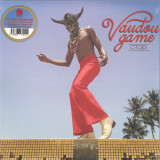
No one had been through those doors in years. Unchanged, seemingly untouched, just a Guard watching over it, one wondered whether the place would ever see the light of day again. Built in the 70s by Scotch, there were only twenty such places in the entire world. Twenty studios, all identical. Most had undergone a digital makeover in the 80s, but not this one; situated in Lomé, this studio had stayed true to its original form. Silent and uninhabited but waiting for one thing, and one thing only: for the sacred fire to be lit once again. That of the Togolese Recording Office, is studio OTODI for those in the know. Through thick layers of dust, the console was vibrating still, impatient to be turned on and spurt out the sound so unique to analog. That sound is what Peter Solo and his band Vaudou Game came to seek out.
The original vibrations of Lomé's sound, resonating within the studio space, an undercurrent pulsing within the walls, the floor, and the entire atmosphere. A presence at once electrical and mystical sourced through the amps that had never really gone cold, despite the deep sleep that they had been forced into. In taking over the studio's 3000 square feet, enough to house a full orchestra, Vaudou Game had the space necessary to conjure the spirits of voodoo, those very spirits who watch over men and nature, and with whom Peter converses every day.
For the most authentic of frequencies to fully imbibe this third album, Peter Solo entrusted the rhythmic section to a Togolese bass and drum duo, putting the groove in the expert hands of those versed in feeling and a type of musicianship that you can't learn in any school. This was also a way to put OTODI on the path of a more heavily hued funk sound, the backbone of which maintains flexibility and agility when moving over to highlife, straightens out when enhanced with frequent guest Roger Damawuzan's James Brown type screams, and softens when making the way for strings. Snaking and undulating when a chorus of Togolese women takes over, guiding it towards a slow, hypnotic trance. Up until now, Vaudou Game had maintained their connection to Togo from their base in France. This time, recording the entire album in Lomé at OTODI with local musicians, Peter Solo drew the voodoo fluid directly from the source, once again using only Togolese scales to make his guitar sing, his strings acting as channels between listeners and deities...
Two Words is the debut release from the duo of Canadian sound artist crys cole and Australian songwriter Francis Plagne. Building on a series of experimental live performances in which the pair toyed with possible common languages for their seemingly unrelated approaches to music, the LP's two sides present a single piece that brings together abstract texture and slow-motion song in a sonic space where genre cedes to the logic of dreams.
The piece begins with a long, nearly static sequence built primarily from rubbed surfaces, using movement in the stereo field and changing mic placements to create a unified but unstable sonic environment that mimics wind, water, and breath, opening an impossible space between nature and artifice. This artificial outdoors ultimately makes room for Plagne's electric organ, which sounds a series of melancholic chords to accompany a wandering Wyatt-esque keyboard line as cole's intimate contact mic textures sizzle and pop in the foreground.
From here the piece makes a surprise detour into song, as the majority of the second side finds Plagne intoning a series of obtuse two word phrases (from a text by Berlin-based poet Marty Hiatt) to an austere organ accompaniment. Working closely with engineer and producer Joe Talia, cole and Plagne extend the studio-as-an-instrument tradition of Teo Macero and This Heat, introducing subtle yet unexpected production shifts that lead the listener from the initial austerity of the organ and voice to an oneiric space of asynchronised vocal doubles, creaking textures, and distant whistling, ultimately arriving at something like an imagined meeting of Organum and Arthur Russell.
Packaged in a suitably mysterious sleeve featuring a lush work by Australian painter Anne Wallace on the front and text by Hiatt on the back, Two Words is both comforting and strange, a disorienting blend of seemingly discrepant elements.
Since the release of their critically acclaimed debut album in 2013 on Names You Can Trust, La Mecánica Popular has quietly been contemplating the evolution of the group's sound, philosophy, and overall approach to making music. Band leader Efraín Rozas' experimental nature has continually pushed the boundaries of his own definition of not only Latin American music, but its broader relationship with music's global culture and history. The sound of "psychedelic salsa" that LMP helped capture in their debut was destined for further outside-the-box interpretations, and with the formation of a new quintet lineup over the last few years, LMP began to incorporate a more free, improvised and instrumental-focused performance of Rozas' increasingly radical compositions. The band subsequently took this liberated approach directly into the studio, recording Roza Cruz live, in its entirety. It was a cathartic experience, a necessary methodology for the new album's concept that embraced the intimate performance of its players and did away with standard techniques of isolation and overdubs.
The evolution of the band's sound on Roza Cruz brings forth a blend of styles rarely heard together, a touch reminiscent of electric-era Miles Davis or Eddie Palmieri at his most experimental, as the driving force of timbales and congas provide a bed for a wave of lush, analog amplification that mirrors the dueling leads of fuzz guitar and electric piano. But as far out as those instruments take the listener, the raw rhythm — the clave — always keeps it tethered to the earth and the dance, a cerebral yet visceral gift for the mind and feet.
His latest release I KNOW from Elypsia Records is a quintet of Detroit inspired remixes of the song 'I Know'. Inspired by Kevin Saunderson, his original TECHNO MIX (7:06) is a hardcore and high energy track with intensity to match the wildest of crowds. The EP also contains 3 remixes of the track, each exposing and accentuating the brilliant aspects of his complex tune. It begins with the LUCIEN FOORT REMIX (6:41), a lively big room hit with a punch fit for an epic Saturday night. UK MIX (6:46) follows with subtle electric melo-dies and rhythmic drum and bass patterns that give listeners the feel of wonder and excitement under a clear starry sky. With a clean and gravitating groove BIT FLOAT REMIX (7:42) would fit perfectly in any Ibiza party with flair and style. This release is a masterpiece of its own and nothing less than the product of a man who was born with beats and melodies ingrained in his soul. For Orlando Voorn, making music is more than a way of life, it's a necessity. From the early age of 9 his natural intuitions became apparent when his drum teacher told his parents he could play everything that was shown to him, even though he had no ability to read a score. He began to DJ at the age of 12, and 3 years later won the World Mixing Championships of 1983 at just 15 years old. Steve Clisby, from the popular American band 'American Gypsies', recognized Voorn's ability and taught him chord structures, which gave him the tools to begin composing tracks using keys and bass. His artistry then took off, making a name for him-self with his vibrant dance tracks under the alias 'Frequency". Today, he's known as one of the Netherland's most inventive and ingenious producers in the world of electronic dance music. Having produced a wide variety of music under a number of monikers including 'Fix', 'Format', 'Urban Nature' and 'X-it', his diverse ability stems
Granny13 opens with Nicola Ratti's 'Odd Doubt'. With the use of a modular system and tape loops, a broken rhythm is obtained by parallelism between single sound signals as LFO one or processed tapes.On the second side, Giovanni Lami's 'Johnny Leech' is made with a small bunch of equipment, just a chaotic hand-made synth (cacophonator) and a memoryman, working mainly on static electricity and leakage current in the synth used without any kind of power supply.
Reviews
The Wire
''Two Italian mucisians share a split single of glitchy fun and everyone goes some happy. Lami s piece uses a defective unplugged synthesizer to make huzzing chitters that have a kind of rhythm in spots. Ratti s contribution is a bit more structured it sounds like a record of accordion miniatures broken into pieces, then glued back together with little pieces of felt stuck onto it. Which would definitely be a pretty hep thing to hear.''
Textura
''Some releases qualify as art objects as much as musical collections, a case in point this recent seven-inch vinyl outing featuring material by Nicola Ratti on one side and Giovanni Lami on the other. That shouldn't be interpreted to mean that the musical content isn't worthy of one's time, as it assuredly is, but more to emphasize how striking the sleeve artwork by Opora is and how effectively it complements the musical content.Mastered by Giuseppe Ielasi and issued in an edition of 150 copies, the release opens with Odd Doubt, a concise experimental setting by the Milan-born Ratti, who's issued material on labels such as Anticipate, Preservation, Die Schachtel, and Entr'acte and who's presently working with Ielasi in the project Bellows, with Attila Faravelli as Faravelliratti, and with Enrico Malatesta and Faravelli in ~Tilde. Though Ratti started out as a guitar player, his current focus is more on beat-analog experimentation and sound installation. In Odd Doubt, Ratti's modular system and tape loops generate broken rhythms that varyingly call to mind dub-techno, even if dub-techno of an extremely wonky variety. Off-beat chords, crackle, and snare strikes add to the dubwise flavour of the material, though ultimately it registers as more of an experimental exploration than straight-up dub exercise.The flip side features Johnny Leech by Lami, a one-time photographer now known as both a field recordist and a musician focusing on soundscaping and sound-ecology. In his contribution to the seven-inch, Lami's chaotic hand-made synth (cacophonator) and memoryman give birth to blustery smears of static electricity that ultimately mutate into an Oval-like array of ripples and scratches. Johnny Leech is so removed from anything conventionally musical, it makes Odd Doubt sound like a Top 40 pop song. Like Ratti's piece, Lami's is short, so short, in fact, it gives the impression of being an excerpt from a larger sound art work. Here's a release where the abstract nature of the musical content matches its visual presentation.December 2014''
Vital Weekly 951
''Granny Records is from Greece, but the two musicians here are from Italy, of which I don't I heard from Giovanni Lami before. His piece is called 'Johnny Leech' and he uses a hand-made synth known as the cacophonator and a memory man (a delay machine), 'working mainly on static electricity and leakage current in the synth used without any kind of power supply'. It makes up for a nice piece of chaotic lo-fi sound, which is put forward through methods of improvisation. Quite a nice piece and it fits the format very well. The crackling of vinyl surely adds an extra layer. Nicola Ratti uses a modular synth and tape loops, of what seems to be percussive material, but the rhythm is broken down and the whole thing has a nice gentle feel to it, even when it bumps, clicks and glides, but the synth makes it more subtle. Here too one could say this perfect for a 7": one doesn't have the idea that this is cut from a longer part as is not unusual with this kind music. Especially Ratti seems to have worked out his music as a composition, which is very nice. (FdW)''Vital Weekly 951''Granny Records is from Greece, but the two musicians here are from Italy, of which I don't I heard from Giovanni Lami before. His piece is called 'Johnny Leech' and he uses a hand-made synth known as the cacophonator and a memory man (a delay machine), 'working mainly on static electricity and leakage current in the synth used without any kind of power supply'. It makes up for a nice piece of chaotic lo-fi sound, which is put forward through methods of improvisation. Quite a nice piece and it fits the format very well. The crackling of vinyl surely adds an extra layer. Nicola Ratti uses a modular synth and tape loops, of what seems to be percussive material, but the rhythm is broken down and the whole thing has a nice gentle feel to it, even when it bumps, clicks and glides, but the synth makes it more subtle. Here too one could say this perfect for a 7": one doesn't have the idea that this is cut from a longer part as is not unusual with this kind music. Especially Ratti seems to have worked out his music as a composition, which is very nice. (FdW)''Vital Weekly 951''Granny Records is from Greece, but the two musicians here are from Italy, of which I don't I heard from Giovanni Lami before. His piece is called 'Johnny Leech' and he uses a hand-made synth known as the cacophonator and a memory man (a delay machine), 'working mainly on static electricity and leakage current in the synth used without any kind of power supply'. It makes up for a nice piece of chaotic lo-fi sound, which is put forward through methods of improvisation. Quite a nice piece and it fits the format very well. The crackling of vinyl surely adds an extra layer. Nicola Ratti uses a modular synth and tape loops, of what seems to be percussive material, but the rhythm is broken down and the whole thing has a nice gentle feel to it, even when it bumps, clicks and glides, but the synth makes it more subtle. Here too one could say this perfect for a 7": one doesn't have the idea that this is cut from a longer part as is not unusual with this kind music. Especially Ratti seems to have worked out his music as a composition, which is very nice. (FdW)''