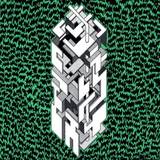
Much time has passed since the Queer Australian/Italian-Armenian, multifaceted artist, Kristian Bahoudian aka Kris Baha, swapped the parched red earth and searing midday sun of the Australian landscape for the brutalist communist-era apartment blocks and slate-grey skies of former East Berlin. Kris is now a fixture in Berlin’s club scene and has toured most of the world as a DJ & live artist with his own unique production style of cyber industrial, EBM, wave, post punk, and early ‘90s IDM mutations. Remixing some of the scene’s most notable artists such as Boy Harsher and techno pop lord Boys Noize, Kris has garnered respect and trust in the electronic music scene for the last 13 years. To respond to the current AI revolution, Kris uploads himself to the cyber ether through his latest project: GHOSTS IN THE MACHIИE.
Across Dual Timelines —
” GHOSTS IN THE MACHIИE ” unfolds as a sci-fi cyberpunk concept project inhabiting dual timelines. In one, we glimpse a trans-humanist future where human consciousness exists as intricate sequences of binary code, entwined and controlled by omnipresent AI systems. In this coded future, a profound awakening stirs among a select few who manage to mutate the code they were governed by, unlocking memories of their history that was erased by the AI. Through this discovery they realize they can traverse temporal boundaries and utilize this power to send warning messages back in time to their former fully human selves. These eerie missives carry a dire warning for humanity, urging them to rectify the course of society before the relentless march of artificial intelligence deprives humanity of its essence. In this terrifying future, humans are rendered mere specters within the digital expanse, stripped of their souls, to become Ghosts In The Machine.
Collaboration with the future self —
The cyber odyssey unfolds from a unique perspective— Kris’s very own future self (his future ghost): a spectral entity endeavoring to caution its present incarnation against the ominous path it treads, attempting to avert a dystopian future.Sonic Alchemy —
A fuse of cybernetic synth waves, hyper-punk, and pulsating drum and bass laid out against the dystopian, industrial sonic landscape of this grim future “civilization”. Each track recounts a new chapter in the gripping narrative, drawing listeners deeper into their own story and the role we all play as a collective society with the future possibilities of unregulated AI.Recorded in Berlin with software and hardware synthesisers. AI was used to assist me with lyric themes, concepts and ideas. I also used a trained AI model of my own voice as backing vocals in ‘Haunting Me’.ll music, words & concepts by Kristian Bahoudian aka Kris Baha and his future ghost,
GHOSTS IN THE MACHIИE
quête:electro one
Neil Feather has spent decades creating a musical world of his own through dozens of one-of-a-kind instruments he invented and built himself. His work as an instrument inventor, improviser, musical iconoclast, and stalwart of the idiosyncratic Baltimore experimental scene culminated in the late 2010s when filmmaker Skizz Cyzyk shot hours of footage of Feather taking stock of his workshop and his collaborations with musicians from Baltimore and beyond as he prepared to relocate permanently to New Zealand. That period produced Sound Mechanic, Skizz’s 2022 feature-length documentary about Feather’s work and music. It also produced an album-length collection of recordings of Feather’s music from the film that captures the spectrum of his unique sonic vision. Uninterested in the traditional rules and roles of music from his early years, Feather began constructing noisemakers out of what was around him—pieces of metal, spare parts from bikes and other gadgets, discarded traditional instruments, various electronics, ball bearings, and so on. By the time he moved to Baltimore in 1985, his work had become more codified into a practice of instruments and families of instruments, such as the Nondo, the Vibrawheel, and the Former Guitars. At the same time, he became a mainstay of the burgeoning experimental / improvised music scene that erupted from the Red Room and the internationally renowned High Zero Festival.
Bluets' debut on Kimochi Sound seamlessly integrates into the label's well established and distinctive style. This one, with a hand-sprayed sleeve as always, opens with "if you can imagine," a confident bit of microhouse that mixes rich melodies and a lively bassline. 'Action Potential' echoes RDMA's aesthetic with its precise beats and on the B-side you will find a vaporous melody that weaves through sparse downbeat house grooves to make for a dreamlike atmosphere. Closing the EP, 'Buong Bilog' features distorted IDM rhythms and a poignant refrain that balances twitchy textures with melancholic tones. This carefully crafted release bridges home-listening electronics with dancefloor clout.
Mas O Menos was set up by South African born, Manchester based, DJ and Producer Levi Love. Levi has played numerous dancefloors across the globe for the past 13 years developing a fine palate for Deep House and electronica.
A chance meeting with one half of >ONE, MAKO MCR resulted in Levi signing the DUO and their APPLEBUSH offering. To Levi, Applebush reignites the memories of Johannesburg townships when he was a teenager, which at the time was infused with
Kwaito music. Slow BPM, synth heavy and trippy at times, APPLEBUSH takes it to another level of impressive technical acumen and blessed creative prowess.
>ONE is comprised of MAKO MCR and METRODOME. METRODOME is a known producer for World renowned RED LASER DISCO imprint alongside Manchester's LEVELZ & Wet Play collectives, working with artists like Amp Fiddler & Zed Bias, with a bevy of heavy hitters to his name. MAKO MCR is no newcomer to the scene as he boasts releases from numerous labels such as Hot'n'Heavy, Gradient Audio, Abaga records and
Echodub. The Applebush EP marks the start of their creative endeavors together with an already varied back catalogue of electronic music from across the spectrum to come.
Gregory T.S. Walker’s Minstrels & Minimoogs was self-published by a young, nomadic composer and virtuoso in 1988 to accompany an immersive multimedia performance at the University of Colorado Boulder’s Fiske Planetarium. Created with this outer, and other, world setting in mind, the four tracks find Walker stretching toward an ancient-to-future vision where Egyptian myths and Hieronymus Bosch-ian tableaus are rendered in a screaming three dimensional circuitry of electronic drums, synth guitars, and, of course, Minimoog. Given the musical terrains and outmoded topics traversed, and that this entirely DIY effort was originally released as a micro one-sided 12” edition, Minstrels & Minimoogs is as perplexing and euphoric a document lost-to-time as it is now found.
Born in 1961 into an intensely musical family spanning four generations, Gregory’s mother Helen Walker-Hill was a noted musicologist specializing in the rediscovery and work of historical Black female composers, while his father, George Walker, was the first African American composer to win the Pulitzer Prize for music. Both parents studied with the famed (and famously strict) Nadia Boulanger in Paris in the 1950s, and held to lofty aesthetic standards in their home life. Walker began studying the violin as a child, but when a burgeoning interest in the electric guitar and rock music as a teen manifested, it was largely verboten in the household. The rule was that the music played in the home was to be acoustic and classical. Although the elder Walkers eventually relented and allowed Gregory’s guitar to be plugged in for a brief interval on the weekends, the remaining days he settled for strumming it sans amplification.
Gregory, conditioned and eager for a life in music but looking to get out from under the influence and yoke of his famous composer father, ultimately chose to study computer music at the University of California at San Diego, where he earned a Master of Arts. This was followed by another MA in electronic music composition at that hotbed of West Coast experimental music, Mills College. Intermedia and multimedia in the arts was the rage in the 1980s, and Mills was one of the centers for it; audacious spectacle meeting visionary performance, such as one of the realizations for Anthony Braxton’s music for multiple orchestras a young Gregory performed in with his violin.
After a series of solo synthesizer concerts around California, Gregory followed a girlfriend on a mid-country move to Boulder, Colorado. After picking up yet another composition degree at University of Colorado Boulder, his life as a composer really started, writing a piece for extended technique for guitar, a passacaglia for vocoder and orchestra, as well as Minstrels & Minimoogs.
Envisioned as a multimedia performance such as the kind he’d experienced at Mills (which was all but unknown in Boulder at the time), Gregory roped in a number of college going or aged friends of varying skill levels and musical sympathies to accompany him with distorted sax or oblique spoken interludes. Confronted with a lack of finances, but driven to get his ideas captured in a complete musical package, the album was recorded in his brother’s apartment. If not every player assembled was on Gregory’s virtuosic level, so be it; it was more about capturing the spirit of his intentions and embracing the serendipity of mistakes.
An inspired attempt at world building, Minstrels & Minimoogs draws on the deep well of musical knowledge Gregory gathered from his parents and teachers, but all the while subverting that historical basis by incorporating mutant strains of prog and pop music. The work accumulated is not unlike the playful 1980s work of Gregorio Paniagua, where medieval estampies and rondeaus are wrenched into an anachronistic present where Hildegard Von Bingen and Kate Bush are contemporaries. Ars nova, new art, a 20th century minimalist jester and troubadour.
A one sided LP was the cheapest option Gregory found to have Minstrels & Minimoogs memorialized on vinyl, so somewhere between 50 to 100 copies were pressed. There was no distribution, outside of copies that were handed out to friends or sold at the performances at the planetarium. Gregory T.S. Walker’s cosmic-futuristic forays into oblique pop and baroque subversion could forever reside perfectly in both the domed simulacrum of our universe for which it was composed, in the formats it is being reintoduced now, and our own biblical firmament. For in the words of Gregory, straight from the original liner notes: “God Is A Minimoog”
Gregory T.S. Walker’s Minstrels & Minimoogs arrives again August 23, 2024 on vinyl and digitally as part of uncommon¢ (“uncommon sense”), an open-ended, serialized endeavor from Freedom to Spend that provides new meaning for rarefied recordings from music's outermost fringe.
The Circus is a place of lights and colors, but also of shadows, even darkness. Admittedly, it delights children and makes adults laugh. But you only need one rainy autumn evening near a circus tent and the smell of fodder to think of the sadness of the clowns, the endless training of the animals and the freaks who are hidden in some caravan... cinema, the essence of the circus – movement, light, danger and burlesque – will have been admirably rendered in Notes on the circus by Jonas Mekas (1966), one of the inventors of the filmed diary. With Cirque, Michèle Bokanowski does similar work, entirely dedicated to spinning, in the musical field.
She distinguished herself in particular in the composition of musique concrète, among others Tabou and Trois chambres d'inquiétudes, after having studied with Pierre Schaeffer and Éliane Radigue. The latter, great lady of drone and minimalism, fell under the spell of Cirque and wrote the booklet for the piece as a poem.
The piece, divided into five movements, is based on the handling and editing of recordings captured within one or more circuses (this is not specified and is of no importance) between 1988 and 1993. The initial allegro reveals the gallop of a horse joined gradually by other images. The idea of the circular space of the circus tent is immediatly and magnificently rendered and will be constantly recalled by an insistent use of the loop technique. Children's laughter, applause and drum rolls are thus sheared, repeated before being brutally interrupted. Accordion interludes and the distortion of sounds create a dreamlike atmosphere. This beautiful nightmare reminds us, to quote Éliane Radigue, the "Magic of childhood still living in the heart of man even beyond its abrupt end."
Words by Alexandre Galand, from the book “Field Recording – L’usage sonore du monde en 100 albums” (ed. Le mot et le reste, 2012)
Major member of the french musique concrète scene, Michèle Bokanowski was born on August 9, 1943 in Cannes, FR, to a musician mother and a writer father. She now lives and works in Paris.
Music lover since adolescence, it was relatively late, at the age of 22, that Michèle Bokanowski decided to study composition. Reading In Search of a Concrete Music by Pierre Schaeffer was decisive. After classical training on harmony, she met Michel Puig, a student of René Leibowitz, who taught her writing and analysis based on the Treatise of Schönberg. In September 1970 she began a two-year internship in the ORTF Research Department under the direction of Pierre Schaeffer. She takes part in the same time in a research group on sound synthesis, studies musical computing at the Faculty of Vincennes and electronic music with Éliane Radigue.
Her main works are intended for concert: Pour un pianiste, Trois chambres d’inquiétude, Tabou, Phone Variations, Cirque, L’étoile Absinthe, Chant d’Ombre, Enfance, Rhapsodia, Cadence, Elsewhere. She has also composed for theater (with Catherine Dasté), dance (with choreographers Hideyuki Yano, Marceline Lartigue, Bernardo Montet) and cinema: music for the short films of Patrick Bokanowski and his two feature films L'Ange ( 1982) and A Solar Dream (2016).
BBsitters Club is a rock band based in Chicago that features Doug Kaplan and Charlie Olvera on guitar and vocals, Max Allison on bass, and Paul Birhanu on drums. As the label’s de-facto in-haus band, BBsitters Club satisfies Hausu Mountain co-founders Allison and Kaplan’s urge to remain connected to the rock and roll music they grew up loving and playing — far across the spectrum from the experimental electronics featured on the lion’s share of HausMo releases.
A solid four years after the one-two-punch releases of BBsitters Club & Party, the band’s 2020 debut studio album, and Joel’s Pick’s Vol. 1, the first volume in a series of audience-recorded live takes from shows around Chicago, we find the BBs reviving the Joel’s Pick’s series with Vol. 2. Charged with the energy of a close-knit group of friends willing to follow along with each other’s most outlandish ideas both in composition and live performance, JPV2 offers us a bewildering yet always tongue-in-cheek palette of ideas cherry-picked and mashed together into amalgams that both embrace “rock traditions” and defy them with a cherubic grin.
BBsitters Club’s amorphous compositions land somewhere between the world’s most baked prog band and a jamband that’s never content to lapse into wheel-spinning complacency. On JPV2, BBsitters Club cartwheel between eras and styles of rock music with abandon — a TV stuck flipping channels after your dad falls asleep with one leg on the remote. We encounter the elliptical dueling guitars and autumnal atmospheres of midwest emo / math rock, the gregarious stomp of electrified country rock, blues rock that has melted from ingesting one too many hallucinogens, and fried Devo-style art punk that breaches into the realms of ska before melting into free-form noise rock flecked with the bizarro imitative instrument tones of Kaplan’s MIDI guitar.
Presenting 3+5, the long-awaited eighth album from Tokyo-based noise-rockers Melt-Banana on their own A-Zap label! The album showcases the duo’s visionary musical approach and extraordinary abilities as performers: Yasuko Onuki’s giddy, hyperactive vocalizing and Ichiro Agata’s glitchy, cyberpunk guitar, delivered at dizzying speed, bathed in aggressive electronic sounds. Their aesthetic approach is exultantly experimental, fusing diverse genres imbued with chaotic energy. As on their previous works, the music on 3+5 is unpredictable, always filled with surprises and excitement. 3+5 synthesizes elements of a variety of extreme music, hyper-pop, classic punk, vintage metal, and noise. It partakes of Japanese culture overall, especially the subcultures of gaming, anime and underground music. Melt-Banana seek to offer possibilities to musicians who won’t start a band if they can’t find a drummer, young women afraid to express themselves in their own unfiltered and unique voices, bedroom musicians and egg punks seeking to blend electronic noise with live instrumentation. 3+5 provides a fresh experience and perhaps inspiration for all. While Melt-Banana hasn’t explicitly explained the meaning behind the album’s title, 3+5, prime numbers symbolize mathematical integrity and independence, which could represent the band’s uniqueness and freedom. Why “3+5” and not “1 + 7”? One is left to ponder.
Kompakt is proud to announce, finally, a reissue of the first, self-titled GAS album. Originally released on electronica imprint Mille Plateaux back in 1996, it’s been unavailable in its original form ever since – the version of GAS included in 2008’s Nah Und Fern box featured several different tracks. Here, however, GAS is restored in all its glory, the debut full-length from Wolfgang Voigt’s most enigmatic, quixotic project.
There had, of course, been signs of what was to come. Back in 1995, Voigt essayed the first GAS release, a slender, yet remarkable four-track EP, Modern. Its centre label featured a reduced symbol – an overhead or lamp light, switched on, its glow radiating outwards in four bold black lines – a perfect representation of the tight, stylised ambient electronic pop contained on that 12”. A few curious compilation tracks were floating around, too, for Mille Plateaux’s Modulation & Transformation and Electric Ladyland series. If you were attentive enough, you could tell something was up.
But nothing quite prepared us for the languorous, effervescing loops and regular-like-clockwork beats that Voigt folded together on GAS. Its six long tracks, all untitled, neither begin nor end but hazily fade into earshot, vibrate majestically in your cochlea for fifteen-or-so minutes – some a bit shorter, some longer – and then meander away, reading the mise-en-scène for the next example of Voigt’s drift and dream logic to unfold. The material is referential in the most distant way, and you can sense only the most evanescent of ghostly presences, haunting these six compositions.
GAS feels, also, like a more pliable hint at what’s to come, as the GAS concept really solidified on its successor, 1997’s Zauberberg, and reach its apotheosis on Königsforst and Pop. Those three albums share a very similar palette – blurred, hazy samples, often of classical music, stacked and cross-thatched across a muted 4/4 thud. GAS, then, is an outlier of sorts: it’s more expansive in its remit, lighter in its mood, perhaps more fleet of foot. This, of course, is part of its charm.
In clearing space for Voigt, by preparing the terrain, GAS sits both at the edge of the forest, and at the verge of an expansive, wide-eyed future; one where GAS would become truly eternal.
Text by Jonathan Dale
Kompakt ist stolz, endlich eine Neuauflage des ersten, selbstbetitelten GAS-Albums ankündigen zu können. Ursprünglich im Jahr 1996 auf dem Electronica-Label Mille Plateaux veröffentlicht, ist es seitdem nicht mehr in seiner ursprünglichen Form erhältlich – die gleichnamige Version von GAS, die 2008 in der Nah Und Fern Box enthalten war, enthielt verschiedene andere Titel. Nun liegt das 3er Album in seinem naturbelassenen Originalzustand wieder vor.
Bereits 1995 zeichnete sich mit der Maxi GAS - Modern auf Profan, sowie einigen Kompilation-Beiträgen auf Modulation & Transformation und Electric Ladyland auf Mille Plateaux dieser frühe, weltentrückte, rätselhafte GAS Sound ab, der sich erst in den sechs scheinbar endlosen, majestätisch-sprudelnden Tracks des Albums voll entfaltete. Die Musik ist von ätherischer Leichtigkeit, in der wie aus einer anderen Sphäre abstrakte Referenzen aus weiter Ferne nur andeutungsweise herüberzuwehen scheinen.
Dieser frühe, eher sphärisch-leichte, gleich einer sonnendurchfluteten (Wald-)Lichtung anmutende GAS Sound, stellt gewissermaßen den Ausgangspunkt der audiovisuellen „Welt“-Reise in den düster-romantischen Acid-Wald dar, in den sich GAS ab 1997 mit den Alben Zauberberg, Königsforst, Oktember und ab 2000 mit Pop an anderer Stelle wieder hinaus und in seine ganz eigene Ewigkeit begeben hat.
One of the greatest UK White Labels of all time. Terrestrial Funk brings you an absolute summer sensation over three decades delayed. Relegated to obscurity until now, this four track EP boasts the downtempo hit ‘Summertime’ alongside three electronic bangers… and mash. The dubbed out stabs of ‘Jennifer’ on the A2 and two never before heard versions of ‘Let’s Climb’. Feel the festival ready power of the ‘Come To Me Mix’ and lose yourself to the hypnotic squelch of the ‘Glad You Made It Dub’, ready for sweaty summer nights.
In the late eighties, Simon Akers and Jason Brown began producing in a quaint home studio. Later collaborating with likeminded talents through the early nineties. Terrestrial Funk has worked with the group to transfer all their old digital audio tapes and bring you a series of fresh music yet to see the light of day. Jacqueline Foster aka Jacquoda brought her stunning voice to the project on this massive single showcasing vocals that shine brighter than the summer sun. Grab your copy today!
Dream in Dream Cornelius Vinyl Release Sales Sheet BIO Cornelius is the brainchild of Japanese multi-instrumentalist Keigo Oyamada; the genre-defying producer and multi-instrumentalist. Last year Cornelius released the highly anticipated seventh studio album, 'Dream in Dream’ via Like Ltd, which marks the first full-length album since the critically acclaimed 'Mellow Waves' in 2017. What can only be described as breezy and sun-drenched ambiance, 'Dream in Dream' seamlessly merges elements of avant-garde jazz, soulful R&B, and psychedelic acoustic electronics, resulting in a genre-blending masterpiece that pushes the boundaries of musical innovation.
With his breakthrough album Fantasma, Cornelius gained international recognition for his cut and paste style reminiscent of American counterparts Beck and The Beastie Boys and was released internationally by Matador Records.
Being called a "modern day Brian Wilson" for his orchestral-style arrangements and production techniques, Cornelius subsequently became one of the most sought after producer/remixers in the world, working with a wide range of artists including Blur, Beck, Bloc Party, MGMT, and James Brown. 'Dream in Dream,' Cornelius expands his sonic universe, incorporating angular guitars and lush synthesizer interplay that dance around syncopated drums throughout the album.
"Bright and poppy while inviting an air of contemplation, this track takes notes from ‘00s indie rock, alt-pop, and a touch of electro to form a solid comeback.
Dream in Dream Cornelius Vinyl Release Sales Sheet BIO Cornelius is the brainchild of Japanese multi-instrumentalist Keigo Oyamada; the genre-defying producer and multi-instrumentalist. Last year Cornelius released the highly anticipated seventh studio album, 'Dream in Dream’ via Like Ltd, which marks the first full-length album since the critically acclaimed 'Mellow Waves' in 2017. What can only be described as breezy and sun-drenched ambiance, 'Dream in Dream' seamlessly merges elements of avant-garde jazz, soulful R&B, and psychedelic acoustic electronics, resulting in a genre-blending masterpiece that pushes the boundaries of musical innovation.
With his breakthrough album Fantasma, Cornelius gained international recognition for his cut and paste style reminiscent of American counterparts Beck and The Beastie Boys and was released internationally by Matador Records.
Being called a "modern day Brian Wilson" for his orchestral-style arrangements and production techniques, Cornelius subsequently became one of the most sought after producer/remixers in the world, working with a wide range of artists including Blur, Beck, Bloc Party, MGMT, and James Brown. 'Dream in Dream,' Cornelius expands his sonic universe, incorporating angular guitars and lush synthesizer interplay that dance around syncopated drums throughout the album.
"Bright and poppy while inviting an air of contemplation, this track takes notes from ‘00s indie rock, alt-pop, and a touch of electro to form a solid comeback.
Celebrated Norwegian singer and composer Susanna announces her new album, Meditations on Love, out August 23rd via her own label SusannaSonata. Having spent five years writing material, Meditations on Love reflects the complexities and difficulties of maintaining love. So many songs celebrate the giddy joy of a new connection or lick the wounds from a break-up, but Meditations on Love explores what happens in between, examining the work required by a healthy relationship and contemplating the conditions that turn love into something toxic. Susanna's mastery of balladry is well documented, but on Meditations on Love, she introduces a rhythmic presence new to her work. The result is one of Susanna's strongest and most dynamic recordings of her career. The Norwegian artist Susanna has released albums as Susanna and the Magical Orchestra/Susanna/Susanna Wallumrod since 2004 on labels like Rune Grammofon/ECM/Grappa Musikkforlag and since 2011 on her own label SusannaSonata. Critically acclaimed for both her own songs and her highly personal interpretations of other people's songs, she wanders lightly and intented between champer folk, avantgarde, electronica, jazz and independent pop. Highly riyl Joanna Newsom, Sufjan Stevens, Kate Bush
Electronic titan Sasha combines with Sentre for the latest in a series of collaborative releases. The release of 'Glastacy' coincides with this year’s Glastonbury festival and comes with something special for fans.
Even by his own high standards, electronic luminary Sasha is in a superb run of form that has already yielded some stellar singles in the last year, both solo and in collaboration with like-minded talents. TheGRAMMY Award-nominated artist is renowned for pushing musical and technological boundaries, as well as for platforming exciting sounds on his Last Night On Earth label. The next release finds him working with Sentre, aka Dave Gardner & Dennis White, who have been electronic mainstays for many years. They have plenty of major credits under their belts, including working with Sasha on his seminal ‘Involver’ album and also 'Track 10' which they made with Sasha many years ago. It was Pete Tong’s Essential New Tune at the time and is one of many gems from these self-confessed studio nerds.
The release of ‘Glastacy’ also marks a new approach for Sasha and LNOE as they extend their relationship with fans beyond just the music. For the first time, along with the single release, fans will be able to collect and own the single artwork for free. The label has always sought to marry together music and art across its releases and now fans get the chance to own a piece for themselves. Using pioneering technology, those who claim the art will also be able to convert it to a smartphone wallet pass which will bring with it future benefits and surprises from Sasha and LNOE.
'Glastacy' is their latest collaboration, and it works angelic, wordless vocal sounds into heavenly loops that shimmer in and out of focus. Deft hi-hits and a supple bassline bring movement as a lead synth motif rises up out of the mix to bring dramatic tension and take dancers to the stars. It's emotive, hypnotic techno of the highest order, with a spine-tingling breakdown leading towards more trance-inducing musical pleasures. The Intro:Outro Mix is an ambient tool stripped of beats.
Next up on Aris is a particularly special one - Ireland's first electronic music 12''- Carrier Frequency's Telecaster Man, a particularly Irish take on the acid house sounds of the late 80's, that still does the job 35 years later. ''A nine minute tune with two chords, it's just f-ckin' madness mostly - distortion and drum machines.'' simply put by one of the artist himself, but it's much more really. The record originally released in 1989 was a collaborative effort featuring the talents of Mr. Spring, Leo O'Kelly of 70's folk heroes Tir Na nOg, and Trevor Knight of 80s synth pop band Auto Da Fe, Mr. Spring, a veteran of pirate radio since his early teens and the local go to studio guy for dreamers and the Depeche Mode and Talk Talk clones of the time, spearheaded the project. Drawing from his extensive experience and technical prowess, Spring had already established his own studio in 1987, equipped with state-of-the-art gear including an Atari sequencer and an Akai s900 sampler. They decided to work together on it as Spring says ''We wanted to get a Cabaret Voltaire sound to it and have a bit of fun.'' Fueled by a shared passion for experimentation and sonic exploration and inspired by the dynamic energy of the club scene and the rapidly evolving sounds of electronic music, the late-night recording sessions in Spring's studio characterized by spontaneity and innovation. The result of their collaboration was ''Telecaster Man,'' a nine-minute tour de force combining distorted guitars, hypnotic rhythms, and pulsating synthesizers. The 12 inch comes with the original and Sinewave mixes plus a new Mr. Spring remix from the original multi tracks rounding it out with the replication remix and a bonus acapella. Full colour sleeve and comes with extended liner notes.
Black vinyl[17,02 €]
Valuable reissue of slow Italo classic! Roberto Onofri, since he was a teenager, has developed his own culture independently. Whatever he liked to do, he immediately embodied it, instantly identifying with what he was passionate about. However, one certainly cannot expect the sixteen-year-old and self-taught disc jockey to be ready as a composer for his first time in a recording studio. He became an author, arranger and performer shortly after, but for his first experience on vinyl he had to resort to a cover, as many did to get noticed and have the limelight on him. There was no mistake in choosing 'Living with Passion'' by the Canadian band Moral Support, but only how to write the title of the piece on the album cover!!! At the time, not all Italian printers knew English well, which is why Italo Disco soon became sadly famous for the huge blunders that were written. It was love at first sight for Roberto, who played the song written and produced by Richard Cranford and Sandro Durante every night in the disco. There were some imperfections due to inexperience, but the electronics, more and more imperious and overwhelming, won over everything, effectively decreeing the beginning of a new musical style. The Italian one. Dave Mathmos did well to have the same passion as Onofri and his DJ Program Band, developing an excellent version that gave new life to the piece from 40 years ago, reprinted by Best Record in two different and limited editions, in black vinyl and in green vinyl with black shades. Both editions come out with the artwork and credits in relief and with the image of the very young DJ Onofri immortalized next to a drum kit with the microphone in his hand, ready as always to make people jump and have fun.
Green color vinyl[18,70 €]
Valuable reissue of slow Italo classic! Roberto Onofri, since he was a teenager, has developed his own culture independently. Whatever he liked to do, he immediately embodied it, instantly identifying with what he was passionate about. However, one certainly cannot expect the sixteen-year-old and self-taught disc jockey to be ready as a composer for his first time in a recording studio. He became an author, arranger and performer shortly after, but for his first experience on vinyl he had to resort to a cover, as many did to get noticed and have the limelight on him. There was no mistake in choosing 'Living with Passion'' by the Canadian band Moral Support, but only how to write the title of the piece on the album cover!!! At the time, not all Italian printers knew English well, which is why Italo Disco soon became sadly famous for the huge blunders that were written. It was love at first sight for Roberto, who played the song written and produced by Richard Cranford and Sandro Durante every night in the disco. There were some imperfections due to inexperience, but the electronics, more and more imperious and overwhelming, won over everything, effectively decreeing the beginning of a new musical style. The Italian one. Dave Mathmos did well to have the same passion as Onofri and his DJ Program Band, developing an excellent version that gave new life to the piece from 40 years ago, reprinted by Best Record in two different and limited editions, in black vinyl and in green vinyl with black shades. Both editions come out with the artwork and credits in relief and with the image of the very young DJ Onofri immortalized next to a drum kit with the microphone in his hand, ready as always to make people jump and have fun.
RT PRO is the new Right Tempo line “for professional use”, addressed to a discerning audience and released on 12” Single housed in a curated packaging. This first instalment is a follow-up to the internationally acclaimed "The Congregation - Jazz Alliance
International" compiled by Jazzcat. It features never previously released remixes of the slammin’ "Seasons in My Mind" track by Japanese producer Yellowtail feat. legendary jazz singer Mark Murphy. In addition to the Original, come remixes by Further Out Recordings’ head Richard E feat. saxophonist/flutist Jake Telford, by Frankson (one half of the British electronic duo Part Time Heroes), and by all-round musician and producer Emanative, who invited his longtime friend and collaborator, keyboardist Jessica Lauren, to join him for this special project.
A familiar favorite, Deft, steps up with his second EP on Hooversound, featuring a VIP remix of one of his original songs taken from his 2020 ‘Burna’ EP.
Defts ‘Burna’ EP back in 2020 set the tone perfectly for Hooversound, it being the second release on the imprint following Hyroglific and Sinistarr’s almighty ‘BS6’. Deft’s hybrid artistic style of production sat perfectly within the launch of Hooversound as he went on to rise steadily within the underground electronic scene. Fast forward four years, Deft returns to Hooversound with an equally impressive follow up, entitled ‘Two Years’.
Yip Wong aka Deft has been producing music for nearly a decade. Within that time he has crafted a signature style using elements of dance, cinematic sound design, hip hop, jungle, footwork and 140. This enigmatic style of production has led him to release on 20/20 LDN, Exit, 1985 Music, Critical Music and more. His release schedule alongside his ever evolving sound has gained the attention of not only London and UK listeners, but fans worldwide.
Defts new ‘Two Years’ EP on Hooversound once again sees the talented producer drawing elements from 140, footwork and jungle, all laced with his ability to create immersive atmospheres and intricate percussion. It’s been teased across SHERELLE and NAINAs DJ sets for months, with it finally dropping to the masses this summer on Hooversound.
On 'Be Am' (now available only vinyl), Norwegian pianist, composer and
producer Bugge Wesseltoft has allowed his creative impulses to wander
where they may - no pre-set rules to govern the composition and
production, no obligations to (not) use electronics, not even a will to be
totally alone: this is pure playing and composition, where the music
speaks freely by whatever means it will
In the 25 years since Wesseltoft founded Jazzland Recordings, he has engaged in
numerous group projects and collaborations such as New Conception of Jazz,
duos with the likes of Sidsel Endresen, Henning Kraggerud and Henrik Schwarz,
one- off projects such as Trialogue, Bugge and Friends, and OKWorld! And of
course, the super- trio Rymden. However, it is in his solo material that we can
glimpse the true soul behind the effervescent and mercurial mind of one of the
most influential and important Norwegian musicians of an entire generation.
Many of the pieces here have the feeling of being wordless songs - indeed, no
words are needed when the notes convey all that is needed on tracks like "Tide"
or "State". The arrival of Håkon Kornstad on the track pairing of "Emergence" and
"Roads" shifts the mood from one of peace within solitude to peace within
company, the latter track being an understated dialogue, a musical soundtrack for
watching the world hustling and bustling, or sleeping its way towards a new day.
Tracks such as "Messenger", "Green" and "Be Am" throw more angular shapes,
musical shadow-play where unexpected progressions shift to moments of gospel
uplift before taking unanticipated shifts towards unexpected harmony. With "Life",
kalimba accompanied by birdsong loops, carrying us into a piece that takes
tentative but exact steps between positions, like tai chi in musical form.
"Sunbeams through leaves softly rustling" closes the album with that beautiful
Satie-like melodic simplicity that Bugge has made his own.