Fans of Coltrane will certainly dig this historical 1970s spiritual jazz album from Argentina which left an everlasting imprint in the local jazz scene. From the eerie "Blues para un cosmonauta" —which could easily fit in the Twin Peaks soundtrack—, to the majestic "Líneas Torcidas" or the mid-tempo groove of "Mi amigo Tarzán", new landscapes in jazz are explored without hiding, at moments, the musicians' bebop pedigree. Venturing into unchartered dimensions, the album breaks with traditionalism and combines jazz and new electronic instruments into a contemporary concept that is both cosmic and sensual, a sound where timbre and space play a crucial role. Here, no track sounds like the other.
The charismatic, multifaceted saxophone player Horacio "Chivo" Borraro is joined here most notably by Fernando Gelbard —who pioneered electronic keyboards and analog synths in Argentina, playing here Fender Rhodes and Minimoog— and Brazilian musician Stenio Mendes —who plays the 12-string craviola and contributes two tracks. Jorge González on bass and Néstor Astarita on drums —both part of Gato Barbieri's rhythm section in the early 60s— and Chino Rossi —responsible for much of the unusual percussion and special effects that give the album its unprejudiced aura— complete the line-up of Blues para un Cosmonauta.
Cerca:electro peaks
- A1: Erstes Kapitel (Verschliffen)
- A2: Zweites Kapitel (Ruckartig)
- A3: Drittes Kapitel (Ungesagt, Dann Vergessen)
- A4: Viertes Kapitel (Bewusstseinsfrei)
- B1: Fünftes Kapitel (Kreuzweis)
- B2: Sechstes Kapitel (Herausgewunden)
- B3: Siebentes Kapitel (Verflochten)
- B4: Letztes Kapitel (Halb Vermutet, Halb Gesehen)
11th album by the one-of-a-kind collective: psychedelia and free form jazz (not jazz) trigger a sophisticated excursion into weird textures with drastic turns. Dislocated dense music full of secret connections!
Kammerflimmer Kollektief – "Schemen"
Before reason prevails, invoked by those who want everything to remain as it is, Kammerflimmer Kollektief disrupts the established supply chains of sound. It seeks more interesting ways to assemble them. Trusting in this, because of the fact that every sound that still comes out of a guitar, a bass, a harmonium, drums and electronic devices has already been taken into the common mangle of meaning anyway. Enough of all that. Here, nothing is explained. Here we speak in schemes. Polished and jerky.
The images that Kammerflimmer Kollektief conjures up therefore happen not in the focus of consciousness, but rather in its outer realms. In those to which one does not give one's full attention at the moment, but which are nevertheless perceived. For example, when a leaf falls from the ground back up to the tree in the corner of your eye, and for an instant you think this is possible, before you realize it was a small bird flying into the tree; it is in just such irritating moments between perception and realization that the art of the Kollektief also unfolds. On "Schemen", familiar fragments float gently around their core – a Fender Rhodes tone, a bass figure, a guitar motif, a masterful drum shuffle, a moment of icy stasis borrowed from the harmonium playing of Christa 'Nico' Päffgen. Triggering brief associations, they slowly rush off in other directions through free jazz-informed editing work, whereupon such zones can also arise in which perception has a few tricks ready and earlier experience suddenly breaks into the now in a completely different way. Half suspected, half seen.
Half-music like Can from Cologne – also masters of improvised editing – sometimes produced a few decades ago in their in-between moments. The first minutes of "Future Days" for example, which fade in gently, sketch a barely graspable figure emerging from all directions of the room. Kammerflimmer Kollektief also engages in similarly open moments of development. Loosely, it eludes the first formative impressions, keeping itself ready for moments that do not follow any logic of appointment. This looseness in handling makes Kammerflimmer Kollektief so fluidly audible, even when dissonant peaks and free playing arise. What Karlheinz Stockhausen is to Can's understanding of composition, the recordings of The Cocoon are to Kammerflimmer Kollektief. The Cocoon, a meeting of garage psychedelics from the Hannover area with free jazzers from the Galaxie Dream Band, whose album "While The Recording Engineer Sleeps", recorded in 1985 in unguarded moments, operates in a very similar way with decentralized perceptual ambivalences and only appeared more or less secretly four years later on Wilhelm Reich Schallspeicher. Other traces of "Schemen" lead to the debut album of Quicksilver Messenger Service. The guitars of Gary Duncan and John Cipollina, which refer to themselves in an unforced manner, are instructions to let go. They don't want to be traced in every note as a solo, but they give their music a sense that the essential takes place off center, in the mutual and intuitive gift of loving attentions. Consciousness-free.
Loving turns like the little guitar phrase that, like a kind of leitmotif, is repeatedly ghosting more or less unchanged through all of the Kammerflimmer Kollektief albums. A Coricidin induced, very catchy slide idea filtered out of ancient Æther, which – who knows – maybe even centuries ago found its way from somewhere to America – the old, the eerie – and from there wafted on through the ages to southern Germany, to a smoky studio in the Upper Rhine lowlands. A memory of which even the memory no longer knows what it once reminded. Unsaid, then forgotten.
In Kammerflimmer Kollektief you will also find a friend of slowly building, unhurried music, which probably would have been appreciated by the old Franz Mesmer, who 200 years ago, after tranquilizing treatments, sometimes used to play for his patients ambient melodies on the enormous glass harmonica. However, in order not to surrender completely to the flow of one's own life energy, as Mesmer had in mind with his therapies, Kammerflimmer Kollektief occasionally adds hectic tensions, gently embraced by the droning of a sine wave generator, as if a trance could briefly refesh. This old analog sine wave generator is new in the Kammerflimmer assortment of sounds. So, the art of the Kollektief likes to dock occasionally in modern times, yet with the past in mind. Mental states begin to flicker between imagination and certainty, between culture-bound art expression and coincidences: A cawing and scraping can always just be a cawing and scraping with Kammerflimmer Kollektief, the way Andy Warhol's mushroom eater just eats a mushroom.
Heike Aumüller's cover works, which illustrate all the Kammerflimmer Kollektief albums, additionally act as amplifiers of unexplained refractions. Her style consists of eye-corner art that remains so, even when looked at directly. Her shots remain disquieting because they do not jolt themselves into a reassuring order, even in retrospect. Rather than evading the fear that arises when looking at them by trying to impose some irrational rhyme or reason, that fear must simply be endured. This strategy of endurance is equally applicable to the music. The trick is to let parts be parts without compulsively seeking delusional patterns that lull us into a false sense of security and in doing so, possibly delude ourselves. In this context, freedom means not having to anxiously attach a fantasized superior meaning to everything. "Schemen" has an conspiracy disintegrating effect.
b A2 Zweites Kapitel (ruckartig) [feat. Heike Aumüller]
It seems fitting that a trilogy of albums celebrating nature should conclude some eight years after its second chapter. Manchester-via-Todmorden based instrumental trio Plank’s first two LPs – 2012’s kosmiche-inspired Animalism and 2014’s more expansive and structurally disruptive follow-up Hivemind – enjoyed relatively quick gestation periods. However, Plank are firm believers in letting nature run its course, and so it is that their third LP Future of the Sea arrives early in 2023. “I always knew I wanted to make three albums inspired by nature” says Plank main-man David Rowe (synths / guitar). “Future of the Sea is another exploration into odd time signatures and traditional rock instruments alongside synths and electronics.”
“Future of the Sea is a celebration of the power and majesty of our oceans and how humankind has been destroying them through industrial scale fishing and global warming” says Rowe. “Rachel Carson put it more eloquently in her book The Sea Around Us: ‘It is a curious situation that the sea, from which life first arose should now be threatened by the activities of one form of that life. But the sea, though changed in a sinister way, will continue to exist; the threat is rather to life itself.’” A post apocalyptic underwater city scape adorns the cover in an illustration by Jake Blanchard, whose work you'll also see on Richard Dawson's latest album 'The Ruby Cord'.
The synthetic nature of Plank’s sprawling rock odysseys feel at their most pronounced on Future of the Sea which leans to the band’s love of Pink Floyd era Meddle, Camel, film score composers like John Carpenter and Vangelis, 70s experimentalists Harmonia, 1980s King Crimson and 90s post-rock adjacent group Tortoise. In polyrhythmic dexterity if not heaviness, Plank also take some influence from Meshuggah, and it’s in their movement between the 16 minute final album track’s sections that it feels most prominent. They swerve from crunching stoner rock jams to more ambient spatial explorations, crescendoing progressive peaks, 80s synth pop and finally a crushing riff-laden finale.
Limited edition reissue of this legendary, rare and dreamy electronic ambient new age album.
Originally created and released in a small edition in Japan back in 1987 by the mysterious musician/ magician Shiho. The album features floating shimmering synthesizer textures. It's unique and extra ordinarily serene with shifting tone colors and spatial textures bringing the listener to a special magic place. It's as beautiful as it captivating. There's also a haunting edge to parts of the album sounding like what could originally have influenced David Lynch and Angelo Badalamenti when they composed the soundtrack to the original Twin Peaks series. Shiho who loves to make improvisational music began studying classic piano at the age of five. She says she gets inspiration from the celestial realms but she never considers melody. She draws a musical picture. Creativity is the unfolding of the unknown realms within the self. Through our chosen ways of expression, each of us is daily creating a unique universe, a unique environment.
The universe created by each and every being in endless repetition are messages of the universe. The breath of this music, expressed from my present environment, flowing through a myriad of places as environmental music is my expression of The Body Is A Message Of The Universe. Part of the album also saw a limited US CD release in the late 1980s which is hard to come by today.
Although Shiho Yabuki continued her career in Japan, both as a musician and magician and became a pioneer of healing music in Asia, for most western listeners it was like Shiho was one of those mysterious artists who puts out an album and then is never heard from again.
Tracks: Tomoshibi / Samadhi / Winterland / Tenshingoso (Earth, Wind, Fire, Water and Spirit) / Forestland / Tawamure/Cosmic Dance / Energy Flow/Ki No Nagare (The Way Of The Energy Flow)
Brilliantly unclassifiable ambient midi-jazz salvo from Brazil’s Gabriel Guerra aka Guerrinha - member of PAN/Future Times' Lifted ensemble and lynchpin of the Rio De Janeiro underground. Very highly recommended noir sleaze x fantasy lounge music somewhere on the spectrum between Gigi Masin, Spencer Clark, 0PN, Flanger and Koji Kondo’s iconic video game soundtracks.
Deployed as the third release on the expertly curated confuso editions, ‘Cidade Grande’ sees Guerra unfurl an immersive and deeply enveloping variant of lounge jazz noir intersecting Japanese city pop, classic video game soundtracks and future-primitive kosmische signatures in a way that defies easy categorisation. Guerrinha colours outside the lines in swirling, exquisitely trippy designs that are as easy on the ears are they are hard to fully fathom over a single sitting.
Mirroring a strain of jazz music’s evolution from sophisticate lounge soundtrack to more psychedelic lustre when musicians found acid and Brazilian styles in the ‘60s, Guerrinha slants the paradigm thru the prism of late ‘80s midi with a c.21st suss that coolly echoes hauntological takes from Spencer Clark & James Ferraro to Leyland Kirby, and Eli Keszler’s electro-acoustic jazz proprioceptions, as much as emotive Kenji Kawai soundtracks. There's a complete lack of cynicism in his approach, and dense, hypnotic tracks like 'Venda Casada Village' and the moving 'Kafta Hoje' sound so completely straight-faced it's impossible not to respect the flex.
It’s a hugely trippy listen, at once calming and eerily evocative, with a wipe-clean palette of deft midi orchestrations that conjure flashbacks to soundtracks for everything from Twin Peaks to Sharky & George or Patlabor, but with more opalescent depth, dancing around motifs in holographic designs that mark the uncanny valley of perception.
As a duo they embrace both sides of the coin, drums and guitar, chaos and order, male and female, ying and yang, the angel and the devil. They are more than the sum of both counterparts though, making for a maximalist auditory experience. PIKA brings her skills of mystifying performance to the table, all free-drum bluster and vocals veering between shrine maiden and wild spirit. Kawabata's guitar-work moves from a roar to a whisper, a yell to a sob, he's working on the same canvas of extremes. The aim of their unity is to write truly celestial hymns for the outer world and odes of love for the inner cosmic context.
No strangers to one another, the pair have not only gigged together with their respective bands but also recorded together, when these two outfits temporarily fused in 2005 to become Acid Mothers Afrirampo (releasing an album of the same name). Two years later they distilled their collaboration, all other players being stripped away to leave the core of Pikacyu's manic drums and pop vocal, and Makoto's schizoid guitar conjurings. In 2011 they spent five weeks touring the US and their first album, 'OM Sweet Home: We Are Shining Stars From Darkside', which was released by the esteemed UK label of all things heavy and brilliant, Riot Season. Last year they spent two weeks touring through Europe whilst writing a new album suffused with the outreaching sound and message of their impulsive live performances. This new album is entitled 'Galaxilympics' and will be released by Upset The Rhythm on August 4th on LP and CD.
'Galaxilympics' is an album of contrasts, so much colour, so much shade! 'Space Sumo' kicks off the record in explosive style. Pikacyu's drums jitter, crash and stumble, but steadfastly refuse to groove. Makoto attacks his guitar, cloaking himself in reverb to produce a wall-of-sound, alternating between melody and noise. 'Funifunikonefuni' follows with it's frenzied take on pop music, bubbling with energy and PIKA's multiple vocal layers. 'I'll Forgive' is chant-like in its devotion to following the tumbling melody line of the song even to absurd and unpredictable dimensions. 'Pika Mako Hall' is a more serene affair, with whispered echoes and guitar drones swirling amongst bursts of rapid sequencer ambience. 'Castle Of Sand' picks up on this more spacious approach with slowly developing programmed electronics, before the title track erupts with gurgling synths, soaring guitar trails and PIKA's most searching vocal yet.
The album concludes in reflective manner with the suitably titled 'Sayonownara', a song as much in the present as it is in the act of saying farewell. It's positively elegiac with washes of cymbal and deep acres of guitar drone for the first five minutes before PIKA's drums take things up a gear and into more psychedelic out-rock terrain. This insurgence eventually peaks and the album melts away to silence. PIKACYU-MAKOTO have made an album that takes you on a trip into your very soul before emerging once more at the edge of another galaxy. 'Galaxilympics' is a triumph of opposites united, it enjoys walking out into the unknown, but it's also a portal into the very real world of two musicians who find peace and semblance through their interaction. Hymns and odes to one side, this is a giant album of future-facing song and noise, where better to find harmony enthroned
- A1: Alberto Radius - California Bill
- A2: Mario Lavezzi - In Alto Mare
- A3: Beppe Cantarelli - Se Il Mio Canto Sei Tu
- B1: I Ricci - Vienimi A Pigliare
- B2: Eduardo De Crescenzo - Alle Sei Di Sera
- B3: Im Porto - Smettila (Po-Para) (Po-Para)
- B4: Barnaba - Bianco E Nero
- C1: Enzo Cervo - Solo Mo
- C2: Peppino Di Capri - Mo
- C3: Franco Camassa - Non Andar Via
- C4: Stefano Pulga - La Mia Nave
- D1: Massimo Stella - C'e Una Donna Sola
- D2: Gino D'eliso - Ti Ricordi Vienna?
- D3: Enzo Carella - Contatto
- D4: Serafini - Serafini
Between the late 70s and the early 80s, pop music was in a transitional phase. After a return to the roots of punk, rock was morphing into new wave, while disco was rapidly declining and the electronic revolution, already on the rise, was ushering in the transition from analog to digital. This period also saw the emergence and relatively brief flowering of a commercially dominant style that mixed soul influences (especially Stevie Wonder and Ear th Wind & Fi re) , folk/pop songwriting and jazz sensibilities in equal measure, creating a hybrid easy on the ears but also emotionally and musically rich. It was the style represented by artists like Christopher Cross, Michael McDonald, Gino Vannelli and Kenny Loggins, who were all influenced by black music. They belonged to a larger trend that took place in all major music producing countries, including Italy where, like so many other things, the style was not merely imported or copied, but reshaped into a specifically local version based on the nation's tastes and cultural traditions. In Italy, a soulful and sophisticated approach to pop music was embraced not only by established names like Mina, Alan Sorrenti and Loredana Berté, but also, and perhaps most importantly, by an entire generation of writers, arrangers and musicians who had grown up listening to early fusion, to Steely Dan's refined recordings, and to Quincy Jones's productions. So, with this compilation we hope to give new exposure to artists and songs that, despite having moderate or little success when first released, must be regarded as among the creative peaks of Italian pop music. "Paisà Got Soul" features pop veterans Peppino Di Capri, Mario Lavezzi and Alberto Radius alongside atypical singer-songwriters (Enzo Carella, Enzo Cervo, Gino D'Eliso), Italo-disco heroes (Stefano Pulga), international hit composers (Beppe Cantarelli, who has co-written for Aretha Franklin and Mariah Carey), Brazilian-born naturalized Italians (Jim Porto) and complete unknowns (Franco Camassa, I Ricci, Massimo Stella).It brings together little gems that in most cases are no longer available on the market, or only available in their original and now very rare vinyl format. We believe they all deserve to be rediscovered today, partly because of the recently renewed interest in "yacht rock", as this music style has been retrospectively named, and partly because they provide further evidence that Italian artists rework international music styles in creative and original ways.
Compiled and conceived by David Nerattini partnered by Pierpaolo De Sanctis
Pan Daijing's exhibition-performance Tissues premiered in the Tanks at the Tate Modern in autumn 2019. A five-act immersion in performance, sound, movement, space, and most of all emotion in its most distilled and conflicted states, Tissues engaged with the conventions of opera and tragedy to present a searing representation of the embattled human psyche in space and time. While the ambitious multi-sensory artwork made use of the range of Daijing's artistic capabilities, music, particularly the voice, was at its formal and emotional core. The vinyl and digital release of Tissues on PAN serves as a record of that work, in the form of an hour-long audio excerpt: an invaluable archival document from Daijing's expansive live practice. Tissues is both a solitary work and a formal study in relation. Composed, directed, designed, written, and performed by Daijing (alongside a cast of twelve dancers and opera singers), the work_its libretto written in a mixture of old and modern Chinese_lingers inside a single human perspective. Daijing conjures states that are by turns delicate and severe, the tension between opposing modes animating the work as it unfolds. And yet, for all its interiority, Tissues foregrounds an intimate relationship with its audience through details like its engulfing visual landscape and its rattling, confrontational narrative arcs. Daijing uses the opera form as a prism through which to question the boundaries of music itself: perhaps, she proposes, music is much more than simply what is heard. It is in the relationship between voice and electronics that this limit is most clearly breached. Across the four acts gathered in this documentation, a counter-tenor, a soprano, a mezzo-soprano, and the artist herself voice a mixture of stunning laments and cries over an instrumental landscape, built out from industrial texture. Meant to be heard in a single listen, rather than track by track, the work unfolds through tender hollows and agitated peaks. At its crescendo, the operatic vocals melt away and the synthesizers themselves seem to howl with grief. Daijing uncovers an essential, sometimes painful, music in all that surrounds us, inviting something like catharsis but also a greater understanding of the thing she and her cast conjure and draw close. A tissue, after all, is both a disposable object one uses to wipe away a tear, and the building block of our fleshy human forms. Daijing reaches and excavates the roiling core of what it is to be alive and full of feeling. Music from Tissues, an opera of five acts at Tate Modern, London on Oct 2nd, 4th and 5th, 2019 Composed, written, produced and directed by Pan Daijing. Performed by Anna Davidson, soprano ; Marie Gailey, mezzo soprano, Steve Katona, countertenor and Pan Daijing, additional vocals. The recording is mixed by James Ginzburg , Jan Urbiks and Pan Daijing, mastered by Rashad Becker. *2xLP comes in a gatefold cover, and includes an obi strip and a booklet containing images from the performance & liner notes, as well as a postcard granting access to exclusive video documentation*
- A1: One Is True
- A2: Two Is Apocryphal
- A3: Triptych In Mass
- A4: To Fold & Remain Dormant
- A5: Divine Objects
- B1: The Low Drone Of Circulating Blood, Diminishes With Time
- B2: Moral Vacuums
- B3: Take The Night Air
- B4: The Mountain View, The Majesty Of The Snow-Clad Peaks, From A Place Of Contemplation & Reflection
The previously unrecorded Drone Mass was described by its composer, the late Jóhann Jóhannsson, as “a contemporary oratorio”. Written for voices, string quartet and electronics, it was commissioned and premiered by the American Contemporary Music Ensemble, aka ACME, who toured and recorded with Jóhannsson for almost ten years. Now they have made the world premiere recording of this richly atmospheric work, in collaboration with Grammy Award-winning vocal ensemble Theatre of Voices, conducted by Paul Hillier, also a multiple Grammy Award-winner. The members of both ACME and Theatre of Voices worked closely with the composer many times, both in the studio and in multiple live performances and tours, before his untimely death. Drone Mass is an extraordinary, mysterious accomplishment which at times bears comparison with the meditative minimalism of composers such as Arvo Pärt or Henryk Górecki. Beginning with strings and voices, but slowly integrating Joìhannsson’s electronic techniques into its landscape, the work represents what the Icelandic composer called “a distillation of a lot of influences and obsessions”.
FFO: Arthur Russell, Stealing Sheep, Neu!, Agar Agar, Galaxians
Holodrum are a new disco-infused synth-pop group, who feature members of Hookworms, Yard Act, Cowtown, Virginia Wing, Drahla and more.
Maybe Holodrum were destined to start at this point. This might be the first time they’ve all officially worked together, but between Emily Garner (vocals), Matthew Benn (synth/bass/production), Jonathan Nash (drums), Jonathan Wilkinson (guitar), Sam Shjipstone (guitar/vocals), Christopher Duffin (sax/synth) and Steve Nuttall (percussion) they’ve shared bands, mixed each other’s records, promoted live shows and made music videos together in and around Leeds. As Holodrum, this is the 7 piece’s debut album, but the interlocking grooves and hot headiness of their repeato-rock-via-CBGBs dopamine hits have in one way or other been fermenting for years.
“When it comes to doing music most bands fall between two extremes of doing it for some goal or as an end to itself” says Shjipstone. “I think Holodrum is about the joy and complexity of living, and I just hope to god everyone gets to have a good time doing it.”
Ultimately the core of the group comes from Shjipstone and his former Hookworms bandmates Benn, Nash and Wilkinson. After their abrupt dissolution in late 2018, the four of them spent six months apart; Benn still had Xam Duo, his ongoing project with Virginia Wing and some-time James Holden & The Animal Spirits live member Duffin, Nash remains vocalist and guitarist of long-running DIY rockers Cowtown and helms his solo project Game_Program; and Shjipstone plays guitar with Yard Act. However, the four of them missed the sixth sense synergy they’d built-up playing together over a decade and soon enough demos were being swapped and new ideas were discussed.
The vision of a large live electronic ensemble formed quickly. Friends were added: Duffin and Nuttall – who was keen to resurrect the double percussion interplay that he and Nash had been exploring as part of motorik trio Nope joined first. Then animator and VIDE0 singer Garner crystallised the line-up by joining on vocals.
“Apart from Emily, all of us had actually played together before in a covers band at a New Year’s Eve party at the Brudenell Social Club a couple of years ago, so we knew we could have fun together” says Benn. “So we set up to be a live party band early on. We wanted lots of people on stage having fun, playing for people that also wanted to have fun. It makes sense we take inspiration from bands like Tom Tom Club and Liquid Liquid; they were trying to help people to party at a point when New York was quite a scary and dangerous place we’re doing the same, albeit in the face of a decaying world and a global pandemic.”
Covid-19 hasn’t given them much opportunity to do that yet, with two fledgling shows in late 2019 to their name before festival appearances at the likes of Bluedot, Sounds From The Other City and Gold Sounds were scuppered last year. However, the 6 tracks on Holodrum crackle with the energy of the dancefloor. Opening cut 'Lemon Chic' described by Garner as her “workout track” starts out sparsely, with tight drum claps and burbling synths holding a teetering suspense before the whole thing’s prised open, allowing beaming saxophone skronk to shine in. Garner’s vocals bob and weave around the syncopations of the track’s building cacophony.
It sets the stall for an album heavy on euphoria, built atop crisp interplaying percussion and acid-flecked grooves. At times Shjipstone provides a raw counterpoint on vocals, while elsewhere - like on the strutting, swirling disco of 'Free Advice' and 'Low Light'’s late night ping pong synths - the pair indulge in playful call and response as the instrumentation builds and contorts around them. 'Stage Echo' provides a respite of sorts halfway through, a swirling, fever dream of a track that peaks with big squelchy frequencies and cavernous reverb, before the album returns to its repetitious exercises in body-moving catharsis underpinned at all times by a relentlessly propulsive rhythm section.
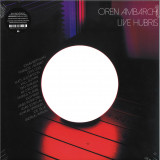
Black Truffle is pleased to announce Live Hubris, documenting the hypnotic and electrifying live performance of Oren Ambarchi’s 2016 LP Hubris by a fifteen-strong band at London’s Café Oto. Over three days in May 2019, Oto toasted Oren Ambarchi at 50/Black Truffle at 10 with Ambarchi and a large group of close friends and collaborators in a series of performances that interspersed existing projects with new collective endeavours, culminating with this: fourteen members of the extended Black Truffle family together on stage, joined by one special virtual guest, to translate the intricately studio-constructed layers of Hubris into a muscular live band workout.
Operating with only the bare minimum of pre-gig preparation after the planned afternoon rehearsal had to be wrapped up prematurely due to noise complaints, the gargantuan group lurches into motion with a 21-minute rendition of ‘Hubris Part 1’, powered by the pulsating electronics of Konrad Sprenger (the ‘ringmaster’ at the ensemble’s core) and no less than seven electric guitars spinning a web of intricately interlocking palm-muted polyrhythms. The layers of closely related but metrically distinct lines create ripples of shifting accents, flickering changes in emphasis that ricochet along the endless central pulse. Gradually building in density, this motorik continuum becomes the backdrop for the haunting tones of Eiko Ishibashi’s processed flute and an extended feature from long-distance guest Jim O’Rourke on guitar synth.
After the brief interlude of the second part, where Albert Marcoeur-esque guitar arpeggios accompany a halting attempt at phone conversation, the full ensemble gears up for the epic side-long rendition of ‘Hubris Part 3’. Now joined by the astonishing triple drum line-up of Joe Talia, Will Guthrie and Andreas Werliin, the layered pulse of the opening piece becomes a burning funk-fusion groove. Beginning on a medium simmer, the ensemble initially stick to its pulsating one-note mantra, over which Ambarchi unfurls a beautiful example of his signature shimmering Leslie-toned guitar harmonics, eventually joined by Ishibashi’s flute and some brooding, distorted dissonance from Julia Reidy’s guitar. Building steadily for the first nine minutes, the heat then rises dramatically with a first, gloriously loose chord change: with the all drummers now rolling and tumbling like a twice-cloned Jack DeJohnette circa 1970, Mats Gustafsson enters on baritone, his tortured roars and shrieks driving the band to peaks of insane intensity. Finally, the exhausted ensemble drops out, leaving only the jagged, skittering fuzz of Ambarchi’s guitar, brought to an abrupt conclusion at the command of crys cole. Arriving on hot pink vinyl with artwork by Lasse Marhaug and an extensive selection of live photos by Ivan Weiss and Fabio Lugaro, Live Hubris brings this ambitious and outrageous evening of music to the safety of the home stereo.
Following March’s 9696 Dream mixtape and July’s Flex Time EP, this new album sees 96 Back shine the spotlight on his own vocals for the first time, at points (such as on lead single ‘9 To Find 6’) operating fully in the realms of experimental pop. At other times, such as on ‘Teach Me Tenderness’ and ‘Feel Hard’, 96 Back stretches and processes his vocals to almost breaking point, while album closer ‘Melt You’ sees him duet with past collaborator Iceboy Violet, ending Love Letters on a sombre but romantic note. That’s not to say Love Letters is fully removed from the dancefloor, however: tracks like ‘Don’t Die’ and ‘Love Compact’ are precision-tooled for the club, while the likes of ‘Felzin’ and ‘Vibrant Colours’ continue to explore the intricate but emotive electronics that 96 Back has been so successful with in the past. More varied and vivid than any of 96 Back’s releases to date, Love Letters feels like a coming of age moment. It casts its net incredibly wide at points, and it’s an album full of ambition, but it meets every challenge it sets itself — as affecting in its quieter, tender moments as during its dramatic peaks. In 96 Back’s words: “This is a record I feel like I’ve been trying to write for years, it feels like the most accurate body of work to match the ideas in my mind. Trying to project a lot of the records I hold very dear to me through this lens, interpreting how they sound to me and merging them with ideas of finding the drama and excitement in the full spectrum of emotions on the tip of my tongue, that’s what ended up being Love Letters, Nine Through Six.”
Pilgrimage of the Soul is the 11th studio album in the 22-year career of Japanese experimental rock legends, MONO. Recorded and mixed - cautiously, anxiously, yet optimistically - during the height of the COVID- 19 pandemic in the summer of 2020, Pilgrimage of the Soul is aptly named as it not only represents the peaks and valleys where MONO are now as they enter their thirddecade, but also charts their long, steady journey to this time and place. Continuing the subtle but profound creative progression in the MONO canon that began with Nowhere Now Here (2019), Pilgrimage of the Soul is the most dynamic MONO album to date (and that's saying a lot). But where MONO's foundation was built on the well-established interplay of whisper quiet and devastatingly loud, Pilgrimage of the Soul crafts its magic with mesmerizing new electronic instrumentation and textures, and - perhaps most notably - faster tempos that are clearly influenced by disco and techno. It all galvanizes as the most unexpected MONO album to date - replete with surprises and as awash in splendor as anything this band has ever done. MONO began in Japan at the end of the 20th Century as a young band equally inspired by thepioneers of moody experimental rock (My Bloody Valentine, Mogwai) and iconic Classicalcomposers (Beethoven, Morricone) who came be fore them. They have evolved into one of the most inspiring and influential experimental rock bands in their own right. It is only fitting that their evolution has come at the glacial, methodical pace that their patient music demands. MONO is a band who puts serious value in nuance, and offers signi ficant rewards for the wait. "glacial, metallic, all-consuming post-rock" - Stereogum ,Stunning, eloquent, emotionally gut-busting" - Pop Matters "it's the kind of album that's best played start to finish (and best played loudly), and that can truly suck you in and transport you to another world if you do so." - Brooklyn Vegan
Composed, produced, and arranged by Eartheater alone, Phoenix: Flames Are Dew Upon My Skin draws a path back to the primordial lava lake from which she first emerged, as it also testifies to the reincarnating resurrections the project has undergone over its first full decade of existence. While the album renews her focus on guitar performance and legible structure, Eartheater balances the unabashed prettiness of acoustic harmonic songs with the dissonant gestural embroidery of oblique instrumentals. Having fallen back in love with the idioms that first captivated her, she worked to crack open the techniques that had fossilized inside of her, while still seeking to apply the electro-alchemical knowledge she picked up along her journey. The result of a laborious revival in fire, Phoenix recontextualizes Eartheater’s combinatorial approach to production within her most confident abstractions, adjacent to some of her most direct songs to date.
Eartheater composed and workshopped most of Phoenix over a ten-week artist residency (FUGA) in Zaragoza, Spain, housed in a sprawling, cubic glass facility that looked out over wildflower-flecked mountains. Following an intensive period of recording and touring, the residency provided her with an unprecedented period of solitude in the small Spanish town. Her newfound sense of isolation ultimately became liberating, leading her to sidestep the crutches and steady grids inherent to electronic music, and to conceive pieces rooted in her guitar and her desire to perform with other players live.
Eartheater’s voice glows brighter than ever at the center of Phoenix’s arrangements — her familiar operatic highs are grounded by newly expanded velvety lows, leaping lucidly up and down octaves. Her intricate guitar work flits across baroque fingerpicked passages and latches into cyclical figures that meet her voice in lush harmonic progressions. From her own guitar parts, to the orchestral string arrangements she wrote for the Spanish conservatory group Ensemble de Camara, to the harp and violin lines performed by her close friends and collaborators Marilu Donovan and Adam Markiewicz of LEYA, Eartheater’s applications of acoustic instruments bring an extraordinary emotional emphasis to her compositions. Phoenix prepares for a future where electronic sound — or even electricity itself — isn’t guaranteed, but where her music could still come to life with a group of hands dexterously winding across instruments against the light of the fire. Eartheater drew inspiration for Phoenix from geological imagery, whose turbulence and potential for genesis mirror the trajectory of her own life and relationships. The album’s instrumental pieces directly reference these moments of upheaval, colliding audio of volcano and lightning storms with resplendent string and vocal arrangements. “Volcano” looks out over the album from its peak at the center, its tectonic plates colliding in towering melodies and layers of vocal harmonies, as piano accents crest and cascade down the mountainside. When Eartheater sings, “I’m still building mountains underground,” she is trying to reconcile the pinnacles of her ambition with the comforts of a simple existence buried beneath the surface. “Diamond in the Bedrock” finds her admiring the gemstone forming under intense pressure inside her, but rejecting the romantic promise that the diamond signifies, choosing instead to escape a relationship that has come to stifle her.
With the album’s subtitle, Flames Are Dew Upon My Skin, Eartheater imagines being tempered to a state of perfect equilibrium, suspended between melting and freezing, where fire could streak across her body and appear as a crystalline blush. This image captures the tension at the heart of the Eartheater project, as she decides how best to distill her passion and render it cool to the touch; to find beauty in simple pleasure, while keeping one eye fixed on the peaks that loom in the horizon. The album is mixed by Kiri Stensby and mastered by Heba Kadry, featuring photography by Daniel Sannwald.
Black Truffle is very proud to present Peaks by Australian cellist Judith Hamann, her debut release of electro-acoustic music. Known mostly for her live performance work with composers including Sarah Hennies, Yvette Janine Jackson, Alvin Lucier, Tashi Wada, and La Monte Young, here she steps away from the cello, moving into an intimate dreamscape woven from recordings gathered over years of itinerant touring.
Peaks is a work in two distinct parts, crossfading between different landscapes and apertures; from rooftop to church, from stasis to flares of momentary romanticism. Peaks considers summits as being both above and below, reframing the idea of apex from a more intimate perspective. Hamann considers how our domestic and personal geographies might form their own apogees, meridians, or nadirs.
Assembled in 2019 while an artist in residence in Krems, Austria, Peaks begins with Hamann’s more familiar cello but soon unravels into resonant electronic interiors; Southern California nightscapes heard through windows, San Francisco bathroom fans, snatches of recordings of friends, hand organs, and engines. signal/centinela draws primarily on recordings from Hamann’s time living in San Diego, and carries with it a certain sense of nostalgia in the sense of homesickness, longing, and displacement of distance and time. Side B is composed from recordings gathered on a different continent, Europe, weaving piano with recordings of sleep, breath, church organ, and the act of climbing. under/over emerges as it recedes, overlapping moments of arrival to create another kind of ‘spire’ in the sense of spir (breath). Peaks, with its omission of any recordings from Hamann’s home of Australia, hints at how the very construction of home itself, might be restless, untethered, changeable, and malleable.
On Peaks, Hamann interrogates tropes of ambient concrète musics, intentionally pivoting formally around material which teeters on the edge of cliche. This exploration asks whether familiar frames of harmony, field recordings and narrative trajectories can excavate new territories, or be ruptured. Peaks untangles a very personal sense of tension between beauty and shame in experimental music: treating lushness and harmony as possessing potentially muscular musical properties that might wrestle with or construct senses of belonging and home.
Outfitted with anthemic romps, tongue-in-cheek pastiches, and percussions that pivot from rolling adventures to rain hitting the windowpane, Intimacy's 'Across the Bridge' marks the artist's fifth release on vinyl and first release on Bouquet.
A grab bag of fun, dancefloor-ready tracks written across 2019, the EP delivers his aesthetic of old computers, sci-fi movies, and science class educational videos configured into deep, spacey line-toting bedroom techno and melancholic house.
The title track features a catchy electroclash-esque (!!!) saw wave bassline, complete with emo Roland D50 strings and bells, all laid over a very beefy electro beat. It crossbreeds a Drexciya strain of low-end thump with a chewy, Eurotrash bassline evoking that time you lost your wallet at Tresor in '98. Strings and bells from the Roland D50 introduce the same euphoric high found in most of the products crawling out of Perdue's lab these days.
'Angelo's House' is a full-forced banger built around a well-traveled sample of Angelo Badalamenti's theme from Twin Peaks, recorded from an Intimacy live set early last year.
The flipside leads with the spiritual acid techno masterpiece 'Datalore 66'. Bubbling basslines hit a boiling point when placed in sequence with flutes showing genetic linkage to the Hartnoll family. Highly reactive material.
'Eternal September' opens a portal to the earliest hours of morning via synthesis of swirling pads and snapping drums. Closing the EP in introspective fashion, the track shows just how much emotional range Intimacy can pull out of decades-old disciplines.
ABOUT THE ARTIST
Parks Perdue is a Memphis-born electronic musician. A culmination of internet research and home listening in the club-barren Tennessee city, his style draws from stoned out Dutch West Coast concept albums, video game soundtracks, and old-school midwest house and techno. Perdue made his vinyl debut under the alias Intimacy in 2016 on the short lived UK, DJ Haus-run label Vector Works. Perdue is now based in Los Angeles, California.
Long-time collaborators, longer-time best friends, lifelong analog appreciators; the German duo Iron Curtis & Johannes Albert join cosmic forces once again for another LP mission 'Moon II', a heartfelt voyage through the sounds, movements, styles and machines that created this music in the first place.
Think late 80s New York, early 90s Sheffield and the perennial sounds of Italo and Detroit, 'Moon II' is a lunar safari that celebrates the deepest foundations of house, techno and electronic soul while resolutely refusing to get nostalgic. Written and recorded during an intense two-and-a-half month session in Berlin last autumn, there's a consistency and tangible narrative running throughout as the pair play inspiration ping-pong over the course of 10 tracks.
A little Drexcyian glacial nod here, a hazy Boards Of Canada wink there. The Other People Place, Kerrier District, Environ Records, the Hacienda, Sub Club, Heaven 17, classic electro… All these ingredients are constantly bubbling in the mix for both Curtis and Albert (as individuals and even more so as a duo) and the end result is an album that works as a proper album should. Peaks, troughs, dreamy departures and all beautiful things in between.
Taking off where their debut collaborative album 'Industrie & Zärtlichkeit' (soon to be retitled 'Moon I') left us three years ago, the opening modem sounds on the intro track 'Canggu Laundry Club' dial us into a special sense of time and space.
It's a space where anything feels possible; Visual-inspired acid lines on 'Tiger Trek', lino-spinning body pops and windmills to the street sounds electro style of 'The Ultimate Seduction', the club-focused, Traxx-style Cutie Schamuthie collaboration 'Hurting', the melancholy plucks and struts of 'Feingold', the provocative, slinky, smoky finale piece 'Nektar'… The list of intergenerational and cross-genre landmarks on this adventurous body of work go and on, each track complementing the last as they fuse to create a bigger collective picture. A picture that's charmed together through the consistent use of key classic studio machines.
They call it Introverted Electronic Body Music, we call it warm, free-spirited and ultimately timeless. Perfect for your sets, your afterhours or your headphones alike; it's time to let Iron Curtis and Johannes Albert take you to the Moon and back… Once again.
Borneo Records welcomes Swedish made, Berlin based DJ City to the family!
As a fairly fresh face to the European dance music scene, involved with renowned musical outlets like Cocktail d’Amore and Born Free, DJ City has been turning heads with his playful and energetic style.
For Borneo’s ninth release DJ City delivers two deep dance floor cuts, referencing and paying hommage to his childhood idols, craftily combining well known building blocks into future classics.
”Sierra Madre” is a warm and deep dive into the aesthetics of the late 90s electronic music scene, balancing between lush pads and low bit rates. Steadily it progresses as the loops unfold and evolve into an ambient landscape of clear peaks and valleys. Dreamy and suggestive without becoming too literal or camp, it invites its listener to let the mind wander during the course of the dance.
On the flip side, “5426261” is a more playful feature as its percussion and somewhat off tune melodies roll out. The texture is light and invites its listener to venture in thought to an imaginary Mediterranean location right before dawn. The enigmatic title is repeated in a sample towards the end, implicating it is a phone number. Who are you trying to reach?
Written & produced by J. Norling, 2016-2018, Örebro/Berlin. Artwork by Nicole Martens. Borneo Records Rotterdam 2020.
Based in Munich, Germany, the producer, part-time DJ and Permanent Vacation label co-head Tom Bioly aka TB delivers new romantics, inspired by influences like The Cure’s „The Holy Hour“, Boards of Canada’s late 90s electronica, Miami Vice tropic percussion and Angelo Badalamenti’s Twin Peaks. Acid drops, string distortions, lushed melody bits, hushed robo vox and washed space guitars are being layered and sprinkled over machine beats and disco drums.
TB’s first release "Invitation To Love" made it on John Talabot's vinyl-only Hiverned 10" imprint and was voted amongst the best 10" releases by UK Fact magazine. GROOVE magazine wrote "..entirely superb..“, about the follow-up EP "City Girl" on Permanent Vacation, of which the title track has been licensed to the independent film „All These Sleepless Nights“ by director Michal Marczak.
In 2017 TB followed with “Heartbreak Hotel“, a double twelve-inch release with eight tracks of melancholic dance noir set in smoke-filled darkness. In 2018 he followed with the „Night Heat“ single, of which a RMXD EP with contributions by Gerd Janson, Sascha Funke, DJ Hotel and Bostro Pesopeo came out earlier this year.