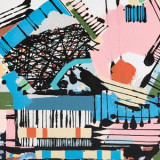
Moving freely through time and space via experimental DIY recordings since 2009, Joasihno return with their fourth album "Spots".
“Find your spot in the shade,” a truly laid-back and incredibly soft-spoken MC once advised, yet in a world that seems to get shadier every day, it’s probably time to finally get out and face the sun. Southern German experimental pop duo Joasihno – initial solo founder Cico Beck (The Notwist, Aloa Input, Spirit Fest) and drummer/composer Nico Sierig (Instrument, Fehler Kuti) – seem to know exactly when it’s time to shine. Idiosyncratic genre tweakers since day one, they have been operating at their own pace, mostly staying in their own shady corner. Yet, almost a decade after their most recent “Meshes” (an album that came with a whole legion of tiny music robots), it’s high time for them to take over more corners, to reclaim even more spots between lo-fi and sci-fi, retro electronica and contemporary classic. Drawing upon influences as varied as Reich, Riley, and Ryuichi, múm, Meek, and Moondog, while also nodding to other experimental twosomes (e.g. The Books), the duo’s fourth full-length “Spots” is set to arrive via Alien Transistor in late 2025.
Leaving soulless automation and all things artificial to others, Joasihno launch the latest record on “2 Squares” that feel like a peaceful, almost bucolic version of retro space age: lights blink ever so softly as easy-going bass tones point at today’s introspective flight arc. Electronic shapes align and things lift off – with a majestic 8-bit sunrise soon appearing right in front of us. Whereas playful title song “Spots” is a miniature Rube Goldberg kind of device, with quirky plucked strings and glitches setting off more and more contraption layers, “Crackleboom” is uncharted energy, an open landscape, an expanding bonfire that leads to a long-forgotten piano, all dust-covered in some kind of saloon. Space might be only noise to others, here, it’s foreboding screeches (“Dizzle Whistle”) that make room for A-side center piece “Forest Lights”: a steady beat that lures us to a clearance in the woods. Things break and shatter in the distance, but this spot right here is for hypnosis, dancing, sylvan spirits. And yeah, it’s surprisingly hot down here in the undergrowth…
Opening side B with a fun banger that takes the unhinged dancing to the playground – “Characa Orb.” feels like French kids on swings going crazy, a tipsy, tongue-in-cheek electro blow-out between Oizo and Orbis Tertius –, things get even more cinematic throughout the second half. Even the cheapest, lo-fiest gear is sufficient to make “The Slow Hour” glow like true, timeless pop royalty. In fact, the very same pop spirits roam and celebrate freely in the chirpy coves of mesmerizing “Detune Lagoon” – more hand-crafted sci-fi/lo-fi loops you’ll only find after facing the ghosts of Lynch or Sakamoto on those night-time trails under the “Deep Moon”. It’s all DIY spots, spots that leave room to dream or dangle, drape yourself over or dive into. Returning to the leafy bower on a melancholy post rock tip, we eventually learn that “Death Is Real” – and so we’re left with a laterna magica that turns and turns and turns. It’s a beautiful spot where light and shadows keep on dancing, just like they’ve always done, ever since the dawn of this madcap universe.

Buscar:electro swing
- Vinheta Quebrante
- Lenda
- Malemolência
- Roda
- Rainha
- 10: Contados
- Mais Um Lamento
- Concrete Jungle
- Valsa Pra Biu Roque
- O Ronco Da Cuíca
- Bobagem
- Ave Cruz
20th Anniversary Reissue. Remastered. Groundbreaking MPB/Downtempo Classic. Originally released in 2005, CéU introduced the world to a bold new voice in Brazilian music. Seamlessly blending samba, MPB, soul, and downtempo grooves, Céu delivered a debut that felt both deeply rooted and strikingly contemporary. With her smoky, understated vocal tone, she evoked echoes of classic bossa nova while pushing into new sonic territory - covering Bob Marley"s "Concrete Jungle" with Afro-Brazilian swing and layering in dub and electronica accents. Hailed for its elegance and quiet innovation, the album hit No. 1 on Billboard"s World and Heatseekers charts, earned a Grammy nomination, and became the highest U.S. chart debut for a Brazilian female artist since Astrud Gilberto. Now celebrating its 20th anniversary, CéU returns remastered for vinyl - a modern Brazilian classic reissued for a new generation of listeners. Includes Classics : "Lenda", "Malemolencia", "Concrete Jungle"... Mastering by Colorsounds Paris.
Drawing from over three decades in electronic music, DJ Rame (one third of the acclaimed Italian Pastaboys team) showcases his House Music expertise with this genre-blending original EP on Memento Records, going right back to the roots of club culture.
Title track Life 3 starts off with a dreamy pad intro and New York-house inspired piano chords, setting the mood for the dance floor and suddenly exploding into a bouncy, tension-and-release energetic swing, trippy percussions and rubberized synth rhythms.
Toyholic’s infectious bassline and syncopated beats match retro-futuristic synths and acid melodies, while Niwa’s faster pace and robotic vocal samples are drenched in 80s Electro Disco moods.
Stone Garden rounds off the release with a breakbeat groove, vintage analog sounds and mesmerizing stop-and-gos.
A visceral ode to the free spirit of the early warehouse parties that came to define an era of revolutionary music, these 4 tracks are one part raw emotion, one part contemporary sonic innovation.
Mister Water Wet returns to Soda Gong with "Things Gone and Things Here Still," an album that radically expands the project’s purview while preserving the homespun warmth and oblique tactility that have long defined Iggy Romeu’s work. Where earlier records tilted toward the dusty swing of sample-based beatcraft or spectral minimalist jazz, here Romeu opens the frame to a more ensemble-minded approach, inviting a stellar cast of supporting musicians, including SG alumni Memotone and K. Freund, into the fold.
The result is an album that feels both broader and more intimate, with live instrumentation such as piano, strings, and reeds woven into MWW’s signature lattice of hand percussion, production sleights, and slippery time signatures. Acoustic and electronic textures bend toward each other like plants angling for the same light: bowed strings blur into vaporous pads, brushed drums scatter under riffing guitars, a horn phrase lingers in the same space as a cracked cassette loop.
A tension between decay and presence - the “things gone” and the “things here still” - runs throughout the record. At times, the music evokes a chamber session refracted through waterlogged tape; at others, it recalls the afterimage of a hip-hop instrumental slowed into an oneiric haze. In the world of MWW, memory functions less as nostalgia and more as a living fabric - mutable and resonant. "Things Gone and Things Here Still" finds Iggy Romeu at his most expansive, offering up a generous record of open spaces and porous boundaries.
Following a wildly successful first release, Risk/Reward returns with an outstanding EP from Bizarre Trax bossman and Felon5 member Jhobei, featuring a remix from UK electro royalty Carl Finlow no less!
Digitaria combines a groovy organ bass with psychedelic synths and progressive elements, to create a dancefloor-focused, trance-inducing bomb, guaranteed to get crowds of all sizes moving. Trippy, hypnotic but always playful, the perfect track to bring the energy up in the room.
A monster bassline, punchy drums and dreamy pads make Thinking Nodes a versatile tool, equally at home early in the night or deep into the after hours. Classic UKG swing meets deep house, plus a sprinkling of rave elements go into the recipe, making a tasty treat for DJs and collectors alike.
Beatagroove Funk see's Jhobei channel his inner Random Factor, to create an Electro House ripper, with quirky vocals, glitchy synths, a bassline straight out of a 80s new wave banger and enough drive in the drums to make this a peak time weapon.
Carl Finlow delivers an epic masterpiece on the remix of Beatagroove Funk, creating a work of sheer beauty that sounds like a blissful sunset cruise on a hover bike through a futuristic metropolis. Unexplainably detailed and emotional, this is the work of a true master of his craft and will surely go on to be recognized as some of his very best work - simply unmissable!
With heavy support from Tini, Harry McCanna, Anna Wall, Rich NxT, Voigtmann and more, Jhobei's star seems destined to keep rising, as Risk/Reward continues to establish itself as a must buy label.
Planet Trip Records is pleased to present Aqua Terra, the latest EP release from Friedrich Trede and Stephan Braun, the respected Munich-based DJ and production duo better known as Rhode & Brown. Since 2010, they’ve racked up a slew of quality releases through Permanent Vacation, Public Possession, Shall Not Fade, and their own Slam City Jams imprint, while playing well-received DJ sets across Europe. Along the way, the two longtime friends have spent the last fifteen years incorporating influences from electro, italo, synth-pop, breakbeat trance, rave music, and ambient into their blend of uptempo house and techno productions.
Shifting gearspeed, Aqua Terra sees Rhode & Brown trying something completely new and unexpected from them: a record inspired by UK street soul, digi-dub, and transatlantic R&B and boogie from the 1980s and 1990s. Beginning with the Loose Ends slanted synthesiser chords and shuffling machine beat of ‘Heart Attack’ and the glossy new jack swing bounce of ‘Passion Sauce’ (both featuring sultry Berlin-based New York singer Marlena Dae), Aqua Terra quickly reveals itself as a treasure chest of heavy tunes. Steeped in love and lust, ‘Heart Attack’ and ‘Passion Sauce’ are essential sing-along numbers for the warm-up and the warm-down.
The exemplar of a groove that keeps on giving, ‘Aqua Terra (Acid Frog Mix)’ is a note-perfect example of digi-dub redone for the 2020s. Keeping us guessing, Rhode & Brown flip the script on ‘Longo Doggo’ by borrowing elements from sampledelic ‘90s turntablism and blending them with a post-disco/electro beat and a slinky bassline for the ages. From there, ‘Multiflora’ sees our protagonists back in a bassy digi-dub mode, before closing things out with an acid breakbeat slanted demo mix of the title track.
Cosey Fanni Tutti has announced details of a new album, 2t2, set for release on the artist’s own imprint, Conspiracy International, on 13 June 2025 on vinyl & CD. Composed, performed and produced by Cosey Fanni Tutti, the 9-track album moves between propulsive beat constructions and expansive electronic explorations, continuing themes from 2019’s acclaimed album TUTTI. It is a personal reflection; a sonic realisation of her life, drawing on her powerful inner resolve and expressing it through music. The album finds Cosey making sense of some very tough years, dealing with personal bereavements alongside swingeing world events that have impacted us all. Centring on her own strength and self will, the album’s two distinct sides – one rhythmic, one more meditative – are connected by an overwhelmingly positive mood. She explains, “My overtone chanting on the track ‘Stound’ was part of that, tapping into the inner self, to the core of your being, emotionally, physically, allowing the sounds to permeate and soothe as well as create a sense of power, resistance and resilience to what we face.” Even in the more melancholic moments, there’s a lightness that she explains is an “acknowledgement that it’s alright to be sad, that’s part of life, but there is so much joy too in our memories of people we lose and in the moments we share with each other. Joy is our resistance.” There are also threads from her most recent projects running through 2t2. Her latest book RE-SISTERS and the score she wrote for Caroline Catz’s film Delia Derbyshire: The Myths and Legendary Tapes are acknowledged, most directly on ‘Threnody’ which is dedicated to Delia Derbyshire and Andy Christian, an artist friend of Delia’s. He sent Cosey an abstract drawing of the same name, created one night from an improvised evening where he drew while Derbyshire intoned and sang softly as she looked at the drawings, as if reading a score expressing how they made her feel. Cosey’s process and the different strands that make up her work form a totality of vision. She goes on to say, “Once you get creating and listening, weaving, collaging sound it’s a wonderfully fulfilling feeling that takes you both out of yourself at the same time as essentially deep within.”
The artwork reflects this idea that the album is a “sound cameo”, reflecting the light within the music, and the buzz of life that exists within all of Cosey’s work. Musician, artist and author Cosey Fanni Tutti has continually challenged boundaries and conventions through her work. As a founding member of the hugely influential avant-garde band Throbbing Gristle, one half of electronic pioneers Chris and Cosey, and as an artist channelling her experience in pornographic modelling and striptease, her work on the margins has reshaped the mainstream. Her first solo album, Time To Tell (1983) was followed by 2019’s Tutti and 2022’s Delia Derbyshire: The Myths and the Legendary Tapes. Her debut book, the Penderyn Music Book Prize shortlisted Art Sex Music, was published in 2017, followed by RE-SISTERS in 2022 (both Faber), which will soon get a Spanish edition.
Emotional Rescue completes the series of non-defined reissues where the label licenses an all-time favourite, remasters and then reappraised with new interpretations by contemporary producers for today’s collectors.
After the series started back in 2019 with Hawkwind’s sprawling psychedelic electronics, featuring deep drone mixes by the esteemed digger Cherrystones (ERC074), the bouncing cosmic-Balearics of Thomas Leer with wonderful reworkings by friend and producer Bullion (ERC075) and then the post punk dubs of The Embrace and Timothy J Faiplay’s brooding italo-dub excursions (ERC076), there was always one artist and producer left out. Finally, then the percussive excursion of the early 80s band The Impossible Dreamers and their cult B side jam, Spin, coming with 9 minutes percussion-dub extravaganza of an extended reversion, plus a dub heavy reprise, by label go-to Dan Tyler (Idjut Boys /Noid), under his NAD moniker.
Started by a group of friends while at Exeter University that centered around Caroline Radcliffe, James Hood, Justin Adams and Nick Waterhouse, their debut 12” record is one of just three on the 100 Things To Do label. The other two releases have already been covered with the Hamburger All Stars ‘Swinging London’ 12” (ERC114) of 2022.
Recorded before the move to West London, ‘Life On Earth’ was a raw post punk vocal pop cut, with influences of dub, funk, hip-hop and African music shining through, there were in their own words, “young music fans starting out, with no agenda”.
However, it was on the B side that things got interesting. Enamored by the growing trend of extended 12” singles, they decided, with the A side wrapped up, to have some studio experimentation by recording a drumming jam, with all the members playing percussion, followed by some overdubbing. Memories are hazy, but at the time the band was an 8-piece, so the results a chaotic explosion, capturing the essence of that time. Featuring Nick and James on 4 hand piano, plus Caroline on Oboe, with some additional hollering and wooping vocals, Spin was a 5-minute burst of energy.
In effect, self-released in 1982, the band didn’t expect much to come of it, but the 12” acted as a calling card leading them to London and later signing for RCA. At the same time, Spin was being discovered in the early eighties alternative club world. On a trip to New York, the track was heard being played Downtown, and on enquiring it was discovered the DJ was playing a 7” that was never an official release but cut in the US solely for the club DJs there.
Its resonance extended further, to Italy and the Cosmic club of the resident, an ever-searching Danielle Baldelli, before being picked up a few years later by a young Andrew Weatherall during his pursuit of an alternative “Balearic” beat during the late eighties Summers of Love and has even recently received the Joe Clausell edit treatment back again in NYC.
For the remake to fit the label series, it was only right to ask label friend Dan Tyler to do what he does so well, putting the original through his array of dub machines and pedals, extending and cutting with aplomb to create an incendiary ‘Reversion’ that will send dancefloors literally in a spin. Teasing the percussion incandescent, looping and teasing, the piano held back before finally releasing in a haze of dub effects.
This is followed by the ‘Riddim Reprise’. Working with London based drummer Matt Bruce (Claptrap), this is the perfect DJ tool, taking the original idea of the band, to just jam see what happens, twisting it full of space echo and reverb, to offer a perfect 12” Extended Mix.
- Bam Bam (Feat. Takoda)
- Clown Camp
- How To Swing (Feat. Nikiranda)
- Tap Water
- I Don't Like My Telephone(Feat. Salamirose Joe Louis)
- Castle In The Sky
- Kaza Dum
- Circuit City
- Tummy (Feat. Teleporter)
- Velvet Room (Feat.deradoorian)
- Band Practice
- Larry
Los Angeles trio sunking marry hip hop, and electronic influences on their 2nd album I DON"T LIKE MY TELEPHONE. Childhood friends Bobby Granfelt, a jazz drummer and self-proclaimed hip-hop head, Antoine Martel, a synthesist and composer, branched off their mainstay High Pulp to explore their polar opposite tastes and make music as sunking in addition to multi-instrumentalist Victory Nguyen. Their 2022 debut Smug, was more jazz-influenced, while I DON"T LIKE MY TELEPHONE is akin to the early work of beat-driven artists Thundercat, Madlib, and Flying Lotus. They hand selected artists Salami Rose Joe Louis, Niki Randa, Deradoorian, and Takoda to lend vocals and help capture that spirit. I DON"T LIKE MY TELEPHONE as a series of self-contained "micro-compositions," built around Granfelt"s drum loops and Martel"s new gear. In addition to, they were fueled by an increasing love for electronic music artists like Galcher Lustwerk, The Field, and Susumu Yokota, whose 1994 cult classic Acid Mt. Fuji they cite as a particular inspiration. The result is a record as vibrant as a kaleidoscope, and compact as one too, shuffling through more styles and ideas in neat, three-minute chunks of virtuosity.
Composed, performed and produced by Cosey Fanni Tutti, the 9-track album moves between propulsive beat constructions and expansive electronic explorations, continuing themes from 2019’s acclaimed album TUTTI. It is a personal reflection; a sonic realisation of her life, drawing on her powerful inner resolve and expressing it through music. The album finds Cosey making sense of some very tough years, dealing with personal bereavements alongside swingeing world events that have impacted us all. Centring on her own strength and self will, the album’s two distinct sides – one rhythmic, one more meditative – are connected by an overwhelmingly positive mood.
She explains, “My overtone chanting on the track ‘Stound’ was part of that, tapping into the inner self, to the core of your being, emotionally, physically, allowing the sounds to permeate and soothe as well as create a sense of power, resistance and resilience to what we face.” Even in the more melancholic moments, there’s a lightness that she explains is an “acknowledgement that it’s alright to be sad, that’s part of life, but there is so much joy too in our memories of people we lose and in the moments we share with each other. Joy is our resistance.”
There are also threads from her most recent projects running through 2t2. Her latest book RE-SISTERS and the score she wrote for Caroline Catz’s film Delia Derbyshire: The Myths and Legendary Tapes are acknowledged, most directly on ‘Threnody’ which is dedicated to Delia Derbyshire and Andy Christian, an artist friend of Delia’s. He sent Cosey an abstract drawing of the same name, created one night from an improvised evening where he drew while Derbyshire intoned and sang softly as she looked at the drawings, as if reading a score expressing how they made her feel. Cosey’s process and the different strands that make up her work form a totality of vision.
She goes on to say, “Once you get creating and listening, weaving, collaging sound it’s a wonderfully fulfilling feeling that takes you both out of yourself at the same time as essentially deep within.” The artwork reflects this idea that the album is a “sound cameo”, reflecting the light within the music, and the buzz of life that exists within all of Cosey’s work. Musician, artist and author Cosey Fanni Tutti has continually challenged boundaries and conventions through her work. As a founding member of the hugely influential avant-garde band Throbbing Gristle, one half of electronic pioneers Chris and Cosey, and as an artist channelling her experience in pornographic modelling and striptease, her work on the margins has reshaped the mainstream. Her first solo album, Time To Tell (1983) was followed by 2019’s Tutti and 2022’s Delia Derbyshire: The Myths and the Legendary Tapes. Her debut book, the Penderyn Music Book Prize shortlisted Art Sex Music, was published in 2017, followed by RE-SISTERS in 2022 (both Faber), which will soon get a Spanish edition.
Repress!
In the mid-1970s, a force of nature swept across the continental United States, cutting across all strata of race and class, rooting in our minds, our homes, our culture. It wasn’t The Exorcist, Goodbye Yellow Brick Road, or even bell-bottoms, but instead a book called The Secret Life of Plants. The work of occultist/former OSS agent Peter Tompkins and former CIA agent/dowsing enthusiast Christopher Bird, the books shot up the bestseller charts and spread like kudzu across the landscape, becoming a phenomenon. Seemingly overnight, the indoor plant business was in full bloom and photosynthetic eukaryotes of every genus were hanging off walls, lording over bookshelves, and basking on sunny window ledges. The science behind Secret Life was specious: plants can hear our prayers, they’re lie detectors, they’re telepathic, able to predict natural disasters and receive signals from distant galaxies. But that didn’t stop millions from buying and nurturing their new plants.
Perhaps the craziest claim of the book was that plants also dug music. And whether you purchased a snake plant, asparagus fern, peace lily, or what have you from Mother Earth on Melrose Avenue in Los Angeles (or bought a Simmons mattress from Sears), you also took home Plantasia, an album recorded especially for them. Subtitled “warm earth music for plants…and the people that love them,” it was full of bucolic, charming, stoner-friendly, decidedly unscientific tunes enacted on the new-fangled device called the Moog. Plants date back from the dawn of time, but apparently they loved the Moog, never mind that the synthesizer had been on the market for just a few years. Most of all, the plants loved the ditties made by composer Mort Garson.
Few characters in early electronic music can be both fearless pioneers and cheesy trend-chasers, but Garson embraced both extremes, and has been unheralded as a result. When one writer rhetorically asked: “How was Garson’s music so ubiquitous while the man remained so under the radar?” the answer was simple. Well before Brian Eno did it, Garson was making discreet music, both the man and his music as inconspicuous as a Chlorophytumcomosum. Julliard-educated and active as a session player in the post-war era, Garson wrote lounge hits, scored plush arrangements for Doris Day, and garlanded weeping countrypolitan strings around Glen Campbell’s “By the Time I Get to Phoenix.” He could render the Beatles and Simon & Garfunkel alike into easy listening and also dreamed up his own ditties. “An idear” as Garson himself would drawl it out. “I live with it, I walk it, I sing it.”
But as his daughter Day Darmet recalls: “When my dad found the synthesizer, he realized he didn’t want to do pop music anymore.” Garson encountered Robert Moog and his new device at the Audio Engineering Society’s West Coast convention in 1967 and immediately began tinkering with the device. With the Moog, those idears could be transformed. “He constantly had a song he was humming,” Darmet says. “At the table he was constantly tapping.” Which is to say that Mort pulled his melodies out of thin air, just like any household plant would.
The Plantae kingdom grew to its height by 1976, from DC Comics’ mossy superhero Swamp Thing to Stevie Wonder’s own herbal meditation, Journey Through the Secret Life of Plants. Nefarious manifestations of human-plant interaction also abounded, be it the grotesque pods in Invasion of the Body Snatchers or the pothead paranoia of the US Government spraying Mexican marijuana fields with the herbicide paraquat (which led to the rise in homegrown pot by the 1980s). And then there’s the warm, leafy embrace of Plantasia itself.
“My mom had a lot of plants,” Darmet says. “She didn’t believe in organized religion, she believed the earth was the best thing in the whole world. Whatever created us was incredible.” And she also knew when her husband had a good song, shouting from another room when she heard him humming a good idear. Novel as it might seem, Plantasia is simply full of good tunes.
Garson may have given the album away to new plant and bed owners, but a decade later a new generation could hear his music in another surreptitious way. Millions of kids bought The Legend of Zelda for their Nintendo Entertainment System back in 1986 and one distinct 8-bit tune bears more than a passing resemblance to album highlight “Concerto for Philodendron and Pothos.” Garson was never properly credited for it, but he nevertheless subliminally slipped into a new generations’ head, helping kids and plants alike grow.
Hearing Plantasia in the 21st century, it seems less an ode to our photosynthesizing friends by Garson and more an homage to his wife, the one with the green thumb that made everything flower around him. “My dad would be totally pleased to know that people are really interested in this music that had no popularity at the time,” Darmet says of Plantasia’snew renaissance. “He would be fascinated by the fact that people are finally understanding and appreciating this part of his musical career that he got no admiration for back then.” Garson seems to be everywhere again, even if he’s not really noticed, just like a houseplant.
- A1: Gregory Moore - Excursions
- A2: Talee - Makes Me Wonder
- A3: Cantor Feat New Hook - Achtung! Achtung!
- A4: World Wild Web Feat Rasp Thorne - Scavengers
- A5: H L.m. - Fronde
- A6: New Hook - Unity
- B1: Montessori Feat Vongold - Ad Libitum
- B2: Sx2 - Buttons
- B3: Cantor - Hannett’s Dream (Modular Project Rework)
- B4: Aimes - Carissima
Underground Pacific is back with a new double vinyl compilation titled ‘The Only Good Wave is a Dead One’ that confirms, once again, its uncompromising taste for bold electronic music, psychedelic textures, and raw, electrified rock ‘n roll. This release brings together a varied group of artists, each of them adding something special to the journey.
The trip begins with “Excursions” by Gregory Moore, a piece that floats into a humid sonic world, between the nostalgic tones of vintage video game soundtracks, the Fourth World atmospheres of Jon Hassell, and the shimmering calm of ’90s Japanese ambient à la Takashi Kokubo.
Next comes Talee, the Rotterdam-based regular of the label, with “Makes Me Wonder”. Here, grunge-soaked vocals meet a tight dark disco groove, pierced by crystalline guitar chords that shimmer at the track’s heart. A song with its soul in the past and its feet in the club.
Label founder Cantor teams up once again with German duo New Hook on “Achtung! Achtung!”, an homage to the eponymous track by Italian producer Black Saagan. Fueled by vintage drum machines, punk-infused vocals, and melodies echoing the krautrock minimalism of Cluster, the track channels pure Cold War disco energy.
On “Scavengers”, Berlin based World Wild Web and Rasp Thorne deliver a pure mix of electro-rock noir – Suicide by way of David Lynch. Picture a never seen before episode of the series where Martin Rev and Alan Vega are playing live at the Roadhouse in Twin Peaks, while Laura Palmer slowly moves her head to the music, with a devilish smile on her face.
All the way from Grenoble to Berlin, H.L.M. deliver a dirty bass-driven anthem called ‘Fronde’. French spoken vocals spitfire over layers of distorted drones and hypnotic rhythms. The result is rough, hypnotic, and brings to mind the grooves of Death in Vegas.
New Hook return, this time solo, with ‘Unity’: a blend of groovy downtempo percussions, melancholic guitar riffs, and their signature brand of spoken word, a style that’s quickly become their sonic fingerprint.
Then it’s the turn of mexican-wave exponents Montessori featuring Vongold on “Ad Libitum”: a techy sunrise piece with soft pads, subtle build-ups, and an ecstatic sense of endlessness. After-party music for vast, open spaces.
Next up are SX2 from Ireland with their ‘Buttons’, offering a rolling tech-house banger laced with desert guitars. Psychedelic FX’s and whispered vocals drenched in delay slow the pace in a breakdown full of tension, preparing the floor to an euphoric release.
A dream from the pandemic era reappears: Cantor’s “Hannett’s Dream”, originally released in 2020 by Modular’s Project’s imprint ‘Nothing Is Real’ together with their own reworked version present also in two very limited vinyl-collector editions released by Underground Pacific. The introspection and hypnotic structure of the original cut here is replaced by a more stripped down arrangement, with a four-to-the-floor groove that is perfectly crafted for peak-time ignition.
Closing out the release is “Carissima” by the man behind iconic label Wonder Stories, Aimes – a Moroder-esque bassline and sensual vocals play on top of a warm groove that suddenly fractures into jazz-tinged, breakbeat mood, in the style of early Warp Records, just in time to get back into its disco-ish swing.
Contrary to what the title of this release might suggest, the wave isn’t dead at all. It’s well alive in the underground, reanimated by labels like Underground Pacific who are always ready to welcome artists who aren’t afraid to crash genres together and, above all, who are driven by the desire to make free-form, inspired pieces of music.
- A1: Robin S - Show Me Love (Stonebridge Club Mix)
- A2: Kings Of Tomorrow Feat Julie Mc Knight - Finally (Exte
- A3: Hardrive, Barbara Tucker, Louie Vega - Deep Inside
- B1: M1 - Electronic Funk (Kaje Remix)
- B2: Louie Vega & Jay Sinister - Diamond Life (Old School Du
- B3: Ministers De La Funk Feat Jocelyn Brown - Believe (Min
- C1: Ultra Naté - Free (Mood Ii Swing Extended Vocal Mix Edi
- C2: Phunky Data - Fashion (Ian Pooley's Stylish Mix)
- C3: Superfunk Feat Ron Carroll - Lucky Star (Album Mix)
- D1: Bob Sinclar - Gym Tonic
- D2: Africanism, Dj Gregory - Block Party
- D3: Salome De Bahia - Outro Lugar
The first and most independent of all independent producers, Joe Meek needs little introduction. He was the first to chart in both the UK and the USA with an independently produced song -which was actually recorded in his home’s kitchen- when The Tornados' Telstar took the world in 1962. Meek was, of course, one of the most in vogue producers of the first half of the 1960s, providing the soundtrack to the evolution of UK Rock’n'Roll to Swinging London, scoring hits with actors like John Leyton (Johnny Remember Me), showmen like Screaming Lord Sutch and bands like The Outlaws and The Tornados. He also produced a wide stream of R&B and freakbeat 45s that are nowadays hardly sought after by the collectors with the biggest bank accounts.
Joe Meek experimented with all kinds of recording techniques in his home studio, his tricks and gimmicks won his productions chart placement and critical and public acclaim, but none of his projects was so advanced and way out as the avantgarde experimentation showed in his I Hear a New World electronic symphony from 1960. Aided by The Blue Men formed by Rod Freeman (group leader, guitar, vocals), Ken Harvey (tenor sax, vocals), Roger Fiola (Hawaiian Guitar), Chris White (guitar), Doug Collins (bass), Dave Golding (drums) -also known as Rodd-Ken and The Cavaliers- who provided a tight base to his electronically produced sounds, Meek came up with what he envisioned as the soundtrack of the future, the sounds he envisioned were to be heard in outer space. It was too way out for its time, certainly. To the point that of all the opus, only four tracks saw the light of day on a 7" EP released on Triumph, Meeks very own label. It wouldn’t be until 1991 that the whole recordings from the I Hear a New World sessions would see the light of day on a CD issued by the RPM label.
Wah Wah offers a new reissue of this now classic early electronics masterpiece, housed in a beautiful front-laminated back-flapped sleeve and offered as a limited 400 copies only black vinyl version and an ultra-limited 100 copies only transparent purple vinyl. Get yours before they fly!
RIYL : Delia Derbyshire and The BBC Radiophonic Workshop, Louis and Bebe Barron’s soundtrack to Forbidden Planet, Raymond Scott, Tom Dissevelt & Kid Baltan, Morton Subotnick…
The first and most independent of all independent producers, Joe Meek needs little introduction. He was the first to chart in both the UK and the USA with an independently produced song -which was actually recorded in his home’s kitchen- when The Tornados' Telstar took the world in 1962. Meek was, of course, one of the most in vogue producers of the first half of the 1960s, providing the soundtrack to the evolution of UK Rock’n'Roll to Swinging London, scoring hits with actors like John Leyton (Johnny Remember Me), showmen like Screaming Lord Sutch and bands like The Outlaws and The Tornados. He also produced a wide stream of R&B and freakbeat 45s that are nowadays hardly sought after by the collectors with the biggest bank accounts.
Joe Meek experimented with all kinds of recording techniques in his home studio, his tricks and gimmicks won his productions chart placement and critical and public acclaim, but none of his projects was so advanced and way out as the avantgarde experimentation showed in his I Hear a New World electronic symphony from 1960. Aided by The Blue Men formed by Rod Freeman (group leader, guitar, vocals), Ken Harvey (tenor sax, vocals), Roger Fiola (Hawaiian Guitar), Chris White (guitar), Doug Collins (bass), Dave Golding (drums) -also known as Rodd-Ken and The Cavaliers- who provided a tight base to his electronically produced sounds, Meek came up with what he envisioned as the soundtrack of the future, the sounds he envisioned were to be heard in outer space. It was too way out for its time, certainly. To the point that of all the opus, only four tracks saw the light of day on a 7" EP released on Triumph, Meeks very own label. It wouldn’t be until 1991 that the whole recordings from the I Hear a New World sessions would see the light of day on a CD issued by the RPM label.
Wah Wah offers a new reissue of this now classic early electronics masterpiece, housed in a beautiful front-laminated back-flapped sleeve and offered as a limited 400 copies only black vinyl version and an ultra-limited 100 copies only transparent purple vinyl. Get yours before they fly!
RIYL : Delia Derbyshire and The BBC Radiophonic Workshop, Louis and Bebe Barron’s soundtrack to Forbidden Planet, Raymond Scott, Tom Dissevelt & Kid Baltan, Morton Subotnick…
Swingrowers are known for their mixture of JAZZ, SWING, POP and ELECTRO, they have extensively toured Europe and North America, opening sell-out shows for Parov Stelar, Chinese Man & Caravan Palace. On top of delivering official remixes for Caro Emerald and Swing Republic, Swingrowers also boast musical collaborations with The Lost Fingers, Gypsy Hill, DJ Pony Montana and have had their own songs remixed by Bart&Baker and Jamie Berry.
Following on from their debut album 'Pronounced Swing Grow'ers' in 2012, Swingrowers have released their second album 'REMOTE' in early 2015, followed now by 'OUTSIDEIN', the band's third full-length studio album. This new release shows their expert musicianship and most meticulous production to date, mixing genres from jazz to electronica, from gypsy-swing to full-on rock'n'roll with a melodic pop sensibility.
The emblematic Chilean producer Camilo Gil tells a story of life through ink and sound. In its original version, the creativity between bass, MPC, garage influences, and Break Deep elements gives us a unique work.
In the alternate version, the legendary MARK AMBROSE takes us on a journey through space, with captivating voices, tones, and his signature sound.
On the B-side, the remix by Detroit legend GARI ROMALIS showcases the soulful, emotional side of the Motor City, featuring pianos and a hypnotic bassline that brings us closer to the 313. Closing the EP is the energetic deep jazzy minimal style of AUDIO WERNER, a track designed for the dancefloor, with a playful swing between vocals and bass, complemented by a hypnotic string that makes us want to dance at any moment.
Mysticisms arrives majestic at 20, transformative ceremonial offerings. Ritualistic, rhythmic, spiritual, chemistry.
The deep house of Elements Of Life returns, the forever sound. Alex From Utopia is a rising name. Utopia Records releasing a myriad, ambient to esoteric, Balearic to breaks, a discerning DJ found in smarter, darker London nightspots. He unearths and sanctifies the rare and lesser known Are You With Me Love?. Alex’s bump and swing version overlays the ambient original in to a late night groove for those hallowed hours. Find the Eternal.
Øyvind Morken comes fresh, How Bleep Is Your Love? all pure Detroit electro and Chicago jack beats, reminding where it’s at. Elemental, creative, demanding attention. The sound intensifies, gliding, heralding the past and future. Find the Control.
Eirwud Mudwasser & Romansoff are the nod’n’wink jack in the pack, popping and locking, Cherrie is all polyrhythmic pots and pans, crackles and unshackled, dubby beats ripple, psychedelic waves overflow. Find the Elixir.
Label brother N-Gynn appears, the on-going uplift of his Superlux label and DJing the globe, from Ibiza to Thailand, always the man who’s hard to pin. Dream house Es Vedra TB Deluxe floats across White Isle waves, embracing Rimini memories, 303 bubbling, fermenting the magic, alchemists all, gold in the sunrise. Find the System.
"Irrepressible, off-the-wall and utterly unique - the late 70s/early 80s Latin jazz-funk and leftfield electronic boogie of Japanese composer and pianist Izumi ‘Mimi’ Kobayashi collected for the first time.
A star in Japan, she moved to Europe to record global hits with Depeche Mode and Swing Out Sister, toured the world with the Reggae Philharmonic Orchestra and made beats with Attica Blues’ Tony Nwachukwu. Now based in London, Mimi currently fronts Tokyo Riddim Band - the intergenerational live Japanese Reggae outfit born from Time Capsule’s acclaimed 2023 compilation of the same name - playing live shows and releasing a trio of recordings.
Choice Cuts 1978-1983 collects eight recordings from four of Mimi’s first five albums – Sea Flight (1978) recorded with her group Flying Mimi Band, and Coconuts High (1981), Nuts Nuts Nuts (1982) and Tropicana (1983) under her own name.
The compilation opens with a syncopated electro-funk cover of Sergio Mendes’ ‘Mas Que Nada’ (Tropicana) and the crisp and stripped back techno-pop of ‘Coffee Rumba’ (Nuts Nuts Nuts) with a keyboard bass line that would have made Stevie Wonder weep.
Alongside the off-beat synth jam ‘Quiet Explosion’ (Nuts Nuts Nuts) and piano samba of ‘Espresso’ (Tropicana), there’s two low slung soul-jazz numbers, ‘Naze’ and ‘Angel Sky’, from Sea Flight (1978) that recall the collaborations between Herbie Hancock and Kimiko Kasai. But it is around the two tracks from Mimi’s 1981 album Coconuts High that this compilation revolves (and from whose cover shoot it borrows).
Released on legendary guitarist Takanaka’s Kitty Records label, Coconuts High was recorded in LA with a jazz fusion backing band, including Alex Acuña, Abraham Laborial, Harvey Mason and the Tower of Power horns. A riot of playful Latin-tinged jazz, funk and fusion with the off-beat spirit of Kid Creole & and the Coconuts, the album became a cult hit. Here it’s the sultry, Minnie Riperton-esque ‘Crazy Love’, with its addictive groove and bittersweet melodies that makes the cut, alongside the steel drum-infused carnivalesque bounce of ‘Palm St’.
Choice Cuts 1978-1983 will introduce the idiosyncratic energy and playful verve of this under-the-radar pioneer to a wider audience for the first time. Welcome to the world of Izumi ‘Mimi’ Kobayashi."
Electro Swing Master Resh-G is back on vinyl !
DZ never surrender ?
Toolbox never surrender ?
Lets invite a newskool Nash for a gatefold supa collector sleeve.
Some privates jokes a bit everywhere then...
Superb album.
Mastered by FKY the magician (to make it pump !)
Cut by Simon the master.
And finally we'll get a pure jewell... Probably never repressed as it's a gatefold double pack... Not really that easy to make ^^
Enjoy the sound an go for any open air after parties level up !!!