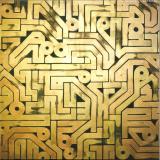
Seedbed is a new revolving-door collective project helmed by Atlanta songwriter JJ Posway (Sloping, Scooterbabe). After six years of recording what was to be the ambitious final studio album of Posway’s long-running Athens-based band Scooterbabe, most traces of the group’s scrappy indie pop had been burnished off to reveal something entirely new. What emerged from the ashes was Seedbed.
Largely composed of performances and songwriting contributions by Scooterbabe’s final lineup (Anna Staddon vocals, keyboard, Michael Buice [bass], Zach Spires [drums]), the formation of Seedbed marks the calling in of producer Terence Chiyezhan to help mix and arrange years of piecemealed recordings. The result is an intensely imposing stylistic shift for Posway and company, as tense as the apt title of Seedbed’s growing pains-fueled debut album Stalemate implies.
Stalemate stares straight into an all-consuming whirlpool of a million swirling emotions spanning the past seven years; It’s glistening and reflective on “Unit 4” and “C c c c c c c c c c c,” while cacophonously turbulent for “Fingertips Like Ice” and foreboding album opener “Mouse At Your Feet.” But the entirety of Stalemate is nostalgia-soaked and dripping with the painful necessity of change. It brazenly steeps in the tension and grief that accompanies evolution - even at the risk of drowning in it completely.
Buscar:emerge
Demon Records Single Club are delighted to present a reissue of
Shaun Escoffery’s club anthem Days Like This.
Originally released in 2002, Days Like This is a classic by the very
definition of the word. Days Like This was Shaun’s second single and itwent on to cement his place as one of the most exciting British artists to emerge in Soulful House.
Remastered by Phil Kinrade at Alchemy Mastering and now featuring
mixes from K-Klass and Spen & Karizma and, for the very first time,
we’re releasing MJ Cole’s majestic mix of Shaun’s debut single Space
Rider. Appearing on vinyl for the first time!
- 1: Chichibu - 秩父
- 2: Watatsumi - ワタツミ
- 3: Cuba - キューバ
- 4: 15 Eunomia
- 5: Gandhara - ガンダーラ
- 6: Sora Tobu Tokyo - 空飛ぶ東京
- 7: Ātman - アートマン
- 8: Tradition
- 9: Moon Dance
- 10: Kayohnenka - 花様年華
- 11: Quarantine Mood
- 12: Ryukyu Boogie Woogie - 琉球ブギウギ
Japanese acid pop outfit Cho Co Pa Co Cho Co Quin Quin channel the globe-trotting spirit of Haruomi Hosono’s 1970s tropical boogie on their debut album, Tradition.
Named after one of the basic rhythms of Cuban folk music and drawing on influences from across the globe, Cho Co Pa Co Cho Co Quin Quin are quite simply a world unto itself.
Comprised of three childhood friends, Daido, Yuta and So, who reconnected during the coronavirus pandemic, Cho Co Pa initially emerged as a playful way for the three 23-year-olds to pass the time. Tapping into their youthful connection, they created a sound that exudes confidence and curiosity, a homage to the masterful world of YMO’s and Happy End’s Haruomi Hosono, rooted in the trio’s own idiosyncratic experience of the present.
Recorded at home and promoted on hugely popular DIY TikTok videos, their debut album Tradition is a technicolour exercise in armchair travelling – a kind of lockdown exotica for the housebound whose nostalgic flights of fancy are laced with a sense of whimsical melancholy for the lost freedoms of youth.
Referencing everything from Afro-Cuban percussion to lo-fi beats, Buddhist spirituality to trap, each member of the band brings different musical inspirations to the table. Latin American and Middle Eastern styles sit adjacent to a fascination for the electronic music of Aphex Twin, Dorian Concept, Underworld and Daft Punk. At times, the music verges on acid pop bliss, at others, it grooves with the instrumental funk sensibility of BADBADNOTGOOD.
“In the first place, when I create a song, my goal is to transport the listener to a mysterious place,” vocalist Daido explained in a recent magazine interview. Using lyrics as another sonic texture in the composition of ideas, Cho Co Pa paint beguiling sonic postcards of far-flung moods across 12 highly original tracks.
Marrying the organic and the electronic on rhythmically sophisticated compositions like ‘Chichibu’ and ‘Watatsumi’, it is on the album’s standout track ‘Gandhara’ that the experimental sound of Cho Co Pa comes to the fore. Referencing the ancient city of Gandhara through which Buddhism made its way from India to China, the track is a vocoder-trap-inspired, Udu drum-driven pop jam that lilts with unmistakable Balearic flair. If that’s difficult to imagine, then know simply that ‘Gandhara’ sounds like nothing else on this side of Saturn. Even Daido seemed surprised by the outcome: “I feel like we were able to create something that exceeded our abilities. That was huge!”
Hugely popular in Japan, with festival appearances lined up alongside BADBADNOTGOOD at Asagiri Jam in October, it's safe to say the success of Tradition has taken Cho Co Pa by surprise. You won’t have heard anything like it."
- A1: Dosojin No Uta
- A2: Extra Freedom
- B1: Still In Love
KYOTO JAZZ SEXTET's new work is a folk song cover!
KYOTO JAZZ SEXTET, which will celebrate its 10th anniversary in 2025, has released an emergency 12-inch. It is a cover of "DOSOJIN NO UTA",
a folk song handed down in Nozawa Onsen Village, Nagano Prefecture, with a spiritual and danceable jazz arrangement.
In 2022, the demo version was used for the video distribution of the Dosojin Festival and secretly attracted attention, and was completed in 2025
with new recordings of drums and bass.
It was also selected as the commercial song for "THE GIN SODA", which uses gin from Nozawa Onsen Village Distillery and will be released at Lawson stores
nationwide in March 2025, and has attracted a lot of attention.
The coupling is Extra Freedom, which has been played more than 1 million times on Spotify and became KYOTO JAZZ SEXTET's biggest hit. In addition, the album includes a new jazz version of Still In Love, a cover of Shuya Okino's global anthem, featuring Navasha Daya and Tomoki Sanders.
This is a supreme album that breaks new ground for KYOTO JAZZ SEXTET and features their strongest songs.
This is also the first release from KJCC (Kyoto Jazzy Creative Council), a voluntary organization that Shuya Okino founded with Yukari BB (Jazz Sport Kyoto) and Masaki Tamura (DoitJAZZ!). Shuya Okino himself wrote the Japanese title on the front cover.
"The nineteenth entry in the Altered Circuits catalog comes courtesy of Alex Neri with a selection of 4 tracks that distill an equal amount of decades in the studio. They are undeniably straightforward yet difficult to pigeonhole. It is clear Neri is aware of current trends and, at times, might even throw them a little nod - but overall, his music escapes easy temporal classification. On the "Club Voyage EP", he aims at the brash and brazen yet keeps the pace lighthearted. When the results come buttressed with the type of technical prowess at hand, it is hard not to get sucked into the adventure. "Teller Mood", charged with a fierce bassline, boisterous drums and jittery arps, is a slab of electroshock production. The track comes complete with extra motivational vocals to drive the point home, and when it arrives at its most stripped parts, instead of toning down, an alarm-like lead emerges. "Schelter's Sounds" features an FM bass and gently modulated, slow-attack synth embellishments. It is a set-up that allows for catching a breath until a grandiosely introduced portamento-heavy patch cranks things up a notch again. On the other side, the delayed and flanged percussion of "Tenax Roots" forms the ideal conditions for ominous synth work and robotized vocals; a theme that could have been lifted from a giallo flick completes its suspenseful, hypnotic ambience. "Move Tokyo Inputs" starts with another salvo of invigorating percussion. Amidst subtly evolving formant basslines and several risers, the tune directs a tweaked deadpan vocal sample to take center stage, showcasing how, in the right hands, the sparsest source material can be turned into a showstopper."
Nicola Conte once again expands the boundaries of his creativity through a joint venture created with fellow Bari-based and rising to international fame producer Nico Lahs. A connection rooted in an artistic synergy melting leftfield dance music and live organic sounds. This new project is set to make waves in 2025.
Stylistically, Tema Due is defined by a sophisticated, elegant approach to dance music, tailor-made for discerning club environments. Anchored in Afro-jazz percussion, the sound naturally evolves into electronic territory through an irresistible groove. The compositions are richly layered yet deceptively simple: on “Macumba De Oxalá” - whose title alone evokes trance-like states and cathartic release - voices and instruments gradually emerge, each at their own pace, building toward an increasingly hypnotic and immersive crescendo.
“La Danse de l’Esprit” unfolds in a similar fashion and features four special guests who bring an exotic, textured feel to the track: Dario Bassolino on electric piano, Magnus Lindgren on flute, Abdissa Assefa on percussion, and Lalin St. Juste on vocals.
This “EP1” is just the beginning. A second 12” and a full-length double LP are set to follow by autumn-glistening gems for lovers of the most refined electronic Afro-jazz for the dancefloor.
- A1: Aguita Clara
- A2: Cervecita
- A3: Chofercito Carretero
- A4: Dime, Dime
- A5: El Aguajal
- A6: El Solitario
- B1: Fruto De Amor
- B2: La Novia
- B3: Ladrón De Amor
- B4: Marujita
- B5: Porque Eres Mujer
Discos Fantástico presents: Los Shapis – The Electric Pulse of Peruvian Chicha In 1980s Peru, during a time of crisis and mass migration, chicha music emerged as a joyful, rebellious sound from the people. A fusion of Andean cumbia, huayno, and psychedelic rock, the genre found its most iconic expression in Los Shapis. With electric guitars, emotionally charged lyrics, and rainbow-colored outfits inspired by Incan symbolism, they reshaped Peru’s popular music landscape. Discos Fantástico proudly presents an exclusive compilation of their best singles—restored and remastered for vinyl. A vital tribute to one of the most colorful and revolutionary movements in Latin American music history.
- Beyond Compare
- Step On Up
- Meant To Be
- Possibilities
- Things
- That's Fate
- Adventure
- The Summer Of Love
- Stars Don't Lie
- Lemonade Sunset
- Magnificent
- Blame It On Your Smile
Legendary indie travellers Half Japanese return with their new album Adventure. The prolific outsider combo, helmed by the ever-optimistic Jad Fair, delivers a heartwarming set of upbeat sonnets celebrating the power of love, affection, and maturity. More than 50 years since Jad and his brother David emerged from their lo-fi bedroom in Uniontown, Maryland, USA, Adventure takes the latest incarnation of the band down new and more refined avenues. Recorded in London at Vacant TV and produced by Jason Willett and Jad, Adventure presents a more pristine and polished canvas for Jad to expand upon. The addition of Euan Hinshelwood to the sonic palette, with saxophone, harmonica, and piano, creates a smoother backdrop for the band's less lubricated sound. Lemonade Sunset is an ode to the world of wonder, a spacious overture built with melancholy in mind but relishing the positivity of life. By contrast, Step On Up revolves around a glorious rising piano motif that hints at Steely Dan if they were high on energy drinks and spinach rather than their usual tipple. It's a light-hearted evocation of the good times. Magnificent is a homage to living in the present tense, powered by the bittersweet saxophone, with a glorious piano-led sub-melody offsetting Jad's positivity: "magnificently magnificent," no less. Elsewhere, ringing percussion and sharp arrangements provide Jad with a sturdy and far reaching soundtrack to lament over. Adventure sees Half Japanese covering new ground, with Jad's considered soliloquies set in a sumptuous setting. The lineup for Half Japanese on Adventure includes Jason Willett (bass, keyboards), Gilles-Vincent Rieder (drums, percussion), John Sluggett (guitar, piano, bass), Mick Hobbs (guitar), Euan Hinshelwood (guitar, saxophone, piano, harmonica), and Jad Fair (vocals, percussion). Sadly, longstanding member Mick Hobbs passed away last year. "Absurdly underrated art-rockers" - Record Collector. * "Fair's ability to bang out music behind him is matched perhaps only by Mark E Smith" - The Wire.
For her second full-length as Plume Girl, Sowmya Somanath crafts a space where boundaries of language, feeling, and sound start to dissolve. ‘Unnameable Glory’ ruminates on the limits of expression, and the luminous freedom that emerges when we let go of the need to name. Elaborating on the exploratory songs of her debut, Plume Girl continues to bring together Hindustani classical improvisation, ambient soundscapes, and experimental pop.
Somanath’s voice—from gentle murmur to radiant call—guides the listener through dreamlike arrangements: sunrise guitar arpeggios, humming choirs, heartbeat kickdrums, and synths tremble. Elsewhere field sounds and old family recordings are collaged, a woman’s giggle transposed into a piano melody, a sloshing body of water mirrored by synth bleeps. Plume Girl conjures moments of revelation, drawing from the natural beauty and intuition, that unnameable glory.
Is there a divinity or a wholeness that exists beyond language, belief, or tradition? Unnameable Glory both celebrates and gently challenges the notion: Can we honour the creative richness of culture while also seeing through the divisions it creates? Can we meet the world—and each other—without assumption, without fear, with eyes made new? In these songs, the sacred is found not in grand gestures, but in the anonymous freedom of simply being: the iridescence of oil and water on a street, the smile of a stranger, the hush that settles by a creek.
At the heart of the album is a sense of curiosity and surrender—a willingness to listen without judgment, to let the moment be unnameable, to allow wonder to arise and dissolve. And yet, as Somanath notes, there’s an impulse to capture that’s tough to ignore; a need to replicate and remember. Unnameable Glory dwells in this tension: between holding and letting go, between the urge to define and the beauty of what cannot be contained. There is a quiet, revolutionary joy in simply living and sensing together. Music becomes a meeting place for the whole, the holy, and the unnamable.
In 1995, when Cobweb-day was released, Fabrice Laureau was 24, Nicolas Laureau 21, Ludovic Morillon 22, and Quentin Rollet, who had just joined them on this new album, was 21. Prohibition, founded in 1989, had already released two albums: Turtle in 1993 and Nobodinside in 1994, on the Distorsion label. Cobweb-day, literally "Spider-web Day," is poetic, satirical, and libertarian. A title conceived by Nicolas to express all the feelings and themes explored on the album, this neologism also echoes the artwork on the cover. The lyrics describe, in vitriolic poetry and with a touch of self-deprecation, a world based on the powers of commodification and order, on submission to modern Molochs. Thirty years ago, it addressed themes such as the trade in minds and bodies, Kafkaesque justice, state violence, and Western blindness. Is this a coincidence that might raise a smile? Fabrice and Nicolas were both conscientious objectors at the time the album was written. The deceptively childish drawing that adorns the cover was created by Fabrice in 1989. It evokes African art and the skyscraper where the brothers grew up. Its title? "Glances on the Horizon." Yet, in these naive eyes, locked in a rhizomic matrix, there is the disturbing sensation of being observed, scrutinized, or perhaps imprisoned. This is Cobweb-day. During this period, the band spent its entire life touring with the British post-punk trio Headcleaner and the furious Lyon-based Condense. Their correspondence, followed by a meeting in 1994 with Guy Picciotto, singer-guitarist in Fugazi, led to a series of concerts with the Washington, DC quartet, around the time of the album's release in the spring of 1995. Quentin Rollet gradually joined the band, first on stage and then on the records. The concerts of this era often ended with long improvisations featuring saxophone, sitar, bass, and drums. Prohibition had emerged from the shadows, but chose to continue evolving underground, with the Laureau brothers creating their label Prohibited Records. Cobweb-day serves as the first reference. Thirty years ago, then. The album was recorded at Ark Studios near Paris in January 1995, along with eight other previously unreleased tracks. This new mix was created at Black Box Studios by Peter Deimel and Nicolas from 24-track analog tapes in August 1998, shortly before the release of 14 Ups & Downs, Prohibition's fifth and final album, and their US tour. All tracks were remastered by Fabrice and Nicolas Laureau in March/April 2025.
An F-bomb saturated hip-hop call & response club cut...from Sun Ra?!
While the most renown track in this omniversal opus is the atomic expletive-filled repartee “Nuclear War,” there is so much more to this dark mysterious journey through the mind of Sun Ra. The sprawling, suite-like 20-minute title track sustains a lyrical edge in spite of an open framework and textures, which encourage sonorities to surface and emerge from the band as if there was no human intention behind them. In opposition to “Nuclear War,” Ra's organ playing here was built less on bombast and sonic terror than it is on whispers, stutters, shivers, and swells. Fireside Chat offers a wide stylistic array, as was the artist’s intent, reflecting his eclectic, seemingly irreconcilable approach to compositional extremes. With Sun Ra you get everything... except predictability. Pressed on lime green vinyl!
- 1: We Have Arrived
- 2: Red Sky
- 3: Faith
- 4: Horsemen Of The Apocalypse
- 5: Castles In The Sand
- 6: Heroes, Saints And Fools
- 7: Flame Of Youth
- 8: Jekyll And Hyde
- 9: Menage A Trois
- 10: Ride Shotgun With The Wind
- 11: Angel Eyes
- 12: Follow The Piper
Lifelong friends Richard Lowe and Rob Bendelow formed their first band “Lammergier” during the mid 1970’s together with bassist Barry Yates. Following their first love performance in 1977 the band gigged extensively across the British midlands. The standard of these performances combined with their unique brand of symphonic rock saw “Lammergier” amass a large and loyal following. Then a new decade arrived changes were made, the music remained the same, but they called themselves “Saracen”.
After several months on the road Saracen decided it was time to record an album, and in October 1981 they released “Heroes, Saints and Fools” to critical acclaim. Saracen tracks received regular airplay on Tommy Vance’s Friday night rock show and the single “We have arrived” was recorded. In 1983 line-up changes occurred and the band eventually stopped touring in 1985.
Two decades later and the band re-appear with a vengeance and the release of “Red Sky” in March 2003 put the band firmly back on the map, and it was a rework of some of the old classics with new tracks added. The band regained its popularity, and a further three albums have emerged to critical acclaim, namely “Vox in Excelso”, “Marilyn” and “Redemption”.
With renewed interest in the vinyl format of recorded music “Vox In Excelso” has been re-released in 2025 as a numbered limited edition with new artwork and now “Red Sky” is to follow, again with new artwork. These are beautiful works of art and the recordings sound fresh and vibrant, its classic progressive rock brought into the present day and it doesn’t get better than this..
Air Texture proudly announces its latest artist-curated compilation, “Hardwired,” assembled by Berlin-based musician JakoJako. This expansive collection celebrates the implicit connection between hardware-focused electronic producers, featuring contributions from Rødhåd, Acid Pauli, The Field, Neon Chambers, and many more.
“Hardwired” draws its conceptual foundation from synthesizer terminology. As JakoJako explains: “A hardwired synth has connections already soldered into the machine—it comes with certain functions without needing to patch cables externally. As a hardware producer, I feel whenever I meet someone who creates music as I do, we have this immediate connection, like a hardwired synthesizer. There’s no need for small talk—we can speak about gear.”
This metaphor of pre-established connections forms the emotional core of the compilation, celebrating the community of hardware enthusiasts who share an intuitive understanding and appreciation for machine-based music creation.
JakoJako has established herself as one of electronic music’s most intriguing voices, exploring the territory between technical precision and emotional expression. Her artistic approach balances rigorous knowledge with unrestrained intuition, creating works that reach beyond genre boundaries.
A Berghain resident with performances at Dekmantel and Fusion, to the Royal Albert Hall and the Barbican, JakoJako has released music on prestigious labels including Tresor, Mute, and Leisure System, and crafted remixes for artists like New Order and Martin Gore. Her deep relationship with analog and modular synthesis, including her ongoing connection to Berlin’s SchneidersLaden, informs her distinctive sound.
Following her recent Mute album “Têt 41,” this curation for Air Texture provides further insight into the musical universe that has shaped JakoJako’s artistic vision.
“Hardwired” showcases 23 tracks for its digital release, with a select 9 tracks pressed to vinyl. The collection spans the spectrum of contemporary electronic music while maintaining cohesive focus on hardware-driven production approaches.
Highlights include collaborative works between JakoJako and fellow producers Mareena and Frank Wiedemann, alongside contributions from established artists like Rødhåd, Acid Pauli, and The Field, plus emerging talents representing the hardware renaissance in electronic music.
Founded by James Parker Healy, Air Texture emerged from New York City’s late ’90s rave scene, carrying forward the fundamental PLUR (Peace, Love, Unity, Respect) ethos with a collaborative and curatorial focus. Air Texture has evolved from its roots in Manhattan’s club era and Brooklyn’s warehouse scene to embrace a global perspective, working with producers across diverse styles and regions worldwide through the label and its PLace: nonprofit series.
Far Out Recordings continues its reissue campaign of the late Argentinian guitarist Agustin Pereyra Lucena's work with the first-ever vinyl reissue of his singular 1988 private press album, Puertos De Alternativa, now his most sought-after LP. The album features some of Agustin’s most uniquely beautiful compositions, including “Luces de Valeria” and “Preparativos Maritimos,” alongside Baden Powell's “Pequeño Vals” and “O Cego Aderaldo (Nordeste...),” and “Tema Barroco” by his longtime collaborator, Guilhermo Reuter.
By 1988, Agustín had established himself as one of Argentina’s foremost interpreters of Brazilian music. The seventies saw success with his group Candeias, and he gained recognition in Brazil, forming friendships and collaborations with luminaries such as Vinicius de Moraes, Baden Powell, Dorival Caymmi, Toquinho, and Maria Bethania. Following the era of dictatorship in South America, Agustín spent the late seventies and early eighties, living and touring in Norway as part of his European travels with his group Agustín Pereyra Lucena quartet.
Recorded after returning to his native Buenos Aires, Agustin Peyera Lucena’s Puertos de Alternativa emerged from this confluence of diverse experiences and influences, revealing an artist deeply connected to his environment. The album's title, meaning "Alternative Harbours," reflects Agustín's particular affinity for water. He observed that much of his favourite music originated from places with rivers and seas nearby, noting, "There is a flow near water that influences guitar playing for sure."
With a profound connection to both instrument and environment, Agustín’s music is often difficult to place. The album begins rooted deeply in South American soil, drawing clear inspiration from Brazilian guitar masters like Heitor Villa Lobos, Garoto and Baden Powell. But, as it progresses, a sense of journey unfolds, evoking new landscapes and horizons – from the crystalline beauty of glacial Norway to the gentle currents of the Rio de la Plata.
The ensemble on Puertos de Alternativa features notable Argentinian musicians, including drummer Osvaldo Avena, flautist Rubén Izarrualde, and saxophonist Bernardo Baraj.
Mastered by Stuart Hawkes at Metropolis Studios from the original master tapes which had been lovingly kept by Agustin’s nephew José Lucena Perreyra
Tracklist & Credits:
A1. Luces De Valeria (Agustin Pereyra Lucena)
Guitar, Vocals – Agustin Pereyra Lucena
Piano, Bass, Drums, Vocals – Guillermo Reuter
Tamboril – Julio Said
A2. Pequeña Valsa (Baden Powell)
Arranged By Flute – Lucho González
Drums – Osvaldo Avena
Flute – Alejandro Santos
Guitar – Agustin Pereyra Lucena
Tambora – Eduardo Avena
A3. Planicie (El Llano) (Agustin Pereyra Lucena)
Arranged By Flute – Lucho González
Flute – Rubén Izarrualde
Keyboards, Acoustic Bass, Percussion, Arranged By Keyboards – Guillermo Reuter
Guitar – Agustin Pereyra Lucena
A4. Tema Barroco (Guillermo Reuter)
Guitar – Agustin Pereyra Lucena
Percussion – Guillermo Reuter
A5. O Cego Aderaldo (Nordeste...) (Baden Powell)
Guitar – Agustin Pereyra Lucena
B1. Tres Que Quedaron (Agustin Pereyra Lucena, Andrés Laprida)
Drums – Osvaldo López
Flute – Rubén Izarrualde
Piano, Keyboards, Bass, Directed By – Guillermo Reuter
Soprano Saxophone – Bernardo Baraj
Electric Piano, Arranged By – Andrés Laprida
Guitar, Electric Guitar, Vocals – Agustin Pereyra Lucena
B2. Preparativos Maritimos (Andrés Laprida, Agustin Pereyra Lucena, Guillermo Reuter)
Guitar, Vocals – Agustin Pereyra Lucena
Keyboards, Acoustic Bass, Percussion, Arranged By – Guillermo Reuter
B3. Puertos De Alternativa (Agustin Pereyra Lucena)
Guitar, Effects – Agustin Pereyra Lucena
B4. Casi-Numbe (Luis González Cárpena, Agustin Pereyra Lucena)
Bass – Lucho González
Bass Flute – Rubén Izarrrualde
Berimbau – Horacio Veros
Keyboards, Piano, Vocals, Drums, Arranged By – Guillermo Reuter
Guitar, Vocals, Arranged By – Agustin Pereyra Lucena
Following on from the single release of ‘Intentions’, Soul Quest is pleased to present a myriad of remixes alongside a resonating live version of the original cut - and in doing so, serving up a package of lively renditions that add further to the label’s soulful sound.
‘Intentions’ in its original guise was the result of a joint musical adventure from label head Max Sinal, producer and longtime collaborator Kingcrowney, and vocalist Liv East. The track is Soul Quest to its core, with simmering and emotive chords interlaced between a softly spoken yet impactful rhythm section. East provides some inspired vocal work up top, her angelic voice floating through the breeze, shining light on all corners, as the totality of the musical package gives over only the most heartfelt and joyful feels. It seems only fitting that the original track be explored and reconsidered by some of the finest producers currently going, and with this remix album, you see all sides of ‘Intentions’ possible. Up first comes producer extraordinaire Frits Wentink, who takes the atmosphere firmly into the clubbing sphere. Wentink breaks down all the elements with razorsharp precision, drawing focus to the central progression by adding in new, repeating chordal elements that revolve around the kicks. As the track shifts through the gears, lines emerge and grow in stature, with plenty of time for breakdowns to get that full dose of the original’s emotive brilliance.
Dallas based deep house legend, JT Donaldson features next with not one but two remixes, the first of which retains the forward progression of the original but adds in some exciting elements. The addition of the driving bass line gives depth to the undercurrent, with stripped-back sections allowing the flow to meander through some very profound atmospheres. The ‘Dub’ version strips back East’s vocals to draw more focus to the groove and melodic sequences, and as a flip side to the first remix, the duo encapsulates all that could be wished for in a soulful house number.
Flying Moth is up next, with his spin consisting of a more hypnotic approach, with skipping broken drums creating melodic pools and caverns. East’s voice echoes through space and time, enticing further escapism as the track grows and morphs with each passing minute - a beautiful saucerful of sound that is oh so intoxicating.
Finally, to wrap things up, the live version lands to take the energy down to a beautiful canter. The rhythm section takes the form of a full percussive outlay, which speaks gently amidst a sea of exquisite guitar licks, breezy chords, and brass. East is the star of the show here, her voice the anchor within the ever-evolving backing section, which drifts and lulls with a wondrous effortlessness.
‘Intentions’ as a single contained all the sonic qualities which Soul Quest treasure, and with this collection of remixes and live versions, its meaningfulness is only added to. From imaginative takes through to inspired audial environment
Chicago-based composer/producer Joey Meland makes music under the moniker Cocojoey. Treating genre conventions and ostensible barriers between disparate musical vocabularies like playthings to gleefully smash and reshape at will, Meland channels decades of experience as a polymathic professional musician adept in styles like metal, jazz, synthpop, and experimental sound design into their infinitely combinatory compositions. STARS, their first album on Hausu Mountain, follows the self-released COCOJOEY’S WORLD with a spellbinding burst of heart-on-sleeve self-expression. The album finds Cocojoey indulging their most adventurous impulses in production and technical instrumental performance, launching into a constantly morphing program that contrasts day-glo earworm hooks against cathartic moments of screaming intensity. Cocojoey’s music exudes warmth and finger-wagging mischief as it exhumes the depths of their psyche with the pure-hearted goal of making their audience smile — when those listening find a chance to breathe within the ecstatic overstimulation.
The album’s tightly constructed song cycle blasts the listener with moment after moment of novel juxtaposition, both in terms of genre and emotional energy, that keep us reeling in a state of delirious whiplash. Warp-speed piano solos over bossa nova-inflected chord progressions segue into detonations of death metal that front-load Meland’s ferocious screaming vocals and meticulously programmed double-kick drum patterns. A strain of iridescent prog emerges in the sheer overload of notes and ideas, as drum n’ bass breaks collide with labyrinthine multi-time signature keyboard lines and bright flashes of clean vocals. Despite whatever contrasting styles might hit within any given Cocojoey song, Meland returns again and again to the upheaval and release provided by extreme metal — though that idiom lands with joyful exuberance, an abrasive yet heartwarming flavor whose positive energy carries through even to those who might not encounter screams and hyper-technical drum breakdowns in their typical listening regimen.
- 1: I'm A Stranger Here/Stranger Blues
- 2: Nervous
- 3: I Just Want To Make Love To You
- 4: Born With The Blues
- 5: I Got My Eyes On You
- 6: John Henry
- 7: I Need Money
- 8: Everyday, I Have The Blues
- 9: Night Time Is The Right Time
- 10: My Own Fault
- 1: Baby, Won't You Please Come Home
- 2: Moanin
- 3: Money Honey
- 4: Kansas City
- 5: Bye Bye Baby
- 6: Medley : The Blues Ain't Nothin' But A Woman & Bye Bye Baby
- 7: Eyesight To The Blind*
- 8: Your Funeral & My Trial*
- 9: Bye Bye Bird*
- 10: Fattening Frogs For Snakes*
- 11: Bye Bye Blues*
- 12: Wake Up Baby**
The blues, born in the cotton fields of the American South, emerged from makeshift instruments and simple harmonies rooted in African heritage. It captured the struggles, hopes, and fleeting joys of laborers enduring harsh conditions, with its hallmark "blue note" adding a unique dissonance to this evocative musical style.
As industrialization progressed, the blues migrated to urban centers like Chicago and New Orleans, evolving with modern instruments and expanding themes to reflect urban struggles, sensual nights, and existential despair. This period birthed many of the musicians who later formed the American Folk and Blues Festival (AFBF), an initiative started in 1950s Germany to introduce Europe to the genre and counter its reductive reputation as a precursor to jazz.
The Lost Recordings celebrates these legendary artists through restored performances from the 1962 Olympia in Paris and the 1963 Stadttheater in Bremen. Featured artists include John Lee Hooker, Memphis Slim, Sonny Terry, Brownie McGhee, T-Bone Walker, Helen Humes, and others, showcasing the depth and evolution of the blues.
From intimate duos like Brownie McGhee and Sonny Terry’s harmonica-guitar interplay to T-Bone Walker’s electrifying group performances, each act demonstrates the genre's versatility and influence. John Lee Hooker’s solo mastery mesmerized audiences, while T-Bone Walker pioneered the electric guitar's place in blues, inspiring legends like B.B. King.
The album also highlights Sonny Boy Williamson, whose charismatic harmonica and profound sensitivity defined his performances. These concerts take listeners on a journey through the authentic sound of the blues, traversing America’s history and foreshadowing its transformative impact on global music.
"Wind, Again" is Sary Moussa’s fourth studio album and second album on Other People. Based between France and Lebanon, Moussa returns with a riveting electro-acoustic album informed by his ever-changing relationships to space, listening, and resonance as well as his growing interest in the study of harmonics in electronic and electro-acoustic music.
Years in the making, “Wind, Again” approaches distinct musical worlds and languages by bringing together improvisations by musicians performing on Western and West Asian instruments such as the Hammond organ, clarinet, saz, and buzuk with electronic arrangements and textures. Rather than force a rapprochement of these musical worlds through the instruments, and keenly aware of the weighty sonic histories they carry, Moussa proposes another way through which they can exist together in contemporary electronic composition.
Composed of six tracks, each of which demonstrate an array of recording and processing techniques, the album generates moments of tension produced by the synthesis of textural, tonal, and harmonic encounters that Moussa calls “shadows”, which outline an impressionistic musical language, existing at the edge of familiarity. Such moments permeate tracks like “Everywhere at once” and “Violence” that open with the Hammond organ and the saz respectively and slowly reveal an expansive field of sounds that showcases each of the musicians’ characteristic performances and Moussa’s densely layered textures. It is a latent yet unrelenting tension through which the composer invokes rather than represents a collective experiential state, especially familiar to those who know his environment. In “Wind, Again” these shadows are articulations of sounds steeped in traditions they are never quite tethered to. Such articulations are implied and alluded to, they play within a musical reference without the latter explicitly existing in the recording, always teetering, never completely here nor there.
Sonically and musically, the album is fueled by the cultural, social, and personal realities that Moussa was brought up and lives in.
Both personal and musical ties with the musicians who feature on the album is central to Moussa’s practice. In the title track “I will never write a song about you”, musician Julia Sabra opens with rolled piano chords, followed by Paed Conca on clarinet and Abed Kobeissy on buzuk, before Moussa’s electronic processing pieces together, lifts, and sustains the melodic direction of the track that emerged from the musicians’ separate improvisations. For Moussa: “The initial connection between the three performances was made on a track that no longer existed, the original recording was both an obstacle and necessary step for the track we hear on the record. It’s as if we were all telling different stories and I pulled on the thread that held them together”. The track, and more generally the record, is tinged with a melancholy of things lost, though it never fully succumbs to it.
“Everything inside a circle”, Moussa’s most personal track and for which he provides the only vocals on the record, harkens back to a childhood memory of listening to music with his mother in a car: “There was a sound I was looking for — a memory of a sound and how I first heard it. This track is a hybrid of that memory and what I wanted to make of it”. The track relies heavily on generativesystems and perhaps embodies most the ambiguous quality of the record’s music in its refusal to be pinned down by one musical tradition or another.
“Wind, Again” is both familiar and alien, cold and warm; it pays homage to the mechanics, materials, and tactility of the instruments and converges acoustic and synthetic spaces. What anchors the sound of the album are the elements of a whole that cannot find its own idiosyncrasy and that is precisely why Moussa’s album is a tour de force.
- 1: Echo-Logik
- 2: Bass Temprature
- 3: Train To Transylvania
- 4: Emperor Dub
- 5: Mother Dubber
- 6: The Orientalist
- 7: Hempro 905
- 8: N 1 Station
- 9: Rajaskank
- 10: Lysergic Sound Of Dub
- 11: Antivitrolles Dub
- 12: Dubiously
With Bass Temprature, rediscover on one single CD the first three vinyl EPs by High Tone: Bot Dub Seasons, Low Tone, and Bass Temperature-a total of 12 tracks that propelled the Lyon-based group into the ranks of electro-dub heavyweights. In addition to these two reissues, four extra tracks have been added, making for a 12-track album just as compelling as it's predecessor. It marks a shift toward a more roots-oriented sound while remaining firmly grounded in the electro-dub genre. The album opens with Echo-Logik, a warrior-like chant followed by a driving bassline that makes you want to move-DJ Twelve's scratches laid over the groove offer a brilliant showcase of the band's talent. The title track, Bass Temprature, follows-perhaps the least striking piece, though that's only relative given the strength of the rest. Worth noting are the mystical vocal samples in Train to Transylvania, evoking vampires and devils, while N1 Station brings a heavy psych sound, a more energetic beat, and moments that border on hard-tek. Other influences also emerge, such as the strong Eastern vibe in The Orientalist. As always, High Tone delivers a stunning dub album sure to delight ears tired of the everyday noise pollution that surrounds us.
- A1: Don't Try To Tell Me - Berna-Dean
- A2: This Mornin' - The Jesse Stone Singers
- A3: All Around The World - Vermettya Royster With James Brown's Band
- A4: What's On Your Mind - The Four Bars
- A5: Don't Look Now - Wilbur "Hi-Fi" White & King Kolax Band
- A6: Money Talks - Kenny Smith
- A7: Hey Little Girl Pt 1 - Roosevelt Lee
- B1: Goin' Away Baby (Round Like An Apple) - Smokey Wilson
- B2: Hey Hey Baby - T-Bone Walker
- B3: I'm A Good Woman - The Afterglows
- B4: You Make Me Mad - Johnny Madara
- B5: Money Talks (Tell Me What I Say) - The Citations
- B6: Tell Me Why - Richard Berry
- B7: Mary Don't You Weep - The Delights
New R&B discoveries continue to emerge and entertain the many followers of the New Breed musical cult; nobody finds more than the Kent connoisseurs.
Berna Dean’s two previously unheard recordings are by far her best. They were laid down at Cosimo Matassa’s New Orleans’ studios by GNP Crescendo but eschewed in favour of two relatively average sides. The great 50s R&B songwriter Jesse Stone provides a rocker for the much-admired Jimmy Breedlove and a super-catchy ‘This Morning’ for an unknown mixed vocal group that has a joyous gospel feel. Jesse also penned ‘Private Eye’, a classic early 60s story-song, for Buddy Wilkins which was issued on Al Sears’ Tri-Ess imprint.
The title track is used twice, on two very different Fraternity recordings. Kenny Smith’s version was issued in 1964 and has many followers, but the equally meritorious Coasters-inspired composition by the Citations is newly discovered. Win Menifee’s ‘I’m Runnin’ Around’ from the same Cincinnati label comes complete with a fascinating back-story.
There are three cover versions. Vermettya Royster’s ‘All Around The World’ is backed by James Brown’s 1961 band, while Roosevelt Lee's 1970 update of the 1947-originated ‘Hey Little Girl’ funks the tune up a la Godfather of Soul. The cover that will make the biggest noise is undoubtedly west coast band the Afterglows’ version of Barbara Lynn’s evergreen dancer ‘I’m A Good Woman’ – this is a future monster.
Golden Crest provides two fabulous male vocal group sides – the swinging ‘What’s On Your Mind’ by Eddie Daye’s Four Bars and the delightful harmonies of the appropriately-named, but unknown Delights ‘Mary Don’t You Weep’.
Blues still thrived into the 70s as Albert Washington’s mean and moody ‘Case Of The Blues’ proves. Smokey Wilson took the music into the late 70s with the storming ‘Goin’ Away Baby (Round Like An Apple)’, which benefits here from a 45-style edit. His Pioneer Club on 88th Street in South Central L A provides the atmospheric photo for this collection.
More early 60s movers come from Wilbur “Hi-Fi” White with ‘Don’t Look Now’, future hit songwriter Johnny Madara’s raucous ‘You Make Me Mad’ and Big Boy Groves ‘Bucket O’ Blood’ which brilliantly describes the kind of club these tracks would fit right into.
The LP version loses a few tracks, but so many collectors have strong preferences we’ve thrown the vinyl junkies a lifeline.