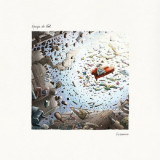
Lake Havasu is a community of winding hillside roads, launched in the 1960s alongside a brick-for-brick rebuild of the original London Bridge. “It’s this very synthetic, gimmicky place set in this soulful, desolate landscape,” laughs Pedro the Lion’s David Bazan, who moved to the Arizona city for one year in seventh grade. Bazan collected his earliest childhood experiences for 2019’s Phoenix, the prolific artist’s celebrated return to the Pedro moniker and the first in a planned series of five records chronicling his past homes. To write its sequel, Bazan traveled to Havasu four times over several years, driving past his junior high campus, a magical skating rink, and other nostalgic locations that evoked feelings long suppressed. “An intersection I hadn’t remembered for 30 years would trigger a flood of hidden memories,” he says. “I was there to soak in it as much as possible.” Driving the inscrutable loops of Havasu’s lakeside, Bazan listened through an audiobook of Tom Petty’s biography, eventually dialoguing with Petty’s voice in his mind. A revelation from the book—that Petty subconsciously wrote the song “Wildflowers” as an act of kindness toward himself—inspired Bazan to approach his own work with radical generosity toward his young self. “I wanted to be there for that kid,” he offers. “That twelve year old still needs parenting, and still needs to process.” To revisit his past with openness, Bazan modified harmful work habits he’d accepted as necessary. That meant doing away with deadlines, and accumulating moments of play as he felt moved to—“Rather than squeezing stones every single time. I’m on a slow journey away from that,” he clarifies. As he worked through the music that became Havasu, flexibility and curiosity informed the arrangements. Bazan began writing on a simple synthesizer and drum machine setup. He detoured to a more elaborate assortment of analog electronic equipment, then woodshed his original two-handed keyboard arrangements on fingerpicked acoustic guitar. Concurrently relearning his catalog for a weekly series of livestream concerts also renewed his gratitude toward songwriting. “I was trying to evaluate what I have to show for 20 years of kicking my own ass,” Bazan quips about the strenuousness of full-time touring. “But the garden of my songs is what I’ve been building. It doesn’t have to be an ego test.”
Cerca:equip
Home Stories is Hainbach’s fourth release on Seil Records. It displays an uncompromising approach to sonic world building and explorative ambient music.
The majority of Home Stories was recorded in the Black Forest, the artist’s old home, but the album is far from a reflection on the past. It is about the changes this area has seen and more importantly, about transformation in general. As humans have always been changing the landscapes - for better or worse - Hainbach takes a tentative listen to what can be found in taking the well-known and changing it to the uncanny.
Thus the piano, that often serves as a compositional root sound and familiar element changes over the course of the tracks, is abstracted, re-synthesized, shaped into abstract forms and relocated to physically impossible places. The premise of this album is that transformation is possible. It frees the known to dare into the unknown.
Based out of Berlin, Germany, electro-acoustic music composer and performer Hainbach creates shifting audio landscapes, using esoteric synthesizers, nuclear test equipment, magnetic tape and a collection of idiophones. Hainbach has become known for his immersive live shows and an unique sound that is both abstract yet very much a corporal experience. Otherworldly and intimate, raw and heartfelt. On his wildly popular YouTube channel, Hainbach shares his love for experimental music techniques and his passion for forgotten machines with a wide audience. Inspiring over one hundred thousand each week to explore synthesis, electronics - and to leave beaten paths.
Tape
Home Stories is Hainbach’s fourth release on Seil Records. It displays an uncompromising approach to sonic world building and explorative ambient music.
The majority of Home Stories was recorded in the Black Forest, the artist’s old home, but the album is far from a reflection on the past. It is about the changes this area has seen and more importantly, about transformation in general. As humans have always been changing the landscapes - for better or worse - Hainbach takes a tentative listen to what can be found in taking the well-known and changing it to the uncanny.
Thus the piano, that often serves as a compositional root sound and familiar element changes over the course of the tracks, is abstracted, re-synthesized, shaped into abstract forms and relocated to physically impossible places. The premise of this album is that transformation is possible. It frees the known to dare into the unknown.
Based out of Berlin, Germany, electro-acoustic music composer and performer Hainbach creates shifting audio landscapes, using esoteric synthesizers, nuclear test equipment, magnetic tape and a collection of idiophones. Hainbach has become known for his immersive live shows and an unique sound that is both abstract yet very much a corporal experience. Otherworldly and intimate, raw and heartfelt. On his wildly popular YouTube channel, Hainbach shares his love for experimental music techniques and his passion for forgotten machines with a wide audience. Inspiring over one hundred thousand each week to explore synthesis, electronics - and to leave beaten paths.
Miles Davis Kind of Blue meets Analogue Productions' UHQR, the pinnacle of high-quality vinyl!
Best-selling album in jazz history; mastered from the original master tapes by Bernie Grundman
Pressed at Quality Record Pressings using Clarity Vinyl® on a manual Finebilt press
Purest possible pressing and most visually stunning presentation and packaging!
Dream team of Davis, Adderley, Coltrane, Evans, Kelly, Chambers, Cobb make history.
Legends have a way of sticking around. If there was ever an album awaiting a high-fidelity, custom-pressed vinyl treatment of the level you now hold in your hands, it is Miles Davis' Kind of Blue. The top-selling jazz album of all time, it has been lauded, entered into "Best Of" lists and Halls of Fame, and universally acknowledged as a landmark recording — a five-track masterpiece of melancholy mood and melody.
It continues to be one of the most listened-to and studied recordings of all time, a required primer for many young musicians, and one of the most transcendent pieces of music ever recorded. Davis played trumpet sublime with his ensemble sextet featuring pianist Bill Evans, drummer Jimmy Cobb, bassist Paul Chambers, and saxophonists John Coltrane and Julian "Cannonball" Adderley with Wyton Kelly playing piano on "Freddy the Freeloader."
Now Analogue Productions, together with Quality Record Pressings, is putting Kind of Blue where it belongs: the Ultra High Quality Record (UHQR) pressed on Clarity Vinyl on a manual Finebilt press with attention paid to every single detail of every single record.
The 200-gram records will feature the same flat profile that helped to make the original UHQR so desirable. From the lead-in groove to the run-out groove, there is no pitch to the profile, allowing the customer's stylus to play truly perpendicular to the grooves from edge to center. Clarity Vinyl allows for the purest possible pressing and the most visually stunning presentation. Every UHQR will be hand inspected upon pressing completion, and only the truly flawless will be allowed to go to market. Each UHQR will be packaged in a deluxe box and will include a booklet detailing the entire process of making a UHQR along with a hand-signed certificate of inspection. This will be a truly deluxe, collectible product.
Kind of Blue is more than Miles Davis's most enduring recording, it's a testament to Miles' experimental approach, drastically simplifying modern jazz by returning to melody unlike the chord complexity more often heard at the time. "The music has gotten thick," Davis complained in a 1958 interview for The Jazz Review. "... There will be fewer chords but infinite possibilities as to what to do with them." Kind of Blue is, in a sense, all melody — and atmosphere.
None of the musicians had played any of the tunes before heading into the first of two recording sessions in early spring of 1959. In fact Miles had written out the settings for most of them only a few hours before the session. Miles also stuck to his old recording procedure of having virtually no rehearsal and only one take for each tune.
Miles remained proud of the album, performing at least two of its tracks — "So What" and "All Blues" — for years after, until his musical path took him in a different direction.
History was on the side of Kind of Blue; it was born in 1959, at the peak of the golden age of high-fidelity, featuring innovations in studio equipment (magnetic tape, high-quality condenser microphones), matched by advancements in home audio reproduction (long-player records — LPs; high-end turntables, and other stereo components). Kind of Blue also benefited from Miles' being signed to the leading major record company of the day — Columbia Records, a part of the CBS media conglomerate. Columbia had the means and wisdom to invest in cutting edge recording technology, and their own professional recording studio.
A minor audio complication with Kind of Blue has been addressed with this UHQR edition. The motor on the studio's 3-track master recorder was running slowly the day of the album's first session. This speed issue affected the album's first three tracks, "So What," "Freddie Freeloader" and "Blue in Green," making them a barely perceptible quarter-tone sharp. Before now, it was only addressed in 1995 for the Classic Records edition and by Columbia Records — or their latter-day parent, Sony Music — on a CD reissue in the late '90s.
Sixty years have passed; this LP bridges that time span in the best way possible, struck from the master reel of Kind of Blue, free of speed issues and replete with all the instrumental detail, sonic environment and minimal noise. As we set out to make our UHQR series the world's best-sounding vinyl records, we have also used Clarity Vinyl, which is free of any carbon black pigment which might introduce surface noise. All-in-all this edition of Kind of Blue meets the highest audiophile standards and offers the truest sound for the most enjoyment.
- A1: Do You Remember? (Intro)
- A2: Videobox
- A3: Pirates Night Out
- A4: Ravers Dateline
- A5: Walls Of Babylon
- A6: Absolute Class
- A7: Limelight
- A8: Freestyle
- A9: Funky Power
- A10: Functioning Neatly
- A11: Greek Salon
- A12: School Reunion
- A13: Under 18S Disco
- A14: A1 Sound
- A15: Summertime '90
- A16: Back To Back Mixtapes
- A17: Rare Groove Champagne Party
- A18: Savage Affair
- A19: Are You Sure?
- A20: Ladies Sunday Night Affair
- B1: Hello Ladies
- B2: British Flag
- B3: Any Kind Of Function
- B4: Trade Equip
- B7: Yeah Amigo
- B8: Next To Tescos
- B9: City Of Joy
- B10: Amsterdam
- B11: Roller Skating
- B12: Too Radical
- B13: Escape '93
- B14: Corporation Of New Generation
- B15: Jookie Jam
- B16: Revival Showcase
- B17: Until Further Notice
- B18: High Fashion
- B19: Damn Best Night Out
- B20: Lepke Sent You
- B5: I'll Buy You A Beer
- B6: Lex's Birthday
A limited edition clear vinyl pressing for Vol. 1 of DINTE's critically acclaimed collection of pirate radio adverts & idents, taken from recordings of London stations between 1984 & 1993.
Proximity is a 12-track album of richly textured and 100% analog electronic music that will appeal to fans of Daniel Avery, Telefon Tel Aviv, Jon Hopkins or Rival Consoles.
Whilst this is the debut release from DEFSET - the producer has spent many years experimenting with electronic music & equipment and the album demonstrates a mastery in using modular synthesizers and outboard gear to create a pallet of evolving melodies over syncopated, glitched out rhythms - resulting in a deeply accomplished sonic blend of immersive techno and atmospheric electronic music.
A mind-melting remix from Panorama Bar and Ostgut Ton royalty Steffi is due to surface very soon, and the equally entrancing debut album is still available on double clear vinyl !
. A true child of the seventies, Sojo wished to record and mix his new material straight to tape, using vintage analog equipment with according methods of work. This was made possible at Studio Kerwax, located in the heart of Brittany. A tight quintet gathered with sound engineer Christophe Chavanon to produce the warm timeless sounds of Silvatica, marking the welcome return of drummer Earl Harvin (Tindersticks, The The, Psychedelic Furs). New recruit Erik 'Raggy' Sevret (from French dub masters Zenzile) works his sax magic, breathing further life into Sweet Gum Tree's lush sonic forest.
The Mighty Soulmates is a towering early 90s project from the legitimate super group of André Cymone (bass player with Prince), St. Paul Peterson (guitarist with The Family and Prince), Mic Murphy (of Sass and The System fame) and Gardner Cole (writer, producer and musician probably best known for his work with Madonna). The sound is a majestic blend of sophisticated funk, emotional R&B, New Jack Swing flava and slick deep soul.
These should-be legendary sessions have been almost a secret since they were recorded back in 1993. The first Be With knew about the project was whilst working with Mic on some Sass re-issues and he told us he had something else we might be interested in hearing.
Mic explained, “In the summer of 1993, Gardner Cole asked if I’d be interested in coming out to work with him, André, and St. Paul. So we all headed out to what can best be described as a fantasy music summer camp at Gardner’s house in Woodland Hills, California. We had all worked together in the past in some form or another so everyone was energized and enthused and excited to see what we could create together. St Paul and Andre had already begun some songwriting at Gardner’s well equipped home garage studio. The songs and ideas progressed quickly and some additional recording was completed at André Cymone’s studio in downtown LA. We ended up working on the project for about 6 months, off and on, until Gardner's house fell victim to the Northridge Earthquake in January 1994.”
There were some vague ideas at the time about turning the sessions into a finished record, but everyone went back to their day jobs and as St. Paul puts it: “for nearly 30 years it just sat there, marinating like a fine funk masterpiece. Everything has its right time and now just be the time”.
From all the tracks Mic sent over, we’ve cherry picked the absolute cream for a tight four track EP. In an alternate history all four for these would’ve been radio smashes. No doubt. But these songs never even reached a plugger. A mixture of beat ballads and uptempo non-hits, coming on like Al B Sure! or Babyface take on Shalamar or, dare we say it, The Purple One - maybe not so surprising given who’s playing!
The feel-good dancefloor dynamite of “I Wanna Be The One” is the explosive opening track. A piano-driven, groove-laden blast of yearning deep-pop, with perfectly delivered soulful vocals and an unmistakable “early 90s” sound. Indeed, fans of Eddie Chacon’s old group will dig this for days. “Back In The Day” has a timeless swing and swagger, the lyrics reminiscing about the halcyon streetlife of the Soulmates’ youth, about Curtis, Superfly and innocent days gone by, about hustling with friends. Yet more spine-tingling vocals over yet another perfectly produced musical backdrop. Stunning.
Opening side B, “Blue Tuesday” is the thrilling pinnacle of the EP, at least for us. It’s absolute soulful-pop perfection, and the one we’ve been asked about most after teasing this collection on our NTS show. A soaring beat ballad full of chiming guitars, gorgeous harmonising, falsetto “doo-doo-doo-doo do-do-do-do” backing vocals and a real steppers’ groove. Glide to this with your loved one at the next roller rink party.
Dramatic, purple-hued closer “Private Time” seems to predict the Timbaland-dominated sound of the mid-to-late 90s, all synthetic strings and squelchy, acidic-drum-machine soul. There’s even room for funky piano breaks, vocoder bridges and more cowbell than you can shake a cowbell at. You could just as easily hear Aaliyah vibing over this as much as Mic.
This EP represents the sound of four incredibly soulful, talented, and influential (soul)mates jamming together over one long hot summer and weaving pure sonic magic. André Cymone loved the “kinda pop, experimental exploration of sound and music. I think these songs make a statement. Not just because of the collection of talented musicians involved but the idea of musically branching out and experimenting; which is what I loved about the project and for people to hear and hopefully appreciate the artistic adventure this music takes, I think it’s a much needed breath of fresh air.” As Mic recalls, “it had the feeling of recovery in a circle with my dudes making music sitting around catching up on life - it felt like living a second childhood. We just wrote what we felt. I don’t remember ‘aiming’ at anything but a great song, melding all our different influences from throughout our lives. We had no restraints. For me personally, it was a time to make music and regroup. I call it the ‘Soulmate Experience’ because in many ways we are kindred souls as a band. We did have an amazing time making the record and so much fun together. Probably my best summer ever”.
The Mighty Soulmates EP has been mastered for vinyl by Simon Francis, cut by Pete Norman at Finyl Tweek and pressed at Record Industry. That early 90s gloss sounds spectacular, if we do say so ourselves.
And such a special record needed some truly almighty artwork, so thanks go to DJ Ruby Savage for directing us to London-based illustrator and designer River Cousin. This music needed something elegant and indulgent yet soulful and striking and something as simultaneously tongue-in-check and deadly-serious as the group’s name. The end result is as modern yet timeless as the music itself.
And these are just our four picks. There’s plenty more where this came from and Mic tells us he’s even picked the album title: “Earthquake Summer”.
With governments finally admitting that UFOs do in fact exist, and humanity attempting to heal from a state of recent crisis, the timing couldn’t be more appropriate for the newest addition to the HYPOCRISY catalog: WORSHIP, due to be released Fall 2021 via Nuclear Blast Records. Aptly titled, the album cover shows a mass of humans reaching up mindlessly to the sky as glowing spaceships shaped like the HYPOCRISY crosses sigil beam down to descend upon earthen civilizations and Mayan temples. Designed by artist Blake Armstrong (Kataklysm, In Flames, Carnifex, etc.), WORSHIP’s artwork speaks to the history of the relationship between humanity and extraterrestrials. “They’re coming back to collect,” explains founder and HYPOCRISY mastermind Peter Tägtgren.
A track entitled CHEMICAL WHORE breaches the subject of pharmaceutical addiction, and those who engineer it. “We are all chemical whores. We regularly consume prescriptions and drugs because we think we need it; we use one pill to heal the damage done by another medicine... it’s a vicious cycle.” Musically, it’s the only song that was written by all 3 core members of the band and translates into a recognizable, mid-tempo HYPOCRISY sound much like ERASER or FRACTURED MILLENIUM. Traveling from Sweden to Russia, the band also shot an official music video for CHEMICAL WHORE.
The DEAD WORLD music was written by Peter Tägtgren’s son, Sebastian. “We actually started to write an album together, something like 11 or 12 songs, but we never put any vocals in there and we just sort of set it aside. Then when I started writing HYPOCRISY I realized I really liked the song… it feels fresh. I think my kid got some new blood in there.” While the song comes equipped with a modern feel, the writing is still old fashioned at its core. Going into detail about the illuminati and black ops government, the lyrics examine how miserable these figureheads and theories can make us. “Call it fantasy, call it sci-fi, there are plenty of conspiracies in the world but I find these ones interesting,” explains Tägtgren.
GREEDY BASTARDS is another track outlined by simplicity and catchiness. Chugging riffs encapsulate a sound that almost verges on the realms of thrash while still keeping its feet firmly planted in the world of death metal. The lyrics touch on the greed and methods of control that we see various governments around the world today; how they manipulate people against one another and abuse the masses.
For Tägtgren, the inspiration to write new HYPOCRISY comes in waves. “I believe we were out on tour for another project and I began to get hungry again. I started spitting out some new riffs and when I had 7-8 songs done, I invited the rest of the guys to join me and contribute, and from there we started putting everything together. We had a break for a few months, continued recording, went back on tour… it never stops. There was a lot of jumping back and forth, and then COVID came and things got really weird.”
Tägtgren was one of the many musically inclined who was forced into sudden isolation upon the onset of COVID 19, only for Tägtgren, this is common practice when creating new songs. “A lot of things in the world stopped, and it was time to finish everything I hadn’t finished.” As usual, all recording and mixing took place at Tägtgren’s home studio in Sweden.
It has been 8 long years since the last record, and HYPOCRISY fans can feel the itch. WORSHIP is 11 tracks of precise, ferocious musicianship. Commonly inspired by the fusion of the modern and the ancient, HYPOCRISY has once more found a way to combine innovative ideas with classic sound in order to deliver something metalheads can enjoyably consume with awe and brutal vigor. HYPOCRISY is Peter Tägtgren (Lead Guitar & Vocals), Mikael Hedlund (Bass Guitar), and Reidar “Horgh” Horghagen (Drums).
- A1: Leonardo Marques - Acordei
- A2: Bernardo Bauer - Coragem
- A3: Moons - Creatures Of The Night
- A4: Giovanni Leao - Nao Se Emburreca
- A5: Douglas Scalioni Domingues - Saideira
- B1: Gui Hargreaves - Pra Ela
- B2: Leonardo Marques - Ilha Do Corvo
- B3: Arthur Melo - Forca
- B4: Rodrigo Damati - Bonita
- B5: Invisivel - Dignity & Devotion
● 180g heavy vinyl pressing, comes with a 4p insert including an interview with Leonardo Marques, artists biographies and exclusive pics.
● Multi-talented musician, singer songwriter, music producer, and sound engineer Leonardo Marques selects ten musical gems recorded at his Ilha Do Corvo studio in Belo Horizonte, Brazil. The studio is equipped with vintage instruments and gear from various decades which creates a unique sonic landscape and sound signature in each record it produces. Ilha do Corvo is also an indispensable creative hub for the inimitable Belo Horizonte and Minas Gerais musical scene. This compilation highlights some of the best works recorded at Ilha Do Corvo over the past few years and features some of the brightest talent to record in the studio, with music by Bernardo Bauer, Moons, Giovanni Leão, Douglas Scalioni Domingues, Gui Hargreaves, Arthur Melo, Rodrigo Damati, Invisível and Leonardo Marques himself. This is essential Brazilian music at its best!
A limited-edition, hand-numbered L.P. dedicated to the previuosly unreleased 1990 project by Manrico & Nicola - featuring two special new Balearic versions by Ed Longo. Manrico & Nicola are comprised of Italian artist, singer, composer and author Manrico Mologni, together with saxophonist, composer and sound engineer Nicola Calgari. Manrico and Nicola were collaborating for some time in artistic harmony, and decided to form a duo to undertake their own album. Nine songs identified, arranged and recorded on a wave of enthusiasm - their "alchemy" gave excellent results. At the last stage of the work unfortunately, misfortune struck - Manrico fell very ill. For the respect of a unique creative moment, and for a sort of psychological "removal" all of this was forgotten until recently. By chance, Manrico had an old cassette with a couple of those songs - the memories resurfaced and it was immediately a race to meet again. Going though many recording studios, Nicola found the DAT with the temporary mixes which had been waiting for years with their emotional content.
But finding a way to transfer the songs was not easy. Quite by chance, a miracle took place. Their friend Massimo Parretti, in his post-production studio, was still equipped to transfer from DAT, and everything worked - with the sound intact as 30 years before!
The rest is news, and now a 1990 album - and piece of history - resurfaces.
Archeo Recordings is a re-issue record label that regenerates old, lost, or forgotten rare gems, of mostly Italian music, but also 70's, 80's and 90's music from across the world.
All releases are licensed audio tracks, re-mastered in their original form. The sleeves are re-created for today, but all based on the original images.
Archeo would like to make the music available to a wider audience of collectors, DJs, music lovers of a forgotten time.
Artwork by Filippo Sala, Milan, 1990.
Proximity is a 12-track album of richly textured and 100% analog electronic music that will appeal to fans of Daniel Avery, Andy Stott, Jon Hopkins and Max Cooper. Whilst the debut release from DEFSET - the producer has spent many years experimenting with electronic music & equipment and the album demonstrates a mastery in using modular synthesizers and outboard gear to create a pallet of evolving melodies over syncopated, glitched out rhythms - resulting in a deeply accomplished sonic blend of immersive techno and atmospheric electronic music.
The album features singles including 'Deadlines' - a dark & brooding pitched down slice of menacing techno; the airy and light 'Shira2', a piece of dreamy electronica that dances over a shuffling backbeat; 'Bathtime' - a unique piece of slo-mo dub-techno featuring live bass and instrumentation inter-woven with trance-like vocals and the tough & atmospheric 'HoneySwede'.
When we think of the phrase Bonded By Blood, we think of two things: a brotherhood that is meant to outlast the trials of war, pain, and time... and the almighty EXODUS. With a bond forged in youth and decades-old friendship, the undisputed masters of thrash metal return with their eleventh studio album: PERSONA NON GRATA. Literally translating to “an unwelcome” or “unacceptable” person, PERSONA NON GRATA touches on themes of modern societal disgust and degradation. “The people that disgust you - cut ‘em out like cancer,” explains guitarist Gary Holt. “Who is that person? It could be anybody. That’s up to the listener. Who is ‘Persona Non Grata’ to them?”
For decades, EXODUS has impressed us with the ability to attract opposing factions to their music because of its intensity and versatility. A track like “The Beatings Will Continue Until Morale Improves” was inspired by the riots both in theme, and sound. “Without seeming insensitive to the riots, the song is tongue in cheek about what the people beating on the rioters were expecting to happen. Did you think you would beat a smile onto their face? At 3 minutes in length, it’s probably the shortest EXODUS song we’ve ever done. It gets in, gets out, and is just crushing,” describes Holt. While most of the songs do run on the shorter side, this album also comes equipped with crushing, epic tracks.
Whether it’s the music industry gossip sites, or the big players like CNN and FOX, we’re all aware of how news outlets love to set little rat traps; “Clickbait” discusses their methods of picking things out of context to grab your attention, add to their page views, and increase their revenue all while riling up your emotions. “It’s all journalistic dishonesty,” explains Holt, “it’s a modern-day version of Al Capone’s vault, everyone tunes in, and then there’s NOTHING.“ Evenly balanced with extraordinary speed and tremendous, catchy choruses, “Clickbait” is a song that explodes with vigorous energy. “As heavy as this album is, and it’s heavy as fuck, if times were different and there was still metal radio, this song, and probably over half the album, has single capabilities.”
Sitting as the second to last song on the album, “The Fires of Division” keeps PERSONA NON GRATA strong all the way through. “This album doesn’t operate on the normal parameters,” describes Holt, “we didn’t frontload this one, it’s strong right through to the end. It’s supposed to be a musical journey as the songs segway together.”
For the third time in the band’s history, EXODUS returned to Swedish artist Par Olofsson to create the album artwork PERSONA NON GRATA. “After this album, I feel like we probably won’t work with anyone else again, Par just gets it,” states Holt. A three-faced, winged creature sits atop a bloody pile of diseased and rotting humans as they scream in pain and reach their hands up desperately towards the beast. Undead riot cops beat mercilessly, and senselessly upon this pile of the dying and the world is red with fresh, sopping blood. “Is it an angel, a demon? Is the world being created or destroyed,” asks Holt, “you don’t really know.”
EXODUS don’t fall into the usual recording slump that most bands get stuck in. Gathering at Tom Hunting’s house up in the mountains, they avoided the need to book studio time or adhere to a certain schedule. “At first it was just Tom, myself, a half stack, and a drum kit; we call it jam camp. We lived there. We built the studio, we immersed ourselves in it. Number one, because we still enjoy each other’s company enough to do it. When we’re not actively rehearsing or recording, we’re still sitting there talking about the songs, working on them, plucking on acoustics until things really work,” explains Holt, “we’re not settling.” Working from three home-built studios, the band recorded PERSONA NON GRATA themselves with the help of Andy Sneap on mixing and mastering and with Steve Lagudi at the helm of engineering.
“As a band, I’m super grateful. I’ve seen a lot of things around the world and we’re still a band that loves each other, have each other’s back, and we genuinely like to hang out with each other,” explains Holt. “Take it how you will, but I’m this band’s biggest fan. We write songs that are designed to make us feel fired up - that’s why it’s still heavy.”
When we think of the phrase Bonded By Blood, we think of two things: a brotherhood that is meant to outlast the trials of war, pain, and time... and the almighty EXODUS. With a bond forged in youth and decades-old friendship, the undisputed masters of thrash metal return with their eleventh studio album: PERSONA NON GRATA. Literally translating to “an unwelcome” or “unacceptable” person, PERSONA NON GRATA touches on themes of modern societal disgust and degradation. “The people that disgust you - cut ‘em out like cancer,” explains guitarist Gary Holt. “Who is that person? It could be anybody. That’s up to the listener. Who is ‘Persona Non Grata’ to them?”
For decades, EXODUS has impressed us with the ability to attract opposing factions to their music because of its intensity and versatility. A track like “The Beatings Will Continue Until Morale Improves” was inspired by the riots both in theme, and sound. “Without seeming insensitive to the riots, the song is tongue in cheek about what the people beating on the rioters were expecting to happen. Did you think you would beat a smile onto their face? At 3 minutes in length, it’s probably the shortest EXODUS song we’ve ever done. It gets in, gets out, and is just crushing,” describes Holt. While most of the songs do run on the shorter side, this album also comes equipped with crushing, epic tracks.
Whether it’s the music industry gossip sites, or the big players like CNN and FOX, we’re all aware of how news outlets love to set little rat traps; “Clickbait” discusses their methods of picking things out of context to grab your attention, add to their page views, and increase their revenue all while riling up your emotions. “It’s all journalistic dishonesty,” explains Holt, “it’s a modern-day version of Al Capone’s vault, everyone tunes in, and then there’s NOTHING.“ Evenly balanced with extraordinary speed and tremendous, catchy choruses, “Clickbait” is a song that explodes with vigorous energy. “As heavy as this album is, and it’s heavy as fuck, if times were different and there was still metal radio, this song, and probably over half the album, has single capabilities.”
Sitting as the second to last song on the album, “The Fires of Division” keeps PERSONA NON GRATA strong all the way through. “This album doesn’t operate on the normal parameters,” describes Holt, “we didn’t frontload this one, it’s strong right through to the end. It’s supposed to be a musical journey as the songs segway together.”
For the third time in the band’s history, EXODUS returned to Swedish artist Par Olofsson to create the album artwork PERSONA NON GRATA. “After this album, I feel like we probably won’t work with anyone else again, Par just gets it,” states Holt. A three-faced, winged creature sits atop a bloody pile of diseased and rotting humans as they scream in pain and reach their hands up desperately towards the beast. Undead riot cops beat mercilessly, and senselessly upon this pile of the dying and the world is red with fresh, sopping blood. “Is it an angel, a demon? Is the world being created or destroyed,” asks Holt, “you don’t really know.”
EXODUS don’t fall into the usual recording slump that most bands get stuck in. Gathering at Tom Hunting’s house up in the mountains, they avoided the need to book studio time or adhere to a certain schedule. “At first it was just Tom, myself, a half stack, and a drum kit; we call it jam camp. We lived there. We built the studio, we immersed ourselves in it. Number one, because we still enjoy each other’s company enough to do it. When we’re not actively rehearsing or recording, we’re still sitting there talking about the songs, working on them, plucking on acoustics until things really work,” explains Holt, “we’re not settling.” Working from three home-built studios, the band recorded PERSONA NON GRATA themselves with the help of Andy Sneap on mixing and mastering and with Steve Lagudi at the helm of engineering.
“As a band, I’m super grateful. I’ve seen a lot of things around the world and we’re still a band that loves each other, have each other’s back, and we genuinely like to hang out with each other,” explains Holt. “Take it how you will, but I’m this band’s biggest fan. We write songs that are designed to make us feel fired up - that’s why it’s still heavy.”
Electronic musician Xopher Davidson will release ‘Lux Perpetua’ this year via Daydream Library Series. A noted protége of Maryanne Amacher, Xopher recorded these two tracks in 2020 utilizing vintage synths within the beloved music studios of Mills College in Oakland, California. Xopher builds his experiments in electronic sound from a basis in painting, photography, and film, and through an interest in electronic circuits going back to building radios and homemade circuits as a kid. He has built and explored the sound world of a homebrew modular synthesizer comprised of surplus laboratory equipment: various oscillators, pulse generators, filters and an 'analog computer. He has released 4 albums as ANTIMATTER : ‘Transfixion’, ‘Antimatter Vs. Antimatter’, ‘Our Lady of the Skies’, and ‘Reset’. As an audio engineer, Davidson has worked on projects composed / performed by: the League of Automatic Composers, John Cage, Marcel Duchamp, Subtropic, Diamanda Galas, Kid 606, DJ Rupture, Darwin's Bitch, Once 11, Mix MasterMike, Hans Grusel, Phoenecia, Jonah Sharp, We, Zbigniew Karkowski, and Iannis Xenakis
When we think of the phrase Bonded By Blood, we think of two things: a brotherhood that is meant to outlast the trials of war, pain, and time... and the almighty EXODUS. With a bond forged in youth and decades-old friendship, the undisputed masters of thrash metal return with their eleventh studio album: PERSONA NON GRATA. Literally translating to “an unwelcome” or “unacceptable” person, PERSONA NON GRATA touches on themes of modern societal disgust and degradation. “The people that disgust you - cut ‘em out like cancer,” explains guitarist Gary Holt. “Who is that person? It could be anybody. That’s up to the listener. Who is ‘Persona Non Grata’ to them?”
For decades, EXODUS has impressed us with the ability to attract opposing factions to their music because of its intensity and versatility. A track like “The Beatings Will Continue Until Morale Improves” was inspired by the riots both in theme, and sound. “Without seeming insensitive to the riots, the song is tongue in cheek about what the people beating on the rioters were expecting to happen. Did you think you would beat a smile onto their face? At 3 minutes in length, it’s probably the shortest EXODUS song we’ve ever done. It gets in, gets out, and is just crushing,” describes Holt. While most of the songs do run on the shorter side, this album also comes equipped with crushing, epic tracks.
Whether it’s the music industry gossip sites, or the big players like CNN and FOX, we’re all aware of how news outlets love to set little rat traps; “Clickbait” discusses their methods of picking things out of context to grab your attention, add to their page views, and increase their revenue all while riling up your emotions. “It’s all journalistic dishonesty,” explains Holt, “it’s a modern-day version of Al Capone’s vault, everyone tunes in, and then there’s NOTHING.“ Evenly balanced with extraordinary speed and tremendous, catchy choruses, “Clickbait” is a song that explodes with vigorous energy. “As heavy as this album is, and it’s heavy as fuck, if times were different and there was still metal radio, this song, and probably over half the album, has single capabilities.”
Sitting as the second to last song on the album, “The Fires of Division” keeps PERSONA NON GRATA strong all the way through. “This album doesn’t operate on the normal parameters,” describes Holt, “we didn’t frontload this one, it’s strong right through to the end. It’s supposed to be a musical journey as the songs segway together.”
For the third time in the band’s history, EXODUS returned to Swedish artist Par Olofsson to create the album artwork PERSONA NON GRATA. “After this album, I feel like we probably won’t work with anyone else again, Par just gets it,” states Holt. A three-faced, winged creature sits atop a bloody pile of diseased and rotting humans as they scream in pain and reach their hands up desperately towards the beast. Undead riot cops beat mercilessly, and senselessly upon this pile of the dying and the world is red with fresh, sopping blood. “Is it an angel, a demon? Is the world being created or destroyed,” asks Holt, “you don’t really know.”
EXODUS don’t fall into the usual recording slump that most bands get stuck in. Gathering at Tom Hunting’s house up in the mountains, they avoided the need to book studio time or adhere to a certain schedule. “At first it was just Tom, myself, a half stack, and a drum kit; we call it jam camp. We lived there. We built the studio, we immersed ourselves in it. Number one, because we still enjoy each other’s company enough to do it. When we’re not actively rehearsing or recording, we’re still sitting there talking about the songs, working on them, plucking on acoustics until things really work,” explains Holt, “we’re not settling.” Working from three home-built studios, the band recorded PERSONA NON GRATA themselves with the help of Andy Sneap on mixing and mastering and with Steve Lagudi at the helm of engineering.
“As a band, I’m super grateful. I’ve seen a lot of things around the world and we’re still a band that loves each other, have each other’s back, and we genuinely like to hang out with each other,” explains Holt. “Take it how you will, but I’m this band’s biggest fan. We write songs that are designed to make us feel fired up - that’s why it’s still heavy.”
The second selection from Toko's 2021 collection again sees label mainstay Si Brad man the controls on the sublime and soulful 'Avenue 6 (Is This Real Life?)'.
Incorporating the crisp rhythms, heavyweight subs & swelling pads which are such a Toko trademark, Brad brings the bliss to this sensual house heater, enlisting Azeem's emotive vocal tones for an extra helping of soul.
The label enlist hometown hero Crooked Man for the B side business here, and the Techno hero obliges with a pair of ferocious speaker tweaking reshapes.
Dark and cavernous, the 'Real Crooked' mix combines wall shaking bass, jacking drums and bloodless riffs into a smoke and strobe stomper, repurposing Azeem's vocal as a haunting refrain.
The dance floor paranoia continues on the 'Crooked Girl, Crooked Boy' mix, a sparse and dissociative take on the original equipped with demented dub FX and some serious bass weight.
An anthem in its original form, and a main room monster on the remix tip. Toko are back.
We are elated to invite the multi-talented and multi-national musical mastermind Portable in to the Circus family finally. After many years of traveling in similar scenes and orbits, and thoroughly enjoying his vast output on some of our favorite and best friends’ labels, the time has come to join forces with our now-fellow Parisian dweller.
The My Event Horizon EP is a truly creative treat, chock full of the charm and studio ingenuity that permeates all of his work, and a first look at what’s to come on his full length LP we have in store for you in the coming months as well. Two versions of the lead track “I Feel Stronger Now” are accompanied by an exclusive club cut, just in time for the world’s hopeful dance floor reopenings.
“I Feel Stronger Now” is one of those perfectly balanced tracks that is equal parts soft and edgy, mellow and exciting, and features a rich mix of sharp percussion, warm jazz-inflected piano motifs and Portable’s own inimitable dulcet-toned vocals, making it a sure-shot fit with the label’s modus operandi. The A2 track “My Art Sets Me Free” as the title may suggest, is a more abstract and artistic take on full-scale DSP dance floor equipment - we can already imagine hearing this on some of our most cherished club systems, head-down, fully immersed. Next up “I Feel Stronger Now” gets a fresh facelift treatment from Portable’s own and equally-notorious alter ego Bodycode, which follows suit to the pseudonym’s production quality, giving the avant-garde bounce of the original version a more syncopated and stripped-back feel, imparting a stronger physical sound bed with tasteful synth layering for the vocal Iines to ride over. And as a digital bonus addition to the package we have the Radio Edit of “I Feel Stronger Now” which is nicely tightened in all the right places to drive the point home for broadcast listeners, and further proof that this man’s music can be fully enjoyed in many settings - a big loving welcome to Mr. Portable!
“ When I started working on the piece in March of 2020, I had only decided to record it in the way I wanted to. The coronavirus was spreading globally, and the situation was gradually changing into something very serious. With no gigs scheduled and hardly seeing anyone, I felt as if my spirit was in a slightly deeper place than usual during the production. I sat down in front of my equipment as if I were dropping a fishing line into a quiet lake. I kept feeling that something new was lurking beneath the water surface. I was trying to catch that something that seemed to be just out of reach, that floated in and out of sight like a speck of smoke. “ _Referenced from: Afterword of 7FO「Ran - Bouten」
2021 brings a new album by Osaka electronic musician / producer 7FO. This work is a departure from the recent global ambient / new age approach, and the unique sound aesthetic created using only hardware equipment is a new frontier of 7FO or a return to his origin. "Ran - Bouten" is a new electronic music album with a poetic sensibility using machines.Discovered by overseas labels such as RVNG intl., Bokeh Versions, and Metron-and with the release that followed EM Records in his hometown Osaka, it's like his personal folk craft that was once quietly played at his own pace. Music has reached listeners around the world. In recent years, he has been touring from a famous performance with Tapes at the Belgian "Meakusma Festival 2019" to a Japan-Korea tour. "Ran - Bouten" was born as a result of facing the sound alone without being asked by anyone to cool down the heat when the steaming and intense experience had settled down. Inside the cool electronic sound like a water bath, you can feel the maker's heart sending hot blood.Peep into the condensed universe of a home-recorded miniature world that looks like an independent production of unknown age. He was alone in a dark room, making full use of KAWAI's 1990 digital and FM synthesizers , tracing the shape of nature and resonating the micro and macro sound worlds. The Rhythm and melody that continues to the Paradise Pure Land, which floats in a dreamy atmosphere, is the true value of 7FO even without his guitar play.Mastering by Makoto Oshiro, which supports everything from home listening to club sound systems. Hiroaki Hidaka designed the jacket to make the image of the sound appear cool and friendly everywhere.
- A1: Soul Machine
- A2: Distant Memories
- A3: Black Butterfly
- A4: Atomic Heart
- A5: Eternal Time Machine
- A6: Quantum Mysticism
- A7: Reflections
- A8: Trees Speak
- B1: Nothing Remains
- B2: Everlasting
- B3: Spirit Oscillator
- B4: Waiting
- B5: Unconscious Though Control
- B6: Ghost We Know
- B7: Silance In The Sky
- C1: Shadow Circuit (Part I)
- D1: Shadow Circuit (Part Ii)
Trees Speak is an experimental rock band that transcend mainstream influences by incorporating elements of Avant-garde, Neo-psychedelic, Minimalism, art and electronic - along with violin-bowed guitar, Theremin and a glut of effects pedals, and it's an ear-bending rush of lush soundscapes.
Trees Speak - as much a sound laboratory as a rock and roll band - is the musical venture of acclaimed visual artist and musician Daniel Martin Diaz (formerly of Blind Divine and Crystal Radio). For the debut double-LP Trees Speak is joined by Michael Glidewell (Black Sun Ensemble), Gabriel Sullivan (XIXA, Giant Sand), Connor Gallaher (Myrrors & Cobra Family Picnic), Damian Diaz (Human Error), and Julius Schlosburg (Jeron White Acoustic Trio). The studio itself should also take top billing, because in the tradition of krautrockers Can and Bitches Brew-era Miles Davis, the band takes its winding, incandescent motoric rock and roll improvisations and edits them into coherent compositions using the mixing desk after recording. And that's where the sound lab half of the equation appears. The end result is flowing and droning ambient proto-punk reminiscent of fellow travelers NEU!, Stereolab,
Our intention is to create music with an unrehearsed minimalist approach performing simple beats, riffs, and sequences that take one inward. We attempt to create a sonic environment to set one's mind free and to become aware of the nuances of tone, melody, and structure. We organize our recording equipment with the same approach, in a transparent manner. Our recorded performances are never rehearsed. Our belief is that a brilliant rehearsal is a lost opportunity to capture a magical moment. We are chasing the mystery of music and tone. We let the musical performance sculpt its own destiny and create imperfect perfection. Our tool of creation is the anxiety one feels when they are unrehearsed or prepared for a performance. We believe this approach brings us closer to the authentic self. The result is genuine music without an agenda that captures the unfiltered spirit.
- Trees Speak
The music was recorded live in one room with no overdubs or repairs, only using edits to create arrangements. All tracks were written over a 5 day period at Sacred Machine Studio and Dust & Stone Studio.
"One turntable, one microphone, a mek we skank it til a morning!" Taking you back to the roots of sound-system culture: when entertainers rocked the dance until morning, with the most basic equipment. The skill and the vibe were all that mattered. "One turntable, One microphone" captures that essence. Sweet, lilting saxophone licks from Jazz futurist Marcus Joseph (Jazz re:freshed) set the scene for the gathering. Ranking Joe bawls out, "forward rub-a-dub style!" as clean, crisp piano chops out the backbeat. A rock-hard rhythm section drops in to put the bassline in your waistline. As the crowd swells, so too does the energy of the performers, with spaced out echoes creating a lush soundscape for the deejay to ride over joyfully. Ranking Joe is a foundation reggae artist from Kingston Jamaica. His first recording was on Coxsone Dodd's legendary Studio One label in 1974. He has cut hits with Sly and Robbie and Easy Star All Stars, enlivening any production with his fast, intricate and sometimes humorous lyrical flows. This latest release shows the endurance of his musical gift and reactivates the essence of golden-era Jamaican dancehall for modern ears.
DENNIS BOVELL, from Barbados, based in London, England, is a legend - a bass player legend (band leader of the legendary Linton Kwesi Johnson Band) - a producer legend (THE SLITS, Fela Kuti, Bananarama, Madness, Joss Stone, a.o.). He produced the soundtrack for the critically highly acclaimed movie Babylon and the hit song "Silly Games" by Janet Kay. In recent years his works regained interest, also due to the recent rerelease of the 80's movie Babylon and his participation in Steve Mc Queens drama series Small Axe about the real-life experiences of London's West Indian community, set btw 1969-82. In 2019 Vienna's Dubblestandart produced a limited selection of reworks of reggae classics of Dennis Bovell's 1980's band Matumbi, Steel Pulse, Burning Spear, Twinkle Brothers, Culture a.o. , focusing on works that have been pivotal for the inspiration of Dubblestandart's bandleader Paul Zasky. Nicolai Beverungen, dub reggae label headman of ECHO BEACH outta Hamburg/Germany, invited DENNIS BOVELL to "REPULSE" the album at Robbie Ost's GoEAST Studio. Dennis felt inspired, loved the idea, re-voiced the songs, added a couple of guitar lines and also re-dubbed the album. "Repulse" Reggae Classics features DENNIS BOVELL on vocals and as a dub producer in co-operation with Robbie Ost from Dubblestandart, mixing on a legendary E - 6000 solid state mixing board (taken over from TEARS FOR FEARS studio in London), using selected vintage outboard Analog equipment, developing a distinctive dub reggae sound for this coming up 2021 release. What do songs like "I'm No Robot", "Babylon The Bandit" or Matumbi's "Hypocrite" have in common? All of them were written during the 1980's of the last century, but never lost their contemporary accuracy, still perfectly criticizing and analysing the "pulse" todays political leaderships and societies controversial points of view, have, while entering the digital age. Re- Pulse 21!
Grains is the debut album by Numinos on Mille Plateaux. The Cologne-based producer, DJ, author and lecturer has been writing the tech-reviews in "Groove" for many years, tests equipment for various specialist magazines and teaches at the Institute for Pop Music (IFPOM) and Institute for Computer Music and Electronic Media (ICEM) of the Folkwang University.In his current creative phase, he conceptually deals with the topic of "granular synthesis".
A "grain" is thus, to a certain extent, a tiny spectral snapshot from a larger musical context - an infinitely expandable, flowing intermediate state. This is also where the connection to the cover motif is found that shows the negative of a photograph of a wild field and has been taken Bernd Adamek-Schyma: The negative as an eternal intermediate state between the motif and the developed image. And despite the fact that "Numinos" has a fully equipped studio with a wide range of instruments, the 20 Euro iPad app "Borderlands Granular" turned out to be the creative catalyst that enabled the trained pianist to implement his sound ideas with direct haptic influence.The app gives the Cologne-based sound artist the opportunity to extract tiny fragments from the sample based on their specific tonality, to recontextualize them and thus work out structures that are not audible at the original tempo.
The results are polyrhythmic sound scenes that appear harsh, artificial and strange in a moment, only to transform into contemplative, warm and familiar frequency stratification minutes later. Numinos deceives the listener in many ways. Above all with the supposed rhythm that does not exist. Because in fact almost all granular clusters within the pieces run in completely asynchronous loops. The addition of a simple kick drum then forces the brain to suddenly hear apparent triplets, quintoles or dotted eighths in these mathematically completely chaotic structures, which are purely fallacy.
The scottish musician, born in 1953 in Port Glasgow, is one of the most eclectic artist of the so-called minimal wave scene. Alongside german singer Claudia Brücken (vocalist of the hit-makers Propaganda) he formed Act a short-lived synthpop group signed to ZTT Records in the late eighties. Licensed by Cherry Red in 1982, the double album ‘Contradictions’ is the third effort in Leer high and rising career. After the seminal debut on Industrial Records with Robert Rental – The Bridge (1979) – Leer ventured on a solo career with the brave synth wave of ‘Letter From America’ and his personal masterpiece ‘Contradictions’. The latter is such an enigmatic piece of work, with alien melodies as in the case of the ‘Soul Gypsy’ infectious white funk. The whole album was recorded in his living room at home onto 4-track using borrowed equipment ( Korg synth, Ult-sound drum computer & guitars ) from his friend Morgan Fisher. Featuring Leer’s haunting, uncertain vocal – recorded quietly, so as not to wake his girlfriend in their bedsit! – crooning over a minimal bass pulse and discreet whines and washes of primitive Wasp synthesiser, it retains its peculiar lo-fi magic four decades on.
Duca un rotolo. Les star tape edit. Equipaggi.
Casinoboy returns after a decade in hiding. Young Sex. Slow Sex. Mr Sexy. Then the grande secret. The Unknown. Nuova. Acid. Jack. Geile. Bang. Hehe, Hoho. He is Rune. A legend. Mumble-grumble. Lindbaek knows the score. Disco, disco, disco. Cut, edit, splice, dice. Pumper.
Finale Campioni. Chuncho. Khidja edit v dub v techno. Who wins?
Spectra! represents a lone, anomaly release by illusive producer and recording artist J. Walker of Perth, Western Australia. Recorded and produced in 2016, Spectra! comprises a collection of 12 instrumental works composed in response to an imagined brief investigating the refined shades and pigments of colour.
Whilst stylistically somewhat comparable to library music recordings from Europe released throughout the 1980’s, Walker’s compositions never step too closely toward facsimile. Instead, they maintain a unique sense of identity, one closer akin to a born-too-late contemporary interpretation of the sentimentality and lost moods that allowed library music it’s point of difference and charm in the first place. Unlike many modern artists who flirt with the past, Walker isn’t concerned with carbon copying the sound palate and tape hiss of yesterday. In these works, antecedent emotional and harmonic bodies are given new life and form by means of modern studio hardware, musical equipment and compositional techniques. Recommended for fans of the Coloursound Library and Joël Vaandroogenbroeck.
Concentric Records presents Radiant, the third compilation of its introductory release trilogy. Featuring music by ASWA, HOLOVR, Max Loderbauer, Petre Inspirescu, Supply, The Waves, William Selman, the album evokes luminous, iridescent and ethereal sonic spaces - a journey that overcomes struggles, spinning upward towards the light.
The album opens with calm, bright and assertive tonalities, evoking mental spaces prone to exploration and wondering. Molecular textures and real-world sounds bring us closer to an intimate and physical sphere, a voice. Ultimately everything dissolves into a synthetic domain of acid-like washes, in a cinematic sense of departure.
MAX LODERBAUER has been an active engineer, producer, and musician across four decades. He first came to notice in the late ‘80s as a member of Fischerman’s Friend. Known then as Daimler Max, Loderbauer’s associates included Stephan Fischer and Tom Thiel, as well as producer Thomas Fehlmann. Once the group went dormant, Loderbauer and Thiel established Sun Electric; one of the leading sources of entrancing downtempo and ambient techno through the ‘90s. During the 2000s and 2010s, Loderbauer collaborated in numerous settings, including NSI with Tobias Freund, Chica & the Folder with Paula Schopf, and Moritz von Oswald Trio with Vladislav Delay and Moritz von Oswald. Loderbauer was partly responsible for some of the most progressive and experimental electronic music released during these years. In 2011, he and contemporary Ricardo Villalobos assembled Re: ECM, a project that involved radical transformations of ECM label recordings by the likes of Bennie Maupin, Christian Wallumrød, John Abercrombie, and Arvo Pärt. More recently he consolidated the collaboration with Ricardo Villalobos via the Vilod project, and with Samuel Rohrer and Claudio Puntin as Ambiq - both described as ‘a fertile patch of inspiration, shaking up the principles of minimal techno with the loose, expressive qualities of jazz’. The album opening track - ‘Harmonic’ - feels like a glowing dream. Composed of stunning electronics in a polychromatic, blinding and shimmering light; harmonious interwoven melodies calmly wind down invoking a serene mental state and grounding peace.
WILLIAM SELMAN was the very first artist ever approached by Concentric Records prior to the label’s birth, back in 2018, following his defining release ‘Musica Enterrada’. A musician and multimedia artist currently based in Portland, Oregon, his work employs analogue and digital synthesis techniques, live percussion and instrumentation, and his own rich field recordings to create compositions and sound art focused on the ideas of place and environment. Selman's recent works have been released on Mysteries of the Deep and Hausu Mountain.
PETRE INSPIRESCU is an extremely versatile composer. As co-founder of the legendary RPR Soundsystem together with Rhadoo and Raresh, he mostly produced club-ready, heavily textured takes on tech-house and minimal techno. In 2015 he released his first album on Mule Musiq, considered a significant departure from his previous work, scoring piano, strings and woodwind instruments for the first time, resulting in a set that sat somewhere between ambient and neo-classical. Since then, he continued to explore further sonic territories, adding in vintage synthesizers and occasional nods to dub techno, resulting in melodious sequences of musical movements that relate to the work of classical composers, American minimalists and ambient legends. ‘The Garden’ is a dreamy, intimate and nature inspired composition, recorded in his home studio in Ibiza sometime in the Summer.
DJ and producer SUPPLY (youngest so far on the label) was born and raised in Gießen, within sight of the skyscrapers of Frankfurt am Main, and has been living in Berlin since 2017. Musically socialised through hip hop, he found his connection to electronic music produced in Chicago and Detroit in the 90s by moving to FFM in 2013. For almost 6 years he has hosted his own events in his hometown. His productions connect the dots between hip hop, retro futuristic movie soundtracks and techno, he recently released on YAY Recordings. ‘Inhale / Exhale’ was created during a time of stress and mental tension, partly self-inflicted, partly result of my surroundings, as it turned out in retrospect. The track tries to capture a moment of taking a deep breath by releasing that tension for a moment. I came up with the first sketch one night around 4am, the final arrangement found its way onto a C60 Chromoxid Cassette - inhale - exhale.’ - Supply
THE WAVES is a post-punk and synthwave-inspired project led by Maayan Nidam, that places her vocals at its front and centre. As a musician obsessed with sound and the technology behind its creation, her workflow places a strong focus on the studio environment. Triggering chain reactions between guitar pedals, drum machines, modular synths and acoustic instruments, generating sounds in unpredictable ways. Drum machines keep a steady groove as to give support to an array of guitars and synthesisers, all topped with The Waves own, mostly unmasked, lyrics and voice. ‘Hold On’ was written by Maayan during the 2020 pandemic as she dived deeply in studio work in Berlin. Her lyrics are featured as part of the art print insert, and have became a central statement to the LP and its narrative - the power to hold on and break through.
Jimmy Billingham's HOLOVR project has racked up various releases on some of the most forward-thinking electronic music labels over the past few years, including Firecracker Recordings, Likemind, Further Records, Opal Tapes and his own Indole Records. Though best known for melodic, drifting acid techno and electronica, he's equally at home crafting textured ambient soundscapes. HOLOVR's deeply emotional synth passages and pads will take you on a journey into the outer. 'Melancholy of Time came out of a period exploring ways of producing and recording outside of the grid-based structures that I was previously working with. I wanted to strip it back to what I often find to be the emotional core of a piece of electronic music - ebbing and flowing synth pads - but to push and pull it a bit to create a slight disjointedness, unpredictability and shop-worn texture, as if it's coming apart and fraying, yet retaining a sonic clarity. I recorded it live using looped and layered synth phrases, underpinned by a layer of hiss and pin-prick textures. I find reflections on time and its passing to be a recurrent feature of my work, both in a more straightforward way of harking back to music of a certain period or pieces of equipment but also in a more abstract sense of creating a feeling where time doesn't matter - a deep feeling of now; that escape that you find in music and other ecstatic experiences. Though of course we’re always in - and running out of - time, and hence the melancholy.’ - Jimmy Billingham
Hailing from the German underground scene, ASWA aka Attila Fidan has an intricate, hypnotic style of electro, techno and ambient. Coming from visual arts and not primarily a trained musician, Attila produces under various and multiple monikers: ‘I never really start out knowing which moniker the track will be made under’. Since 2017 he runs a boutique Berlin label named ‘Tape Archive’. ‘Dust Palace’ is a synthetic piece that resonates with a cinematic vastness, closing the LP in an uplifting tone that evokes new departures and new beginnings.
Introducing Oslo’s next big exports, Veps. Open The Door is an introduction to their nineties tinged, pop rock and out September 3rd on Kanine Records.
Hailing from the eastside of Norway’s capital, Veps have known each other since elementary school and began playing music together in middle school, aged 14. Although growing up with very different influences, the girls had a common sense as outsiders and while making a short film together decided to make an impromptu band. With Helena, Laura and June already accomplished at their instruments, Maja was assigned as drummer, she had never touched a drum set before, and Veps was born. Already causing a stir playing a series of DIY shows wherever they could, the band self-released Do I Hear A Maybe? and Funny Things.
Equipped with their stunning debut EP which showcases songwriting beyond their youthful years, Veps signed to New York label Kanine Records, planting them firmly as one of the most exciting bands to watch.
- Generation Genocide
- Let It Slide
- Good Enough
- Something So Clear
- Thorn
- Into The Drink
- Broken Hands
- Who You Drivin’ Now?
- Move Out
- Shoot The Moon
- Fuzzgun ‘91
- Pokin’ Around
- Don’t Fade Iv
- Check-Out Time
- March To Fuzz
- Ounce Of Deception
- Paperback Life (Alternate Version)
- Fuzzbuster
- Bushpusher Man
- Flowers For Industry
- Thorn (1St Attempt)
- Overblown
- March From Fuzz
- You’re Gone
- Something So Clear (24-Track Demo)
- Bushpusher Man (24-Track Demo)
- Pokin’ Around (24-Track Demo)
- Check-Out Time (24-Track Demo)
- Generation Genocide (24-Track Demo)
The classic 1991 album remastered and expanded with rare and previously
unreleased tracks. Extensive liner notes by band biographer Keith Cameron.
A landmark of the grunge era.
By going back to basics with ‘Every Good Boy Deserves Fudge’, Mudhoney
flipped conventional wisdom. Not for the first time - or the last - they would be
vindicated. A month after release in July 1991, the album entered the UK
album chart at Number 34 (five weeks later, Nirvana’s ‘Nevermind’ entered
at 36) and went on to sell 75,000 copies worldwide. A more meaningful
measure of success, however, lay in its revitalisation of the band, casting a
touchstone for the future. The record is a major chapter in Mudhoney’s
ongoing story, the moral of which has to be: when in doubt, fudge it.
The album began at Music Source Studio, a large space equipped with a 24-
track mixing board - downright futuristic, compared to the 8-track setup that
birthed the band’s catalytic 1988 debut, ‘Touch Me I’m Sick’. The Music
Source session quickly turned into a false start when the results, in guitarist
Steve Turner’s words, “sounded a little too fancy, too clean.” Lesson learned,
the band went primitive and got to work at Conrad Uno’s 8-track setup at Egg
Studio. Named after the cartons pasted on the walls in an optimistic attempt
at sound-proofing, Egg boasted a 1960s vintage 8-track Spectra Sonics
recording console, originally built for Stax in Memphis.
So it was that, in the spring of 1991, Mudhoney made ‘Every Good Boy
Deserves Fudge’. The resulting album is a whirlwind of the band’s influences
at the time: the fierce ‘60s garage rock of their Pacific Northwest
predecessors The Sonics and The Lollipop Shoppe, the gnashing posthardcore of Drunks With Guns, the heavy guitar moods of Neil Young, the
lysergic workouts of Spacemen 3 and Hawkwind, the gloomy existentialism
of Zounds and the satirical ferocity of ‘80s hardcore punk. The quartet’s
special alchemy meant these fond homages never slid into pastiche.
Ultimately, ‘Every Good Boy Deserves Fudge’ epitomised the best of
Mudhoney: here was a band reconnecting with its purest instincts and, in the
process, reinventing itself.
This 30th Anniversary edition, remastered by Bob Weston at Chicago
Mastering Service, stands as testimony to the creative surge that drove them
in this period. The album sessions yielded a clutch of material that would
subsequently appear on B-sides, compilations, and split-singles. This edition
includes all those tracks and a slew of previously unreleased songs,
including the entire five-track Music Source session.
From their genesis as members of the Venus club in-house band in the early 70s, Hailu Mergia and the Walias Band were at the forefront of the musical revolution during an era where modern instruments and foreign styles superseded the traditional fare to become the staple sound of Ethiopia. No one would argue that the Walias were the trailblazing powerhouse of modern Ethiopian music. They were the first band to form independently without affiliation to a theatre house, a club or a hotel; unprecedented and risky as they had to raise all funding for expenses by themselves including buying equipment. They were the first to release full instrumental albums, considered to be commercially unviable at the time. They opened their own recording studio, with band members Melake Gebre and Mahmoud Aman doubling as technical buffs during sessions. They were also the first independent band to tour abroad. In short, they were the pioneers every band tried to emulate; some more successfully than others.
Odds are, any Ethiopian over the age of 35 who had access to TV or radio by the early 90s, will instantly recognize the sound of Walias. What is not a given is, how many would actually identify the band itself. Barely a day went by without hearing the Walias either in the background on radio or as an accompaniment to various programs on TV.
This Tezeta album, the band’s second recording, released in 1975, is one of those that have been impossible to find for nearly three decades. Sourced by Awesome Tapes From Africa and expertly remastered by Jessica Thompson, its unique and funky renditions of standards and popular songs of the day are so quintessentially Walias, flavorful and evocative. Hailu's melodic organ, unashamedly front and center in every track, makes even the complex pieces accessible.
Profoundly engaging; it's an immersive trip down memory lane for those of us getting reacquainted with it, while also an enthralling and gratifying experience for fresh ears.
Virtually unknown recording outside Ethiopia.
Documents Mergia & Walias legendary early period.
Follow-up to reissue of hugely popular seminal Ethiopian instrumentals LP Tche Belew (ATFA012)
Cassette-only, released in 1975 on the band’s in-house label to fund their record store.
Beautifully-rendered instrumentals of classic Ethiopian standards.
Schmer brought these two together to battle it out for Schmer019: Snazelle vs Loveland : Get this special 6 track maxi EP of pure techno and YOU will be the winner.
Brooklyn based techno producer and Snazzy Fx boss. Much of the hardware Dan uses in his productions and live sets was designed and built by him. His focus as an artist is on electronic music as a vehicle for achieving transcendent states. This comes out in his sets as a respect for both the funky and hypnotic aspects of dance music. As a DJ and live act, Dan has performed throughout Europe and is a regular fixture in NYC.
2018 saw Dan release the "Exposure to a Steady Stream Ep" on Jacktone records. Fact Magazine included the track " Broken Saucers" in their best of September round-up.
In early 2019 Nina Kraviz and Dan released their collaboration "u ludei est pravo"on the trip compilation "Happy New Year! We Wish You Happiness".
In August, Schmer released his newest EP, "Swarm Draze".
Jasen Loveland is a mercurial force about whom little is known with any certainty. Much of Loveland’s life and exploits are shrouded in an opaque and often contradictory mythology that includes many other characters who may or may not be Loveland himself. Born sometime around 1950, Loveland seems to have been operational within the dance music community for decades, allegedly interning for Giorgio Moroder in Munich after finishing a medical degree in the 1970s. It is rumored he was the individual who did the actual synth programming on “I Feel Love”, however this was never confirmed. Documentation of Loveland’s past was further obscured by a “studio fire” while operating out of Chicago in the mid-1990s that destroyed all of Loveland’s memorabilia from the past, except for a handful of lo-resolution, poorly-scanned photographs Loveland (an early user of Hyperreal.org and the #mw.raves listserv) had emailed to a friend. Fortunately, Loveland was able to save his two favorite synthesizers, a battered Roland TB-303 and it’s demented sibbling, the MC-202, but the rest of Loveland’s equipment, and the documentation of his past, was lost in the blaze, leaving Loveland homeless for several months. Regardless of the veracity of his tales, Loveland’s music speaks for itself; the intense, maniacial vibes that pervade the ouvre are undeniably suited for the most far-out, dancefloor head trips, thus making it only a matter of time before he joined the Interdimensional Transmissions family.
Most recently, Loveland has been presenting DJ-style musical performances under the name “Loveland & Friends”, which has become an umbrella term for all projects related to his work, including JL-303, DJ Curtis Chipp, Chip Curtis, MIDI Master, Remote Perception, The Limit, Acid Musik Department, The Gaze, Ace of Fades, East German Chemistry, The Universal Vision, Clonus, Gamma Polaris, R.O.M. and DJ Kline, and Da House Band. Many of these, such as the DJ Kline project (with Prof. Dr. Alice B. Kline, a self-described “unremarkable scientist” and researcher at CERN), seem to be collaborations or ghost productions, although even this is not clear. In fact, the only confirmed Loveland collaborations are LW Productions (with Clay Wilson) and Pervocet (with Patrick Russell), the latter presented as a 12” by Interdimensional Transmissions, Detroit.
The explosion of indie Hip Hop labels in the early 90s resulted in an ongoing snowball effect that started to shift the narrative around an artist’s need to sign to a major label. Coincidentally, quality home recording equipment was also becoming more easily accessible
and, with the rising popularity of CD-R technology, this allowed artists to write, record, and manufacture their own albums right at home.
Before there was Rimarimba, Suffolk-born, Felixstowe-based musician and home recording enthusiast Robert Cox assembled a cast of friends, some musicians and some not so much, for an experiment in group exploration and ecstatic expression under the name The Same. Sonically and gravitationally defined by Cox’s collaboration with guitarist Andy Thomas (a partnership which formed in 1976 to record as General Motors), Sync or Swim, The Same’s one and only album, also featured keyboards by Florence Atkinson and Paul Ridout, and vocals by Robert’s sister Rebecca.
Originally released in small cassette and vinyl quantities on Unlikely Records, Cox’s imprint and a meeting point for many other musicians found at the fringe, the back cover of the original album jacket is as much a map of the personnel, place, and process
fundamental to Sync or Swim as it is a table of contents for DIY music-making at the beginning of the 80s: “Recorded in peaceful Wiltshire between September 18th and October 6th 1981 (using a miscellany of home made devices) onto a Teac A-3300SX via a Teac A-3440. No noise reduction systems were used.”
The additional equipment listed – a combination of consumer technology and DIY innovation – speaks to an unpretentious, improvisational ethos that pilots Sync or Swim, and Cox’s career as a whole. Rimarimba, whose near complete discography Freedom To Spend made available again in 2019, showcased Cox’s simultaneously hermetic and prolific creative process, while The Same celebrates making sound for sound’s sake and the serendipity surrounding those moments.
Wiltshire, home to the Stonehenge stone circles and a county of empty plains in the southwest of England, is worlds away from the commerce and industry of Glenn Branca’s New York City or Neu’s Düsseldorf. While The Same may feel in some ways like a British blend of these minimalist and motorik machinations, Cox and Thomas were curiously fascinated with The Grateful Dead and Frank Zappa’s brand of psychedelic music.
Cox’s own definition of British psychedelia is “folk music meeting technology and going bonkers.” It’s by this definition that Sync or Swim takes unexpected forms, from tape-speed tomfoolery, concrète sound collage and analog delayed marimbas, to the colorful spectrum of interwoven guitar play between Cox and Thomas reminiscent of Ghanaian Highlife but more accurately indebted to Jerry Garcia.
Detroit Parties Rock like This......................another repressed Detroit stomper from the Duo Keith Tucker and Blak Tony. Equipped and programmed for the dance floor, K1 and Blak Tony’s acapella is sure to start any set off if you bold enough to do it. “Rock Like this” is A electro rap assault into the Detroit parties of the past. This track is a anthem from the city that gave you some of the funkiest electro ever created. This ep never disappoints a favorite of Dj Stingray.
Im Jahr 2008 war Portugal. The Man seit etwas mehr als zwei Jahren eine Band und ritt auf einer kreativen Welle, wie man sie nur selten sieht. In den ersten zwei Jahren ihres Bestehens hat die Band drei Alben, eine EP und ein paar Singles veröffentlicht und dabei knapp 500 Shows gespielt. Die junge Band aus Alaska fuhr von Stadt zu Stadt, kaufte säckeweise Reis und gönnte sich nur selten etwas von ihrem Taco Bell-Feed The Beat-Geld. PTM waren engagiert. Sie beendeten die Tour im Dezember 2008 und anstatt eine dringend benötigte Pause einzulegen, trafen sie die Entscheidung, den Höhepunkt dessen aufzunehmen, was ihre Live-Performance geworden war. Sie fanden ein seltenes Juwel von einem Studio in den Vororten von Portland, und versammelten sich dort mit ihrem Live-Equipment und einer Handvoll Freunde mit Handkameras. Der langjährige Mitarbeiter und Filmemacher Graham (Baclagon) Agcaolli und der Tontechniker/Mixer Jacob Portrait (der später zu Unknown Mortal Orchestra stoßen sollte) halfen bei der Dokumentation. Sie spielten ihr komplettes Set einmal durch - ohne Nachvertonungen oder Overdubs - nur die Band in ihrer natürlichen Form. Ein paar Wochen später gingen sie ins Studio, um ihr nächstes Album, "The Satanic Satanist", aufzunehmen, und "Oregon City Sessions" wurde in ein Regal gestellt. Dort lag es über ein Jahrzehnt lang. Nur wenige sahen den ganzen Film. Die Band, ihr Manager oder Tour-Manager boten gelegentlich an, zu den Leuten nach Hause zu gehen und ihn für sie zu zeigen. Manchmal zeigte die Band auf dem Parkplatz eine Handvoll Songs für die lokalen Fans. Sie knüpften Freundschaften, aber wann immer sie gefragt wurden, war die Antwort: "Ja, wir werden das irgendwann veröffentlichen." Jetzt ist die Band seit über einem Jahr nicht mehr unterwegs, die mit Abstand längste Pause seit ihrer Gründung, und die Zeit scheint einfach reif. Hier ist "Oregon City Sessions", ausgegraben aus den Archiven. Unberührt, unverändert von dem Tag, an dem es fertiggestellt wurde. Es ist eine Zeitkapsel einer Band, die ihren Weg findet. Ein Schnappschuss von jungen, rohen Talenten, bevor sie Preise gewannen, bevor sie Millionen von Platten verkauften, bevor sie Headliner von Festivals waren. Nur ein paar Kids aus Alaska, die die Welt bereisen und Musik machen wollten.
- A1: The Benefits Of The Fake Commute
- A2: Parasitic Future
- A3: Work Permits And The Isolation Of Equipment
- A4: A Case For Co-Operation Between Humans And Machines
- B1: Maintenance Tips For Heavy Equipment
- B2: Work After Machinery
- B3: Avoiding Cross-Contamination In Your Food Business
- B4: Does The Next Industrial Revolution Spell The End Of Manufacturing Jobs?
Alleged Witches debut album breaks down centuries of human labour into an eight-part instruction manual for company best practice, stock control and tips for the optimum commute. The final break from nature, it's Pagan funeral marches, insect rhythms and doomed ambience for one last trip up the river. Artwork from Bill Connors.
From their genesis as members of the Venus club in-house band in the early 70s, Hailu Mergia and the Walias Band were at the forefront of the musical revolution during an era where modern instruments and foreign styles superseded the traditional fare to become the staple sound of Ethiopia. No one would argue that the Walias were the trailblazing powerhouse of modern Ethiopian music. They were the first band to form independently without affiliation to a theatre house, a club or a hotel; unprecedented and risky as they had to raise all funding for expenses by themselves including buying equipment. They were the first to release full instrumental albums, considered to be commercially unviable at the time. They opened their own recording studio, with band members Melake Gebre and Mahmoud Aman doubling as technical buffs during sessions. They were also the first independent band to tour abroad. In short, they were the pioneers every band tried to emulate; some more successfully than others.
Odds are, any Ethiopian over the age of 35 who had access to TV or radio by the early 90s, will instantly recognize the sound of Walias. What is not a given is, how many would actually identify the band itself. Barely a day went by without hearing the Walias either in the background on radio or as an accompaniment to various programs on TV.
This Tezeta album, the band’s second recording, released in 1975, is one of those that have been impossible to find for nearly three decades. Sourced by Awesome Tapes From Africa and expertly remastered by Jessica Thompson, its unique and funky renditions of standards and popular songs of the day are so quintessentially Walias, flavorful and evocative. Hailu's melodic organ, unashamedly front and center in every track, makes even the complex pieces accessible.
Profoundly engaging; it's an immersive trip down memory lane for those of us getting reacquainted with it, while also an enthralling and gratifying experience for fresh ears.
Virtually unknown recording outside Ethiopia.
Documents Mergia & Walias legendary early period.
Follow-up to reissue of hugely popular seminal Ethiopian instrumentals LP Tche Belew (ATFA012)
Cassette-only, released in 1975 on the band’s in-house label to fund their record store.
Beautifully-rendered instrumentals of classic Ethiopian standards.
Drug Store Romeos formed at college in nearby Farnborough when childhood friends Jonny (Gilbert) and Charlie (Henderson) pinned an ad about finding a bassist for their new band to the school’s notice board – Sarah (Downie) replied and quickly proved herself a better vocalist than either of them. The trio spent the subsequent 24 hours discussing their love of Stereolab over messenger and watching Portishead and Mild High Club videos in the college’s computer lab. The band soon cut their teeth playing live at college, at Guildford Boiler Room and Aldershot West End Centre, rather than the familiarly trodden paths in London although they did frequent Brixton Windmill as often as three times a week at one point; carrying all of their equipment back to Fleet by train as none of the band were old enough to drive. The 3am walk home from Fleet station, with amps and flight cases slung over their shoulder, would become a rite of passage; the quiet countryside influencing their hushed atmospheric sound and nocturnal aesthetics as much as their shared affection for Suburban Lawns, Broadcast, and Tom Tom Club. Lyrical abstractness / concrete meaning. Danceability / lyingdownability. Minimalism / fullness. Introspective melancholy / playfulness. Lo fi / hi fi. Drug Store Romeos play with the senses and flip the expectations, finding the sweet spot every time.
Question everything. Consider your sources. Be wary of ulterior motives, insidious media narratives and even your own unconscious bias. Trust sparingly and try to make smart, informed choices. As the world slides further into ruin, it’s more important than ever to be vigilant and fight back. Luckily, Hacktivist are back to help cut through the noise and bullshit, tooled-up and ready to attack with renewed vigour and reinforced ranks. With Jot Maxi and J. Hurley now sharing the vocal and lyrical load, drummer Rich Hawking and bassist Josh Gurner bringing the beats and rhythms, and guitarist and production don James Hewitt fleshing out the group’s genre-fluid muscle, new album Hyperdialect arrives less like a mission statement and more as a flaming musical Molotov, declaring all-out war. “Hyperdialect isn’t an album for people to just casually listen to,” J insists, “we’ve taken things to the next level, which I didn’t even think was possible. We spit the truth. *We are the truth.*” In 2016, when Hacktivist initially set sights on their enemies with debut album Outside The Box, the world wasn’t fully equipped to heed their warnings and pay attention to its timely rallying cries. They return into a very different one, however – a world that’s sadly now all-too-finely-attuned to the horrors they first forecasted four years ago. “It’s becoming clear that we are on the brink of some type of revolution,” says Jot, with no small dose of conviction or optimism. “Hacktivist are here to bring truth and positivity – the silver lining of a society clouded in poisonous fear. Hacktivist also represents a voice that isn’t afraid of saying what needs to be said. We’re already living in the future. We have the choice to either be shaped by it or to stand up and shape it ourselves. Which path will you take?” It was with those battle lines clearly drawn and ambitions duly set that Hacktivist entered into the creation of Hyperdialect. Starting almost two years ago and developing on the acerbic sonic filth introduced by 2019 singles Reprogram and Dogs Of War, the five-piece felt fired up by their new working dynamic and the collective process involved, with each member actively encouraged to contribute ideas until the best outcome was reached. Unusually, for such a group of bloody-minded insurrectionists, this democratic approach worked wonders – a testament to how much they were all on the same page on these 12 tracks.
African, funky, sarcastic, bewitching, green, ecstatic: these words collide to describe Vaudou Game and all of them are true. Bella is the first vinyl single derived from the upcoming album called Noussin, due to be relased June 11th 2021.
"Bella" is a smashing summer hit, sang in Mina and french. It's an ode to the nature and love in this hard times. "Be My Wife" on the B side, is a trip into a rock /funk universe with an uptempo twist rythm, sang into the voodoo harmonies.
Composed in Lyon on 100% analog equipment during the lockdown, those two songs might be the funky nuggets of all DJ's and radio playlists .