Oscar-nominated composer Rafiq Bhatia has only deepened his status as "one of the most intriguing figures in music today...who refuses to be pinned to one genre, culture or instrument" (New York Times). On his new album Environments out on September 12th, Bhatia makes sculptural, meticulously crafted music that finds common ground among ecstatic avant-garde jazz. New technological integrations have allowed Bhatia to merge his last decade of development as an electroacoustic composer back into his practice as an improvising guitarist, using real-time sampling and manipulation to express and develop multiple worlds of sound at once. Rafiq has previously co-scored Marvel"s Thunderbolts and the Oscar-nominated soundtrack for Everything Everywhere All AT Once with his bandmates, Son Lux.
Cerca:eve 6
- 088:
- 087:
- 089:
- 088:
- 087:
- 089:
DELUXE EDITION[26,01 €]
Requiescat Record is the new EP by New Brutalism, a minimal rock quartet formed in Knoxville, Tennessee, in 1998. The band comprises vocalist Shane Elliott, guitarist/vocalist Matt Hall, bassist/vocalist David Basford, and drummer Carey Balch. The three-track release - "088," "087" and "089," in keeping with their strict numerical naming convention - was recorded in 2021 by the late, great Steve Albini at Electrical Audio, and mastered by Bob Weston at Chicago Mastering Service in 2025. For the band, "less is more" became a guiding principle - channeled through an unwaveringly raw, direct, and honest approach to sound. Out of partly sound, partly aesthetic, mainly a thirst to build, New Brutalism performs on aluminum instruments built by the band members. They chose the material because itE¼s lighter than steel, more consistent than wood, and easy to machine. Above all, itE¼s precise - and thereby, can produce precise music. In 2021, New Brutalism entered Electrical Audio to record Requiescat Record. Named after a Latin term meaning a prayer for the repose of a dead person, Requiescat Record retroactively became a dedication to AlbiniE¼s memory. The band acknowledges that so much of the aesthetic, interests and sounds they admired are a product of his influence and the circle of artists around him. His death instigated a state of urgency. A desire to act became more pressing, to strike more often, and usher in a new era of productivity. Shattered and kinetic, forgedby time and tragedy, with god-given sonicquality, Requiescat Record may acknowledge the dead, but this music feels ever so alive.
- Hiraeth
- Fills The Well
- Cantor Dew
- Vanishing Point
- Light In August
- Heim
- Dispossessed
- Aftenstjerne
Stripping away excess layers, Dispossessed lives up to its title. The band went into Causa Sui's Jonas Munk's studio on the last day of February 2025. In an a priori session, the first note played together since 2023's Dens - the conclusion of a trilogy and a live album all in less than a year. Has something shifted during the silence? Added aggression? Faster tempo? Darker ambiance? The feeling of losing time? Or is it simply the listener who's world has tilted? In a fast paced world, Edena Gardens shows us how to resist and tune to our own inner chord. Edena Gardens deals in subtle shifts that can only be summoned from something played for the first time. From the sludgy blasts of opener Hiraeth to the droning ambience of 10-minute ender Aftenstjerne. As always, the band travels far yet stays in the same internal realm. The band's own Jakob Skott has made minor edits to cut a record from hours of free improvisation, and every dubbed ambience has been culled directly from the material recorded that day, bringing into play the band's gestalt in a way that shows their both outer and inner workings: Dispossessed. Edena Gardens is: Jakob Skott: Drums (Causa Sui) Nicklas Sorensen: Guitar (Papir) Martin Rude: Baritone guitar & Bass (London Odense Ensemble)
- Copa, Raya, Paliza
- Es Un Buen Da
Valencia-based band Wau y Los Arrrghs!!! is made up of five punk rock hooligans as raw and real as chaos itself _ led by one of the wildest frontmen around, Juanito Wau. Yes, there's garage rock here, no doubt _ but you'll also find blasts of punk, rock 'n' roll, pop, and even a splash of surf. This joint release with Slovenly Records brings back two anthemic tracks from Spain's undisputed kings of garage punk! Originally produced by Jorge Explosion over a decade ago, "Copa, raya, paliza" and "Es un buen día" are guaranteed party-starters no garage DJ should be without. Pressed on neon pink vinyl.
FJAAK return with a powerful remix package, delivering fresh takes on a selection of tracks from their unforgettable 2024 album 'FJAAK THE SYSTEM'. Welcoming three standout remixes from some of techno's most respected names, 'REMIX02' sees offerings from Robert Hood, Shed and West Code, as well as some surprise Bandcamp digital only remixes selected from the participants of FJAAK's latest remix competition. Kicking off the main remix package release, Detroit legend Robert Hood brings his unmistakable raw, relentless and pioneering sound to the table as he reimagines FJAAK's 'Breathe Underwater'. The genre-defining godfather serves up an undeniably signature cut flooded with euphoric energy, thumping grooves, rippling musicality and spaced-out vocal injections, carving out an authentic Floorplan-esque peak-time jam. Berlin-based artist Shed (one of the many monikers of established electronic stalwart Ren? Pawlowitz) is next to feature, delivering another impressive spin on FJAAK's work, this time exploring his vision on 'Micro Expressions'. An impressive blend of hypnotism and electricity, this bold remix echoes FJAAK's preference for cultivating huge dancefloor heaters that thrive on live instrumentalism and limitless energy. It's racy, groovy and raw, building around rolling rhythms, warping layers of analogue sound and intricate breaks throughout. Argentinian talent West Code was the winner of the 'Redemption' remix competition and rounds off the main package with a huge interpretation of FJAAK's original mix. Almost bordering into tribal techno in places, its emphasis on groove and subtle South American influences create a unique remix, overflowing with boomy low-end drive, piercing percussive drive and mind-bending melodics - a real gem for the height of the party and irresistibly sinister from start to finish. The remix competition of 'Redemption' drew an overwhelming response from producers worldwide, which made it very difficult to choose a winner. Even though West Code's interpretation was the chosen remix, four other interpretations were so good that FJAAK decided to showcase the talent of Helsmoortel, Genex, Ay Din and Your friend daao by including their reworks on an exclusive Bandcamp-only EP, highlighting the duo's ongoing commitment to to the underground.
- A1: Highway No Kage ~ Daiichi No Giwaku
- A2: Matteita Onna ~ Daiichi No Wana
- A3: Highway No Kage ~ Main Theme
- A4: Nazo No Onna ~ Wana!?
- A5: Matteita Onna ~ Main Theme
- A6: Highway No Kage ~ Wana E No Chosen
- B1: Sachiusu No Onna ~ Namiko No Tsuioku
- B2: Nazo No Onna ~ Main Theme
- B3: Highway No Kage ~ Teki Wo Motomete
- B4: Sachiusu No Onna ~ Main Theme
- B5: Matteita Onna ~ Variations
- B6: Highway No Kage ~ Kanashii Ketsumatsu
Composed, Arranged, and Conducted by: Norio Maeda
Has there ever been a soundtrack so thrilling and beautiful? This is the pinnacle of cine-jazz, crafted by the master Norio Maeda.
Released in 1971, Shadow Of The Highway is a suspense-action film produced and starring Jiro Tamiya, and directed by Jun Fukuda.
True to its tagline—“A sports car tearing vertically through Japan, from Kagoshima to Hokkaido”—the film features a Mitsubishi Galant GTO racing
across the country. Often compared to the American New Cinema classic Vanishing Point, it stands as a Japanese road movie gem.
The music was composed by the legendary Norio Maeda. His piano corners with elegance, the vibraphone dashes forward with flair, the bass charges
ahead with power, and the drums shift gears with precision. Motion and stillness, obsession and desire, joy and sorrow—thrilling performances and
beautiful melodies elevate the film to new heights.
As a soundtrack, it is exceptional. But even more, it represents an extraordinary level of quality for Japanese jazz in 1971. The performances are so
remarkable that it’s unfortunate the exact personnel remain unidentified. However, it has long been rumored that the musicians may have been associated
with Takeshi Inomata’s Sound Limited—or possibly The Third.
Text by Yusuke Ogawa (UNIVERSOUNDS / DEEP JAZZ REALITY)
- A1: Sakura Sakura
- A2: Kariboshikiri Uta
- A3: Shika No Tone
- A4: Yagibushi
- B1: Genroku Hanami Odori
- B2: Esashi Oiwake
- B3: Rokudan
- B4: Awa Odori
An unrelenting storm of Minyo, Latin, and Jazz—fierce, thrilling, and utterly original. A groundbreaking work of classical artistry, created by two
masters: Naotero Misuna and Norio Maeda.
Naotero Misuna, known as “Maestro Misuna,” led the Tokyo Cuban Boys, a legendary big band formed in 1949—before Latin music had even taken
root in Japan. With over 300 recordings to their name, they are one of Japan’s most iconic ensembles. Throughout their long career, the band remained
rooted in Latin music while boldly incorporating other genres and contemporary styles. Among their most internationally acclaimed works are those that
focus on traditional Japanese music, such as folk songs and ancient melodies.
This album, Japanese Classical Arts, arranged by the great Norio Maeda, is a masterpiece that transforms Minyo + Latin + Jazz into a thrilling sonic
experience. Leading the charge is a powerful rendition of “Sakura Sakura,” which moves seamlessly between Afro-Cuban jazz and jazz-rock, captivating l
isteners around the world. The album also features meticulously crafted arrangements of “Kariboshikiri Uta,” “Yagibushi,” “Genroku Hanami Odori,” and
“Awa Odori.” The inclusion of Kohachiro Miyata on shakuhachi and Tadao Sawai on koto is nothing short of brilliant.
This is exhilarating Wa-Jazz at its finest—music that makes you want to shout, “This is it!
Text by Yusuke Ogawa (UNIVERSOUNDS / DEEP JAZZ REALITY)
- A1: De Vrouwen Die Ik Nooit Heb Gekend
- A2: Broekjes Aan De Lijn
- A3: Alzheimer Blues
- A4: Mooi Zoals Je Bent
- A5: Ijsje Met Chocola
- A6: Sex Op Vreemde Plaatsen
- B1: Jessica
- B2: Vaginale Vakantie
- B3: Meneer De Generaal
- B4: De Zuchter
- B5: De Blik Die Je Die Gast Geeft
- B6: Ik Wil Mezelf Bedanken
‘Tedere Baldadigheden’, Guido Belcanto's new, long-awaited album in a production by Firmin Michiels and Guido Op De Beeck, was released on 4 October, 2024 at the beginning of a very extensive, sold out tour. It is a special retrospective from an award-winning singer who looks back with melancholy and humour on the many mischievous adventures that marked his life. Love prevails, but tragedy and tristesse also leave their mark on Belcanto himself and the scarred souls of the many colourful characters who come to life in his songs.
This 15th studio album undoubtedly represents a new high point in Belcanto's oeuvre, which now numbers over 300 songs, with 11 of his own songs and 2 surprising adaptations of songs by Eels and Guido's idol Renaud. Besides members of his loyal backing band Het Broederschap, guest musicians such as Stoy Stoffelen, David Poltrock, Evert Verhees, Jan De Smet, Alban Sarens, Adriano Cominotto and Chris Peeters also play along. Also notable are certainly the passages of Lara Chedraoui (Intergalactic Lovers) and The Bonnie Blues.
For more than 40 years, Guido Belcanto has been creating a universe all his own with his songs. A warm, recognisable home for everyone, young or old, rich or poor, winner or loser. A home too, masterfully brought to a stage where the audience is allowed to be themselves without embarrassment, praising happiness, measuring the damage suffered, letting the tears flow and the laughs ring out.
- A1: Time For A Change (Paul’s Collection)
- A2: Nobody Will Ever Help You (The Klan)
- A3: 20Th Century (Berry Clan)
- A4: See My Car (New Inspiration)
- A5: I Don’t Need You (The Jumpers)
- A6: Woman Don’t Love Me (The Swallows)
- A7: When I’m Down (Ferre Grignard)
- B1: Only Lonely Me (The Mec-Op Singers)
- B2: Lonely Tears (R And The R’s)
- B3: Mad Jane (François Nico)
- B4: Tomorrow (The Midgets)
- B5: Freedom (Les Altesses)
- B6: Tus Es Mon Enfer (Mosaïque)
- B7: Cocaine Blues (Patrick)
Starman Records, the Belgian label renowned for re-releasing Belgian rock from the 60s, 70s, and 80s, has so far released five volumes in the highly anticipated and widely acclaimed Belgian Vaults Series, praised by both press and fans.
These unique albums focus entirely on the sixties and early seventies, compiling many rare and hard-to-find tracks—mainly originally released as singles on small, long-forgotten labels. Covering genres such as pop, beat, rock ’n’ roll, and psych, these gems are well worth rediscovering. Belgian Vaults are not just collector’s items; each album features restored and remastered sound quality and is carefully curated to appeal to all fans of sixties rock.
Everything Is Recorded, the collaborative music project centred around producer Richard Russell, returns with a brand new single, “Porcupine Tattoo” - a stripped-back lament featuring two American musical icons - Noah Cyrus and Bill Callahan - who appear on record together for the very first time. The collaboration came together while Russell was hosting sessions for a forthcoming Everything Is Recorded album, one set to build on previous acclaimed releases including 2018’s eponymous, Mercury Prize-nominated debut album. Reaching out to Callahan - an artist he’s long admired and whose song “I’m New Here” was covered by, and provided the title for, Gil Scott-Heron’s final, Russell-produced studio album - Russell asked the simple question “who would you like to write a song for?”. “Noah Cyrus” was Callahan’s reply. The final single features Callahan’s original demo vocal, pitched down and resting on layers of sub bass and complemented by Cyrus’ crystalline counterpoint vocal. It was recorded during a rainy week of sessions in a bungalow at Los Angeles’ Chateau Marmont, which Russell described as “comfortable but haunted”. The song continues a lineage of Russell productions – from “I’m New Here” to Bobby Womack’s “Deep River” and Damon Albarn’s “History of a Cheating Heart” – that explore a sparser, more acoustic side of his sound. The limited edition 7” vinyl single is released on XL Recordings in partnership with Drag City, Bill Callahan’s long term label home. The 7” exclusively features a second collaboration between Everything Is Recorded and Callahan in the form of “Norm”, a tribute to the Austin-based singer songwriter’s favourite comedian Norm MacDonald”
- A1: The Look
- A2: The Bay
- A3: Heartbreaker
- A4: Lately
- A5: A Thing For Me
- B1: Love Letters
- B2: My Heart Rate Rapid
- B3: I'm Aquarius
- B4: Reservoir
- B5: The Light
- C1: Salted Caramel Ice Cream
- C2: Everything Goes My Way
- C3: Corinne
- C4: This Could Be Beautiful (It Is)
- C5: Night Owl
- D1: Old Skool
- D2: Walking In The Dark
- D3: Things Will Be Fine
- D4: Right On Time
- D5: You Could Easily Have
Yellow & Blue 2x12" Limited Edition[34,66 €]
Celebrating 20 years of defining, and redefining, electronic alt-pop - Metronomy ‘GREATEST HITS’ is the first comprehensive collection of their “smash hits” spanning across all 7 studio albums, and will be release alongside a separate album of BBC Sessions.
Formed in 1999 by Joseph Mount, Metronomy has released six acclaimed studio albums and become one of the UK's most influential electronic acts. Known for their distinctive visual aesthetic, innovative production techniques, and energetic live shows, Metronomy continues to bridge the gap between experimental electronic music and accessible pop. From the charm of early tracks like "You Could Easily Have Me" to the sophisticated pop of "The Look" and the dance floor magic of "Love Letters," Metronomy's distinctive sound has consistently pushed boundaries while maintaining their unmistakable identity.
The previously unreleased BBC Sessions reveal another dimension to these songs, capturing their magnetic live energy and Joe’s evolving approach to arrangement and performance, all recorded between 2009-2019 across BBC6Music, BBC Radio 1 & BBC Radio 2.
Hilit Kolet and The Illustrious Blacks team up for the ‘Transatlantic Kiki’ EP. Dropping on Rekids late August, the package is remixed by Floorplan.
London-based artist Hilit Kolet returns to Rekids, collaborating with New York’s The Illustrous Blacks, the project formed by Manchildblack and Monstah Black, for the ‘Transatlantic Kiki’ EP, landing 29th August 2025 via Radio Slave’s Rekids. Legendary father-daughter duo Floorplan remix the single, with the release following up Kolet’s 2024 ‘Snap Talk’ EP, which won support from artists like Dam Swindle, Chloé Caillet, Bradley Zero, and more.
With lyrics that connect London and New York, ‘Transatlantic Kiki’ is a tough, funk-fueled roller true to Hilit Kolet’s signature production style, infused with an unmatchable personality via The Illustrous Blacks’ playful, vogue-like vocals. It’s hypnotic, bold, and irresistible, with the pair supplying a loopy ‘First Class’ mix that introduces vocal elements not featured in the original, amplifying the track’s qualities to hit even harder, and works the dancefloor into a sweat.
Robert and Lyric Hood, known together as Floorplan, remix Hilit Kolet & The Illustrous Blacks’ ‘Transatlantic Kiki’. Equally infectious as the original, they transform its rhythm into a drummy late-night cut. Stabs and vocal chops ride the groove, culminating in a proper lose-yourself-in-the-dance House cut that also comes with an instrumental version.
London’s Hilit Kolet came up through the former Soho Black Market Records shop, and has since become synonymous with the city’s House scene via releases on Defected, Snatch!, Domino, and Rekids, with a #1 debut on Music Week’s Upfront Club Chart and support from BBC Radio 1, Jamie Jones, HAAi, Skream, and more. NYC duo The Illustrious Blacks, comprising Manchildblack and Monstah Black, blend Afro-Electro, Funk, Disco, and House across releases on Soul Clap, Classic Music Company, and Defected, as well as collaborations with artists such as Osunlade, DJ Minx, Seven Davis Jr., and David Morales.
- A1: October (1 19)
- A2: My & Me (Feat Sampha, Laura Groves, Ricky Washington & Alabaster Deplume) (3 21)
- A3: Porcupine Tattoo (Feat Noah Cyrus & Bill Callahan) (3 38)
- A4: Never Felt Better (Feat Sampha & Florence Welch) (4 06)
- A5: Ether (Feat Maddy Prior) (3 17)
- A6: Losing You (Feat Sampha, Laura Groves, Jah Wobble & Yazz Ahmed) (3 09)
- A7: Firelight (Feat Florence Welch, Berwyn & Alabaster Deplume) (3 19)
- B1: The Summons (1 29)
- B2: No More Rehearsals (Feat Roses Gabor, Jah Wobble, Jack Jack Penate & Yazz Ahmed) (3 14)
- B3: You Were Smiling (Feat Samantha Morton) (3 51)
- B4: Norm (Feat Bill Callahan) (1 26)
- B5: Swamp Dream #3 (Feat Clari Freeman-Taylor) (5 57)
- B6: The Meadows (Feat Roses Gabor, Kamasi Washington & Ricky Washington) (4 50)
- B7: Goodbye (Hell Of A Ride) (Feat Nourished By Time) (3 32)
Black Vinyl[21,81 €]
Everything Is Recorded, ist das musikalische Kollaborationsprojekt von XL-Recordings Chef Richard Russell. Auf dem Album "Temporary" sind zu hören u.a. Sampha, Bill Callahan, Noah Cyrus, Florence Welch, Maddy Prior, Berwyn, Alabaster Deplume, Jah Wobble, Yazz Ahmed, Laura Groves, Kamasi Washington, Ricky Washington, Roses Gabor, Jack Penate, Samantha Morton, Clari Freeman-Taylor und Nourished By Time. "Temporary" entstand im Verlauf von vier Jahren in Russells Londoner Copper House Studio und während einiger zusätzlicher Sessions in Tottenham, Cumbria, Dorset, Los Angeles und Las Vegas Es schließt an die vorangegangenen Releases wie das 2018 für den Mercury Prize nominierte Debüt an. Auf dem neuen Album erfährt Russells musikalische DNA allerdings ein Reboot: Sein Cut & Paste Approach reicht in die Zeit vor Sampling-Helden wie The Bomb Squad und Prince Paul zurück bis hin zu Innovatoren wie Steve Reich, Robert Rauschenberg und William S. Burroughs. Während Russells Musik bislang geprägt war von Rhythmus, Worten und Melodie - in ebendieser Reihenfolge - tauschen zwei Aspekte diesmal ihre Rollen. Der Rhythmus tritt zugunsten der Melodie in den Hintergrund. Musikalisch ist "Temporary" vom Gedankenexperiment "what if folk music had "gone digital" in the 80s, just as reggae had?" geleitet, während sich in spiritueller und lyrischer Hinsicht vieles um Trauer und den Verlust von Freunden, Familienmitgliedern und Kollegen dreht. Im Ergebnis stehen leuchtende und gelassene Kompositionen, auch dank der faszinierenden und vielfältigen Gästeliste, die "Temporary" mitbringt. Die fragilen, zärtlichen und stillen Tracks liefern vielleicht eines der sanftesten Alben, die je über den Tod geschrieben wurden. "Das Album zu machen, war erfüllend, eine Art, das Leben zu heiligen", so Russell. "Temporary" ist die erste reguläre Veröffentlichung von Everything Is Recorded nach über vier Jahren. In der Zwischenzeit war Russell allerdings nicht untätig. Via Soundcloud und Bandcamp erschienen zuletzt "Summer Solstice", "Autumn Equinox", "Winter Solstice" und "Spring Equinox", die alle mit einer Reihe von Gastmusikerinnen und -.musikern im Rahmen ausgiebiger Jams an jeweils nur einem Tag entstanden. Mit der Schauspielerin und Regisseurin Samantha Morton tat er sich zum Duo Sam Morton zusammen, welches sein Debüt "Daffodils und Dirt" veröffentlichte. Für Peter Gabriels Comeback-Album "i/o" produzierte Russell den Song "Four Kinds of Horses".
- A1: Malavoi - Te Traigo Guajira
- A2: Los Caraibes - Donde
- A3: Tropicana - Amor En Chachacha
- A4: Ryco Jazz - Wachi Wara
- A5: Eugene Balthazar - Dap Pignan
- A6: Roger Jaffort - Oye Mi Consejo
- A7: Les Kings - Oriza
- B1: Les Supers Jaguars - Tatalibaba
- B2: Super Combo De Pointe A Pitre - Serrana
- B3: L'ensemble Abricot - Se Quedo Boogaloo
- B4: Henri Guedon - Bilonga
- B5: Les Aiglons - Pensando En Ti
- B6: Los Martiniquenos - Caterate
In Guadeloupe, many people think that jazz and ka music are like a ring and a finger. To some extent, the same could be said about so called Latin music and the music played in the French West Indies.
Both aesthetics were born in the Caribbean and bear so many connections that they can easily be considered cousins. In constant dialogue, there are lots of examples of their fruitful alliance and have been for a while. The English country dance that used to be practiced in European lounges came to be called kadrille in Martinique and contradanza in Cuba. They both featured additional percussion instruments inherited from the transatlantic deportation. Drawing from shared feelings about the same traumatized identity – later to be creolized – it would be hard not to assume that they were meant to inspire each other. The golden age of the orchestras that graced the Pigalle nights during the interwar period further proves the point. As soon as the 1930s, Havana-born Don Barreto naturally mixed danzón and biguine music in a combo based at Melody's Bar. In the following decade, Félix Valvert, a conductor who was born and raised in Basse-Terre in Guadelupe, also worked wonders in Montparnasse with La Coupole, which was an orchestra made up of eclectic musicians. Afro- Caribbean performers of various origins were often hired on rhythm and brass sections in jazz bands, which used to enliven the typical French balls of the capital. In the 1930s and onwards, Rico’s Creole Band was one of them.
Martinican violinist-clarinettist Ernest Léardée, who would become the king of biguine music as well as the main figure of French Uncle Ben's TV commercials (a dark stigma of post-colonial stereotypes), had musicians from the whole Caribbean sphere play at his Bal Blomet – and they all enchanted "ces Zazous-là" (according the words of Léardée's biguine-calypso piece). In les Antilles (French for French West Indies), music history started to speed up in the 1950s, when trade expanded and radio stations grew bigger. The Guadelupean and Martiniquais youth tuned in their old galena radio sets to South American and Caribbean music. As for the women traders, les pacotilleuses, they bought and sold goods across different islands (the "passing of items through various hands" was thought to be most pleasurable) and brought back countless sounds in their luggage. Such was the case of Madame Balthazar, who once returned from Puerto Rico with the first 45rpm and 33rpm to ever enter Martinique.
Out of this adventure was created the famous Martinican label La Maison des Merengues, a music business she opened and undertook with her husband and which proved to be a major landmark. At the end of the 1950s, in Puerto Rico, Marius Cultier competed in the Piano International Contest playing a version of Monk's Round 'Midnight. He won the first prize and this distinction foreshadowed everything that was to come. Cultier, the heretic Monk of jazz, was quickly praised for writing superb melodies, always tinged with a twist that conferred a unique sound to his music. It didn't take long for the gifted self-taught musician to get to play with Los Cubanos, making a name for himself thanks to his impressive maestria on merengues.
The rest is history. Besides, in the late 1950s, Frantz Charles-Denis, born into the upper middle class in Saint-Pierre and better known by his first name Francisco, went back home after working at La Cabane Cubaine – a club located rue Fontaine where he had caught the Latin fever. Francisco's music was therefore heavily marked by his Cuban cousins' influence, which gave the combos he led a specific style and also led to renewal. Things were swinging hard in La Savane, located in the main square in Fort-de-France. He set up the Shango club close by and tested out the biguine lélé there, a new music formula spiced up with Latin rhythms. Soon afterwards, fate had him fly to Puerto Rico and Venezuela.
As for percussionist Henri Guédon (percussions were only a part of his many talents), he was born in Fort-de-France in May 22nd 1944, the day marking the celebration of the abolition of slavery. As an old man, he could remember that in " his father's Teppaz, a lot of hectic 6/8 music was constantly playing...". In the opening lines of his Lettre à Dizzy, a small illustrated collection of writings published by Del Arco, he highlighted the huge impact that cubop had on him as a teenage boy, around 1960. He eventually turned out to be the lider maximo in La Contesta, a big band steeped in Latin jazz. He was also the one who originated the word zouk to describe music which brought the sound of the New York barrio to Paris. It was the culmination of a journey that started in Sainte-Marie: "a mythical place for bélé, the equivalent of Cuban guaguancó". In the early 1960s, the tertiary economy developed to the detriment of agriculture. Yet rural life was where roots music emerged in Martinique and in Guadeloupe.
Record companies played a major part in the process of Latin versions sweeping across the islands – before reaching everywhere else. Producer Célini, boss of the great Aux Ondes label, and Marcel Mavounzy, both the head of Émeraude records - a firm which was founded in 1953 - as well as the brother of famous saxophonist Robert Mavounzy, were big names to bear in mind. Although there were many of them - all of whom are featured on this record - Henri Debs was definitely the major figure in the recording adventure. He proved to be so influential that he even got compared to Berry Gordy. In the mid 1950s, when he acquired his first Teppaz, he worked on his first compositions: a bolero and a chachacha. Then, he became the one man who made people discover Caribbean music, from calypso to merengue. He was among the first ones to rush out to San Juan, Puerto Rico, to buy records and distribute them through a store run by one of his brothers in Fort-de-France. He had members of the Fania All Star come and perform there, which he was madly proud about. He was also the first one to pay attention to Haitian music, such as compas direct and various other rhythms which would soon flood the market. As a result, many of the combos hitting his legendary studio would end up boosted by widespread "Afro-Latin" rhythms. However, he never denied his identity: gwo ka drums were given a major role, although they were instruments which had long been banned from the "official" music spheres. The present selection bears witness to such a creative swarming. Here are fourteen tracks of untimely yet unprecedented cross-fertilization: all types of music rooted in the Creole archipelago have found their way, whatsoever, to the tracklisting. Whether originating from the city or being more rural, they all go back to what Edouard Glissant, in an interview about the place of West Indian music in the Afro-American scope, called "the trace of singing, the one which got erased by slavery." "It is so in jazz, but also in reggae, calypso, biguine, salsa... This trace also manifests through the drums, whether Guadelupean, Dominican, Jamaican or Cuban... None of them being quite the same. They all point to the idea of a trace, seeking it out and connecting to each other through it. This is the hallmark of the African diaspora: its ability to create something new, in relation to itself, out of a trace. It may be the memory of a rhythm, the crafting of a drum, a means of expression which doesn't resort to an old language but to the modalities of it." The opening track features one of the emblematic orchestras of this aesthetic identity, criscrossing many music types from the archipelago. The 1974 Ray Barretto guajira – Ray Barretto was a major New York drummer influenced by Charlie Parker and Chano Pozzo – is magnificently performed by Malavoi, a legendary Fayolais group (i.e from Fort-de-France). Additionally, the compilation ends on a piece by Los Martiniqueños de Francisco. It symbolically closes the circle as it is a genuine potomitan of Martinique culture which also functions as a tireless campaigner for Afro-Caribbean music. Practicing the danmyé rounds (a kind of capoeiria) to the rhythm of the bèlè drum, it delivers a terrific Caterete, a kind of champeta of Afro- Colombian obedience which was originally composed by Colombian Fabián Ramón Veloz Fernández for the group Wgenda Kenya. The icing on the cake is Brazilian Marku Ribas, who found refuge in Martinique in the early 1970s, bringing his singing to the last trance-inducing track. These two "versions" convey the whole tone of a selection composed of rarities and classics of the tropicalized genre, swarming with tonic accents and convoluted rhythms. It is the sort of cocktail that the West Indians never failed to spice up with their own ingredients. For instance, the Los Caraïbes cover of Dónde, a famous Cuban theme composed by producer Ernesto Duarte Brito, has a typical violin and features renowned Martinique singer Joby Valente and his piquant voice.
The track used to be – or so we think – their only existing 45rpm. The meaningful Amor en chachachá by L'Ensemble Tropicana, a band which included Haitian musicians among whom was composer and leader Michel Desgrotte, also recalls how Latin music was pervasive in the tropics in the mid-1960s. They were the ones keeping people dancing at Le Cocoteraie in Guadelupe and La Bananeraie in Martinique. Around the same time, another "foreign" band, Congolese Freddy Mars N'Kounkou's Ryco Jazz, achieved some success on both islands by covering Latin jazz classics – such as their adaptation of Wachi Wara, a "soul sauce" by Dizzy Gillespie and Chano Pozo whose interweaving of strings and percussions can have anyone hit the dancefloor. How can you resist Dap Pinian indeed, a powerful guaguancó by Eugene Balthazar, performed by the Tropicana Orchestra and published by the Martinique-founded La Maison des Merengues? It also acts as a symbol of the maelstrom at work. Going by the name Paco et L'orchestre Cachunga, Roger Jaffory used to play guaguancó too: his Fania-inspired Oye mi consejo is one example of his style. Baila!!!!! Dancing was also one of the Kings' focus points. Oriza is a Puerto Rican bomba and a "classic" originally composed by Nuevayorquino trumpeter Ernie Agosto, which reserves major space for brasses, giving it a special sheen.
Emerging from the New York barrios crucible was also La Perfecta, a Martinique group originating from Trinidad, whose name directly references the totemic Eddie Palmieri figure as well as his own band, also called La Perfecta. Here they borrow Toumbadora from Colombian producer and composer Efraín Lancheros and interpret it by emphasizing percussions, which set fire to the track even more than the wind instruments. The same goes for Martinique's Super Jaguars, who use Tatalibaba – a composition by Cuban guitarist Florencio "Picolo" Santana which was made famous by Celia Cruz & La Sonora Matencera – as a pretext for sending their cadences into a frenzy. In a more typically salsa vein, the Super Combo, a famous Guadelupean orchestra from Pointe-Noire that was formed around the Desplan family and had Roger Plonquitte and Elie Bianay on board, adapt Serana, a theme by Roberto Angleró Pepín, a Puerto Rican composer, singer and musician also known for his song Soy Boricua. Here again, their vision comes close to surpassing the original. In the 1970s, L'Ensemble Abricot provided a handful of tracks of different syles, hence reaching the pinnacle of the art of achieving variety and giving pleasure. They played boleros, biguines, compas direct, guaguancó and even a good old boogaloo - the type they wanted to keep close to their hearts for ever, "pour toujours", as they sang along together in one of their songs. Léon Bertide's Martinican ensemble excelled at the boogaloo which had been composed by Puerto Rican saxophonist Hector Santos for the legendary El Gran Combo.
Three years later, in 1972, Henri Guédon, with the help of Paul Rosine on the vibraphone, tackled the Bilongo made famous by Eddie Palmieri. Such a classic!!!!! And so were the Aiglons, the band from Guadelupe: choosing to execute Pensando en tí, a composition by Dominican Aniceto Batista, on a cooler tempo than the original, they noticeably used a wonderfully (un)tuned keyboard in place of the accordion. On the high-value collectible single – the first one released by Les Aiglons under the Duli Disc label – there is a sticker classifying the track under the generic name "Afro". Now that is what we call a symbol. Jacques Denis
- A1: We Are Here (Remastered)
- A2: Dumkraft (Remastered)
- A3: Hot Wire My Heart (Edit)
- A4: Weiter (Remastered)
- B1: Beautiful Music/Dangerous Rhythm (Edit)
- B2: Knartz Iv (Remastered)
- B3: Smily Blu (Remastered)
- B4: Aranda
- C1: Everybody (Remastered)
- C2: Live At Sirius Prime (Remastered)
- C3: Nobody Expected It To Happen That Way (Remastered)
- C4: A Piece Of The Action (Vinyl Version) (Remastered)
- D1: Hohl Von Innen (Edit)
- D2: Telefunken (Remastered)
- D3: Disco Past Perfect (Remastered)
- D4: Memories Can Wait (Edit)
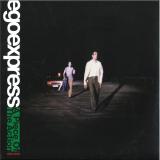
Dies ist deine Einladung zur besten Party überhaupt! Mit A Piece Of The Action erscheint eine längst überfällige Retrospektive des Hamburger Duos Egoexpress - ein wilder, tanzbarer Ritt durch ein Jahrzehnt elektronischer Subkultur. Zwischen 1995 und 2005 erschufen Mense Reents und Berndt "Jimi" Siebels einen Sound, der sich jeder Schublade entzog: roh, verspielt, hypnotisch. Aus dem Punk- und Rock-Umfeld kommend, schmuggelten sie ein störrisches Selbstverständnis und ansteckenden Humor in den Club. Statt verkopfter Coolness setzten sie auf Körperlichkeit und Bauchgefühl - und landeten damit direkte, tanzbare House-Hits mit Eigensinn. Ihre Musik war nie glatt, nie angepasst - sondern ein lebendiger Gegenpol zur Ästhetik ihrer Zeitgenossen. Die 2LP-Compilation versammelt 16 remasterte Tracks - darunter Klassiker wie We Are Here, Knartz IV oder Telefunken - und dokumentiert eindrucksvoll die Entwicklung von minimalistischen Loops hin zu psychedelischen Clubtracks. Egoexpress waren nie Teil eines Trends - sie waren ihr eigener.
Do you ever wish to wish, to wish away the pain, to wish away some sort of pleasure? All these
feelings that we cary, all these things that burden us. Over time the weight drags us down and
one day we want to explode. Time to explode is now. Throw it all away. Maara is back on her
classic b*ll sh*t, or proverbial horse riding high on latest EP ‘Revenge from the Penthouse’.
Gracing us from her ivory penthouse, Maara throws down 5 club ready bangers in her signature
style. She ain’t played with…