Buscar:ever vivid

Estilos
Todo
7ebra - Bird Hour

7Ebra

Bird Hour

12inchPNKSLM104
PNKSLM
31.05.2023
  • 1: Secretly Bad 03:08
  • 2: I Like To Pretend 0:53
  • 3: Rude Body 02:57
  • 4: If I Ask Her 02:18
  • 5: Stripey Horsey 03
  • 6: Lean 03:2
  • 7: I Have A Lot To Say 03:09
  • 8: Born To Care 03:00
  • 9: Done With The Day 03:30
  • 10: Lighter Better 03:12
  • 11: Wakey Wakey 01:57
También disponible

PURPLE VINYL[22,65 €]


In a world of endless, bottomless content, to find something that stands out from the crowd is a rare thing. But it’s something that 7ebra manage without breaking a sweat. Based in Malmö, twin sisters Inez and Ella Johansson deal in sparkling indie-rock that’s pretty without being soft, sweet without losing its edge and catchy without being cheap. With Inez on guitar and vocals and Ella on keys, organ and Mellotron, their minimal set-up makes a virtue of simplicity – with a sliver of guitar fuzz, and organ lines snaking around stark, striking vocals, augmented by shivering harmonies, they don’t need a lot to make music that’s colourful, kaleidoscopic, and effortlessly original.

7ebra debuted in 2022 with the double-single “I Have A Lot To Say”/ “If I Ask Her”, two helpings of psych-tinged, street-smart rock and roll, and the music scene around them wasn’t slow to notice. They opened for the Future Islands and the Dandy Warhols, were picked out by Apple Music’s Matt Wilkinson as a Hidden Gem of 2022 and were booked for prestigious showcases SXSW and Eurosonic. With a packed schedule of shows across Europe and the UK already planned for 2023, their world looks set to get a lot bigger – something that their debut album Bird Hour makes certain. The record is a warm, elegant introduction to the sound 7ebra have crafted. The songs are full of personality and character, but also retain a little bit of enigma, a sense of keeping something secret to themselves. To unwrap that elusiveness is a daunting task, but one the listener can’t resist leaping into.

Ella and Inez’s parents played in bands as they were growing up, so picking up music was a natural thing for them. The origins of 7ebra start with Inez whiling away the hours playing guitar in her bedroom. “I learned by playing covers by myself in my room”, she says. “Ella didn’t do that as much, but we sometimes played and sang together, country songs”. Eventually she would start writing her own. Ella wasn’t involved originally (“we did play together a few times”, she says, “and it just went to shit laughs. We fought a lot”), and Inez was originally reluctant: “I was a bit unsure whether I wanted to be in a band with my sister. Because you get clumped together all the time, when you’re twins”. But Ella was keen to join, and eventually persuaded Inez to let her join for a show. It went – so well that producer Tore Johansson (The Cardigans, Franz Ferdinand), saw it and asked if they’d like to record with him. That changed things, says Ella: “It made us think there might be something in this music”. As a duo, 7ebra were in flight. “In the end, it’s kind of a nice thing too being sisters in a band”, Inez says. “It doesn’t bother me anymore. It just made sense to play together”.

On the album that they eventually came up with, the talent that caught Johansson’s eye is immediately obvious. Opener “Secretly Bad” has a way of walking along your nerves, an eerie echo of a hymn in Inez’s vocal backed by a swirl of woozy blend of guitars and organ. That’s followed up by “I Like To Pretend”, an easily charming song that has a sleepy brightness about it, like morning sunlight breaking through a window. They take a couple of different genres for a whirl on Bird Hour – they’re tense and snappy on “If I Ask Her”, breezy and cocky on “Lighter Better”, and there’s even a couple of droplets of blues and folk in the mix, in the raw intensity of the emotions in the slower songs, the vulnerability and aching of songs like “Lean” and “Stripey Horsey”. The record has a way of sweeping you along in its mood and tones, fuelled in part by the band’s use of repetition, sometimes fast and fevered, sometimes crawling and hypnotic. The duo’s musical input blends perfectly, with Inez’s guitar and vocals forming the core, and Ella drawing in the detail with keys, organ, and harmonies, to really bring out the vivid nature of the songs. Indie rock that’s melodic and sweet, but with enough shadow mixed in to make it really compelling.

On Bird Hour, what strikes you first about 7ebra’s sound is how fully formed it is, how much they’ve carved out their own sonic territory, perfected by trial and error in the studio with Johansson. “Tore wanted us to try everything possible”, says Ella. “We had moments where things weren’t working. But that was necessary in order to find the good stuff”. 7ebra’s signature might be found in the deft way they deal with emotion – unafraid of being open, but a little too clever to make things too clear cut: “You can’t take yourself that seriously. It’s too emotional to take it seriously, to start hating yourself. But at the same time, it is quite serious”, says Ella. Another trademark is the simplicity – a 7ebra song has just enough to make it work, and nothing more. “I think it was important for me that our voices were at the centre of the songs”, says Inez, “that all the little melodies have their place, and don’t get overwhelmed. With lyrics, I sometimes come up with something, and just feel ‘there’s no need to add more to this’. Sometimes a line works by itself. You don’t have to add a bunch of lyrics”. Finally, the album’s themes are ones that will resonate with most people that have set foot on this planet. “I guess it’s about trying to understand yourself, in relation to others. Just life. ‘Why am I not good at this, why is this thing happening to me, why is this thing so hard, why am I so stupid?’”, laughs Ella.

7ebra haven’t been around for very long – but a handful of songs and their fizzing live shows have stirred up the biggest buzz in Scandinavian music in quite a while. Their debut album justifies it all. It showcases the magic they’re capable of conjuring up, and hints at even more to come in the future. But from where they are right now, they’ve made something very special. Bird Hour takes all that promise and turns it into something concrete, in the form of one of the year’s best rock debuts.

Reservar31.05.2023

debe ser publicado en 31.05.2023

22,65
7ebra - Bird Hour

7Ebra

Bird Hour

12inchPNKSLM1104
PNKSLM
31.05.2023

In a world of endless, bottomless content, to find something that stands out from the crowd is a rare thing. But it’s something that 7ebra manage without breaking a sweat. Based in Malmö, twin sisters Inez and Ella Johansson deal in sparkling indie-rock that’s pretty without being soft, sweet without losing its edge and catchy without being cheap. With Inez on guitar and vocals and Ella on keys, organ and Mellotron, their minimal set-up makes a virtue of simplicity – with a sliver of guitar fuzz, and organ lines snaking around stark, striking vocals, augmented by shivering harmonies, they don’t need a lot to make music that’s colourful, kaleidoscopic, and effortlessly original.

7ebra debuted in 2022 with the double-single “I Have A Lot To Say”/ “If I Ask Her”, two helpings of psych-tinged, street-smart rock and roll, and the music scene around them wasn’t slow to notice. They opened for the Future Islands and the Dandy Warhols, were picked out by Apple Music’s Matt Wilkinson as a Hidden Gem of 2022 and were booked for prestigious showcases SXSW and Eurosonic. With a packed schedule of shows across Europe and the UK already planned for 2023, their world looks set to get a lot bigger – something that their debut album Bird Hour makes certain. The record is a warm, elegant introduction to the sound 7ebra have crafted. The songs are full of personality and character, but also retain a little bit of enigma, a sense of keeping something secret to themselves. To unwrap that elusiveness is a daunting task, but one the listener can’t resist leaping into.

Ella and Inez’s parents played in bands as they were growing up, so picking up music was a natural thing for them. The origins of 7ebra start with Inez whiling away the hours playing guitar in her bedroom. “I learned by playing covers by myself in my room”, she says. “Ella didn’t do that as much, but we sometimes played and sang together, country songs”. Eventually she would start writing her own. Ella wasn’t involved originally (“we did play together a few times”, she says, “and it just went to shit laughs. We fought a lot”), and Inez was originally reluctant: “I was a bit unsure whether I wanted to be in a band with my sister. Because you get clumped together all the time, when you’re twins”. But Ella was keen to join, and eventually persuaded Inez to let her join for a show. It went – so well that producer Tore Johansson (The Cardigans, Franz Ferdinand), saw it and asked if they’d like to record with him. That changed things, says Ella: “It made us think there might be something in this music”. As a duo, 7ebra were in flight. “In the end, it’s kind of a nice thing too being sisters in a band”, Inez says. “It doesn’t bother me anymore. It just made sense to play together”.

On the album that they eventually came up with, the talent that caught Johansson’s eye is immediately obvious. Opener “Secretly Bad” has a way of walking along your nerves, an eerie echo of a hymn in Inez’s vocal backed by a swirl of woozy blend of guitars and organ. That’s followed up by “I Like To Pretend”, an easily charming song that has a sleepy brightness about it, like morning sunlight breaking through a window. They take a couple of different genres for a whirl on Bird Hour – they’re tense and snappy on “If I Ask Her”, breezy and cocky on “Lighter Better”, and there’s even a couple of droplets of blues and folk in the mix, in the raw intensity of the emotions in the slower songs, the vulnerability and aching of songs like “Lean” and “Stripey Horsey”. The record has a way of sweeping you along in its mood and tones, fuelled in part by the band’s use of repetition, sometimes fast and fevered, sometimes crawling and hypnotic. The duo’s musical input blends perfectly, with Inez’s guitar and vocals forming the core, and Ella drawing in the detail with keys, organ, and harmonies, to really bring out the vivid nature of the songs. Indie rock that’s melodic and sweet, but with enough shadow mixed in to make it really compelling.

On Bird Hour, what strikes you first about 7ebra’s sound is how fully formed it is, how much they’ve carved out their own sonic territory, perfected by trial and error in the studio with Johansson. “Tore wanted us to try everything possible”, says Ella. “We had moments where things weren’t working. But that was necessary in order to find the good stuff”. 7ebra’s signature might be found in the deft way they deal with emotion – unafraid of being open, but a little too clever to make things too clear cut: “You can’t take yourself that seriously. It’s too emotional to take it seriously, to start hating yourself. But at the same time, it is quite serious”, says Ella. Another trademark is the simplicity – a 7ebra song has just enough to make it work, and nothing more. “I think it was important for me that our voices were at the centre of the songs”, says Inez, “that all the little melodies have their place, and don’t get overwhelmed. With lyrics, I sometimes come up with something, and just feel ‘there’s no need to add more to this’. Sometimes a line works by itself. You don’t have to add a bunch of lyrics”. Finally, the album’s themes are ones that will resonate with most people that have set foot on this planet. “I guess it’s about trying to understand yourself, in relation to others. Just life. ‘Why am I not good at this, why is this thing happening to me, why is this thing so hard, why am I so stupid?’”, laughs Ella.

7ebra haven’t been around for very long – but a handful of songs and their fizzing live shows have stirred up the biggest buzz in Scandinavian music in quite a while. Their debut album justifies it all. It showcases the magic they’re capable of conjuring up, and hints at even more to come in the future. But from where they are right now, they’ve made something very special. Bird Hour takes all that promise and turns it into something concrete, in the form of one of the year’s best rock debuts.

Reservar31.05.2023

debe ser publicado en 31.05.2023

22,65
Detlef Funder & Bernd Sevens - Stumm LP

Detlef Funder&Bernd Sevens

Stumm LP

12inchTAL029LP
TAL
26.05.2023

With this release TAL delves deep into the very beginnings of Düsseldorf's post punk scene of the early 1980s. STUMM was the duo of Detlef Funder and Bernd Sevens who both would become pivotal figures in the tape underground movement of West-Germany, when they launched the SDV label in 1986. Individually they went on to produce boundary defying works as Konrad Kraft and Seventh Day respectively.

The material on this album was recorded by Funder and Sevens quite casually in 1980 in a rehearsal studio in the centre of Düsseldorf. Right from the beginning the two young musicians incorporated the atmosphere of the space in order to document the process of their sound experiments on a 4-track tape machine. For those recording sessions, which are now released for the first time ever on vinyl and download, Funder and Sevens managed to get their hands on a very rudimentary set of equipment consisting of merely a Korg MS 20 synth, a Roland CR 78 drum machine, a few electronic effects and a drum kit. The urgent and rough sound of the recordings imbues their production with a characteristic and era-specific edge that's hard to imitate today. Spontaneity and understatement were key elements in the brief creative period of STUMM. The recordings still have a uniquely dizzying quality and are somewhat of a basic blueprint for a lot of industrial/techno and post punk which was about to loom in all corners of the world. These tracks are also a testament to the vivid spark of a period in time that would soon be radically changed through the rise of digital technology.

Bernd Sevens: “Around 1980 there was a great musical awakening. Punk, New Wave, Industrial and of course Dub Reggae -- the electronic music blew us away. Everything we heard influenced us. Back then, cassette tapes were cheap and easily available. We could record our ideas on the spot and then copy and distribute the tapes. That's how it started. Giving it a go, experimenting, trial and error. The music you hear on the record was spontaneous and had no concept. Our collaboration was also not intended to be a permanent project. You could say we were dilettantes setting out on our journey, making it up as we went along. It felt like a beginning.”

Reservar26.05.2023

debe ser publicado en 26.05.2023

27,94
The Album Leaf - Future Falling 2x12"

Jimmy LaValle’s The Album Leaf has spun from solo outlet to full band and back in its nearly 25 years. His acclaimed catalog spans releases for labels such as Sub Pop, City Slang, Relapse, and others. He also composes music for film and television, scoring over 20 projects (narrative features, documentaries, and TV series) since 2009. The cinematic sensibilities of The Album Leaf were present from the beginning. His 1999 debut introduced the start of a signature sound: melodic and meditative electro-organic soundscapes constructed with guitar, percussion, Rhodes, and field recordings.

His seventh full-length LP, and first since 2016, arrives in 2023 via Vancouver’s Nettwerk Records. FUTURE FALLING finds LaValle working with an array of musicians, shaping slightly darker, more spacious, and synth-driven songs with contributions from Bat For Lashes, Kimbra, and many others.
The music registers a shade darker and more synth-driven than most moments in his acclaimed catalog, a bridge between shadowy, cerebral terrain and dreamy precision pop, where softly percussive frameworks meet shimmering sound design and emotive instrumentation.
LaValle sees the construction of FUTURE FALLING as less conventional than past work. Contributions were done remotely with a “throw everything at it” mindset, making LaValle the arranger of layers from all over: drums, synths, horns, violins, voice, and more. LaValle created a pastiche of these layers and elements; in some cases even moving vocal takes to new tracks entirely. Without the in-the-room dynamics, he had more time to experiment, adding and subtracting ad infinitum.
The album opens on “PROLOGUE,” an evocative, slow-building instrumental that rides a pattern into a symphonic sea of static. Keys and horns glide atop the rhythmic pulse of “DUST COLLECTS,” setting the contemplative scene for “AFTERGLOW,” the record’s most pop-minded performance. Here Kimbra, the Grammy-winning New Zealand singer-songwriter, renders a striking recollection of past love as percussive elements shimmer and swirl.
A plaintive piano line moves throughout “Cycles 19.9” encircled by light ambient washes, both a valley between two peaks and a powerful composition in its own right. “Future Falling” follows; with origins tracing back to 2015, the track embodies the full sonic journey LaValle has taken. All the hallmarks of The Album Leaf — melodic builds, vivid sprawl, tonal shape-shifting — assemble to a blissful finish.

For the next stretch, “Cycles” begins with a uneasy Rhodes loop that builds and erupts into a wall of texture paving its way into “Give In,” where LaValle models a movement that begins subtle and measured before curving up with skyward, percussive bursts (“Stride”) and settling back down to the album’s back-half centerpiece, “Near” featuring the acclaimed English artist Natasha Khan aka Bat For Lashes. “Do you feel me near?” she sings into a mist of widescreen synths and soothing, distant drum beats as if searching through the dark.

No en stock

Haga su pedido ahora y le encargaremos el artículo en nuestro proveedor.

25,17

Ültimo hace: 2 Años
Karen Dalton - Shuckin’ Sugar

Old style, Tip-On Jacket, and 8pp heavy insert featuring a treasure trove of newly discovered photos, and a 6,000 word essay by Kris Needs.

In 1962, Karen summoned Richard Tucker to join her in Colorado, extolling the healthier lifestyle, and plentiful gigs at Boulder folk club The Attic. Upon his arrival, the pair solidified their personal and professional relationship, riding horses in the mountains, and performing as a duo at parties and venues throughout Denver and Boulder. Stories of the spell they conjured - and rumours of tapes! - have circulated among friends and musicians who witnessed them, but until now, no recorded evidence had turned up.

Shuckin' Sugar is the glorious result of three reel to reel tapes that miraculously found their way to us in November, 2018; which featured two complete shows from The Attic in January '63, and a benefit concert for The Congress of Racial Equality (CORE) recorded the following February. Their gigs would often include brief solo sets from Karen and Richard, in addition to the duets, and all seven solo songs of Karen's found on the three reels are included here, as well as five duets, sequenced as close to how it all went down as humanly possible. To describe the record would take a poet, but all I can say is that unveiling a missing chapter in the Karen Dalton story - with six songs we've never heard her sing before - is cause for celebration in Delmore's world.

"From her opening, jaw-dropping lift-off with early blues standard "Trouble In Mind," the unique
otherworld Karen conjured springs into vivid life. Playing to audiences inevitably bound to the era's formalities and traditions, Karen instinctively pushed the envelope, straying into uncharted territory beyond the established borders. She must have bewildered many who came to see her in those winsome Peter, Paul and Mary times." From the liner notes by Kris Needs

Reservar20.05.2023

debe ser publicado en 20.05.2023

29,03
Ilija Rudman - Pulsar Diaries LP

The Croatian production powerhouse and disco boogie impresario steps up to International Feel, and takes a left turn into deep space with a new six track LP Pulsar Diaries.

Ilija’s discography stretches back to 2003, and over those 20 years he’s packed it full with albums, versions, remixes and singles. His releases are often perfectly-penned love letters to ‘80s boogie, electro and disco, and like postcards from an old flame, they’ve landed in an array of record label catalogs, from Bear Funk, Rong, and Electric Minds, to Is It Balearic? as well as his own Red Music and Imogen Recordings. He’s long-been an active voice on the underground club scene, and if you’ve been out dancing in Zagreb, Berlin or even Tisno beach, chances are you’ve gotten down to one of his beautifully blended sets of cosmic-tinged electro funk and disco dubs.

On Pulsar Diaries, Ilija delivers a panoramic collection of spaced-out synths and drum machine grooves, dedicated to the planet and our place in the universe. The A side opens up with the blissful, weightless pads of the title track, before it breaks out into filtered stabs over a minimal b-boy bounce. Delphic Expanse ebbs and flows like a lunar eclipse, sounding like a futuristic version of Key-Matic’s Breaking In Space, all uprock rhythms and syrupy synth horns as it spins off beyond the asteroid belt. Side A closes out with Blackburn Tales, a suspenseful and spacious electro rhythm packed with strings and 303 squelch, which you might call anti-gravity acid, if you were so inclined.

Side B picks up the tempo with Fourth Amendment, perfect for the space station discotheque with its sweeping bass filters and ice-cold synth melodies hovering in orbit. Farewell Theme takes an introspective moment, slowing the pace to a cosmic 90 bpm and inviting a certain cinematic feel to proceedings. This feeling applies not just to the vivid landscapes we travel through, but also wider thoughts about humankind: as we pause for a breath and look around, we find ourselves in Ilija’s space, considering human motivations, like the pursuit of happiness, or the eternal struggle with the self.

Every journey begins with a goodbye, and so the last track of the album feels like the arrival at a new destination: Ursa Major is ablaze with cascading drum fills, bubble-wrapped bass riffs and bright synth chords that sparkle like city lights underneath a re-orbiting satellite.

With Pulsar Diaries, Ilija Rudman has created a rare artifact: an album that straddles several worlds at once. Part soundtrack to space travel, part meditation on the human condition, part deep-burning dancefloor dynamo - whether in the club surrounded by friends or at home by yourself, this is a record that expands the mind and lets the imagination soar.

No en stock

Haga su pedido ahora y le encargaremos el artículo en nuestro proveedor.

14,71

Ültimo hace: 77 Días
TOM TRAGO - DECO LP

Tom Trago

DECO LP

12inchRHM045
Rush Hour
09.05.2023

Tom Trago returns to Rush Hour after 10 years with a wonderfully accomplished mini-album, tip!

During the years he spent living in Amsterdam, when his DJ career seemed to become an unstoppable juggernaut, Tom Trago was a regular visitor to Deco Sauna, a local institution that helped him “decompress” and de-toxify his body. Eventually, a more extended period of “decompression” was needed, with Trago moving to the coast to reassess his priorities and spend more time with his young family.

‘Deco’, his sixth album and first for Rush Hour in a decade, was recorded following an extended absence from club dancefloors, as Trago cut back on DJ commitments to prioritise family life. When he returned to the studio, often with his daughter by his side, Trago initially struggled to get back into the groove. The desire to make dancefloor-focused music had – temporarily, at least – deserted him; instead, he found himself drawn towards a desire to create “electronic lullabies” and music that reflected his more pastoral environment (his home backs on to a patch of woodland in which he would walk every day).

Returning to his most familiar synthesisers – and specifically the first synthesiser he bought, on credit, as a young DJ and wannabe producer – Trago set about navigating different musical routes without the straight-jacket of club-focused dancefloors. Occasionally, old friends from Amsterdam would join him in the studio – Tracey and Maxi Mill, both of whom are part of his Voyage Direct label roster, contributed to tracks on the album – but for the most part the production process was a solo endeavour: musical therapy for an artist determined to do things differently after years spent making club hits and sweat-soaked peak-time workouts.

The results are rarely less than spellbinding. Trago sets his stall out with opener ‘Dark Oak’, a gorgeous, colourful, sun-bright scene-setter co-produced by Tracey that layers tumbling lead lines, chiming melodic motifs and kaleidoscopic chords atop the gentlest of bubbly beat patterns. Maxi Mill lends a hand on ‘Central Park’, a deep and hypnotic excursion marked out by rhythmic bleeps, minimalistic beats and layered melodies, and the summer sun-down rush of ‘Never Peace a Puzzle’, where kaleidoscopic synth sounds, meandering solos and looped electronic stabs rush towards a dancefloor of the mind.

Trago’s desire to create “electronic lullabies” for his young daughter comes to the fore on ‘To Be Left Unlocked’, a hypnotising fusion of spacey electronic motifs, Steve Reich style (synth) marimba melodies and slowly building musical intensity, while the echoing Fender Rhodes riffs, squelchy synth-bass, glistening guitar notes and sparse, snappy post hip-hop beats of ‘When The Sky Is Watching Us’ doff a cap to the producer’s roots as a bedroom beat-maker.

Given the project’s genesis, it’s perhaps fitting that Trago chose to conclude proceedings with ‘It Might Be Forever’ and the digital only ‘Blue Dope’, the album’s most rejuvenating, immersive, and vibrant moments. Both feature sustained chords painted with vivid aural brush strokes and come blessed with the merest hint of a rhythmic pulse – a thread that subtly runs throughout Trago’s most mature and musically rich album to date.

Matt Anniss

No en stock

Haga su pedido ahora y le encargaremos el artículo en nuestro proveedor.

16,39

Ültimo hace: 2 Años
Bruce Springsteen - Greetings From Asbury Park

ULTRADISC ONE-STEP BOX SET OF BRUCE SPRINGSTEEN'S 1973 DEBUT PLAYS WITH AUDIOPHILE SOUND: LIMITED TO 7,500 NUMBERED COPIES.

1/4" / 15 IPS analogue master to DSD 256 to analogue console to lathe

Teeming with identifiable characters, youthful romanticism, vivid narratives, and sophisticated arrangements, Greetings from Asbury Park, N.J. is a personal postcard from the heart, soul, and mind of a rock ’n’ roll lifer bent on discovering his world and what lays beyond it. The 1973 album establishes many of the signature themes and sounds Bruce Springsteen would embrace throughout his unparalleled career. No wonder a majority of the songs — “Blinded by the Light,” “Lost in the Flood,” “Spirit in the Night” included — remain staples of the New Jersey native’s fabled concerts.

Sourced from the original analog master tapes, pressed at RTI on MoFi SuperVinyl, and strictly limited to 7,500 numbered copies, Mobile Fidelity's UltraDisc One-Step 180g 33RPM LP set is the definitive-sounding version of Springsteen’s daring debut. Afforded the benefits of SuperVinyl’s nearly non-existent noise floor, Greetings from Asbury Park, N.J. plays with a clarity, directness, and emotionalism that practically whisks you into the New York office in which Springsteen — accompanied by then-manager Mike Appel — played a few originals for legendary Columbia Records executive John Hammond and earned a record deal.

That solo-centric aspect of Greetings from Asbury Park, N.J. — credited only to Springsteen and featuring only a handful of accompanying musicians — helps make it unique in his catalogue. So do the acoustic-based frameworks, revealed on this pressing with newly exposed detail, nuance, and immediacy. The music emerges with an openness that gives flight to the Boss’ storytelling. His words flow with unbridled, stream-of-conscious pacing and vibrant imagery; they pay homage to and update a tradition established by Bob Dylan, Woody Guthrie, and Jack Kerouac. Equally important, Springsteen’s still-underrated vocal performances can now be appreciated in full-range fidelity. Earnest, transparent, and sincere, his singing comes across with an urgency that distinguishes him from the era’s singer-songwriter mold and a raw energy that underlines his unflinching belief in rock ’n’ roll.

Recorded in just three weeks, Greetings from Asbury Park, N.J. also stands out by way of its insightful artwork. Designed by Grammy winner John Berg, the inviting cover is appointed with images of the local landmarks, beachfronts, and geography that provide the backdrops for some of the songs. Those graphics are complemented by the beautiful packaging of Mobile Fidelity’s UD1S edition. Tucked in a sleek slipcase, the LP is housed in a special foil-stamped jacket with faithful-to-the-original graphics. In every way, this reissue is made for listeners who prize sound quality and who want to engage themselves in everything involved with this invigorating album.

An aspirational declaration by a then-23-year-old musician who was already a seasoned veteran of the Jersey Shore bar-band scene, Greetings from Asbury Park, N.J. can in many ways be seen as a semi-fictional autobiography released more than four decades before Springsteen penned his official tome. Elaborate, descriptive, and absorbing, Springsteen’s lyrics spark with the enthusiasm and exuberance of a wide-eyed adventurer ready for possibility, excitement, and fun — but who is also mindful of loss, pain, and disappointment. Words often tumble and collide like dice spilling from a jar; shaken and fully intact, they pour forth with purpose and without self-conscious concern.

One of two songs composed after label president Clive Davis cited the need for a radio-friendly single, the opening “Blinded by the Light” provides an unforgettable introduction. It flares with a blend of confidence, fun, and poetry that helps define Greetings from Asbury Park, N.J. Crackling with wiry guitars, funky chords, Clarence Clemons’ cool-toned saxophone, and action-packed lyrics, the shuffle simultaneously expands and contracts — and establishes Springsteen as a master of rhyme, alliteration, and breathless expression. The thread continues on “Growin’ Up.” Steered by ascending piano lines, soulful grooves, and frisky rhythms, the coming-of-age confessional is at once rebellious and controlled, fearless and vulnerable, honest and boastful. It is a tale to which multiple generations still relate.

Such universality has always been a Springsteen trademark. It surfaces throughout Greetings from Asbury Park, N.J., as does another Boss hallmark: the importance of friendship and tight bonds. These concepts relate to the fact many of the songs — see the feverish “Does This Bus Stop at 82nd Street?,” strutting “It’s So Hard to Be a Saint in the City,” and tender “For You,” the latter complete with brilliant Hammond organ shading — are directly tied to the friends, acquaintances, places, and happenings he knew. “Lost in the Flood,” whose cinematic drama and epic scope hint at the directions Springsteen would pursue on his next LP, extends that familiarity while addressing the kind of socially conscious issues with which he’s forever been associated.

Balancing the label’s vision of him as a folk-based singer-songwriter and his own desire to play rock ‘n’ roll with a full band, Springsteen never again made a record like Greetings from Asbury Park, N.J. One of the most captivating debuts in history, it heralds the start of a legacy whose import Springsteen seemingly foretells on “Blinded by the Light”: “He’s gonna make it tonight.” And how.

Reservar30.04.2023

debe ser publicado en 30.04.2023

159,62
JIMETTA ROSE & THE VOICES OF CREATION - HOW GOOD IT IS LP

Beautiful, soulful jazz record by Jimetta Rose and The Voices of Creation, a Los Angeles-based community choir, a mainstay of the local scene. Highly recommended!!

The Voices of Creation are a community-based choir led by vocalist, songwriter, arranger, producer and mainstay of the Los Angeles scene Jimetta Rose. Made up of a multigenerational group of mainly non-professional singers backed by some of the city’s finest musicians,their music marries hip strains of gospel with layers of jazz, soul and funk. While aspects of their music might recall Kamasi Washington, The Staple Singers or Sly Stone, Jimetta’s unique vision has resulted in new spiritually-charged forms of music whose whole-hearted embrace of love, joy and peace act as sonic healing balms for the soul.

For Jimetta - whose resume includes collaborations with Miguel Atwood Ferguson, Georgia Anne Muldrow, Sa-Ra Creative Partners, Angel Bat Dawid, Shafiq Husayn, MED and Blu - the very act of creation was part of a healing process: “I was very low at the time and I wrote most of the songs going through hardship. But I found comfort in the songs and a way to adjust my mindset to where things got better. So I thought ‘if this music works for me, maybe it will work for other people’ I believe that every person has their own voice and their own note and that we can use our voices to heal ourselves. That’s the intention behind creating the project.”

After putting out a call on social media for people interested in joining her choir she was met with a sea of replies. Members were chosen in less-than conventional fashion: “I recruited people based on their interest in healing themselves and others, not necessarily on their musical experience or being seasoned performers” she says. Among those accepted into the ever-evolving collective, which was begun initially as a community choir, were the likes of Sly Stone’s daughter Novena Carmel, better known as a radio DJ for KCRW’s flagship breakfast show. Jimetta’s upbringing in the Pentecostal church, where she was a youth choir director, fed into her otherwise intuitive teachings of her songs and arrangements to the inexperienced members with help from the group’s seasoned organ player/co-musical director Jack Maeby.

Produced by Mario Caldato Jr. (Beastie Boys, Seu Jorge) and his wife Samantha Caldato the results show the incredible sense of togetherness and communal spirit that the group had built up over time in the rehearsal sessions. The six tracks of their debut album, a mixture of originals and rearranged covers, are performed in a wide-eyed mix of styles that reflect Jimetta’s vision for borderless music: “It’s new black classical music,” she explains. “It’s all the hodgepodge of being an African American but also with creativity and vision for the future. It has a taste of what is to come and what we can do. What we have gone through and who we are now.”

The group’s propensity for warm and buoyant sonics finds representation on album opener Let The Sunshine In, a sparkling rework of the Sons and Daughters of Lite’s deep jazz classic. Their version finds the group’s dynamic group harmonies offset with Allakoi Peete’s nimble afro-percussive touches and plenty of soul- drenched keys courtesy of pianist Quran Shaheed and organ player Jack Maeby. A similarly uplifting take on Rahsaan Roland Kirk’s choral jazz classic Spirits Up Above follows, with Maeby’s groove-laden organ lines inspiring some gorgeous group harmonies as well as prime solo turns from the likes of Kellye Hawkins, Zavier Wise, Tamara Blue, and Khalila Gardner.

Another Sons and Daughters of Lite cover follows as Jimetta leads the choir in the groove-drenched ode to self-affirmation Operation Feed Yourself. Written as a series of mantras for everyday living, the Jimetta-penned composition How Good It Is harnesses the full transformative power of music to generate a stirring and joyful ode to positivity - it’s chanted declarations bringing out some of the group’s most deeply-felt and affecting vocal performances over some superlative piano and organ accompaniment with a surprise feature vocal from Novena Carmel.

Jimetta’s talent for re-imagining songs in her own light is highlighted in Answer The Call, her vivid re-telling of Funkadelic’s Cosmic Slop: “When I listened to the original song, the Mom in the story was really going through it. I thought of how I could turn this into a song that can encompass the glorification of all mothers and I thought of the Egyptian cosmic goddess Nut. To that mother we’re all the seeds planted in the garden. Answering the call in your life is literally that. Finding out exactly what you’re here for through your heart.”

The album finishes with the standout original gospel number Ain’t Life Grand. Over swaying organs and clapped percussion Jimetta’s lyrical mantras serve to emphasise the good feelings that come to those with a grateful heart. Good feeling is an apt descriptor for the mood of the album as a whole. Its shining positivity provides a welcome ray of light in an increasingly dark world. “It’s a shortcut if you will to the better feelings” Jimetta says. “The hope that we need to keep pressing forward. We are saturated and inundated with images of chaos and destruction, death and hatred. There’s so much we can witness. So, I want to make sure that there is a representation sonically of the other parts that are still there to witness so that we can continue to build those things. So that the systems we support actually reflect what we want to experience. So it’s like: “Don’t give up and Let The Sunshine Into You” and then find out what your purpose is and answer the call.”

No en stock

Haga su pedido ahora y le encargaremos el artículo en nuestro proveedor.

25,17

Ültimo hace: 3 Años
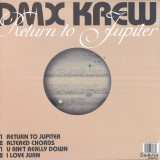
DMX Krew - Return To Jupiter

DMX Krew announces his return to Peggy Gou's Gudu Records with a new four-track EP, sharing the dreamy, Detroit-inspired title track, ‘Return to Jupiter’.

The full EP - out 14th April 2023 - will be his second release for the label and Gudu’s first release of 2023, set to be the label’s busiest year yet.

Ed DMX made his debut for Gudu with 2019’s Don’t You Wanna Play? EP, becoming the first artist to release on the label outside Peggy herself. Ed and Gudu have retained a regular working relationship ever since: he mastered Indonesian crate-digger Dea’s ‘Glazer Drum’ release for Gudu, contributed a pair of remixes to the reissue of Riff’s South African electro curio ‘Jacks Jive’, and now returns to the label with Return to Jupiter, a new original four-track EP.

Ed has been one of electronic music’s most respected faces for over 25 years. Debuting in the mid-1990s, he released his first decade of music almost exclusively through Grant Wilson-Claridge and Aphex Twin’s Rephlex label and his own Breakin’ imprint, but recent years have seen him ply his trade across a who’s who of dance music’s most respected underground labels: including Hypercolour, Balkan Vinyl, Central Processing Unit and, of course, Gudu.

Inspired by the futurist funk and vivid synthesiser epics of classic Detroit, ‘Return to Jupiter’ is dripping with richness and colour, driven by the sort of thick analogue basslines and distinctive melodies that have come to define Ed’s catalogue. The EP’s title track sets the tone for what’s to follow, introducing a language of sorts for the record - before ‘Altered Chords’ turns the funk up to 11, ‘U Ain’t Down’ aims its distorted kicks and wiggy, manipulated lead straight at peak time dancefloors, and ‘I Love Juan’ closes the EP on a star-gazing tip.

Founded by Peggy Gou in 2019, Gudu releases music from a global roster of artists, including DMX Krew, Maurice Fulton, Hiver, Dea, Mogwaa, Brain de Palma, Dukwa, JRMS and Peggy herself (including the hits ‘Starry Night’, ‘I Go’ and ‘Nabi’). 2023 will see Gudu’s busiest year to date, with new releases scheduled from the current roster and some exciting new faces.

No en stock

Haga su pedido ahora y le encargaremos el artículo en nuestro proveedor.

15,34

Ültimo hace: 2 Años
Tallest Man On Earth - HENRY ST.

Tallest Man On Earth

HENRY ST.

12inch279524
ANTI
14.04.2023

Kristian Matsson has never remained in one place for very long. Having spent much of the last decade touring around the world as The Tallest Man on Earth, Matsson has captivated audiences using, as The New York Times describes, “every inch of his long guitar cord to
roam the stage: darting around, crouching, stretching, hip-twitching, perching briefly and jittering away…Mr. Matsson is a guitar-slinger rooted in folk, and his songs are troubadour ballads at heart.”

Now, Matsson returns as The Tallest Man on Earth with Henry St., his sixth studio album following 2012’s There’s No Leaving Now, full of “vivid imagery, clever turns-of-phrase, and devastating, world-weary observations” (Under The Radar) and 2015’s Dark Bird Is A
Home, his “most personal record… surreal and dreamlike” (Pitchfork). Henry St. notably marks the first time he recorded an album in a band setting. “My entire career I’ve been a DIY person––mostly fueled by the feeling that I didn’t know what I was doing, so I’d just do everything myself.”

But now, longing for the energy that’s only released when creating
together with others, Matsson invited his friends to come and play.
Nick Sanborn (of Sylvan Esso) produced Henry St., which includes contributions from Ryan Gustafson (of The Dead Tongues) on guitar, lap steel and ukulele, TJ Maiani on drums, CJ Camerieri (of Bon Iver) on trumpet and French horn, Phil Cook on piano and organ, Rob
Moose (of Bon Iver, yMusic) on strings and Adam Schatz on saxophone.

Reservar14.04.2023

debe ser publicado en 14.04.2023

23,49
Tallest Man On Earth - HENRY ST.

Tallest Man On Earth

HENRY ST.

12inch279521
ANTI
10.04.2023

Kristian Matsson has never remained in one place for very long. Having spent much of the last decade touring around the world as The Tallest Man on Earth, Matsson has captivated audiences using, as The New York Times describes, “every inch of his long guitar cord to
roam the stage: darting around, crouching, stretching, hip-twitching, perching briefly and jittering away…Mr. Matsson is a guitar-slinger rooted in folk, and his songs are troubadour ballads at heart.”

Now, Matsson returns as The Tallest Man on Earth with Henry St., his sixth studio album following 2012’s There’s No Leaving Now, full of “vivid imagery, clever turns-of-phrase, and devastating, world-weary observations” (Under The Radar) and 2015’s Dark Bird Is A
Home, his “most personal record… surreal and dreamlike” (Pitchfork). Henry St. notably marks the first time he recorded an album in a band setting. “My entire career I’ve been a DIY person––mostly fueled by the feeling that I didn’t know what I was doing, so I’d just do everything myself.”

But now, longing for the energy that’s only released when creating
together with others, Matsson invited his friends to come and play.
Nick Sanborn (of Sylvan Esso) produced Henry St., which includes contributions from Ryan Gustafson (of The Dead Tongues) on guitar, lap steel and ukulele, TJ Maiani on drums, CJ Camerieri (of Bon Iver) on trumpet and French horn, Phil Cook on piano and organ, Rob
Moose (of Bon Iver, yMusic) on strings and Adam Schatz on saxophone.

Reservar10.04.2023

debe ser publicado en 10.04.2023

22,06
Hidden Empire - Momentum

Hidden Empire

Momentum

12inchSVT327EP
Stil vor Talent
06.04.2023

Following in the footsteps of "Mind Palace" and "Lost Spirits", respectively issued in 2018 and 2021, Hidden Empire return to Stil vor Talent with their eagerly anticipated third studio full-length, "Momentum". Going the same route that came to define their sound throughout the years, Branko Novakovic and Niklas Schäfers cook a savvy mix of deep electroid flavours and prog techno magnitude which flourishes in the long-playing format. Orbiting the frontier between proper no-nonsense, floor-focussed effectiveness and a trademark exploratory take on electronics, Hidden Empire here delivers one of their most accomplished slices to date, which not only spans the largest span of their many-faceted influences, from tribal anchorage to hypermodern escapology, but breathes a truly epic wind into it.

Draped in luscious, silken envelopes and easternmost ambiences, "Dawn" gets the ball rolling on a mystique-imbued note, halfway meditation-friendly material and square-shouldered club busting wares. Moving into Afro-infused house grounds, "Modesty" finds Branko and Niklas heading for the deeper end of the spectrum, as they pull out a clinically precise blender of rattling percussions, opaque incantations, lush synth swashes and verbed-out machine talk, tailored for nightly boogie rituals in the forest. "Avalanche" opts for a more brooding, deadlier approach. Cutting its path away from prying eyes, this one finds Hidden Empire pulling the stealth weaponry to absolute hypnotic effect - perfect for serious in-between peak time business with its thick, thriller-like tension, mist-shrouded atmosphere and surgical focus. Featuring Felix Raphael on vocals, "Who We Are", is a pop-influenced chugger that perhaps best defines Hidden Empire's ambivalent style, both hi-NRG and innervated with a melancholy that infuses down to the bass and most functional elements. Geared up for big-room traction with its seesawing synths and clinical drumwork, Raphael's moving timbre does more than offer a sensible counterpoint to the track's overall sturdy backbone, it takes it to a whole other dimension completely.

"Repeat The Good" ft. Wolfson balances out a fast-ticking groove with those subtle melodic lines Hidden Empire champion to astounding vibrancy, offering a particularly satisfying glimpse into their vortical imaginarium, whereas "Last Call" has us journeying to straight out Moroder-esque territories, flush with the aptly configured palette of fuzzy space disco bass, fast-paced Italo churn and vocodized talk for good measure. All in breaks and chopped-up euphoria, "Vivid" runs the hoodoo down in muscular fashion and with impressive levels of energy throughout, all set at cranking up the heat one notch further, while "Rebel" provides us with the kind of rough-around-the-edges EBM horsepower and neon-clad synth engineering that'll get the basement in a state of alert. Encompassing all of the pair's idiosyncratic merger of styles - from pop-laced Italo to spaced-out techno wares, through jagged motorik and heavily mecched-out jacking house, "Alright" shows off Hidden Empire's wide arsenal of pyrotechnics under the most compelling of lights. A more openly jagged and quirky weapon that hatches into a full-fledged solar number around the half, "Momentum" roars up the club's highway at full throttle, proving a formidable asset when it comes to plunging dancers into a state of weird, left-of-centre euphoria.

A stroboscopic eclipse is predicted as "Dark Sun" enters the room, deploying its obscure wingspan over the ravers, not quite a bad omen as it lets more light in with every bar, its brittle piano lines and heart-wrenching vocals cutting a path into the crowd's pulsating hearts. Graceful as Hidden Empire's music can be, a moment of utter exhilarating beauty. "Savasana" wraps up the voyage with a pure slab of cyphered 4x4 seduction, as an ASMR-like voice guides us across the soul-questioning haze that blankets our pathway onto a luminous finale. A piece of elusive nature, clearly designed for the club and yet telling a tale of off-piste initiation through twelve fascinating movements, "Momentum" will undoubtedly etch on the listeners' mind as one of the German pair's most strikingly powerful emanations.

Download:
1. Hidden Empire - Dawn Interlude
2. Hidden Empire - Modesty
3. Hidden Empire - Avalanche
4. Hidden Empire & Felix Raphael - Who We Are
5. Hidden Empire & Wolfson - Repeat the Good
6. Hidden Empire - Last Call
7. Hidden Empire - Vivid
8. Hidden Empire - Rebel
9. Hidden Empire - Alright
10. Hidden Empire - Momentum
11. Hidden Empire - Dark Sun
12. Hidden Empire - Savasana
13. Hidden Empire & Felix Raphael - Who We Are (Instrumental)

No en stock

Haga su pedido ahora y le encargaremos el artículo en nuestro proveedor.

11,73

Ültimo hace: 15 Meses
Nancy Sinatra & Lee Hazlewood - Again LP

The incongruous, yet glorious, creative partnership between Nancy Sinatra and Lee Hazlewood was well underway when the two singular artists reunited to record 1972’s Nancy & Lee Again, a follow-up to their bestselling duet debut, Nancy & Lee. Nancy, the eldest daughter of Frank Sinatra, had been working with the Oklahoma-born songwriter since 1965, when she topped the pop charts with “These Boots Are Made For Walkin’.” Over the next five years, the two artists forged a prolific relationship in the studio, with Hazlewood writing and producing many of Nancy’s solo hits. Soon, the duo found success with a series of duets, including “Sand,” “Summer Wine,” and “Some Velvet Morning” – all of which appeared on their highly-influential 1968 debut.

Not long after the critical acclaim and chart success of Nancy & Lee died down, however, Hazlewood unexpectedly relocated to Sweden, leaving his musical partner in the proverbial dust. America, meanwhile, was in the midst of a cultural shift, as the Vietnam War waged on. By the turn of the decade, the musical landscape had changed significantly. “Trivial music and not profound music became unimportant,” recalls Nancy, speaking to Hunter Lea. “It was a tough time.” And yet, despite the circumstances, the stars somehow aligned for the duo to record some of their most magnificent music together.

Returning to Los Angeles for the project, Hazlewood – who reprised his role as producer – chose to take a new direction with the duo’s sophomore album. Nancy recalls, “It was more dramatic; it was more fun to do, more challenging to do…. It was more grandiose.” For the lush, orchestral arrangements, they collaborated with Larry Muhoberac (an original member of Elvis Presley’s TCB band, whose early ‘70s credits also included Barbra Streisand, Neil Diamond, and Lalo Schifrin) and Clark Gassman, who had worked on Hazlewood’s 1970 LP, Cowboy in Sweden. Backing vocals from brothers John and Tom Bahler, who remain two of the most recorded singers in history, added additional texture to several songs.

The big sound that Nancy describes above is exemplified in the album’s cinematic opener, “Arkansas Coal (Suite).” Clocking in at nearly six minutes long, the dynamic overture tells the tale of an ill-fated coal miner (sung by Hazlewood), while Nancy adjusts her vocals to sing as both the miner’s daughter and his wife. Hazlewood’s knack for vivid, nuanced storytelling shines throughout Nancy & Lee Again, particularly in “Paris Summer,” which details the conflict that a married woman faces, as she engages in a passionate affair. Another highlight is the country-inspired hit, “Did You Ever,” which was released as the album’s lead single. After it landed at No.2 on the U.K. pop charts, the song served as an alternate title track in several countries, including LP pressings in the U.K., Germany, and Canada.

One of the most emotionally-charged moments on Nancy & Lee Again is a cover of Dolly Parton’s “Down From Dover.” The heartbreaking tune tells the tale of a pregnant teenager, who has been abandoned by her lover and her family and ultimately gives birth to a stillborn baby. While Parton’s 1970 version was sung from the teenager’s point of view, Hazlewood and Sinatra transformed the country song into a duet. Hazlewood, who offers the man’s side of the story, sings in a notably deeper octave than his signature baritone.

Another poignant selection is “Congratulations,” which describes a soldier coming home from Vietnam. “His face has grown old and his eyes have grown cold/And they tell you of where he has been/Congratulations, you sure made a man out of him,” Hazlewood sings, pointedly. Nancy, who performs as the vet’s wife, argues that the song had a deeper meaning for her duet partner. “Lee started out a hawk, he was an army guy, so he was all for the war in the beginning. We didn’t talk about it, but at some point, he changed radically. ‘Congratulations’ was almost like an apology from him. I don’t want to put words in his mouth, but it was as though he was saying ‘I’m really sorry.’”

The song “Friendship Train” could also be interpreted as an apology of sorts – this time to Nancy. “You’ve been hurt and I’ve been hurt/Now we’re living pain,” the tune opens. When Hazlewood moved to Sweden without telling his longtime musical partner, Sinatra was understandably upset. “I felt pretty betrayed. I mean, who does that? Who just up and disappears like that? I’ll never understand it,” she reveals. But the uplifting duet – a slice of ‘70s pop perfection – offers reaffirming words of love between friends. “Lee felt things very deeply and tended to express his feelings in song instead of in real life,” explains Nancy.

The 10-track album closes with the stripped-down “Got It Together.” Backed by an acoustic guitar, the song is equal parts playful and candid, as the duo has an impromptu, spoken-word conversation about their lives. “I wish that we’d quit getting so old,” laments Nancy, who later shares her wish to have children (she would do so in the next few years). Hazlewood, meanwhile, attempts to remedy his past wrongdoings – this time asking his partner, “Can I go back to Sweden?” With that, Nancy gives her blessing.

This definitive reissue of Nancy & Lee Again also includes two bonus tracks. Both are stylistic departures for the duo – but fit right in with the psychedelic pop of the era. The first one, “Think I’m Coming Down,” is a harmony-filled reflection on a toxic relationship. “I think that was one of [Lee’s] drug things. I don’t mean that he used drugs; I mean that he was trying to be part of that culture. Trying to be hip,” explains Nancy, who delivers an emotive vocal performance on the solo track. Also included is “Machine Gun Kelly,” penned by a staple of the 70s singer-songwriter movement, Danny Kortchmar (James Taylor, Carole King, Linda Ronstadt). Recorded several months after the release of the album, the song found Nancy reuniting with Billy Strange, who arranged many of her solo albums, as well as Nancy & Lee. Sinatra and Hazlewood first performed “Machine Gun Kelly” during their residency at Las Vegas’ Riviera Hotel in February 1972 (later released as a concert documentary on Swedish television). While the recording has long remained a career favorite of Nancy’s, it would be decades before it was officially released.

Nancy & Lee Again remains a creative high point in the careers of Sinatra and Hazlewood and, upon its release, garnered rave reviews from Billboard, Record World, and Cash Box, among others. Yet, Nancy & Lee Again never received the spotlight it so utterly deserved. “We didn’t have label support at all in those days,” recalls Nancy. “Without the strength of a label, records die. We were old. We were old-fashioned. We were just not what was happening. It’s a very ageist kind of business.” Nevertheless, she adds, “I think it’s a very good album. I think it’s timeless.” Now, after years of being a sought-after rarity, this gem in the Sinatra-Hazlewood canon can finally get its due.

Five decades later, Nancy’s legacy only continues to grow, as new generations discover her impressive catalog (which boasts nearly 20 studio albums – her duets with Hazlewood among them – and dozens of charting singles, including the theme song to the 1967 James Bond film, You Only Live Twice). In 2020, Sinatra was recognized by her peers when “These Boots Are Made For Walkin’” was inducted into the GRAMMY® Hall of Fame. That same year, Sinatra partnered with Light in the Attic for Nancy Sinatra: Start Walkin’ 1965-1976, a definitive survey of her most prolific period. LITA has also reissued Sinatra’s classic debut, Boots, and her iconic, 1968 album with Lee Hazlewood, Nancy & Lee. The label looks forward to celebrating Nancy over the coming years with a variety of special releases, exclusive merchandise, and more.

Reservar24.03.2023

debe ser publicado en 24.03.2023

34,24
Nancy Sinatra & Lee Hazlewood - Again LP

The incongruous, yet glorious, creative partnership between Nancy Sinatra and Lee Hazlewood was well underway when the two singular artists reunited to record 1972’s Nancy & Lee Again, a follow-up to their bestselling duet debut, Nancy & Lee. Nancy, the eldest daughter of Frank Sinatra, had been working with the Oklahoma-born songwriter since 1965, when she topped the pop charts with “These Boots Are Made For Walkin’.” Over the next five years, the two artists forged a prolific relationship in the studio, with Hazlewood writing and producing many of Nancy’s solo hits. Soon, the duo found success with a series of duets, including “Sand,” “Summer Wine,” and “Some Velvet Morning” – all of which appeared on their highly-influential 1968 debut.

Not long after the critical acclaim and chart success of Nancy & Lee died down, however, Hazlewood unexpectedly relocated to Sweden, leaving his musical partner in the proverbial dust. America, meanwhile, was in the midst of a cultural shift, as the Vietnam War waged on. By the turn of the decade, the musical landscape had changed significantly. “Trivial music and not profound music became unimportant,” recalls Nancy, speaking to Hunter Lea. “It was a tough time.” And yet, despite the circumstances, the stars somehow aligned for the duo to record some of their most magnificent music together.

Returning to Los Angeles for the project, Hazlewood – who reprised his role as producer – chose to take a new direction with the duo’s sophomore album. Nancy recalls, “It was more dramatic; it was more fun to do, more challenging to do…. It was more grandiose.” For the lush, orchestral arrangements, they collaborated with Larry Muhoberac (an original member of Elvis Presley’s TCB band, whose early ‘70s credits also included Barbra Streisand, Neil Diamond, and Lalo Schifrin) and Clark Gassman, who had worked on Hazlewood’s 1970 LP, Cowboy in Sweden. Backing vocals from brothers John and Tom Bahler, who remain two of the most recorded singers in history, added additional texture to several songs.

The big sound that Nancy describes above is exemplified in the album’s cinematic opener, “Arkansas Coal (Suite).” Clocking in at nearly six minutes long, the dynamic overture tells the tale of an ill-fated coal miner (sung by Hazlewood), while Nancy adjusts her vocals to sing as both the miner’s daughter and his wife. Hazlewood’s knack for vivid, nuanced storytelling shines throughout Nancy & Lee Again, particularly in “Paris Summer,” which details the conflict that a married woman faces, as she engages in a passionate affair. Another highlight is the country-inspired hit, “Did You Ever,” which was released as the album’s lead single. After it landed at No.2 on the U.K. pop charts, the song served as an alternate title track in several countries, including LP pressings in the U.K., Germany, and Canada.

One of the most emotionally-charged moments on Nancy & Lee Again is a cover of Dolly Parton’s “Down From Dover.” The heartbreaking tune tells the tale of a pregnant teenager, who has been abandoned by her lover and her family and ultimately gives birth to a stillborn baby. While Parton’s 1970 version was sung from the teenager’s point of view, Hazlewood and Sinatra transformed the country song into a duet. Hazlewood, who offers the man’s side of the story, sings in a notably deeper octave than his signature baritone.

Another poignant selection is “Congratulations,” which describes a soldier coming home from Vietnam. “His face has grown old and his eyes have grown cold/And they tell you of where he has been/Congratulations, you sure made a man out of him,” Hazlewood sings, pointedly. Nancy, who performs as the vet’s wife, argues that the song had a deeper meaning for her duet partner. “Lee started out a hawk, he was an army guy, so he was all for the war in the beginning. We didn’t talk about it, but at some point, he changed radically. ‘Congratulations’ was almost like an apology from him. I don’t want to put words in his mouth, but it was as though he was saying ‘I’m really sorry.’”

The song “Friendship Train” could also be interpreted as an apology of sorts – this time to Nancy. “You’ve been hurt and I’ve been hurt/Now we’re living pain,” the tune opens. When Hazlewood moved to Sweden without telling his longtime musical partner, Sinatra was understandably upset. “I felt pretty betrayed. I mean, who does that? Who just up and disappears like that? I’ll never understand it,” she reveals. But the uplifting duet – a slice of ‘70s pop perfection – offers reaffirming words of love between friends. “Lee felt things very deeply and tended to express his feelings in song instead of in real life,” explains Nancy.

The 10-track album closes with the stripped-down “Got It Together.” Backed by an acoustic guitar, the song is equal parts playful and candid, as the duo has an impromptu, spoken-word conversation about their lives. “I wish that we’d quit getting so old,” laments Nancy, who later shares her wish to have children (she would do so in the next few years). Hazlewood, meanwhile, attempts to remedy his past wrongdoings – this time asking his partner, “Can I go back to Sweden?” With that, Nancy gives her blessing.

This definitive reissue of Nancy & Lee Again also includes two bonus tracks. Both are stylistic departures for the duo – but fit right in with the psychedelic pop of the era. The first one, “Think I’m Coming Down,” is a harmony-filled reflection on a toxic relationship. “I think that was one of Lee’s drug things. I don’t mean that he used drugs; I mean that he was trying to be part of that culture. Trying to be hip,” explains Nancy, who delivers an emotive vocal performance on the solo track. Also included is “Machine Gun Kelly,” penned by a staple of the 70s singer-songwriter movement, Danny Kortchmar (James Taylor, Carole King, Linda Ronstadt). Recorded several months after the release of the album, the song found Nancy reuniting with Billy Strange, who arranged many of her solo albums, as well as Nancy & Lee. Sinatra and Hazlewood first performed “Machine Gun Kelly” during their residency at Las Vegas’ Riviera Hotel in February 1972 (later released as a concert documentary on Swedish television). While the recording has long remained a career favorite of Nancy’s, it would be decades before it was officially released.

Nancy & Lee Again remains a creative high point in the careers of Sinatra and Hazlewood and, upon its release, garnered rave reviews from Billboard, Record World, and Cash Box, among others. Yet, Nancy & Lee Again never received the spotlight it so utterly deserved. “We didn’t have label support at all in those days,” recalls Nancy. “Without the strength of a label, records die. We were old. We were old-fashioned. We were just not what was happening. It’s a very ageist kind of business.” Nevertheless, she adds, “I think it’s a very good album. I think it’s timeless.” Now, after years of being a sought-after rarity, this gem in the Sinatra-Hazlewood canon can finally get its due.

Five decades later, Nancy’s legacy only continues to grow, as new generations discover her impressive catalog (which boasts nearly 20 studio albums – her duets with Hazlewood among them – and dozens of charting singles, including the theme song to the 1967 James Bond film, You Only Live Twice). In 2020, Sinatra was recognized by her peers when “These Boots Are Made For Walkin’” was inducted into the GRAMMY® Hall of Fame. That same year, Sinatra partnered with Light in the Attic for Nancy Sinatra: Start Walkin’ 1965-1976, a definitive survey of her most prolific period. LITA has also reissued Sinatra’s classic debut, Boots, and her iconic, 1968 album with Lee Hazlewood, Nancy & Lee. The label looks forward to celebrating Nancy over the coming years with a variety of special releases, exclusive merchandise, and more.

Reservar24.03.2023

debe ser publicado en 24.03.2023

39,45
Material Object - Telepath 2x12"

Material Object

Telepath 2x12"

2x12inchEMEGO299V
Editions Mego
13.03.2023

Dismantling the acoustic to feed the electronic, Editions Mego presents Telepath, the new album by Material Object. Born out of a single improvised recording session with a lone Violinist, Telepath is a startling album of future electronic music, resulting in an LP of unique and timeless tracks that reimagine a classic sound for an endless future.

Boldly departing from his previous canon of largely 'ambient' work, Material Object's Telepath renders itself out as something much stranger, something more spacious, more subtle and gradual. Moments of bouncing minimalism meet moirés of delayed pure tones phasing in and out of resolution, giving way to a series of strobing foreground gestures arranged and offset in disorienting landscapes which scatter themselves asymmetrically amongst crystal pools of reverb.

Revelling in the creative dismemberment of the original source material, Material Object slowly and patiently induces the violin to undergo every category of torsion, pressure and rupture. Its vivid acoustic qualities pass over and across the event horizon of the digital domain. Shattering then crystallising into points and coordinates, intersections, disjunctions, planes and reverberant figures. An uncanny geometry perceived only between the ears, at once dissolving and reconstructing itself.

Not to be missed here is the essential, but bonus only, add-on (available with all Bandcamp purchases) "Auxiliary Apparition", a hallucinatory expanse that traverses the same liminal geography as the LP proper but as some refracted, ghostly counterpoint. More nocturnal, overpowering phantasms looming out of a droning noise floor before fading away. A hypnotic and time-dilated recapitulation of what's gone before as if looking back from beyond a mirror. When it finally resolves in the closing moments and returns you home, you realise you haven't really moved at all.

Equally abstract, haunting and daring, Material Object’s Telepath is a singular work that abandons all notions of genre. Erupting with a tension of opposites that unfolds as a truly unique story, told in four dimensions and draped in deafening colour.

No en stock

Haga su pedido ahora y le encargaremos el artículo en nuestro proveedor.

24,79

Ültimo hace: 3 Meses
WANG WEN - PAINFUL CLOWN & NINJA TIGER 2x12"

China's leading post rock band Wang Wen are releasing their 12th album on March 10th, the follow-up to much acclaimed 2021's "100.000 Whys" "Wang Wen's new album Painful Clown & Ninja Tiger is named after the traditional Chinese method of chronology year name (DEDF & DEDD).The two years just passed by. The sexagenarian cycle of the Chinese calendar is like the FE- against-FD polyrhythm in music. Two separate paths that travel six times through the Heavenly Stems and five times through the Earthly Branches and then reunite. However, this is just a superficial interpretation. The reality is the dark side has been approaching and countless miserable accidents occurred in front of us. All the savage and dictatorship come back, repeating itself over and over again in a dead loop in the history, which becomes less distant and fuzzy nowadays. They are not just "years","people" or "places" that we read in books. They jump out suddenly in front of us, turning into vivid and bare details that we are confronted with every day. To put it simply: this album was composed and recorded in those two years, and it records the life experience of the band in those two years, hence the name. For fans of RADIOHEAD, MONO, 1099, RADARE, CONDOR GRUPPE, GODSPEED YOU! BLACK EMPEROR, CASPIAN, IF THESE TREES COULD TALK Limited (130 copies ww) Single Colour (Transparent Orange) Edition!

Reservar10.03.2023

debe ser publicado en 10.03.2023

38,03
Benoît Pioulard - Eidetic

Benoît Pioulard

Eidetic

12inchMORR198-LP
Morr Music
03.03.2023

American singer-songwriter, poet, and photographer Thomas Meluch, known musically as Benoît Pioulard, returns with his most structured and vocal release to date. Titled »Eidetic,« a word denoting the ability to recall mental images with extraordinarily rich precision, the album presents unprecedented clarity and vitality for Benoît Pioulard. To access its thematic ground, Meluch looked inward with an affinity towards the people he loves during a period marked by his move from Seattle to Brooklyn in 2019. The resulting work engages with the universe's unflinching mortality and, as he says, »the ways it has modified and improved my relationships, especially with family.« Embodied by the creek, leaves, and ferns of the cover photography — taken in Michigan’s Burchfield Park, where he and his dad used to hike and »muse on existence« — the music glistens and unfurls with the flow of life he’s come to know. »Eidetic« is the culmination of Meluch's craft both as a producer and writer. An evocative sonic vocabulary meets deft lyrical introspection, articulated with the nuance, vulnerability, and confidence of a longtime artist hitting a stride.

Meluch has continually refined, redefined, and adjusted the focus of his gentle pop project over the last 20 years. Recorded primarily with guitar, tapes, and voice — and spanning labels with albums for Kranky, Morr Music, Beacon Sound, and Past Inside the Present — his catalog flows seamlessly between ambient improvisation and pop composition. Much like the analog photos that often accompany his releases, songs can feel dreamily softened and distant, and others beautifully vivid and detailed. 2021 full-length »Bloodless« found Meluch deep in droning decay, expressive yet wordless. With »Eidetic,« he swings back to sharpened forms. Lush banks of treated guitar and synth brush against hushed percussion; there is mist in the distance, but everything up close is intricately constructed and radiant. Meluch's voice is notably forward in the mix — a warm and calming tenor, a harmonic coo more than a whisper — ever-observant and actively processing.

To record much of the album, Meluch filled a cabin in rural Maine with his usual setup of simple percussion, a couple of Fender electrics, and a parlor guitar made by his friend who does bespoke luthier work. The modest utility is what he knows best, and here he pushes the output to its most pristine potential.

»Eidetic« opens in a swirl of familiar haze; »Margaret Murie« eases listeners in, as lush and verdant as the landscapes conserved by its famed namesake. With the setting established, Meluch, the narrator, enters the foreground with »Crux,« a tender piece written about finding new motivations in a new city. »We covet this rare green hue / Here at the farthest point from home,« he sings above a reassuring pattern of strums and percussion. Meluch's prose shines on the swiftly-moving »Nameless,« inspired by the neurological effects that came with the antiquated practice of manufacturing mercury mirrors; »folks would slowly go insane while looking into their own reflections every day,« he adds. The idea informs a series of surreal abstractions before everything drops out in the final minute, and we are left free-floating in eerie nothingness.

Across the album, labyrinthine lyrical ponderings scatter with dazzling imagery, artfully blurring scenes from world history with Meluch's more personal, present-day. The propulsive and earnest »Thursday Night« catches his mind overly active and too stoned, riffing on black holes and songwriting itself. »Halve« references the splitting of the atom, what he considers »the beginning of man's downfall,« and the unrealized initiative proposed by the US government that would have created 'nuclear refuges' in its national parks. Meluch's loved ones weave throughout; »Tet« holds his father's experience in Vietnam and its lasting effects. »Lillian Isola« touches on his maternal grandmother's spinal curvature, and »Pastel Dust« navigates the wake of his cat, who died on New Year's Eve 2020.

At first blush, Meluch's atmospheric and melodic sensibilities resonate purely in their own right. Upon closer meditation, his ability to render stories — many of which surround human tragedy, misfortune, and understanding — through the prism of his poetry makes »Eidetic« even more rewarding.

Reservar03.03.2023

debe ser publicado en 03.03.2023

24,33
Benoît Pioulard - Eidetic

Benoît Pioulard

Eidetic

12inchMORR198-LPX
Morr Music
03.03.2023

Dark Green Vinyl

American singer-songwriter, poet, and photographer Thomas Meluch, known musically as Benoît Pioulard, returns with his most structured and vocal release to date. Titled »Eidetic,« a word denoting the ability to recall mental images with extraordinarily rich precision, the album presents unprecedented clarity and vitality for Benoît Pioulard. To access its thematic ground, Meluch looked inward with an affinity towards the people he loves during a period marked by his move from Seattle to Brooklyn in 2019. The resulting work engages with the universe's unflinching mortality and, as he says, »the ways it has modified and improved my relationships, especially with family.« Embodied by the creek, leaves, and ferns of the cover photography — taken in Michigan’s Burchfield Park, where he and his dad used to hike and »muse on existence« — the music glistens and unfurls with the flow of life he’s come to know. »Eidetic« is the culmination of Meluch's craft both as a producer and writer. An evocative sonic vocabulary meets deft lyrical introspection, articulated with the nuance, vulnerability, and confidence of a longtime artist hitting a stride.

Meluch has continually refined, redefined, and adjusted the focus of his gentle pop project over the last 20 years. Recorded primarily with guitar, tapes, and voice — and spanning labels with albums for Kranky, Morr Music, Beacon Sound, and Past Inside the Present — his catalog flows seamlessly between ambient improvisation and pop composition. Much like the analog photos that often accompany his releases, songs can feel dreamily softened and distant, and others beautifully vivid and detailed. 2021 full-length »Bloodless« found Meluch deep in droning decay, expressive yet wordless. With »Eidetic,« he swings back to sharpened forms. Lush banks of treated guitar and synth brush against hushed percussion; there is mist in the distance, but everything up close is intricately constructed and radiant. Meluch's voice is notably forward in the mix — a warm and calming tenor, a harmonic coo more than a whisper — ever-observant and actively processing.

To record much of the album, Meluch filled a cabin in rural Maine with his usual setup of simple percussion, a couple of Fender electrics, and a parlor guitar made by his friend who does bespoke luthier work. The modest utility is what he knows best, and here he pushes the output to its most pristine potential.

»Eidetic« opens in a swirl of familiar haze; »Margaret Murie« eases listeners in, as lush and verdant as the landscapes conserved by its famed namesake. With the setting established, Meluch, the narrator, enters the foreground with »Crux,« a tender piece written about finding new motivations in a new city. »We covet this rare green hue / Here at the farthest point from home,« he sings above a reassuring pattern of strums and percussion. Meluch's prose shines on the swiftly-moving »Nameless,« inspired by the neurological effects that came with the antiquated practice of manufacturing mercury mirrors; »folks would slowly go insane while looking into their own reflections every day,« he adds. The idea informs a series of surreal abstractions before everything drops out in the final minute, and we are left free-floating in eerie nothingness.

Across the album, labyrinthine lyrical ponderings scatter with dazzling imagery, artfully blurring scenes from world history with Meluch's more personal, present-day. The propulsive and earnest »Thursday Night« catches his mind overly active and too stoned, riffing on black holes and songwriting itself. »Halve« references the splitting of the atom, what he considers »the beginning of man's downfall,« and the unrealized initiative proposed by the US government that would have created 'nuclear refuges' in its national parks. Meluch's loved ones weave throughout; »Tet« holds his father's experience in Vietnam and its lasting effects. »Lillian Isola« touches on his maternal grandmother's spinal curvature, and »Pastel Dust« navigates the wake of his cat, who died on New Year's Eve 2020.

At first blush, Meluch's atmospheric and melodic sensibilities resonate purely in their own right. Upon closer meditation, his ability to render stories — many of which surround human tragedy, misfortune, and understanding — through the prism of his poetry makes »Eidetic« even more rewarding.

Reservar03.03.2023

debe ser publicado en 03.03.2023

24,33
Jessica Winter - Limerence

Jessica Winter is the queen of sad-bangers, a purveyor of dark glittery synth-pop and a truly unique artist, as well as an acclaimed producer and writer (The Big Moon, Jazmin Bean, Phoebe Green, Walt Disco & more). Growing up on a diet of Nine Inch Nails and Siouxsie and the Banshees, her music is just as likely to channel Madonna, trap, pop, and indie disco. Much of her childhood was spent gazing out of the window from her hospital bed due to hip dysplasia, which led to a very vivid imagination to grow.

Across Jessica Winter’s debut EP ‘Limerence’ for new label Lucky Number, Winter shows her versatility as an artist, from the cinematic-pop aesthetics present in ‘Choreograph’, to a more raucous, dance-heavy approach with ‘Funk This Up’. Grounded within her unique, unmistakable style, Winter delves into everything from synth-pop, punk, and 80’s glam and cements her glimmering pop vision.

“Limerence was written during a time when I was trying to understand my relationship to love and my behaviours around it.” says Jessica; “Love confuses me so much and I think this EP demonstrates that.”

No en stock

Haga su pedido ahora y le encargaremos el artículo en nuestro proveedor.

17,44

Ültimo hace: 3 Años
Artículos por página
N/ABPM
Vinyl