Suche:every time i die

Styles
Alle
TECHNOLOGY & TEAMWORK - WE USED TO BE FRIENDS LP

*MILKY CLEAR VINYL - 300 COPIES ONLY FOR WORLD!!* Technology + Teamwork’s fizzling synths, interweaving textures and punchy rhythms are beguiling on their long-awaited debut album We Used To Be Friends. However, at the heart of it all it’s the connection between the group’s two members, Anthony Silvester and Sarah Jones, the friendship the much-travelled duo have managed to maintain for nearly 15 years and a showcase of the slow-burning construction of the electronic world that they’ve surrounded themselves with. We Used To Be Friends is ultimately the tale of two storied artists in their own right, holding onto each other through personal and career twists and turns, relocations and broader movements through respective phases of their lives. Silvester and Jones first met and then collaborated as part of biting post-punk five-piece XX Teens in 2008, eventually breaking off to forge their own path together even as the latter’s demand as a drummer grew. Performing with everyone from Hot Chip, Harry Styles and Bloc Party among many others, Jones has been a constant percussive presence across the sphere of alternative UK pop music – she’s also found time for her own solo project Pillow Person and played on records by the likes of Puscifer and Kurt Vile. Silvester meanwhile has performed in art galleries across Europe including: Fridericianum in Kassel, Kölnischer Kunstverein in Cologne, and Vleeshal in Middelburg, as well as providing sound design and composing work for several art films. Technology + Teamwork is the constant throughout all of that though. “Technology + Teamwork's name perfectly describes how we work” Silvester explains. “Sometimes the teamwork is between each other and sometimes it’s between us and the technology.” Although going by the name Technology + Teamwork as far back as 2014, two events conspired that pulled the project into focus for the pair of them: firstly, Silvester spent a year constructing a soundproof studio shed on the border of London and Essex where he lives. Secondly, inevitably, the pandemic brought the globe-trotting Jones back home to just seven miles away from her long-time collaborator and friend. “We probably hung out more than we had for a few years” says Silvester. “Also, after all her Pillow Person releases Sarah had gotten really good with recording vocals and knowing what did and didn’t work and had a really good home studio set up. We still worked separately though, exchanging ideas via email and WhatsApp.” As with many artists through 2020 and early 2021, working separately was a new necessity that they were forced to adapt to. However, it became clear that there were creative benefits to it. “It really changed our sound and our sounds became a lot more focused as a result” Jones says. “I wanted to use the same ideas of improvisation that I might use while playing the drums for myself and apply that to melodies and lyrics.” The album bristles with hyperpop modernity. You can hear it in the manipulated vocals most prominently on Big Blue’s disco strut and on Moving Too’s heady mix of pitched up voice and burrowing sub bass. However, the pair also looked to San Francisco and the West Coast synthesis movement of the 60s, Silvester inspired by the likes of Suzanne Ciani and Don Buchla. The plaintive lo-fi and melancholy of Amsterdam incorporates Mutable Instrument’s Marbles by Émilie Gillet which – inspired by Buchla’s own synthesis work – outputs random voltages to give the track an air of unpredictability. It’s something that occurs throughout the album, the duo revelling in the happy accidents that disrupt the flow of their hook-laden pop. “The ‘Buchlian’ ideas of music having randomness and uncertainty, completely freed us up” Silvester explains. “It felt a bit like having more members in the band, machines that didn't do what you expected or intended.” Perhaps more subtly, is the influence of 17th and 18th century Baroque music, with Silvester drawing a line between it and the 90’s R’n’B he and Jones both love – exemplified perhaps best on K+B’s percussive claps and sultry grooves. The portentous juddering synthpop of the title track, meanwhile, alludes specifically to Handel’s Sarabande. It’s typical of an album that only needs a scratch of its seemingly glossy surface to unearth a myriad of contorted touchstones and reference points that’ve fermented beneath it. Thematically there’s an anxious sense to the record, with tracks often balancing above a quiet sense of unerring tension even at their most bombastic. Moving Too is the result of an existential doubt that hit Silvester while out cycling, with the outro refrain "it's not enough to die you also have to be forgotten" a take on something Samuel Beckett once said. These worries are echoed on the album’s closing track What A Year, which borrows a lot of lines from the late drag performer and fashion designer Dorian Corey including the grimly defiant "you're gonna leave your mark somewhere in this world just by getting through it”. Those clouds offer a counter point to We Used To Be Friends, but then isn’t that what great pop albums do? Technology + Teamwork undoubtedly love the craft of the hook and the song, but they always position themselves left of centre, prepared to scuff things up, pull something out of shape or manipulate something to leave it sounding warped. Much like their friendship, nothing here is particularly linear – and it’s all the better for it. Bio: Anthony Silvester & Sarah Jones first collaborated as part of biting post-punk five piece XX Teens in 2008, eventually breaking off to forge their own path together even as the latter's demand as a drummer grew. Performing with everyone from Hot Chip, Bat for Lashes, Harry Styles and Bloc Party (among many others), Jones has been a constant percussive presence across the sphere of alternative UK pop music - she's also found time for her own solo project Pillow Person and played on records by the likes of Puscifer and Kurt Vile. Silvester meanwhile has performed in art galleries across Europe including Fridericianum in Kassel, Kölnischer Kunstverein in Cologne, and Wleeshal in Middelburg, as well as providing sound design and composing work for several art films. Technology & Teamwork is the constant throughout all of that though. "We Used To Be Friends" proves that Technology & Teamwork undoubtedly love the craft of the hook and the song, but they always position themselves left of centre, prepared to scuff things up, pull something out of shape or manipulate something to leave it sounding warped. Much like their friendship, nothing hear is particularly linear - and it's all the better for it.

Auf Lager

Bei uns am Lager und sofort versandfertig

20,97
Ken Boothe - Essential Artist Collection - Ken Boothe LP 2x12"

Ken Boothe, der wohl begabteste jamaikanische Musiker seiner Generation, gilt heute als lebende Legende, dieüber einen Zeitraum von rund 60 Jahren unzählige Ska-, Rock-Steady- und Reggae-Klassiker aufgenommen hat.

Nach seinem Aufnahmedebüt im Jahr 1962 erlebte Ken Boothe eine äußerst erfolgreiche Karriere in Jamaika, bevor er 1974 mit seiner Interpretation von "Everything I Own" und dem Top-10-Nachfolger "Crying Over You" internationalen Ruhm erlangte.
Diese beiden äußerst beliebten Titel sind auf dieser Sammlung enthalten, die Teil der neuen "Essential Artist"-Serie von Trojan Record ist und die beliebtesten Aufnahmen einiger der größten
Musiktalente Jamaikas präsentiert.

Erhältlich als 28-Track-Doppel-Vinyl-LP und als umfassende 2CD-Compilation, zeigen beide Veröffentlichungen das außergewöhnliche Gesangstalent eines der besten und gefühlvollsten Interpreten, die der modernen Popmusikszene seit den Sechzigern ihren Stempel aufgedrückt haben.

Auf Lager

Bei uns am Lager und sofort versandfertig
27,52
Various - yet 3x12"

Various

yet 3x12"

3x12inchTRESOR350LP
Tresor
28.04.2023

yet is a slippery word in English. Amorphous, these three letters in dierent contexts can define contrast or emphasis, set a place in time, show an expectation that something will occur or, paradoxically, that it is likely to stop.
It is this mercurial nature that makes yet the perfect title for Tresor’s latest compilation: the label follows on from the more explorative sections of 2021’s landmark Tresor 30 boxed set with a compilation, featuring 13 artists making music that resists easy definition.
Every track hints at and borrows from the familiar yet none follow the expected path: halfway through Deserto, Nandele & A-Tweed dramatically reveal a very dierent sonic landscape that was initially suggested; DJ Sotofett collaborates with Sri Lankan artist Kavadi with results that are unlike anything in the Norwegian producer’s catalogue as yet.
Further invention can be found as Jean Redondo’s Hypersonic moves across spaces inhabited by digital hardcore and hyperpop before swerving o-road and into a futuristic hip-hop section; on No Longer Human, Ireen Amnes takes a dierent path at the crossroads melding hyperpop, trance, and sci-fi soundtrack atmospherics, Significant Other heads towards UK Bass and Dubstep, and France’s Willis Anne skims by the outskirts of footwork with a piece that is almost completely uncategorisable.
Yet more sonic experimentation comes from E-Saggila, Nadia Struiwigh, NVST, Solid Blake, and Viikatory who oer unique takes on the well-established electro blueprint, while Ryan James Ford, and Nit. both find ways to blend elements normally found in ambient pieces with those heard on a dancefloor.
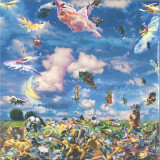
The feel of the compilation is yet again reflected in the enigmatic artwork by Malik Arbab, where shapes and colours suggest animals and plants but in a world that appears to be transient and constantly evolving.

Auf Lager

Bei uns am Lager und sofort versandfertig

26,85
MARIA Die RUHE - Enarchy LP 2x12"

ENARCHY is the debut album by Leipzig-based producer and singer Maria die Ruhe. It is the result of a deep and thorough look the
artist took into both her own inner workings and the world around her. In 14 tracks, she explores different types of energy,
oscillating between head and heart. Final destination of this sometimes painful process of self- exploration is the embodiment of
her own power and creativity; the realization, that she manifests her role as catalyst, healer, and fighter for freedom and equality
by reporting on her experiences. These songs are about nothing less than that. And you can also dance to them.
In a musical sense, Maria surpasses herself compared to previous releases. She is bolder, more explorative and dissolves genre
boundaries. Acoustic instruments like the cello and the piano unite playfully with electronic beats. Her expressive voice speaks and
sings from the lowest lows to the loftiest heights. Her self-disclosing lyrics communicate the deepest messages of the soul. One can
tell right away: something is at stake here, this is about a real human living through something real, and now reporting from the
front lines of the human experience.
With lines like „Things are changing all the fucking time“ (ENARCHY) she posts a reminder for the current zeitgeist and the resulting
global uncertainty. „Some things need to be destroyed before they can heal“ is a demand for openness towards change, even if it is
challenging, requires energy, and leaves behind some scars.
In ART IS THE ONLY REAL TRANSLATION OF LIVING FOR ME, Maria uses sentences like „I’ve been trying to please you, I got headaches
and I still don’t fit“ to express her desperation with existing structures of injustice and the lack of livability of the artist lifestyle.
„Ah, you’re an artist - and what do you do professionally?“ Everyone loves music and art! When, o when, will the understanding
follow that there need to be people who make this art as a central part of their lives?
Frustration takes turns with hope and a growing acceptance of the self. In EQUALISTA, Maria discusses antiquated conditions like the
inequality between the sexes in a kind of manifesto, with a simple proposal for solution: „Let’s both be selfish and raise our
energies, to create a whole world with all the things we need.“
In WE BELONG TO NEVER, Maria sings about the everyday horror of toxic relationships. Lines like „Disengagement and rage, I’ve become such a slave.“ express the despair of the emptiness that results from a lack of affection. She also describes treacherous
narcissistic manipulation: „You cut me small just to feel tall.“
In SKIN, she confesses: „I’m not as enough as everyone else.“ and describes the long and painful way from rejecting her own body
to loving herself unconditionally. „I hate what I feel, while I pretend to be free“ means she doesn’t want to be reduced down to
her body, doesn’t want to be seen as an instagrammable, thoroughly designed product; she wants to be acknowledged as an
individual.
In LOST, she poses a question that many are currently forced to ask themselves: „What do we do with all this solitude?“ Maybe
making use of the reclusion by exploring the shadow self. „Can you cope with the truth?“
The conclusion: energy is being freed up through the means of self-experience and living through the personal darkness -
ENARCHY. The realization: every human being is self-determined and should simply do what they feel. It is everyone’s right to
choose their own life’s path. Here, intuition serves as a signpost. This is both feminine and strong.
ENARCHY celebrates an embodied anarchy by working through the personal shadow and the genuine, healthy integration of the
struggle survived - not as a destructive rebellion, but as a testament of shameless, joyful self-empowerment.
„In the end, I want to be alive, because in reality, I’m free.“

Auf Lager

Bei uns am Lager und sofort versandfertig

24,33
Property - Water Temple LP

Property

Water Temple LP

12inchALT69
Alter
12.12.2022

'Water Temple' is the debut album of the Berlin-based group Property. Comprised of Marijn Degenaar (NL) and Vivant de Non (AUS), the group use the theme of hydromancy to straddle the poetics of reverb from a post-punk perspective. The album wanders through dense end-of-world sensations without keeping away from piercing melodic instrumentation. As hazy as 'Water Temple' can get, Property just as easily trade the murky side of their post-punk sound for analogue synthesisers that feel almost celestial. Used to striking effect on 'Water Temple', the chorus-heavy bassline is interwoven with a strident melody that punctures the rhythm and accents the Neue Deutsche Welle energy that the pair play on at certain moments. Similarly, the vocals on 'Water Tempel' flirt with our cracked times from another angle, rendering a remarkable first transmission from this new duo. Foggy synthesisers fill the cavities of every track, though the driving leads ensure the ambience never overtakes the song-structures across the album. This tendency is best captured on the downer-anthem Blood Cube with its sharp drum machine rhythm, just as Clear Boys reprises this rowdy pop edge for a forceful album closer. The burning melancholy of 'Water Temple' is as shadowy as it is enlivening Track list: 1. Empty Leather Spell 2. Diet Of Worms 3. Water Tempel 4. Sea Wall 5. Blood Cube 6. Verbreek d Eed Niet 7. Het Oerslijm 8. Clear Boys

Auf Lager

Bei uns am Lager und sofort versandfertig

18,28
The Doudou Ndiaye Rose Family - Twenty-One Sabar Rhythms LP 2x12"

Magnificent Wolof drum music, performed by an extended griot family over seven consecutive days, in the mystical setting of Lac Rose, outside Dakar.

Doudou Ndiaye Rose — who died in 2015 — is a key drummer in the musical history of the world. He developed a system of five hundred original drumming patterns, ancient and new. Amongst the modern rhythms here is Bench Mi — ‘under the Baobab tree,’ a spot where problems get solved. Also Hibar Yi — ‘passing on information’ — the theme-tune of Senegalese TV national news for decades — and Les Rosettes, the signature rhythm of Senegal’s first ever all-female percussion group, convened by Doudou, and named after his grandmother.

These original compositions sit alongside important traditional rhythms, familiar to every Sabar player, such as Farwu Jar (a courtship game sometimes resulting in a wedding), Ceebu Jin (also the name of the national dish of fish and rice), and Gumbé, often played after a successful harvest.

Recorded in joyful single takes, with no overdubs, mastered by Rashad Becker, the music is deep and thrilling, polyrhythmic to the bone, with a complex, pointillistic intensity at times evoking Jeff Mills in full flight.

Auf Lager

Bei uns am Lager und sofort versandfertig

18,45
King's X - Three Sides of One 2X12" + CD

Deluxe GF marbled 2LP+CD

Die legendären King's X, bestehend aus dUg Pinnick, Ty Tabor & Jerry Gaskill, freuen sich, die Veröffentlichung ihres 13. Studioalbums 'Three Sides of One' über InsideOutMusic/Sony Music bekannt zu geben. Es ist das erste neue Album der Band seit 14 Jahren, für das sie sich mit dem Produzenten Michael Parnin (Rage Against The Machine, Mark Lanegan) zusammengetan haben, um es in seinem Blacksound Studio in Kalifornien aufzunehmen. dUg kommentiert: 'Es kommt mir vor, als wäre es eine Ewigkeit her, dass wir ein neues Album herausgebracht haben, und ich bin bereit, dass die Welt unser neuestes Werk zu hören bekommt, das hoffentlich ein bisschen von allem enthält, was man an King's X liebt. The groove is with us!" Das Album wird als Limited Deluxe Gatefold 180g Marbled 2LP + CD mit einem exklusiven, handnummerierten Druck und Poster, sowie als Ltd CD Digipak, Gatefold Standard 180g 2LP + CD und als Digitales Album erscheinen.

Auf Lager

Bei uns am Lager und sofort versandfertig

21,85
HDSN - Low End Therapy

HDSN is one of the most diverse young artists in recent times, and every new production that hits the shelves is proof of his endless exploration of the electronic music universe. “Low End Therapy” is the follow up to his first release on NBAST ́s sister label “ We Must Protect This House” , which kicked off a new era of sound on his second home label earlier this year. Now that the dust has settled WMPTH002 is here: straight to the point, pounding and euphoric, its a modern reimagined dream of an illegal 1992 warehouse rave anthem full of energy but also incredibly catchy and instantly recognisable.

collecting

Bestelle jetzt. Wir sammeln aktuell Bestellungen für eine Nachpressung.

10,04

Last In: vor 4 Jahren
Kölsch - 1983 LP 2x12"

Kölsch

1983 LP 2x12"

2x12inchKOM329
Kompakt
10.09.2021

Revered Danish producer and live performer KÖLSCH follows his 2013 hit album "1977" (KOMPAKT 276 CD 107) with the new full-length "1983", again chaining up heroic techno tracks for a grandiose sonic journey to the vibrant heart of today's dance floor. PRIORITY RELEASE

Coupling contemporary production pizzaz with nostalgia-tinged soundscapes and sweeping melodies, this opus acts as both a skilfully composed portfolio of personal memories and a sublime collection of crowd-charming cuts - a modern classic in the making, coming from a master of his craft.

1983 features collaborations with Gregor Schwellenbach, Waa Industry and WhoMadeWho's Tomas Høffding.

Hot on the heels of SPEICHER 84 (KOMPAKT EXTRA 84), featuring club crackers DERDIEDAS and TWO BIRDS, the latest full-length offering from KÖLSCH is very much a travel album: "When I was a kid in 1983, we used to drive through Europe every summer on the way to the south of France", he explains. "A lot of my early music memories stem from these long travels, as we would listen to all my father's favorite records on the cassette deck. After getting a walkman, I would make up my own soundtrack for travelling, with early electro and hip hop creeping into my life. My father of course did not like it, and it never grace the official cassette deck of the car, obviously"

These trips became a primary source of inspiration to a hungry young mind forced to sit on the backseat of a car for several days: "they were also journeys through the seasons. In Denmark, it would be spring time, so I could nearly see us driving through spring into the summer. The scenery would change, and so would the mood in the car." Informed by the symbolic quality of these slightly gauzy childhood memories, KÖLSCH's unique melange of emotional and functional elements works exceptionally well for the full-length format - a seamless transition of musing introspection and explosve expression, where catharsis never seems far away in dance-ready techno vignettes like MOONFACE, UNTERWEGS or PACER.

From beatless opener and title track 1983 to the filigreed piano banger DIE ANDEREN or the bleep-infused synth-fest E45, each cut operates as its own little time capsule, storing bits and pieces of recollection and then magically transforming them into epic, beat-driven soundscapes. Confronted with other producers' input (and other memories), these traits find themselves extended in the most interesting ways - TALBOT, THE ROAD and CASSIOPEIA (also featured on KOMPAKT EXTRA 79) make excellent use of GREGOR SCHWELLENBACH's emotive orchestral flourishes, while BLOODLINE's lyrics come to life thanks to the distinct timbre of TOMAS HØFFDING of WHOMADEWHO fame. A new powerful take on an earlier collaboration, PAPAGENO 30 YEARS LATER not only rejoins WAA INDUSTRY on vocal duty, but also ends the album on a wonderfully elegiac, yet hopeful note - basically turning water into wine, as we've come to expect from KÖLSCH.

Auf Lager

Bei uns am Lager und sofort versandfertig

23,95
Kölsch - Now Here No Where LP 2x12"

2025 Repress

On his fourth album proper, Now Here No Where, Danish producer Kölsch (aka Rune Reilly Kölsch) is charting new terrain. Fans of his ‘years trilogy’ – 1977, 1983 and 1989, released on Kompakt over the past decade – were privy to a kind of sonic diary, an autobiography, tracking the artist’s early years through three albums of superior, meticulously rendered techno. Calling in collaborators where needed – most notably, the strings of Gregor Schwellenbach – there was still something deeply personal going down, not quite hermetic, but internally focused; the albums proved not only Kölsch’s mastery of his chosen form, but also his capacity to make techno personal, individual, and to trace histories of the self through music. But on Now Here No Where, Kölsch finds his feet firmly planted in the present. Reflecting on his new album, he notes, “It is fascinating to write about memories and feelings that have had years to manifest and develop, but how would I approach current emotions?” It’s a good question: our past coheres through the narratives we build around memories, but the moment we’re in, the newness of the now-ness, is harder to navigate; this story is as yet untold. For Kölsch, this makes Nowhere Now Here “an album about life in the year 2020. A time defined by confusion, misinformation and environmental challenges. It is an emotional interpretation of personal and mental challenges, observations and personal growth.” Kölsch does this with music that effortlessly balances emotional heft with the dancefloor’s brimming desires. It’s a space that Kölsch has navigated for a while now – one of techno’s breakthrough acts, an in-demand DJ across the globe and a prolific and restlessly creative producer, he’s also Kompakt’s biggest-selling act – but Now Here No Where ratchets up the lushness, making for a delirious drift across twelve tracks that are at once perfectly poised and deeply trippy. “Great Escape” is an elegant swoon, an opener that pivots on a sigh and a prayer; then “Shoulder Of Giants” bustles into view, subliminal clatter and an aching violin line giving way to a riff that glows with fluorescence and iridescence. “Remind You” combines an odd ECM jazziness with notes from a twenty-first century torch song; “Sleeper Must Awaken” mines huge buzzing synths and lets them float, in and out of sync, with reduced, ticking beats; “Traumfabrik” (dream factory – there’s a giveaway) is oddly lush, the tones malleable and plastic, morphing across a glitching undertow. There are sad, emotional washes of strings throughout the penultimate “While Waiting For Something To Care About”, while “Romtech User Manual”’s patterns twist and shape in the light. Throughout, Kölsch never keeps his eye off the dancefloor, and you can tell this is his still his home. “The amount of energy and joy I experience every time I perform, has a profound effect on me. It has inspired me so much of late and has become an integral part of my musicality.” “The way we join in expressing our hope for the future every weekend has given me so much,” Kölsch concludes. The club as a temporary autonomous zone, as a space both of freedom and of politics; somehow, that’s all here, Now Here No Where. “Most of all, it is an album about hope.”

Auf seinem vierten Album “Now Here No Where” betritt der dänische Produzent Kölsch (alias Rune Reilly Kölsch) neues Terrain. Seine Trilogie mit den Jahreszahlen 1977, 1983 und 1989, die in den letzten zehn Jahren bei Kompakt erschienen war, hatte seine Fans durch eine Art akustisches Tagebuch, eine Autobiografie geführt, die die frühen Jahre des Künstlers über die Länge von drei großartig produzierten Techno-Alben nachgezeichnet hatte. Wo es nötig war, wurden Kollaborateure hinzugezogen - allen voran für die Streicher, arrangiert von Gregor Schwellenbach -, dennoch zeichnete die Musik immer auch etwas zutiefst Persönliches aus, etwas nicht Hermetisches, auf eine bestimmte Art immer auch nach Innen fokussiert. Die Alben bewiesen nicht nur, wie sehr Kölsch die von ihm gewählte äußere Form beherrscht, sondern auch seine Fähigkeit, Techno zu etwas Persönlichem und Individuellem zu machen und der eigene Geschichte durch Musik näher zu kommen.

Auf “Now Here No Where” steht Kölsch nun mit beiden Beinen fest auf dem Boden der Gegenwart. Mit Blick auf sein neues Album stellt er fest: "Es ist faszinierend, über Erinnerungen und Gefühle zu schreiben, die Zeit hatten, sich zu manifestieren und zu entwickeln, aber wie nähere ich mich meinen aktuellen Emotionen?”. Eine gute Frage: Unsere Vergangenheit wird im Innersten zusammengehalten durch Geschichten, die aus Erinnerungen entstehen, aber der Moment, in dem wir uns befinden, die Neuheit des Neuen, ist schwieriger zu beschreiben; die Geschichte ist noch nicht erzählt. Für Kölsch ist “No Here Now Where” daher "ein Album über das Leben im Jahr 2020. Eine Zeit, die von Verwirrung, Desinformation und ökologischen Herausforderungen geprägt ist. Es geht dabei um die emotionale Interpretation von persönlichen und mentalen Herausforderungen, von Beobachtungen und der eigenen, individuellen Weiterentwicklung".

Kölsch tut dies mit Musik, die mühelos kleine Gefühlsausbrüche mit den großen Sehnsüchten der Tanzfläche in Einklang bringt. Es ist dieser Zwischenraum, in dem sich Kölsch schon seit einiger Zeit bewegt, als weltweit gefragter und gefeierter Live Act, DJ und so unermüdlicher wie kreativer Produzent (nicht umsonst ist Kölsch der “biggest-selling-artist” bei Kompakt), doch “Now Here No Where” treibt all das noch weiter auf die Spitze: ein enormer Sog entsteht, der uns über zwölf Tracks hinweg gefangen hält wie ein perfekt ausbalancierter Trip. Der Opener "Great Escape" ist pure Eleganz, ein Track, der irgendwo zwischen Seufzer und Gebet hin und her schwankt; dann drängt "Shoulder Of Giants" ins Blickfeld, ein unterschwelliges Geklapper, eine wehende Geige, schließlich ein schillernder Riff, der in der Dunkelheit zu leuchten und zu glühen scheint.

"Remind You" kombiniert seltsamen ECM-Jazz mit einem sentimentalen Liebeslied des 21. Jahrhunderts; "Sleeper Must Awaken" schürft im Bergwerk riesiger Synthesizer, mal im Takt, mal aus dem Takt ticken die minimalen Beats; "Traumfabrik" ist ungewöhnlich “lush”, die einzelnen Töne, geschmeidig und modelliert, zerfließen in einem glitzernden Abgrund. Das vorletzte Stück "While Waiting For Something To Care About" wird von traurigen, emotionalen Strings untermalt, während sich die Strukturen von "Romtech User Manual" im Licht drehen und immer wieder neu formieren. Die ganze Zeit über behält Kölsch die Tanzfläche im Auge, und man merkt ihm an, dass sie immer noch sein Zuhause ist: "Die Menge an Energie und Freude, die ich bei jedem Auftritt erlebe, hat eine tiefe Wirkung auf mich. Sie hat mich gerade in letzter Zeit stark inspiriert und ist zu einem integralen Bestandteil meiner Musik geworden.”

"Die Art und Weise, wie wir an jedem Wochenende gemeinsam unsere Hoffnung auf eine bessere Zukunft zum Ausdruck bringen, hat mir viel gegeben", so Kölsch abschließend. Die Vision des Clubs als eine temporäre autonome Zone, als ein Raum von großer Freiheit aber auch von politischen Ideen, das ist irgendwie alles hier drin, Now Here No Where. "Es ist vor allem ein Album über Hoffnung."

Auf Lager

Bei uns am Lager und sofort versandfertig

24,33
Stick To Your Guns - Keep Planting Flowers LP

Stick To Your Guns hold a mirror up to society’s ills without blurring its ugliness. In an attempt to unapologetically trumpet real change, the Southern California quintet—Jesse Barnett vocals,Andrew Rose bass,Adam Galindo[drums], Chris Rawson [guitar], and Josh James [guitar]—never shy away from speaking or screaming unpopular truths from the purest place. Founded in2003, Stick To Your Guns have always written and performed with a sense of urgency, their socially conscious message hitting as hard as their signature hybrid of hardcore, punk, and metal. Over the course of their career, they’ve amassed over 50 million total streams, performed on four continents, and shared stages with the likes of Parkway Drive, Architects, and Every Time I Die. Most recently, Alternative Press praised 2017’s True View as “the result of a long time spent on self-reflection and realization.” The band’s latest release ‘Invisible Rain’ incorporates two new songs that remain quintessentially Stick To Your Guns while incorporating fresh elements. The band’s relentless pursuit of a better world and their critique of societal injustices continues to drive their music and message. In 2024, Stick To Your Guns signed with SharpTone Records, marking a new chapter in their storied career. This partnership promises to bring their potent blend of activism and music to an even broader audience, amplifying their call for change and social justice.

vorbestellen01.05.2026

erscheint voraussichtlich am 01.05.2026

27,86
Various - Toolroom Sampler Vol. 14
 
4
auch erhältlich

Vol. 1[13,40 €]

Vol. 2[13,66 €]

Vol. 3[13,66 €]

Vol. 4[13,03 €]

Vol.5[13,66 €]

Vol.6[12,90 €]

Vol.7[13,03 €]

Vol. 8[13,40 €]

Vol. 9[12,90 €]

Vol. 10[13,87 €]

Vol.11[13,87 €]

Vol.12[13,87 €]

Vol 13[14,08 €]

Vol 15[14,08 €]

Vol 16[14,50 €]


Repress 2026

DJ Support from Danny Howard, Annie Mac, Mistajam, Pete Tong, Charlie Hedges, Kraak & Smaak, Maxinne, Todd Terry, Alex Preston, Full Intention, GW Harrison, DJ Rae, Rudimental, Alaia & Gallo, Illyus & Barrientos, Johan S, David Penn, Sam Divine, Riva Starr, Claptone, Nice7, Dario D’Attis, Mousse T, S-Man, Huxley, KC Lights, Friend Within, Dombresky, Gorgon City, Chris Lake, Format:B, Pirupa, TCTS, Alan Fitzpatrick, Low Steppa, Mat.Joe, Raumakustik, Eskuche

The next of Toolroom’s 4 track vinyl sampler series kicks off with a bang(er!). Welcoming CHANEY back onto the label with possible his finest release to date in the shape of ‘I Choose You’. On Toolroom alone he has amassed over 40m streams across leading streaming stores in just 3 years and can add massive imprints like Defected, Insomniac and Perfect Havoc to his list of musical successes. Everything in this record is 100% original and written by CHANEY himself from the self-played bass line, lush rhodes chords and distinctive, poignant vocals.

Next up is Gene Farris who has been a mainstay on Toolroom in recent years and is a regular artist at our label events all over the World. ‘In My Heart’ lands as an exciting collab with the Basura Boyz, a duo also hailing from Gene’s hometown of Chicago and the chemistry between the 3 of them is evident from the first beat! A super cool, stripped back vocal tech house track that sits in that sweet spot of club and specialist radio.

Kicking off the B-side is Deeper Purpose who returns to Toolroom alongside Jalja & Lazy Joe, after his debut club weapon ‘Stutter’ dropped on the label last year. He has had success across all the scene’s leading imprints over the past 12 months including Fisher’s Catch n Release, Experts Only and Repopulate Mars and this record is an anthem in the making! Jalja is on vocal duties, the vocalist that shot to fame after her huge ‘Hanging Tree’ record alongside Michael Bibi. She adds her trademark ethereal vibe to the record and delivers a typically killer hook - This is a real EAR WORM!!

Wrapping things up on Sampler 14 is a very exciting collaboration from 2 of the scene’s brightest shining new stars; Tony Romera and Crusy. Having been die-hard Toolroom fans for many years, this record came about during a conversation about old Toolroom records, and how they collectively wanted to emulate that slightly progressive tech house but bring it right up to date. And they have certainly done that! A real peak-time dance floor moment here with insane production and a unique, intense build up that is already causing maximum mayhem!

Countless radio plays on Radio 1 from Danny Howard, Sarah Storie, Pete Tong

Other notable radio plays – Kiss FM, Toolroom Radio, Sirius XM, Data Transmission Radio, Radio 1 Dance Anthems, Radio 1 Party Anthems, Rinse FM, Select Radio, Tomorrowland Radio

nicht am Lager

Bestelle jetzt und wir bestellen den Artikel für dich beim Lieferanten.

14,24

Last In: vor 10 Tagen
Mindless Sinner - Master Of Evil LP
  • 1: Broken Freedom
  • 2: Key Of Fortune
  • 3: Master Of Evil
  • 4: Screaming For Mercy
  • 5: Mindless Sinner (Demo 1983)
  • 6: Higher And Higher (Demo 1983)
  • 7: We All Go Back (Demo 1983)
  • 8: Heavy Metal Will Never Die
  • 9: City Games (Demo 183)

Purple Haze started out in Linköping in 1981. When singer Christer Göransson joined them towards the end of the year, they soon changed their moniker to Genocide (after the Judas Priest song of the same name) and supported local metal heroes Axewitch. A final name change was to follow: In August 1983, the band, now called Mindless Sinner, recorded a four-track demo entitled »Master Of Evil«, consisting of the title track, “Broken Freedom”, “Key Of Fortune” and “Screaming For Mercy”. This attracted Swedish label Fingerprint Records, and they in turn released the NWOBHM-inspired material as a mini-album with an awful cover and getting the band’s name wrong (spelling it Mindless Sinners). By then, the line-up of the band was Anders Karlsson (bass), Magnus Danneblad (guitar), Jerker Edman (guitar), Tommy Johansson (drums) and vocalist Christer Göransson. »Master Of Evil« originally saw the light of day on Fingerprint in January 1984. Christer Göransson takes us back to the early days of Mindless Sinner saying: “We wanted to record an album, but we couldn’t afford the studio cost. We were lucky to win a music contest, and the price money paid for the studio. I remember walking into the studio, and we thought it was like a spaceship in there, with all the buttons and flashing lights everywhere. We recorded the four songs that would become »Master Of Evil«. We then gave the tape to the Axewitch guys, and they played it to their record label at the time Fingerprint/Web Records and they liked it so much that they signed us as well.” Over the years, the music of Mindless Sinner has often been compared to the Tygers Of Pan Tang from England but Christer Göransson doesn’t see too many similarities: “We really love Tygers Of Pan Tang but I don’t think they were a big influence. It was more Judas Priest, Iron Maiden, Saxon, Black Sabbath, Ozzy, Dio etcetera. That kinda stuff.” In addition to the four tracks of the original edition of »Master Of Evil«, the current High Roller Records pressing also contains the five songs of the band’s first demo tape from early 1983 (including “Mindless Sinner”, “Higher And Higher”, “We All Go Back”, “Heavy Metal Will Never Die” and “City Games”). All nine tracks were mastered by Patrick W. Engel at his Temple Of Disharmony in November 2025. Cutting by SST Germany on Neumann machines for maximum quality on all levels ... The ultimate audiophile re-issue of this Swedish metal classic!

vorbestellen24.04.2026

erscheint voraussichtlich am 24.04.2026

25,63
SHRUNKEN ELVIS - SHRUNKEN ELVIS

Shrunken Elvis ist ein Trio aus Nashville, bestehend aus Spencer Cullum, Sean Thompson und Rich Ruth - drei erfahrenen Musikern, die ihre Liebe zu genreübergreifender Instrumentalmusik verbindet. Die Gruppe entstand aus langen Autofahrten durch Europa, Winter-Jam-Sessions und dem gemeinsamen Bestreben, Musik eher aus dem Bauch heraus als aus Ambitionen heraus zu machen. Cullum, ein in East London geborener Pedal-Steel-Gitarrist, spielte bereits mit Angel Olsen, Lambchop, Miranda Lambert und Billy Strings gespielt und zwei Solo-Folk-Psych-LPs bei Full Time Hobby veröffentlicht. Thompson kam mit Gnarwhal und Promised Land Sound in der DIY-Szene von Nashville groß heraus und tourte später mit Margo Price und Skyway Man. Ruth schafft unter dem Namen Rich Ruth (Third Man Records) immersive Soloarbeiten, die spirituellen Jazz, Ambient und Post-Rock miteinander verbinden. Ihre Anfänge gehen auf eine Europatournee im Jahr 2022 zurück, die sie im Rahmen von Cullums Soloalbum unternahmen. Mit einem kompakten Setup aus Gitarren, Pedal Steel und Synthesizern in einem VW Passat zusammengepfercht, begannen sie unterwegs zu komponieren - und entwickelten eine gemeinsame musikalische Sprache, die sie in ihre Wintersessions in Nashville mitnahmen. Sie nahmen in einem Studio in einem Schuppen um einen Heizstrahler herum auf und fingen den Geist dieser Reisen mit Spontaneität und Vertrauen ein. Ihr Debütalbum zielt nicht darauf ab, individuelle Fähigkeiten in den Vordergrund zu stellen, sondern die Instrumente zu etwas völlig Neuem verschmelzen zu lassen. Mit der Einstellung ,keine Ziele, nur Ideen" schufen sie Musik, die sich ungezwungen, explorativ und lebendig anfühlt. Verwurzelt in den Traditionen von Kosmischer Musik, Jazz-Fusion, Elektronik und Ambient, lässt sich Shrunken Elvis von Alice Coltrane, Michael Rother, Pat Metheny, Ashra und KLF inspirieren lassen - zusammen mit visuellen Einflüssen wie ECM-Albumcovern und den Filmen von Kurosawa und Bergman. Gemischt von Jake Davis (William Tyler) und mit Artwork von Max Kinghorn-Mills (Hollow Hand) ist ihr Debüt ein leise drängendes, zutiefst kollaboratives Album - Musik, die ohne Erwartungen entstanden ist, aber voller Absicht.

nicht am Lager

Bestelle jetzt und wir bestellen den Artikel für dich beim Lieferanten.

22,27

Last In: vor 22 Tagen
DASH RIP ROCK - A SONG IN EVERYONE
  • 1: Taking You On
  • 2: Dangerous Ways
  • 32: Much 2 Do
  • 4: I Don't Wanna Be A Whore
  • 5: Shaking Out The Days
  • 6: Pain Pills Never Expire
  • 7: Mean Mr.mustard
  • 8: Water Valley Throwdown
  • 9: River
  • 10: Hell & Back

Wenn du es weißt, dann weißt du es. Die Shows von Dash Rip Rock sind ein ausgelassener Spaß - eine explosive Mischung aus Respektlosigkeit, Verzerrung und rohem Gitarrensound. Dieses legendäre Trio aus der Louisiana Music Hall of Fame und langjährige Indie-Größen verbinden Roots Rock, Garage Rock, Country-Punk und Southern Swagger und werden von der New York Times für ihre ,Flüssigkeit in der amerikanischen Roots-Musik mit einer kräftigen Dosis Punkrock-Spirit" und von SPIN als ,unbestreitbar die größte Rockband des Südens" gelobt. Mit über siebzehn Underground-Klassikern, einer treuen, genreübergreifenden Fangemeinde aus Rock, Americana und Punk und einem Radiohit aus den 1990er Jahren mit ihrer ironischen Hymne ,Let's Go Smoke Some Pot" liefert Dash Rip Rock weiterhin mitreißende Live-Shows. Gründer, Leadgitarrist, Sänger und Songwriter Bill Davis wird oft als Pionier des Country-Punk, Cowpunk und Alt-Country bezeichnet - Genres, die Rock, Outlaw Country und Punk-Attitüde miteinander verbinden. Die Austin Chronicle lobt Davis als ,das Gehirn hinter Dashs Muskeln, einen Bar-Poeten mit einem ausgeprägten Sinn für Humor und einem unverschämten Talent für gute Riffs". Mit ,A Song in Everyone" kehrt Dash Rip Rock mit einer brandneuen LP zurück, die in Mississippi mit Matt Patton von den Drive-By Truckers aufgenommen wurde.

vorbestellen17.04.2026

erscheint voraussichtlich am 17.04.2026

22,65
PENNY ARCADE - DOUBLE EXPOSURE

PENNY ARCADE

DOUBLE EXPOSURE

12inchTR6071
Tapete
17.04.2026
  • Regrets
  • Memory Lane
  • Worst Trip
  • You've Got The Key
  • Everything's Easy
  • Early Morning
  • Rear View Mirror
  • Time
  • Instrumental No.1
  • We Used To Be Good Friends
  • Mercy
  • Riverside Drive

Double Exposure ist das neue Album des britischen Multiinstrumentalisten James Hoare, bekannt aus Bands wie Veronica Falls, Ultimate Painting und Proper Ornaments. Unter seinem Solo-Pseudonym Penny Arcade präsentiert er ein Werk, das noch roher, spontaner und experimenteller klingt als sein Debüt Backwater Collage (2024). Die Songs entstanden größtenteils schnell und intuitiv - aufgenommen auf einer 16-Spur-Bandmaschine, mit alten Drumcomputern, schwebenden Orgeln und reduzierten Arrangements. Gitarre ist erstmals nicht das zentrale Element, auch wenn Stücke wie "Regrets" zeigen, wie eindringlich Hoares Gitarrenarbeit bleibt. Das Album bewegt sich zwischen psychedelischen Folk-Momenten, Lo-Fi-Experimenten, souligen Anklängen und analogen Klanglandschaften, die an die Offenheit von Syd Barrett oder die Tape-Ästhetik von White Fence erinnern. Songs wie "Worst Trip", "Rear View Mirror" oder das träumerisch-verrauchíte "We Used To Be Good Friends" wirken wie spontane Momentaufnahmen - unfertig im besten Sinne, atmosphärisch dicht und voller subtiler Melodien. Double Exposure ist ein Album der Stimmungen und Schichten: ein intuitiver, unprätentiöser Blick in Hoares kreative Innenwelt, geprägt von Umbrüchen, Ortswechseln und der Schönheit des Ungefilterten.

vorbestellen17.04.2026

erscheint voraussichtlich am 17.04.2026

23,49
Various - Tchic Tchic: French Bossa Nova 1963-1974  Colored Edition LP 2x12"
  • A1: Les Masques - Il Faut Tenir (1969)
  • A2: Isabelle Aubret - Casa Forte (1971)
  • A3: Christianne Legrand - Hlm Et Ciné Roman (1972)
  • A4: Jean Constantin - Pas Tant D'chichi Ponpon (1972)
  • A5: Billy Nencioli & Baden Powell - Si Rien Ne Va (1969)
  • B1-: Marpessa Dawn - Le Petit Cuica (1963)
  • B2: Jean-Pierre Sabar - Vai Vai (1974)
  • B3: Sophia Loren - De Jour En Jour (1963)
  • B4: Isabelle - Jusqu’à La Tombée Du Jour (1969)
  • B5: Sylvia Fels - Corto Maltesse (1974)
  • C1: Frank Gérard - Comme Une Samba (1972)
  • C2: Ann Sorel - La Poupée Des Favellas (1971)
  • C3: Charles Level - Un Enfant Café Au Lait (1971)
  • C4: Andrea Parisy - Les Mains Qui Font Du Bien (1970)
  • C5: Audrey Arno - Quand Jean-Paul Rentrera (1969)
  • C6: Aldo Frank - T’as Vu Ce Printemps (1970)
  • D1: Christianne Legrand - Cent Mille Poissons Dans Ton Filet (1972)
  • D2: Clarinha - Lemenja (1970)
  • D3: Hit Parade Des Enfants - Aquarela (1976)
  • D4: Jean-Pierre Lang - Tendresse (1965)
  • D5: Magalie Noël - Une Énorme Samba (1970)
  • D6: Françoise Legrand - La Lune

Ever since the late 1950s bossa-nova revolution, Brazil’s influence on French music has been undeniable. Pierre Barouh, Georges Moustaki and a vast array of lesser known artists, all made the Musica Popular Brasileira (MPB) an axis of promotion at the service of a cool and metaphysical, modern and mixed Brazilian lifestyle. Some were seduced by the poetic languors of the bossa, some were looking for fun, and others just loved the American hybridization of jazz-bossa, jazz-samba.


What is bossa nova? One of its creators, Joao Gilberto said: "Its style, cadence, everything is samba. At the very start, we didn't call it bossa nova, we sang a little samba made up of a single note - Samba de uma nota so .... The discussion around the origins of bossa nova is therefore useless”. It is nevertheless useful to remember that these magnificent Brazilian songs, which the guitarist describes as samba, were shifted and balanced around improbable chords. "I like things that lean, the in-betweens that limp with grace," said Pierre Barrouh, quoting Jean Cocteau.


With emotion, arrangements for violin and supple guitar licks, bossa nova rapidly changed. A transformation that can be heard in the Tchic, tchic, French Bossa Nova 1963-1974 compilation, the result of a cultural reappropriation, which traveled through the United States and supplemented itself in France.

A musical revolution that has remained significant, bossa nova was born in Rio. From 1956 to 1961, Brazil lived through its golden years. In five years, the country had invented its modernist style. Elected president in 1956, Juscelino Kubitschek de Oliveira, an elegant man with a broad forehead, brandished a promising slogan: "Fifty years of progress in five years". He quickly got to work. Not worried about increasing debt, he launched the project for a new federal capital, Brasilia, designed by the communist architect Oscar Niemeyer. Volkswagen opened state-of-the-art factories and created the “fusquinha”, the Beetle. In Rio, the Vespa made its first appearance. The Arpoador Surf Club crew run into the “girl” from Ipanema, Helô Pinheiro - the tanned garota ("chick"), between a flower and mermaid, who at 17 walked by the Veloso bar, where the fiery author and composer, Tom Jobim and Vinicius de Moraes, were getting drunk on whiskey. From then on, bossa symbolized cool.

In 1958, Joao Gilberto recorded Chega de Saudade, which the directors of Philips denied, calling it "music for fagots". The marketing director, who believed in it, secretly pressed 3000 78-inch vinyls and distributed them at schools around Rio, creating a tidal wave.

American jazzmen then took over. In particular, trumpeter Dizzy Gillespie and guitarist Charlie Byrd. In November 1962, the Brazilian Ministry of Foreign Affairs funded a "Bossa-Nova" concert at Carnegie Hall in New York, inviting the genre’s pioneers. Unprepared, the show soon turned to disaster. But the troupe was invited to the White House by Jackie Kennedy. The first lady loved "the new beat" and in particular Maria Ninguem, a song by Carlos Lyra, later covered by Brigitte Bardot.

In Brazil, the 1964 military coup quickly ended this euphoria. The destructive atmosphere that ensued pushed many Brazilian musicians to leave, if not to exile. Thus, Tom Jobim, Sergio Mendes and Joao Gilberto arrived to the United States. In New York, Joao Gilberto met saxophonist Stan Getz. At the time, he was married to the Bahianese Astrud Weinert Gilberto, who had a German father. She had never sung before, but she knew how to speak English. Getz therefore asked her to replace her husband on The Girl From Ipanema. The Getz/Gilberto record with Tom Jobim on piano, was released in March 1964. Phil Ramone, the "pope of pop" was in charge of sound.

Bossa nova arrived in Paris through the classic “guitar-voice” channel (Pierre Barouh, Baden Powell, Moustaki…) But France loved jazz and Paris had already welcomed its American contributors. All these good people were to pass through Saint-Germain-des-Prés. The cabaret l'Escale became the Mecca of Latin American sound where one could find Pierre Barrouh and his friends, such as the Camara Trio, samba-jazz aces, whose only record was published by the Saravah label. With a band strangely called Les Masques (a band that included Nicole Croisille and Pierre Vassiliu, among others), the Camara Trio recorded an interesting Brazilian Sound, including the track Il faut tenir which is present on this tasty compilation of rarities.

Other enlightened musicians can also be found on the compilation, such as Jean-Pierre Sabar (songwriter for Hardy, Auffray, Leforestier ...) and the French pop rock organist Balthazar. In 1975, Sabar recorded Aurinkoinen Musiikkimatka on a Finnish label, which featured the crazy Vai, Vai, included on this record. We are now following the footsteps of Brazilian electronic musicians such as Sergio Mendes, Eumir Deodato or Marcos Valle who created funk and disco sounds on their keyboards and synthesizers. A style that influenced Véronique Sanson when she wrote Jusqu’à la Tombée de la nuit in 1969 for Isabelle de Funès, the niece of Louis and a great friend of Michel Berger - Sanson did end up singing this track on her 1992 Sans Regret record.


The pinnacle of exoticism and travel, Sylvia Fels’ Corto Maltese includes bongos, sea mist and ocean sounds. The title was taken from Jacky Chalard’s concept album written in 1974, Je suis vivant, mais j’ai peur (I am alive, but I am scared), based on Gilbert Deflez’s science fiction novel.


However, bossa nova extended the scope of popularity. "In the 1970s, I was a fan of Sergio Mendes, Getz / Gilberto. I fell in love with this music that I knew because I had been an orchestral singer, " explained Isabelle Aubret, who in 1971 delivered a composite record of covers by the very funky Jorge Ben, Orfeu Negro, Tom Jobim, Vinicius de Morais and Jean Ferrat. "I recorded this album for Meys Records in Paris, far from Brazil, with wonderful musicians, François Raubert, Roland Vincent, Alain Goraguer...". The latter wrote the arrangements for Casa Forte, a very percussive title borrowed from Edu Lobo, one of the initiators of the bossa who spent time in California. "Jazz and bossa came together and produced very rhythmic music. I love singing, it allows me to dream, to have fun, to feel a high on stage, and these songs brought me joy, made me swing, my singing felt like a dance.”


The world tours of French singers and their desire for the tropics, often brought them to Rio with its hills, forests, caipirinhas and tanned bodies. There are surprises though, like this Iemenja (Iemenja is the goddess of the sea in the Afro-Brazilian candomblé religion). Not unlike the composer and musician Jean-Pierre Lang, based in Sao Paulo, Claire Chevalier taught Brazil to Brazil. In 1970, the singer and painter published a 45-inch vinyl, Mon mari et mes amants (My husband and my lovers), under the improbable pseudonym of Clarinha (little Claire). She was then living in Rio, with her husband, Joël Leibovitz, who founded a band called Azimuth, and who owned a record label specialized in "sambas enredos" songs for samba school parades.


For its B side, she asked Pierre Perret to come up with lyrics for a song composed by Carlos Imperial: "Oh goddess of the sea, o goddess Iemenja, I bring a white rose to adorn your long hair ..." . "Perret came to see us, and we had fun, remembers Joël Leibovitz. We wrote Lemenja for fun, we recorded it at the Havaí studio, behind the Central do Brasil the central station. Erlon Chaves, the arranger who worked with Elis Regina, joined us" adding his share of Afro-Brazilian percussions and funky brass to the mix.

There is a common misunderstanding in Franco-Brazilian history: that bossa, admittedly hedonistic, is perceived as funny, even though the poets who wrote the texts are often philosophizing on the human condition. Its French interpreters pull it towards a carnival inspired universe, far removed from its fundamental essence. Thus, Jean Constantin covered the famous Samba da minha terra, an ode to the art of samba written by the classic Bahian composer Dorival Caymmi, renaming it with the enticing title of Pas tant de tchi tchi pompon: "On your pier there is no tchi tchi / when you arch your back, you know everything is alright ”(lyrics by Gérard Calvi). This expedited bossa aims for the absurd, but retains a certain elegance.

Indeed, Jean Constantin was not an idiot, the rather large man had a huge mustache and liked fantasy, (Les pantoufles à papa, Le pacha, inspired by cha-cha-cha-cha, salsa and jazz) but he was also the lyricist of Mon manège à moi interpreted by Edith Piaf, the composer of Mon Truc en plume by Zizi Jeanmaire and the soundtrack of François Truffaut’s 400 Blows. Le Poulpe, published in 1970, from which this bossa is extract, was arranged by Jean-Claude Vannier, an accomplice of Serge Gainsbourg’s Melody Nelson. In short: "There is enough of samba / By looking at the parasol / Because my poor cabeza / Is going to die in the sun".

Even the American actress Marpessa Down, who was at the heart of the bossa nova revolution with her role as Euridyce in Marcel Camus’ film Orfeu Negro, winner of the 1959 Cannes Palme d'or, fed the clichée with Je voudrais parler au petit cuica - "Tell me how you manage to always make people want to dance / It's true, I must admit that I cannot resist your magic" - in consequence, once can hear the cuica, a little drum inherited from the Bantu.


But bossa nova had many angles. Societal, of course, pushing actresses who were symbols of women's liberation like Brigitte Bardot, Jeanne Moreau, or Sophia Loren to engage in the exercise of accelerated bossa. In February of 1963, Sophia Loren made a record in French in Rome, Je ne t'aime plus, featuring the song De jour en jour, a bossa written by two Italians, Armando Trovajoli and Tino Fornai, which was released a little later by Barclay. Bossa accompanied the 1960s, a decade of moral liberation. Ann Sorel, who interpreted La Poupée des favellas, caused a sensation with L’amour à plusieurs, a provocative song written by Frédéric Bottom and Jean-Claude Vannier. As for the actress Andrea Parisy, she displayed her bourgeois cheekiness in Marcel Carné's Les Tricheurs before interpreting Les mains qui font du bien. And Magalie Noël, the friend of Boris Vian, who sung Johnny fais-moi mal, was hired to sing Une énorme Samba, composed by Alain Goraguer (arranger to Gainsbourg, Bobby Lapointe and Jean Ferrat) with lyrics by Frédéric Botton.

But in the end, of what wood is bossa nova made of? The answer is given by Christianne Legrand, daughter of Raymond the conductor, and sister to Michel the composer: "With me, with jà" - jà means "immediately" in Portuguese. In 1972, the singer, an expert in vocal jazz and a member of the Double Six, published Le Brésil de Christianne Legrand. Two songs included on the Tchic Tchic compilation that demonstrate how bossa, jazz, funk, rock, etc. work like a swiss army knife: the music is used to denounce broken systems, or miracles, HLM et ciné roman, Cent mille poissons dans ton filet, two songs from the O Cafona soundtrack, a successful telenovela broadcast, at the time in black and white, on TV Globo. The first was adapted in French by the fighter and friend of the Legrand tribe, Agnès Varda. The second is content with a play on words, jostling them into a summer fun.


Véronique Mortaigne

vorbestellen17.04.2026

erscheint voraussichtlich am 17.04.2026

27,31
Forndom - Faþir LP

Forndom

Faþir LP

12inchLPNVP123
NORDVIS
10.04.2026

The cycle of life and nature is a precious and wondrous thing. We are born. We learn. We live. We die. And after death, another life awaits. When the world succumbs to the cold, dark grasp of winter, the promise of a spring birthing everything anew keeps hope alive. Such is the journey we make, and such is the lifespan of “Faþir”. Heaving, pulsating, filled with contrasts: ardent hostility and fiery revenge, blossoming life and lush fertility, soul-wrenching grief and deep anguish. Such is the path we walk under the guidance of the deities – the helping hand of a father, the nurturing wisdom in times of need. But sometimes, a treacherous god leads us into death and despair, albeit always with an underlying purpose. Such is “Faþir”.

With eloquence, elegance, and emotion, L. Swärd has created another monolith of sublime art to add to Forndom’s impeccable discography. This highly awaited follow-up to 2016’s “Dauðra Dura” is nothing short of a modern masterpiece, rooted in ancient ways. Expressive vocals and strings soar atop a foundation of unyielding drums, like spirits dancing in the skies yet bound to the human pulse. Never surrendering its strong connection to our mortal world, “Faþir” carries a deeply sacred dimension – a glimpse of the divine, seen through a lens of devotion and veracity. The joining of death and life, if you will.

The thick atmospheres and vast inner landscapes Forndom creates are more prevalent than ever, and from the first trembling string introduction of “Jakten” to the last wistful beat of “Hemkomst”, one is transported to another time, another place, and another mindset – leaving behind the calamity, stress, and superficiality of the modern world, and rediscovering the lost wisdom hidden behind the veil of passing years.

vorbestellen10.04.2026

erscheint voraussichtlich am 10.04.2026

23,95
MARKET EAST - FRENCH STREET
  • Angel From The Sky
  • Meditations On Mother Earth
  • Circles Of Time
  • Echoes Of My Heart
  • Everyday, Springtime
  • In The Delta
  • The Castles Of Our Minds
  • Roses
  • Italian Market Wine
  • French Street
  • St. Rita
  • So Hard To Say Goodbye
auch erhältlich

PAISLEY PEACH VINYL[24,79 €]


Market East teilt endlich seine wichtigste Botschaft mit der Welt in Form seines Debütalbums ,French Street". Die Band, bestehend aus Kurt Cain (Gesang), Vincent John (Gesang, Bass, Gitarre und Keyboard) und Maxwell Perla (Gesang, Schlagzeug und Percussion), liefert ihre charakteristischen himmlischen dreistimmigen Harmonien über Arrangements, die noch nie so reichhaltig und fesselnd geklungen haben. ,French Street" ist extrem gefühlvoll und die Vocals sind üppig, als hätten die Zombies in Muscle Shoals aufgenommen. Die Texte sind poetisch und nostalgisch, da die Band Songs über ihre vergangenen ,goldenen" Jahre geschrieben hat. Damals hatten die Jungs nicht viel außer einander und ihrer gemeinsamen Liebe zur Musik. Sänger Kurt Cain lebte in einem kleinen Reihenhaus in North Philadelphia in einer fast verlassenen Gasse namens French Street. Hier trafen sich Cain, John und Perla jede Woche, um der Realität zu entfliehen und sich gemeinsam an der Musik zu berauschen. Sie entwickelten eine tiefe Wertschätzung für alles aus den 60er- und 70er-Jahren, von Simon & Garfunkel bis The Moments und allem, was dazwischen liegt. All diese Jahre später hat Market East ein eigenes klassisches Album geschaffen. Vom Barock-Pop des Titelsongs und dem mitreißenden Soul von ,Roses" bis hin zu den lateinamerikanischen Klängen von ,Echoes of My Heart" und den orchestralen Klängen von ,Everyday, Springtime" zeigt Market East ihre beeindruckende Bandbreite. Die Platte wurde in Philadelphia auf Analogband aufgenommen und von Market East und Eraserhood Sound produziert. Hol dir noch heute dein Exemplar dieses zeitlosen Klassikers.

vorbestellen03.04.2026

erscheint voraussichtlich am 03.04.2026

23,49
Artikel pro Seite:
N/ABPM
Vinyl