Quinnisa Kinsella-Mulkerin recorded her first song at five years old with her parents, who comprise the adventurous Maine band, Big Blood. Ever since the age of five, she was writing songs, banging on chimes, strumming guitars, and clanging together whatever else she could find. Improvisation was natural, and she stuck to the approach. Quinn brings this innate sense of songwriting to The Wickies, a duo she formed with Aiden Arel a year ago at age 16, whose chill approach and fluid delivery belie true inventiveness in the underneath mechanics. Inspired by seventies folk icons like Stevie Nicks, Krautrock bands like Can, and modern indie-rockers like Alex G, The Wickies feel like an amalgamation of these decade-spanning sounds, but uniquely their own. Quinn’s voice croons like a seventies folk star, but it possesses a great and controlled tone. Her vocals feel like another instrument within the mix, building and growing each song to its fullest sound, leaving no detail within the mix unheard. Their use of echoing guitar lines recalls sixties psych, a springboard for their unique take. Quinn’s lush, free-flowing lyrics, created on the spot, complement Aiden's fleshed out backing instrumentation and over-dubbing. Quickly, the pair created more material than they ever needed, allowing them to mold their recordings into a self-titled debut album. Like a painter crafting the perfect exhibition of their finest work, Aiden and Quinn condensed their improvisations to all the best parts. Tracks like “Campfire Song” and “Skipping Pond,” exemplify the ethereal and lackadaisical atmosphere of their sound. “I keep finding these weird, obscure bands from the seventies that have one album and nothing else, which is awesome,” Quinn said, “I want my music to sound like somebody found it in a record store that no one has ever heard of and uploaded it to YouTube. I want it to sound a little strange.”
Suche:exhibit
2024 Repress
Dark Entries is honored to finally present the first ever official vinyl reissue of Space Museum by Solid Space. Solid Space was the British duo of Dan Goldstein (keyboards, vocals) and Matthew 'Maf' Vosburgh (guitar, bass, keyboards, vocals) formed in 1980. Dan and Matthew met at the age of 11 while attending school in north London. In late 1978 at at the age of 14, they formed Exhibit 'A' with Paul Platypus' and Andrew Lunchbox' Bynghall. They recorded two EPs in 1979 and 1980, self-released on Irrelevant Wombat Records and appeared on 'The Thing From The Crypt' compilation. After the dissolution of the group, Mathew started taking his guitar over to Dan's house where he'd play his Casio MT-30 and they would record songs. Eventually a second hand drum machine and Wasp synthesizer were acquired from classified ads in Melody Maker and the Solid Space sound was born. By this time they were just turning 18 and finally found the freedom to make the music they'd had in their heads. Over the course of the next two years the band assembled eleven bedroom recordings that would become one of the most cherished DIY obscurities of its kind. Their debut album 'Space Museum' was released in 1982 on cassette by In Phaze Records. All of the songs were mixed by label boss Pat Bermingham on 8-track tape at The Shed, in Ilford, which was literally a garden shed. The band's music and lyrics were heavily indebted to science fiction, in particular the 1960s television series Doctor Who. 'Space Museum' is an unveiling of atmospheric, minimalist post punk supported by bright melodies. The music combines drum machines and synths with acoustic guitar and toy drums whilst also experimenting with samples between tracks. Lyrics deal with space travel and a general sense of dejection. Representing a bubbling spirit within the underground, they foreshadowed an entire world of independent music which would emerge across the 80's and well into the 90's. For this reissue we've included two bonus tracks from the band's archive, Platform 6' originally released on the B-side of the second single by Exhibit 'A', this song features only Dan and Matthew and is the first Solid Space track ever recorded. Tutti Lo Sanno' is a cover of In Phaze label mates Marine Girls, though the lyrics have been changed to suit the gender of the new singer.Each song has been carefully remastered for vinyl by George Horn at Fantasy Studios in Berkeley. The record is sleeved in a replica of the cassette artwork featuring the Cybermen and Jamie from the Doctor Who episode "The Wheel in Space". Every copy includes a double sided 11x11 insert with lyrics, notes and never before seen photographs of the band taken by Maf as well as a postcard featuring an original advert for the cassette.
Never say never! Because it's time for TURMOIL - a surprising landmark album comeback for RICO PUESTEL defining a musical and personal turning point with a completely new and re-invented artistry. About time!
4U opens the Pandora's Box of TURMOIL with inimitable meditative beauty, descending into the metaphorical and tonal SLICES OF LIFE that unleashes a complex chain of energy while WHERETO even overcomes this high voltage setup with a deadly infective loop and the only reminiscences of something to call Techno on this album in its fading conclusion.
Before HEART OF GOLD defines the probably most immersive peak on TURMOIL with its vast soundscape and mantra-like piano shuffle, QUESTIONS floats in Dubstep'ish ways to actually raise two questions to the listener while this train keeps on going.
FIVE SIGNS speeds up the pace on the album's second half, culminating in the mesmerizingly driven groove and words of HIGH HOPE and the powerful Upbeat drenched into ambient soundscapes on NEWTON.
Nearing the end of TURMOIL, DUMB delivers the longest vocal verses on this album and proceeds with the most pervasive and powerful layers of beats, violins and synth stabs.
Closing and re-starting all of it, EVERENDING grooves into infinity with its yoga-like theme and spreads some true love.
Without a doubt, TURMOIL happens to be the most accomplished work by RICO PUESTEL melting so many of his artistic worlds into one unique piece of art!
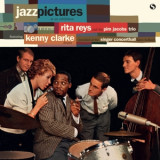
Once billed as "Europe's First Lady of Jazz," Rita Reys was a legend overseas during the second half of the 20th century, and certainly one of the top European jazz singers. Jazz Pictures at an Exhibition showcases a 1961 concert featuring Rita with the Pim Jacobs Trio (also including Pim's brother Ruud on bass), plus drum legend Kenny Clarke. This was the only time ever Reys and Clarke recorded together.
- A1: Volta Semantron (Inre Kretsen Grupp & Prins Emanuel)
- A2: Athos Dub (Holy Tongue)
- A3: Garden Of Kibele (Esma & Murat Ertel)
- A4: Doxology (Daniel Paleodimos)
- B1: Idän Kuoromiehet (Jimi Tenor)
- B2: Synaptic Riddles (Jay Glass Dubs)
- B3: L'île Météore (Gilb'r)
- B4: I Swim In Your Dreams (Organza Ray)
- C1: Vatopedi Semantron Vespers (Gregoriou Monastery)
- C2: Axion Estin, Mode Plagal B (Daniilaioi Brotherhood Choir)
- C3: Christos Anesti, Mode Plagal A ((Daniilaioi Brotherhood Choir)
- C4: Theoteke Parthene, Mode Plagal A (Daniilaioi Brotherhood Choir)
- C5: Doxologia Chourmouzioy, Mode Varys (Daniilaioi Brotherhood Choir)
- C6: Osoi Eis Christon, Mode Plagal A (Daniilaioi Brotherhood Choir)
- C7: Tas Esprinas Manouel Chrysafis, Mode Plagal A (Daniilaioi Brotherhood Choir)
- D1: Doxastikon Idiomelon, Mode Plagal A (Father Lazaros Of Gregoriou Monastery)
- D2: Anoixantos Sou; Koukouzelis, Mode Plagal D (Father Germanos Of Vatopedi Monastery)
- D3: Cherouvical Hymn, Third Mode (Iviron Monastery Choir)
- D4: Axion Estin, Seventh Mode (Father Antipas)
- D5: Koinonikon, Mode Plagal A (Simonopetra Monastery Choir)
Mount Athos, known as the «Holy Mountain,» is a monastic peninsula in northeastern Greece, central to Eastern Orthodox monasticism for over a millennium. Its twenty monasteries house around 2,000 monks dedicated to prayer and worship, which songs have echoed across the Aegean Sea for centuries, heard only by visiting pilgrims, isolated from conventional time and global events.
After several years of research, and several visits to the retired community, we are happy to present our new project «Athos : Echoes from the Holy Mountain» dedicated to this liturgic music and repertoire that seems to be evolving outside the usual boundaries of time and space. Rooted in Byzantine chant, this a cappella tradition essential to monastic life featuring intricate yet serene melodies designed to facilitate prayer and contemplation, using a system of modes and scales to create a meditative atmosphere.
Trans-disciplinary, this effort of documentation also comprehends an artistic re-interpretation aspect inviting contemporary Greek and foreign artists to reflect on the subject.
A musical compilation which captures original field recordings from the 1960s and from today capturing the essence of liturgical music on Mount Athos, but also new compositions inspired by them by artists such as Holy Tongue (UK), Jay Glass Dubs (GR), Prins Emanuel & Inre Kresten Grupp (SWE), Jimi Tenor (FI), Gilb’r (FR), Daniel Paleodimos (GR), Esma & Murat Ertel (TUR) and Organza Ray (GR/US).
A trilingual book in English, Greek and French, featuring essays, articles, photographs and artistic comissions reflecting around the theme giving a voice to contributors such as , Stratos Kalafatis, Theodore Psychoyos, Tefra90, Father Damaskinos Ulkinuora, Prof. Thomas Apostolopoulos, Makar Tereshin, Phaedra Douzina-Bakalaki, Michelangelo Paganopoulos and Alberto Cameroni.
The release of the book and the record will be followed by a cycle of exhibitions and conferences, deploying FLEE’s year-long research on Mount Athos, as well as its numerous commissioned artworks.
- A1: Zdenka Vuckovic - Ja Cu Prezivjeti (I Will Survive)
- A2: Gabi Novak - Pjesma Je Bila Zivot Moj
- A3: Krunoslav Slabinac - Juzni Vjetar
- A4: Arian - Do Posljednjeg Daha
- B1: Moni Kovacic - Be My Bear
- B2: Kim - Naivke
- B3: Rok Hotel - Disko
- B4: Grupa St - Superkazanova
- B5: Ivica Surjak - Julija
- C1: Vera Kapetanovic - Ne Gubi Vreme Sa Mnom
- C2: Milka Lenac - Zeljo Luda
- C3: Nano Prsa - Dzingis Kan
- C4: Dubravka Jusic - Stani Stani
- D1: Ljupka Dimitrovska - Robot (Version 1983)
- D2: Ana Sasso - Krenimo Niki
- D3: Elvira Voca - Drugo Vrijeme (The Second Time)
- D4: Opatijski Suveniri - Vamos A La Playa
- D5: Roman Butina - I'm Gonna Get Your Love
A collection of 18 rare disco tracks from Yugoslavia. Compiled by Leri Ahel & Zeljko Luketic from original master tapes. Fox & His Friends label owners Ahel & Luketic selected obscure 7'' singles, b-sides, out-of-print releases and digged deep into the vaults of Jugoton to tell the story of how disco infiltrated clubs and pop music. This compilation is vinyl counterpart to their pioneering research and work in two major exhibitions tracing roots, influences and social significance of disco in music, fashion and design held in 2015 in Klovicevi Dvori Museum and HDD Gallery in Zagreb. "Socialist Disco - Dancing Behind Yugoslavia's Velvet Curtain 1977-1987" double gatefold LP with extensive liner notes contains tunes from KIM Band, Gabi Novak, Arian, Ljupka Dimitrovska, Ana Sasso, Moni Kovacic, Milka Lenac, Rok Hotel, Ivica Surjak, Grupa ST, Nano Prsa and many more in various sub-genres including classical orchestrated disco, dance reworkings of international chart hits and synth-filled italo-disco stompers performed by Yugoslavian music stars, fashion models and even sports and football heroes. Disco, a vital Trojan horse (in local notion: a pop music you can dance to), stayed quite a long time In Yugoslavia, refusing to be silenced and refusing to jump into the bandwagon of expected. It was influenced by American and European disco sound, for example, by the Boney M, Amanda Lear or Love Machine, who all visited Yugoslavia and had live concerts. The producers and the big record companies like Jugoton, PGP RTB, Diskoton or ZKP RTVL, noted the hype in music and they constantly probed the market with limited run of seven inchers or special performances. Some artists were quite successful, but the rest were in the 7'' single empire which was free enough to experiment with all things disco had to offer - genre hybrids, use of electronics, sexual innuendo, bizarre lyrics and most importantly, great musicians and major composers having fun. The no-restrictions policy of disco was there to evade the rules and surely it did.
First re-press since the initial 2019 release of critically acclaimed album featuring Yeah Yeah Yeahs' lead vocalist Karen O, and Danger Mouse, one of the most influential artist/producers of the 21st Century.
Debuting in March 2019, Lux Prima was hailed by Pitchfork as a “dreamy and poignant collaboration.” It featured the single “Woman,” which was accompanied by a memorable Spike Jonze-directed live performance on The Late Show with Stephen Colbert. The single was also nominated for the Best Rock Performance Grammy.
The new package includes the original artwork plus a 16 page booklet highlighting their interactive exhibition “An Encounter with Lux Prima”, held at Los Angeles’ Marciano Arts Foundation featuring a 360 degree soundscape of the album mixed at famed Skywalker Ranch.
Permanent Parts is the second album released by visual artist Katharina Grosse (synthesizer) and musician Stefan Schneider (synthesizer; So Sner, To Rococo Rot). Grosse and Schneider were joined at Galerie Max Hetzler on 29 April 2023, performing as part of the Spectrum without Traces exhibition, by three artists who all generally work within improvised music – Carina Khorkhordina (trumpet), Tintin Patrone (trombone and electronics), and Billy Roisz (noise generator, piezo and mini cymbal). Permanent Parts is an extraordinary set of recordings that inhabits multiple zones at once: within its thirty-five minutes, we can hear the interactions of non-idiomatic collective music making, and the electronic glimmers of electro-acoustics, while, at the same time, the music remains untethered to genre.
This capacity to work within liminal zones makes perfect sense when thinking about both Grosse’s and Schneider’s prior work, whether the energetic diffusions and spatial explorations of Grosse’s artistic practice, or the slippery texturology of Schneider’s recent work with electronics. Khorkhordina, Patrone and Roisz all find their own ways into this dynamic, too, and Permanent Parts feels like an equal exchange of presence and contribution; there are no hierarchies here. This might explain the music’s curious sense of development, where several elements are allowed to exist alongside each other, not in direct contact but in a mode that’s somewhere between carefree layering and unconscious juxtaposition. The musicians are listening, but not just with their ears – their skin, their bodies are hearing, too.
When talking about Permanent Parts, Schneider is careful to place it within contexts that are specific, to some degree, but which allow for difference to blossom. “Although it was recorded live, it somehow was not meant to be a documentation of a live event in the first place. The five piece line up that appears on the record had met for the first time only a few hours before the concert took place.” While it might take a leap of faith for all parties to walk together, and so willingly, into a place of such freedom, of such risk, there is clear sympathy here between the musicians, and a shared appreciation of the immediacies of the situation.
It also throws some of our preconceptions about this music out of the window. “The record does not feel like a document of a performance as the music was not pre-composed and there was no reference,” Schneider continues. “Perhaps it was not even an improvisation?” For Grosse, her musical relationship with Schneider similarly shakes free from expectation: “My sound does not exist without Stefan’s. It is neither written down nor is it improvised. It is instantaneous.” When thinking about the five-piece exploration on Permanent Parts and asked to expand on what each musician brings to the table, she continues, “We all love the thrill of an unknown encounter and we seem to have a need for building connections through the thicket of our voices.”
There’s a curious phrase on the back cover of the album, before the artists are listed: “Wir sind eine Batterie / We are a battery.” This sums up the spirit of Permanent Parts. Schneider recalls that Grosse said this phrase to the musicians at the start of the performance. Grosse explains further, “The figure of the battery referred to our placement in the space building out a small circle facing one another from where the sound could spill into the impressive volume of the gallery.” The battery as an arrangement of similar devices; but I also think of charge, and the conversion of chemical energy, and of fortification. It’s a poetic metaphor that sums up much of the febrile pleasure of the music contained on these Permanent Parts.
– Jon Dale, Melbourne
crys cole returns to Black Truffle with Making Conversation, her third solo release for the label. After the intimate song-like constructions of Other Meetings (BT096), Making Conversation documents a different facet of cole’s work, presenting three rigorously conceptualised commissioned pieces, each of which extend her signature approach to highly amplified small sounds into new directions.
The side-long title piece is a stereo version of an 8-channel sound installation exhibited in 2023 at the Tabakalera Art Center in Donostia / San Sebastian, Spain. The piece uses a multitude of instrumental, vocal, concrete and electronic sounds to evoke the soundscapes cole encountered during nocturnal listening session in Bali, Indonesia in 2018 and 2019. In this world of night sounds, she explains, she ‘observed the complex interplay between amphibian, lizard, bird and insect communication, domestic animals (roosters, dogs), man-made sounds (airplanes, vehicles, conversations and evening activities) and sounds that were difficult to place’. Drawing on field recordings as memory aids (but including none in the finished piece), cole’s piece uncannily reproduces the spatiality and pacing of environmental sound without attempting strictly to replicate it. We hear insect-like twittering and birdsong fragments, resonant thuds and distant roars, furtive crunches and taps, muffled breath and metallic scrapes. While at times it can be difficult to imagine the source of these sounds, at other points they are clearly instrumental or electronic in origin; in its placement and layering, though, the whole assemblage suggests the glorious, unthinking richness of a non-musical sound environment. Suggesting at once the electronic gardens of Rolf Julius and the little instrument expanses of classic AACM, the piece is a brilliant enactment of the Cagean drive to ‘imitate nature in her manner of operation’.
‘Valid ForeverrRrrRRrrr… (pt. 1)’ began as cole’s contribution to an Issue Project Room commission to realise a score from Alison Knowles and Annea Lockwood’s Women's Work, a 1975 collection of text and conceptual scores by women artists and composers. cole’s piece begins from Beth Anderson’s Valid for Life, a complex arrangement of the letter R in various typefaces. Where the composer suggests a realisation on a trio of acoustic instruments (playing rolls with velvet beaters), cole translates the piece into her characteristic sound and object language as a trio of rolling sounds on ‘two large similar paper things and one 5-pin bowling ball’. Rolling from one side of the stereo field to the other, the bowling ball’s uneven movement is the heart of this immersive textural array, created with the simplest materials, which generates phantom sensations of pitch and phasing effects solely through amplified friction.
On ‘Valid ForeverrRrrRRrrr… (pt. 2)’, cole makes a first foray in translating her signature approach into conventional instrumental sounds, here in the form of a transcription for MIDI percussion ensemble. The result is refreshingly puzzling, comparable perhaps only to the sparsest moments of Keiji Haino’s classic “C’est parfait…” Accompanied with extensive liner notes, photographic documentation and a download code, Making Conversation is an exciting next step in cole’s work, extending her signature concerns in new sonic and conceptual directions.
2024 marks 10 years since the release of Perfume Genius" critically acclaimed album Too Bright (Matador). The third studio album by Perfume Genius (Mike Hadreas) marked a significant departure from his earlier work with its bold, avant-garde sound and introspective lyrics. The LP featured the standout single "Queen"- Hadreas" confrontational dissection of "gay panic" which Pitchfork said "sounds like triumph amid the pathetic relevancy of its subject matter in 2014." The song was jolt in the cultural discourse and has since become a fan-favorite. Hadreas grew up in Seattle, WA and started his music career in 2008. He put himself on the map with the release of debut album Learning in 2010 via long-time label home Matador Records, earning him widespread praise from music critics and fans around the world.The momentum only intensified with his subsequent albums, 2012"s Put Your Back N 2 It, and 2014"s Too Bright, which exhibited a massive leap forward in both production and confidence.
Permanent Parts is the second album released by visual artist Katharina Grosse (synthesizer) and musician Stefan Schneider (synthesizer; So Sner, To Rococo Rot, Mapstation). Grosse and Schneider were joined at Galerie Max Hetzler on 29 April 2023, performing as part of the Spectrum without Traces exhibition, by three artists who all generally work within improvised music - Carina Khorkhordina (trumpet), Tintin Patrone (trombone and electronics), and Billy Roisz (noise generator, piezo and mini cymbal). Permanent Parts is an extraordinary set of recordings that inhabits multiple zones at once: within its thirty-five minutes, we can hear the interactions of non-idiomatic collective music making, and the electronic glimmers of electro-acoustics, while, at the same time, the music remains untethered to genre.
Limited "Bamboo" Brown Vinyl[33,82 €]
Nick Lowe returns with Indoor Safari, his first studio album in over a decade. Backed on every track by Nick's trusted collaborators Los Straitjackets, Nick exhibits his razorsharp songwriting ability through a multitude of sonic environments. With his signature wit on display for grooving numbers like "Went to a Party" and "Don't Be Nice to Me," to the heartfelt sentiment on "Blue on Blue" and "Jet Pac Boomerang," and topped with Nick breathing new life into hidden gems of the '60s like "Raincoat in the River" and "A Quiet Place," Indoor Safari demonstrates how Nick Lowe continues to make his mark as a performer, songwriter and producer over a half-century after his start in the music industry. This First Edition pressing of Indoor Safari is pressed on bamboo color vinyl and is limited to 2,000 copies worldwide.
Black Vinyl[31,72 €]
Nick Lowe returns with Indoor Safari, his first studio album in over a decade. Backed on every track by Nick's trusted collaborators Los Straitjackets, Nick exhibits his razorsharp songwriting ability through a multitude of sonic environments. With his signature wit on display for grooving numbers like "Went to a Party" and "Don't Be Nice to Me," to the heartfelt sentiment on "Blue on Blue" and "Jet Pac Boomerang," and topped with Nick breathing new life into hidden gems of the '60s like "Raincoat in the River" and "A Quiet Place," Indoor Safari demonstrates how Nick Lowe continues to make his mark as a performer, songwriter and producer over a half-century after his start in the music industry. This First Edition pressing of Indoor Safari is pressed on bamboo color vinyl and is limited to 2,000 copies worldwide.
- In A Deserted Landscape (Read By Richard Hamilton)
- In A Little Hotel By The Deserted Sea (Read By Dieter Roth)
- In A Little Hotel By The Deserted Sea - A Landscape (Read By Duncan Smith)
- In A Little Hotel By The Deserted Sea - A Landscape Excerpt (Read By Richard Hamilton & Dieter Roth)
- Die Grosse Bockwurst (Read By Richard Hamilton, Dieter Roth & Friends)
Recital presents an artists’ record from the two giants Richard Hamilton and Dieter Roth. Hamilton (1922-2011) is revered as the father of British Pop Art as both theorist and practitioner, in addition to famously designing the artwork for The Beatles’ White Album. Dieter Roth (1930-1998) was a Swiss German artist who blithely ignored all artistic boundaries and aesthetic dictums. His oeuvre includes hundreds of artist books, almost half a thousand prints, sculptures, multiples and records, all balanced between magnetic playfulness and self-deprecating paranoia. Roth also ran his own record/book press Dieter Roth's Verlag and was a major force in the reckless improvisational music group Selten Gehörte Musik (1973-1979).
The two artists most significant collaborations happened between 1976 and 1978, beginning with a series of 74 paintings in which they reworked each other’s art. The paintings were made for an exhibition for dogs (as suggested by the late Marcel Broodthaers, to whom the works were dedicated) in Cadaqués, Spain. Hamilton and Roth then produced the catalogue Collaborations of Ch. Rotham with reproductions of all the paintings alongside four brilliant new collaborative texts. The narrative of the texts sprung from the “fairy story” (Hamilton) quality that emerged from these dog paintings – a hallucinatory tapestry of sausages, gestating giants, Sancho Panza, Don Quixote, and a donkey. Together they gallop, humorous and beautifully absurd, across the wild field of an imaginary seaside backdrop with endless garbled iterations of ever-mutating names riddled with mad typos.
For these recordings the individual texts were read by Roth and Hamilton, actor friend Duncan Smith, and a huge cast of British artists for the final play Die Grosse Bockwurst, performed at the Whitechapel Gallery in London in 1977. The recordings were first released on cassette on the Audio Arts label in 1978, and have now been remastered from the original ¼″ tapes for this double vinyl edition.
Also included are two booklets: one is a new essay written for this edition by artist and co-producer Malcolm Green (Red Sphinx, Atlas Press), alongside full reproductions of the Roth / Hamilton collaborative Ch. Rotham texts. Thanks to Björn Roth, Rita Donagh, Hansjörg Mayer, William Furlong, Tate Modern, and Hauser & Wirth.
Limited edition double-vinyl record of 300 copies in full color gatefold sleeve with over 70 minutes of audio recordings. Including two booklets: a 16-page new essay on Roth & Hamilton by Malcolm Green that includes new Roth translations, and a 20-page complete reproduction of the collaborative Ch. Rotham texts.
For our second release, circuit|breaker quips back the stacked offering of CBRK001 with another dynamic double LP, exhibiting some of the best local and international talent that’s cropped up on our radar over recent years.
The label is as driven as ever to build a bridge between our community and the wider electronic
music domain, giving artists a platform to preach the sound that speaks to them, and this release is but another stepping stone towards greatness, for us and for them.
CBRK002 opens up with a rolling, gritty number that could only be Fergus Sweetland, as metallic voices beckon forth on ‘Untitled (ARP 1.02)’. Hasvat Informant, whose thunderous reputation precedes him, then storms the barn with the explosive ‘Abispa Ephippium’. The B-side shifts gears to Goa’s Dotdat and his frantically groovy track ‘Holo’, followed by a gorgeous minimal number by Berlin-based Pino Peña – Mia’s Pocket; one that’s sure to get summer dancefloors pumping.
The C-side of the record contains two heaving tracks, the C1 from the prominent force of Cloudy Ku with ‘A Room of One’s Own’, and the C2 from the dark visage that is disgrays with
‘Turmstraße’. The final side of the record has Amsterdam legend Juan Sanchez open the filter with a warm, jacking submission in ‘Indulge’, while the Berliner Marsch takes us home with a
devious timbre that will have bodies glued to the floor on ‘Into You’.
More than two years after the release of 'Impressões de Outra Ilha', Discrepant's head honcho returns home under his birth name with the appropriately titled 'Exotic Immensity'. Conjured from the seeds of an exhibition of dioramas at Le Bon Accueil in Rennes, this double LP feels quietly epic in scope, a sprawling travelogue through imagined scenarios and what if possibilities. Discarding the more rough around the edges collages of previous works under a myriad of aliases - Discogs it, if you will -, Cardoso's approach here is more meticulously composed, with seamless transitions within his own personal soundworld giving way to this hallucinated landscape of field recordings, subtle electronic tweaks, cascading patterns, queasy ambiences and kösmiche-like synth harmonies.
Perfectly embodied in Evan Crankshaw's cut up poem, filled with occult and sci-fi references such as Agrippa's Book of the Occult, William Blake's Book of Urizen, Dr. Moreau or 50's pop-science books, the music on 'Exotic Immensity' transverses time and cartography in a deeply personal matter, from the cricket-like textures and reverse loops of 'Réplica(s)' until the closing moments with the touching chord progression and mangled voices of 'Pó Nuno'. In-between, the foghorn meets bass clarinet melody of 'Ossos' recalls the unassuming but essential harmonic patterns of Laurence Crane, surrounded by an almost percussive sheet of field recordings that drift into the gliding synth tones of 'Desumanização (I & II)' until tape orchestral swells carry us into the aether. 'Aquário Novo Mundo' brims in an undisplaced cartography, from electronic marimba stabs to synth choirs, the call of the loom to labyrinthine keyboard harmonies and underwater radiance. Are we still here? Somewhere? The muffled looped rhythmic sequence of 'Imagem/Miragem', cut by the glow of cascading synths doesn't offer a reply. Nor does it need to.
'Exotic Immensity' exists on the perpetual outside. Blessed be Cardoso for showing us a way in.
- A1: To Circle The World
- A2: I See Something Shining
- A3: Takeoff
- A4: Aloft
- A5: San Juan
- A6: Brazil
- A7: Crossing The Equator
- A8: The Badlands
- A9: Waves Of Sand
- A10: The Letter
- A11: India And On Down To Australia
- B1: This Modern World
- B2: Flying At Night
- B3: The Word For Woman
- B4: Road To Mandalay
- B5: Broken Chronometers
- B6: Nothing But Silt
- B7: The Wrong Way
- B8: Fly Into The Sun
- B9: Howland Island
- B10: Radio
- B11: Lucky Dime
Nonesuch Records releases Laurie Anderson’s Amelia, the 2024 Grammy Lifetime Achievement Award recipient's first new album since 2018’s Grammy-winning Landfall. The record comprises 22 tracks about renowned female aviator Amelia Earhart’s tragic last flight. Anderson, who Pitchfork says, ‘sees the future, but she starts by paying attention’, wrote the music and lyrics for this subjective narrative piece. On the album, she is joined by the Czech orchestra Filharmonie Brno, conducted by Dennis Russell Davies, and Anohni, Gabriel Cabezas, Rob Moose, Ryan Kelly, Martha Mooke, Marc Ribot, Tony Scherr, Nadia Sirota, and Kenny Wolleson.
Earhart was a passionate pioneer of early aviation, achieving fame as the first woman to cross the Atlantic, in 1932. Five years later, she embarked on a flight around the world. Before she could complete the voyage, her plane disappeared without a trace; it has never been found. “The words used in Amelia are inspired by her pilot diaries, the telegrams she wrote to her husband, and my idea of what a woman flying around the world might think about,” Anderson says. First premiered at Carnegie Hall in 2000, the updated piece was recently performed across Europe.
Laurie Anderson is one of America’s most renowned – and daring – creative pioneers. Her work, which encompasses music, visual art, poetry, film, and photography, has challenged and delighted audiences around the world for more than 40 years. In a recent 60 Minutes profile, Anderson Cooper said she ‘is a pioneer of the avant-garde, but ... that doesn’t begin to describe what she creates. Her work isn’t sold in galleries. It’s experienced by audiences who come to see her perform: singing, telling stories, and playing strange violins of her own invention... she blends the beautiful and the bizarre, challenging audiences with homilies and humor. She blurs boundaries across music, theater, dance, and film.’ The Washington Post has said she ‘doesn’t just tell stories; she draws out every word with a kind of physical pleasure, tasting its flavor as she probes the everyday mysteries of life,’ and the Guardian has called Anderson ‘one of the great popular artists and storytellers of our time.’
Anderson released her first album with Nonesuch Records in 2001, the critically lauded Life on a String. Her subsequent releases on the label include Live in New York (2002), Homeland (2010), the soundtrack to Anderson’s acclaimed film Heart of a Dog (2015), and her Grammy-winning collaboration with Kronos Quartet, Landfall (2018). Additionally, Anderson’s virtual-reality film La Camera Insabbiata, with Hsin-Chien Huang, won the 2017 Venice Film Festival Award for Best VR Experience, and, in 2018, Skira Rizzoli published her book All the Things I Lost in the Flood: Essays on Pictures, Language and Code, the most comprehensive collection of her artwork to date.
Recent exhibitions and installations of Anderson’s work include Habeas Corpus at New York’s Park Avenue Armory; her largest exhibition to date, The Weather, at Washington, DC’s Smithsonian’s Hirshhorn Museum of Modern Art; and Looking into a Mirror Sideways at Stockholm’s Moderna Museet, which was her largest European exhibition to date. Anderson recently toured with Sex Mob, performing her piece Let X=X. Earlier this year, she was awarded the 2024 Stephen Hawking Medal for Science Communication, along with Christopher Nolan and David Attenborough, and the International Astronomical Union named a minor planet in her honour: Asteroid 270588, Laurieanderson.
Nonesuch released a re-mastered edition of Anderson’s landmark 1982 album Big Science in 2007 for its 25th anniversary, followed by a vinyl LP re-issue in 2021; its beloved single, ‘O Superman’, became a surprise viral hit on TikTok earlier this year.
"Artist, multi-instrumentalist and astral traveller E Ruscha V releases a hypnotic suite of flow-state synth improvisations for Fourth Sounds.
Building on Ruscha’s 2022 collection Thinking A View, also accompanying an exhibition at Cedric Bardawil, Seeing Frequencies is as intuitive and it is experimental, as Ruscha follows melodic and rhythmic modulations like desire paths across 13 spacious recordings.
Drawn in part from the CocoQuantus synth, built by a man Ruscha describes as 'too weird for Buchla', Seeing Frequencies rides high on tremolo waves and organic vibrations, rooted in ambient, Balearic and Kosmische music traditions, while simultaneously engaging in a dialogue with the synaesthetic qualities of Ruscha’ painting practice.
Allowing the music to flow through him, Ruscha describes the optimum moment of creation as one he imagines for the listener too. 'I really love when music forces you to forget,' he explains. 'There's this beautiful moment where everything coalesces, and you just don’t think about anything.'
To immerse yourself in Seeing Frequencies is to understand exactly what he means."
Edition of 300 marbled vinyl with risograph insert, liner notes by Anton Spice.