FREQ Records is the record label accompanying the manga "FREQ," created by Nicola Kazimir, illustrated by goodnewsforbadguys, and written by the legendary Dai Sato, who has written scripts for Ergo Proxy, Eureka Seven, Cowboy Bebop, Samurai Champloo, among many others.
The setting of Freq's lore unfolds in a futuristic realm where the influence of sound frequencies governs all aspects of life. In this world, everything from traffic and AR visuals to electricity, warfare, and of course, music, is orchestrated through the manipulation and extraction of sound frequencies. The narrative unfolds within the sprawling expanse of Rephlex, a vast city featuring diverse districts, factions, and social classes.
FREQ001, called Super FREQ, is composed by none other than Machine Girl, known for their breakcore-inspired sonic adventures and highly energetic live shows. For this EP, we might get a compositional glimpse of how Machine Girl will sound in the future.
Cerca:ext
Eine Platte zu machen ist beides: Musik, die als Momentaufnahme festgehalten wird, und gleichzeitig eine Dokumentation des Zeitraums, in dem die Lieder entstanden sind. Wenn man dieser Dokumentation und dem Zeitrahmen einen Namen geben möchte (wie einem Albumtitel), stellt sich die Frage: Was ist seit der letzten Aufnahme passiert - auf persönlicher, sozialer und vielen anderen Ebenen? Was hat sich verändert? Oder ging es einfach nur um "mehr" vom Gleichen: in immer kürzerer Zeit zig Dinge parallel erledigen, optimieren, wiederholen? Entwickeln sich diese Dinge in die Richtungen, in die sie sich entwickeln sollten? Schreitet der Fortschritt überhaupt voran? Oder geht es einfach nur darum, das zu tun, was wir schon vorher getan haben - nur schneller, effizienter? Der Ausdruck "L'inertie polaire" (fast 35 Jahre alt) erklärt nicht alles, was in der Welt vor sich geht, aber eine, ziemlich unangenehme, Menge_ 3 Jahre nach Extract.Transform.Debase veröffentlichen The Antikaroshi ihr 6. Album, das inhaltlich direkt an den Vorgänger anknüpft. Das Trio setzt genau dort an, wo es aufgehört hat: Lieder, die sich Zeit nehmen, die atmen um dann im nächsten Moment hektisch zu lärmen! Die Lautstärke ist immer ein Mittel zum Zweck und das Spiel mit ihr ein Markenzeichen von The Antikaroshi. Während Drums und Bass die Grundlage bilden, aber trotzdem immer wieder bekannte Muster durchbrechen, ist die Gitarre hypnotisch und forschend. Die Vocals wechseln zwischen rezitativem und melodiösem Ausdruck und geben der Musik genügend Raum. So bilden The Antikaroshi die Welt ab, die sie umgibt: Hektik und Stillstand schließen einander nicht aus, sondern sind kulturelle Pole zwischen denen sich Gesellschaft entfaltet. Und so wird ihre Musik politisch: Während eine Handvoll superreicher Menschen bereits Abschied von diesem Planeten nimmt (Lost In Compassion), läuft die Medienmaschine geölt wie ein Uhrwerk und hat gelernt, schlechte Nachrichten als gute zu verkaufen (Shiny White Teeth). Kriege werden zu Friedensmissionen (Authority) und das Ergebnis rechtfertigt allzu oft die Mittel (Gravity), wenn es darum geht, der eigenen Schwerkraft zu trotzen. Sogar Seen stehen inzwischen zum Verkauf (Thousand Lakes) und alle verfügbaren Mittel werden genutzt (Sticky Hands). Die Menschen schwanken zwischen gegensätzlichen Sichtweisen, handeln gegen ihren Verstand und viel zu oft auch gegen ihr Herz (Doxa). Was lässt sich dem entgegensetzen? Solidarität und metaphorisch die Wölfe zu vertreiben (Homohominilupus). Und natürlich der kollektive Protest (Tang Ping).
Listening to The Softies has always felt like peeking into a diary, with no personal detail spared. Lyrically the band documents a lovelorn heart in every manifestation, and hope is the bright silver lining adorning each song. As the third Softies album, Holiday in Rhode Island KLP119 presents a more accessible view to the humble honesty of their emotive universe. When Holiday in Rhode Island was originally released in Sept. 2000, it had been three and a half years since The Softies previous album Winter Pageant [KLP061]. In that time Jen and Rose's introspective musings are reborn, sparkling with renewed vision, both musically and spiritually. The trademark harmonies between Jen Sbragia (All Girl Summer Fun Band) and Rose Melberg (Tiger Trap, Gaze) simply shimmer, brighter than ever before, benefiting from strong yet simple arrangements and excellent production (at a house on Galiano Island near Victoria, British Columbia) by Dave Carswell and John Collins. The beautiful surroundings and supportive production crew inspired The Softies to extend their minimalist blueprint of two delicately jangling guitars and two crystalline voices to include acoustic guitar embellishment on "Just a Day," "You and Only You;" piano and sparse drums on "Me and the Bees;" a xylophone makes subtle appearances here and there. Holiday in Rhode Island is a stunning artistic accomplishment from these two much heralded pop icons.
For more than twenty years, +/- Plus/Minus has stood as a captivating fixture in the indie rock scene, defying simple categorization while blending futuristic odd-time signature pop with electronic elements and traditional rock instrumentation. The band's origins trace back to the friendship of childhood friends Patrick Ramos and James Baluyut, who would go on to play with 90s New York indie stalwarts Versus. Following the (temporary!) dissolution of Versus in 2001, Ramos and Baluyut welcomed seasoned drummer Chris Deaner, hailing from the Austin music scene, into the fold This fruitful collaboration led to the creation of five full-length albums, several EPs, a video compilation DVD, and extensive tours across the United States, Europe, and Asia, alongside acts including Death Cab For Cutie, The Wrens, Mates of State and more.
BGP are excited to launch their new 7s at 33 series which aims to deliver classic album length tracks in their full length on 7-inch singles.
Although a new series, we have experimented with this before, releasing Tom Moulton’s extended version of Patti Jo’s ‘Make Me Believe In You’ in 2016 to an ecstatic response and great sales.
‘Leaving This Planet’ was the title track of Charles Earland’s 1974 album of the same name: one of the finest jazz albums of the 70s. This Track was played at the Loft and other New York dance clubs in the 70s.
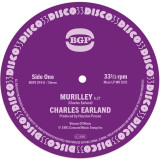
Here it is coupled with ‘Murilley’, an organ led vocal number that was a massive jazz dancer at the Wag Club, Dingwalls and beyond in the 80s.
The cheeky chaps at Cheeky Chops return with another disco packed 12" of dancefloor goodness. Editing a couple of 80s anthems, on the A side we find the Queen Of Pop strung out for over 11 minutes of hand raising ecstasy that wouldn't have sounded out of place at the Paradise Garage, whilst over on the B side a denim dungaree clad trio get the extended long summer break we've all been waiting for.
LAKE's 2009 album Let's Build A Roof KLP213, produced by Northwest legend Karl Blau, is sweet, funky and nostalgic - a paragon of psychedelic pop. Originally, this landmark album had overlooked sonic anomalies now corrected by REMASTERING. Five bonus songs have been added to the DIGITAL ALBUM, creating a whole new Let's Build a Roof.Let's Build A Roof is LAKE's most popular album with many fan favorites, though every track is unique. After extensive touring in 2009, LAKE entered Dub Narcotic Studio (Olympia, Wash.) to record fresh with their live energy. In the studio they were able to fill out their jingly pop aesthetic, enhanced with the vintage sounds of instruments available at Dub Narcotic and the local community. Blazing synth solos, timpani, flutes, saxophones, cello, and marimba, are just some of the featured sounds on Let's Build a Roof.Some of the album's most requested songs: "Madagascar," a dubby, slow-groove track; "Christmas Island" a surfy Phil Spector-sounding song used as theme music for the television in show Adventure Time; and "Don't Give Up", an upbeat motivating dance song with Blau performing the hook on harmonized saxophones; "Gravel" is the first single and has that a driving intensity that we can all deeply relate to - trying to keep up.
"Like Water" is the new album from Jasper Høiby, a luminary in the realm of contemporary jazz and the mastermind behind the celebrated piano trio Phronesis, renowned for its electrifying live performances and critical acclaim across Europe. Høiby, with his latest project, introduces "3 Elements," featuring the gifted Chaerin Im on piano and the versatile Jamie Peet on drums. This new assembly not only draws inspiration from the foundational strengths of Phronesis but elevates the ensemble's synergy to new heights, showcasing a more refined and cohesive sound that distinctly echoes Høiby's bold and charismatic sonic identity. While Phronesis has been celebrated for its dynamic interplay and innovative compositions, "3 Elements" presents a more singular vision of Høiby’s artistry, melding the complexity and depth of his musical influences with a fresh, unmistakable vigour. The lineup brings together an exceptional blend of talent and creativity, with Im's evocative piano lines and Peet's dynamic rhythms perfectly complementing Høiby’s profound bass undertones. Together, they create a sound that is not just an extension of Phronesis's legacy but a distinct declaration of Høiby's evolving narrative in jazz. "Like Water" stands as a pivotal work in Jasper Høiby’s illustrious career. The album skilfully bridges the realms of innovation and tradition, marking a significant chapter in his journey as one of Europe’s most charismatic contemporary composers, bandleaders, and bassists. With "3 Elements," Høiby not only cements his legacy but also redefines the essence of the piano trio format for the modern era, making this album an essential milestone and a testament to his visionary approach to music.
red LP[26,85 €]
The Dream Of Delphi is an ode to motherhood created in LA, Natasha’s second home, during the Covid-19 pandemic. It’s a sonic archive of a time when Natasha birthed her daughter Delphi earth side. The record weaves together ten song poems, documenting the polarity of navigating both an exterior world that was seemingly turning upside down, whilst also experiencing theprofoundly personal and transformational early moments of mothering Delphi, named after the Greek Oracle, the ancient future teller. The music became Natasha’s sanctuary, born out of stolen trips to the studio, where each track was improvised and completed in a few hours and chronologises her diary like offerings over a period of two years; from “The Midwives Have Left”; to writing a “Letter To My Daughter”; and all the way through to “Waking up”, as well as a cover of her daughter’s favourite song, “Home”.While the storytelling behind Bat For Lashes’ previous albums have traditionally used otherworldly narratives and female lead characters (e.g. ‘Laura’, ‘Daniel’ and ‘The Bride’), for the first ti me, The Dream Of Delphi is about Natasha’s personal experience of the magical and sometimes melancholy intimacy of early motherhood. This record creates a more private form of mythology around the music than her previous work. The Dream Of Delphi touches on more of an instrumental “Bat For Lashes” world, and shows Natasha to be both a confident composer and craftswoman of intimate landscapes. While the music creates a more womb-like, ambient space for the listener, it still leaves ample room for her signature dream pop songwriting to vibrate through. Natasha has worked with Brad Oberhofer, Mary Lattimore and Jack Falby on this record.
1974 soundtrack from Ennio Morricone Pressed on Red Vinyl & includes a 30x30cm insert Liner notes and audio remastered by Claudio Fuiano “Allonsanfàn” is a 1974 historical film written and directed by Paolo and Vittorio Taviani; set in 1816 in Italy during the Restoration period, its cast features, among others, Marcello Mastroianni, Lea Massari, Laura Betti and Mimsy Farmer.
“Allonsanfàn” is the first collaboration between the two directors and Morricone, who would also compose the music for the film “Il prato” (The Meadow, 1979). The soundtrack starts with a main marching theme, “Rabbia e tarantella”, introduced by the piano and reworked in a thrilling way by the full orchestra; Giuseppe Tornatore liked it so much that in 2009 he asked Morricone to write a similar musical theme for a sequence of the film “Baarìa”. This motif is alternated with the bucolic passages for flute and orchestra of “Ritorno a casa”, the festive “Dirindindin”, the classical piece “Te Deum Laudamus” for orchestra and choir and “Frammenti di sonata” for solo violin and small ensemble.
This score was only partially issued on vinyl in 1979, and subsequently only on CD; for the first time, then, it’s here released on clear red vinyl in an extended version, including a 30x30cm insert. Liner notes and audio remastered by Claudio Fuiano.
A band who have justifiably been championed across the world, Tokyo’s Melt-Banana have been responsible for some of the most complex punk rock ever made … that far outshines ninety-nine percent of most other bands out there. The band once described their live show as “Shooting machine gun and laser beam, chaos in order.” And I think that pretty much sums them up. — Olli Siebelt, BBC No wave without the self-conscious pretension, avant garde composition compressed into one-minute-or-less bursts, urgency, intricate destruction, pure glorious abandon. Melt-Banana play the same way that Repulsion, Naked City, The Ruins, or The Boredoms all make you want to scream and dance and kill your neighbors. This is not music that we are conditioned to accept. This is you delirious with joy scraping your five senses off the floor. —Matthew Moyer, Ink19 Melt-Banana are in a league of their own. There are other extreme hardcore bands out there who are experimental and unique but Melt-Banana are more than that. They area giants amongst infants. Masters amongst pupils. Kings amongst serfs. Nobody can do what they do and nobody can adequately use words to describe them. —Jeb, Crass Menagerie
black LP[26,85 €]
The Dream Of Delphi is an ode to motherhood created in LA, Natasha’s second home, during the Covid-19 pandemic. It’s a sonic archive of a time when Natasha birthed her daughter Delphi earth side. The record weaves together ten song poems, documenting the polarity of navigating both an exterior world that was seemingly turning upside down, whilst also experiencing theprofoundly personal and transformational early moments of mothering Delphi, named after the Greek Oracle, the ancient future teller. The music became Natasha’s sanctuary, born out of stolen trips to the studio, where each track was improvised and completed in a few hours and chronologises her diary like offerings over a period of two years; from “The Midwives Have Left”; to writing a “Letter To My Daughter”; and all the way through to “Waking up”, as well as a cover of her daughter’s favourite song, “Home”.While the storytelling behind Bat For Lashes’ previous albums have traditionally used otherworldly narratives and female lead characters (e.g. ‘Laura’, ‘Daniel’ and ‘The Bride’), for the first ti me, The Dream Of Delphi is about Natasha’s personal experience of the magical and sometimes melancholy intimacy of early motherhood. This record creates a more private form of mythology around the music than her previous work. The Dream Of Delphi touches on more of an instrumental “Bat For Lashes” world, and shows Natasha to be both a confident composer and craftswoman of intimate landscapes. While the music creates a more womb-like, ambient space for the listener, it still leaves ample room for her signature dream pop songwriting to vibrate through. Natasha has worked with Brad Oberhofer, Mary Lattimore and Jack Falby on this record.
An’archives presents the latest album by Japanese free saxophonist and vocalist Harutaka Mochizuki, Doppelgänger ga boku wo. Since the early 2000s, Harutaka has quietly, yet steadily, released a string of solo and collaborative releases that have allowed multiple perspectives on one of the most singular voices in modern music. In collaboration, he seems to prefer the duo format, and digging through his discography, you’ll find releases where he pairs with Tomoyuki Aoki (of Up-Tight), Michel Henritzi, and Hideaki Kondo. But Harutaka’s solo performances, with their lyricism and physicality, are where the magic truly happens.
If earlier albums, like Solo Document 2004 (Bishop, 2005) and Pas (no label, 2014), were raw documentations of solo alto saxophone performances, in recent years, Harutaka’s solo albums have become more complex, more mystifying. Most significantly, they’ve become more personal; there are few musicians extant whose albums feel quite so much like diaristic interventions, and Harutaka’s music now is deeply moving in its intimacy. Developing that thread of revelation, Doppelgänger ga boku wo offers a still richer exploration of many facets of Harutaka’s artistry.
The two double-tracked alto saxophone performances here feel consummate, with Harutaka shadowing himself, exploring the possibilities of the multiple self: Doppelgänger is me, indeed. The playing here is rich with affect, but still exploratory, voiced with rigour and intent. Two short pieces for keyboard and voice (about Giacometti and Genêt, respectively) are fragile miniatures, with clusters of chords, and passing phrases, wrapping around Harutaka’s untutored but lovely singing.
The ‘karaoke’ performance that closes the album, of “Woman ‘W no higeki’ yori”, speaks to the iterative aspects of Harutaka’s music. A cover of the Hiroki Yakushimaru song, the theme to Shinichirō Sawai’s 1984 film W’s Tragedy, he’s returned to this song several times, and here, his delivery perfectly captures the spirit of what Michel Henritzi, in his typically beautiful liner notes, evocatively details as “one of those sad love songs that accompany lonely sake drinkers in smoky night bars, sharing their spleen.”
Gorgeous, human, heartrending - Doppelgänger ga boku wo is Harutaka Mochizuki in element and in spirit.
On Unknown Road, Pennywise steps up their songwriting, maintains all their fury and intensity, and
lays out their philosophy of independence and the importance of daring to live every moment to its
fullest. This album features a number of songs that played on tons of skate, surf and snowboarding
videos, making this, and other PW records to come, the soundtrack to the exploding extreme sports
board scene. Featuring such Pennywise classics as “Homesick,” “Unknown Road,” “It’s Up To Me,” and
“You Can Demand,” Unknown Road is arguably the quintessential So Cal hardcore record of the ‘90s.
Reissued on limited edition Sunset Boulevard vinyl to celebrate the album’s 30th anniversary!
Bosconi Records Presents Datafreq’s Electrifying EP: “Circuit Garden” Toronto’s electronic music scene luminary, Dave Rout, known as Datafreq, is set to unveil his EP titled “Circuit Garden” on Bosconi Records. With a musical journey as Datafreq spanning 2 decades, and a continuous presence since the mid-80s, he has become a cornerstone in the electronic music scene in Toronto. “Circuit Garden” is a six-track collection that pays homage to Datafreq’s distinctive blend of video game music and electro sounds. A true sonic pioneer, he brings forth his unique musicality that has resonated since he started the project in 2004.
This EP features select tracks from his debut album, “Fun for the Whole Family,” originally released in 2006 on the esteemed Berlin label Das Drehmoment. Notably, these tracks, (never before available on vinyl with the exception of “Just Like 1981”), have been reimagined with slight remixing, editing, and remastering to seamlessly align with the vinyl format. Two brand-new tracks make their debut on this release, adding an extra layer of exclusivity and elevating the EP to a truly special status.
The unmistakable “Datafreq” sound is prevalent throughout the EP, characterized by eclectic electro techno and vocodered tunes. Infused with a melodic approach, the tracks remain dancefloor-friendly, showcasing Datafreq’s exceptional talent for crafting engaging melodies. The EP is adorned with cosmic arpeggios and space synthesizers, reflecting his prowess in creating immersive sonic landscapes. “Circuit Garden” not only celebrates Datafreq’s enduring legacy but also signifies a new chapter in his sonic exploration, inviting listeners to immerse themselves in Bosconi Records’ consistently precise and insightful musical universe.
DJ Support: Gilles Peterson, Sean Johnston, Jaye Ward, Max Essa and Francois K
Limited to 300 copies
Having been long-time admirers of one another from afar, Hell Yeah and Michele Mininni finally come together for Pop Archetypes. It is a multifaceted debut album that collides broken beats, worldly rhythms, jazz, eastern melodies, live drums and much more into one thrilling 15-track opus that arrives on May 31st.
Italian artist Mininni has always had a leftfield take on electronic music and imbued it with rhythms, melodies and instruments from around the globe. He has released it on cult labels like R&S, Optimo Trax, Internasjonal and Curle Recordings but has saved his magnificent debut album for Hell Yeah. It is much more than a collection of sounds he has already explored and instead finds him heading off into all new territory without losing his signature sense of inventive and beguiling rhythm and melody. It is a multicultural journey that takes in heterogeneous styles and diverse influences but distills them all into one cohesive album with its own unique storyline.
Says Mininni of the record, 'I wanted each track to be like pieces of a unique, multifaceted picture, like walking through train cars or progressing through the levels of a video game, all filtered through my own vision and concentrated into 36 minutes. I wanted a pop album rooted in the extraordinary richness of popular music and projected into the future, a continuum where pieces communicate with each other and are received by the ears in symbiotic balance.'
Despite that concept, the album is a spontaneous listen full of surprises, left turns and original ideas that all hold together in thrilling fashion. It kicks off with the tumbling jazz drums and swirling synths of 'Spinning Around Cotton Candy', takes in mellifluous melodic layers and broken beats on 'Golden Room' and 'Slipped Air' casts you adrift amongst gorgeous piano keys and refracted vocals on the suspensory 'Vertigo'. There are jungle interludes with Eastern string melodies like 'Bangkok Tempo', lavish fusions of organic and synthetic sounds on 'Kundalini' and more charming Far Eastern rhythms on 'Muting Cat'. 'Congoflash' brings electrifying cosmic rays to busy hand drum patterns, 'The Magic Of Synesthesia' combines dark amen breaks and bright and uplifting flutes while 'Carousel Of Tears' douses you in watery melodies and celestial pads that awaken the soul.
Pop Archetypes is an adventurous work packed with meticulous and infinite details but all with an overarching narrative that makes it far more than the sum of its parts.
- A1: Barry Woolnough - Great Father Spirit In The Sky
- A2: David Holmes & Steve Jones - The Reiki Healer From County Down
- A3: The Children Of Sunshine - It's A Long Way To Heaven
- A4: Spark Sparkle - Slythtovery
- A5: Alain Maclean - Talking Judgement Day Blues
- A6: David Crosby - Orleans
- A7: Buddy Holly - Love Is Strange
- B1: After Dinner - Paradise Of Replica
- B2: Lullaby Movement - Ru-Ru (Sleep Little Baby)
- B3: Jeff Bridges & Keefus Ciancia - It's In Every One Of Us
- B4: Song Sung - I'm Not In Love
- C1: Neo Maya - I Wont Hurt You
- C2: Bp Fallon & David Holmes - Henry Mccullough
- C3: Documenta - Love As A Ghost (Produced By David Holmes)
- C4: Keith Fullerton Whitman - Stereo Music For Acoustic Guitar, Buchla Music Box 100 Hewlett Packard Model 236 Oscillator, Electric Guitar And Computer Part I
- D1: Eat Lights Become Lights - Into Forever
- D2: Geese - Andrew Parsnip
- D3: Die Hexen - Gloomy Sunday
- D4: Jon Hopkins & David Holmes Feat Stephen Rea - Elsewhere Anchises
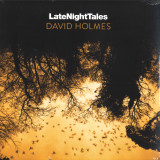
DJ and producer David Holmes is welcomed to the Late Night Tales fraternity with an evocative collection of personal songs and music, peppered with exclusive new material and rare gems. By now, I think we all know David Holmes, right There's acid house Holmes, with bone-rattling Chicago jams and Detroit destroyers, break-digger Holmes responsible for the grittily shaking 'Let's Get Killed' and seminal Essential Mix compilation (which brought Sixto Rodriguez to people's attention, and then there's soundtrack Holmes. His most enduring and vital source of musical inspiration - cinema - plugged into David's rst solo record 'This Film's Crap, Let's Slash the Seats' and inspired 2000's 'Bow Down to the Exit Sign', created as the soundtrack to a not-yet-made movie. Ofcial soundtracks have been bountiful, including scores for Soderbergh's Out Of Sight and Ocean's trilogy, '71, Hunger and Good Vibrations. In a series of personal songs sung by himself, David's last solo album 'The Holy Pictures' explored inuences of La Düsseldorf, The Jesus and Mary Chain and early Brian Eno. His Unloved collaboration with Keefus Ciancia and Jade Vincent then took us on a musical journey full of raw 60s pop-noir, psychedelia and French Ye Ye with a contemporary twist. Somehow he's also found time to produce records by Primal Scream and Jon Spencer Blues Explosion. Unsurprisingly, for someone au fait with matters cinematic, this Late Night Tales conjures up its own mindmovies. It's not only packed with the judiciously selected nuggets for which his mixes are noted but also stuffed with original material, including collaborations with BP Fallon and Jon Hopkins and an amazing new reading of 10cc's 'I'm Not In Love' by Holmes-produced Song Sung. In fact, there's a Celtic thread running through the whole journey with Stephen Rea's reading of an extract from Seamus Heaney's AENEID BOOK VI - Elsewhere Anchises. Among the other gems included here are David Crosby's lush 'Orleans', Buddy Holly's celestial 'Love Is Strange' and the Children Of Sunshine's 'It's A Long Way To Heaven'. David Holmes loves music. It's a way of expressing the sometimes inexpressible or the inconsolable, a questing desire to nd out just what is over the next hill. It's no surprise to learn he's a keen walker. Always on the move, headphones on, lost in some reverie or piece of music, the soundtrack to his life, the stuff that feeds his imagination. I walk a lot. It's amazing for listening to music: your phone or your emails aren't going and you're just in the forest listening to music. It's so intimate. Anyway, I was listening to the KLF's Chill Out album, which still sounds amazing, but it triggered an idea with concrete sounds through travelling and movement. And one of the things I was trying to do was to use this idea not just break up the moods but also as a metaphor for moving through life and arriving in different destinations or arriving at different stages in different parts of your life. Memory, Love, Living, Family, Friendship, Healing, Death and The Afterworld are some of the themes I wanted to explore within this record. Although these strong themes and tracks are personal to me, I also wanted it to be a great listen that was unpredictable yet had a seamless ow - a journey that was personal to me yet to the listener a great compilation of music that they may or may not have heard before. I hope I've succeeded in the later.' David Holmes 2016
FEATURES
NEW in the MK2 version:
Metal top panel and reinforced housing construction
Reworked metallic buttons with improved feel & tactile response
Precision pitch with range of +/-10 %
Superior finish in deep black metallic
Turntable with belt-drive for DJ and hifi use
Perfect for aspiring DJs and hifi enthusiasts
Powerful belt-drive motor system absorbs unwanted vibration and noise
Precise motor control with 2 selectable speeds (33 1/3 & 45 rpm)
Precision-engineered, die-cast aluminium platter with stable rotation
Statically balanced S-shaped tone arm with hydraulic lift and anti-skating mechanism
Universal connection for pick-up systems (SME)
Extendible needle illumination
Shock-absorbing feet for vibration isolation
Sturdy, heavy construction with optimized damping features
Dust cover available as optional accessory
Incl. platter, Reloop OM Black cartridge (by Ortofon), headshell, slipmat, counterweight, power cord, instruction manual
TECHNICAL DATA
Turntable:
Type: belt drive turntable
Drive: belt drive
Motor: DC motor
Turntable speeds: 2 speeds, manual (33 1/3, 45 RPM)
Brake time: 50 dB (DIN-B)
Brake system: electronic brake
Platter:
Material: aluminium die-cast
Diameter: 332 mm
Tone arm:
Type: universal, statically balanced, s-shaped
Effective length: 230.5 mm
Overhang: 16 mm
Tracking angle error: < 3°
Applicable pick-up weight: 3.5 – 8.5 g (incl. headshell 13 – 18 g)
Anti-skating range: 0 - 7 g
Connections:
1x PHONO out (gold-plated)
General:
Power supply: AC 115/230 V, 60/50 Hz (US/EU)
Power consumption: 10 W
Dimensions: 450 (w) x 352 (d) x 144 (h) mm
Weight: appr. 5.7 kg