is it the best jazz record from japan, as the french-born english disc jockey, record label owner and music collector gilles peterson once assumed or is it maybe the best jazz record of all jazz records
well, everybody needs to decide by himself and has to listen to 'watabase', the second solo piano album of the japanese jazz pianist fumio itabashi, that was originally released in 1982.
tokyo based mule music unearth it, remastered the original recordings and brings it back to the global stores in order to seduce all music lovers that embrace notes who come straight from the heart and soul.
while diving deep into the seven compositions on 'watarese', any sensible listener finds out, that the instrumental piano pieces are somehow soulfully connected to what keith jarret plays on his legendary 'the köln concert' live album for the munich based ecm record company.
like jarret, itabashi does not play his notes academic. he let them fly, gives them some kind a life of their own, hits the piano keys deeply emotional and injects his compositions and interpretations some kind of nervous human soul.
in terms of style some call his 'watarase' recordings post-bop, others contemporary jazz. none of such definitions fit really, as all is just that kind of agitating jazz that melts spirituality with humanity. three tunes, the epic 'someday my prince will come' as well as 'msunduza' and 'i can't get started', are interpretations of compositions by the us-american movie score pioneer frank churchill, south african pianist dollar brand and russian-american composer and songwriter vernon duke.
all other four compositions been written and recorded by the 1949 born itabashi who started to play the piano when he was eight years old. while studying at the tokyo based kunitachi college of music, he fell in love with jazz.
his love was so deep, that he starts to work in the 1970's with such legendary japanese jazz musicians like trumpet player terumasa hino, drummer takeo moriyama and saxophonist sadao watanabe.
till today fumio itabashi is a vital part of the japanese jazz culture as a live performer and film score composer. those who want to see how he makes love with his piano should check the world wide web for the french documentary 'jazzed out', that captured his unique way of playing in one episode.
but as music is always firstly for the ears, and not for the eyes, this little letter in-front of you would rather like to recommend to play the 'watarase' recordings loud to get hooked by the highly infectious piano gems that have been recorded at nippon columbia 1st studio in tokyo on 12th and 13th of octo-ber 1981.
they will haunt you. they will come for good. and they will force you to be a good friend with the repeat button - whatever medium you chose to surrender to the piano jazz music of fumio itabashi.
Buscar:fell
Hot on the heels of Rapid Eye Movement's journey of discovery and growth comes the EP 'Split: Remixes' featuring reworks of the quartet of cuts originally signed by label founders Memorial Home and VII Circle.
Invited to apply their own reflections onto the material are rising producers Nur Jaber and Wrong Assessment as well as renowned artists on the underground experimental scene Edit Select and Reggy Van Oers.
First up is Nur Jaber's take on VII Circle's 'Metaphysical Functions' showing how the young Berlin-based Lebanese artist is as much inspired on remix duties than in crafting her already much acclaimed productions. The perfect mixture of dark and intense driving techno beat with haunting ambient-driven melodic motifs and dramatic breakdowns encompasses much of what her sophisticated sense of sonic exploration is about.
Up next on a heavier kicking note is 'Dogma' refashioned by Milanese fellow Wrong Assessment who transmits his vision of both minimal and hard pounding techno by merging a strait rugged beat with undulating synth lines and bouncy cymbals that will drive the audience to an insane rave-spirited dance floor venture.
Following the path, Tony Scott a.k.a Edit Select's interpretation of Memorial Home's 'Second Floor' is a clear example of the unique and forward-thinking sound that the Scottish techno scene 'veteran' has developed throughout the years. Deftly combining a tension-building drum and bassline work with layers of hypnotic synth textures that makes the track both suggestive and trippy-hitting in equal measure.
Concluding the journey is Reggy Van Oers (RVO)'s rework of Memorial Home's 'Ampere' which evinces this quest for organic and mental techno soundscapes inspired by classical and cinematic music, characterising the both complex and powerful crafting signature of Dutch Telemorph label's owner.
Between dark shadows and brightness, REM confirms with this new release that quality and free-minded artistry are the key pillars of the platform's curation philosophy.
Former member of Dublin punk band The Threat, Stano released his debut LP on Scoff Records in 1983. Recorded in Alto Studios, the Irish artist eschewed live performances in favour of fusing collaborative, improvised, experimental music with spoken word-poetry. The LP featured contributions from fellow Irish musicians and artists such as Michael O'Shea, Roger Doyle, Donald Teskey, Vinnie Murphy, Detroit born Jerome Rimson and is a seminal document of Irish postpunk
With its lush live string and horn section, Can't Stop Loving You when originally released in 1990 was an immediate favorite in the UK, and represented famed House Producer Marshall Jefferson's movement toward utilizing live instrumentation in his productions. The track was released right around the time the Kiss FM London launched as a legal radio station, and Richard was support talent at the radio station launch party in Hyde Park London that was headlined by fellow Chicagoans Ten City.
The track also represented one of the last releases on the relaunched Sam Records imprint, before Michael Weiss ceased releasing new titles on Sam and started Nervous Records.
Krystal Klear has shown a unique ability to recognize sonic elements trends from past eras, and re-shape them to work for today's club crowds. With his two versions, he has done a masterful job remixing this early 90's dance classic.
MANOID returns to Hafendisko this October with his debut long player 'Truth', comprising six original tracks on vinyl from the Polish producer and live act. Rising producer MANOID has been steadily developing his unique approach to electronic music for the past few years, releasing his first tracks in 2014 and co-producing material for fellow Polish artist Pola Rise, whilst taking his live act across the globe to The Netherlands, South Korea,Iceland and more. Here though, we see him marking a milestone in his career with his debut album for hafendisko, the Hamburg-based sublabel of hfn music. Across the Truth LP MANOID delivers an amalgamation of styles ranging from jazz-tinged electronica through to modern classical and techno- due to MANOID's origin often referred to as 'Forest Techno'. One half of Darkness Falls and Trentemøller collaborator Josephine Philip also delivers vocals on 'Take Me', adding yet another musical twist to the package, whilst further ideas came to fruition through field recordings such as 'When' which is based upon recordings from a textile museum in the city of Lodz, and 'For Roses' which was initially made as a lullaby for MANOID's niece but he felt was a little too dark so later developed it into this enchantingly eerie composition for the album. MANOID's debut album radiantly displays charm, maturity and musicality throughout and joins the thread of his musical influences and experiences perfectly.
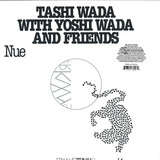
Composer Tashi Wada has performed for years with his father Yoshi Wada—artist, composer, and early member of the Fluxus movement. However, they have rarely appeared together in studio settings. Nue, the fourteenth entry in RVNG Intl.'s intergenerational FRKWYS series, finally brings Tashi and Yoshi, along with an eclectic group of close friends and extended family, together on tape.
Nue draws on aspects of Tashi's background for his widest vision to date—among them the minimalist bagpipe music of Yoshi, who co-composed three of the tracks, the psychoacoustic and perceptual explorations of his mentor, composer James Tenney, and reimagined forms of ancient and devotional music. The album, however, is not a tribute to the past or a recapitulation of familiar sounds. Instead, Nue is an intertwining of people and ideas as a means of growing, of looking inward to move outward, and of looking back to move forward.
To achieve this growth, Tashi assembled a core group of fellow travelers, including Yoshi, composer Julia Holter, producer Cole MGN, and percussionist Corey Fogel, to give life to this multifaceted suite. As an experience, Nue subtly navigates the interactions, intimacy and spaciousness of this group.
The album's title itself is a nod to Tashi's abiding interest in duality and the unknown: nue is a mythological Japanese chimera with the face of a monkey, the legs of a tiger, and a snake for a tail, a composite form, at once disturbing and otherworldly. But, as the composer points out, nue is also French for naked—stripped of complexity, bare and exposed, but also raw and essential.
From the doubling of tones—and the world of harmonic nuances such an action produces—to the rich interplay between individual musicians, all baring their own personalities and experiences through shared performance, Tashi's compositions allow space for these elements to join and grow. The multipartite creature that is an ensemble melds in the simplicity and purity of the music itself.
As explained by Tashi, each part was written with an individual in mind, not simply an instrument. And each individual performer makes their mark, from Holter's vocal performances on the cresting, oceanic 'Mutable Signs' and 'Ondine' with guest vocalists Simone Forti, Jessika Kenney and Laura Steenberge, to Fogel's resonant, precise percussion on 'Bottom of the Sky.' Producer Cole MGN, who has worked extensively with artists like Beck and Ariel Pink, helped to create a world of sound with minimal yet multi-dimensional materials. Like many of its influences, Nue uses deceivingly simple means to create complex, coherent worlds and narratives.
Tashi notes the influence of legendary Brazilian writer Clarice Lispector, whose work looked inward, investigating memory and emotion and dream, to understand the often overwhelming world outside the self. Like Lispector's classic novel Near to the Wild Heart, Nue cleaves these archetypal dualities—world/self, old/new, complex/simple—to create a work that allows them to coalesce into something singular.
As Tashi states in his liner notes: 'My desire was to create something both old and new sounding—ancient and futuristic—and ultimately something of its own world and other. Nue is a vision, an endless night of dreams, and a personal history of sorts, full of joys and demons.'
This is a long overdue collaboration and we couldn't be more excited to present a brand new EP from our man, Jena's mad scientist funk freak himself, Metaboman. A stalwart veteran of the legendary Musik Krause camp, which has been a kindred spiritual sister label of sorts of ours since the millennium-turn heydays, being fellow purveyors of bold and raw dance floor music, still brimming with new ideas galore and bucket loads of soul. Here with the Wireless Dancer EP we have Metaboman in top form offering nothing less than his finest work: 'Doppeldenk' starts things off with some classic Krause bump that brings to mind the heights of the Duo at their peak but updated, like an STL banger turned up to 11 with sinewy melodic lines and that special Thuringen twist. 'Hanno' follows up with a guest spot by jazz saxophone master Thomas Prestin, and guarantees to bring down the house with a storm of swinging stabs, rough riffs, and fresh-as-it-gets drum work. On the flip, 'Splitit' does exactly that, whether referring to wigs, legs, or that last drink ticket - where dusty blues vox chops and a rolling percussive smack down will revive any fading floor faces. And finally, 'EchterG' rounds it all out nicely with the illest of atonal trips and subsonic bass tones that the finer sound systems out there will fully indulge. Much love from Jena & Paris to the World!
Good News! Berlin Calling - The Soundtrack By Paul Kalkbrenner Is Available Now On Double Vinyl For The Very First Time! The 10th Anniversary Vinyl Edition On 180 G Heavyweight Vinyl In A Beautifully Made Gatefold Sleeve With A Luxurious Finish Includes A Brand-new Exclusive Poster Marking That Particular Milestone In Recent Electronic Music History.
Paul Kalkbrenner's Eponymous Soundtrack To The Legendary And Unique Film Hardly Needs Any Introduction. The Original Movie And Its Soundtrack Catapulted Him Into Prominence As An Actor And Dj/ Producer, Spearheading His Peers And Being At The Forefront Of Electronic Music At The Time.
- 10th Anniversary Vinyl Edition
- 180 G. Heavyweight Vinyl In Gatefold Sleeve
- Exclusive Poster
- Berlin Calling Cd/digital Is A Double Platinum Album In Germany!
- The Single "sky & Sand" Stayed In The German Top 100 Single Charts For More Than 2 Years (106 Weeks Continuously)
American composer and multi-instrumentalist Alvin Curran has remained one of the great emblems of experimental music for the last half-century. In 1966, along with Frederic Rzewski and Richard Teitelbaum, Curran co-founded Musica Elettronica Viva, a seminal gesture in collective free improvisation. In the early '70s, his solo work would become a crucial bridge between minimalist traditions on both sides of the Atlantic.
Canti E Vedute Del Giardino Magnetico, Curran's solo debut, was recorded by the artist himself and issued on Ananda, the small Italian imprint started by Curran and fellow composers Giacinto Scelsi and Roberto Laneri. The piece itself was put together in the winter of 1973 and presented for the first time at Teatro Beat 72 (Rome's The Kitchen).
Encouraged by the work of Terry Riley, La Monte Young, Charlemagne Palestine and Simone Forti, Curran binds the listener to aberrant notions of place and time: blending field recordings (wind, high-tension wires, beach waves, etc.) with simple and often primitive instruments. Across two sidelong tracks, Giardino Magnetico forms a lyrical collage of synthesizer, glass and metal chimes, plastic tubes, brass and the composer's alluring voice - converging in an immersive realm of Curran's inner / outer experiences.
This first-time vinyl reissue is recommended for fans of Harry Bertoia, Michel Redolfi and Lino Capra Vaccina.
Wild Style Lion feat. Kim Gordon how the fuck did that happen
Or better ask: how did this young band end up on a record box-set called Psych Box with Hawkwind, MC5, Nico and Kim Fowley out on Cleopatra Records
And if that was not enough they toured Europe with Dinosaur Jr. in Beyoncé's custom made night-liner for a whole freakin' month.
So you would think these guys sit back and get their hard-disks sucked but instead they keep partying and drop ecstasy at Berghain where Khan used to host a monthly party called Smegma with DJ Nd Baumecker presenting bands like The Gossip, GusGus, Opal Bastards or even Lady Gaga.
Wild Style Lion is Philipp Virus and Khan Of Finland a hard working producer-duo from Berlin. Tallmen 785 responsible for the B-side remix who already reworked for the likes of Little Dragon or his good fella Scuba.
Wild Style Lion currently working on a transgender Hip Hop project with mc BIG T shooting to drop a 12' in fall 2018 and a new full length album in spring 2019.
Anything else I forget to mention
Yours sincerely,
Khan (Of Finland)
- A1: Zavoloka -.Transmutatsia
- A2: Mimicof - Love Control Feat. Hprizm
- A3: Benjamin Brunn - Joy
- A4: Retina.it - Horses
- B1: Mads Emil Nielsen - Unfold
- B2: Mads Emil Nielsen - Untitled Percussion Loop
- B3: Mimicof - Spark
- B4: Pierce Warnecke - Bogusstratagem
- B5: Mads Emil Nielsen - Circles
- C1: Zavoloka - Inflame
- C2: Retina.it - Rodeo
- C3: Retina.it - Gauchos
- C4: Benjamin Brunn - Alloy
- D1: Pierce Warnecke - Shiftform
- D2: Pierce Warnecke - Hddxenoglossy (And The Machine Spoke)
- D3: Mads Emil Nielsen - Framework 12
- D4: Mimicof - Cycle
- D5: Benjamin Brunn - Coy
»sichten« refers both to »opinions« as well as the »examination of material«. in lose sequence, we will invite friends and colleagues, but especially music lovers to share their opinions on music with us or to look through their collected materials in order to present music that tends to be out of the focus of current media channels. as a label for electronic music our focus is on examining exactly this genre. but in the context of the series, we are rather looking for more hidden, unknown, perhaps forgotten music. we want to present the yet undiscovered, and also offer a platform for other cultural environments with different musical approaches. each issue will be supervised and compiled by a curator. an introductory text shall explain the ar- tistic approach of the respective curator. in this sense, the format of a double lp can only provide a first insight and wants to invite to a more in-depth research. for the first issue of the series, »sichten 1«, we asked frank bretschneider to compile his own, very personal selection of current electronic music. his choice fell on six artists, whose different styles me- ander between accessible music on the one hand and very abstract compositions on the other hand.
"sichten" bezieht sich sowohl auf "Meinungen" als auch auf die "Auseinandersetzung mit dem Material". In loser Folge laden wir Freunde und Kollegen, vor allem aber Musikliebhaber ein, ihre Meinung zur Musik mit uns zu teilen oder ihre gesammelten Materialien durchzusehen, um Musik zu präsentieren, die nicht im Fokus der aktuellen Medienkanäle steht. als label für elektronische musik liegt unser schwerpunkt auf der untersuchung genau dieses genres. im rahmen der serie suchen wir aber eher nach verborgener, unbekannter, vielleicht vergessener musik. wir wollen das noch unentdeckte präsentieren und auch eine plattform für andere kulturelle umgebungen mit unterschiedlichen musikalischen ansätzen bieten. Jede Ausgabe wird von einem Kurator betreut und zusammengestellt. Ein einleitender Text soll den künstlerischen Ansatz des jeweiligen Kurators erläutern. In diesem Sinne kann das Format einer Doppel-LP nur einen ersten Einblick geben und will zu einer vertieften Recherche einladen. für die erste ausgabe der serie "sichten 1" haben wir frank bretschneider gebeten, seine eigene, sehr persönliche auswahl aktueller elektronischer musik zusammenzustellen. seine auswahl fiel auf sechs künstler, deren unterschiedliche stilrichtungen ich zwischen zugänglicher musik einerseits und sehr abstrakten kompositionen andererseits unterscheiden.
Mannequin Records is proud to present a trilogy of reissues from the avantgarde Italian-born producer Doris Norton, "Norton Computer For Peace" (1983), "Personal Computer" (1984), "Artificial Intellingence" (1985).
Apple's first music "endorsement" (later IBM consultant) and early Roland affiliate, Doris Norton is one of the most important women pioneer in the use of synths and in the early electro / computer music.
While the beat-oriented style of Norton's music aligns her with such global fellow-travelers as Yellow Magic Orchestra and Kraftwerk, her championing of the personal computer as a tool for self-sufficient musical creativity also connects her to more artsy musicians such as Pietro Grossi, Laurie Spiegel, and the League of Automatic Music Composers. Norton's predilection for the bright, glossy timbres of early digital instruments also recalls Hubert Bognermayr and Harald Zuschrader's bizarre 1982 one-off Erdenklang.
1 year after "Personal Computer", Doris Norton released 'Artificial Intelligence' (previous title: From Art-Physiol to Artificial Intelligence, changed before publishing) in 1985, setting a step up in her deep electronic music research and innovation.
Bath-come-London party purveyors, Origins, take to channelling some of their creativity into the creation of their own Origins label. At the helm for the debut release is Bristolian up-and-comer Tommosini. Having heard Move D unleash the beauty of 'Another Dimension' at Freerotation last year, Origins knew they had to find out who the mastermind behind this deep house gem was....and the rest, they say, is history.
'Another Dimension' transports you through the galaxies via a combination of dreamy pads, crisp percussion, full-bodied bass and those sensual deep tinged vocals. Future classic in the making.
The A2 'I Don't Stop' carries on the U.S flavoured deep house with a vocal house track that wouldn't be out of place coming from the shores of Chicago masterfully intertwining a bumping bassline, soft organs and those introspective, luscious vocals.
Flip it over and you're treated to two interpretations of 'Another Dimension'. First up fellow Bristol bass badboy, Hodge, serves up a signature remix, chopping the vocals and layering them behind a pounding kick and machine gun percussion to give that bass heavy flavour he's become so well known for. Deadbeat steps up to close out the e.p. with a heavyweight techno rework of the original, complete with hypnotic bleeps, phased hats, and intermittent sub bass goodness, all tied together with a driving kick to give a real industrial feel to the remix.
'Garage bands suddenly obtain cult status and become the antithesis of their initial appeal'
Garage Class were a group of reluctant outliers who produced one of the finest contributions to the wave of UK DIY music that emerged during the late 70s and early to mid-80s.
Hailing from Alsager in North West England and comprised of Tim Shutt (vocals) Phil Murphy (lead guitar) Clive Williams (guitar) Lynne Sanders (bass) and Phil Bourne (drums / bass on studio recordings) Garage Class originally went by the name of The Pits before their then manager Steve Hurt imposed an alias which, though unpopular within their ranks, would nevertheless reflect the shambolic art they would eventually capture on their first and only single.
As The Pits the group offered a loutish inflection on glam-punk flamboyance, evoking Johnny Thunder hitting the north and remaining disowned yet undeterred in a dreary old boozer. But as Garage Class the group distilled a roughcast and homespun primitivism that felt quintessentially their own. In this they proved too unruly to be assimilated into any wider scene. Early gigs descended into acrimony and recognition proved elusive. Yet what they managed to make back then now sounds like an extraordinary article of underdog ambition.
Released in 1984, four years after it was originally recorded, the Terminal Tokyo single is an unlikely triumph of exceptional messthetic punk. Though raw and unpolished the songs here are precariously pop-minded and indisputably anthemic. The titular A-side reveals the dry and detached drawl of Shutt aka The Subliminal Kid, a sharp, jaded and poetic voice that has some of the most iconic lines never heard in punk. Accompanied by second-hand guitars, on-the-fly handclaps and a chorus like a terrace chant this is the cult hit that never was, a heroically artless masterpiece that has all the ragged character and misfit euphoria of Swell Maps and The Buzzcocks if they were more impulsive and boisterous, and left to their own devices in the remote margins of a Cheshire town. The original B-side is here substituted for I Got Standards, a track that, until now, has somehow remained unreleased. An ideal twin to Terminal Tokyo there's the same brusque and dog-eared quality to the band's delivery, as well as the same upfront emphasis on strong hooks and insistent momentum. Yet again, Shutt is on impeccable form, perfecting an inflated, adolescent antagonism that has all the sardonic, malcontented charm of similarly 'shirty' buggers like Dan Treacy (Television Personalities), Patrik Fitzgerald and Mark Perry (Alternative TV).
Although never accepted in their own time both tracks represent a brief but inspired moment of fervent imperfection, one that epitomized the best of a diffuse and autonomous underground movement spearheaded by The Desperate Bicycles and built upon by the likes of Amos & Sara, The Homosexuals, The Cleaners From Venus and Family Fodder. Like them Garage Class were situated at a point where punk, art, humour and a sense of stubborn independence all intersected.
In the years since Terminal Tokyo has accumulated a retrospective appeal among certain trusted circles, with Jon Dale celebrating the single in his exhaustive and essential Story of UK DIY for Fact Magazine, and original copies regularly changing hands for a foolish forty quid or so. With this inaugural release on the Outer Reaches label Terminal Tokyo is not only restored for the very first time but given a worthy expansion courtesy of JD Twitch (Optimo).
Continuing his own fascination with the fringe history of UK DIY - documented on his own outstanding compilation Cease & Desist: DIY! (Cult Classics From The Post Punk Era 1978-1982) and in his re-edits of Crass Records classics for an early release on RVNG INTL - Twitch reinterprets I Got Standards as an incisive, dubwise outing that pictures Jaki Liebezeit and Muslimgauze on a bender in England's provinces, tasked with remixing the raw product of local punks. A new slant on Garage Class' crude magnificence, built to play loud on contemporary soundsystems.
Although the latter part of 1980 spelled the end for Garage Class with members moving on to other projects (Bourne fell in with The Colours Out of Time, Murphy went on to front The Regular Guys and Shutt eventually left to form Happy Refugees) this reissue attempts to give their fleeting time together and the unique single statement they made the treatment it deserves. If this means Garage Class have obtained cult status, their initial appeal remains. Just listen for yourself.
Autre fell asleep in a gondola and awoke in the Krankenhaus. This is his first offering for the ESP Institute. Side A's Everybody In The Past is sharp techno aimed for the alleys of your mind — gritty, driving, and melodic combinations of blown-out drums and classic electro riffs that relentlessly sprint for a good 4 minutes before a squelching arpeggio and angelic solo kick in — tugging the heartstrings and lighting a beacon for those noble morning dancers lost at the front left speaker, channeling from the deep. On Side B, Frigo completely dismantles any expectations you might have after listening to its predecessor. An undoubtedly seductive Samba rhythm comprised of distant snares, rim shots and cowbells holds together an aggressively active bassline, a steel drum harmony and synth solo that crawl all over like a funky worm. This track is truly something special, a gift for the prodigious selector — when dropped in the deserved context, it has the potential to unlock unprecedented levels of euphoria. These two songs are as fluid as a paintbrush yet precise as a scalpel.
Label head honchos Rhode & Brown finally debut on their own imprint, Slam City Jams, after putting out music on fellow labels Toy Tonics and Public Possession. Produced over the past two
years, the Wave 100 EP might be the most versatile record by the Munich-based fellas so far.
On the title track we have an euphoric hint of 80s synth nostalgia, slapped bass and banging woodsticks (did someone say Safri Duo!). 'Sparkle' on A2 feels like the joy of a fresh breeze on hot summer days whilst living la vida loca in the clouds - b/w phat bass, sweet flutes & strings.
On the flip there is 'Love Lane', a classic house track with a funked up bassline, shuffling snares and the most erotic vocal in human history. 'Moon Bells' on B2 is the soundtrack to that road
trip you did back in 86' with a Juno 106 arpeggiator bassline, percussive drums and airy synths all around. 'Over Europe' on B3 rounds off this special 5-tracker with beautiful ambient spheres
straight from outta space.
Fans of Electro's big hitter DJs such as Helena Hauff, Dave Clarke, UMEK, Maceo Plex, and UMWELT won't have escaped the sonic assaults of Dutch artist RXmode and his fellow Transhumanism collective members; w1b0, Slaves of Sinus, TFHats.
RXmode's last EP 'Cerberus' was very much the EP he'd been building up to since his debut on Bass Agenda Recordings back in 2015; dark, sinister, heavy, and distinctive.
One of the tracks from that EP, 'Degraded', gets the remix treatment from the other Transhumanism members on this, the third vinyl release the collective have put out.
The original track kicks things off in style before the three very individual remixes take things to new territories. TFHats takes the track, remoulds it and adds his own lyrics and vocals to great effect. W1b0 brings what will certainly be looked back on as one of the heaviest tracks of 2018; his 'Violation in G Minor' mix is a brutal sonic assault with a bassline that will surely wake the dead. Last and by no means least Slaves of Sinus brings an abstract acid tinged version; laced with his own brand of sinister vibes and darkness.
One afternoon in 1975, friend and fellow music traveler, Harold Schroeder, showed up at Poo-Bah Record Shop where Tom Recchion worked selling records and experimental music to people, forcing them to buy albums that he swore would change their lives. Harold asked if Tom wanted to share in a studio space close to the shop. After seeing it Tom immediately said "YES!". They moved in and divided the space in half. On Tom's half he made drawings, paintings, performances, video, sculptures, installations, and music. Harold had his all set up for music with his newly acquired Steiner-Parker synth and guitars and things. At the beginning they played under the name The Two Who Do Duets. Soon the late-night jam sessions that took place in the back of Poo-Bah moved over to the fourth floor of 35 South Raymond. It was pretty beat up and derelict, the way one imagines an artist's studio to look. They could make all the noise they wanted. No one else was on their floor. The music heard on this LP has remained unheard since it was recorded and was created just before and right after the inaugural concert by the Los Angeles Free Music Society (LAFMS) groups Le Forte Four, Doo-Doettes, and Ace & Duce. That concert took place in late January 1976. The sessions on this release feature members of the newly formed and expanded Doo-Doettes, which now included Dennis Duck, Juan Gomez, Harold Schroeder, and Tom Recchion, as well as Ju Suk Reet Meate from Smegma and Ace, of Ace & Duce. 35 S. Raymond eventually became a sort of LAFMS headquarters, with Chip Chapman of Le Forte Four, artist and future Extended Organ vocalist/guitarist Paul McCarthy, and soon to become singer for Nervous Gender, punk/folk artist Phranc, who along with many other artists and musicians, moved into the building. 35 S. Raymond allowed for free expression and explorations of all sorts. Some wild parties ensued, not to mention the luxury of endless hours of experimentation. Parking was free and so was the art and music. Ace found the tapes for side one ("Tom's Studio") in his archive and Ju Suk Reet Meate found the tapes for side two ("50 Of Every American Are Machines") and edited them both for this release. No overdubs or remixing was emplo
Next up on Dusky's renowned 17 Steps label is the return of long term pal Kiwi. Having supported the lads on 9 of the 17 Steps tour dates and having also provided the 15th release in the label catalogue - the fellow Londoner now readies his 'Oooh' EP which comes backed up with a remix from Feel My Bicep affiliate Hammer.
Kiwi's sound is one defined by positive, kinetic feeling - joining the dots between Detroit Techno, Soul and Balearic. With previous releases on Futureboogie, Life and Death and Moscoman's lauded Disco Halal imprint, he's garnered several accolades including reaching number #85 in Mixmag's Top 100 tunes of 2017 and sitting at #1 in the genre chart for a total of 9 weeks with his 'Orca' EP back in 2016.
Now - continuing on his ascent, Kiwi lays out a pair of rapturous, gooey House jams that lands right on time for the festival season. On 'Oooh' - Vocal lines swirl over a largely beatless backing track. A rich, balmy feeling unfolds behind synth chimes and layered delays which work together to form an irresistible summer DJ tool. 'Andromeda' then follows up and blends 80's soundtrack-tinged stabs with crispy drums and thick sub bass before being accompanied by a pulsating synth line that carries the track to a delectable crescendo. Hammer then closes things up with a somewhat hallucinogenic take on 'Oooh' with LFOs, analogue sweeps and blobs of acid bleeding together to cap off an altogether warm and woozy trip.