‘Blind On A Galloping Horse’ serves as David Holmes’ first solo album since 2008’s ‘The Holy Pictures’. A 14-track interrogation of the last decade, time spent watching a decaying, fraying Britain visibly buckling in real time while tending to his own battles with mental health. Holmes’ soundtrack to this inquiry is at times claustrophobic, often euphoric, driven by the rattle and snap of analogue drum machines, wild oscillations of droning analogue synths and the voice of Raven Violet, which beguiles and commands in a way that could part oceans. On this album, there are songs of hope for an age of uncertainty; love songs to leap the barricades to and, on ‘Necessary Genius’, a comprehensive roll call of the great and good - those ‘dreamers, misfits, radicals, outcasts’ that we’ve lost and just a few who’ve managed to cling on in the churn of the 21st century. And there are elegiac electronics evocative of an endless Europe where pulsating, crackling rhythm tracks fuse with dreamlike textures and the underground pulse of psychedelic therapy to form something unique that feels nothing less than radical. CD in 4pp digisleeve with 8pp booklet. Double vinyl in 300gsm gatefold sleeve with reverse side print and 180gsm reverse side print inner sleeves.
Suche:first serve
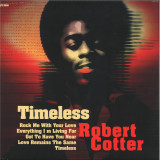
Worthy re-issue of Robert Cotter's second late 70's soul album! Comprising five songs, with four of them being quite lengthy and well-structured for the dance floor, was entirely recorded in the United States by top-notch American musicians. "Timeless", a fresh and lively expression of late 70s soul music, was recorded at the Sundragon Studio in New York. This studio was home to legendary bands such as Talking Heads and Ramones, as well as a few 'disco studio groups' like Andrea True Connection, Tony Valor Sound Orchestra, and Camouflage, who recorded songs that later became considerable hits. For this reason, it's believed that the positive outcome of the album can be partially attributed to Ned Liben, an eclectic New York musician and co-founder of the studio in the Flatiron district of Manhattan, served as an exhaustive interlocutor for any artistic and technical needs. He was also the arranger of "Rock Me With Your Love", the most significant song on the album. Ned's successful mission was to capture the maximum timbral fidelity of Robert Cotter's voice using appropriate recording techniques, assisted by Michael George Ewing, a talented engineer who had previously worked on similar projects with well-known artists like Carol Williams, Maryann Farra & Satin Soul, Touch and Tony Valor. In fact, the piece features original and melodious lines, coupled with an excellent steady rhythm, spanning approximately 8 minutes and 30 seconds - in short, "a delightful sound for every beat." This ensured that the performance of the young singer-songwriter from New Jersey was faithfully reproduced without neglecting the overall musical landscape. The other four songs, arranged by Ben Lazzaroni with the same musicians as the first piece, are no exception. Best Record also delivered on the promise to Robert's older brother, Karl Potter, a powerful percussionist transplanted to Rome, for whom the roman label produced "Sweet & Salty Cha-Cha-Cha" (12", 1986). Robert Cotter, an artist about whom almost nothing has been written, is poised to gain recognition once word spreads about his album, which has been entirely remastered by Dom Scuteri and features a more congenial tracklist. This album is destined to be truly 'timeless', ready to captivate audiences around the world. Even the new cover artwork, created by Nerina Fernandez, pays homage to an artist who, despite expressing himself with elegance and simplicity, radiates energy and exudes love. "Timeless" is an inevitable revelation for anyone who missed it at the time, and for the next 40-plus years, it will remain an absolute must-listen for Robert Cotter's many fans, leaving them all in awe. In addition to the reissue on the classic glossy black vinyl, a strictly limited edition on red vinyl will be released exclusively by Clone Distribution.
Worthy re-issue of Robert Cotter's second late 70's soul album! Comprising five songs, with four of them being quite lengthy and well-structured for the dance floor, was entirely recorded in the United States by top-notch American musicians. "Timeless", a fresh and lively expression of late 70s soul music, was recorded at the Sundragon Studio in New York. This studio was home to legendary bands such as Talking Heads and Ramones, as well as a few 'disco studio groups' like Andrea True Connection, Tony Valor Sound Orchestra, and Camouflage, who recorded songs that later became considerable hits. For this reason, it's believed that the positive outcome of the album can be partially attributed to Ned Liben, an eclectic New York musician and co-founder of the studio in the Flatiron district of Manhattan, served as an exhaustive interlocutor for any artistic and technical needs. He was also the arranger of "Rock Me With Your Love", the most significant song on the album. Ned's successful mission was to capture the maximum timbral fidelity of Robert Cotter's voice using appropriate recording techniques, assisted by Michael George Ewing, a talented engineer who had previously worked on similar projects with well-known artists like Carol Williams, Maryann Farra & Satin Soul, Touch and Tony Valor. In fact, the piece features original and melodious lines, coupled with an excellent steady rhythm, spanning approximately 8 minutes and 30 seconds - in short, "a delightful sound for every beat." This ensured that the performance of the young singer-songwriter from New Jersey was faithfully reproduced without neglecting the overall musical landscape. The other four songs, arranged by Ben Lazzaroni with the same musicians as the first piece, are no exception. Best Record also delivered on the promise to Robert's older brother, Karl Potter, a powerful percussionist transplanted to Rome, for whom the roman label produced "Sweet & Salty Cha-Cha-Cha" (12", 1986). Robert Cotter, an artist about whom almost nothing has been written, is poised to gain recognition once word spreads about his album, which has been entirely remastered by Dom Scuteri and features a more congenial tracklist. This album is destined to be truly 'timeless', ready to captivate audiences around the world. Even the new cover artwork, created by Nerina Fernandez, pays homage to an artist who, despite expressing himself with elegance and simplicity, radiates energy and exudes love. "Timeless" is an inevitable revelation for anyone who missed it at the time, and for the next 40-plus years, it will remain an absolute must-listen for Robert Cotter's many fans, leaving them all in awe.
- A1: Unseen Small Steps
- A2: Light Years
- A3: Noon At The Moon
- A4: The Other Side Of The Moon
- B1: Tsukiyo
- B2: Between Worlds
- B3: Authentic Love Song
- B4: Oasis
- C1: Light Years (Daydream Dub)
- C2: Noon At The Moon (Daydream Dub)
- C3: The Other Side Of The Moon (Daydream Dub)
- D1: Tsukiyo (Daydream Dub)
- D2: Authentic Love Song (Daydream Dub)
- D3: Oasis (Daydream Dub)
Following on from the warm reception to Hell Yeah and Music Conception reissuing Calm's cult Before album, the labels have come together once more to offer up a reissue of the Japanese master's highly sought-after long player Moonage Electric Ensemble. The hard-to-find original has been given an all-new mixdown from original stem files and then re-mastered by Calm himself, and the double LP will also come with a bonus 12" featuring his very own Daydream Dubs plus an obi-strip and original artwork by FJD.
The blissful yet soul-stirring Moonage Electric Ensemble, which landed first in 1999, was Kiyotaka Fukagawa's stunning sophomore album and the one that kept the bar high following his debut Shadow of the Earth. It investigated all new worlds of future jazz, ambient and downtempo and has since become a cult classic that often fetches three figures on secondhand markets. He has released over 18 albums since including Before which was reissued in 2022, though Moonage Electric Ensemble remains a favourite with those who enjoy the most accomplished and innovative sounds from the first wave of chillout.
This escapist charmer opens with the suspensory synths and piano keys of 'Unseen Small Steps' featuring spoken words from Dan Gamble, then 'Light Year' has gently tumbling rhythms and shimming synth moving about the soothing mix. 'Noon At The Moon' brings gorgeously fizzing future jazz drums and mellifluous piano playing full of subtle joy, and 'The Other Side Of The Moon' then layers up melancholic chords and chunkier rhythms that are detailed with gorgeous persuasive details and mystic flutes. 'Tsukiyo' is a new age charmer with paddy hand drums and romantic interplay between sax and trumpet, 'Between Worlds' is an ambient interlude with distant winds blowing and intimate whispers from Gamble before closer 'Authentic Love Song' rides on dusty trip hop breaks as lazy piano chords melt the heart and Gamble serves up another aloof monologue.
This is another welcome reissue of a sublime album that is not only one of Calm's finest but also a true gem in the wider world of downtempo music.
- A1: Serve The Servants
- A2: Scentless Apprentice
- A3: Heart-Shaped Box
- A4: Rape Me
- A5: Frances Farmer Will Have Her Revenge On Seattle
- A6: Dumb
- B1: Very Ape
- B2: Milk It
- B3: Pennyroyal Tea
- B4: Radio Friendly Unit Shifter
- B5: Tourette's
- B6: All Apologies
- C1: Gallons Of Rubbing Alcohol Through The Strip
- C2: Marigold
- D1: Moist Vagina
- D2: Sappy
- D3: I Hate Myself & Want To Die (2013 Mix)
Celebrating 'In Utero''s 30th, the album pressed on 180-gram vinyl plus 5 b-sides and bonus tracks pressed on a 10-inch have been newly remastered from 96kHz 24-bit transfers of the original analog tapes by original album engineer Bob Weston.
Original album artwork has been expanded to a premium tip-on gatefold jacket for the first time with new 10-inch jacket art.
“I hope you die by my side, the two of us at the exact same time, I hope we die not long from now, the two of us at the exact same time”
By the time Molly Nilsson released History, she had already established a fledgling cult status built on homemade YouTube videos and home-burnt Cdrs. Writing from a distance, it’s clear that History is the first classic album in her canon and arguably a classic of the 21st Century underground music panorama.While the methodology on History hadn’t changed from Nilsson’s previous 3 albums – it was recorded solo at The Lighthouse, Nilsson’s home studio based on a Berlin crossroads – on this record the songwriting reached a new peak and the emotional scythe cut deeper. Here, Nilsson managed to combine a cosmic, outward looking perspective with an intimate knowledge of the human condition and its place in these turbulent times. In truth, no other songwriter has excavated the modern psyche so clearly and perfectly.
The tracklist to Nilsson’s fourth album reads as an early greatest hits for Molly Nilsson followers and also serves as the perfect entry point to a whole world the artist has been building for the last 10 years. In Real Life crystalises the millenial obsession with relationships built online, with a generation paying for the baby boomer’s excesses with their anxiety towards the harshness of every day life. It’s a call to arms for a generation who fell in love on Skype. On I Hope You Die, one of Molly Nilsson’s most iconic songs, the songwriter flips the song title into a tale of doomed romance, a relationship based on discommunications and the thrill of the other. It’s also one of the most heartfelt songs full of pathos written by anyone, an ode to obsession. Doomed romance, life lived on the flipside of day and the role of the outsider in society are themes that crop up through-out History. On
Bottles Of Tomorrow, the narrator is sweeping up, in love with the night and examining the remains a society leaves behind.
On City Of Atlantis, Nilsson veers from the plaintive balladry she had begun to make her name with, embracing trance-like synth and dance music details to create an unlikely anthem using the mythological city as a means to comment on the patriarchal rendering of history by power. With by now trademark panache, she turns complicated subject matter into a glorious song that transforms into an ecstatic pop moment.
Hotel Home, another Nilsson classic, paints loneliness not as a debilitating anxiety, but as a powerful to that propels the artist forward through her travels. It’s a song that hints at an endearing self-awareness also; the writer is never at home, living life on the road, content that “the world will find me when the time is ripe.”
There’s never been a greater time.
GREEN AND WHITE MARBLE VINYL.
The Beths occupy a warm, energetic sonic space between joyful hooks, sun-soaked harmonies, and acerbic lyrics. Their debut album Future Me Hates Me, forthcoming on Carpark Records, delivers an astonishment of roadtrip-ready pleasures, each song hitting your ears with an exhilarating endorphin rush like the first time you heard Slanted and Enchanted or 'Cannonball.'
Front and center on these ten infectious tracks is lead singer and primary songwriter Elizabeth Stokes. Stokes has previously worked in other genres within Auckland's rich and varied music scene, recently playing in a folk outfit, but it was in exploring the angst-ridden sounds of her youth that she found her place. 'Fronting this kind of band was a new experience for me,' says Stokes. 'I never thought I had the right voice for it.'
From the irresistible title track to future singles 'Happy Unhappy' and 'You Wouldn't Like Me,' Stokes commands a vocal range that spans from the brash confidence of Joan Jett to the disarming vulnerability of Jenny Lewis. Further honeying Future Me Hates Me's dark lyrics that explore complex topics like being newly alone and the self-defeating anticipation of impending regret, ecstatic vocal harmonies bubble up like in the greatest pop and R+B of the '60s, while inverting the trope of the 'sad dude singer accompanied by a homogenous girl-sound.'
All four members of The Beths studied jazz at university, resulting in a toolkit of deft instrumental chops and tricked-out arrangements that operate on a level rarely found in guitar-pop. Beths guitarist and studio guru Jonathan Pearce (whose other acts as producer include recent Captured Tracks signing Wax Chattels) brings it all home with an approach that's equal parts seasoned perfectionist and D.I.Y.
'There's a lot of sad sincerity in the lyrics,' she continues, 'that relies on the music having a light heart and sense of humor to keep it from being too earnest.' Channeling their stew of personal-canon heroes while drawing inspiration from contemporaries like Alvvays and Courtney Barnett, The Beths serve up deeply emotional lyrics packaged within heavenly sounds that delight in probing the limits of the pop form. 'That's another New Zealand thing,' Stokes concludes with a laugh. 'We're putting our hearts on our sleeves—and then apologizing for it.'
- A1: Euphoria 1 49
- A2: Soft Hallucinations 2 00
- A3: Sky Move 2 40
- A4: Destroyed Dreams 2 06
- A5: Horror Trip 1 39
- A6: Floating Illusions 2 23
- A7: Lost Chance 1 46
- A8: The Morning After 3 15
- A9: Random Thoughts 1 12
- B1: Heroin 2 44
- B2: Night Trip 2 54
- B3: Day Trip 1 21
- B4: Dealer's Corner 3 23
- B5: Sad And Hopeless 1 53
- B6: Riding Pegasus 3 32
- B7: Hopeless Chaos 2 15
- B8: Goin' Mad 2 06
Sven Torstenson's notorious Drugs is a loopdigga's fever dream, bursting with breaks for days and featuring possibly the most iconic cover of all library music's cult classics. First released in 1980, it's now a hyper-rare and seriously sought-after electronic album full of experimental soundscapes and samples just waiting to be flipped. It's both terrifying and terrifyingly good. So much so, it's been brilliantly sampled by Kendrick Lamar and Chance The Rapper.
The sleeve describes Drugs as containing "the newest dimensions of electronic sounds. Dramatic underscores for all problems of today's life and society, at the border between reality and delusion." That's pretty spot-on. The fast moving "Euphoria" is an incredible, unignorable opener. It's loaded with disorientating effects and really needs to be heard to be believed. It's followed by the gorgeous "Soft Hallucinations", containing quiet, meditative and beautiful sounds - as the title suggests. One listen and you'll want to live in the warm embrace of this beatless, harmonic gem. Sinister squelchy synth stabs don't distract from the sheer beauty of the track's main (gentle) thrust. They only serve to elevate its trippy magic.
Next up, "Sky Move"'s agitated and repetitive rhythm makes it an intense listen but with a broad melody that will appeal to many. "Destroyed Dreams" utilises a muffled church organ and it sounds heavenly to begin with but it gradually invites increasingly distorted elements. Yes, you've had trips like this, we're pretty certain. Mental! Talking of bad trips, never have they sounded so good as "Horror Trip"; this fractured drama-synth just needs some some dusty beats to hold it up - get involved.
"Floating Illusions" almost sounds like a beatless Spiritualized bomb from the early-mid 90s; melodic, synthy, church organ-drenched. The mournful, dramatic "Lost Chance" pulses along on a bed of acidy synths whilst "The Morning After" is the sonic equivalent of the extreme fear and doom experienced in the aftermath of the previous night's carnage. Whilst somewhat uncomfortable listening, again, it's pretty compelling thanks to the myriad effects being expertly utilised. Fascinating. The sprawling, fragmented "Random Thoughts" is described as containing "confused melody phrases" - yeah, pretty much sums this one up.
The B-Side is ushered in by "Heroin" and it's as sketchy as you might think, all mysterious minor chords with a dominating - but not overbearing - bass refrain. Next up, the dream-like synthy fanfare of "Night Trip" climaxes after a few minutes of dramatic, ecclesiastical sounds whilst "Day Trip" layers its melody over a repetitive rhythmic base.
Next up, one of the *REAL* highlights makes itself known. Absolutely not to be missed, "Dealer's Corner" is all shifting tenors from quiet to hectic and back around again. The hectic parts are like a totally synthed-out-the-eyeballs jazz-funk collective wigging out with the latest electronic toys from 1980. This one totally SMOKES.
The dramatic "Sad And Hopeless" is appositely replete with dissonant, minor church-organ chords whilst "Riding Pegasus" uses a creepy ostinato bass melody to create irrational bleepy menace that's ripe for sampling. The penultimate track, "Hopeless Chaos" is another disorientating trip, a bleepy confection of sounds and phrases whilst closer "Goin' Mad" is all electronic percussion with an unpleasant rhthymic feel and irritating melody. Music to annoy your partner with!
Established in Munich in 1965 by Gerard and Rotheide Narholz, Sonoton introduced library music to Germany. Initially intended to cater to the country's new TV market, the library also provided an avenue for Gerhard Narholz's astonishing musical prolificacy, and soon became a haven for a wide range of European composers and musicians. In 1969, Sonoton struck a deal with the British label Berry Music for international publishing rights, exposing its catalog to a worldwide audience; when Berry was bought out by EMI in 1973, Sonoton transitioned into a full-fledged international label, with successes in the library and commercial fields and many innovations to its credit. Now a worldwide operation with hundreds of producers and composers under its employ, Sonoton nonetheless remains an independently run business still helmed by its founders - a remarkable achievement in an era when nearly every other major library has been absorbed by a multinational conglomerate.
The audio for Drugs has been remastered by Be With regular Simon Francis, ensuring this release sounds better than ever. Cicely Balston's expert skills have made sure nothing is lost in the cut whilst the original, iconic sleeve has been restored here at Be With HQ as the finishing touch to this long overdue re-issue.
Founded and curated by DJ and producer Samantha Togni, Boudica is a platform that aims to give visibility to women, trans* and non-binary artists. Since the platform was first launched in 2019, Boudica has evolved into a series of club events in London at venues like The Pickle Factory, Fold and E1, a radio show, a music conference and a record label.
Boudica's mission is to promote greater gender equality within the music industry. By showcasing diverse role models from marginalised communities across the music industry, they aim to engage and inspire young and upcoming artists to pursue music careers irrespective of their background and experience within the field.
In 2020, they launched the inaugural Boudica Music Conference at Freemasons' Hall. The full day included educational panels, workshops and live music designed to encourage more artists from marginalised genders to pursue careers in the music industry. In 2022, Boudica not only held London's edition of the conference at the same venue, but they also expanded to Europe. In partnership with Pioneer DJ, they held their first edition of the conference abroad in Bologna at the Museum of Modern Art. Boudica Music Conference is touring in Europe in 2023, featuring talks, workshops alongside Pioneer DJ and club nights.
Last year, they launched the Boudica label, to support and celebrate female, trans+ and non-binary producers. Supported by Arts Council England, the label features artists such as Feminyst, Nur Jaber, Wanton Witch, OCD, Infinity Dreams, Peachlyfe, Yazzus and founder Samantha Togni. Their previous releases have garnered support from major music publications such as RA and Mixmag, resulting in a third VA release.
The third vinyl, 'Dark As It Gets', is a reflection of Boudica's continual musical evolution. The release marks a first for the platform, as they issued a callout for trans+ producers across the world to send in a track to be included on the vinyl. 'Dark As It Gets' by MIIIA was selected, and the title not only encapsulates the EP's energy but also Boudica's drive to support upcoming artists in the electronic music space.
The third vinyl commences with Rotterdam-based duo Animistic Beliefs' 'Vu Sua La Gi?'. The atmospheric track begins with menacing synths that are soon after enmeshed with vogue, gqom and percussive vocal chops that build towards a rewarding, melodic breakbeat cadence at its close.
New York-based Jasmine Infiniti's 'Top Shop' is the second track on the release. Skittish breaks and warped vocals skip across brooding, muted chords that eventually dissipate to reveal a hypnotic synth melody.
The vinyl's B-side begins with Metaraph's 'Emotional Intelligence'. The track marries pummelling kick drums, heady chords and transcendent melodies, all of which serve to guide the listener from triplet hard bass to trance bliss.
Finally, the title track, 'Dark As It Gets', produced by competition winner MIIIA, delivers a powerful sonic ending to the vinyl. In her own words, the track's relentless momentum and intricate incorporation of sampling leads listeners on a 'hypnotic, sassy and intense' techno journey from beginning to end. The uncompromising track's fierce groove emblematizes Boudica's third vinyl commitment to forward-thinking, idiosyncratic production.
The third vinyl concludes the initial Boudica trilogy, depicting members of the Boudica community as contemporary royalty, drawing inspiration from the queen herself.
Orchestral Manoeuvres In The Dark (OMD) return with their 14th studio album Bauhaus Staircase, over six years after the triumph of their Top 4-charting record The Punishment of Luxury. The album was born from the impetus to kickstart new explorations during lockdown when as Andy McCluskey admits: “I rediscovered the creative power of total boredom.”
The album’s first offering as a single is the title track which serves as a nod both to Andy McCluskey’s love of the Bauhaus era & the power of protest art. “I am a huge lover of visual arts especially mid 20th century movements” Andy comments. “The song is a metaphor for strength and artist passion in the face of criticism and adversity. When times are hard there is a tendency for Governments to look at cutting funding for creativity just at the moment when the arts are most needed to nourish our souls. It seems appropriate that the song and its eponymous album were created during Covid Lockdown.”
Ranging further from the beautiful film noir ballad of ‘Veruschka’ and the dance stylings of ‘Anthropocene’ - a term for the current epoch in Earth’s evolution to the sinister ‘Evolution Of Species’ and the hectic ‘Kleptocracy’ - OMD’s greatest straight-up protest song - the new album is a broad electronic sonic masterpiece that lyrically tackles the topics of the future. The record closes on ‘Healing’ - a moment of reflective calm.
By rights OMD should be in semi-retirement performing classics like Enola Gay and Maid Of Orleans on the nostalgia festival circuit like so many peers. Instead they’ve created a landmark album worthy of their finest work. Bauhaus Staircase remains unmistakably the work of a duo who are still perfectly in sync 45 years after their first gig at legendary Liverpool club Eric’s.
“I’m very happy with what we’ve done on this record" McCluskey summarises. “I’m comfortable if this is OMD’s last statement.”
Two visionary maestros, Pierre Bastien and Michel Banabila, unite in their first collaborative album, Baba Soirée. The veterans of electronic music bring their unique expertise to the table, resulting in a captivating fusion of experimental styles. Bastien’s mechanical loops and experimental instrumental setups merge seamlessly with Banabila's sound design and impeccable skills of sampling collages. It's not a dance party, nor is it an avant-garde intervention. It's a soirée: a cultivated evening of sonic alchemy hosted by these two charismatic gentlemen.
Pierre Bastien is a composer and multi-instrumentalist with a background in French literature. He has spent decades crafting an idiosyncratic world of experimental sound with his self-built mechanical orchestra Mecanium. It was most notably showcased in audiovisual releases on Aphex Twin's Rephlex label. Bastien's creations are a mesmerizing combination of traditional instruments (he has a vast collection) and mechanical automatons. The violin in the track Rotomotor, for example, is physically played by one of his machines. In Baba Soirée, Bastien also plays a prepared cornet (Slow Dance, Banbas Aura), infusing the recordings with a breathy, dreamy dimension.
Michel Banabila, a sound artist, composer and producer, possesses an eclectic musical repertoire that defies genres. His seamless blend of minimal electronica, tribal ambient, and neo- classical influences has earned him a prominent place in the world of experimental music, and an impressive discography (Knekelhuis, Bureau B, Séance Center, a.o.). Banabila serves as the creative sampling editor for Baba Soirée, expertly weaving together the recordings to craft an evocative sonic tapestry.
The two share a curiosity for traditional instruments from various cultures. The instruments used in the recordings are shown in the cover artwork. A mutual admiration for each other's work paved the way for this fruitful artistic partnership of the Rotterdam-based artists: Collaborating on a single as a fundraiser for Yemen in 2022 set the stage for the creation of Baba Soirée.
For Pierre Bastien, Dada, Fluxus and International Situationism have played a significant role in shaping his artistic vision. The title Baba Soirée is an homage to Kurt Schwitters and Theo van Doesburg's "Kleine Dada Soirée" collaboration which took place exactly a century ago. There's an unmistakable stoicism and an anarchic not-giving-a-f*** attitude in these recordings by Bastien & Banabila, which resonates in the light of this Dada reference.
The first offering from Personality Edits got plenty of plaudits so we're glad Harri Pierson now goes to work adding his own tweaks to a primitive house jam. 'Work That Boogie' has whistles and jacked-up drums, razor-sharp hi-hats and corrugated bass, all of which serve to get the floor in a sweat.
Flip it over and you'll find 'Coco' as edited by Tomato Wallet. It's a mix of old-school scratching and cut-up b-boy breaks with some cosmic melodic signifiers and rich percussive play. This super limited 7" arrives as a one-time-only pressing with no digital alternative.
Polish jazz rebels sneaky jesus are back with their second studio album For Chaching Taphed.The highly imaginative quartet out of Wroclaw comprising Maciej Forreiter (Guitar), Matylda Gerber (Saxophones), Ben Łasiewick i(Bass) and Filip Baczyński (Drums) have won fans around the world for their restless, quirky brand of jazz which takes in breakbeats, twisting chord progressions and improvisation as well as a wealth of musical influences.
The band have been touring their asses off ever since they surprised the world with their debut album For Joseph Riddle in 2021. From out of nowhere their debut LP of 500 copies sold out in a month and they quickly went on to sell close to 1,000 CDs of the album. Fast-forward to 2023 and the band are sharing stages with artists such as Ill Considered and Theon Cross.
For Chaching Taphed was created in complete isolation. The group locked itself in a barn at the Museum of Agricultural Technology in Piotrowice Świdnickie. It worked on its sophomore output surrounded by machinery, trucks and carriages. These new compositions mirror the abstract conversations which the group frequently has just for fun. Contrary to For Joseph Riddle, this album is simple and does not rely on ongoing grooves. This enabled the group to be much more experimental. The band was joined by friends Flautist Mariya Mavko on Piękno Niemożliwe (Impossible Beauty) and her playing is sampled in Hipotetyczny Taras (Hypothetical Terrace). Pięciu Pszczelarzy (Five Beekeepers) closes the album featuring EABS' Jakub Kurek on trumpet. His fiery solo is one of the most intense moments of the album.
Spacer Po Nadodrzu (A walk around Nadodrze) opens the album and is inspired by one of the districts of Wrocław. It is a sonic story depicting a walk through Nadodrze late at night. A steady bass rhythm imitates a careful pace and the responding sax line is a spooky theme that might pop to oneʼs head in a moment of uncertainty.
The album's first single Krztusiec (Whooping Cough) finds the group diving head first into their most recent influences. The trackstarts with drum improvisation, rolling into a solid hip-hop backbeat provided by Ben Łasiewicki on Bass and Drummer Filip Baczyński. Sax and Guitar weave steady but dissonant lines, written by Maciej Forreiter after many hours spent listening to the Ethiopian jazz greats. The track takes off right after that. Matylda Gerber delivers a fiery Sax solo, while the group picks up the tempo and quickens the groove. The essence is the middle section, a dubby collective improvisation. Forreiter, Gerber and Baczyński take turns playing both classic dub phrases and fierce avant grade lines. Łasiewicki keeps everybody in check with a steady bassline. The energy slows down until Baczyński's drum solo, which explores phrasing detached from the rest of the tune.
Second single Chiński Sprzedawca Smażonych Kasztanów (Chinese roasted chestnut seller) is a fusion of breakbeats, energized songo rhythms and motifs inspired by South African melodies. Presenting the group with spacious and rhythmic horn lines, guitarist Maciej Forreiter wrote a chord progression while Beniamin Łasiewicki and Filip Baczyński took care of the rhythm section. This first part of the track suddenly drops out and explodes into the dramatic main motif which includes double sax and fierce guitar playing in harmony, plus the rhythm section playing more and more jungle-esque. Powerful guitar and sax solos feature before we return to the main theme with a completely different rhythmic backdrop.
W Klatce z Bykiem (In a cage with a Bull), starts like a race. The music plays with an incredible nerve and when the theme is right on edge it suddenly stops. It is followed by an animalistic growl on the saxophone and a doom metal-esque bash of downtuned, distorted guitars and heavy drums. In this heavy fashion it slowly approaches the finishing line hitting one final metallic clang.
Piękno Niemożliwe (Impossible Beauty) features wonderful flute playing of Mariya Mavko (Kadabra Dyskety Kusaje). Her work in the opening motif evokes sounds of Polish and Ukrainian folklore. This brief mellow moment serves as a contrast to the usual frantic sounds of sneaky jesus. It is an appreciation of thepolish jazz music of the past, intrinsically-linked to folklore. The band took this idea and reworked it into their own unique style.
Hipotetyczny Taras (Hypothetical Terrace) is built on top of a lengthy vamp in an unusual 7/8 time-signature. The bass anchors the quartet in a simple line, while the rest of the quartet share an emotional conversation. This track is the most open of the whole project and it ends accordingly. The final burst is a call back to the basics ofspiritual jazzand the whole band shows every emotion simultaneously and gracefully fades out.
Pięciu Pszczelarzy (Five Beekeepers) is For Chaching Taphed's conclusion and is a non stop assault of heavy horn lines, punk rhythms and noise. The band is joined by the extraordinary trumpeter Jakub Kurek from EABS, who blends in perfectly with sax and guitar. His exchange of solos with Maciej Forreiter is a combination of classic jazz phrasing and discordant clatter. In the same fierce manner the whole group works within the motif, switching up accents and breaks.
In the short space of two years, sneaky jesus has gone from ambitious upstart looking to break out from its home city playing spit and sawdust venues, to touring Europe as well as prestigious Jazz clubs such as Jassmine in Warsaw. In the process, it has delivered two full-length albums that don't stay in lane or pander to established jazz sub-genres as so many groups do. Some artists make the same record twice or even more than that, but not sneaky jesus. For Chaching Taphed shows the band as restless, experimental, fun, irreverent but purposeful as never before.
“A lot of over-hyped improv / jazz projects out there at the moment and Sneaky Jesus are genuinely excellent and out on their own. Drawing on the expansive atmospherics of a barn as the recording's setting, the album immediately pulls you in with the unsettling 'Spacer Po Nadodrzu' and lifts off on 'Krztusiec', effortlessly moving from angular, abrasive jazz to trippy dub and cinematic intrigue. Tempos shift and intensities shift naturally. The whole set warrants a deep listen from start to finish and watch out for two great guest features from flautist Mariya Mavko and Jakub Kurek bringing some mad fuzz licks to the boisterous closer. Brilliant album.”
Quinton Scott — Strut Records
Funk The System! The recipe is simple: Dig deep, listen to your heart, record everything you got on a dusty old desktop computer, leave it to simmer for the time of a pandemic, and if it's still fresh, serve it up on the finest plate of black wax! This collaboration started in Dusseldorf in the year 2018. Locked up for a week in the Flanger Studios, Wolf Muller and Credit 00 recorded everything: from the jaw harp to smartphone apps, chopping up GDR Jazz breaks and squeezing the Funk out of every synthesizer and drum machine at hand. You will hear the open mindedness towards all sorts of musical influences from the first note. Each of the five tracks showcases a wild mix of flavours: Disco Reggae, B-Girl Breakbeats, Protest Folk, Subway Funk, Tabla Rhythms, you name it... they'll take it and shake it! It is obvious these two got sonically socialized and educated by the multiculturalism of Hip-Hop in their early days. After the first Recording Session, the tracks fermented for some time until they were cracked open again. This time in Leipzig at Credit 00's Westend Workshop. That's also where Rizmi from Birmingham joined the team and lent her voice to the title track. She reinterpreted the lyrics of the obscure German 1980s Workers' Rock Song, that Wolf digged out for the Intro Skit of ,,Funk The System". A long time in the making, Rat Life is very happy to finally publish this EP!
Soul Clap Records serve up the flavours of Tatie Dee for their next release. Morning Routine is a six-track weave through bumping house complete with trademark remixes from Black Loops and Belaria.
Opener ‘Nuit d'Ménil’ channels journeys home through the 20th arrondissement of Paris, around Ménilmontant, for Tatie and her friends. Those late-night walks inspiring this dreamy glitched out, synth heavy roller.
Next up, ‘Bed and Break fast’ is a dancefloor bumper, raw and emotive yet powerful and punchy. Moving from a breakbeat to a 4/4 rhythm it’s an intoxicating concoction laced with grooving bars, glistening pads and deft sax injections. Black Loops steps up on remix duties honing in on that breakbeat flavour with a late night, blissful, bouncy burner.
On the flip, ‘I Wasn't Born In 1937’ nods to Tatie’s pal Lucas Moinet, who runs Studio 937. The person that introduced her to the world of the MPC, rolling with her to buy her first one. Having got home and plugged everything in, the first sound Tatie composed on her MPC was this one - it was for him.
Next, ‘16 Swing-71’ is a classic-leaning, ‘90s feeling deep house track. Weighty organs and trademark deep house stabs are served with the 16 swing-71 shuffle from the SP1200 to make everything groove just right. Closing it out Baleria puts a fast-paced new beat spin on 'Bed and Break fast’ for a club ready powerhouse remix.
Singer-songwriter Dora Morelenbaum is one of the stunning voices at the forefront of Brazil’s exciting new musical wave. Her sublime 'Vento De Beirada' EP takes you on a trip into the sensuous sounds of Dora's world. On first hearing her music, we were reminded of the transformational moment when we first discovered the Brazilian singer-songwriter, Joyce. The music is completely new to you, yet instantly familiar, like rediscovering a past love.
Dora is a member of the Brazilian Latin-Grammy-winning superstar quartet Bala Desejo; a trailblazing light opening up Brazilian music to a whole new audience outside of the country. 'Vento De Beirada' EP showcases a different sound to the riotous, joyful, avant-garde Tropicália sound of Bala Desejo. This solo set takes a more dream-like, downbeat, MPB stance. It is firmly contemporary, yet you can also trace the lines of influence back to idols such as Gal Costa and Maria Bethânia.
The EP is comprised of four tracks that have already garnered critical acclaim following their digital release. It starts with the tender and gentle 'Japão', which was inspired by the melodies of the legendary Japanese composer, Ryuichi Sakamoto. Sakamoto once collaborated with Dora's musician parents, Paula and Jaques Morelenbaum, when she was young. 'Dó a Dó' is drenched in lush, sweeping strings that were arranged by her father himself, and is co-written by Dora and Tom Veloso of the band, Dônica. There’s further collaboration on the EP, including production from one of the lynchpins and stars of the current Rio scene, Ana Frango Elétrico. Fellow Bala Desejo band member, Lucas Nunes, contributes towards the production, writing, and guitar with Guilherme Lírio also on production, guitar, and bass. Whilst Bala Desejo’s Zé Ibarra penned the song 'Vento De Beirada' with Lucas and Victor Vasconcellos.
The four-track EP has been cut to 12" and mastered for vinyl by Joker (Liam McLean). With crystalline beauty and a breezy sense of ease and serenity, sounding classic yet contemporary. This release serves as the perfect introduction to an extraordinary talent.
Works for the Ever Present Orchestra Vol. II continues Black Truffle’s documentation of the late work of legendary American experimental composer Alvin Lucier, who sadly passed away in 2021 at the age of 90. Like the first volume of the series, the two works recorded here were written for The Ever Present Orchestra, an ensemble founded in Zürich in 2016 to perform Lucier’s work exclusively. At the core of the music Lucier wrote for the ensemble is the electric guitar, an instrument he began to explore in 2013. Played with e-bows, in these works electric lap steel guitars take on roles akin to the slow sweep pure wave oscillators heard in many of Lucier’s works since the early 1980s. This strikingly elegant pair of compositions would serve as an ideal introduction to Lucier’s late music for a listener as yet unfamiliar with its graceful exploration of beating patterns and other acoustic phenomenon.
The two pieces have quite different characters, exemplifying Lucier’s ability to harvest a remarkable range of musical results from closely related compositional procedures and concerns. In Arrigoni Bridge (2019), Lucier uses a technique familiar from earlier works such as Still Lives (1995), where sine waves traced the shapes of household objects. Here, three lap steel electric guitars (played by Oren Ambarchi, Bernhard Rietbrock, and Jan Thoben) follow the form of the Arrigoni Bridge that connects Middletown and Portland, Connecticut. The bridge’s two enormous steel arcs become slowly sweeping pitches, alongside which alto saxophone (Joan Jordi Oliver Arcos), violin (Rebecca Thies) and cello (Lucy Railton) sustain long tones, creating a variety of audible beating patterns depending on their distance from or proximity to the guitars. With its stately pacing, warm middle register tones, and rich timbral variety in the sustaining instruments, Arrigoni Bridge is a beautiful example of compositional reduction producing immersive results. Flips (2020), on the other hand, is more austere. Scored for two lap steel electric guitars (Rietbock and Thoben), double bass (Ross Wightman) and glockenspiel (Trevor Saint), the two acoustic instruments played with bows, the piece zooms in on the range of a major second (two semitones). The two guitars sweep in opposite directions within the range, crossing every four minutes; the double bass and glockenspiel sustain long tones, producing beats of different speeds determined by their distance from the guitar tones. This limitation of the tonal range means the music is often dissonant and forces the phenomenon of audible beating to the surface, resulting in a paradoxical music composed entirely of long tones yet alive with pulsating rhythm. Exemplifying Lucier’s ability to uncover near-infinite complexity within seemingly simple materials, Works for the Ever Present Orchestra Vol. II is a fitting tribute to one of the major figures of the experimental music tradition and a testament to the continuing power of his work.
- A1: The Lepers Companion
- A2: Boats In A Sunken Ocean
- A3: The Finished River
- A4: Let's Share Wounds
- A5: Verdriet
- B1: Sand Fools The Shoreline
- B2: Let's Be On Our Own
- B3: The Ferris Wheels Of Winter
- B4: We Made It Rain
- B5: How Safe We Must Seem
- C1: Pillows In The Water
- C2: Matching Eyes & Hands
- C3: The Space Around Your Sleeping
- C4: Untitled Song
- D1: Love Gun
- D2: Stedelijk
- D3: Matching Eyes & Hands
- D4: How Safe We Must Seem
»This River Only Brings Poison« was released in 2002 as the sixth full-length album of Chris Hooson’s Dakota Suite project. This first-ever vinyl edition of the record includes four bonus pieces and makes it possible for fans to re-evaluate one of the most crucial Dakota Suite albums in the project’s vast discography while also providing new listeners with an entry point into its intricate musical cosmos. With contributions by artists as diverse as steel guitarist Bruce Kaphan and drummer Tim Mooney from American Music Club, Derald Daugherty, and Laura and Chris Donohue as well as long-time collaborators such as David Buxton, Colin Dunkley or Ed Collins, »This River Only Brings Poison« turned out as a sonically rich and stylistically versatile as it is emotionally multi-layered.
»Writing music for me has always been a cathartic exercise,« explains Hooson. While the instrumental pieces generally serve to express a raw sense of his internal struggles, his vocal-led songs communicate them more directly. »Those are the words I cannot say openly. It’s not that I cannot voice them in a conversation, it’s just that they only seem half-formed and not ›true‹ unless they are located within a song,« he says. What makes Dakota Suite unique is that throughout the project’s history, the music and lyrics have always had a single addressee: Hooson’s wife Johanna, whose photographs were used for the album artwork and who is featured on clarinet on »sand fools the shoreline.«
»The title of the record was something that I had said when Johanna and I first met to make her see that the journey she was considering taking would be full of love, but also come at a cost,« explains Hooson. »The songs were written at a time when I was really struggling to think I could be the person that she deserved.« In the end however, »This River Only Brings Poison« marked a turning point in Hooson’s oeuvre after highly productive time with Dakota Suite: it would take another five years until he returned with a new album. »The reason for that was that I needed to accept that she had made her choice to be with me and that was a big thing for me to get my head around,« he says.
Hooson’s highly personal approach to writing songs also has an impact on the ways in which he works with his collaborators when recording them. »The people with whom I play really need to understand how I perceive the world to be able to play what I need,« he says. »My instructions would always be things like, ›This is what the song means to me, this is what I am trying to communicate to Johanna when she hears it, so your cello, for example, needs to sound like you have noticed that the cloud is covering the sun, and the weight of the air on your skin is heavier and it has unsettled you.‹«
For this particular record, he reached out to Mooney and Kaphan as an admirer of their group American Music Club. Expecting to be rejected, he instead found himself on a flight to San Francisco together with multi-instrumentalist Buxton shortly thereafter, about to make what he today calls one of his most cherished recording experiences. After the four musicians finished the basic tracks, overdubs were added in Hooson and Buxton’s respective houses as well as Daugherty’s home studio while Hooson was visiting his old friend in Nashville.
Hooson emphasises that revisiting his older releases can be complicated. »I feel intense feelings, as every record is a diary of who I was in that period and what I was feeling. That is why having to play the songs live is always like having PTSD: I need to re-experience the event that caused me to write the song, and I do not enjoy that.« He remains, however, proud of »This River Only Brings Poison,« pointing especially to the opener »the lepers companion« as what might perhaps be his favourite song of his. »But overall I just hope that Johanna feels it spoke to her,« he says, adding that the two do not discuss his records. »For me it's enough that she is listening to the things I mean to communicate to her.«
The 5th release comes from the hands of ecuadorian mastermind Fauna Extinta aka Nicola Cruz. The First EP under this alias which Nicola uses to explore biology that once was, and now is left as a memory or a myth. Drawing these ideas of creation, biogeography, evolution and extinction, serve as an inspiration for programming and conceptualizing new material of analogue realms, always challenging the mind and spirit.
- A1: Kaoru Inoue ‘Em Paz’
- A2: Gabby And Lopez ‘Drive From Miracles ‘ (Kaoru Inoue Remix)
- A3: Inner Science ‘Alight’
- B1: Aquarium ‘Rainy Night In Shibuya (外神田Deepspace Slow Down Mix)
- B2: Naohito Uchiyama ‘Shugetsu’
- B3: Keta Ra ‘Equals’
- C1: Yuu Udagawa ‘Infinite Possibility’
- C2: Noah ‘Gemini ― Mysterious Lot ‘
- C3: Sauce81 ‘Sign Of Secret Love’
- C4: Keita Sano ‘Tai + Dai’
- D1: Waltz ‘Folkesta’
- D2: Kuniyuki ‘ Free’
- D3: Ken Ishii Presents Metropolitan Harmonic Formulas
Vol. 2[29,20 €]
Still on and about after years of the most intense crate digging, gem mining, desperate head-scratching and avid schooling, thirsty as ever for the next musical thrill to wrap our ears and brains around, here comes the fruit of our life-long love story with Japanese electronics, Denshi Ongaku No Bigaku Vol. 1 and Vol.2. From the soul-fulfilling first crush felt upon hearing the iconic soundtrack of ‘Merry Christmas Mr. Lawrence’ by Ryuichi Sakamoto onto our release of Inner Science ‘Cosmo Tracks’, through the life-affirming sets of Laurent Garnier at Dijon’s seminal club, l’An-fer, which have at all times nurtured and expanded our taste for Easternmost delicacies, the influence of Japanese music on our vision and endeavours was paramount to the development of our catalogue, whether directly or indirectly.
This first volume gets the ball rolling with a fine assortment of mostly ambient, electronica and deep house-focussed joints. Draped in organic membranes and ASMR-like synth tapestries, K. Inoue’s nu-agey opener ‘Em Paz’ takes us on a ride across the most serene dreamscapes. Jazzing up these lush and oneiric coastal vibes, Gabby & Lopez ‘Drive form the Miracle’ merges a sense of Californian psychedelia with a straight out hard-bop swing. No stranger to our catalogue, Inner Science returns to serve up a crystalline slice of laid-back house on a mystique-imbued tip he holds the secret to. Flip it over and here comes Aquarium with the splendidly immersive ‘Rainy Night in Shibuya’, which very much feels like wandering amidst its neon-upholstered streets and swarming hallways in a bubble of your own.
Naohito Uchiyama treats us to a synth-drenched nocturnal ballad with the ‘80s-inflected vibes of ’Shugetsu’, whereas Keta Ra cuts a path of ethereal sublimation via the mischievously fun and bouncy balearic lounge of ‘equals’. Masterly crafted by Yuu Udagawa, ‘Infinite Possibility’ eases us in a realm where weightless pop and low-slung abstract hip-hop combine to further exhilarating effect. All in harp-driven brittleness and velveteen sub-bass stealth, Noah ‘Gemini - Mysterious Lot’ has us drifting to a lavishly orchestrated headspace, laying down an impressive work on textures and arrangements. All in on the sedated drip-tease flex, Sauce81 ’Sign of Secret Love’ is a blast of freaky hedonism, just as ready to cast its hypnotic spell down the sweatbox as it was upon its original release ten years ago.
Languid jacking house tune ’Tai+Dai’ from Keita Sano blows the winds of discoid luvin’ across the room with its impeccable balance of sharp, glimmering synthwork and driving bass onslaughts from the depths. An odd slice of reshuffled folk music, Waltz ‘Folkesta’ makes for some eerie invitation of sorts, enchanting and spookily haunting in equal measure. Back to a fevered, hip-swaying mindset, Kuniyuki hi-NRG jazz number ‘Free’ is an absolute wonder of piano and drums-driven boogie, cut from the same cloth as some of Blue Note’s finest Cuban jazz classics. Rounding off the package, Japanese legend Ken Ishii’s version of Larry Heard’s house Hall-of-Famer ‘Can You Feel It’ is pure bliss in a can, tailored to turn any crowd into a shapeless cloud of balmy euphoria and universal love, whatever the place or time.