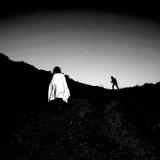
"Dialogues and Shadows" by Goncalo Almeida & Pierre Bastien invites you on a transcendental musical journey, rising above mere notes and timbres. With mechanical instruments and rich harmonics, their music sparks a conversation where listeners may actively participate. Surprises unfold as melodic phrases emerge from diverse sources, including Pierre Bastien's pocket trumpet and Goncalo Almeida's double bass, along with custom-made instruments.
Suche:pierre bastien
- 1
Blickwinkel presents ‘On a Tuesday and a Wednesday’, the first collaboration between Pierre Bastien and Casper Van De Velde. The album captures what the duo has been working on during a 2-day residency at Werkplaats Walter (Brussels), invited by the label. In their improvised sessions, they quickly found a way to merge Bastien's renowned mechanical sound sculptures with the playful and detailed style of percussionist Casper Van De Velde. The result is a blend of intricate rhythms and organic, music that flows effortlessly between the intimate and the expansive.
Pierre Bastien and Michel Banabila return with Nuits Sans Nuit, their second collaboration following their Baba Soirée debut from 2023. Recorded as an intuitive exchange between Rotterdam and Valencia, the album emerged from a simple ping-pong process: Banabila sculpted sounds and atmospheres, to which Bastien responded with his distinctive instrumental palette: flute-augmented cornet, mechanised log drum, and more. Mixed by Banabila, the result is a raw yet immersive work that resonates with a somnambulant, wide-awake presence. Nuits Sans Nuit unfolds through shifting shades of melancholy. "I don"t know how to describe the feeling of these crazy times we live in," says Banabila. "Les plus désespérés sont les chants les plus beaux," Bastien quotes De Musset. Wordless yet deeply expressive, the album invites listeners into a space of contemplation, where meaning emerges through immersion - like ritual music carrying an unspoken message. Echoes of saudade, blues, fado, and soleá surface in the duo"s playful noise, reimagined through their singular vocabulary.
Modern Obscure Music is proud to present Pierre Bastien & DJ Low's "Swing Low", a work that fuses the poetic inventiveness of Pierre Bastien with the visionary legacy of the late DJ Low (Tom Deweerdt), a central figure in Belgian independent music and founder of the influential Lowlands label. This album, which interweaves memory and experimentation, represents Bastien's debut on the Barcelona label's catalog and a testament to the creative bond between the two artists.
The album, composed of seven pieces, stands out for its hybrid nature: five reinterpretations of Bastien's previous works, some of them coming from his influential Mecanoid (originally released by Rephlex), and two unreleased improvisations, A Pupa and Reviver, which seal the unique character of the project.
Pierre Bastien, recognized as a composer, inventor and builder of sound machines, has been a tireless explorer of the frontiers between the mechanical and the musical. From his contribution to the Belcanto Orchestra, his collaboration with the PRSNT project to his participation in Pedro Vian's Earth, Our Planet or his collaboration with Tomaga for the Other People label, his career illustrates a constant commitment to experimentation and the intersection of disciplines. Among the artists he has worked with are names such as Robert Wyatt, Jac Berrocal, Jaki Liebezeit and designer Issey Miyake. His works have found homes on iconic labels such as Marionette, Morphine and Discrepant to name a few.
The album is presented with a visual design by Koen Bruyneel, reinterpreted as a tribute to Tom Deweerdt, a decade after his departure.
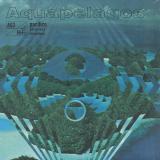
Presenting the second thematic volume on the “Aquapelagos" series - a collection of split LPs where selected artists offer their own take into water surrounded cultures and communities. After the initial release of the Anthology compilation Aquapelago in 2022 (Discrepant ,CREP91) and the split LP Atlantico by Lagoss & Banha da Cobra (Keroxen, KRXN027) we proudly introduce an unique collaboration in the series in the shape of no other than two improvising giants, Mike Cooper and Pierre Bastien.
This second volume blows the lid wide open with a sound journey inspired by the equally majestic and mysterious Indian Ocean, a wide space of open ocean bounded by Africa, to the west, Asia to the north and north-west and Australia, to the south west.
From Philip Hayward and Matt Hill’s liner notes:
‘’The album opens with Return To Chagos by emphasising human presence in the oceanic space, opening with gentle percussive taps and distant looped male vocalisation that gradually come into sharper focus, layered and thickened, accompanied by thicker percussion and mouth harp. The sense of departure is taken up in Trincomalee, which lifts over the oceanic textures, opening with slow, struck and scraped metallic sounds before thick low pitched wind instrument sounds enter, oscillating around shifting microtonal frequencies. The shore returns on Side 2, with the miniature epic of Nicobar elaborated over looped ‘atmos’ sounds of birds and insects over which tonal, slightly distorted electric guitar lines enter before looped high pitched feedback squeals join the texture. Summoning tropical storms and the disruption to the region caused by western intrusion, strong and startling brass accents appear, melding with the looping guitar feedback, creating eeriness and a sense of alarm. Tuangku is permeated by restrained dynamics and an expressive, breathy, low pitched, animalistic melodic voice that offers intermittent and ambiguous utterances, as if rendered in a language essential to and evocative of a place and time but impossible to precisely comprehend – coming from an ocean-aquapelagic beyond that can only be glimpsed and rendered by affect.’’
Philip Hayward and Matt Hill, March 2022
Two visionary maestros, Pierre Bastien and Michel Banabila, unite in their first collaborative album, Baba Soirée. The veterans of electronic music bring their unique expertise to the table, resulting in a captivating fusion of experimental styles. Bastien’s mechanical loops and experimental instrumental setups merge seamlessly with Banabila's sound design and impeccable skills of sampling collages. It's not a dance party, nor is it an avant-garde intervention. It's a soirée: a cultivated evening of sonic alchemy hosted by these two charismatic gentlemen.
Pierre Bastien is a composer and multi-instrumentalist with a background in French literature. He has spent decades crafting an idiosyncratic world of experimental sound with his self-built mechanical orchestra Mecanium. It was most notably showcased in audiovisual releases on Aphex Twin's Rephlex label. Bastien's creations are a mesmerizing combination of traditional instruments (he has a vast collection) and mechanical automatons. The violin in the track Rotomotor, for example, is physically played by one of his machines. In Baba Soirée, Bastien also plays a prepared cornet (Slow Dance, Banbas Aura), infusing the recordings with a breathy, dreamy dimension.
Michel Banabila, a sound artist, composer and producer, possesses an eclectic musical repertoire that defies genres. His seamless blend of minimal electronica, tribal ambient, and neo- classical influences has earned him a prominent place in the world of experimental music, and an impressive discography (Knekelhuis, Bureau B, Séance Center, a.o.). Banabila serves as the creative sampling editor for Baba Soirée, expertly weaving together the recordings to craft an evocative sonic tapestry.
The two share a curiosity for traditional instruments from various cultures. The instruments used in the recordings are shown in the cover artwork. A mutual admiration for each other's work paved the way for this fruitful artistic partnership of the Rotterdam-based artists: Collaborating on a single as a fundraiser for Yemen in 2022 set the stage for the creation of Baba Soirée.
For Pierre Bastien, Dada, Fluxus and International Situationism have played a significant role in shaping his artistic vision. The title Baba Soirée is an homage to Kurt Schwitters and Theo van Doesburg's "Kleine Dada Soirée" collaboration which took place exactly a century ago. There's an unmistakable stoicism and an anarchic not-giving-a-f*** attitude in these recordings by Bastien & Banabila, which resonates in the light of this Dada reference.
By now counting more than four decades of constant activity, Pierre Bastien erected such a towering and influential body of work that any blurb attempt regarding his music could easily fall into redundancy. Not that his revolving soundworld, deeply personal and unique, has ever stalled into gimmick or self mimicry, being Bastien the tireless explorer whose vision can never be complete, only continuously redefined in a process of discovery equally playful and challenging. So, completely in touch with Discrepant's ethos.
Returning to the label after 2017 The Mecanocentric Worlds of Pierre Bastien, the french musician, composer and instrument builder, brings an array of instruments from different cartographies and legacies with the appropriately titled Sonic Folkways. Resorting to different types of horns, prepared trumpet, an army of percussion, from gongs and tambourine to castanets and maracas, violin and too many others to mention here, Bastien weaves together a highly textured and hypnotic mosaic that projects an exotica beamed from scraps of the future. 'Aha!' in the same interstellar wavelength as Sun Ra's cosmic tones, 'Moor's Room’ almost orchestral tapestry of small percussion and insects or the non-western strings and tunings salvaged from ancient alien ceremonies on 'Pan's Nap'.
In an era where so much ink has been shed about world building in experimental music, Bastien can actually claim that to himself. The otherworld is right here, indeed.
“Bandiera Di Carta” represents the ongoing collaboration between instrument builder and composer Pierre Bastien and the
London based experimental duo Tomaga (Valentina Magaletti and Tom Relleen).
Bastien has been called a “mad musical scientist with a celebrity following” by The Guardian (UK) having collaborated with the
likes of filmmaker Pierrick Sorin, fashion designer Issey Miyake, singer and composer Robert Wyatt as well as Aphex Twin,
who released three of his albums on his label Rephlex.
Tomaga have made more than a dozen records since forming in 2014, pursuing a path of fearless experimentation and sonic
brinksmanship that has won them fans and plaudits from far and wide, including Thurston Moore, with whom they collaborated
on the CAN Project with Malcolm Mooney, Deb Goodge and others in 2017, as well as Wire, Silver Apples and Stereolab, with
whom they toured extensively in summer 2019.
The artistic collaboration between Pierre and Tomaga began with two commissions: from Fructose Festival in Dunkirk and the
revered underground festival Supersonic in Birmingham UK. Recording initially at a studio in the industrial port of Dunkirk, the
uneasy bond between borders and states seems to have been a theoretical motor to the collaborative sessions, as well as the
bleak landscape of the seaport frontier. This inspiration found further manifestation in the cover image for ‘Bandiera Di Carta’.
Resembling a white paper flag, it is, in fact, a photograph of Bastien’s paper and air sound machine installed on stage at
Teatro Carignano in Turin as part of the trio’s performance there. This charged, ambivalent image of a blank flag evokes the
transcendence of the national, a prescient visual motif that meditates on the contemporary uncertainty around notions of
national identity and borders but perhaps also a ‘carte blanche’ for the artists involved, in which they can deviate from the
confines of their usual practice into new and strange territories.
For each piece, Bastien’s unique sonic style: by turns his kinetic mechanoid motors, capriciously arrhythmic pipes, or the
peculiar susurrus of paper, creates a world in which Tomaga introduce their musical palette. Magaletti’s percussion anchors
these sometimes chaotic forces into beguiling syncopations, with Relleen’s synthesizer and organ work creating harmonic
counterpoints and interruptive provocations, to which Bastien responds with lyrical turns on prepared trumpet, rubber band, tin
foil and bass ocarina.
The results are curiously evocative of free jazz by the likes of Sun Ra or Art Ensemble of Chicago paired with the percussive
sound worlds of artists like Francis Bebey or Muslimgauze along with unique and sometimes bizarrely exotic tonal landscapes
of composers like Catherine Christer Hennix, Carl Stone, or Egisto Macchi. All three musicians seem to find space to bloom in
ways that are markedly different from their individual work and the resulting album is a strikingly original and powerfully bold
affirmation of what can happen when venturing beyond the normal in pursuit of the other.All tracks written & produced by Tomaga (Tom Relleen & Valentina Magaletti) & Pierre Bastien.
Mixed and mastered by Rashad Becker.
A collection of Elvis Presley covers recorded by the duet David Fenech & Pierre Bastien. The idea of "Suspicious Moon" started at a party around the topic of blue color. David Fenech had chosen to play "Blue Moon" and Pierre Bastien asked to join in. It was a very enjoyable party and then they recorded the song and decided to plan an album exclusively based on covers of the King. Not that we were absolute fans of Elvis... but as a starting point to go somewhere else. And this is what we reached: in many aspects a premiere for the two musicians. Pierre focuses on (prepared) trumpet for the very first time, while David is heard extensively as a vocalist and is more than ever responsible for all arrangements and textures. Playing other people's material is also a premiere for both of them. 11 tracks around very well known standards. Like familiar places that are changed when seen in a different light. Please enjoy. "Our choice of the Elvis Presley song book for this record may seem strange to many. It seems strange to me as well. Not that I dislike the original music, but before our sessions it had never been a direct source of inspiration. Paradoxically, this distance gave me freedom and flowing ideas. I hear similar qualities in David's parts too. We hope that our relaxed attitude and its positive outcome will be reflected in this album" - Pierre Bastien "The strange thing about these recordings is that the creative process was so fluid and natural_ that it seems that through playing other people's music, we almost reveal something of ourselves. As if these tracks were our creation, as if they were our own children!" - David Fenech
- 01: Hìeratico
- 02: Litho Non-Danse
- 03: Blue Hymne (Feat. Limpe Fuchs)
- 04: Cuerda De Piedra
- 05: Aranha
- 06: Tombal (Feat. Pierre Bastien, Massimo Silverio &Amp; Marco Baldini)
- 07: Boku Ga (Feat. Adele Altro)
- 08: Meridiana (Feat. Giuseppe Ielasi)
- 09: Lode (Feat. Natalia Rogantini &Amp; Jonas Torstensen)
- 10: Sospire (Feat. Roberto Musci)
- 11: Muracetra (Feat. Vipera &Amp; Dròlo Ensemble)
- 12: Vessel (Digital Bonus Track)
Like its cover, Nicolas Remondino's Hìeratico plays in the rich shades of crepuscular spaces. A night-tuned, percussion led album where prepared drums are accompanied by flickers of spoken word, acoustic instruments and muted electronics,
The title translates to 'hieratic', for Remondino a "black and gold" term laden with dualities and complex connotations. A sense of teetering between sparkling light and richly coloured darkness imbues the music, the compositions simulating a sense of heightened acuity as they convey us through a spooky elemental soundworld. The opening title track begins with a metallic shimmer, a drum skin activated in a way that sounds like it's being smelted. A cushioned rhythm enters, a smothered timbre akin to hearing something lurking around the garden. On "litho non-danse", percussion cracks like branches and dried foliage under foot.
Remondino recorded initial outlines for the pieces at Giuseppe Ielasi's studio in Milan, before fleshing out these ideas with his own additional instrumentation and contributions from a globe-spanning network of collaborators. On "blue hymne", chiming percussion equal parts jubilant and sinister heralds spoken word from Limpe Fuchs. "Tombal" opens with Massimo Silverio whispering in the Carnic dialect, a minority language from the Carnic Alps. Around, Marco Baldini, Pierre Bastien and Remondino construct a somber soundscape that cranks and sighs in the crevices.
Hìeratico is an album of hybrids. Diverse voices, accents and dialects deliver its lyrics, the instrumentation underpinning it crosses idioms. The drumkit at its core is modified to amplify its resonant tones and harmonics. Inspired by natural substances and phenomena: stone, wood, wind, earth, metal, grass, rain, clouds and bark, Remondino explores how percussion could evoke their materiality, treating drums as lucid textural instruments as much as rhythmic timekeepers. It gives the album a finely shaded depth and clarity as it conjures the vibrancies that reside in darkened corners. Hìeratico dwells in a sensation that crosses borders, the speckles of light in the oblique night sky. Listening is an aural equivalent to stepping into a pitch black forest and waiting for your eyes to adjust, a lightless void turning into a spectacular tableau of shadows and glows. Daryl Worthington
Presenting the third thematic volume on the “Aquapelagos" series - a collection of split LPs where selected artists offer their own take into water surrounded cultures and communities. After the initial release of the Anthology compilation Aquapelago in 2022 (Discrepant ,CREP91) and the split LP Atlantico by Lagoss & Banha da Cobra (Keroxen, KRXN027) as well as the direct collaboration LP Índico by Mike Cooper & Pierre Bastien we proudly introduce an the third volume in the series in the shape of no other than two inspiring artists, Vica Pacheco and Pak Yan Lau. Two different sound journeys inspired by the majestic and peaceful Pacific Ocean, the vastest, largest and deepest ocean of our planet.
Vica Pacheco’s composition takes a calm meditation approach where water flutes and synths brush shoulders to create a ever expanding mind journey whereas Pak Yan Lau’s ambitions Neo classical piece, The Ocean in Us, talks about that grand overwhelming feeling, that vast space deep under, on the bottom of the Pacific. Both compositions were recorded and created with the particular wet acoustics of the Tank in Santa Cruz de Tenerife in mind.
From Philip Hayward and Matt Hill’s liner notes: ‘’The Pacific is a complex space, comprising a third of the Earth’s surface. A cascade of islands runs along its eastern flank, down from the Kamchatka peninsula, through Japan, Taiwan, The Philippines, Melanesia and on to Australasia. In its watery heart the islands of Micronesia and Polynesia stretch across huge distances, north-east to the Hawaiian archipelago, south east to Rapa Nui and south west to Aotearoa and Chatham island. Closer to the shores of the Americas lie Tierra del Fuego, the Galapagos Islands, Haida Gwaii and the Aleutians. This is a space that resists easy characterisation. The Pacific laps the shores of Japan and Chile, the beaches of Australia’s East Coast and the cold, damp coasts of British Colombia and Alaska alike. Indeed, the space is so vast that it is a world in itself and one rarely navigated in its entirety. In this manner, strands of genres and the songs that reflect them are components in an intricate mesh of associations.‘’ Philip Hayward and Matt Hill, April 2022
PulciPerla will unveil “Tatekieto”, their new album, on its release, January 04, 2025, on Prado Records / Cie Pulcinella / The Pusher. This opus will be presented on Wednesday, February 05, 2025, on the stage of FGO - Barbara, Paris (France) during an exceptional launch concert. The eponymous single “Tatequieto” was released on all platforms on November 22, 2024.
Take an iconoclastic and energetic quartet from Toulouse, combine it with a female power trio from Bogotá, shake it up, and you will get Pulciperla!
After an explosive encounter in Colombia in 2019, the fiery trio La Perla and the unclassifiable Pulcinella decided to create an original repertoire: a hybrid, swaying, and sensual music where vocals, saxophone, keyboards, double bass, and percussion blend generously, driving a powerful trance-like pulse. A quirky and striking repertoire infused with bullerengue, reggaeton, funk, and champeta influences, which stirs the fire and gets you moving. The tribal music of La Perla’s percussionist singers merges with Pulcinella’s explosive groove to electrify the audience and awaken their primal instincts!
PulciPerla is composed of :
La Perla: Diana Sanmiguel: vocals, maracas, guacharaca;
Giovanna Mogollón ‘’Roberta Leono’’: vocals, tambor alegre;
Karen Forero:vocals, gaïta, tambora
Pulcinella: Ferdinand Doumerc : saxophones, flutes, keyboards;
Jean-Marc Serpin: double bass;
Bastien Andrieu: keyboards ;
Pierre Pollet: drums
- A1: Robert Pico - Le Chien Fidèle
- A2: Annie Girardot - La Femme Faux Cils
- A3: Spauv Georges - Je Suis L'état
- A4: Zoé - Zoé
- A5: Jacques Da Sylva - Fou
- A6: Valentin - Je Suis Un Vagabond
- A7: Jacques Malia - Histoire De Gitan
- A8: Bernard Jamet - Raison Legale
- B1: Jean-Pierre Lebort - Barbara Au Chapeau Rose
- B2: Les Concentrés - Fils De Dégénérés
- B3: Les Missiles - Publicité
- B4: Hegessipe - Le Credi D'hegessipe
- B5: Marechalement Votre - Ethero Disco
- B6: Mamlouk - Decollez Les
- B7: Mozaique - L'amour Nu
- B8: Jean-Marc Garrigues - Je Dis Non
- B9: Penuel - Astronef 328
The journey through French-speaking pop archives continues with this fifth volume, packed with fuzz, gimmicks, and dissent. Far from the charts, the selected tracks display a great creative freedom, often backed by corrosive humor. Welcome to the surprising, kaleidoscopic, and colorful world of the late sixties and early seventies, Wizzz!
Born in Montauban, Robert Pico stumbled into music by chance when he met René Vaneste, then artistic director at Pathé-Marconi. René brought him to Paris to record his first 45 RPM EP in 1964. A year later, Pierre Perret introduced him to Vogue, where he recorded his second album with Claude Nougaro’s orchestra. Sylvie Vartan then introduced him to RCA, where he recorded four singles, including the astonishing "Chien Fidèle," a track backed by a hair-rising fuzz guitar. Alongside his solo career, he also composed for other artists like Alain Delon (the song was recorded but remains unreleased), Magali Noël, Bourvil, and Georges Guétary. In the Paris of the sixties, he mingled with Mireille Darc, Elsa Martinelli, Marie Laforêt, France Gall, Françoise Hardy, Petula Clark, Régine, Dani, Serge Gainsbourg, Joe Dassin, Franck Fernandel, Charles Level, and Roland Vincent. Despite his efforts and winning a Grand Prix Sacem for his final record, Robert Pico didn’t achieve the expected success in show business and decided to leave Paris and return to the Southwest, where he devoted himself to writing. He is the author of 23 books (including Delon et Compagnie, Jean-Marc Savary Editions 2025, a memoir about his youth and his many encounters). Today, he is relieved to never have become a celebrity and devotes himself to his work with passion.
In 1969, the Franco-Italian movie Erotissimo was released, directed by Gérard Pirès (who later directed Taxi in 1998, written and produced by Luc Besson). This pop comedy features Annie Girardot, Jean Yanne, Francis Blanche, Serge Gainsbourg, Nicole Croisille, Jacques Martin, and Patrick Topaloff. The soundtrack was written by Michel Polnareff and William Sheller, with lyrics by Jean-Lou Dabadie. "La Femme Faux-cils," performed by Annie Girardot. It recounts the feelings of a rich CEO's wife who seeks to develop her sex appeal under the influence of advertisement and magazines. Groovy, sparkling and light, this track, with ITS lush arrangements humorously critiques consumer society and feminine beauty standards.
“Je suis l’Etat” (1967) is the flagship track of the first EP by singer-songwriter Spauv Georges, aka Georges Larriaga, better known as Jim Larriaga (1941-2022). Born into a family of bakers, the young man was initially planning to become a hairdresser when he discovered English-speaking music through Elvis Presley and the Beatles. After this revelation, he decided he would become a songwriter and gave himself five years to succeed. He recorded his first two EP’s independently for RCA under the pseudonym Spauv Georges; meaning “that poor George”, a nickname given to him by the mother of her friend Jean-Pierre Prévotat (future drummer of the Players, Triangle, or Johnny Hallyday). Portraying a depressed and eccentric young man, Spauv Georges created corrosive and amusing songs that didn’t reach a wide audience, despite a TV appearance with Jean-Christophe Averty.
Supported by his loyal friend and fellow songwriter Jean-Max Rivière, Georges Larriaga met the future singer Carlos in the early '70s, then Sylvie Vartan’s assistant. He wrote songs for Carlos, including the popular "La vie est belle," "Y’a des indiens partout," and "La cantine", which went onto become a huge hit in 1972. He also composed for Claude François (“Anne-Marie”, 1971), Charlotte Julian (“Fleur de province”, 1972), helped launch child singer Roméo (who sold 4 million records), and later wrote the hit "Pas besoin d’éducation sexuelle" (1975) for the young Julie Bataille. In 1971, Jim recorded an album for Disc'Az: “L’univers étrange et fou de Jim Larriaga”, which featured pop gems like “La maison de mon père”.
The story of the song "Zoé" began when Pierre Dorsay, artistic director at Vogue Records, asked Swiss singer and musician Pierre Alain to write a song for a new female singer. The inspiration came when he realized that Zoé (the artist's name) was also the name of France's first atomic battery, created in 1948, which consisted of uranium oxide immersed in heavy water! The lyrics reflect a bubbling energy that must be handled with caution, while the instrumentation echoes this atomic theme, notably with the use of a theremin.
Zoé’s career lasted only as long as a single 45 RPM, but it seems Christine Fontane was the vocalist behind this pseudonym, who is known for several EPs, a good "popcorn" album in 1964, and a handful of children’s singles in the '70s. Regardless, the photograph on the cover is of a different girl entirely.
Later, Pierre Alain continued his career, writing songs for himself, Marie Laforêt, Danièle Licari, Alice Dona, Arlette Zola (3rd place in Eurovision 1982), and achieving multiple gold and platinum records in Canada. Also an inventor with several patents, president of the Romande Academy, and head of the French Alliance in Geneva, he now composes atonal music, books, and poetry. Moreover, he is also the host of "Les Mardis de Pierre Alain" at "Le P'tit Music'Hohl" in Geneva.
Filled with oriental choruses and fuzz guitar, "Fou" is from Jacques Da Sylva's only EP released by Vogue in 1967. Despite the quality of this recording, all traces of this singer disappear after this first effort.
Valentin is a baroque pop singer born in Belgium. He is the songwriter and composer of most of the tracks on his three singles released in the late 60s in Canada. A legend says that he reincarnated himself as Jacky Valentin during the 1970s for a rock'n'roll revival career in Belgium, but his older brother sadly debunked this story. Valentin's first two singles were arranged by Claude Rogen, a Parisian session pianist who had come to Canada to promote the song “Mister A Gogo”, a cover of David Bowie’s “Laughing Gnome”, adapted by singer Delphine, his wife at the time. Far from his usual network, Claude Rogen arranged music for Polydor, including the arrangements for “Je suis un vagabond” in 1969, a jerk tune with string arrangements and a furious optimism.
Jacques Malia wrote, composed, and recorded his only 45 EP for Festival in 1966. “Histoire de gitan” is an incredible beat track with bohemian scat that tells the story of a gypsy musician who came to Paris to make it in the Music-Hall, to no avail. The hero of the song and its author probably shared a similar fate, as Jacques Malia faded into anonymity after this remarkable attempt.
Bernard Jamet recorded two EPs for Barclay in the late sixties and co-wrote several songs with Christine Pilzer, Pascal Danel, and prolific songwriters Michel Delancray and Mya Simile. The track “Raison Légale” (1968), his masterpiece, immerses the listener in a courtroom right when a murderer is being judged, with jerk rhythm and free arrangements. A unique, paranoid, judicial, and psychedelic oddity.
Jean-Pierre Lebrot-Millers started his career in show business in 1967 as a singer and songwriter for the Philips label. After three singles, he wrote several songs of a new kind with his friend Pierre Halioche, in the midst of the sexual liberation movement and the democratization of drugs. With provocative lyrics, “Les filles du hasard” and “Barbara au Chapeau Rose” were released on a Philips singles in 1968. The character of Barbara was inspired by a queen of Parisian nightlife during the psychedelic years: model Charlotte Martin, who dated Eric Clapton from 1965 to 1968, then Jimmy Page from 1970 to 1983. Jean-Claude Petit’s arrangements, with a table-filled intro, soul brass, and Hendrixian guitar, emphasize the flamboyance of a hedonistic and sexy character, whose dog is named Junkie because “Junkie est un nom exquis”! The track was recorded live in three takes with a full orchestra.
Upon its release, the record was censored by Europe 1 and RTL due to its references to drug use. Jean-Pierre Lebrot was then banned from the airwaves and later dismissed by his record label. He changed his artist name to Jean-Pierre Millers, while his companion Pierre Halioche became D. Dolby for a new dreamy composition, “Chilla”, which Jean-Pierre produced himself with arrangements by Jean Musy. Once again, the song was immediately censored everywhere. After this setback, he decided to stop singing and started taking on odd jobs to support his Swedish wife and their son until the day he met Jean-Pierre Martin, then production manager at Decca, who had worked with Manu Dibango. Martin offered Jean-Pierre Lebrot-Millers, then employed at Rank Xerox, the position of artistic director at Decca. He accepted and became, a year later, promotion director (radio, press, TV). He worked on Julio Iglesias’s first album for Decca, which became a massive hit and allowed him to meet Claude Carrère. The latter asked him to write new songs and find their performers, much like a “talent scout.” It’s through him that Jean-Pierre discovered Julie Pietri and Corinne Hermès. He composed “Ma Pompadour” for Ringo, Sheila’s husband, and took the microphone again for the syncope hit “Rendez-Vous” in 1982.
That same year, Jean-Pierre Lebrot-Millers tried to release a track for which he had heavily gone into debt: “Si la vie est un cadeau”. Having recorded it in London, he presented it to numerous professionals, all of whom refused to get involved. The same thing happened with Antenne 2 and the Sacem when he proposed the song as France’s entry for Eurovision. He then met Haïm Saban, who was producing cartoon soundtracks and had just launched the Goldorak theme song. Saban, having listened to the song, declared it had the potential to become a hit. He sent Jean-Pierre and Corinne Hermès to meet the CEO of the Luxembourg radio and television network. The latter received them, asked to hear a verse and chorus a cappella in his office, and immediately hired them to represent Luxembourg at Eurovision 1983. They reworked the arrangements and recorded a new version with Haïm Saban as co-producer. The song ended up winning Eurovision 1983, a great comeback for our hero. He continued producing and hung out with the band Nacash in Belgium when a couple came to introduce their daughter for an impromptu audition in a hotel room. The girl sang “Les démons de minuit” while dancing to a radio cassette. Impressed, he had her take singing lessons for a year and composed a song for her (for which he had the melody and title, but no lyrics). This required him to go on the hunt for a lyricist, who ended up being Guy Carlier. They recorded the song, which was initially a ballad, at Bernard Estardy’s CBE studio, and gave the singer a new name: Melody. They showed the song around their industry network without success. Later, Estardy called Jean-Pierre to suggest changing the rhythm and making it pop-rock. Orlando, Dalida’s brother, liked the result and decided to co-produce the track. “Y’a pas que les grands qui rêvent » became a classic hit. The song has since been covered by Juliette Armanet (as a ballad, like the original) and Valentina.
Born into an aristocratic Breton family, Hervé Mettais-Cartier worked as a DJ at Queen Kiss, a nightclub in Poitiers, where he formed the band Les Concentrés with Michel (an actor) and Christian (a radio technician). Together, they created a repertoire of whimsical songs (“Ma bique est morte”, “J’suis un salaud”, “Fils de dégénéré”...) that they performed on stage dressed in white (in homage to “concentrated milk”). They performed at Bliboquet and Olympia in 1968 for the 10th edition of the “Relais de la chanson Française” organized by L’Humanité-Dimanche and Nous les Garçons et les Filles, sponsored by Pepsi Cola. Winners in the author-composer category, alongside Danish singer Dorte, their visibility allowed them to record a 45, and appear on television in Jean-Christophe Averty’s show. The A-side of the disc features Bruno le ravageur, a casatchok dedicated to Bruno Caquatrix, the director of Olympia, nicknamed in the song “Coq Atroce” or “croque-actrices”. The B-side is dedicated to “Fils de dégénéré”, a quirky tribute to Hervé's aristocratic roots, mixing absurdity with sophisticated vocal harmonies.
After Les Concentrés, Hervé Mettais-Cartier formed the duo La Paire et sa Bêtise with his friend Olivier Robert. They performed in Parisian cabarets and toured with Pierre Vassiliu. In the late 1970s, Hervé began a solo career. He recorded two albums for the Motors label in 1978 and 1979, which did not achieve their anticipated success due to lack of promotion. In 1980, he met Bernadette, with whom he started a family and created a “Chansons à voir” (songs to see) show that he performed until his death at the end of 2024.
Publicité comes from the final EP by the Missiles (Ducretet Thomson, 1966), a disc that also includes “La (nouvelle) guerre de cent ans”, featured on Volume 4 of our Wizzz! series. Please refer to the booklet for the story of the band.
“He’s 1.82 meters tall, 28 years old, weighs 135 kg, is black and Belgian”: this is the description of singer Hegesippe on the back of his sole single (Decca, 1967). He appears on the album cover wearing a Greek toga, like a hippie gag – we are at the end of the year 1967. In “Le crédo d’Hegesippe”, this former bodyguard of Antoine and the Charlots plays the delightful card of the thick brute converted to Flower-Power and non-violence, with arrangements by Jean-Daniel Mercier, aka Paul Mille.
“Ethéro-disco” was released on a promotional record for clients of the Maréchal company (Liège, Belgium) for the New Year 1979. Over a funky rhythm, celebrity impersonations (Brigitte Bardot, Jacques Dutronc, Fernandel…) deliver an enigmatic text about pharmaceutical products like ether, bismuth, and aspartate. The track was composed by Dan Sarravah (responsible for Joanna's “Hold-up inusité” featured on Wizzz! Volume 3) and Tony Talado, who was also a singer (one 45 in 1967), songwriter (with over a dozen credits between 1964 and 1985 in various styles from surf music to disco), author (Devenez Végétarien, Dricot Editions, 1985), ad designer, and psychologist.
Décollez-les is on the A-side of Mamlouk's only single, a pseudonym for Marsel Hurten, who is known for his work on several EPs in the late sixties, as well as composing music for Hervé Vilard’s “Capri, c’est fini”, Claude Channes' “La Haine”, Annie Philippe’s “On m’a toujours dit”, and Nancy Holloway’s “Panne de Cœur”.
This strange song, with Afrobeat horns and absurd dialogues between a chef and his kitchen staff, is the result of a collaboration between Marsel Hurten and one of his neighbors, a photographer from Pavillon-sous-Bois (93), where the musician settled after returning from the Algerian War. A music video was shot to promote the record.
Marsel Hurten was born in Tourcoing (59) into a musical family. At a young age, he joined the brass band founded by his grandfather, playing the piston before studying trumpet at the conservatory, as well as teaching himself how to play the guitar. As an orchestra musician, he toured in France, Belgium, Germany, and England. He released a series of solo 45’s between 1965 and 1968 for the DMF and Az labels before stopping recording to focus on working for other artists (Gilles Olivier, Noëlle Cordier…).
“L’amour nu” (Vogue, 1971) is the work of the short-lived Belgian band Mozaïque. The track, written by singer Jacques Albin, closely resembles another of his compositions, “Carré Blanc”, which he recorded in 1969 for Disc’AZ.
Represented by the Lumi Son micro-label based in Marignane (Côte d'Azur), Jean-Marc Garrigues released two 45 RPMs in the late sixties, defending the French jerk sound. The song “Je dis Non” is a short, joyful ode to youth, pop music, and rebellion.
Songwriter and performer Jacques Penuel released three singles. The first one, “Astronef 328” (Fontana, 1969), features a dizzying series of chords punctuated by sound effects, a sci-fi story, and arrangements by Jean-Claude Vannier.
We would like to sincerely thank Pierre Alain, Moon Blaha, Marsel Hurten, Bastien Larriaga, Jean-Pierre Lebrot-Millers, Bernadette Mettais-Cartier, Robert Pico, Olivier Robert, Claude Rogen, Micky Segura.

- 01: Forests, Tales, Cities, Forests: I
- 02: Forests, Tales, Cities, Forests: Ii
- 03: Forests, Tales, Cities, Forests: Iii
- 04: Forests, Tales, Cities, Forests: Iv
- 05: Forests, Tales, Cities, Forests: V
- 06: Forests, Tales, Cities, Forests: Vi
- 07: Forests, Tales, Cities, Forests: Vii
- 08: Forests, Tales, Cities, Forests: Viii
- 09: Forests, Tales, Cities, Forests: Ix
Award-winning producer and composer Giorgi Koberidze offers up a head-spinning debut of Georgian modern classical music shot through with 360° electroacoustic textures.
Giorgi Koberidze is an electronic and classical music composer from Georgia. He currently serves as a professor of music at Tbilisi State Conservatoire, as well as at Ilia State University, and the private music school "303 Herz". Giorgi's work is rooted in the Georgian musical tradition, cross-pollinating indigenous instrumentation with electronic and western classical timbres. He recently won first prize in the Tbilisi Conservatoire Composers Awards, and received Georgia's most prestigious cultural gong, the Tsinandali Award.
The Album was premiered in Georgia at the Kutaisi Film Festival, and later showcased at the Tbilisi Film Festival. Working from graphic scores, Giorgi's ensemble includes strings, woodwind and traditional instruments from the Caucasus (doli, chuniri). Fleeting voices, field recordings and skittering percussion converge to paint a storied map of Tbilisi, and its surrounding terrain of forested polyphony and microtonal peaks and crags.
Each listen of the album is projectively rich, like a dizzying series of sonic inkblot images. The piece is designed to be absorbed in the surround sound of darkened movie theatres, conjuring a multiverse of narratives in the half-light of sensory acuity. At home, Giorgi invites listeners to set aside time to experience the record in a dark, comfortable space absent of external stimuli.
This album was made with the support of the Tbilisi State Conservatoire. The recordings were funded by Nicolas Jaar. Thank you. We are beyond proud to present this incredible project.
Recommended for fans of Pierre Bastien, Roméo Poirier, Jan Jelinek.
- Fragments
- Park Güell
- Séquence
- Logique Du Sens
- Musique Ridicule
- Séquence
- The Curious Sofa
- Moments De Bruits Pendant Le Naufrage
- L'horizon Perdu Du Cornet A Gidouille
- Résumé Du Concert Du Bel Canto Orquestra Du 7 Mai 1992
This is the first ever stand-alone vinyl release of the Bel Canto Orquestra"s legendary concert in Montpellier in 1983. Founded by Pascal Comelade, Pierre Bastien, Cathy Claret and Laurent Churet, the Bel Canto Orquestra was constituted of toy instruments only. During its lifetime from 1983 to 2015, other members included Victor Nubla, Pip Pyle, Jac Berrocal and many more. Includes bonus track "Résumé Du Concert Du Bel Canto Orquestra Du 7 Mai 1992" which is a never before released piano summary of the Orquestra"s 1992 concert.
Earth, Our Planet?”: A call for environmental awareness. This time, Pedro Vian - the founder of Modern Obscure Music - presents his fourth solo album (following his 2020 release, "Ibillorca"). Due for release in spring 2024, "Earth, Our Planet?" promises to immerse us in a moving odyssey, crossing the boundaries of musical genres to provoke an urgent meditation on the protection of our planet. On this occasion Vian has composed the album influenced by the myth of the eternal return, the compositions are long and repetitive, generating states of pure trance.
Pedro Vian, singular for his fusion of genres and styles, ventures into even more complex territories in "Earth, Our Planet?". From the first listen, it is evident that this work treads the line of convention and breaks the boundaries of electronic and experimental music with artistic dexterity. The album weaves together texture, hypnotic rhythms and melody. Each track reveals his distinctive ability to create immersive landscapes, guiding the listener into deep emotional introspection. This is not just music; it is a transformative experience.
The beauty of this album lies not only in the musical vision. The album features high-calibre collaborations that add layers of creativity and elegance. Trumpeter Pierre Bastien, whose early productions left an indelible mark on Aphex Twin's Reflex label, infuses "A Day in Rotterdam" with a unique emotional resonance. Violinist, Asia, renowned for her avant-garde approach and ability to conjure unique landscapes, elevates the album's opening tracks "Urobóros" and "Les Tambours Subterraniens". Their skill and sensitivity intertwine perfectly with Vian's artistic vision. In addition, Italian producer Daniele Mana, with whom Pedro Vian collaborated closely on his previous album "Cascades", known for his experimental approach and talent for creating extraterrestrial atmospheres also contributes to "Les Tambours Subterraniens". His artistic perspective adds more complexity and texture to the piece, pushing the boundaries of contemporary electronic music. There is also a collaboration with Raül Refree, an artist with whom Vian worked with last year, presenting “Font De la Vera Pau”, an album that The Guardian defined as "a wonderful piece of electroacoustic music, a captivating mix of strings and analogue synth drones which sometimes flirts with Alice Coltrane-ish spiritual jazz". With "Earth, Our Planet?", Pedro Vian not only offers up some of his best work to date, but it is also a call to reflect on our relationship with the natural world. As a part of a planet where environmental awareness is more crucial than ever, he urges us to protect and preserve our world as an extension of ourselves. This extensive work is a statement, Vian addresses the notion that too often we prioritise immediate needs over the well-being of the planet. It highlights the fact that we often consider the Earth as a possession when, in reality, we are but a part of it.
Marc Richter aka Black To Comm released his debut record 20 years ago. In 2023 he is still busy releasing music under various disguises and is currently signed to the Thrill Jockey label. To celebrate this anniversary his own Cellule 75 label is re-releasing some classic out-of-print vinyl albums that originally came out on the defunct Type and De Stijl labels. The LP will feature a full-colour printed inner sleeve exclusive to this edition.
In 2009 the Type Recordings label run by John Twells had just released seminal records by Grouper, Jóhann Jóhannsson and Yellow Swans when they signed Richter and put out his breakthrough Alphabet 1968 album. The LP sold out within two weeks, receiving a glowing full-page review in The Wire Magazine by the late Mark Fisher (later reprinted in his book Ghosts Of My Life), was selected for Boomkat's Top 10 releases of the year (alongside debut albums by Leyland Kirby, Demdike Stare and Oneohtrix Point Never) and was greeted with universal praise in the underground blog network as well as established magazines such as The New Yorker and Pitchfork.
The music itself played with the notion of nostalgia without being nostalgic itself. It's the sound of half-remembered dreams, a surreal distorted vision of the past, an aural polaroid of long forgotten musics, a ghostly voice from a non-existent era.
From the original Type one-sheet:
"The mission statement for Alphabet 1968 was to write an album of "songs" for want of a better word. Short tracks which represented genre points, the milestones which stuck in Richter's mind when he thought back to his favorite records. What we arrive at is a breathtaking 10-track album which, over the course of 45 minutes, explores world music, techno, noise, avant-garde, ambient music and even exotica. Each track is linked with a loose thread of radio static or environmental sound, dragging you through the album, as if tuning in to a stray broadcast or a particularly adventurous mix. Richter has pieced the album together from hours of recordings made at his studio with home made gamelan, small instruments and loops gathered from a collection of ancient vinyl and 78 records. The scope of the album is admirable, but ignoring this, it is simply a shockingly arresting collection of experimental oddities, with references ranging from Moondog to Basic Channel by way of Bernard Herrmann. It's not hard to fall in love with Alphabet 1968, far harder would be to place exactly where the record should fit into your collection."
Mark Fisher in The Wire:
"But what if we were to take Richter's provocation seriously - what would a song without a singer be like? What would it be like, that is to say, if objects themselves could sing? It’s a question that connects fairy tales with cybernetics, and listening to Alphabet 1968, I’m reminded of a filmic space in which magic and mechanism meet: JF Sebastian’s apartment in Blade Runner. The tracks on the LP are crafted with the same minute attention to detail that the genetic designer and toymaker brought to his miniature automata, with their bizarre mixture of the clockwork and the computerised, the antique and the ultramodern, the playful and the sinister. Richter’s musical pieces have been built from similarly heterogeneous materials - record crackle, shortwave radio, glockenspiels, all manner of samples, mostly of acoustic instruments. ….. JF Sebastian's apartment was itself an update of older spaces in which science and sorcery co-existed: the workshops of ETA Hoffmann's inventor-magicians, or of Pinocchio's creator, Geppetto. I think, too, of Auguste Villiers de l'Isle-Adam's astonishing 1886 tale The Future Eve in which Edison, using the expertise he has recently acquired from inventing the phonograph, sets himself the task of constructing an artificial woman. But if there are songs here, they are sung by the gramophone and other recording and playback machines. Richter so successfully effaces himself as author that it is as if he has snuck into a room and recorded the objects as they played (to) themselves. Rather than simply automating his music, as in the case of Pierre Bastien and his mechanical machines, Richter makes us feel that he has merely recorded the unlife of objects. ….. Indeed, the impression of things winding down is persistent on Alphabet 1968. Entropy has not been excluded from Richter's enchanted soundworld. It feels as if the magic is always about to wear off, that the enchanted objects will slip back into the inanimate again at any moment."
- A1: Laurie Spiegel - 'Fly By
- A2: Pedro Vian & Pierre Bastien - 'Memory
- A3: Lyra Pramuk - 'Cage
- A4: Chassol - 'Ya!
- A5: Nicolas Godin & Pierre Rousseau - 'Page Turner
- A6: Pascal Comelade - 'Segons Com
- A7: Visible Cloaks - 'Lifeworld
- A8: Raül Refree - 'Vid2020
- A9: Lucrecia Dalt - 'Cosa
- A10: Kelman Duran - 'Dead Cat
- A11: Lafawndah - 'The Super Lady From Nameless-Town
- B1: Ryuichi Sakamoto - 'Silence
Ltd Black Vinyl Gatefold edition + 32 Page Booklet + Download Code
The LP contains original compositions by Ryuichi Sakamoto, Pascal Comelade, Laurie Spiegel, Lyra Pramuk, Chassol, Nicolas Godin and Pierre Rousseau, Pedro Vian and Pierre Bastien, Visible Cloaks, Kelman Duran, Raul Refree, Lucrecia Dalt, Lafawndah.
+ a booklet with writings by contemporary thinkers like Shumon Basar, François J. Bonnet, and pictures by, Araki, Juergen Teller, Elizaveta Porodina, Dani Pujalte, P Jack Davison, Zhong Lin, Alessandra Sanguinetti, Adrià Cañameras, Javier Tles among others. Lacquer cut by Josh Bonati & Mastered by Rashad Becker
'PRSNT' is a unique global artistic project combining the input of artists across the worlds of music, video and written word which acts as a statement on how we, as consumers, engage with music in the 21st century. Vital electronic musicians including Ryuichi Sakamoto, Lafawndah, Lyra Pramuk, Lucrecia Dalt and Visible Cloaks have each contributed tracks, which are approximately 32 seconds long.
The concept was devised by Created By Us and the Barcelona-based label Modern Obscure Music. They read a study which identified that the overwhelming volume of instantly accessible information online is shortening attention spans and altering how audiences engage with music digitally. Their curiosity about the state of online consumption developed further on discovering that around a third of all listeners using digital platforms skip to the next track, within the first 30 seconds of playing.
Each musician was given a fascinating challenge to create engaging compositions with real artistic merit, inside the confines of this shortened span. Akin to Brian Eno's famous Windows 95 start-up music, the time constraints are crucial, and the compositions are deceptively complex and more substantial than expectations of their nano nature would suggest.
'PRSNT' acts as a critique of flighty feed culture, but is simultaneously constructive, providing something which is either proposed solution, or "if you can't beat 'em join 'em" resignation. Every artist has interpreted the brief differently, resulting in an intriguing blueprint for the potential future of digital music. Could abbreviated micro compositions satisfy, inspire and nourish like their longer counterparts? They certainly take up much less of listeners' busy lives, which are often spent tackling ever-increasing workloads.
- A1: Laurie Spiegel - Fly By
- A10: Kelman Duran - Dead Cat
- A11: Lafawndah - The Super Lady From Nameless-Town
- A2: Pedro Vian & Pierre Bastien - Memory
- A3: Lyra Pramuk - Cage
- A4: Chassol - Ya!
- A5: Nicolas Godin & Pierre Rousseau - Page Turner
- A6: Pascal Comelade - Segons Com
- A7: Visible Cloaks - Lifeworld
- A8: Raul Refree - Vid2020
- A9: Lucrecia Dalt - Cosa
- B1: Ryuichi Sakamoto - Silence
Ltd White Vinyl Gatefold edition + 32 Page Booklet + Download Code
The LP contains original compositions by Ryuichi Sakamoto, Pascal Comelade, Laurie Spiegel, Lyra Pramuk, Chassol, Nicolas Godin and Pierre Rousseau, Pedro Vian and Pierre Bastien, Visible Cloaks, Kelman Duran, Raul Refree, Lucrecia Dalt, Lafawndah.
+ a booklet with writings by contemporary thinkers like Shumon Basar, François J. Bonnet, and pictures by, Araki, Juergen Teller, Elizaveta Porodina, Dani Pujalte, P Jack Davison, Zhong Lin, Alessandra Sanguinetti, Adrià Cañameras, Javier Tles among others. Lacquer cut by Josh Bonati & Mastered by Rashad Becker
'PRSNT' is a unique global artistic project combining the input of artists across the worlds of music, video and written word which acts as a statement on how we, as consumers, engage with music in the 21st century. Vital electronic musicians including Ryuichi Sakamoto, Lafawndah, Lyra Pramuk, Lucrecia Dalt and Visible Cloaks have each contributed tracks, which are approximately 32 seconds long.
The concept was devised by Created By Us and the Barcelona-based label Modern Obscure Music. They read a study which identified that the overwhelming volume of instantly accessible information online is shortening attention spans and altering how audiences engage with music digitally. Their curiosity about the state of online consumption developed further on discovering that around a third of all listeners using digital platforms skip to the next track, within the first 30 seconds of playing.
Each musician was given a fascinating challenge to create engaging compositions with real artistic merit, inside the confines of this shortened span. Akin to Brian Eno's famous Windows 95 start-up music, the time constraints are crucial, and the compositions are deceptively complex and more substantial than expectations of their nano nature would suggest.
'PRSNT' acts as a critique of flighty feed culture, but is simultaneously constructive, providing something which is either proposed solution, or "if you can't beat 'em join 'em" resignation. Every artist has interpreted the brief differently, resulting in an intriguing blueprint for the potential future of digital music. Could abbreviated micro compositions satisfy, inspire and nourish like their longer counterparts? They certainly take up much less of listeners' busy lives, which are often spent tackling ever-increasing workloads.
After S3A's 'Deep Love' contribution last year we are stoked to present you this great collection of music! Coming from the French underground S3A aka Max Fader is absolutely no stranger to the scene. With releases on Local Talk, Quartet Series and his own 'Sampling As An Art records' he is deeply rooted in House, Hip Hop, Disco, Soul and Funk serving residencies at Paris clubs 'Concrete' and 'REX' he has become a local favourite as well with his DJ and Live sets. We are more than excited to release this special debut album that showcases some older and recent work, with live acoustic songs from early 2017 recorded at the Paris 'Red Bull Music' studios to new sample based House and Disco infused tracks in the signature 'S3A' style we got to love so much in recent years. 'Fever", 'Friends, 'Joint No. 5 and 'Greed' are all funk fuelled jams composed by Max, re-played and recorded again in several live jams with fellow musicians Nicolas Taite, Raphael Vallade and Pierre Vadon and edited in the studio by S3A afterwards, they breath this special Soul and Funk love Max got into by listening to 'Masters at Work' and old Disco jams. The latter 'Greed' has a special story, it is a cover of an early 'Laurent Garnier' track that got reworked by 'Avril' in the early 00's, here Max wanted to present his own Jazz and Funk perspective on that same track. The club stompers 'First Day With Lucien", 'Lockwood", 'Clarence J. Boddicker' and 'Leaving 19th' are the true party business on this album and range from Deep House to more classic edit style Disco tracks with live improvisations played on top of them.
An Island In The Moon is the perfectly conceived minimal ambient project from Italian composers Pier Luigi Andreoni (Doubling Riders, ATROX) and Silvio Linardi. Andreolina being a mix of the names of the two musicians who were both deeply involved with the label Auf Dem Nil on which the album was originally released in 1990.
The duo stick to a disciplined and simple palette using only two synthesizers and a Roland S50 sampler. They are joined by fellow electronic journeyman Riccardo Sinigaglia who contributes piano and samples on two tracks. Taking influences from Italian minimalism while adding some jazz hints Andreolina sprawls, weightless instrumentals that never stay soporific for too long on this singular rare album.
Auf Dem Nil or ADN was one of the most adventurous Italian record labels of the 80's and early 90's with releases by De Fabriek, Riccardo Sinigaglia and Pierre Bastien. Leaving their mark on the experimental music scene back than and influencing musicians worldwide up until today.
Discrepant is proud and excited to present a magical live recording from the legend that is Pierre Bastien, showcasing his mecanoid orchestra at its intricate best during a performance at Studio M, the historical studio-concert hall of Radio-Television of Vojvodina, Serbia.Around 1986, French composer and multi-instrumentalist Pierre Bastien started creating and building his own orchestra called Mecanium: an ensemble of musical automatons constructed from meccano parts and activated by electro-motors, that "play" on acoustic instruments from all over the world. On this record the Mecanium plays amplified Meccano parts, drums, reeds, rubber bands, paper, nails and flutes whilst Pierre plays kundi, rubber band, prepared trumpet, video loops, nail violin and râbab. Recorded live at Studio M, Novi Sad, October 8, 2016.
- 1