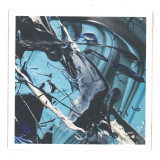
The new recordings from The Dengie Hundred unfurl on Tain Records after a busy year releasing a solo tape on Sagome and a collaborative LP and tape with Japan Blues on Demdike Stare's DDS imprint.
Lammas Land is an album which meditates on the Walthamstow Marshes, an ever-changing watery landscape, rich with history and wildlife. The Dengie Hundred writes:
"I am sitting at my table overlooking the marshes listening to Lammas Land in November 2023, watching crows fight a never-ending aerial battle with the gulls. In summer, you can see bats from here every evening, fluttering around the windows as the light begins to fade, but today it is colder so there is smoke rising from the boats on the River Lea and the dog walkers are wrapped up tight against the wind.
Most of Lammas Land was made sitting right here, playing guitar and recording the sounds passing by. I would hang a microphone out of the window to capture the ‘putput’ boat which delivers provisions, or the trains that rattle along the tracks that cut across the marshes and up to Stanstead, carrying passengers to the airport and away.
I wonder what tourists make of the marshes as they cross them, the landscape opening up for a moment between the urban sprawl of the East End and the rampant development of Tottenham. They offer a jarring pause of green and sky. I feel very lucky to be living in that pause, a resident, for now…
The album contains a whole year of found sounds recorded from the window and while out walking. It is full of bird song and radio sounds, singing, life.
Many others have been inspired by this space, this pause. The author Esther Kinsky who wrote River, published by Fitzcarraldo Editions, captures this area so perfectly. I borrowed the two track names for this album from her book. I hope she doesn’t mind.
Also, the photographer Paul Fuller whose work reflects the atmosphere I feel here precisely. On hearing the music he wanted to collaborate on the Lammas Land project, He spent a year filming the marsh through the seasons. Some of his images are included with the vinyl release, and there is an accompanying film close to completion. I am so pleased this project is continuing in new forms.
The vinyl also contains a piece of writing, ‘Sound Fishing’, by Gemma Blackshaw, an author, art historian and curator who in a twist of fate also found herself spending time on the marshes, but that is her story, for another day."
The Dengie Hundred
Lammas Land
LP, with essay insert + five photographic prints
Cat No: TAIN02
Price: £14.49
Due next week
A: A hand full of ever thickening twilight
(Sample clips 1 / 2 / 3)
B: A string of pearls pulling
the night away
(Sample clips 1 / 2 / 3)
Suche:forms
Anything Can’t Happen is the long-awaited debut album from Dorothea Paas, one of Canada’s most beloved singer-songwriters. For over a decade, Paas has played her unique, prismatic style of folk songcraft for audiences across North America, and lent her talents as a guitarist and vocalist to artists like Jennifer Castle, U.S. Girls and Badge Epoque Ensemble. The songs on this album have been through a near-infinite number of forms – Paas has played them solo and with a full band, electric and acoustic, at house shows and in sold-out venues. they manage to fit inside each context, like water taking the shape of its container.
All of this makes Anything Can’t Happen feel far more mature and complex than a debut album. It’s a statement of purpose, a next step in a decade-long process of artistic growth and evolution, and a bridge between the DIY style of Paas’s previous cassette releases and a more refined studio sensibility. Recorded in studios in Hamilton and Toronto, and mixed by Max Turnbull of Badge Epoque and U.S. Girls and Steve Chahley, these songs bring a diverse range of musical influences into conversation: inflected with the layered reverberations of Grouper, shot through with the piercing harmonies of the Roches, electrified with the searing energy of Sonic Youth. You can hear Neil Young in the grittiness of the title track’s guitar; Joni Mitchell’s Hejira in the album’s lyrics, Fairport Convention in Paas’s voice. The influence of Stevie Wonder - one of Paas’s greatest musical role models - is present too, in the album’s conceptual foundations.
Leatherette’s 2022 debut album Fiesta offered an intense, inspired and individualist take on post-punk, their caustic riffs, fevered saxophone blasts and impassioned vocals revealing the five-piece skilled purveyors of the form.
The group's second album Small Talk, however, is clearly the work of a group ready to take flight in a new direction all their own. As they toured Fiesta across Italy and Europe, Leatherette grew tired of the genre's constrictions and yearned to spread their wings. Small Talk transcends all the group have done before and coins a voice uniquely their own, driven by the same furies that propelled Fiesta, but finding fresh new forms for expression.
The album boasts some of Leatherette's most unabashed pop-songs to date – albeit pop that's deftly twisted, pointedly perverse and ready to explode when you least expect it.
It also contains some of the group's most challenging and uncompromising noise yet, the violent swinging back-and-forth between ugly din and nagging tunefulness a (molotov) cocktail that grows only more addictive with each listen. Where Fiesta saw the group enter the studio with a batch of anthems they'd honed on the road, their approach for Small Talk was very different, leaving the sessions open to moments of on-the-fly invention and sparks of mad genius. The interplay between the five musicians is so much stronger this time around, the group say, a result of the months of touring the band put in following the release of Fiesta.
Living out of rucksacks and spending hours on the motorway in a tour van might not be everyone's idea of a good time, but that's what Leatherette credit with sharpening their intra-group bond, their almost telepathic feel for the sounds that will complement what their bandmates are playing. “We were more free to play and to rearrange, because we knew each other better now,” says guitarist Andrea Gerardi, “and the interplay is more focused on this album as a result.” The sessions for Fiesta were frustrating, Andrea says, because “we were playing the same songs over and over”.
Their approach was radically different for Small Talk, however, which saw the group file into Bronson, a local club where they've often played before, and record the album on the premises. After the sessions, the album was mixed in Bristol by Chris Fullard (Idles) and mastered in Portland at the legendary Telegraph Audio Mastering by Adam Gonsalves. "We recorded live, all playing together at the same time, rather than overdubbing the instruments," says Michele. The process, he says, "made us more coherent, and the songs more spontaneous." "Our strength is live performance," adds Andrea, "so we tried to capture that interplay. Sometimes we made errors, but we didn't care, because it sounded great. This music is our lives - it doesn't need correction. We were free for the two weeks we recorded the album, and the ideas soared in the most amazing way." Indeed they did. The album's see-saw between angular noise and pop coherence is very much its strength, and very much the sonic identity of this singular group
- A1: 助手席のSituation (Situation In The Passenger Seat)
- A2: Passing Scene
- A3: Miss Shooting
- A4: 灰色のひととき (A Gray Moment)
- A5: さらっとゆるして〜コーヒー通の恋人 (Forgiveness Without Reservation ~ Lover A6 And Coffee Connoisseur)
- B1: Wardrobeの中の夢 (A Dream In The Wardrobe)
- B2: 秋日和 (Clear Autumn Day)
- B3: 夜の海風 (Evening Sea Breeze)
- B4: Spouse-同行者- (Traveling Companion)
- B5: One By One
Satoshi Suzuki (鈴木慧) described his musical practice perfectly on the OBI strip of his 1987 privately pressed LP - Tokyo Contemporary! consisting of 40% Jazz, 30% Soul, 20% Brazil, and 10% Kayokyoku - a musical mixture not too far off from what is now referred to as City Pop.
However, this archival compilation of Satoshi Suzuki's works presents a perspective of the City Pop sound not from affluent 1980s Japanese bubble economy-era studios and highly paid studio musicians, but from a one-person band making the most of the instruments in their home studio, inspired by musical traditions from around the world.
With notes of city pop, AOR, jazz, soul, bossa, and kayōkyoku - Satoshi Suzuki's intimately recorded pop songs are charming and full of wit, with a seasonal and poetic approach to these musical forms using only a drum machine and an array of digital synthesizers. Sounding a little like Pacific Breeze played on a Casio keyboard and drum machine, Uku Kuut soundtracking a SEGA video game, or the wonderful lo-fi works of Suzuki’s lo-fi homemade pop & jazz contemporaries Ronald Langestraat, Lewis, and Joe Tossini — though most of all, SUZUKI's works show a new and singular perspective of the bubble-era city pop of the Showa period.
Distant Travel Companion (遠い旅の同行者) introduces Suzuki's musical works to a wide audience for the first time, featuring remastered songs originally released over three privately pressed LPs from the 1980s, as well as a previously unheard CD from 1993. The original works were released in an impossibly limited edition of 100 copies each - printed and assembled on printing equipment at Suzuki’s company office and scarcely distributed, recording these songs at his home studio in his free time. The compilation's design and accompanying OBI and liner notes are a direct homage to the original releases.
Satoshi SUZUKI is a Japanese keyboardist, singer, songwriter, and music arranger. He is also an author of literature and winner of the "Shin-nihon-bungaku" (New Japanese Literature) Award. He was born in 1958 in Tokyo, Japan.
Michael Chapman (1941-2021) released his debut album Rainmaker in 1969 on Harvest. He went on to release over fifty albums and influence many with his evocative songwriting and guitar prowess. From heady jams to expressive ballads to experimental noise, Chapman’s work continues to inspire. Tompkins Square recruited Henry Parker to curate a collection of covers by working musicians from Chapman’s home turf in Northern England. With stunning artwork by local artist Bunty Marshall mapping the important places in Michael’s life, this 12th volume of Tompkins Square’s Imaginational Anthem series is the ultimate tribute to a very dearly missed artist. Notes from Henry Parker: Tompkins Square approached me in Autumn 2022 about putting together a tribute album to Michael Chapman who had passed away one year ago, on my birthday, in 2021. I remember it well; Michael Chapman had always been a huge inspiration to me since starting out on the acoustic guitar and was the first artist I had heard who played the instrument with that heavy thumb, drop tuned sound. I first got the chance to see him live at the Bradford experimental music festival Threadfest in 2015 and then went on to watch him play many more times, in the northern towns of Halifax, Hebden Bridge and Preston, also getting the chance to support him on a couple of his Yorkshire dates in 2018, in Saltaire and his hometown of Leeds. With both Michael Chapman and myself proudly coming from the county of Yorkshire in northern England, Tomkins Square and I decided to make this compilation decidedly Yorkshire focused, bringing together seven other artists from the county who have drawn influence from the profound music of this man.For those who don’t know, Yorkshire is an area that spans much of northern England, with its people taking great pride in the county, never too seriously, and poking fun at the “soft south” or it’s near neighbour Lancashire. Michael’s sound always spanned from introspective folk songwriting to more experimental forms and naturally so does this album, created for Tompkins Square. When it came to choosing musicians to contribute to the record, I was grateful for the Yorkshire limitation on who I could draw from, as the resulting album is comprised of eight artists, who have all shared stages with each other across the folk and experimental scenes in the area. The lack of “bigger” names on the record feels natural, there’s no ego about this project as there never was with Michael, who always seemed content touring the smaller clubs and making records for anyone who was interested. The artwork for the project came together organically, and firmly within the Yorkshire cottage industry. Two months before I was asked to put this album together, I had played a show in Leeds for the launch of a new zine, centred on folklore and mythology. The artist and founder of the zine Bunty has an exceptional eye for detail and a profound love of Yorkshire landscape and culture. Her intricate maps and illustrations created for ‘Hwaet’ zine were the perfect starting point the for this record, and the cover art and inner sleeve is an ocean of detail for Michael Chapman’s incredible life, music and his connection to Yorkshire
Since 1983, Justin K. Broadrick (Godflesh, Jesu, Council Estate Electronics, The Sidewinder, etc.) has been producing largely solo, but sometimes collaborative, work under the Final moniker. Beginning as a more obviously power electronics-inspired project it has during the past two decades or so evolved into one which still retains that sonic intensity but has a more expansive sound. I Am the Dirt Under Your Fingernails is the latest album, closely following It Comes to Us All on Alter in July 2022 and the now mostly o/p CD version already released in October 2022. Comprising nine tracks each named and numbered after the album’s title, IATDUYF violently pushes us through a murky world of suffocating textures, crepuscular guitars, serrated noise and what appear to be random bursts of sawmill grind which together create the perfect backdrop to today’s newscape. This is a relentless sound that’s absolutely unforgiving as it hammers home anger and despair with little respite, illustrating very clearly that JK Broadrick has been one of the very few to contort the uncompromising approach of early power electronics into wholly new and contemporary forms rife with greater possibilities.
André Roligheten is known for his strong presence in a number of collaborations with everything from Gard Nilssen's Acoustic Unity, Team Hegdal, Friends & Neighbors, Trondheim Jazz Orchestra, Susanne Sundfør, to his own release "Roligheten - Homegrown" from 2017.With his new adventurous ensemble, he is now releasing brand new music on the album "Marbles" (Odin, 03.11.23). The album contains a collection of compositions that facilitate bold interaction. The compositions are conceived as parallel universes with their own, improvised musical forms. Imagine that Sonny Rollins and Egberto Gismonti met on the beach at a yoga retreat in Hawaii and decided to make an album together! Roligheten brings out a highly personal expression in his warm tenor saxophone together with a star team of Scandinavian musicians. Each and every one of them adds a unique depth and substance to the musical universe; Strøm's rigorous double bass, Ståhl's bold vibraphone, Nilssen's elastic drums and Lindström's gripping pedal steel. This merges into a unique sound that carries Roligheten's compositions on a golden stool. The gallery of people in this ensemble has prestigious names, and they have worked with artists and bands such as Tonbruket, Bushman's Revenge, Ane Brun, Paal Nilssen-Love, Bobo Stenson, Supersonic Orchestra and Georg Riedel.
Following on from the psychoacoustic concrète of Outside Ludlow / Desert Disco LP (BT075), Sam Dunscombe returns to Black Truffle with Two Forests / Oceanic. Dunscombe has been active in recent years on multiple fronts, including as a key member of the Berlin community of Just Intonation researchers and practitioners; working with composers like Taku Sugimoto, Mary Jane Leach, and Anthony Pateras; and the release of Horatiu Radulescu - Plasmatic Music vol. 1 (the result of many years performance research into the thought and music of this seminal Romanian spectralist). In parallel with these activities, Dunscombe has been deeply involved in research on the role of music in psychedelic-assisted psychotherapy, prompting these two side long pieces, composed using field recordings and digital synthesis. As Dunscombe explains in the accompanying liner notes, music plays a key role in psychedelic-assisted therapy, yet it is often restricted to stock forms of New Age, ambient and electronica. Taking seriously the potential for spatio-environmental sonic experiences to add to the therapeutic process, these two pieces are intended to suggest how ‘a music-as-environment approach may help to add options to the therapist’s toolbox’. ‘Two Forests’ begins in a central Californian sequoia grove. Bird songs and buzzing insect life are treated with a variety of time-based processing methods (slicing and recombination, primitive granular synthesis, delay, and so on), which strip the field recordings of their linear, documentary character, reframing them in an enchanted web of traces and echoes. Analysing the pitches found in the original recordings, Dunscombe used them to generate a large Just Intonation pitch set. These tones are woven slowly into the field recordings, gradually building in density and complexity until the forest has been transformed into an unreal space of infinite proportions. Emerging from this cosmic expanse in the final minutes of the piece, we find ourselves in the Amazon rainforest outside Manaus, Brazil. As Dunscombe writes, the piece creates ‘a sense of place-gone-strange, of space and time simultaneously expanding and contracting across octaves, miles, and minutes’. On ‘Oceanic’, several recordings of different beaches fade in and out to create a texture both homogenous and constantly shifting in both the rhythm of the waves and each recording's sense of depth and distance. Tones relating in simple ratios to the average rhythm of each beach float over each other, colouring the white noise texture of the field recordings with shifting hues. In both pieces, Dunscombe forgoes the easy consonance that bogs down much contemporary ambient music for a richer harmonic array informed by extended tuning practices and spectralism. The end results suggest a hitherto undreamt-of meeting of Radulescu’s undulating sonic masses and the discreetly processed location recordings of Irv Teibel’s ‘psychologically ultimate’ Environments. Looking beyond the insularity that can afflict experimental music culture, Dunscombe’s work is a moving argument for the healing power of expanded approaches to sound and music. Even outside of a psychedelics-assisted therapy, frequent immersion in Two Forests / Oceanic is almost guaranteed to produce beneficial psychological results.
Step into the captivating world of Melody Fields as they release their transformative albums, "1901" and "1991." With a marbled musical background, these albums are crafted with the precision of a brushstroke by the likes of Pablo Picasso or Gustav Klimt. Each track is carefully composed, drawing inspiration from manic behavior, fixated obsessions, and the pursuit of something greater. Melody Fields explores themes of spirituality, faith, trust, and conviction in various forms, often leading to addiction or madness. During the pandemic, Melody Fields accumulated hours of material, embracing the freedom to experiment with drum machines and synthesizers in one session, and exploring oriental instruments in another. The result is a sonic tapestry that defies conventions and pushes boundaries. The primary album, "1901," can be described as a rock album with psychedelic influences. It features repetitive guitar riffs, distorted soundscapes, and mesmerizing three-part harmony vocals. As they traverse these musical landscapes, Melody Fields is joined by guest musicians from esteemed bands such as Goat and Holy Wave, adding an extra layer of sonic brilliance. The album culminates with the captivating track "Mayday," a haunting composition written by the legendary Klaus Dinger from Neu! In contrast, "1991" is a concept album that evolved from late-night jam sessions, experimental sounds, and danceable music. It presents four remixes, including contributions from Goat and Al Lover, breathing new life into the original composition “Jesus” from “1901”. Notably, "1991" includes the thought-provoking composition "Diary of a Young Man," written by Daniel Treacy from Television Personalities, which invites introspection and reflection. Melody Fields' "1901-1991" presents a sonic journey through time, combining elements of rock, psychedelia, and experimentalism. These albums showcase the band's dedication to musical craftsmanship and their willingness to embrace diverse influences. Prepare to be immersed in their sonic universe, where boundaries are shattered, and creativity knows no limits.
C"mon Tigre, the innovative music collective known for their genre-blending compositions, releases their highly anticipated fourth album Habitat. Drawing inspiration from the concept of an ecosystem where various forms of life, both animal and vegetal, thrive and coexist, the album takes listeners on a sonic journey through the intricate and ever-evolving nature"s theater. C"mon Tigre"s ability to blend inï¬éuences from distant corners of the world enriches their music and visual imagery. The album is deeply inï¬éuenced by rhythms coming from Brazilian tradition, the backbone is rooted in samba, forro, through instruments and tempos that come from this cultural magnificence. However, it retains the African jazz, electronic, and mixed inï¬éuences that have characterized the project thus far. Connecting the dots, the result is a richly layered and genre-defying soundscape. The record boasts a stellar lineup of collaborations. Among these are Seun Kuti, heir to the legacy of the legendary Fela Kuti, whose afrobeat roots infuse the album with a potent and infectious energy. The record also features Xenia Franca, a dynamic Brazilian artist hailing from Sao Paulo, Arto Lindsay, recognized as a pivotal figure in the world of experimental music, Giovanni Truppi and the Californian collective Drumetrics which featured on C"mon tigre"s records since their debut in 2014.
»Arches« is the first collaborative album by brothers Simon and Tobias Lanz. It was written for and performed on self-built prototypes of wind instruments that were inspired by the classic pipe organ, but allowed the two composer-performers to go beyond its limitations in several ways. The music on this 40-minute long album for the Swiss Hallow Ground label was conceived and recorded by the two co-founders of the CRTTR collective and label during an artist residency in May 2022 in their home town of Bern. More than a mere document of a performance however, »Arches« combines the artists’ interest in exploring uncharted new creative and tonal ground inside of and beyond the realm of drone music with their background in visual art and design as a conceptually concise whole.
Simon and Tobias have a combined background in electronic music as well as a shared penchant for drone music. They hence designed these novel instruments in a way that allows for microtonal tuning to be able to overcome the restrictions inherent to the dominance of a twelve tone-based scale in Western music and work with a sonic palette that is much wider and nuanced than that of the conventional pipe organ. Furthermore, the physical design of these instruments widely differs from that of those which inspired them. This allows—or more precisely, forces—the musicians to freely invent and explore entirely novel playing techniques.
These factors, of course, also have an impact on the compositional process, which by design needs to be unconventional. The Lanz brothers worked with a graphic score for the four movements of the piece that forms »Arches« so as to adequately visualise the manifold tonal nuances of their instruments. This graphic score in turn was reinterpreted for the album release by Ramon Keiming, adding another dimension to it. Read from left to right, this remix of the score allows the listeners to follow an interpretation of the evolution of these dronescapes while the record plays, urging them to add their own interpretation.
This retroactive visualisation and thus spatialisation of the music is perfectly in line with its performance, which at all times factored in the acoustic affordances of the Prozess Bar in Bern. In many different ways, the Lanz brothers now invite their audience to join them there and explore the near-infinite possibilities of their curious instruments together with them. Much like Hallow Ground label mates such as Kali Malone or FUJI||||||||||TA, they are dedicated to enriching and expanding upon the musical and sonic qualities of pipe organs, but with widely different aesthetical results. To call »Arches« a unique record with an unheard-of sound is not hyperbole, but only factually correct.
Grand River and Sofie Birch are set to unveil their collaborative EP, titled “Our Circadian,” on November 24, through Melantónia.
The two-track release follows Grand River’s final release under the now-discontinued Editions Mego label earlier this year, and Sofie Birch’s two solo albums from 2022. Our Circadian represents the second collaborative release on Melantónia, a platform founded by Hanna Maria & Mattia Onori in 2021, dedicated to music for non-dance environments, featuring early contributions from artists like Polygonia, Plants Army Revolver, and Melantónia co-founders Hanna Maria & Mattia Onori themselves, amongst others.
“Our Circadian” was conceived remotely in 2021 during the lockdown, with the aim of encapsulating two distinct moments of those days – early morning and late afternoon – along with their subtle emotional nuances. The first track of the release – 7PM – conveys dreamy atmospheres that flow into colorful rhythms, recalling the electroacoustic nature of the label’s melancholic sounds. The gloomier 3AM, on the other side of a 7“ record, offers a timeless introspection of a gently intensifying synth sound’s fling.
Grand River, a composer and sound designer, brings her background in linguistics to her work. She draws inspiration from minimalism and ambient music, resulting in atmospheric and rhythmically intricate compositions. Her artistic pursuits traverse the realms of art and electronic music, exploring forms of communication that transcend language, often influenced by nature, scale, and movement. Grand River’s impressive portfolio includes sound installations at 4DSOUND/Monom and Terraforma’s Il Pianeta, as well as performances at prestigious venues like Barbican, Rewire, MUTEK, Le Guess Who?, CTM, Draaimolen, and Atonal’s Kraftwerk. She has also worked on remixes for notable acts like Tangerine Dream. Since 2016, she has curated the label One Instrument, offering a unique creative challenge to artists: creating music using only a single instrument.
Sofie Birch, a celebrated sound artist and producer, is known for her lush ambient releases, art installations, live performances, DJ sets, and her NTS show “Ambient Abracadabra.” Her sonic creations can manipulate space, infuse it with a profound sense of calm, and invite listeners to engage in meditation and introspection through the healing qualities of sound and vibrations. Her music acts as a conduit for understanding the complexities of the mind and body through artistic expression, characterized by a distinct emphasis on stillness, suspension, and sustain. Sofie’s soundscapes open gateways to dream-like states of perception and heightened presence, providing a transcendental journey into an alchemical biosphere. Her extensive repertoire includes performances at renowned events such as Barbican, Roskilde Festival, MUTEK, Unsound, CTM, Rewire, Monom, and Terraforma, as well as award-winning compositions for VR experiences and animated films, in collaboration with artists like Baum & Leahy and animation director Pernille Kjaer.
As Our Circadian takes its final form, it promises a narrative of resilience, creativity, and the indomitable human spirit guided by the artistic mastery of Grand River and Sofie Birch.
In the wake of Young Marble Giants’ breakup, two acts were created, with Stuart Moxham taking minimalist, geometric play to extremes while Alison Statton added more warmth and feeling to a similar template, creating something stunning yet based in popular forms. Those two opposing means of forging paths away from one of music’s most astonishingly unique debuts both included Stuart’s brother, Phil. More recently, both have reversed course, with Stuart proving himself a master of classic pop form, with Alison’s work again approaching a modern abstraction of quiet folk music - experimental but accessible. But that’s another tale. With no template to guide him, Stuart’s new music - as The Gist - was regarded as wildly uneven. Stuart admits that he didn’t know which way to go, so perversely, he decided to take all directions at once. The Gist’s original discography stood at a scant 18 songs, yet only seven featured Stuart’s own voice, often in heavily processed and oddly-mixed form. The Gist’s label, Rough Trade, dropped the band. Starting with a critical re-evaluation of The Gist’s sole album Embrace The Herd in an issue of Mojo, the tide begin to turn. Ambience in pop has long enjoyed a cult following, and the nonlinear structure of many of The Gist’s songs have parallels with artists such as Aphex Twin and Seefeel. One song from the era was covered by Etienne Daho in France - sounding rather advanced for French pop at the time, it ended up selling over a million copies and was later covered by Lush and sampled by DJ Koze with Lambchop singer / songwriter Kurt Wagner. Recent discovery of a trove of unreleased recordings show that Stuart had held back an array of excellent material, in demo and completed forms, often in different arrangements. Interior Windows adds 13 new performances or alternate versions to the band’s catalogue, and does the service of making both sides of The Gist’s first 7” 45 (recorded at the same session as the final YMG single) available again, along with their contribution to the NME / Rough Trade cassette compilation C81, and in keeping with The Gist’s tradition, at least one song on which Stuart does not appear
After a string of two dozen brilliant albums beginning in the 1950’s, clarinetist, saxophonist, flutist,
composer and arranger Jimmy Giuffre stopped recording. For nearly ten years he focused solely on
live performance. This album, Music for People, Birds, Butterflies and Mosquitoes, marked his return
to the studio after his self imposed hiatus. Known for developing forms of jazz which allowed for free
interplay between the musicians, Giuffre began his career as an arranger for Woody Herman’s big
band in the late 1940s. Playing primarily saxophone, he became a central figure in the West Coast
cool jazz scene of the 1950’s, with the Lighthouse All Stars in Hermosa Beach, CA. In the late 50’s, he
began working within different configurations of the trio format, on what he called “blues-based folk
jazz.” A prime example being his piece "The Train and the River" famously featured in 1958 Newport
Jazz Festival concert film, Jazz On A Summer’s Day. The trio here is completed by drums and bass
with Giuffre trading seamlessly between tenor saxophone, clarinet, flute and bass flute. The twelve
original compositions are very much in Giuffre’s signature style. The melody explorations have an
eastern vibe, and are played in hushed tones with an almost chamber music like quality. From 1973,
originally on the Choice label, this album has been remastered and is being presented here as the
artist intended, with its original title, track order and album artwork, for the first time since its original
release. Remastered by Alex McCollough at True East Mastering. Vinyl cut by Jeff Powell at Take Out
Vinyl.
When Black Pumas made their self-titled debut in 2019, the Austin-bred duo set off a reaction almost as combustible and rapturous as their music itself. Along with earning a career total of seven Grammy Award nominations (including Album Of The Year) and winning praise from leading outlets like Pitchfork and Rolling Stone, singer/songwriter Eric Burton and guitarist/producer Adrian Quesada achieved massive success as a live act, touring large theatres all over Europe and North and South America and delivering a transcendent show Burton aptly refers to as “electric church.” As they set to work on their highly awaited sophomore album, the band broadened their palette to include a dazzling expanse of musical forms: heavenly hybrids of soul and symphonic pop, mind-bending excursions into jazz-funk and psychedelia, starry-eyed love songs that feel dropped down from the cosmos. Wilder and weirder and more extravagantly composed than its predecessor, Chronicles of a Diamond arrives as the fullest expression yet of Black Pumas’ frenetic creativity and limitless vision.
After touring the world's Techno and Goths clubs intensively, Die Selektion are back with their unique blend of Synth- Pop and Electronic Body Music. Heavyhearted but hopeful trumpet melodies, German lyrics that make you question your past and future once again, synthesizer sounds in the great tradition of '80s Wave and Pop, combined with hard-hitting drum machines - this forms the base of their self- proclaimed Prosecco Wave world. Their new album "Zeuge aus Licht" features 9 hits to live, love and laugh to, and makes you forget your everyday worries.
Die Selektion sat down together in a new line-up consisting of all three founding members Gillian, Rief and Rieger, as well as Savenberg, who joined in 2013.
The outcome of this mesmerising gathering is a supersonic experience for body, heart and soul. The new songs expand the sound of the band with an almost casual, elegant diversity. Every single component shines and an understanding of what makes pop really pop comes through, adding ironic glitter to the black nihilism of Dark Wave. With "Zeuge aus Licht", Die Selektion opens a new door in their fluid band set- up. And we should all be excited to find out what's hiding behind it.
Repress!
Dublin
born,
London-based
Zero
T
returns
to
The
North
Quarter
for
his
third
project: “Off
Broadway”.
Influenced
by
70's
Jazz-fusion,
this
six-track
affair
sees
the
veteran producer
once
again
show
off
his
effortless
diversity.
Heavier
tracks
include
noir- soundtrack
lead
modern
jungle
cuts
Fortune
Green
and
Drama.
Lighter,
soulful
tracks
include
the
New
Forms
inspired
Something
Got
Me
featuring
Manchester's
Aaliyah
Esprit
as
well
as
collaborations
with
KILLSWSH
and
Steo.
As
always
Zero
T
knows
what
it
takes
to
keep
a
listener
interested,
a
testament
to
his
20
years
plus experience ,
as
he
continues
to
be
one
of
the
most
prolific
artists
in
Drum
&
Bass.
Color Vinyl[20,97 €]
In the decade or so that hard-working New York quartet Sunwatchers have operated, the group has steadily & subtly refined their sound - a brain-blasting mixture of jazz, psychedelia, krautrock, punk, noise, & Saharan blues - into something that is avant-leaning enough to appeal to the discerning jazz & experimental music fan & weird & wooly enough to get the true heads' toes tapping. "Music Is Victory Over Time" is the band's 5th album, and fourth for Chicago-based Trouble In Mind Records, seeing the long-running lineup of Peter Kerlin (bass guitar), Jim McHugh (guitars), Jason Robira (drums), and Jeff Tobias (alto saxophone and keyboards) in prime form. Album opener "World People" is a classic Sunwatchers number whose title expresses their Anarcho-Internationalist ideology (and the atypically multi-culti make up of their crowds), with an underlying melodic resonance to New Orleans funeral marches à la Albert Ayler _ a triumphant call to arms to all peoples. Live fave "Too Gary"'s gang vocal shout punctuates a motorik rager named for a phrase often uttered by a badass eight year old skateboarder McHugh knew with a speech impediment (it means "that's too scary"). "T.A.S.C." (or "Theme For Anarchist Sports Center") is inspired by Sonny Sharrock's maligned 80's output & sounds exactly like a wrathful, mutant version of a prime-time athletic show theme, replete with the requisite "sitcom ending." The sun- scorched "Foams" - a longform piece intended to depict natural stuff like tides, nightfall, and time slowly passing, ancient, peaceful and slightly gross all at once - practically jumps out of the speakers, its palpable intensity crackling in your eardrums. The title of "Tumulus" might reference an ancient burial mound, but the music itself might be the group's most high-tech song to date, complimented by an arpeggiating sequencer, three different forms of tape delay and an electric saxophone; ecstatic, fiery & deeply spiritual. "There Goes Ol' Ooze" is a smoky creeper that lets Tobias & Kerlin take a walk for a while, with respectful nods to the Stones and Steve Reich. "Song For The Gone" closes out the album, showcasing a sincerely tender moment for the gang, as an expression of love and resolve for dear friends who had recently, tragically died. Its cascading, bluesy melody attuning itself to our own collective unconscious grief. Having the distinct pleasure of being the first band to record in John Dwyer 's new LA-based recording studio Discount Mirrors, "Music Is Victory Over Time" boasts a beefed up sound. The band worked closely with in-house engineer Eric Bauer - facilitator, troubleshooter, sonic obsessive, a legendary freak and a DIY lifer. The band also had full access to the studio's epic armory of gear: amps, axes (it's Dwyer's Eddie Harris model electric sax), synths, a bass guitar once belonging to Klaus Flouride of the Dead Kennedys. Crucial for the sounds and the vibe. The album art was created by Josh MacPhee, the activist artist, author, archivist and founding member of both the radical artist collective Just Seeds and Interference Archive, a public collection of materials from social movements based in Brooklyn. MacPhee's participation in the project works as a statement of Sunwatchers' progressive utopian intentionality, and organically underscores their involvement in revolutionary projects within and without of their hometown. Listening to "Music Is Victory Over Time", Sunwatcher's rebellious spirit & unbridled enthusiasm remain fully intact, but the secret sauce is their infectious irreverence in the face of the horrors of this world. Much of our best cultural commentary is Trojan-horsed to the general public via humor & satire & the band has a knack for lacing the ridiculous with the radical. It's good to have them back. "Music Is Victory Over Time" is released worldwide digitally via most DSPs, on CD, black vinyl & a limited "Sunflare" blue/red splatter vinyl while supplies last.
Black Vinyl[20,97 €]
In the decade or so that hard-working New York quartet Sunwatchers have operated, the group has steadily & subtly refined their sound - a brain-blasting mixture of jazz, psychedelia, krautrock, punk, noise, & Saharan blues - into something that is avant-leaning enough to appeal to the discerning jazz & experimental music fan & weird & wooly enough to get the true heads' toes tapping. "Music Is Victory Over Time" is the band's 5th album, and fourth for Chicago-based Trouble In Mind Records, seeing the long-running lineup of Peter Kerlin (bass guitar), Jim McHugh (guitars), Jason Robira (drums), and Jeff Tobias (alto saxophone and keyboards) in prime form. Album opener "World People" is a classic Sunwatchers number whose title expresses their Anarcho-Internationalist ideology (and the atypically multi-culti make up of their crowds), with an underlying melodic resonance to New Orleans funeral marches à la Albert Ayler _ a triumphant call to arms to all peoples. Live fave "Too Gary"'s gang vocal shout punctuates a motorik rager named for a phrase often uttered by a badass eight year old skateboarder McHugh knew with a speech impediment (it means "that's too scary"). "T.A.S.C." (or "Theme For Anarchist Sports Center") is inspired by Sonny Sharrock's maligned 80's output & sounds exactly like a wrathful, mutant version of a prime-time athletic show theme, replete with the requisite "sitcom ending." The sun- scorched "Foams" - a longform piece intended to depict natural stuff like tides, nightfall, and time slowly passing, ancient, peaceful and slightly gross all at once - practically jumps out of the speakers, its palpable intensity crackling in your eardrums. The title of "Tumulus" might reference an ancient burial mound, but the music itself might be the group's most high-tech song to date, complimented by an arpeggiating sequencer, three different forms of tape delay and an electric saxophone; ecstatic, fiery & deeply spiritual. "There Goes Ol' Ooze" is a smoky creeper that lets Tobias & Kerlin take a walk for a while, with respectful nods to the Stones and Steve Reich. "Song For The Gone" closes out the album, showcasing a sincerely tender moment for the gang, as an expression of love and resolve for dear friends who had recently, tragically died. Its cascading, bluesy melody attuning itself to our own collective unconscious grief. Having the distinct pleasure of being the first band to record in John Dwyer 's new LA-based recording studio Discount Mirrors, "Music Is Victory Over Time" boasts a beefed up sound. The band worked closely with in-house engineer Eric Bauer - facilitator, troubleshooter, sonic obsessive, a legendary freak and a DIY lifer. The band also had full access to the studio's epic armory of gear: amps, axes (it's Dwyer's Eddie Harris model electric sax), synths, a bass guitar once belonging to Klaus Flouride of the Dead Kennedys. Crucial for the sounds and the vibe. The album art was created by Josh MacPhee, the activist artist, author, archivist and founding member of both the radical artist collective Just Seeds and Interference Archive, a public collection of materials from social movements based in Brooklyn. MacPhee's participation in the project works as a statement of Sunwatchers' progressive utopian intentionality, and organically underscores their involvement in revolutionary projects within and without of their hometown. Listening to "Music Is Victory Over Time", Sunwatcher's rebellious spirit & unbridled enthusiasm remain fully intact, but the secret sauce is their infectious irreverence in the face of the horrors of this world. Much of our best cultural commentary is Trojan-horsed to the general public via humor & satire & the band has a knack for lacing the ridiculous with the radical. It's good to have them back. "Music Is Victory Over Time" is released worldwide digitally via most DSPs, on CD, black vinyl & a limited "Sunflare" blue/red splatter vinyl while supplies last.