quête:francois x

Genres
Tout
RABBATH ELECTRIC ORCHESTRA - AMALL

François and Sylvain Rabbath have turned six years of touring into a joint album that patiently and intensely distills a variety of musical flavors gathered from around the world.

Since the early 1960s, François Rabbath's double bass has resonated through enough landmark recordings to fill several shelves in a record collection. As an arranger, composer, and musician, his imprint on music goes far beyond his collaborations with Barbara, Paco Ibáñez, Charles Aznavour, or Édith Piaf. Aspiring double bassists owe him a groundbreaking method for learning the instrument. Born into a lush musical universe that quickly became his own, his son Sylvain first accompanied him on his travels before settling at the piano and sharing stages around the world at his side.

Those years of accumulating visas in their passports were put to good use by father and son. The continents, countries, and cities they passed through became a rich source of inspiration for composing Amall, the album by the Rabbath Electric Orchestra.

Long hours spent in the air or on the road, watching passing landscapes that never stayed the same, were transformed into compositions imbued with the atmospheres of the places they crossed or visited. Inspiration sometimes struck with force, like a green oasis appearing in a desert of stone—unexpectedly, as glowing red rocks suddenly dominated an otherwise open landscape with an endless horizon, while the mind wandered into a state between meditation and introspection.
Born from these travels, the pieces took on their final colors once brought into the studio, refined, and finally arranged to welcome the guitars of Keziah Jones and Matthieu Chedid, the piano of Laurent de Wilde, the bass of Victor Wooten, the saxophone of Raphaël Imbert, and the percussion of Minino Garay. Enhanced by the scale of the jazz-soul orchestrations, by the richness of arrangements bursting from strings, brass, rhythms, or keyboards, the epic breath of vast plains became ingrained. The urban tension of funk, echoing their movements, found its place—alongside more electric expressions or the ambience of a darkened room.
Melancholic and melodious, expressive and edgy, the bowed double bass—played in the high register where few dare to go—emerged as the musical guide. One that draws a path between Seville and Minneapolis, connects François Rabbath's native Syria to France, and bridges South America to Europe. It sets the tone to follow—the emotion that will carry the piece, and if not filled with light, will carry it there nonetheless.
Musical visions packed in luggage, transported in cargo holds, or imprinted in their minds just long enough to cover the distances to the next stop—father and son deepened their bond, beyond family and art. And their hands have never held each other more tightly.

François et Sylvain Rabbath ont fait fructifier six ans de tournées pour un album commun distillant patiemment et intensément la variété de parfums musicaux récoltés autour du monde.
Depuis le début des 60’s, la contrebasse de François Rabbath résonne dans assez de références pour combler plusieurs étagères d’une collection de disques. Arrangeur, compositeur, musicien, l'empreinte laissée dans la musique va bien au-delà de ses collaborations avec Barbara, Paco Ibanez, Charles Aznavour, ou Edith Piaf. C’est à lui que les
apprentis contrebassistes doivent une méthode novatrice pour apprendre l’instrument.

Né dans un univers musical luxuriant qui est vite devenu aussi le sien, c’est d’abord dans ses voyages que son fils Sylvain l’a accompagné, avant de s’installer au piano, et parcourir les scènes du monde à ses côtés. Ces années où les visas se sont entassés sur leurs passeports, père et fils les ont mises à profit. Continents, pays, et villes qui se sont succédés sont devenues un gisement pour composer Amall, l’album du Rabbath Electric Orchestra.

Les longs moments passés dans les airs ou sur la route à contempler un paysage qui défile sans pour autant rester le même, se sont convertis en compositions habitées par les ambiances de ces endroits traversés ou visités. Là où l’inspiration s’est imposée parfois brutalement, sous
la forme d’un oasis de verdure surgissant au milieu d’un désert de pierres. Au hasard d’imposantes roches rougeoyantes s’invitant dans un paysage jusqu’alors dégagé sur un horizon sans fin, quand l’esprit se laisse aller à un mélange de méditation et d'introspection.

Nés de ces pérégrinations, les titres ont pris leurs couleurs définitives une fois ramenés en studio, peaufinés puis, enfin, pensés pour y inviter les guitares de Keziah Jones et de Matthieu Chedid, le piano de Laurent de Wilde, la basse de Victor Wooten, le saxophone de Raphaël Imbert, les percussions de Minino Garay. Sublimé par la dimension des orchestrations jazz-soul, par la richesse des arrangements jaillissant des cordes, des cuivres, des rythmiques ou des claviers, le souffle épique des plaines immenses s’est imprimé.
La nervosité citadine du funk rythmant les déplacements a trouvé sa place, non loin d’une expression plus électrique ou d’une atmosphère de salle obscure.

Mélancolique et mélodieuse, expressive et nerveuse, la contrebasse jouée à l’archet, dans les notes hautes du manche où peu s’aventurent, s’est érigée en guide musical. Celui qui trace le chemin entre Séville et Minneapolis, relie la Syrie natale de François Rabbath à la France,
réduit la distance entre l’Amérique du Sud et l’Europe. Donne la note à suivre, l’émotion qui traversera le morceau qui, s’il n’est pas habité par la lumière, le portera néanmoins jusque là.

Visions musicales mises dans le coffre, transportées en soute ou imprimées dans l’esprit le temps de couvrir les distances qui les mèneront aux prochaines, c’est côte à côte que père et fils ont prolongé leur lien par delà des seules limites familiales et artistiques. Et leurs mains ne se sont jamais serrées aussi fort.
credits

pré-commande19.09.2025

il devrait être publié sur 19.09.2025

20,59
VARIOUS - BELGIAN VAULTS VOL 5 LP
  • A1: Time For A Change (Paul’s Collection)
  • A2: Nobody Will Ever Help You (The Klan)
  • A3: 20Th Century (Berry Clan)
  • A4: See My Car (New Inspiration)
  • A5: I Don’t Need You (The Jumpers)
  • A6: Woman Don’t Love Me (The Swallows)
  • A7: When I’m Down (Ferre Grignard)
  • B1: Only Lonely Me (The Mec-Op Singers)
  • B2: Lonely Tears (R And The R’s)
  • B3: Mad Jane (François Nico)
  • B4: Tomorrow (The Midgets)
  • B5: Freedom (Les Altesses)
  • B6: Tus Es Mon Enfer (Mosaïque)
  • B7: Cocaine Blues (Patrick)
également disponible

Vol.4[23,95 €]

Vol.3[23,95 €]


Starman Records, the Belgian label renowned for re-releasing Belgian rock from the 60s, 70s, and 80s, has so far released five volumes in the highly anticipated and widely acclaimed Belgian Vaults Series, praised by both press and fans.

These unique albums focus entirely on the sixties and early seventies, compiling many rare and hard-to-find tracks—mainly originally released as singles on small, long-forgotten labels. Covering genres such as pop, beat, rock ’n’ roll, and psych, these gems are well worth rediscovering. Belgian Vaults are not just collector’s items; each album features restored and remastered sound quality and is carefully curated to appeal to all fans of sixties rock.

pré-commande12.09.2025

il devrait être publié sur 12.09.2025

23,95
DIANE DENOIR & EDUARDO MATEO - INEDITAS
  • Je Suis Sans Toi
  • Rendez-Vous D'automne
  • La Dernière Valse
  • Le Lendemain
  • Un Amour, Un Sourire, Une Fleur
  • Corcovado
  • Gua De Beber
  • Berimbau
  • Vivo Sonhando
  • Fever
  • Garota De Ipanema
  • So Nice
  • Las Flores Nuevas
  • Y Hoy Te Vi
  • Esa Tristeza
  • Mejor Me Voy

Born as Diana Reches, Diane Denoir made her debut as a singer in 1966, backed by Eduardo Mateo on guitar. Influenced by Françoise Hardy and Astrud Gilberto, along with her own unique style, she performed a special blend of chanson française, bossa nova (sung in Portuguese, English, and French), and jazz. By then, Mateo was already a well-known guitarist in the Uruguayan music scene and a sought-after arranger. He was also beginning to establish himself as an incredible songwriter, connecting different musical universes in unique ways. The two formed a fruitful artistic partnership that lasted until the early seventies. This album, originally released in 1998 on CD, is a compilation of various unreleased recordings from different sources (concerts, radio and TV recordings, homemade tapes) made between 1966 and 1968. It is a unique document that showcases their incredible musicianship and creativity in their early years. The duo swings from bossa nova classics like "The Girl from Ipanema" to the rhythm and blues of "Fever," including chanson française standards like "Le lendemain" and "La Dernière Valse." The album also features earlier versions of the three best-known Mateo songs performed by Diane: "Y hoy te vi," "Esa tristeza," and "Mejor me voy," all of which were inspired by Diane. Inéditas unveils a new dimension of South American music from an unforgettable era.

pré-commande05.09.2025

il devrait être publié sur 05.09.2025

35,50
Kassel Jaeger - Fernweh LP

Black Truffle is pleased to announce a new edition of Kassel Jaeger’s Fernweh, returning François J. Bonnet’s electroacoustic project to the label five years after the acclaimed Meith (BT069). Originally released on Giuseppe Ielasi and Jennifer Veillerobe’s impeccably curated Senufo Editions in 2012, Fernweh stands near the beginning of the gradual expansion of Bonnet’s approach after the austere acoustic textures of Aerae and Algae (both released on Senufo), leading to the lush, layered environments of recent solo works on Shelter Press and the epic electronic expeditions undertaken in duo projects with Stephen O’Malley and Jim O’Rourke.

A major work in the Kassel Jaeger oeuvre, stretching over two LP sides, Fernweh draws together synthesized and musique concrète materials into a drifting assemblage. Its title’s meaning is close to the concept of ‘Wanderlust’, fitting for this music that moves freely and unexpectedly between what Bonnet calls ‘climates’. Beginning with fizzing electronics whose rhythm of gradual approach suggests breaking waves, the clinical atmosphere is soon haunted by intangible traces of lived reality. Textures call up wind, water, insects, the crunch of feet on sand or the clinking of glasses, yet they can never be identified with any certainty. At times these concrete elements possess a vivid ‘closeness’; at others, the sounds shade into a formless distance. Though the listener forms no clear picture from the concrete sounds, these elements aerate the music, lending it their space.

Drawing from the rigorous formal language and conceptual apparatus of the French musique concrète tradition—with which Bonnet, as director of the GRM and researcher into its deepest archival recesses, is intimately familiar—the music of Kassel Jaeger is equally informed by how underground experimental music has rethought electroacoustic techniques, with Fernweh at times calling up the grit and grime of para-industrial eccentrics like Maurizio Bianchi or the Toniutti brothers, and at other moments suggesting the slow-moving grandeur of early Olivia Block. Subtle features of dynamics and rhythm act as connective tissue between the numerous ‘scenes’, with wave-like envelopes, rapid pulsations, and short, tape-loop patterns all recurring throughout the piece, shared ambiguously between electronic and concrete sounds. Amid these shifting, often inharmonic textures, the electronic elements sometimes cohere into melodic shapes and chordal patterns, cutting through the fog in distorted arcs or underpinning the layered surface with slow-moving harmonies. Like his friend and collaborator Jim O’Rourke, Bonnet displays a radical openness at odds with academic tradition, allowing unabashed emotion to coexist with rigorous experimentation. As Fernweh dies away with mysterious shudders, listeners are left at once moved and unsure of exactly what they just heard.

pas en stock

Commandez maintenant et nous commanderons l'article pour vous chez notre fournisseur.

22,90

Last In: 9 months ago
VARIOUS ARTISTS - AFROBEATS

VARIOUS ARTISTS

AFROBEATS

2x12inchFF0054
MPO Records
27.06.2025
  • A1: Space Afro– Blessed
  • A2: Dualbox & Aracy Carvalho– Feel (Afrobeats Mix)
  • A3: Bellestar & Trippynova– A Different Path
  • A4: Nikko Mad & Space Afro– On My Mind (Mona Lisa Mix)
  • A5: Future Soundscapes & Françoise Sanders– Honestly
  • A6: Dualbox & Sapce Afro– Used To Be
  • A7: Motor City Squad– One Truth
  • B1: Space Afro & Monsoon– Ready
  • B2: General Soundbwoy & Nikko Mad– You Trap Me
  • B3: Golden Smirk– Missing You (Afrobeats Mix)
  • B4: Dual Sessions– Us Together
  • B5: Urban Love– I Want You, Girl
  • B6: Space Gang & Frederik Young– Can't Go On
  • B7: Max Dubster & General Soundbwoy– Kenya (General Soundbwoy Mix)
  • C1: Future Soundscapes– Body
  • C2: Monsoon– Pretty Nature (Nikko Mad Mix)
  • C3: Space Afro & Nikko Mad– Lights
  • C4: Don & Gene– For My Love (Afrobeats Mix)
  • C5: Dual Sessions– Bikini
  • C6: Monsoon– I Think About You Every Day
  • C7: Hypnomusic– Can't Stop
  • D1: Space Afro– Liquor (Afrobeats Mix)
  • D2: Space Afro– Sweet Gal
  • D3: Monsoon– Scars (Afrobeat Mix)
  • D4: Rhythmic Control– Burghalle
  • D5: D G– Senegal Dreams
  • D6: Gilbert Mota– Number One
  • D7: Rhythmic Contro– One, Two, Three
pré-commande27.06.2025

il devrait être publié sur 27.06.2025

30,97
VARIOUS ARTISTS - MUSIQUE EXPERIMENTALE
  • A1: Volumes; Composed By – François-Bernard Mâche
  • A2: Crucifixion; Compilation Producer – Romuald Vandelle
  • A3: Ambiance Ii (Toast Funèbre); Composed By – Michel Philippot; Text By – S. Mallarmé*; Voice – Nelly Delmas
  • B1: Tautologos Ii; Composed By – Luc Ferrari
  • B2: Texte Ii; Composed By – André Boucourechliev
pré-commande26.06.2025

il devrait être publié sur 26.06.2025

13,07
OS MUTANTES - OS MUTANTES

Os Mutantes

OS MUTANTES

12inchLRC141
Lilith
11.06.2025

Distortion and feedback on Brazilian classics? Only these Sao Paulo mutants dared to reinterpret the standards of the giants of Música Popular Brasileira. Exceptionally talented, curious, and inventive, Os Mutantes infused tropicália with a generous dose of psychedelia. While some listeners were outraged at the time, they stood firm, and their debut album went on to become one of the gems of Brazilian music. Don"t miss their delightfully eccentric coversof "Tempo No Tempo"(The Mamas and The Papas) and "Le Premier Bonheur du Jour" (Françoise Hardy). A true treasure.

pas en stock

Commandez maintenant et nous commanderons l'article pour vous chez notre fournisseur.

32,35

Last In: 10 months ago
Moonee - Brotherhood EP

For its latest release, Last Year in Marienbad welcomes back French producer Moonee, who delivers an EP brimming with his signature blend of euphoric and emotive grooves.

One of François Lefevre’s main aliases, Moonee explores the airier side of dance music, crafting deeply immersive sonic experiences that evoke introspection and escapism. While initially focused on deep house, his sound has evolved across recent releases, particularly on his Sandquest LP for OATH. His finely curated approach highlights fluid, intuitive soundscapes that invite repeat listens.

His new EP, Brotherhood, is perhaps his most refined and carefully poised work to date. The title track’s Glitched version opens with a sense of urgency, combining a stepping garage beat, lo-fi vocal snippets, and deep basslines. Existenzfollows, elevating four-on- the-floor energy with intricate rhythmic textures and a rich, orchestral-like melodic palette. Panorama rounds off the EP’s initial arc with playful vocal samples and an uplifting bassline—perfect for late-night city wanderings.

Closing out the release, Oath affiliate Moomin reinterprets the title track with an electro-infused remix. More understated than the original, his version builds gradually, offering a masterclass in energy control.For those seeking enriching grooves, entrancing melodies, and warmth, Brotherhood delivers. It’s a journey through electronic currents, shifting effortlessly between moments of calm and surging energy—press play and dive in.

pas en stock

Commandez maintenant et nous commanderons l'article pour vous chez notre fournisseur.

13,24

Last In: 3 months ago
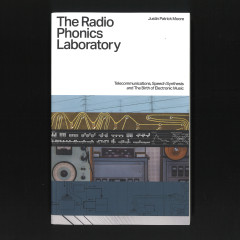
Justin Moore - The Radio Phonics Laboratory - Telecommunications, Speech Synthesis, and the Birth of Electronic Mus

The Radio Phonics Laboratory by Justin Patrick Moore is the story of how electronic music came to be, told through the lens of the telecommunications scientists and composers who helped give birth to the bleeps and blips that have captured the imagination of musicians and dedicated listeners around the world.

Featuring the likes of Leon Theremin, Hedy Lamarr, Max Matthews, Hal 9000, Robert Moog, Wendy Carlos, Claude Shannon, Halim El-Dabh, Pierre Schaeffer, Pierre Henry, Francois Bayle, Karlheinz Stockhausen, Vladimir Ussachevsky, Milton Babbitt, Daphne Oram, Delia Derbyshire, Edgar Varese & Laurie Spiegel.

Quotes
“From telegraphy to the airwaves, by way of Hedy Lamarr and Doctor Who, listening to Hal 9000 sing to us whilst a Clockwork Orange unravels the past and present, Moore spirits us on an expansive trip across the twentieth century of sonic discovery. The joys of electrical discovery are unravelled page by page.”
Robin Rimbaud aka Scanner

“Embark on an odyssey through the harmonious realms of Justin Patrick Moore’s Radio Phonics Laboratory echoing the resonances of innovation and discovery. Witness the mesmerising fusion of telecommunications and musical evolution as it weaves a sonic tapestry, a testament to the boundless creativity within the electronic realm. A compelling pilgrimage for those attuned to the avant-garde rhythms of technological alchemy.”
Nigel Ayers (Nocturnal Emissions)

“In this captivating exploration of electronic music, Justin Patrick Moore unveils its evolution as guided by telecommunication technology, spotlighting the enigmatic laboratories of early experimenters who shaped the sound of 20th century music. A must-read for electronic musicians & sound artists alike—this book will undoubtedly find a prominent place on their bookshelves.”
Kim Cascone

pas en stock

Commandez maintenant et nous commanderons l'article pour vous chez notre fournisseur.

17,61

Last In: 11 months ago
QUIET VOICES - HANTOLOGIES

Written and produced by French Jean-Yves Leloup together with Maxence Cyrin, Villeneuve & Morando and François-Eudes Chanfrault and Hélène Vogelsinger.

pas en stock

Commandez maintenant et nous commanderons l'article pour vous chez notre fournisseur.

14,08

Last In: 12 months ago
BEATRICE DILLON /  HIDEKI UMEZAWA - BASHO / STILL FORMS
  • Basho
  • Sill Forms

Der Titel dieser Arbeit von Beatrice Dillon ist dem Begriff ,basho" entnommen, der von Kitaro Nishida, dem japanischen Philosophen und Vater der Kyoto-Schule, entwickelt wurde. Kitaros ,basho" bezieht sich auf einen grundlegenden Ort oder ein Feld, in dem Dinge existieren und interagieren. Dabei geht es nicht nur um einen physischen Ort, sondern um einen abstrakteren Raum, in dem alle Erfahrungen, Gedanken und Phänomene miteinander verbunden sind. In Nishidas Philosophie ist ,basho" ein dynamischer, lebendiger Ort, an dem Subjekt und Objekt, Selbst und Welt, nicht getrennt sind, sondern sich gegenseitig bedingen. Inspiriert davon entwickelt Beatrice Dillon eine Musik von komplexer Natur, die nie aufhört, sich als reine Präsentation zu konstituieren, die ständig neu belichtet wird und in jedem Moment sowohl das Objekt der Aufmerksamkeit als auch den Hörer, der darauf zielt, reaktiviert. Dillons Basho, das sowohl seine Klänge (die keinen wirklichen Ursprung oder inneren Raum haben) als auch seine Idiome aus der elektronischen Musik entlehnt, ist eine Ablenkung, eine Neuanordnung, die uns durch vertraute, aber plötzlich fremde Elemente in ein Feld des reinen Hörens zurückführt. Still Forms des japanischen Komponisten Hideki Umezawa schöpft sein Klangmaterial aus der Erforschung der Baschet-Klangstrukturen, Instrumente, die von den Brüdern Bernard und François Baschet in den 1950er Jahren entwickelt wurden und seitdem in der Welt des zeitgenössischen Musikschaffens hoch geschätzt werden. Diese Strukturen wurden 1970 auf der Weltausstellung in Osaka vorgestellt, und einige sind in Japan geblieben. In verschiedenen Aufnahmesitzungen in Japan, aber auch in Frankreich, erforscht Hideki Umezawa das faszinierende klangliche Potenzial dieser atypischen Instrumente neu, um sie in eine hochgradig beherrschte Komposition einzubinden, in der Klänge akustischen Ursprungs und elektronische Texturen aufeinander reagieren, wie in der verzerrten Reflexion der Resonatoren der Baschet-Strukturen. Still Forms ist somit eine Hommage an und eine Zeitreise durch die unglaubliche Inspirations- und Erfindungskraft dieser Klangstrukturen, aber auch ein zugespitzter Vorschlag für eine zeitgenössische elektroakustische Komposition, die sich zu erneuern weiß, ohne ihre Ursprünge zu verleugnen.

pré-commande02.05.2025

il devrait être publié sur 02.05.2025

22,65
Various - Bass Scene Investigation Vol 1

EC Underground is back with more inquisitors of low-end heavy sounds on Bass Scene Investigation vol 1 and again digs deep into the worlds of electro, techno, breakbeat and IDM. The compilation kicks off with the skittish percussive patterns of Illektrolab's 'Making Heads Dip', then heads into moody ground with ADJ, Pablo Funk brings some menacing synth work and Errorbeauty gets all weird and trippy with some mad electronics. Francois Dillinger offers a dystopian electro sound full of irresistibly jacked-up drums. A fine investigation indeed.

pas en stock

Commandez maintenant et nous commanderons l'article pour vous chez notre fournisseur.

22,27

Last In: 8 months ago
Intercommunal Free Dance Music Orchestra - Vol. 4 Jo Maka

Rerelease of the fourth album of the Intercommunal Free Dance Music Orchestra recorded with the Guinean saxophonist Jo Maka. The title says it all: Vol.4 – Jo Maka.

The Intercommunal Free Dance Music Orchestra was created in 1971 by an “old hand” of French free jazz, François Tusques. Free Jazz, was also the name of the recording made by the pianist and other like-minded Frenchmen (Michel Portal, François Jeanneau, Bernard Vitet, Beb Guérin and Charles Saudrais) in 1965. But, six years later Tusques had had his fill of free jazz.

So he then founded the Inter Communal, an association a name under which the different communities could become closer and compose, simply. In 1976, on the first album: L’Inter Communal, we can already hear Tusques playing without borders in the company of Carlos Andreu, Ramadolf, Michel Marre and Jo Maka (as a conclusion to this Vol. 4, we can hear them in 1977 at the Moulin de Prades Le Lez). Over the next decade, the, association kept going with concerts at the Dunois theatre, in 1980 and 1981, it welcomed old hands and new recruits (Bernard Vitet, Jean-Jacques Avenel, Jacques Thollot, Sylvain Kassap…).

If Vol. 4 – Jo Maka is an homage to the Guinean saxophonist, who passed away a few months before the release of this selection of concert recordings, it also displays a proud collective inspiration! One foot in the blues, and ears open to everything else, Tusques begins with a lament that the Company rapidly transforms into a joyful dance (“Vive la Commune”), weaves a full-blown party piece (“Poses ton fardeau et remets la machine en route”, “7 rue des prêcheurs”, “Mazir”) or gets fabulous with Mingus (“Fable Of Faubus”). And there you have it, with so many revolutions François Tusques is almost back to free jazz.

pré-commande04.04.2025

il devrait être publié sur 04.04.2025

24,79
Intercommunal Free Dance Music Orchestra - Après la Marée Noire

If the jazz of François Tusques is “free”, his spirit is even more so: having recorded Free Jazz with other like-minded Frenchmen (Michel Portal, François Jeanneau, Bernard Vitet, Beb Guérin and Charles Saudrais), the pianist had covered a lot of ground, with Barney Wilen (Le Nouveau Jazz) or even solo (Piano Dazibao and Dazibao N°2), so as not to repeat himself…

In 1971 he founded the Inter Communal Free Dance Music Orchestra which, as the notes the this album stated, “is an interpretation of a music which synthesizes the different communities living and working in France.” In 1976, on the first album (L’Inter Communal) we can already hear Tusques playing without borders in the company of Carlos Andreu (vocals), Michel Marre (trumpet and saxophone), Jo Maka (saxophone) and Ramadolf (trombone). It is a meeting between jazz and music from Catalonia, Occitanie and Africa. So far so good, but what about Brittany, that, Tusques knows “by heart”? Having lived for a long time in Nantes, he would expand his ‘brittanitude’ on the canal linking the city to Brest by playing with, for example the Diaouled-Ar-Menez. With these “devils from the mountain” who, under the baton of Yann Goasdoué, worked throughout the 1970s on the renewal of music from Brittany, Tusques met, notably, Tanguy Ledoré and invited him one day, with trois bombards and some bagpipes (Jean-Louis Le Vallegant, Gaby Kerdoncuff and Philippe Lestrat), to join the ranks of the Intercommunal. And so they set of towards a new music from Brittany, as the title states; Vers une Musique bretonne nouvelle!

With percussion from Samuel Ateba and Kilikus, the association launches the ‘bombardier’: the repetitions and dissonance of the different members all serve a common cause however: the dance, which is always the reason for the party. This sets a whole universe spinning, which can bring to mind Chris McGregor’s Brotherhood of Breath (“La rencontre”) when not taking on board waltz, swing, blues and gavotta or even revealing mysteries like those of Gurdjieff (“Les racines de la montagne” or “Le cheval” sung by Andreu). Only one thing to say to this Brotherhood Of Breizh: Mersi!

pré-commande04.04.2025

il devrait être publié sur 04.04.2025

24,79
Papooz - Green Juice

Papooz

Green Juice

12inchHA001LP
Half Awake
21.03.2025
  • A1: Ann Wants To Dance
  • A2: Simply Are
  • A3: Toria's Song
  • A4: Stories Of Numbers
  • A5: Green Juice
  • A6: Trampoline
  • B1: Good Times On Earth
  • B2: Chubby Baby
  • B3: Brother
  • B4: Wanted
  • B5: Louise
  • B6: One Of Those Days

Who doesn’t remember their hit song Ann Wants To Dance ?

Soundtrack of the summer 2015 and which music video made by Soko got a few millions views. This cheerful and addictive tune laid the foundations for the four-handed songwriting style of Ulysse Cottin (brown hair) and Armand Penicaut (blond hair). Those two performers, who compose and sing effortlessly in English, posed with a cheerful attitude on the sleeve of their first album Green Juice (2016) recorded at the Cap Ferret and mixed by Ash Workman (Metronomy, Frànçois & The Atlas Mountains, Baxter Dury). Papooz have a talent for sway pop and irrefutable groove like very few of their compatriots, aside from Phoenix we cannot think of anyone else. Tropical pop here, wild bossa nova there, all of it deeply anchored in the American style of the Seventies, Ulysse and Armand are perfectly matched. Falsely dabbler and completely inspired, the duo fights the ambient gloom with their songs.

pré-commande21.03.2025

il devrait être publié sur 21.03.2025

22,90
BusCrates - Altitude

BusCrates is a Producer / Synthesist / DJ hailing from the Steel City -Pittsburgh, PA
BusCrates blurs the lines between boogie funk and boom bap hip hop beats
Returning to Bastard Jazz following two well loved albumsBlasting Off(2020) andControl Center(2023)
BusCrates' increasingly popular Twitch channel streams live every Thursday and Friday night to over 13,500 followers
A noteworthy resume production credits including Mac Miller, Wiz Khalifa, Curren$y, and Phonte & Eric Roberson
He's toured throughout the US playing with artists like RJD2, DJ Epik, J Rawls, Tall Black Guy and more
BusCrates counts big names such as Jazzy Jeff, Francois K, Dâm Funk, Rich Medina and Spinna as fans

pré-commande21.03.2025

il devrait être publié sur 21.03.2025

15,08
Articles par page:
N/ABPM
Vinyl