
out of Stock
Order now and we will order the item for you at our supplier.
11,35 €
Last In: 2 years ago
Order now and we will order the item for you at our supplier.

Reel People Music are excited to present a limited edition 7” Vinyl release of the Opolopo remixes of Mothers Favorite Child & Saeeda Wright’s “Purple Funk, a tribute to the legendary Prince. Of course it had to be pressed on a stunning translucent purple disc !
Music producer and songwriter Paris Toon, founder of Mothers Favorite Child, has teamed up with the ever so soulful vocalist Saeeda Wright for this updated version of Purple Funk. Saeeda Wright who previously performed and recorded with PRINCE adds delightful new layers of depth and nuance with her stylish vocals whilst the one and only Swedish fire starter Opolopo steps forward in real style to deliver his classic bounce to a remix that is set to shake global dancefloors for many a year to come.
Order now and we will order the item for you at our supplier.

expected to be published on 18.08.2023

Attarazat Addahabia & Faradjallah's album came to us as quite a mystery. Our friends from Radio Martiko got access to the studio archive of the Boussiphone label and a reel labeled “Faradjallah” was among the items they had found there. After listening to the selection of reels they borrowed, Radio Martiko felt it was not a fit for their label and helped us licensing it from Mr. Boussiphone instead. We knew nothing about the band. We just had the reel with the music but very little information. What we knew was that the music was incredible and very unique. Gnawa sounds were combined with funky electronic guitars, very dense layers of percussions and female backing vocals more reminiscent of musical styles further south than Morocco. We started asking around whether anyone knew the band with no immediate success until we asked Tony Day, a musician from Morocco who helped us during our search for Fadoul’s family. His sharp memory came through once again, remembering all the names of the Attarazat Addahabia band members and even how to contact the bands singer and leader Abdelakabir Faradjallah. After visiting him at his home in Casablanca with our Moroccan colleague Sabrina multiple times, he shared his personal story. His father arrived in Casablanca from Aqqa at the age of six and his mother came from Essaouira. Abdelakabir was born in the neighbourhood of Benjdia in 1942. Abdelakabir Faradjallah studied fine arts in Casablanca, graduating in 1962. He also played soccer in the second team of "Jeunesse Societe One". His brother-in-law Ibrahim Sadr worked for one of the biggest football teams of the time in Morocco called "Moroco Sportive Union", which allowed him to travel to France occasionally. While Ibrahim was never part of the band he brought along a few instruments from trips.
Yet the majority of the instruments they could not afford to buy were build by Faradjallah and Abderrazak, Faradjallah's brother who passed away early. For instance they had built a Spanish guitar and a drum made of wood barrel and sheepskin by themselves.During the 1950s Faradjallah was booked as a singer for surprise parties with friends. He started to write his first songs including "L’gnawi" in 1967 and wanted to make people discover Gnawa culture, or maybe rather his take on the culture to be more exact. Faradjallah recalls his first interaction with the genre in the streets of the Dern neighbourhood, where he used to go to elementary school. Gnawa is one of the essential musical genres of Morocco. It combines ritual poetry with traditional dances and music linked with a spiritual foundation. Musically a lot of influences originated from West Africa as well as Sudan. Gnawa is usually played by a selection of specific instruments such as the qaraqab (large iron castanets centrally associated with the music), the hajhouj (a three string lute), guembri loudaâ (a three stringed bass instrument) and the tbel (large drums). People would put shells on their clothes and instruments and use incense at their parties. "Sidi darbo lalla - lala derbo khadem..." came from Gnawa verses Faradjallah used to sing when he was 14. The lyrics tackle a global (im)balance of power and the question of social status in this course. The band Attarazat Addahabia was formed in 1968. The original line-up included 14 members, all from the same family. They played their first small concerts here and there starting in 1969. Later in 1973 they performed bigger shows for instance at the Municipal Theatre followed by the "Al Massira Show" at Velodrome Stadium in downtown Casablanca. Their first album "Al Hadaoui" (the one you are listening to) was recorded at Boussiphone studios in 1972 and was never released before. Nobody seems to remember the exact reason why Boussiphone ended up deciding not to put the album out. The album's title track also served as the basis for Fadoul's "Maktoub Lah", who frequented the same circles as the band for some time.
Their shows sometimes could go as long as 12 hours, starting at 5pm in the afternoon, with an occasional break here and there. In the 1980s the band took a brief break. Faradjallah recalled the reason for that break like this: "Zaki, the bands drummer, had fallen in love with a young girl from Mohammedia. Soon after, he fell very ill. The group members were convinced that the girl had given him ‘s'hor’ (a kind of local Moroccan version of "black magic"). For four years, the whole group stopped playing. It was unthinkable to find another drummer to replace Zaki, even temporarily." So they waited four years for Zaki to "get back on his feet" before going back on stage. Apart from very few gigs here and there Faradjallah stopped playing music in the mid 1990s. Some members from the younger generations formed a new band and still play frequently to this day. Faradjallah runs a television repair shop coupled offerings beverages and snacks in the Belevedere /Ains Sbaa district of Casablanca. While Faradjallah was primarily a musician, he would work for the local cinema and paint their posters for new movies by hand and he designed all artworks and cover posters of the band.
And this eventually led to him participating actively in our first exhibition dealing with Habibi Funk’s work in Dubai 2018. He helped us by creating calligraphic complementations on large photo prints for that show.
Order now and we will order the item for you at our supplier.

Order now and we will order the item for you at our supplier.
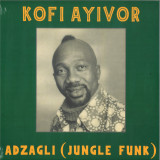
Kalita are excited to announce the first ever re-release of "Adzagli (Jungle Funk)" and "A Song For You (Ayawa)", two phenomenal pieces of West African disco from Amsterdam"s Kofi Ayivor. Selected from his sought-after Nigerian 1981 self-titled debut album "Kofi", at last these two recordings see the light of day once more via a loud-cut remastered 12" single. In addition, Kalita enlists fellow Amsterdam resident, DJ and producer Mendel to create his own remix of each recording, using the original multitrack session tapes to rework both for the modern-day dancefloor.
Order now and we will order the item for you at our supplier.

Romanian maestro Funk E makes his debut on OGE with this 3 track EP, 3 cheeky edits for the dancefloor!!
Order now and we will order the item for you at our supplier.

Indonesian City Sound: Panbers’ Psychedelic Rock and Funk 1971-1974
The Pandjaitan Brothers or Panbers came from the North Sumatra minority Christian group, the Bataks, whose ancestry traces back to an island at the center of Lake Toba. As a minority group within Indonesia's Muslim-dominated society, this ethnic minority has produced top military generals, celebrity lawyers, and a legion of pop and rock superstars.
Suffice to say, some of the biggest names in the country's pop history were Bataks. Panbers fit the bill perfectly.
The band's strong Christianity belief looms heavily in the music they produce. The prominent use of the Hammond organ in their early materials is evocative of church music the band members have been around in their whole life. Bandleader Benny Pandjaitan's fills his characteristic wail with existential dread, with many utterances of the word "mengapa" (why).
Guilt is another central theme Pandjaitan repeatedly comes back to in his lyrics. But they balance it with joy, on songs such as "Come on You Dance" "Let's Dance Together" or "Haai" (a play on the word high), where references to recreational substances are plentiful.
Although they modeled themselves after the era's rock bands Beatles and fellow countrymen Koes Plus, Panbers had a unique aversion to the electric guitar. In "Jakarta City Sound," a fiery three-note guitar solo is laid so far down in the mix that they are barely audible. In "Haai" they modify the guitar to sound like a jungle instrument playing traditional North Sumatran music. In "Rock and the Sea," arguably their most well-known song globally, they decided to ditch electric guitar altogether and replace it with a sitar.
In the absence of an electric guitar, Panbers had to rely on Doan's inventive bass playing and Asido's drum works to do the heavy lifting - and boy, do they deliver (Their 1971 debut "Volume 1" saw plenty of drum breaks). In this compilation, listeners will hear recordings from Panbers' fertile four-year period - a time that produced in some of the grooviest and hardest-sounding psychedelic music in Indonesia's rock history.
For those uninitiated on the glory Panbers, consider this compilation an introduction to some of earliest and heaviest rock sound to come out of Indonesia.
Order now and we will order the item for you at our supplier.

Order now and we will order the item for you at our supplier.

Habibi Funk is excited to share “Marzipan” - our first full length contemporary release courtesy of Beirut’s multi-instrumental phenom Charif Megarbane, also known as the man behind prolific Cosmic Analog Ensemble. The LP is a journey into Charif’s styling, one he terms “Lebrary”: a vision of Lebanon + Mediterranean expressed through the kaleidoscopic sonics of library music. Drawing from artists that encapsulates the HF sound, such as Ziad Rahbani, Ahmed Malek and Issam Hajali, Charif translates these influences into an LP that is equally at home in ’23. We always wondered why Charif’s music stayed under the radar for so long, that all changes with “Marzipan”.
Charif Megarbane, the staggeringly prolific producer, instrumentalist, and all-around musical mastermind returns with full LP “Marzipan.” Following his previous release of EP “Tayara Warak” in 2022, “Marzipan” is a sonic journey that seeks to capture the full scope of Megarbane’s habitus. As a composer and producer, Megarbane touts hugely versatile, sometimes volatile musicianship — his 100+ catalogue of projects (including legendary groups like the Cosmic Analog Ensemble, Free Association Syndicate, Monumental Detail, etc.) features a huge domain of sonic direction. This collection was previously developed in Megarbane’s own Hisstology label which hosts a wealth of collaborative efforts. Now, Habibi Funk represents Megarbane under his own name. Megarbane finds a sonic through-line in his surrounding soundscapes as he draws on the chaotic energy of the crowded Beirut metropolis (“Souk El Ahad”), the warm atmosphere of the Lebanese countryside (“Chez Mounir”), or the lushness of a Mediterranean beach resort (“Portemilio”). Reflecting the aural composition of his direct surroundings into kaleidoscopic instrumentation provides a unique insight into how one musical phenomenon transposes sight into sound. Habibi Funk is thrilled to share “Marzipan” and finally throttle this under-theradar phenomenon into the solo spotlight. Despite the magnitude of his catalog, Megarbane’s LP sounds as fresh—as resolutely inspired—as a debut record. “Marzipan” continues down the winding path he trod on EP “Tayyara Warak” (released Decmber, 2022) which features solid footing in the hectic city sounds Megarbane hears as home. Despite his obvious musical acumen, Megarbane’s greatest talent seems to be his open ears. In many ways, “Marzipan” is a cartographic feat — it travels and traces a journey across many dimensions (both sonic and physical). Megarbane’s instrumental catalogue is vast: toy glockenspiel, harpsichord, pedal steel, a classic Wurlitzer, et al are used liberally on the record. The resultant sound is as sprawling as the musician’s instrumental dexterity. “Marzipan’s” closing track “Bala 3anouan” can be translated loosely to “without address” — a fitting final word. Despite the entire record being a sincere testament to Megarbane’s environmental approach to music-making, the record is not bound to any particular coordinates, or any particular sound for that matter. The vastness of his influences — beloved artists like Ahmed Malek and Issam Hajali (both Habibi Funk veterans); West African funk deep cuts; European cinematic scores; et al — result in a record of somewhat unparalleled expansiveness. Floating melodies and frantic rhythmic interludes both find natural homes across “Marzipan.” The record is tinged with psychedelic elements—fuzz-drenched guitar, sliding microtonal interludes, hypnotic rhythmic breakdowns. Reflecting on his creative process, Megarbane cites a stream of consciousness approach: “It’s a very spontaneous, playful, and diary-like approach and workflow…I trust my instinct because instinct is based on experience.” Lead single “Souk El Ahad” opens the roll-out with a raucous energy, out June 12. Megarbane abstracts busy city sounds into a psychedelic framework, casting technicolor hues on everyday experience. Following is second single “Pas de Dialogue” out June 23. The track jerks the listener towards a more meditative state with lulling harpsichord and expanding, cinematic sound. “Marzipan” will be available physically and digitally everywhere on July 14, 2023. Be sure to listen for focus track “Chez Mounir” that captures the warmth of community in a joyful, laidback groove.
Uncover greater insight into the world of Charif Megarbane in the booklet accompanying the LP
Order now and we will order the item for you at our supplier.

black LP[30,21 €]
Soul Jazz Records’ new Holy Church of the Ecstatic Soul: Gospel, Funk and Soul at the Crossroads 1971-83 is a one-off limited-edition heavyweight special-edition coloured vinyl pressing + download code exclusively for Record Store Day 2023.
he album draws upon the extensive links between black American gospel music and soul music, showing how the sensibilities of gospel artists such as Shirley Caesar, Dorothy Norwood, Andraé Crouch and others crossed over into secular soul music during this period.
Holy Church of the Ecstatic Soul shows how sacred gospel music was at home with Stevie Wonder, Blaxploitation-style funk and produced music celebrated both in New York’s underground discos (The Paradise Garage, Studio 54, etc) and later sampled by the likes of Jay-Z, Snoop Dogg and Mary J Blige
Order now and we will order the item for you at our supplier.

Order now and we will order the item for you at our supplier.

French collectors have been bullish on the boogie for decades now & have spawned some of the best sounds in the genre of recent years with artists like DABEULL, HOLYBRUNE, RUDE JUDE, MOFAK, DOGGMASTER & now FRANKFURT & VOYEAR. 2 cuts here of vintage meets future synth funk with a French touch.
Order now and we will order the item for you at our supplier.

Order now and we will order the item for you at our supplier.

Libyan Reggae at its peak grooves courtesy of Benghazi-born Ahmed Ben Ali. After working with Ahmed in 2020 on the 12” hit “Subhana” (Habibi012) (2.4M Spotify streams), Habibi Funk is back with a fulllength release focusing on Ahmed’s releases from the mid 2000’s.
The tracks on the LP represent a blisteringly deep collection of heavy reggae rhythms and synthesized grooves from a singular creative force, inspired as much from Jamaican sonics as from Libyan folkloric styles, as Ahmed says, “it’s the Libyan style, not some bullshit.” Out everywhere June 16th.
Order now and we will order the item for you at our supplier.

An expanded view of Tomek's (Model Citizens, 2You's) 1983 no wave
punk funk celebration of the Fairlight CMI, recorded in the home of
Stones producer Jimmy Miller
expected to be published on 31.05.2023

expected to be published on 31.05.2023

expected to be published on 12.05.2023

Sampled Funk : all the pearls of the Groove, sampled by the greatest hip-hop and R&B DJs and producers. From the first block parties of the 1970s to the digital revolution, the organic rhythms of the funk, disco, and soul music craftsmen have provided the DNA for countless rap classics. The new volume of the Give Me The Funk series explores the groove treasures sampled by hip-hop and R&B"s greatest DJs, producers, and other " creative diggers ". Cramp your style, here come the hotsteppers! From Johnny Guitar Watson to Instant Funk to B.T. Express and Clarence Reid, Sampled Funk goes back to the source of must-have tracks from Eric B & Rakim, Kanye West, Beastie Boys, De La Soul, Cypress Hill, Dr. Dre, Snoop Dogg and many more.
expected to be published on 08.05.2023

Order now and we will order the item for you at our supplier.
