Frozen Music’ was recorded in New York City 32 years ago and like most of
pianist Andy LaVerne’s releases this album has not lost its original energy
and charm.
Tenor and soprano saxophonist Rick Margitza was then a young rising star under contract with Blue Note. Andy was already a prolific composer who penned
all the tunes of this album. Bassist Marc Johnson who was a member of Bill
Evans’s last trio gave graceful and subtle colouring to LaVerne’s compositions.
“Frozen Music, Andy LaVerne’s third album for SteepleChase, is a solid, modern
blowing session...he makes skilful use of suspensions, pedal points, and ostinatos, which along with the music’s floating harmonies, give the soloists a wealth
of elbow room.” - Mark Stryker, Cadence
Personnel: Andy LaVerne (piano), Rick Margitza (tenor and soprano saxophone), Marc Johnson (bass), Danny Gottlieb (drums)
Search:gave
Fernand Schirren was an exceptional musician and composer, rhythm teacher to Bejart and Anne Teresa De Keersmaeker, silent film accompanist of the Brussels Musee du cinema (now CINEMATEK) from its founding in 1962 until the 1980s, and eccentric collector of pipes and romantic postcards. He chose anything but a traditional historical-oriented approach, and left his avant-garde stamp on the film, dance and music worlds at home and abroad. This compilation gathers never before published works that Schirren specially composed for the short films 'Dimanche' by Edmond Bernhard in 1963, 'Masques' by Jean-Marie Buchet and Marc Lobet in 1959, and Cartoon Circus by Benoit Lamy and Picha in 1972. Some of the most intense and curious soundtracks cinema ever gave us.
We're heading deep into the bowels of the cosmic basements with our latest vinyl release which is headed up by those 2 lovely souls from Leeds, PBR Streetgang.
From rocking it all over the globe to releasing a plethora of absolute yesmate bangers & a long player too, we're pretty thrilled that they have joined our family of music makers with their double A side E.P. 'Transpennine Express'.
GCP gets the party started and instantly takes you to 4am at Barbarellas Discotheque with stacks of throbbing-ness & pumping, laser reaching vibes whilst the boys take you down a wormhole of electronic music pleasure.
Condor jumps ships from Barbarellas & hot foots it over to Berlin to sweat it out in basement with only a smoke machine for company and tons of ravers. Pulsating synth surfs across a chubby bass with some slick as heck cosmic stabs making this a multitude of all that is good in proper dance music.
If the originals are on the dance floor then we made sure to go full on weirded-out on the remixes and crikey they don't disappoint!
ELLES totally flips the script on GCP and turns in a hazy, broken beat style electro groover with a full vocal giving it the sound of a lost track by A Certain Ratio.
Psychederek takes the 'make sure to go really wonky!' advice we gave when sending the parts to Condor and matches ELLES with his full on acid tinged psych wig-out rework. The beat sure is broken, the bass guitar punches, the old school piano thumps and the whole thing sounds like an amazing Andrew Weatherall remix from the mid 90's you never knew existed.
Something for everyone.from clubs to shebeens to after parties & beyond...
Through his dedication to the Los Angeles grassroots projects that gave so much stability and focus to many younger musicians, artists and the community, Horace Tapscott became a neighbourhood hero at a time when the world wanted his presence. He stayed in Los Angeles and focused instead on building a community, rarely giving interviews and instead focusing on passing on the message from his mentors. He shaped a unique sound with his arkestra and community minded musicians. It was a close-knit family that emanated a sound that was deep and unique, flowing with a creative spirit that definitely comes through on this album.
In 1961 he founded the Pan-African Peoples Arkestra, which aimed to preserve, develop and publicise African-American music through the ever-growing family that emanated within many of the deprived areas of Los Angeles. Through his subsequent collaboration with Bruce Albach, a producer and founder of Nimbus West Records, they sought to document the importance of this music alongside many artists who were energetically linked to the ethos and understanding which came from the collective dialogue.
Here the composer leads four extensive arrangements through his 16 piece orchestra, featuring many of the Nimbus West artists including Adele Sebastian, Jesse Sharps and Linda Hill. The music weaves the sound of afro-futuristic music through changing tempos and a relentless dynamic expressive sound that is complex and beguiling with a deep spiritual sound throughout all four tracks.
The ceremonial ‘Peyete Song no. III’ is a great swirling evocative piece from the large collective, with amazing solos from especially Horace Tapscott who seems to find a sound from the piano that is from another dimension. The arrangement airs an important message of a people and their rituals.
Horace Tapscott gives Cal Massey’s composition ‘Nakatini Suite’ a splendid futuristic big band interpretation. The composition had been earlier illuminated by both Lee Morgan on his ‘Lee-Way’ album and John Coltrane on his ‘Believer’ album titled ‘Nakatini Serenade’. Through the more expansive soundscape, the interpretation allows for some great interplay between saxophonist Jesse Sharps and drummer Everett Brown Jr. with the whole orchestra led by Horace Tapscott capturing the essence of Cal Massey’s message.
Vocalist Adele Sebastian opens up the free probing arrangement ‘Quagmire Manor at 5am’ composition with a similar delivery as with her ‘Day Dream’ from the classic ‘Desert Fairy Princess’ album before the music takes off onto the mothership adding a sense of what time and space within the manner was about amongst many great musicians and artists. Their journey and moments encapsulated within the music.
There are certain albums you hear something new every time you revisit the music and this is one of those albums. An important part of Afro-American history; the politics and art which surrounded the album. If you get a chance check out the film ‘Horace Tapscott, Musical Griot’, by filmmaker Barbara McCullough, or buy the book ‘Songs Of The Unsung’: The Musical & Social Journey of Horace Tapscott’. Mark Jones/UK Vibe
FOUR STROKE BARON return with their third full length studio album ‘Classics’, mixed by Devin Townsend and brimming with catchy riffs and unforgettable choruses. Having streamlined into a duo, Kirk Witt and Matt Vallarino cast a sardonic eye over the human condition - as seen through their own uniquely distorted lens, and told via tales involving a murderous rampage at a kegger while dressed as a knight, to being trapped in a casino during a robbery whilst on acid, and other such adventures. They are our guides as we traverse the filthiest folds in the dark underbelly of Reno, Nevada; illuminating the darkest corners of their twisted psyches with their upbeat and insanely catchy pop hooks.
Having scraped off the detritus of their city, rubbed the crust from their eyes and molded it into the heavy pop songs you hear before you today, they enlisted the only person they knew who could add the extra layer of embellishment that the album required. Enter Devin Townsend. They gave him only one instruction for producing Classics: go as hard and insane as possible. The added textures brought in by Townsend during mixing elevate these 10 tracks to another level.
If you’re unsure of what constitutes a classic, a good place to start is with FOUR STROKE BARON’s 2020 release, Monoqueen, which features covers of the likes of Chvrches, The Beatles and Death Grips. Sometimes it’s necessary to allow time to pass to reveal the true nature of a classic track; FOUR STROKE BARON have shaved the waiting time all the way down to zero. Hit play - the classics are all there waiting for you.
Tape
A few months after the release of the legendary Strumming in 1974, Charlemagne gave a masterful and powerful 56 minutes performance in Antwerp in an exciting concert series. With the work and the precious help of M KHA and Lotte Beckwé, we were able to find this recording. We are pleased to offer you this unreleased performance on cassette and CD.
This release takes place in parallel with the magnificent M KHA exhibition which will begin on September 11, 2021.
Music by Charlemagne Palestine played on a Bösendorfer Imperial piano.
* Strictly limited-edition 12” vinyl in full colour sleeve
* DJ Die is among those who laid the foundations for British dance music, who first grabbed the world's attention in the early 90s and who indelibly stamped the 'Bristol Sound' on the history of music forever.
* Die went on to become one of Bristol's most cherished musical sons - and one of the jungle / drum & bass movement's biggest stars.
* From 1993 onward DJ Die gave V Recordings some of the labels most seminal releases, including the likes of 'Slide Away', 'Special Treat' and 'Autumn'. It would be criminal of us to not get him involved in the Legends series. This strictly vinyl-only release sees two cuts from '96 finally see the light of day, 'Capers' and 'Inside'.
* The fifth part in this vinyl series, with yet more legends waiting in the wings. These are an absolute essential for vinyl collectors.
House anthem Slo Moshun “Bells Of NY” is one of the most iconic gems in the Network catalogue and gets a timely reissue.
The lovingly remastered 12” includes the epic nearly 9 minutes long “House To House Mix” which started the fuss in the first place, plus the much loved by DJs “Xen Mantra Beefy Bells Mix” which like fine wine seems to have matured with age.
It’s almost impossible to explain the hype that exploded when the first copies of this landed in 1993. Network pressed a limited run of the first copies on the Dansa label with
bogus New York producer credits in an attempt to create mystique.
The combination of that relentless uptempo house piano and the break where everythIng slows down underneath a hip hop sample hypnotic proved irresistible, and saturation radio plays from KISS in London turned the track into an instant anthem right away.
The the boss of a rival label boasted they had sourced the track and paid “a fortune” to licence it for UK release. He was making it up as a stampede by labels to locate and release the track began.
Network sensed an opportunity to create major mischief and create even more of a buzz. New York garage producer and Network ally Andrew Komis was enlisted and happily donned the bogus ID of a new kid on the block NYC producer to do phone interviews with UK dance music publications.
His pretend story that Bells Of NY was his homage to the UK House scene laced with Big Apple Hip-Hop was eagerly printed by the magazines.
They were left red faced when the truth emerged that former Nexus 21 and Altern 8 member Mark Archer and his new music making partner Danny Taurus had in fact come up with the gem in homely Staffordshire and not glamorous New York for Network.
All the PR spin in the World would not matter a not if the record didn’t live up to the hype.
Bells Of N.Y did and still does.
It gave Network a first chart hit on their six6 label and more importantly is an all time House Music Classic.
During the production of two singles (This being the first) unfortunately William Stuckey passed away, below are some words from my partner in the project Brian Sears regarding our work with him pm his LP.
Brian Sears - I'm not one that likes to write but I wanted to say a few things about William Stuckey. William Stuckey passed away last in August 2021 at age 73, and is an artist that I've been working with since last summer. He was a key fixture in the Little Rock music scene and most notably was one of the driving forces behind the legendary True Soul label. Lee Anthony, the owner of True Soul Records, once told me that William Stuckey was the most talented musician he had ever worked with, and if you know anything about that label or Lee Anthony, that's quite a compliment.
When I reached out to William last summer about re-releasing his material, he ignored my calls and messages. Fortunately, I was able to reach his son, Erreyon who was kind enough to listen to me. I've worked a lot of terrible sales gigs in my past and "getting to the point" is sometimes a hard thing to achieve, especially when you're trying to talk about the music business and music that's 50 years old. But the point was simple, his music matters and deserved to be preserved. This resonated with William and Erreyon and they gave Euan Fryer and myself a chance.There was a memorable handoff of the master tapes in a parking lot and from that point forward I knew William Stuckey trusted me. Trust is something he had to do a lot in his life due to the fact that he was visually impaired and I'm thankful he trusted us. As I wrote before, there was a long process of transferring the tapes, but it was successful, and the album has never sounded so good. William had incredible hearing and was able to pick out details most might not detect. He was gifted and that shined through his own playing and voice through copious recordings. Speaking with him after he finally heard the newly remastered album, the way he had intended for it to sound, is something I'll never forget. Moments like that are really the reason why I feel so compelled to work with older musicians that didn't get a fair shake the first time.
Meeting William Stuckey face to face earlier this summer was one of the highlights of my year. We laughed and hung out at his place where he had lived for the past 50 years. I told him his music was internationally known and the re-release was well received. He was humble and felt like a long lost friend that I hadn't seen in a long time. I'll never forget that. I told him I wanted to take some photos, and I'm so glad I did.We had a good time and it was a beautiful summer night and as I left his place his neighbours noticed me walking to my car and wanted to chat, so we talked briefly and it ultimately lead to one of them getting into their car and cranking "The First Time" on the stereo system in their driveway. I wasn't sure if Stuckey could hear it from his house, but part of me knew he probably could and hearing his song echo in the background as I drove off and thinking about Stuckey and the time we shared and his music being appreciated by so many, even in that moment, is a wonderful memory. I'd like to think he was smiling.His music and legacy will live on forever.
Rest in peace to a great one.
When The Night Ends’ is the first collaborative release from Jens Pauly and Stijin Hüwels. The entire album was produced across two countries, Germany and the Belgium, as Jens and Stijn completed the work via a series of online exchanges.
Regardless of the distance between the two collaborators, Jens and Stijn seem to share a very intricate and natural bond, one that gave rise to a set of composition that seamlessly intertwine the sonic spectrum of both artists. Guitar strings, drones and field recordings effortlessly emerge, grow and disperse, as each composition introduces a new scenery of equally somber and rosy elements. This emotive interplay is a central thematic to the work and carries the album throughout its 4 longform works, resounding quietly they become the fabric of our thoughts, leaving us to ponder aimlessly, yet blissfully, amid nightfall and daybreak.
While the world continues to be in a bizarre mixture of feelings and circumstances, we can thankfully still hark back to last fall when the sophomore LP from the elusive and innovative KAMM band, Cookie Policies gave us an opportunity to reflect on the past while fully looking toward the future.
The album presented a beautifully unique blend of listening-oriented music styles, combining the early roots of the four producers and their pre-DJ formative musical travels. It is now our great pleasure to introduce an EP set of specifically dance floor-focussed remixes that take the diverse textural arrangements and expansive sonic bliss of the LP and stretch it around some solid percussive membranes, sure to excite many DJs and dancers out there in the wild as things begin to reopen.
KAMM band members Dave Aju, Alland Byallo, Kenneth Scott, each chose one original album track to rework with a more propulsive feel and from Aju's psychedelic West Coast breaks rendition of the noir-esque "CCBPGC", to Byallo's high vibe leveled-up flight of "Bird Call", or Scott's bold section-by-section recreation of the sprawling "The Soft Glow Of Electric Sex" laser-designed for heads-down late night club sessions, the boys came through to say the least. The real A1 treat of this reinterpretation package however comes from unanimous artist choice and label favorite I:Cube, whose majestic take on "Shleem" sees the veteran producer and master remixer move the bubbling ambient piece into bumping and rich space-age deep house territory, equal parts angelically uplifting and pure 5am club-belter/mind-melter.
Deluxe Edition[33,57 €]
Portuguese experimental trio 10 000 Russos are gearing up for the release of their fifth album ‘Superinertia’, which is due out September 10th on Fuzz Club Records. Following on from 2019’s ‘Kompromat’ LP and tour dates around the UK, Europe and Mexico in support, the Porto-based band describe ‘Superinertia’ as a record addressing the “state of inertia that humans live in the West nowadays. It isn’t a record about the past or future. It’s about now.” For all that ‘Superinertia’ might take aim at a world without motion, however, the same cannot be said of 10 000 Russos themselves.
On the one hand, since their 2013 debut LP and the three that have followed on Fuzz Club since (2015’s self-titled, 2017’s ‘Distress Distress’ and ‘Kompromat’), 10 000 Russos’ music has always been about as kinetic as it gets: a truly unrelenting and motorik sonic force. On the other hand, ‘Superinertia’ also sees the band itself move into whole new musical territories – aided especially by the recent addition of synth player Nils Meisel to the line-up (who replaces former bassist André Couto.)
“The synths really opened up the sound of the band and gave more routes for the music to journey down. The most important thing on this album was to not repeat ourselves. A new arc in our sound is coming to life”, drummer and vocalist João Pimenta explains. On said arc, the Russos sound is expanded to include moments that invoke Ry Cooder’s ‘Paris, Texas’ soundtrack (‘Mexicali/Calexico’), dancey outbursts that transport you to the 90s Summer of Love (‘Super Inertia’), the closest thing Russos have ever done to a pop song (‘A House Full of Garbage’) and even a touch of banjo (albeit one that sounds like a country band on amphetamines playing over a feedback-blasted Stooges beat.)
“10 000 Russos are bizarre and excellent in equal measure.” - The Quietus
“Songs drip with heavy echo, relentless beats and bass and a sense of charging into the ultimate infinite.” - Bandcamp Daily
“Something unholy has indeed been summoned out of the ground, and it is a power trio from the Iberian Peninsula.” - Clash Magazine
Blue vinyl[26,43 €]
Portuguese experimental trio 10 000 Russos are gearing up for the release of their fifth album ‘Superinertia’, which is due out September 10th on Fuzz Club Records. Following on from 2019’s ‘Kompromat’ LP and tour dates around the UK, Europe and Mexico in support, the Porto-based band describe ‘Superinertia’ as a record addressing the “state of inertia that humans live in the West nowadays. It isn’t a record about the past or future. It’s about now.” For all that ‘Superinertia’ might take aim at a world without motion, however, the same cannot be said of 10 000 Russos themselves.
On the one hand, since their 2013 debut LP and the three that have followed on Fuzz Club since (2015’s self-titled, 2017’s ‘Distress Distress’ and ‘Kompromat’), 10 000 Russos’ music has always been about as kinetic as it gets: a truly unrelenting and motorik sonic force. On the other hand, ‘Superinertia’ also sees the band itself move into whole new musical territories – aided especially by the recent addition of synth player Nils Meisel to the line-up (who replaces former bassist André Couto.)
“The synths really opened up the sound of the band and gave more routes for the music to journey down. The most important thing on this album was to not repeat ourselves. A new arc in our sound is coming to life”, drummer and vocalist João Pimenta explains. On said arc, the Russos sound is expanded to include moments that invoke Ry Cooder’s ‘Paris, Texas’ soundtrack (‘Mexicali/Calexico’), dancey outbursts that transport you to the 90s Summer of Love (‘Super Inertia’), the closest thing Russos have ever done to a pop song (‘A House Full of Garbage’) and even a touch of banjo (albeit one that sounds like a country band on amphetamines playing over a feedback-blasted Stooges beat.)
“10 000 Russos are bizarre and excellent in equal measure.” - The Quietus
“Songs drip with heavy echo, relentless beats and bass and a sense of charging into the ultimate infinite.” - Bandcamp Daily
“Something unholy has indeed been summoned out of the ground, and it is a power trio from the Iberian Peninsula.” - Clash Magazine
Could the missing link between Eric Dolphy and Albert Ayler be the Michel Portal of 1970? After having worked alongside François Tusques defending a free jazz “made in France”, we find him here, heading up an international quintet of which each member is on fire: John Surman, Barre Phillips, Stu Martin and Jean-Pierre Drouet. The quintet had full leeway to break out the free-form in long ambient tracks to compose this Alors!!! which leaves listeners with just one word to say: More!
Do we still need to present Michel Portal?... Clarinetist destined for the classical and contemporary world after his passage in the Paris Conservatory, he decided to try his hand at jazz, with an incendiary flamboyance! After his first experience with André Hodeir and Pierre Michelot, he would break all the codes with François Tusques (Free Jazz, in 1965) before starting the emblematic Michel Portal Unit. It is the Portal of those years that Alors!!! offers us the chance to listen to again.
“There are periods of insolence”, the musician declared and the year 1970 was one all on its own. Heading up an impetuous international troupe, a quintet consisting of John Surman (saxophones, bass clarinet), Barre Phillips (double-bass), Stu Martin (drums) and Jean-Pierre Drouet (percussion), Portal moves from alto sax to clarinet in the compositions shared with his partners.
From the off, the group sparks an explosion with the sound of “OO Bam Ba Deep” battered by the horns and percussion. Next up is the fabulous free jazz of “Yes, Oh Yes, You Wonderous Sun Kissed Maiden!” and the fantastic disjointed march of “Ça Boom?” which shakes up the musicians every which way. The quintet imagined that listeners would need to catch their breath, and thoughtfully added: “Billie the Kid” and “Undercurrent”, marvelous moments of ambient mystery.
Audacious from beginning to end, including the sleeve – the bird-man and his quintet brain designed by Avoine, –, the album is a fabulous object, to which the label Futura gave wings at the time. And as it is being reissued today there is just one word to use: the French translation of the title, So!!!
Blue Vinyl with Bonus 7”
Charlotte Cornfield’s “The Shape of Your Name” was the inaugural release
from Next Door Records, originally launched in April 2019.
Next Door Records is proud to present a deluxe reissue of this monumental
album in time for the second anniversary of its release. The deluxe reissue
consists of the original LP, now pressed on Atlantic Blue vinyl, with bonus twotrack 7” In My Corner b/w Upstate.
From the original release sheet: ‘You free yourself when you take away the
script,’ says Toronto songwriter Charlotte Cornfield. ‘That’s where this record
came from, dismantling patterns and embracing the process.’
The album has a more honed studio sound than her scrappier 2016 release Future Snowbird, and for good reason: it was recorded in 5 different sessions over
the course of 3 years. The songs are her strongest and most striking to date -
contemplative and contemporary, funny and heart-wrenching - and they’ve got
that stuck-in-your-head-for-days quality that Charlotte is known for.
‘My initial intention wasn’t to make a record at all,’ Cornfield muses. ‘The
whole thing kind of happened by accident. I went to The Banff Centre to do
a residency and came out with these recordings that I knew I wanted to use
for something but wasn’t sure what.’ She brought the unfinished songs to her
former roommate Nigel Ward in Montreal.
‘He fell into the producer role seamlessly,’ says Cornfield. ‘We took it slow and
just tried things for a while until the vision settled in. There was no rush. It was
freeing, and it gave the songs a lot of breathing room to develop.’”
- A1: Paragraph One (After The Rain)
- A2: Marshland Lullaby (Feat Kitty Whitelaw)
- A3: Partial Recall
- A4: No Words (Feat Tamar Osborn)
- A5: When The Are No Birds (Feat Tamar Osborn)
- B1: Paragraph Two
- B2: Not Now Karen
- B3: Men Bearing Lanyards (Feat Tamar Osborn)
- B4: Time To Clear Away Your Toys (Feat Tamar Osborn)
Amateur Dramatics is Awkward Corners AKA Chris Menist's second LP in the space of a year. In 2020 – a time when the global pandemic gave artists more time and space to think about their music – Chris took his collaborations and compositions to a different level. Having already collaborated remotely with Sarathy Korwar, as well as Kitty Whitelaw through Karthik from Flamingods' Isolate/Create/Collaborate community, Chris turned his thoughts towards a new project. Amateur Dramatics is influenced by the events of early 2021 and alludes to the general atmosphere of political life in the UK right now where we are chivvied along by people who seem woefully unqualified to be commanding authority. Musically, the LP builds on foundations of the meditative, devotional electronic aspects of previous LP Dislocation Songs but this time frames it more in a jazz context with significant collaborations with Collocutor and Maisha's Tamar Osborn on four tracks.Vocals (from Kitty Whitelaw) feature on an Awkward Corners track for the first time, as well as double bass provided by David Leahy.The result is a thoughtful and deep listening 40 minute listening experience.
Nocturnes: Music For 2 Pianos was written during 2020 and 2021. There are 14 compositions, written mostly at night in lockdown. The decision to compose for two pianos gave me the ability to write more abstract compositions, blurring the melodies and harmonies to make a diffused sound. Other Nocturnes are more pure and focus on delicate melodic fragments, revealing their compositional process as they develop. Each short piece should stand on its own however the atmosphere and intention of each movement work together as a whole. Writing the work, which was composed and recorded at home was in a way therapeutic amidst the pandemic. I would like to think the beauty of the sound and reflectiveness of the music communicates and in turn perhaps might help the listener find some solace in these strange times. I wanted Nocturnes to be an acoustic album, playable by any two pianists who might want to perform them.” – Craig Armstrong
- A1: Ash (2021 Remaster) 07 06
- A2: Chessa (2021 Remaster) 06 58
- A3: Blast (2021 Remaster) 03 04
- B1: Duh (2021 Remaster) 03 40
- B2: Marche (2021 Remaster) 05 21
- B3: Nerf (2021 Remaster) 03 40
- B4: West Nile (2021 Remaster) 02 16
- B5: Melt (2021 Remaster) 05 30
- C1: Logical (2021 Remaster) 03 01
- C2: Dead Leaves (2021 Remaster) 05 22
- C3: Scrapbook (2021 Remaster) 07 53
- D1: Habitat (2021 Remaster) 07 04
- D2: Bloom (2021 Remaster) 03 31
- D3: Angelic (2021 Remaster) 03 39
Keplar re-issues the fourth album 'Chessa' by Dan Abrams' project Shuttle358 on vinyl for the first time. The double LP edition includes 3 previously unreleased tracks from the same recording sessions back in 2004, as well as an extended artwork with unseen photographs by Dan Abrams.
While undoubtedly associated with the microsound and 'clicks & cuts' movement around the turn of the millennium, on 'Chessa' Shuttle358 left behind the classical rhythmic patterns of the genre and shifted further towards warmer territories, meandering between modern digital minimalism and the soft tones of ambient music. Counter to his microsound synthesis approach on Frame (2000), Abrams created Chessa by writing software that manipulated samples from his unreleased songs, guitar pieces, and vintage japanese films sampled from video tape. In particular, a special granulating technique was written and performed at intentionally low sample rates that gave the uniquely fragile, yet dense sound to the album. Over fourteen tracks Abrams arranges slowly evolving sonic entities of unfading elegance. Strayed and hazy melodies pulse and cascade, elongated but brittle harmonies shimmer and disappear, echoing far-off in the rounded corners of the mind. The patient and detailed way Abrams combines the broken with the beautiful in creating organic collages of sound that retain the euphonic essence of a song, makes this piece of work so powerful and timeless, sounding just as relevant today, as it did 17 years ago.
Under modern scrutiny in Abrams latest studio, he refocused the original recordings to emphasize the elements most important to the original vision. The final mastering and vinyl preparation was done in collaboration with Stephan Mathieu, vinyl was cut by LUPO.
From the original press release in 2004 by Taylor Deupree:
Without a doubt Shuttle358 has become one of the most admired artists to emerge from modern electronic music’s sea of musicians. From the humble beginnings of a demo CD in 12k’s mailbox to 4 critically acclaimed CDs, Dan Abrams is, to some, the one credited for bringing a warmth and human touch back into what has often been considered a very cold, sterile genre. It began with 1999’s Optimal.lp (12k1005), a groundbreaking debut release that immediately defined the Shuttle358 sound; a hybridization of the then-emerging “microsound” genre with Eno’s true ambient explorations. In 2000 Abrams outdid himself with Frame (12k1011) by honing his sound design and exploring production techniques at rates that made his “now” quite brief and creating what was to become one of the most sought-after CDs in the 12k catalog.
Chessa is the third release from Abrams’ Shuttle358 moniker on 12k and he continues to do what he does best: attempt to move microsound away from the world of theory and towards absolute real life. Like his photographs, Chessa is music about, and to be listened to in, unexpected places. It is a narrative, a simple slice of life that plays out through the incidental photography of the cover artwork. To achieve this Abrams fuses irregular granular sound particles, like the movements of everyday life, with a deliberate melodic base that captures emotion and simplicity.
- A1: Apartment Loop #1
- A2: Apartment Loop #2
- A3: Apartment Loop #3
- A4: Apartment Loop #4
- A5: Apartment Loop #5
- A6: Apartment Loop #6
- A7: Apartment Song #1
- A8: Apartment Song #2
- A9: Apartment Song #3
- A10: Apartment Song #4
- A11: Apartment Song #5
- A12: Apartment Song #6
- A13: Apartment Song #7
- A14: Apartment Song #8
- A15: Apartment Song #9
- A16: Apartment Song #10
- A17: Apartment Song #11
- A18: Apartment Song #12
- A19: Apartment Song #13
In the early months of 2020, when the COVID-19 outbreak ravaged his home country of Italy, prolific composer Bruno Bavota did what we all would eventually do: isolated and waited. What followed was a year of fear, anxiety, and dread. Eventually, fear gave way to fatigue, and the anxiety metamorphosized into nervous energy. The compulsion to create became more powerful than the compression and weight. And so were born Apartment Songs and Apartment Loops. Representing two separate but intersecting paths of Bavota's creative journey, Apartment Songs is a suite of sparse solo acoustic piano works, while Apartment Loops are expansive explorations for synthesizers and outboard effects processors. Though in theory the two sets should sound disconnected and unrelated - given their disparate creative approaches and instrumentation - it's Bavota's uncanny sense of melody and space that easily unites them as two halves of a singular vision.
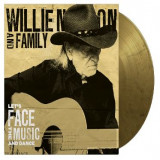
- A1: Let’s Face The Music And Dance
- A2: Is The Better Part Over
- A3: You’ll Never Know
- A4: Vous Et Moi
- A5: Walking My Baby Back Home
- A6: Matchbox
- A7: Twilight Time
- B1: I Can’t Give You Anything But Love
- B2: I’ll Keep On Loving You
- B3: I Wish I Didn’t Love You So
- B4: South Of The Border
- B5: Nuages
- B6: Maria (The Dawn Is Breaking)
- B7: Shame On You
Let’s Face the Music and Dance is the 61st studio album by American country legend Willie Nelson and his band The Family. Produced by Buddy Cannon, this album features a collection of standards that Nelson and his sister Bobbie Nelson played throughout their careers. He recorded the album at his Pedernales studio in Austin, Texas.
Critics gave the album favourable reviews, citing how incredible it is that even at then nearly 80 years old, Nelson’s voice and guitar playing still sound fresh and timeless. The album charted in both the Billboard Top Country Albums as well as the regular Billboard 200 chart.