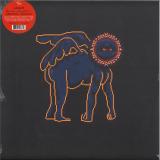
Australian composer-performers Judith Hamann and James Rushford have worked together in countless projects for two decades, perhaps most notably in Golden Fur, their trio with Sam Dunscombe. Black Truffle is pleased to announce Midmeste, their first work as a duo. Its title is Middle English for ‘the middlemost point’, alluding to how the piece builds on the points of overlap between the highly personalised musical languages Hamann and Rushford have developed in recent years. Performed on cello and a variety of pipe organs, Midmeste is a spacious, sometimes unsettling exploration of their shared interest in alternative tunings, psychoacoustic phenomena, the physical properties of their instruments, and the usually peripheral sounds generated by the performing body.
Beginning with a sequence of austerely vibrato-less harmonics from Hamann's cello, trailed by Rushford's whistling portative organ tones, the music soon expands into a slow-moving melodic wander, pausing at times to linger over an uncomfortable harmony or particularly resonant cello tone. Hamann and Rushford have long histories of engagement with pre-Classical European musical traditions, having in past projects performed and radically extended the work of Solage, Louis Couperin, Johann Conrad Beissell and other composers. Here they use a 15th century song by John Dunstaple, ‘O rosa bella’, which returns throughout the piece, distorted, aerated and splayed into new forms.
Developed while the two shared residencies at Akademie Schloss Solitude, Stuttgart in 2020 and La Becque on Lake Geneva in 2023, Midmeste integrates recordings made (at at the invitation of the Biennale Son) on the organ of the Basilica St Valere in Sion, Switzerland—the world’s oldest playable organ, built in the early 15th century. Played by both Rushford and Hamann, the instrument’s idiosyncratic features, including bellows pumped manually using massive wooden beams, are integrated into the music through amplification. Creaks and thumps locate the music physically both in the performers’ bodies and the specific site of its making. Moving through a series of distinct episodes across its forty-minute span, Midmeste makes space for near-silent duets of high harmonics and hissing air, moments where twittering high tones and rumbling sub-bass could be electronic, and static fields that unexpectedly blossom into almost Romantic harmonies.
Listeners familiar with Hamann and Rushford’s work will find many familiar features here: the stunningly rich cello tones, their patient sustain allowing heightened awareness of the inner life of sound and its interactions with the environment; the care with which acoustic space is activated, becoming at times a third instrumental voice; the attention to fragile, unstable sonorities that sometimes have a comic edge. A major work from two key figures in contemporary experimental music, Midmeste synthesises rigorous exploration of fundamental questions of sound and performance with an unapologetic embrace of beauty.
quête:hama
- A1: Mickey's Samba
- A2: Funky Wave
- A3: Moon Stone
- A4: Space Coaster
- B1: Let's Get Together
- B2: Vibration #1
- B3: Keep On Loving
At the time, Mikio Masuda was frequently mentioned as a Japanese jazz musician on par with the soft-and-mellow crossover sound of artists like Bob James and Ramsey Lewis. With a supple sensibility that moves effortlessly between jazz and rock, he stands as one of the defining figures of the 1970s. Now, one of his essential masterpieces, "Moon Stone", has been confirmed for reissue as the fifth installment from SPIN THIS NOW!
Electric Piano, Organ, Clavinet, Synthesizer - Mikio Masuda
Drums - Hideo Yamaki
Electric Bass - Motohiko Hamase
Electric Guitar - Kazumi Watanabe
Electric Guitar, Vocals - Kazumasa Akiyama
Persistence of Sound releases a new work by Brunhild Ferrari called »L’oreille Voleuse« (The Thieving Ear). The LP features an extraordinary live reinterpretation by Eiko Ishibashi and Jim O’Rourke, recorded in October 2025 in Paris.
»No, without listening at doors, the ear captures noises here and there and unexpected sounds without choice, but remains attentive to the messages of each one picked up over the years. It gathers surprises and impressions, bringing them together in a simple mix. In waking up these ear memories again, which were mostly recorded on magnetic tapes, I am very happy about the collaboration of Eiko Ishibashi and Jim O'Rourke in playing on this mix tape.« Brunhild Ferrari
Eiko Ishibashi is a Japanese composer, singer, and multi-instrumentalist who has developed a unique body of work blending experimental pop, improvisation, and film music. Her work, praised for its expressive intensity and sensitivity to sonic textures, has led her to collaborate with numerous musicians on the international scene, including Jim O'Rourke, with whom she forms a long-standing duo. She is also the composer of several film scores, notably for the films of Ryusuke Hamaguchi (Drive My Car, Evil Does Not Exist), which have helped to bring her work to a wider audience beyond experimental music circles.
Jim O'Rourke is an American composer, producer, and multi-instrumentalist, and has been a major figure in experimental and independent music since the 1990s. His work spans rock, improvised music, electronic music, and contemporary music. A former member of Sonic Youth and a collaborator with Wilco, Gastr del Sol, and Merce Cunningham, he has released numerous solo albums and film scores. Based in Japan since the early 2000s, he continues to pursue a rich and multifaceted musical practice, where formal rigor and freedom of invention coexist.
Persistence of Sound was founded in 2019 by Iain Chambers (Langham Research Centre, Rubbish Music). The label explores the world of electroacoustic music, contemporary global field recordings, and the unclassifiable music spanning these genres.
- A1: Never Change Your Mind - Harada Yoshio
- A2: American Night - Asakawa Maki
- A3: Goodbye Transfer - Rajie
- A4: Dream Is Alive - Hamada Kingo
- B1: Uwaki Na Kare - Kazami Ritsuko
- B2: Soradaki - Kado Asami
- B3: Heart And Soul - Ito Ginji
- B4: Loves Super Magic - Inagaki Junichi
- C1: Eternal 1/2 - Ishikawa Seri
- C2: Yokaze No Information - Hamada Kingo
- C3: Cold Field - Ueda Masaki
- D1: Scrambled Eggs - Noguchi Goro
- D2: Gardenia - Kato Kazuhiko
- D3: Natsu/Kimi Ni - My Love Bluew
- D4: Good Morning Kiss - Kazuto Murata
EU/UK Exclusive
Japanese pressing
From Universal Music's vast catalogue, the essence of Japanese AOR, all tracks are selected and played in Muro's mix cd 'Diggin' Japanese AOR' released in 2017 and now released on 2LP.
This includes some of hidden gems such as Maki Asakawa's 'American Night', Yoshio Harada and more from the late 80's to early 90's - the golden time of Japanese AOR.
Black Vinyl[38,03 €]
Die hochgeschätzten Euro-Metal-Pioniere Oz wurden ursprünglich 1977 in der kleinen finnischen Stadt Nakilla gegründet. Die Band bestand aus Mark Ruffneck (bürgerlicher Name Pekka Mark) am Schlagzeug, Sänger Ape De Martini (Eero Hämäläinen), Bassist Tauno Vajavaara sowie Kario Elo an der Gitarre.
Fünf Jahre nach ihrer Gründung legten Oz ihr Debütalbum vor. Mit Krachern wie “Saturday Night”, “Capricorn Man” oder dem schlüpfrigen “Second-Hand Lady” avancierten Oz schnell zur HM-Band Nummer eins in Skandinavien.
In der Folge zog man nach Stockholm um, wo 1983 der gefeierte Zweitling »Fire In The Brain« entstand. Die Platte enthielt höchst energetische Heavy-Metal-Hymnen wie “Fortune”, “Megalomaniac” oder “Gambler”. Der kanadische Journalist Martin Popoff verteilte in seinem »Collector’s Guide To Heavy Metal« 9 von 10 Punkten und schrieb: »Fire In The Brain« ist eine düstere, fast depressiv wirkende Platte, die den Hörer wie ein Güterzug trifft. Es ist ein sehr europäisch klingendes Werk – vom apokalyptisch anmutenden ‘Searchlights’ über das zähflüssige ‘Black Candles’ bis hin zum gewaltigen Titelsong werden absolut keine Gefangenen genommen.“
High Roller Records, silver vinyl, ltd 450, 425gsm heavy cardboard cover with 5mm spine, lyric sheet, 12 page booklet, poster
- A1: Seki Taneko - Akemi&Apos;S Poems
- A2: Kusunoki Shigeo - Longing For The Shadow
- A3: Yayoi Tanaka - Sad Gull
- A4: Akasaka Koume - Please Forgive Me
- A5: Ichimaru - If You Go Down The Tenryū
- A6: Mitsuko Nemoto - Cosmos Elegy
- A7: Ichirō Fujiyama - Tokyo Daughter
- A8: Chiyako Sato - Skyscraper
- A9: Yayoi Tanaka - The Dream Is Short Lived
- B1: Ichirō Fujiyama &Amp; Masao Koga - Is Sake Tears Or Sighs?
- B2: Otomaru - Yoneyama Sanri
- B3: Hamako Watanabe - I Don&Apos;T Forget
- B4: Akasaka Koume - Asama Smoke
- B5: Yoshio Tabata - Farewell Ship
- B6: Ichirō Fujiyama - Farewell Youth
- B7: Kouta Katsutaro - Stand Up Tomorrow
DEATH043[10,04 €]
Emerging during the early stages of the recording industry in Japan, the ryūkōka style adopted western classical, blues & jazz elements into traditional and classical Japanese music.
This collection of 1920s & 30s ryūkōka recordings follows on from the Kouta Katsutaro tape we put out a couple of years back, and further captures the hauntingly unique sound of a cultural merging that was starting to reflect itself via popular song, ahead of the widespread influence of western pop music during post-war US occupation.
"Death Is Not The End are on a mission to expand the musical archive, with compilations of everything from Jamaican doo wop to pirate radio idents and adverts weaving new threads into the history of music. Longing For The Shadow: Ryūkōka Recordings, 1921-1939 goes back to the beginnings of the recording industry in Japan, and a style merging traditional Japanese forms with western pop and classical. Swooning orchestrations and prominent vocals capture some of the melodrama and bombast found in US and European music of the time, but beds of plucked and strummed instruments give an ordered elegance, tying it firmly to Hogaku tradition. Not much has been written about Ryūkōka, and a 2017 book by Hiromu Nagahara gives some clue as to why, arguing that although popular with the public, it was dismissed by critics both for its adoption of western sounds and its dwelling on Japanese traditional styles. Close to a century later, those are some of the qualities that make this compilation so fascinating." - The Quietus
Das Avant-Rock-Sextett aus Beirut verschmilzt auf diesem großartigen Nachfolger seines gefeierten 2023er Debüts "Mais Um" Psych/Kraut, Improv/Skronk, Elektronik, Gothic und Jazzelemente mit traditionellem ägyptischem Gesang und moderner arabischer Poesie. Produziert von Radwan Moumneh (Matana Roberts, Sarah Davachi, Jerusalem In My Heart). Der Titel des zweiten SANAM-Albums ist ebenso vielversprechend wie die Musik der libanesischen Band. "Sametou Sawtan" bedeutet aus dem Arabischen übersetzt "Ich habe eine Stimme gehört". Spukhaft oder spirituell, wie auch immer man die Phrase liest, sie spricht von der Fähigkeit von Klang und Sprache, innezuhalten, Aufmerksamkeit zu stehlen und uns für den Moment zu öffnen. In ähnlicher Weise vermischt die Musik von SANAM zarte Rasereien und feuerverbrannte Balladen, indem sie frei fließende Rock- und Jazzgerüste mit der tief verwurzelten arabischen Tradition verbindet. Sie in vollem Flug zu hören bedeutet, in der Gegenwart gehalten zu werden und sich neu zu orientieren, um einen offenen Horizont zu eröffnen. Die Arbeit an "Sametou Sawtan" begann im Frühjahr 2024. Die ersten Ideen, die in den Tunefork Studios in Beirut entstanden, wurden im April während eines Aufenthalts in Beit Faris, einem mittelalterlichen Haus in der Küstenstadt Byblos, weiter ausgearbeitet. Das Sextett: Sandy Chamoun (Gesang), Antonio Hajj (Bass), Farah Kaddour (Buzuq), Anthony Sahyoun (Gitarre, Synthesizer), Pascal Semerdjian (Schlagzeug) und Marwan Tohme (Gitarren), wurde vom Produzenten Radwan Ghazi Moumneh (Jerusalem In My Heart) unterstützt. Die letzten beiden Tracks des Albums sind Aufnahmen aus den Beit Faris-Sessions, während der Rest in den La Frette Studios in Paris während der Europareise der Band im Sommer 2024 aufgenommen wurde. Die Platte verarbeitet Gefühle der Distanz und der Entwurzelung. "In den letzten fünf Jahren hatte ich das Gefühl, dass jeder den Libanon verlässt", erklärt Chamoun. "Das Album handelt nicht wortwörtlich davon, sondern von der Vorstellung, dass dich etwas verlässt. Eine Distanz zu den Ereignissen, obwohl du in ihnen lebst, eine Distanz zu deinem Haus, obwohl du in ihm wohnst." Ob in der sehnsüchtigen Ballade "Goblin" oder dem langsam brennenden, autotune-überladenen Freakout von "Habibon", Sametou Sawtan fängt das Streben nach festem Boden in einer Welt ein, die diesen nur selten bieten kann . Das Album hat die hypnotisierende Intensität des SANAM-Live-Erlebnisses, während es der Musik Nuancen, Tiefe und eine enorme dynamische Bandbreite verleiht. Wie bei ihrem Debüt sind die Texte vieler Tracks entliehen, Worte, die in neue Kontexte gestellt werden, um die Gegenwart zu verarbeiten. "Hamam" interpretiert ein ägyptisches Volkslied neu. In "Hadikat Al Ams" treibt der krachende Hardrock-Stampfer den Text des zeitgenössischen libanesischen Schriftstellers Paul Shaoul an. Und sowohl "Sayl Damei" als auch der Titeltrack verwenden Gedichte des iranischen Dichters und bahnbrechenden Mathematikers Omar Khayyam aus dem zwölften Jahrhundert. "Wenn man etwas von Omar liest, fühlt man eine Verbindung zur Gegenwart", sagt Chamoun. "Das Gefühl, dass es keinen klaren Weg gibt." "Sametou Sawtan" enthält auch zwei Lieder mit Chamouns eigenen Texten, darunter den Opener "Harik". Es war die Keimzelle des Albums, geschrieben von Chamoun im Februar 2024, wobei die Band den Track um ihre Worte herum aufbaute. Es beginnt mit einem Schauder, zerfetzter Elektronik und einer keuchenden Stimme, die das Schlagzeug durchdringt, bevor sich die Band zu einem triumphalen Aufstieg aufschwingt. Es geht um Eintauchen in "ein unendliches Feuer", verrät Chamoun. Den Text zu "Tatayoum" schrieb sie allein, bevor sie ihn der Band vorlegte. Er spiegelt eine andere Art von Intensität wider, "eine Schleife, eine Besessenheit", wie sie sagt. Buzuq webt durch schwebende Elektronik und drängende Trommeln, während Chamoun arabische Worte rezitiert, die die Liebe beschreiben. Die unaufhörlichen Energien, die in diesen Tracks erforscht werden, sind nicht unbedingt negativ. Sie vergleicht deren Intensität mit der eines Schriftstellers, der in einem Gedankengang gefangen ist, im Guten wie im Schlechten. "Es geht nicht darum, deprimiert oder traurig zu sein", sagt Chamoun. "Es ist eine Falle, aber sie kann auch magisch sein." "Sametou Sawtan" wurde von Farah Fayyad mit ikonischen Grafiken und Design versehen.
After two albums inspired by vast northern landscapes, the forces of nature, and an ever-present sense of duality, Glass Museum shifts gears. The Brussels-based group-originally formed in 2016 by pianist Antoine Flipo and drummer Martin Grégoire-welcomes bassist Issam Labbene as an official third member, opening up a richer, more immersive sound and setting its sights on the rhythms of the modern city.
A true turning point in Glass Museum's career, the new album 4N4LOG CITY twists the codes of electronic music, explores the depths of jazz, and asserts its eclecticism through a fresh and infectious groove.
Signed to the forward-thinking Belgian label Sdban Records, the group shapes its identity within the vaulted ceilings of Volta, a creative hub in Brussels frequented by the vanguard of Belgium's "new scene." Sharing space with acts like ECHT!, Lander & Adriaan, and Tukan, the band continues to push its boundaries through collaboration and reinvention.
Recorded between the French countryside of Drôme, the industrial edges of Brussels, and Volta, 4N4LOG CITY features striking guest appearances. Swiss drummer Arthur Hnatek-known for his work with Tigran Hamasyan and Erik Truffaz, and praised by Gilles Peterson and Laurent Garnier-drives the opener "GATE 1" into hypnotic, krautrock-inspired territory. Meanwhile, rising vocalist JDS lends soulful grace to "Call Me Names", evoking the emotive textures and elegance of vintage soul-jazz reminiscent of the likes of Jordan Rakei or Tom Misch & Yussef Dayes.
Without abandoning their melodic roots and foundational approach, the trio takes daring steps into new terrain. The experimental centerpiece "III" explores the piano as a textural and rhythmic force, drifting between ambient and breakbeat. Elsewhere, the gritty "VAN GLAS"-a hip-hop-tinged track featuring rapper JAZZ BRAK of STIKSTOF-the band ventures far beyond their comfort zone, injecting streetwise lyricism in their mix of electronics and jazz.
Fueled by the heartbeat of the city, 4N4LOG CITY captures the mechanical ebb and flow beneath concrete towers-the anonymous rhythms of daily life moving over the asphalt, and the fleeting, meaningful connections made along the way. Produced by Antoine Flipo and mixed by Elsa Grelot (Avalanche Kaito), the album stands at the intersection of human emotion and urban architecture-a post-modern, deeply cinematic work that asserts Glass Museum's place at the cutting edge of European music.
Repress
Now we look to the horizon of the unknown, We have no need of other worlds. We need mirrors. We don't know what to do with other worlds. A single world, our own, suffices us; we can't accept it for what it is, But the Journey has already began - Fantastic planet 004 Will be out soon with dearest friends @byronyeates @hamatsuki @reshio.dj Huge thanks @ggrdzelishvili for Art direction and @alden.tyrell 4 Dope mastering
Limited 2024 Black Vinyl Repress
Osaka based psych-rock three piece Hibushibire return after a long break, with a new line up and a stunning third album. Produced by Acid Mothers Temple/Mainliner guru Makoto Kawabata who also guests on the album.
Following the successes of their debut album 'Freak Out Orgasm!' (2017), the follow up ‘Turn On, Tune In, Freak Out’ (2019) and two very well received UK tours. The band headed home to Osaka, Japan and then, the pandemic hit.
During this downtime, guitarist/vocalist Changchang decided to create a new power trio. Enter Tetsuji Toyoda (Bass/Vocals) & Aoi Hama (Drums/Vocals). The new trio have spent the last three years writing new music, playing live and honing their sound in Japan, and a short well received tour of Taiwan with Riot Season labelmates Dope Purple. And now finally, Hibushibire mark 2 is born properly.
“Hibushibire has returned after a change of members. A psychedelic, progressive work, suitable for a new beginning"
Entering the studio with Acid Mothers Temple/Mainliner guru Makoto Kawabata in the producer chair (and also as a guest musician) once again, the band recorded album number three, 'Magical Metamorphosis Third Eye’. Makoto also adds some of his own trademark guitar howls throughout the album, perfectly complimenting Changchang’s own growing prowess.
Here the band have taken their trademark psych-rock blasts and blended them perfectly with some more trippy, dare I say sweet progressive psychedelic sounds.
“The idea of this album is based on the theme of "occultism and mysticism". But it's not a serious thing, it's about the things we like (UFOs, pyramids, psychic phenomena, shamanism etc) and we all had fun while making it. In terms of what makes it different from the previous Hibushibire albums, it’s where AOI HAMA's vocals are present. I had wanted to use a female vocalist for a long time, so it was a good feeling!”
Like the band's first two albums, 'Magical Metamorphosis Third Eye’ is very much an album of two halves. Side one again is full of killer shorter tracks, while side two is reserved for a blinding majestic 20 minute epic ‘Ayahuasca Witch Abduction’. Perhaps the biggest musical surprise here though is probably track two, the beautifully mellow tripped out ‘We Won't Go Back To The Past’, which sounds like it’s been beamed straight out of the late 60s/early 70s.
The band also tip a nod to the Beatles psychedelic classic ‘Tomorrow Never Ever Knows’, but with their own twist of course.
It’s clear with the line up changes, Changchang has decided to expand the band's musical pathway, and he’s achieved stunning results.
The band plan to return to the UK and Europe in 2024 to see friends old and new.
There are two versions of the vinyl - classic black and triple-color limited Indie Shop edition.
Both have special insert inside with the bands bio and photos.
Generacja JAZZ is a project showing a fragment of the new wave of Polish jazz, treading its own path, creating, touring and jamming across Europe. Borders don't exist - especially musical - the new generation is engaging with nightclubs, festivals and playlists. The time has now come to show its broader perspective. We created a project which involves a handful of groups that have already racked up debut albums and festival wins, as they set out on their musical odyssey. The groups also have other things in common, like their passion, originality and, for the needs of the project, age - all the artists during the recording of this album were under 30 years old. This is the new generation - the Jazz Generation.
For the Jazz Generation record we invited five bands who had already released debut albums: Immortal Onion, Klawo, Rejoin, Twoosty Mayonez and USO 9001. We also reserved two spots on the compilation for the winners of our open call competition, whereby on the basis of the jury's choice (jury: Monika Borzym, Paulina Przybysz, Envee, Wojtek Mazolewski i Marcin Groh Grośkiewicz) we met the winning bands: Kosmos and quietet.
The sleeve artist is Kornelia Nowak, who won our open call for young designers and graphic artists. Here once again we could rely on the opinion of a prestigious jury comprised of: Beata Śliwińska Barrakuz, Bovska, Maciej Animisiewasz Grochot, Grzegorz Forin Piwnicki i Marcin Groh Grośkiewicz.
Generacja JAZZ LP is also a start of the new imprint - U JAZZ ME, which will be focused on jazz from Poland.
And here are the bands from the album:
1. Immortal Onion - A band from the Tri-City playing a broad spectrum of instrumental music.
Band members: Wojtek Warmijak (percussion), Tomir Śpiołek (piano, synths), Ziemowit Klimek (Upright Bass, synths).
The band Immortal Onion has already established itself as one of the most interesting projects of the new wave of Polish jazz, and is consistently being labelled as such abroad. After two well received albums ("Ocelot of Salvation" (2017) and"XD Experience Design" (2020) U Know Me Records) they released their third album "Screens" in 2022, which was recorded with the well known Tri-City composer and saxophonist - Michał Jan Ciesielski.
The inspiration behind the band's formation were such artists as: Esbjörn Svensson, Hiromi Uehara, Tigran Hamasyan and Tosin Abasi.
The group's guiding principle from the very beginning was the fusion of often disparate musical styles, which bore "post instrumental aggressive gay pop". Despite the stylistic discrepancies, between which they swim, the group has forged its own identifiable language, characterised by complicated rhythmical structures, energetic riffs and trance beats with lyrical melodies.
The trio has performed its original material at many venues and festivals around Europe and Asia.
2. Klawo - seven adventurous adventurers from Gdańsk, who were brought together by their love for music, halvah and throwing Frisbee. Their self-named début album, released in 2022 on the local label Coastline Northern Cuts, is an amalgam of the inspirations of each of the team members and played backwards contains tips on how to reach the Kashubian pyramids. After a win at the international competition Jazz in the Park, held in Cluj-Napoca in Romania, the band began work on their second album. Meanwhile, they were also travelling the length and breadth of Poland on a mission to infect people with the idea of Baltic Funk.
3. Kosmos is a Łódż based jazz quintet. It was formed in 2020 by Pianist Stanisław Szmigero, Saxophonist Iwo Tylman and Trumpeter Jan Ostalski. However, it wasn't until 2022 that Kosmos found its true form when Kamil Gużniczak (Upright bass) and Kacper Kuta (Percussion) joined the line-up.
Their compositions are influenced by Polish yass bands, electronic music and hip-hop. Kosmos music is a mix of lyricism, space, intensity and elements of experiment.
The band members are all eccentric characters possessing different means of musical expression - looking at them, one could even argue they are a group of oddballs. Despite this, for reasons unbeknownst to themselves, the members of Kosmos complement each other on stage and form a unified artistic vision of the world around them.
Kosmos officially released their début single "Ja" in June 2023. They regularly play concerts across Poland and recently were selected as distinguished artists at JAZZiNSPIRACJE (JAZZiNSPIRATION) - a competition held during the 13th Lublin Jazz Festival.
4. Quietet (formed at the beginning of 2023) is the result of meetings between five talented musicians with a deep passion for musical creation. Its sound is a unique blend of Jazz and classical music with a hint of hard rock. The band is inspired by the Scandinavian approach to making music, which brings a characteristic atmosphere and melodies to their work. Their music captivates listeners with its originality, refined improvisations and flawless technique. Both classical and modern musical trends feed their inspiration when creating passionate and emotional compositions.
Their works are full of sound experimentation, which equally surprise and expose new musical horizons. Through their compositions, "Quietet" aims to share their emotions evoked during performances, creating a musical journey that affects and inspires.
5. Connecting jazz with electronic music in fresh interpretations, six young musicians make up the group Rejoin. The group re-formed in 2020 after a four-year break, playing their debut concert at Lotos Jazz Festival Bielska Zadymka Jazzowa. The musicians in Rejoin have performed alongside such artists as: Urszula Dudziak, Krystyna Prońko, Marcin Masecki, Szczyl, Kuba Więcek and Paulina Przybysz.
Most of the members of Rejoin are students from the Katowice Music Academy, where they also develop their own projects. Rejoin was a recipient of the Fabryki Norblin Music Masterclass Foundation scholarship.
6. Twoosty Mayonez is something your grandad would listen to with his younger sister. The non-standard approach to jazz alongside a pursuit of strange sounds, culminated in the conceptual album entitled "Carmin". The material was created by Bartosz Wolerta (percussion) and Dominik Kaniewski (bass guitar/synths). "Triceradiplodocus" tells the story of a mechanical dinosaur that lives on the yet undiscovered planet Carmin.
Recut & Repressed!
Tbilisi based party series Pluto’s Plan launches a new label sharing the same name. To start the things off 3 local producers collabed to merge their sounds in 1 decent wax. A stellar VA compiled EP “Starship of Charon” consists of 2 pure house, acid pumper and slow breaks. A1 and B1 house joints were delivered by the label's own Hatsvali. A2 is claimed by a very good friend of a label Toke, family member of D.ko he delivers a masterpiece with pleasing acid chops fitting any party at any given time. B2 is an unheard side of Horoom resident Hamatsuki, a smooth slow burner for early heat.
Catch the Signals from Fantastic planet, made for Heterotopian Bodies.
Fantasic planet 002 EP from well known Bassiani resident Hamatsuki incl Eversines remix
the debut release of french artist “too smooth christ” on mule musiq. his release on eudemonia was our top fav 12inch last year. it’s a great mixture of chicago house,african,ambient and fusion. this new release have also variety of all kind of dance music. balearic fusion deep house, psychedelic lo-fi techno,detroitish electro break beats, italo disco deep house…. all of them are first class.
- A1: Prologue
- A2: A Song For ××
- A3: Hana
- A4: Friend
- A5: Friend Ii
- B1: Poker Face
- B2: Wishing
- B3: You
- B4: As If…
- C1: Powder Snow
- C2: Trust
- C3: Depend On You
- C4: Siignal
- D1: From Your Letter
- D2: For My Dear
- D3: Present
- A1: Starting Over
- A2: Duty
- A3: Vogue
- B1: End Of The World
- B2: Scar
- B3: Far Away
- C1: Surreal
- C2: Audience
- C3: Seasons
- D1: Ttddy Bear
- D2: Key ~Eternal Tie Ver
- D3: Girlish
- 1: Letters
- 2: Four Leaf Clover
- 3: Thorns
- 4: Daisy Trains
- 5: Knees Deep
- 6: Oh, The Irony
- 7: Parachute
- 8: The Sign
- 9: Ride Or Die
- 10: Cocoon
- 11: Another Life
Paper Crown release their third album Letters - an ambitious and playful record that marks a clear new chapter for the duo, brimming with confidence, nostalgia and new horizons. Letters is the result of a long and meticulous creative process, with guitarist, producer and songwriter Ornulv Snortheim and vocalist and lyricist Johanne Kippersund (MEER) working closely, patiently and with great attention to detail. The album was recorded and produced at Snortheim's own Dakkota Studio in Hamar, Norway. Drummer Borre Flyen contributes throughout the record, and violinist Aud Ingebjorg Barstad adds beautiful string textures on selected tracks. Musically, Letters draws inspiration from the organic warmth of 1970s recordings - featuring spacious arrangements and live, breathing instrumentation - while also clearly nodding to alternative 1990s pop- rock, with strong melodies, distinctive guitar lines, raw energy and a spirit of exploration. The result is a sound that feels both nostalgic and contemporary, making Letters the duo's most complete release to date.
Brendan Eder follows up minimalist 70s-jazz concept with new ambient-classical album, THERAPY. Brendan Eder is a Los Angeles composer and drummer best-known for his eponymous genre-bending ensemble of woodwinds, drumset, and bass; as well as his film scoring work, most notably on four short films for director Ari Aster. On March 3, 2023 Eder released his third album, THERAPY, a collection of meditative woodwind arrangements recorded primarily at Church of the Good Shepherd in Arcadia, California.
The quest for THERAPY came during a period of deep spiritual curiosity. Eder was avidly watching testimonies of near death experience survivors (NDEs), pouring over books of Theosophical artwork and philosophy, and
processing experiences of grief, uncertainty and spirituality.
Eder wanted to explore the threshold between the spiritual and physical dimensions, and create music that could evoke its shape and texture — a theme further illustrated in the original album artwork and single covers by Adam Rabinowitz. Eder felt he must be on to something when, on a whim, he looked up the tempo of a piece he was calling “137 Riddle.” Turned out to be “the most important number in the world” in theoretical physics, as well as a provocative number in Jewish mysticism.
Since 2020, Eder's cover of Aphex Twin's “#20 (Lichen)” has garnered over two million streams. Appropriately, THERAPY delivers two new Aphex Twin arrangements alongside eight original pieces.
Maintaining his track record of recording the best musicians Eder can find, THERAPY features special guests Nailah Hunter (harp), Henry Solomon (saxophone), and Ethan Haman on The Newberry Memorial Organ at Yale University.
- A1: Glimmerine
- A2: A Slow Collision
- A3: Gravity Test
- B1: Tilth (Apparat X Káryyn)
- B2: Hum Of Maybe
- B3: A Echo Skips A Name
- C1: Enough For Me
- C2: Lunes
- D1: Williamsburg
- D2: Pieces, Falling (Apparat X Bi Disc)
- D3: Recalibration
Ltd. Green Vinyl[28,53 €]
Six years after his Grammy-nominated LP5, Sascha Ring - aka Apparat - takes a bold dive into the complexities of life with his sixth studio album.
A Hum Of Maybe is detailed, finely crafted, and wonderfully unpredictable. At its core, the record is about love - for himself, his wife, and his daughter - and holding onto it, protecting it, and constantly recalibrating as it is in a constant state of flux. As the title suggests, the songs explore being stuck in between: not a clear yes or no, but A Hum Of Maybe.
Ring elegantly combines the perspectives of an electronic producer and a classical composer, working closely with long-time collaborators Philipp Johann Thimm (cello, piano, guitar) - who also co-wrote and co-produced the record - Christoph “Mäckie” Hamann (violin, keyboard, bass), Jörg Wähner (drums), and Christian Kohlhaas (trombone). The album also features Armenian-American artist KÁRYYN - Apparat’s Mute labelmate - on ‘Tilth’, and Berlin-and Rome-based musician Jan-Philipp Lorenz (aka Bi Disc) on ‘Pieces, Falling’.
A Hum Of Maybe is complex, deeply personal, and embraces a state of limbo, marking an exciting new chapter for Apparat.
- A1: Prologue
- A2: Shion -Kako No Kioku
- A3: Battle & Sentô Suru Kos-Mos & Sentô Shûry?
- A4: Fuan
- B1: Life Or Death
- B2: Gnosis
- B3: Kanashimi
- B4: Kokoro O Tozashita Shôjo
- C1: Kookai Foundation
- C2: Nephilim
- C3: Nukumori
- C4: World To Be Born
- C5: Albedo
- D1: Kyomu No Hamabe
- D2: Last Battle
- D3: Pain
- D4: Kokoro
Released in February 2002 on PlayStation 2, Xenosaga Episode I marked the beginning of an unforgettable video game saga created by Tetsuya Takahashi, accompanied by a majestic soundtrack composed by Yasunori Mitsuda.
The latter is still considered an essential milestone in video game music. We wanted to pay tribute to these cult classics with Across the Kosmos ~ Xenosaga Piano Collection and Jazz in Kosmos, two albums of officially licensed arrangements featuring the best tracks from the game.
This album was created in collaboration with some of the most talented figures in Japanese video game music. It includes 17 piano tracks arranged by Mariam Abounnasr, Akio Noguchi, Hiroyuki Nakayama, and Benyamin Nuss, carefully recorded on a Steinway D Grand Piano.