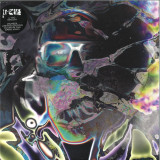
Mike Paradinas, veteran producer and Planet Mu label owner has written a new album called 'Grush' and it's full of weird bangers that reclaim the 'dance' part of the woeful term IDM. A back-to-first-principles record, inspired in part by the group of artists IDM was coined for; melodic dance music that didn't come out of urban scenes, but interpreted them from a distance. The tracks on 'Grush' are all road-tested live favorites developed with feedback from Mike's touring partner and visuals guy Mora (Jan Moravec). It's a detailed and energetic journey which replicates the flow of a live gig. A lot of the tracks have been made in hotel rooms in response to shows, 'Imperial Crescent' is named after a Japanese Hotel, as is 'Belvedere' in Prague, while some tracks such as 'Hyper Daddy' were created specifically to play live. Drums are confidently at the fore here and the album feels like it traces Mike's musical history and interests neatly around his sweetly nostalgic melodies, with atmospheres and structures which twist and turn with a charming softness which contrasts with the tension in the drums. Take 'Hyper Daddy's' spiralling notes and twinkling piano which remind one of early Black Dog or Omni Trio rushing alongside splashy jungle drums, or the aquatic acid footwork of the title track with its drums softly bubbling and kicking. Elsewhere there's territory which harks back to his Tusken Raiders pseudonym, like the heads down Drexciyan funk of 'Windsor Safari Park,' which transforms from moody electro into a sunny hardcore track midway. The album is interspersed with Reticulum A, B and C at the start middle and end of the album which suggest a theme which carries across the music in an effortless and joyful way. 'Grush' is a strong album that works both for listening and DJing and a great snapshot of where Mike Paradinas musical head is at in 2024.Tracklist Vinyl A: 1/Reticulum A 2/Hyper Daddy 3/Fogou B: 1/Magic Pony Ride (Pt.4) 2/Imperial Crescent 3/Reticulum B 4/Grush C: 1/Belvedere 2/Raver 3/Windsor Safari Park 4/Hastings D: 1/Manscape 2/Metaphonk 3/Reticulum C
quête:harks
Vol. 17 - Special Remix EP[14,24 €]
Vol. 18[12,56 €]
Vol. 20[13,40 €]
Vol. 21[12,19 €]
Vol. 22[14,50 €]
Vintage house and disco don Dave Lee knows a thing or two about serving up irresistible and timeless cuts and that's what he does here with the 24th instalment of the long-running Attack The Dancefloor series on his own Z Records. The man himself kicks off with Maurissa Rose on the loosely chugging, deep and soulful 'Open Me Up' (a first taste of the upcoming album together). He then slips into US garage style with his popular remix of The Trammps' 'I've Gotta Stand Up' that harks back to the glory days of 90s Soulful House. Felix Buxton's Celestial Being & Citizens Of The World Choir's 'Raise The Vibration' gets a gloriously sunny and positive Crackazat club mix before Lee closes the release with squelching synth in the form of his Boogified mix of Soul Dhamma's classic 'Flower.'
- A1: Free Form (Feat. Lojii, Ill Camille)
- A2: How I Live (Feat. Lil B, Vic Spencer)
- A3: For The Family (Feat. Awon)
- A4: Daybreaks (Interlude)
- A5: Running (Feat. Pink Siifu)
- A6: Out Of Time (Feat. Ill Camille)
- A7: Black Sabbath (Feat. Billy Woods, Tha God Fahim)
- A8: Change The World (Feat. Moruf)
- B1: Peace (Feat. Yungmorpheus)
- B2: For You (Feat. Moruf)
- B3: The Last Of Us (Feat. Quelle Chris)
- B4: Count Your Blessings (Feat. Lojii)
- B5: Pgo (Feat. Oliver The 2Nd)
- B6: Stories (Feat. J’von, Vuyo)
- B7: Recuperating (Feat. Gabe ‘Nandez, Fly Anakin)
- B8: Discipline 74 (Interlude)
- B9: Holler Back (Feat. Kooley High)
Album packaging features 24pt reverse board jackets and illustrated inner board sleeves, with silver printed center labels. All artwork created by acclaimed designer, Håvard Gjelseth. Ol’ Burger Beats’s new opus, 74: Out of Time, is a multifaceted and stunning exploration of sounds and eras. In addition to every track being produced at 74 beats per minute, the album harks back to the year 1974; particularly the music, the records, the activism, the artwork, and the aesthetics. But it’s also incredibly current, as the Out of Time portion of the title very much refers to the present. It promotes a sense of urgency in the face of current affairs such as the COVID-19 pandemic, climate change, as well as contentious politics sweeping across the US and Europe. Beyond those deeply resonating elements to the record, 74: Out of Time is a truly gorgeous representation of hip-hop through the lens of the Norwegian composer, which is undoubtedly his most ambitious undertaking to date. Using 74bpm as his basis, he constructs sublime, jazzy instrumentals that feature some of hip-hop’s finest emcees and vocalists. And to say they all gel perfectly together is an understatement—and it would be underselling OBB’s meticulous approach here. Each song blends seamlessly from one to the next spread across the album’s 17 tracks, with the help from a standout supporting cast that includes Fly Anakin, Awon, Quelle Chris, Pink Siifu, Yungmorpheus, Lojii, billy woods, Tha God Fahim, Vic Spencer and Vuyo, among several others. “An avid record collector, the producer's first release was 2014's High Rhodes which led to comparisons to his heroes such as J Dilla, Madlib and Pete Rock.” Okayafrica // “With music teachers for parents, it was perhaps inevitable that Ole-Birger Neergård would follow their path and become a student of the game.” Passion of the Weiss
A1 - Tensor
Opening with an earworm minimal old school melody which lives long in the mind, Tensor sees JLM Productions kick off his latest Spatial EP in style, flexing his versatility in the genre with an exquisite Hot Pants break pattern in delightfully laid back fashion. Showcasing sublime filtering techniques, a lush 808 bassline and a nominal usage of kicks, Tensor lives long in the memory - and rightfully so.
A2 - Pseudovector
A real treat in store for fans of clean, edited breaks as JLM Productions immediately drops the crispest assortment of drum samples which will delight the ear and the feet in equal measure. Pseudovector is a real treat for the senses with an immense high note melody punctuating the track as the breaks build and build, adding layers of punchy detail which combine beautifully with cymbals, bongos and gentle atmospherics.
AA1 - Helios Drift
A more laid back piece that harks back to a special bygone age of slower atmospherics - as is Spatial's speciality - Helios Drift offers a feast of breakbeats with distinctive tribal maracas jubilantly shaping a unique vibe. Soothing padwork provides an elegant backdrop to the beats with rolled chords and sci fi melodies draped throughout, deconstructing towards a polished outro to this memorable mid-set breather.
AA2 - Wavefunction
Instant rolling 2-step vibes unfold as Wavefunction sees JLM Productions close the EP in style with a track which won't fail to move the discerning dancefloor. Immense 80's synthwave vibes tell a tale of cyber dystopia, highly evocative notes washing harmoniously with the breakbeats while a superb bassline solo in the breakdown invites contemplation from the audience before the beat rolls on to a reflective conclusion.
Words by Chris Hayes (Spatial / Red Mist)
The 6th Full Length studio album from South African Death Metal Bulldozers VULVODYNIA is upon us! As the first album featuring Lwandile Prusent on vocals (previously on guitar), 'ENTABENI' harks back to the band's earlier brutal roots, with lyrical concepts themed on African folklore, with a huge production from Christian Donaldson (Cryptopsy, Ingested, Despised Icon) and artwork by Shindy Reehal (Viscera, The Zenith Passage, Bound in Fear).
Hardway Bros teams up with Beth Cassidy on Rekids for a timeless ode to the legendary Murk Records The release includes a ‘coral way’ dub mix and a remix by Erol Alkan and Richard Norris’ Beyond The Wizards Sleeve.
Sean Johnston is the man behind Hardway Bros, an alias well known for wobbly, downtempo, and synth-laced disco jams which have appeared on the likes of Is it Balearic? Whiskey Pickle, and Throne of Blood over the last decade. On this single, which is a love letter to legendary early 90s label Murk Records, Johnston links with vocalist Beth Cassidy, known for her work as part of Manchester’s Sea Fever and Section 25.
Hardway Bros’ wonderful 'Murky' is deep and sensual house music. The vocal brings sultry charm, unfolding in soulful style over whimsical ambient pads and chunky drums. It oozes with character and harks back to actual songwriting of days gone by.
Beyond The Wizard's Sleeve is an alias of dance music pioneers Erol Alkan and Richard Norris. It was established to bring psyched-out, acid touches to the dance floor and has resulted in a critically acclaimed album on Alkan’s Phantasy Sound and much more. Their excellent Re-Animation is eight minutes of drawn-out disco chug, loose grooves and masterful chord work. Up last is a Coral Way dub that strips things back to the beats, layers in plenty of cosmic FX, and lets your imagination run wild on the tripped-out synth leads that pan between the stars.
Mike Paradinas, veteran producer and Planet Mu label owner has written a new album called ‘Grush' and it's full of weird bangers that reclaim the 'dance' part of the woeful term IDM. A back-to-first-principles record, inspired in part by the group of artists IDM was coined for; melodic dance music that didn't come out of urban scenes, but interpreted them from a distance. The tracks on ‘Grush’ are all road-tested live favorites developed with feedback from Mike's touring partner and visuals guy Mora (Jan Moravec). It's a detailed and energetic journey which replicates the flow of a live gig. A lot of the tracks have been made in hotel rooms in response to shows, ‘Imperial Crescent’ is named after a Japanese Hotel, as is ‘Belvedere’ in Prague, while some tracks such as ‘Hyper Daddy’ were created specifically to play live. Drums are confidently at the fore here and the album feels like it traces Mike's musical history and interests neatly around his sweetly nostalgic melodies, with atmospheres and structures which twist and turn with a charming softness which contrasts with the tension in the drums. Take ‘Hyper Daddy’s’ spiralling notes and twinkling piano which remind one of early Black Dog or Omni Trio rushing alongside splashy jungle drums, or the aquatic acid footwork of the title track with its drums softly bubbling and kicking. Elsewhere there's territory which harks back to his Tusken Raiders pseudonym, like the heads down Drexciyan funk of ‘Windsor Safari Park,’ which transforms from moody electro into a sunny hardcore track midway.
- A1: Wonka's Welcome Song
- A2: Augustus Gloop
- A3: Violet Beauregarde
- A4: Veruca Salt
- A5: Mike Teavee
- A6: Main Titles
- B1: Wonka's First Shop
- B2: The Indian Palace
- B3: Wheels In Motion
- B4: Charlie's Birthday Bar
- B5: The Golden Ticket / Factory
- C1: Chocolate Explorers
- C2: Loompa Land
- C3: The Boat Arrives
- C4: The River Cruise
- C5: First Candy
- C6: Up And Out
- C7: The River Cruise - Part 2
- D1: Charlie Declines
- D2: Finale
- D3: End Credit Suite
Tim Burton’s 2005 adaptation of Roald Dahl’s classic children’s book was conceived as long ago as 1991 and was in development for several years before Burton was involved in the production. He immediately brought regular collaborators Johnny Depp and Danny Elfman aboard.
Charlie and the Chocolate Factory represents the first time since The Nightmare Before Christmas that Elfman contributed to a film score using written songs and his vocals. The film was released to critical praise and was a box office success, grossing $475 million worldwide.
The wonderfully quirky melodic score and songs from one of Hollywood’s great composers harks back to Edward Scissorhands, Burtons’ and Elfman’s most personal work, and is a return to the composer’s “vintage” sound from the late 1980s and early 1990s.
First released on vinyl in 2015, this latest edition brings the popular soundtrack back to vinyl on Marshmallow Pink and Chocolate Brown Vinyl.
“It was more fun than I ever had working on a movie. It was so crazy and doing all the vocals was so much fun. I found myself falling into voices, singing vocal mannerisms. I was having such a gas.”
- Danny Elfman
Greenhouse Recordings label head and long-time master of deep house Andrew Macari steps up to his own imprint with a bunch of fine originals. The opener is a deep tech cut with steely drums that are tight and compelling and offset by smooth chords. Manuel Sahagun then steps up to remix and brings a touch of jazz to his chords which swirl around over heavyweight bass rumbles. 'U Got Me' is then a house sound that harks back to the DIY heyday of Nottingham with its bumping drums and lush chord work and 'When I Want' closes out with more fresh synths and an alluring female vocal.
With the new album Wiggle Your Fingers, GospelbeacH is back with their 70s Laurel Canyon sounds drifting down to Hollywood in the early 80s - this time the Lonesome LA Cowboy vibes reflect the neon lights of New Wave, Power-Pop, and Post-Punk. The Los Angeles group was formed in 2014 by Brent Rademaker, Tom Sanford and Neal Casal all from the Beachwood Sparks camp. Over the years has featured many harmonious friends, luminaries and guest stars over the years. The sound harks back to several eras of California sounds, folk-rock, sunshine pop country-rock and of course, the Paisley Underground.
Dwell Time II is the second part of a three-part project on Past Inside The Present from T.R. Jordan. Each of the albums was made using the same material in the same time frame, and they are all part of one overarching and coherent suite that he refers to as "musical composting." This is the cassette tape version and it is full of grainy, fluttering howls, soft warbling pads, pastoral references like flowing streams and mossy rocks and plenty of grand spatial elegance that harks back to the likes of Hiroshi Yoshimura and early Brian Eno experiments. Another immersive offering from this fine label, then.
Bosconi Records is thrilled to announce a distinctive vinyl release that harks back to berlin 2000’s good old days
The featured track of this release unveils Console’s , known and active as Acid Pauli, reinterpretation of a track that gained fabio’s attention during his stay in Berlin in 2000. Fabio Della Torre, the owner and A&R of Bosconi Records, stumbled upon this hidden gem during his year in Berlin as many djs in the city were spinning it. Finally his quest to uncover the origins of this track led him to a CD release on the label of Angelika Köhlermann. The track in question is Console’s reimagining of “Let’s Rock Baby” a composition by the independent musician and video artist Anne Laplantine, who adopted the Japanese-sounding alias Michiko Kusaki. This version was originally released alongside a series of remixes by artists such as Dmx krew, Felix Kubin, and Adult, all featured on Angelika Köhlermann’s label.
Today, Bosconi Records is thrilled to bring this iconic track to light again on vinyl, accompanied by fresh interpretations. It’s important to note that these reinterpretations breathe life into Console’s work, not Laplantine’s original track, making Console’s version the centerpiece of this release. We have a banger version from German electro luminary The Exaltics which his typilcal electro techno trademark sound. The Exaltics had just released his new album on Clone and has been featured by Helena hauff in her Fabric Mix compilation. Italian producers Voodoos & Taboos, known for their homonymous label and with an recent “banger” on Bordello a Parigi with an electro playful version. The vibrant Queen of Coins have breathed new life into Console’s track, delivering a fresh new-beat acid ebm burner, giving the track a new and personal perspective.
This project mirrors Bosconi Records’ commitment to exploring diverse dimensions of electronic music and featuring compelling compositions. The release looks to resonate with DJs and electronic music enthusiasts, offering a contemporary perspective on a timeless track.
V.I.V.E.K returns to SYSTEM MUSIC with a 3 track EP exploring new grooves within the 140 scope. Following on from his SHAPES EP he continues to try something different within the boundaries of tempo.
U Dub harks back to old school jungle territory, ambient synths with heavy distorted 808 bassline.
Voices explores an Amapiano style at 140 with heavy log drum bass and whispering synths .
While 108 works to bashment style bounce but is heavy on the bass .
The Drip EP brings together four distinctive producers and one set of sounds - The Drips. The result is a compilation of 4 tracks that bring the swing and sampling of some of Accidental Jnr's finest to produce a soaking wet dancefloor.
First up is label boss Matthew Herbert with a trademark groove that harks back to his Wishmountain moniker albeit found lurking in the swamp. Cosmo Sheldrake takes a slight departure from his usual multi-instrumentaling live-looping avant-folk to deliver a track that could only be described as travelling circus aqua-techno. Bahraini born, French / US bred and now Edinburgh dwelling video game builder, sound designer and sometime Scottish league football referee Yann Seznec opens the B-side with an absolute stormer of a rain drenched club hook. Sussex based producer Crewdson and builder of such electronic instruments as the Eggiophone and Concertronica closes proceedings with a drizzling evolving 2-step number.
Swim is super happy to welcome their first 12” record into the world, and Mark Lando is up for his second release! The first side is a body affair, with acid-tinged techno dominating both cuts. Formation is a fun, muscular take on the format, while Scope zones in on his industrial forays. The other side gives time to heady, joyous gear, sporting two tracks spreading far in style and tempo. The title track is nimble and fast on its feet, a rhythmic workout indebted to bass music as much as to new age experiments. Rounding things out, In This Light harks back to the heydays of atmospheric trance excursions, leaving in its wake a warm note of care.
Slacker 85 is the new label from the mind of one of the world’s biggest DJs & most recognised personalities, Seth Troxler. The first release, SLACKER001, brings together Seth and four more artists with their own takes on modern electronic music, to introduce fans to Slacker 85's remit for the oddball, esoteric & diverse sounds that are forthcoming from a wide range of artists and genres.
The label launches with the long awaited release of ‘Pills’, a a low slung acid groove that has been an in-demand staple of Seth's DJ sets around the world over the past year. It will be followed by the effervescent jacking house of ‘Let’s Go’ by Jackmaster – destined to be a mainstay of global dancefloors throughout this summer – before the fast-rising UK talent Ghoulish drops ‘Forever Ugly’, a romantic filter house earworm that harks back to the halcyon era of Fred Falke and Alan Braxe.
Rounding out the first batch is Cesar Merveille’s collaboration with André Baum (People People / Beyondré). ‘The Finish Line’ sees the Cadenza-affiliated Parisian’s building a melodic analog groove while NYC’s Baum invokes classic 80s electropop with his understated vocal.
"Neural transmissions of crisis on the eve of WEB 3.0"
Net Prophet finds the band moving deeper into the vaporous territory of 21st century excess, where power casually corrupts absolutely and the mental netscape is more deranged in the membrane than we ever knew possible. A world on the edge, where imminent ecocide and violent social upheaval lurk beneath every minute mental distraction. The doomscroll gets longer and the attention span shorter as a disconnected global internet life takes over with its scepters of promise and looming evasiveness.
The sound is rich in variety from the darkwave pulsing synths of "Lichtenberg Monologue" reminiscent of Shape / Shifting's "Tomahawk" to the growling, slowdriving bass of "A New Dawn" which harks back to the bands S/ T 1st record, albeit with a synth instead of guitar. Even with the stark contrasts of murder-punk "AR-15" and jangle- pop "Purgatory Mall" the record never strays from the prime colors of the band: Vox, Drums, Bass, Guitar, Synth.
Recorded live in the Berlin studio Monoton, the record demonstrates the band in its prime - tightened up and influenced by their extensive touring, who have honed their sound from simple elements into a rich and tasty nugget, easily digestible for the modern consumer. Always true to their company slogan "tight, loose and evil".
black vinyl edition[12,90 €]
Humanoid continues the journey on De:tuned and returns with a new 4 track EP of classic acid jams. Brian Dougans harks back to the fundamentals of late 80s and early 90s productions, resulting in a masterclass of 303 action from a pioneer. 'Sweet Acid Sound' delivers guaranteed peak-time party material, while elsewhere tracks like 'Roached' and 'Si-rak' see Brian fusing acid and techno to hypnotic and addictive effect. Eternal love and respect tot he originators Graham Massey, Gerald Simpson and Martin Price.
Kevin Foakes (Openmind, DJ Food, Ninja Tune) created all the graphic work. Mastered by Matt Colton at Metropolis and pressed on 180 gr vinyl. A separate digital release will also be available at the usual digital shops. Stay tuned!
red vinyl edition[13,91 €]
Humanoid continues the journey on De:tuned and returns with a new 4 track EP of classic acid jams. Brian Dougans harks back to the fundamentals of late 80s and early 90s productions, resulting in a masterclass of 303 action from a pioneer. 'Sweet Acid Sound' delivers guaranteed peak-time party material, while elsewhere tracks like 'Roached' and 'Si-rak' see Brian fusing acid and techno to hypnotic and addictive effect. Eternal love and respect tot he originators Graham Massey, Gerald Simpson and Martin Price.
Kevin Foakes (Openmind, DJ Food, Ninja Tune) created all the graphic work. Mastered by Matt Colton at Metropolis and pressed on 180 gr vinyl. A separate digital release will also be available at the usual digital shops. Stay tuned!
After a meteoric rise in 2018 following the release of his debut album, 'Free Me', J.P. Bimeni's remarkable and soul stewed journey continues with the release of the classic Jackie Edwards track 'Keep on Running'. Recognised as a stone-cold soul music canon afer the UK's Spencer Davis Group's 1965 stewarded the song to top of the pops in 1965, Bimeni adds his sweet Burundian touch aided and abetted by the Black Belts and a terrific hammond organ. 'I Miss You ' is on the flip and features on the long player - a devilishly emotional lament that harks back to the motor city cerca late '60s. BBC 6Music and Craig Charles awarded Bimeni and his band 'Album of the Year' at the end of 2018 and critics and fans have been blown away since his album and remarkable story came to light. Bimeni is a royal refugee turned soul survivor with a remarkable story of resistance having fled Burundi's civil war after three attempts on his life, landing in Wales as a teenager. On his debut album Free Me, Burundian-born JP Bimeni astonishes with a voice that recalls Otis Redding in his prime whilst resonating with the soul of Africa. Living in London since the early 2000s, Bimeni songs of love and loss, hope and fear deliver with a conviction that comes from the extraordinary experiences life has thrown at him. With classic 60s-sounding Motown and Stax-inspired grooves the album was written by musical director Eduardo Martiìnez and songwriter Marc Ibarz and Bimeni imbues these tales of love and loss with his tragic experiences making 'Free Me' a deep soul soundtrack to his pained life: 'When I sing I feel like I'm cleansing myself: music is a way for me to forget'. For Bimeni, music is a way to survive: 'You can't entertain the pain of your problems all the time - you have to put them away and let something else fill the space where it's just been pain, worry and terror.' He's a spiritual soul singer yet also a soul-singer with spirit, and his infallible positivity can be an inspiration to us all: 'It's my dream to return to Burundi one day - but I always remember that getting shot enabled me to meet the world."
Dom (and his Roland s760 sampler) was once described by seminal magazine NME as the “Ridley Scott” of drum and bass. His epic early records helped form the blueprint of the scene today.
Originally releasing on No-U-Turn in 1994 and credited as one of architects of “Tech-step”. Dom was signed by the legendary Moving Shadow label in 1996 where he released 3 solo albums and a plethora of singles becoming their most prolific and influential artist in the history of the label.
Well known for his early alliances with school friends “Optical” and “Matrix”, Dom started his own label DRP (Dom & Roland Productions) in 2006 to collaborate with like-minded artists. Now 15 years in with an enviable roster from “Noisia” to “Amon Tobin” it is now the main home of Dom’s work.
Both of these tracks play to Dom’s epic nature and have been highly requested since they were teased late last year on socials. Fur Coats Knickers and Gold harks back to the 70’s era, with a funktastic intro leading into some heavyweight slap subs. Drive me Crazy again has a 70’s Style intro before a barrage of tearing live drums and warping bass is unleashed.
We’re still harvesting the fruits of those past days in seclusion, the cabin fever induced creative outbursts, ideas that would probably have never surfaced without these enforced trips to our inner minds. Lockdown transcendence.
“Don’t Cry” by Italo-Brazilian DJ producer Stephan Barnem and Futuristant is another impressive testament of those days. Secluded in Stephan’s studio in Northern Italy, the duo subconsciously conjured the spirits of one of their mutual favorite bands, Depeche Mode and created a fierce, boombappy Neo New Wave smasher contrived to send rays of hope into the darkest corners of this mad world. We had to add a gratuitous beatless version to the EP that amplifies the cinematic depth and healing potency of this song.
If “Don’t Cry” echoes the dark brooding euphoria of Depeche Mode’s “Music For The Masses” era, the flipside cut “Elysium” harks back to the synthwave happy days of their debut “Speak & Spell”. It’s a wonderfully careless track that’s bringing a dearly needed breeze of fresh air to today’s discerning dancefloors.
Boys don’t cry for me Argentina. Save your tears for another day.
Wir ernten immer noch die Früchte jener vergangenen Tage in Abgeschiedenheit, der vom Lagerkoller verursachten kreativen Ausbrüche, Ideen, die ohne diese erzwungenen Reisen in unser Inneres wahrscheinlich nie entstanden wären. Lockdown-Transzendenz.
„Don’t Cry“ des italo-brasilianischen DJ-Produzenten Stephan Barnem und Futuristant ist ein weiteres beeindruckendes Zeugnis jener Tage. In der Abgeschiedenheit von Stephans Studio in Norditalien, beschwor das Duo unbewusst die Geister einer ihrer gemeinsamen Lieblingsbands, Depeche Mode, herauf und schuf einen wilden, boombappigen Neo-New-Wave-Smasher, der Licht in die dunkelsten Ecken dieser verrückten Welt senden wird. Wir mussten der EP eine Beatless-Version von “Don’t Cry” hinzufügen, die die filmische Tiefe und heilende Kraft dieses Songs noch verstärkt.
Wenn „Don’t Cry“ die dunkle, grüblerische Euphorie von Depeche Modes „Music For The Masses“-Ära widerspiegelt, erinnert der Flipside-Cut „Elysium“ an die Happy Synthwave-Tage ihres Debüts „Speak & Spell“. Es ist ein wunderbar sorgloser Track, der den dringend benötigten frischen Wind auf die anspruchsvollen Tanzflächen von heute bringt.
Boys don’t cry for me Argentina. Save your tears for another day.
Blackploid has become one of Central Processing Unit's stalwarts in the past couple of years. Martin Matiske's project contributed a trio of EPs to the Sheffield label across 2021 and 2022, with each of them showing off the kind of electro chops and production sensibilities that made Blackploid an ideal fit for an imprint which also boasts the likes of Cygnus, Silicon Scally and Bochum Welt among its catalogue.
Now, for CPU's first release of 2023, Matiske levels things up with the debut Blackploid LPEnter Universe. Across these twelve tracks, Matiske leaves us in no doubt that he's a prime mover in the world of modern electronic music.Enter Universedoes not let up from start to finish, delivering a dozen pieces of leftfield electro that draws from the sound's greats while also showcasing an unpredictability and flair that is all of Blackploid's own.
The tone is set from the first frosty chords of opening cut 'Pulsation'. The track traverses the starscape on pitter-patter drums and chirruping synths, a lively and slightly dystopian roller with an adventurous undercurrent reminiscent of classic Rephlex drops. It's a style which Blackploid often draws for throughout the rest ofEnter Universe, albeit with elements added or subtracted at each stage.
Indeed, this album features some of the most unusual production you will hear on any record this year. While the grooves pulse away in a manner reminiscent of Drexciya or Legowelt, Blackploid layers the mixes with a whole cornucopia of synth tones. 'The Mission' boasts a bleep-bloop breakdown that sounds like malfunctioning rotary telephones; 'Silent Room' is a ghoulish jam which harks back to Warp's legendary Artificial Intelligence compilations; 'Automatik' and 'Wormhole' are defined by some brilliantly strange low-ends - you'll be thinking of Mr. Oizo's 'Flat Beat' with the wiggly former, while the gurgling, writhing anti-lead that dictates 'Wormhole' is oddly thrilling and more than befits the track's title.
This inventive approach is also apparent in some of the structural choices onEnter Universe. While the tracks here all keep a steady, dancefloor friendly pulse, several of them surprise you by switching up the approach after a minute or two. 'Pulsation', 'Automatik' and 'The Mission' all feature moments where a new element - extra hi-hats, a synth line entering from leftfield - inject fresh impetus into the tune to keep the listener on their toes.
Blackploid may push the sonic envelope onEnter Universe, but this does not mean there is no room for melody. In particular, the cuts here which most strongly channel 'Computer World'-era Kraftwerk do so by fronting some slyly tuneful work, particularly in the low end of the mix. 'Unidentified' serves up delightfully springy chords, 'Cell Mutation' leads from the bassline, and 'Space Curve' features little cells of melody and counter-melody working together to closeEnter Universeout on a high.
Blackploid's debut LP Enter Universe marries Drexciyan electro and Warp-school electronica with some brilliantly inventive production choices.
- A1: Ringa Ringa (The Old Pandemic Folk Song) (Feat. The Mediaeval Baebes)
- A2: Day One (Feat. Dina Ipavic)
- A3: Are You Alive? (Feat. Penelope Isles)
- B1: You Are The Frequency (Feat. The Little Pest)
- B2: The New Abnormal
- C1: Home (Feat. Anna B Savage)
- C2: Dirty Rat
- C3: Requiem For The Pre-Apocalypse
- D1: What A Surprise (Feat. The Little Pest)
- D2: Moon Princess (Feat. Coppe)
White Vinyl[33,24 €]
DOUBLE BLACK LP : 2 x 140 G Black Vinyl , Sleeve & 2 x Heavy Weight Printed Inner with UV Gloss Finish
Legendary electronic music duo Orbital return Early 2023 with new album “Optical Delusion”, the Hartnoll brothers first studio album since 2018’s Monster’s Exist. Recorded in Orbital’s Brighton studio, “Optical Delusion” includes contributions from Sleaford Mods, Penelope Isles, Anna B Savage, The Little Pest, Dina Ipavic, Coppe, and perhaps most surprisingly, The Medieval Baebes.
Earlier this year, Orbital celebrated their storied history with “30 Something” which, unlike other Best Of’s, contains reworks, remakes, remixes and re-imaginings of landmark Orbital tracks including “Chime”, “Belfast”, “Halcyon”, “Satan”, and “The Box”
SHORT BIOG:
“A human being experiences himself, his thoughts and feelings as something separate from the rest of humanity – a kind of optical delusion of his consciousness. This delusion is a kind of prison for us, restricting us to our personal desires and to affection for a few persons nearest to us. Our task must be to free ourselves from this prison…”
You many have seen this quote attributed to Albert Einstein on social media, the archetypal Smartest Guy Ever apparently having an out-of-character religious epiphany. It certainly leapt out at Paul Hartnoll of Orbital who spotted it in Michael Pollan’s 2018 book How to Change Your Mind: What the New Science of Psychedelics Teaches Us About Consciousness, Dying, Addiction, Depression and Transcendence.
“As soon as I saw ‘optical delusion’ I thought Oh hey, that’s the album title,” says Paul. “It just seemed to say so much about how people construct their own realities, how we see patterns that aren’t there, how we see what we want to see.
“But it’s actually a misquote. He never quite said that. In the German original what he’s really saying is that human experience is as relative as physics. Wouldn’t it be good if we could accept that, and find a kind of universal theory of everything for the human race? Then you look at everything from history to art to your Twitter feed and you think yeah, that’s what we’re all trying to do all of the time…”
Hence ‘Optical Delusion’, the tenth original Orbital album and the latest in a burst of renewed post-pandemic creativity for two brothers who’ve stayed at the top of their game longer than anyone from the post-1988 Class of Acid House.
Now with ‘Optical Delusion’ the Hartnolls dig deeper into the unquiet psyche of our increasingly surreal and disordered world. Sketched out partly during lockdown but fully recorded in the uncertain After Times, the album summons up conflicting emotions and sometimes beguiling images from years when the science fiction doomsdays that the Hartnolls watched on TV as kids finally came true. There are mesmeric tracks with names like ‘The New Abnormal’ and ‘Requiem For The Pre-Apocalypse’ and ‘Day One’. But there are also straight-up bangers and ethereal cosmic dreams, abstract sound wars and deeply human songs of separation and loss.
And it all starts with a bang. Lead single ‘Dirty Rat’, an outright Fall-meets-Front-242 class rant with vocals by Sleaford Mods mob orator Jason Williamson, harks right back to the Hartnolls’ days of politicised anarcho-squatpunk. It began as a remix swap (Orbital did the Sleafords’ ‘I Don’t Rate You’) and morphed into a comic, brutal, bass-driven harangue not so much against our rulers but at the petty, mean-spirited, frightened, Mail-reading voters who put them there: the people who are “blaming everyone in hospital/blaming everyone at the bottom of the English Channel/blaming everyone who doesn’t look like a fried animal.”
Also key to the album is opening track ‘Ringa Ringa (The Old Pandemic Folk Song)’ which returns to an Orbital truism, that time always becomes a loop. This chugging, cyclical Orbital groove gives way to an unnerving past-meets-present timeslip fit for ‘Sapphire And Steel’ as goth maenads The Mediaeval Baebes materialise to sing ‘Ring O’Roses’ – the innocent nursery rhyme whose roots are in the Black Death.
“I’ve always liked folk music and mediaeval sounds,” says Paul, himself an occasional Morris dancer. “I had the basis of that track and I wanted to spin it off somehow.” Trawling his archives he stumbled on The Mediaeval Baebes’ version of ‘Ring O’Roses’ “and my hackles just went up. I was like, my God, this is the original pandemic folk song.”
?his being Orbital, there are collaborations galore on the album, the roles once played by Alison Goldfrapp, Lady Leshurr or David Gray now filled by new talents. London singer-songwriter Anna B Savage contributes a compellingly fragile, Anohni-like vocal to ‘Home’, in which nature reclaims the scorched and vacant mega-cities. ‘Day One’ is a pulsing techno track featuring the singer Dina Ipavic. Paul got in touch with her after working on a score for a sculpture show of giant robotic installations by his friend Giles Walker during the pandemic. First Paul cut up his own score and Ipavic’s vocals on the track The Crane, which appears on the deluxe version of the album. Then he thought, Why not work with her for real? The result is school of ‘Belfast’, a bassy dreamscape with vocalised clouds billowing above.
The pensive ‘Are You ?live?’ adds to the Orbital product range of existential questions (‘Are We Here?’, ‘Where Is It Going?’) in collaboration Bella Union signings Penelope Isles, AKA brother and sister act Lily and Jack Wolter. “They’re our studio mates, they work upstairs!” says Paul happily. “And they’ve both got amazing voices.”
But Orbital are Orbital and never far from the dancefloor. “Eventually the more abrasive bits came back into the fold…” ‘You Are The Frequency’, first of two tracks to feature mysterious vocalist The Little Pest, surrounds the listener with warped voices ordering you to the dancefloor (Phil: “we wanted the idea that the music is kind of absorbing you”). And the second, the sinister ‘What A Surprise’, traps you in a paranoid electronic hall of mirrors.
In another nod to Orbital’s resurgent past the cover artwork once again comes from fine art painter John Greenwood, creator of fantastical grotesques for the covers of ‘Snivilisation’, ‘In Sides’ and Orbital’s most recent album, 2018’s ‘Monsters Exist’. Orbital had just had a slick Mark Farrow cover for ‘30 Something’ – this is a return to the overripe and bulbous techno-organic constructions that somehow express Orbital’s own uncontrollably fertile sound.
There are gaps in the future that Orbital are desperate to fill too; there will be tours and festivals and rooms and fields full of people. Those long paralysed months when we had little to look forward to but a Zoom DJ set made Paul and Phil appreciate the things that make life worth living.
- A1: Ringa Ringa (The Old Pandemic Folk Song) (Feat. The Mediaeval Baebes)
- A2: Day One (Feat. Dina Ipavic)
- A3: Are You Alive? (Feat. Penelope Isles)
- B1: You Are The Frequency (Feat. The Little Pest)
- B2: The New Abnormal
- C1: Home (Feat. Anna B Savage)
- C2: Dirty Rat
- C3: Requiem For The Pre-Apocalypse
- D1: What A Surprise (Feat. The Little Pest)
- D2: Moon Princess (Feat. Coppe)
Black Vinyl[31,05 €]
2 x Solid White LP, 5mm spine Sleeve UV Gloss Finish, 2x Heavy Weight Printed Inner Sleeve UV Gloss finish, marketing sticker.
Legendary electronic music duo Orbital return Early 2023 with new album “Optical Delusion”, the Hartnoll brothers first studio album since 2018’s Monster’s Exist. Recorded in Orbital’s Brighton studio, “Optical Delusion” includes contributions from Sleaford Mods, Penelope Isles, Anna B Savage, The Little Pest, Dina Ipavic, Coppe, and perhaps most surprisingly, The Medieval Baebes.
Earlier this year, Orbital celebrated their storied history with “30 Something” which, unlike other Best Of’s, contains reworks, remakes, remixes and re-imaginings of landmark Orbital tracks including “Chime”, “Belfast”, “Halcyon”, “Satan”, and “The Box”
SHORT BIOG:
“A human being experiences himself, his thoughts and feelings as something separate from the rest of humanity – a kind of optical delusion of his consciousness. This delusion is a kind of prison for us, restricting us to our personal desires and to affection for a few persons nearest to us. Our task must be to free ourselves from this prison…”
You many have seen this quote attributed to Albert Einstein on social media, the archetypal Smartest Guy Ever apparently having an out-of-character religious epiphany. It certainly leapt out at Paul Hartnoll of Orbital who spotted it in Michael Pollan’s 2018 book How to Change Your Mind: What the New Science of Psychedelics Teaches Us About Consciousness, Dying, Addiction, Depression and Transcendence.
“As soon as I saw ‘optical delusion’ I thought Oh hey, that’s the album title,” says Paul. “It just seemed to say so much about how people construct their own realities, how we see patterns that aren’t there, how we see what we want to see.
“But it’s actually a misquote. He never quite said that. In the German original what he’s really saying is that human experience is as relative as physics. Wouldn’t it be good if we could accept that, and find a kind of universal theory of everything for the human race? Then you look at everything from history to art to your Twitter feed and you think yeah, that’s what we’re all trying to do all of the time…”
Hence ‘Optical Delusion’, the tenth original Orbital album and the latest in a burst of renewed post-pandemic creativity for two brothers who’ve stayed at the top of their game longer than anyone from the post-1988 Class of Acid House.
Now with ‘Optical Delusion’ the Hartnolls dig deeper into the unquiet psyche of our increasingly surreal and disordered world. Sketched out partly during lockdown but fully recorded in the uncertain After Times, the album summons up conflicting emotions and sometimes beguiling images from years when the science fiction doomsdays that the Hartnolls watched on TV as kids finally came true. There are mesmeric tracks with names like ‘The New Abnormal’ and ‘Requiem For The Pre-Apocalypse’ and ‘Day One’. But there are also straight-up bangers and ethereal cosmic dreams, abstract sound wars and deeply human songs of separation and loss.
And it all starts with a bang. Lead single ‘Dirty Rat’, an outright Fall-meets-Front-242 class rant with vocals by Sleaford Mods mob orator Jason Williamson, harks right back to the Hartnolls’ days of politicised anarcho-squatpunk. It began as a remix swap (Orbital did the Sleafords’ ‘I Don’t Rate You’) and morphed into a comic, brutal, bass-driven harangue not so much against our rulers but at the petty, mean-spirited, frightened, Mail-reading voters who put them there: the people who are “blaming everyone in hospital/blaming everyone at the bottom of the English Channel/blaming everyone who doesn’t look like a fried animal.”
Also key to the album is opening track ‘Ringa Ringa (The Old Pandemic Folk Song)’ which returns to an Orbital truism, that time always becomes a loop. This chugging, cyclical Orbital groove gives way to an unnerving past-meets-present timeslip fit for ‘Sapphire And Steel’ as goth maenads The Mediaeval Baebes materialise to sing ‘Ring O’Roses’ – the innocent nursery rhyme whose roots are in the Black Death.
“I’ve always liked folk music and mediaeval sounds,” says Paul, himself an occasional Morris dancer. “I had the basis of that track and I wanted to spin it off somehow.” Trawling his archives he stumbled on The Mediaeval Baebes’ version of ‘Ring O’Roses’ “and my hackles just went up. I was like, my God, this is the original pandemic folk song.”
?his being Orbital, there are collaborations galore on the album, the roles once played by Alison Goldfrapp, Lady Leshurr or David Gray now filled by new talents. London singer-songwriter Anna B Savage contributes a compellingly fragile, Anohni-like vocal to ‘Home’, in which nature reclaims the scorched and vacant mega-cities. ‘Day One’ is a pulsing techno track featuring the singer Dina Ipavic. Paul got in touch with her after working on a score for a sculpture show of giant robotic installations by his friend Giles Walker during the pandemic. First Paul cut up his own score and Ipavic’s vocals on the track The Crane, which appears on the deluxe version of the album. Then he thought, Why not work with her for real? The result is school of ‘Belfast’, a bassy dreamscape with vocalised clouds billowing above.
The pensive ‘Are You ?live?’ adds to the Orbital product range of existential questions (‘Are We Here?’, ‘Where Is It Going?’) in collaboration Bella Union signings Penelope Isles, AKA brother and sister act Lily and Jack Wolter. “They’re our studio mates, they work upstairs!” says Paul happily. “And they’ve both got amazing voices.”
But Orbital are Orbital and never far from the dancefloor. “Eventually the more abrasive bits came back into the fold…” ‘You Are The Frequency’, first of two tracks to feature mysterious vocalist The Little Pest, surrounds the listener with warped voices ordering you to the dancefloor (Phil: “we wanted the idea that the music is kind of absorbing you”). And the second, the sinister ‘What A Surprise’, traps you in a paranoid electronic hall of mirrors.
In another nod to Orbital’s resurgent past the cover artwork once again comes from fine art painter John Greenwood, creator of fantastical grotesques for the covers of ‘Snivilisation’, ‘In Sides’ and Orbital’s most recent album, 2018’s ‘Monsters Exist’. Orbital had just had a slick Mark Farrow cover for ‘30 Something’ – this is a return to the overripe and bulbous techno-organic constructions that somehow express Orbital’s own uncontrollably fertile sound.
There are gaps in the future that Orbital are desperate to fill too; there will be tours and festivals and rooms and fields full of people. Those long paralysed months when we had little to look forward to but a Zoom DJ set made Paul and Phil appreciate the things that make life worth living.
- A1: Tricky Feat. Tirzah - Sun Down
- A2: Tricky Feat. Mykki Blanco & Francesca Belmonte - Lonnie Listen
- A3: Tricky Feat. Francesca Belmonte - Something In The Way
- B1: Tricky Feat. Nneka - Keep Me In Your Shake
- B2: A.j. - The Unloved (Skit)
- B3: Tricky Feat. Francesca Belmonte - Nicotine Love
- C1: Tricky Feat. Bella Gotti - Gangster Chronicle
- C2: Tricky Feat. Francesca Belmonte - I Had A Dream
- C3: Tricky Feat. Blue Daisy - My Palestine Girl
- D1: Tricky Feat. Bella Gotti - Why Don't You
- D2: Tricky Feat. Tirzah - Silly Games
- D3: Tricky Feat. Oh Land - Right Here
Repress !
One of music's most unpredictable characters Tricky is back with his new album Adrian Thaws, released in conjunction with !K7 Records and his imprint False Idols.
'Calling it Adrian Thaws is saying you don't really know me,' says Tricky, explaining the title of his 11th album. 'So many times people have tried to put a finger on me and every album I
go to a different place.'It's typical of one of music's most unpredictable characters that the first album to bear his
birth name is one of his least introspective. Adrian Thaws is a vivid, attention-grabbing set of songs which roamfrom hip hop to house, jazz to blues, rock to reggae. It was recorded in
Tricky's home studio in London, where he's living again after almost two decades in New York, Los Angeles and Paris, and features an international crew of collaborators: Francesca
Belmonte, Nneka, Mykki Blanco, Bella Gotti, Tirzah, Blue Daisy and Oh Land. It's designed to be played loud.
'I suppose this is my club/hip hop album,' he says. 'I've only heard my music a few times in a club but I grew up in clubs from when I was 14: blues parties, hip hop clubs, a few raves. I'm
not known for doing club music but this album has some club tracks on it — well, what I would consider club music.'
Tricky makes complicated music because Adrian Thaws has had a complicated life. Born in 1968, he grew up in an extended family that was both black and white, urban and rural, containing strong women and volatile men. His choice of cover versions is revealing. Janet Kaye's 1979 lovers rock classic Silly Games reminds him of his childhood in Bristol's Knowle West district. London Posse's 1990 track Gangster Chronicle harks back to his musical apprenticeship with the Wild Bunch and Massive Attack under the name Tricky Kid before he launched his solo career with 1995's startling Maxinquaye. Tricky has always used music to explore the different, sometimes contradictory facets of his
background and personality. 'I can be anything I want when I do an album,' he says. 'I could be a woman, I could bea man. It's great to be able to be all these different things.'
Celebrating a momentous five decades in the industry, legendary
musician and songwriter Paul Carrack, who's 'Golden Voice' features on
numerous classic world wide hits such as 'How Long' (ACE') ,
'Tempted' (Squeeze), 'The Living Years', 'Over My Shoulder' ( Mike and the
Mechanics) teams up with the GRAMMY Award-winning SWR Big Band &
Strings on epic new album " Don't Wait Too Long"
The covers album celebrates the pioneering golden era in music from the 50s and
beyond spanning blues, gospel, country and jazz. The first single "Cryin' Won't
Help You" out in Jan 2023 is Paul's tribute to the legendary BB King.Paul has a
deep love of R&B songs from the fifties and beyond. For him, 50s music was filled
with intense emotion, it was wildly kinetic and had a profound impact on his
career. In Paul's mind, it's where all modern pop music began, the sounds were
spectacular and revolutionary. Days when the change from jazz to pop was
stretched via pioneers and great singers like Bobby Bland, Ray Charles, Aretha
Franklin, and Lloyd Price..These artists always resonated as fantastic performers
with stylistic records that had such joy and intensity.
The 50s were not only a time for musical revolution but a social and generational
upheaval of vast and unpredictable scope. The power of this music is as vital
today as it ever was with the power to change lives forever.
After working with the SWR band on a number of projects, Paul and his producers
had the idea to find and record a selection of these time-warped classics, some
well- known, others not so much, and the title track , a modern song that harks
back to those times called 'Don't Wait Too Long'. The result is an impassioned,
compelling album. Honest, epic, touching, the album showcases a great vocalist
who is at home with his art and talent.
NATIONAL TV & RADIO.BBC Breakfast - Will take first week Jan / BBC Radio 2 -
Cerys Matthews - First Week Jan / Talk Radio - 2nd week Jan / Sky News - Beth
Rigby Interview - Second Week Jan / Greatest Hits - First Week Jan / GB News -
Live Interview via Zoom First Week Jan / Talk TV - Live Interview via Zoom first
week Jan / Ch 5 News - TBC week 2 Jan / ITV News - 2nd week Jan
- A1: Ataxia - Detroit Gospel
- A2: Ataxia & Andres - Pine Island
- A3: Ataxia - Language
- B1: Ataxia & Dj Minx – Maxia
- B2: Ataxia - Spit In Your Percolator
- B3: Ataxia - 98 Degrees
- C1: Ataxia - Number Streets
- C2: Ataxia - The Formulator
- C3: Ataxia - The Pusher
- D1: Ataxia & Mister Joshooa - Feels Like
- D2: Ataxia – Wm
- D3: Ataxia - Dance The Bridge
Having torn up raves for well over a decade, the Detroit duo Rickers and Ted Krisko AKA Ataxia present their debut longplayer ‘Out Of Step’. Featuring guest spots from close peers DJ Minx, Andrés and Mr Joshooa, they twist house, techno, electro, breakbeat and rave into revitalized new shapes; embellished with a touch of soul, funk and hip hop. With backgrounds in hardcore and punk, Ataxia’s debut is suffused with that energy, attitude, and approach; this is raw, lean and unashamedly no-nonsense dance floor tackle that goes straight for the jugular. Heavily analogue, the album experiments with tape saturation, which harks back to the duo’s formative years in bands, recording demos to cassettes. These straight-up, in-the-red tracks give preference to overdriven drum machines, rather than generic polished sheen, but conversely, it’s all deceptively well-crafted too; ‘Out Of Step’ is a standout record that’s big in character, bringing to mind the renegade spirit of Underground Resistance, and the bombastic brilliance of The Prodigy and Chemical Brothers.
Defiantly optimistic despite the state of the world, a “life is good” vocal sample meets minor chords sliding over 808 hats on the exemplary house/techno pumper ‘Detroit Gospel’, before a lighter moment on the album, but no less impactful with its hefty low-end thump, is ‘Pine Island’ featuring Motor City hero Andrés. Together they cook up a Motown-inspired house cut awash with horn swells and backup singers, bouncing to wide swung funk bass, in classic 313 style. ‘Language’ turns the club on its head – busting out one of the most distinct basslines in recent times, and bristling with buzzy, undulating chords, whilst ‘Maxia’ features influential Detroit royalty DJ Minx. Inspired by her classic ‘A Walk In The Park’, with a fat distorted kick and stealthy bass groove, this is low-slung, stripped-back, heads-down coolness. The high-tech funk of ‘Spit In Your Percolator’, is laser-guided in its efficiency, with a strobe-like, increasingly intensifying energy, peppered with clever, tripped up vocal chops. With the next cut, conveyor belt noises and fast churning low-end gives way to a dubbed-out breakdown, on the deep breakbeat roller ‘98 Degrees’. Charged with a blistering, rave intensity, ‘Number Streets’, is a futuristic distorted techno workout that booms through the subs, whilst ‘The Formulator’ mixes filtered snippets, abstract synth noises and melodic bleeps with a bassline echoing Paperclip People’s ‘The Floor’. Closer to the UK definition of hardcore, combining 4/4 and breakbeat, ‘The Pusher’ evokes the spirit of late 80s orbital raves, adding a natty keys solo, and deadly bass used sparingly, for even deadlier effect. ‘Feels Like’ sees Rickers and Ted team up their studiomate and fellow TV Lounge resident and club booker, Mister Joshooa. Inspired by Photek but also almost UKG in style, this breakbeat session is stamped with MJ’s signature chopped vocals and intricate rhythmic interplay. The bubbling, wobbly loose swing of ‘WM’ is constructed around a classic chopped-up MTV cribs sample, with a filtered vocal creating a far out psychedelic effect – all of which is propelled apace by a huge bruising LFO. The LP concludes in fine style with ‘Dance The Bridge’, where bouncy beats and wigged-out keys meet bright, gently uplifting synth chords that bring a clear-skied mood; ending the record as it began, on an optimistic note.
‘Out Of Step’ marks another chapter in the ongoing relationship between Life and Death co-founder DJ Tennis and Ataxia. Their connection goes back to the earliest days of the label, where they played gigs together on some of Tennis’ initial visits to Detroit. It’s a friendship that’s blossomed organically over the last decade through their shared love of punk and hardcore, and led to the fruition of one of Ataxia’s most compelling projects to date. Labels to release Ataxia’s output include legendary Detroit techno imprints Planet E and KMS, plus the seminal American house label Nervous Records. Their catalogue also includes music for Visionquest, Leftroom, 20/20 Vision and Seth Troxler’s Play It Say It.
Italian duo Agents Of Time have been incredibly busy over the past few years, from releasing a string of classic singles – including their recent single for Afterlife, “The Mirage”, which earned more than five million views on Instagram – to remixing The Weeknd’s “Take My Breath”, which appeared on his recent Dawn FM (Alternative World). But the biggest news is here now – their second album, Universo, is ready. Elevating their trademark melodic techno with an exquisite pop-ness, Universo has found its ideal home with Kompakt, following their Music Made Paradise 2020 debut EP for the label. It’s a meeting of minds that makes perfect sense.
Andrea Di Ceglie and Luigi Tutolo, the two members of Agents Of Time, used their time during the pandemic to work on Universo, an album loosely conceptualised around their ‘personal universo’, a manifestation of the world Di Ceglie and Tutolo built both within and around their studio. This accounts for the sparkle and brightness of Universo – it’s full of personality, vim and vigour, the duo experimenting with their music, exploring its furthest corners. If you come to Universo expecting just another album of melodic techno, get ready to be pleasantly surprised – there’s a whole lot more going on here, and it’s all equally compelling.
After a typically poetic opening gesture – the swirling, synaesthetic, self-titled intro track – expectations are immediately blindsided with the two-step pop of “Fallin’”, sung with gentle clarity by guest Audrey Janssens, a dream of a song that harks back to the glory days of early ‘00s UK garage. “Interstellar Cowboy” is a confident, lithe, disco-fied strut; the gentle minor-key piano of “Liquid Fantasy” spirals into a gorgeously melancholy techno-pop epic, Vicky Who?’s voice rich with yearning. Janssens also reappears on the electro-swirl of “Poison”; “Dream Vision” revisits their single “The Mirage”, soft with sweeping strings, loaded with drama; “Part Of Life” sashays into view with a schaffel-stomp.
This rich variety throws the more dancefloor-focused tracks, like “Ciao”, into even starker relief – they’re more decisive, streamlined, yet rich with detail, chugging, Moroder-esque bass meeting strobe-lit synths that fire melodies out into the firmament. Universo feels texturally dense, but it still breathes, its sounds so tactile you want to reach out and grab them, its tunes so seductive you can’t get them out of your head. Universo is a fiercely beautiful album, brave in its spirit, a perfectly poised meeting-point of pop melody and stylish, lush techno: Agents Of Time in excelsis.
Das italienische Duo Agents Of Time war in den letzten Jahren unglaublich fleißig, von der Veröffentlichung einer Reihe klassischer Singles - darunter ihre jüngster Beitrag für Afterlife, "The Mirage", der mehr als fünf Millionen Aufrufe auf Instagram erhielt - bis hin zum Remix von The Weeknds "Take My Breath", der auf dessen aktuellen Album “Dawn FM (Alternative World)” erschien. Aber die bahnbrechendeste Neuigkeit ist erst jetzt endlich da - ihr zweites Album "Universo" ist fertig! “Universo" verbindet ihr Markenzeichen, melodischen Techno, mit einer besonderen Pop-Haltung und findet nach der EP "Music Made Paradise 2020" sein ideales Zuhause bei Kompakt. Eine Seelenverwandtschaft, die absolut Sinn macht.
Andrea Di Ceglie und Luigi Tutolo, die beiden Mitglieder von Agents Of Time, nutzten die Zeit während der Pandemie, um an "Universo" zu arbeiten, einem Album, das lose um ihr "persönliches Universum" herum konzipiert ist, eine Manifestation der Welt, die Di Ceglie und Tutolo in und um ihr Studio herum aufgebaut haben. Das macht den besonderen Glanz und die strahlende Helligkeit von "Universo" aus - es strotzt nur so von Persönlichkeit, Elan und Kraft, das Duo experimentiert mit Musik und erkundet auch noch deren entfernteste Ecken. Wer bei "Universo" nur ein weiteres Album mit melodischem Techno erwartet, wird angenehm überrascht sein - hier ist viel mehr los, und alles ist gleichermaßen spannend.
Nach einer poetischen Eröffnungsgeste - dem wirbelnden, synästhetischen, selbstbetitelten Intro-Track - werden mit dem 2-Step-Pop von “Fallin” alle Erwartungen sofort über den Haufen geworfen. Mit sanfter Klarheit von Gastsängerin Audrey Janssens gesungen, ist “Fallin” ein Traum von einem Song, der an die großen Zeiten von UK-Garage in den frühen 00er Jahre erinnert. "Interstellar Cowboy" ist ein selbstbewusstes, geschmeidig über den Laufsteg stolzierender Disco-Track; das sanfte Moll-Klavier von "Liquid Fantasy" entwickelt sich zu einem wunderbar melancholischen Techno-Pop-Epos, mit Vicky Who?’s Stimme voller Sehnsucht . Danach taucht auch Janssens Gesang auf dem Elektro-Wirbel von "Poison" wieder auf; "Dream Vision" greift die Single "The Mirage" auf, sanft und mit schwungvollen Streichern, voller Dramatik; "Part Of Life" dagegen ist ein echter Schaffel-Stomp.
All der Abwechslungsreichtum lässt eher tanzflächenorientierte Tracks wie "Ciao" noch deutlicher hervortreten - sie wirken noch entschlossener, stromlinienförmiger und dennoch reich an Details, pluckernde, Moroder-eske Bässe treffen auf stroboskopisch blitzende Synths, von denen aus die Melodien ins Firmament schießen. “Universo” fühlt sich textlich dicht an, aber es atmet trotzdem, seine Klänge sind so greifbar, dass man sie anfassen möchte, seine Melodien so verführerisch, dass man sie nicht mehr aus dem Kopf bekommt. “Universo” ist ein wunderschönes, mutiges Album, ein perfekter Treffpunkt von Pop-Melodien und stilvollem Techno: Agents Of Time in excelsis.
Japanese born Shoko Igarashi's debut album Simple Sentences is a record that, not unlike a piece of luggage checking in from city to city, has managed to absorb vital influences from each place it has landed. Shoko grew up in rural Japan, she studied in the US and is currently
living in the most quintessential European city, Brussels.
Shining in its diversity, Simple Sentences carries elements from each one of those stops in her life.
The influences from Far East are more than evident and funnily enough, even unconscious, which makes them integrate in a beguiling childish and naive way that adds even more to the originality of the sound. Take for Example the lead track ’AppleBanana’ - Echoes of Chiemi Manabe, Hosono and even overtones of Akiko Yano are all seamlessly there. 'Sand Dungeon' is a little gem reminiscent of Yellow Magic Orchestra at the heights of their powers and the aptly titled 'Anime Song' could be an unreleased track from Testpattern’s infamous and sought after LP. 'Lovely Song' in its electronic pastoral vibe could have been produced by Seigen Ono, but is entirely the work of Shoko's expansive creative world.
'CASH OK' harks back to New York’s 90’s Jazz Street scene, paying tribute to her Brooklyn live gigs, and album closer 'Tsuki No Yama' goes back to her roots with a meditative folk sound quite different from the rounded pop edges that the rest of her album carries.
Simple Sentences is like its title implies: straightforward in its brilliance and simplicity, yet carefully measured with a maturity that almost makes us wonder - how did Shoko manage to absorb all these influences and bring them together into a vibrant sound collage which ultimately is fresh and timeless.
Abhoria was created by guitarist Vor (aka, Trevor Portz of Ashen Horde) as a way to satiate his appetite to play classic, aggressive black metal. Recruiting some top-notch players from the L.A. metal underground to join him, he rounded out the band with vocalist Walthrax (ex- Catheter) and bassist Koszmar (Vimana). The band quickly got to work on their debut album with engineer Shane Howard (Vale of Pnath, Martriden, Helleborus), and the result is a black metal album that harks back to the 90s black metal scene, but with modern production. While rooted in the more brutal side of black metal, the album blends the requisite blast beats and tremolo picked guitars with many melodic passages, doom-inspired detours and a variety of tempos. While “Mountebank” is a relentless blitz of high-speed black metal, closing track “Sunless” is a seven-minute epic that incorporates mid-paced, atmospheric grooves and clean vocals. Though the energy never relents, the album is not relentless. Abhoria is hellbent on carrying on the musical torch of the genre’s founding fathers Immortal, Dark Funeral and Emperor.
10” black vinyl with download code. File under: Indie, UK. It’s been four years since we last heard from Tigercats, with the 2018 album Pig City marking the expansion of their sonic palette from indie-pop and alt-rock, to include highlife, afrobeat, and scuzzy West African psych. The New Works EP is another step into the new for Tigercats, the sound of an increasingly political band, unbound by the records they’ve made previously, and enjoying the freedom of exploring and experimenting for these 5 new tracks. “We’ve been a band over 10 years and it felt like all of our previous recordings have been leading up to this one. After Duncan switched from guitar to kalimba a few years back, and we welcomed a horn section into the line-up, the sound has been getting denser and grittier, particularly live. With this recording we’ve finally managed to capture some of that energy on record.” The opening track New Work, a song about the relentless tyranny of labour in the 21st century, grows from the synth bass riffs and riotous brass lines with production inspired by industrial techno like JK Flesh, to display lyrical ferocity not often heard. The Space came together completely improvised in the studio, and reflects on the fight for space to create art - in a world fighting for your attention 24-7, and the depletion of available arts spaces. The intensity subsides for The Picture, a track whose origins date back to the writing of the band’s second record. More reminiscent of Tigercats’ indie credentials, drawing on the textures of Low or Yo Lo Tengo, it is developed here by a band confidently hitting their stride. New Works was written in 2019 and recorded at Lightship 95 on the Thames, and at Big Jelly in Ramsgate. Originally scheduled for a spring 2020 release, we’re excited to finally bring you these 5 tracks and the promise of a return to blistering live shows from Tigercats. Tigercats are a kalimba-led psychedelic pop band from East London. Having honed his songwriting craft in the short-lived but much much-missed Esiotrot, in 2010, Duncan Barrett went about forming a new band and recruited sibling/long-time producer Giles Barrett (bass), talented songstress Laura Kovic (keys), as well as Paul Rains (guitar, of Allo Darlin’). The band have performed throughout the UK and Europe and have supported The Wave Pictures, Allo Darlin and Darren Hayman among others. They have also performed at the End of the Road and Primavera Festivals and have appeared on Spanish TV (RTVE Radio3) and Indietracks. A tour of the USA and Canada included a headline appearance at NYC Popfest. New Works harks a return to Fika Recordings, having released the debut Tigercats album Isle of Dogs back in 2012, bookending albums with Fortuna Pop! (2014’s Mysteries) and El Segell Del Primavera (2018’s Pig City). Tigercats are: Duncan Barrett - Vocals, Kalimba. Giles Barrett - Bass, Production. Laura Kovic - Keys, Vocals. Paul Rains - Guitar, Vocals. Will Connor - Drums, percussion. Seb Silas - Baritone saxophone. Meridyth Dickson - Alto saxophone. Thom Punton – Trumpet.
Hypernatural, comprises of Dan Whitford, better known as one of the pillars of Melbourne heavyweights Cut Copy, Mirko Vogel, the engineer extraordinaire who has recorded for Modular and Room40, and Mike Gamwell, also known as Knightlife, who’s racked up several releases on Cut Copy’s own Cutters Records. You could say their roots are in Melbourne, Australia, but it seems unfair to pinpoint the trio to any specific location.
That’s because their sound lies somewhere deep in misty forests, or half-remembered dreams and subconscious wells of ancestral emotion. The transformative power of these 7 tracks was no accident however. The music was pieced together during two trips - one to the remote Swedish coast and another to the Scottish highlands. The three producers used a set of guidelines that allowed each of them to compose and arrange tracks separately yet collectively, like a connected Oblique Strategy. They took inspiration from the stark beauty of their natural surroundings, which had a huge effect on the music they were making.
The resulting tracks inhabit a world of their own, full of shimmering arpeggios and drifting pads, taut drums and sound effects. The opening track Longboat cruises into view with white noise washes and galley master rhythms, conjuring Old Norse battleships and a sense of sailing the open sea, destination unknown. The single Stormfront is a depth-charged deep house burner, bristling with atmospheric energy and rolling like thunder. With its cascading synth arpeggios and weighty drops, it swells like moody clouds on the horizon and releases tension like the first rain of a summer storm.
Hypernatural particularly succeeds in its world-building, and there’s a cohesion to the tracks despite their many differences in tempo and style. Spirit Walk joins marimbas with modular pulses, as well as slide guitar and snappy shakers, to bring out some Ry Cooder swagger. Unknown Caller taps into the phone line at the speed of 5G, sending breakbeats down the wire on a cold calling mission to recruit ravers for the next after hours. But there are also tracks nodding to blissed-out comedowns and daydreams. Both Changing Tides and New Dawn slow down time to an introspective moment, a catch of the breath, the witness to a beautiful moment. Album closer Valley harks back to classic rave-era ambient, an avalanche of optimism down a majestic mountainside.
Hypernatural evokes panoramic vistas and serene countryside, and you could certainly imagine it soundtracking a hike along coastal hills, or a field at a festival. But it also resides beyond the pastoral, finding a home in airport departure lounges and autobahn service stations, until it eventually settles down inside us - even without the headphones on.
Stormfront
Hypernatural’s single Stormfront is a depth-charged house-tempo burner, bristling with atmospheric energy and rolling like thunder. With its cascading synth arpeggios, raindance incantation and weighty drops, it swells like moody clouds on the horizon, and releases tension like the first rain of a summer storm.
There are records with empathy, records which are your friends and then there's the others... There might be little difference between them, a certain "je ne sais quoi", an "almost nothing but still something" which makes the difference between almost pointless and vital records. Despite, or rather thanks to his cynical despair, Matt Elliott's music never holds up a moralizing mirror to us - on the contrary, it creates a compassionate dialogue with listeners like the rhythm of two steps that synchronize to become as one. In 2016, Matt Elliot brought out his seventh solo album The Calm Before whose obscure title is neither exactly threatening nor comforting... the calm before what? Before the storm for sure but maybe also before the great record, the immediate classic we felt might be coming for a long time in the dual discography of the Bristol-born artist working under his own name and his electronic alias Third Eye Foundation. The elegant details and perspectives of Little Lost Soul (2000) already hinted at the upcoming masterpiece from the English singer-songwriter. The Mess We Made (2003) was Matt Elliott's first solo album and portrayed a universe in a kind of flight towards Balkan horizons made up of visceral despair. With the Songs trilogy, he put aside the electronic side of his work to continue working with a minimalist, stark and lucid style of writing. The Broken Man (2012) was full of tears and long laments sometimes carried by Katia Labèque's piano on a record which painted new shades of grey. On this record Matt began working with the producer, arranger and multi-instrumentalist David Chalmin (La Terre Invisible) who has kept on collaborating with the Bristol-born singer since then. Their partnership continued on Only Myocardial Infection Can Break Your Heart (2013) and The Calm Before (2016). Stéphane Grégoire is the head of the Ici D'Ailleurs label which has accompanied Matt Elliott since 2005 and perhaps he describes this album the best: "This new record by Matt is without a doubt his best album to date, a record that takes him into another dimension where he fully asserts himself as a songwriter and singer of the calibre of artists like Bill Callahan, Leonard Cohen or Johnny Cash." Matt Elliott's other records all seemed like empathic links between each other. Farewell To All We Know is an instant classic based on the sensitive piano and superb arrangements of David Chalmin, the sensitive cello of Gaspar Claus, the subtle bass of Jeff Hallam (who has also played with Dominique A and John Parish). There is a clear form of alchemy in all of this and still we find Matt Elliott's usual atmospheres and scenery, the same Eastern European folk music, long songs that take time to settle over time. Everything is the same but also is transfigured. By making his music stark and purifying and redefining the subject matter, Matt Elliott's work became so much more delicate. However this work is never frail nor really turned in on himself and thus becomes like a vital tune that vibrates and unfolds. The opening song Farewell To All We Know seems torn between the fear of what tomorrow may bring, inevitability and hope for the future in a permanent and progressive dramatic tension expressed by his Spanish guitar, the impressionist style piano and Matt's voice teetering on the edge of whispers. A funereal tribute to endless twilights and the dawns we all dream of seeing. There are touches of Leonard Cohen from Songs from a Room or Thanks For The Dance in The Day After That with Gaspar Claus's counterpoint cello. There is no spirit of resignation in Matt Elliott's work - life's path has to be followed against all odds. We have to follow the river's flow to reach the immense ocean and its infinite freedom. The haunted instrumental Guidance Is Internal harks back to the atmospheres of Howling Songs (2008) with its guitar parts full of scansions and muted threats. The music is transcendental but never seems afraid of the risk of falling. This is also what Bye Now tells us with its quasi-obsolete simplicity and sunburst melancholy reminiscent of the work of Luiz Bonfá, Bill Evans on Peace Piece or laidback crooners of the 50s. In Farewell To All We Know, Matt Elliott incessantly alternates between the dual desires to face up to the world or to protect himself from it. Hating The Player, Hating The Game is a lucid statement about the dullness of our daily lives sometimes, our right to get out of the game and no longer want to be part of it. Matt Elliott is tender but spares no one, particularly himself. Aboulia speaks of the tiredness of living and of looming death while Crisis Apparition says that there is always a time for reconstruction after chaos. This is like initially wearying wandering in the ruins of Aleppo with the slow dilution of the melody into a hallucinated drone. However the smell of great fires always fades and the earth always regenerates. Matt Elliott seems to suggest that the survival instinct is stronger than any cold winds could ever be. Matt Elliott never sings of certainties and prefers possibilities. Possibly the worst is over? Maybe... Maybe the storm has passed and devastated everything, now we just have to rebuild and live again. Farewell To All We Know shows us the distance that still needs to be walked and he walks next to you - right next to you, he is the friend who doesn't spare you the truth like all true friends really do.
We used to enjoy presenting Chapelier Fou's work using the idea of music in the form of a treasure hunt. However, while the phrase in itself it still just as relevant today, we would never have imagined that it would become such an integral part of one of his albums. Or two of his albums to be perfectly exact - Méridiens and Parallèles. Two records with twelve songs each which answer each other back in the form of anagrams. They are like the two sides of the same planet - similar but simultaneously so different. They need to be discovered one after the other taking the time necessary to travel through the sound territories produced by his imagination. The starting point is a sombre night in Uqbar… Chapelier Fou's opening reference to Borgès was obviously not made by chance. He subsequently confided in us the objective of his diptych, namely to combine reality with fiction to question certainties and our relationships with the imaginary sphere. He has continued with his traditional classical-contemporary electronic approach which, although now known to a wide audience, has the advantage of opening up a whole range of possibilities right up to the infinite scale. Moving away from an "État Nain" (Dwarf State) to take refuge on an asteroid...Throughout Méridiens, each composition can be seen as a universe in itself or a specific landscape with its own temporality. Proof of this is the introduction to the chamber music format composed for and performed by only strings which can only be given the date we want to give it. This is "État Nain" in which violins are played like guitars. In some parts we find the spirit of the Penguin Cafe Orchestra and the idea of cheering up classical instruments and not taking everything too seriously. In other parts, we find something close to a mischievous and childish unplugged grunge anthem that could be from the French series Les Shadoks. This mischievous view of things is shown to full effect in Am Scharchtensee. The introduction shows Chapelier Fou's whole classical universe and mastery of orchestration in which "modular" electronics provide a subtle and discreet backdrop. Then, the record suddenly switches to a surrealist dialogue between these classical sounds and modular synthesizers with the flavour of the German pioneers Kluster/Harmonia to name but one example. Timelessness and imaginary places. La vie de cocagne confirms this choice of total freedom. It's traditional music with old sounds, a kind of forgotten bourrée (old French dance) in which electronic sounds disturb the established order and thus reach another musical dimension. Le méridien du Péricarde followed by Désert de Sonora push this idea of a trompe l'oreille and a hall of mirrors even further. The latter track ends almost like a catchy 80s melody and we can no longer find any logical meaning. We let ourselves be carried away by this profusion of madness and are a little amazed by this mastery of sound, composition and space. It sometimes all seems like a succession of conjuring tricks. Chapelier Fou takes not being serious very seriously indeed. The end song Everest trail is the perfect conclusion, a deadpan track in which the primary aspect of a totally classical melody in all its straightness is underpinned by a permanent exchange of electronic tweets which mocks the main musical posture. This impertinence harks back to Pierre Schaeffer who directed the ORTF's very serious experimental department in another era and allowed the development of Jacques Rouxel's series Les Shadoks thus introducing the general public to the notion of concrete music. This is also perhaps why Louis Warynski's stage name is French – because he has opted to use his French musical heritage. Thus the first singles selected from this album, Constantinople with its groovy and jazzy allure and Le Triangle des Bermudes evoke composers like Michel Magne or Michel Colombier both of whom have totally open minds and consider all music to have the same importance, namely that of sound. In absolutely all the tracks that make up Méridiens, you will find at least one detail - a pattern, melody, sometimes a simple sound - that will draw you back to explore it a little more. And the words are carefully weighed for sure. It's quite simple. This is undoubtedly his most hypnotizing and catchy album. Chapelier Fou has become a complete master of his own universe. He draws the start and finish lines himself and no one can follow him in a field that now belongs to him alone. Composed imaginary spheres, illustrated territories...Music is just as meaningful as the more visual arts. Therefore the artwork of Méridiens had to project each of the twelve tracks considered individually and not just the whole album as such. Chapelier Fou therefore asked his old friend the contemporary artist Corentin Grossman to create twelve windows to represent glimpses of the twelve worlds composed for the record. Windows or mirrors when it comes to that? You can never be sure of anything...Space OK. But what about time? The years go by and sometimes we forget that fact. But a simple glance back is often enough to gently touch the time that has passed. It is over 10 years since his first official record and he has been composing, recording and sharing his music for almost 20 years. 20 years is a long time. It makes some people look old while others fall into reassuring but sterile nostalgia. Chapelier Fou, on the other hand, has released his most ambitious project and tried to take a higher view of his discography that was itself nevertheless irreproachable. Although the journey is over we can see Parallèles universes on the horizon. Chapelier Fou has announced 12 additional tracks which are like echoes of the compositions on Méridiens' and will be released on the album Parallèles next spring. They are neither twins nor opposites – they are instead totally original new compositions which go further in exploring a universe which is already richly abundant.
Leng Records has long admired Andrew Meecham’s work as the Emperor Machine. Last year, Meecham made his first appearance on the label via a fine remix of Harks & Mudd favourite ‘Susta’. 12 months on, Meecham returns to Leng with his first Emperor Machine outing of 2021, a typically eccentric, heavily electronic dancefloor outing featuring the seductive vocals of rising star Séverine Mouletin. Meecham is one of British dance music’s most experienced and lauded producers, with a packed history stretching right back to the acid house era. He first rose to fame as part of Bizarre Inc and Chicken Lips (both alongside long-term studio partner Dean Meredith), but over the last two decades has devoted far more time to solo work as The Emperor Machine. In the process, he’s developed a sparse, hypnotic, heavily electronic trademark sound that combines analogue and modular synthesizer sounds with nods to post-punk disco, new wave, trippy proto-house and the mind-altering experiments of the Radiophonic Workshop.
‘Dance Par Amour’, his first solo single on Leng, is typical of his now familiar personal sonic style, with echoing, alien-sounding synthesizer motifs (some reminiscent of those that marked out Chicken Lips’ club classic ‘He Not In’), with bubbly sequenced bass, unfussy machine drums, rubbery slap-bass riffs and flashes of post-punk disco guitars.
Sparse but weighty and pleasingly trippy, the EP-leading ‘Extended Vocal Mix’ is classic Emperor Machine: a near ten-minute workout in which Mouletin’s tender but confident vocals rise above Meecham’s stylish and note perfect backing track, which sits somewhere between early ‘80s ‘no wave’ New York disco, lo-fi European synth-pop and the trippy late night dancefloor dubs that were once a feature of American boogie and proto-house records. Meecham further explores his love of these sparse, effects-laden “synth-dubs” on the accompanying ‘Erotique Dub’, a thrillingly heavy, heads-down affair awash with echoing vocal snippets, hypnotic drums and synthesizer flourishes that attractively echo across the sound space. Like the best DJ-focused dubs of the early 1980s, the remix is propelled forwards by a strong bassline, around which other elements – guitar, bass guitar, sparkling synth sounds and mind-mangling electronics – appear, make their mark and then drift off into the ether. With key passages of Mouletin’s vocal appearing periodically to encourage people to dance, it’s the kind of delightfully wayward revision that will keep people dancing well into the early hours.
Finnish producer Sasu Ripatti has been torching the fringes of electronic music since the mid 1990s, a process that's found him melting a wide spectrum of musical innovation into his cult brand of experimental minimalism. From the skeletal jazz deconstructions of his 1997 Vladislav Delay debut "The Kind of Blue EP" to the blurred dub techno variations of 2000's "Multila" and 2012's "Kuopio", Ripatti has betrayed a restless, voracious passion for sound. "Fun is Not A Straight Line" builds on this impressive legacy, retaining his sonic signature and adding a playfulness that harks back to his beloved deep house smash, Luomo's "Vocalcity". After becoming frustrated by the inflexibility of the 4/4 house idiom, Ripatti found solace in rap and bass music's rhythmic complexity and anarchic structures. "I bought Nas's 'Illmatic' when it came out in '94 and have more or less been listening to rap since," he explains. "I'm not really sure why now, but that rap influence wanted to come through." Chopped rap vocals, booming subs and gritty, neck-snapping beats are the primary colors of "Fun is Not A Straight Line", painted into the foreground and blended into an immediately recognizable rhythmic palette. The tracks cross into the same continuum as Chicago footwork, with stuttering samples that build thick walls of bass and flurries of wordless rhymes amid a narcotic haze of beats. On 'monolith', Ripatti's love of New York rap is in full focus as he obscures chipmunked vocals with tight, crackling percussion that disintegrates into rolling kicks; 'speedmemories' is even more upfront, channeling the raw sunshine energy of So So Def electro into rhythms that are powerfully skeletal. Elsewhere, syrupy Southern-fried TR-808 bass womps are tangled with molasses-slow vocals on 'videophonekitty', fuzzed into textured, dissociated ambience. Since the beginning, Ripatti has tried to find a balance between his experimental urges and drive to create more universal music. As his more recent albums have traveled into darker, more extreme realms, he has craved something different for balance. By drawing a crooked line between DJ Premier, DJ Screw and DJ Rashad, Sasu Ripatti has emerged with the most accessible and unashamedly enjoyable album he's produced in years.
Clear Vinyl
DDS catch enduringly absorbing sonic alchemist Jim O’Rourke at his knottiest and most ingenious in a wormholing suite of amorphous rhythm and psychedelic electronics - a massive RIYL Autechre, Roland Kayn, Bernard Parmegiani, NYZ, Keith Fullerton Whitman.
Playing up to and into DDS’ freeform aesthetics, O’Rourke renders 40 minutes shearing hyaline synth tones and ruptured rhythm generated at his Steamroom facilities in Tokyo, a modular outzone trawling that harks back to his iconic Mego releases and some of the more recent Steamroom experiments. It’s an ideal addition to the ever expanding DDS cosmos, following Demdike’s recent ‘Drum Machine’ expo with a slice of purist and screwed modular magick that transcends early
electronics and modern styles in pursuit of musical sensations that defy stylistic brackets.
‘Too Compliment’ was assembled using a bespoke Hordijk modular system, a rare West Coast-style setup hand made by Dutch engineer Rob Hordijk. O’Rourke focuses on the frequency shifter here, using it to coax out fluxing tone thickets, haphazard frequencies and elongated drone corridors.
It’s transportive stuff, harking back to the early days of private press academic synth music but also sitting on edge alongside Autechre’s recent long-form work, as well as O’Rourke’s classic “I’m Happy, And I’m Singing, And A 1, 2, 3, 4” In O’Rourke’s hands, the mass of electronics takes on throbbing, organic dimensions, congealing
grey matter and purplish veins of fluid in viscous transitions that glisten and spark with invention as they form new tissue. What comes out is as unearthly as the earliest electronic music, but also
blessed with a psychedelc spirit in a way that’s long kept O’Rourke right out on his own, teetering between paradigms yet never settling into any single style. If you’ve always been keen on finding a way into that sprawling soundworld, ‘Too Compliment’ is a perfect entry point into a highly rewarding creative macrocosm.
Finnish producer Sasu Ripatti has been torching the fringes of electronic music since the mid 1990s, a process that's found him melting a wide spectrum of musical innovation into his cult brand of experimental minimalism. From the skeletal jazz deconstructions of his 1997 Vladislav Delay debut "The Kind of Blue EP" to the blurred dub techno variations of 2000's "Multila" and 2012's "Kuopio", Ripatti has betrayed a restless, voracious passion for sound. "Fun is Not A Straight Line" builds on this impressive legacy, retaining his sonic signature and adding a playfulness that harks back to his beloved deep house smash, Luomo's "Vocalcity". After becoming frustrated by the inflexibility of the 4/4 house idiom, Ripatti found solace in rap and bass music's rhythmic complexity and anarchic structures. "I bought Nas's 'Illmatic' when it came out in '94 and have more or less been listening to rap since," he explains. "I'm not really sure why now, but that rap influence wanted to come through." Chopped rap vocals, booming subs and gritty, neck-snapping beats are the primary colors of "Fun is Not A Straight Line", painted into the foreground and blended into an immediately recognizable rhythmic palette. The tracks cross into the same continuum as Chicago footwork, with stuttering samples that build thick walls of bass and flurries of wordless rhymes amid a narcotic haze of beats. On 'monolith', Ripatti's love of New York rap is in full focus as he obscures chipmunked vocals with tight, crackling percussion that disintegrates into rolling kicks; 'speedmemories' is even more upfront, channeling the raw sunshine energy of So So Def electro into rhythms that are powerfully skeletal. Elsewhere, syrupy Southern-fried TR-808 bass womps are tangled with molasses-slow vocals on 'videophonekitty', fuzzed into textured, dissociated ambience. Since the beginning, Ripatti has tried to find a balance between his experimental urges and drive to create more universal music. As his more recent albums have traveled into darker, more extreme realms, he has craved something different for balance. By drawing a crooked line between DJ Premier, DJ Screw and DJ Rashad, Sasu Ripatti has emerged with the most accessible and unashamedly enjoyable album he's produced in years.