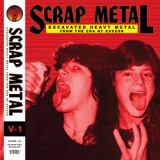
It almost seems churlish to regard Celtic Frost as one of the great extreme metal bands, because they were so much more than that. It’s better to hail them as among the finest extreme and experimental bands of the 1980s. Refusing ever to do what was expected or demanded, the band constantly changed musical direction, always brought in surprising influences, and kept people guessing as to where they might venture next. Their catalogue of albums is formidable and unmatched. Each is not only unique, but part of an entire tapestry that only now can be appreciated for being a remarkable part of music history. Despite, or maybe because of, constant turmoil on so many fronts, Celtic Frost achieved an artistic level few others would even have dared to dream of aspiring towards. They climbed high because they were never afraid to fall. Which is why the band are now rightly regarded as icons, and iconoclasts.
Released in 1985, the band’s second album had an ominous pall of doom and gloom, enmeshed in a sound both primitive yet also Wagnerian in its vast scope. Many claim this was a massive inspiration for black metal bands later in the decade. In truth, though, none matched what was here. This release includes the ‘Emperor’s Return’ EP as well as a remix of Visual Aggression, and the concept and art direction of the release was done by the man behind Celtic Frost, Tom G. Warrior.
Buscar:here is why
If it's really a post-genre world, why does everything sound the same? The two halves of Tampa rap duo They Hate Change_Dre (he/him) and Vonne (they/them)_first came together in front of the apartment complex where they both lived as teens. Dre had just moved down from Rochester, NY; Vonne was trying to sell him bad weed. It was clear from the start that the two listen to music differently from most people_they're sonic omnivores, obsessive deep-divers, lovers of rare and radical sounds. Starting as kids trawling the internet for tracks, they've been collecting music from around the world and across the decades, amassing a shared sonic knowledge so deep that "encyclopedic" barely begins to cover it _ not just the East Coast hip-hop that Dre grew up on, or the hyperlocal bass-music variants like jook (the Gulf Coast's twerkably raunchy answer to house) and crank (think "Miami bass meets NOLA bounce"), but also drum `n' bass, Chicago footwork, post-punk, prog (they're, like, seriously into prog), grime, krautrock, emo, and basically any genre on the map. Once they graduated to DJs on the Tampa DIY scene _ which includes everything from punk rock house parties to the black "teen nights" that pop up in rec centers and ballrooms _ they figured out how to pull all these disparate sounds together into a cohesive style. More importantly, they figured out how to make it something people will actually move to. When they made the transition to rapping and making beats, they brought that pleasure-seeking approach to sonic experimentation with them. "With this album, Vonne says, "it's really like, okay, you know how you talk about the internet breaking down borders? Here's what that actually sounds like. It's not just a hip-hop record with a couple more weird sounds. You want homegrown DIY? This is a record that was written, produced, and recorded in a 150-squarefoot bedroom from the least cool city you could think of." Finally, New is what a truly post-genre musical landscape is supposed to be: building deep connections that transcend outdated distinctions between them, spilling over with the joy of exploration and possibility, and daring other artists to think broader, go deeper, take bigger risks. Let the rest of them keep playing by the old rules_They Hate Change will keep changing the game.
Jazzrausch Bigband has more or less invented a new art form,
techno jazz, and has become well-known for performances of it. But
the band also has another, different story to tell. It has invented its
own tradition of hitting the road and touring at the end of each year
with a programme consisting of Christmas music, and has been doing
this ever since the band first emerged eight years ago. Bandleader
and founder Roman Sladek explains: “Whereas our regular projects -
the most recent album, ‘Emergenz’, is a good example - are all about
working through a specific theme and finding new ways to reinvent
ourselves, our Christmas thing is something we do for one reason
alone: to have fun. It was our very first programme, we still love it, and
we’re still nurturing, developing and growing it. Being able to devote
one month a year entirely to the big band tradition is something we’re
all really passionate about.”
Some bands might have been tempted just to throw together an
album of Christmas chestnuts any old how, but the Jazzrausch way of
doing things is not like that at all. Unlike any other album by the band,
for the first time we hear purely instrumental music. Furthermore,
Kuhn has taken ten classic Christmas songs - each one of them
rarely heard in jazz, and tunes which can often come across as a bit
staid in their original settings - from ‘Tochter Zion, freue dich# to
‘Adeste fideles’ or ‘Ihr Kinderlein, kommet’. The title track, ‘Alle Jahre
wieder!’ (based on the 1830s carol to music by Silcher which is very
familiar to children and adults in the German-speaking world) appears
here in completely new orchestral garb.
Sometimes the listener will recognise the kind of swing typical of
Glenn Miller. At other moments it is the incomparable big band
elegance of, say, Artie Shaw. ‘Es wird scho glei dumpa’ (an Austrian
carol) is given the full extra high pressure Tijuana brass treatment.
‘Maria durch ein’ Dornwald ging’ gets the touch of the Thad Jones /
Mel Lewis Orchestra after a Henry Mancini-like intro, and ‘Ich steh’ an
deiner Krippe hier’ recalls more of the great swing heritage.
Once again Jazzrausch Bigband has succeeded in a way that only
very few in the jazz field can, notwithstanding the openness of the
genre: they have brought young and old together, tradition and
revolution, the familiar and the new. Which is why it feels so
completely natural and right that they should continue to do this
‘again every year’, as the album title tells them: ‘Alle Jahre wieder’.
- A1: Modern Day Miracle (Feat Ghostface Killah)
- A2: Death Defying (Feat Inspectah Deck)
- A3: Sparrow
- A4: The Pulpit (Feat Conway The Machine, Ghostface Killah & Cappadonna)
- A5: Crazy 8'S (Feat Method Man, Ghostface Killah, Inspectah Deck, Masta Killa, Cappadonna, Solomon Childs & Streetlife)
- A6: Supreme Intellect (Feat Rza)
- A7: To Say The Least
- B1: Greatness - Killa Bee Legacy (Feat Trife Diesel & Solomon Childs)
- B2: The Recipe (Feat Method Man & Cappadonna)
- B3: The Art Basel (Feat Ghostface Killah & Shyheim)
- B4: Calculated Risk
- B5: Killa Bee Invasion (Feat Cappadonna & Solomon Childs)
- B6: Noir Story (Feat Killah Priest)
- B7: Never Again
Wu Tang & Staten Island MC/Producer come together again in new vinyl release Wutang x Remedy. Remedy is a MC/producer from Staten Island, New York who first made his mark with the song "Never Again" off the Wu-Tang Killa Beez' debut album The Swarm in the summer of '98. He eventually made his full-length debut The Genuine Article in the spring of '01 & followed it up with Code Red about 2« years later. The last we heard from him on his own was when It All Comes Down to This was released in 2010. But as the 12-year anniversary of that approaches in a few weeks, he's enlisting a star studded cast of veterans to be featured on his 4th album. Ghostface Killah tags along for the opener "Modern Day Miracle" working in an occultist loop to verbally abuse anyone who wants to challenge them whereas "Death Defying" with Inspectah Deck finds the 2 over an operatic instrumental talking about choosing whether to kill or be killed. "Sparrow" takes a more soulful route feeling comparing himself to the titular bird leading into Ghostface returning alongside Conway the Machine for "The Pulpit" incorporating some orchestral samples talking about the street life.The penultimate track "Noir Story" is a full-on Killah Priest solo cut with a drumless instrumental & his lyricism on here is a reminder as to why he's this reviewer's 2nd favorite affiliate right behind Killa Sin in terms of lyrical skill, the previous cuts. "Never Again" then ends the album by mournfully paying tribute to those we've lost along the way.If you're a diehard Wu fan like I am, then you're gonna come away from this highly impressed. It's great to hear Remedy completely rejuvenated & he does an awesome job of paying homage to my all-time favorite hip hop group from the guests to the production.
- 1: Discover Who I Am
- 2: The Music Played
- 3: Winchester In Apple Blossom Time*
- 4: Who Knows Why
- 5: Sammy
- 6: Bye Bye Country Boy
- 7: Raindrops Keep Falling On My Head
- 8: Sweet Georgie Fame
- 9: Feeling Good Being Me
- 10: You Have Lived In Autumn
- 11: Both Sides Now
- 12: Winchester In Apple Blossom Time
- 13: Bring All You Love Along
Among the great moments in the career of Blossom Dearie, an exceptional singer and pianist, are the concerts she gave and recorded in the Netherlands between 1968 and 1989, of which we have a faithful reflection here, thanks in particular to a fine recording. She dominates all instrumental formats, from solo to the large Metropole Orchestra, and all repertoires, from the film song "Raindrops Keep Falling On My Head", which she magnifies, to Joni Mitchell's "Both Sides Now", which she renews with intelligence, not forgetting a masterpiece for which she is responsible, "Winchester in Apple Blossom Time". Not forgetting her other personal works, as well as "Bring All Your Love Along", of which we hear the first recorded version here. Blossom's sublime farewell, eternal spring, in the form of a delicate reverence.
If it's really a post-genre world, why does everything sound the same? The two halves of Tampa rap duo They Hate Change_Dre (he/him) and Vonne (they/them)_first came together in front of the apartment complex where they both lived as teens. Dre had just moved down from Rochester, NY; Vonne was trying to sell him bad weed. It was clear from the start that the two listen to music differently from most people_they're sonic omnivores, obsessive deep-divers, lovers of rare and radical sounds. Starting as kids trawling the internet for tracks, they've been collecting music from around the world and across the decades, amassing a shared sonic knowledge so deep that "encyclopedic" barely begins to cover it _ not just the East Coast hip-hop that Dre grew up on, or the hyperlocal bass-music variants like jook (the Gulf Coast's twerkably raunchy answer to house) and crank (think "Miami bass meets NOLA bounce"), but also drum `n' bass, Chicago footwork, post-punk, prog (they're, like, seriously into prog), grime, krautrock, emo, and basically any genre on the map. Once they graduated to DJs on the Tampa DIY scene _ which includes everything from punk rock house parties to the black "teen nights" that pop up in rec centers and ballrooms _ they figured out how to pull all these disparate sounds together into a cohesive style. More importantly, they figured out how to make it something people will actually move to. When they made the transition to rapping and making beats, they brought that pleasure-seeking approach to sonic experimentation with them. "With this album, Vonne says, "it's really like, okay, you know how you talk about the internet breaking down borders? Here's what that actually sounds like. It's not just a hip-hop record with a couple more weird sounds. You want homegrown DIY? This is a record that was written, produced, and recorded in a 150-squarefoot bedroom from the least cool city you could think of." Finally, New is what a truly post-genre musical landscape is supposed to be: building deep connections that transcend outdated distinctions between them, spilling over with the joy of exploration and possibility, and daring other artists to think broader, go deeper, take bigger risks. Let the rest of them keep playing by the old rules_They Hate Change will keep changing the game.
Special 10th Anniversary Edition In Brown Card Artboard Sleeve With Additional Lyric Print Insert
Slowdive singer and songwriter’s third solo album, which was originally released in November 2012. It is a stunning record and one which, upon its release, underlined the claims that Neil was one of the finest and most underrated British songwriters of recent times. It’s also a very special release in the Sonic Cathedral catalogue; the shoegaze label licensed the record from Jack Johnson’s Brushfire imprint for the UK and Europe and it was the start of a relationship that also gave us the Black Hearted Brother album in 2013 and, ultimately, brought about the reformation of Slowdive in 2014. But Palindrome Hunches is a very different beast. Both stately and understated, this moody and mesmerising collection of peculiarly British folk songs was made with the Band of Hope, a Wallingford, Oxfordshire based collective consisting of Ben Smith (violin), Drew Milloy (double bass), Paul Whitty (piano) and Tom Crook (guitar). Together with producer Nick Holton, banjo player Kevin Wells and backing singer Aimee Craddock, they recorded the album to tape over a few weekends in the music room of their local junior school. “At first we were going to record in a studio, but everything seemed too clean,” said Neil at the time. “We just went through the songs and recorded them live without very much rehearsal. We wanted to be spontaneous and simple and to keep the little mistakes that sneaked in.” This goes a long way to explaining the album’s humanity and intimacy, and also why it has had a quiet life of its own over the past decade, gradually growing in stature alongside Neil’s more high-profile activities with Slowdive; copies of the 2012 original and even the 2017 repress currently fetch up to triple figures on Discogs. The stunning opener ‘Digging Shelters’ was used to devastating effect in the posthumously released James Gandolfini movie Enough Said – a fitting home for a song that rubs shoulders here with ruminations about love and loss such as ‘Tied To You’ and ‘Spin The Bottle’ and, on ‘Wittgenstein’s Arm’, an Austrian pianist who had his right arm amputated in World War I and lost three of his brothers to suicide. The wordplay of the title track is almost light-hearted in comparison; “I wanted to write a song that was the same forwards and backwards, but it didn’t quite work out,” explained Neil, adding that he also chose ‘Palindrome Hunches’ for the album’s title because “I like the idea of things being reversible”. A couple years later, by reforming his old band, he proved that. And now, ten years on, it’s the perfect time to rewind to this understated, underrated classic. Side A 1 Digging Shelters 2 Bad Drugs and Minor Chords 3 Wittgenstein’s Arm 4 Spin The Bottle 5 Tied to You Side B 1 Love Is a Beast 2 Palindrome Hunches 3 Full Moon Rising 4 Sandy 5 Hey Daydreamer 6 Loose Change. Praise for Palindrome Hunches on its original release: ““Nope, it ain’t shoegaze as it's been codified and re-codified. But why be disappointed in someone following his muse to a logical conclusion when that path was always the one he walked on?” – Pitchfork An exquisite set of dark folk music” – The Times “Draws from the same understated, reflective well as John Martyn” – MOJO “‘Tied To You’ doesn’t merely evoke Nick Drake but withstands the comparison – evidence of the songs’ quality” – Financial Times “Halstead’s songs breathe the sort of honesty and goodness that’s harder and harder to find in the iTunes age” – The Independent “Given the chance, they could be songs that continue to enchant for many years to come” – The Line Of Best Fit
Drummer and composer Edward Vesala, the most internationally renowned jazz musician from Finland, was very keen on percussion instruments. Oddly enough, this broad and enduring interest is hardly evident on his albums. Whether playing on his own albums or contributing to other musicians’ work, Vesala played a standard drum kit most of the time. He hardly used external percussionists on his own albums either. And most of all: his music was almost never percussive, at least in the traditional manner. Perhaps even stranger is the fact that he barely played any drum solos on his own albums. That’s why I’m Here (Blue Master Special, SPEL 311, 1974), recorded in Helsinki in 1973, is such a rarity. Of course, being a limited release has also made it an expensive treasure among collectors. Additionally, I’m Here is Vesala’s only solo album and only percussive album, and one of the few where he can be said to play drum solos, albeit in his own idiosyncratic way..
Here lies a reissue of the first release from legendary long-running
Chicago group ONO, Kate Cincinnati
ONO originally self-released the music in an edition of 300 tapes, and it shares
several traits with the music of today's ONO. travis's singing moves effortlessly
between gospel, blues, opera and noise registers; Shannon Rose Riley plays a
maelstrom of music on her horn of choice, here saxophone; bandleader P.
Michael Grego quietly orchestrates bass, guitar and lap guitar, creating a musical
Jenga tower. If this is your first time with ONO, hop on board and see why Moor
Mother, Black Midi, Algiers and countless other acts love them so. If you're
already a fan: don't walk - run.
It’s almost four years since their last opus - two years since the most-recent run
of live shows. Now, Bitchin Bajas return from whatever kind of rare ether they
occupy when they’re at home, bearing the riches of the whole cosmos in their
hands. And strictly OG as well - on cassette only.
‘Switched On Ra’ is the outcome of a typical Bajas exercise: pouring some out
for the pioneers that came before (as they’ve done with Bitchitronics and their
participation in the annual Chicago performance of ‘In C’ over the years). It’s a
nice way to get a flow - they play a little of themselves, then some for the
pioneers, then a little more for the band. Before long, they’re playing with the
inspirations twined, as they can only come from within.
For ‘Switched On Ra’, this meant a deep delve into the song-book of one of their
soul-predecessors, Sun Ra, whose music is literally written in the Bajas DNA.
Digging into this music sounded wild on paper: the drone synth group taking on
the Arkestra harmonies and Ra’s loose grooves? The trick was to get that sense
of rhythm to translate across the spectrum from Ra to Bajas, in a way that
worked for them both.
Their rearrangements of the tunes went good - up and down the EQ band, they
were finding the round sounds and jagged edges that brought Ra’s music into
their own thing. Then at the last minute, there was another twist - why not pay
tribute to the Queen herself, and think of the arrangements with a Wendy Carlos
vibe? A little side homage? After all, ‘Switched on Bach’ was visionary, bringing
analogue synths from the outside all the way into the mainstream in the late 60s -
and this take on Ra is meant to take him to new ears everywhere.
Sun Ra of course was his own kind of original keyboard visionary, using electric
keyboards in the late 40s and 50s to fill a role in jazz that had traditionally been
played on acoustic piano only. Once he’d done so, he took his writing in
directions inspired by the electricity, places no one had thought to go before
then.
Bitchin Bajas have been content to dominate in a microtonal world, usually
without a single chord to be found anywhere. But here, they step up righteously,
their vibe triangulated as they bring Ra’s music forward with some Wendy C
style, making an unexpected space for all to thrive. There’s a real feeling of joy
as these collected signals bounce off the tape and through the speakers into
your space.
To get this unique colloid exactly right, Bitchin Bajas used nineteen different
keyboards. They abstained from deploying their arsenal of reed and woodwind
instruments: everything had to be on the keys. This meant Yamahas, Rolands,
Korgs, Casios, a MicroMoog and of course their trusty Ace Tone organ. They
even broke out the Crumar DS-2, to have some of Ra’s chosen tone in the mix.
Then Jayve Montgomery added an EWI as a solo voice on a few tunes, just to
get some air-blown signal (and a natural shout out to EWI master Marshall Allen)
in there, after all. It felt like somewhere in the universe, Ra was decreeing it.
- A1: City Sounds
- A2: Turn Me Around
- B1: When You Call Me
- B2: Night Flight 05 25
- B3: Soothsayer (Feat. Theo Croker)
- C1: Why Must You Fly (Feat. Omar)
- C2: To Be As One (Feat. Theo Croker)
- C3: (Bring On The) Bad Weather (Feat. Anushka)
- D1: Lazy Days (Feat. Emma-Jean Thackray)
- D2: Find Your Heaven (Feat. Valerie Etienne)
- D3: Virgil (Vocal Version)
White Vinyl[32,73 €]
Welcome to ‘STR4TASFEAR, Bluey and Gilles’ second STR4TA album released.
A collection of songs, melodies, grooves and sounds that sit perfectly in the brand new music world it’s part of. Gilles and Bluey are both men who emerged into the Brit funk world. They were both part of this truly thrilling chapter in the story of homegrown music; which manifests itself here in a sumptuous mixture of twanging basslines, spacey synth melodies, clicking beats and wispy, ethereal voices.
And for this new set, they’ve got a few like-minded souls along to join the party. Multi-talented Neo-soul Godfather Omar, and celebrated vocalist, Valerie Etienne, both represent Brit funk’s first bounce. Also welcomed in to the fold is musical polymath, Emma-Jean Thackray, Brighton duo Anushka and Floridian trumpeter/vocalist Theo Croker. ‘STR4TASFEAR’ is Gilles and Bluey’s wide-open window into a timeless, wonderful world of Brit funk (Words by Mark Webster, 2022).
STR4TA has received a rapturous reception, with standout tracks ‘We Like It’ achieving over 1 million streams on Spotify and ‘Rhythm In Your Mind’ exceeding 12 weeks on Jazz FM’s playlist. They have been heavily supported by BBC 6Music, The Guardian, Wax Poetics, The Vinyl Factory, CLASH, Télérama (FR), Radio Nova (FR), Rolling Stones Italy & Japan. Most recent singles “When You Call Me” & “Night Flight”, taken from the upcoming album, has already received support from Rampage (BBC 1Xtra), Jamz Supernova (BBC 6 Music), Deb Grant (Jazz FM) plus NTS, Mi-Soul, Solar Radio, KCRW (US), KEXP (US), Concrete Islands, CRACK Magazine, and Nu-Funk (Spotify).
- A1: City Sounds
- A2: Turn Me Around
- B1: When You Call Me
- B2: Night Flight
- B3: Soothsayer (Feat Theo Croker)
- C1: Why Must You Fly (Feat Omar)
- C2: To Be As One (Feat Theo Croker)
- C3: (Bring On The) Bad Weather (Bring On The)
- D1: Lazy Days (Feat Emma-Jean Thackray)
- D2: Find Your Heaven (Feat Valerie Etienne)
- D3: Virgil
Black Vinyl[26,85 €]
Welcome to ‘STR4TASFEAR, Bluey and Gilles’ second STR4TA album released.
A collection of songs, melodies, grooves and sounds that sit perfectly in the brand new music world it’s part of. Gilles and Bluey are both men who emerged into the Brit funk world. They were both part of this truly thrilling chapter in the story of homegrown music; which manifests itself here in a sumptuous mixture of twanging basslines, spacey synth melodies, clicking beats and wispy, ethereal voices.
And for this new set, they’ve got a few like-minded souls along to join the party. Multi-talented Neo-soul Godfather Omar, and celebrated vocalist, Valerie Etienne, both represent Brit funk’s first bounce. Also welcomed in to the fold is musical polymath, Emma-Jean Thackray, Brighton duo Anushka and Floridian trumpeter/vocalist Theo Croker. ‘STR4TASFEAR’ is Gilles and Bluey’s wide-open window into a timeless, wonderful world of Brit funk (Words by Mark Webster, 2022).
STR4TA has received a rapturous reception, with standout tracks ‘We Like It’ achieving over 1 million streams on Spotify and ‘Rhythm In Your Mind’ exceeding 12 weeks on Jazz FM’s playlist. They have been heavily supported by BBC 6Music, The Guardian, Wax Poetics, The Vinyl Factory, CLASH, Télérama (FR), Radio Nova (FR), Rolling Stones Italy & Japan. Most recent singles “When You Call Me” & “Night Flight”, taken from the upcoming album, has already received support from Rampage (BBC 1Xtra), Jamz Supernova (BBC 6 Music), Deb Grant (Jazz FM) plus NTS, Mi-Soul, Solar Radio, KCRW (US), KEXP (US), Concrete Islands, CRACK Magazine, and Nu-Funk (Spotify).
Futurismo are proud to present a deluxe remastered vinyl package of the classic 1980 album: Red Exposure by the uncompromising Chrome.
Arguably considered the San Francisco bands greatest work, Red Exposure, the fourth album to feature core members Damon Edge
and Helios Creed, was the definitive version of Chrome’s idiosyncratic approach to sound: a projected vision of near future dystopia via an undefinable guise of experimental space rock and punk-tinged alien soundscapes. Here, the band simultaneously draw from the otherworldly noises of their past records, whilst pushing their synthesizers forward into, albeit oblique, pop song structures.
Edge’s vocals are structured more like an instrument than a voice, lyrics painting images of humanities future on the edge of total destruction. As Creed’s guitar work multilayersit’s way into a completely different aural spectrum, beautiful yet violent, slashing against rhythmic pulsations, loops and experimentations, to create a sound that even today feels beyond the here and now. This distillation of the bands repertoire seemed to envision a deconstruction of rock ‘n’ roll, aimed to break past the shell of cliché that it would of course eventually come to inhabit. Which is why despite it’s age Red Exposure remains a record that still sounds like the sonic product of a far off civilisation, making this disk of new wave nihilism vital for fans of Space rock, Krautrock, Throbbing Gristle, Cabaret Voltaire and Suicide.
The deluxe remastered version of this out of print 1980 LP is presented here in ltd edition coloured vinyl. It comes packaged in a chromed mirrorboard sleeve, contains a large screen printed poster printed with neon ink featuring unseen photographs of the band, and a bonus track.
Storyville Records is proud to present Michel Petrucciani – Solo in
Denmark
This album features French piano prodigy Michel Petrucciani in a solo recording
from Silkeborg Church, 1990. MP was one of the most popular pianists in the
1990’s due to his extraordinary technique, his astounding musical outlook and
extremely dynamic playing style. His music is simply timeless and magical,
seemingly coming straight from his soul. As he is often quoted: “I’m not playing
to your head, but to your soul. When I play, I’m like a bird flying over the landscape,
and I can land anywhere.” Recorded on June 23, 1990 at the Riverboat Jazz
Festival in Silkeborg, Denmark, this album is a tour de force that leads the listener
through a series of the most iconic motifs in jazz, all of which are deconstructed
and transformed by an outstanding craftsman and embellished along the way by
a true master. And he also allows himself to insert unexpected twists and turns
that are guaranteed to make the listener smile. Pay special attention to his small
rhythmic and melodic tags, little hints for the well- trained ear. They reveal a
musician who never grows complacent or takes himself too seriously. Here, the
totality of MP’s talents are exhibited in an intimate setting, where he stuns the
crowd with his inventive and blindingly rapid playing. The music emanating from
the man simply grabs everybody’s attention. Arrangements by jazz legends like
Duke Ellington, Thelonious Monk and Miles Davis gets the cheeky Petrucciani
treatment with his rather audacious approach to ‘established’ jazz standards. MP
had the ability to effortlessly travel through the history of jazz on his piano,
fascinating his audience in the process. This church concert clearly displays why
MP quickly developed into a truly exceptional member of the international jazz
scene. For MP, joyful playing with the music was a necessity of life. He lived and
breathed for the opportunity to show it his love and respect. And all we have to do
is open our ears, mind and soul and accept the gems from a musical individualist,
who has made an indelible impression on millions of jazz listeners around the
world. Solo in Denmark is simply another chapter in the remarkable story of a
man, who perceived himself as a servant of the music. BIOGRAPHY Michel
Petrucciani was a highly charismatic and high- spirited character, despite being
hindered by a genetic disease called osteogenesis imperfecta or brittle bone
disease. He was extremely short, standing at three feet. Luckily, his hands were
perfectly normal, but he had special modifications to reach the piano’s pedals. He
started playing in the family band with his guitarist father and bassist brother. At
the age of 15, he had the opportunity to play with Kenny Clarke and Clark Terry,
and at 17 he made his first recording. MP moved to the US in 1982, where he
convinced Charles Lloyd to get out on the road again, and tour with his quartet.
Behind the grand piano, MP was a giant with h
Moody Blue Vinyl. RIYL: Codeine, Mazzy Star, Bedhead, Red House Painters, Low & American Music Club. Previously unreleased 16-track recordings that predates Spain’s 1995's landmark “The Blue Moods Of Spain". Includes original studio version of "World Of Blue" featuring Petra Haden on violin. Re-mixed and re-imagined by Kramer for Shimmy-Disc. The LP “World of Blue” features Merlo Podlewski on guitar. I first met Merlo in 1994. My sister Rachel Haden, who had been working with him at the Rhino Records store in Westwood, knew I was looking for a new guitarist for my band, and introduced us. Merlo is one of those guitarists whose playing is so smooth and effortless he makes anyone feel like they can play. He had an instinctual grasp of harmony and theory, which brought a great counterpoint to the technical knowledge and finesse of lead guitarist Ken. Spain played their first official L.A. gig with Merlo at a club called Pan, which shortly thereafter changed its name to Spaceland. We opened for Beck and That Dog. We played at Spaceland a lot and at other small clubs and coffee joints like the Troy Cafe (owned by Beck’s mom), Congo Square Coffee House in Santa Monica, Alligator Lounge, and others. At a certain point that year we were ready to record our first 7” single, and I reserved some time at Poop Alley. Poop Alley didn’t seem like the ideal recording setting. The walls and floors were made of concrete, and there was no soundproofing. The mixing board was in a loft up this steep staircase with no guard rails. But it worked somehow. On the particular day we recorded basics there was a rain storm which you can clearly hear in the background. The ceiling was so high there almost wasn’t a ceiling. A steep curving staircase with no guardrail led up to a loft area where the console was located, and next to it, on a custom-built, guardrail-less ledge, a queen-sized bed where Tom slept. I paid for the session with weed I grew in my closet. We set up and it started raining. Tom put a microphone outside. After tracking was finished, Petra came over and overdubbed violin. There was a cushioned area where I remember sitting during mixdown. We stayed good friends with Tom. We recorded a couple more songs with him the following year. Tom recorded lots of bands at Poop Alley. My sisters’ band That Dog, Beck, the Rentals, Rod Poole, Tom’s band Waldo the Dog Faced Boy, and many others. There were parties in the alley. There would be a keg of beer. Everyone was well-behaved. The most dangerous it got was when Kenny asked Beck if he was a Scientologist. I remember laughter and happiness the most from those parties. Not long afterwards Tom shut down the studio. Luckily for us, the tapes still exist. On those tapes are five songs, all of which are represented here. “I Lied” and “Her Used-To-Been” were released on the 7”, the remaining three have never been released before now. I can’t remember who I sent copies of the 7” to but shortly after it came out I got a call from an A&R executive at Geffen inviting me to their offices to talk. “I love your songs,” I remember him saying to me, “but my boss David Geffen won’t let me sign you because he doesn’t know how to market you.” Eventually a label that did want to sign us got in touch with me. Restless Records, they had decent distribution, so I said to myself, “Why not?”. This eventually led to the recording that produced our debut LP “Blue Moods of Spain”. Track listing: A1. Her Used-To-Been A2. Phone Machine A3. I Lied B1. Dreaming of Love B2. World of Blue
- A1: Rock This Mother
- A2: Talk To Me Girl
- A3: You Can Find Me
- A4: Check This Out
- A5: Jesus Going To Clean House
- A6: Hope You Understood
- A7: Is It What You Want
- A8: Love Is Everlasting
- A9: This Is Hip-Hop Art
- A10: Opposite Of Love
- A11: Do You Know What I Mean
- B1: Saving All My Love For You
- B2: Look Out Here I Come
- B3: Girl You Always Talking
- B4: Have A Great Day
- B5: Take My Hand
- B6: I Need Your Love
- B7: Your Town
- B8: Talk Around Town
- B9: Booty Head/Take A Little Walk
- B10: I Love My Mama
- B11: I Never Found Anyone Like You
Vinyl LP[23,49 €]
As the sun sets on a quaint East Nashville house, a young man bares a piece of his soul. Facing the camera, sporting a silky suit jacket/shirt/slacks/fingerless gloves ensemble that announces "singer" before he's even opened his mouth, Lee Tracy Johnson settles onto his stage, the front yard. He sways to the dirge-like drum machine pulse of a synth-soaked slow jam, extends his arms as if gaining his balance, and croons in affecting, fragile earnest, "I need your love… oh baby…"
Dogs in the yard next door begin barking. A mysterious cardboard robot figure, beamed in from galaxies unknown and affixed to a tree, is less vocal. Lee doesn't acknowledge either's presence. He's busy feeling it, arms and hands gesticulating. His voice rises in falsetto over the now-quiet dogs, over the ambient noise from the street that seeps into the handheld camcorder's microphone, over the recording of his own voice played back from a boombox off-camera. After six minutes the single, continuous shot ends. In this intimate creative universe there are no re-takes. There are many more music videos to shoot, and as Lee later puts it, "The first time you do it is actually the best. Because you can never get that again. You expressing yourself from within."
"I Need Your Love" dates from a lost heyday. From some time in the '80s or early '90s, when Lee Tracy (as he was known in performance) and his music partner/producer/manager Isaac Manning committed hours upon hours of their sonic and visual ideas to tape. Embracing drum machines and synthesizers – electronics that made their personal futurism palpable – they recorded exclusively at home, live in a room into a simple cassette deck. Soul, funk, electro and new wave informed their songs, yet Lee and Isaac eschewed the confinement of conventional categories and genres, preferring to let experimentation guide them.
"Anytime somebody put out a new record they had the same instruments or the same sound," explains Isaac. "So I basically wanted to find something that's really gonna stand out away from all of the rest of 'em." Their ethos meant that every idea they came up with was at least worth trying: echoed out half-rapped exhortations over frantic techno-style beats, gospel synth soul, modal electro-funk, oddball pop reinterpretations, emo AOR balladry, nods to Prince and the Fat Boys, or arrangements that might collapse mid-song into a mess of arcade game-ish blips before rallying to reach the finish line. All of it conjoined by consistent tape hiss, and most vitally, Lee's chameleonic voice, which managed to wildly shape shift and still evoke something sincere – whether toggling between falsetto and tenor exalting Jesus's return, or punctuating a melismatic romantic adlib with a succinct, "We all know how it feels to be alone."
"People think we went to a studio," says Isaac derisively. "We never went to no studio. We didn't have the money to go to no studio! We did this stuff at home. I shot videos in my front yard with whatever we could to get things together." Sometimes Isaac would just put on an instrumental record, be it "Planet Rock" or "Don't Cry For Me Argentina" (from Evita), press "record," and let Lee improvise over it, yielding peculiar love songs, would-be patriotic anthems, or Elvis Presley or Marilyn Monroe tributes. Technical limitations and a lack of professional polish never dissuaded them. They believed they were onto something.
"That struggle," Isaac says, "made that sound sound good to me."
In the parlance of modern music criticism Lee and Isaac's dizzying DIY efforts would inevitably be described as "outsider." But "outsider" carries the burden of untold additional layers of meaning if you're Black and from the South, creating on a budget, and trying to get someone, anyone within the country music capital of the world to take your vision seriously. "What category should we put it in?" Isaac asks rhetorically. "I don't know. All I know is feeling. I ain't gonna name it nothing. It's music. If it grabs your soul and touch your heart that's what it basically is supposed to do."
=
Born in 1963, the baby boy of nine siblings, Lee Tracy spent his earliest years living amidst the shotgun houses on Nashville's south side. "We was poor, man!" he says, recalling the outhouse his family used for a bathroom and the blocks of ice they kept in the kitchen to chill perishables. "But I actually don't think I really realized I was in poverty until I got grown and started thinking about it." Lee's mom worked at the Holiday Inn; his dad did whatever he had to do, from selling fruit from a horse drawn cart to bootlegging. "We didn't have much," Lee continues, "but my mother and my father got us the things we needed, the clothes on our back." By the end of the decade with the city's urban renewal programs razing entire neighborhoods to accommodate construction of the Interstate, the family moved to Edgehill Projects. Lee remembers music and art as a constant source of inspiration for he and his brothers and sisters – especially after seeing the Jackson 5 perform on Ed Sullivan. "As a small child I just knew that was what I wanted to do."
His older brother Don began musically mentoring him, introducing Lee to a variety of instruments and sounds. "He would never play one particular type of music, like R&B," says Lee. "I was surrounded by jazz, hard rock and roll, easy listening, gospel, reggae, country music; I mean I was a sponge absorbing all of that." Lee taught himself to play drums by beating on cardboard boxes, gaining a rep around the way for his timekeeping, and his singing voice. Emulating his favorites, Earth Wind & Fire and Cameo, he formed groups with other kids with era-evocative band names like Concept and TNT Connection, and emerged as the leader of disciplined rehearsals. "I made them practice," says Lee. "We practiced and practiced and practiced. Because I wanted that perfection." By high school the most accomplished of these bands would take top prize in a prominent local talent show. It was a big moment for Lee, and he felt ready to take things to the next level. But his band-mates had other ideas.
"I don't know what happened," he says, still miffed at the memory. "It must have blew they mind after we won and people started showing notice, because it's like everybody quit! I was like, where the hell did everybody go?" Lee had always made a point of interrogating prospective musicians about their intentions before joining his groups: were they really serious or just looking for a way to pick up girls? Now he understood even more the importance of finding a collaborator just as committed to the music as he was.
=
Isaac Manning had spent much of his life immersed in music and the arts – singing in the church choir with his family on Nashville's north side, writing, painting, dancing, and working various gigs within the entertainment industry. After serving in the armed forces, in the early '70s he ran The Teenage Place, a music and performance venue that catered to the local youth. But he was forced out of town when word of one of his recreational routines created a stir beyond the safe haven of his bohemian circles.
"I was growing marijuana," Isaac explains. "It wasn't no business, I was smoking it myself… I would put marijuana in scrambled eggs, cornbread and stuff." His weed use originated as a form of self-medication to combat severe tooth pain. But when he began sharing it with some of the other young people he hung out with, some of who just so happened to be the kids of Nashville politicians, the cops came calling. "When I got busted," he remembers, "they were talking about how they were gonna get rid of me because they didn't want me saying nothing about they children because of the politics and stuff. So I got my family, took two raggedy cars, and left Nashville and went to Vegas."
Out in the desert, Isaac happened to meet Chubby Checker of "The Twist" fame while the singer was gigging at The Flamingo. Impressed by Isaac's zeal, Checker invited him to go on the road with him as his tour manager/roadie/valet. The experience gave Isaac a window into a part of the entertainment world he'd never encountered – a glimpse of what a true pop act's audience looked like. "Chubby Checker, none of his shows were played for Black folks," he remembers. "All his gigs were done at high-class white people areas." Returning home after a few years with Chubby, Isaac was properly motivated to make it in Music City. He began writing songs and scouting around Nashville for local talent anywhere he could find it with an expressed goal: "Find someone who can deliver your songs the way you want 'em delivered and make people feel what you want them to feel."
One day while walking through Edgehill Projects Isaac heard someone playing the drums in a way that made him stop and take notice. "The music was so tight, just the drums made me feel like, oh I'm-a find this person," he recalls. "So I circled through the projects until I found who it was.
"That's how I met him – Lee Tracy. When I found him and he started singing and stuff, I said, ohhh, this is somebody different."
=
Theirs was a true complementary partnership: young Lee possessed the raw talent, the older Isaac the belief. "He's really the only one besides my brother and my family that really seen the potential in me," says Lee. "He made me see that I could do it."
Isaac long being a night owl, his house also made for a fertile collaborative environment – a space where there always seemed to be a new piece of his visual art on display: paintings, illustrations, and dolls and figures (including an enigmatic cardboard robot). Lee and Issac would hang out together and talk, listen to music, conjure ideas, and smoke the herb Isaac had resumed growing in his yard. "It got to where I could trust him, he could trust me," Isaac says of their bond. They also worked together for hours on drawings, spreading larges rolls of paper on the walls and sketching faces with abstract patterns and imagery: alien-like beings, tri-horned horse heads, inverted Janus-like characters where one visage blurred into the other.
Soon it became apparent that they didn't need other collaborators; self-sufficiency was the natural way forward. At Isaac's behest Lee, already fed up with dealing with band musicians, began playing around with a poly-sonic Yamaha keyboard at the local music store. "It had everything on it – trumpet, bass, drums, organ," remembers Lee. "And that's when I started recording my own stuff."
The technology afforded Lee the flexibility and independence he craved, setting him on a path other bedroom musicians and producers around the world were simultaneously following through the '80s into the early '90s. Saving up money from day jobs, he eventually supplemented the Yamaha Isaac had gotten him with Roland and Casio drum machines and a Moog. Lee was living in an apartment in Hillside at that point caring for his dad, who'd been partially paralyzed since early in life. In the evenings up in his second floor room, the music put him in a zone where he could tune out everything and lose himself in his ideas.
"Oh I loved it," he recalls. "I would really experiment with the instruments and use a lot of different sound effects. I was looking for something nobody else had. I wanted something totally different. And once I found the sound I was looking for, I would just smoke me a good joint and just let it go, hit the record button." More potent a creative stimulant than even Isaac's weed was the holistic flow and spontaneity of recording. Between sessions at Isaac's place and Lee's apartment, their volume of output quickly ballooned.
"We was always recording," says Lee. "That's why we have so much music. Even when I went to Isaac's and we start creating, I get home, my mind is racing, I gotta start creating, creating, creating. I remember there were times when I took a 90-minute tape from front to back and just filled it up."
"We never practiced," says Isaac. "See, that was just so odd about the whole thing. I could relate to him, and tell him about the songs I had ideas for and everything and stuff. And then he would bring it back or whatever, and we'd get together and put it down." Once the taskmaster hell bent on rehearsing, Lee had flipped a full 180. Perfection was no longer an aspiration, but the enemy of inspiration.
"I seen where practicing and practicing got me," says Lee. "A lot of musicians you get to playing and they gotta stop, they have to analyze the music. But while you analyzing you losing a lot of the greatness of what you creating. Stop analyzing what you play, just play! And it'll all take shape."
=
"I hope you understood the beginning of the record because this was invented from a dream I had today… (You tell me, I'll tell you, we'll figure it out together)" – Lee Tracy and Isaac Manning, "Hope You Understand"
Lee lets loose a maniacal cackle when he acknowledges that the material that he and Isaac recorded was by anyone's estimation pretty out there. It's the same laugh that commences "Hope You Understand" – a chaotic transmission that encapsulates the duality at the heart of their music: a stated desire to reach people and a compulsion to go as leftfield as they saw fit.
"We just did it," says Lee. "We cut the music on and cut loose. I don't sit around and write. I do it by listening, get a feeling, play the music, and the lyrics and stuff just come out of me."
The approach proved adaptable to interpreting other artists' material. While recording a cover of Whitney Houston's pop ballad "Saving All My Love For You," Lee played Whitney's version in his headphones as he laid down his own vocals – partially following the lyrics, partially using them as a departure point. The end result is barely recognizable compared with the original, Lee and Isaac having switched up the time signature and reinvented the melody along the way towards morphing a slick mainstream radio standard into something that sounds solely their own.
"I really used that song to get me started," says Lee. "Then I said, well I need something else, something is missing. Something just came over me. That's when I came up with 'Is It What You Want.'"
The song would become the centerpiece of Lee and Isaac's repertoire. Pushed along by a percolating metronomic Rhythm King style beat somewhere between a military march and a samba, "Is It What You Want" finds Lee pleading the sincerity of his commitment to a potential love interest embellished by vocal tics and hiccups subtlely reminiscent of his childhood hero MJ. Absent chord changes, only synth riffs gliding in and out like apparitions, the song achieves a lingering lo-fi power that leaves you feeling like it's still playing, somewhere, even after the fade out.
"I don't know, it's like a real spiritual song," Lee reflects. "But it's not just spiritual. To me the more I listen to it it's like about everything that you do in your everyday life, period. Is it what you want? Do you want a car or you don't want a car? Do you want Jesus or do you want the Devil? It's basically asking you the question. Can't nobody answer the question but you yourself."
In 1989 Lee won a lawsuit stemming from injuries sustained from a fight he'd gotten into. He took part of the settlement money and with Isaac pressed up "Saving All My Love For You" b/w "Is It What You Want" as a 45 single. Isaac christened the label One Chance Records. "Because that's all we wanted," he says with a laugh, "one chance."
Isaac sent the record out to radio stations and major labels, hoping for it to make enough noise to get picked up nationally. But the response he and Lee were hoping for never materialized. According to Isaac the closest the single got to getting played on the radio is when a disk jock from a local station made a highly unusual announcement on air: "The dude said on the radio, 107.5 – 'We are not gonna play 'Is It What You Want.' We cracked up! Wow, that's deep.
"It was a whole racist thing that was going on," he reflects. "So we just looked over and kept on going. That was it. That was about the way it goes… If you were Black and you were living in Nashville and stuff, that's the way you got treated." Isaac already knew as much from all the times he'd brought he and Lee's tapes (even their cache of country music tunes) over to Music Row to try to drum up interest to no avail.
"Isaac, he really worked his ass off," says Lee. "He probably been to every record place down on Music Row." Nashville's famed recording and music business corridor wasn't but a few blocks from where Lee grew up. Close enough, he remembers, for him to ride his bike along its back alleys and stumble upon the occasional random treasure, like a discarded box of harmonicas. Getting in through the front door, however, still felt a world away.
"I just don't think at the time our music fell into a category for them," he concedes. "It was before its time."
=
Lee stopped making music some time in the latter part of the '90s, around the time his mom passed away and life became increasingly tough to manage. "When my mother died I had a nervous breakdown," he says, "So I shut down for a long time. I was in such a sadness frame of mind. That's why nobody seen me. I had just disappeared off the map." He fell out of touch with Isaac, and in an indication of just how bad things had gotten for him, lost track of all the recordings they'd made together. Music became a distant memory.
Fortunately, Isaac kept the faith. In a self-published collection of his poetry – paeans to some of his favorite entertainment and public figures entitled Friends and Dick Clark – he'd written that he believed "music has a life of its own." But his prescience and presence of mind were truly manifested in the fact that he kept an archive of he and Lee's work. As perfectly imperfect as "Is It What You Want" now sounds in a post-Personal Space world, Lee and Isaac's lone official release was in fact just a taste. The bulk of the Is It What You Want album is culled from the pair's essentially unheard home recordings – complete songs, half-realized experiments, Isaac's blue monologues and pronouncements et al – compiled, mixed and programmed in the loose and impulsive creative spirit of their regular get-togethers from decades ago. The rest of us, it seems, may have finally caught up to them.
On the prospect of at long last reaching a wider audience, Isaac says simply, "I been trying for a long time, it feels good." Ever the survivor, he adds, "The only way I know how to make it to the top is to keep climbing. If one leg break on the ladder, hey, you gotta fix it and keep on going… That's where I be at. I'll kill death to make it out there."
For Lee it all feels akin to a personal resurrection: "It's like I was in a tomb and the tomb was opened and I'm back… Man, it feels so great. I feel like I'm gonna jump out of my skin." Success at this stage of his life, he realizes, probably means something different than what it did back when he was singing and dancing in Isaac's front yard. "What I really mean by 'making it,'" he explains isn't just the music being heard but, "the story being told."
Occasionally Lee will pull up "Is It What You Want" on YouTube on his phone, put on his headphones, and listen. He remembers the first time he heard his recorded voice. How surreal it was, how he thought to himself, "Is that really me?" What would he say to that younger version of himself now?
"I would probably tell myself, hang in there, don't give up. Keep striving for the goal. And everything will work out."
Despite what's printed on the record label, sometimes you do get more than one chance.
LP + 7". Indigo Sparke's majestic second full-length album Hysteria is a sweeping work, one that possesses a rare, reflective power. On it, she examines love, loss, her history, and the emotional upheaval surrounding those sensations: her words tell the stories, and the sounds act them out. It's a diary built for big stages. Hysteria arrives just a year after her striking, minimalist debut, Echo. Here, though, Sparke offers an expansive body of work_it's a complex collection that expands her sound and outlook. Work on Hysteria began at the start of the COVID-19 pandemic, while Sparke was stranded in quarantine in her native Australia. After moving back to New York in the spring of 2021, Sparke finished writing the album's 14 songs and decamped upstate with producer Aaron Dessner (The National, Taylor Swift). "Originally we were going to co-write, but after he heard my demos he said, `There's so much in here already,'" Sparke recalls on how Dessner, who also contributes instrumentation along with guitarist Shahzad Izmaily and drummer Matt Barrick (The Walkmen, Muzz), got involved in bringing Hysteria to life. Centering Sparke's powerful vocals throughout, Hysteria is packed with big guitars and layered instrumentation that practically acts as the album's lungs, giving every note breath. From the pulsing immediacy of "Infinite Honey" to the soaring "God Is a Woman's Name" and "Hold On"'s towering chorus, this is music that sounds huge even as it zooms in on the trials and turmoils of one's inner life. You can hear Sparke reflecting on reconciliation, grief, hope, and the passage of time on the perpetually building "Pressure in My Chest" and the airy, Joni Mitchell-esque title track, which finds her embracing a gorgeous upper register over gently strummed guitar. "Set Your Fire on Me" builds and bursts not unlike Angel Olsen's own raw folk-rock expressionism_and then there's the stark opener and first single "Blue," which acts as a cosmic road map for Sparke's own journey in life. Sparke observes while reflecting on Hysteria's thematic bent "these songs are about being at the axis point of love - right at the edge of hysteria - and how that transformed me."
- E1: Anniversary (Nothing Up My Sleeve)
- G2: Not For The Season (Laminated Cat)
- H2: Not For The Season (Laminated Cat)
- K3: Remember To Remember (Hummingbird)
- N2: Love Will (Let You Down)
- A1: I Am Trying To Break Your Heart (2022 Remaster)
- A2: Kamera (2022 Remaster)
- A3: Radio Cure (2022 Remaster)
- B1: War On War (2022 Remaster)
- B2: Jesus, Etc. (2022 Remaster)
- B3: Ashes Of American Flags (2022 Remaster)
- C1: Heavy Metal Drummer (2022 Remaster) #
- C2: I'm The Man Who Loves You (2022 Remaster) #
- C3: Pot Kettle Black (2022 Remaster) #
- D1: Poor Places (2022 Remaster) #
- D2: Reservations (2022 Remaster) #
- E2: Venus Stopped The Train (American Aquarium Version) *
- E3: Poor Places (American Aquarium Version 1)
- E4: I Am Trying To Break Your Heart (American Aquarium Version) *
- F1: American Aquarium *
- F2: Cars Can't Escape (American Aquarium Version) *
- F3: Kamera (American Aquarium Version) *
- F4: War On War (American Aquarium Version) *
- F5: I'm The Man Who Loves You (American Aquarium Version) *
- G1: Ashes Of American Flags (American Aquarium Version) *
- G3: Shakin' Sugar (American Aquarium Version) * #
- G4: Let Me Come Home (American Aquarium Version) *
- H4: I Am Trying To Break Your Heart (Here Comes Everybody Version) *
- H5: Kamera (Here Comes Everybody Version) *
- K1: Cars Can't Escape (Here Comes Everybody Version) * #
- K2: A Magazine Called Sunset (The Unified Theory Of Everything Version) ** #
- K4: I Am Trying To Break Your Heart (The Unified Theory Of Everything Version)
- L1: Kamera (The Unified Theory Of Everything Version) ** #
- L2: Radio Cure (The Unified Theory Of Everything Version) ** #
- L3: War On War (The Unified Theory Of Everything Version) ** #
- L4: Jesus, Etc. (The Unified Theory Of Everything Version) ** #
- M1: Ashes Of American Flags (Stravinsky Mix) ** #
- M2: Heavy Metal Drummer (The Unified Theory Of Everything Version) ** #
- M3: I'm The Man Who Loves You (The Unified Theory Of Everything Version) **
- M4: Pot Kettle Black (The Unified Theory Of Everything Version) ** #
- M5: Poor Places (The Unified Theory Of Everything Version) ** #
- N1: Reservations (The Unified Theory Of Everything Version) ** #
- N3: Lost Poem Demo (Lonely In The Deep End Version) *
- N4: I’m The Only One Who Lets Her Down (Lonely In The Deep End Version) *
- N5: Has Anybody Seen My Pencil? (Lonely In The Deep End Version) *
- G5: Poor Places (American Aquarium Version 2) *
- H3: Remember To Remember (Hummingbird) (Here Comes Everybody Version)
‘Complex and dangerously catchy, lyrically sophisticated and provocative, noisy and somehow serene… Yankee Hotel Foxtrot… is simply a masterpiece.’ – Pitchfork, 10/10, April 2002
‘The looped chaos and plangent melodies... effectively heralded the birth of a new band, as Jeff Tweedy overhauled his compositional modus operandi. So tender was the emotional core of songs like ‘Jesus, Etc.’ that the record became wrapped up in America’s post-9/11 cultural discourse... Yankee Hotel Foxtrot embedded Wilco’s great American songwriter status.’
– Mojo
‘It's as if the Flying Burrito Brothers suddenly decided to cover Pavement songs. There is a gentle, rootsy beauty here that Wilco has buried in a box of vulnerability and covered with a handful of dirt.’ – New York Times
‘Born out of turmoil, Wilco’s fourth album was a stone-cold classic.’ – Uncut
Nonesuch releases seven special editions of Wilco’s landmark 2002 album Yankee Hotel Foxtrot. The now-classic record has been remastered and will be available as part of each set. The Super Deluxe version comprises eleven vinyl LPs and one CD – including demos, drafts, and instrumentals, charting the making of Yankee Hotel Foxtrot – plus a live 2002 concert recording and a September 2001 radio performance and interview. That box set includes eighty-two previously unreleased music tracks as well as a new book featuring an interview with singer/songwriter/guitarist Jeff Tweedy, drummer Glenn Kotche, and Jim O’Rourke, who mixed the acclaimed 2002 album; an in-depth essay by journalist/author Bob Mehr; and previously unseen photos of the band making the album in their Chicago studio, The Loft. For the Yankee Hotel Foxtrot recording, Wilco was Jeff Tweedy, John Stirratt, Leroy Bach, Glenn Kotche, and Jay Bennett with Craig Christiansen, Ken Coomer, Jessy Greene, Fred Lonberg-Holm, and Jim O’Rourke.
A live version of ‘Reservations’ from a legendary concert contained on Snoozin’ at The Pageant – Live 7/23/02 at The Pageant, St. Louis, MO – a recording that is part of the Super Deluxe LP and CD sets as well as the Deluxe LP and digital sets – is now available. A limited-edition vinyl 7” with versions of ‘I’m the Man Who Loves You’ and ‘War on War’, from the Super Deluxe box set, is available now from wilcostore.
Wilco marked the anniversary of Yankee Hotel Foxtrot – which was released commercially on April 23, 2002, after a circuitous and storied gestation, including a period of streaming for free on the band’s website – with a performance of the album’s ‘Poor Places’ on April 18’s Late Show with Stephen Colbert, which may be seen here. The band is currently performing Yankee Hotel Foxtrot in its entirety (plus a mix of concert favourites and rarities) in two limited runs at New York City’s United Palace and Chicago’s Auditorium Theatre. The Chicago show on April 23 will be available as a live stream here.
Yankee Hotel Foxtrot was widely acclaimed as one of 2002’s best albums, appearing in year-end lists of Mojo, NME, Q, Rolling Stone, and Uncut, among many others. Yankee Hotel Foxtrot also was featured in multiple decade-end lists, with Rolling Stone naming it #3 Album of the 2000s, as well as many Greatest Albums of All Time lists, including in the NME.
Among Yankee’s inspirations was a recording Tweedy bought at Tower Records in the late 1990s, The Conet Project: Recordings of Shortwave Numbers Stations. As Bob Mehr points out in his new album note, the record got “deep under Tweedy’s skin.” Tweedy said in his 2017 memoir, Let’s Go (So We Can Get Back), “It was as fascinating to me as anything being made by actual musicians using actual instruments… I wanted to know why it was so hypnotic to me. Why could I listen to hours of this stuff, even though I had no clue what any of them were saying. That question became the foundation for Yankee Hotel Foxtrot… the way people communicated or ultimately failed to communicate.” The album takes its title from a haunting recording of a woman repeating those words that is included in The Conet Project; that recording is sampled in the penultimate song on Yankee Hotel Foxtrot, ‘Poor Places’.
“Conceptually, Tweedy had decided to focus on a big idea for the next album: the state of America. His lyrics – often distilled from scribbled pages of free verse or poetry – became a form of inquiry,” Mehr continues. Tweedy said, in 2004, “I wanted to write about the stuff right in front of my eyes, microscopically looking at America and asking questions about each little thing… How can there be all these good things and things that I love about America, alongside all of these things that I’m ashamed of? And that was an internal question, too; I think I felt that way about myself.”
Mehr says, “Exploring those questions, while weaving in strands of Eastern philosophy and bits of autobiography – Yankee lyrics would be loaded with the pained imagery of someone suffering from migraines and mental health issues – Tweedy would conjure a deep examination of both country and self.”
Describing the uncanny, strangely prescient feeling of the album, which Wilco began offering as a free stream on its website in 2001, Mehr notes: “In the wake of 9/11, Yankee Hotel Foxtrot would be burdened with unintended meaning. The disc had originally been scheduled for a September 11 release. Its cover – a Sam Jones-shot image of Chicago’s twin Marina Towers angled in looming fashion – bore an eerie resemblance to the felled World Trade Center towers. And the songs – with titles like ‘Ashes of American Flags’ and ‘War on War,’ and lyrics about how ‘tall buildings shake, sad voices escape’ – took on a terrible new resonance.”
Yankee Hotel Foxtrot was the first Wilco release on Nonesuch Records following the band’s infamous split with Reprise (both labels are part of Warner Music Group). It was also the first release featuring the line-up of drummer Glenn Kotche and multi-instrumentalist Leroy Bach joining founding members Jeff Tweedy and John Stirratt. The 2002 Sam Jones film I Am Trying to Break Your Heart documented the fraught recording and mixing process, personnel changes, and label issues.
The relationship with Nonesuch would last nearly a decade and include three more studio albums – the Grammy Award-winning A ghost is born, Sky Blue Sky, and Wilco (the album) – along with a live album and a live DVD, plus reissues of earlier records, before Wilco began its own label, dBpm. The band’s current lineup of Jeff Tweedy, John Stirratt, Glenn Kotche, Mikael Jorgensen, Patrick Sansone, and Nels Cline has been together for nearly twenty years.
DISC 5: HERE COMES EVERYBODY – BUILDING YANKEE HOTEL FOXTROT (PART 2)
Side I: (TRAIN)
1. Radio Cure (Here Comes Everybody Version) *
2. War on War (Here Comes Everybody Version) *
3. Venus Stopped the Train (Here Comes Everybody Version) * #
4. I'm the Man Who Loves You (Here Comes Everybody Version) *
5. The Good Part (Here Comes Everybody Version) * #
Side J: (KETTLE)
1. Pot Kettle Black (Here Comes Everybody Version) *
2. Ashes of American Flags (Here Comes Everybody Version) *
3. Poor Places (Here Comes Everybody Version) *
4. Shakin' Sugar (Here Comes Everybody Version) *
5. Reservations (Here Comes Everybody Version) *
DISC 6: HERE COMES EVERYBODY – BUILDING YANKEE HOTEL FOXTROT (PART 2) / THE UNIFIED THEORY OF EVERYTHING – BUILDING YANKEE HOTEL FOXTROT (PART 3)
Side K: (ESCAPE)
1. Cars Can't Escape (Here Comes Everybody Version) * #
2. A Magazine Called Sunset (The Unified Theory of Everything Version) ** #
3. Remember to Remember (Hummingbird) The Unified Theory of Everything Version ** #
4. I Am Trying to Break Your Heart (The Unified Theory of Everything Version) ** #
Side L: (WAR)
1. Kamera (The Unified Theory of Everything Version) ** #
2. Radio Cure (The Unified Theory of Everything Version) ** #
3. War on War (The Unified Theory of Everything Version) ** #
4. Jesus, Etc. (The Unified Theory of Everything Version) ** #
DISC 7: THE UNIFIED THEORY OF EVERYTHING – BUILDING YANKEE HOTEL FOXTROT (PART 3) / LONELY IN THE DEEP END – DEMOS, DRAFTS, ETC.
Side M: (DRUMMER)
1. Ashes of American Flags (Stravinsky Mix) ** #
2. Heavy Metal Drummer (The Unified Theory of Everything Version) ** #
3. I'm The Man Who Loves You (The Unified Theory of Everything Version) **
4. Pot Kettle Black (The Unified Theory of Everything Version) ** #
5. Poor Places (The Unified Theory of Everything Version) ** #
Side N: (RESERVATIONS)
1. Reservations (The Unified Theory of Everything Version) ** #
2. Love Will (Let You Down) Lonely in the Deep End Version *
3. Lost Poem Demo (Lonely in the Deep End Version) *
4. I’m The Only One Who Lets Her Down (Lonely in the Deep End Version) *
5. Has Anybody Seen My Pencil? (Lonely in the Deep End Version) *
[l] E1. Anniversary (Nothing Up My Sleeve) [American Aquarium Version] *
[v] G2. Not for the Season (Laminated Cat) [American Aquarium Version] *
[y] H2. Not for the Season (Laminated Cat) [Here Comes Everybody Version] * #
[xe] K3. Remember to Remember (Hummingbird) [The Unified Theory of Everything Version] ** #
[xq] N2. Love Will (Let You Down) [Lonely in the Deep End Version] *
‘Complex and dangerously catchy, lyrically sophisticated and provocative, noisy and somehow serene… Yankee Hotel Foxtrot… is simply a masterpiece.’ – Pitchfork, 10/10, April 2002
‘The looped chaos and plangent melodies... effectively heralded the birth of a new band, as Jeff Tweedy overhauled his compositional modus operandi. So tender was the emotional core of songs like ‘Jesus, Etc.’ that the record became wrapped up in America’s post-9/11 cultural discourse... Yankee Hotel Foxtrot embedded Wilco’s great American songwriter status.’
– Mojo
‘It's as if the Flying Burrito Brothers suddenly decided to cover Pavement songs. There is a gentle, rootsy beauty here that Wilco has buried in a box of vulnerability and covered with a handful of dirt.’ – New York Times
‘Born out of turmoil, Wilco’s fourth album was a stone-cold classic.’ – Uncut
Nonesuch releases seven special editions of Wilco’s landmark 2002 album Yankee Hotel Foxtrot. The now-classic record has been remastered and will be available as part of each set. The Super Deluxe version comprises eleven vinyl LPs and one CD – including demos, drafts, and instrumentals, charting the making of Yankee Hotel Foxtrot – plus a live 2002 concert recording and a September 2001 radio performance and interview. That box set includes eighty-two previously unreleased music tracks as well as a new book featuring an interview with singer/songwriter/guitarist Jeff Tweedy, drummer Glenn Kotche, and Jim O’Rourke, who mixed the acclaimed 2002 album; an in-depth essay by journalist/author Bob Mehr; and previously unseen photos of the band making the album in their Chicago studio, The Loft. For the Yankee Hotel Foxtrot recording, Wilco was Jeff Tweedy, John Stirratt, Leroy Bach, Glenn Kotche, and Jay Bennett with Craig Christiansen, Ken Coomer, Jessy Greene, Fred Lonberg-Holm, and Jim O’Rourke.
A live version of ‘Reservations’ from a legendary concert contained on Snoozin’ at The Pageant – Live 7/23/02 at The Pageant, St. Louis, MO – a recording that is part of the Super Deluxe LP and CD sets as well as the Deluxe LP and digital sets – is now available. A limited-edition vinyl 7” with versions of ‘I’m the Man Who Loves You’ and ‘War on War’, from the Super Deluxe box set, is available now from wilcostore.
Wilco marked the anniversary of Yankee Hotel Foxtrot – which was released commercially on April 23, 2002, after a circuitous and storied gestation, including a period of streaming for free on the band’s website – with a performance of the album’s ‘Poor Places’ on April 18’s Late Show with Stephen Colbert, which may be seen here. The band is currently performing Yankee Hotel Foxtrot in its entirety (plus a mix of concert favourites and rarities) in two limited runs at New York City’s United Palace and Chicago’s Auditorium Theatre. The Chicago show on April 23 will be available as a live stream here.
Yankee Hotel Foxtrot was widely acclaimed as one of 2002’s best albums, appearing in year-end lists of Mojo, NME, Q, Rolling Stone, and Uncut, among many others. Yankee Hotel Foxtrot also was featured in multiple decade-end lists, with Rolling Stone naming it #3 Album of the 2000s, as well as many Greatest Albums of All Time lists, including in the NME.
Among Yankee’s inspirations was a recording Tweedy bought at Tower Records in the late 1990s, The Conet Project: Recordings of Shortwave Numbers Stations. As Bob Mehr points out in his new album note, the record got “deep under Tweedy’s skin.” Tweedy said in his 2017 memoir, Let’s Go (So We Can Get Back), “It was as fascinating to me as anything being made by actual musicians using actual instruments… I wanted to know why it was so hypnotic to me. Why could I listen to hours of this stuff, even though I had no clue what any of them were saying. That question became the foundation for Yankee Hotel Foxtrot… the way people communicated or ultimately failed to communicate.” The album takes its title from a haunting recording of a woman repeating those words that is included in The Conet Project; that recording is sampled in the penultimate song on Yankee Hotel Foxtrot, ‘Poor Places’.
“Conceptually, Tweedy had decided to focus on a big idea for the next album: the state of America. His lyrics – often distilled from scribbled pages of free verse or poetry – became a form of inquiry,” Mehr continues. Tweedy said, in 2004, “I wanted to write about the stuff right in front of my eyes, microscopically looking at America and asking questions about each little thing… How can there be all these good things and things that I love about America, alongside all of these things that I’m ashamed of? And that was an internal question, too; I think I felt that way about myself.”
Mehr says, “Exploring those questions, while weaving in strands of Eastern philosophy and bits of autobiography – Yankee lyrics would be loaded with the pained imagery of someone suffering from migraines and mental health issues – Tweedy would conjure a deep examination of both country and self.”
Describing the uncanny, strangely prescient feeling of the album, which Wilco began offering as a free stream on its website in 2001, Mehr notes: “In the wake of 9/11, Yankee Hotel Foxtrot would be burdened with unintended meaning. The disc had originally been scheduled for a September 11 release. Its cover – a Sam Jones-shot image of Chicago’s twin Marina Towers angled in looming fashion – bore an eerie resemblance to the felled World Trade Center towers. And the songs – with titles like ‘Ashes of American Flags’ and ‘War on War,’ and lyrics about how ‘tall buildings shake, sad voices escape’ – took on a terrible new resonance.”
Yankee Hotel Foxtrot was the first Wilco release on Nonesuch Records following the band’s infamous split with Reprise (both labels are part of Warner Music Group). It was also the first release featuring the line-up of drummer Glenn Kotche and multi-instrumentalist Leroy Bach joining founding members Jeff Tweedy and John Stirratt. The 2002 Sam Jones film I Am Trying to Break Your Heart documented the fraught recording and mixing process, personnel changes, and label issues.
The relationship with Nonesuch would last nearly a decade and include three more studio albums – the Grammy Award-winning A ghost is born, Sky Blue Sky, and Wilco (the album) – along with a live album and a live DVD, plus reissues of earlier records, before Wilco began its own label, dBpm. The band’s current lineup of Jeff Tweedy, John Stirratt, Glenn Kotche, Mikael Jorgensen, Patrick Sansone, and Nels Cline has been together for nearly twenty years.
DISC 5: HERE COMES EVERYBODY – BUILDING YANKEE HOTEL FOXTROT (PART 2)
Side I: (TRAIN)
1. Radio Cure (Here Comes Everybody Version) *
2. War on War (Here Comes Everybody Version) *
3. Venus Stopped the Train (Here Comes Everybody Version) * #
4. I'm the Man Who Loves You (Here Comes Everybody Version) *
5. The Good Part (Here Comes Everybody Version) * #
Side J: (KETTLE)
1. Pot Kettle Black (Here Comes Everybody Version) *
2. Ashes of American Flags (Here Comes Everybody Version) *
3. Poor Places (Here Comes Everybody Version) *
4. Shakin' Sugar (Here Comes Everybody Version) *
5. Reservations (Here Comes Everybody Version) *
DISC 6: HERE COMES EVERYBODY – BUILDING YANKEE HOTEL FOXTROT (PART 2) / THE UNIFIED THEORY OF EVERYTHING – BUILDING YANKEE HOTEL FOXTROT (PART 3)
Side K: (ESCAPE)
1. Cars Can't Escape (Here Comes Everybody Version) * #
2. A Magazine Called Sunset (The Unified Theory of Everything Version) ** #
3. Remember to Remember (Hummingbird) The Unified Theory of Everything Version ** #
4. I Am Trying to Break Your Heart (The Unified Theory of Everything Version) ** #
Side L: (WAR)
1. Kamera (The Unified Theory of Everything Version) ** #
2. Radio Cure (The Unified Theory of Everything Version) ** #
3. War on War (The Unified Theory of Everything Version) ** #
4. Jesus, Etc. (The Unified Theory of Everything Version) ** #
DISC 7: THE UNIFIED THEORY OF EVERYTHING – BUILDING YANKEE HOTEL FOXTROT (PART 3) / LONELY IN THE DEEP END – DEMOS, DRAFTS, ETC.
Side M: (DRUMMER)
1. Ashes of American Flags (Stravinsky Mix) ** #
2. Heavy Metal Drummer (The Unified Theory of Everything Version) ** #
3. I'm The Man Who Loves You (The Unified Theory of Everything Version) **
4. Pot Kettle Black (The Unified Theory of Everything Version) ** #
5. Poor Places (The Unified Theory of Everything Version) ** #
Side N: (RESERVATIONS)
1. Reservations (The Unified Theory of Everything Version) ** #
2. Love Will (Let You Down) [Lonely in the Deep End Version] *
3. Lost Poem Demo (Lonely in the Deep End Version) *
4. I’m The Only One Who Lets Her Down (Lonely in the Deep End Version) *
5. Has Anybody Seen My Pencil? (Lonely in the Deep End Version) *
DISC 8: LONELY IN THE DEEP END – DEMOS, DRAFTS, ETC.
Side O: (MAGAZINE)
1. The Good Part (Lonely in the Deep End Version) *
2. A Magazine Called Sunset (Lonely in the Deep End Version) *
3. A Magazine Called Sunset (Backing Track) [Lonely in the Deep End Version] *
4. Anniversary (Nothing Up My Sleeve) (Lonely in the Deep End Version) *
5. Kamera (Lonely in the Deep End Version) *
Side P: (DOOBY)
1. I'm The Man Who Loves You (Lonely in the Deep End Version) *
2. I Am Trying To Break Your Heart (Lonely in the Deep End Version) *
3. Jesus, Etc. (Lonely in the Deep End Version) *
4. Reservations (Backing Track) [Lonely in the Deep End Version] *
5. Let Me Come Home (Synth) [Lonely in the Deep End Version] *
6. Ooby Dooby (Lonely in the Deep End Version) *
DISC 9: SNOOZIN’ AT THE PAGEANT – 7/23/02 THE PAGEANT, ST. LOUIS, MO
Side Q: (SNOOZIN)
1. I Am Trying to Break Your Heart (Live at The Pageant, St. Louis, MO 7/23/02) **
2. I’m the Man Who Loves You (Live at The Pageant, St. Louis, MO 7/23/02) **
3. War on War (Live at The Pageant, St. Louis, MO 7/23/02) **
4. Kamera (Live at The Pageant, St. Louis, MO 7/23/02) **
Side R: (PAGEANT)
1. Radio Cure (Live at The Pageant, St. Louis, MO 7/23/02) **
2. A Shot in the Arm (Live at The Pageant, St. Louis, MO 7/23/02) **
3. She’s a Jar (Live at The Pageant, St. Louis, MO 7/23/02) **
DISC 10: SNOOZIN’ AT THE PAGEANT – 7/23/02 THE PAGEANT, ST. LOUIS, MO
Side S: (RUSTY)
1. I’m Always in Love (Live at The Pageant, St. Louis, MO 7/23/02) **
2. Sunken Treasure (Live at The Pageant, St. Louis, MO 7/23/02) **
3. Jesus, Etc. (Live at The Pageant, St. Louis, MO 7/23/02) **
4. Heavy Metal Drummer (Live at The Pageant, St. Louis, MO 7/23/02) **
Side T: (SWING)
1. Pot Kettle Black (Live at The Pageant, St. Louis, MO 7/23/02) **
2. Ashes of American Flags (Live at The Pageant, St. Louis, MO 7/23/02) **
3. Not for the Season (Laminated Cat) [Live at The Pageant, St. Louis, MO 7/23/02] **
DISC 11: SNOOZIN’ AT THE PAGEANT – 7/23/02 THE PAGEANT, ST. LOUIS, MO
Side U: (OUTTASITE)
1. Reservations (Live at The Pageant, St. Louis, MO 7/23/02) **
2. California Stars (Live at The Pageant, St. Louis, MO 7/23/02) **
3. Red-Eyed and Blue (Live at The Pageant, St. Louis, MO 7/23/02) **
4. I Got You (At the End of The Century) [Live at The Pageant, St. Louis, MO 7/23/02] **
Side V: (WHEEL)
1. Misunderstood (Live at The Pageant, St. Louis, MO 7/23/02) **
2. Far, Far Away (Live at The Pageant, St. Louis, MO 7/23/02) **
3. Outtasite (Outta Mind) [Live at The Pageant, St. Louis, MO 7/23/02] **
4. I’m a Wheel (Live at The Pageant, St. Louis, MO 7/23/02) **
BONUS CD: 9/18/01 SOUND OPINIONS WXRT-CHICAGO, IL WITH GREG KOT & JIM DEROGATIS
1. Interview, Pt. 1 **
2. War on War (Live in Studio) **
3. Interview, Pt. 2 **
4. Interview, Pt. 3 **
5. I'm the Man Who Loves You (Live in Studio) **
6. Interview, Pt. 4 **
7. Should've Been in Love (Live in Studio) **
8. Interview, Pt. 5 **
9. She's a Jar (Live in Studio) **
10. Interview, Pt. 6 **
11. Ashes of American Flags (Live in Studio) **
[l] E1. Anniversary (Nothing Up My Sleeve) [American Aquarium Version] *
[v] G2. Not for the Season (Laminated Cat) [American Aquarium Version] *
[y] H2. Not for the Season (Laminated Cat) [Here Comes Everybody Version] * #
[xe] K3. Remember to Remember (Hummingbird) [The Unified Theory of Everything Version] ** #
[xq] N2. Love Will (Let You Down) [Lonely in the Deep End Version] *
‘Complex and dangerously catchy, lyrically sophisticated and provocative, noisy and somehow serene… Yankee Hotel Foxtrot… is simply a masterpiece.’ – Pitchfork, 10/10, April 2002
‘The looped chaos and plangent melodies... effectively heralded the birth of a new band, as Jeff Tweedy overhauled his compositional modus operandi. So tender was the emotional core of songs like ‘Jesus, Etc.’ that the record became wrapped up in America’s post-9/11 cultural discourse... Yankee Hotel Foxtrot embedded Wilco’s great American songwriter status.’
– Mojo
‘It's as if the Flying Burrito Brothers suddenly decided to cover Pavement songs. There is a gentle, rootsy beauty here that Wilco has buried in a box of vulnerability and covered with a handful of dirt.’ – New York Times
‘Born out of turmoil, Wilco’s fourth album was a stone-cold classic.’ – Uncut
Nonesuch releases seven special editions of Wilco’s landmark 2002 album Yankee Hotel Foxtrot. The now-classic record has been remastered and will be available as part of each set. The Super Deluxe version comprises eleven vinyl LPs and one CD – including demos, drafts, and instrumentals, charting the making of Yankee Hotel Foxtrot – plus a live 2002 concert recording and a September 2001 radio performance and interview. That box set includes eighty-two previously unreleased music tracks as well as a new book featuring an interview with singer/songwriter/guitarist Jeff Tweedy, drummer Glenn Kotche, and Jim O’Rourke, who mixed the acclaimed 2002 album; an in-depth essay by journalist/author Bob Mehr; and previously unseen photos of the band making the album in their Chicago studio, The Loft. For the Yankee Hotel Foxtrot recording, Wilco was Jeff Tweedy, John Stirratt, Leroy Bach, Glenn Kotche, and Jay Bennett with Craig Christiansen, Ken Coomer, Jessy Greene, Fred Lonberg-Holm, and Jim O’Rourke.
A live version of ‘Reservations’ from a legendary concert contained on Snoozin’ at The Pageant – Live 7/23/02 at The Pageant, St. Louis, MO – a recording that is part of the Super Deluxe LP and CD sets as well as the Deluxe LP and digital sets – is now available. A limited-edition vinyl 7” with versions of ‘I’m the Man Who Loves You’ and ‘War on War’, from the Super Deluxe box set, is available now from wilcostore.
Wilco marked the anniversary of Yankee Hotel Foxtrot – which was released commercially on April 23, 2002, after a circuitous and storied gestation, including a period of streaming for free on the band’s website – with a performance of the album’s ‘Poor Places’ on April 18’s Late Show with Stephen Colbert, which may be seen here. The band is currently performing Yankee Hotel Foxtrot in its entirety (plus a mix of concert favourites and rarities) in two limited runs at New York City’s United Palace and Chicago’s Auditorium Theatre. The Chicago show on April 23 will be available as a live stream here.
Yankee Hotel Foxtrot was widely acclaimed as one of 2002’s best albums, appearing in year-end lists of Mojo, NME, Q, Rolling Stone, and Uncut, among many others. Yankee Hotel Foxtrot also was featured in multiple decade-end lists, with Rolling Stone naming it #3 Album of the 2000s, as well as many Greatest Albums of All Time lists, including in the NME.
Among Yankee’s inspirations was a recording Tweedy bought at Tower Records in the late 1990s, The Conet Project: Recordings of Shortwave Numbers Stations. As Bob Mehr points out in his new album note, the record got “deep under Tweedy’s skin.” Tweedy said in his 2017 memoir, Let’s Go (So We Can Get Back), “It was as fascinating to me as anything being made by actual musicians using actual instruments… I wanted to know why it was so hypnotic to me. Why could I listen to hours of this stuff, even though I had no clue what any of them were saying. That question became the foundation for Yankee Hotel Foxtrot… the way people communicated or ultimately failed to communicate.” The album takes its title from a haunting recording of a woman repeating those words that is included in The Conet Project; that recording is sampled in the penultimate song on Yankee Hotel Foxtrot, ‘Poor Places’.
“Conceptually, Tweedy had decided to focus on a big idea for the next album: the state of America. His lyrics – often distilled from scribbled pages of free verse or poetry – became a form of inquiry,” Mehr continues. Tweedy said, in 2004, “I wanted to write about the stuff right in front of my eyes, microscopically looking at America and asking questions about each little thing… How can there be all these good things and things that I love about America, alongside all of these things that I’m ashamed of? And that was an internal question, too; I think I felt that way about myself.”
Mehr says, “Exploring those questions, while weaving in strands of Eastern philosophy and bits of autobiography – Yankee lyrics would be loaded with the pained imagery of someone suffering from migraines and mental health issues – Tweedy would conjure a deep examination of both country and self.”
Describing the uncanny, strangely prescient feeling of the album, which Wilco began offering as a free stream on its website in 2001, Mehr notes: “In the wake of 9/11, Yankee Hotel Foxtrot would be burdened with unintended meaning. The disc had originally been scheduled for a September 11 release. Its cover – a Sam Jones-shot image of Chicago’s twin Marina Towers angled in looming fashion – bore an eerie resemblance to the felled World Trade Center towers. And the songs – with titles like ‘Ashes of American Flags’ and ‘War on War,’ and lyrics about how ‘tall buildings shake, sad voices escape’ – took on a terrible new resonance.”
Yankee Hotel Foxtrot was the first Wilco release on Nonesuch Records following the band’s infamous split with Reprise (both labels are part of Warner Music Group). It was also the first release featuring the line-up of drummer Glenn Kotche and multi-instrumentalist Leroy Bach joining founding members Jeff Tweedy and John Stirratt. The 2002 Sam Jones film I Am Trying to Break Your Heart documented the fraught recording and mixing process, personnel changes, and label issues.
The relationship with Nonesuch would last nearly a decade and include three more studio albums – the Grammy Award-winning A ghost is born, Sky Blue Sky, and Wilco (the album) – along with a live album and a live DVD, plus reissues of earlier records, before Wilco began its own label, dBpm. The band’s current lineup of Jeff Tweedy, John Stirratt, Glenn Kotche, Mikael Jorgensen, Patrick Sansone, and Nels Cline has been together for nearly twenty years.
DJ Scriby - Izingoma zeGqomu / DJ MARIIO - ZULU MAN / DJ Skothan – Nevegation. Highlighting the continuing evolution of Durban's globally influential gqom sound, this special trilogy of releases showcases three separate artists from South Africa's fertile musical landscape. The set captures a fresh wave of gqom innovation from veteran producer DJ Skothan/DJ Scoturn, DJ Scriby, and 20-year-old DJ MaRiiO. DJ Skothan/DJ Scoturn has been a key figure in Durban's underground scene for many years, producing alongside Phelimuncasi, Bhejani, Tweeyking, Lafaristo, MaRiiO and DJ MP3. His gqom and house tracks have quietly provided a rumbling engine for the city's scene, and "Nevegation" is his debut full-length, providing a complex diagram of his dancefloor versatility. This isn't the gqom you might expect to hear: immediately on opener 'The Gringo' familiar sounds - shovel kicks, chopped vocals, sampled gasps, horror movie strings - are shuffled into atypical patterns, creating jerky soundscapes rather than the expected four-on-the-floor bump. 'Salut to DJ Lag' pays respect to Durban's Beyoncé-approved pioneer, but twists the template into a propulsive new form, adding rolling and evolving percussion that teases fractal shapes each bar. But the album's most unexpected and forward-thinking moment arrives with the aptly titled 'The King of Gqom', a track that simmers the genre's percussive sounds into limber sci-fi club futurism, tweaking the bass sounds into patterns that nod to dubstep, Jersey club and ballroom. 25-year-old DJ Scriby has been working behind the scenes since 2013, assisting the first wave of gqom innovators promote their sound both inside Durban and beyond. In 2017 he joined London's Trax Couture to release "The Clermont EP", and here he introduces his long-awaited follow-up "Izingoma zeGqomu". Scriby's approach to gqom is well-studied and self-aware, which gives him the ability to stretch the sound's scope across the diaspora: just peep the Atlanta trap synths on the dynamic 'Friday 13th', or the absorption of tight grime snares on opening track 'Goi'. Scriby's engineering skill pushes his productions to the next level, lending slithering downtempo tracks like 'Ouuu1' and 'Igqom Libuye' a widescreen, big-room punch without losing the genre's undulating funk. And the producer even eyes the EDM mainstage with 'Qumqum!!', balancing saccharine synths with jerky kicks, claps and rolling toms. The youngest artist featured in the collection, DJ MaRiiO started producing when he was just 12 years old, watching YouTube production videos. "No one told me how to use FL Studio," he admits, "and no one helped me doing different genres." This might be why his music sounds so completely unique; the basic structure of gqom is still present, but MaRiiO augments these elements with youthful energy and carefree use of unusual sounds and production methods. "Zulu Man" opener 'GQom NyeGe' manages to mash together trance synths, DMZ bass and a driving woodblock rhythm that reminds you of its Durban roots, while the bizarre 'Ngom ya Phesh', featuring MaRiiO's regular collaborator Hot Chicks on vocals, pushes the gqom template into the red, with overdriven kicks and disorienting environmental sounds. All three records provide a 360 degree view of Durban's contemporary underground, nodding to the past, present and future of gqom. It's a genre that's constantly in flux as it moves from South Africa's bedrooms and basements to main stages and movie screens across the globe.
For Fans Of...El Michels Affair, Adrian Younge, Roy Ayers, Karriem Riggins, The Roots, Khruangbin. Deep, Hard Hitting Soul-Jazz Meets Dub Instrumental Analog Grooves For Your Psyche. In few words, Doctor Bionic can be described as Instrumental b-movie psych-hop. But that doesn't tell the whole story. Doctor Bionic is the brainchild of Cincinnati's Jason Grimes, formerly the producer of the hip-hop group MOOD (with emcees Main Flow & Donte). Having grown up in the Scribble Jam scene here in Cincy, and running in circles that included artists like Hi-Tek & Talib Kweli, Grimes' music has continued to evolve from sample-based loops, to live instrumentation with deep layering; provided by a revolving door of local musicians. The common thread in most Doctor Bionic tracks are the neck snapping drum breaks, but the tempo adjustments and varying instrumentation lends itself to a collection of non-genre specific songs - held together in unity by the flawless drums, often provided by Josiah Wolf (of indie-rock band Why?). The result of these recording sessions are a masterclass in musical juxtaposition. Spacious yet clustered. Futuristic nostalgia. Ideal for long car rides or setting the vibe during a laid back gathering of friends. Also Available From Doctor Bionic: The Invisible Hand LP. Tracks: 1.The Messengers 2. No Middle Ground 3. Purple Spark 4. Decades To Come 5. Shadows In The Sun 6. Snow Bird 7. In The Mirror 8. Dose Of Dank 9. The Things That We Love 10. History Lessons
SECOND TITLE IN THE LOCKDOWN TRILOGY 'CLAUSTROPHOBIC
UNIVERSE' NOW AVAILABLE ON VINYL.In 2020, Polish Prog multiinstrumentalist Mariusz Duda (Riverside, Lunatic Soul) decided to
conduct an experiment
He set out to create a third music world, independent of his band 'Riverside' &
solo project, Lunatic Soul. A world which would differ stylistically from the
previous two & underline the first steps he took in music.
30 years ago, a certain shy boy fascinated by the works of Jean Michel Jarre,
Vangelis & Tangerine Dream, locked himself up in his room & started to think up
his original music stories. He recorded them on cassette tapes, created covers
for them & arranged them on the shelf next to those of his masters. 30 years
later, when the world was taken over by a pandemic & an international lockdown,
Mariusz was beamed back to his childhood bedroom, where he was reading &
drawing comic books, playing games, listening to lots of music from cassette
tapes... & recording his own electronic sounds. "Why not do it again?" he thought
to himself, feeling inspired. "Why not create a new project where I will play only
the keyboards? And why not sing it just like I used to when I was a kid? Simply
'Mariusz Duda'".
And that's exactly what he did. Between 2020 & 2021, he recorded & released
online three electronic albums that make up the "Lockdown Trilogy".
'Claustrophobic Universe' is not an album inspired by books about astronomy &
astrophysics. It's an album about a journey into our mind. The universe here is a
metaphor for our escape from reality, escape to the place where we soothe our
response to stimuli.
MARIUSZ DUDA'S SECOND IN THE TRILOGY IS OUT VIA KSCOPE
- A1: Rock This Mother
- A2: Talk To Me Girl
- A3: You Can Find Me
- A4: Check This Out
- A5: Jesus Going To Clean House
- A6: Hope You Understood
- A7: Is It What You Want
- A8: Love Is Everlasting
- A9: This Is Hip-Hop Art
- A10: Opposite Of Love
- A11: Do You Know What I Mean
- B1: Saving All My Love For You
- B2: Look Out Here I Come
- B3: Girl You Always Talking
- B4: Have A Great Day
- B5: Take My Hand
- B6: I Need Your Love
- B7: Your Town
- B8: Talk Around Town
- B9: Booty Head/Take A Little Walk
- B10: I Love My Mama
- B11: I Never Found Anyone Like You
Cassette[11,72 €]
As the sun sets on a quaint East Nashville house, a young man bares a piece of his soul. Facing the camera, sporting a silky suit jacket/shirt/slacks/fingerless gloves ensemble that announces "singer" before he's even opened his mouth, Lee Tracy Johnson settles onto his stage, the front yard. He sways to the dirge-like drum machine pulse of a synth-soaked slow jam, extends his arms as if gaining his balance, and croons in affecting, fragile earnest, "I need your love… oh baby…"
Dogs in the yard next door begin barking. A mysterious cardboard robot figure, beamed in from galaxies unknown and affixed to a tree, is less vocal. Lee doesn't acknowledge either's presence. He's busy feeling it, arms and hands gesticulating. His voice rises in falsetto over the now-quiet dogs, over the ambient noise from the street that seeps into the handheld camcorder's microphone, over the recording of his own voice played back from a boombox off-camera. After six minutes the single, continuous shot ends. In this intimate creative universe there are no re-takes. There are many more music videos to shoot, and as Lee later puts it, "The first time you do it is actually the best. Because you can never get that again. You expressing yourself from within."
"I Need Your Love" dates from a lost heyday. From some time in the '80s or early '90s, when Lee Tracy (as he was known in performance) and his music partner/producer/manager Isaac Manning committed hours upon hours of their sonic and visual ideas to tape. Embracing drum machines and synthesizers – electronics that made their personal futurism palpable – they recorded exclusively at home, live in a room into a simple cassette deck. Soul, funk, electro and new wave informed their songs, yet Lee and Isaac eschewed the confinement of conventional categories and genres, preferring to let experimentation guide them.
"Anytime somebody put out a new record they had the same instruments or the same sound," explains Isaac. "So I basically wanted to find something that's really gonna stand out away from all of the rest of 'em." Their ethos meant that every idea they came up with was at least worth trying: echoed out half-rapped exhortations over frantic techno-style beats, gospel synth soul, modal electro-funk, oddball pop reinterpretations, emo AOR balladry, nods to Prince and the Fat Boys, or arrangements that might collapse mid-song into a mess of arcade game-ish blips before rallying to reach the finish line. All of it conjoined by consistent tape hiss, and most vitally, Lee's chameleonic voice, which managed to wildly shape shift and still evoke something sincere – whether toggling between falsetto and tenor exalting Jesus's return, or punctuating a melismatic romantic adlib with a succinct, "We all know how it feels to be alone."
"People think we went to a studio," says Isaac derisively. "We never went to no studio. We didn't have the money to go to no studio! We did this stuff at home. I shot videos in my front yard with whatever we could to get things together." Sometimes Isaac would just put on an instrumental record, be it "Planet Rock" or "Don't Cry For Me Argentina" (from Evita), press "record," and let Lee improvise over it, yielding peculiar love songs, would-be patriotic anthems, or Elvis Presley or Marilyn Monroe tributes. Technical limitations and a lack of professional polish never dissuaded them. They believed they were onto something.
"That struggle," Isaac says, "made that sound sound good to me."
In the parlance of modern music criticism Lee and Isaac's dizzying DIY efforts would inevitably be described as "outsider." But "outsider" carries the burden of untold additional layers of meaning if you're Black and from the South, creating on a budget, and trying to get someone, anyone within the country music capital of the world to take your vision seriously. "What category should we put it in?" Isaac asks rhetorically. "I don't know. All I know is feeling. I ain't gonna name it nothing. It's music. If it grabs your soul and touch your heart that's what it basically is supposed to do."
=
Born in 1963, the baby boy of nine siblings, Lee Tracy spent his earliest years living amidst the shotgun houses on Nashville's south side. "We was poor, man!" he says, recalling the outhouse his family used for a bathroom and the blocks of ice they kept in the kitchen to chill perishables. "But I actually don't think I really realized I was in poverty until I got grown and started thinking about it." Lee's mom worked at the Holiday Inn; his dad did whatever he had to do, from selling fruit from a horse drawn cart to bootlegging. "We didn't have much," Lee continues, "but my mother and my father got us the things we needed, the clothes on our back." By the end of the decade with the city's urban renewal programs razing entire neighborhoods to accommodate construction of the Interstate, the family moved to Edgehill Projects. Lee remembers music and art as a constant source of inspiration for he and his brothers and sisters – especially after seeing the Jackson 5 perform on Ed Sullivan. "As a small child I just knew that was what I wanted to do."
His older brother Don began musically mentoring him, introducing Lee to a variety of instruments and sounds. "He would never play one particular type of music, like R&B," says Lee. "I was surrounded by jazz, hard rock and roll, easy listening, gospel, reggae, country music; I mean I was a sponge absorbing all of that." Lee taught himself to play drums by beating on cardboard boxes, gaining a rep around the way for his timekeeping, and his singing voice. Emulating his favorites, Earth Wind & Fire and Cameo, he formed groups with other kids with era-evocative band names like Concept and TNT Connection, and emerged as the leader of disciplined rehearsals. "I made them practice," says Lee. "We practiced and practiced and practiced. Because I wanted that perfection." By high school the most accomplished of these bands would take top prize in a prominent local talent show. It was a big moment for Lee, and he felt ready to take things to the next level. But his band-mates had other ideas.
"I don't know what happened," he says, still miffed at the memory. "It must have blew they mind after we won and people started showing notice, because it's like everybody quit! I was like, where the hell did everybody go?" Lee had always made a point of interrogating prospective musicians about their intentions before joining his groups: were they really serious or just looking for a way to pick up girls? Now he understood even more the importance of finding a collaborator just as committed to the music as he was.
=
Isaac Manning had spent much of his life immersed in music and the arts – singing in the church choir with his family on Nashville's north side, writing, painting, dancing, and working various gigs within the entertainment industry. After serving in the armed forces, in the early '70s he ran The Teenage Place, a music and performance venue that catered to the local youth. But he was forced out of town when word of one of his recreational routines created a stir beyond the safe haven of his bohemian circles.
"I was growing marijuana," Isaac explains. "It wasn't no business, I was smoking it myself… I would put marijuana in scrambled eggs, cornbread and stuff." His weed use originated as a form of self-medication to combat severe tooth pain. But when he began sharing it with some of the other young people he hung out with, some of who just so happened to be the kids of Nashville politicians, the cops came calling. "When I got busted," he remembers, "they were talking about how they were gonna get rid of me because they didn't want me saying nothing about they children because of the politics and stuff. So I got my family, took two raggedy cars, and left Nashville and went to Vegas."
Out in the desert, Isaac happened to meet Chubby Checker of "The Twist" fame while the singer was gigging at The Flamingo. Impressed by Isaac's zeal, Checker invited him to go on the road with him as his tour manager/roadie/valet. The experience gave Isaac a window into a part of the entertainment world he'd never encountered – a glimpse of what a true pop act's audience looked like. "Chubby Checker, none of his shows were played for Black folks," he remembers. "All his gigs were done at high-class white people areas." Returning home after a few years with Chubby, Isaac was properly motivated to make it in Music City. He began writing songs and scouting around Nashville for local talent anywhere he could find it with an expressed goal: "Find someone who can deliver your songs the way you want 'em delivered and make people feel what you want them to feel."
One day while walking through Edgehill Projects Isaac heard someone playing the drums in a way that made him stop and take notice. "The music was so tight, just the drums made me feel like, oh I'm-a find this person," he recalls. "So I circled through the projects until I found who it was.
"That's how I met him – Lee Tracy. When I found him and he started singing and stuff, I said, ohhh, this is somebody different."
=
Theirs was a true complementary partnership: young Lee possessed the raw talent, the older Isaac the belief. "He's really the only one besides my brother and my family that really seen the potential in me," says Lee. "He made me see that I could do it."
Isaac long being a night owl, his house also made for a fertile collaborative environment – a space where there always seemed to be a new piece of his visual art on display: paintings, illustrations, and dolls and figures (including an enigmatic cardboard robot). Lee and Issac would hang out together and talk, listen to music, conjure ideas, and smoke the herb Isaac had resumed growing in his yard. "It got to where I could trust him, he could trust me," Isaac says of their bond. They also worked together for hours on drawings, spreading larges rolls of paper on the walls and sketching faces with abstract patterns and imagery: alien-like beings, tri-horned horse heads, inverted Janus-like characters where one visage blurred into the other.
Soon it became apparent that they didn't need other collaborators; self-sufficiency was the natural way forward. At Isaac's behest Lee, already fed up with dealing with band musicians, began playing around with a poly-sonic Yamaha keyboard at the local music store. "It had everything on it – trumpet, bass, drums, organ," remembers Lee. "And that's when I started recording my own stuff."
The technology afforded Lee the flexibility and independence he craved, setting him on a path other bedroom musicians and producers around the world were simultaneously following through the '80s into the early '90s. Saving up money from day jobs, he eventually supplemented the Yamaha Isaac had gotten him with Roland and Casio drum machines and a Moog. Lee was living in an apartment in Hillside at that point caring for his dad, who'd been partially paralyzed since early in life. In the evenings up in his second floor room, the music put him in a zone where he could tune out everything and lose himself in his ideas.
"Oh I loved it," he recalls. "I would really experiment with the instruments and use a lot of different sound effects. I was looking for something nobody else had. I wanted something totally different. And once I found the sound I was looking for, I would just smoke me a good joint and just let it go, hit the record button." More potent a creative stimulant than even Isaac's weed was the holistic flow and spontaneity of recording. Between sessions at Isaac's place and Lee's apartment, their volume of output quickly ballooned.
"We was always recording," says Lee. "That's why we have so much music. Even when I went to Isaac's and we start creating, I get home, my mind is racing, I gotta start creating, creating, creating. I remember there were times when I took a 90-minute tape from front to back and just filled it up."
"We never practiced," says Isaac. "See, that was just so odd about the whole thing. I could relate to him, and tell him about the songs I had ideas for and everything and stuff. And then he would bring it back or whatever, and we'd get together and put it down." Once the taskmaster hell bent on rehearsing, Lee had flipped a full 180. Perfection was no longer an aspiration, but the enemy of inspiration.
"I seen where practicing and practicing got me," says Lee. "A lot of musicians you get to playing and they gotta stop, they have to analyze the music. But while you analyzing you losing a lot of the greatness of what you creating. Stop analyzing what you play, just play! And it'll all take shape."
=
"I hope you understood the beginning of the record because this was invented from a dream I had today… (You tell me, I'll tell you, we'll figure it out together)" – Lee Tracy and Isaac Manning, "Hope You Understand"
Lee lets loose a maniacal cackle when he acknowledges that the material that he and Isaac recorded was by anyone's estimation pretty out there. It's the same laugh that commences "Hope You Understand" – a chaotic transmission that encapsulates the duality at the heart of their music: a stated desire to reach people and a compulsion to go as leftfield as they saw fit.
"We just did it," says Lee. "We cut the music on and cut loose. I don't sit around and write. I do it by listening, get a feeling, play the music, and the lyrics and stuff just come out of me."
The approach proved adaptable to interpreting other artists' material. While recording a cover of Whitney Houston's pop ballad "Saving All My Love For You," Lee played Whitney's version in his headphones as he laid down his own vocals – partially following the lyrics, partially using them as a departure point. The end result is barely recognizable compared with the original, Lee and Isaac having switched up the time signature and reinvented the melody along the way towards morphing a slick mainstream radio standard into something that sounds solely their own.
"I really used that song to get me started," says Lee. "Then I said, well I need something else, something is missing. Something just came over me. That's when I came up with 'Is It What You Want.'"
The song would become the centerpiece of Lee and Isaac's repertoire. Pushed along by a percolating metronomic Rhythm King style beat somewhere between a military march and a samba, "Is It What You Want" finds Lee pleading the sincerity of his commitment to a potential love interest embellished by vocal tics and hiccups subtlely reminiscent of his childhood hero MJ. Absent chord changes, only synth riffs gliding in and out like apparitions, the song achieves a lingering lo-fi power that leaves you feeling like it's still playing, somewhere, even after the fade out.
"I don't know, it's like a real spiritual song," Lee reflects. "But it's not just spiritual. To me the more I listen to it it's like about everything that you do in your everyday life, period. Is it what you want? Do you want a car or you don't want a car? Do you want Jesus or do you want the Devil? It's basically asking you the question. Can't nobody answer the question but you yourself."
In 1989 Lee won a lawsuit stemming from injuries sustained from a fight he'd gotten into. He took part of the settlement money and with Isaac pressed up "Saving All My Love For You" b/w "Is It What You Want" as a 45 single. Isaac christened the label One Chance Records. "Because that's all we wanted," he says with a laugh, "one chance."
Isaac sent the record out to radio stations and major labels, hoping for it to make enough noise to get picked up nationally. But the response he and Lee were hoping for never materialized. According to Isaac the closest the single got to getting played on the radio is when a disk jock from a local station made a highly unusual announcement on air: "The dude said on the radio, 107.5 – 'We are not gonna play 'Is It What You Want.' We cracked up! Wow, that's deep.
"It was a whole racist thing that was going on," he reflects. "So we just looked over and kept on going. That was it. That was about the way it goes… If you were Black and you were living in Nashville and stuff, that's the way you got treated." Isaac already knew as much from all the times he'd brought he and Lee's tapes (even their cache of country music tunes) over to Music Row to try to drum up interest to no avail.
"Isaac, he really worked his ass off," says Lee. "He probably been to every record place down on Music Row." Nashville's famed recording and music business corridor wasn't but a few blocks from where Lee grew up. Close enough, he remembers, for him to ride his bike along its back alleys and stumble upon the occasional random treasure, like a discarded box of harmonicas. Getting in through the front door, however, still felt a world away.
"I just don't think at the time our music fell into a category for them," he concedes. "It was before its time."
=
Lee stopped making music some time in the latter part of the '90s, around the time his mom passed away and life became increasingly tough to manage. "When my mother died I had a nervous breakdown," he says, "So I shut down for a long time. I was in such a sadness frame of mind. That's why nobody seen me. I had just disappeared off the map." He fell out of touch with Isaac, and in an indication of just how bad things had gotten for him, lost track of all the recordings they'd made together. Music became a distant memory.
Fortunately, Isaac kept the faith. In a self-published collection of his poetry – paeans to some of his favorite entertainment and public figures entitled Friends and Dick Clark – he'd written that he believed "music has a life of its own." But his prescience and presence of mind were truly manifested in the fact that he kept an archive of he and Lee's work. As perfectly imperfect as "Is It What You Want" now sounds in a post-Personal Space world, Lee and Isaac's lone official release was in fact just a taste. The bulk of the Is It What You Want album is culled from the pair's essentially unheard home recordings – complete songs, half-realized experiments, Isaac's blue monologues and pronouncements et al – compiled, mixed and programmed in the loose and impulsive creative spirit of their regular get-togethers from decades ago. The rest of us, it seems, may have finally caught up to them.
On the prospect of at long last reaching a wider audience, Isaac says simply, "I been trying for a long time, it feels good." Ever the survivor, he adds, "The only way I know how to make it to the top is to keep climbing. If one leg break on the ladder, hey, you gotta fix it and keep on going… That's where I be at. I'll kill death to make it out there."
For Lee it all feels akin to a personal resurrection: "It's like I was in a tomb and the tomb was opened and I'm back… Man, it feels so great. I feel like I'm gonna jump out of my skin." Success at this stage of his life, he realizes, probably means something different than what it did back when he was singing and dancing in Isaac's front yard. "What I really mean by 'making it,'" he explains isn't just the music being heard but, "the story being told."
Occasionally Lee will pull up "Is It What You Want" on YouTube on his phone, put on his headphones, and listen. He remembers the first time he heard his recorded voice. How surreal it was, how he thought to himself, "Is that really me?" What would he say to that younger version of himself now?
"I would probably tell myself, hang in there, don't give up. Keep striving for the goal. And everything will work out."
Despite what's printed on the record label, sometimes you do get more than one chance.
COLD GAWD ist der Name, unter dem der in Kalifornien lebende Multiinstrumentalist Matt Wainwright stürmische, verletzliche Shoegaze-Musik mit offenen Stimmungen und R&B-Melodien kreiert. Inspiriert von diesen Klängen, präsentieren COLD GAWD eine verfeinerte, modernisierte Version des Genres. Das insgesamt zweite Album der Band, "God Get Me The Fuck Out Of Here", nahm im Winter 2020 Gestalt an, während Wainwright lange Solo-Schichten in einem Coffee Shop in Chicago arbeitete. Angetrieben von dem Traum, in seine Heimatstadt Rancho Cucamonga zurückzukehren und alte Freunde aus früheren Hardcore-Bands wiederzutreffen, verkroch sich Wainwright mit seiner begehrten rosa Jazzmaster, einer Reihe von Effektpedalen und einem Laptop und schrieb das gesamte Album in einem Monat. Im März 2021 zog er zurück in den Westen ins Inland Empire, wo er bei Gabe Largaespada im Open Ocean Sessions zum Aufnehmen und Abmischen buchte. Obwohl er jedes Instrument selbst einspielte, haben die Ergebnisse das lebendige Gefühl einer geübten Live-Band (was COLD GAWD jetzt sind, da sie zu einer sechsköpfigen Band angewachsen sind). Kaskadenartige Gitarrenwände wirbeln, wallen und plätschern, umrahmt von versunkenen Rhythmen und Wainwrights entfernter, geschlagener Stimme, die in violetten Dunst gehüllt ist. Wainwright nennt die thematischen Gemeinsamkeiten zwischen Shoegaze und R&B als zentrale Muse, die beide obsessiv auf Liebe, Lust und Sehnsucht fixiert sind, in abwechselnd grandiosen und molligen Formen. Textlich schwankt das Album zwischen schräg und verzweifelt, sehnsüchtig und resigniert - mit Ausnahme von "Comfort Thug", einem grüblerischen, größtenteils improvisierten Spoken-Word-Stück, das durch den bemerkenswerten Mangel an schwarzen Musikern im Shoegaze inspiriert wurde. COLD GAWD ist hier, um das zu ändern. "God Get Me The Fuck Out Of Here" kanalisiert Unwohlsein und Melancholie in hauchdünne, energiegeladene Hymnen über Flucht, Veränderung und Introspektion. Das erdrückende Schlussstück "Passing Through The Opposite Of What It Approaches" wabert und schwebt wie drohende Gewitterwolken, unter denen Wainright singt (und sein Bandkollege Arturo Ramirez schreit), was einem Mission Statement so nahe kommt, wie es das Album bietet: "leave what you know / and get grown / everyday / remember / why you left".
Popa Chubby stands before a sold-out crowd in Paris at l'Olympia - The
theatre where Hendrix, Miles, The Beatles and so many greatsplayed - He
tells the audience : "Je T'aime Mes Amis" !"I love you my friends" and in
that moment it's like the pandemicnever happened.Popa has not stopped
working
He followed the 2020 release celebrating his 30thanniversary ("It's A Mighty Hard
Road") with an introspective outing reflecting his timeat home : "Tinfoil Hat". The
year that has followed has lead to more upbeat themes andtimes. This is strongly
reflected on his latest recording, "Emotional Gangster", out worldwide on
Dixiefrog records on March 2022.And indeed the emotions run high on this
recording. 11 tracks featuring The Chubbfatha on many instruments and doing all
the mixing and recording duties. "Thisrecord definitely reflects happier times and
good solid dose of classic blues !" Says Popafrom his studio full of guitars in the
Hudson Valley. "I specifically included covered like"Hoochie Coochie Man" and
"Dust My Broom" to show respect for the Fathers. WillieDixon has always been my
idol you know".But the real gems here come in Popa's original compositions.
"Equal Opportunity"is a light-hearted sing along that celebrates the feminine at a
time when it is seriouslyneeded. And songs like "Fly Away" and both French and
English versions of "Why YouWanna Make War?" are big standouts !There is more
than an ample amount of pure guitar bliss on this record and slideguitar on tracks
like "Tonight I'm Gonna Be The Man" add flavor to a savory mix ! For an added
bonus Harmonica Wizard Jason Ricci joins Popa on the Blues Rockanthem "New
Way Of Walking" and the swing shuffle "Best For Last".Popa has been given many
accolades in a 30 years career. He shuns recognitionand has little use for awards
as he says it just gets in the way of the music. This has notstopped his last 3
outings from reaching the Billboard Blues Charts. He has also beengiven the
prestigious Red Rooster Award by Willie Dixon's family and been nominatedfor a
Grammy and a W.C. Handy Award.With "Emotional Gansgster Popa puts his heart
on the line and makes a play tosteal yours !
Philadelphia rap artist Asher Roth strengthens his relationship with Salt Lake City producer, Heather Grey on the 7-track extended player, Why’s It So Grey Out? The duo’s chemistry first became evident on Roth’s ‘21 collaborative musical, The Greenhouse Effect Vol. 3. Heather Grey’s standout production led to providing the ideal backdrop for Roth’s latest offering, a lyrical exploration of hope versus doubt. Grey’s production interweaves golden age elements with futuristic uncertainty while the formidable duo ask the unfortunate question, “Why’s It So Grey Out?” This seven track EP boasts guests appearances from Like, Blu, Lord Apex, Kota the Friend and is available for pre-order right here courtesy of Fat Beats in a stunning black and white swirl configuration to coincide with the hand-painted artwork, courtesy of Meghan Langley.
TRACKLIST: 1. Me First 2. Tree Hunter 3. Teammates 4. Ratatatattle (feat. Blu, Lord Apex & Kota the Friend)
5. Shake Weight (feat. Like) 6. 12th Night (Bare Naked) 7. Climate Control
- A1: In And Out
- A2: Isola Natale
- A3: Black Cat
- A4: Lament For Miss Baker
- A5: Goodbye Jungle Telegraph
- B1: Tramp
- B2: Why (Am I Treated So Bad)
- B3: A Kind Of Love In
- B4: Break It Up
- B5: Season Of The Witch
- C1: A Day In The Life
- C2: George Bruno Money
- C3: Far Horizon
- C4: John Brown’s Body
- D1: Red Beans And Rice
- D2: Bumpin’ On Sunset
- D3: If You Live
- D4: Definitely What
- E1: Tropic Of Capricorn
- E2: Czechoslovakia
- E3: Take Me To The Water
- E4: A Word About Colour
- F1: Light My Fire
- F2: Indian Rope Man
- G1: Ellis Island
- G2: In Search Of The Sun
- G3: Finally Found You Out
- G4: Looking In The Eye Of The World
- H1: Vauxhall To Lambeth Bridge
- H2: All Blues
- H3: I’ve Got Life
- H4: Save The Country
- I1: I Wanna Take You Higher
- I2: Pavane
- I3: No Time To Live
- I4: Maiden Voyage
- J1: Listen Here
- J2: Just You Just Me
- F3: When I Was A Young Girl
- F4: Flesh Failures (Let The Sunshine In)
The ground- breaking, unique jazz/R&B/pop group Brian Auger & The Trinity were formed from the ashes of Long John Baldry’s and Brian Auger’s previous group bandThe Steampacket, an R&B Revue collective, which also featured a then barely known Rod Stewart and Julie Driscoll.
Adding the UKs then greatest soul/pop singer Julie Driscoll to this new collective meant that not only did the band have a unique, beautiful voice and face to front the group – Driscoll also embodied everything about the 1960s fashionable It Girl; her sound, her clothes, hair styles and make up assured that nearly as many column inches were dedicated to her stylish demeanour as much as the band’s genre bending music.
The group were the one of the first too to intentionally set out to break down musical barriers – Brian himself specifically stated in the sleeve notes for 1968s ‘Definitely What!’ album that his concept “lies along a straight line drawn between pop and jazz and aims at the ‘fusion’ of both elements”. ‘Fusion’ at that time was not even a recognised musical term, reinforcing Auger’s credentials as an originator and innovator.
“Back then the jazz audiences were purists. They really looked down on rock and pop,” he explains. “I had people cross the road when they saw me coming, I was persona non grata at Ronnie Scotts because of themusic we were doing and the clothes we were wearing”.
Happily – audiences of the time didn’t take the same dismissive approach, Julie Driscoll, Brian Auger & The Trinity toured the US and had exploded onto American TV screens as guests of The Monkees, and also scored hits across Europe's pop charts via the singles ‘This Wheels On Fire’ & ‘Save Me’ – but simultaneously appeared on the UK’s ‘Top Of The Pops’ in the same month as headlining major European Jazz Festivals – a feat no other act has equalled since.
Between 1967 and ’70, Brian Auger experienced a four year run of unprecedented creativity – 1967’s Open with Julie Driscoll, 1968’s Definitely What!, 1969’s Streetnoise again with Driscoll and 1970’s Befour – taking the Hammond Organ in new directions with their thrilling fusion of club R&B, jazz and psychedelic cool, engaging both the underground and the mainstream, and bringing the group chart success in the UK and Europe. “I look back on my years with The Trinity as aperiod of discovery,” Auger concludes. “I didn’t know what would happen or where it would take me but we were breaking down barriers and going someplace new.”
King Britt “The Multi-Genre Maestro, Brian Auger is every producer and DJ’s secret weapon. A hero who deserves his flower now”
DJ Format “I have more Brian Auger records in my collection than any other British artist, which says more about my love of his music than words ever could"
FOR FANS OF:
Jimmy Smith, Aretha Franklin, The Spencer Davis
Group, Nina Simone, Georgie Fame, Traffic. Sly &
The Family Stone, Jimmy McGriff.
"Kontakt Audio and Infinite Fog Productions proudly present the 25-th anniversary reissue of the one of most unique albums on avantgarde/neoclassic music – Ihor Tsymbrovsky – Come, Angel.
Recorded in 1995 in Ukraine and released in 1996 just as a small run on cassette on Polish label Koka Records, the album without any promotion little by little became legendary and madly wanted by many fans all around the world. And from the first seconds, you can hear why it is so. Pretty hard to explain what songs play Ihor, moreover that would be senseless. “Come, Angel” is one of those albums which are so unique that takes you in a vacuum of verbal forms in an attempt to describe the record. In a few words, this is definitely very intimate and deeply emotional music with an absolutely incredible voice. The first associations could forward you to Antony Hegarty from Antony And The Johnsons, Marc Almond, Arthur Russell, Baby Dee, Bjork. Experienced listener familiar with these great artist knows that all of them are inimitable and Ihor Tsymbrovsky is totally inimitable as well.
In 2016 well-known German label Offen Music published 3 tracks from the album “Come, Angel” which brought a lot of attention to Ihor’s music. This time we’re excited to announce the first full album reissue on CD, Double vinyl, and tapes. Beside the full version of the album, you’ll find an exclusive bonus song from the cult compilation “Music The World Does Not See” – Nefryt Records 2000.
~
“For me, music is a certain way of cultural survival. Here I do not set myself theoretical problems or experiments.
The connotations of life are important: rhythms, melodies, their connection with language, poetry, real life, virtual or imaginary space. It is very important to me how the recitation of work sounds, how consonant and vowel sounds dissolve in singing, how they combine musically. I understand sound space as a field of my interpretations, preferences, priorities, and I do not use direct imitation. If I hear a melody or a musical phrase, and it is fixed in my memory, later I extract it in my own interpretation, as already formed by this field. In art, the goal is in the work itself, not outside it. For me, the expression “To be is to create a new reality” is another winged reality.” – Ihor Tsymbrovsky
~~
“Tsymbrovsky – an architect, musician, a poet, an artist; one of the most underestimated musicians in Ukraine’s artistic world. Many critics pulled their hair out trying to get to the bottom of Tsymbrovsky’s music. It has been inspired by jazz, minimal, modern, ethnic, and meditation music. Tsymbrovsky is not a virtuoso, however, he creates whole worlds with his astonishing falsetto. Although Cymbrovsky’s music is simple it is made of many elements. Filled with magic and unusual sensitivity and warmth it can be therapeutic for the listener. This is that kind of music, which can be listened to many times – in a different way each time.” – Koka Records.
~~~
“Igor Tsymbrovsky’s only album “Come Angel” (1995) still remains perhaps the most bizarre phenomenon in Ukrainian music since independence. The story of its author is a vivid example of cultural amnesia. In the pre-Internet era, Tsymbrovsky was a prominent figure in the Ukrainian underground, performed on the “Red Route”, went on tour in Germany. However, he left a minimum of evidence of his activity and became a silent legend for a few. We talked to Igor to find out where he came from and where he was going.
The album “Come Angel” is eight compositions performed with a falsetto to the accompaniment of a piano. (Tsymbrovsky’s falsetto is a legacy of the Lviv Dudaryk choir, where he sang as a child.) It would seem that it could be easier. But, despite such ascetic tools, Tsymbrovsky managed to create a phenomenon unique to Ukrainian culture. Some people compare him to Benjamin Clementine and Anthony Hegarty, but no comparison will be exhaustive. The lyrics of the songs attract special attention: two of them were written by Tsymbrovsky himself, the others demonstrate his remarkable literary knowledge. Here and Guillaume Apollinaire, and Mikhaijl Semenko, and even less obvious poets, such as Mykola Vorobyov or Jozsef Attila.
The young performer’s first performance took place in 1987 in the club of the Forestry Institute. It is quite symbolic that this room used to be a Jesuit church because such a chamber environment suits his songs about angels much better than the noise of big festivals. However, there were also many festivals in Tsymbrovsky’s career: in 1989, Chorna Rada and Chervona Ruta, in 1991, Kharkiv’s Nova Scena and Ukrainian Nights in Gdansk, Alternativa in Lviv. Ihor calls his first performances musical performances and notes that they sounded completely different. Unfortunately, we will never know exactly how.” – Amnesia
~~~~
“The magicians at Dusseldorf’s Offen Music pluck a madly beguiling pearl of late-night songcraft by Ukraine’s Ihor Tsymbrovsky to follow their vital releases by Toresch and Rex Ilusivii. Come Angel was first recorded in Lviv, Ukraine, in 1995, and issued on cassette by Poland’s Koka Records in 1996. There appears to be no prior mention of the release or artist on the internet and quite how it came into of Offen Music possession is not disclosed, and that only ratchets the record’s enigma to astonishing degrees once you’ve heard the music. In a quivering, high register, androgynous trill, Ihor Tsymbrovsky beckons heavenly beings in the remarkable A-side Come, Angel against a swirling backdrop of phasing, subtly delayed organ. It was recorded in one take (this is the 2nd version), and, if we’re not mistaken, you can hear the keys being pressed rhythmically in the background, which seems to be the song’s only tangible connection to this mortal world as Ihor vaults octaves high and close-in-the-mix with the sort of alien, dreamlike vocal that requires pinching oneself to make sure you’re awake. Spellbinding is definitely the word. On the other side he (we’re assured it is a ‘he’ in the promo text) sets two poems by Mykola Vorobyov and Mykhal Semenko, respectively, to emphatic piano keys, this time more shy of FX save for some delay, placing that willowing, avian vocal at a dreamy arms reach in Roses for the Poet, and with a sort of liturgical dark jazz feel, sorta like Lewis repenting his sins as a castrato monk, in the spare atmosphere in By the Sea. This is gold-seal business, we tell ya. Clock the clips and clear some swooning room.” – Boomkat
credits:
Music By – Ihor Tsymbrovsky
Lyrics By: Ihor Tsymbrovsky (tracks: C2, D1)
Atilla Joszef (tracks: B1)
Mychajl Semenko (tracks: B2, C1,C3, D2)
Mykoła Worobjow (tracks: A1,A2)
Engineer – Edward Hryhorjew
Remastering – Ihor Tsymbrovsky"
- A1: Goi
- A2: Esheee!!!
- A3: Friday 13Th
- A4: Igqom Libuye
- B1: Ouuu1
- B2: Qumqum!!!
- B3: S3
- B4: Siyangqongqoza
- B5: The Night
- C1: Gqom Nyege
- C2: Pink Light
- C3: Ngom Ya Phesh*
- C4: Izandla
- D1: Umshini*
- D2: I Xhaphozi
- D3: Ushukela
- D4: Ubhuku
- E1: The Gringo
- E2: Salut To Phelimuncasi
- E3: Salut To Dj Lag
- E4: Qhafaza
- F1: Section A
- F2: Shadow
- F3: The King Of Gqom
- F4: Congo Dance
- F5: Uzalo
Highlighting the continuing evolution of Durban's globally influential gqom sound, this special trilogy of releases showcases three separate artists from South Africa's fertile musical landscape. The set captures a fresh wave of gqom innovation from veteran producer DJ Skothan/DJ Scoturn, DJ Scriby, and 20-year-old DJ MaRiiO. DJ Skothan/DJ Scoturn has been a key figure in Durban's underground scene for many years, producing alongside Phelimuncasi, Bhejani, Tweeyking, Lafaristo, MaRiiO and DJ MP3. His gqom and house tracks have quietly provided a rumbling engine for the city's scene, and "Nevegation" is his debut full-length, providing a complex diagram of his dancefloor versatility. This isn't the gqom you might expect to hear: immediately on opener 'The Gringo' familiar sounds - shovel kicks, chopped vocals, sampled gasps, horror movie strings - are shuffled into atypical patterns, creating jerky soundscapes rather than the expected four-on-the-floor bump. 'Salut to DJ Lag' pays respect to Durban's Beyoncé-approved pioneer, but twists the template into a propulsive new form, adding rolling and evolving percussion that teases fractal shapes each bar. But the album's most unexpected and forward-thinking moment arrives with the aptly titled 'The King of Gqom', a track that simmers the genre's percussive sounds into limber sci-fi club futurism, tweaking the bass sounds into patterns that nod to dubstep, Jersey club and ballroom. 25-year-old DJ Scriby has been working behind the scenes since 2013, assisting the first wave of gqom innovators promote their sound both inside Durban and beyond. In 2017 he joined London's Trax Couture to release "The Clermont EP", and here he introduces his long-awaited follow-up "Izingoma zeGqomu". Scriby's approach to gqom is well-studied and self-aware, which gives him the ability to stretch the sound's scope across the diaspora: just peep the Atlanta trap synths on the dynamic 'Friday 13th', or the absorption of tight grime snares on opening track 'Goi'. Scriby's engineering skill pushes his productions to the next level, lending slithering downtempo tracks like 'Ouuu1' and 'Igqom Libuye' a widescreen, big-room punch without losing the genre's undulating funk. And the producer even eyes the EDM mainstage with 'Qumqum!!', balancing saccharine synths with jerky kicks, claps and rolling toms. The youngest artist featured in the collection, DJ MaRiiO started producing when he was just 12 years old, watching YouTube production videos. "No one told me how to use FL Studio," he admits, "and no one helped me doing different genres." This might be why his music sounds so completely unique; the basic structure of gqom is still present, but MaRiiO augments these elements with youthful energy and carefree use of unusual sounds and production methods. "Zulu Man" opener 'GQom NyeGe' manages to mash together trance synths, DMZ bass and a driving woodblock rhythm that reminds you of its Durban roots, while the bizarre 'Ngom ya Phesh', featuring MaRiiO's regular collaborator Hot Chicks on vocals, pushes the gqom template into the red, with overdriven kicks and disorienting environmental sounds. All three records provide a 360 degree view of Durban's contemporary underground, nodding to the past, present and future of gqom. It's a genre that's constantly in flux as it moves from South Africa's bedrooms and basements to main stages and movie screens across the globe.
The Outer Edge (formerly known as The Artless Cuckoo) is proud to present a second vinyl release by Ghia. The first single is sold out for a while and already became a collectible item. Now, we present a piece from Ghia's past - a very limited 7" with two unreleased recordings from 1985: "Down At The Hilton" on side A and the equally fantastic tune "Curacao Blue" on the flip side. This is just the beginning of a series of more unissued songs by the band. Two albums are currently in the works - and there will be more material to follow.
For now, here is what label founder Günter Stöppel a.k.a. John Raincoatman says about the project: "For the past three years I've been asking Ghia about further recordings. Lutz Boberg and Frank Simon, the two original band members who later joined with Lisa Ohm as a singer, always were communicative, friendly and interested in releasing more music. But at the same time nothing really happened. Accept for a bunch of newer demo tracks they offered on their Bandcamp page for a while, I never was able to hear anything more. Anyway, a few month ago, I suprisingly received a picture by email. A photo showing a box of 11 demo tapes by Ghia with basically all tracks they ever recorded. I couldn't believe my eyes! After a few complications the package with the cassettes arrived in Berlin. I didn't really know what to expect. Everything was taped chronologically, the first cassette included early recordings from 1984 and 1985. I put it in my tape deck and I couldn't believe what I heard. It started with a minimal electro funk track, the next song was '80s funk with rap vocals, and then came a track entitled "Down At The Hilton". This was EASILY the best Balearic jazz funk track I had ever heard. The warm sound, the melodies, the drum computer beats, the solos - everything was almost too unreal to believe. I really didn't understand why Boberg and Simon never considered that some of their early works could be of interest to other people. But they simply thought of it as some sort of learning curve remnants or simply forgot that the music existed."
The story goes on - but we are going to end it here for now. The vinyl single "At The Hilton" is now available. Once you hear the songs we are sure that you'll agree that the music by Ghia needs to be heard and shared with the world.
The debut album from Jack Flanagan, currently best known for his work as a member of the Mystery Jets. ‘Jack Rides The Sky’ is a magical coming of age record that comprises of 12 tracks written over the last decade, some finished and some left as initial sketches of ideas. As brutally honest as it is escapist and romantic, ‘Jack Rides The Sky’ is a body of work that signals the arrival of a unique, poetic talent finally stepping out on his own and releasing the extraordinary songs that have been parked on his laptop for the last 10 years.
City life isn’t always easy or pleasant, but whether you call it home or you're just out for a visit, there’s an undeniable energy that envelopes you. Danger becomes excitement, speed becomes the regular pace, and exhaustion morphs into an urge to rally, to not miss a beat of what these myriad concrete jungles have to offer. And after a while, you learn to settle into it. You relax, you walk with a little more ease, and, eventually, you become yourself at your most slick. Hiatt dB’s
City Slick celebrates that carnality of the city, while simultaneously asking the one question burning in every city dweller’s mind - why am I even here?? Rat races, dumpster res, endless injustice, outrageous prices, conquered green spaces... an innite array of inhumanity hurled in your face on a daily basis; Is it really worth it? But we all know why
we're here, and it’s not something you can verbalize. It’s the feeling you get when the hellscape precipitates that which life is all about: real, serendipitous, life-arming experience.
Still, even on its best days, the City can be unkind. So if you need some tunes to help you push on, Hiatt’s cooked up the perfect soundtrack for your pavement-pounding steps
Are you still here? Or are you still there? Berlin-based/Italian warehouse-rave warrior, Younger Than Me, and Italo-American romantic goth-wave prince, Curses are THERE. They're there where it's at!
It was the bond of bold friendship that brought these guys together - and of course a shared history of subgenre juxtaposition and meshing. Both grew up on Punk, Rap, and of course the early days of Techno. »Still There« is their first EP together and thus of course their first for Live At Robert Johnson. It's a venture into the euphoric, psychedelic power of early Trance and Breaks mixed with the attitude and energy of EBM and Electro.
Starting with the moody slow beats of the title tune »Still There«, Y2C takes you on a journey to a faraway chill-out room in some dark yet warm and cozy cellar. Or is this place to be found in synth heaven? It could well be if you listen to those dreamy melodies. Melodies as beguiling as the song of the Sirens that seduced good old Ulysses.
Y2C pick up on that dreamy vibe but throw in that slight and subtle Trance-factor, taking up speed with »Romantic Squat«, dragging you into their very own romantic squat.
Next up is »Love Your Enemy« - oh yes, shouldn't we all? Icey claps with lots of reverb and a bass line draw you onto the dry ice flooded aluminum floor and there's no way back - especially when that strange break with that crazy sound makes you stop for a second and think, why did I stop dancing? Get back on the floor y'all!
The last track »Lullapaluza« is indeed some kind of a lollapalooza ride, a very special ride. And no, it does not lull you to sleep because the beat created by Y2C here is a demanding one, a special which gets you going all over its eight and a half minutes. It's sheer bliss, you gotta believe it.
This is not a one-off novelty EP, it's a kinetic collaboration. Y2C is a force of nature, a force of RAVE/WAVE energy, with many more to come, a force to reckon with.
15TH ANNIVERSARY LIMITED EDITION
When we started our family group, The Staple Singers, we started out mostly singing in churches in the south. Pops saw Dr. Martin Luther King speak in 1963 and from there we started to broaden our musical vision beyond just gospel songs. Pops told us, "I like this man. I like his message. and if he can preach it, we can sing it" So we started to write "Freedom Songs," like "Why Am I Treated So Bad," "When Will We Be Paid For The Work We've Done," "Long Walk To DC," and many others. Like many in the civil rights movement, we drew on the spirituality and the strength from the church to help gain social justice and try to achieve equal rights. We became a major voice for the civil rights movement and hopefully helped to make a difference in this country. It was a difficult and dangerous time (in 1965 we spent a night in jail in West Memphis, Arkansas and I wondered if we'd ever make it out alive) but we felt we needed to stand up and be heard. So for us, and for many in the civil rights movement, we looked to the church for inner strength and to help make positive changes. And that seems to be missing today. Here it is, 2007, and there are still so many problems and social injustices in the world. Well, I tell you we need a change now more than ever, and I'm turning to the church again for strength. With this record, I hope to get across the same feeling, the same spirit and the same message as we did with the Staple Singers and to hopefully continue to make positive changes. We've got to keep pushing to make the world a better place. Things are better but we're not where we need to be and we'll never turn back. 99 and 1/2 just won't do! - Mavis
- A1: Pale Blue Care Biobiopatata06 09
- A2: Crossing The Tamariver Maher Shalal Hash Baz 48
- A3: Bayern Mitamurakandadan? 02 39
- A4: Anton Popo 04 08
- A5: Tohonoko Kourakuen 03 03
- A6: People Have Called Them Flowers Various Sighhorns 03 32
- B1: A Sparkle To Your Eyes Zayaendo 04 58
- B2: Swamp Strada05 18
- B3: New Window (Onto A Collapsed House) Sekifu 01 41
- B4: Gone Astray Hose 04 44
- B5: Ghhgh Compostela02 40
- B6: Wippi Zayaendo 01 25
- C1: Just Watching Gratin Carnival 04 35
- C2: Apple Ringo Pascals 02 50
- C3: Way To The Seatail 02 59
- C4: Pensive Miss Noahlewis’ Mahlon Taits 03 33
- C5: Nagyon Szeretrek Mindenkinek K`dlokk 05 57
- D1: Kemuri Fuigo 04 28
- D2: Mado Petit Daon 05 53
- D3: Minato Nrq 02 35
- D4: The Ending Theme Tenniscoats 02 59
- D5: A Day With The Saints Satomi Endo 03 13
Alien Transistor present Alien Parade Japan, a joyous double-album compilation of groups from Japan’s indie-pop and avant-garde undergrounds, all of which feature brass or woodwind instruments as part of their line-up. Compiled by Markus Acher (Alien Transistor, The Notwist, Hochzeitskapelle) with plenty of support and help from his Spirit Fest bandmate, Saya (also of Tenniscoats), it features some familiar names – Tenniscoats, naturally, but also Zayaendo, Tori Kudo’s Maher Shalal Hash Baz – alongside lesser-known groups like Biobiopatata, Mitamurakandadan?, Kourakuen, sekifu, and Noah Lewis Mahlon’ Taits, amongst many others.
The collection of songs here rests upon a simple question, and an interesting parallel: Why do so many groups from Japan include brass and woodwind, and how closely does this echo the scene that Acher is involved with in Munich? The idea was formulated in Acher’s mind after one of his groups, Hochzeitskapelle, had been invited by Saya to Japan in 2019, to take part in the Alien Parade Japan tour. “Saya and her friends recommended a lot of music to me that I didn’t know of,” Acher recalls, “and I was surprised and excited to find so many Japanese bands who use brass and woodwind instruments.”
This approach was something Acher had been familiar with for a while, thanks to his experiences in Munich: “Until then I thought of the Munich scene, where Hochzeitskapelle come from, as being quite unique in having ex-punk and still-indie musicians form loud acoustic bands with many brass instruments and play a wild mixture of styles.” And indeed, that variety is reflected in the twenty-two songs on Alien Parade Japan, which flits from the pastoral melody of Maher Shalal Hash Baz’s “Crossin The Tama River”, through the tenderness of various sighhorns’s “people have called them flowers”, to the folksy lament of Gratin Carnival’s “Just Watching”.
Alien Parade Japan reaches further afield, too, drawing in some groups, like HOSE, Fuigo, and popo, that feature musicians like Toshihiro Koike, Masafumi Ezaki and Taku Unami, who may be better known for their experimental and improvised releases on labels like ftarri and Erstwhile. It also looks back to material recorded in the 1990s - the swinging slide guitars and sax/tuba duet of Strada’s “Swamp”, from 1998, and Compostela’s energetic, rousing “ghhgh”, from 1990. Both pieces were written by, and feature, saxophonist Kanji Nakao; Compostela’s membership also included late saxophonist Masami Shinoda, who was also part of such storied Japanese groups as Pungo, A-Musik, Orquestra Del Viento, Ché-SHIZU, and the fiery free jazz outfit, Seikatsu Kōjyō Iinkai.
Groups like Compostela help to draw some through-lines to the aesthetics of chindon’ya, a type of Japanese marching band made up of costumed street performers who advertise businesses; the music made by these bands is brash, spirited, and full of energy. Alien Parade Japan weaves all of this together – chindon’ya; jazz; indie-pop; psych-folk; big band – into one beautiful, big tapestry of gorgeous melody, sweetness, and melancholy, with plenty of creative fraying at its edges. “The collection is a very personal view of Japanese bands using brass and woodwind instruments,” Acher concludes: “it’s not a representative anthology, it’s mainly held together by my personal taste, experiences, and friendships.” But it’s also a wonderfully coherent collection of some of the most playful and elated music you’re likely to hear this year. As musician and writer David Grubbs says:
„Now it is confirmed: my favorite genre of music is Alien Parade Japan. Hopefully now people will know what I’m talking about when I gush about the unassailable brilliance of longtime favorites like Maher Shalal Hash Baz, Popo, Mitamurakandadan?, Hose, and Tenniscoats, presented here alongside others whose music I have only begun to search out. Please share in my gratitude and enjoyment of this lovingly assembled collection, one that I welcome into my home as I would a long-anticipated guest.“
- A1: Season For Love (3:06)
- A2: The Twelfth Of Never (2:25)
- A3: Trying To Understand A Woman (2:27)
- A4: When A Boy Falls In Love (2:38)
- A5: The Shortest Distance (0:36)
- B1: Hurt So Bad (3:16)
- B2: Walking On My Love (3:02)
- B3: Wichita Lineman (3:21)
- B4: Let's Try It Over Again (2:09)
- B5: The Magic Of Love (2:47)
2022 re-press, 180g vinyl
A monumental force firmly rooted in the soul canon, Willie Hutch is most notable for recording two of the best Blaxploitation soundtracks, The Mack and Foxy Brown. Yet his legacy is much greater. Outside of Marvin Gaye, Stevie Wonder and Smokey Robinson, Hutch was arguably Motown's top male solo artist of the 70s. Prior to his association with Gordy et al, Hutch crafted his opening statements for RCA, two vital LPs that Be With Records is honoured to present today.
Often-overlooked, his second album Season For Love (1970) is a must for all deep soul fans and has been sought-after by collectors of different stripes for decades. Whereas his debut featured thundering, gritty numbers, Hutch treats us to a mellower soul here - sumptuous, warm and string-led. He compared his approach to that of Otis Redding and there are definite parallels, from the raspy, rough-hewn vocals that tend to roam between sweet and deeply impassioned to the horn-heavy, emphatic sonic backdrops.
With flawless originals presented alongside a few well-chosen classics (his stunning cover of "Wichita Lineman" arguably bests the original's splendour), it's easy to see why sample-based musicians have been falling over themselves to plunder from this album. Witness the sweeping strings that grace "The Magic Of Love" and the heartbreaking "Walking On My Love", the mellifluous guitar work on the contemplative instrumental "The Shortest Distance" and gorgeous single "When A Boy Falls In Love".
Whilst the arrangements and playing are subtly jaw-dropping throughout, Hutch's uncontrived voice has a certain warmth to match a Nat "King" Cole and a purity of tone that even recalls the great Sam Cooke. Indeed, a few numbers are almost in a jazz vocal territory reminiscent of artists Lou Rawls. That's not to say that others lack the righteous energy and undeniable groove of Willie's later sound.
Remarkably consistent throughout - a rare commodity for many 70s soul albums - the lack of one signature song likely hindered its progress. Regardless, it deserved to make more of an impact and now, paired with the majestic debut, Soul Portrait, these recordings shine a new light on the early work of a soul legend.
Original vinyl copies of this album are extremely rare - and correspondingly expensive - so we're thrilled to present the first ever vinyl reissue of a true lost classic. This release is officially licensed and has been remastered for vinyl by our esteemed engineer Simon Francis. It has been pressed on audiophile 180g vinyl for the first time and features the original, rarely seen artwork.
He might be vocalist in bands such as Brighton-based progressive act Diagonal and psychedelic outfit Baron, but when it comes to his solo work Alex Crispin has typically worked in more wordless fields. Last year the songwriter, vocalist and producer released a triptych of ambient albums, consisting of two older albums in 'Idle Worship' and 'Open Submission', as well as new meditative work in 'Resubmergency'. On his new self-titled album, however, Crispin re-emerges from the cavernous soundscapes to – for the first time – put his vocal and song writing stamp on a record under his own name. “I personally find it easier to create more guarded, moody music, but I was at a point where I wanted to embrace a more universal, intimate and open side to what I might say” Crispin says. “Over time I’d got over certain blocks or preoccupations and so wanted to create something accessible and open hearted, which became a big driver for this record.” Pointedly self-titled to reflect the newfound confidence in his song writing away from the collective of a band, the album’s nine tracks are a warm embrace amidst troubled times. Musically there’s nods to everything from tropicalia and Brazilian MPB, to 80’s dusk pop balladeers The Blue Nile and Paul Simon’s explorations into African music. Lyrically aware of the snowballing turbulence that surrounds us, Crispin in reaction tries to see hope and looks around at the relationships and connections in his life that provide him strength. He opens 'Invisible (To Us)' with the words “Before the world did end, there was just one moment when, everybody thought there might be time, to look around again, to laugh to cry to sing.” Elsewhere, 'Listen & Learn' strikes at the heart of other underlying themes of the record, of the rarity of people opening up, taking on new ideas and allowing change. It’s accompanied with a rich, maximal sound palette of flute and sax that play around each other as Crispin’s vocal chips in with gentle encouragement. “One of the main markers on the album that I was aware of from the start, was to let myself express joy and positivity in the music” he says. “I have come to greatly prize the power of accessibility and universality over artistic 'coolness or trend', much in the same way that so often for me, the greatest pieces of art humans make nowadays are things like Pixar movies, with their combination of undeniable human talent and craft, alongside genuinely moving and accessible themes.” Indeed, there is a cinematic feel to much of Crispin’s own music, something brought over from his ambient creations – although his self-titled album possesses a panorama all of its own. Something like 'When I Reach The Ocean' has a hazy, pastoral feel to it like something out of the Canterbury Folk scene; there’s space between the notes though, which in turn pushes the track out to a greater expanse than the comparatively soft-edged and modest sound palette used to create it. Similarly, the likes of 'Effert' revel in the space afforded to them - in the case of the aforementioned in particular, Crispin lets his voice take a back seat and creates an open wash of sound that he allows the guitar to probe and explore within. “In making any music I am definitely conscious of trying to put in only what is effective” Crispin says. “It is so easy to clutter tracks without realising it, just having the ability to add stuff can just become addictive as it’s so easy to do with recording setups now.” The album started coming together at the end of 2020, with Crispin getting most of the songs to a concrete state, before starting recording in May 2021 with Diagonal bandmates Luke Foster (drums) and Daniel Pomlett (Bass), who put down rhythm tracks. Jazz saxophonist Rob Milne then added parts which would become the glue that held the whole organic aesthetic of the album together. There’s no doubt that lockdown played a part in proceedings, with a kind of forced focus resulting in a need for joyful expression. However, Crispin and his partner also suffered a bereavement which led to her travelling for large periods of time. “It was a very intense and difficult time and I think some of the intensity of emotion of that situation coupled with being alone must have inevitably contributed to the work itself” he says. It's perhaps why when even in moments of sheer happiness, such as the 'Sabu’s' breezily euphoric opener, Crispin ponders: “No-one really cares beyond this moment, and even when it's here, it's never here”. It’s the first of several bittersweet moments on the record that give the album its weight. On this new LP, Crispin recognises that sadness doesn’t mean throwing out hope, and that even in moments of joy there’s still a path ahead of you to take.
Naomi Alligator is fed up. She’s sick of trying to make relationships work that have already run their course, and tired of sitting in a wintry apartment waiting for her life to kick into gear. On »Double Knot«, the modern folk singer/songwriter from Virginia attempts to unwind her life from all that is holding her back. In a way, it’s a coming-of-age record about shedding what no longer serves you and, ultimately, finding something like deliverance.
On the opening track, “Seasick,” Naomi Alligator is already in the midst of a sort of awakening. Right off the bat, she sings, “I don’t know what’s happened to me / It’s like I turned 16 / It’s like I grew to be 6-feet tall.” This is the announcement of a wide-eyed artist coming out of hibernation and into their own. Still, Naomi’s vocals ache with guilt and longing, belying the track’s playful catchiness. Longing for what? Maybe attention from a crush, but mostly a sunnier place to call home.
Naomi Alligator began writing Double Knot while living in Philadelphia during the height of the pandemic and the deterioration of a longterm romance. “I scream: How’d the hell I end up here? / I’m 1-inch tall, it’s crystal clear,” she chants on “Neighborhood Freak,” returning to height and size as an emotional barometer. When asked though, Naomi rejects the notion that Double Knot is a breakup album, or autobiographical at all. Moreso, she says, it’s a personal reckoning in which, “the minute before you make a big decision, you tally up the reasons why you don’t want to do what you’re doing anymore.”
That desire to turn the page expands to the production of the album as well. Naomi Alligator generally houses her narratives in beds of minimal, home-tracked instrumentation—influenced by the stripped-down poeticism of Joan Baez and Liz Phair’s Girly-Sound tapes. Double Knot finds Naomi continuing to hone the winning combination of guitar and banjo she established on 2021’s Concession Stand Girl EP. For Double Knot though, Naomi wanted a fuller, more dynamic sound: more instruments, more harmonies, more layering, more, more, more. Inspired by the impressionistic melodies of Animal Collective and MGMT, Naomi peppers in computer-generated synths throughout the album, most notably on the song “Burn Out.” These electronic flourishes augment the more grounding string instruments, arriving somewhere more ethereal than Naomi’s earlier work while still maintaining her warm songwriting.
If anything, Double Knot is a reminder that you can always pack up your bags, try something new, and change your life. As for Naomi Alligator herself? She moved west, to California.
Petter Eldh's explosive ensemble Koma Saxo continues their adventures with a new album "Koma West", out on We Jazz Records, 18 March 2022. The album sees Koma Saxo expand on their previous sound with the addition of vocalist Sofia Jernberg and a strong cast of featured artists, including cellist Lucy Railton, violinist Maria Reich, pianist Kit Downes and accordionist Kiki Eldh (Petter's mom!). The hard-hitting key quintet remains, including Eldh on bass and assorted instruments, Christian Lillinger on drums, plus saxophonists Otis Sandsjö (of Y-OTIS), Jonas Kullhammar and Mikko Innanen bringing the SAXO to the KOMA operation.
At 14 tracks, "Koma West" is a full menu of monumental compositional ideas that could spawn entire albums. True to his chop & go production style, Eldh relies on continuous movement while presenting another all killer no filler program taking Koma Saxo on a sonic outing not quite like anything that had previously appeared under the band's name. That being said, there's very much the Petter Eldh touch here, one which might be hard to pinpoint and verbalise, but nevertheless a recognisable style of composing, producing and arranging.
Thematically, the album is rooted in the West Coast of Sweden, where Eldh grew up – he's from a tiny town called Lysekil. There's a thread of Swedish folk song tradition that has been part of the Koma Saxo DNA from the get-go and you can hear that here as well, especially on cuts such as "Närhet", beautifully sung by Sofia Jernberg.
Petter Eldh says:
"In a way, it's a concept album and a celebration of the Swedish West Coast. The first single is called 'Koma Kaprifol', and kaprifol is the landscape flower of Bohuslän on the West coast, where I grew up. I'm not too wild about attaching strong narratives to my music but there's no way around it this time. The oysters, a common snack around the coast, are a strong conceptual presence here. Anyway, they seem to pop up here and there quite often already thus far in the Koma Saxo narrative, even though it's not always so obvious. Koma Vocals! Koma Strings! I love the presence of Sofia Jernberg here and I love writing string arrangements, too, although I never thought I would do it for Koma, but of course, Koma should have some strings, why not?. Koma Saxo should and can become anything."
White Vinyl
Remastered reissue of Het Zweet's 1987 self-titled LP + a bonus LP, consisting of previously unreleased material.
Marien Van Oers work under the name Het Zweet (“The Sweat” in English) originally came out in the 1980s (specifically 1983-1988), but listening to the new reissue of this self-titled album from 1987 can feel like one is listening to something that’s both much more current and also much, much older than that. Van Oers, who passed away in 2013, made music that tended to get classed as “industrial”, and tracks here like the steady, clanging churn of “From the Lowland” or “On Earth” show why, but he was as or more inspired by tribal music intended to produce trance-like effects via rhythm and (percussive and vocal) repetition. Using instruments made by himself out of anything from shopping carts to cardboard tubes, the music of Het Zweet locks into grooves that somehow feel more elemental and physical than many of his contemporaries. It never quite feels like Van Oers is emulating or echoing the music of any particular region or tradition so much as trying to synthesize all the ones he’s heard into some sort of ur-pulse, an overtone so powerful as to compel the “Massive Trance” the title of the last song on the record evokes.
While the 1987 Het Zweet has four track titles per side, and on listening you can discern some segues and places where it feels like new movements do shift into place, it’s fitting to have this record on vinyl where the listener is encouraged to experience each side as one uninterrupted piece. The bonus material included on this reissue expands Het Zweet from one LP to two, the second LP consisting entirely of previously unreleased material. This bonus LP is sequenced similarly, with three untitled tracks and two live excerpts presented as side-long experiences that belie their disparate origins with a unity of sound and purpose. Van Oers’ percussive nous and distantly yelled chants certainly sound capable of working up a sweat in both the performer and any movement- minded listeners, but maybe the most striking thing about Het Zweet is how vital it still sounds, despite its age and relative obscurity.
- A1: Crazy About You (Can't Hold Out Much Longer) (Can't Hold Out Much Longer)
- A2: Down At The Crown
- A3: Tell Me All The Things You Do
- A4: Station Man
- A5: Purple Dancer
- B1: Station Man
- B2: Crazy About You (Can't Hold Out Much Longer) (Can't Hold Out Much Longer)
- C1: One Together
- C2: I Can't Stop Loving Her
- C3: Lonely Without You
- C4: Tell Me All The Things You Do
- D1: Jewel-Eyed Judy
- D2: Hey Baby
- D3: It's You I Miss
- D4: Gone Into The Sun
- D5: Tell Me You Need Me
- E1: Madison Blues
- E2: Purple Dancer
- E3: Open The Door
- E4: Preaching Blues
- E5: Dust My Broom
- E6: Get Like You Used To Be
- E7: Don't Go, Please Stay
- F1: Station Man
- F2: I'm On My Way
- F3: Jailhouse Rock
- F4: King Speaks
- F5: Teenage Darlin
- F6: Honey Hush
This three album Limited Edition Numbered set of Fleetwood Mac live
and studio tracks on Blue Vinyl recorded after the departure of Peter
Green and before the arrival of Stevie Nicks and Lindsey Buckingham
Fleetwood Mac made it big twice over: first as young kings of the late 1960's
British blues boom – blues fanatics who nonetheless made the pop charts with a
batch of memorable songs penned by founder Peter Green.
Then secondly, as the band that with its Rumours album Californian line- up,
tapped into a whole new market in the mid-1970's which became known as AOR -
adult oriented rock.
The music here is from a pivotal eighteen months in Mac's history as it lost its
original if- it- ain't- blues- we- don't- wanna- know attitude and looked to its own
songwriters - and America's West Coast sound - for inspiration.
After Peter Green's exit in May 1970 the rest of the band bravely decided to carry
on as a 4-piece, and so rented an oast house called Kiln House to try and 'get it
together in the country. Christine McVie joined, and one of the stand-out songs,
'Station Man', would endure for Mac in the bleak years before they moved to
California in 1974 where they struck gold with their eponymous white album and
then Rumours. 'Station Man' eventually found its way into the live set-list of the
Buckingham/ Nicks line- up and listening to it again here you can hear why: in
there, as far back as 1970, are some trademarks of the Rumours sound: threevoice harmonies, in- song tempo changes and ringing guitar sounds. Similarly,
'The Purple Dancer' and 'Jewel Eyed Judy' showcase a vocal harmonies and
melodic sense of things to come for Fleetwood Mac many miles down the line.
After an extended interval between releases, Data Arts Group owner/operator Document Swell (real name Simon Cotter), presents his first full length LP "Hybrid Emotion". Document Swell's first musical contribution to Data Arts Group is also the first vinyl release for the label and brings DAG into the new world of 2022 and beyond. Song-writing, and sound sketches for "Hybrid Emotion" took place over a time span of approximately 5 years in various bedroom studios and life-phases throughout northern Melbourne/Naarm, as well as small setups in the Berlin localities of Templehof and Schöneberg. Arranging and mixing was completed in Northcote, throughout that period of ample time in Melbourne's Covid-19 lockdowns. The album spans a rich tapestry of ideas and moods which can be perceived as something between Document Swell's classic playful dance floor style to a more reflective and brooding tone.
The opening track "River Heart", is built of rudimentary pitched percussion, warm Juno pads and randomised Blofeld synthesis to construct an electronic impression and nostalgic sense of life by the river. The title track "Hybrid Emotion" brings the album closer to the realm of the club with relaxed house grooves and moody but spirited melodies, along with hybridised vocal samples."Why Then Here" pushes the album's character towards something less human, with a more synthetic affection portrayed by repetitive vocal samples and individualistic synth tangents. "Now and Then" realigns the trajectory to a warmer and more predictable landscape with chugging Balearic rhythms, glassy synths and jottings of lush electric guitar. On the flip side, "Day of Thunder" drops things down into an animated variety of industrial darkness, with heavy weight kick drums, metallic percussion and bleak vocal messaging. "Little G", an ode to a well loved cat, lightens things up instantly with playful synth noodlings, disco beats and clatter from pots and pans. "Vergangenheit" exhibits Simon's explorations into the acid world, with 303 squawks, cassette crunched drums and shadowy synth pads. The closing track "Epic Sands" ends the album, not with an end note, but a sense of ongoing possibilities.
"Don’t be afraid, old son, it’s only me,
though not as I’ve appeared before,
on the battlements of your signature,
or margin of a book you can’t throw out"
~ Michael Donaghy
Whytwo is a young, enigmatic artist from Scotland, UK. A talented multi-instrumentalist and performer with an extraordinarily broad range.
First coming to Blu Mar Ten's attention after entering their 2017 remix competition, Whytwo created a wildly different take on their track 'Titans', bending it into a skittering, menacing groove while somehow maintaining a playful edge.
Fast-forward a little and we've now arrived at Whytwo's debut LP, 'Ghost', an exhilarating and elasticated take on Drum & Bass that exists in the hinterland between elation, melancholy and longing.
Mirroring Whytwo's music, the album's title, 'Ghost', is richly layered word, meaning, in different places and at different times; a memory of something or someone; to disappear without communication; to move quietly and quickly; to secretly do work for another; and, of course, a being caught between worlds.
From the old English, 'Gast', meaning 'breath' or 'spirit', the word eventually transformed into 'Ghost' coming to describe "a slight suggestion, mere shadow or semblance". All of these definitions relate, in some way, to the album now before us.
In conversations with Whytwo, he describes how his Jazz musician Grandfather was the person responsible for first giving him music-making software, and whose clarinet features on some of the album tracks. At the same time that 'Ghost' was being created, Whytwo was looking after a young child and some of the drums on 'Ghost' are recordings of the child hitting things. Whytwo describes the feeling of existing between these two extreme states, young & old, naive & experienced, primitive & advanced, and taking the role of a medium 'caught between worlds' whose task was to stitch together this generational fabric.
The result is nothing less than spectacular. Despite having its roots in Drum & Bass, the rules and conventions of the style are ruthlessly disobeyed resulting in glittering cascades of melody, harmony and rhythm that somehow burst with both sadness and joy, hope & loss, memory and anticipation. The music swoops and dips, briefly casting shadows before blasting them away with sunlight, evoking memories both personal and collective. This is 'Lost Soul Music' that manages to speak to all of us.
Despite being deceptively listenable, Whytwo insists this is not relaxing background music. Listeners should fully engage with the music beyond its attractive surface and absorb it at the same deep human level where it was created. 'Ghost's production levels are astoundingly high but focussing on those would be a mistake. They only serve to carry the spiritual content of the music across to the audience and unlock the valves of feeling. The beauty here is not the machine, but the ghost in the machine.
- A1: Signe" (Eric Clapton) - 3:13
- A2: Before You Accuse Me" (Ellas Mcdaniel) - 3:36
- A3: Hey Hey" (Big Bill Broonzy) - 3:24
- A4: Tears In Heaven" (Clapton, Will Jennings) - 4:34
- B1: Lonely Stranger" (Clapton) - 5:28
- B2: Nobody Knows You When You're Down And Out" (Jimmy Cox)
- B3: Layla" (Clapton, Jim Gordon) - 4:46
- B4: Running On Faith" (Jerry Lynn Williams) - 6:35
- C1: Walkin' Blues" (Robert Johnson) - 3:37
- C2: Alberta" (Traditional) - 3:42
- C3: San Francisco Bay Blues" (Jesse Fuller) - 3:23
- D1: Malted Milk" (Robert Johnson) - 3:36
- D2: Old Love" (Clapton, Robert Cray) - 7:53
- D3: Rollin' & Tumblin'" (Muddy Waters) - 4:10
Strictly limited to 10,000 numbered copies, pressed on MoFi SuperVinyl at RTI, and mastered from the original master tapes, Mobile Fidelity's ultra-hi-fi UltraDisc One-Step 180g 45RPM 2LP collector's edition enhances the blockbuster work for today – and the ages to come. Surpassing the sonics of any prior version, it peels away any remaining limitations to provide a transparent, lively, ultra-nuanced presentation of a record that won six Grammy Awards – including prizes for Album of the Year, Best Male Rock Vocal Performance, and Best Rock Song. The expanse and depth of the soundstage, fullness of tones, natural snap and extension of the guitar strings, realistic rise and decay of individual notes, and roll of Clapton's vocals all attain demonstration-grade levels.
Housed in a deluxe box, the UD1S Unplugged pressing features special foil-stamped jackets and faithful-to-the-original graphics that illuminate the splendor of the recording and the reissue's premium quality. No expense has been spared. Aurally and visually, this UD1S reissue exists as a curatorial artifact meant to be preserved, touched, and examined. It is made for discerning listeners that prize sound quality and production, and who desire to fully immerse themselves in the art – and everything involved with the album, from the images to the finishes.
Truly, everything about Unplugged matters. Having sold more than 10 million copies in the U.S. and more than 26 million copies worldwide, the 1992 work resonates with listeners of all generations and speaks a universal language. Recorded for MTV before a very small audience on January 16, 1992, the 14-track set became the signpost for future acoustic-based endeavours that witnessed artists of all stripes re-examining their catalogues and, in many instances, as Clapton does here, placing familiar originals in fresh contexts and unveiling spirited versions of cover material. Needless to say, Clapton's session turned MTV's series into can't-miss programming for which the likes of Rod Stewart, Tony Bennett, Nirvana, Pearl Jam, and more would soon participate.
Kicking off his performance with a spirited instrumental to establish the mood, Clapton immediately wades into the style that originally caught his attention as a British teenager in the early 1960s: American blues. Backed by a superb band that includes guitarist Andy Fairweather Low, pianist Chuck Leavell, bassist Nathan East, and drummer Steve Ferrone, Slowhand delivers a rhythmic, toe-tapping rendition of Bo Diddley's "Before You Accuse Me" that announces he's come to reconnect with his muse. What follows over the course of nearly the next hour stirs the heart, shakes the soul, moves the mind, and invigorates the senses.
Of course, there's no talking about Unplugged without keying in on "Tears in Heaven," the striking ballad Clapton penned about the death of his four-year-old son. More emotional, direct, spare, and healing than the studio version released a year prior, it crackles with an intimacy, maturity, poignancy, honesty, sweetness, and integrity that inform the entire concert. Indeed, how Clapton frames other favorites here – transforming "Layla" into a relaxed, comfortable stroll and ruminating on the seasoned ripples flowing throughout "Old Love," for example – indicate both a creative rebirth and gleeful acceptance of the next phase of his career.
And that very direction (two of Clapton's next three albums would be all-blues projects) is what really makes Unplugged so indispensable. Equivalent in mastery if not in volume to the output that earned him his "God" nickname, interpretations of Jesse Fuller's "San Francisco Bay Blues" (complete with kazoo!), Big Bill Broonzy's "Hey Hey," Robert Johnson's "Walkin' Blues" and "Malted Milk," and Muddy Waters' "Rollin' & Tumblin'" showcase a learned professor in his element and all the wheels turning.
In every regard, Clapton's Unplugged session was appointment listening when it came out in August 1992. With the arrival of MoFi's UD1S pressing, that sensation is more urgent than before.
More About Mobile Fidelity UltraDisc One-Step and Why It Is Superior
Instead of utilizing the industry-standard three-step lacquer process, Mobile Fidelity Sound Lab's new UltraDisc One-Step (UD1S) uses only one step, bypassing two processes of generational loss. While three-step processing is designed for optimum yield and efficiency, UD1S is created for the ultimate in sound quality. Just as Mobile Fidelity pioneered the UHQR (Ultra High-Quality Record) with JVC in the 1980s, UD1S again represents another state-of-the-art advance in the record-manufacturing process. MFSL engineers begin with the original master tapes and meticulously cut a set of lacquers. These lacquers are used to create a very fragile, pristine UD1S stamper called a "convert." Delicate "converts" are then formed into the actual record stampers, producing a final product that literally and figuratively brings you closer to the music. By skipping the additional steps of pulling another positive and an additional negative, as done in the three-step process used in standard pressings, UD1S produces a final LP with the lowest noise floor possible today. The removal of the additional two steps of generational loss in the plating process reveals tremendous amounts of extra musical detail and dynamics, which are otherwise lost due to the standard copying process. The exclusive nature of these very limited pressings guarantees that every UD1S pressing serves as an immaculate replica of the lacquer sourced directly from the original master tape. Every conceivable aspect of vinyl production is optimized to produce the most perfect record album available today.
MoFi SuperVinyl
Developed by NEOTECH and RTI, MoFi SuperVinyl is the most exacting-to-specification vinyl compound ever devised. Analog lovers have never seen (or heard) anything like it. Extraordinarily expensive and extremely painstaking to produce, the special proprietary compound addresses two specific areas of improvement: noise floor reduction and enhanced groove definition. The vinyl composition features a new carbonless dye (hold the disc up to the light and see) and produces the world's quietest surfaces. This high-definition formula also allows for the creation of cleaner grooves that are indistinguishable from the original lacquer. MoFi SuperVinyl provides the closest approximation of what the label's engineers hear in the mastering lab.
SACD
Mastered from the original master tapes, Mobile Fidelity's numbered hybrid SACD enhances the blockbuster work for today – and the ages to come. Peeling away remaining sonic limitations to provide a transparent, lively, ultra-nuanced presentation of a record that won six Grammy Awards (including prizes for Album of the Year, Best Male Rock Vocal Performance, and Best Rock Song), it places Clapton and company in your room. The expanse and depth of the soundstage, fullness of tones, natural snap and extension of the guitar strings, realistic rise and decay of individual notes, and roll of Clapton's vocals all attain demonstration-grade levels. A perennial audiophile favourite, Unplugged now tosses its hat into the ring as a demonstration disc.
Clear Vinyl
Music became an escape for Greta during lockdown, and her new songs tell us about the feelings of love and longing that became an essential part of the pandemic for the German, Copenhagen based singer-songwriter. The songs follow last year’s successful debut album ‘Ardent Spring’ and together they make up her new album ‘Forever We’ll Be Dancing’, which will be released on February 4th 2022
Like so many of us, Greta spent most of last year trapped inside her apartment. While some have been making puzzles or knitting sweaters Greta has been writing songs about love, euphoria and longing; longing for the clubs of Berlin, longing for social contact and trying to find a way out of an emotional darkness.
During the Corona lockdown, Greta found herself in a romantic symbiosis with her husband and though the isolation brought them closer, it was also a challenging time where Greta’s husband struggled with depression.
»Music became my escape and if I needed to take a break and connect with myself, I could disappear into my computer and write a lot of songs. That was a good thing. Difficult, but good. It’s extremely hard to be close to someone who’s in pain when you have to carry them because they’re not able to carry themselves. In that sense, lockdown has been a good thing. My husband needed me and because of the lockdown I didn’t have to worry about missing out on anything. I feel that I’ve reached a deeper understanding of his feelings because we’ve had time to talk about them«, Greta says.
»Zwei Herzen«
The bubble of love and depression became a source of strength and personal growth, but it also caused Greta to miss the world outside and her family in the small German town Husum. Because of this, Greta wanted to fulfill a wish she had kept for a long time – she wanted to write songs in her native tongue, German. This is why multiple of her songs carry titles such as ‘Nicht Allein’, ‘Genug’ and ‘Drei’.
»I’ve been crazy homesick and that has definitely inspired the album. I have not written in German before, so for me this was a way of connecting with my roots. I can listen to German with Danish ears now, because I’ve lived here for so long now, and it allowed me to use the language differently and more rhythmically«.
A question popular among followers of Thrash Metal is undeniably this, “Which is considered the fastest Thrash Metal album of all time?”. There would be a high percentage of answers supporting “Reign In Blood”, Darkness Descends” or “Pleasure To Kill”. Now here’s a startling reality. Wehrmacht’s debut album makes those albums sound as if they were meant to be listed under progressive Metal. The sheer ferocity of these guys is enough to convince you why they were considered the fastest Heavy Metal band in the underground. So what is it that makes this record worthy of being called an underground classic? Right from production to musicianship, the concoction of several different ideas results into one colossal and inevitably unique style of their own. Many of you would probably wonder that there might just be a natural leaning towards sloppy playing especially considering my description of their astoundingly fast nature earlier. But the major surprise here is that all the musicians are extremely tight and precise with no single riff, solo or beat falling out of place. Tito Matos is one of the most versatile Thrash singers one has ever heard till date. His clarity of words and ability to keep up with the rest of the band with his lightning fast singing is simply commendable. The songs in here are all ridiculously speedy pieces of Thrash Metal with practically little or no remorse for the listener. The title track with that brilliant rendition of the famously eerie “Jaws” theme kicks off the onslaught with a tearing main riff that shreds away with speed and precision. Teutonic, Bay Area and a few east coast Thrash Metal bands have been instrumental in forging the whole genre altogether but taking the intensity a couple of notches higher was undoubtedly achieved by bands like Cryptic Slaughter, Soothsayer and finally Wehrmacht. For a year that was 1987, “Shark Attack” was way ahead of its time and has been highly regarded as the release that influenced many a band in the Grindcore and Black Metal genres. To testify this statement of mine, U.K Grindcore pioneers Napalm Death have covered Wehrmacht on one of their studio compilations, thus proving the exemplary effect this band had in the years to come. Yet the irony still stands out as to why only the most devoted of Thrash Metal/Crossover freaks know about this band. As for some of you guys, quit wasting your time listening to the senseless offshoots of Grindcore and shitty Black Metal and get a hold of this classic instead.
Liam Gallagher is not the kind of artist who was going to be stopped by the sizeable problem of not being able to play to an audience during lockdown. So when the idea of playing a playing and filming a live stream show came up, he looked at the precedent set by the Sex Pistols and The Clash and decided to hit the River Thames, armed with a boatload of attitude, a phenomenal live band (including Bonehead) and an arsenal of classic songs.
The show has been captured in full on the new live album ‘Down By The River Thames’, which will be released on May 27th via Warner Records.
Originally streamed on December 5th 2020, the show became one of the most memorable performances of the lockdown era. From iconic Oasis favourites (‘Supersonic’, ‘Cigarettes & Alcohol’) to big hitters from his two all-conquering #1 solo albums (‘Wall of Glass’, ‘Once’), Liam’s inimitable snarl boomed across the Thames and dominated London’s gloomy winter skyline. There were plenty of welcome surprises too: debut solo performances of the Oasis songs ‘Hello’, ‘Fade Away’ and ‘Headshrinker’, and the first live version of ‘All You’re Dreaming Of’. Liam’s voice is absolutely on point throughout, with a full-throttle snarl of anger and attitude that doesn’t compromise any of the finesse of the studio recordings.
Liam commented, “So here it is, the gig they said we could never pull off! As we were in lockdown, bored and depressed, rock ‘n’ roll came to save the day once again. It was a top night and a top gig and it’s captured here on record for you to all enjoy.”
‘Down By The River Thames’ is now available to pre-order now. It will be released on orange double-vinyl, CD and digital formats. The CD and download formats will be available at a special price of £5.
‘Down By The River Thomas’ provides a timely reminder of Liam’s live experience, which returns this month when he headlines a Royal Albert Hall show for the Teenage Cancer Trust. It will be followed by his summer UK headline tour, which includes two nights at Knebworth Park – all 160,000 tickets sold-out in a matter of moments – as well as other mammoth outdoor shows in Manchester, Belfast, Glasgow and Dublin. Please see his website for a full list of his international tour dates.
Liam will also release his eagerly anticipated third studio album ‘C’MON YOU KNOW’ on May 27th. Previewed by ‘Everything’s Electric’, the biggest solo hit of his career so far after hitting the Top 20, the album is available to pre-order now.
Before Dan Klein's unfortunate passing, The Frightnrs agreed to keep a promise he asked of them - continue making music together. Part of that promise has been made manifest here... Daptone Records is proud to present ALWAYS - the raw, soulful new long player from The Frightnrs.
The road to Always began with a period of intense songwriting back when The Frightnrs and producer Victor Axelrod (Ticklah) were working on the group's debut, rocksteady masterpiece, Nothing More to Say. In addition to the scorchers heard therein, Axelrod and The Frightnrs agreed many of the recordings were too sweet to tamper with in order to fit the rocksteady mold. Some were created at their headquarters in Queens with Dan on the mic, some were elaborations on older ideas, others were brand new creations made at the finish line.
Thanks to the vocal stems they had captured in this golden period, Dan Klein's other-worldly voice lived on, giving The Frightnrs all the raw material they needed for an entire album's worth of new, original music. So with that, The Frightnrs and Axelrod returned to the studio and painstakingly conceptualized, tracked, re-tracked and mixed them into a complete album with their beloved friend singing lead. The fruits of this arduous process lay bare the undying love and respect between musical brothers.
The last song written for this album, "Why Does it Feel Like a Curse", married two song concepts with one of Dan's original vocal performances - creating a beautiful, flawless composition that not only serves as a highlight reel of their editing skills and songwriting prowess, but also as a kind of metaphor for The Frightnrs jour ney. The per fect ending f or ALWAYS.
Tinnitus Tonight is the latest & sneakiest full-measure serving from LARS FINBERG, world-class bon vivant and prolific Panic Rock artiste. Why so sneaky? Here’s the dirt: Finberg developed a nerve rash leading up his 2017 tootle, the TY SEGALL-assisted Moonlight Over Bakersfield. Rather than blindly leap from the comfy zone, he tip-toed in secret to a friendly but far-flung (cough*Sacramento*cough) studio to capture a reserve of slanted tunes with a proven-effective team of buds. Those comrades – the glorious LAUREN MARIE MIKUS on keys, frequent collaborator & forever-gent KAANAN TUPPER on drums and, at the controls and elsewhere, the indestructible CHRIS WOODHOUSE – all fostered a supportive framework that first allowed Finberg to “think” beyond THE INTELLIGENCE, gearing him up for a life in the spotlight (or moonlight, as it were). So yes indeed: what appears to be an adventurous follow-up also doubles as a prequel. Keep accurate score or you’re dusted. The core of Tinnitus Tonight centers on an assemblage of Finberg’s most golden riffs – trash-coustic but driftwood-smooth, naughty and infinite, all of ‘em bangers and/or buggers. Tunes sprout and move matador-like until an inevitable goring. The past-it grunt that kicks off “Burger Queen” prompts a mimed chef’s kiss. “My Prison” and “The Doors” are quintessential, truly distilled Finberg moments, compounding his trademark acerbic, out-for-blood wit with these absurdly cool, whip-crack guitars. The massively impressive “Public Admirer” is unequivocally the loudest, most damaged blurt from this doggie in at least a decade. In total, Tinnitus Tonight is a wonderful and welcome reminder that our guy is a very real rouser and a vital, unique purveyor of artful aggression, playful and powerful. Finberg beams really fuckin’ brightly under his own name, perhaps more so than with any group orchestration he happens to be braising with. Do these higher personal stakes call for a dastardlier delivery? Maybe this permeating 2020 End Times feeling prohibits the normal corralling of the subconscious mind? Whatever the answers are, you will find them here.
"The gift Lars Finberg has to disfigure rock riffs into minor chord marvels should serve as a glowing example for those who feel the need to pick up a guitar and make some noise to share with the world. Using the conventional tools of rock and roll flavored with a mix of garage punk, post punk, synth punk and mutant surf, Mr. Finberg, with seemingly effortless cool, has crafted or contributed to countless albums with bands like The Intelligence, Puberty, Rubber Blanket, A Frames and more, all with a magnetic pull and genius lyrics that stand out from the indie rock heap and reveal an exceptionally creative mind that’s actually done its homework." - Noise For Zeros
- A1: Innersoul •
- A2: Interlude 1 •
- A3: Psyche Move
- A4: I Come Real With This (Feat. Kankick)
- A5: Interlude 2 •
- A6: Situation
- B1: Get Whack (Feat. Declaime)
- B2: Antidote To Da Antidope (Feat. God's Gift) •
- B3: Interlude 3
- B4: Attack Of The Tupperware Puppets (Feat. Declaime, God's Gift, & Oh No)
- B5: Interlude 4 •
- B6: Forever Beef (Feat. Medaphoar & Oh No)
- C1: What 'Cha Gotta Say? (Feat. Oh No) •
- C2: Interlude 5
- C3: Miss Deja Vu •
- C4: I Declare War (Feat. Medaphoar & Oh No)
- C5: Why Do We Go Out Like That? (Feat. Declaime)
- D1: Make Your Ears Want To Bleed (F. Kazi)
- D2: Interlude 6 • D3. Female Request Line
- D4: Undisciplined (Feat. God's Gift) •
- D5: Hip Hop
Before Madvillain, before Yesterday’s New Quintet and before Quasimoto or any other of his several alter egos, Madlib perfected his craft as an MC/producer in the Lootpack. Along with DJ Romes, and fellow rhymer Wildchild, they released the dusty full-length, Soundpieces: Da Antidote back in 1999, that laid down the foundation for the unique and dusty sound now associated with Madlib. The loose, freeform recordings on this collection are circa 1996 when the group was managed by Madlib’s father, and they show the now-renowned maverick producer in comparatively restrained form. Madlib’s scope and imagination was clearly fixated on East coast jazzy hip-hop production from the early ’90s, laying down soundscapes for his hungry crew including the likes of Kazi, Declaime and Medaphoar, who have all become well known underground rap vets. Madlib’s own strong mic presence is noticeable given his now only-on-rare-occasion rhyming, but it’s his production that is the most fascinating element here. While a resolutely hip-hop project, the burgeoning jazzy flourishes and Madlib’s heavily accomplished ear for sound makes the record an important starting point for adherents of his more recent exploratory work.
Martin Matiske's superb new six-track EP Circle Of Enlightenment on LDI Records is based around the concept of one-mindedness and togetherness. This German artist was fascinated with mixing records as early as his 10th birthday and had his first release on the legendary International Deejay Gigolo Records aged just 15. In the 20 years since he has released a selection of records on labels like Moustache Records and Bordello A Parigi. His timeless sound comes with a vintage touch and always fuses electro, italo and techno in fresh new ways. This new EP aims to describe the direct connection between human beings and the universe. Martin says: "Human beings are aliens always looking for answers to questions like why are we here and what life is about? We know the answer but won't accept it. We are made up of the elements of space and are directly connected to the universe. Each person contains the energy of the universe and is connected with everything that surrounds it. We are one! We are here because we are here! Our mission is to be!" The EP opens with 'Memory', and Martin explains that "Remembering is the ability to do things right but most of the time it causes pain." The track is a slick and icy electro workout with gorgeous retro-future pads bringing a cosmic sense of soul while the corrugated bass keeps busy below. 'Breakout' describes breaking out of normal thought and reaching a state of "no-mind." It is a playful and dynamic electro cut with characterful bass and synth stabs like shooting stars as shimmering arps ride up and down the scale. 'Lost In Space' deals with the idea that human beings on earth are just as lost in space as aliens. It's an interplanetary electro trip with glistening synths shining bright next to more twisted, tortured bass. 'Microbot' is about miniature robots that make our lives easier and ride on a punchy bassline, with neck-snapping snares and pads that circle around like spacecraft during battle. It is another lush electro workout that leads into 'Stars' and pays homage to the importance of these twinkling rays of light. It's a widescreen track with withering leads, cyborg vocals, and a real sense of hope as the snappy drums march into an unknown future. Last of all, 'Solaris' pays tribute to the life-giving force of the sun with another super crisp electro groove, slithering arps and conversational pads that make both a physical and emotional impact. Circle Of Enlightenment is a brilliantly adventurous and storytelling new EP from the ever-excellent Martin Matiske.
"Half a Klip" is a Vinyl Reissue of Kool G Rap's first solo release It was originally released in 2007: As is to be expected, G Rap fills out the lyrics sheet here with banana clips and stacks of body bags -- certainly not a disappointment (he played a big part in inventing this agenda after all), though the MC's steady, workmanlike approach and topical sameness leaves a lot of responsibility on the shoulders of his producers. t's open to debate as to whether there has ever been a rapper more influential, yet somehow less celebrated, than Kool G Rap. From his seminal work on Marley Marl's Juice Crew productions and Cold Chillin' Records, to the major contributions he gave to the blueprint of gangster storytelling in rap, the Kool Genius has remained relevant and consistent despite heaps of record label drama and the ever-diminishing attention span of the listening public. It's unlikely that the new Chinga Chang Records EP Half A Klip will do much to elevate G Rap's legacy, but there are still shining moments to remind us why the legendary MC is more than deserving of the little reverence he receives.IThus, the EP's best moments come when he is united with a strong hand behind the boards. Marley Marl's sinister keys and kettle drum composition for "With A Bullet" (inexplicably buried at track eight on this 11-track offering) is probably the best canvas for Rap's gangster mentality. DJ Premier contributes a strong track (merely serviceable by Premier standards, but a standout here) and the lesser-known Domingo also seems to be able to give G Rap room to run. Unfortunately, the rest is just middling with one true mistake, Critical Child's dismal "Turn It Out", which sounds like a cast-off from a Jim Jones studio session. In any event, this collection of new and unreleased material is not the next Road to the Riches. On the bright side, the MC behind Road to the Riches is still here (in every sense) and still doing it 20 years later.
"We’ve reached book IV in Rupert Clervaux’s series of “Zibaldone” audio diaries, at which point we find him telling a different kind of story.
“The first three all had very specific themes, while this one feels a little bit looser and doesn’t have just one thematic thrust,” he tells me, which maybe explains why listening feels a bit like annotating. I’m underlining, emphasizing, drawing arrows from here to there, highlighting symbols and noting motifs, realising, questioning, eureka-ing. An impressionistic meaning’s been encoded in and we’re lucky to be given the space to play that most poetic and boundless of all mental games: narrativization.
There are no wrong answers, but Rupert offers some clues either way. If there’s any cipher here it’s “something like a meditation on the concept of ‘depth’––in all its connotative forms.” Think below the surface, (the) underground, yawning oceans, being ‘down in the dirt’, soil, roots, rootlessness, pulling at the dregs, collapse, profundity, stable and unstable horizons, distance, perspective, intuition, not to mention relative opposites: to be shallow, to be above, to be beyond.
It’s got me thinking of Bresson’s “Bring things together that have as yet never been brought together and did not seem predisposed to be so.” His: “Dig deep where you are. Don't slip off elsewhere.” Rupert has realized these—two favourite goals of mine!—here.
This is music that catches you at your own periphery, gives pause, has you offering a little “huh” to, asking “I wonder why” to. Again, it’s got me musing on another mindworm, this time from New York publisher and multi-sensory reading room Dispersed Holdings: “Feeling-making-knowing feedback loop; cartography of feeling; water as text, read to know the land beneath and around it, and body as reader.”
Is it ok to offer up these other contexts out of context? I think so, because Zibaldone IV articulates a similarly swirly tone. Like, we’ve got Rebecca Solnit talking through Kropotkin’s “Mutual Aid” and later calling out to Michael Ruppert a ways away, and “Easy Rider” is playing in the wings. We’ve got Susan Sontag magically contextualizing Mariah Carey with poet Thylias Moss triangulating in order to sketch out (Rupert again) “something a little more interesting than wilful eclecticism or that laboured and patronising kind of pop-savvy.”
Are we following? Whether yes or no Vanessa Bedoret follows on with a performance of a performance of Moss’s 'Water Road’: to be once or twice removed, via strange transitions, purposeful confusions, and, suddenly, seagulls. We’re on a boat with Ingeborg Bachmann—and how I wish I could actually be! But maybe thanks to this music I can as literature, films, friends, lethargy, coincidences, little mental links, eternal wormholes, lingering notions come together to imagine something better."
Text by Natalia Panzer
It begins with a rustle of noise, equally reminiscent of distorted factory noise and a cassette recording of cathedral bells unspooling, before a near-robotic beat and stuttering bassline enter the fray. Initially, you could be forgiven for thinking you’ve stumbled across the lost tapes of Joy Division’s early Warsaw incarnation, but the atonal blast of strafing guitars fading in and out soon make you realise this is a very different proposition. This is The Drin, and ‘Engines Sing for the Pale Moon’ is their debut album. It’s also one of the best things you’ll hear all year. Helmed by Dylan McCartney, drummer of the rock band Vacation, The Drin originally released this album as a hyper-limited cassette via Future Shock. It’s as much of a departure from McCartney’s usual output as it is for Drunken Sailor Records; songs don’t so much explode out of the gate as drift towards you like a creeping fog that turns your skin inside-out and leaves you sloshing organs all across the carpet. Second track ‘Guillotine Blade’ shows the pieces all coming together, a dubbed-out riot of claustrophobic noise that feels like Pere Ubu trapped in a cupboard one minute, and ‘Warm Jets’-era Eno trying on Bauhaus’ trenchcoats the next. Meanwhile, ‘Down Her Cheek A Party Tear’ unfolds across jittering, skittering rustles of drums and an undulating bassline, making you wonder why post-millennial post-punk so often settles for dickheads shouting non-sequiturs over landfill indie, when it could be entering these dark, unsettling territories instead. The Drin like to get weird. The Drin like to get wild. The Drin rarely cut loose, but that’s because the trip is already intense and haunting enough without things getting raucous in here as well. Hey kids, turn off those shite band name redacted records and get into this; you deserve so much better, and better’s right here. Fall into it, immerse yourself and step forward into a brave new world. I love this record
- A1: When I Kissed The Teacher
- A2: I Wonder (Departure) (Departure)
- A3: One Of Us
- A4: Waterloo
- A5: Why Did It Have To Be Me?
- B1: I Have A Dream
- B2: Kisses Of Fire
- B3: Andante, Andante
- B4: The Name Of The Game
- B5: Knowing Me, Knowing You
- C1: Angel Eyes
- C2: Mamma Mia
- C3: Dancing Queen
- C4: I've Been Waiting For You
- C5: Fernando
- D1: My Love, My Life
- D2: Super Trouper
- D3: The Day Before You Came
"The soundtrack of the much celebrated smash hit movie of 2018 - MAMMA MIA! Here We Go Again - is to be released on vinyl for the first time as a double picture disc set, emblazoned with the movie's cover image of the whole cast on disc one and a second disc with a scene from the movie.
To be released on 1st April through UMC/Polydor, this double-LP picture disc set features all sixteen songs from the film's original soundtrack, including ‘When I Kissed The Teacher’, ‘One Of Us’, ‘I've Been Waiting For You’, ‘Fernando’ as well as two extra tracks not featured in the movie - ‘I Wonder (Departure)’ sung by Lily James Jessica Keenan Wynn and Alexa Davies and ‘The Day Before You Came’ sung by Meryl Streep."
A masterful mix of timeless American soul with vintage 1970s African samples in a most rewarding way – musical traveler Eamon teams with production duo Likeminds for No Matter The Season, his second album for Now-Again. “I’ve been singing since I was a tike, promoters used to call me ‘the boy wonder’, but with this record it felt new, almost like I was singing every note as if my life depended on it,” says Eamon from his home in Southern California, a far cry from his native Staten Island, New York City. But you wouldn’t know his birthplace from the way he sings, especially on No Matter The Season, where Eamon put a new spin on vintage samples from the Now-Again catalog, crafting beats from various African rhythms such as Amanaz’s Zamrock, the Hygrades Nigerian funk, and Ayalew Mesfin’s Ethiopian tezetas. Shortly after the release of his last Now-Again project, Captive Thoughts, he began working with the production duo on two original compositions that appear on No Matter The Season. But as time went on, he came upon the idea of completing the album by sending the duo samples from the Now-Again catalog to work with. Which were expanded upon with a multitude of live instruments. “There was something special about combing through the African records at Now-Again,” Eamon reflects. “I had never heard the variety of funk and soul that existed in places like Lagos and Addis Ababa, it was like a history lesson in Rhythm & Blues. I was hearing the godfathers of the movement here in the US. I wanted to pay my respect to that lineage. Since singing in my father’s doo-wop group as a kid, I’ve always used music from the past to create and express something new in the present. But to be able to do that across continents and get back to the roots…that was really impactful for me.” Likeminds, helmed by Chris Soper and Jesse Singer, two East Coast transplants to LA who are as comfortable chopping up samples on an MPC as they are playing classic instruments, using vintage microphones, or recording to tape, offer up what could be described as a West Coast spin on the revivalist soul sound championed by Daptone Records. “For sure, the album is soaked in an old school feel, but to still tap into the depths of my soul today is always the end goal,” Eamon states. All but two tracks are based on Now-Again samples, using the classic rhythms as accompaniment to showcase Eamon’s emotional singing style that is still as honest and raw as when he was a 16, singing about heartbreak. The end result, No Matter the Season, is a celebration of the musical relationship between Africa and America and the thrilling soul music that relationship has spawned since the 60s and 70s. “My hope is people know that I’m not leaving anything on the table in this chapter of my career,” Eamon reflects. “Only thing I can do is pour my heart out on every single line. Even though I’m writing and screaming to the heavens about my joy, my pain, my love…these are songs for everyone, everywhere, anytime. You’re gonna walk away feeling something. This is why I titled the album No Matter The Season.”
Classic Marty Robbins album pressed on limited edition 180g vinyl
picture disc.
This quintessential release features Marty Robbins' most celebrated album, originally issued on the Columbia label: 'Gunfighter Ballads and Trail Songs' (1959). With his cowboy albums, Robbins helped keep western music alive during the late '50s and early '60s, and the warm, affectionate spirit of this music illustrates why.
Here you will find such country favourites as "El Paso," "Big Iron" and "Cool Water," and a classic version of "Billy the Kid," among other western standards. These songs are about work, love, travel, death, the beauty of the American West, and living life on your own terms (and paying the price for it). Robbins' subject is mostly the West of myth and movie, which benefits from his ability as a storyteller
- most of the tracks may tell tales heard or seen one hundred times onscreen, but he makes listeners feel like this is the first time they are hearing them, creating the excitement and anticipation of a poet in the middle of a spellbinding recital.
This sensational album has been remastered and packaged in this incredibly special collector's edition, which also includes 4 bonus tracks from the same period.
This quintessential release features Marty Robbins' most celebrated album, originally issued on the Columbia label: 'Gunfighter Ballads and Trail Songs' (1959). With his cowboy albums, Robbins helped keep western music alive during the late '50s and early '60s, and the warm, affectionate spirit of this music illustrates why.
Here you will find such country favourites as "El Paso," "Big Iron" and "Cool Water," and a classic version of "Billy the Kid," among other western standards. These songs are about work, love, travel, death, the beauty of the American West, and living life on your own terms (and paying the price for it). Robbins' subject is mostly the West of myth and movie, which benefits from his ability as a storyteller
- most of the tracks may tell tales heard or seen one hundred times onscreen, but he makes listeners feel like this is the first time they are hearing them, creating the excitement and anticipation of a poet in the middle of a spellbinding recital.
This sensational album has been remastered and packaged in this incredibly special collector's edition, which also includes 4 bonus tracks from the same period.
Faitiche presents Beispiel (German for "example", also suggests playing together), a joint project by Frank Bretschneider and Jan Jelinek. Muster is their first album.
Free electronic music, the result of spontaneous improvisations.
“Meaning” is a concept that is overused in connection with music. Muster does not call for the same kind of air quotes. With its title, German for patterns/exemplars, Beispiel’s album frees itself from the ballast of teleological semantics. There is no overarching theme, no preparation, no reading list, no reason for this music. Just two facts: Frank Bretschneider and Jan Jelinek have known each other a long time and appreciate each other’s work; and they share a love of modular synthesizers and of experimental set-ups designed to capture surprise.
Bretschneider and Jelinek got together for their first joint session in 2016 and the years that followed brought more such meetings at Jelinek’s studio for open-ended musical dialog – at irregular intervals and with no clear objective. The improvisations were recorded in two stereo tracks: one track for Bretschneider’s audio, one for Jelinek’s. After each session, the recordings were processed separately, the options essentially limited to cutting and altering the frequency range. The nine pieces for Muster were selected from the resulting material.
This approach reflects an ideal: music is when you play your first note without knowing what the third or fourth will sound like. When your 290th note still sees you leaving the beaten track, and when curiosity grows as the piece unfolds. Duping is part of Beispiel’s practice. Improvisation is about disagreement. It’s a matter of addressing the right issues. What’s happening here? What’s mine, what’s yours? Are “why” and “where next” legitimate questions?
Muster is an exemplary work. Nine suggestions for what can be. Nine ideas for possibilities of listening.
Arno Raffeiner
Nonesuch Records releases Ghost Song, the label debut of singer/songwriter Cécile McLorin Salvant. Ghost Song features a diverse mix of seven originals and five interpretations on the themes of ghosts, nostalgia, and yearning. Salvant says, “It’s unlike anything I’ve done before – it’s getting closer to reflecting my personality as an eclectic curator. I’m embracing my weirdness!” Cécile McLorin Salvant plays at Cadogan Hall on November 16 as part of the EFG London Jazz Festival, four shows at SFJAZZ in February, and two nights featuring the music of Ghost Song at Jazz at Lincoln Center in May. Salvant says of the title track, out now, “What if the love has gone, the love has left you and you have the emotions around that, and you’re still going through them, still engaging with the ghost of that love?” She continues, “Some songs are so painful to come out but this one came out pretty quickly. I’ve had some loss the last couple of years: my grandmother, the drummer in my band Lawrence Leathers.”
Ghost Song opens and ends with a sean-nós (traditional Irish unaccompanied vocal style) performance by Salvant, recorded in a church. On track one, she transitions into Kate Bush’s 1978 classic ‘Wuthering Heights’. Salvant says of the song, “Wuthering Heights is a book that really struck me to my core as I was making this album, during the pandemic. And the best interpretation of the novel is Kate Bush’s song.” She continues, “It’s the most classic ghost story. I decided I wanted to do an album called Ghost Song, and I knew that one had to be on it. Then I had the idea to mix it in with the sean-nós ‘Cúirt Bhaile Nua’, which binds it to the traditional ‘Unquiet Grave’, the last track on the album. The ghost is not haunting me; now I am haunting the ghost. They parallel each other so well and they’re such different time periods. I wanted the album to be a circle, with the sean-nós reference at the beginning and at the end. So it is the first track but it’s also the last track and it’s also the middle track, which is how I listen to music, walking around my neighborhood, on a plane, travelling somewhere, putting stuff on repeat.” “All the songs on the album kind of mirror each other. I tried to create this strange symmetry. So as you go in from both ends, the songs are sort of matched together,” Salvant says. “‘I Lost my Mind’ is the center of the Russian doll. I wrote that in the middle of the pandemic. There were nights when I wanted to just scream. It was this deeper part of me saying, ‘It’s OK if this sounds completely crazy, OK to just go with the completely crazy thing and not worry if people think you have lost your mind for doing it.’
“The bands also mirror each other from top to bottom. In terms of the instrumentation, everything,” Salvant explains. “That’s why the songs are there in that relationship: they match each other, they’re like fraternal twins, or one is the evil twin of the other. I, as the living, am visited by the ghost, and then I go visit the ghost in turn. I am haunting the ghost and annoying the ghost, which is saying, ‘Get out of here and go live.’” Of the sonic variety on Ghost Song, Salvant says, “Texture is a big part of how I sing, having multiple textures in one song. It’s almost a compulsion. I can’t allow myself to stay in one texture. The instrumentation creates that but the recording process as well. It’s something I like, even when I’m eating. You want the creamy and chewy and crunchy at the same time. Warm and cold.”
Cécile McLorin Salvant, a 2020 MacArthur Fellow and three-time Grammy Award winner, is a singer and composer bringing historical perspective, a renewed sense of drama, and an enlightened musical understanding to both jazz standards and her own original compositions. Classically trained, steeped in jazz, blues, and folk, and drawing from musical theater and vaudeville, Salvant embraces a wide-ranging repertoire that broadens the possibilities for live performance. Salvant’s performances range from spare duets for voice and piano to instrumental trios to orchestral ensembles. Her unreleased work Ogresse is an ambitious long-form song cycle based on oral fairy tales from the nineteenth century that explores the nature of freedom and desire in a racialized, patriarchal world. Salvant studied at the Université Pierre Mendès-France. She has performed at national and international venues and festivals such as the Newport Jazz Festival, the Monterey Jazz Festival, the Village Vanguard, and the Kennedy Center. Salvant is also a visual artist.
Jonas Lindberg & The Other Side is the progressive rock project from Stockholm, Sweden-based bass player, songwriter and producer Jonas Lindberg. The new album - called "MILES FROM NOWHERE" – features Jonas joined by Jonas Sundqvist, Jenny Storm and Jonathan Lunderg. Returning on a few tracks is Simon Wilhelmsson (drums) who some may remember from their first EP, as well as Jonas's brother Joel and Roine Stolt (The Flower Kings, Transatlantic) on lead guitars,amongst others. “MILES FROM NOWHERE” is a journey that takes in stunning guitar solos, intense drums, folky melodies, majestic instrumentals & a 25-minute epic. Available as Limited CD Digipak, Gatefold 180g 2LP+CD+LP-Booklet & as Digital Album.
Rapidly marking themselves out as one of the most abrasive, innovative artists to watch in 2022, Brighton-based feminist electropunk trio CLT DRP are delighted to kick off their year with new single ‘TORX’, out now on Small Pond Records.
The single will be available to purchase on a new limited edition 10” vinyl from Small Pond which features new track ‘TORX’, previous single ‘Ownership’ plus a remix from New York’s FLOSSING (Brace Yourself Records), and their cover of Dolly Parton’s track ‘Why’d You Come In Here Lookin’ Like That’.
Commenting on the track, CLT DRP vocalist Annie Dorrett says: "TORX is a hard-hitting non-stop racket. It was a stream of consciousness that stemmed from a very tired & frustrating day where I couldn't get my oven fixed in my flat because I didn't have the right screwdriver and I was dealing with a sort of post-break-up rant about somebody that caused me a lot of grief. It’s one of my favourites to play live now."
- 1: Toyboat – Sharon Van Etten
- 2: Who Has Seen The Wind? – David Byrne With Yo La Tengo
- 3: Dogtown – Sudan Archives
- 4: Waiting For The Sunrise – Death Cab For Cutie
- 5: Yellow Girl (Stand By For Life) - Thao
- 6: Born In A Prison – U.s. Girls
- 7: Growing Pain – Jay Som
- 8: Listen, The Snow Is Falling – Stephin Merritt
- 9: No, No, No - Deerhoof
- 10: Don’t Be Scared – We Are King
- 11: Mrs. Lennon – The Flaming Lips
- 12: Nobody Sees Me Like You Do – Japanese Breakfast
- 13: There’s No Goodbye Between Us – Yo La Tengo
- 14: Run Run Run – Amber Coffman
Curated by Death Cab For Cutie’s Ben Gibbard, Ocean Child: Songs of Yoko Ono is various artist project covering songs of Yoko Ono compiled here by a generation-spanning group of musicians for whom her work has meant so much. It will feature contributions from David Byrne, Deerhoof, Death Cab For Cutie, The Flaming Lips, Japanese Breakfast, Jay Som, Stephin Merritt, Sharon Van Etten, Yo La Tengo & more and will be out on vinyl & CD on the February 18th 2022 with a portion of proceeds to go to WhyHunger.
On an album born out of both love and frustration, Ben evokes “the seemingly bottomless well of inspiration and enjoyment” that Yoko Ono’s music has provided, both for him and everyone else present on this compilation. “As an advocate, the tallest hurdle to clear has always been the public’s ignorance as to the breadth of Yoko’s work” he continues, as “she has consistently created melodies as memorable as those of the best pop writers”. It is his sincere hope that a new crop of Yoko Ono fans fall in love with her songwriting due in small part to this album that they have put together.
The Zephyr Bones’ psychedelic rock expands in a precise and determined sophomore album. A warm and accessible record that speaks about love, self-affirmation, loss and hope.
A quicksilver track that glides on a buoyant bassline and glistening melodic interplay, “No One” is the sound of joy. While it’s easy to pigeonhole it as a dreampop track, there’s undoubtedly hints of psych, funk and Kraut all nestled in there, The Zephyr Bones blurring the lines with ease in this intoxicating track that shows growth in their sonic heft without losing their feathery lightness.
Beats per Minute
"No One" opens up like a traditional indie dance track, with sparkling guitars and a vibrant synth lead reminiscent of a cut from The Strokes or Tame Impala. But it progresses in a fascinating way, bringing in a crunchy psychedelic guitar solo and a funky instrumental breakdown at the end. This track has a variety of sounds, but it's prog rock more than anything, as the dynamic instrumentation sticks out the most. Every layer here is not only an excellent piece to the larger puzzle while also being technically impressive on its own. Despite these nods to the more experienced rock nerd, what's the most fascinating is how accessible the tune really is. The wild drum beats, dense synth layers, and lightning-quick guitars demonstrate the true cerebral chemistry of the group. The sheer musical talent doesn't hurt either.
Earmilk
When The Zephyr Bones first burst into the scene they crushed everything that got in their way. Their music slapped us like a wave when it reaches shore. It took us by surprise and left us asking yearning for more. They coined their style “beach wave”. All this became a first album titled Secret Place, something like the sonic coordinates of a sunny place with a soundtrack of guitars with reverb and intoxicating melodies. You can’t tell whether you’ve been there or not, but you definitely want to go back.
In Neon Body they are the same people, but it hits differently. Their melodies and suggestive guitar riffs are on point. They are able to take you back to places. You will never finish these 10 tracks in the same place where you were when you first hit play. Speaking of The Zephyr Bones is speaking of pure freedom. And yet, in this second album we get to know them in a different way, more determined and with a renewed intensity. The landscape has also changed and now the tone reminds us of the twilight, and in some songs you can even feel the reflection of neon light on your skin.
But let’s not lose the point. What matters here are the songs, and in this album you can find pretty damn good ones. “No One”, the first single, is an excellent entry into the universe created in Neon Body. Addictive and irresistible, it will instantly get you dancing and singing along. “So High” is a dizzying and fast-paced first track. By the time “Verneda Lights” arrives, you have fully surrendered to Brian Silva (vocals, guitar and synthesizers), Jossip Tkalcic (guitar and vocals), Marc López (drums) and Carlos Ramos (bass). “Sparks” shines with its own light: it is a controlled fire until the final part of the song makes everything burn again. “Plastic Freedom” goes all-in with an infallible riff. “Velvet” is as elegant as its title suggests, and “Rocksteady” hits the bullseye again with a chorus that hits like a poisonous dart. “Neon Eyes’’ lifts you up with heavenly back up vocals and “Afterglow” keeps you with your feet on the ground – Why? Because begs you to dance. And then comes “Celeste V”, a song that speaks about loss that puts an end to the recording.
Neon Yellow
The Zephyr Bones’ psychedelic rock expands in a precise and determined sophomore album. A warm and accessible record that speaks about love, self-affirmation, loss and hope.
A quicksilver track that glides on a buoyant bassline and glistening melodic interplay, “No One” is the sound of joy. While it’s easy to pigeonhole it as a dreampop track, there’s undoubtedly hints of psych, funk and Kraut all nestled in there, The Zephyr Bones blurring the lines with ease in this intoxicating track that shows growth in their sonic heft without losing their feathery lightness.
Beats per Minute
"No One" opens up like a traditional indie dance track, with sparkling guitars and a vibrant synth lead reminiscent of a cut from The Strokes or Tame Impala. But it progresses in a fascinating way, bringing in a crunchy psychedelic guitar solo and a funky instrumental breakdown at the end. This track has a variety of sounds, but it's prog rock more than anything, as the dynamic instrumentation sticks out the most. Every layer here is not only an excellent piece to the larger puzzle while also being technically impressive on its own. Despite these nods to the more experienced rock nerd, what's the most fascinating is how accessible the tune really is. The wild drum beats, dense synth layers, and lightning-quick guitars demonstrate the true cerebral chemistry of the group. The sheer musical talent doesn't hurt either.
Earmilk
When The Zephyr Bones first burst into the scene they crushed everything that got in their way. Their music slapped us like a wave when it reaches shore. It took us by surprise and left us asking yearning for more. They coined their style “beach wave”. All this became a first album titled Secret Place, something like the sonic coordinates of a sunny place with a soundtrack of guitars with reverb and intoxicating melodies. You can’t tell whether you’ve been there or not, but you definitely want to go back.
In Neon Body they are the same people, but it hits differently. Their melodies and suggestive guitar riffs are on point. They are able to take you back to places. You will never finish these 10 tracks in the same place where you were when you first hit play. Speaking of The Zephyr Bones is speaking of pure freedom. And yet, in this second album we get to know them in a different way, more determined and with a renewed intensity. The landscape has also changed and now the tone reminds us of the twilight, and in some songs you can even feel the reflection of neon light on your skin.
But let’s not lose the point. What matters here are the songs, and in this album you can find pretty damn good ones. “No One”, the first single, is an excellent entry into the universe created in Neon Body. Addictive and irresistible, it will instantly get you dancing and singing along. “So High” is a dizzying and fast-paced first track. By the time “Verneda Lights” arrives, you have fully surrendered to Brian Silva (vocals, guitar and synthesizers), Jossip Tkalcic (guitar and vocals), Marc López (drums) and Carlos Ramos (bass). “Sparks” shines with its own light: it is a controlled fire until the final part of the song makes everything burn again. “Plastic Freedom” goes all-in with an infallible riff. “Velvet” is as elegant as its title suggests, and “Rocksteady” hits the bullseye again with a chorus that hits like a poisonous dart. “Neon Eyes’’ lifts you up with heavenly back up vocals and “Afterglow” keeps you with your feet on the ground – Why? Because begs you to dance. And then comes “Celeste V”, a song that speaks about loss that puts an end to the recording.
Tape
The Zephyr Bones’ psychedelic rock expands in a precise and determined sophomore album. A warm and accessible record that speaks about love, self-affirmation, loss and hope.
A quicksilver track that glides on a buoyant bassline and glistening melodic interplay, “No One” is the sound of joy. While it’s easy to pigeonhole it as a dreampop track, there’s undoubtedly hints of psych, funk and Kraut all nestled in there, The Zephyr Bones blurring the lines with ease in this intoxicating track that shows growth in their sonic heft without losing their feathery lightness.
Beats per Minute
"No One" opens up like a traditional indie dance track, with sparkling guitars and a vibrant synth lead reminiscent of a cut from The Strokes or Tame Impala. But it progresses in a fascinating way, bringing in a crunchy psychedelic guitar solo and a funky instrumental breakdown at the end. This track has a variety of sounds, but it's prog rock more than anything, as the dynamic instrumentation sticks out the most. Every layer here is not only an excellent piece to the larger puzzle while also being technically impressive on its own. Despite these nods to the more experienced rock nerd, what's the most fascinating is how accessible the tune really is. The wild drum beats, dense synth layers, and lightning-quick guitars demonstrate the true cerebral chemistry of the group. The sheer musical talent doesn't hurt either.
Earmilk
When The Zephyr Bones first burst into the scene they crushed everything that got in their way. Their music slapped us like a wave when it reaches shore. It took us by surprise and left us asking yearning for more. They coined their style “beach wave”. All this became a first album titled Secret Place, something like the sonic coordinates of a sunny place with a soundtrack of guitars with reverb and intoxicating melodies. You can’t tell whether you’ve been there or not, but you definitely want to go back.
In Neon Body they are the same people, but it hits differently. Their melodies and suggestive guitar riffs are on point. They are able to take you back to places. You will never finish these 10 tracks in the same place where you were when you first hit play. Speaking of The Zephyr Bones is speaking of pure freedom. And yet, in this second album we get to know them in a different way, more determined and with a renewed intensity. The landscape has also changed and now the tone reminds us of the twilight, and in some songs you can even feel the reflection of neon light on your skin.
But let’s not lose the point. What matters here are the songs, and in this album you can find pretty damn good ones. “No One”, the first single, is an excellent entry into the universe created in Neon Body. Addictive and irresistible, it will instantly get you dancing and singing along. “So High” is a dizzying and fast-paced first track. By the time “Verneda Lights” arrives, you have fully surrendered to Brian Silva (vocals, guitar and synthesizers), Jossip Tkalcic (guitar and vocals), Marc López (drums) and Carlos Ramos (bass). “Sparks” shines with its own light: it is a controlled fire until the final part of the song makes everything burn again. “Plastic Freedom” goes all-in with an infallible riff. “Velvet” is as elegant as its title suggests, and “Rocksteady” hits the bullseye again with a chorus that hits like a poisonous dart. “Neon Eyes’’ lifts you up with heavenly back up vocals and “Afterglow” keeps you with your feet on the ground – Why? Because begs you to dance. And then comes “Celeste V”, a song that speaks about loss that puts an end to the recording.
- A1: Rain (Featuring Taylor Pace)
- A2: My Life
- A3: A Poem
- B1: Harlem
- B2: Brooklyn (Featuring Ade Da Poet)
- B3: To Begin (Featuring Pharoah Davis)
- C1: Praise The Lord
- C2: Spirit (Featuring Melodie Nicole)
- C3: Without You (Featuring Jessica Care Moore)
- D1: Occupy (Featuring Mosi)
- D2: Right Here Waiting (Featuring J Ivy)
- D3: What I Want To See
Gratitude is the eagerly anticipated new solo album from Abiodun Oyewole, the poet, teacher and founding member of The Last Poets. The album liner notes include an extensive new interview with Abiodun himself, detailing the writing process of the album.
Looking back, the Last Poets are often referred to as the godfathers of rap, and by listening to their early recordings; it’s easy to hear why. Their words encompass revolution, sex, death, drugs, and Black Power - they own their words. From their mouths – words are a sense of pride, a statement, and a feeling of empowerment. There’s no self-conscious hang-up with the Last Poets using words as an art form. On May 19th, 1968 (in celebration of Malcolm X’s birthday), The Last Poets performed their first ever concert in Mount Morris Park (in Harlem), now called Marcus Garvey Park. Their debut album was released in 1970 including poet/singer Abiodun Oyewole.
Now AFAR is proud to present a whole new way of thinking socially, politically, emotionally, and humanly – via the perspective of Abiodun Oyewole of The Last Poets with his new solo album ‘Gratitude’ - it's not a protest album, it's an inspirational LP/CD via the inclusive words and God-like voice of Abiodun - this is not an angry man, but an older wiser man - reflecting on his life and spiritual quests. Rappers love him for coining the phrase "Party and Bullshit" decades ago - but this is not that - this is a sacred journey with a universal message for all people regardless of their background and nationality.
“ONE OF THE MOST INFLUENTIAL SPOKEN-WORD GROUPS THAT PIONEERED HIP-HOP” NPR
“EXPERIMENTING WITH STREET POETRY AND PERCUSSIVE SOUND, THE MUSIC OF HARLEM’S LAST POETS HELPED LAY THE GROUNDWORK FOR HIP-HOP” ROLLING STONE
As funny as it may sound, Anaïs Mitchell has spent the past 15 years in some kind of hell. OK, not actual hell, but the multi-faceted world of Hadestown, a musical project she began in Vermont in 2006 that has grown into a Tony®- and Grammy®-award-winning Broadway phenomenon with touring editions now delighting audiences as far away as South Korea.
“I experienced so much joy working on Hadestown, but it just kept ramping up and up and requiring more and more attention,” Mitchell admits. “I had to become so single-minded and really put blinders on to my other creative life.” As it did for many artists, the COVID-19 pandemic unexpectedly offered Mitchell a blank slate to reconnect with her own music. The result is a new self-titled album made with close collaborators from Bon Iver, The National and her own band Bonny Light Horseman, Mitchell’s first collection of all-new material under her own name since 2012’s Young Man in America.
“I was nine months pregnant when the pandemic reached New York, so we made an 11th hour decision to leave and have the baby in Vermont,” Mitchell recalls. “We left the city and had the baby a week later, and then like everyone, we were in the midst of this unprecedented stillness. It felt like I could see behind me: oh, there’s New York City. There’s Hadestown. There’s my life with just one kid. A certain kind of stress and expectations. In Vermont, we moved onto my family farm and lived in my grandparents’ old house, with a new baby. I’d look at pictures on my phone from a few months earlier and wonder, whose life was that? This record, and the songs that are on it, came out of that time. I got into a flow again that I hadn’t felt in a really long time.”
Dubbed by NPR as “one of the greatest songwriters of her generation,” Mitchell is a master of the worlds of narrative folksong, poetry and balladry. Those talents are evident from the first moments of the new album, as Mitchell narrates what she calls “an unbearably romantic” trip over the Brooklyn Bridge colored by Bon Iver member Michael Lewis’ heartstring-tugging saxophone accompaniment. “Having left New York, I was able to write a love letter to it in a way I never could when I was living there,” she says. “It was like, fuck it. This is how I feel. There is nothing more beautiful than riding over one of the New York bridges at night next to someone who inspires you.”
Produced by Mitchell’s Bonny Light Horseman bandmate Josh Kaufman, the album proceeds to chronicle Mitchell’s reconnection with the Vermont roots that have been so formative in her life and music. “Bright Star” finds her making peace with the idea of being at peace in the familiar setting of her grandparents’ house, while “Revenant” was inspired by paging through a box of journals and letters belonging to herself and her grandmother — “a very pandemic activity,” she says. “That house is literally my happy place. I can picture myself as a kid, in this house, laying on the carpet with a sunbeam coming through the sliding glass door. There’s something about it that is really connected in my mind to my childhood and a very free, imaginative, creative time. “Revenant” has a lot to do with that house and reconnecting with my childhood self.”
Mitchell concedes that she tends “to be someone who thinks it has to be hard in order for it to be good or beautiful,” but that feeling has changed, partly thanks to her deep connection with musicians she’s met through the 37d03d collective established by The National’s Aaron and Bryce Dessner and Bon Iver’s Justin Vernon. During the pandemic, some of those artists participated in a “song a day” writing group — an idea Mitchell says is usually “totally opposite of how I roll. But it really helped me to gain access to some kind of trust and intuition and flow. I began a bunch of these songs while doing that.”
“It unlocked something that allowed me to finish a bunch of songs I’d been sitting on, and feeling a bit paralyzed about how to finish them,” she continues. “Because no one was touring, it’s not like I was playing them for anyone before we were in the studio. In other times, I’ve trotted things out in advance. Here, it was like, here’s all these brand new songs. Let’s discover what they can be. That was really exciting.”
That discovery process took flight at Dreamland Recording Studios outside Woodstock, N.Y., which Mitchell describes as “this weird, janky, beautiful church - it’s my favorite studio in the world.” Kaufman, Lewis and Big Red Machine drummer JT Bates formed a core band around Mitchell, while Aaron Dessner and Thomas Bartlett joined the sessions mid-week on guitar and piano, respectively.
After the appropriate COVID tests came back negative, “it was a pretty extraordinary feeling to hug, kiss and share the same space playing together,” Mitchell says. “We went into that world for a week and didn’t leave the studio for any reason. I felt very safe with all those guys. It was warm and joyful.”
Mitchell says this environment brought out unexpected details in the material, which was recorded almost entirely live together in the room. “Sometimes we tried separating things out, like vocals, but we always ended up back in the room together,” she says. Indeed, after spending the better part of a day recording overdubbed versions of “Little Big Girl” that nobody loved, the musicians gave up and tracked it again live. “We got so frustrated that we went in and I was like, I’m just going to sing this as hard as I fucking can. It felt like that’s what the song wanted to be,” Mitchell says. “It felt like all those songs wanted to be recorded as live as possible.” The exception to the rule was Nico Muhly's arrangements for strings and flute, which were added from New York City afterward.
Mitchell will debut the new material during various headline tours in the U.S. and Europe in 2022, at which she’ll be accompanied by players from the album. On stage, she can’t wait to further hone the sights, sounds and scenes that bring the songs to such vivid life. “I’ve spent a lot of time trying to write in the voice of other characters, especially with Hadestown. It’s fun for me, but these songs are not that,” she says. “Weirdly, they’re all me. The narrator is me. That’s why it felt right to self-title the album. It felt like after so many years of working on telling other stories, now here are some of mine.”
As funny as it may sound, Anaïs Mitchell has spent the past 15 years in some kind of hell. OK, not actual hell, but the multi-faceted world of Hadestown, a musical project she began in Vermont in 2006 that has grown into a Tony®- and Grammy®-award-winning Broadway phenomenon with touring editions now delighting audiences as far away as South Korea.
“I experienced so much joy working on Hadestown, but it just kept ramping up and up and requiring more and more attention,” Mitchell admits. “I had to become so single-minded and really put blinders on to my other creative life.” As it did for many artists, the COVID-19 pandemic unexpectedly offered Mitchell a blank slate to reconnect with her own music. The result is a new self-titled album made with close collaborators from Bon Iver, The National and her own band Bonny Light Horseman, Mitchell’s first collection of all-new material under her own name since 2012’s Young Man in America.
“I was nine months pregnant when the pandemic reached New York, so we made an 11th hour decision to leave and have the baby in Vermont,” Mitchell recalls. “We left the city and had the baby a week later, and then like everyone, we were in the midst of this unprecedented stillness. It felt like I could see behind me: oh, there’s New York City. There’s Hadestown. There’s my life with just one kid. A certain kind of stress and expectations. In Vermont, we moved onto my family farm and lived in my grandparents’ old house, with a new baby. I’d look at pictures on my phone from a few months earlier and wonder, whose life was that? This record, and the songs that are on it, came out of that time. I got into a flow again that I hadn’t felt in a really long time.”
Dubbed by NPR as “one of the greatest songwriters of her generation,” Mitchell is a master of the worlds of narrative folksong, poetry and balladry. Those talents are evident from the first moments of the new album, as Mitchell narrates what she calls “an unbearably romantic” trip over the Brooklyn Bridge colored by Bon Iver member Michael Lewis’ heartstring-tugging saxophone accompaniment. “Having left New York, I was able to write a love letter to it in a way I never could when I was living there,” she says. “It was like, fuck it. This is how I feel. There is nothing more beautiful than riding over one of the New York bridges at night next to someone who inspires you.”
Produced by Mitchell’s Bonny Light Horseman bandmate Josh Kaufman, the album proceeds to chronicle Mitchell’s reconnection with the Vermont roots that have been so formative in her life and music. “Bright Star” finds her making peace with the idea of being at peace in the familiar setting of her grandparents’ house, while “Revenant” was inspired by paging through a box of journals and letters belonging to herself and her grandmother — “a very pandemic activity,” she says. “That house is literally my happy place. I can picture myself as a kid, in this house, laying on the carpet with a sunbeam coming through the sliding glass door. There’s something about it that is really connected in my mind to my childhood and a very free, imaginative, creative time. “Revenant” has a lot to do with that house and reconnecting with my childhood self.”
Mitchell concedes that she tends “to be someone who thinks it has to be hard in order for it to be good or beautiful,” but that feeling has changed, partly thanks to her deep connection with musicians she’s met through the 37d03d collective established by The National’s Aaron and Bryce Dessner and Bon Iver’s Justin Vernon. During the pandemic, some of those artists participated in a “song a day” writing group — an idea Mitchell says is usually “totally opposite of how I roll. But it really helped me to gain access to some kind of trust and intuition and flow. I began a bunch of these songs while doing that.”
“It unlocked something that allowed me to finish a bunch of songs I’d been sitting on, and feeling a bit paralyzed about how to finish them,” she continues. “Because no one was touring, it’s not like I was playing them for anyone before we were in the studio. In other times, I’ve trotted things out in advance. Here, it was like, here’s all these brand new songs. Let’s discover what they can be. That was really exciting.”
That discovery process took flight at Dreamland Recording Studios outside Woodstock, N.Y., which Mitchell describes as “this weird, janky, beautiful church - it’s my favorite studio in the world.” Kaufman, Lewis and Big Red Machine drummer JT Bates formed a core band around Mitchell, while Aaron Dessner and Thomas Bartlett joined the sessions mid-week on guitar and piano, respectively.
After the appropriate COVID tests came back negative, “it was a pretty extraordinary feeling to hug, kiss and share the same space playing together,” Mitchell says. “We went into that world for a week and didn’t leave the studio for any reason. I felt very safe with all those guys. It was warm and joyful.”
Mitchell says this environment brought out unexpected details in the material, which was recorded almost entirely live together in the room. “Sometimes we tried separating things out, like vocals, but we always ended up back in the room together,” she says. Indeed, after spending the better part of a day recording overdubbed versions of “Little Big Girl” that nobody loved, the musicians gave up and tracked it again live. “We got so frustrated that we went in and I was like, I’m just going to sing this as hard as I fucking can. It felt like that’s what the song wanted to be,” Mitchell says. “It felt like all those songs wanted to be recorded as live as possible.” The exception to the rule was Nico Muhly's arrangements for strings and flute, which were added from New York City afterward.
Mitchell will debut the new material during various headline tours in the U.S. and Europe in 2022, at which she’ll be accompanied by players from the album. On stage, she can’t wait to further hone the sights, sounds and scenes that bring the songs to such vivid life. “I’ve spent a lot of time trying to write in the voice of other characters, especially with Hadestown. It’s fun for me, but these songs are not that,” she says. “Weirdly, they’re all me. The narrator is me. That’s why it felt right to self-title the album. It felt like after so many years of working on telling other stories, now here are some of mine.”
- A1: Wake Up The Red King
- A2: Intelligent Life
- A3: Fantasy Ball
- A4: Tally Ho!
- A5: Painting By Numbers
- A6: Cold Statements
- A7: It's Our World Too
- A8: How The Other Half Die
- B1: Food For Thought
- B2: T'll Never Happen Here
- B3: Another New Testament
- B4: So Why Fight?
- B5: Poll Tax
- B6: Token Slogans
- B7: Crisis? What Crisis?
Karma Sutra were an anarcho pacifist band from Luton, Bedfordshire who formed in the early 80’s after the demise of the legendary the Phallic Symbols. Karma Sutra only had one release at the time - an album self released in 1987 called Daydreams of a Production Line Worker which came towards the end of their lifetime. Sealed Records now release the earlier years of demos and compilation tracks on a 15 track round up. Be Cruel with Your Past and all Who Seek to Keep you There includes their first and primitive demo The New Economy Roast from 1983. It’s very basic and has a Bullshit Detector Compilation quality to it. A few years later came the second demo Shoppers Paradise which is the best material Karma Sutra recorded. Six tracks of well produced classic 80’s Anarcho punk with a driving sound. It’s passionate, tuneful and politically aware. How this wasn’t released at the time on vinyl, is a travesty. Also included is two tracks from the Mortarhate Compilations Who? What? Why? When? Where? and We Don't Want Your Fucking Law!. Finally the last three tracks were from the final line up of the band and were recorded with Spon from UK Decay adding more post punk elements to the sound. The LP comes with a 40 page booklet of Lyrics, handouts, fanzine interviews and statements. FFO: OMEGA TRIBE, CRASS, EXIT STANCE, ALTERNATIVE
Having produced the Emskee – Wall To Wall 12” released early 2021, AE boss Mr Fantastic is back with another slab of essential Hip Hop made without pretence or adhering to modern trends – in others words, how it used to be. Featuring Teekay of Dragon Fli Empire, hailing from Calgary, Canada, ‘Breakdown’ is a stand-alone single with no plans as being part of any album release right now and comes with the Instrumental version on the flip. Pressed on black vinyl and supplied in full colour card sleeve, as is the standard high-quality packaging from AE Productions.
Although only being acquainted via the internet, Mr Fantastic and Teekay have mutual admiration for each other’s work which lead to this collaboration. This funky 45 features crisp drums and disco funk samples that have been chopped into that good old Hip Hop. The beat has a reasonably sparse stabbing feel with subtle wah-wah guitar between the stabs which bounces along not just at a perfect tempo for DJ’s but also sonically perfect for a big sound system, hence this track being picked for a single release and packs that punch that sounds best played loud. No moody introspective thing here, this is crowd rocking Hip Hop.
Teekay’s rhymes flow over the beat like it is 2nd nature to him because, well, it is 2nd nature to him, and is further evidence of why his group Dragon Fli Empire alongside DJ Cosm, have been able to maintain a steady string of superb releases going all the way back to 2002 and have toured Canada, USA and Europe. The chorus features Mr Fantastic’s turntable skills backing up Teekay’s vocal giving a nicely conceived and executed song structure with a little help from 2 of Soul and Funk’s legends.
The artwork for this one was hand painted by Bristol graffiti heavyweight Turroe who favoured a nod to comic book covers for the theme which was then scanned and arranged into the sleeve format with courtesy of AE artwork regular Nick Pointon of Fine Print.
As the 21st century was born, so Kreator underwent what was nothing less than a seismic creative rebirth. By this time, the iconic German band had released nine studio albums in the 1980s and '90s, which had established them as one of the most important metal names of these decades.In the first period, they had helped to shape and pioneer the thrash scene through such releases as 'Pleasure To Kill' (1986), 'Terrible Certainty' ('87) and 'Extreme Aggression' ('89). During the following decade, the band had opened up exciting horizons of experimentation on albums like 'Coma Of Souls' (1990), 'Renewal' ('92) and 'Endorama' ('99).
Now, though, it was time to move into a fresh era, as vocalist/guitarist Mille Petrozza explains.
“During the 1990s, we were definitely experimenting with what the band were doing. But (drummer) Ventor and I decided that for this album – our first of the new millennium – we wanted to go back to the sort of sound that we had at the start of Kreator. In other words, to get back to the reason why we began the band in the first place.”
There was also new guitarist introduced, as Sami Yli-Sirniö (who had made his reputation with Finnish band Waltari) took over from Tommy Vetterli. The latter (also known as Tommy T. Baron) had joined in 1996 and played on the 'Oucast' (1997) and 'Endorama' albums.
The producer for this album was Andy Sneap, who was now making a name for himself as one of the pre-eminent masters of this art in the modern metal world.“I had known and liked Andy since the days he had been the guitarist in Sabbat, as they were signed to Noise Records as Kreator were on that label. He was our first choice to work on this new project. I liked what he'd done for Testament on their album 'The Gathering' (released in 1999). He had given them a sound they'd never had before, and that really was what we were after. It was natural and organic, and also very modern. I remember phoning him at his Backstage Studios in England (Ripley in Derbyshire). And Warrel Dane, the vocalist in Nevermore, answered. Andy was producing their new album at the time ('Dead Heart In A Dead World', 2000). And when I heard this, again I was very impressed. So, I was delighted when he agreed to produce the new Kreator album.”
The album title came from something Petrozza had read. “In a book I came across a comment that John F. Kennedy said (in 1962). This was: "Those who make peaceful revolution impossible will make violent revolution inevitable”. I thought 'Violent Revolution' would make a good title for an album. So, I kept it in my mind for this record. I think 'Violent Revolution' is a title that makes a real impact.”
One interesting aspect of the track listing was that the 52 second instrumental 'The Patriarch' actually came after the opening song 'Reconquering The Throne'. Fans might have been expected that it would have opened the album. But for Petrozza, there was a logical reason for this not to happen. “We really wanted to lead off with a thrashing track, to show everyone what we were now doing musically. After 'Endorama', it was important that everyone should recognise this was a new era for Kreator.”
'Violent Revolution' is without question an excellent album. While in some ways it does hark back to the glories of the band's earlier days, nonetheless it does not sound at all nostalgic. The performances and production values are very much part of the contemporary era, and the strength of the compositions themselves are of the highest values. Rising to the challenge offered by a new generation of ambitious metal bands, Kreator proved they were far from being a spent force. Unlike so many of their peers, here was a band who still had so much creativity to offer, and were also clearly excited themselves by what they were doing. And when you hear the band themselves enjoying the entire process, then you know this is a bona fide revitalisation.
Having already proven that he is capable of maintaining sonic quality and distinction over the course of a full original program, Chevel (a.k.a. Dario Tronchin) now makes his LP debut for Stroboscopic Artefacts. His other S.A. contributions (including the inaugural entry in the label's singular Monad series, the "One Month Off" EP, his participation to the label's five-year retrospective series) have already hinted that a more complete exposition of his unique inner world would surface, and here it is at last.
Over the course of his young career, Chevel has gained a mastery over several compositional elements: Polaroid-like slow melodic fades, sharp ricocheting beats, and simply making one's headphones feel like a viable means of physical transportation. All of these elements come into play shortly after the needle hits the grooves of (Track A1), a euphoric introductory track marked by a spectral panning sequence and by beats chopped with a culinary expert's sense of elegance. The drum kit sounds that feature throughout are used sparely but - either because of this or in spite of this - provide maximum impact upon the listener's nervous system. The almost 'far Eastern' use of 'block' percussion on (Tracks A2 and B1) perfectly complements the synthetic sheen produced by fuzz distortion, radio static and bandpass-filtered sound bites, taking us to a terrain where a palette of decay effects provides just as much aesthetic inspiration as the presence of technological advancement.
There is more than enough humor and playfulness at work here, too, helping to once again banish the persistent stereotype of the modern techno producer as a sterile technician: the queasy melody line, sliced-and-diced whistling and gelatinous bounce of (Track D2) evoke a child's wonderment at playtime more than they do the rarefied rigour of the laboratory. The less pulsating numbers like (Track C3) and the closing (Track D3) will engage the listener as well, being like short audio films of abiogenesis (i.e. spontaneous generation of life from 'non-living' material) taking place. These tracks are not so much 'interludes' or contemplative retreats from the action as they are enhancers of it, utilizing fluttering cycles of melody to engage in a kind of conversation with the more driving tracks. As to the 'driving' tracks themselves: the places that they drive the listener to are satisfyingly beyond customary experience.
In other words, despite Chevel's keeping the sonic toolkit and overall atmosphere consistent from track to track, there is a rich variety in the emotional affectivity on display here. The net effect is like a dream state that leaves strong impressions even though one can't pinpoint exactly why they are doing so (and which leaves one wanting to dive back into the dream pool and experience something similar again.) This is a talent that unifies the diverse constellation of Stroboscopic Artefacts producers, and one that makes Chevel in particular one to continue watching, listening to, and experiencing.
Wire (USA/Germany/UK) - ''Very intriguing, can/'t wait to dive in.''
Pitchfork (USA) - "Nice use of space, though do find the atmosphere a little one-note. Percussion really pops."
RBMA - "Thanks for reaching out. Having a listen now and the album sounds really good. Happy to give it a shout on RBMA Twitter whenever is best for you."
Paramount Artists (UK) - "20/10 top effort!"
NTS Radio (UK) - ''Nice IDM music with fine textures and bass frequencies..''
Groove (Germany) - ''Very interesting delicate structures. Suggested for review in Groove.''
Exclaim! (Canada) - "I like this. I'll float it to my team and I'll let you know if anyone's interested in covering it."
Big Up Magazine (USA) - "Absolutely epic album."
Vicious Magazine (Spain) - "Great sounds, for our september issue, thx a lot!"
Little White Earbuds (USA) - ''Fantastic album from Chevel. I have unfortunately been at work today without my usual headphones but even listening on very poor quality ones, the rich sonic mastery comes through. Can't wait to get home and listen to this properly.''
Cone Magazine (UK) - "Thanks for sending this through. Looks great, and always interested about a new Stroboscopic release. I'll let you know when something goes up."
- A1: Saint Etienne - Cool Kids Of Death (Underworld Mix)
- A2: Unloved - Why Not (Gwenno Remix)
- A3: Nots - Reactor (Mikey Young Remix)
- B1: Mildlife - Automatic (Jono Ma Ascend Mix)
- B2: Espiritu - Los Americanos (Mother Mix)
- B3: Confidence Man - Out The Window (Greg & Che Wilson Remix)
- C1: Mattiel - Guns Of Brixton (Rub-A-Dub Style Part 2)
- C2: Baxter Dury - Miami (Parrot & Cocker Too Remix)
- C3: Jimi Goodwin - Terracotta Warrior (Andy Votel Spazio 1975 De-Mix)
- D1: Working Mens Club - X (Minsky Rock Remix)
- D2: Moonflowers - Get Higher (Get Dubber Mix)
- D3: Raf Rundell - Monsterpiece (Harvey Sutherland Remix)
- D4: Cherry Ghost - Finally (Time & Space Machine Edit)
Marshall McLuhan’s famous edict ‘the medium is the message’ has never been more apt than with regard to modern remix culture. Although the idea of the remix goes way back to the Jamaican dub pioneers and New York disco remixers of the 1970s, the form didn’t truly come into its own until the acid house explosion of the 1980s, when remixers’ credentials often subsumed — and sometimes surpassed — the original source material. Some, among them our lost friend Andrew Weatherall, used remixing as a springboard into multiple other directions, and became auteurs in their own right.
Forged in the white-hot heat of post-acid house Britain, these Heavenly remixes are perfectly weighted with respect and irreverence, the remixer in each case carefully chosen to add heft to the song (as on Al Breadwinner’s dubwise reworking of Mattiel’s ’Guns of Brixton’— the pairing more a game of chess than a best-of-three arm wrestle).
Although Heavenly was founded in the wake of huge upheavals in electronic music, it was still imbued with its own curious parallel life. I’ve always thought of Heavenly as one of the UK’s alt-pop labels; a place where brilliant pop bands live and record, if the general public would only realise. Some of them have ended up in the real, actual charts (Saint Etienne, Doves), but that’s missing the point about Heavenly, who are, like Factory and Fast Product before them, pop music’s conscience.
There is no sense of order to this compilation and we make no apologies. It’s the Heavenly way. Think of it as a present from Loki, the Norse god of mischief. You’ll find a smattering of older tracks: album openers Saint Etienne are taken on a Poseidon Adventure with Underworld, who inject ‘Cool Kids of Death’ with typically manic energy. Elsewhere, ’90s Brum duo Mother add dancefloor pzazz to Espiritu’s innate glamour on an all-funked-up reworking of ‘Los Americanos’, and Mark Lusardi’s remix of Moonflowers’ ‘Get Higher’ is an early Heavenly classic.
On ‘Terracotta Warrior’, a perfect, psyched-out, Mancunian union is created betwixt Jimi Goodwin and Andy Votel, whilst Goodwin cohort Simon Aldred, in his Cherry Ghost guise, receives a proper Tamla-Motowning from Richard Norris (aka Time & Space Machine) on an inspired cover of Cece Peniston’s glam-house hit, ‘Finally’.
There are several of Heavenly’s current darlings here too. One of the most exciting young British prospects, Yorkshire’s Working Men’s Club, effectively remix themselves, as Minsky Rock — WMC’s Syd Minsky-Sargeant and producer Ross Orton — cleave ‘X’ into a riotous industrial racket. Jagwar Ma’s Jono Ma takes the Kraftwerkian leitmotif on ‘Automatic’ and drives the Australian jazz-funkers Mildlife down an electro-convulsive psychedelic tunnel (thankfully no-one was harmed during the making of this remix); Sheffield’s DJ Parrot and Jarvis Cocker deliver one of the outstanding remixes of 2018, turning Baxter Dury’s ‘Miami’ into a lovelorn minor opera; and, making its first appearance on vinyl, David Holmes’ Unloved project is taken on a panoramic Welsh waltz thanks to Gwenno.
There may well be no rhyme, nor reason, to how these compilations have been put together, beyond the fact that they are assembled with love, an innate understanding of the power of great pop music, and a skilled marriage of song and remixer — but does one really need anything more than that for an album to make sense? I’d suggest not.
Repress in soon, note new price. For Fans Of: The Gaslight Anthem, Jawbreaker, Bouncing Souls, The Lawrence Arms, Bayside. Still a red-hot release more than 10 years later, Chamberlain Waits is now back in stock! Here’s what we had to say about the release when rst issued in 2010: After releasing an especially lauded EP and touring much of 2009, The Menzingers have been dubbed a “Band You Need To Know” in 2010 by Alternative Press and now they have a brand new full length proving why. Chamberlain Waits may very well be the most important record released so far by Red Scare and on it The Menzingers combine many of the genre’s styles (punk, hardcore, folk) to make for an undeniably infectious hybrid of hits. Produced by Matt Allison at Atlas Studios (Alkaline Trio, Less Than Jake, Lawrence Arms), this new album is destined for great, great things.
- A1: Wildcat
- A2: Elevator Shaft
- A3: Salal Harvest Chant
- A4: Broken (Everything Is Broken) (Everything Is Broken)
- A5: My Nest
- A6: I'm Crowded
- A7: Blue Ears
- A8: Baked Potato
- A9: Lucifer Peacock Raven
- B1: Oyster Mushrooms
- B10: Chase The Badger
- B11: Polecat That
- B2: Tukwila Joe
- B3: That Big Thing
- B4: Orange Peel
- B5: High Falutin' Blue Rasputin
- B6: Silver Moon Duck
- B7: Bobcat & Turkey
- B8: Ocean Trip (Ocean Shores) (Ocean Shores)
- B9: Railroad Maypole
Originally released on cassette in 1993 and now for the first time on vinyl, this is an incredible document from a teenage Arrington de Dionyso. All the seeds of his 30+ career are engrained on these fully formed Tascam recordings. "Bobcatflamethroat" was originally released as "Pine Cone Alley Cassette #9" in August of 1993. The songs were recorded on a Tascam Porta-One 4 Track cassette studio inside a secret area in the basement of the College Activities Building at the Evergreen State College, known as "Happyland". This album has never before seen a digital release of any kind, however there is one song "Everything is Broken" which later became part of the original "canon" of Old Time Relijun after that band was formed in 1995. That song was re-recorded on the first Old Time Relijun album "Songbook Vol. I" released in 1997. I still dig most of the tunes on this one- these were all written and recorded while preparing to welcome a new young life into the world (my daughter Lucinda, born August 22, 1993). So while not specifically "Children's Music" per se, the tunes are wild, hopeful, optimistic yawps of playful abandon for all ages. There are a number of "inside jokes" that only would have made sense to the very tight knit inner circle hat I considered my "core" group of friends at that point in my life. I also think there are more than a few "hits" on here. I was 18 years old! Anyone who has followed the last thirty years of my musical career should find something of interest and delight on this album. For some reason I chose to record most of the guitar and bass parts "direct" without an amplifier- I'm not sure why I did that but it's a unique sound in retrospect. There's a decent dose of throatsinging and other odd vocal techniques, proving that I dove deep into this territory of vocal exploration at a very young age. Also plenty of mouth harps, flutes, kazoos, and clarinet, although this was just BEFORE I bought my first bass clarinet. The song "Kite Dragon Hypnosis" showcases the very first time I EVER recorded anything with a saxophone! The lyrics are reflective of my interests in the theories of "Ethnopoetics" as put forth by Jerome Rothenberg in many of his books such as "Shaking the Pumpkin" and "Technicians of the Sacred", as pathways to understanding the universality of myth and shamanism as connective threads through human poetic expression. And yes, if you know something about the Evergreen State College, I did indeed receive 16 credits for working on this album.
‘Paint It Blue’ is dedicated to the man who, for many still today embodies
the central figure at the genre’s source: Julian Edwin ‘Cannonball’
Adderley (1928 - 1975). Maybe he didn’t invent Funk. Together with his
co-musicians in his 60s quintet, Cannonball’s alto sax style, his attitude,
humour great musicality, and his love for his audience allowed him to
become a synonym for funk.
Nils Landgren, born in 1956, grew up between the music of his father, a
Jazz cornet-player, and the music of his grandfather, a pastor on the
island Gotland. He first heard Cannonball Adderley on ‘Kind Of Blue’. In
this Miles Davis Sextet of the late 1950s, they were all together: “Miles,
the master of beauty. Coltrane, the master of sound. And Cannonball
Adderley, the master of funk,” Nils Landgren writes in the liner notes to
‘Paint It Blue’. From that point on, he procured everything of
Cannonball’s that he could lay his hands on. “Without the soul of
Cannonball it would have been impossible to form my group Funk Unit
many years later,” he writes.
Landgren edited Cannonball’s live concert announcements into his own
arrangements, so that the time jump between the original and the
nouveau arrangement appears non-existent. An effective device that
literally brings this revered musician into the fold of Nils Landgren’s Funk
Unit.
Whoever speaks of Cannonball Adderley, must also speak equally of his
brother Nat Adderley. It was an obvious thought to invite the most
important brothers in Jazz after the Adderleys to guest on ‘Paint It Blue’;
with the high energy Funk-Jazzrock of the late 70s, the Brecker brothers
have proven worthy heirs to the Adderleys. Both of them solo on
Landgren’s track ‘You Dig’.
The equally noble and forcible groove is delivered by the sideman to
countless Soul greats, Bernard Purdie. Bernard’s own stylistically related
production with the Brecker Brothers, Nils Landgren, amongst others is
now strongly in the public consciousness on ‘Soul To Jazz’. Much like
Cannonball Adderley, Airto Moreira owes important impulses to his time
with Miles Davis.
‘Paint It Blue’ is possibly Nils Landgren’s most lavish record to date and
with some certainty also his best. Landgren’s playing is cool and smooth,
with warmth, temperament and thought. Here his sound combines
organically with everything he surrounds himself with. The album sounds
as if the recordings for it were a pure joy for all participants. Nils
Landgren has the prerequisite for serious fun, the gift of intelligent
serenity.
- A1: Alpha – Anteludium – Omega Alive
- A2: Abyss Of Time – Countdown To Singularity – Omega Alive
- A3: The Skeleton Key – Omega Alive
- A4: Unchain Utopia – Omega Alive
- B1: The Obsessive Devotion – Omega Alive
- B2: In All Conscience – Omega Alive
- B3: Victims Of Contingency – Omega Alive
- C1: Kingdom Of Heaven Pt 1 – A New Age Dawns Part V – Omega Alive
- D1: Kingdom Of Heaven Pt 3 – The Antediluvian Universe – Omega Alive
- E1: Rivers – A Capella – Omega Alive
- E2: Once Upon A Nightmare – Omega Alive
- E3: Freedom – The Wolves Within – Omega Alive
- F1: Cry For The Moon – The Embrace That Smothers Part Iv – Omega Alive
- F2: Beyond The Matrix – Omega Alive
- F3: Omega – Sovereign Of The Sun Spheres – Omega Alive
For many years now, the comparative of epic has simply been EPICA. Since their formation in 2002 and their quick ascension to stalwarts of symphonic metal noblesse with trailblazing masterpieces “The Divine Conspiracy” (2007) or “Requiem for the Indifferent” (2012), Dutch metal titans only knew one way: Up. Especially with their last three releases “The Quantum Enigma”, “The Holographic Principle” and this years’ “Ωmega”, forming a metaphysical trilogy that’s both alpha and omega of all things symphonic metal, EPICA became rightful monarchs of a genre they themselves helped made become a global phenomenon.
Yet, as every other band, EPICA couldn’t take their latest installment of breathtaking cinematic grandeur to the seven corners of the world as they would have normally done. You know why. Thus, plans have been made and visions fulfilled to produce a once-in-a-lifetime event that couldn’t be further away from yet another streaming show. What EPICA unleashed upon the world on Saturday, June 12th, 2021, was a monument to their music, their career, and their enduring legacy as forebears of a whole genre. Now finally being released on Blu-ray and DVD and various audio formats, “Ωmega Alive” is the EPICA show of your wildest dreams, brought to life by blood, sweat, tears and a healthy dose of megalomania. Think Marvel meeting Cirque de Soleil in a Tim Burton universe.
Celebrating the release of their gargantuan new opus magnum, „Ωmega“, the streaming event saw fans from over a 100 countries flock to the screens to witness a show that has proven to be the defining moment in EPICA‘s concert history. A show that’s nothing short of the band’s most explosive performance to date, brought to life with an enormous production on an ever-evolving stage setting that’s full of visual surprises. For the first time ever, EPICA performed songs like ‘The Skeleton Key’ or the insanely monumental “Kingdom of Heaven Part 3” from “Ωmega”, alongside the band’s most popular songs, rare songs, fan favorites and huge surprises. “What started as a basic idea to do an online release show for “Ωmega” quickly spiraled out of control and became our most ambitious project to date,” creative director and keyboard wizard Coen Janssen says. “As usual, we wanted to push the boundaries, explore the limits, and think outside the box. We found ourselves back in our happy place. This concert film, our ray of light for you in the dark times that we have all been living in.”
For half a year, the band worked tirelessly on a show that’s been setting a new standard for concert films and streaming events. “What we wanted to do was the ultimate EPICA show where we could fulfill every dream we ever had, where there was room for all the ideas, effects and props that are just too big to be taken on tour.” Far from your usual streaming concert, the band developed a trademark feature called a “living backdrop.” Coen explains: “We built another stage right behind our stage where lots of things were going on the whole time. And we meant that very literally,” he laughs. “Every song got something extra, something unique that was fitting its world.”
He can say that again: Elaborate visuals, tailor-made videos and graphic effects, fire, and flames on a Nibelungen level, dancers and actors, artistic performances or fire performers all add to the aura of symbolism and cinematic splendor, setting the stage for a band that can’t be happier to finally bring their new album to life, harmonizing wonderfully and giving their A game for a show to remember. “It was so great finally playing with the band again, actually standing on stage with them. Boy, did we miss this,” Coen emphasizes and adds: “We also built a pretty cool new stage with some fire-breathing snakes and lots of rotating elements. Good thing is, we might also take it on the road when we can finally tour again.”
Until then, “Ωmega Alive” will be a more than efficient remedy against no-concerteritis – for bands, fans, and crew alike who all look back on an extra-long dry spell. Divided into five acts as there are letters in EPICA and “Ωmega”, each part gets a different theme, look, and feel, complemented with references to the history of EPICA, the symbolism of the band and the videos they did. It’s, in short, the best show they ever did, a two-hour spectacle spanning their storied career up to their latest endeavors and graced by Simone Simons’ breathtaking a-cappella rendition of ‘Rivers’ from “Ωmega” complete with choir, easily the most emotional and achingly beautiful moment in their entire career. Frankly, you don’t see this on a normal tour.
What EPICA brought to life here with the help of 75 artists and crew members is a testimony to their burning will to take their band ever higher – even now, in the darkest of times we ever had to endure. Let “Ωmega Alive” be your ray of light as it was theirs, a journey into the heart, body and soul of one of the most passionate and visionary metal bands alive today.
What do you get when you blend a reverential take on the diverse canon of popular Caribbean music with an all-star cast of seasoned studio musicians from the heart of Brooklyn? The answer lies in Combo Lulo's much anticipated debut studio long-player, Neotropic Dream. The group takes its influence from the deep musical heritage of New York's cultural pedigree, especially the heyday of the city's Caribbean record distribution industry — a culture of music that still bubbles today in the crevices of the city's independent neighborhoods and record communities.
Despite the general scope of the muse, it's hard to precisely pin down this fantastic re-imagining. In some ways, that's why the title for the band's debut album is Neotropic Dream, a nod to the biogeographic region that encompasses the countries along the Afro-Caribbean diaspora, a region intensely diverse in its climate, fauna and flora. This theme manifests musically as you journey through Combo Lulo's original compositions and cleverly chosen covers. More than anything, it's a dreamy storm of styles and musical moments born anew. And just as weather swiftly travels and transforms the Caribbean, so the varied musical styles carry the listener from the album's start to finish. Not just a talented band's showcase of styles, but rather a sumptuous feast of savory and sweet ingredients on display, together. A musical curry roux, if you will, that fits together so harmoniously, it's no wonder the band engenders automatic appreciation both in their studio recordings and in their uproarious live shows.
Whether it's cumbia gone rock steady, or reggae gone chicha, or vocal vs. version, there's a little something for everybody on here, depending on where you drop the needle. With splendid original compositions and horn arrangements from band leader Mike Sarason and saxophonist Anant Pradhan, respectively, Combo Lulo is quickly proving themselves to be a powerhouse of the highest caliber.
By now you’re probably familiar with our wildly popular Brown Acid series of rare, lost and unreleased proto-metal and stoner rock singles from the 60s-70s. In the endless pursuit of those glorious gems, we often uncover equally brilliant rarities from the late-70s to late-80s Golden Age of Heavy Metal that also just must be heard, but they don’t fit the series’ aesthetic. Scrap Metal, Volume 1 collects some of the greatest unknown and lost Heavy Metal tracks, long buried beneath the avalanche of the era’s classic output.
We all know the old adage that history is told by the winners. But sometimes the losers tell the best stories. And while none of these bands found fame and fortune, this artifact and the volumes to come are testament to the enduring power of heavy music. You can hear the blood, sweat and beers that went into each of these singles. The recordings may be low budget, but the inspiration and talent is immutable. Not only are the amps turned up to 11, the boyish sexual innuendo is cranked to 69. You can hear the convergence of influences — NWOBHM, thrash, glam metal, doom, etc — colliding at once as the era birthed a wellspring of subgenres.
Many of these singles are self-released and were thus limited to a small run of copies. Those that remain are hoarded by collectors and sold for exorbitant amounts. We’ve collected the best of the best for you here. As with Brown Acid, all of these tracks are licensed legitimately and the artists all get paid. Because it’s the right thing to do.
LINER NOTES:
Rapid Tears launch this series with the perfect christening. The Toronto, ON quintet’s 1981 single “Headbang” is such the pinnacle of heavy metal madness that it almost sounds like a spoof. There’s also enough of the rapid-fire sputum that inspired Metallica to bang the head that doesn’t, as such, engage in said practice, to be found on the band’s sole full length Honestly. But “Headbang” is a straightforward glammy anthem for the ages.
Air Raid’s “69 In A 55” may be lyrically so sophomoric that it’s actually pretty clever, but this 1983 Bay Area power metal single is loaded with sleek Judas Priest riffs and interwoven melodies that are downright sublime. The band’s sole release, the 2-song Rock Force 7” features a curious band photo in which 3 band members — dolled up in Crüe makeup and leather — are sexually menacing the lead singer/guitarist tied to a bed. Another low budget highlight is when singer/guitarist Tommy “Thrasher” Merry imitates a delay effect on his vocals as he sings, “tonight!...tonight...night.”
Hades’ “Girls Will Be Girls” has a real demo cassette feel to its vastly uneven mix, but the energy to the performance makes this an undeniable keeper. The long running Paramus, NJ quintet’s 1982 2- song debut 7” titled Deliver Us From Evil features this blistering thrasher dominated by shimmering leads and confident vocals that show why the band went on to near-fame on Metal Blade Records.
Resless don’t need no T to prove that they’ve got “The Power” with this 1984 driving mid-tempo rocker in the vein of Mötley Crüe and Ratt. The River Vale, NJ quartet’s tight crunch wails all over Bon Jovi posers but it’s the band’s unique and subtle deployment of background vocals that gives this rager its staying power.
Pittsburgh, the Steel City, is home to Don Cappa, a band that pays tribute to the burgh, the metal, and the awesomeness of both with “Steel City Metal.” Their lone single, issued in 1987 with only 300 copies released, sounds like the work of some serious steel driving men, with a drummer who might’ve forgotten to wear a hard hat one too many times on the construction site.
The Beast has more of a punk feel to their aggressive “Enemy Ace” track from the 4-song Power Metal EP from 1983 — something like Dr. Know meets D.O.A. But their look, artwork and lyrics all prove that Heavy Metal is where their hearts lie. And this hook filled monster delivers repeated lines like, “I command them all in my lofty realm,” with commendable conviction.
Dead Silence from Denver, Colorado, debuting in 1984 is not to be confused with Dead Silence from Denver, Colorado, who also debuted in 1984. The former a workman’s hard rock bar band, the latter a political peace punk band and neither knowing of the other’s existence throughout their tenure. The pre-internet days were a marvel, indeed.This Dead Silence spits out a slick, Nugent tinged rocker called “Can’t Stop” about life on the road.
The Danger Zone is, by all accounts, not the place to be. And, Hazardous Waste of Boston, MA saw fit to add their two cents on the matter with this 1986 single that combines Van Halen’s flashy musicianship with NWOBHM aggression that sounds so awesome it teeters on itself entering the “Danger Zone.”
Czar’s heavy, doomy “Iron Curtain” single from 1982 hearkens to the sleazy sounds of Saint Vitus and Pentagram with its cranked up DOD Distortion pedal in a Peavey combo amp guitar tone and meaty, barking vocals. The upstate NY quintet only issued this 2-song single, but its driving rhythm, nosedive whammy-bar guitar solos and comparatively mature Cold War subject matter show they had real potential.
Not much is known about Real Steel’s majestic “Viking Queen” from 1987, other than it rocks hard and the 7” 45 sells for upwards of a grand on the collectors market. The Flint, Michigan band recorded at the home studio of local radio personality Bill Lamb, who primarily released Christian Gospel recordings. So, perhaps the band was struck down by a bolt of lightning shortly after this rare single’s release. Whatever the case may be, it’s a must have for fans of classic metal mayhem.
- Running From Death
- Censor
- First Subway
- Deranged Meeting
- Why Aren’t You Banning These Films?
- Don’t Go In The Church
- Mum’s Neck Dream
- List Of His Films
- Watching Asunder
- Driving To Parents
- Enid Drives Home
- Dream Of Nina
- Night Visit
- What’s Going To Happen To
- Alice?
- You Sick B
- What We’re Doing Here Is
- Pointless
- I’ll Be Doing Your Makeup
- Blood Splattering
- The Cabin
- Beastman’s Lair
- Frederick’s Demise
- You Have Her Eyes
Emilie Levienaise-Farrouch’s dark, throbbing score to
Prano Bailey-Bond’s horror debut ‘Censor’ is out now on
vinyl, after previously being released on digital platforms.
The vinyl is pressed on clear vinyl with black smoke effect
and comes housed in a deluxe spined sleeve with double
sided printed insert featuring beautiful imagery from the
film.
Emilie Levienaise-Farrouch manages to inhabit a space
between Ennio Morricone, Goblin and John Carpenter in
her stunning score to ‘Censor’.
“I wanted the original score to focus on two different
elements of the film’s storytelling which slowly intertwine
as the movie progresses,” Emilie told Booklyn Vegan.
“One sound palette represents the trauma of our lead
character Enid, with a use of manipulated vocals and
synthesisers, slow moving, almost suspended, and at
times disorientating cues, with short melodic motives, little
lullabies Enid might softly sing to herself to sooth her
anxiety and guilt of having lost her sister. The other palette
is much more anchored in the time period (1980s) and
genre the film explores.” She calls that second sound
palette a “love letter to classic Carpenter and Goblin
soundtracks, using vintage synths, rare Japanese
instruments and choirs to bring us deep into the fun,
surreal, and meta elements of the film.”
‘Censor’ received critical acclaim upon its release,
including a 5-star review in The Guardian, and is available
to watch now.
Lady Wray releases an instant classic two-sider with two certified bangers from her forthcoming album 'Piece Of Me'. Side A is the in your face, head nodding, "Through It All". A tune that rips out of the speaker from the first snare crack with Nicole's pitched up and infectious chorus. The tried and true chemistry of Lady Wray and producer Leon Michels is on full display here as they push the envelope of current R&B and Soul making a stark declaration of why they are out in front of the pack of any of their peers. Nicole sings a song about dedication through the ups and downs on a track that has so much energy it is sure to move crowds around the globe. Side B, "Under The Sun" is a feel good homage to the sun and summertime. Lady Wray encapsulates all things good and lovely about warm weather and where it puts our minds. The infectious good vibes of the tune will change your attitude and have you turning the volume knob up while the earworm choruses will stay on the tip of your tongue long after the song ends. Also Available From Lady Wray: Piece Of Me 7”, Guilty 7”, Queen Alone (Instrumentals)
- 01: Kanephoros
- 02: Up Down
- 03: Watch Devil Go
- 04: In Extenso
- 05: Go Mind
- 06: Tryptique Pour La Foire Des Tenebres
- 07: Le Ciel Manque De Genealogie
- 08: Kamikazes Nightmare
- 09: Entre Java Et Tombok
- 10: Eddy G. Always Present
- 11: Before In
- 12: Eleven
- 13: La Dynastie Des Wittelsbach
- 14: 1883-1945, Heavens
- 15: Au Stylo Feutre, Un Paysage
- 16: Canephore
To write these few lines, we spoke to saxophonist François Jeanneau, an old friend of Jacques Thollot who also played on several of his albums, including the “Watch Devil Go” which interests us here. He told us a story which, according to him, sums up the personality of Thollot. A noted studio had reserved three days for a Thollot recording session. The first morning was devoted to sound checks and putting some order in the score sheets which Jacques would hand out in a somewhat anarchic manner. Then everyone went for lunch. When the musicians returned to the studio, Thollot had disappeared. He wasn’t seen again for the three days. When he reappeared, he had already forgotten why he had left, The music of Jacques Thollot is in the image of its’ author: it takes you somewhere, suddenly escapes and disappears, returning in an unexpected place as if nothing had happened.
Four years after a first album on the Futura label in 1971, Jacques Thollot returned, this time on the Palm label of Jef Gilson, still with just as much surrealist poetry in his jazz. In thirty-five minutes and a few seconds, the French composer and drummer, who had been on the scene since he was thirteen, established himself as a link between Arnold Schoenberg and Don Cherry. Resistant to any imposed framework and always excessive, Thollot allows himself to do anything and everything: suspended time of an extraordinary delicacy, a stealthy explosion of the brass section, hallucinatory improvisation of the synthesisers, tight writing, teetering on the classical, and in the middle of all that, a hit; the title-track - that Madlib would one day end up hearing and sampling.
“Watch Devil Go” was in the right place in the Palm catalogue, which welcomed the cream of the French avant-garde in the 70s. But it is also the story of a long friendship between two men. Jacques Thollot and Jef Gilson had known and respected one another for a long time. Though barely sixteen years old, Thollot was already on drums on the first albums by Gilson starting in 1963 and would play in his big band (alongside François Jeanneau once again), ‘Europamerica’, until the end of the 70s.
In a career lasting half a century and centred on freedom Jacques Thollot played with the most important experimental musicians (Don Cherry, Sonny Sharrock, Michel Roques, Barney Wilen, Steve Lacy, François Tusques, Michel Portal, Jac Berrocal, Noël Akchoté...) and they all heard in him a pulsation coming from another world. (Jérôme "Kalcha" Simonneau)
No other pairing in the history of Darkwave ever matched the unfettered creativity, resolve, and DIY attitude from the collaboration between the two creative minds that compromise Lebanon Hanover.
The meeting of the Swiss musician Larissa Georgiou, aka Larissa Iceglass and British artist William Maybelline a decade ago in the latter’s hometown of Sunderland in the UK, was a monumental occasion, reverberating throughout the European music scene and even across the Atlantic.
Lebanon Hanover would emerge from the peak of the world-wide minimal wave revival, with their 2011 split 7-inch record with La Fete Triste issued as the catalog debut of Europe’s most ubiquitous Techno-Industrial EBM labels, Aufnahme + Wiedergabe
With Berlin as their new physical home, William and Larissa would soon, however, join the Fabrika Records family. From here, they would go on to release two full-length albums through the Athens based label, starting in early 2012 with their winter debut LP The World Is Getting Colder, and it’s All Hallows Eve follow up Why Not Just Be Solo.
It was Lebanon Hanover’s 2013 third studio outing Tomb for Two that would go on to cement the duo’s legacy, with the album’s single “Gallow Dance” becoming a post-punk anthem for the times, with artwork became the band’s defacto logo. Not only that, the song “Sadness is Rebellion”, also featured on the album, became the band’s official Mantra.
Two years would pass before the release of 2015’s critically acclaimed fourth record, “Besides the Abyss”. In the intervening years, William and Larissa, initially a couple, would find other partners, and relocate to Athens.
Meanwhile, Lebanon Hanover as a live act would expand rapidly in popularity, exceeding capacity during their performances at Wave Gotik Treffen in Leipzig, and performing sold-out shows across Europe and the UK.
With the playful Babes of the 80s maxi-single released in the interim, three years would pass before the next record from Lebanon Hanover, with 2018’s Let Them Be Alien, the band’s fifth studio album.
At the dawn of the global pandemic, where dystopian nightmares that were only ever seen before within the pages of books and flashes of silver screen celluloid, has become a daily reality, a new kind of darkness envelops the world. It was at this Lebanon Hanover returned, sharing a glimmer of hope with the single “The Last Thing,” the duo’s first song from their forthcoming sixth studio album Sci-Fi Sky.
Spanning an epic journey across ten tracks that wander through industrial landscapes, and ascend beyond the atmospheric aether, Sci Fi Sky is Lebanon Hanover’s most cohesive artistic statement to date. With their icy hearts on their sleeves, this is the culmination of a decade’s worth of musical creativity radiating from the minds of both Iceglass and Maybelline, and altogether an otherworldly beacon of hope in a time of sheer darkness.
Ltd White vinyl LP w/ printed inner sleeve lyric insert (1000 copies ww)! Emma Ruth Rundle's forthcoming Engine of Hell is stark, intimate, and unflinching. For anyone that's endured trauma and grief, there's a beautiful solace in hearing Rundle articulate and humanize that particular type of pain not only with her words, but with her particular mysterious language of melody and timbre. The album captures a moment where a masterful songwriter strips away all flourishes and embellishments in order to make every note and word hit with maximum impact, leaving little to hide behind. "I really wanted to capture imperfection and the vulnerability of my humanity," Rundle says of the album's sonic approach. "Here are some very personal songs; here are my memories; here is me teetering on the very edge of sanity dipping my toe into the outer reaches of space and I'm taking you with me and it's very fucked up and imperfect.'" Emma Ruth Rundle has always been a multifaceted musician, equally capable of dreamy abstraction (as heard on her album Electric Guitar: One), maximalist textural explorations (see her work in Marriages, Red Sparowes, Nocturnes or collaborations with Chelsea Wolfe and Thou), and the classic singer-songwriter tradition (exemplified by Some Heavy Ocean). But on Engine of Hell, Rundle has opted to forego the full-band arrangements of her previous albums in favor of the austerity of a lone piano or guitar and her voice, which creates a kind of intimacy, as if we're sitting beside Rundle on a bench, or perhaps even playing the songs ourselves. It's an extremely up-close and personal confessional with a focus on the rich subtleties and timbre of Rundle's graceful performances. "For me this album is the end of an era to the end of a decade of making records. Things DO have to change and have changed for me since I finished recording it." In essence, Engine of Hell signifies a major turning point for Rundle as both an artist and as a person. The catharsis of this type of songwriting has effectively served its purpose, and to continue ruminating on the past going forward is less of a healing process and more like picking at a scab and refusing to let it heal. This may help explain why Rundle is less than enthusiastic about divulging the details about her muses, but it doesn't alter the fact that these songs served a purpose in their creation, and that they may continue to bring comfort to others.
- A1: Eric Burdon & War - Spill The Wine
- A2: Eric Burdon & War - Tobacco Road
- A3: All Day Music
- A4: Get Down
- A5: Slippin' Into Darkness
- B1: The World Is A Ghetto
- B2: The Cisco Kid
- B3: Gypsy Man
- B4: Me & Baby Brother
- B5: Why Can't We Be Friends?
- C1: Low Rider
- C2: So
- C3: Don't Let No One Get You Down
- C4: Smile Happy
- C5: Summer
- D1: La Sunshine
- D2: Galaxy
- D3: Cinco De Mayo
- D4: You Got The Power
- D5: Outlaw
Blue[55,04 €]
WAR’s head-nodding mix of music and message started a revolution 50 years ago that continues to win over the hearts and hips of fans around the world. “Greatest Hits 2.0” will be available 29th October and is a new, career-spanning collection that expands on WAR’s platinum-certified 1976 greatest hits album, featuring the legendary songs “Spill The Wine,” “Low Rider,” “Galaxy,” and “Why Can’t We Be Friends?”
WAR’s “Greatest Hits 2.0” 2LP contains 20 tracks, 2CD contains 24 tracks recorded between 1970 and 1994, including the gold-certified singles “Slipping Into Darkness,” “The World Is A Ghetto,” “The Cisco Kid,” and “Summer.” Another gold single, “Why Can’t We Be Friends?” stayed on the charts for 31 weeks and became the soundtrack to the US-Soviet space mission where astronauts and cosmonauts linked up in the spirit of friendship. In the modern era, it has been streamed more than 100 million times. Also included is the #1 R&B smash “Low Rider,” which was inducted into the Grammy Hall of Fame in 2014.
In the collection’s liner notes, Los Angeles Times columnist Gustavo Arellano says GREATEST HITS 2.0 does more than capture WAR at its creative and commercial peaks. He writes: “All the big hits are here, of course, in chronological order from the Eric Burdon days up through cuts from 1982’s underrated Outlaw…But what I love about this collection is that it’s a symphonic suite for a perfect Southern California Sunday afternoon, the kind the rest of the world wants to experience but can only dream about. You can envision it by playing these albums from start to finish.”
Recorded in Havana’s famed Egrem Studios, the group displays a cohesion forged by an intense performing and touring cycle. The musical conversation that began in the Areito studios three years earlier blossomed into an easy, intimate dialogue between good friends - allowing full, fearless musical expression and risk-taking outside of their comfort zones.
Building upon Perez Prado’s dissonant, near avant-garde vision of the mambo, and highlighting the Lucumí subtext of Cuban rhythms and styles, the band continues to explore, develop and expand the island’s rich rhythmic palette and repertoire - pushing the conventions of what is considered “mambo” - and drawing deeply from folkloric and religious traditions seldom heard in popular music. 16 Rayos is here to shine its musical rays on us, warm our hearts, and irresistibly move our bodies.
When Orquesta Akokán burst onto the global music scene a mere three years ago, their no-holds-barred 21st century take on the venerable Cuban mambo lit up stages around the world with a fierce and unremitting joy. Singer José "Pepito" Gómez, Chulo Records producer and multi instrumentalist Jacob Plasse, and arranger Michael Eckroth joined forces with a carefully curated selection of Havana’s most extraordinary musicians as Orquesta Akokán, polishing Cuban mambo’s golden sound to a luminous, contemporary sheen. Along the way Orquesta Akokán imbued these legendary Cuban grooves with a renewed vitality and powerful sense of akokán ---the Yoruba word used by Cubans to mean “from the heart” or “soul.”
On the Cuban side of the equation the Orquesta boasts some of the island’s greatest instrumentalists culled from members of near-mythical groups such as Los Van Van, NG La Banda, and Irakere (notably César Lopez, Orquesta Akokan’s point man in Havana). The ensemble for 16 Rayos shines a light on Cuba’s musical families and multigenerational legacy with the participation of two fabled Vizcainos on percussion - Roberto "Tato" Vizcaino Jr. and his father Roberto Vizcaino Guillot, a member of Chucho Valdes’ seminal 90’s quartet. Another family duo added their masterful legacy to the recording, with trumpeter Reinaldo “Molote” Melián bringing in his son, Reinaldo Melián Zamora, to play trumpet on several tunes alongside lead trumpet Harold Madrigal Frías. The winds and brass are rounded out with a rich saxophone section made up of young lion Jamil Shery and Germán Velazco (musical director for Pablo Milanés)on tenor, with Evaristo Denis on baritone and César López on alto, along with Yoandy Argudin and Heikel Fabián Trimiño on trombone. Coros were sung by Eddie Venegas and Luis Soto. Significantly, Orquesta Akokán added strings to the ensemble for the first time, with the participation of violinists Amelia Febles Díaz, Jenny Peña and Anabel Estévez Acosta, whose virtuosity stems from the classical training for which Cuban musicians are so renowned. The power and grace of Pedro "Tata" Francisco Almeida Barriel’s vocals lead the way on “4 de Octubre” and “Llegue con mi Rumba,” evincing why he is considered one of the Cuban rumba’s premier exponents. Another highly recognized singer, legendary guarachera Xiomara Valdés - who’s shared the stage with legends such as Beny Moré and Omara Portuondo and received the Ministry of Culture’s Distinción por la Cultura Nacional de Cuba as a significant contributor to Cuba’s musical legacy - is the featured guest on the title track.
Here at Z Records, we believe, quite simply that the world is a better place thanks to our good friend Madam Disco. Where would we be in 2021 without Chic, Sylvester, or Donna Summer? Let alone all the wonderful underground disco releases both new and old. A world not worth thinking about in short, this is why we have collected together the finest, most exquisite collection of disco music and presented them to you here.
We have exclusive brand new remixes, re-masters, and unearthed some of the rarer cuts from the vaults of the label and disco world in this bumper package that celebrates Disco in all its forms. Highlights include a brand new Dave Lee remix of Italo disco classic Firefly 'Love is gonna be on your side' and previously vinyl only remixes from Larry Levan and Blaze. A new song 'Sensationalized' from Crackazat. Digital exclusives from Ruffneck, Masters of the Universe, and a Walter Gibbons mix of the classic 'Set It Off'. Disco is a beautiful thing.
Ignition, Something Records lifts off 'Lost in Musik' by STL aka Stephan Laubner. An album to blow your minds, shake your bodies and touch your souls. On 17 tracks and an extended playing-time, this double vinyl comes in complete album feel, multifarious variations, and in STL's full tonal trademark fit. It will rumble dance-floors the same as moody home listening places. Here we go. STL attends the brains & ears in his magic discrete way with an unstoppable bucket-raining flow of fresh sounds, catching rhythms and aspirating music, like no one else usually does. Soon after joining these vinyl reliefs, you will be under the spellbound and enhexed beauty of these otherworldly beats and tones, which makes you feel all of the sudden, being relocated in other dimensions shrouded in new-born principles of fascinating un-shattered realities. Feel from beyond. Something Vinyl Series 31 works great with special and exceptional. From the sound creations up to the artwork. Everything follows the distinct d-i-y philosophy to what a something-records release is well known for. The Vinyls are coming in limited quantity. So you better be fast catching a copy. Now let the music do the further talking. Enjoy this seldom gem. Take the action and get lost in musik!
The forthcoming latest edition of the popular compilation series featuring long-lost vintage 60s-70s proto-metal and stoner rock singles, Brown Acid: The Thirteenth Trip will be available on Halloween 2021. Check out the first single "Run Run", released in 1970 by Montreal hard rockers Max is available to hear & share via Metal Injection HERE. (And, direct YouTube and Bandcamp)
The Brown Acid series is curated by L.A. label RidingEasy Records and retailer/label Permanent Records. Read interviews with the series curators via Paste Magazine HERE and LA Weekly HERE.
About The Thirteenth Trip:
Max, from Montreal, QC — originally known as Dawn, before Tony Orlando & Dawn forced a name change — kick things off with “Run Run” from their lone 1970 single. It’s a hard-hitting rocker with scale climbing crunching guitars and powerful Bonham-esque drumming. Sadly, the band didn’t last long due to poor management and various other factors, so this is the only surviving document according to guitarist Gerry Markman. And what a document it is, paired with the A-side “The Flying Dutchman.”
You might remember Ralph Williams and the Wright Brothers from their track “Never Again” on Brown Acid: The Tenth Trip. Here they make their return to the series with the A-side of their 1972 Hour Glass Records 45, which sounds like Blue Cheer mangling Roy Orbison’s “Pretty Woman” (that’s right, several years before Van Halen actually did so.) Alas, Ralph and these Wright Brothers soon disappeared from terrestrial airspace.
“Feelin’ Dead” is extremely heavy blues from this also extremely rare 1974 single by Detroit, MI’s Master Danse, which was only released as a promo 45. Think Led Zeppelin’s “Since I’ve Been Loving You” and you’re on the right track. A little dose of Hendrix acid blues and a heartfelt groove, and you’ll wonder why this single never even made it to official release. The unavoidable tell in the lyric, “help me get this damn thing out of my arm” hints at the post-Vietnam heroin epidemic as a potential clue why we never heard more from Master Danse.
Folks, Gary Del Vecchio is “Buzzin’” hard on this one, and from what sounds like an in-studio party of yelps and chatter at the start of the song, it seems that the whole band was in on the festivities. The funky blues riff, reminiscent of Led Zeppelin’s “Heartbreaker” and rollicking rhythmic changes certainly keep the buzz a rollin’.The recording is technically credited as Gary Del Vecchio with Max, though not the same band as the one that kicks off this Trip.
John Kitko’s 1973 heavy psychedelic rager “Indecision” is the only recording known to exist by the mysterious artist. The Twin Record Productions release features a different artist, Tom Poff on the B-side, which is truly a shame, considering the smoldering ashes Kitko leaves of the turntable by song’s end. It starts out more like a late 60s Acid Rock jam before leaping into a blazing double-time gallop, whipped into a frenzy by wailing, neck-pickup guitar squeals and Kitko’s barely audible howls.
Tampa, FL’s Bacchus made their Brown Acid debut way back on the very first Trip with “Carry My Load.” This 1972 B-side, “Hope” is a huge sounding swinging rocker replete with roadhouse piano bolstering the chunky riffs and confident vocals. After relocating to Southern California a few years later, the band morphed into Fortress, an 80s melodic metal act whose Hands In The Till album of Pomp Rock on Atlantic Records still draws chatter today.
Orchid’s “Go Big Red” is perhaps the most garage-y sounding offering here, with loose rhythms and straightforward stop-and-start riffing. Nonetheless, the stomping energy and fried-amp guitar tone make this one a charming skull thwack. The band’s 1973 single on American records, backed with a cover of Johnny Russell and Voni Morrison’s “Act Naturally” (popularized by Buck Owens and the Buckaroos) is their only release, so the world never did see this Orchid fully blossom.
By the title alone of Dry Ice’s “Don’t Munkey with the Funky Skunky” you know you’re in for a good time. The 1974 barnstormer seems aimed to the novelty tunes crowd, with its kooky lyrics and silly-voiced spoken catchphrase break, “peeyew, you’ll be sorry if you do.” But, the Ohio band’s maniacal drumming, crunching guitars and, of course, drug euphemistic lyrics make it a shoo-in for the Brown Acid series of erudite rock’n’roll.
Good Humore’s swaggering 1976 rocker “Detroit” is a slick and smooth paen to the Motor City. It most likely doesn’t predate “Detroit Rock City” by Kiss, also released in 1976, and it has more rock’n’roll swing, but it could fit comfortably alongside the era’s arena anthems. Not much else is known about the one-off release on P.V. Records, but songwriter Mike Moats is noted to also have been a recording engineer in later years and this well produced track sounds like a labor of love.
The forthcoming latest edition of the popular compilation series featuring long-lost vintage 60s-70s proto-metal and stoner rock singles, Brown Acid: The Thirteenth Trip will be available on Halloween 2021. Check out the first single "Run Run", released in 1970 by Montreal hard rockers Max is available to hear & share via Metal Injection HERE. (And, direct YouTube and Bandcamp)
The Brown Acid series is curated by L.A. label RidingEasy Records and retailer/label Permanent Records. Read interviews with the series curators via Paste Magazine HERE and LA Weekly HERE.
About The Thirteenth Trip:
Max, from Montreal, QC — originally known as Dawn, before Tony Orlando & Dawn forced a name change — kick things off with “Run Run” from their lone 1970 single. It’s a hard-hitting rocker with scale climbing crunching guitars and powerful Bonham-esque drumming. Sadly, the band didn’t last long due to poor management and various other factors, so this is the only surviving document according to guitarist Gerry Markman. And what a document it is, paired with the A-side “The Flying Dutchman.”
You might remember Ralph Williams and the Wright Brothers from their track “Never Again” on Brown Acid: The Tenth Trip. Here they make their return to the series with the A-side of their 1972 Hour Glass Records 45, which sounds like Blue Cheer mangling Roy Orbison’s “Pretty Woman” (that’s right, several years before Van Halen actually did so.) Alas, Ralph and these Wright Brothers soon disappeared from terrestrial airspace.
“Feelin’ Dead” is extremely heavy blues from this also extremely rare 1974 single by Detroit, MI’s Master Danse, which was only released as a promo 45. Think Led Zeppelin’s “Since I’ve Been Loving You” and you’re on the right track. A little dose of Hendrix acid blues and a heartfelt groove, and you’ll wonder why this single never even made it to official release. The unavoidable tell in the lyric, “help me get this damn thing out of my arm” hints at the post-Vietnam heroin epidemic as a potential clue why we never heard more from Master Danse.
Folks, Gary Del Vecchio is “Buzzin’” hard on this one, and from what sounds like an in-studio party of yelps and chatter at the start of the song, it seems that the whole band was in on the festivities. The funky blues riff, reminiscent of Led Zeppelin’s “Heartbreaker” and rollicking rhythmic changes certainly keep the buzz a rollin’.The recording is technically credited as Gary Del Vecchio with Max, though not the same band as the one that kicks off this Trip.
John Kitko’s 1973 heavy psychedelic rager “Indecision” is the only recording known to exist by the mysterious artist. The Twin Record Productions release features a different artist, Tom Poff on the B-side, which is truly a shame, considering the smoldering ashes Kitko leaves of the turntable by song’s end. It starts out more like a late 60s Acid Rock jam before leaping into a blazing double-time gallop, whipped into a frenzy by wailing, neck-pickup guitar squeals and Kitko’s barely audible howls.
Tampa, FL’s Bacchus made their Brown Acid debut way back on the very first Trip with “Carry My Load.” This 1972 B-side, “Hope” is a huge sounding swinging rocker replete with roadhouse piano bolstering the chunky riffs and confident vocals. After relocating to Southern California a few years later, the band morphed into Fortress, an 80s melodic metal act whose Hands In The Till album of Pomp Rock on Atlantic Records still draws chatter today.
Orchid’s “Go Big Red” is perhaps the most garage-y sounding offering here, with loose rhythms and straightforward stop-and-start riffing. Nonetheless, the stomping energy and fried-amp guitar tone make this one a charming skull thwack. The band’s 1973 single on American records, backed with a cover of Johnny Russell and Voni Morrison’s “Act Naturally” (popularized by Buck Owens and the Buckaroos) is their only release, so the world never did see this Orchid fully blossom.
By the title alone of Dry Ice’s “Don’t Munkey with the Funky Skunky” you know you’re in for a good time. The 1974 barnstormer seems aimed to the novelty tunes crowd, with its kooky lyrics and silly-voiced spoken catchphrase break, “peeyew, you’ll be sorry if you do.” But, the Ohio band’s maniacal drumming, crunching guitars and, of course, drug euphemistic lyrics make it a shoo-in for the Brown Acid series of erudite rock’n’roll.
Good Humore’s swaggering 1976 rocker “Detroit” is a slick and smooth paen to the Motor City. It most likely doesn’t predate “Detroit Rock City” by Kiss, also released in 1976, and it has more rock’n’roll swing, but it could fit comfortably alongside the era’s arena anthems. Not much else is known about the one-off release on P.V. Records, but songwriter Mike Moats is noted to also have been a recording engineer in later years and this well produced track sounds like a labor of love.
Since their debut, Whitehorse has traveled from magnetic folk duo to full-blown rock band and beyond. In truth Whitehorse is never fully either one or the other, but an ever-evolving creative partnership that challenges both artists, Melissa McClelland and Luke Doucet, to explore new instrumental and lyrical terrain with each record. Steamy, swampy and squalling in equal measure, Whitehorse’s signature sound is guitar-heavy, harmony-abundant and lyrically deft. Now, the JUNO Award winners return with Strike Me Down, a collection of disco-twirling, hard riffing tales from the brink. Strike Me Down showcases Whitehorse’s masterful, fantastical storytelling and melodic pop sensibilities, with plenty of space made for guitar shredding, epic basslines and spaced-out vocal layering. High-impact production and prismatic visuals contribute to Strike Me Down’s high-stakes, epic vibe.
In 2020 Sunnyboys will celebrate 40 years since their inception (though a mere 12 years of actual existence) via a new release SUNNYBOYS 40 that brings together the first ever re-release of the band’s much loved 1980 eponymous debut 7” - featuring the original version of the classic Alone With You - alongside four new recordings culled from the archives of chief songwriter Jeremy Oxley.
Recorded over two days in October 1980 and released via independent Sydney label Phantom Records on December 31st the same year, the four songs featured on the EP were essentially the first songs Jeremy Oxley had presented to the band on his arrival in Sydney from Kingscliff just a few months earlier. Alongside Alone With You they included Love to Rule, What You Need & The Seeker.
The debut ‘yellow’ ep was an instant underground smash selling out its initial pressing of 1000 copies in just 2.5 weeks. A further pressing of 1000 would follow but then all further attempts of a repress were quashed when the ep master mysteriously disappeared after band signed to Mushroom Records in February 1981. The tapes having never been recovered these masters have been taken from the cleanest vinyl available and appear here for the first time ever outside the 7” ep format and that limited run of 2000.
Fast forward 40 years (as you do) and Sunnyboys are enjoying a renaissance rarely seen for any band from any era. In truth their popularity now eclipses what it did in 1980-1984 with each successive tour selling more tickets and faster than the tour previous. Why not then give the people new music?
Part 2 of Sunnyboys 40 was recorded between touring commitments in 2018 at Airlock Studios, Brisbane. Overdubs were added over the following twelve months at locations in Sydney & Brisbane and the mixing completed in the summer of 2019 by current in-demand producer Konstantine Kerstin. The idea being to tackle some material Jeremy had written for other projects post-1984 and to complete some unfinished business from back in the band’s original lifespan.
Can’t You Stop is a reworking of a song Jeremy recorded as The Fisherman in 1986. The short-lived trio were Jeremy’s immediate post-Sunnyboys band and the original version was released on the Waterfront label the same year. In this guise Can’t You Stop features an all new arrangement plus those trademark Sunnyboys harmonies.
Lovers (On Another Planet’s Hell) meantime, is a reworking of a track from the Sunnyboys third album Get Some Fun. The original version featuring a 4/4 beat often referred to as the “AC/DC beat” which never sat well with the band. The opportunity to readdress that all these years later proving irresistible. The added keyboards of Alister Spence and brass playing of Eamon Dilworth and young Nico Oxley (Peter’s son) also adding a new dimension to the original.
Strange Cohesion was actually written post-Get Some Fun in 1984 and was performed by the band regularly during their final tour. It would feature on the band’s swansong release, 1984’s Real Live but was never recorded in the studio. 40 gives the track its recorded debut and gives some small hint as to what Sunnyboys album no.4 may have sounded like.
Originally released as a solo recording back in 1991 under the banner Jeremy ‘Ponytail’ Oxley Way After Five shares perhaps the strongest relationship to the ‘40’ concept. Jeremy’s voice at times just a croak - a by-product of the life he has lead for much of last 40 years - adding further poignancy to the songs lyric; and it’s another Oxley classic.
And what better way to celebrate both the new release and the milestone anniversary than by doing what Sunnyboys do best - play live! And so Sunnyboys hit the east coast this February including first time ever shows in Torquay and for Sydney’s Twilights @ Taronga. Special guests Painters & Dockers will join Sunnyboys for the shows in Victoria while garage rockers Rocket Science will join the birthday boys in Sydney.
“We really didn’t think we would ever play again as a band. But wow, we have and we sure are having a bloody great time doing it.” - Peter Oxley
ayne/Wayne County's most audacious album is also possibly among the most important albums of its age. Released in 1979 just as the new wave was teetering on the brink of some kind of bold step forward, Things Your Mother Never Told You was one of the sudden shoves which sent it sprawling into its destiny. Electro-punk starts here. Producer David Cunningham takes only a portion of the credit; in years to come he would lead the Flying Lizards into the realm of heavily stylized electronica. But County's songs match his ambitions all the way, from the harsh, grating soundscapes behind "C3"'s muttered imprecations to the soft-spoken paranoia of "Waiting for the Marines," and onto "Berlin," the song that put into words everything David Bowie (among others) tried to convey about that city via image and insinuation. It's not all electro-art smarts, of course. "Boy With the Stolen Face" and the pouting, punishing "Wonder Woman" are archetypal Electric Chairs - a reminder of how, at the band's very best, they could run the Rolling Stones close in the swaggering rock & roller stakes - and the murder mystery "Wall City Girl" could have fallen off a forgotten volume of Nuggets or Pebbles. The title track, meanwhile, doesn't simply seethe with all the promise -- sexual, social, and societal -- which made County the superstar (s)he so very nearly was, it also lets listeners know why no one has ever truly snatched that crown away.
This is a limited edition, golden vinyl of "Deep Shadows".
You are holding in your hands an album, which was never heard at the time it was recorded. For over 30 years it was stored in the archive of record producer and musician Dave Hamilton, one of the unsung heroes of the Detroit soul scene. The box of reels was marked simply "The Possible Little Ann Album".
Little Ann's songs, are timeless masterpieces of soul music. That is why we here at Timmion Records thought that they belong together on an album like they were originally intended to be heard. Sometimes possibility takes time to be fulfilled.
This album comes with authentic 60's style tip-on sleeve.
TOTAL turns 21 this year, and Kompakt’s venerable compilation series couldn’t have asked for a more auspicious coming-of-age collection. If TOTAL 20 was consolidation against the odds, the Kompakt crew producing for a dreamt-of dancefloor in an uncertain future, then TOTAL 21 feels abuzz and alive with possibilities. Significantly, it’s the first TOTAL in some time that’s streamlined down to a single disc; this makes TOTAL 21 even punchier than usual, a joyous, reflective, and always thrilling 75-minute audio scan of the world according to Kompakt.
As with every instalment of TOTAL, there’s a deft balancing here of Kompakt regulars and new blood. Of the latter, there’s a first appearance by KOLLMORGEN, remixed by PATRICE BÄUMEL into an astral torch song; Amsterdam’s NICKY ELISABETH, offering up ROMAN FLÜGEL’s pulsating, arpeggiated remix of “Celeste”; and CAPTAIN MUSTACHE swoops down into view, PLAY PAUL in tow, with the dream-like electro lift-off that is “Everything”. JONATHAN KASPAR also drops by with a new track, “Von Draussen”, a stealthy and lethal floor-hugger with prowling bass.
Elsewhere, there’s the lead track to MICHAEL MAYER’s astonishing recent EP, “Brainwave Technology”, which not-so-gently spears the tech-futurist babble of AI, transhumanism and posthumanism, soundtracked by one of Mayer’s typically lush, glimmering soundscapes. JOHN TEJADA reaches back to the heyday of glitch and dub techno with the gorgeous “Spectral Progressions”, while the brothers VOIGT & VOIGT, on “Nicht Mein Job”, seem reinvigorated by the interwoven patterns and funky minimalism of the Profan days. Not to be outdone, JÜRGEN PAAPE kicks TOTAL 21 with “La Guittara Romantica”, a chiming and lilting lullaby for woozy late-night reflection.
Throughout, it feels as though Kompakt are taking a moment to both breathe in the dust of the past and look forward to a bright future. Perhaps that’s why, on “Fasson”, SASCHA FUNKE seems so confident, with pinprick melodies bouncing around a hall of audio mirrors, or why THE BIONAUT returns with “Blue Sky Motor Lodge”, a song so moistly melancholy, so enduringly lovely, it’ll make you weep tears of joy. ROBAG WRUHME gets a little delirious on the ticking, twisting “No”, and then GUI BORATTO mops everything up with the bubbling, bumping glam-stomp “Wake Up”.
That’s not all – spring for the digital and/or vinyl edition and you’ll get a new cut, “Happy”, from MICHAEL MAYER, and MARC ROMBOY & C.A.R.’s “I Am A Dancer”. But however you choose to play it, now TOTAL’s turned 21, it’s your duty to throw it the celebration to end all celebrations. Let the party begin, and don’t forget to bring a party favor…
one hand on the steering wheel the other sewing a garden is the name of the second album by Canadian songwriter Alexandra Levy, publicly known by the moniker Ada Lea. On one hand, it’s a collection of walking-paced, cathartic pop/folk songs, on the other it’s a
book of heart-twisting, rear-view stories of city life. Ada Lea has followed up the creative, indie-rock songcraft of her debut what we say in private with surprising arrangements and new perspectives. The album is set in Montreal and each song exists as a dot on a personal history map of the city where Levy grew up. Due on September 24th from Saddle Creek and Next Door Records in Canada, the physical record will be released alongside a map of song locations and a songbook with chords and lyrics, inspired by Levy’s love of real book standards.
Levy penned and demoed this batch of songs in an artist residency in Banff, Alberta. After sorting and editing she made her way to Los Angeles to record with producer/engineer Marshall Vore (Phoebe Bridgers) who had previously worked on 2020’s woman, here E.P. After a long walk to the studio each morning, Levy spent her session days diving into the arrangements, playfully letting everything fall in place with complete trust for her collaborators. She notes “Marshall’s expertise and experience with drumming and songwriting was the perfect blend for what the songs needed. He was able to support me in a harmonic, lyrical, and rhythmic sense.” Other contributors that left a notable fingerprint on the soundscape include drummer Tasy Hudson, guitarist Harrison Whitford (of Phoebe Bridgers band), and mixing engineer Burke Reid (Courtney Barnett). Many songs came together with a blend of studio tracks and elements from the pre-recorded demos.
The resulting sounds range from classic, soft-rock beauty to intimate finger-picked folk passages and night-drive art-pop. And the textures are frequently surprising due to the collage of lo-fi and hi-fi sounds that tastefully decorate the album without ever clouding the heart-center of the song. Tracks like “damn” and “oranges” feel timeless with their AM gold groove and 70’s studio sheen, while songs like “my love 4 u is real '', “salt spring” and “can’t stop me from dying” sound completely modern in their use of electronics, sound effects, and pitched vocals. In their subtle, sonic variety, all of the album’s songs flow together with ease into one big, romantic dream for Levy’s silken vocals to float above.
Inspired by personal experience, daydreams, and Elena Ferrante’s Neapolitan novels, the lyrics of one hand... center storytelling on a bigger scale. The experience and emotions of a year are communicated through Levy’s vignettes of city life. Her prose is centered in its setting of the St Denis area of Montreal as it draws up memories from local haunts like Fameux, La Rockette, and Quai des Brumes in rearview reverie. Levy creates a balance through the album’s year by splitting her songs evenly into four seasons. Opening track “damn”, as a song of winter, kicks off the narrative with the events of a cursed New Year’s Eve party. Immediately this timeline becomes jumbled into a Proustian haziness. The listener is then led through the heat-stricken, brain fog of Summer song, “can’t stop me from dying” and then into the autumnal romanticism of “oranges” before returning back to New Year’s on “partner,” which Levy describes as “a woozy late-night taxi blues reflection on moments when timing can be so right, yet so wrong…”. These collected stories as a whole chart the unavoidable growth that comes with experience. “All is forgiven in time. All is forgotten in time. And when the music stopped, I heard an answer” (from “my love 4 u is real”).
Whether to consider these songs fiction or memoir remains unknown. On one hand, Levy says “Why would I try to write a story that’s not my own? What good would that do?” but on the other hand, she is quick to note the ways that language fails to describe reality, and how difficult this makes it to tell an actually true story. The poetic misuse of the word “sewing” in the album’s title serves as a nod to the limitations words provide. What does it mean to sew the garden? And how can we appreciate its carefully knit blooms when the rearview mirror is so full of car exhaust?
one hand on the steering wheel the other sewing a garden is the name of the second album by Canadian songwriter Alexandra Levy, publicly known by the moniker Ada Lea. On one hand, it’s a collection of walking-paced, cathartic pop/folk songs, on the other it’s a
book of heart-twisting, rear-view stories of city life. Ada Lea has followed up the creative, indie-rock songcraft of her debut what we say in private with surprising arrangements and new perspectives. The album is set in Montreal and each song exists as a dot on a personal history map of the city where Levy grew up. Due on September 24th from Saddle Creek and Next Door Records in Canada, the physical record will be released alongside a map of song locations and a songbook with chords and lyrics, inspired by Levy’s love of real book standards.
Levy penned and demoed this batch of songs in an artist residency in Banff, Alberta. After sorting and editing she made her way to Los Angeles to record with producer/engineer Marshall Vore (Phoebe Bridgers) who had previously worked on 2020’s woman, here E.P. After a long walk to the studio each morning, Levy spent her session days diving into the arrangements, playfully letting everything fall in place with complete trust for her collaborators. She notes “Marshall’s expertise and experience with drumming and songwriting was the perfect blend for what the songs needed. He was able to support me in a harmonic, lyrical, and rhythmic sense.” Other contributors that left a notable fingerprint on the soundscape include drummer Tasy Hudson, guitarist Harrison Whitford (of Phoebe Bridgers band), and mixing engineer Burke Reid (Courtney Barnett). Many songs came together with a blend of studio tracks and elements from the pre-recorded demos.
The resulting sounds range from classic, soft-rock beauty to intimate finger-picked folk passages and night-drive art-pop. And the textures are frequently surprising due to the collage of lo-fi and hi-fi sounds that tastefully decorate the album without ever clouding the heart-center of the song. Tracks like “damn” and “oranges” feel timeless with their AM gold groove and 70’s studio sheen, while songs like “my love 4 u is real '', “salt spring” and “can’t stop me from dying” sound completely modern in their use of electronics, sound effects, and pitched vocals. In their subtle, sonic variety, all of the album’s songs flow together with ease into one big, romantic dream for Levy’s silken vocals to float above.
Inspired by personal experience, daydreams, and Elena Ferrante’s Neapolitan novels, the lyrics of one hand... center storytelling on a bigger scale. The experience and emotions of a year are communicated through Levy’s vignettes of city life. Her prose is centered in its setting of the St Denis area of Montreal as it draws up memories from local haunts like Fameux, La Rockette, and Quai des Brumes in rearview reverie. Levy creates a balance through the album’s year by splitting her songs evenly into four seasons. Opening track “damn”, as a song of winter, kicks off the narrative with the events of a cursed New Year’s Eve party. Immediately this timeline becomes jumbled into a Proustian haziness. The listener is then led through the heat-stricken, brain fog of Summer song, “can’t stop me from dying” and then into the autumnal romanticism of “oranges” before returning back to New Year’s on “partner,” which Levy describes as “a woozy late-night taxi blues reflection on moments when timing can be so right, yet so wrong…”. These collected stories as a whole chart the unavoidable growth that comes with experience. “All is forgiven in time. All is forgotten in time. And when the music stopped, I heard an answer” (from “my love 4 u is real”).
Whether to consider these songs fiction or memoir remains unknown. On one hand, Levy says “Why would I try to write a story that’s not my own? What good would that do?” but on the other hand, she is quick to note the ways that language fails to describe reality, and how difficult this makes it to tell an actually true story. The poetic misuse of the word “sewing” in the album’s title serves as a nod to the limitations words provide. What does it mean to sew the garden? And how can we appreciate its carefully knit blooms when the rearview mirror is so full of car exhaust?
- A1: Ghetto Priest - Hercules (North Street West 'Late Night Tales' Dub) *Exclusive Remix
- A2: Prince Fatty &Shniece Mcmenamin - Black Rabbit
- A3: Wrongtom Meets The Rockers - Dub In The Supermarket *Exclusive Remix
- A4: Gaudi Meets The Rebel Dread Ft. Emily Capell - E = Mc2 *Exclusive Track
- A5: Rude Boy - Superstylin' *Exclusive Remix
- B1: Capitol 1212 Ft. Earl 16 - Love Will Tear Us Apart (Full Vocal Dub) *Exclusive Remix
- B2: Quantic Presenta Flowering Inferno - All I Do Is Think About You (Far East Dub) *Exclusive Remix
- B3: Zoe Devlin Love Ft. Tim Hutton - Caroline No
- B4: John Holt - You'll Never Find Another Love Like Mine (Mad Professor 2021 Dub) *Exclusive Remix
- B5: Cornell Campbell - Ital City Dub *Exclusive Remix
- B6: Matumbi - (I Can't Get Enough Of) That Reggae Stuff (Dennis Bovell Remix) *Exclusive Remix
- C1: Gentleman's Dub Club Ft. Kiko Bun - Use Me (Ben Mckone Dub)
- C2: Black Box Recorder - Uptown Top Ranking
- C3: Obf - Sixteen Tons Of Dub
- C4: Yasushi Ide - Ain't No Sunshine (Space Dub Mix) *Exclusive Remix
- D1: The Tamlins - Baltimore
- D2: 15 16 17 - Emotion (Dennis Bovell Remix) *Exclusive Remix
- D3: Ash Walker - There's Nothing Like This *Exclusive Track
- D4: The Senior Allstars - Slipping Into Darkness
- D5: Easy Star All-Stars - Within You Without You
- D6: Khruangbin - Dern Kala (Khruangbin Dub Mix) *Exclusive Remix
Born in Brixton, a child of the Windrush Generation, Letts’ slippery and unorthodox career is somewhat hard to define, without taking a few detours around London, New York and Jamaica. He began his working life managing the dauntingly hip Acme Attractions on Chelsea’s Kings Road, where he made a mark with his attitude, dress and, especially, the pounding dub reggae that vibrated the shop’s walls. His first gig as a DJ at the short-lived Roxy in Neal Street, became mythical for turning a generation of punks on to reggae. They in turn hipped him to their DIY ethos resulting in his reinvention as a filmmaker. This led to a shed-load of music videos (Linton Kwesi Johnson, The Clash, Bob Marley) not
to mention documentaries on the likes of Gil Scott-Heron, George Clinton and Sun Ra.
In the ’80s, he was part of Mick Jones’ new venture, Big Audio Dynamite and his innovative use of samples were a core part of their sound. Listeners of his weekly 6 Music radio show are taken on a musical safari that moves seamlessly between time, space and genre. It’s not called Culture Clash Radio for nothing. So this latest bulletin from Letts HQ is merely one angle of a multifaceted personality, his take on the JA tradition of the cover version.
The history of Caribbean music owes a debt to R&B as many of the early island releases were cover versions of US 45s. Ska’s breakthrough commercially, Millie Small’s ‘My Boy Lollipop’, was originally recorded by Barbie Gaye in ’50s New York. Cover versions became quite a thing in Jamaica and Don, following in that tradition, has dug deep with a selection of interesting dubbed out covers including thirteen exclusives.
“A disciple of sound system, raised on reggae n’ bass culture my go to sound was dub. Besides being spacious and sonically adventurous at the same time, its most appealing aspect was the space it left to put yourself ‘in the mix’ underpinned by Jamaica’s gift to the world - bass. But that’s only half the story as the duality of my existence meant I was also checking what the Caucasian crew were up to not to mention the explosion of black music coming in from the States. That’s why this version excursion crosses time space and genre, from The Beach Boys to The Beatles, Nina Simone to Marvin Gaye, The Bee Gees to Kool & The Gang, The Clash to Joy Division and beyond. You’d think it impossible to draw a line between ‘em but not in my world. Fortunately, the ‘cover version’ has played an integral part in the evolution of Jamaican music and dub covers were just a natural extension.”
There’s a diverse mix of classic and new, with legendary figures like John Holt, The Tamlins and Cornell Campbell, mixed in with British veterans Mad Professor and the irrepressible Dennis Bovell, while (relatively) young striplings Kiko Bun, Emily Capell and Prince Fatty deliver the goods, with laidback Texan groovers Khruangbin also offering an exclusive bass heavy-delight.
The song choices are diverse, from French dubsters’ OBF’s renditions of ‘Sixteen Tons’, the miners’ paean popularised by Tennessee Ernie Ford in the 1950s, to Ash Walker’s refix of Omar’s ‘There’s Nothing Like This’ and ‘All I Do Is Think About You’, immortalised by the ill-fated Tammi Terrell and preserved here by Quantic (the latter two both exclusives). Being a Rebel Dread compilation, there’s a cover (by Wrongtom Meets The Rockers) of The Clash’s ‘Lost In The Supermarket’ while Don’s exclusive, naturally, is a rendition of Big Audio Dynamite’s debut hit, ‘E = MC2’.
“Truth be told I’ve wanted to work with the Late Night Tales crew from the get go. We’re talking nearly two decades such was the allure of their musical aesthetic typified by curators like Nightmares on Wax, The Flaming Lips, MGMT, Trentemoller, Khruangbin and countless others. Now being as old as rock n’ roll (born in ‘56) and having nearly 20 years of Culture Clash Radio under my belt I figured I was tooled up to musically juggle with the best of ‘em. But I wanted to carve out a space that was distinctly my own - something that reflected my musical journey and the culture clash that’s made me the man I am today.”
Black vinyl w/ standard sleeve. Juju is the brainchild of Sicilian multi-instrumentalist Gioele Valenti (Lay Llamas, Herself) and this Fuzz Club Session LP finds Valenti and band (Vincenzo Schillaci, Simone Sfameli) storming through four tracks at I Candelai in Palermo, Italy. The resulting session is released as a series of videos and pressed on vinyl. Due for release August 13th on London-based label Fuzz Club, the session comprises two tracks from their 2017 second album 'Our Mother Was A Plant' ('In A Ghetto' and 'And Play A Game') and two from 2019's 'Maps and Territory' LP ('Master and Servants' and 'Motherfucker Core'). Juju's worldly, genre-bending experimentalism fuses psychedelia, new wave and krautrock with touches of afrobeat, funk and zamrock and it's in a live setting, such as that captured here, where that captivating blending of sounds is at its most spellbinding and hypnotic. Juju's Fuzz Club Session (the latest in a series which has previously included the likes of A Place to Bury Strangers, Night Beats, Holy Wave, The Entrance Band and more) makes all too clear why the band have been praised as one that "resets the coordinates and makes the past seem startling new again" (The Quietus).
- A1: Bye Bye Bye
- A2: Tale Of My Lost Love
- A3: You Need Me
- A4: Peace Of Mind
- A5: Baby Buggy
- A6: Stop & Think It Over
- A7: I'm Gonna Make It
- A8: Explain Why
- A9: Tying The Leaves
- B1: Coast To Coast
- B2: There's A Rainbow
- B3: Sooner Or Later
- B4: Here Comes The Night
- B5: Till The Moon Don't Shine
- B6: In The Moonlight
- B7: Someone Lock Me Up
- B8: Chinchilla Hat
This is the story of two sisters who nurtured a dream for half a century and never let it die. Vicki and Ronni Gossett launched their musical career as teenagers in Whittier, California in 1966. They called themselves the Female Species. Members came and went; their base of operations moved to Las Vegas, back to LA, and over to Nashville. Along the way their sound transformed from garage rock to lounge to country pop, the only constant being an innate mastery of hooks and harmony.
These ladies had it. Along the way, they crossed paths with The Carpenters, Paul Revere & The Raiders, The Judds, and seemingly half of the industry’s power players, rebuffing all untoward advances, focused always on their craft. In the 1980s they became staff songwriters for music publishing companies in the hit-making business. Relentless pushing landed them a once in a lifetime audition before the court of RCA’s top executives — the kind of new talent showcase that almost never happens after 30.
Vicki and Ronni were by then in their 40s. Tale of My Lost Love is the whole story from beginning to end of two sisters who gave everything to their dream, yet never made a single record... until now. Sometimes great music just isn’t enough to break through — until it is. Numero Group is thrilled and proud, at long last, to introduce Female Species.
- A1: Hit The Road Jack
- A2: What'd I Say
- A3: I Got A Woman
- A4: Leave My Woman Alone
- A5: Let The Good Times Roll
- A6: Someday (You'll Want Me To Want You) (You'll Want Me To Want You)
- A7: Unchain My Heart
- B1: Georgia On My Mind
- B2: Mess Around
- B3: I Wonder
- B4: Sticks & Stones
- B5: Ruby
- B6: Ev'ry Time We Say Goodbye
- B7: When Your Lover Has Gone
- C1: Hallelujah, I Love Her So
- C2: It Should Have Been Me
- C3: Take These Chains From My Heart
- C4: It Had To Be You
- C5: Yes Indeed!
- C6: Swanee Rock River
- C7: California, Here I Come
- D1: I'm Movin' On
- D2: Drown In My Own Tears
- D3: Night Time Is The Right Time
- D6: You Win Again
- D7: Cc Rider
- D4: Hide Nor Hair
- D5: Lonely Avenue
**LONG OVERDUE REPRESS - CLEAR VINYL 300 COPIES ONLY** “With Ela’s music I feel emotional, engaged… I can’t help but feel she’s always looking for a sense of belonging and it
seems to inform all the music that she makes. Glasgow must have more of that belonging feeling than most
cities because she’s spent the most time here, an exotic bird in a rainy city she maybe finds a lttle bit of comfort in. It’s
a pleasure to have her here, in this awful time to be living in Britain, her illuminations feel important and hopeful. A
stubborn light; someone making great timeless music out of the humdrum of the everyday.” - Stephen Pastel
Movies For Ears is a retrospective collection of works by Polish-born, Glasgow-based artist Ela Orleans which
navigates almost two decades of songwriting in the heart of the global pop underground. This remastered collection casts
an ear over what Orleans might call the ‘pop sensibility’ within her back catalogue. Released previously on a number of
small DIY labels, Orleans’ music coincided with the explosion of auto-didactic musicians finding their voice in the age of
the blogosphere, artists emboldened by the democratisation of music-making afforded by the internet. From the outset,
Orleans’ childhood studying formal music mixed with cut-up techniques, sampling, sound-art and experimentation to
create a distinctive signature cloaked in an innate melancholy and playfulness. Fully remastered by James Plotkin,
featuring extensive sleeve-notes and rare photos from Orleans’ archive, Movies For Ears presents an appraisal of the
musician’s work, painting a portrait of an artist with an uncanny ability to evoke emotions and ghosts of memories in the
listener.
Each song pulls sunshine from its surroundings, moments of pleasure plucked from eulogies. The Season employs a
hypnotic loop with Orleans’s prophetic voice heralding the season we’re doomed to repeat. In fact the singer is often cast
as the changing protagonist in her songs: on Walkingman, a hazy ballad heavy with ennui, the narrator is laden with the
world’s weight, forever pacing a groundhog day world blank, a pissed-off actor in a Kafka-esque melodrama. On Light At
Dawn we’re in a seedy kitsch bar-room go-go scene, a ghostly rock’roll romance with shimmering percussion, poledancing
in a Lynchian half-dream. Movies For Ears’ moods straddle memory and fantasy: scratchily invoking halfremembered
exotica, the flickering shadows of europhile cinemas screens, a delicately woven world anchored in Orleans
existential meditations on longing, intimacy, solitude and the search for love. These rich textures in every song don’t
overpower some crystalised moments of emotion however: on In Spring Orleans sings simply “I have been happy two
weeks together,” summarizing that feeling of elation when emerging from a depression, a long winter. It’s a moment that
perfectly illustrates the lightness of touch and clarity in the singer’s voice.
The power of the loop and Orleans’ weaving songwriting that breaks its spell is illustrated perfectly by I Know. Over an
aching chord progression, the vocal takes flight into bittersweet loneliness, Pachelbel’s Canon played at a wedding where
only one person shows up. The repeated refrain “I know, I know” ascends to the heavens as the chords descend to the
dumps and the listener is left in the middle, happy but not knowing why, maybe a little changed, two weeks together. On
Movies For Ears, Ela Orleans lets us into a secret: the rare moments of joy to be found in the joins of the loop, the spaces
between things, the spring after the winter are the moments that last after the day has faded.
Nonesuch Records releases an album of songs written and performed by Caroline Shaw and Sō Percussion, Let the Soil Play Its Simple Part. The musicians, who have known each other since their student days, were presented with three days of gratis studio time and decided to experiment with ideas they had begun putting to tape during the sessions for their January 2021 Nonesuch release Narrow Sea. With Shaw on vocals and Sō – Eric Cha-Beach, Josh Quillen, Adam Sliwinski, and Jason Treuting – filling out this new band, they developed songs in the studio, with lyrics inspired by their own wide-ranging interests: James Joyce, the Sacred Harp hymn book, a poem by Anne Carson, the Bible’s Book of Ruth, the American roots tune ‘I’ll Fly Away’, and the pop perfection of ABBA, among others. The album is co-produced by Shaw, Sō Percussion, and the Grammy Award–winning engineer Jonathan Low (The National, Taylor Swift).
Shaw, who won a Pulitzer Prize for her vocal composition Partita for 8 Voices, written for and performed with Roomful of Teeth, makes her solo vocal debut with Let the Soil Play Its Simple Part. The album’s first track, ‘To the Sky’, from the Sacred Harp, takes its lyrics from Anne Steele. “I love the songs about death, and going home, and looking toward a time that is better or brighter, which, if there’s one thing to think about in the world, maybe that’s the thing,” Shaw says. “This one I love in particular. There’s a line, ‘Frail solace of an hour / So soon our transient comforts fly / And pleasure blooms to die.’ It’s meditation on the ephemeral, and I love it.”
“I hadn’t written very many songs, but I have certainly loved many in my life. I’ve been thinking of making a solo album for seven or eight years, but it takes having the right friends and community in the room,” Shaw says. “The prompt for all of us was: What would we make in the room together with no one person in charge, like a band writes in the studio?”
Cha-Beach recalls of the early test run during the Narrow Sea session: “It had that capturing-lightning-in-a bottle feeling.” When the opportunity to have three days in their friends’ studio, Guilford Sound, came up, the five musicians decamped for Vermont with engineer/co-producer Jonathan Low. “Jon is an amazing editor,” Cha-Beach says. “He is so helpful in thinking about: ‘We have these ideas: how do we shrink those and make them come across on an album?’”
One such idea was for Shaw to do a duet with each member of Sō. She sings with Josh Quillen on steel drums on the title track, which she wrote in under an hour in a “free-writing zone, very inspired by James Joyce, taking on that brain space,” she says. Lyrically, the song is “related to some math bits that I love, but also memory, and love songs of somebody who’s gone or passed away, or that you’re no longer with: what is the sound of that kind of devastation or confusion or love?” They recorded the song only twice, and the first take is on the album. “It’s very spare. The playing is very Josh; it’s so sensitive,” Shaw says.
Adam Sliwinski’s marimba duet with Shaw is an interpretation of the ABBA song ‘Lay All Your Love On Me’. She explains, “It’s really a Bach chorale. Also, the idea of someone singing ‘Don’t go wasting your emotion / Lay all your love on me / Don’t go sharing your devotion / Lay all your love on me,’ over and over again very slowly, there’s a certain tragedy in it. And then Adam did some absolutely exquisite layering that built this stunning world from the marimba.”
Jason Treuting on the drum kit joined Shaw for ‘Long Ago We Counted’. She suggested, “Why don’t we start with the voice and the kit having a weird conversation, sort of like two babies talking to each other? And then we built this loop, and we go from this place that’s totally uncomfortable and nonsensical to something that’s rich and rolling and satisfying.” For ‘Some Bright Morning’, the duet with Cha-Beach – who here plays electronics, piano, and Hammond organ – Shaw drew upon a twelfth century liturgical hymn she had sung regularly in church during her college years: ‘Salve Regina’.
“Some songs on Let the Soil… were very specifically composed by Caroline,” Cha-Beach says. “But others were this assemblage of ideas: finding words, an idea for how a melody could work, a harmony, and then tossing it in a blender and trusting each other.” Shaw adds, “What I love about Sō is the curiosity about how objects make sounds and how they speak to each other. There was an underlying thread of thinking about what goes into soil, how we take care of it, how we allow it to be itself, how we contain it, and what can come out of it if you cultivate the right environment, which for me is always this wonderful metaphor for creativity and collaboration: let people be themselves and see what happens,” she concludes.
Caroline Shaw is a New York–based musician – vocalist, violinist, composer, and producer – who performs in solo and collaborative projects. She was the youngest recipient of the Pulitzer Prize for Music in 2013 for Partita for 8 Voices, written for the Grammy–winning Roomful of Teeth, of which she is a member. Shaw’s film scores include Erica Fae’s To Keep the Light and Josephine Decker’s Madeline’s Madeline as well as the upcoming short 8th Year of the Emergency by Maureen Towey. Hailed for ‘astonishing both the pop and classical music worlds’ (Guardian), she has produced for Kanye West (The Life of Pablo; Ye) and Nas (NASIR), and has contributed to records by The National and by Arcade Fire’s Richard Reed Parry. Shaw currently teaches at NYU and is a Creative Associate at The Juilliard School. Her 2019 Nonesuch/New Amsterdam album Orange won a Grammy Award.
Through its interpretations of modern classics, innovative multi-genre original productions, and ‘exhilarating blend of precision and anarchy, rigor and bedlam’ (New Yorker), Sō Percussion has redefined the scope and role of the modern percussion ensemble. Sō’s repertoire ranges from twentieth century works by John Cage, Steve Reich, and Iannis Xenakis, to commissioning and advocating works by contemporary composers such as David Lang, Julia Wolfe, and Steven Mackey, to collaborations with artists who work outside the classical concert hall, including Shara Nova, choreographer Susan Marshall, The National, Bryce Dessner, and many others. Sō has recorded more than twenty albums, including a performance of Reich’s Mallet Quartet on the Nonesuch record WTC 9/11; appeared at Carnegie Hall, Lincoln Center, Walt Disney Hall, the Barbican, the Eaux Claires Festival, MassMoCA, and TED 2016; and performed with Jad Abumrad, JACK Quartet, the Mostly Mozart Festival Orchestra, and the LA Phil and Gustavo Dudamel, among others.
Over the past decade, Egyptian-born, Barcelona-based DJ and techno producer Raxon, known to friends and family as Ahmed Raxon, has popped out a steady stream of twelve-inch singles, precision-tooled, for labels like Cocoon, Drumcode, Diynamic, Truesoul, and Ellum Audio. An alumni of Kompakt’s Speicher series – check the insistent, vibrating pulses of “The Ancient” and “Dark Light” on 2019’s Speicher 107 – with Sound Of Mind, Raxon has produced a long-awaited debut album that’s ready and aching both for the dancefloor and the boudoir, traversing the heat of the club and the warmth of the home.
“The idea of an album has always floated around in my head for the past few years,” Raxon confirms, “but it was never the right moment in my mind.” Instead, he’s been insistently pursuing his vision of deep, elegant techno, taking him from early DJ gigs in Dubai, including the legendary audio tonic night, then relocating to Europe on the recommendation of Herman Cattaneo, all the while allowing his experiences to inform and transmute his producer’s thumbprint. He’s an architect by training (though he gave architecture up for electronic music), which might explain why Raxon productions are so sturdy and well-designed; but remember also that architecture is a field filled with brave experimentation, something Raxon definitely draws on throughout Sound Of Mind.
Like many albums from the past twelve months, Raxon’s debut developed partly thanks to the unique social situation the planet has found itself caught within. “In the beginning of 2020 I started working on a few tracks with the album in mind,” he recalls, “with no idea of what’s to come in the next few months. As catastrophic as the situation was/is, I found myself in the studio; in a way the lockdown gave me that creative freedom in the studio, to try to tell my story through sound.” And indeed, there is something in the way of ‘life writing’ about Sound Of Mind, particularly in the way Raxon’s productions pay subtle homage, perhaps, to his formative listening experiences in the late nineties.
It’s no retro trip, but there’s plenty of variety here, and a few moments that’ll tickle the collective memory – see the prowling pulsations of the opening “Majestic”, the alien breakbeat action of “Vice” and “Journey Mode”, where the interstellar tones feel like Foul Play or Steve Gurley, the leaking gas and woozy keys that make “Droid Solo” so subtly destabilising, or the strobelight drones that sputter and flare throughout “El Multiverse”, where dappled organ tones fight it out with interdimensional transmissions, all sucked into the vortex of a late-night techno mantra. Beautifully sculpted, Sound Of Mind feels consummate, an elegant set that pulls Raxon’s vision into its sharpest focus. Alive with possibilities, it’s a fever dream of creativity.
In den letzten zehn Jahren hat der in Ägypten geborene und in Barcelona lebende DJ und Techno-Produzent Raxon, der Freunden und Familie auch als Ahmed Raxon bekannt ist, eine ganze Reihe von 12inch-Singles auf Labels wie Cocoon, Drumcode, Diynamic, Truesoul und Ellum Audio veröffentlicht. Wir kennen Raxon außerdem durch seinen Beitrag zur Kompakt Extra/Speicher-Reihe – man höre sich nur mal "The Ancient" und "Dark Light" auf dem 2019 erschienenen Speicher 107 an. Nun hat Raxon mit “Sound Of Mind“ sein lang erwartetes Debütalbum produziert, das sowohl für den Dancefloor als auch für die eigenen vier Wände geeignet ist und dabei sowohl die Hitze des Clubs als auch die Wärme des eigenen Zuhauses durchmisst.
"Die Idee eines Albums schwebte in den letzten Jahren immer in meinem Kopf herum", bestätigt Raxon, "aber es gab nie den richtige Moment." Stattdessen verfolgte er leidenschaftlich seine Vision von tiefem, elegantem Techno, die ihn von frühen DJ-Gigs in Dubai, einschließlich der legendären Audio-Tonic-Nacht, dann auf Empfehlung von Hernan Cattaneo nach Europa führte. Im Laufe dieser Zeit sammelte er unzählige Erfahrungen, die es ihm erlaubten, seinen Stil als Produzent mehr und mehr zu transformieren. Raxon ist gelernter Architekt (obwohl er die Architektur für die elektronische Musik aufgegeben hat), was vielleicht erklärt, warum seine Produktionen so robust und gut durchdacht sind; aber man sollte auch nicht vergessen, dass Architektur bestenfalls immer ein Feld mutiger Experimente ist, etwas, worauf Raxon in “Sound Of Mind“ definitiv zurückgreift.
Wie viele andere Alben der letzten zwölf Monate auch wurde Raxon’s Debüt von der einzigartigen gesellschaftlichen Situation, in der sich der Planet momentan befindet, beeinflusst. "Anfang 2020 habe ich angefangen, an ein paar Tracks für das Album zu arbeiten", erinnert er sich, "ohne zu wissen, was in den nächsten Monaten auf uns zukommen würde. So katastrophal die Situation auch war/ist, ich fand mich im Studio wieder; in gewisser Weise gab mir der Lockdown auch eine kreative Freiheit im Studio, um zu versuchen, eine Geschichte durch meinen Sound zu erzählen." Und in der Tat gibt es auf “Sound Of Mind“ so etwas wie eine "Lebensgeschichte", besonders in der Art und Weise, wie Raxon’s Produktionen eine subtile Hommage an seine prägenden musikalischen Erfahrungen in den späten Neunzigern darstellen.
Es ist fürwahr kein Retro-Trip, aber es gibt hier viel Abwechslung und ein paar Momente, die das kollektive Gedächtnis kitzeln werden - zum Beispiel der sich langsam heran pirschende Pulsschlag im Eröffnungstrack "Majestic", oder die außerirdischen Breakbeats von "Vice" und "Journey Mode", in denen sich die interstellaren Sounds ein wenig wie Foul Play oder Steve Gurley anfühlen. Dann das ausströmende Gas und die wummernden Tasten, die "Droid Solo" subtil destabilisieren, oder die Strobo-Drones, die in "El Multiverse" herum sprudeln und flackern, wo einzelne Töne einer Orgel mit interdimensionalen Transmittern um die Wette strahlen und schließlich in den Strudel eines nächtlichen Techno-Mantras gesogen werden. “Sound Of Mind“ fühlt sich formvollendet an, wie ein elegantes Set, das Raxon’s Vision verstärkt in den Fokus rückt. Ein Fiebertraum voller Kreativität und Möglichkeiten.
- 1: Bonjour Klaus - Jeff Özdemir & Daniel Raymond Gahn 03:58
- 2: He's A Woman - Jeff Özdemir With Knarf Rellöm & Dj Patex 03:51
- 3: I Follow My Heartbeat - F.s.blumm & Jeff Özdemir 0:25
- 4: Saatler, Dakikalar Ve Saniyeler Gelip Geçiyor - Jeff Özdemir & Ertan Doğancı 02:29
- 5: Kleistpark - Vackrow 04:22
- 6: Love Letters - Jeff Özdemir & Joanna Gemma Auguri 03:31
- 7 52: Nd Street Und Dann Die Erste Rechts - Jeff Özdemir 05:14
- 8: Campagne (Band Version) - Désolé Léo 04:46
- 9: Disco - Beige Gt 03:40
- 10: Losin' - Jeff Özdemir & Zap 04
- 11: Complètement Perdu - Jeff Özdemir & Alexandre Thiercelin 02:18
- 12: Zu Viele Erinnerungen - Otto Von Bismarck 08:23
- 13: That's Not What Friends Are For - Jeff Özdemir's New Hard Drive 02:58
- 14: Bremerhaven, Das Kann Ich Dir Nicht Antun - Jeff Özdemir 03:26
- 15: The Day - Eng°N Featuring Jeff Özdemir 05:43
- 16: Güneș - Jeff Özdemir & Treetop 01:51
- 17: Bored - Elke Brauweiler & Jeff Özdemir 04
- 18: Die Quelle Von Hermidas - Jeff Özdemir With Elmer Kussiac 02:19
In the past years, the multi-instrumentalist, composer, producer and music enthusiast Jeff Özdemir had been focusing on organising the Live-Mixtape series in Berlin, inviting numerous artists to join him on stage for every single event. However, the year 2020 put an end to this for all the painfully obvious and obviously painful reasons. Undeterred, he instead put together the third instalment of the »Jeff Özdemir & Friends« series, working with singers, musicians and groups such as Knarf Rellöm & DJ Patex, F.S. Blumm, Joanna Gemma Auguri, Elke Brauweiler and Elmer Kussiac for an 18-track … Now, is this a compilation or an artist album? Well, why just either this or that when it can just be both at once? This is »Jeff Özdemir & Friends Vol. 3« after all, emphasis on »&«.
Released on Karaoke Kalk like its two predecessors from the years 2015 and 2017, respectively, »Jeff Özdemir & Friends Vol. 3« sees the man behind Kreuzberg’s 33rpm record store and the 33rpm Records label showcase his qualities as a people remixer, songwriter and versatile musician. He put together a collection of groovy tunes picking up on funk and afrobeat rhythms, introspective ballads, a musically channeled punk attitude, shoegaze sentiments, spoken word passages, drones, glockenspiel sounds, seriously fun experimentation and much more. Just like on the cover artwork - courtesy of Marion Eichmann, Özdemir’s favourite visual artist - everything here seems to discreetly exist for itself while being tightly connected to everything else at same time.
While artists like Ertan Doğancı, Désolé Léo, eng°n, F.S. Blumm and Zap have been long-term collaborators of Özdemir and were featured on previous instalments of the »Jeff Özdemir & Friends« series, new faces and forces also enter the mix. The melancholic »Love Letters« for example marks the first (though hopefully not last) collaboration with singer Joanna Gemm Auguri, while Knarf Rellöm & DJ Patex’s appearance has been dreamt of collectively but hasn’t been fully realised until now.
Whether it’s Désolé Léo’s French crooner soul, the lo-fi synth pop song »Bored« featuring former Commercial Breakup singer Elke Brauweiler or the many different sounds and styles presented under the name Jeff Özdemir: no decision is ever made between either that or this musical direction, but all are being joyfully enjoyed together. Thus, throughout its 70 minutes, the stylistic diversity of »Jeff Özdemir & Friends Vol. 3« does not once border on randomness. Instead, these sometimes very different songs are marked by a shared atmosphere - a direct result of these very different musicians approaching their studio time together less as a chance to make music but more of a chance to carefully listen to and interact with each other.
Just like you’d expect it from someone deeply connected with the local music community who also happens to run a record store, Özdemir is also the kind of person who’ll hand you the worn copy of a record he has just fished out from the bargain bin because he knows about its potential to change your life. The contributions by Vackrow (»Kleistpark«), Gebrüder Teichmann’s old band BeigeGT (»Disco«), and Otto von Bismarck (»Zu viele Erinnerungen«, produced by The Whitest Boy Alive’s Daniel Nentwig) do not even feature Özdemir, but are simply musical pearls that were (almost) lost in the shuffle of music history and unearthed for this very special occasion. That’s just what friends do, don’t they?
- A1: Experience
- A2: Golden Butterflies - Day 1
- A3: Berlin Song
- A4: Love Is A Mystery
- A5: Main Theme From The Third Murder
- B1: My Journey
- B2: The Water Diviner
- B3: Petricor
- B4: Fly
- C1: Time Lapse
- C2: Walk
- C3: Cold Wind Var 1 - Day 1
- C4: Ascolta
- C5: Fuori Dal Mondo
- D1: Due Tramonti
- D2: Run
- D3: Le Onde
- D4: L'origine Nascosta
- D5: White Night
A HANDPICKED COLLECTION OF HIS GREATEST MUSICAL WORKS FROM FILM & TELEVISION, FEATURING MUSIC FROM NOMADLAND, THE FATHER, INSIDIOUS, THIS IS ENGLAND & MANY MORE
"The most syncable modern composer" Synchtank
The new collection Cinema features 28 breath-taking pieces that take the listener through Ludovico's incredible musical journey working in film & television, and includes two previously unreleased tracks** (see tracklist below)
Includes music from films and series such as the Golden Globe & BAFTA Award-winning and Oscar favourite Nomadland, another BAFTA Award-winning and Oscar favourite The Father, This Is England, I'm Still Here, Insidious, Dr Foster, Sense8 & many more
"I felt like he Ludovico and the character of Fern were walking in parallel; their shared love of nature connects them, and I knew then his music would fit perfectly with our movie" Chloé Zhao on Nomadland
Award-winning scores such as Fuori Dal Mondo (Oscar nominated, Echo Klassik award) and Sotto falso nome (Avignon Film Festival) are also included
Einaudi has become the biggest streamed classical artist of all time. His beautifully evocative music lends itself so perfectly to use in films, tv & advertising and has the incredible ability to provoke and enhance emotion.
This is why for many years directors have been using it to complement their images and continue to do so.
Famous fans & collaborators include Shane Meadows (This Is England, Dead Man's Shoes), Russell Crowe (The Water Diviner, Gladiator, Les Miserables), Chloé Zhao (Nomadland), Ricky Gervais (Derek), Eric Toldedano (The Intouchables), Clint Eastwood (J Edgar), Casey Affleck (I'm Still Here) & Darren Aronofsky (Black Swan).
Is Joe's 2nd album on Sable Noir recordings. It's a recollection of tunes put on a side throughout the years in the idea to make an album, and englobing all the different aspects possible of some of the music the producer has been up to.
Flow LP takes its influences from triphop to dub techno, ambient music to jungle, soulful drum and bass of course, but also cinematic ambient scores to darkest and percussive 170 joints.
The point here was to be able to tell a story bringing all those different styles all together, and also to deliver an album. Not only for dj's, but also for a full listening purpose. That's why we also released this album, in vinyl, digital, but also in a good old fashioned CD version too.
We hope this cosmic journey through all those styles makes you feel something special. Wherever you listen to it.
Sable noir recordings, but also everything behind this LP is a friend and family co working team, and it is a real pleasure to finally be able to bring this to you now!
It’s a given that timing is everything in music – most obviously in terms of composition and production but often just as much in regard to conception and release – the latter two doubly poignantly so in the case of this massive DOOM vs The Sugarcubes mash-up LP from turntablist and producer Krash Slaughta.
Which is why the tale of this project’s gestation is perhaps what should be told about it before anything else.
Begun last August and finished on 25 October, the album started life as an idea born from a casual listen to final Sugarcubes album Stick Around For Joy that Krash had bought a copy of years before in a charity shop. Contemplating the cover art while listening to the LP and the track Hit in particular, it came to him that here might be the musical basis for a concept LP in the grand tradition of the hip-hop mash-up album. Thus the project was born, becoming something of an obsession as lockdown restrictions recommenced through a sanity-testing autumn. As it developed, the provisional title of Stick Around For DOOM morphed into Sugar Coated DOOM and Brighton artists Leigh Pearce and Rob Crespo were roped in to create the artwork. So pleased was Krash with the results that he decided to self-finance the pressing of the LP to vinyl which in turn would allow him to send a copy to DOOM in the most fitting format. On that basis, along with his dad’s advice that if you want something done properly; do it yourself’, he initiated the process for a limited press run as soon as the project wrapped and telephoned his dad (who’d been shielding and who he hadn’t seen for months) to say he’d done precisely that. In a tragic twist, this turned out to be their last ever conversation, for Krash’s dad died suddenly the next day. Two months later of course, while waiting for the Covid-slowed vinyl pressing process to complete, came a further tragic twist as the world received the delayed news that DOOM himself had also passed away back in October – in the event, only five days after Krash’s father. So it’s no understatement to say that Sugar Coated DOOM carries significant emotional resonance for its maker, forever linked as it will be to the deaths of two of his personal heroes.
Which brings us to the content. The album contains seven vocal tracks, with an alternate version of one and instrumental versions of five of the seven across two sides of an album with the music, track names, LP title and cover art mashing up musical, lyrical/ textual and visual elements of The Sugar Cubes’ Stick Around For Joy with DOOM acapellas, track names and references. Listeners won’t need long to appreciate that Krash Slaughta was right to be proud of his creation, almost certainly correct in thinking DOOM would dig it and no doubt The Sugarcubes too. Also, who would have thought The Sugarcubes had so much potential for beat-mining? But then seeing potential in the unexpected was always a vital skill from the golden era of sampling in hip-hop and those who follow in the tradition. The first track proper, for example, swipes Madlib’s lo-fi beat from underneath the vocals for Figaro and replaces it with the looped and beefed-up opening bars of the Cubes’ I’m Hungry. The result is a natural fit. But then the blending of elements in every track on this release provides evidence of the effort and love put into its creation, reinvigorating DOOM’s classic vocals while re-purposing The Sugarcubes in a manner that will delight. Indeed, if you’d didn’t know the work of Bjork’s former band, you’d be unlikely to pin an early 90s alt-rock LP as the sample source. I imagine listeners will have a hard time picking a favourite too. Perhaps Hit It (based on the track which triggered the project idea in the first) which splices the Bond-theme-ish Hit with My Favourite Ladies might prove the most popular, or the monkey’s favourite, Nurse Chong, which blends Happy Nurse with Raedawn (named for Tommy Chong’s daughter) from Viktor Vaughn LP Vaudeville Villain. Whichever one punters pick though, anyone who hears anything off this will know it’s one to rank alongside your other favourite hip-hop mash-up albums. And who knows – perhaps even Mr Daniel Dumile himself might have considered it a not unfitting epitaph.
Celebrating a determined and ambitious 15 year tenure as Yorkshire’s chief bastion of deep house music, Hudd Traxx enlist a who’s who from their gilded halls to contribute tunes for a special anniversary release. Split across two vinyl parts and an expansive digital release, it’s a pretty prestigious occasion featuring dance music legends Nightmares On Wax & Jovonn, long term label stalwarts Iron Curtis & JT Donaldson, a guest appearance from Mark Hawkins (FKA Marquis Hawkes) and a track from label head Eddie Leader. Adding to the already weighty credentials are Agnès (releasing his first material since 2013), Berlin-via-Italy producer Black Loops.
On Part Two longstanding Hudd Traxx veteran JT Donaldson drops “What I Got” - twisting and contorting throughout its duration, a serpentine roller rich with block party flavour and the very essence of deep house coursing through its veins.
Dixon Avenue Basement Jams’ Mark Hawkins does some moonlighting under his newly deed-polled alias with the epically beautifully “Chasing Paper”. No royalty credits heading north of the border here, just swathes of satisfied revellers and euphoric dancefloors guaranteed upon delivery.
Meanwhile, another Hudd Traxx regular, Iron Curtis, pays tribute to one of the scene’s greatest on “Kerri On (Chandelier Dub)”. A red-lit nocturnal jam that Mr. Chandler himself has rubber stamped, its ever-growing bassline, soaring strings and delicately placed keys taking us towards a seriously blissful conclusion.
Concluding part 2 is a track by Agnès - founder of Sthlmaudio Recordings. The stylish Swiss keeps true to his remit – deep, dubby, transcendent grooves that sway lushly with the midnight air. “Embryonic Connections” taking us right back to the roots of that tribal beat and a fitting end to this mammoth release and a perfect lead up to his forthcoming Hudd EP.
4 tracks which perfectly instil why Hudd started this label of love 15 years ago; to showcase fierce, uncompromising dancefloor workouts in as sincere and stylish manner as possible. The artists and tracks chosen show the adventurous routes and development the label keep as their main point of focus – to unearth the tantalizing new and exciting sounds of house music’s continuous evolution.
This release is dedicated to Richi Larkin & Yuriano x
- 01: There&Apos;S No One Who&Apos;S Got Your Back
- 02: Dancing Takes Away My Anger. That&Apos;S Why I Do It
- 03: We Were Just Being Twats. That&Apos;S All Me And Sam Ever Do
- 04: Something Needs To Go In About Our Kids
- 05: They Told Me I&Apos;D Be In Prison When I Was 16
- 06: I&Apos;D Like To Go To Space Because I&Apos;M Really Curious
- 07: In This Little Container Is A Roll Of Film From The Camera
- 08: The Sky Going Into Three Different Colours
- 09: If You&Apos;Ve Got Money, You&Apos;Ll Make It
INTERMISSION MUSIC is the soundtrack to An Intermission, an artists film by Edwin Mingard made in collaboration with a group of young people experiencing homelessness in Stoke-on-Trent, England. Like the film, the soundtrack was made collaboratively by the group, working with Edwin and composer Tom Haines.
ALL PROFITS from the soundtrack go to a dedicated fund to support the young people as they take their next steps in life. All partners have worked for free or at cost to make sure this is as much of the cover price as possible.
The film won Jury Special Mention at IDFA, the world's most prestigious documentary festival; was selected for New Contemporaries, and longlisted for the Aesthetica Art Prize. In 2021 it is screening at the London Short Film Festival; Future Now Symposium; and is being exhibited at South London Gallery from May 2021.The soundtrack is being showcased on all these platforms.
The Guardian are releasing the film in 2021. Their documentaries consistently receive tens of thousands of views, and the release of INTERMISSION MUSIC will be highlighted here also.
With a fundamental emphasis on the encouragement of genre hybridization, Evar Records, the Los Angeles-based imprint co-founded by Trickfinger (John Frusciante) and Aura T-09 (Marcia Pinna), continues its momentum with an expansive 9-track collection from Netherlands-based luminary, Limewax.
After making a strong first impression with its 2020 debut offerings, Evar Records has recruited Limewax to carry forward its mission of blurring boundaries and challenging conventions in electronic music. The Ukranian hard drum and bass hero happily obliged, referring to signing with Evar as a breaking point which allowed him, finally, to take full stock of his background in classical and electronic music simultaneously. Although Maxim Anokhin is widely known for his hard-edged breakbeats, releasing on labels such as Tech Itch Recordings, Position Chrome, Freak Recordings, and PRSPCT, the full scope of his artistry shines through on Untitled.
The opening cut, "Porcelaineworm," is a futuristic electro cut recalling IDM classics like AFX's "XMD5A." Of course, the virtuosic drum programming and hectic D&B sound which Limewax has built his reputation upon is here in spades on tracks like "Stay Lackey. Cuts like "Ushio" and "Whay1" are fascinating studies in contrasts—the former balances bludgeoning techno of the Ansome and Perc variety with a resolve that recalls Fennesz's pastoral glitch abstractions. "Whay1," meanwhile, is sub-rattling drum and bass nuanced by cinematic string themes. "Getupa" is an experimental beat track that truly bangs, its layers of texture and field recordings placing Limewax in the company of bleeding-edge acts like SVBKVLT's breakout star Hyph11E. The very next track, "19NB," is a subtle update to the original minimal technical template established by Detroit icons Robert Hood & Jeff Mills.
While most of the album hurtles forward at hard techno and D&B tempos, "Maleisae" is a sensual 70 BPM track mixing ghostly R&B and acid. That spectacular cut heralds Untitled's intricate denouement. The brief "Wernmqbram" effortlessly reconciles a baroque minor-key piano theme with the renegade snares of classic jungle. "Hasan" is a true "closing credits" master stroke, half-time acid giving way to gorgeous IDM-meets-Blade Runner synth leads.
Far from a genre-jumping hodgepodge, Untitled is a remarkably coherent full-length by a virtuosic artist free to explore the entirety of their creative influences. The Tilburg-based artist cites the poets Marina Tsvetaeva and David Whyte as influential on Untitled and also listened to works by 1771-1862 works by organ builders when crafting the album. The end result reveals Limewax as a masterful, diverse artist, capable of any style he pursues. It's a clear indicator of the boundless promise of Evar's core principle—a staunch refusal to put artists in boxes.
- 1: Love Has Finally Come At Last
- 2: It Takes A Lot Of Strength To Say Goodbye
- 3: Through The Eyes Of A Child
- 4: Surprise, Surprise
- 5: Tryin’ To Get Over You
- 6: Tell Me Why
- 7: Who’s Foolin’ Who
- 8: I Wish I Had Someone To Go Home To
- 9: American Dream
Womack updates his material for the 80s, creating grown-up sensual soul.
The passion for earthy R&B seemed to have dimmed as the 80s began.
Synthesised confections abounded and veteran Bobby Womack, the Midnight Mover, was at a crossroads. His peers were either in the wilderness (Marvin Gaye, James Brown and Isaac Hayes) or otherwise indisposed (Sam Cooke, Jackie Wilson, Sly Stone), so it was left to Womack to fly the flag for down-to-earth, quality soul.
Womack had been a recording artist for best part of two decades when he made The Poet. After making his name with The Valentinos in the 60s, he cut a string of heartfelt, emotional albums for Minit, United Artists and Columbia throughout the 70s. The Poet was written with great optimism; Womack was out of contract and was approached by agent Otis Smith to set up on his new label, Beverly Glen.
Working with Patrick Moten, Womack crafted eight songs that sounded breathlessly contemporary. If this material had been put in the hands of a soul crooner, it could have sounded perfunctory. The Poet works because of the juxtaposition of Womack’s feral growl with the album’s sweet, smooth, urbane soundtrack. This is grown-up, sensual music; from So Many Sides of You to its epic closer Where Do We Go From Here, this is a luscious collision of Womack’s soul mastery and slick musicianship. It rises and falls, with Womack sidestepping cliché thanks to his preaching, heartfelt delivery. For example, when he cries “I wanna dedicate this song to all the lovers tonight / And I expect that might be the whole world,” on If You Think You’re Lonely, it sounds honest, simple and sincere.
The Poet put Womack back on the map, and gave him his first US R&B chart-topper and first mainstream top 30 album. It was adored in the UK, and sent many back to investigate his grittier 70s heyday as an albums artist. The album became the best-selling record of Womack’s career
Womack cut the equally sublime follow-up The Poet II, released in 1984.
Daryl Easlea – BBC
- 1: Unlawful Assembly
- 2: Content 3. Before I Ask
- 4: Why Are We Waiting
- 5: Create The Visitor
- 6: We Can Really Feel Like We?Re Here
- 7: More Data
- 8: I Didn?T Know I Was Dead 9. Failure
- 10: Don?T Don?T Get Freaked Out
- 11: Anything Else
- 12: Attractive Target
- 13: Open Your Mouth
- 14: Incomprehensible Solution
- 15: The World Will Decide
Negativland’s mirror image sequel to last year’s True False, The World Will Decide turns the focus away from the very human inability to accurately define reality, and towards the technologies being built to do a better job at it. But if sorting true from false seemed like a full time job back when all one had to keep track of was one’s own mind, life alongside the machines built to connect everyone only seems to multiply the uncertainties. On The World Will Decide, those uncertainties are made almost deliriously danceable: a netweb of densely sampled voices melting speech back down into music and back again, into what everyone can agree are the real questions—did that firefly really land on your finger? Would you like to be arrested? Does this app connect you to people, or replace them? Is this post an example of inauthentic behavior? Do people have to die? Or, as one of the many sampled voices on this work assures the listener: we can really feel like we’re here.
- A1: Please, Please, Please (James Brown-Johnny Terry)
- A2: Why Do You Do Me (Bobby Byrd-Sylvester Keels)
- A3: I Don't Know (James Brown-Johnny Terry)
- A4: I Feel That Old Feeling Coming On (Nashpendle Knox-Nafloyd Scott)
- A5: No, No, No, No (James Brown)
- A6: Hold My Baby's Hand (James Brown-Wilbert Smith-Nafloyd Scott-Bobby Byrd)
- A7: Chonnie-On-Chon (James Brown-Wilbert Smith-Nafloyd Scott-Bobby Byrd)
- A8: I Won't Plead No More (Bobby Byrd-Sylvester Keels)
- B1: Just Won't Do Right (James Brown)
- B2: Let's Make It (James Brown)
- B3: Gonna Try (James Brown)
- B4: Can't Be The Same (James Brown)
- B5: Messing With The Blues (James Brown)
- B6: Love Or A Game (James Brown)
- B7: You're Mine, You're Mine (James Brown-Nafloyd Scott)
- B8: I Walked Alone (Nashpendle Knox-Nafloyd Scott)
Split in two volumes, here is the sum of James Brown's early five year period 1956 - 1960, when JB (and his Famous Flames) was obsessively searching for his own sound. Selected from a bunch of 19 two-sided singles, and including super hits such as "Please, Please, Please", "Try Me" and "I'll go crazy", this collection represents James Brown's fundamental groundwork for the coming Soul Music revolution.
This deep soul-jazz double-sider, recorded on October 3rd 1972, was released as a seven-inch single on Motella, one of the many labels of the Mavuthela Music division of Gallo Africa (now Gallo Record Company). Mavuthela was founded by the talent scout and producer Rupert Bopape in 1964. This recording of 'The Toreadors', a one-off session group, was produced by Ray Nkwe who worked as an independent producer for several different companies and was responsible for organising many African jazz-oriented sessions in the 1970s and early 80s.
On first hearing the A-side ‘Thembi’ (written by Ray Nkwe) you’ll wonder why you haven't heard this song before, but simultaneously be struck with a sense of instant familiarity. It has a loose floating jazz vibe with echoes of 60's hippy, psychedelic soul-jazz qualities, and elements that remind us of acts such as The Deirdre Wilson Tabac. The vocal deliveries are stunning, hauntingly beautiful, and from a place where it is hard to pinpoint just where this song originates.
The B-side, ‘Gwinyitshe', is also absolute fire. This song has gained more coverage and notoriety among South African music fans / collectors and DJ's over the years. It is a deep, pulsing soul-jazz-funk groove with another exceptional vocal performance that is relaxed yet engaging and spiritual, whilst managing to surf the instrumentation to perfection. 'Gwinyitshe' was written by one of the sleeping giants of South African music, Teaspoon Ndelu, who also plays on the record and whose material we can't get enough of here at Mr Bongo.
When you think you have all the records you need a gem like this resurfaces from the past, reminds you that you've only scratched the surface and there is still a wonderful treasure trove out there to enrich you and your music collection. So dive into The Toreadors world briefly, your day will be the better off for it.
• Official vinyl replica
• South African soul-jazz obscurity
• 'Gwinyitshe' written by Teaspoon Ndelu
- 1: Flying Fish
- 2: The Devil Is Loose
- 3: Hello Everyone
- 4: Wonder Why
- 5: My Buddy And Me
- 6: Say Yes
- 7: Space Talk
- 8: Our Love Is Making Me Sing
- 9: Good Night
Gold Vinyl[27,94 €]
We can’t think of many artists that have had as diverse a career and who have been involved in as many different genres of music as Asha Puthli. A musical pioneer who forged a path through 60's psych, free-jazz, pop, rock, disco, and more.
Asha's 1976 album 'The Devil Is Loose' is maybe her most well-known record. Featuring the beautiful disco-funk-classic 'Space Talk’, Asha's ethereal soaring vocals take us on a journey that almost mirrors Asha's eclectic career. The track was championed by a wide-range of musical scenes and movements, and over space and time it has been commandeered as their own. You would hear it played by David Mancuso at the now ‘mythical’ underground New York party 'The Loft’, in the most discerning disco nightclubs across the globe, in the Rare Groove scene, and also being sampled by hip-hop heavyweights such as The Notorious B.I.G / P Diddy, and The Pharcyde. The appeal and lifespan of ’Space Talk’ keeps on extending and morphing as new audiences gleefully discover it for the first time - it still sounds as relevant and fresh on the dancefloor today - a sign of a true classic.
Here at Mr Bongo we are thrilled to be releasing records by such an iconic musical maverick as Asha, from her roots in India to becoming a globe-trotting artist with a celebrated career in music and acting, whilst always staying true to her art. She has blazed a trail so that others could follow. Whether you are buying this album as a replacement for your worn-out original copy or it's the first time you've heard of Asha Puthli and you're just intrigued and drawn in by the cover, we hope you enjoy this quintessential slice of Asha's world.
• Featuring the legendary ’Space Talk’.
• Played by David Mancuso at the ‘mythical’ underground New York party 'The Loft’.
• Sampled by hip-hop heavyweights such as The Notorious B.I.G / P Diddy, and The Pharcyde.
• Also available on Limited Edition Pink Vinyl
No other pairing in the history of Darkwave ever matched the unfettered creativity, resolve, and DIY attitude from the collaboration between the two creative minds that compromise Lebanon Hanover.
The meeting of the Swiss musician Larissa Georgiou, aka Larissa Iceglass and British artist William Maybelline a decade ago in the latter’s hometown of Sunderland in the UK, was a monumental occasion, reverberating throughout the European music scene and even across the Atlantic.
Lebanon Hanover would emerge from the peak of the world-wide minimal wave revival, with their 2011 split 7-inch record with La Fete Triste issued as the catalog debut of Europe’s most ubiquitous Techno-Industrial EBM labels, Aufnahme + Wiedergabe
With Berlin as their new physical home, William and Larissa would soon, however, join the Fabrika Records family. From here, they would go on to release two full-length albums through the Athens based label, starting in early 2012 with their winter debut LP The World Is Getting Colder, and it’s All Hallows Eve follow up Why Not Just Be Solo.
It was Lebanon Hanover’s 2013 third studio outing Tomb for Two that would go on to cement the duo’s legacy, with the album’s single “Gallow Dance” becoming a post-punk anthem for the times, with artwork became the band’s defacto logo. Not only that, the song “Sadness is Rebellion”, also featured on the album, became the band’s official Mantra.
Two years would pass before the release of 2015’s critically acclaimed fourth record, “Besides the Abyss”. In the intervening years, William and Larissa, initially a couple, would find other partners, and relocate to Athens.
Meanwhile, Lebanon Hanover as a live act would expand rapidly in popularity, exceeding capacity during their performances at Wave Gotik Treffen in Leipzig, and performing sold-out shows across Europe and the UK.
With the playful Babes of the 80s maxi-single released in the interim, three years would pass before the next record from Lebanon Hanover, with 2018’s Let Them Be Alien, the band’s fifth studio album.
At the dawn of the global pandemic, where dystopian nightmares that were only ever seen before within the pages of books and flashes of silver screen celluloid, has become a daily reality, a new kind of darkness envelops the world. It was at this Lebanon Hanover returned, sharing a glimmer of hope with the single “The Last Thing,” the duo’s first song from their forthcoming sixth studio album Sci-Fi Sky.
Spanning an epic journey across ten tracks that wander through industrial landscapes, and ascend beyond the atmospheric aether, Sci Fi Sky is Lebanon Hanover’s most cohesive artistic statement to date. With their icy hearts on their sleeves, this is the culmination of a decade’s worth of musical creativity radiating from the minds of both Iceglass and Maybelline, and altogether an otherworldly beacon of hope in a time of sheer darkness.
No other pairing in the history of Darkwave ever matched the unfettered creativity, resolve, and DIY attitude from the collaboration between the two creative minds that compromise Lebanon Hanover.
The meeting of the Swiss musician Larissa Georgiou, aka Larissa Iceglass and British artist William Maybelline a decade ago in the latter’s hometown of Sunderland in the UK, was a monumental occasion, reverberating throughout the European music scene and even across the Atlantic.
Lebanon Hanover would emerge from the peak of the world-wide minimal wave revival, with their 2011 split 7-inch record with La Fete Triste issued as the catalog debut of Europe’s most ubiquitous Techno-Industrial EBM labels, Aufnahme + Wiedergabe
With Berlin as their new physical home, William and Larissa would soon, however, join the Fabrika Records family. From here, they would go on to release two full-length albums through the Athens based label, starting in early 2012 with their winter debut LP The World Is Getting Colder, and it’s All Hallows Eve follow up Why Not Just Be Solo.
It was Lebanon Hanover’s 2013 third studio outing Tomb for Two that would go on to cement the duo’s legacy, with the album’s single “Gallow Dance” becoming a post-punk anthem for the times, with artwork became the band’s defacto logo. Not only that, the song “Sadness is Rebellion”, also featured on the album, became the band’s official Mantra.
Two years would pass before the release of 2015’s critically acclaimed fourth record, “Besides the Abyss”. In the intervening years, William and Larissa, initially a couple, would find other partners, and relocate to Athens.
Meanwhile, Lebanon Hanover as a live act would expand rapidly in popularity, exceeding capacity during their performances at Wave Gotik Treffen in Leipzig, and performing sold-out shows across Europe and the UK.
With the playful Babes of the 80s maxi-single released in the interim, three years would pass before the next record from Lebanon Hanover, with 2018’s Let Them Be Alien, the band’s fifth studio album.
At the dawn of the global pandemic, where dystopian nightmares that were only ever seen before within the pages of books and flashes of silver screen celluloid, has become a daily reality, a new kind of darkness envelops the world. It was at this Lebanon Hanover returned, sharing a glimmer of hope with the single “The Last Thing,” the duo’s first song from their forthcoming sixth studio album Sci-Fi Sky.
Spanning an epic journey across ten tracks that wander through industrial landscapes, and ascend beyond the atmospheric aether, Sci Fi Sky is Lebanon Hanover’s most cohesive artistic statement to date. With their icy hearts on their sleeves, this is the culmination of a decade’s worth of musical creativity radiating from the minds of both Iceglass and Maybelline, and altogether an otherworldly beacon of hope in a time of sheer darkness.
It has been twelve months since singer-songwriter Lucy Spraggan chose to go sober, and life has changed a lot. In fact, the present day Lucy Spraggan is, in a multitude of ways, unrecognisable from the person of yesteryear. Control - both relinquishing it and taking it back - plus rediscovering oneself, is a recurring theme of the past year and Spraggan’s forthcoming album Choices. Aptly named, the songs that comprise the collection offer insight and introspection that saw her let go of alcohol, embrace exercise and a healthier lifestyle, move onwards through a divorce and find solace in its wake. Needless to say, it may have been necessary, but it was by no means easy. In conclusion, “it’s really just been an enlightening thing.”
- Intro Feat. Bobby Rox
- Relax Playa
- You Sure Love It Feat Kenny Keys
- It's Gonna Be Trouble Find Myself Interlude
- There's No Wasting Time
- Feel Involved In Love Feat. Mr. Tanqueray
- Comfortable Place
- The Next Level Feat Keya Maeesha
- Live At The Beeiscuit Lounge
- Feeling Good Off That Life
- Let Love Be Your Magic Carpet Feat Kyotey Grey
- Speak Low
Generally speaking, albums are created over the course of a few weeks, months, or years. However when it comes to Airplane Mode, not only has it spanned the latter, but its DNA was formed across two continents, a multitude of significant life changes, and an overall renaming of the projects title.
What started as a collaboration effort morphed in to a sonic space that Tall Black Guy used to highlight questions many of us frequently ask, but struggle to answer; Why am I here? Am I enough? What makes me happy? How do I move forward? What does real love feel like? Although the answers may be different for us all, Airplane Mode sets the path that the listeners use to reach their own conclusion.
In closing, rarely does 40 minutes capture the essence of so many different facades of an artist’s process, and personal transition. As intimate as the album may be, Tall Black Guy leaves room for people to shape their own interpretation by what they bring to the listening experience. Airplane Mode demands your complete consideration, and is intended to be consumed without skips, or interruptions. In other words, sit back, relax, and put your mind in….Airplane Mode!
It was the end of a century, and as the 1990s inevitably applied its brakes, Dubstar were sent flailing through the windscreen of popular music. Their third album, the unfortunately-titled Make It Better, lay bleeding at the side of the road, itself a casualty of one-too-many personal and professional traumas.
In the following years there were some half-hearted attempts to record more music- even the occasional, low-key live appearance here and there- but it wasn’t until 2015 that Sarah Blackwood and Chris Wilkie found themselves formally reconstituted and writing new material in dedicated earnest. Not because it was expected, but because they couldn't help it.
With the support and encouragement of legendary producer Youth, they began sessions for One, which represented the beginning of a new chapter in the Dubstar story, and one which has audibly benefitted from the passing of time. The album is generally considered to be the first worthy successor to their platinum-selling debut Disgraceful, and serves as generous compensation for the wilderness years, while promising even better things on the horizon.
We’ve recorded an intimate and homely acoustic version of Not So Manic Now to celebratethe 25th birthday of Disgraceful. It’s out now digitally, but we’re also releasing a souvenir7” to commemorate the occasion.The b-side is a cover of Free As A Bird.Why? When our debut album came out in 1995, werealised that it was coincidentally John Lennon’s birthday, and when Not So Manic Nowwas in the Top 20, Free As A Bird was too, which gave us the unexpected privilege ofbeing in the charts at the same time as the Beatles. Including it here seems to heightenthe nostalgia of the occasion, as it were.
Southern Lord announce Crush The Machine, the debut EP from West Coast hardcore punk collective D.E.A (Dead End America), formed by the late, great Steve "Thee Slayer Hippy" Hanford of Poison Idea, with current and former members of Queens Of The Stone Age, Eyehategod, The Accüsed A.D, World Of Lies, Ape Machine, and more.
Captured before Hanford’s passing earlier this year, D.E.A's debut shall be released on 7" and digital EP on 30th October (Non-Returnable) Recording details, liner notes from Mark Lanegan and more info below.
Crush The Machine sees the primary writers, drummer/vocalist Steve Hanford and guitarist Tony Avila (World of Lies, Why Won't You Die, Aborted Cop, Here's Your Warning) joined by lead guitarist Ian Watts (Ape Machine, Minmae) and bassist/vocalist Nick "Rex Everything" Oliveri (Mondo Generator, The Dwarves, ex-Kyuss, ex-Queens Of The Stone Age), with additional lyrics and vocals from Mike IX Williams (Eyehategod, Corrections House, Outlaw Order) and Blaine Cook (The Accüsed A.D, The Fartz, Toe Tag).
"A perfectly appropriate title for this 7 inch EP of jack-hammering, oldschool style hardcore tunes released by Southern Lord, written and played by a rogues gallery of real deal music lifers as a condemnation of the criminal Trump administration and republican party, in the same spirit of those by-gone days when Ronald Reagan or George Bush was the crooked, self-serving president of the crumbling United States empire. Never before has there been a more obvious target, as Donald Trump and his mafia family cabinet rape the country while Rome burns. D.E.A. is Tony Avila, Ian Watts, Nick Oliveri, Mike IX, Blaine Cook and the legendary and beloved, late producer and drummer of Poison Idea, Steve "Thee Slayer Hippy" Hanford. Dying shortly before the completion of this record, it stands as a final testament to his genius, one last hot-wired blast of his epic musical brilliance."
Mark Lanegan
Los Angeles
August, 2020
- A1: Lloyd Clarke & Smithie's Sextet - Now I Know The Reason
- A2: The Charmers & Prince Buster - Now You Want To Cry
- A3: The Rhythm Aces & The Caribs - A Thousand Teardrops
- A4: Jiving Juniors - Have Faith In Me
- A5: Chuck & Dobby - I Love My Teacher
- A6: The Blues Busters - Call Your Name Forever
- A7: The Echoes Celestials - I Love You Forever
- B1: Wilfred Jackie Edwards - Hear My Cry
- B2: Jiving Juniors - Valerie
- B3: The Magic Notes - Why Did You Leave Me
- B4: Rupert Edwards - Guilty Convict
- B5: Keith & Enid - Worried Over You
- B6: The Moonlighters - Julie
- B7: Higgs & Wilson - How Can I Be Sure
Limited Vinyl LP edition!
The second volume in a two-part collection of Jamaican doo wop from the late 1950s through to the early 1960 represents a period in which sound systems began to dominate the island, and were starting to step up their rivalry by beginning to record heir own platters rather than rely on imports to gain the competitive edge.
With the uniquely Jamaican ska craze yet to fully catch hold, these tracks are largely imitative of the sounds that had been reaching the island from American shores, albeit peppered with hints of what was to come ~ some of the future stars of ska, rocksteady and reggae are starting to cut their teeth here on these records, providing a unique view into the fledgling industry at a time of creative flux.
- A1: Frank Wiedemann - Dream Hoarding
- A2: Sainte Vie - Hibernation
- A3: Mano Le Tough - Oblivion
- B1: Marc Piñol - Sooner
- B2: Adana Twins -Shadow Of Doubt
- B3: Axel Boman - Anywhere In The World
- C1: Echonomist - Cecil
- C2: Perel - Der Abend Birgt Keine Ruh
- C3: Michael Mayer - Hamstring
- D1: Rebolledo - Twenty Tears
- D2: Frank Wiedemann - Peter Pan Me
- D3: Robag Wruhme - If You Leave
“We have always been very fortunate to meet and know many talented producers. In recent years, we have been exploring those relationships with different remixes and collaborations, and every time something exciting came out. That’s why we started our Synchronicity project. To challenge ourselves making inspiring, fun and beautiful music.‘Synchronicity’ means "the simultaneous occurrence of events which appear significantly related but have no discernible causal connection. This very well describes how our path led to the place we are now – somewhere between the club and indie scenes.” – WhoMadeWho
KOMPAKT welcomes back Copenhagen’s WhoMadeWho. Tomas Barfod’s penchant for electronic music poetically juxtaposed with Tomas Høffding and Jeppe Kjellberg’s respective backgrounds in rock and jazz, gives their music an electrifying combination of sounds, merging a variety of influences to produce a unique sonic fingerprint that is emotive, irresistible and immensely satisfying.
Though we both have yet to strike a note together since the release of their 2012 full length “Brighter” (KOM 254), WhoMadeWho have been remarkably productive. With two full lengths, a DJ mix for Watergate’s series and releasing two of 2019’s most played out club tracks together with Rampa (Innervisions) and Artbat (Watergate Records), the trio have found themselves diving more and more into the world of electronic music, tapping into their goldmine of connections within the scene to spearhead an array of collaborations.
Synchronicity is all about ‘meaningful coincidences’ – bringing interpretation to bear on connections that have no actual causal relationship. It’s a canny concept to pin onto Copenhagen trio WhoMadeWho’s latest album, which sees them return to Kompakt for the first time since 2012’s Brighter.
This re-established connection helps us to understand the synchronicity at play, the way that the WhoMadeWho core ave built an album around collaboration with friends and peers, much as Kompakt is all about cross-connections and family. On Synchronicity, WhoMadeWho call on friends old and new – Michael Mayer, Echonomist, Adana Twins, Alex Boman, Robag Wruhme, Frank Wiedemann, Sainte Vie, Mano Le Tough, Marc Piñol, Rebolledo, and Perel is the cast list; WhoMadeWho direct the material, shaping it into one lovingly flowing gem of dance-pop glory.
There’s something particularly generous about hearing an album as all-inclusive and open-hearted as Synchronicity in the midst of the profound social and cultural shifts we’re currently experiencing. While some songs on Synchronicity were recorded together, in real time, such as the collaborations with Adana Twins and Rebolledo, most of them have taken place via long distance, thanks to the pandemic lockdown. But you don’t need to know who was where to understand either the magnesium-flare melancholy of “Sooner”, recorded with Piñol, which has you holding your breath with the gentle thrill of the song’s lush melody, or the stomping strut of the following Adana Twins collaboration, “Shadow Of Doubt”.
Elsewhere, there’s the stentorian robot voice at the heart of “Hamstring”, where they’re joined by Michael Mayer; the lustrous headsoak of “Twenty Tears”, a tender intervention by Rebolledo; the strip-light, slow-motion disco strut of “Cecil”, produced alongside Echonomist; or the glittering, arpeggio dreamwork that Perel helps sculpt into shape on “Der Abend birgt keine Ruh.”… Really, there’s so much to celebrate here, a panoply of pleasures. From pop revelations to dancefloor delirium to slow-burning brooders, Synchronicity is just that; a space for the joys of the unexpected to collide, and to be given meaning by their coincidental co-existence in WhoMadeWho’s beautiful world.
"Wir hatten immer schon das Glück, viele talentierte Produzenten kennenzulernen. In den letzten Jahren haben wir diese Beziehungen durch verschiedene Remixe und Kollaborationen vertieft und jedes Mal kam etwas Aufregendes dabei heraus. Aus diesem Grund haben wir unser Synchronicity-Projekt gestartet: um uns selbst herauszufordern inspirierte, lustige und schöne Musik zu machen. “Synchronizität” bedeutet das gleichzeitige Auftreten von Ereignissen, die scheinbar in einem signifikanten Zusammenhang stehen, aber keinen erkennbaren kausalen Zusammenhang haben. Das beschreibt sehr gut, wie unser Weg zu dem Ort geführt hat, an dem wir jetzt sind - irgendwo zwischen der Club- und der Indie-Szene". – WhoMadeWho
KOMPAKT freut sich über Rückkehr der Kopenhagener Band WhoMadeWho. Tomas Barfods Vorliebe für elektronische Musik im poetischen Kontrast zu Tomas Høffding und Jeppe Kjellbergs jeweiligem Hintergrund im Rock und Jazz macht ihre Musik zu einem elektrisierenden Konglomerat, in das verschiedene Einflüsse zu einem einzigartigen klanglichen Fingerabdruck verschmelzen: gefühlvoll, unwiderstehlich und immens befriedigend.
Obwohl wir seit der Veröffentlichung von "Brighter" (KOM 254) in 2012 keine gemeinsamen Dinger gedreht haben, waren WhoMadeWho in der Zwischenzeit bemerkenswert produktiv. Mit zwei Full-Length-Alben, einem DJ-Mix für die Watergate-Reihe und der Veröffentlichung von zwei der meistgespielten Clubtracks aus dem Jahr 2019 zusammen mit Rampa (Innervisions) und Artbat (Watergate Records), taucht das Trio mehr und mehr in die Welt der elektronischen Musik ein. Für ihre Kollaborationen greifen WhoMadeWho immer wieder auf ihre Goldgrube an Bekanntschaften innerhalb der Szene zurück.
Bei “Synchronicity” geht es um "sinnvolle Zufälle" - also um die Interpretation von Verbindungen, die keinen tatsächlichen Kausalzusammenhang haben. Es ist ein ausgeklügeltes Konzept, das dem neuesten Album des Kopenhagener Trios WhoMadeWho anheftet: Diese wieder hergestellte Verbindung hilft uns, die Synchronizität im Spiel zu verstehen; die Art und Weise, wie WhoMadeWho ein Album um die Zusammenarbeit mit Freunden und Gleichgesinnten herum aufgebaut hat: schließlich geht es auch bei Kompakt um Querverbindungen und Familie. Auf Synchronicity richten sich WhoMadeWho an alte und neue Freunde: Michael Mayer, Echonomist, Adana Twins, Axel Boman, Robag Wruhme, Frank Wiedemann, Terr, Sainte Vie, Mano Le Tough, Marc Piñol, Rebolledo und Perel stehen auf der Liste. Das Trio führt Regie und sorgt für den Feinschliff. Das Ergebnis: ein echtes Juwel aus Dance, Pop und Glorie.
Inmitten der tiefgreifenden sozialen und kulturellen Veränderungen, die wir derzeit erleben, ist es etwas Besonderes, ein Album zu hören, das so offenherzig ist wie “Synchronicity”. Zwar wurden einige Songs gemeinsam und in Echtzeit aufgenommen – etwa die Kollaboration mit den Adana Twins und Rebolledo – die meisten Sessions fanden aufgrund der Pandemie jedoch über größere Entfernungen statt. Letztlich muss man aber gar nicht wissen wer wo war, um die Melancholie von "Sooner" mit Marc Piñol zu verstehen und im sanften melodischen Rausch des Liedes den Atem anzuhalten. Auch die eher brachiale Energie der darauf folgenden Adana-Twins-Kollaboration , "Shadow Of Doubt" vermittelt sich eingehend über die soziale Distanz hinweg.
An anderer Stelle ertönt die schallende Roboterstimme im Herzen von "Hamstring", wo sich Michael Mayer zu ihnen gesellt; die schimmernden "Twenty Tears", einer zärtlichen Intervention von Rebolledo; der Zeitlupen- Disco-Nummer "Cecil", die zusammen mit Echonomist produziert wurde; oder der glitzernde Arpeggio-Traum, den Perel in "Der Abend birgt keine Ruh" in Form bringt.. Ja, es gibt tatsächlich einiges zu feiern: Von Pop-Enthüllungen über Dancefloor-Delirium bis hin zu Stücken, die sich ihre Zeit nehmen - Synchronicity bietet Platz für all das; das Album spendet Raum, in dem die Freuden des Unerwarteten aufeinanderprallen und durch ihr zufälliges Nebeneinander in der Welt von WhoMadeWho Sinn ergeben.
After a well received and enjoyed first joint on this freshly founded co-founded music label joining Kalakuta Soul Records with the neighboring Bahlo Records Store, Kalakuta Soul Bahlo Records is more than happy to re-issue a Disco gem that has been enjoyed in several occasions in the past years but seldom was easy to find.
On a working trip to Italy the salesmen Mohmed Fersi, Lotfi Ferjani, Smir Almia, Mohsen Matri and Nejib Toukabri used their stopover in Italy for a recording session guided by the owner of Phono Sound Dischi Francesco Ammaturo and that resulted in the release of „Dance“ and „Can’t You See Me“ in 1980.
Almost 40 years later, KABA’s half Guy Dermosessian got invited by the mighty Najib Ben Belgacem for a memorable party he organized together with Tunis’ mighty „Downtown Vibes“ Family at Wax Bar followed by a live stream for downtown based and freshly found record label „Eddisco“. Why we’re telling you that? Well, odds are it
turned out that one of Downtown Vibes’ Baba and Eddisco’s Mama was the amazing selector and DJ Hamdi Toukabri, nephew of Nejib Toukabri, Corniche Band’s Keyboard maestro. And the rest is history as you can imagine.
We are more than pleased to have had the chance to re-issue this amazing record we hereby would like to dedicate to the shortly deceased Mohmed „Momo“ Fersi and his family. May his soul rest in peace. We would also like to thank Hamdi Toukabri and Nejib Toukabri for making this happen and possible as well as our brother Najib
Ben Belgacem for bringing us all together in the first place.
Corniche Band comes in its original Cover design and with the same tracklist.
Stay tuned for an exclusive and lovely Edit of „Dance“ by Downtown Vibes’ super amore Hamdi Ryder hitting the digital shelves upon release of this record.
- A1: Impressions Of Copenhagen/R.v
- A2: The Northstar
- A3: I’ll Say No This Time
- B1: Quiet Dawn
- B2: Why Am I Here?
- B3: Lush Life (Bonus Track)
Re-mastering by: Ray Staff at Air Mastering, Lyndhurst Hall, London
Originally released by Theresa in 1981, this frequently exquisite set features the McCoy Tyner-inspired piano of Joe Bonner on four originals, Cal Massey's "Quiet Dawn," and "Lush Life." Bonner and a rhythm section are joined by a string quartet, trumpet, trombone, and flutist Holly Hofmann (the leader provided the arrangements) for music that is both lyrical and often passionate. Bonner is an underrated talent, and this is one of his finest recordings. by Scott Yanow
Bonner is only the second-most famous pianist born in Rocky Mount, N.C., behind Thelonious Monk. It’s indicative of Bonner’s lack of fame and appreciation that Monk is listed as a notable resident on Rocky Mount’s Wikipedia page, but Bonner is not.
But the pianist Bonner was most often compared to was not Monk but McCoy Tyner. Scott Yanow’s allmusic review of Impressions of Copenhagen said Bonner’s piano playing was “McCoy Tyner-inspired.” Bonner’s admittedly biased drummer, Tom Tilton, even felt Bonner surpassed Tyner. “Joe Bonner has all the power of McCoy, he has all the capability of McCoy, but he’s so much more romantic,” Tilton said, according to westword “I mean, I’ve been there time after time where there were tears running down people’s faces when he would play a ballad. He could captivate a room like nobody I’ve ever experienced before.”
Bonner did most of his playing over the last two decades in Denver, where he was beloved and appreciated. Even Gov. John Hickenlooper was a Bonner fan. “He was without question, the most talented piano player I’ve ever heard,” the governor told the website heyreverb in a remembrance of Bonner. “… I want people to know that I loved Joe Bonner.”
On December 26th, 2018, Emily Cross received an excited email from a friend: Brian Eno was talking about her band on BBC radio. “At first I didn’t think it was real,” she admits. But then she heard a recording: Eno was praising ‘Black Willow’ from Loma’s self-titled debut. He said he’d had it on repeat.
At the time, a second Loma album seemed unlikely. The band began as a serendipitous collaboration between Cross, the multi-talented musician and recording engineer Dan Duszynski and Shearwater frontman Jonathan Meiburg, who wanted to play a supporting role after years at the microphone. They’d capped a gruelling tour
with a standout performance on a packed beach at Sub Pop’s SPF 30 festival, in which Cross leapt into the crowd and then into the sea, while the band carried on from the stage - an emotional peak that also felt like a natural ending. “It was the biggest audience we’d ever had,” she says. “We thought, why not stop here?” Following the tour, Cross went to rural Mexico to work on visual art and a solo record, while Meiburg began a new Shearwater effort. But after a few months apart
(and Eno’s encouraging words), the trio changed their minds and reconvened at Duszynski’s home in rural Texas, where they began to develop songs that would become ‘Don’t Shy Away’. Loma writes by consensus and, though Cross is always the singer, she, Duszynski and Meiburg often trade instruments. Meiburg compares their process to using an Ouija Board and says the songs revealed themselves slowly, over many months. “Each of us is a very strong flavor,” he says, “but in Loma, nobody wears the crown, so we have to trust each other - and we end up in places none of us would have gone on our own. I think we all wanted to experience that again.” The album that emerged is gently spectacular - a vivid work whose light touch belies
its timely themes of solitude, impermanence and finding light in deep darkness. “Stuck / beneath / a rock,” Cross begins, as if noticing her predicament for the first time. Then she adds: “I begin to see / the beauty in it.” A series of guests contributed to the absorbing soundscapes of ‘Don’t Shy Away’, including touring members Emily Lee (piano, violin) and Matt Schuessler (bass), Flock of Dimes/Wye Oak’s Jenn Wasner and a surprisingly bass-heavy horn section.
And then there’s Brian Eno. Loma invited him to participate in the mantra-like ‘Homing’, which concludes the album and sent him stems to interact with in any way he liked. He never spoke directly with the band but his completed mix arrived via email late one night, without warning and they gathered to listen in the converted bedroom Duszynski uses as a control room. “I was a little worried,” says Cross.
“What if we didn’t like it?” But it was all they’d hoped for: minimal but enveloping, friendly but enigmatic, as much Loma as Eno - a perfect ending to an album about finding a new home inside an old one. “I am somewhere that you know,” Cross sings, above a chorus of her bandmates’ blended voices. “I am right behind your eyes.”
First LP pressing on dark green vinyl.
Traditionally the liner notes of an album take on a kind of third-party address, where a writer is delivering their thoughts about how an album makes them feel without breaching that space where they are representing themselves or the moment in time directly to the reader. The goal is typically a kind of timelessness, but as we live in unprecedented times, unconventional methods take on new life, and hopefully importance. In the spirit of that idea... man, is this the kind of album we all need right now. So many of us feel like we're constantly walking a tightrope, are feeling like we can't unwind, are in genuine need of a few moments of respite. Every so often an album emerges from an artist that most likely did not realize when they were composing how timely the results would be, and Lofi Dimensions is exactly that kind of record. It doesn't really matter why it's coming when it is, what's important is that it's here, offering peace to the perturbed and inspiration for the downcast. The American Dollar have long been one of those artists operating in a kind of middle ground, a band with a long history of creating moving instrumental rock that has somehow avoided ever becoming synonymous with modern American post-rock acts. They retain a sort of autonomy in a valued position just outside the boundaries of classification. Blending electronic textures with moving guitar and keyboard melodies, their music has always traveled somewhere in the spaces between trip-hop, electronic, post-rock and ambient, and this inability to be defined is ultimately what sets them apart from the trappings of genre, allowing them to be whatever they want The American Dollar to be in a given moment, always on their terms.
- A1: Santa Claus Is Back In Town
- A2: White Christmas
- A3: Here Comes Santa Claus (Right Down Santa Claus Lane)
- A4: I'll Be Home For Christmas
- A5: Blue Christmas
- A6: Santa Bring My Baby Back To Me
- A7: Silent Night
- A8: Oh Little Town Of Bethlehem
- A9: Treat Me Nice
- A10: My Wish Came True
- A11: Don't
- B1: I Believe
- B2: Tell Me Why
- B3: Got A Lot O' Livin' To Do!
- B4: All Shook Up
- B5: Mean Woman Blues
- B6: (There'll Be) Peace In The Valley (For Me)
- B7: I Believe
- B8: Take My Hand, Precious Lord
- B9: It Is No Secret (What God Can Do)
2024 Repress
KMRU is the moniker of Joseph Kamaru, a sound artist, and producer based in Nairobi. One of the leading exponents of the burgeoning experimental music scene in Nairobi and beyond he was listed by Resident Advisor as one of '15 East African Artists You Need To Hear' in 2018 and is a regular performer at the fabled Nyegenyege Festival having also presented live performances at CTM festival and Gamma Festival. Peel is KMRU's first release for Editions Mego. exquisite mix of field recordings and electronics unravelling at a repetitive and leisurely pace to expose a rich tapestry of sound that has been revered for it's ability to cross bordear with the sheer undertow of emotional content. The subtle calming atmosphere within Peel belies the compositional prowess as layers of delicate sounds wrap around each other creating a hybrid new form ambient musics both captivating through it's textural depth and kaleidoscopic patterns. The track titles lend themselves to the themes and mood set within: Why are you here, Well, Solace, Klang, Insubstantial and the title track. This is a deep heartfelt journey with a new strong voice being expressed through the means of organically presented electronic ambient sounds, one which reveals further layers on repeat listens.
Finally, after 53 years, "I Caught You In A Lie" is now rightly regarded as one the GREAT New Orleans Soul classics.
Whilst many people may only know the various cover versions, Robert Parker's original sublime slice of heartfelt Soul has steadily built in reputation, especially recently. That's why original Nola copies are £150+, even for battered ones! So here is the official legitimate, remastered repress on the sacred Nola label.
Mint Condition continue their mission excavating the outer fringes of classic House and Techno. Unreleased mixes, classics and overlooked gems mined from the last 20+ of contemporary dance music are the order of the day. From Chicago, Detroit and New York to London and beyond, Mint Condition have got their expert digging hats on to bring you exclusive heat and those rarer than rare jams that have been on your wants list for years! Dig in....
Back to 1994 and Charles Webster's lesser used Together Trax alias brings us 4 tracks of that deep, soulful and slamming garage house sound. Released on UR's much celebrated Happy Soul sub-label, famed for its gospel soaked, piano driven uplifting jams, Together Trax serves it up in fine style. Strange for UR to sign 4 cuts from a guy from Derbyshire, but once you hear both sets of mixes of 'Celebrate / Ain't Nothin' Wrong' it all makes sense! Both tracks could have come from the deepest, darkest basement session in downtown Detroit no problem, and it's obvious why Mad Mike signed them. This is old-school house, for the connoisseur who remembers how it used to be, way back. When dance music was fun and put a smile on your fave. Often a rare catch, this 12" fetches tidy sums in the netherworld of Discogs and the like, but now it's here again, lovingly restored and ready to make its way into your record bag once again.
Together Trax has been legitimately re-released with the full involvement of Charles Webster and was remastered by London's Curve Pusher from the original DAT's especially for Mint Condition. 100% legit, licensed and released. Dug, remastered, repackaged and brought to you by the caring folks at your favourite reissue label - Mint Condition!
DJ Support and positive Feedback by the likes of
Laurent Garnier, Dixon, Ame, Adriatique, Ian Pooley, Timo Maas, Trikk, Frankey & Sandrino, Sacha, The Drifter, Severino (Horse Meet Disco), Alex Dallas (Zukunft Zürich),
Yør Kultura, Lehar, Denis Horvat, BOG, Echonomist, Fred Everything, Luca Bachetti, Karotte, Roberto Rodriguez…
We're happy to announce the fourth chapter of our sought-after Outbound series which also marks Lossless' second release in 2020. After two extended chapters of Outbound, fully showcasing our labels artist roster, Outbound.4 is a crisp double A-Side affair - featuring two killer Techno workouts courtesy of our French stalwart Anthony George Patrice followed up by two Deep/Dub House delights delivered by Son Dos.
Without a doubt, Berlin based frenchman Anthony George Patrice steadily adjusted and developed his sound to a higher level over the last years. His contribution on Side A - "DBZU (Eine Brücke Zum Übermenschen)" and "Crowned Eagle" exposing new artistic shades and Anthony's ability to take you on a sonic journey and soak you into his rich and driving deeper Techno soundscapes.
Side AA belongs to Son Dos - a creative power plant by two Sweden born men: Barcelona based Marco Gegenheimer and Tapia J. Arriagada living in Malta. The duo already caused a stir with their debut "Children Of Almost" on Outcast Oddity. Marco also released some great music on Studio Barnhus as one half of MLiR!
On our Outbound.4 the guys showcase two amazing cuts originated from fruitful studio jams.
The beautiful "Cala" is hypnotizing us in deep, meditative balearic territories while her powerful brother "Maffio" might have had a little testosterone injection along the way and moves us straight onto the dancefloor. Both tunes are capable to unveil their power outdoors just as much as they will in a sweaty basement!
Son Dos quoting on Anthony George Patrice's tracks:
"These songs sound like a Movie score to us, a soundtrack taking you further and further into an unexplored forest: ...you are on a mission ... chugging drums, haunting strings and rolling percussion guide you... your heartbeat intensifies, with each step that you take...
all of a sudden, the floor underneath you turns into flowing geometrical patterns and you start falling...
a voice tells you "Happiness Is A Miisunderstanding", and the fear you had leaves your mind...you connect yourself with a higher power and realise why you started this mission in the first place"
Anthony George Patrice quoting on Son Dos tracks:
"Lovely balearic yet powerful atmosphere on "Cala"… Head flies and shoes get used. All that you wish for!" ...
"Hands in the air for "Maffio"! Here comes the peaktime booming system. Simple, efficient yet super interesting and deeply rooted dance floor killer. This is ace!
Pressed On Limited Edition Black And White Vinyl! Available on 2LP, with the look of a silk-screened jacket we are excited to bring to you these Liquid Swords Instrumentals. There are many reasons why Wu-Tang Clan rapper GZA's second solo album Liquid Swords is considered one of the greatest hip-hop records of all time. Critics and historians point to GZA's raw, and starkly poetic lyrics which featured references to chess, crime and philosophy, as well as superb guest performances from his Wu-Tang Clan contemporaries. One can't comment on Liquid Swords' brilliance however without touching upon the production, courtesy of Wu-Tang's own mastermind RZA. Behind a hazy and murky backdrop of rare samples and classic boom-bap beats, RZA crafted a bleak atmosphere of urban dystopia for GZA's esoteric rhymes to flourish in,cribbing from a wide panoply of sources ranging from the dusty soul of The Bar-Kays and Ohio Players, the nostalgic jazz of Cannonball Adderley and Willie Mitchell, and even the experimental weirdness of Mothers Of Invention. In a retrospective 5-star AllMusic review of Liquid Swords, writer Steve Huey said of RZA’s production: “The Genius' eerie calm is a great match for RZA's atmospheric production, which is tremendously effective in this context; the kung fu dialogue here is among the creepiest he's put on record, and he experiments quite a bit with stranger sounds and more layered tracks.” These instrumentals, peppered with frequent interludes of dialogue from the classic samurai flick Shogun Assassin, became the core of the GZA’s acclaimed sophomore LP. The full Liquid Swords instrumentals are now available in a white and black vinyl pressing, a nod to the chessboard art synonymous with the album’s cover art. All tracks have been restored, with re-mastered audio from the original source tapes.
Canyons are places of mystery and beauty. The interesting thing is, while they are one of the great wonders in the history of planet earth and attract scientists of all kinds of disciplines, they have also been a popular retreat for artists and musicians. You will have heard of Topanga Canyon, Rickie Lee Jones and Chicago recorded here. Laurel Canyon is even more well known, a mythical place where Crosby, Stills & Nash developed their unique vocal sound while hanging around Mama Cass' place. Or was it in Joni Mitchell's house on Lookout Mountain? Ok, you get the picture. There is something unexplainable, almost magical going on in canyons.
Maybe that's why Andy Platts and Shawn Lee were thinking of "Canyons" when they wrote and recorded their third album as Young Gun Silver Fox. With "West End Coast" and "AM Waves" these two very talented musicians, singers, songwriters, arrangers and producers already explored all things Westcoast, AOR, Softrock and Boogie. But - especially if you are a into the golden age of this sound running from circa 1976 to 1984 - you will be aware that there is no return once you started digging these unconditional musical delights with their timeless compositions, untouchable musicianship and refined arrangements. The great albums from that era appeared when punk broke and the musical establishment was shaken to the ground. Today they sound more up to date than ever. Who would have thought back then?
On "Canyons" Young Gun Silver Fox turned it up to eleven. They are nothing but "Kids" cruising in the fast lane, totally over the top searching for the "Dream Woman", touching down in Tokyo caught in a "Long Distance Love Affair", imagining the theme for a lost 70s TV series starring "Danny Jamaica", being on the winning side in a "Private Paradise", getting deep and soulful in "Things We Left Unsaid" and wondering how to spread "All This Love". Their bass lines, sound layers, brass arrangements and harmony vocals are immaculate. Everything fits perfectly. Just like this. "Who Needs Words" when everything is crystal clear? Exactly!
"Canyons", after all, are magical places of rare beauty. (Mr. Mellow - Porcaroc Club/Mr. Mellow's Sunday Scene/Soho Radio).
- A1: Starfish – This Town
- A2: Vampire Lezbos – Stop Killing The Seals
- A3: Nubbin – Windyyy
- A4: Saucer – Jail Ain't Stopping Us
- A5: Machine – Blind Man's Holiday
- A6: Medelicious – Beverly
- A7: Hitting Birth – Same 18
- A8: Nubbin – Wonderama
- B1: Crunchbird – Woodstock Unvisited
- B2: The Ones – Talk To Me
- B3: Pod – 123
- B4: Thrillhammer – Alice's Palace
- B5: Yellow Snow – Take Me For A Ride
- B6: Helltrout – Precious Hyde
- B7: Bundle Of Hiss – Wench
- C1: Starfish – Run Around
- C2: Thrillhammer – Bleed
- C3: Chemistry Set – Fields
- C4: My Name – Voice Of A Generation Gap
- C5: Small Stars – It's Getting Late
- C6: Shug – Am Fm
- C7: Treehouse – Debbie Had A Dream
- D1: My Name – Why I Fight
- D2: Soylent Green – It Smiles
- D5: Saucer – Chicky Chicky Frown
- D6: Attica – The System
- D3: Kill Sybil – Best
- D4: Calamity Jane – Magdalena
Soul Jazz Records new release takes us on a serious road trip into the North-West region of the USA, 1986-97, to explore the amazing lost and forgotten sounds of the Grunge era.
This Deluxe massive 28-track Double CD with 44-page outsize booklet features extensive text, band features and interviews, exclusive photos. Also Worldwide digital release + Ltd.Edition Two seperate double-vinyl albums with full notes and free download code.
The underground music scene of the North-west of America arose from the early 1980's, strung out in isolated towns across the vast state of Washington. In its early days bands who showed an allegiance to their roots of punk. Yet, by 1991,Nirvana, the biggest band in the world, had been born from this community of outsiders.
This compilation features some of the many divergent bands who emerged out of the North-west during this era. Intensely researched and documented this album features many bands who have now disappeared from history after releasing maybe just a couple of singles, or an album, or even never making it onto vinyl – alongside some bands that continue to this day.
Perhaps most fascinating is the wide-ranging styles that these grunge bands incorporated - from punk to metal, experimental and more.
All Roads lead to Nirvana: 17 of the bands featured here played alongside Nirvana in the period 1987 to 93. All 23 bands featured feature members who shared a stage with Nirvana. Jack Endino (The Ones) produced 37 Nirvana songs. Dave Foster (Helltrout) was Nirvana's 3rd drummer. Bundle of Hiss became TAD who played more gigs with Nirvana than any other band.
With fantastically in-depth sleevenotes, interviews with most of the bands, exclusive photography and all sonically remastered tracks this is a comprehensive double CD (and 2 volumes of 2x12" vinyl releases) bringing together the hidden, lost and forgotten sounds of the North-west grunge era.
Reviews & Articles: Seattle Times feature here. Irish Times here. Read article by compiler Nick Soulsby in Nirvana Legacy here Read second article by the compiler here. Read article about the artwork here.
- A1: The Explosions - Hip Drop
- A2: Aaron Neville - Hercules
- A3: Bo Dollis & The Wild Magnolia Mardi Gras Indian Band - Handa Wanda
- A4: The Meters - Handclapping Song
- B1: Eddie Bo - Check Your Bucket
- B2: Professor Longhair - Big Chief
- B3: Cyril Nevilille - Tell Me What's On Your Mind
- B4: Lee Dorsey And Betty Harris - Love Lots Of Lovin
- C1: Mary Jane Hooper - I've Got Reasons
- C2: Lee Dorsey - Who's Gonna Help Brother Get Further
- C3: Huey Piano Smith & His Clowns - Free Single And Disengaged
- C4: Eddie Bo - Hook'n'sling (Pt Ii)
- D1: The Gaturs - Gator Bait
- D2: Danny White - Natural Soul Brother
- D3: Ernie K Doe - Here Come The Girls
- D4: Dr John - Mama Roux
- E1: Allen Toussaint - Get Out Of My Life Woman
- E2: The Explosions - Garden Of Four Trees
- E3: Robert Parker - Hip-Huggin
- E4: Chuck Carbo - Can I Be Your Squeeze
- F1: Gentleman June Gardner - It's Gonna Rain
- F2: Marilyn Barbarin - Reborn
- F3: The Meters - Just Kissed My Baby
- F4: Sonny Jones - Sissy Walk (Pt Ii)
Album features Ernie K Doe’s ‘Here Come The Girls’, The Meters, Eddie Bo, Professor Longhair, Lee Dorsey, Wild Magnolias and more.
This is the definitive collection of New Orleans Funk featuring acknowledged masters next to some of the earlier artists who shaped the meaning of funk. The album is also filled with many rare, sought after and undiscovered funk tracks. It covers the period from the emergence of New Orleans Funk in the early 1960's through to the mid-seventies.
The record is an essential part of anyone in any way interested in Funk's record collection. It has some vital ingredients in it that you can't find elsewhere. With the sound of the New Orleans Funeral March Bands, Mardi Gras Indian Tribes and Saturday Night Fish Fries all as inspiration New Orleans Funk developed into a unique sound.
New Orleans is a port town. Originally owned by the French, this was where many slaves were brought from the West Indies. Many of these slaves came from Haiti and brought with them the religion of Voodoo and its drums and music. It became one of the first parts of America to develop a strong African-American culture leading to the invention of Jazz in the early 1900's.
A main feature of Jazz in New Orleans were the Jazz Funeral Marching bands. Solemn Brass bands accompanying a coffin would, on burial, be joined by a second line of drummers and dancers which would turn the event into a celebration of the spirit cutting free from earth. This African tradition is strong in New Orleans and still goes on to this day. The backline drums play a syncopated style that is neither on the beat nor the off-beat. It is these rhythms that are the basis of New Orleans Funk.
The album comes with a booklet presenting a historical explanation to how and why this music came about, and with lots of information about the people involved.
Reviews: "A Perfect Primer For Funk Fans" Q (Top 5 albums of the year). "Probably the finest compilation that Soul Jazz has released. Essential" Time Out.
Bombstrikes make a long awaited return to the world of vinyl with this limited edition 7'' from The Allergies. There are two outstanding funk jams to choose from here, both taken from their Funk N Beats compilation, with the guys working their magic in the form of collaborators or remixers.
On the A side, long time friend of the duo Andy Cooper (Ugly Duckling) delivers the vocals on ' Why You Buggin'' a tribute to the legendary Run DMC. Over on the flip, the Bristol duo remix Dr Syntax and Pete Cannon's 'Downtime' in their trademark style with the funk licks complementing the infectious vocals perfectly.
This is pure dancefloor gold and available for the first time on vinyl! Get in quick though as these won't last long.
At the start of the year, Rocafort Records treated us to it's first roots reggae outing in the form of 'The Circle of Confusion' featuring the legendary Studio #1 vocalist 'Cornel Campbell'. ... Warm, feel-good, socially conscious, intergalactic dub.
We hoped for more, and finally it's here! Although slightly more digital in production, "Yesterday was History" cannot be claim to differ enormously from its predecessor. But hey, why mess with the formular when the results are pure and damn-near perfect ... ?
'The Circle of Confusion' are a Swiss production duo: Seb.K (Shakedown productions) and Phil'eas (Black Diamond Sound).
Recorded at Addis records in Geneva on the day of Mandela's passing, this track is another slice of dubby humanity-driven peace and love that buoyantly skips along aided by the sweetest scatting voice in reggae, (not showing any signs of it's 73 years), and all the appropriate studio space-age sound effects, harmonics and vintage keys. Modern roots reggae at its best, where the dub version is as banging and cosmic as the A Side.
Yes, at last! Kinky keyboard porn! Whisper porn! Vinyl Porn! And all at the same time.! And what an ASMR treat we have for you here.
Recordings of 12 incredible bespoke mechanical keyboards made and recorded by the master of this modern art, Taeha Types. Yes, this is actual typing sounds on amazing future/retro/cutting edge keyboards. Every track different. Every keyboard different. Listen and weep - Or sleep - Or something ... An INCREDIBLE & UNIQUE listening experience. The first mechanical keyboard album EVER !!!
For the last few years a small scene has been growing. The mechanical keyboard scene. It’s now quite a big scene actually.
It makes total sense as most of us use keyboards everyday, so why not have an amazing keyboard to use instead of the total crap one you have. I mean just look down. It’s shit isn’t it. So, some people worked out that things could be improved - A lot. - So they started to make incredible, kinky keyboards, using both old and new tech: and the possibilities and options in construction are endless.
There are key cap options (GMK ABS, PBT etc etc), spring options (Cherry MX, Pandas, Alps etc etc) and even backplate options (steel, aluminum, copper etc etc), and of course case options too. And all these options make a big or little difference. And once made these keyboards are carefully lubricated spring by spring to give them that little extra smoothness and “ping”.
The results are beautiful, fetishistic, futuristic in an odd retro style, and they sound AMAZING when they are typed on. This is classic ASMR / whisper porn, the gentle click and rattle of carefully lubed springy keyboards make the hairs on the back of your neck rise. Either that or they gently woo you into a peaceful, sublime state. This is a classic and groundbreaking new Trunk album for our modern stressful times.
The recordings on this album are the first ever release of mechanical keyboard sounds. They are from a selection of (enhanced) keyboards from the 80s, 90s and now. They were recorded by the master maker of the modern mechanical keyboard, Nathan from Taeha Types.
He has a large following on Instagram, YouTube (videos of his hands typing on his keyboards hit 10K in just a couple of days after upload), and he now has over half a million views on his Twitch channel where he constructs keyboards live.
Sleevenotes on the album have been put together by Jonny Trunk and Stu London (AKA Futurecrime) from the London mechanical Keyboard scene. He knows what the fuck he is talking about. And you might not understand it, but you can catch up real quick - like I did.
- Album mastered by Jon Brooks, who also really understand these
sounds. And if you don’t, don’t worry - lots of others will.
- A1: Lotus Eater - Tripholium
- A2: Shifted - K Pop
- B1: Efdemin - Entropie
- B2: L.b. Dub Corp - Look Shiny
- C1: Rrose - The Myth Of Purity
- C2: Lucy - The Goat God
- D1: James Ruskin - From Here On
- D2: Denise Rabe - Paralysed Spheres
- E1: Zeitgeber - Double Down
- E2: Adriana Lopez - It All Adds Up
- F1: Chevel - Va Lavorar
- F2: Alessandro Adriani - Two Journeys
- F3: Serena Butler - Giubia
Stroboscopic Artefacts releases ‘X – Ten Years Of Artefacts’, a 13-track album curated by Lucy, the nom de techno of Luca Mortellaro. It celebrates ten years of his label by boldly confirming its raison d’être: a continual redefinition of modern techno.
‘X – Ten Years Of Artefacts’ is a various artists album in which the label’s key artists respond to its tenth anniversary with fresh compositions. Artists with divergent perspectives and MOs are equally at home expressing themselves. These tracks’ timbres, tempos and moods differ greatly yet—somewhat improbably—they seem together, ideologically unified.
The album will be later complemented by a special remixes EP, with four new reworks of pivotal back catalogue material from the label (Donato Dozzy, Caterina Barbieri, Xhin and Klock). And from fall 2019, Lucy and an incredible cast of Stroboscopic Artefacts artists will begin an extended club tour to mark the anniversary.
On ‘X – Ten Years Of Artefacts’, Mortellaro features solo as Lucy, in collaboration with Rrose as Lotus Eater and together with Speedy J as Zeitgeber. (Rrose also appears alone with “The Myth of Purity.”) Shifted, Efdemin, L.B. Dub Corp (Luke Slater), James Ruskin, Denise Rabe, Adriana Lopez, Chevel, Alessandro Adriani and Serena Butler each feature, representing a group of singular artists whose relationships with the label range from years to months—Stroboscopic Artefacts’ past, present and future must exist simultaneously.
Back in September 2009, Lucy released “Why Don’t You Change/Dub Man Walking,” the first record from Stroboscopic Artefacts, which began a discography that, ten years later, is almost unparalleled in its ambition and vision. Put simply, Mortellaro wanted to create something that didn’t exist. Stroboscopic Artefacts would be respectful of, and indebted to, the great techno and electronic music artists of the past but would develop new paths forward for the label and the genre. The label refused to perpetuate the established dichotomies of electronic music — between the dance floor and home listening, between club music and experimental music, between the past and the future. It took risks knowing it wouldn’t always work. But within a year or so of the label’s inception, it was obvious Stroboscopic Artefacts’ approach had captured imaginations far beyond its Berlin base, showing us that the boundaries of techno are often constructs of limited imagination.
The label pursued constantly evolving methods of releasing music. It created concept-driven series like Monad, Stellate and Totem, establishing frameworks that would give freedom in limitation. Standout albums by Lucy, Xhin, Dadub, Zeitgeber, Chevel, Kangding Ray, Lotus Eater and Alessandro Adriani were deeply considered longform presentations.
With this new album, remix EP and tour, now is the moment for Stroboscopic Artefacts to look fondly at its past while drawing breath, reenergised, and hinting at new chapters.
Nuovo Testamento is a new half-American half-Italian trio featuring members from Horror Vacui, Sheer Mag, Tørsö, Terremoto and Crimson Scarlet. With such references you wouldn’t expect this to be any less good than it actually is. Exposure is their very first recording and its six songs perfectly blend colwave bass lines, minimal electro beats, synthpop melodies, ethereal female vocals. That’s why we decided to give this its well-deserved vinyl run after the first band-released tape limited edition. Expect more from this cult in the future but for now we only have a couple hundred copies here so don’t snooze on this.
Utopia Music are back for another release and it features the artists who have helped create its identity. Dropping in October, Mikal and Mako are here to take you into the darker months.
Their next release sees label head Mako join Mikal for a punchy a-side titled ‘Under the Earth’ and joins two masters of their craft for a track which is pervasive. Stabs of sub and clattering breaks draw you in whilst the second drop pad heralds back to old Bad Company.
On the flip, Mikal presents ‘Switch It’, with a howling ambient backdrop and ticking patches of percussion. Mikal goes for the dark and moody sounds and in doing so, highlights why he’s come under the guise of Goldie and Andy C. He has already proven his heavyweight formula through a variety of labels, including the esteemed Metalheadz imprint, showing a penchant for the darker styles of drum & bass and he boasts an enviable production standard.
Bristol based Utopia Music have recently relaunched the label and in doing so, have already reaffirmed why they grew to become such tastemakers. With the double-sided single from Break, M-Zine’s hard-lined ‘Equate EP’ and Hydro’s expansive ‘Lateral Thinking’ LP, they’ve delivered a host of releases to wet the appetites of drum & bass listeners who were waiting for Utopia’s return.
Goldie – “These guys are at the top of their game”
Break – “One of the best labels in dnb, very happy to be involved”
Ulterior Motive - “Big tunes”
Spectrasoul - “The quality is always super high”
Emotional Rescue returns to the music of British "pop" band Furniture, with an EP of the band's own extended versions, remixes and unreleased takes of their particular output.
Taken from three 12"s that followed When The Boom Was On (ERC072), the songs included cast a light on their development from 3 to 5 piece, adding Sally Still (bass) and Maya Gilder (keyboards) and the new male/female frontline. The subsequent broadening of their line-up and sound meant they could start to address the kind of pop music they wanted to play.
After the early releases garneered radio play and reviews, Furniture were launched into the melee of '80s pop. An anomaly, the band found they attracted a specific kind of "intense" follower, who were often beguiled by Furniture's freaky normality. This was addressed on the 1984 release, 'I Can't Crack'. A more urgent version of the sound Furniture had debuted with 'Why Are We In Love', the track, sung by Tim, was based around a sequencer-like rhythm played live by drummer Hamilton Lee, and a clarinet part played by Tim's brother, Larry Whelan. A mix of bleakness and euphoria, the song was and is a favourite of the band and considered one of their best self-productions, as well as becoming a latter day club play.
This is followed by the studio experiment 'Throw Away The Script', where the band wrestled with sequencers and synth-pop, but then countered it with a free-jazz sax solo. Found on the flip of the double A -side of 'Love Your Shoes' 12", this instrumental version too became an underground club hit, including a cult play at Fran Lenaer's influential Valencia club, Spook Factory. Played loud, the studio mastery, trickery and oft-accidental discoveries come to the fore, with tissue-damaging frequencies giving extra sound system shaking bottom end.
The B-side continues the band's love of making extended mixes with 'Dancing The Hard Bargain'. Co-produced with Tim Parry (formerly of Blue Zoo), they threw everything at these 12" versions. Able to relax and focus on the sounds they really liked, rather than the ones thought more commercial, this can be clearly heard on this compelling, percussive mix, a stop-start breakdown becoming a band hallmark.
To close this collection is the mammoth 'Bullet'. Again sung by Whelan, an edited version of which debuted on the 1986 Survival compilation of Furniture tracks called 'The Lovemongers', here this previously unreleased original take is centred on a mesmeric tape loop, live drums and a guest appearance by violinist Helena Bjorelius.
It seems KPM have long been fans of Smith and Mudd and, after being introduced to each other by mutual friend Andy Allday, the peerless Balearic maestros were invited to contribute to the library label’s digital-only “Album Shorts” project. The results are predictably wonderful.
With past projects under our belt working with everyone involved so far it made perfect sense for Be With to take on the vinyl release of this instant library classic. But why is it called “Tea With Holger”?
“Holger” is of course Holger Czukay and the whole LP is dedicated to Smith and Mudd’s time spent with him and Ursa Major at Can’s famous Inner Space Studio in Weilerswist, near Cologne.
When not recording it seems they spent a great deal of time sat around being entertained by Holger’s stories and drinking many cups of different sorts of tea from all over the world. These moments provide some their fondest memories of their visits:
“Looking back, it was pretty incredible that we spent part of our lives with Holger in one of the most magical places we’ve ever known, Inner Space Studio. We have our memories and, of course, the Bison album we made with him. But to honour the time we spent with him, we wanted to dedicate an album to him called ‘Tea With Holger’. The names of the tracks are about that time.”
The album was recorded over several years in London, Margate and Gorthleck, a small hamlet in the Scottish Highlands. Mike Piggott, who played with Bert Jansch, handled the strings and played violin whilst Sam Creer lent his virtuoso cello work to the proceedings. The sessions employed a key recording technique from their time with Holger: hit record and play. They wanted to capture magical improvisational moments live and not do the work later on in editing.
In their own words (and in classic library record sleeve style) these tracks are collectively described as “Balearic themes including breezy soul, sun-dappled melodies, warm pianos and sweeping strings”. You want to hear this, right?
The album is vintage Smith and Mudd. The gentle piano ushering in opening track “The Gardener” is soon joined by low, bubbling drums. When the time is just right, lush guitars glisten above a Welsh language vocal that floats like silk. Easy as a sea breeze. “Innerspace” is of course a nod to Can’s aforementioned studio. Dark, heavy piano meets rolling drums before warm chords and luscious strings take over, gliding over moody grooves to drive you home. Closing out side A, “Weilerswist” delivers more beautifully rolling piano and guitars over thumping cellos and building drums.
Side B opens with the full, string-enhanced version of “Away From Me”. This is Smith and Mudd’s prefered version and it’s only available here on this vinyl issue. For us it’s the standout on this all-highlight album. Tribal tones, piano and cello set a melodic staccato for violin to soar over while rolling piano lines and gospel organ chords descend into a drum drop that leads to a glorious vocal lead finale.
Distant synths introduce sun-drenched guitars and uplifting strings in “Kölner Street”, before a spacey Moog solo leads to a spellbinding, sci-fi drop. The sunshine returns before the track ends. The album closes with “Tea With Holger”. Airy vocal swells are punctuated by plucked cellos and picked guitars, all wonderfully warmed by a soulful piano.
Cut by Pete Norman and pressed in the Netherlands by Record Industry, “Tea With Holger” comes in a classic KPM green sleeve complete with track descriptions from Smith and Mudd themselves. The finishing visual touches come courtesy of Richard Robinson. We’ve given this record the same care and attention as we give to each our KPM re-issues, and it’s just as essential.
Charles Trees. Myth, tall tale, legend of a human being, one of those people who one minute you'll be scouring reddit for obscure content and the next, stepping on stage to casually DJ to thousands of people like “no big whoop” at a French music festival. Charles is unassuming, the kind of person who effortlessly mixes ghettotech into soul for lulz, who samples a speech (/rant) by Funkmaster Flex in an acid track, or rides BMG & Derek Plaslaiko’s “True Story of a Detroit Groove” with Velvet Underground’s “Sister Ray” for 8 minutes straight.
Charles' relationship with electronic music started early. In high school, Dave Shayman (Disco D) introduced Charles to DJing and he was a regular at Dubplate Pressure*– Todd Osborn's now-legendary record store in Ann Arbor. By 1998, he was already playing on raves in Detroit. A year later, he was the first person to show Zach Saginaw (Shigeto) to Ghostly International, arguably altering the course of our lives forever. In the late 2000s, they became label mates on Moodgadget, the record label of Jakub Alexander (Heathered Pearls).
Through out the years, Charles has been a musical mentor (whether DJing, producing or throwing shows) to many, danced at every weekly at every venue in Ann Arbor & Detroit, produced Hip Hop, and fronted a psych rock band. He has released music on Moodgadget (US), Musique Large (FR), Lovemonk (ES), Vanity Press (US) and JFX Lab (FR). Today, between DJing, hosting radio shows and producing new music, Charles regularly throws shows/parties/raves, and hosts a monthly at Deluxx Fluxx.
We love Charles Trees and we're proud to present "2019," the eighth record on Portage Garage Sounds.
*Additional reading: Dubplate Pressure: was the precursor to Technical Equipment Supply; how Todd Osborn was discovered by Richard D. James and signed to Rephlex Records; where Sam Valenti IV, the founder of Ghostly International, met Tadd Mullinix (Dabrye, JTC, Charles Manier, X-Altera); one of the reasons why we're all here
"Got No"
Hit the ground running.
Chopped up vocal stabs and a playful syncopated melody accompany this percussion heavy two-step shuffle as it speeds down the Lodge on a Friday night in Detroit.
"Think First"
Undeniable rhythm section pocket.
Acoustic bass and dirty ride symbols swing alongside lush keyboards and sprinkles of light melodicism in this psych house banger.
Think St. Germain with CAN playing a warped version of "Rose Rouge."
"In Arms"
Crave the rave. Whips crack and sizzle in this dubbed out techno slapper. A modern take on a classic sound. Trees conjures an era close to his heart: when the warehouse was church and service didn't stop until the sun came up.
"Acja feat. Marcus Elliot ("12 club mix)
Beautifully understated and triumphant.
This closer marks the return of Detroit Saxophonist Marcus Elliot (Detroit pt II - PGS 001). His notes dance and soar over a creeping acid line, while driving drums and warm pads effortlessly take you home in this powerful house anthem.
This summer, Samuel van Dijk (also known as Mohlao and VC-118A) takes up his Multicast Dynamics alias for his fifth album on Denovali. Once again this storytelling artist sets out to remove you from reality and sink you deep into his Lost World. You arrive long after humans have left, but why? That is for you to find out. Multicast Dynamics albums are always absorbing and journeying affairs that are as immersive as a film or evocative as an audio book. Since 2015, long players like Aquatic System, Outer Envelopes and Continental Ruins have explored forgotten utopias and unexplored oceanic abysses with a documentary maker’s attention to detail and narrative, and Lost World continues in this fine tradition. This is a mysterious album that wants you to engage not only with the music, but with what it means. Where it takes you. What happened before it started and what will happen long after it ends. How did you get here? Where will you go? Listening to it is like tuning into a world that already exists, somewhere, like some distant sci-fi reality turned underwater ruin that has a million stories to tell if only you can find them. It’s an isolated world that is somehow alive with microbial life, crumbling architecture and radioactive energy that leaves you with a thousand questions as you descend ever deeper in search of some form of truth. Track titles are subtle signposts along the way, while the music is like sonic poetry: expressive and beautiful, yet open to wide interpretation and always rather mysterious. It is music that fits perfectly with our visual world in the way the artist places sounds in specific places in the sonic field. You are the central character as the action moves, pans and unfolds around you in a 360 degree spatial field rather than on a linear plane. Lost World, then, is a voyage to a distant reality that awaits your own endless exploration.
- A1: Episode One – Fit The Nineteenth
- B1: Episode Two - Fit The Twentieth
- C1: Episode Three - Fit The Twenty-First
- D1: Episode Four – Fit The Twenty Second
‘Just rain! Tell that to the dolphins!’
The brand new first-time vinyl edition of The Hitchhiker’s Guide to
the Galaxy: Quandary Phase comes on heavyweight blue vinyl,
packaged in the lavish style of the preceding Primary Phase,
Secondary Phase and Tertiary Phase LP releases.
Here, for the first time ever on vinyl, are Episodes 19 to 22 of the
BBC radio series. First broadcast in 2005, the Quandary Phase is
based upon the Douglas Adams’s fourth novel So Long, and
Thanks for all the Fish. This is the first ever publication of the
original radio edits of the Quandary Phase, as heard on their
original Radio 4 broadcast.
Hitching a lift back to Earth after it miraculously reappeared, Arthur
Dent returns to his cottage and tries to resume normal life. But an
encounter with a striking woman named Fenchurch leads to a
series of unanswered questions. Why has the planet’s entire
population of dolphins vanished, leaving behind them some very
charming crystal bowls? Who is Wonko the Sane, and what is
God’s Last Message to His Creation? Meanwhile Ford Prefect is
Having revelations of his own, and as for Marvin the Paranoid
Android…well, just don’t ask. Suffice to say, things may never be
the same again.
Starring William Franklyn as The Book, with Simon Jones as
Arthur Dent, Geoffrey McGivern as Ford Prefect, Bill Paterson as
Rob McKenna, Jane Horrocks as Fenchurch, Sandra Dickinson as
Tricia McMillan and Stephen Moore as Marvin the Paranoid
Android, with a guest cast including Arthur Smith, June Whitfield,
Stephen Fry, Jackie Mason, Rula Lenska, Patrick Moore and
Christian Slater, with music by Philip Pope and Paul ‘Wix’
Wickens. Adapted, Directed and Co-Produced by Dirk Maggs
Two 180g heavyweight coloured vinyl discs are presented in
illustrated wallets inside a rigid, bound 20 page book, including a
moving tribute to Douglas Adams written by Stephen Fry and
sleeve notes by Jem Roberts, Adams’s official biographer.
‘Whoooo…I’m flying…’
Eagerly awaited debut album from oft-cited UK's most out-there band, features in the works with The Quietus and Wire already.
180GM PRESSING - 500 COPIES ONLY.
Difficult times required difficult music, my Yarns, that's why we had Guttersnipe; with its own sort of energy-kind there then.Reiner: A singular yield, a singular yield now.Barns: A whot
Reiner: A singular yield mate! Rich guitar strang, flow motive pounding underneath.Vox like Death come winding through the fields. Barns: Hell of a way to describe a vocal style.
Me: Nah but for real my Donny, Have you read a presser 1 sheet lately It's the most
They say the PR era, circa late 80's killed the golden age of music journalism:
They say Guttersnipe have continuously melted all the forms that they come up against. They are right. Because Guttersnipe is not part of a tradition we know well. You will identify the departure from it though, immediately, upon hearing My Mother The Vent. This LP, the promotional version of which, likely sits in your hands (disk, whatever). The innovation here is a FIRM commitment to the flowmotive polyrhythm underwriting the seared, nay fried, tonal rainbow and de-reasoned vox.
Not Nate Nelson, nor John the masseuse dude from Sightings but TIPULA CONFUSA. Don't want to put the captain obvious pants on so tight I can't jump around the yard because why waste a good yard hang. I'll put on my blighty nighty instead. UROCERAS GIGAS has bridged so many gaps, finally unlocked the AxeWeld CODE and is really playing the thing. Not to mention bringing forth a world-view so utterly unique. Good luck finding anything like it.
Finally some REAL disjunction in the music; clear and intended. In an age when most computer music composers use stochastic systems and still manage to drop some linear pathground shit, the brawler drums and slanky guitar constructions on My Mother The Vent are a genuine treat. I've spent too much of my adult life so far hearing too much of this shit to not recognize REAL GAME. And here it crawls out of the grey shadows of ol' BLIGHTY.
Our post-music age: after the fine human endeavour known as music, the result of letting the cybernetic run ITS horrible game on us. I'm not waxing confusingly in a rarefied tone here. Nor running the boring sci-fi script. I really think that is were we is. We left the human-music-on-a-human-scale behind and much to our detriment. Here we sit in our crumbling reality. But Guttersnipe come paleo, like the rhapsodes with long ass memories rattling off Homeric verse well into the age of manuscript culture, but here, with future tones. Luckily. Otherwise, me and the record label here wouldn't be wasting our time and yours with a 1 sheet for My Mother The Vent.
So a proper first time on wax for these amazing creatures is a welcome addition to the world of things. These drums and these guit-lines are so cranké, as they say here in my odd neighborhood. These voices are so utterly expressive without even the damn language at hand ; like the great horns. We'll rinse this record out, I'll put on my old blighty nighty and go dance in the street. Alex Moskos, Montreal, August 2018Guttersnipe is:UROCERAS GIGAS - Guitar, Analog Synth, VoxTIPULA CONFUSA - Drums, Drum Synth, Vox
The fourth AF Trax release is a three-track EP from our long time ally The Fantastic Twins, who has the following to say about her EP:
This EP is a small collection of works I crafted over the past couple of years in the process of working on my live show. I have been performing versions of these tracks countless times and yet never played them twice the same way. To me, they have been material in constant motion, so shaping them into a 'finished' form was a risky challenge. Something I was also wary of - would it mean they would become set in stone Would it mean I'd have to somehow 'rationalise" the music - via the mind - as opposed to letting it run into the wildness of its physical live experiences
Whilst editing these tracks into a format that could be released, I realised that instead of shaping them into the mould my mind first intended to give them, I could in fact use the power they revealed each time I performed them to an audience and inject some of that energy - as much as it is possible to capture and recreate it in the studio - back into this EP. Then of course, it meant letting go on things I usually like to control more, and better.
But isn't it the power of music to let it take you where you didn't plan to go And how incomplete would the music be if our inspiration didn't feed off the collective experience of dancing to music together I've lost myself (and my twins) many times throughout the process - not only on German soil - I have sometimes landed in the wrong place, but I may have found one answer yet in the form of another question. Why are we here if we can't dance
That reminds me of the words of Pina Bausch 'Dance, dance or we are lost'. Lost in our internal struggles as individuals (or imaginary twins). Lost in a society where our relation to the other is often marked by fear, power or violence. We feel the need to resist. Yet nowadays, taking a political stance as an artist is too often being instrumentalised as another tactics or accessory to gather more popularity, reducing the political message to nothing else but a branding attempt. Isn't it anyway the power of capitalism to assimilate everything, even contradictory or once-upon-a-time subversive voices All to end up on a 'Rave' or 'Feminist' H&M t-shirt. Slogans that have been emptied of their initial force and substance, now replaced by their commercial value. I strongly doubt that more empty words poured in vain on social media will help us much. But, like Pina Bausch, like JD Twitch, I have always firmly believed in dancing as a physical, social and fundamental act that leads us to share a common space with others and embrace otherness. Standing together, dancing together when everything else forces us to divide.
- A1: Ken Parker - True, True, True
- A2: Techniques - Run Come Celebrate
- A3: Techniques - Sweet Soul Music
- A4: Joya Landis - Kansas City
- A5: Termites - Love Up, Kiss Up
- A6: Soul Lads - Funny
- B1: Supersonics - Regay
- B2: Supersonics - Second Fiddle
- B3: Danny Simpson - Mary Poppins
- B4: Tommy Mccook - Soul Remedy
- B5: I Techniques- 'M In The Mood For Love
- B6: Soul Lads - I'm Yours Forever
- 180 GRAM AUDIOPHILE VINYL
- LIMITED EDITION OF 750 INDIVIDUALLY NUMBERED COPIES ON ORANGE COLOURED VINYL
The famous Jamaican record producer Duke Reid founded record label Treasure Isle in the 1960s. Some of his best production skills can be found on the compilation album Here Comes The Duke. Showcasing the talents of some of the giants of the rock steady era, the recordings, all issued during the latter half of '68, demonstrate just why the Duke is widely regarded as the king of the rock steady sound. The grooves are thoughtful and the brass section adds the right attitude to the different songs.
Here Comes The Duke is available as a limited edition of 750 individually numbered copies on orange coloured vinyl.
- A1: Odeyemi - Oni Suru
- A2: Prince Nico Mbarga & Rocafil Jazz - Sickness
- A3: Osayomore Joseph & The Creative 7 - Obonogbozu
- B1: Felixson Ngasia & The Survivals - Black Precious Colour
- B2: Sina Bakare - Africa
- B3: Saxon Lee & The Shadows International - Special Secret Of Baby
- C1: International Brothers Band - Onuma Dimnobi
- C2: Don Bruce & The Angels - Kinuye
- C3: Etubom Rex Williams & His Nigerian Artistes - Psychedelic Shoes
- D1: Rogana Ottah & His Black Heroes Int. - Let Them Say
- D2: Sir Victor Uwaifo & His Titibitis - Iziegbe (Ekassa No. 70)
- D3: M.a. Jaiyesimi & His Crescent Bros Band - Mundiya Loju
As part of their 20th Anniversary celebrations, Strut present the first new volume in their pioneering 'Nigeria 70' series for over 8 years, bringing together rare highlife, Afro-funk and juju from the '70s and early '80s. Compiled by collector and DJ Duncan Brooker, this new selection of tracks is receiving its first international release outside of Nigeria.
The compilation returns to a fertile heyday in Nigerian music when established styles like highlife and juju became infused with elements of Western jazz, soul and funk and musicians brought a proud new message post-independence. Brooker places the spotlight particularly on some of the incredible Ukwuani musicians from the Delta State region as guitarist Rogana Ottah and Steady Arobby's International Brothers Band forged their own fluid brand of highlife and soulman Don Bruce drew on the US R&B greats for a series of great albums and explosive stage shows at his residency at Hilton Hotel in Abuja.
Elsewhere, the album explores the close connection between Nigeria and Benin's music, most famously through Sir Victor Uwaifo, appearing here with a killer mid'80s ekassa jam, as well as highlife hitmaker Osayamore Joseph on 'Obonogbozu' (Joseph made headlines in Nigeria for very different reasons in 2017, surviving a one month kidnapping ordeal).
Other tracks include 'Sickness' a 1979 lament on how all countries share troubles by Prince Nico Mbarga, the Nigerian / Camerounian star behind the smash hit 'Sweet Mother'; reggae singer Felixson Ngasia switches to funk and disco for a heavy workout with potent lyrics around black identity; another major highlife great Etubom Rex Williams unleashes a punchy psych funk gem with 'Psychedelic Shoes' and Africa 70 member Pax Nicholas vocals a simmering Afrobeat groove from Jacob Lee's Saxon Lee & The Shadows International Band.
'Nigeria 70: No Wahala' iis released on 29th March 2019 on CD, 2LP and digital. All tracks have been restored by See Why Audio and mastered by The Carvery. The package features comprehensive sleeve notes including exclusive interviews with some of the original artists.







![The Circle of Confusion - Yesterday Was History/Yesterday Was History (TCOC Yesterdub Mix) [feat. Cornel Campbell]](https://www.deejay.de/images/l/4/4/943844.jpg)