A double treat for those who love timeless Southern Soul flavoured with some of those good ol’ down home blues. Memphis born, and Minneapolis based, Willie Walker can comfortably be included in the pantheon of grittiest soul singers along with Wilson Pickett, Syl Johnson, Lou Rawls, James Carr, Eddie Floyd, Tyrone Davis and L.V. Johnson, to name but a few, but there has always been speculation about other Willie Walkers. The recordings on Eutor and Hi in the 70’s are not by the same Willie as those on Goldwax and Checker in the 60’s. He did, however, also record as Wee Willie Walker.
He was a member of The Rhythm Harmonizers, The Val-Dons, The Exciters, The Bound Band, Willie & The Bumblebees (although that Willie is actually Willie Murphy of The Val-Dons), and Canoise, spanning a long and varied career before hooking up with the Minneapolis based band The Butanes in 2004, with whom he made the next three albums. The first of these was mainly cover versions, but "Right Where I Belong" (2004) and "Memphisapolis" (2006) are notable for each providing the tracks that make up this latest Jai Alai release, a label that differs from sister label Soul4Real by featuring 21st century tracks previously CD only but now released on 7” vinyl for the first time. It also has to be noted that all the tracks on both these albums were written and produced by Curtis Obeda, who managed to track down Willie after so many years.
“I Feel It” will have been missed by most as it was on the CD "Right Where I Belong" which was released in 2004 on the most unlikely of UK imprints, the Wirral based One On One Records run by Colin Dilnot. The album is a lavish display of real instruments from a band that once backed John Lee Hooker and Little Johnny Taylor and the perfect setting for Willie’s powerful vocals.
Just tipping five glorious minutes, "Cry, Cry, Cry" is a perfect example of why soul music is inextricably linked to the blues, and when the gospel styled chorus joins in towards the end, you realise that this could, maybe should, have carried on for just a little bit longer. Perhaps a fuller length version exists? Sadly, Willie died peacefully in his sleep in November 2019, but to complete his story check out the two albums on Blue Dot as Wee Willie Walker & The Anthony Paule Soul Orchestra. To quote the great Quinton Claunch…”Willie was one of the best to come out of Memphis in the 60’s”.
Steve Hobbs
(Solar Radio, Totally Wired Radio)
Suche:hi rhythm
Repress !
One of the first true moments of genius from saxophonist Nathan Davis - a mid 60s European session cut for the tiny SFP label - and a record that's even rarer than his early classics for MPS! The sound here is similar to the MPS sides - a mixture of soul jazz and modal jazz - served up with a bit more freedoms than Davis might have gotten on the US scene, and featuring a lineup that includes Woody Shaw on trumpet, Jean-Louis Chautemps on baritone sax, Rene Urtreger on piano, Jimmy Woode on bass, and Kenny Clarke on drums. The tight rhythm of Woode and Clarke is a nice counterpoint to the modernism of Davis and Shaw - Davis works a bit on soprano, which sounds especially great!
Prolific Japanese producer T5UMUT5UMU has built up a reputation in the last few years for his ability not just to recreate club styles but to flip them into almost unrecognizable dancefloor hybrids. "Asyl" follows a blistering run of Bandcamp releases where T5UMUT5UMU has melted together gqom and techno, deconstructed grime and welded dubstep to traditional music from Japan and India. Here, he's operating completely off the grid, pulling raw materials from across the globe and hammering them into confounding shapes and patterns. On its surface, 'Fireball' sounds like a liquid metal approximation of South African gqom, but move in closer and you can make out dubstep bass squelches, trap hats, and industrial techno jet propulsion filling in the gaps with rubberized mortar. 'Desert' is the EP's most lightheaded cut, a psychedelic percussive spiral that curves micro-tuned mbira clangs around bee sting bass, aerated noise blasts and sub-aqueous kicks. It's a hard track to place, but fits in somewhere between Donato Dozzy, Menzi and 33EMYBW, all shifting rhythms and precision-edited sound design. 'Sea of Trees' retains this momentum, pushing the tempo and interspersing woodblock vibrations with syncopated bass drums and goosebump-inducing synths, while closer 'Bottomless Valley' shifts back into a gqom framework, shuffling the expected pulse with a powerful dembow swing, half step subs and Indian-inspired rattles. "Asyl" is a varied but shockingly coherent statement from an enigmatic producer who refuses to confine himself to a single path, and at a time when "cross-genre" is the norm rather than the exception, it's refreshing to witness a producer who's unafraid to truly make stylistic left-turns, rather than simply mash together top-level aesthetics.
Violence is the self-titled third album from Baltimore born/ New York based artist, multi-instrumentalist, and cult figure Olin Caprison.. Their compositions are known for vivisecting and seamlessly merging the idiosyncratic features of hip hop, metla, RnB, and electronica, creating a language all their own. A dense multilayered opus, the album takes us on a journey through religious ceremony, nightmarish visions, and the forgotten corners of a decaying cityscape, leading us to the celebratory catharsis of the club. Entirely written, produced and performed by Violence, the project is an ambitious and singular vision that takes their unique sound to transcendent new places. The album initiates with Small Body, a solemn hymn inspired by the procession of nurses encircling a congregation in black pentecostal tradition. It's freeform chanting and syncopated body percussion invoke the trancelike rhythms of call and response music. A hollowed chamber of reverence that pulls us deep into the vision of the album. It's followed by Reptile, a horrifying slab of industrial intensity that merges multiple narratives seen throughout history to interrogate a side of victimhood not usually explored. A baroque masterpiece of intricate instrumentation and celestial theatre, guitar melodies blast across a delicately woven tapestry, reflecting the manic, distorted, and unstable mindset of the central figure.
Eck Echo records is set to release a mixed bag of original songs and remixes by one of digital cumbia's founding fathers, Peru's Tribilin Sound. Plastic Toy Sounds turns "Virgenes del Sol" into a woozy cumbia-dub with bright, shimmering guitar lines. Loris, adds squiggly sawtooth synths to the already irresistible beat of "Sarita", and Chancha Via Circuito offers up an atmospheric take on "Condorcanqui" that sounds like DJ Shadow and Augustus Pablo soundtracking a Peruvian heist while Peruvian duo Dengue Dengue Dengue reinvent "El Carmen's" Afro-Peruvian festejo groove as ageless ambient techno. Eck Echo records is set to release a mixed bag of original songs and remixes by one of digital cumbia's founding fathers, Peru's Tribilin Sound. Jalea is the affectionate term used by seafood-craving Peruvians for one of the country's signature dishes. In this jalea the menu consists of four original tracks highlighting the artist's career on one side, and four selected remixes by iconic producers from Mexico, Argentina, and Peru. Tribi arrived on the scene as digital cumbia was busy spreading its wings from Buenos Aires, soon to take over Latin America (and later the world), with Lima the next city to catch the bug. Ernesto had been DJ'ing in clubs since the mid-90s, and experimenting with Peruvian cumbia since the mid-00s, but the birth of his alias Tribilin Sound allowed him to go wholesale into his beloved chicha, reinterpreting grooves by classic Peruvian groups like La Pintura Roja, Los Titanes and Chacalón y la Nueva Crema, as well as proving to be a dab hand at a mash-up. Soon, he found himself at the heart of a like-minded community, releasing a debut self-titled album with Peruvian label, Terror Negro, and following it up with Aquí Siempre Bailamos (2014) for pan-Latin collective Sello Regional. Coming from a club background, rhythm has always been central to Ernesto's approach, his adopting of Peruvian styles never deviating from the necessity to get bodies moving, and the remixers here seem to take delight in stretching out his rhythms. Mexico's Plastic Toy Sounds turns "Virgenes del Sol" into a woozy cumbia-dub with bright, shimmering guitar lines; another Mexican, Loris, adds squiggly sawtooth synths to the already irresistible beat of "Sarita", and Chancha Via Circuito offers up an atmospheric take on "Condorcanqui" that sounds like DJ Shadow and Augustus Pablo soundtracking a Peruvian heist while Peruvian thunder-duo Dengue Dengue Dengue reinvent "El Carmen's" Afro-Peruvian festejo groove as ageless ambient techno..
Although Los Hermanos Ballumbrosio are one of the most emblematic groups of Afro-Peruvian music, no single recording has been able to portray the essence of the group... Until now. "Homenaje a El Carmen" ("Homage to El Carmen"), their debut album for Buh Records, sets the record straight: it captures the true spirit of the musical tradition of El Carmen, a city located a few miles to the south of Lima that is home to the largest black community in Peru. Songs based on percussion and zapateo bring back the memories and experiences of a culture that has produced one of the greatest treasures of Peruvian music. "Homage to El Carmen", the third volume of the series "Perspectives on Afro-Peruvian Music", signals the return of the group to the recording studio, and also to the sources of rhythms such as festejo and panalivio, which they interpret with cajón, quijada (jawbone), congas, bongo and batá. The result is a distillation and a testimony of the memories and experiences that portray the cultural universe of El Carmen. We have access to a selection of traditional songs that are heard during the festivities, such as "Guanchivalito", which is played during the Yunza Negra, a ceremony in which a willow tree is cut to bring benefits to the community. "Panalivio " and "Serrana Vieja" are two traditional Christmas carols that are played in the "Hatajo de Negritos" and which reflect the syncretic character of the Afro-Peruvian culture. These songs speak of the difficulties of rural life, but they also serve as a vehicle to demonstrate the Ballumbrosio brother's mastery in the art of zapateo, a dance that is accompanied by violin and bells. The classic "La Esquina de El Carmen" is perhaps the song that best expresses the erotic character of festejo, also known as baile de cintura (waist dance). "Homage to El Carmen" is the highly anticipated return of the Ballumbrosio brothers to the recording studio. They have become indisputable references of Afro-Peruvian music and have displayed their sound and dances around the world. It was time for an album that portrays the essence of the group: a collective spirit, where the tutelary image of Amador Ballumbrosio always shines, and which traces a history from Africa to El Carmen. This album is published in vinyl format in a limited edition of 300 copies. Include 8 full-page booklet with liner notes in Spanish and English. Produced by Manongo Mujica and Daniel Mujica. Cover by Yerko Zlatar.
Each realm moves its own time in the now. Our space in this realm moves in time with the greater mechanism, at our own pace. We focus less on the gears of the mechanism and more on the energy that turns motion. Our music is a reaction to falling; an instinctual jerk that breaks momentum. Our sounds are taken from the background of our environment. Conversations that blend, the rattling hydraulics of a bus, the ringing of your ears, the random bangs of a floundering stumble corralled into a rhythm and submerged in synth. Docile is a style that is gritty to smooth on an honest simple funk. It is a stripped down 4\4 minimalism with a backbone. We transmit the frequency of our time and space through the noise of the technosphere; determined to advance our movements into unknown areas.
Docile Recordings is owned and managed by Andy Garcia. Docile 31 was produced by Garcia in his laboratory located in downtown Detroit. Every Docile product is pressed by Garcia at Archer Records on an American made Lened press.
The Belgian minimal synth band's three releases – a cassette and two vinyl EPs – were all titled »Against The Dark Trees Beyond«. This compilation collects the songs from these records.
"They were interesting times, the early eighties. Against a backdrop of cold war and economic crises, the DIY attitude of the earlier punk movement had spawned near countless new genres where artists and bands broke the three-chord guitar mould and experimented with new content matter, singular song structures and – in many cases – new instruments. Synthesizers became affordable and were no longer the sole privilege of rock millionaires. All around the globe, musical creativity boomed as never before, and Belgium was no exception: Digital Dance, Snowy Red, The Names, Pseudocode, Marine, 1000 Ohm, De Kommeniste, M.Bryo & D.M.T., De Brassers, Struggler, Siglo XX are but a few legendary names of bands and artists who started making a name for themselves.
In Leuven, things were happening as well. Until then, the music scene in this rather provincial town had been dominated by straightforward rock and blues acts. Not for much longer, though: in places like Arno'z and (later) The Gladhouse, where young budding artists met with kindred spirits, bands were often formed on the spot and, more importantly, started to make ripples.
Ludo Camberlin and Karel 'Bam' Saelemaekers already had a certain track record in Leuven's burgeoning music microcosm. But what they shared would become the cornerstone of A Blaze Colour (Against The Dark Trees Beyond): a fascination for new forms and instruments, a penchant for sonic adventure and a profound love for gripping songs. The full band name, by the way, was inspired by a phrase from the Irish-American novelist J.P. Donleavy, a writer who belongs in the definitely-worth-checking-out section.
After appearing on the first No Big Business LP (1981) with the instrumental 'Fisk', A Blaze Colour's first proper release, as was so often the case in those days, was a self-produced cassette. The music – which would later be dubbed 'minimal' – was characterized by the use of basic rhythm machines (Boss Dr. 55, mainly) and analog synthesizers (for the synth geeks: Korg Delta and MS20, Roland SH-2 and Jupiter IV, and the infamous Casio VL-1). Camberlin’s vocals, meanwhile, displayed an aloofness totally in sync with the zeitgeist. Equally important, though: all five tracks on this cassette were bona fide songs with a clear sense of structure, aided by a sonic mastery that demonstrated a high level of experience: 'Means To An End' started out as a proto-industrial track before bursting out into a moroderesque finale. The remix of 'Fisk' was as sprightly as the next river salmon, while 'Or Lie Again' proved the perfect soundtrack to a nightly walk through wet deserted streets. On the other hand, 'Through With Life', rife with disturbing sound effects countered by a slow portamento, could have been a prize track on a post punk 'Lamb Lies Down On Broadway'. And in true dramatic fashion, 'Follow The Signs' was the perfect ending of this five-song cycle: a driving sequencer and gripping chord progression coupled with a simple but powerful vocal line. Considering the limited technical means the duo was working with, this was no less than a triumph.
A few months later, the band released a seven-inch single on its own ABLACO label. 'Dark Trees Beyond', a quirky pop song, was coupled with 'Addict Of Time', a dark and brooding spoken word piece. Not the kind of single to storm hit parades, but it didn't go unnoticed. The Minny Pops' Wally van Middendorp, who had founded the Plurex label in 1978, invited A Blaze Colour to his studio in the Netherlands, to record an EP. It would prove to be a massive step forward: recording in a semi-professional studio offered great possibilities, the recently acquired TR-808 drum machine allowed for a broader rhythm palette, and the three new tracks (next to the re-recording of 'Through With Life') showed a band on the top of their game: 'The New Ones' was a wry and haunting song built around a live drum loop and an ominous bass pattern, while 'Nowhere Else' was a near-pop track with very un-minimal vocal harmonies. And it's a mystery why 'Altitude' – another instrumental – was never used in a stylized, high-profile detective soundtrack.
Another song from these sessions, the revved-up 'Cold As Ever' turned up on the high-profile Plurex "Hours" compilation, where it shone brightly, next to songs of a.o. X-Mal Deutschland, Nasmak, Minny Pops and Section XXV.
Meanwhile, Camberlin had already carved out a bit of a reputation for himself as a producer, while Saelemaekers was a respected graphic designer. It remains uncertain if this played a big part in the end of A Blaze Colour, but the fact remains: as studio recordings go, 'The Ultimate Fight' on the "No Big Business 2" compilation, was to be their swan song. What a way to go, though: maybe their best song ever, this was a synthetic bastard funk groove, complete with shout-out chorus and punch-drunk middle-eight. It shut a door, for sure, but it did so with a resounding bang.
So there it is and there it was. Short, sweet, visionary, pioneering and highly influential. And as anybody listening to this first ever compilation will be able to assess probably one of the most colourful electronic acts of its time.
On a more a personal note, A Blaze Colour proved to be instrumental in my own coming of age as a lyric writer, when Ludo and Bam graciously adopted some of my earlier writings, warts and all. To hear them translated into songs was no less than magic, and it certainly gave me the confidence to start our own band a bit later. And the magic continued when Ludo became our producer and Bam designed our record sleeves. But that’s another story, obviously. Because this is the place and the time to dive back into the wondrous world of A Blaze Colour!"
Bart Azijn (Aimless Device)
Needwant Records arrive with the latest in their ever-evolving roster showcasing the sounds of underground city life, proudly presenting label newcomer NATE08's kaleidoscopic debut LP, 'Furaha'.
London-based label Needwant Records have been tirelessly advancing dance music's esoteric fringes for well over a decade, with their immaculately curated catalogue routinely moving dancers and garnering respect and plays from the industry's most revered tastemakers. Here, the newest recruit to the label's glittering line-up, Mumbai-based musician, producer, and DJ, NATE08 brings forth his breathtaking inaugural album.
Equally adept as a producer, session bass player, and genre-spanning selector, Nathan Thomas has become an irrepressible force in India’s blossoming underground music scene. The Mumbai-based musician’s solo project, NATE08, treads the groove-oriented territories of funk, r&b, and house – with his elegantly spun productions firmly rooted in dance music's glorious heritage while imbued with a future-facing production gloss.
Title track 'Furaha' blissfully sets the tone for what's to follow, with dextrous Latin guitar gliding over intricate percussive waves as heavenly chords fill the sun-kissed panorama. Upping the energy just a touch, Azamaan Hoyvoy's honeyed vocal enlivens the summer haze of 'Trigger Fool', arriving over evocative chords and laser tight four/four rhythms to create a stunning slice of low-slung future house deepness.
The funk-flecked bump of 'Bunker' sees Nathan's bass mastery arrive in full force, with spirited slaps propelling misty chords and sublime guitar licks across a loose-limbed beat. Continuing the horizontal sensations, the captivating chord progressions of 'Hold Up' soar over thick, rolling bass notes and shimmering synth swells.
Lead single 'Sunrise Sundown' is a stunning example of NATE08's organically spun deep house prowess, with Jitwam's soul-drenched vocals cascading over succulent chords and dancing synth melodies as smokey beats and pulsating bass cement the heads-down groove. Next, hypnotic fusion guitar refrains soar over lively percussion and gentle pads for a life-affirming Balearic voyage, maintaining the carefree spirit while enlivening the senses as the arrangement heads for the horizon.
The 'Let's Go To Ibar' interlude makes way for the mesmerising deep house flex of 'Want You', where Megan Murray's yearning vocal provides the seductive hook as acidic bass notes bounce over glistening chords and propulsive beats. A prime example of NATE08's futurist intentions arrives in the form of r&b-meets-house hybrid 'Feel It', with Lojal's striking performance flitting between searing soul and street-ready swagger powers over an intoxicating, organ-infused bed.
The forward-thinking two-step rhythm of 'Cold Muse' sees broken drums drive emotion-heavy chords and bewitching guitar licks over sensual bass, before closing track 'Primrose' sees the album home with a fitting flourish. Here, Naisha's heartfelt vocals sail across an ocean of glassy chords and staccato synths, with kinetically charged congas enlivening the groove as the magnetic bass adds body to the celestial instrumentation.
'Xaybu: The Unseen' is the sophomore release from Sélébéyone, the
international avant-rap collective led by saxophonist and composer Steve
Lehman, who has been hailed by The New York Times for his "sure-footed
futurism" in the realms of modern jazz and contemporary classical music
Comprised of MCs HPrizm and Gaston Bandimic, saxophonists Lehman and
Maciek Lasserre, and drummer Damion Reid, their eponymous 2016 debut was
hailed as a game-changing synthesis of underground hip-hop, modern jazz and
live electronic music that was described by Pitchfork as "legitimately new" and a
"revelation."
On 'Xaybu', Sélébéyone - which means "intersection" in Wolof - continues to build
on its groundbreaking work with shifting rhythms and state- of- the art sound
design, now with a newfound sense of effortless fluidity. The word "xaybu" in
Wolof refers to the concept in Islamic mysticism of al- Ghaib - that which is
unknowable and unseeable. HPrizm (a.k.a. High Priest, legend of New York's
underground hip- hop scene and a founding member of Antipop Consortium),
Bandimic (one of Senegal's most distinctive young rap stars), and Lasserre are all
Sufi Muslims, and that spiritual connection and sense of abandon and giving in to
the unknown has been a cornerstone of the group since its inception.
The result is a profound musical statement filled with otherworldly sonorities,
intricate compositional structures, and cutting- edge improvisation that deftly
explores spirituality and mysticism through the lens of experimental music.
Many music fans will remember Jimmy Salcedo due to his wonderful work as arranger and producer with the duo Elia and Elizabeth in the early 70s. Their delicate songwriting acquired, after his treatment, a special Tropical aroma that even included the funk influences received by Salcedo at that time. He released with his band, La Onda Tres, a few LPs and singles that had a limited distribution, mainly in Colombia only. This anthology comprises a selection of songs that celebrate Salcedo's sound signature: a base of coastal funk with vocals and melodic bubblegum-bomb arrangements and hints of light psychedelia. Many of the compiled songs became popular radio hits in Colombia that Jimmy Salcedo and La Onda Tres recorded and arranged at the Zeida studios in Medellín. These recordings include Latin-jazz tracks ('Mira') with stunning percussion solos, songs recorded under a heavy Caribbean-soul influence ('Qué linda es Colombia!' and 'Lo mismo de siempre') 'Maranguango', an irresistible mix of Afrolatin percussion and catchy Tropical harmonies spiced up with moog keyboard sounds, fuzz and wah wah guitars and even touches of hammond, in a psychedelic funk style, an exhilarating moog driven instrumental with a heavy Afro-funk rhythm ('Moogambo') and revisited Latin classics ('Moliendo Café').
- A1: Descarga Royal - Los Royal´s De Pucallpa 03 30
- A2: La Cervecita - Sonido Verde De Moyobamba 02 09
- A3: Selva Virgen - Los Zheros 02 40
- A4: Moyobambina - Grupo Siglo Xx De Rioja 02 43
- B1: Humo En La Selva - Los Invasores De Progreso 02 58
- B2: La Hamaca - Los Cisnes 02 54
- B3: Cumbion Universal - Fresa Juvenil De Tarapoto 03 35
- B4: La Trochita - Los Rangers De Tingo Maria 02 40
- C1: La Bola Buche - Los Invasores De Progreso 03 21
- C2: Bailando En El Infinito - Ranil Y Su Conjunto Tropical 02 56
- C3: Safari En La Selva - Los Cisnes 02 52
- C4: Baila Bonito - Ranil Y Su Conjunto Tropical 02 55
- C5: Ali Baba - Los Zheros 02 43
- D1: La Palmerita - Fresa Juvenil De Tarapoto 02 57
- D2: Recordando A Aguaytia - Sonido Verde De Moyobamba 02 18
- D3: El Pasito De Miriam - Grupo Siglo Xx De Rioja 02 51
- D4: Rio Mar - Los Cisnes 02 34
- D5: La Uñita - Los Zheros 02 22
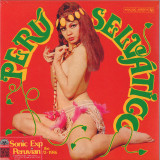
Less than a hundred miles inland from the capital city of Lima lies the great Peruvian jungle, an untamed land of impenetrable forests and endless winding rivers. In its isolated cities, cut off from the fashions of the capital, a unique style of music began to develop, inspired equally by the sounds of the surrounding forests, the roll of the mighty Amazon and Ucayali Rivers, and the rhythms of cumbia picked up from distant stations on transistor radios. With the arrival of electricity, a new generation of young musicians started plugging in their guitars and trading in their accordions for synthesizers: Amazonian cumbia was born.
Powered by fast-paced timbale rhythms, driven by spidery, treble-damaged guitar lines, and drenched in bright splashes of organ, Amazonian cumbia was like a hyperactive distant cousin of surf music crossed with an all-night dance party in the heart of the forest. While many of the genre’s greatest tracks were instrumental, and others were simple celebrations of life in the jungle, the goal of every song was to keep the party going.
Radio stations in Lima remained unaware of the new electric sounds emanating from the jungle, but a handful of pioneering
record producers ventured over the mountain passes to the cities of Tarapoto, Moyobamba, Pucallpa – even Iquitos, a city
reachable only by boat or plane – and lured dozens of bands to the recording studios of the capital to lay down their best
tracks. Although many became local hits, few were ever heard outside the Amazonian region … until now.
With eighteen tracks from some of the greatest names in Amazonian cumbia, Perú Selvatico is both the improbable soundtrack
to a beach party on a banks of the Amazon and a psychedelic safari into the sylvan mysteries of the Peruvian jungle.
Jackson Ryland comes in focused and ecstatic with his first vinyl release under his technoid alias JR2K. Jackson is based in Washington DC as one-half of both Superabundance and Rush Plus. He’s recently released on Peach Discs and Pleasant Life, showcasing his knack for presenting energy as a delicacy. JR2K “Walking Backward” is another illustrious highlight in the savvy DC producer’s already-accomplished underground career. Played on Hör Radio by Kush Jones and supported by Peach, Ciel, Clarisa Kimskii, Ryan Elliott, CMD, Davis Galvin, livwutang, Furtive, Golden Medusa, Lychee, Miley Serious, and Jialing!
The A side opens up whooshy and hard with “ExoGeni Approach”. This illustrates perfectly what I love about Jackson’s style(s)...it sounds like the sickest mid-90s techno track, full of energy and movement while taking in the atmosphere with repose. After the rollercoaster intro, the acidic up-ticks, lush synth layering, and perfectly crunchy closed-hats sink your ass straight through the dance-floor to tumbling free-for-all in the green-screen collage of your daydreams. Wake up…A2 “Call Back” splashes you with a glass of refreshing water…you still got hours at the party, and you’re coming up on some healthE shit…time to get back to that business of dancing your soles and soul away to this driving monorail of euphoric acidic techno. Choo choo choose your own dance destiny, baby!
RC02 is the much awaited vinyl release of the tracks from the second fundraver by Rhythm Research. Showcasing four tracks that offer dark and textured moments courtesy of label artists Surt, Reticent and head honcho Ritual Cycles.
Side A sees the much awaited track "Ten" by Surt on wax featuring his signature cinematic immersive sound. "AT" by Reticent is an imposing sound design journey centered around a spooky pad brought forward by his trademark bass configuration.
The B side is the Ritual Cycles side with "Collapsing Singularity" - a blueprint of a peak time time warping composition. Finally live duo InsideOut close the EP with their spin on "Hot Coal Dance" .
All proceeds go to Lilipad e.V.
Lilipad e.V. is a Berlin based non-profit initiative that aims to facilitate access
to education to underprivileged children. We provide little libraries.
Blue Vinyl
We invite to assist us in welcoming our latest addition to the Sacred Rhythm Music & Cosmic Arts Family. It is with excitement that we introduce to you SORA.
SORA will focus on the likes of deeper, electronic, soundscape compositions; Think more in genres of Joaquin's' widely acclaimed, but now paused Natural Resource, which is the sister label to Spiritual Life Music from back in the mid-nineties to early 2000's.
First up is The Ascension of Light and Wisdom 10 Inch,
Produced and performed by Joaquin Joe Claussell.
On the A Side, we have Subtle Light
Subtle Light provides some organic deepness of which leans more so towards Joaquin's traditional afro Latin influences infused with what we like to call Cosmic Art Trance Music. It is spiritual dance music that up lifting and as usual unique in presentation.
On the be B side we have "Peekaboo Is see You.
Peekaboo Is see You is a deep tech composition that Joaquin has been playing out for quite some time now. Exposed to enthusiastic audiences across the globe, it is a deep bass tech track that is in high demand. We are very excited that finally it will finally see the light of day, all the while spinning on countless turntables globally.
With his third album, The Big Swim, due out in December 2022 on Bongo Joe records, Augenwasser ventures once again into the paths of synth wave exploration with a pop feel. Still laced with the folk textures of his early days, he nevertheless develops a dance approach that can at times be akin to melancholic drone. His music takes you to an imaginary, dark club, lulled by a haunting rhythm, surrounded by the fumes of the night, where it is possible to indulge in that quiet voice that has already confessed that it is too late but will never stop repeating its soft, cold poetry:
red/clear splatter vinyl
Shake Chain will also be performing at Marina Abramovic’s private view at Modern Art Oxford on September 23rd.
Shake Chain have been busy demolishing audiences and expectations for the best part of three years. Vocalist Kate Mahony sets that standard by starting each live performance by crawling from the back of the room through a disbelieving crowd’s legs in a shiny yellow raincoat. The resulting questions that frantically arise of ‘what’s going on?’, ‘am I hallucinating?’ and ‘is this part of the show?’ are hallmarks of how Shake Chain approach making their unruly, lyric-bespattered rock music.
The four-piece from London are completed by Robert Syres (guitar, synth), Chris Hopkins (bass, synth) and Joe Fergey (drums), all artists hailing from Goldsmiths College, Nottingham Trent and Wimbledon, University of the Arts. A mutual love of thought-provoking performance art and a yearning for disruption have helped Shake Chain lock into their wayward sound. Twitchy guitar lines jolt and jerk, synths burble noisily and tack-sharp drums pin things down for Kate’s reeling vocal to vault and slur. Kate’s singing has drawn comparisons with Yoko Ono, Su Tissue and even a seance with it’s unique embrace of flights of atonal fancy, head-first repetition and ecstatic frenzy. Opinion-dividing arguably, but singular in making Shake Chain dauntingly brilliant.
Shake Chain’s debut album ‘Snake Chain’ was recorded in the New Forest’s Chuckalumba Studios early in 2022. The tranquil setting only slightly skewed by the intense extratropical cyclone occuring outside. When asked to sum up the album the group collectively settled on it sounding like “crying in a Catholic sex dungeon with Eastenders on”, perhaps only half tongue in cheek given the soapy dramatics of opening track ‘Stace’. ‘RU’ is a stompy triumph of ad lib monotony, heavy and wonky, its vocal slowly unwinding into residual sense. Shake Chain’s songs are populated with cowboys, cherry-pickers, content-addicts, private investments, a careless driver called Mike, architects and by much lamentation at the state of our confusing existencies. This last point underlined in luminous marker pen with slow-building vortex ‘Highly Conpeptual’ and whispered closer ‘Duck’.
‘Copy Me’ races along with radiant headbangs of dynamic abandon, one part tumble, two parts pummel, “hold your breath til something changes” commands Kate whilst everything of course is in hammering flux. ‘Second Home’ is similarly coruscating yet bouyant, whilst ‘Arthur’ feels like it could tear inside in two amid sobbing wails and the twining of its disparate parts. Throughout all the unhinged freakouts, found sounds and blasting rhythms though is Kate’s questioning, resilient presence, anchoring everything. On bruising creeper ‘Birthday’ she asks most tellingly “Do we speak language or does language speak us? Is there a mouth in the middle of the desert? Do you ask how cups are designed? Would you say yes when you really mean I don’t know”? Shake Chain are cathartic and absurd, humorous and deadly serious yet always inspired. Its this tightrope walk which makes their album such a thrilling, vital listen.
Born in Los Angeles to fourth generation Angelenos, Garrett’s childhood was surrounded by music. The afternoons spent at his uncle’s boxing gym in Montebello introduced him to jazz, and the restaurants he worked in as a teenager exposed him to stars such as Cal Tjader and Eddie Cano. In 1973, Garrett re-emerged in the scene rejuvenated and recalibrated releasing “En Medio” - a singular vision, a multi-genre blend of Latin rhythm, headhunter-inflicted funk, and Arkestra jazz, one that could have only come from LA. Today, Garrett is ready to meet his fans, and make many more, as he wraps up his entry in the Jazz Is Dead series and records new music for the first time in decades.
Orange Vinyl
Born in Los Angeles to fourth generation Angelenos, Garrett’s childhood was surrounded by music. The afternoons spent at his uncle’s boxing gym in Montebello introduced him to jazz, and the restaurants he worked in as a teenager exposed him to stars such as Cal Tjader and Eddie Cano. In 1973, Garrett re-emerged in the scene rejuvenated and recalibrated releasing “En Medio” - a singular vision, a multi-genre blend of Latin rhythm, headhunter-inflicted funk, and Arkestra jazz, one that could have only come from LA. Today, Garrett is ready to meet his fans, and make many more, as he wraps up his entry in the Jazz Is Dead series and records new music for the first time in decades.
From Chile now Rotterdam comes that extraordinary One Lady Rock'n'Roll Orchestra giving you the most obscure Covers of the Cramps, Motörhead or the Drifters, Recorded in Peru and the NL Ladies & Gentlemen welcome to violence, der künstlerischen Gewalt der emotionalen Kraft, Sinnlichkeit und grenzenloser Stärke... Willkommen in der Welt von Bang Bang Band Girl, der allmächtigen ein Damen-Band, die dieses fabelhafte Album komponiert und gassenhauer neu um-komponiert, spielt, singt und produziert. In Chile geboren, dann auf der ganzen Welt gelebt und jetzt im niederländischen Rotterdam heimisch, ist das Album ein echtes Sonic-Meisterwerk, das wie eine Jukebox die grandiosen Hits unseres Bang Bang Band Girl spielt. Eine wild abgespacte Wand aus Fuzz gitarren, Theremin, Reverberation-Feedback und einer warmen, gefährlichen und doch süßen Stimme bringt Ihnen die Hits von The Troggs (Wild Thing) Wanda Jackson (Funnel Of (trash) Love) Hasil Adkins (No More Hot Dogs) Nancy Sinatra (bang bang) Motorhead (the Watcher) The Drifters (Up On the Roof) Dave Diddle Day (Blue Moon Baby) The Heartbreakers (All By My Self) Elvis Presley (Heartbreak Hotel) the Cramps (Call Of The Wighat) alles selbst aufgenommen und gespielt in Rotterdam oder Lima, Peru, ausgenommen Walter Daniels (daddy long legs, Oblivians, john schooley etc) spielt Saxophon in Blue Moon Baby und Veronik spielt das Theremin in Heartbreak Hotel, wir können nur aufstehen mit den Füssen stampfen und laut applaudieren und eine weitere Münze in die Jukebox werfen, nur um in den Tiefen der Nacht zu tanzen. (Frank Zwiler) Vinyl-LP mit DLC, Poster-Booklet-Inlay und Gratistrip ins All, CD in Karton-Digisleeve inklusive 12seitigem Insert, kein Kunststoff bis auf die CD