In a landscape increasingly dominated by surface-level sonics and a lack of true organic – man-made-machine-driven - sound, the newly found and London-based Gaia Tones project rises with an unforgiving grasp over the science of improvisation and mystery. Like a gust of wind from Mother Nature herself, the duo comprised of John Swing and David Soleil-Mon breathe a new, highly perceptible form of life into the UK’s long ‘dub and ‘bass’ dynasty.
Contrary to the consumer plastics found across much of the ‘digital’ musical spectrum, the two artists impose their own vision and aesthetic to a framework of sound that has somehow always existed but never fully explored before. Heady, stoned-out and surely emanating from physical matter, their two debut tracks are set to redefine the standards going into the next decade.
The A-side “Lychees”, stutters its own brand of dread paranoia over a sea of complex, morphing percussion that together create a whole new palette of exploratory sound, loosely tied up into a hazy, nomadic groove. On the flip, “Wonkadonk” feels like its natural extension, evolving that familiarly off-kilter assembly of drums to work around a devotedly dystopian swell of bass that pushes further and further out into the ether.
In the end, the universe tends to unfold as it should.
Label artwork by Egidio Sterpa
A cryptical presence hiding behind many different aliases spread across a range of underground labels: co-owner of LiveJam Records alongside EMG, John Swing begins producing with a live and spontaneous approach that pushes the boundaries and general conceptions of club music while digging deeper into the techniques of the past.
The production process through ananlog equipment that John Swing so strongly supports with an uncompromising attitude is the key to his underground success and esteem.
With a back catalogue of over seventy releases including collaborations with established artists such as Mr. G and Ben Sims, the London based talent has been receiving recognition by established artists including Floating Points, Gerd Janson, Levon Vincent, Theo Parrish and many others.
Inspired by London's Plastic People and it's bonding vibes, through a well refined spectrum of musical knowledge John Swing engages with the dance floor in a physical yet emotional way: the strength and power of pure house is blended with black soul music in a constant crossover between underground aesthetics and cherry-picked funk and disco. His subtle understanding of the dance floor guarantees a deep-rooted experience for the mind, body and soul.
quête:hi tech root
ZamZam 72 comes from one of our favorite producers for the last few years, the elusive Andy Mac. Known in particular for his “Diving Bird” series, a buy-on-sight trilogy of 12”s on Bristol’s Idle Hands, the idiosyncratic producer also has releases on No Corner (in collaboration with Ossia), and the seminal Punch Drunk label. His unique style of chopped, techy, warm, pastoralist dubwise had us from the first, and the tunes he sent us flew through our A&R gauntlet with ease. His are records we return to again and again, revealing more subtlety with each listen, free from genre or tempo constraints.
“Dawner,” the first of two transmissions from Lands End, Cornwall, is a perfect encapsulation of the Andy Mac sound: melancholy yet uplifting, rooted in techno-steppers yet rough-hewn and organic, breezy yet piercingly introspective. Led by a staccato kick and insistent metallic snare, featuring a bubbling Hammond organ lead by Richard Blackbarrow of cult UK Rough Trade band “Bob,” this one shimmers with summer warmth, lens-flare refracting saturated side-light, made for dusk sessions and sunrise sets, preferably out of doors, far from any city.
Layered with field recordings of streams and sea, “Tawny Grammar” is an altogether deeper affair, a dark, hallucinatory journey into the power of repetition in a 140-ish style. Shaker, kick, and hi hat lay the foundation for a looping and loping Binghi drum and guitar chop that begin their journey hacking through a dense undergrowth of sound, only to find themselves ensnared in a web of backwards delays and psychotropic effects that suspend the unwary in a strange tension between minimal and claustrophobic… the dance’s dark beating heart.
Led by Saxophonist Rob Mitchell, Abstract Orchestra have been a consistent presence on the u.k. music scene, touring constantly in the promotion of their debut LP "Dilla" and follow up 45 "New Day feat. Illa J", steadily building a loyal and supportive fanbase. Inspired by the legendary live performances of The Roots with Jay-Z and the 40 piece orchestral arrangements by Miguel-Atwood Ferguson of the work of J Dilla, classic arranging techniques underpin modern loop-based structures, breathing new life into familiar material.
The band itself is based on the classic jazz big band instrumentation of saxes, trumpets, and trombones and features the cream of the north of England's jazz scene who collectively have played with Jamiroquai, Corinne Bailey Rae, Mark Ronson, Martha Reeves, John Legend & the Roots, Roots Manuva and Amy Winehouse.
"Madvillain Vol. 2" follows on from the 2018 release "Madvillain vol. 1" and further explores the jazz, TV soundtrack and film score aspect of the original work, combining it with classic big band writing and a focus on improvisation. As with vol 1. there is a strong influence of Quincy Jones, Lalo Schifrin and David Shire(Composer of the soundtrack to The Taking of Pelham 123) on the album, and the arranger Rob Mitchell crafts his own sound that inhabits the space between Madlib's production and Quincy Jones' writing.
As a bonus track to the album, Abstract reworks Dabrye's 'Air' and have included the original vocal of MF DOOM. Dabrye's original is heavily soaked in synths and drum machines, with an almost sci-fi, Blade Runner or Tron-esque sound . Mitchell explores this further and is influenced by Bob Brookmeyer's late work 'Electricity', which explores synths and jazz orchestration.
Madvillain Vol. 2 will build on the success of vol. 1 which received enormous support from Gilles Peterson & Huey Morgan on BBC6 Music as well as numerous airplay on Worlwide FM and Jazz FM, and reviews from soulbag in France and ukvibe, qwest.tv, and vinyl district online.
Eno Williams, frontwoman of Ibibio Sound Machine, uses both English and the Nigerian language from which her band's name is derived for the dazzling new album Doko Mien. Long lauded for jubilant, explosive live shows, Ibibio Sound Machine fully capture that energy on Doko Mien, the followup to their Merge debut Uyai.
In a glowing piece in the New York Times, those songs were praised for following 'in the tradition of much African music, [making] themselves the conscience of a community.' By pulsing the mystic shapes of Williams' lines through further inventive, glittering collages of genre, Ibibio Sound Machine crack apart the horizon separating cultures, between nature and technology, between joy and pain, between tradition and future. That propensity for duality and paradox seems common in people whose lives span continents.
Williams was born in the UK, but grew up in Nigeria, always steeped in her family heritage. She obsessed over West African electronic music, highlife, and the like, but was equally empowered by Western genres such as post-punk, disco, and funk. The London octet have enveloped themselves in that maximalist quilt proudly since their 2013 formation. Though it can often bring with it news of stress and uncertainty, the modern world further brings all these disparate traditions into connection.
'Everyone has everything now,' says multi-instrumentalist Max Grunhard. 'Everyone has immediate access to every genre, picking things up from everywhere—like magpies.' And while they haven't suddenly left their African roots behind, Doko Mien does find increased representation of English lyrics in the ratio. By sharing more directly with more universal lyrics, the record feels more anthemic, reaching for grander heights.
'We wanted to give people a reason to sing along, to find their soundtrack every day,' Williams says. 'We wanted everyone to feel as if they're part of the music as well.'
Late album highlight 'Guess We Found a Way' addresses the change with a coy smile. 'Guess we found a way to speak to you/ Guess we found a way to say what's true/ To say what's real,' Williams coos over glistening chains of reverberant synth and diamond dust percussion, before returning to Ibibio in the chorus. Perhaps the best example of the group's ability to convey meaning across language and tradition, to blend past and future into a singular present comes on 'She Work Very Hard'. The traditional Ibibio folk tale bobs over the waves of tuned percussion, chunky synth, and pinprick highlife-esque guitar, while Jose Joyette's drums and Derrick McIntyre's bass funk groove bring everyone to the dance floor. 'These stories won't be forgotten. Feel the music: it speaks to everybody,' Williams says. 'We can travel back in time together, while convening on a futuristic, present tense. We hope that we can give people that reason to wake up, that one song to sing and dance and be happy.'
Doko Mien: Tell me everything. On their new album, Ibibio Sound Machine provide the perfect companion, ready to digest as much as possible and then further unfurl beauty and hope. They remember and honor the past and charge forward toward the future, all while intensely expanding the present.
Under the alias Ciel, Xi'an-born/Toronto-based producer, pianist, DJ, and Discwoman affiliate Cindy Li embodies the social conscience of progressive electronic music. She is at once a local and global artist, having flourished at the fringe of cutting-edge club culture since 2015, firmly rooted in her adopted city while reaching increasingly outward, her sets echoing from Berlin’s Berghain to Chicago’s Smartbar to Lisbon’s Lux Fragil. Back in Toronto, she co-runs the label Parallel Minds and event initiative Work In Progress, an extension of her radio show in both name and M.O. to improve female representation in the scene. She’s helped write safe space policies, hosted DJ workshops, and applied activist pressure on promoters through varying methods with a single-minded resolve. Those efforts have evoked responses, which Li has spent time reckoning with over the past two years. Now, manifesting as a self-guided reaction to her experiences as an artist and activist is Ciel’s Spectral Sound debut, Why Me?, a deeply personal and physical work.
Ciel’s stylistic pocket as a producer remains that of “soft-touch slammers,” but fans will note the material on Why Me? hits harder. “I wanted to write something that was heavy,” she says of the title track, the result of processing the noise leveled at her specifically after she amassed a database of female and nonbinary talents to highlight the lack of bookings amongst a subset of clubs in the community. “I was dealing with a lot... anger, despair, paranoia, feeling unjustly targeted.” She channeled these antiphons into her art. The cut’s namesake is sourced from the foregrounded sample, a snippet of dialogue from an old film about a man who believes he’s been abducted by aliens. Pulsing metallic drum patterns steer through the hypnotic passage; permeating beneath the beats are lush pads, washing the rattled urgency with unease.
Hardware-built tracks “Go Fish” and “Uri’s Song” came together over studio time with friend and occasional collaborator Colin Sims aka Wiretapping. Ciel brought her sampler to the sessions, with Sims contributing additional drums, which she’d arrange further at home, adding synth parts and basslines and effects, distilling it all down to its most potent core. The latter track — an effervescent minimal techno exercise both tender and tough — expresses Li’s reflections on today’s cyclical conditions for activism, dissension, and, ultimately, optimism. “These are harsher sounds but they also have elements that are really beautiful about them. I wanted to communicate that nothing is permanent, that there’s always hope for understanding and resolution.”
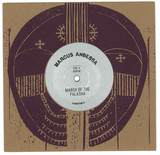
ZamZam 70 is our first team-up with the man of mystery known as Marcus Anbessa. An enigmatic figure whose identity must remain secret for the time being, his infrequent releases on labels such as Lion Charge, Tribe 12, and The Most High (as “Unknown Artist”) are eagerly awaited by those who know, charting an uncompromising vision down a path untrod by the weakheart or the follow-fashion. We love music that builds its own sound world with only passing reference to familiar genres or signposts, music that believes in itself utterly - for this reason we feel genuinely blessed to present these two sides.
“March of The Falasha” is pure roots music that, firmly planted in the soil of dub and sound system, reaches back even further into the mists of time through technological means. Downbeat steppers is the idiom, pure heartbeat is the pulse. Like an old soul young in years but full of wisdom, a distorted flute melody wanders ahead through the undergrowth of bass, light filtering through the ancient canopy above in the form of swung percussion and flickering echoes overlapping and intertwining like vines and creepers weaving on temple walls. Ancient-to-the-future.
“Creator” strikes a different yet equally dread chord, 140-ish post-apocalyptic Rasta business focused squarely on bass and space, hard, insistent drums and infinite echo trails flinging from the snares and percussion, creating hypnotic tracers like sparks swirling heavenward from a well-tended fire in blackest night.
Imagine African Headcharge on Jah Tubbys, or a rootsman groundation resuscitating ancient machines in the crumbling ruins of a near-future world and you begin to see what Marcus Anbessa brings. This music reminds us that nature herself will some day claim Babylon and grind it to dust, regardless of our efforts to save it or hasten its fall.
(Limited edition of 300 copies on clear & black marbled vinyl with full printed sleeve and textured coloured printed insert)
This is the 1st vinyl release on a quiet RIOT, an independent electronic music label based in Scotland.
Following his Interferenza cassette for Osiris Music, Berlin-based sound artist Adam Winchester returns with a new body of work that sees him embracing ever more forthright rhythms while adhering to his established lines of sonic enquiry.
With roots in the Bristol dubstep scene and a long-standing partnership with Christopher Jarman in Dot Product, Winchester has spent the past few years investigating alternative methods of sound generation that deal in hidden electromagnetic frequencies and spectral tones found lurking in circuitry. Bringing these extremities back to a more structured focus, Muutto is a highly personal work that captures the period of transition as he moved from Bristol to Berlin.
While the finely sculpted tonality and artful distortion of his recent work is plain to hear throughout, Muutto is also grounded in arrangement and melody, weaving a tangible narrative that pivots around steely rhythmic architecture, nodding to his roots in club music without expressing anything explicitly 'dancefloor.' Even at its most physical, as on the weighted march of 'Hold,' the emphasis is on atmosphere and mood, no matter how heavy the drums fall. In the distant murmurs of pads and poignant vocal threads, the bittersweet emotional backdrop to the record comes through in abundance.
There's space afforded for the more avant-garde tendencies in Winchester's music too. 'Metaphors' is caked in guttural feedback that comes on like a particularly noisy Albini studio session strapped to a chassis of the swampiest blues rock lurch you're likely to hear all year.
In its needlepoint detail, broad scope of sound palettes and potent expression, Muutto is an accomplished offering, but more significant is the way these facets are bound together by immediacy and form that transcend the freeform experimentation many of Winchester's traits are drawn from.
'a quiet RIOT' is an electronic music label based in Livingston, Scotland orchestrated by Nomad and is the sub-label of the highly renowned 'RIOT Radio Records.'
Since 20th February 2015, Nomad has run his own very successful fortnightly internet techno radio show called the "RIOT Radio Show.' Each show has a resident warm up set then a further hour with a wicked guest, the majority of whom are among the world's top electronic artists. The show gets thousands of listeners on each transmission with every set recorded exclusively for it. You will not hear them anywhere else.
A hoard of very well-known and simply stunning acts always feature on the show along with a whole host of very talented local music makers.
This was the build up to the record label being launched in April 2016 that will show-case major acts and amazing local talent.
Headz up! Guti's current club cutter 'Red Eye' continues to wriggle and writhe its way hypnotically into our sets and psyches with these two crucial versions from one of house and techno's most respected gentlemen... The one and only Kenny Larkin.
Weighing in at a combined length of 20+ minutes, both remixes capture the Detroit legend at his deepest and most cosmic with his hands glued to the dials. Not just part of the biggest single from Guti's 'Year Of The Conga' album so far, they also tell a unique tale of their own...
These mixes were originally meant for the full release earlier this year, alongside killer mixes from Loco Dice and Priku. But when Larkin received a shiny new Moog One he rang Guti and label bosses the Martinez Brother and told them that they'd have to wait... He was about go back in with a whole new modular perspective.
You can feel it, too; that deep throb on the subs and trippy psychedelic swirls of his 'Black Eye' mix and that wobbling voluptuous bassline in his 'Pink Eye' mix are just two examples of Kenny's attention to sonic detail and pure analogweight on these two immersive, alluring remixes.
Well worth the wait, and another precision chapter to the beautiful back-to-roots adventure that is Guti's third artist album 'Year Of The Conga', don't sleep on these... They're going out strictly as Record Store Day specials. Vinyl crew, this one's for you.
Production duo Computa Games take the most slamming synth bass, the crispest drum machine hits, and the overall classic vibes of 80's dance-funk tunes to new aural heights. Sculpted using the best modern studio techniques, the 'Cosmic Dispatch' EP fuses funk, disco, soul and electro to various combinations, fitting the feel of the classiest nightclub or the grittiest backyard party. Each individual tune on the EP pairs with a unique vocalist or collaborator, as the project features guests Lovechild, B Bravo, Jackie Rain, NATALITA, and E. Live. There is something killer and personalized on this EP for every type of dancer, funkster, and headnodder around.
The Computa Games project is the product of the combined efforts of Martin Arceneaux and Chris Arenas. Joining their deep roots of live funk, electronic/live production and DJing, they formed in the fall of 2012, and quickly released two singles on the Supermart Produce label. The two debuted their live set at Monarch in San Francisco, with follow up performances at SXSW in Austin, and Tipitina's New Orleans. The group's third single "Rock Creek (Revenge)" was released exclusively on Beatport, where it was a featured track on the site's Funk/R&B page and stayed in the Funk/R&B Top100 for nearly 2 months, peaking in the top15. The group then released the "Grand Design" EP in September 2013 on Super Mart Records, followed quickly by a remix of The Pendletons single "Let Me Turn You On" featuring K-Maxx, and then a remix of New Orleans based funk band Galactic's "Heart Of Steel', featuring the legendary Irma Thomas. In October of 2015 Computa Games released their first vinyl 7' on ABC records with 'Do Your Thing' featuring K-Maxx b/w 'Feel Right 2Nite' which promptly established them in the burgeoning modern funk scene. Their follow up 7' was released in January 2017 with the single 'Computer Rock' b/w 'Computer Rock (West Coast Remix) on the New Orleans label Super Jock Records. Computer Rock garnered the duo more accolades with critics and fans alike.
Khaliphonic 11 Is A Truly Epic Release From One Of Our Most Prolific Artists, Brendon Moeller Aka Echologist, Aka Beat Pharmacy. In Just The Last Two Years, Moeller Has Released On Labels As Varied As Echocord, Silent Season, Kynant, And Rohs!, To Name Only The Most Well-known. Recognized Globally For A Singularly Organic And Dubwise Approach To Techno, We Are Proud To Have A Close Working Relationship With An Artist Who Coaxes Humanity And Warmth From Machines Like Few Others. The Dub Purpose Ep Is One Of His Finest Achievements.
As We Planned A Third Zamzam Release From Our Favorite Well Of Hardware Sonics, Four Tracks Emerged As Comprising A Set That Simply Did Not Want To Be Separated. The Four Tunes That Make Up This Ep Felt Like Chapters In A Single Gorgeous Narrative, And So A 12' Was Born.
We Asked Brendon How Dub Influences His Process, And What This Ep Specifically Is About. He Replied:
"dub Facilitates Whatever Vision I Have With Music, Which Is One Of The Reasons I Incorporate A Dub Approach In Everything I Do. Whether Infusing Nyabinghi Rhythms With Epic Strings, Roots Dub With Industrial Dread Or Grungy Modular Antics With Stepping Vibes, Dub Is The Glue That Keeps It Together. The Inspiration Behind These Tracks Are On-u Sound, Wordsound And Bill Laswell, Travellers Who Understood The Possibilities Of Dub."
The Dub Purpose Ep Does In Four Tunes What Many Lps Struggle To Do In Eight - It Builds A Cohesive Narrative Arc That Moves From Menace, To Exploration, Through Mystery, Closing With Beauty. And Just Wait Til You Hear It On A Proper Sound...
Mastered By Sam Precise.
As humans living on the planet today, we have become so removed from our original, natural habitat—the forest—that we forget our wild roots, our primal, animal origins. Music is one of the things that can bring us back to that place, that can put us in contact with a felt world of instinct, immediacy, and presence: a world where language and the problem-solving mind are not needed, where the music keeps your mind and body in the present moment, and the point of dancing becomes the dance of our inner wildness and animality itself. Hans Berg's Sounds of the Forest Forgotten affirms that music can bring us to a state of mind and body that can help us feel what we've forgotten from the forest. The overlaying project of the album is to conjure musical and conceptual resonances between mysticism and nature, summoning the incredible depth and force of nature that we usually miss, especially living in contemporary urban cities. Sounds of the Forest Forgotten channels the creativity, playfulness, and freedom of a life both before and beyond ours through the sounds of analog and digital synthesizers, a modular system, drum machines, and computers. Recorded between Hans's studios in Berlin and on the Swedish countryside, the album similarly shuttles between contemplative and ecstatic, between delicate and powerful, mixing sublime psychedelic techno compositions like 'Emerald Sea' with acidic dance-floor bangers like 'Storm' and 'Milk Thistle,' all nestled between contemplative and textural ambient compositions like 'Butterfly' and 'Glow Worm.' Berg is known for his enthralling productions and energetic livesets that capture dance floors with his particular brand of hypnotic techno, replete with angular lines, affecting melodies, pulsating basslines, and big drums. He also produces atmospheric scores and ambient soundscapes to accompany the video art and installations of long-term collaborator and celebrated artist Nathalie Djurberg. Berg's live sets have found a home in nightclubs around the world, with recent gigs in Berlin, Stockholm, New York, Tokyo, and Melbourne, to name a few. In addition to 2MR, he has released his solo work on record labels including Ian Pooley's imprint Montage, Klasse Recordings, and The Vinyl Factory. His ongoing collaboration with fellow Swede Johanna Knutsson - as Knutsson/Berg - has led them to start the label UFO Station Recordings, on which they release their own material. The duo also has released on labels such as Idle Hands, Default Position, Kann, and Random Island.
Heavy-weather, beyond-good-and-evil soundsystem poetics, channelling raw and rootical techno, Isolationist abstraction, and dub at its most turbulent and raw-nerved and space-time-warping. New worlds ahead... Equal parts tuff, tail-thrashing dancehall pressure - see 'Hell Dub' - and art-of-darkness ambience and introspection, culminating in the slow-burning, third-eye-opening 23-minute dreamweapon, 'Vertigo'. Part of the Young Echo crew, Ossia embodies the best tradition of Bristol underground music in that he doesn't pay much mind to tradition, just does his own thing. Yes, Devil's Dance shares DNA with those sullen masterpieces we will always associate with the city, from blunted 90s street-soul/hip-hop to sub-loaded dubstep - but like his forebears Ossia is ultimately a mongrel breed, drawing from his own, very contemporary and idiosyncratic well of influences: grime, jazz, steppers, dub, post-punk and industrial abrasion, concrète minimalism... Devil's Dance could easily be not just a forbidding, but a suffocating proposition. But even at its most angst-ridden it feels lithe and aerodynamic, its darker impulses both intensified, and offset, by a pure soundboy's delight in detail and colour and higher dancefloor mechanics. The music pulses with energy, a fever to communicate...and Raki Singh (violin), Jasmine (vocals) and Ollie Moore (saxophone) add vivid flesh-tone to the punishing, plasmic electronics. The record was mixed at an infamous, subterranean Bristolian recording studio, using an arsenal of spring and plate reverbs, modded pedals, tape-delays and compressors: systems of black magic crucial to the album's intense presence and physicality and carefully modulated dread. In the end what we are witnessing, and experiencing vicariously, is a purging, an exorcism: find the devil, dance with the devil... and then chase, chase, chase him out of the earth
Visions Recordings is happy to welcome the Italian trio Jaxx Madicine for a single with two jazz/house influenced tracks aimed for the dancefloor with enough music and fat beats to make you wanna fly and dance .Their specific mix of vintage and modern sounds keep the bouncy feeling that deejays love to play in their sets . Round bass, Fender Rhodes , piano and warm keys are the ingredients to this delicious meal we invite you to share with us.
The name Jaxx Madicine suggests a wide range of influences - 'Jaxx' obviously being a tilt of the hat to the original rhythms and basslines born out of Chicago house while the 'XX"s suggest a keen passion for jazz.These are the two main ingredients used by the projects founders Turbojazz and Parker Madicine, who are joined by the talented and mysterious Veez_0 - a young Italian piano player that you're bound to hear more from in the near future.Turbojazz plants his roots in the rhythms and futuristic sounds of the Broken Beat golden age while Parker Madicine leans more towards the sounds and timbres of Detroit's spacey atmospheres. These two musical worlds are married by Veez_o's incredible playing and harmonic backing. To get a proper idea of what this is about you should consider George Duke in his peak cosmic period jamming in a studio with 'High Tech Jazz"-era Underground Resistance before joining Pete Rock for dinner and then heading to a Roy Ayers concert. Absolutely delicious !
2019 Repress with alternate label-art.
Seattle's Chris Roman returns after his amazing release on little sister label Harbour City Sorrow. Again he drops his signature Miami rooted beats for an EP that will make any floor rock. Sculpting hi-tech electronica with loud pads, big strings and precise rhythm programming. The Submanouvers EP is no sissy copycat electro but a powerful record with his own unique signature style. Two Fourteen is no joke!!
Cin Cin opens it's 2019 account with the inspired pairing of Joe Goddard and Kiwi.
A production 'tour de force' over the last decade, Joe Goddard has had his fingers in many pies (Hot Chip, The 2 Bears, Greco-Roman Soundsystem to name but a few) but it's on this Cin Cin debut that he bares his solo chops and delivers something for the floor. The darker roots of acid house are channelled on 'Jack Come Back', with a rubbery bassline and churning keys loaded over the vintage drum machine rhythms as the deviant vocal calls out the track title. 'Moebius Trip' takes a headier journey through wave upon wave of melodic modular synthesis and crumpled beats, with a nod to Detroit's techno-soul heritage, whilst packing a punch with the energy levels.
New York residing DJ/Producers John Barera & Will Martin update their longstanding body of collaborative work with their first 2MR release since last year's exceptional 'Proceed To The Root' sophomore album... And it might just be their best work to date. Continuing the celestial theme of their last EP 'History Of Space'; the EP is the result of a whole new writing technique and heller time spent jamming on Will's Chroma Polaris synth. Comprising four tracks that simply ooze machine soul and loose-limbed groovemanship, 'Life, The Heavens & The Earth' is an ageless document that digs deep into the foundations while staring out into the cosmos. The tone is set by 'The Meaning'. Outer planetary electroid savoir faire; its crisp breaks are countered by the bulbous textured bassline throughout. It's followed by the title track 'Life, The Heavens & The Earth'; a spatial excursion built around a classic break and coloured with poignant arpeggiated cascades. Deeper into the EP we glide to strike warehouse gold on the venomous acid of 'In The Depths Of Madness', a layered analog jam that writhes and slinks dynamically in the spirit of Pierre, before closing with a track the duo feel is their most accomplished composition to date: 'Searching For Time'. Not just a title we can all relate to but a poignant emotional workout that touches your soul in the same way you first heard the instrumental of Information Society's 'Running'. Beautiful emotive electronica from a duo who keep getting better with every release. The journey to the root continues....
Jabal is the title of the forthcoming release by Kendojubaki and Dj Ali through Berlin based Label 'Live From Earth'. The release is the second instalment of the labels Live From Earth Klub series.
'Jabal' translates to mountain in Arabic. It is also where the two artists roots trace back to in their home country of Lebanon. The listeners receive a glimpse of the socio-political issues surrounding the jabal areas across Lebanon through unique sampling
KendojubakiKendojubaki is the pseudonym of Adam Rajab, an Australian-Lebanese Sound Designer and producer currently based in Melbourne. As the son of Lebanese refugees he spent parts of his childhood working in his parents Middle Eastern supermarket. In times of recreation he and his relative Ali would pretend to be an Arabic wedding band playing the tabla and the mijwiz to imaginary dabke dancers.Hatched from these activities and through years of back-and-forth between e Middle East and Australia, Adam has captured a unique sound-language which amalgamates traditional sounds of the Levant with modular synthesis, drum machines and industrial elements of unrelenting vim. His thematic music dwells on commonly unfair socio-political issues surrounding the east and the west, displacement and identity.
As a Dj Kendojubaki's sets are filled with long Arabic intros, old school hardcore rave tracks and tempos above 140. In his own productions and live sets, kendo recombines his sound design influence into powerful and cathartic riddims, along with thick echoes un-natural like drums.
Dj Ali Dj Ali is the stage name for Ali Chahine, an Australian-Lebanese live hardware act currently based in Melbourne, Australia. In his productions, Ali fuses sounds from his archive of field and foley recordings along with 90's hardcore rave melodies to create an emotive flow of fast techno music.As the son of Lebanese refugees, Ali also shares stories of conflict and socio-political issues through his music and art. In 2018 Ali joined the collaborative label 'Al Gharib' with relative Adam Rajab who is most commonly known as 'Kendojubaki's'. The two are collaborating on a 12' release named 'Jabal' in December, released through Berlin label Live From Earth.
Domestic Exile are proud to present the devastatingly deplorable and malevolent recordings (that are sure to corrode yet electrify your ears) by Glasgow's very own KLEFT.
KLEFT aka Vickie McDonald is rooted in and has actively propagated the underground DIY radical queer punk and feminist movement here in Glasgow. Their projects have included the skull crushing sludge doom of Cartilage, the unflinching and infamous multi- membered hard core stars that were DIVORCE and the sacrificial, druid drone glitch of MOURN. Alongside these projects they have uncompromisingly disrupted, motivated and facilitated collective endeavors to take down the capital power structure of the dominant system of patriarchal club venues and abhorrent fuckers in this town.
For this record 'H+ Sexualis', KLEFT explores the neo-modern space where flesh is left behind. Negotiating, analyzing and tearing to shreds the relationship and balance between flesh and technology. KLEFT's expansive and palpable sonic offerings delve into themes of transhumanism and body hacking and seep into our collective skin begging the question; can flesh ever be created digitally. Does a lack of physicality alienate human experience in a post transhumanism society Are we all destined to be skinless yet digitally connected Will the body become superfluous Toward "the utopian dream of the hope for a monstrous world without gender," as stated on Donna Haraway's essay ''A Cyborg Manifesto.'
From the opening track 'Ossein' the listener grasps a foreboding lethargic build up, lurking out of the spatial ritualistic shadows into a sea of suffocating nothingness. A void where there is no gravity. Skeletal and brittle shattering rhythms which echo DMZ / Skull Disco dubstep alongside the more frozen, glacial ominous explorations of grime are often felt proving KLEFT is an artist whose inspirations run deep and wide and generally exist in the darkest recesses of our subconscious. These fearful, disjointed rhythms are set against weightless atmospheric oscillated synths, as if roaming through bleakly opaque, claustrophobic narrow corridors on a first person survival horror video game such as Resident Evil.
Moving through to 'CMBR', KLEFT's dissonant, degrading soundscape ferociously ascends. The resilient kick drum is propulsive and pulverizing akin to 'ardcore tekno - or intense gabba if you have the guts to adjust the tempo up to +8 - aesthetics that overwhelm and agitate finally revealing it's grotesque biological / amorphous bio structure. Elevating the repetitive 4/4 kick to a destructive, distorted banger of a track as layers of converging atonal noise and sound design simultaneously further enhances the sense of imminent radioactive contamination.
Next is 'Writhe, Squirm, Broken' continuing the convulsive, nauseating permutations of the prior track but reconfigured like a mangled, gruesome Cronenberg-esque parasite that has infiltrated an open wound, excruciatingly feeding off of the inner anatomy of it's hosts body from within. Repulsively reformulating the shape and dimension. The intro is akin to a panic stricken bouncy ball contracting and expanding, the spring reverb building momentum and traveling further away in distance and speed.
'Hackfleisch Deluxe' is a muuurrderous stomper and is one of the more grime / bass orientated tracks that deconstructs and disrupts the tempo familiar to sub-low producers on Black Ops / Jon E Cash / DJ Dread D. The crawling, plummeting frequency of the synth is a nauseating rush of coagulating blood to the heed; a deep throbbing sensory depravation in sharp, paradoxical contrast with the driving harmony layered on top which proves to be infectiously addictive. Furthermore are splintering programmed vocal samples that gives a sense of artificial disorientation, mind over matter, a possible hint at our evolving sentient cognition within a nightmarish simulated, augmented reality
Second to last we have 'Keratin' which is filled with the near fatal dissolving thud of Djax-Up acid that gives the impression that you're a biologist peering through a microscope into a petrie dish and witnessing the rapid and furious genetic cellular replication of bacterial and viral organisms.
Culminating in 'Bruised and Bleeding Hands' where the squashed density of a deflated and depressurized helium filled balloon and elastic umbilical cords, barbed wire and copper wires grind n' coil around the lens of a zooming camera. Taking no prisoners, this is a punishing grime weapon. A phat, surgical kick drum bulldozes its way thru causing carnage, syncopated punching snares after every rave stab and dizzying third beat. It won't be long until ye hear this on Silver Drizzle's youtube channel in the near future.
This record transports us to the hyperkinetic mutation scene on the cult cyberpunk film Tetsuo The Iron Man where the organic flesh / mechanical rust of the Iron Man metamorphoses with the Metal Fetishist during the rebirth sequence and we say 'LONG LIVE THE NEW FLESH!''.
Brainchild of Multi Culti A&R, Sascha Funke and Niklas Wandt were introduced by Dreems, who charted a course for the seasoned Berlin-based producer and funky multi-percussionist and singer.
Wandt was just about to enter the scene forcefully with his collaborative 2LP with Wolf Müller and the debut single of his band Neuzeitliche Bodenbeläge. In the icey cold of his warehouse rehearsal space, Funke had him record a variety of slapped, bowed and scratched percussions (congas, talking drum, prepared cymbals played with a bass bow) over his tracks. These first efforts were later expanded into joint sessions at Sascha's home studio and, within a few weeks, the journey reached it's destination: Wibe strasse, Deutschland.
At first glance, they seem an odd couple: a techno veteran of almost thirty years meets a side-burned upstart socialized in Free Jazz and Krautrock. But the shared sonic influences come through in the hypnotic, dubbed-out sound, perhaps rooted in the close connection the two share to the Rheinland region in West Germany, Funke as part of the Kompakt family and Wandt by origin and socialization in the Cologne and Düsseldorf music scene centered around the Salon des Amateurs. Regional flavours, global appeal.
Multi Culti, promoting local collaboration, one freaky record at a time.
Lost Futures is a new label that explores experimental and often radical approaches to dance music from the past. In a musical landscape that increasingly claims to seek and reward new forms and ideas, Lost Futures delves into the recent past to revisit forward-thinking, optimistic projects that, owing to the social, musical or outright political climate, perhaps struggled to find an audience. Allowing only time to re-contextualise these leftfield, sometimes misunderstood and ultimately human bodies of work, Lost Futures taps into the inherent idealism of rave.
LF001 trips back until the early nineties to revisit the alternative scene emerging from the Dutch city of Utrecht. Here, three young men - DJ Zero One (Sander Friedeman), TJ Tape TV (Arno Peeters) and DJ White Delight (Richard van der Giessen) - joined forces to form 'The Awax Foundation'. Inspired by the transcendent and revolutionary electronic music arriving on their shores imported from Chicago and Detroit, combining their knowledge, gear and ever-expanding vinyl collection allowed additional freedom in paying sincere tribute to these intoxicating sounds, while also developing their tastes in a more personal, eclectic direction.
The musical flavours of Awax initially leaned toward acid house and the roots of techno. However, with three different mindsets in the mix, their tastes were rarely fixed. One thing each shared in common was a devotion to collecting rare sounds, specifically more adventurous and international samples than those emanating from the increasingly-hard, masculine dance music emerging from the Netherlands during the period. Inspired by the cross-over global sound of bands like Suns of Arqa, or 'World Music', as it was perhaps patronisingly termed at the time, the trio became interested in the idea of making techno with 'ethnic instruments'.
Of course, this being 1992, none of The Awax Foundation had access to such instruments, instead, they had a vast, collective library of samples from all over the world. There were no collaborations and no clear plan. Instead, they set to work using a Yamaha TX16W sampler, the legendary Atari 1040ST computer, a cheap mixing desk and a couple of low-end synths and FX machines. When Richard mentioned the project to his friend, Akin Fernandez, the London DJ and owner of cult label Irdial Discs, Fernandez was intrigued enough to invite the trio to record a one-hour show for his 'Monster Music Radio' series on London's then-burgeoning Kiss FM.
Forced to come up with a name, 'CultureClash' seemed like the obvious choice, even if the members of Awax were only creatively sparring among themselves. Along with the term 'ethno-techno', slightly dubious to a hopefully more conscious Western audience in 2017, these were the only guiding principles to the quietly ambitious project that soon combined cutting-edge machine rhythms with samples sourced from everywhere from Bolivia to Togo, and inspired by everything from Ravi Shankar's epic soundtrack to the Oscar-winning movie Ghandi, to the technical limits of their own setup requiring a dazzling degree of cut-and-paste work. Some tracks even emerged out of academic studies within the ethnomusicology department at The University of Amsterdam.
The show aired on October 2nd, 1992, recorded in one blistering take and without any rehearsals, traversing a huge variety of tempos and styles. If the performance wasn't seamless, it was undeniably thrilling, fresh and ambitious. As such, several labels, including Fernandez's aforementioned Irdial Discs expressed an interesting in commercially releasing CultureClash, while another imprint proposed a series of twelve-inches and an album. But the sheer complexity of the project meant that it never saw the light of day, while the trio embarked on different journeys ahead, both creative and personal.
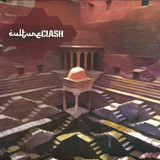
Twenty five years later, and the original CultureClash lineup and founding members of The Awax Foundation provide the sound of the first release from Lost Futures. An otherworldly, ambitious and optimistic compilation, accompanied by extensive sleeve notes from the trio, CultureClash is a timeless ode to experimentation in dance music's ever-overlapping culture.